Reading view

Curve DAO Token (CRV) Price Prediction 2026, 2027-2030: Can CRV Break Its Long-Term Range?

Curve DAO Price Prediction

The post Curve DAO Token (CRV) Price Prediction 2026, 2027-2030: Can CRV Break Its Long-Term Range? appeared first on Coinpedia Fintech News

Story Highlights

  • The live price of the CRV token is  $ 0.25733947.
  • Price predictions for 2026 range from $0.45 to $3.00.
  • Curve Dao (CRV) could extend toward $8.00 by 2030, if recovery structure holds.

Curve DAO (CRV) is entering a technically sensitive phase where its role as a core DeFi liquidity protocol contrasts sharply with a price structure that has spent months compressing near long-term support. With 2026 already underway, CRV’s price behavior is no longer defined by aggressive downside extensions but by controlled ranges, contracting volatility, and repeated defenses of demand conditions that often precede a broader trend transition.

Fundamentally, Curve continues to sit at the center of decentralized liquidity infrastructure, particularly across stablecoin and low-slippage markets. While price action has lagged this relevance, the technical structure is beginning to reflect stabilization rather than decay. As the first quarter of 2026 unfolds, the market is closely watching whether this prolonged consolidation evolves into a sustained recovery phase or remains range-bound for longer.

Curve DAO Token Price Today

Cryptocurrency Curve DAO Token
Token CRV
Price $0.2573 down -0.48%
Market Cap$ 376,409,206.76
24h Volume$ 76,267,678.6033
Circulating Supply1,462,695,186.9619
Total Supply2,350,432,173.8907
All-Time High$ 60.4988 on 14 August 2020
All-Time Low$ 0.1811 on 05 August 2024

Curve Dao (CRV) Price February 2026 Outlook

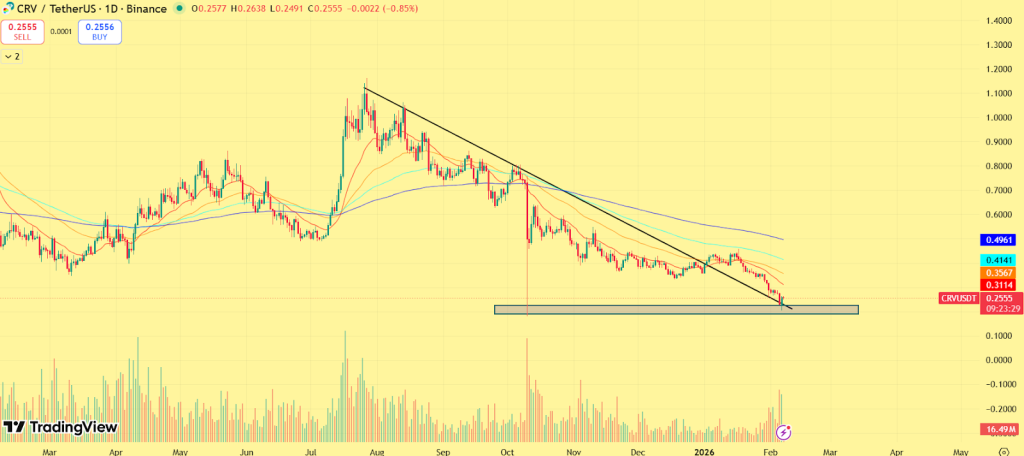
Through February, CRV has continued to trade above its $0.22–$0.25 demand zone, a region that has repeatedly absorbed selling pressure since late 2025. Price remains compressed beneath overhead resistance near $0.35–$0.40, forming a tightening wedge on the daily timeframe.

This behavior suggests that bearish momentum is fading, even though bullish follow-through remains gradual. As long as CRV holds above its rising support trendline, downside risk appears limited. A decisive daily close above the $0.40 region would be a technical signal that accumulation is giving way to early expansion, while failure to break higher would likely extend consolidation without invalidating the broader setup.

Curve Dao (CRV) Price Prediction 2026

As 2026 progresses, the focus shifts from whether CRV can hold its base to whether it can begin reclaiming higher structural levels. On higher timeframes, CRV appears to be forming a rounded accumulation zone following a multi-year downtrend, an environment typically associated with longer-term reversals rather than short-lived relief rallies.
Curve Dao (CRV) Price Prediction 2026

If momentum gradually builds, CRV could start challenging intermediate resistance near $0.85, followed by the psychologically important $1.60 zone. These levels align with prior consolidation ranges and would likely attract profit-taking along the way. However, sustained acceptance above these areas could open a path toward the $2.40–$3.00 region before the end of 2026. Pullbacks toward $0.50–$0.65 would remain constructive as long as higher lows continue to form. A breakdown below long-term demand would delay the bullish outlook but would not automatically negate the broader recovery thesis unless followed by sustained weakness.

Curve Dao Crypto Price Prediction 2026 – 2030

YearPotential Low ($)Potential Average ($Potential High ($)
20260.451.753.00
20271.502.004.50
20282.104.106.00
20293.406.007.20
20304.806.508.00

Curve Dao Price Prediction 2026

In 2026, Curve Dao price could project a low price of $0.45, an average price of $1.75, and a high of $3.00.

Curve Dao Price Forecast 2027

As per the Curve Dao Price Prediction 2027, Curve Dao may see a potential low price of $1.50 . Meanwhile, the average price is predicted to be around $2.00. The potential high for Curve Dao price in 2027 is estimated to reach $4.50.

Curve Dao (CRV) Price Prediction 2028

In 2028, Curve Dao price is forecasted to potentially reach a low price of $2.10 and a high price of $6.00.

CRV Price Prediction 2029

Thereafter, the Curve Dao  (Curve Dao) price for the year 2029 could range between $3.40 and $7.20.

Curve Dao Price Prediction 2030

Finally, in 2030, the price of Curve Dao  is predicted to maintain a steady positive. It may trade between $4.80 and $8.00.

Curve Dao Price Prediction 2031, 2032, 2033, 2040, 2050

The long-term projection assumes Curve Dao sustains relevance in enterprise blockchain use cases, with growth moderating over time as the asset matures.

YearPotential Low ($)Potential Average ($)Potential High ($)
20315.207.409.00
20326.008.6010.80
20337.0011.5013.50
204019.0025.0032.00
205035.0048.0070.00

Curve Dao (CRV) Price Prediction: Market Analysis?

Year202620272030
Changelly$2.40$3.80$6.50
CoinCodex$1.90$3.50$7.00
WalletInvestor$2.00$3.60$6.40

CoinPedia’s Curve Dao Price Prediction

Coinpedia’s price prediction for Curve DAO’s in 2026 and beyond hinges on whether its extended base structure transitions into sustained upside momentum. While CRV may not deliver rapid price acceleration, the current technical setup favors gradual recovery over continued decline. If broader DeFi sentiment improves and CRV maintains its higher-timeframe support zones, the token could steadily work toward multi-dollar valuations over the coming years. Failure to reclaim key resistance levels, however, would keep price action range-bound and delay the recovery cycle.

YearPotential Low ($)Potential Average ($)Potential High ($)
20260.451.753.00
Never Miss a Beat in the Crypto World!

Stay ahead with breaking news, expert analysis, and real-time updates on the latest trends in Bitcoin, altcoins, DeFi, NFTs, and more.

FAQs

What is the Curve DAO Token (CRV) used for?

Curve DAO Token (CRV) is used for governance, staking, and boosting rewards on Curve Finance, a leading DeFi protocol for low-slippage stablecoin trading.

What is the Curve DAO price prediction for 2026?

Curve DAO price prediction for 2026 suggests CRV may trade between $0.45 and $3.00 if long-term support holds and DeFi demand improves.

What is the CRV price prediction for 2030?

CRV price prediction for 2030 estimates a range between $4.80 and $8.00 if Curve continues serving as key liquidity infrastructure in DeFi.

What factors will influence Curve DAO price long term?

CRV’s long-term price depends on DeFi adoption, stablecoin growth, protocol revenue, governance activity, and broader crypto market cycles.
20% Bounce and an ETF Filing: Why ONDO Price is Separating from the Crypto Pack.

SEC Ends Two-Year Probe Into Ondo Finance

The post 20% Bounce and an ETF Filing: Why ONDO Price is Separating from the Crypto Pack. appeared first on Coinpedia Fintech News

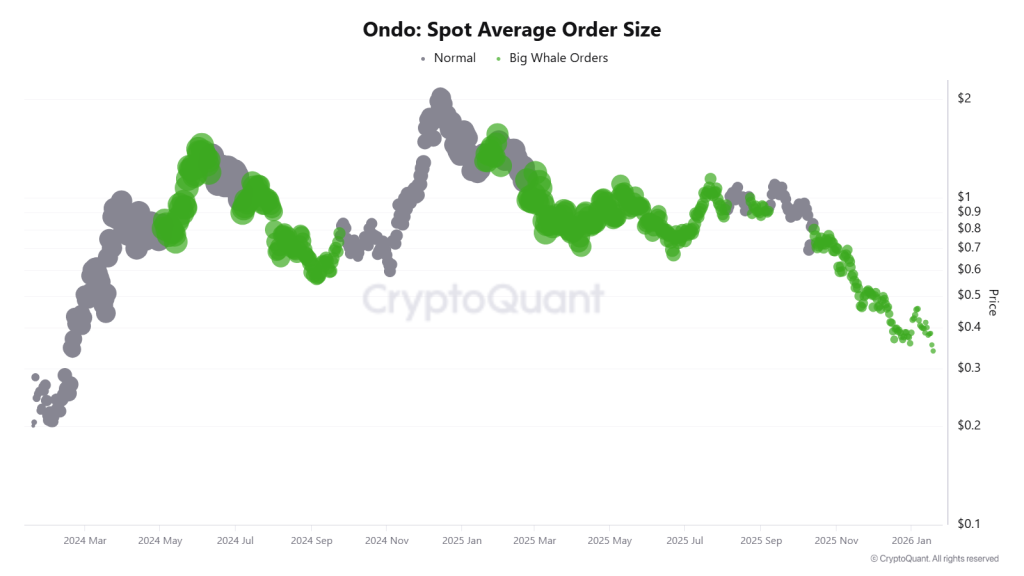
ONDO price is hovering around $0.2539, up roughly 20% from its recent $0.2017 low, and the timing isn’t random. While broader markets remain choppy, Ondo Global Markets has already crossed $10 billion in cumulative volume since launch, a detail that cuts through the noise faster than most price charts do.

And yes, that matters. This isn’t about vibes or speculative excitement. It’s about usage. Tokenized RWAs are still the fastest-growing corner of crypto, mostly because they do something radical: they work. Global access, smoother settlement, fewer intermediaries, these are the unglamorous stuff that institutions actually care about.

$10B Tokenized stock volume highlights structural growth

Since launch, Ondo Global Markets has pushed past $10 billion in total volume. That number doesn’t come from retail gambling on memes. It comes from tokenized stocks and structured products steadily finding demand.

Tokenized stocks keep growing.

Since launch, Ondo Global Markets has surpassed $10 billion in total volume.

Tokenized RWAs continue to be the industry's fastest growing sector, unlocking global access to the world's largest markets. pic.twitter.com/PxzB8fqCto

— Ondo Finance (@OndoFinance) February 5, 2026

Well, here’s the kicker: tokenization isn’t just a crypto buzzword anymore. It’s becoming financial plumbing. Industry commentary continues to frame tokenization as a way to make markets faster and more efficient, cutting down friction that traditional systems still haven’t solved.

So when volume keeps stacking up, it signals something simple and that is Ondo isn’t being “tested” anymore. It’s being used.

Institutional Commentary Reinforces Efficiency Narrative

Meanwhile, tokenized US stocks and ETFs are now live inside MetaMask with ONDO infrastructure doing the heavy lifting. That’s not cosmetic. It drops tokenized assets directly into one of the largest self-custody wallets in the market.

But let’s be real. Accessibility is only half the story. Trust is the other half. And this is where institutional behavior quietly enters the frame.

An asset manager has taken another formal step toward launching an exchange-traded product tied to Ondo by submitting an amended S-1 filing. No approvals yet. No victory laps either. Still, the filing keeps the process alive and confirms that tokenization-focused products are staying on regulatory radars.

Goldman Sachs on tokenization:

“Tokenization has the potential to really improve operational efficiencies.”

What the ONDO Price Chart isn’t Saying?

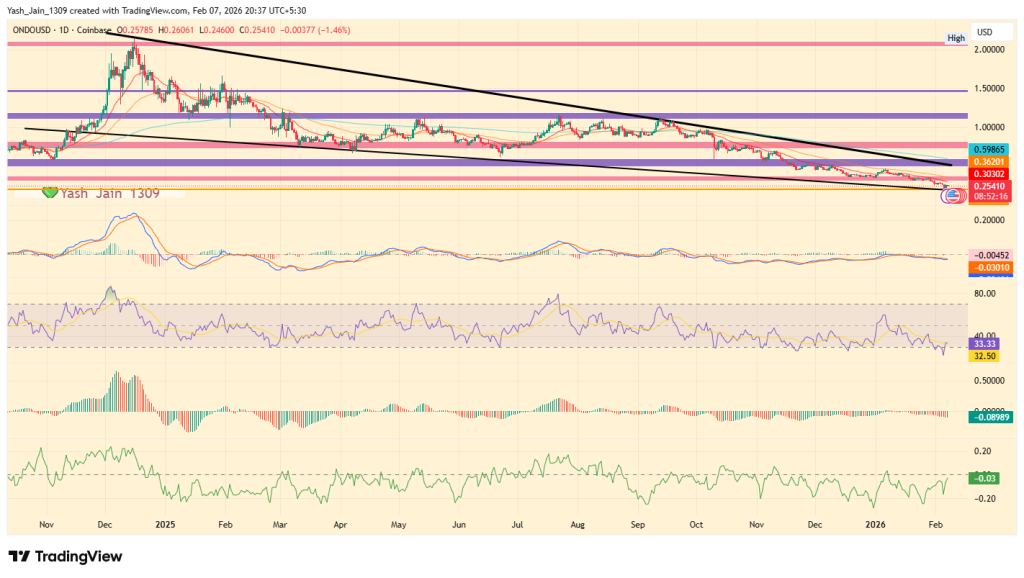
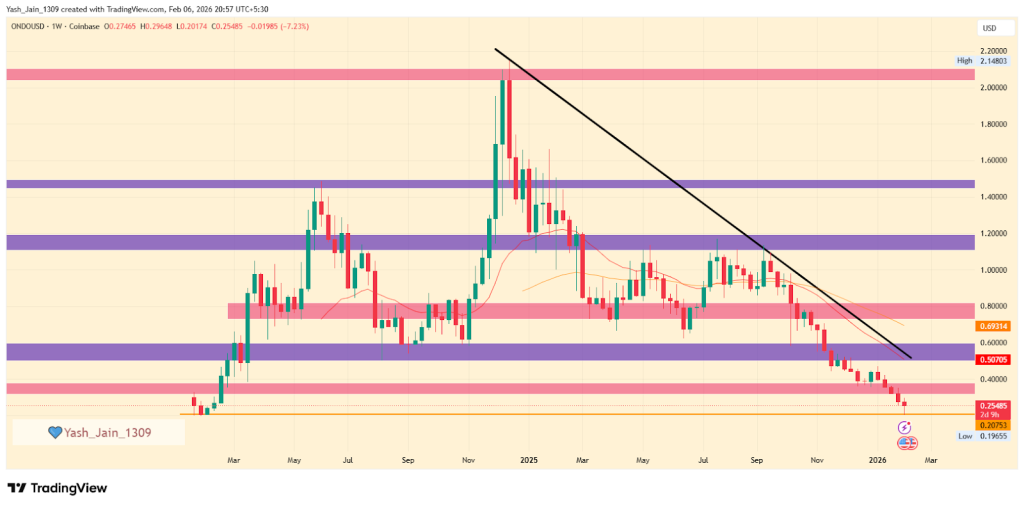
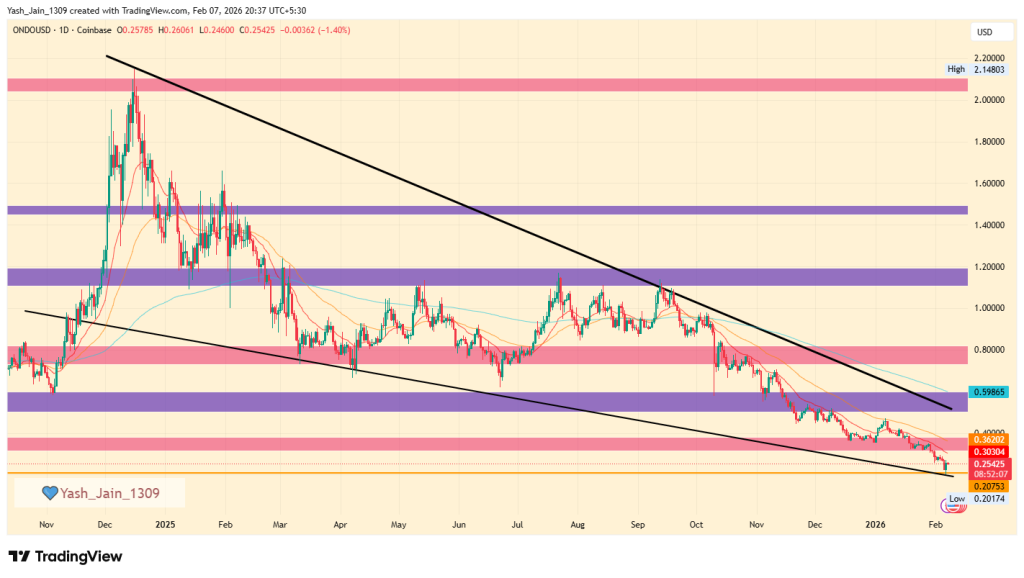
Now for the part traders keep staring at. The ONDO price chart shows price compressing near the lower boundary of a falling wedge, a structure aligning closely with the February 2024 base. Technically, it’s a pressure zone.

20% Bounce and an ETF Filing: Why ONDO Price is Separating from the Crypto Pack.

Momentum indicators are trying to turn. CMF is climbing. MACD and AO are improving. RSI is crawling out of oversold territory. None of this guarantees upside, but it does suggest selling pressure isn’t accelerating anymore.

If demand actually shows up, the ONDO/USD structure opens space toward the $0.60 region. Beyond that, higher levels come into view only if participation expands meaningfully. That’s where any ONDO price prediction becomes conditional, not confident.

20% Bounce and an ETF Filing: Why ONDO Price is Separating from the Crypto Pack.

And for now, ONDO price remains stuck between solid fundamentals and a market that still isn’t ready to reward them.

CFTC Confirms National Trust Bank Stablecoins as Approved Payment Tokens

CFTC stablecoin guidance

The post CFTC Confirms National Trust Bank Stablecoins as Approved Payment Tokens appeared first on Coinpedia Fintech News

The U.S. Commodity Futures Trading Commission has taken another step toward formalizing stablecoins within the regulated financial system. By revising its guidance, the agency has clarified that stablecoins issued by national trust banks can now qualify as approved payment stablecoins under its existing framework. The move signals growing regulatory comfort with stablecoins as they become more embedded in mainstream financial markets.

What Changed in the CFTC Guidance

The update comes through a reissued version of CFTC Staff Letter 25-40, which outlines how certain digital assets can be used as margin collateral in derivatives markets. When the original letter was released in December 2025, it allowed futures commission merchants to accept qualifying non-securities digital assets, including payment stablecoins, under strict conditions.

However, regulators later acknowledged that the original wording unintentionally left out stablecoins issued by national trust banks, even when those tokens met all the required standards. The revised guidance fixes that gap by explicitly recognizing national trust banks as permitted stablecoin issuers within the no-action framework.

Why National Trust Banks Matter

National trust banks have played a growing role in the stablecoin ecosystem, particularly after earlier regulatory approvals allowed them to custody and issue payment-related digital assets. These institutions operate under federal charters and are subject to strict oversight, which makes their stablecoins attractive for use in regulated markets.

By including these banks in the definition of payment stablecoins, the CFTC is aligning its guidance with existing banking structures rather than creating a parallel system for digital assets. This also reinforces the idea that stablecoins are no longer operating at the fringes of finance but are increasingly part of regulated infrastructure.

Impact on Futures Markets and Collateral Use

For futures commission merchants, the revised guidance brings much-needed clarity. Firms can now more confidently accept eligible stablecoins issued by national trust banks as customer margin collateral, provided all existing safeguards are met. These safeguards include segregation requirements designed to protect customer funds and limit risk.

Importantly, the update does not loosen compliance standards or change the conditions under which stablecoins can be used. Instead, it removes ambiguity and ensures consistent treatment of qualifying stablecoins across regulated derivatives markets.

A Broader Signal for Stablecoin Adoption

CFTC Chairman Michael Selig framed the move as part of a broader push to position the U.S. as a leader in stablecoin innovation, especially following the passage of the GENIUS Act. Taken together, these developments suggest regulators are shifting from cautious observation to structured integration of stablecoins into the financial system.

For the crypto industry, this marks another sign that payment-focused stablecoins are becoming an accepted tool rather than an experimental one, especially when issued by regulated and federally chartered institutions.

Never Miss a Beat in the Crypto World!

Stay ahead with breaking news, expert analysis, and real-time updates on the latest trends in Bitcoin, altcoins, DeFi, NFTs, and more.

FAQs

What is the CFTC’s new stablecoin guidance?

The CFTC updated its rules to include stablecoins issued by federally-regulated national trust banks as approved collateral for derivatives trading, integrating them into the regulated financial system.

Can stablecoins now be used as collateral in futures markets?

Yes, futures merchants can accept qualifying payment stablecoins—including those from national trust banks—as customer margin collateral, provided all existing customer protection safeguards are met.

Which stablecoin issuers are approved under the new CFTC rules?

The revised guidance explicitly approves stablecoins issued by federally-chartered national trust banks, which operate under strict oversight, aligning them with existing banking structures.

The Sharpe Ratio Warning: Why This BTC Price Bounce Could Be a Trap Heading for $48K

Will BTC, ETH and XRP Rally As Trump Formally Nominates Kevin Warsh as Fed Chair

The post The Sharpe Ratio Warning: Why This BTC Price Bounce Could Be a Trap Heading for $48K appeared first on Coinpedia Fintech News

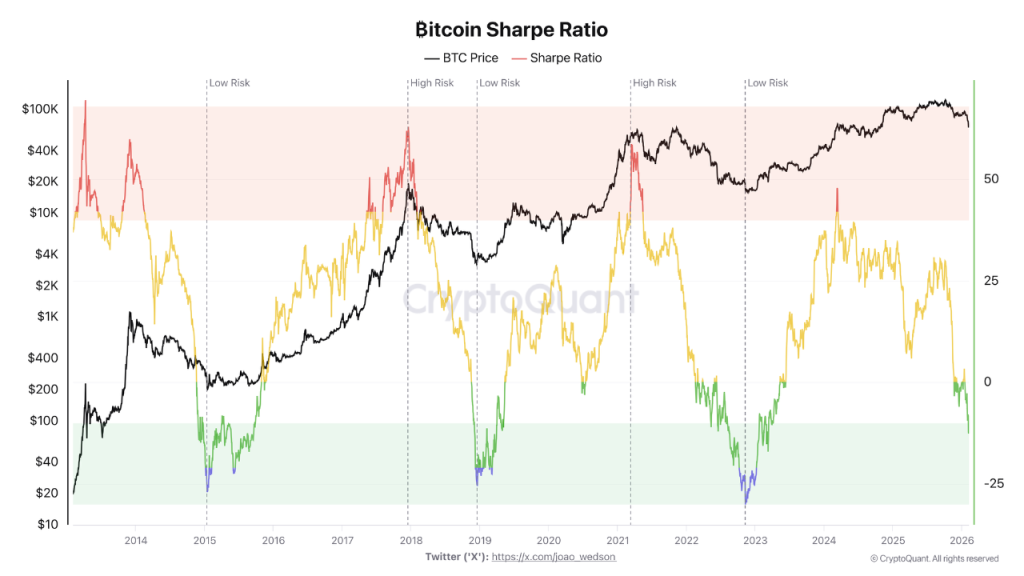
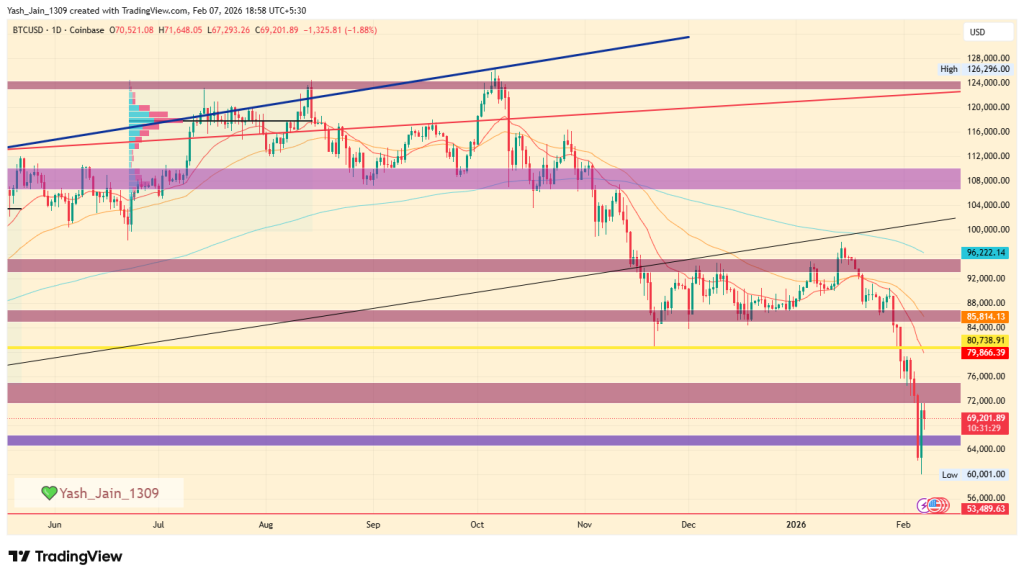
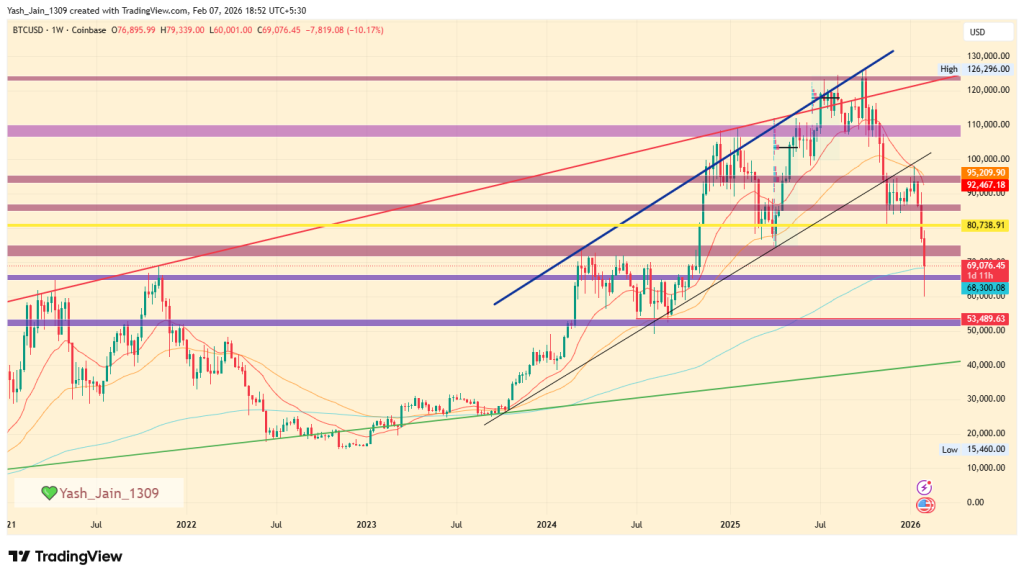
The BTC price is hovering near $68,890 today after a brief recovery from $60K. But, the key risk metric, the Sharpe Ratio, shows intact caution. It shows that BTC’s sharpe ratio has slipped into a historical bear-market zone. Rather than signaling an immediate bottom, this shift highlights rising risk relative to returns, a dynamic that has often appeared near long, complex market turning phases.

Sharpe Ratio signals growing stress, not capitulation

The Sharpe Ratio, which measures risk-adjusted returns, has now entered a zone historically associated with the later stages of Bitcoin bear markets. In practical terms, this means investors are currently taking on elevated risk for relatively weak performance. 

Meanwhile, the ratio continues to deteriorate, underscoring that recent BTC returns remain insufficient to justify volatility. At the same time, this type of compression has often emerged before broader trend stabilization, not during periods of optimism.

The Sharpe Ratio Warning: Why This BTC Price Bounce Could Be a Trap Heading for $48K

Importantly, the Sharpe Ratio should not be interpreted as a timing tool. Rather, it reflects the consequences of price behavior already in motion. As BTC crypto performance weakens on a risk-adjusted basis, more participants find themselves underwater, increasing stress across shorter time horizons.

Contrarian dynamics begin to surface

Still, market history shows that extreme Sharpe Ratio readings often align with contrarian opportunity zones. That does not imply an imminent reversal. Instead, it suggests the market may be entering a phase where long-term positioning slowly becomes more defensible. 

From a behavioral perspective, prolonged underperformance tends to reduce speculative excess, gradually shifting ownership toward participants with longer holding periods.

That said, patience remains critical. This phase can persist for months, and the BTC price today may continue adjusting lower before risk metrics begin to improve meaningfully.

BTC price chart highlights key technical magnets

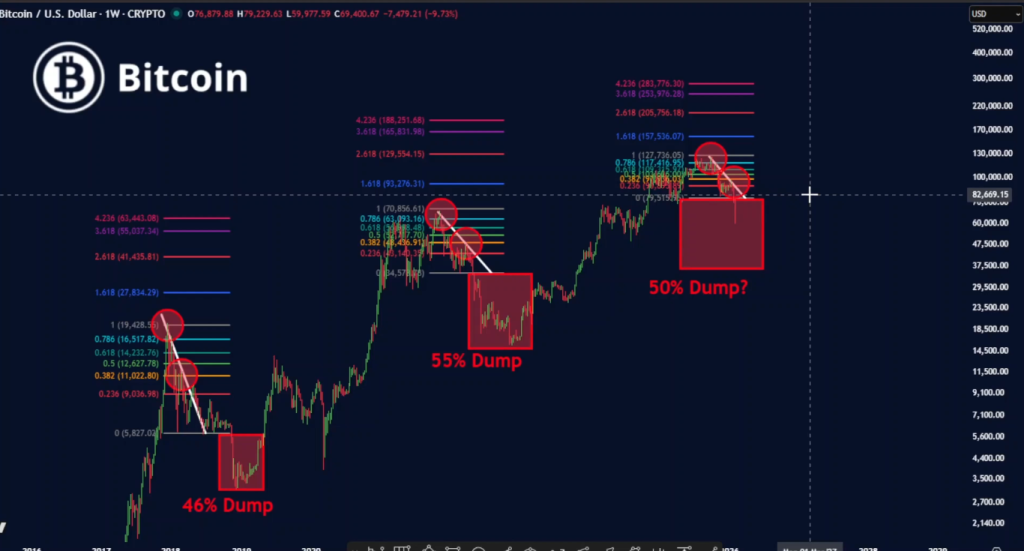
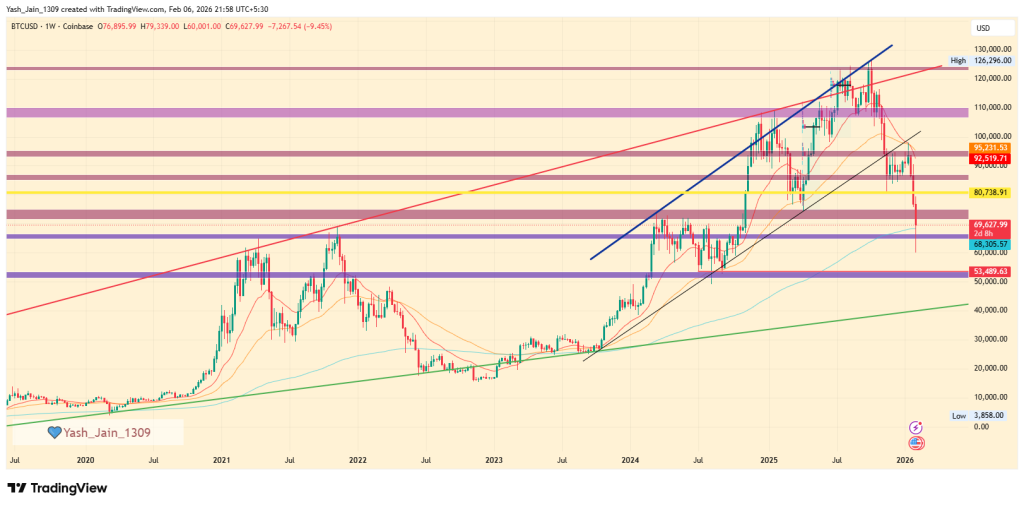
From a technical perspective, the experts presents his theory that BTC price chart reinforces cautious outlook and shows historical dip odds. Following a peak near $126,000, Bitcoin respected the 0.382 Fibonacci retracement around $78,000, an area that acted as a structural drift zone. Once that level was lost, technical focus shifted lower.

The Sharpe Ratio Warning: Why This BTC Price Bounce Could Be a Trap Heading for $48K

The next major retracement level sits near the 0.618 zone around $48,000, a level that may act as a longer-term magnet should corrective pressure persist. 

Risk management takes center stage

As a result, investors are increasingly weighing two broad approaches. One involves gradually building exposure as risk metrics approach historically lower-risk zones. The other prioritizes confirmation, waiting for the Sharpe Ratio to clearly improve before increasing allocation. Neither path implies urgency.

Still, the current setup emphasizes discipline. The BTC price USD remains sensitive to liquidity conditions, and the developing structure suggests that time, rather than speed, is the primary variable. In this environment, BTC price behavior reflects positioning stress more than directional conviction, a dynamic that continues to shape the evolving BTC price forecast.

Shiba Inu Price Holds Ground, Yet Data Shows the Market Isn’t Ready To Chase

Shiba Inu Price Jumps 8% as Whale Activity and Burns Hint at 59% Rally

The post Shiba Inu Price Holds Ground, Yet Data Shows the Market Isn’t Ready To Chase appeared first on Coinpedia Fintech News

Shiba Inu price regains ground with the broader market recovery, stabilizes near the $0.000006200 mark. Following a rebound from the channel lows, SHIB price eyes further rebound ahead. The broader market recovery has helped stabilize price, yet SHIB’s own momentum remains selective rather than impulsive. Beneath the surface, on-chain positioning and derivatives activity hint at a market that is no longer panicking, but not fully convinced either. The rebound has removed immediate downside pressure, but whether it evolves into a trend or fades into another range depends on how holders, leverage and liquidity align next.

On-Chain Data Shows Stable Holders Data, Not Aggressive Accumulation

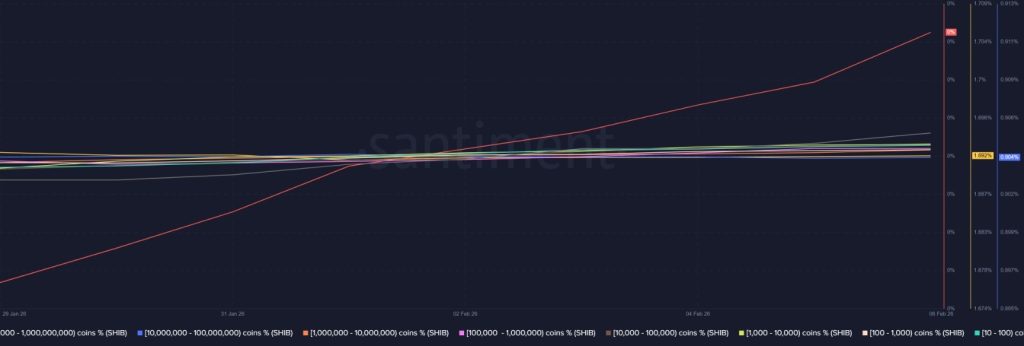
Shiba Inu’s on-chain holding data suggests the recent rebound has brought stability, but not a surge in conviction buying. Wallet distribution shows that large holders, particularly addresses holding between 100 billion – 1 trillion SHIB have largely maintained their positions rather than expanding exposure. This points to confidence in current price levels, but not urgency to accumulate at resistance. Mid-sized holders, typically more reactive to short-term moves, have also slowed activity. Transfers from this cohort have flattened after the rebound, indicating that profit-taking pressure has eased, yet fresh inflows remain limited. In practical terms, selling has cooled, but demand has not accelerated.

SHIB Holders Data

Smaller retail wallets continue to show minor net additions, though the scale remains modest. This behavior aligns with a market attempting to form a base rather than initiate a breakout. When holding data stabilizes without sharp distribution or accumulation, it often reflects a pause phase, a period where price absorbs prior moves before choosing direction. For SHIB, this balance explains why downside momentum has stalled, but upside progress remains capped. Holders are patient, not aggressive, and that restraint is shaping the current range-bound structure.

Liquidation Map Highlights Where Pressure Is Building

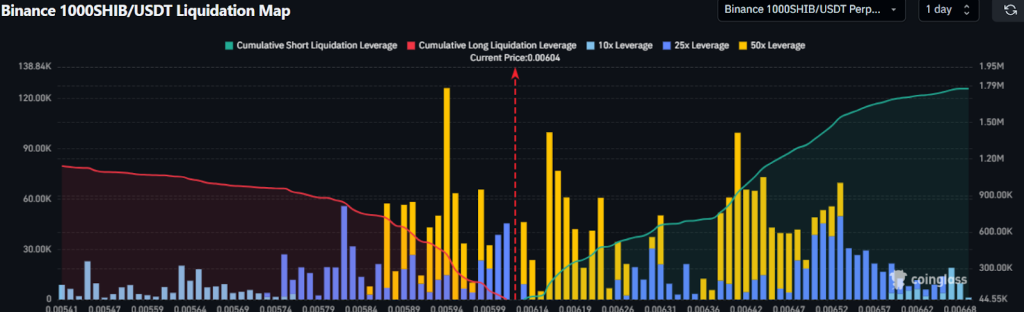
The liquidation map shows that SHIB’s current price zone is sitting between two well-defined leverage clusters, explaining why recent moves have slowed despite yesterday’s rebound. On the upside, a dense concentration of short liquidations is stacked near the $0.00000610–$0.00000625 range. This zone has repeatedly capped price, as short positions remain active and unchallenged. Without a decisive push through this band, forced short covering is unlikely to materialize.

SHIB Liquidation Data

On the downside, long liquidation clusters thin out significantly above $0.00000570, indicating that downside leverage has already been reduced during the prior sell-off. The next meaningful pool of long liquidations sits closer to $0.00000540, suggesting that sellers would need renewed momentum to trigger another cascade lower. This positioning tells a clear story: leverage has been partially flushed, but not reset enough to fuel volatility. 

In these conditions, SHIB is more likely to remain sideways unless one side is decisively forced out. A clean break above $0.000006250 would expose a thin liquidation zone higher up, increasing the odds of a fast extension. Conversely, a drop below $0.00000570 would test whether remaining longs are willing to defend or capitulate.

SHIB Price Stalls Near Key Resistance: Can Bulls Extend Recovery Ahead?

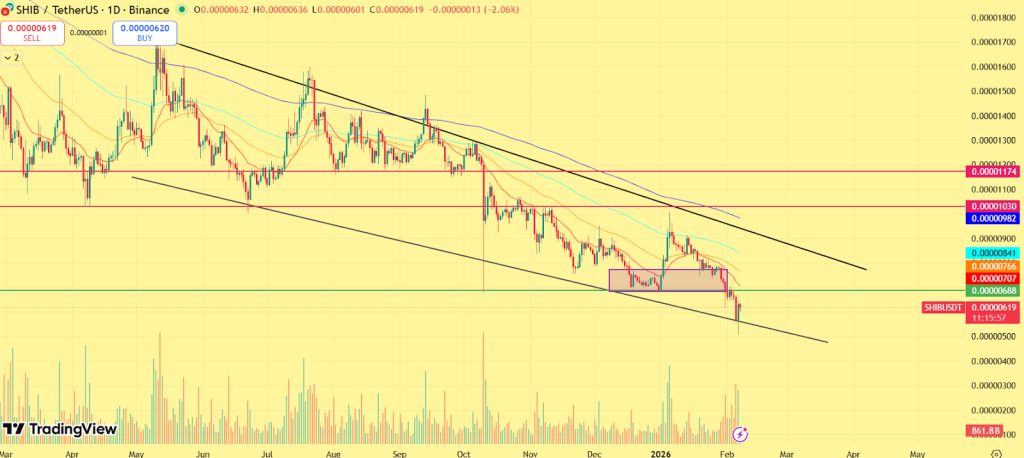
SHIB’s price action remains constructive but constrained, with the chart showing a recovery from the lower end of its recent trading channel rather than a full trend reversal. After stabilizing from the channel lows, SHIB has pushed higher into a well-defined resistance zone near $0.000006100, a level that has repeatedly capped upside attempts over the past sessions. Shiba Inu price is still respecting a descending-to-sideways range, where lower highs remain intact despite the bounce. 

SHIBA INU Price

The recent recovery has been supported by declining sell pressure rather than aggressive new buying, suggesting consolidation rather than breakout momentum. As long as SHIB holds above the $0.00000580–$0.00000570 support band, downside risks remain contained in the near term. A decisive close above $0.000006200 would shift the short-term bias higher, opening room toward the next resistance near $0.00000645–$0.00000660, where prior supply and liquidation pressure cluster. Failure to clear this zone, however, could keep SHIB locked in a range, with price drifting back toward mid-channel support.

Altcoin to Watch in February: Hyperliquid (HYPE) Primed for a 50% Upswing

Hyperliquid (HYPE) Price Extends Rally as Silver Futures Trigger Volume Shock

The post Altcoin to Watch in February: Hyperliquid (HYPE) Primed for a 50% Upswing appeared first on Coinpedia Fintech News

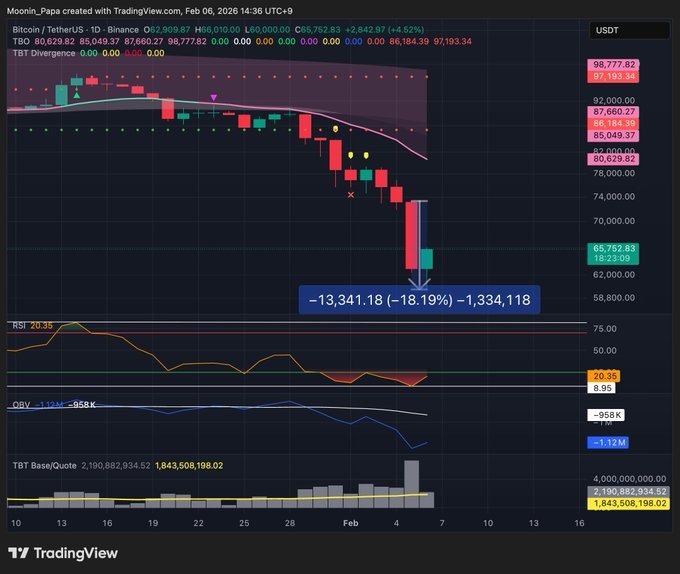
Crypto market volatility has intensified since the start of the month, with Bitcoin recording one of its sharpest single-day declines, dropping over $10,000. The sell-off triggered multiple liquidation cascades exceeding $2 billion, forcing leveraged positions out and creating conditions for buyers to step in near local lows.

As broader markets begin to stabilize, trader focus is shifting toward select altcoins showing relative strength and rising participation. While many tokens have bounced from oversold levels, only a few are displaying sustained momentum rather than short-term relief moves. Hyperliquid (HYPE) has emerged as a standout, with the price consolidating above a recently broken resistance level.

Although buying pressure has cooled in the short term, the HYPE price continues to show strength on higher timeframes, positioning the token for a potential volatility expansion if broader market conditions remain supportive.

hype price

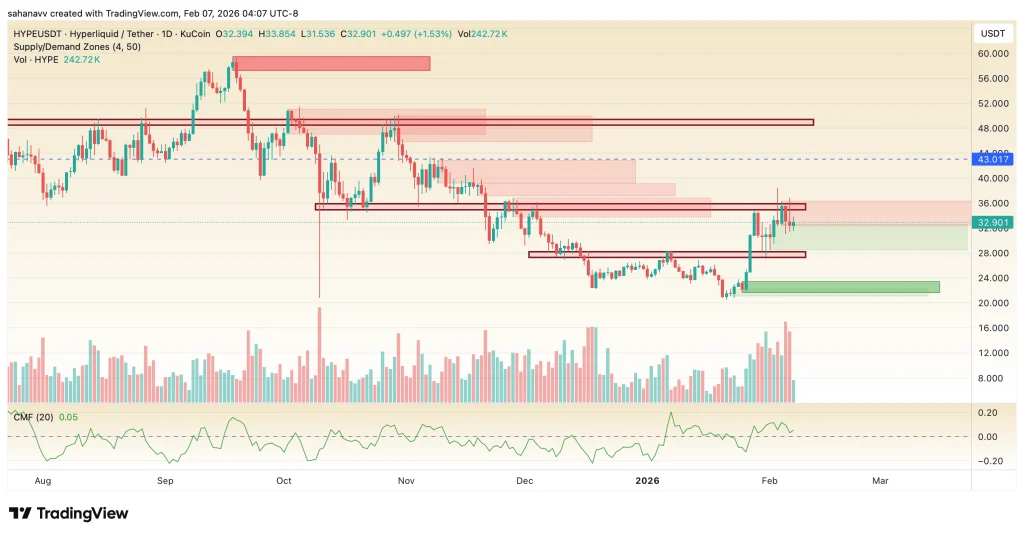
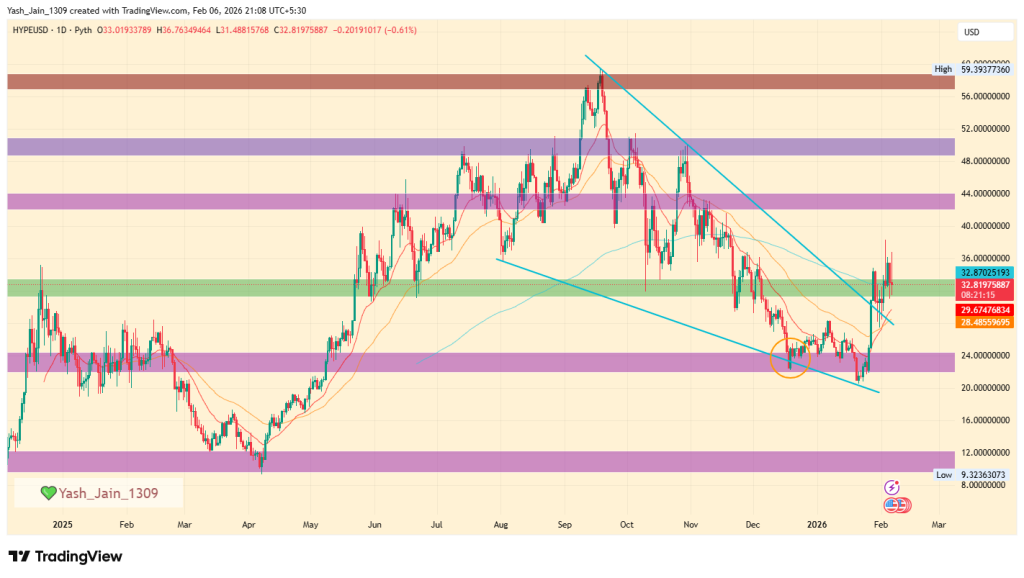
Looking at the daily chart, Hyperliquid (HYPE) price is currently trading in a tight zone where supply and demand are stacked closely together. This overlap explains why price has struggled to push higher, with repeated rejections keeping the move capped below the $35 level. Buyers are clearly stepping in on dips, but sellers continue to defend this area, resulting in sideways consolidation rather than a breakout.

That said, the Chaikin Money Flow (CMF) tells a more constructive story. The indicator shows a bullish divergence and is holding near the zero line, suggesting capital is still flowing into the asset despite muted price action. This points to accumulation rather than distribution.

From here, HYPE needs a clean daily and weekly close above $35 to shift momentum decisively. A successful breakout above $40 would significantly improve the odds of a move toward the $50 zone, where the chart shows relatively limited resistance.

Eigen LabsResearcher Says DAOs Will 100x as AI Crushes Software Costs

Scaramucci Explains Why Bitcoin Fell to $60K This Week

The post Eigen LabsResearcher Says DAOs Will 100x as AI Crushes Software Costs appeared first on Coinpedia Fintech News

Building a software product used to cost around $215,000. Today, with AI tools, that number has dropped to under $450. That gap is exactly why one expert believes DAOs are about to take off.

Kydo, a researcher at Eigen Labs, shared a detailed breakdown on X explaining why DAOs are no longer just a governance experiment. His argument is straightforward: AI has made building software so cheap that the cost of setting up a company now matters more than the cost of building the product itself.

The Numbers Behind the Shift

In a traditional setup, hiring one software engineer for 12 months costs roughly $200,000. Add $15,000 for legal and LLC formation, and you’re looking at about $215,000 to get an MVP off the ground.

With AI tools like Claude Code and Opus, a single builder can now ship a working product for around $200. Setting up a DAO costs $50 to $250. Total: under $450.

“That’s not a marginal improvement. That’s a structural inversion,” Kydo wrote.

When building was expensive, nobody cared that an LLC cost $15,000. It was a rounding error. Now that AI has pushed production costs near zero, that $15,000 is the biggest expense on the table. DAOs, at a fraction of that cost, suddenly have a real advantage.

The Old Pitch vs the New Pitch

DAOs were always sold on ideology: decentralization, community ownership, censorship resistance. Kydo argues those ideas alone were never enough to justify the friction of working without a traditional company.

The new case for DAOs is purely economic. And economic arguments, as he put it, “scale.”

He backed this up with real examples. Nouns DAO hit a treasury worth over $50 million without any corporate entity behind it. Botto, an AI-generated art collective, used a DAO to let community members direct an autonomous artist and share in the earnings.

What This Means for Solo Crypto Builders

Kydo highlighted a problem many builders already know too well. Building is now cheap. Getting distribution and funding is not.

A working app built for $200 without a community behind it is just a side project. Add a DAO with a token and aligned contributors, and it becomes what Kydo calls “an economic organism.”

He also confirmed that Eigen Labs is working on solutions to make tokens “actually own and mean something, not this speculative fluffy thing that we have currently.”

Not Everyone Agrees

Crypto lawyer Gabriel Shapiro responded, arguing that regulation, not costs, is the real reason DAOs haven’t taken off as fundraising vehicles.

Kydo pushed back: “crypto never had much reg clarity but it didn’t stop tokens and companies making 100s of billions here.”

Never Miss a Beat in the Crypto World!

Stay ahead with breaking news, expert analysis, and real-time updates on the latest trends in Bitcoin, altcoins, DeFi, NFTs, and more.

FAQs

What is a DAO and how does it work today?

A DAO is a blockchain-based organization run by smart contracts where members vote on decisions using tokens instead of relying on a traditional company structure.

Why are DAOs becoming more popular with AI tools?

AI has slashed software-building costs, making company setup the biggest expense. DAOs are cheaper than forming an LLC, creating a major economic advantage.

How much does it cost to start a DAO compared to a startup?

A DAO can be launched for $50–$250, while forming an LLC and hiring staff can exceed $200,000, even before product development.

What does this mean for solo crypto builders?

Solo builders can now launch real products cheaply and use DAOs to attract funding, contributors, and users—turning side projects into viable ecosystems.

Next Crypto to Reach $1? Analysts Highlight This New Protocol

mutm-rise

The post Next Crypto to Reach $1? Analysts Highlight This New Protocol appeared first on Coinpedia Fintech News

While large, well-known cryptocurrencies continue to move at a slower pace, innovation across the crypto market has not stopped. Historically, some of the strongest gains have come from projects that focus on solving real problems before they reach wide adoption. As 2026 approaches, analysts are observing a clear shift in capital away from hype-driven tokens and toward new crypto protocols.

This transition often begins when a project moves beyond planning and delivers working technology. In the current market, one emerging protocol is drawing attention as it enters this critical stage. Its recent progress suggests it may be positioning itself for increased visibility as investors search for the next crypto phase of growth.

Mutuum Finance (MUTM)

The growth of this project is being fueled by a very successful presale that has caught the attention of the global market. Mutuum Finance has already raised over $20.4 million from early participants. This is not just a small group of traders; more than 19,000 individuals have already joined the ecosystem as holders. The project is currently in Phase 7 of its structured distribution, and the MUTM token is priced at $0.04.

This price is a significant climb from the early starting point of $0.01, which represents a 300% surge during the development stage. However, there is still more room for the price to move. The team has confirmed that the official launch price will be $0.06. 

This means that anyone joining today is securing their MUTM at a lower rate than what the general public will pay when the mainnet goes live. With a total supply of 4 billion tokens, exactly 45.5% (1.82 billion tokens) were allocated for this presale phase to ensure a fair and broad distribution. To date over 840M MUTM is already sold out.

BUY-MUTM

Building the Future of Decentralized Finance

Mutuum Finance is being developed as a decentralized lending hub focused on simplicity and safety. The protocol aims to let users lend digital assets to earn yield or borrow against them without relying on a traditional middleman. All interactions are designed to be non-custodial, so users remain in control of their funds.

On the lending side, users are expected to earn APY based on borrowing demand. For example, supplying 1,000 USDT to a pool offering 6% APY could generate about 60 USDT over a year if rates remain stable. Borrowing is planned to follow loan-to-value (LTV) limits to manage risk. With a 70% LTV, depositing $10,000 worth of crypto would allow borrowing up to $7,000 while keeping ownership of the collateral.

According to the project’s whitepaper, Mutuum Finance also plans to introduce a buy-and-distribute model in later stages. Under this mechanism, a portion of protocol fees is intended to be used to acquire MUTM tokens and distribute them to participants who help support the ecosystem.

Security remains a major priority. The protocol has completed a comprehensive audit with Halborn, maintains a strong safety score from CertiK, and operates an active $50,000 bug bounty to encourage ongoing testing and transparency as development continues.

Growth Catalysts and the Path to $1

Looking ahead, analysts are highlighting several roadmap catalysts that could drive the price of MUTM much higher. One major plan is the launch of a native, over-collateralized stablecoin. This will allow borrowers to access a stable unit of value without ever leaving the protocol. 

To ensure everything runs smoothly, the project is integrating decentralized oracles like Chainlink. These oracles provide real-time price data so that collateral values are always accurate and liquidations remain fair.

Because of these professional features, many market experts believe the token is on a path to a major milestone. Some analysts suggest that if the platform captures a slice of the global lending market, the price could reach $1.00 by late 2026 or 2027. 

From the current price of $0.04, this would represent a massive 2,400% increase. This prediction is based on the protocol’s developing ability to generate revenue and the planned expansion to Layer-2 networks, which is expected to make transactions faster and much cheaper for every user.

Technical Readiness and Whale Interest

The project recently reached its biggest technical milestone yet. The V1 protocol is now live on the Sepolia testnet, which means the technology is no longer just a promise on a website. Users are currently testing the core lending and borrowing flows in a live environment. This successful launch has triggered a surge in demand, causing Phase 7 to sell out at a record pace.

This technical progress has also brought in whale allocations, with large investors moving significant capital into the project. When “whales” enter a project at this stage, it often signals strong confidence in the upcoming mainnet launch. 

These large holders are looking for “day one utility,” and Mutuum Finance is aiming exactly that. With the security verified and the testnet running, the final window to join before the $0.06 launch is closing fast.

For more information about Mutuum Finance (MUTM) visit the links below:

Website: https://www.mutuum.com

Linktree: https://linktr.ee/mutuumfinance

Vietnam Proposes 0.1% Tax on Crypto Transactions Under New Regulatory Framework

Vietnam Proposes 0.1% Tax on Crypto Transactions Under New Regulatory Framework

The post Vietnam Proposes 0.1% Tax on Crypto Transactions Under New Regulatory Framework appeared first on Coinpedia Fintech News

Vietnam is moving closer to formally regulating cryptocurrency trading, with a new draft policy that treats digital assets similarly to traditional securities. The proposal, circulated by the Ministry of Finance for public feedback, introduces a transaction-based tax system while tightening oversight of crypto exchanges.

0.1% Levy on Crypto Transfers

Under the proposed framework, individuals trading or transferring cryptocurrencies through licensed service providers would be charged a 0.1% personal income tax on the value of each transaction. This mirrors the tax structure currently applied to stock trading in Vietnam. The levy would apply to all investors, regardless of residency, whenever a crypto transfer is executed within the regulated system.

At the same time, the draft clarifies that crypto transfers and trading would be exempt from value-added tax, signaling that the government views digital assets more as financial instruments than consumer goods.

Corporate Investors Face Profit-Based Taxation

Companies and institutional investors would be taxed differently. Profits generated from crypto trading would fall under the standard 20% corporate income tax regime. This tax would be calculated after deducting acquisition costs and related expenses, aligning crypto-related earnings with other business income.

Clear Definitions and High Entry Barriers

The proposal also formally defines crypto assets as digital assets that rely on cryptographic or similar technologies for issuance, storage, and transaction verification. Alongside this definition, the draft sets strict requirements for exchange operators. Firms seeking to run digital asset trading platforms would need at least 10 trillion Vietnamese dong, or about $408 million, in charter capital. Foreign ownership would be allowed but limited to 49%.

Pilot Program and Licensing Push

These rules come as Vietnam continues its five-year pilot program for a regulated crypto market, launched in September 2025. Despite the country ranking among the top globally for crypto adoption, no firms initially applied, largely due to high capital and compliance hurdles.

To push the framework forward, Vietnam began accepting license applications for crypto exchanges in January 2026, marking a concrete step toward bringing the fast-growing sector under full regulatory oversight.

Never Miss a Beat in the Crypto World!

Stay ahead with breaking news, expert analysis, and real-time updates on the latest trends in Bitcoin, altcoins, DeFi, NFTs, and more.

FAQs

Is crypto trading legal in Vietnam?

Vietnam is implementing a formal regulatory pilot program for crypto trading, treating digital assets similarly to securities, with licensing for exchanges now open.

How is crypto taxed in Vietnam?

Individuals pay a 0.1% transaction tax per crypto transfer. Companies are taxed 20% on trading profits, aligning with standard corporate income tax rules.

Can foreigners own a crypto exchange in Vietnam?

Yes, but foreign ownership in licensed Vietnamese crypto exchanges is capped at 49%, with high capital requirements of approximately $408 million.

Do you pay tax on crypto profits in Vietnam?

Yes. Individuals pay via the 0.1% transaction levy. Corporate investors pay a 20% tax on net profits from crypto trading, after deducting costs.

Bitcoin Searches Reach 12-Month High

Bitcoin Searches Reach 12-Month High

The post Bitcoin Searches Reach 12-Month High appeared first on Coinpedia Fintech News

Global Google searches for “Bitcoin” soared to a one-year high during the week of February 1 as the price plunged toward $60,000 before rebounding near $70,000, erasing post-election gains. On X, opinions are divided: some see rising retail interest as a bullish signal, while others call it FOMO. Volatility was fueled by deleveraging, Fed signals, and Epstein-related FUD. On-chain data showed record losses, suggesting either capitulation or a fresh buying opportunity for investors.

Crypto.com CEO Buys AI.com for $70M

Crypto.com CEO Buys AI.com for $70M

The post Crypto.com CEO Buys AI.com for $70M appeared first on Coinpedia Fintech News

Cryptocom co-founder and CEO Kris Marszalek has purchased the domain AIcom for approximately $70 million, marking the largest publicly disclosed domain name sale. He plans to use it to launch a consumer-focused AI platform, promoted with a Super Bowl ad, featuring an AI agent that can message, use apps, and trade stocks. The entire purchase was made in cryptocurrency, signaling Marszalek’s long-term confidence in AI as a major technological wave shaping the future.

Bitcoin Rebounds Into the Weekend, Ethereum Outperforms: ETH vs BTC, Who Leads Next Week?

Bitcoin Rebounds Into the Weekend, Ethereum Outperforms ETH vs BTC, Who Leads Next Week

The post Bitcoin Rebounds Into the Weekend, Ethereum Outperforms: ETH vs BTC, Who Leads Next Week? appeared first on Coinpedia Fintech News

Crypto markets head into the weekend after a sharp relief bounce across majors, but price behavior shows a clear divergence. Bitcoin price is stabilizing after a deep sell-off, while Ethereum price is attempting to reclaim structure after a more aggressive breakdown. The key question for traders is whether this move marks an early rotation into ETH or if BTC continues to control market direction next week.

Bitcoin (BTC) Price Analysis

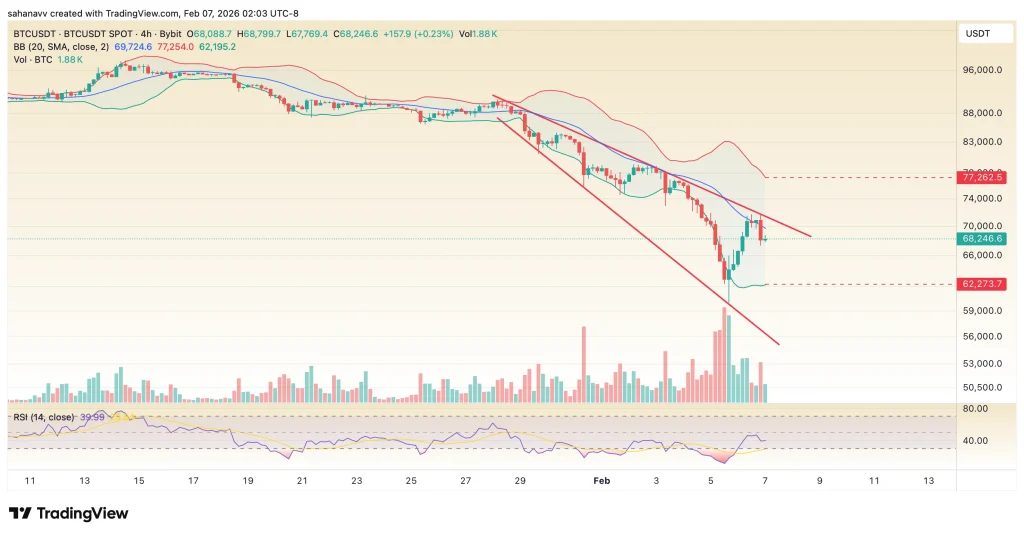
The short-term price action of Bitcoin shows the price stuck within a falling wedge after it broke down from the horizontal consolidation. Despite the rebound, the price has failed to break the resistance, keeping the lower targets active. With the BTC price entering the weekend trade, the volatility is expected to rise, which may have a huge impact in the coming week. 

btc price

Bitcoin is trading near $68,200 on the 4H chart after rebounding from the $62,200–$63,000 demand zone. Price remains near the mid Bollinger Band (~$69,700), keeping the broader structure bearish. RSI has recovered to around 40, easing from oversold conditions but still below neutral, suggesting stabilization rather than trend reversal. For Bitcoin to regain control, bulls need a clean reclaim above $70,000–$72,000; failure to hold $68,000 risks another test of lower demand.

Ethereum (ETH) Price Analysis

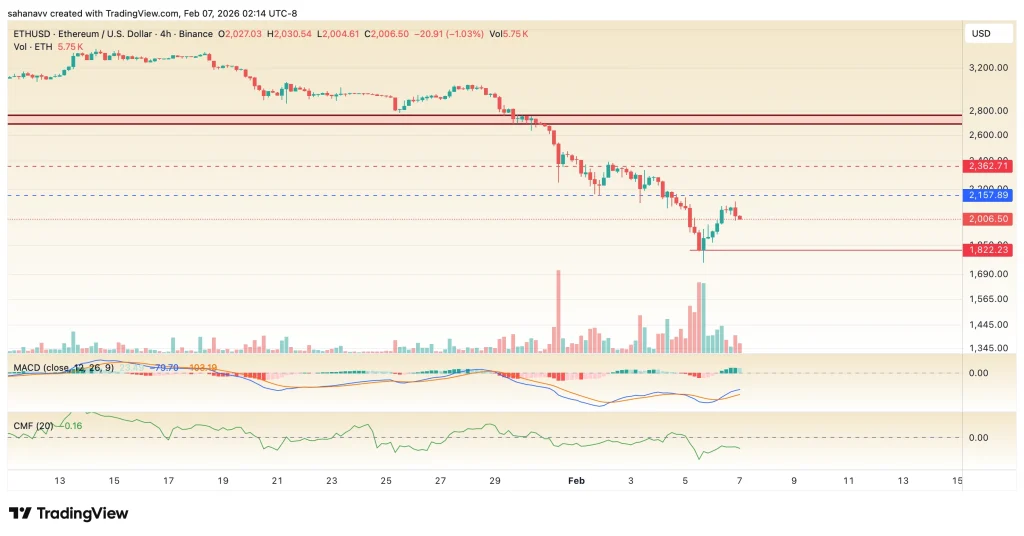
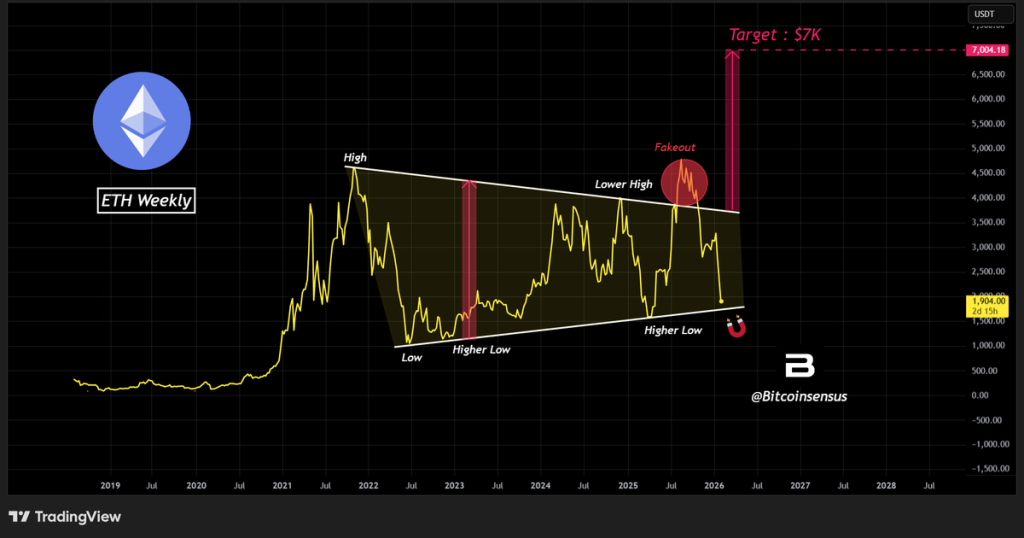
Similar to Bitcoin, the Ethereum price has also rebounded from the lows below $1800, but despite a rebound, it failed to surpass $2,157. This is one of the important resistances, and hence a rise beyond this range may strengthen the bullish momentum. The buying pressure has dropped in the short term, raising the possibility of a pullback into the demand zone. 

eth price

Ethereum shows stronger relative momentum. ETH bounced sharply from $1,820, reclaiming $2,000, though it remains capped below the former support zone at $2,150–$2,170. Unlike BTC, ETH printed a deeper breakdown followed by a faster recovery. The MACD is curling upward, and the CMF has turned slightly positive, hinting at improving short-term participation. However, ETH still trades well below its prior range, making this a recovery attempt, not confirmation.

Conclusion: Who Leads Markets Next Week?

Despite ETH’s stronger rebound, directional control still sits with Bitcoin. BTC is stabilizing above key demand after a violent sell-off, and as long as it holds the $68K area, it will continue to dictate risk appetite across the market. Ethereum’s bounce, while faster, is still a recovery from a deeper structural breakdown, with price capped below former support near $2,150–$2,170.

For traders, the setup is clear: ETH can outperform only if Bitcoin holds its range and reclaims resistance. Any weakness or rejection in BTC is likely to hit ETH harder. Until Bitcoin regains trend structure, ETH’s strength remains beta-driven, not leadership-driven.

FAQs

Is the crypto market entering a recovery phase now?

The market is showing early recovery signs, with prices bouncing from key demand zones, but confirmation needs sustained strength above resistance.

Is this crypto bounce sustainable or just a relief rally?

Right now, it looks like a relief bounce. Sustainability depends on Bitcoin holding support and reclaiming higher resistance levels.

How does Bitcoin affect overall crypto market recovery?

Bitcoin sets market confidence. If BTC holds support and stabilizes, it allows altcoins like ETH to recover more sustainably.

Can Ethereum’s recovery last if Bitcoin weakens?

Usually no. Ethereum’s recovery is closely tied to Bitcoin’s stability, and BTC weakness often leads to sharper ETH pullbacks.

Solana Price Reclaims $85, but On-Chain Data Tells a More Cautious Story

Why Solana Price Is Surging

The post Solana Price Reclaims $85, but On-Chain Data Tells a More Cautious Story appeared first on Coinpedia Fintech News

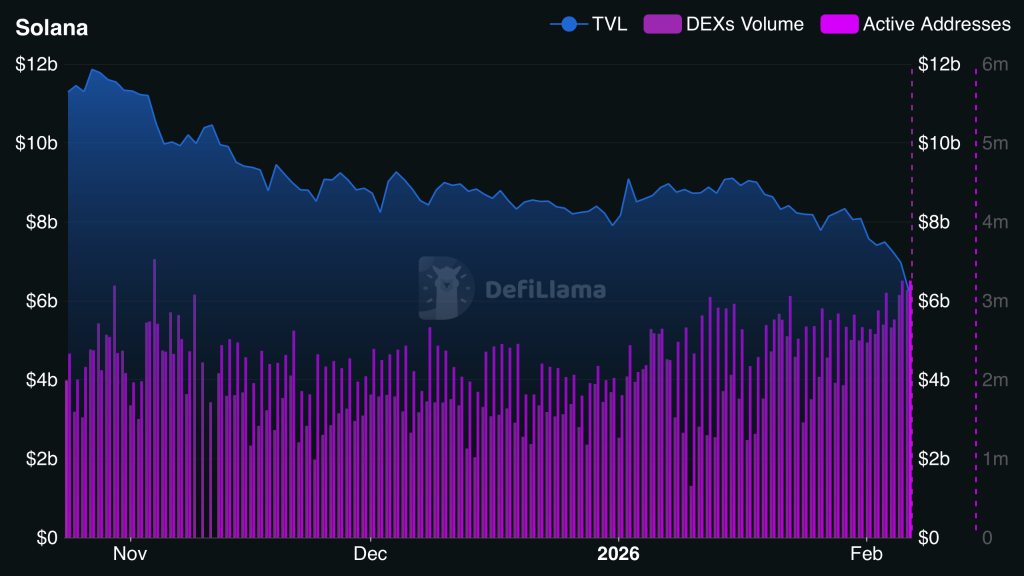
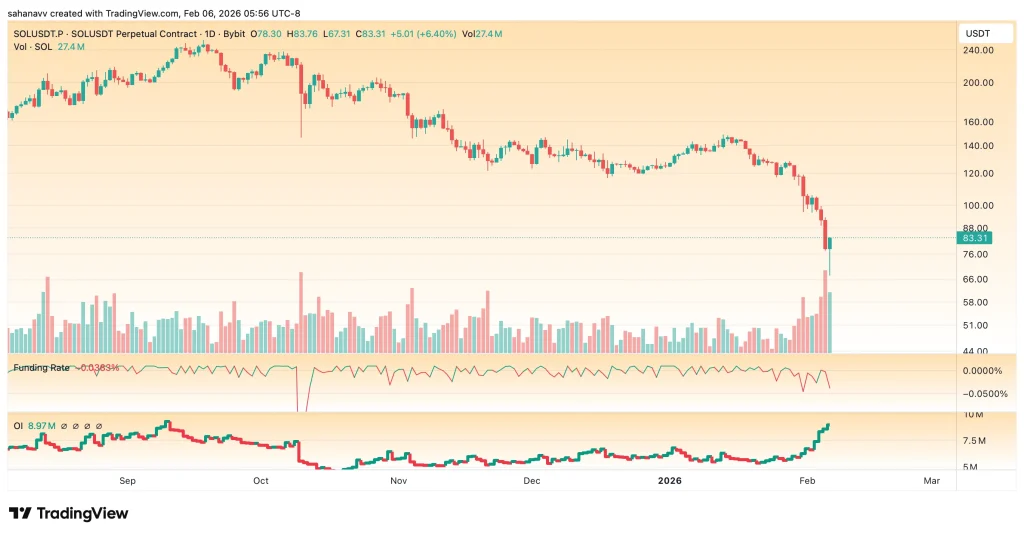
Crypto markets witnessed a mild recovery today after last week’s sharp sell-off, with Bitcoin stabilizing and altcoins attempting to form short-term bases. Solana joined the rebound, climbing over 5% to reclaim the $85 level after briefly dipping into the low-$70s. The move has eased immediate downside pressure, but on-chain data suggests the market is still recalibrating rather than transitioning into a fresh uptrend. While SOL price has bounced, the deeper market signals point to balance returning, not conviction. The question now centers on whether Solana (SOL) is building a foundation or merely reacting to exhausted selling.

Solana’s On-Chain Data Reflects Cooling Conditions After the Sell-Off

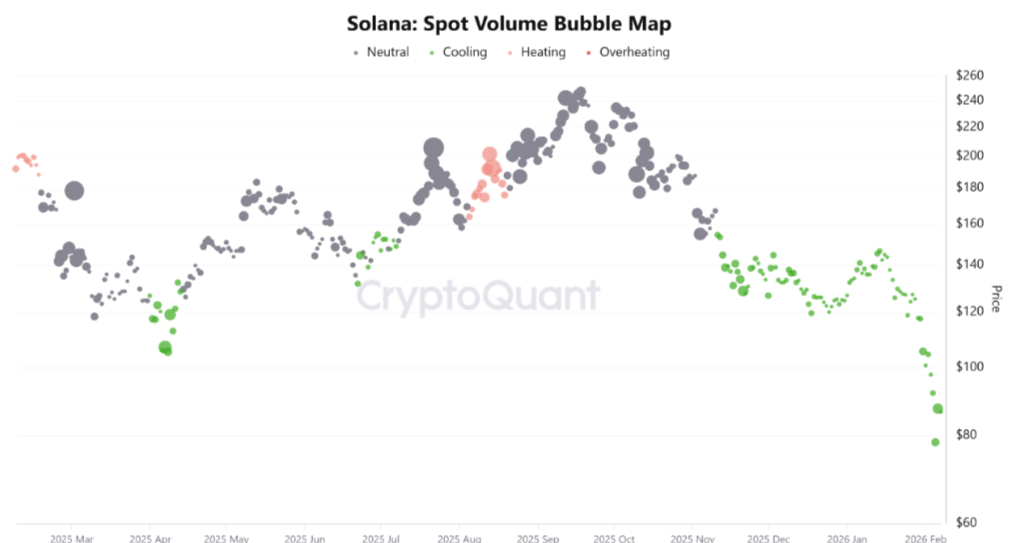
Solana’s on-chain data reflects a textbook post-liquidation environment. CryptoQuant’s Spot Volume Bubble Map places current activity firmly in a “cooling” region, a phase typically observed after extended declines. Historically, this zone indicates that sellers have largely exited, but buyers have not yet re-engaged with force. Crucially, spot volume remains subdued relative to prior recovery attempts. This matters because sustainable bottoms are usually accompanied by rising spot participation, not just price stabilization. The absence of strong spot inflows suggests that large holders are waiting for confirmation rather than front-running a reversal.

SOL spot volume map

Derivatives data reinforces this view. Futures volume bubble maps show a sharp transition from “overheating” to “cooling,” confirming that speculative leverage has been flushed. Open interest has contracted meaningfully, reducing liquidation risk but also signaling reduced directional conviction. In simple terms, traders have stepped back rather than stepped in.

Stablecoin Inflows Rise as Traders Stay Cautious

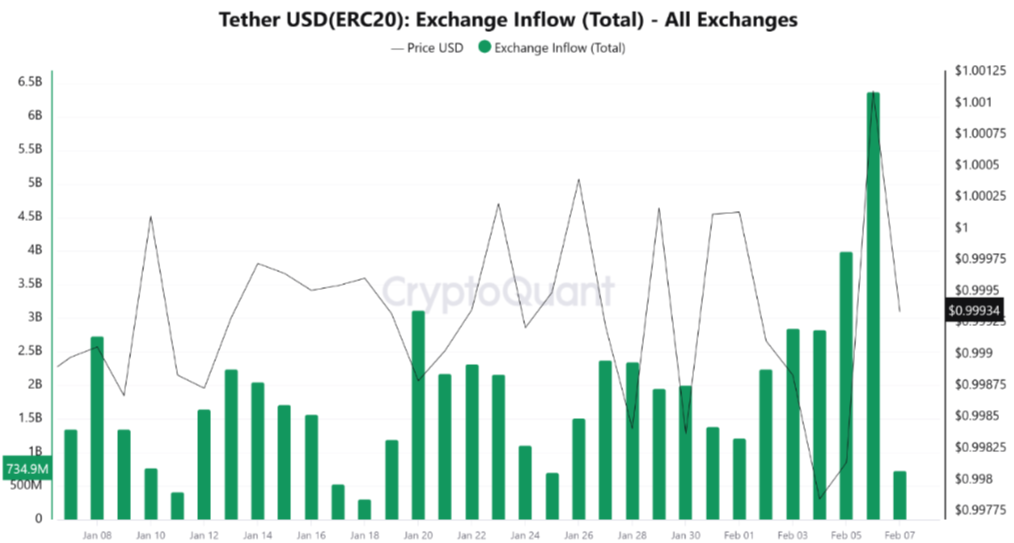
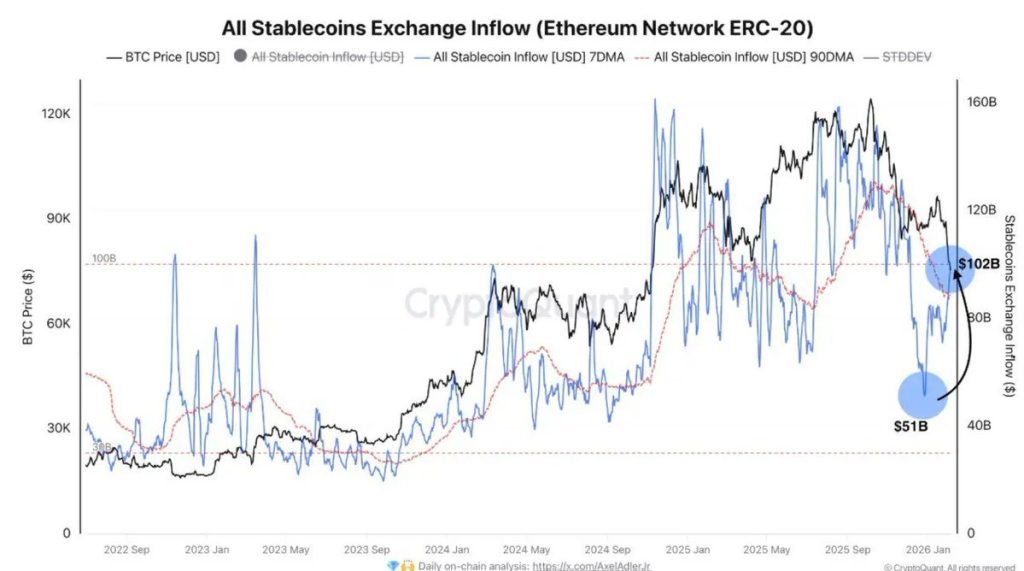
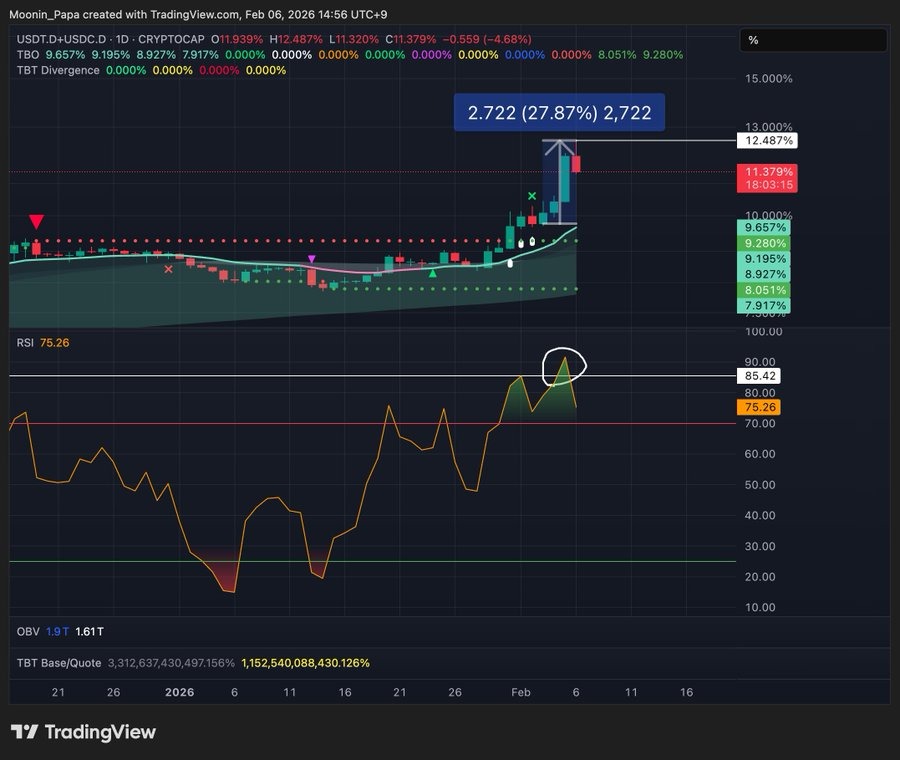
Stablecoin flow data adds an important layer to the narrative. Exchange inflows of USDT recently spiked to multi-week highs, reflecting fresh liquidity entering the system. However, this liquidity has not translated into aggressive Solana accumulation.

Exchange inflows

Historically, strong bottoms form when rising stablecoin balances coincide with expanding spot volume and declining exchange reserves for the asset itself. At present, Solana’s on-chain footprint shows liquidity availability without decisive allocation. This asymmetry suggests capital is positioning defensively, waiting for clearer signals before committing. In institutional terms, the market is liquid but cautious.

Solana Price Reclaims $85, but Key Resistance Still Overhead

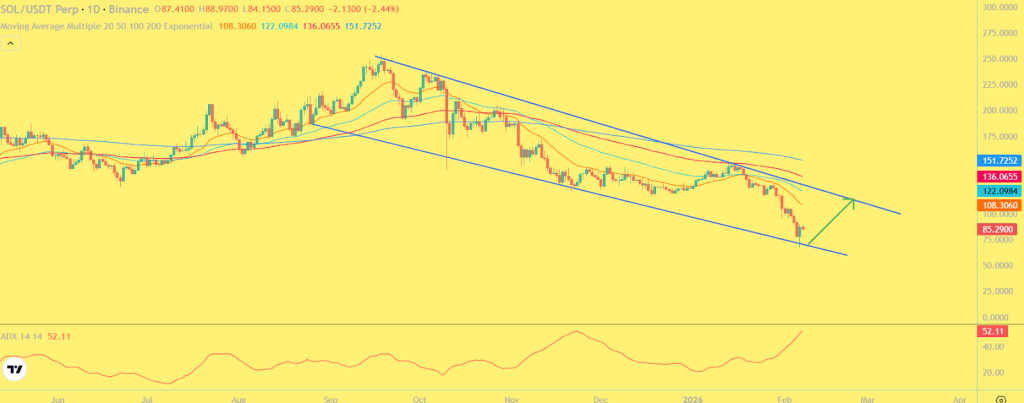
Solana’s price rebound toward the $85 mark marks a clear short-term recovery from recent panic lows, but the broader chart structure suggests the move is still corrective rather than trend-changing. On the daily timeframe, SOL remains confined within a descending channel that has guided price action since the January breakdown, indicating that sellers continue to control the dominant trend. The recent bounce originated from a well-defined demand zone in the $70–$75 region, where historical buying interest previously absorbed heavy sell pressure. That zone acted as a liquidity flush, triggering short covering and a technical rebound. However, the rally has so far stalled near the mid-range of the descending channel, an area that has repeatedly capped upside attempts over the past several weeks.

Solana Price

The $88–$92 resistance band now stands out as the first major supply zone. This region aligns with prior breakdown levels, short-term moving averages, and the upper boundary of the declining structure. A clean daily close above this zone would be required to shift market structure and open the door toward $100. Until then, upside moves risk being sold into. On the downside, immediate support now rests near $80, followed by the broader demand block around $72. As long as SOL holds above $80, the rebound structure remains intact. A failure back below that level would signal that the current move is losing momentum and could drag price back toward the lower demand area. Overall, Solana’s price action reflects stabilization after a sharp sell-off, but confirmation of a trend reversal remains absent. 

Final Thoughts

Solana’s price recovery toward $85 reflects short-term relief driven by oversold conditions and cooling on-chain metrics, including declining futures leverage and stabilizing spot volume. That said, exchange inflows and muted follow-through buying suggest conviction is still building. A sustained push above the $90–$95 resistance zone, backed by rising spot demand and reduced sell pressure, is needed to confirm a durable trend shift rather than a temporary rebound.

FAQs

Why is Solana (SOL) price recovering after the sell-off?

Solana is rebounding as selling pressure eased and leverage was flushed, leading to stabilization rather than strong new buying.

Is the current Solana recovery sustainable?

Sustainability depends on rising spot volume and continued demand. Without that, the move remains a technical rebound.

What is the short-term outlook for Solana price?

Short term, SOL may consolidate as the market recalibrates. A trend reversal needs stronger buying and a close above $90.

How Hard Has the Crypto Market Crash Hit Donald Trump’s Holdings?

$550 Billion Returns To Crypto After Record Selloff Triggered by Trump-Xi Miscommunication

The post How Hard Has the Crypto Market Crash Hit Donald Trump’s Holdings? appeared first on Coinpedia Fintech News

The crypto market just had one of its worst days in months, and Trump might have felt the heat too.

In a recent video breakdown by The Bulwark, hosts Tim Miller and Catherine Rampell unpacked the crash, what caused it, and why the Trump family’s deep crypto exposure makes this sell-off different from the rest.

$TRUMP Coin Down, Bitcoin Back to 2021 Levels

Bitcoin fell toward $60,000, with realized losses reaching about $3.2 billion in just one day – the highest daily total ever recorded. It now sits 46% below its all-time high, back to where it was in 2021. Ethereum lost 50% over six months. Dogecoin dropped 66% in a year.

The $TRUMP meme coin took the hardest hit. It currently trades at $3.33, down 95.58% from it’s all-time high just a year ago.

Bessent Says No Crypto Bailout

Treasury Secretary Scott Bessent made one thing very clear: the government is not coming to save crypto. That statement sent markets deeper into panic, triggering forced liquidations and stop-loss cascades that made the drop worse.

The bigger issue is the rising long-term interest rates.

Rampell explained it simply: “You want money to be really cheap… when you have long-term rates going up, that tends to be bad for asset bubbles.”

Cheap money fuels speculation. When borrowing gets expensive, assets like meme coins are the first to break.

Trump Family’s Secret Crypto Deal With Abu Dhabi

The Wall Street Journal reported that the Trump family’s crypto exchange sold a 49% stake to an Abu Dhabi royal who serves as the country’s national security chief. No one knew about the deal until journalists broke the story.

Rampell raised the concern directly: “We don’t have a lot of visibility into those transactions and whether Trump and his family may be doing lots of shady deals or selling off at various points to enrich themselves.”

Gold Up, Crypto Down?

While crypto crashed, gold kept climbing.

According to Rampell, that gap challenges the idea that Bitcoin works as a hedge against inflation. She argued that gold has thousands of years of history behind it, while crypto still behaves more like a speculative risk asset tied to cheap money conditions.

Retail Investors Take the Biggest Hit

Rampell was blunt about who loses the most here: “There are a lot of people who maybe lost their shirts who can’t afford it.”

With this level of political involvement in crypto markets, the questions around transparency and investor protection are only going to get louder.

Never Miss a Beat in the Crypto World!

Stay ahead with breaking news, expert analysis, and real-time updates on the latest trends in Bitcoin, altcoins, DeFi, NFTs, and more.

FAQs

What caused the recent major crypto market crash?

A combination of high investor losses, a government statement ruling out a crypto bailout, and rising long-term interest rates that reduced cheap money for speculation triggered the sell-off.

Is Bitcoin still a good inflation hedge like gold?

Recent trends challenge that idea. While gold rose, Bitcoin crashed, behaving more like a speculative risk asset dependent on low interest rates rather than a stable store of value.

Who is most affected by a crypto market crash?

Retail investors often bear the biggest losses, as they may invest money they cannot afford to lose in these highly volatile and speculative digital asset markets.

Cardano (ADA) Price Surges 10% as Whales Accumulate and CME Futures Near Launch

Cardano (ADA) Price Surges 10% as Whales Accumulate and CME Futures Near Launch

The post Cardano (ADA) Price Surges 10% as Whales Accumulate and CME Futures Near Launch appeared first on Coinpedia Fintech News

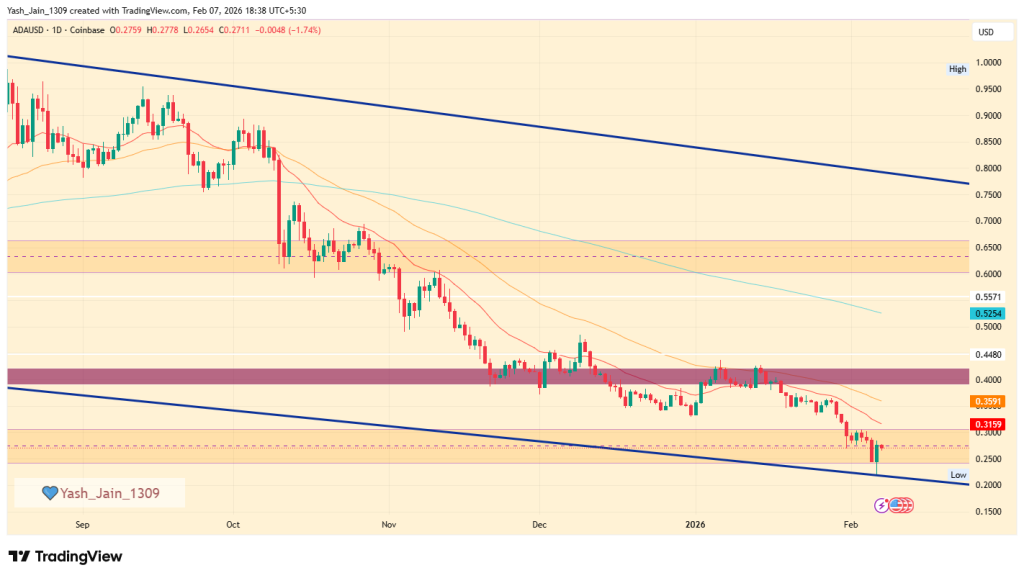
Cardano’s native token ADA has made a strong comeback, rising nearly 10% today to trade around $0.27 after falling close to $0.22 earlier this week. The sharp recovery has renewed optimism among investors and raised fresh questions about whether ADA is preparing for a bigger rally ahead.

Institutional & whale Buying Boosts ADA Confidence

One major reason behind the rebound is renewed institutional interest. Grayscale, a leading crypto investment firm managing over $35 billion in assets, recently increased its ADA holdings. 

BREAKING NEWS

GRAYSCALE SIGNALS STRONG CONFIDENCE IN CARDANO 😱😱😱

Grayscale has increased its $ADA allocation in the Smart Contract Fund from 18.55% to 19.50%, reaffirming strong conviction in Cardano.

As of 05-02-2026, $ADA remains the third-largest holding in the fund pic.twitter.com/LMQI60di8u

— Mintern (@MinswapIntern) February 6, 2026

The firm raised Cardano’s weight in its Smart Contract Fund from 18.55% to 19.50%, showing stronger confidence in the project.

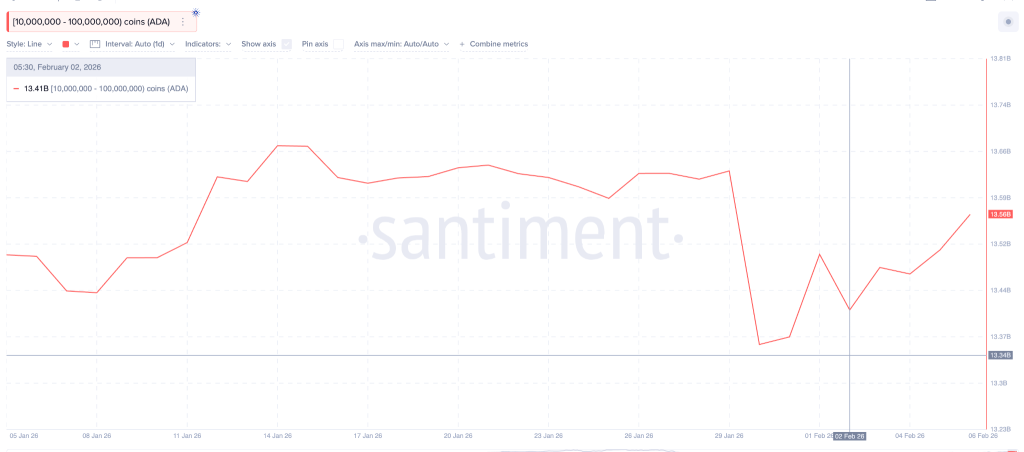
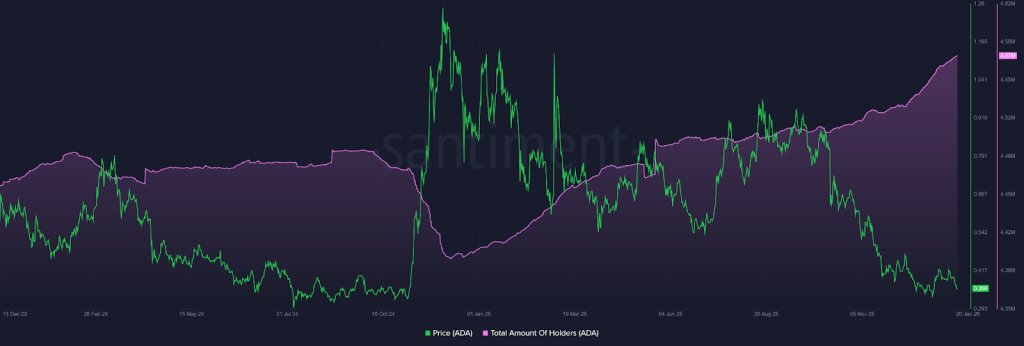
Data from santiment shows that large ADA holders took advantage of the recent price drop. Wallets holding between 10 million and 100 million ADA increased their combined balances from about 13.41 billion to 13.56 billion ADA since early February. This represents an accumulation of roughly $40 million worth of tokens.

whale buying

More importantly, these mid-sized whales did not sell during the crash. Their holdings remained stable even when prices briefly fell to $0.22.

Big Milestone Ahead: ADA Futures on CME

Adding to the positive momentum, Cardano futures are set to launch on the CME exchange on February 9. The new contracts will give institutional investors regulated access to ADA trading. CME will introduce both standard contracts of 100,000 ADA and smaller micro contracts of 10,000 ADA.

This upcoming launch could increase liquidity and bring more professional participation into the Cardano market. 

Cardano ADA Price Outlook

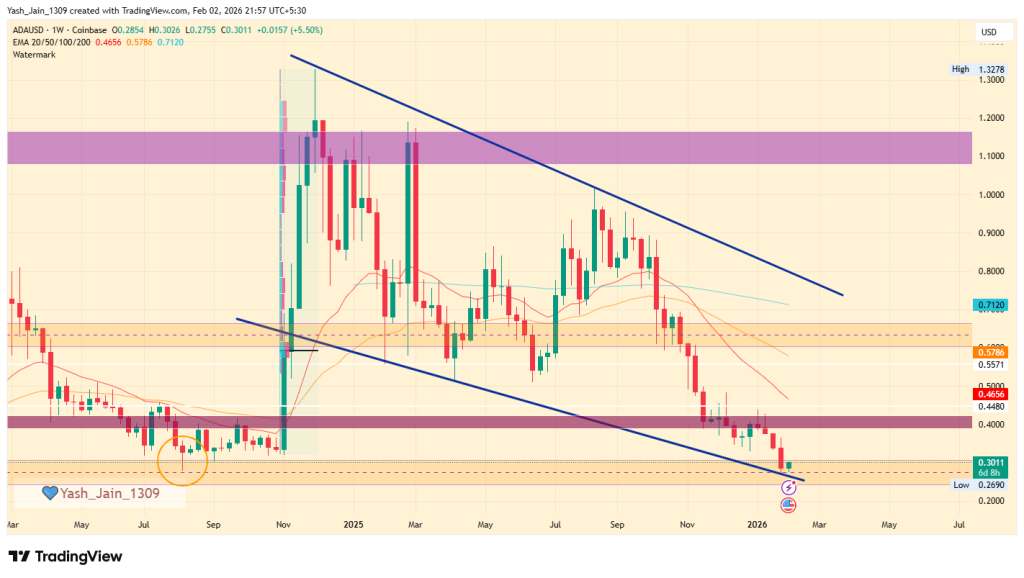
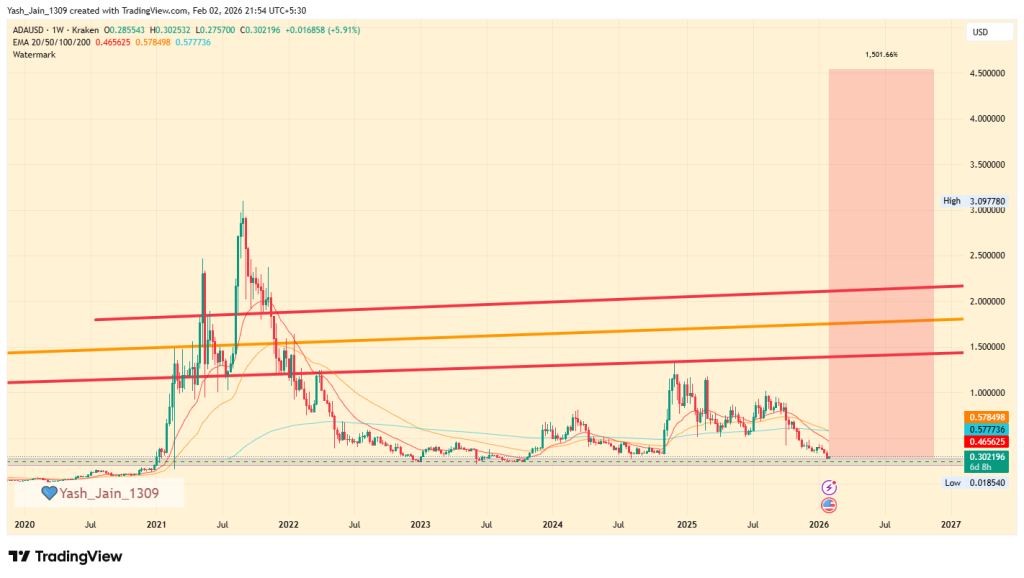
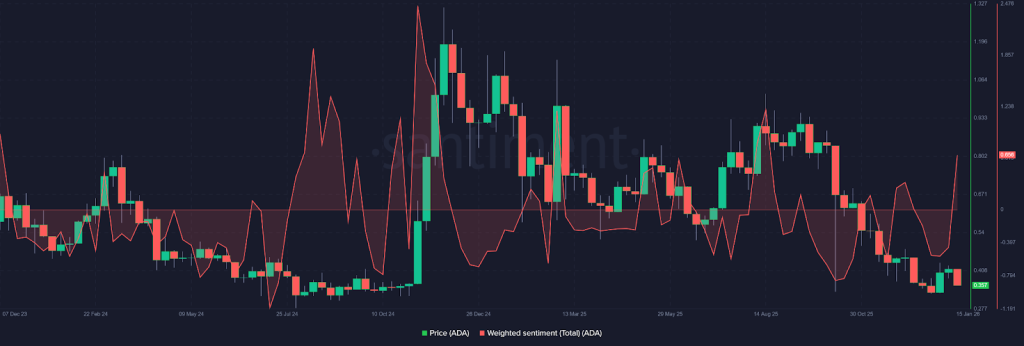
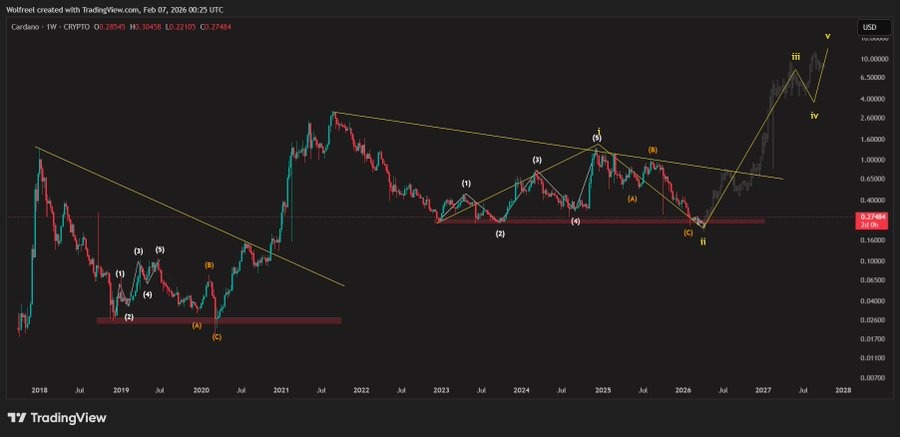
On the weekly chart, ADA has been moving sideways for a long time after its last major peak. The price is forming higher lows near the $0.26 support zone, showing steady buying interest. ADA is also testing a long-term resistance line that has blocked earlier rallies. 

A weekly close below $0.20 would weaken the bullish structure and invalidate the current setup. That level acts as the main line of defense for bulls.

CArdano price

However, if momentum improves, analysts see potential for a mid-cycle move toward the $2 to $3 range.

Never Miss a Beat in the Crypto World!

Stay ahead with breaking news, expert analysis, and real-time updates on the latest trends in Bitcoin, altcoins, DeFi, NFTs, and more.

FAQs

Why is the Cardano (ADA) price rising today?

Cardano (ADA) price is rising due to strong whale accumulation, increased Grayscale exposure, and optimism ahead of CME ADA futures.

Are whales buying Cardano during the dip?

Yes, wallets holding 10M–100M ADA added nearly $40M worth of tokens, signaling confidence and long-term accumulation.

What are the key support and resistance levels for ADA?

ADA holds strong support near $0.26, while a weekly close below $0.20 would weaken bullish momentum.

What is Cardano price prediction for February 2026?

Analysts expect ADA to trade between $0.90 and $1.50 by February 2026 if adoption grows and bullish momentum holds.

China’s New Crypto Ban Explained: Stablecoins, RWA, and the Digital Yuan

China Bans Unapproved Yuan Stablecoins

The post China’s New Crypto Ban Explained: Stablecoins, RWA, and the Digital Yuan appeared first on Coinpedia Fintech News

China is tightening the screws on crypto again.

The People’s Bank of China and seven other government agencies released a revised joint notice on Friday, banning unauthorized offshore issuance of yuan-pegged stablecoins. The notice also brings RWA tokenization under regulatory control for the first time.

The agencies stated that stablecoins pegged to fiat currencies “perform some of the functions of fiat currencies,” and warned that their unregulated circulation could threaten the yuan’s stability.

The rules apply to both domestic and foreign entities, including overseas branches of Chinese firms.

What Do the New Rules Cover?

The notice reaffirms that crypto has no legal tender status in China. All crypto-related business activities remain classified as “illegal financial activities.”

Financial institutions are warned against offering banking or clearing services to crypto businesses. Mining operations continue to face enforcement. And businesses can no longer include words like “stablecoin,” “RWA,” or “cryptocurrency” in their registered names or business scope.

A Hidden Opening for RWA?

Here is where it gets interesting. Despite the ban language, the notice does seem to create a regulated path for RWA tokenization, something that previously sat in a grey area.

Louis Wan, CEO of Unified Labs, said, “The biggest breakthrough is a clear separation between virtual currencies and RWA. Virtual currencies will still be outlawed, but RWA is being included in the regulatory system. For China’s RWA business, this is a milestone.”

Alex Zuo, senior vice president at Cobo, added, “To some extent, this means China is allowing the issuance of offshore tokens based on onshore assets.”

Digital Yuan Dominance

Winston Ma, adjunct professor at NYU School of Law, said China’s central bank is essentially highlighting that only its own digital yuan is legitimate.

China recently allowed commercial banks to pay interest on digital yuan wallets starting January 1, 2026, a clear push to drive e-CNY adoption while shutting out private alternatives.

Crypto Twitter has been exploding with reactions. Benjamin Cowen, CEO of Into The Cryptoverse, summed it up on X: “It wouldn’t be a bear market if China wasn’t banning crypto.”

Never Miss a Beat in the Crypto World!

Stay ahead with breaking news, expert analysis, and real-time updates on the latest trends in Bitcoin, altcoins, DeFi, NFTs, and more.

FAQs

Is cryptocurrency legal in China?

No, all cryptocurrency-related business activities are officially classified as illegal financial activities in China, and crypto has no legal tender status.

What is China’s policy on cryptocurrency?

China maintains a comprehensive ban on all cryptocurrency trading and business activities, classifying them as illegal financial operations to protect its financial sovereignty and the yuan.

Is any form of crypto or digital asset allowed in China?

While cryptocurrencies are banned, China is creating a regulated path for Real World Asset (RWA) tokenization and actively promoting its own central bank digital currency, the digital yuan (e-CNY).

What happens to crypto mining and related businesses under China’s rules?

Crypto mining remains prohibited, and businesses cannot use terms like “cryptocurrency” in registrations. Financial institutions are barred from servicing crypto firms, with continuous enforcement.

Vitalik Buterin Backs Zcash Upgrade, Signaling Crypto’s Privacy Future

Vitalik Buterin Backs Zcash Upgrade, Signaling Crypto’s Privacy Future

The post Vitalik Buterin Backs Zcash Upgrade, Signaling Crypto’s Privacy Future appeared first on Coinpedia Fintech News

Ethereum co-founder Vitalik Buterin has quietly made a strong statement about where he thinks crypto should be heading. He recently donated to Shielded Labs, a research group working on a major upgrade for Zcash, signaling his growing focus on privacy and long-term security rather than hype or short-term growth.

The donation supports the development of Crosslink, a proposed upgrade aimed at making Zcash transactions settle faster and more securely. More than the money itself, the move reflects Buterin’s belief that privacy should be treated as core infrastructure, not a bonus feature.

What Crosslink Changes for Zcash

At a simple level, Crosslink adds an extra layer of confirmation on top of Zcash’s existing proof-of-work system. This second layer is designed to lock in transactions more quickly and with stronger certainty. That matters because it reduces the risk of chain reorganizations and double-spend attacks, issues that can be especially costly for exchanges and large transfers.

With stronger finality, exchanges would not need to wait as long before crediting deposits, cross-chain bridges could operate with better security guarantees, and developers would have clearer assumptions when building on the network. For Zcash, this means becoming more practical to use without weakening its privacy model.

Why Shielded Labs Fits Buterin’s Thinking

Shielded Labs is focused entirely on improving Zcash at the protocol level. It is not building apps or chasing user growth. Instead, the team works on deep technical upgrades that improve security, usability, and cryptographic guarantees, especially around shielded transactions.

That approach lines up closely with how Buterin has been speaking lately. He has argued that blockchains should be designed for worst-case scenarios, not ideal conditions. In other words, systems should still protect users even under censorship, attacks, or hostile regulatory pressure.

Privacy Is Not Optional Anymore

Buterin has become increasingly vocal about the risks of financial systems that are fully transparent without strong privacy protections. He has warned that this kind of openness can lead to surveillance, coercion, and long-term instability.

From that perspective, Zcash stands out because privacy is built directly into the protocol through shielded transactions, rather than added later as an extra feature. Supporting Shielded Labs is effectively an endorsement of that design philosophy.

Crypto Reaction

Crypto analyst Mert argues that crypto cannot truly succeed without strong, built-in financial privacy, saying that a system without encrypted money misses the entire point of decentralization. He suggests that what the market saw late last year was only a preview, and believes momentum is building for a serious revival of Zcash. According to him, the groundwork is already in place for Zcash to accelerate sharply and potentially re-enter the top tier of cryptocurrencies.

Never Miss a Beat in the Crypto World!

Stay ahead with breaking news, expert analysis, and real-time updates on the latest trends in Bitcoin, altcoins, DeFi, NFTs, and more.

FAQs

What is the Crosslink upgrade for Zcash?

Crosslink adds an extra layer of confirmation to Zcash, speeding up transactions and reducing the risk of double-spends.

How does Zcash maintain privacy?

Zcash uses shielded transactions, encrypting amounts and addresses, making privacy a built-in feature, not optional.

Could Zcash gain in the crypto market soon?

With Crosslink upgrades and growing privacy demand, Zcash could accelerate adoption and rise among top cryptocurrencies.

Scaramucci Explains Why Bitcoin Fell to $60K This Week

Bitcoin price today

The post Scaramucci Explains Why Bitcoin Fell to $60K This Week appeared first on Coinpedia Fintech News

Bitcoin fell sharply to $60,000 this week, shaking investor confidence, even though the market has many positive developments. On CNBC’s Closing Bell Overtime, SkyBridge Capital founder Anthony Scaramucci explained why Bitcoin can still have big swings, despite favorable regulation, the approval of ETFs, and growing interest from large investors.

A Rough Week for Bitcoin

This week, Bitcoin saw a steep drop followed by a quick rebound, showing that it remains unpredictable. This happened even though many consider recent events as wins: spot Bitcoin ETFs are now available, institutions are investing, and U.S. regulations are becoming clearer. Still, instead of stable prices, Bitcoin fell hard, leaving investors puzzled.

Scaramucci said the recent drop is uncomfortable but not unusual for Bitcoin.

Bitcoin Is Still an Early-Stage Asset

Scaramucci emphasized that Bitcoin is still in its early adoption phase. He doesn’t call it just “digital gold” or a hedge against inflation, but a new type of technology with characteristics of both money and gold. Early-stage assets often have big ups and downs.

He added that most Bitcoin investors are younger. Older, wealthier investors often prefer traditional safe-haven assets like gold and silver. That’s why those assets rose earlier this year while Bitcoin struggled to stay at its highs.

Regulatory Clarity Could Boost Confidence

A major factor holding Bitcoin back, according to Scaramucci, is uncertainty around U.S. regulations. He highlighted the importance of the Clarity Act. Even with ETFs, many banks and institutions hesitate to invest fully without clear government guidance.

If such legislation passes, it could bring in a new wave of large investors. Until then, uncertainty is likely to keep Bitcoin prices volatile.

Why ETFs Haven’t Made Bitcoin Stable Yet

Even with institutional buying and ETFs, Bitcoin still reacts strongly to market conditions. Scaramucci said the recent price drop was actually smaller than past cycles. For example, a fall like this might have pushed Bitcoin down to $38,000 before, but this time it held near its 200-day moving average. This shows some support from ETFs and big buyers.
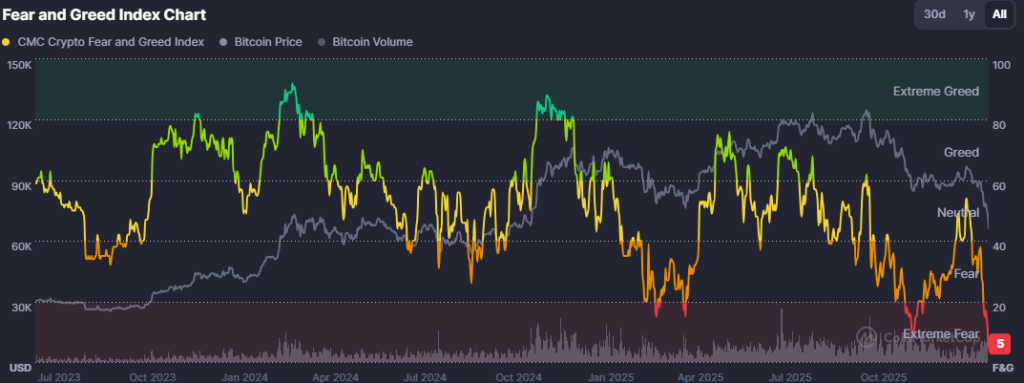
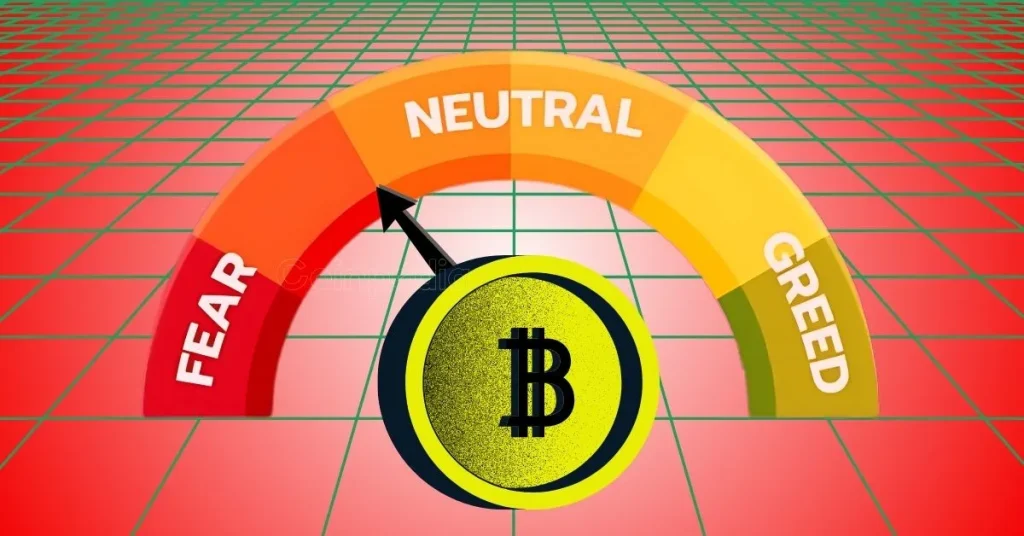
He also pointed out that fear is very high in the market. The Fear & Greed Index dropped to 5, one of Bitcoin’s lowest levels ever, which usually happens during major sell-offs rather than market peaks.

Despite the chaos, Scaramucci remains confident. He called the recent drop a “normal correction” and revealed he bought more Bitcoin during the dip. For him, volatility is just part of owning an asset that is still early in global adoption.

Never Miss a Beat in the Crypto World!

Stay ahead with breaking news, expert analysis, and real-time updates on the latest trends in Bitcoin, altcoins, DeFi, NFTs, and more.

FAQs

Is Bitcoin still a risky investment?

Yes, Bitcoin is an early-stage asset with big price swings, influenced by adoption trends, ETFs, and ongoing regulatory uncertainty.

Can U.S. regulations boost Bitcoin confidence?

Clear regulations could attract institutional investors and reduce volatility, but current uncertainty keeps Bitcoin unpredictable.

Why is Bitcoin so volatile despite institutional interest?

Early adoption, a younger investor base, and Fear & Greed-driven sentiment make Bitcoin prone to large swings.

Should I buy Bitcoin after a recent dip?

Buying during dips can be an opportunity, but it carries risk; volatility is normal for Bitcoin’s early-stage market.

WLFI Price Slumps as Regulatory Concerns Eclipse Crypto Market Recovery

Trump-linked crypto investigation

The post WLFI Price Slumps as Regulatory Concerns Eclipse Crypto Market Recovery appeared first on Coinpedia Fintech News

Crypto markets attempted to stabilize today, with Bitcoin holding above the $67,000 mark and several major altcoins showing short-term relief rallies after aggressive liquidation-driven selloffs. Risk appetite, while fragile, showed early signs of returning across parts of the market. WLFI price has failed to participate in that rebound. Instead, WLFI price extended losses, remaining one of the weakest performers as selling pressure persisted. The divergence highlights a key point: WLFI price action is being driven by project-specific risk rather than broader market conditions.

Scrutiny Tightens as WLFI Price Struggles to Shake Political Overhang 

WLFI price continues to face bearish pressure as political scrutiny surrounding World Liberty Financial remains firmly in focus, keeping traders cautious even as broader crypto markets attempt to stabilize. The project sits under increasing examination after the U.S. Congressman Ro Khanna, a ranking member of the House Select Committee on China, confirmed an investigation into a reported $500 million UAE-linked investment connected to the Trump family’s crypto venture. The inquiry centers on transparency, foreign capital exposure, and potential national-interest implications factors that markets typically price in well before any regulatory outcome materializes.

Breaking: I have launched an investigation as ranking member of the Select Committee on China into a $500 million UAE investment in the Trump family’s cryptocurrency company.

This is about public trust and transparency. https://t.co/2PfVrOmNni https://t.co/1PjXb64jyH

— Ro Khanna (@RoKhanna) February 5, 2026

For WLFI, the issue is not a single headline but the persistence of uncertainty. Once political oversight enters the equation, price discovery often shifts away from short-term technicals toward risk management, with traders reducing exposure until clarity emerges. That dynamic appears evident in WLFI’s continued downside momentum. Adding to the strain, reports of World Liberty Financial reducing its wrapped Bitcoin holdings have deepened concerns around defensive positioning. Whether interpreted as liquidity management or precautionary de-risking, the move has amplified bearish sentiment around WLFI price, reinforcing the perception that the token is trading under an unresolved cloud.

As long as political scrutiny and balance-sheet questions remain active themes, WLFI price is likely to stay sensitive to headlines, with rallies facing immediate selling pressure rather than sustained follow-through.

WLFI Price Analysis: Breakdown Structure Signals Continued Pressure

WLFI price action remains technically weak, with the chart reflecting sustained selling pressure following its breakdown of the symmetrical triangle pattern. After failing to hold its prior consolidation base around $0.1600, price broke down below the trendline support, confirming a bearish thesis. Moreover, the meme-coin has slipped below the short-term moving averages, with EMAs sloping downwards, indicating that sellers are active on rallies. 

WLFI Price

The recent breakdown has shifted the structure, from higher lows to lower lows which signals that sellers have dominated now. The current structure signals that WLFI price is heading toward the swing low of $0.0750, the key demand zone. Once price approaches the zone, buyers may accumulate the memecoin and a swift recovery could be seen from there. Until WLFI token price remains below $0.1500, the short-term trend remains bearish. In case of bounceback, the $0.1200 would act as an immediate resistance, while near support levels are $0.1000 and $0.0900.

Crypto Startup Erebor Becomes First US Bank of Trump’s Term

Crypto Startup Erebor Becomes First US Bank of Trump’s Term

The post Crypto Startup Erebor Becomes First US Bank of Trump’s Term appeared first on Coinpedia Fintech News

Erebor Bank, a crypto‑friendly financial startup backed by tech investors including Palmer Luckey and Joe Lonsdale, has become the first new national bank chartered in the US during President Trump’s second term, the Wall Street Journal reported. The Office of the Comptroller of the Currency (OCC) approved the charter less than eight months after application, allowing Erebor to operate nationwide. The bank aims to serve technology firms in crypto, artificial intelligence, defense, and manufacturing, helping fill funding gaps left after Silicon Valley Bank’s collapse. It has also secured FDIC deposit insurance and plans to offer traditional banking alongside services tailored to emerging industries.

Arthur Hayes Links Bitcoin Crash to BlackRock Bitcoin ETF Flows

Bitcoin recovery today

The post Arthur Hayes Links Bitcoin Crash to BlackRock Bitcoin ETF Flows appeared first on Coinpedia Fintech News

Bitcoin and other major cryptocurrencies are showing signs of short-term recovery after a recent sharp drop, with prices bouncing off key support levels. Analysts say this rebound may indicate the worst of the recent sell-off is over, at least for now.

Bitcoin found support at $60,000, which is now acting as a short-term floor. Ethereum, XRP, Solana, and Chainlink have also bounced, suggesting the recovery is affecting the wider crypto market.

Stock Market Bounce Adds Support to Crypto

The crypto recovery happened at the same time as a small bounce in U.S. stocks. The S&P 500 rose slightly as the week ended, showing that traditional markets and cryptocurrencies often move together. Analysts say this stock market bounce may have helped Bitcoin and other cryptocurrencies start to recover.

While the recent rebound is encouraging, some experts caution that the prior crash was influenced by more than just market sentiment.

Arthur Hayes: ETF Hedging Behind the Crash

BitMEX co-founder Arthur Hayes offered a structural explanation for the decline. He believes the Bitcoin sell-off is not just panic-driven but also linked to dealer hedging related to structured products tied to BlackRock’s iShares Bitcoin Trust (IBIT). As IBIT shares fell sharply, banks and dealers were forced to rebalance their positions, triggering aggressive selling in Bitcoin and related derivatives.

$BTC dump probably due to dealer hedging off the back of $IBIT structured products. I will be compiling a complete list of all issued notes by the banks to better understand trigger points that could cause rapid price rises and falls. As the game changes, u must as well. pic.twitter.com/9DF8VE9XBL

— Arthur Hayes (@CryptoHayes) February 7, 2026

Hayes noted that such mechanical selling can create sudden and dramatic price swings, especially in fragile markets. He is compiling a detailed list of bank-issued notes to identify key triggers that could cause rapid moves in either direction.

ETF Flows Highlight Structural Pressure

Recent spot Bitcoin ETFs have been net sellers, supporting Hayes’ view. Nearly $1.2 billion has flowed out of spot Bitcoin ETFs over the last three trading days, led by BlackRock’s IBIT. Meanwhile, IBIT recorded a record $10 billion in trading volume as its share price fell 13% in a single session, its second-largest daily drop since launch.

Rather than signaling strong demand, this surge in volume reflects stress, hedging, and forced repositioning. It underscores that structural flows are becoming a dominant factor in Bitcoin’s price movements.

Never Miss a Beat in the Crypto World!

Stay ahead with breaking news, expert analysis, and real-time updates on the latest trends in Bitcoin, altcoins, DeFi, NFTs, and more.

FAQs

Why is the crypto market up today?

Crypto prices are rising as key coins find support, ETF outflows slow, and investor confidence returns alongside stocks.

What caused the recent sharp drop in Bitcoin?

The decline was driven by structural factors like ETF-related hedging, forced bank selling, and high-volume repositioning.

Are ETFs making Bitcoin more volatile?

Yes, large spot Bitcoin ETF flows can trigger mechanical selling and sudden moves, making structural pressures key in crypto volatility.

XRP News Today : Ripple Pushes XRP Beyond Trading Into Core Settlement and Liquidity Role

XRP News Today

The post XRP News Today : Ripple Pushes XRP Beyond Trading Into Core Settlement and Liquidity Role appeared first on Coinpedia Fintech News

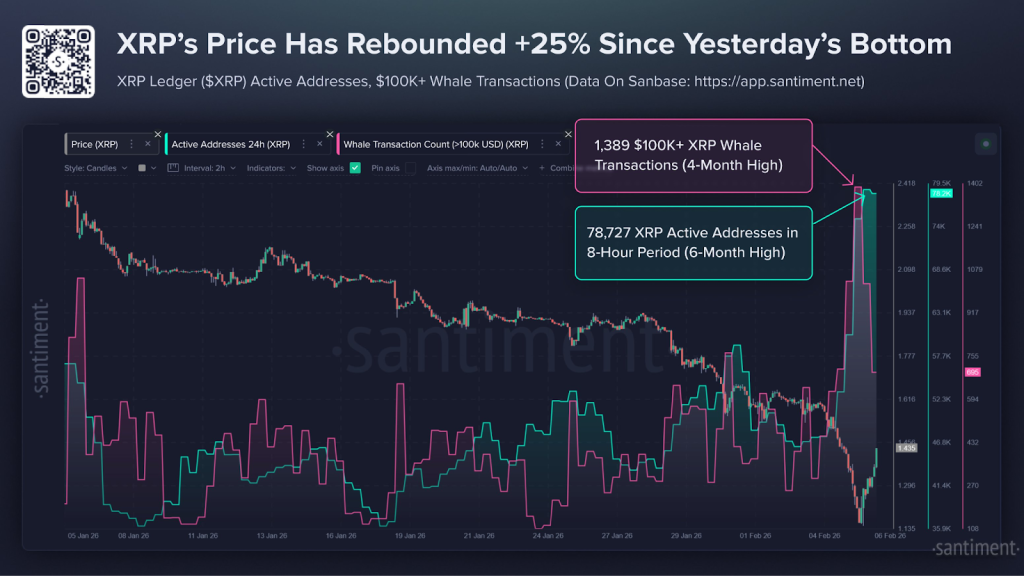
Ripple’s native token XRP is shifting from a trading-focused crypto asset into a key settlement layer for institutional finance. A new strategic update around XRP Ledger (XRPL) shows a strong push toward regulated decentralized finance, positioning XRP at the core of payments, liquidity transfers, and on-chain credit activity. 

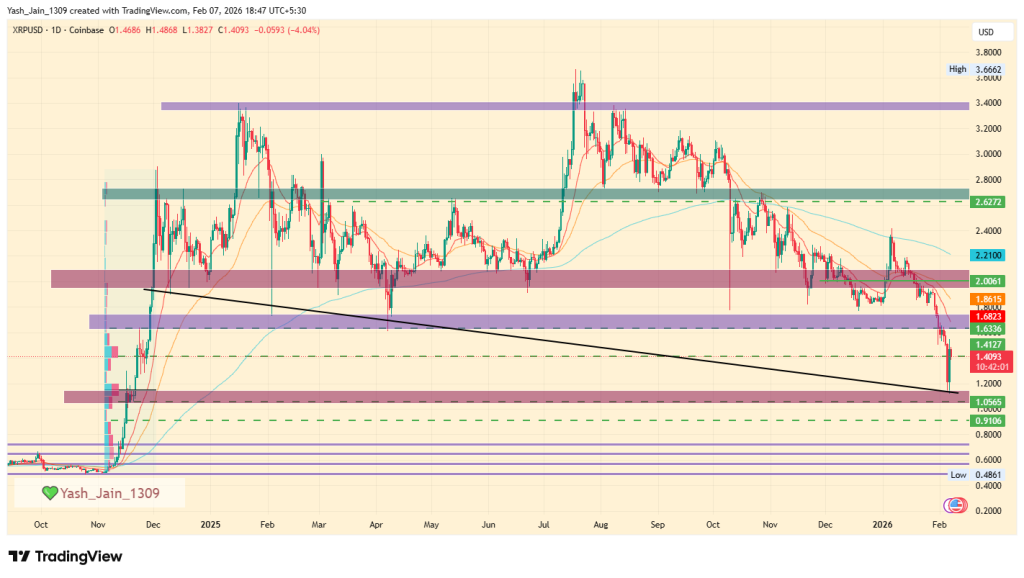
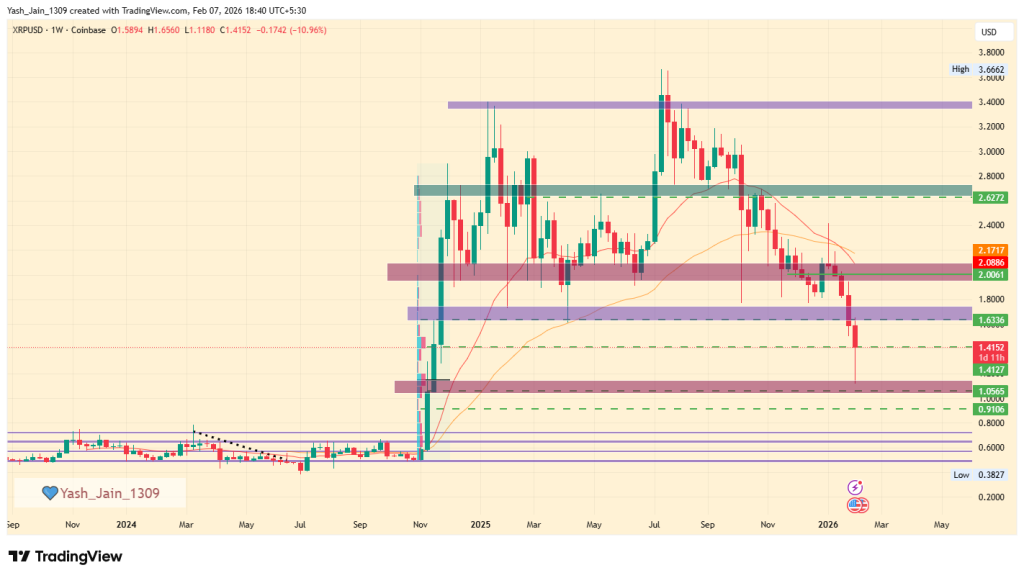
Meanwhile, XRP is trading near $1.46, gaining almost 12% in today’s market rally.

XRPL Upgrades Target Institutional Finance Needs

According to Ripple’s latest roadmap insight, XRPL is evolving beyond basic transfers and is now designed to handle real-time settlement and tokenized finance operations at scale. 

The network already supports tools that institutions typically require, such as multi-purpose tokens, permissioned environments, credential layers, escrow controls, and batch transaction processing.

These functions allow financial players to manage foreign exchange settlements, issue tokens, and complete delivery-versus-payment transactions directly on the ledger.

Instead of operating as a separate trading asset, XRP is used directly inside these flows to cover transaction fees, reserve requirements, and automatic asset bridging between tokens.

XRP’s Utility Expands Beyond Simple Transfers

Ripple’s framework positions XRP as a functional protocol token rather than only a medium of exchange. The asset supports multiple ledger-level operations that connect payments, collateral movement, and liquidity routing.

This design allows different financial components to work together as a single system. Payments, token settlement, and liquidity conversion are linked through XRP at the base layer, giving it a structural role in how transactions are completed.

Recently, Ripple also pointed to 2 upcoming upgrades expected to deepen XRP’s role:

  • Single-Asset Vaults for structured asset management
  • XLS-66 Lending Protocol for native on-ledger borrowing and lending

These additions would allow credit markets to function directly on XRPL while keeping XRP central to settlement and liquidity movement.

Bitrue List 10 New RLUSD Trading Pairs

At the same time, exchange-side support for the XRP ecosystem is also expanding. Crypto trading platform Bitrue announced stronger XRP ecosystem support and launched 10 new RLUSD spot trading pairs linked to major crypto assets.

#Bitrue was the world's first crypto exchange to offer #XRP base pairs and we continue to show our support and dedication to the #XRP ecosystem with the introduction of $RLUSD trading pairs this week! 🚀 @ripple

Here's 10 $RLUSD Spot trading pairs we will be offering:
⭐pic.twitter.com/zzS5OZzGFC

— Bitrue (@BitrueOfficial) February 5, 2026

The platform says its XRP-focused product line now includes trading, staking, loans, and futures tools. 

The rollout is designed to improve liquidity access and portfolio flexibility for traders positioning for the next market cycle.

Never Miss a Beat in the Crypto World!

Stay ahead with breaking news, expert analysis, and real-time updates on the latest trends in Bitcoin, altcoins, DeFi, NFTs, and more.

FAQs

How is XRP evolving beyond a trading crypto?

XRP is shifting into a settlement and liquidity layer for institutions, supporting payments, tokenized finance, and on-ledger credit operations.

How does XRP help institutional finance work?

XRP handles fees, reserves, and asset bridging, enabling real-time settlements and smooth liquidity flow for institutions.

Is XRP a good investment?

XRP’s value is increasingly tied to its utility in institutional finance for settlements and liquidity, not just speculation. It recently traded near $1.46, gaining 12% in a market rally.

Can you lend and borrow using XRP?

Yes, an upcoming XRPL upgrade (XLS-66 Lending Protocol) will allow native on-ledger borrowing and lending, deepening XRP’s role in credit markets and asset management.


White House to Hold Feb. 10 Meeting on Stablecoin Yield Rules With Banks and Crypto Firms

White House to Hold Feb. 10 Meeting on Stablecoin Yield Rules With Banks and Crypto Firms

The post White House to Hold Feb. 10 Meeting on Stablecoin Yield Rules With Banks and Crypto Firms appeared first on Coinpedia Fintech News

The White House is preparing for another important meeting on February 10 to discuss stablecoin rules with banks and crypto companies. The talks are part of ongoing efforts to shape clear regulations for the U.S. crypto market. 

The main issue remains whether stablecoin issuers should be allowed to offer yield or interest to users.

Why Stablecoin Yields Are a Big Concern

Independent journalist Eleanor Terrett highlighted that a new round of White House discussions is about the happen next Tuesday. 

This follows an earlier closed-door session earlier in the week where staff-level participants from both sectors met but failed to fully resolve major policy gaps. Even though attendees described the tone as productive, no final consensus was reached.

However, the main goal of this discussion is about clarisfication over the Stablecoin Yield talks.

Why Stablecoin Yields Are a Big Concern?

Traditional banks are strongly worried about yield-bearing stablecoins. They believe that if crypto firms are allowed to offer interest on stablecoins, customers may move their money away from bank deposits. This could weaken the banking system and reduce financial stability.

Therefore, banking groups and Treasury officials have pushed for strict limits on stablecoin rewards. They argue that only regulated banks should be allowed to offer interest-based products to protect consumers and the economy.

Crypto firms strongly disagree. They say user rewards are a standard growth tool in digital finance, and banning them would hurt competition and give traditional banks an unfair advantage in the market.

Several industry participants have suggested targeted edits to the draft framework to make the bill more balanced and practical. Perhaps, banking representatives have not yet signaled acceptance of those changes.

Next Meeting to Bring Both Sides Together

The upcoming discussion will include staff-level officials, bank representatives, and crypto trade groups. This is an important change from earlier meetings, which mainly involved government officials and policy experts.

With the crypto market facing recent volatility, regulatory clarity is widely seen as a potential confidence booster for investors and institutions

If both sides reach a compromise, it may help speed up long-delayed crypto legislation.

Never Miss a Beat in the Crypto World!

Stay ahead with breaking news, expert analysis, and real-time updates on the latest trends in Bitcoin, altcoins, DeFi, NFTs, and more.

FAQs

What are the main concerns about stablecoin yields?

Regulators and banks fear yield-bearing stablecoins could lure deposits away from traditional banks, potentially weakening the financial system’s stability and consumer protections.

Why are banks against stablecoins offering interest?

Banks argue that only regulated institutions should offer interest products to safeguard customers and maintain economic stability, viewing crypto yields as a competitive threat to deposits.

What is the goal of the upcoming White House stablecoin meeting?

The February 10 meeting aims to bridge policy gaps between banks and crypto firms, seeking clarity on yield rules to advance clearer U.S. crypto regulations.

Arthur Hayes Blames IBIT Hedging for Recent Bitcoin Selloff

Arthur Hayes Blames IBIT Hedging for Recent Bitcoin Selloff

The post Arthur Hayes Blames IBIT Hedging for Recent Bitcoin Selloff appeared first on Coinpedia Fintech News

BitMEX co-founder Arthur Hayes said the recent Bitcoin selloff was likely driven by dealer hedging linked to iShares Bitcoin Trust (IBIT) structured products. These hedging activities, where market participants adjust positions based on price movements, can amplify volatility. Hayes is also compiling a detailed list of bank-issued notes and related products to identify potential trigger points that could cause sharp Bitcoin swings. He stressed that as market conditions evolve, traders and institutions must adapt quickly to navigate sudden price changes.

Crypto Markets Rebound—Here’s Why Bitcoin, Ethereum, XRP Prices are Rising Today

5 Key Reasons Why the Crypto Market Is Up Today?

The post Crypto Markets Rebound—Here’s Why Bitcoin, Ethereum, XRP Prices are Rising Today appeared first on Coinpedia Fintech News

The crypto markets experienced some relief as the selling pressure eased over the major cryptos. The market capitalisation recovered above $2.4 trillion, while the volume dropped close to $200 billion from the highs around $306 billion during the sell-off. The crypto ETF also turned positive after 2 to 3 days of continuous outflow. The market dynamics suggest a shift in favour of the bulls, but the sentiments remain under extreme fear, indicating that the traders and the investors remain in disbelief. 

Why is Bitcoin Price Rising?

Bitcoin is rising after a sharp rebound from intraday lows, driven by exhausted selling and forced short covering rather than fresh bullish news. BTC price is trading near $69,942, up 7.68% on the day, after bouncing from a low of $64,459 to an intraday high of $71,681. The recovery followed an extreme momentum reset, with RSI climbing to 32.2 from 15.82, a level that often signals panic selling has peaked.

Derivatives data show the move was mechanically fueled. Open interest rose to $58.6 billion, pointing to new positions entering after the flush. Liquidations also skewed toward the downside, with short liquidations at roughly $384 million, compared to $299 million in long liquidations, forcing late sellers to buy back into the move.

Ethereum & XRP Followed Bitcoin Price Recovery

ETH price is trading around $2,072, up 7.75%, after rebounding from a $1,865 low to a $2,115 intraday high. The move followed extreme downside pressure, with RSI recovering from 18.66 to near 30, a level that often marks seller exhaustion. Derivatives positioning picked up alongside the bounce, as open interest rose from $22.89 billion to $25.16 billion, suggesting fresh participation after the flush rather than long-term accumulation.

XRP price trades near $1.45, up 10.74%, after climbing from $1.29 to $1.54. RSI jumped from 17.05 to the mid-30s, while open interest increased from $2.4 billion to $2.63 billion, pointing to speculative flows rather than confirmed trend strength. XRP is also among the top performers among the top 10 cryptos, with over a 30% rise from the lows close to $1.12. 

What to Expect from the Crypto Markets This Weekend

As the market heads into the weekend, Bitcoin will remain the key driver, especially after its sharp rebound and leverage reset. With BTC RSI still below neutral and price sitting near reclaimed intraday levels, weekend action is likely to be range-bound and volatility-driven rather than trend-defining. 

Ethereum and XRP have rebounded more aggressively, but both moves were fueled by oversold bounces and rising open interest, which increases the risk of choppy price action in thinner liquidity. Traders should watch for failed retests and funding shifts, as weekend sessions often favor stop-hunts and partial retracements before a clearer direction emerges early next week.

Crypto Market Today Rebounds as Bitcoin, XRP Rally After Panic Sell-Off

Crypto Market Today

The post Crypto Market Today Rebounds as Bitcoin, XRP Rally After Panic Sell-Off appeared first on Coinpedia Fintech News

The crypto market showed early signs of recovery today after a sharp sell-off, with Bitcoin climbing back above the $71,000 level. The rebound followed a wave of panic selling that pushed market sentiment to an extreme level of fear, leaving investors unsure whether this move marks a real recovery or just a short-term bounce before another decline.

The Crypto Fear & Greed Index dropped to 5, one of its lowest levels ever, indicating the extent of negative sentiment. Similar levels were last seen during major market crashes, including the COVID crash and the collapse of FTX, highlighting the scale of fear that recently gripped the market.

Bitcoin and Altcoins Recover as Oversold Conditions Ease

Bitcoin briefly dipped close to the $60,000 level before finding support and bouncing back. At the same time, major altcoins also posted strong short-term gains. Ethereum rose nearly 9%, Solana jumped over 14%, and XRP surged more than 20% at its peak during the rebound.

Despite the recovery, prices remain well below recent highs, showing that the broader market is still fragile. Analysts say the bounce is likely driven by traders closing short positions and fresh liquidity entering the market, rather than strong long-term buying confidence.

Tether has minted nearly $2 billion in USDT over the past few days, which may have helped support prices in the short term by adding liquidity to the market.

XRP Price Shows Strong Recovery Signs Amid Whale Buying

XRP Ledger Active Addresses
Source: Santiment X Post

XRP stood out during the rebound, posting sharper gains compared to the broader market. According to Santiment data, XRP price recovered from below $1.15 to above $1.50 in less than a day.

The rally was supported by heavy whale activity, with over 1,389 transactions worth more than $100,000 recorded, the highest level in four months. At the same time, the number of active XRP Ledger addresses surged to a six-month high, suggesting renewed interest during the dip.

These signals point to strong buying during panic conditions, often seen near short-term market bottoms.

Bitcoin Relief Rally or More Downside Still Possible?

Bitcoin has not yet confirmed a full trend reversal. Buy signals are appearing on shorter timeframes, but a stronger confirmation would require a weekly signal, which is still missing.

Past market cycles show that initial rebounds are often followed by weeks of choppy price action or even another leg lower. Similar setups in recent months resulted in breakdowns after brief optimism.

Bitcoin could move toward the $75,000–$80,000 range in the short term. However, a sustained move above $80,000 is seen as necessary before confidence in a new bull phase can return.

Never Miss a Beat in the Crypto World!

Stay ahead with breaking news, expert analysis, and real-time updates on the latest trends in Bitcoin, altcoins, DeFi, NFTs, and more.

FAQs

Why is the crypto market up today?

The crypto market is up due to Bitcoin and altcoin rebounds, panic buying easing, and fresh liquidity entering the market.

Which altcoins gained the most during the recent recovery?

Ethereum rose 9%, Solana jumped 14%, and XRP surged over 20%, showing strong short-term gains amid oversold conditions.

Is the crypto market recovery likely to continue?

Short-term rebounds are possible, but trend reversal is unconfirmed; Bitcoin must sustain above $80K to signal a new bull phase.

21Shares Files With SEC for Spot ONDO ETF

21Shares Files With SEC for Spot ONDO ETF

The post 21Shares Files With SEC for Spot ONDO ETF appeared first on Coinpedia Fintech News

Crypto asset manager 21Shares has filed a Form S-1 registration statement with the U.S. Securities and Exchange Commission to launch a spot ETF based on ONDO, the native token of Ondo Finance. The proposed 21Shares Ondo Trust would directly hold ONDO tokens and track their performance using the CME CF Ondo Finance-Dollar Reference Rate, with Coinbase providing custody. This ETF aims to offer a regulated, passive way for investors to gain exposure to ONDO and the growing tokenized real-world assets market.

Immutable (IMX) Price Prediction 2026, 2027 – 2030: How High Can IMX Go?

IMX Price Prediction

The post Immutable (IMX) Price Prediction 2026, 2027 – 2030: How High Can IMX Go? appeared first on Coinpedia Fintech News

Story Highlights

  • The live price of the IMX token is  $ 0.16452323
  • The Immutable IMX price could hit $1.05 in 2026
  • By 2030, IMX could target the $11, only if Web3 gaming becomes mainstream.

Immutable is a blockchain infrastructure project built specifically for NFTs and Web3 gaming. Instead of competing as a general-purpose Layer 1, Immutable operates as a Layer 2 scaling solution on Ethereum, focused on delivering fast, secure, and gas-free NFT minting and trading.

Powered by StarkWare’s zero-knowledge rollups, Immutable can process more than 9,000 transactions per second, solving Ethereum’s high fees and slow transaction speeds for gaming applications.

Despite strong fundamentals, Immutable native token IMX has suffered alongside the broader NFT and gaming sector, now trading around $0.157.

So, let’s formulate an Immutable (IMX) price prediction for 2026, 2027, and 2030.

Immutable Price Today

Cryptocurrency Immutable
Token IMX
Price $0.1645 up 10.00%
Market Cap$ 327,232,189.02
24h Volume$ 21,824,673.8682
Circulating Supply1,988,972,529.2098
Total Supply2,000,000,000.00
All-Time High$ 9.4974 on 26 November 2021
All-Time Low$ 0.1327 on 06 February 2026

Immutable Price Targets For February 2026

Immutable (IMX) is currently undergoing a major structural transition called the Immutable Chain Merge. Immutable is upgrading its bridge contract to complete the merger of Immutable X and Immutable zkEVM into one unified chain.

For users who did not withdraw before the February 11 deadline, funds will be automatically migrated to their wallets on the new Immutable zkEVM chain starting as early as February 25.

If user activity rises meaningfully, IMX could begin forming a long-term base.

Immutable Price Targets For February 2026

Technical Analysis

IMX/USDT is currently in a strong bearish trend on the 1-day chart. The price is trading near $0.151, down sharply and moving inside a clear descending channel that has been active since late 2025. 

This structure shows continuous lower highs and lower lows, confirming that sellers remain in control. The recent bounce attempt toward $0.18 failed at channel resistance, triggering another rejection and a drop toward the lower trendline.

The RSI is at 24, which indicates oversold conditions, but this alone does not confirm a reversal. In strong downtrends, RSI can stay oversold for long periods.

However, immediate support lies near $0.150, while stronger support exists around $0.14. A real bullish reversal will only be confirmed if IMX breaks above the falling channel and reclaims $0.24 with strong volume.

MonthPotential Low ($)Potential Average ($)Potential High ($)
Immutable Crypto Price Prediction February 2026$0.115$0.176$0.24

Immutable (IMX) Price Prediction 2026

The year 2026 could be important for Immutable if Web3 gaming starts growing again. Unlike many NFT projects, Immutable focuses on building strong technology and long-term partnerships.

The platform is adding more gaming studios, improving tools for developers, and making wallets and marketplaces easier to use.

Work on Immutable zkEVM is also progressing, which aims to make transactions faster, safer, and fully compatible with Ethereum.

If adoption of NFTs and blockchain gaming continues to rise, the IMX price could reach around $1.05.

YearPotential Low ($)Potential Average ($)Potential High ($)
IMX Price Prediction 2026$0.095$0.412$1.05

Immutable (IMX) Price Prediction 2026 – 2030

YearPotential Low ($)Potential Average ($)Potential High ($)
2026$0.095$0.412$1.05
2027$0.250$0.886$2.29
2028$0.535$1.98$3.56
2029$0.913$3.1$6.84
2030$2.5$5.5$11

Immutable (IMX) Price Prediction 2026

With new Web3 games launching on Immutable, adoption is rising. If this trend continues, IMX could reach around $1.05.

Immutable Price Prediction 2027

By 2027, growing demand for zero-gas NFT trading and Layer-2 gaming may push IMX higher, with a possible target of $2.29.

IMX Price Prediction 2028

In 2028, if Web3 gaming becomes more popular, Immutable’s infrastructure role could help IMX move near $3.56.

Immutable Price Forecast 2029

With stronger platform usage and growth in digital ownership, IMX may trade near $6.84.

Immutable Price Prediction 2030

By 2030, Immutable aims to have established itself as the leading platform for the global NFT and blockchain gaming industry, eying to go beyond $11.

What Does The Market Say?

Year202620272030
Coincodex$3.76$1.59$3.79
Wallet Investor$0.125$0.45$1.4
DigitalCoinPrice$3.61$4.93$10.56

CoinPedia’s Immutable (IMX) Price Prediction

Immutable is a long-term infrastructure play tied closely to the success of blockchain gaming rather than short-term NFT speculation. As of now, the project continues to build quietly while speculation fades.

If Web3 gaming adoption rebounds and Immutable’s infrastructure becomes widely used, IMX could see a strong long-term recovery.

Thus, CoinPedia expects IMX to recover gradually in 2026, with a potential high near $0.105, provided active games attract real users.

YearPotential Low ($)Potential Average ($)Potential High ($)
2026$0.095$0.412$1.05
Never Miss a Beat in the Crypto World!

Stay ahead with breaking news, expert analysis, and real-time updates on the latest trends in Bitcoin, altcoins, DeFi, NFTs, and more.

FAQs

What is Immutable (IMX) and what does it do?

Immutable is a Layer-2 Ethereum solution for NFTs and Web3 gaming, offering fast, secure, and gas-free minting and trading.

What is the Immutable (IMX) price prediction for 2026?

IMX could trade between $0.095 and $1.05 in 2026 if NFT gaming adoption grows and new games boost platform activity.

What is the Immutable (IMX) price prediction for 2030?

IMX could reach $11 by 2030 if Web3 gaming goes mainstream and Immutable becomes a leading blockchain infrastructure platform.

What is the IMX price prediction for 2040?

By 2040, IMX could see significant growth as blockchain gaming and NFTs mature, potentially reaching major multi-digit valuations.

What factors influence Immutable (IMX) price?

IMX price depends on NFT and gaming adoption, platform upgrades like zkEVM, user activity, and overall crypto market sentiment.

Is Immutable (IMX) a good long-term investment?

IMX has strong long-term potential due to its Layer-2 technology and NFT gaming focus, but volatility and market cycles remain a risk.

Next Big Altcoin Alert: This New Crypto is Surging Since Q1 2025

crypto-btc

The post Next Big Altcoin Alert: This New Crypto is Surging Since Q1 2025 appeared first on Coinpedia Fintech News

As investors look for the next big altcoin, attention is starting to shift toward newer crypto projects that have shown steady growth since early 2025. While much of the market has struggled with volatility, analysts are tracking a new crypto that has continued to gain visibility through consistent development and rising interest.

This upward trend since Q1 2025 has placed the project on several analyst watchlists. With early momentum building and broader exposure still limited, market observers believe this altcoin could remain one to watch as the next market phase begins.

The Architecture of Mutuum Finance (MUTM)

Mutuum Finance (MUTM) is being developed as a lending and borrowing hub designed to support different user needs within one ecosystem. The protocol is built around a dual-market structure that aims to balance speed, flexibility, and risk control.

One part of this design is the Peer-to-Contract (P2C) market. In this environment, users are expected to supply assets into shared liquidity pools governed by smart contracts. Borrowers would be able to access liquidity directly from these pools, while lenders earn APY that adjusts based on supply and demand. For instance, when borrowing activity increases for assets like USDT, interest rates are designed to rise to attract more liquidity.

Alongside this, the protocol plans a Peer-to-Peer (P2P) market intended for users who want more control. This setup would allow lenders and borrowers to agree on custom terms such as interest rates and loan duration. 

Across both models, risk management is based on loan-to-value (LTV) limits. With a 70% LTV, depositing $10,000 worth of ETH would allow borrowing up to $7,000, ensuring loans remain over-collateralized.

The project is currently in its presale phase and has raised over $20.4 million, supported by a community of more than 19,000 holders. This steady participation highlights growing interest as development continues toward broader deployment.

A Working Product with Institutional Security

Unlike many projects that only exist as a website, Mutuum Finance has reached a major technical milestone. The V1 protocol is now live on the Sepolia testnet. This allows the community to test the lending pools and borrowing logic in a real environment. 

Seeing a functional product before the mainnet launch has built a huge amount of trust. To further protect its users, the project completed a deep security audit by Halborn. This firm is one of the most respected names in the world for checking blockchain code.

Because of this progress, analysts are very bullish on the project’s future. The MUTM token is currently priced at $0.04 in its 7th phase. With a confirmed official launch price of $0.06, investors are securing a 50% discount today. 

Many experts believe that as long as the protocol hits top-tier exchanges, the price could see a massive move. Some analysts point to a short-term target of $0.18, which would be a 350% growth from the current stage. They argue that as usage grows, the token’s value would naturally follow the protocol’s success.

BUY-MUTM

Value Drivers and the Buy-and-Distribute Mechanism

A central part of the Mutuum Finance design is the mtToken system. When users supply assets to the protocol, they receive mtTokens as a record of their position. These tokens are designed to be yield-bearing, meaning their value increases over time as interest from borrowing activity is generated. mtTokens are already available to test in the current V1 protocol, allowing users to see how this mechanism works in practice.

To keep pricing accurate during market changes, the protocol integrates decentralized oracles that provide real-time asset values. These price feeds are used to manage collateral levels and support fair liquidation logic within the system.

According to the project’s official whitepaper, Mutuum Finance also plans to introduce a buy-and-distribute mechanism in later stages. Under this model, a portion of protocol fees is intended to be used to acquire MUTM tokens and distribute them to participants. This approach is positioned as a long-term catalyst tied to platform usage rather than short-term market activity.

Several analysts believe this mechanism could push the token even higher as adoption scales. Some longer-term forecasts suggest a target of $0.32 as long as the roadmap unfolds as expected, which would represent a 700% increase for those participating at the current $0.04 level.
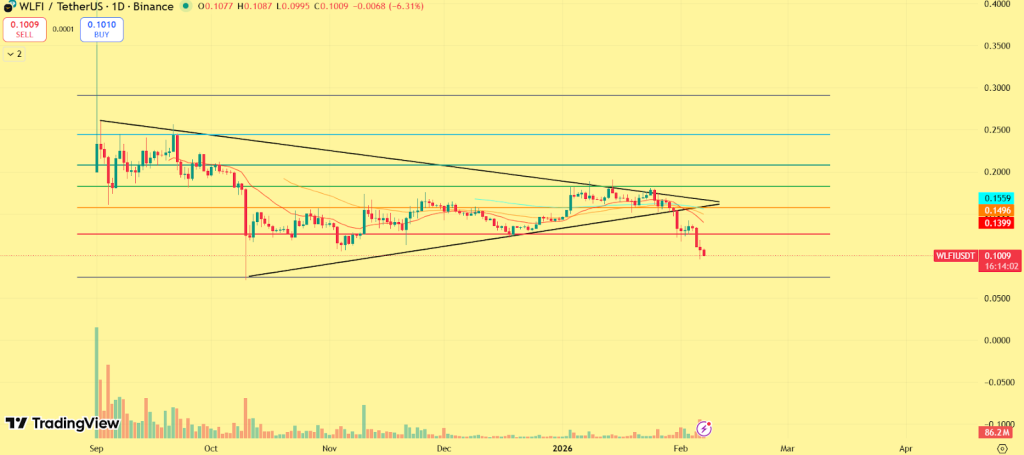
The Next Ripple (XRP)?

Many market experts are comparing the early steps of Mutuum Finance to the early days of Ripple (XRP). Just like XRP aimed to revolutionize how banks move money, Mutuum is building a bridge for decentralized credit. They are creating a self-sustaining ecosystem that provides real financial utility to millions of people. While XRP focused on cross-border payments, Mutuum is focusing on the multi-billion dollar lending market.

Investors believe the project is following the “XRP blueprint” by building a professional infrastructure and securing top-tier audits before a massive rollout. With the V1 testnet active and a $50,000 bug bounty in place, the project is ready for the big stage. As the final stages of the presale sell out, the window to catch this growth story at a 50% discount is closing. The move toward a full mainnet launch is the next big crypto step on a path that many believe leads to the top of the altcoin rankings.

For more information about Mutuum Finance (MUTM) visit the links below:

Website: https://www.mutuum.com

Linktree: https://linktr.ee/mutuumfinance

Flake.exchange: A Faster Way to Swap and Bridge Crypto Cross-Chain

flake-protocol

The post Flake.exchange: A Faster Way to Swap and Bridge Crypto Cross-Chain appeared first on Coinpedia Fintech News

As crypto liquidity spreads across multiple blockchains, users need tools that remove friction, not add more steps. Flake.exchange is built to solve one core problem in DeFi: moving assets across chains efficiently, securely, and without unnecessary complexity.

Flake.exchange offers a streamlined experience for cross-chain swaps and token bridging, allowing users to move assets between ecosystems in a single, unified flow.

What Makes Flake.exchange Different?

Flake.exchange focuses on execution quality and simplicity. Instead of forcing users to manually bridge, swap, and rebalance across different platforms, Flake automates the entire process behind the scenes.
• Key advantages include:

• One-step cross-chain swaps

• Optimized routes for price and speed

• Broad chain and asset coverage

• Fully non-custodial execution

• Everything happens directly from the user’s wallet, with no custody risk and full on-chain transparency.

• Cross-Chain Swaps Without the Headache

• Traditional bridging often means:

• Multiple transactions

• High fees

• Delays and failed transfers

• Poor UX

Flake.exchange removes these pain points by abstracting the technical complexity. Users simply choose the asset they have and the asset they want, Flake handles the rest.

This makes it ideal for both everyday DeFi users and advanced traders who value speed and capital efficiency.

The Most Efficient Way to Bridge to Hyperliquid

• Accessing high-performance trading venues like Hyperliquid requires fast and reliable cross-chain liquidity.

Flake.exchange provides an efficient path to bridge assets to

Hyperliquid by:

• Minimising transaction steps

• Reducing unnecessary fees

• Prioritising fast execution

• For traders who want to move capital quickly and stay focused on trading rather than infrastructure, Flake.exchange offers a clear advantage.

Why Flake.exchange Matters

Cross-chain infrastructure is no longer optional, it’s foundational. As DeFi continues to fragment across chains, platforms like Flake.exchange play a critical role in keeping liquidity fluid and accessible.

Flake.exchange matters because it:

• Improves capital mobility

• Simplifies multi-chain DeFi

• Enhances user experience without sacrificing control

• Helps users interact with new ecosystems faster

• It’s a practical solution to a real, growing problem in crypto.

• Built for the Multi-Chain Future

About Flake Exchange

Flake.exchange is designed for a future where users don’t need to think about bridges, chains, or routes. They just want the best result.


For anyone looking for a reliable cross-chain swap, an efficient crypto bridge, or a simple way to move assets to platforms like Hyperliquid, Flake.exchange is positioning itself as a strong, infrastructure-level player in the DeFi stack.

Contact

The Markethub

info@themarkethub.in

Decred (DCR) Price Prediction 2026, 2027 – 2030: Will Decred Price Hit $1000?

Decred (DCR) Price Prediction

The post Decred (DCR) Price Prediction 2026, 2027 – 2030: Will Decred Price Hit $1000? appeared first on Coinpedia Fintech News

Story Highlights

  • The live price of the Decred token is  $ 23.68029414.
  • Price predictions for 2026 range from $40 to $200.
  • Decred could extend toward $1000 by 2030, if recovery structure holds.

Decred (DCR) has abruptly returned to the spotlight after posting a sharp 28% intraday rally, marking one of its strongest single-day moves in recent months. The surge comes after a prolonged phase of low volatility and compressed trading ranges, a technical backdrop that often precedes trend expansion rather than short-lived relief bounces.

From a broader perspective, the breakout has pushed DCR above near-term resistance while reviving volume activity, suggesting that dormant market interest may be re-engaging. With higher-timeframe charts still reflecting a long accumulation structure, the latest price action strengthens the case that Decred could be transitioning from base formation into an early recovery phase, setting the stage for a more constructive outlook through 2026 and beyond.

Decred Price Today

Cryptocurrency Decred
Token DCR
Price $23.6803 up 4.67%
Market Cap$ 408,799,017.81
24h Volume$ 17,910,380.0936
Circulating Supply17,263,257.5997
Total Supply17,263,257.5997
All-Time High$ 250.0164 on 17 April 2021
All-Time Low$ 0.3948 on 28 December 2016

Decred (DCR) Price February 2026 Outlook

As February trading unfolds, Decred is holding firmly above its reclaimed support zone around the $20–$22 range, an area that previously capped price advances. The ability to convert this zone into support following a strong impulsive move is a technically constructive signal, indicating that buyers are stepping in on shallow pullbacks rather than chasing exhausted rallies.

If DCR continues to consolidate above this level, the chart opens room for a gradual move toward the $32–$38 resistance band, where prior supply is expected to emerge. Failure to hold above $20, however, could drag price back into the previous range, delaying the bullish thesis without fully invalidating it.

Decred (DCR) Price Prediction 2026

The broader 2026 outlook for Decred leans decisively on whether the current breakout evolves into a sustained trend. On the weekly timeframe, DCR appears to be forming a higher-low structure after months of sideways accumulation, a pattern that often precedes multi-month advances. If broader market sentiment remains constructive, Decred could gradually build momentum through successive resistance breaks near $45, $75, and $120, levels that align with historical reaction zones. 

Decred (DCR) Price Prediction 2026

A decisive expansion phase could eventually place the $180–$200 region in focus as a long-term cycle high for 2026. That said, volatility is likely to remain elevated. Pullbacks toward the $35–$45 zone may occur along the way, acting as healthy resets rather than structural breakdowns, provided the broader uptrend remains intact.

Decred Crypto Price Prediction 2026 – 2030

YearPotential Low ($)Potential Average ($Potential High ($)
202640100200
202785170320
2028210410500
2029320600800
20306708501000

Decred (DCR) Price Forecast 2026

In 2026, Decred price could project a low price of $40, an average price of $100, and a high of $200.

Decred Price Prediction 2027

As per the Decred Price Prediction 2027, Decred may see a potential low price of $85 . Meanwhile, the average price is predicted to be around $170. The potential high for Decred price in 2027 is estimated to reach $320

Decred (DCR) Price Prediction 2028

In 2028, Decred  price is forecasted to potentially reach a low price of $210 and a high price of $500.

Decred Price Prediction 2029

Thereafter, the Decred  (Decred) price for the year 2029 could range between $320 and $800.

Decred Price Prediction 2030

Finally, in 2030, the price of Decred  is predicted to maintain a steady positive. It may trade between $670 and $1000.

Decred Price Prediction 2031, 2032, 2033, 2040, 2050

The long-term projection assumes Decred sustains relevance in enterprise blockchain use cases, with growth moderating over time as the asset matures.

YearPotential Low ($)Potential Average ($)Potential High ($)
203184012001800
2032100018002500
2033200028003500
2040290033005400
2050250048006000

Decred (DCR) Price Prediction: Market Analysis?

Year202620272030
Changelly$165$280$550
CoinCodex$140$250$700
WalletInvestor$180$300$840

CoinPedia’s Decred Price Prediction

Coinpedia’s price prediction for Decred remains bullish over the long term, supported by the recent breakout from consolidation and improving market structure. If DCR sustains acceptance above its reclaimed support zones, the asset could steadily work toward the $180–$200 range by 2026. Over a full market cycle, Coinpedia projects that Decred has the potential to revisit and exceed prior highs, with $1,000 emerging as a plausible 2030 milestone, contingent on broader crypto-market expansion.

YearPotential Low ($)Potential Average ($)Potential High ($)
202640100200
Never Miss a Beat in the Crypto World!

Stay ahead with breaking news, expert analysis, and real-time updates on the latest trends in Bitcoin, altcoins, DeFi, NFTs, and more.

FAQs

What is Decred (DCR) and why is it gaining attention?

Decred is a cryptocurrency focused on community governance. Recent price rallies and breakout patterns are drawing renewed investor interest.

Is Decred (DCR) a good investment for long-term growth?

DCR shows long-term potential with a strong governance model and historical support levels, but volatility remains high.

What is Decred (DCR) Price Prediction 2026?

In 2026, DCR could trade between $40 and $200, supported by strong accumulation and breakout patterns.

What is the Decred coin price prediction for 2028?

By 2028, DCR may reach $210–$500, depending on market sentiment, adoption, and sustained bullish trends.

What is the Decred price prediction for 2030?

DCR is projected to trade between $670 and $1,000 by 2030 if it maintains growth and market relevance.

What factors influence Decred’s future price?

Price depends on adoption in blockchain use cases, market sentiment, and ability to hold support and break resistance levels.

How high could Decred (DCR) go in the next crypto cycle?

With consistent adoption and bullish cycles, DCR could revisit highs near $1,000 by 2030, making it attractive for patient investors.

Ondo Price Prediction 2026, 2027 – 2030: Can Ondo Hit $10?

Ondo Price Prediction 2024 - 2030: Will ONDO Price Hit $1?

The post Ondo Price Prediction 2026, 2027 – 2030: Can Ondo Hit $10? appeared first on Coinpedia Fintech News

Story Highlights

  • The live price of Ondo Price is  $ 0.25827081
  • Price predictions for 2026 range from $0.80 to $4.15.
  • Long-term forecasts suggest ONDO could reach $9.30 by 2030.

ONDO Finance in the RWA sector is a hot topic, investors are closely eyeing its future potential. Especially as its native token ONDO continues to build credibility and momentum through high-profile developments.

Moreover, Ondo Finance is known to be a leading RWA provider on the Solana chain and it is witnessing growing institutional interest, ONDO has solidified itself as a major player in the Real World Asset (RWA) space.

With such attraction, the ONDO price prediction 2026 is what analysts and retail investors are intrigued about. But how far can it go from here? Let’s dive into the detailed ONDO price forecast from 2025 to 2030.

Ondo Price Today

Cryptocurrency Ondo
Token ONDO
Price $0.2583 up 9.88%
Market Cap$ 1,257,605,978.07
24h Volume$ 123,149,062.5058
Circulating Supply4,869,330,647.00
Total Supply10,000,000,000.00
All-Time High$ 2.1413 on 16 December 2024
All-Time Low$ 0.0835 on 18 January 2024

Coinpedia’s ONDO Price Prediction 2026

ONDO/USD has been declining since early 2025, reaching a support level around $0.20 in February 2026. A potential reversal may occur if it breaks the $0.60 resistance. Key targets for Q1 2026 are $0.80 and $1.20.

ONDO Price Prediction February 2026

On the daily chart, the ONDO price fall continued in January and February, and also began on a bearish note.

It is now retesting the lower border of the falling wedge pattern. This support is the level where buying could be happening, and once it overflows with demand, a rise could burst its way out. Also, the falling wedge range is narrowing, and ONDO/USD is at a key support level. February could see a revisit to the $0.50-$0.60 range. If it breaks above this level, it may aim for $0.80, which could be a significant target for February. However, if it fails to do so, the price may continue to consolidate around the support level or potentially decline further.

ONDO price prediction February 2026

ONDO Price Prediction 2026 

The weekly chart for ONDO/USD shows a declining trend since the start of 2025, following a high of $2.14. The descending trendline acted as a strong hurdle, characterized by lower highs and lower lows in price action, indicating reduced price volatility. The persistent bearish pressure on the weekly chart signals bear dominance.

The same price fall continued in Q1 2026, and January and early February have taken a severe hit, but it has reached February 2024 based support around $0.20 in early February 2026, which indicates that a reversal may be possible before Q1 completes in March 2026.

Looking ahead to the first quarter of 2026, the market may be ready for a rally, especially if it breaks through the $0.60 resistance. The recent establishment of $0.20 as a support level, along with increased demand for ONDO, suggests that buyers may be willing to re-enter the market at this price.

If the market surpasses the $0.60 resistance following $0.50, the next big targets for ONDO/USD would be $ 0.80 and $1.20 for Q1 2026.

ONDO Price Prediction 2026

ONDO Price Analysis: Onchain Outlook

The on-chain data indicate that although the price is currently capped and has been consolidating for several months, the on-chain metrics have strengthened significantly despite the weak ONDO price action. 
Since January 2024, the number of confirmed transactions sent to a project’s contracts has increased. By December 2025, the project had surpassed 1.3 million transactions, making it the second-largest project for real-world asset (RWA) issuance after BitGo.

Ondo Spot Avg Order Size

Additionally, the “Spot Average Order Size” maintains high levels (represented by green dots) while the price is declining; it is a classic signal of Whale Absorption. Therefore, this Consistent whale activity confirms institutional conviction in the RWA (Real World Asset) sector.

ONDO Cryptocurrency Price Target 2026 – 2030

YearPotential Low ($)Potential Average ($)Potential High ($)
20261.652.754.15
20272.203.655.25
20282.954.306.90
20294.755.608.45
20305.357.459.30

Ondo Coin Future Forecast 2026

The price projection of ONDO crypto for 2026 could range between $0.20 to $2.15, with an average trading price of roughly $1.25.

Ondo Token Price Prediction 2027

This altcoin could hit a potential high of $5.25 in 2027, with a potential low of $2.10, and an average price of $3.65.

ONDO Price Prediction Next Bullrun 2028

By 2028, forecasts indicate a potential low of $2.95 and a high of $6.90. This could bring the average price to $4.30.

Ondo Price Forecast Long-term 2029

During 2029, the price of the Ondo token is anticipated to reach a minimum of $4.75, with a maximum of $8.45, and an average price of $5.60.

ONDO Coin Price Growth Potential 2030

ONDO coin price may reach a high of $9.30 in 2030. With a potential low of $5.35. With this, the average price could settle at around $7.45.

Market Analysis

Firm Name202520262030
Changelly$1.32$1.87$8.26
priceprediction.net$1.34$2.03$8.43
DigitalCoinPrice$2.01$2.29$5.01
Never Miss a Beat in the Crypto World!

Stay ahead with breaking news, expert analysis, and real-time updates on the latest trends in Bitcoin, altcoins, DeFi, NFTs, and more.

FAQs

How much is Ondo crypto worth today?

At the time of writing, the price of the Ondo token was  $ 0.25827081.

What is the ONDO price prediction for 2026?

ONDO price in 2026 is projected to range between $1.65 and $4.15, with an average near $2.75 if RWA adoption continues to grow.

Is Ondo Finance a good long-term investment?

Ondo Finance shows long-term potential due to strong on-chain growth and its leading role in the real-world asset sector, though market risk remains.

What is the Ondo price prediction for 2030?

By 2030, ONDO price could reach up to $9.30, with sustained growth driven by institutional adoption and expansion of tokenized assets.

Hyperliquid Price Prediction 2026, 2027 – 2030: Will HYPE Price Hit A New ATH?

Hyperliquid Price Prediction

The post Hyperliquid Price Prediction 2026, 2027 – 2030: Will HYPE Price Hit A New ATH? appeared first on Coinpedia Fintech News

Story Highlights

  • The live price of the Hyperliquid crypto is  $ 33.18341266.
  • The 2025 HYPE price suggests it could hit $40-$105 in 2026.
  • Forecasts suggest that HYPE could reach a potential average price by 2030 of around $125, with highs up to $185.

The crypto market is buzzing with excitement over Hyperliquid and its native token, HYPE. As a decentralized, paperless alternative to platforms like Binance and Coinbase, Hyperliquid is quickly gaining traction, prompting investors to look closely at the HYPE price prediction for 2026 and beyond

With its unique “HyperBFT” consensus mechanism, lightning-fast transactions, and zero KYC hurdles, Hyperliquid is rewriting the rules of perpetual trading. Beyond its consensus mechanism, Hyperliquid also allows users to trade crypto perpetual futures, including major assets like BTC, ETH, SOL, AVAX, and SUI, even without owning the underlying asset. 

As the platform gains traction for its streamlined trading experience, many investors are now turning to analyze the HYPE token price outlook. But does its innovative model signal long-term growth for HYPE Token Price? 

In this article, we dive deep into market sentiment and Hyperliquid price projections from 2026 to 2030.

Hyperliquid Price Today

Cryptocurrency Hyperliquid
Token HYPE
Price $33.1834 down -3.25%
Market Cap$ 8,624,137,713.51
24h Volume$ 795,722,040.0694
Circulating Supply259,893,031.5662
Total Supply958,756,332.1931
All-Time High$ 59.3926 on 18 September 2025
All-Time Low$ 3.2003 on 29 November 2024

Coinpedia’s HYPE Price Prediction 2026

In January 2026, the price rallied 70% from $20 to $35, signaling strong bullish sentiment. The breakout from a falling wedge pattern, starting from a demand zone around $22-$24, signals a rally in Q1 2026. If the market clears consolidation near $33, we could see prices rise toward $42 soon.

Hyperliquid Price Prediction 2026

After closing 2025 around $24, January 2026 kicked off with a stunning rally in the final week, soaring 70% from $20 to $35. This surge unmistakably shows that bulls are aggressively buying, determined to drive HYPE prices back up. The Q4 2025 chart has clearly formed a falling wedge pattern, and with this recent movement, a breakout has been achieved. The January rally originates directly from its lower boundary, perfectly aligning with a robust horizontal demand zone around $22-$24. This optimal setup strongly signals a powerful rally that is set to unfold in Q1 2026.

We have already witnessed a breakout from the pattern, and the retest phase that began in early February on the upper border confirms our expectations. Once the market breaks through the current consolidation around $33, a significant rally toward the $42 mark is inevitable. This crucial breakout will undoubtedly attract even more buying interest, reinforcing the bullish sentiment and setting the stage for substantial gains ahead.

Hyperliquid Price Prediction 2026

HYPE On-Chain Outlook

The Dune analytics dashboard provided an quick on-chain overview of the utility metrics of the Hyperliquid token (HYPE), which appears to be improving significantly with each passing month.

HyperEVM total transaction fees have surpassed 235.57K and are at an ATH, and total trading volume has crossed $3.64 trillion and is at an ATH. Even its revenue has reached an ATH, crossing $993 million.

HYPE On-chain outlook

All the major metrics suggest that it is experiencing great adoption among peers, and its on-chain metrics are proof of that, suggesting that if the rally occurs, then 2026 might end on very good numbers.

Hyperliquid Coin Price Targets 2026 – 2030

YearPotential Low ($)Potential Average ($)Potential High ($)
2026255090
20274075105
20285595130
202985110155
2030105125185

HYPE Price Projection 2026

By 2026, the value of a single Hyperliquid token price could reach a maximum value of $90 with a potential low of $25. With this, the average price could land at around the $50 level.

Hyperliquid Coin Price Prediction 2027

During 2027, the HYPE could reach a maximum value of $105 with a potential low of $40. Considering this, the average price of this altcoin could settle at around $75.

HYPE Crypto Price Action 2028

The Hyperliquid price could achieve the $130 milestone by the year 2028. On the flip side, the altcoin could record a low of $55 and an average price of $95.

Hyperliquid Price Analysis 2029

The HYPE crypto prediction for the year 2029 could range between $85 to $155 and the average price could be around $110.

HYPE Price Prediction 2030

Looking forward to 2030, the Hyperliquid Price may range between $105 and $185, and a potential average value of around $125.

Market Analysis

Firm Name202520262030
Binance$37$63$164
DigitalCoinPrice$76$54$97

*The aforementioned targets are the average targets set by the respective firms.

CoinPedia’s HYPE Price Projection

This Layer-1 project has taken the crypto market by storm within a short time frame. With a market cap of over $7 billion, this altcoin has successfully secured a position in the top 25. Moreover, with the mass adoption, this altcoin could claim a spot in the top 10 during the upcoming bull run.

If the bullish sentiment intensifies, the Hyperliquid price will reach a high of $41.39 this year. On the flip side, if the market experiences unfavorable events, this could result in this altcoin settling at a low of $14.65.

YearPotential LowPotential AveragePotential High
2025$14.65$28.02$41.39
Never Miss a Beat in the Crypto World!

Stay ahead with breaking news, expert analysis, and real-time updates on the latest trends in Bitcoin, altcoins, DeFi, NFTs, and more.

FAQs

What is Hyperliquid (HYPE) and why is it gaining popularity?

Hyperliquid is a fast, decentralized trading platform with no KYC and low fees, making HYPE popular among traders seeking speed and independence.

What is the Hyperliquid (HYPE) price prediction for 2026?

HYPE price in 2026 is projected to range between $25 and $90, with an average near $60 if adoption and trading volumes keep rising.

What could HYPE be worth by 2030?

Long-term projections suggest HYPE might reach an average of $125 by 2030, with possible highs near $185 if platform usage keeps expanding.

Is Hyperliquid (HYPE) a good long-term investment?

HYPE may appeal to long-term investors due to strong platform growth, but like all crypto, it carries risk and requires careful research.

Hedera Price Prediction 2026, 2027 – 2030: Will HBAR Price Hit $0.5?

Hedera Price Prediction 2024, 2025-2030

The post Hedera Price Prediction 2026, 2027 – 2030: Will HBAR Price Hit $0.5? appeared first on Coinpedia Fintech News

Story Highlights

  • The live price of Hedera crypto is  $ 0.09127438.
  • Hedera Price prediction highlights HBAR could reach $0.45-$1.05 in 2026.
  • The Long-term forecasts suggest HBAR could hit $2.20 by 2030, indicating stable growth potential.

Hedera has been making waves in the cryptocurrency space, with a fast and secure blockchain that offers a distinct approach to transaction processing compared to Ethereum and other smart contract chains. It’s permission-only, meaning the blockchain is managed by private companies. Limiting what types of decentralised applications are allowed is what makes Hedera stand out from the rest.

Having entered the top 20 digital assets by market cap in 2024, it is now eyeing a potential leap into the top 10 by the end of 2025. Hedera has also recently ramped up its development activities for its ecosystem. Its ecosystem is strengthening, despite its capped price action. With increasing real-world use cases, institutional interest, and strategic partnerships, many are closely tracking HBAR price chart 2025 to gauge how high the token can rise.

With major companies like Google, IBM, and Chainlink Labs backing the project, and discussions about SEC approved HBAR ETF would flood string liquidity. Many are intrigued that: Will the HBAR Price Reach $1? Let’s discuss this in our Hedera price prediction 2025 article.

Hedera Price Today

Cryptocurrency Hedera
Token HBAR
Price $0.0913 up 11.15%
Market Cap$ 3,925,084,720.29
24h Volume$ 298,280,938.1714
Circulating Supply43,003,138,665.2452
Total Supply50,000,000,000.00
All-Time High$ 0.5701 on 16 September 2021
All-Time Low$ 0.0100 on 02 January 2020

Coinpedia’s HBAR Price Prediction 2026

HBAR’s price fell to $0.105 by January 2026, despite having an ETF and direct access to institutional flows, due to low demand. If support holds at $0.075 to $0.080, a recovery rally may emerge in Q1 2026. However, falling below this level could raise investor concerns, while a price increase could encounter resistance at $0.1930, with further potential at $0.2835 and $0.4010.

HBAR Price Prediction 2026: What’s Next for Hedera?

The HBAR price has experienced a prolonged period of consolidation below $0.120, lasting nearly 2 years from 2023 to the third quarter of 2024. Then a rally in Q4 2024 pushed it to $0.4010. But by the end of 2025, it is back below $0.120, and by the end of January 2026, it has slipped to $0.105. 

Despite an ETF, the price is witnessing lower demand and consolidating at the lower border of a falling wedge. This setup looks promising if $0.100-$0.105 holds its support, which closely aligns with the pattern’s lower border.

As we look ahead to the first quarter of 2026, there’s optimism based on this pattern. Currently, a strong range-bound price action is witnessed. A successful recovery rally from this point would indicate robust demand and could signal a stronger upward move. 

On the other hand, entering below this price zone could also raise concerns among investors, as market fluctuations and investor sentiment may lead to uncertainty. But, if it really spikes, then $0.1930 is key resistance in the immediate term and beyond this, 2026 could revisit $0.2835, followed by $0.4010 high.

HBAR Price Prediction 2026

HBAR On-Chain & ETF analysis

HBAR onchain & ETF analysis

The HBAR ETF is gaining momentum once again, with $1.46 million in inflows this week. The last time we saw such significant inflows was in early December, when it reached $1.78 million. This suggests liquidity is flowing into HBAR, potentially signaling a price rise. 

Hedera Spot Avg Order Size

Also, large orders from whales have been increasing since mid-October, suggesting that they are purchasing HBAR on every price decline.

YearPotential LowPotential AveragePotential High
2026 (conservative)$0.15$0.40$0.75

HBAR Price Prediction 2026 – 2030

YearPotential LowPotential AveragePotential High
2026$0.45$0.80$1.05
2027$0.60$0.95$1.20
2028$0.65$1.10$1.40
2029$0.70$1.35$1.60
2030$0.95$1.70$2.20

HBAR Price Prediction 2026

Moving forward to 2026, forecast prices and technical analysis project that Hedera’s price is expected to reach a minimum of $0.45. The price could escalate to $1.05 on the higher end, with an average trading price hovering around $0.80.

HBAR Price Forecast 2027

Looking ahead to 2027, the optimism around Hedera will lead to steady growth. Hence, the HBAR price is forecasted to reach a low of $0.60, with a potential high touching $1.20 and an average forecast price of $0.95.

Hedera Price Forecast 2028

As we advance to 2028, with moderate gains, the HBAR predictions indicate that the price of a single HBAR could reach a minimum of $0.65, with the ceiling potentially rising to $1.40. Within the range, the average price will be $1.10.

HBAR Price Target 2029

By the time 2029 rolls around, it’s predicted that Hedera’s price will maintain its upward trajectory, reaching a minimum of $0.70, with the maximum price possibly reaching $1.60 and an average of $1.35, reflecting cautious optimism.

Hedera Price Prediction 2030

By the end of this decade, HBAR is predicted to touch its lowest price at $0.95, aiming for a high of $1.70 and an average price of $2.20. Hence, the prediction suggests stable long-term growth for Hedera’s market value.

Market Analysis

Firm20262030
Changelly$0.370$1.74
priceprediction.net$0.40$1.99
DigitalCoinPrice$0.50$1.07

Coinpedia’s Hedera Price Prediction

By the end of 2025, the recovery run in HBAR prices is expected to continue with a gradual rise in momentum. Hence, by the end of 2025, Coinpedia’s HBAR price forecast expects a potential high of $0.80 with a solid support at $0.40, making an average of $0.60.

YearPotential LowPotential AveragePotential High
2025$0.40$0.60$0.80
Never Miss a Beat in the Crypto World!

Stay ahead with breaking news, expert analysis, and real-time updates on the latest trends in Bitcoin, altcoins, DeFi, NFTs, and more.

FAQs

What is the HBAR price prediction for 2026?

HBAR price in 2026 is projected to trade between $0.45 and $1.05, with an average near $0.80 under favorable market conditions.

What is the Hedera price prediction for 2030?

By 2030, HBAR price could rise to around $2.20 if network growth, partnerships, and broader crypto adoption continue steadily.

Is Hedera a good long-term investment?

Hedera shows long-term potential due to enterprise adoption, real-world use cases, and strong governance, though price cycles still affect returns.

Bitcoin Price Prediction: BTC Eyes Big Rally To $94K After Forming Potential Bottom

Bitcoin price crash 2026

The post Bitcoin Price Prediction: BTC Eyes Big Rally To $94K After Forming Potential Bottom appeared first on Coinpedia Fintech News

Bitcoin is showing early signs of recovery after falling sharply in recent weeks. The world’s largest cryptocurrency bounced from around the $60,000 level and has moved modestly higher, giving investors some hope that the worst part of the recent correction may be ending. However, analysts say it is still too early to confirm that the market has fully stabilized.

At the time of writing, Bitcoin is up by more than 7% and is trading slightly below $70,000.

Recovery Seen, But Confirmation Still Needed

Bitcoin has already climbed more than 10% from its recent low, which is a positive signal for the market. Even so, experts explain that a stronger and more consistent upward move is needed before traders can confidently say that a new uptrend has started. Markets often show short-term rebounds during corrections, and sometimes prices can fall again before a true recovery begins.

Because of this, many traders are carefully watching how Bitcoin behaves over the next few weeks. If buying demand continues to grow and prices keep rising steadily, it could confirm that a meaningful bottom has been formed.

Possible February Rally in Focus

Bitcoin could see a stronger rally later in February once the correction phase ends. One important level being watched is around $94,000, which is considered a key resistance area based on previous price movements. A move toward that level would mean strong recovery momentum, although it may not happen immediately.

Downside Risk Still Exists

Despite the recent bounce, risks remain. If selling pressure returns, Bitcoin could still fall toward the $55,000–$56,000 range, which is seen as the next important support zone.

For now, the market remains mixed. Investors are waiting for clearer signs of sustained strength before making large moves, while long-term holders continue to focus on Bitcoin’s broader growth trend despite short-term volatility.

Is This the Moment XRP Millionaires Are Made? Garlinghouse Quote Sets Crypto Twitter Ablaze

Ripple CEO Brad Garlinghouse Breaks Silence as XRP Becomes Fastest Spot ETF to Hit $1B

The post Is This the Moment XRP Millionaires Are Made? Garlinghouse Quote Sets Crypto Twitter Ablaze appeared first on Coinpedia Fintech News

The recent pullback in the crypto market has pushed XRP into a period of volatility, but comments linked to Brad Garlinghouse, CEO of Ripple, are stirring fresh discussion among investors about whether the downturn could present a buying opportunity.

Market Fear Rises as XRP Metrics Turn Bearish

XRP has been moving in line with the broader crypto market decline, with several indicators showing weakening momentum. On-chain data indicates that XRP exchange reserves recently climbed to around 2.7 billion tokens, meaning that some investors are moving holdings onto exchanges — often interpreted as a signal that traders may be preparing to sell.

However, at the time of writing, XRP has gained more than 19% in the last 24 hours. Analysts warn that short-term rebounds could also turn into “bull traps,” where prices briefly rise before continuing lower, making timing the market difficult.

Investors Urged to Wait for Confirmation

Several experts have advised investors to avoid rushing into dip-buying strategies. Historically, sharp corrections can continue longer than expected, and analysts say confirmation of a sustained uptrend is often safer than trying to catch a “falling knife.”

This approach shows the broader uncertainty in the crypto market, where sentiment indicators have recently slipped into extreme fear territory.

Garlinghouse Quote Interpreted as Subtle Signal

Amid the downturn, Garlinghouse shared the well-known Warren Buffett quote: “Be fearful when others are greedy and greedy when others are fearful.”

My favorite Warren Buffet quote:

"Be fearful when others are greedy, and greedy when others are fearful!"

— Brad Garlinghouse (@bgarlinghouse) February 5, 2026

While the Ripple CEO did not directly comment on XRP’s price, many traders interpreted the post as a possible signal encouraging long-term confidence during the market’s fear phase. Social media reactions from XRP supporters quickly framed the message as a reminder that major opportunities often appear during market stress.

Long-Term Fundamentals Still in Focus

Despite short-term bearish signals, XRP supporters continue pointing to Ripple’s ongoing institutional partnerships, payment-network expansion, and new use cases on the XRP Ledger as long-term drivers that could support the asset once broader market sentiment improves.

For now, analysts say the coming months could determine whether the market stabilizes into a consolidation phase or experiences additional downside. 

LINK Price Struggles Near $8.60 as Reserves Grow and ETF Inflows Diverge From Market Weakness

Chainlink Whales Accumulate as LINK Price Slips Below $13—Is the Bottom Still Ahead

The post LINK Price Struggles Near $8.60 as Reserves Grow and ETF Inflows Diverge From Market Weakness appeared first on Coinpedia Fintech News

The LINK price is trading near $8.60, under pressure despite a fresh catalyst from the Chainlink Reserve, which added over 125,000 LINK in a single update. While broader crypto markets weaken, on-chain accumulation and ETF flows suggest a widening disconnect between price action and underlying demand.

Chainlink Reserve Growth Signals Long-Term Commitment

The Chainlink Reserve continues to expand its footprint as a long-term sustainability mechanism for the network. According to official data, the reserve has accumulated 125,454.48 LINK, bringing total holdings to approximately 1.9 million LINK. This reserve is funded through a combination of off-chain enterprise revenue and on-chain service usage, reinforcing its role as infrastructure rather than a market-facing liquidity tool.

RESERVE UPDATE

Today, the Chainlink Reserve has accumulated 125,454.48 LINK.

The Chainlink Reserve now holds a total of 1,899,670.39 LINK.https://t.co/oxMv5N3rFC

The Chainlink Reserve is designed to support the long-term growth and sustainability of the Chainlink Network by… pic.twitter.com/uaLv42504k

— Chainlink (@chainlink) February 5, 2026

Meanwhile, this steady accumulation occurs independently of short-term LINK price USD fluctuations. That separation is notable. Historically, reserves of this nature tend to grow during periods of suppressed market confidence, when usage-driven revenues quietly outpace speculative demand.

At the same time, the reserve’s design reduces reliance on inflationary incentives, aligning with Chainlink’s broader goal of long-term network sustainability rather than cyclical price appreciation.

ETF Inflows Contrast Broader Crypto Outflows

From a flows perspective, Chainlink stands out. While Bitcoin and Ethereum ETFs have experienced consistent outflows during recent market stress, LINK ETF products have yet to record a single day of net outflows. Data shows cumulative inflows of $78.63 million, representing roughly 1.11% of LINK’s market capitalization.

LINK Price Struggles Near $8.60 as Reserves Grow and ETF Inflows Diverge From Market Weakness

Notably, institutional vehicles such as Grayscale and Bitwise have maintained their exposure even as volatility increased. That persistence suggests portfolio-level conviction rather than momentum-driven positioning. Still, ETF stability alone has not insulated the LINK price chart from downside pressure.

Whale Distribution Adds Near-Term Pressure

That said, on-chain supply distribution reveals a more complex picture. Addresses holding between 1 million and 10 million LINK have been net sellers over the past 48 hours. This cohort historically acts as a liquidity driver during periods of market stress, and their activity aligns with recent downside moves.

LINK Price Struggles Near $8.60 as Reserves Grow and ETF Inflows Diverge From Market Weakness

Conversely, wallets holding 100,000 to 1 million LINK continue to accumulate. This divergence suggests a transfer of supply from larger entities to mid-sized holders rather than broad capitulation. Still, until selling from the upper bracket cools, downward pressure on LINK crypto markets may persist.

Technical Zones and Risk Framing

From a technical perspective, analysts continue to closely monitor lower channel supports. If demand weakens further, $5 appears as a historically relevant zone where price compression previously stabilized. A deeper downside scenario places attention on the $1.20 region, which aligns with long-term cycle extremes rather than base expectations.

$LINK chainlink prepare for an extended winter, the early snowfall in spring was a clue… pic.twitter.com/tWWe83jz6E

— master (@MASTERBTCLTC) February 4, 2026

Still, the LINK price analysis suggests that these levels on chart function more as stress-test markers than forecasts. With the LINK price already down materially from cycle highs, further declines would likely require sustained macro deterioration and continued whale distribution.

Best Crypto to Invest in 2026: This DeFi Token is Predicted to Beat Ripple (XRP) 2021 Gains

best-crypto-to-invest (1)

The post Best Crypto to Invest in 2026: This DeFi Token is Predicted to Beat Ripple (XRP) 2021 Gains appeared first on Coinpedia Fintech News

Ripple (XRP) delivered one of the market’s top rallies in 2021, peaking at $1.96. However, as the market matures, analysts note that replicating big gains has become difficult for large-cap tokens. This shift has investors searching for the best crypto to invest in 2026. One DeFi crypto now drawing significant attention is Mutuum Finance (MUTM), a low-priced token at $0.04 in presale. MUTM is gaining traction for its decentralized lending and borrowing model and rapidly advancing presale adoption. Analysts believe MUTM has the potential to outperform even XRP’s 2021 run in the next market rally. This makes it the best crypto to invest in for early adopters.

Ripple (XRP) Holds Key Support During Market Reset

Ripple (XRP) is priced at $1.521, down roughly 56% from its 2025 high. This decline has occurred alongside continued ecosystem progress, including Ripple Labs securing an EU-wide electronic money license, which supports longer-term integration with financial institutions across Europe. For now, price action suggests a stabilization phase as the market digests recent volatility, with XRP behaving more as a mature, infrastructure-focused asset than a high-growth play. Investors are now keeping an eye on newer tokens that are still early in their development cycles, among them MUTM. 

xrp-us

Ripple (XRP) 2021 Rally: A Benchmark for Future Gains

In 2021, Ripple (XRP) delivered one of the market’s standout performances, rising from around $0.21 at the start of the year to a cycle high of $1.96, representing roughly a 900% gain over the course of the year. This surge was driven by renewed investor interest, network developments, and broader crypto market momentum. Analysts suggest that Mutuum Finance (MUTM) has the potential to replicate or even surpass similar percentage gains in the next cycle. These market strategists point to MUTM’s strong value drivers, such as its dual lending model, staking dividends, and attractive lending APYs, and rapidly progressing presale. This further positions MUTM as the best crypto to invest in for strategic market entrants.

MUTM Presale: Early Investors Gain the Edge

Mutuum Finance’s MUTM token is currently at $0.04 in Phase 7 of its presale, and is set to increase to $0.045 in Phase 8. Early participants are positioned to benefit the most from this price progression. Take the example of an investor putting $2,500 into the presale today. They will acquire 62,500 MUTM tokens. When Phase 8 begins, these tokens will be worth nearly $3,000, delivering a profit of $500 even before the presale concludes. By the time of listing at $0.06, the same holding will be valued at $3,750, representing a gain of $1,250 prior to any public market activity. This demonstrates why early entry into the MUTM presale can yield substantial returns for investors.

Passive Income Through Token Buybacks

Mutuum Finance incentivizes loyalty through its buyback and redistribution mechanism, which channels a portion of protocol revenue to purchase MUTM tokens and distribute them to mtToken stakers. For example, if the protocol generates $9 million in quarterly revenue and allocates 15% of it, or $1.35 million, for buybacks, this amount would be used to purchase MUTM tokens on the open market and return them to active stakers. An investor with a stake representing 0.5% of all staked mtTokens would receive approximately $6,750 worth of additional MUTM as passive income, on top of any interest accrued from lending pools. This provides a dual benefit of ongoing yield and rewards for long-term participation.

The MUTM Stablecoin

In the future, Mutuum Finance plans to introduce its own overcollateralized stablecoin, designed to let users unlock liquidity without giving up yield on their assets. Mutuum Finance’s native stablecoin allows users to borrow liquidity while their collateral continues to yield interest in lending pools. Collateral is required, e.g 150% of the borrowed amount to maintain system safety. For instance, an investor holding $30,000 in ETH could deposit the full amount as collateral to mint $18,000 in MUTM stablecoin. The ETH continues to accrue interest in Mutuum Finance’s lending pools, e.g 7–10% APY, where part of the yield generated can be used to repay the stablecoin loan.

Community Engagement Drives Adoption

Mutuum Finance has also focused on creating a strong and active community. The project recently launched a $100,000 giveaway, awarding $10,000 in MUTM tokens to ten lucky participants. Daily incentives, such as a $500 MUTM reward for the largest buyer of the day, encourage continuous engagement, while the recognition of the top 50 MUTM holders on a leaderboard fosters friendly competition among the community. These initiatives cultivate a loyal and active user base, driving adoption of the platform and positioning MUTM as one of the most promising new DeFi crypto projects entering 2026.

Forget XRP’s old rally. Mutuum Finance (MUTM) could easily be the best crypto to invest in for 2026. Priced at $0.04, this DeFi crypto offers a real lending platform and has raised over $20M, positioning it for huge gains. Join the presale today, while MUTM is still undervalued. 

For more information about Mutuum Finance (MUTM) visit the links below:

Website:https://mutuum.com/ 

Linktree:https://linktr.ee/mutuumfinance 

Ethereum Bull Case: A Range Breakout Could Propel ETH Price Toward $7,000

Ethereum Price Reclaims $3000 as Whale Activity Intensifies Is a 50% Rally Next

The post Ethereum Bull Case: A Range Breakout Could Propel ETH Price Toward $7,000 appeared first on Coinpedia Fintech News

Ethereum slipped below the $2,000 mark for the first time since May 2025 as intense selling pressure swept through the crypto market. Bitcoin’s drop to $60,000 added to the downside momentum, dragging ETH lower until buyers stepped in around $1,753, a level that helped stall the decline and spark a rebound.

The recovery lifted the ETH price back above $1,975, suggesting the move lower was largely technically driven rather than event-led. With no major negative catalyst behind the sell-off, rising buying pressure fueled a swift bounce, shifting focus to whether Ethereum can now build on this recovery or if the rebound remains a short-term reaction within a broader range.

Weekly Chart Signals Compression Ahead of a Breakout

This ETH weekly chart captures a long phase of consolidation that traders often see before a big expansion move. Ethereum has been printing higher lows since the 2022 bottom, while price keeps getting capped near the $3,800–$4,000 resistance zone. The recent move above that level, followed by a sharp pullback, looks like a classic fakeout meant to flush late entries. With the broader structure still intact, this setup leans more toward prolonged accumulation than a trend breakdown.

eth price
Source: X

For traders, the line in the sand sits around $2,800–$3,000, where the higher-low structure is anchored. As long as ETH holds this zone, upside attempts remain valid. A strong weekly close above $4,200 would signal real acceptance and could open the path toward $5,000–$5,500, with $7,000 as the larger breakout target. Losing $2,800 on a weekly close would weaken the setup and point to more sideways or corrective price action.

Ethereum Price at a Decision Point

Ethereum’s current price action reflects stabilization, not confirmation. After defending the $1,750–$1,900 macro support zone, ETH has managed to rebound above $1,950, but it continues to struggle below the $2,150 resistance, which remains the first level bulls need to reclaim to regain short-term control.

From a higher-timeframe perspective, the weekly higher-low structure is still intact, meaning the broader bullish thesis has not been invalidated yet. However, the lack of a strong follow-through move and continued rejection near resistance suggests ETH is still range-bound, not trending.

As long as ETH holds above $1,750, the downside risk remains containe,d and the market stays in a positioning phase. A weekly close below $1,700 would weaken the structure and open the door to a deeper correction. On the upside, a reclaim of $2,150, followed by acceptance above the $2,600 mid-range, would be the first signs that Ethereum is preparing for a broader breakout attempt.

Is BTC Price Staging a Relief Rally or a Dead Cat Bounce? Can BTC Price Hold the Weekly 200-EMA Support?

Bitcoin price today

The post Is BTC Price Staging a Relief Rally or a Dead Cat Bounce? Can BTC Price Hold the Weekly 200-EMA Support? appeared first on Coinpedia Fintech News

BTC price rebounded to nearly $69,500 after briefly breaking down toward $60,000 in recent week, triggering debate over whether the move reflects stabilization or a classic dead-cat bounce. While crowd sentiment has flipped deeply bearish, on-chain data shows rising whale exchange activity, adding complexity to Bitcoin’s short-term outlook.

Crowd Psychology Turns Deeply Bearish After Sharp Selloff

When markets fall aggressively, expectations often follow price. After BTC price slipped to $60,000, social sentiment quickly shifted toward calls for “lower” and “below,” signaling widespread fear among retail participants. Historically, such spikes in bearish crowd language tend to occur closer to local inflection zones rather than continuation peaks.

Is BTC Price Staging a Relief Rally or a Dead Cat Bounce? Can BTC Price Hold the Weekly 200-EMA Support?

Meanwhile, data tracking social volume suggests that pessimism has intensified rather than faded during the rebound toward $69,500. This imbalance indicates that confidence in the recovery remains fragile, even as price attempts to stabilize. Still, extreme fear phases often reduce immediate selling pressure, particularly if weaker hands have already exited.

Dead Cat Bounce or Short-Term Relief Rally?

That said, the ongoing recovery raises an very important question on the BTC price chart: is this merely mechanical short covering, or a response to sentiment exhaustion? Since, markets rarely move in straight lines, and violent declines are often followed by reflexive rebounds.

Is BTC Price Staging a Relief Rally or a Dead Cat Bounce? Can BTC Price Hold the Weekly 200-EMA Support?

From a technical perspective, BTC price USD is hovering just above the weekly 200-EMA band, an area closely watched by long-term participants. A sustained hold above this region could allow price to revisit higher liquidity zones crossing the $70,000 area towards $80K-$85K. However, failure to defend this band would increase downside exposure toward the mid-$50,000s.

Whale Exchange Activity Adds Caution to the Setup

At the same time, on-chain behavior introduces a more defensive note. The Exchange Whale Ratio on Binance, smoothed over 30 days, has climbed to 0.447, its highest reading since March 2025. This suggests that large holders now account for a disproportionate share of exchange inflows.

Is BTC Price Staging a Relief Rally or a Dead Cat Bounce? Can BTC Price Hold the Weekly 200-EMA Support?

Historically, elevated whale ratios coincide with phases of distribution or hedging rather than accumulation. As shown on the chart, this spike aligns closely with Bitcoin’s recent price decline, reinforcing the idea that larger players remain active on the sell side. Until this metric begins to cool, downside risk remains structurally present.

Contradictory Signals Keep BTC Price Range-Bound

Still, the divergence between retail fear and whale pressure creates a complex environment. While extreme pessimism among smaller participants can support short-term rebounds, continued whale dominance in exchange inflows limits upside follow-through.

From a broader lens, BTC crypto markets appear to be undergoing a reset rather than a directional trend. If price stabilizes above key moving averages, the BTC price prediction narrative could temporarily shift toward consolidation or relief rallies. Conversely, renewed weakness below support could open the path toward the $53,000 region, where prior demand has historically emerged.

In this context, BTC price remains caught between sentiment exhaustion and structural selling, making the coming weeks particularly sensitive to crowd behavior and on-chain flow shifts.

​​CZR Exchange Rolls Out Major Rebrand With Upgraded Platform and Integrated $CZR Utility Token

czrex

The post ​​CZR Exchange Rolls Out Major Rebrand With Upgraded Platform and Integrated $CZR Utility Token appeared first on Coinpedia Fintech News

CZR Exchange has officially launched a comprehensive rebrand alongside a significantly upgraded trading platform, marking a pivotal step in the exchange’s long-term strategy. The update goes beyond visual changes, introducing deeper infrastructure improvements and native integration of the platform’s utility token, $CZR, as a core component of its ecosystem.

According to the company, the rebrand reflects a broader transformation of CZR Exchange from a conventional crypto trading venue into a utility-driven platform designed to support sustainable growth and user alignment over time.

A Structural Upgrade, Not a Cosmetic One

While rebranding is common across the crypto industry, CZR Exchange says its latest update was driven by structural priorities rather than aesthetics. The upgraded platform features a redesigned interface focused on speed and usability, alongside backend performance enhancements aimed at improving execution reliability and scalability.

The exchange has also implemented a modular system architecture, allowing new features and services to be introduced without disrupting core operations. This design is intended to support ongoing development as the platform expands its product offerings.

Charlie Rothkopf, Founder of CZR Exchange, emphasized that the rebrand represents a foundational rebuild rather than a surface-level refresh.

“This was about rethinking how the exchange operates at both a technical and economic level,” Rothkopf said. “$CZR is embedded directly into the platform to support real utility and long-term participation.”

$CZR Utility Embedded Into the Exchange Experience

A central element of the rebrand is the native integration of the $CZR token across the platform. Rather than existing as a standalone asset, $CZR is built directly into key exchange functions, including trading fees, rewards, and user status tiers.

Users can benefit from trading fee reductions, accelerated access to VIP levels, ecosystem incentives, and eligibility for future premium tools and features. By tying these functions directly to token usage, CZR Exchange aims to align user activity with platform growth through a shared economic framework.

The exchange stated that this approach is designed to encourage participation based on utility and engagement, rather than short-term speculation.

Phase One of a Broader Ecosystem Roadmap

The newly launched platform represents the first phase of CZR Exchange’s broader roadmap. Future phases are expected to expand the role of $CZR across additional services, including payments, identity-based solutions, rewards systems, and other financial tools.

By establishing token utility at the infrastructure level early on, CZR Exchange is positioning $CZR to scale alongside platform adoption rather than being retrofitted at a later stage.

Looking Ahead

With its rebrand now live, CZR Exchange is entering its next phase focused on ecosystem expansion and long-term execution. The company says its goal is to build a scalable, utility-driven exchange model that balances performance, usability, and economic alignment.

More information and official updates can be found at czrex.com.

Why is the XRP Price Rallying Today?

XRP Price Prediction

The post Why is the XRP Price Rallying Today? appeared first on Coinpedia Fintech News

The price of XRP rose strongly on Friday after a sharp earlier decline, supported by increased buying activity and a technical rebound from oversold levels.

XRP gained roughly 15%, recovering to around $1.30–$1.40, after falling nearly 20% earlier in the week to its lowest level since November 2024. The rebound came even as the broader cryptocurrency market remained under slight pressure.

Oversold conditions trigger recovery

Market data showed the token had entered deeply oversold territory during the recent sell-off, prompting bargain buying that helped drive the recovery. Trading volumes also increased sharply, indicating strong spot demand as investors stepped in following the decline.

Such rebounds are common after rapid price drops, particularly when leveraged positions have already been cleared from the market.

Liquidations and supply changes added to volatility

Earlier losses were intensified by approximately $40 million in liquidations, which accelerated selling during periods of thin liquidity. Additional pressure came from the scheduled release of about 300 million XRP tokens from escrow by Ripple, temporarily increasing available supply.

Mixed outlook for near-term prices

Market participants remain divided over the near-term outlook. Some analysts said the rebound could mark the formation of a temporary price floor after the recent correction, while others warned that volatility may persist if broader crypto market sentiment remains weak.

Maintaining levels above the $1.29 area could allow further gradual gains, while a renewed drop below that range could lead to another test of recent lows.

Analyst EGRAG Crypto said his strategy is to stay positive on the asset if the price moves back above $1.85, which he believes could open the way for a rise toward $2.20. He added that a confirmed move above $2.50 would require a fresh reassessment of the overall market structure.

On the downside, he said that if the price falls below $1.28, the position is small enough that he is comfortable continuing to hold it as part of his risk management approach.

BitMart Card Extends Coverage to 115+ Regions While Introducing 2026 Reward Enhancements Up to 5.5% Cashback

bitmart (1)

The post BitMart Card Extends Coverage to 115+ Regions While Introducing 2026 Reward Enhancements Up to 5.5% Cashback appeared first on Coinpedia Fintech News

Mahe, Seychelles — BitMart has expanded the availability of its crypto-linked payment card, BitMart Card, to more than 115 countries and regions worldwide, marking a new phase in the platform’s payment ecosystem strategy. Alongside the geographic expansion, the company unveiled its 2026 reward structure, offering cashback rates of up to 5.5% and annual cumulative benefits exceeding $300. The move reflects the increasing integration of digital assets into day-to-day financial activity beyond exchange trading environments.

Everyday Spending Trends Support International Growth

Unlike some crypto payment products that rely on short-term promotions or remain limited to specific regions, BitMart Card’s global footprint has been built through sustained, real-world consumer demand. The card is now widely used across a range of everyday spending scenarios, including dining, online shopping, high-frequency daily expenses, and cross-border payments.

BitMart noted that the formation of stable usage patterns across multiple markets highlights increasing acceptance of crypto payments globally, as users seek practical, reliable ways to spend digital assets beyond trading environments.

Crypto Payments Transition Toward Functional Utility

In the early stages of crypto payment adoption, many products were largely experimental, with limited use cases and frequency. As infrastructure has matured, crypto payment tools are increasingly evolving toward everyday financial utilities.

The usage trajectory of BitMart Card reflects this shift. Crypto assets are no longer confined to on-platform balances, but are increasingly being used directly for real-world consumption. Whether for seamless payments during international travel or instant settlement in daily transactions, demand for stable, long-term crypto payment solutions is being met through BitMart Card.

Updated 2026 Rewards Emphasize Continued Engagement

As both user adoption and usage frequency continue to grow, BitMart has introduced a 2026 upgraded benefits structure for BitMart Card, designed to emphasize long-term value rather than short-term incentives.

According to the company, key highlights of the updated benefits framework include:

  • Up to 5.5% cashback across a wide range of everyday spending categories
  • More than $300 in annual cumulative rewards, combining welcome benefits and ongoing usage incentives for both new and existing users
  • Additional benefits such as free ATM withdrawal allowances, tiered cashback structures, and long-term reward programs integrated with the BitMart ecosystem, aligning payment activity with broader asset participation

A BitMart spokesperson said the upgrade reflects a systematic optimization based on long-term user behavior, aimed at supporting the normalization of crypto payments in everyday consumption through sustainable incentives.

External Reviews Reinforce Competitive Standing

Amid intensifying competition in the crypto payments sector, BitMart Card has also received independent third-party recognition. The card recently ranked among the top global crypto cards evaluated by CryptoCardHub, an industry review platform that assessed 86 crypto card products worldwide. The recognition reflects the card’s practical usability, accessibility, and overall value proposition in real-world payment scenarios.

According to CryptoCardHub’s assessment, BitMart Card’s performance is driven by its focus on everyday spending convenience, automatic crypto-to-fiat conversion at the point of payment, and its integration with Visa’s global merchant network. This recognition underscores BitMart’s continued efforts to advance the mainstream adoption of digital assets through functional payment infrastructure.

Payment Infrastructure Gains Strategic Importance

As crypto trading infrastructure becomes increasingly standardized, industry competition is shifting toward real-world application and payment usability. Market observers widely view the ability to deliver consistent, reliable payment experiences across regions as a key differentiator in the next phase of platform competition.

BitMart emphasized that expanding BitMart Card to 115+ countries and regions represents a critical step in integrating crypto assets into the real economy. The company said this foundation not only strengthens its position in crypto payments but also supports future expansion into broader payment scenarios and financial services.

For further details on BitMart Card’s 2026 rewards, supported payment scenarios, and availability, visit: https://www.bitmart.com/en-US/activity/BitMart-Card-Benefits

About BitMart

BitMart is a premier global digital asset trading platform with more than 13 million users worldwide. Consistently ranked among the top crypto exchanges on CoinGecko, BitMart offers over 1,700 trading pairs with competitive fees. Committed to continuous innovation and financial inclusivity, BitMart empowers users globally to trade seamlessly. Learn more about BitMart on the Website, follow their X (Twitter), or join their Telegram for updates, news, and promotions. Download the BitMart App to trade anytime, anywhere.

Exclusive: Expert Reveals What’s Next For Bitcoin, Ethereum and XRP Prices As Market Recovers

Bitcoin Ethereum XRP

The post Exclusive: Expert Reveals What’s Next For Bitcoin, Ethereum and XRP Prices As Market Recovers appeared first on Coinpedia Fintech News

The global cryptocurrency market has lost about $720 billion in value since the start of the year, with total market capitalization falling from $2.97 trillion to about $2.25 trillion in just over five weeks.

Large holders selling as retail investors buy

Blockchain data shows that large Bitcoin holders, often referred to as “whales,” have been reducing their positions during the recent decline. Wallets holding 10 to 10,000 Bitcoin now control about 68.04% of the total supply, a nine-month low, after selling roughly 81,000 BTC over the past eight days.

🧐 What's been behind the Bitcoin crash that has seen prices fall to as low as $60,001 for the first time since October, 2024?

🐳 Whale and shark wallets holding 10-10K Bitcoin now hold a 9-month low 68.04% of the entire $BTC supply. This includes a dump of -81,068 BTC in just… pic.twitter.com/Yyd20dy3nS

— Santiment (@santimentfeed) February 6, 2026

At the same time, smaller retail investors continue to accumulate. Wallets holding less than 0.01 BTC now account for about 0.249% of supply, the highest level in roughly 20 months, showing continued dip-buying despite falling prices.

Bitcoin struggling near key support

In an interview with Coinpedia, Avinash Shekhar, co-founder and CEO of Pi42, said Bitcoin’s drop toward $60,000 marks its weakest stretch since late 2024, with the asset now down nearly 50% from its October 2025 peak.

He said heavy liquidations and continued outflows from exchange-traded funds have intensified the sell-off, while repeated failures to hold above the $70,000–$72,000 range have kept market sentiment defensive.

According to Shekhar, the $58,000–$60,000 region remains an important support band, and stability at those levels could gradually restore confidence and allow for a measured recovery if volatility begins to ease.

Ethereum and XRP lead the correction

Shekhar said the broader downturn has been driven by sharp weakness in Ethereum and XRP, which have both seen steep declines in recent weeks. Ethereum’s fall below $2,000 pushed prices back to levels last seen in 2023, with the asset down roughly 30% over the past week.

XRP has also dropped more than 25% during the same period, accompanied by falling derivatives activity and large liquidations, indicating reduced speculative participation across the market.

Deep corrections often precede consolidation

Despite the scale of the decline, Shekhar said such sharp market resets often occur before longer consolidation phases that help establish stronger foundations for future recovery.

“While near-term caution remains dominant, such deep corrections often precede consolidation phases that help establish stronger long-term bases for recovery,” he said.

While near-term caution remains dominant due to continued volatility and weak sentiment, he said improving stability near major support levels could eventually pave the way for gradual market normalization in the coming months.

LIVE Crypto Market Today: XRP Suddenly Jumps 10% in Sharp Reversal After Market Crash

Crypto News Today

The post LIVE Crypto Market Today: XRP Suddenly Jumps 10% in Sharp Reversal After Market Crash appeared first on Coinpedia Fintech News

February 6, 2026 15:38:30 UTC

Bitcoin Reclaims $68,000 as Crypto Market Adds $270 Billion

Bitcoin climbed back above $68,000, rising about 14% from its previous day’s low as buying momentum returned to the crypto market. The rebound helped lift the total cryptocurrency market value by roughly $270 billion, while about $185 million in short positions were liquidated within 12 hours.

February 6, 2026 15:09:57 UTC

Crypto Rebound Begins, XRP Gains 10%

At the time of writing, Cryptocurrency markets showed mild recovery signs over the past 24 hours, with Bitcoin trading around $68,090, up about 0.5%, while Ethereum rose roughly 1.8% to $1,972. XRP led gains among major tokens, climbing nearly 10% to around $1.47. The broader CoinMarketCap 20 index also advanced more than 2%.

February 6, 2026 14:43:54 UTC

Crypto Market Losing Nearly $20 Billion Daily in 2026 as $720 Billion Wiped Out

The cryptocurrency market has shed roughly $720 billion since January 1, with total market capitalization falling from $2.97 trillion to $2.25 trillion, according to market estimates. From the January 14 peak, the broader market has lost about $1 trillion, averaging close to $44 billion in daily declines, highlighting the scale of the ongoing crypto downturn.

February 6, 2026 14:43:54 UTC

Bitcoin Must Hold $65K to Stop Liquidation Spiral

The crypto market downturn deepened as leveraged positions from the 2025 rally continue to unwind, triggering fresh selling pressure. Investor sentiment has dropped to Extreme Fear (index 5). Analysts say Bitcoin stabilizing above $65,000 and falling liquidation volumes could signal early signs of market recovery.

February 6, 2026 14:31:01 UTC

Cardano Founder Charles Hoskinson Says He Lost Over $3 Billion

Cardano founder Charles Hoskinson says he has lost over $3 billion across crypto cycles but refused to cash out, stating it would have been “real easy” to walk away while reaffirming his commitment to long-term blockchain development.

February 6, 2026 14:31:01 UTC

Crypto Market Cap Drops to $2.29T as Investors Enter Extreme Fear Zone

The global cryptocurrency market remained under pressure, with total market capitalization falling to $2.29 trillion, down nearly 4% in the past 24 hours. Investor sentiment weakened sharply, as the Fear & Greed Index dropped to 5, signaling extreme fear in the market. Bitcoin traded near $67,880, while Ethereum hovered around $1,973.

Solana Price Prediction for February 2026: Will SOL Reclaim $100 or Drop to $60?

Why Solana Price Fell Harder Than Bitcoin During the Recent Market Crash Will it Hit $100

The post Solana Price Prediction for February 2026: Will SOL Reclaim $100 or Drop to $60? appeared first on Coinpedia Fintech News

Solana (SOL) price has staged a sharp rebound after plunging to an intraday low of $67.31, a level not seen since December 2023. The drop came amid heavy liquidation-driven selling that erased over $350 billion from the total crypto market capitalization.

Since then, Bitcoin has reclaimed the $67,000 mark, while SOL has rebounded above $83, fueling hopes that the market may have already formed a bottom. However, beneath the surface, sentiment remains cautious. Technical signals and on-chain data indicate that traders are still hesitant to commit, suggesting the bounce may be driven more by short-term positioning than a clear shift in market confidence.

Spot Traders Turn Optimistic While Long-Term Investors Remain Cautious 

The crypto market has shown signs of recovery after rebounding from recent lows, but underlying data suggests the move is still being driven more by positioning than long-term conviction. While prices have bounced and trading activity has picked up, several key metrics indicate that the market remains cautious beneath the surface.

Solana price
Source: Defilama

Active addresses are increasing, and DEX trading volumes have climbed, suggesting higher participation and capital rotation as volatility returns. These trends often emerge during early recovery phases, when traders begin testing the market after a sell-off.

However, not all signals are supportive. Total Value Locked (TVL) continues to decline, indicating that long-term capital is still being withdrawn from protocols. This suggests that while traders are active, longer-term investors and liquidity providers remain cautious and unwilling to commit.

Short Positions Pile While SOL Price Rebounds

Solana’s price action over the past few weeks has been choppy and uncertain. After dropping more than 21% from monthly highs above $106, SOL has bounced back about 18% from the lows. The increase in active addresses shows more traders stepping in, which has also pushed volatility higher. Still, the rebound hasn’t fully convinced the market, as many participants appear to be positioning for a possible rejection rather than a clean recovery.

sol price

Following the rebound, open interest has started to rise, indicating that new positions are being opened rather than the move being driven purely by short covering. At the same time, funding rates remain negative, showing that traders are still skewed toward short positions despite the price recovery. This combination points to disbelief in the rally rather than aggressive bullish positioning.

Taken together, the data paints a clear picture: the market is seeing renewed activity and speculation, but not yet a return of confidence. For the rebound to develop into a sustained recovery, price strength would need to persist alongside stabilization in TVL and a gradual shift in positioning. Until then, the current move appears to be an early, fragile phase rather than a confirmed trend reversal.

What’s Next for SOL Price: A Rise to $100 or Drop to $60?

Solana’s price is currently in a make-or-break zone. The rebound from the lows has been sharp, but a trend reversal has not been confirmed yet. For the bullish continuation to $100, the price is required to hold above $80 to $82 and reclaim the resistance around $93 to $95. A failure could drag the price back to $70, triggering a deeper correction to $60 or below.

Therefore, the weekly close can be important for the Solana (SOL) price, which may further decide the next price action. 

Pi Networl News Today: Kraken’s 2026 Roadmap Sparks New Listing Speculation

Kraken Pi Coin Listing

The post Pi Networl News Today: Kraken’s 2026 Roadmap Sparks New Listing Speculation appeared first on Coinpedia Fintech News

Speculation around Pi Coin gained fresh momentum after Kraken added Pi Network to its 2026 asset listing roadmap. While the move does not confirm an imminent spot listing, it marks the first formal signal from a major U.S. exchange that Pi could be under consideration for broader market access. The update arrives at a critical moment for Pi, which has been struggling with heavy price pressure and weakening investor confidence.

What Kraken’s Roadmap Update Really Means

Kraken’s roadmap outlines digital assets that may be listed in the future, subject to regulatory, technical, and liquidity requirements. Pi Network now appears alongside other potential listings such as Conflux and Pepecoin. Importantly, the exchange has not committed to a timeline or guaranteed spot trading support.

This development builds on Kraken’s earlier move to launch Pi perpetual futures in 2025. That product allowed traders to take both long and short positions using more than 40 supported collateral assets, increasing Pi’s exposure within derivatives markets even as spot trading remained limited.

Pi Network’s Uneven Exchange Presence

Currently, Pi Coin is already available for spot trading on exchanges like OKX and Bitget, offering some liquidity to the market. However, the absence of listings on top-tier platforms such as Binance, Coinbase, and Robinhood has remained a major hurdle for broader adoption.

In Binance’s case, industry watchers have long speculated about a potential listing, but those expectations have repeatedly stalled. Ongoing leadership controversies within Pi Network appear to be one of the factors dampening progress with major U.S. and global exchanges.

Pi Current Market Sentiment 

Pi Network remains under heavy pressure after sliding 9% on Thursday and breaking below the key $0.1533 support, a level that previously marked the October 10 low. Although the price bounced slightly from a fresh record low near $0.1300, the relief appears limited as bearish momentum still dominates. Technical indicators underline the weakness, with the RSI stuck deep in oversold territory around 20, signaling aggressive selling, while the MACD continues to trend lower in negative territory, reinforcing downside pressure. 

With momentum tilted firmly toward sellers, PI appears to be entering a price-discovery phase, leaving the $0.100 listing price as the next major reference level. Any meaningful recovery would require a clear reclaim of the $0.1533 zone to ease selling pressure and stabilize price action.

Never Miss a Beat in the Crypto World!

Stay ahead with breaking news, expert analysis, and real-time updates on the latest trends in Bitcoin, altcoins, DeFi, NFTs, and more.

FAQs

Is Pi Coin listed on Kraken?

No, Pi Coin is not currently listed for spot trading on Kraken. However, Kraken has added Pi Network to its 2026 asset roadmap for potential future listing, following its 2025 launch of Pi perpetual futures contracts.

Is Pi Coin available for trading on major exchanges?

Pi Coin trades on platforms like OKX and Bitget, but top-tier exchanges such as Binance and Coinbase have yet to list it.

Why is Pi Coin’s price under pressure?

Heavy selling, weak investor confidence, and technical resistance near $0.1533 are driving Pi Coin’s recent price decline.

What is the future outlook for Pi Network?

The future outlook remains uncertain. While Kraken’s interest is a positive signal, Pi Network faces hurdles like exchange adoption delays and internal controversies. Price recovery requires stabilizing above previous key support levels.

Stablecoin Inflows Surge to $100B Amid Crypto Dip

Stablecoin Inflows Surge to $100B Amid Crypto Dip

The post Stablecoin Inflows Surge to $100B Amid Crypto Dip appeared first on Coinpedia Fintech News

Weekly stablecoin inflows to exchanges doubled from $51 billion in late December to around $100 billion amid the recent crypto dip, surpassing the 90-day average of $89 billion. January transaction volumes reached $10 trillion, with USDC leading at $8.4 trillion, highlighting its speed and efficiency over traditional payments. U.S. Senator Cynthia Lummis urged banks to adopt stablecoins for custody and cheaper payment rails. Meanwhile, China banned unapproved yuan-linked stablecoins, and Binance CEO CZ is developing native stablecoins with multiple countries.

Crypto Sell-Off Intensifies as Bitcoin and Altcoins Fall Further

Crypto Sell-Off

The post Crypto Sell-Off Intensifies as Bitcoin and Altcoins Fall Further appeared first on Coinpedia Fintech News

The crypto market has just experienced one of its sharpest sell-offs on record, with Bitcoin plunging nearly $10,000 in a single day and briefly touching the $60,000 level. The sudden collapse triggered widespread panic, wiping out more than $2 billion in leveraged positions, most of them from traders betting on higher prices.

U.S. stock markets also showed clear signs of stress, with both the S&P 500 and Nasdaq slipping below key technical levels. 

Broader macroeconomic pressures added fuel to the fire. Weaker-than-expected U.S. job openings data sparked fresh selling in equities, which quickly spilled over into crypto. Major technology stocks, including Microsoft, Nvidia, Tesla, and Meta, fell to recent lows, reinforcing a risk-off environment across global markets. 

Capitulation Phase Signals Emerge as Bitcoin Volatility and Fear Spike

Despite a major crypto crash, market data suggests the sell-off may be approaching a point of exhaustion. Bitcoin’s price volatility has surged to levels seen only a few times in its history, often associated with major market stress events.

Forced liquidations in the futures market have reached extreme levels, driving sharp sell-offs followed by sudden rebounds. These violent intraday moves reflect a market dominated by panic rather than rational positioning.

Several additional indicators point to extreme fear. Bitcoin is now as oversold as it was during the March 2020 market crash, one of the most dramatic downturns in crypto history. Overall sentiment across the crypto market has dropped to one of its lowest readings on record, with traders rushing to exit positions at nearly any price.

These conditions resemble a classic capitulation phase, where panic selling peaks and weaker hands are flushed out of the market. However, capitulation does not guarantee an immediate recovery. In previous market cycles, Bitcoin often required weeks or even months to form a durable bottom after similar events.

Bitcoin Bear Market Timeline Points to Further Downside Risks

Looking at the broader cycle, earlier Bitcoin bear markets generally lasted around 12 to 14 months from peak to trough. If this cycle follows a similar trajectory, the market may still face further downside or an extended phase of sideways consolidation before stability returns.

For now, traders are closely watching key downside levels. Bitcoin could revisit the $57,000 zone, which has previously acted as an important support area. Below that, the $54,000–$55,000 range remains another critical level, as it held during earlier periods of broader market weakness.

Ethereum, XRP, and Solana Struggle as Altcoin Sell-Off Intensifies

Altcoins have suffered heavy losses, with market structure across most tokens remaining weak. Ethereum continues to face strong selling pressure and could slide toward the $1,500 level or lower if current conditions persist. XRP is drifting closer to $0.60, with no clear signs yet that the downtrend has ended.

Solana has dropped sharply into the $60–$70 range following a steep sell-off. While short-term rebounds of 30% or more are possible, analysts warn that any recovery is likely to remain volatile and occur within a broader downtrend. Other major tokens, including Cardano, Avalanche, and Sui, are also approaching key support zones where brief relief rallies could emerge.

Stablecoin Inflows Grow as USDT Dominance Weighs on Bitcoin

Meanwhile, USDT dominance has surged to new highs, signaling that investors are moving capital into stablecoins. Although this move appears stretched in the short term, sustained strength in USDT dominance would be bearish for Bitcoin and the wider crypto market. 

A clear pullback in stablecoin dominance could trigger a strong relief rally, potentially pushing Bitcoin back toward the $70,000–$80,000 range. However, analysts caution that positioning aggressively for this scenario remains risky given the current macro and market conditions.

Never Miss a Beat in the Crypto World!

Stay ahead with breaking news, expert analysis, and real-time updates on the latest trends in Bitcoin, altcoins, DeFi, NFTs, and more.

FAQs

What is a Bitcoin capitulation phase?

Capitulation occurs when panic selling peaks, weaker hands exit, and extreme fear dominates, often signaling a potential market bottom.

How are altcoins like Ethereum, XRP, and Solana affected?

Altcoins are under heavy pressure, with Ethereum near $1,500, XRP around $0.60, and Solana at $60–$70, showing weak market structure.

What Bitcoin price levels are key to watch next?

Traders are watching $57,000 as near-term support, with $54,000–$55,000 critical if selling pressure continues.

China Bans Unapproved Yuan Stablecoins

China Bans Unapproved Yuan Stablecoins

The post China Bans Unapproved Yuan Stablecoins appeared first on Coinpedia Fintech News

China has banned unapproved offshore yuan-pegged stablecoins to stop crypto-based capital flight and financial crime. The People’s Bank of China repeated its strict ban on crypto activity, citing risks tied to money laundering and foreign exchange fraud. Hong Kong regulators also warned that no licenses have been issued, and promoting such stablecoins is illegal. The move targets offshore RMB tokens like CNH stablecoins and supports China’s push toward its digital yuan, the eCNY.

Cathie’s ARK Invest Sells $17M Coinbase Stock, Buys Bullish Shares

Cathie’s ARK Invest Sells $17M Coinbase Stock, Buys Bullish Shares

The post Cathie’s ARK Invest Sells $17M Coinbase Stock, Buys Bullish Shares appeared first on Coinpedia Fintech News

ARK Invest, the investment firm led by well-known tech investor Cathie Wood, has made a notable portfolio move after a sharp fall in crypto-linked stocks. The firm sold about $17 million worth of Coinbase shares and used nearly the same amount to buy stock in digital asset platform Bullish, signaling a strategy change during market weakness.

ARK Invest Sells $17.4 M Coinbase Shares as Stock Falls

Coinbase (COIN) shares have fallen heavily in recent weeks, dropping more than 40% over the past month and hitting multi-month lows. As prices continued to weaken, ARK Invest sold 119,236 shares of Coinbase, worth around $17.4 million in a single trade session.

ARK had mostly been buying Coinbase on dips and had not sold shares for many months. In fact, just days before this sale, the firm had added a small number of Coinbase shares, continuing its earlier buy-the-dip pattern. 

🌐 💹 Crypto Update: Cathie Wood’s ARK dumps $17M in Coinbase stock as shares fall 37% YTD
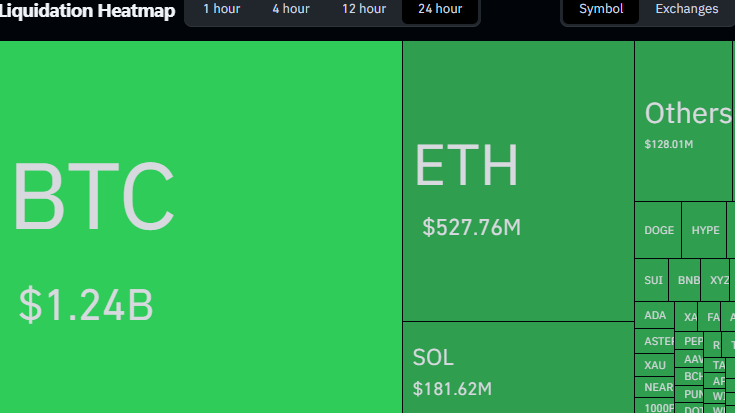
Girl, Cathie Wood finally getting real about Coinbase's struggles? Smart move, 'cause that YTD drop is no joke and sometimes you just gotta protect your portfolio. pic.twitter.com/S5nxLUsLbh
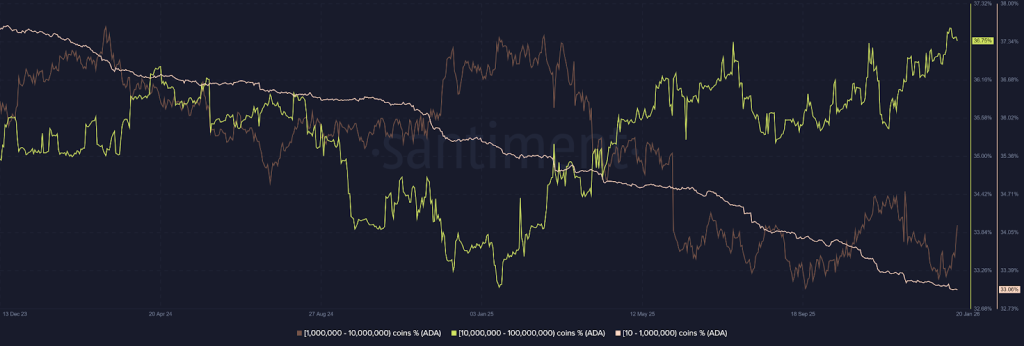
— Jessica (@koynlabs) February 6, 2026

The quick switch from buyer to seller suggests a short-term defensive move rather than a full exit.

ARK Rotates Capital Into Bullish Shares

Instead of holding cash, ARK quickly moved the money into another crypto company. The firm bought about $17.8 million worth of shares in Bullish, an institutional-focused crypto trading platform listed on the NYSE in 2025. 

Since its listing, Bullish stock has struggled and is down more than 60%, while the company reported a Q4 net loss of $563.6 million on a GAAP basis. ARK appears to see value at these lower prices and is increasing its exposure. 

This shift shows that ARK is not leaving crypto, but rotating investments toward firms it believes have better growth potential.

ARK Still Holds Large Coinbase Position

Even after this sale, ARK remains one of the major investors in Coinbase. Across its main ETFs, the firm still owns about $312 million worth of COIN shares.

The shift comes during a difficult time for crypto markets. Bitcoin recently dropped near $60,000, and trading volumes on exchanges have slowed. 

As a result, Coinbase stock has faced strong selling pressure, currently trading around $146.

Never Miss a Beat in the Crypto World!

Stay ahead with breaking news, expert analysis, and real-time updates on the latest trends in Bitcoin, altcoins, DeFi, NFTs, and more.

FAQs

Why did ARK Invest sell Coinbase shares?

ARK sold Coinbase after a sharp price drop, likely as a defensive move to manage short-term risk rather than a loss of long-term conviction.

How much Coinbase stock did ARK Invest sell?

ARK sold about 119,236 Coinbase shares worth roughly $17.4 million during a single trading session as the stock hit multi-month lows.

Is ARK Invest still bullish on Coinbase?

Yes. Even after the sale, ARK still holds around $312 million in Coinbase shares, showing continued long-term confidence.

How did the broader crypto market impact this move?

Bitcoin’s drop near $60,000 and slowing trading volumes pressured crypto stocks, prompting ARK to rebalance during market weakness.

Altcoins Crash Deepens as Fear Peaks: Is the Market Near a Turning Point?

Top 5 Altcoins to Buy in November 2025 Amid the Crypto Market Crash

The post Altcoins Crash Deepens as Fear Peaks: Is the Market Near a Turning Point? appeared first on Coinpedia Fintech News

Crypto markets extended their downside momentum on Friday as selling pressure intensified across both majors and altcoins. Bitcoin fell nearly 9% on the day, briefly touching the $65,000 level, while Ethereum slid below $2,000. The weakness quickly spilled into the broader market, pushing several large-cap and mid-cap altcoins into double-digit losses.

This phase of the altcoin crash did not unfold gradually. Instead, price action accelerated once key intraday supports failed, triggering forced liquidations across derivatives markets. Liquidity thinned rapidly, bids pulled back, and volatility expanded in a way typically seen during late-stage risk unwinds rather than the start of fresh bearish trends. With sentiment deteriorating sharply and leverage exiting the system, the market now faces a critical question: Is this the exhaustion phase of the selloff, or merely another step lower?

Liquidations Data Shows Capitulation Spreading Beyond Bitcoin

The scale of forced selling offers a clearer view of the current altcoin crash. According to derivatives data, total liquidations crossed $2.59 billion over the past 24 hours, marking one of the largest single-day wipeouts in recent months. Bitcoin led the move with $1.34 billion in liquidations, reflecting the cascade triggered once price broke below the $67,000 zone. Ethereum followed with $562 million, while altcoins collectively absorbed more than $1.1 billion in liquidations. Solana alone saw close to $187 million, with the remainder spread across high-beta Layer-1s, DeFi tokens, and speculative mid-caps. This distribution matters. In earlier corrections, Bitcoin typically carried the majority of leverage risk. 

liquidation data

During this altcoin crash, forced selling extended far deeper into the market, confirming that speculative positioning had built up aggressively beyond BTC. Once prices turned, leverage exited quickly, accelerating downside momentum. Historically, liquidation-heavy sessions of this magnitude tend to reset market structure by flushing excess risk rather than marking the start of prolonged downside trends.

Extreme Fear Readings Reflect Late-Stage Panic Conditions

Market sentiment data reinforces the view that the current altcoin crash is driven by fear rather than complacency. The Crypto Fear & Greed Index fell to 5, placing sentiment firmly in “Extreme Fear” territory. Readings below 10 have appeared only a handful of times across past cycles, including 2018, March 2020, and late 2022. 

fear and greed

In each instance, such levels reflected emotional capitulation rather than early-stage bearish conviction. While prices did not reverse immediately in every case, downside momentum typically slowed as panic peaked.

Altcoin Crash Mirrors Historical Pre-Rotation Phases

Despite the severity of the ongoing altcoin crash, long-term structure paints a more nuanced picture. Historical market-cap trends show that altcoin cycles often experience deep compression phases before meaningful rotation begins. In 2017, 2021, and following the 2022 bear market, altcoins endured extended periods of underperformance marked by repeated breakdown fears, declining relative strength, and sharp monthly selloffs. These phases typically preceded strong upside expansions once capital rotation resumed.

Altseason

Current charts reflect a similar pattern. Altcoin market capitalization remains locked in a long-term consolidation range, with downside moves repeatedly attracting demand near historical support zones. While this does not confirm an immediate altcoin season, it suggests the present altcoin crash resembles structural compression rather than outright collapse. Notably, these transitions have historically occurred during periods of extreme fear conditions that closely mirror the current environment.

Final Thoughts

The altcoin crash appears driven more by liquidation pressure than fresh selling. With sentiment near extreme fear and leverage largely flushed, downside momentum may be slowing. Volatility can persist, but the data suggests the market is closer to stabilization than collapse. Caution remains key, yet conditions for a gradual base may be forming.

FAQs

Why is the crypto market crashing today?

Crypto prices fell as key supports broke, triggering mass liquidations. High leverage, thin liquidity, and panic selling accelerated losses across coins.

Is this crypto crash a sign of a new bear market?

Not necessarily. Data suggests forced liquidations drove the drop, which often marks late-stage selloffs rather than the start of long bear markets.

What do high crypto liquidations mean for prices?

Large liquidations usually flush excess leverage. This can reduce selling pressure and help prices stabilize once panic-driven trades are cleared.

Should investors buy altcoins during a crash?

Crashes can create long-term opportunities, but timing is risky. Many investors wait for volatility to cool and price action to stabilize.

Will XRP Price Crash Below $1 Amid the Crypto Market Sell-Off

Will XRP Price Crash Below $1 Amid the Crypto Market Sell-Off

The post Will XRP Price Crash Below $1 Amid the Crypto Market Sell-Off appeared first on Coinpedia Fintech News

XRP’s sharp 17% fall did not happen because of bad news from Ripple. The real reason was a broader crypto market crash. Bitcoin price fell quickly, and Ethereum dropped below the important $2,000 level. Investors across the market rushed to sell and cut their risk.

XRP usually moves faster than most large cryptocurrencies. So when the market turned negative, XRP fell harder and faster than others.

Once prices started dropping, panic selling kicked in. More sellers entered the market, pushing the price down even further in a short time.

Heavy Liquidations Triggered the XRP Sell-Off

The biggest reason behind the XRP price drop was forced liquidations. In the last 24 hours alone, nearly $46 million worth of XRP positions were closed automatically. Most of these were traders who had bet on XRP prices going higher.

When XRP fell below the key level near $1.44, many of these trades were shut down by exchanges. This added more selling pressure and caused prices to fall even faster.

In markets with high borrowing and leverage, once selling starts, prices often keep falling until the most risky positions are cleared.

Ripple’s Positive News Couldn’t Save XRP Price

This drop confused many investors because Ripple recently secured important regulatory approvals in Europe, including licenses in the UK and Luxembourg. Normally, such news would help XRP prices.

However, during a market-wide selloff, investors focus more on fear and safety than long-term progress. Right now, XRP is moving based on short-term market emotions rather than Ripple’s business growth.

Key XRP Support Levels to Watch Next

The $1.00 price level is now the most important support for XRP. If the crypto market stays weak, a move toward this level would not be surprising.

XRP could briefly dip below $1.00 if panic selling returns, but a long-term fall below this level would likely need another major wave of selling across the market.

Meanwhile, analyst Bill Morgan’s comment about XRP possibly dropping below USDC in market value highlights how fragile investor confidence remains.

Why XRP Recovery Is Still Possible

Despite the sharp fall, large investors are not panicking. XRP ETFs are still seeing money flow in, even during the price drop. This is very different from Bitcoin ETFs, which have faced strong outflows.

XRP’s recovery will largely depend on whether Bitcoin and Ethereum stabilize. If the overall market calms down and price swings slow, XRP could bounce back faster than many expect.

With better regulation, steady interest from institutions, and lower risky trading activity, this drop may turn out to be a short-term reset rather than a long-term downtrend.

Never Miss a Beat in the Crypto World!

Stay ahead with breaking news, expert analysis, and real-time updates on the latest trends in Bitcoin, altcoins, DeFi, NFTs, and more.

FAQs

Who is most affected by XRP’s sudden volatility?

Short-term traders and leveraged participants are most exposed, as rapid price swings can trigger margin calls or forced exits. Long-term holders are less directly impacted unless volatility persists.

How could this price move influence XRP trading behavior going forward?

Sharp declines often reduce speculative leverage in the short term, leading to lower volatility. This can create a more stable trading environment once weaker positions are flushed out.

What does this mean for institutions tracking or offering XRP products?

Institutions may reassess short-term risk models but typically focus on liquidity and regulatory clarity. Sudden drops rarely change long-term exposure strategies unless market stress deepens.

What should investors watch for next in the XRP market?

Market participants will monitor derivatives activity, volume trends, and broader crypto sentiment. A shift in Bitcoin or Ethereum momentum often sets the direction before XRP reacts.

Stablecoin Inflows Jump From $51B to $102B—Is Smart Money Preparing to Buy the Dip?

Stablecoin Inflows Surge to $100B Amid Crypto Dip

The post Stablecoin Inflows Jump From $51B to $102B—Is Smart Money Preparing to Buy the Dip? appeared first on Coinpedia Fintech News

The crypto market has come under intense selling pressure, with more than $350 billion wiped off total market capitalization. Similar downturns in the past have usually been accompanied by falling participation and capital exiting the space. This time, however, the setup looks different.

Instead of drying up, capital has surged, with stablecoin inflows doubling even as prices decline. This points to traders staying engaged and waiting on the sidelines rather than rushing to exit, likely positioning for a potential entry near market lows.

The key question now is whether the Bitcoin (BTC) price has already found a bottom or if the market still needs to endure further downside before a more durable recovery can take shape.

Stablecoin Inflow Doubles to OVer $102 Billion

The Weekly stablecoin exchange inflows have witnessed a massive increase, nearly doubling, highlighting a sharp increase in funds moving into exchanges during the sell-off. The rise in the stablecoin inflow comes at a time when Bitcoin and major altcoins remain under pressure, weighed down by heavy liquidations and weakening short-term market structure. 

stabelcoin nflow
Source: X

The data from CryptoQuant shows a major spike in inflows reaching $102 billion, well above the 90-day average of around $89 billion. This increase indicates a rapid rise in stablecoins being transferred to exchanges rather than withdrawn. Large inflows during a sell-off usually indicate that traders are preparing for potential accumulation rather than exiting the market. In simple terms, they are waiting for the markets to bottom. 

When Does the Crypto Market Typically Bottom?

Historical Bitcoin bear markets show a clear pattern in drawdowns. In past cycles—2011, 2013–15, 2017–18, and 2021–22—market bottoms have usually formed after Bitcoin recorded deep peak-to-trough losses ranging between 60% and 80%.

The chart highlights that earlier corrections rarely ended at shallow pullbacks. Instead, price tended to stabilize only after prolonged drawdowns, accompanied by sustained fear, declining participation, and extended consolidation phases. In the 2021–22 cycle, for example, Bitcoin bottomed only after the drawdown pushed well beyond 70%, followed by several months of sideways movement.

btc price
Source: X

In the current cycle, the drawdown remains shallower compared to prior bear-market bottoms, suggesting the market may still be in a price-discovery and positioning phase rather than a confirmed bottoming process. Historically, bottoms have formed not at the first sharp drop, but after volatility compresses and drawdowns stop making new lows.

This comparison suggests that while capital positioning is increasing, time and further stabilization, rather than a single event, have typically been required before durable market bottoms emerge.

The Bottom Line: What to Watch Next?

The data suggests the market is not in panic exit mode, but it may also not be done correcting. More than $350 billion has already been erased from total crypto market capitalization, yet stablecoin inflows have doubled to around $102 billion, showing capital is waiting rather than leaving.

Historically, Bitcoin bear-market bottoms have formed after 60%–80% drawdowns. From the recent cycle high, BTC is currently down roughly 35%–45%, which places the market short of typical historical lows. Based on past drawdowns, a probable downside zone for the Bitcoin price lies between $48,000 and $42,000, where long-term demand has previously emerged.

For the broader crypto market, a comparable move would imply total market capitalization falling toward the $1.6 trillion–$1.4 trillion range, down from recent highs near $2.3 trillion.

In short, capital appears ready, but history suggests price may still need to probe lower levels or consolidate longerbefore a durable bottom is confirmed.

FAQs

Why is the crypto market falling despite rising stablecoin inflows?

Prices are falling due to liquidations, but stablecoin inflows suggest traders are staying active and preparing to buy, not exiting crypto.

What do rising stablecoin inflows mean during a crypto crash?

They usually signal sidelined capital. Traders move funds to exchanges to prepare for buying near potential market bottoms.

Is this crypto crash panic selling or strategic positioning?

Data suggests positioning, not panic. Capital is waiting on exchanges, indicating traders expect opportunities after volatility cools.

Bithumb Employee Mistake Sends 2,000 BTC to Users

Bithumb Employee Mistake Sends 2,000 BTC to Users

The post Bithumb Employee Mistake Sends 2,000 BTC to Users appeared first on Coinpedia Fintech News

A Bithumb employee accidentally sent around 2,000 $BTC to hundreds of users during an airdrop instead of the intended token, causing Bitcoin to drop about 10% on the exchange. Some users reported receiving 2,000 $BTC rather than the expected 2,000 KRW. The mishap triggered a sharp price reaction locally on Bithumb, though Bitcoin’s broader market remained relatively stable. The incident highlights the risks of human error in crypto operations and the potential market impact of large accidental transfers.

Ethereum Founder Vitalik Buterin Says Relying on L2s Could Cost Users Their Funds

Ethereum Founder Vitalik Buterin Says Relying on L2s Could Cost Users Their Funds

The post Ethereum Founder Vitalik Buterin Says Relying on L2s Could Cost Users Their Funds appeared first on Coinpedia Fintech News

Two of Ethereum’s most senior figures just disagreed publicly on how the protocol should scale, and the conversation is worth paying attention to.

Ethereum Foundation Co-Executive Director Tomasz Stańczak suggested that Ethereum should drop its built-in statelessness effort at L1 and let L2s handle state scaling instead. He called the current approach too complex and “against the idea of simplicity,” adding that the current design leads to “nothing better than L2s.”

Vitalik Buterin responded directly and disagreed.

What Did Vitalik Buterin Say About L1 Statelessness?

Buterin first corrected how Stańczak framed the issue. He said current proposals are not about “higher-security vs lower-security” state but about “higher-accessibility vs lower-accessibility.”

He then laid out a path where Ethereum scales execution by 1000x but state by only 20x. In that setup, creating new storage slots becomes very expensive compared to computation.

Apps would need to provide merkle proofs to update virtual state trees instead of using native L1 storage. He noted that privacy protocols already work this way.

L2 Dependency Puts User Funds at Risk

This is where it matters most. Buterin said that relying too heavily on L2s means more dependency on extra-protocol code. When that code breaks, users lose money, and there is no hard fork to fix it.

He was clear: consensus failure followed by a hard fork is “less bad” than people quietly losing funds through broken L2 infrastructure. This lines up with his recent comments where he called most L2s “copypasta EVM chains” and said Ethereum does not need more of them.

Have been following reactions to what I said about L2s about 1.5 days ago.

One important thing that I believe is: "make yet another EVM chain and add an optimistic bridge to Ethereum with a 1 week delay" is to infra what forking Compound is to governance – something we've done…

— vitalik.eth (@VitalikButerin) February 5, 2026

Buterin Floats a UTXO-Style Alternative

If the goal is to minimize L1 work, Buterin said he would go with a bare-bones UTXO approach, starting with moving receipts to SSZ for better provability.

But he is not locking anything in.

“There is no need for us to commit to an exact path this year,” he said, emphasizing that L1-native solutions reduce the code apps depend on for security while protecting “privacy, availability and censorship resistance for users.”

Also Read: Vitalik Buterin Wants Ethereum to Survive Without Him, Reveals 7-Step Plan

With Ethereum L1 gas limit increases planned for 2026 and Buterin openly questioning the role of L2s, this debate inside the Foundation could shape the protocol’s scaling roadmap going forward.

Tether Invests $150 Million in Gold.com to Expand Digital Gold Access

Tether invests in Gold.com

The post Tether Invests $150 Million in Gold.com to Expand Digital Gold Access appeared first on Coinpedia Fintech News

Tether has announced a $150 million investment in Gold.com, marking a major move to bring physical gold and digital assets closer together. The deal gives Tether around a 12% ownership stake in the precious metals company and strengthens its long-term focus on real-world assets and blockchain-based finance.

The investment will happen in two stages. Tether will first buy $125 million worth of Gold.com shares, followed by an additional $25 million, subject to regulatory approval. As part of the agreement, Tether will also be able to appoint a board member, giving it a say in Gold.com’s future plans.

Tether Gold and Physical Bullion: Connecting Digital and Real Assets

A key part of this partnership is the deeper integration of Tether Gold (XAU₮) into Gold.com’s platform. XAU₮ is a gold-backed digital token, with each token supported 1:1 by physical gold stored in secure vaults.

This collaboration could allow users to buy physical gold using digital assets, including USDT and XAU₮. By combining Gold.com’s bullion operations with Tether’s global stablecoin network, the companies aim to create a single platform linking traditional gold markets with crypto-based payments.

Gold Price Rally Boosts Demand for Gold-Backed Stablecoins

The timing of the deal comes as gold prices hit record highs, crossing the $5,000 per ounce level. Alongside this rally, interest in gold-backed stablecoins has surged.

Over the past year, the market for gold-backed digital assets has grown from $1.3 billion to $5.5 billion. Tether Gold leads the sector, holding more than half of the total market value. Tether itself reportedly owns around 140 tonnes of physical gold, worth over $23 billion, strengthening its role in hard-asset-backed digital finance.

How Tether’s Investment Helps Gold.com Go Digital

Founded in 1965, Gold.com operates several well-known precious metals brands, including JMBullion, Monex Precious Metals, GovMint, and Stack’s Bowers Galleries. These platforms have long focused on physical bullion sales and collectibles.

With Tether’s backing, Gold.com plans to expand into digital gold products, stablecoins, and possibly gold leasing and tokenized assets. Company leaders say the partnership supports their goal of becoming a full-service precious metals platform, serving both traditional investors and crypto users.

Tether’s Growing Focus on Real-World Assets

This investment fits into Tether’s broader diversification strategy. The company reported $10 billion in net profit in 2025 and revealed excess reserves of more than $6.3 billion.

Beyond USDT, Tether has been investing in Bitcoin mining, artificial intelligence, decentralized communications, and now precious metals. The Gold.com deal highlights Tether’s push to position tokenized gold as a modern store of value, blending the stability of physical gold with the speed and flexibility of digital finance.

Never Miss a Beat in the Crypto World!

Stay ahead with breaking news, expert analysis, and real-time updates on the latest trends in Bitcoin, altcoins, DeFi, NFTs, and more.

FAQs

How does Tether Gold (XAU₮) work?

XAU₮ is a digital token backed 1:1 by physical gold stored in secure vaults, letting users hold and transfer gold on the blockchain.

Can users buy physical gold using crypto after this deal?

Yes. The partnership aims to let users buy physical gold on Gold.com using USDT, XAU₮, and other supported digital assets.

How does this deal fit Tether’s long-term strategy?

It supports Tether’s focus on real-world assets, expanding beyond USDT into tokenized gold and blending traditional finance with crypto.

Crypto Analyst Warns Bitcoin Could Hit Zero, Lays Out 16-Step ‘Doomsday’ Scenario

Bitcoin Price Crash Slips Below $70K After 15 Months

The post Crypto Analyst Warns Bitcoin Could Hit Zero, Lays Out 16-Step ‘Doomsday’ Scenario appeared first on Coinpedia Fintech News

Bitcoin just posted its worst single-day loss event ever recorded, and one crypto analyst believes the market is staring down a path that ends at zero.

Jacob King, founder of SwanDesk, laid out a 16-step breakdown of how Bitcoin could enter what he calls a “worst-case, totally catastrophic domino effect of cascading failures.”

BTC crashed toward $60,000 today, with on-chain data showing $3.2 billion in realized losses on February 5 alone.

That figure is larger than what investors lost during the Terra-Luna crash or the FTX bankruptcy, making it the most severe single-day capitulation event in Bitcoin’s history.

What Does King’s Bitcoin Doomsday Look Like?

King’s scenario begins with exchange liquidity collapsing under sustained ETF outflows, creating what he describes as a “self-reinforcing capitulation loop.” Retail investors rush for the exits, but platforms freeze or go dark. Exchanges lacking reserves start banning withdrawals altogether.

From there, things get worse. Tether comes under federal pressure and stops printing new supply, removing the artificial liquidity that has historically helped spark rebounds. Miners, hit by falling rewards and rising energy costs, dump their BTC reserves onto a market that already has no buyers.

Then comes the big domino. King warns that heavily leveraged corporate holders like MicroStrategy could face margin calls, forcing “massive involuntary liquidations” of hundreds of thousands of coins. Demand vanishes. Tether depegs. Hashrate collapses so far that a 51% attack becomes realistic.

“The story of Bitcoin mirrors the Titanic. It was said to be unsinkable, but that was never true. You will see,” King wrote.

Also Read: Why Is Bitcoin Crashing Today? Analysts Say Synthetic BTC Supply Is the Real Problem

Can Bitcoin Actually Fall That Far?

The fear is not entirely detached from reality. Market depth, the amount of capital available to absorb large sell orders, sits more than 30% below where it was in October. That kind of thin liquidity means even moderate selling can trigger sharp moves down.

Historical patterns offer some perspective. Each Bitcoin bear cycle has produced a smaller drawdown than the one before: 93% in 2011, roughly 77% in 2022. If that trend continues from the $126,000 peak, a potential floor sits somewhere around $38,000.

Whether King’s full doomsday chain plays out is debatable, but traders need to be on full alert.

Metaplanet to Keep Buying Bitcoin Despite Market Slump

Metaplanet to Keep Buying Bitcoin Despite Market Slump

The post Metaplanet to Keep Buying Bitcoin Despite Market Slump appeared first on Coinpedia Fintech News

Metaplanet CEO Gerovich announced the company will continue steadily accumulating Bitcoin despite a 50% drop from October 2025 highs and shares nearly halving since mid-January. The Tokyo-listed firm, which began buying BTC in April 2024, now holds 35,102 BTC worth $2.2 billion, ranking fourth globally among public companies. With an average purchase price of $107,716 per BTC, the firm faces $1.6 billion in unrealized losses. Gerovich emphasized long-term growth, mirroring strategies of other resilient Bitcoin holders like MicroStrategy.

Bitcoin Crash Sends Ethereum and Major Altcoins Into Oversold Territory

Bitcoin price crash 2026

The post Bitcoin Crash Sends Ethereum and Major Altcoins Into Oversold Territory appeared first on Coinpedia Fintech News

Today, the flagship cryptocurrency Bitcoin price saw a massive 14% crash to the $60,000 level before recovering toward $65,000 after several technical breakdown signals appeared at once.

The sharp fall triggered panic selling, heavy liquidations, and pushed market sentiment into extreme fear across crypto traders.

Extreme Fear and Bitcoin RSI Signals Show Panic Conditions

On 5th Feb, Bitcoin broke below the key $70,000 support and quickly dropped close to $60,000 before seeing a small recovery. The fall triggered three major technical breakdown signals, pointing to strong downside momentum.

In just one week, Bitcoin has fallen nearly 25%, marking one of the fastest corrections this year. Meanwhile, trading volume was more than 3x the normal price level, showing panic selling and heavy liquidations. Secondly, more than $60 billion was wiped from the crypto market during the drop.

bitcoin Price crash

Lastly, Bitcoin’s daily RSI fell near 9, an extreme level usually seen only during panic phases. The crypto fear index also plunged to 5, deep in the extreme fear zone.

Such signals often appear near short-term bottoms, but analysts warn that oversold markets can stay weak for longer. 

Bitcoin may now move in a broad range between $60,000 and $73,000 in the coming weeks. If selling pressure rises again, traders fear another drop toward the $55,000 level.

Bitcoin Dominance Drops Sharply Against Altcoins

Additionally, Bitcoin dominance (BTC.D) dropped 1.64% in a single day, and its RSI is rolling over, signaling weakening strength. At the same time, combined stablecoin dominance has jumped sharply, which usually means investors are moving to cash and reducing risk. 

bitcoin altcoin domiance

Meanwhile, altcoin dominance is rising mainly because Bitcoin is falling faster than altcoins, not due to real market strength.

Ethereum and Altcoins Follow With Heavy Losses

Following the Bitcoin drop, Ethereum plunged about 30% during the same period, with its daily RSI near 11. The ETH/BTC ratio continues to trend lower, showing that Ethereum is weaker than Bitcoin in this correction.

Several major altcoins also broke long-term support levels. 

Large-cap altcoins like BNB, SOL, LTC, and XRP moved into oversold territory, with some hitting multi-month lows after the market-wide dump.

Ethereum Whales Face $1.7 Billion Liquidation Risk

Ethereum Whales Face $1.7 Billion Liquidation Risk

The post Ethereum Whales Face $1.7 Billion Liquidation Risk appeared first on Coinpedia Fintech News

Several Ethereum whales are at risk of major liquidations as ETH trades near $1,900. Trend Research leads with 356,000 ETH ($671 million) vulnerable between $1,562 and $1,698, followed by Joseph Lubin with 293,000 ETH ($553 million) and the “7 Siblings” group with 287,000 ETH ($541 million) exposed near $1,029 to $1,075. Trend Research recently sold 170,000 ETH ($322 million) and repaid $344 million in loans, reducing exposure. If ETH prices drop further, forced liquidations could trigger sell-offs, though adding collateral may help whales avoid wipeouts.

Cardano Founder Loses $3B in Crypto Crash

Cardano Founder Loses $3B in Crypto Crash

The post Cardano Founder Loses $3B in Crypto Crash appeared first on Coinpedia Fintech News

Cardano founder and former Ethereum co-founder Charles Hoskinson revealed in a livestream called Red Days that his crypto holdings have lost over 3 billion dollars as Bitcoin fell below 66,000 and ADA dropped to 0.25, down 92 percent from its 2021 peak. Hoskinson stressed his commitment to blockchain technology over profit, saying money is not his motivation, and he would stay dedicated even after such losses. He highlighted his clean record compared to scandals like FTX and urged the community to keep building despite market volatility.

Why Is Bitcoin Crashing Today? Analysts Say Synthetic BTC Supply Is the Real Problem

Why Is Bitcoin Crashing Today Analysts Say Synthetic BTC Supply Is the Real Problem

The post Why Is Bitcoin Crashing Today? Analysts Say Synthetic BTC Supply Is the Real Problem appeared first on Coinpedia Fintech News

Bitcoin briefly crashed toward $60,000 on February 6, wiping out over $2.6 billion in leveraged positions in 24 hours. That makes it the worst single-day drop since the FTX collapse in November 2022. Most outlets are blaming macro pressure and weak sentiment.

But DeFi researcher CryptoNobler says the real issue is structural, and it has been building for months.

According to CryptoNobler, Bitcoin no longer trades like a supply-and-demand asset. Derivatives have taken over price discovery entirely.

“The moment supply can be synthetically created, scarcity is gone. And when scarcity is gone, price stops being discovered on-chain and starts being set in derivatives,” he stated.

What Happened to Bitcoin’s 21 Million Hard Cap?

The hard cap still exists on-chain. But Bitcoin’s original value proposition relied on two things: fixed supply and no rehypothecation.

That framework broke the moment Wall Street layered cash-settled futures, perpetual swaps, options, ETFs, prime broker lending, wrapped BTC, and total return swaps on top of the chain.

Bob Kendall, creator of PortfolioXpert and a technical analyst, backed the same argument.

“Once you can synthetically manufacture the supply, the asset is no longer scarce, and once scarcity is gone, price becomes a derivatives game, not a supply-and-demand market,” he said.

The Six-Layer BTC Problem

CryptoNobler pointed to what he calls the Synthetic Float Ratio (SFR). The idea is simple: one real BTC can now simultaneously back an ETF share, a futures contract, a perpetual swap, an options delta, a broker loan, and a structured note. All at the same time.

“That’s six claims on one coin. That is not a free market. That is a fractional-reserve price system wearing a Bitcoin mask,” he warned.

He added that this is the same structural break that already happened to gold, silver, oil, and equities once derivatives took over those markets.

Synthetic Float Ratio (SFR) chart

Wall Street’s Playbook

Both researchers described a cycle that keeps repeating: create unlimited paper BTC, short into rallies, force liquidations, cover at lower prices, and do it again. CryptoNobler called it “inventory manufacturing.”

Today’s crash fits that pattern. Of the $2.6 billion in liquidations, over $2.1 billion came from long positions being force-closed. Derivatives markets led the selloff while spot activity stayed relatively calm.

What Does This Mean for Bitcoin Holders?

Bitcoin is trading around $66,000 after bouncing from the $60,000 floor.

The question now is how long this cycle continues before the market catches up.

Never Miss a Beat in the Crypto World!

Stay ahead with breaking news, expert analysis, and real-time updates on the latest trends in Bitcoin, altcoins, DeFi, NFTs, and more.

FAQs

Why is Bitcoin price down today?

Bitcoin is down today due to heavy leverage liquidations in derivatives markets, where forced selling amplified losses despite relatively stable spot demand.

How low can Bitcoin price go from here?

Bitcoin often tests major liquidity zones after crashes; downside risk depends on leverage unwinding, but strong spot buying can limit deeper drops.

When will the Bitcoin market recover?

Recovery usually begins once leverage is flushed out and derivatives open interest resets, allowing spot demand to regain control of price movement.

Crypto Crash: Should You Buy the Dip or Wait for More Downside?

Israel-Iran Conflict Triggers Crypto Crash: Bitcoin, Ethereum, XRP Prices Plunge Hard

The post Crypto Crash: Should You Buy the Dip or Wait for More Downside? appeared first on Coinpedia Fintech News

Crypto markets extended the downside move today, slipping deeper into a high-volatility sell-off that has shaken both spot and derivatives traders. Bitcoin price dropped nearly 8.6%, hovering near the $65,000 level, while Ethereum and major altcoins followed with sharp intraday losses. The intensity of the move points to more than routine profit-taking. With liquidations accelerating and sentiment collapsing into extreme fear, the ongoing crypto crash creates a dilemma among investors, one that forces traders and investors to confront a familiar question: Is this a buy-the-dip moment, or is patience still required?

Liquidations Data Reveals Market Still Under Stress

The key trigger of today’s crypto crash lies in derivatives data. More than $2.59 billion worth of crypto positions were liquidated in the last 24 hours, marking one of the most aggressive leverage flushes of the year.

Crypto liquidations

Bitcoin and Ethereum accounted for the bulk of forced closures, while altcoins experienced cascading liquidations as price levels failed in quick succession. At the same time, total open interest fell 10.1% to $95.77 billion, confirming that leverage is being removed, not repositioned. Such conditions typically reflect instability rather than balance. Markets tend to struggle to form durable bottoms while liquidation velocity remains elevated.

Sentiment Hits Extreme Fear, But Capitulation Is Incomplete

The Crypto market Fear & Greed Index plunged to 10, placing sentiment deep into Extreme Fear, a zone that historically precedes medium-term recoveries. However, structural signals remain mixed. Bitcoin exchange balances increased by 13,800 BTC, suggesting that selling pressure has not fully exhausted itself. Coins are still moving toward exchanges rather than being locked away by long-term holders. In previous market cycles, sustainable bottoms emerged after extreme fear persisted alongside declining exchange inflows, a condition that has not yet fully materialized.

Bitcoin Price at $65K: A Decision Zone, Not a Confirmed Bottom

Bitcoin’s drop toward the $65,000 region is now colliding with a signal that long-term market participants rarely ignore. The monthly stochastic oscillator has slipped into extreme oversold territory, a condition that has appeared only three times over the past decade. Each prior occurrence aligned with major bear market bottoms and the start of prolonged accumulation phases. However, history also shows this signal is not a timing trigger. In previous cycles, Bitcoin did not immediately reverse higher. Instead, price often spent weeks sometimes months moving sideways or making marginal new lows as leverage flushed out and sentiment reset.

BTC Price

That dynamic matters today. While the long-term stochastic suggests downside may be structurally limited, short-term data still reflects stress. Open interest is falling, liquidations remain elevated, and exchange balances are rising, indicating that traders are still de-risking rather than rebuilding positions. In practical terms, this creates a split narrative. For long-horizon investors, conditions are beginning to resemble early accumulation zones. For short-term traders, volatility risk remains high until liquidation pressure eases and price stabilizes above key support. The signal argues that Bitcoin may be closer to a bottom than a top, but confirmation will require patience, not prediction.

Final Thoughts: Right Time to Buy or Wait?

The broader crypto market is showing classic stress signals, not clear bottoming behavior. Extreme fear readings, multi-billion-dollar liquidations, and declining open interest suggest forced deleveraging is still working its way through the system. While some assets are showing relative strength and selective accumulation, this looks more like rotation and positioning not a broad-based recovery.

Historically, durable market bottoms form after volatility compresses and sellers exhaust, not during peak liquidation phases. Right now, liquidity is thin and confidence remains fragile, leaving room for further downside or prolonged consolidation. This is not a clear “buy the dip” moment for the overall market. Caution and patience are still the better strategy, with selective accumulation only where strong fundamentals and on-chain support clearly justify it.

Crypto Fear Hits Extreme Levels as Bitcoin Dips Below $65,000

Crypto Fear Hits Extreme Levels as Bitcoin Dips Below $65,000

The post Crypto Fear Hits Extreme Levels as Bitcoin Dips Below $65,000 appeared first on Coinpedia Fintech News

The Crypto Fear and Greed Index fell to extreme fear levels of 5-9, the lowest since the June 2022 Terra and FTX crashes, as Bitcoin briefly dropped below $65,000 before recovering. The cryptocurrency saw a single-day decline of over $10,000, wiping out significant market value and triggering widespread liquidations. U.S. spot Bitcoin ETFs recorded $434.1 million in net outflows on February 5, led by BlackRock’s IBIT, reflecting growing caution among institutional investors.

Bitcoin Crash Triggers Biggest One-Day Investor Losses in History

Bitcoin price crash 2026

The post Bitcoin Crash Triggers Biggest One-Day Investor Losses in History appeared first on Coinpedia Fintech News

Bitcoin’s recent fall has triggered one of the biggest loss-taking events in its history, illustrating how quickly market sentiment has shifted after months of strong gains. As prices dropped nearly 10% to around $64,000, Bitcoin hit its lowest level since late 2024. This sharp move pushed many investors to sell their holdings at a loss.

Record Losses in a Single Day

February 5 stood out as a major stress point for the market. On-chain analyst Murphy reported that realized losses reached about $3.2 billion in just one day—the highest daily total ever recorded. Realized losses reflect how much money investors actually lose when they sell below their buying price, making this a strong sign of panic selling.

Murphy noted that this single-day loss was even larger than what was seen during major past crises, including the Terra-Luna collapse and the FTX bankruptcy. This highlights how severe and sudden the latest sell-off has been.

Low Liquidity Made the Drop Worse

The Kobeissi Letter added that the decline was not driven by fear alone. It also exposed weak market liquidity. Bitcoin’s market depth, the amount of money available to absorb large trades, is still more than 30% lower than its October high. With fewer buyers at key price levels, even moderate selling can cause sharp price drops.

The last time market depth was this low was after the FTX collapse in 2022, showing that the market remains fragile during periods of heavy selling.

No Clear Trigger Behind the Sell-Off

Unlike previous crashes caused by major news events, this downturn did not have one obvious trigger. Murphy said that aside from a data adjustment issue in late 2025, the current loss numbers reflect real selling pressure. He also defended using dollar-based loss data, saying it better shows the financial and emotional stress investors feel during sharp declines.

Extreme Price Volatility

The Kobeissi Letter also pointed out another first: Bitcoin recorded a single-day drop of more than $10,000. Even during earlier high-liquidation events, prices did not fall this much in one day. This has led to speculation that a large leveraged trader was forced to exit, which likely accelerated the fall and exposed how risky large positions can be.

How Much Lower Can Bitcoin Go?

Crypto researcher Sherlock highlighted a long-term pattern in Bitcoin’s history. Each bear market has resulted in smaller losses than the previous one, as the asset has matured. Bitcoin fell about 93% in 2011 and around 77% in 2022. If this trend continues, the current cycle could see a drop of roughly 70% from the $126,000 peak, pointing to a possible bottom near $38,000.

This outlook suggests that while the recent sell-off has been painful, it may not be the final low and a quick recovery should not be taken for granted.

Never Miss a Beat in the Crypto World!

Stay ahead with breaking news, expert analysis, and real-time updates on the latest trends in Bitcoin, altcoins, DeFi, NFTs, and more.

FAQs

Why is Bitcoin price down today?

Bitcoin is down due to low market liquidity and forced selling from leveraged positions. With fewer buyers, sell orders moved prices sharply lower.

How big were the losses in the recent Bitcoin sell-off?

On February 5, investors realized losses of roughly $3.2 billion in a single day—the highest daily loss ever recorded, exceeding losses seen during the Terra-Luna and FTX collapses.

Could Bitcoin’s price drop further from here?

Based on historical bear market patterns, Bitcoin could potentially fall around 70% from its $126,000 peak, suggesting a possible bottom near $38,000, though market conditions remain fluid.

Was there a specific event that caused Bitcoin’s latest sell-off?

No single news event triggered it. The drop appears driven by market structure, leverage unwinding, and fragile liquidity conditions.

Bitcoin Price Prediction 2026, 2027 – 2030: How High Will BTC Price Go?

Bitcoin Price Prediction

The post Bitcoin Price Prediction 2026, 2027 – 2030: How High Will BTC Price Go? appeared first on Coinpedia Fintech News

Story Highlights

  • Bitcoin is currently trading at: $ 69,191.82813541
  • Predictions suggest BTC to hit $150K to $250K before 2026 ends.
  • Long-term forecasts estimate BTC prices could hit $900K by 2030.

The Bitcoin price prediction 2026 is becoming increasingly bullish as the 2025’s second half comes to a close soon, with all-time highs of $125K reached this year as the highest point.

As a wave of bullish momentum sweeps into the market, investors and traders are intrigued by its next stop.

The year was marked by optimism, driven by massive inflows into spot Bitcoin ETFs, skyrocketing institutional adoption, clearer regulations, and unwavering political support. There were several macro downturns, too, that capped BTC’s uptrend, like trade tariffs and wars.

Despite that, BTC holds its level, making it now seen as “a hedge against inflation” more than ever. Major players, including MicroStrategy, Metaplanet, and several other entities, are boldly adding BTC to their balance sheets, signaling unshakable adoption and confidence in its future.

The market enthusiasm is at a fever pitch, investors are buzzing with questions: “Can Bitcoin sustain its meteoric rise?” and “Will it redefine the financial landscape in the next five years?” This Bitcoin price prediction 2026 – 2030 dives deep into the trends driving this historic rally. Read on for the full scoop.

Coinpedia’s BTC Price Prediction 2026

In December 2025, Bitcoin price faced resistance leading to a decline to $80,738 by January’s end. This slipped to 200-day EMA by early February. Now, a demand spike is seen but if it jumps beyond $70K, a retest of $80K-$85K is expected; below $65K could lead to a drop to $53K in Q1 2026.

What is the Bitcoin price prediction for today?

The BTC price may range between $67,364.44 and $71,681.31 today.

Bitcoin Price Today

Cryptocurrency Bitcoin
Token BTC
Price $69,191.8281 down -2.02%
Market Cap$ 1,382,858,536,217.52
24h Volume$ 62,666,217,163.8693
Circulating Supply19,985,865.00
Total Supply19,985,865.00
All-Time High$ 126,198.0696 on 06 October 2025
All-Time Low$ 0.0486 on 14 July 2010

Bitcoin February Price Prediction 2026

In early February, BTC dipped to $60, and the next day the fall reversed, briefly touching $ 70 K. Now, if it breaches $70K, we can see a retest of $75K and $80K, but if it fails to clear $70K, a fall to $65K is imminent, which could extend even further.

BTC February Outlook

Bitcoin Price Prediction 2026

Bitcoin price prediction 2026

In December 2025, the Bitcoin price retested the lower border of the ascending wedge pattern as resistance, with a slight bullish attempt that proved to be a fakeout, leading to a deeper decline. This is exactly what was witnessed in January, when the fall worsened to $80738 by the end of January, and early February even briefly penetrated the 200-day EMA band. But a sudden spike came from this area, as it was an earlier demand area. If it moves beyond $70K a retest of $80K-$85K range is expected. But if the 200-EMA is lost, then the $65K support area holds extreme value. If BTC/USD doesn’t take support and keeps falling, the odds suggest that, beneath $65K, Q1 2026 could see the price fall towards $53K.

MonthPotential LowPotential AveragePotential High
2026$60,000-$95,000$100,000 – $108,000$115,000 – $118,000

Bitcoin Price On-chain Outlook

The on-chain data has showed strong accumulation in 2025 and sustained declines in exchange reserves. Crucially, this confirms the elevated institutional commitment, which is evident even in the US Spot ETFs data figures and the corporate adoption also reinforces this trend, with public company holdings nearly doubling since the start of the year.

Bitcoin Onchain Outlook

Ultimately, a Bitcoin price prediction 2025 suggests that the future potential depends strictly on how sustained buying demand remains, as well as geopolitical stability and regulatory clarity. 

If the current bullish sentiment persists, the BTC price is expected to reach a cycle high target of $150,000. Conversely, should global uncertainty intensify and sentiment turn negative, the downside risk is projected to find strong support around the $70,000 mark.

YearPotential LowPotential AveragePotential High
2025$70K$120K$175K

Also Read: What is Bitcoin? An In-Depth Guide To The King Of Digital Currencies

Bitcoin Crypto Price Prediction 2026 – 2030

YearPotential Low ($)Potential Average ($)Potential High ($)
BTC Price Forecast 2026150K200K230K
BTC Price Prediction 2027170K250K330K
Bitcoin Predictions 2028200K350K450K
BTC Price 2029275K500K640K
Bitcoin Price Prediction 2030380K750K900K

BTC Price Forecast 2026

The BTC price range in 2026 is expected to be between $150K and $230K.

BTC Price Prediction 2027

Subsequently, the Bitcoin price range can be between $170K to $330K during the year 2027. 

Bitcoin Predictions 2028

With the next Bitcoin halving, the price will see another bullish spark in 2028. Specifically, as per our Bitcoin Price Prediction, the potential BTC price range in 2028 is $200K to $450K. 

BTC Price 2029

Thereafter, the BTC price for the year 2029 could range between $275K and $640K.

Bitcoin Price Prediction 2030

Finally, in 2030, the price of Bitcoin is predicted to maintain a positive trend. Indeed, the BTC price is expected to reach a new all-time high, ranging between $380K and $900K.

Bitcoin Price Prediction 2031, 2032, 2033, 2040, 2050

Based on the historic market sentiments and trend analysis of the largest cryptocurrency by market capitalization, here are the possible Bitcoin price targets for the longer time frames.

YearPotential Low ($)Potential Average ($)Potential High ($)
2031$540,830.43$901,383.47$1,261,936.86
2032$757,162.60$1,261,936.86$1,766,711.60
2033$1,059,945.80$1,766,711.60$2,473,477.75
2040$5,799,454.28$9,665,757.13$13,532,059.98
2050$161,978,188.65$269,963,647.74$377,949,106.84

Bitcoin Prediction: Analysts and Influencers’ BTC Price Target

  • As per the Bitcoin price forecast by Blockware Solutions, the price of 1 BTC could hit $400,000
  • Cathie Wood predicts the price of BTC to achieve the $3.8 million mark by 2030.
  • Michael Saylor-led MicroStrategy expects Bitcoin to soar beyond $13 million by 2045.
  • ARK Invest has increased its bullish BTC price target to $2.4 million by 2030.
Never Miss a Beat in the Crypto World!

Stay ahead with breaking news, expert analysis, and real-time updates on the latest trends in Bitcoin, altcoins, DeFi, NFTs, and more.

FAQs

What are the biggest risks to Bitcoin’s price in 2026?

Major risks include global recessions, tighter crypto regulations, declining liquidity, or a sustained breakdown below key support levels.

How much will BTC be worth in 2030?

Bitcoin price forecasts for 2030 range from $380K to $900K, driven by scarcity, long-term adoption, and expanding institutional participation.

What will be the price of Bitcoin in 2050?

While uncertain, many long-term projections suggest Bitcoin could exceed $1 million by 2050 if it becomes a global store of value.

Is Bitcoin still a good hedge against inflation in the long term?

Bitcoin’s fixed supply makes it attractive as an inflation hedge, especially during currency debasement and long-term economic uncertainty.

Ripple XRP Price Prediction 2026, 2027-2030: Will XRP Reach $5?

Ripple XRP Price Prediction

The post Ripple XRP Price Prediction 2026, 2027-2030: Will XRP Reach $5? appeared first on Coinpedia Fintech News

XRP price currently stands at $2.99, with a market capitalization of $179.79 billion. Analysts and AI forecasts alike suggest that XRP could reach $5.05 by the end of 2025. Long-term XRP price predictions also place it as high as $26.50 by 2030, with an ultra-bullish target of $526 by 2050.

Ripple (XRP) remains one of the top five crypto assets in the world, gaining traction as institutional adoption ramps up and its prolonged legal battle approaches resolution. Since President Trump’s return to office, XRP has seen a resurgence in on-chain activity, investor sentiment, and even XRP ETF approved turned it into a bluechip asset.

Now, making this the most ideal time for XRP price prediction 2026-2030 to be in more focus. Read this to know in depth what’s coming next in XRP.

XRP Price Today

Cryptocurrency XRP
Token XRP
Price $1.4223 down -3.57%
Market Cap$ 86,640,571,064.48
24h Volume$ 5,384,863,213.5014
Circulating Supply60,917,315,351.00
Total Supply99,985,721,048.00
All-Time High$ 3.8419 on 04 January 2018
All-Time Low$ 0.0028 on 07 July 2014

Coinpedia’s XRP Price Prediction

XRP has dropped to $1.15, testing demand from late Q4 2024. If it breaks $1.63, it could rise to $2.00 or $2.62. If not, it may fall to $1.00 and consolidate there in Q1 2026.

XRP Price Prediction For February 2026

A long-term declining trendline just retested in early February, and a notable spike was witnessed, which shows a rise in demand, but the rest of February’s direction will depend on its ability to clear $1.63 if it jumps, then $1.75 and $2.00 are key resistance, but if it falls, then $1.00 is a key support.

XRP February outlook

XRP Price Prediction 2026

On the weekly chart, XRP’s price shows significant weakness, falling to $1.15, a retest of the demand area built in late Q4 2024. But early February saw a quick reversal from a short-term demand.

Now, if we see recovery ongoing and manages to flip $1.63, the recovery can continue towards $2.00 or even $2.62 in Q1 2026. However, if $1.63 poses as resistance and reverses, then a fall to $1.00 is expected, and Q1 could spend consolidating around $1.0.

XRP Price Prediction 2026
YearPotential LowPotential AveragePotential High
2026$1.75$3.45$5.05

XRP Onchain Outlook

The XRP Ledger: DEX Transaction Count chart indicates a significant bullish divergence starting from May 2025. While the price is consolidating, the activity in decentralised exchanges (DEX) is increasing sharply.

The high transaction volume, which includes both orders placed and cancelled, shows that experienced traders are actively positioning themselves and adding liquidity in anticipation of a future price movement.

XRP Ledger DEX Transaction Count

As a result, this on-chain metric suggests that the market is preparing for a powerful and sustainable rally in the XRP price ahead.

XRP On Chain Data

Also, the biggest fact right now in December is that altcoin liquidity is drying up. Projects securing new liquidity channels like ETFs have a better chance of long-term survival, and since November 14th, the XRP ETF has been seeing positive inflows consistently, despite what price action is, and so far, Cumulative Total Net Inflow has crossed $756 million, while total net assets are worth $723.05 million, by December 1st.

Ripple XRP Price Prediction 2026 – 2030

YearPotential Low ($)Potential Average ($)Potential High ($)
XRP Price Prediction 20265.506.258.50
Ripple Price Prediction 20277.009.013.25
XRP Price Prediction 202811.2513.7516.00
XRP Price Prediction 202914.2516.5021.50
XRP Price Prediction 203017.0019.7526.50

This table, based on historical movements, shows XRP price prediction 2030 to reach $26.50 based on compounding market cap each year. This table provides a framework for understanding the potential XRP price movements. Yet, the actual price will depend on a combination of market dynamics, investor behavior, and external factors influencing the cryptocurrency landscape.

Ripple (XRP) Price Projection 2031, 2032, 2033, 2040, 2050

Based on historic price sentiments and XRP’s rising popularity, here are the XRP future price projections beyond 2030, where Ripple price forecasts suggest that it has become more speculative. Therefore, assuming continued adoption and dominance, XRP may see aggressive valuations in the decades ahead.

YearPotential Low ($)Potential Average ($)Potential High ($)
203125.0029.5035.25
203231.5036.7541.25
203335.7542.2547.75
204097.50135.50179.00
2050219.25331.50526.00

A look at this table, highlights the XRP price prediction 2040 and XRP price prediction 2050 potential high ambitious targets but this reflect a transformative vision for XRP as a dominant global payment player.

Market Analysis

Firm Name202520262030
Changelly$2.05$3.49$17.76
Coincodex$2.38$1.83$1.66
Binance$2.16$2.27$2.76
Never Miss a Beat in the Crypto World!

Stay ahead with breaking news, expert analysis, and real-time updates on the latest trends in Bitcoin, altcoins, DeFi, NFTs, and more.

FAQs

What will XRP be in 2026 price prediction?

XRP price predictions for 2026 range between $3.45 and $5.05, depending on ETF inflows, market sentiment, and sustained demand above key levels.

What will XRP be worth in 2030?

By 2030, XRP forecasts suggest a potential range of $17 to $26.50 if adoption grows and Ripple maintains its role in global payments.

How much will 1 XRP be worth in 2040?

Long-term projections estimate XRP could trade between $97 and $179 by 2040, assuming continued network usage and institutional integration.

Is XRP a good investment going into 2026?

XRP’s outlook for 2026 depends on ETF inflows, broader crypto sentiment, and its ability to hold key support levels above $2.

Cardano Price Prediction 2026, 2027 – 2030: Will ADA Price Hit $2?

Cardano Price Prediction

The post Cardano Price Prediction 2026, 2027 – 2030: Will ADA Price Hit $2? appeared first on Coinpedia Fintech News

Story Highlights

  • The live price of the Cardano token is  $ 0.27162719.
  • Price prediction suggests potential to reach $2.75 to $3.25 by year-end 2026.
  • Long-term forecasts indicate ADA could hit $10.25 by 2030.

The Cardano price prediction 2026 is generating significant buzz in the crypto market, as the last quarter is soon to close in few days, boosting interest for the next altcoin. The 2025 for ADA/USD began with numerous fundamental updates strengthening its future, including the transformative Plomin Hard Fork, but 2026 seems even more constructive. 

Now, Questions abound: “Will Cardano spearhead the altcoin movement?” and “What heights can ADA reach by 2050?” Explore this Cardano price prediction 2026 and beyond, filled with expert insights and ambitious forecasts.

Coinpedia’s Cardano Price Prediction

The Cardano price outlook for 2026 is promising, driven by its extraordinary 4,000% surge in 2020 and currently holding strong at a significant support level. With a positive shift in market sentiment, even a moderate increase could lead to a remarkable 1,000% rise, positioning Cardano around $4.50.

A more conservative target of $1.40 indicates a solid 300% gain based on existing trends. Analysts are broadly optimistic that upcoming ETF approvals will boost institutional adoption and market stability, with price projections ranging from $2.05 to $2.80.

Cardano Price Today

Cryptocurrency Cardano
Token ADA
Price $0.2716 down -1.94%
Market Cap$ 9,794,155,890.54
24h Volume$ 1,262,842,521.4318
Circulating Supply36,057,347,728.0513
Total Supply44,994,622,371.2576
All-Time High$ 3.0992 on 02 September 2021
All-Time Low$ 0.0174 on 01 October 2017

ADA Price February Outlook

The ADA price movement is currently facing a notable sell-off; however, early February has unveiled a critical demand zone where fresh buying interest is likely to emerge, setting the stage for a potential bullish rally. Moreover, the lower boundary of the falling wedge is acting as solid support, suggesting that a price spike could be on the horizon. So its anticipated that ADA could very well hit $0.60 this month.

ADA price February outlook

Cardano AI Price Prediction For February 2026

SourceLow PriceAverage PriceHigh Price
Gemini$0.85 – $0.95$1.00 – $1.20$1.30 – $1.50+
BlackBox$0.65$1.00$1.50
ChatGPT$0.75$0.95$1.25

ADA Price Prediction 2026

The Cardano price forecast for 2026 points to an important support level on its weekly chart, a range that has consistently acted as a strong pivot point for price trends, and is currently giving off signals of another potential rally. This support level is known for displaying remarkable resilience over time, suggesting that if Cardano price USD can maintain its position above this threshold once again, it could pave the way for significant price movements in 2026.

Looking back at Cardano’s historical performance on the weekly chart, it shows an extraordinary rally in 2020, when the asset posted staggering gains of nearly 4,000%. During that bullish phase, the Cardano price USD spent an extended period consolidating around the dynamic support trendline, which appears to be a strategic accumulation at discounts from smart money, contributing significantly to its eventual surge. 

If the current market sentiment shifts positively, a resurgence in investor confidence could lead to a recovery. Not ambitiously, even modestly, past performance could give a tremendous surge. Last year’s performance was 4000%. If we assume 1/4 of that momentum, it would result in an increase of approximately 1000%, potentially elevating Cardano’s price to $4.50 by 2026.

ADA Price Prediction 2026

Conversely, a more conservative approach suggests a realistic price target of around $1.40, indicating a potential increase of about 300%. This estimate remains feasible, especially since it is based on fundamental analyses and market trends that are not reliant on speculative triggers, such as the possible approval of exchange-traded funds (ETFs). 

Additionally, many experts propose that these ETFs could significantly impact the market by boosting institutional investment and improving market stability. In a situation where ETF approvals occur and retail investor excitement rises, Cardano’s price could realistically range from $2.05 to $2.80.

ADA Price Prediction 2026
ScenarioPotential LowAverage PricePotential High 
Without ETF Approval$0.85$1.10$1.25
With ETF Approval + Retail Surge$1.20$1.65$2.05
Bullish Breakout (with ETF & macro support)$1.50$2.05$2.80

Cardano On-chain Analysis

As per Cardano’s on-chain metrics, “Smart Money” accumulation phase is the best observation right now, because the divergence between retail and institutional holders is more vivid than ever.

As the number of addresses holding between 10 and 1 million ADA is declining, and the consistent surge in the 10 million to 100 million coin bracket confirms this, this represents a major supply consolidation. The observation shows that these mega-whales are strategically absorbing the “weak hands” during price dips, effectively building a rock-solid fundamental floor for the asset. Also, the fact that the 1M to 10M coin bracket is also growing confirms that professional high-net-worth investors seem to be positioning for a recovery, too.

Cardano onchain

Similarly, the surge to 4.57 million total holders despite a grueling 2025 proves that Cardano’s ecosystem is expanding its reach even in a “stress test” environment. This growth in the holder base suggests that the asset is not being abandoned; rather, it is being redistributed into a more stable, long-term foundation. When a holder count rises as prices fall, it signals that the market views current levels as a deep-value opportunity rather than a reason to exit.

ADA Santimnet Data

Additionally, the Weighted Sentiment flipping the 0 line to 0.656 is a crucial momentum trigger. Professionally, this “0-line flip” indicates that the aggregate social and market bias has shifted from fear to optimism. 

ADA Weighted Sentiment

Combined with the strategic whale accumulation, this sentiment pivot suggests that the “disbelief” phase is ending and that a bullish rally is likely once the remaining retail sell pressure is fully absorbed by the growing whale cohorts.

Cardano (ADA) Price Prediction 2026 – 2030

Price PredictionPotential Low ($)Average Price ($)Potential High ($)
20262.753.003.25
20274.504.755.00
20285.255.505.75
20296.757.257.75
20309.009.7510.25

This table, based on historical movements, shows ADA prices to reach $10.25 by 2030 based on compounding market cap each year. This table provides a framework for understanding the potential Cardano price movements. Yet, the actual price will depend on a combination of market dynamics, investor behavior, and external factors influencing the cryptocurrency landscape.

Cardano Price Prediction 2031, 2032, 2033, 2040, 2050

YearPotential Low ($)Potential Average ($)Potential High ($)
203110.5011.0011.25
203213.7514.2514.75
203317.5018.5019.75
204034.2551.7569.25
2050128.25228.75329.50

Based on the historic market sentiments and trend analysis of the altcoin, here are the possible Cardano price targets for the longer time frames.

Never Miss a Beat in the Crypto World!

Stay ahead with breaking news, expert analysis, and real-time updates on the latest trends in Bitcoin, altcoins, DeFi, NFTs, and more.

FAQs

What is Cardano’s (ADA) price prediction for 2026?

Cardano could trade between $2.75 and $3.25 in 2026 if market sentiment improves, adoption grows, and key support levels hold.

Is Cardano a good long-term investment?

Cardano is considered a long-term project due to its research-driven development, scalability upgrades, and focus on decentralization.

What factors could drive ADA’s price higher in the future?

ETF approval, institutional adoption, network upgrades, and improved macro conditions could all positively impact ADA’s price.

Where will ADA be in 5 years?

In five years, ADA could trade between $7 and $10 if Cardano adoption grows, scalability improves, and the crypto market enters a strong cycle.

What will Cardano be worth in 2030?

By 2030, Cardano could be valued around $9 to $10 based on long-term growth, network usage, and sustained investor confidence.

❌