Reading view

Taiwan Government Now Holds 210 Bitcoin from Seized Assets

Taiwan Government Now Holds 210 Bitcoin from Seized Assets

The post Taiwan Government Now Holds 210 Bitcoin from Seized Assets appeared first on Coinpedia Fintech News

Taiwan has joined the growing list of governments holding Bitcoin, not as an investment strategy but as a result of law enforcement activity. The country’s Ministry of Justice has confirmed it currently holds 210.45 BTC in seized assets, securely stored as legal evidence. While the amount may seem modest compared to corporate treasuries, the move highlights how seriously governments are now treating digital assets within formal legal systems.

How Taiwan Ended Up With 210 Bitcoin

The Bitcoin held by Taiwan’s Ministry of Justice comes from multiple criminal investigations rather than a single high-profile case. As crypto has become more embedded in financial activity, it has also appeared more frequently in cases involving fraud, money laundering, and other financial crimes. Taiwan’s authorities have spent years developing the technical capability to trace blockchain transactions, identify wallet ownership, and legally seize digital assets.

Successfully securing more than 210 BTC suggests Taiwan’s law enforcement agencies are no longer playing catch-up with crypto-related crimes. Instead, they now have the tools and legal processes needed to operate confidently in a blockchain-based financial environment.

Why This Matters for Crypto Regulation

This development signals a growing level of regulatory maturity. Handling seized Bitcoin is far more complex than storing cash or physical valuables. Authorities must manage price volatility, safeguard private keys, and ensure airtight cybersecurity. Taiwan’s ability to securely hold Bitcoin shows that governments can manage digital assets responsibly without destabilizing markets.

More importantly, it reinforces the idea that crypto is no longer operating in a regulatory gray zone. Governments that can securely seize and manage Bitcoin are better positioned to create clearer, more predictable crypto regulations. Taiwan’s approach could serve as a blueprint for other jurisdictions still struggling with digital asset custody.

Crypto Impact

For everyday crypto users, the message is twofold. On one hand, Taiwan’s actions support long-term adoption by proving that governments can coexist with digital assets rather than banning them outright. On the other hand, it’s a reminder that crypto transactions are not invisible. With the right tools, authorities can trace activity and enforce the law.

For investors, this points to increasing institutional understanding of crypto mechanics. Markets tend to favor clarity over uncertainty, and developments like this suggest crypto is steadily moving toward regulatory normalization.

A Sign of Crypto’s Growing Legitimacy

Taiwan’s 210.45 BTC is more than seized evidence, it’s a symbol of how far digital assets have come. When governments hold, secure, and manage Bitcoin within legal frameworks, they implicitly acknowledge its permanence in the global financial system. As more countries follow this path, crypto’s role as a recognized asset class only continues to strengthen.

Never Miss a Beat in the Crypto World!

Stay ahead with breaking news, expert analysis, and real-time updates on the latest trends in Bitcoin, altcoins, DeFi, NFTs, and more.

FAQs

Why does Taiwan’s government hold Bitcoin?

Taiwan holds Bitcoin seized during criminal investigations. It’s stored as legal evidence, not an investment, reflecting how crypto is now treated like other financial assets.

Is Taiwan investing in Bitcoin like other governments?

No. Taiwan’s Bitcoin was seized through law enforcement actions. It is not part of a national investment or treasury strategy.

What does Taiwan seizing Bitcoin mean for crypto regulation?

It shows regulatory maturity. Taiwan can trace, seize, and securely store crypto, paving the way for clearer and more predictable digital asset rules.

Bitcoin Price Today Holds Near $86,600 Amid Thin Liquidity and Market Uncertainty

Bitcoin Price Today Holds Near $86,600 Amid Thin Liquidity and Market Uncertainty

The post Bitcoin Price Today Holds Near $86,600 Amid Thin Liquidity and Market Uncertainty appeared first on Coinpedia Fintech News

Bitcoin price is hovering around the $86,600 mark, but the calm comes after a sharp reminder of how fragile the market remains. Earlier this week, BTC briefly surged close to $90,000 before reversing just as quickly, underscoring that selling pressure still sits just beneath the surface. This isn’t a sign of collapsing fundamentals, but rather a market struggling with thin liquidity and unresolved macro uncertainty.

Low liquidity has made Bitcoin more sensitive to sudden shifts in sentiment. With fewer aggressive buyers stepping in, even moderate selling has had an outsized impact on price. At the same time, Bitcoin’s growing correlation with traditional risk assets has pulled it into broader “risk-off” moves seen across global markets.

What’s Driving the Selling Pressure?

Several forces are weighing on Bitcoin simultaneously. ETF inflows, which helped fuel earlier upside, have slowed noticeably. Derivatives markets have also gone through a period of deleveraging, flushing out excess leverage that once supported higher prices. Add year-end portfolio repositioning into the mix, and the result is a market that’s cautious and reactive rather than confident.

According to LVRG Research Director Nick Ruck, Bitcoin’s recent weakness reflects macro-driven risk aversion rather than any crypto-specific breakdown. With fresh liquidity scarce, price swings have become sharper, even without major news catalysts.

What’s Happening

Despite the volatility, not all analysts see this as the start of a major downturn. Vincent Liu, CIO at Kronos Research, views the current range as a re-pricing phase following Bitcoin’s strong run earlier in the cycle. In his view, leverage has already been cleared, and the market is now in a holding pattern, waiting for direction.

A key level to watch is around $81,000, often referred to as Bitcoin’s “True Market Mean.” As long as BTC holds above this zone, the broader structure remains intact. A decisive break below it, however, could open the door to a deeper correction and revive fears of a prolonged downturn heading into 2026.

Role of Fed

Monetary policy remains a major overhang. While the Federal Reserve has cut rates three times recently, Chair Jerome Powell has signaled a pause in January, with markets largely pricing in no near-term cut. That stance has kept risk appetite in check.

However, speculation is building around a leadership change at the Fed. President Donald Trump has stated that the next Fed Chair will aggressively favor lower rates, potentially pushing borrowing costs toward 1% or below. Reports suggest Trump has already interviewed candidates, including pro-crypto Fed Governor Christopher Waller.

How Low Can Bitcoin Go From Here?

For now, Bitcoin’s stability reflects patience, not strength. As long as macro uncertainty persists and liquidity remains thin, downside risks cannot be ruled out. A hold above $81,000 keeps the market in consolidation mode, but a loss of that level could accelerate selling. Until clearer signals emerge from Washington or liquidity returns, Bitcoin is likely to remain vulnerable to sharp, choppy moves rather than a clean trend in either direction.

Never Miss a Beat in the Crypto World!

Stay ahead with breaking news, expert analysis, and real-time updates on the latest trends in Bitcoin, altcoins, DeFi, NFTs, and more.

FAQs

Why is Bitcoin’s price so volatile right now?

Bitcoin is currently facing thin market liquidity and broader financial uncertainty, making it more sensitive to even moderate selling pressure, which leads to sharper price swings.

Is the Bitcoin bull market over?

Not necessarily. Many analysts view current volatility as a re-pricing phase, not a structural breakdown, with leverage already reduced and the market awaiting clearer direction.

What’s the worst-case scenario for Bitcoin’s price?

The main risk is a sustained break below the $81,000 support. In thin liquidity, this could trigger accelerated selling, though fundamentals remain intact for long-term holders.

Vitalik Buterin Says Ethereum Is Still Not Fully “Trustless”

Vitalik Buterin

The post Vitalik Buterin Says Ethereum Is Still Not Fully “Trustless” appeared first on Coinpedia Fintech News

Ethereum co-founder Vitalik Buterin said the network still falls short of being truly “trustless,” arguing that decentralization is not just about open-source code or distributed validators, but also about how many people can understand how the system works.

According to Buterin, when only a small group of experts can fully follow the protocol, trust quietly shifts from code to people — weakening the core promise of blockchain technology.

An important and underrated form of trustlessness is increasing the number of people who can actually understand the whole protocol from top to bottom.

Ethereum needs to get better at this (by making the protocol simpler). https://t.co/Pa1PXRG8sA

— vitalik.eth (@VitalikButerin) December 17, 2025

Why Complexity Threatens Ethereum’s Decentralization

Buterin warned that Ethereum’s increasing complexity is becoming a major risk. With more upgrades, layers, and abstractions added over time, the network has become difficult for most users and developers to fully grasp.

As a result, participants are forced to rely on a limited number of highly technical contributors, which concentrates trust rather than distributing it.

Buterin Calls for Simpler Protocol Design

Fewer Features Could Improve Trustlessness

Addressing the balance between innovation and clarity, Buterin said Ethereum should be willing to give up some advanced features if it makes the protocol easier to understand and review.

He stressed that simpler systems allow more people to independently verify how Ethereum works, strengthening trust without relying on authority figures.

Complexity Shifts Trust Away From Code

Projects building on Ethereum echoed Buterin’s concerns. Privacy-focused layer-2 network INTMAX said that if only a small number of people can explain or audit a protocol, trustlessness breaks down.

In such cases, complexity does not remove trust but instead shifts it toward specialists.

Ethereum Roadmap Focuses on Ease of Use

Planned Changes Aim to Lower Entry Barriers

Ethereum’s roadmap already acknowledges that the network is too complex for most users. Planned upgrades include smart contract wallets that simplify gas fees and key management, easier node operation on everyday devices, and broader education efforts.

On-chain data also shows growing long-term confidence, with exchange-held ETH dropping to 8.7% of total supply, the lowest level since 2015.

Support Grows, Debate Continues

Most of the crypto community supported Buterin’s call for simplicity, while acknowledging the difficulty of reducing complexity at Ethereum’s scale.

Some users suggested AI tools could help more people understand Ethereum’s design, while others argued that complexity is unavoidable for a global blockchain. Buterin maintained that clarity should take priority when trustlessness is at risk.

Never Miss a Beat in the Crypto World!

Stay ahead with breaking news, expert analysis, and real-time updates on the latest trends in Bitcoin, altcoins, DeFi, NFTs, and more.

FAQs

How could Ethereum’s complexity affect network security over time?

If fewer people can independently verify Ethereum’s rules, bugs or unintended changes may go unnoticed longer, increasing systemic risk. Over time, this can make the network more dependent on social consensus among core developers rather than broad, technical verification by the community.

Could Ethereum’s approach influence other blockchains or layer-2 networks?

Yes, Ethereum’s design philosophy often sets norms across the industry, especially for rollups and modular chains. A visible shift toward simplicity could encourage other projects to prioritize auditability and long-term robustness over feature density.

What practical changes might users notice if Ethereum prioritizes simplicity?

Users may see more predictable behavior, clearer wallet interactions, and fewer edge cases during upgrades. While progress could feel slower, the trade-off would be a network that is easier to reason about and less reliant on expert interpretation.

MSCI Proposal Could Trigger $15B Crypto Sell-Off in Public Companies

Crypto Sell-Off

The post MSCI Proposal Could Trigger $15B Crypto Sell-Off in Public Companies appeared first on Coinpedia Fintech News

A proposed rule change by MSCI is quickly becoming a major talking point across traditional finance and crypto markets. Analysts warn the move could trigger billions of dollars in forced selling, not just in stocks, but potentially spilling into Bitcoin itself. At the center of the debate is how crypto-heavy public companies are treated inside global equity indexes.

What Is MSCI Proposing and Why Does It Matter?

MSCI, one of the world’s most influential index providers, is considering excluding companies that hold more than 50% of their assets in digital assets from its Global Investable Market Indexes. The proposal was first floated in October and is still under consultation, with a final decision expected by January 15, 2026. If approved, changes would likely take effect in February 2026.

This is not a minor technical tweak. MSCI indexes guide trillions of dollars in institutional capital, meaning any reclassification can instantly reshape market flows.

Why Is the 50% Threshold So Controversial?

The core issue is how MSCI defines risk. The proposed rule relies purely on balance-sheet composition, not on how a company actually operates. Critics argue this rigid threshold ignores the reality of digital asset treasury strategies.

For firms like MicroStrategy, which holds over 671,268 BTC, Bitcoin is treated as a long-term treasury asset rather than a speculative trade. Yet under MSCI’s framework, a rise in Bitcoin’s price alone could push such companies past the 50% mark and lead to index removal, even if their business model hasn’t changed.

Forced Selling is possible, if..

Analysts believe the risk is real. Around 39 publicly listed companies with heavy crypto exposure, worth roughly $113 billion combined, are currently included in MSCI-linked indexes. If excluded, index-tracking ETFs and mutual funds would be forced to sell these stocks automatically.

Estimates suggest this could drive between $10 billion and $15 billion in outflows. JPMorgan has separately warned that excluding MicroStrategy alone could trigger about $2.8 billion in selling, highlighting how concentrated and sudden the impact could be.

Crypto-Linked Stocks Could Amplify BTC Volatility

Companies heavily invested in Bitcoin could push BTC markets into turbulence if equity selling intensifies. Analysts warn of a self-reinforcing cycle: falling share prices lead to more index exclusions, forced selling, and heightened volatility.

Institutional Crypto Adoption Could Slow

Beyond short-term volatility, industry participants worry the rule could slow institutional crypto adoption and undermine index neutrality, a core principle of passive investing. It may also invite regulatory scrutiny as policymakers continue debating how digital assets should be classified.

Even though the final decision is still months away, uncertainty is already creeping in. Stocks like MicroStrategy, Coinbase, and Bitcoin miners could face heightened volatility as markets price in the risk. The outcome could shape not only crypto-linked equities but also how digital assets fit into corporate balance sheets worldwide.

Never Miss a Beat in the Crypto World!

Stay ahead with breaking news, expert analysis, and real-time updates on the latest trends in Bitcoin, altcoins, DeFi, NFTs, and more.

FAQs

Could companies restructure their balance sheets to avoid index exclusion?

Yes. Companies could reduce reported digital-asset exposure by raising cash, issuing debt, or shifting assets into operating subsidiaries, even if their core strategy remains unchanged. Such moves would be driven by index eligibility rather than business fundamentals, potentially distorting capital allocation decisions.

Could the proposal influence how companies account for digital assets?

Potentially. Firms may reconsider how and where digital assets are held or reported, especially if accounting classifications affect index treatment. This could accelerate lobbying for clearer global accounting standards for cryptocurrencies through bodies like the IASB or FASB.

What happens if MSCI delays or modifies the proposal after consultation?

If MSCI adjusts the threshold, adds grace periods, or introduces qualitative criteria, immediate market disruption could be reduced. However, prolonged uncertainty may still keep valuations volatile until final index rules are locked in and implemented.

Bhutan to Deploy 10K Bitcoin to Fund Gelephu Mindfulness City Project

Bhutan to Deploy 10K Bitcoin to Fund Gelephu Mindfulness City Project

The post Bhutan to Deploy 10K Bitcoin to Fund Gelephu Mindfulness City Project appeared first on Coinpedia Fintech News

Bhutan is taking an unconventional yet carefully structured approach to national development by channeling a significant share of its Bitcoin reserves into a flagship infrastructure project. The Himalayan kingdom has confirmed plans to allocate 10,000 Bitcoin toward the development of Gelephu Mindfulness City (GMC), a special administrative region intended to redefine Bhutan’s long-term economic trajectory.

With estimated holdings of 11,286 BTC currently valued at more than $986 million, Bhutan stands as the world’s fifth-largest known sovereign Bitcoin holder. The majority of these holdings were accumulated through state-backed Bitcoin mining operations powered by renewable energy, aligning the strategy with the country’s sustainability goals.

What Is Gelephu Mindfulness City?

Launched in 2024, Gelephu Mindfulness City is designed to serve as Bhutan’s next major economic growth hub. Situated in southern Bhutan near the Indian border, the city spans approximately 1,544 square miles, accounting for nearly 10% of the nation’s total land area.

The project directly targets Bhutan’s rising youth migration by creating high-value employment opportunities domestically. GMC is planned as a multi-sector zone, drawing investment in finance, tourism, green energy, healthcare, agriculture, and technology. A flexible regulatory framework is also being developed to attract crypto, fintech, and digital asset firms seeking regulatory clarity and innovation-friendly policies.

How Bhutan Plans to Deploy Its Bitcoin Reserves

Bhutanese authorities have emphasized that Bitcoin deployment will prioritize capital preservation rather than aggressive liquidation. Instead of selling large portions of its holdings, the government is exploring risk-managed treasury strategies, yield-generating mechanisms, and long-term custody models to support infrastructure funding while maintaining balance-sheet strength.

Officials have reiterated that Bitcoin’s role within the project is to generate compounded value over time. Governance safeguards, transparency standards, and institutional oversight are expected to guide all treasury decisions, ensuring that development financing does not compromise fiscal stability.

Bitcoin at the Center of Bhutan’s Economic Strategy

GMC forms a core pillar of Bhutan’s broader National Bitcoin Development Pledge, which integrates digital assets, sovereign mining operations, and renewable energy into national economic planning. The city already supports crypto-based payments across tourism services and local merchants and has introduced TER, a sovereign-backed digital token linked to physical gold reserves.

Preparatory work is well underway. Bhutan has finalized the legal framework for the city, approved a master development plan, appointed a governing board, and installed a dedicated governor to oversee implementation.

A Long-Term Vision for Shared Prosperity

King Jigme Khesar Namgyel Wangchuck has positioned Gelephu Mindfulness City as a collective national endeavor rather than a top-down development project. He has compared the city’s structure to a corporate model in which landowners function as shareholders, ensuring that economic returns are distributed broadly across Bhutan’s population of approximately 796,000 people.

Planned as a 20-year development initiative, GMC is envisioned as an economic corridor linking South Asia and Southeast Asia. By combining sustainability, digital finance, and a sovereign Bitcoin strategy, Bhutan is aiming to carve out a distinctive role in the evolving global economic landscape.

Never Miss a Beat in the Crypto World!

Stay ahead with breaking news, expert analysis, and real-time updates on the latest trends in Bitcoin, altcoins, DeFi, NFTs, and more.

FAQs

What is Gelephu Mindfulness City in Bhutan?

Gelephu Mindfulness City is a 1,544 sq. mile economic hub blending digital finance, tourism, green energy, and tech to boost Bhutan’s growth.

Why is Bhutan investing in a Bitcoin-backed city?

The goal is long-term economic stability, youth employment, and innovation by integrating digital assets with sustainable urban development.

What sectors will Gelephu Mindfulness City focus on?

GMC targets finance, tourism, healthcare, green energy, agriculture, and technology with flexible rules for crypto and fintech firms.

Trump Adds Fed Governor Christopher Waller to Shortlist to Replace Jerome Powell

Christopher Waller Fed Chair

The post Trump Adds Fed Governor Christopher Waller to Shortlist to Replace Jerome Powell appeared first on Coinpedia Fintech News

The race to replace Federal Reserve Chair Jerome Powell is heating up, with President Donald Trump expanding his shortlist to include current Fed Governor Christopher Waller. The move highlights Trump’s main objective: appointing a Fed Chair who supports deep interest rate cuts to boost economic growth. With Powell’s term ending in May next year, the decision could come quickly, possibly as early as January.

Trump is already in discussions with former Fed Governor Kevin Warsh and National Economic Council Director Kevin Hassett. Waller’s entry into the race suggests the final choice is still open, with policy alignment playing a central role.

Why Christopher Waller Is Gaining Attention

Waller has gained traction for his consistently dovish stance on monetary policy. He has been one of the strongest voices inside the Federal Reserve, pushing for rate cuts, and earlier this year dissented when the Fed decided to keep rates unchanged. Under Powell, the Fed has already delivered three consecutive quarter-point cuts, bringing rates to the 3.50%–3.75% range.

Trump has repeatedly argued that interest rates should be closer to 1% or even lower. Waller’s openness to further easing places him closer to Trump’s policy goals than many other candidates. His clear and structured policy views have also earned him support from parts of Wall Street.

Crypto-Friendly Views Add to His Appeal

Waller has also stood out for his relatively open approach to digital assets. He has pushed back against skepticism around decentralized finance, arguing that regulators should adapt to innovation rather than block it. At a Federal Reserve payments conference last year, Waller described stablecoins as “a new form of private money” that can exist alongside traditional payment systems.

These comments have drawn praise from crypto industry leaders. Custodia Bank CEO Caitlin Long said Waller could help resolve long-standing issues such as access to Fed master accounts for crypto firms. She called the timing of his consideration “perfect” and said he deserves serious attention.

Political Challenges Limit His Chances

Despite his policy stance, Waller remains an underdog. According to The Wall Street Journal, he lacks the close personal relationship with Trump that Hassett and Warsh have. Some Trump allies have also criticized Waller for supporting only a half-point rate cut in September 2024, arguing it did not go far enough.

Prediction platform Polymarket currently gives Waller a 15% chance of becoming Fed Chair. Hassett leads with 52%, followed by Warsh at 29%.

Decision Timeline and Market Impact

Treasury Secretary Scott Bessent has confirmed that Trump is actively interviewing candidates and is expected to announce his choice in early January. While Warsh remains the perceived frontrunner, Waller’s inclusion signals Trump’s willingness to prioritize policy views over personal ties.

Some investors see the potential leadership change as market-positive. BitMine chairman Tom Lee believes a new Fed Chair could lead to a more dovish policy shift, possibly supporting a broader market recovery heading into 2026. For now, Waller’s candidacy underscores how the Fed Chair race is being shaped by monetary policy views as much as political dynamics.

Never Miss a Beat in the Crypto World!

Stay ahead with breaking news, expert analysis, and real-time updates on the latest trends in Bitcoin, altcoins, DeFi, NFTs, and more.

FAQs

Who is Christopher Waller and why is he being considered for Fed Chair?

Christopher Waller is a current Federal Reserve Governor known for supporting interest rate cuts, aligning closely with President Trump’s push for easier monetary policy.

Who is the chair of the Federal Reserve right now?

Jerome Powell is the current Federal Reserve Chair, leading U.S. monetary policy decisions on interest rates, inflation control, and financial stability.

What does the Federal Reserve Chair actually do?

The Fed Chair leads the central bank, guides interest rate policy, oversees financial stability, and represents the Fed to markets, Congress, and the public.

Bitcoin, Ethereum, and XRP Price Fall as Crypto Market Today Fails to Recover

Bitcoin Ethereum and XRP Price

The post Bitcoin, Ethereum, and XRP Price Fall as Crypto Market Today Fails to Recover appeared first on Coinpedia Fintech News

The crypto market is once again under pressure, with total market capitalization falling below the $3 trillion mark for the third time this month. The repeated failure to reclaim and hold this level is heightening concerns that the current pullback could deepen rather than turn into a brief relief rally. 

Large-cap assets, including Bitcoin, Ether, and XRP, are driving the weakness. When losses are led by major tokens, it often signals broader shifts in market structure rather than short-lived speculative selling.

Institutional Selling Picks Up

A key source of downside pressure is changing institutional behavior. Bitcoin and Ether, which saw strong demand earlier this year due to ETF inflows, are now facing renewed selling as large investors reassess risk exposure.

With year-end approaching, funds appear to be rebalancing portfolios and trimming positions that no longer fit short-term risk mandates. Analysts say this shift has turned large-cap cryptocurrencies into the main casualties of cooling sentiment. XRP’s inability to sustain momentum near the $1.90 level highlights how fragile confidence has become across the high-cap segment of the market.

Retail Fear Rises, Often a Contrarian Signal

As institutional participation cools, retail sentiment has swung sharply toward fear. Data from Santiment shows that bearish commentary and fear-driven narratives now dominate crypto-related discussions across social platforms.

Historically, such sentiment extremes have coincided with periods of stabilization or early-stage recoveries. Santiment notes that spikes in fear have often appeared near local market bottoms, while euphoric, FOMO-driven sentiment has more frequently preceded corrections. While fear alone does not guarantee a reversal, it suggests selling pressure may be closer to peaking than intensifying.

Macro Headwinds Weigh on Crypto

Broader macroeconomic conditions are adding to the pressure. The U.S. dollar has strengthened following stronger-than-expected employment data, a move that typically weighs on dollar-denominated assets like Bitcoin. At the same time, Asian equity markets are showing relative strength, supported by expectations of fiscal stimulus from China.

This contrast underscores a broader capital rotation toward markets with clearer policy support, leaving crypto temporarily on the sidelines.

Key Levels to Watch for Bitcoin

From a technical perspective, Bitcoin’s next major support lies near $81,000, an area reinforced by prior consolidation. A decisive break below this level could open the door to a deeper pullback toward the $60,000–$70,000 range, a zone that has played a critical role in previous market cycles.

Despite the short-term weakness, the long-term picture remains mixed rather than outright bearish. On-chain data indicates continued accumulation by corporations and institutional players, with several recent large purchases pointing to sustained conviction beneath the surface.

For now, the market sits at a crossroads, caught between fading short-term confidence and persistent long-term belief. The coming weeks are likely to determine whether this downturn extends further or begins to stabilize.

Never Miss a Beat in the Crypto World!

Stay ahead with breaking news, expert analysis, and real-time updates on the latest trends in Bitcoin, altcoins, DeFi, NFTs, and more.

FAQs

Why is crypto going down right now?

Crypto is falling due to institutional selling, a stronger U.S. dollar, year-end portfolio rebalancing, and reduced short-term risk appetite.

Is institutional selling hurting Bitcoin and Ethereum prices?

Yes. When institutions sell, it impacts liquidity and sentiment, causing larger price moves in Bitcoin and Ethereum.

Does fear among retail investors signal a crypto bottom?

Often, yes. Extreme fear has historically appeared near local bottoms, suggesting selling pressure may be close to exhaustion.

What Bitcoin price levels should investors watch now?

Bitcoin support near $81,000 is key. Losing it could trigger a deeper pullback, while holding it may stabilize prices.

Bitcoin Price Crash Could Deepen, Peter Schiff Warns

Bitcoin Price Crash

The post Bitcoin Price Crash Could Deepen, Peter Schiff Warns appeared first on Coinpedia Fintech News

Bitcoin price today is trading in the $85,000–$86,000 range at press time, pulling back sharply from recent highs. The price currently sits near $85,654, down around 4%–7% in the past 24 hours. Earlier in the session, Bitcoin briefly climbed close to $89,948 before reversing, underlining the increase in short-term volatility.

As prices cool, long-time Bitcoin critic Peter Schiff has renewed crash warnings. He points to the strong rally in gold and silver as a sign that investors may be shifting capital away from risk assets like Bitcoin and back into traditional safe havens. According to Schiff, fading confidence across markets could leave Bitcoin vulnerable to deeper losses.

The first casualty of the gold and silver surge will likely be Bitcoin. Before a U.S. dollar crash, we will likely get a Bitcoin crash. This will surprise Bitcoin HODLers, who bought Bitcoin to protect themselves from a dollar crash. They jumped from the frying pan into the fire.

— Peter Schiff (@PeterSchiff) December 17, 2025

Schiff Challenges Bitcoin’s Safe-Haven Narrative

Schiff argues that many investors bought Bitcoin as protection against a weakening U.S. dollar. However, he believes that the argument is losing strength. With gold and silver hitting record highs, Schiff says investors are clearly placing more trust in precious metals during periods of uncertainty. In his view, if market fear intensifies, Bitcoin may face selling pressure instead of acting as a hedge.

He also warns that those expecting Bitcoin to protect their portfolios during economic stress could be caught off guard if prices continue to fall.

Precious Metals Send a Strong Signal

The surge in precious metals has been hard to ignore. Silver jumped more than $1.60 in a single session, pushing above $66, while gold climbed past $4,300 to fresh highs. Schiff believes silver could approach $70 by year-end, with gold moving even higher.

He sees this move as a sign of weakening confidence in the U.S. dollar and government bonds. Rising metal prices, according to Schiff, reflect growing concern about the economy and the stability of the financial system.

What’s Driving the Concern?

Schiff believes the U.S. economy is moving toward serious trouble, citing risks such as persistent inflation, rising unemployment, and declining trust in financial institutions. In that environment, he argues Bitcoin may struggle rather than benefit, especially if investors rush to cut risk.

Other analysts echo similar caution. Bloomberg Intelligence strategist Mike McGlone has suggested Bitcoin could fall further if demand continues to weaken. Meanwhile, 10x Research has warned that $10–$20 billion in crypto hedge fund redemptions could add selling pressure toward the end of the year.

Bitcoin Holders Push Back

Despite the warnings, much of the Bitcoin community remains unconvinced. Long-term holders point out that Bitcoin has survived multiple drawdowns of more than 80% and has still gone on to reach new highs. Many brushed off Schiff’s comments, noting he has predicted Bitcoin’s collapse since it traded near $100.

Others argue Bitcoin doesn’t behave like a typical risk asset. While it often sells off during early market shocks, supporters say it can diverge during deeper confidence crises. In their view, gold preserves wealth within the financial system, while Bitcoin offers mobility and an exit from it, keeping long-term conviction intact despite short-term volatility.

Never Miss a Beat in the Crypto World!

Stay ahead with breaking news, expert analysis, and real-time updates on the latest trends in Bitcoin, altcoins, DeFi, NFTs, and more.

FAQs

What is the Bitcoin price prediction for 2025?

Most forecasts expect Bitcoin to stay bullish in 2025, with potential highs around $175K if strong demand, ETF inflows, and adoption continue.

Will Bitcoin hit $1 million by 2030?

While some long-term forecasts are extremely bullish, reaching $1 million by 2030 is speculative. Current credible estimates suggest a potential high around $900,000 by 2030.

Is Bitcoin a good hedge against inflation?

Yes, Bitcoin is increasingly viewed as a digital inflation hedge. Its fixed supply contrasts with expanding fiat currencies, attracting investors seeking to preserve purchasing power.

How much will Bitcoin be in 10 years?

Bitcoin could trade significantly higher in 10 years, with some forecasts expecting it to reach several hundred thousand dollars if adoption keeps growing.

Russia Rules Out Crypto Payments, Says Bitcoin Will Never Be Legal Money

Russia bans Bitcoin payments

The post Russia Rules Out Crypto Payments, Says Bitcoin Will Never Be Legal Money appeared first on Coinpedia Fintech News

Russia’s stance on cryptocurrency payments is becoming increasingly clear. Despite growing adoption and interest in digital assets, senior lawmakers insist that Bitcoin and other cryptocurrencies will never be allowed as a means of payment for goods and services inside the country. According to top officials, crypto may have a place in Russia’s financial system, but strictly as an investment tool, not as money.

Crypto Regulations: “Only the Ruble Can Be Money”

Anatoly Aksakov, chairman of the State Duma’s Committee on Financial Markets and the key architect of Russia’s crypto legislation, made the position unmistakable. Speaking to the state news agency TASS, Aksakov stated that Russians will never be permitted to pay for goods or services using Bitcoin, Ethereum, or other cryptocurrencies. Any form of payment, he emphasized, must be made exclusively in rubles.

Aksakov reinforced that cryptocurrencies will not be recognized as legal money in Russia under any circumstances. Instead, lawmakers see digital assets as speculative instruments that can be held or traded, but not used for everyday transactions between individuals or businesses.

Central Bank’s Longstanding Resistance

The Bank of Russia has been the strongest and most consistent opponent of crypto payments. Governor Elvira Nabiullina has repeatedly pushed for sweeping restrictions, including bans on crypto transactions, exchanges, and even mining. This hardline view shaped Russia’s 2020 law that formally outlawed cryptocurrency payments within the country.

Since then, tensions have simmered between the central bank and the Ministry of Finance. While the bank favored a near-total ban similar to China’s approach, the finance ministry advocated regulation, oversight, and taxation instead. For years, competing bills stalled in parliament, leaving Russia’s crypto framework in limbo.

Russia’s Plan B for Crypto

Despite the firm ban on payments, Russia is making efforts towards crypto. Officials, including Aksakov himself, have acknowledged that Russian companies have already used cryptocurrencies to settle billions of dollars in cross-border trade. President Vladimir Putin has also spoken favorably about the growth of the country’s crypto mining sector, signaling a pragmatic shift driven by economic realities.

Major Russian banks have echoed this sentiment, noting rising demand for crypto exposure among customers, even as domestic payment use remains prohibited.

Moreover, the recent comments from policymakers suggest that regulation, not legalization of payments, is now the priority. Evgeny Masharov, a member of the Civic Chamber’s regulatory commission, argued that properly regulating crypto could boost federal revenues and help law enforcement combat financial crimes such as fraud and money laundering.

Never Miss a Beat in the Crypto World!

Stay ahead with breaking news, expert analysis, and real-time updates on the latest trends in Bitcoin, altcoins, DeFi, NFTs, and more.

FAQs

Has Russia legalized crypto?

Yes, Russia legalized digital financial asset (DFA) transactions in July 2020. In 2025, it’s strengthening its framework with stricter laws to balance innovation and security.

Is Binance banned in Russia?

Binance has largely exited Russia. In September 2023, Binance announced it sold its entire Russian business to CommEX. While it initially maintained service for a “limited number of existing Russian users,” it has been scaling back and looking for a new buyer after CommEX announced its closure in March 2024. Therefore, Binance has largely ceased its operations for new users and is in the process of a full exit for existing ones.

Can crypto regulation in Russia change in the future?

Regulation may evolve for investment and cross-border use, but officials consistently say crypto payments inside Russia will remain prohibited.

StraitsX to Launch XSGD and XUSD Stablecoins on Solana by 2026

StraitsX stablecoins on Solana

The post StraitsX to Launch XSGD and XUSD Stablecoins on Solana by 2026 appeared first on Coinpedia Fintech News

Singapore’s regulated crypto ecosystem is preparing for another major step forward. StraitsX, a Monetary Authority of Singapore (MAS)-licensed stablecoin issuer, has announced plans to bring its Singapore dollar-backed XSGD and U.S. dollar-backed XUSD stablecoins to the Solana blockchain by early 2026. 

The move signals growing confidence in high-performance blockchains as demand for real-world, regulated stablecoin use accelerates across Asia.

Why Solana Was Chosen

StraitsX’s decision to integrate with Solana reflects a focus on speed, cost efficiency, and scalability. Solana’s low transaction fees and high throughput make it well-suited for payments, trading, and automated financial activity. According to StraitsX, launching both XSGD and XUSD on a single, high-performance network allows users to access centralized exchanges, decentralized liquidity, lending protocols, and everyday payments within one ecosystem.

The expansion also aligns with Solana’s growing role in automated payments, especially through support for the x402 standard, which enables machine-to-machine transactions. This makes Solana attractive for emerging AI-driven use cases where software agents need to transact autonomously and at scale.

Strong Onchain Track Record

StraitsX is not starting from scratch. XSGD is already live across multiple blockchains, including Ethereum, Polygon, Avalanche, Arbitrum, Hedera, Zilliqa, and the XRP Ledger. XUSD is currently available on Ethereum and BNB Smart Chain. Together, the two stablecoins have processed over $18 billion in on-chain transaction volume, highlighting strong real-world usage rather than speculative demand.

While XSGD’s market capitalization stands near $13 million and XUSD’s around $52 million, their transaction volumes suggest growing adoption in payments, settlements, and cross-border activity, particularly within Southeast Asia.

Regulatory Clarity Strengthens the Case

A key differentiator for StraitsX is regulation. The company operates as a licensed Major Payment Institution under MAS and has confirmed that both XSGD and XUSD align with Singapore’s upcoming stablecoin regulatory framework. This compliance positions the stablecoins as trusted tools for institutions and enterprises looking to adopt blockchain-based payments without regulatory uncertainty.

From Crypto to Everyday Payments

Beyond DeFi and trading, StraitsX is pushing toward mainstream adoption. Recently, Southeast Asia’s super-app Grab signed an exploratory agreement with StraitsX to build a stablecoin-based settlement layer. If approved, users across the region could eventually hold and spend XSGD and XUSD directly within the Grab app, blending digital wallets, programmable payments, and regulated stablecoins.

Never Miss a Beat in the Crypto World!

Stay ahead with breaking news, expert analysis, and real-time updates on the latest trends in Bitcoin, altcoins, DeFi, NFTs, and more.

FAQs

What are XSGD and XUSD stablecoins?

XSGD and XUSD are regulated stablecoins issued by StraitsX, fully backed by Singapore dollars and U.S. dollars for payments and settlements.

Why is StraitsX launching XSGD and XUSD on Solana?

Solana offers fast transactions, low fees, and high scalability, making it ideal for payments, DeFi, and automated, real-world stablecoin use.

When will XSGD and XUSD be available on Solana?

StraitsX plans to launch both stablecoins on the Solana blockchain by early 2026, pending technical readiness and regulatory alignment.

How will XSGD and XUSD be used beyond crypto trading?

They are designed for real-world payments, cross-border settlements, DeFi, and potential integration into apps like Grab for everyday use.

Crypto Bank Custodia Challenges Fed Authority

Custodia Bank Fed master account

The post Crypto Bank Custodia Challenges Fed Authority appeared first on Coinpedia Fintech News

Custodia Bank, a Wyoming-chartered crypto-focused bank, has taken its legal fight with the US Federal Reserve to the next level. After years of pushback, the bank is now asking the full Tenth Circuit Court of Appeals to review the Fed’s refusal to grant it a master account. 

The case has become a flashpoint for a much larger debate over who truly controls access to the US financial system. At its core, the dispute questions whether federal regulators can effectively override state-approved banks without clear legal limits.

Why a Fed Master Account Is Critical

A Federal Reserve master account is not optional for banks. It provides access to core payment systems such as wire transfers and the Automated Clearing House (ACH). Without it, a bank cannot operate normally, regardless of its legal status.

Custodia argues that it meets all eligibility requirements under federal law as a nonmember depository institution. Yet the Kansas City Federal Reserve denied its application, leaving the bank operationally frozen. Custodia says this makes Wyoming’s decision to charter the bank meaningless in practice.

🚨NEW: Wyoming crypto bank @custodiabank has filed a petition for rehearing en banc, meaning it’s asking the full Tenth Circuit (not just the original three-judge panel) to reconsider its October decision siding with the @federalreserve in denying Custodia a master account.

The… pic.twitter.com/RDfeorIKGc

— Eleanor Terrett (@EleanorTerrett) December 16, 2025

State Innovation vs Federal Control

Wyoming introduced its Special Purpose Depository Institution (SPDI) framework in 2020 to attract digital asset firms while minimizing risk. The model requires full reserve backing and bans traditional lending, creating one of the strictest crypto banking regimes in the US.

Custodia claims the Fed’s decision undermines this framework and sets a dangerous precedent. If federal reserve banks can deny access at will, state-level innovation in banking becomes largely symbolic.

Constitutional Red Flags Raised

Beyond state authority, Custodia’s petition raises constitutional concerns. The bank argues that granting regional Federal Reserve Bank presidents unchecked discretion turns them into powerful federal actors without proper constitutional appointment. Because these officials are selected through a hybrid public-private process, Custodia says this level of authority may violate the Appointments Clause, raising serious questions about accountability and oversight.

Judges Split as Pressure Builds

The issue has already divided judges within the Tenth Circuit. A dissenting opinion stressed that the Monetary Control Act clearly states that Fed services “shall be available” to eligible institutions. Allowing unlimited discretion, the dissent warned, creates legal and constitutional problems. This split has strengthened Custodia’s case for a full court review.

Notably, the recent findings from the Office of the Comptroller of the Currency showed that major US banks imposed inappropriate restrictions on lawful businesses, including crypto firms, between 2020 and 2023. The issue gained political traction after President Trump signed an executive order aimed at stopping banks from denying services solely over crypto activity.

Crypto Industry Reaction

The crypto community has reacted sharply, arguing that Custodia’s case exposes why trust in traditional banking rails is fading. Many see the denial, despite strict safeguards, as proof that innovation can be blocked by opaque federal discretion. 

As a result, industry voices say the case strengthens the push toward parallel, blockchain-based settlement systems that don’t rely on centralized gatekeepers.

Never Miss a Beat in the Crypto World!

Stay ahead with breaking news, expert analysis, and real-time updates on the latest trends in Bitcoin, altcoins, DeFi, NFTs, and more.

FAQs

What is a Federal Reserve master account and why does it matter?

A Fed master account lets banks access payment systems like ACH and wire transfers. Without it, a bank can’t function in the US financial system.

Why did the Federal Reserve deny Custodia Bank a master account?

The Fed cited policy and risk concerns, even though Custodia says it meets legal requirements. The denial highlights regulator discretion over bank access.

How does this situation impact the cryptocurrency industry?

Many see the denial as proof that traditional finance can block innovation, fueling a shift toward decentralized settlement systems outside centralized banking control.

Shiba Inu Coin News: Coinbase Launches U.S.-Regulated SHIB Futures

Shiba Inu Coin News

The post Shiba Inu Coin News: Coinbase Launches U.S.-Regulated SHIB Futures appeared first on Coinpedia Fintech News

Coinbase has officially launched Shiba Inu–linked futures on its U.S.-regulated derivatives platform, marking a major step in SHIB’s entry into compliant financial markets. The move places the token alongside more established cryptocurrencies within a regulated trading framework, signaling a shift in how large exchanges and institutional players view the asset.

SHIB 1k Index Brings Regulated Perpetual Futures to U.S. Traders

The exchange has introduced the SHIB 1k Index on Coinbase Derivatives, offering U.S.-based traders access to perpetual-style futures tied to Shiba Inu. These contracts are available to both retail and institutional investors through approved Futures Commission Merchants and operate fully within U.S. regulatory standards.

Now live: Trade US Perpetual-Style Futures for all altcoins on Coinbase Derivatives, available 24/7.

→ Shiba Inu $SHIB
→ Avalanche $AVAX
→ Bitcoin Cash $BCH
→ Cardano $ADA
→ Chainlink $LINK
→ Dogecoin $DOGE
→ Hedera $HBAR
→ Litecoin $LTC
→ Polkadot $DOT
→ SUI $SUI
→… pic.twitter.com/yjS2XsQ2jN

— Coinbase Markets 🛡 (@CoinbaseMarkets) December 15, 2025

While the product mirrors the mechanics of offshore perpetual futures, it differs in structure by providing regulatory oversight, transparency, and compliance features rarely extended to meme-based tokens in the U.S. market.

Why This Matters for SHIB’s Market Standing

With regulated futures now live, Shiba Inu joins a limited group of cryptocurrencies supported by structured derivatives markets, including Bitcoin and Ethereum. This expands SHIB’s trading access, strengthens liquidity conditions, and opens the door to professional investors who require regulated instruments.

Coinbase had previously listed SHIB futures earlier this year, but the index-based launch reflects deeper integration into its derivatives ecosystem rather than a standalone offering.

ETF Prospects Gain Context

Regulated futures markets are often a key prerequisite in SEC ETF evaluations. This framework has already fueled ETF-related activity around SHIB, including a reported filing linked to T. Rowe Price Group. Although approval is not guaranteed, compliant futures materially improve SHIB’s position within traditional financial review processes.

Global Momentum Builds

Outside the U.S., SHIB continues to gain regulatory recognition. Japan recently added the token to its Green List of approved digital assets, placing it alongside Bitcoin and Ethereum. The designation may support broader institutional participation and could influence future tax considerations.

In Europe, Valour Inc. has launched a SEK-denominated exchange-traded product tracking SHIB on Sweden’s Spotlight Stock Market, offering regulated exposure without direct token custody.

Beyond Trading

The Shiba Inu ecosystem is also expanding beyond financial instruments. A recent partnership with TokenPlay AI aims to develop a SHIB-branded blockchain game featuring AI-driven gameplay and on-chain rewards.

Together, these developments reflect SHIB’s gradual shift into regulated markets, institutional frameworks, and broader utility, moving it further away from a purely meme-driven identity.

Never Miss a Beat in the Crypto World!

Stay ahead with breaking news, expert analysis, and real-time updates on the latest trends in Bitcoin, altcoins, DeFi, NFTs, and more.

FAQs

Does the launch of regulated futures change how SHIB’s spot price behaves?

Regulated futures can influence short-term price dynamics by enabling hedging and arbitrage strategies that weren’t easily accessible before. Over time, this can dampen extreme volatility during news events, though it does not guarantee price appreciation or stability.

Who benefits most from this development—and who may not?

Institutional desks, market makers, and risk-managed funds gain tools to hedge or express views on SHIB within compliance constraints. Long-term retail holders may see indirect benefits from improved liquidity, but casual traders seeking high leverage could find fewer options.

What are the likely next steps to watch following this rollout?

Market participants will monitor open interest, volume consistency, and participation from regulated intermediaries over the coming quarters. Sustained activity could prompt additional structured products or risk-management tools, while weak uptake may limit further expansion.

Crypto Sell-off: Cathie Wood’s ARK Invest Buys the Dip, Adds $60M in Crypto Stocks

Crypto Sell-off

The post Crypto Sell-off: Cathie Wood’s ARK Invest Buys the Dip, Adds $60M in Crypto Stocks appeared first on Coinpedia Fintech News

Crypto-linked stocks remain under heavy pressure, extending a multi-day selloff that has dragged some of the sector’s biggest public names deeper into the red. While prices continued to slide, Cathie Wood’s ARK Invest stepped in aggressively, signaling confidence in the long-term outlook despite near-term volatility.

As selling accelerated across crypto equities, ARK moved against the trend, adding meaningful exposure to exchanges, infrastructure firms, and miners that have been hit hard over recent sessions.

Nearly $60 Million Deployed Into Crypto Names

According to ARK’s latest disclosures, the firm invested close to $60 million into crypto-related stocks during the downturn. The purchases were spread across several major players, led by Coinbase, Bullish, and Circle, alongside infrastructure-focused names like Bitmine Immersion Technologies and CoreWeave.

Coinbase attracted the largest allocation, followed by sizeable additions to Circle and Bitmine. Bullish and CoreWeave also saw fresh inflows as ARK used the selloff to scale into positions rather than wait for price stabilization.

Crypto Stocks Extend Multi-Day Decline

The buying came as crypto equities posted another round of sharp losses. Bitmine led the decline with double-digit percentage losses, while Circle, CoreWeave, Coinbase, and Bullish all recorded steep drops. The weakness builds on several sessions of downside pressure, reflecting broader caution around crypto markets, regulation, and risk assets.

The speed and depth of the selloff suggest investors are de-risking aggressively, even from companies with strong balance sheets and established market positions. That has created what ARK appears to see as a valuation opportunity rather than a warning sign.

A Familiar ARK Playbook

Buying into weakness is nothing new for Cathie Wood’s firm. ARK has consistently leaned into volatility, preferring to accumulate positions during drawdowns instead of chasing rallies. The latest purchases align with that strategy, reinforcing the view that current prices undervalue long-term growth prospects in crypto infrastructure.

Crypto-focused stocks already make up a substantial portion of ARK’s portfolio. Coinbase remains one of its largest holdings, alongside Circle, Bitmine, Bullish, and CoreWeave. The recent dip buying added to positions that were already significant, highlighting conviction rather than a short-term trade.

What This Signals for the Market

ARK’s move doesn’t guarantee an immediate bottom for crypto stocks, but it does signal institutional confidence amid widespread fear. As volatility persists, the contrast between retail caution and long-term accumulation by funds like ARK could become a key theme shaping the next phase of the crypto equity cycle.

For now, ARK is clearly betting that today’s pain sets the stage for tomorrow’s recovery.

US Crypto Market Structure Bill Delayed Until 2026

US crypto market structure bill

The post US Crypto Market Structure Bill Delayed Until 2026 appeared first on Coinpedia Fintech News

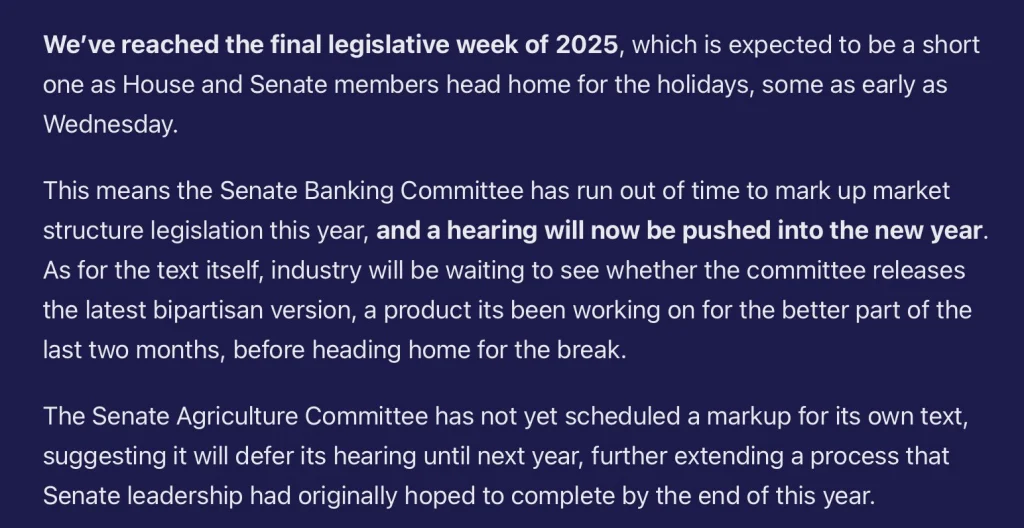
The US government has again delayed long-promised crypto rules. The Senate Banking Committee has postponed hearings on the crypto market structure bill until early 2026. This ends hopes that clear federal rules will be in place by 2025.

Committee Chair Tim Scott said the bill needs support from both parties, and lawmakers are not willing to rush it. For crypto companies and investors, the delay means continued confusion about what is allowed and who regulates what.

US Crypto Market Structure Bill

Which Crypto Bill Is on Hold?

The delay affects the Senate’s version of the crypto market structure bill, which follows the House-passed FIT21 bill from 2024. While the House moved ahead, the Senate has struggled to agree on key points, including who should regulate crypto markets and how much power regulators should have.

The bill was expected to reach the Senate markup stage this year. That step has now been pushed to 2026, raising doubts about whether it will move forward at all.

Why This Bill Matters

This bill is important because it would finally set clear rules for crypto in the US.

The main goals include:

  • Deciding whether crypto assets fall under the SEC or the CFTC
  • Giving the CFTC control over spot crypto markets
  • Setting clear rules for exchanges and platforms
  • Reducing lawsuits as the main way to regulate crypto

Without these rules, crypto businesses operate in a grey area. That uncertainty makes companies cautious and often pushes traders to pull back during weak market conditions.

Why the US Crypto Market Structure Bill is Delayed?

Lawmakers now have bigger political issues to deal with, including budget deadlines and upcoming elections. Crypto regulation has slipped down the priority list. What was once seen as a delay now looks more like a reset. Even moving the bill in early 2026 is no longer guaranteed.

Market and Industry Reaction

Crypto prices showed little reaction to the news, suggesting traders expected the delay. Still, concern remains high.

Analyst Paul Barron said the bill has effectively stalled and warned that it may not return anytime soon. With elections coming up, he believes crypto laws could stay stuck for years.

Crypto lawyer John E. Deaton pointed to pressure from the traditional banking sector. He argues that large banks are working behind the scenes to slow crypto-friendly rules and protect their own interests. Lawmakers deny this, saying their focus is on consumer safety.

What Happens Next?

For now, nothing changes.

The crypto industry will likely face:

  • More enforcement actions instead of clear rules
  • Ongoing uncertainty for exchanges and builders
  • States creating their own rules in the absence of federal law
  • Slower growth from institutions waiting for clarity

Clear US crypto rules are now unlikely before 2026. Until then, the industry remains stuck waiting.

Never Miss a Beat in the Crypto World!

Stay ahead with breaking news, expert analysis, and real-time updates on the latest trends in Bitcoin, altcoins, DeFi, NFTs, and more.

FAQs

Why is the US crypto bill delayed?

The bill is delayed due to a lack of bipartisan agreement, shifting political priorities like elections, and unresolved debates over which regulators should oversee crypto markets.

What does the delayed crypto bill mean for investors?

Continued uncertainty. Without clear rules, investors face a grey area with cautious companies and potential market pullbacks during volatility.

How does the crypto regulation delay affect businesses?

Crypto businesses face more enforcement lawsuits, operational uncertainty, and a patchwork of state laws, which slows institutional adoption and growth.

❌