Reading view

Crypto Analyst Calls XRP a “Zombie Asset” Despite Ripple’s Growth
XRP token utility debate

The post Crypto Analyst Calls XRP a “Zombie Asset” Despite Ripple’s Growth appeared first on Coinpedia Fintech News

Ripple’s native token XRP has been under debate almost since the day it launched. While Ripple continues to grow as a blockchain payments company, many argue that XRP’s price no longer reflects how much it is actually used.

Now, those questions are back in focus again. 

Crypto analyst Atlas recently shared an on-chain analysis, calling XRP the most useless token.

Ripple Thrives, But XRP Lags Behind

In a detailed breakdown of Ripple’s business model and on-chain data, Atlas argues that while Ripple as a company remains active and profitable, its native token XRP is becoming increasingly disconnected from real-world usage. 

His main point is simple: Ripple can operate without XRP, and in many cases, it already does. Banks and institutions can use Ripple’s payment technology without holding or using the XRP token at all.

Atlas highlights a growing gap between XRP’s market value and its actual demand. XRP’s market cap is close to $100 billion, yet activity on the XRP Ledger tells a very different story.

DeFi usage on XRPL is still small, with total value locked in the tens of millions, not billions. For Atlas, this isn’t just a small mismatch, it’s a fundamental problem.

Ripple, XRP, and XRPL Are Not the Same Thing

Another key point Atlas stresses is that Ripple, XRP, and the XRP Ledger are not the same thing. Ripple sells software and payment infrastructure to banks and institutions, but those services do not always require XRP. 

Due to this, Ripple’s success does not automatically increase demand for XRP.

Atlas also raises concerns about decentralization, noting that the XRP Ledger relies on trusted validator lists that remain closely tied to Ripple.

Activity Spikes Don’t Equal Adoption

AAtlas questions recent increases in XRP transaction activity. He points out that Ripple has admitted some of this growth came from micro-transaction spam, meaning higher transaction counts did not reflect real economic use.

He also notes that past adoption was often supported by incentives. Programs such as XRP rebates helped create liquidity, but partners like MoneyGram reportedly sold the tokens quickly, suggesting demand was artificial rather than organic.

Atlas Calls XRP a “Zombie Asset”

Despite his criticism, Atlas does not expect XRP to collapse. Instead, he calls it a “zombie asset,” one that survives on belief, liquidity, and supply control rather than growing utility. For now, he believes XRP’s price remains driven more by faith than usage.

➠ 9

◈ This is why “zombie asset” fits

◈ XRP doesn’t collapse

◈ It doesn’t grow in utility either

◈ It survives on belief, liquidity, and supply control

— Atlas (@crptAtlas) December 26, 2025

Atlas says the SEC lawsuit kept XRP alive through headlines, not usage. When the SEC sued Ripple in December 2020, XRP was trading near $0.60, then dropped to $0.17 as exchanges delisted it. 

Now, SEC lawsuits have ended, XRP price is trading around $1.85 with a market cap hitting $111.89 billion.

Never Miss a Beat in the Crypto World!

Stay ahead with breaking news, expert analysis, and real-time updates on the latest trends in Bitcoin, altcoins, DeFi, NFTs, and more.

FAQs

Is XRP a good investment for 2025 and beyond?

XRP is seen as a long-term bet on payments and institutional adoption, but its price will depend on market trends, regulation, and real-world usage.

What will XRP be in 2026 price prediction?

XRP price prediction for 2026 ranges between $1.75 and $5.05, depending on market recovery, adoption growth, and overall crypto sentiment.

What are the main risks to XRP’s price outlook?

Major risks include regulatory setbacks, weak market liquidity, competition from other payment-focused blockchains, and prolonged bearish market cycles.

Could XRP really reach triple-digit prices by 2050?

Triple-digit targets assume massive global adoption and long-term dominance in payments, making them highly speculative rather than guaranteed outcomes.
Maker Dao Price Prediction 2026, 2027 – 2030: Is MKR a Strong Long-Term DeFi Investment?

Maker Dao Price Prediction

The post Maker Dao Price Prediction 2026, 2027 – 2030: Is MKR a Strong Long-Term DeFi Investment? appeared first on Coinpedia Fintech News

Story Highlights

  • The live Price of the Maker Dao token is  $ 1,446.06662561
  • MKR could target the $2,800 zone by 2026 if DAI adoption and protocol revenues continue to expand.
  • By 2030, MKR may hit $12,000 levels if MakerDAO successfully evolves into a sustainable DeFi financial backbone.

Maker (MKR) is the governance token of MakerDAO and the Maker Protocol, both built on the Ethereum blockchain. The platform allows users to create and manage DAI, one of the most widely used decentralized stablecoins in crypto.

As the system behind DAI, Maker plays an important role in lending, borrowing, payments, and on-chain liquidity across the crypto market.

However, Maker’s native token MKR has faced a strong decline in recent months. The ongoing bear phase has pushed the token below the $1,600 level, making recovery difficult despite signs of improvement in the broader market.

With MKR under pressure, investors are now looking ahead to understand what may come next. Let’s take a closer look at Maker (MKR) price predictions for 2026, 2027, and 2030.

Maker Price Today

Cryptocurrency Maker
Token MKR
Price $1,446.0666 down -8.44%
Market Cap$ 1,225,144,404.23
24h Volume$ 787,289.9241
Circulating Supply0.00
Total Supply870,827.47
All-Time High$ 6,339.0242 on 03 May 2021
All-Time Low$ 21.0598 on 30 January 2017

Maker Dao Price Targets For January 2026

Unlike speculative DeFi tokens, MKR derives value from real protocol responsibility. It governs risk parameters, absorbs losses when things go wrong, and benefits when the system generates surplus. This makes MKR closer to an ownership-like asset than a simple utility token.

As 2026 approaches, MKR’s short-term outlook is closely tied to the growth in DAI circulation and Maker’s ongoing protocol restructuring. 

Unlike many DeFi tokens, MKR tends to move in response to changes in fundamentals rather than during hype-driven rallies.

Maker Dao Price Targets For January 2026

Technical Analysis

Maker (MKR) is currently trading under pressure after failing to hold above the $1,600 level. On the 4-hour chart, MKR had been moving in an upward channel, but recent candles show rejection near the upper band around $1,620–$1,630.

In the short term, MKR looks weak to neutral. Holding above $1,500 is crucial to avoid a deeper correction. A recovery above $1,580 would improve sentiment, while a breakout above $1,630 could restart an upward move.

The RSI is near 45, below the neutral 50 mark. This shows that momentum is currently tilted toward sellers. 

Meanwhile, a breakout above the resistance level will open the door for an upwards rally towards $2470.

MonthPotential Low ($)Potential Average ($)Potential High ($)
Maker Crypto Price Prediction January 2026$1216$1835$2470

MakerDAO (MKR) Price Prediction 2026

The year 2026 may mark a transition phase for MakerDAO. The protocol has been gradually shifting toward a more structured and revenue-focused model, emphasizing efficiency, resilience, and long-term sustainability.

Key factors that could influence MKR in 2026 include

  • Growth in DAI supply across DeFi and payments
  • Protocol-generated fees and surplus management
  • Governance participation and risk controls

If Maker continues strengthening its financial foundations, MKR could experience steady appreciation rather than sudden spikes.

MakerDAO (MKR) Price Prediction 2026
YearPotential Low ($)Potential Average ($)Potential High ($)
Maker Price Prediction 2026$1197$2050$2804

Maker Price Prediction 2026 – 2030

YearPotential Low ($)Potential Average ($)Potential High ($)
2026$1197$2050$2803
2027$1914$2000$4762
2028$2800$4891$6700
2029$3900$6870$9326
2030$4817$8500$12000

MKR Price Prediction 2026

In 2026, MKR’s price is expected to reflect measured growth rather than speculation. If MakerDAO maintains strong risk controls while expanding DAI adoption, MKR could approach $2,803.

MKR Price Prediction 2027

By 2027, MakerDAO may benefit from greater institutional and DeFi integration of DAI. Under this scenario, MKR could trade between $1,900 and $4,762.

MKR Price Prediction 2028

As decentralized stablecoins gain wider acceptance, Maker’s role as a trusted issuer could strengthen. This may push MKR toward the $6,700 level.

MKR Price Prediction 2029

In 2029, investors may increasingly value protocols with consistent revenue. If MakerDAO continues generating surplus, MKR could be priced closer to $9,326.

MKR Price Prediction 2030

By 2030, MakerDAO’s success will depend on whether DAI remains competitive against centralized stablecoins. If so, MKR could potentially reach $12,000, reflecting its role as a core DeFi financial layer.

What Does The Market Say?

Year202620272030
CoinCodex$2473$3805$5451
CoinChepkup$3516$5736$6715
Mudrex$2800$4000$12000

CoinPedia’s MakerDAO (MKR) Price Prediction

According to CoinPedia analysts, MakerDAO stands apart from most DeFi projects due to its direct link to real on-chain revenue and risk management. While MKR may not deliver explosive short-term rallies, its long-term value proposition remains strong.

CoinPedia analyst suggests that MKR will trade with moderate upside in 2026, targeting a high near $2,800. But long-term projections remain constructive, as experts eye $12000 mark until 2030.

YearPotential Low ($)Potential Average ($)Potential High ($)
2026$1250$2050$2803
Never Miss a Beat in the Crypto World!

Stay ahead with breaking news, expert analysis, and real-time updates on the latest trends in Bitcoin, altcoins, DeFi, NFTs, and more.

FAQs

What is the Maker (MKR) price prediction for 2026?

MKR could trade between $1,200 and $2,800 in 2026, driven by DAI adoption, protocol revenue, and MakerDAO’s focus on long-term sustainability.

Can Maker (MKR) reach $10,000 by 2030?

Yes, MKR may approach or exceed $10,000 by 2030 if DAI remains competitive and MakerDAO continues generating consistent on-chain revenue.

Is Maker (MKR) a good long-term investment?

MKR is considered a long-term asset due to its role in governance, risk management, and value capture from MakerDAO’s real protocol revenues.

What factors influence MKR price the most?

Key drivers include DAI supply growth, protocol fees, governance decisions, risk controls, and overall DeFi and crypto market conditions.

How is MKR different from other DeFi tokens?

Unlike hype-driven tokens, MKR derives value from real responsibility—governing DAI, absorbing losses, and benefiting from MakerDAO’s surplus.

Ripple IPO Back in Spotlight as Valuation Hits $50B

Ripple IPO in 2026

The post Ripple IPO Back in Spotlight as Valuation Hits $50B appeared first on Coinpedia Fintech News

Ripple, the blockchain payments company behind XRP, is once again in the spotlight as reports suggest that it may be preparing for a possible initial public offering (IPO) in 2026. 

Industry analysts now rank Ripple among the biggest potential public listings, with valuations estimated near $50 billion

Here’s what Ripple’s leadership is saying about these IPO talks.

Sign Shows Ripple Preparing for a 2026 IPO

According to multiple sources, Ripple is reportedly holding advanced internal discussions around a potential IPO in 2026. These are not rumors or casual considerations, but signs that the company may be actively preparing for a public listing.

The company has also strengthened its internal structure, with better reporting and governance, which are common steps before going public. At the same time, Ripple is expanding bank partnerships and payment services to build steady, real-world revenue.

Indeed, Ripple continues to position XRP as a liquidity tool within its payment system. IPO-ready companies usually highlight utility and long-term value rather than market hype.

Ripple Ranks Among Top IPO Candidates for 2026

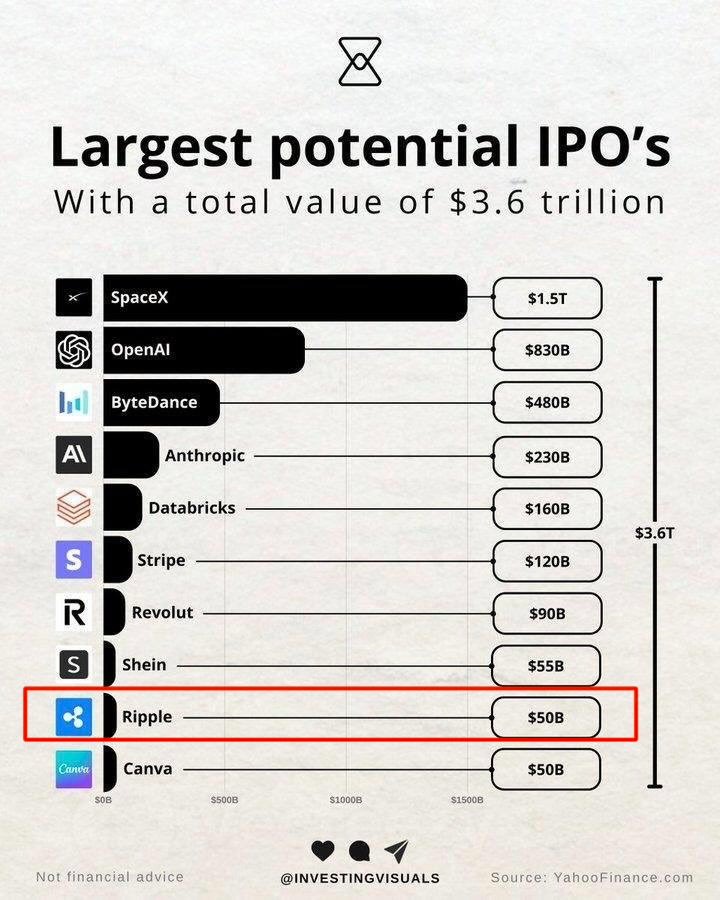
Adding to the excitement, market data and industry visuals now place Ripple among the largest potential IPOs heading into 2026. According to recent comparisons, Ripple ranks ninth among top private companies expected to go public, with an estimated valuation of $50 billion.

Ripple ipo listing

The list includes major global names such as SpaceX, OpenAI, ByteDance, and Stripe, highlighting just how significant Ripple’s position has become. 

Analysts point to strong momentum, improving regulation, and growing global adoption as key reasons Ripple continues to stand out.

Ripple Leadership Pushes Back

Despite growing speculation, Ripple executives have consistently denied IPO rumors. Ripple President Monica Long has said the company has “no plan and no timeline” to go public, stressing that Ripple is well-funded and does not need public markets to raise capital. 

Even Ripple CEO Brad Garlinghouse has echoed this view, noting that any IPO discussion would be a long-term consideration, not an immediate move.

Other Crypto Firms Move Closer to IPO

According to recent research reports, public markets are becoming the preferred next step for mature crypto firms. Circle has already gone public, and other major names such as Kraken, Grayscale, and BitGo have filed paperwork or entered advanced talks. 

In Asia, Dunamu, the operator of Upbit, is also preparing a public debut through a merger. This broader trend has fueled speculation that Ripple could follow a similar path.

Never Miss a Beat in the Crypto World!

Stay ahead with breaking news, expert analysis, and real-time updates on the latest trends in Bitcoin, altcoins, DeFi, NFTs, and more.

FAQs

Would a Ripple IPO affect how XRP is governed or used?

A Ripple IPO would not change how XRP Ledger operates, since the network is open-source and not owned by Ripple. However, Ripple’s business decisions after an IPO could influence how aggressively it promotes XRP-based payment products.

What regulatory hurdles could still delay or prevent a Ripple IPO?

Ripple would need sustained regulatory clarity in major markets, especially the U.S., where crypto-related disclosures face close scrutiny. Any unresolved legal or compliance issues could slow the timing of a public listing.

Who stands to benefit most if Ripple eventually goes public?

Early private investors and long-term employees with equity would likely see the most direct financial impact. Banks and payment partners could also benefit indirectly from greater transparency and public-market credibility.

What signals should investors watch next regarding Ripple’s IPO plans?

Key indicators include hiring for finance or compliance leadership, audited financial disclosures, or public comments shifting from denial to conditional openness. These steps often precede formal IPO filings.

Bitcoin Breakout Alert: 10x Research Sees Multi-Week Rally Pushing BTC To $110K

Bitcoin Price Forecast: $100K Bounce or Drop Toward $65K?

The post Bitcoin Breakout Alert: 10x Research Sees Multi-Week Rally Pushing BTC To $110K appeared first on Coinpedia Fintech News

Bitcoin is currently going through a calm but tense phase as it faces $23.6 billion in option expiry today. After weeks of heavy selling in October and November, the market is trying to find stability.

According to recent analysis from 10x Research, Bitcoin has triggered a bullish breakout that may signal the start of a multi-week recovery, with upside potential toward $110K if momentum holds.

October Crash and ETF Outflows Weighed Heavily on Bitcoin

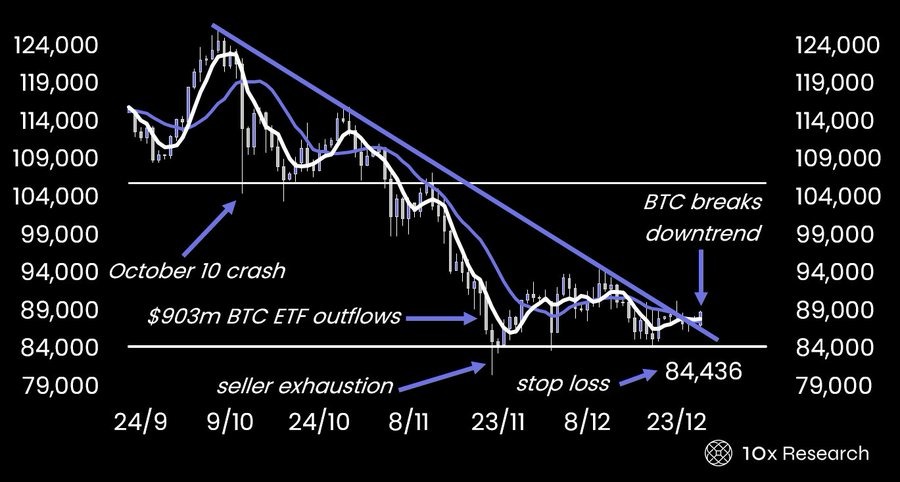
According to 10x Research, Bitcoin’s current price structure began with the sharp October 10 crash, when BTC fell from its peak near $98,000, and the broader crypto market saw about $19 billion in liquidations.

Pressure increased after the October 29 Federal Reserve meeting, which delivered a hawkish message. Soon after, spot Bitcoin ETFs recorded heavy selling, with nearly $903 million in net outflows. This drained liquidity and kept Bitcoin stuck under selling pressure.

Even when prices looked attractive, buyers remained cautious. As a result, the downtrend lasted longer than many traders expected.

By late November, selling began to fade as most short-term sellers had exited. However, instead of rebounding, capital shifted to assets like gold and silver, leaving Bitcoin stuck in a slow recovery.

$85,000 Becomes a Strong Support Level

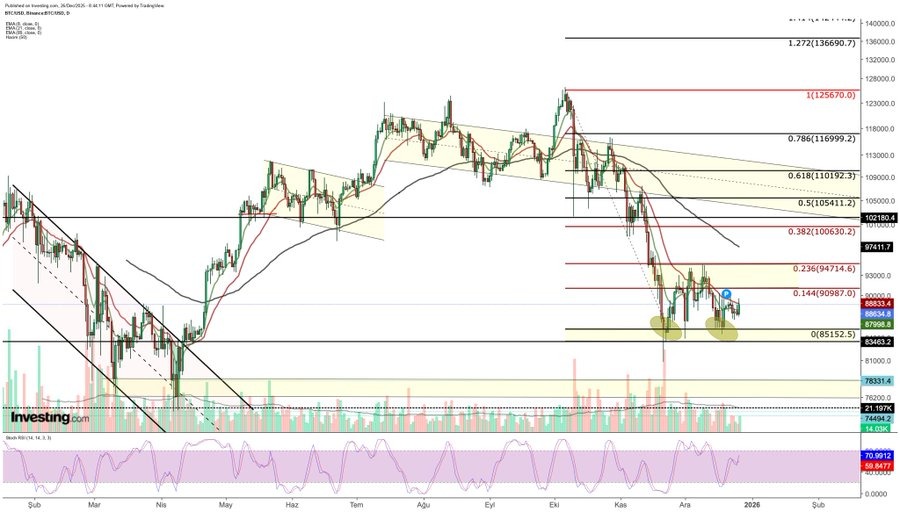
From a chart perspective, Bitcoin recently moved above its descending trendline, signaling potential trend exhaustion. Key support near the $85,000 zone held firm, strengthening buyer confidence. As long as Bitcoin stays above this zone, the market avoids deeper losses.

10x research bitcoin

Even though Bitcoin has tried to move above $92K but failed several times, one major reason is low trading volume, which is common near year-end. 

With fewer traders active, price moves lack strength. As a result, recent rises look like short pauses, not a true trend shift.

Resistance Levels Hold the $110000 Level Back

On the upside, Bitcoin faces heavy resistance. The first level to watch is $91,000, which could signal the end of consolidation if broken. The bigger hurdle lies near $94,700, a key level that could shift market sentiment.

If Bitcoin clears these zones, upside targets sit near $100,600, $105,400, and $110,000. 

bitcoin price chart

As of now, BTC is trading $88,656, reflecting a jump of 1.5% seen in the last $1.77 trillion.

EOS Price Prediction 2026, 2027 – 2030: Can EOS Finally Break Its Long Silence?

EOS Price Prediction

The post EOS Price Prediction 2026, 2027 – 2030: Can EOS Finally Break Its Long Silence? appeared first on Coinpedia Fintech News

Story Highlights

  • The live price of EOS crypto is  $ 0.15419198.
  • EOS could attempt a recovery toward $0.89 by 2026 if ecosystem traction improves.
  • By 2030, EOS may revisit $6.1 levels if long-term network reforms succeed.

EOS is one of the oldest smart contract platforms in crypto. Built as a third-generation blockchain, it focuses on speed, scalability, and near fee-less transactions using its own EOS Virtual Machine and WebAssembly engine. While newer blockchains grabbed headlines in recent years, EOS has continued evolving quietly in the background.

With EOS currently trading near $0.16, down from its 64% from its May high,  investors are questioning whether the network can transition from a long consolidation phase into a meaningful recovery.

So, let’s further dive into exploring this EOS price prediction for 2026, 2027, and 2030.

EOS Price Today

Cryptocurrency EOS
Token EOS
Price $0.1542 down -1.59%
Market Cap$ 247,366,405.45
24h Volume$ 193,204.3682
Circulating Supply0.00
Total Supply2,100,000,000.00
All-Time High$ 22.8904 on 29 April 2018
All-Time Low$ 0.1430 on 18 December 2025

EOS Price Targets For January 2026

During earlier market cycles, EOS attracted massive attention, but over time, competition from newer networks and governance challenges pushed it out of the spotlight. Now, as the crypto market gradually matures and infrastructure-focused projects regain attention, EOS is once again being closely watched.

EOS is trading around $0.16, while its 24-hour trading volume has surged by nearly 70%, reaching approximately $175.8K. This sudden spike in volume suggests renewed interest, even as price remains range-bound.

EOS Price Targets For January 2026

Technical Analysis

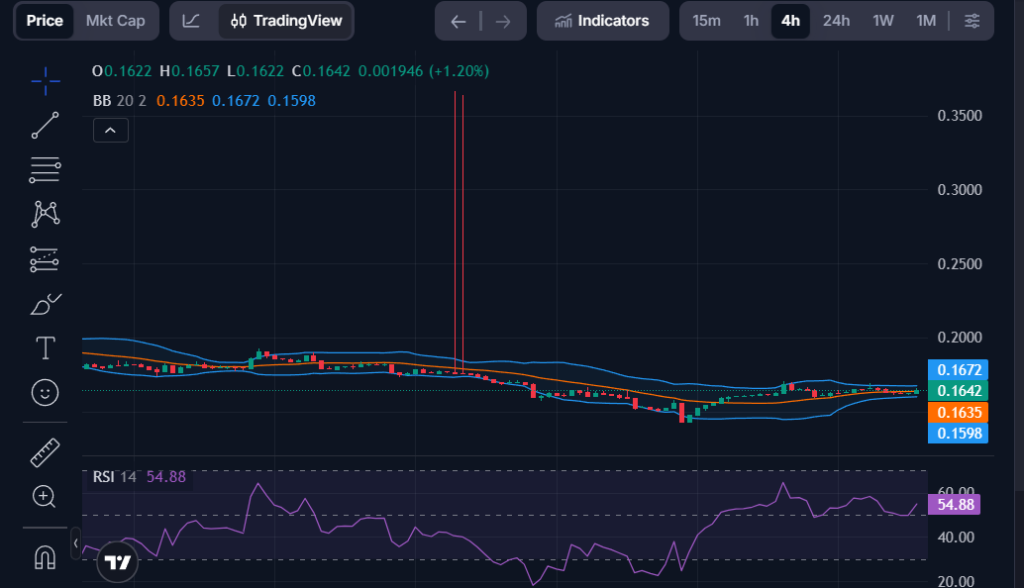
The price is currently moving sideways, showing no strong trend in either direction. On the 4-hour chart, the asset is trading around $0.164, staying inside a tight range.

Meanwhile, the Bollinger Bands are narrow, which usually means the market is calm and volatility is low. Key support is around $0.160, showing buyers step in here.

The RSI is near 55, which is slightly bullish but not strong. This means buyers have a small advantage, but there is no overbought or oversold condition right now. 

If EOS manages a clean breakout above the $0.21 resistance, a short-term move toward $0.38 becomes likely.

MonthPotential Low ($)Potential Average ($)Potential High ($)
EOS Crypto Price Prediction January 2026$0.12$0.21$0.38

EOS Price Prediction 2026

Throughout 2024 and 2025, EOS remained under pressure as investors favored faster-growing ecosystems. However, EOS has continued refining its infrastructure, focusing on stability, governance improvements, and developer-friendly tools.

In 2026, EOS’s price movement is likely to depend on whether developers and enterprises begin building meaningful applications on the network.

EOS Price Prediction 2026

A sustained recovery above $0.56 could improve sentiment, while rejection at lower levels may keep EOS range-bound.

YearPotential Low ($)Potential Average ($)Potential High ($)
EOS Price Prediction 2026$0.12$0.56$0.92

EOS Price Prediction 2026 – 2030

YearPotential Low ($)Potential Average ($)Potential High ($)
2026$0.12$0.56$0.92
2027$0.30$0.77$2.5
2028$0.54$1.40$3.18
2029$0.85$2.10$3.90
2030$1.30$3.25$6.1

EOS Price Prediction 2026

In 2026, EOS’s focus will be on proving stability. If developers continue shipping updates and users see smoother performance, the price could approach $0.92 by the end of the year.

EOS Price Prediction 2027

By 2027, EOS may benefit from renewed interest in high-throughput chains for gaming, social apps, and enterprise use cases. Under this scenario, EOS could test $2.5.

EOS Price Prediction 2028

As blockchain adoption grows, EOS could benefit from its near-feeless transactions and high throughput. This may push EOS toward $3.18 if adoption continues to strengthen.

EOS Price Prediction 2029

By 2029, investors may prioritize networks with long operational histories. EOS’s survival through multiple market cycles could support prices up to $3.90.

EOS Price Prediction 2030

By 2030, EOS’s fate depends on whether it successfully reinvents itself as a reliable infrastructure chain. If adoption continues to grow steadily, the EOS price would jump to $6.10 by the end of the year.

What Does The Market Say?

Year202620272030
CoinCodex$0.48$0.82$1.83
Preicepredictions$0.037$1.05$3.64
Digitalcoinprice$0.85$2.92$7.2

CoinPedia’s EOS Price Prediction

CoinPedia analysts believe EOS is no longer a hype-driven asset, and that may be its biggest strength. The network has already endured its speculative boom and collapse. What remains is infrastructure, experience, and a community focused on long-term rebuilding.

CoinPedia expects EOS to trade cautiously in 2026, with upside toward $0.92, while long-term outcomes remain tied to execution rather than promises.

YearPotential Low ($)Potential Average ($)Potential High ($)
2026$0.12$0.56$0.92
Never Miss a Beat in the Crypto World!

Stay ahead with breaking news, expert analysis, and real-time updates on the latest trends in Bitcoin, altcoins, DeFi, NFTs, and more.

FAQs

What is EOS price prediction for 2026?

EOS may trade between $0.12 and $0.92 in 2026, depending on adoption, developer updates, and market sentiment.

How high can EOS go by 2028?

With increased blockchain adoption and high throughput use, EOS could approach $3.18 by 2028.

Could EOS reach $1 or higher by 2030?

If EOS adoption grows steadily and infrastructure improves, the price could rise toward $6 by 2030.

Is EOS a good long-term investment?

EOS may appeal to long-term investors focused on infrastructure stability, adoption, and resilience through market cycles.

How does EOS compare to other smart contract platforms?

EOS offers fast, near-feeless transactions and high scalability, making it a strong contender for enterprise and app development.

$27B Bitcoin, Ethereum Options Expiry Today: Here’s What to Expect 

Bitcoin Ethereum Options Expiry Today

The post $27B Bitcoin, Ethereum Options Expiry Today: Here’s What to Expect  appeared first on Coinpedia Fintech News

Around $27 billion worth of Bitcoin, Ethereum options expired today on Deribit, one of the world’s largest crypto options exchanges. Bitcoin is trading near $88,000, while Ethereum is hovering close to $2,950, as traders brace for possible volatility. 

With such a large amount of contracts settling at once, the expiry could have a massive impact on the crypto market

Bitcoin Faces $23.6 Billion Option Expiry

Bitcoin accounts for the biggest share of today’s expiry, with over $23.6 billion in BTC options rolling off. Data from Deribit shows 268,000 option contracts settled at the same time, clearing a major amount of risk from the market in a single session.

Despite the size of the expiry, trader positioning still leans positive. The put-to-call ratio stands at 0.38, which means more traders were betting on higher prices than lower ones. 

The “max pain” level, where most option holders would see losses, was near $96,000. This level often acts like a price magnet around expiry, even if briefly.

Bitcoin Eyeing $100K level

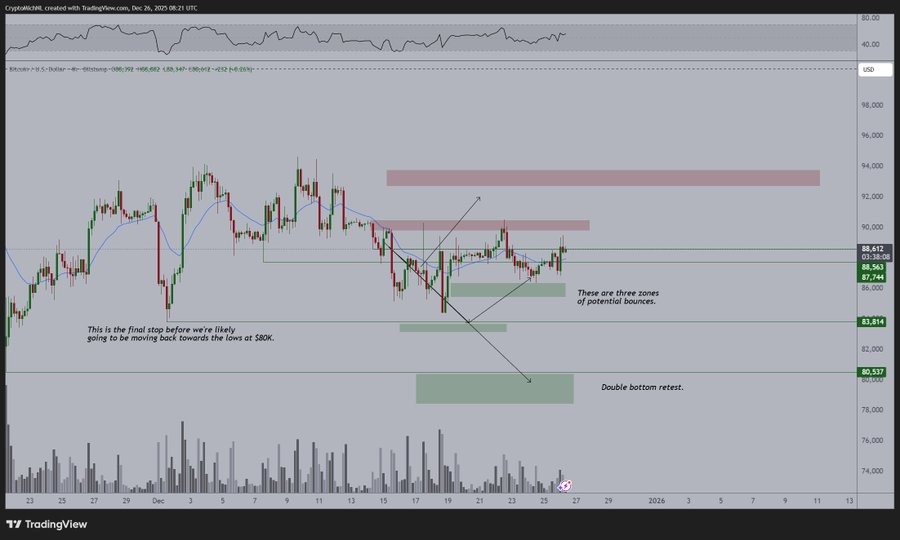
Over the past few weeks, Bitcoin has remained stuck in a tight range, repeatedly testing both sides. Crypto analyst Michael van de Poppe noted that sellers have failed to push BTC below $86.5K, showing strong buyer support. 

However, every move above $90K has been rejected, highlighting heavy selling pressure at that level.

bitcoin chart

Analysts say $90,000 is the key barrier. A clear breakout above it, backed by strong volume, could restore bullish momentum and open the path toward the $100,000 mark.

Ethereum Traders Remain Cautious After Options Expiry

Ethereum is also under the spotlight, with nearly $4 billion in ETH options expiring. Although ETH has seen small price gains, traders remain cautious rather than confident. The max pain level sits near $3,100, keeping pressure on the price.

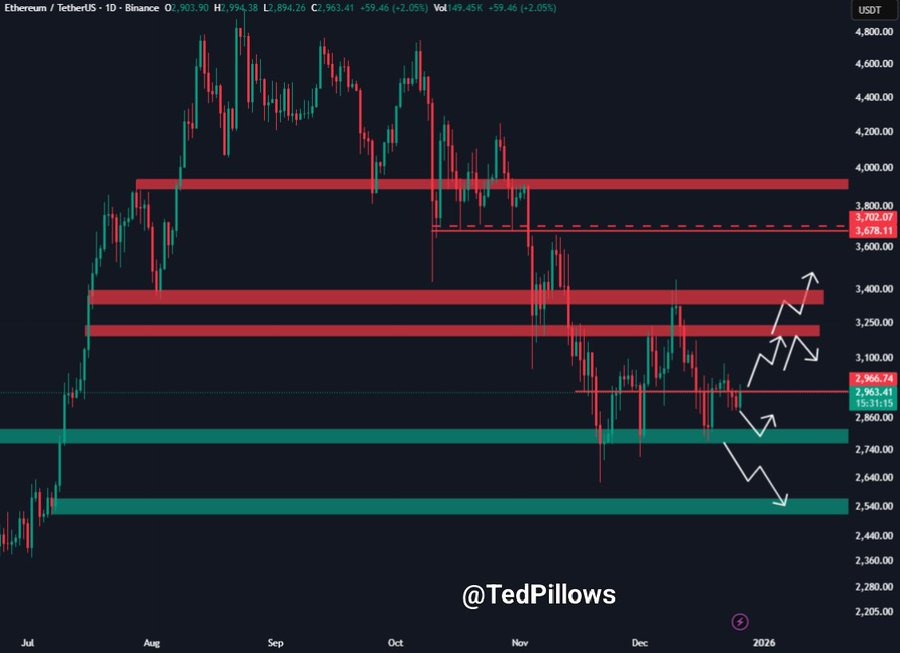
Ethereum has once again failed to hold above the key $3,000 level, which is worrying traders. Crypto analyst Ted noted that unless ETH clearly moves back above $3,000, the risk of another drop stays high.

If the price falls below $2,800, selling pressure could increase quickly. Below that, the next strong support lies around $2,600, $2,500, where buyers stepped in during earlier sell-offs.

ethereum price chart

XRP and Solana Show Mixed Signals

XRP options show continued pressure, with traders closely watching the $1.80 support level. A break below this could lead to further downside.

Solana shows a more balanced picture. Options data remains neutral, and SOL has already seen a small recovery around $123. 

As 2026 approaches, this option’s expiry could act as an important turning point for the token.

Never Miss a Beat in the Crypto World!

Stay ahead with breaking news, expert analysis, and real-time updates on the latest trends in Bitcoin, altcoins, DeFi, NFTs, and more.

FAQs

What happens when Bitcoin and Ethereum options expire?

When options expire, contracts settle, removing market risk and often causing short-term price volatility in BTC and ETH.

How does a large options expiry affect crypto prices?

A massive expiry clears a large amount of market risk at once, which can increase short-term volatility. The “max pain” price often acts as a temporary magnet, but the overall trend depends on broader market sentiment.

How do crypto option expiries impact other tokens like XRP and Solana?

Large expiries can influence market sentiment, affecting XRP support at $1.80 and Solana’s price recovery around $123.

Lithuania Crypto License Deadline: Firms Must Comply by Dec 31, 2025

Lithuania MiCA crypto enforcement

The post Lithuania Crypto License Deadline: Firms Must Comply by Dec 31, 2025 appeared first on Coinpedia Fintech News

Lithuania is known as a leading, crypto-friendly EU hub, is sending a clear message to the crypto industry: follow the rules or leave. The country’s central bank has warned that all crypto companies operating in Lithuania must secure a proper license by December 31, 2025, or face serious legal consequences starting next year.

Lithuania Tightens Crypto Rules Under EU Law

According to the Bank of Lithuania, also known as Lietuvos Bankas, every business offering crypto services in the country must hold a valid license under the European Union’s MiCA framework. From January 1, 2026, any platform operating without approval will be considered illegal.

This move is part of the EU-wide rollout of Markets in Crypto-Assets (MiCA) rules, which aim to bring stronger oversight, consumer protection, and transparency to the crypto sector across Europe.

🚨 JUST IN: 🇱🇹 Bank of Lithuania warns crypto firms must get licensed by Dec 31.
From Jan 1, unlicensed platforms operating in Lithuania will be deemed illegal.

Penalties include fines, website blocking, and up to 4 years in prison. pic.twitter.com/U0qo9FteHC

— Crypto India (@CryptooIndia) December 26, 2025

Heavy Penalties for Non-Compliant Platforms

The consequences for ignoring the deadline are serious. Regulators say unlicensed crypto firms could face large fines, blocked websites, and even criminal charges. In severe cases, company executives may face up to four years in prison.

Authorities have also advised crypto firms that do not plan to meet the new standards to shut down operations in an orderly way. This includes returning user funds safely and avoiding sudden service disruptions that could harm customers.

9% Lithuanian crypto businesses have applied for a license

Despite the clear deadline, compliance has been slow. Out of more than 370 crypto companies currently registered in Lithuania, only around 30 have applied for a MiCA license so far. This raises concerns that many firms may struggle to meet the requirements in time.

In recent years, Lithuania has become a popular base for crypto companies due to its fast registration process and crypto-friendly stance. However, regulators now say stricter rules are needed to reduce risks like money laundering, fraud, and poor consumer protection.

As the deadline approaches, both crypto companies and users are being urged to prepare for a more regulated crypto environment in Lithuania starting in 2026.

Never Miss a Beat in the Crypto World!

Stay ahead with breaking news, expert analysis, and real-time updates on the latest trends in Bitcoin, altcoins, DeFi, NFTs, and more.

FAQs

What happens if a crypto company operates in Lithuania without a MiCA license?

Unlicensed firms may face heavy fines, blocked websites, forced shutdowns, and in serious cases, criminal charges against executives.

Will crypto users in Lithuania be affected by the new MiCA rules?

Yes. Users may see platforms exit the market, but licensed firms should offer stronger protections, transparency, and safer handling of funds.

Why is Lithuania tightening crypto regulations now?

Lithuania is enforcing EU MiCA rules to reduce fraud, money laundering, and consumer risk while aligning with Europe’s unified crypto framework.

Russia Says U.S. Interested in Using Nuclear Power for Bitcoin Mining

Russia Says U.S. Interested in Using Nuclear Power for Bitcoin Mining

The post Russia Says U.S. Interested in Using Nuclear Power for Bitcoin Mining appeared first on Coinpedia Fintech News

The two world’s biggest economies, Russia and the United States, are discussing the future of the Zaporizhzhia Nuclear Power Plant, which has been under Russian control since early in the Ukraine conflict. 

Meanwhile, reports suggest that the U.S has shown interest in using electricity from Europe’s largest nuclear power plant for Bitcoin mining

U.S. Interest Links Nuclear Energy and Bitcoin Mining

According to a report by Kommersant, President Vladimir Putin revealed that the Zaporizhzhia Nuclear Power Plant is part of ongoing talks between Russia and the United States. One of the ideas raised during these discussions is using the plant’s massive electricity output for Bitcoin mining operations.

Zaporizhzhia is the largest nuclear power plant in Europe, which produces 136.8 gigawatt-hours (GWh) of energy per day than local demand requires. 

With such a large and steady energy supply, Bitcoin mining, which requires constant, high-volume electricity, could provide a practical way to use this excess power more efficiently.

According to Kommersant, President Vladimir Putin said Russia is discussing the management of the Zaporizhzhia nuclear power plant with the United States. The report said the U.S. has expressed interest in using the plant’s electricity for Bitcoin mining. Zaporizhzhia is Europe’s…

— Wu Blockchain (@WuBlockchain) December 26, 2025

Why Nuclear Power Appeals to Bitcoin Mining

Bitcoin mining requires stable, low-cost, and continuous electricity. Nuclear power fits this need well, as it provides constant energy without interruptions. In recent years, miners have increasingly turned to alternative energy sources like hydro, wind, and nuclear power to reduce costs and improve sustainability.

Using nuclear energy for Bitcoin mining could also help stabilize power grids by consuming excess electricity that would otherwise go unused. This makes the idea attractive not just for miners, but also for energy planners.

If nuclear-powered Bitcoin mining becomes a reality, it could change how and where Bitcoin is mined globally.

Joint Management Talks Signal a Bigger Shift

Putin’s comments suggest that Russia is open to joint management of the Zaporizhzhia plant with the U.S., rather than Ukraine. While the talks are still at an early stage, they point to a broader shift where energy infrastructure, geopolitics, and digital assets are becoming closely linked.

If such cooperation moves forward, it would mark one of the first cases where a major nuclear facility is openly discussed in the context of Bitcoin mining.

While no official agreement has been announced, the fact that such talks are happening shows how seriously governments are now viewing Bitcoin mining as an industrial activity tied to energy policy.

How Many BTC Are Left For Mining

While Bitcoin has a fixed maximum supply of 21 million coins, most of them have already been mined. As of now, around 19.7 million Bitcoins are already in circulation, which means only about 1.3 million BTC are left to be mined. This is less than 7% of the total supply.

After the 2024 halving, miners now earn 3.125 BTC per block, producing roughly 450 new BTC per day. At this pace, the last Bitcoin will be mined around the year 2140, making Bitcoin increasingly scarce over time.

Never Miss a Beat in the Crypto World!

Stay ahead with breaking news, expert analysis, and real-time updates on the latest trends in Bitcoin, altcoins, DeFi, NFTs, and more.

FAQs

Why does Bitcoin mining benefit from nuclear power?

Bitcoin mining needs stable, low-cost, 24/7 electricity. Nuclear power provides uninterrupted energy, helping miners reduce costs and improve efficiency.

How much Bitcoin is left to be mined?

Only about 1.3 million BTC remain, less than 7% of the total 21 million supply. Currently, roughly 450 new Bitcoin are created per day through mining.

When will the last Bitcoin be mined?

At the current mining rate post-2024 halving, the last Bitcoin is projected to be mined around the year 2140 due to the protocol’s built-in gradual reduction of new coins.

Ethereum Prepares for Two Major 2026 Upgrades: Glamsterdam and Heze-Bogota 

Ethereum Fusaka upgrade

The post Ethereum Prepares for Two Major 2026 Upgrades: Glamsterdam and Heze-Bogota  appeared first on Coinpedia Fintech News

Ethereum is preparing for major network upgrades in 2026 that could transform how the blockchain works. According to recent developer roadmap updates shared in late 2025, Ethereum is planning two major protocol upgrades in 2026, the Glamsterdam fork and the Heze-Bogota fork.

These upgrades target faster transactions, stronger privacy, and better decentralization, helping the ETH token price rally ahead.

Glamsterdam Fork Targets Speed and Higher Gas Limits

One of the key upgrades expected in 2026 is the Glamsterdam fork, which focuses on performance. This upgrade introduces parallel transaction processing, enabling Ethereum to handle multiple tasks simultaneously instead of processing them one by one.

Along with this, Ethereum’s gas limit is expected to rise sharply to 200 million, up from the current 60 million. This would allow far more transactions to fit into each block, reducing congestion during busy periods.

Another important change is how validators operate. Instead of validating full transaction data, validators will move toward checking zero-knowledge (ZK) proofs. This reduces workload while keeping the network secure.

With these improvements combined, Ethereum’s main network could eventually reach up to 10,000 transactions per second, a major jump from today’s levels.

If Vitalik spent more time looksmaxxing and less time on infrastructure

ETH would be at $10,000 pic.twitter.com/lWlBrJvZCW

— Tenacious (@TenaciousBit) December 16, 2025

Heze-Bogota Fork Focuses on Privacy and Censorship Resistance

Alongside Glamsterdam upgrades, which focus on speed, Ethereum is also addressing concerns around privacy and decentralization. The planned Heze-Bogota fork will concentrate on strengthening user privacy and improving censorship resistance.

This upgrade aims to reduce reliance on centralized infrastructure and make it harder for any single party to block transactions. 

Developers see this as a key step toward keeping Ethereum open, neutral, and permissionless as global adoption grows.

Why These Ethereum Upgrades Matter

Ethereum already powers much of today’s DeFi, NFT, and stablecoin activity, but high fees and overcrowding remain challenging. The 2026 upgrades aim to fix these issues at the base layer.

By combining higher speed, ZK-based validation, and stronger decentralization, Ethereum is positioning itself for long-term growth. If successful, these upgrades could help Ethereum remain competitive while staying true to its core values of openness and security.

Ethereum Price Outlook

On-chain data shows more ETH moving onto exchanges in December, with reserves rising from about 16.2 million to nearly 16.6 million ETH. This means around 400,000 ETH has been added to exchange balances, increasing short-term supply

At the same time, Ethereum network activity has jumped sharply. Active addresses nearly doubled in just one week, rising from around 496,000 to 800,000, showing growing user participation.

Ethereum $ETH network activity has nearly doubled in a week, with active addresses rising from 496,000 to 800,000. pic.twitter.com/c0espgmwr9

— Ali Charts (@alicharts) December 25, 2025

Looking at the Ethereum price, ETH is trading just below $2,955 with a market cap hitting $356.7billion. However, the ETH price has stabilized after dipping toward $2,850 but remains in a corrective phase. 

Looking ahead, traders believe that if market conditions improve, ETH could attempt a recovery toward the $3,390 zone.

Bitcoin vs. Gold: Can BTC Surpass Gold? Experts Weigh In

Bitcoin vs. Gold: Can BTC Surpass Gold? Experts Weigh In

The post Bitcoin vs. Gold: Can BTC Surpass Gold? Experts Weigh In appeared first on Coinpedia Fintech News

Gold has jumped more than 70% this year and is now trading near a new record high of $4,406. The rally is being driven by expected interest rate cuts and rising global tensions. At the same time, Bitcoin has been falling compared to gold. Bitcoin is now trading below $87,000, almost 29% down from its recent peak. 

This growing gap has left many traders wondering whether Bitcoin can recover and eventually move ahead of gold again.

Gold Still Dominates Safe-Haven Status

For centuries, gold has been the top choice to store value. Recently, many countries and large institutions have rushed to buy gold as global tensions rise, inflation fears grow, and investors expect interest rate cuts. 

Gold is widely seen as a safe place to park money during uncertain times. Because of this strong demand, gold prices have surged more than 70% this year, reaching new record levels above $4,400 per ounce.

In contrast, Bitcoin has faced more selling pressure, with its value down roughly 29% from its peak and trading range-bound for weeks.

Why Bitcoin’s Supply Works Differently Than Gold

Gold supply increases slowly each year. When gold prices rise, miners are encouraged to dig deeper, use more machines, and extract more gold. This extra supply slowly enters the market and helps cool prices over time.

Bitcoin works in a completely different way.

Bitcoin has a fixed supply of only 21 million coins. No matter how high the price goes, no new Bitcoin can be created beyond this limit. Every four years, Bitcoin goes through a halving event that cuts the number of new coins entering the market in half. This makes Bitcoin harder to obtain as time passes.

Because of this design, rising demand does not increase Bitcoin’s supply.

Bitcoin could hit $1.5 million in 18 years

Meanwhile, a crypto researcher, David, offers a mathematical calculator using very conservative assumptions:

  • Gold grows about 2% per year
  • Bitcoin’s market value doubles every four years

Under these slow estimates, Bitcoin could match gold’s total value in about 18 years. That would place Bitcoin near a $30 trillion market cap, or roughly $1.5 million per coin.

This is not hype. It is basic math based on supply rules.

Bitcoin vs Gold: What the Chart Is Showing

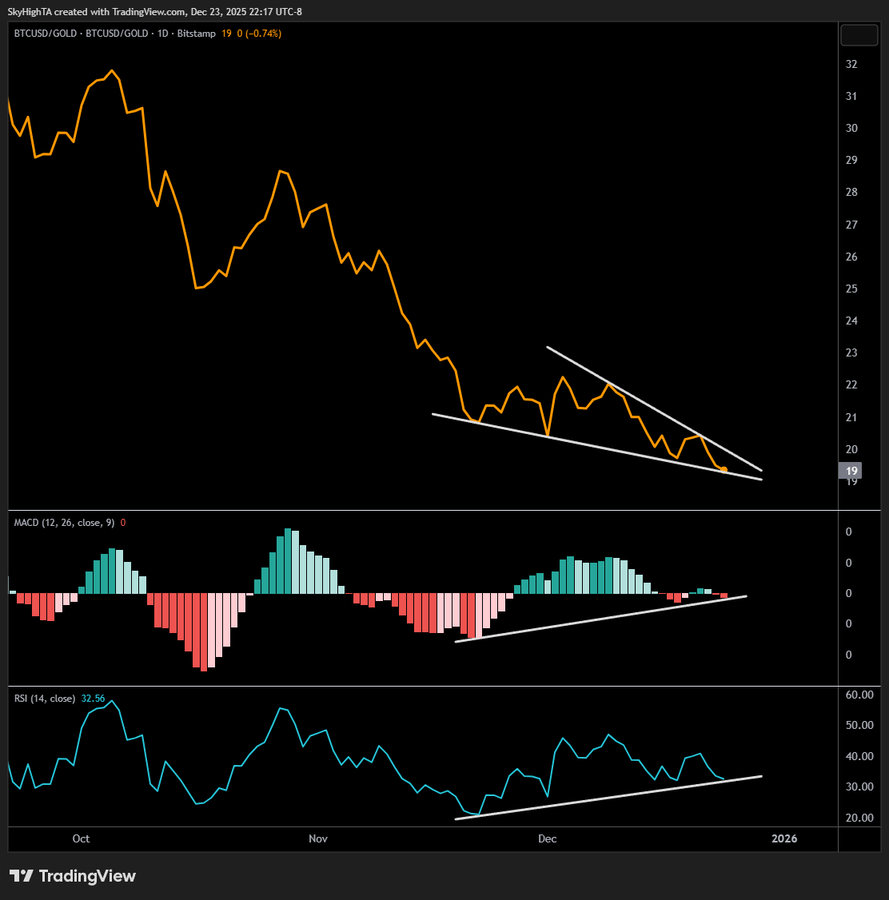
The Bitcoin-to-gold ratio chart shows how Bitcoin performs compared to gold over time. Right now, this ratio is moving inside a falling wedge pattern, which is often seen before a trend reversal.

Even more important, momentum indicators like RSI and MACD are showing bullish divergence. This means selling pressure is slowing, even though prices remain low. In simple terms, Bitcoin is losing strength less quickly against gold, which often happens before a rebound.

bitcoin vs gold chart

This setup suggests Bitcoin may be forming a base rather than collapsing further.

Never Miss a Beat in the Crypto World!

Stay ahead with breaking news, expert analysis, and real-time updates on the latest trends in Bitcoin, altcoins, DeFi, NFTs, and more.

FAQs

Why is gold outperforming Bitcoin right now?

Gold benefits from rate-cut expectations and geopolitical risk, while Bitcoin faces short-term selling pressure and weaker demand from risk-averse investors.

Can Bitcoin still overtake gold in the long term?

Yes. Bitcoin’s fixed 21 million supply and halving cycles mean long-term demand growth could eventually push its value beyond gold’s market cap.

What does the Bitcoin-to-gold ratio indicate for investors?

The ratio shows Bitcoin’s performance versus gold. Current chart patterns suggest Bitcoin may be stabilizing and preparing for a potential rebound.

New Crypto Rules in Spain: What Investors Need to Know for 2026

New Crypto Rules in Spain: What Investors Need to Know for 2026

The post New Crypto Rules in Spain: What Investors Need to Know for 2026 appeared first on Coinpedia Fintech News

Spain is preparing for a major change in how cryptocurrencies are handled across the country. Starting in 2026, the government will fully enforce new crypto rules that will change how digital asset companies operate and how users are monitored. 

Spain’s decision follows the European Union’s broader crypto framework known as MiCA (Markets in Crypto-Assets), which aims to create common crypto rules across all EU countries.

Crypto Firms Will Need Full Licenses

Under the new rules, all crypto companies offering services in Spain will be required to obtain full licenses. This includes crypto exchanges, wallet providers, and platforms that allow users to trade or store digital assets.

Spain has now confirmed clear dates to apply these rules at the national level. From July 1, 2026, only fully licensed crypto firms will be allowed to operate in Spain.

Firms that do not meet the licensing requirements may be forced to stop operating in the country. The goal is to ensure that only regulated and accountable businesses are allowed to serve Spanish users.

Transaction Reporting to Tax Authorities

Another major change affects crypto users directly. From 2026, crypto platforms will automatically report user transaction data to tax authorities. This includes trading history, balances, and fund movements.

The data will also be shared between EU countries, making it harder to hide crypto income across borders. Even small transactions may be reported, giving tax officials far more visibility than before.

Spanish regulators believe this step will help reduce tax evasion and improve financial transparency. It also brings crypto closer to traditional financial systems, where banks already report similar data.

What This Means for Users and Companies

For crypto users, the changes may bring more safety and fewer scams, but also less privacy and higher tax responsibility. Investors will need to be more careful with reporting and compliance.

Crypto companies, especially smaller ones, may face higher costs due to stricter rules. However, larger and regulated firms could benefit from increased trust and long-term stability.

Meanwhile, self-custody wallets are not directly covered by automatic reporting. However, experts warn that once funds move through exchanges, authorities can still track activity and take action if taxes are unpaid.

As 2026 approaches, both users and companies will need to prepare for a more regulated crypto future in Spain.

Never Miss a Beat in the Crypto World!

Stay ahead with breaking news, expert analysis, and real-time updates on the latest trends in Bitcoin, altcoins, DeFi, NFTs, and more.

FAQs

Will existing crypto firms in Spain need to reapply for licenses, or are current approvals sufficient

Existing crypto companies will likely need to ensure their licenses fully comply with the new 2026 regulations. Firms that currently operate under temporary or partial approvals may need to submit updated applications or meet additional requirements to continue operating legally.

Could smaller crypto startups be forced out of the Spanish market?

Yes, smaller firms may struggle with the costs and administrative burden of full licensing and compliance. This could result in some startups exiting Spain or consolidating with larger, regulated companies.

Are self-custody wallet users completely exempt from these rules?

Self-custody wallets themselves are not automatically reported, but any funds moved through exchanges or regulated platforms will be visible to authorities. Users must still comply with tax obligations when transferring assets to or from these platforms.

Why is Bitcoin Price Down Today? BTC Price Slips Below $87,000 

Why Crypto Is Crashing Today

The post Why is Bitcoin Price Down Today? BTC Price Slips Below $87,000  appeared first on Coinpedia Fintech News

Bitcoin price slipped today below $87,000, falling nearly 1%, as multiple pressures hit the market at the same time. After weeks of moving sideways between $85,000 and $90,000, Bitcoin is struggling to find strong support, leaving traders cautious.

China’s Mining Crackdown Triggers Supply Pressure

One of the biggest reasons behind today’s drop is China’s renewed crackdown on Bitcoin mining. Reports show that authorities shut down large mining operations in Xinjiang earlier this month. As a result, an estimated 400,000 miners went offline in a very short period.

This sudden disruption caused Bitcoin’s network hashrate to fall by around 8%, signaling a real operational shock. When miners are forced offline, their income stops instantly. 

Many then face relocation and setup costs, which often lead them to sell Bitcoin to cover expenses. This creates real selling pressure, not speculation.

ETF Outflows Signal Institutional Rotation

At the same time, institutional demand has weakened. Spot Bitcoin ETFs have now recorded three straight weeks of outflows. On December 23 alone, ETFs saw $186.6 million leave the market. BlackRock led the withdrawals with $157.3 million, followed by Fidelity and Grayscale.

This trend suggests institutions are rotating funds away from Bitcoin, at least temporarily. 

Many analysts believe that money is moving into gold, which recently hit a fresh all-time high above $4,400, strengthening the safe-haven trade.

Massive Options Expiry Adds Volatility Risk

Adding more pressure is the largest Bitcoin options expiry in history. Over $23.6 billion worth of BTC options expired on Deribit, involving nearly 268,000 contracts. 

Such large expiries often cause sharp moves, especially during low-liquidity holiday weeks. Traders usually see choppy price action before expiry, followed by a clearer move afterward.

What Comes Next for Bitcoin?

Despite weak sentiment, some technical signs remain hopeful. Bitcoin has printed multiple golden crosses this month, and historically, BTC rarely closes two years in a row in the red.

Still, analysts at CryptoQuant warn that if pressure continues, Bitcoin could retest the $70,000 to $56,000 range in the coming months before a stronger recovery begins.

For now, Bitcoin’s drop looks driven by policy shocks, institutional rotation, and market mechanics, not a collapse in long-term demand.

Never Miss a Beat in the Crypto World!

Stay ahead with breaking news, expert analysis, and real-time updates on the latest trends in Bitcoin, altcoins, DeFi, NFTs, and more.

FAQs

How does China’s mining crackdown affect Bitcoin?

Shutting down miners lowers the network hashrate and forces some to sell Bitcoin to cover costs, creating real selling pressure.

Are institutions selling Bitcoin ETFs right now?

Yes, spot Bitcoin ETFs have seen three straight weeks of outflows, suggesting some funds are temporarily rotating into safer assets.

Could Bitcoin fall further in the coming months?

If selling pressure continues, Bitcoin might retest $70,000–$56,000, though long-term demand remains strong.

❌