
 Login
Login
Dimensity 9400 vs Snapdragon 8 Gen 5: Which chip is actually faster?
The Dimensity 9400 is a true flagship chipset from MediaTek, featuring an all-big-core CPU design that aims to deliver high peak and sustained performance. It’s powerful enough to rival Qualcomm’s Snapdragon 8 Elite, even if it trails in a few areas, as noted in our detailed comparison. That makes the Snapdragon 8 Gen 5 an interesting opponent.
Announced in November 2025, the Snapdragon 8 Gen 5 sits just below the Snapdragon 8 Elite and therefore is an exciting matchup against the Dimensity 9400. The big question is: can Qualcomm’s sub-Elite flagship hold its ground against MediaTek’s all-big-core powerhouse?
Let’s begin with the spec sheet:
| Dimensity 9400 | Snapdragon 8 Gen 5 | |
|---|---|---|
| Announced | October 2024 | November 2025 |
| Process node | TSMC’s 3nm (N3E) | TSMC’s 3nm (N3P) |
| CPU | 1 x 3.62GHz — Cortex-X925 3 x 3.3GHz — Cortex-X4 4 x 2.4GHz — Cortex-A720 | 2 x 3.8GHz — Oryon (3rd gen) 6 x 3.32GHz — Oryon (3rd gen) |
| GPU | Mali-G925 Immortalis MP12 Ray tracing support MediaTek HyperEngine Gaming Technology | Adreno 840 ray tracing support Snapdragon Elite Gaming features |
| NPU | MediaTek NPU 890 Agentic AI support | Qualcomm Hexagon NPU Agentic AI support |
| Memory | LPDDR5x, up to 5.3GHz | LPDDR5x, up to 4.8 GHz |
| Storage | UFS 4.0 + MCQ | UFS 4.1 |
| Camera | MediaTek Imagiq 1090 ISP up to 320MP single camera up to 8K/60fps video recording supports real-time semantic segmentation | Qualcomm Spectra triple AI ISP (20-bit) up to 320MP single camera up to 108MP single camera with zero shutter lag, 30fps up to 48MP triple cameras with zero shutter lag, 30fps real-time semantic segmentation (limitless) up to 4K/120fps video recording |
| Connectivity | 3GPP Release-17 5G modem download speed: 7Gbps (peak) Wi-Fi 7 (peak speed: 7.3Gbps) Bluetooth 6.0 | Snapdragon X50 5G modem download speed: 10 Gbps (peak) upload speed: 3.5 Gbps (peak) Wi-Fi 7 (peak speed: 5.8 Gbps) Bluetooth 6.0 |
Dimensity 9400 vs Snapdragon 8 Gen 5: Benchmark score
Note: The benchmark tests were performed on the Vivo X200 Pro (powered by Dimensity 9400) and the OnePlus 15R (powered by Snapdragon 8 Gen 5).
Geekbench score
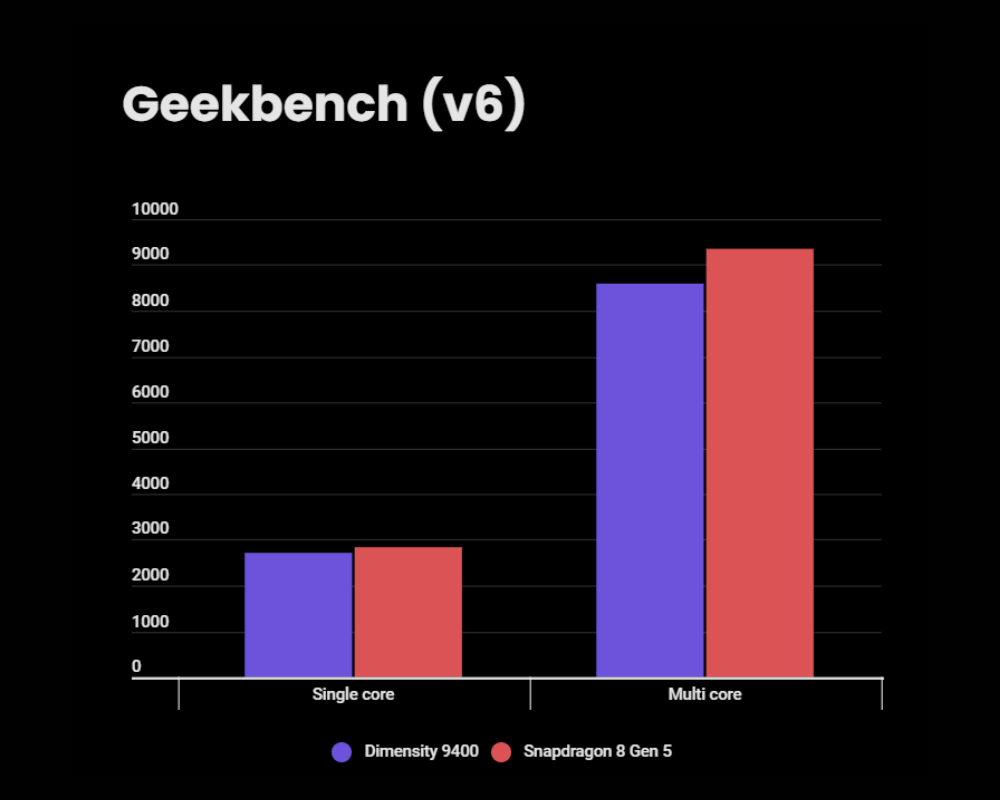
The single-core scores are pretty close, but Qualcomm holds a slight 4.5% lead. The gap widens in multi-core performance, where the Snapdragon 8 Gen 5 posts a 9% higher score than the Dimensity 9400.
Geekbench scores suggest higher peak performance for the Snapdragon 8 Gen 5. In everyday tasks like browsing the internet, scrolling through your social app feeds, and watching movies, you’d hardly be able to spot a difference.
| Dimensity 9400 | Snapdragon 8 Gen 5 | |
| Single core | 2,713 | 2,837 |
| Multi core | 8,592 | 9,352 |
AnTuTu score
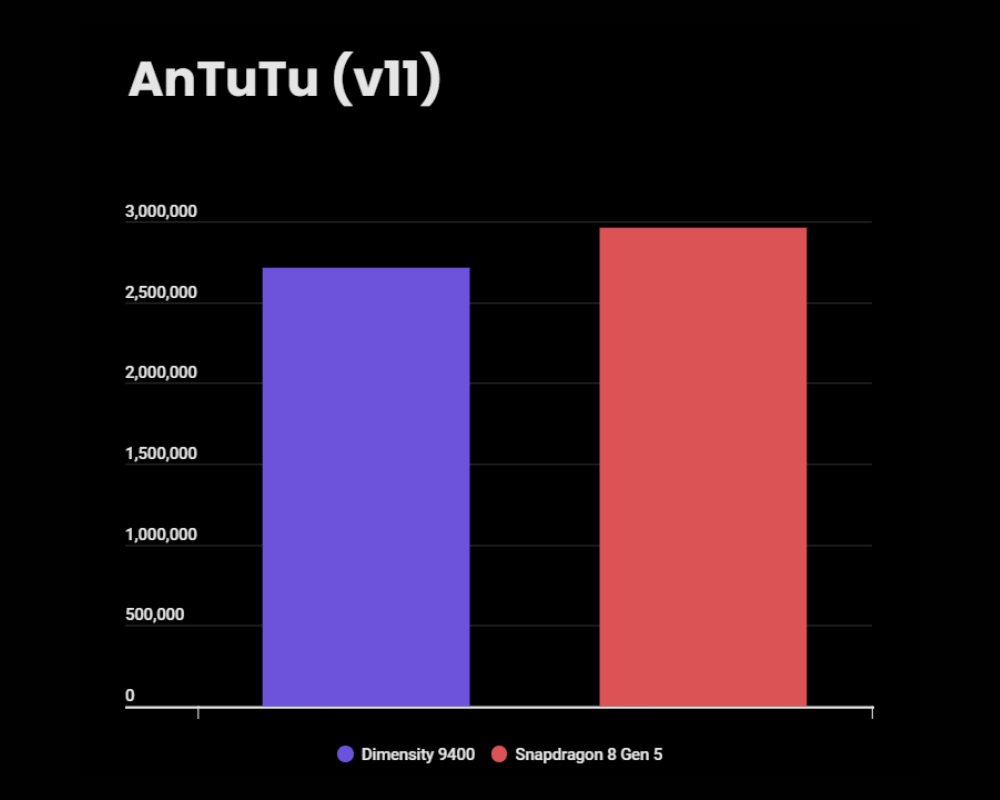
On the AnTuTu benchmark, the Snapdragon 8 Gen 5 scores nearly 3 million, while the Dimensity 9400 reaches 2.7 million. That’s about a 9% higher score for the Snapdragon chip.
The Snapdragon 8 Gen 5 consistently outperforms the Dimensity 9400 across every AnTuTu test, though the difference is not significant. The CPU score is 7% higher, and the GPU score is 5% higher. The memory and UX scores also favor the Snapdragon chip.
| Dimensity 9400 | Snapdragon 8 Gen 5 | |
| AnTuTu score | 2,713,650 | 2,961,236 |
| CPU | 853,995 | 914,878 |
| GPU | 927,892 | 974,402 |
| Memory | 355,391 | 382,729 |
| UX | 576,372 | 689,228 |
The benchmarks favor Snapdragon 8 Gen 5 over the Dimensity 9400 in terms of performance, but they don’t provide insights into the capabilities of connectivity, camera, and other important aspects of the chips. So, let’s dig further to uncover the real-world differences between the two high-end chips.
Dimensity 9400 vs Snapdragon 8 Gen 5: Key differences
Both Dimensity 9400 and Snapdragon 8 Gen 5 are manufactured using TSMC’s 3nm process, but the latter uses the N3P node, which offers slightly better performance and power efficiency over the N3E node used for the Dimensity 9400.
Furthermore, the chips differ greatly in terms of CPU architecture. The Dimensity 9400 has a 1+3+4 layout, featuring one Cortex-X925 prime core, three Cortex-X4 performance cores, and four Cortex-A720 performance cores. In contrast, the Snapdragon 8 Gen 5 features a 2+6 CPU layout with two Oryon prime cores and six Oryon performance cores.
Notably, the Snapdragon 8 Gen 5 features third-generation Oryon cores, the same CPU cores from the top-tier Snapdragon 8 Elite Gen 5 chipset. They offer better performance and power efficiency than those inside the Dimensity 9400. Plus, they run at higher speeds, offering an additional performance boost.
For graphics rendering, the Dimensity 9400 relies on the Mali-G925 Immortalis MP12 GPU, while the Snapdragon chip uses the Adreno 829 GPU with the new Sliced architecture. Both chips offer ray tracing capabilities, along with their own set of gaming features: Snapdragon Elite Gaming on the Snapdragon 8 Gen 5 and MediaTek HyperEngine Gaming Technology on the Dimensity 9400.
The Snapdragon 8 Gen 5 also maintains an edge in imaging capabilities, as it borrows the triple 20-bit ISP from the Snapdragon 8 Elite Gen 5 with strong “always-sensing” camera support. The Dimensity 9400 features an Imagiq 1090 ISP with emphasis on HDR video across the zoom range and AI-assisted zoom features.
Both chipsets offer robust connectivity features, although the Snapdragon chip may have some advantage here, thanks to mature modem and better carrier-integration in some regions. Furthermore, the chip supports mmWave, UWB, and dual-way satellite connectivity, which are not mentioned on the official Dimensity 9400 page.
Dimensity 9400 vs Snapdragon 8 Gen 5: Conclusion
The Snapdragon 8 Gen 5 holds an upper hand in almost every aspect over the Dimensity 9400. It offers better CPU and GPU performance, a more powerful ISP with greater capabilities, and advanced connectivity features.
That said, the Dimensity 9400 is still a capable high-end chipset with strong performance and robust connectivity. Plus, you’ll likely get a device powered by this chip at a lower price than one powered by Snapdragon 8 Gen 5. That makes it a sweet deal for those looking for a high-performance device at an affordable price. For the absolute best of the two, the Snapdragon 8 Gen 5 is clearly the better choice.
The post Dimensity 9400 vs Snapdragon 8 Gen 5: Which chip is actually faster? appeared first on Gizmochina.


