Reading view

Why is Crypto Crashing Again Today and What’s Next?
Bitcoin Price

The post Why is Crypto Crashing Again Today and What’s Next? appeared first on Coinpedia Fintech News

The crypto market is under pressure again, with prices sliding sharply during the latest trading session.

Total crypto market value has dropped 3.24% to $2.57 trillion, wiping out nearly $50 billion in a matter of hours. The selloff accelerated after the U.S. market opened, when Bitcoin suddenly fell by around $1,700.

Liquidations Add Fuel to the Drop

The sharp move triggered heavy liquidations.

  • Over $55 million in long positions were liquidated in just two hours
  • Traders betting on higher prices were forced out, pushing prices even lower

This happened despite positive news around the U.S. government shutdown, showing that market sentiment remains fragile.

Bitcoin and Ethereum Lead the Decline

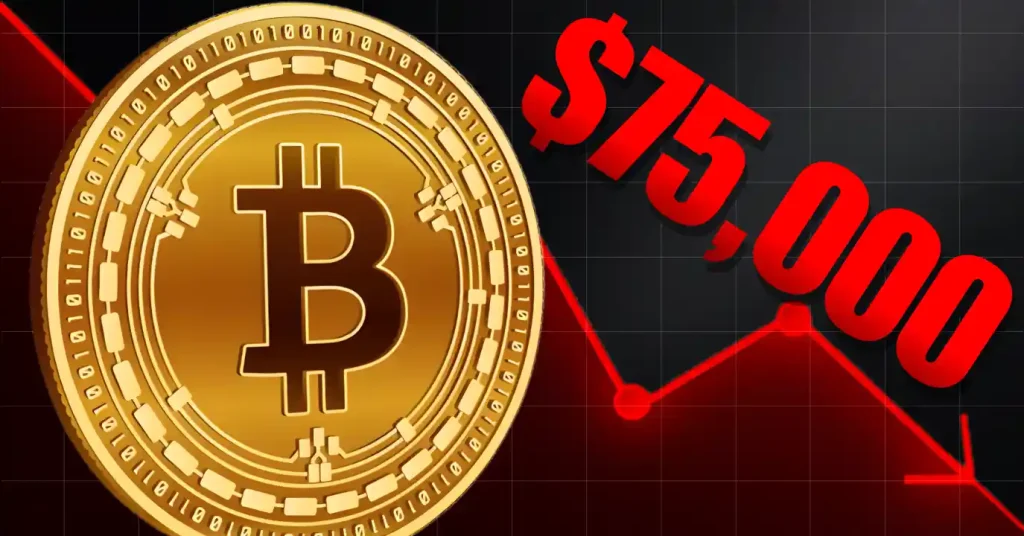
  • Bitcoin fell more than 4% in 24 hours, trading near $75,700
  • Ethereum dropped over 6%, falling to around $2,220
  • Major altcoins like XRP, Solana, and Cardano also moved lower

Fear remains high, with the Crypto Fear & Greed Index stuck at 17, deep in “extreme fear” territory.

ETF Outflows and Weak Confidence

One key pressure point has been continued selling from institutional products.

  • U.S. spot Bitcoin ETFs have seen about $2.8 billion in outflows over the past two weeks
  • This steady selling has drained confidence and reduced buying support

Oversold conditions and low liquidity made the market vulnerable to sudden drops.

Ethereum at a Turning Point

Ethereum has broken below an important support level, adding to the bearish mood.

  • Short-term price trends remain weak
  • Longer-term trends are still pointing higher
  • Investors are now watching for a strong support zone to hold before any recovery can begin

Analysts say that Ethereum could still outperform Bitcoin later in the cycle, but only if broader market conditions stabilise.

A Sharp Contrast: Gold and Silver Surge

While crypto struggled, traditional safe-haven assets surged.

  • Gold is up 11% from its recent low, adding more than $3 trillion in value
  • Silver has jumped nearly 20%, adding around $800 billion

Together, nearly $4 trillion flowed back into precious metals in just 30 hours, a possible sign that investors are seeking safety.

What Should Investors Watch Next?

The next major catalyst will be the upcoming U.S. Federal Reserve meeting, which could set the tone for global markets.

Looking ahead, some research firms have warned that if selling pressure continues and no new catalysts emerge, Bitcoin could slide further and could even hit $58000, with long-term support levels coming into focus.


Ethereum No Longer Needs Its Layer-2 Crutches, Says Founder Vitalik Buterin

Vitalik Buterin Says Ethereum Is Still Not Fully “Trustless”

The post Ethereum No Longer Needs Its Layer-2 Crutches, Says Founder Vitalik Buterin appeared first on Coinpedia Fintech News

Ethereum founder Vitalik Buterin said the blockchain’s long-standing approach to scaling through layer-2 networks needs a rethink, as Ethereum’s core network grows faster than expected and many secondary chains struggle to meet earlier goals.

In a detailed post, Buterin said two developments have weakened the original case for treating layer-2 networks, or L2s, as extensions of Ethereum itself.

First, progress by L2s toward full decentralisation and security has been “far slower and more difficult” than expected. Second, Ethereum’s main network is now scaling directly, with transaction fees falling sharply and major increases in capacity planned from 2026 onward.

Together, those shifts mean the original vision for L2s “no longer makes sense,” Buterin said, calling for a new framework to define their role in the ecosystem.

From ‘Ethereum Shards’ to Independent Chains

Ethereum’s original roadmap imagined L2s as “branded shards” — tightly integrated networks that would inherit Ethereum’s security and censorship resistance while dramatically increasing transaction capacity.

But that vision has not materialised.

Some L2 developers have openly said they may never move beyond partial decentralisation, citing technical limits or regulatory demands that require retaining control. While that approach may suit certain users, Buterin said it does not align with the goal of scaling Ethereum itself.

“If you are doing this, then you are not scaling Ethereum in the sense originally intended,” he wrote.

Crucially, Buterin argued this is no longer a problem. Ethereum’s base layer is now expanding on its own, reducing reliance on L2s to deliver growth.

Ethereum’s Base Layer Gains Momentum

Rising capacity on the main network, combined with low fees, has weakened the argument that L2s must serve as near-identical replicas of Ethereum. Instead, Buterin said, L2s should be viewed as a broad spectrum — ranging from chains deeply secured by Ethereum to more independent systems with looser connections.

Users, he added, should decide how much trust or integration they require, rather than assuming all L2s offer the same guarantees.

What L2 Developers Should Focus On Now

Buterin urged L2 projects to define their value beyond simple scaling.

Possible directions include specialised features such as privacy tools, ultra-fast transaction processing, non-financial applications like identity or social platforms, and systems designed for workloads that even an expanded Ethereum mainnet cannot efficiently handle.

For L2s that rely on Ethereum-issued assets like ether, Buterin said a minimum level of security integration remains essential. Beyond that, flexibility — not uniformity — should be the goal.

A Push for Stronger Native Integration

On Ethereum’s side, Buterin said he has grown more confident in a proposal known as a “native rollup precompile” — a built-in feature that would allow Ethereum itself to verify advanced cryptographic proofs used by L2s.

Such a tool, he said, would reduce reliance on external security committees, improve trustless interoperability, and make it easier for L2s to build safely while adding unique features.

If flaws emerge, Ethereum would take responsibility for fixing them through network upgrades, bringing trust in the system.

Clear Guarantees, Not Perfect Uniformity

Buterin acknowledged that a more open approach will inevitably lead to some L2s being less secure or more centralised than others. That, he said, is unavoidable in a permissionless ecosystem.

“Our job,” Buterin wrote, “should be to build the strongest Ethereum that we can.”

After the Crash, XRP’s Next Move Is Starting to Matter

XRP price prediction 2026

The post After the Crash, XRP’s Next Move Is Starting to Matter appeared first on Coinpedia Fintech News

XRP is showing tentative signs of stabilization after one of its sharpest pullbacks in recent months, even as broader crypto markets remain under pressure. For investors and experts, the focus is now shifting from panic-driven selling to whether prices are beginning to form a durable base.

How Far XRP Has Fallen

From its recent cycle high, XRP has declined by roughly 54%, a magnitude of correction that has historically preceded periods of consolidation or recovery rather than prolonged declines.

According to an expert, during the latest market-wide selloff, XRP briefly dipped toward recent lows but avoided setting a new breakdown point. Instead, prices rebounded quickly, suggesting that buyers are stepping in earlier than before.

This matters because in previous XRP cycles, declines in the 50–55% range have often marked exhaustion of selling pressure.

A Difference This Time: Higher Lows

While Bitcoin and Ethereum both pushed to new short-term lows during the latest drop, XRP did not.

  • XRP held above its prior low
  • This formed a higher low, a classic sign that downside momentum may be weakening
  • Buying interest appeared faster and more consistent on the rebound

For investors, this relative strength is important. It could mean that XRP is being accumulated at current levels rather than aggressively sold into weakness.

Short-Term Price Levels Investors Are Watching

XRP is now trading in a narrow recovery range, with several levels drawing attention:

  • Immediate support: The recent rebound zone where buyers stepped in aggressively
  • Near-term resistance: Around the $1.80 area, which previously acted as a floor before the selloff
  • Upside target if reclaimed: A sustained move above $1.80 could open the door toward $2.20–$2.30, where selling pressure last increased

A decisive break and hold above $1.80 would be an important signal that confidence is returning.

Bitcoin’s Role Remains Critical

Bitcoin is still hovering near a major support zone after its deepest pullback of the cycle. As long as Bitcoin holds these levels, XRP’s downside risk appears limited. A renewed breakdown in Bitcoin, however, would likely drag the entire market lower, regardless of individual strength.

In short: XRP can outperform, but it cannot fully decouple.

Broader Conditions Are Turning Less Hostile

Macro conditions are becoming less restrictive compared with recent months.

  • US economic data is pointing to renewed expansion
  • Expectations are growing for interest rate cuts later this year
  • Global trade tensions appear to be easing at the margin

Why Are Bitcoin, Ethereum and XRP Prices Going Down Today Again?

Bitcoin Ethereum XRP

The post Why Are Bitcoin, Ethereum and XRP Prices Going Down Today Again? appeared first on Coinpedia Fintech News

After a brief recovery yesterday, the crypto market has turned red again.

On Monday, prices moved higher after comments from US President Donald Trump, who said he supports crypto and believes the US must lead in digital assets or risk falling behind China. That statement helped lift market sentiment for a few hours.

But the bounce did not last.

Crypto Market Slips Back Into the Red

At the time of writing, the total crypto market value has fallen 3.95% in the last 24 hours, dropping to $2.62 trillion.

  • Market sentiment remains weak
  • The Fear & Greed Index is at 17, showing extreme fear
  • Most major coins are still down sharply over the past week

Bitcoin, Ethereum and XRP are all trading lower again, along with most large altcoins.

Bitcoin Is Driving the Decline

Bitcoin continues to lead the market lower.

  • Bitcoin dominance is near 59%
  • This means the entire market is closely following Bitcoin’s price moves
  • When Bitcoin weakens, most other coins fall with it

Bitcoin is down more than 11% over the past seven days, keeping pressure on the broader market. Over $55 million worth of long positions were wiped out in just two hours as prices suddenly dropped.

The selloff came despite positive news around the U.S. government shutdown. BTC is currently down by more than 4%.

Ethereum Is Making Things Worse

Ethereum has fallen even harder than Bitcoin.

  • Ethereum is down more than 22% in the last week
  • This sharp drop has hurt confidence across the altcoin market
  • Many traders remain bearish, with little buying interest visible

Because Ethereum has such a large market value, its decline has added to the overall market losses.

Market Is Ignoring Stocks and Gold

Crypto is currently moving on its own, not in line with traditional markets.

  • Correlation with the S&P 500 is low
  • Correlation with gold is negative
  • This shows crypto is being driven mainly by internal fear and selling pressure

What Happens Next?

The market is at a critical level.

  • Holding above $2.59 trillion in total market value is important
  • A break below this level could lead to another sharp drop
  • Traders are watching US Federal Reserve signals and ETF fund flows for direction

Despite supportive comments from political leaders, crypto prices are falling again due to:

  • Continued Bitcoin weakness
  • Heavy losses in Ethereum
  • Extreme fear among investors
  • Lack of strong buying demand

Until Bitcoin stabilizes and sentiment improves, the market is likely to remain volatile.

Crypto Rebound: How High Can Bitcoin, Ethereum and XRP Prices Go Next?

Why are Bitcoin, Ethereum and XRP Prices Rallying Today

The post Crypto Rebound: How High Can Bitcoin, Ethereum and XRP Prices Go Next? appeared first on Coinpedia Fintech News

The crypto market has turned green over the last 24 hours, offering some relief after a sharp sell-off earlier this week. Total market value has climbed back to around $2.66 trillion, while sentiment remains careful, with the Fear and Greed Index still deep in “extreme fear” territory.

Bitcoin Finds Support Above $75,000

Bitcoin is trading near $78,700, staying above the $75,000 level, which many analysts see as a weekly support. This zone was tested recently, and so far, buyers have managed to defend it.

On the weekly chart, Bitcoin has slipped below both the 20-week and 50-week moving averages, which is typically a bearish signal. However, this does not automatically mean a long-term bear market. It can also happen after a heavy correction.

One possible scenario is that $75,000 becomes the bottom, with Bitcoin holding the April 2025 low and forming a higher low. If that happens, the broader uptrend of higher highs and higher lows would remain intact, and the recent drop would be seen as a pullback rather than a trend break.

For a stronger bullish signal, Bitcoin would need to reclaim and close above the 50-week moving average, currently near $100,400. A clean weekly close above that level would suggest momentum has shifted back in favor of buyers.

Ethereum Holds Near Important Levels

Ethereum has rebounded to around $2,370, after recently trading near levels that some analysts had flagged months in advance as potential support. Activity on the Ethereum network is reportedly picking up, with increased on-chain usage as traditional financial players continue building infrastructure.

While Ethereum is still down significantly from recent highs, the current bounce has raised hopes that a short-term bottom may be forming if prices can hold above the $2,300–$2,400 zone.

XRP Shows Strong Support

XRP is trading around $1.64, with strong demand seen between $1.60 and $1.65. This area has been tested multiple times, and buyers continue to step in, suggesting a solid base is forming.

If this support holds, analysts say XRP could attempt a move back toward $2.00, with $3.00 or higher possible over time if overall market conditions improve. 

What’s Driving the Market Mood?

Recent selling pressure was fueled by ETF outflows, signaling institutional investors were reducing exposure. A hotter-than-expected inflation report and uncertainty around US monetary policy also weighed on risk assets.

However, some market watchers believe the worst may be over. Veteran strategist Tom Lee has said crypto may have just bottomed, pointing to a rare alignment of time and price targets, along with rising activity on Ethereum.

Ripple News Today: Full EU EMI License Granted by Luxembourg Regulator 

Ripple News Today

The post Ripple News Today: Full EU EMI License Granted by Luxembourg Regulator  appeared first on Coinpedia Fintech News

Ripple has received full approval for an Electronic Money Institution (EMI) license in the European Union, following authorization from Luxembourg’s financial regulator, the Commission de Surveillance du Secteur Financier (CSSF).

The approval comes after Ripple met all regulatory conditions set by the CSSF. The company had announced preliminary clearance for the license last month, with full approval now allowing it to operate as an EMI across the EU.

With the license in place, Ripple can formally expand its payments-related services across European markets under EU regulatory rules. The move strengthens the company’s ability to work with banks, payment providers, and other financial institutions that require regulated electronic money services.

Ripple’s Europe-focused leadership said the authorization reinforces the company’s long-term commitment to the region and positions it to support businesses moving toward digital and blockchain-based payment infrastructure within a regulated framework.

The Luxembourg approval adds to Ripple’s growing list of regulatory clearances globally. In January, the company also secured an EMI license and cryptoasset registration from the Financial Conduct Authority in the United Kingdom.

According to Ripple, it now holds more than 75 regulatory licenses worldwide, reflecting its focus on operating within established regulatory systems as digital asset adoption grows. The expanded licensing footprint is expected to support Ripple’s efforts to offer compliant cross-border payment and digital asset services to institutional clients across multiple jurisdictions.

The development comes as European regulators continue to implement clearer frameworks for digital finance, with companies increasingly seeking regulated status to operate across the bloc.

“I can now share that we have fulfilled the conditions set by the CSSF, resulting in Ripple being granted its full EU EMI license – a transformative milestone that allows us to scale our mission of providing robust, compliant blockchain infrastructure to clients across the EU,” Cassie Craddock of Ripple said.

Bitcoin Price Prediction: Will BTC Hold $75K Support or Break Lower?

Bitcoin Price Prediction Is a Direct Drop to $75,000 Next

The post Bitcoin Price Prediction: Will BTC Hold $75K Support or Break Lower? appeared first on Coinpedia Fintech News

Bitcoin is showing early signs of stabilising after bouncing from its recent April low, but analysts say price action remains fragile and important levels will decide what happens next. For now, the market is still trading below major resistance, meaning the correction may not be fully over yet.

Bitcoin Holds April Low, but Bounce Is Limited

Bitcoin recently defended the April 2025 low, which has acted as an important short-term support. Buyers stepped in near this level, triggering a modest bounce. However, analysts stress that this move is not a strong recovery yet, but rather a normal reaction after a sharp sell-off.

At current levels, Bitcoin remains trapped below resistance, suggesting the market is still in a corrective phase rather than a confirmed uptrend.

$74,000–$75,000 Still a Key Downside Zone

On the downside, there is focus on the $74,000 to $75,000 range. This zone has been watched closely for weeks as a potential area where Bitcoin could form a more meaningful low. A brief dip below the April low into this range is still considered possible, especially if broader market weakness continues.

Such a move would not necessarily be bearish long term. In fact, a final dip could help clear remaining selling pressure before a stronger bounce develops.

$80,500 Is the Level That Matters Most

On the upside, $80,500 is now the most important price to watch. A clear break above $80,500, especially if followed by continued strength, would be the first real sign that Bitcoin’s low is likely in place.

An ideal scenario would be a breakout above this level, followed by a shallow pullback that holds above support. That would mean buyers are gaining control and price is ready to move higher.

Oversold Signals Support a Short-Term Bounce

Technical indicators show Bitcoin is deeply oversold, even more than during some previous market pullbacks. Historically, such conditions often lead to short-term relief rallies, although these rallies can be choppy and unstable at first.

Because of this, Bitcoin may attempt several bounces before a clear trend emerges. Early rallies can fail, so confirmation through price structure is critical.

While further downside toward the mid-$70,000s cannot be ruled out, risk is becoming more balanced between buyers and sellers.

In the coming days, all eyes will be on whether Bitcoin can hold above support and eventually reclaim $80,500. Until then, volatility is likely to remain high, and traders are advised to watch price levels closely rather than rely on sentiment alone.

Canary Capital CEO Says Ripple’s Real Power Isn’t XRP Price — It’s Remittances and RLUSD

Ripple RLUSD ADGM approval

The post Canary Capital CEO Says Ripple’s Real Power Isn’t XRP Price — It’s Remittances and RLUSD appeared first on Coinpedia Fintech News

Canary Capital CEO Steven McClurg has shared his views on where Ripple could create the biggest real-world impact, following the company’s recent launch of Ripple Treasury after acquiring G Treasury.

Remittances Still Matter Most

McClurg said Ripple’s global remittances network remains one of the most important use cases in crypto today. While it may not be the biggest money-maker for the company, he believes it solves a real problem at global scale by making cross-border payments faster and cheaper, especially for countries that rely heavily on remittances.

RLUSD Seen as a Major Opportunity

Looking ahead, McClurg said the product he is most bullish on is RLUSD, Ripple’s U.S. dollar-backed stablecoin. He expects RLUSD adoption to grow quickly once it is fully integrated across Ripple’s partner network.

According to him, RLUSD could even challenge USD Coin over time, especially because of the regulatory framework under which RLUSD operates. He noted that RLUSD appears to have stronger oversight in the United States, which could make it more attractive to institutions and governments.

Could the U.S. Outsource a Digital Dollar?

McClurg also said that if the U.S. government decides not to launch a full central bank digital currency, it could instead outsource a digital dollar to private companies. In his view, Ripple and Circle would likely be the two main contenders for such a role.

He added that governments around the world have been exploring digital currencies for years and often approach companies with early experience in stablecoins. Based on those trends, he believes it is only a matter of time before the U.S. moves in this direction.

Institutional Questions Around XRP

When discussing XRP ETF, McClurg said one question comes up repeatedly from institutional investors: what gives the token its value? Unlike Bitcoin, which is widely understood as a digital currency, XRP requires more explanation.

He said institutions often need clarity on how XRP is tied to Ripple’s network and how it functions within that ecosystem. While the explanation can be complex, he believes it is a fair and important question that serious investors need answered.

Analyst Reveals What’s Next For Bitcoin, Gold and Silver

Bitcoin 2026 [LIVE] Updates Stock Market, Gold And Silver Price, Crypto News

The post Analyst Reveals What’s Next For Bitcoin, Gold and Silver appeared first on Coinpedia Fintech News

Markets are under heavy pressure as crypto and precious metals have dropped sharply, triggering what analysts are calling a short-term market emergency. Bitcoin, gold, and silver have all seen steep declines, leaving investors focused on price levels that could decide what happens next.

Gold Sees Sharp Drop, Bounce Levels in Focus

Gold has fallen around 16% from recent highs, a move that surprised many traders. According to analyst Dylan, the first important bounce zone sits near $4,780, where gold has already shown some buying interest. If prices rebound further, the $5,130–$5,140 range is being watched closely, as it could act as a strong resistance area where selling pressure returns.

If gold weakens again, deeper support is seen near $4,700, and lower down around $4,550 to $4,480, where the 50-day moving average sits. These zones could attract buyers if broader market weakness continues.

Silver Crashes Harder Than Gold

Silver has taken an even bigger hit, falling nearly 38% from its highs. The sharp drop punished late buyers, but silver did manage a short-term bounce from its 50-day moving average. The most important support level now is around $70, which analysts describe as a “must-hold” zone. If silver fails to hold there, downside risk increases.

On the upside, resistance is expected near $92 and $98, where any short-term rally could face selling. In the near term, silver may see quick rebounds, but analysts warn these could be temporary in a volatile environment.

Bitcoin Under Pressure, Key Levels Ahead

Bitcoin is also facing strong selling pressure. On longer time frames, the analyst says $78,000 to $75,000 is the first major support zone to watch. A bounce from this area is possible, but it may only be short-lived. If selling continues, Bitcoin could dip toward the $70,000 area, and in a more extreme case, even the mid-$60,000 range.

On a monthly view, deeper downside zones around $57,000 to $50,000 are also being discussed as possible future bounce areas if market stress continues.

Bearish Mood Could Set Up Short-Term Bounces

Market sentiment is extremely negative right now, with fear spreading across crypto and metals. Such “peak fear” conditions sometimes lead to short-term relief rallies, even if the broader trend remains uncertain.

The next moves in Bitcoin, gold, and silver are likely to depend on how markets react around these critical price zones in the coming days.

Why is Bitcoin Price Going Down Today?

Bitcoin Price Crash Today Has Bitcoin Entered a Bear Market

The post Why is Bitcoin Price Going Down Today? appeared first on Coinpedia Fintech News

The crypto market is under heavy pressure today, with prices falling sharply over the weekend and investors asking one question: what went wrong? The answer lies in a mix of forced selling, weak demand, and price levels breaking all at once.

The total crypto market value has dropped to around $2.6 trillion, down nearly 5% in the last 24 hours. Bitcoin, which was trying to hold above $78,000, has now slipped below that level, adding to market fear. Many traders are now watching the next major support near $75,000.

The biggest driver of today’s crash is liquidations. In just 24 hours, more than $2.58 billion worth of crypto positions were wiped out. This happens when traders use borrowed money and prices move against them, forcing exchanges to close positions automatically.

Weekend Trading Made It Worse

Weekend markets usually have lower trading volume and thinner liquidity. That means fewer buyers are available when prices start falling. As Bitcoin dropped below key levels, sell orders piled up quickly, pushing prices down faster than usual.

Bitcoin Breaks Key Levels

Bitcoin falling below $78,000 was a major technical trigger. This level had been acting as short-term support. Once it broke, many traders exited positions. Bitcoin is also testing an important long-term support level when compared to gold, making this zone critical.

If Bitcoin fails to hold near current levels, analysts see $75,000 as the next strong support. A break below that could bring even more selling.

Altcoins Hit Harder

Altcoins are feeling even more pain:

  • Ethereum is down sharply over the week, losing more than 20%
  • XRP, Solana, and BNB are all deep in the red
  • The CoinMarketCap 20 Index is down over 14% in seven days

Market Fear Is Extreme

Investor sentiment has collapsed. The Fear and Greed Index is at 18, which signals extreme fear. Technical indicators show most coins are now oversold, meaning prices have fallen very quickly in a short time.

Weak Demand Adds Pressure

On top of liquidations, demand has been weak. Large investors have been cautious, and there has been no strong buying support to absorb the selling. When forced liquidations meet low demand, prices fall fast.

What Happens Next

The market now depends on whether Bitcoin can stabilise above $75,000. If selling slows and liquidations dry up, a short-term bounce is possible. But if fear continues and key supports fail, volatility could remain high in the coming days.

For now, the weekend crash shows how quickly crypto markets can turn when leverage, fear, and low liquidity collide.

No Crypto Tax Cuts in India Budget 2026, New Penalties Introduced for Non-Compliance

India Budget 2026

The post No Crypto Tax Cuts in India Budget 2026, New Penalties Introduced for Non-Compliance appeared first on Coinpedia Fintech News

India’s Union Budget 2026 has kept the existing crypto tax framework unchanged, even as the government moved to tighten compliance through stricter penalties. While oversight has increased, industry leaders say the Budget missed a key opportunity to support long-term growth in crypto and Web3.

The Finance Bill introduces penalties to enforce reporting under Section 509 of the Income-tax Act, 2025. Union Finance Minister Nirmala Sitharaman said the aim is to deter non-compliance in crypto-asset reporting.

Under the amendment, entities that fail to file crypto transaction statements will face a ₹200 per day penalty, while furnishing incorrect or misleading information — or failing to correct it — will attract a ₹50,000 fine. These provisions will take effect from April 1, 2026.

“Tax Regime Remains Restrictive”

Reacting to the Budget, Sathvik Vishwanath, Co-founder and CEO of Unocoin, said expectations from Budget 2026 were much broader than enforcement alone.

“The Union Budget 2026 was expected to play a decisive role in shaping India’s approach to crypto assets and Web3 technologies,” he said in an interview with Coinpedia. “A primary expectation was the rationalisation of the existing tax regime for virtual digital assets, which is currently restrictive and misaligned with broader financial market practices.”

Sathvik added that allowing loss set-offs, reducing transaction-level friction, and aligning crypto taxation with other asset classes would have helped restore domestic liquidity and encourage compliant participation within India.

Regulatory Clarity Still Missing

Beyond taxes, Sathvik stressed that the lack of a clear regulatory framework continues to hurt Indian exchanges.

“The absence of a comprehensive, crypto-specific framework has created uncertainty for exchanges, investors, and technology developers,” he said. “Clear definitions, licensing norms, compliance standards, and consumer protection mechanisms are essential for long-term planning and responsible innovation.”

He warned that unclear rules have already reduced local trading volumes and pushed users to offshore platforms.

“A well-defined framework would help retain market activity within India, strengthen domestic exchanges, and improve regulatory oversight,” Sathvik said.

How India Compares Globally

Sathvik also opened up about how India lags behind global crypto hubs. He pointed out that Dubai has introduced purpose-built digital asset regulations, while Singapore follows a structured licensing and consumer protection model. The United States, despite earlier fragmentation, is gradually moving toward clearer asset classification.

“Compared to these jurisdictions, India’s current framework lacks the clarity and cohesiveness required to compete effectively for global capital, talent, and innovation,” he said.

XRP Price Prediction: Why the $7 Target Is Still Alive After the Crash

Top XRP Price Predictions

The post XRP Price Prediction: Why the $7 Target Is Still Alive After the Crash appeared first on Coinpedia Fintech News

XRP’s recent price fall has worried many investors, but fresh chart analysis hints the move may not be the end of the cycle. Even after slipping below key levels, XRP is still behaving in a way that has historically led to strong rallies.

According to analyst Egrag Crypto, on the monthly chart, XRP recently tested an important support zone around $1.60–$1.61, with the lowest dip reaching near $1.50. Despite this drop, XRP managed to close the month above $1.60 and started February near $1.66, showing that buyers are still active around this level.

This area matters because it has acted as a key turning point in past market cycles. The recent dip appears to be a liquidity grab, a phase where prices briefly fall to shake out weak positions before the next big move.

Two Possible Paths From Here

Market history shows two common outcomes after similar setups:

First path: XRP sees a short-term bounce, then dips once more to test lower levels, before starting a stronger upward move.
Second path: XRP skips the second dip and begins rising directly, similar to earlier cycles.

In past rallies, XRP delivered massive gains even without a full bull market:

  • In the 2021 cycle, XRP rallied about 340%, which would point to a price near $7 from current levels.
  • In the 2017 cycle, XRP surged nearly 1,600%, which would imply much higher long-term targets.

Why a Breakdown Is Not “Game Over”

A monthly close below $1.60 would confirm weakness in the broader trend. However, history shows that XRP’s strongest rallies often happen during bearish or corrective phases, not during clear bull markets.

Such breakdowns usually come with:

  • Fear-driven selling
  • Forced exits
  • A reset phase before larger moves begin

These conditions have previously set the stage for sharp recoveries.

The $7 Target Explained

If XRP continues to hold key structural levels and follows a pattern similar to the 2021 cycle, a 340% recovery would place XRP around $7. Analysts note that these moves are driven by market structure, not sentiment, and often start when confidence is at its lowest.

Bitcoin Price Prediction: Is a Direct Drop to $75,000 Next?

Bitcoin February 2026 forecast

The post Bitcoin Price Prediction: Is a Direct Drop to $75,000 Next? appeared first on Coinpedia Fintech News

Bitcoin is at a crucial stage on the higher time frame charts. The broader structure still allows one final dip before a more stable base is formed. This aligns with earlier projections for early 2026, where prices were expected to make another low before any sustained recovery begins.

At current levels, Bitcoin may still revisit recent lows, with the $75,000 area emerging as an important zone to watch. Such moves are often seen near the end of corrective phases, where prices briefly fall lower before finding support.

What the Charts Are Signalling

Bitcoin remains close to levels that have historically marked important market bottoms. The Relative Strength Index (RSI) on this timeframe is nearing zones last seen during major downturns, suggesting selling pressure has already done significant damage.

On the daily chart, RSI has already moved into deeply stretched territory. In past cycles, similar conditions often appeared near points where prices later bounced. While this does not confirm an immediate recovery, it indicates that downside may be becoming limited.

Short-Term Levels That Matter

Despite a small rebound, analysts say Bitcoin has not yet confirmed a clear low. The recent move higher still looks like a short-term bounce rather than a full trend shift.

A first positive signal would be a sustained move above $80,000, followed by higher lows. A stronger confirmation would come if Bitcoin manages to break above $84,500, which could open the door to a broader recovery phase.

What Happens If Support Breaks

If Bitcoin fails to hold current support levels, another drop remains possible. In that case, the market could slide toward $75,000 before finding stronger buying interest. This zone is being closely watched as a potential area where prices could finally stabilise.

Why are Bitcoin, Ethereum and XRP Prices Crashing Today?

Crypto Market Crash Why Bitcoin and Altcoins are Dropping Today

The post Why are Bitcoin, Ethereum and XRP Prices Crashing Today? appeared first on Coinpedia Fintech News

The crypto market is facing a major sell-off today, with total market value dropping to $2.66 trillion, down more than 6% in the last 24 hours. Bitcoin, Ethereum, XRP and other major cryptocurrencies have all fallen sharply, wiping out nearly $500 billion from the market in just a few days.

The biggest reason behind this fall is global uncertainty around interest rates. Investors turned bearish after news related to a new US Federal Reserve leadership appointment, which raised fears that future monetary policy could stay tighter for longer. When interest rates are expected to remain high, risky assets like crypto usually suffer, as investors move money into safer options.

This macro-driven fear pushed both stock markets and crypto lower at the same time. Over the past week, crypto prices have shown a strong link with US equities, showing how closely digital assets now react to traditional financial markets.

The decline was made much worse by massive liquidations. As prices started falling, leveraged traders were forced out of their positions. Over the last three days, nearly $5 billion worth of leveraged long and short positions were liquidated. When this happens, exchanges automatically sell assets to cover losses, which adds extra selling pressure and accelerates the crash.

Ethereum has been hit particularly hard. Reports of large unrealised losses held by institutional players increased fear around ETH, dragging down the wider altcoin market. As Ethereum weakened, confidence across the market dropped further.

Here’s how major cryptocurrencies were affected:

  • Bitcoin fell around 13%, losing nearly $265 billion in market value.
  • Ethereum dropped about 25%, erasing roughly $91 billion.
  • XRP declined close to 22%, wiping out around $24 billion.
  • Solana crashed more than 23%, losing about $16 billion.

Market sentiment has turned extremely bearish. The Fear and Greed Index has slipped to 18, a level classified as Extreme Fear. Many technical indicators now show the market is oversold, meaning prices may have fallen too fast in a short time.

Looking ahead, the short-term outlook depends on whether Bitcoin can hold the $77,000 support level. If that breaks, further downside is possible. Investors are also closely watching upcoming signals from the US Federal Reserve, which could determine whether markets stabilise or see another wave of selling.

India Budget LIVE: Will the Government Rethink Crypto’s 30% Tax Today?

India Budget 2026

The post India Budget LIVE: Will the Government Rethink Crypto’s 30% Tax Today? appeared first on Coinpedia Fintech News

February 1, 2026 09:22:15 UTC

Crypto Missing From India’s Union Budget 2026 Speech

India’s Union Budget 2026 speech made no mention of cryptocurrency or digital assets, signaling continued uncertainty for the domestic crypto industry. The absence of any policy update leaves existing tax and regulatory frameworks unchanged, despite repeated calls from industry participants for clearer rules.

February 1, 2026 06:51:22 UTC

India Budget 2026: Crypto Tax Data Shows Investors Paid Tax Even After Losses

New data shows a growing gap between crypto trading outcomes and tax liability. While high-activity traders contribute most of the TDS, thin profit margins mean both active and retail investors are facing liquidity pressure.

In FY 2024–25, investor results were almost evenly split, with 50.91% reporting net gains and 49.09% ending the year with net losses. Despite this, taxable capital gains rose to ₹3,722 crore, even though actual net profits were lower. Investors who collectively recorded ₹1,178 crore in net losses still paid tax on ₹180 crore of gains, as current rules do not allow losses to be set off.

February 1, 2026 06:51:22 UTC

India Budget 2026: Buybacks to Be Taxed as Capital Gains for All Shareholders

The government has announced a change in how share buybacks will be taxed. Union Finance Minister Nirmala Sitharaman said that buybacks will now be treated as capital gains for all shareholders.

The move is meant to stop the misuse of tax benefits through buybacks. Promoters, in particular, will have to pay more tax on buyback income. Corporate promoters will be taxed at 22%, while non-corporate promoters will face a 30% tax.

The new rule aims to make buyback taxation more uniform and reduce tax loopholes.

February 1, 2026 06:14:23 UTC

India Budget 2026: India’s Crypto TDS Mismatch Leaves Traders Owed Crores in Refunds

India’s crypto ecosystem saw ₹511.83 crore collected as TDS in FY 2024–25, but new data highlights a growing mismatch between tax deducted and actual tax owed. KoinX users alone contributed ₹130.16 crore, or 25.43% of total collections, even though their final tax liability stood at only ₹91.64 crore. This resulted in an estimated ₹38.52 crore locked in excess TDS and potential refunds.

The imbalance appears widespread. Over 30% of TDS deductions exceeded traders’ final tax dues, while nearly half of all TDS-paying users ended the year with net capital losses. At the same time, trading activity remains highly concentrated, with less than 5% of traders accounting for 87% of total TDS collections.

February 1, 2026 05:31:02 UTC

India Budget 2026: New Data Fuels Calls to Reform India’s Crypto Tax Regime

As the Union Budget 2026 approaches, India’s crypto industry is calling for a more outcome-based tax framework, including rationalisation of the 30% capital gains tax, permission to offset losses, and a review of the 1% tax deducted at source (TDS) on crypto transactions. These demands are supported by India’s Crypto Tax Story 2025, a new report by KoinX, which analyses anonymised data from nearly 7 lakh Indian crypto users in FY 2024–25 and shows how current tax rules often diverge from actual investor outcomes.

February 1, 2026 05:09:14 UTC

India Budget 2026: Crypto Rules Must Shift Beyond Tax and Enforcement,

Manhar Garegrat, Country Head–India at Liminal Custody, said India’s crypto policy needs to move toward market structure and sustainability, warning that current tax frictions are pushing compliant trading activity offshore. He urged Budget 2026 to rethink transaction-level taxes and consider a VDA transaction tax model to keep crypto activity onshore, transparent, and economically viable.

February 1, 2026 05:09:14 UTC

India Budget 2026: Will Crypto Take Center Stage?

Crypto and Bitcoin taxes are in focus today, with expectations of rationalisation and clearer rules rather than any expansion of the 30% levy, even as the government has not yet signaled formal changes.

❌