While the public One UI 8.5 beta has remained exclusive to the Galaxy S25 series so far, Samsung has been actively testing the latest build internally on other Galaxy devices. In recent weeks, One UI 8.5 test builds have been spotted on Samsung’s test servers for dozens of Galaxy devices. We’ve prepared a list of those Galaxy devices below.
These internal One UI builds are not accessible to the public for testing. If your Galaxy device is on the list, it means Samsung is working on the One UI 8.5 build for your device, not that the update will arrive soon. That said, here’s the complete list.
Samsung is internally testing One UI 8.5 on these Galaxy devices
The list will grow as we get closer to the stable release, which is expected to debut alongside the Galaxy S26 series in February. Additionally, internal One UI 8.5 builds have been spotted on test servers for several upcoming smartphones, including the Galaxy S26 series, Galaxy A57, and Galaxy A37.
If your Galaxy device isn’t on the above list, it may still be eligible for the One UI 8.5 upgrade. Click here to explore the complete list of eligible devices, along with the exciting features and rollout details. To recap, One UI 8.5 is packed with a host of visual upgrades and exciting new features, including a more customizable Quick Panel, revamped icons with a bit of 3D effect, iOS-inspired liquid glass effects, Audio Broadcast, and plenty of AI upgrades. So, there’s a lot to explore once you have the software on your Samsung device.
To ensure you’re not missing out on the latest updates, check back the Samsung section on this website once in a while. Alternatively, you can join our Telegram channel to get instant notifications about the latest One UI updates, along with all the biggest tech headlines.
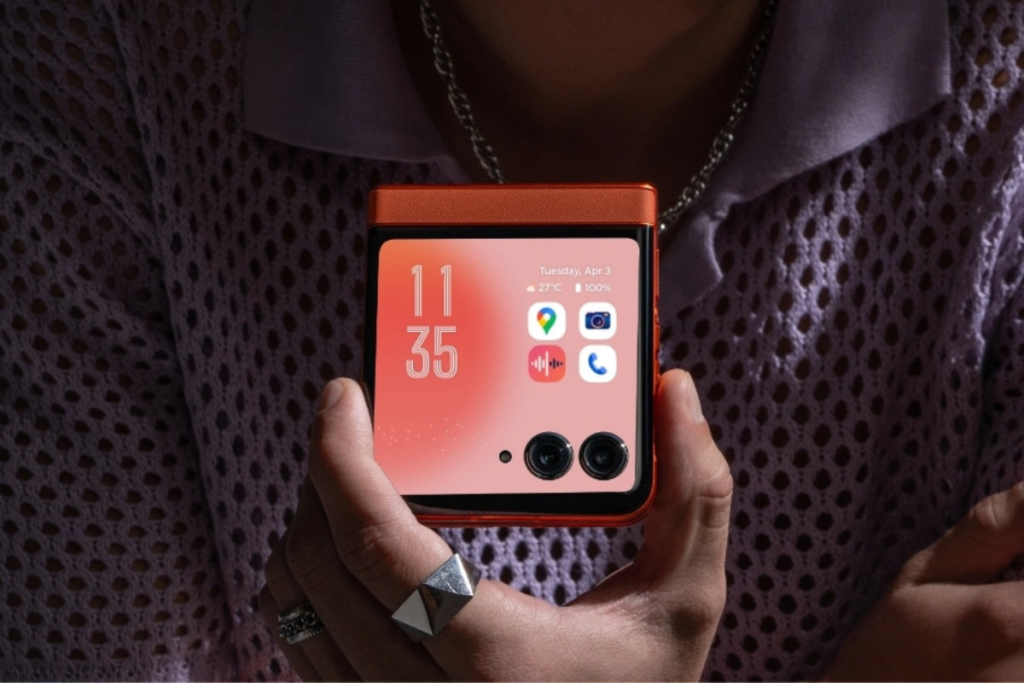
While Motorola has already released the Android 16 update to dozens of eligible devices, some high-end smartphones are still awaiting their turn. The Razr 2024 was also one of them, and it has now started receiving the Android 16 update, which brings a host of useful upgrades.
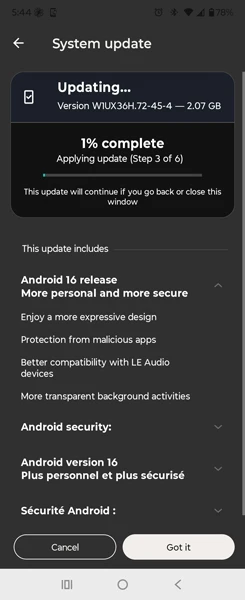
The latest update for Motorola Razr 2024 (also known as Razr 50) has been spotted rolling out in Canada with the firmware version W1UX36H.72-45-4. It’s a big upgrade with a download size of about 2GB. Android 16 is the second major OS update for the Razr 2024, and will receive another upgrade sometime next year as the final one. The device will, however, continue to receive security updates for a while.
As the initial release, the update is available in Canada, and soon, it will start rolling out to other regions. To check if the update is available on your Motorola smartphone, go to Settings > System updates > Check for updates. Once the update reaches your device, ensure that it has sufficient storage and is charged to at least 40% for a smooth upgrade to Android 16.
Here’s the complete Android 16 changelog, detailing every single change:
Feature improvements After upgrading, you’ll see the following improvements to the Android operating system and other apps.
Find modes in one place Now you can find these modes in Settings > Modes:
– Do Not Disturb – Bedtime – Driving
You can also create custom modes to fit any situation where you want to choose a different set of people or apps who can interrupt you.
Toggle these modes on or off in quick settings.
Connect to Wi-fi and hotspot with one tap If your phone and device you want to connect to its hotspot are using the same Google account, you no longer need to enter a password to connect.
Better support for low-energy audio hearing aids You can now choose to use either your hearing aid’s built-in microphone or your phone’s microphone during voice calls. Additionally, you can adjust the volume of ambient sound captured by the hearing aid’s microphones. These options help enhance call clarity, especially in noisy environments or when your hearing aid’s battery is running low.
Other improvements Android system updates add more than new features. Using the latest Android update provides other improvements such as: – Enhanced security and protection to defend against evolving threats like malware, phishing, and data breaches – App compatibility with newer apps, which often require the latest Android version to function correctly – Performance improvements that optimize your phone’s operating system for smoother performance, better stability, and, in some cases, longer battery life – Bug fixes and stability enhancements to resolve known issues and improve overall reliability and stability
You can regularly visit the Motorola section on Gizmochina to stay up-to-date with the latest news and developments. Or, if you prefer instant updates, don’t forget to join our Telegram channel.
The Dimensity 9400 is a true flagship chipset from MediaTek, featuring an all-big-core CPU design that aims to deliver high peak and sustained performance. It’s powerful enough to rival Qualcomm’s Snapdragon 8 Elite, even if it trails in a few areas, as noted in our detailed comparison. That makes the Snapdragon 8 Gen 5 an interesting opponent.
Announced in November 2025, the Snapdragon 8 Gen 5 sits just below the Snapdragon 8 Elite and therefore is an exciting matchup against the Dimensity 9400. The big question is: can Qualcomm’s sub-Elite flagship hold its ground against MediaTek’s all-big-core powerhouse?
Let’s begin with the spec sheet:
Dimensity 9400
Snapdragon 8 Gen 5
Announced
October 2024
November 2025
Process node
TSMC’s 3nm (N3E)
TSMC’s 3nm (N3P)
CPU
1 x 3.62GHz — Cortex-X925 3 x 3.3GHz — Cortex-X4 4 x 2.4GHz — Cortex-A720
2 x 3.8GHz — Oryon (3rd gen) 6 x 3.32GHz — Oryon (3rd gen)
GPU
Mali-G925 Immortalis MP12 Ray tracing support MediaTek HyperEngine Gaming Technology
Adreno 840 ray tracing support Snapdragon Elite Gaming features
NPU
MediaTek NPU 890 Agentic AI support
Qualcomm Hexagon NPU Agentic AI support
Memory
LPDDR5x, up to 5.3GHz
LPDDR5x, up to 4.8 GHz
Storage
UFS 4.0 + MCQ
UFS 4.1
Camera
MediaTek Imagiq 1090 ISP up to 320MP single camera up to 8K/60fps video recording supports real-time semantic segmentation
Qualcomm Spectra triple AI ISP (20-bit) up to 320MP single camera up to 108MP single camera with zero shutter lag, 30fps up to 48MP triple cameras with zero shutter lag, 30fps real-time semantic segmentation (limitless) up to 4K/120fps video recording
Dimensity 9400 vs Snapdragon 8 Gen 5: Benchmark score
Note: The benchmark tests were performed on the Vivo X200 Pro (powered by Dimensity 9400) and the OnePlus 15R (powered by Snapdragon 8 Gen 5).
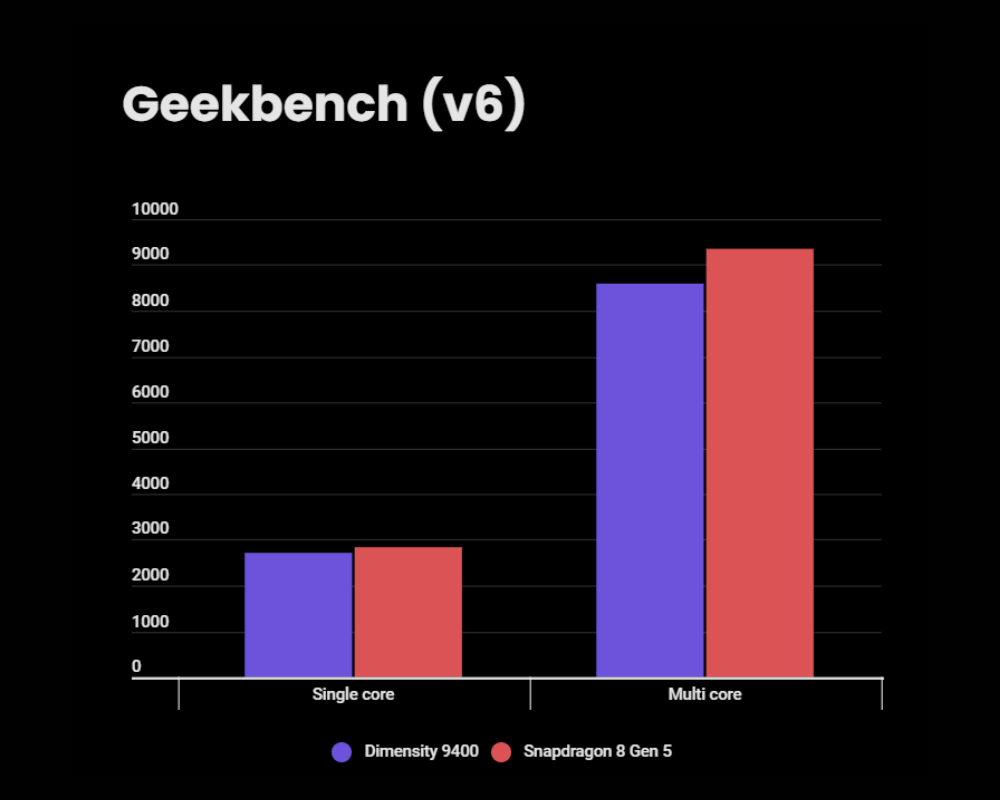
Geekbench score
The single-core scores are pretty close, but Qualcomm holds a slight 4.5% lead. The gap widens in multi-core performance, where the Snapdragon 8 Gen 5 posts a 9% higher score than the Dimensity 9400.
Geekbench scores suggest higher peak performance for the Snapdragon 8 Gen 5. In everyday tasks like browsing the internet, scrolling through your social app feeds, and watching movies, you’d hardly be able to spot a difference.
Dimensity 9400
Snapdragon 8 Gen 5
Single core
2,713
2,837
Multi core
8,592
9,352
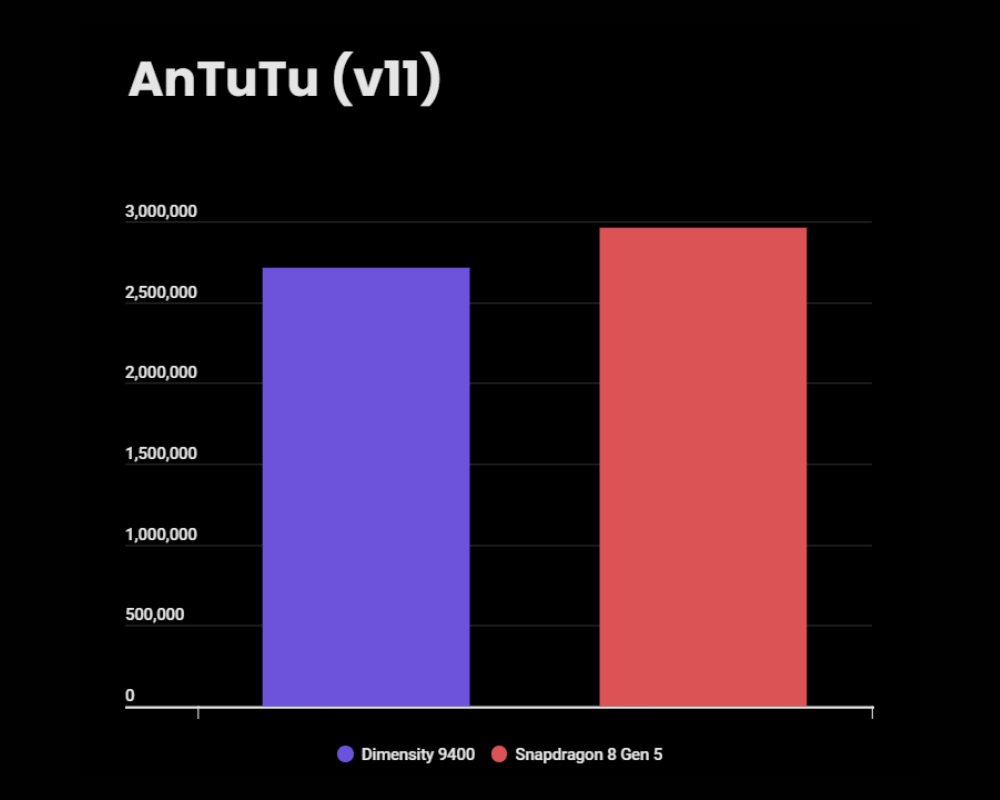
AnTuTu score
On the AnTuTu benchmark, the Snapdragon 8 Gen 5 scores nearly 3 million, while the Dimensity 9400 reaches 2.7 million. That’s about a 9% higher score for the Snapdragon chip.
The Snapdragon 8 Gen 5 consistently outperforms the Dimensity 9400 across every AnTuTu test, though the difference is not significant. The CPU score is 7% higher, and the GPU score is 5% higher. The memory and UX scores also favor the Snapdragon chip.
Dimensity 9400
Snapdragon 8 Gen 5
AnTuTu score
2,713,650
2,961,236
CPU
853,995
914,878
GPU
927,892
974,402
Memory
355,391
382,729
UX
576,372
689,228
The benchmarks favor Snapdragon 8 Gen 5 over the Dimensity 9400 in terms of performance, but they don’t provide insights into the capabilities of connectivity, camera, and other important aspects of the chips. So, let’s dig further to uncover the real-world differences between the two high-end chips.
Dimensity 9400 vs Snapdragon 8 Gen 5: Key differences
Both Dimensity 9400 and Snapdragon 8 Gen 5 are manufactured using TSMC’s 3nm process, but the latter uses the N3P node, which offers slightly better performance and power efficiency over the N3E node used for the Dimensity 9400.
Furthermore, the chips differ greatly in terms of CPU architecture. The Dimensity 9400 has a 1+3+4 layout, featuring one Cortex-X925 prime core, three Cortex-X4 performance cores, and four Cortex-A720 performance cores. In contrast, the Snapdragon 8 Gen 5 features a 2+6 CPU layout with two Oryon prime cores and six Oryon performance cores.
Notably, the Snapdragon 8 Gen 5 features third-generation Oryon cores, the same CPU cores from the top-tier Snapdragon 8 Elite Gen 5 chipset. They offer better performance and power efficiency than those inside the Dimensity 9400. Plus, they run at higher speeds, offering an additional performance boost.
For graphics rendering, the Dimensity 9400 relies on the Mali-G925 Immortalis MP12 GPU, while the Snapdragon chip uses the Adreno 829 GPU with the new Sliced architecture. Both chips offer ray tracing capabilities, along with their own set of gaming features: Snapdragon Elite Gaming on the Snapdragon 8 Gen 5 and MediaTek HyperEngine Gaming Technology on the Dimensity 9400.
The Snapdragon 8 Gen 5 also maintains an edge in imaging capabilities, as it borrows the triple 20-bit ISP from the Snapdragon 8 Elite Gen 5 with strong “always-sensing” camera support. The Dimensity 9400 features an Imagiq 1090 ISP with emphasis on HDR video across the zoom range and AI-assisted zoom features.
Both chipsets offer robust connectivity features, although the Snapdragon chip may have some advantage here, thanks to mature modem and better carrier-integration in some regions. Furthermore, the chip supports mmWave, UWB, and dual-way satellite connectivity, which are not mentioned on the official Dimensity 9400 page.
Dimensity 9400 vs Snapdragon 8 Gen 5: Conclusion
The Snapdragon 8 Gen 5 holds an upper hand in almost every aspect over the Dimensity 9400. It offers better CPU and GPU performance, a more powerful ISP with greater capabilities, and advanced connectivity features.
That said, the Dimensity 9400 is still a capable high-end chipset with strong performance and robust connectivity. Plus, you’ll likely get a device powered by this chip at a lower price than one powered by Snapdragon 8 Gen 5. That makes it a sweet deal for those looking for a high-performance device at an affordable price. For the absolute best of the two, the Snapdragon 8 Gen 5 is clearly the better choice.
Xiaomi’s HyperOS 3 rollout began in October 2025 and has been gradually expanding to a long list of eligible devices. The update is now available on dozens of its devices, and only a few models are pending the HyperOS 3 upgrade. It appears Xiaomi won’t take long to wrap it up, as it has already begun the rollout for the last batch of eligible devices.
Here’s a list of Xiaomi, Redmi, and POCO devices that are still waiting for the HyperOS 3 update, as shared by Xiaomi Time:
Xiaomi 13T
Redmi Note 15 Pro 4G
Redmi 14R
Redmi 15 (LTE & 5G)
Redmi 15C (LTE & 5G)
Redmi A4
POCO C85 (LTE & 4G)
POCO C75 5G
POCO M7 5G
POCO M7 Plus
Redmi Pad Pro
POCO Pad
While some of these devices may have started receiving beta builds in select regions, the stable release has yet to appear. However, we expect the rollout to be completed by the end of February, as the HyperOS 3.1 release is also around the corner.
Xiaomi has already completed the first batch of the HyperOS 3.1 beta release and has recently opened the second batch. So, the development is happening at a rapid pace, and therefore, we’re expecting the stable rollout to begin as soon as next month. Check the list of Xiaomi devices receiving the latest beta update here.
To stay updated with the latest news about HyperOS, visit the Xiaomi section regularly. Or, you can join us on Telegram to get instant notifications about the latest HyperOS updates, along with the biggest tech headlines.
Samsung has been working on One UI 8.5 for the past few months. It’s still based on Android 16 but uses a newer QPR2 development build, allowing Samsung to include deeper system-level features that weren’t available in the original Android 16 release for One UI 8.0.
One UI 8.5 has been available to select Galaxy devices as a beta release for quite some time now, and it’s inching closer to its stable release. And if you think it would be a minor upgrade, you’re getting it all wrong. There are a host of exciting upgrades and many new features, making the new software more customizable, visually appealing, and more secure.
In this post, we’ll tell you whether your Samsung Galaxy is eligible for the One UI 8.5 update and when you can expect it to roll out.
Is your Samsung device eligible for the One UI 8.5 update?
While the official list is yet to arrive, it’s safe to assume that all Samsung devices that have received the One UI 8.0 update or launched with One UI 8.0 should be upgraded to One UI 8.5, since both software are based on Android 16.
Galaxy XCover series: Galaxy XCover 7, XCover 7 Pro
If your Samsung Galaxy is on the list, it should receive the One UI 8.5 update. But we’d still recommend checking the official announcement for the final confirmation. We’ll post the official list on this website as soon as it’s announced. So, stay tuned.
When will Samsung roll out the One UI 8.5 update?
Samsung will release One UI 8.5 with the Galaxy S26 series, which is set to launch in late February. The latest Galaxy flagships will go on sale starting early March. A few weeks after that, Samsung will begin rolling out older Galaxy devices.
While the exact date of the One UI 8.5 rollout is yet to be announced, reports suggest it could begin towards the end of April.
Meanwhile, Galaxy S25, S25 Plus, and S25 Ultra users are already getting an early taste of One UI 8.5 via the beta program. The first beta build was released in early December, and then a few more beta builds were released at regular intervals.
Unfortunately, Samsung hasn’t expanded the beta program beyond the S25 series, and it doesn’t appear to be changing soon. That means other Galaxy devices may receive the stable build directly. Premium devices such as the Galaxy S25, Galaxy Z Fold 7, and Galaxy Z Flip 7 are likely to be among the first phones to receive the stable update. Then, it will expand to other high-end devices, followed by mid-range and cheaper models.
We’ll continue to update you with the latest developments around One UI 8.5 in the Samsung section on this website. Remember to visit that regularly. Also, join our Telegram channel to get instant notifications about the breaking news and software rollouts.
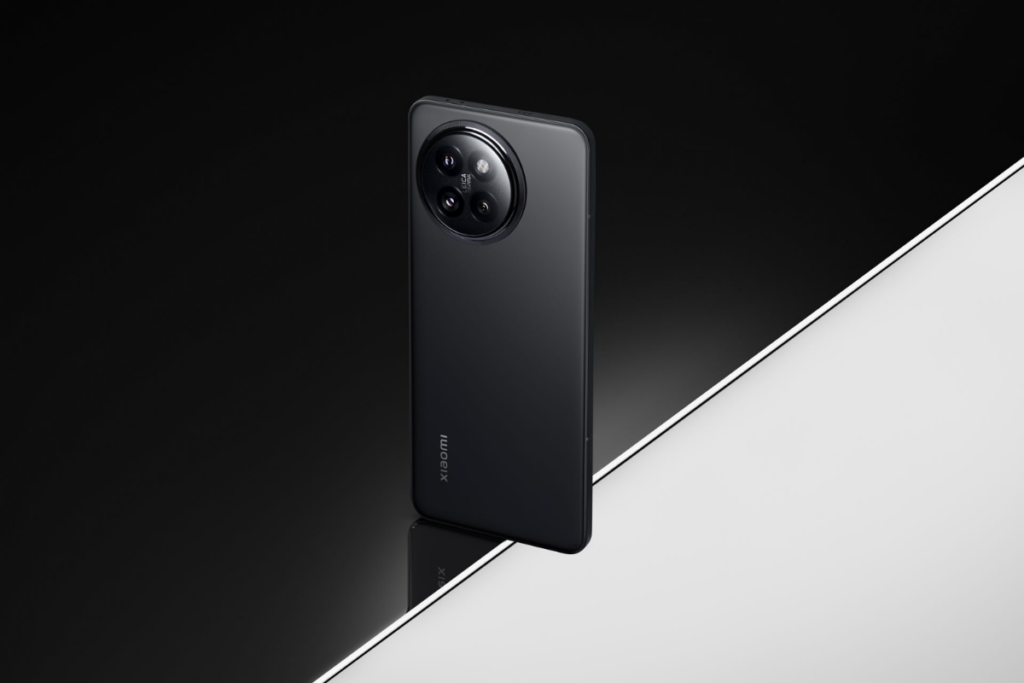
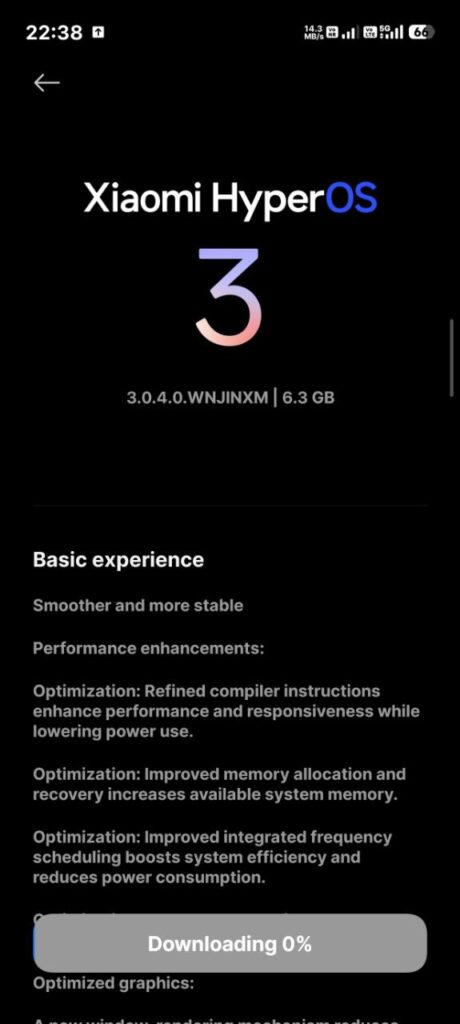
Xiaomi has finally started rolling out the much-awaited HyperOS 3 update for the Xiaomi 14 Civi users, while the regular Xiaomi 14 models received it a month ago. Anyway, the update is finally here for Xiaomi 14 Civi, and it brings loads of exciting stuff, including a bundle of new features and dozens of improvements.
The HyperOS 3 update, based on Android 16, is initially rolling out in India with the firmware version 3.0.4.0.WNJINXM. It’s a massive update package with a download size of about 6.3GB. So, it’s best to download it over a stable Wi-Fi connection.
Since Xiaomi rolls out updates in batches, it may take a few days for all users to receive them. If you’re rocking a Xiaomi 14 Civi, check for available updates manually by navigating to Settings > About phone, then tapping the HyperOS logo. To ensure a smooth upgrade to HyperOS 3, ensure that the device has sufficient space on the internal storage and it’s charged to at least 50%. You can back up important data for added safety.
After upgrading to HyperOS 3.0, you’ll have plenty to explore and play with, including a new HyperIsland, which lets you monitor live activities without opening the app. The updated lock screen now includes AI Cinematic Lock Screen, AI Dynamic Wallpapers, and more new features, allowing greater customization for a more personalized, dynamic lock screen experience.
HyperOS 3 also focuses on AI, with new features such as AI Writing, AI Speech Recognition, AI Search, and AI Translate. The software now features Gemini integration for a more useful software experience. Additionally, Xiaomi has made over 100 improvements to HyperOS 3 to deliver a faster, smoother experience.
The company is also working on HyperOS 3.1, which would still be based on Android 16, and is expected to bring useful upgrades to the software. It has already started recruiting people for the beta program. Unfortunately, the Xiaomi 14 Civi is not on the beta list, but it should receive the update once the stable rollout begins.
To stay updated with the latest news about HyperOS, visit the Xiaomi section regularly. Or, you can join us on Telegram to get instant notifications about the latest HyperOS updates, along with the biggest tech headlines.

 Login
Login