Login
Login
Xiaomi Pad 8 Pro vs OnePlus Pad 3: Same Chip, Totally Different Experience
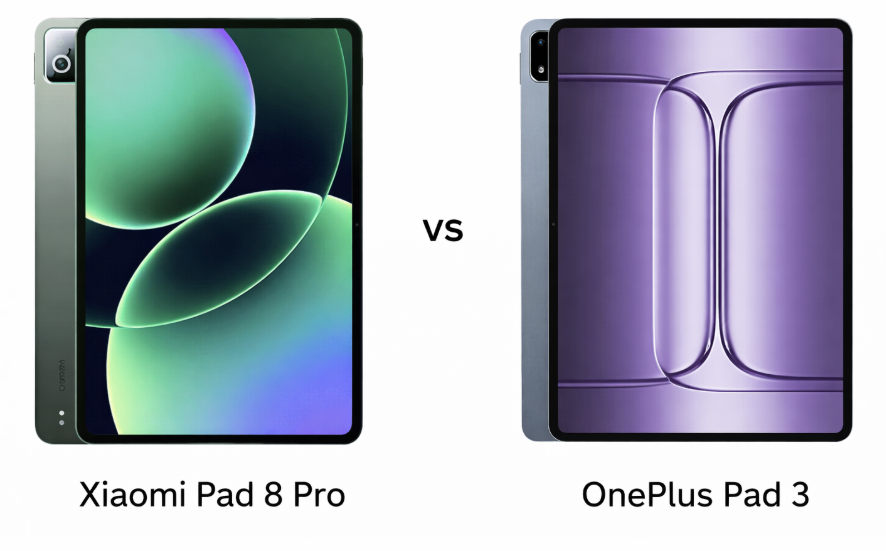
Choosing between the Xiaomi Pad 8 Pro and the OnePlus Pad 3 isn’t just about specs; it’s about deciding what kind of tablet experience fits your lifestyle. One focuses on flagship power in a sleek, portable form at a competitive price, while the other pushes toward a larger, laptop-style productivity machine with immersive multimedia. For buyers balancing performance, display size, battery life, and value, this comparison highlights which tablet truly delivers more for the money, and which one fits specific usage needs better.
| Preview | Product | |
|---|---|---|

|
OnePlus Pad 3 World’s Fastest Snapdragon 8 Elite Processor, 13.2″ 3.4k Screen, 144Hz Adaptive… | Check Price on Amazon India |
Please Note: When you buy something using the links in our articles, we may earn a small commission at no cost to you.
| Preview | Product | |
|---|---|---|
|
|
OnePlus Pad 3 Storm Blue, 13.2″ 3.4K LCD 144 Hz Display, Snapdragon 8 Elite,… | Check Price on Amazon Global |
Please Note: When you buy something using the links in our articles, we may earn a small commission at no cost to you.
Major Features:
| Feature | Xiaomi Pad 8 Pro | OnePlus Pad 3 | Winner |
|---|---|---|---|
| Display Size & Multimedia | 11.2″ 144Hz, HDR10, Dolby Vision, 800 nits, 4-speaker Dolby Atmos | 13.2″ 144Hz, Dolby Vision, 900 nits, 8-speakers | OnePlus – Larger screen + richer speaker setup for immersive media |
| Portability & Build | 5.8mm thin, ~485g, easier to hold for long sessions | Larger 289.6×209.7×6mm, 675g, more desk-oriented | Xiaomi – Much lighter and more portable |
| Processor & Performance | Snapdragon 8 Elite, UFS 4.1 | Snapdragon 8 Elite, UFS 4.0 | Xiaomi – Same power but slightly faster storage |
| Battery & Charging | 9200 mAh, 67W fast, 22.5W reverse charging | 12140 mAh, 80W fast | OnePlus – Bigger battery and quicker charging overall |
| Camera Quality | 50MP rear + 32MP selfie, 4K@60fps | 13MP rear + 8MP selfie | Xiaomi – Far better cameras for photos & video calls |
Design and Display
Build Quality
The Xiaomi Pad 8 Pro focuses on portability with its slim 5.8mm aluminum body and sub-500g weight, making it easier to hold for long reading or gaming sessions. It feels compact yet premium. The OnePlus Pad 3, on the other hand, is significantly larger and heavier at 675g, built more like a laptop replacement. Its expansive chassis suits desk use but is less travel-friendly. The difference in size alone changes how each tablet fits into daily life.
Display & Multimedia
Xiaomi offers an 11.2-inch 3:2 IPS LCD with 144Hz refresh rate, HDR10, Dolby Vision, and 800 nits peak brightness. The sharper 344 ppi density makes text look crisp. OnePlus counters with a massive 13.2-inch 144Hz IPS LCD panel, brighter at 900 nits HBM and ideal for split-screen productivity. For audio, OnePlus dominates with 8 speakers, while Xiaomi includes a capable 4-speaker Dolby Atmos setup.
Verdict
Xiaomi wins for portability and sharper visuals; OnePlus wins for immersive size and louder multimedia output.
Performance and Software
Processor & UI Smoothness
Both tablets run the Snapdragon 8 Elite (3nm) with Adreno 830 GPU, meaning flagship-level performance across gaming, rendering, and multitasking. Raw power is identical. Xiaomi ships with Android 16 and HyperOS 3, giving it a slight software freshness advantage. OnePlus runs Android 15 with ColorOS 15, which remains fluid but is technically a generation behind. With UFS 4.1 storage on Xiaomi (except base) and UFS 4.0 on OnePlus, both feel extremely fast.
Productivity & Multitasking
OnePlus Pad 3 benefits from its larger 13.2-inch canvas, making split-screen apps and document editing more comfortable. Xiaomi’s 3:2 aspect ratio, however, is better optimized for reading and browsing. RAM configurations go up to 16GB on both, ensuring heavy apps run smoothly. Xiaomi’s lighter weight makes handheld productivity easier, while OnePlus feels more desk-oriented.
Verdict
Performance is equal; Xiaomi edges ahead in software freshness, while OnePlus excels in large-screen multitasking.
Battery and Accessories
Battery Life
The Xiaomi Pad 8 Pro packs a 9200mAh battery with 67W fast charging and even 22.5W reverse wired charging, a rare bonus. OnePlus Pad 3 steps ahead with a massive 12140mAh battery and faster 80W charging. For extended binge sessions or long workdays, the OnePlus simply lasts longer due to its capacity advantage.
Stylus, Keyboard & Ecosystem
Both support stylus input, but Xiaomi includes magnetic stylus support integrated neatly into its slim frame. OnePlus supports stylus and keyboard accessories and benefits from a productivity-focused large display. However, Xiaomi’s infrared port adds smart-home control flexibility, a small but practical addition rarely seen today.
Verdict
OnePlus wins on battery endurance; Xiaomi stands out for reverse charging and compact accessory integration.
Camera & Media
Rear and Front Camera
Xiaomi equips a 50MP rear camera and a 32MP ultrawide selfie camera, far exceeding typical tablet standards. OnePlus keeps it basic with a 13MP rear and 8MP front camera. For document scanning, video calls, or occasional content capture, Xiaomi clearly offers more versatility and sharper detail.
Video & Audio Quality
Both support 4K video recording on the rear camera, but Xiaomi allows 4K at 60fps, giving it more flexibility. OnePlus includes gyro-EIS for steadier footage. In audio, the 8-speaker system on the OnePlus Pad 3 delivers a more cinematic soundstage compared to Xiaomi’s 4-speaker setup.
Verdict
Xiaomi dominates camera hardware; OnePlus wins in speaker immersion.
Pricing
At around $400 / ₹35,000, the Xiaomi Pad 8 Pro delivers flagship chipset performance at a much more aggressive price. The OnePlus Pad 3, priced at $600 / ₹48,000, justifies its premium with a bigger display, larger battery, and stronger multimedia system.
Value-focused buyers will naturally gravitate toward Xiaomi, while users seeking a laptop-like tablet experience may consider the OnePlus worth the extra investment.
Disclaimer:
Prices are approximate and may vary based on country, region, and applicable taxes.
Conclusion
Xiaomi stands out with its 3:2 high-resolution panel, stronger cameras, lighter build, reverse charging, and newer Android version. OnePlus impresses with its massive 13.2-inch display, 8-speaker setup, and huge battery capacity.
Verdict
For pure value and portability, the Xiaomi Pad 8 Pro feels like the smarter buy. For big-screen productivity and cinematic entertainment, the OnePlus Pad 3 offers a more expansive experience, but at a noticeable premium.
Read More:
- Pixel Watch 4 vs Galaxy Watch8 Classic: Is Samsung Worth The Extra Money?
- Samsung Galaxy S26 Ultra vs Galaxy S25 Ultra: Everything You Should Know
- Samsung Galaxy Watch Ultra vs Apple Watch Series 11: Full Comparison ( Amazon Discounts)
The post Xiaomi Pad 8 Pro vs OnePlus Pad 3: Same Chip, Totally Different Experience appeared first on Gizmochina.


![(PRICE DROP )Apple Watch Series 11 [GPS 42mm] Smartwatch with Jet Black Aluminum Case with Black Sport Band - S/M. Sleep Score, Fitness Tracker, Health Monitoring, Always-On Display, Water Resistant](https://www.gizmochina.com/wp-content/plugins/aawp/public/image.php?url=YUhSMGNITTZMeTl0TG0xbFpHbGhMV0Z0WVhwdmJpNWpiMjB2YVcxaFoyVnpMMGt2TlRGVFJYTkljM2x3ZGt3dVgxTk1NVFl3WHk1cWNHYz18MTc3MTM2OTkwMA=)
![Samsung Galaxy Watch Ultra (2024) 47mm LTE AI Smartwatch w/Energy Score, Wellness Tips, Heart Rate Tracking, Sleep Monitor, Fitness Tracker, GPS, Titanium White [US Version, 1Yr Manufacturer Warranty]](https://www.gizmochina.com/wp-content/plugins/aawp/public/image.php?url=YUhSMGNITTZMeTl0TG0xbFpHbGhMV0Z0WVhwdmJpNWpiMjB2YVcxaFoyVnpMMGt2TlRFeE1IQlFha0pSYTB3dVgxTk1NVFl3WHk1cWNHYz18MTc3MTM2OTkwMA=)