Reading view

Bitcoin Price Analysis: BTC Extends Retreat to Sub $63K, Threatening Retracement to $55K
Crypto Market Crash Today Bitcoin Falls Below $66K, Ethereum and XRP Extend Losses

The post Bitcoin Price Analysis: BTC Extends Retreat to Sub $63K, Threatening Retracement to $55K appeared first on Coinpedia Fintech News

On February 24, the price of Bitcoin (BTC) fell below $63,000, hitting an intraday low of $62,694. At press time, the overall relative strength index (RSI) was at 43.21, reading oversold, similar to the Mt Gox and COVID-19 crises. Chairman and CEO of JPMorgan Chase & Co., Jamie Dimon, noted parallels in the current market conditions and the 2008 crisis.
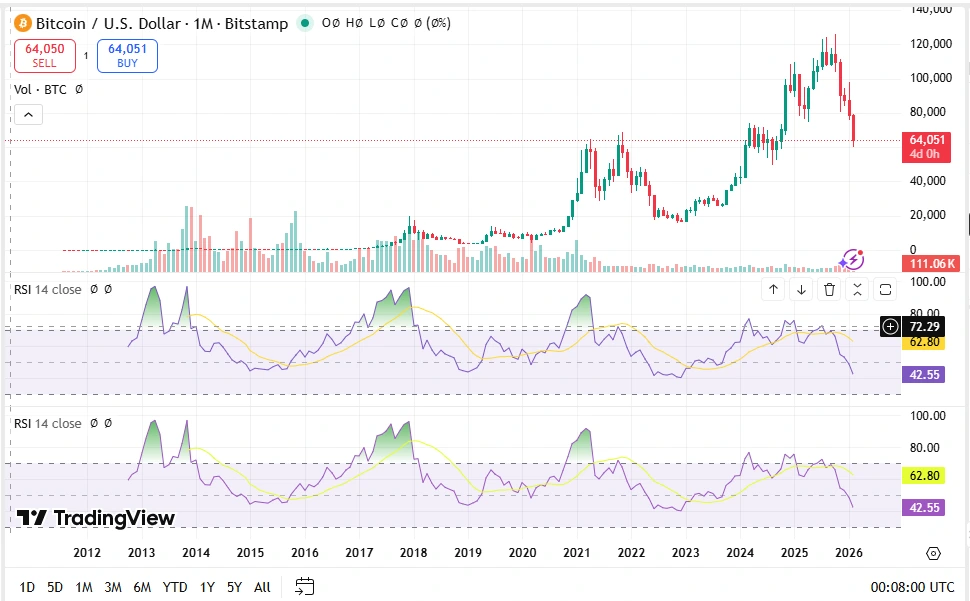
Bitcoin price and RSI

Source: Trading View

The fear-and-greed index has now clocked 11/100, depicting extreme fear, with 24h liquidations mounting to $342.76 million. Open interest (OI) sits at $43.64 billion, a significant decline from the $217 billion recorded just before the October 10 flash crash.

Possible Bitcoin pullback to $53-$55K

In the week ending February 20, CoinShares reported that digital asset products had entered their fifth week of consecutive outflows, amounting to $4 billion. On Monday alone, spot Bitcoin ETFs accounted for over $200 million worth of outflows, further contributing to the downward trend in crypto prices.
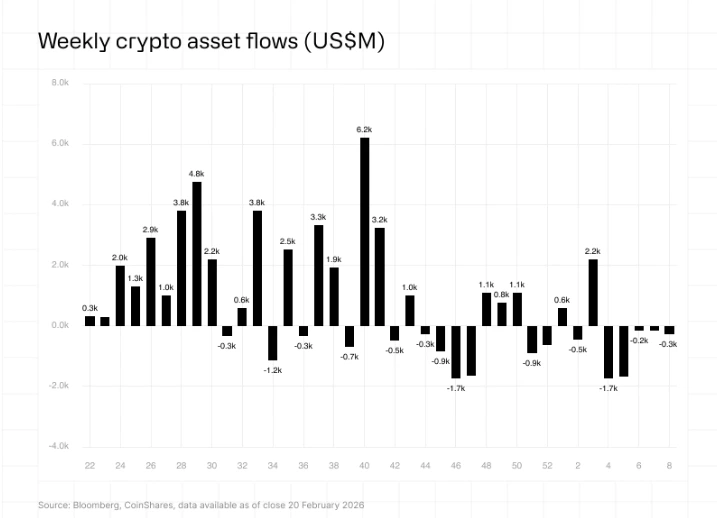
Bitcoin institutional outflows

Source: CoinShares

Tensions between the US and Iran have driven recent global market volatility, with both sides considering launching the offensive following failed talks regarding Iran’s nuclear disarmament.

Samer Hasn, a senior market analyst at XS.com, says there is potential for a fall to $53-$55K, due to unwavering selling pressure. Matt Howells-Barby of Kraken echoed this view, adding, “The $60k level is a key support level that the bulls are watching closely.”

What the future holds

Software company Strategy now sits on $9 billion in unrealized losses from its BTC holdings. Despite previously affirming the crypto winter, Executive Chairman Michael Saylor sees this as a buying opportunity, saying, “Bitcoin is on sale.”

Supporting his theory is data from Glassnode, which shows accumulations of over 400,000 BTC at prices ranging between $60,000-70,000. This, in addition to increased mining difficulty, suggests a “buy the dip” trend upcoming as sales near exhaustion. 

At writing time, BTC was trading at $64,110 following an hourly recovery of 0.08%.

White House: Trump Will Not Pardon Sam Bankman-Fried Despite Ongoing Clemency Campaign

FTX Bankruptcy

The post White House: Trump Will Not Pardon Sam Bankman-Fried Despite Ongoing Clemency Campaign appeared first on Coinpedia Fintech News

A spokesperson from the White House has confirmed that U.S. President Donald Trump will offer no clemency to Sam Bankman-Fried (SBF), the founder and former CEO of the now-defunct FTX cryptocurrency exchange.

The spokesperson added that Trump is the sole decider on a mercy release, and he is firmly rooted in granting no pardon to SBF.

Bankman-Fried attempts at absolution following FTX collapse

In March 2024, Bankman-Fried was sentenced to 25 years in federal prison after being found guilty of all seven counts of money laundering, conspiracy, and fraud. 

In his defense, SBF argued that he and FTX had been strategically targeted by the Biden administration because of his multi-million-dollar pro-Republican donations. His parents (both professors and legal scholars at Stanford Law School) have tried to secure a presidential pardon for their son to no avail.

A week ago, SBF claimed that FTX’s collapse was manufactured by lawyers and his successor, John J. Ray III, who allegedly profited from the exchange’s bankruptcy filings. He also pinpointed the FTX $7.1 billion payback of its investors as a show of goodwill.

Sam Bankman-Fried says FTX is repaying customers 119-143%

Source: X

More recently, Bankman-Fried took to X in a long-shot show of Republican pivot, with hopes of swaying Trump’s resolve. He described the recent tariff policies as “right on crypto” and Trump’s capture and extradition of Venezuelan leader Nicolás Maduro as “smart, gutsy, and pro-democracy.” SBF further noted the “political bias” nature of Judge Lewis Kaplan, the man who sentenced him and has been a key player in civil cases against Trump.

Clinton-appointed judge Lewis Kaplan made his political bias very clear when sentencing me and @rsalame7926.

Kaplan ranted about how I “set up a vehicle for making political donations to the right.”

“The state of our political life in this country is in jeopardy,” he said, and…

— SBF (@SBF_FTX) February 18, 2026

What next for SBF?

Bankman-Fried remains incarcerated at the Metropolitan Detention Center (MDC) in Brooklyn, New York. The 33-year-old man has run into rotten luck with yet another denial of a presidential pardon and a much heavier sentence compared to his associates. 

Supporters say SBF should receive a similar pardon to crypto players like Binance CEO Changpeng Zhao and former BitMEX CEO Arthur Hayes. Trump, however, stands his ground, saying the man committed financial fraud worth $8 billion. Bankman-Fried’s last resort is an appeal to the US Court of Appeals for the Second Circuit.

Bitcoin Is Safe From Quantum Computing Attacks: Saylor

Strategy Buys 592 Bitcoin

The post Bitcoin Is Safe From Quantum Computing Attacks: Saylor appeared first on Coinpedia Fintech News

Michael Saylor, the CEO of software company Strategy, has affirmed that quantum computers pose negligible risk to the security systems of the Bitcoin (BTC) blockchain.

Bitcoin-targetted quantum computer attacks are at least a decade away

Speaking at Natalie Brunell’s Coin Stories podcast, Saylor referred to news of quantum computing risks to Bitcoin as a “fear fad.” Echoing a similar outlook by CoinShares, Saylor said any remarkable quantum risk is over a decade away.

Saylor went on to cite Bitcoin’s BIP-360 upgrade, which will effectively adapt the blockchain into a quantum-resistant and lattice-based infrastructure. Any attempts to breach security would only heighten the demand for the coin, further validating what he referred to as a “supply-hardening event.”

As Saylor explains, institutional buying is causing Bitcoin shift away from technical scarcity (halving) to structural scarcity (institutional BTC accumulation). Thereafter, any demand in Bitcoin, even through a coordinated hack, would cause a “supply shock”, effectively causing upward mercurial responses in BTC’s price.

In our brand new sit-down, I handed @saylor every anti-Bitcoin argument the internet has and he responded to ALL of them.

I dare any Bitcoin critic to watch this interview and not reconsider at least one of their arguments.

TIMESTAMPS:
00:00 Michael Saylor address Bitcoin bear… pic.twitter.com/lmMnZ2p7WX

— Natalie Brunell ⚡ (@natbrunell) February 23, 2026

In the past, however, Ripple’s David Schwartz and CryptoQuant founder Ki Young Ju, have warned of Bitcoin’s vulnerability to quantum attacks. Schwartz even noted that Bitcoin may need to “fork to be quantum proof.”

Strategy BTC acquisition tactic and price outlook

As of February 23, 2026, Strategy was the world’s largest corporate holder of Bitcoin, with 717,722 BTC worth about $54.56 billion. Speaking to Brunell, Natalie explained that the company uses the perpetual preferred stock technique to accumulate BTC while significantly minimizing its stock dilution risk. Effectively, shareholders enjoy fixed income, while the company increases its Bitcoin exposure.

Since 2020, Strategy has continuously accumulated Bitcoin as its reserve asset in the Bitcoin era that it refers to as the “Orange Century”.

The Orange Century. pic.twitter.com/8zelTduTPC

— Michael Saylor (@saylor) February 22, 2026

At press time, BTC was trading at $64,208, having dropped 0.34% in the last 24h. Despite an almost 50% crash from a $123,000 all-time high, Saylor remains bullish and continues to plan for further BTC purchasing.

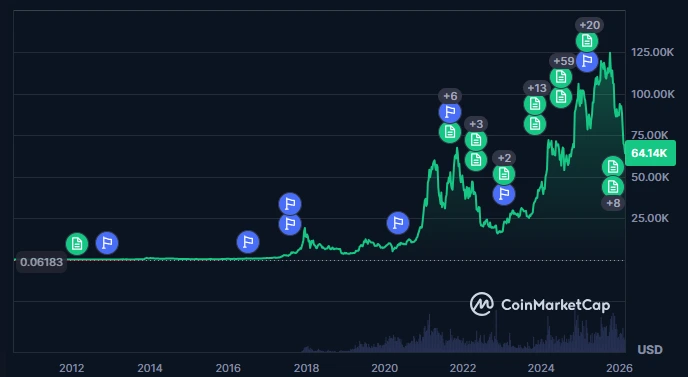
Bitcoin price chart

Bitcoin Falls Below $64K: Here Are the Causes and Price Predictions

Crypto Market Crash Today Bitcoin Falls Below $66K, Ethereum and XRP Extend Losses

The post Bitcoin Falls Below $64K: Here Are the Causes and Price Predictions appeared first on Coinpedia Fintech News

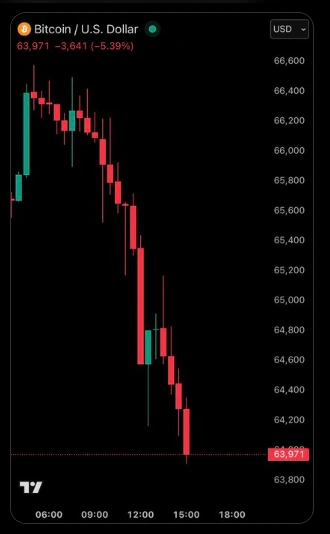
Bitcoin (BTC) dropped below $64,000 on February 23 at 20:15 UTC to trade at $63,950, a level last witnessed in late 2024. The flagship’s coin fear & greed index read 5/100, indicating extreme fear.

Bitcoin price chart

Source: Trading View

The crypto market’s Relative Strength Index (RSI) is still in the region of oversold, as BTC’s open interest (OI) drops 0.69% to $44.67 billion in 24h. 164,471 traders have experienced a combined total of $621.69 million in liquidations, with the largest single liquidation happening on the HTX exchange and accounting for $61.51 million.

Bitcoin recorded an all-time-high of $126,272 on October 6, then saw the biggest ever single-day flash crash four days later. In what is now dubbed the “10/10 event”, liquidations on leveraged positions mounted to over $19 billion in just 24h.

Why is Bitcoin on a persistent downward spiral?

One of the primary triggers for Bitcoin’s price correction was US President Donald Trump’s announcement of 100% tariffs on Chinese imports. Currently, this tax sits at 15% for global imports to the US, which has triggered major de-risking among crypto investors.

Among institutions, Bitcoin ETFs have recorded their fifth consecutive week of outflows, now totaling $3.8 billion. Outflows now account for a net $8 billion since late last year, with delays in the passage of the CLARITY Act further hurting market optimism.

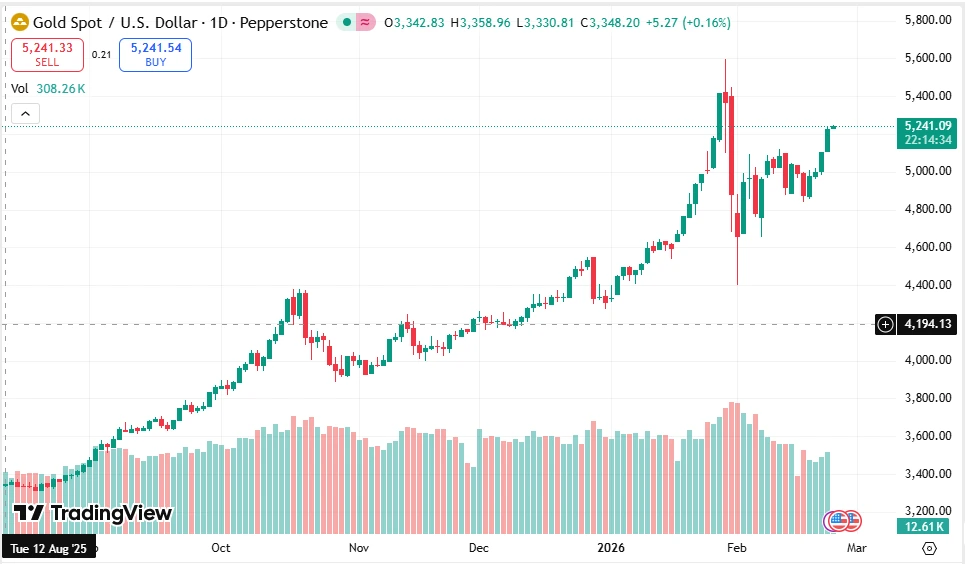
Geopolitical tensions between the US and Iran have heightened fear among investors, causing them to switch to gold as a more stable store of value. Gold’s market cap has now risen to $36.4 trillion, with a 17% gain year-to-date. Cryptocurrency’s performance pales in comparison, with the overall market cap at $2.23 trillion, and a 25% backtrack of BTC from its new year’s price of over $88,000.

Gold trading price

Source: Trading View

What next for Bitcoin?

Several analysts, including those from Standard Chartered, suggest Bitcoin could hit a bottom of $50,000 due to institutional capitulation. However, high trading volumes and net institutional inflows for at least three consecutive days could cause a reclamation of $68,000.

The likes of Grayscale and Bitwise suggest that Bitcoin now has the features of a mature asset, charting slow bullish trends in place of the historical four-year cycle. 

Upcoming events that are expected to positively impact the price of Bitcoin include the passage of the CLARITY Act, the March 2026 mining of the 20 millionth BTC, and the appointment of Kevin Warsh as the new Federal Reserve Chair.

Trump and Israeli Officials Discuss a Stablecoin for the Gaza Strip

Hong Kong’s New Stablecoin Law Takes Effect

The post Trump and Israeli Officials Discuss a Stablecoin for the Gaza Strip appeared first on Coinpedia Fintech News

US President Donald Trump is reportedly coordinating efforts with Israeli officials and tech specialists to explore a stablecoin for the embattled region of Gaza. This recent development will be part of the broader objective of the Trump-led multinational organization, the Board of Peace (BoP), which seeks to restore peace and civility not only in Gaza but also globally.

Trump and Israel propose a Gaza stablecoin

For nearly four decades now, Gaza has been the central arena for the Israel-Iran war on regional dominance. In 2023, the conflict became a full-blown missile war, with fatalities on both sides exceeding 70,000. 

Consequently, Gaza’s access to Israel’s official currency, the shekel, diminished, while its banking systems collapsed. Gaza occupants now suffer from shortages in food, water, shelter, and medical supplies.

In a pledge towards Gaza’s reconstruction, BoP member states have contributed roughly $17 billion, with the bulk of it ($10 billion) from the US. Part of these funds will be directed toward the Gaza stablecoin, which would function as a digital currency and an alternative means of payment for Gaza citizens. 

According to the Financial Times, Israeli developer Liran Tancman will lead the development of the stablecoin. Several Israeli officials will participate in advancing the stablecoin, with Palestinian and Gulf Arab cryptocurrency firms promoting its adoption.

[ ZOOMER ]
DONALD TRUMP'S BOARD OF PEACE WORKS WITH ISRAELI TECH ENTREPRENEUR TO CREATE STABLECOIN FOR GAZA'S CITIZENS, WITH HOPES IT WILL LIMIT HAMAS: FT

— zoomer (@zoomerfied) February 23, 2026

The development would mark yet another lean toward cryptocurrencies as an alternative means of payment for war-ravaged economies, with Ukraine and Iran already showing heightened adoption.

Opinions regarding the Trump-backed Gaza stablecoin

Supporters of the stablecoin note that it would create a digital payments system, which would be a much-needed alternative to solid cash. The coin would also limit financial access to the terrorist labeled Hamas group.

On the other hand, critics note that developing a stablecoin specifically for Gaza would further isolate it from the West Bank’s economy and governance. Others note that the benefits would be minimal, since Gaza suffers frequent power outages and remains dependent on slow 2G networks. Recently, the Trump-backed stablecoin USD1 temporarily depegged from the dollar by 0.6%, raising uncertainty over Trump’s engagement with yet another stablecoin.

World Liberty Financial Stablecoin USD1 Prevails Over FUD Attack

Rep. Ro Khanna Investigates $500M UAE Investment in Trump-Linked WLFI Project

The post World Liberty Financial Stablecoin USD1 Prevails Over FUD Attack appeared first on Coinpedia Fintech News

On February 23, the Trump-backed decentralized finance (DeFi) protocol World Liberty Financial reported that hackers had infiltrated its ecosystem, specifically targeting its primary stablecoin, USD1. 

The coordinated attack comprised a three-pronged approach designed to depeg USD1 from the dollar, and profit from the same. 

Using co-founders’ hacked social accounts, hackers posted falsified information to manufacture fear, uncertainty, and doubt (FUD) in the platform’s ecosystem. Thereafter, the attackers reportedly paid off crypto influencers to amplify news of the attack, making it appear worse than it actually was. Attackers then proceed to short-sell WLFI tokens in the hopes of profiting from the artificial chaos. 

A coordinated attack was launched against USD1 this morning. Attackers hacked several WLFI cofounder accounts, paid influencers to spread FUD, and opened massive $WLFI shorts to profit from the manufactured chaos.

It didn’t work.

Thanks to USD1’s sound mint-and-redeem mechanism…

— WLFI (@worldlibertyfi) February 23, 2026

WLFI stablecoin recovers shortly after FUD hit

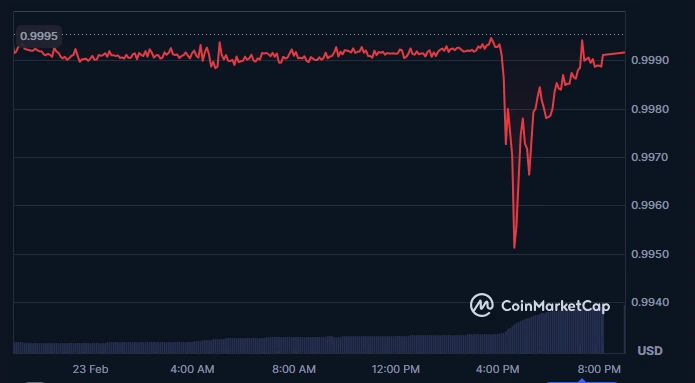
World Liberty Financial explained that the attack failed “thanks to UDS1’s sound mint-and-redeem mechanism and full 1:1 backing.” The stablecoin experienced a temporary 0.6% deviation to $0.994 before quickly recovering close to the dollar. At press time, the stablecoin was trading at $0.9989, with an overall drop of 0.28% in the last 24h. WLFI token, ranked 29th by market cap, was trading at $0.1115 following a 0.7% 24h dip. 

USD1 price change

Source: CoinMarketCap

The DeFi platform is one among many that rely on a fully-reserved and fiat-backed mint-and-redeem stablecoin mechanism. Evidence of this is found in monthly reserve attestations, reserve composition reports, institutional partnerships, and its white paper dubbed the “Gold Paper”.

WLFI attack history and developments

Notably, this is the fourth attack aimed at the World Liberty Financial platform in the last two years. In July 2024, Dough Finance, a previous project related to the DeFi platform, lost $2.5 million to hackers. And in September 2025, “sweeper bots” exploited a vulnerability related to Ethereum’s EIP-7702 upgrade, draining wallets of millions in WLFI tokens. Two months later, a phishing campaign compromised user wallets, and the platform was forced to burn and re-allocate $22 million worth of stolen tokens.In more progressive developments, World Liberty Financial launched the World Liberty Forum, which aims to participate in shaping the cryptocurrency regulatory playground.

❌