Reading view

XRP Price Prediction 2026: What 3 AI Models Say About the Next Cycle
XRP Price Prediction Could Nasdaq Listing and Bullish Sentiment Push XRP to $9

The post XRP Price Prediction 2026: What 3 AI Models Say About the Next Cycle appeared first on Coinpedia Fintech News

The cryptocurrency market has been volatile in early 2026, and XRP has not been immune to the volatility. Over the past month, the digital asset lost roughly 45% of its value within four weeks.

However, some analysts argue that the recent decline may not tell the full story. New projections generated by three artificial intelligence models hint that XRP’s long-term trajectory could look very different from its recent performance.

XRP’s Sharp Correction Raises Questions

The recent downturn followed technical issues and broader market pressure, which pushed XRP into one of its steepest short-term corrections in recent years.

While the price dropped sharply, network activity on the XRP Ledger reportedly increased by about 30% during the same period. For analysts, that divergence between price and usage has sparked debate about whether the asset’s market value is temporarily disconnecting from its underlying utility.

In traditional markets, such situations sometimes occur when investors react strongly to short-term news while long-term fundamentals continue to develop.

Three AI Models Offer Different Scenarios

To better understand XRP’s possible path forward, analysts applied three separate artificial intelligence forecasting models. Each model produced a different outlook based on varying assumptions about adoption, liquidity and market cycles.

Model One: Utility-Driven Floor

The first model estimates a conservative range of $1.50 to $2. This scenario assumes XRP continues growing steadily through real-world payment use cases and institutional transaction flows.

Even without strong retail speculation, the model suggests that rising activity on the XRP Ledger could support a gradual price increase over time.

Model Two: Cyclical Growth Scenario

A second model places XRP within a $3 to $5 range, drawing comparisons to historical crypto market cycles.

This projection assumes that XRP benefits from broader market expansion and increasing adoption following legal clarity and infrastructure development across the network.

Under this scenario, XRP evolves from a speculative asset into a more mature financial instrument used in cross-border transactions and liquidity management.

Model Three: Liquidity Shock Outlier

The most aggressive model explores a scenario in which XRP’s role in global payment infrastructure expands rapidly. If financial institutions adopt the network as a major bridge liquidity layer, demand for XRP could increase significantly.

In that case, the model says the token could potentially move into double-digit territory during the next major market cycle.

Analysts warn that this outcome depends heavily on institutional adoption and broader financial market developments.

A Market Still Driven by Sentiment

Despite these projections, the crypto market remains sensitive to short-term sentiment.

Large price swings often occur when traders react quickly to news events, technical issues or macroeconomic developments. In the short term, market behavior can resemble what investors describe as a “voting machine,” where sentiment dominates.

Over longer periods, however, price movements tend to align more closely with utility, adoption and network growth.
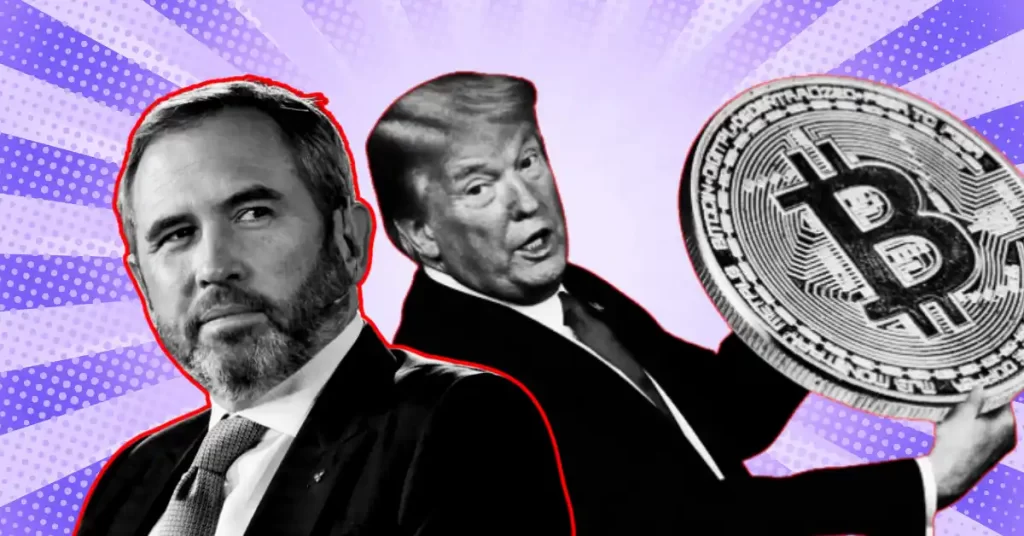
Ripple CEO Brad Garlinghouse Says THIS as Trump Calls Out Banks Over Crypto Bill

Ripple’s CEO Join Trump’s Crypto Advisory Council, Can Skyrocket XRP to $5.5

The post Ripple CEO Brad Garlinghouse Says THIS as Trump Calls Out Banks Over Crypto Bill appeared first on Coinpedia Fintech News

A fresh political push for crypto legislation is stirring debate across Washington and the digital asset industry.

U.S. President Donald Trump issued a forceful statement backing the CLARITY Act and warning that major banks should not undermine what he described as America’s crypto agenda.

In his remarks, Trump said the “Genius Act” was being threatened by banks and stressed that the United States must finalize market structure legislation as soon as possible. He argued that Americans deserve the opportunity to earn more on their money and warned that delays could push innovation to countries like China.

Trump framed the legislation as part of a broader effort to position the U.S. as the “Crypto Capital of the World,” adding that the industry should not be stalled by traditional financial institutions protecting their interests.

Ripple CEO Calls Message “Extremely Pointed”

Reacting to Trump’s comments, Brad Garlinghouse described the statement as “an extremely pointed message” to lawmakers and stakeholders who have slowed progress on the CLARITY Act.

An extremely pointed message from @POTUS to those who are dragging their feet on CLARITY.

This is, and always has been, about what’s in the best interest of the American people. pic.twitter.com/t1CIFBOBg4

— Brad Garlinghouse (@bgarlinghouse) March 3, 2026

Garlinghouse’s response quickly gained traction within the XRP community, where regulatory clarity has long been viewed as essential to long-term growth.

The CEO of Ripple has repeatedly argued that the absence of clear digital asset rules in the U.S. has placed domestic firms at a disadvantage compared to international competitors. His latest reaction shows growing alignment between parts of the crypto industry and political voices calling for immediate action.

Lawmakers and Industry Voices Weigh In

The discussion expanded beyond Ripple.

Mike Selig also backed publicly backed Trump’s stance, stating that the CLARITY Act must pass to establish a future-proof digital asset market structure. He added that the Commodity Futures Trading Commission is prepared to implement the framework under the current administration.

Across social platforms, reactions reflected frustration with perceived delays. Several users questioned why banks should have influence over legislation that could introduce competition to their business models. Others argued that clear rules would unlock innovation, attract builders and accelerate U.S. leadership in blockchain development.

A recurring theme in the responses was urgency. Many commenters warned that Congress is running out of time and called for immediate passage of the bill to prevent the U.S. from falling behind in global crypto adoption.

What’s at Stake

At its core, the debate centers on market structure.

The CLARITY Act tries to define how digital assets are classified and regulated, potentially drawing clearer boundaries between securities and commodities oversight. For years, regulatory uncertainty has been cited as one of the biggest obstacles facing crypto companies operating in the United States.

Trump’s statement framed the issue as one of national competitiveness. He suggested that failing to finalize crypto legislation could shift innovation and capital overseas. That message resonates strongly with industry leaders who argue that regulatory ambiguity has already slowed domestic progress.

Why are Bitcoin, Ethereum and XRP Prices Rallying Today?

Why Is the Crypto Market Up Today Bitcoin, Ethereum & XRP Lead Broad Rally

The post Why are Bitcoin, Ethereum and XRP Prices Rallying Today? appeared first on Coinpedia Fintech News

Crypto markets turned green today. Bitcoin surged past $68,000 and briefly traded near $69,500, rising about 5% in just 50 minutes. The move added roughly $60 billion to Bitcoin’s market capitalization.

Ethereum followed closely, breaking above $2,000 and climbing nearly 6% within the same window, adding more than $20 billion in value.

XRP also joined the advance, trading around $1.41. In total, the broader crypto market added close to $100 billion in under an hour, triggering nearly $80 million in short liquidations during the surge.

So what’s behind the sudden rally?

Strong U.S. Economic Data Sparks Risk Appetite

One of the main drivers appears to be fresh macroeconomic data.

The U.S. ISM Manufacturing PMI came in at 52.4, beating expectations of 51.8. A reading above 50 signals expansion in the manufacturing sector.

For markets, that matters.

An expanding economy reduces immediate recession fears and often encourages investors to rotate back into risk assets. Crypto, which has shown a strong correlation with equities in recent months, reacted quickly to the upside surprise.

With risk sentiment improving, leveraged traders positioned for further downside were forced to cover.

A Massive Short Squeeze Accelerates the Move

As Bitcoin began pushing higher, short sellers were caught off guard. Roughly $80 million in short positions were liquidated within 45 minutes. Over 24 hours, total liquidations approached $128 million.

When short positions are forced to close, they effectively become market buy orders, which pushes prices even higher. That feedback loop created a sharp upward spike across major assets.

Bitcoin’s rapid 5% jump became the trigger that lifted the entire market.

Gold and Silver Plunge as Capital Rotates

At the same time, traditional safe-haven assets sold off aggressively.

Gold fell more than 2%, erasing an estimated $750 billion in market value, while silver dropped nearly 7%, wiping out about $370 billion.

The sharp decline in precious metals shows a rotation out of defensive positions. Crypto, which had been trading under pressure amid global tensions, appears to have benefited from that shift.

Recent data shows crypto moving inversely to gold, reinforcing the idea of capital rotation rather than isolated speculation.

Institutional Buying Adds Fuel

Beyond short liquidations, there are signs of continued institutional participation.

Strategy recently disclosed a $200 million Bitcoin purchase, reinforcing long-term conviction from corporate buyers. Large inflows like these provide underlying support during volatile sessions.

Where the Market Stands Now

The total crypto market capitalization climbed back toward $2.37 trillion, up more than 2% on the day. Despite the rebound, sentiment indicators still sit in “Extreme Fear” territory, suggesting positioning had been heavily defensive before the move.

Bitcoin now faces a critical test near the $69,000 level. Holding above $66,360 is seen as important for maintaining short-term structure.

The next major macro event is the Federal Reserve meeting on March 18. A dovish tone could extend momentum, while a hawkish stance may cool risk appetite again.

White House Apology? Why Gensler’s Reported Words Could Change XRP’s Future

Ripple CEO Brad Garlinghouse Explains

The post White House Apology? Why Gensler’s Reported Words Could Change XRP’s Future appeared first on Coinpedia Fintech News

In a moment few in the crypto industry expected, former SEC Chair Gary Gensler allegedly offered a personal apology to Brad Garlinghouse over the agency’s long-running lawsuit against Ripple.

The revelation came during remarks delivered at the XRP Australia Sydney 2026 conference. According to Garlinghouse, the encounter took place during a private interaction at the White House.

“He comes up to me and says, sorry,” Garlinghouse recounted in a video clip from the event. “He’s like, ‘Oh gosh, wait, no, I’m sorry. I was wrong. And you guys have done an incredible job.’ It was kind of weird that it happened at the White House.”

Gary Gensler reportedly apologized to Ripple 👀

Gary Gensler. .. "Sorry… I was wrong."

At #XRPSydney2026, Ripple CEO Brad Garlinghouse revealed a shocker: Gary Gensler personally approached him at the White House and said, "Sorry… I was wrong."
Garlinghouse says the long… https://t.co/Kq3UJeGHc8 pic.twitter.com/fEZ91mQ4lW

— 𝗕𝗮𝗻𝗸XRP (@BankXRP) February 27, 2026

If accurate, the statement marks a dramatic turn in one of crypto’s most consequential regulatory battles.

From Lawsuit to Apology

The SEC filed its lawsuit against Ripple in December 2020, alleging that XRP had been sold as an unregistered security. The case triggered widespread uncertainty across the digital asset sector and led to major exchange delistings. XRP’s price plunged, and the token spent years navigating legal and reputational headwinds.

Gensler, who took over as SEC chair after the case was initiated, became closely associated with the agency’s broader crackdown on crypto markets. Under his leadership, enforcement actions expanded, and regulatory scrutiny intensified.

That is why the reported apology carries weight. Sitting or former regulators rarely acknowledge missteps publicly, especially in high-profile enforcement matters. If Gensler did indeed tell Garlinghouse “I was wrong,” it signals more than a personal gesture. It suggests a shift in tone at the highest levels of financial oversight.

A Changed Regulatory Climate

Since Gensler’s departure, Washington’s approach to digital assets appears to be evolving. Lawmakers have pushed for clearer market structure frameworks, and discussions around digital asset classification have gained bipartisan traction.

For Ripple and XRP holders, the apology, whether symbolic or substantive, is being interpreted as institutional validation. The lawsuit that once cast a shadow over XRP now looks, in hindsight, like a chapter closing rather than a threat lingering.

Garlinghouse framed the moment as proof that utility ultimately prevails. He told attendees that if Ripple continues focusing on real-world use cases and cross-border payments infrastructure, he remains confident about the company’s direction.

What This Means for XRP in 2026

The bigger question now is whether this turning point could position XRP for a stronger cycle in 2026.

Legal clarity has historically played a major role in XRP’s price movements. When court rulings favored Ripple during the legal battle, the token responded sharply. Regulatory overhang has long been cited as one of the primary factors limiting sustained upside.

If that overhang is truly gone, the narrative around XRP shifts. Instead of surviving a lawsuit, the token re-enters the conversation as one of the few major cryptocurrencies to withstand direct federal scrutiny and continue operating globally.

Market performance will still depend on broader crypto conditions, liquidity cycles and Bitcoin’s direction. But with the legal cloud lifting and policy discussions becoming more structured, XRP could find itself back in focus during the next expansion phase.

❌