Reading view

Florida Senate Passes Unprecedented, Comprehensive Stablecoin Regulation

Hong Kong’s New Stablecoin Law Takes Effect

The post Florida Senate Passes Unprecedented, Comprehensive Stablecoin Regulation appeared first on Coinpedia Fintech News

On March 6, the Florida Senate unanimously passed Bill 314, which details comprehensive regulations regarding payment stablecoins. The pro-crypto state is the first in the US to develop such a framework, which now awaits signing into law by Governor Ron DeSantis.

Florida Senate passes stablecoin legislation

Florida’s framework borrows greatly from the nation’s GENIUS Act to remain federally compliant.

The Bill clarifies that stablecoins are not securities, but that their monetary value makes their issuers Money Services Businesses. This part of the Bill is similar to the specifications made by Texas and New York regarding stablecoins.

Issuers are therefore required to obtain operational licenses, such as the state MSB license or certain certificates of approval, in line with anti-money laundering provisions.

Providers must also perform KYC (Know Your Client) checks and keep real-time records of all transactions, just like banks. Issuers should report transactions above $10,000 to the state and those attracting suspicion to the Florida Office of Financial Regulation (OFR). They should also maintain a 1:1 reserve and transition into federal oversight once their total valuation reaches $10 billion.

In matters of stablecoin yield farming, the legislation says stablecoin issuers must not pay interest to holders if prohibited by federal law. This throws the ball back again to the US Senate, a place where the subject has been greatly debated and remains undecided.

Delays in the CLARITY Act

Some crypto opinionists argue that the GENIUS Act only prohibits issuers from offering stablecoin interest, and not any other rewards. Banks face criticism from US President Donald Trump and his son Eric Trump for lobbing against stablecoin yields, fearing capital flight.

Meanwhile, Tether has now participated in a $7.5 million funding round to build APIs that enable USDT payments on the Bitcoin network. Also developing is USDC, which is now the liquidity reserve for Cardano’s stablecoin USDCx.

The overall stablecoin market cap is now $312.85 billion, having risen from $205 billion in January of 2025.
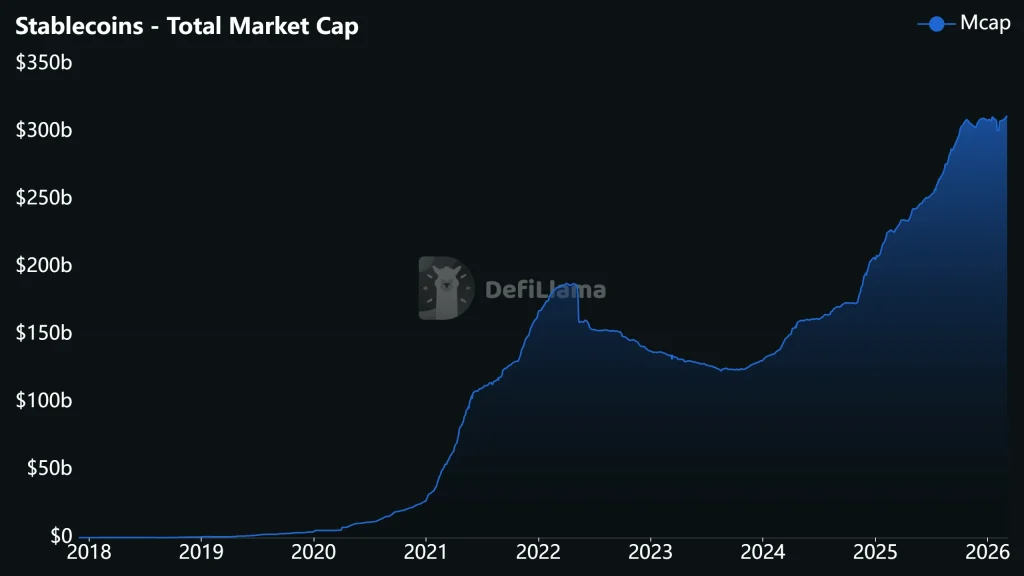
Chart of stablecoin market cap

Source: DefiLlama

Bitcoin Falls Below $70K as Short-Term Sell Pressure Mounts, Is Capitulation Imminent?

Bitcoin Price Crash Today Has Bitcoin Entered a Bear Market

The post Bitcoin Falls Below $70K as Short-Term Sell Pressure Mounts, Is Capitulation Imminent? appeared first on Coinpedia Fintech News

Following a three-day streak above $70K, Bitcoin (BTC) has fallen below this resistance level, trading at $68,131 (down 3.96% in 24) at the time of writing.

Blockchain analytics firm CryptoQuant shows that Bitcoin selling pressure among short-term holders (STHs), or people who hold BTC for less than 155 days, has recently spiked. 

In the last 24h, panic-led STHs have sold over 27,000 BTC for profit on exchanges. This marked the highest level observed in recent months, signaling an upcoming capitulation phase.

STH Selling Pressure Emerges Despite BTC Recovery

“Over the past 24 hours, STHs have sent more than 27,000 BTC in profit to exchanges, which ranks among the highest levels observed in recent months.” – By @Darkfost_Coc pic.twitter.com/0gsKZM6LT3

— CryptoQuant.com (@cryptoquant_com) March 6, 2026

Another crypto analyst noted that Bitcoin formed a new death cross on March 3. On this day, the 50-day simple moving average crossed below the 200-day average, signaling bearish momentum.

It's happening! $BTC https://t.co/9vGw5OebLw pic.twitter.com/qhqvnAOanL

— Ali Charts (@alicharts) February 27, 2026

Is Bitcoin entering a capitulation period?

The death cross has historically signalled an upcoming capitulation phase, followed by a bottoming-out phase. Crypto markets fell an average of 52%, 50%, and 46% following death crosses in 2014, 2018, and 2022, respectively.

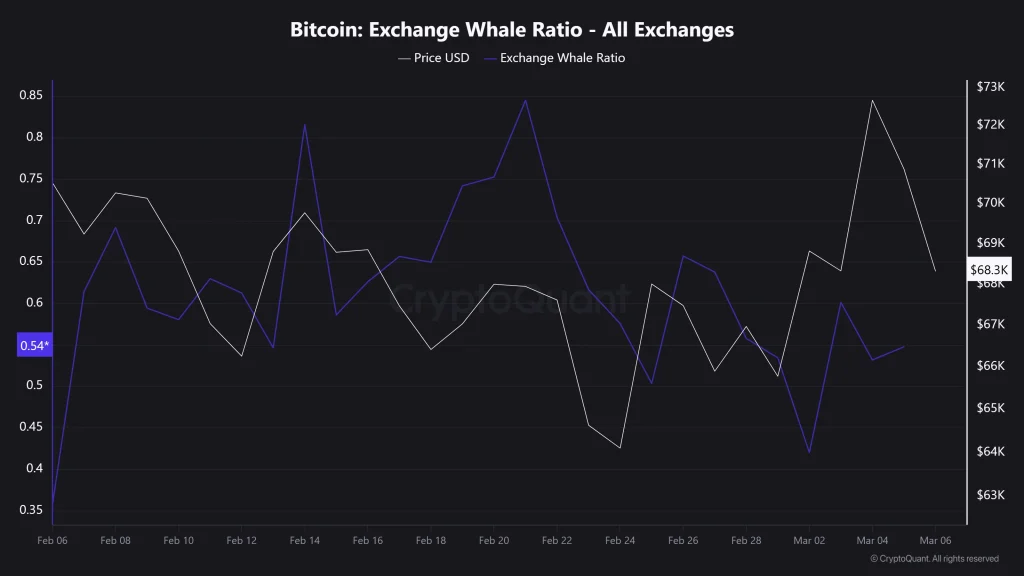
CryptoQuant shows a Bitcoin Exchange Whale Ratio (EWR) of 0.54, suggesting whales are increasingly moving their crypto assets to exchanges.

Bitcoin Exchange Whale Ratio

Source: CryptoQuant

Additional metrics supporting the bearish case include Bitcoin’s open interest dropping by 3.94% in the past day to $45.13 billion, while liquidations mounted to $159.29 million. 

Just yesterday, Bitcoin spot ETF outflows reached $228 million, reversing a 3-day inflow streak. BlackRock, the largest issuer of crypto ETFs globally, has placed a 5% quarterly cap on withdrawals, seemingly overwhelmed after surging withdrawal requests. Institutional crypto lender BlockFills is preparing for “restructuring” due to a liquidity crisis brought on by $75 million in losses in early 2025.

Rising oil prices amid the prevailing US-Iran war, inflationary fears, and heightened unemployment rates have also triggered de-risking among investors.

What Next?

Technically, Bitcoin could consolidate between $68-$70K if it holds above the $67,757 swing low. Failure to attain this would risk a test of $65K.

The community also awaits broader market price reactions to the March 18 US Federal Reserve policy announcement.

Suspect Arrested for Alleged $46M Heist of Seized Crypto Assets

Google’s Quantum Computing Could Threaten Bitcoin Encryption, Warns NYDIG

The post Suspect Arrested for Alleged $46M Heist of Seized Crypto Assets appeared first on Coinpedia Fintech News

John Daghita, aka Lick, was arrested today by the Federal Bureau of Investigation (FBI) in the Caribbean for allegedly stealing $46 million worth of seized crypto assets from the US Marshals Service (USMS).

Suspect arrested for $46M grand crypto theft

The heist began in 2024, when Command Services & Support, Inc. (CMDSS), a technology company, was awarded a contract to handle asset disposal for the US Department of Justice (DoJ) and the Department of Defense (DoD). Dean Daghita was head of the company while his son John worked as an employee.

Per the ZachXBT (revealer of the Axiom insider trading) expose, John allegedly used his status to withdraw confiscated cryptocurrencies to his personal wallets.

He remained anonymous until January 23, 2026, when he decided to flaunt his success to another confessed thief by the name of Dritan Kapplani Jr. 

A recording of this interaction shows how John revealed his wallet address, which ZachXBT then linked to several scams and a US Government address from which digital assets had been siphoned in 2024.

11/ Threat actors only continue to showing off stolen funds in leaked recordings rather than simply just staying quiet after an alleged theft from the US Government.

In this case John was ragebaited by Dritan into going band for band and the proof of ownership for these wallets… pic.twitter.com/kXl5HDGUSP

— ZachXBT (@zachxbt) January 23, 2026

Shortly after ZachXBT publicized the investigation, John made changes to his Telegram account in a failed attempt to mask his identity. He also dusted the investigator’s account by sending him 0.0067 ETH. The CMDSS website, X, and LinkedIn accounts have since been deactivated.

A drop in the ocean

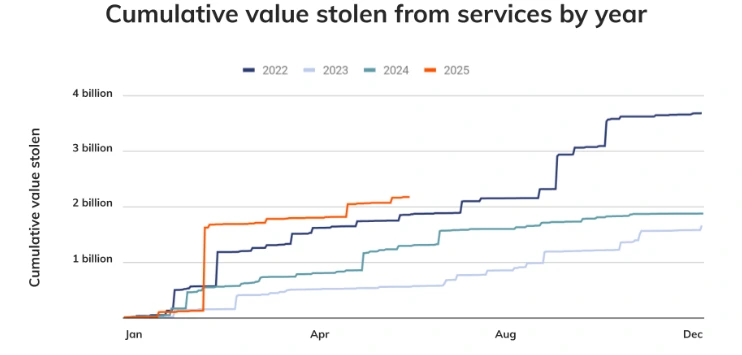
By mid-2025, stolen cryptocurrencies surpassed $2.17 billion (more than all of 2024), according to the Chainalysis 2025 Crypto Crime Report. Of these, $1.5 billion was related to the Bybit exchange hack.

Crypto assets stolen over the years

Source: Chainalysis

This year, Apple cautioned iOS users of the “Coruna” exploit, which hunts for crypto wallet seed phrases in phones running iOS 13.0 through 17.2.1, but not later (iOS 18+). The malware is estimated to have affected at least 42,000 devices.

More recently, South Korea’s tax agency mistakenly revealed its virtual asset wallet seed phrase online, leading to the loss of $4.8 million worth of tokens.

Bitcoin Miner Core Scientific Secures up to $1B Morgan Stanley Funding for AI Pivot

New Hampshire Crypto Mining Bill

The post Bitcoin Miner Core Scientific Secures up to $1B Morgan Stanley Funding for AI Pivot appeared first on Coinpedia Fintech News

On Thursday, Bitcoin mining company Core Scientific Inc. (Nasdaq: CORZ) announced that it had secured up to $1 billion from Morgan Stanley (NYSE: MS) to accelerate the shift of its Bitcoin mining facilities (all 10 sites) into AI data centers.

Per terms of the agreement, Core Scientific will receive an initial $500 million, 364-day loan. An accordion feature allows it to increase this amount to up to $500 million.

The firm will use the funding to purchase equipment, land, and cover the extra energy costs associated with high-density colocation for its AI clients.

Core Scientific stimulus loan to transition to AI

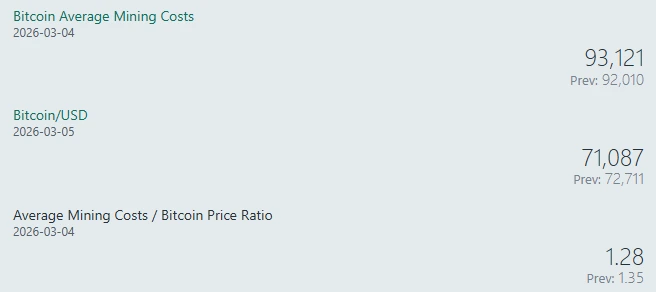
The recent development comes after Core Scientific reported missing Q4, 2025 revenue estimates by over $44 million. This happened as Bitcoin dropped from its 2025 all-time high of $126K to a 2025 low of $71K, with miners’ production costs at roughly $93K. At press time, Bitcoin was yet to escape this miner capitulation zone, trading at $71,086.

Ratio of Bitcoin mining costs to BTC price

Source: MacroMicro

To counter these negatives, Core Scientific recently dumped nearly all (2,537) of its Bitcoin holdings to fund AI infrastructure. The company is also in a $10 billion partnership with the AI cloud platform CoreWeave, where it provides the AI facilities necessary for CoreWeave’s graphical processing units (GPUs).

Pragmatic approach towards profitability

Core Scientific is one among many large-scale Bitcoin miners that have partially or fully transitioned into AI data centers. Others include Iris Energy, Cipher Mining, TeraWulf, and Hut 8 Corp.

The move is supported by their pre-existing electric grids and pre-allocated power capacity, in addition to physical infrastructure such as land, warehousing, and cooling facilities. 

Hosting AI will now generate up to 25X more revenue per kilowatt-hour than Bitcoin mining. This income will also be tied to the dollar, making it more stable than that tied to Bitcoin.

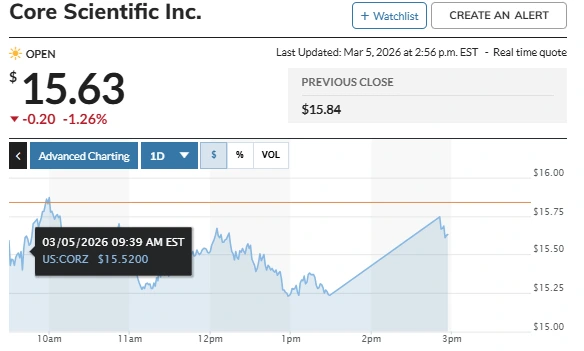
Core Scientific stock is yet to reflect this development, trading at $15.67 (-1.07% in 24h) at press time.

Core Scientific stock price chart

Source: MarketWatch

Will the Trump Fed Nominee Kevin Warsh Catapult Bitcoin to $80K?

Israel controls Bitcoin fact check

The post Will the Trump Fed Nominee Kevin Warsh Catapult Bitcoin to $80K? appeared first on Coinpedia Fintech News

On March 4, US President Donald Trump officially nominated Kevin Warsh as Chairman of the US Federal Reserve. Following Senate approval, Warsh will succeed Jerome Powell, whose second four-year term expires on May 15, 2026.

Bitcoin and other markets’ reaction to the announcement

In the past decade, Warsh has compared Bitcoin to gold on several occasions, stating, “If you’re under 40, Bitcoin is your new gold,” and that Bitcoin is a “sustainable store of value, like gold.” Last year, he described the digital asset as a “good policeman” for federal policy.

This advocacy and his recent nomination have sparked a risk-off attitude among crypto and stock markets alike. 

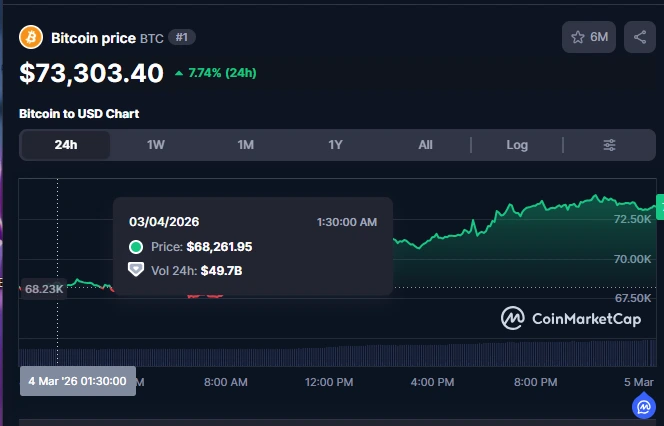
At writing time, Bitcoin was trading at $73,599, up 7.54% over 24h.

Bitcoin price chart

Source: CoinMarketCap

The digital asset also led crypto ETFs’ inflows, which reached $1 billion in the past week and broke a five-week streak of outflows totaling $4 billion. Meanwhile, the Nasdaq Composite and the S&P 500 rose 1.5% and 0.9%, respectively.

What’s next?

The January 30 “Warsh Shock” saw markets bleed in anticipation of tight Warsh-led monetary policies. Markets now depict recovery, after the Fed nominee called for interest rate cuts.

Critics view his nomination as “unconventional” since, unlike his predecessors, he lacks a Ph.D. Others add that Trump ties make his endorsement “politically dependent.” Meanwhile, Senator Thom Tillis has blocked the nomination until the Department of Justice (DoJ) completes its criminal investigation of Powell.

Analysts from Kalshi traders project the market could hit $80,000 this month. This theory is supported by the 24h upsurge in Bitcoin open interest to $50.31 billion (14.79%).

BREAKING: Our traders forecast Bitcoin will hit $80,000 this month pic.twitter.com/jhZ9XzXpyF

— Kalshi Traders (@KalshiTrade) March 4, 2026

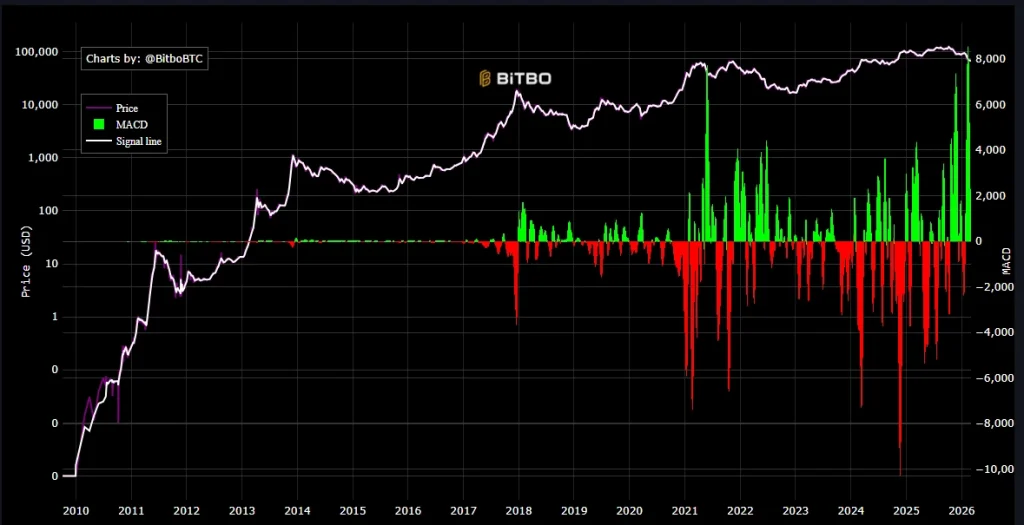
BTC’s Moving Average Convergence Divergence (MACD) histogram has also gradually declined, suggesting dissipating sell pressure.

Bitcoin MACD indicator chart

Source: Bitbo

Meanwhile, the taker buy/sell ratio on Binance has risen to a high of 1.18, showing buyers are outweighing sellers.

Analysts propose that a consistent daily close above $71-$72K is required to hit a target of $84K.

Stablecoins Weaken Eurozone Monetary Policy Transmission: European Central Bank

Meta Plans Another Stablecoin Launch in 2026 for Its Digital Payment Systems

The post Stablecoins Weaken Eurozone Monetary Policy Transmission: European Central Bank appeared first on Coinpedia Fintech News

In a March 3 report titled “Stablecoins and Monetary Policy Transmission”, the European Central Bank (ECB) warned that increased stablecoin adoption was undermining financial stability and policy effectiveness in the eurozone.

ECB outlines the cascade of risks imposed by stablecoins 

According to the ECB, as more people swap the euro for these virtual currencies, banks lose a stable and low-cost source of funding from retail deposits.

This forces them to switch to the more expensive wholesale funding that comes with volatile interest rates for both the banks and the customers they lend to.

ECB estimates that for every 10% increase in stablecoin market cap, there will be a 0.2% reduction in bank lending. It further adds that interest cuts to stimulate the economy would be useless, since banks will have tightened their lending policies to keep their operations afloat.

The ECB adds that widespread adoption would import US monetary conditions to Europe since most (85%+) of these digital currencies are dollar-backed.

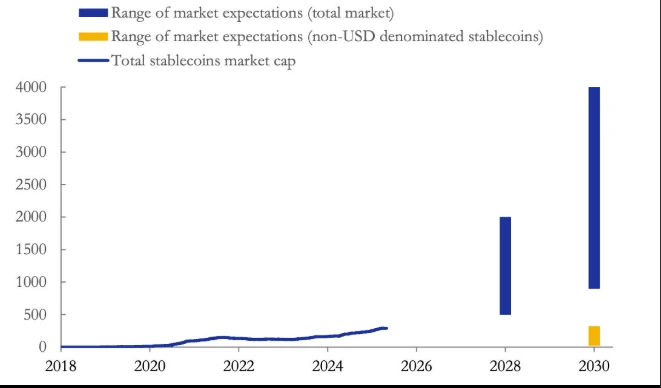
The ECB projects a non-linear pattern to these effects, saying that they would accelerate should the digital currency market cap hit $2-$4 trillion by 2030.

Stablecoins market cap growth over time

Source: European Central Bank

To counter these risks, the ECB is promoting the digital euro, which it says is safer from a bank run than private stablecoins

Growth and adoption headwinds

As of March 4, 2026, the global stablecoin market capitalization was approximately $316.27 billion. While this is dwarfed by the eurozone’s €17 trillion bank deposits, its growth is notable since it has more than doubled in the past three years.

Despite this, the banking industry is strongly pursuing a stablecoin-yield ban with the upcoming CLARITY Act. US President Donald Trump has vowed to look into this, saying, “They (banks) need to make a good deal with the crypto industry.”

America can’t afford to wait. Congress must move quickly to pass the Clarity Act.

Let’s make the U.S. the digital asset capital of the world. https://t.co/bL9WOeOkZr

— Senator Cynthia Lummis (@SenLummis) March 3, 2026

French Hill, the Chairman of the House Financial Services Committee, recently suggested the Senate could simply label stablecoins as a payment device rather than an investment product, just as stipulated by the GENIUS Act.

Moderator: “You also need to figure out crypto.” Chairman of @FinancialCmte @RepFrenchHill: “Well, I have figured it out!”

Hill, at the @MilkenInstitute Future of Finance event, said that if the Senate can’t reach a straightforward conclusion on the stablecoin yield issue,… pic.twitter.com/rZQch3IQUc

— Eleanor Terrett (@EleanorTerrett) March 3, 2026

Meanwhile, TD Cowen multinational investment bank, said banks will likely lose the stablecoin-yield fight.

Indiana Mandates Crypto Inclusion in State-Managed Retirement and Savings Plans

Indiana’s New Crypto Bill Bitcoin ETFs for Pension Funds

The post Indiana Mandates Crypto Inclusion in State-Managed Retirement and Savings Plans appeared first on Coinpedia Fintech News

Indiana has become the first state in the US to legalize the inclusion of Bitcoin and other cryptocurrencies into state-managed retirement and savings plans.

On March 3, Indiana Governor Mike Braun signed this into law under House Bill 1042, titled “Regulation and Investment of Cryptocurrency.”

Henceforth, state-managed retirement and savings plans should provide at least one cryptocurrency as an investment option in a user’s self-directed brokerage account. This kind of account will allow users to operate nodes and engage in peer-to-peer transactions.

Exchange-traded funds (ETFs) can be included in these plans, but not stablecoin-related funds due to the current lack of clarity regarding stablecoin yields. 

Pension providers now have until July 1, 2027, to have fully integrated digital asset provisions into their systems.

Indiana Bill to include crypto investments for pensioners

The Indiana bill levels the playing field for digital and traditional finance, banning any taxes that bring discrepancies between the two.

Also part of the bill was the prohibition of unreasonable restrictions on crypto mining zones.

Crypto included in pension fund portfolio in Indiana

Source: X

Other US states that have integrated crypto-related options for pensioners are Wisconsin ($321 million in Bitcoin ETFs) and Michigan ($45 million in BTC and ETH ETFs). Florida and New Jersey are in the process of doing the same.

Internationally, countries that have implemented or are exploring the incorporation of digital assets into pension funds include Canada, Japan, Australia, and Germany.

Providing these at the workplace are Fidelity Investments, 401(k) providers, and self-directed IRA (Individual Retirement Account) custodians.

Community Reaction

The new Indiana legislation has received mixed community reactions following its enactment. Supporters cite the bill’s alignment with the US Strategic Bitcoin Reserve, its progressive nature, and the provision of pensioners’ autonomy.

On the other hand, critics cite financial risk from dabbling in highly volatile financial instruments, in addition to the state’s distancing itself from direct digital asset investments. The bill also raised controversy regarding Indiana’s specific stance when it comes to cryptocurrencies amid the recent scam-related ban of crypto ATMs.

Iranians Increase Self-Custody Bitcoin Reserves Amid Iran-Israel War

Bitcoin Price Prediction by Wikipedia Co-Founder $10,000 or Lower for BTC

The post Iranians Increase Self-Custody Bitcoin Reserves Amid Iran-Israel War appeared first on Coinpedia Fintech News

Citizens of Iran are heavily purchasing Bitcoin (BTC) and directing it to self-custody wallets. 

A 2026 report from blockchain analytics firm Chainalysis showed an uptick in Iran’s crypto system valuation from $7.4 billion in 2024 to $7.8 billion in 2025. 

The report also highlighted that users withdrew roughly $10.3 million worth of cryptocurrencies from major Iranian exchanges to crypto wallets in the 48hours following the US-Israel’s preemptive strike on Iran. Within minutes of the hit, the country’s largest exchange, Nobitex, saw a staggering 700% spike in outflows.

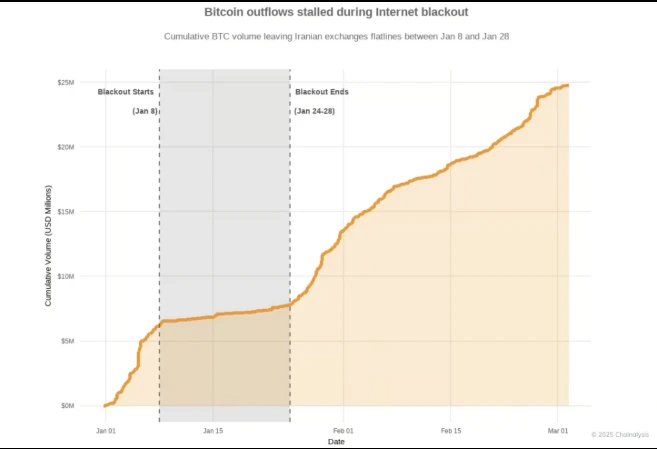
This coincided with a steady uptrend in Bitcoin outflows before and after the January 8 government-imposed internet blackout.

Bitcoin outflows from exchanges in Iran

Source: Chainalysis

Bitcoin becomes the financial lifeboat for Iranian citizens

Bitcoin has primarily become a financial haven for Iranians since its long-term value acts as an inflationary hedge. Iran’s native currency, the Rial, has declined 90% in value since 2018. Inflation in the country has also escalated to 40-50%, the highest recorded since World War II.

Additionally, Bitcoin in self-custodial wallets is immune to state/exchange restrictions and security vulnerabilities. In mid-2025, Nobitex suffered a $90 million hack, while Tether continues to blacklist addresses and freeze USDT funds for alleged Iranian conspirators. 

Meanwhile, the nation’s central bank (CBI) has suspended rial-crypto conversions several times to prevent further devaluation of the rial. The bank has recently become more accommodating of cryptocurrencies, but on the condition of real-time user surveillance.

Another reason for the migration is the January government-imposed internet blackout, which rendered cryptocurrencies on exchanges useless. Additionally, cryptocurrencies’ digital nature makes them highly portable for those anticipating fleeing the country. 

Most importantly, cryptocurrencies allow cross-border remittances despite sanctions such as the SWIFT bank line of disconnects.

Researchers now estimate that 15 million Iranians (20% of the population) are involved with or using Bitcoin, among other cryptocurrencies.

Iran joins sanctioned countries in Bitcoin adoption

Iran, Russia, Venezuela, and North Korea are sanctioned countries that are increasingly pivoting towards cryptocurrencies to bypass international trade restrictions.

Crypto firms Binance and, ironically, the Trump-backed World Liberty Financial (WLFI) are now facing Senate probes related to Iran-linked flows.

❌