Reading view

Bitcoin Exchange Reserves Drop to 2019 Levels: Is a BTC Supply Shock Coming?

Core Scientific Sells 1,900 BTC

The post Bitcoin Exchange Reserves Drop to 2019 Levels: Is a BTC Supply Shock Coming? appeared first on Coinpedia Fintech News

Bitcoin exchange reserves drop to their lowest levels in nearly six years, and the shift could quietly reshape the market’s supply dynamics. Recent on-chain data indicates that the amount of BTC held on centralized exchanges has fallen back to levels last seen in 2019, highlighting a significant structural change in how investors are choosing to hold the asset.

While price volatility often dominates market headlines, deeper indicators such as exchange reserves can reveal important changes in supply and liquidity. With institutional demand rising and more investors opting for self-custody, the pool of Bitcoin available for active trading may be shrinking. This development has now sparked a key question across the crypto market: could declining exchange reserves become the next bullish catalyst for Bitcoin price?

Bitcoin Exchange Reserves Drop to Multi-Year Lows

According to on-chain data, Bitcoin exchange reserves have declined to roughly 2.7 million BTC, marking the lowest level since 2019. The trend has been unfolding gradually over several years but accelerated significantly following the collapse of centralized platforms during the 2022 market crisis. After the FTX collapse, investors rushed to withdraw funds from exchanges and move their Bitcoin into private wallets. In November 2022 alone, more than 325,000 BTC left exchange reserves, marking one of the largest single-month outflows in Bitcoin’s history.
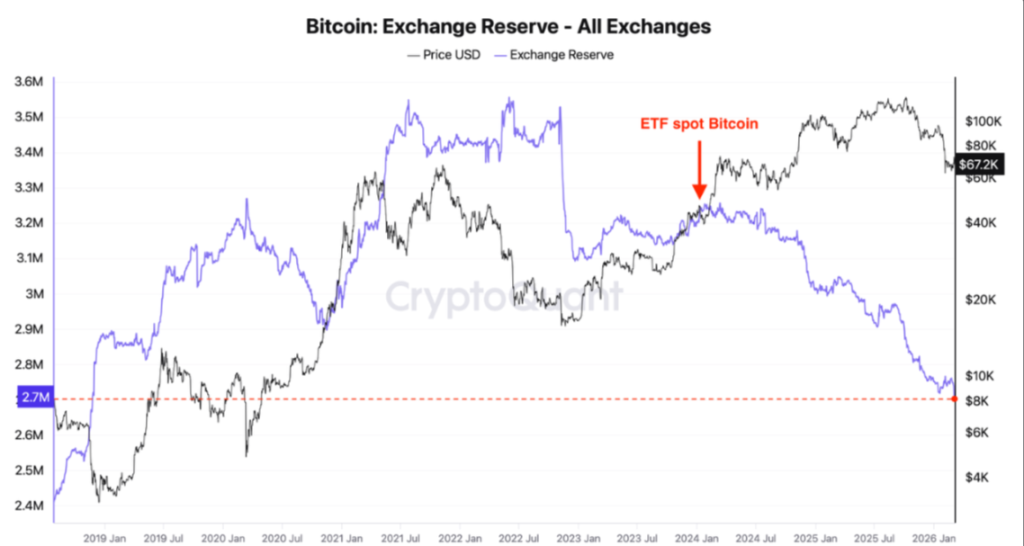
Bitcoin Exchange Reserves Drop

Even years after that event, the downward trend has continued, suggesting a long-term shift toward self-custody and long-term holding strategies.

Among centralized exchanges, Binance currently holds around 20% of all exchange-based BTC reserves, making it the largest retail liquidity hub. Meanwhile, Coinbase Advanced reportedly holds nearly 800,000 BTC, although this is roughly 200,000 BTC lower than levels seen in mid-2025.

Spot Bitcoin ETFs Are Absorbing Supply

Another key factor behind why Bitcoin exchange reserves drop is the rapid rise of spot Bitcoin ETFs. Since their launch in early 2024, institutional investors have been steadily accumulating Bitcoin through regulated investment products. At the time ETFs entered the market, exchange reserves were still above 3.2 million BTC. Today, these funds collectively hold roughly 1.3 million BTC, representing about 6–7% of Bitcoin’s circulating supply.

Because ETF holdings are typically stored with custodians rather than exchanges, this Bitcoin is effectively removed from the liquid trading supply.

As ETF inflows continue, the amount of Bitcoin available on exchanges may keep declining.

Corporate Bitcoin Treasuries Continue to Grow

Corporate treasury strategies are also contributing to the trend where Bitcoin exchange reserves drop. Over the past few years, several companies have adopted Bitcoin as a strategic reserve asset, allocating BTC to their balance sheets as a hedge against currency debasement and macroeconomic uncertainty. Collectively, corporate treasury entities now hold around 1.1 million BTC, which accounts for roughly 5% of the total circulating supply.

Unlike short-term traders, these organizations typically follow long-term accumulation strategies, meaning their Bitcoin is unlikely to return to exchanges anytime soon. This further reduces the liquid supply available for active market trading.

What This Means for Bitcoin Price

When Bitcoin exchange reserves drop, it often signals tightening supply conditions across the market. With more BTC moving into long-term storage, ETFs, and corporate treasuries, fewer coins remain available for immediate trading on exchanges.

Historically, declining exchange reserves have sometimes preceded supply-driven price expansions, particularly when demand simultaneously increases. While the impact may not appear immediately, analysts believe the ongoing reduction in exchange balances could play an important role in shaping Bitcoin’s next market cycle.

Chainlink Price Forms Breakout Setup as Inflows Rise: What Charts Reveal

Chainlink Price Targets $53 Could LINK Be the Next Blue Chip to Rally

The post Chainlink Price Forms Breakout Setup as Inflows Rise: What Charts Reveal appeared first on Coinpedia Fintech News

Chainlink price has been quietly building strength while much of the crypto market struggles to regain momentum. Despite broader uncertainty and volatility across major altcoins, LINK has managed to hold a critical support region while gradually tightening its price range. This type of compression often appears before major directional moves, and the latest on-chain data suggests investors are still positioning around the Chainlink ecosystem.

At the same time, LINK price is now trading close to a key descending resistance trendline, raising an important question for traders: Is Chainlink preparing for a breakout rally, or will the consolidation continue? A closer look at capital flows and the chart structure may provide the answer.

LINK Attracts Fresh Capital Despite Market Weakness 

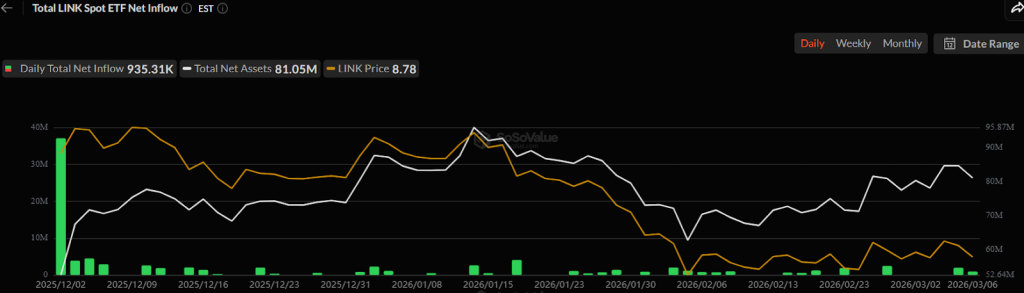
One of the most notable signals supporting the current Chainlink price outlook is the steady inflow of capital into LINK-related investment products. Recent data shows that Chainlink recorded approximately $935K in inflows on March 6, following $1.93 million in inflows the previous day.

This pushed the cumulative inflow figure to nearly $90.66 million, highlighting continued interest in the Chainlink ecosystem. What makes this development particularly important is that the inflows are occurring during a weak market environment, when many altcoins are experiencing capital outflows.

LINK ETF inflows

Sustained inflows during uncertain market conditions often indicate strategic accumulation, where investors gradually increase exposure while prices remain compressed. For Chainlink, which plays a critical role in providing decentralized oracle infrastructure, this continued capital flow reflects ongoing demand for its underlying technology.

Chainlink Price Tightens Near Key Trendline: Is $12 Level Next?

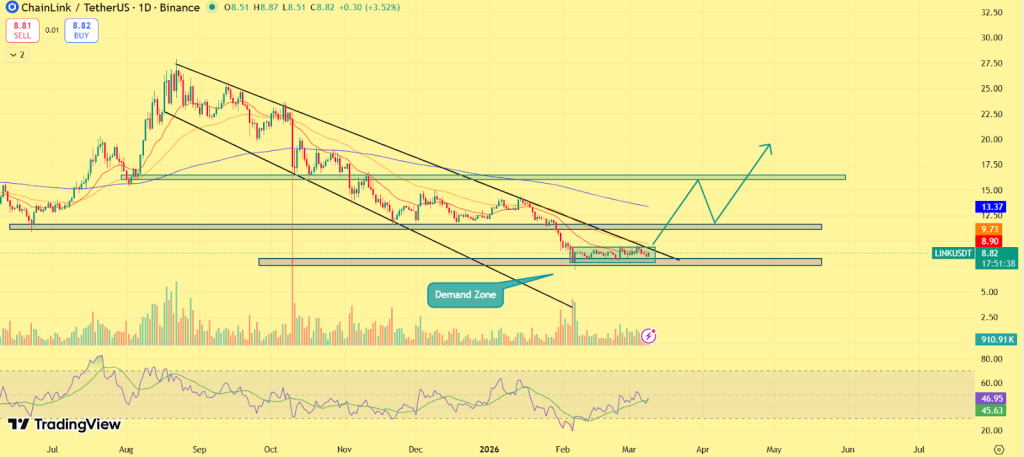
Chainlink price is currently forming a tightening consolidation pattern. The chart shows LINK trading inside a structure defined by a descending resistance trendline and a stable support zone near $8.40–$8.60.

This pattern has produced a sequence of lower highs, but buyers continue defending the lower boundary of the range. Such compression typically indicates a buildup of market pressure, where volatility gradually contracts before a larger move unfolds. LINK price remains inside this structure, the stronger the eventual breakout tends to be.

Chainlink Price

With LINK now approaching the upper boundary of the trendline, the next move could determine the short-term direction. The most important level for Chainlink price right now is the descending resistance trendline near $9.20–$9.40. A decisive breakout above this region could allow LINK to reclaim the $10 psychological level, which has previously acted as a strong supply zone. If bullish momentum accelerates, analysts are watching the $11–$12 region as the next major upside target.

This zone aligns with previous consolidation areas seen during earlier phases of the market cycle. On the downside, the $8.40–$8.60 demand zone remains the key support structure. Holding above this region keeps the current breakout setup intact, while a breakdown below it could delay the bullish scenario. For now, the structure suggests that Chainlink price is approaching an important inflection point.

Final Outlook

Chainlink continues to show resilience in a market that remains uncertain. The combination of steady capital inflows and tightening price structure suggests that LINK may be entering a key decision phase. If buyers manage to push the token above its descending resistance trendline, the current consolidation could quickly transition into a stronger rally. Until then, the ongoing compression indicates that Chainlink price may be preparing for its next major move.

Internet Computer (ICP) Price Prediction 2026, 2027 – 2030: Is ICP Preparing a Move Toward $25?

Internet Computer Price Prediction

The post Internet Computer (ICP) Price Prediction 2026, 2027 – 2030: Is ICP Preparing a Move Toward $25? appeared first on Coinpedia Fintech News

Story Highlights

  • The live price of the ICP crypto is  $ 2.49805801.
  • If the recovery structure develops, ICP could gradually climb toward the $27 region by the end of 2026.
  • With stronger Web3 infrastructure adoption, ICP price could potentially expand toward $70 by 2030.

Internet Computer (ICP) has spent the past year rebuilding its market structure after one of the sharpest corrections among large-cap crypto assets. While the token once commanded significantly higher valuations during its early market debut, the current phase suggests a slow stabilization as the broader crypto market gradually prepares for its next expansion cycle.

Developed by the DFINITY Foundation, Internet Computer aims to extend blockchain capabilities beyond payments by enabling developers to build full-scale applications directly on-chain. The protocol functions as a decentralized cloud platform where websites, enterprise tools, and services can run entirely on blockchain infrastructure without relying on traditional cloud providers.

If the broader cryptocurrency market regains momentum and developer adoption continues expanding across decentralized computing platforms, Internet Computer could gradually regain investor attention over the coming years. So, let’s dive into Coinpedia’s Internet Computer (ICP) Price Prediction 2026, 2027 – 2030.

Internet Computer Price Today

Cryptocurrency Internet Computer
Token ICP
Price $2.4981 up 4.48%
Market Cap$ 1,372,523,557.56
24h Volume$ 56,507,719.2853
Circulating Supply549,436,223.5677
Total Supply549,436,223.5677
All-Time High$ 750.7305 on 10 May 2021
All-Time Low$ 1.9773 on 10 October 2025

Internet Computer (ICP) Price March 2026 Outlook

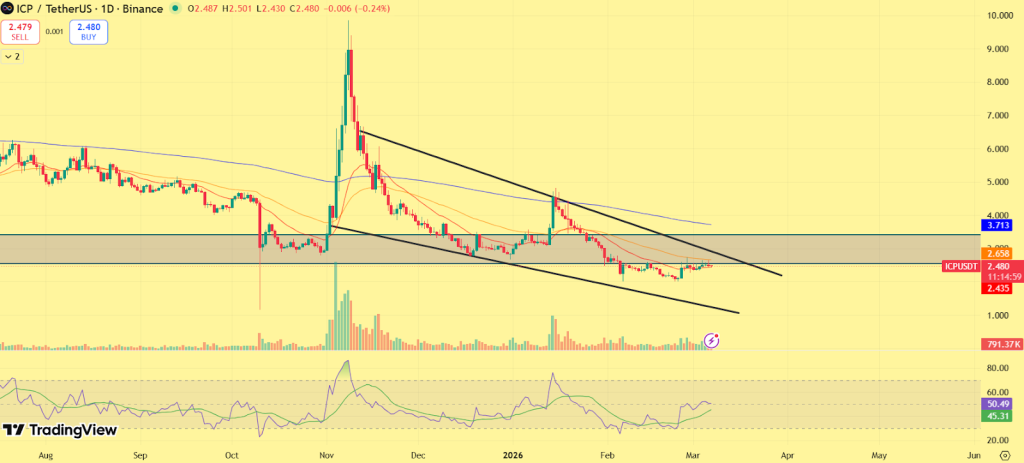
As March progresses, Internet Computer continues trading within a tight consolidation range near $2.40–$2.60, suggesting the market is waiting for a decisive breakout. The $2.20–$2.30 zone currently acts as a key support region. Holding above this level keeps the short-term recovery structure intact and signals that buyers remain active in the market.

On the upside, the first meaningful resistance sits around $3.50, where previous rallies stalled. If ICP manages to break above this area, momentum could push the price toward $5–$6, which historically acted as a major trading range. For now, the market appears to be in a consolidation phase where traders are watching whether the token can reclaim higher levels during the next market expansion.

Internet Computer Price Prediction 2026

Looking deeper into 2026, Internet Computer’s trajectory will likely depend on both technical recovery and broader Web3 infrastructure demand. The project continues positioning itself as a decentralized cloud platform, and if developer activity and ecosystem usage increase, market sentiment toward ICP could gradually improve. ICP first needs to stabilize above the $3–$4 region, which has repeatedly acted as a short-term ceiling during recovery attempts. A sustained move above this range would signal that buyers are slowly regaining control of the market. Once this zone is reclaimed, the next important resistance sits around $6–$8, an area where previous rallies in the past cycle lost momentum. Breaking this level would likely bring renewed investor interest and could open the door toward $12–$15, which historically acted as a major liquidity zone.

Internet Computer (ICP) Price Prediction 2026

If the broader cryptocurrency market enters another expansion phase and capital rotates back into infrastructure projects, ICP could gradually push toward $20–$27 by 2026, aligning with long-term recovery expectations.

However, the downside scenario should also be considered. If the market weakens or Bitcoin enters another prolonged correction, ICP could revisit $2–$2.20, which currently acts as the strongest long-term support zone. Losing this level could extend consolidation before a stronger recovery begins.

Overall, the 2026 outlook for Internet Computer remains cautiously optimistic. A combination of improving market liquidity, developer adoption, and stronger Web3 infrastructure demand could gradually help the asset rebuild its long-term value.

Internet Computer Crypto Price Prediction 2026 – 2030

YearPotential Low ($)Potential Average ($Potential High ($)
2026101827
2027142434
2028183045
2029254055
2030355070

Internet Computer Price Projection 2026

In 2026, Internet Computer  price could project a low price of $10, an average price of $18, and a high of $27

ICP Crypto Price Action 2027

As per the Internet Computer price Prediction 2027, Internet Computer   may see a potential low price of $14, The potential high for Internet Computer  price in 2027 is estimated to reach $34

Internet Computer Price Target 2028

In 2028, Internet Computer price is forecasted to potentially reach a low price of $18, and a high price of $45.

ICP Token Price Forecast 2029

Thereafter, the Internet Computer (ICP) price for the year 2029 could range between $25 and $55.

Internet Computer Price Prediction 2030

Finally, in 2030, the price of Internet Computer (ICP) is predicted to maintain a steady positive. It may trade between $35 and $70

Internet Computer Price Prediction 2031, 2032, 2033, 2040, 2050

Over the long term, the value of Internet Computer (ICP) will depend on Web3 adoption and the expansion of decentralized cloud services, which could support gradual growth across future market cycles.

YearPotential Low ($)Potential Average ($)Potential High ($)
2031406085
20324570100
20335085120
2040120185250
2050350520700

Internet Computer (ICP) Price Prediction: Market Analysis?

Year202620272030
Changelly$15$35$35
CoinCodex$18$42$50
WalletInvestor$20$38$45

CoinPedia’s Internet Computer Price Prediction

Coinpedia’s price prediction highlights that Internet Computer (ICP) appears to be entering a long-term accumulation phase following an extended correction period. If the project continues expanding its decentralized cloud ecosystem and attracts more developers building Web3 applications, the token could gradually regain market momentum.

In a favorable market environment, ICP could reach around $27 by 2026, while stronger adoption across decentralized infrastructure platforms could push the token toward $70 by 2030.

YearPotential Low ($)Potential Average ($)Potential High ($)
2026101827
Never Miss a Beat in the Crypto World!

Stay ahead with breaking news, expert analysis, and real-time updates on the latest trends in Bitcoin, altcoins, DeFi, NFTs, and more.

FAQs

What is Internet Computer (ICP) and what is it used for?

Internet Computer (ICP) is a layer-1 blockchain that lets developers build fully on-chain apps without traditional cloud servers.

What is the Internet Computer (ICP) price prediction for 2026?

ICP is projected to trade between $6 and $25 in 2026, depending on market momentum, support levels, and broader crypto sentiment.

How high can ICP price go by 2030?

If adoption of decentralized cloud platforms expands and crypto markets strengthen, ICP could potentially reach around $70 by 2030 in a strong growth cycle.

How much will ICP cost in 2035

Long-term models suggest ICP could trade between about $80 and $150 by 2035 if decentralized computing platforms gain wider adoption.

What will ICP be worth in 2040?

Long-term projections estimate ICP could range between roughly $120 and $250 by 2040, depending on Web3 adoption, developer activity, and broader crypto market growth.

What factors influence ICP price movements?

ICP’s price is influenced by market trends, developer adoption, token supply dynamics, network upgrades, and overall crypto sentiment.

Is ICP a good long-term investment?

ICP may suit long-term investors who believe in decentralized cloud computing, but price volatility means risk management is essential.

Hyperliquid Price Prediction: $680M Inflows and Falling Wedge Breakout Hint at $58 Target

Hyperliquid Unstakes 140K HYPE Tokens

The post Hyperliquid Price Prediction: $680M Inflows and Falling Wedge Breakout Hint at $58 Target appeared first on Coinpedia Fintech News

Hyperliquid price is gaining fresh momentum this week as the HYPE token trades near the $30 region, while nearly $680 million in capital inflows has entered the network. This surge in activity is now strengthening the broader Hyperliquid price prediction narrative among traders and analysts.

The rapid rise in liquidity, combined with strong protocol revenue and expanding derivatives trading activity, has pushed the decentralized trading platform into the spotlight across the crypto market.

With improving fundamentals and strengthening technical signals, traders are increasingly asking: Could Hyperliquid price rally toward the $55–$58 range in the coming weeks?

Hyperliquid Sees $680M Weekly Capital Inflows

One of the biggest catalysts supporting the current Hyperliquid price prediction outlook is the sharp increase in capital entering the ecosystem.

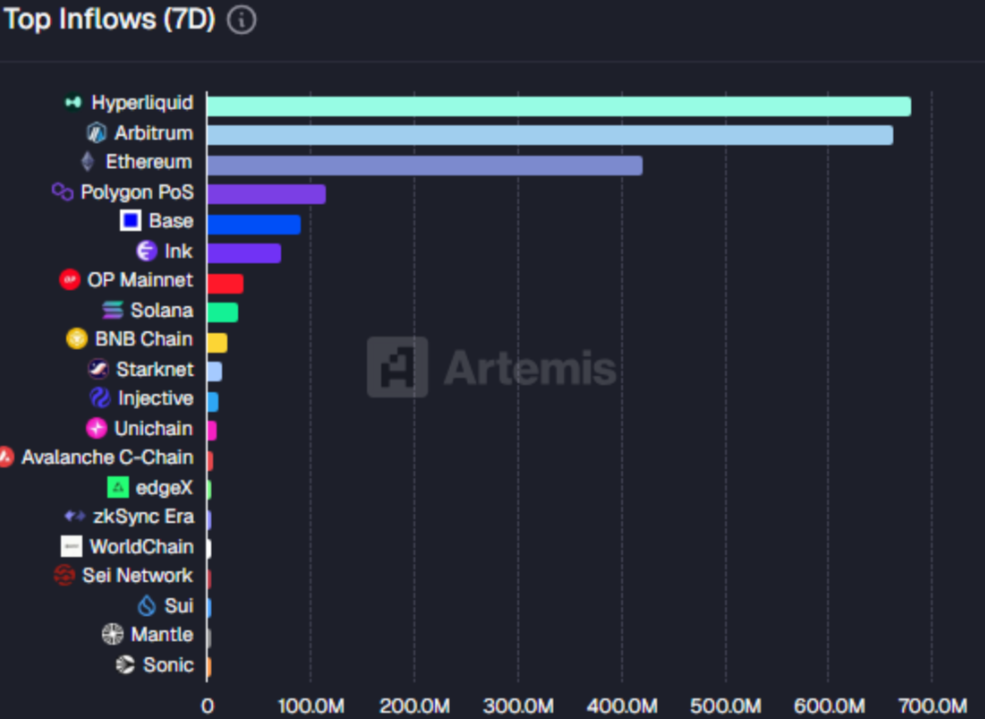
According to data from blockchain analytics platform Artemis, Hyperliquid recorded around $680 million in net inflows during the past week, making it the top-performing blockchain network in terms of capital growth during that period. 

Hyperliquid inflows

The platform outpaced several major ecosystems including Ethereum, Polygon, and Arbitrum, which followed behind in weekly inflows.

Large capital inflows typically indicate growing investor confidence and expanding liquidity, both of which tend to support stronger price momentum for network tokens. For derivatives-focused platforms like Hyperliquid, rising liquidity is particularly important because it improves market depth, trading efficiency, and platform usage. The latest inflow surge suggests that traders are increasingly viewing Hyperliquid as a rapidly growing infrastructure layer for decentralized derivatives trading.

Hyperliquid Price Analysis: Falling Wedge Breakout Signals Potential Rally

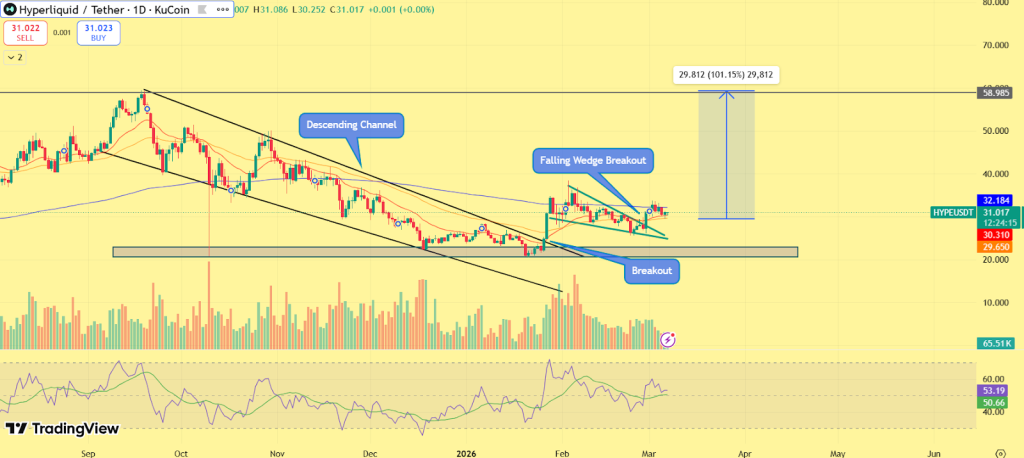
Hyperliquid price is beginning to show signs of a bullish reversal. The HYPE token had previously been trading inside a descending price structure, reflecting the broader consolidation phase seen across the crypto market in recent months.

Hyperliquid price prediction

However, recent price action indicates that Hyperliquid price is attempting to break out of a falling wedge pattern, a structure commonly viewed by analysts as a bullish reversal formation. Following the breakout attempt, the token is currently consolidating near the $30–$32 region, which is starting to act as an important short-term support zone. Immediate resistance sits around $32, a level that has capped several recent upward attempts. A strong breakout above this region could accelerate bullish momentum.

Based on the projected move from the wedge pattern, analysts are watching a potential upside target in the $55–$58 range, which would represent a major expansion if buying pressure continues.

Hyperliquid Leads Blockchains in Fee Generation

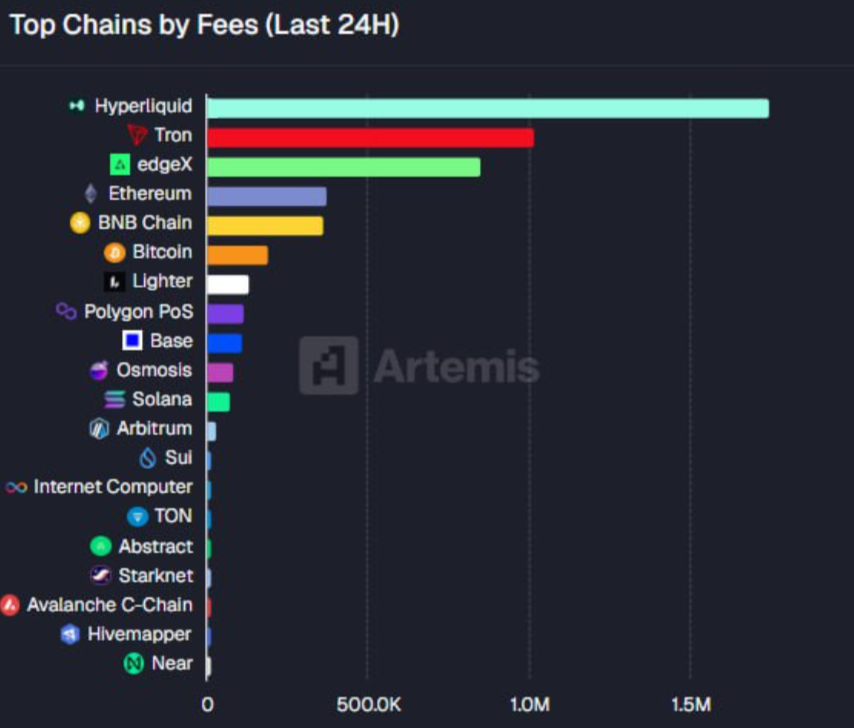
Another factor strengthening the Hyperliquid price outlook is the network’s rising protocol revenue. Recent data shows Hyperliquid generating approximately $1.7 million in fees within a single 24-hour period, making it the highest fee-generating blockchain during that timeframe.

The protocol managed to outperform several major networks including Ethereum, TRON, and BNB Chain, highlighting the scale of trading activity currently taking place on the platform.

Hyperliquid fees

In blockchain ecosystems, rising fee generation is widely considered a strong indicator of real network demand and user engagement. Higher fees typically reflect growing trading volume, deeper liquidity, and increasing adoption of the platform’s services. For Hyperliquid, this surge in protocol revenue suggests the platform is quickly evolving into one of the most actively used decentralized trading ecosystems in the crypto market.

Final Thoughts 

Hyperliquid is rapidly emerging as one of the fastest-growing ecosystems in decentralized derivatives trading. Strong capital inflows, rising protocol revenue, and expanding platform activity are reinforcing its long-term fundamentals. At the same time, Hyperliquid price is forming a bullish technical structure that could support further upside. If the token maintains support above the $30 zone and successfully clears the $32 resistance level, the current setup may evolve into the next major rally for the HYPE token.

FAQs

What is driving Hyperliquid’s recent price surge?

Hyperliquid’s price is rising due to $680M capital inflows, strong protocol revenue, and growing derivatives trading activity on the platform.

What is the current support and resistance for HYPE token?

HYPE token is consolidating near $30–$32, with $30 acting as support and $32 as immediate resistance for potential upside moves.

Why is rising protocol revenue important for Hyperliquid?

Higher revenue reflects growing trading volume, deeper liquidity, and increased platform adoption, supporting long-term token value.

Bitcoin Bottom Near? 5 On-Chain Signals Suggest the Bitcoin Price Bottom

Will Bitcoin Recover or Crash to $40K Next Analysts Can’t Agree

The post Bitcoin Bottom Near? 5 On-Chain Signals Suggest the Bitcoin Price Bottom appeared first on Coinpedia Fintech News

Bitcoin has entered March under heavy uncertainty. After weeks of volatile trading and macro-driven market pressure, Bitcoin price is hovering around the $70,000 region, leaving investors divided over whether the correction is over or if another drop lies ahead. Sentiment across the crypto market remains fragile, yet on-chain data is beginning to tell a different story. Several key metrics, many of which have historically appeared near major turning points, are now flashing signals that often emerge around a Bitcoin bottom or Bitcoin price bottom formation.

So the big question remains: Is the Bitcoin bottom already forming? Here are five on-chain signals suggesting the Bitcoin price bottom could be closer than many traders expect.

A Historic Bitcoin Exodus from Exchanges

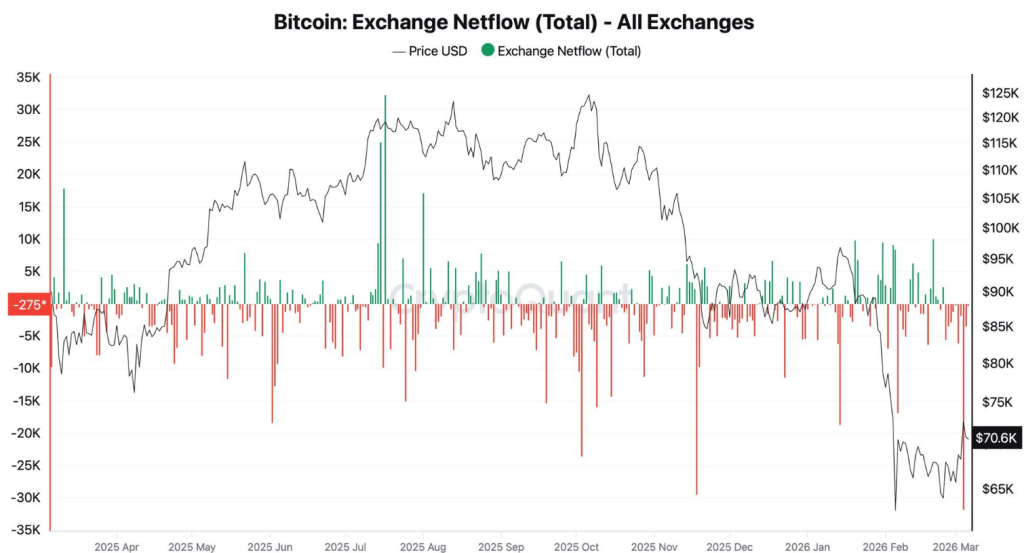
One of the clearest signals pointing toward a potential Bitcoin bottom comes from exchange flow data. Nearly 31,900 BTC, worth around $3 billion, was withdrawn from exchanges in a single day, marking one of the largest outflow events seen this year.

Bitcoin exchange data

When Bitcoin leaves exchanges at this scale, it usually indicates investors are moving coins into long-term storage rather than preparing to sell. Reduced supply on exchanges often appears during accumulation periods when experienced investors begin positioning for future price appreciation.

Historically, large exchange outflows have appeared near Bitcoin price bottom zones, when institutional and long-term investors accumulate while market sentiment remains pessimistic.

Short-Term Holder Selling Signals Capitulation

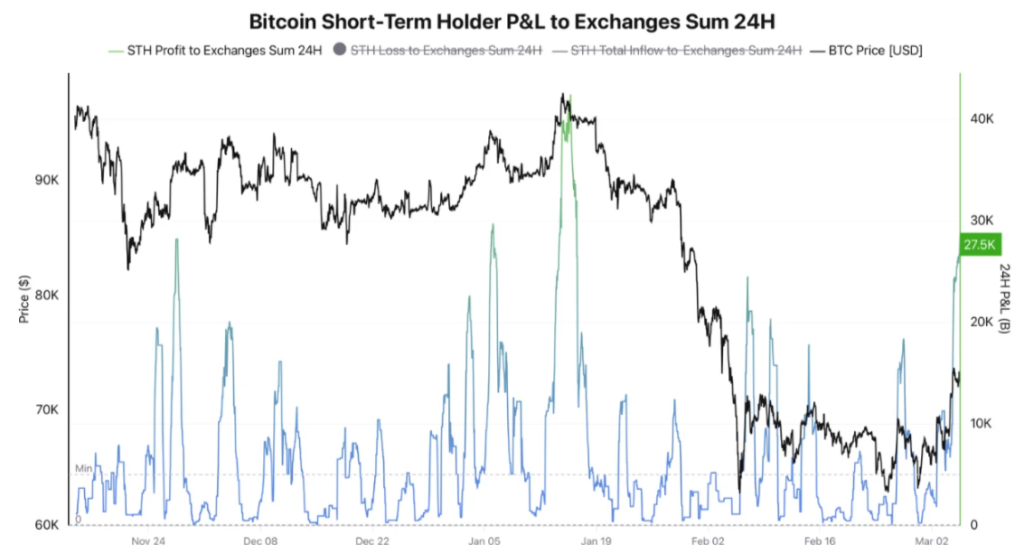
Another important signal comes from short-term holder behavior, which often reflects emotional reactions to market volatility. Recent data shows that more than 27,000 BTC in profit was sent to exchanges by short-term holders, one of the largest readings in recent weeks. Most of these coins were accumulated between one week and one month ago, with a realized price near $68,000.

BTC STH DATA

Short-term holders typically react quickly to uncertainty, often selling during corrections. Historically, this type of selling pressure tends to appear near Bitcoin price bottom formations, when weaker hands exit the market.

Rather than signaling structural weakness, the activity may represent a classic capitulation phase, where reactive traders sell while long-term investors quietly accumulate.

Long-Term Holders Are Accumulating Again

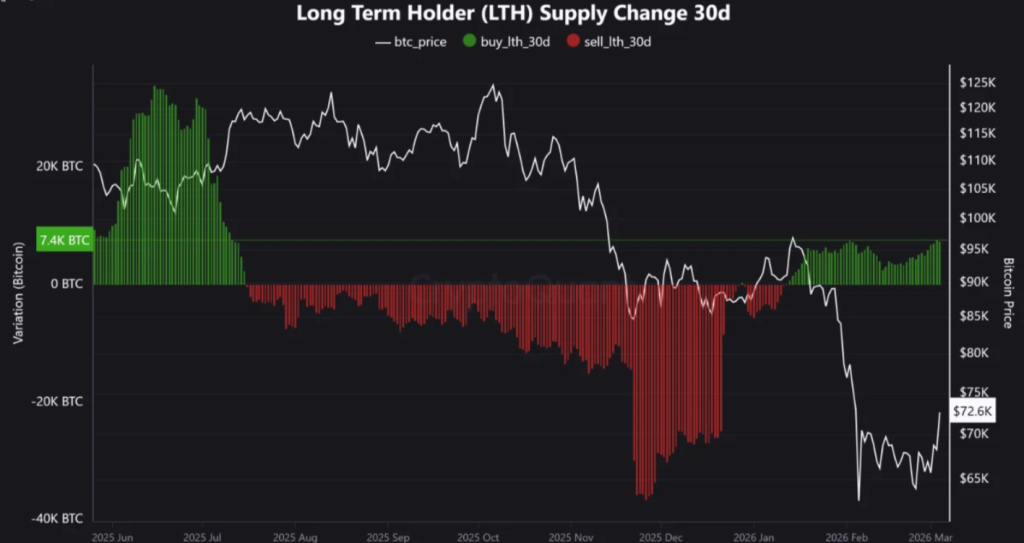
Long-term holder behavior is widely considered one of the most reliable indicators of a Bitcoin bottom. On-chain data now shows that long-term holders are accumulating Bitcoin at the fastest pace since July 2025, ending nearly eight months of steady distribution.

BTC LTH DATA

This group typically consists of experienced investors who accumulate during undervalued periods and distribute near market peaks. Historically, when long-term holders shift from selling to aggressive buying, Bitcoin often enters a macro accumulation phase that precedes the next major rally. The recent shift suggests these investors may believe the market is approaching a Bitcoin price bottom zone

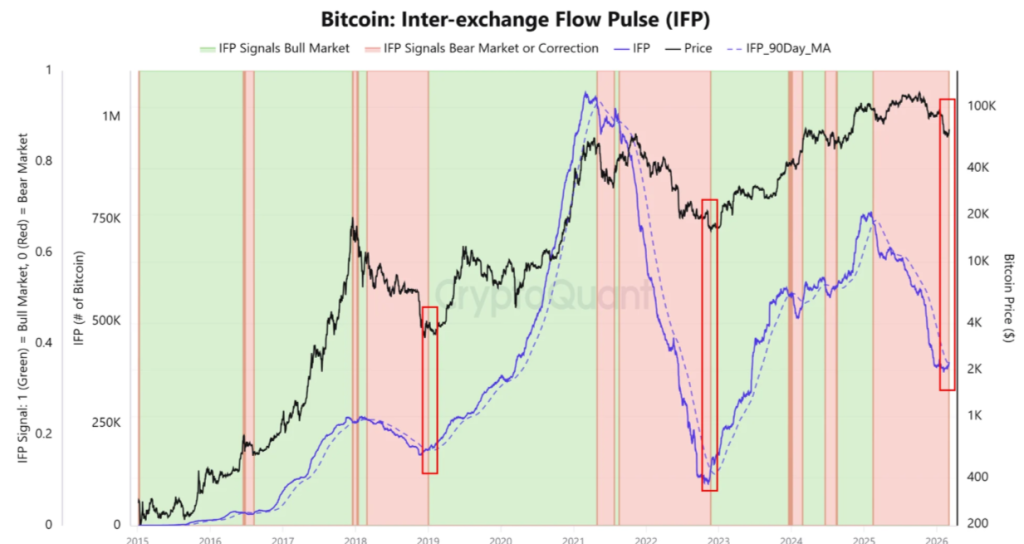
Inter-Exchange Flow Pulse Golden Cross Appears

Another signal comes from the Inter-Exchange Flow Pulse (IFP) indicator, which tracks Bitcoin movement between spot exchanges and derivatives markets.

BTC on chain

The indicator recently formed a golden cross, a signal that has historically preceded strong bullish phases in the Bitcoin market. Golden cross events in this indicator typically appear after extended consolidation or re-accumulation periods, suggesting market participants are shifting back toward spot accumulation rather than speculative derivatives activity. Analysts believe the signal could indicate that the current re-accumulation phase is nearing completion.

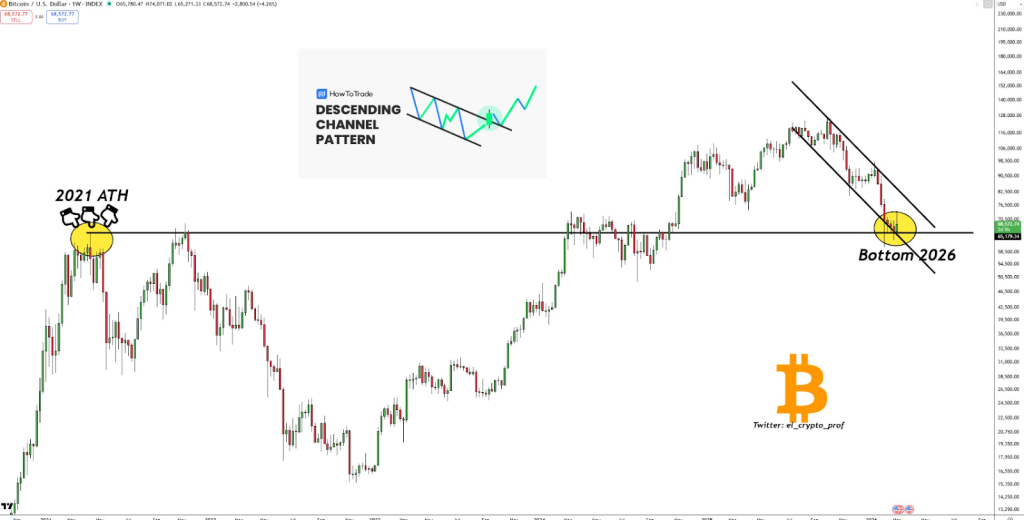
Bitcoin Holding the 2021 All-Time High Support

Bitcoin is currently trading near one of the most historically significant levels in its price structure, the 2021 all-time high region. This level has transitioned from major resistance into a long-term support zone, reinforcing the argument that the broader market structure remains strong despite recent corrections.

Bitcoin Price Bottom

Bitcoin price is also moving within a descending channel pattern, a formation that often appears during consolidation phases before bullish breakouts once selling pressure fades. If Bitcoin continues to hold above this region, analysts argue it could strengthen the case that the market is forming a macro Bitcoin price bottom, potentially laying the foundation for the next expansion phase of the cycle.

Final Words

Markets rarely confirm a bottom in real time, but several on-chain signals are beginning to align. Massive exchange outflows, renewed buying from long-term holders, and strong technical support near historic levels are patterns often seen around a Bitcoin bottom. While volatility may persist in the short term, the current data suggests Bitcoin could be stabilizing near a potential Bitcoin price bottom, with investors closely watching whether the market can defend key support levels in the coming weeks.

Why Crypto Market Is Down Today?

Crypto Market Crash Today Bitcoin Falls Below $66K, Ethereum and XRP Extend Losses

The post Why Crypto Market Is Down Today? appeared first on Coinpedia Fintech News

The crypto market is under pressure again after a brief recovery attempt earlier this week. Bitcoin had surged toward $73,000, sparking optimism that the broader market could regain bullish momentum heading into March. That optimism did not last long. As of March 7, the crypto market has turned lower again. Bitcoin has dropped toward $68,000, Ethereum price is trading near $1,976, and XRP has slipped toward $1.36.

The latest decline comes as traders react to a combination of macroeconomic shocks, including surging oil prices, a surprisingly weak U.S. jobs report, and a wave of leveraged liquidations across crypto derivatives markets. Together, these forces have pushed investors into a risk-off environment, explaining why the crypto market is down today.

Macro Shocks Hit Risk Assets

One of the major triggers behind the market decline is rising geopolitical tension in the Middle East. Concerns about disruptions in the Strait of Hormuz, a critical shipping route responsible for roughly 20% of global oil supply, have pushed energy markets sharply higher. As a result, Brent crude oil surged above $91 per barrel, marking a sharp weekly increase.

JUST IN: Brent crude oil price surges to $91, up 25% in the past 7 days. pic.twitter.com/2uXw8TyPK5

— Watcher.Guru (@WatcherGuru) March 6, 2026

Higher oil prices typically increase inflation pressure and reduce expectations of near-term interest rate cuts from central banks. When interest rates remain elevated, risk assets such as cryptocurrencies often face renewed selling pressure.

Weak U.S. Jobs Data Adds to Market Uncertainty

Another catalyst weighing on the crypto market is the latest U.S. labor market report. The February Nonfarm Payrolls report showed the U.S. economy lost roughly 92,000 jobs, a sharp miss compared with expectations for job growth. Meanwhile, the unemployment rate climbed to around 4.4%, signaling signs of a cooling labor market.

FEBRUARY U.S. JOBS REPORT

NONFARM PAYROLLS -92K, (Est. +55K) UNEMPLOYMENT RATE 4.4%, (Est. 4.3%)

The probability of a rate cut is rising pic.twitter.com/R23L5M4ZhC

— Couch Investor🛋 (@Couch_Investor) March 6, 2026

The weak data has increased fears of economic slowdown while inflation risks remain elevated due to rising energy prices. For crypto markets, which tend to react strongly to global liquidity conditions, the combination of slowing growth and persistent inflation has created additional uncertainty.

$302M Liquidations Accelerate the Crypto Sell-Off

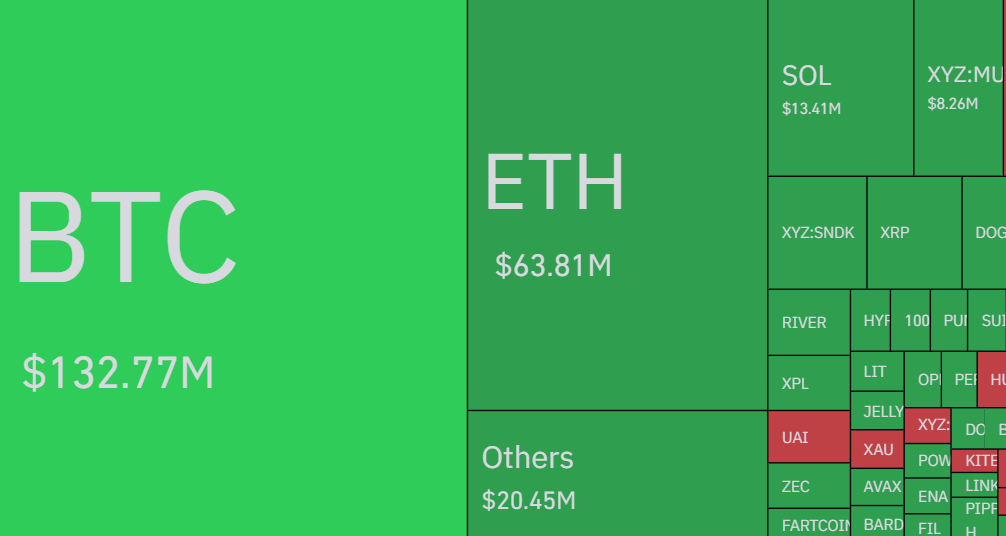
The latest drop in prices has also been intensified by large liquidations across crypto derivatives markets. According to Coinglass data, more than $302.75 million in crypto positions were liquidated in the past 24 hours.

Bitcoin accounted for the largest share of liquidations at roughly $132.79 million, followed by Ethereum with about $63.73 million, while the remaining liquidations were spread across various altcoins.

Crypto Liquidations

Such liquidation cascades occur when leveraged traders are forced to close positions after prices move against them. This forced selling often amplifies market declines and increases volatility.

Bitcoin Price Analysis: Key Levels To Watch

After briefly touching $73,000 earlier this week, the BTC price failed to sustain its bullish momentum and has now retraced toward the $68,000 level. Technically, the $67,000–$68,000 region now represents a critical support zone. This area previously acted as a demand region during the recent consolidation phase and may determine the next direction for the market. If buyers manage to defend this level, Bitcoin could attempt a rebound toward $70,000 and $72,000. However, a decisive break below $67,000 could open the door for a deeper correction toward the $65,000 support level.

Ethereum Price Analysis: Can ETH Reclaim $2,200?

Ethereum has also moved lower alongside Bitcoin and is currently trading around $1,976, slipping below the important $2,000 psychological level.

The $1,850–$1,900 zone now acts as a key support range for Ethereum. If buyers manage to defend this area, the asset could attempt a recovery toward $2,080 and $2,200. However, if bearish pressure continues, ETH may revisit deeper support near $1,850, which previously served as a strong demand region.

XRP Price Analysis: What’s Next for XRP?

XRP is also experiencing mild downside pressure as the broader crypto market weakens. The token is currently trading near $1.36, consolidating after failing to extend its earlier recovery. The $1.30 level now represents a critical support level. If this zone holds, XRP could attempt another move toward $1.45 and $1.50. However, if Bitcoin continues to decline and broader market sentiment weakens, XRP could revisit the $1.20 support zone before buyers step in again.

FAQs

Why does geopolitical tension in the Middle East impact crypto?

Rising conflict, like in the Strait of Hormuz, fuels fear and volatility, causing investors to move away from risk assets like crypto.

Can rising interest rates affect Bitcoin and altcoins?

Yes. Higher rates make risk assets less attractive, often leading to declines in Bitcoin, Ethereum, and other cryptocurrencies.

What is a liquidation cascade in crypto markets?

When leveraged traders are forced to close positions due to price drops, it triggers further selling, amplifying market declines.

How do oil price surges influence crypto volatility?

Spiking oil prices raise inflation concerns and market risk, which can lead to short-term drops in Bitcoin and major altcoins.

❌