Crypto rules in South Korea are tightening as regulators target major exchanges. Bithumb, the country’s second-largest crypto exchange, is facing a possible six-month partial suspension after regulators accused it of breaking AML and KYC rules.
The decision could limit services like deposit and withdrawal, mainly for new users joining the exchange.
Bithumb Faces Six-Month Partial Suspension
The Financial Intelligence Unit, operating under the Financial Services Commission, issued the notice to Bithumb. Authorities claim Bithumb may have failed to properly enforce Know-Your-Customer (KYC) and anti-money-laundering (AML) checks required under the Special Financial Transactions Act.
Regulators raised concerns that Bithumb dealt with overseas crypto operators without properly reporting them to authorities.
Because of these issues, the FIU has proposed a six-month partial business suspension along with disciplinary action against the company’s chief executive.
In response to this, Bithumb officials said the case remains under review and regulators will decide during the March 16 sanctions meeting.
If the sanction is confirmed, the suspension will mainly affect new users joining the Bithumb platform. According to industry reports, restrictions would likely block new users from transferring crypto assets for up to six months.
Meanwhile, existing users, however, would still be able to deposit and withdraw Korean won and continue normal crypto trading on the platform.
This approach is similar to penalties imposed on other exchanges in the country. Last year, regulators fined Dunamu, the operator of Upbit, 35.2 billion won (about $26 million) and imposed a three-month partial suspension.
Another local exchange, Korbit, was also fined 2.73 billion won (around $2 million) for compliance failures.
South Korea Tightens Oversight of Crypto Platforms
The investigation comes as South Korea increases oversight of the digital asset industry. The country introduced stricter crypto rules after the 2022 collapse of the Terra ecosystem, created by Do Kwon, which wiped out more than $40 billion in market value globally.
In July 2024, South Korea also launched the Virtual Asset User Protection Act, forcing exchanges to improve AML monitoring, separate customer funds, and report suspicious transactions.
Never Miss a Beat in the Crypto World!
Stay ahead with breaking news, expert analysis, and real-time updates on the latest trends in Bitcoin, altcoins, DeFi, NFTs, and more.
FAQs
Why is Bithumb facing a possible suspension in South Korea?
Bithumb is under investigation for allegedly failing to properly enforce AML and KYC checks and for dealing with overseas crypto operators without reporting them to regulators.
Will current Bithumb users lose access to their funds?
No. Existing users are expected to continue normal trading and Korean won deposits and withdrawals even if regulators impose the partial suspension.
Why is South Korea tightening crypto exchange regulations?
South Korea increased oversight after major crypto failures like the Terra collapse, aiming to strengthen AML checks, protect users, and improve transparency across exchanges.
The global market is on high alert after the latest statement from U.S. President Donald Trump, who said he will decide when iran war ends. The comments have added a new layer of uncertainty to already volatile markets, with investors now asking how the situation could influence cryptocurrencies such as Bitcoin, Ethereum, and XRP.
Trump Will Decide When the Iran War Ends
During a brief phone interview, when asked about the timeline for the ongoing U.S.-Israel and Iran war, Donald Trump said the United States would have the “final say” on when the military operation against Iran ends.
“We’ll make final call to end operation ‘at right time’; says he and PM ‘worked together’ against Islamic Republic: ‘We’ve destroyed a country that would have destroyed Israel.”
When asked if he alone would decide when the war ends or if Benjamin Netanyahu would also have a say, Trump said the decision would be a “mutual” one taken together with the Israeli Prime Minister.
Lastly, when asked if Israel could continue the war even after the U.S. stops its strikes, Trump said he believes Israel would not need to continue the war once the U.S. halts its attacks.
Bitcoin Holds Despite Liquidations Risk Rises
Since the war began, the crypto market has lost billions in value. Bitcoin has dropped from around $79K to nearly $68K.
Despite the tension, the market has not seen major panic selling. Further CoinGlass data shows 99,443 traders liquidated in 24 hours, with total losses reaching $396.55 million
Bitcoin accounted for around $150 million of those liquidations, while Ethereum saw $80.8 million and Solana about $18.8 million.
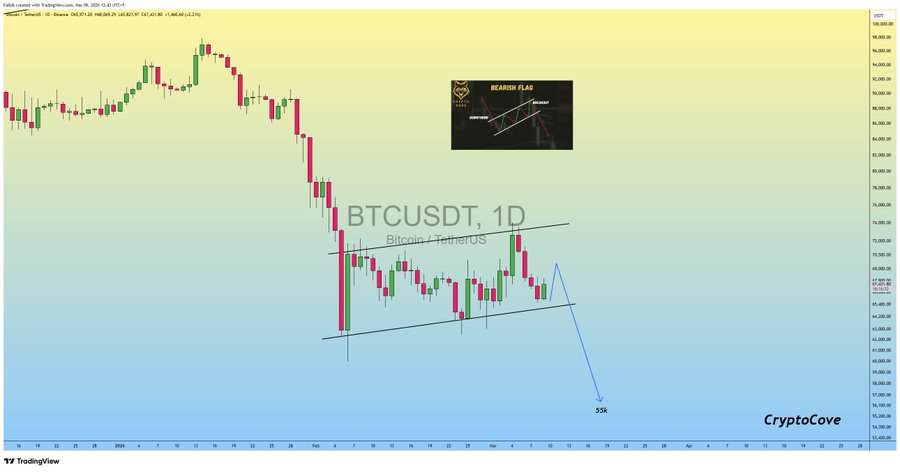
If the conflict between the U.S., Israel, and Iran continues, Bitcoin could face a period of higher volatility. Keeping these factors in mind, crypto trader Captain Faibik believes Bitcoin may be preparing for another bearish rally.
After a sharp drop, Bitcoin started moving inside a small rising channel. This suggests the market is taking a short pause while the overall trend still looks weak.
If Bitcoin breaks below the channel support, the bearish pattern could confirm further downside movement. In that case, Faibik expects the price to fall toward the $55,000 level.
However, if Bitcoin breaks above the upper trendline, the bearish setup weakens, and the potential price drop may delay
Never Miss a Beat in the Crypto World!
Stay ahead with breaking news, expert analysis, and real-time updates on the latest trends in Bitcoin, altcoins, DeFi, NFTs, and more.
FAQs
How could the Iran war affect Bitcoin and the crypto market?
Geopolitical tensions often increase market volatility. If the conflict escalates, Bitcoin and major altcoins may see sharp price swings as investors react to global risk.
Why did Bitcoin drop after the Iran war tensions increased?
Rising geopolitical uncertainty pushed investors toward safer assets. This led to liquidations in crypto derivatives, causing Bitcoin’s price to fall sharply.
Why hasn’t the crypto market seen panic selling yet?
Despite volatility, many investors are holding positions, suggesting cautious sentiment rather than panic as traders wait for clearer geopolitical signals.
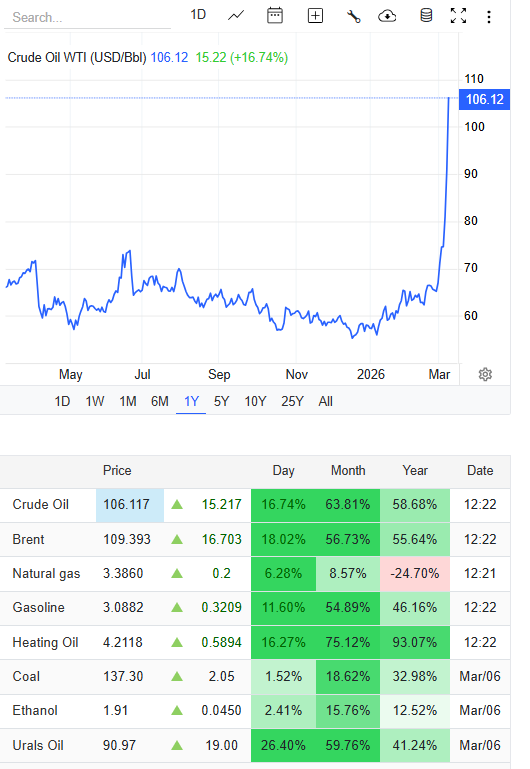
The ongoing U.S.-Israel and Iran war is starting to affect global markets after the Strait of Hormuz closure triggers a historic oil crisis. Crude oil prices jumped 17% to nearly $110. Because of this spike, veteran strategist Ed Yardeni has increased the chances of a U.S. stock market crash to 35%.
Meanwhile, Bitcoin is showing surprising strength, holding near $67K despite rising tensions.
Strait of Hormuz Closure Triggers Historic Oil Crisis
Today, crude oil prices jumped 17% in a day, reaching their highest level since July 2022, as tensions in the Middle East increased. The rally followed a series of military escalations in the Middle East involving the U.S, Israel, and Iran, raising fears of a major supply shock.
At the same time, oil supply has dropped across the region. An Iranian drone strike forced Saudi Aramco to shut its Ras Tanura Refinery. Oil output in Iraq also fell sharply, while Kuwait Petroleum Corporation reduced shipments.
Meanwhile, the United Arab Emirates is managing offshore production to handle storage limits, while Bahrain stopped some shipments after a refinery fire.
These supply disruptions have pushed global oil prices sharply higher.
U.S. Market Crash Odds Rise to 35%
As the Strait of Hormuz closure triggers a historic oil crisis, financial analysts are warning about bigger economic risks. Veteran market strategist Ed Yardeni raised the probability of a U.S. market crash to 35%, up from 20% earlier this year.
At the same time, he dropped the chances of a strong crypto market rally to just 5%.
According to Yardeni, the U.S. economy is facing two problems: rising inflation from high oil prices and slowing economic growth. This could put pressure on stocks and cryptocurrencies.
Odd of this crash can be seen in the Asian markets too. Japan’s Nikkei 225 index fell over 6%, while South Korea’s Kospi fell nearly 8%
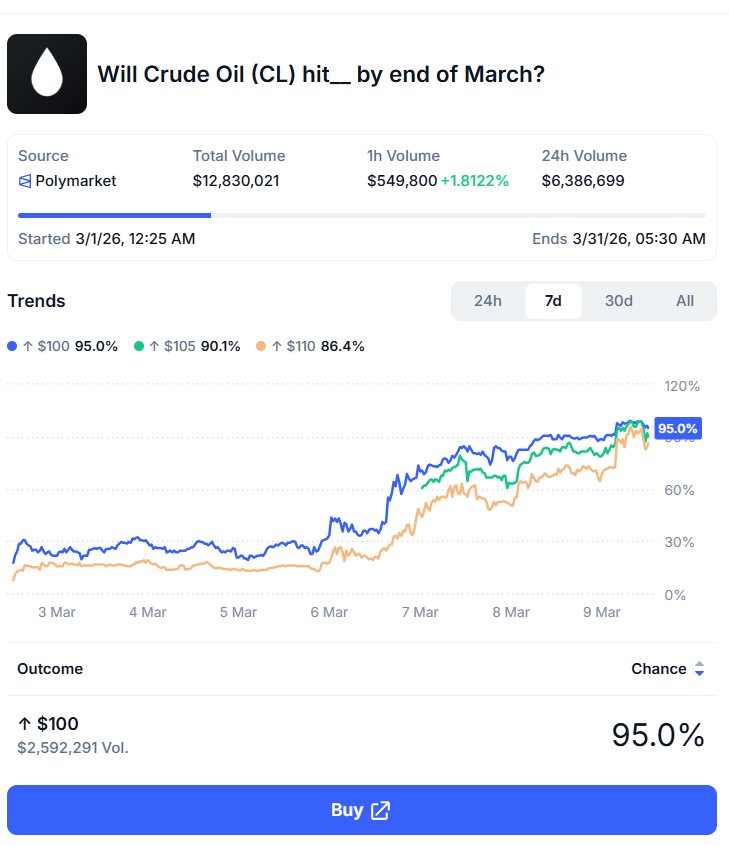
Meanwhile, traders betting on Polymarket see a 72% chance that oil could reach $120 by the end of March.
Bitcoin and Major Cryptos Stay Stable Despite Market Shock
Despite the market chaos, the Bitcoin price stayed stable near $67,278, rising about 1% in the last 24 hours.
Bitcoin has often fallen alongside stocks during major risk-off events, despite its reputation as a hedge. However, analysts warn that if the Strait of Hormuz Closure Triggers Historic Oil Crisis for a long time, crypto markets could face pressure, and Bitcoin may drop toward the $60K level.
Other major cryptocurrencies also saw small gains. Ethereum rose to around $2,007, XRP moved to $1.35, Solana climbed to $84, and Dogecoin increased to about $0.091.
The crypto market started Monday on a positive note, with most top 10 coins trading in green. Now, investors are closely watching one key event this week, the upcoming U.S. Consumer Price Index (CPI) report. Last month’s CPI data pushed the crypto market up by nearly 4%.
The U.S. Bureau of Labor Statistics will release the February 2026 CPI and Core CPI data this week. Economists expect inflation to come in around 2.5%, slightly higher than January’s 2.4%. Core CPI is also expected to stay near 2.5%.
These numbers show that inflation is slowly cooling but is still above the Federal Reserve target of 2%. Because of this, the Fed may delay cutting interest rates. Some officials want rate cuts, while others prefer to keep rates unchanged.
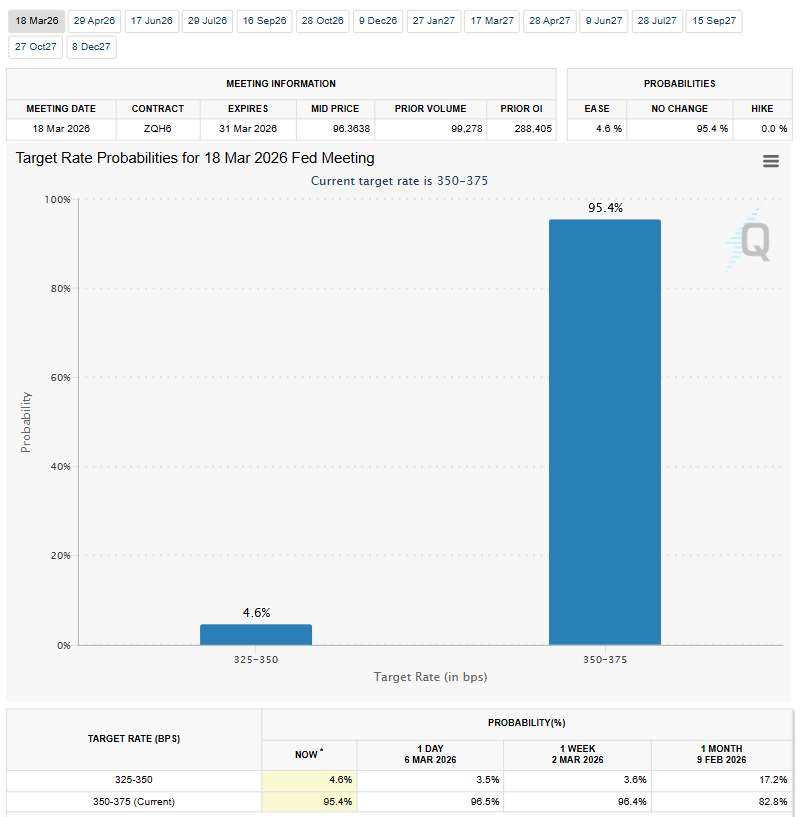
Meanwhile, the CME Group FedWatch Tool shows about a 95% chance that rates will stay near 3.5% – 3.75%.
Higher interest rates usually reduce money flowing into markets, which can put pressure on risk assets like cryptocurrencies
How Could Bitcoin, Ethereum, and XRP React to the CPI Report?
Crypto markets have shown strong reactions to inflation data in recent months. On February 13, when January CPI came in at 2.4%, slightly below expectations, Bitcoin quickly rallied about 5%, jumping from a daily low of $65,889 to nearly $70,500.
At the same time, Ethereum and XRP also reacted strongly. Both coins gained around 5% to 8% in a single day, with Ethereum moving above $2,100 and XRP trading near $1.55.
Now, the February CPI data is expected to come in at 2.5%, slightly higher than January’s 2.4% reading. Because of this, traders are closely watching how the market will react this time.
However, there is also some caution in the ETF market. Over the last two days, Bitcoin ETFs recorded outflows of $227.9 million and $348.9 million, which could affect short-term price momentum.
Possible Scenarios for Crypto After CPI
If inflation comes in lower than expected, analysts believe Bitcoin could attempt another move toward $70,000, with Ethereum and XRP likely following.
However, if CPI surprises to the upside, traders may fear that high interest rates will remain longer, potentially pushing Bitcoin toward a lower support level of $60K.
As of now, Bitcoin is trading near $67,179, while Ethereum sits around $1,980, and XRP is hovering close to $1.35.
Never Miss a Beat in the Crypto World!
Stay ahead with breaking news, expert analysis, and real-time updates on the latest trends in Bitcoin, altcoins, DeFi, NFTs, and more.
FAQs
When will the February 2026 U.S. CPI report be released?
The February 2026 U.S. CPI report will be released on March 11, 2026, at 8:30 a.m. Eastern Time (ET) by the U.S. Bureau of Labor Statistics.
How does the CPI report affect Bitcoin, Ethereum, and XRP prices?
CPI shows inflation trends. Lower inflation can boost crypto prices, while higher inflation may pressure Bitcoin, Ethereum, and XRP due to expectations of higher interest rates.
Why do higher interest rates usually impact cryptocurrency markets?
Higher rates reduce liquidity and make safer assets more attractive, which can lower demand for risk assets like Bitcoin, Ethereum, and other cryptocurrencies.
The live price of the BEAM crypto is $ 0.02468474.
Beam is building a privacy-focused DeFi ecosystem using Mimblewimble and LelantusMW, aiming to enable confidential transactions, assets, and smart contracts.
If adoption of private DeFi grows, BEAM could recover toward $0.0505 by 2026 and potentially reach $4.41 by 2030 with stronger ecosystem expansion.
Privacy has become a major topic in blockchain. While many once believed Bitcoin transactions were anonymous, blockchain tools later showed that most transfers can be traced.
Beam was created to solve this problem.
Launched in March 2018, it is a privacy-focused DeFi platform that uses Mimblewimble and LelantusMW to hide wallet balances, transaction amounts, and user identities.
Unlike many privacy coins that focus solely on payments, Beam is gradually expanding into a private DeFi ecosystem, integrating NFTs, decentralized exchanges, and confidential smart contracts.
With the token currently trading near $0.023, investors are now asking whether Beam could become a major player in the emerging privacy-first DeFi sector.
Here is CoinPedia’s Beam (BEAM) price prediction for 2026, 2027, and 2030.
In recent years, regulatory debates around data transparency and financial surveillance have pushed many blockchain users toward privacy-enhancing protocols.
Beam’s architecture is designed specifically for this use case.
The platform uses Mimblewimble technology, which compresses blockchain data while hiding transaction details. Combined with LelantusMW, it enables users to create fully private transactions without exposing balances or transaction histories.
Beyond payments, Beam is also expanding its private DeFi toolkit, including confidential assets, decentralized exchanges, and NFT functionality.
If these developments gain traction and more users begin prioritizing privacy in DeFi, BEAM could attempt to move toward $0.0035 by March 2026.
Month
Potential Low ($)
Potential Average ($)
Potential High ($)
Beam Price Prediction March 2026
$0.0202
$0.02861
$0.0350
Beam (BEAM) Price Prediction 2026
Beam’s long-term value depends largely on whether privacy becomes a critical feature in decentralized finance.
Public blockchains provide transparency, but they also expose transaction histories and wallet balances. For institutions, traders, and everyday users seeking financial confidentiality, this can be a major limitation.
Beam’s approach combines confidential transactions with scalable blockchain design, which could make it attractive for private DeFi applications.
If Beam successfully integrates more financial tools, such as private lending markets, decentralized exchanges, and tokenized assets, it could gradually attract liquidity into its ecosystem.
Technical Analysis
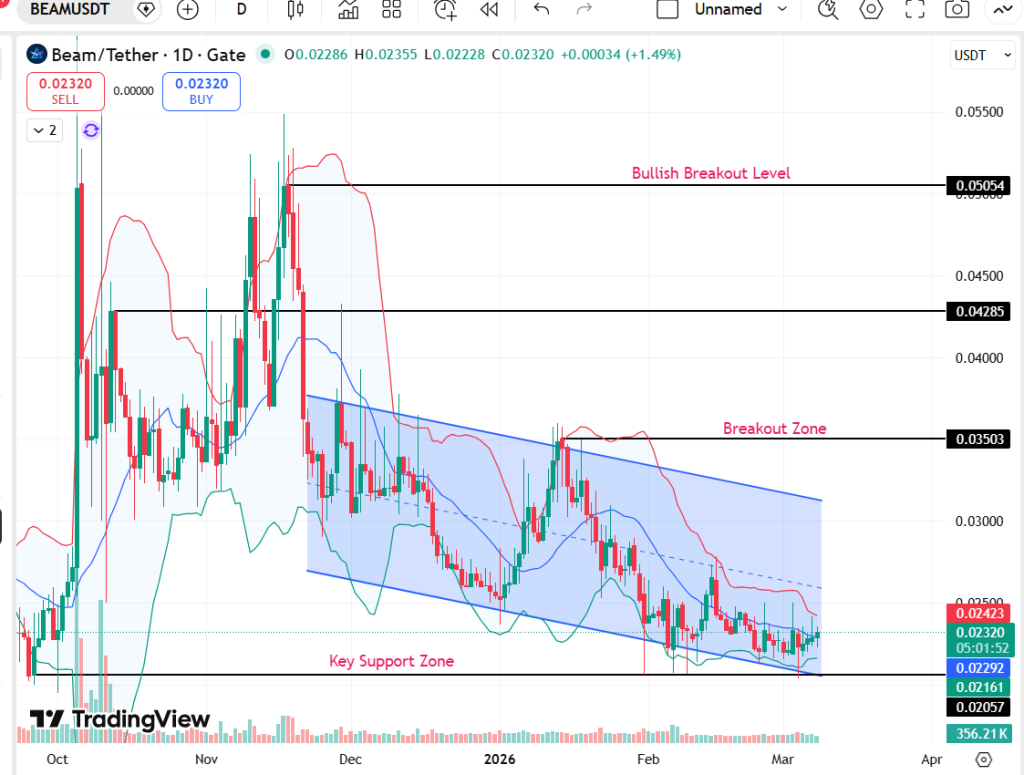
Looking at the BEAM/USDT 1-day chart, it shows the price moving within a clear descending channel, indicating a slow downtrend over several months.
Recently, BEAM bounced again from the key support zone near $0.021–$0.022, which shows that buyers are still defending this area. The current price of around $0.023 suggests a small recovery after touching the lower boundary of the channel.
For the trend to turn bullish, BEAM must break above the channel resistance and the breakout zone near $0.035. If that happens, the next targets could appear around $0.042 and later near $0.0505 by the end of 2026.
However, if the price fails to hold the $0.021 support, the downtrend could continue with further downside pressure.
Year
Potential Low ($)
Potential Average ($)
Potential High ($)
Beam Price Prediction 2026
$0.018
$0.3503
$0.0505
Beam Price Prediction 2026 – 2030
Year
Potential Low ($)
Potential Average ($)
Potential High ($)
2026
$0.018
$0.3503
$0.0505
2027
$0.030
$0.092
$0.2973
2028
$0.094
$0.5070
$1.02
2029
$0.376
$1.32
$2.57
2030
$0.930
$2.86
$4.41
Beam Price Prediction 2026
If privacy-focused DeFi applications expand and Beam’s ecosystem gains liquidity, the token could approach $0.0505.
BEAM Price Prediction 2027
Meanwhile, by 2027, stronger adoption of confidential financial tools may push BEAM toward $0.297.
Beam Price Forecast 2028
If private decentralized exchanges and confidential NFTs gain popularity, BEAM could climb to $1.02.
Beam Coin Price Prediction 2029
Greater demand for financial privacy and institutional experimentation with confidential blockchain infrastructure may move BEAM toward $2.57.
Beam (BEAM) Price Prediction 2030
By 2030, if Beam becomes a leading platform for private DeFi and confidential asset transfers, the token could reach $4.41.
What Does The Market Say?
Year
2026
2027
2030
Changelly
$0.602
$0.342
$0.157
Coincodex
$0.079
$0.033
$0.086
Digitalcoinprice
$0.0720
$0.11
$0.21
CoinPedia’s Beam (BEAM) Price Prediction
From CoinPedia’s perspective, Beam stands out as a privacy-focused blockchain attempting to bring confidential transactions into decentralized finance.
While many blockchains prioritize transparency, Beam is building infrastructure for users who require financial confidentiality without sacrificing scalability.
If the project continues expanding its private DeFi ecosystem and regulatory debates increase demand for privacy-preserving technologies, BEAM could gradually reclaim the $0.0505 range in 2026.
Year
Potential Low ($)
Potential Average ($)
Potential High ($)
2026
$0.018
$0.3503
$0.0505
Never Miss a Beat in the Crypto World!
Stay ahead with breaking news, expert analysis, and real-time updates on the latest trends in Bitcoin, altcoins, DeFi, NFTs, and more.
FAQs
What is the Beam (BEAM) price prediction for 2026?
BEAM could trade between $0.018 and $0.0505 in 2026 if adoption of privacy-focused DeFi grows and the project expands its confidential financial tools.
How high can Beam price go in 2030?
Beam could reach around $4.41 by 2030 if privacy-focused DeFi adoption grows and its ecosystem expands with confidential smart contracts and private trading tools.
What is the Beam price prediction for 2040?
If privacy becomes a major part of DeFi and Beam continues expanding its ecosystem, the token could trade significantly higher by 2040, though long-term forecasts remain uncertain.
Does Beam coin have a future?
Beam has potential if demand for blockchain privacy increases. Its focus on confidential DeFi, private assets, and scalable transactions may support long-term growth.
Is Beam a good coin to buy?
Beam may interest investors seeking privacy-focused crypto projects. Its success depends on adoption of private DeFi tools and overall market conditions.
Other major cryptocurrencies, including ETH, XRP, Solana, and Dogecoin, are also down by around 3% to 5%.
U.S. Wants to Cut Iran’s Oil Revenues, Iran Won’t Surrender
The recent market drop came after a White House official said the U.S. wants to stop Iran from using its oil money to fund groups like the Islamic Revolutionary Guard Corps (IRGC). The plan aims to limit Iran’s oil sales, which are the country’s main source of income.
Yesterday, Donald Trump also posted on Truth Social, saying there would be no deal with Iran unless it agrees to an unconditional surrender.
This recent response from white house and Trump came in response to Iranian President Masoud Pezeshkian rejecting the demand and saying Iran would never surrender.
These strong statements have increased fears of growing this war into a bigger conflict.
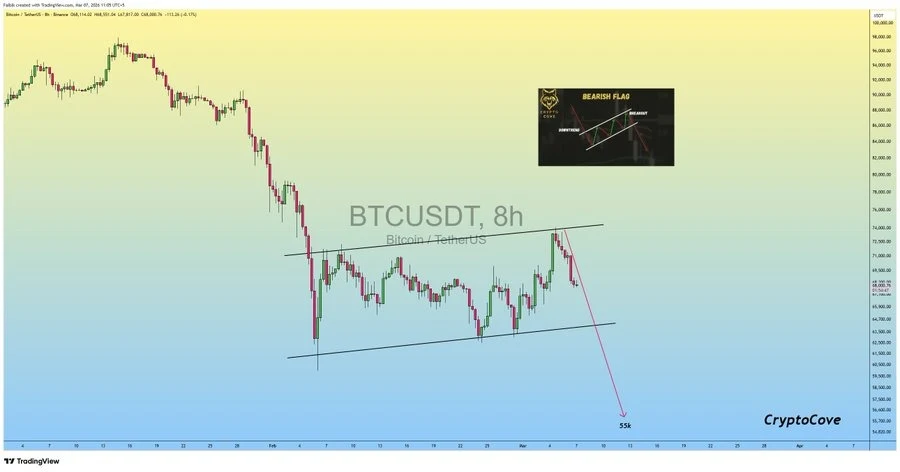
Bitcoin Price Drop, Now Eying $55K Level
Tensions between the U.S. and Iran are rising, and this is adding pressure to the crypto market. Bitcoin erased most of the gains it had recently made. The digital asset dropped roughly 4%, pushing the price below $68,000 and reducing the total crypto market value.
Popular crypto trader Captain Faibik points to a bearish flag pattern forming on the 8-hour chart of Bitcoin. After the sharp drop earlier, the price has been moving inside an upward-sloping channel.
If Bitcoin breaks below the lower support of the flag with strong volume, it could confirm the bearish continuation pattern. According to this setup, the next major downside target sits near the $55,000 level.
Altcoins Also Slide as Risk Appetite Drops
The decline is not limited to Bitcoin. Ethereum has dropped below $2,000, falling about 4%, while XRP is hovering around $1.37. Meanwhile, Solana, Cardano, and Dogecoin have also slipped, each losing roughly 3% to 5%.
The rising tensions hint that neither side is ready to step back, increasing uncertainty for both the traditional and the crypto market.
Never Miss a Beat in the Crypto World!
Stay ahead with breaking news, expert analysis, and real-time updates on the latest trends in Bitcoin, altcoins, DeFi, NFTs, and more.
FAQs
How does the U.S.–Iran conflict affect cryptocurrency prices?
Geopolitical tension fuels market fear, causing Bitcoin and altcoins to drop as investors avoid high-risk assets.
Can crypto act as a safe haven during the U.S.–Iran tensions?
Crypto is volatile; while some view it as a hedge, rising conflict often triggers short-term sell-offs.
Which altcoins are most sensitive to global conflicts?
Bitcoin, Ethereum, and XRP usually react first, with smaller altcoins following as risk appetite declines.
Could the U.S.–Iran conflict trigger a broader crypto market crash?
Escalating conflict can intensify fear, potentially pushing major cryptocurrencies lower if uncertainty persists.
On 6 March 2026, the U.S. federal court allowed the Tether, Bitfinex Crypto Case to move forward as a class action. However, the investor’s case claims that both companies manipulated Bitcoin and Ethereum prices during the 2017 crypto boom using newly issued USDT tokens.
Tether, Bitfinex Crypto Case Moves Forward
A federal judge in New York approved class action status in an ongoing lawsuit against Tether and Bitfinex. The decision made by U.S. District Court Judge Katherine Polk Failla allowed thousands of investors to join the lawsuit instead of filing individual claims.
The judge divided the plaintiffs into two groups to manage the case more efficiently. One group represents investors who bought cryptocurrencies directly in the spot market, while the second group includes traders who used futures contracts.
Meanwhile, the judgment of this case does not determine whether the companies broke the law. However, it allows the case to move forward toward further legal proceedings.
Lawsuit Claims USDT Were Issued To Manipulate BTC & ETH Price
Investors claim that large amounts of Tether (USDT) were issued between 2017 and 2019 without proper backing. According to the complaint, these tokens were allegedly used to buy Bitcoin and Ethereum, pushing prices higher & creating a market bubble.
The plaintiffs argue that the manipulation caused artificial price inflation during the historic 2017 bull run.
When the market later corrected, many investors suffered heavy losses. Some estimates suggest the alleged manipulation may have caused billions of dollars in damages across the crypto market.
Both Tether and Bitfinex have strongly denied the accusations. The companies say the lawsuit is based on incorrect assumptions and misunderstand how USDT issuance and trading activity work.
What’s Next in the Tether and Bitfinex Lawsuit?
Now that the class action status is approved, the case will move to the next stage, where both sides will present evidence.
For now, the court is reviewing parts of the judge’s sealed opinion. Lawyers from both sides must submit their proposals by March 9.
Meanwhile, any major ruling could affect future rules on stablecoin transparency and market practices.
Never Miss a Beat in the Crypto World!
Stay ahead with breaking news, expert analysis, and real-time updates on the latest trends in Bitcoin, altcoins, DeFi, NFTs, and more.
FAQs
What is the history behind the Tether and Bitfinex lawsuit?
The lawsuit stems from the 2017 crypto bull run, when investors claimed large USDT issuances were used to buy Bitcoin and Ethereum and artificially inflate prices.
Did the court rule that Tether and Bitfinex manipulated crypto prices?
No. The court only approved class action status, allowing thousands of investors to join the case while the court reviews evidence and legal arguments
What could happen next in the Tether and Bitfinex case?
The case now moves to the evidence phase. Both sides will present documents and arguments before the court decides whether the claims have merit.

 Login
Login



 -3.60%


 Κασσάνδρα
  (@Bitfinexed)