While the Pi Network community celebrates Pi Day on March 14, its native token PI is crashing instead of rallying. The price has fallen about 26% in 24 hours, leaving investors wondering what went wrong. Let’s find out the reason why the Pi network Pi coin price is crashing today on Pi day.
Sell-the-News Reaction After Kraken Listing
One of the main reasons behind the drop is a typical sell-the-news reaction following PI’s listing on Kraken. Before the listing, the token surged more than 30%, climbing close to $0.30 as traders positioned themselves ahead of the event.
Once trading began on March 13, many early buyers took profits, triggering a quick pullback. This pattern often appears in crypto markets when a long-anticipated announcement or listing finally occurs.
Token Unlocks Raise Supply Concerns
Another factor affecting sentiment is the upcoming release of new tokens.
According to the Pi scan, Pi network is about to release 17 million PI tokens, which are scheduled to unlock on March 17, followed by another 16 million tokens on March 20.
Token unlocks increase the circulating supply of a cryptocurrency, which is currently at 9.66 billion.
As more token complete into circulation, it will lead to short-term price pressure if holders decide to sell.
Pi v20.2 Network Upgrade Delayed?
At the same time, the project is also improving its network with several technical upgrades. The team first upgraded the network to v19.6 on February 21, followed by v19.9 on March 4.
Another major update, v20.2, was planned for March 14, but the date was later moved to March 12. So far, the team has not officially confirmed that the upgrade is complete.
However, some community members believe the migration may have already happened.
The v20.2 update is expected to make the network more secure, faster, and more reliable, helping it handle more activity as the ecosystem grows.
Overall, the Crypto Market Is Struggling
Additional pressure on Pi Network’s Pi coin came from the broader crypto market decline. Bitcoin has fallen below $71,000, dropping about 2.3% as geopolitical tensions increased.
As of now, Pi coin is trading around $0.2042, which is about 86% below its all-time high.
Analysts say the token is currently moving inside a liquidity zone between $0.18 and $0.20. If the price stays above this range, the market may stabilize.
However, if PI drops below this support zone, the next potential downside target could move toward $0.15.
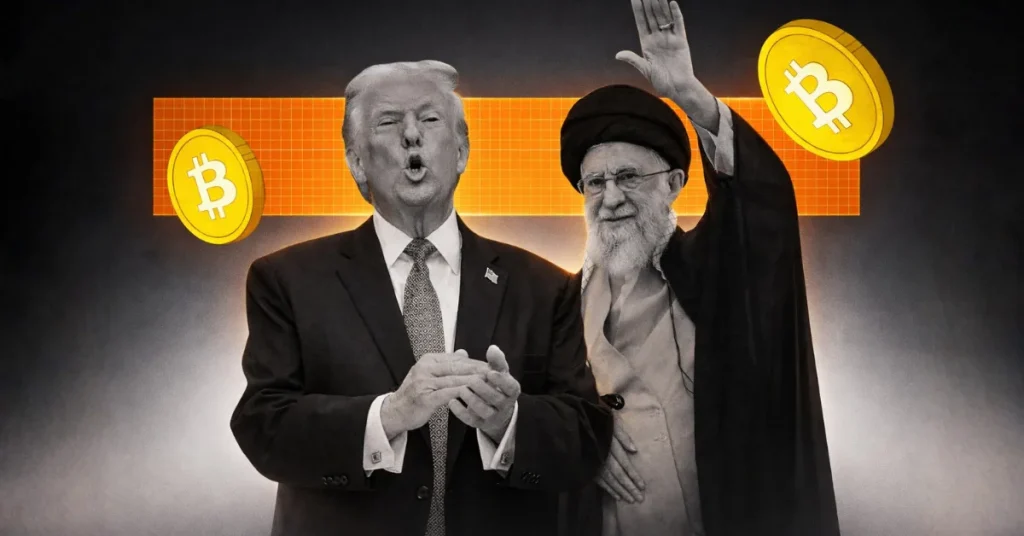
Flagship cryptocurrency Bitcoin price dropped today below $71,000, after the U.S. bombed military targets on Kharg Island, near Iran’s main crude export facility.
The price of Bitcoin erased the gains it made on Friday when it reached $73,927, falling nearly 2% as risk sentiment weakened across markets. Despite this drop, Bitcoin ETFs continue to see inflows for the last 5 straight days.
Trump Warns of Strikes on Iran’s Kharg Island
In a post on Truth Social, Trump said U.S. forces carried out major bombing operations targeting military positions on Kharg Island, a strategic location near Iran’s primary oil export infrastructure.
He warned that energy facilities on the island could become targets if Iran continues to block the Strait of Hormuz, a key global oil shipping route. Kharg Island handles more than 90% of Iran’s crude oil exports, making it one of the most critical locations in the country’s energy system.
Oil prices have already surged more than 40% since the conflict began, increasing pressure on global markets.
Iran responded by warning that it could attack oil infrastructure linked to the United States if energy facilities on Kharg Island are targeted.
Polymarket reports also indicate that Iran is considering allowing oil shipments through the Strait of Hormuz only if payments are made in Chinese yuan instead of U.S. dollars, adding another layer of tension to global energy markets.
JUST IN: Iran is reportedly now considering letting tankers through the Strait of Hormuz if the oil onboard is traded in Chinese yuan rather than the U.S. dollar.
Even as prices pulled back, institutional demand for Bitcoin remains strong.
Data from Farside Investors shows that U.S. spot Bitcoin ETFs have recorded inflows for five consecutive trading days, totaling about $763.4 million.
On March 14 alone, spot Bitcoin ETFs saw $180.4 million in net inflows.
The largest share of these inflows came from the iShares Bitcoin Trust (IBIT), managed by BlackRock, which attracted roughly $600 million over the past five days.
Bitcoin Testing $66K Technical Levels
As of now, Bitcoin is currently trading around $70,668, with trading volume rising about 16% during the session.
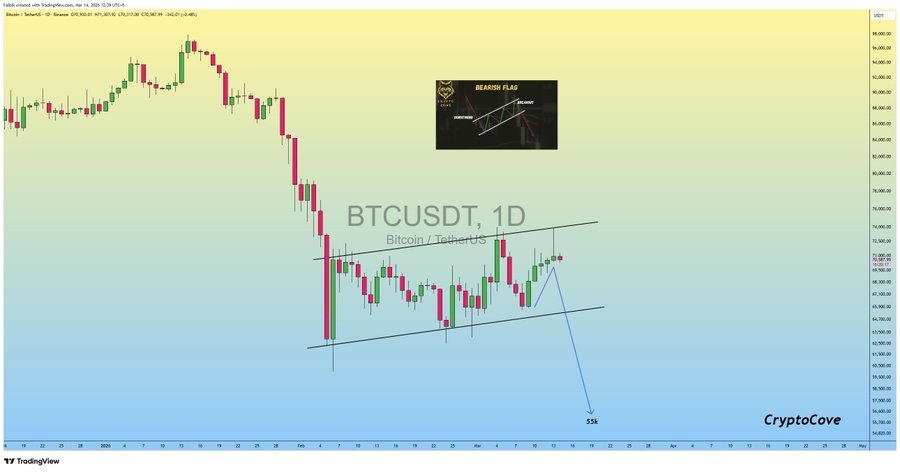
According to crypto trader Captain Faibik, Bitcoin’s daily chart is forming a bearish flag pattern, which often appears when the market pauses before another move lower.
The cryptocurrency is currently moving within a price channel between $66,000 and $72,000.
If Bitcoin fails to break above the upper resistance of this range and falls below support, the analyst says the price could potentially decline toward $55,000.
Never Miss a Beat in the Crypto World!
Stay ahead with breaking news, expert analysis, and real-time updates on the latest trends in Bitcoin, altcoins, DeFi, NFTs, and more.
FAQs
Why is Bitcoin price down today?
Bitcoin is down today due to rising geopolitical tensions after U.S. strikes near Iran’s Kharg Island, which triggered market uncertainty and risk-off sentiment.
How are geopolitical tensions affecting Bitcoin and crypto markets?
Rising tensions around Iran and the Strait of Hormuz have shaken global markets. This uncertainty often pushes investors to reduce exposure to volatile assets like crypto.
Are Bitcoin ETFs still seeing inflows despite the market drop?
Yes. U.S. spot Bitcoin ETFs recorded about $763M in inflows over five days, showing strong institutional demand even as geopolitical tensions weigh on prices.
A special purpose acquisition company (SPAC) linked to the crypto exchange Kraken is exploring potential deals with crypto-native firms valued between $2 billion and $10 billion.
The move highlights growing interest from Wall Street in companies connected to digital assets and blockchain infrastructure.
KRAK Acquisition Begins Search After $345M IPO
The SPAC, KRAK Acquisition Corp., raised about $345 million in an initial public offering in January. Like other SPACs, the company aims to acquire a private business and take it public through a reverse merger.
In 2024, Kraken also raised $800 million in funding, giving the company a valuation of about $20 billion.
According to company director Ravi Tanuku, the firm is currently reviewing several potential targets across the crypto industry.
KRAK Acquisition is targeting companies valued between $2 billion and $10 billion, including mid-sized and emerging crypto firms.
KRAK Acquisition is focusing on businesses operating in fast-growing sectors of the crypto economy. These include companies working on stablecoins, asset tokenization, decentralized finance (DeFi), and digital payment infrastructure.
Tanuku said institutional investors are increasingly recognizing blockchain’s potential impact on global financial markets..
He added that Wall Street has shown increasing willingness to support companies working in these areas.
SPAC Seen as Strategic Investment Tool
According to Tanuku, KRAK Acquisition could allow Kraken to build economic partnerships with promising crypto firms while helping them enter public markets.
By backing the SPAC, Kraken signals plans to expand its influence across the broader crypto industry. The filing notes assets like Bitcoin are increasingly viewed as inflation hedges by investors.
KRAK Acquisition now has two years to complete a deal, a typical deadline for SPAC structures. During that time, it will continue reviewing potential crypto firms that could attract public market investors.
Never Miss a Beat in the Crypto World!
Stay ahead with breaking news, expert analysis, and real-time updates on the latest trends in Bitcoin, altcoins, DeFi, NFTs, and more.
FAQs
What is a SPAC in simple terms?
A SPAC is a publicly traded shell company created solely to raise money through an IPO in order to acquire a private business and take it public.
Why is Kraken starting a SPAC?
Kraken is using the SPAC to build strategic partnerships with promising crypto firms and help them enter public markets more efficiently.
What kind of crypto companies is the SPAC targeting?
The SPAC is targeting mid-sized and emerging crypto firms working in asset tokenization, decentralized finance (DeFi), and payment infrastructure.
IoTeX is positioning itself in the growing DePIN and AI sectors, aiming to connect real-world devices and blockchain networks through a trusted data infrastructure.
If device adoption increases and DePIN momentum continues, IOTX could climb toward $0.028 in 2026 despite its current long-term downtrend.
Strong support near $0.0048 remains crucial, while a breakout above $0.015 could signal a trend reversal and open the path toward higher price targets.
Not every blockchain is built for finance or NFTs. Some are trying to connect blockchain directly to the physical world.
IoTeX is one of those projects.
IoTeX is a Layer-1 blockchain designed to connect real-world devices, sensors, and machines to decentralized networks. The project operates at the intersection of IoT, AI, and blockchain, aiming to create a trusted data layer that securely transmits real-world information to decentralized applications.
The native token IOTX powers the ecosystem by securing the network through staking, paying transaction fees, and enabling device registration. As of now, IOTX is trading around $0.005460.
Will the project remain relevant in the coming year?
Let’s explore CoinPedia’s IoTeX price prediction for 2026, 2027, and 2030.
March 2026 could be a pivotal moment for IoTeX as the network navigates both technical challenges and strategic pivots.
One major development affecting the ecosystem is the IIP-56 governance proposal, which concluded around March 12, 2026. This vote aims to deprecate CIOTX, the cross-chain wrapped version of IOTX, fully.
IoTeX has also introduced an “Anti-Roadmap” for 2026. Instead of fixed plans, the team wants a flexible strategy to quickly adapt to changes in the fast-growing AI and DePIN sectors.
If device adoption grows and the DePIN narrative gains momentum, IOTX could move toward $0.00890 by March 2026.
Month
Potential Low ($)
Potential Average ($)
Potential High ($)
IoTeX Price Prediction March 2026
$0.00435
$0.0595
$0.00890
IoTeX (IOTX) Price Prediction 2026
The year 2026 may become a defining phase for IoTeX as the project positions itself within the DePIN and AI infrastructure sectors.
Through initiatives such as MachineFi and W3bstream, the network enables developers to build applications in which real-world device data can trigger smart contract events.
For example, devices such as Pebble Tracker sensors or Ucam cameras can securely transmit data to blockchain-based systems, enabling applications in areas such as logistics, environmental monitoring, and autonomous machine networks.
If the DePIN sector continues gaining traction and more devices integrate with the IoTeX network, demand for IOTX could increase.
Technical Analysis
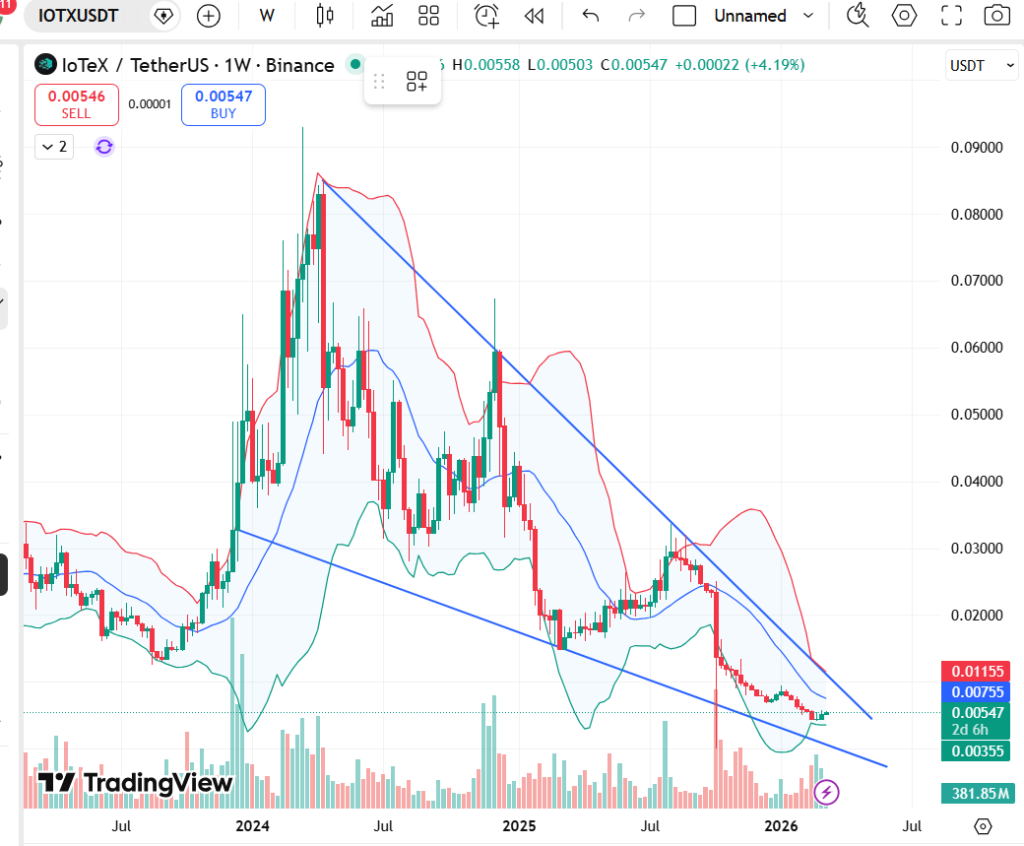
Looking at the weekly chart of IoTeX (IOTX), the price remains within a long-term downtrend. It is currently trading near $0.0054, just above a strong support zone at $0.0048, where buyers have stepped in before.
A falling trendline from the 2024 highs near $0.089 remains a major resistance level. As a result, every recovery has faced selling pressure
However, a real trend change may only happen if it breaks above $0.015, which will take the price to near $0.028.
If support near $0.004 fails, the market could drop toward $0.0035 before strong buyers return.
Year
Potential Low ($)
Potential Average ($)
Potential High ($)
IoTeX Price Prediction 2026
$0.0035
$0.012
$0.02874
IoTeX Price Prediction 2026 – 2030
Year
Potential Low ($)
Potential Average ($)
Potential High ($)
2026
$0.0035
$0.012
$0.02874
2027
$0.008
$0.040
$0.10
2028
$0.020
$0.080
$0.18
2029
$0.030
$0.120
$0.27
2030
$0.040
$0.150
$0.35
IoTeX Price Prediction 2026
If IoTeX’s Burn-Drop tokenomics continue reducing supply and DePIN adoption increases, IOTX could reach around $0.028.
IOTX Price Prediction 2027
By 2027, broader adoption of machine-generated data economies could push IOTX toward $0.10.
IoTeX Price Targets 2028
By 2027, broader adoption of machine-generated data economies could push IOTX toward $0.018.
IoTeX Price Prediction 2029
With deeper integration between IoT devices, AI networks, and blockchain applications, IOTX could approach $0.27.
IoTeX (IOTX) Price Prediction 2030
With deeper integration between IoT devices, AI networks, and blockchain applications, IOTX could approach $0.35.
What Does The Market Say?
Year
2026
2027
2030
Changelly
$0.0455
$0.0801
$ 0.382
Priceprediction.net
$0.0886
$0.125
$0.608
Digitalcoinprice
$0.0944
$0.14
$0.27
CoinPedia’s IoTeX (IOTX) Price Prediction
From CoinPedia’s perspective, IoTeX is one of the few projects attempting to build infrastructure that connects real-world devices, artificial intelligence, and blockchain networks.
While adoption remains relatively early, the growth of DePIN, machine economies, and AI-driven data markets could significantly increase demand for platforms that verify real-world data.
If IoTeX successfully expands its device ecosystem and maintains strong developer activity, the token could potentially reach around $0.028 by 2026.
Year
Potential Low ($)
Potential Average ($)
Potential High ($)
2026
$0.0035
$0.012
$0.02874
Never Miss a Beat in the Crypto World!
Stay ahead with breaking news, expert analysis, and real-time updates on the latest trends in Bitcoin, altcoins, DeFi, NFTs, and more.
FAQs
What is IoTeX (IOTX) used for?
IoTeX connects real-world devices to blockchain. Its IOTX token secures the network, pays fees, and powers applications that use trusted data from sensors and machines.
Can IoTeX benefit from the DePIN trend?
Yes. IoTeX focuses on DePIN infrastructure where physical devices provide data to blockchain networks. Rising demand for real-world data could boost IOTX adoption.
What factors could drive IoTeX price growth?
Key drivers include more connected devices, growth of AI data networks, strong developer activity, and tokenomics like the Burn-Drop mechanism reducing supply.
Is IoTeX a long-term investment?
IoTeX targets the growing machine economy and IoT sector. If device adoption and AI integration expand, the project could gain long-term relevance in Web3.
What is the IoTeX price prediction for 2026?
If DePIN adoption grows and device integration expands, analysts expect IoTeX to potentially reach around $0.028 by 2026, though market conditions remain uncertain.
How high could IoTeX (IOTX) price go in 2030?
If DePIN adoption and real-world device integration expand, analysts suggest IOTX could reach between about $0.05 and $0.20 by 2030 in optimistic scenarios.
What is the IoTeX (IOTX) coin price prediction for 2040?
Long-term forecasts vary widely, but some models estimate IOTX could trade anywhere from about $0.18 to several dollars by 2040 depending on adoption and market growth.
Tether, the company behind the world’s largest stablecoin, is now expanding its focus on the U.S. market. Recently, the firm has launched a new stablecoin called USAT and is now seeking funding that could value the company at $500 billion.
Tether CEO Paolo Ardoino said digital dollars like Tether may play a bigger role if traditional systems struggle.
Tether CEO Says Tether To Plays a Big Role in Weak Traditional Systems
Speaking at a conference in San Salvador, Tether CEO Paolo Ardoino said the company is preparing to play a larger role if traditional financial systems face pressure. He pointed to Tether’s growing financial strength, noting the firm generated over $10 billion in profit in 2025 and now holds about $122 billion in U.S. Treasuries.
Ardoino said these resources allow Tether to expand beyond stablecoins into sectors such as crypto infrastructure, artificial intelligence, energy, and media.
With discussions around a potential $500 billion valuation, he said Tether is building financial infrastructure designed to operate even during periods of global economic instability.
Bloomberg: Tether is expanding its focus on the U.S. market and has launched a new stablecoin, USAT, while seeking fundraising that could value the company at around $500 billion, according to CEO Paolo Ardoino. Tether reported over $10 billion in profit in 2025 and holds about… pic.twitter.com/zSsMS7ZEE7
With roughly 300 employees, Tether has become one of the most profitable companies in the crypto sector. Its stablecoin is widely used for trading digital assets and transferring funds globally.
Tether Expands Investments Across Multiple Sectors
With billions in profit, Tether has started investing heavily across the crypto and fintech sectors. Reports suggest the company now holds stakes in more than 140 companies around the world.
Tether has been investing in companies across sectors such as cryptocurrency infrastructure, artificial intelligence, energy, and media.
Ardoino said the firm’s financial resources allow it to pursue broader investments while continuing to develop digital payment infrastructure.
U.S. Market Could Become a Key Focus
Another major shift is the company’s growing focus on the United States. With Donald Trump returning to the White House, the regulatory environment for crypto companies could become more supportive.
As stablecoin adoption grows globally, Tether is positioning itself to play a larger role in both crypto markets and traditional financial systems.
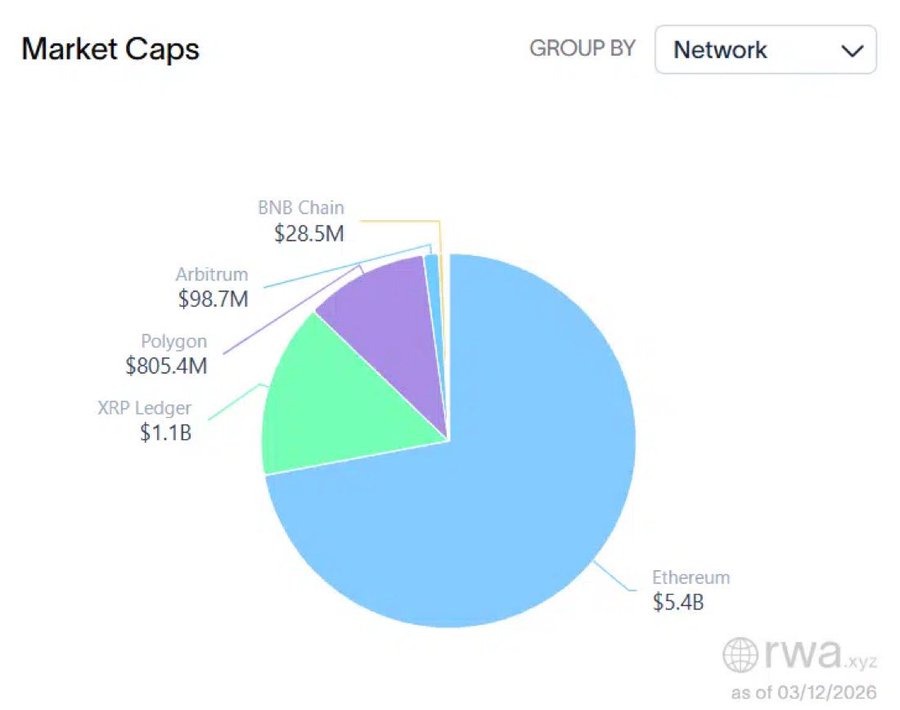
The update comes as tokenization activity on the XRP Ledger surges, with tokenized assets on the network growing to $1.14 billion in 2026.
Ripple’s XRPL Rolls Out Security Update
According to the XRPL announcement, the new 3.1.2 Rippled version fixes several vulnerabilities that could have disrupted server operations. These fixes are designed to improve node stability and ensure smoother network performance.
The update follows earlier XRPL upgrades that introduced a lending protocol and single-asset vault features. As new financial tools are added to the ecosystem, strengthening the network’s security has become increasingly important.
Meanwhile, developers are urging validators and node operators to upgrade servers to maintain security and future network compatibility.
XRPL’s Rapid Growth in Tokenization
At the same time, activity on the XRP Ledger has been rising sharply this year. Data shows that tokenized assets on the network have grown from about $111 million to $1.1 billion in 2026.
XRPL now holds over 15% of global tokenized commodities, making it a major blockchain in this sector. The expansion shows the growing use of the network for tokenizing real-world assets and financial products.
Meanwhile, crypto validator Vet recently pointed out that the XRP Ledger was one of the earliest blockchain platforms to offer tokenization and decentralized exchange capabilities.
He also noted that the XLS-66 Lending Protocol could unlock liquidity for tokenized assets that currently sit idle on the network. By allowing lending and borrowing, the feature could help capital move more efficiently within the ecosystem.
In addition, the recent Permissioned DEX upgrade could attract institutions seeking a regulated environment for trading tokenized assets. With stronger security and new DeFi tools, XRP Ledger is expanding its role in digital finance infrastructure.
Never Miss a Beat in the Crypto World!
Stay ahead with breaking news, expert analysis, and real-time updates on the latest trends in Bitcoin, altcoins, DeFi, NFTs, and more.
FAQs
How could XRPL tokenization growth impact the wider market?
More tokenized assets can improve liquidity, enable fractional ownership, and make global investment in commodities and financial assets easier.
What role could institutions play in XRPL’s ecosystem?
Institutions could bring large capital, liquidity, and regulated trading activity, helping expand blockchain use in traditional finance markets.
What developments could come next for XRPL?
Future updates may add new DeFi tools, improve scalability, and support more tokenized assets and financial applications on the network.
Singapore-based fintech company MetaComp has secured $35 million in new funding in just three months. The investment round was led by Alibaba, along with support from Spark Venture and several institutional investors.
The funding raise reflects growing interest in Web2.5 financial infrastructure, a model that combines traditional finance with digital assets.
MetaComp Targets Hybrid Stablecoin and Fiat Payments
According to the company’s announcement on March 13, the new capital will help MetaComp expand its hybrid payment and wealth management platform across key global markets.
MetaComp focuses on building financial infrastructure that connects traditional banking rails with blockchain-based payments. Its platform allows businesses and financial institutions to move funds using both fiat currencies and stablecoins.
By offering hybrid settlement options, MetaComp aims to enable faster cross-border payments and treasury management.
Licensed Infrastructure Supports Web2.5 Finance
A key strength of MetaComp is its regulatory backing. The company operates under licenses from the Monetary Authority of Singapore (MAS), allowing it to provide digital payment token services and cross-border money transfers.
Through its affiliate Alpha Ladder Finance, clients can also access tokenized investment products and traditional wealth services.
@MetaCompHQ raises total US$35M — backed by Alibaba, Spark Venture, and institutional investors. Two rounds. Three months.
✦ US$10B+ in payments & OTC volume in 2025 ✦ US$1B+ monthly run rate on the Client Asset Management Platform ✦ US$500M+ in wealth assets under… pic.twitter.com/Z2WJqgnaSJ
MetaComp’s Strong Growth Across Payments and Assets
The company reported significant growth across its financial platforms. In 2025 alone, MetaComp processed over $10 billion in payments and OTC trading volume. Its client asset management platform is now running at more than $1 billion in monthly activity.
At the same time, the company’s affiliated platform Alpha Ladder Finance manages over $500 million in wealth assets.
Despite operating in a fast-growing sector, MetaComp says it achieved full-year profitability in 2025, a milestone that many fintech startups struggle to reach.
Funding to Expand StableX Network and AI Infrastructure
With the new funding, MetaComp plans to expand its StableX Network, a platform designed for institutional settlement and liquidity. The network currently supports transactions across more than 13 stablecoins.
MetaComp plans to expand the platform across Asia, the Middle East, Africa, and Latin America, where demand for faster cross-border financial settlement continues to grow.
At the same time, MetaComp is also developing an AI-based financial architecture known as Agent-Skills-MCP, designed to support future automated financial services within the Web2.5 ecosystem.
Never Miss a Beat in the Crypto World!
Stay ahead with breaking news, expert analysis, and real-time updates on the latest trends in Bitcoin, altcoins, DeFi, NFTs, and more.
FAQs
What is MetaComp?
MetaComp is a Singapore-based fintech firm building Web2.5 financial infrastructure that connects traditional banking systems with blockchain payments.
What will MetaComp do with the new funding?
The company plans to expand its StableX Network, grow global payment infrastructure, and develop AI-based financial systems.
Is MetaComp a regulated fintech company?
Yes, MetaComp operates under licenses from the Monetary Authority of Singapore, allowing digital payment token services and transfers.
Flagship cryptocurrency Bitcoin today climbed close to $72,000, extending its recent rally as investors reacted to regulatory developments in the United States and easing concerns about rising oil prices. Ethereum, XRP, and Solana all joined the rally, jumping over 3 to 5%.
Overall, the crypto market cap increased about 3% to roughly $2.43 trillion. While seeing a liquidation of $253 million in the last 24 hours.
SEC and CFTC Cooperation Boosts Bitcoin Rally
On a weekly basis, Bitcoin is now up roughly 6.5%, outperforming several traditional risk assets despite ongoing geopolitical tensions. Part of the market’s strength followed a regulatory announcement in Washington.
The U.S. Securities and Exchange Commission and the U.S. Commodity Futures Trading Commission said they will work together to develop a clearer regulatory framework for crypto markets.
Under the agreement, both agencies plan to coordinate policies and oversight for digital assets and other emerging technologies. The goal is to create a regulatory approach designed specifically for crypto markets.
The initiative aligns with broader policy goals promoted by Donald Trump, who has said he wants the United States to provide clearer rules for the digital asset sector.
Oil Market Moves Also Support Risk Assets
Another factor supporting the rally came from developments in global energy markets.
Scott Bessent said the U.S. Treasury would provide temporary authorization allowing countries to purchase Russian oil shipments that are currently stranded at sea.
The move aims to increase supply and stabilize energy markets after oil prices surged nearly 10% to about $100 per barrel earlier in the week.
Bitcoin’s price jumped shortly after the statement as traders reacted to signs that energy-related inflation risks could ease.
Short liquidations also helped push the Bitcoin rally higher. Data from CoinGlass shows that 74,532 traders were liquidated in the past 24 hours, with total liquidations reaching about $251.96 million.
The largest single liquidation occurred on Hyperliquid, where a $4.24 million BTC-USD position was closed.
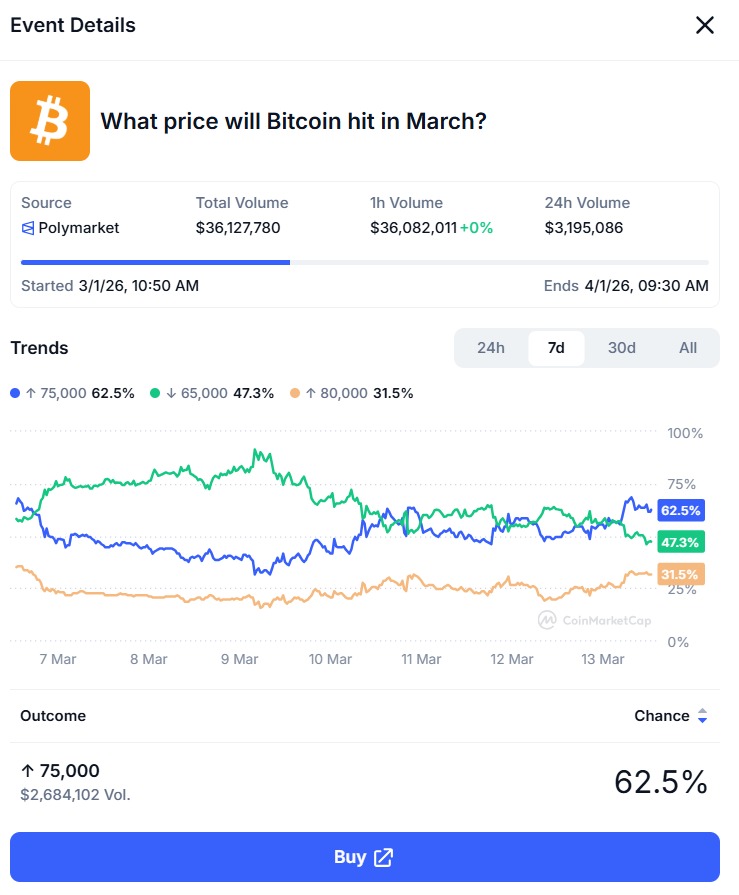
As of now, Bitcoin is trading at around toward $71,447, reflecting a jump of 3%. Meanwhile, prediction platform Polymarket currently shows about 62.5% odds that Bitcoin could move above $75,000 before the end of the month if bullish momentum continues.
Never Miss a Beat in the Crypto World!
Stay ahead with breaking news, expert analysis, and real-time updates on the latest trends in Bitcoin, altcoins, DeFi, NFTs, and more.
FAQs
What are the biggest risks to Bitcoin’s price in 2026?
Major risks include global recessions, tighter crypto regulations, declining liquidity, or a sustained breakdown below key support levels.
How much will BTC be worth in 2030?
Bitcoin price forecasts for 2030 range from $380K to $900K, driven by scarcity, long-term adoption, and expanding institutional participation.
What will be the price of Bitcoin in 2050?
While uncertain, many long-term projections suggest Bitcoin could exceed $1 million by 2050 if it becomes a global store of value.
Is Bitcoin still a good hedge against inflation in the long term?
Bitcoin’s fixed supply makes it attractive as an inflation hedge, especially during currency debasement and long-term economic uncertainty.
Lido DAO continues to dominate Ethereum liquid staking, and upgrades like stVaults and ValMart could strengthen stETH demand and drive LDO’s ecosystem growth.
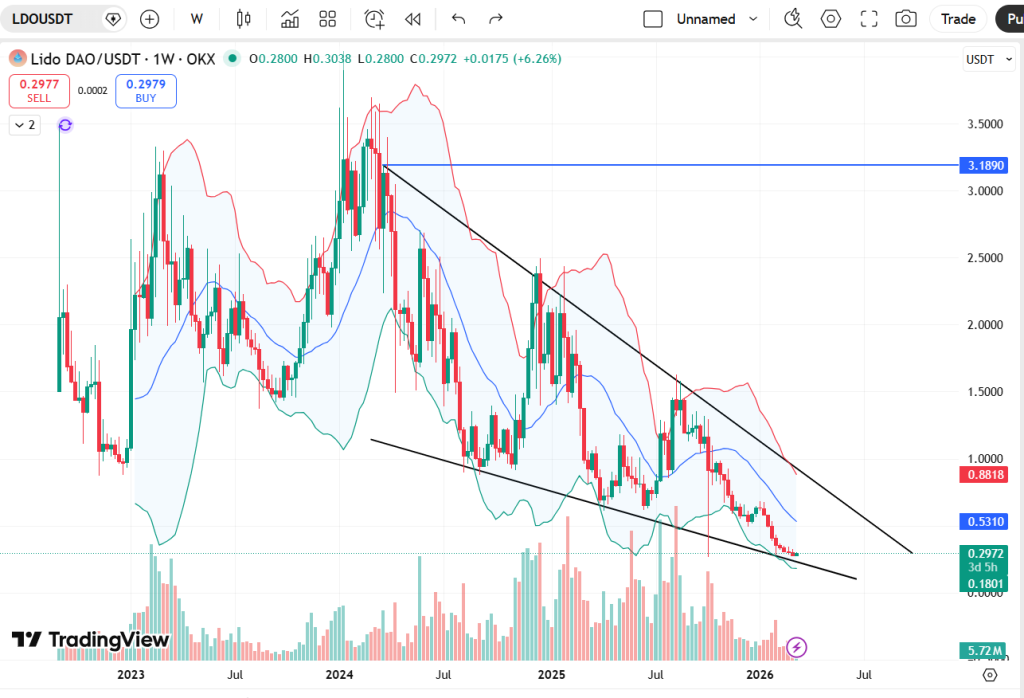
If value-capture strategies such as NEST and buybacks succeed, LDO price could recover from current support and potentially reach around $3.18 by 2026.
As liquid staking becomes core DeFi infrastructure, stronger adoption and institutional participation may push LDO toward higher long-term targets by 2030.
Ethereum’s transition to Proof-of-Stake reshaped the entire staking landscape. Instead of relying solely on validators locking 32 ETH, a new category of infrastructure emerged, liquid staking protocols.
Lido DAO quickly became the leader in that category.
As staking becomes more popular in the crypto world, Lido DAO is changing the game with liquid staking. It lets users stake Ethereum (ETH) while still being able to use it for on-chain activities.
Meanwhile, the native token of Lido DAO, called LDO, is also used as the platform’s governance token.
If you want to learn how this technology works or are curious about the future price of LDO.
Here is CoinPedia’s Lido DAO (LDO) price prediction for 2026, 2027, and 2030.
Over time, this innovation positioned Lido as one of the most influential infrastructure protocols in decentralized finance. The project now manages billions in total value locked while powering a large portion of Ethereum’s staking ecosystem.
Lido is also preparing to introduce stVaults and ValMart, two infrastructure layers designed to expand the ways stETH can generate yield across DeFi protocols.
If these upgrades attract institutional participation and increase demand for liquid staking derivatives, LDO could attempt a recovery toward $0.8816 by March 2026.
Month
Potential Low ($)
Potential Average ($)
Potential High ($)
Lido DAO Price Prediction March 2026
$0.18
$0.531
$0.8816
Lido DAO (LDO) Price Prediction 2026
The year 2026 could become a turning point for Lido as the protocol shifts toward value capture for LDO token holders.
Historically, Lido generated large staking volumes but captured relatively little value directly for its governance token. The DAO is now exploring mechanisms such as buybacks and improved revenue distribution, which could strengthen long-term demand for LDO.
One of the upcoming mechanisms under this strategy is NEST (Node Operator Staking Expansion).
At the same time, Lido continues expanding its staking infrastructure across multiple networks while maintaining its leadership in Ethereum liquid staking.
Technical Analysis
Looking at the Lido DAO weekly chart, LDO shows that the token is still in a long-term downtrend. Price has been moving inside a descending channel, with lower highs and lower lows forming since early 2024.
Recently, LDO dropped close to the $0.30 support area, which is an important level where buyers may try to defend the price. The chart also shows Bollinger Bands tightening, which suggests that volatility is decreasing and a strong move could happen soon.
As of now, the price remains below the mid-band and key resistance near $0.53, showing that sellers still control the market. If LDO manages to hold above the current support and break the falling trendline, the price could move toward $0.53 and later $3.18.
However, if the support breaks, LDO may fall toward $0.20 or lower, continuing the bearish trend.
Year
Potential Low ($)
Potential Average ($)
Potential High ($)
Lido DAO Price Prediction 2026
$0.19
$1.50
$3.18
Lido DAO Price Prediction 2026 – 2030
Year
Potential Low ($)
Potential Average ($)
Potential High ($)
2026
$0.19
$1.50
$3.18
2027
$.781
$3.10
$7.90
2028
$1.4
$6.43
$9.70
2029
$2
$7.67
$11.30
2030
$2.53
$9.14
$15.42
Lido DAO Price Prediction 2026
If Lido’s ecosystem upgrades improve value capture and stETH demand increases, LDO could approach $3.18.
Lido DAO Token (LDO) Price Prediction 2027
By 2027, Lido plans deeper integration of Real-World Assets (RWAs). If this “Billion-Dollar Bet” succeeds, LDO could reach $7.90
Lido DAO Price Forecast 2028
As liquid staking derivatives become essential infrastructure for DeFi lending and derivatives markets, LDO may approach $9.70.
Lido DAO Price Prediction 2029
If stETH continues evolving into a core collateral asset within decentralized finance, LDO could climb toward $11.30.
Lido DAO Token (LDO) Price Prediction 2030
By 2030, if Lido maintains its position as the primary liquid staking provider while expanding into institutional finance, LDO could potentially reach $15.43.
What Does The Market Say?
Year
2026
2027
2030
Wallet Investor
$1.504
$1.054
$0.73
coincodex
$4.96
$2.08
$5.06
Digitalcoinprice
$4.72
$6.59
$14.05
CoinPedia’s Lido DAO (LDO) Price Prediction
From CoinPedia’s perspective, Lido remains one of the most critical infrastructure protocols within the Ethereum ecosystem. The protocol’s success will depend on whether it can transition from a simple staking service into a multi-layer financial ecosystem centered around stETH.
If strategies such as GOOSE-3, stVaults, ValMart, and RWA integrations succeed, Lido could significantly increase the economic value flowing through its ecosystem.
Under such conditions, CoinPedia expects LDO to reach around $3.18 by 2026.
Year
Potential Low ($)
Potential Average ($)
Potential High ($)
2026
$0.19
$1.50
$3.18
Never Miss a Beat in the Crypto World!
Stay ahead with breaking news, expert analysis, and real-time updates on the latest trends in Bitcoin, altcoins, DeFi, NFTs, and more.
FAQs
What is Lido DAO (LDO) and how does it work?
Lido DAO is a liquid staking protocol that lets users stake Ethereum while keeping liquidity through stETH, while LDO tokens are used to vote on protocol upgrades.
What factors could influence LDO’s future price?
LDO price depends on Ethereum staking growth, DeFi demand for stETH, governance upgrades, and new initiatives like NEST, stVaults, and RWA integrations.
What is the price prediction for LDO in 2026?
LDO could trade between $0.19 and $3.18 in 2026 if liquid staking demand grows and Lido improves value capture for token holders.
What is the Lido DAO price prediction for 2030?
By 2030, LDO could reach around $15.42 if Lido maintains dominance in Ethereum liquid staking and expands into institutional and RWA integrations.
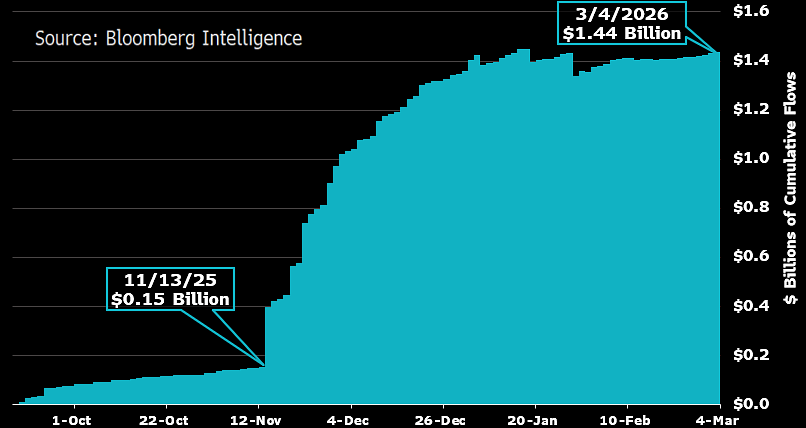
Since launching in November 2025, XRP exchange-traded funds (ETFs) have attracted more than $1.4 billion in inflows, showing steady investor demand. Products from asset managers such as Franklin Templeton and Canary Capital have continued to bring in new funds.
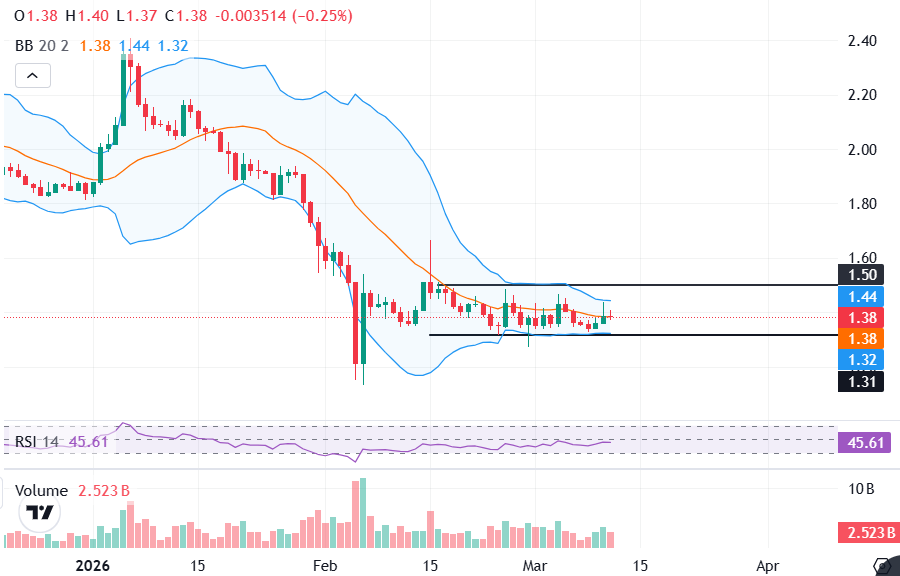
Despite this strong inflow, XRP’s price remains under pressure, currently trading near $1.38.
XRP ETFs Attract $1.4 Billion Inflows
XRP ETFs were launched in November 2025 after Ripple Labs secured a major legal victory against the U.S. Securities and Exchange Commission. Since then, these funds have attracted about $1.4 billion in total inflows.
According to James Seyffart, most of the money flowing into XRP ETFs is coming from retail investors rather than large institutions. This pattern has continued even during recent market volatility.
By early March 2026, total inflows across XRP ETF products had reached about $1.44 billion. Data also shows that investors added around $58 million in February, despite slower trading activity across the broader crypto market.
Institutions Slowly Joining the Trend
While retail investors dominate the inflows, some large institutions are beginning to take positions.
Coinpeida news reported that Goldman Sachs revealed in its latest filing with the SEC that it holds about $154 million worth of XRP ETF shares. These make it one of the largest institutional investors in these funds.
XRP Price Struggles Despite $1.4B ETF Inflows
However, the price of XRP continues to face pressure even though XRP ETFs have attracted over $1.4 billion in inflows since launch. Recently, weakening institutional demand has also affected the token’s price.
Since March 5, U.S. spot XRP exchange-traded funds have recorded about $44.76 million in outflows. Because of this, XRP’s price has continued to fall.
Although, since the XRP ETF launch, the token has dropped sharply from its November high of $2.57.
As of now, XRP is trading below $1.38, which is about a 45% decline since the ETF launch.
Chart Analyst Eyeing $2 level For XRP
Meanwhile, crypto chart analyst Ali Martinez pointed out that XRP’s Bollinger Bands are tightening around the $1.38 level. This pattern usually means the price is moving in a small range before a big move.
If buying pressure returns, rising volatility could push XRP toward a possible $2 retest in the coming weeks.
Big news for the crypto market. On March 11, the U.S. Securities and Exchange Commission and the Commodity Futures Trading Commission announced a historic Memorandum of Understanding (MoU).
The agreement aims to improve cooperation between the two agencies, especially on crypto regulation and new digital asset products.
SEC and CFTC Sign MoU To Work Together on Crypto Oversight
For years, the two agencies have taken different views on digital assets. The SEC has often treated many tokens as securities, while the CFTC argued that some of them are commodities.
Because of this lack of clear rules, many large investors kept billions of dollars on the sidelines instead of entering the market.
The new agreement aims to reduce these conflicts. Under the MoU, both regulators plan to coordinate policy efforts, enforcement actions, and regulatory frameworks related to crypto markets.
TODAY: Alongside the @CFTC, we entered into an updated Memorandum of Understanding to guide future coordination between our two agencies.
This MOU will support lawful innovation, uphold market integrity, and promote investor and customer protection.
— U.S. Securities and Exchange Commission (@SECGov) March 11, 2026
SEC Chairman Paul S. Atkins said that regulatory conflicts and overlapping rules between the agencies had slowed innovation for years and pushed some companies to move outside the United States.
“The era of turf wars, duplicative registrations, & differing regulations between SEC & CFTC is over.”
The agencies also launched a Joint Harmonization Initiative to improve coordination. The plan includes:
Clarifying product definitions through joint interpretations and rulemaking
Updating clearing, margin, and collateral frameworks
Reducing regulatory friction for exchanges and intermediaries registered with both agencies.
A proper regulatory framework for crypto assets and new technologies.
Streamlining reporting requirements for trade data and funds.
Coordinating examinations, risk monitoring, and enforcement activity.
The initiative will be co-led by Robert Teply and Meghan Tente, who will oversee collaboration between the two agencies.
Bullish News For Crypto Market
Crypto experts believe this agreement could help reduce regulatory uncertainty in the United States. Clearer rules may encourage more institutional investors to enter the crypto market, which would be a very bullish sign for the industry.
This move also aligns with the vision of Donald Trump to make the United States the “crypto capital of the planet” and the “Bitcoin superpower of the world.”
He has recently pushed lawmakers to pass the Clarity Act, arguing that the crypto industry needs clear rules to end what he calls a long-running “regulatory war” against the sector.
Never Miss a Beat in the Crypto World!
Stay ahead with breaking news, expert analysis, and real-time updates on the latest trends in Bitcoin, altcoins, DeFi, NFTs, and more.
FAQs
What is the SEC and CFTC MoU about?
The MoU aims to improve coordination between SEC and CFTC on crypto regulation, enforcement, and policy to reduce market uncertainty.
Why did the SEC and CFTC sign this MoU?
The agencies signed it to end regulatory conflicts, streamline rules, and encourage innovation and institutional crypto investment in the US.
How will the MoU impact the US crypto market?
Clearer rules and joint oversight may attract more institutional investors, reduce regulatory friction, and boost confidence in crypto projects
Could this MoU be bullish for crypto prices?
Yes, reduced regulatory uncertainty and increased institutional participation may positively influence market sentiment and crypto adoption.
Strike (STRK) is a DeFi lending protocol where users supply crypto to earn interest while borrowers access liquidity without selling their assets.
STRK trades near $0.040 and remains in a descending channel, with $0.038 acting as key support and $0.052 as the major resistance level.
If DeFi liquidity and TVL recover, STRK could potentially reach up to $0.158 in 2026 as lending demand returns to the sector.
Long-term projections suggest STRK could climb toward $6.29 by 2030 if decentralized lending adoption expands across the crypto market.
Strike is a decentralized lending protocol where users can supply crypto assets to liquidity markets and earn interest, while borrowers can access capital without selling their holdings.
The platform uses a pool-based model where deposited assets are converted into sTokens, which represent a user’s share in the lending pool and can be redeemed at any time.
With its innovative approach and growing adoption, Strike is positioning itself as a major DeFi player in the years to come. Amid the increasing demand in the DeFi sector, Strike is a rising DeFi protocol in the lending segment. Are you considering investing in Strike?
Here is CoinPedia’s Strike (STRK) price prediction for 2026, 2027, and 2030.
March 2026 could be a key period for Strike as decentralized lending protocols attempt to rebuild momentum following the DeFi downturn of recent years.
Strike’s design is similar to early money market platforms like Compound, where lending pools automatically adjust interest rates based on borrowing demand. This system allows lenders to earn yield while keeping their assets liquid.
The protocol supports multiple crypto assets as collateral and distributes interest through the sToken system, which tracks a user’s share in the lending pool.
If total value locked (TVL) across DeFi lending protocols begins expanding again, and Strike increases market participation, STRK could attempt to reach $0.10 by March 2026.
Month
Potential Low ($)
Potential Average ($)
Potential High ($)
Strike Price Prediction March 2026
$0.0018
$0.0560
$0.010
Strike (STRK) Price Prediction 2026
The future of Strike is closely tied to the overall health of the DeFi lending market.
In previous cycles, decentralized lending platforms captured billions of dollars in liquidity as users searched for alternatives to centralized financial services. If similar trends return, Strike could benefit from renewed capital inflows.
The protocol’s governance token STRK plays a role in managing platform parameters, voting on proposals, and shaping the future of the lending markets.
If the DeFi lending sector grows again and Strike manages to increase its market share, STRK could gradually regain value in the coming cycle.
Technical Analysis
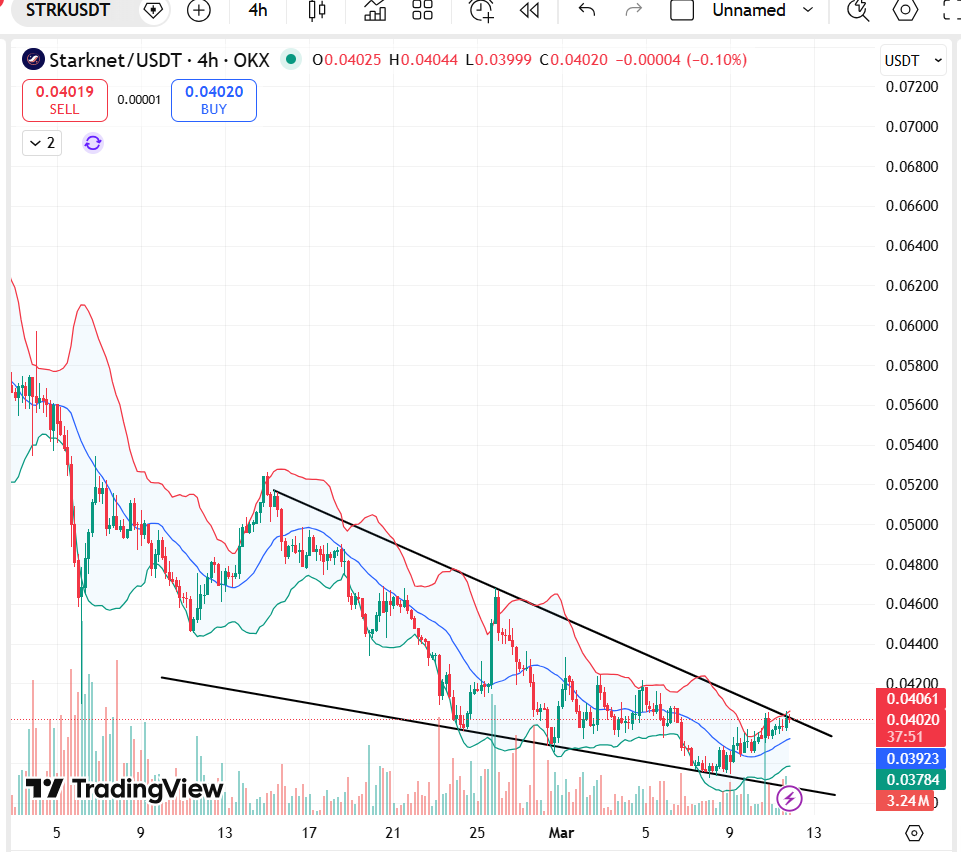
Looking at the 4-hour chart of STRK/USDT, it shows that the price is still moving inside a descending channel, which means the short-term trend remains bearish.
On the chart, STRK is trading around $0.040 and recently bounced from the lower support area near $0.038. This zone is acting as short-term support where buyers are trying to defend the price. However, the price is still below the main trendline resistance.
If STRK breaks above the upper trendline near $0.052, it could move toward $0.158 in the long term.
But if the support zone fails, the price may drop toward $0.035.
Year
Potential Low ($)
Potential Average ($)
Potential High ($)
Strike Price Prediction 2026
$0.0035
$0.052
$0.158
Strike Price Prediction 2026 – 2030
Year
Potential Low ($)
Potential Average ($)
Potential High ($)
2026
$0.0035
$0.052
$0.158
2027
$0.080
$0.142
$0.28
2028
$0.13
$0.36
$0.74
2029
$0.21
$0.81
$2.31
2030
$0.63
$1.77
$6.29
Strike (STRK) Price Prediction 2026
If DeFi liquidity returns and Strike’s lending markets expand, STRK could climb toward $0.158.
Strike Price Prediction 2027
As decentralized lending becomes more competitive, protocols offering efficient interest markets may attract capital again.
STRK Price Prediction 2028
By 2028, deeper integration with other DeFi services such as stablecoin lending and liquidity markets could push STRK toward $0.74.
Strike Coin Price Prediction 2029
If decentralized finance regains large-scale adoption and lending volumes increase across the industry, STRK could approach $2.31.
Strike (STRK) Price Prediction 2030
By 2030, if Strike manages to remain relevant among DeFi money market platforms, the token could potentially reach the $6.29 range.
What Does The Market Say?
Year
2026
2027
2030
CoinCodex
$0.0179
$0.01642
$ 0.01581
Swapspace
$0.328
$0.339
$0.500
Digitalcoinprice
$0.0409
$0.0474
$0.0495
CoinPedia’s Strike (STRK) Price Prediction
Strike represents one of the earlier attempts to build decentralized money markets within the DeFi ecosystem.
Although the sector has faced volatility and declining liquidity in recent years, decentralized lending remains a fundamental building block of blockchain finance.
CoinPedia’s experts believe that, if DeFi markets regain momentum and lending platforms once again attract large capital inflows, STRK could potentially recover toward the $0.158 range in 2026.
Year
Potential Low ($)
Potential Average ($)
Potential High ($)
2026
$0.0035
$0.052
$0.158
Never Miss a Beat in the Crypto World!
Stay ahead with breaking news, expert analysis, and real-time updates on the latest trends in Bitcoin, altcoins, DeFi, NFTs, and more.
FAQs
What is Strike (STRK) in crypto?
Strike is a decentralized lending protocol where users supply crypto to earn interest and borrow assets without selling holdings through liquidity pools.
What is the STRK price prediction for 2026?
STRK could trade between $0.0035 and $0.158 in 2026 if DeFi lending demand grows and the protocol attracts more liquidity and users.
How high can STRK coin go by 2030?
If DeFi lending expands and Strike gains adoption, STRK could potentially reach around $6.29 by 2030 according to long-term projections.
What will STRK be worth in 2040?
By 2040, STRK’s value will depend on DeFi growth, platform relevance, and adoption. If the ecosystem expands, the token could see significant gains.
How does Strike’s lending system work?
Users deposit crypto into liquidity pools and receive sTokens that represent their share. Borrowers take loans using collateral while lenders earn interest.
Is Strike (STRK) a good investment?
STRK’s potential depends on DeFi market growth, platform adoption, and liquidity expansion. Strong lending activity could support long-term value.
Kraken, one of the largest crypto exchanges with more than 13 million active users, has announced plans to list the PI Network native Pi token on March 13. Meanwhile, the move comes just two days before the community’s annual Pi Day on March 14.
Following the announcement, PI coin price rose about 2% within one hour, trading around $0.23.
Kraken Announces PI Token Listing
In a recent tweet post, Kraken Listing announced plans to list the PI token on March 13.
Tap-to-Earn Pi Network is a digital currency project that allows users to mine coins using a free mobile app. Unlike Bitcoin, it does not require heavy computers or large amounts of electricity. Instead, users can mine tokens directly from their smartphones with a simple daily tap.
Coming soon: $PI@PiCoreTeam Pi Network is a mobile-first Layer-1 blockchain and developer platform enabling accessible crypto mining via smartphone, with a utility-based ecosystem on an identity-verified mainnet.
The upcoming listing will add Kraken to the group of exchanges already offering PI trading. The token is currently available on platforms including OKX, Bitget, HTX, and BitMart.
However, PI has not yet been listed on some of the largest global exchanges, such as Binance and Coinbase.
The listing announcement arrives just two days before Pi Day on March 14, an annual milestone for the community.
This date has often created strong excitement in the Pi Network community and has historically led to increased trading activity around the token.
Meanwhile, this year, network protocol upgrades are expected to finish by March 12, and new DeFi tools may also launch.
PI Coin Price Rises After Listing News
Even though the Pi Coin price moved up after the listing news, Pi Coin is still about 85% below its all-time high of $2.34.
According to crypto market observer Dr. Altcoin, PI has been trending higher during the past week and is approaching a $0.24 resistance level.
If the token moves above that level, traders say it could trigger an additional price rally towards $0.50 as the Pi Day event approaches.
Never Miss a Beat in the Crypto World!
Stay ahead with breaking news, expert analysis, and real-time updates on the latest trends in Bitcoin, altcoins, DeFi, NFTs, and more.
FAQs
When will Kraken list the Pi Network (PI) token?
Kraken plans to list the Pi Network PI token on March 13. The announcement came just days before Pi Day, a major annual event for the Pi community.
How many exchanges currently list Pi Coin?
Pi Coin is currently listed on several exchanges, including OKX, Bitget, HTX, and BitMart. Kraken’s listing will add another major trading platform.
Is Pi Coin listed on Binance or Coinbase?
No, Pi Coin has not yet been listed on Binance or Coinbase. Many investors are watching closely to see if these major exchanges support PI in the future.
Can Pi Coin reach $0.50 before Pi Day?
Traders say a break above the $0.24 resistance level could trigger a rally toward $0.50. Market sentiment and Pi Day excitement may influence short-term price moves.
Goldman Sachs has emerged as the largest institutional holder of spot XRP exchange-traded fund shares, with nearly $154 million in holdings across multiple XRP ETF products. Despite the sizable institutional exposure, XRP has struggled to move above $1.50 in recent weeks.
13F Filings Show Institutional Positioning in XRP ETFs
Goldman Sachs filed its 13F report with the U.S. Securities and Exchange Commission (SEC). The latest filings show that 83 institutions reported holdings in XRP ETFs. Together, the top 30 investors hold around $211 million worth of XRP ETF shares.
Among them, Goldman Sachs holds the largest position, with about $154 million in XRP ETF shares, putting it far ahead of other institutions that reported their holdings.
Although Goldman Sachs holds a large position, institutions control only a small part of the total XRP ETF market.
As of now, spot XRP ETFs held roughly $1.21 billion in total assets. The $211 million disclosed through 13F filings represents about 16% of those assets. The remaining 84% of ETF ownership comes from investors who are not required to file 13F reports.
Because of this structure, much of the daily trading activity in XRP ETFs is driven by investors outside the institutional reporting system.
ETF Experts Say Retail Demand Still Drives XRP Market
Senior ETF Analyst Eric Balchunas commented that the non-reporting majority of ETF investors is likely dominated by dedicated XRP supporters rather than casual traders.
The token remains central to the strategy of Ripple Labs. At a recent event, Brad Garlinghouse described XRP as the company’s “North Star.”
XRP Price Failing To Rally
Despite large institutional exposure through XRP exchange-traded funds, XRP has struggled to move above the $1.50 level for nearly a month.
However, overall market sentiment has weakened due to rising geopolitical tensions in the Middle East, particularly the conflict involving the United States, Israel, and Iran.
Technical levels show that $1.50 remains a strong resistance zone. If the token breaks above this level with sustained buying pressure, the price could move toward $2.

 Login
Login
 -1.65%

 2.75%
2.75%

 TODAY: Alongside the