Reading view

Attorney Explains Why XRP Token Buybacks Are Not the Same as Share Buybacks
Ripple XRP buyback debate

The post Attorney Explains Why XRP Token Buybacks Are Not the Same as Share Buybacks appeared first on Coinpedia Fintech News

Ripple recently bought back about $750 million worth of its own shares, valuing the company at around $50 billion. This move has sparked questions in the crypto community about whether Ripple should also be supporting XRP more directly. Attorney Bill Morgan and Zach Rynes share opposing views on how token value should be supported.

Why Ripple Isn’t Buying XRP

Morgan rejected comparisons between token buybacks and traditional stock buybacks. According to Morgan, the comparison is flawed because cryptocurrency tokens do not function like company shares.

Shares provide ownership rights and claims on company profits, while XRP operates on the decentralized XRP Ledger, which Ripple does not control. Morgan emphasized that Ripple does not own the network, meaning actions like buybacks would not have the same economic meaning they do in traditional corporate finance.

Instead of accumulating more tokens, Morgan suggested that Ripple could potentially release escrowed XRP faster to improve liquidity within the ecosystem.

Evernorth Strategy: Ripple’s Alternative Approach

Morgan also pointed to another approach linked to Ripple through Evernorth, an entity created to build an institutional XRP treasury.

Evernorth plans to buy XRP, use it in yield strategies like lending or liquidity, and then use the earnings to purchase more XRP from the market. This could slowly increase demand for the token. Morgan added that Evernorth operates independently and aims to give institutions a regulated way to gain exposure to XRP.

Critics Push Back on Ripple’s Strategy

However, not everyone agrees with Ripple’s approach. Zach Rynes, also known as ChainLinkGod, criticized Ripple’s structure, arguing that companies issuing both tokens and equity could create conflicting incentives.

Rynes claimed that when a company sells tokens while also prioritizing equity shareholders, the economic interests of token holders and shareholders may not always align. He also argued that using revenue to support token value, similar to corporate buybacks, could provide clearer benefits to holders.

Another voice in the discussion, SmartCon Drummer, questioned why Ripple focused on buying back company shares rather than purchasing XRP directly from the market. According to him, token buybacks could create both direct price impact and positive psychological sentiment among holders.

Ripple’s Narrative

Rejecting such claims, David Schwartz, former Ripple CTO argued that if critics believe Ripple lowers XRP’s price by selling tokens to fund share buybacks, the same logic means XRP holders actually benefit by getting the chance to buy the token at lower prices.

Are you being deliberately dumb? It’s good for holders because it made the price of XRP go down when they bought it.

Narratives Changing to Legal Concerns

Ripple supporters argue that the company’s strategy is partly shaped by legal history. During the long-running SEC v. Ripple case, the U.S. Securities and Exchange Commission cited actions by Ripple that allegedly supported XRP’s price as part of its argument that the token could be considered a security.

Never Miss a Beat in the Crypto World!

Stay ahead with breaking news, expert analysis, and real-time updates on the latest trends in Bitcoin, altcoins, DeFi, NFTs, and more.

FAQs

Why isn’t Ripple buying XRP from the market?

Ripple says XRP isn’t a company share. Because it doesn’t control the XRP Ledger, token buybacks wouldn’t work like stock buybacks used by traditional companies.

Would Ripple buying XRP from the market increase its price?

Large market purchases could boost demand and sentiment. However, Ripple has avoided this strategy due to regulatory concerns and token-equity differences.

Could Ripple legally support XRP’s price by buying it?

Ripple has been cautious. During the SEC case, actions tied to supporting XRP’s price were cited in arguments that the token might be a security.
The Week That Could Send Bitcoin to $80,000 or Back to $65,000 Starts Now

The Week That Could Send Bitcoin to $80,000 or Back to $65,000 Starts Now

The post The Week That Could Send Bitcoin to $80,000 or Back to $65,000 Starts Now appeared first on Coinpedia Fintech News

Global financial markets are entering a week packed with important macroeconomic developments, with several central bank decisions and economic indicators scheduled across major economies. These crypto events often shape liquidity conditions and risk appetite in global markets, which can spill over into digital assets like Bitcoin and the broader crypto sector.

With major policy updates from the Federal Reserve, the European Central Bank, and other monetary authorities expected, the crypto market may see increased volatility as investors react to signals around interest rates, inflation, and the overall economic outlook.

Monday, March 16 – Quiet Start

The week begins without any major macroeconomic announcements.

With no scheduled economic releases, markets are expected to move steadily while participants prepare for several high-impact events later in the week. Early-week trading activity typically reflects positioning ahead of upcoming inflation data and central bank decisions.

Tuesday, March 17 – Waiting for the Fed

Tuesday also has no major economic releases scheduled. However, attention is gradually building around the upcoming policy decision from the Federal Reserve.

In many cases, markets begin adjusting ahead of central bank announcements, especially when interest rate expectations are involved. This positioning can influence risk assets across global markets.

Wednesday, March 18 – Decisive Day for Global Markets

Wednesday is expected to be the most significant day of the week.

The first major event is the release of the United States Producer Price Index (PPI) inflation data at 15:30. The PPI measures inflation at the wholesale level and can provide insight into future consumer price trends.

Later in the evening, the Federal Reserve will announce its interest rate decision at 21:00. Monetary policy decisions from the Fed play a major role in shaping global financial conditions.

Following the rate announcement, Jerome Powell, Chair of the Federal Reserve, will hold a press conference at 21:30, where he will discuss the central bank’s economic outlook and policy direction.

Thursday, March 19 – Labor Data and ECB Decision

Thursday brings several additional macroeconomic updates.

The United States will release Initial Jobless Claims at 15:30, a weekly indicator that reflects labor market conditions and economic activity.

Shortly afterward, the European Central Bank will announce its interest rate decision at 16:15. Policy changes from the ECB can influence currency markets and global financial sentiment.

Later in the day, the Federal Reserve Balance Sheet report at 23:30 will show any changes in the central bank’s asset holdings, offering insight into liquidity management through asset purchases or quantitative tightening.

Friday, March 20 – Russia Rate Decision

On Friday, the Central Bank of Russia will announce its latest interest rate decision at 13:30. The policy update reflects Russia’s ongoing efforts to manage inflation and maintain financial stability.

Saturday, March 21 – Powell Speaks Again

The week concludes with another scheduled appearance by Jerome Powell at 17:30. The discussion may provide additional context on inflation trends, economic growth, and the future direction of U.S. interest rate policy.

Never Miss a Beat in the Crypto World!

Stay ahead with breaking news, expert analysis, and real-time updates on the latest trends in Bitcoin, altcoins, DeFi, NFTs, and more.

Crypto This Week: $229M Unlock Events Ahead While Ethereum Whale Makes $17M Move

Crypto token unlocks this week

The post Crypto This Week: $229M Unlock Events Ahead While Ethereum Whale Makes $17M Move appeared first on Coinpedia Fintech News

The crypto market is set for a large wave of token unlocks over the next seven days, with the total value expected to exceed $438 million, according to data from Tokenomist.

Token unlocks refer to the release of previously locked tokens into circulation. These tokens are usually allocated to early investors, project teams, or ecosystem incentives and become available based on pre-set schedules.

Several large one-time unlocks exceeding $5 million are scheduled during the period. These include tokens such as ZRO, BARD, RIVER, MBG, YZY, and KAITO, along with the native token of Arbitrum (ARB).

Alongside the one-time releases, several projects will conduct linear unlocks, meaning tokens are distributed gradually each day. Projects with daily unlock values above $1 million include RAIN, Solana (SOL), CC, RIVER, TRUMP, Worldcoin (WLD), Dogecoin (DOGE), ASTER, and Bittensor (TAO).

Major Token Releases Between March 16–22

Crypto analytics platform Top 7 Crypto reported that more than $229 million worth of tokens will be unlocked between March 16 and March 22, 2026.

The largest release is expected from ASTER, which plans to unlock 78.4 million tokens worth approximately $55.9 million on March 17, representing about 0.98% of the token’s total supply.

Another notable unlock involves ZRO, the token associated with the LayerZero ecosystem, which will release $50.3 million worth of tokens on March 20. This event represents roughly 2.47% of the token’s total supply.

Other scheduled releases include BARD with $34.8 million on March 18, RIVER with $27 million on March 22, and STBL unlocking $15.1 million on March 16. 

Additional projects participating in the release schedule include ESPORTS with $12.6 million, RTX with $10.5 million, ARB with $9.8 million, BR with $7.4 million, and KAITO with $6.3 million.

Ethereum Whale Accumulates $17 Million in ETH

On the other hand, while token unlocks dominate the weekly schedule, blockchain data also shows large accumulation activity. Analytics platform Onchain Lens reported that a crypto whale identified as billΞ.eth purchased 7,769 ETH in the past few hours.

The purchase was valued at $17.46 million, with the buyer acquiring Ethereum at an average price of around $2,248 per token.

The transaction occurred within roughly three hours, indicating a significant accumulation move during a relatively short time frame.

Supply Expansion Arrives Alongside Whale Activity

The upcoming token releases will introduce a notable amount of new supply across multiple projects. At the same time, large wallet accumulation in major assets such as Ethereum highlights continued capital movement within the crypto ecosystem.

Together, these developments mark an active week for the market as new tokens enter circulation while major holders continue increasing positions in leading cryptocurrencies.

Never Miss a Beat in the Crypto World!

Stay ahead with breaking news, expert analysis, and real-time updates on the latest trends in Bitcoin, altcoins, DeFi, NFTs, and more.

FAQs

What are crypto token unlocks and why do they matter?

Token unlocks release previously locked coins into circulation for investors, teams, or rewards. They increase supply and can influence price volatility.

How much crypto is scheduled to unlock this week?

More than $438 million worth of tokens are expected to unlock over the next seven days, adding new supply across multiple crypto projects.

Do token unlocks usually affect crypto prices?

They can. Large unlocks may increase selling pressure if holders sell tokens, but strong demand or market sentiment can offset the impact.

Bitcoin Gained $1,800 in 30 Minutes and Wiped Out $113 Million in Shorts: What Just Happened?

Why Bitcoin price is rising today

The post Bitcoin Gained $1,800 in 30 Minutes and Wiped Out $113 Million in Shorts: What Just Happened? appeared first on Coinpedia Fintech News

The crypto market moved higher today, led by Bitcoin, which surged to around $74,300, marking its highest level in roughly 40 days. Bitcoin gained nearly $1,800 in just 30 minutes, triggering a wave of liquidations across derivatives markets.

More than $113 million worth of short positions were liquidated within an hour, forcing bearish traders to close positions and adding strong buying pressure to the market. The move pushed the broader crypto sector higher as well, with Ethereum climbing about 13% while other major assets followed the upward trend.

Since geopolitical tensions escalated between the United States and Iran, the crypto market has added over $320 billion in value.

Capital Rotation Toward Crypto

One of the developments during this rally is the shift of capital toward digital assets. While global markets faced volatility, traditional sectors experienced large losses.

U.S. equity markets erased roughly $2.4 trillion in value, while Gold and Silver together lost nearly $2.5 trillion during the same period. In contrast, the crypto market added more than $200 billion.

Bitcoin’s ability to outperform several major asset classes during geopolitical stress has strengthened its narrative as a diversification tool in global portfolios.

Institutional Demand Through ETFs

Institutional participation remains one of the strongest drivers of the current rally. Data from Sosovalue, between March 9 and March 13, spot ETFs linked to Bitcoin recorded $767 million in net inflows, extending a three-week streak of positive institutional investment.

Spot ETFs tied to Ethereum attracted $161 million in inflows over the same period. Meanwhile, funds connected to Solana recorded $10.7 million in inflows, while ETFs tracking XRP experienced $28.07 million in net outflows.

Large institutions have reportedly purchased over $2.1 trillion worth of Bitcoin ETF exposure, further strengthening demand for the asset.

Analysts Highlight Bullish Market Signals

Crypto analyst Dan Gambardello explained that several long-term indicators are beginning to align, forming what he described as a bullish macro confluence that typically takes years to develop. According to him, the current structure resembles patterns often seen near major market bottoms.

Crypto analyst Ali Martinez believes a relief rally may be approaching for Bitcoin. According to him, while Bitcoin trades around $71,000, derivatives data shows bears paying funding fees to keep their short positions open. He describes this as a rare market setup that has historically resulted in relief rallies with a strong success rate. 

Based on past patterns, the analyst also highlights $73,500 as a key level, suggesting that a move toward that zone could confirm the expected bounce.

Never Miss a Beat in the Crypto World!

Stay ahead with breaking news, expert analysis, and real-time updates on the latest trends in Bitcoin, altcoins, DeFi, NFTs, and more.

FAQs

Why is Bitcoin Price Up Today?

Bitcoin is rising due to strong ETF inflows, a short squeeze that liquidated $113M in bearish bets, and investors shifting capital to crypto during global geopolitical tensions.

How high did Bitcoin surge in the latest rally?

Bitcoin surged to around $74,300, its highest level in about 40 days, after gaining nearly $1,800 within 30 minutes during a sudden market-wide short squeeze.

Is Bitcoin benefiting from geopolitical tensions?

Yes. During global uncertainty, investors often diversify into Bitcoin. Recently, the crypto market added over $320B as geopolitical tensions increased.

What is the Bitcoin price prediction for March 2026?

Analysts expect Bitcoin to trade roughly between $70,000 and $80,000 in March 2026 if momentum continues, with stronger rallies possible if ETF inflows remain strong.

Pi Network News: New Pi Launchpad App With Experimental Token Launches on Testnet 

Pi Network News

The post Pi Network News: New Pi Launchpad App With Experimental Token Launches on Testnet  appeared first on Coinpedia Fintech News

The Pi Core Team has announced that the first version of the Pi Launchpad has been released as a Pi App on the Testnet, along with a test token.

Since the Launchpad introduces new features and works differently from typical Web3 token launches, the team decided to release it on Testnet first. This allows the Pi community to understand how the system works and get familiar with the process before it eventually launches on Mainnet.

According to the team, the launchpad has come up with several new concepts that differ from traditional Web3 token launches. Because many community members may be unfamiliar with these mechanics, the feature is being released on Testnet first so Pioneers can learn the system and provide feedback before the Mainnet rollout.

Interestingly, the mechanism behind the launchpad follows Design 1 of the PiRC framework, which was originally introduced during the network’s Open Network anniversary. 

A Different Model From Typical Web3 Launches

Unlike many token launches in the broader Web3 space, the Pi Launchpad focuses on utility-first applications. Projects launching tokens are expected to have working apps where tokens can be used for payments, rewards, governance, or access to services.

The model also introduces a liquidity-focused structure designed to reduce common risks associated with token launches. Some community discussions highlight that launch proceeds are directed toward liquidity rather than project treasuries, which could help reduce the risk of rug pulls while improving market stability.

Community Reaction Turns Positive

The announcement quickly sparked discussion across the Pi community. Several ecosystem supporters described the Testnet rollout as a strategic move that allows users to explore the mechanics before Mainnet deployment.

A community member said that releasing the launchpad with a dummy token gives users time to understand how the system works, particularly features such as engagement scoring, PiPower allocation, and auto-liquidity mechanisms.

Others also emphasized the broader vision behind the ecosystem. Developers and supporters say the long-term goal is not simply trading Pi for fiat but building real-world utility where users can pay for everyday services directly with Pi.

Additional ecosystem updates shared by community accounts include progress on DEX testing, node upgrades to Protocol 20.2, second Mainnet migrations, and smart contract development, suggesting the network is gradually expanding its blockchain infrastructure.

Pi Price Chart Shows Early Recovery

Meanwhile, the PI/USDT daily chart is showing early signs of recovery after forming a strong support base around $0.13–$0.15. The market recently rallied toward the $0.27–$0.30 range before cooling slightly, with prices currently stabilizing around $0.19–$0.20. Technically, the chart is forming higher lows, indicating that buyers are slowly returning to the market.

For now, $0.18 remains a key support level, while the $0.26–$0.30 zone is the next major resistance area for a potential breakout.

Never Miss a Beat in the Crypto World!

Stay ahead with breaking news, expert analysis, and real-time updates on the latest trends in Bitcoin, altcoins, DeFi, NFTs, and more.

FAQs

What is the Pi Launchpad on Pi Network

Pi Launchpad is a new Testnet app where projects can launch tokens tied to real utility. It focuses on working apps, user engagement, and liquidity to build a safer ecosystem.

How does the Pi Launchpad differ from other crypto token launches?

Unlike typical Web3 launches, the Pi Launchpad prioritizes utility-first applications over speculation. Projects must have a working app, and launch funds are directed toward liquidity pools to enhance market stability and reduce the risk of rug pulls.

Is the Pi coin price recovering after the Launchpad news?

The PI/USDT chart shows early signs of a recovery, with the price forming a support base between $0.13 and $0.15. The market is currently stabilizing around $0.19–$0.20, suggesting that buyer interest is slowly returning.

What is the goal of releasing the Launchpad with a test token?

The test token allows the Pi community to explore the new launch mechanics in a risk-free environment. It gives users hands-on experience with the process so they are fully prepared and can provide feedback before the system goes live on the Mainnet.

Anthony Scaramucci Bitcoin Price Prediction: $1.5 Million in 15 Years

Anthony Scaramucci Bitcoin Price Prediction

The post Anthony Scaramucci Bitcoin Price Prediction: $1.5 Million in 15 Years appeared first on Coinpedia Fintech News

Despite the geopolitical tensions in the Middle East, rising oil prices, Billionaire investor Anthony Scaramucci has made a bold long-term prediction for Bitcoin, saying the asset could eventually reach $1.5 million per coin. Speaking on the PBD Podcast, the founder of SkyBridge Capital revealed that Bitcoin remains his largest investment position.

“Bitcoin is my largest position by far… and I’ve added recently,” Scaramucci said during the discussion, signaling continued confidence in the digital asset despite market volatility.

His outlook is rooted in the belief that Bitcoin will gradually become a global store of value, competing directly with traditional assets like gold. 

The $1.5 Million Bitcoin Thesis

Scaramucci explained that his price target is based on Bitcoin eventually reaching the market capitalization of gold. If Bitcoin were to match gold’s valuation, the cryptocurrency’s total market cap could reach tens of trillions of dollars, implying a price close to $1.5 million per BTC.

However, he stressed that this transformation will take time.

“I think it’s going to be the market capitalization of gold, but I think it’s going to take about 15 years to get there. It’s not going to happen overnight,” he said.

According to Scaramucci, Bitcoin’s fixed supply of 21 million coins makes it uniquely positioned to absorb growing demand as investors look for alternatives to traditional currencies.

Institutional Buying Tightens Supply

Moving on, he also noted that the large institutions are steadily accumulating Bitcoin. Scaramucci pointed to aggressive buying by Michael Saylor and his company, Strategy, as an example of how institutional demand is impacting supply dynamics.

At times, Saylor’s firm has been purchasing more Bitcoin than the network produces daily through mining, tightening the available supply on the market.

Bitcoin mining releases roughly 450 new BTC per day, yet large buyers have been accumulating at even faster rates. This imbalance between supply and demand could become a main driver of future price growth.

Why the Next Generation Could Drive Bitcoin Higher

Scaramucci also believes the biggest wave of Bitcoin adoption may come from younger investors over the next decade. As wealth transfers to digitally native generations, he expects Bitcoin to become a more widely accepted financial asset.

He argued that declining trust in traditional fiat systems could further strengthen Bitcoin’s role as a decentralized store of value.

In his view, the long-term shift toward digital assets is only beginning, and if adoption continues to grow, Bitcoin could eventually emerge as one of the largest financial assets in the world.

Never Miss a Beat in the Crypto World!

Stay ahead with breaking news, expert analysis, and real-time updates on the latest trends in Bitcoin, altcoins, DeFi, NFTs, and more.

FAQs

Why does Scaramucci think Bitcoin can reach $1.5M?

He says Bitcoin’s fixed 21M supply and rising global demand could push its market cap toward gold’s level, potentially driving the price near $1.5M per BTC.

Why should traders track institutional Bitcoin accumulation?

Heavy buying by firms like MicroStrategy and investors such as Michael Saylor can reduce market supply and support bullish momentum.

Why could long-term adoption impact trading opportunities?

Growing adoption among younger investors and institutions may increase liquidity, volatility, and long-term bullish trends in the Bitcoin market.

Is 10,000 XRP Enough for Financial Freedom in 2026? Analysts Say No

10,000 XRP financial freedom

The post Is 10,000 XRP Enough for Financial Freedom in 2026? Analysts Say No appeared first on Coinpedia Fintech News

The long-running belief that holding 10,000 XRP could lead to financial freedom is now being reassessed. In a recent market breakdown, analysts from Cheeky Crypto said the strategy no longer reflects the financial reality many investors face today. 

So the big question remains—is 10,000 XRP really enough? Let’s find out.

The 10,000 XRP Myth Is Fading

As per the analysis, for years, many retail investors believed that building a relatively small stack of XRP would eventually allow them to retire once prices climbed higher. That thinking developed during an earlier stage of the crypto market, when the cost of living was lower, and purchasing power was stronger.

Since 2021, however, inflation and rising expenses have significantly changed the equation. Even if XRP reached $10, a portfolio of 10,000 tokens would be worth about $100,000 before taxes. While that remains a solid gain, it may not provide the level of financial freedom many investors originally expected.

Under these conditions, the 10K token target is increasingly viewed as a financial buffer rather than a complete retirement plan.

Why the “100,000 XRP Standard” Is In

In contrast, the analysts discuss what they describe as the “100,000 XRP standard.” In this framework, holding a larger position allows investors to benefit from more realistic price levels.

At a $10 valuation, a 100,000 XRP portfolio would reach roughly $1 million, a figure far closer to the type of wealth often associated with financial independence.

100,000 XRP × $10 = $1 million

Instead of relying on extreme price projections such as $100 in the near term, the approach focuses on accumulating a position large enough that moderate price growth can still create substantial returns.

Follow The Flow Dynamics 

The shift in thinking also reflects the growing involvement of institutions across the crypto sector. The market is gradually moving beyond retail-driven speculation toward infrastructure capable of supporting global financial transactions.

Companies such as Ripple are working to expand the role of the XRP Ledger in cross-border payment systems. If banks and financial institutions increasingly rely on blockchain networks to move capital internationally, demand for XRP could grow because it serves as a liquidity bridge for those transfers.

Meanwhile, supply dynamics could also influence future pricing. Mechanisms like escrow lockups and token burns may slowly reduce the amount of XRP available in circulation, tightening supply as usage expands.

Planning Exits Instead of Waiting for One Price

Beyond accumulation, the analysts also stress the importance of having a structured profit-taking plan. Rather than waiting for a single price milestone, investors may consider selling portions of their holdings gradually.

Taking profits at levels such as $3, $5, and $8 allows investors to lock in gains while keeping some exposure to potential long-term growth.

This staged approach is commonly used by professional traders, who typically secure returns at multiple price levels instead of trying to time the exact peak of the market.

Never Miss a Beat in the Crypto World!

Stay ahead with breaking news, expert analysis, and real-time updates on the latest trends in Bitcoin, altcoins, DeFi, NFTs, and more.

Ripple News: XRP Just Lost $457 Million in Open Interest, and Analysts Say It Is a Bullish Sign

Ripple News

The post Ripple News: XRP Just Lost $457 Million in Open Interest, and Analysts Say It Is a Bullish Sign appeared first on Coinpedia Fintech News

XRP is trading around $1.42, with over 61 billion tokens in circulation and daily trading volume holding above $2.3 billion. After months of turbulence, the price has finally settled into a relatively calm range.

Analysts at CryptoQuant say the real story right now is in the derivatives market. The extreme leverage that fuelled XRP’s 2025 rally has been largely wiped out, and the market is now going through a quiet but meaningful reset. Overleveraged positions have been flushed, speculative excess has cooled, and what remains is a cleaner market structure.

Buyers Slowly Setting Foot

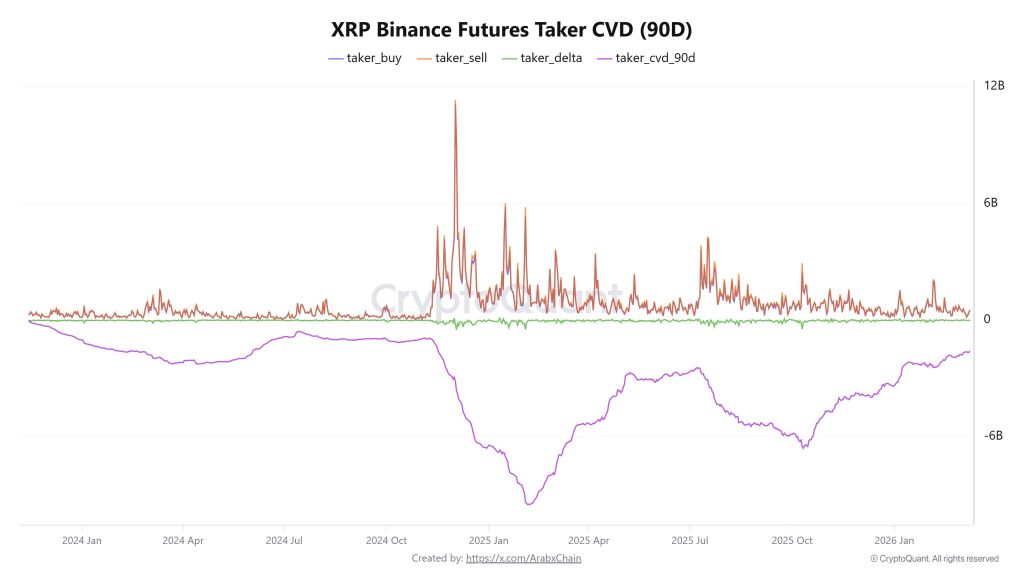
A March 12 report reveals a subtle shift in XRP futures activity. Data from Binance shows that aggressive buy orders totaled around 516.4 million XRP over the past 90 days.

During the same period, sell orders reached roughly 513.1 million XRP, creating a net taker delta of about 3.36 million XRP.

While the difference is relatively small, analysts interpret it as a meaningful indicator that buyers are beginning to regain control of market orders. For months, selling pressure dominated XRP’s derivatives market, but the latest data suggests that bear scenarios may be gradually fading.

XRP Binance Futures Taker CVD

XRP Open Interest Gives a Cleaner Market Structure

Another development involves XRP futures open interest, a metric that tracks the total value of active derivative contracts.

According to derivatives data, open interest previously peaked near $660 million in October 2025, but has since dropped to around $203 million by early March 2026.

This sharp decline indicates that a large portion of speculative leverage has already been flushed from the market. Historically, such resets are seen as a healthy development because it removes excessive risk and reduce the chances of sudden liquidation-driven price swings.

In simple terms, the market now appears “cleaner,” with fewer highly leveraged traders influencing price movements.

XRP Current Market Snapshot

Technically, XRP continues to trade within a broader correction that started after its previous peak near $3.50.

  • Support: around $1.30–$1.33
  • Immediate resistance: near $1.45
  • Breakout confirmation: above $1.50

If XRP manages to reclaim the $1.50 level, it could be the start of a broader recovery phase. For now, however, the focus remains on whether the improved derivatives data can translate into sustained buying pressure in the spot market.

Never Miss a Beat in the Crypto World!

Stay ahead with breaking news, expert analysis, and real-time updates on the latest trends in Bitcoin, altcoins, DeFi, NFTs, and more.

FAQs

Why does reduced leverage matter for XRP’s future price movement?

Lower leverage typically means fewer forced liquidations during volatility. This can lead to more stable price movements and healthier long-term market growth.

How could derivatives market changes affect regular XRP investors?

A cleaner derivatives market can reduce sudden price swings, giving spot investors a more stable environment and potentially improving confidence in long-term positions.

Could macro crypto market conditions influence XRP’s recovery?

Yes, broader crypto sentiment, Bitcoin price movements, and regulatory developments can significantly impact XRP’s momentum and overall market demand.

Pi Network News: Analyst Says Pi Will Never Hit $314,159; But There’s a Twist

Pi Network News

The post Pi Network News: Analyst Says Pi Will Never Hit $314,159; But There’s a Twist appeared first on Coinpedia Fintech News

Pi Network is making headlines as its price approaches the $0.30 level, ahead of its much-awaited listing on Kraken and growing anticipation for Pi Day on March 14.

While excitement in the community continues to build, one crypto analyst has pushed back against one of the most widely circulated price predictions tied to the project.

Meanwhile, Pi has recently traded in the $0.23 to $0.27 range, recording roughly a 30% gain over the past week as traders position themselves ahead of potential developments.

Analyst Rejects $314,159 Pi Price Theory

Looking at the brief price surge, crypto analyst Dr. Altcoin has addressed one of the most widely discussed price narratives within the community, the belief that Pi could reach $314,159 per coin.

The number is linked to the Global Consensus Value (GCV) theory and references the mathematical constant π (3.14159), which has symbolic importance for Pi supporters.

However, the analyst argues that such a valuation does not align with basic market economics. With a maximum supply of 100 billion tokens, Pi reaching $314,159 would push its total market capitalization to roughly $31 quadrillion.

That figure would be hundreds of times larger than the estimated $100 trillion global economy, making the price target mathematically unrealistic.

But there’s more….

Although the analyst rejects the $314,159 price theory, he remains bullish on Pi Network in the long term, urging investors not to treat it as a short-term trade. A potential listing on Kraken around today at 3 PM UTC is expected to boost liquidity and attract more traders, while Pi Day on March 14 may bring ecosystem updates or partnerships. 

The project has already moved to its Open Network Mainnet in February 2025, though users must still complete KYC to migrate their balances. 

Looking ahead, possible listings on major exchanges like Coinbase and Binance, along with growing real-world utility, could gradually support Pi’s long-term growth.

Pi Price Prediction 2026

According to analysts at CoinDCX, Pi could test the $0.235–$0.240 resistance zone by March 15, 2026, if the price continues to hold above the $0.219–$0.220 support level near the 20 EMA.

A breakout above $0.240 could open the door for a move toward $0.250, while a drop below $0.219 may push the price back toward $0.206, with $0.193 acting as the next key support level. 

While talking about the long-term, CoinDCX suggests Pi Network could reach $2.50 to $3.50 by 2030 if the ecosystem continues to grow and adoption expands.

For now, the indicators may be showing a bullish rise in the short term, but not closer to even $1 or $314,159. 

Never Miss a Beat in the Crypto World!

Stay ahead with breaking news, expert analysis, and real-time updates on the latest trends in Bitcoin, altcoins, DeFi, NFTs, and more.

FAQs

Why is Pi Network gaining attention right now?

Pi Network is trending as its price nears $0.30, with traders anticipating a potential Kraken listing and ecosystem updates expected around Pi Day.

When will Pi Coin be listed on Kraken?

The Kraken listing is expected to occur around 3 PM UTC, according to recent reports. This move is anticipated to significantly boost liquidity and attract more traders to the Pi Network ecosystem.

Is Pi Network a good long-term investment?

Yes, analysts remain bullish on Pi Network for the long term, but caution against treating it as a short-term trade. Future growth depends on ecosystem adoption and potential listings on major exchanges like Coinbase or Binance.

How many exchanges have listed Pi Coin?

Pi Coin is listed on several exchanges including OKX, Bitget, MEXC, Gate.io, CoinW, DigiFinex, and LBank, while major exchanges are yet to list it.

What is Pi Day and why is it important?

Pi Day is celebrated on March 14, inspired by π (3.14). The Pi Network community expects updates, announcements, or ecosystem news on this day.

Ethereum Price Could Slide to $1,500 as Capital Leaves Network, CryptoQuant Warns

Ethereum Price

The post Ethereum Price Could Slide to $1,500 as Capital Leaves Network, CryptoQuant Warns appeared first on Coinpedia Fintech News

A new market analysis from blockchain analytics firm CryptoQuant hints that Ethereum (ETH) could face deeper downside if the current market downturn continues. The firm estimates that ETH may decline toward $1,500 by late Q3 or early Q4 of 2026 if bearish conditions persist.

What makes the situation unusual is that the warning comes even as Ethereum’s network usage continues to hit record highs, creating what analysts describe as a growing disconnect between adoption and price.

The “Adoption Paradox” Behind Ethereum’s Weak Price

CryptoQuant highlights what it calls an “adoption paradox.” Traditionally, higher network usage has supported price growth in major cryptocurrencies. However, Ethereum is now showing the opposite trend.

Data shows daily active addresses and smart contract interactions recently reached new all-time highs, even surpassing levels seen during the 2021 bull cycle. Despite this surge in activity, ETH has fallen more than 50% from its cycle peak, indicating that strong on-chain usage is no longer translating into price momentum.

This breakdown in the historical relationship between adoption and valuation is now raising concerns among analysts.

Capital Leaving the Ethereum Network

Another factor pointing to potential downside is weakening capital inflows. CryptoQuant’s one-year realized market cap metric, which tracks new capital entering the network, has recently turned negative.

This shows that more money is flowing out of Ethereum than coming in, a trend that often appears during extended market corrections.

At the same time, Ethereum has recorded rising inflows to exchanges, especially when compared with Bitcoin. Increased exchange deposits typically indicate that holders may be preparing to sell, adding further pressure on prices.

The ETH/BTC pair has also continued to weaken, signaling that Ethereum is losing relative strength against Bitcoin during the current market cycle.

Six Straight Red Months Signal Market Stress

Ethereum’s recent price action reflects the broader pressure. As of March 2026, ETH has recorded six consecutive red monthly candles, a rare streak that pushed the asset down toward the $2,000–$2,050 range.

According to CryptoQuant analysts, the market is currently going through a “clean-up phase,” where weaker positions are being flushed out of the system. At the same time, extremely negative funding rates across derivatives markets show that bearish sentiment among traders has reached extreme levels.

Could This Phase Build a Future Base?

Despite the short-term risks, analysts believe the current conditions may not be entirely negative. Historically, periods where network usage remains strong while prices stay suppressed have sometimes helped build a stronger long-term price base.

If capital inflows eventually return and market sentiment improves, Ethereum could use this phase of heavy adoption to support a future recovery cycle once broader market conditions stabilize.

Top Altcoin Projects to Dump Now? Analyst Breaks Down ‘Dead Chains’ List

Altcoin networks low user activity

The post Top Altcoin Projects to Dump Now? Analyst Breaks Down ‘Dead Chains’ List appeared first on Coinpedia Fintech News

Several altcoin networks that once raised billions are now showing very low user activity and weak on-chain revenue, raising questions about their long-term sustainability. Viral Data re-shared by an analyst shows that a group of underperforming chains collectively raised around $2.6 billion, yet generate only about $65,000 in weekly fees, or roughly $3.4 million annually across multiple networks.

Low user activity, weak revenue, and technical resistance levels are now pushing some analysts to warn that certain altcoins could see further downside if adoption does not improve.

In a recent video analysis, crypto analyst Nick Valdez examined the claims and reviewed the charts of several projects mentioned in the post, including Algorand, Celestia, Monad, and Sei.

Celestia (TIA): Low Users and Persistent Resistance

Valdez first examined Celestia, which currently holds a market capitalization of roughly $300 million. Despite its valuation, the network reportedly has only about 1,200 daily active users, the lowest among the coins analyzed.

From a technical perspective, the chart also shows weakness. TIA has repeatedly been rejected near its 50-day moving average, failing several times to convert that level into support. According to Valdez, this resistance could act as a potential exit point if the token rallies again toward that level.

Sei (SEI): Activity Exists, But Revenue Is Nowhere

Next, Valdez looked at Sei. While the network records roughly 7,000 daily active users, the revenue generated remains minimal.

Recent figures suggest the chain produces around $232 in daily fees, or about $2,000 weekly. In addition, roughly 6.7 billion tokens are already circulating out of a 10 billion supply, meaning more tokens could still enter the market.

Technically, SEI appears to be trading within a range channel, and Valdez suggested that traders holding the token may consider exiting near the top of that range.

Sonic (Formerly Fantom): Weak Fees and Technical Pressure

The third project discussed was Sonic, the rebranded version of Fantom. Network activity remains limited, with roughly $155 in daily chain fees.

Like Celestia, Sonic’s price has repeatedly faced rejection at the 50-day moving average, indicating persistent selling pressure. Valdez noted that the token would need to reclaim this level before any sustained recovery could occur.

Monad: Large Token Unlock Risk

Monad presents a different concern. The project carries a fully diluted valuation near $800 million, yet only 10 billion tokens are circulating out of a potential 100 billion supply.

Large allocations remain reserved for the team and early investors. As those tokens unlock over time, Valdez warned that additional supply entering the market could increase selling pressure.

Algorand (ALGO): Weak Fees but Possible Technical Bounce

Finally, Valdez reviewed Algorand. The network generates only about $12 in chain fees, though it still maintains around 26,000 active addresses, stronger than several other projects on the list.

From a technical perspective, ALGO shows the most optimistic setup. The chart appears to be forming a falling wedge pattern, a structure that sometimes precedes bullish breakouts.

Valdez suggested that if the pattern resolves upward, ALGO could see a recovery move, offering what he described as a possible “off-ramp” for investors looking to exit positions.

Never Miss a Beat in the Crypto World!

Stay ahead with breaking news, expert analysis, and real-time updates on the latest trends in Bitcoin, altcoins, DeFi, NFTs, and more.

Every Company Ripple Has Acquired Since 2023 and What It Means for XRP

Ripple acquisitions

The post Every Company Ripple Has Acquired Since 2023 and What It Means for XRP appeared first on Coinpedia Fintech News

Ripple has spent the past three years quietly building one of the most ambitious financial infrastructure networks in crypto, deploying more than $4 billion across custody, brokerage, payments and treasury technology. CEO Brad Garlinghouse recently hinted that 2026 could be another defining year, suggesting the buying is far from over.

“Adoption doesn’t happen overnight,” Garlinghouse posted on X after visiting Ripple offices in Dublin, London, Singapore and Sydney. “Platforms over point solutions. Meet customers where they are.” Many of the employees he met, he noted, joined through the company’s recent acquisitions.

Here is every deal Ripple has made, what it cost, and what it added to the ecosystem.

2023: Laying the Foundation

Ripple entered its modern acquisition phase with two institutional-focused deals:

  • Metaco acquired May 2023 for $250 million, a leading digital asset custody platform already trusted by major global banks, giving Ripple immediate institutional credibility in the custody space
  • Fortress Trust acquired September 2023 for undisclosed, brought critical U.S. regulatory licenses and compliance infrastructure, expanding Ripple’s ability to operate within American financial regulations

2024: Strengthening Regulated Infrastructure

  • Standard Custody acquired 2024 for undisclosed, a New York-regulated digital asset trust company that deepened Ripple’s custody and settlement capabilities for institutions entering the digital asset market

2025: The Biggest Year Yet

Four deals in twelve months, totalling well over $2 billion:

2026: The Next Move

Ripple’s acquisition strategy is already moving into its next phase. The company has plans to acquire BC Payments Australia, a firm holding an Australian Financial Services License. The deal would strengthen Ripple’s regulated payments presence across the Asia-Pacific region and expand its cross-border payment services into one of the fastest-growing digital asset markets in the world.

Never Miss a Beat in the Crypto World!

Stay ahead with breaking news, expert analysis, and real-time updates on the latest trends in Bitcoin, altcoins, DeFi, NFTs, and more.

FAQs

How do Ripple’s acquisitions impact XRP price?

Ripple’s strategic acquisitions strengthen its network, increasing investor confidence, which could positively influence XRP price over time.

What is Ripple’s acquisition strategy for the future?

Ripple spends billions acquiring custody, brokerage, payments, and treasury companies to expand adoption and institutional use of XRP globally.

Can Ripple’s deals boost XRP adoption?

Yes, acquisitions like Hidden Road and GTreasury enhance infrastructure for banks and enterprises, helping XRP gain wider adoption.

How might XRP price react to 2026 acquisitions?

Plans to acquire BC Payments Australia could improve cross-border payment reach, potentially boosting XRP usage and investor interest.

What is the future outlook for XRP?

With expanded financial infrastructure, regulated payments, and global partnerships, XRP’s adoption and long-term utility could grow significantly.

CFTC Chair Warns ‘We Can’t Have Another FTX’ as Crypto Manipulation Concerns Grow

CFTC warns about crypto market manipulation

The post CFTC Chair Warns ‘We Can’t Have Another FTX’ as Crypto Manipulation Concerns Grow appeared first on Coinpedia Fintech News

The head of the U.S. Commodity Futures Trading Commission has issued a sharp warning about the state of crypto markets. Speaking on the All-In Podcast, CFTC Chairman Michael Selig said regulators are increasingly concerned about risks building across the digital asset sector.

According to Selig, parts of the market are showing signs of excessive manipulation rather than genuine trading activity.

“Too much manipulation instead of trading… fraud.”

His comments come at a time when regulators in the United States are intensifying their focus on crypto market structure, particularly around exchanges, derivatives platforms, and on-chain trading systems.

“We Can’t Have Another FTX”

Selig made it clear that preventing another major industry collapse remains a top regulatory priority. He pointed to the 2022 failure of FTX as a warning of what can happen when oversight and risk controls break down.

The exchange’s collapse wiped out billions of dollars in customer funds and shook confidence across the crypto industry.

“We can’t have another FTX in the United States where funds are lost, and there’s an absolute fraud on our American people.”

Because of this, the CFTC is focusing heavily on enforcement against fraud, insider trading, and manipulation across crypto-related trading markets.

The problem lies somewhere else…

During the interview, Selig also discussed the rapid rise of prediction markets, which allow users to trade contracts tied to future events such as elections, sports outcomes, or commodity prices.

He explained that event-based derivatives have long served a legitimate economic purpose by allowing businesses and investors to hedge risks tied to real-world outcomes.

However, some newer products may be more vulnerable to insider trading or manipulation. Selig pointed to recent enforcement actions where individuals used inside information to trade on prediction contracts.

Under U.S. law, exchanges listing such products must ensure that contracts are not easily manipulated and have proper safeguards against insider trading.

Keeping Crypto Innovation in the U.S.

Despite the concerns, Selig emphasized that regulators do not want crypto innovation to move overseas. Instead, the goal is to create a system where blockchain-based markets can operate safely within the United States.

The CFTC chair said the agency is already updating its regulatory framework to prepare for on-chain trading platforms and blockchain-based exchanges.

He also noted that the agency has broad powers to enforce anti-fraud and anti-manipulation rules in crypto markets.

Never Miss a Beat in the Crypto World!

Stay ahead with breaking news, expert analysis, and real-time updates on the latest trends in Bitcoin, altcoins, DeFi, NFTs, and more.

A $9 Trillion Company Just Replied to Ripple With 6 Words

Ripple and Mastercard blockchain partnership

The post A $9 Trillion Company Just Replied to Ripple With 6 Words appeared first on Coinpedia Fintech News

The global payments industry has been circling blockchain for years, cautious and uncommitted. That may be changing.

Ripple took to X this week to name what many had been quietly observing: digital assets are no longer a laboratory experiment. They are becoming operational tools. The company pointed specifically to Mastercard’s newly launched Crypto Partner Program as evidence of that shift, describing it as an important step toward connecting blockchain developers with established financial infrastructure.

Ripple Drives Cross-Border Payments

Then Mastercard replied. The payments giant, which processes transactions across more than 200 countries and handles trillions of dollars annually, did not respond with a press release. It responded with six words: “Fueling the future of the digital payment world.”

Short as it was, the response landed with unusual weight. In a sector where partnerships are announced with carefully worded statements and coordinated communications, a direct, unqualified public reply from one of the world’s most powerful payment networks is its own kind of signal.

Market analyst Jacob Metzger was among the first to highlight the exchange, pointing out that this was not a startup responding to another startup. This was a company responsible for a meaningful share of how money moves globally, stepping into a public dialogue about digital assets and choosing to validate it.

Other voices quickly joined. Finance analyst Renaat Ver Eecke noted that corporate treasury teams are actively exploring whether stablecoins and blockchain-based settlement can reduce the friction embedded in how business payments currently work. 

Analyst Logan Winn framed the two companies as complementary rather than competing: Mastercard owns one of the most extensive global acceptance networks ever built, while Ripple has spent years developing infrastructure for rapid, low-cost cross-border settlement.

Digital Assets Reshape Global Finance

No formal partnership has been announced, and neither company has indicated one is coming. But the exchange reflects something real: the era of traditional finance treating blockchain as a curiosity to study from a distance appears to be giving way to something more pragmatic.

The question is no longer whether digital assets have a role in global payments. It is about what that role looks like and who shapes it.

The future of payments will not be built by one company or one technology. It will be assembled from many pieces. The assembly, it seems, has begun.

Never Miss a Beat in the Crypto World!

Stay ahead with breaking news, expert analysis, and real-time updates on the latest trends in Bitcoin, altcoins, DeFi, NFTs, and more.

FAQs

Did Mastercard and Ripple announce a partnership?

No. Mastercard and Ripple have not announced a partnership. However, their public exchange highlights growing collaboration between traditional finance and blockchain payment infrastructure.

How could Ripple help improve global payments?

Ripple’s blockchain infrastructure enables faster and cheaper cross-border payments by reducing intermediaries, allowing financial institutions to settle transactions more efficiently.

Could blockchain reshape the future of global payments?

Yes. Blockchain can streamline international transfers, cut costs, and enable near-instant settlement, making digital assets a growing part of the evolving payment ecosystem.

Charles Hoskinson Just Revealed a Plan to Make Cardano’s Treasury Pay for Itself

Cardano (ADA) price prediction

The post Charles Hoskinson Just Revealed a Plan to Make Cardano’s Treasury Pay for Itself appeared first on Coinpedia Fintech News

How Hoskinson Plans to Bring Capital Into ADA

Cardano founder Charles Hoskinson recently outlined a major funding strategy for 2026 aimed at strengthening the Cardano ecosystem. Under the proposal, the Cardano treasury could invest ADA into selected projects within the network.

In return, those projects would share a portion of their revenue with the treasury and regularly purchase ADA from the market. The goal is to create steady demand for the token while supporting ecosystem growth.

The treasury could also build a weighted index of ecosystem tokens, potentially buying 10–30% of each project’s supply. As these projects grow and generate revenue, part of that income, around 10% in some cases, would be used to buy ADA and return it to the treasury.

Hoskinson believes this system could allow the treasury investments to pay for themselves within one to three years while increasing activity across the network.

Fixing the Loopholes

During the discussion, Hoskinson said Cardano’s funding has traditionally focused on three areas: infrastructure, utility, and user experience. Most resources so far have gone into infrastructure projects like Ouroboros, Plutus, and Aiken, while user activity and decentralized applications remain relatively limited.

To change that, the 2026 roadmap aims to shift funding toward utility and user experience. This includes supporting DeFi projects, improving wallets and onboarding tools, and organizing 20–30 developer hackathons each year to encourage new applications.

The broader goal is to bring more developers, capital, and users into the Cardano ecosystem and strengthen real activity on the network.

Is This a Good Time to Buy ADA?

From a technical perspective, ADA is currently trading near a crucial support zone around $0.25–$0.26. In a bull scenario, if buyers manage to defend this area, the token could attempt a recovery toward $0.30 and $0.33, with stronger resistance sitting between $0.33 and $0.40.

However, the broader trend still reflects a long downward channel, meaning the market has not fully shifted bullish yet. Crypto analyst Ali Martinez noted that Cardano’s key level to watch is $0.245 support. If ADA breaks decisively below this level, it could trigger a sharp decline toward $0.112 or even $0.051, potentially marking a 50%–80% drop from the current support zone.

For now, ADA sitting at a safe zone, as selling pressure appears to be less, while derivatives activity suggests speculative leverage is cooling.

If support holds and the ecosystem funding strategy begins to gain traction, ADA could see a gradual recovery. But until the token reclaims the $0.33–$0.40 resistance zone, the broader market structure remains cautious rather than fully bullish.

❌