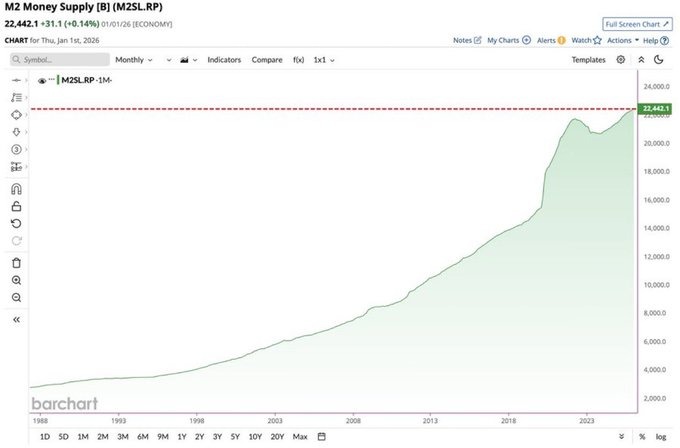
The U.S. M2 money supply has reached a new all-time high of $22.45 trillion, showing a steady rise in liquidity across the economy. Meanwhile, this is important for crypto markets, as rising liquidity has historically supported Bitcoin and other risk assets.
U.S. M2 Money Supply at Record $22.45T
Looking at the recent data, the U.S. M2 money supply has reached $22.45 trillion, rising about 4.3% year-over-year.
As seen in the chart, M2 has been on a long-term upward trend, with sharp growth after 2020 and now reaching fresh highs again. This shows that more money is circulating in the economy than ever before.
Historically, rising money supply has been a “risk-on” signal, meaning investors are more willing to take risks.
A clear example is the pandemic period, when M2 jumped from $15 trillion to $21 trillion. During the same time, Bitcoin saw its biggest rally, reaching $69,000 in November 2021.
Later, in late 2025, Bitcoin again surged to a new all-time high of around $124,000, supported by continued liquidity growth.
Why Rising Liquidity Supports Bitcoin Price
When liquidity increases, investors often move money into assets that can offer higher returns. This includes stocks, real estate, and especially cryptocurrencies like Bitcoin.
Bitcoin tends to benefit because it is seen as both:
A risk asset during strong liquidity cycles
A hedge when people worry about currency value
This is why past M2 growth phases have often matched with Bitcoin rallies.
Instead, the market has seen a 6-month phase of decline or sideways movement, even as liquidity continues to rise. This shows a more “decoupled” relationship compared to previous cycles.
One key reason is the growing presence of institutional investors. Unlike earlier cycles driven mostly by retail, today’s market is more mature and reacts differently to macro conditions.
At the same time, large Bitcoin holders are increasing their positions. While smaller investors remain cautious, whales are buying during dips.
If M2 continues to rise, it could act as fuel for the next crypto move. More liquidity means more buying power entering the market.
Never Miss a Beat in the Crypto World!
Stay ahead with breaking news, expert analysis, and real-time updates on the latest trends in Bitcoin, altcoins, DeFi, NFTs, and more.
FAQs
What is the current U.S. M2 money supply?
The U.S. M2 money supply has reached a new all-time high of $22.45 trillion, rising approximately 4.3% year-over-year, indicating record levels of liquidity circulating in the economy.
How does M2 money supply affect Bitcoin price?
Historically, rising M2 money supply has acted as a risk-on signal, with liquidity flowing into assets like Bitcoin. Past M2 growth phases coincided with Bitcoin rallies to $69,000 in 2021 and $124,000 in 2025.
Will rising M2 money supply trigger a crypto rally?
If M2 continues its upward trend, the growing liquidity could act as fuel for the next crypto move. However, market dynamics now include institutional factors that may delay the typical price response.
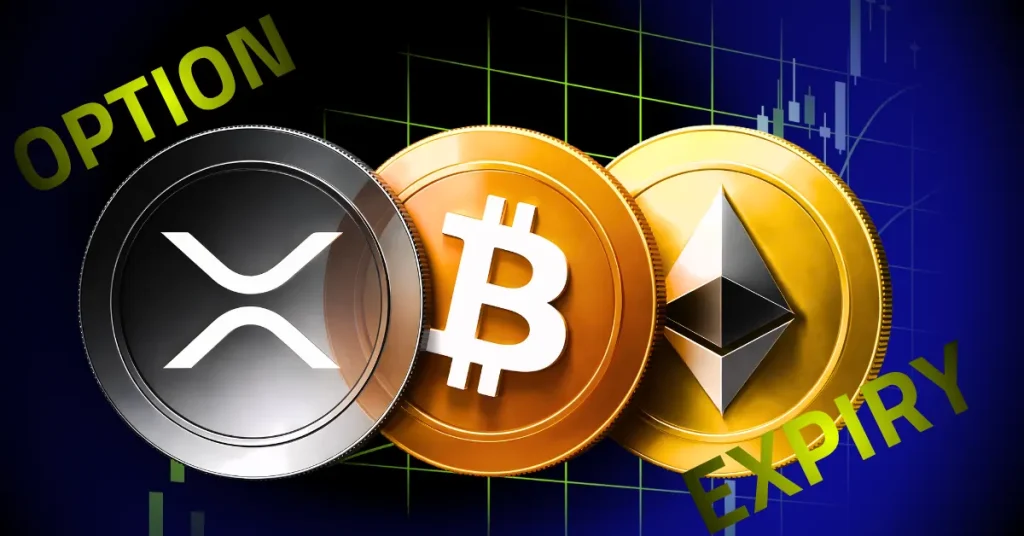
Today, the crypto market is going to see a slight volatility as Bitcoin and Ethereum options worth about $2.1 billion are set to expire. The market is already under pressure, so traders are watching important levels closely, Bitcoin’s “max pain” at $70,000 and Ethereum’s at $2,150, which could affect prices in the short term.
$1.7 Billion Bitcoin Options Expiry Today
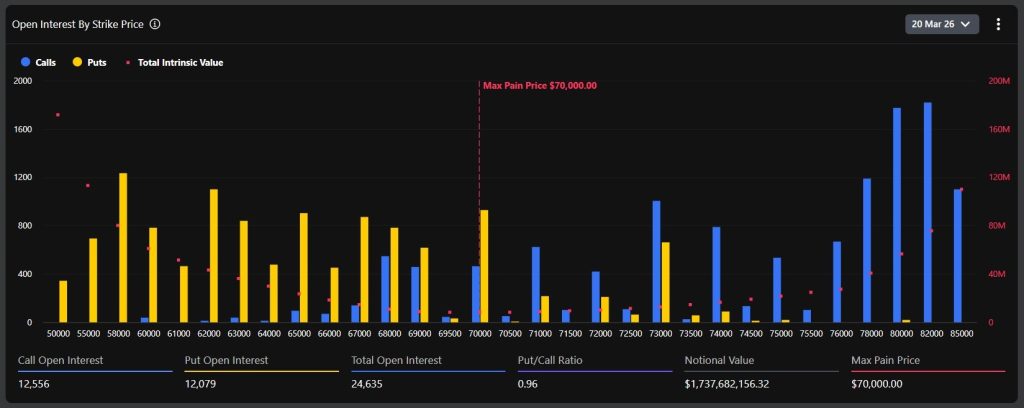
A large batch of Bitcoin options worth around $1.7 billion is expiring today. According to Deribit, nearly 23,000 contracts are set to close, with a put-call ratio of 0.96, showing slightly balanced market sentiment.
The most important level right now is the “max pain” point near $70,000. This is the price where most option traders may face losses, and markets often move toward this level during expiry.
Recently, Bitcoin tried to break above $75,000 but failed to hold that level. This rejection pushed the price back near $70,547, which is now acting as a key support zone.
At the same time, a large number of bearish bets are sitting around the $60,000 level, showing that some traders are still expecting downside risk.
Adding to the pressure, spot Bitcoin ETFs have seen outflows of $253.7 million for two straight days, indicating that some investors are pulling money out in the short term.
$370 Million Ethereum Options Expiry Today
Ethereum is also part of today’s expiry event, with around $370 million worth of options contracts closing. As per the Deribit data, about 176,000 ETH contracts are expiring, with a put-call ratio of 1.04, showing slightly bearish sentiment.
The max pain level for Ethereum stands near $2,150, which could act as a magnet for price movement as expiry approaches.
How Options Expiry Will Impact the Crypto Market Today
Options expiry often brings short-term volatility as traders adjust their positions. Looking at the last week, a similar event pushed Bitcoin up by nearly 8% and Ethereum by around 10% after expiry.
However, this time the total expiry size is slightly smaller at $2.1 billion compared to last week’s $2.4 billion. This could mean lower market pressure, but price swings are still expected.
On the other hand, Polymarket predicts a 38% chance that Bitcoin could reach $65K by the end of March 2026.
For now, the market remains cautious, as traders watch closely to see if this option’s expiry will impact current Bitcoin price levels.
Never Miss a Beat in the Crypto World!
Stay ahead with breaking news, expert analysis, and real-time updates on the latest trends in Bitcoin, altcoins, DeFi, NFTs, and more.
FAQs
What happens when Bitcoin and Ethereum options expire?
Options expiry can trigger short-term volatility as traders close or adjust positions, often pulling prices toward key “max pain” levels before stabilizing.
Will today’s options expiry cause a major crypto crash?
Not necessarily. Expiry usually causes temporary volatility, not crashes. Market direction depends on broader sentiment, liquidity, and macro factors.
Altcoin trading volumes have dropped sharply to their multi-month low, showing weaker investor interest across the crypto market. Meanwhile, lower activity, cautious sentiment, and global uncertainty are pushing traders away from risk.
Money is still moving inside crypto, hinting at a hidden shift. Is this a warning sign, or the start of the next big move?
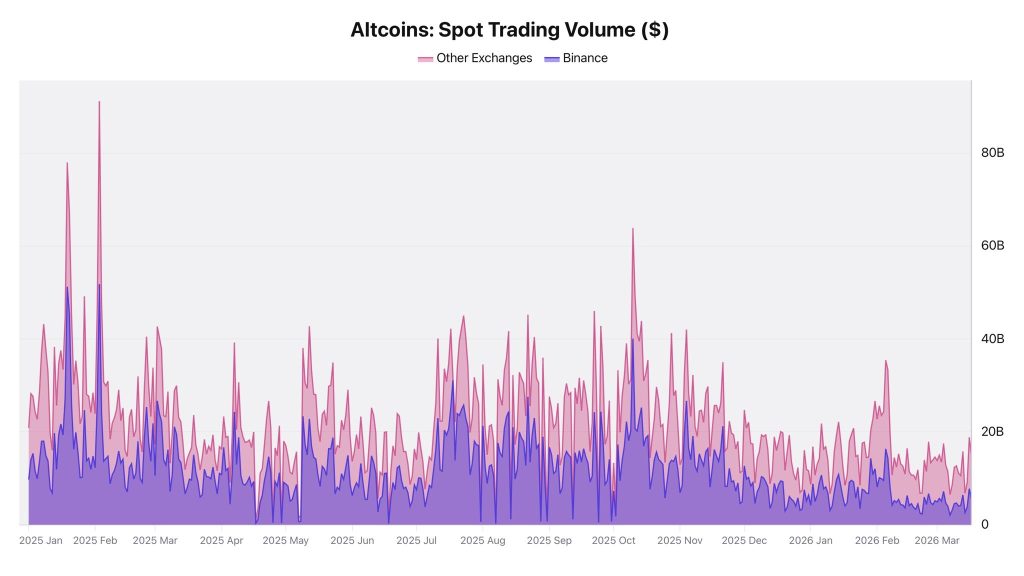
According to data shared by CryptoQuant analyst DarkFost, altcoin trading activity across Binance and other major exchanges has fallen to its lowest levels in months.
Meanwhile, Binance, the world’s largest cryptocurrency exchange, currently records around $7.7 billion in daily volume, while other exchanges contribute nearly $18.8 billion combined.
These figures are far below earlier highs seen in 2025, highlighting a major slowdown in market participation. The drop suggests that traders are becoming more cautious, especially in an environment where risk-taking is limited.
Even with declining volumes, Binance continues to lead the market. The exchange now controls roughly 40% of total altcoin trading volume, meaning nearly one out of every two trades flows through the platform.
Capital Rotation Shows Liquidity Is Not Leaving Crypto
Despite the drop in volumes, capital is not exiting the crypto market entirely. Instead, it is shifting within the ecosystem. Altcoins now account for nearly 50% of total crypto trading volume, surpassing Bitcoin’s share of around 27%.
This suggests traders are actively rotating funds into large-cap altcoins in search of higher percentage returns. At the same time, Bitcoin dominance stands at 58.92%, showing that BTC still holds a strong position even as capital spreads across other assets.
Meanwhile, the total altcoin market cap, excluding Bitcoin, is currently around $983.3 billion.
Past Volume Spikes Linked to Market Tops and FOMO Cycles
Looking back, major spikes in altcoin trading volume were seen during February and October 2025. During these periods, Binance recorded between $40 billion and $50 billion in volume, while other exchanges reached as high as $91 billion.
These peaks often appeared when the market was forming local tops. Increased activity during such phases is usually driven by FOMO, where retail investors rush in, allowing experienced traders to exit positions.
Although current conditions remain weak, as bitcoin and other major cryptocurrencies are all nearly down by 40 to 70% from their peak.
Morgan Stanley, an American financial services firm, has filed a second amended S-1 with the U.S. Securities and Exchange Commission (SEC) for its spot Bitcoin ETF. The fund, named Morgan Stanley Bitcoin Trust, is expected to trade under the ticker MSBT on NYSE Arca if approved.
Morgan Stanley Bitcoin ETF Filing Signals Institutional Expansion
According to the March 17 filing with the U.S. Securities and Exchange Commission (SEC), Morgan Stanley submitted its second amended S-1 for the Morgan Stanley Bitcoin Trust, which plans to trade under the ticker MSBT on NYSE Arca.
The filing outlines key details, including a 10,000-share creation unit and an initial $1 million seed investment. Coinbase Custody will handle Bitcoin storage in offline wallets, while BNY Mellon will manage cash, administration, and transfers.
The fund will support both cash and in-kind transactions, giving institutional investors flexibility when entering or exiting a position.
Although approval is not guaranteed, the updated filing shows the process is moving forward, bringing Morgan Stanley closer to becoming the first major U.S. bank to launch a spot Bitcoin ETF.
Bitcoin ETF Inflows Cross $56 Billion Since Launch
Since the approval of spot Bitcoin ETFs in January 2024, the market has already seen over $56.26 billion in total inflows. These funds have become a major driver behind Bitcoin’s recent price growth.
One of the major drivers of this inflow, BlackRock’s (IBIT) and Fidelity’s (FBTC) remain the leading products attracting the largest share of capital.
However, despite this strong demand, spot Bitcoin ETFs have recently recorded two consecutive days of outflows, totaling $163.5 million and $90.2 million.
Following these short-term outflows, the Bitcoin price has seen a drop lately to below $70,000.
How Morgan Stanley ETF Could Impact Bitcoin Price
If approved, Morgan Stanley’s ETF could further increase demand for Bitcoin. The bank manages around $1.8 trillion in assets, meaning even a small allocation shift could bring billions into the market.
For example, a 1% allocation would equal $18 billion, which could significantly boost buying pressure. Since ETFs require actual Bitcoin purchases, this reduces available supply and supports higher prices over time.
For now, the focus will be on how the SEC responds and whether more banks follow the same path into crypto ETFs.
BORA could reach up to $0.12 in 2026 if real adoption grows through gaming apps and stronger ecosystem integration.
Long-term growth depends on actual usage, successful game launches, and deeper integration within the Kaia ecosystem.
By 2030, BORA may approach $2.74, but only if it becomes widely used across apps, not just driven by speculation.
BORA is a South Korean blockchain ecosystem focused on gaming and entertainment. It aims to solve common problems like high fees and slow transactions for content platforms.
It uses a dual-chain system. The main BORA token runs on the public Klaytn blockchain, where it is traded. At the same time, a separate BORA Chain handles app data and transactions, making the system faster and more efficient.
At its peak in 2021, BORA surged alongside GameFi hype. But when that cycle faded, so did most of its demand.
Since then, the project hasn’t disappeared; it has quietly continued building tools for game studios, content platforms, and in-app economies.
So, can Bora ride the next wave of Web3 gaming and entertainment?
Bora is not competing globally; it’s competing locally inside one of the strongest digital ecosystems in Asia. Meanwhile, that’s both its biggest strength and biggest limitation.
If Kakao-linked platforms actually push blockchain into real user-facing products, Bora could quietly grow without hype.
But if usage remains limited to speculation and inactive apps, the token will likely struggle to break past resistance zones.
Based on the current trajectory, CoinPedia expects the Bora token to reach a 2026 high of $0.12.
Year
Potential Low ($)
Potential Average ($)
Potential High ($)
2026
$0.0032
$0.0475
$0.12
BORA (BORA) Price Targets For March 2026
2026 is likely to be a make-or-break year for BORA, not because of market hype, but because of execution.
The Web3 gaming sector is evolving. Users are no longer satisfied with basic token rewards; they expect real gameplay, ownership, and value.
One of the important factors is South Korea’s regulatory environment. If regulations become more favorable toward blockchain gaming and tokenized assets, Bora could benefit significantly due to its regional dominance. Bora Points also play an important role. Users can start without crypto and later convert points into BORA. This makes it easier for new users to join.
However, considering the bullish and bearish targets, the Potential high price may find its base at $0.0475 by the end of March 2026.
Month
Potential Low ($)
Potential Average ($)
Potential High ($)
Bora Price Prediction March 2026
$0.0342
$0.03990
$0.04759
Technical Analysis
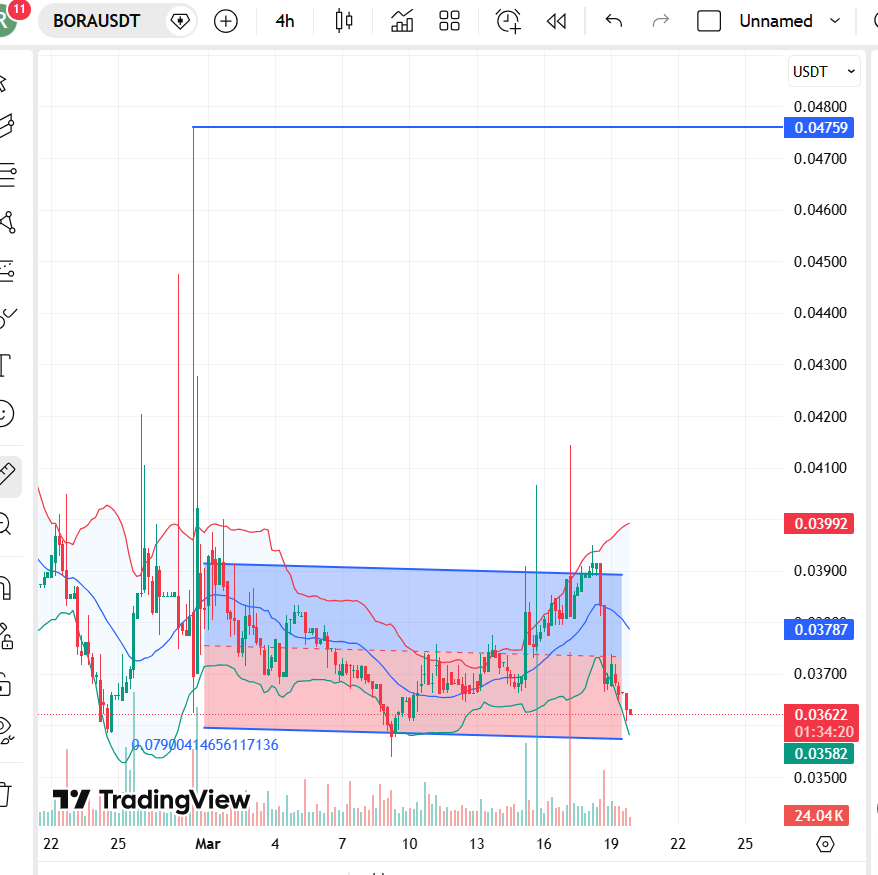
BORA on the 4-hour chart is moving inside a clear range, with price bouncing between support near $0.036 and resistance around $0.040. Recently, the price moved up toward the top of the range but failed to break above and quickly dropped back down.
This shows sellers remain strong near the resistance.
The price is now close to the lower support area again. If this level holds, we could see another bounce back toward the $0.04759.
But if support breaks, price may fall further toward 0.035 or lower.
BORA (BORA) Price Prediction 2026
BORA’s future in 2026 will largely depend on how well it performs within the Kakao–Kaia ecosystem, not on overall crypto market trends. Its growth will come from real usage, not hype alone.
One key factor is the use of Bora infrastructure for game launches. If even one or two games succeed and use Bora Points and rewards, it can attract new users, increase transactions, and create real demand for the token.
Another important factor is the growth of the Kaia ecosystem. After the Klaytn and Finschia merger, Kaia aims to become a strong Web3 hub in Asia. If BORA is more deeply integrated here, it can achieve better liquidity and attract more developer attention.
This means that real users, real activity, and real usage will decide BORA’s future.
Year
Potential Low ($)
Potential Average ($)
Potential High ($)
Bora Price Prediction 2026
$0.0032
$0.0475
$0.12
BORA Price Prediction 2026 – 2030
Year
Potential Low ($)
Potential Average ($)
Potential High ($)
2026
$0.0032
$0.0475
$0.12
2027
$0.040
$0.093
$0.33
2028
$0.090
$0.35
$0.65
2029
$0.113
$0.59
$1.28
2030
$0.30
$0.95
$2.74
BORA (BORA) Price Prediction 2026
If Bora successfully integrates into Kaia and launches usable games, it could test $0.12. Without that, it may stay below $0.07.
BORA Price Prediction 2027
If Kakao-backed platforms push Web3 adoption at scale, BORA could move toward $0.33, driven by regional demand.
BORA Price Targets 2028
This is where survival matters. If Bora is still actively used, not abandoned, it could reach $0.65 as Web3 gaming matures.
BORA Coin Price Prediction 2029
By 2029, if Bora evolves into a backend economy layer for mobile apps, not just games, it could approach $1.28.
BORA (BORA) Price Prediction 2030
In 2030, a move toward $2.74 only happens if Bora becomes invisible infrastructure, used daily without users even noticing the blockchain..
What Does The Market Say?
Year
2026
2027
2030
Priceprediction.net
$0.242
$0.370
$ 1.51
CoinCodeX
$0.227
$0.120
$0.0078
Digitalcoinprice
$0.32
$0.43
$0.92
Never Miss a Beat in the Crypto World!
Stay ahead with breaking news, expert analysis, and real-time updates on the latest trends in Bitcoin, altcoins, DeFi, NFTs, and more.
FAQs
What is BORA crypto used for?
BORA powers payments, rewards, and transactions in gaming and content apps, helping developers build fast, low-cost Web3 experiences.
Is BORA a good investment in 2026?
BORA’s potential depends on real adoption in gaming ecosystems. If usage grows, it may perform well, but risks remain if demand stays weak.
What affects BORA price the most?
BORA’s price is driven by app usage, game launches, user activity, and South Korea’s crypto regulations impacting blockchain adoption.
Will BORA benefit from Web3 gaming growth?
Yes, BORA can benefit if it powers successful games. Real player activity and in-game economies are crucial for sustained demand.
What is BORA (BORA) price prediction for 2026?
BORA could reach up to $0.12 in 2026 if adoption grows. Without strong usage, it may stay below key resistance levels.
How high can BORA price go by 2030?
BORA may reach $2.74 by 2030 if it becomes widely used in apps and games. Long-term growth depends on real demand and ecosystem expansion.
The Bank of Japan has kept interest rates steady at 0.75% amid rising global tensions and surging oil prices. The move comes as markets react to uncertainty from the Middle East crisis.
Investors and crypto traders are closely watching how Japan’s stable interest rates could influence Bitcoin, Ethereum, and other cryptocurrencies.
BOJ Holds Interest Rates Steady at 0.75%
According to the Bank of Japan announcement, it has decided to keep its benchmark interest rate steady at 0.75% after its latest policy meeting.
This comes after a rate hike in December 2025, when the central bank raised rates to a 30-year high. Officials chose to pause and study global conditions before making further moves.
Governor Kazuo Ueda said risks are rising due to the Middle East situation. The bank noted that global financial markets have become unstable, and oil prices have increased sharply. These factors could affect Japan’s inflation and overall economic growth.
BOJ Governor Kazuo Ueda noted at a March 19 press conference that the central bank chose not to raise rates at Thursday’s meeting as risk scenarios had intensified. Hawkish board member Hajime Takata reiterated his January proposal to lift the policy rate to 1.0%, which was not… pic.twitter.com/rTHLXqzgU9
However, the central bank made it clear that future rate hikes are still on the table.
Why BOJ is Keeping Interest Rate Steady
Rising tensions in the Middle East are starting to impact Japan’s economy. Oil prices have jumped due to supply concerns, especially around key routes like the Strait of Hormuz.
Since Japan relies heavily on imported fuel, higher oil prices are quickly pushing up costs across the country.
At the same time:
The Japanese yen has weakened as investors move toward the U.S. dollar
Stock markets in Tokyo have seen declines
Inflation risks are rising due to higher import costs
Because of these factors, the Bank of Japan is choosing to stay cautious and hold interest rates steady
How BOJ’s Decision Could Impact the Crypto Market
The Bank of Japan’s choice to hold interest rates steady could have mixed effects on the crypto market. Stable rates often support risk assets like Bitcoin and other altcoins, as investors seek higher returns outside traditional markets.
Currently, the crypto market has fallen by 4.47%, reducing its total value to about $2.43 trillion, following the U.S. Federal Reserve’s decision to keep interest rates unchanged.
Bitcoin has fallen to $70,223 from a recent high of $76,000. Other major coins like Ethereum, XRP, Solana, and Dogecoin are down between 3% and 6%.
The live price of the Audius token is $ 0.01999027.
Audius aims to disrupt music streaming by giving artists direct control and earnings, but its success depends on real adoption beyond niche Web3 communities.
AUDIO price could grow if user activity and creator monetization improve, with long-term potential reaching $1+, but risks remain due to competition and adoption hurdles.
Audius is trying to flip that. Instead of labels, middlemen, and opaque royalty systems, Audius gives artists direct control over their content, audience, and revenue.
Built initially on POA and later migrated to Solana for scalability, Audius operates as a decentralized music streaming protocol where creators upload content without needing approval and get rewarded directly.
With around 500,000+ monthly active users, Audius has already proven there is demand for an alternative to traditional streaming platforms.
Now, the big question is, can Audius turn into the Web3 version of Spotify, or will it remain a niche experiment?
Its token, Audio, is currently trading around $0.02013, which is nearly 76% form its all-time highs.
Audius is not just another altcoin; it is a bet on the future of digital ownership in music.
Its success depends on whether artists truly shift away from traditional platforms toward decentralized alternatives. Unlike speculative tokens, AUDIO’s value is closely tied to real usage, uploads, streams, and creator earnings.
From CoinPedia’s perspective, if Audius successfully builds a strong creator economy and expands beyond niche adoption, AUDIO could reach around $0.076 in 2026.
Year
Potential Low ($)
Potential Average ($)
Potential High ($)
2026
$0.0089
$0.03190
$0.0760
Audius (AUDIO) Price Targets For March 2026
March 2026 could be an important turning point for Audius as it moves from testing ideas to helping creators earn real income.
The platform is introducing a community-led system to handle content moderation and copyright issues, giving more control to users. At the same time, big artists are launching their own tokens, like Kodak Black’s $YAK and Almighty Jay’s $JAY in late 2025.
Audius is also improving its reward system, where artists earn AUDIO tokens based on engagement, such as trending tracks and user activity.
If more users join the platform and more artists start using it, AUDIO’s price could recover toward $0.0271, and strong momentum may push it even higher.
Month
Potential Low ($)
Potential Average ($)
Potential High ($)
Audius Price Prediction March 2026
$0.01163
$0.0223
$0.0271
Audius (AUDIO) Price Prediction 2026
2026 will likely test whether Audius can move beyond being a creator-friendly experiment and become a serious music distribution platform.
One key area is how artists earn money. Unlike Spotify, where payments are slow and unclear, Audius wants a clear system using blockchain. In the future, artists may earn directly from fans through payments, subscriptions, or even selling music as NFTs.
Another important trend is AI music. As AI tools grow, Audius could help artists protect and sell their music safely on-chain.
The platform also plans to add stablecoins for paid content and artist tokens, which can give fans access to special content and perks.
Technical Analysis
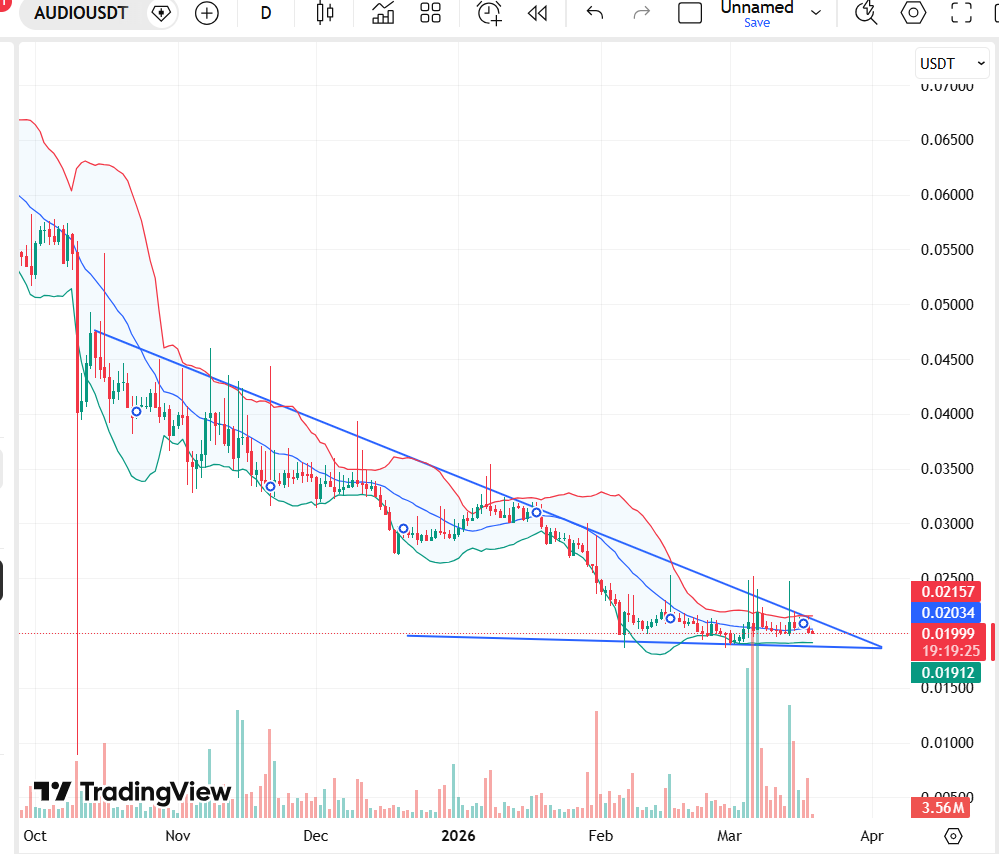
AUDIO’s 1-day chart shows a clear downtrend, with price making lower highs since October. The blue trendline shows strong resistance, and the price keeps failing to break above it.
Right now, AUDIO is moving sideways between $0.019 and $0.021. This looks like a small triangle pattern, where the price is getting squeezed. The support at $0.019 has been tested many times, so it is getting weaker.
Volume increases mostly when the price drops, which shows more selling than buying.
If the AUDIO price breaks above $0.022 with good volume, a short-term bounce is possible towards $0.0760.
Meanwhile, a breakdown below $0.019 it to fall further toward $0.0089.
Year
Potential Low ($)
Potential Average ($)
Potential High ($)
Audius Price Prediction 2026
$0.0089
$0.03190
$0.0760
Audius Price Prediction 2026 – 2030
Year
Potential Low ($)
Potential Average ($)
Potential High ($)
2026
$0.0089
$0.03190
$0.0760
2027
$0.020
$0.095
$0.18
2028
$0.045
$0.168
$0.243
2029
$0.08
$0.32
$0.672
2030
$0.15
$0.56
$1.21
Audius (AUDIO) Price Prediction 2026
In 2026, AUDIO’s growth will depend on better creator tools and more users joining the platform. AUDIO could reach $0.0760.
Audius Price Prediction 2027
By 2027, Audius may benefit from deeper connections with social media platforms and stronger earning options for artists.
Audius Price Forecast 2028
In 2028, if users start adopting blockchain-based music rights and NFTs more widely, Audius could gain strong traction, helping AUDIO to reach around $0.243.
AUDIO Price Prediction 2029
By 2029, Audius may expand into global markets and improve fan engagement tools. If more creators and fans interact directly on the platform, it could increase usage and support AUDIO’s price near $0.672.
Audius (AUDIO) Price Prediction 2030
In 2030, if Audius becomes a widely used decentralized music platform, it could see strong adoption. With more users, artists, and real use cases, AUDIO might reach $1.21.
What Does The Market Say?
Year
2026
2027
2030
Changelly
$0.370
$0.0420
$ 1.57
CoinCodeX
$0.321
$0.348
$1.24
Digitalcoinprice
$0.41
$0.54
$1.17
Never Miss a Beat in the Crypto World!
Stay ahead with breaking news, expert analysis, and real-time updates on the latest trends in Bitcoin, altcoins, DeFi, NFTs, and more.
FAQs
What is Audius (AUDIO) and how does it work?
Audius is a decentralized music platform where artists upload content directly, earn AUDIO tokens, and control their rights without relying on labels or intermediaries.
Is Audius better than Spotify for artists?
Audius offers more control and transparency for artists, but Spotify still leads in user base, making Audius a promising but early-stage alternative.
Is Audius (AUDIO) a good long-term investment?
AUDIO has potential if Web3 music grows, but it carries risk due to competition, adoption uncertainty, and market volatility.
What’s the Audius (AUDIO) price prediction for 2026?
AUDIO could trade between $0.02 and $0.14 in 2026, depending on adoption, platform growth, and overall crypto market conditions.
How much will 1 Audius cost in 2030?
By 2030, AUDIO may range from $0.30 to $1+ if adoption grows, though some forecasts suggest lower or higher extremes based on market cycles.
How high can Audius (AUDIO) price go by 2040?
By 2040, AUDIO could reach $0.08 in conservative cases or much higher in bullish scenarios if Web3 music adoption becomes mainstream.
Canada’s financial watchdog is cracking down on cryptocurrency businesses. So far in 2026, the Financial Transactions and Reports Analysis Centre of Canada (FINTRAC) has cancelled the licenses of 50 money services businesses (MSBs), including 47 crypto firms such as exchanges, wallets, and other services.
The move is to lower money laundering risks and make sure all crypto platforms, services, and ATMs follow the rules.
FINTRAC Cancels 47 Crypto Registrations
As per the report, the Financial Transactions and Reports Analysis Centre of Canada has revoked 50 money services business (MSB) licenses so far in 2026, with 47 tied to crypto firms.
The latest action includes 23 newly revoked registrations, highlighting what authorities describe as a “significantly increased pace of enforcement.”
Authorities confirmed that affected firms have a 30-day window to appeal. However, the scale and pace of action suggest a clear shift toward stricter regulatory control in Canada’s crypto sector.
Canada Crypto Crackdown 2026
According to FINTRAC, crypto businesses in Canada must register with FINTRAC before operating. They also need to keep records, verify customer identities, and report large or suspicious transactions.
Finance Minister Francois Philippe Champagne said this move is part of Canada’s effort to stop money laundering and fraud.
The government is also giving extra support to law enforcement and plans a new financial crimes agency to make supervision stronger.
Heavy Fines Signal Zero Tolerance
Regulators have also imposed major fines on non-compliant platforms. Crypto platform Cryptomus was fined $126 million for multiple violations, including failure to report over 1,000 suspicious transactions.
Similarly, KuCoin faced a $14 million penalty for operating without proper registration and failing to report large transactions. These actions underline a zero-tolerance approach toward violations.
Why Canada Is Targeting Crypto Firms
Authorities are taking action to fight financial crime, noting that many crypto platforms lack proper transaction monitoring, reporting, and compliance rules. However, the issue is bigger than crypto.
The Financial Action Task Force says 2%–5% of global GDP is laundered through traditional finance, compared with less than 1% in crypto.
This shows that Canada is clearly moving toward stricter crypto regulation. While the aim is to reduce illegal activity, the crackdown is also making it harder for smaller firms to survive due to higher costs and tougher rules.

 Login
Login



 2.08%
2.08%


 -1.42%