Reading view

Bitcoin and Ethereum Declared Non-Securities as SEC Chair Atkins Backs Clarity Act: ‘I Trust It Will Reach Trump’s Desk’
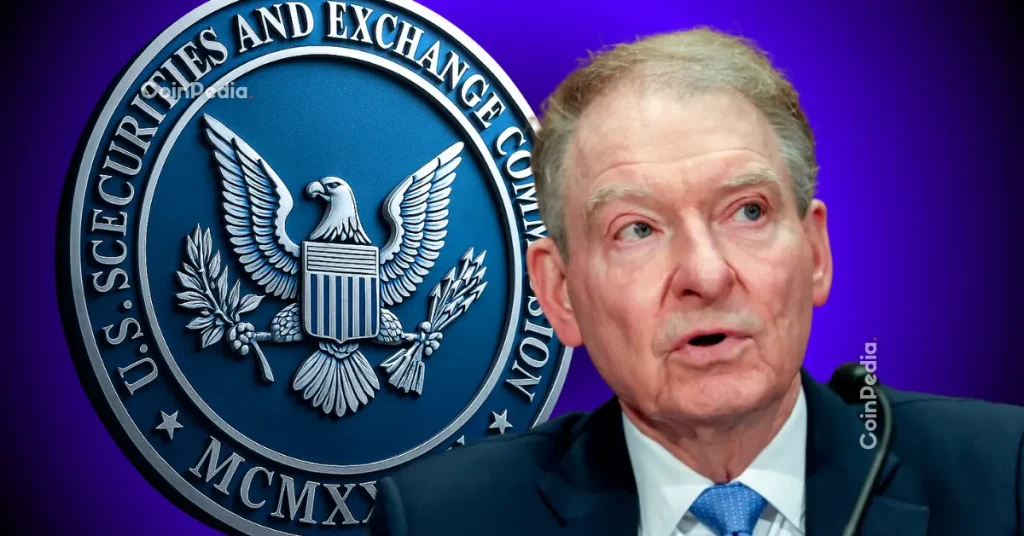
SEC Project Crypto Framework

The post Bitcoin and Ethereum Declared Non-Securities as SEC Chair Atkins Backs Clarity Act: ‘I Trust It Will Reach Trump’s Desk’ appeared first on Coinpedia Fintech News

Securities and Exchange Commission Chair Paul Atkins made one of the most significant announcements in the history of American crypto regulation on Tuesday, declaring that Bitcoin, Ethereum and a broad range of digital assets are formally exempt from securities laws, a ruling that draws a clear legal line under more than ten years of industry confusion and enforcement-by-ambiguity.

Speaking at the DC Blockchain Summit 2026, Atkins unveiled a new token taxonomy and investment contract interpretation framework that the SEC is implementing immediately.

“The SEC’s persistent failure to provide clarity on this question is over,” Atkins told attendees.

What the Framework Actually Says

The new framework establishes four categories of crypto assets that are explicitly not securities under U.S. law. Digital commodities, which include Bitcoin and Ethereum, sit at the top of the list. Digital collectibles, digital tools, and payment stablecoins issued under the GENIUS Act round out the remaining three categories.

SEC Chair: BTC and ETH Have Been Clearly Defined as Non-Securities

On March 18 at the DC Blockchain Summit 2026, SEC Chair Paul Atkins announced a new token taxonomy and investment contract interpretation framework, ending long-standing regulatory uncertainty.

The framework… pic.twitter.com/009JGB2Nvl

— Wu Blockchain (@WuBlockchain) March 22, 2026

Under the new interpretation, only one class of crypto asset remains subject to SEC oversight: digital securities, defined narrowly as traditional financial securities that have been tokenised and moved onto a blockchain. Everything else falls outside the SEC’s jurisdiction.

Atkins was blunt about what this means for the agency’s identity.

“We are not the Securities and Everything Commission anymore,” he said.

Safe Harbors for Startups and Fundraising

Beyond the taxonomy, Atkins previewed two new capital-raising pathways designed to bring crypto innovation back to U.S. soil.

The first is a startup exemption, a time-limited registration exemption lasting up to four years that would allow early-stage crypto projects to raise up to $5 million while operating under a regulatory runway rather than full securities compliance.

The second is a fundraising exemption that would allow more established projects to raise up to $75 million in any 12-month period, provided they file a disclosure document with the SEC covering the project’s financial condition and audited financial statements.

Both exemptions would sit alongside existing capital-raising mechanisms, not replace them.

Congress Still Holds the Final Card

Despite the sweeping nature of Tuesday’s announcement, Atkins was clear that regulatory frameworks issued by the SEC alone are not a permanent solution. Only Congress, he said, can future-proof crypto regulation through comprehensive market structure legislation.

He expressed strong support for the bipartisan Clarity Act currently moving through Capitol Hill, describing Regulation Crypto Assets as a head start on implementing the bill ahead of its expected passage.

“I trust it will soon reach President Trump’s desk,” Atkins said.

For an industry that has spent a decade navigating enforcement actions, legal threats and regulatory ambiguity, Tuesday’s announcement marks the clearest signal yet that Washington is finally ready to let crypto grow up.


Why are Bitcoin, Ethereum and XRP Prices Crashing Today: Iran, Trump and the Strait of Hormuz Explained

Crypto News Today How Bitcoin, Ethereum and XRP Are Positioned Into the Weekend

The post Why are Bitcoin, Ethereum and XRP Prices Crashing Today: Iran, Trump and the Strait of Hormuz Explained appeared first on Coinpedia Fintech News

Bitcoin, Ethereum and XRP tumbled sharply on Sunday after Iran responded to President Trump’s 48-hour ultimatum not with concessions but with an escalation, vowing to fully close the Strait of Hormuz and strike energy, technology and water infrastructure across the Middle East. With 33 hours remaining on Trump’s deadline, markets are pricing in the very real possibility of direct military confrontation.

The total crypto market cap fell 2.31% to $2.36 trillion, wiping roughly $55 billion in value as investors moved swiftly out of risk assets.

What Iran Said

Iran’s response, relayed through senior military commanders, was unambiguous. The country would completely seal the Strait of Hormuz, the narrow waterway through which roughly 20% of the world’s oil supply passes daily.

Strikes on vital regional infrastructure, including energy facilities, IT systems and water desalination plants, were explicitly threatened. Officials added that Iran had stockpiled enough essential goods to withstand up to one year of sanctions pressure, signalling the country has no intention of backing down quickly.

Iran’s military leadership also announced a formal shift in strategy from defensive to offensive operations, a significant change in posture that immediately rattled financial markets worldwide.

The Numbers

Every major cryptocurrency fell in lockstep with equities as the headlines broke.

Bitcoin dropped 2.58% to $68,820, dragging its market capitalisation below $1.38 trillion. Ethereum fell harder, losing 3.36% to $2,082, its steepest single-session drop in weeks. XRP declined 3.04% to $1.39. Solana shed 2.72% to $87.33, and Dogecoin fell 2.82% to $0.091.

The CoinMarketCap Fear and Greed Index hit 27, deep in fear territory. The average crypto RSI across the market fell to 39.59, approaching oversold levels not seen since the early weeks of the Iran conflict. 

Why Crypto Falls When Wars Escalate

The moves reflect a market that has fundamentally repositioned crypto as a risk asset rather than a safe haven. When geopolitical fear spikes, institutional investors reduce exposure across equities, commodities and digital assets simultaneously, rotating into cash and government bonds instead.

Adding to the pressure, interest rate hike expectations are quietly creeping back into market pricing. 

What Happens Next

The next 33 hours are the most consequential for markets in weeks. If Trump extends or softens his deadline, a relief rally across risk assets is likely. If Iran takes any military action before the clock runs out, expect Bitcoin to test the $65,000 level and broader crypto market cap to approach $2.29 trillion, the 78.6% Fibonacci retracement level analysts have identified as critical support.

Macro events this week will add further volatility. S&P Global Services PMI data arrives Tuesday, U.S. crude oil inventory data on Wednesday, initial jobless claims on Thursday, and Michigan Consumer Sentiment on Friday.

Pi Network News: Pi Price Faces Six-Month Headwind as Token Unlocks and Development Delays Compound

Pi Network Launches Protocol 20 Mainnet Upgrade

The post Pi Network News: Pi Price Faces Six-Month Headwind as Token Unlocks and Development Delays Compound appeared first on Coinpedia Fintech News

Pi Network’s token is under serious pressure, falling 5.16% to $0.190 in 24 hours. For a coin that once traded at $2.98 over a year ago, the decline represents a 93% collapse from its all-time high, and analysts warn the bottom may still be months away.

Three Forces Pushing Pi Lower

The immediate trigger was macro. President Trump’s threat to strike Iranian power infrastructure sent risk assets into a tailspin on Saturday, and Pi, as one of the market’s more speculative tokens, felt the pain disproportionately. A 16 million Pi token unlock on March 21 added fresh selling pressure on top of an already fragile price structure, flooding the market with new supply at precisely the wrong moment.

Pi’s 24-hour range told the story clearly: a high of $0.201 gave way to a low of $0.1878, with buyers unable to mount any meaningful defence.

The Deeper Problem: Development Is Too Slow

Beyond the short-term noise, a growing number of community voices are raising structural concerns about Pi’s roadmap. Dr. Pi, one of the network’s most followed commentators, published an assessment this week that is circulating widely across crypto forums.

“Pi will keep falling,” they wrote. “The current user base is driven by overly optimistic expectations about announcements from the Pi Core Team, creating only a short-lived boom.”

The core argument is damaging: that Pi Launchpad, which recently went live on testnet, will generate no real token demand because it is entirely sentiment-driven rather than backed by genuine utility. Based on the core team’s historical pace, he estimates the full launch is at least six months away. PiDex, the network’s decentralised exchange, is even further out.

“Their intention is clear,” they wrote. “They do not want to enable speculative trading.”

Even smart contracts, when they eventually arrive, will be rolled out in a tightly controlled, limited manner, only for hand-picked projects the team specifically endorses. For a community that has been mining and waiting for years, the timeline is testing patience to its limits.

A Community Running Out of Steam

Perhaps the most sobering observation concerns the human cost of the long wait. Dr. Pi said that while Pi’s community remains enormous on paper, active participation is steadily declining as pioneers exhaust their enthusiasm. Early miners and third-party developers, he argued, have already been worn down by years of delays.

Where the Price Goes Next

Technically, the immediate line in the sand is $0.176. A hold above that level could allow Pi to consolidate and stabilise. A break below opens the door to $0.15, a level that would represent a fresh all-time low and likely trigger another wave of capitulation selling.

For bulls, the target to watch on the upside is $0.21. A reclaim of that level would signal that selling pressure is easing and that sentiment may be turning.

XRP Price Could Hit Double-Digits by End of Trump Term as Clarity Act Clears Final Hurdle, Experts Say

Ripple acquisitions

The post XRP Price Could Hit Double-Digits by End of Trump Term as Clarity Act Clears Final Hurdle, Experts Say appeared first on Coinpedia Fintech News

A last-minute compromise between the White House, U.S. banks, and crypto firms over stablecoin yield rules has dramatically improved the odds of the Clarity Act becoming law this year, a development that analysts say could be the most consequential regulatory moment in digital asset history.

Prediction market Polymarket now prices the bill’s passage at 72%, up from 63% just one week ago, after negotiators resolved a months-long standoff over whether stablecoin holders should be allowed to earn interest on their holdings.

The Stablecoin Standoff, Solved

Banks had fiercely resisted provisions that would allow retail customers to earn 4% to 5% annual yields on stablecoins, fearing it would drain deposits from the traditional banking system. Under the tentative deal, crypto firms will be prohibited from using terms such as “interest” or “yield” for stablecoin rewards, limiting but not eliminating the returns available to holders.

Patrick Witt, executive director of the White House Crypto Council, called it “a major milestone,” crediting Senators Tom Tillis and Tim Scott for bridging the partisan divide. Ripple CEO Brad Garlinghouse had previously put the odds of passage by end of April at 90%.

“Watch April very closely,” one Washington policy analyst wrote this week. “The path just opened.”

What It Means for XRP

Senator Cynthia Lumis, one of the bill’s most vocal champions, framed the Clarity Act as central to Trump’s stated ambition of making the United States the global capital of digital assets.

For XRP specifically, the stakes are substantial. The CFTC and SEC this week jointly indicated that XRP, Chainlink, and similar tokens would be classified as digital commodities rather than securities, a designation that removes a significant legal barrier to institutional adoption.

Evernorth, the company building what it describes as the largest XRP treasury in the world ahead of a planned Nasdaq listing, noted this week that institutional use of XRP as a cross-border liquidity bridge is growing, even if retail price action has not yet reflected it.

“The version of XRP that could drive sustained utility demand is when banks and businesses leverage it as working capital,” the firm’s chief executive said.

The $600 Trillion Comparison

Supporters of the bill are drawing parallels to the Commodity Futures Modernization Act of 2000, which gave legal clarity to derivatives markets and helped expand that asset class from roughly $100 trillion to over $600 trillion within a decade, before the same instruments became central to the 2008 financial crisis.

If crypto follows a similar trajectory after the Clarity Act is signed, analysts argue that trillions of dollars currently sitting on the sidelines at firms like BlackRock, JPMorgan, and Goldman Sachs could move into digital asset markets. Hence experts say XRP could hit double-digits. 

The Senate Banking Committee is expected to be the next critical checkpoint, with April seen as the make-or-break window for the bill’s passage before attention shifts to midterm election season.

CoinDCX Founders Arrested in $85,000 Crypto Fraud Linked to Impersonator Network

Israeli Arrested for Selling Secrets to Iran for Crypto

The post CoinDCX Founders Arrested in $85,000 Crypto Fraud Linked to Impersonator Network appeared first on Coinpedia Fintech News

The co-founders of CoinDCX, one of India’s largest cryptocurrency exchanges, were arrested and questioned by police this week in connection with an alleged fraud totalling roughly 71 lakh rupees ($85,000) — a case the company says was carried out entirely by scammers impersonating them, not by the founders themselves.

Sumit Gupta and Neeraj Khandelwal were detained after a First Information Report named them in connection with the scheme. CoinDCX said the complaint was filed against the wrong people, calling it “a conspiracy against CoinDCX by impersonators posing as founders.”

Fake Sites, Real Victims

The exchange says criminals built a network of fraudulent websites mimicking its brand to steal money from ordinary investors. Between April 2024 and January 2026, CoinDCX says it identified and reported over 1,212 fake websites designed to look like its official platform. Victims were allegedly told to transfer funds in cash to third-party accounts that had no connection to the real exchange.

“We have taken cognizance of the fact and published a notice to public at large on our website that CoinDCX is being targeted by fraudsters. The entire conspiracy falsely claims that funds were transferred to accounts which have no relation to CoinDCX,” the company said in a public statement,” they said.

Exchange Cooperating, Founders Cleared of Blame

CoinDCX said both co-founders are fully cooperating with law enforcement and maintained they had no involvement in the fraud. The company has published a public warning on its website urging users to verify they are using the official platform before making any transactions.

Brand impersonation scams have become an escalating problem across India’s fast-growing digital finance sector, with fraudsters increasingly targeting well-known crypto platforms to exploit retail investors.

Authorities have not yet commented publicly on the status of the investigation.

Why is Bitcoin Price Going Down Today?

Crypto Crash Today

The post Why is Bitcoin Price Going Down Today? appeared first on Coinpedia Fintech News

Trump’s Iran ultimatum triggers $232M liquidation cascade; crypto market sheds $45B in 30 minutes

Bitcoin dropped nearly $2,000 in under 30 minutes on Sunday after President Donald Trump threatened to strike Iran’s power infrastructure unless Tehran reopened the Strait of Hormuz within 48 hours, sending shockwaves through global risk assets and triggering one of the largest single-session liquidation events in crypto derivatives markets this year.

The world’s largest cryptocurrency slid to $69,141, down 2.26% on the day, as the threat, a sharp reversal from Trump’s comments just 24 hours earlier that he was considering “winding down” the conflict, caught leveraged traders badly offside. 

Crypto Moves in Lockstep With Stocks

The broader crypto market fell 1.95% to a $2.38T market capitalisation, moving in near-perfect correlation with equities. Crypto’s 88% correlation with the S&P 500 and 92% correlation with gold, evidence that digital assets are being traded as macro risk instruments rather than independent stores of value.

Ethereum dropped 1.96% to $2,110, Solana shed 2.06% to $88.25, and Dogecoin fell 2.92% to $0.092. The CoinMarketCap Fear & Greed Index sat at 28, deep in fear territory.

Leverage Was the Accelerant

Bitcoin liquidations surged 86% in 24 hours, with long positions accounting for over 90% of the total, a sign the market had been positioned for a continued recovery before the geopolitical shock arrived. The average crypto RSI fell to 40.1, approaching oversold territory.

What Comes Next

Analysts are watching the $2.34T total market cap level as immediate support. A breach could expose the $2.29T level, the 78.6% Fibonacci retracement from the recent swing high. Recovery, most agree, hinges entirely on the next 48 hours of diplomatic headlines from Washington and Tehran.

Quadruple Witching 2026: Bitcoin’s Most Dangerous Trading Day of the Quarter Has Arrived

Bitcoin Price

The post Quadruple Witching 2026: Bitcoin’s Most Dangerous Trading Day of the Quarter Has Arrived appeared first on Coinpedia Fintech News

One of the most turbulent days in the financial calendar has arrived. Quadruple witching, a quarterly event where trillions of dollars in derivatives expire simultaneously, is happening today, and crypto markets are already feeling the pressure.

What Is Quadruple Witching?

Four times a year, on the third Friday of March, June, September, and December, four major types of derivatives expire on the same day: stock index futures, stock index options, single stock options, and single stock futures. Traders must close, roll over, or settle all positions at once, causing a sharp surge in trading activity and often violent price swings across financial markets.

This One Breaks Every Record

Today’s expiration is not just big. According to Goldman Sachs, it is the largest ever recorded.

More than $7.1 trillion in notional options exposure is set to expire today, including roughly $5 trillion tied to the S&P 500 index alone and $880 billion linked to single stocks. December options expirations are typically the biggest of the year, but Goldman says this one eclipses all prior records.

To put the scale into context, the options expiring today represent notional exposure equal to approximately 10.2% of the total market capitalisation of the Russell 3000. That is not a quarterly routine. That is a historic event.

What History Says About Bitcoin on Witching Days

Crypto does not operate in isolation from traditional finance anymore. Bitcoin increasingly moves alongside broader risk assets, meaning sharp equity swings have a habit of spilling directly into digital markets.

Historical data from 2025 paints a consistent picture. Bitcoin tended to show muted or flat performance on quadruple witching days themselves, followed by weakness in the days and weeks after. In September last year, a sharp post-witching decline took Bitcoin from $177,000 all the way down to $108,000. In June, it drifted to a local bottom just two days after the event.

At the time of writing, Bitcoin is holding around $69,800, with Ethereum at $2,134, XRP at $1.43, and Solana at $88.93. The broader market Fear and Greed Index sits at just 30, firmly in fear territory.

A Second Crypto Expiry Is Coming Next Week

Even after today passes, the market is not in the clear. A separate $13.5 billion in crypto derivatives are set to expire on Deribit on March 27, just one week away. Positioning data shows traders are leaning toward volatility strategies rather than strong directional bets, signalling the market is bracing for continued turbulence rather than a clean recovery.

Top Analyst Reveals What’s Next For Bitcoin, Ethereum and XRP Prices

Why Is the Crypto Market Up Today Bitcoin, Ethereum & XRP Lead Broad Rally

The post Top Analyst Reveals What’s Next For Bitcoin, Ethereum and XRP Prices appeared first on Coinpedia Fintech News

Gareth Soloway, Chief Market Strategist at VerifiedInvesting.com, is doubling down on his bullish crypto calls,  and so far, the charts are proving him right.

About a month ago, when Bitcoin had just flushed to $60,000 and retail sentiment was bearish, Soloway turned bullish. Most people thought he was wrong. 

“When I see eight out of ten comments calling me a clown, I put more money into the trade,” he explained. For Soloway, extreme retail fear is not a warning, it is an invitation.

Bitcoin: The $74,000 Line That Changes Everything

Bitcoin is now trading above $74,000, marking eight consecutive days of gains. Soloway says the level to keep an eye on is a daily close above $74,000. If that holds, the next targets are $80,000 to $85,000.

The resistance at this level is not random. Soloway traced it back to a long-term trend line connecting multiple major price pivots, a classic technical setup where old support becomes new resistance. A clean break above it, he says, opens the door to the next significant leg higher.

Ethereum: A 45% Move Could Be on the Table

Ethereum has broken out of what Soloway describes as a textbook inside bar pattern, a structure where price compresses after a strong reversal before launching higher. ETH is now trading above $3,300 and confirming the breakout.

His price targets: $2,600 to $2,800 — which from the recent consolidation low would represent a 45% move. 

Solana and XRP Join the Party

Soloway is also long Solana, currently up around 15% on the trade, with targets of $115 to $118 after clearing the $100 resistance zone.

For the XRP community, Soloway revealed he picked up XRP over the weekend after spotting the same breakout pattern forming across the chart. He is already up 10% on the position and says the setup looks nearly identical to the other trades that have worked.

Despite the short-term bullishness, Soloway is clear-eyed about the macro backdrop. The larger trend, he says, still points downward. 

XRP Price Direction Irrelevant as Delta-Neutral Strategies Offer 8-15% Yields, Says Former Ripple Employee

Ripple News

The post XRP Price Direction Irrelevant as Delta-Neutral Strategies Offer 8-15% Yields, Says Former Ripple Employee appeared first on Coinpedia Fintech News

A former Ripple employee, William Sculley, an early Ripple insider, laid out a detailed case for why the next wave of institutional money entering crypto will not be chasing price. It will be chasing yield, and XRP sits right in the middle of that story.

“Price Doesn’t Matter”

The headline claim sounds controversial, but the logic behind it is straightforward. Sculley’s thread breaks down what are known as delta-neutral strategies, a class of trades used by the world’s biggest hedge funds, including Citadel, Millennium, and Point72, to generate steady returns regardless of which direction markets move.

Whether XRP rises 50% or falls 50%, these strategies are structured to remain balanced and still deliver. The target return? A consistent 8% to 15% annually, with none of the whipsaw risk that defines most crypto investing.

As Sculley put it plainly: “You’re not betting on price — you’re capturing spreads, fees, or premiums.”

The $2 Trillion Problem Nobody Talks About

The bigger picture Sculley paints is striking. Crypto’s total market capitalization sits at roughly $2 trillion, yet less than 5% of that capital is actively deployed in yield-generating strategies through DeFi. The overwhelming majority sits idle or earns basic returns through centralised platforms.

For context, institutional asset managers like BlackRock and PIMCO keep less than 5% of portfolios in cash. They deploy the rest. Crypto, by comparison, is almost entirely unproductive by institutional standards.

That gap, Sculley argues, is not a weakness — it is an opportunity.

Why XRP Is Central to This Shift

Sculley’s framework, which he calls Financial Grade DeFi, is about bringing institutional-calibre yield strategies fully on-chain, accessible to anyone holding crypto, with no minimums and no middlemen.

For XRP holders specifically, this reframes the entire investment case. Rather than waiting for a price catalyst, holders could soon access basis trades, covered calls, and structured products built directly around XRP, the same tools previously reserved for the ultra-wealthy.

If institutions can generate reliable, direction-independent returns using XRP as collateral, the argument for large-scale capital deployment into the asset strengthens significantly, bull market or not.

Sculley’s conclusion is measured but pointed. Institutional strategies are already moving on-chain. The infrastructure is being built now. The only open question is who benefits first — and whether everyday crypto holders position themselves before the next wave of capital arrives.

Why is Bitcoin Price Dropping Today: $72,500 Rejection and Support Levels to Watch

Bitcoin Price

The post Why is Bitcoin Price Dropping Today: $72,500 Rejection and Support Levels to Watch appeared first on Coinpedia Fintech News

Bitcoin is under pressure on the shorter timeframe, trading below a critical resistance zone after failing to hold recent gains. The bulls have not shown up yet and the structure points toward at least one more low before any meaningful recovery can be confirmed.

Where Bitcoin Stands Right Now

Bitcoin got rejected at the resistance zone between $70,700 and $72,500 after attempting a move higher. That zone is the single most important level on the chart right now. Without a clean and sustained break above it, the market remains in a downward consolidation pattern with bears firmly in control.

The current move lower is a three-stage structure rather than a clean downtrend, meaning a reversal is possible but needs confirmation first. That confirmation only comes from a decisive break above $70,700 to $72,500, ideally sustained across multiple candles rather than a brief spike that quickly reverses.

Until that happens the path of least resistance remains lower.

Support Levels to Watch

If Bitcoin continues lower from here the levels that matter are:

  • $69,450 is the first meaningful support zone and the immediate area where buyers could attempt to step in
  • $67,760 becomes relevant if $69,450 fails to hold and selling pressure accelerates
  • $66,765 represents deeper support and the area where the broader structure would face a more serious test

None of these levels guarantee a bounce. They are areas where buyers have previously shown interest and where the market could attempt to stabilise.

The Two Scenarios Playing Out

If bears stay in control: Bitcoin drifts lower through $69,450 toward $67,760 without any meaningful buying response at current levels. The consolidation extends further and the recovery timeline gets pushed out.

If bulls return: Bitcoin builds a base around current levels and produces a strong move above $70,700. A sustained hold above $72,500 would be the clearest signal that the balance of power has shifted back toward buyers and a more meaningful recovery is underway.

BTQ Technologies Deploys First Working Quantum-Resistant Bitcoin Implementation as Core Development Stalls

Bitcoin Is Safe From Quantum Computing Attacks Saylor

The post BTQ Technologies Deploys First Working Quantum-Resistant Bitcoin Implementation as Core Development Stalls appeared first on Coinpedia Fintech News

Quantum computers cannot break Bitcoin yet. The emphasis is on yet. A Canadian technology company just became the first to deploy a working implementation of the solution Bitcoin developers have been debating for months, and it did so while the broader Bitcoin ecosystem has made virtually no progress toward the same goal.

BTQ Technologies activated Bitcoin Improvement Proposal 360 on its Bitcoin Quantum testnet this week, moving what had been a theoretical proposal into functioning, testable infrastructure available to developers, miners, and researchers right now.

Why Bitcoin Has a Quantum Problem

The issue sits inside Taproot, the upgrade Bitcoin activated in 2021 that underpins Lightning Network, BitVM, and other next-generation applications. Taproot’s design includes a mechanism that can expose public keys on-chain. When quantum computers become powerful enough to run Shor’s algorithm at scale, those exposed public keys become vulnerable to attack.

BIP 360 addresses this by introducing a new output type called Pay-to-Merkle-Root, which preserves all of Taproot’s scripting capabilities while removing the specific mechanism that creates the quantum vulnerability. It is a targeted fix rather than a rebuild.

What BTQ Actually Built

The company has implemented BIP 360 on a live testnet with more than 50 miners, over 100,000 blocks mined, and full end-to-end wallet tooling that allows users to create, fund, sign, and spend quantum-resistant transactions today.

It also includes five post-quantum signature algorithms operating inside the script tree, complete address creation, transaction construction, and confirmation capabilities.

The Timeline Problem

Bitcoin’s governance culture is deliberately conservative. SegWit took 8.5 years from concept to adoption. Taproot took 7.5 years. BIP 360 has entered the official proposal repository but Bitcoin Core has made no implementation progress.

Meanwhile US federal agencies face an April 2026 deadline to submit post-quantum transition plans. The European Union has set a 2030 quantum-resistance target for critical infrastructure. Canada’s new procurement requirements take effect next month.

BTQ’s CEO Olivier Roussy Newton framed the urgency simply: “The industry can’t afford to treat quantum resistance as a theoretical exercise.”

The quantum threat to Bitcoin is not immediate. But the time required to implement a fix, measured historically in years, suggests that waiting until the threat becomes urgent may already be waiting too long.

Ripple’s 2026 Digital Asset Survey: 72% of Finance Leaders Say Ignoring Digital Assets Means Falling Behind

Ripple expands in Brazil

The post Ripple’s 2026 Digital Asset Survey: 72% of Finance Leaders Say Ignoring Digital Assets Means Falling Behind appeared first on Coinpedia Fintech News

A survey of more than 1,000 global finance executives has found that digital assets are no longer a speculative interest for the financial industry but an operational imperative, with nearly three quarters of respondents saying institutions that fail to offer digital asset solutions risk losing their competitive position entirely.

The survey, conducted by Ripple at the start of 2026, covered banks, asset managers, fintechs, and corporate finance departments across multiple geographies. The results paint a picture of an industry that has moved past the question of whether to adopt digital assets and is now focused on how to do so safely and at scale.

Stablecoins Lead the Demand

Among all digital asset applications, stablecoins generated the strongest consensus. Seventy-four percent of respondents said stablecoins can improve cash-flow efficiency and unlock working capital that would otherwise sit trapped in slow-moving settlement systems.

The significance of that figure lies in its context. Treasury management is one of the most conservative functions in any financial institution. Stablecoins gaining traction there signals a shift from speculative interest to practical utility, a distinction that matters considerably to regulators and institutional risk committees.

Fintechs Are Setting the Pace

Across every adoption metric in the survey, fintechs outpace both traditional financial institutions and corporates. Thirty-one percent of fintech respondents are already using stablecoins to collect payments on behalf of customers. Twenty-nine percent accept stablecoin payments directly. Nearly half are building proprietary digital asset solutions in-house.

Corporates, by contrast, are taking a more cautious approach. Seventy-four percent plan to work with external partners rather than build internally, and 71% prefer a single provider capable of handling their full digital asset infrastructure stack.

Custody Is the Critical Requirement

For institutions evaluating tokenisation of financial assets, custody ranked as the single most important partner capability, cited by 89% of respondents. Banks placed additional weight on token lifecycle management at 82% and pre-issuance structuring advisory at 85%, suggesting many institutions want experienced guidance throughout implementation rather than technology deployment alone.

Security certifications including ISO and SOC II compliance were considered important or very important by 97% of respondents across all segments, the highest-ranked consideration in the entire survey.

❌