Login
Login
Samsung Galaxy S26 vs iPhone 17e: Which One Makes Sense to Buy?
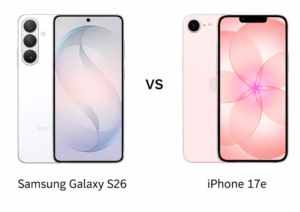
Choosing between the Samsung Galaxy S26 and the iPhone 17e isn’t just about Android vs iOS anymore; it’s about how much flagship experience you actually need. One pushes boundaries with cutting-edge hardware and features, while the other focuses on delivering a clean, reliable experience at a much lower price. For buyers deciding whether to spend big or stay smart with their budget, this comparison highlights what truly changes, and what doesn’t, when you move up the price ladder.
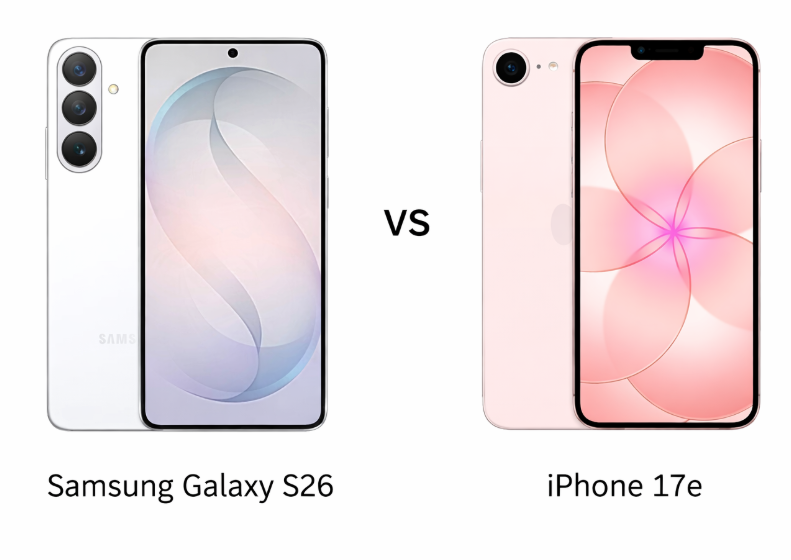
Major Features:
| Features | Samsung Galaxy S26 | iPhone 17e | Trade-Off: What It Means |
|---|---|---|---|
| Display | 120Hz, much brighter | Standard refresh, lower brightness | Samsung feels smoother & more premium |
| Camera Setup | Triple camera + zoom | Single 48MP camera | Samsung = versatility, Apple = simplicity |
| Performance | 12GB RAM, raw power focus | 8GB RAM, highly optimized | Samsung is more future-ready, Apple stays consistent |
| Features | DeX, reverse wireless, more extras | Minimal extra features | Samsung offers more flexibility |
| Battery & Charging | Bigger battery + reverse charging | Efficient but simpler setup | Samsung gives more options |
| Software Experience | Feature-rich One UI | Clean, smooth iOS | Samsung = control, Apple = ease |
| Pricing | Premium (~₹88K) | More affordable (~₹65K) | Big price gap changes expectations |
| Overall Trade-Off | More power, more features | Less cost, less complexity | Depends on what you value more |
The smartest buy for the price → iPhone 17e
Disclaimer: Specs are based on available data. Actual performance may vary. Verify details from official sources before buying.
Design and Display
Build and Feel
Samsung Galaxy S26 leans into a premium yet practical design with Gorilla Glass Victus 2 on both sides and an Armor Aluminum 2 frame. It feels refined but also engineered for durability, especially with Samsung’s focus on long-term usability. iPhone 17e, on the other hand, uses Ceramic Shield 2 and aluminum, delivering that signature Apple minimalism. It feels slightly more polished in hand, but Samsung’s finish comes across as more rugged and purpose-driven.
Display Quality
Samsung clearly dominates here with a 120Hz LTPO AMOLED panel pushing up to 2600 nits. The brightness and smoothness make everyday use and outdoor visibility noticeably better. The iPhone 17e’s OLED panel is sharp and color-accurate, but the lack of a high refresh rate makes it feel less fluid in comparison. Apple’s tuning is excellent, but Samsung’s display feels more modern and immersive.
Verdict
Galaxy S26 wins for offering a more advanced, smoother, and brighter display, while still maintaining a solid premium build.
Specifications Including Battery
Performance
The Galaxy S26 packs either Snapdragon 8 Elite Gen 5 or Exynos 2600, both cutting-edge chips with strong multi-core performance and GPU capabilities. It’s clearly built for heavy multitasking and gaming. The iPhone 17e’s A19 chip is highly optimized and efficient, delivering smooth real-world performance, but with only 8GB RAM, it feels slightly less future-proof compared to Samsung’s 12GB setup.
Battery and Charging
Samsung offers a 4300mAh battery with 25W wired charging and reverse wireless support, making it more versatile for daily use. The iPhone 17e’s 4005mAh battery is efficient thanks to iOS, but charging speeds remain average. Apple focuses more on consistency than speed, while Samsung pushes flexibility.
Verdict
Galaxy S26 takes the lead with better raw performance, more RAM, and greater charging versatility, making it feel more future-ready.
Camera
Main and Secondary Lenses
Samsung delivers a versatile triple-camera setup with a 50MP main sensor, 3x telephoto, and ultrawide lens. This flexibility makes it more capable across different scenarios, especially zoom and wide shots. The iPhone 17e sticks to a single 48MP camera, which performs excellently in most conditions but lacks the versatility of multiple lenses. Apple’s image processing is refined, but hardware limitations are noticeable.
Selfie Camera
Both phones feature 12MP front cameras with strong video capabilities. Apple adds Face ID and spatial features, making it slightly more advanced for biometrics and video recording. Samsung’s selfie camera is consistent and sharp, but less feature-packed.
Verdict
Galaxy S26 wins for versatility and overall camera system depth, while iPhone 17e remains strong for consistent point-and-shoot photography.
Pricing
The Galaxy S26 is priced around $900 (₹88,000), while the iPhone 17e comes in significantly lower at $600 (₹65,000). This creates a clear gap in positioning. Samsung targets the premium flagship segment, while Apple focuses on delivering a more affordable entry into its ecosystem.
Is the Price Justified?
Samsung justifies its higher price with a better display, more powerful hardware, additional cameras, and extra features like DeX and reverse charging. It feels like a full flagship experience. The iPhone 17e, however, offers strong value for those who want Apple performance and software at a lower cost, even if it compromises on hardware.
Verdict
iPhone 17e wins on value for money, but Galaxy S26 justifies its price with a more complete flagship package.
Disclaimer:
Prices are approximate and may vary based on country, region, and applicable taxes.
Conclusion
The Galaxy S26 stands out with features like Samsung DeX, a high-refresh-rate display, a triple-camera system, and longer software support. It feels designed for power users who want flexibility and cutting-edge hardware. The iPhone 17e focuses on simplicity, offering a clean iOS experience, reliable performance, and ecosystem advantages like Face ID and satellite features.
Verdict
Galaxy S26 is the better overall smartphone for those seeking top-tier specs, versatility, and future-proofing. However, the iPhone 17e remains a smart pick for users who prioritize value, smooth software, and a straightforward flagship experience without paying premium prices.
Disclaimer: This comparison is based on the specifications provided and is intended for general informational purposes. Actual performance, camera results, battery life, and overall experience may vary depending on real-world usage, software updates, and individual preferences.
Read More:
- Galaxy S26 vs Galaxy S26: battery life difference between Exynos and Snapdragon is huge
- Samsung Galaxy S26 Ultra vs Vivo X200T: Which One Should You Actually Buy?
- Xiaomi Robot Vacuum 6 Max vs Roborock S9 MaxV Ultra: One Cleans Harder, One Cleans Smarter
The post Samsung Galaxy S26 vs iPhone 17e: Which One Makes Sense to Buy? appeared first on Gizmochina.




 C-shaped frame, which flexibly adjusts to your neck and shoulders to keep the massage nodes perfectly aligned. This eliminates constant repositioning and delivers deeper, more effective pressure.