Reading view

Solana Hasn’t Bottomed Yet—Here’s Where the Real SOL Rally Could Begin

SBI’s B2C2 Picks Solana for Stablecoin Settlements

The post Solana Hasn’t Bottomed Yet—Here’s Where the Real SOL Rally Could Begin appeared first on Coinpedia Fintech News

The Solana price faced significant upward pressure as the broader market sentiments turned bearish following Trump’s address on the ongoing war. After losing a key support zone, the SOL is now trapped below the resistance, which may resemble a distribution, not a recovery. However, the buyers have not stepped in with conviction, while the price has not reclaimed any critical levels. As long as the SOL price does not reclaim its lost structure, the downside risk continues to prevail. 

Hence, now the question arises whether the current correction is another consolidation or an accumulation. 

Solana has lost a major horizontal support zone around $110–$120, a level that previously acted as a strong demand base throughout multiple cycles. Currently, the same level has flipped into resistance, where a retest may turn into selling opportunities hereafter. Historically, these types of structures tend to resolve lower. 
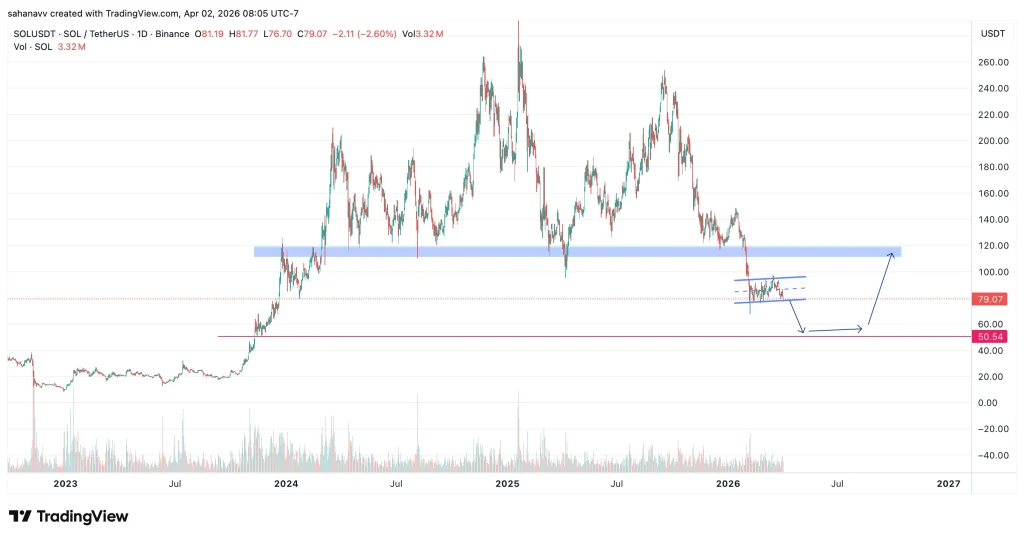
sol price

The broader structure shows lower highs forming consistently after failure to reclaim key resistance between $110 and $120. Moreover, the recovery was extremely low after a sharp decline due to a weak bounce. Moreover, it is compressing just above a major downside target, highlighting a critical support level at $50. 

This is the level where previous consolidation occurred with a strong demand, where risk-reward becomes attractive again. Therefore, the trade set suggests the SOL price may continue to remain range-bound and further initiate a breakdown to the demand zone. 

Collectively, Solana is trading below broken structure and remains a wait-for-confirmation market, not a bottoming market. Failure to reclaim $100 to $110 keeps the pressure intact, while a breakdown below the range opens a move toward $60 first, then $50, which is the key accumulation zone. Until then, every bounce is likely a lower high in formation, not the start of a new rally. 

Hyperliquid (HYPE) Flashes Golden Cross, But Fading Momentum Raises Concerns- What’s Next?

Hyperliquid Price

The post Hyperliquid (HYPE) Flashes Golden Cross, But Fading Momentum Raises Concerns- What’s Next? appeared first on Coinpedia Fintech News

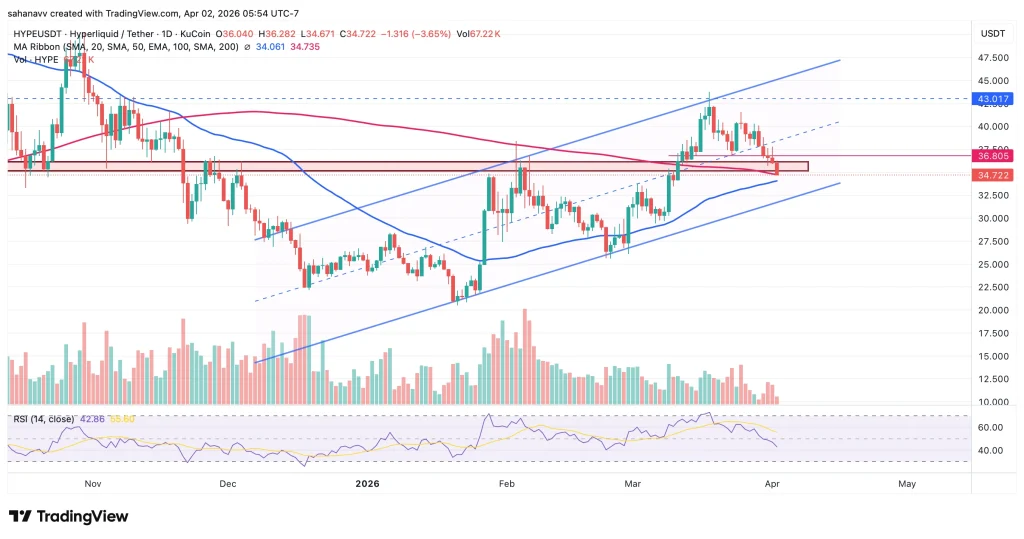
The crypto market has been facing significant upward pressure ever since Trump announced the re-escalation of the war with Iran. Many cryptos, including Bitcoin, XRP, Solana, etc., have broken down their respective support ranges, while some, like Ethereum, display some strength. Hyperliquid price has been plunging for the past few days, and the latest pullback has dragged the levels below the pivotal support range. 

On the other hand, it is also sending mixed signals and here’s where the setup appears to be dangerous. The current trade setup does not appear to be a breakout setup but a conflict between trend and momentum. And in such phases, the market usually undertakes a sharper price action. 

Hyperliquid Trend Structure: Bullish, But Slowing

HYPE has been in a steady uptrend since February, forming a rising channel with consistently higher lows as buyers remained largely active. However, the rejection near $43 resistance shows that while buyers can push the price higher, they lack the strength to sustain the momentum. Currently, the price has dropped back into the support range around $35-$36, and a breakdown below this range could attract a deeper correction. 

hype price

The emergence of a potential golden cross suggests that the broader trend is turning bullish. Typically, this attracts trend-following capital and supports further upside. Besides, the RSI is declining, even as price attempts to hold above key levels, indicating a drop in buying pressure. This divergence may create a key conflict, which may result in a correction or consolidation before the next expansion phase. 

If HYPE price holds above $34 and momentum stablises and RSI begins to rise, it may reclaim $38 to $40, which may even extend to $43 to $45. Besides, a failure may result in a pullback close to $30, invalidating the possibility of recovery in the short-term. 

What’s Next for the HYPE Price Rally?

Currently, the HYPE price is not breaking out but is in a transitional phase where buyers are still present, keeping the trend intact. However, the conviction is fading as the momentum is weak, which may also invalidate the upcoming golden cross as well. Therefore, defending the current support range is extremely important for the Hyperliquid price, which may pave the way for a healthy recovery beyond $40.

Drift Exploit Reshapes Crypto Liquidity—Is $267M in ETH Fueling the Next Move?

BC.GAME Offers $500K Bounty After ETH Hack Loss

The post Drift Exploit Reshapes Crypto Liquidity—Is $267M in ETH Fueling the Next Move? appeared first on Coinpedia Fintech News

The crypto market just witnessed one of the biggest DeFi exploits of 2026—but the real story isn’t the hack itself but what happened after it. Following the Drift Protocol exploit, the attacker accumulated over 130,000 ETH worth nearly $267 million, quietly turning a security breach into a market-moving liquidity event. While most are focused on the loss, smart money is watching the flow.

And right now, that capital is influencing Ethereum’s price behaviour.

What Happened: A $270M+ Exploit in Minutes

Drift Protocol, a major Solana-based decentralized exchange, suffered a $270M–$285M exploit, draining more than half of its total value locked in a matter of hours.

This wasn’t a typical smart contract bug. Instead, the attacker executed a highly sophisticated admin-level takeover, manipulating governance controls and bypassing safeguards to withdraw funds across multiple assets—including USDC, BTC derivatives, SOL, and ETH.

The funds were rapidly moved across wallets, swapped, and bridged—marking the beginning of something far more impactful than the exploit itself.

From Hack to Liquidity Rotation: The Real Market Shift

Here’s where the narrative changes. The stolen assets weren’t just held—they were actively converted and repositioned, with a significant portion bridged to Ethereum and accumulated as ETH. 

This has created a unique market condition where there is no organic demand and no investor-driven buying, but forced liquidity rotation into ETH. In simple terms, the exploit unintentionally triggered large-scale buy pressure on Ethereum.

This is why ETH has shown relative stability despite broader market uncertainty.

Ethereum Price Analysis: Stability or Artificial Support?

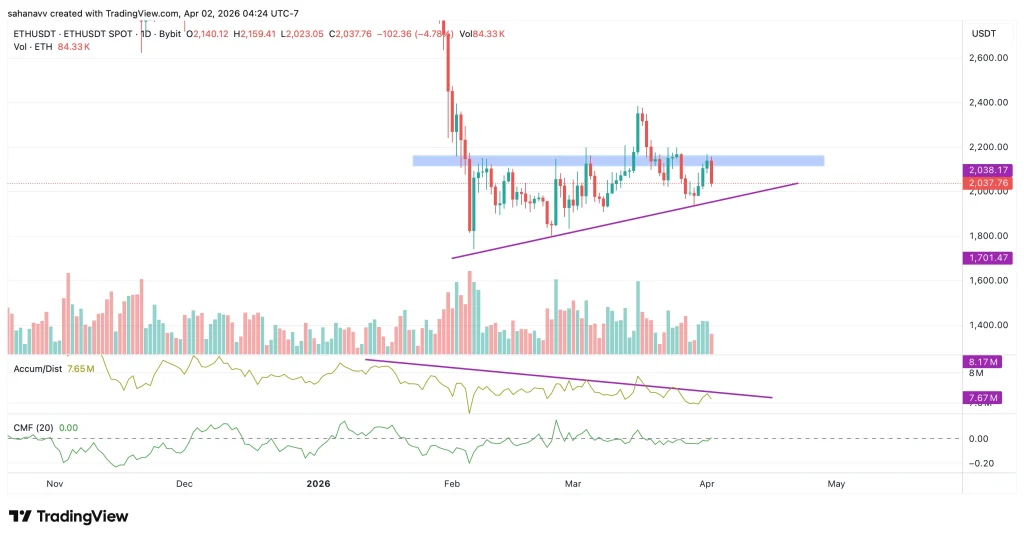
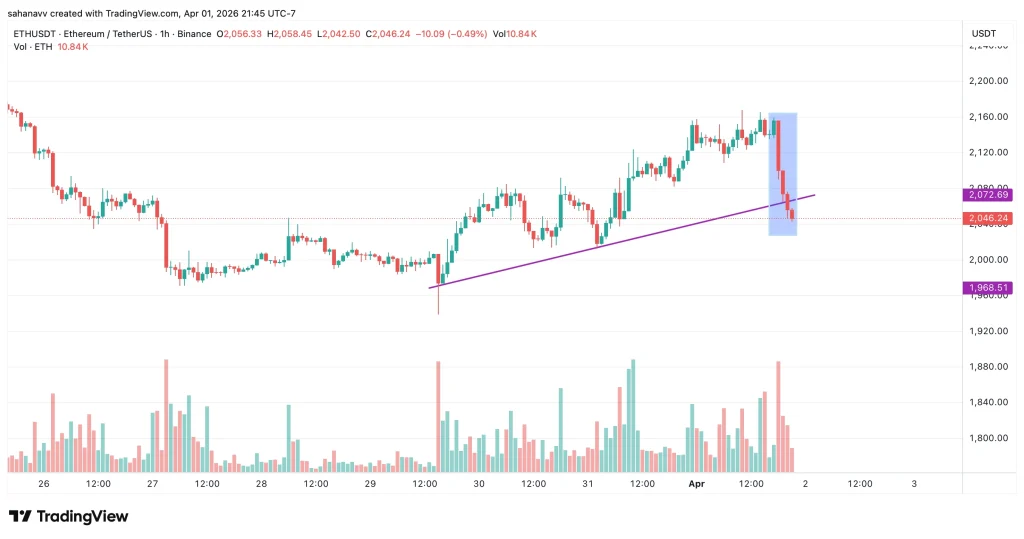
Ethereum is currently holding the $2,000 level, consolidating just below the $2,100 resistance zone. From a structural perspective, ETH continues to respect an ascending trendline from $1,700. Besides, the price is also forming higher lows, maintaining a constructive setup. 

eth price

But the Accumulation/Distribution line is declining, indicating weak real demand, and the Chaikin Money Flow remains neutral, showing limited capital inflow. This creates a clear divergence, suggesting price is stable, but conviction is missing. Therefore, the price between $2000 and $2100 is extremely important, as a breakout from either of the ranges may drive the rally towards their respective directions. 

Holding $2,000 and a breakout above $2,100 could push the levels to $2,300 or slightly higher, while losing $2,000 could drag the price close to $1900. 

The Bottom Line–What’s Next?

Ethereum isn’t holding up because the market is strong—it’s holding up because liquidity hasn’t left yet. The $267M ETH accumulated after the Drift exploit is acting as a temporary floor, absorbing pressure and keeping the price above $2,000. But this is not organic demand. It’s concentrated, event-driven capital, and that makes the current stability fragile. 

If it stays dormant, the ETH price can grind higher and attempt a breakout above $2,100. But if it starts flowing toward exchanges, the same capital that supported the market could accelerate a sharp downside move.

Bittensor (TAO) Price Holds Strong Amid Market Correction—Is a $350 Rebound Still on the Table?

Top Bittensor subnets

The post Bittensor (TAO) Price Holds Strong Amid Market Correction—Is a $350 Rebound Still on the Table? appeared first on Coinpedia Fintech News

Bittensor (TAO) price just went through a classic high-volatility shakeout after a sharp rejection at $365, followed by a quick 10–12% pullback. On the surface, it looks like weakness. But under the hood, the data tells a different story.

Volume surged to nearly $486 million, 168% above its daily average, right as price pulled back. That’s not panic selling. That’s aggressive accumulation during weakness. At the same time, TAO’s social dominance hit an all-time high, confirming that attention is flooding in. And in crypto, attention plus volume during dips usually signals one thing: positioning, not exit.

So the real question is no longer “why did TAO drop?” It’s this: Is this a reset before continuation, or the start of a deeper correction?

What’s Actually Backing TAO Right Now

The TAO price has remained sustained above $300 in times when the BTC price corrects due to geopolitical pressure. The other altcoins like XRP, SOL, HYPE, BNB, etc., and a few tokens also dropped below their respective support. While it appears that the price is experiencing congestion, these upcoming events are expected to be a strong catalyst for the next bullish action.

Decentralized AI Just Got Real

Bittensor proved that a 72-billion-parameter model can be trained across a decentralized network at competitive cost. This shifts TAO from an experimental AI token to a real infrastructure layer.  That’s a narrative upgrade—and markets price that fast.

Compute Access Expansion

TargonCompute’s opening access to consumer GPUs changes the game. More participants mean more computing and more network value. This is how network effects kick in early.

Institutional Speculation Building: 

The pending Grayscale decision adds a front-running catalyst. Even if nothing is confirmed yet, markets don’t wait. They price expectations before outcomes. 

Bittensor (TAO) Price Analysis: Can Bulls Still Push Toward $350?

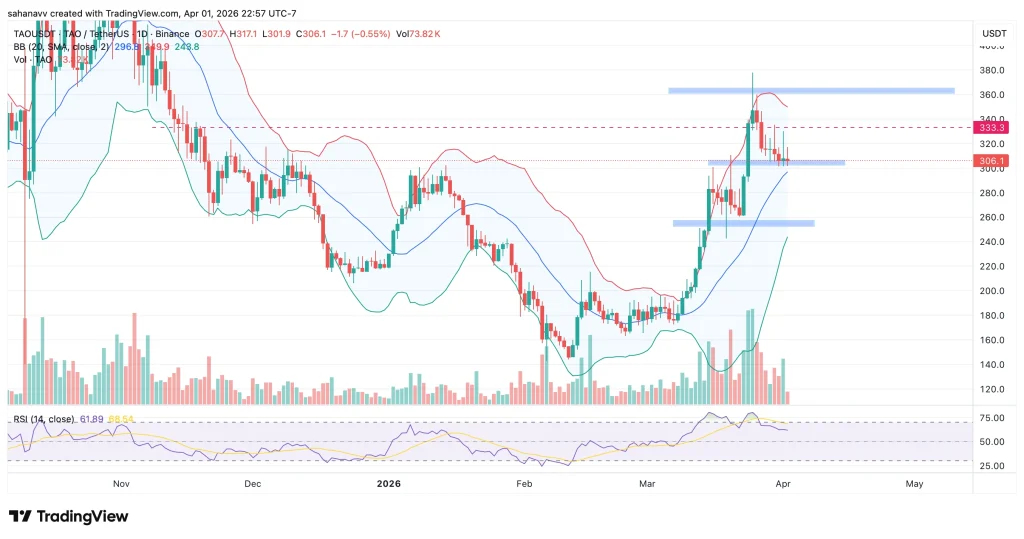
Bittensor (TAO) is currently consolidating after a sharp rejection from the $365 level, with price now holding near the $300 support zone. Despite the pullback, the overall structure remains bullish, as TAO continues to maintain higher highs and higher lows.

tao price

The recent drop appears to be a cooling phase after an overextended rally, not a trend reversal. Indicators support this view—RSI is easing from overbought levels but remains above 50, while price is stabilizing near the mid-Bollinger Band, signaling a volatility reset. Volume remains elevated during the pullback, suggesting active accumulation rather than selling pressure, which keeps the bullish case intact.

Key Levels to Watch

  • Support: $300
  • Major Support: $250–$260
  • Resistance: $330 → $365

If TAO holds above $300 and reclaims $330, a move toward $350–$365 remains likely. However, a breakdown below $300 could trigger a deeper correction toward the $260 zone.

Wrapping it Up

TAO’s flash crash wasn’t a breakdown; it was a stress test. And so far, the market is holding. The fundamentals are strengthening. The narrative is gaining traction. And the volume confirms that big players are not stepping out; they’re stepping in. If momentum returns and $365 breaks, the move to $400+ can be fast and aggressive. But if support cracks, the Bittensor price correction will be equally sharp.

Trump’s Iran War Escalation Sends Bitcoin Below $67K—But Ethereum Holds Firm: What’s Next in the Coming Weeks?

Trump Trigger Sparks Crypto Market Rally Bitcoin Hits $71K, XRP & ETH Spikes

The post Trump’s Iran War Escalation Sends Bitcoin Below $67K—But Ethereum Holds Firm: What’s Next in the Coming Weeks? appeared first on Coinpedia Fintech News

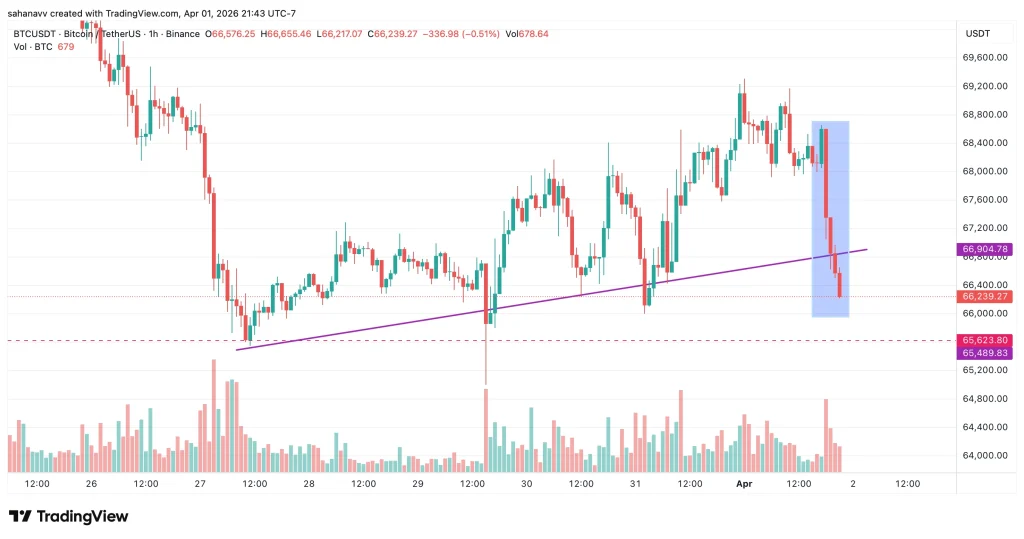
The Bitcoin price is once again trading on edge—not because of internal market weakness, but because macro uncertainty is tightening its grip. The latest trigger came from U.S. President Donald Trump’s national address on the ongoing Iran war, where he signaled that the conflict is far from over and could stretch another 2 to 3 weeks with intensified military action ahead. 

That single statement has reshaped market expectations. Instead of clarity, it injected a fresh wave of uncertainty across global assets—and crypto was no exception. Bitcoin slipped back below the $67,000 mark, reinforcing its fragile consolidation phase, while broader altcoins cracked key supports. Ethereum, however, is telling a different story. Holding firmly above the $2,000 level, it is emerging as a relative strength play in an otherwise risk-sensitive market.

This 2–3 week window is now critical. If tensions escalate, crypto could remain under pressure as liquidity shifts toward safety. But any signs of resolution could trigger a sharp reversal. In short, this is no longer just a crypto market—it’s a macro-driven battlefield where headlines, not charts alone, will dictate the next move.

Why Bitcoin Dropped While Ethereum Holds Strong

The wave of uncertainty has been deeply impacting the markets, specifically Bitcoin, and the latest one is pointing towards an extended action for another 2 to 3 weeks. BTC, being the most liquid and heavily traded, becomes the first one to absorb selling pressure. As a result, the price has been printing consecutive lower highs and lows. As long as the Bitcoin price remains stuck between $60,000 and $70,000, the consolidation may prevail, preventing it from undergoing huge moves. 

btc price

Ethereum, however, is playing a different game. While the broader market weakens, ETH continues to defend the $2,000 psychological and structural support, showing clear signs of relative strength. It could be due to stronger spot demand and accumulation near $2000 and less aggressive selling compared to BTC. 

eth price

Bitcoin and Ethereum are clearly diverging in structure right now. Bitcoin continues to trade below key resistance, printing lower highs and showing weakness within a tight $65K–$68K range. Ethereum, on the other hand, is holding firm above the $2,000 support, indicating stronger buyer interest and base formation. This puts BTC in a fragile consolidation phase, while ETH is showing relative strength with early signs of accumulation—a setup that often precedes rotation if market conditions stabilize.

What to Expect in the Next 2–3 Weeks

The next few weeks will be driven less by charts and more by headlines. If the Iran conflict continues to escalate as Trump predicts, Bitcoin is likely to stay under pressure, with a higher probability of testing the $63K–$60K zone. However, any signs of de-escalation could quickly flip sentiment and push BTC back above $68K, triggering a relief rally.

Ethereum remains the key asset to watch. As long as it holds above $2,000, it retains a bullish edge and could outperform the market. A break above $2,100 would likely accelerate momentum toward $2,400, signaling a shift from defence to expansion.

In short, expect volatility, sharp reactions to news, and divergence between assets. This is not a trend market yet—it’s a reaction-driven phase, where confirmation matters more than prediction.

Aptos vs. Sui vs. Filecoin—Which Altcoin Has Real Upside in Q2 2026?

This Altcoin Is Rebounding After Months of Compression—Are These Early Signs of a Bigger Move

The post Aptos vs. Sui vs. Filecoin—Which Altcoin Has Real Upside in Q2 2026? appeared first on Coinpedia Fintech News

Aptos, Sui & Filecoin: all the prices are trading within the lower bands and are showing the possibility of a breakout. While Bitcoin price is stuck between $60,000 and $70,000, and Ethereum is showing weakness against the star token, these altcoins could shake the markets. Aptos price seems to be ready for a breakout above $1, but Sui & Filecoin prices may have a delayed breakout. 

SUI Price Analysis—Weak Structure Without Breakout Possibility

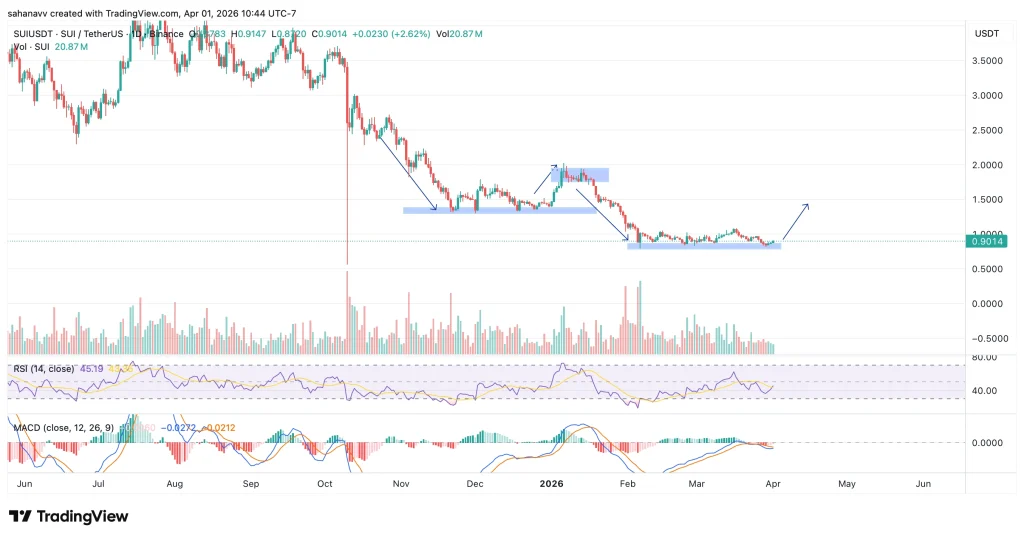
The Sui price continues to trade under pressure, with the chart clearly reflecting a prolonged downtrend. After a sharp breakdown in late 2025, SUI formed a temporary base around the $1.30–$1.40 zone. However, the recovery attempt failed to be sustained, leading to another leg lower. This confirms a classic pattern of lower highs followed by breakdowns, indicating that sellers remain in control.

sui price

Currently, SUI is stabilizing near the $0.85–$0.90 range, which is acting as immediate support. The RSI remains neutral, hovering around mid-levels without showing strong bullish divergence. Besides, the MACD is flattening, indicating a lack of directional momentum. A sustained move above the $1.00–$1.10 resistance zone is required to confirm any meaningful trend reversal. Until then, the current price action should be viewed as range-bound consolidation within a broader bearish structure.

Filecoin Price Analysis: FIL Compresses in Falling Wedge 

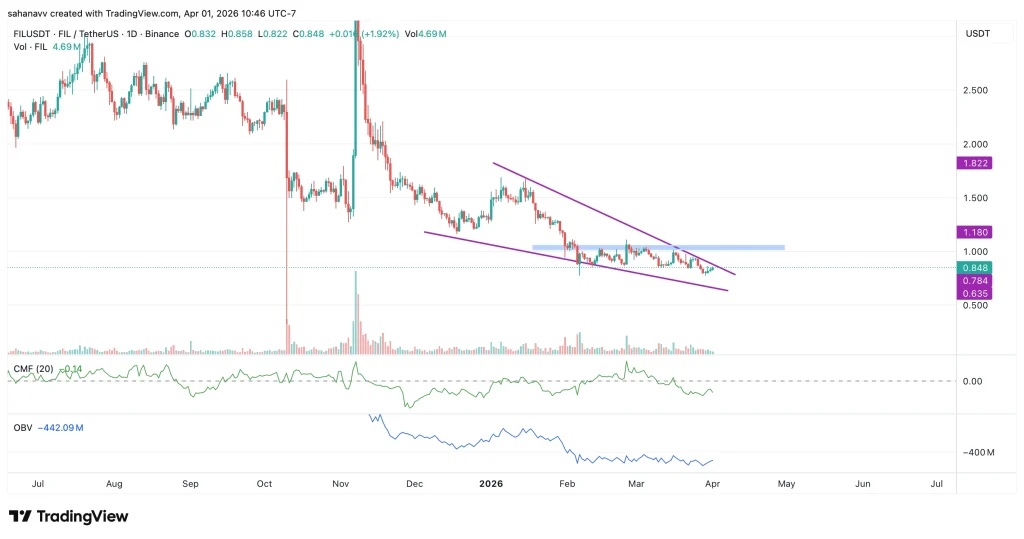
Filecoin is currently trading in a tight compression phase, with price action forming a falling wedge pattern—a structure often associated with potential bullish reversals, but only after confirmation. Following a sharp decline, FIL has continued to print lower highs within a descending trendline while holding support near the $0.75–$0.85 zone. This has led to a narrowing price range, signaling that the market is approaching a decision point.

fil price

Volume remains relatively muted, and On-Balance Volume (OBV) continues to trend lower, indicating a lack of strong accumulation. At the same time, the Chaikin Money Flow (CMF) is hovering near neutral levels, suggesting that capital inflows are not strong enough to support an immediate upside move. FIL remains capped below the key $1.00–$1.10 resistance zone, and until it reclaims this level, the current price action can be treated as consolidation with a broader downtrend, rather than a confirmed reversal. 

Aptos Price Analysis: APT Builds Structure as Bullish Reclaim Attempts Emerge

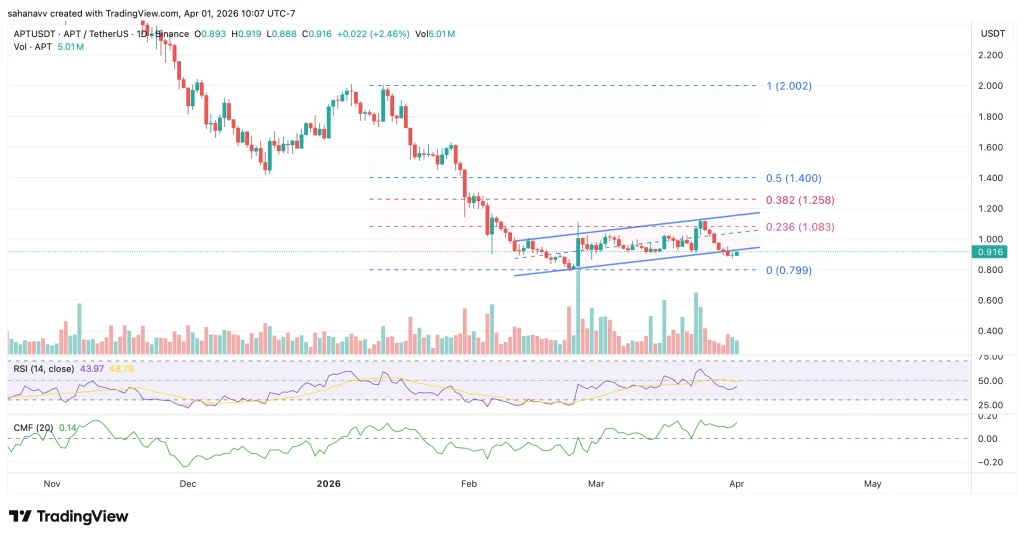
Aptos is beginning to show early signs of structural strength after a prolonged downtrend, indicating a shift from aggressive selling to controlled accumulation. Currently trading near the $0.90–$0.95 zone, APT is holding above key support around $0.80, forming higher lows—a critical signal that selling pressure is weakening. Unlike typical range-bound behaviour, this structure reflects gradual demand stepping in, rather than passive stabilisation.

apt price

Momentum indicators support this developing strength. The RSI is holding near mid-levels, avoiding bearish extremes, while the CMF remains positive, signaling steady capital inflows. The price is now attempting to reclaim important Fibonacci levels, particularly the $1.08 (0.236) zone, which acts as immediate resistance. A sustained move above this level could open the path toward $1.25–$1.40, aligning with the next key retracement levels. APT remains in a pre-breakout phase where a confirmation will require a clean reclaim of the $1.08–$1.25 resistance. Until then, the structure remains constructive but unconfirmed.

Wrapping it Up: Aptos Looks Stronger than SUI & Filecoin

SUI continues to show no structural shift, holding near lows without breaking its downtrend. Filecoin is in a compression phase, forming a potential setup but still lacking confirmation. Both remain reactive, not leading. While Aptos is building higher lows, holding support, and attempting to reclaim key levels, all are early signs of strength in a weak market.

Among the three, Aptos stands out as the only altcoin with a developing bullish structure, while Sui and Filecoin remain conditional and require confirmation before any sustained move.

Bitcoin Stuck Between $60K and $70K—Why BTC Price Isn’t Ready to Break Out

Bitcoin price analysis $69K resistance

The post Bitcoin Stuck Between $60K and $70K—Why BTC Price Isn’t Ready to Break Out appeared first on Coinpedia Fintech News

The Bitcoin price continues to trade within a defined $60,000–$70,000 range, but this lack of movement is not random—it reflects a market in equilibrium, not expansion. Spot demand is gradually absorbing sell-side pressure, while derivatives have reset, removing excess leverage. As a result, volatility has cooled, and price action has stabilized.

But stability is not strength.

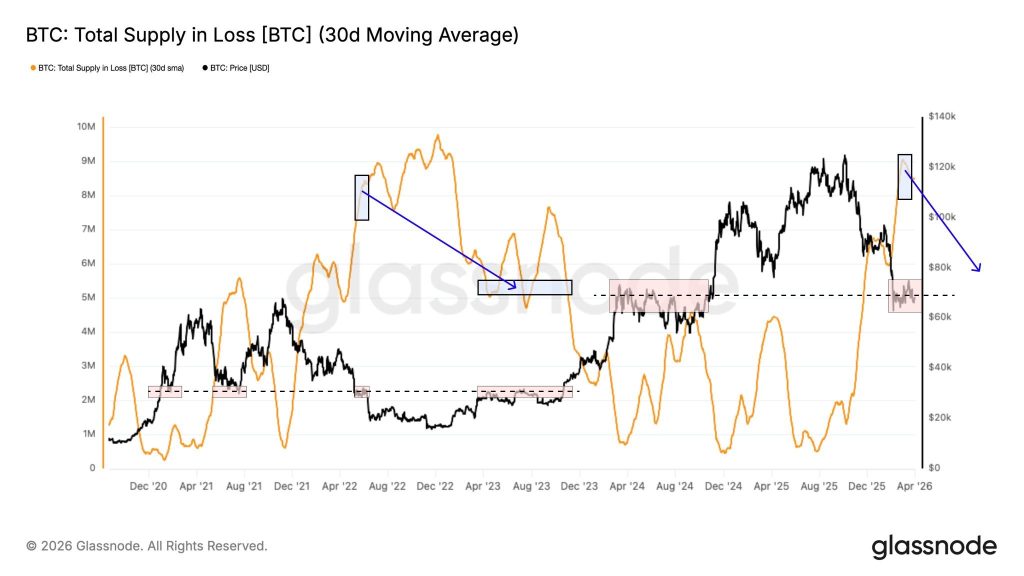
Without a clear catalyst or aggressive demand, Bitcoin remains in a compression phase, where both buyers and sellers are active, yet neither side has enough conviction to drive a sustained move. On-chain data from Glassnode explains why the breakout is still missing.

Supply in Loss Signals: Selling Pressure Is Being Absorbed

The “Total Supply in Loss” metric shows a recent spike, indicating that a large portion of BTC holders are currently underwater. Historically, this phase often leads to increased sell-side pressure, as weaker hands exit positions.

btc price

However, the price has not collapsed. This suggests that spot demand is absorbing supply effectively, preventing a breakdown. While this is constructive, it does not indicate strength—it reflects balance between buyers and sellers, not dominance.

Realized Loss Spikes Point to Capitulation — But Not Expansion

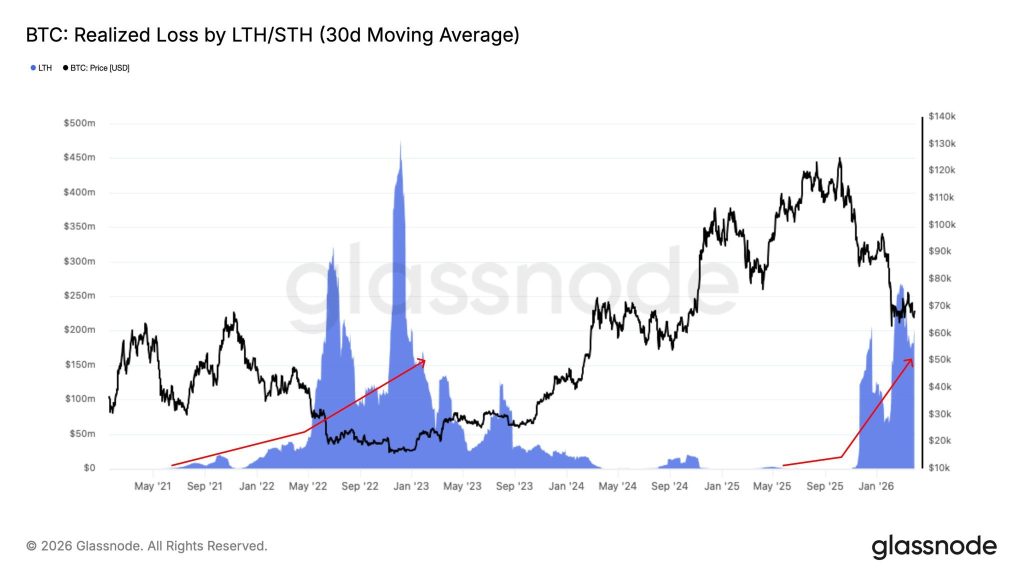
On-chain Glassnode data shows a rise in realised losses, particularly among short-term holders. This typically marks local capitulation events, where panic selling flushes out weak participants. Historically, such phases can form a base, but only if followed by strong inflows.

btc price

Right now, that second part is missing. The market has absorbed losses, but there is no clear follow-through demand, keeping Bitcoin stuck within its current range.

Derivatives Reset Removes Fuel for Breakout

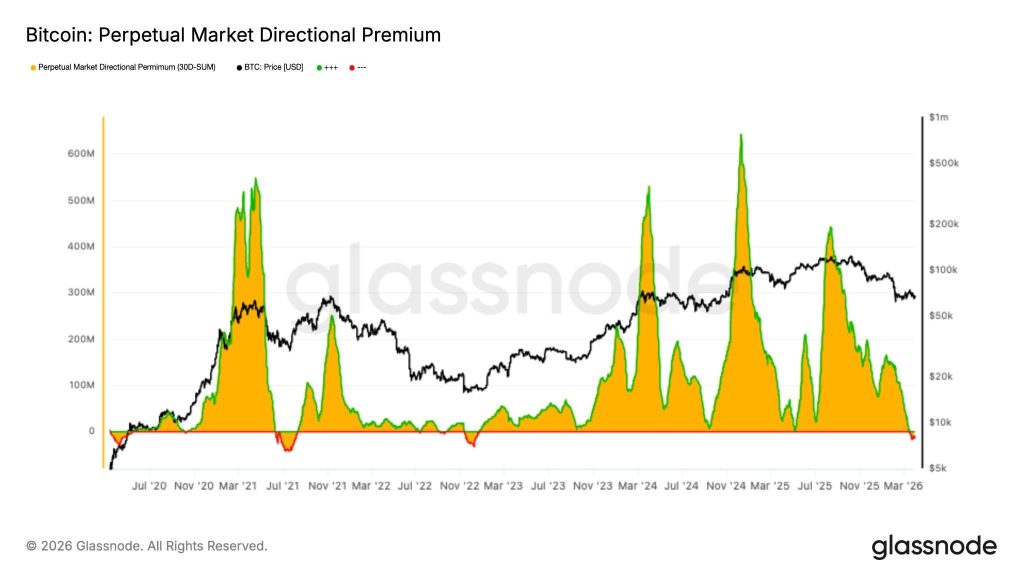
The perpetual market directional premium has normalized, showing that leverage has been flushed out of the system. At the same time, volatility risk premium is declining, signaling reduced expectations of large price swings.

btc price

This move is pivotal as breakouts require aggressive positioning, expanded voalitlty and a strong directional conviction. Unfortunately, none of this has happened as of now, hinting towards the future traders being uncertain. 

Bitcoin Price Outlook — Range Holds Until Catalyst Appears

Bitcoin is not weak—but it is not ready to move either. The current phase reflects absorption without expansion, where supply is being managed but demand is not strong enough to drive a breakout. Until a clear catalyst emerges, Bitcoin is likely to remain range-bound, controlled, and directionless.

As the BTC price remains stuck between $60,000 & $70,000, a breakdown or a breakout from the range may trigger upside or downside price action. 

Ethereum Lags Behind Bitcoin: Is it an Early Warning of a Hidden Opportunity?

Tom Lee’s Bitcoin and Ethereum Price Prediction 2026

The post Ethereum Lags Behind Bitcoin: Is it an Early Warning of a Hidden Opportunity? appeared first on Coinpedia Fintech News

Ever since the February drop, the Ethereum price has been trading within a range with predefined resistance and support. In the times when the Bitcoin price is attempting larger moves, ranging from lows around $62,000 to as high as $75,600, the ETH price is failing to secure a range above 2,200. However, the price has been defending the pivotal support close to $2000 that may appear bullish, but the underlying data tells a different story. 

Currently, the momentum is weak, and capital is not flowing back to ETH, and this divergence raises a critical question: Is Ethereum preparing for a delayed breakout, or is this an early warning of deeper weakness? 

ETH/BTC Downtrend Signals Weakness Despite ETH/USD Price Stability

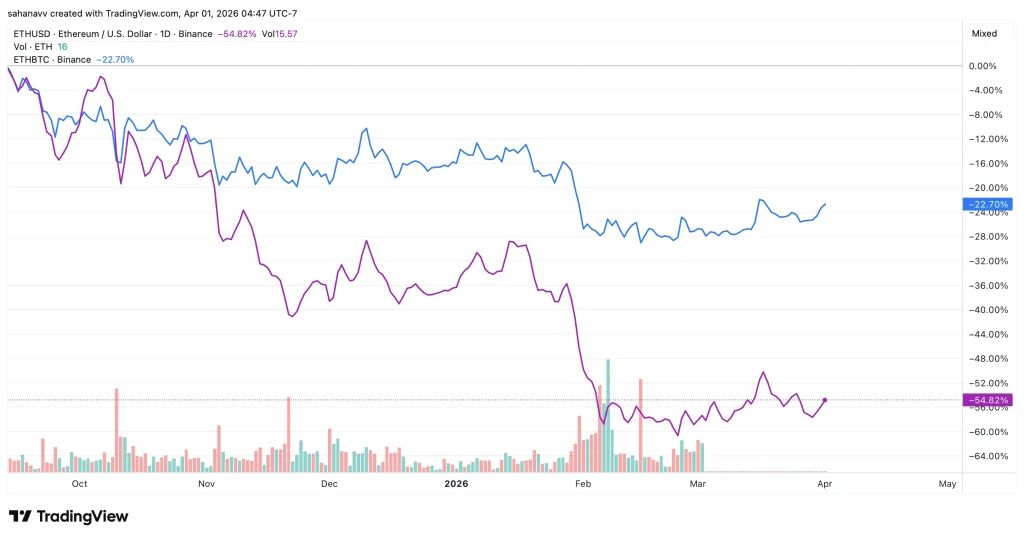
Ethereum price is showing signs of stabilization on the price chart, but a deeper look at the ETH/BTC pair reveals a more critical signal; it continues to underperform Bitcoin in the current market cycle. The ETH/BTC chart remains locked in a clear downtrend, marked by consistent lower highs and a sharp breakdown in February. This keeps Ethereum in a relative weakness phase, rather than signaling a true reversal.

eth price

This divergence between the ETH price and the ETH/BTC performance is significant. While ETH/USD appears stable, the relative decline indicates that capital is not flowing back into Ethereum at the same pace as Bitcoin. Instead, the current market environment reflects a Bitcoin-led recovery, where BTC continues to absorb liquidity while ETH lags. 

From a trading perspective, this structure does not support a bullish bias yet. As long as the ETH/BTC pair fails to break its downtrend and reclaim key levels, any upside in Ethereum price should be viewed as limited and conditional, not a confirmed trend shift.

Ethereum Dominance Drops as Bitcoin Gains Control — Capital Rotation Intensifies

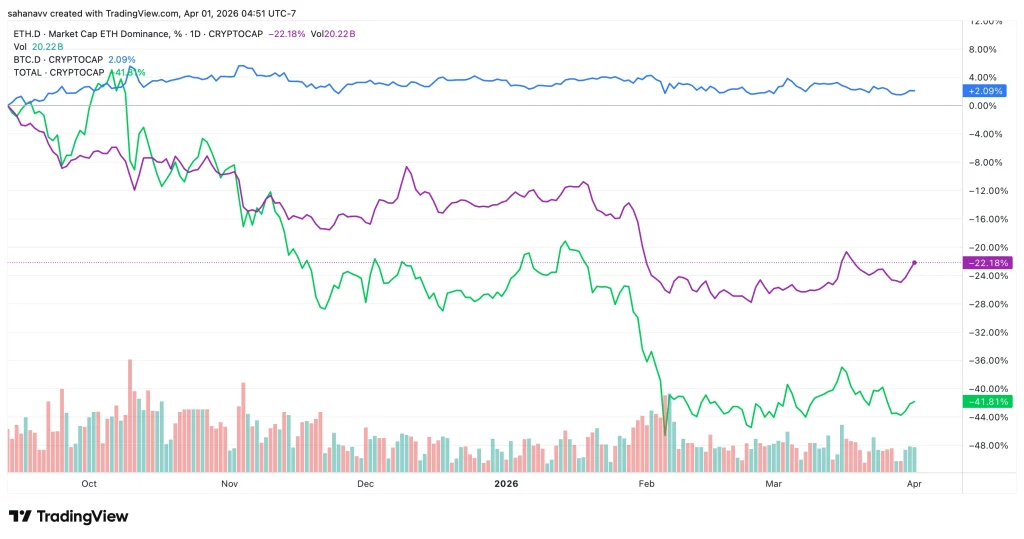
Ethereum price is continuing to lose ground in the broader market, with Ethereum dominance (ETH.D) holding near its lows despite a recent bounce. The structure remains weak, with no confirmed higher high, signaling that ETH is not regaining meaningful market share. At the same time, Bitcoin dominance (BTC.D) remains elevated, showing consistent relative strength. This divergence confirms a clear shift in capital flow; liquidity is favoring Bitcoin while Ethereum lags.

eth price

The total crypto market has attempted a recovery following the recent correction, but Ethereum has failed to capture a proportional share of that move. This indicates that the current environment is not driven by altcoin expansion but by a Bitcoin-led recovery phase, where capital is concentrated rather than broadly distributed.

As long as Ethereum dominance remains suppressed and fails to reclaim higher levels, ETH is likely to continue underperforming. A meaningful shift in trend will require sustained strength in ETH.D alongside a cooling in BTC dominance, confirming that capital is rotating back into Ethereum.

What This Means for the Retailers

The continued downtrend in the ETH/BTC pair highlights relative weakness, while declining ETH dominance confirms that Ethereum is losing market share. At the same time, Bitcoin dominance remains elevated, signaling that liquidity is concentrated in Bitcoin. This combination defines the current environment as BTC-led, not ETH-driven.

At this stage, Ethereum does not offer a confirmed trend. Instead, it presents a conditional setup where confirmation is required before taking directional bias. A shift in trend will only occur if Ethereum shows clear strength across multiple metrics:

  • ETH/BTC breaks its downtrend and forms higher highs
  • ETH dominance (ETH.D) starts trending upward
  • Price reclaims key resistance levels with strong momentum

Invalidation of Bullish Setup

  • Continued weakness in ETH/BTC
  • Failure of ETH dominance to recover
  • Rejection at key resistance levels

Collectively, the Ethereum price is not in a confirmed bullish trend—it is in a setup phase with weak relative positioning. Until capital rotates back into ETH from Bitcoin, and key structures are reclaimed, any upside should be treated as limited and reactive, not a sustained move.

Chainlink (LINK) Price Eyes Breakout as Whale Outflows Surge — $15 Next?

Amundi tokenized fund SAFO

The post Chainlink (LINK) Price Eyes Breakout as Whale Outflows Surge — $15 Next? appeared first on Coinpedia Fintech News

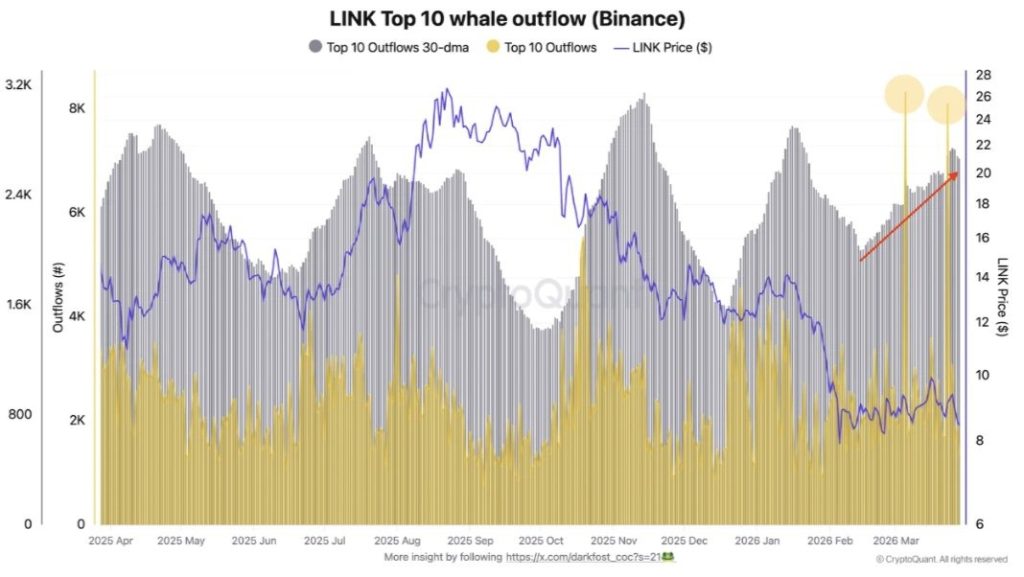
Chainlink price is quietly building strength near the $9 level after weeks of sustained pressure, but the real signal is coming from on-chain data. Whale outflows from Binance have started to rise again, hinting that large holders may be stepping in at current levels.

This shift often points to supply tightening on exchanges, a condition that can support upside if demand follows. At the same time, LINK’s price structure is stabilizing, suggesting that the market could be preparing for a move higher.

However, this is not a confirmed breakout yet. Until key resistance levels are cleared, the LINK price remains in a setup phase, with both bullish potential and downside risk still in play.

Chainlink Whale Outflows Surge — Bullish Signal Building?

Chainlink is witnessing a steady rise in whale outflows from Binance, with recent data showing a clear uptick in large-holder activity. The latest trend highlights that top wallets are increasingly moving LINK off exchanges, a pattern often associated with reduced selling pressure and potential accumulation.

link price

Notably, this increase in outflows comes as the LINK price stabilizes near the $8–$9 range, suggesting that whales may be positioning during a consolidation phase rather than exiting at highs. Historically, such behavior has aligned with early-stage accumulation zones, where smart money prepares ahead of a possible trend shift.

However, while the rising outflows support a bullish narrative, they do not confirm it. These movements could also reflect internal transfers or OTC activity. For now, the data points to a strengthening on-chain backdrop, but confirmation will depend on whether the price follows with a sustained breakout.

Chainlink Price Analysis — Ascending Channel Signals Breakout Setup

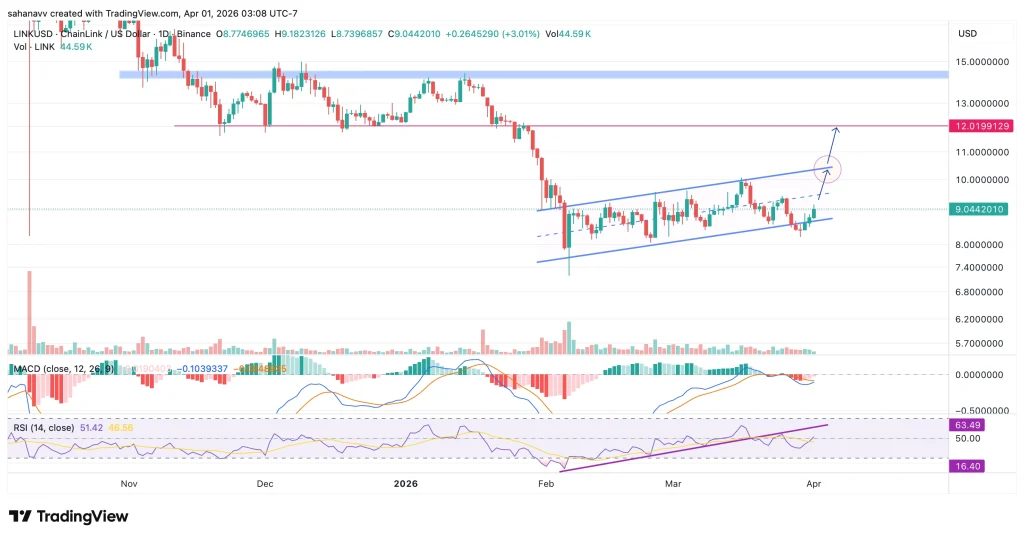
Chainlink is trading within a well-defined ascending channel, showing early signs of strength after a sharp correction. The structure reflects higher lows, indicating that buyers are gradually stepping in near the $8–$8.5 zone. From a price action perspective, LINK is now approaching the mid-to-upper range of the channel, with immediate resistance sitting near $10, followed by a key horizontal barrier at $12. 

A sustained move above this level could confirm a trend reversal and continuation toward higher targets.

link price

RSI is trending upward and holding above the midline, suggesting building bullish momentum. but is yet to catch up to the trend line. Besides, MACD is attempting a bullish crossover, indicating a potential shift from bearish to neutral-bullish momentum. However, the setup is not confirmed yet.

The price has just entered the rising parallel channel, and once it surges above the middle bands at $9.45, which is also a crucial resistance, a rise above $10 could be imminent. Further, a breakout above the channel’s resistance may attract more bullish action, but given the buying pressure and volume, a breakout does not seem imminent. 

However, as long as LINK holds above the channel support near $8.5, the bullish possibility remains intact. Only a breakdown below this level would invalidate the bullish setup and expose downside toward the $7.4 region.

Wrapping it Up

The Chainlink price is approaching a decisive phase, where both on-chain activity and price structure are beginning to align. Rising whale outflows point to a strengthening backdrop, while the ascending channel reflects controlled accumulation with improving momentum. The focus remains clear; $12 is the key breakout level that could shift the structure bullish and open the path toward higher targets. 

Until that level is reclaimed with strength, the LINK price continues to trade within a setup phase, where patience matters more than prediction.

Algorand Price Surges 10%—Is ALGO Finally Breaking Its Downtrend?

Algorand CTO Steps Down as Foundation Relocates to the US and Cuts Workforce by 25%

The post Algorand Price Surges 10%—Is ALGO Finally Breaking Its Downtrend? appeared first on Coinpedia Fintech News

Algorand price has gained fresh momentum, rising over 10% in the past 24 hours and drawing attention from traders watching for a potential trend reversal. The altcoin, which has been stuck in a prolonged downtrend, is now testing a critical resistance zone near $0.09. This move comes as broader market sentiment stabilizes, raising the key question: Is this the start of a sustained recovery or just a short-term bounce?

Why Algorand (ALGO) Price Is Rising

The recent upside in Algorand appears to be driven primarily by technical and market-driven factors rather than strong fundamentals. Firstly, ALGO price has been trading in a prolonged downtrend, making it a candidate for a relief rally or short squeeze. Assets that remain oversold for extended periods often witness sharp upside moves once key levels are reclaimed.

Secondly, the broader crypto market is showing signs of stabilization. When Bitcoin consolidates, capital often rotates into underperforming altcoins, and Algorand fits this profile. Additionally, the price surge coincides with a break toward descending resistance, which likely triggered short liquidations and fresh buying interest. However, there is no strong evidence yet of a major fundamental catalyst driving this move, suggesting the rally may still be fragile.

Algorand Price Tests a Crucial Resistance

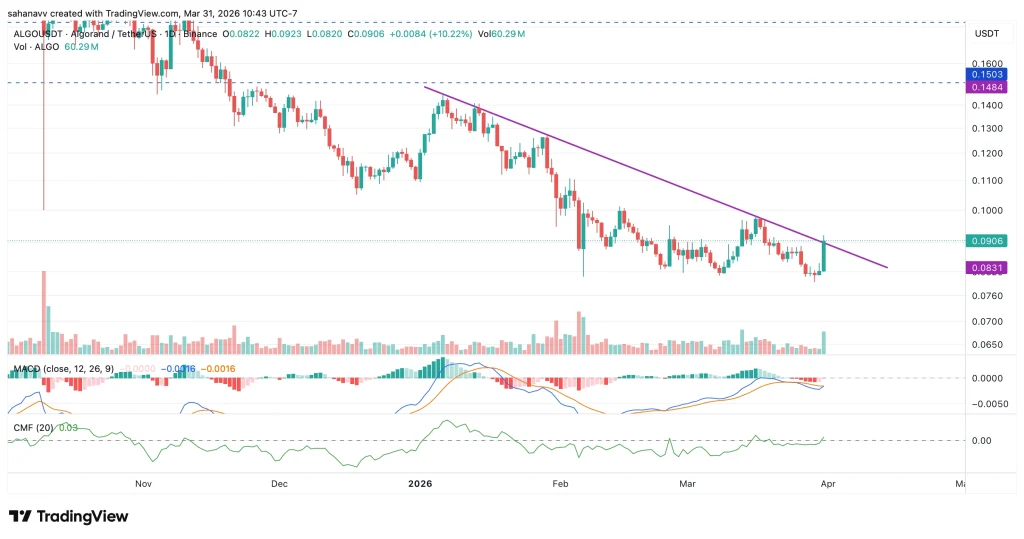
From a technical standpoint, Algorand remains within a clear descending trendline, which has been acting as dynamic resistance for months. The price is trading around $0.90, after rebounding from the lows at $0.80. The token has risen above the descending trendline and hence a daily close above this range could push the price towards the immediate resistance between $0.092 to $0.095. 

algo price

The recent move shows ALGO testing this descending resistance, making this a critical decision zone. MACD is showing early signs of bullish crossover, indicating improved momentum, while CMF is turning positive, suggesting mild capital inflow. The volume has also increased during the recent spike, backing the upswing. 

However, the broader trend remains bearish with the lower highs remaining intact. A rejection from the current levels could continue the downtrend, while a sustained breakout above the trendline could signal a shift in structure. 

Key Levels Traders Should Watch

Algorand price is currently at a make-or-break level, where the next move will likely define short-term direction. If the price breaks and holds above $0.095 to $0.105, then the rally may be extended beyond $0.12 to $0.14. On the other hand, a rejection at the trendline resistance may drag the levels back toward the $0.083 to $0.076 range. 

At this stage, the move appears to be a technical bounce within a broader downtrend, rather than a confirmed reversal. Traders should watch for a decisive breakout or rejection before positioning, as premature entries in such setups often lead to traps.

Solana Compressing in a Narrow Range—Is SOL Price Gearing Up for a Massive Move?

Solana Price Could Slide to $50 if $75 Support Breaks—Here’s the Bullish and Bearish Scenario

The post Solana Compressing in a Narrow Range—Is SOL Price Gearing Up for a Massive Move? appeared first on Coinpedia Fintech News

Over the past few days, the Solana price has been trading range-bound, strongly defending the $80 support while failing to reach $95. This has prevented the token from securing the $100 range, which could have attracted significant buying pressure. In times when the broader crypto market remains uncertain and Bitcoin shows signs of structural pressure, SOL price behaviour also displays weakness as traders remain indecisive. 

This raises a key question: is SOL price quietly accumulating strength for the next rally, or is this range forming as part of a distribution phase before the next price action?

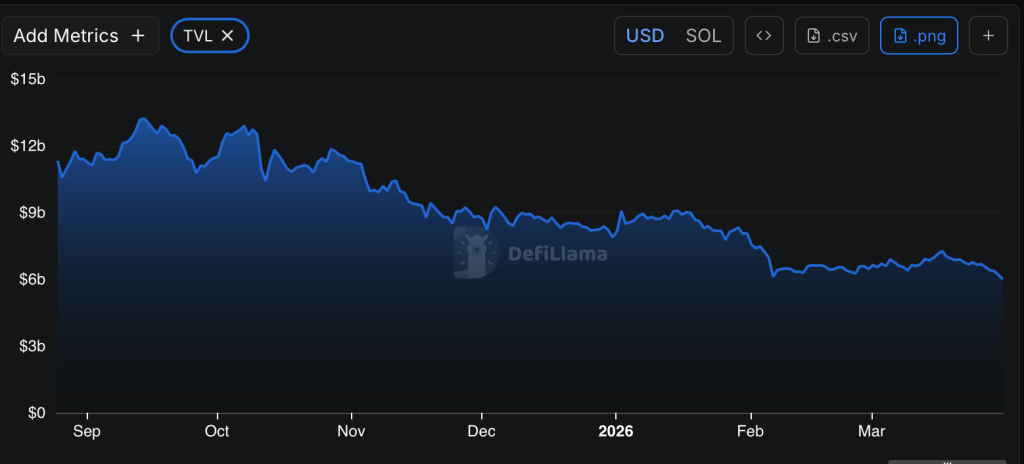
Solana TVL Decline Signals Weak Underlying Demand

Solana’s Total Value Locked (TVL) has been trending downward over the past several months, reflecting a steady decline in on-chain liquidity and user participation. Data show TVL falling from above $12 billion in late 2025 to nearly $6 billion by April 2026.

sol price

This consistent drop in locked value suggests that capital has been gradually exiting the ecosystem rather than rotating within it, a key signal that underlying demand remains weak despite periods of price consolidation.

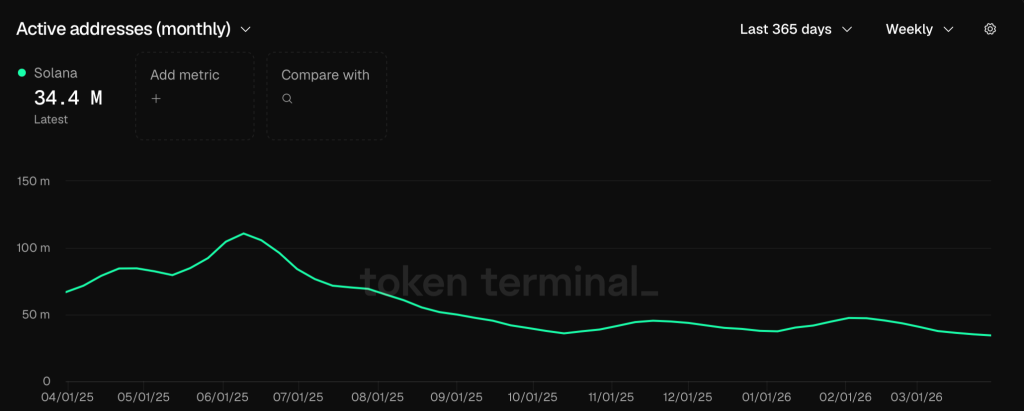
Solana Active Addresses Decline Points to Weak Network Activity

Beyond liquidity trends, Solana’s network activity also reflects a cooling phase. Data shows that monthly active addresses have dropped significantly from peak levels above 100 million in mid-2025 to nearly 34 million recently.

sol price

This steady decline highlights a reduction in user engagement, suggesting that fewer participants are actively interacting with the network compared to previous months. When this metric declines alongside TVL, it strengthens the case that the ecosystem is experiencing a slowdown rather than expansion.

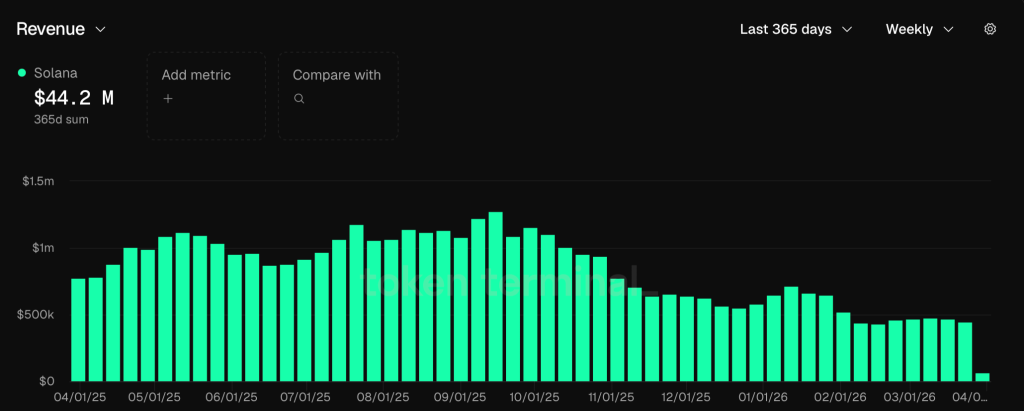
Solana Revenue Drops, Reflecting Slowing Economic Activity

Another critical on-chain signal comes from Solana’s revenue, which has been steadily declining over recent months. After peaking above $1 million in mid-to-late 2025, weekly revenue has now dropped significantly, with recent figures hovering near the lower end of the range.

sol price

This decline in revenue indicates reduced economic activity across the network, as fewer transactions and lower demand translate directly into weaker fee generation.

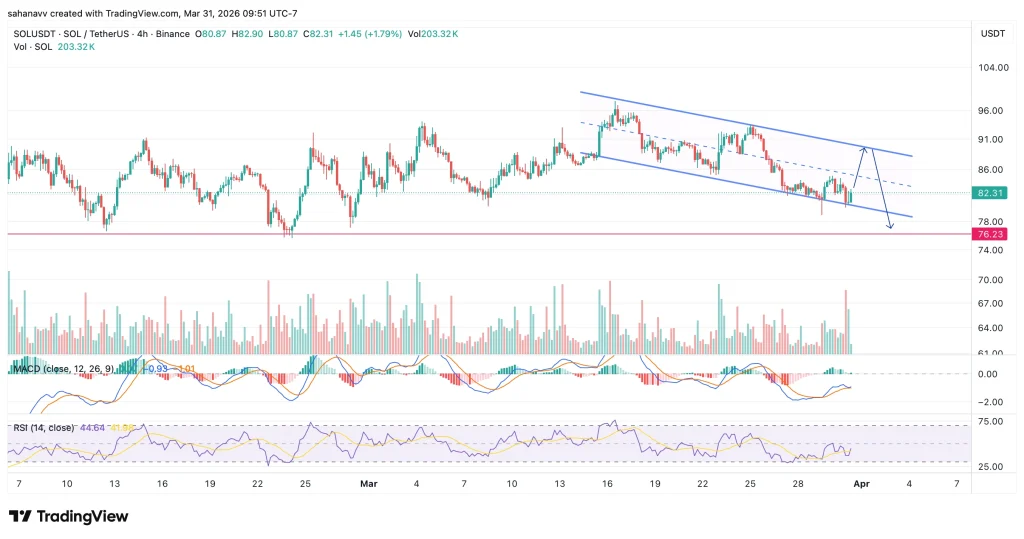
How Will This Impact SOL Price as Descending Channel Keeps Bears in Control

Solana price continues to trade within a descending channel, with the price hovering near the lower boundary around $82, indicating a critical decision zone. The overall structure remains bearish, marked by consistent lower highs and weak follow-through from buyers. Indicators like RSI and MACD also reflect a lack of strong momentum, suggesting that bulls are yet to regain control. 

sol price

If SOL fails to hold the $80–$78 support range, a breakdown toward $76 appears likely, especially as on-chain data—including declining TVL, active addresses, and revenue—continues to signal weakening demand.

On the other hand, a potential recovery could emerge if Solana (SOL) price manages to reclaim the $86–$90 resistance zone, which may trigger a short-term rebound and shift sentiment. However, unless this level is decisively breached, the current trend leans slightly bearish, with price likely to remain under pressure. As a result, waiting for confirmation around key levels may be a more prudent approach rather than anticipating an early breakout.

❌