Reading view

Binance Gold & Silver Futures Soar: Why Traders Are Swapping BTC for Bullion

Bitcoin vs Gold vs S&P 500 Is Gold Really Beating Bitcoin on Returns

The post Binance Gold & Silver Futures Soar: Why Traders Are Swapping BTC for Bullion appeared first on Coinpedia Fintech News

Gold ($2.15B) and Silver ($1.98B) futures on Binance have surged to rank fourth and fifth, respectively, in terms of trading volume, surpassed only by Bitcoin ($21.5B), Ethereum ($18.1B), and Solana ($3.0B). Cumulative trading for gold and silver contracts surpassed $130 billion by early March 2026. The milestone achievement is notable, given that the exchange launched metal perpetual contracts in January this year.
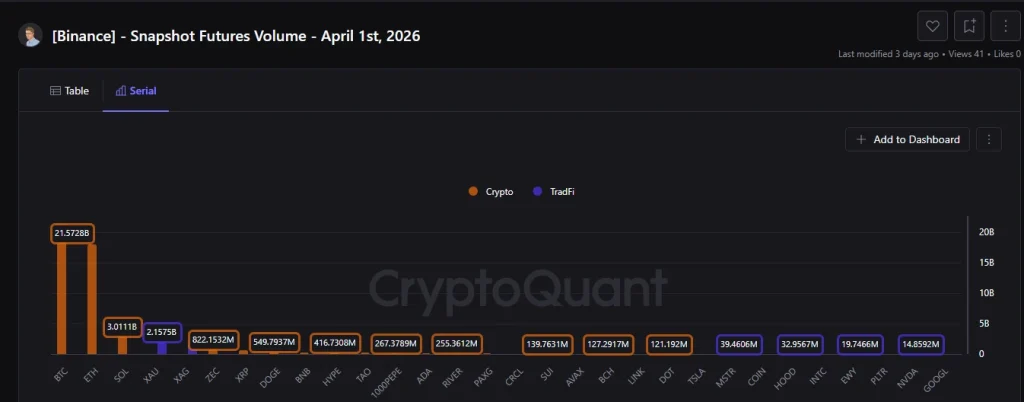
Gold futures ranking 4th after three crypto futures

Source: CryptoQuant

Gold and silver futures rival Bitcoin on Binance

Recent events, including geopolitical hostilities, persistent inflation, the weakening of the dollar, and increases in US trade tariffs, have triggered market-wide shocks across both traditional and cryptocurrency markets. 

However, over the past year, gold has gained 50.17% to $4,676/ounce, and silver has gained 117.01% to $73.02/ounce. Bitcoin, however, has declined by about 19% in the same time period, trading at $66,863 at press time.
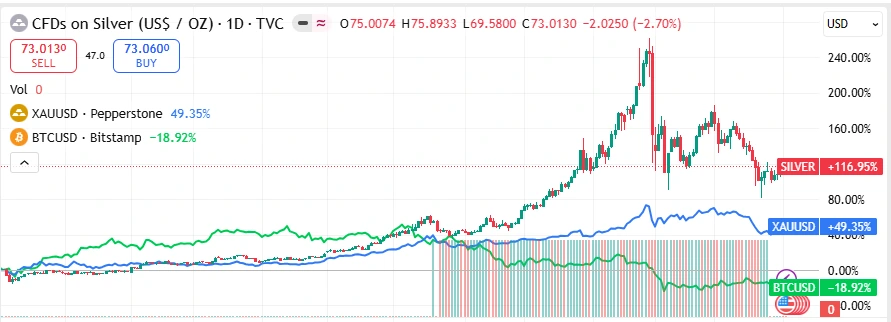
gold, silver and bitcoin performance in the past year

Source: TradingView

The result has been an investor capital rotation to “time-tested” bullion markets, which are subject to less intense volatility.

Additionally, metal futures have seen increased trading volume on blockchain due to features such as 24/7 accessibility and up to 50x leverage. Even more, incorporating blockchain accelerates the trade process by eliminating intermediaries and the bureaucratic processes typical of traditional markets.

Outside speculation, central banks globally have collectively purchased over 1,000 metric tons of gold annually, further fueling the gold rush. Meanwhile, silver’s surge in demand is driven by growth in artificial intelligence and green energy.

Where metals thrive, BTC follows

The gold-Bitcoin correlation began to show a sharp divergence in 2025 and continued into 2026. However, analysts maintain that the decoupling is only temporary and that long-term positive correlation remains intact due to the assets’ shared scarcity.

GOLD ALREADY MOVED. BITCOIN IS NEXT.

This rotation has played out every single cycle.

Gold rallies during uncertainty.
Stabilizes at the top.
Liquidity searches for higher returns.

Then Bitcoin responds.
Gold completed the breakout.

Now it's pausing.
That pause is the… pic.twitter.com/ReDJUF8CqH

— Crypto Tice (@CryptoTice_) April 3, 2026

That said, Binance continues to cater to both traditional and crypto demand, as seen by its recent announcement to launch oil and gas trading.
Circle’s $420M Compliance Crisis: ZachXBT Exposes Massive USDC Scandal

Circle Mints $1B USDC on Solana

The post Circle’s $420M Compliance Crisis: ZachXBT Exposes Massive USDC Scandal appeared first on Coinpedia Fintech News

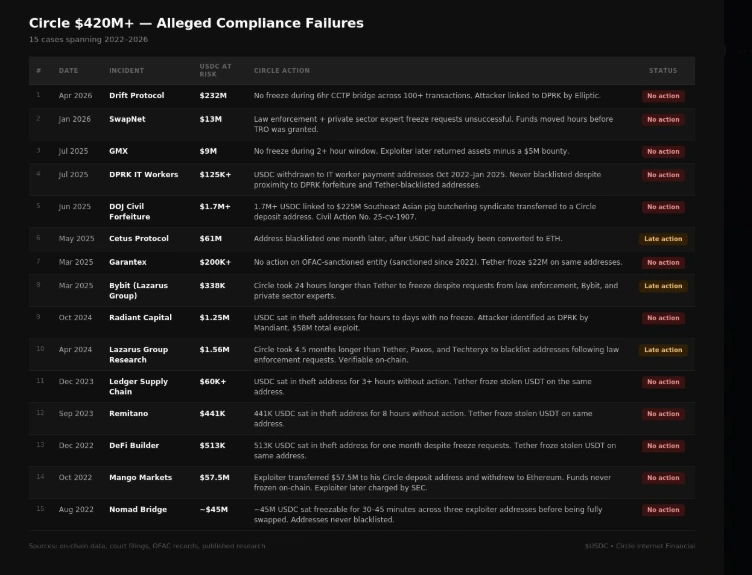
On-chain investigator ZachXBT has published a detailed investigation alleging delays or failures in USDC stablecoin issuer Circle to freeze theft proceeds worth over $420 million since 2022.

Dubbed the “Circle $USDC files,” the X thread highlights 15 cases in which the company took little to no action regarding illicit funds.

USDC issuer Circle faulted for $420M regulatory complacency

Among the highlighted cases is the most recent: the $285M Drift Protocol exploit, which has since caused a domino effect on 20 other Solana-based projects. ZachXBT noted a 6-hour delay in Circle’s action, during which the hacker laundered multiple batches of USDC.

In the same year, $3M (in USDC) of the $16M stolen from SwapNet sat in the hacker’s address for 2 days. Law enforcement and private entities requested a temporary freeze, which Circle did not honor.

In another major case, the North Korean cybercrime syndicate known as the Lazarus Group stole $1.5 billion in the February 2025 Bybit hack. While Tether froze the associated addresses within hours, Circle allegedly waited an additional 24 hours before acting.
Other reports detail thefts ranging from $200,000 to $223 million. Issuers delayed freezes for up to 4 months, while some never froze addresses associated with bad actors at all.

Circle freezing delays

Source: X

One user noted the irony in Circle’s inaction, saying that blocking these addresses would have acted to their advantage.

The inaction is extra mind-boggling because it's literally free money if they freeze

Get to sit on the reserves for a few more months as the legal process plays out, vs the hacker dumps the USDC & it gets redeemed by market makers

— Luke Cannon (@lukecannon727) April 3, 2026

Regulatory infringement in the crypto industry

Circle is the latest notable crypto player allegedly defying regulatory mandates related to illicit fund flows. Others are Binance and, even the Trump-associated World Liberty Financial, both being accused of Iran-linked flows.

The news brings into question Circle’s trustworthiness, especially considering that USDC is the second-largest stablecoin globally. The company had also reported building a compliance engine in 2024, but its use seems to have fallen through.

Tokenization: The IMF’s 2026 Roadmap for Global Finance

IMF’s New Crypto Classification Explained_ Bitcoin, Stablecoins, and Staking

The post Tokenization: The IMF’s 2026 Roadmap for Global Finance appeared first on Coinpedia Fintech News

On April 2, 2026, the International Monetary Fund (IMF) published a note regarding real-world assets (RWAs), noting both their advantages and shortcomings in the financial industry.

Entitled “Tokenized Finance,” the note acknowledges that permissioned shared ledgers, programmable assets (RWAs), and the smart contracts that connect the two, alter finance in terms of liquidity, settlement, and risks.

IMF and RWAs: the good, the bad, and the ugly

Per the note, the benefits of tokenization include atomic settlement, continuous liquidity management, new revenue streams, and operational savings from automated asset servicing. 

Even more, RWAs are natively regulatory-compliant and offer lower investor entry barriers through fractional ownership.

That said, the organization warns that the lack of international coordination in policy development could amplify systemic risk and financial instability. 

Here, the IMF points out that the very “lightning speed” efficiency of transactions is what could turn a minor financial crisis into a major one. This is because no safeguards exist to control liquidity flows, which can trigger flash crashes and massive liquidations.

Additionally, the fact that each institution develops its own unique ledger causes market fragmentation. This results in impaired asset transfer, high price divergence across assets, and high ledger bridging costs.

As a solution to these issues, the IMF suggests “anchoring digital finance in public trust” through safe settlement options such as Central Bank Digital Currencies (CBDCs).

Regulators could also supervise robust code governance by auditing smart contracts and stress testing tokenization algorithms.

Moreover, mandating ledger interoperability would reduce arbitrage issues by standardizing asset prices across different blockchains.

Industry growth

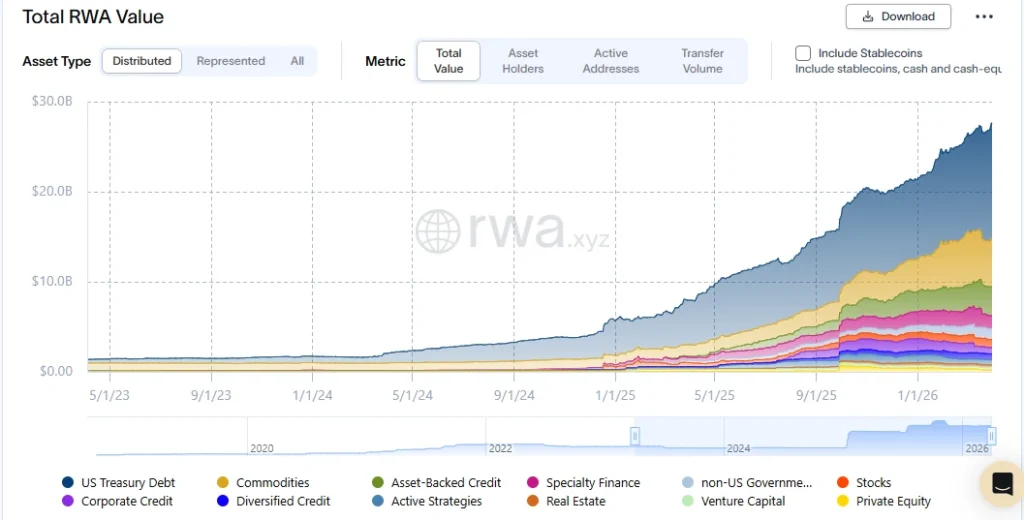
InvestaX values the on-chain tokenization industry between $24.9 billion and $36 billion (excluding stablecoins) in 2026.

With payment stablecoins, the figure rises to $300 billion, where the leading $10.8 billion comes from tokenized US Treasuries. Since the start of the year, the industry has grown by an estimated 66%.

RWA distribution across the years

Source: rwa.xyz

BlackRock’s BUIDL fund contributed significantly to this, with assets under management exceeding $1.7 billion. Similar institutional players include JPMorgan Chase and Goldman Sachs, while specialized tokenization platforms include Securitize and Ondo Finance.

Critics argued that implementing the IMF’s recommendations would take away the true meaning of decentralization. 

Even in finance satanists invert everything. You created layer 2 permission Blockchains which are centralised and invert its original purpose of decentralisation.

— Amit 𝚇 (@xplorable) April 2, 2026

The industry must now choose its path: permissioned and safe, or decentralized and volatile.

Elon Musk: Why Quantum Computing Could Actually Help Bitcoin Owners

quantum computing threat to Bitcoin and Ethereum

The post Elon Musk: Why Quantum Computing Could Actually Help Bitcoin Owners appeared first on Coinpedia Fintech News

Tech mogul Elon Musk is convinced that quantum computers could enable the recovery of lost crypto wallet passwords – a plus side of the computing technology amid all the recent buzz of the great risks it poses to blockchain and cryptocurrencies.

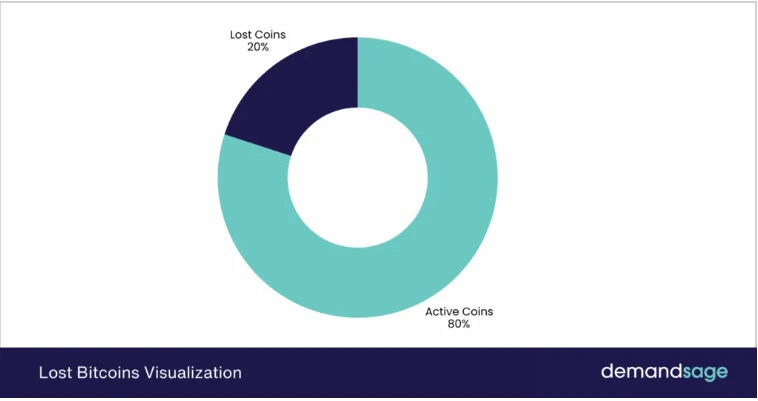
Blockchain analytics estimates that at least 3-4 million Bitcoin (BTC), or 15%-20% of the total circulation, have been irretrievably lost. Additionally, the number of BTC lost due to forgotten or misplaced seed phrases surpassed that lost from exchange hacks.

Quantum computers could help recover the 20% of all Bitcoin supply that might have been lost forever.

Source: DemandSage

A quantum computer capable of solving for private keys given known public keys could therefore prove beneficial to this population. That said, wallet inactivity does not necessarily mean the owner forgot/lost their password.

On the plus side, if you forgot the password to your wallet, it will be accessible in the future https://t.co/xAFtNGC5FE

— Elon Musk (@elonmusk) March 31, 2026

Quantum developments and the crypto ecosystem

Musk’s statement came as a humorous response to Google’s recent research, which concluded that Bitcoin could be cracked with far less quantum resources and less time than previously anticipated.

Several blockchains have taken the quantum threat seriously and are actively upgrading their cryptography to render it quantum-proof.

Ethereum has developed a quantum-resistance roadmap, while Cardano has partnered with experts from Google, Microsoft, and Linux for the same purpose. Bitcoin lags behind this front in terms of timelines, contingency plans, and dedicated teams. 

Still, crypto proponents Michael Syalor and Changpeng Zhao are confident that crypto will survive quantum risks.

Risks vs benefits

The timeline for achieving quantum capabilities at any level is widely estimated to be between 2029 and 2035. And while certain risks rattle the crypto community, it might be helpful to consider some of the benefits such an advancement could pose in a post-quantum era. These include:

  • Enhanced security through true randomness in cryptographic key generation and non-copyable digital currency (quantum money).
  • Scalability through parallel transaction processing and faster block finality.
  • Real-time and complex logic smart contracts.
  • Energy consumption reduction for Proof-of-Work networks.
  • Lower transaction costs following improved network speed and efficiency.
❌