
 Login
Login
Snapdragon 8 Gen 5 vs Dimensity 9300: Benchmark score, spec sheet, and more
The Snapdragon 8 Gen 5 is the first non-Elite chipset to feature the powerful Oryon cores. The chipset offers solid gaming performance, a flagship-grade ISP, and reliable connectivity, making it a powerful choice among premium mid-range phones.
On the other hand, the Dimensity 9300 is two years older than the Snapdragon 8 Gen 5. Still, it offers smooth performance and excellent efficiency to be considered a reliable choice, and more importantly, at a lower price.
So, the real question is: does it make sense to go with the Snapdragon 8 Gen 5, or is the Dimensity 9300 a solid choice at a relatively lower price? Let’s find out in this detailed comparison.
Quick verdict:
Choose Snapdragon 8 Gen 5 if you want higher CPU performance, sustained gaming performance, flagship ISP, and modern connectivity features.
Choose Dimensity 9300 if you want reliable performance and excellent efficiency at a lower price point.
Snapdragon 8 Gen 5 vs Dimensity 9300: Spec sheet
| Snapdragon 8 Gen 5 | Dimensity 9300 | |
|---|---|---|
| Announced | November 2025 | November 2023 |
| Process node | 3 nm (TSMC) | 4 nm (TSMC) |
| CPU | 2 × 3.8 GHz (Oryon Gen 3 – Prime) 6 × 3.32 GHz (Oryon Gen 3 – Performance) | 1 × 3.25 GHz (Cortex-X4) 3 × 2.85 GHz (Cortex-X4) 4 × 2.0 GHz (Cortex-A720) |
| GPU | Adreno 829 ray tracing support Snapdragon Elite Gaming features | Arm Immortalis-G720 MP12 console-level global illumination effects ray tracing support MediaTek HyperEngine Adaptive Gaming Technology |
| NPU | Qualcomm Hexagon NPU Agentic AI support | MediaTek NPU 790 up to 33 billion parameters on-device LoRA Fusion support |
| Memory | LPDDR5x, up to 4.8 GHz | LPDDR5T, up to 4.8 GHz |
| Storage | UFS 4.1 | UFS 4 + MCQ |
| Camera | Qualcomm Spectra triple AI ISP (20-bit) up to 320MP single camera up to 108MP single camera with zero shutter lag, 30fps up to 48MP triple cameras with zero shutter lag, 30fps up to 4K/120fps video recording real-time semantic segmentation (limitless) | MediaTek Imagiq 990 ISP (18-bit) up to 320MP single camera up to 8K video recording AI Semantic Analysis Video Engine |
| Connectivity | Snapdragon X80 5G modem download speed: up to 10 Gbps upload speed: up to 3.5 Gbps Wi-Fi 7 (peak speed: 5.8 Gbps) Bluetooth 6.0 | MediaTek 5G modem download speed: up to 7 Gbps Wi-Fi 7 (peak speed: 6.5 Gbps) Bluetooth 5.4 |
Snapdragon 8 Gen 5 vs Dimensity 9300: Benchmark numbers
Note: To obtain the benchmark results, the tests were performed using these devices:
– OnePlus 15R (Snapdragon 8 Gen 5)
– Vivo X100 Pro (Dimensity 9300)
Geekbench score (v6)
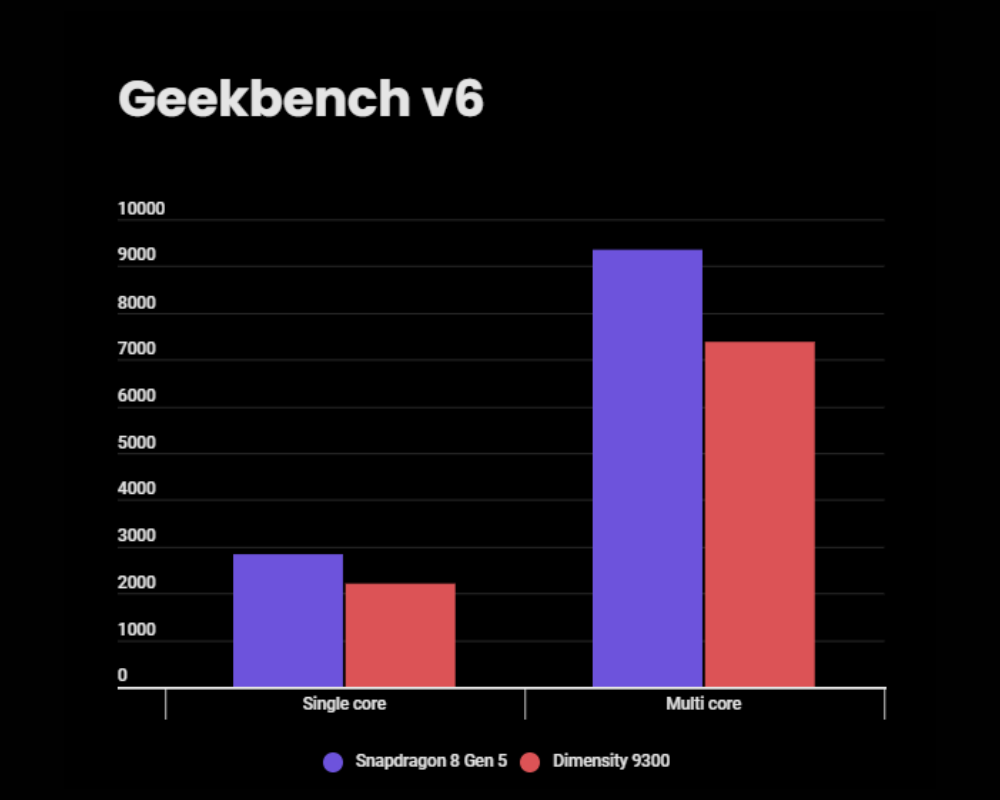
The Snapdragon 8 Gen 5 outperforms the Dimensity 9300 in both single-core and multi-core tests. In both tests, the Snapdragon chip achieves about 27% higher score, suggesting a snappier performance, particularly in tasks that require greater CPU resources.
| Snapdragon 8 Gen 5 | Dimensity 9300 | |
| Single core | 2,837 | 2,208 |
| Multi core | 9,352 | 7,380 |
AnTuTu score (v11)
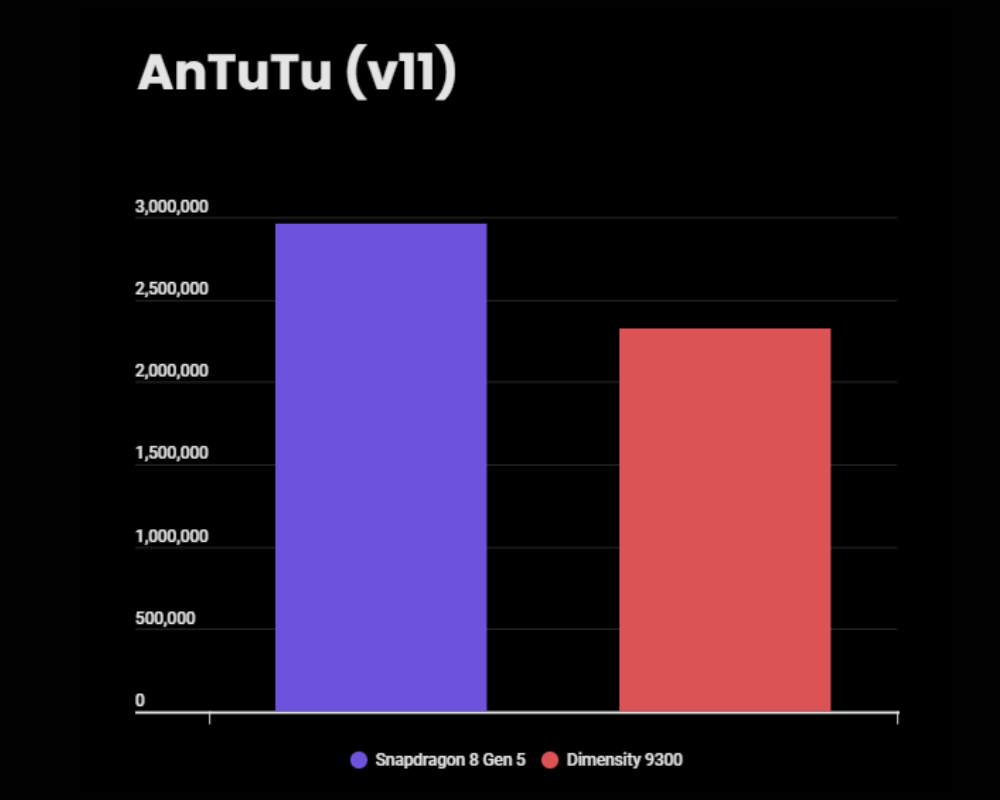
On the AnTuTu benchmark, the Snapdragon 8 Gen 5 scores 2.96 million, while the Dimensity 9300 sits below it with 2.32 million total score. That’s a solid 27% uplift for the Snapdragon chip.
| Snapdragon 8 Gen 5 | Dimensity 9300 | |
| AnTuTu score | 2,961,236 | 2,324,872 |
| CPU | 914,878 | 692,230 |
| GPU | 974,402 | 816,259 |
| Memory | 382,729 | 338,122 |
| UX | 689,228 | 478,261 |
The breakdown of the AnTuTu score paints a better picture, and unsurprisingly, the Snapdragon 8 Gen 5 dominates all aspects. The CPU gets 32% higher score, the GPU gets 19% higher score, memory performance is up by 13%, and the UX score is up by 44%.
3DMark score
Wild Life Extreme Stress Test
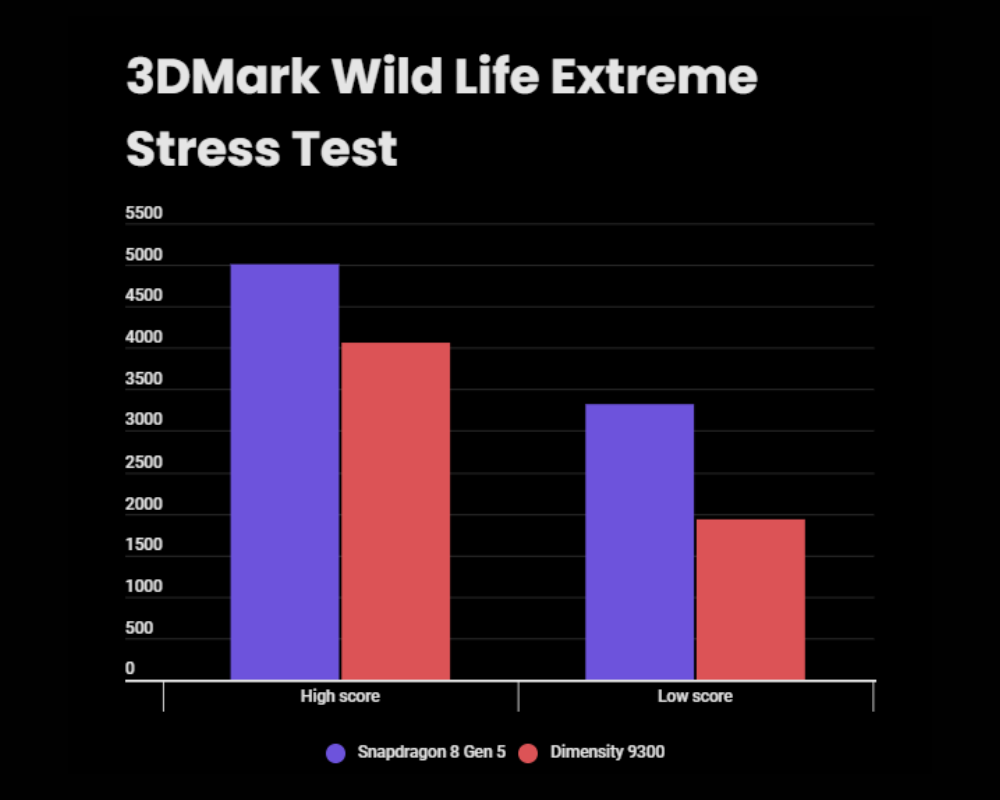
This is a widely popular gaming benchmark, where the Snapdragon 8 Gen 5 outperforms the Dimensity 9300 by a wide margin. It achieves a 23% higher best loop score and a whopping 71% increase in the lowest loop score. So, not just the performance, the Snapdragon chip also maintains higher stability.
| Snapdragon 8 Gen 5 | Dimensity 9300 | |
| Best loop score | 5,009 | 4,062 |
| Lowest loop score | 3,321 | 1,933 |
| Stability | 66.30% | 47.59% |
While benchmarks offer great insights into performance and stability, they don’t focus on other key aspects, including connectivity, camera, and features. To give you a clearer picture, we’ve included them in the following section.
Snapdragon 8 Gen 5 vs Dimensity 9300: Key differences
Process node
The Snapdragon 8 Gen 5 uses TSMC’s newer 3nm node, which offers better performance and power efficiency than the 4nm node used in the Dimensity 9300.
Performance
CPU
Both chipsets feature octa-core CPUs, although their core configurations differ. The Snapdragon 8 Gen 5 uses a (2 + 6) layout, featuring two Oryon prime cores at 3.8 GHz and six Oryon performance cores at 3.32 GHz. The Dimensity 9300 features a (1 + 3 + 4) layout, which includes one Cortex-X4 prime core at 3.25 GHz, three Cortex-X4 performance cores at 2.85 GHz, and four Cortex-A720 efficiency cores at 2.0 GHz.
The Snapdragon 8 Gen 5 prioritizes performance by offering a higher peak clock speed of 3.8 GHz. In fact, all the CPU cores in the Snapdragon chip run at higher clock speeds than those in the Dimensity 9300. This is one of the primary reasons the Snapdragon chip easily outperforms the Dimensity 9300 in benchmarks.
GPU
As for the gaming and graphics rendering, the Snapdragon 8 Gen 5 uses a powerful Adreno 829 GPU featuring Qualcomm’s “sliced” architecture. The GPU offers excellent ray tracing performance, support for Unreal Engine 5, and AI-assisted upscaling. It also bundles a full suite of Snapdragon Elite Gaming features to deliver a smooth gaming performance with consistently high frame rates, low latency, and improved power utilization.
The Dimensity 9300 features a 12-core Arm Immortalis-G720 GPU, promising console-level global illumination effects. The GPU is equipped with a 2nd-gen hardware ray tracing, which is claimed to offer “fast, full raytracing experiences at a smooth 60 fps.” The chip also features MediaTek HyperEngine Adaptive Gaming Technology to deliver flagship performance without slowdowns for up to an hour in top titles, along with better cooling and improved power efficiency.
NPU
The Snapdragon 8 Gen 5 features a very capable Hexagon NPU, which integrates with an Oryon CPU and Adreno GPU to enable on-device agentic assistants, multimodal AI, and heavier gen-AI workloads in high-end devices. It is essentially a slightly binned-down version of the 8 Elite Gen 5 AI platform, with nearly all of the same features but lower peak clocks.
The Dimensity 9300’s AI stack is built around the MediaTek NPU 790, which delivers substantial efficiency and speed gains over the previous generation. It can run LLMs with up to 33 billion parameters and real-time generative AI. The AI stack enables the SoC to run multi-modal, multi-LLMs setups at usable latencies, entirely on-device.
Camera
The Snapdragon 8 Gen 5 features a 20-bit Spectra AI ISP with up to 320MP single camera and up to 4K/120fps video recording, although OEMs can enable up to 8K recording. The chip also supports limitless real-time semantic segmentation for precise optimizations. Plus, it offers a range of camera features (including AI-assisted features) to deliver greater quality with less noise.
On the other hand, the Dimensity 9300 is equipped with an 18-bit Imagiq 990 ISP, supporting up to 320MP single-camera and up to 8K video recording. The chip features an AI Semantic Analysis Video Engine with 16 categories of scene segmentation adjustments for enhanced cinematic video capture. It also features zero-latency video preview and 100% pixel-level autofocus + dual-lossless zoom.
Connectivity
While both chips offer robust connectivity, there are several important differences to consider. On a 5G connection, the Snapdragon 8 Gen 5’s download speed can reach up to 10 Gbps, while the Dimensity 9300 peaks at 7 Gbps. The Dimensity chip bounces back with a higher peak Wi-Fi 7 speed, reaching 6.5 Gbps (vs. 5.8 Gbps on the Snapdragon 8 Gen 5). Another advantage of the Snapdragon 8 Gen 5 is its support for Bluetooth 6.0, while the Dimensity 9300 supports the older Bluetooth 5.3 standard.
Snapdragon 8 Gen 5 vs Dimensity 9300: Which is better?
The Snapdragon 8 Gen 5 is clearly a much better choice over the Dimensity 9300. It offers solid CPU performance, a more consistent gaming performance, and a modern connectivity stack. Plus, it features the advanced Spectra ISP from the Snapdragon 8 Elite Gen 5, integrating the latest camera features and advanced camera optimizations.
That said, the Dimensity 9300 is still a solid mid-range chipset in 2026. It can smoothly run your day-to-day apps while offering excellent efficiency. Gaming performance is also good, but for heavier games and longer sessions, you may want to prefer a more capable chipset like the Snapdragon 8 Gen 5. Perhaps the only advantage it offers over the Snapdragon 8 Gen 5 is its lower price. So, if you’re getting a hefty discount on a Dimensity 9300 phone that makes it much cheaper than a Snapdragon 8 Gen 5 phone, that may be a solid deal. Otherwise, the Snapdragon 8 Gen 5 is a no-brainer choice here.
The post Snapdragon 8 Gen 5 vs Dimensity 9300: Benchmark score, spec sheet, and more appeared first on Gizmochina.
