Reading view

Xiaomi launches Mijia Ceiling Lights Pro Ultra-Thin with high brightness, diffusion layer, and smart controls

Xiaomi has expanded its smart lighting lineup with a new series, the Mijia Ceiling Light Pro Ultra-Thin. As the name suggests, the focus here is on a slim, low-profile design that doesn’t visually crowd the ceiling, while still delivering strong brightness and more natural-looking light. There’s also a clear push toward “healthier” lighting this time, alongside the usual smart features.

The series comes in three variants, each aimed at a slightly different room size. L100 (Large Square) is the top-end model, meant for bigger living rooms (around 25-45㎡). It pushes up to 10,000 lumens at 150W, which is quite a lot for a ceiling light. Xiaomi claims an average illuminance of ≥300lx, along with a Ra98 color rendering index. The panel itself measures 1050 × 650mm and is just 29mm thick.

D60 (Large Round) sits somewhere in the middle, targeting spaces like smaller living rooms or larger bedrooms (15–25㎡). It’s rated at 75W and delivers up to 5,200 lumens. Diameter is 600mm, with a 24mm thickness.

D50 (Small Round) is designed for more compact rooms under 15㎡. It drops to 60W and 4,200 lumens. This one measures 500mm across and is also 24mm thick.

All three use a custom full-spectrum LED setup, and you can adjust the color temperature between 2700K and 5700K. They also carry an RG0 rating, meaning minimal blue light hazard.

The ultra-thin design is clearly a big part of the appeal. They’re meant to sit close to the ceiling and spread light more evenly, rather than acting as a bulky fixture in the center of the room. On the smart side, Xiaomi is bundling in its HyperOS smart connectivity system. That means the usual stuff, such as remote control, scheduling, and linking with other Xiaomi devices.

Pricing is fairly aggressive, especially once subsidies are factored in:

  • D50: 849 yuan (around 721 yuan after subsidy)
  • D60: 999 yuan (about 849 yuan after subsidy)
  • L100: 1759 yuan (roughly 1495 yuan after subsidy)

The emphasis here seems to be on comfortable, soft lighting rather than just raw brightness. The wide light surface and high CRI should help with things like reading or desk work, though real-world performance will depend on placement and room size.

The Mijia Ceiling Light Pro Ultra-Thin series is already listed and available for purchase on Xiaomi Youpin and other e-commerce platforms in the home country.

Don’t miss a thing! Join our Telegram community for instant updates and grab our free daily newsletter for the best tech stories!

For more daily updates, please visit our News Section.

(Source)

The post Xiaomi launches Mijia Ceiling Lights Pro Ultra-Thin with high brightness, diffusion layer, and smart controls appeared first on Gizmochina.


Oppo A6k launches with Dimensity 6300, 7000mAh battery at an affordable price

Oppo has added another model to its A-series lineup in China, the Oppo A6k, and this one seems clearly aimed at users who care more about battery life than anything else. Yes, it’s a budget phone, with a few practical compromises along the way.

Up front, there’s a 6.75-inch LCD display with HD+ resolution (1570 × 720). Not exactly sharp, and Oppo isn’t really trying to sell it that way either. Instead, the focus is on smoothness. The panel supports a 120Hz refresh rate and 240Hz touch sampling, so general navigation should feel relatively fluid compared to some of its competitors. Brightness goes up to 900 nits typically, with a peak of 1125 nits. Anything over 1000 nits is quite impressive for an IPS panel and should be enough for comfortable outdoor use.

The phone runs on the MediaTek Dimensity 6300, a fairly familiar 5G chip in this segment. It’s paired with LPDDR4X RAM and UFS 2.2 storage, so nothing unusual there.

In terms of actual use, this should handle everyday tasks like calling, messaging, web browsing, video streaming, and even some lightweight games just fine. It’s not built for heavy workloads, but that’s kind of expected here. Benchmark numbers land roughly around 530K on AnTuTu v11 and about 770 / 1980 on Geekbench 6, which is about where you’d expect it to be.

Cameras are fairly straightforward. There’s a 50MP main sensor, along with a 2MP monochrome lens, and an 8MP front camera. Nothing particularly ambitious, but it covers the basics. A side-mounted fingerprint sensor is also here, which honestly still feels quicker than in-display options at this price.

The main talking point, though, is the battery. Oppo has gone with a 7000mAh unit, which is hard to ignore. For most users, that should comfortably last more than a day, maybe even stretch into a second depending on usage. Charging is rated at 45W SuperVOOC, with support for UFCS and a few other standards, so it’s not locked to one ecosystem.

It comes in Dawn Gold, Twilight Blue, and Seashell White in the home country.

Pricing and availability:

The phone comes in three different configurations and is currently available for sale in China.

  • 8GB + 256GB at 1999 yuan (~$290)
  • 8GB + 512GB at 2199 yuan (~$319)
  • 12GB + 256GB at 2399 yuan (~$348)

Don’t miss a thing! Join our Telegram community for instant updates and grab our free daily newsletter for the best tech stories!

For more daily updates, please visit our News Section.

(Source)

The post Oppo A6k launches with Dimensity 6300, 7000mAh battery at an affordable price appeared first on Gizmochina.

Vivo X300 Ultra vs Sony A7 III camera test: can a phone really compete?

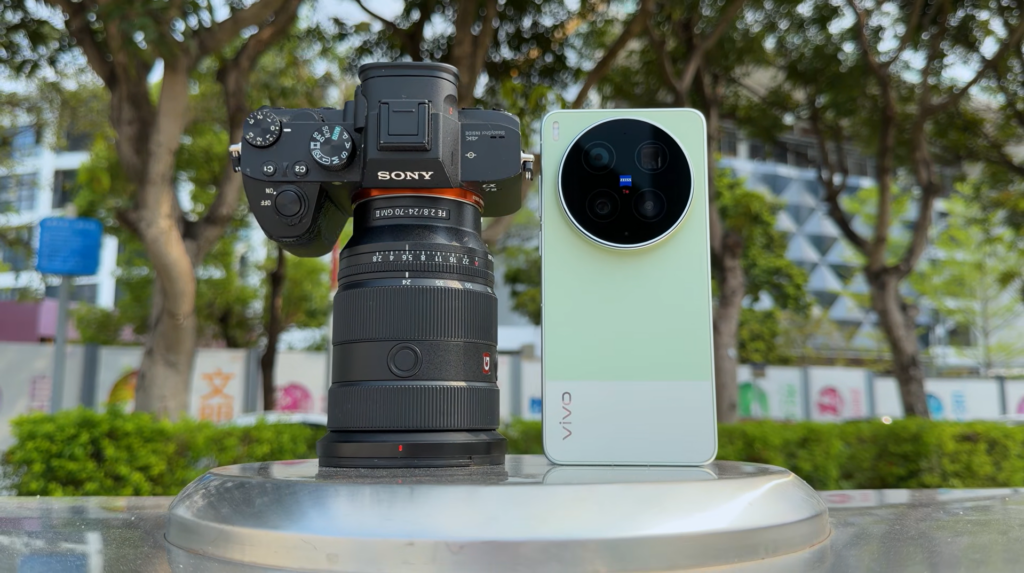
A new camera comparison making the rounds is putting a smartphone up against a full-frame mirrorless setup, and the results are interesting to say the least. Chinese creator fenibook has shared a side-by-side camera comparison between the Vivo X300 Ultra and a Sony A7 III paired with the 24–70mm GM II lens, along with the original RAW files for anyone who wants to take a closer look.

On paper, the comparison feels a bit uneven. The Sony setup costs significantly more once you factor in both the body and lens, while the Vivo sits around the $2,000 mark depending on the variant. But that’s also part of the point: how close a phone can get to dedicated camera gear in certain situations.

Vivo X300 Ultra (left) vs Sony A7 III (right)

In good lighting, the Vivo actually holds up better than some might expect. Its 200MP sensor produces images with a lot of detail, and in all the image samples shown in the video, they appear sharper than what comes out of the A7 III’s 24MP sensor. Colors are also fairly well controlled, though in some tricky lighting situations the Vivo samples can look slightly less natural compared to the dedicated camera. Vivo is likely relying on heavy post-processing here, but it’s handled well enough that the images don’t come across as overly processed.

That said, it’s not a complete picture. The test doesn’t really cover more challenging scenarios like low light or a wider range of focal lengths. And realistically, pixel-peeping 200MP images isn’t something most people will do regularly. A full-frame camera still has a clear advantage when it comes to flexibility, especially with zoom lenses, where it can deliver results that a smartphone setup struggles to match. Even with Vivo’s optional 400mm G2 teleconverter, there are limits. With that accessory, the X300 Ultra is expected to retail at around €2,300 in Europe.

Vivo X300 Ultra (left) vs Sony A7 III (right) under tricky lighting

But the point here isn’t to replace a dedicated camera in every situation. It’s more about how close a smartphone can get while staying portable. And from that perspective, the Vivo X300 Ultra does quite well. The images are highly detailed, colors are mostly consistent, and there’s no obvious noise or artifacts. For users who want more flexibility, there’s also the option to add the teleconverter kit, which is relatively compact.

Don’t miss a thing! Join our Telegram community for instant updates and grab our free daily newsletter for the best tech stories!

For more daily updates, please visit our News Section.

(Source: @fenibook on YouTube)

The post Vivo X300 Ultra vs Sony A7 III camera test: can a phone really compete? appeared first on Gizmochina.
YouTube took down NVIDIA’s own DLSS 5 trailer following a copyright issue

NVIDIA’s DLSS 5 rollout hasn’t exactly been smooth, and now there’s another twist. The company’s own promotional trailer has disappeared from YouTube, but not for the reason you’d expect.

The video, which was first shown at GTC last month, highlighted DLSS 5’s new neural rendering capabilities. The demo clips, including scenes from Resident Evil: Requiem, drew attention for their lighting and overall visual quality. At the same time, though, the tech quickly became a talking point for less positive reasons.

A lot of the criticism has focused on how DLSS 5 affects visuals, especially character faces. Some players feel the AI processing smooths things out too much, giving scenes a slightly artificial look. The reaction online has been fairly divided, and in some cases quite harsh. Reports suggested the official trailer had a low like ratio despite pulling in millions of views.

NVIDIA CEO Jensen Huang has addressed those concerns more than once, saying developers still have control over how the tech is used and that it’s meant to support, not override, a game’s original style. Still, the debate hasn’t really settled.

Now the situation has taken a more unusual turn. The DLSS 5 trailer on NVIDIA’s GeForce YouTube channel was removed, but it wasn’t taken down by NVIDIA itself. Instead, it was pulled following a copyright claim.

According to reports, Italian broadcaster La7 used parts of the trailer in a program and then ended up triggering a copyright claim through YouTube’s system. The result was that not only NVIDIA’s original video, reportedly with over 2 million views, but also other uploads using the same footage were blocked.

It’s the kind of issue that points back to YouTube’s automated Content ID system, which doesn’t always get things right. In this case, the trailer is clearly NVIDIA’s own content, so the takedown is likely temporary. Still, it adds another layer to what has already been a somewhat messy rollout for DLSS 5.

For now, the conversation around the technology, and how it’s being used, doesn’t seem to be slowing down anytime soon.

Don’t miss a thing! Join our Telegram community for instant updates and grab our free daily newsletter for the best tech stories!

For more daily updates, please visit our News Section.

The post YouTube took down NVIDIA’s own DLSS 5 trailer following a copyright issue appeared first on Gizmochina.

Honor 600 Pro surfaces in live images, Geekbench scores also revealed

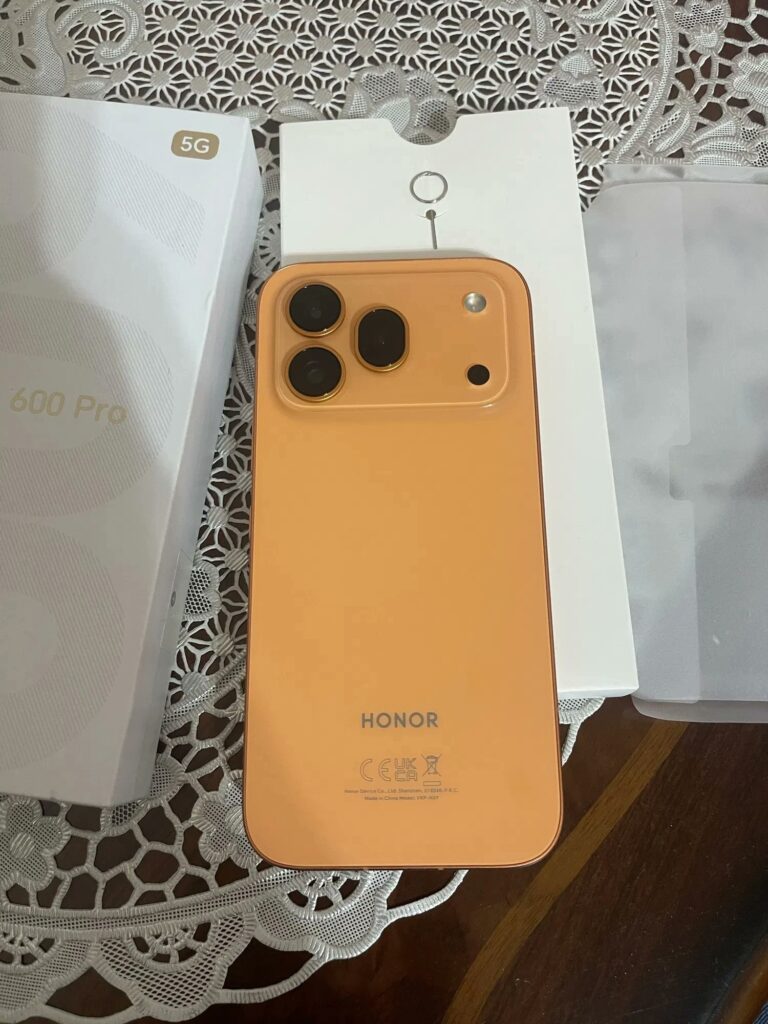
Honor’s upcoming 600 series is starting to take shape, and new live images of the Honor 600 Pro have now surfaced online. It’s probably the clearest look so far, and if the timing of recent leaks is anything to go by, the launch might not be too far off.

The images were shared by DigitalChatStation on Weibo, showing the phone in an orange finish. The biggest change is on the back. The phone uses a horizontal triple-camera layout, which feels a bit different from what Honor has done recently. It looks clean, though opinions will likely depend on taste.

From the front, things are more familiar. The device appears to have a 6.57-inch OLED display with slim bezels and slightly rounded corners. There’s a single punch-hole camera at the top, which keeps the overall look fairly minimal.

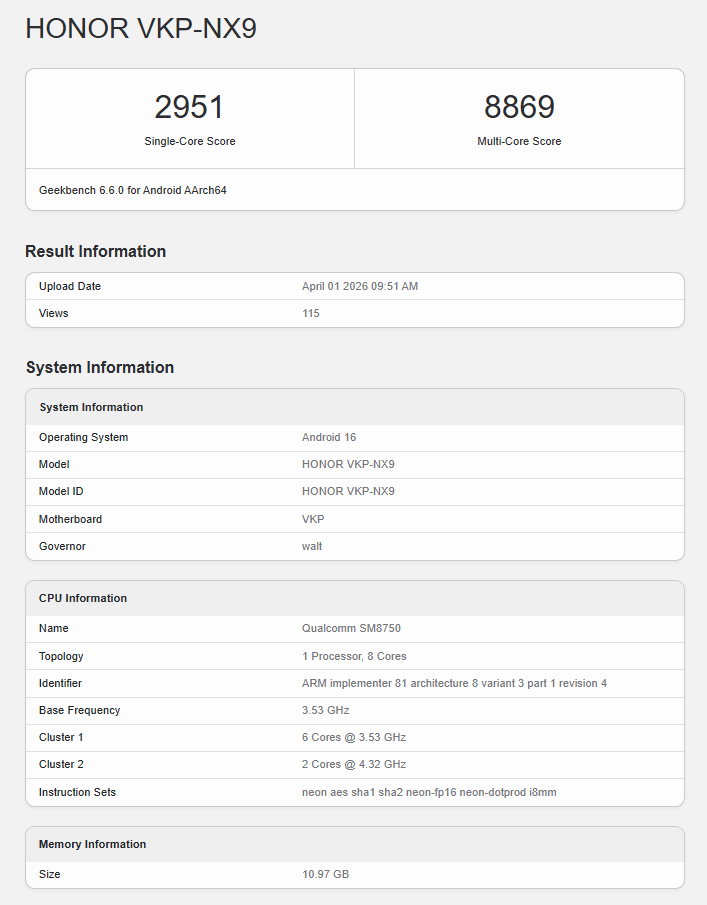
The Honor 600 series has already appeared in Geekbench and TUV certification listings. The standard model scored 1318 in single-core and 4075 in multi-core tests on Geekbench 6.6.0, while the Pro variant posted 2951 and 8869, respectively. Based on the core layout and clock speeds, the standard and Pro models are likely powered by the Snapdragon 7 Gen 4 and Snapdragon 8 Elite.

Honor 600 Pro Geekbench CPU scores

The TUV certification points to IP68 and IP69 ratings for dust and water resistance. The display is expected to offer a 1.5K resolution with a 120Hz refresh rate, and the main camera on both the standard and Pro models could jump to 200MP. There’s also talk of a 9,000mAh battery, which sounds unusually large for a handset.

Not much has been officially confirmed yet, but with real-world images now out and certifications already in place, the launch doesn’t seem too far away. More details, especially around performance and pricing, should start to surface soon.

Don’t miss a thing! Join our Telegram community for instant updates and grab our free daily newsletter for the best tech stories!

For more daily updates, please visit our News Section.

(Source: DigitalChatStatio on Weibo)

The post Honor 600 Pro surfaces in live images, Geekbench scores also revealed appeared first on Gizmochina.
Red Magic Gaming Tablet 5 Pro launch timeframe officially confirmed

Red Magic looks set to update its gaming tablet lineup soon. The upcoming Red Magic Gaming Tablet 5 Pro has now been teased with an official launch window.

Jiang Chao, a senior executive at the company, said on Weibo that the tablet will arrive sometime in April or May 2026. He didn’t share an exact date, but did say the device should be worth the wait. It will follow last year’s Gaming Tablet 3 Pro, which marked Red Magic’s push into compact, performance-focused tablets.

One thing that’s already been confirmed is a global rollout. The previous model launched in China first and later arrived internationally under the name Red Magic Astra, so something similar could happen again. If the timing holds, a global version might show up a month or two after the initial release.

As for upgrades, RedMagic is hinting at a few key changes. The tablet is expected to feature an OLED display with a very high refresh rate. Some early talk suggests it could go beyond 165Hz, possibly even touching 200Hz, though that’s still unconfirmed.

For performance, Red Magic is expected to use the Snapdragon 8 Elite Gen 5 chipset. Cooling also seems to be a big focus. The company is reportedly working on a more advanced system using PC-grade materials, which should help keep performance stable during longer gaming sessions.

Pricing is still unclear, but with component costs rising, a slight increase wouldn’t be surprising.

For now, most of the information is still coming from early teasers and hints. But with the launch window already confirmed, more details should start to appear soon.

Don’t miss a thing! Join our Telegram community for instant updates and grab our free daily newsletter for the best tech stories!

For more daily updates, please visit our News Section.

(Source)

The post Red Magic Gaming Tablet 5 Pro launch timeframe officially confirmed appeared first on Gizmochina.

Galaxy Z Fold 8, Flip 8 and Wide Fold clear BIS in India

Samsung’s next foldables seem to be moving closer to launch, with a new round of certifications in India giving a clearer picture of what’s coming. The Galaxy Z Fold 8, Z Flip 8, and what appears to be a wider Fold variant have all shown up, along with a new pair of earbuds.

Battery units for these devices recently cleared India’s BIS certification, which usually happens fairly late in the process. The listings include multiple battery model numbers tied to the Fold 8, Flip 8, and the so-called Galaxy Z Wide Fold, though Samsung hasn’t officially confirmed that name yet. The new audio product is expected to be the recently leaked Galaxy Buds Able (model SM-U600).

The Galaxy Z Fold 8 and the wider Fold variant are both expected to move up to 5,000mAh batteries (advertised capacity). That would be a noticeable jump from the 4,400mAh Samsung has stuck with for a while. The Z Flip 8, on the other hand, is rumored to stay closer to its current setup, with a battery around 4,300mAh.

Charging could see a small upgrade too. The Fold 8 and Wide Fold are tipped to support 45W wired charging, while the Flip 8 may continue with 25W, which is more or less what we’ve seen before.

The Wide Fold is probably the most interesting part of this. Leaks suggest it could use a wider 4:3 aspect ratio when unfolded, which might make it feel a bit more like a tablet than the usual Fold design. It’s still early, but it does sound like Samsung is experimenting a little this time.

There were also a few extra battery model numbers listed that don’t clearly match any of the main devices. These could be test units or alternate versions, though it’s hard to say for sure.

With CAD renders already out and certifications now in place, the launch timeline seems to be lining up. Samsung is expected to unveil the new foldables sometime in July 2026. The appearance of the new earbuds in these listings adds to that. Details are still limited, but if they’re showing up here, there’s a good chance they’ll be announced around the same time.

Don’t miss a thing! Join our Telegram community for instant updates and grab our free daily newsletter for the best tech stories!

For more daily updates, please visit our News Section.

(Source)

The post Galaxy Z Fold 8, Flip 8 and Wide Fold clear BIS in India appeared first on Gizmochina.

Pre-order details for Motorola’s first book-style foldable surface

Motorola Razr Fold

Motorola is finally moving into the book-style foldable space. The new Moto Razr Fold has started showing up on retail listings in China, confirming that pre-orders will begin on May 31 in the country.

Motorola Razr Fold

Interestingly, buyers in the UK will get access sooner. Motorola UK posted on X on March 27 that pre-orders there would open in 15 days, meaning the wait is nearly over. The phone was already introduced at MWC earlier this year, but it’s only now starting to appear in a more consumer-facing way.

The Razr Fold runs on the Snapdragon 8 Gen 5, paired with 16GB of RAM. That’s more than enough for running multiple apps at once. The battery is also on the larger side at 6,000mAh. It supports 80W wired and 50W wireless charging, along with reverse charging.

There’s also support for the Moto Pen Ultra, which suggests Motorola wants this to double as a productivity device, not just something for media consumption.

The display setup looks fairly typical for a foldable, but with some interesting choices. Inside, there’s an 8.09-inch LTPO OLED panel with a 120Hz refresh rate. On the outside, the 6.56-inch display goes up to 165Hz, which is a bit unusual for a foldable. Although how much that matters in daily use is another question.

In terms of size, it comes in at around 9.9mm folded and 4.6mm unfolded, weighing about 244 grams. Its’a bit heavier like the Galaxy Z Fold7 (215g) and the Honor Magic V6 (219g).

The camera setup includes three 50MP sensors on the back: a main, ultra-wide, and a 3x telephoto. For selfies, there’s a 32MP camera on the outer display and a 20MP one inside.

Pricing is listed at €1,999, which puts it right alongside other premium foldables. That’s not surprising, though it does make the usual question of value a bit harder to answer.

There are still a few unknowns, especially around availability in different regions, but with pre-orders nearing, those details should start to clear up soon.

Don’t miss a thing! Join our Telegram community for instant updates and grab our free daily newsletter for the best tech stories!

For more daily updates, please visit our News Section.

(Sources: 1, 2)

The post Pre-order details for Motorola’s first book-style foldable surface appeared first on Gizmochina.

Oppo Pad Mini leaks again: 8.8″ 144Hz LTPO OLED, 8000mAh battery within 279g build

Oppo Pad 5 Mini Specs and Design leak

Oppo is seemingly getting ready to step into the compact tablet space with a new device called the Oppo Pad Mini. The leaks revealed so far point to a smaller tablet that still aims fairly high in terms of specs.

Oppo Pad 5 Mini Specs and Design leak

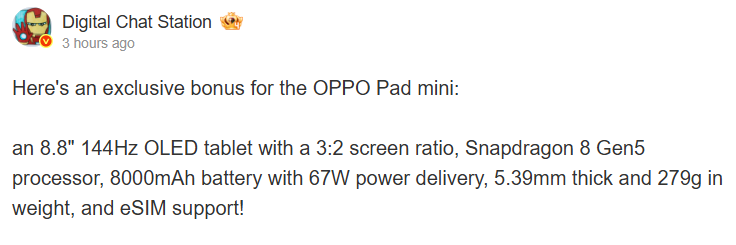
The latest info comes from @DigitalChatStation on Weibo, who shared a set of key details earlier today. According to the leak, the tablet will feature an 8.8-inch OLED display with a 3:2 aspect ratio, which is a bit different from the usual media-focused layouts. It should make more sense for reading and general use.

The panel itself sounds quite strong. It’s said to have a 2880×1920 resolution, along with a 144Hz refresh rate that can scale down to 1Hz thanks to LTPO tech. Peak brightness is reportedly 1800 nits, and it covers the full DCI-P3 color gamut, so on paper at least, it’s aiming for a premium display experience.

Performance is expected to come from Qualcomm’s Snapdragon 8 Gen 5, which would put it in flagship territory. The design seems to be another highlight. The tablet is tipped to use a unibody metal build, measuring around 5.39mm thick and weighing about 279 grams. That’s quite thin and light, even for a compact tablet. Color options are said to include dark gray, purple, and cyan. Lenovo’s 8.8-inch Legion Tab Gen 5, for instance, weighs 360 grams.

On the back of the Oppo Pad Mini, there’s a 13MP camera in a capsule-style module. Not a major focus, but standard for tablets.

Battery capacity is listed at 8000mAh, with support for 67W fast charging. There’s also mention of eSIM support, which could make it more useful as a standalone device without relying on Wi-Fi. Based on what’s out so far, Oppo seems to be aiming for something more than just a “mini” in name.

If the leaks hold up, this could end up being one of the more interesting compact Android tablets to watch this year.

Don’t miss a thing! Join our Telegram community for instant updates and grab our free daily newsletter for the best tech stories!

For more daily updates, please visit our News Section.

(Source: DCS on Weibo)

The post Oppo Pad Mini leaks again: 8.8″ 144Hz LTPO OLED, 8000mAh battery within 279g build appeared first on Gizmochina.

Infinix Note 60 Pro launching in India soon with rear display, Snapdragon 7s Gen 4 chip

Infinix looks set to bring the Note 60 Pro to India soon, and it’s already starting to tease some of the phone’s more unusual features. The device was announced globally earlier this year.

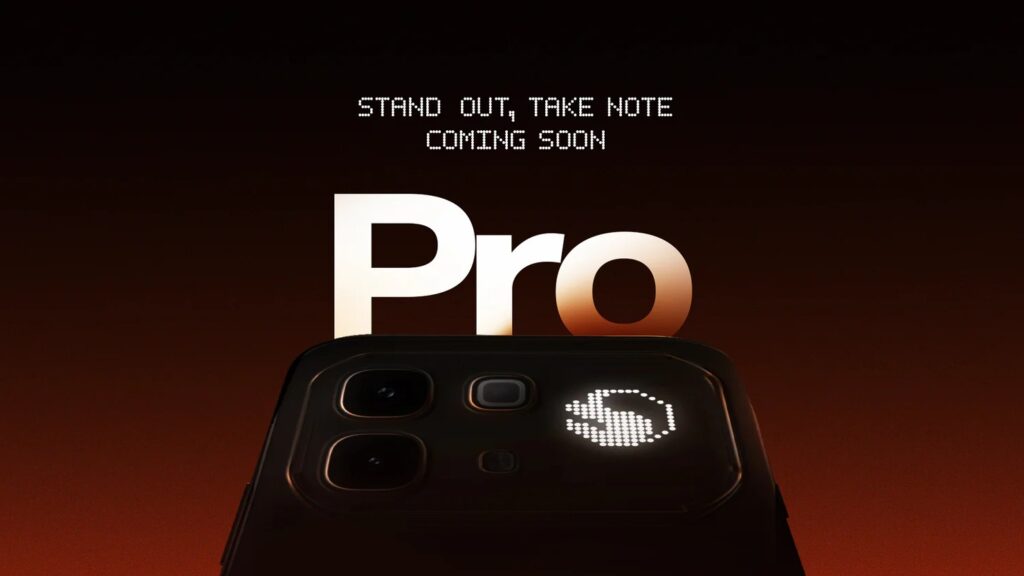
The company has begun its local campaign by highlighting what it calls the Active Matrix Display on the back. It’s essentially a set of LEDs built into the camera module, somewhat similar in concept to Nothing’s Glyph interface. It can show notifications, battery status, incoming calls, and even simple animations without needing to flip the phone. It’s more of a visual feature than a practical one, but it does help the phone stand out a bit.

Infinix has also confirmed that another feature will be revealed on April 4 at 12 PM, though most of the core specs are already out there from the global launch.

Up front, the phone uses a 6.78-inch AMOLED display with a 1.5K resolution and a 144Hz refresh rate. Local peak brightness is claimed to be 4,500 nits, which sounds impressive, though global peak or full-screen brightness will matter more for outdoor visibility.

Performance is handled by the Snapdragon 7s Gen 4, paired with 8GB or 12GB of RAM and 256GB storage. That should be enough for everyday tasks like browsing, social media, and some casual gaming.

The camera setup includes a 50MP main sensor with OIS, along with an 8MP ultrawide. On the front, there’s a 13MP camera for selfies and video calls.

Battery is one of the stronger points of this phone. It packs a 6,500mAh cell, with support for 90W wired charging and 30W wireless charging, along with reverse charging options. It runs Android 16 with XOS 16, and carries an IP64 rating for basic dust and splash resistance.

Reports point to a mid-April timeline in India, with April 13 being mentioned in a few listings. Pricing hasn’t been confirmed yet, but more details should show up as the teasers continue.

Overall, the Note 60 Pro doesn’t look radically different on paper, but the rear LED system and large battery could give it a bit of an edge in a crowded mid-range market.

Don’t miss a thing! Join our Telegram community for instant updates and grab our free daily newsletter for the best tech stories!

For more daily updates, please visit our News Section.

(Source)

The post Infinix Note 60 Pro launching in India soon with rear display, Snapdragon 7s Gen 4 chip appeared first on Gizmochina.

Xiaomi’s new robot vacuum and mop packs 10,000Pa suction, 180-min runtime at an affordable price

Xiaomi is adding another option to its Mijia robot vacuum lineup, with a model that focuses on strong suction without pushing the price too high. The new Mijia Robot Vacuum and Mop 4 has now been listed in China.

One of the headline features here is the 10,000Pa suction power, which puts it in the higher range for robot vacuums at this price point. Average suction power for modern robot vacuum mops typically ranges between 2,500 Pa and 6,000 Pa. 10,000Pa should be more than enough for everyday dust, pet hair, and even slightly heavier debris

Xiaomi is also sticking with LDS laser navigation, which helps the robot map out rooms and move in a more structured way rather than randomly bouncing around.

The design remains familiar: simple, white, and minimal. For cleaning, there’s a dual-claw anti-tangle brush setup, aimed at reducing hair buildup, especially useful in homes with pets.

It’s a 2-in-1 unit, so it can vacuum and mop at the same time. The dustbin is rated at 520ml, while the water tank comes in at 270ml. Xiaomi says it can cover up to 300 square meters in open areas, though real-world usage will likely vary depending on layout.

There are a few practical touches as well. The robot can climb thresholds up to 20mm, which should help it move between rooms more easily. It runs on a 5,200mAh battery, with a claimed runtime of up to 180 minutes.

Nothing here feels overly experimental, but that’s not really the goal. Xiaomi seems to be focusing on getting the basics right: strong suction, decent navigation, and usable battery life.

Pricing and availability:

The device is priced at 1,443 yuan (roughly $200), and in some regions, subsidies can even bring it down to around 1,299 yuan. Sales are set to begin on April 7.

For users looking for a simple, capable robot vacuum without spending too much, this one could be worth a look once it goes on sale.

Don’t miss a thing! Join our Telegram community for instant updates and grab our free daily newsletter for the best tech stories!

For more daily updates, please visit our News Section.

(Via)

The post Xiaomi’s new robot vacuum and mop packs 10,000Pa suction, 180-min runtime at an affordable price appeared first on Gizmochina.

❌