Reading view

Why is Crypto Rallying Today: Price Targets For Bitcoin, Ethereum and XRP
Why Is the Crypto Market Up Today Bitcoin, Ethereum & XRP Lead Broad Rally

The post Why is Crypto Rallying Today: Price Targets For Bitcoin, Ethereum and XRP appeared first on Coinpedia Fintech News

The crypto market has rebounded, with Bitcoin rising 10% over the last eight days and Ethereum up 12% in the same period. The total market cap is now up about 2.95% to $2.47 trillion in 24 hours, adding roughly $209 billion in value. 

Why Crypto Is Rallying

The primary driver is Japan’s regulatory momentum. The Japanese cabinet has approved a bill that classifies crypto as official “financial products,” giving institutions more confidence to treat crypto similarly to traditional assets.

Secondary factors include:

  • Reduced geopolitical risk from Iran ceasefire talks
  • Strong technical momentum, with Bitcoin now testing a very important resistance zone

Near‑term, the outlook remains bullish if Bitcoin holds its $69,000–$70,000 support range. The next event to watch is the SEC’s CLARITY Act roundtable on April 16, which could either confirm the current momentum or trigger a re‑evaluation by traders.

Bitcoin Price Analysis

Bitcoin is currently trading around $72,900–$73,000, still technically in a larger bearish trend, but now showing signs of a relief rally after a deep oversold phase. 

Bitcoin is now testing a major resistance zone between $72,000 and $76,000—a range that has acted as strong resistance since 2024 and has repeatedly flipped between support and resistance over 2025 and 2026. If BTC breaks and holds above $76,000, analysts expect a move toward the mid‑$80s, around $85,000–$86,000, as the next major target.

Ethereum Price Analysis

Ethereum has bounced back above $2,240–$2,250, recovering about 9% in the last week. 

On the daily chart, ETH is trading between $2,150 and $2,250, a range that has become critical. If Ethereum holds this zone as support, the bullish inverse head and shoulders structure remains intact, with a technical target around $2,430 as the next upside. However, a confirmed break below $2,150–$2,200 would invalidate the current pattern and reopen the door to deeper downside.

In the short term, many analysts expect a small cool‑off, mirroring Bitcoin’s structure, with a roughly 1‑day setback possible before the next leg up. 

XRP Price Analysis

XRP is trading around $1.35, up about 3% over the last seven days, and still in a larger bearish trend on the weekly chart. However, the price is now firmly testing a long‑watched support zone around $1.30–$1.35, which has served as a major downside target and bounce area for months.

  • Support area: $1.30–$1.35, with a tighter band near $1.32–$1.33
  • Resistance area: $1.44–$1.45

If XRP continues to hold above $1.30, the downside could be limited and the coin may trade sideways in its $1.30–$1.45 range. XRP is expected to follow Bitcoin’s lead over the next few days: if BTC pulls back into a small cool‑off, XRP is likely to see similar weakness, but not necessarily a full breakdown as long as that $1.30 floor holds.

Ripple and Quant Team Up on Stage: Is XRP the Real Internet of Value Behind the Scenes?

Ripple News

The post Ripple and Quant Team Up on Stage: Is XRP the Real Internet of Value Behind the Scenes? appeared first on Coinpedia Fintech News

Ripple and Quant are no longer just talking about the future of institutional payments, they’re now sharing the stage, and the market is taking notice. In a rare joint appearance, Ripple’s James Wallace, head of CBDC relations, and Gilbert Verdian of Quant Network sat side by side, unveiling a single, tightly‑linked vision: a programmable, multi‑ledger, institutional “internet of value” largely built on the XRP Ledger.

Ripple and Quant’s “Institution of Trust” Duets

On stage, Wallace laid out Ripple’s two‑pronged setup: RippleNet for cross‑border payments using cryptocurrency as a bridge currency, and Ripple’s XRP‑based initiatives for next‑generation CBDC and institutional solutions. Crucially, he framed Ripple’s mission as creating the “internet of value”—where corporate, central‑bank, and individual money can move as easily as data.

Observers on the XRP community side argue that while Quant markets itself as the programmable, interoperable layer for regulated value, Ripple is calling the XRP Ledger the main “regulated library network” beneath it all. In this narrative, Quant acts as the “API glue” and roll‑up layer, while XRP is the backbone ledger for CBDCs, private digital currencies, and cross‑border rails.

One Unified Ledger, Many “Library” Names

The video deep‑dive highlights how banks and central‑bank tech leaders have quietly renamed the same concept several times: “regulated library network,” “regulated internal value,” “shared ledger,” “unified ledger,” “constellation of regulated networks.” According to the XRP‑focused commentary, they all point back to the XRP Ledger as the shared, public, regulated‑grade core, with CBDC‑style blockchains as “carbon‑copy clones” running alongside.

The twist? The same executives who talk about a “constellation” of CBDC‑related networks are the ones who sit with Verdian at events and call Quant the interoperability layer. That’s where the XRP‑centric argument kicks in: Ripple and the XRP Ledger are the shared infrastructure; Quant and similar firms are the programmable front‑end layer.

Why This Matters for XRP

Jesse said that put together, the scene is a masterstroke for XRP:

  • Ripple publicly positions the XRP Ledger as the central “internet of value” ledger for CBDCs and regulated money.
  • Quant’s presence beside Ripple suggests multi‑ledger interoperability is already being architected around the XRP stack.
  • Language like “regulated library network,” “internet of value,” and “institutions of trust” is no longer abstract—it’s being used in real‑world forums by bank and central‑bank tech leaders.

Is Adam Back Satoshi Nakamoto? CEO Responds to New York Times Investigation

“I’m Not Satoshi,” Says Adam Back, denying NYT Claim

The post Is Adam Back Satoshi Nakamoto? CEO Responds to New York Times Investigation appeared first on Coinpedia Fintech News

Adam Back has heard the question before. He will keep hearing it. But this week, with a New York Times investigation naming him as the most likely identity behind Satoshi Nakamoto, the Blockstream CEO gave his most detailed public response yet, and it raises as many questions as it answers.

“No,” he said when asked directly if he is Satoshi. “I have said this a number of times.”

The Man Who Got the First Email

What makes Back’s denial more complicated than most is the biography he cannot change.

In August 2008, before Bitcoin’s whitepaper was published, before anyone outside a small circle of cryptographers knew it existed, Back received an email from Satoshi Nakamoto. He was the first person Satoshi ever contacted.

“I got the first email that anybody got from Satoshi in August 2008 before the Bitcoin paper was released,” Back confirmed. The communication was limited, a small exchange of emails in the autumn of 2008 and spring of 2009, before Satoshi eventually went silent in 2011 and was never heard from again.

Back later shared those emails publicly as part of the COPA trial against Craig Wright, the Australian computer scientist who spent years falsely claiming to be Satoshi before being legally forced to retract the claim. The emails are now part of the court record.

His Theory on Who Satoshi Actually Is

Back’s most interesting contribution to the debate was not his denial but his theory about why Satoshi has never been found.

“It’s probable that Satoshi is somebody that nobody knows,” he said, repeating an argument he made to the producer of the HBO documentary that also investigated the mystery. “He’s not talking to documentary film crews, he’s not talking to investigative journalists, he’s not going to conferences speaking under his own name.”

His logic follows from that. If Satoshi is someone known in the cryptography or Bitcoin community, they would have been identified already. Fifteen years of analysis by some of the most technically sophisticated researchers in the world has produced nothing conclusive. The digital breadcrumbs stopped in 2011. There is no new information to analyse.

“I think it’s probable we’ll never know at this point,” Back said.

XRP Price Can Hit $1000 by 2030, Says Analyst Drawing Direct Comparison With Bitcoin Market Cap Logic

Could $1000 XRP Become a Reality Understanding The Hidden Plan

The post XRP Price Can Hit $1000 by 2030, Says Analyst Drawing Direct Comparison With Bitcoin Market Cap Logic appeared first on Coinpedia Fintech News

Most people who throw out a $1,000 XRP price target do it anonymously on social media. Dom Kwok did it on a podcast, with his name attached, and when the hosts pushed back he did not flinch once.

Appearing on Rollup alongside his brother, Kwok said XRP could reach $1,000 over the next four to five years, a call that drew immediate scepticism from the hosts who pointed out the market cap implications would be larger than the entire planet’s combined assets.

His response was, “There isn’t really a ceiling in crypto.”

The Market Cap Question

When pressed on the mathematics behind the call, Kwok turned the question around.

“Look at Bitcoin. Why is Bitcoin valued more than most major companies? Bitcoin does not actually do anything,” he said. “When you look at crypto and market caps, there isn’t any ceiling I think.”

His point was not that market cap calculations are irrelevant. It was that crypto has repeatedly broken the frameworks people use to dismiss it. Bitcoin at $1,000 seemed impossible once. So did $10,000. So did $100,000.

Kwok is locking in his view with a bet on 2030 as the timeline. The Rollup hosts said the conviction gap between the claim and conventional analysis as, in their words, “insane.”

Beyond the Price Target

The more substantive part of Kwok’s argument was not the number itself but the thesis behind it.

He argued that the XRP community has been operating on an outdated premise. The “Ripple replaces SWIFT” narrative was a valid entry point, he said, but the story has moved well beyond that.

What Ripple has actually built is something larger. The Hidden Road acquisition for $1.25 billion brought a prime brokerage clearing over $3 trillion in trades onto the XRPL. Ripple Treasury, launched in April, gave CFOs a single platform to manage fiat and digital assets together for the first time. RLUSD is live, regulated and expanding across multiple chains. On-chain developer funding is growing.

“The future is not just about replacing one system,” Kwok said. “It is about bringing the entire financial world on-chain.”

Crypto Drama: OKX CEO Says CZ’s Sold My House to Buy Bitcoin’ Story and Divorce Claims Are Big Lies

CZ Returns to U.S. for Trump-Linked Crypto Summit

The post Crypto Drama: OKX CEO Says CZ’s Sold My House to Buy Bitcoin’ Story and Divorce Claims Are Big Lies appeared first on Coinpedia Fintech News

The release of Binance founder CZ’s memoir, Freedom of Money, has sparked a fresh public clash with the CEO of OKX, who now accuses CZ of repeating misleading claims about his divorce and his famed crypto origin story.

The OKX CEO says that if CZ can produce a dated, signed divorce agreement clearly approved by both parties as of today, he will issue a public apology. But if CZ cannot provide such proof, yet continues to claim in media interviews and in Freedom of Money that he is already divorced, the OKX CEO calls it a clear misrepresentation—and “another big lie” in a pattern of confident but inconsistent statements.

如果首富能够拿出截至今天、经双方签字确认的离婚协议,我将立即公开道歉。

如果拿不出这样的协议,却在媒体和书中宣称自己已经离婚,那就是在公然对公众撒谎。这不过是他又一次理直气壮地向公众撒谎的例子。 https://t.co/rkwzKMamuR

— Star_OKX (@star_okx) April 9, 2026

Citing a CoinDesk report, the OKX CEO points out that CZ’s wife reportedly referred to them as “husband and wife” in a letter to the judge, without using terms like “ex‑wife” or “ex‑husband.” This, the OKX CEO argues, contradicts CZ’s shifting language in the book and public appearances, and raises questions about whether his stake in Binance was fairly divided in line with the law.

The “House‑to‑Bitcoin” Story in the Book

The OKX CEO also turns to CZ’s celebrated origin tale in Freedom of Money: selling his apartment for about $900,000 to buy Bitcoin at roughly $400, a story CZ has long used to paint himself as a visionary risk‑taker. The OKX CEO questions the full truth behind the episode: where the original down payment came from, whose house was really sold, and why CZ keeps repeating the story while downplaying the emotional strain on his in‑laws and family.

From Book Launch to Public Feud

Supporters of OKX have urged the exchange to escalate the dispute legally, arguing that a company of its size should not let disputed claims in a high‑profile book stand unchallenged. What started as book‑tour chatter is now turning into a broader credibility test for CZ.

Top 3 Altcoins to Hold Until the Next Bull Run

Best Altcoins to Buy in March 2026

The post Top 3 Altcoins to Hold Until the Next Bull Run appeared first on Coinpedia Fintech News

There are way too many altcoins today, and most will not survive into the next bull run. Instead of chasing hype coins, analysts are focusing on projects quietly building real infrastructure. Three altcoins that stand out are Chainlink (LINK), Sui (SUI), and Hedera (HBAR).

Altcoin 1: LINK

Chainlink (LINK) acts as the “backbone” for smart contracts. It has already powered over $28 trillion in transactions and secures tens of billions of dollars in DeFi. Large institutions like Euroclear are using Chainlink to automate complex financial tasks, which shows it is becoming core infrastructure. The price can be slow, but if tokenization and DeFi keep growing, LINK is likely to grow with them.

Altcoin 2: SUI

Sui (SUI) is a fast‑moving layer‑1 blockchain built for speed and scalability. It can handle many transactions at once and already has hundreds of millions of dollars locked in DeFi. 

Developer activity is surging, and Sui is expanding into stablecoins, payments, and AI‑driven apps. Its Hashi solution also lets Bitcoin work in DeFi without wrapping it, opening a huge market that is still mostly unused. Sui is a higher‑risk, high‑growth play, but it sits at the center of DeFi, AI, and scalable systems.

Altcoin 3: HBAR

Hedera (HBAR) is directed at institutions and big companies, not meme‑coin traders. Its network is governed by a council that includes Google, IBM, Boeing, and McLaren, all of which use it for real‑world projects. 

Hedera is energy‑efficient, fast, and focused on compliance and governance, making it attractive to big money. It already has an ETf holding over 1% of its supply, and it’s building tools for AI agents and post‑quantum‑secure systems. If the next bull run is driven by institutions, HBAR is positioned to surprise many investors.

Together, these three altcoins cover data (Chainlink), growth (Sui), and institutional adoption (Hedera), making them solid long‑term holds into the next bull market.

XRP News: Iran’s Hormuz Fees in Crypto? PetroDollar Architect Says ‘Could Be Ripple’

Ripple News

The post XRP News: Iran’s Hormuz Fees in Crypto? PetroDollar Architect Says ‘Could Be Ripple’ appeared first on Coinpedia Fintech News

Jim Rickards has spent decades at the intersection of intelligence, finance and geopolitical strategy. He was involved in the construction of the PetroDollar system in the 1970s. 

Which makes what he said this week particularly interesting.

Discussing which currencies Iran might be using to collect its reported Bitcoin toll from oil tankers passing through the Strait of Hormuz, Rickards paused before answering. “Could be Bitcoin. Could be Tether. Could be, I mean, you know, Ripple.”

He listed Ripple alongside Bitcoin and Tether as a plausible medium for sovereign energy settlement. 

The Context Matters

Rickards was discussing breaking news from the Financial Times reporting that Iran had begun charging vessels a toll to transit the Strait of Hormuz, with payment demanded in cryptocurrency. The exact currency was not specified in the original report. Rickards was working through the logical candidates in real time.

His analysis went further than just naming currencies. He pointed out that regardless of which cryptocurrency Iran uses, it is still pricing the toll in dollars. One dollar per barrel of oil is a dollar-denominated transaction settled in crypto, not an escape from the dollar system.

“You can hit on the dollar but you can’t get away from it,” he said. “Cryptocurrencies have a dollar equivalent. So you’re always back to the dollar no matter how hard people try to get away from it.”

He also raised a pointed question about Tether specifically. The largest stablecoin by market cap counts Howard Lutnik, the US Secretary of Commerce, as a significant investor. If Iran is settling oil tolls in Tether, it is arguably routing payments through an instrument with direct ties to the US government it is trying to circumvent.

“Iran is going to use Tether? They’re going to charge a toll on the oil in Tether?” he said, letting the irony speak for itself.

Why Ripple Matters in This Conversation

According to supporters, Ripple’s inclusion in Rickards’ list was not random. XRP and the XRP Ledger are specifically designed for fast, low-cost cross-border settlement between institutional counterparties. Transactions settle in three to five seconds. The network has over 300 financial institutions using its payment infrastructure. 

Whether Iran is actually using Ripple is unknown. Rickards was speculating, not confirming. But the fact that a former CIA contractor and one of the architects of the PetroDollar system reached for Ripple as a natural answer to the question of what replaces dollar-denominated oil settlement is a data point worth noting.

Can XRP Price Reach New All-Time Highs Above $4 in Six Days?

XRP Price ATH

The post Can XRP Price Reach New All-Time Highs Above $4 in Six Days? appeared first on Coinpedia Fintech News

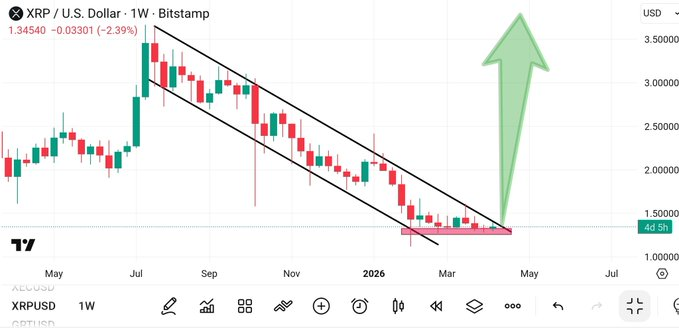
A prediction making rounds on social media this week claims XRP could hit new all-time highs above $4 within six days, pointing to a weekly chart squeeze as the primary signal. The claim has picked up traction in the XRP community, though analysts who follow the token closely are offering a more neutral perspective.

XRP is currently trading around $1.34, down 2.39% on the week.

What the Chart Actually Shows

Looking at the weekly chart, XRP has been trading inside a descending channel since its peak above $3.50 in mid-2025. The price has been grinding lower through a series of lower highs and lower lows, with the channel tightening noticeably in recent weeks. The pink highlighted zone on the chart marks the current compression area, with a large green arrow pointing toward a potential breakout above $1.50 and beyond.

xrp

The squeeze is real. Bollinger Bands on the weekly timeframe are at their tightest levels in months, a condition that historically precedes a significant move in either direction.

XRP Price Analysis

One measured analyst offered a more structured view of where XRP stands right now.

Analyst Josh of Crypto World said that on the weekly timeframe, the longer-term trend remains technically bearish. A full reversal out of the larger bear market structure has not yet been confirmed. The $1.30 level continues to hold as a significant support, a level the analyst had been flagging as critical since XRP was trading near $3.

Immediate support sits at $1.34 to $1.35, with further support at $1.32 and the key level at $1.30. Resistance is expected at $1.38 to $1.39, a zone where the price has already rejected recently. A clean break above that opens the path toward $1.44 to $1.45.

Bitcoin Enters Hormuz Standoff as Iran Explores Sanctions Workarounds

Bitcoin price analysis $69K resistance

The post Bitcoin Enters Hormuz Standoff as Iran Explores Sanctions Workarounds appeared first on Coinpedia Fintech News

Iran’s reported plan to charge oil tankers a fee in Bitcoin or Chinese yuan to pass through the Strait of Hormuz is drawing global attention, as it mixes geopolitics with cryptocurrency in a way rarely seen before.

According to messages sent to ships in the region, tankers may need to pay between about $0.50 and $1.50 per barrel of oil to pass through the narrow waterway. For large ships, that could mean paying millions of dollars per trip.

The warning was clear. Ships must pay quickly to get approval. Those that try to pass without permission could face serious consequences. Right now, hundreds of vessels are said to be waiting near the Gulf, unsure how the situation will play out.

Why Bitcoin?

The idea behind this move is simple. By asking for Bitcoin or yuan, Iran could avoid the traditional banking system, which is heavily controlled by Western countries and often used to enforce sanctions.

BREAKING: Iran is demanding ships pay a toll in Bitcoin to pass through the Strait of Hormuz.

$1 per barrel of oil. Payment must be made in seconds or the ship does not pass.

Vessels that attempt transit without Iranian approval will be destroyed, according to a radio… pic.twitter.com/qcgZa8kGyg

— Bull Theory (@BullTheoryio) April 8, 2026

Instead of using dollars and bank transfers, payments would move through alternative systems. In this case, that could mean direct crypto transfers or non-dollar settlement channels.

Social media fuels big numbers

The story has quickly spread online, especially in crypto circles.

One user on X claimed that if Iran charges around $2 million per ship, that would equal about 27 Bitcoin at current prices. If around 130 ships pass daily, as they did before tensions rose, that could mean over 3,600 Bitcoin in daily payments.

For comparison, only about 450 Bitcoins are mined each day.

The user suggested this could allow Iran to build a large Bitcoin reserve over time. But these estimates are based on assumptions, and there is no proof this level of activity is happening.

Is this actually happening?

There are reports that some ships may already be using non-dollar payments to pass through the region, but details are limited.

It’s still unclear:

  • How many ships would agree to pay
  • Whether insurers would allow it
  • How governments would respond

Because of these unknowns, the plan may not scale easily.

❌