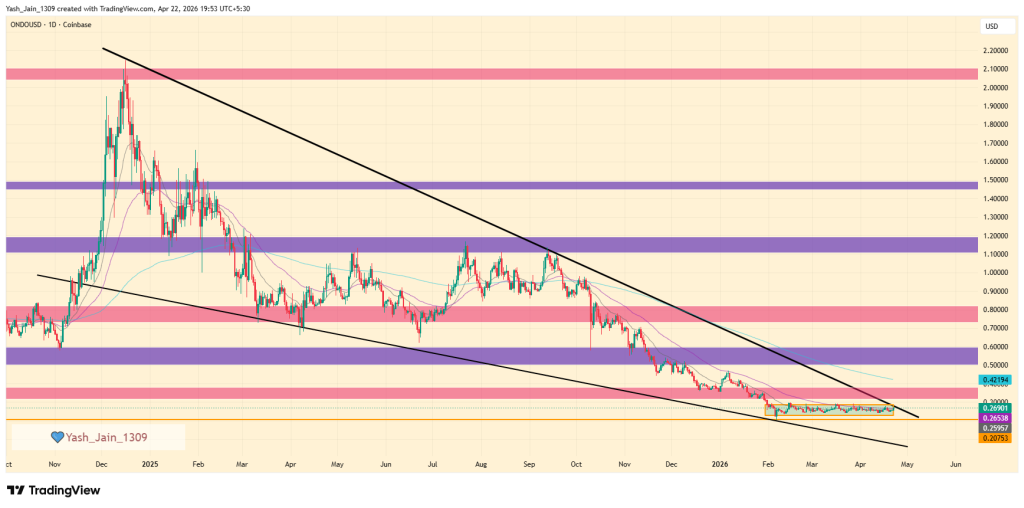
After months of grinding lower inside a falling wedge, the ONDO price chart is finally tightening up and not quietly. With tokenized stocks suddenly back in the spotlight, ONDO might just be sitting on the kind of narrative fuel traders pretend they don’t chase… until they do.
Tokenized stocks narrative suddenly grabs Washington spotlight
Here’s the twist. Tokenized stocks aren’t just a niche experiment anymore they’re getting regulatory attention at the highest level. That alone shifts the tone.
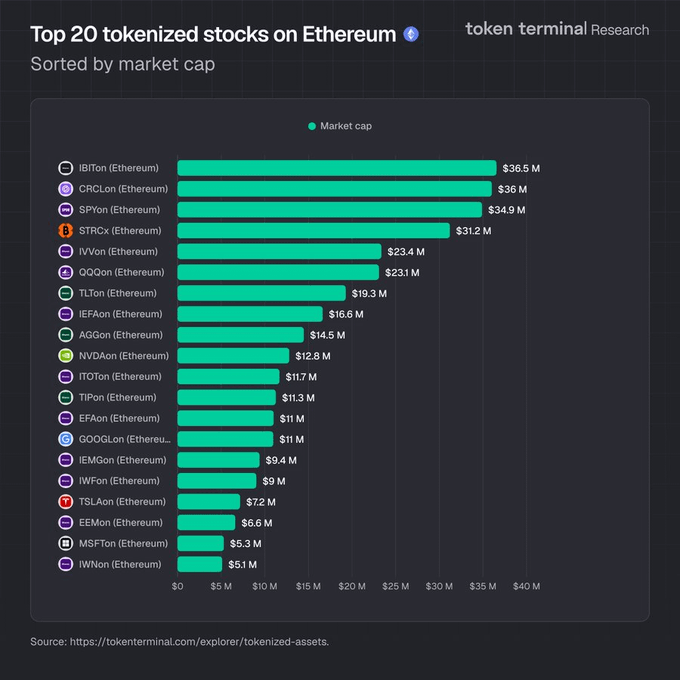
Today Ondo Finance announced on X that Nineteen of the top twenty tokenized stocks on Ethereum now come from Ondo Global Markets. That’s not a small footprint. On Ethereum alone, Ondo’s tokenized stocks and ETFs account for nearly $500 million in total value locked, alongside billions in trading volume and tens of thousands of holders.
And then came the policy angle. A recent statement pointed toward an upcoming “innovation exemption” aimed at facilitating on-chain trading of tokenized securities. Translation? Washington isn’t debating whether this sector should exist but clearly it’s figuring out how to regulate it. Well, that changes things for good in the sector.
Tokenization has Washington's attention.
“We are on the cusp of releasing an 'innovation exemption' to begin facilitating the trading of tokenized securities onchain.”
SEC Chairman Paul Atkins, speaking at the Economic Club of Washington, outlining the regulatory framework… pic.twitter.com/txldrIptrb
ONDO price compresses inside falling wedge structure
Now flip to the chart, because this is where it gets tactical. ONDO price has been stuck in a prolonged downtrend, forming a clean falling wedge pattern since early 2025. Lately, though, price action has shifted into a tight horizontal consolidation box near the lower boundary, which is kinda classic pre-breakout behavior. But here’s the catch: it’s not just any resistance overhead.
The $0.42 level sits right in line with the 200-day EMA band and the wedge’s upper boundary. That makes it a double-layered barrier and the kind that doesn’t break easily unless momentum shows up with intent.
Still, price is creeping toward it again. Slowly. Quietly. And markets love breaking when everyone’s bored. So, what happens next?
If ONDO price manages a clean break above $0.42, that level flips from resistance into a magnet. Not immediately explosive but structurally important. From there, the next major zone sits near $0.80, which aligns with prior resistance clusters.
But let’s be real. None of that matters if the breakout fails. This setup is binary. Either the falling wedge resolves upward, supported by fresh narrative momentum from tokenized securities… or it drifts sideways and fades back into irrelevance.
Right now, though, the timing is hard to ignore. ONDO price is sitting at the edge of a technical breakout while the tokenized stocks story gains traction at both institutional and regulatory levels. That’s not confirmation but it’s definitely a setup worth watching.
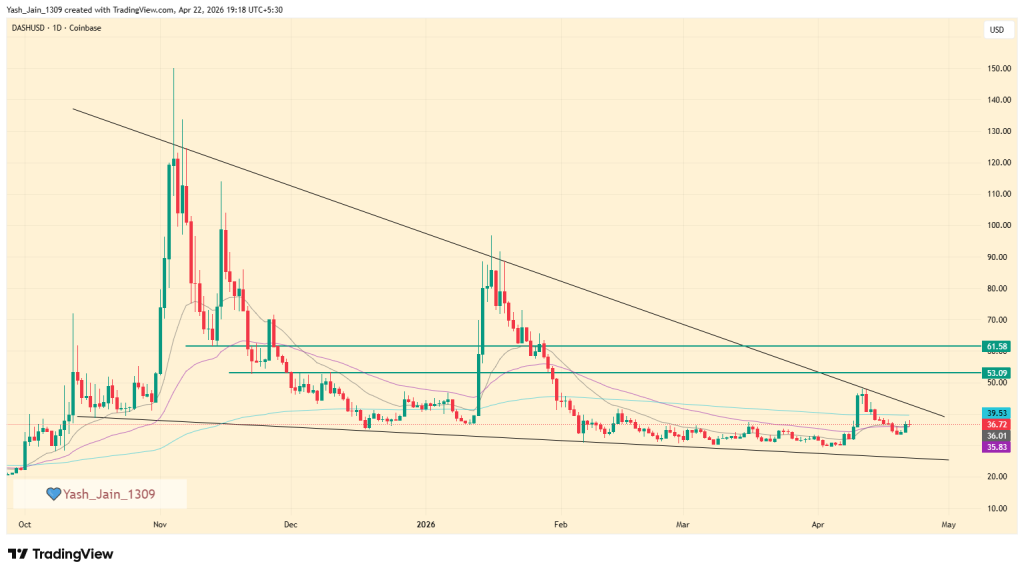
DASH price is sitting right at that uncomfortable edge where patience runs thin and volatility usually kicks the door in. After months of grinding lower since Q4 2025, the daily chart now shows a clear falling wedge structure, and it’s tightening fast. April’s price action isn’t subtle about it either; momentum is compressing, and something’s got to give.
But here’s the catch there’s a ceiling. And it’s not just any ceiling.
Falling Wedge Pressure Builds Toward Key Breakout Zone
The falling wedge has done what it’s supposed to do: squeeze price into a narrowing range while quietly building breakout pressure. Now, DASH price is pressing right into the upper boundary of that structure. Typically, that’s where reversals start to show up.
Except this time, there’s a second wall stacked right on top.
The 200-day EMA around $40 is sitting exactly where the wedge resistance lies. That’s not coincidence ina fact that’s confluence. And in markets, confluence tends to matter more than narratives.
So yeah, breaking $40 isn’t just another level. It’s the most key level right now.
Why $40 Is The Only Level That Matters
As the data suggest, if DASH price clears $40 cleanly meaning a proper breakout, not a weak wick then the structure flips. Simple as that. Now, what happens next depends on how aggressive that move is.
If price rips through $40 with strong momentum, then the $53–$61 resistance zone probably won’t slow things down much. That kind of breakout tends to ignore intermediate levels and go straight for expansion.
But markets aren’t always that generous. If DASH climbs slowly and stabilizes above $40, then $53 and $61 become real checkpoints. Not barriers, but tests. Fail those, and the breakout risks losing steam.
Decentralization Narrative Enters The Conversation Again
And then there’s the timing. While price structures are tightening, the broader crypto space is dealing with a different kind of pressure that’s trust and decentralization doubts.
With recent events involving asset freezes raising eyebrows across the industry, DASH crypto decided to step in with a not-so-subtle reminder. The network publicly stated that it is decentralized and cannot, and will not, censor or surveil users.
PUBLIC SERVICE ANNOUNCEMENT
The Dash network is decentralized and cannot, and will not, censor or surveil its users.
That’s not just PR it’s positioning in people minds that are in fear of assets freezing.
In a market where decentralization is suddenly being questioned again, that message isn’t random. It’s strategic. Whether it actually shifts investor sentiment, though, is a different story.
Artificial Superintelligence Alliance’s price could hit a maximum trading price of $1 in 2026
With a potential surge, the FET price may record a high of $12.45 by 2030.
As artificial intelligence continues to dominate global headlines, blockchain-based AI infrastructure projects are once again attracting investor attention.
Among them, the Artificial Superintelligence Alliance (ASI) stands out as a strategic merger of major AI-focused blockchain entities.
Founded through the collaboration of Fetch.ai, SingularityNET, and later CUDOS, the alliance aims to create the largest open-source, decentralized ecosystem focused on Artificial General Intelligence (AGI).
The FET token, originally native to Fetch.ai and now central to the ASI ecosystem, serves as the utility, governance, and settlement layer across AI services.
So let’s dive straight into CoinPedia’s Artificial Superintelligence Alliance (FET) price prediction for 2026, 2027, and 2030.
Artificial Superintelligence Alliance (FET) Price Targets For April 2026
The Artificial Superintelligence Alliance (ASI) is expanding its AI agent marketplace, making it easier for users and applications to access various AI services.
If ASI successfully integrates its offerings, it will be able to host AI models on its network, facilitate communication and collaboration among AI agents, and enable users to pay for AI services directly on the blockchain. Additionally, ASI is working to establish partnerships with businesses interested in utilizing AI.
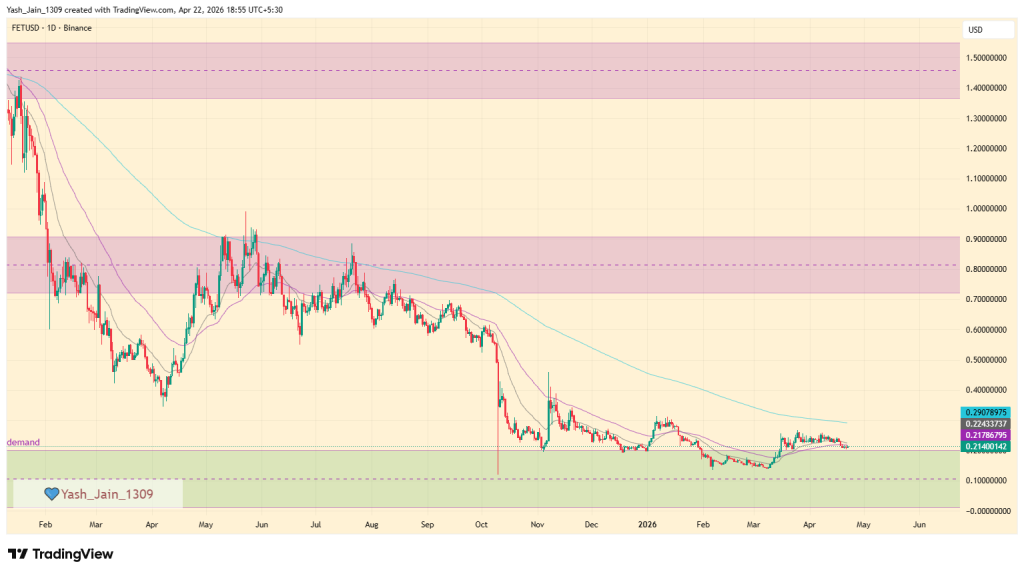
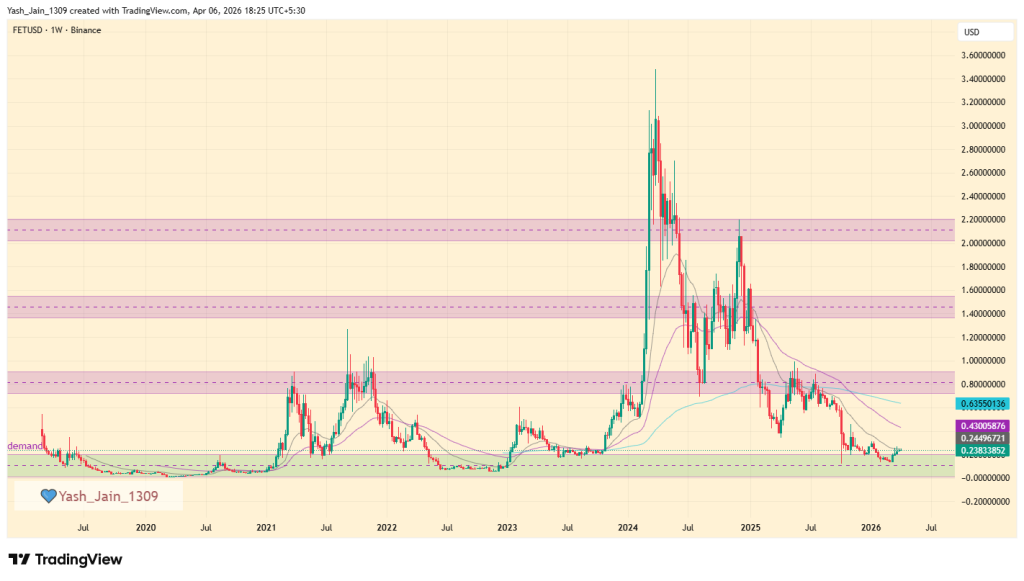
As more people begin to use AI on the network and the demand for computing power increases, this could drive up activity and potentially push the FET price towards $0.32 by late April to May of 2026. The price already reached $0.25 in mid-March, now approaching the 200-day EMA band. It has also found support in the green box, which aligns with a multi-year demand zone. If bearish pressure increases, the price could re-enter this support zone; however, if it continues on its upward trajectory, testing $0.32 could be within reach or even higher.
Unlike many AI tokens driven by hype, the Artificial Superintelligence Alliance (FET) is building a foundation in decentralized compute and autonomous agents. This shift from speculation to real-world utility suggests that FET’s value will increasingly mirror actual network usage. As companies adopt these decentralized services, the organic demand for the token could provide a structural floor for long-term growth.
Technically, FET’s 2026 outlook remains tied to key market cycles. A potential low of $0.0582 serves as a deep support zone during “risk-off” periods. However, as the ecosystem matures, an average price of $0.0913 is expected as it maintains a steady trend. In a bullish breakout scenario, FET could surge toward $0.3013, driven by high-volume demand for decentralized AI infrastructure.
FET Price Prediction 2026 – 2030
Year
Potential Low ($)
Potential Average ($)
Potential High ($)
2026
$0.0921
$0.340
$0.950
2027
$0.173
$0.820
$2.14
2028
$0.468
$1.938
$5.53
2029
$1.40
$4.30
$8.05
2030
$2.126
$6.78
$12.45
FET Price Prediction 2027
Growing wider adoption of autonomous AI agents in supply chains, logistics, and digital services could push FET near $2.14
FET Price Forecast 2028
By 2028, if decentralized AGI frameworks mature and institutional AI infrastructure adopts ASI tooling, FET may approach $5.53.
FET Coin Price Prediction 2029
In 2029, AGI research networks integrate token-based compute markets, and valuation expansion could drive FET toward $8.
What will Fetch AI be worth in 2030?
In a strong AI-dominant economy where decentralized compute markets compete with centralized cloud providers, FET could test $12.45
As per CoinPedia’s FET Price Prediction, the exponential growth observable in the field of artificial technologies will boost the value of AI tokens in the crypto world
If the alliance successfully aligns AI compute markets, decentralized agents, and open-source model hosting under one economic framework, FET could gradually reclaim the $0.950 range in 2026.
Year
Potential Low ($)
Potential Average ($)
Potential High ($)
2026
$0.0921
$0.340
$0.950
Never Miss a Beat in the Crypto World!
Stay ahead with breaking news, expert analysis, and real-time updates on the latest trends in Bitcoin, altcoins, DeFi, NFTs, and more.
FAQs
What is Artificial Superintelligence Alliance (FET)?
Artificial Superintelligence Alliance (FET) is a merged AI-blockchain ecosystem uniting Fetch.ai, SingularityNET, and CUDOS to power decentralized AI services.
What is the Artificial Superintelligence Alliance (FET) price prediction for 2026?
FET could trade between $0.09 and $0.95 in 2026, depending on AI adoption, network growth, and overall crypto market momentum.
What could FET be worth by 2030?
If decentralized AI scales globally, FET may test $12 by 2030, though long-term growth depends on real-world usage and regulation.
What Is the FET Price Prediction for 2040 and How High Can It Go?
By 2040, FET could trade between $25 and $40 if decentralized AI and AGI adoption expand globally with strong ecosystem growth.
What is the price prediction for FET in 2050?
By 2050, FET may exceed $60 in a mature AI economy, assuming sustained adoption, real utility, and stable crypto regulations.
Is FET a good long-term AI crypto investment?
FET offers exposure to decentralized AI infrastructure. Its long-term value relies on adoption, partnerships, and sustainable ecosystem growth.
Cronos coin price is expected to go as high as $0.3000 to $0.3500 in 2026.
CRO crypto may cross the $1 mark, with a potential high of $1.3190 by 2029.
Cronos (CRO) serves as the backbone of the Cronos Chain, a high-performance, open-source ecosystem engineered by Crypto.com. Designed to bridge the gap between traditional finance and Web3, CRO acts as a versatile utility token that facilitates instantaneous, low-cost global transactions while powering a vast suite of DeFi applications, perpetuals, and fiat-integrated markets.
Driven by institutional-grade infrastructure and a rapidly expanding global footprint, CRO’s market performance increasingly reflects a surge in investor confidence and real-world utility. As the network matures into 2026, its role in the next generation of digital asset exchange becomes even more pivotal.
In this analysis, we leverage advanced technical indicators and historical performance models to forecast the trajectory of Cronos. Whether you are a long-term holder or a strategic investor, this guide provides essential price projections for 2026 and through to 2035, helping you determine if CRO/USD is the missing piece for your portfolio.
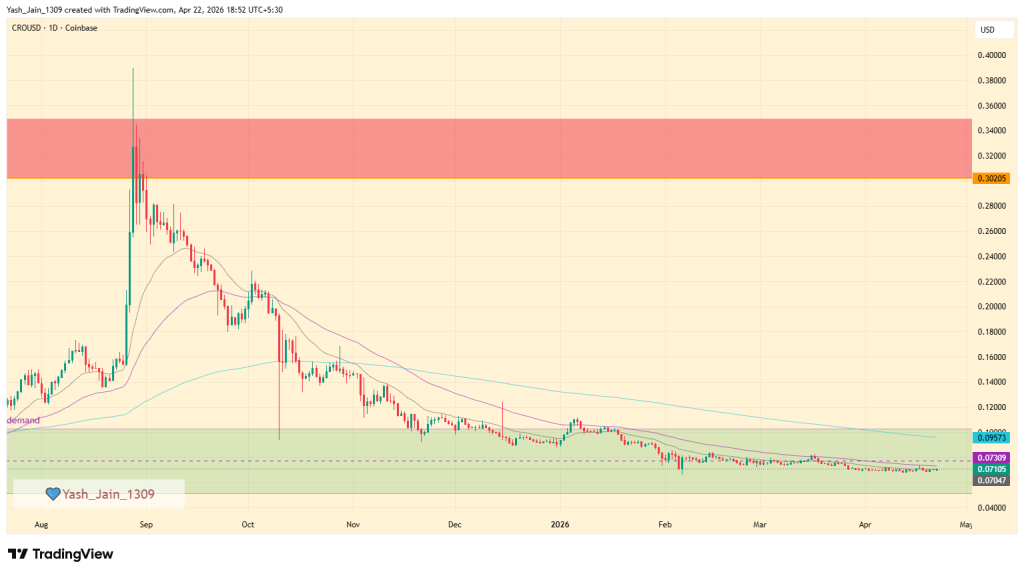
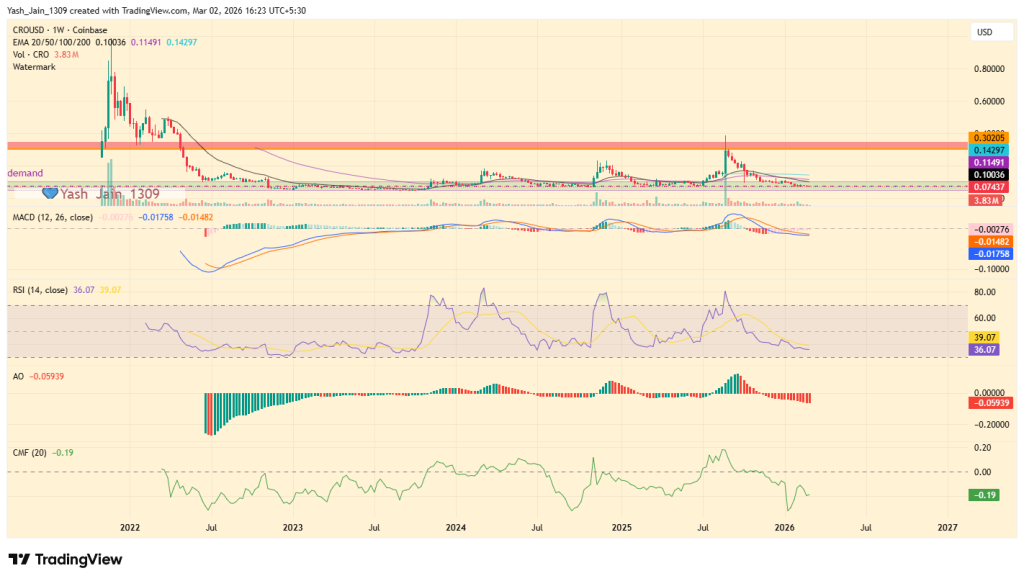
Currently, the Cronos price is experiencing a period of consolidation on the daily chart, hovering around the key horizontal line at approximately $0.0777, which marks an important multi-year demand range (indicated in green). This phase indicates a decrease in momentum, and if this trend continues, we could observe its persistence into March.
On a more optimistic note, should the price successfully break above $0.1000, we can anticipate a robust move towards the 200-day EMA band, potentially reaching around $0.1200 by late April to may. However, if bearish factors come into play, we might see the price retreat to the lower end of the current demand range, possibly down to around $0.0600.
Recent Updates & Network News
On February 5, 2026, Cronos announced the development of a unified trading platform offering tokenized stocks, commodities, and prediction markets. This expansion is supported by a strategic integration with Fireblocks, providing the secure, institutional-grade custody infrastructure necessary for market makers to trade at scale.
Following this, a post on February 28 announced the Cronos v1.7 Network Upgrade is scheduled for March 10 at 07:00 GMT. This technical maintenance will involve approximately 30 minutes of downtime to align with recent SDK updates and implement RPC performance improvements to ensure long-term chain stability.
CRO Price Prediction for 2026
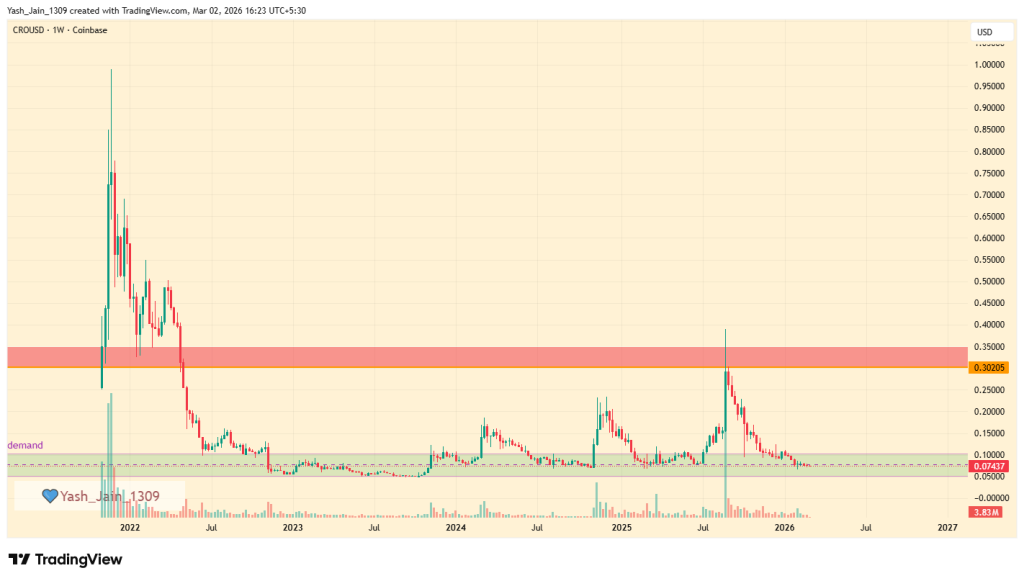
The weekly chart for CRO/USD reveals a persistent long-term structure defined by a well-established accumulation zone. Since late 2023, Cronos has consistently found a floor within the $0.0500 to $0.1000 demand area. This “buy zone” has historically triggered significant rallies, notably in late 2024 and mid-2025, where the price peaked at $0.3900.
As of early 2026, CRO has returned to this familiar base, setting the stage for its next major move.
The current weekly price action suggests a period of base-building. We are seeing a repeat of the historical pattern where CRO enters a deep consolidation phase before a vertical expansion.
Supply Zone: The primary target for a breakout lies between $0.3000 and $0.3500.
The Pivot Point: Simply hitting the supply zone isn’t enough; for a true trend reversal, CRO must flip this resistance into support to reclaim its 2022 highs.
Moreover, While the price remains flat, the underlying “engine” of the market (indicators) is starting to show signs of exhaustion from the bears:
In MACD for instance we are currently approaching a weekly bullish cross. Historically, this cross has served as the starting gun for intensified consolidation that eventually leads to a breakout at later stage.
CMF is the most encouraging sign. The CMF has bounced sharply from a low of -0.32. This move toward the zero line suggests that selling pressure is fading and capital is starting to stabilize within the ecosystem.
RSI & AO, Both indicate that the “cooling off” period is still in effect. This lack of a clear direction in RSI confirms we are in a neutral accumulation phase, which is often known as the quiet before the storm.
What Makes CRO Interesting in 2026?
In 2026, Cronos (CRO) stands out as a unique bridge between high-finance and retail utility. The landscape shifted dramatically in late august 2025 when Trump Media Group announced a $6.42 billion CRO Digital Asset Treasury strategy, signaling a massive institutional endorsement of the token’s scarcity.
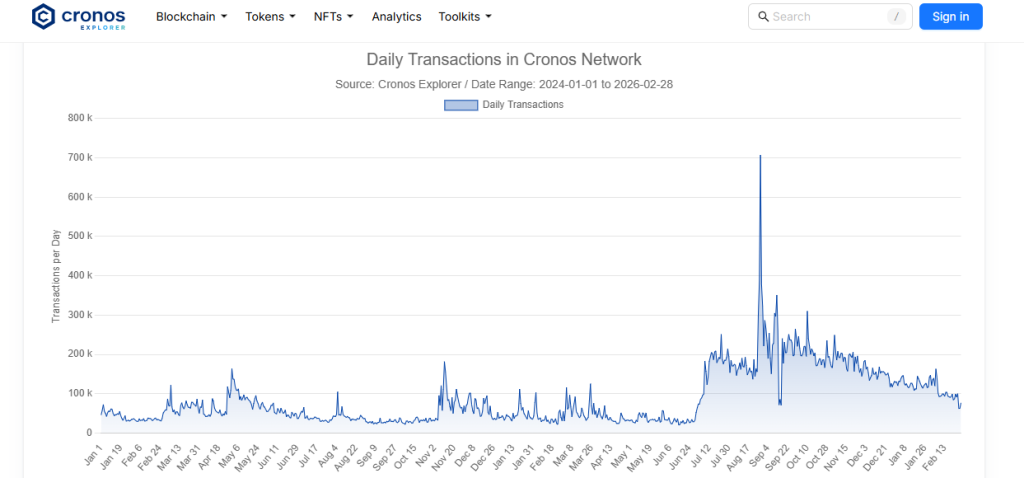
Beyond the headlines, Cronos remains a technical powerhouse with zero downtime over four years. It currently supports 150M+ users via the Crypto.com ecosystem and powers payments for 10M+ merchants. While the broader market has cooled in Q1, Cronos maintains a healthy 100,000 daily transactions, proving its resilience. This blend of “battle-tested” infrastructure and “institutional-grade” liquidity makes it a critical pillar of the 2026 digital economy.
Cronos (CRO) Price Prediction for 2027-2035
Year
Minimum Price ($)
Maximum Price ($)
Average Trading Price ($)
2027
0.1690
0.3490
0.2490
2028
0.3570
0.6990
0.5090
2029
0.7100
1.3190
0.9890
2030
1.3490
2.4010
1.8210
2031
2.4200
4.1990
3.2350
2032
4.2210
7.1000
5.5290
2033
7.1090
11.5050
9.1650
2034
11.5910
18.4510
14.7650
2035
18.4290
28.7110
23.1990
Cronos Token Price Prediction for 2027
By 2027 Cronos token price is expected to trade between $0.1690 and $0.3490. The average expected trading cost is $0.2490.
CRO Price Prediction for 2028
In 2028, CRO price is expected to trade between $0.3570 and $0.6990. The average expected trading cost is $0.5090.
Cronos (CRO) Crypto Price Prediction for 2029
Experts expect Cronos crypto to trade between $0.7100 and $1.3190 in 2029. The average expected trading cost is $0.9890.
CRO Price Prediction for 2030
Based on technical CRO price analysis it is expected to trade between $1.3490 and $2.4010 in 2030. The average expected trading cost is $1.8210.
CRO/USD Price Prediction for 2031
Based on technical analysis by experts, in 2031 CRO/USD is expected to trade between $2.4200 and $4.1990. The average expected trading cost is $3.2350.
Cronos Price Prediction for 2032
Following 2031, in 2032, Cronos price is expected to trade between $4.2210 and $7.1000. The average expected trading cost is $5.5290.
CRO Token Price Prediction for 2033
In 2033, CRO token price is expected to trade between $7.1090 and $11.5050, with an average expected trading cost of $9.1650.Price Prediction for 2034
CRO Crypto Price Prediction for 2034
Based on technical analysis by cryptocurrency experts, in 2034 CRO crypto is expected to trade between $11.5910 and $18.4510. The average expected trading cost is $14.7650.
CRO Price Prediction for 2035
According to technical analysis by top specialists, the CRO price is projected to range from $18.4290 to $28.7110 by 2035. The anticipated average trading price is $23.1990.
Never Miss a Beat in the Crypto World!
Stay ahead with breaking news, expert analysis, and real-time updates on the latest trends in Bitcoin, altcoins, DeFi, NFTs, and more.
FAQs
What is the Cronos (CRO) price prediction for 2026?
CRO is expected to trade within the $0.05–$0.35 range in 2026, with a breakout above $0.30 needed to confirm a bullish reversal.
Can Cronos (CRO) reach $1 by 2030?
Based on long-term projections, CRO could trade between $1.34 and $2.40 by 2030 if adoption and momentum continue.
Is Cronos a good long-term investment through 2035?
Long-term forecasts suggest gradual growth toward higher ranges by 2035, but returns depend on adoption and market cycles.
What could drive CRO price growth in 2026?
Institutional integration, network upgrades, rising utility, and a confirmed bullish MACD cross could support upside momentum.
TRON price looks bullish based on social feeds and rising stablecoins data, yet the chart just… shrugs. While headlines scream about rising stablecoin supply and Justin Sun’s decentralization claims, TRON price action is barely reacting, and honestly, that disconnect is getting hard to ignore. Because under the surface, things aren’t as clean as they seem.
TRON Price Ignores Bullish Narrative
Let’s start with the supposed bullish driver. The total supply of USDT on the TRON network just hit a fresh all-time high of $86.7 billion. On-chain logic says that’s a good thing more stablecoins usually mean more liquidity, more activity, more upside.
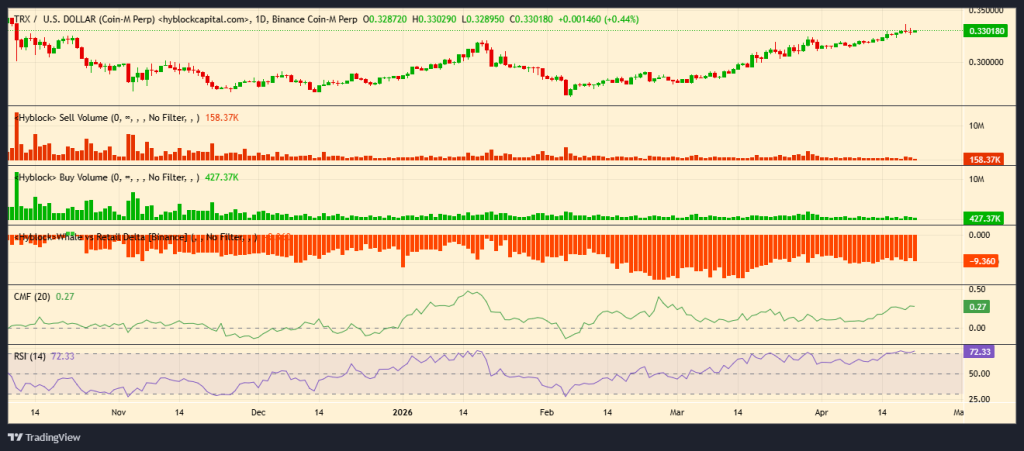
In theory. But here’s the kicker, TRON price hasn’t exactly taken off. Yes, buy volume is rising, and sure, the network looks active, but price isn’t reflecting that enthusiasm in any meaningful way. It’s moving up, but not with conviction. More like a cautious grind than a breakout.
And that usually tells you one thing: the market isn’t fully buying the narrative.
Security Moves Spark Debate Around Decentralization Claims
Now layer in the broader market context. The Arbitrum Security Council announced that they froze 30,766 ETH linked to an exploit, moving the funds to a secure intermediary wallet with governance control. The move was coordinated with law enforcement and executed without affecting users or chain state.
Efficient? Yes. Decentralized? Well… move raises doubts. Justin Sun raised voice on this and this is where things get spicy. In response, TRON’s founder doubled down, claiming TRON is the “most decentralized blockchain in the world.” Bold statement, especially when the market is actively watching how different chains handle crises.
Overbought Indicators Flash Warning For TRON Price
And right now, TRON price is sending mixed signals. On one hand, the Chaikin Money Flow (CMF) sits at 0.27, suggesting steady capital inflow. That’s not bearish. Not at all.
But then you look at the RSI hovering around 72.22 and suddenly things look a bit stretched. That’s firmly in overbought territory. Historically, that doesn’t end with immediate continuation. It ends with cooling.
Maybe even a pullback. So yeah, rising buy volume is there. Momentum is building. But the technicals are quietly hinting that this move might be running a little too hot, a little too fast.
TRON Price Faces Reality Beyond Bullish Headlines
So, what’s next? SInce TRON price isn’t weak, but it’s not convincing either. Not yet. The bullish narrative from USDT supply growth is real, but it hasn’t translated into explosive price action. At the same time, overbought indicators are flashing caution.
That’s not a breakout setup. That’s a hesitation phase. Until TRON price shows a decisive move backed by sustained momentum not just headlines alone, till then the market’s likely to stay skeptical. And in crypto, skepticism usually wins… at least in the short term.
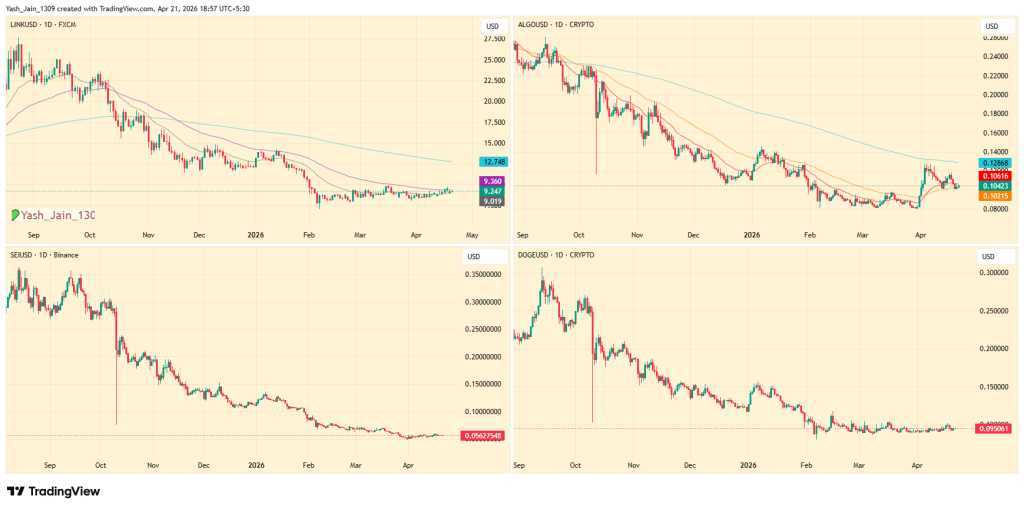
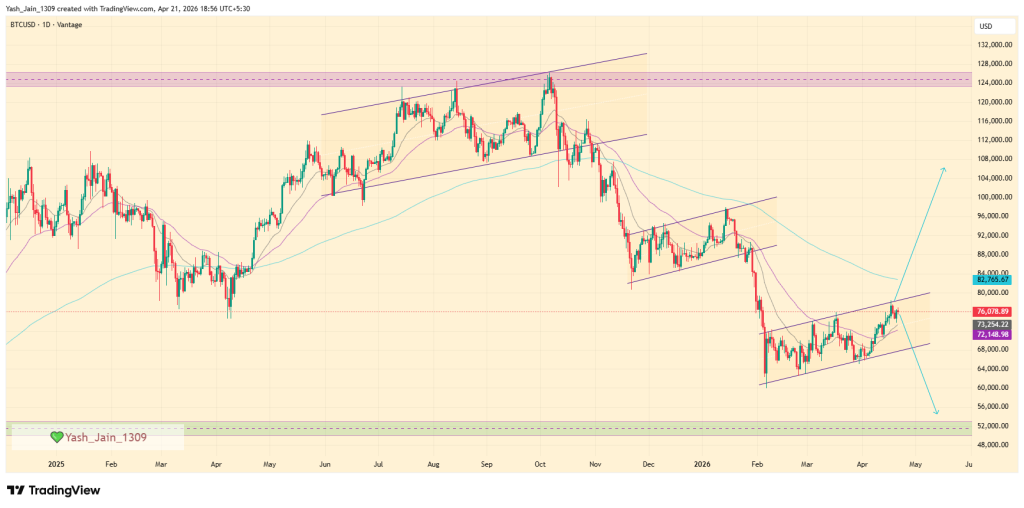
Bitcoin isn’t breaking out. It’s stalling and dragging the entire altcoin market into a slow, frustrating freeze. While traders keep staring at sleepy charts or instance LINK stuck near $10, ALGO hovering around $0.15, SEI barely breathing at $0.05 and other altcoins are not doing any good either but the bigger story is unfolding quietly: a textbook Bitcoin bear flag tightening its grip. And, it’s not the kind of setup alt holders want to ignore.
Bitcoin Bear Flag Keeps Altcoins Completely Frozen
The first Bitcoin bear flag formed right after the explosive move to the $124k all-time high. Price peaked, rolled over hard followed by another flag, and now its in third flag that has been consolidating inside a rising channel since early Q1. Now here’s where it gets interesting.
In First flag the rejection came near $92k price hit the upper trendline, failed, and dumped all the way to $62k. Then came second flag. A bounce from $62k pushed price back toward $80k… only to get rejected again at the same resistance.
So yeah, we’re now staring at the third touch. And markets love symmetry and perhaps a fall may come again.
Third Rejection Could Trigger Altcoin Capitulation
Well, here’s the detail bear flags don’t usually end with fireworks. They end with continuation. That means if this third rejection plays out like the last two, downside isn’t just possible, it’s expected.
Measured move? Somewhere in the $52k to $56k range. And altcoins? They don’t get a free pass. Historically, every rejection in this structure has translated into sharp losses across majors. This time, projections suggest a potential 20% to 40% drop, with broader sentiment hinting at even deeper bleeding up to 50% in some weaker names. Not exactly the “altseason” everyone keeps tweeting about.
Breakout Or Breakdown Only Two Outcomes Remain
But let’s be fair it’s not all doom. There is another path. If all people are right and bulls do manage to defend current fall and top dog Bitcoin price breaks above the flag’s upper trendline with a strong daily close with no wicks, no fakeouts then the bearish structure may have the chance to get invalidated. That’s the trigger. That’s when things flip. And that’s when altcoins finally get breathing room after months of underperformance.
Simple, right? Well, not really. Because so far, every attempt to reclaim that resistance has failed. Cleanly. So, what’s next?
The live price of the MANA crypto token is $ 0.08904400.
Price predictions for 2026 range from $0.247 – $0.40.
By 2030, the MANA price could surge toward $4.90 due to growing trader activity.
Decentraland (MANA) is one of the earliest and most recognizable names in the metaverse sector. Built on Ethereum, Decentraland allows users to own virtual land, create experiences, and participate in a digital space using its native token, MANA.
While the overall metaverse narrative has cooled since its 2021 peak, Decentraland continues to maintain an active ecosystem focused on virtual events, social experiences, and creator-led development.
If you’re curious about Decentraland’s future and wondering whether MANA is a good investment, this MANA price prediction 2026–2030 will walk you through its potential growth and long-term outlook.
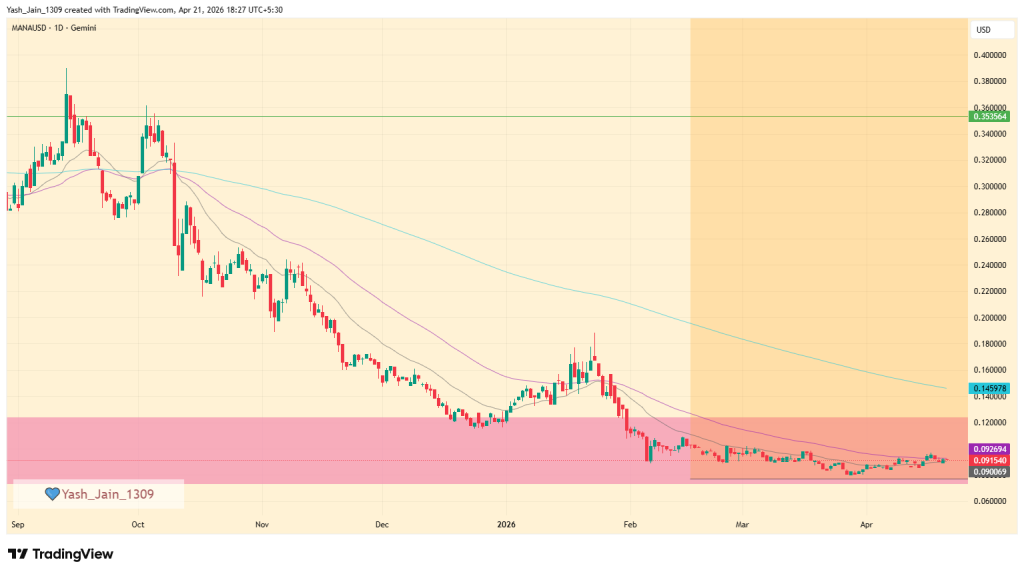
The MANA price has recently retraced to a significant multi-year demand zone in the first quarter 2026, demonstrating a consolidation phase on the price chart that indicates a potential exhaustion of long-standing selling pressure. As we entered the second quarter in April, this consolidation continues.
However, should a favorable catalyst arise, we could see the price ascend toward the upper boundary of this demand zone at $0.125. Conversely, if such a catalyst does not materialize, we may experience an extension of this consolidation throughout April.
Decentraland (MANA) Price Prediction 2026
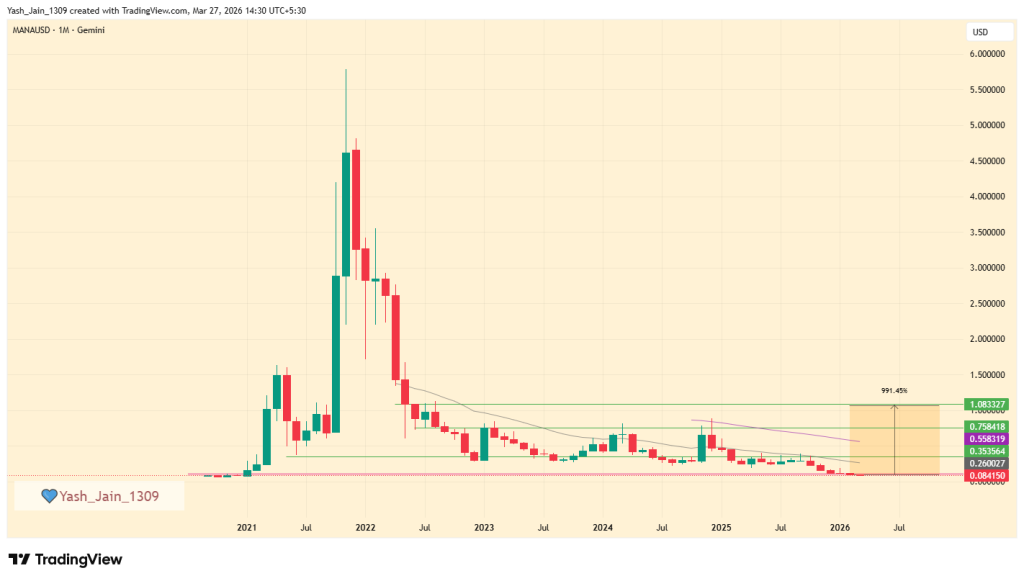
MANA crypto’s multi-year performance chart reflects a dramatic 98% decline since the FTX crash in 2022, leading many enthusiasts and investors to speculate about the project’s potential end.
This sharp price depreciation has instilled fear among investors, who have witnessed continuous negative price action for years. However, it is essential to consider the historical support level that has been in place since early 2021, which warrants attention despite the recent stagnation in price movement.
Although the project has experienced considerable setbacks over the past half-decade, there still remain arguments for a potential revival. The primary argument is the avoidance of delisting from several exchanges, indicating that MANA/USD continues to pursue efforts aimed at market recovery and still retains decent liquidity in a project with an over $250 million market cap.
Thus, the current retest of this support level is particularly noteworthy. A reversal at this juncture could result in substantial upward momentum. Conversely, if this support range is breached, it would likely reinforce perceptions of MANA crypto as a failing venture.
That said, it is crucial to closely monitor the $0.35 level. Should MANA successfully breach this level and maintain above it with a weekly close, this would signify a significant “Change of Character” for the price dynamic. Under such circumstances, a conservative target of $1.00 for the year may be warranted.
Price Prediction
Potential Low ($)
Average Price ($)
Potential High ($)
2026
0.95
1.45
1.95
MANA On-Chain Analysis
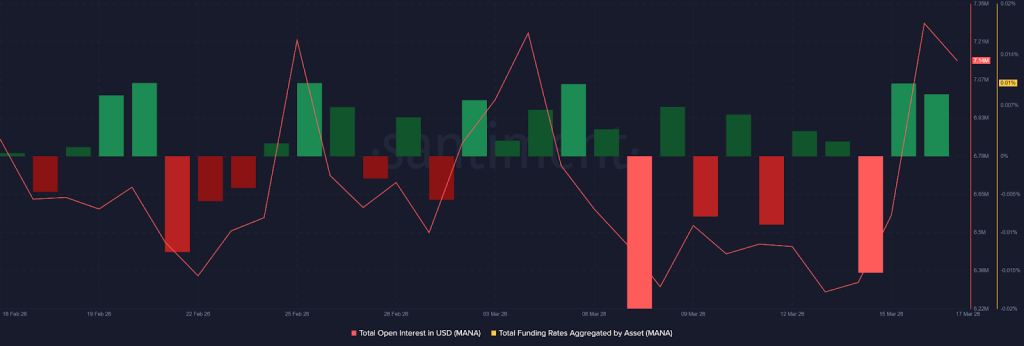
On-chain metrics for Decentraland (MANA) as of mid-March 2026, the asset is exhibiting a notable shift in market sentiment and trader behavior. Over the past 30 days, Open Interest (OI) has trended upward, peaking recently near the $7.14 million mark.
This climb in OI, coupled with funding rates that are stabilizing or turning positive (reaching approximately 0.01%), suggests that new capital is entering the market and traders are increasingly willing to pay a premium to hold long positions.
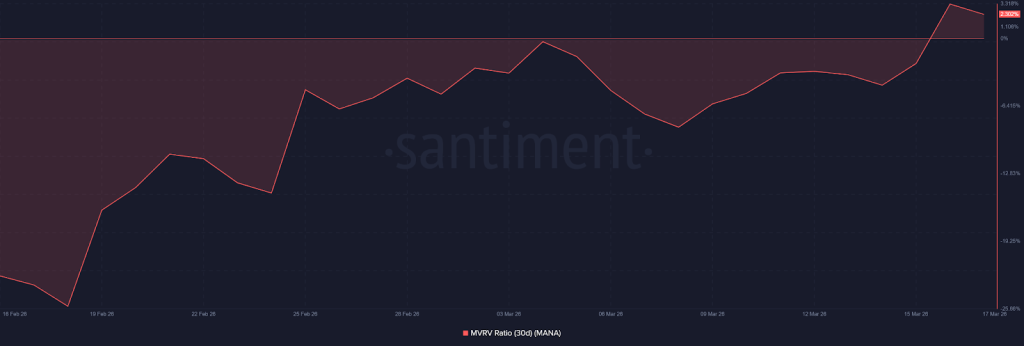
The profitability profile of short-term holders has also undergone a significant transformation. The 30-day MVRV Ratio has flipped above the zero line, currently sitting at approximately 2.39%. This transition into positive territory indicates that the average address that acquired MANA within the last month is now seeing “green” on their investment.
While this signals a return of bullish momentum, it also suggests that the asset has moved out of the “opportunity zone” and into a phase where some traders might begin to consider taking profits.
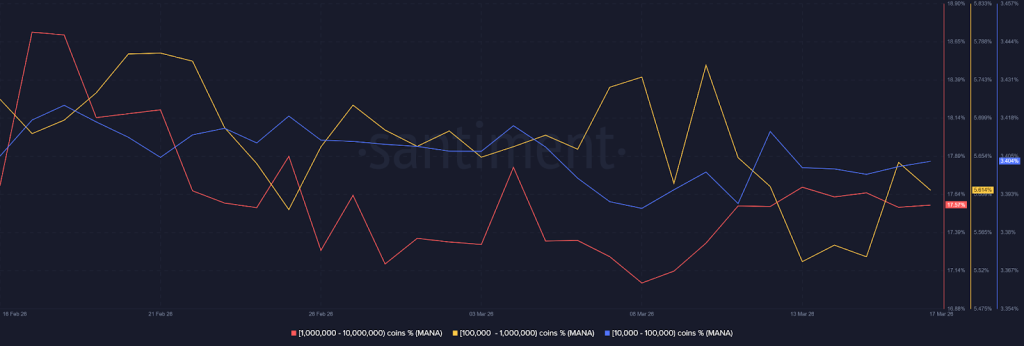
Furthermore, the supply distribution data reinforces this narrative of accumulation by larger stakeholders. Throughout March, addresses holding between 10,000 and 10 million MANA have seen a synchronized rise in their percentage of the total supply.
Specifically, the mid-tier “whale” and “shark” brackets (the 100k–1M and 1M–10M cohorts) have recovered from their late-February lows, signaling that significant players are positioning themselves for further upside. This collective accumulation by influential wallet tiers often serves as a foundational support for sustained price action.
Decentraland MANA Price Prediction 2026 – 2030
Price Prediction Years
Potential Low ($)
Average Price ($)
Potential High ($)
Decentraland (MANA) Price Forecast 2026
0.95
1.45
1.95
MANA Token Price Forecast 2027
1.55
2.15
2.85
Decentraland Price Analysis 2028
2.45
3.05
3.65
Decentraland Price Prediction 2029
3.55
3.95
4.35
MANA Price Prediction 2030
4.15
4.65
5.15
Decentraland (MANA) Price Forecast 2026
According to forecast prices and technical analysis, Decentraland’s price is projected to reach a minimum of $0.95 in 2026. The maximum price could hit $1.95, with an average trading price of around $1.45.
MANA Token Price Forecast 2027
Looking forward to 2027, MANA’s price is expected to reach a low of $1.55, with a high of $2.85 and an average forecast price of $2.15.
Decentraland Price Analysis 2028
In 2028, the price of a single Decentraland is anticipated to reach a minimum of $2.45, with a maximum of $3.65 and an average price of $3.05.
Decentraland Price Prediction 2029
By 2029, Decentraland’s price is predicted to reach a minimum of $3.55, with the potential to hit a maximum of $4.35 and an average of $3.95.
Decentraland (MANA) Price Prediction 2029
In 2030, the MANA coin price is predicted to touch its lowest price at $4.15, hitting a high of $5.15 and an average price of $4.65.
What Does The Market Say?
Year
2026
2027
2030
CoinCodex
$0.26
$0.39
$0.67
Tokenmetrics
$0.78
$1.41
$2.11
DigitalCoinPrice
$0.33
$0.61
$3.32
Never Miss a Beat in the Crypto World!
Stay ahead with breaking news, expert analysis, and real-time updates on the latest trends in Bitcoin, altcoins, DeFi, NFTs, and more.
FAQs
What is Decentraland (MANA) and how does it work?
Decentraland is a virtual world on Ethereum where users buy land, create experiences, and trade using the MANA token.
What is the predicted price of MANA in 2026?
MANA could trade between $0.247 and $0.40 in 2026, with potential upside if it maintains key support and adoption grows.
What is Decentraland’s price prediction for 2030?
By 2030, MANA could reach a high of $4.92, a low of $4.15, and an average price of $4.65, reflecting adoption and growing metaverse use.
How high could MANA price go in 2040?
Over the long term, MANA may see substantial growth if adoption and virtual land demand expand, potentially reaching a high of $12–$15 by 2040.
What drives the price of MANA?
MANA’s price is influenced by virtual land demand, user growth, creator tools, and on-chain activity in Decentraland.
Can Decentraland compete with other metaverse projects?
Yes, if Decentraland expands events, gaming, and creator tools, it could attract more users and remain a top metaverse platform.
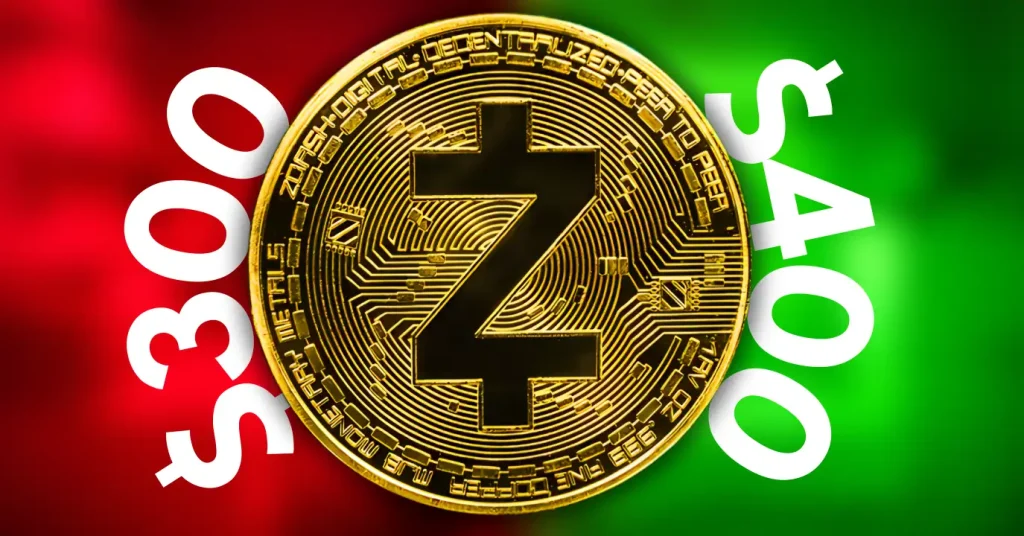
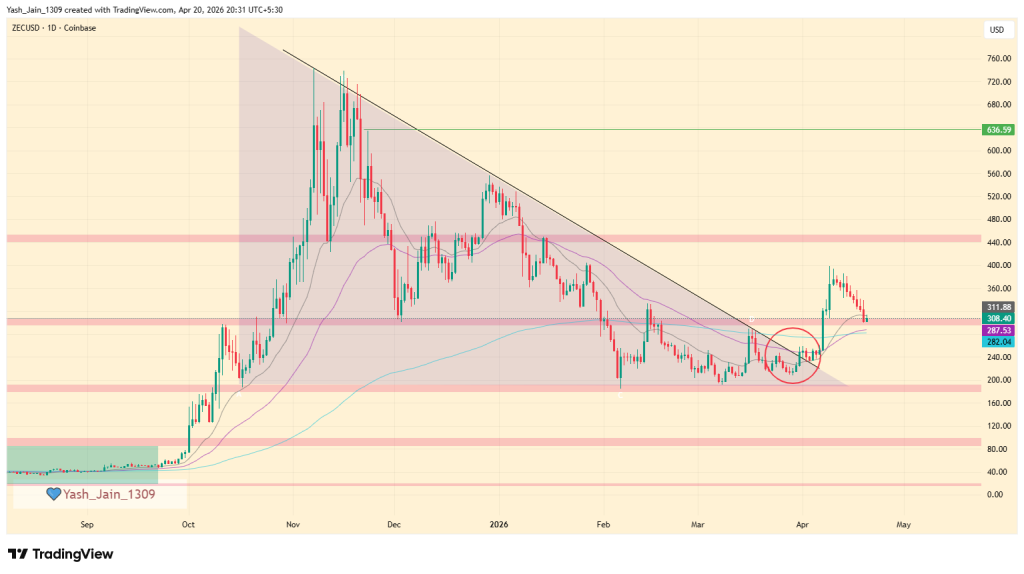
ZEC price isn’t quietly trending but it’s stepping into a full-blown liquidity war. After months of suffocating under a descending triangle, ZEC price finally snapped the structure in early April, and yeah, it didn’t tiptoe either. The breakout shoved price action toward $400, effectively flipping the script on a long-term bearish trend that had been in control since late 2025.
But don’t get too comfortable on this rally. This isn’t a clean rally it’s messy, crowded, and very clearly dominated by whales.
ZEC Breakout Ends Months of Downtrend Pressure
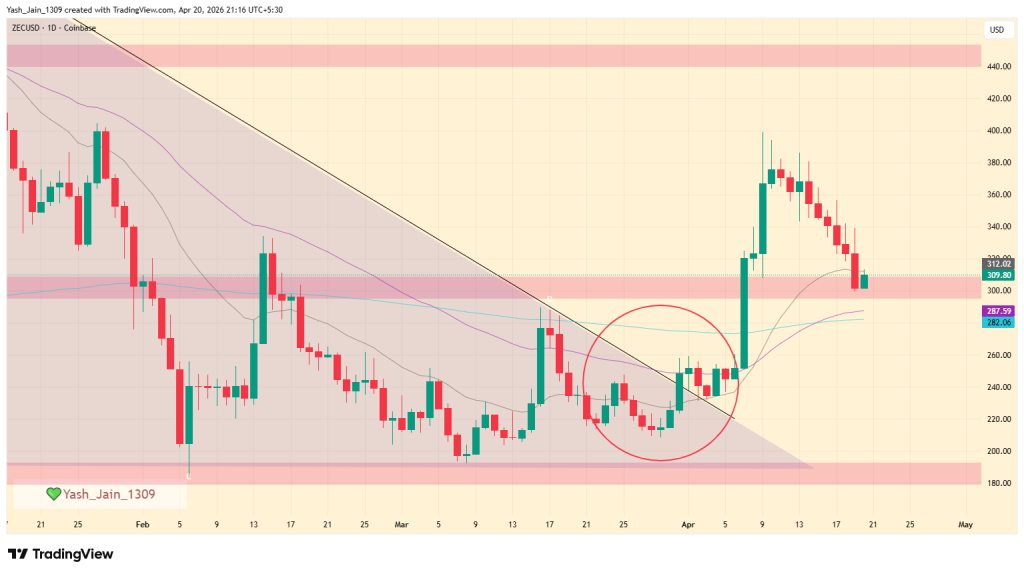
The daily chart tells a straightforward story at first glance: a decisive breakout from a descending triangle, followed by a strong push higher. That move alone was enough to neutralize months of downward pressure. Easy narrative, right?
Well, price didn’t just keep running. It stalled. Instead of continuation, ZEC/USD slipped into a choppy range between $300 and $400. That’s not random. That’s where the real players showed up.
Whale Clusters Define Critical Support and Resistance
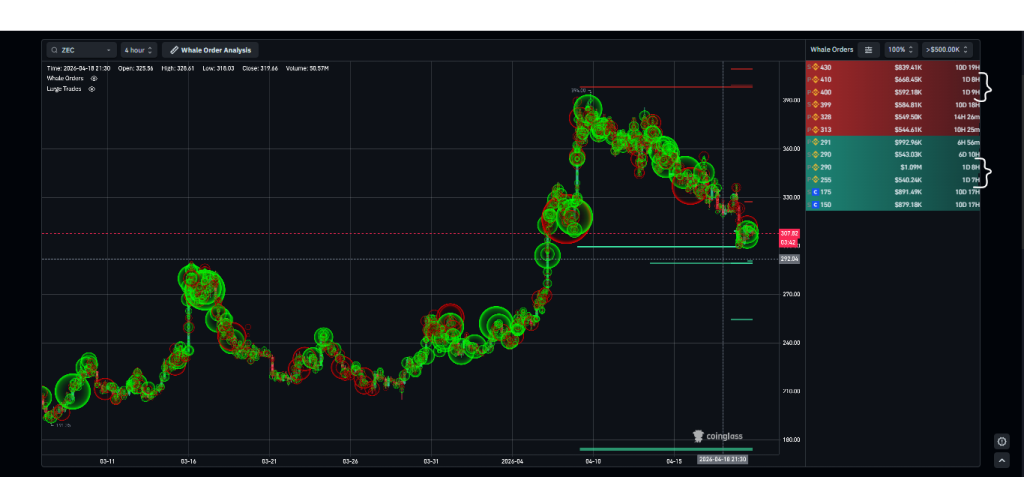
Zoom into the data, and things get interesting fast. Around the $300 level, there’s a heavy concentration of large buy orders with massive green clusters showing consistent whale accumulation. These aren’t casual trades. They’re deliberate, repeated entries, signaling that big players see $300 as a key re-entry zone.
In other words, it’s not just support it’s defended territory, at least it looks intact for now.
Now flip the script. Up near $400, the tone changes completely. Red clusters dominate, showing aggressive sell-side activity. Add to that the presence of large, persistent sell orders sitting at $410 and $430 for over ten days, and it’s clear: whales aren’t just taking profits they’re building a wall.
Order Book Reveals Where Next Volatility Hits
And then there’s the deeper layer the order book. Multiple pending orders exceeding $500,000 are scattered across key levels, with notable buy interest sitting around $290 and even as low as $175. These aren’t decorative numbers; they’re potential magnets for price.
So, what does that mean? If ZEC price dips and fills those $290 buy orders while open interest climbs, it likely signals fresh long positioning. That’s fuel. Real fuel. The kind that could drive a second leg higher, possibly toward the $636 macro target marked on the chart.
But let’s be real none of that matters if $300 support zone breaks cleanly.
ZEC Price Hinges on Whale Commitment at $300
Right now, Zcash price is hovering just above short-term moving averages, sitting dangerously close to that $300 cluster. This is where conviction gets tested. If the buy-side pressure holds and absorbs the sell orders stacked above, the structure leans bullish.
If not? Those lower liquidity pockets start looking very attractive. So, what’s next? Watch the whales. Not the headlines, not the hype but the actual orders. Because in this ZEC price setup, they’re not just participating in the market… they’re controlling it.
CHZ price just woke up with a sharp 10% intraday spike has pushed the token back into trader conversations, and this time, it’s not just technical noise. There’s a narrative building, and like always in crypto, that’s half the battle. The trigger? A clear push toward the U.S. sports market.
U.S. Expansion Narrative Fuels CHZ Price Momentum
Chiliz isn’t playing small anymore. After generating over $700 million for the sports industry through Fan Tokens, the project is now setting its sights on the United States. That’s not a casual move because it’s kind of a statement.
We have generated over $700M+ for the sports industry through Fan Tokens.
70+ top-tier clubs including FC Barcelona, Arsenal, Manchester City, PSG, Atlético Madrid, AC Milan, and Juventus have already launched their Fan Tokens.
— Chiliz – The Sports Blockchain (@Chiliz) April 19, 2026
And they’ve got the resume to back it. More than 70 top-tier clubs as they say including giants like FC Barcelona, Arsenal, Manchester City, PSG, Atlético Madrid, AC Milan, and Juventus have already launched Fan Tokens. That’s a serious footprint in global sports.
Now the pitch is simple: replicate that success in the U.S. Naturally if succeeds, CHZ prices will react. Fast.
SportFi Vision Expands Beyond Basic Fan Tokens
But here’s where things get interesting. Chiliz isn’t just selling tokens anymore they’re framing an entire category. “SportFi.”
According to the latest post, the chain isn’t trying to be a general-purpose network. It’s positioning itself as the global settlement layer for sports-based finance. Fan Tokens? Just the entry point.
We didn’t build a general-purpose chain. We built the global settlement layer for SportFi.
And Fan Tokens are the entry point to SportFi.
Next up: Fan Token Play. A new layer where on-pitch results meet tokenomics.@bitget breaks it down https://t.co/9m6JmpHaqD
— Chiliz – The Sports Blockchain (@Chiliz) April 20, 2026
And then comes the next layer: Fan Token Play. That’s where things shift from passive holding to active engagement where on-pitch results directly tie into tokenomics. It’s a bold concept, blending real-world sports outcomes with blockchain incentives. Whether it sticks… well, that’s another story.
Technical Indicators Align With Uptrend Structure
Now let’s talk charts, because hype alone doesn’t move markets but structure does.
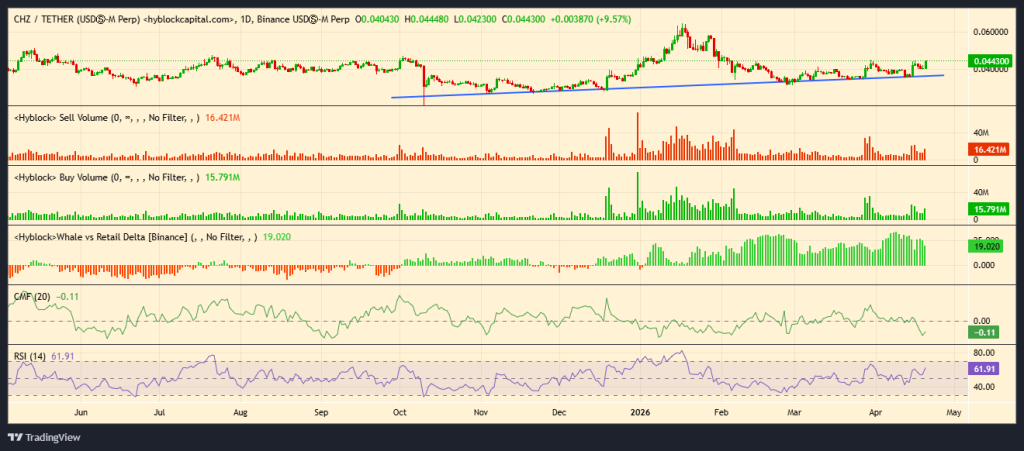
CHZ price is currently climbing along an upward trendline, and so far, it’s respecting it. That’s a good sign for bulls, at least in the short term.
Volume data shows a fairly balanced fight: around 16.42 million in sell volume versus 15.79 million in buy volume. Not a runaway rally but not weak either.
Meanwhile, the Whale vs Retail Delta is sitting positive at 19.020, suggesting larger players are leaning slightly bullish. That’s usually where momentum starts to build.
Indicators aren’t asleep either. CMF is hovering around -0.11 still slightly negative, but not collapsing. RSI sits near 61.9, which puts CHZ in a “healthy but not overheated” zone. There’s room to run… if buyers stay interested.
CHZ Price Riding Narrative But Needs Follow-Through
So, this move is being driven by narrative and momentum working together. That’s powerful… but also fragile.
If the U.S. expansion story gains traction and SportFi actually delivers something tangible, CHZ price could keep grinding higher along that trendline.
But let’s be real if momentum fades, this could just as easily stall out. For now, CHZ price is moving up, backed by both headlines and technical structure.

 Login
Login


 0.95%
0.95%
 -0.96%



 are the entry point to SportFi.