Reading view

Crypto CLARITY Act Faces Major Setback as Senate Pushes Decision to May
Clarity Act Timeline Update Hill Signals Senate Progress, Downplays Political Risk

The post Crypto CLARITY Act Faces Major Setback as Senate Pushes Decision to May appeared first on Coinpedia Fintech News

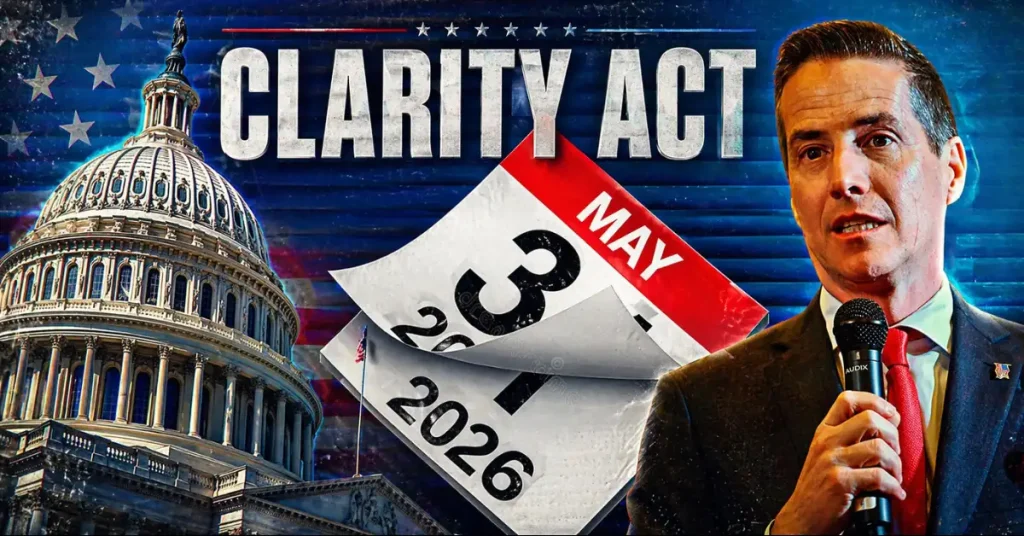
Momentum around the U.S. CLARITY Act markup has slowed further after the Senate Banking Committee failed to signal any markup schedule before the end of the week, pushing expectations into May and raising doubts over the bill’s near-term progress.

Eleanor Terrett reported that no update came from Senator Tim Scott or Senate Banking Committee Republicans regarding a markup for next week. Friday was viewed as the informal cutoff to announce proceedings before the Senate enters recess, and the absence of any notice has effectively removed the April window.

April Window Closes as Senate Schedule Tightens

While hearings can technically be scheduled on short notice, the lack of formal communication makes an April markup increasingly unlikely. The Senate is set to enter a weeklong recess on Thursday, further narrowing the remaining timeframe.

Attention is now shifting toward early May, with multiple industry and Senate sources indicating the markup is more likely in the second week of the month.

Competing Priorities Inside the Senate

Committee leadership may also be focused on a confirmation vote for Federal Reserve Chair nominee Kevin Warsh before turning to crypto legislation. This adds another layer of delay to an already compressed schedule.

Senator Thom Tillis has requested additional time to engage with banking groups on the stablecoin yield issue and has pushed for draft text to be released publicly ahead of markup. However, no draft has been circulated, making a near-term schedule unlikely.

Industry Warning Signs and Growing Concern

The delay has triggered concern across parts of the crypto policy community. Analysts, including commentator Nic, noted that a key deadline passed without movement, suggesting weakening momentum for immediate progress.

With the Senate calendar tightening ahead of the Memorial Day recess, there are concerns that further delays could push the bill deeper into uncertainty or reduce its chances of advancing this year.

Lobbying Pressure Intensifies

Industry groups continue to push for action. The North Carolina Blockchain Initiative recently urged Senator Tillis to move the bill forward, arguing that opposition from banking groups over stablecoin yield does not reflect broader sentiment across the industry or state-level policymakers.

The group warned that restricting yield-bearing stablecoin products could drive innovation offshore, while framing the CLARITY Act as important for maintaining U.S. competitiveness in digital assets, especially in financial hubs like Charlotte.

Outlook Shifts to Mid-May

With no formal markup notice and limited legislative time remaining in April, expectations now center on a second week of May timeline. The delay leaves the CLARITY Act’s path forward increasingly dependent on Senate coordination and resolution of stablecoin-related disagreements.


Telegram Founder Pavel Durov Warns Crypto Data Leaks Are Fueling Kidnappings in France

Toncoin-Plunges-20-After-Telegram-CEOs-Arrest-4-Hour-Network-Transaction-Halt

The post Telegram Founder Pavel Durov Warns Crypto Data Leaks Are Fueling Kidnappings in France appeared first on Coinpedia Fintech News

Telegram founder Pavel Durov has raised alarm over a sharp rise in crypto-related kidnappings in France, linking the trend to alleged leaks of tax and investor data. He argues that increasing exposure of personal financial information is making crypto holders easier targets for organized crime groups operating across the country.

“More data = more victims,” Durov said in an X post, pointing to what he described as massive tax database leaks and misuse of sensitive crypto investor records.

Rising Crypto Kidnappings in France

Durov said France has already recorded around 41 kidnappings involving crypto holders in the first months of 2026. He noted that the pattern shows a direct link between leaked personal data and physical attacks, where criminals use exposed information to identify and track wealthy crypto owners.

Reports suggest the situation has escalated into a recurring security issue, with France now seeing roughly one crypto-linked kidnapping every 2.5 days. What once appeared as isolated incidents has turned into a consistent pattern of violent crime across multiple regions.

Reported Crypto Kidnapping Cases

• Jan 2025: Ledger co-founder kidnapped in France in a ransom case

• May 2025: crypto CEO’s daughter targeted in a daylight kidnap attempt in Paris

• May 2025: crypto investor’s relative abducted, ransom demanded in crypto

• 2026: multiple “wrench attacks” forcing victims to transfer funds

Alleged Tax Data Leak Case

Durov highlighted the case of former French tax official Ghalia C., detained in 2025 for allegedly selling crypto investor data to criminal groups. The information was reportedly used in extortion schemes and kidnapping operations targeting investors.

He said once criminals access details such as names, addresses, and financial links, identifying high-value crypto holders becomes significantly easier, increasing physical risk.

High-Profile Incidents

Several cases have intensified concern in the crypto community. In 2025, Ledger co-founder David Balland and his wife were kidnapped and subjected to severe violence during a ransom attempt.

In another incident, a crypto entrepreneur’s family in Burgundy was abducted, with attackers demanding a 400,000 euro ransom. A separate home invasion in Ploudalmézeau saw multiple family members held hostage for hours, highlighting the growing threat.

Law Enforcement and Privacy Debate

French authorities have confirmed ongoing investigations and arrests in several cases involving organized groups, including cross-border networks. Officials say investor protection is now a growing priority.

Durov, however, criticized expanding government access to personal data, saying it increases risks rather than reducing them. He added that Telegram would leave the French market rather than allow access to private messages, framing it as a conflict between privacy and state surveillance.

Charles Hoskinson Says CLARITY Act Is Key to Crypto Growth

Cardano Founder Loses $3B in Crypto Crash

The post Charles Hoskinson Says CLARITY Act Is Key to Crypto Growth appeared first on Coinpedia Fintech News

The cryptocurrency industry is once again facing questions about one of its core promises: decentralization.

Charles Hoskinson recently revisited a widely discussed essay by Moxie Marlinspike, renewing debate over whether Web3 systems are as independent from centralized control as the industry claims.

Hoskinson argued that while blockchain networks themselves may be decentralized, most users still depend on a small number of companies and platforms to access them.

“People don’t want to run their own servers… and they never will,” Marlinspike wrote, challenging one of the foundational assumptions behind Web3.

Centralized Services Still Power Much of Web3

Although blockchain networks operate without a central authority, many users access them through companies such as Infura and Alchemy, which provide infrastructure and data services.

Marlinspike argued that users often trust these intermediaries rather than independently verifying blockchain data.

“So much work has gone into trustless systems… but clients just trust these companies.”

The criticism highlights a gap between the decentralized design of blockchain networks and the centralized services that support day-to-day use.

NFT Ownership Faces Questions

Marlinspike’s essay also raised concerns about how non-fungible tokens, or NFTs, function in practice.

Many NFTs do not store images or media directly on a blockchain. Instead, they link to content hosted on external servers, meaning the material can potentially be changed or removed.

In one experiment, Marlinspike created an NFT that displayed different content depending on where it was viewed. When the item was removed from an online marketplace, it also disappeared from digital wallets.

“What you bid on isn’t what you get,” he said.

The example raised broader questions about ownership when access to digital assets depends on centralized platforms.

Slow Blockchain Systems Compared With Platforms

Marlinspike also argued that decentralized systems tend to evolve more slowly than centralized technology platforms.

He compared older internet systems such as email with modern apps that rapidly add features and update services.

“Protocols move much more slowly than platforms.”

According to Marlinspike, much of the innovation in Web3 is happening through off-chain services rather than on the blockchain itself.

Hoskinson Says Infrastructure and Regulation Are Key

Hoskinson agreed with many of the criticisms and said the industry failed to fully decentralize the infrastructure surrounding blockchain networks.

“We said users would run everything… but we didn’t finish the job,” he said.

He argued that stronger infrastructure and clearer regulation are needed for the sector to grow beyond its current limitations.

Hoskinson also raised concerns about government-linked cryptocurrency projects and political involvement in digital assets, saying the lack of clear rules has delayed broader adoption.

He pointed to proposed U.S. legislation such as the CLARITY Act as an important step toward defining how the industry should operate.

According to Hoskinson, uncertainty around regulation continues to limit institutional investment and slows infrastructure development.

He said clearer rules could encourage larger inflows of institutional capital, improve investment in crypto infrastructure and support a more stable market structure.

Crypto Taxes Are Next After CLARITY Act, Says Patrick Wilson 

Actor Patrick Wilson speaking into a microphone next to a 'Clarity Act' scroll, wooden blocks spelling 'TAXES', and Bitcoin coins in front of the US Capitol Building.

The post Crypto Taxes Are Next After CLARITY Act, Says Patrick Wilson  appeared first on Coinpedia Fintech News

Momentum is building in Washington for the proposed CLARITY Act, a bipartisan crypto regulation bill that lawmakers say could bring long-awaited legal certainty to the U.S. digital asset industry. But even as Congress moves closer to defining crypto oversight, industry experts warn that complicated crypto tax rules remain one of the biggest obstacles to mainstream adoption.

Senator Bernie Moreno said he expects the legislation to be “done by the end of May,” cautioning that failure to act now could stall U.S. crypto legislation for years. Senator Cynthia Lummis echoed the urgency, saying, 

“We have bipartisan support… this is our moment.”

Crypto Taxes, IRS Rules, and DeFi Compliance Emerging as Next Major Challenge

Even with clearer regulation on the horizon, Patrick Wilson, General Counsel at the Solana Policy Institute, said crypto taxation remains a major friction point for users and businesses.

“Tax and the complexities around crypto… [are] a real gating issue to folks adopting crypto at a larger scale,” Wilson said.

He noted that the current U.S. tax framework treats cryptocurrency as property, meaning even routine transactions can create taxable events. According to Wilson, that approach makes everyday crypto use unnecessarily difficult.

“The number of taxable events… from something simple is so complex… it just becomes an administrability nightmare,” he said.

Industry participants have long argued that the current system discourages practical use cases such as payments, decentralized finance (DeFi), and microtransactions because users must track gains and losses for nearly every transfer.

De Minimis Crypto Tax Exemption Gains Attention

Wilson pointed to a growing push for a de minimis tax exemption, which would remove tax reporting requirements for small crypto transactions.

“Small transactions shouldn’t turn into a big headache come tax time,” he said, adding that similar exemptions already exist in traditional finance systems.

He also suggested regulators could ease some of the burden without waiting for Congress to pass new laws.

“With the stroke of a pen… [regulators] could really ease the burden for everyday Americans,” Wilson said, referring to possible adjustments to existing IRS guidance.

DeFi and Cross-Border Crypto Transactions Complicate Global Tax Policy

As decentralized finance and international crypto usage expand, policymakers face increasing pressure to modernize tax frameworks that were designed before blockchain technology became mainstream.

Wilson said future crypto tax policy must better reflect how decentralized networks operate globally.

“Whatever tax rules are in place need to match the capability of the technology,” he said.

He also emphasized the need for fair tax sourcing rules so users are taxed based on where they reside, rather than where blockchain infrastructure or protocols operate.

Crypto Industry Says Regulatory Clarity Alone Is Not Enough

The CLARITY Act is widely viewed by the crypto industry as a major step toward establishing clearer oversight between U.S. regulators and encouraging investment in digital assets. However, Wilson said regulation alone will not drive mass adoption unless tax compliance becomes easier for ordinary users.

“If we are going to realize the full potential… people need to be comfortable using it,” he said.

XRP ETF Inflows Hit $75M in April Amid Massive Whale Activity

xrp-etf-inflows-75m-whale-activity-bullish.webp

The post XRP ETF Inflows Hit $75M in April Amid Massive Whale Activity appeared first on Coinpedia Fintech News

XRP price is starting to show signs of a deeper shift, even if price action hasn’t caught up yet. Over the past few days, a mix of on-chain outflows, ETF accumulation, and whale activity has created a setup that analysts say the market isn’t fully pricing in.

According to Santiment, the XRP Ledger recorded 34.94 million XRP in exchange outflows, marking the 6th largest 24-hour outflow of the year. These large outflow events have historically been followed by bullish price action, as tokens leaving exchanges typically reduce immediate selling pressure.

This isn’t just retail movement either. Whale activity is dominating the flow. Large holders accounted for 94.4% of recent Binance outflows, showing that most of the movement is coming from big players. At the same time, whale transfers back to Binance rebounded to around 3,000 transactions on April 23–24, after dropping close to zero earlier, suggesting active repositioning rather than clear distribution.

XRP ETF Flows Are Telling a Different Story

While attention remains on Bitcoin and Ethereum, XRP’s institutional story is quietly strengthening. Data from SoSoValue shows that U.S. spot XRP ETFs now hold $1.08 billion, or 1.23% of the total supply.

In just one day, ETFs saw $3.89 million in inflows, driven primarily by the Franklin Templeton XRP ETF (XRPZ). But the bigger picture matters more; over $75 million has flowed into XRP ETFs in April, with no meaningful outflows since April 9, aside from a minor $661K dip.

As one market observer noted, “XRP ETFs quietly pulling in $75M in April while everyone watched BTC and ETH… that disconnect doesn’t usually last long.” The steady inflows with minimal noise suggest long-term positioning rather than short-term speculation.

Adding to this trend, Tuttle Capital has filed for an XRP Income Blast ETF, showing continued expansion in institutional exposure.

Ripple XRP Price Holds While Pressure Builds

Despite these strong underlying signals, XRP’s price remains range-bound. It recently tested resistance before pulling back to around $1.43, holding above the key $1.40 support level.

Staying above this range keeps the path open for a move toward $1.50–$1.51, with further upside targets at $1.54 and $1.60 if momentum builds. On the downside, a break below $1.38 could push XRP toward $1.35 or even $1.30.

XRP Price Prediction 2026: Bitwise Says New All-Time Highs Possible in Next 12 to 18 Months

XRP Price

The post XRP Price Prediction 2026: Bitwise Says New All-Time Highs Possible in Next 12 to 18 Months appeared first on Coinpedia Fintech News

In a recent conversation with Paul Barron, Bitwise strategist Juan Leon has opened up about how institutions are no longer just testing crypto with tiny allocations; they’re starting to rethink it as a core part of portfolios.

Leon makes it clear that XRP’s recent stability doesn’t mean the opportunity is gone; it actually signals a shift toward a more mature phase. Earlier volatility, he explains, was largely tied to uncertainty.

“A lot of the volatility… was driven by the uncertainty of the regulatory and legal status,” Leon says. With that now mostly resolved, price action has cooled, but the bigger picture remains bullish. “There’s still definitely a lot of growth ahead for the digital asset ecosystem.”

Global Push Is Where the Real Story Lies

Instead of hype, XRP’s future now depends on execution. Leon highlights how the network is expanding globally—partnering with SBI in Japan, rolling out RLUSD in Singapore, and exploring African markets. “Every quarter… they’re looking to expand… with banks and payment providers,” he said.

He also points out that rising stablecoin market cap, growing transaction volumes, and increasing partnerships will fuel momentum.

“As we see more partnerships and more of those revenues start flowing… all of that should drive the price.”

Strong Tech + Regulation = Investor Confidence

A big reason for growing institutional interest is the strength of the XRP Ledger. Leon highlights its efficiency, with sub-5-second settlement and transactions that are over 60% cheaper than traditional systems like SWIFT.

“It’s a very efficient settlement ledger,” he says.

On top of that, RLUSD adds a regulated layer to the ecosystem. It’s backed by short-term treasuries, held with custodians like BNY Mellon, and supported by independent attestations. It’s also expanding across Ethereum and Layer 2 networks like Optimism and Base.

He further added that “There’s a lot of conviction from investors around it.”

AUM Growth and Market Outlook

Leon points out that digital asset ETFs currently hold around $160 billion in AUM, with Bitcoin dominating at $120 billion, Ethereum at $18 billion, and XRP at roughly $2.5 billion, leaving significant room to grow.

He says future upside depends on catalysts like the Clarity Act and improving macro conditions. With Bitcoin previously hitting $125K and now below $80K, a recovery could reignite the market.

“If we resume the bull run… we could go to new all-time highs over the next 12 to 18 months,” he concluded.

Clarity Act News: Why Crypto’s Most Important Bill Is Stalling at 50/50 Odds Despite Presidential Backing

CLARITY Act May Pass by the End of May, Says Senator Moreno

The post Clarity Act News: Why Crypto’s Most Important Bill Is Stalling at 50/50 Odds Despite Presidential Backing appeared first on Coinpedia Fintech News

The Clarity Act is running late again. What lawmakers described just weeks ago as nearly done has now slipped into May, and the crypto industry is no longer staying quiet about it.

Analyst Dan Gambardello said this week that the delay has taken over conversations across the industry, with pressure mounting directly on Senate Banking Republicans to bring the bill to markup without further stalling.

Industry Push Reaches Critical Mass

More than 100+ major players, including Coinbase, Ripple, Kraken, Circle, and Chainlink Labs, have signed a joint letter urging immediate action. Gambardello stressed that this is not just routine lobbying but a coordinated industry-wide effort after years of bipartisan groundwork.

For many, the bill represents a long-awaited framework to bring clarity around regulation, jurisdiction, and market structure. Yet despite being at the final stage, it continues to face delays.

The Clarity Act Delay Pattern Continues

Gambardello walked through how the timeline has kept slipping. Back in late 2025, expectations were set for completion by year-end. Moving into 2026, optimism grew with projections of an 80–90% chance of passage by April.

That didn’t happen.

Through March and early April, updates kept pointing to a deal being “very close,” but now the bill is likely moving into May. Gambardello stressed how quickly sentiment shifts, where even strong probabilities can break down as new developments emerge.

What’s Holding It Back

The latest delay is largely tied to ongoing disagreements between banks and crypto firms, particularly around stablecoin yield rules. Senator Tom Tillis has pushed for more time to resolve these issues.

Gambardello, however, objected to further delays, arguing that the U.S. risks falling behind if action is not taken soon. He called on leadership, including Senator Tim Scott, to move the process forward.

Latest Update 

The latest update on the Clarity Act shows mixed signals, as the bill’s possibilities are shifted towards next month. Senator Bernie Moreno, as reported by Eleanor Terrett, said he expects the bill to be “done by the end of May,” suggesting confidence from within the Senate despite ongoing delays.

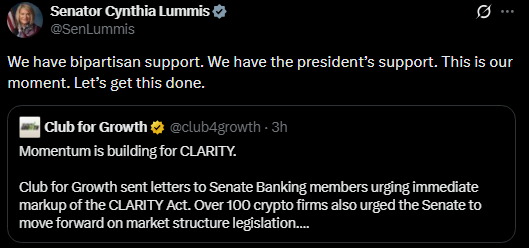
While Senator Cynthia Lummis said that, “We have bipartisan support. We have the president’s support. This is our moment. let’s get this done.” 

Lummis statement

So in short, if they’ve finally reached bipartisan approval, this could be the biggest thing to happen to Crypto – ever.

Bitcoin News: Strategy CEO Maps 30% Yield Model, Calls it Future of Digital Credit

Bitcoin News Strategy CEO Maps 30% Yield Model, Calls it Future of Digital Credit

The post Bitcoin News: Strategy CEO Maps 30% Yield Model, Calls it Future of Digital Credit appeared first on Coinpedia Fintech News

MicroStrategy is pushing a new narrative around Bitcoin, with CEO Phong Le detailing how the firm is building a yield-driven system around BTC.

Le described the approach as a “digital credit ecosystem,” where capital is deployed into Bitcoin-linked strategies with target returns as high as 30%, and a portion of that yield is passed back to investors holding preferred shares like STRC.

Step-by-Step: How the Model Works

Le broke the structure down clearly, drawing direct comparisons to traditional finance:

Step 1: Capital Base Is Built

The company first raises capital from investors, similar to how banks collect deposits. These investors become the “capital holders” in the system.

Step 2: Capital Is Deployed Into Bitcoin

Instead of issuing mortgages or car loans, Strategy allocates that capital into Bitcoin-related opportunities, targeting high-yield exposure (hypothetically ~30% ARR).

Step 3: Yield Is Generated From Deployment

The return comes from how that capital interacts with the Bitcoin ecosystem. While exact mechanisms aren’t fully detailed, the key idea is that Bitcoin becomes the base layer where returns are generated.

Step 4: A Portion Is Paid Back to Holders

Just like banks share interest with depositors, Strategy distributes part of the yield back to investors. Le referenced returns in the range of 7.5% to 11.5% going back to preferred shareholders.

The Traditional Finance Comparison

Le directly compared this to banking models, where institutions issue loans at 5% to 30% returns, depending on risk, and pass a share of that yield to depositors.

The difference is that Strategy is not lending to consumers or businesses. Instead, it is allocating capital into Bitcoin as the core layer of yield generation.

“Banks earn 5-30% yields on loans, then share a portion with depositors. That is how the digital credit ecosystem works,” he said.

What This Means

Phong Le is arguing that MicroStrategy isn’t a bank, but it’s using a similar playbook—taking capital, deploying it into Bitcoin to generate returns, and then sharing a portion of that yield back with investors. That’s what he calls “digital credit.”

“So that entire ecosystem of a bank, and we’re not a bank, right? But the ecosystem of a bank providing loans out, getting your percentage, and providing part of that back to a capital holder, that’s what digital credit is,” he added.

If this scales, Bitcoin shifts from just being held for gains to becoming part of a system where money flows in, earns yield, and pays out, like a credit market built on BTC. 

It’s still early, but it gives enough room for investors to think that in the near term, Bitcoin could be positioned as the base layer for a new digital credit system.

TON Blockchain News: Durov Confirms 6x Fee Cut With Completely Feeless Transactions Next

TON Blockchain News Durov Confirms 6x Fee Cut With Completely Feeless Transactions Next

The post TON Blockchain News: Durov Confirms 6x Fee Cut With Completely Feeless Transactions Next appeared first on Coinpedia Fintech News

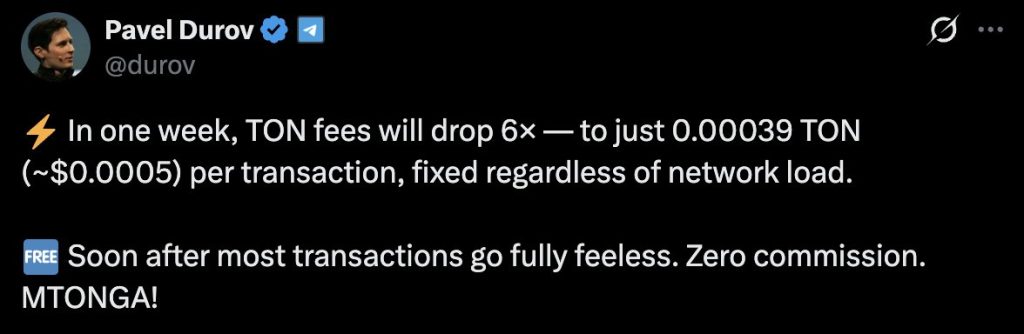
Toncoin is about to undergo a big shift in its cost structure. According to Pavel Durov, transaction fees on the network will drop 6x within a week, bringing costs down to just 0.00039 TON (~$0.0005) per transaction, fixed, regardless of network load.

This isn’t just a fee cut. It’s part of a broader push under the MTONGA roadmap, where Durov also confirmed that most transactions could become completely feeless soon after. The move follows the recent Catchain 2.0 upgrade, which already made the TON Blockchain 10x faster with sub-second finality.

“Soon after most transactions go fully feeless. Zero commission. MTONGA!”

How the Fee Model Is Changing

TON’s previous fee sat around 0.00234 TON (~$0.003), meaning this update reduces costs significantly while removing congestion-based variability entirely.

Ton Gas Fee

Compared to other networks, the difference is big. Ethereum still sees $1–$10+ fees during peak usage, while Bitcoin ranges between $0.50–$5. Even Solana, known for low fees, can spike under load.

At $0.0005 flat fees and potentially zero soon, TON is pushing toward a new baseline for blockchain economics, where micro-transactions become practical at scale.

Why This Matters for Adoption

The bigger story is distribution. TON is deeply integrated with Telegram, which has over 950 million users. Until now, the missing piece was fee efficiency at the consumer scale.

At near-zero costs, use cases like creator tipping, micro-payments, in-app purchases, and cross-border transfers become frictionless. Sending even $0.01 with zero fees is where crypto starts competing directly with platforms like Venmo or PayPal.

Price Reaction

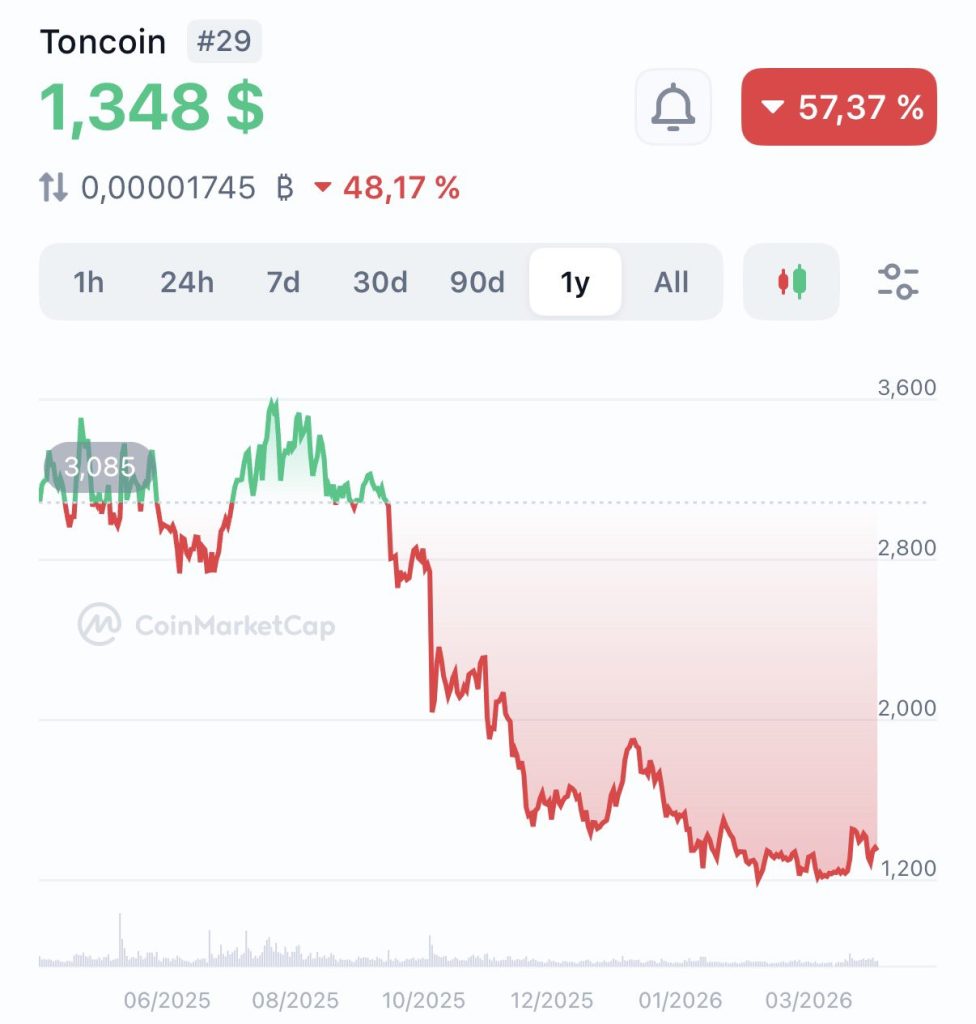
Despite the development, price action hasn’t followed yet. Analyst Ruslan Khairullin noted TON is still down 57% YTD, highlighting a weak immediate market response.

Ton Price

Others remain bullish. Another X user pointed out that TON is “executing in real time,” with faster speeds already live and zero-commission transactions next.

The roadmap still has five more steps, but timelines remain undisclosed. For now, TON isn’t just reducing fees, it’s redefining what “usable” blockchain infrastructure could look like at scale.

The Confirmed + Implied Steps

TON just got ten times faster with its Catchain 2.0 upgrade, bringing near-instant transaction finality. Fees are also being cut six times to roughly $0.0005, with stable pricing even during busy periods. 

Pavel Durov has confirmed that most transactions will go completely feeless soon. The end goal is a global payment network where anyone can send money instantly, at no cost, for anything from micro-payments to international remittances.

How Many Pi Tokens Do You Actually Need to Reach $1 Million? 

How Many Pi Tokens Do You Actually Need to Reach $1 Million

The post How Many Pi Tokens Do You Actually Need to Reach $1 Million?  appeared first on Coinpedia Fintech News

Most cryptocurrency wealth stories follow a familiar script: someone buys a small amount of an obscure token, forgets about it, and wakes up rich. Pi Network’s potential trajectory, according to one analyst’s breakdown, does not follow that script. The numbers here are more grounded, and the math is more straightforward than most in the space would like to admit.

An expert who has been tracking Pi Network’s ecosystem development has put together a projection that strips away the hype and focuses on a simple question: at realistic price points, how many Pi tokens would an investor need to reach $1 million?

How the Millionaire Math Works

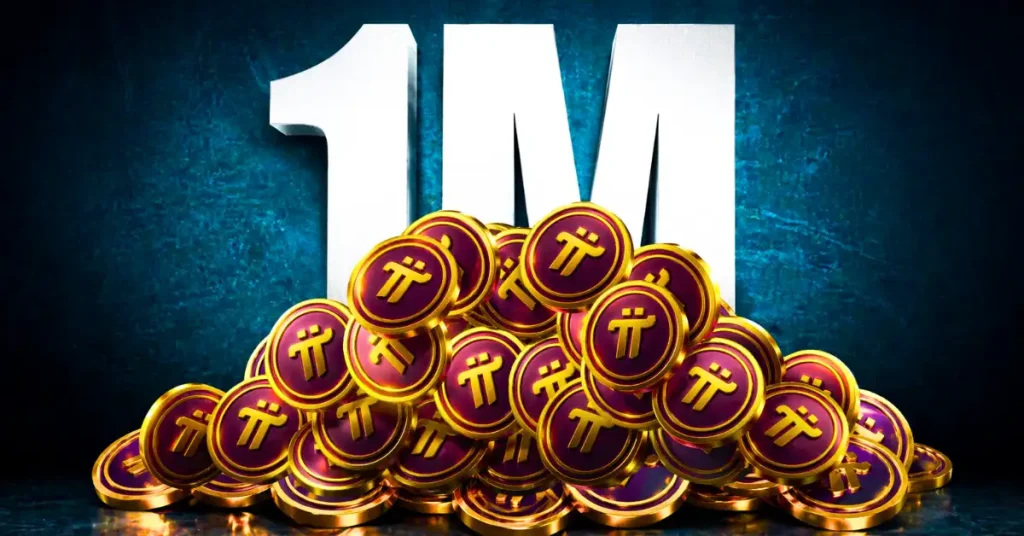
The model is built on realistic price scenarios rather than hype-driven assumptions. If Pi reaches a $10 billion market cap, the price could hit $1, meaning an investor would need 1 million Pi tokens to reach $1 million. At current levels, that equals roughly a $188,000 entry.

At a $20 billion valuation, Pi could reach $2, cutting the requirement to 500,000 tokens, or about $94,000 invested today.

In a more aggressive scenario, if Pi climbs to a $30 billion market cap and hits $3, the requirement drops further to around 330,000 tokens, with an estimated $63,000 investment.

The structure is simple: higher price, fewer tokens, but every path still requires significant early positioning.

What’s Driving These Projections

The outlook is tied to Pi’s growing ecosystem and recent developments, including its listing on Kraken, which improves liquidity and access to global markets.

The network’s mobile-first mining model, large user base of over 60 million, and transition toward utility through smart contracts and applications all contribute to its potential valuation growth.

However, the projections also factor in limits. Unlike smaller meme tokens, Pi’s large supply means gains are expected to scale with adoption rather than explode overnight.

The Constraint That Still Matters

Despite the upside, one issue continues to shape the outlook: control. While Pi uses the Stellar Consensus Protocol, much of the network’s validation and token distribution remains tied to the core team.

That creates a clear trade-off. In short, the path to $1 million with Pi is possible, but it depends on execution, adoption, and whether the project can transition from hype to real utility.

❌