Reading view

CLARITY Act New Update: Senate Banking Committee Reportedly Targets May 14 Vote
CLARITY Act Could Unlock Institutional Capital Into Crypto Markets

The post CLARITY Act New Update: Senate Banking Committee Reportedly Targets May 14 Vote appeared first on Coinpedia Fintech News

The CLARITY Act is moving faster than expected. The Senate Banking Committee is preparing to vote on the landmark crypto regulation bill as early as May 14, according to multiple sources, who confirmed that draft legislative text has already been circulated to select industry participants.

JUST IN: Senate Banking Committee preparing to vote on crypto CLARITY Act as soon as May 14

— Gemini (@Gemini) May 8, 2026

Committee Chairman Tim Scott is aiming to complete markup before May 21, the start of the Memorial Day recess. The White House is targeting July 4, America’s 250th anniversary, for the President’s signature.

How It Got Here

The bill passed the full House in July 2025 with a strong bipartisan vote of 294 to 134. It then stalled in the Senate for months, primarily over disagreements on stablecoin yield provisions.

The breakthrough came on May 1 when Senators Thom Tillis and Angela Alsobrooks reached a bipartisan compromise. The deal bans passive yield on stablecoins, meaning simply holding USDC or USDT will not generate interest-like returns. However, activity-based rewards tied to actual transactions, trading volume, or platform use remain permitted.

What the Bill Would Do

The CLARITY Act would end the regulatory confusion that has defined US crypto policy for years. It would draw a clear boundary between SEC and CFTC jurisdiction over digital assets, establish a proper framework for exchanges and institutions, and move away from regulation through enforcement actions.

What Still Needs to Happen

A committee vote is not the finish line. If the Senate Banking Committee advances the bill, the full Senate must still vote on it. The Senate version would then need to be reconciled with the House version before reaching the President’s desk.

Some community members remain cautious. Users on social media pointed out that until the markup appears on the official Senate calendar, the timeline remains unconfirmed. “I want to see it on the calendar,” one user wrote directly.

Sources close to the process described the overall mood as positive, though some bracketed sections of the draft text are still being finalized with Democratic offices requesting additional edits ahead of the vote.

Could XRP Be Pegged to Gold as Part of a New Global Reserve Currency System?

XRP Price Can Hit $1000 by 2030, Says Analyst Drawing Direct Comparison With Bitcoin Market Cap Logic

The post Could XRP Be Pegged to Gold as Part of a New Global Reserve Currency System? appeared first on Coinpedia Fintech News

Speaking at the close of the XRP Las Vegas event, Jesse from Apex Crypto Insights told host Paul that Ripple is significantly further along than its public statements suggest. Brad Garlinghouse, David Schwartz, and Jack McDonald all spoke at the event. 

On Ripple’s Real Bank Count

Jesse said Ripple has been connecting banks to RippleNet at a rate of two to three per week for eight years. He believes the actual number of integrations is well beyond what is publicly disclosed.

On Garlinghouse’s 15% Swift market share claim, Jesse said, “I don’t think Brad was saying the full truth there. He was being political.”

His basis is Ripple’s position on the ISO 20022 governance body, the same messaging standard that underpins Swift. Ripple and Stellar are the only blockchain companies on that body. Jesse argues this makes the Swift versus Ripple competition narrative largely fictional.

“I don’t see Swift and Ripple as competition. I always felt that was just theater.”

Why Is the Price Still Low

Jesse flagged the question directly. XRP hit over three dollars in 2018 with minimal real integrations. It sits around $1.40 with thousands of active partnerships and ongoing infrastructure buildout.

His explanation is that payment corridors have not been activated yet. Banks may be connected but transaction flows have not been switched on at scale. Whether that is strategic timing or deliberate price suppression, he said he cannot say with certainty.

CBDC Risk and Rate Cuts

On macro factors, Jesse said rate cuts would help the broader market but XRP’s utility case is strong enough to stand independently. He also flagged that recent US Senate legislation has left the door open for a Fed CBDC, which he views as a risk if the political environment shifts after Trump.

He also opened up about the possibility of XRP being tied to a gold-backed global reserve framework, pointing to nation states accumulating gold at record rates and public statements from figures like Judy Shelton connecting distributed ledgers to a new Bretton Woods structure.

Is Pi Network The Benchmark Cryptocurrency?

Pi Network News

The post Is Pi Network The Benchmark Cryptocurrency? appeared first on Coinpedia Fintech News

A statement from veteran crypto participant Justin Wu is making headlines across crypto social media. Wu, known online as Hackapreneur, posted a simple but provocative take: if you have been in crypto for five years and do not hold Pi Network, you have failed.

“If you are in crypto for 5 years and you don’t have $PI then you are failed,” Wu wrote.

The comment cuts to the heart of a growing debate inside crypto circles. Is OG status now defined by early Bitcoin and Ethereum accumulation, or has the benchmark shifted toward capturing massive retail adoption plays like Pi Network’s mobile mining model?

Pi Network at a Crossroads

The timing of the debate matters. Pi Network is facing a critical moment with its May 15 Mainnet Upgrade deadline approaching fast. The token has dropped nearly 5% in the last 24 hours, marking its third consecutive daily loss. Bitcoin falling below $80,000 has added pressure across the board, and weak retail interest is keeping PI traders cautious going into the upgrade.

The central question is whether the Mainnet upgrade will reignite momentum or simply bring more volatility to a token already struggling to find direction.

No New Token, Real Utility Focus

At Consensus 2026 in Miami, Pi Network co-founder Dr. Chengdiao Fan addressed the community directly and made one thing clear. Pi Network has no plans to launch a new token.

Fan said Pi’s focus remains on verified humans and blockchain-based utility within the artificial intelligence economy. His message to the broader industry was pointed. Tokens should create real use cases rather than serve as quick exit tools for early participants.

The statement positions Pi Network deliberately apart from the token launch culture that has defined much of crypto in recent years.

The Bigger Question

Wu’s provocation taps into something real. Pi Network has accumulated one of the largest user bases in crypto history through mobile mining, reaching tens of millions of participants who had never previously touched a blockchain product. Whether that scale translates into lasting value remains the debate.

Critics argue that five years in crypto without Pi simply reflects a disciplined focus on proven assets. Supporters say missing the largest retail onboarding experiment in crypto history is exactly the kind of opportunity OGs are supposed to identify early.

The May 15 Mainnet Upgrade will not answer the philosophical question. But it will give the market its clearest signal yet on whether Pi Network’s scale can convert into genuine utility and price momentum.

Why Are Bitcoin, Ethereum and XRP Prices Falling Today?

Bitcoin, Ethereum, XRP, and the Quantum Future Which Network Can Adapt

The post Why Are Bitcoin, Ethereum and XRP Prices Falling Today? appeared first on Coinpedia Fintech News

Bitcoin dropped below $80,000. Ethereum fell under $2,300. XRP slipped to $1.38. The total crypto market cap shed 1.51% to $2.66 trillion, with over $90 billion wiped from local highs and $331 million in liquidations recorded in the last 24 hours alone.

Meanwhile gold surged 4.6% and silver jumped 12.4% in the same period, adding a combined $2.1 trillion to precious metals market caps. Money is moving. The question is where it is going and why it is leaving crypto.

Three Reasons Markets Are Falling

Michael Saylor Spooked the Market

One of the possible reasons could be comments from Michael Saylor, who discussed the potential for strategic Bitcoin sales to cover dividends. For a market that treats Saylor’s MicroStrategy as a symbol of institutional conviction, any suggestion of selling from that camp hits sentiment hard. Bitcoin dominance climbed to 60.23% as the market followed BTC lower, dragging altcoins down with it.

ETF flow concerns added to the pressure. Institutional demand through spot Bitcoin ETFs has been the backbone of this cycle’s rally. Any signal that those flows are slowing or reversing tends to amplify selling across the board.

A $6.7 Million DeFi Hack Rattled Confidence

On May 7, DeFi liquidity provider TrustedVolumes was exploited for $6.7 million. The attacker was linked to a prior hack on 1inch, raising concerns about interconnected vulnerabilities across DeFi protocols. Large Ethereum whale wallets moved funds to exchanges shortly after, a classic signal of impending selling pressure.

Security incidents like this create a risk-off response across the entire sector. Traders reduce exposure first and ask questions later.

Gold and Silver Are Winning the Safe Haven Trade

The rotation into precious metals tells a broader story. With US-Iran tensions still unresolved and global economic uncertainty rising, institutional capital is flowing into gold and silver rather than crypto. Gold and silver pumping simultaneously for the first time since the conflict began suggests a genuine flight to safety rather than a short-term trade.

What to Watch Now

The crypto market is currently testing a key support level at $2.63 trillion. A clean hold above that level keeps the near-term outlook stable. A break below opens the door to $2.59 trillion as the next meaningful support.

Two catalysts will determine which way it goes. First, whether Bitcoin can hold the psychological $80,000 level. Second, the US employment data releasing on May 8, which will shape Federal Reserve policy expectations and broader risk appetite across all markets.

Brad Garlinghouse Explains What CLARITY Act Means For Ripple and XRP

Ripple CEO Brad Garlinghouse Says Clarity Act Window is ‘Open’

The post Brad Garlinghouse Explains What CLARITY Act Means For Ripple and XRP appeared first on Coinpedia Fintech News

The CLARITY Act passing would be good for crypto and Ripple CEO Brad Garlinghouse believes that. Garlinghouse said Ripple has actively leaned into supporting the CLARITY Act.

“If we want the largest economy in the world, the United States, to lean into crypto in the way that helps, it’s good for Ripple if that happens,” he said. “But XRP has clarity.”

The distinction matters. Ripple is not lobbying for the CLARITY Act because it needs it. It is supporting it because the broader crypto industry does, and because a healthy US crypto regulatory environment is ultimately good for everyone operating in the space, including Ripple.

Garlinghouse also pointed to a concern he hears repeatedly from bank CEOs and senior financial executives. They are nervous. Not about XRP specifically, but about what happens when the current regulatory leadership changes. Paul Atkins is at the SEC today. But guidance is not law, and guidance can change the moment a new administration arrives.

“If you’re a big financial institution that’s had to deal with an SEC that has fined them billions of dollars, they don’t want to take a chance,” he said.

That institutional nervousness, Garlinghouse argued, is exactly why the CLARITY Act matters. Legislation creates permanence that guidance never can. Without it, major banks will remain cautious no matter how friendly today’s regulators appear.

The Clock Is Ticking

On timing, Garlinghouse said that the window is narrow. The bill needs to clear the Senate Banking Committee within the next few weeks. If it does not, the realistic chance of passage shrinks dramatically, and the political calendar makes things worse. If the House flips in November, the entire legislative landscape could shift as early as then.

“Either this gets out of committee in the next few weeks or it’s not going to happen anytime soon,” he said.

ZachXBT Accuses LAB Token Founder of Market Manipulation, Offers $10,000 Bounty for Evidence

Blockchain sleuth ZachXBT exposed Canadian Haby, who stole $2M from Coinbase users via social engineering, earning RCMP calls.

The post ZachXBT Accuses LAB Token Founder of Market Manipulation, Offers $10,000 Bounty for Evidence appeared first on Coinpedia Fintech News

On-chain investigator ZachXBT has publicly accused Vova Sadkov, the founder of LAB token, of manipulating the market through centralised exchanges while simultaneously posting philosophical content on social media. ZachXBT said the alleged manipulation has directly harmed retail investors who were trading the token.

Before going public, ZachXBT said he reached out to the LAB team privately via direct message. He received no response.

The Bounty

With no reply from the team, ZachXBT escalated. He announced a $10,000 bounty for anyone who can provide concrete evidence of LAB-related market manipulation. The information he is specifically looking for includes contracts, chat records, and insider documents from LAB’s market-making activities across four major exchanges: Bitget spot, Bybit perpetuals, Binance perpetuals, and OKX perpetuals.

$10K bounty is now live on @vsadkovv passport/ID or insider details of the market maker (contracts, chat logs, etc) used for LAB on Bitget spot, Bybit perps Binance perps, or OKX perps.

These grifters are further hurting the industry reputation and it must not go unpunished.… pic.twitter.com/NG2n2PHWeS

— ZachXBT (@zachxbt) May 7, 2026

He is also offering the bounty for identity-related information on the founder, known online as vsadkovv, including passport or government-issued ID details.

What Others Are Saying

The accusation quickly gained traction across crypto social media. On-chain analyst Specter posted what he described as strong on-chain proof of coordinated manipulation by the LAB team, calling it a classic pump and dump scheme with retail investors used as exit liquidity. LAB had previously raised $1.5 million from institutional backers, adding weight to the concerns being raised.

ZachXBT was direct when asked about trading tokens like LAB. “I do not recommend trading these type of tokens at all,” he wrote.

When another user suggested naming and shaming the market makers involved, ZachXBT replied with a single word: “Yes.”

What to Watch

LAB token has not publicly responded to the accusations at the time of writing. With a $10,000 bounty now live and on-chain analysts actively digging through transaction data, more evidence is likely to surface in the coming hours and days.

ZachXBT has a track record of producing detailed investigations that have led to real consequences for bad actors in the crypto space. For retail holders of LAB, his warning is clear. Proceed with extreme caution.

CLARITY Act Update: White House Sets July 4 Deadline as Senate Moves Toward Vote

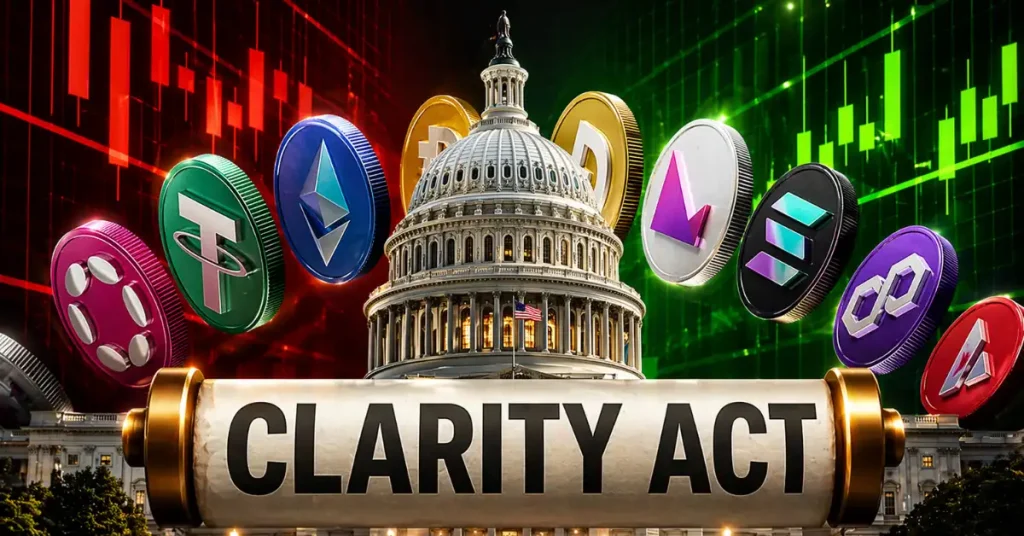
A "CLARITY ACT" scroll in front of the US Capitol Building, surrounded by various cryptocurrency coins including Bitcoin, Ethereum, and Solana against a trading chart background.

The post CLARITY Act Update: White House Sets July 4 Deadline as Senate Moves Toward Vote appeared first on Coinpedia Fintech News

The White House is pushing to pass the Digital Asset Market Clarity Act before July 4, according to Patrick Witt, the administration’s digital assets adviser.

Witt said that the Senate Banking Committee is expected to advance the bill this month and that most major disputes have been resolved. On the stablecoin yield question, which had been one of the most contested issues, he said a compromise has been reached though both the crypto industry and banks remain unhappy with the outcome.

“I’m very bullish, cautiously optimistic,” Witt said about the bill’s prospects.

Senate Banking Committee Chairman Tim Scott described the bill as “in the red zone.” CFTC Chair Mike Selig said he is hopeful for a July 4 signing.

What the Bill Would Do

The CLARITY Act would establish clear boundaries between SEC and CFTC jurisdiction over digital assets, set rules for stablecoin yields, create a regulatory framework for crypto exchanges and institutions, and reduce the use of enforcement actions as the primary tool of crypto oversight in the United States.

Gillibrand Sets Conditions

Senator Kirsten Gillibrand, the lead Democratic negotiator on the bill, said at the Consensus 2026 conference on Wednesday that she will not support the legislation without provisions banning crypto insider trading by lawmakers and government officials.

Gillibrand, who wrote the 2012 STOCK Act barring congressional insider trading in equities, named three issues that must be resolved before the Senate Banking Committee proceeds to markup: ethics rules, consumer protections, and safeguards against illicit finance and terrorism financing.

“It can get done by August if we’re lucky,” she said.

Many Democrats are concerned about potential conflicts of interest involving the Trump family. Bloomberg has estimated the family has earned at least $1.4 billion from the crypto industry. The White House said it is negotiating ethics rules that would apply to all government officials broadly rather than targeting specific individuals or families.

Bitcoin Reserve Update

Witt said updates on the proposed US Strategic Bitcoin Reserve are expected in the coming weeks. The administration is currently auditing and centralising crypto assets held by federal agencies following President Trump’s executive order, with details on the reserve’s structure to follow.

Key Date to Watch

The Senate Banking Committee markup in May is the most critical near-term milestone. If the bill clears committee, a July 4 deadline remains achievable. If it stalls, passage is more likely to slip to August at the earliest.

XRP News Today: JPMorgan, Mastercard and Ondo Complete a Historic First

Fact Check: Are BRICS Nations Partnering With Ripple to Use XRP Ledger for a Global Digital Currency?

The post XRP News Today: JPMorgan, Mastercard and Ondo Complete a Historic First appeared first on Coinpedia Fintech News

Four of the biggest names in global finance just completed a transaction that the industry has been working toward for years. Ondo, Kinexys by JPMorgan, Mastercard, and Ripple successfully executed a pilot transaction connecting the XRP Ledger directly with interbank settlement rails.

The result was the first time tokenized US Treasuries settled across borders and between banks in near real time, outside traditional banking windows.

How It Worked

The transaction moved through three distinct steps. Ondo processed a redemption of OUSG, its tokenized US Treasury product, on the XRP Ledger. Mastercard’s Multi-Token Network then routed the settlement instructions to Kinexys, JPMorgan’s blockchain-based payment platform. JPMorgan then delivered US dollars directly to Ripple’s Singapore bank account.

Start to finish, a tokenized asset moved from a public blockchain through global banking infrastructure and landed as real money in a real bank account, in real time.

Why It’s Important

Cross-border settlements today are slow, expensive, and bound by banking hours and time zones. This pilot demonstrated that those constraints are not inevitable. A public blockchain and traditional banking infrastructure can work together in a single integrated flow without one replacing the other.

Tokenized assets have long been described as the future of finance. This transaction suggested that future is closer than most expected. For the first time, a tokenized fund did not just exist on a blockchain. It settled across borders, across institutions, and across time zones as part of a live transaction.

The broader implication is significant. Global financial markets currently close. The infrastructure tested in this pilot is designed to make sure they never have to.

‘XRP Has Clarity’: Brad Garlinghouse Says He Has Chosen To Ignore Hoskinson’s ‘Stuff’

Charles Hoskinson Says XRP Would Be a Security Under Crypto Clarity Act

The post ‘XRP Has Clarity’: Brad Garlinghouse Says He Has Chosen To Ignore Hoskinson’s ‘Stuff’ appeared first on Coinpedia Fintech News

Ripple CEO Brad Garlinghouse delivered a message that every XRP holder needed to hear. Regardless of whether the CLARITY Act passes through the US Senate, XRP is not waiting for Washington to catch up. It already has what most of the crypto industry is still fighting for.

“XRP has clarity,” Garlinghouse said. “XRP is going to be okay. No matter what.”

The Fight That Already Happened

To understand why Garlinghouse sounds so calm while the rest of the crypto industry nervously watches Capitol Hill, you have to go back to the legal battle Ripple spent years fighting and ultimately won.

A federal judge ruled clearly and on the record that XRP in and of itself is not a security. That ruling did not come from a friendly regulator or a favorable administration. It came from an independent federal judge, appointed by a Democrat, who looked at the facts and reached her conclusion.

“Boom. We have clarity,” Garlinghouse said. “Like that’s what we care about.”

That single court ruling changed everything for Ripple. While other crypto projects are still operating in legal grey zones, hoping the CLARITY Act or SEC guidance will eventually give them the cover they need, XRP already has a federal court opinion on its side. That is a fundamentally different position to be in.

The Hoskinson Dismissal That Spoke Volumes

This is where the conversation got pointed. Not every voice in crypto has been supportive of the CLARITY Act, and one of the loudest skeptics has been Charles Hoskinson, the founder of Cardano and one of the most outspoken figures in the industry.

Hoskinson has been vocal about his concerns with how Washington shapes crypto legislation, often framing it as watching sausage get made, messy, uncomfortable, and not always reflective of what the industry actually needs. His commentary around the CLARITY Act has been pointed enough that it has drawn attention and sparked debate across crypto circles.

Garlinghouse’s response was not a counter-argument. It was something more dismissive and in its own way more powerful.

“I’ve chosen to ignore Charles Hoskinson on all this stuff,” he said. “I already have clarity. I’m supporting this because I think it’s good for the industry.”

❌