Reading view

CZ Says Bitcoin Recovery Could Come Faster This Cycle After Clearing October 2025 Flash Crash Blame

CZ Responds to Binance Blame After Record $19B Crypto Market Crash

The post CZ Says Bitcoin Recovery Could Come Faster This Cycle After Clearing October 2025 Flash Crash Blame appeared first on Coinpedia Fintech News

Cathie Wood and Changpeng Zhao recently discussed Bitcoin, market cycles, and the October 11 crypto flash crash during a podcast conversation that quickly gained attention across the crypto community.

For the unversed, the October 10–11, 2025 flash crash was one of the biggest sell-offs crypto had ever seen, wiping out more than $19.5 billion in leveraged positions within 24 hours. The panic began after President Trump proposed 100% tariffs on Chinese imports.

Since then, many theories have blamed Binance for the brutal crash. BTC at that time was at its highest peak of $125,000, dropping to $101,000 within hours. Since then, BTC failed to reach the ATH again. 

During the podcast discussion, Cathie Wood clarified that Binance was not responsible for triggering the sharp market collapse that happened during the October 11 crash.

Cathie Wood Clears Binance’s Name

Wood explained that while there was a software glitch during the event, Binance itself did not cause the market-wide drop.

“We know there was a software glitch, but Binance did not trigger the flash crash,” she said, adding that broader tariff-related panic and extremely nervous market conditions likely worsened the selloff.

Changpeng Zhao responded by thanking her for the clarification, revealing that her earlier comments had been heavily circulated in Chinese media, where many interpreted the crash as Binance’s fault.

“That statement was widely quoted by the media,” Zhao said. “Many people said Binance caused the collapse. I’m glad you’re clearing this up now.”

Wood also admitted she was unaware her previous comments had been taken out of context so widely.

CZ Shares Bullish Bitcoin Outlook

The conversation later shifted toward Bitcoin’s future and whether the traditional four-year crypto cycle is still playing out.

Zhao acknowledged that Bitcoin has seen weakness entering 2026 after the strong 2025 rally, but said several major macro factors could help speed up the recovery this time.

According to Zhao, improving stock market conditions under President Donald Trump’s administration could positively impact crypto markets as well.

“When stock markets do well, people have more free cash, and they diversify into crypto,” he explained.

He also pointed to rising geopolitical tensions and growing interest in gold as signals that Bitcoin could remain active as an alternative asset.

Bitcoin Recovery Could Arrive Faster

Despite recent volatility, Zhao said Bitcoin holding above previous major support levels remains encouraging. He added that the current correction may recover faster than previous bear market cycles.

“I’m hoping the worst part is over,” Zhao said, while noting that his comments were “not financial advice.”

Wood also backed Bitcoin’s long-term outlook, noting that institutional investors are increasingly stepping in during corrections. She said many institutions had been waiting for a pullback tied to the traditional four-year cycle before increasing exposure.

The discussion comes as Bitcoin continues attempting to regain momentum after recent market turbulence, with investors closely watching whether the next major rally is beginning to form.


Coinbase Suffers Second AWS Outage Since October As Frustrated Users Question Exchange Reliability

The Chainlink (LINK) logo flanked by the AWS and Coinbase logos over a blue digital network background.

The post Coinbase Suffers Second AWS Outage Since October As Frustrated Users Question Exchange Reliability appeared first on Coinpedia Fintech News

Coinbase users were hit with major trading issues on Thursday after an outage tied to Amazon Web Services (AWS) disrupted the exchange’s systems. The problems started after overheating issues impacted an AWS data center in Northern Virginia, affecting services inside the US-EAST-1 region.

The exchange confirmed that some users were experiencing “degraded performance,” with many traders reporting frozen charts, failed orders, and delayed price updates across both desktop and mobile apps. Coinbase later said the issue was linked to the AWS Availability Zone “use1-az4,” where temperatures had spiked unexpectedly.

Crypto traderLuke Cannon claimed there had not been a Bitcoin trade on Coinbase for over an hour during the disruption. He also pointed out that Coinbase’s order books were showing prices far above competitors like Binance and Hyperliquid, while many user orders simply failed to execute.

Coinbase assured users that funds remained safe and said trading would gradually resume through a “Cancel Only” mode before fully reopening markets.

We are aware that customers may be experiencing degraded performance at this time due to an AWS outage.

Our team is investigating this issue and will provide an update. Your funds are safe.

— Coinbase Support (@CoinbaseSupport) May 8, 2026

The affected assets include KAITO, SENT, TOSHI, AKT, ANIME, ZK, KERNEL, and BARD. This is now the second major AWS-related Coinbase outage since October 2025.

Terrible Timing After Earnings Disaster

The outage came at one of the worst possible moments for Coinbase.

Just a day earlier, the exchange reported disappointing quarterly earnings that shocked investors. Coinbase posted a surprise loss of $1.49 per share, while revenue came in at $1.41 billion, missing analyst expectations of roughly $1.52 billion. Following the weak results, Coinbase shares dropped around 4% in after-hours trading.

The company is currently trying to evolve beyond simple crypto trading by building what executives describe as an “everything exchange,” expanding into stablecoins, tokenized real-world assets, and broader financial services. However, the transition has not been smooth so far.

Coinbase also recently announced layoffs affecting nearly 14% of its workforce, cutting around 700 jobs as part of broader cost-reduction efforts.

Community Frustration Builds Again

After the weak earnings report, the outage quickly triggered frustration across crypto social media. Many users questioned how a problem in just one Amazon AWS region could end up affecting such a massive exchange like Coinbase. Others pointed out that Coinbase has faced similar outages during busy market periods for years now.

Some traders defended the exchange, saying the AWS issue was largely outside Coinbase’s control

Pi Network Sets May 15 Deadline for Critical Node Upgrade

pi-network-price-prediction-token-value-market-analysis.jpg

The post Pi Network Sets May 15 Deadline for Critical Node Upgrade appeared first on Coinpedia Fintech News

Pi Network is pushing ahead with its decentralization plans as the team issued an important reminder for all Mainnet node operators. According to the latest update, every Mainnet node must complete the Protocol 23 upgrade before May 15, 2026, or risk losing connection to the network.

The team also warned that the upgrade process may take longer than usual, urging users to plan and complete the update early.

Pi Pushes Ahead With Decentralization

The move is part of Pi Network’s broader effort to strengthen its infrastructure during the ongoing Enclosed Mainnet phase. Pi said node operators running the latest Node version 0.5.4 on Windows, Mac, or Linux systems will continue helping secure the blockchain and validate transactions.

Unlike Bitcoin’s proof-of-work model, Pi uses the Stellar Consensus Protocol (SCP), where trusted groups of nodes work together to confirm transactions. The system is designed to reduce energy usage while making node participation easier for everyday users.

Pi also reiterated its long-term focus on “user-centric decentralization,” allowing users to run nodes directly from standard laptops and desktops without needing expensive mining hardware.

How Pi Nodes Actually Work

The network currently supports three levels of participation: desktop app users, Nodes, and SuperNodes.

Regular Nodes help validate blockchain activity and submit transactions, while SuperNodes play a larger role in maintaining consensus and synchronizing the blockchain across the network 24/7.

Pi explained that users interested in becoming Nodes or SuperNodes must install the Pi Node software, complete technical setup requirements, maintain strong uptime and internet stability, and eventually pass KYC verification.

The project also confirmed that the blockchain component of Pi Node will eventually become open source.

Security Concerns Still Fresh

The reminder comes shortly after pressure increased around the project following a recent third-party security incident.

Pi Network previously disclosed that unauthorized access to a server exposed some user-related data, including emails and certain phone numbers linked to two-factor authentication. However, the team clarified that no wallets, private keys, or user funds were compromised.

Following the incident, Pi said it began migrating infrastructure and pursuing legal action against former partners connected to the breach.

For now, the latest Protocol 23 push shows Pi Network is continuing to focus heavily on infrastructure upgrades, decentralization, and long-term network stability as it moves closer toward its Open Network phase.

Asteroid Shiba Price Down 14% as Mystery Trader Cashes In After 731,000% Rally

High-impact digital graphic illustrating the resilience of the Ice Open Network (ICE) following a security incident. The imagery of a breaking chain symbolizes the network overcoming technical hurdles and team restructuring to focus on a new decentralized direction and improved blockchain security protocols.

The post Asteroid Shiba Price Down 14% as Mystery Trader Cashes In After 731,000% Rally appeared first on Coinpedia Fintech News

ASTEROID Shiba is currently down around 14.82% in the past 24 hours, trading near 0.000368. 

The correction comes after ASTEROID’s massive 731,582% surge over the past 30 days, triggering aggressive profit-taking from traders who entered early in the rally.

Unknown Trader Makes Over $1 Million

The token made headlines today after blockchain analytics platform Arkham revealed that a mystery trader with only nine followers on X turned a small investment into a massive win.

THIS GUY HAS 9 FOLLOWERS – HE JUST MADE A MILLION DOLLARS

Nobody knows who trader @404eq is – but he bought $17.5K of ASTEROID at an average of $2.5M Market Cap.

Since then, he’s up over $1 Million. How bullish is he on ASTEROID? pic.twitter.com/OvRUPZvMkw

— Arkham (@arkham) May 7, 2026

According to Arkham, trader @404eq bought around $17,500 worth of ASTEROID when the token’s market cap was sitting near just $2.5 million. Since then, the wallet’s profits have surged past $1 million as the meme coin exploded higher.

Still Holding Big ASTEROID Bags

The mystery wallet has not fully exited the position yet. Arkham later revealed that the trader sold about $118,900 worth of ASTEROID and transferred another $187,000 to CookerFlips, but is still holding nearly $750,000 worth of the token.

He sold $118.9K, sent $187K to CookerFlips, and is still holding $750K of ASTEROID.

Track 404eq on Arkham:https://t.co/cDm1DGODP8

— Arkham (@arkham) May 7, 2026

That has sparked speculation across crypto social media about whether the trader expects another major rally ahead.

What Happens Next?

For now, the biggest factor driving ASTEROID appears to be profit-taking after its parabolic move. Hence, technically, the token could stabilize if buying pressure returns and price holds above the key $0.00035 level.

However, if ASTEROID breaks the support, the next downside target could move closer to $0.00034. Traders are also watching whether trading volume begins to normalize after the recent frenzy.

Ice Open Network Reveals New Direction After Security Breach and Team Cuts

Ice Open Network News What Really Happened to the ION Token

The post Ice Open Network Reveals New Direction After Security Breach and Team Cuts appeared first on Coinpedia Fintech News

Ice Open Network has finally addressed growing concerns from its community after weeks of silence, reduced updates, and rising criticism surrounding the project’s direction. The statement comes after many users pointed out that the development had slowed down following missed expectations, technical delays, and the sudden drop in communication from the team.

In a lengthy X post, Ice Open Network reassured supporters that the project is still active and “still building,” even though the team is now smaller than before.

Security Incident Sparked Fresh Concerns

Ice Open Network recently faced a security breach linked to a third-party provider, exposing some user emails and 2FA-related phone numbers. The team clarified that no wallets or funds were affected, but the incident still triggered community concerns. 

Since then, the project says it has been upgrading infrastructure and taking legal action against those involved.

“Silence Does Not Mean Surrender”

The project admitted that things may look difficult from the outside, but said the current phase is about staying focused on execution instead of public hype. According to the team, this period will help separate long-term supporters from short-term panic and negativity.

Ice Open Network stressed that the lack of updates should not be seen as abandonment. “Silence does not mean surrender. It means focus,” the team wrote.

No More Constant Timelines and Weekly Updates

One important shift announced by the project is its communication strategy. Ice Open Network said it will no longer share weekly bulletins, internal milestones, or expected timelines before products are fully ready.

The team explained that previous transparency often backfired whenever delays happened, turning unfinished work into FUD and damaging community trust instead of helping it.

Instead, the project now plans to reveal developments only when products are closer to launch.

Focus Turns Toward Revenue and Utility

According to the statement, the project’s main priority now is building products that generate “real revenue” and create a stronger long-term business model.

The team also hinted that Ice Open Network wants to move beyond being just another crypto project. It said the goal is to build technology that can scale outside the crypto industry by offering faster, cheaper, and utility-driven solutions.

Big Changes Ahead

Ice Open Network teased several upcoming updates, including changes to its website, whitepaper, and overall direction. While no launch dates were provided, the team said the new vision will become clear once development is ready to be shown publicly.

The statement also included a personal lesson from the team, saying they learned not to “brag before the product is ready,” adding that if the work was easy, “everyone would have done it already.”

BNY Expands Crypto Custody Push to Abu Dhabi as UAE’s Digital Asset Race Heats Up

Bitcoin ETF investment 2026

The post BNY Expands Crypto Custody Push to Abu Dhabi as UAE’s Digital Asset Race Heats Up appeared first on Coinpedia Fintech News

BNY, the world’s largest custodian bank with nearly $59 trillion in assets under custody and administration, is making a bigger move into crypto. The Wall Street giant is expanding its digital asset custody business into Abu Dhabi through partnerships with Finstreet and ADI Foundation. 

As per the report, the new initiative will operate inside Abu Dhabi Global Market (ADGM), one of the Middle East’s fastest-growing crypto and blockchain hubs. Initially, the focus will be on custody services for Bitcoin and Ethereum, but the plan is to later expand into stablecoins and tokenized assets.

BNY Is Going Bigger on Crypto

This is another sign that traditional finance is moving deeper into blockchain infrastructure. BNY was already the first major U.S. global systemically important bank to launch digital asset custody services, and now it’s taking that business into one of the world’s most crypto-friendly regions.

Hani Kablawi, Executive Vice Chair at BNY, said the UAE is entering a “new phase of financial development” driven by stronger digital connectivity and deeper capital markets. According to him, BNY wants to help connect traditional finance with digital assets through regulated infrastructure.

Why Abu Dhabi? The ADGM Advantage

A big reason behind the move is regulation. Unlike many regions still figuring out crypto laws, ADGM has spent years building a clear framework for digital assets through its Financial Services Regulatory Authority (FSRA).

For a 240-year-old bank like BNY, legal clarity matters. It gives institutions confidence to safely manage crypto assets with the same standards used for traditional financial products.

The Bigger Play: Tokenization

This expansion is not just about storing Bitcoin and Ethereum. The real opportunity is tokenization, putting real-world assets like real estate, bonds, and private equity on blockchain networks.

By working with ADI Chain infrastructure, BNY is positioning itself for a future where trading, settlement, and custody all happen on-chain in one regulated ecosystem.

What This Means for Crypto

BNY’s arrival in the UAE signals a “domino effect” for other global banks. As one of the biggest names in traditional finance, its move adds major credibility to Abu Dhabi’s ambition of becoming a global hub for regulated digital finance.

The UAE is no longer just attracting crypto startups; it’s now becoming a serious destination for trillion-dollar institutional players.

VanEck Says $1 Million Bitcoin Is The Base Case — Here Is What The Data Says

bitcoin-price-prediction (1)

The post VanEck Says $1 Million Bitcoin Is The Base Case — Here Is What The Data Says appeared first on Coinpedia Fintech News

Bitcoin is slowly regaining momentum as investors once again look toward the $100,000 milestone. After dropping from its late-2025 high of $126,000, BTC is now trading near $81,000, supported by improving sentiment, growing enthusiasm around the U.S. CLARITY Act, and strong institutional demand. 

Spot Bitcoin ETFs saw massive $2.44 billion inflows in April 2026 alone, marking the strongest month since the 2025 peak. On May 6, spot Bitcoin ETFs recorded a total net inflow of $46.33 million, marking the fifth consecutive day of net inflows. 

VanEck’s Matthew Sigel Predicts $1 Million Bitcoin

Matthew Sigel, Head of Digital Assets Research at VanEck, made one of the boldest predictions yet, saying Bitcoin reaching $1 million is now the firm’s “base case.”

“Bitcoin going up for us is the base case. We think this asset is going to reach a million dollars over the next several years,” Sigel said during a CNBC interview.

To explain his outlook, Sigel compared Bitcoin to the video game industry. He noted that gaming was once seen as something mainly for kids, but today it is mainstream across all age groups, even mentioning that Elon Musk plays video games. According to Sigel, Bitcoin is following a similar path toward mass adoption.

“People don’t quit Bitcoin,” he said, pointing to growing interest from younger investors and the fact that central banks are now beginning to hold Bitcoin reserves. He described Bitcoin as a long-term “mega trend,” although he warned that the asset will remain highly volatile along the way.

Sigel believes Bitcoin could potentially reach $1 million within five years if adoption keeps accelerating.

On-Chain Analysis Points to $93K Next

According to CryptoQuant researchers, Bitcoin’s next major target could be $93,000 due to a key CME gap. BTC recently surged close to $83,000 as the total crypto market cap jumped to $2.73 trillion. Moreover, a sharp 12% crash in oil prices and growing optimism around a possible U.S.-Iran peace deal also added fresh fuel to the crypto rally.

Ethena Jumps 4% After Grayscale Adds It to DeFi Fund in Q1 Rebalancing

Ethena Claims Third Place in Stablecoin Rankings

The post Ethena Jumps 4% After Grayscale Adds It to DeFi Fund in Q1 Rebalancing appeared first on Coinpedia Fintech News

Ethena Jumps 4% After Grayscale Adds It to DeFi Fund in Q1 Rebalancing

Grayscale Investments reshuffled its crypto portfolios this week as part of its Q1 2026 fund rebalancing. The firm removed Aerodrome Finance from its DeFi Fund and replaced it with Ethena, a yield-focused decentralized finance protocol. 

Ethena rose 4.33% in the last 24 hours following the announcement. Grayscale also made adjustments to its Smart Contract Fund, though no new assets were added to that portfolio.

Ethena Replaces Aerodrome

The biggest change came in Grayscale’s DeFi Fund. Following the CoinDesk DeFi Select Index methodology, the firm sold AERO and portions of other existing holdings to purchase ENA.

As of May 1, 2026, the fund holdings stood at:

  • Uniswap (UNI) – 35.22%
  • Aave (AAVE) – 21.36%
  • Ondo (ONDO) – 19.83%
  • Ethena (ENA) – 13.59%
  • Curve (CRV) – 5.27%
  • Lido DAO (LDO) – 4.73%

Smart Contract Fund Stays Focused on Layer 1s

Grayscale also adjusted the weightings of its Smart Contract Fund using the CoinDesk Smart Contract Platform Select Capped Index methodology. Unlike the DeFi Fund, no assets were removed or added.

The updated allocations are:

  • Ethereum (ETH) – 30.14%
  • Solana (SOL) – 29.69%
  • Cardano (ADA) – 17.96%
  • Avalanche (AVAX) – 7.69%
  • Hedera (HBAR) – 7.41%
  • Sui (SUI) – 7.11%

The allocation shows Grayscale still heavily favors established smart contract ecosystems led by Ethereum and Solana.

What This Signals for the Market

These updates give a simple look into where institutional investors believe crypto is heading. Grayscale appears to be betting more on DeFi projects connected to stablecoins, yield, and tokenized assets rather than only trading platforms.

At the same time, the company is still keeping strong exposure to big blockchain ecosystems like Ethereum and Solana, which continue to dominate developer activity and liquidity in crypto markets.

Overall, rebalances like this reflect where capital is rotating. The question is whether flows follow or lag.

Clarity Act All New Updates: Moreno Says Bill Could Be Signed Before July 4 as Odds Hit 67%

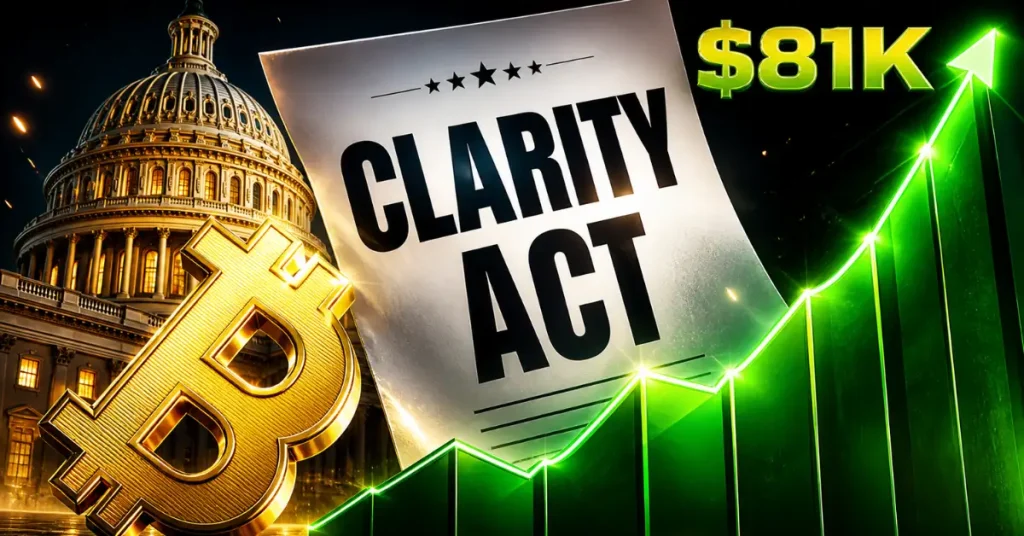
A golden Bitcoin symbol in front of the US Capitol building, a document labeled "CLARITY ACT," and a rising green line graph reaching "$81K."

The post Clarity Act All New Updates: Moreno Says Bill Could Be Signed Before July 4 as Odds Hit 67% appeared first on Coinpedia Fintech News

A bipartisan compromise on stablecoin yield has cleared the biggest obstacle standing between the Clarity Act and a Senate vote, injecting fresh momentum into legislation that has spent months stalled over a single unresolved dispute.

Senators Thom Tillis and Angela Alsobrooks struck the deal this week, agreeing on language that allows crypto firms to offer stablecoin rewards while stopping those products from functioning as direct substitutes for traditional bank deposits. The agreement, modest in its technical scope, was significant in its political effect. It moved a bill that had been frozen.

“This finalised, bipartisan text is the culmination of months of hard work to deliver a compromise on yield we can all live with,” Senator Cynthia Lummis said. “We are closer than ever to getting the Clarity Act across the finish line.”

This finalized, bipartisan text is the culmination of months of hard work to deliver a compromise on yield we can all live with. We are closer than ever to getting the Clarity Act across the finish line. https://t.co/8vF7tzpxpy

— Senator Cynthia Lummis (@SenLummis) May 4, 2026

A Timeline Comes Into View

With the yield dispute resolved, the legislative calendar is moving. House Financial Services Chair Bryan Steil confirmed the markup is scheduled and Senate planning is underway. 

Senator Bernie Moreno went further, telling reporters the bill could reach President Trump’s desk by the end of June and be signed into law before July 4.

The pressure to move is not just political. Brad Garlinghouse, Ripple’s chief executive, told the Consensus 2026 conference in Miami that the window is closing. “The next two weeks are pivotal,” Garlinghouse said. “Clarity is better than chaos.” 

He warned that delays running into election season would sharply reduce the bill’s chances of passage, giving both parties a concrete reason to act now.

Markets React Before the Vote

Circle rallied sharply. Coinbase gained. Bitcoin briefly crossed $80,000 as optimism about regulatory clarity fed into a broader market recovery already underway. Prediction markets moved the bill’s odds of passage to approximately 67%.

Coinbase CEO Brian Armstrong reduced his public position to two words: “Mark it up.”

The Dissent

Not every voice was bullish. Arthur Hayes argued that the bill, as written, advantages large centralised firms with established lobbying relationships while creating structural barriers for smaller and more decentralised projects. 

Charles Hoskinson raised similar concerns earlier, warning that the legislation’s mature blockchain standard protects incumbents while making it harder for new projects to avoid securities classification.

What Comes Next

Markup is the immediate milestone. After that, a Senate floor vote, House approval, and a presidential signature before July 4 is the timeline on record. The crypto industry has seen promising legislation arrive at the finish line before without crossing it. This time, the bipartisan deal, the market pressure, the political calendar, and the industry’s unified push are converging in the same direction at the same moment.

❌