Login
Login
CLARITY Act Draft Released: What the 309-Page Draft Says About Bitcoin, Staking and Stablecoins

The post CLARITY Act Draft Released: What the 309-Page Draft Says About Bitcoin, Staking and Stablecoins appeared first on Coinpedia Fintech News
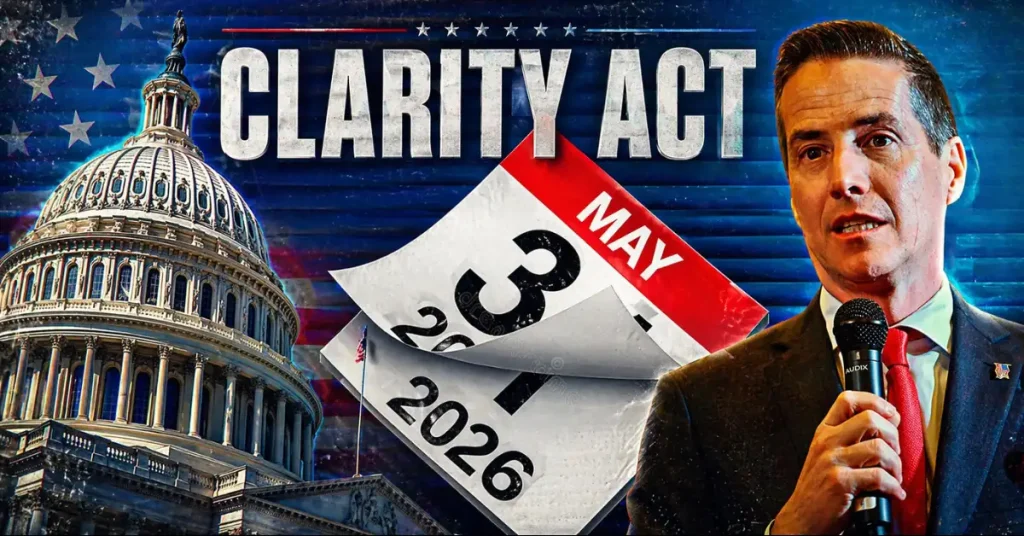
The Senate Banking Committee released the full 309-page draft of the Digital Asset Market Clarity Act on Tuesday morning, giving committee members until close of business Wednesday to file amendments ahead of Thursday’s 10:30 AM EST markup vote.
The release follows months of negotiations that nearly collapsed multiple times over stablecoin yield provisions, ethics rules, and DeFi regulations. The draft represents the most complete picture yet of what US crypto regulation will actually look like if the bill passes.
Here are some parts of the text:
Bitcoin and Ethereum Are Permanently Non-Securities
One of the most significant provisions locks in the regulatory status of major cryptocurrencies immediately. Any token that served as the principal asset of a spot Exchange Traded Product as of January 1, 2026 is permanently treated as a non-security under the bill.
In practical terms that means Bitcoin, Ethereum, and any other asset that received spot ETP approval by year-end 2025 can never be reclassified as a security regardless of future SEC or CFTC leadership changes. The legal certainty that the industry has fought for years to establish is written directly into the legislation.
Staking Is Fully Protected
The draft carves out staking activity entirely from securities treatment. Four specific staking structures are explicitly classified as administrative or ministerial rather than investment activity:
- Self-staking by token holders
- Self-custodial staking with a third-party node operator
- Liquid staking through receipt tokens
- Custodial staking services provided by exchanges
Critically, the bill also states that governance rights attached to a token do not disqualify it from non-security treatment. This directly addresses one of the longest-running regulatory grey areas in the industry.
Banks Get Direct Access to Crypto Without Prior Approval
Section 401 of the draft opens the door for traditional banking institutions to enter the digital asset space without needing regulatory permission first. National banks, state banks, and credit unions are all permitted to offer the following services as incidental to normal banking business:
- Custody of digital assets
- Staking services
- Lending against digital assets
- Payment processing
- Market making
- Underwriting
No prior approval from regulators is required. For an industry that has spent years watching banks turn away crypto clients due to regulatory uncertainty, this provision alone represents a structural shift in how digital assets integrate with the traditional financial system.
The Stablecoin Yield Question Is Settled
Section 404 draws the clearest line yet on stablecoin rewards. Exchanges and platforms are prohibited from paying interest or yield simply for holding stablecoin balances. Any return that is economically equivalent to interest on a bank deposit is banned outright.
However, activity-based rewards remain fully permitted. Staking rewards, governance participation incentives, loyalty programmes, and rewards tied to actual platform usage are all allowed to continue. Existing exchange rewards programmes that pay passive yield on stablecoin balances will need to restructure their models to comply.
The compromise gives banks what they lobbied for, a ban on stablecoins functioning as interest-bearing deposits, while preserving the activity-based reward structures that crypto platforms argued were fundamentally different from deposit interest.
What Happens Next
Committee members have until Wednesday close of business to submit amendments. Thursday’s markup at 10:30 AM EST will determine whether the bill advances out of committee. If it clears that hurdle the full Senate must still vote, and the Senate version must be reconciled with the House version before reaching President Trump’s desk.
The White House is targeting July 4 for the final signature. Thursday is the next critical checkpoint.