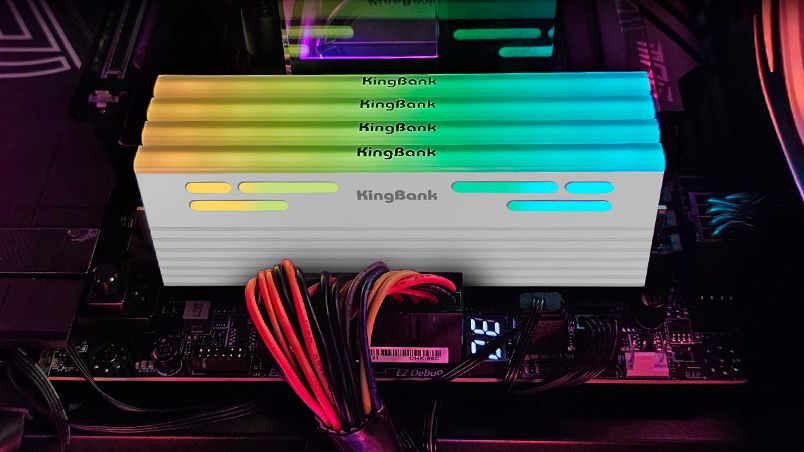
Homegrown DDR5 memory from China, manufactured by ChangXing Memory Technologies, has been making the rounds lately as more and more vendors start legitimizing it. However, new testing from overclocker Safedisk, shared by Uniko's Hardware, purportedly shows that it actually carries inferior performance compared to similar options from SK Hynix, alongside significant variance in the silicon between different batches.
kingbank 2x24 6000c36 1.25 kit (cxmt 3gb dies) on asus c10amanual oc to 8600c44 mt 100%key characteristics of cxmt dies- dont scale with voltage- cant tighten timings- silicon variance appears to be massive between batches- not as strong as hynix when it comes to manual… pic.twitter.com/WNPRiHj233July 15, 2026
CXMT began producing DDR5 in late 2025 despite lacking any cutting-edge EUV lithography tools. Fast forward to today, and reports of the company matching Micron's memory capacity by this year are now floating around. If true, China would become the second-largest memory maker in the world. At such scale, it's no wonder that many companies in China have already started sourcing CXMT-made RAM to fill the gap in the consumer market.
Throughout 2026, we've seen motherboard manufacturers verify CXMT's DDR5 with official BIOS optimizations that allow it to run beyond 8,000 MT/s at this point. OEMs such as Dell and HP are using CXMT RAM in their region-bound systems, and even proper PC hardware companies like Corsair are using CXMT modules. Lexar, Kingbank, Netac, Asgard, Gloaway and more are also producing retail DDR5 kits with CXMT chips.
As such, the testing features a Kingbank 48GB (2x24) DDR5-6000 kit running at CL36 and found several weaknesses despite successfully achieving an 8,600 MT/s overclock at CL44. The first revelation is that CXMT modules don't scale with voltage, meaning you can't just increase voltage in hopes of achieving higher clocks. CXMT's DDR5 apparently doesn't respond well to tuning sub-timings either, forcing you to remain stuck with baseline CAS latency (or higher, like in this case).
Different batches of CXMT-equipped memory perform differently, too, so silicon lottery plays a much bigger role than it would with other vendors. Speaking of which, SK Hynix-made DDR5 modules allegedly performed better at identical clock speeds, while CXMT's modules were less susceptible to overclocking in general. We didn't get any comparative benchmarks for any metric, so take these claims with a grain of salt.
Overall, if Asus' testing is to be believed, it serves as counterprogramming against the popular narrative forming around China as the savior of consumer interests. CXMT's strength lies in the fact that it doesn't have to cater to opulent AI clients as much as the Big Three, which reduces opportunity cost, allowing CXMT to produce more DDR5 memory. That doesn't mean it would be cheaper, though, or at least no evidence has suggested that so far.
CXMT has remained limited to the Chinese region for now, and breaking through to the Western market would mean impressing a lot of skeptics. Not only would pricing play a big factor, but the reliability of a new DRAM manufacturer would raise serious concerns. Stories like these certainly don't help, but with CXMT's IPO on the way, it's only a matter of time before it becomes a serious mainstream contender.
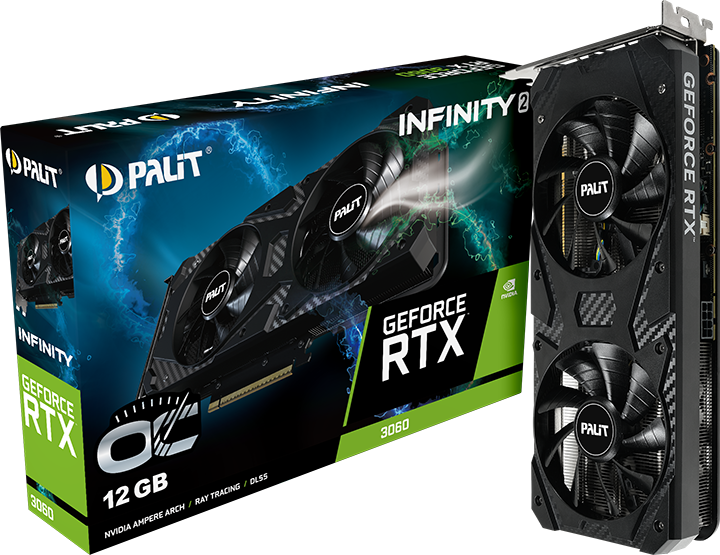
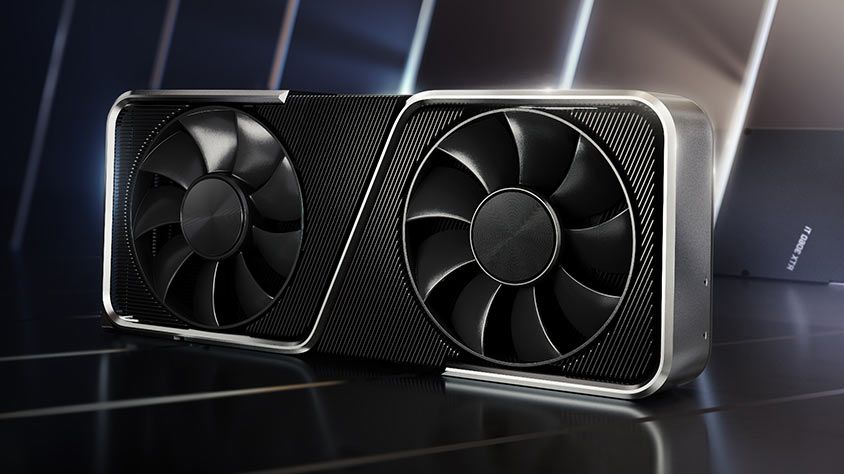
Nvidia has just relaunched its five-year-old graphics card, the GeForce RTX 3060, in order to combat the component scarcity driven by AI. This resurrection has seen a staggered release, with companies like Gigabyte and Manli silently listing their renewed variants in different parts of the world. Today, Palit joined the list with an official announcement for its RTX 3060 Infinity 2 OC, the first official indication of Ampere's return.
If we take a look at the specs, the card is identical to the original RTX 3060 we saw in 2021 — it has 3,584 CUDA cores paired with 12GB of GDDR6 VRAM saturated across a 192-bit-wide bus. Since this is an overclocked variant, it can boost up to 1,792 MHz, which is less than 1% higher than the base 1,777 MHz boost that Nvidia already mandates. Palit will also release a non-OC variant of the Infinity 2 RTX 3060.
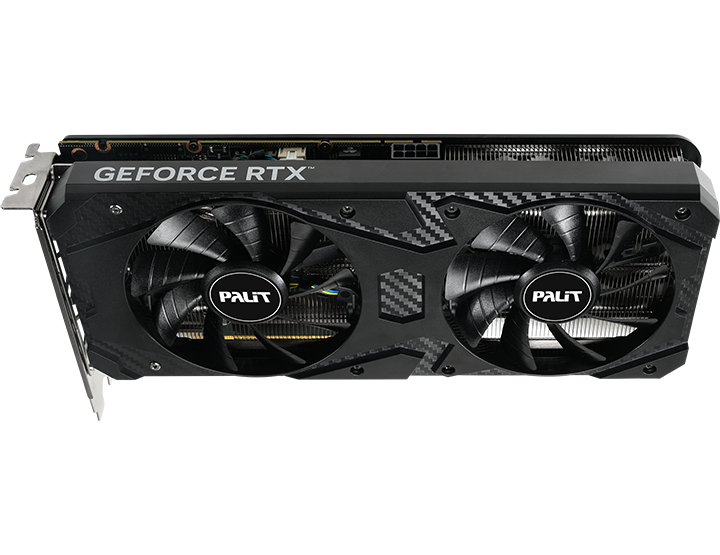
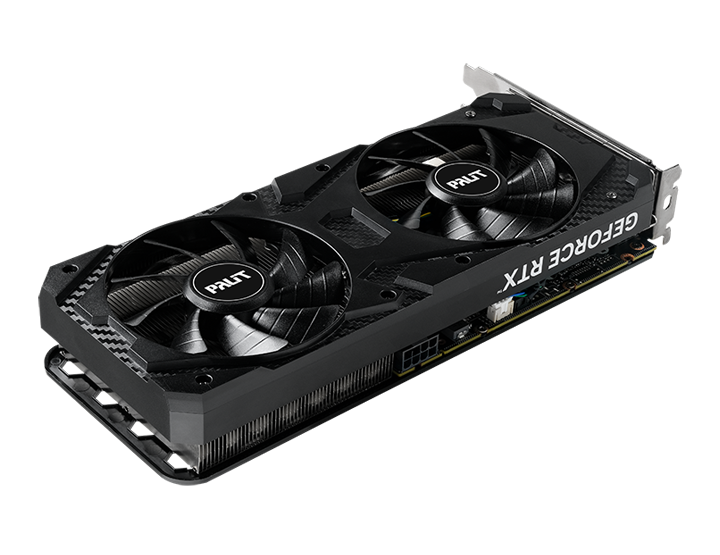
The card features a relatively simple design characterized by the typical black aesthetic we see on budget GPUs. There's no zero-RPM tech here, but Palit claims 0dB noise levels and says there's a "protective backplate" on the card that prevents PCB flex. When you're buying a GPU like this, its looks are probably the least of your concern; the main selling point is, of course, that 12GB memory pool.
PalitPalitPalit
Late last year, the PC hardware industry entered one of its most turbulent eras, characterized by production inadequacies created by the AI boom. Artificial intelligence demands a lot of memory and storage, and thus, commodity silicon has skyrocketed in price overnight with no signs of slowing down. After evading the crisis initially, GPUs eventually got wrapped up in the price hikes as well.
Nvidia's latest Blackwell family uses cutting-edge GDDR7 memory, which is even more expensive, and since vendors are busy producing HBM for fatter margins instead, the "solution" to this dilemma had to be creative. The idea for reviving older generation cards was actually floated by our very own Paul Alcornat a Q&A at CES 2026, where Nvidia CEO Jensen Huang replied, saying he'd "go back and take a look at this."
Palit hasn't provided a price for the Infinity 2 OC yet, and we didn't see it listed on retailers yet, but we can infer it'll cost around $329 given similar variants have also been popping up for that price. To be clear, the RTX 3060 is a great value GPU that we praised even back when it launched. But in the face of the RTX 50-series, it's not exactly something you should consider first, especially when buying new.
You can get an RTX 5060 Ti for just $369 right now on Newegg, which is a significantly faster card with support for DLSS 4.5 and multi-frame gen, not to mention the better efficiency. It only has 8GB of VRAM, unfortunately, which hurts performance at high resolutions and if you like to play with ray tracing enabled. Still, unless you're going up to 4K, the 5060 Ti (and the regular 5060) will perform much better than a 3060 no matter what, as you can see in our GPU benchmark hierarchy.
Ultimately, rebooting the RTX 3060 makes sense from a manufacturer's point of view given the better yields of Samsung's older 8nm process compared to TSMC's more expensive N5 node used by Ada and Blackwell. But as a consumer, you should definitely stick with the RTX 50-series or try to find a used RTX 40-series GPU instead.
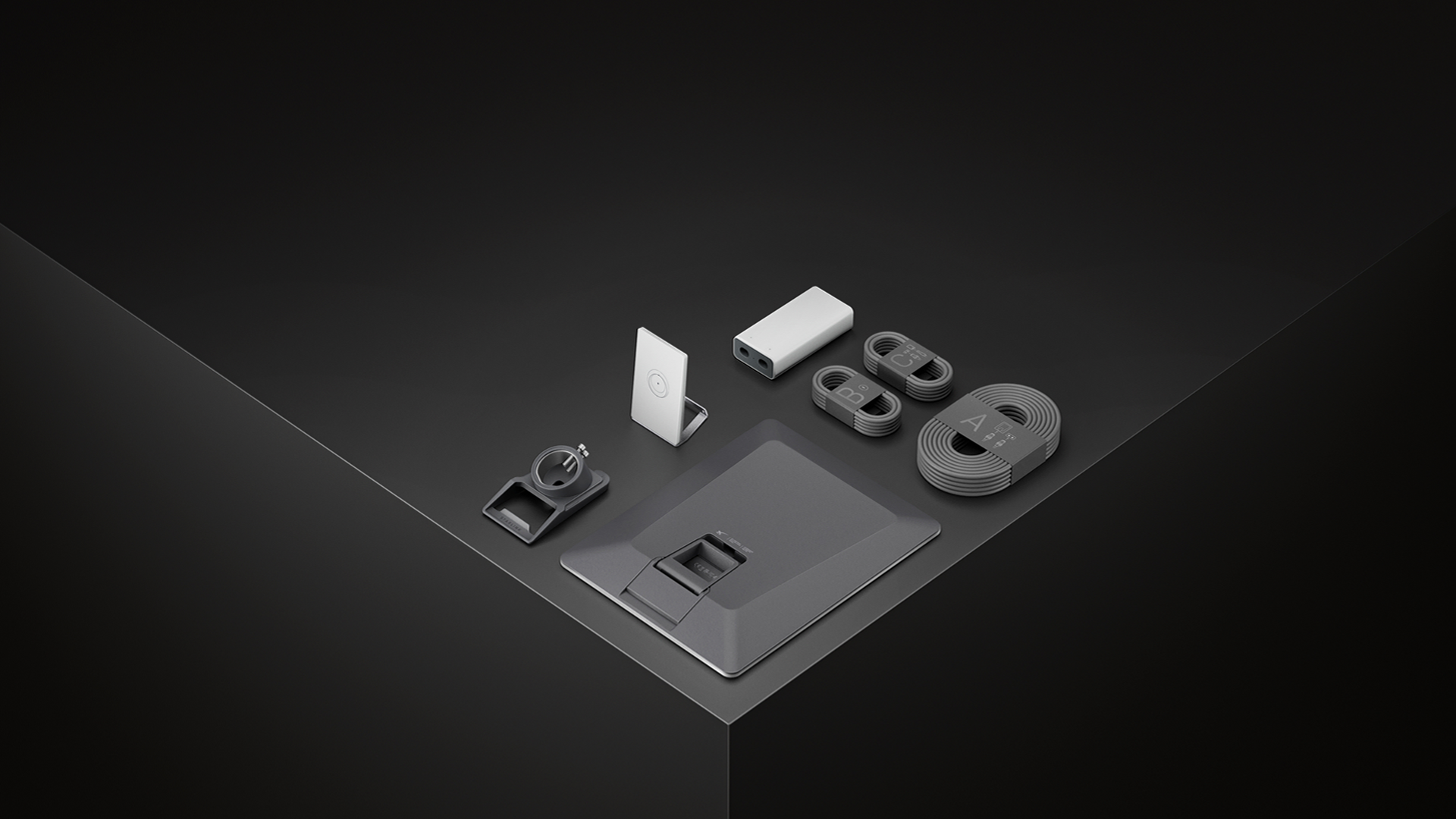
The SpaceX satellite internet service Starlink has just introduced its latest residential kit, letting users connect to the satellite network using a smaller and lighter terminal. The company announced the Starlink V5 on X, saying that it could hit up to 375+ Mbps for “streaming, video calling, gaming, and more.” It’s currently available in select areas only, though, with wider availability expected later as the company ramps up production.
Download speeds
Antenna
Field of View
Dish Weight
Environmental Rating
Operational Temperature
Mounted Wind Speed
Snow Melt Capability
Average Power Consumption
Power Indicator
Starlink V5
Up 375+ Mbps
Electronic Phased Array
110 degrees
2.4 lbs. (1.1kg)
IP67 Type 4
-22 deg F to 122 deg F (-30 deg C to 50 deg C)
165 mph (265 kph)
Up to 1.6 in. per hour (40mm per hour)
35 to 50 watts
LED / Starlink Top Face
Standard 4
Up to 400+ Mbps
Electronic Phased Array
110 degrees
6.4 lbs. (2.9kg)
IP67 Type 4
-22 deg F to 122 deg F (-30 deg C to 50 deg C)
60 mph (96 kph)
Up to 1.6 in. per hour (40mm per hour)
75 to 100 watts
LED / Router Face Plate
Mini
Up to 300+ Mbps
Electronic Phased Array
110 degrees
2.43 lbs. (1.1kg)
IP67 Type 4
-22 deg F to 122 deg F (-30 deg C to 50 deg C)
60 mph (96 kph)
Up to 1 in. per hour (25mm per hour)
25 to 40 watts
LED / Starlink Rear Face Plate
The new unit is significantly smaller and lighter than the Standard 4 used in most home deployments, and brings it close to the Starlink Mini, which is designed for both fixed and portable use. However, the Starlink V5 still requires a router (included), whereas the Mini can work without one, providing a wireless connection using its built-in Wi-Fi antenna. Still, the former is faster, offering speeds of up to 375+ Mbps. Although this is 25 Mbps slower than the 400+ Mbps that the Standard 4 is rated for, it’s still higher than the up to 300+ Mbps that SpaceX has set for the Mini.
The changes that SpaceX made to the Starlink V5 would make it much easier to set up, which is especially helpful for users who prefer to DIY their Starlink setup. Another interesting update to the new terminal is that it can handle faster wind speeds while mounted despite being lighter than the Standard 4. This should help it withstand tougher meteorological conditions, especially in areas frequently battered by storms and tornadoes.
(Image credit: Starlink)
The much lower average power consumption, which is just about half of what the previous-generation Starlink terminals consumed, would also help power stations last longer, making it ideal for keeping communications alive, especially during emergencies. This is exactly what Japan is experimenting with, as Tokyo has started putting up Starlink antennas on fire hydrant signs to provide emergency Wi-Fi.
Although SpaceX and its owner, Elon Musk, are no strangers to controversy, Starlink has proven useful in various situations. Aside from being useful for first responders in disaster zones, it also helped Ukraine stay connected during the height of Russia’s invasion of the country in 2024. It has even gotten to the point that China simulated a Starlink blockade over Taiwan because of how useful the service is in keeping a government online and communicating with its allies during times of distress.
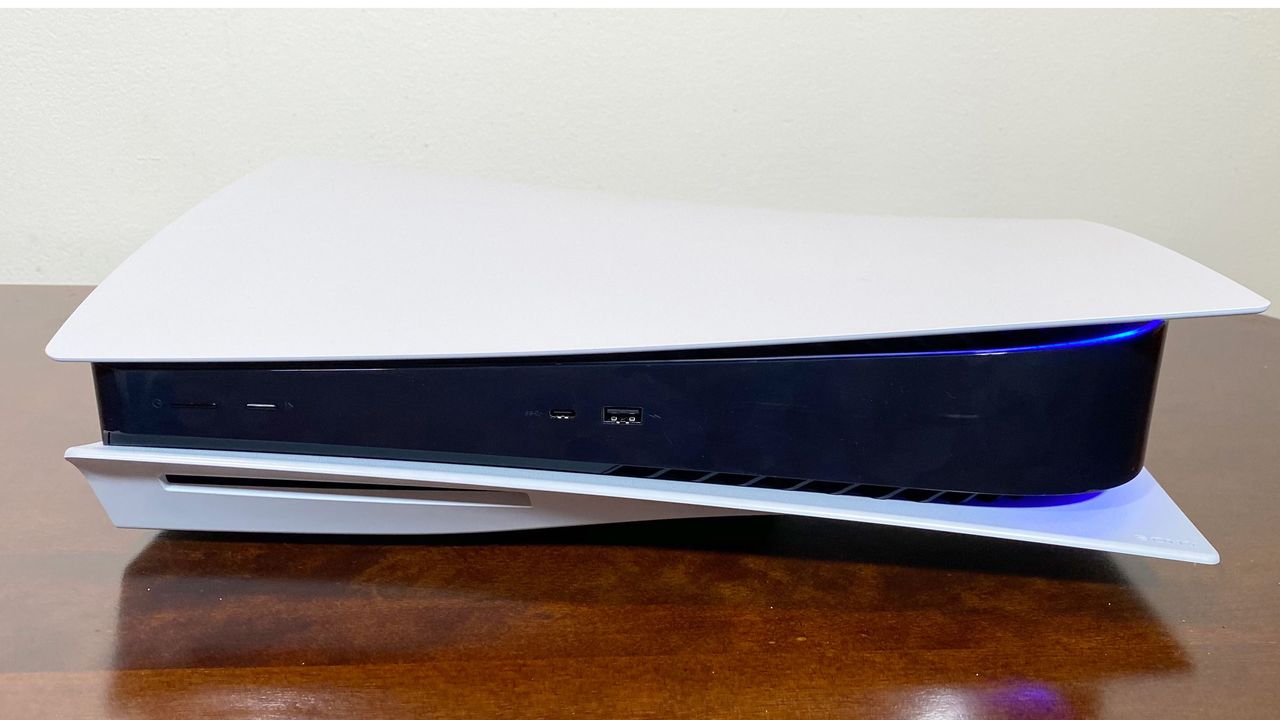
For years, the PS5 emulation scene has remained dormant, with updates few and far between as most projects become abandonware. However, Sony's recent decision to stop physical disc production and the impending release of GTA VI later this year have created an unprecedented demand in the market. All of a sudden, an influx of PS5 emulators has popped up online, and they're swiftly hitting development milestones, including actually being able to boot recent PS5 titles.
The most prominent name in the news cycle is SharpEmu, which serves as a PS5 emulator for Windows. It's written entirely in C# and works more like a translation layer since modern consoles and PC share the same x86 underlying architecture. SharpEmu allows the PC to execute CPU instructions natively while translating OS-specific API calls and graphics.
Since it's aiming for accuracy, only some 2D titles such as Dreaming Sarah are running on SharpEmu with solid performance and no hiccups. As far as 3D titles go, that's a different story since it's significantly harder to emulate those. At first, the PS5 remake of Demon's Souls successfully booted, but it didn't go past the startup screen. Then, in a major development, Discord user RShantila was able to boot Astro Bot, which is a PlayStation exclusive from 2024, on SharpEmu.
الأمور تحدث ⚠️ محاكي PS5 emu على PC !يشغل من الآن لعبة Dreaming Sarahومن الحصريات يشغل شاشة بدء Demons Souls Remakeوجاري تطويره وتحسينه لتشغيل الالعاب مثل ShadPS4بداية سريعة pic.twitter.com/XRerLF9oak pic.twitter.com/NvdLZVCYoQJuly 9, 2026
Getting such a recent game to run is extremely promising and shows that PS5 emulation is currently outpacing PS4 emulation at the same point in its life cycle. And SharpEmu is just one project among what's starting to seem like a sea of hopes and dreams.
The other emulator gaining traction is KytyPS5, which started as a cross-platform PS4 and PS5 emulator in 2021 but was abandoned in 2022. Fast forward four years and developer Nmzik has revived the project, creating their own fork that focuses only on PlayStation 5. According to reports online, within just a few weeks, KytyPS5 can boot commercial PS5 games running in Unreal Engine 4/5, Unity, and other custom engines.
KytyPS5 was able to boot and run Silent Hill: The Short Message till the menu screen. Remember, 3D games were previously limited to just their boot screens, so this is yet another major accomplishment. However, earlier today, the project's GitHub page was updated to show two new 3D games actually running with their graphics being properly rendered, shattering all expectations set thus far.
يب هذا محاكي ثاني للـPS5 اسمه KytyPS5 و بدأ يشغل لعبة SILENT HILL: The Short Message و يوصل للوقو و الرسائل التنبيهية مثل ما تشوفون، يلا عقبال نشوفه يتطور اكثر https://t.co/DjDda8tatw pic.twitter.com/Yn7ilNsHCrJuly 10, 2026
These two games are PowerWash Simulator and Pac-Man World, both of which are playable with functional gameplay, though we don't have any idea about performance or stability. Even more impressively, and perhaps more on-topic, the KytyPS5 version 0.0.3 successfully booted the commercial PS5 version of Grand Theft Auto V far enough to display the loading screens, main splash art, and actually navigate the in-game display settings.
محاكي KytyPS5 قدر يشغل GTA V و يوصل للقوائم، و Quake 2 ingame 😵😵توفر تحديث جديد قبل ساعة https://t.co/xK0Y4LTIwR pic.twitter.com/awVY3VpGUDJuly 11, 2026
KytyPS5 has also recently received updates to its shader compiler for better graphics, better memory management that leads to faster load times, and better audio support as well. The emulator works on Windows for now, but a Linux version is also planned for the future.
Finally, we need to mention RPCSX, which isn't exactly an emulator but rather just a research project dedicated to better understanding both PS4 and PS5 software. The devs are still working on being able to boot games from the user interface, but in a race like this, you need every hand on deck, and the team behind RPCS3 is one of the most experienced in the field.
The PS5 emulation scene has suddenly exploded, and the pace of these developments is astonishing. At this trajectory, it won't be unreasonable to expect GTA V to actually run on SharpEmu or KytyPS5 by next month. That being said, emulation is a marathon that takes a long time to perfect, so it's almost guaranteed that the official PC version of GTA VI will be out long before the emulated version becomes playable.
A PS5 emulator doesn't need to exist, because there'd be no games to emulate.July 8, 2026
The Sino-American chip wars have resulted in many back-and-forth salvos and negotiations as the countries try and strike a balance between technology access and trade. Currently, both sides have set respective import and export controls, letting specific companies on a case-by-case basis. Today, Reuters reports that Chinese telecoms giant ZTE and server firm Maginfra have received U.S. approval to buy Nvidia's last-gen H200 "Hopper" chips.
ZTE joins a club that counts Alibaba, Tencent, ByteDance, and JD.com among the roughly 10-strong group of Chinese companies with U.S. clearance for those purchases. Additionally, an apparent subsidiary of Kingsoft Cloud got approval to buy AMD accelerators equivalent to Nvidia's H200, presumably Instinct MI300X-class chips.
Over on the Chinese side of the table, Reuters remarks that there's no word on whether the respective authorities will give ZTE the go-ahead for import, as the country has taken on a protectionist stance as it tries to grow its own chip industry. The country has discouraged firms from purchasing foreign tech and has instead pushed companies to acquire homegrown accelerators. Huawei in particular has made great strides both technologically and financially.
But even with those domestic production initiatives, the Chinese hunger for AI silicon is so deep that six months ago, Reuters said the nation's tech firms had more than two million H200 chips on order, far more than what Nvidia had on hand at the time. We'd venture that hunger has barely subsided.
ZTE might not be a familiar name Stateside, but the corporation is one of China's largest telecommunication conglomerates, and among many other ventures, it sells all sorts of carrier network gear that's installed worldwide, along with corresponding client-facing equipment, including phones and IoT equipment. Like most any sizable technological venture, ZTE has joined in on the cloud computing and AI push, so it needs accelerators to make those ambitions reality.
The current status of the AI chip trade situation is roughly that the U.S. allows Chinese firms to buy AI chips up to and including the Hopper family (meaning no Blackwell chips), with a 25% export tariff, though final decisions are made on a case-by-case basis. Over on Chinese shores, Beijing's authorities play their cards close to their chest and dole out approvals as they see fit, with no clear rules seemingly set. But China is, of course, a global power with trade connections to most everyone, so interested firms were able to get their hands on Blackwell chips through various creative (and potentially illicit) means.
Whether this change will actually clear the way for any great volumes of H200 accelerators to make their way into ZTE's data centers remains to be seen. CNBC cites a U.S. trade official who today stated that "very few shipments against licenses for H200s and equivalents have taken place. It’s a very small quantity of chips" during a congressional hearing. If H200 shipments become material to Nvidia's bottom line, we'll almost certainly hear about it in future comments or earnings reports.
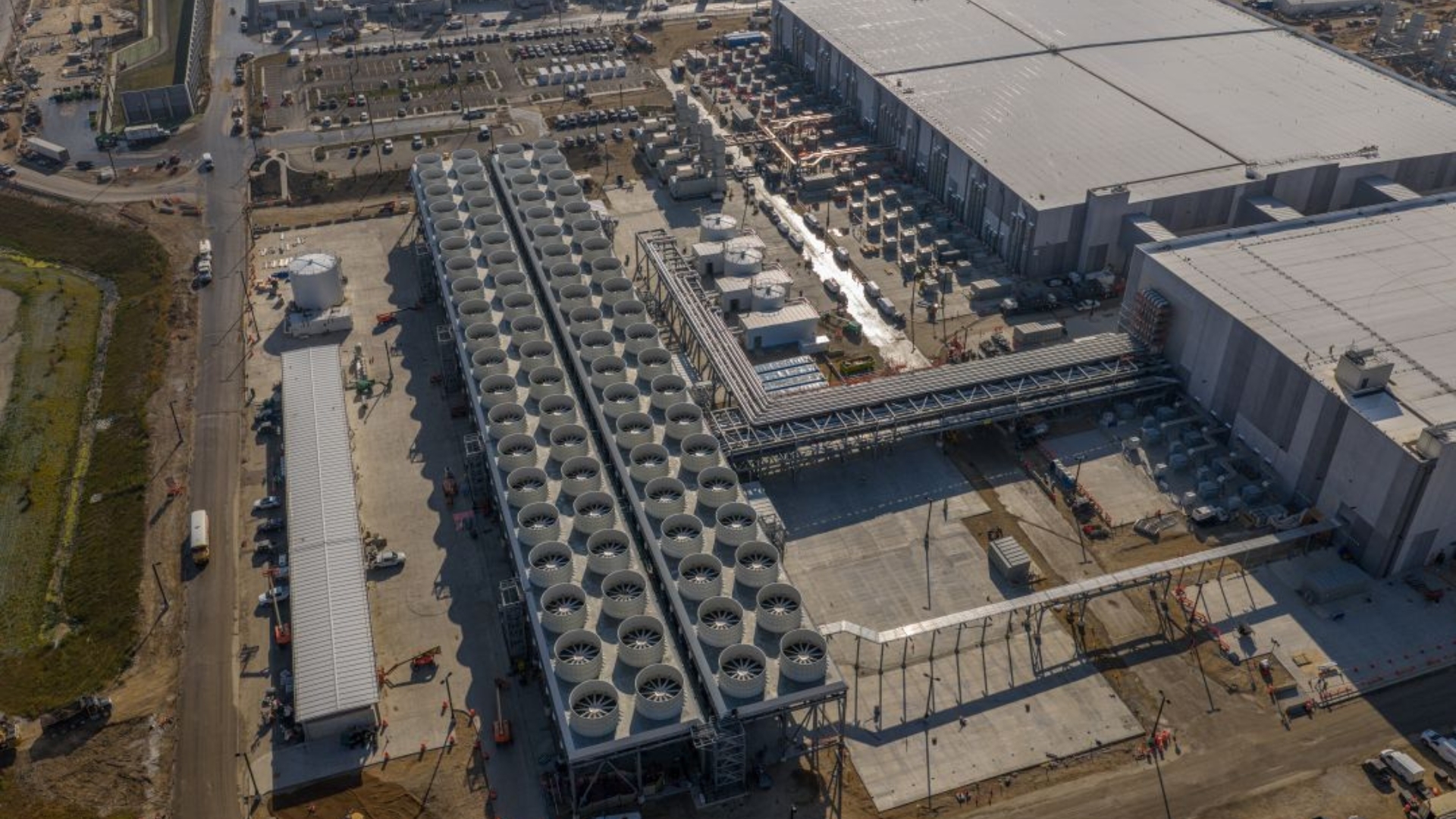
Elon Musk's Colossus 2 xAI data center, which runs independently of the power grid through on-site natural gas turbines, is said to be releasing thousands of tons of nitrogen oxide and carbon monoxide every year. According to Reuters, the company has installed 59 temporary, mobile natural gas turbines without permission, and these unpermitted portable units mostly heavily affect the communities surrounding the site, which happen to be predominantly black and are already suffering disproportionately high lung disease rates. xAI has claimed that it’s running 27 turbines without any permits, saying that it’s exempted because of their temporary nature.
Elon Musk’s alleged use of illegal turbines isn’t a new issue, with the community discovering that it’s been using over 30 gas turbines on the site, despite only having an ongoing application for 15 in July 2025. The company said that these turbines are exempted from the permitting process, as they are not permanent installations and will be moved within 364 days. The Environmental Protection Agency (EPA) issued a ruling earlier this year that removed all exceptions, but told Reuters that “it’s considering changes allowing ‘regulatory flexibilities’ for portable units while continuing to protect public health.”
The Colossus data centers were put up in record time, and Musk had to bring his own energy sources to achieve this. That’s because connecting to the grid could take years, especially if the grid must be upgraded to deliver his 1-GW capacity target. However, the Clean Air Act permitting process could take a similarly long time, with the report suggesting xAI bypassed it completely just to achieve its goal. Adding to the complexity, while the data center is located in Tennessee, Reuters reports that "at least" 57 of the 59 turbines are actually located just over the state line in Mississippi, which issued a permit for 41 permanent turbines in March. xAI and Mississippi environmental regulators claim the turbines are mobile and therefore don't need permits, but they also aren't covered by the permit for 41 permanent turbines.
This did not sit well with the communities surrounding the data centers, especially Colossus 2, which sat near the border of Tennessee and Mississippi. Because of this, xAI (now called SpaceXAI after its recent merger with Space X) is facing a lawsuit from the NAACP, which alleges that the operation of these unpermitted turbines resulted in an 111% increase in nitrogen oxide exhaust, an 83% increase in PM2.5 airborne particles, and an 88% increase in formaldehyde emissions. The Reuters investigation says that just 30 of the 59 turbines listed could emit 2,500 tons of nitrogen oxide, 4,000 tons of carbon monoxide, and 22 tons of formaldehyde annually — way above the 100-ton nitrogen oxide threshold that the Clean Air Act set for turbines to operate without a permit.
These pollutants are proven to have adverse effects on the health of the people living within a five-mile radius of the source, and census data showed that the residents living in the affected area are predominantly black. Since Colossus 2 straddles a state boundary, the publication listed the data for two counties — DeSoto County, Mississippi, and Shelby County, Tennessee. Statistics show that about 46% of the population in the former and 94% in the latter are black, which is significantly higher compared to the 33% and 52% in the rest of the counties.
While the report did not say that these communities were deliberately targeted, it also pointed to a 2022 study that showed that areas once redlined by banks still suffer in the present day from higher air pollutant emissions. SpaceXAI recently announced an automatic 50% discount and free hardware rentals on Starlink plans for people living near Colossus 1 and 2, with SpaceX VP for Starlink Michael Nicolls saying on X, “The unique capabilities of the Colossus datacenters could not be accomplished without the partnership and support from the local Memphis community.” While this may bring some benefit to already existing Starlink users, some say that this is merely a PR stunt to help give the company a better image as the community is battling the air and noise pollution they bring to the area.
New York Governor Kathy Hochul signed into law Senate Bill S10642 today, also called the Responsible Data Center Development Act, which would put a one-year moratorium on all data center developments in the state. According to Reuters, this is the first temporary ban to be enforced statewide in the U.S. Maine’s legislature was actually the first one to pass a statewide moratorium, but Maine Governor Janet Mills vetoed the measure after it failed to exempt a data center project “that enjoys strong local support from its host community and region.”
"As data center development threatens to hike up utility bills, deplete our natural resources, and create uncertainty for New Yorkers, it's my responsibility to take action and lead," Hochul said in a statement. She also said that she’s pursuing legislation to repeal tax exemptions for large data centers. The moratorium will apply to data center projects with a capacity of 50 megawatts or more, with the New York Department of Environmental Conservation not issuing any more permits to projects that haven’t been completed yet.
Hochul said that the state will build a Generic Environmental Impact Statement (GEIS) so that future data center developments are held to “consistent standards,” while also looking at how the construction and operation of these projects will impact the environment. Although the data center moratorium is set for one year, the governor’s office said that it will be lifted once the state has finalized the GEIS.
All this pushback has resulted in many jurisdictions passing data center moratoriums. More than 75 projects have already been delayed in the first half of this year, amounting to $130 billion, with New York state being the first one to pass a state-wide temporary ban. Before this, Seattle, which plays host to the headquarters of Amazon and Microsoft, passed a similar one-year moratorium last month.
While delays like this will likely negatively impact the future availability of compute within the U.S., it’s also forcing tech giants to speed up innovations and governments to pass laws that protect their constituents. Multiple startups have started unveiling or even turning on their small modular reactor (SMR) prototypes, which could deliver the power needed by data centers without increasing air pollution or straining the local power grid. AI tech companies like Microsoft and Nvidia are also working on solutions that will cut data center energy use and water consumption, while Oregon’s POWER Act increased data center bills by 30% while cutting residential costs by 1.3%.
AI tech giant Nvidia, which builds some of the most coveted AI chips in the world, has reportedly created a new “whitelist” of verified companies to help prevent its products from getting smuggled into China. According to the Financial Times, this roster cuts the number of authorized clients by more than half, with those remaining having passed tougher compliance inspections to ensure that they are genuine businesses, not shell companies designed to forward Nvidia GPUs and servers into China. Some of the steps that Nvidia took to help safeguard its chips reportedly included sending staff to customer data centers, contract verification, and interviewing end users.
Go deeper with TH Premium: Taiwan, trade, and tariffs
Although the U.S. has banned the latest AI GPUs for export into China since 2022, various investigations showed Chinese companies could still easily get their hands on these coveted chips until recently. Washington’s and its allies’ crackdown on AI GPU smuggling have cut supply in China, which is now making it harder for AI companies to procure the processors they need. President Donald Trump took a 180-degree turn in December 2025 and finally allowed Nvidia to export its H200 GPUs to select customers in the region, which would have alleviated the situation. However, Beijing refused to allow Chinese companies to buy these AI processors — instead, it’s banking on domestic semiconductor manufacturers to make up for the shortfall, but it’s apparently still not enough. One tech executive even told the Financial Times that all domestic suppliers are sold out and that they’re even considering less powerful chips, as long as they could be put to use.
As Nvidia reportedly cleaned up its verified list of clients and made it harder for non-vetted companies to acquire its chips, the company has also told its partners to fix their export control compliance. “We insist our partners are compliant,” Nvidia CEO Jensen Huang told the media last May after Taiwan started its operations against AI chip smuggling into China. “We hope that they will enhance and improve their regulation compliance and prevent that from happening in the future.”
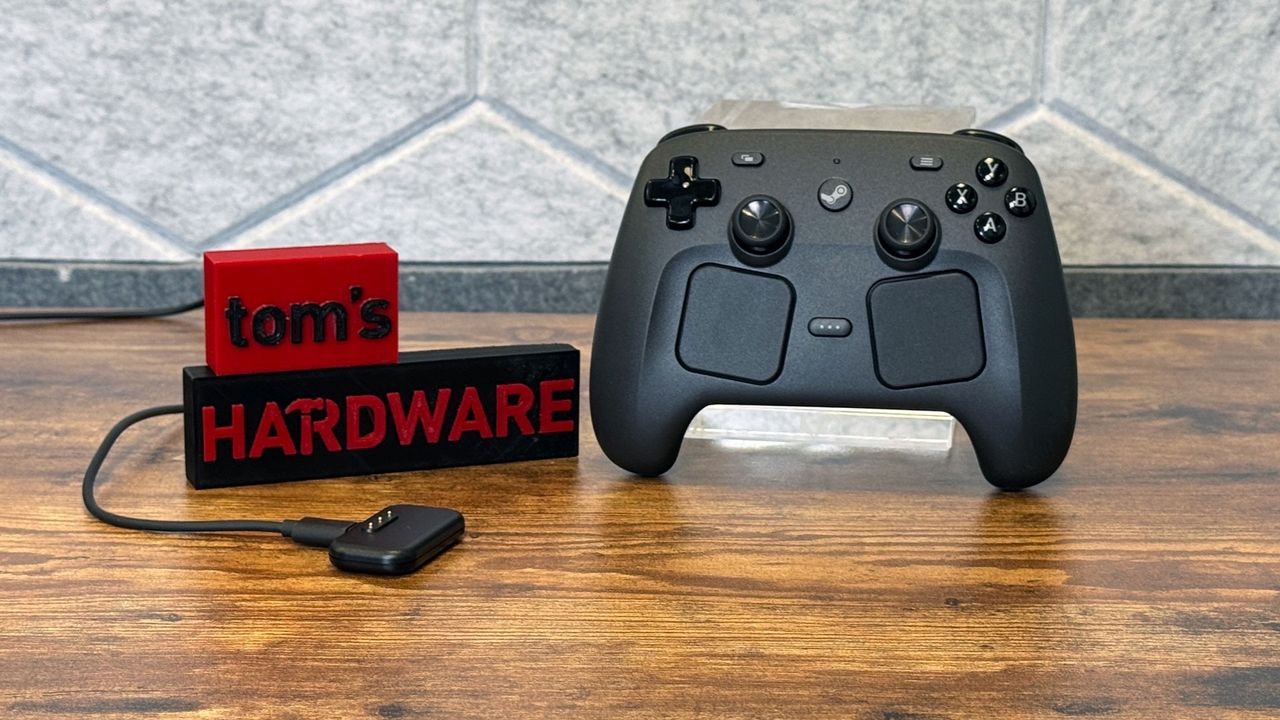
Valve's new Steam Controller lacks native XInput support, but you can still emulate it as long as Steam is running in the background. An enthusiast named Safijari has just engineered a more seamless solution, creating his own DIY "OpenPuck" that lets the Steam Controller emulate other gamepads on the fly. It can emulate Xbox, PlayStation, and even Nintendo layouts, and do so away from your PC.
OpenPuck serves as open-source firmware for a microcontroller, allowing you to easily flash and convert that dev board into a DIY Steam Controller puck. The firmware intercepts raw data from the Steam Controller and translates it on-device, enabling fully-fledged, real-time emulation without the need for Steam Input.
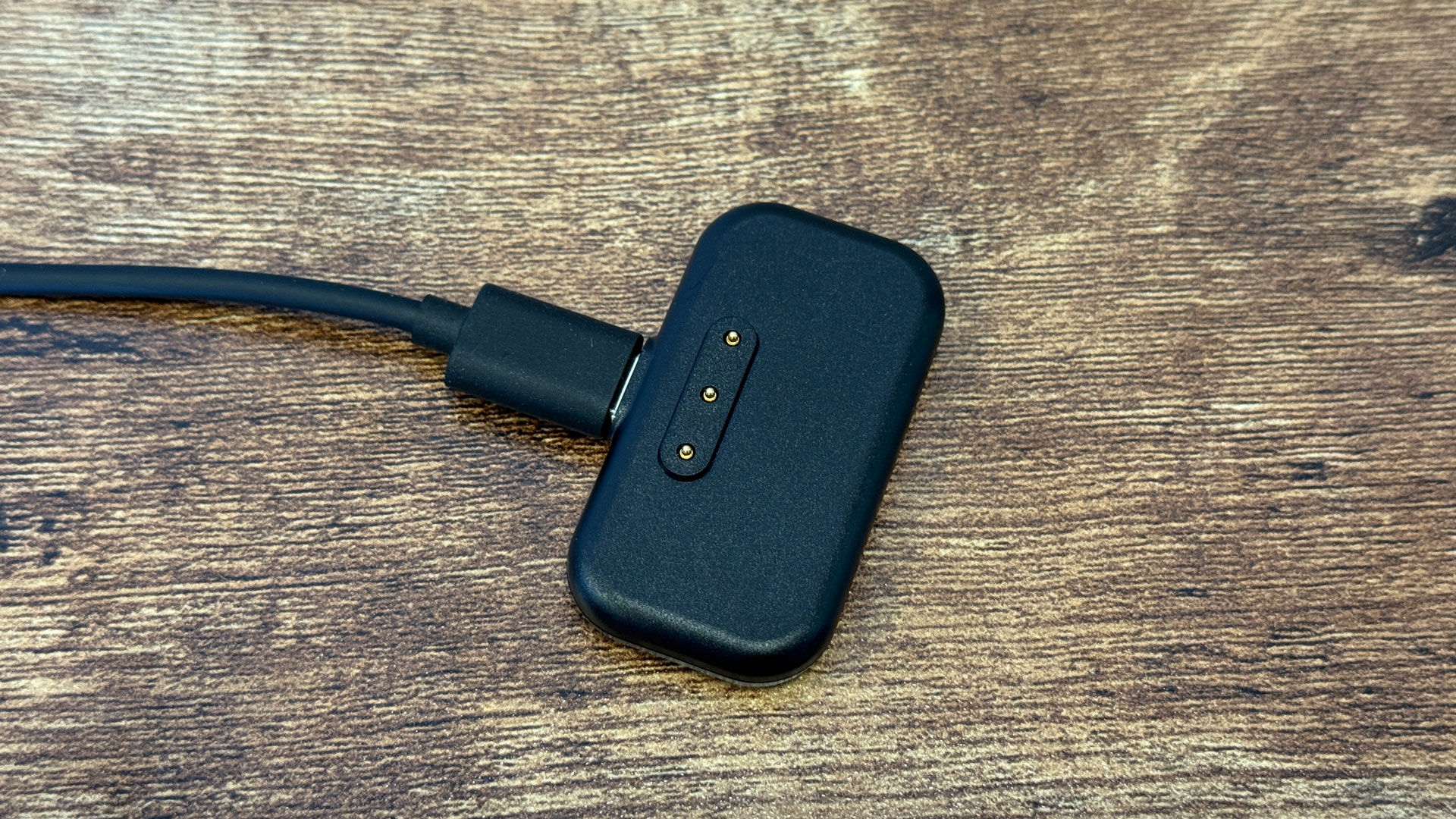
There are other options out there, but the creator used a Pro Micro NRF52480 from Amazon that has the appropriate Bluetooth and 2.4 GHz radios. Once primed in DFU mode, all you need to do is plug the board into your computer via USB-C, drag and drop the Arduino sketch onto it, and the microcontroller turns into an OpenPuck right away. You can 3D print a case to make the assembly look more polished, too.
The original Steam Controller 2 puck (Image credit: Tom's Hardware)
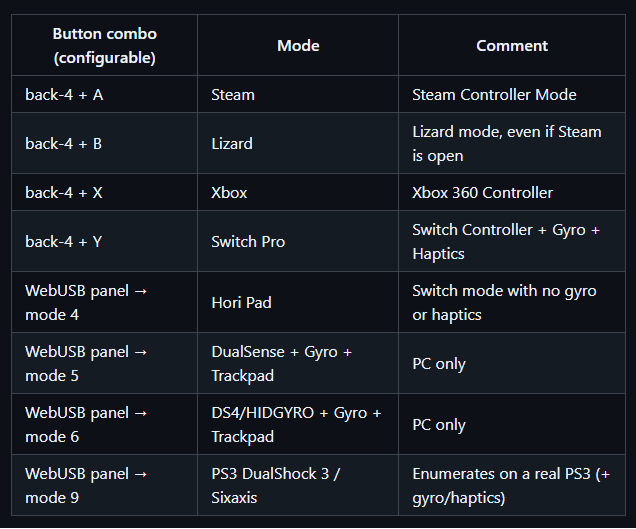
The sketch is available on the project's GitHub page. Once you've flashed your controller, head to the configurator to manage the puck. It's a simple website that uses the WebUSB API to manage the controller, allowing you to switch between the different modes, which include Switch Pro, Xbox, DualSense (PS5), and DualShock 4 (PS4). The project description claims the puck only has a 1ms latency.
The Switch mode works natively on a Switch console with gyro and haptics support, but you can also emulate a Hori Pad that disables those extra features. The PlayStation modes only work on PC, but there's a special DualShock 3 mode that can work natively on a PlayStation 3 console as well, with gyro and haptics (Sixaxis). Of course, the default Steam Controller mode is also there.
You can switch between some of these different controller modes by pressing all four back buttons together and hitting either A, B, X, or Y, but the PlayStation modes require you to use the web configurator. Once everything is set up, however, the Steam Controller runs just like an official Switch, Xbox, or PlayStation controller without Steam even being open in the background.
(Image credit: Future)
There's even a bonus "ReversePuck" sub-project that allows a Steam Deck to act as an external controller, supporting all of the Steam Controller's features (except grip). If you flash a second NRF52840 Pro Micro and plug it into a Steam Deck, you can stream the Steam Deck's built-in controls across the room over 2.4GHz to your OpenPuck-equipped PC, giving you access to essentially another Steam Controller.
Barely a day goes by without some retro system developer accomplishing a technical feat that beggars belief. OpenStrike is the latest mad project, creating a proof-of-concept reimplementation of the seminal Counter-Strike for the Sony PlayStation Portable (PSP), a 22-year-old system that arguably has no business running the game.
The port was made by Yifeng Wang (aka doodlestrike), who apparently created his own Rust-based 3D engine called Pocket3D for the affair, along with the PocketJS JavaScript engine for the game rules and UI. Despite the proof-of-concept status, Wang says that elimination matches with bots are already playable, though the game's famous buying stages aren't yet functional. The full set of eight original Counter-Strike maps have already been tested, and interested modders should easily be able to roll their own.
Yes, that's Counter Strike on a PSP!Yes, that's DevTools inspecting game UI!Yes, it's PocketJS! Clean room implemented FPS engine, fully open JavaScript mod API, ~12MB RAM footprint, 60fps, fully open source. ⚡️ pic.twitter.com/OprLN3E71JJuly 10, 2026
The engine manages to run the game with bots at a steady 60 FPS at the PSP's native 480x272 resolution, thanks to pre-processing graphical assets to directly bake lightmaps into vertex colors (as opposed to real-time or on-startup calculations). Interestingly, Wang kept the old-school BSP (Binary Space Partitioning) rendering method to cull non-visible areas rather than use a fancier modern algorithm, lending credence to the "don't fix what isn't broken" motto.
The game also runs on the PS Vita, a system with 4x the effective resolution of the original at 960x544, with native graphics, without upscaling of either 3D rendering or 2D assets. You should also be able to run the project as a standard desktop game, and naturally, it's playable on the popular PPSSPP emulator. To get the project going, you'll have to provide your own copy of the Counter-Strike asset data, similar to using Doom's original WADs in one of the many ports.
The project's entire technical architecture is impressive, as Wang went way beyond the scope of "make a 3D engine that load maps." Both the Pocket3D and PocketJS 2D engines are generic, and OpenStrike is merely the first "product" that uses them. The code runs on a server/client/event architecture, and the event handling (ex: shooting) is decoupled from the rendering core, preventing nasty FPS dips. The game is testable offline, and most everything is trivially moddable. You should check out the OpenStrike repo if you're interested.
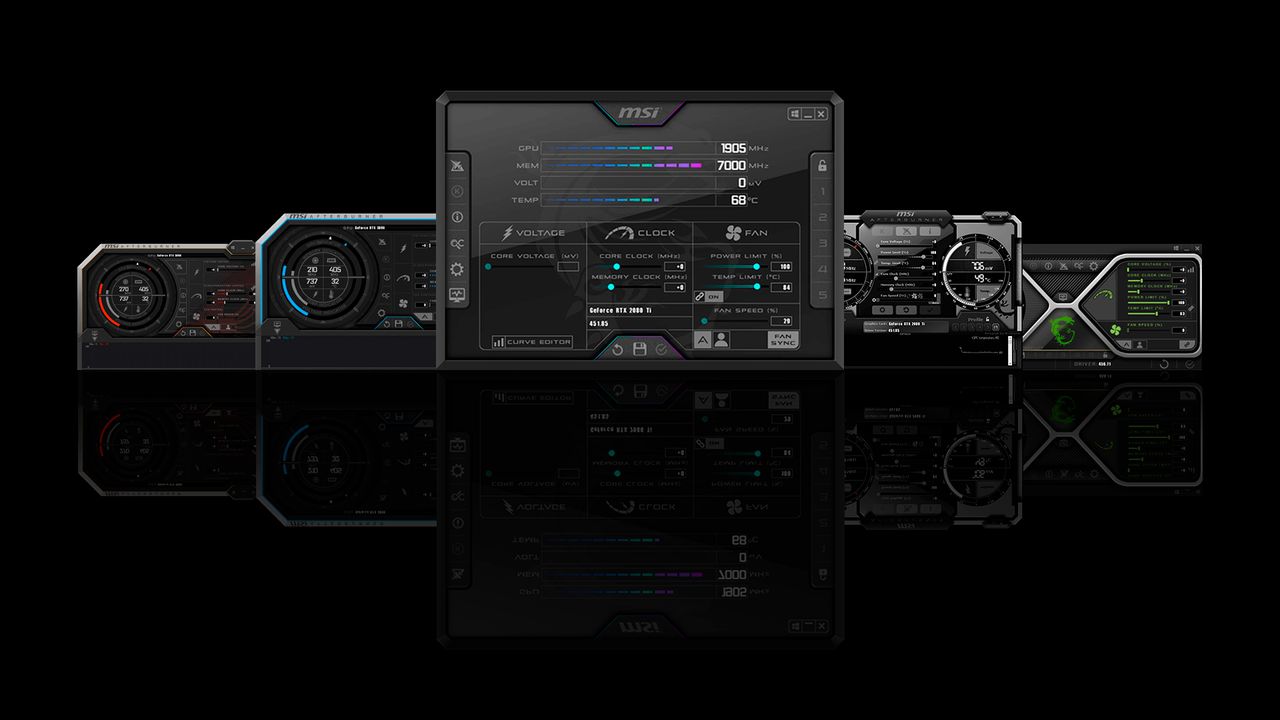
MSI Afterburner’s solo developer is working on a new update that provides a heatmap of the most-used voltage/frequency points a GPU is operating at within Afterburner’s voltage/frequency curve chart. The update is designed to help enthusiasts and overclockers better understand the boosting behavior of their GPU and adjust their GPU’s overclock accordingly. Unwinder, Afterburner’s developer, reported on the Guru3D forums that this update will be released with 4.6.7 beta4 for users to test. An official (non-beta) release with the heatmap has not been announced yet.
The new heatmap generates yellow dots within Afterburner’s existing V/F curve editor, making it easy to compare the GPU’s existing V/F curve against where the GPU is boosting in real workloads. For instance, Unwinder shared a screenshot of the heatmap being used with an RTX 5090, showing the GPU operating primarily at 800mv at 1200MHz, and 1000- 1055 mV at around 2.6 to 2.8GHz. The former relates to the GPU’s behavior at idle/low-load workloads and the latter at maximum load.
the next beta of msi afterburner developed by unwinder adds V/F hit map.v4.6.7 beta4 (not yet released)https://t.co/sJxErlqMLVthe current latest beta is v4.6.7 beta3 build17352 (jun 19)https://t.co/o4jRfXFMJP https://t.co/cEMaQHaDTe pic.twitter.com/7vKK0rgyhhJuly 12, 2026
Unwinder revealed that one interesting perk of the new heatmap system is its ability to identify the differences in boosting behavior between Nvidia’s RTX 40-series and older GPUs, and RTX 50-series GPUs. Improvements in Blackwell’s DVFS, or Dynamic Voltage Frequency Scaling, make the GPU behave very differently compared to RTX 40-series GPUs or older. Unwinder shared an additional screenshot of an RTX 4090 running the heatmap, showing yellow dots only around the lower and upper ranges of the V/F curve. By contrast, the heatmap of the RTX 5090 shows yellow dots across the entire V/F curve, revealing that the RTX 5090 is spending more time in the middle range of the curve than its predecessor.
MSI Afterburner’s new heatmap aims to help overclockers more accurately adjust their overclocks according to what voltage/frequency points the GPU is prioritizing in real workloads. For the uninitiated, V/F curve overclocking manipulates the GPU’s boosting algorithm by changing the shape of its V/F curve. If you're able to sustain the same clock speed at a lower voltage, that should mean a higher voltage can push a higher clock speed, which is the idea behind undervolting with a V/F curve before overclocking with an offset.
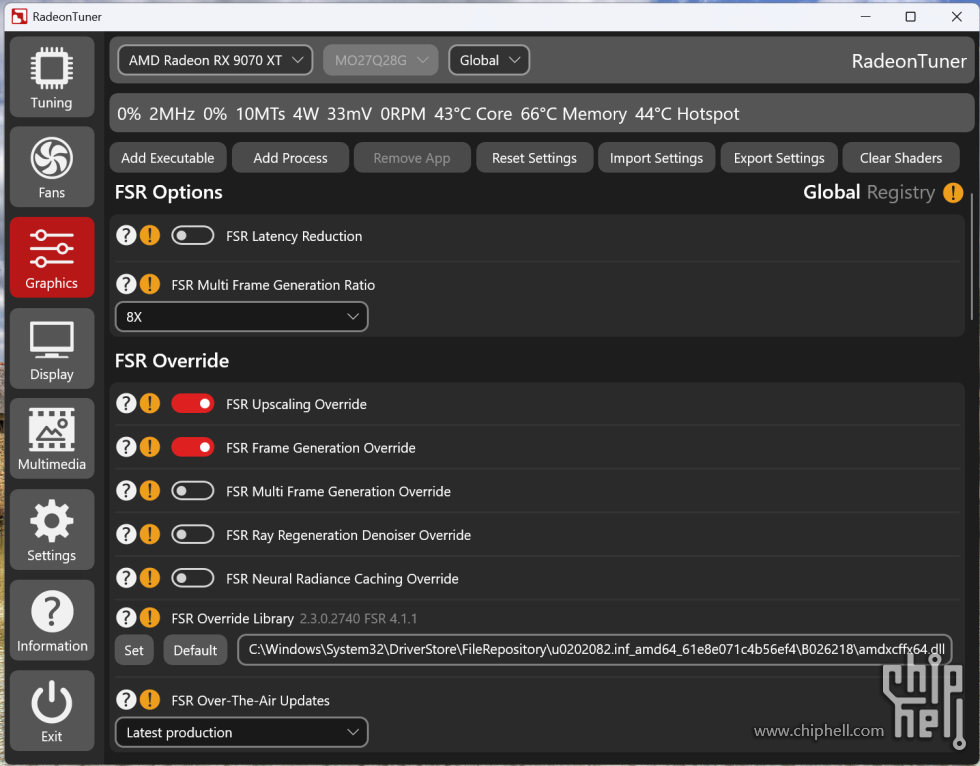
AMD is reportedly testing FSR Multi Frame Generation for existing Radeon GPUs, with ratios of up to 8x. According to a screenshot shared on the Chiphell forums, AMD's latest Adrenalin Edition 26.6.2 driver includes support for Multi Frame Generation, as hidden experimental settings were discovered in RadeonTuner, a third-party open-source alternative to AMD Adrenalin Software. In addition to a new Multi Frame Generation Ratio setting, RadeonTuner also includes override options for FSR Ray Regeneration Denoiser and FSR Neural Radiance Caching.
This suggests that AMD is potentially testing FSR Multi Frame Generation, with options ranging from 1x to 8x. In theory, that could boost a base frame rate of 60 FPS to as high as 480 FPS, which is around 2x higher than what Nvidia currently offers on its RTX 50 series GPUs. That said, these settings are non-functional, and there is no confirmation whether AMD has plans to roll out an 8x Multi Frame Generation mode.
(Image credit: Chiphell Forums)
The discovery has also prompted a response from the developer of RadeonTuner on GitHub, where they explained that AMD occasionally adds the names of upcoming settings to its drivers months before the actual functionality is implemented. The developer also clarified that the newly listed Multi Frame Generation ratios of up to 8x are placeholders that have been added for testing purposes, meaning that it may or may not align with the final implementation that AMD ends up supporting eventually.
Interestingly, during Microsoft's recent unveiling of its upcoming Xbox platform codenamed Project Helix, the company confirmed that the console will feature FSR Diamond (previously called FSR Next). This was touted as an AI-powered rendering suite that would include machine learning-based upscaling, ray regeneration, and Multi Frame Generation. AMD's graphics chief, Jack Huynh, later described FSR Diamond as the result of a multi-year engineering collaboration with Microsoft.
While there is no indication that the hidden driver settings are directly tied to FSR Diamond, the presence of experimental options for Multi Frame Generation, Ray Regeneration, and Neural Radiance Caching suggests AMD is laying the groundwork for its next-generation FSR technologies across the Radeon ecosystem.
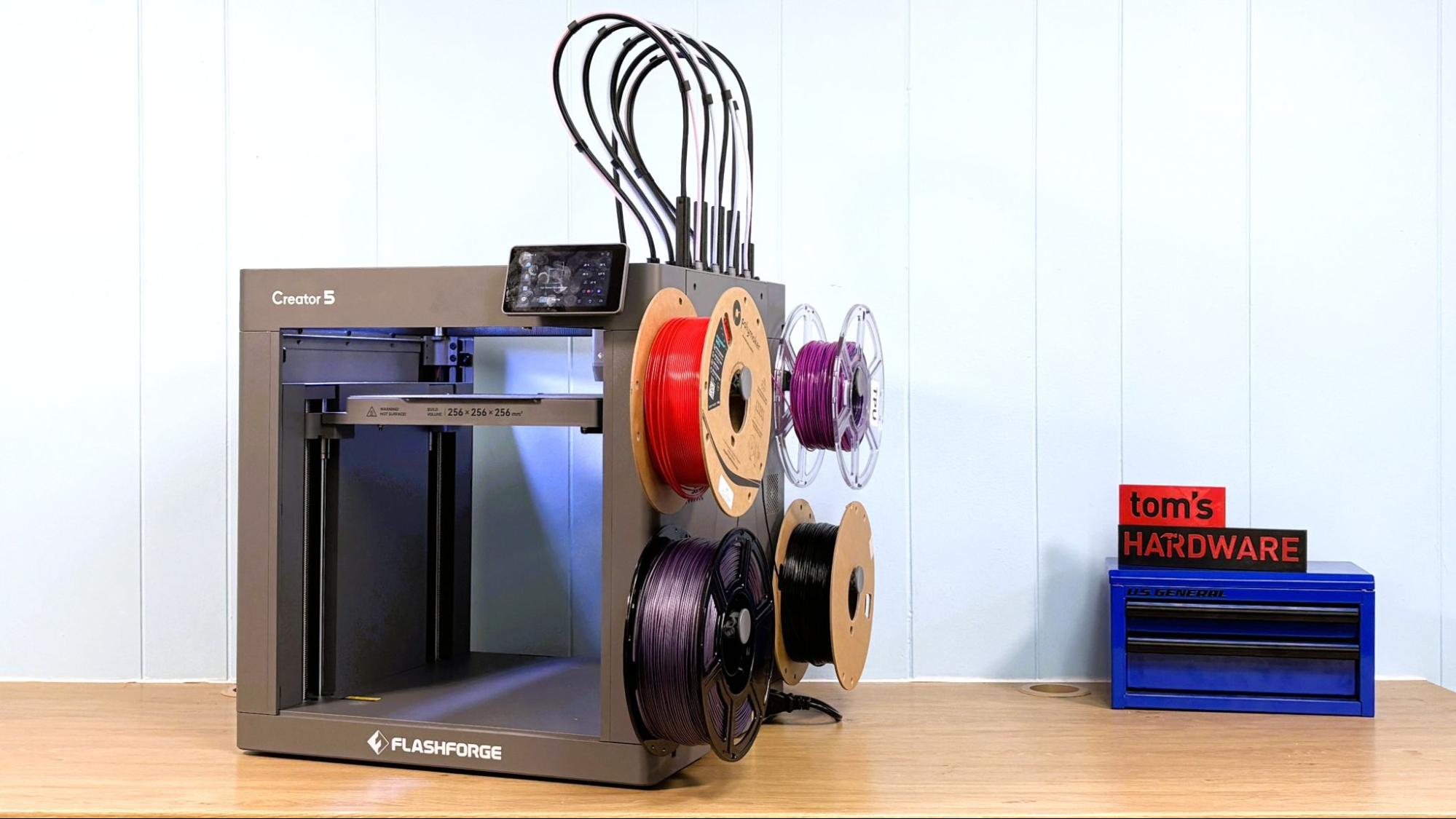
The Flashforge Creator 5 is the best budget tool changer currently on the market. Of course, there are only two other true toolchangers out there right now, three if you include the Bambu Lab H2C nozzle swapper. At the time of this review, the Creator 5 is on sale for $699, after a $100 discount. For that, you get a solid, open-frame Core XY machine with a 256 mm cubed build volume and four speedy toolheads that won’t waste your filament budget.
The Creator 5 is not perfect. It purges an insane amount of material when it loads, and the required prime block is surprisingly large. If you don’t use the Flashforge filament profiles, you’ll be in for a shock at the heft of the prime tower. Why? They only adjusted the filament profile for their own material. Everything purges at single-nozzle AMS levels. This setting is buried pretty deep in the slicer, and it took some time for me to find and correct it.
The printer handle high temperature materials well, which is more relevant if you opt for the enclosed Creator 5 Pro. It's still useful on the open frame machine because it loads and unloads at a higher temp to avoid clogging.
Being an open-frame printer, the Flashforge Creator 5 is limited in the materials it can print. We used the basics, PLA, PETG, and TPU for most of our prints. Since the hot end temperature can go all the way to 320°C and bed can get to 120°C we did try some higher temp filaments like PET-GF which printed fine at 310°C.
There’s no upgrade path to take the Creator 5 to an enclosed Pro, something that other companies might offer. Even though it looks like Flashforge uses the same case for both machines, there’s no fan behind the exterior grill for extra cooling, and no way to install one. However, if your plan is to print in multicolor PLA, PETG, and TPU, this is a good, no-frills machine for your workshop. It's one of the best 3D printers we’ve seen this year, and I highly recommend checking it out for your next multicolor machine.
Specifications: Flashforge Creator 5
Build Volume
256 x 256 x 256 mm (10.07 x 10.07 x 10.07 inches)
Material
PLA/PETG/TPU (up to 320 degrees)
Extruder Type
Direct Drive Tool Changer
Nozzle
.4mm stainless steel proprietary
Build Platform
Double-sided textured PEI steel flex plate
Bed Leveling
Automatic + Z height
Filament Runout Sensor
Yes
Connectivity
USB, LAN, Wi-Fi
Interface
4-inch Color Touch Screen
Machine Footprint
520 x 443 x 710 mm (20.47 x 17.44 x 27.95 inches)
Machine Weight
14 KG (30.86 lbs)
MSRP
$799
Release Date for Pre-Orders
June 2026
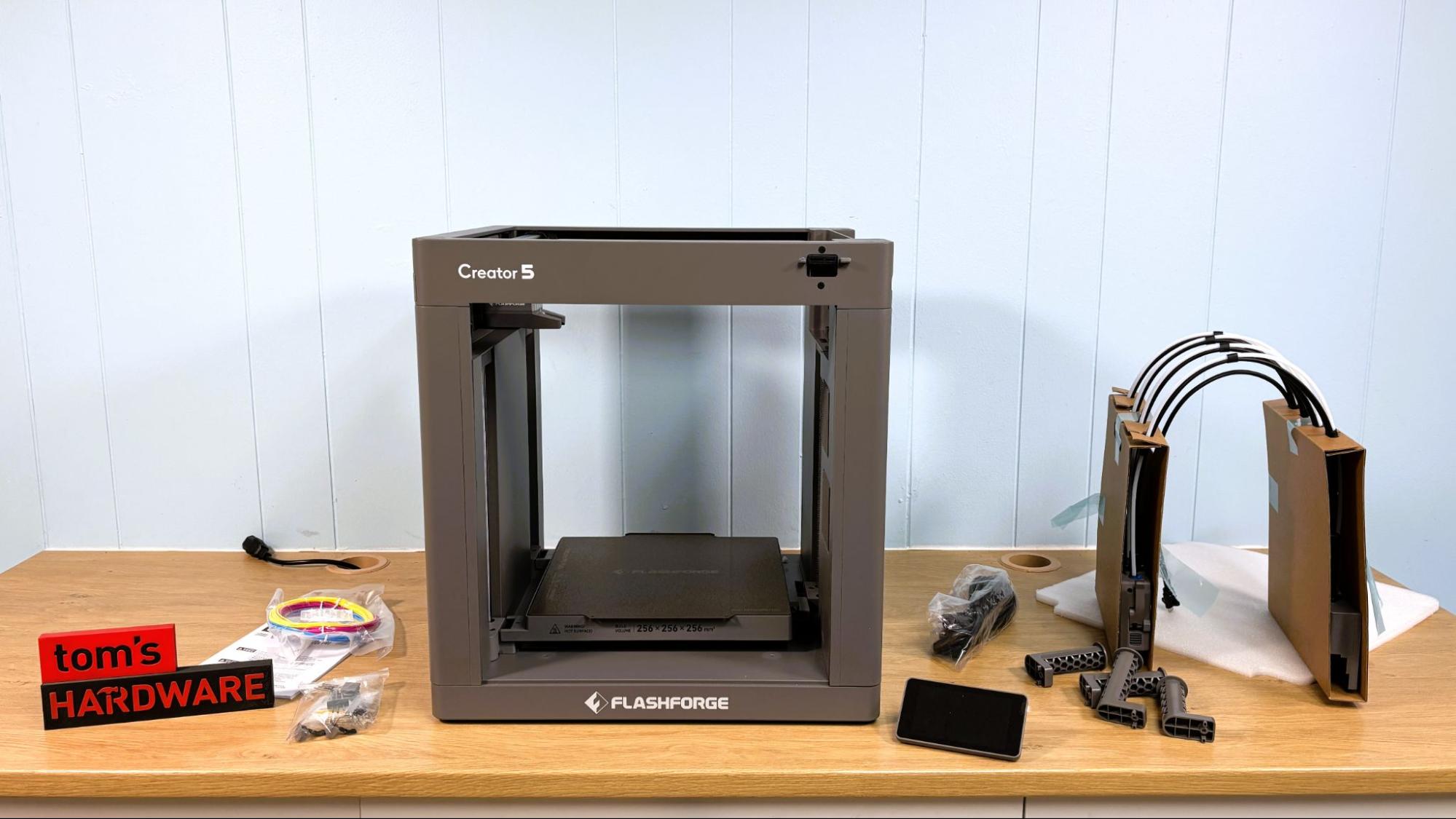
Flashforge Creator 5: Included in the box
(Image credit: Tom's Hardware)
The Flashforge Creator 5 arrives mostly assembled. The tool heads are pre-assembled with a mounting plate. The spoolholders, touch screen, toolkit, filament coils, and quick start guide are included.
Design of the Flashforge Creator 5
(Image credit: Tom's Hardware)
The Flashforge Creator 5 is a fast Core XY open-frame printer with a simple grey case that prioritizes mechanical simplicity to keep the price down. We mainly see this in how filament is manually loaded to each tool head and requires picking up each head to physically hold down a lever while you push the material through to the nozzle.
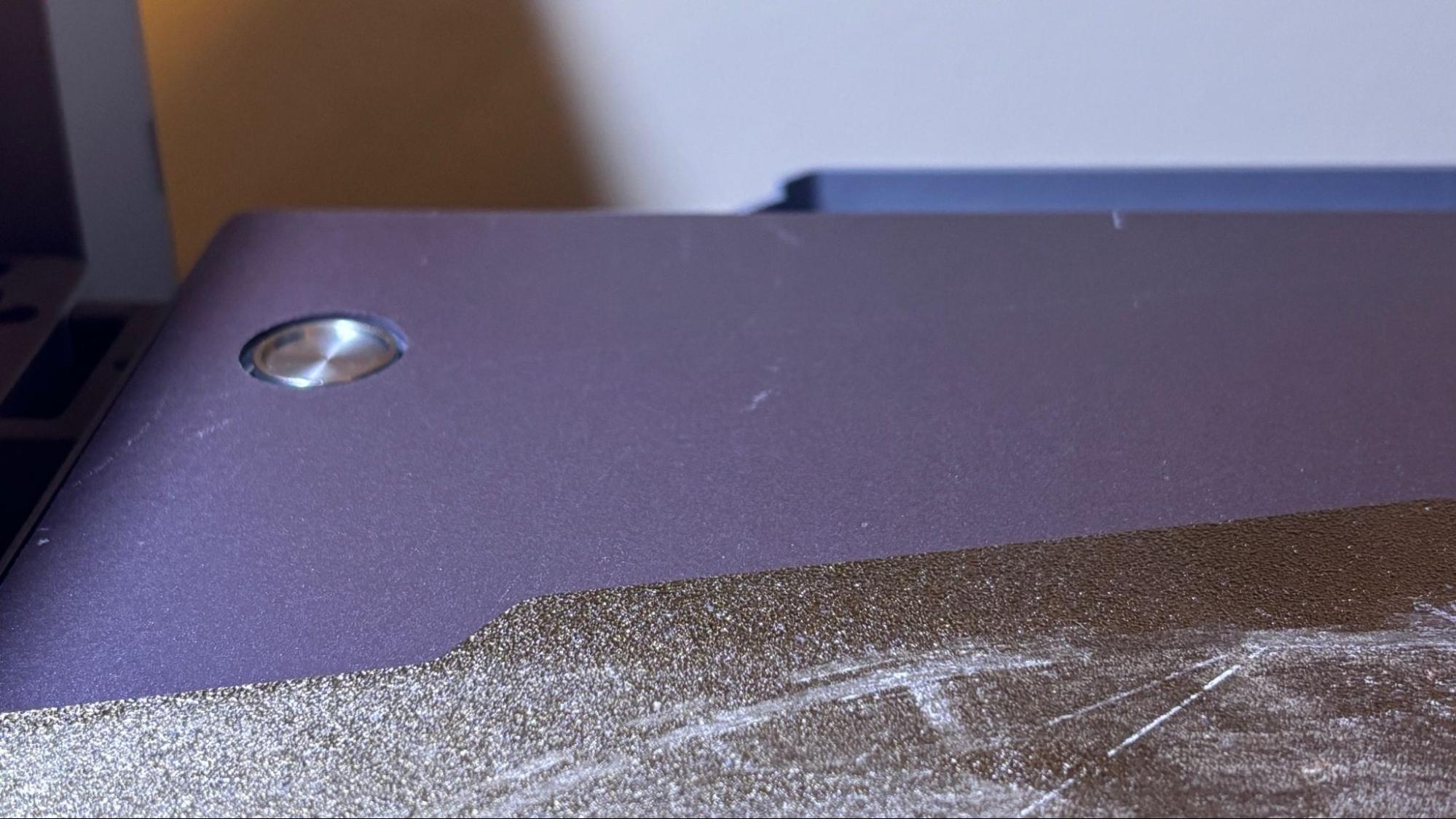
The build volume is 256 mm³, which is a fairly standard size when compared to most 3D printers. The removable flex plate is two-sided and coated with a common PEI textured surface, which gave us no problem.
As I mentioned previously, the open frame case is not meant to be upgraded with a door or top lid. It appears to be the same one used on the Pro version of this machine, which is a great cost-saving method for Flashforge, but disappointing to the buyer when you notice there are no fans behind the vents in the body.
The X and Y axes run on beefy 8mm belts with a linear rail for the X axis and linear rods for the Y. The Z runs on three linear rods, driven by three lead screws belted to a single stepper motor.
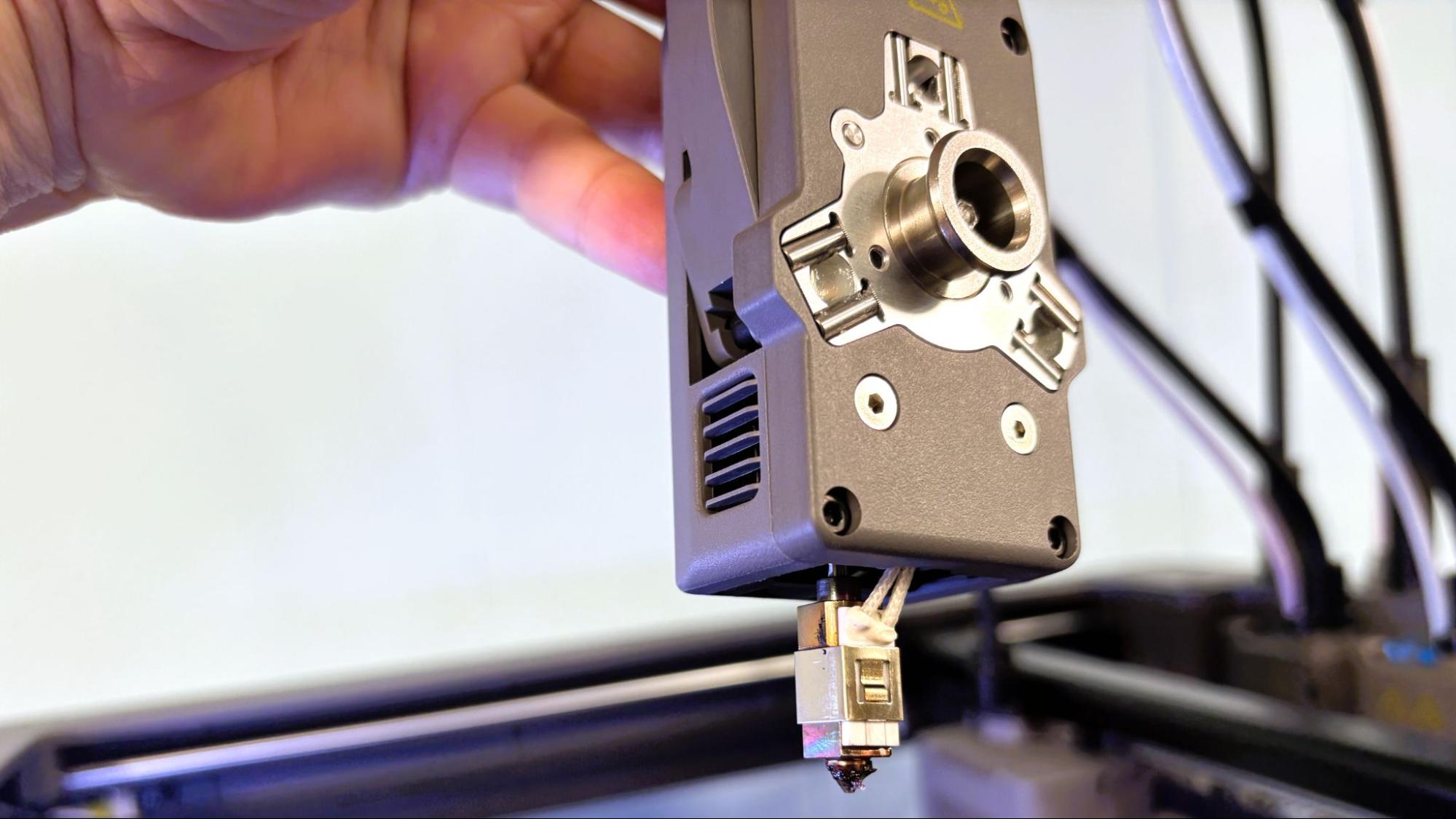
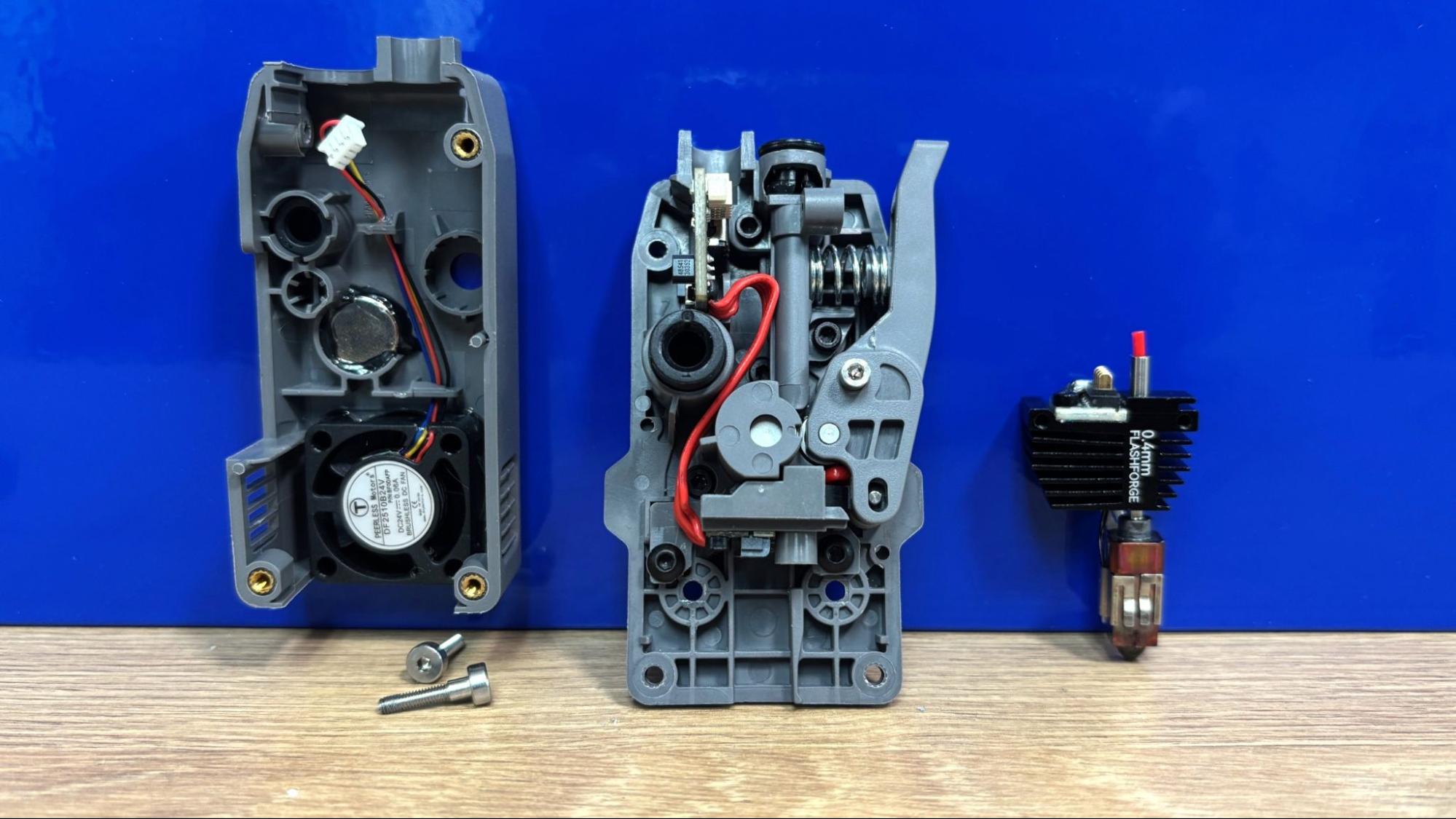
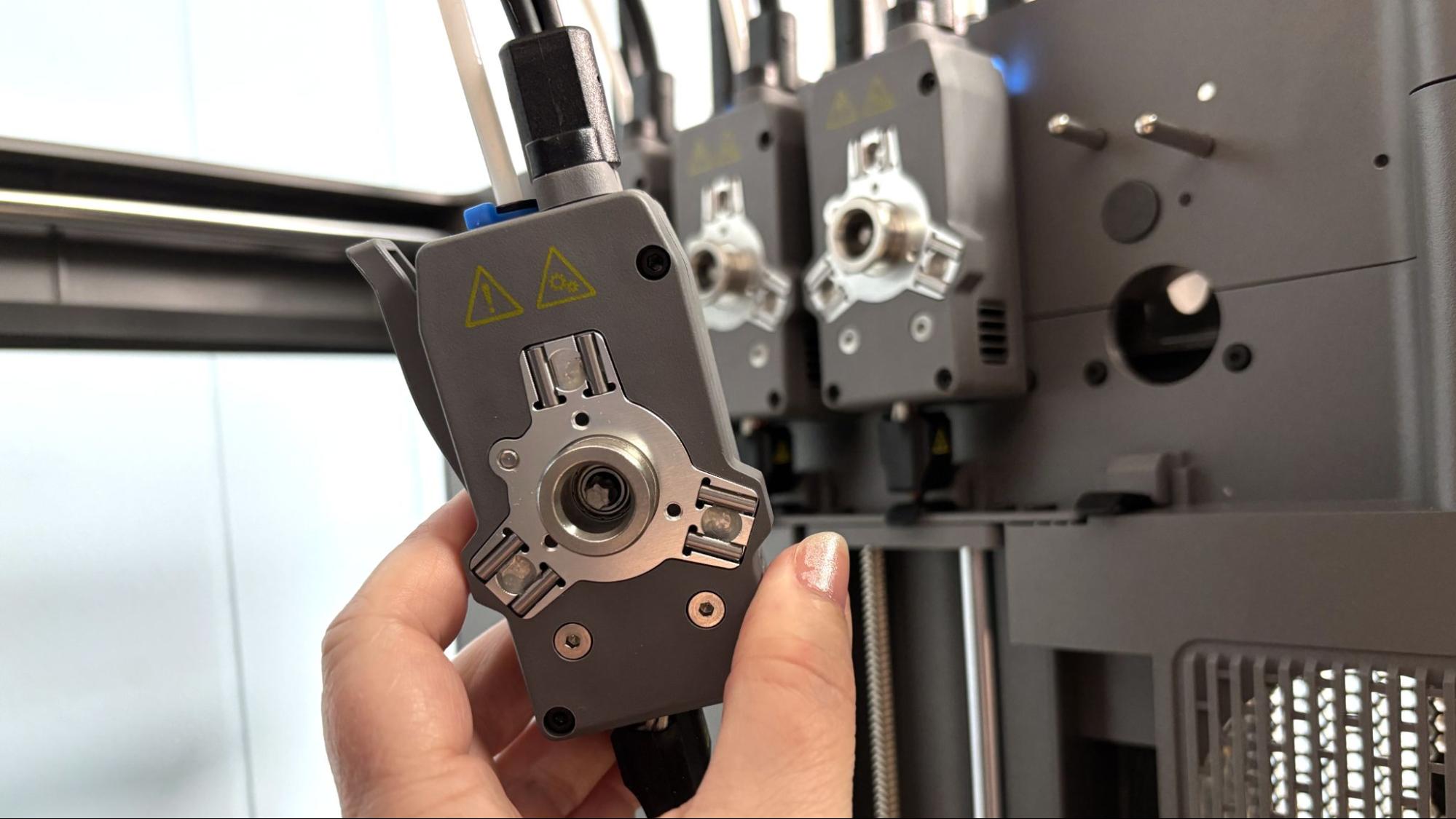
The tool head carriage includes the extruder motor and parts cooling fan, which are shared by four very lightweight tool heads. Each tool head has a manual cutter, hot end, and cooling fan. The tool heads attach to their base with magnets and are picked up by the tool carriage mechanically by gripping the circular protrusion on the back of the tool head, and aligned by mating with three pins on the tool head carriage. This is less complex than motorized latching pins that other machines use, but during our testing, it proved to be a very reliable system.
(Image credit: Tom's Hardware)
The hot end includes the thermistor and heater, and is replaced as a unit. This is not a quick-release system, and you will need tools and a bit of patience to change out the nozzles.
The Flashforge Creator 5 has basic, static, spool holders which allow for the use of a wide variety of spool types from sample spools and coils to oversized spools and spools with dinged up rims. Since the Creator 5 does not automatically unload filament, these work just fine.
Assembling the Flashforge Creator 5
(Image credit: Tom's Hardware)
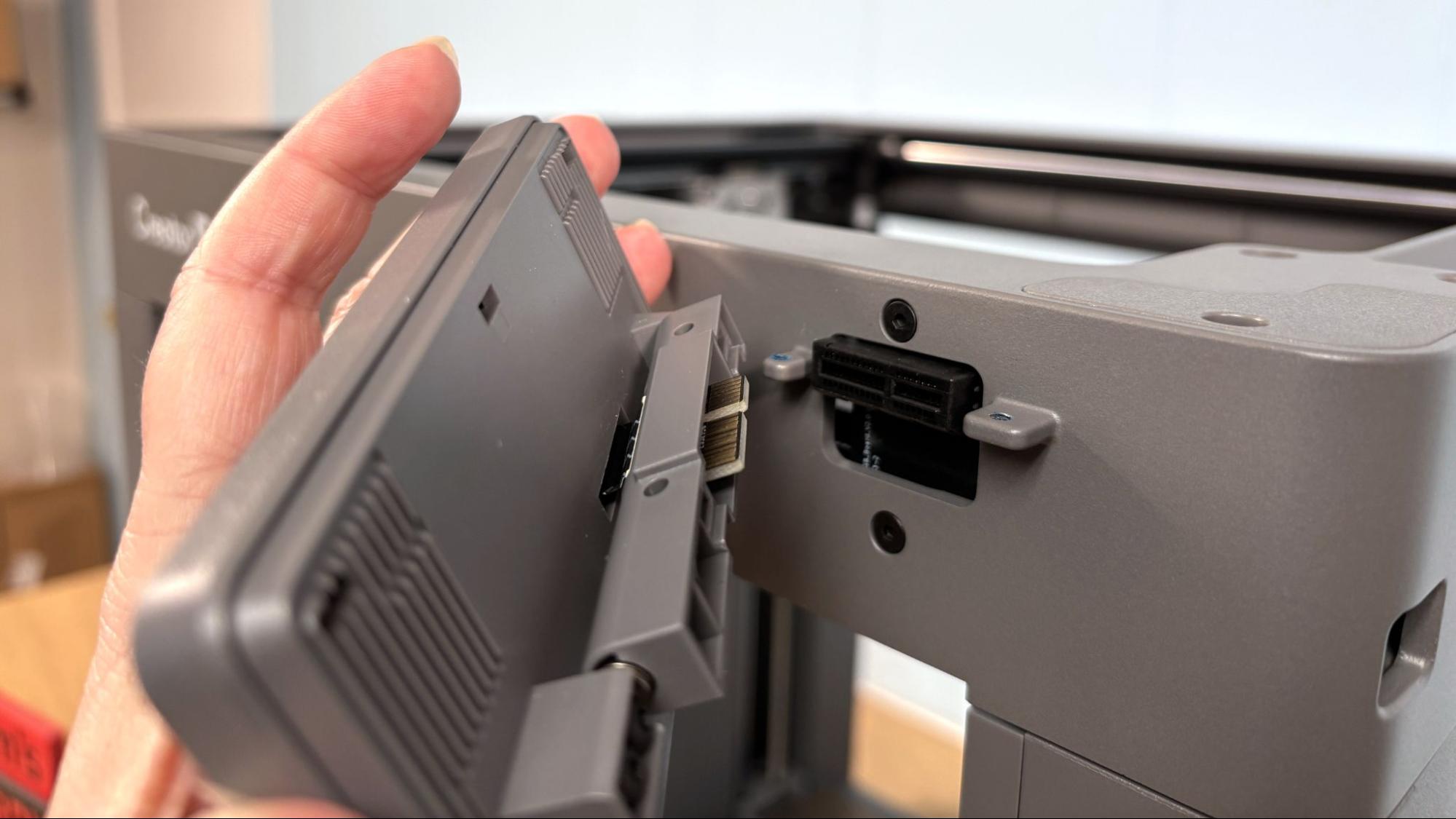
For a complex machine, the Flashforge Creator 5 is very simple to assemble. The 4-inch touchscreen plugs into a socket on the printer, with no ribbon cable to fuss with, and attaches with two screws.
(Image credit: Tom's Hardware)
The tool heads are prewired and attached to a plate, which is screwed into the right side of the printer, and the tool heads dock magnetically, also on the right side of the printer.
The spool holders are attached to the right side of the printer with a single screw each. Four nozzle blockers slot into the right side of the printer to prevent oozing. There is one cable to plug into the toolhead carriage, and it attaches with two screws.
(Image credit: Tom's Hardware)
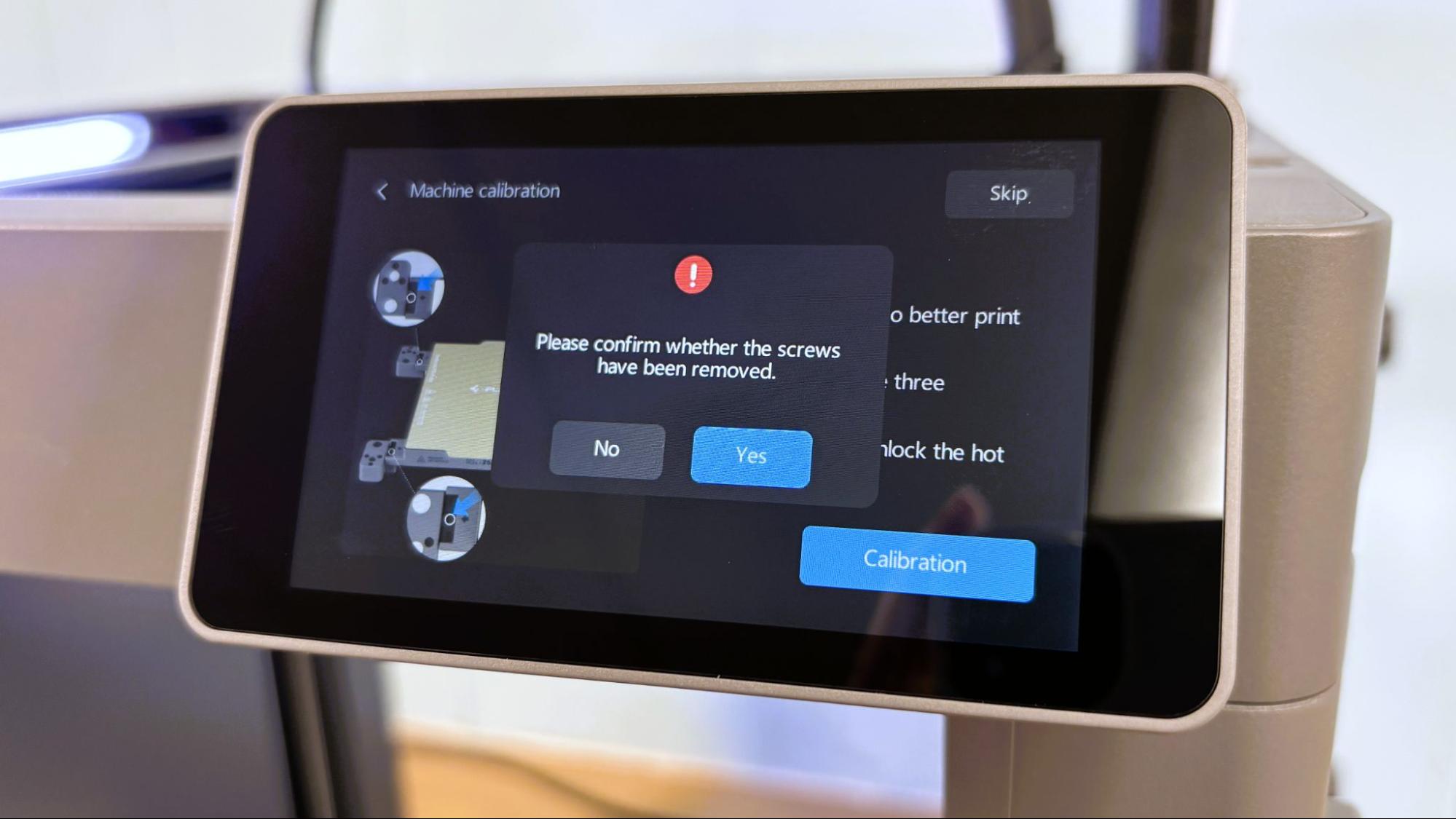
Before calibration, there is a nice reminder to make sure you’ve removed the three screws holding the bad in place for shipping.
Preparing Files / Software for Flashforge Creator 5
(Image credit: Tom's Hardware)
The Flashforge Creator 5 requires a download of Flash Studio, which is based on Orca Slicer, which traces its lineage to Bambu Studio and Prusa Slicer. Flash Studio is stable and works fine for connecting to the Creator 5 in either cloud or LAN mode. The filaments input from the printer itself show up on the device page, but have to be manually chosen in the slicer as they do not sync up automatically.
Flashforge does not give access to the printer directly from a browser using the IP address, but does offer LAN mode if you want to avoid the cloud. Files can also be transferred manually via a USB drive.
(Image credit: Tom's Hardware)
You can access Voxelshare, Flashforge’s file sharing site from the home page of the slicer. While not as deep as some of the other file sharing services out there, it is a good place to start looking for something to print.
(Image credit: Tom's Hardware)
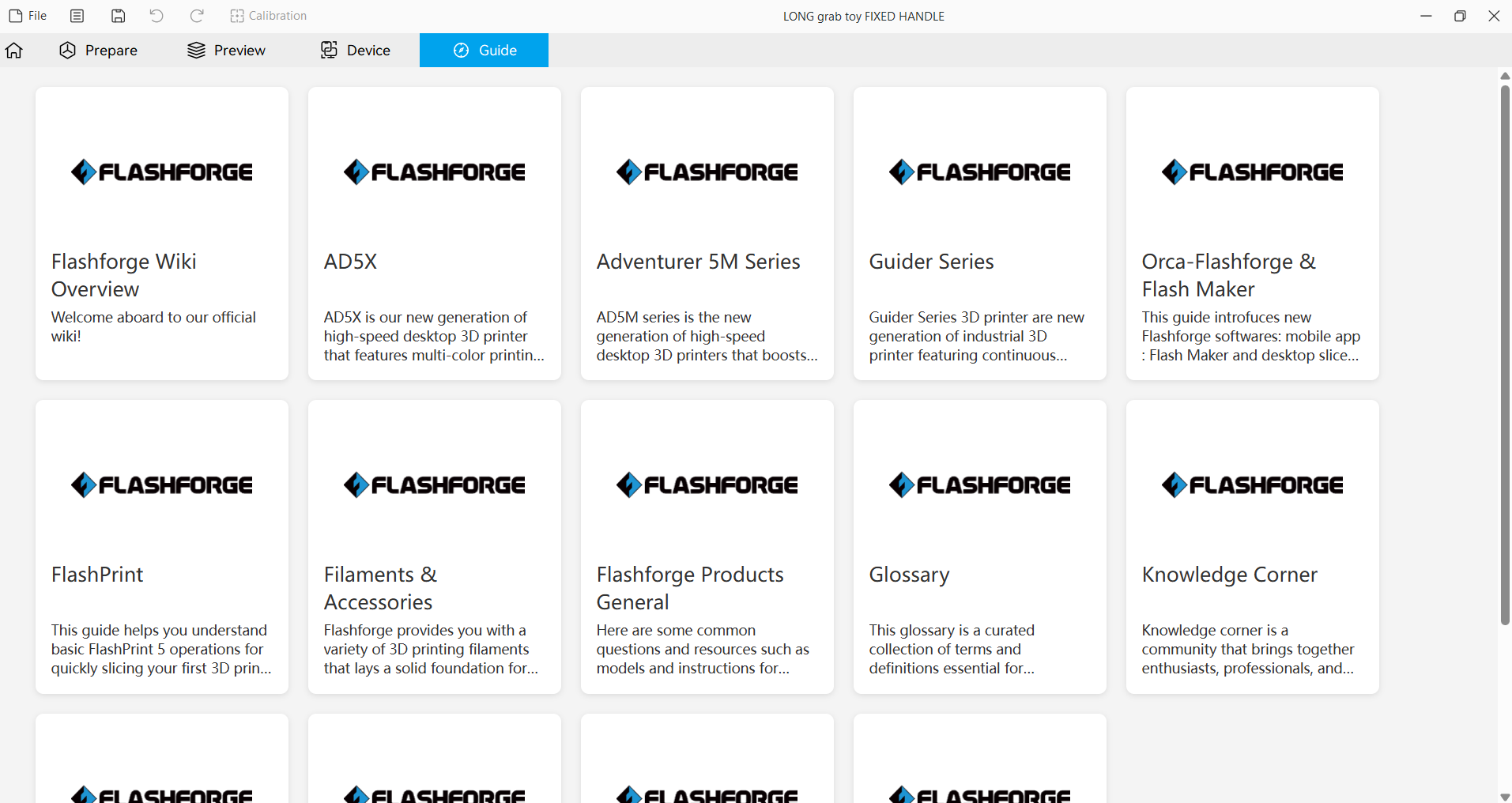
Flashforge does have a nice series of guides that can be accessed directly from the slicer. Information is a little light on the Creator 5 largely because it is still in pre-order status.
Leveling the Flashforge Creator 5
(Image credit: Tom's Hardware)
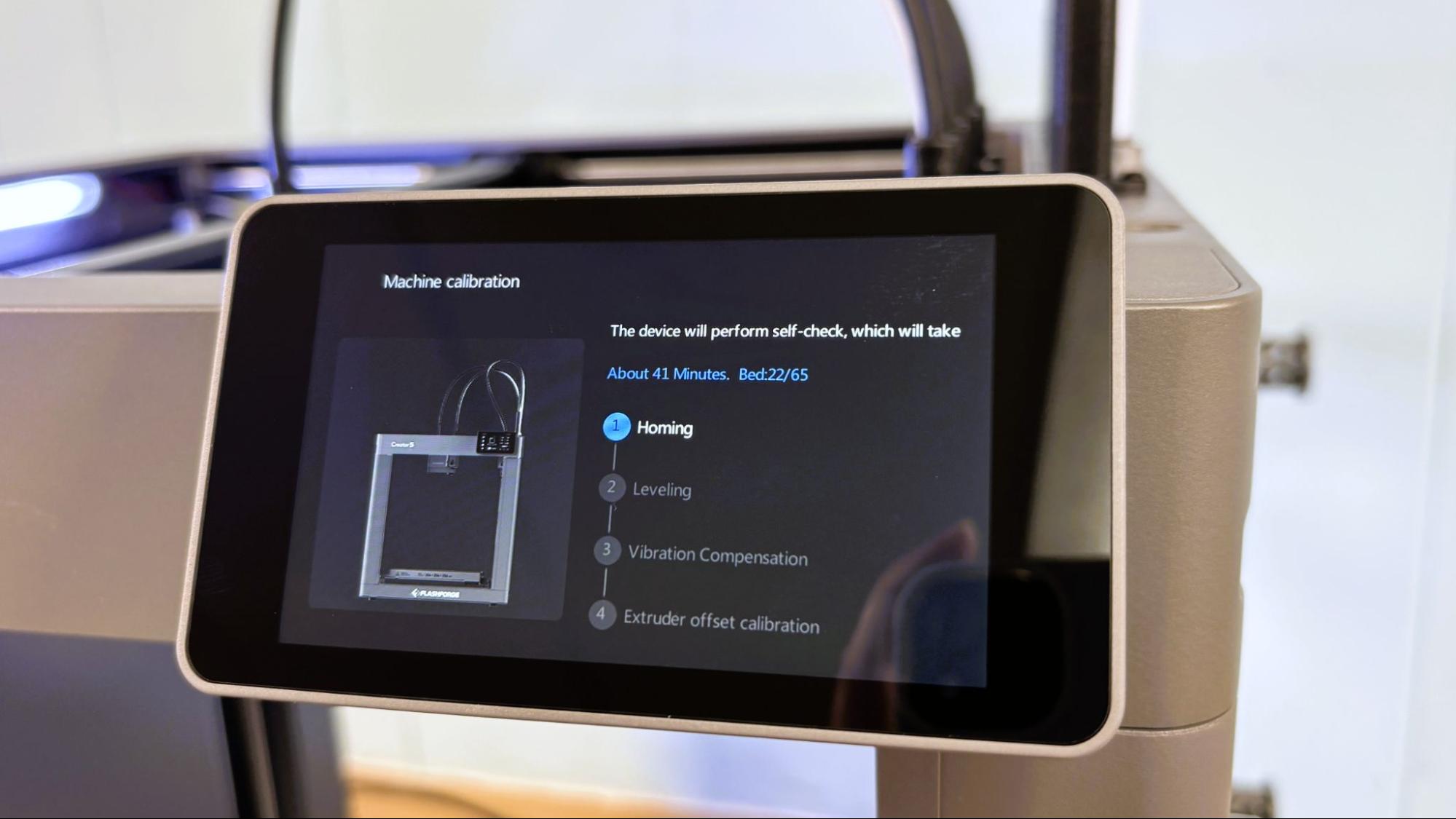
The Flashforge Creator 5 sets Z offset and levels the bed as part of its initial calibration, along with vibration compensation and extruder offset calibration. It calibrates the four tool heads by tapping a calibration disk hidden underneath the build plate. This takes about 40 minutes, but only needs to be done when the machine is first set up.
(Image credit: Tom's Hardware)
The printer offers to recheck the level at the start of each print. Since the printer sets the level using the tool head carriage, without the need to level each individual tool, it’s quick enough to just let it level each time.
Loading Filament on the Flashforge Creator 5
(Image credit: Tom's Hardware)
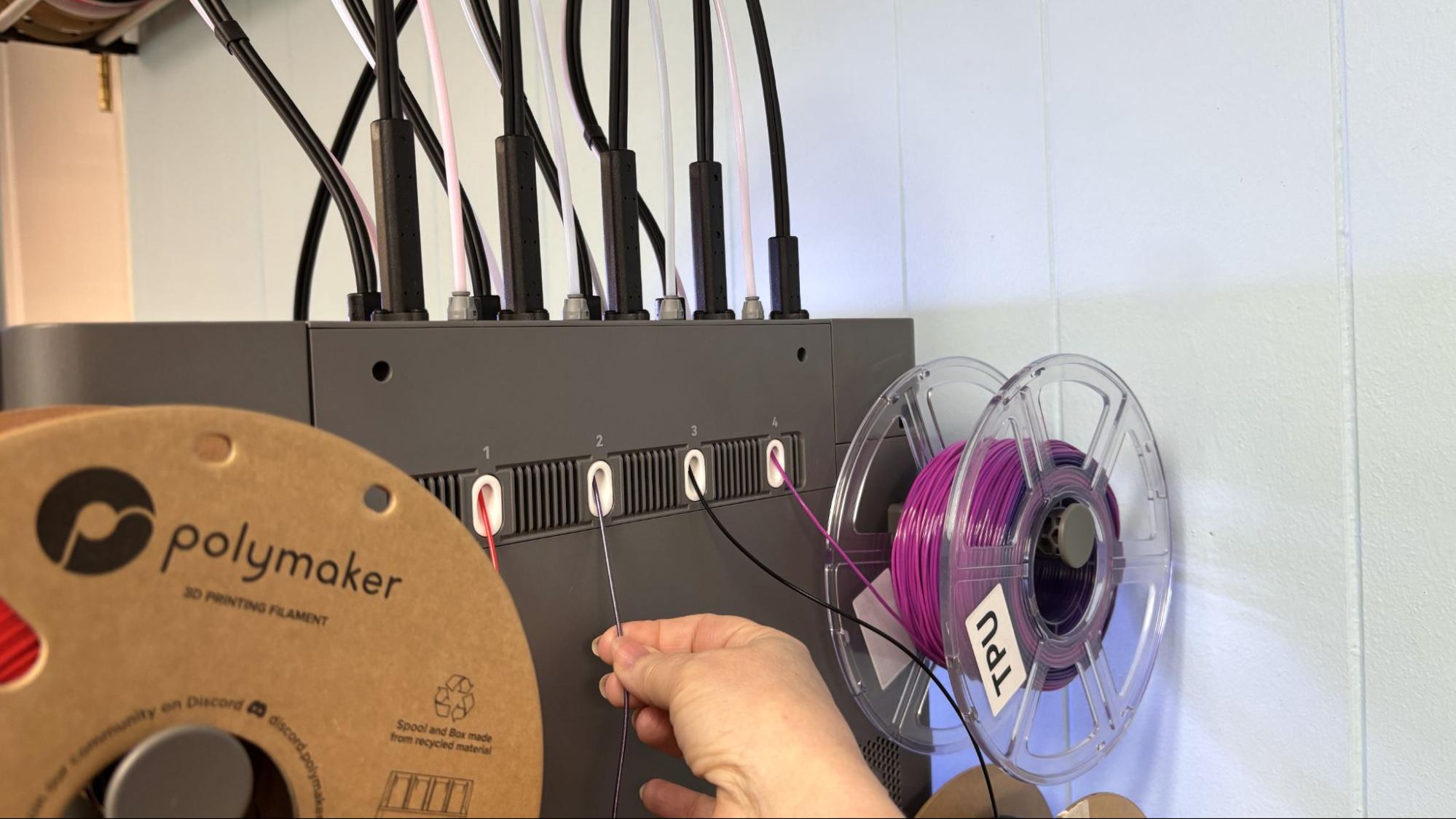
Loading filament in the Flashforge Creator 5 is a very simple, though oddly manual, process. Each tool head has a manual cutter, triggered by a lever, which also releases the extruder. To load filament, place the spool on the holder, push the end of the material into the appropriately numbered port, and hand-feed the material to the tool head. You then remove the toolhead from its dock, press the lever to release the extruder tension, and feed the material until it stops. To unload, you reverse the process.
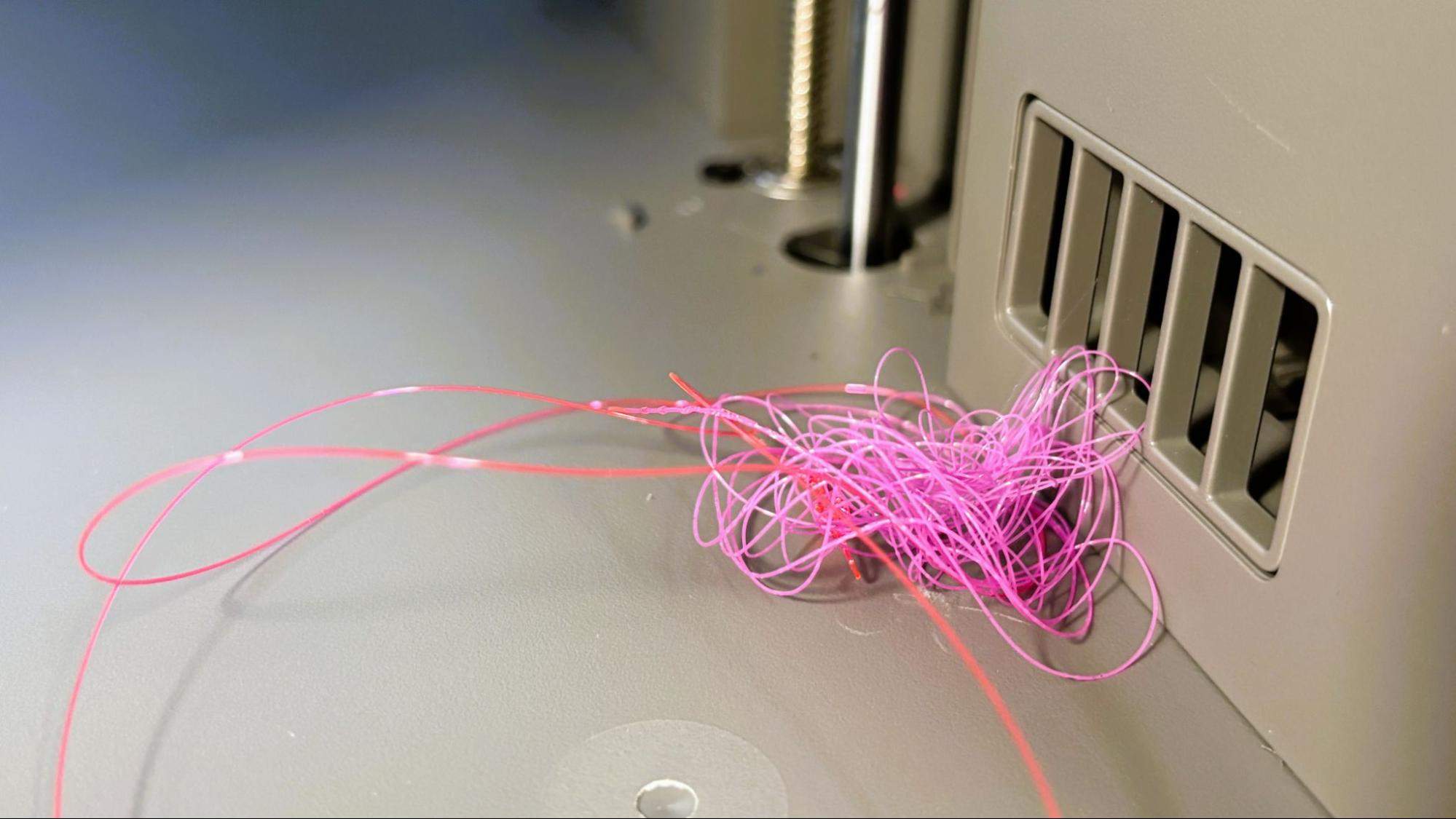
The loading routine on the printer nicely sets the hot end temperature to match the last filament loaded, 250 °C for PLA and TPU, and 270 °C for PETG. It will then purge a rather large amount of material onto the floor of the printer.
(Image credit: Tom's Hardware)
Printing on the Flashforge Creator 5
The Flashforge Creator 5 comes with four small sample coils of basic colored PLA, which are too small to be of any real use. You should check out our guide to the best filaments for 3D printing to stock up on filament before using the Creator 5.
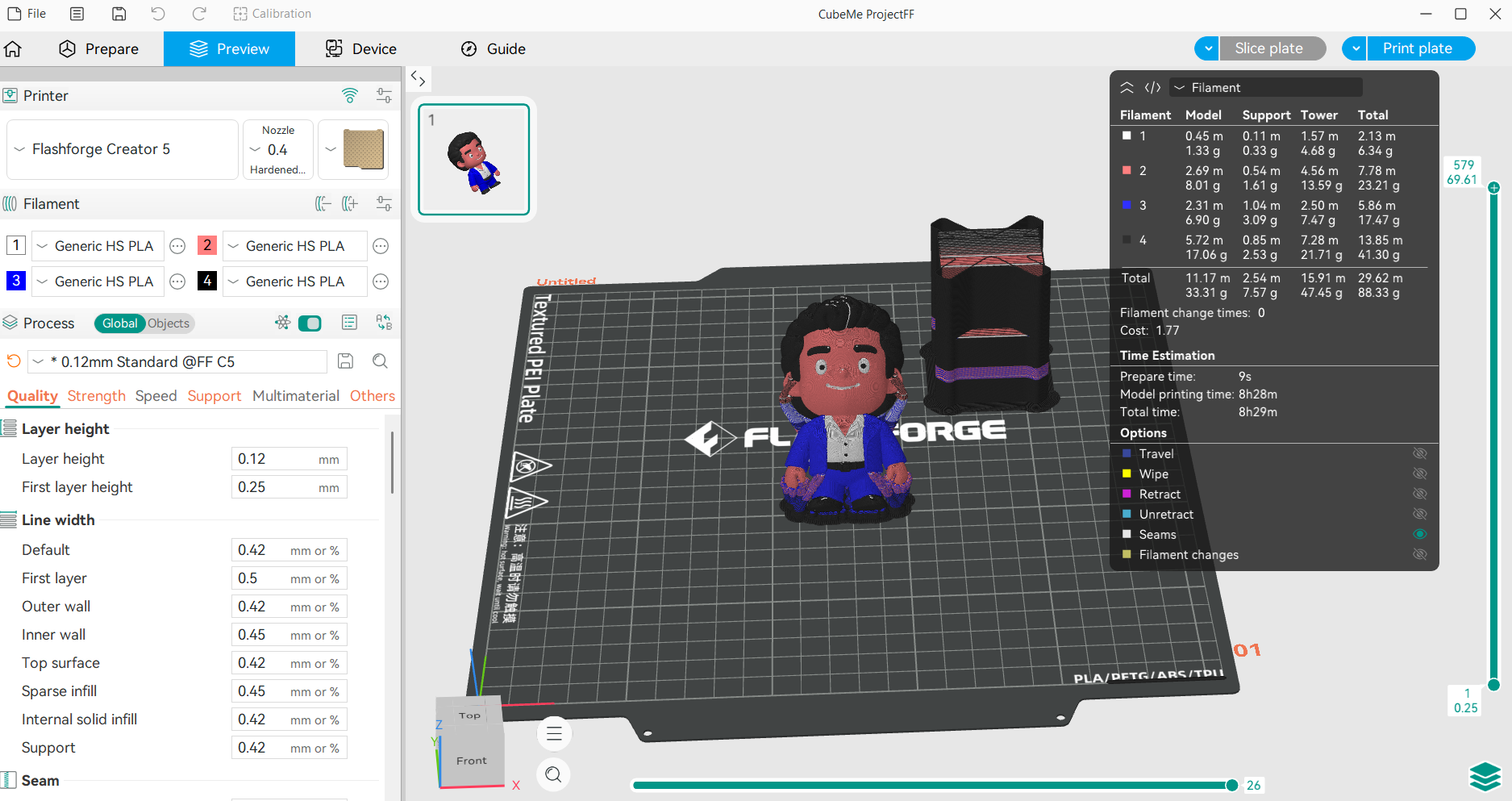
For my first print, I decided to jump into the deep end of the pool. I used Creality’s Cube Me tool to make a model from a photo of Dave Hasselhoff from his Knight Rider days. I used the .12 mm layer height default profile, which set an average print speed of 160 mm/s. I tilted the model 90 degrees backward to avoid supports on Hoff’s face and stuck with the default values for tree supports. The supports were very stout, but were removed with very little trouble.
The print took 8 hours 28 minutes to complete and looks fantastic. The purge block generated by the defaults was massive on this model, weighing in at 44 grams, more than the model’s 33 grams. This purge value can be adjusted in the slicer and should be refined in future software releases as well.
I wanted to test the ability of the Creator 5 to push TPU, so I loaded up some FiberFlex 40D from Fiberology. 40D is a little bit softer than standard 95A TPU, and many of the printers I test have a hard time handling it. To make it more interesting, I gave it a difficult model, the TPU air duster from Dan the 3D Printing Dad on Printables. This file will fail at the first hint of underextrusion. Using a .12mm layer height and an average print speed of 50 mm/s, the print completed in 2 hours and 9 minutes.
The duster printed great, with no leaks in the bellows, but did fail ¾ of the way up the straw. That soft TPU was way too wiggly at the top, where the model was very small.
Sadly, the extruder clogged, which required disassembling the tool head to clear.
Tinkercad (Image credit: Tom's Hardware)
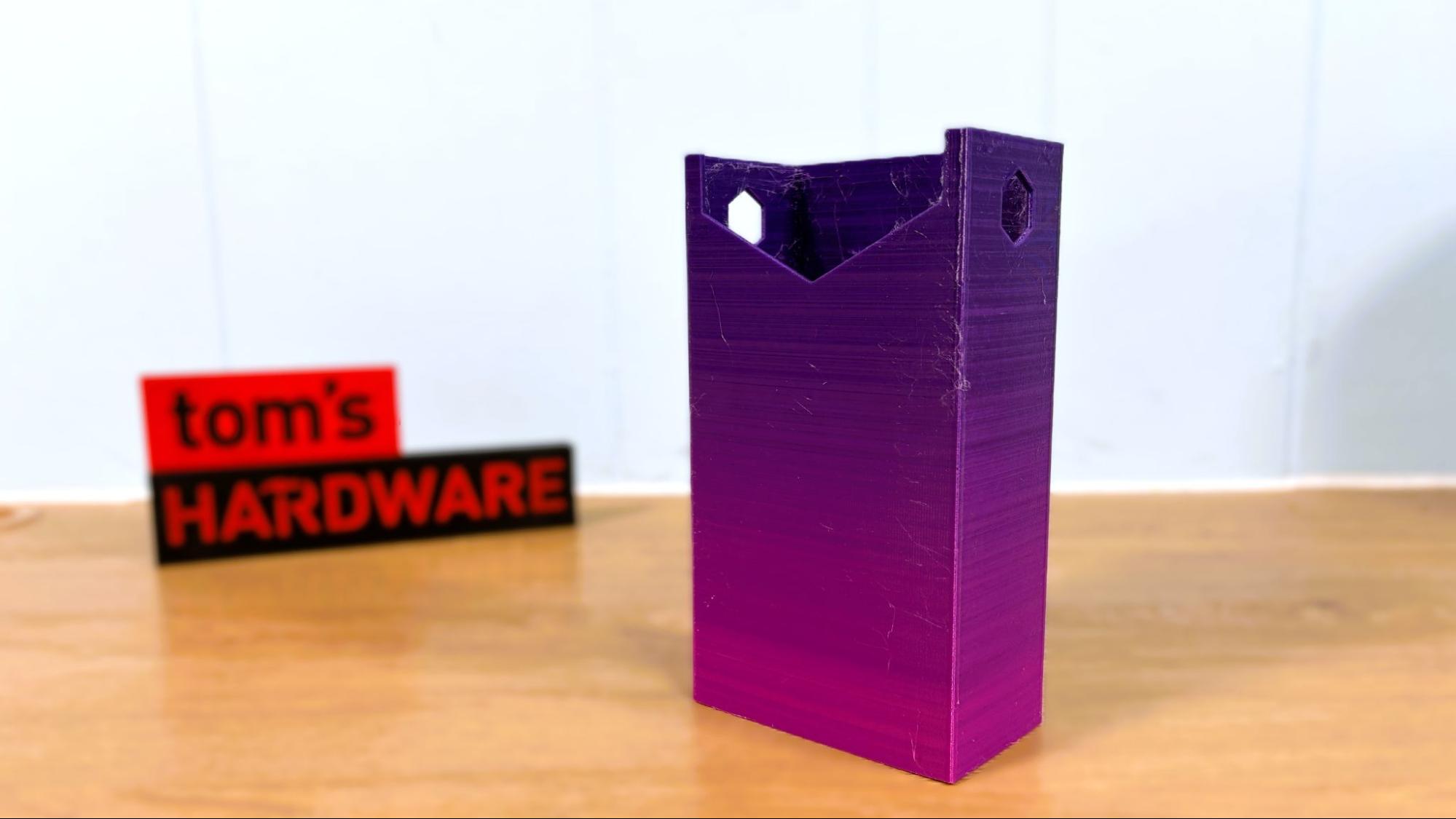
I wanted to give the machine another shot, so I loaded up some CookieCad Sunset TPU, which has a shore hardness of 95A. This time, I was prototyping a phone bag I made in Tinkercad.
This printed at a .2mm layer height, with an average speed of 50 mm/s. The print took a little over 10 hours to print. The quality is very nice with just a little bit of stringing on the interior of the bag, which just means I should have dried the TPU before printing with it.
For PETG, I printed a Fidget Grabber I found while browsing MakerWorld. Using a .2mm layer height and an average print speed of 120 mm/s, the print completed in 2 hours 57 minutes. The print looks really good in Polymaker Silver PETG, and all of the print-in-place joints came out super clean. It’s not the most functional print, but it’s certainly fun.
Bottom Line
(Image credit: Tom's Hardware)
The Flashforge Creator 5 printed everything we threw at it (except softer than soft TPU) and did an excellent job. It will be even better if Flashforge can tone down the purge waste when loading and on the prime block. The slicer could be a little less clunky and sync filaments directly, but again, this is a small issue.
$699 isn’t exactly the cheapest price for a 3D printer, but it is currently the best deal you’ll get on a tool changer. If you want to print in four colors, but hate wasting your filament, the Creator 5 is worth a look.
Right now, our options for tool changers are limited. The Snapmaker U1 has a bit more polish and can be upgraded to be fully enclosed by slapping an IKEA tub on top of it. It is currently $899. The prosumer Prusa Research XL, which has a larger print volume and five heads, is $3,899.
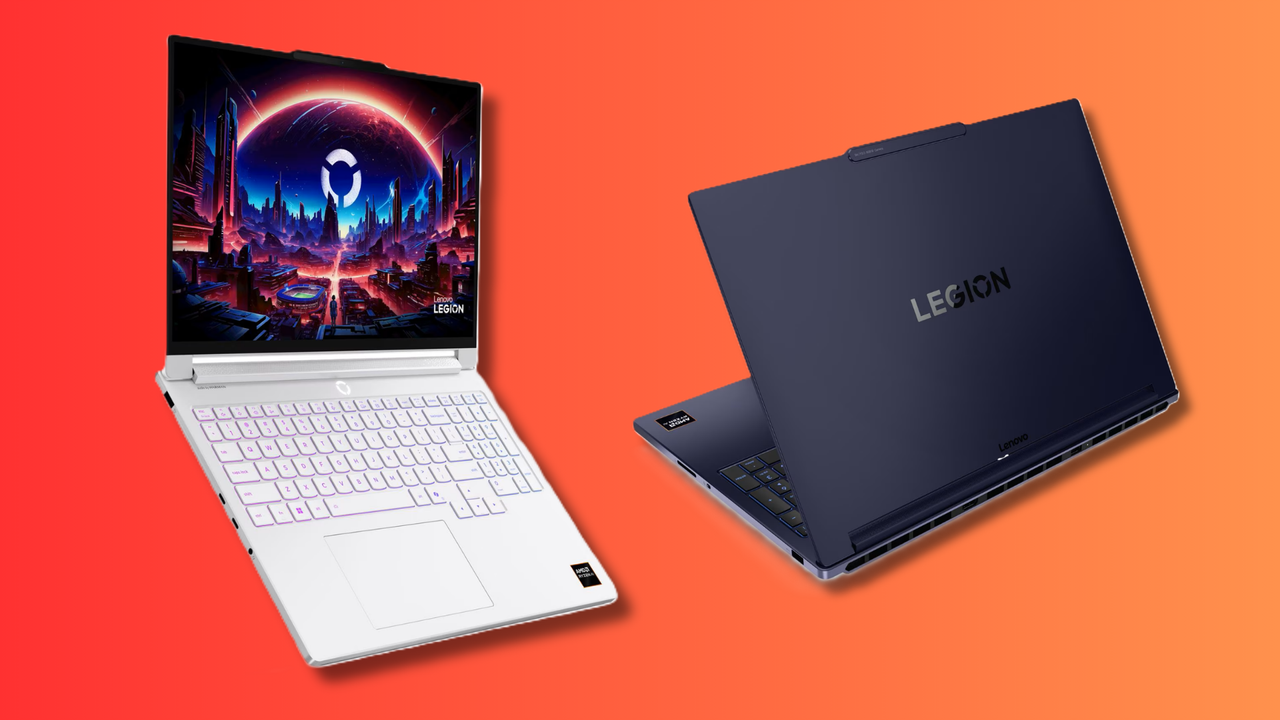
Lenovo has just updated its current-gen Legion 7a 16-inch gaming laptop with a new GPU config: the 12GB version of the RTX 5070 mobile. Previously, the laptop 5070 was limited to just 8GB of VRAM, but Nvidia recently overhauled it, splitting the 5070 SKU into two distinct variants. Lenovo is one of the first vendors to feature the 12GB 5070 in a retail device, but it doesn't come cheap — this new Legion 7a is listed for a whopping $3,375 on Best Buy right now.
(Image credit: Future)
For that money, you're getting a flagship Ryzen AI 9 HX 470 CPU, 32GB of LPDDR5X-8000 memory, and a 1TB PCIe 4.0 SSD. Not to mention a gorgeous 2560 x 1600 OLED display with a 240 Hz refresh rate, solid build quality, and a plethora of cutting-edge I/O. This laptop is also the perfect recipient for the upgrade since its GPU topped out at a measly RTX 5060 before, making it less powerful than the last-gen Legion 7a devices.
Now, that RTX 5060 variant was almost $600 cheaper than this new 5070-equipped model, but it's actually expanded to a $1,000 delta right now because the 5060 SKU is on sale at the moment. When Nvidia first announced RTX 50-series laptops, it said RTX 5070 devices would start at $1,299; even if you consider the upgraded VRAM, you're paying just about double of what was initially promised to you.
In all seriousness, the Legion 7a is a premium gaming laptop with all the bells and whistles so it naturally commands a higher price, AI boom or not. The RTX 5070 in here is also rated at a 115W TGP instead of the 100W baseline Nvidia has set for the GPU. Regardless, you can still find cheaper laptops kitted with the new 12GB RTX 5070, such as Lenovo's own Legion 7i with a Core Ultra 9 290HX Plus processor.
The extra 4GB of VRAM in these devices, gained by swapping from 2GB GDDR7 modules to 3GB ones, should help improve performance in modern titles and AI workloads, especially where ray tracing is involved. Customers have already complained about Nvidia's insistence on packing 8GB video memory pools with various GPUs for years, and at this point, if you're buying a new GPU (or laptop) with that spec, you're killing any chances of future-proofing.
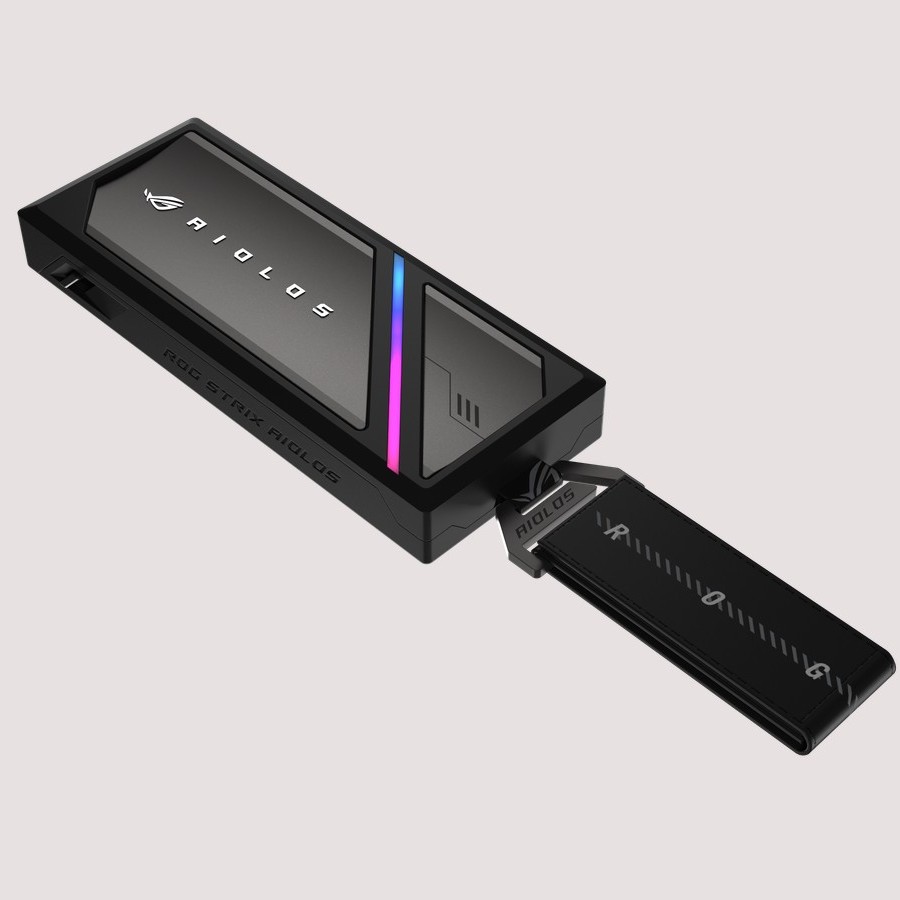
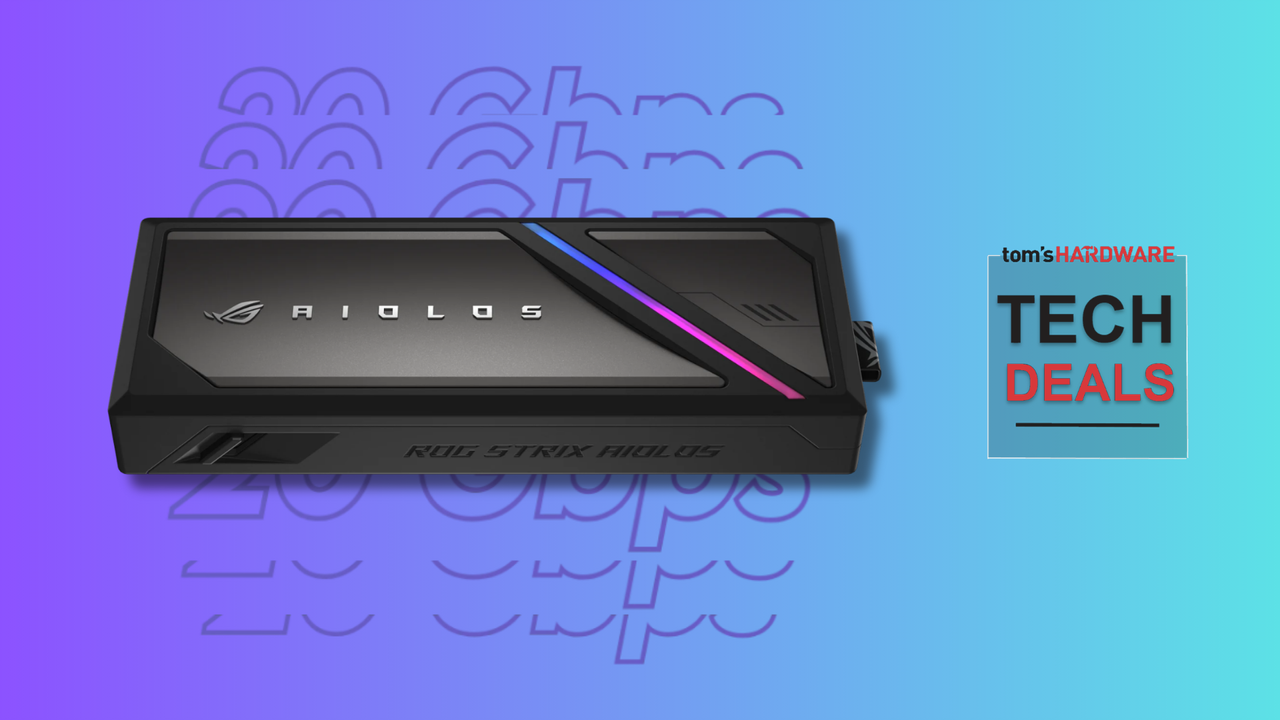
We all know by now that flash storage is facing unprecedented demand due to the AI boom; while not as unattainable as memory, it's still severely overpriced compared to last year. If you have an old M.2 SSD lying around that you'd like to appreciate more during these trying times, you can use an enclosure to turn it into a super-fast external drive. As such, we've found a deal on Asus' ROG Strix Aiolos, which has dropped down to just $59 on Amazon right now.
With transfer speeds up to 20 Gbps, this dual-interface M.2 enclosure can take any SSD and convert it into a high-speed portable drive in seconds, thanks to its tool-free installation. It also happens to look sleek while doing so. View Deal
The ROG Strix Aiolos is a premium, high-end M.2 SSD enclosure with transfer speeds up to 20 Gbps, enabled by a USB 3.2 Gen 2x2 interface that terminates in a USB-C port. Asus is using a Realtek RTL9220 controller, which allows it to take either a PCIe-based NVMe SSD or a SATA-based SSD and connect it to the aforementioned USB interface. It supports M.2-2242/2260/2280 sizes, but not M.2-2230.
You get a tool-less assembly with the Aiolos since it features a push-to-open mechanism for quick removals and installations. The enclosure is made from metal and has a hook on one end with a fabric loop for attaching it to backpacks and such. The body is also wrapped around in rubber to make it grippier on flat surfaces like when it's sitting on a desk. Frankly, the entire thing looks like a miniaturized ROG Astral graphics card.
Being an Asus ROG Strix product, there's an RGB strip running along the top that's controllable through software. Speaking of which, the Aiolos ships with a key for a basic version of the ROG SSD Dashboard so you can monitor your drive in real time. It can track SSD health, remaining capacity, show SMART info, and check temps. You can definitely get cheaper M.2 enclosures, but for just $59 right now, you're not getting one as fancy, or perhaps as fast, as the Aiolos.
Reflect Orbital, a California startup that markets itself as “The Sunlight Company” and aims to make “clean, abundant energy available on demand,” has just received approval from the Federal Communications Commission (FCC) to launch the Eärendil-1. According to Space News, this is a low-earth orbit satellite equipped with four 18-meter (~60ft) thin-film reflectors designed to reflect sunlight on specific areas on Earth. This deployment will test the spacecraft’s capabilities in extending daylight for several minutes, which can be used from lighting construction sites and search-and-rescue operations to increasing solar farm energy production.
“We’re grateful to the FCC for recognizing the importance of testing novel technologies in space,” Ben Nowack, chief executive of Reflect Orbital, said in a statement. “This license is the first step toward rigorously testing our technology’s efficacy and the safeguards we have developed.” While the company envisions launching two satellites into space this year, it says on its website that it wants to deploy more than 50,000 satellites by 2035, allowing it to provide “up to 36,000 lux for hours comparable to daylight” or “up to 100 lux 24/7 comparable to indoor working areas.”
This idea is similar to the Icarus satellite developed by the antagonist in the James Bond movie Die Another Day, which was supposed to deliver “light and warmth to the darkest parts of the world” and “grow crops the year round, bringing an end to hunger.” The Reflect Orbital satellite could potentially achieve the same things, but experts from various fields are concerned about its potential adverse effects.
Astronomers from across the world criticized the project, saying it would make it harder to observe the night sky and could even be dangerous to sensitive instruments and people using telescopes. The Chief Scientist of the Vera C. Rubin Observatory, Tony Tyson, said that this plan to light up the ground using orbital mirrors was “even crazier” than the Starlink satellite constellations that have been affecting nighttime observations. The European Southern Observatory (ESO), which operates several telescopes in the Chilean desert, said that Reflect Orbital’s full deployment “would increase the background sky brightness at its facilities by a factor of three to four, limiting the ability of telescopes to detect faint objects.”
The orbital space mirror’s potential for disrupting astronomy is even greater than the threat posed by Elon Musk’s planned million-satellite Orbital Data Center and China’s planned competing project. But aside from making it harder for astronomers and scientists to survey the night sky, environmentalists also raised their reservations, saying that artificially extending daytime could disrupt the day-and-night cycles that the biology of living beings — from plants and animals to humans — rely on.
Unfortunately, the FCC said that scientific and environmental concerns were outside its jurisdiction. The government regulator only deals with “interstate and international communications by radio, television, wire, satellite and cable in all 50 states, the District of Columbia and U.S. territories.” Instead, it appears that the project’s critics should reach out to the EPA and NASA, as these are the relevant agencies that deal with concerns regarding space and astronomy. But even if the FCC had authority over the issues raised by its critics, it seems that the project will still push through as it considers that “…it is in the public interest to make spectrum available to encourage companies to test new and innovative space activities, as it promotes American innovation and the new services and economic growth that come from that innovation.”
When the RTX 50 series launched, reviewers quickly discovered that the hotspot temperature was being misreported in standard diagnostics tools such as HWiNFO or MSI Afterburner. Eventually, people realized that Nvidia had outright removed the option to monitor hotspot temps, but it seems like the hardware was never removed from the GPU. New testing by Brazilian repair specialist Paulo Gomes has revealed that the sensor is still present and readable with special tools.
In the video, the host shows a Gigabyte variant of the RTX 5070 Ti that was sent to him due to overheating issues. Within Windows, the monitoring tools showed no abnormal signs, as the "average" temperature was reported at 67 to 68 degrees Celsius. However, when diagnosed with a specialized tool called "MODS," the hotspot temperature reached 107 degrees Celsius almost immediately under load.
MODS stands for Modular Diagnostics Software, and it's an internal Nvidia tool used to test GPUs before they hit the shelves or during the RMA process. It's not available to the public and doesn't work on Windows because the OS keeps intercepting calls from the hardware monitoring APIs. You need a Linux distribution that boots directly into a command line, from where MODS (and MATS, for memory testing) can run as intended.
Some repair shops have been known to get access to MODS, such as in this case, which unlocks the hidden hotspot temperature sensor on Blackwell gaming GPUs. Keep in mind that Nvidia ships much more comprehensive diagnostic utilities for its server-grade and workstation GPUs that can actively monitor all aspects of the card. It's unknown why the company decided to keep some sensors locked out of gamers' reach.
Perhaps we can infer the rationale from last year, when Igor's Lab tested several RTX 50-series GPUs and found a "hotspot issue" affecting all of them. The reason was poor PCB manufacturing — not using heavy-duty materials to build the PCB layers, causing certain parts of the substrate to heat up even when the core was relatively cool. This was exacerbated by Nvidia's own guidelines, which told AIBs to compensate for ideal conditions instead of worst-case scenarios.
Anyhow, as Paulo Gomes and his team discovered, the RTX 5070 Ti's hotspot was hitting 107 degrees Celsius, and the card throttled and dropped its clock speeds right away. Nvidia mandates 107 degrees Celsius as the upper limit for RTX 50-series, so it was clear that the card was slowing down to prevent damage. To inspect what was actually wrong, they opened up the card and found poor thermal contact between the cooler and the componentry.
The TIM (thermal interface material) application was inadequate; the paste had accumulated around the perimeter of the core while the center was mostly dry. The repair personnel removed the old material and replaced it with SnowDog Husky paste, which was enough to drop the hotspot temperatures to 100 degrees Celsius. Now, it was within the safe operating range and no longer thermal throttling under load.
What would've been a simple fix on the consumer's end was turned into a repair job solely because Nvidia hid the GPU's hotspot temperature, literally misreporting the card's internal condition. Had this RTX 5070 Ti just run at 107 degrees Celsius continuously, the silicon would wear down incredibly fast, and the customer would never even know why. Not to mention some manufacturers' insistence on voiding warranty upon breaking the GPU's "seal," which is an illegal and unenforceable practice in the United States.
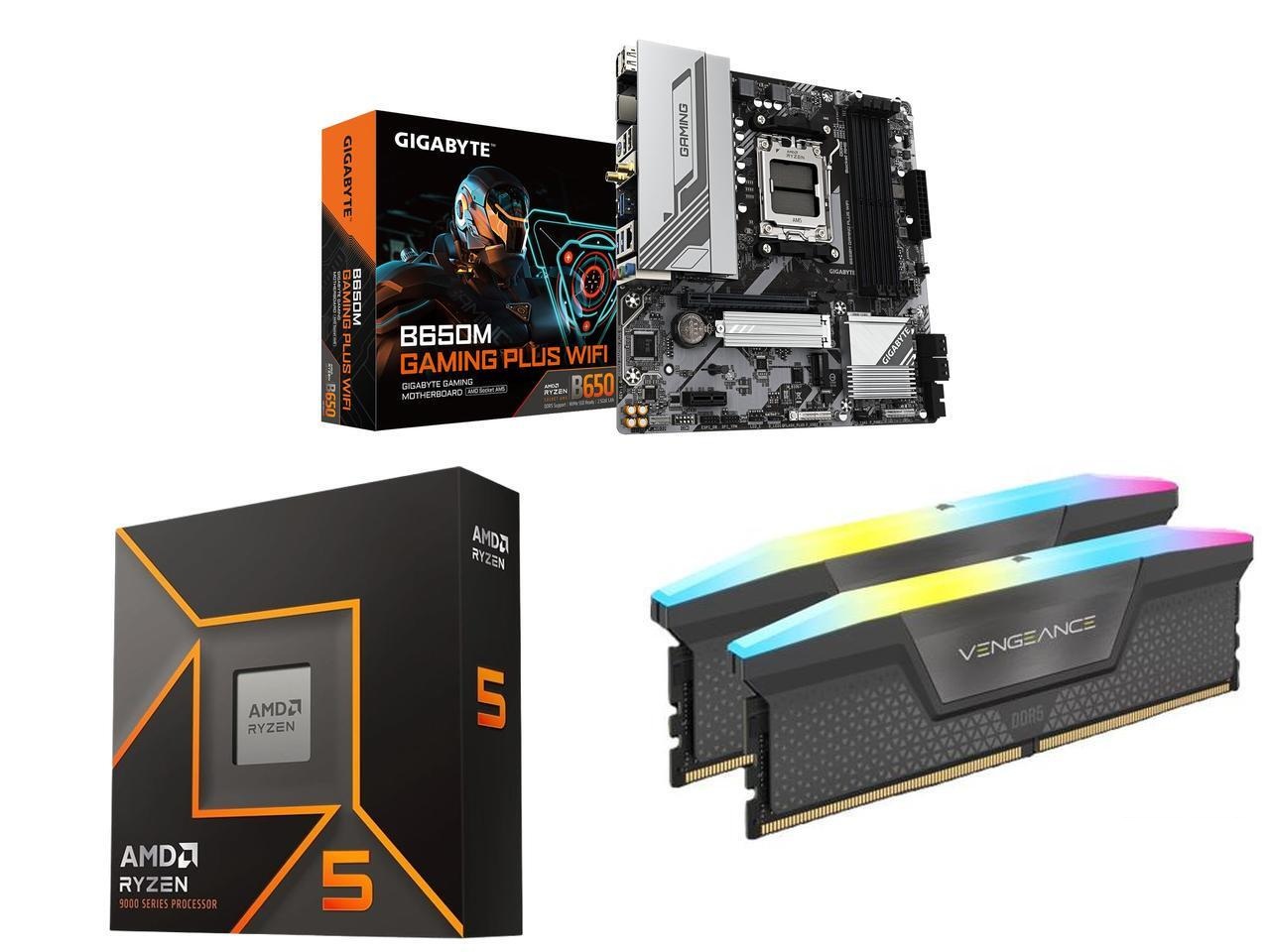
Combo deals are a great way to offset today's inflated memory prices while saving money on a complete platform upgrade. One such offer we spotted at Newegg bundles an AMD Ryzen 5 9600X with a Gigabyte B650M motherboard and a Corsair Vengeance RGB 16GB DDR5-6000 memory kit for $519.99. In addition to saving roughly $50, the bundle also includes a free Cooler Master Elite 240mm AIO liquid cooler valued at $79.99.
The AMD Ryzen 5 9600X is a solid budget processor featuring 6 cores and 12 threads with a boost clock speed of 5.4 GHz. Based on AMD’s latest Zen 5 architecture, the CPU comes with a rated TDP of 65W, which not only makes it efficient but also allows it to run at much lower temperatures. As for memory, the 16GB Corsair Vengeance RGB is a solid kit offering support for AMD Expo, 6000 MT/s speeds, addressable RGB lighting, and CL36 latency with timings of 36-44-44-96.
The bundle includes AMD's Zen 5-powered Ryzen 5 9600X, a Gigabyte B650M Gaming Plus Wi-Fi motherboard, 16GB of Corsair Vengeance DDR5 memory, and a complimentary 240mm liquid cooler.View Deal
The Gigabyte B650M Gaming Plus Wi-Fi is an entry-level mATX motherboard that comes with all the essential features, including a 5+2+2 digital VRM solution, support for DDR5 8000 (OC) memory, two M.2 SSD slots with support for PCIe Gen 4.0 speeds, a quick-release mechanism for the PCIe x16 slot, and onboard Wi-Fi 6E and 2.5GbE LAN.
As mentioned, the deal includes a free Cooler Master Elite Liquid 240mm AIO liquid cooler, which should easily handle the Ryzen 5 9600X. The company claims that the included 120mm PWM fans are optimized for quiet operation, while the pre-installed CryoFuze thermal paste should offer excellent thermal conductivity. The cooler also comes with a unique translucent hexagonal cap that sits atop the pump block and features customizable ARGB lighting.
Considering the overall value, this $519.99 Newegg bundle offers a great starting point if you are looking at a budget-friendly AM5 gaming build. Not only do you save $50 on the core components, but you also get a free CPU cooler, bringing the total value of the offer to roughly $130. Do keep in mind that such combo deals are usually time-limited and subject to stock availability.
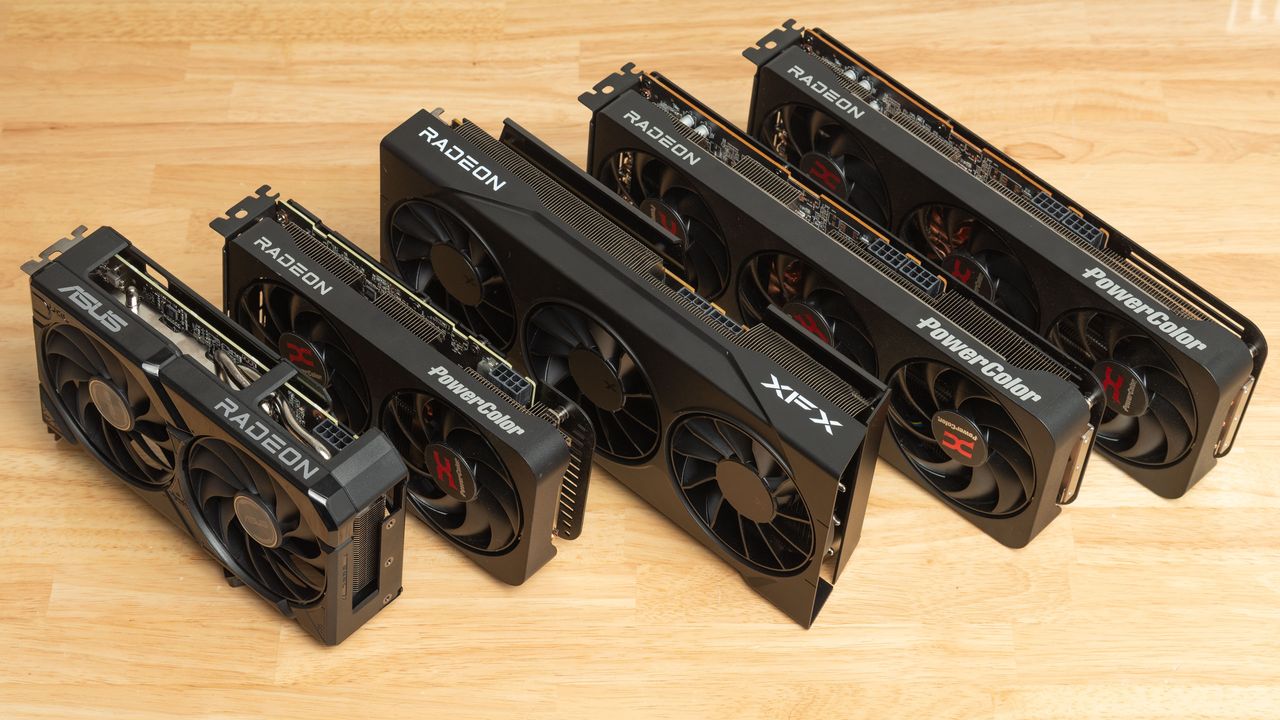
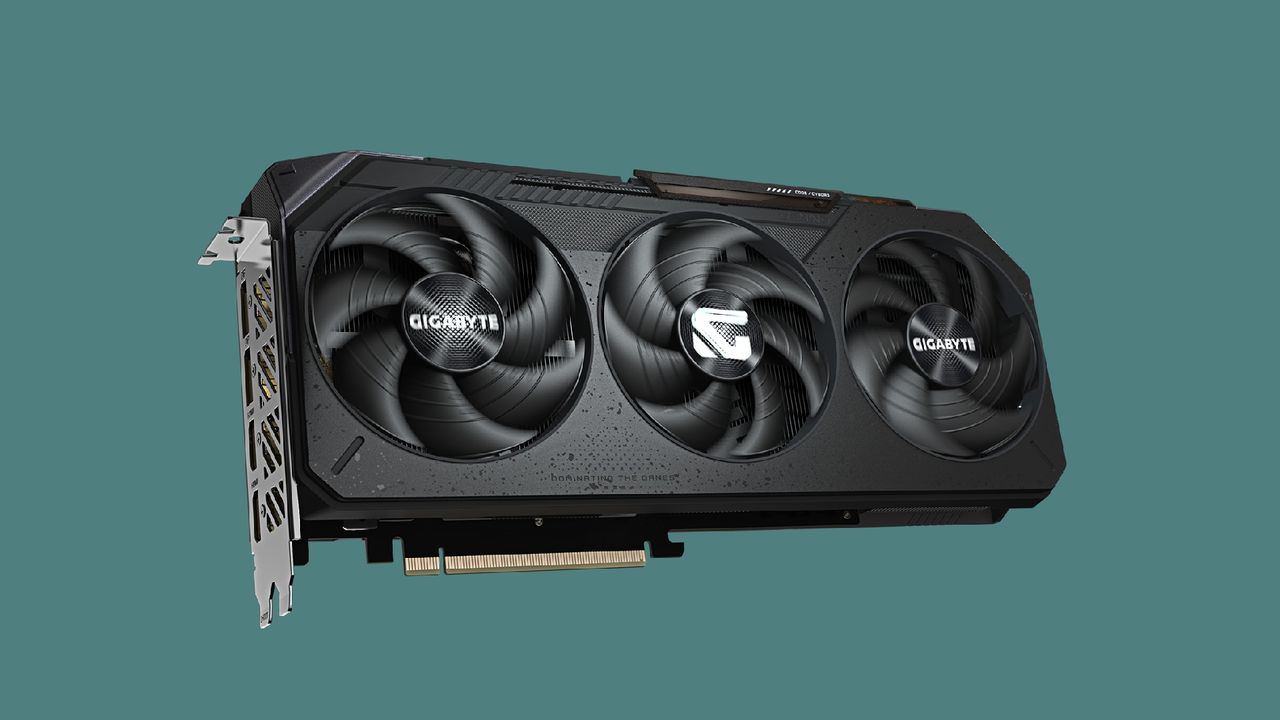
AMD’s formerly China-exclusive Radeon RX 9070 GRE, which rivals the best graphics cards, went global last month at a suggested MSRP of $549. The GPU has now seen its first price drop since its launch, with the Gigabyte Gaming Radeon RX 9070 GRE available for $499 at Newegg. While the listing shows $549, customers can use a $50 promo code by submitting their email address to reveal it.
The Radeon RX 9070 GRE is built on AMD’s RDNA 4 graphics architecture, and uses the same Navi 48 GPU as the Radeon RX 9070 and RX 9070 XT. However, it uses a cut-down version of that chip with 48 compute units. It also comes with 12GB of GDDR6 running at 18 Gbps on a 192-bit bus, offering 432 GB/s of raw memory bandwidth. Despite the scaled-down specifications, the RX 9070 GRE retains a TDP of 220W, similar to the standard Radeon RX 9070. Essentially, the card sits between the RX 9060 XT 16GB and the RX 9070, and AMD claims it delivers 21% higher average performance than the RTX 5060 Ti 16GB in 1440p gaming.
FutureFutureFuture
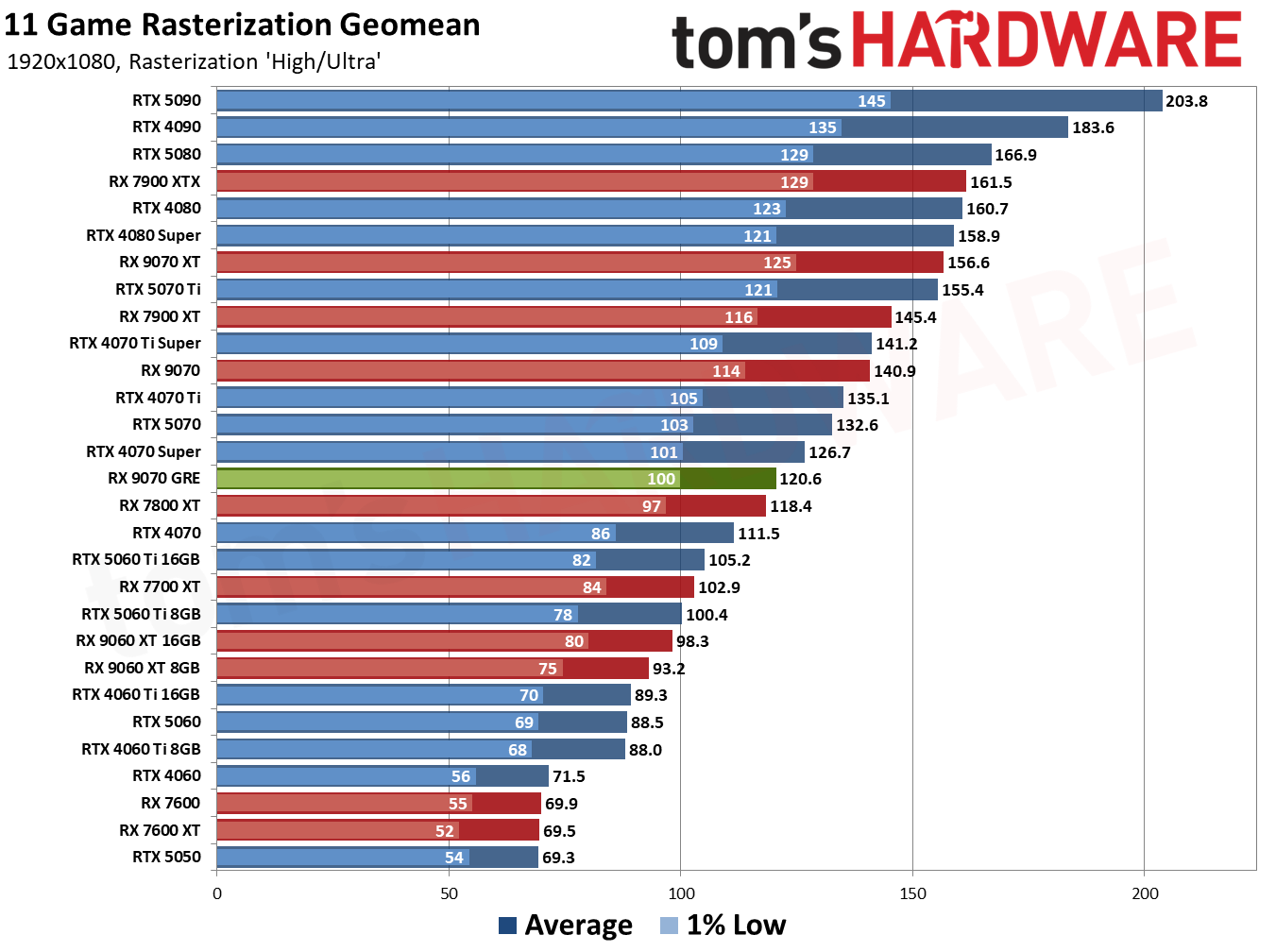
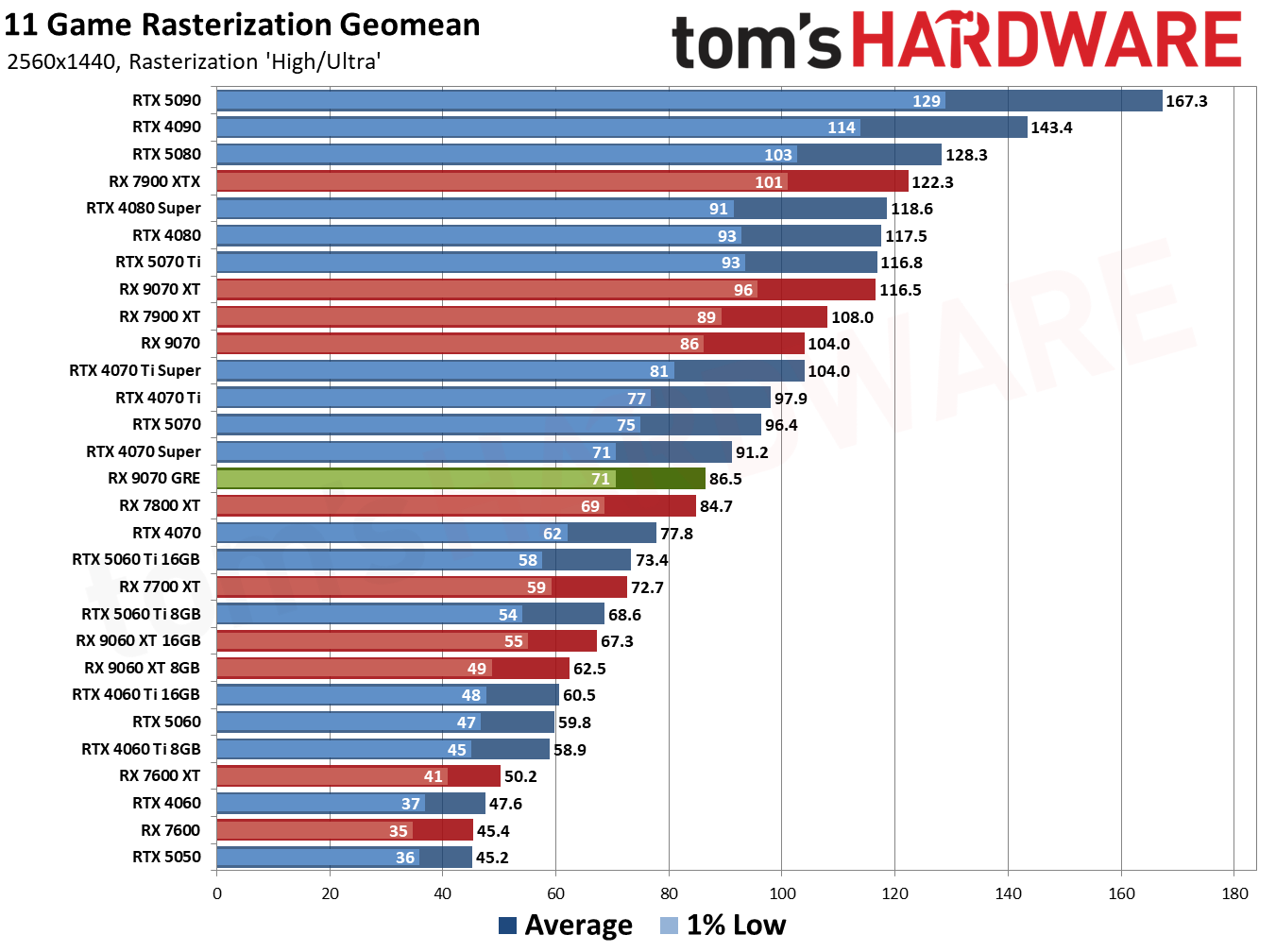
In our testing of the XFX Swift Radeon RX 9070 GRE, we found that the card averages 120 FPS at 1080p and 86.6 FPS at 1440p across our 11-game raster-only test suite. That makes it a solid choice for high-refresh-rate gaming at two of the most popular monitor resolutions, and it offers a comfortable position over the RX 9060 XT 16GB and RTX 5060 Ti 16GB.
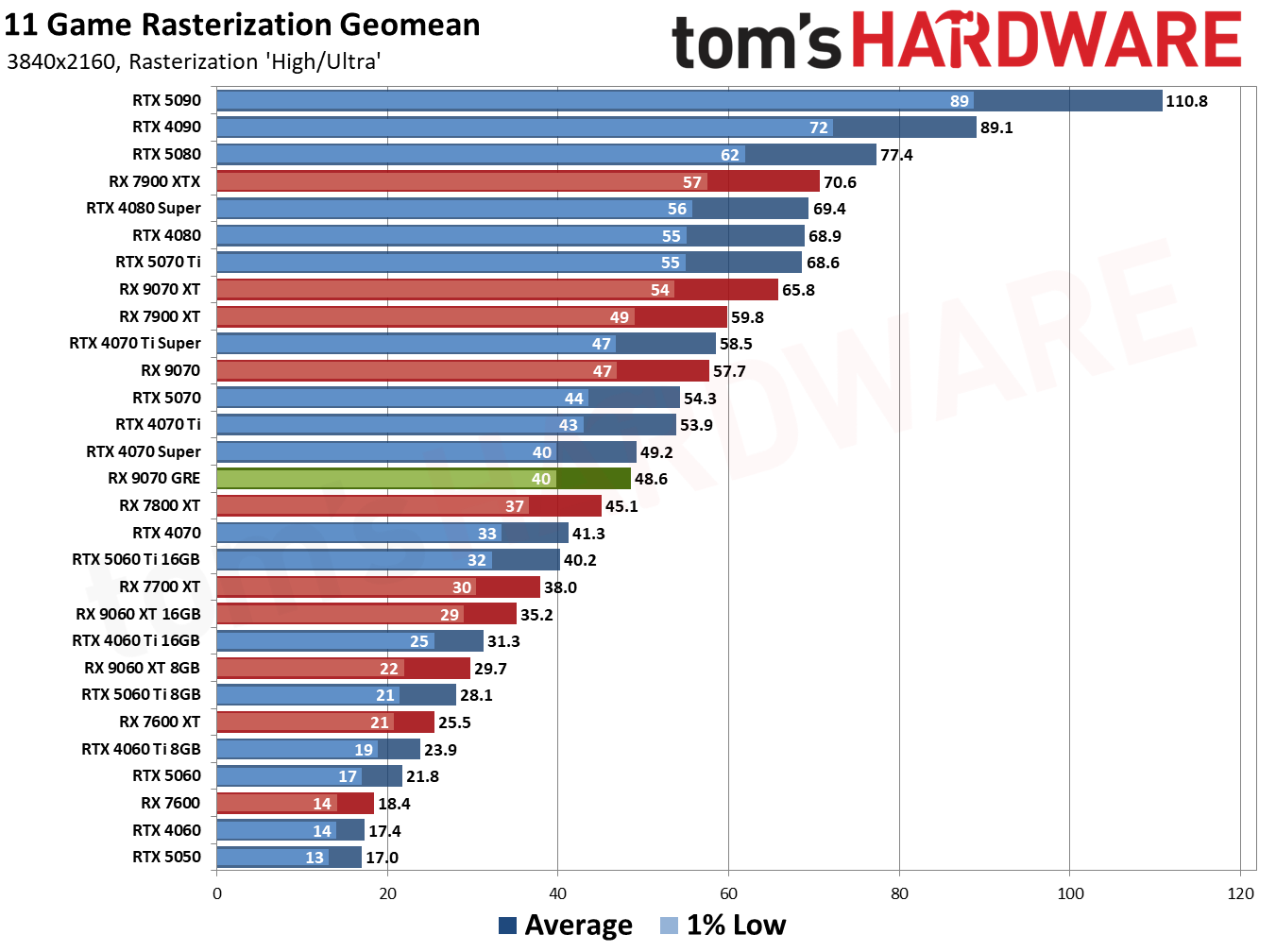
Unfortunately, the RX 9070 GRE is not entirely impressive at 4K resolution as it struggles to maintain an average of 60 FPS. That said, enabling FSR 4 upscaling and frame generation in supported titles can significantly improve performance. Ray tracing performance remains a weaker area for the RX 9070 GRE. Gamers who prefer enabling RT effects will likely need to enable FSR 4 to offset the performance hit, particularly at higher resolutions.
At its discounted price, the RX 9070 GRE competes directly with Nvidia's RTX 5060 Ti 16GB, which currently sells for well over $500. If you are a gamer who prioritizes raw rasterized performance, the RX 9070 GRE is worth considering, especially if you're upgrading from an older GPU such as the RX 6700 XT or RTX 3070.
Running LLMs and agents in home lab setups is steadily gaining popularity due to the rising cost of AI bot subscriptions and concerns about data privacy. Unfortunately, an Nvidia NVL72 rack is ever so slightly out of the financial reach of most people, so enthusiasts have to make do with models that can run in limited amounts of memory. Italian engineer Vincenzo (aka JustVugg) seemingly wanted to have his cake and eat it,so he created ColibrÌ to run the 744-billion-parameter 1.5-TB GLM-5.2 model on a modest CPU, a mere 25 GB of RAM, and a 1 GB/s virtual NVMe drive.
Let's get the elephant out of the way: Colibrì's speed on Vincenzo's setup is only about 0.05 to 0.1 tokens per second on average, a measure that's unusable for practical conversation — imagine just one question taking hours to answer. Higher-end setups provide far better figures, but for now, they still don't meet the 20-30 tokens per second required for real-time use.
Having said that, GLM-5.2 is a Mixture-of-Experts (MoE) model with frontier-level capability, at least somewhere in viewing distance of the finest offerings from Anthropic, OpenAI, et al. This means that the quality of the answers ought to be excellent, and Vincenzo himself says his limited testing produced some impressive results. The way Colibrì works is simple enough to describe, and yet hard to do right: loading the model in slices to RAM. We're going to oversimplify for clarity's sake.
An MoE model like GLM-5.2 includes hundreds of expert sub-models to answer different topics, and these are chosen per token, not per query — meaning that when you ask a question, your words get split into tokens (chunks). For each token, the bot activates the best experts for it. The experts might always be the same for the entire question, but more often than not, a query might reel in tens of experts, possibly going into triple digits.
Whereas normally large chunks of the model, or the entire model, are loaded onto interconnected datacenter GPUs, Colibrì takes advantage of the MOE architecture and repeatedly loads/unloads the experts required per token, allowing even a cheap machine to use a large model at a steep performance penalty. For speed and simplicity's sake, Colibrì's expert-selection code is a single C file with very few dependencies. Additionally, the GLM-5.2 model is quantized down (simplified with lossy encoding) to take up less space to begin with.
If you're thinking that loading and unloading data for every piece of a question's words is going to be a hard hit on storage I/O and memory bandwidth, you're exactly on the right track. In this type of setup, NVMe storage speed is the first major bottleneck, but the proverbial funnel varies across configurations. Give it enough storage bandwidth, then you're up against RAM limitations. Fix that, then you need more CPU cores, and so on.
Colibrì is currently a proof-of-concept and doesn't yet run on GPUs, though it's worth noting that even then, shuffling data to/from the card will almost certainly be the biggest constraint. Even still, the project has barely been released, and it's already proving quite popular. Vincenzo is collecting benchmark data and running fixes as we speak, so be sure to visit the repository to contribute if you can. Maybe at some point it'll be feasible to run a really clever model on high-end consumer hardware at a decent enough clip.
A data entry error in Flock’s system has resulted in a car reviewer getting boxed in by police cars in a parking lot on suspicion that he was driving a vehicle with stolen tags.The Drivereviewer and Director of Content and Product, Joel Feder, was driving a $155,000 loaner Range Rover when police surrounded his vehicle.
When he asked why he was stopped (and by four police cars, nonetheless), the officers said the car’s plate had been reported stolen and that they’d been tracking him for days using the Flock app. After about an hour of trying to figure out why he was stopped, it turned out that a different plate with similar characters had been misplaced and had to be reported stolen in California, which triggered a nationwide alert on Flock.
The core of the issue is that the New Jersey plates on the Range Rover read 34 10 DTM, with the number 10 written in smaller font. This is a non-standard design used by New Jersey for manufacturers, with VEHICLE MFR written on the bottom of the tags. The missing plate was 34 03 DTM, but unfortunately, the LAPD police report only listed 34 DTM.
Another issue with the Flock system compounded this reporting error. Since the New Jersey manufacturer tags weren’t standard, it only read the larger numbers and letters and disregarded the smaller “10” on Feder’s plate. Because of this, it flagged all vehicles with the 34 ## DTM plate as stolen and alerted partner police forces whenever it detected a similar plate on the road. Feder even said that four other vehicles with a similar plate were being tracked throughout Minnesota, and it just so happens that he was the first to be intercepted.
The police said they had been tracking the vehicle for days using Flock’s AI cameras, but kept losing it because Feder parked it in his covered garage. So, when he stopped at a retail store, the authorities jumped on the chance and boxed him in to ensure that he did not escape. Thankfully, the issue was resolved on the spot with the officers, although it took an hour to verify with Jaguar Land Rover that the car or the plates Feder had were not stolen. Still, the journalist was advised to go straight home, as other police agencies using Flock might not be aware of the situation, which could lead to him getting stopped again on suspicion of driving a stolen luxury car.
These two errors compounded together to create a rather harrowing experience with the police. Thankfully, the incident did not turn into something serious, especially as the Plymouth Police told Feder that the cops would have stopped him with guns drawn if he were in Minneapolis.
This event adds to the numerous controversies that Flock AI has been facing, with one of the biggest issues the company faced recently being whenseveral police officers were arrested for misusing the service to stalk romantic partners. This has led citizens to push back against the service, especially as news like this makes them lose trust in the authorities. It has even gotten to the point where a Texas town council member broke into a tantrum, proposing atotal ban on cellular and GPS devices, after community pressure led to the cancellation of the service.
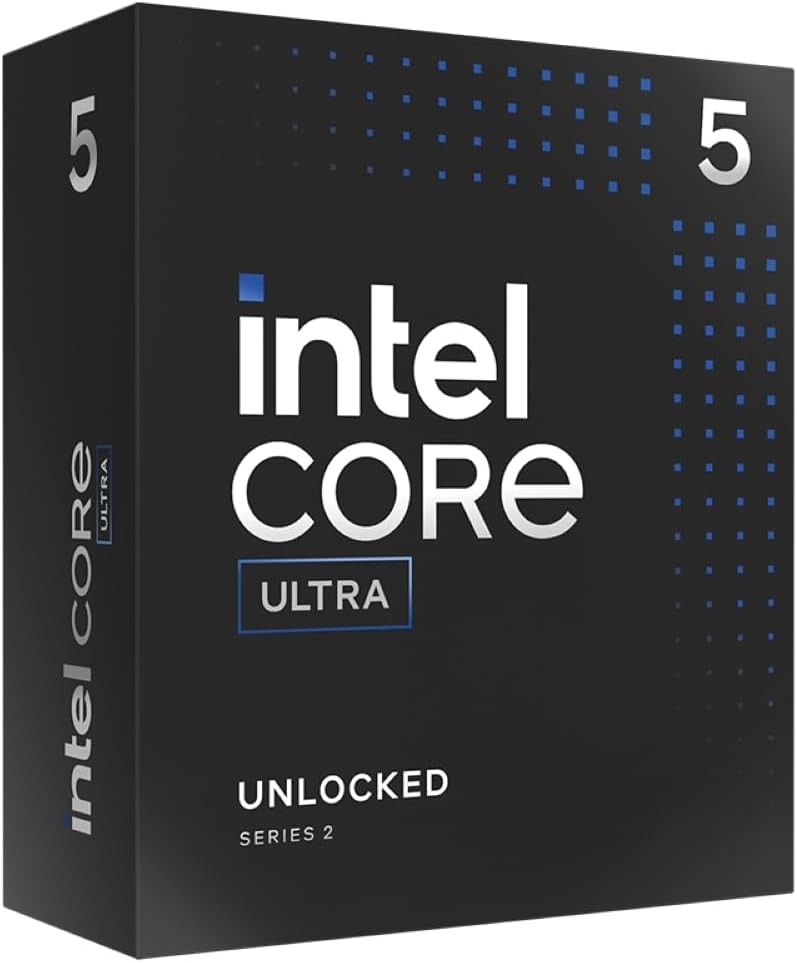
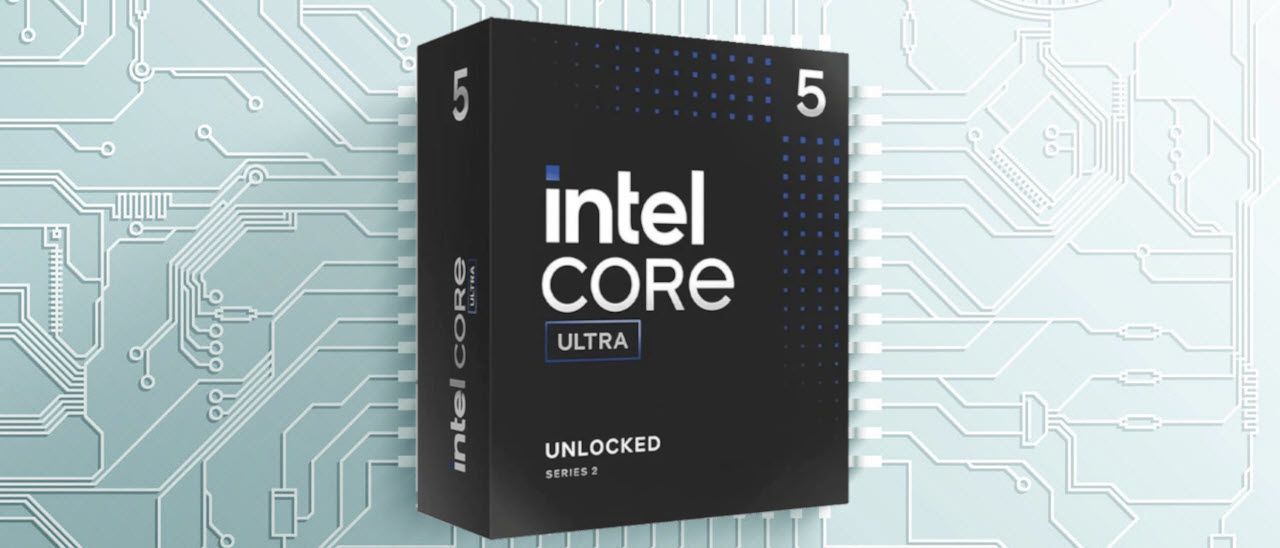
The entire PC hardware industry is in shambles right now due to the AI boom. The cost of components has skyrocketed over the past year, making it difficult to assemble a rig today. Some parts, however, have stayed relatively unaffected, including processors. We've found a great deal on Intel's prior-gen Core Ultra 5 245K CPU — it's on sale for just $179.99 on Amazon right now, down 42% from its original MSRP of $310.
The Intel Core Ultra 7 245K is at all-time low pricing. This 14-core processor has 6 P-cores and 8 E-cores with 14 threads. The boost clocks of 5.2 GHz for the P-cores and 4.6 GHz for the E-cores enable this processor to perform well in gaming and multithreaded applications. View Deal
Tom's HardwareTom's HardwareTom's Hardware
The Intel Core Ultra 5 245K was succeeded by the excellent Core Ultra 5 250K Plus earlier this year as part of the Arrow Lake refresh. While that chip is genuinely fantastic, the 245K is no slouch either, especially at this new discounted rate. Its value proposition skyrockets if you get it for just $179, since it's a 14-core processor with 6 P-cores and 8 E-cores built on the same architecture and node as the Arrow Lake refresh lineup.
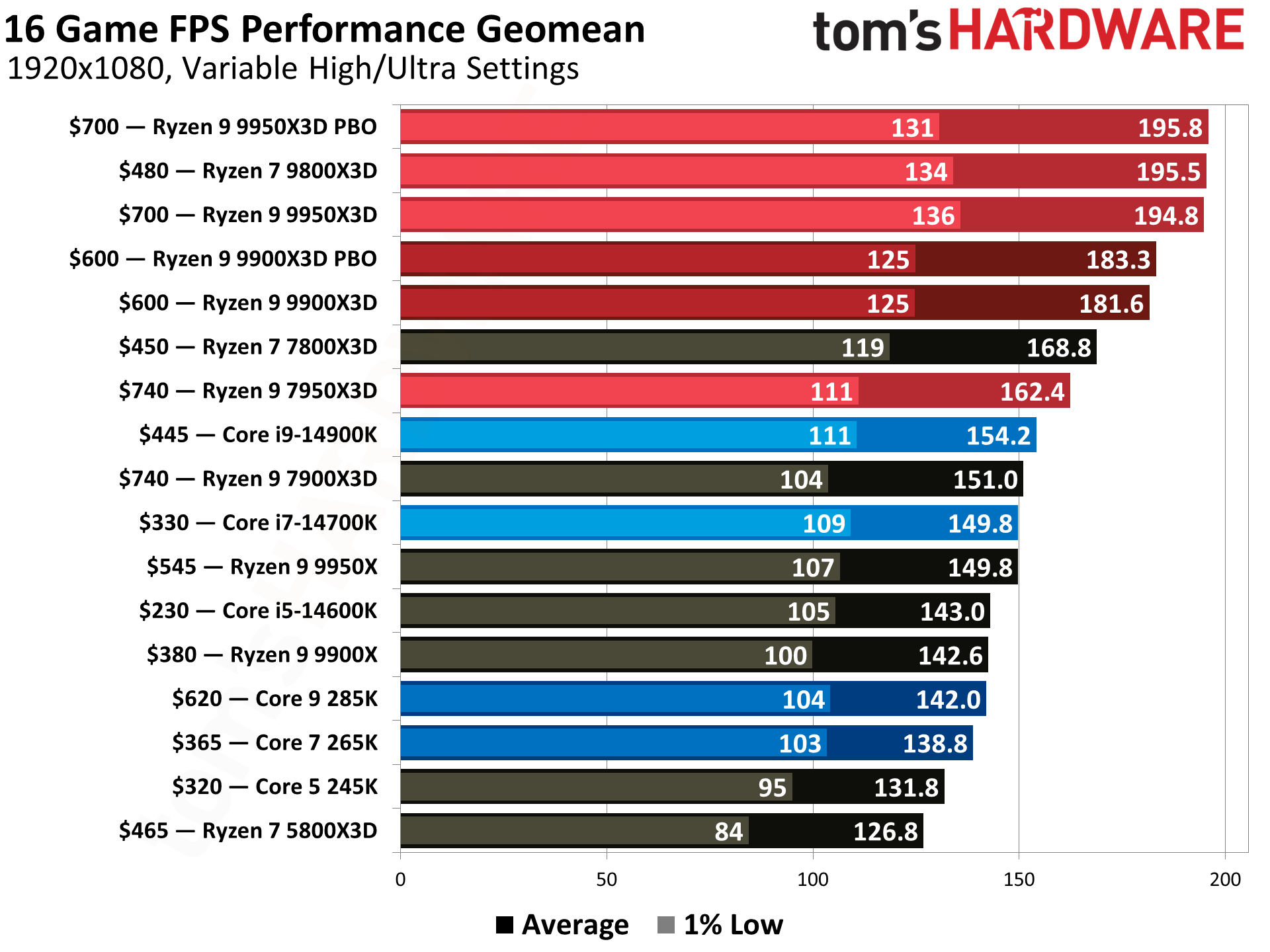
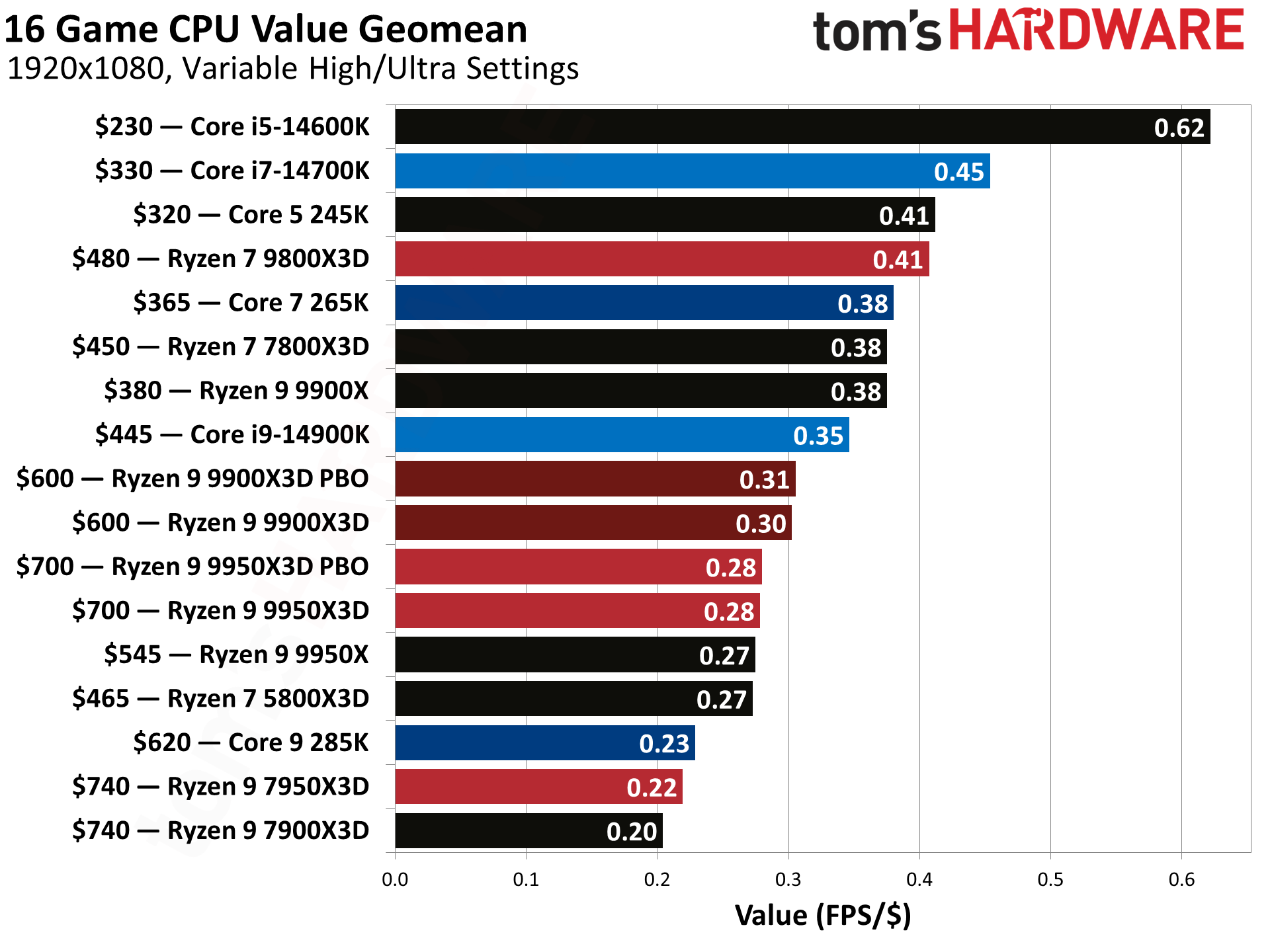
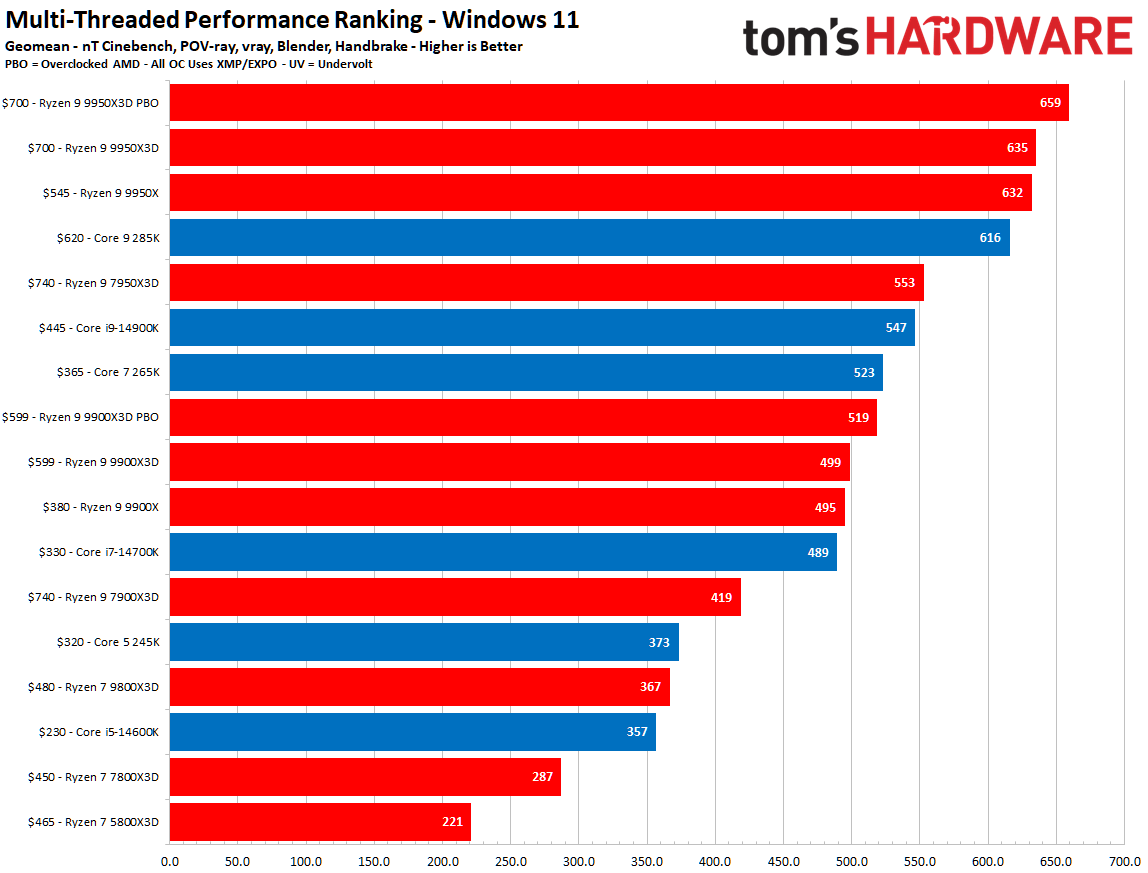
In games, it performs better than AMD's Ryzen 7 5800X3D, which was just relaunched as a special edition for $349. Even at its original $310-320 launch price, the 245K had the third-best FPS-to-dollar ratio in our testing; at $179, it's basically a no-brainer. In productivity tasks, it can even beat AMD's flagship AM5-based X3D chips, since it posted better geomean numbers than the 5800X3D, 7800X3D, and the 9800X3D in multi-threaded performance.
This CPU is compatible with DDR5 RAM — more specifically, you can install up to 256GB of DDR5-6400 via 2 memory channels. The Intel Core Ultra 5 245K is compatible with both PCIe 4.0 and PCIe 5.0 devices. The integrated graphics have doubled in capability compared to the 14th Gen Raptor Lake chips, though they're still no match for a dedicated GPU, of course.
Despite not being the flashiest offering on the Blue Team's ledger right now, the revised pricing makes it one of the best, nonetheless. At just $179 on Amazon, no other CPU will give you more performance across the board than the Core Ultra 5 245K. Just make sure to find reasonably priced DDR5 memory, as motherboards are already enjoying lower prices.
According to new research published by Alinea Analytics, Valve has grossed an estimated 11.1 billion dollars throughout the first half of 2026. If correct, the estimates would make it Valve's most profitable half-year on record, as digital storefronts become the norm throughout the games industry. Earlier this month, Sony announced that it would stop making new physical PlayStation discs by 2028, instead turning its efforts digital.
According to a Substack post from research firm Alinea Analytics, games sold on the platform accumulated $11.1 billion in revenue in the first six months of this year, which is a 14.5% jump compared to the first six months of 2025. Even more impressively, though, Steam's H1 2026 has posted 8% higher numbers than H2 2025, which includes the lucrative holiday season where most of the biggest sales happen. The store generated "only" $10.3 billion in revenue during the latter half of 2025.
Steam has been on a consistent incline for 10 years, boasting record revenue numbers almost every successive year. Even if it hits a slump, the data shows Valve has never had two bad years in a row; a recession is always followed by a boom. Alinea says five main factors contribute to the storefront's growth: a surge in Chinese players, higher prices, viral co-op hits, and smarter back-catalogue categories from big publishers.
The last one is rather ironic, as it involves third-party publishers quietly returning to Steam after their own launchers faltered. Some companies like Activision still inject their proprietary launchers between Steam and the game itself for titles like Call of Duty, but the situation has generally improved.
What display resolution do you use on your primary monitor?
Almost 10 years ago, in the first half of 2017, the platform made a little less than $2.5 billion, which means the H1 2026 revenue is 4.7 times higher, almost quintupling in a decade. Moreover, it's remarkable to believe that Steam also made more in the first six months of this year than it did in the entirety of 2020, when most of us were confined to our homes, free from responsibilities, and with a lot of time on our hands.
Alinea lists Forza Horizon 6, Resident Evil Requiem, and Crimson Desert as the top three games for Steam's explosive H1 2026 numbers — all of them made almost $200 million. Games from prior years also played a bigger role this time since 2026 releases only accounted for 21% of the $11.1 billion, while 27% of H1 2025's revenue came from 2025 launches; 29% of H1 2024's revenue was accumulated from 2024 releases.
Amidst all the data, a clear trend is forming. People are looking back in their libraries and appreciating older games more than ever before, while new releases still make an impact if they're universally acclaimed. With the highly anticipated GTA VI coming soon (with no current PC release date), it'll be interesting to see how these numbers change. Now, if only Valve could make more Steam Machines to play all those older games everyone seems to be playing.
Meta’s surprise purchase of Manus, a Chinese startup known for its advanced AI agents, caught Beijing by surprise and ordered the two companies to unwind the $2 billion deal. The Chinese tech giant Tencent, which was among the startup’s initial investors during early funding rounds, is taking the lead in buying back the startup at the same price. According to the Financial Times, other former investors, including ZhenFund and HSG — China-based venture capital firms — while former U.S. investors like Benchmark are unlikely to join the potential consortium.
This move marks Beijing’s increasing protectiveness of its AI companies and experts, which it considers strategic assets in its heated rivalry with the U.S. We can see this in the Chinese government’s five-year plan, which is doubling down on technological self-reliance. It has even gotten to the point that AI experts, even those working in private firms, are now required to secure approval before traveling internationally.
U.S. tech giants are investing billions of dollars to develop their AI models, even dangling hundred-million-dollar bonuses to hire AI experts — one AI founder even claimed that Meta offered a $1.25-billion bonus. It seems that China is trying to avoid a situation where its experts are enticed to work for American AI tech companies, with the Financial Times reporting that Chinese officials are calling Meta’s acquisition of Manus “a conspiratorial attempt to hollow out China’s technology base.” The order to undo the deal means that Meta cannot use Manus’ intellectual property, nor can it have its founders and employees working for the company. Still, the U.S. tech giant has had a few months to study its models and engineering expertise.
Meta has already agreed to undo the deal, with most of Manus’ operations reportedly running independently of the company. However, the Chinese startup still needs to break financially from the American tech giant by paying back the $2 billion the latter spent to purchase it. Even though Chinese companies are also investing massive amounts in AI tech, it’s still not easy to raise this amount of capital in such a short period.
Tencent, which owns the WeChat platform used by China’s 1.4 billion population for messaging, social networking, mobile payments, ride-hailing, food delivery, and more, believes that Manus would be an asset for the company. Aside from reaching an annual revenue of $500 million, its AI agent would also mesh well with the company's increasing AI focus. “Beyond foundation models, it has become increasingly evident that agentic AI represents a breakthrough use case,” Tencent president Martin Lau said in its May earnings call. “Our platform inherently has many benefits of hosting AI agents.”
The Chat Control 1.0 law that enables warrantless mass scanning of digital communications has been voted against multiple times by the EU Parliament. And yet, just like a movie zombie, it keeps getting resurrected by various legal sleight-of-hand moves. Yesterday, one of those tricks worked, as Chat Control 1.0 passed (or rather, was not rejected) in a forced re-vote that required an absolute majority (50% + 1) for active refusal. This brings back the law until 2028, and sets a different stage for September's upcoming discussion on Chat Control 2.0.
After the impending publication in the EU Official Journal, online direct-communication platforms will be allowed to mass-scan their users' data without the need for a warrant, under the guise of looking for child sexual abuse material (CSAM).
The scanning is not mandatory, but big tech firms will have a legal mechanism to rifle through user data. EU firms have historically refrained from doing so, presenting privacy and data sovereignty as selling points, but the legal door is nevertheless now officially open.
Go deeper with TH Premium: Taiwan, trade, and tariffs
The obvious platforms where monitoring can now take place will be e-mail and chat services. Immediate examples include Gmail, iCloud, Hotmail, Discord, Instagram, Slack, Teams, Snapchat, Xbox, and Google Chat.
Although the law's scope is for "interpersonal communications services," the legal mechanism might hypothetically extend to some gray areas like Google Drive, where sending someone a link to a cloud file could be within the scope of the law.
It's worth noting that "direct communication" isn't restricted to one-to-one chats, as it includes group chats; just not public or undirected communications. Additionally, EU law enforcement is still beholden to the same warrant requirement as before — Chat Control 1.0 does not grant a blank pass to authorities to mass-scan user data, or request companies to do so without a targeted warrant.
Thanks to two amendments in yesterday's vote, end-to-end-encrypted (E2EE) communications means (ex: WhatsApp) stay exempt. That means that for now, Chat Control 1.0 isn't a commandment to break encryption, something that has been regularly suggested by lawmakers around the world.
It's as good a time as any to remind people that Instagram messages are no longer E2EE as of May, and that although WhatsApp's messages are encrypted, the service leaks out every single bit of metadata about them — sender, recipient, time, size, etc. As always, Signal is recommended as a privacy-focused communications app.
This latest development in the EU parliament is eliciting widespread public outcry due to the nature of the law itself, but also due to the manner in which it happened. Critics and opponents of the rule are suggesting this move is unprecedented.
Chat Control 1.0 has already been shot down repeatedly, most recently in March. However, European Parliament President Roberta Metsola forced a second reading of the law, and invoked Rule 163's "urgent procedure" mechanism. This had many effects, including bringing up a law that was voted against for discussion yet again; turning the decision into a denial vote (vote-to-deny, not vote-to-pass); exploiting the second-reading requirement that demands an absolute majority vote (50% + 1); and letting the President herself set the schedule. Metsola scheduled the second reading to the very last day before the European Parliament summer recess.
The result was that out of 720 representatives, only 607 actually cast a vote. Of those, 315 (over half) voted against Chat Control 1.0. That figure did not meet the supermajority threshold of 361, which was calculated against a full chamber.
Opponents to Chat Control have posted resources at the Fight Chat Control website, including a breakdown of member-state and individual representative voting positions and contact information.
Tobias Friedly, also known as Game of Tobi on YouTube, is quite the wizard when it comes to making the seemingly impossible happen on early Nintendo hardware. His latest venture is getting a limited version of Minecraft running on the Game Boy Color (GBC)... but in 3D. As an added bonus, he even got the game working on the original Game Boy in limited fashion, thanks to both machines' interoperability.
Friedly demonstrated his work in a short YouTube video, where it's plainly visible that he managed to coax the GBC's 8x8 sprites into something visually resembling Minecraft in a three-dimensional projection. Although there are no enemies, inventory, or game logic, the feat is exceedingly impressive given that the hardware was never meant to have 3D games.
This is a significant departure from existing Minecraft demakes for old Nintendo gear, seemingly all of which tried implementing the original game's mechanics in a flat two-dimensional space. Friedly's project appears to be an offshoot of his existing Minecraft 3D for the Gameboy Advance.
Even with the limited GBC hardware, he even went as far as adding a map generator that can create flat or bumpy maps. Blocks of various types (including portals) can be placed and removed, and he even added the Nether area of the game. Game saving and loading is included, and there's an option to enable block textures. Predictably the results are a bit iffy given the limited resolution of the display and the inherent difficulty in faking texture mapping with 8x8 tiles.
Despite running at different speeds and color levels, the Game Boy Color and original Game Boy are for the most part compatible, and Friendly even showed that his clone does run on the original black-and-green Game Boy. It's hard to distinguish blocks on that screen — but it works. If you're interested in trying it out yourself, download the cart files that Friedly published.

 Login
Login