Reading view

‘Unlikable and insufferable’: Jude Bellingham sparks outrage for ‘getting violent’ after World Cup loss

Jude Bellingham
Soccer Football - FIFA World Cup 2026 - Semi Final - England v Argentina - Atlanta Stadium, Atlanta, Georgia, U.S. - July 15, 2026 Argentina's Nicolas Otamendi clashes with England's Jude Bellingham at the end of the match REUTERS/Dylan Martinez

England superstar Jude Bellingham has had a dominant run through the 2026 FIFA World Cup, but that World Cup run ended in heartbreak on Wednesday with the team falling to Argentina in the semifinals. After the match, Bellingham clearly let his frustration get the best of him.

As Argentina celebrated on the field following their 2-1 victory over England on Wednesday, Bellingham was caught on camera striking an Argentina player in apparent frustration.

Bellingham Strikes Argentina Player

In the aftermath of Wednesday’s 2-1 loss, a video showed Bellingham standing on the field as Argentina players began to celebrate. After Argentinian defender Valentín Barco joined the celebration, Bellingham immediately turned and struck him on the head.

It’s not clear whether or not Barco did or said something to spark Bellingham’s reaction, but Barco responded by shoving Bellingham. The other Argentina players immediately started trying to separate the two before Bellingham’s England teammates approached to do the same.

¡EL ENGANCHÓN DE BELLINGHAM CON LOS JUGADORES DE ARGENTINA TRAS EL FINAL!#NuestroMejorMundial#NuestroMejorMundialAS@jfelixdiaz@as_tvpic.twitter.com/9Y8rlgG2TL

— Diario AS (@diarioas) July 15, 2026

The incident came after England suffered a frustrating 2-1 loss to Argentina, after Bellingham helped put the team ahead 1-0 in the second half with a perfectly placed cross.

Bellingham Sparks Outrage

While it’s not clear what led to this reaction from Bellingham, he was certainly the first to get physical with Barco, and fans were quick to express their outrage at the incident.

“Wait what? Why on earth has he done that?!” one fan wrote in a post on X.

“The guy literally didn’t do anything???” someone else wrote.

“They must have told him something. Even so, you have to know how to lose,” another fan wrote.

“What outrages me is that this guy went out of nowhere to attack a rival player who was just happily celebrating with his team. Good thing he was exposed for the coward he is,” someone else added.

“Something so nasty about male players getting violent the second they’re losing,” another fan wrote, adding that “the kid didn’t even touch him.”

“One of the most unlikable and insufferable players out there. Bellingham is the sorest loser you can imagine,” someone else wrote, adding a photo of him kicking a cooler in frustration on a previous occasion.

While England has been eliminated from championship contention, they do still have one more match to play as they are set to take on France in the third-place match on Saturday.

The post ‘Unlikable and insufferable’: Jude Bellingham sparks outrage for ‘getting violent’ after World Cup loss appeared first on The Comeback: Today’s Top Sports Stories & Reactions.

Paige Bueckers says WNBA was ‘built’ on Black women

Paige Bueckers
May 20, 2026; Chicago, Illinois, USA; Dallas Wings guard Paige Bueckers (5) and guard Azzi Fudd (35) stand on the court during the second half of a WNBA game against the Chicago Sky at Wintrust Arena. Mandatory Credit: Kamil Krzaczynski-Imagn Images

Throughout its existence, the WNBA has been made up primarily of Black women players. However, that does not extend to the league’s coaches, and Dallas Wings superstar Paige Bueckers thinks that’s a problem.

While Black women have made up most of the players in the WNBA since the league began in 1997, that is not true of the coaches throughout the league, as the WNBA does not have a single Black woman head coach. During a recent interview, Bueckers spoke out against that.

Following Sunday’s game against the Chicago Sky, Bueckers was asked about the “process” she hopes to see in terms of hiring Black women to head coaching jobs, with the WNBA not having a single Black coach throughout the league.

Bueckers, who is white, said that she would like to see “equal opportunity and no discrimination based on what you look like, who you like, and anything of that nature,” when it comes to the league making hires. She added that she thinks the league was “built on” the contributions of Black women.

“I think Black women — specifically, I grew up with a lot of prominent Black women in my life that were very important to me in how I was raised and how I grew up, being my stepmom, my AAU coach,” Bueckers said via ESPN. “So I understand how amazing they are and how they should get the same equal opportunity as a white woman, as a white man to be an important piece of this league.

“It was built on a lot of Black women — this league was — so it’s definitely right for them to get the same equal opportunity as everyone else.”

While seven of the 15 coaches throughout the league are women, none of those coaches is a Black woman, despite Black women holding most of the roster spots in the WNBA. It sounds like Bueckers wants to change that.

The post Paige Bueckers says WNBA was ‘built’ on Black women appeared first on The Comeback: Today’s Top Sports Stories & Reactions.

LaMelo Ball Cybertruck puts Minnesota on notice

LaMelo Ball was recently traded to the Minnesota Timberwolves after spending the first six years of his career with the Charlotte Hornets. It was a bittersweet move for Minnesota fans who had to say goodbye to Naz Reid, but now have the opportunity to see LaMelo Ball arrive at and depart from the Target Center on a regular basis.

Ball was notorious on the streets of Charlotte. He was sued after allegedly running over someone’s foot in 2024 and had a car accident caught on tape back in February. There are also enough videos showing him recklessly leaving Spectrum Stadium that someone made a compilation:

MORE: How LaMelo Ball trade impacts Minnesota Timberwolves’ NBA Championship odds

Ball is so well known for poor decisions behind the wheel that one of the main reactions to the trade was concern for the safety of the people of Minneapolis.

With Ball arriving in Minnesota to work out this summer, video has surfaced of him sitting in the driver seat of a Cybertruck. Some accounts are saying this is a new vehicle, but it looks like one he had back in 2024. It has LF on the side and “1of1” on the trunk and floor mats. The LF stands for “LaFrance,” which is his middle name.

This Cybertruck has always had an exterior that lights up, but he may have had the interior done to add some new lighting features. It’s certainly a choice when you’re considered a sometimes distracted driver.

Did LaMelo Ball bring his go kart?

We don’t know if Ball has found a new permanent residence in Minnesota yet or if he’s still looking. Hopefully he can find a place with a big enough yard that he doesn’t have to drive his gokart around on his roof like he did when he lived in Charlotte.

Ball is coming off a solid season where he played 72 games and helped the Hornets more than double their win total from the previous season. Expectations will be high for him this season, both on the court and in the street.

‘She will be the candidate’: Journalist predicts Sophie Cunningham to make run for White House

Sophie Cunningham
Indiana Fever guard Sophie Cunningham (8) warms up before a game Friday, Aug. 15, 2025, at Gainbridge Fieldhouse in Indianapolis.

Sophie Cunningham has seen her star power rise enormously since becoming teammates with WNBA phenom Caitlin Clark. Since joining the Fever, where she has embraced the role of Clark’s “enforcer,” Cunningham has launched a podcastjoined USA Network as an active player analystbecome a meme, and, over the weekend, even debuted as a UFC ring girl.

Cunningham has also shown a willingness to talk about controversial issues in the WNBA, even when comments get her into trouble. Atlthough Cunningahm has bristled from at fans linknig her to the MAGA movement or Donald Trump directly (some fans call her “MAGA Barbie”), her recent dodging of a question about the current administration using her viral finger-pointing meme has reignited talks about her political affiliations.

In fact, ESPN Page 2 writer Chuck Klosterman has predicted that Cunningham will be on a presidential ticket within the next 25 years.

“Sophie Cunningham … I’m going to say 2050, is going to be Vice President of the United States,” Klosterman said in an appearance on The Bill Simmons Podcast. “I don’t know what party she’ll be in, I don’t know anything about her political views. But she will be the vice presidential candidate, at least the candidate.”

@CKlosterman‘s bold prediction for 2050 pic.twitter.com/Ex7PCCy55V

— The Ringer (@ringer) July 13, 2026

“I don’t know what it is. It’s something about the fact that she wears those sleeves on the court, something about the way she triggers in-bound plays at the end of games, makes me think she will be someone’s ideal vice president. You know, she has a damn likable personality.”

In fairness, Klosterman’s prediction should be taken with a grain of salt consdiering how he quickly acknowledged that he knows little about her political leanings or ambitions.

Still, in a cultural where celebrities have become prime Presidential candidates, and with the White House have already been home to one female vice president, Cunningham could end up being a pretty savvy prediction, especially considering her willingness to get her hands dirty both on the court and when it comes to dealing with the media.

The post ‘She will be the candidate’: Journalist predicts Sophie Cunningham to make run for White House appeared first on The Comeback: Today’s Top Sports Stories & Reactions.

VAR intervention rate shows just how much ‘VARgentina’ has benefitted during World Cup

Loinel Messi with referee
June 27, 2026; Arlington, Texas, U.S.; Argentina's Lionel Messi shakes hands with referee Istvan Kovacs after the match. Mandatory Credit: Jerome Miron-Imagn Images

Argentinian superstar Lionel Messi has turned back the clock and is arguably turning in the most impressive World Cup performance in his career during the 2026 FIFA World Cup in North America.

Entering Argentina’s semifinal matchup against England, Messi has scored eight goals and provided two assists. However, as great as Messi has been, a lot of the conversation around Argentina has surrounded what many have found to be preferential treatment during its games.

After losing 3-2 to Argentina 3-2 in the round of 16, Egypt coach Hossam Hassan did not hold back when discussing what he felt was a match where his country had to overcome not only the great Messi, but the FIFA referees as well.

We haven’t seen respect or fair play,” he told media members. “A penalty was ruled out and a second (incident) that should have been checked for a penalty for us was not even checked by the VAR. A second goal was remarkably, for whatever reason, disallowed.

“There seems to have been pressure on the Argentinian side on the referee that has brought about this outcome. Life is unfair. The world is unfair. OK, but why isn’t there any fairness in sports? I’m not convinced by this outcome and by the way things unfolded in this match.”

Even New York City Mayor Zohran Mamdani referenced Egypt being treated unfairly in an address to the city.

“VARgentina”

One controversial moment in the match occurred when Egypt had what would’ve been its second goal of the match overturned by a VAR review that left even Fox’s announcers stunned.

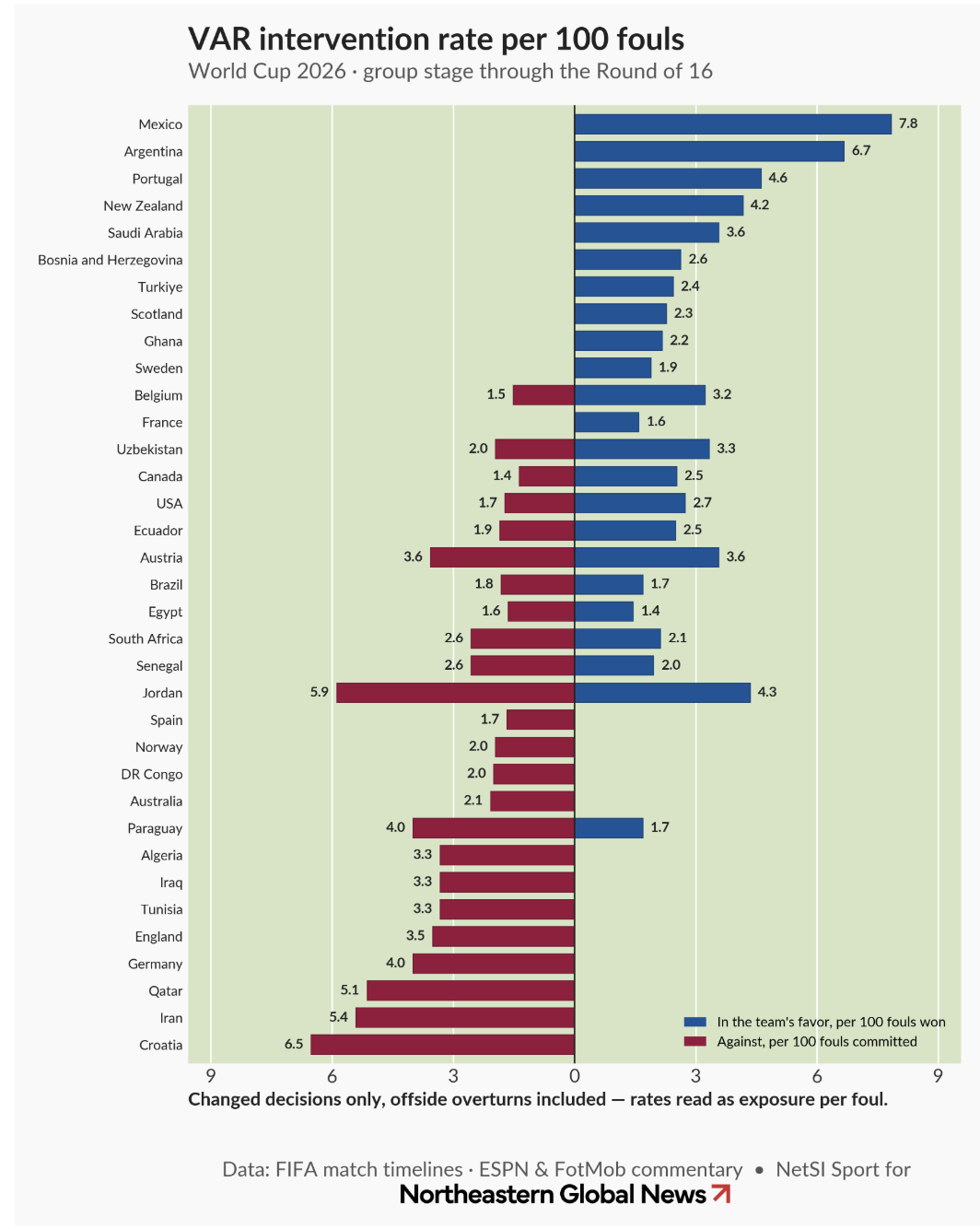
Many fans have felt that Argentina has received favorable rulings throughout the entirety of its World Cup run, leading them to dub the squad as “VARgentina.” Now, a delve into the numbers has revealed the truth behind Argentina’s relationship with VAR reviews.

A chart created by NetSI Sport and provided by Northeastern Global News shows “which teams during this year’s World Cup have seen the most favorable VAR outcomes (in blue) and which have seen the least (in red) using a baseline of per 100-fouls committed or won.”

Credit: NetSI Sport

Per the graph, which was provided on July 11th before Argentina’s quarterfinals win over Switzerland, which saw a Swiss player sent off after a VAR review, of all the teams that reached the quarterfinals, only Argentina didn’t have a single foul committed be reviewed by VAR, while also having the most fouls in its favor reviewed by a wide margin.

Still, Brennan Klein, director of the Northeastern NetSI Sport research group, is not going as far as to say that Argentina has received preferential treatment.

“Why are Argentina and Mexico topping this list?” he said. “They are topping this list because the referees missed fouls that the VAR thought should have been fouls. There’s a hop, step and a jump away from: ‘They’re biased against my team or for this team.’”

Still, these findings certainly won’t help quell any fan narratives that FIFA is favoring Argentina.

The post VAR intervention rate shows just how much ‘VARgentina’ has benefitted during World Cup appeared first on The Comeback: Today’s Top Sports Stories & Reactions.

15 best baseball announcers of all time

Baseball’s soundtrack of summer has always depended on the voices in the booth as much as the players on the field. The right call can turn a routine summer night into a memory that lives in a fan base forever.

As the 2026 MLB season reaches the unofficial halfway mark with this week’s All-Star Game and turns toward the stretch run, it’s a good time to reflect on the game’s most memorable voices.

MORE: Ranking the 13 most memorable moments in MLB All-Star Game history

This list of the 15 best baseball announcers of all time leans on impact, longevity, big moments and, just as important, how they sounded sitting in the car or on the couch in July when nothing much was happening.

These are the voices that defined how the sport sounds.

15. Phil Rizzuto

A Hall of Fame player with the New York Yankees, Phil Rizzuto moved right from the playing field to the broadcast booth. His idiosyncratic, conversational style played well in the Big Apple for 40 years before he retired in 1996.

Who can forget Rizzuto’s signature phrase, “Holy cow!” And, yes, that’s him providing the play-by-play of a young man “rounding the bases” in the Meat Loaf song “Paradise by the Dashboard Lights.”

14. Bob Costas

Bob Costas famously got his start in broadcasting with the ABA’s St. Louis Spirits when he was just 22 years old. But baseball was his first love, and it showed. It wasn’t long before Costas got the “Game of the Week” job alongside Tony Kubek.

Costas’ encyclopedic knowledge of the game and humor formed a perfect mix for baseball broadcasts on television. He went on to broadcast several World Series and league championship series, both as a play-by-play man and pregame host.

The winner of 29 Emmy awards for his work in sports, news and entertainment, Costas still pops up on MLB Network as the host of documentaries.

13. Jerry Coleman

Jerry Coleman’s path to the booth ran through the field and military service, and he brought that perspective to decades of San Diego Padres broadcasts. He was known for good-natured malapropisms and slightly scrambled calls that fans came to love, as well as for a catchphrase that lived on in San Diego sports culture.

Coleman’s long-running “Oh, Doctor!” exclamation after big plays helped define Padres baseball on radio for multiple generations of fans in Southern California.

Behind the quirks, Coleman knew the game and never faked his way through a sequence. His style is a reminder that perfection is not the point; connection is.

12. Harry Kalas

Harry Kalas’ deep, rolling baritone became inseparable from the Philadelphia Phillies. His “Outta here!” home run call filled summers in the Delaware Valley, and his work on NFL Films projects gave him a second life as a legendary narrator in another sport.

For Phillies fans, Kalas provided constancy through lean years and eventual championships, including the 2008 World Series run that gave him a long overdue title call. His voice gave even routine plays a sense of weight without ever feeling heavy-handed.

11. Joe Buck

Few modern broadcasters inspire stronger opinions than Joe Buck, which usually means a guy has been on a lot of important calls. He became the primary national TV voice of the postseason at a relatively young age and stayed in that seat for two decades, layering his own style on top of the expectations that came with being Jack Buck’s son.

Joe Buck brought a measured, sometimes dry delivery that let big October moments speak for themselves. He was on the call for iconic plays such as the Red Sox breaking their title drought in 2004 and the Cardinals’ wild comeback in Game 6 of the 2011 World Series. Whether fans loved him or complained about him, his voice is attached to a long list of plays everyone remembers.

10. Curt Gowdy

Curt Gowdy spent years as the national voice for big events across multiple sports, and baseball was one of the primary beneficiaries. He called World Series, All-Star Games and classic postseason matchups in an era when there might be only one national telecast for a given game, which meant his calls effectively became the official record.

Gowdy’s style was straightforward and uncluttered, the sound of someone who trusted that the game would deliver the drama on its own. That approach has aged well. Listening back, there is no forced catchphrase or manufactured intensity, just a professional voice giving context to important baseball moments.

9. Bob Uecker

Bob Uecker was probably as famous for joking about his own playing career as he was for anything that happened on the field, and that self-deprecation powered decades of entertaining Milwaukee Brewers broadcasts. He also became a pop culture figure through late-night TV appearances and the “Major League” movies, but in Wisconsin he was the voice that guided fans through 162 games.

Uecker mixed dry humor with sharp play-by-play instincts, never missing the action even when he was clearly having fun with the audience. He kept Brewers baseball light during long rebuilds and heightened the joy when the team finally started stacking playoff berths again. The fact that locals simply call him “Ueck” says everything about how personal that connection has become.

8. Jon Miller

Jon Miller has one of the most recognizable voices in baseball and a delivery that can shift from lyrical to deadpan in a heartbeat. He spent years as the national Sunday night voice and has been a fixture on San Francisco Giants broadcasts, calling everything from Barry Bonds’ home run chase to multiple World Series runs.

Miller’s strength is precision. His descriptions are vivid but never crowded, and he brings an international flair with his playful use of accents and languages when appropriate. He made national broadcasts feel like big events without losing the rhythm of a regular baseball game.

7. Joe Garagiola

Joe Garagiola brought a former player’s insight and a comedian’s timing to national baseball broadcasts. A catcher turned broadcaster, he became a familiar voice on the Game of the Week and multiple World Series, helping casual fans understand what was happening without talking down to them.

Garagiola’s strength was his ability to weave in anecdotes that actually explained things, rather than simply filling air time. He could make viewers laugh at a mound conference or an error while still outlining the strategy behind the next pitch. His blend of accessibility and credibility set a template for the color role on national baseball coverage.

6. Ernie Harwell

In Detroit, Ernie Harwell was more than an announcer. He was a companion for summer after summer, with a welcoming tone and gentle sense of humor that made Tigers games feel like family gatherings. Harwell had a knack for turning mundane elements of a game into ritual, from his “stood there like the house by the side of the road” strikeout line to noting fans catching foul balls “from Kalamazoo” or “from Windsor.”

He called games for more than four decades in Detroit, and his consistency and warmth built a trust few broadcasters ever achieve. Harwell made listeners feel like they were exactly where they were supposed to be, and that is a rare gift in a long season.

5. Jack Buck

Jack Buck’s voice is stitched into the fabric of both St. Louis Cardinals history and national baseball memory. His “Go crazy, folks! Go crazy!” reaction to Ozzie Smith’s 1985 NLCS home run remains one of the sport’s most replayed calls, and his work on national radio placed him in people’s living rooms for multiple generations of postseason moments.

Buck combined Midwest calm with a knack for capturing the tone of a game in a simple phrase. He never tried to be the show, but when the moment called for a strong line, he invariably had one ready. That economy of words is a big reason he is still held up as a model for baseball play-by-play.

4. Harry Caray

Harry Caray turned the broadcast booth into a neighborhood bar, first in St. Louis and then in Chicago, where he became synonymous with Wrigley Field and the Cubs. His slurred vowels, mispronunciations and genuine awe for what he was seeing made him feel more like a fan with a microphone than a polished broadcaster. That was exactly the point.

Caray’s energy, including his signature “Holy cow!” and his willingness to lead the crowd in “Take Me Out to the Ball Game,” turned ordinary regular season games into events. He was not perfect on details and barely pretended to be neutral, but he captured the emotional side of baseball fandom in a way that still resonates in Chicago lore.

3. Mel Allen

For a huge chunk of the 20th century, Mel Allen was the voice of the New York Yankees and, by extension, the voice of winning. His “How about that!” catchphrase could be heard on radio, television and highlight packages at a time when the Yankees were stacking championships and stars. Allen had an enthusiastic but controlled style that fit both the local broadcast and the emerging national appetite for baseball highlights.

He later became the host and narrator of “This Week in Baseball,” where his smooth delivery and sense of pacing introduced fans around the country to plays they never would have otherwise seen. Allen’s work helped bridge the gap between local radio calls and the national TV era that followed.

2. Red Barber

Red Barber helped invent the language of baseball on radio. Long before every market had its own signature voice, Barber was painting pictures for Dodgers, Reds and Yankees fans with a southern cadence and a string of homespun phrases. He popularized turns of phrase that still pop up in broadcasts, from “sitting in the catbird seat” to describing a close game as “tighter than a new pair of shoes.”

Barber’s work in Brooklyn set the table for Scully, and his influence on how play-by-play is described can be heard throughout the generations that followed. He did not just call the action; he framed games as narratives long before that became standard practice.

1. Vin Scully

Vin Scully is the standard every baseball broadcaster gets measured against. From Brooklyn to Los Angeles, from Jackie Robinson to Clayton Kershaw, he spent 67 seasons calling Dodgers games and still somehow sounded curious and sharp into his final year behind the mic. Scully mastered the balance between play-by-play and storytelling, dropping in anecdotes that felt like they belonged to the moment instead of distracting from it.

He called some of the most famous plays in baseball history, including Kirk Gibson’s hobbling home run in the 1988 World Series and Hank Aaron’s 715th home run. What separates Scully is how often he understood that silence could be more powerful than any line he might write. He laid out after big moments and let ballparks speak for themselves, trusting that fans at home did not need their hands held.

‘Confederate Clark’: Caitlin Clark faces criticism after support from Riley Gaines, Republicans

Caitlin Clark
Jul 9, 2026; Phoenix, Arizona, USA; Indiana Fever guard Caitlin Clark against the Phoenix Mercury at Mortgage Matchup Center. Mandatory Credit: Mark J. Rebilas-Imagn Images

Indiana Fever point guard Caitlin Clark has been named to the All-Star Game for the third time in as many seasons despite playing a career low in minutes. Unfortunately, a segment of the population seems set on perpetually discussing anything but her outstanding play on the court night after night, even as she deals with a back injury that has lingered throughout the season.

Last week, several Republican members of Congress penned a letter to WNBA commissioner Cathy Engelbert demanding that the WNBA take action to prevent what they deemed to be ” repeated acts of unnecessary physical hostility and violence” against Clark, and even mentioned that the acts “may be racially motivated.”

In a recent appearance on Fox News, conservative political commentator and former collegiate swimmer Riley Gaines commented on Clark’s treatment by the league and opposing players.

“Here’s what I’ll say about Caitlin Clark,” Gaines said. “It goes without saying that she is the golden goose of the WNBA. Do they hate her because she’s white? Maybe. Do they hate her because she’s straight? Maybe. I think it is rooted in jealousy.”

“I think she was the queen of the WNBA before she ever stepped foot on a WNBA court, and they hate her for it,” she added.

The Indiana Fever quickly attempted to distance the organization from any outside political agendas trying to be attached to its star player, but the damage seems to already have been done. Unfortunately for Gaines and the members of Congress behind the letter, their support has seemed to alienate more people against Clark.

“Caitlin Congress.”

Clark faced criticism for what many perceived to be her flopping in Sunday night’s game win against the Las Vegas Aces, and not only did she face some intense criticism, but some fans on social media slapped her with some unfortunate and undeserving nicknames.

“Confederate Clark back at it again,” one fan posted on X.

“Caitlin is getting bullied and needs more intervention from congress!!!! Karen’s tears after she crumpled to the ground after seeing the missed shot and heard the whistle got the refs to review for ‘hostile act’ after the review she still yelled at the refs. Pathetic,” another fan posted.

Caitlin is an embarrassment to Women’s Basketball! First Calling Congress because they don’t let her get her way plus all the Flopping and showing out on the court like a Toddler! She is Weak and deserves Zero respect in the league!” someone else added.

CaitlinCongress is a classic passive aggressive. If a player has status she’ll pretend they hurt her,” one account wrote.

“None of that is OK.”

What many of her harshest critics fail to realize, however, is that Clark has never voiced support for anyone’s political agenda, and has even come out against the hate that black women around the league have received online.

“The harassment, the hate. None of that is OK …” she said prior to Sunday’s game, via ESPN. “There should never be a question of character like I’ve always stood up here and said that, and that’s truly what I believe, that’s how I was raised. So, none of that is okay, and I don’t want anyone to experience that.”

The WNBA will be in a much better place when the conversations surrounding it are centered on basketball and made in good faith. Hopefully, that will begin to happen sooner rather than later, and more fans will begin to appreciate Clark’s exceptional ability on the court.

The post ‘Confederate Clark’: Caitlin Clark faces criticism after support from Riley Gaines, Republicans appeared first on The Comeback: Today’s Top Sports Stories & Reactions.

World Cup could expand to 64 teams, FIFA President Gianni Infantino says

Gianni Infantino
Jun 1, 2026; Dallas, Texas, USA; FIFA President Gianni Infantino holds the World Cup trophy while he speaks during the grand opening of the 2026 FIFA World Cup international broadcast center at Kay Bailey Hutchison Convention Center. Mandatory Credit: Raymond Carlin III-Imagn Images

The 2026 FIFA World Cup featured the largest field of teams yet, featuring 48 teams compared to the 32 teams previously involved in the tournament. However, it sounds like further expansion could be in the cards.

During a recent interview, FIFA President Gianni Infantino confirmed that after this World Cup, which is set to conclude next week, FIFA will look into the possibility of further expanding the field.

Possible Expansion?

During a recent interview with Swiss broadcaster Blue Sport, Infantino was asked about the possibility of expanding the field to 64 teams after the recent expansion from 32 teams to 48 teams. Infantino certainly did not rule it out.

“This is certainly an issue that will be looked at and discussed in the relevant committees after this World Cup,” Infantino said via ESPN. “When you organize a World Cup, it’s important that you organize it for the whole world. It’s not just Europe and South America, but the entire world, effectively. Every nation should be able to dream of taking part in the World Cup.

“We can see that the quality of the teams is extremely high, and it’s getting higher and higher everywhere in the world. If you don’t give smaller countries the chance to participate in the World Cup, they also lose the incentive to keep improving.”

Back in March 2025, South American confederation CONMEBOL proposed expanding the field to 64 teams for the 2030 tournament, which marks the World Cup’s centenary.

“We believe in a historic 2030 World Cup. We want to call for unity, creativity and believing big. Because when football is shared by everyone, the celebration is truly global,” CONMEBOL president Alejandro Domínguez said at the time.

What would it look like?

If the 64-team proposal were to be approved, the expanded tournament would double the number of matches played during the previous 32-team format that was used from 1998 to 2022.

A 64-team World Cup would feature 128 matches, whereas the 32-team format used from 1998 to 2022 included 64 matches. This year’s expanded tournament will feature 104 matches.

The biggest benefit to an expanded field would be a cleaner system for teams advancing to the knockout round. In this tournament, eight third-place teams advanced out of the group stage and made the knockout round, using various tiebreakers.. Under an expanded 64-team format, no third-place teams would advance.

The post World Cup could expand to 64 teams, FIFA President Gianni Infantino says appeared first on The Comeback: Today’s Top Sports Stories & Reactions.

❌