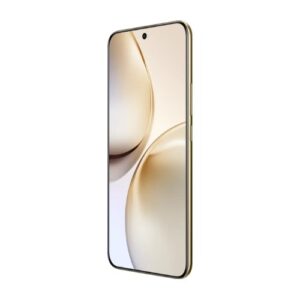
Earlier this month, Realme claimed that its upcoming Realme 16 Pro+ will ship with a processor more powerful than Qualcomm’s Snapdragon 7 Gen 4. Last week, however, the smartphone made an appearance on Geekbench with—surprisingly—the same chip that Realme said it would not use.
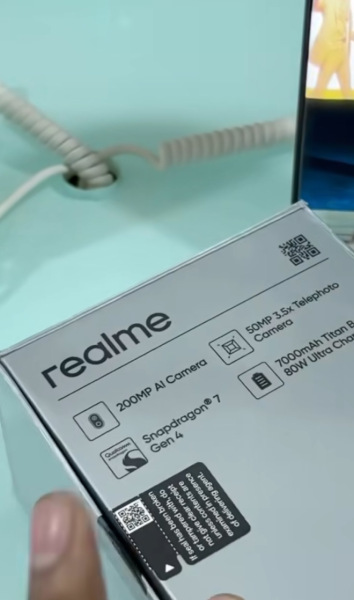
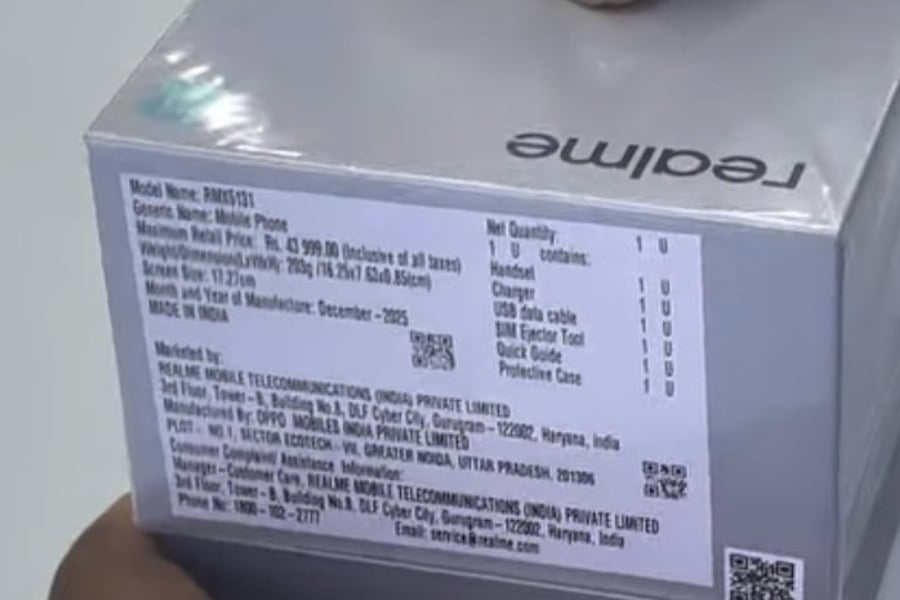
Now, the phone’s retail box image has also surfaced online. And guess what? The box imprinting confirms that the device is indeed powered by the Snapdragon 7 Gen 4.
We are not sure why Realme is doing false marketing. The source of the image is a reliable tipster, which rules out the likelihood of the image itself being doctored.
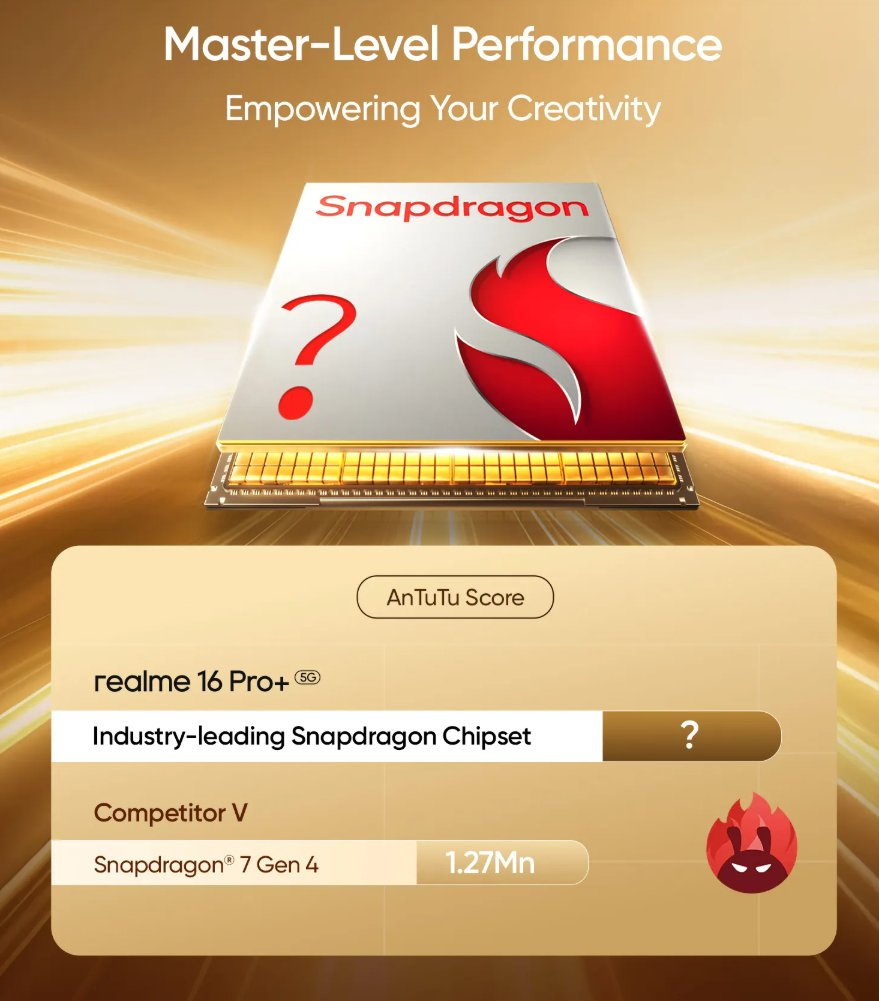
Below is the official teaser, which shows Realme 16 Pro+ has an “industry-leading Snapdragon chip,” which performs better than the Snapdragon 7 Gen 4. It’s Realme logic now, and we’ll have to wait for the company to explain the discrepancy.
Beyond the chipset confusion, the box image also reveals some previously confirmed details. The Realme 16 Pro+ packs a 200MP main camera alongside a 50MP 3.5x telephoto lens on the back. Powering the phone is a massive 7,000mAh “Titan” battery, paired with 80W fast charging.
Rest of the specs
The 16 Pro+ has already made its way to the TENAA database, revealing most of its specs. It flaunts a 6.8-inch AMOLED panel with 10-bit color depth. The front also has a 50MP selfie camera, while the rear includes an 8MP ultrawide alongside above mentioned 200MP main and 50MP telephoto.
It runs on Android 16, which is layered with Realme UI 7. Globally, it is expected to receive three OS upgrades and four security updates. Other features include an in-display fingerprint sensor and an IR blaster.
The Realme 16 Pro+ is set to launch in India on January alongside the more affordable Realme 16 Pro.
For more daily updates, please visit our News Section.
Motorola is prepping to launch a new smartphone series called the Motorola Signature in India. The device, according to rumors, will replace the Motorola Edge 70 Ultra as the company’s next flagship offering.
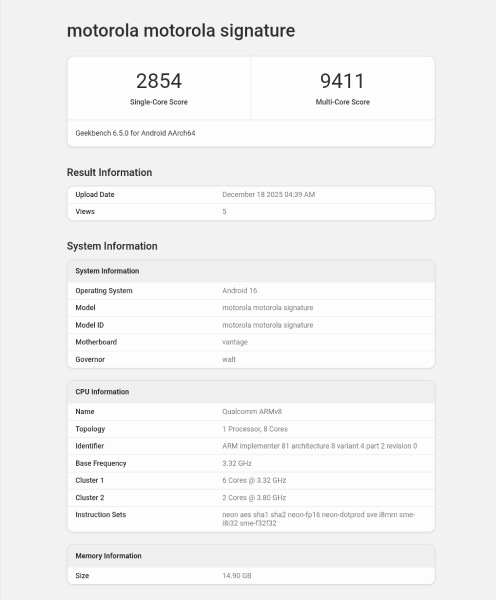
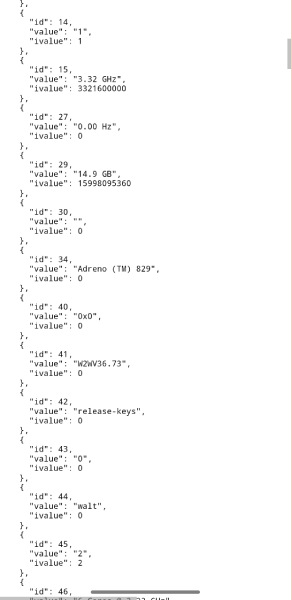
The smartphone has now surfaced on Geekbench, confirming the moniker and chipset choice. The benchmark listing explicitly mentions the phone as Motorola Signature, so indeed the rumors were true.
Moreover, the Signature is powered by Qualcomm’s Snapdragon 8 Gen 5 processor, paired with the Adreno 829 GPU. The test phone is running Android 16 and comes with 16GB of RAM.
In terms of performance, the Geekbench scores are in line with what you can expect from a flagship chip. The phone scored 2,854 points in the single-core test and 9,411 points in the multi-core test.
The first teaser arrives
Soon after its Geekbench spotting, the company also shared the first teaser for the Motorola Signature in India. It doesn’t reveal specs or design, but the company says to ”come back on t28, 2025.” While we are not sure, this could be a hint for the launch on December 28.
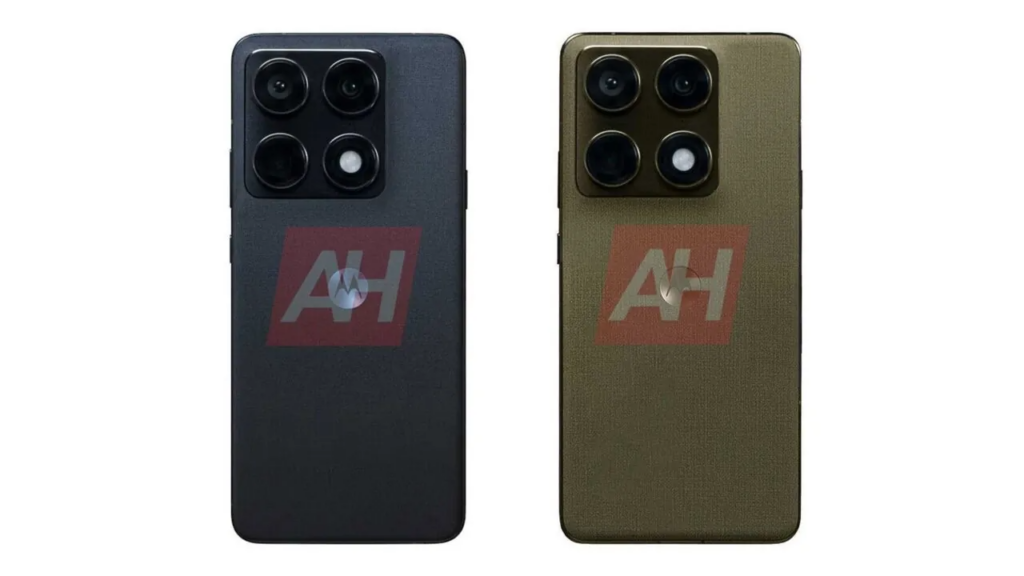
Design-wise, leaked images seen in earlier reports suggest that Motorola isn’t straying too far from its existing Edge-series playbook. The device has a rectangular camera module at the top left, housing three camera sensors and an LED flash. The overall profile also looks slim.
On the front, the Motorola Signature is expected to feature a 6.7-inch flat OLED display with a 1.5K resolution and a 120Hz refresh rate. For cameras, the phone is rumored to pack a 50MP triple-camera setup, including a main sensor, an ultra-wide lens, and a periscope telephoto camera.
Lastly, leaked information suggests the phone will be available in at least three color options: black, green, and bronze.
For more daily updates, please visit our News Section.
Honor is set to launch its first Honor Win series phones in China today. The Win and Win RT are performance-focused handhelds with Snapdragon 8 Elite chip and a 10000mAh battery.
Despite these beefy specs, the main talking point of Power 2 could be its design. A Weibo tipster who goes by the alias Panda is Bald shared an image showing the phone’s design, and yeah, it looks like iPhone 17 Pro.
It’s not very inspiring
The device has a panned camera module housing three lenses in Apple’s fashion, and the LED cutout is also on the left. In fact, the hero color of the Power 2 seems to be Orange, just like the new Pro iPhones. Apart from this, the phone might be available in Black and White shades.
For better or worse, Chinese manufacturers, big or small, have always tried to bring Apple’s flavor to their own devices. A recent example is the Xiaomi 17. So we shouldn’t be as surprised by Honor doing the same thing. But yeah, it’s not very inspiring.
The Honor Power 2 is also expected to feature a 6.79-inch OLED display with a 1.5K resolution and a 16MP front-facing camera. A 50MP lens will lead the rear setup.
Pairing with Dimensity 8500 is 12GB of RAM and Android 16-based Magic OS 10. Tumors say the same chip will also power Redmi Turbo 5, Poco X8 Pro, and Realme Neo 8 SE.
The Turbo 5 could be the first phone to feature the said chip, but it will remain exclusive to China. The Poco X8 Pro will arrive as a global version of the Turbo 5.
For more daily updates, please visit our News Section.
Realme is getting ready to kick off 2026 with two new smartphone launches. Part of the Realme 16 series, the company will announce the 16 Pro 5G and 16 Pro+ 5G on January 6 in India. Ahead of that announcement, a fresh leak has shed some light on what the more premium Realme 16 Pro+ 5G might cost.
According to well-known tipster Paras Guglani, the Realme 16 Pro+ 5G is expected to carry a maximum retail price of Rs. 43,999. As is usually the case with early leaks, this figure isn’t official.
Realme is likely to announce launch offers, bank discounts, or limited-time deals that could bring the actual street price down. There was no Realme 15 Pro+ to compare the price to its predecessor; however, the Realme 14 Pro+ launched at Rs 29,999. So that’s indeed a steep increase in a couple of generations.
Realme 16 Pro+ 5G: What to expect
The Realme 16 Pro+ 5G is confirmed to ship with a 200MP main camera, 8MP ultrawide, and a 50MP telephoto lens. The phone will run on a Snapdragon chipset, which Geekbench shows could be a tweaked version of Snapdragon 7 Gen 4.
Design-wise, the Pro+ appears to follow a similar look to the Realme 16 Pro, with color options including Master Gold, Camellia Pink, and Master Grey.
Realme 16 Pro in Master Gold
On the software side, the phone will ship with Realme UI 7.0 based on Android 16. Realme has also committed to three years of Android OS updates and four years of security patches for 16 Pro+. The device will include intelligence features like AI Edit Genie 2.0.
The January 6 launch event won’t just be about smartphones. Realme has also confirmed the debut of the Realme Buds Air 8 and the Realme Pad 3. All of these products are expected to go on sale through Realme’s official website and Flipkart shortly after launch.
Xiaomi could be expanding HyperOS 3‘s reach to as many as 25 devices before the end of 2025. Based on internal server listings, the company has already finished builds of HyperOS 3 for a wide range of phones and tablets, suggesting imminent launch.
According to tracking data spotted on HyperOSUpdates.com, multiple HyperOS 3 builds are currently marked as “ready to release” on Xiaomi’s servers. The label confirms these updates are not part of an internal test or public beta phase anymore. Instead, they are the final builds that can be pushed to users through a staged rollout at any time.
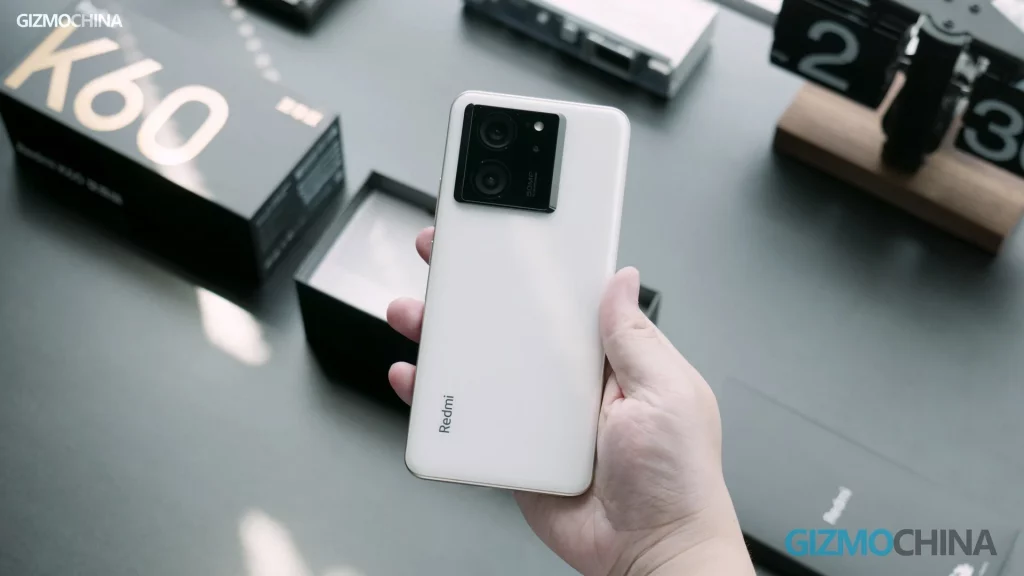
Redmi K60 Ultra
If the information holds up, Xiaomi could release the update in the remaining week of December.
List of Xiaomi devices ready for HyperOS 3 release
Here’s the list of Xiaomi, Redmi, and Poco with “ready to release” HyperOS status:
Cihaz Modeli
Durum
Xiaomi Pad 6 Max 14
Ready to release
Xiaomi Pad 6 Pro
Ready to release
Xiaomi 13T Pro
Ready to release
Redmi K60 Ultra
Ready to release
Redmi K60
Ready to release
POCO F5 Pro
Ready to release
Redmi 15
Ready to release
POCO C75
Ready to release
POCO F6
Ready to release
POCO X6 Neo
Ready to release
POCO Pad M1
Ready to release
POCO M6 Pro 4G
Ready to release
POCO M7 4G
Ready to release
POCO M7 Pro 5G
Ready to release
Redmi 15 4G
Ready to release
Redmi Note 15
Ready to release
Redmi Pad Pro
Ready to release
Redmi Pad 2 Pro
Ready to release
Redmi Pad 2
Ready to release
Redmi A4
Ready to release
Redmi Pad SE 4G
Ready to release
Redmi Note 13 Pro+
Ready to release
Redmi Note 13 Pro 4G
Ready to release
POCO M7 5G
Ready to release
Redmi 14C / Redmi A3 Pro
Ready to release
To note, not every device will receive the same underlying Android version. Higher-end models, such as the Pad 6 Max 14, Pad 6 Pro, and Redmi K60 Pro variants, are confirmed to run HyperOS 3 on top of Android 15. Other devices are expected to ship with different Android bases, depending on their hardware and update policies.
For more daily updates, please visit our News Section.
After weeks of leaks and rumors, OnePlus has finally made things official. The company is launching a new Turbo series smartphone in China soon. OnePlus is positioning the new lineup as a “performance and battery life supernova” that will inherit the performance genes of its flagship phones.
According to the brand, the upcoming OnePlus Turbo delivers the “strongest battery life” in its segment, along with what the company calls an “unprecedented gaming experience” for its price range.
Adding to the announcement, OnePlus China President Li Jie says the Turbo series will bring several gaming-focused technologies previously limited to high-end models. These include a 165Hz ultra-high refresh rate display, the company’s Fengchi gaming kernel, and what OnePlus calls an “e-sports triple core.”
Li says these features have already been well received by professional players and hardcore gamers, and that the Turbo series will bring them to a much wider audience.
OnePlus Turbo specifications
As far as the specs are concerned, the OnePlus Turbo is said to feature a 6.78-inch flat LTPS OLED panel with a 1.5K resolution and a 165Hz refresh rate.
Under the hood, an AnTuTu listing confirms the phone will be powered by Qualcomm’s Snapdragon 8s Gen 4 chipset. It scored 2,609,327 points on the benchmark.
OnePlus 15R
The phone will feature flagship-grade LPDDR5X RAM and UFS 4.0 storage. Memory option ranges from 12GB RAM with 256GB storage to a top-end 16GB RAM and 512GB storage variant. In China, the phone is expected to launch in Unique Black, Ocean Green, and Light Chaser Silver shades.
Fueling the phone could be a massive 9,000mAh battery with fast charging support. Other specifications include a metal middle frame and an ultrasonic in-display fingerprint sensor.
Interestingly, a previous report also points to another OnePlus Turbo-series phone with V branding. This model is expected to feature a Snapdragon 7-series chipset, a 165Hz display, and a large battery. Its color options include Unique Black, Nova White, and Fearless Blue. More details on this variant are expected to surface soon.
For more daily updates, please visit our News Section.
Xiaomi’s next budget smartphones, under the Redmi and Poco brands, have made their first appearance on certification sites. We’re talking about the Rsdmi A7 Pro and the Poco C81, which will be nearly identical in terms of hardware but are likely headed to different markets.
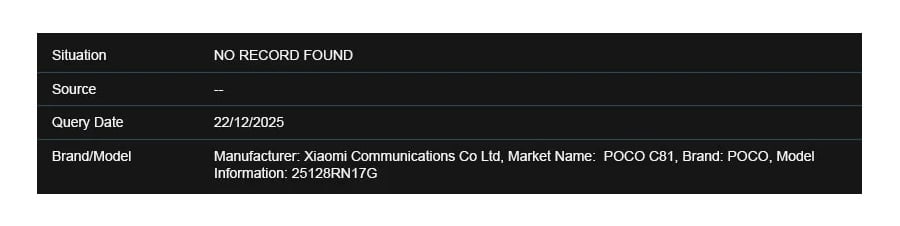
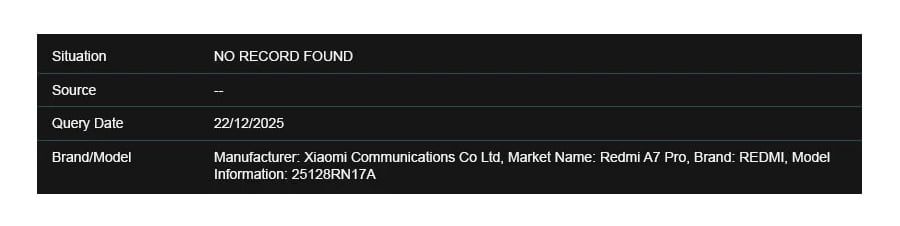
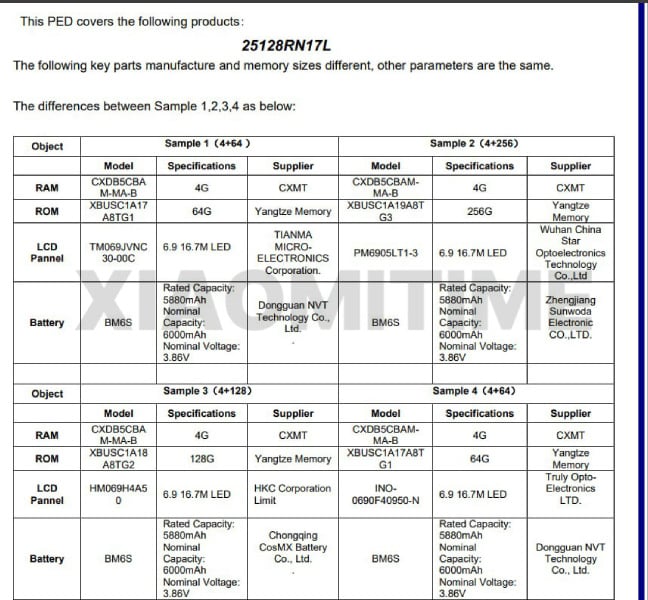
Both devices have been listed in GSMA IMEI and FCC listings, which reveal most of their core specifications. The IMEI database confirms that the Redmi A7 Pro carries the model number 25128RN17A, while the Poco C81 uses identifier 25128RN17G.
Poco C81 IMEIRedmi A7 Pro IMEI
The near-identical naming confirms their close relationship, but what’s even more interesting is that the fact that Redmi is jumping straight from the Redmi A5 to the Redmi A7 Pro. Yes, the company is skipping the Redmi A6 altogether. Poco C81, on the other hand, succeeds Poco C71.
Redmi A7 Pro / Poco C81 Specifications
The FCC listing also confirms that both phones will feature a large display measuring just under seven inches. It’s an IPS LCD panel with a waterdrop notch, which is about as classic budget-phone design as it gets in 2025.
Under the hood, the Redmi A7 Pro and Poco C81 are expected to run on the Unisoc T7250. It’s a 12nm chip with a mix of performance and efficiency CPU cores, paired with a Mali-G57 GPU.
Memory options could top out at 4GB of LPDDR4X RAM and 64GB or 128GB of slower eMMC storage. On the software side, the phones could ship with Android 15 or the lighter Android 15 Go Edition.
One of the more notable details is the battery. Xiaomi is said to be equipping these phones with a 6,000mAh cell. Charging, however, remains modest at 15W over USB-C, and the certification listings suggest that a charger won’t be included in the box.
Last but not least, there’s no mention of specific sensors, but the phones are expected to feature a single rear camera, keeping things simple.
For more daily updates, please visit our News Section.
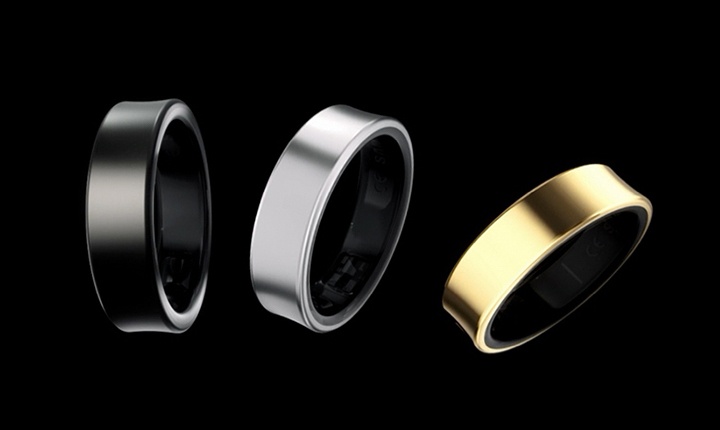
Smart rings have been around long enough that they are no longer a novelty. But it’s still fair to call them niche. A big reason for that is that most mainstream consumer tech brands have yet to dabble in this category.
There’s Samsung with the Galaxy Ring, and… yeah, that’s pretty much it. Even major Chinese manufacturers like Xiaomi, Oppo, and Vivo don’t seem to view smart rings as mainstream enough to earn a spot in their portfolios.
Samsung Galaxy Ring
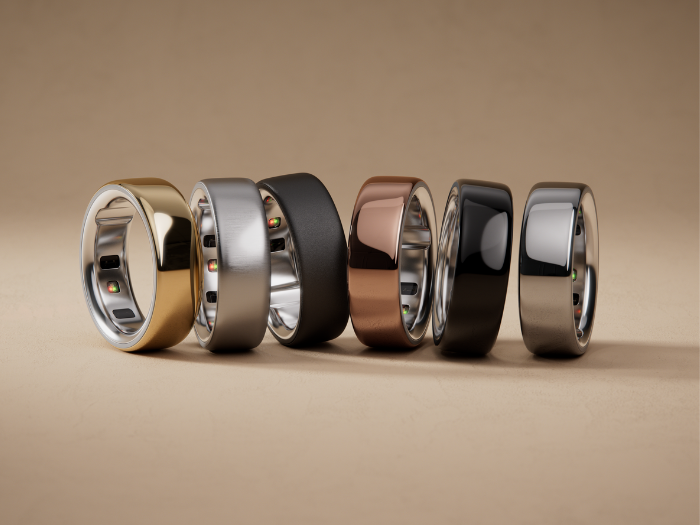
You might argue that brands like RingConn and Oura have been working in this space for years, and yes, they are. But the availability of these wearables is still limited to select countries, making them still a niche gadget.
That said, smart rings are often considered more reliable for tracking health metrics. It’s because they are easier to wear and stay in place, unless the ring is loose on the finger.
It’s also a good option for those who don’t like the idea of wearing a smartwatch. So, if you’re thinking about buying one, is a smart ring actually worth investing in for 2026? The answer, as usual, depends on what you expect from it and what you’re willing to live without.
Please Note: When you buy something using the links in our articles, we may earn a small commission at no cost to you.
What Smart Rings Are Trying to Do
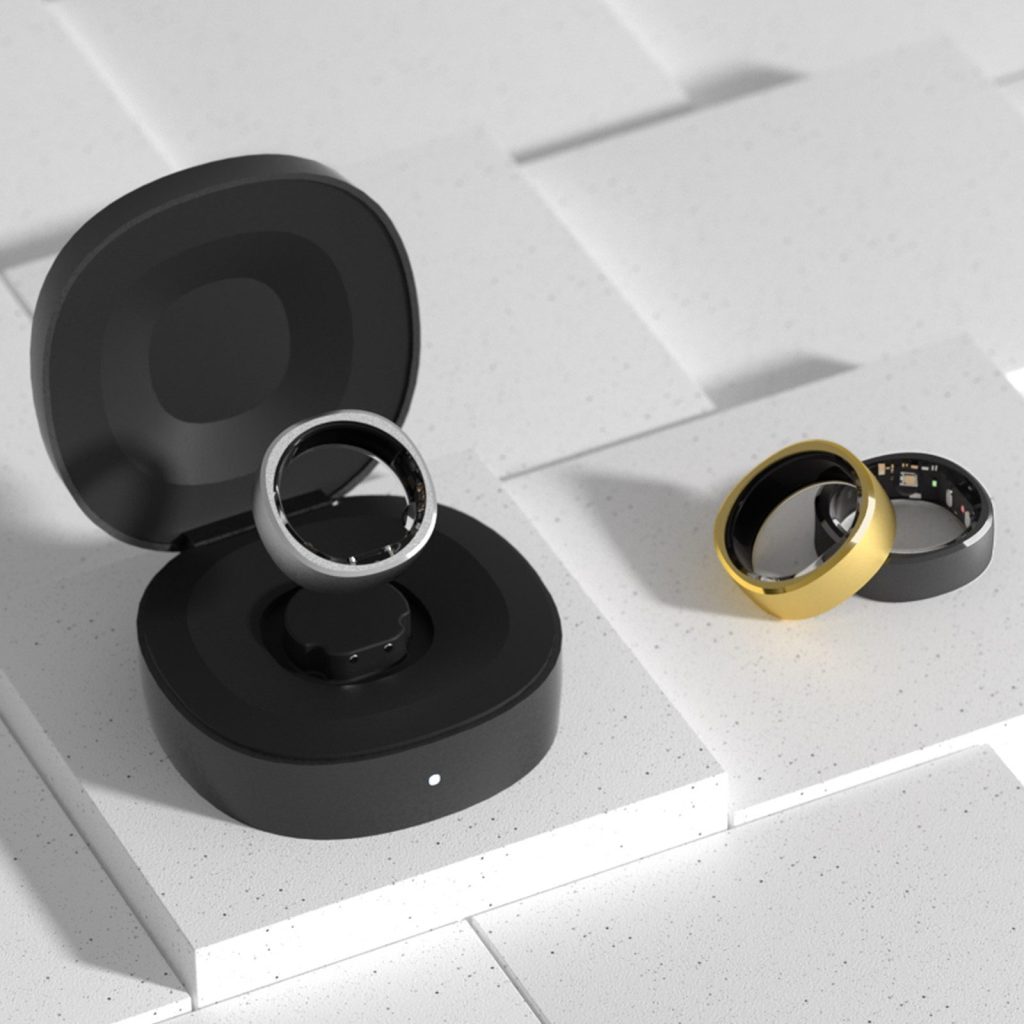
At their core, smart rings are health trackers that don’t look or feel like traditional gadgets. They sit on your finger, collect data quietly in the background, and send everything to an app on your phone. Most of them track sleep, heart rate, heart rate variability, blood oxygen levels, body temperature changes, and activity throughout the day.
The pitch here is that it’s a ring, small and light, easy to wear all the time. You don’t need a screen on it, you don’t interact with it much, and ideally, you forget it’s there.
Compared to smartwatches, which demand your attention with notifications and apps, smart rings are meant to stay out of our daily routine.
The Current State of Smart Rings
The smart ring market is still small compared to smartwatches, but it’s more established than it used to be. Oura is probably the dominating brand as it was among the first to enter this category. Samsung joined the space in 2024 with Galaxy Ring, and it naturally works best if you’re already using a Samsung phone.
There are other brands too. Many of them are trying to stand out by avoiding subscriptions. Oh, and I forgot to mention that the Oura Ring requires a separate subscription called Oura Membership.
Oura Ring Gen 4
However, what’s evident is that this market is not moving at the same speed as smartphones or smartwatches. Updates are incremental. New generations improve sensors, refine algorithms, and tweak designs, but there might not be dramatic leaps every year.
That can be a good thing if you don’t like buying new hardware often, but it also means you shouldn’t expect a smart ring to suddenly become something completely different next year.
Why a Smart Ring Might Make Sense for You
The strongest case for a smart ring is long-term health tracking without friction. Because rings are comfortable and unobtrusive, people tend to wear them all day and night.
This consistency means you can track sleep or workout data more reliably. Rings are often considered better at this than bulkier wearables, as their ease of wear results in fewer data gaps.
Another thumbs-up for smart rings is battery life. Most rings last several days on a single charge, sometimes close to a week. It’s honestly relaxing to switch from Wear OS smartwatches, which often need recharging every couple of days, if not sooner. You’re also less likely to miss data because the device ran out of power.
There’s also the fact that smart rings don’t compete for your attention. They don’t buzz, light up, or interrupt you. It’s best for people who already feel overwhelmed by screens and notifications. You check your data when you want to.
Where Smart Rings Still Fall Short
For all their strengths, smart rings are limited devices. They are not replacements for smartwatches, and this will never change. If you want real-time notifications, GPS tracking, music controls, or a screen you can glance at, a smart ring won’t help you.
Another issue is cost, especially when subscriptions are involved. Some of the more popular smart rings charge a monthly fee to unlock detailed insights and long-term trends. Over time, that can make a relatively small device feel expensive. Not everyone is comfortable paying ongoing fees for something that mostly tracks data in the background.
Fit can also be an issue. Rings need to be sized correctly, and fingers can change size depending on temperature, time of day, or activity. Most companies offer sizing kits, but it’s still a more complicated process than buying a watch and adjusting the strap.
There’s also the question of how useful the data actually is. Smart rings generate a lot of numbers, graphs, and scores. For some people, that could be helpful. But for others, it might not matter much except the usual sleep and heart rate data.
Who Smart Rings Are Actually For
In 2026, smart rings make the most sense for a specific type of user.
If you care about sleep quality, recovery, and general health trends, and you prefer something that works quietly in the background, a smart ring can fit well into your routine. It’s also a good option if you dislike wearing watches or find them uncomfortable, especially at night.
They’re less useful for people who want active interaction with their wearable. If you like checking notifications, tracking runs with GPS, or using apps directly on your wrist, a smartwatch still does all of that better.
Smart rings also aren’t ideal if you’re skeptical of subscription models or don’t want another app asking you to pay monthly. While there are options without subscriptions, they’re still not the norm.
So, Should You Invest in One?
A smart ring in 2026 isn’t a risky purchase, but it’s not an obvious one either. The technology is mature enough to do what it promises, and for the right person, it can be genuinely useful. At the same time, it doesn’t solve problems you didn’t already know you had.
You can think of a smart ring less as a must-have gadget and more as a specific tool. It works well if you want passive health tracking, decent battery life, and something that stays out of your way. It doesn’t work well if you expect it to replace a smartwatch or actively change how you use technology every day.
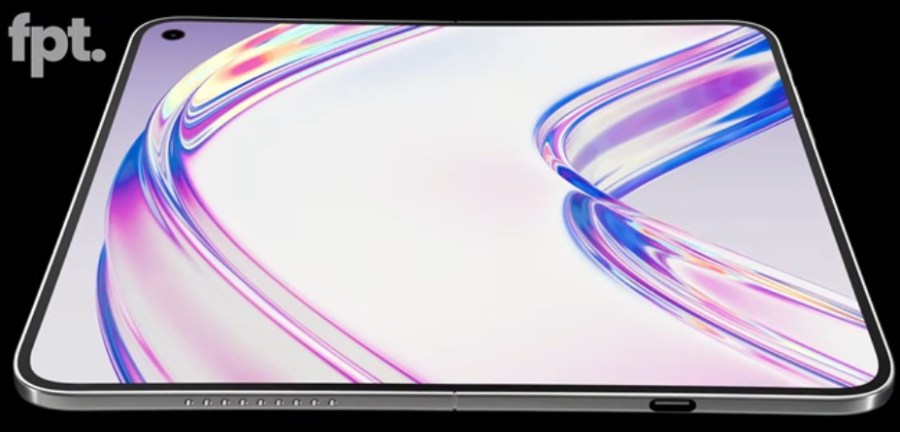
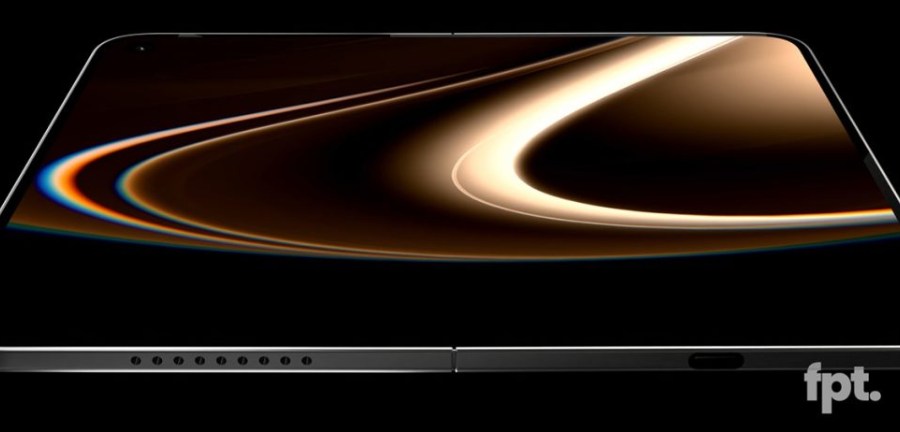
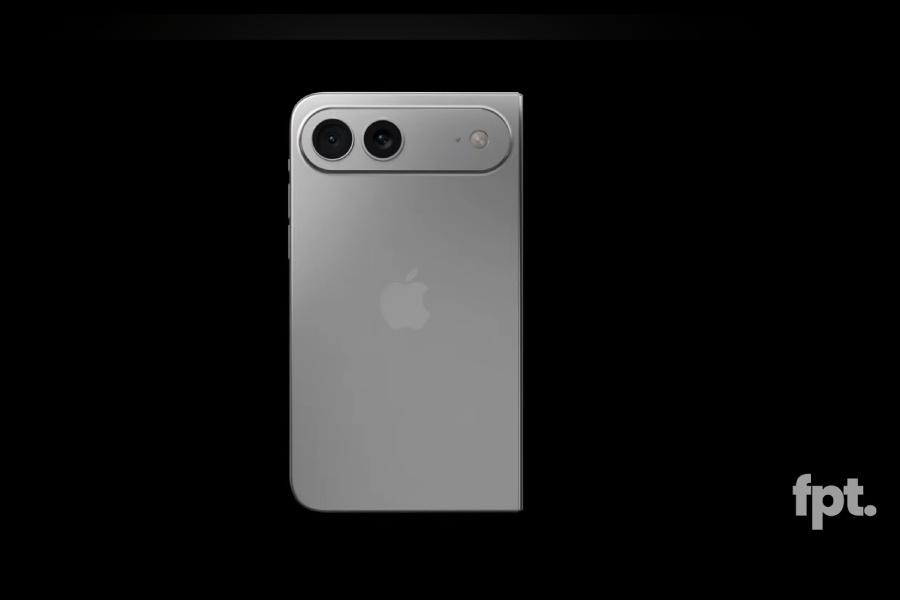
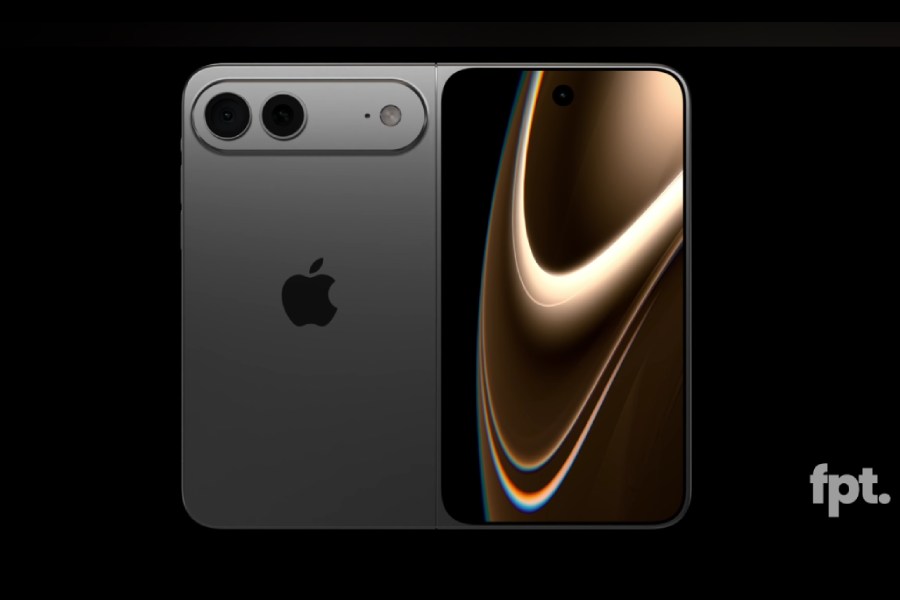
Apple’s long-rumored foldable iPhone has finally shown up in what are probably the first good-looking renders. And they come with a bold claim that its screen crease might be nearly invisible.
Courtesy of Jon Prosser at Front Page Tech, the YouTuber published a video today, showing the iPhone Fold’s design in full. Prosser claims Apple has chosen to make a book-style foldable instead of a clamshell because of what he thinks Apple has pulled off here.
The iPhone Fold reportedly features a 5.5-inch display on the front, while the inner screen will measure 7.8 inches. The highlight, of course, is the crease. Or the lack of it.
Prosser says Apple is using a combination of a pressure-dispersing metal plate, liquid metal in the hinge, and an in-cell touch panel to give iPhone Fold a crease-free look.
The claim lines up with an earlier report that suggests Apple is developing ultra-thin flexible glass (UFG) specifically to tackle the crease problem. If true, this could be Apple’s biggest contribution to foldable hardware yet.
Moreover, the iPhone Fold reportedly measures 9mm when folded and just 4.5mm when unfolded.
Performance, Camera, Battery, and More
The iPhone Fold is expected to run on Apple’s A20 Pro chip. It will also use Apple’s second-generation C2 modem and a high-density battery that should offer great battery life.
As for cameras, you can expect two at the back housed in an iPhone Air–like module. You’ll also get one camera on the cover display and another on the internal screen. Sadly, no under-display camera.
Another claim that corroborates previous rumors is that the Fold will skip Face ID in favor of a fingerprint sensor. It will reside in the power button, which Prosser says Apple has moved to the top of the device.
Last but not least, Prosser claims the iPhone Fold will come in only black and white color options and at a price between $2,000 and $2,500.
Huawei’s new Router X3 Pro is probably one of the coolest tech products of 2025. Unlike any router, it has a cylindrical body with a glowing mountain inside. It’s a perfect piece of home decor except for being a networking device.
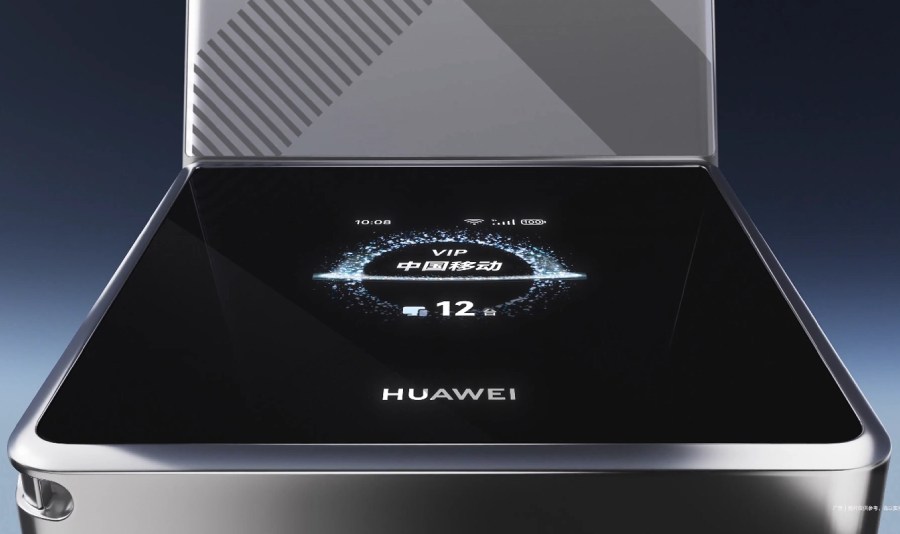
The same company is now teasing a new kind of portable hotspot. And in Huawei’s fashion, it looks very different from the pocket-sized mobile WiFi devices we’re used to. Called the Huawei Mobile WiFi X, the device was revealed through an official teaser video just today.
In Huawei’s own words, the Mobile WiFi X is “reshaping the mobile network experience.” The company claims its multi-antenna system integrated into an X-shaped design balances aesthetics, convenience, and performance, especially for outdoor live streaming and mobile content creation.
Of course, the most striking thing here is the design. Instead of a flat slab, the Mobile WiFi X features a foldable X-shaped body that can be unfolded and placed on a table while in use.
Huawei Mobile WiFi X is an all-in-one networking device
And the design might not just be for looks. An expanded structure gives Huawei more room for antennas, which could help with signal stability and performance.
There’s also a built-in display screen, which shows information like the time, battery level, signal strength, connection status, carrier, and how many devices are connected.
Interestingly, the signal indicator shown in the teaser doesn’t list a specific network standard. We are expecting 5G nonetheless.
The Huawei Mobile WiFi X has also been spotted inside the Huawei Smart Life app, where users can connect to and bind the device. This suggests the software side is well underway, even if the hardware details remain under wraps.
For now, Huawei is keeping official specs and pricing details under wraps. However, the device is expected to launch in March 2026.
For more daily updates, please visit our News Section.
PCs won’t be Lenovo’s only focus at CES 2026. The company is also reportedly planning to show off an unusual keyboard and mouse combo that you may never need to plug in.
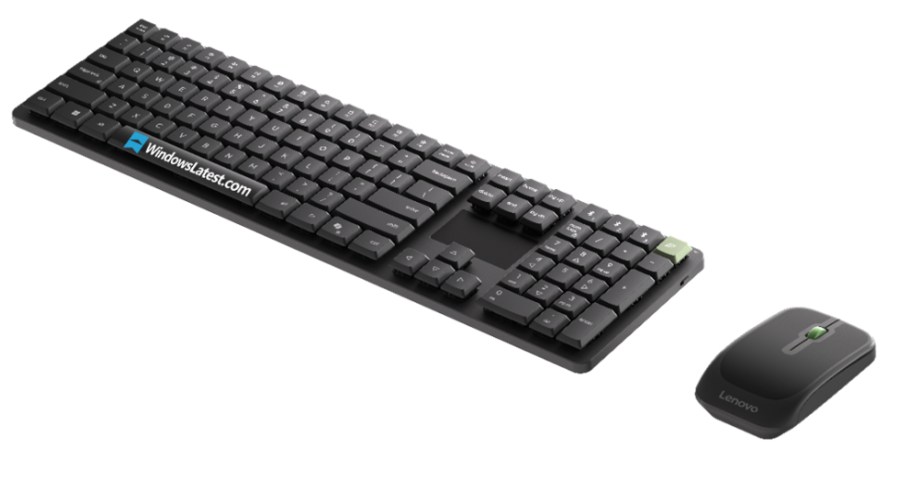
According to Windows Latest, Lenovo is preparing to unveil what it calls the Lenovo Self-Charging Kit Concept. And if you guessed it, yes, the keyboard and mouse rely on solar power. The twist is they’re designed to harvest energy, not just outdoors, but from indoor lighting as well.
The report claims Lenovo is using a next-generation solar light–harvesting technology that can continuously power both peripherals in a wide range of environments. More impressively, the system is said to generate power under indoor lighting as low as 50 lux.
In comparison, the small solar panels commonly found in calculators typically need around 200 to 500 lux to function.
The attached image shows the keyboard and mouse combo, with the keyboard likely featuring solar panels on top of the arrow keys. However, it’s difficult to spot it on the mouse.
More keyboard and mouse innovations
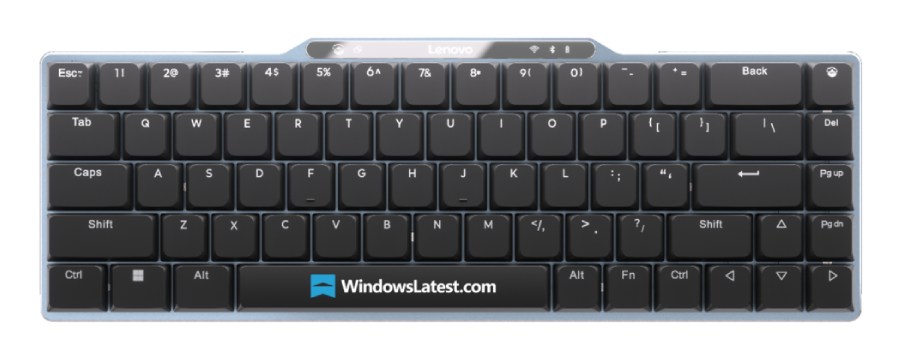
Lenovo is also introducing the Lenovo Adaptable Keyboard Concept at CES. According to the report, this keyboard can adjust key stroke behavior using optical actuation controls, though Lenovo hasn’t explained exactly how this mechanism works.
It also has indicators for Wi-Fi, Bluetooth, and battery status on an isle on top, along with an additional icon on the top right.
Finally, Lenovo will launch the Lenovo 900 Wireless Low-Profile Mechanical Keyboard and Mouse, featuring a translucent design and Thunder Grey and Cloud Grey shades.
Unlike the other two concepts, this set isn’t a concept model. While there’s no image of it, the 900 series is said to feature the company’s custom 4-point mechanical switch for a more satisfying typing experience, along with multi-device pairing via a unified 2.4G dongle or dual Bluetooth.
For more daily updates, please visit our News Section.
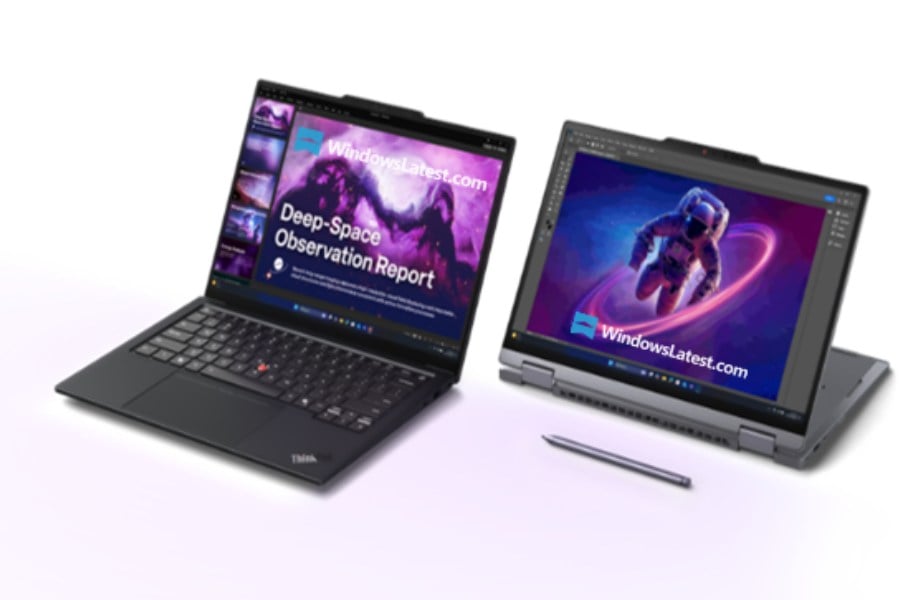
Lenovo’s next-generation ThinkPad X1 laptops may be getting one of their biggest internal updates in years. According to a new report published by Windows Latest, Lenovo has quietly redesigned the internals of the upcoming ThinkPad X1 Carbon Gen 14 Aura Edition and ThinkPad X1 2-in-1 Gen 11 Aura Edition, with a focus on repairability, thermals, and sustainability.
The two laptops are among the many products Lenovo will unveil at CES 2026.
The biggest change, reportedly, is dual-sided motherboard layout, meaning components are now placed on both sides of the board instead of one. This redesign saves internal space and allows Lenovo to improve heat dissipation, maintain performance for longer periods, and even make room for a larger touchpad.
More importantly, the report claims that the new internal design scored an impressive 9 out of 10 in iFixit’s repairability assessment.
Performance and Specs
As for the performance, both ThinkPad models are expected to ship with Intel Core Ultra X7 Series 3 processors, paired with Intel Arc graphics offering up to 12 Xe cores. Lenovo is also leaning heavily into AI, with an integrated NPU capable of delivering up to 50 TOPS.
The company is said to be advertising a 20 percent improvement in thermal performance, with sustained power draw reaching 30W.
On the outside, the laptops feature a new 10-megapixel webcam with a wide 110-degree field of view and distortion correction. The ThinkPad X1 2-in-1 Gen 11 also adds a new magnetic stylus that can be stored and charged directly on the device.
The display options are extensive, too. You can choose from a WUXGA IPS panel rated at 500 nits to a 2.8K OLED configuration with VRR, EyeSafe certification, and wide color gamuts.
Memory option includes up to 64GB of LPDDR5x RAM, storage reaches 2TB via PCIe Gen 5, and both models support Windows 11 and Linux.
Despite all this, the laptops stay impressively light. The X1 Carbon Gen 14 reportedly starts at just 996 grams, while the 2-in-1 model begins at 1.182kg. Connectivity includes Thunderbolt 4, HDMI 2.1, Wi-Fi 7, optional 5G, and Bluetooth 5.4.
Lenovo is also doubling down on sustainability, using recycled magnesium, aluminum, plastics, and even 100 percent recycled cobalt in the batteries, alongside plastic-free packaging.
For more daily updates, please visit our News Section.

 Login
Login