Login
Login
Vivo X300s vs Samsung Galaxy S26: Specs vs Longevity
We’ve been putting the Samsung Galaxy S26 up against flagships from across the market. If you’re curious, it’s already faced off against the OnePlus 15 and the Nothing Phone (4a) Pro.
Today, we’re comparing the Galaxy S26 with a more recent flagship, the Vivo X300s, which launched just last week in China. Both phones sit in the increasingly competitive “affordable flagship” tier. But the two are very different ideas of how a flagship phone should be in 2026.
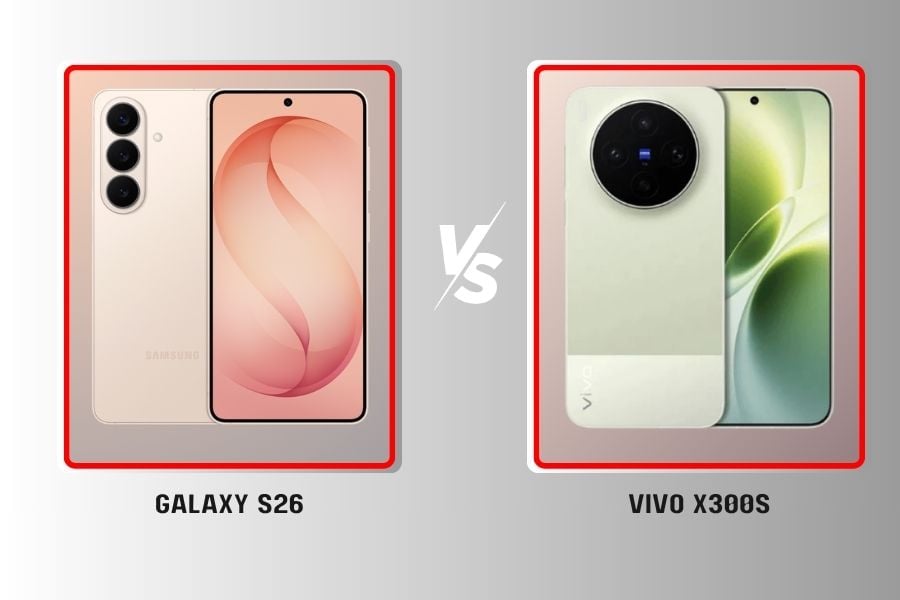
Vivo is about bigger battery, higher megapixel counts, faster charging, while Samsung offers refinement, long-term support, and a more compact form factor. Let’s go through them in detail here.
Design and size
The Galaxy S26, as you might know, is a relatively compact flagship. At 149.6mm tall and weighing just 167 grams, it’s noticeably smaller and lighter than the Vivo X300s. You can actually use it one-handed without thinking about it.
The Vivo X300s, by comparison, is large, and unapologetic about it. At 162mm tall and 217 grams, it’s closer to what you’d expect from an “ultra” phone. The extra size makes room for its bigger battery and camera system, but it also means you’ll feel it in your pocket.
Both phones use glass and aluminum builds, but Samsung uses Gorilla Glass Victus 2 on both sides and Armor Aluminum 2 for the frame. Meanwhile, Vivo offers IP68/IP69 ratings, which technically give it an edge in ingress protection.
Display
No prize for guessing, Vivo gives you more screen in almost every sense. The X300s has a 6.78-inch LTPO AMOLED panel with a 144Hz refresh rate, compared to the S26’s 6.3-inch Dynamic LTPO AMOLED 2X display at 120Hz.
On paper, Vivo offers a higher refresh rate, higher resolution (1260 x 2800), and features like 2160Hz PWM dimming and HDR Vivid. But in everyday use, you’re unlikely to notice a major difference between Samsung and Vivo.
Performance
Both phones run flagship chips, but from different ecosystems.
The Vivo X300s uses the MediaTek Dimensity 9500, built on a 3nm process with a peak clock speed of 4.21GHz. Samsung’s Galaxy S26, meanwhile, uses different chips depending on the region: Snapdragon 8 Elite Gen 5 in some markets and Exynos 2600 in others.
On paper, Samsung’s Snapdragon variant is slightly more aggressive, with a 4.74GHz peak core speed. But these are flagship SoCs, so everyday performance will feel smooth on either device.
Where Samsung pulls ahead is software longevity. The S26 promises up to seven major Android updates, compared to five on the Vivo. That’s a meaningful gap if you plan to keep your phone for several years.
Cameras
When it comes to cameras, the Vivo X300s goes all-in on hardware. It features a 200MP main sensor, a 50MP periscope telephoto, and a 50MP ultrawide. It even supports optional external zoom lenses with Zeiss optics.
Samsung, on the other hand, opts for a 50MP main sensor, a 10MP telephoto, and a 12MP ultrawide.
There’s no doubt Vivo has the edge in flexibility. Higher-resolution sensors allow for more cropping, and the periscope lens — plus optional add-ons — suggests it’s built for users who want to experiment with zoom and detail.
Samsung’s advantage lies in predictability. Features like Best Face, strong HDR processing, and consistent video performance make it easier to get reliable results without much effort.
Battery and charging
The Vivo X300s packs a massive 7100mAh battery, significantly larger than the Galaxy S26’s 4300mAh cell.
Charging speeds widen the gap further. Vivo supports 90W wired and 40W wireless charging, while Samsung sticks to 25W wired and 15W wireless. Even with Samsung’s efficiency optimizations, it’s hard to see it competing on endurance or charging time.
The S26 does offer reverse wireless charging and tighter accessory integration, but that doesn’t change the core difference: the Vivo is built to last longer and charge faster.
The bottom line
The Vivo X300s and Galaxy S26 don’t really compete on the same terms, even though they sit in the same category.
The Vivo X300s is all about maximizing hardware — a bigger battery, faster charging, higher-resolution cameras, and a larger, faster display. It’s trying to win on specs.
The Galaxy S26 is more restrained. It focuses on usability, long-term software support, and a compact design that’s increasingly rare among flagship Android phones.
Ultimately, it comes down to what you value more: raw hardware or a more balanced, long-term experience.
For more daily updates, please visit our News Section.
Stay ahead in tech! Join our Telegram community and sign up for our daily newsletter of top stories!
The post Vivo X300s vs Samsung Galaxy S26: Specs vs Longevity appeared first on Gizmochina.