Normal view

Yesterday — 9 March 2026Gizmochina

OnePlus 15T confirms design in green, brown shades

9 March 2026 at 07:54
OnePlus 15T design

So far, OnePlus has been gradually revealing key details about the OnePlus 15T. Today, the brand released a new poster showcasing the phone’s design and colour options and confirmed it will launch later this month in China.

OnePlus 15T design, color options revealed

OnePlus 15T launch date

The poster shared by OnePlus reveals that the OnePlus 15T’s overall design appears consistent with the OnePlus 15, and it is not too different from last year’s OnePlus 13T.

The 15T is a compact phone featuring a clean rear panel and a camera module placed in the upper corner. The teaser also confirms it will be available in a green option and a darker shade that appears brown or graphite. Apart from these color options, the 15T is also expected to arrive in white.

OnePlus President Li Jie has previously described the device as a “small-screen powerhouse.” The OnePlus 15T is expected to feature a 6.32-inch flat display with extremely narrow symmetrical bezels on all four sides. For security, it will feature an ultrasonic in-screen fingerprint sensor.

A Geekbench listing of the device that surfaced last week revealed that it will feature the Snapdragon 8 Elite Gen 5 chipset. The device managed to achieve an impressive score of 4.45 million on AnTuTu benchmarks.

The OnePlus 15T is confirmed to pack a 7,500mAh battery, along with 100W wired fast charging and 50W wireless charging. It will run on ColorOS 16-based Android 16.

On the camera side, the phone is tipped to include a 50-megapixel periscope telephoto camera designed to improve long-range photography. Despite including a periscope lens and a large battery, the camera bump is said to remain relatively slim. It is also confirmed to offer an IP68/69-level of dust and water resistance.

For more daily updates, please visit our News Section.

Stay ahead in tech! Join our Telegram community and sign up for our daily newsletter of top stories.

The post OnePlus 15T confirms design in green, brown shades appeared first on Gizmochina.

Official: Oppo Find N6 is launching on March 17 in China; Configs, color options confirmed

9 March 2026 at 06:39
Oppo Find N6 launch date

 Oppo has confirmed that the Find N6 foldable smartphone will debut in China on March 17. Ahead of the launch, the company has released its first teaser video, revealing the phone’s design and colour options. The Find N6 is also expected to address one of the biggest concerns with foldable devices: the visible crease on the inner display.

Oppo aims to minimize foldable display crease

Oppo says the Oppo Find N6 has been designed with a new engineering approach that combines a titanium alloy hinge with a special memory glass layer. Together, these components aim to reduce the crease and maintain a flatter display surface even after prolonged use.

The hinge structure reportedly distributes physical stress more effectively when the phone is folded or unfolded. Meanwhile, the memory glass is said to restore the display’s flatness after opening the device. Oppo suggests this design could significantly reduce the crease visibility compared to earlier foldable phones.

The Find N6 will support a new Oppo AI stylus, which is expected to expand the functionality of the large internal display. The stylus is intended to make writing, note-taking and creative tasks easier on the foldable screen.

Oppo Find N6 - Golden Orange
Oppo Find N6 – Golden Orange
Oppo Find N6 - Original Titanium
Oppo Find N6 – Original Titanium
Oppo Find N6 - Deep Black
Oppo Find N6 – Deep Black

The official pre-orders page confirms that the Find N6 will come in three shades, such as Golden Orange, Original Titanium, and Deep Black. It will be available in three options: 12GB+256GB, 16GB+512GB, and 16GB+1TB, which will have support for satellite connectivity.

Leaked specifications suggest the Snapdragon 8 Elite Gen 5-powered foldable phone could feature an 8.12-inch inner display and a 6.62-inch cover screen. The device may run on Qualcomm’s Snapdragon 8 Elite series processor and include a battery close to 6000mAh with fast charging support. The rear camera system is expected to include a 200-megapixel Samsung HP5 primary sensor, accompanied by a pair of 50-megapixel Samsung JN5 sensors for ultra-wide and periscope telephoto cameras.

For more daily updates, please visit our News Section.

Stay ahead in tech! Join our Telegram community and sign up for our daily newsletter of top stories.

The post Official: Oppo Find N6 is launching on March 17 in China; Configs, color options confirmed appeared first on Gizmochina.

Lenovo’s Legion Go Fold Concept Turns a Handheld Gaming PC Into an 11.6-Inch Gaming Screen

9 March 2026 at 06:21

At the recently held MWC 2026 event, Lenovo revealed the Legion Go Fold Concept, a new idea for a portable gaming PC that uses a foldable screen to make the device more flexible. The concept builds on Lenovo’s Legion Go handheld series and focuses on giving players different ways to game depending on where they are.

Lenovo Legion Go Fold Concept

The device uses a POLED display that can change size. When folded, the screen measures 7.7 inches and works like a normal handheld gaming device with detachable controllers attached to both sides. This setup is meant for situations where space is limited, such as gaming while traveling or during short breaks.

Legion Go Fold Concept

When unfolded, the display expands to 11.6 inches. This larger screen allows the device to support several usage modes that go beyond standard handheld gaming.

In Standard Handheld Mode, the device remains folded with the 7.7-inch display and controllers attached. This provides a familiar handheld gaming experience similar to other portable gaming PCs.

Legion Go Fold Concept
Legion Go Fold Concept vertical mode

The device also supports Vertical Split-Screen Mode. In this mode, the screen unfolds upward to create two stacked displays. A player can run a game on one part of the screen while using the other part to watch a walkthrough, stream content, or check other information while playing.

Legion Go Fold Concept
Legion Go Fold Concept horizontal mode

Another option is Horizon Full Screen Mode. Here, the display is unfolded and rotated by 90 degrees. The controllers can be attached again to use the full 11.6-inch screen for gaming. The larger display gives players more viewing space, which can improve the experience in games that benefit from a bigger screen.

Lenovo Legion Go Fold Concept
Legion Go Fold Expanded Desktop Mode

The fourth option is Expanded Desktop Mode. Lenovo includes a wireless keyboard with a built-in touchpad that lets the device function like a compact laptop. Users can play games with keyboard controls, browse media, stream content, or complete work tasks. The right controller can also act as a vertical mouse, similar to the feature used in other Legion Go devices.

Legion Go Fold Concept

The Legion Go Fold Concept runs on the Intel Core Ultra 7 258V processor and includes 32GB of RAM. This hardware is designed to handle modern PC games and multitasking. The device uses a 48Wh battery, which Lenovo says helps maintain longer gaming sessions while keeping power usage efficient.

The detachable controllers also add more features. The right controller includes a small built-in screen that works as a touchpad. It can also display performance metrics, adjust system settings, and act as a customizable hotkey panel.

As with many concept devices shown at technology events, it is unclear whether Lenovo plans to turn the Legion Go Fold into a commercial product. Foldable displays in gaming handhelds are still expensive and complicated to manufacture, which could make the device costly for consumers. However, Lenovo has previously turned experimental Legion ideas into real products, so elements of this concept could eventually appear in future Legion Go devices even if the exact design never reaches mass production.

For more daily updates, please visit our News Section.

Stay ahead in tech! Join our Telegram community and sign up for our daily newsletter of top stories!

The post Lenovo’s Legion Go Fold Concept Turns a Handheld Gaming PC Into an 11.6-Inch Gaming Screen appeared first on Gizmochina.

Xiaomi 18 Ultra Rumored to Launch in December With New Quad-Camera Setup

9 March 2026 at 06:16
Xiaomi 17 Ultra

New leaks suggest Xiaomi is preparing to launch the Xiaomi 18 Ultra earlier than expected this year. According to information shared by well-known tipster Smart Pikachu, the company may keep the same release pattern it used for the Xiaomi 17 Ultra. Instead of launching early in the year like older Ultra models, the upcoming device could debut in China toward the end of the year, possibly around December.

Xiaomi 17 Ultra

The camera system could see a major change. Xiaomi is reportedly testing a quad-camera setup for the Xiaomi 18 Ultra. This would be a shift from the Xiaomi 17 Ultra (review), which moved away from a traditional four-camera layout and introduced a mechanical zoom solution instead. If the latest leak is accurate, Xiaomi may return to a four-lens configuration to offer more focal length options and improve overall camera versatility.

Before the 17 Ultra adopted its triple-camera arrangement, Xiaomi used a quad-camera system on the Xiaomi 15 Ultra. That setup included a 50MP primary wide-angle camera, a 50MP telephoto lens, a 200MP periscope telephoto sensor, and a 50MP ultrawide camera. If Xiaomi does not introduce a completely new camera concept this year, a similar configuration could return on the Xiaomi 18 Ultra.

To understand the direction Xiaomi may take with the 18 Ultra, it helps to look at the Xiaomi 17 Ultra, which launched in China about three months ago, in December. The phone features a 6.9-inch 2K LTPO OLED display with a refresh rate ranging from 1Hz to 120Hz. It runs on the Snapdragon 8 Elite Gen 5 processor paired with up to 16GB RAM and up to 1TB storage.

The device carries a 6,000mAh silicon-carbon battery with support for 90W wired charging and 50W wireless charging. It also includes an IP68 rating for dust and water resistance.

Photography was the major focus. The Xiaomi 17 Ultra introduced a 50MP primary camera with a 1-inch sensor and f/1.67 aperture, along with a 50MP ultra-wide camera offering a 115-degree field of view. The telephoto system uses a 200MP sensor paired with a Leica APO zoom lens that provides continuous optical zoom from 3.2x to 4.3x.

With the Xiaomi 18 Ultra, leaks indicate Xiaomi may expand the camera system again while also upgrading the chipset and battery capacity. More details about the additional lens and final hardware are expected to surface in the coming months.

For more daily updates, please visit our News Section.

Stay ahead in tech! Join our Telegram community and sign up for our daily newsletter of top stories!

(Source)

The post Xiaomi 18 Ultra Rumored to Launch in December With New Quad-Camera Setup appeared first on Gizmochina.

iQOO Z11 officially teased with 165Hz display and 9020mAh battery, launching later this month

9 March 2026 at 02:08
iQOO-Z11-Turbo

iQOO has officially teased the launch of its upcoming smartphone, the iQOO Z11. The company confirmed that the device will feature a 165Hz gaming display and a massive 9020mAh battery, the largest ever in the brand’s history. iQOO product manager Xing Cheng announced these details during the company’s 7th anniversary event.

iQOO Z11 Teased

The iQOO Z11 is expected to launch later this month. Xing Cheng expressed confidence in the phone’s appeal, stating that it will become a top choice in the 2,000-3,000 ($290-434) yuan price range. In this price range, the Z11 may compete with devices such as the Realme P4 Power, which recently debuted with a 10,001mAh battery in the same category.

The iQOO Z11 recently appeared in Malaysia’s SIRIM certification database under the model number I2512. This listing confirms the device as the iQOO Z11 5G. The same model number also surfaced earlier in the IMEI database.

iQOO-Z11-Turbo
iQOO Z11 Turbo

In China, two Vivo devices with model numbers V2551A and V2547A appeared on the 3C certification platform, with one of them believed to be the iQOO Z11. The listing showed support for 90W fast charging, which suggests that the phone will include a 90W charging adapter.

Rumors suggest that the iQOO Z11 will use a 1.5K LTPS display panel. The exact size of the screen is not confirmed. The phone is also rumored to run on a mid-range processor, but details about the chipset remain unclear. For reference, its predecessor, the iQOO Z10, launched with the Snapdragon 7s Gen 3 processor.

Alongside the Z11, iQOO is also preparing to launch the iQOO Z11x, which is scheduled to debut in India on March 12 with a massive 7,200mAh battery.

For more daily updates, please visit our News Section.

Stay ahead in tech! Join our Telegram community and sign up for our daily newsletter of top stories! 💡

The post iQOO Z11 officially teased with 165Hz display and 9020mAh battery, launching later this month appeared first on Gizmochina.

DJI Avata 360 may launch at just $499 with replaceable lenses, slightly bigger battery

9 March 2026 at 00:45

DJI may soon return to the spotlight in the FPV drone space, and early leaks suggest the company is preparing something a little different this time. If the latest information proves accurate, the next Avata model could make 360-degree aerial capture far more accessible than it has been so far.

Details about the rumored drone, widely expected to be called the DJI Avata 360, have surfaced through several leaks from known DJI watcher Jasper Ellens. According to the leak, the drone-only version could start around $499, which would put it below the current Avata 2, typically priced at around $600. That alone would make it one of the more affordable entries into the growing 360 FPV category, where competitors such as the Insta360 Antigravity A1 sit at noticeably higher prices.

Ellens has also said that leaked promotional images and packaging circulating online appear to be genuine. Those images reveal a few practical features as well. For example, the drone is expected to support replaceable lenses, with a two-pack reportedly costing around $50 or €50. The lenses appear to use a simple screw-in design, which should make quick replacements possible after scratches or minor crashes.

Battery pricing may also be more approachable. Spare Intelligent Flight Batteries are rumored to cost about $70 or €70, each with a 38.6 Wh capacity. That would actually be larger than the 31.8 Wh battery used in the Avata 2, which could translate to longer sessions in the air.

As for the drone itself, the design shown in leaks suggests a compact body with cinewhoop-style propeller guards, similar to earlier Avata models. The key difference would be the addition of 360-degree imaging, possibly through a dual-camera setup.

DJI has already started teasing something new on social media, hinting at “an all-new dimension of aerial creativity.” According to Ellens, another teaser is expected on March 12, with more promotional material likely to follow.

Don’t miss a thing! Join our Telegram community for instant updates and grab our free daily newsletter for the best tech stories!

For more daily updates, please visit our News Section.

(Source)

The post DJI Avata 360 may launch at just $499 with replaceable lenses, slightly bigger battery appeared first on Gizmochina.

Vivo Y37+ debuts with 6.74-inch display, Dimensity 6300, & 6000mAh battery

8 March 2026 at 21:11
Vivo-Y37-Plus

Vivo has quietly expanded its Y-series lineup by launching the Vivo Y37+ in China. Let’s take a closer look at its specifications and pricing.

Vivo Y37+

Vivo Y37+ Specifications

The Vivo Y37+ features a 6.74-inch LCD flat display with a 1600 x 720 resolution, 1000 nits brightness, and eye protection. It supports a 90Hz refresh rate, 180Hz touch sampling rate, 70% NTSC color gamut, and a 1500:1 contrast ratio.

Under the hood, the device features the MediaTek Dimensity 6300, a 6nm octa-core processor with two 2.4GHz performance cores, six 2.0GHz efficiency cores, and a Mali-G57 GPU. It comes with 8GB of LPDDR4X RAM and 256GB of UFS 2.2 storage, with support for an additional 8GB of virtual RAM through the Memory Fusion feature.

The smartphone runs on OriginOS 5, based on Android 15, offering the latest features, improved security, a user-friendly interface, and intelligent anti-fraud protection for enhanced safety.

Vivo Y37+

The Vivo Y37+ boasts a single 13MP rear camera with autofocus and an f/2.2 aperture. It supports modes such as Night, Portrait, Panorama, and Pro mode, making it versatile for casual photography. The rear camera supports up to 10x digital zoom, while video recording is capped at 1080p resolution. On the front, there’s a 5MP fixed-focus camera for selfies and video calls, also capable of recording 1080p videos.

The device features a massive 6000mAh battery with a lifespan of up to five years, supports 44W fast charging, and offers reverse charging (OTG) to power other devices.

In terms of other specs, the Vivo Y37+ supports dual Nano-SIM with 5G, NFC, infrared remote control, a side-mounted fingerprint scanner, and a 3.5mm headphone jack, along with SGS-certified drop resistance.

Vivo Y37+

Pricing and Availability

The Vivo Y37+ is priced at 1,599 yuan ($230) for the 8GB + 256GB variant. It is available in three elegant color options: Obsidian Black, Glaze Blue, and Sunrise Gold. The device is now listed on Vivo’s official website, with sales expected to start soon.

For more daily updates, please visit our News Section.

Stay ahead in tech! Join our Telegram community and sign up for our daily newsletter of top stories! 💡

The post Vivo Y37+ debuts with 6.74-inch display, Dimensity 6300, & 6000mAh battery appeared first on Gizmochina.

Casio launches new affordable analog-digital hybrid watch in the US

8 March 2026 at 17:38
Casio-AQ230A-2A1M

Casio has expanded its Vintage lineup with the launch of the AQ230A-2A1M in the United States. The new analog-digital hybrid watch is now available on Casio’s official website for $59.95. The AQ230A-2A1M features a sleek ice blue dial and joins the collection’s existing turquoise blue and silver models.

Casio AQ230A-2A1M

Casio AQ230A-2A1M Specifications

The AQ230A-2A1M combines a retro-inspired design with modern functionality. The angular case frames a simple analog dial paired with a small digital display. Casio designed the watch to provide essential features while maintaining a minimalist aesthetic. The new color option follows current trends and adds a fresh, vibrant look to the classic design.

Casio equipped the watch with an adjustable stainless steel band and a chrome-plated bezel. The lightweight design, weighing just 47 grams, ensures comfortable wear for both casual outings and formal events. The watch offers water resistance for added durability, making it suitable for daily use.

Casio AQ230A-2A1M

The AQ230A-2A1M includes several practical features. The digital display supports dual time zones, a 1/100-second stopwatch, a daily alarm, and an auto-calendar that adjusts for months with fewer than 31 days. The watch also allows users to toggle between 12-hour and 24-hour formats. Casio powered the watch with a battery that lasts approximately three years, ensuring long-term reliability without frequent maintenance.

The case measures 38.8 x 29.8 x 8.1 mm, making it slim and compact. Casio used resin glass for the watch face, which balances durability with a lightweight build. The band fits wrist sizes ranging from 140 to 205 mm, making it a versatile choice for a wide range of users.

In related news, Casio has launched four new transparent G-Shock GA-V01 models, alongside the Casio Edifice x Honda ECB-2300HR-1A watch, which is now on sale in the US for $400.

For more daily updates, please visit our News Section.

Stay ahead in tech! Join our Telegram community and sign up for our daily newsletter of top stories! 💡

(JD)

The post Casio launches new affordable analog-digital hybrid watch in the US appeared first on Gizmochina.

Before yesterdayGizmochina

Honor Power 2 Tops AnTuTu Sub-Flagship Rankings for February 2026, Reno 15 Series Close Behind

8 March 2026 at 07:27
Honor-Power-2-Launch-Specs-Price

AnTuTu has released its top 10 Android sub-flagship smartphone performance rankings for February 2026, based on benchmark data collected using AnTuTu Benchmark V11 between February 1 and February 28. The list shows the best-performing upper mid-range smartphones based on their average benchmark scores.

February did not see many major launches in this segment, but a few new devices still made their way into the ranking. The most notable additions are the Honor Power 2, Redmi Turbo 5, and the OPPO Reno 15 series.

Honor-Power-2-Launch-Specs-Price
Honor Power 2

The Honor Power 2 ranks first with an average AnTuTu score of 2,201,537. The phone is powered by the MediaTek Dimensity 8500 Elite processor. This chipset continues the design used in its predecessor and uses an all Cortex-A725 core architecture. MediaTek has also increased the operating frequency compared to the previous generation, which helps improve overall performance. Another thing that makes this smartphone impressive is its massive 10,080mAh battery, which it manages to fit inside a body that’s just 7.98mm thick. With this configuration, the Honor Power 2 leads the February ranking and stands out as the fastest sub-flagship Android smartphone in the latest benchmark results.

OPPO Reno15 Pro Mini Crystal Pink
OPPO Reno 15 Pro

Second place goes to the OPPO Reno 15 Pro, which recorded an average score of 2,113,019. The device is powered by the Dimensity 8400-Max processor. Close behind it is the OPPO Reno 15, which ranks third with an average score of 2,102,547 and uses the same Dimensity 8400-Max chipset.

Redmi Turbo 5
Redmi Turbo 5

Another new entry is the Redmi Turbo 5, which takes the fourth position. The phone runs on the Dimensity 8500 Ultra processor and achieved an average score of 2,087,575.

The rest of the ranking includes earlier releases that are still competitive in this segment. The OPPO Reno 14 Pro ranks fifth with a score of 2,080,957. The iQOO Z10 Turbo is sixth with 1,995,751, followed by the Redmi Turbo 4 in seventh with 1,964,441.

The OPPO Reno 14 takes eighth place with 1,614,550. The Redmi Note 12 Turbo ranks ninth with 1,304,873, while the OnePlus Turbo 6V, powered by the Snapdragon 7s Gen 3, completes the list in tenth place with a score of 1,089,387.

The February rankings show that MediaTek’s Dimensity 8500 and 8400 series processors currently dominate the sub-flagship performance category, with several newly launched devices quickly reaching the top positions.

For more daily updates, please visit our News Section.

Stay ahead in tech! Join our Telegram community and sign up for our daily newsletter of top stories!

(Source)

The post Honor Power 2 Tops AnTuTu Sub-Flagship Rankings for February 2026, Reno 15 Series Close Behind appeared first on Gizmochina.

The iQOO 16 and OnePlus 16 could both jump to 200MP main cameras

8 March 2026 at 07:26
iQOO 15

The iQOO 16 may be starting to surface in the rumor mill. Last week, we reported that the device could launch at a higher price than its predecessor. Now, a new report from China suggests the upcoming flagship might also get a camera upgrade on the back.

According to tipster Smart Pikachu on Weibo, the iQOO 16 is currently being tested with a 200-megapixel main camera. For comparison, the iQOO 15 features a 50-megapixel primary sensor. The upcoming phone is still said to retain a 50-megapixel periscope telephoto camera, similar to its predecessor.

The tipster also claims that only the iQOO 16 is currently in testing, while the successor to the iQOO 15 Ultra has yet to appear in testing.

OnePlus 16 could also get a 200MP main lens

Interestingly, the same tipster says the OnePlus 16 could feature a similar camera setup. That is, a 200-megapixel main sensor paired with a 50-megapixel periscope lens. The OnePlus 15, by comparison, uses 50-megapixel sensors for both its main and periscope cameras.

Back to the iQOO 16, the phone is also tipped to upgrade its display resolution from 1.5K to 2K.

There’s currently no word on the rest of the phone’s specifications. As a performance-focused flagship, however, it could feature the next-generation Snapdragon 8 Elite Gen 6 processor along with a large battery.

iQOO 15
iQOO 15 – Legend

As we mentioned earlier, a price increase also seems plausible. A previous report suggests that upcoming flagship phones that will use 2nm chips could start at around 5,000 yuan (roughly $725). 

Since the Snapdragon 8 Elite Gen 6 is rumored to be built on a 2nm process, the iQOO 16 could fall into that category. For comparison, the iQOO 15 launched at 4,199 yuan.

For now, we’ll have to wait for more leaks to shed light on the iQOO 16’s internals.

For more daily updates, please visit our News Section.

Stay ahead in tech! Join our Telegram community and sign up for our daily newsletter of top stories.

The post The iQOO 16 and OnePlus 16 could both jump to 200MP main cameras appeared first on Gizmochina.

Nothing Phone (4a) Pro vs OnePlus 15: Similar price, but who is the winner?

8 March 2026 at 06:43
Nothing-Phone-4a-Pro-vs-OnePlus-15R

It’s been a few days since Nothing officially unveiled the Phone (4a) Pro globally. The new phone is a fresh take from a design-focused brand on delivering something different while still maintaining strong value for its price.

Its closest competitor is the OnePlus 15R. Both phones offer large OLED displays, fast processors, and cameras built around 50MP sensors. But clearly, each has its own philosophy, merits, and drawbacks.

Nothing continues to offer a distinctive design and signature LED module. Whereas the OnePlus 15R is all about raw performance. So let’s see how the two phones differ to make your buying decision easier.

Design

Nothing has built its identity around unusual design choices, and the Phone (4a) Pro continues that trend. It has a transparent back with a Glyph Matrix on the left of a now wide camera module. 

For those unaware, Glyph Matrix is a circular LED display made up of 137 individually addressable LEDs. It can reach up to 3,000 nits of brightness and can show things like a stopwatch, a timer, or the weather without having to wake the screen every now and then.

Nothing-Phone-4a-Pro-launch-specs-price

Beyond aesthetics, though, the device is fairly typical in terms of size. It measures 163.7 x 76.6 x 8 mm and weighs 210 grams. The phone is also rated IP65 for dust and water resistance and has Gorilla Glass 7i protection on the front, an aluminum frame, and a glass back. 

The OnePlus 15R also has a glass front protected by Gorilla Glass 7i and an aluminum alloy frame. On the back, you can choose from either a glass finish or a fiber-reinforced plastic option, depending on the color options.

OnePlus 15R

Where the OnePlus phone stands out is in durability. It carries a much stronger IP68 and IP69K rating, meaning it can withstand high-pressure water jets and immersion up to 1.5 meters for 30 minutes. 

The design language is also very different. It doesn’t have flashy elements, but rather an understated look with a flush back and a raised metallic camera module that resembles the flagship OnePlus 15. The phone measures 8.1 mm thick and weighs 213 grams.

Display

Here, the Nothing Phone (4a) Pro features a 6.83-inch AMOLED display with 1.5K resolution, 144Hz refresh rate, and 3500 nits of peak brightness. The panel also supports 2160Hz PWM dimming to reduce flicker at lower brightness levels.

Nothing’s display is also  HDR10+ certified, and can show Ultra HDR images with up to one billion colors.

Interestingly, the OnePlus 15R has a 6.83-inch AMOLED display, but it refreshes at 165Hz. This screen is also PWM capable, HDR 10+, and Dolby Vision certified with a peak brightness of 3600 nits. 

But OnePlus has one extra gaming-focused feature. It features a dedicated chip that enables up to a 3200Hz touch sampling rate. This may not matter for most users, but it is definitely useful for competitive mobile games. 

Performance

The Nothing Phone (4a) Pro runs on Qualcomm’s Snapdragon 7 Gen 4 processor built on a 4nm process. It is paired with either 8GB or 12GB of LPDDR5X RAM and up to 256GB of UFS 3.1 storage. To keep temperatures under control, Nothing has built in a vapor chamber cooling system measuring around 5,300 mm².

The OnePlus 15R, meanwhile, packs a flagship-level chip. It runs on Qualcomm’s Snapdragon 8 Gen 5, built on an efficient 3nm process. It’s a much more powerful processor that delivers performance close to what you’d expect in a flagship device.

Cameras

Nothing’s edge for the Phone (4a) Pro probably is in the camera. It features a triple rear camera setup led by a 50-megapixel Sony Lytia 700C with optical image stabilization. There is also a 50-megapixel periscope telephoto camera with 3.5x optical zoom, which can extend to around 7x using in-sensor zoom techniques.

The third camera is an 8-megapixel ultrawide lens with a 120-degree field of view. It can record up to 4K videos at 30 frames per second. 

The OnePlus 15R has a simpler camera setup headlined by a 50MP-megapixel Sony IMX906 main sensor with optical image stabilization. It pairs with an 8-megapixel ultrawide lens. There is no dedicated telephoto camera here, so zoom relies on digital cropping.

However, OnePlus does offer more advanced video capabilities, including 4K recording at up to 120 frames per second. Both phones use a 32-megapixel front camera for selfies. OnePlus supports autofocus and 4K recording from the front, while Nothing limits it to 1080p at 30fps. 

Battery and charging

OnePlus 15R wins here with a large 7,400mAh silicon-carbon battery. It supports 80W wired charging.

The Nothing Phone (4a) Pro uses a 5,080mAh battery for international models and a slightly larger 5,400mAh unit in India. Charging speeds reach up to 50W, and there is also a 7.5W reverse wired charging feature.

Price 

The Nothing Phone (4a) Pro starts at around $500 globally, with higher configurations reaching about $600 depending on the market.

The OnePlus 15R launches in India starting at ₹47,999 for the 12GB + 256GB model, with the 512GB version priced higher.

That puts both phones in a similar price range, even though their focus is quite different.

Two phones with different priorities

The Nothing Phone (4a) Pro and the OnePlus 15R show how brands approach the upper midrange differently.

Nothing emphasizes design, LED lighting, and a flexible camera system with a periscope zoom lens. It’s a phone that tries to stand out visually while still offering solid everyday performance.

OnePlus, on the other hand, leans heavily into performance and battery capacity. With a flagship-level Snapdragon processor and a much larger battery, the 15R looks more like a performance-focused device.

In the end, the choice between the two depends on what matters more to users. A distinctive design and extra camera versatility, or stronger performance and longer battery life.

For more daily updates, please visit our News Section.

Stay ahead in tech! Join our Telegram community and sign up for our daily newsletter of top stories! 💡

The post Nothing Phone (4a) Pro vs OnePlus 15: Similar price, but who is the winner? appeared first on Gizmochina.

Ayaneo Launches Pocket Air Mini × B.Duck Limited Edition Handheld

8 March 2026 at 03:21
Ayaneo-Pocket-Air-Mini-×-B.Duck-Limited-Edition

Ayaneo has released the Pocket Air Mini x B.Duck Limited Edition, a playful take on its popular retro handheld gaming console. This special edition celebrates the Year of the Horse Spring Festival with a design inspired by the cheerful B.Duck character.

Ayaneo Pocket Air Mini × B.Duck Limited Edition

The Pocket Air Mini, launched last year, established itself as an affordable retro handheld with strong performance and a nostalgic design. Ayaneo has now expanded the lineup with the B.Duck Limited Edition, which features a bold yellow color scheme and duck-themed accents while maintaining the same technical specifications as the original model.

Ayaneo Pocket Air Mini Specifications

The Pocket Air Mini uses a 4.2-inch LCD display with a 1280 x 960 resolution and a 4:3 aspect ratio for a classic gaming experience. The device runs on an MTK G90T octa-core processor, which includes two Cortex-A76 cores and six Cortex-A55 cores, alongside a Mali-G76 MP4 GPU.

Ayaneo Pocket Air Mini × B.Duck Limited Edition

Ayaneo has included Hall-effect joysticks and triggers for precise controls. The active cooling system with a fan ensures stable performance during extended gaming sessions. The device features a 4500mAh battery, which supports PD 18W fast charging.

The handheld offers 2GB/32GB and 3GB/64GB configurations for memory and storage. It supports Wi-Fi 5 and Bluetooth 5.0 for wireless connectivity. The device includes a USB Type-C port, a 3.5mm headphone jack, and a microSD card slot for expanded storage options.

Ayaneo Pocket Air Mini × B.Duck Limited Edition

The device runs on Android 11 and includes a customized software ecosystem. Gamers can access features like a retro game frontend, performance modes, global monitoring, customizable fan curves, and key mapping.

Ayaneo Pocket Air Mini × B.Duck Limited Edition

The Pocket Air Mini x B.Duck Limited Edition joins the existing color lineup, which includes Aurora Black, Retro White, and Retro Power.

In related news, Ayaneo has recently launched the Pocket S Mini retro handheld featuring a premium build and the Snapdragon G3x Gen 2 processor.

For more daily updates, please visit our News Section.

Stay ahead in tech! Join our Telegram community and sign up for our daily newsletter of top stories! 💡

The post Ayaneo Launches Pocket Air Mini × B.Duck Limited Edition Handheld appeared first on Gizmochina.

TCL launches Thunderbird 2026 Crane 7 Pro QD-Mini LED TVs

7 March 2026 at 22:05
Thunderbird 2026 Crane 7 Pro

TCL’s sub-brand FFALCON has launched the Thunderbird 2026 Crane 7 Pro QD-Mini LED TV series. The lineup includes four size options: 65 inches, 75 inches, 85 inches, and 98 inches. The pre-sale has begun in China with a promotional starting price of 5,999 yuan (approximately $869) for the 65-inch model after coupons. The official sale will start on March 12 at 8 PM.

Thunderbird 2026 Crane 7 Pro

Thunderbird 2026 Crane 7 Pro Specifications

The standard pricing for the models starts at 6,099 yuan (approximately $854) for the 65-inch version, 7,799 yuan (approximately $1,092) for the 75-inch version, 9,999 yuan (approximately $1,400) for the 85-inch version, and 14,999 yuan (approximately $2,100) for the 98-inch version.

The TV series features a QD-Mini LED Butterfly Wing HVA panel with a 7000:1 static contrast ratio for deep blacks and bright highlights. It has low-reflection coatings reducing glare to 1.8% and extremely minimal bezels, offering nearly 100% screen coverage for an immersive experience.

The Mini LED backlight system features up to 3,840 local dimming zones (98-inch version), XDR brightness technology for up to 5,000 nits peak brightness, and Quantum Dot Pro 2026 technology, achieving 98% DCI-P3 color coverage.

Thunderbird 2026 Crane 7 Pro

The TV supports 4K resolution with a 150Hz refresh rate and VRR up to 300Hz for smoother motion. It includes gaming features like MEMC, automatic low-latency mode, and AMD FreeSync Premium Pro to reduce screen tearing, input lag, and motion blur. Additionally, it supports HDR formats such as Dolby Vision, HDR10+, and IMAX Enhanced.

The integrated Onkyo 2.2.2 Hi-Fi audio system delivers immersive sound. The setup includes eight drivers, with upward-firing channels for Dolby Atmos effects and dedicated subwoofers for deep bass.

The Thunderbird 2026 Crane 7 Pro runs on the Lingkong UI 3.0 with a clean, ad-free interface, customizable home screens, and multitasking. It features a MediaTek MT9655 processor, 4GB RAM, 128GB storage, four HDMI 2.1 ports, WiFi 6, USB 3.0, and supports FTP and WebDAV media playback protocols.

In related news, TCL has recently introduced the 27P2A Ultra Mini LED gaming monitor with an ultra-high 1040Hz refresh rate, alongside the 27C3A Pro QD-Mini LED monitor that supports dual modes of 4K 165Hz and Full HD 320Hz.

For more daily updates, please visit our News Section.

Stay ahead in tech! Join our Telegram community and sign up for our daily newsletter of top stories! 💡

(JD)

The post TCL launches Thunderbird 2026 Crane 7 Pro QD-Mini LED TVs appeared first on Gizmochina.

Oppo Find X10 Pro Max may arrive with three 200MP cameras on the rear

7 March 2026 at 18:22
Oppo Find X9 Pro

Rumors about the Oppo Find X10 series have been circulating for a while now. The lineup is expected to debut with three models: the Find X10, X10 Pro, and X10 Pro Max.

According to a new claim from tipster Digital Chat Station, one of those devices could feature an unusual camera setup. Three 200-megapixel sensors on the back!

Oppo Find X10 Pro Max could feature a 200MP main, telephoto, and ultrawide lens

The leak suggests that one of the cameras would be an ultra-wide lens using a 200-megapixel sensor measuring around 1/1.56 inches. That’s significantly larger than the sensors most smartphones currently use for ultra-wide cameras.

The blogger didn’t explicitly name the device, but their hinting emoji, along with the reactions from followers, suggest that the setup is intended for the high-end Oppo Find X10 Pro Max.

The same tipster previously claimed that Oppo is also testing a brand-new 200-megapixel sensor that’s even larger, reportedly around 1/1.3 inches.

That sensor is said to support technologies called 4×4 RMSC (Rearranged Pixel Color Information) and UFCC (Ultra Full Color Capture), which are designed to improve color accuracy and dynamic range. It’s also rumored to use an advanced manufacturing process aimed at improving overall image quality. This could be the main lens.

And even the telephoto unit is expected to use a 200-megapixel sensor, though details such as the sensor size and manufacturer remain unclear for now.

Oppo Find X9 Pro
Oppo Find X9 Pro

Beyond the cameras, the Find X10 lineup is rumored to be among the first devices powered by the upcoming MediaTek Dimensity 9600 chip.

None of these details has been officially confirmed by Oppo yet, but the leaks suggest the company could be experimenting with an unusually stacked camera system for its next flagship series. We’ll keep you posted as more information surfaces.

For more daily updates, please visit our News Section.

Stay ahead in tech! Join our Telegram community and sign up for our daily newsletter of top stories.

The post Oppo Find X10 Pro Max may arrive with three 200MP cameras on the rear appeared first on Gizmochina.

ViewSonic launches new affordable gaming monitor with 27-inch 175Hz 1080p display

7 March 2026 at 17:51
ViewSonic VA27G11-2

ViewSonic has launched the VA27G11-2 monitor, a 27-inch IPS display with a 1080p resolution and a refresh rate of up to 175Hz. The monitor is priced at 579 yuan ($84) and targets both gamers and general users.

ViewSonic VA27G11-2

ViewSonic VA27G11-2 Specifications

The VA27G11-2 provides a native refresh rate of 144Hz, which can be overclocked to 175Hz for smoother motion in high-speed gaming. The panel delivers a 1ms MPRT response time and a 5ms gray-to-gray response time. The monitor uses a 16:9 aspect ratio and offers viewing angles of 178 degrees.

The IPS panel supports Full HD resolution (1920 x 1080) and features a typical brightness of 350 nits. It achieves a 1500:1 contrast ratio. ViewSonic states that the screen reproduces 100% of the sRGB color gamut and supports 16.7 million colors. The display uses an 8-bit color depth based on a 6-bit plus FRC structure.

ViewSonic VA27G11-2
ViewSonic VA27G11-2

The VA27G11-2 includes several gaming-focused features. It supports AMD FreeSync and Nvidia G-Sync technologies to reduce screen tearing and stuttering. It also offers a black stabilization feature to improve visibility in dark scenes and a built-in crosshair mode. The monitor supports HDR10 content, enhancing detail and color in compatible media.

For eye comfort, ViewSonic has included flicker-free technology and hardware-level low blue light reduction, which help reduce strain during long usage sessions. The monitor comes with an anti-glare screen coating with 3H hardness and 25% haze, which minimizes reflections in bright environments.

The VA27G11-2 features two HDMI 2.0 ports, one DisplayPort 1.4, an audio out port, and supports HDCP 1.4/2.2 standards. It offers tilt adjustment from -5° to 20° and VESA 100 × 100 compatibility for wall mounting.

In related news, TCL has recently launched the 27C3A Pro QD-Mini LED monitor with 4K 165Hz and FHD 320Hz dual modes, alongside the 32X3A OLED+ monitor featuring a 4K 240Hz display.

For more daily updates, please visit our News Section.

Stay ahead in tech! Join our Telegram community and sign up for our daily newsletter of top stories! 💡

(ViewSonic)

The post ViewSonic launches new affordable gaming monitor with 27-inch 175Hz 1080p display appeared first on Gizmochina.

The Best Portable Projectors in 2026

7 March 2026 at 17:20
Dangbei-Freedo

Portable projectors have advanced significantly in the past few years. The latest models in 2026 offer better brightness, smarter technology, and improved portability.

Whether you need a projector for outdoor movie nights, family gatherings, or flexible home entertainment, there is a range of excellent options available this year. Here is a detailed look at the best portable projectors in 2026.

Xgimi MoGo 4 Laser

Xgimi-MoGo-4-Laser

The Xgimi MoGo 4 Laser delivers top-tier performance with its triple laser technology. It produces 550 ISO lumens of brightness, 1080p resolution, and covers 110% of the BT.2020 color gamut. This ensures vivid colors, deep blacks, and sharp clarity, even in moderately lit environments.

The projector includes a built-in battery that provides up to 2.5 hours of video playback and 6 hours of music playback. Its 360° adjustable stand allows users to position it at nearly any angle. Features like Intelligent Screen Adaptation (ISA) automatically correct the image for perfect alignment.

The Harman Kardon speakers add to the premium experience, while Google TV and built-in Netflix make it easy to stream. For users seeking a high-end portable projector, the MoGo 4 Laser is one of the best in its class.

Price: $709

Xgimi MoGo 4

Xgimi MoGo 4

The Xgimi MoGo 4 provides a more affordable alternative to the MoGo 4 Laser while still offering excellent performance. It delivers 450 ISO lumens of brightness and 1080p resolution with 90% DCI-P3 color gamut coverage. This results in sharp visuals and vibrant colors suitable for most environments.

Its compact design makes it ideal for travel, and the built-in battery gives the same 2.5 hours of video playback as the Laser model. The projector includes magnetic creative filters, such as the Sunset Filter, for creating ambient lighting. With Google TV, Netflix, and Harman Kardon speakers included, the MoGo 4 is a well-rounded option for users who want great features at a lower price.

Price: $479

Samsung The Freestyle+

Samsung The Freestyle+

The Samsung Freestyle+ focuses on flexibility and smart features. It uses AI OptiScreen technology to adjust the image for different surfaces, including uneven walls. The projector offers 430 ISO lumens of brightness and automatically handles keystone correction, focus, and image alignment.

The Freestyle+ has a 180° rotating design that allows users to project onto walls, ceilings, or floors. It includes Wall Calibration to match the image to the color and texture of the projection surface. Samsung TV Plus and built-in streaming apps add convenience, making it simple to start watching without external devices.

The projector was recently announced at CES and is not officially available yet, but it is expected to go on sale soon.

Estimated Price: $800

Dangbei Freedo

Dangbei Freedo

The Dangbei Freedo offers a stylish design and impressive performance for its price. It produces 450 ISO lumens of brightness, 1080p resolution, and 90% DCI-P3 color gamut coverage for vibrant visuals. The built-in battery supports 2.5 hours of video playback or 6 hours of music playback, making it ideal for portable use.

The Freedo includes AI-powered features such as autofocus, keystone correction, and obstacle avoidance. These features ensure that the image remains perfectly aligned without manual adjustments. Google TV and Netflix are pre-installed, giving users access to a wide range of streaming options. The Freedo is an excellent mid-range portable projector for both casual and serious users.

Price: $599

Soundcore Nebula P1

The Soundcore Nebula P1 stands out with its detachable speakers, which provide a 2.0 channel surround sound experience. The projector delivers 650 ANSI lumens of brightness, 1080p resolution, and 124% Rec.709 color gamut coverage. These features ensure bright and accurate visuals in most settings.

The projector does not include a built-in battery but pairs well with the Anker Solix C300 Power Station. The detachable speakers offer up to 20 hours of playtime, making it suitable for outdoor events. Google TV and built-in Netflix provide easy streaming, and the Nebula P1 is ideal for users who prioritize sound quality alongside great visuals.

Price: $799

Aurzen Boom Air

Aurzen Boom Air

The Aurzen Boom Air provides a budget-friendly option for portable projection. It offers 300 ANSI lumens of brightness and 1080p resolution, making it a good choice for dim or moderately lit environments. The projector supports USB-C power input, allowing users to power it with a compatible power bank.

The Boom Air includes Google TV, Dolby Audio, and Bluetooth 5.1 for streaming and audio playback. Its 110° adjustable stand makes it easy to set up in a variety of locations. While it lacks the brightness and advanced features of higher-end models, it is a solid entry-level choice for users on a budget.

Price: $299.99

For more daily updates, please visit our News Section.

Stay ahead in tech! Join our Telegram community and sign up for our daily newsletter of top stories! 💡

The post The Best Portable Projectors in 2026 appeared first on Gizmochina.

Honor Magic V6 features 64MP telephoto with CIPA 6.5 stabilization and new ADR display technology

7 March 2026 at 14:15
Honor Magic V6

After its global debut, Honor Magic V6 is set to launch in China on March 10. The company has been revealing its specs on lead up to launch. And the latest teasers reveal details about its camera and display specs.

The Magic V6 will include a 64-megapixel periscope telephoto lens, paired with CIPA 6.5 image stabilization. That level of stabilization is designed to make handheld zoom shots easier to capture, especially at longer focal lengths, where small hand movements can easily blur images. 

The camera system is backed by Honor’s AiMAGE color engine.

Honor Magic V6 introduces new ADR Display Technology

As for the display, Honor says the Magic V6 has an industry-first four-in-one coating technology designed to strengthen the outer screen while improving visibility.

According to Honor, the new coating improves drop resistance by up to 10 times, while also making the surface three times more wear-resistant and up to 15 times more resistant to scratches. The company also claims the coating reduces reflections by three times make the screen easier to see under bright light.

On the inside, the Magic V6 relies on a multi-layer protection system for both transparency and durability. Honor says the internal foldable display uses a triple-material structure that includes an ultra-low reflection AR film, newly upgraded ultra-tough UTG (ultra-thin glass), and a strong carbon fiber support layer. 

Honor is also introducing a new display feature called ADR Display Technology on the Magic V6. The technology reportedly expands video dynamic range by up to 500 percent in supported content.

The Magic V6 has also earned SGS Seamless Crease Certification, meaning the fold line should be much less visible during normal use. According to the company, the crease performance is 44% better than the previous generation. The foldable also has ultra-narrow bezels measuring just 1.18mm around the display.

For more daily updates, please visit our News Section.

Stay ahead in tech! Join our Telegram community and sign up for our daily newsletter of top stories.

The post Honor Magic V6 features 64MP telephoto with CIPA 6.5 stabilization and new ADR display technology appeared first on Gizmochina.

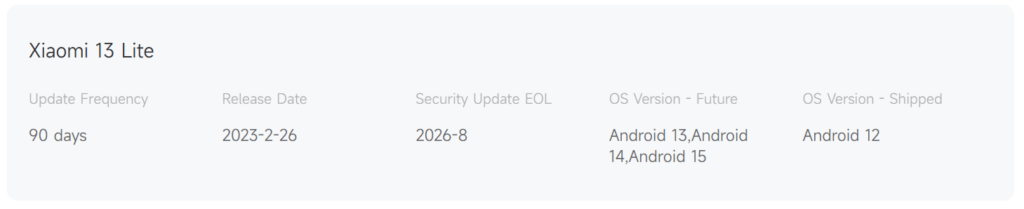
Xiaomi 13 Lite users are receiving their final major HyperOS update

7 March 2026 at 13:56
Xiaomi 13 Lite HyperOS 3 update

Xiaomi has finally begun rolling out the much-awaited HyperOS 3 update to Xiaomi 13 Lite users. This one is based on Android 15 and packs some exciting new features, along with plenty of upgrades throughout the system. Unfortunately, this is the last major HyperOS upgrade for the Xiaomi 13 Lite users.

The smartphone was launched in early 2023 with Android 12 out of the box. It received three Android OS updates since then, now running Android 15, and isn’t eligible for more OS upgrades. That means it will spend the rest of its life running Android 15. According to the official website, the Xiaomi 13 Lite will reach end of life in August 2026.

Coming to the HyperOS 3 update, it’s rolling out to Xiaomi 13 Lite users in multiple regions with the following firmware versions:

  • Xiaomi 13 Lite (Global): OS3.0.1.0.VLLMIXM
  • Xiaomi 13 Lite (EEA): OS3.0.2.0.VLLEUXM
  • Xiaomi 13 Lite (Turkey): OS3.0.1.0.VLLTRXM
  • Xiaomi 13 Lite (Taiwan): OS3.0.1.0.VLLTWXM
  • Xiaomi 13 Lite (Russia): OS3.0.1.0.VLLRUXM

If you have a Xiaomi 13 Lite, you should be able to upgrade to HyperOS 3 by navigating to Settings > My device and tapping the HyperOS logo at the top. If the update doesn’t appear, check again in a few days, as the rollout happens in batches and can take a few days to reach all the users.

While not as rich as the Android 16-based software, HyperOS 3 with Android 15 still delivers a wide array of useful upgrades throughout the system, along with many visual enhancements and new features. Fortunately, it includes the new Hyper Island, which provides easier access to information with multitasking capabilities.

The update also includes new icons, new battery and signal indicators, enhanced animations, and system-wide blur effects. HyperOS 3 further improves integration with Apple devices by supporting iPhone call/SMS forwarding and screen sharing with a MacBook.

HyperOS 3 also integrates new AI features, including AI writing in notes, AI voice translation and noise reduction for recordings, AI Dynamic Wallpapers, and AI Search and AI photo search in Gallery. The latest update also includes numerous under-the-hood changes to deliver up to 30% better performance.

Also read:
1. HyperOS 3.1 vs HyperOS 3: Every features, changes, & full eligible device list
2. 5 HyperOS 3 features that make it better than stock Android

EOL approaching for Xiaomi 13 Lite

HyperOS 3 is the final major upgrade for the Xiaomi 13 Lite, and it will soon run out of security patches as well. The official website says software support will end in August 2026. By that time, the Xiaomi 13 Lite may receive one or two security updates, but it won’t receive HyperOS 3.1 or HyperOS 4.0.

Xiaomi 13 Lite software support

Even after reaching the end of life (EOL), the Xiaomi 13 Lite will continue to work fine, but it won’t have the fixes for the recently discovered security vulnerabilities, which puts your device at risk, especially if it contains critical data.

It’s best to upgrade to a newer model, which will not only receive the latest security patches but also the latest features and upgrades from HyperOS updates. If you’re wondering about the best upgrade options, this page lists all Xiaomi devices that promise 6 years of software updates.

Be sure to visit the Xiaomi section once in a while for fresh information. Alternatively, you can join our Telegram channel to get instant alerts about the latest HyperOS releases and breaking tech news.

The post Xiaomi 13 Lite users are receiving their final major HyperOS update appeared first on Gizmochina.

Poco X8 Pro Max marketing materials leak, revealing nearly everything

7 March 2026 at 13:23
Poco X8 Pro Max

Poco X8 Pro series has been making headlines almost every day this week. Today, we are adding another one, as the official marketing materials for the Poco X8 Pro Max have been leaked.

According to the leaked materials, the Poco X8 Pro Max will feature a 6.83-inch display with a 120Hz refresh rate and a resolution of 2772 × 1280. The panel can reach a peak brightness of up to 3500 nits, supports the DCI-P3 color gamut, and is a 12-bit panel.

Poco X8 Pro MAX 5G

On the camera side, the phone has a dual rear camera setup with a 50MP primary sensor and an 8MP ultra-wide lens. For selfies, the device is said to feature a 20MP front camera.

Poco X8 Pro leaks in full with these marketing materials

The promotional images also reveal the phone’s audio features. The Poco X8 Pro Max includes symmetrical stereo speakers with support for Dolby Atmos and Hi-Res Audio. Poco also claims the speakers can deliver sound that is up to 300% louder.

Under the hood, the Poco X8 Pro Max features a Dimensity 9500s processor. This is paired with a vapor chamber cooling system for improved heat dissipation, and the phone also appears to support bypass charging.

Keeping everything running is an 8500mAh battery with 100W charging support. It also supports 27W reverse wireless charging. Despite such a large battery, Poco has managed to keep the phone’s thickness at 8.38mm, while it weighs roughly 201 grams.

Other features of the Poco X8 Pro Max include IP68 dust and water resistance and an ultrasonic in-display fingerprint sensor for biometrics.

Poco has yet to reveal the launch date for the new smartphones. However, a recent report suggests they will launch globally on March 17.

Don’t miss a thing! Join our Telegram community for instant updates and grab our free daily newsletter for the best tech stories!

For more daily updates, please visit our News Section.

(Source)

The post Poco X8 Pro Max marketing materials leak, revealing nearly everything appeared first on Gizmochina.

Oppo expands ColorOS 16 rollout to three more mid-range phones

7 March 2026 at 12:20
ColorOS 16 update rollout to mid-range phones

ColorOS 16 rollout is in its final phase, with only a few devices left to receive the update. The list has now become even shorter as Oppo has released the update to three more mid-range smartphones: Oppo K13x, Oppo K12x, and Oppo Reno12 F.

As per the official announcement on the community page (1, 2, 3), the ColorOS 16 update for the Oppo K13x and Oppo K12x is rolling out in India, while the Oppo Reno12 F is receiving the update in Indonesia. The update will expand to other regions in the coming days and weeks.

Your Oppo phone must be running the required firmware version to be eligible for the ColorOS 16 update:

  • Oppo K13x: CPH2753_16.0.3.500(EX01)
  • Oppo K12x: CPH2667_16.0.3.500(EX01)
  • Oppo Reno12 F: CPH2687_16.0.3.501(EX01)

If your Oppo smartphone is on the list and you belong to a supported region, the update may be ready for installation. Go to Settings > System & update > Software update to check for available updates.

If you don’t see the update, apply for the Release Candidate to get it sooner. For this, go to Settings > System & update > Software update > Tap the top of the page > Tap the icon on the top right > Beta program > Release candidate > Apply Now. Then check for an update and hit the Download now button.

Keep in mind that ColorOS 16 is a major upgrade with a download size of a few gigabytes. So, you must make sufficient room on your device and charge it to at least 50% for a smooth upgrade to ColorOS 16. Don’t forget to back up important data just to stay on the safe side.

With three more Oppo devices now receiving the ColorOS 16 update, only a few devices are in the queue, including the Oppo Reno12 FS, Oppo Reno11 FS, and Oppo F31 5G. Oppo promises to release the update for those devices this month itself.

We’ll keep you updated with the latest news in our Oppo section, so make sure to check it regularly for new updates. You can also join our Telegram channel to get instant notifications.

The post Oppo expands ColorOS 16 rollout to three more mid-range phones appeared first on Gizmochina.

DxOMark ranking shows Pixel 10a struggling against Pixel 8a, iPhone 15

7 March 2026 at 12:03

Google’s latest A-series phone, the Pixel 10a, is designed to deliver the familiar Pixel experience at a lower price. It brings the usual mix of clean Android, long software support, and Google’s AI-powered features. But when it comes to the camera, early testing suggests the improvements this year are fairly limited.

According to DxOMark’s camera evaluation, the Pixel 10a receives an overall score of 134 points, placing it 75th in the global ranking. The gain appears to come mostly from software adjustments rather than any major hardware change. In fact, the camera hardware remains largely the same.

The Pixel 10a continues to use a 48MP f/1.7 main camera, built around a 1/2.0-inch sensor. The 13MP f/2.2 ultrawide camera (1/3.1-inch) is also unchanged from the previous model. The Pixel 8a, for comparison, scored 136 points thanks in part to its larger 64MP (1/1.73-inch) primary sensor.

The limitations show up more clearly in difficult conditions. Low-light photos and videos tend to show visible noise, and the phone sometimes struggles with consistent exposure and white balance. Detail can drop quickly once the lighting gets worse.

Video performance also appears somewhat average. DxOMark observed limited fine detail in recordings and occasional autofocus hunting, which can make video capture less reliable when subjects are moving.

Zoom performance is another weak point. The Pixel 10a relies entirely on digital cropping from the main sensor. Unsurprisingly, this leads to a very low zoom score of just 25 points, while the best devices in this category reach scores close to 140.

Even the older iPhone 15 performs noticeably better with a 145-point camera score. Those who care more about low-light photography, zoom quality, or overall camera versatility may notice the compromises. In that sense, the Pixel 10a feels less like a major step forward and more like a small refinement of the previous model.

Don’t miss a thing! Join our Telegram community for instant updates and grab our free daily newsletter for the best tech stories!

For more daily updates, please visit our News Section.

(Source: 1, 2)

The post DxOMark ranking shows Pixel 10a struggling against Pixel 8a, iPhone 15 appeared first on Gizmochina.

UGREEN launches 17-in-1 Thunderbolt 5 Docking Station with 140W of power output

7 March 2026 at 11:24
UGREEN-Maxidok-17-in-1-thunderbolt-5-docking-station-launch-specs-price

Accessory maker UGREEN has launched two new Thunderbolt 5 docking stations under its Maxidok lineup. The new models, the Maxidok 17-in-1 and Maxidok 10-in-1, offer different levels of connectivity and power depending on how many features users need.

UGREEN 17-in-1 Thunderbolt 5 Docking Station

As you might’ve guessed, the more capable of the two is the UGREEN Maxidok 17-in-1 Thunderbolt 5 Docking Station. The dock includes 17 ports in total. 

One of its more unusual features is a built-in M.2 NVMe SSD expansion slot that supports drives up to 8TB. The slot uses an 80Gbps connection, allowing the dock to double as external storage without needing a separate enclosure.

The dock also includes two Thunderbolt 5 ports with up to 120Gbps bandwidth, along with three USB-A ports and three USB-C ports that support 10Gbps data speeds. For displays, users get two Thunderbolt 5 outputs and a DisplayPort connection, which should make multi-monitor setups easier to manage.

Networking is handled by a 2.5-gigabit Ethernet port, while additional connectivity option includes an SD card reader capable of speeds up to 312Mbps and three 3.5mm audio ports for input and output. 

The dock is powered by a 240W power adapter and can deliver up to 140W of power to a connected laptop through its upstream Thunderbolt connection.

UGREEN Maxidock 10-in-1 Thunderbolt 5 Docking Station

For users who need something simpler, the UGREEN Maxidok 10-in-1 Thunderbolt 5 Docking Station offers a smaller set of features. It drops the SSD expansion slot and reduces the total number of ports to ten. The Ethernet connection is also downgraded to standard 1GbE.

The 10-in-1 dock still includes two Thunderbolt 5 ports with the same 120Gbps bandwidth, along with three USB-A ports for peripherals. Power delivery is slightly low as well. The dock supports up to 100W charging to the host device using a 140W power adapter.

Other features include a DisplayPort output, a 3.5mm audio jack, and an SD card reader rated for speeds up to 170MB/s.

Price

As for the price, the Maxidok 17-in-1 Thunderbolt 5 docking station is available at an early bird price of $389.99. Meanwhile, the Maxidok 10-in-1 model retails for $249.99 in early-bird discount. You can pre-order them from the official site, with the earliest shipping date being March 24.  

For more daily updates, please visit our News Section.

Stay ahead in tech! Join our Telegram community and sign up for our daily newsletter of top stories

The post UGREEN launches 17-in-1 Thunderbolt 5 Docking Station with 140W of power output appeared first on Gizmochina.

Lenovo is working on a smartphone with 7.5-inch screen

7 March 2026 at 10:36
Motorola and Microsoft Partners to bring Windows 365 and Teams to Lenovo ThinkPhone

A new leak suggests that Lenovo may be testing some unusual hardware for its upcoming smartphones. According to a Weibo post by well-known tipster Digital Chat Station, Lenovo is currently testing a 200-megapixel large-sensor periscope telephoto camera for its next phones.

The leak further says Lenovo is reportedly working on a 1.5K LCD panel, though development is said to be progressing slowly.

As a result, the company is apparently exploring a different internal direction, which the tipster described as a “large-screen design.” As part of that exploration, Lenovo has started testing a wide, flat display measuring around 7.5 inches.

Would you be interested in a 7.5-inch smartphone?

A screen of that size would place the device somewhere between a traditional smartphone and a small tablet, suggesting Lenovo may be experimenting with a new category or a niche device for users who prefer larger displays.

In the comments under the post, some users also discussed Lenovo’s position in the smartphone market. One commenter noted that the brand’s phones do not seem as popular as they were around 2021, when devices powered by chips like the Qualcomm Snapdragon 870 and Qualcomm Snapdragon 888 were widely considered strong value options.

Motorola and Microsoft Partners to bring Windows 365 and Teams to Lenovo ThinkPhone

Digital Chat Station responded by saying Lenovo struggles to compete on price with companies like Realme and Redmi. Aggressive pricing from those brands has made the mid-range market more difficult for Lenovo.

The tipster also clarified that the current development progress is “average,” adding that there are no concrete steps yet toward pushing these new designs into mass production.

In related news, Lenovo’s sub-brand unveiled its first book-style foldable at MWC 2026. Called the Razr Fold, the phone features an 8.1-inch 2K LTPO inner screen and a 6.6-inch outer screen. It is powered by the Qualcomm Snapdragon 8 Gen 5 mobile platform, equipped with three 50-megapixel cameras, and supports the Moto Pen Ultra stylus.

For more daily updates, please visit our News Section.

Stay ahead in tech! Join our Telegram community and sign up for our daily newsletter of top stories

The post Lenovo is working on a smartphone with 7.5-inch screen appeared first on Gizmochina.

Realme C83 5G Arrives with 6.8-inch 144Hz Display, 7000mAh Battery and Dimensity 6300

7 March 2026 at 07:31
Realme C83 5G

Realme has introduced the Realme C83 5G, adding a new model to its C-series lineup. The device focuses on long battery life, durability features, and a high refresh rate display in the budget segment.

The smartphone runs on the MediaTek Dimensity 6300 processor, a 6nm octa-core chipset with two Cortex-A76 cores clocked at 2.4GHz and six Cortex-A55 cores at 2GHz, paired with the Arm Mali-G57 MC2 GPU. It is available with 4GB or 6GB LPDDR4X RAM, along with Dynamic RAM expansion up to 12GB. Storage options include 64GB and 128GB eMMC 5.1, and users can expand storage up to 2TB using a microSD card through the hybrid dual SIM slot.

On the front, the phone carries a 6.8-inch IPS LCD display with an HD+ resolution of 1570 × 720 pixels. The panel supports a 144Hz refresh rate, up to 180Hz touch sampling rate, and 900 nits peak brightness, helping with smoother navigation and better visibility in bright environments.

The device runs Realme UI 7.0 based on Android 16. It also includes AI Outdoor Mode, a feature designed to improve usability outside. When activated, it increases screen brightness, boosts system performance, improves network responsiveness, and raises speaker output for clearer audio.

Realme C83 5G

For photography, the Realme C83 5G is equipped with a 13MP rear camera with an f/2.2 aperture and LED flash. On the front, it offers a 5MP camera with an f/2.2 aperture for selfies and video calls.

The phone features a vertical dual-camera layout on the back and comes in two color options: Blooming Purple and Sprouting Green. Blooming Purple mixes blue and purple tones, while Sprouting Green takes inspiration from fresh plant growth.

Durability is another focus of the device. The phone carries IP64 dust and splash resistance, ArmorShell Protection, and MIL-STD 810H military-grade shock resistance certification.

The Realme C83 5G measures 166.3 × 78.1 × 8.4 mm and weighs 212 grams. It includes a side-mounted fingerprint scanner, 3.5mm headphone jack, and a bottom-ported speaker with 300 percent Ultra Volume.

Connectivity features include 5G SA and NSA bands (n1, n3, n5, n8, n28B, n40, n41, n77, n78), dual 4G VoLTE, Wi-Fi 802.11ac (2.4GHz and 5GHz), Bluetooth 5.3, GPS, GLONASS, Galileo, QZSS, and USB Type-C.

Powering the phone is a 7000mAh battery with 15W fast charging. The device also supports reverse wired charging and bypass charging, and Realme says the battery is designed to provide up to six years of reliable usage.

Pricing & availability

The Realme C83 5G starts at ₹13,499 for the 4GB + 64GB model, while the 4GB + 128GB version costs ₹14,499. The 6GB + 128GB variant is priced at ₹17,499. The phone will go on sale March 7, 2026 through Flipkart, realme.com, and offline retail stores, with six months of no-cost EMI available for buyers.

For more daily updates, please visit our News Section.

Stay ahead in tech! Join our Telegram community and sign up for our daily newsletter of top stories

The post Realme C83 5G Arrives with 6.8-inch 144Hz Display, 7000mAh Battery and Dimensity 6300 appeared first on Gizmochina.

Redmi Buds 8 Active (Vitality Edition) launched: Bluetooth 5.4, HyperOS Connect, 37-hour battery

7 March 2026 at 03:58

Xiaomi has launched the Redmi Buds 8 Active (Vitality Edition) in China. The new wireless earbuds focus on sound quality, stable connectivity, and long battery life at a low price.

REDMI Buds 8 Active Edition

The earbuds use a 14.2 mm large dynamic driver with a titanium-plated diaphragm. This setup is designed to deliver clearer sound and stronger bass. The earbuds also support the AAC audio codec, which helps maintain audio quality during wireless playback.

Xiaomi has added wind noise reduction that works at speeds of up to 6 meters per second. This helps reduce noise when listening outdoors or while moving. For calls, the earbuds use dual microphones with AI call noise reduction. The system is designed to filter background noise and improve voice clarity during calls.

REDMI Buds 8 Active Edition

The Redmi Buds 8 Active (Vitality Edition) use a semi-in-ear design. This is similar to the design used in the Redmi Buds 8 Lite that was recently launched globally. The earbuds rest lightly in the ear and are designed for everyday use and longer listening sessions.

Battery life is one of the main highlights. Each earbud includes a 37 mAh battery. Xiaomi says the earbuds can deliver up to 7 hours of playback on a single charge. The charging case carries a 475 mAh battery. With the case, the total listening time can reach up to 37 hours.

For connectivity, the earbuds support Bluetooth 5.4. This version helps improve connection stability and power efficiency. The earbuds also come with an IP54 rating, which protects them from dust and water splashes from any direction.

The Redmi Buds 8 Active (Vitality Edition) support Xiaomi HyperOS Connect. This allows features such as smart device search, dual device connection, audio sharing, and quick pairing pop-ups when used with compatible Xiaomi devices. The earbuds also work with the Xiaomi Earbuds app for additional settings and controls.

Pricing & availaiblity

In China, the Redmi Buds 8 Active (Vitality Edition) are priced at 119 yuan. The earbuds are available in three colors: Transparent Blue, Matte Black, and Cream White. Information about a possible global launch has not been announced yet.

The post Redmi Buds 8 Active (Vitality Edition) launched: Bluetooth 5.4, HyperOS Connect, 37-hour battery appeared first on Gizmochina.

LG Launches Sound Suite Premium Home Audio System With AI Sound and 13.1.7 Channel Output

7 March 2026 at 03:58

LG Electronics has introduced the LG Sound Suite, a new premium home audio system in South Korea. The system focuses on delivering spatial sound throughout the home without requiring fixed wired speaker placement. LG says the setup is designed for watching movies and sports, streaming music, and regular TV viewing. It was initially unveiled at CES 2026 back in January.

Flexible multi-speaker system

The Sound Suite lineup includes four main components. The Soundbar H7 serves as the central hub and manages sound processing using AI. The M7 and M5 models act as surround speakers that can be placed in different parts of the room to create a wider soundstage. The W7 subwoofer is responsible for handling low frequencies and providing deeper bass.

LG says the system supports up to 50 configuration combinations. When users build the system around the soundbar, there are 28 possible configurations. A setup centered around an LG TV allows 22 combinations. The largest configuration uses the Soundbar H7, four M7 surround speakers, and the W7 subwoofer. In this setup, the system outputs 13.1.7 channels designed for full multi-directional audio.

Audio technologies and features

One of the main features is Dolby Atmos FlexConnect. This technology identifies where speakers are placed and adjusts the audio output automatically. Users can place speakers freely around the room without losing spatial audio accuracy. The feature works with LG premium TVs released in 2025 and 2026 for synchronized sound output.

Sound Follow is another key feature. It uses ultra-wideband wireless technology and the LG ThinQ app to detect where the listener is located. The system then adjusts the audio so the user hears sound from the best listening position.

Room Calibration Pro analyzes the size, layout, and acoustic characteristics of the room. Based on this analysis, the system adjusts audio output to suit the installed environment.

The system is powered by LG’s third-generation Alpha11 AI processor. Through AI Sound Pro+, it identifies voices, music, and sound effects, then adjusts levels for clearer playback. AI Upmix also expands low-channel audio into multi-channel output so all speakers in the setup are used.

Peerless premium drivers are included to deliver balanced high and low frequencies. The system supports wireless streaming through Wi-Fi and Bluetooth, with stereo and standalone listening modes available.

Price and availability

LG will begin selling the Sound Suite in South Korea starting April 2026 through LGE.COM and LG Best Shop retail stores.

The Soundbar H7 is priced at 1,299,000 won, which is around $880 or ₹80,650. The W7 subwoofer costs 799,000 won, about $541. The M7 surround speaker is priced at 549,000 won, about $372. The M5 surround speaker costs 449,000 won, about $304.

For more daily updates, please visit our News Section.

Stay ahead in tech! Join our Telegram community and sign up for our daily newsletter of top stories.

The post LG Launches Sound Suite Premium Home Audio System With AI Sound and 13.1.7 Channel Output appeared first on Gizmochina.

Anker Nano Smart Shield Magnetic Power Bank introduced with 10,000mAh battery and Smart Shield safety system

6 March 2026 at 23:56
Anker Nano Smart Shield Magnetic Power Bank

Anker has released the Nano Smart Shield Magnetic Power Bank in China. The portable charger introduces the company’s new Smart Shield safety system, which focuses on improving battery monitoring and protection.

Anker Nano Smart Shield Magnetic Power Bank

The device includes an internal system that monitors battery conditions in real time. Anker says the Smart Shield system can detect temperature-related issues immediately when charging begins. A built-in battery management system continues monitoring throughout the charging cycle. The power bank also uses dual-core protection along with flame-retardant materials inside the body to improve overall safety.

Anker Nano Smart Shield Magnetic Power Bank

Another feature highlighted by the company is battery traceability. Each unit includes a unique identification number that allows users to check manufacturing details for the battery cell.

The power bank is equipped with a 10,000 mAh battery and a rated capacity of 6,200 mAh. It uses ATL battery cells, which Anker states come from the same supplier used by Apple. Charging is available through both wired and wireless methods.

The front magnetic pad supports wireless charging up to 7.5W, allowing compatible smartphones to attach magnetically while charging. For faster charging, the USB-C port supports up to 27W output. The same USB-C port is also used to recharge the power bank itself.

A small LCD display is placed on the side of the device. The screen shows real-time charging data including battery percentage, charging status, and estimated charging time remaining.

The design also includes a foldable built-in stand, allowing the attached smartphone to stay upright during charging. This makes it easier to watch videos or use the device hands-free while power is being delivered.

The Nano Smart Shield Magnetic Power Bank measures 107 mm × 68.9 mm × 21.8 mm and weighs 233 g. It is available in three color options: black, white, and blue. Because the battery capacity is below 27,000 mAh, the power bank is permitted on airplanes according to airline carry-on regulations.

Pricing & availability

The product is currently available in China for CNY 369 (around $54). Anker has not yet confirmed whether the Nano Smart Shield Magnetic Power Bank will launch in other markets.

For more daily updates, please visit our News Section.

Stay ahead in tech! Join our Telegram community and sign up for our daily newsletter of top stories!

The post Anker Nano Smart Shield Magnetic Power Bank introduced with 10,000mAh battery and Smart Shield safety system appeared first on Gizmochina.

Galaxy A37 and Galaxy A57 specs leak paint a somewhat disappointing picture

6 March 2026 at 21:20

Fresh leaks have now revealed the full specifications of the upcoming Galaxy A37 and Galaxy A57, offering a clearer picture of what Samsung is preparing for the next cycle.

Galaxy A57 design render

Both models reportedly keep the same 6.7-inch AMOLED display with a 120Hz refresh rate. So the visual experience should remain largely unchanged. Battery capacity is also expected to stay at 5,000mAh on both devices.

Where things do change is the processor. Samsung is said to be moving to the Exynos 1480, replacing the Snapdragon 6 Gen 3 used in the Galaxy A36. The switch could bring a modest bump in performance for everyday tasks.

Memory and storage options are expected to include:

  • 6GB or 8GB RAM
  • 128GB or 256GB storage
  • No microSD expansion

The camera system also sees a small tweak. The main 50MP camera remains, but the ultra-wide sensor may increase from 8MP to 12MP. A 12MP selfie camera is expected on the front.

In terms of size, the device is tipped to measure 162.9 × 78.2 × 7.4mm and weigh about 196g. Samsung may offer several “Awesome” colors, including Charcoal, Graygreen, Lavender, and White. You can see the leaked renders below.

The Galaxy A57 also appears to follow a similar formula. Samsung will use the Exynos 1680, replacing the Exynos 1580 from the Galaxy A56. RAM and storage options reportedly mirror the A37, and the camera hardware also seems largely unchanged.

  • 50MP main camera
  • 12MP ultra-wide camera
  • 5MP macro camera
  • A 12MP front camera

Color options reportedly include Awesome Gray, Icyblue, Lilac, and Navy.

Physically, the Galaxy A57 is rumored to be slightly slimmer and lighter than its predecessor, measuring around 161.5 × 76.9 × 6.9mm and weighing about 192g. For reference, the Galaxy A56 measures 7.4mm in thickness and weighs 198g. So if the leaks are accurate, Samsung isn’t making any major change this year.

Don’t miss a thing! Join our Telegram community for instant updates and grab our free daily newsletter for the best tech stories!

For more daily updates, please visit our News Section.

(Source)

The post Galaxy A37 and Galaxy A57 specs leak paint a somewhat disappointing picture appeared first on Gizmochina.

Xiaomi’s REDMI Pad 2 9.7″ appears in GSMA database ahead of expected launch

6 March 2026 at 19:58

Xiaomi may be getting ready to expand its budget tablet lineup once again. A new version of the REDMI Pad 2 has now surfaced in certification records, suggesting the device could be on the way.

As first reported by XiaomiTime, a tablet listed as the REDMI Pad 2 9.7-inch has appeared in the IMEI database of the GSMA. Devices typically show up in this database before their official launch, so its presence there usually indicates that the company is preparing the device for release.

The listing mentions three model numbers: 2604ERP4DG, 2604ERP4DC, and 2604ERP4DI. These kinds of suffixes often point to different regional variants. Based on the pattern Xiaomi has used in the past, DG is likely meant for the global market, DC could be the Chinese version, and DI may correspond to the Indian model.

Going by the name alone, the tablet will carry a 9.7-inch display. That would make it slightly smaller than many recent tablets that sit around the 11-inch mark. Devices in this size range usually aim for portability first, something that can be easily carried around for reading, watching videos, browsing, or quick tasks.

Connectivity options could vary depending on the model. The tablet is expected to come in both 4G LTE and Wi-Fi-only variants. There is also a chance the Wi-Fi version may launch under a different name in some markets. According to the report, it could appear internationally as the POCO C Pad. Xiaomi has done similar rebrands before, especially with its more affordable devices.

Other hardware details are still unclear at this stage. There’s no information yet about the chipset, battery size, cameras, or memory configurations. Still, the model number itself may hint at the timing. Xiaomi devices with codes starting with “2603” or “2604” have previously been tied to launches early in the year.

If that pattern holds, the REDMI Pad 2 9.7 could make its debut sometime around March or April 2026.

Don’t miss a thing! Join our Telegram community for instant updates and grab our free daily newsletter for the best tech stories!

For more daily updates, please visit our News Section.

(Source)

The post Xiaomi’s REDMI Pad 2 9.7″ appears in GSMA database ahead of expected launch appeared first on Gizmochina.

Exynos 2600 vs Snapdragon 8 Elite Gen 5: Benchmark score, spec sheet, and more

6 March 2026 at 18:19
Exynos 2600 vs Snapdragon 8 Elite Gen 5

Samsung’s Exynos chipsets have historically been less powerful than Qualcomm’s Snapdragon chipsets. The latter has always dominated key aspects, including CPU, GPU, and connectivity. However, the newly-released Exynos 2600 narrows the gap significantly. In fact, it outperforms the Snapdragon 8 Elite Gen 5 on several benchmarks.

In this detailed comparison, we’ll make sense of the benchmark scores and dive into the key differences to understand how the Exynos 2600 and Snapdragon 8 Elite Gen 5 stack up against each other.

Let’s begin with a quick look at the spec sheet:

Exynos 2600Snapdragon 8 Elite Gen 5
AnnouncedDecember 2025September 2025
Process node2nm (TSMC)3nm (TSMC)
CPU cores10-core8-core
CPU cores1 x 3.8GHz — C1-Ultra
3 x 3.25GHz — C1-Pro
6 x 2.75GHz — C1-Pro
2 x 4.61GHz — Oryon (3rd gen)
6 x 3.63GHz — Oryon (3rd gen)
GPUExynos Xclipse 960 GPU
Ray tracing support
Exynos Neural Super Sampling
Adreno 840
Ray tracing support
Snapdragon Elite Gaming features
NPUAI engine with 32K MAC NPUQualcomm Hexagon NPU
Agentic AI support
MemoryLPDDR5XLPDDR5X, up to 5.3 GHz
StorageUFS 4.1UFS 4.1
Cameraup to 320MP single camera
up to 108MP single camera (30fps)
up to 64MP+32MP dual cameras (30fps)
up to 8K video recording
real-time semantic segmentation
Qualcomm Spectra Triple ISP (20-bit)
up to 320MP single camera
up to 108MP single camera (MFNR, ZSL, 30fps)
up to 48MP triple camera (MFNR, ZSL, 30fps)
up to 8K video recording
real-time semantic segmentation (limitless)
Advanced Professional Video (APV) codec
ConnectivityExynos 5410 modem
download speed: 14.79Gbps (maximum)
upload speed: 4.9Gbps (maximum)
Wi-Fi 7
Bluetooth 6.0
Snapdragon X85 5G modem
download speed: 12.5Gbps (peak)
upload speed: 3.7Gbps (peak)
Wi-Fi 7 (peak speed: 5.8Gbps)
Bluetooth 6.0

Exynos 2600 vs Snapdragon 8 Elite Gen 5: Benchmark scores

Since the Galaxy S26 trio has yet to reach Gizmochina’s house, we used NL Tech’s benchmark data. The Galaxy S26+ (Exynos 2600) and Galaxy S26 Ultra (Snapdragon 8 Elite Gen 5) were used in the testing.

Geekbench score (v6)

Exynos 2600Snapdragon 8 Elite Gen 5
Single core3,1263,690
Multi core10,68411,148

On Geekbench, the Exynos 2600 posts lower scores than the Snapdragon 8 Elite Gen 5. In the single-core test, the Snapdragon gets about 18% higher score, while the difference in multi-core scores is just 4%.

AnTuTu score (v11)

Exynos 2600Snapdragon 8 Elite Gen 5
AnTuTu score2,663,8983,396,880
CPU788,8031,014,266
GPU1,091,1411,388,476
Memory359,328346,871
UX424,626647,267

The Snapdragon 8 Elite Gen 5 shines on AnTuTu too, posting a total score close to 3.4 million (vs. 2.66 million on Exynos 2600). That 27% uplift in total score for the Snapdragon chip is also reflected in the CPU and GPU scores.

The Snapdragon 8 Elite Gen 5 also achieves a significantly higher score in the memory test, while the Exynos 2600 scores 3% higher in the user experience test.

3DMark score

Wild Life Extreme Stress Test

Exynos 2600Snapdragon 8 Elite Gen 5
Best loop score7,0777,084
Lowest loop score2,9883,067
Stability42.2%43.3%

Benchmark results from the 3DMark Wild Life Extreme Stress Test show that the Dimensity 2600 performs on par with the Snapdragon 8 Elite Gen 5. There isn’t a big gap in stability either.

Solar Bay Extreme Stress Test

Exynos 2600Snapdragon 8 Elite Gen 5
Best loop score2,0371,247
Lowest loop score878709
Stability43.1%56.9%

The Exynos 2600 surprisingly outperforms the Snapdragon 8 Elite Gen 5 in the Solar Bay Extreme Stress Test, which means that the latest phones have excellent ray tracing performance.

Now that we’re aware of the benchmark data, let’s dig further into the key differences to get a clearer picture.

Exynos 2600 vs Snapdragon 8 Elite Gen 5: Key differences

The Exynos 2600 was announced just three months after the Snapdragon 8 Elite Gen 5, as the world’s first smartphone chipset to use a 2nm process. In February 2026, it debuted with the Galaxy S26 series.

CPU, GPU, and NPU

The Exynos 2600 features a 10-core CPU, which includes one C1-Ultra prime core, three C1-Pro high-performance cores, and six C1-Pro high-efficiency cores. The Snapdragon 8 Elite uses a custom-designed Oryon CPU, featuring two Oryon prime cores (third-gen) and six Oryon performance cores (third-gen).

The Snapdragon 8 Elite benefits from a higher peak CPU speed, which is one of the reasons it scored higher in the single-core test on Geekbench. For graphics-intensive tasks, the Exynos 2600 relies on the Xclipse 960 GPU, while the Snapdragon chip uses the Adreno 840 GPU.

Both chipsets have highly capable GPUs with strong ray tracing capabilities. However, the Exynos 2600 may have an edge, as seen in 3DMark tests.

The Exynos 2600 and Snapdragon 8 Elite Gen 5 feature advanced NPUs optimized for on-device generative AI. They also use AI to optimize connectivity, camera, and many other aspects.

Camera

The Exynos 2600 introduces an AI-powered Visual Perception System (VPS), which replaces the traditional ISP with a dedicated AI subsystem for real-time scene analysis, object recognition, and noise reduction. This enables ultra-high-res processing at 60fps with over 50% better power efficiency than the Exynos 2400.

The Exynos chip features Deep Learning Video Noise Reduction (DVNR) for noise reduction in low-light conditions and supports hybrid OIS + AI-EIS for better stabilization.

On the other hand, the Snapdragon 8 Elite offers 20-bit triple AI-ISPs, delivering 4x dynamic range, real-time semantic segmentation with up to 250 layers, and direct NPU access to raw sensor data for on-device AI processing. Additionally, the chip offers a range of features to further improve the camera output, including object eraser, skin/sky tone enhancements, Night Vision 3.0, video object eraser, and Snapdragon Audio Sense.

Connectivity

The Exynos 2600 features a redesigned connectivity setup with an external modem (Exynos Modem 5410), offloading cellular, Wi-Fi, and Bluetooth from the main 2nm die to improve the thermal efficiency and space for CPU/GPU.

The Exynos chip supports a higher peak download speed of 14.79Gbps (vs. 12.5Gbps) and a higher peak upload speed of 4.9Gbps (vs. 3.7Gbps) on a cellular connection compared to the Snapdragon 8 Elite Gen 5.

The Snapdragon chip features an integrated Snapdragon X85 5G modem with FastConnect 7900 for robust connectivity. Wi-Fi 7 supports a peak speed of 5.8Gbps. Furthermore, the chip includes AI-powered optimizations for traffic prioritization, seamless Wi-Fi/cellular switching, and enhanced satellite support.

Exynos 2600 vs Snapdragon 8 Elite Gen 5: Which is a better choice?

Since we haven’t yet tested an Exynos 2600-powered Samsung phone, it’s difficult to say whether it’s the same story this year or if the Exynos 2600 completely outperforms the Snapdragon 8 Elite Gen 5. However, based on the benchmark data and spec sheet, the Exynos 2500 appears to be significantly better than its predecessor, particularly in gaming performance.

The Exynos chip also introduces major camera upgrades, including Deep Learning Video Noise Reduction. It now features a redesigned connectivity system with an external modem, which claims to improve thermal efficiency.

That said, the Snapdragon 8 Elite Gen 5 still delivers strong CPU performance and features a mature ISP with excellent imaging capabilities. Its robust connectivity system with better carrier support also makes a notable difference.

The post Exynos 2600 vs Snapdragon 8 Elite Gen 5: Benchmark score, spec sheet, and more appeared first on Gizmochina.

Zebronics launches Zeb Juke Bar 9710C 5.1 550W Dolby Atmos soundbar

6 March 2026 at 15:35
Zebronics Zeb Juke Bar 9710C 5.1 soundbar

Zebronics has launched the Zeb Juke Bar 9710C, a compact 5.1-channel soundbar system designed for home entertainment setups. The new model features a multi-speaker configuration with support for Dolby Atmos and DTS:X, aiming to deliver immersive surround sound for movies, music, and gaming.

Zebronics Zeb Juke Bar 9710C 5.1 soundbar

Zebronics Zeb Juke Bar 9710C Specifications

The Zeb Juke Bar 9710C delivers a total output of 550W RMS. The system includes a soundbar, a wireless subwoofer, and two rear satellite speakers that form a full 5.1-channel surround configuration.

The subwoofer provides 190W output and uses a 13.33 cm driver to handle low-frequency audio. The main soundbar houses three drivers rated at 70W each, while the rear satellite speakers deliver 75W output per unit to enhance surround effects.

The audio system supports a frequency response range of 40Hz to 20kHz. Zebronics lists the signal-to-noise ratio at 78dB or higher and channel separation at 48dB or above. These specifications allow the system to deliver clear dialogue, detailed mid-range sound, and stronger bass output through the dedicated subwoofer.

Zebronics Zeb Juke Bar 9710C 5.1 soundbar

For connectivity, the soundbar includes Bluetooth 5.3 for wireless streaming from smartphones and tablets. It also features TV eARC, Optical input, AUX input, and USB playback support. The USB port supports MP3 files and works with storage devices up to 32GB. It also includes an LED display for playback and connectivity details.

The soundbar measures 40.5 x 9 x 6.2 cm, while the subwoofer measures 15 x 18.5 x 29.5 cm. Each satellite speaker measures 9 x 6 cm. The complete system weighs about 4.3 kg. The design includes a matte finish and supports wall mounting for flexible installation.

Zebronics ships the package with the soundbar, wireless subwoofer, two satellite speakers, power adapters, cables, wall mount fasteners, and a remote control.

Pricing and Availability

The Zeb Juke Bar 9710C is currently available in India through Amazon at an introductory price of Rs. 16,999. The product comes with a one-year warranty.

In related news, Philips launched the TAB4230 soundbar, TAS4400 speaker, and SHP9500 headphones in India, while Xiaomi unveiled a budget Redmi Soundbar equipped with RGB lighting and a wireless subwoofer.

For more daily updates, please visit our News Section.

Stay ahead in tech! Join our Telegram community and sign up for our daily newsletter of top stories! 💡

The post Zebronics launches Zeb Juke Bar 9710C 5.1 550W Dolby Atmos soundbar appeared first on Gizmochina.

Rollme launches Navis smartwatch with dual-band GPS, offline maps & 50m waterproofing

6 March 2026 at 15:11
Rollme launches Navis smartwatch

Rollme has launched the Navis GPS Smartwatch, a feature-packed wearable designed for outdoor enthusiasts. The smartwatch is priced at $79.99 and is now available for purchase from the official store.

Rollme Navis Smartwatch

Rollme Navis Specifications

The Navis features L1+L5 dual-frequency GPS supporting GPS, BeiDou, GLONASS, and Galileo for fast and accurate positioning. It offers offline maps, reliable route tracking, and track-back navigation for both trails and city streets.

The device features a 1.43-inch AMOLED HD display with a 90% screen-to-body ratio and narrow bezels. The screen supports a 60Hz refresh rate, auto-brightness adjustments, and an Always-On Display (AOD) mode. Rollme allows users to customize the watch with dynamic watch faces, DIY video styles, and AI-generated designs by entering keywords.

The Navis is designed for durability with a metal case, MIL-STD 810H certification, and a 50-meter waterproof rating. It features a 600mAh battery, and as per the brand, it provides 15-20 days of daily use or up to 60 days on standby.

Rollme launches Navis smartwatch

For health and fitness, the smartwatch supports 178+ sports modes and features a 4PD sensor for 24/7 monitoring of heart rate, blood oxygen, sleep, and stress levels. It also includes outdoor tools like a compass, barometer, altimeter, and a built-in LED flashlight for added safety and convenience during activities.

The Navis connects to smartphones via Bluetooth and allows users to answer calls, read messages, and receive notifications. It supports offline music playback and works with TWS headphones for hands-free listening. Rollme has added AI GPT integration, which provides instant answers to questions and translation support.

The Rollme Navis is available in Black and Silver.

In related news, Amazfit has launched the Active 3 Premium with a sapphire AMOLED display, offline maps, and up to 12 days of battery life, while Reebok has introduced the Stride smartwatch with an AMOLED display, GPS, and Bluetooth calling for $99.

For more daily updates, please visit our News Section.

Stay ahead in tech! Join our Telegram community and sign up for our daily newsletter of top stories! 💡

(Rollme)

The post Rollme launches Navis smartwatch with dual-band GPS, offline maps & 50m waterproofing appeared first on Gizmochina.

OnePlus 15T Geekbench listing appears, launch imminent

6 March 2026 at 15:01
OnePlus 15T (AI-generated image)

The OnePlus 15T was recently spotted on AnTuTu with an impressive score of 4.45 million. Now, the device, which bears the model number PLZ110, has appeared on Geekbench, suggesting that the brand could be internally testing its performance before launch.

OnePlus 15T Geekbench listing

OnePlus 15T Geekbench

The OnePlus 15T Geekbench listing reveals that it is powered by the Snapdragon 8 Elite Gen 5 chip, 16GB of RAM, and Android 16. It scored 3,440 points in the single-core test and 10,523 points in the multi-core test.

The previously seen AnTuTu listing revealed that the OnePlus 15T will have LPDDR5x RAM, up to 512GB of UFS 4.1 storage, and 165Hz refresh rate support. The brand has already confirmed that it will be a compact phone with a 6.32-inch OLED display with ultra-thin bezels.

Despite its compact size, the OnePlus 15T will feature a massive 7,500mAh battery with 100W wired and 50W wireless charging support. The phone is also confirmed to feature a 50-megapixel periscope telephoto camera on the back, but it is unlikely to feature an ultra-wide lens. It will also have other features, such as an ultrasonic in-screen fingerprint sensor and an IP68/69 level of dust and water resistance.

OnePlus 15T launch date

OnePlus is expected to confirm the OnePlus 15T launch date in the coming week. Most likely, it may debut a few days after the Oppo Find N6, which is rumored to launch on March 17. Therefore, the 15T may launch toward the end of this month in China.

Globally, the OnePlus 15T’s tweaked version may release with the OnePlus 15s branding. This phone may break cover in the second quarter of this year.

For more daily updates, please visit our News Section.

Stay ahead in tech! Join our Telegram community and sign up for our daily newsletter of top stories.

(via)

The post OnePlus 15T Geekbench listing appears, launch imminent appeared first on Gizmochina.

Oppo Watch X3 officially confirmed, teasers hint premium design

6 March 2026 at 14:18
Oppo Watch X3

Oppo has officially teased the upcoming Oppo Watch X3 smartwatch, hinting that the device will debut soon in China. The company has confirmed that the wearable will arrive alongside the Oppo Find N6 foldable smartphone. Early teasers and leaks have already started revealing several details about its design and hardware.

Oppo Watch X3 design teased

According to official teasers shared by Oppo on Weibo, the Watch X3 will feature a design focused on durability and premium materials. The company has used promotional phrases that translate roughly to a titanium-focused design and strong protective build.

This suggests the smartwatch could feature a titanium alloy bezel or structural components, similar to the approach seen on its predecessor. Preview videos released by the brand indicate that the smartwatch will support several outdoor activity metrics. The interface appears capable of displaying information such as step count and altitude, suggesting that the device is being positioned for fitness tracking and outdoor usage scenarios.

The smartwatch was also previously spotted in China with the model number OWW261 during a radio certification process. Some reports claim that the device may feature a USB Type-C charging interface instead of the proprietary connectors commonly seen on smartwatches.

Oppo Watch X3 specifications (rumored)

Oppo Watch X3
Oppo Watch X3 teaser

Earlier this year, tipster Digital Chat Station have revealed that the Oppo Watch X3 may include 2GB of RAM and 32GB of internal storage. The wearable is expected to pack a 632mAh battery and weigh around 68 grams. It may also support eSIM connectivity through an independent eUICC chip, allowing users to make calls or access data without needing a smartphone nearby.

The smartwatch is expected to arrive in several color options, including black, silver, titanium and orange. There are also early reports suggesting that Oppo could be working on a smaller Watch X3 mini variant, although details about this model remain unclear.

Industry sources indicate that the Oppo Watch X3 and the Oppo Find N6 foldable smartphone could be unveiled around March 17 in China, though the company has not yet confirmed the exact launch date.

Recently, a OnePlu watch with model number OPWWE261 was spotted at Elements Certification, revealing support for 10W charging. This watch, which is believed to be a rebranded version of Oppo Watch X3, is likely to be called the OnePlus Watch 4 when it hits the global market.

For more daily updates, please visit our News Section.

Stay ahead in tech! Join our Telegram community and sign up for our daily newsletter of top stories.

The post Oppo Watch X3 officially confirmed, teasers hint premium design appeared first on Gizmochina.

First MacBook Neo benchmark reveals how fast Apple’s new laptop is

6 March 2026 at 14:06

After the god-tier M5 Max, the first benchmark results for the Apple MacBook Neo have surfaced online. The numbers suggest that the laptop’s CPU performance is very close to that of the Apple iPhone 16 Pro.

According to Apple’s official specifications, the MacBook Neo runs on the Apple A18 Pro chip, the same six-core processor found inside the iPhone 16 Pro.

However, the laptop version ships with a slightly reduced graphics configuration. While the iPhone 16 Pro has six GPU cores, the MacBook Neo includes five. The CPU cores are 6 on both. 

MacBook Neo Geekbench

With this setup, the MacBook Neo scored 3461 in single-core, 8668 in multi-core, and 31,286 in the Metal graphics test on Geekbench. For comparison, the iPhone 16 Pro posts 3445 single-core, 8624 multi-core, and 32,575 Metal.

These scores make the two devices nearly identical on the CPU side, which isn’t surprising given that they share the same chip architecture. The small gap in the Metal graphics score likely comes from the MacBook Neo’s reduced GPU core count.

The numbers also put the new laptop in an interesting position compared to older and newer Macs. For instance, the Apple MacBook Air (M1) scored 2346 single-core and 8342 multi-core in the same benchmark, meaning the MacBook Neo noticeably improves single-core performance while only slightly surpassing the M1 in multi-core tasks.

Meanwhile, the Apple MacBook Air M4 sits in a very different performance tier with 3696 single-core and 14,730 multi-core, far ahead in workloads that rely on multiple CPU cores.

The MacBook Neo also lands below devices like the Apple iPad Air (M3) in multi-core performance, which scores 11,678 points. However, it still outperforms more entry-level hardware, such as the Apple iPad (11th generation), which achieves 6036 points in multi-core performance.

Don’t miss a thing! Join our Telegram community for instant updates and grab our free daily newsletter for the best tech stories!

For more daily updates, please visit our News Section.

The post First MacBook Neo benchmark reveals how fast Apple’s new laptop is appeared first on Gizmochina.

Poco X8 Pro series could debut globally on March 17, says new leak

6 March 2026 at 13:59
Redmi Turbo 5 Max display-

Poco appears to be preparing its next performance-focused smartphones for the global market. According to an industry insider, the Poco X8 Pro and Poco X8 Pro Max could launch globally on March 17, 2026.

Redmi Turbo 5 Max display-

If the details are accurate, both phones will follow a familiar strategy from Poco: bringing slightly modified versions of Xiaomi’s China-only devices to international markets. In this case, the upcoming models are expected to be based on the Redmi Turbo 5 and Redmi Turbo 5 Max.

The Poco X8 Pro is confirmed to feature MediaTek’s Dimensity 8500 Ultra chipset, which should offer solid performance for gaming, multitasking, and everyday use. On the front, the device is expected to include a 6.59-inch OLED display with 1.5K resolution and a 120Hz refresh rate, something that has become fairly standard in this segment.

Camera hardware looks fairly typical for a mid-range performance-centric phone. Reports suggest a 50MP Sony IMX882 primary sensor, paired with an 8MP ultrawide camera, while the front houses a 20MP selfie shooter.

One of the more interesting aspects may be the battery. The X8 Pro is rumored to pack a 7,560mAh battery, the same as the Redmi Turbo 5. This is unusually large for a device in this category. It’s also likely to support 100W fast charging, so topping up the battery shouldn’t take long.

Just like the Redmi Turbo 5 Max, the Poco X8 Pro Max is expected to pack a larger 6.83-inch 1.5K display and a more powerful MediaTek Dimensity 9500s chipset. Camera setup includes a 50MP Light Hunter 600 sensor, an 8MP ultrawide, and a 20MP selfie shooter.

Battery capacity could be another highlight. Global variants are rumored to include an 8,500mAh battery, while some reports suggest certain markets could see a 9,000mAh version. Charging is still expected to max out at 100W. With certifications already appearing in several regions, the launch may not be far off.

Don’t miss a thing! Join our Telegram community for instant updates and grab our free daily newsletter for the best tech stories!

For more daily updates, please visit our News Section.

(Source: Smartprix)

The post Poco X8 Pro series could debut globally on March 17, says new leak appeared first on Gizmochina.

Oppo is reportedly adding “Pro Max” model in Reno 16 line

6 March 2026 at 13:43

Oppo announced the Oppo Reno 15 smartphones in China last November. Since the company typically refreshes the lineup every six months, the Oppo Reno 16 series likely isn’t too far away. A previous report has already tipped some shared specs for the upcoming devices.

A new leak now suggests Oppo could expand the lineup with a Pro Max model. According to tipster Digital Chat Station, the device is described as “super-sized,” reportedly featuring a 6.78-inch display.

Oppo Reno 16 Pro Max Specifications

The screen is said to offer 1.5K resolution and use an LTPO panel, with uniform bezels on all four sides. The most interesting detail, however, may be the chipset. The tipster claims the phone will run a flagship “N-1” Dimensity processor. While the exact model wasn’t confirmed, it could be a previous-generation flagship chip such as the MediaTek Dimensity 9400.

So far, the Reno series has typically used sub-premium processors, but if the leak is accurate, the lineup could move closer to the sub-flagship segment. 

As for cameras, the Reno 16 Pro Max is said to feature a 200-megapixel main camera alongside a 50-megapixel periscope telephoto lens. Interestingly, the Reno 16 Pro may also have a similar lens setup. The latter, however, is said to be powered by the Dimensity 8500 chip.  

If the leak proves accurate, the Reno 16 Pro Max could effectively replace the current Pro model as the lineup’s top-tier offering, bringing upgraded specs across the board. That bump in hardware may also come with a higher price tag, according to the tipster.

None of this is official yet, and Oppo hasn’t acknowledged the leak. Still, with testing already underway and a mid-year launch window hinted at, the Reno 16 series may not stay a mystery for much longer.

For more daily updates, please visit our News Section.

Tech enthusiast? Get the latest news first! Follow our Telegram channel and subscribe to our free newsletter for your daily tech fix! ⚡

The post Oppo is reportedly adding “Pro Max” model in Reno 16 line appeared first on Gizmochina.

Poco X8 Pro Max with Dimensity 9500s appears on Geekbench, performance revealed

6 March 2026 at 13:11
Poco X8 Pro Max

Poco is expected to announce the Poco X8 Pro series of smartphones later this month globally. The brand has already announced that the lineup will feature phones powered by Dimensity 8500 and Dimensity 9500s chipsets. These chipsets are likely to power the Poco X8 Pro and X8 Pro Max, respectively. In a new development, the global and Indian versions of the X8 Pro Max have emerged on the Geekbench benchmarking platform.

Poco X8 Pro Max Geekbench listing

Poco X8 Pro Max Geekbench

As can be seen in the above screenshots, the Poco X8 Pro Max’s global and Indian versions have appeared on Geekbench. These models have appeared with respective model numbers, such as 2602BPC18G and 2602BPC18I.

The global version has scored 2,659 and 8,369 points, respectively in the single-core and multi-core tests of Geekbench 6.5. On the other hand, the Indian version has recorded 2,616 and 8,401 points, respectively. The X8 Pro Max’s Geekbench listings have revealed the Dimensity 9500s performance for the first time. Reports have revealed that the upcoming Oppo Find X9s will also feature the said chipset.

For those who do not know, the Dimensity 9500s is a toned-down version of the existing Dimensity 9500, which was announced in October 2025. The Geekbench listing reveals that the single prime core of the D9500s operates at 3.73GHz. It also includes three cores working at 3.30GHz, four cores running at 2.40GHz, and Mali-G925 Immortalis MC11 graphics.

Being a more powerful offering, the Dimensity 9500 comes with a 1+3+4 architecture but with faster core speeds, such as 4.21GHz, 3.5GHz, and 2.7GHz. For graphics, it has Arm G1-Ultra onboard. When it comes to performance, the Dimensity 9500 can reach around 3,500 and 9,000 to 10,000 in the single-core and multi-core tests, respectively.

The Poco X8 Pro Max’s Geekbench listing also reveals Android 16 and 12GB RAM. Now that the device has appeared on the benchmarking site, it appears that the brand could be doing final testing before its launch. Some unconfirmed reports suggest that the series may launch on March 26.

For more daily updates, please visit our News Section.

Stay ahead in tech! Join our Telegram community and sign up for our daily newsletter of top stories.

(via)

The post Poco X8 Pro Max with Dimensity 9500s appears on Geekbench, performance revealed appeared first on Gizmochina.

Apple’s M5 Max outperforms a previous 32-core Apple chip in new benchmark listing

6 March 2026 at 11:36
MacBook Pro with M5 Pro and M5 Max

Apple announced its M5 Max–powered MacBooks a couple of days ago, and its first benchmarks are finally in. A 16-inch MacBook Pro equipped with Apple’s M5 Max has appeared in the Geekbench, offering an early look at the chip’s performance.

Apple M5 Max Geekbench shows incredible multi-core performance

According to MacRumors, the tested configuration features an 18-core CPU, and it did incredibly well in the multi-core test. The chip posted a score of 29,233, which is even higher than Apple’s M3 Ultra’s 27,726 points in a 32-core CPU setup.

This result puts the M5 Max ahead of several other high-end Apple processors. The M3 Ultra in the Mac Studio scores 27,726 in Geekbench’s multi-core test, while the M4 Max inside the Mac Studio reaches 26,166. Another configuration of the M4 Max in a 16-inch MacBook Pro scored 25,702 points.

In other words, the new M5 Max delivers roughly a 5% improvement over the M3 Ultra and around 14 to 15% over the M4 Max in multi-core performance.

Single-core performance looks strong as well. The M5 Max scored 4,268 in Geekbench’s single-core test, putting it roughly in line with the standard M5 chip used in the 14-inch MacBook Pro. The result also exceeds the score of AMD’s high-end desktop processor, the Ryzen 9 9950X3D, which sits at around 3,395 in the same benchmark.

The tested M5 Max configuration includes a 40-core GPU. In Geekbench’s Metal graphics benchmark, the chip scored between 218,772 and 232,718 points. That’s roughly 20 percent higher than the M4 Max, but about 5 to 10 percent lower than the M3 Ultra.

That gap isn’t entirely surprising. The M3 Ultra is effectively two Max-class chips fused together, giving it significantly more GPU resources overall.

All told, the early benchmark results suggest the M5 Max offers around a 15 percent CPU improvement and roughly a 20 percent GPU uplift compared with the M4 Max.

For more daily updates, please visit our News Section.

Stay ahead in tech! Join our Telegram community and sign up for our daily newsletter of top stories.

(Source)

The post Apple’s M5 Max outperforms a previous 32-core Apple chip in new benchmark listing appeared first on Gizmochina.

Asus V501 desktops, AiO V400 bring compact design and Intel performance

6 March 2026 at 10:58
Asus V501 desktops, AiO V400

Asus has expanded its consumer PC lineup with the launch of the Asus V501 desktops and AiO V400 series. The new systems are designed to cater to different usage scenarios ranging from small offices and studios to family households that require dependable everyday computing. With compact designs and modern hardware, the lineup aims to provide balanced performance for both productivity and entertainment needs.

Asus V501 desktop specifications and features

Asus V501 desktops, AiO V400
Asus AiO series

The Asus V501 desktop lineup includes the V501MV mini-tower and the V501SV small-form-factor model. These systems are designed for environments such as small offices, startups, studios and home workspaces where reliable day-to-day computing is essential. The desktops are powered by up to Intel Core 7 240H processors and support up to 64GB DDR5 expandable memory, allowing them to handle tasks such as document processing, accounting software, virtual meetings and light design workloads.

Asus has also focused on stability for long working hours. The V501 desktop includes an advanced thermal design with copper heat pipes to maintain steady performance under sustained workloads. Noise levels can stay as low as 38dB even during heavy use, making the system suitable for professional environments like consultation rooms or creative studios. The desktops also feature an 80 Plus Bronze certified power supply that helps improve energy efficiency while reducing operational costs.

The Asus AiO V400 series includes the V470 and V440 models, designed for users who prefer a clutter-free workspace. These all-in-one systems combine the display and computing hardware in a single unit, reducing cable clutter and saving desk space. Powered by up to Intel Core 3 processors and paired with up to 8GB DDR5 RAM and SSD storage, the AiO V400 series supports tasks such as streaming, online learning, video calls and everyday multitasking.

Asus AiO V400 series price and availability

The Asus V501 desktops start at Rs 42,990 (~$470) and will be available from March 16 through Asus Exclusive Stores, the Asus eShop, Flipkart, Amazon and authorized retail partners. The AiO V470 starts at Rs 71,990 (~$785) and is already available through Asus Exclusive Stores, Croma, the Asus eShop, Flipkart and Amazon. The AiO V440 is expected to go on sale from April 14 through the same channels.

For more daily updates, please visit our News Section.

Stay ahead in tech! Join our Telegram community and sign up for our daily newsletter of top stories.

The post Asus V501 desktops, AiO V400 bring compact design and Intel performance appeared first on Gizmochina.

❌
❌