Normal view

Yesterday — 13 April 2026Gizmochina

Nothing Phone (4a) vs Samsung Galaxy A57 Full Comparison: Specs, Camera, Price

13 April 2026 at 16:58
Nothing vs Samsung

Two very different philosophies collide in the mid-range segment with the Nothing Phone (4a) and Samsung Galaxy A57. One leans into bold design, experimental features, and aggressive pricing, while the other refines the formula with durability, long-term software support, and a polished user experience. This comparison matters because both target users who want near-flagship performance without stepping into ultra-premium pricing. The real question isn’t just about specs, it’s about which approach delivers a better everyday experience and stronger long-term value.

Please Note: When you buy something using the links in our articles, we may earn a small commission at no cost to you.

Major Features:

FeatureNothing Phone (4a)Samsung Galaxy A57Winner
BuildGlass + plastic frame, IP64Glass (Victus+) + aluminum, IP68Samsung – More premium + stronger protection
DisplayAMOLED, 1224×2720, 4500 nits peakSuper AMOLED+, 1080×2340, 1900 nits peakNothing – Sharper + much brighter
ChipsetSnapdragon 7s Gen 4Exynos 1680Samsung – Slight CPU edge (on paper)
GPUAdreno 810Xclipse 550Tie
RAM & StorageUp to 12GB / 256GBUp to 12GB / 512GBSamsung – Higher storage option
Software Support3 Android updates6 Android updatesSamsung – Longer support
Rear Camera50MP + 50MP (3.5x periscope) + 8MP UW50MP + 12MP UW + 5MP macroNothing – Periscope zoom advantage
Video4K, Dolby Vision HDR4K, 10-bit HDRTie – Both strong
Selfie32MP, 1080p12MP, 4K HDRSamsung – Better video
Battery5080/5400mAh5000mAhNothing – Bigger battery
Charging50W + reverse wired45WNothing – Faster + extra feature
ConnectivityWi-Fi 6, BT 5.4Wi-Fi 6e, BT 6.0Samsung – Newer standards
SIMDual Nano-SIMNano-SIM + eSIMSamsung – More flexible
Price₹32,000₹57,000Nothing – Massive price advantage
Disclaimer: Specs are based on available data. Actual performance may vary. Verify details from official sources before buying.

Please Note: When you buy something using the links in our articles, we may earn a small commission at no cost to you.

Design and Display

Build and Feel

Nothing Phone (4a) brings a distinctive transparent-style design with mini-LED Glyph lighting, giving it a futuristic personality that stands out instantly. The glass back and IP64 rating feel decent, but the plastic frame slightly reduces the premium touch. In contrast, Samsung Galaxy A57 leans toward a cleaner, more refined flagship-like aesthetic with Gorilla Glass Victus+ on both sides and an aluminum frame. The IP68 rating adds a layer of durability that feels more reliable in daily use. Samsung’s design feels more mature, while Nothing focuses on visual flair and uniqueness.

Display Quality

Nothing Phone (4a) offers a sharper AMOLED panel with higher resolution and extreme peak brightness, making it excellent for HDR and outdoor visibility. The colors feel vibrant and punchy, with strong contrast. Galaxy A57’s Super AMOLED+ panel is slightly less sharp but still delivers consistent brightness and balanced colors. Samsung’s tuning feels more natural, while Nothing’s display feels more dramatic and eye-catching.

Verdict

Samsung wins on durability and premium feel, but Nothing edges ahead in display sharpness and visual excitement.

Specifications Including Battery

Performance

Nothing Phone (4a) runs on the Snapdragon 7s Gen 4, delivering efficient and stable performance for gaming and multitasking. It handles sustained loads well, making it feel smooth over longer sessions. Galaxy A57 uses the Exynos 1680, which is slightly more powerful on paper, especially in CPU-heavy tasks. However, Exynos chips can sometimes feel less consistent under prolonged stress. Nothing feels more optimized, while Samsung feels more powerful in bursts.

Battery and Charging

Nothing Phone (4a) packs a larger battery (especially in India) and supports faster 50W charging, reaching 50% quickly. It also includes reverse wired charging, adding extra utility. Galaxy A57 sticks with a 5000mAh battery and 45W charging, which is reliable but not class-leading. Samsung focuses more on efficiency, while Nothing prioritizes speed and flexibility.

Verdict

Nothing Phone (4a) wins for better battery versatility and stable performance, though Samsung has a slight edge in raw power.

Camera

Main and Secondary Lenses

Nothing Phone (4a) stands out with its versatile triple setup, including a 50MP main sensor and a 3.5x periscope telephoto lens. This adds real zoom capability, which is rare at this price. The ultrawide is decent but not exceptional. Galaxy A57 offers a strong 50MP main sensor with consistent results and a better ultrawide camera, but it lacks a telephoto lens. Samsung focuses on reliability, while Nothing adds flexibility and creativity.

Selfie Camera

Nothing includes a higher-resolution 32MP selfie camera, producing sharper images in good lighting. Samsung’s 12MP front camera, however, supports 4K video and better HDR processing, making it more versatile for video content. Samsung feels more polished for creators, while Nothing leans toward detail.

Verdict

Nothing wins for zoom and versatility, but Samsung delivers more consistent overall camera performance and better video capabilities.

Pricing

Nothing Phone (4a) is priced around ₹32,000 ($450), while the Samsung Galaxy A57 comes in significantly higher at around ₹57,000 ($550). This creates a large gap that immediately affects value perception. Nothing undercuts Samsung heavily while still offering competitive hardware, especially in display, battery, and camera versatility.

Value for Money

Nothing Phone (4a) feels aggressively priced, offering flagship-like features such as a periscope camera and ultra-bright display at a mid-range cost. Galaxy A57 justifies its higher price with better build quality, longer software support, and a more polished overall experience. However, the price difference makes it slightly harder to recommend Samsung unless those extras are essential.

Verdict

Nothing Phone (4a) clearly wins on value, while Samsung Galaxy A57 targets users willing to pay more for refinement and longevity.

Conclusion

Nothing Phone (4a) stands out with its Glyph interface, periscope zoom camera, and ultra-bright display, giving it a bold, feature-rich identity. It feels like a device built to impress and differentiate. Samsung Galaxy A57 focuses on durability, longer software support (up to 6 updates), and a balanced user experience. It feels more dependable and polished over time.

Verdict

Nothing Phone (4a) is the smarter buy for most users due to its aggressive pricing and standout features. Samsung Galaxy A57 suits those who prioritize premium build, software longevity, and consistency. The choice ultimately comes down to excitement versus reliability, and Nothing currently delivers more for the money.

Read More:

The post Nothing Phone (4a) vs Samsung Galaxy A57 Full Comparison: Specs, Camera, Price appeared first on Gizmochina.

TSMC hits 5GHz speeds on smartphone processors, leaving Huawei generations behind

13 April 2026 at 16:06
TSMC 2nm reaches 5.0GHz speed

TSMC would hit another major milestone this year as its advanced nodes would allow smartphone chipsets to reach clock speeds up to 5GHz. Companies like Qualcomm, MediaTek, and Apple have already been greatly benefiting from TSMC’s cutting-edge technologies, and later this year, we’ll witness new chips reaching up to 5GHz of peak clock speeds for the first time in history, and that only makes it worse for Huawei to compete with.

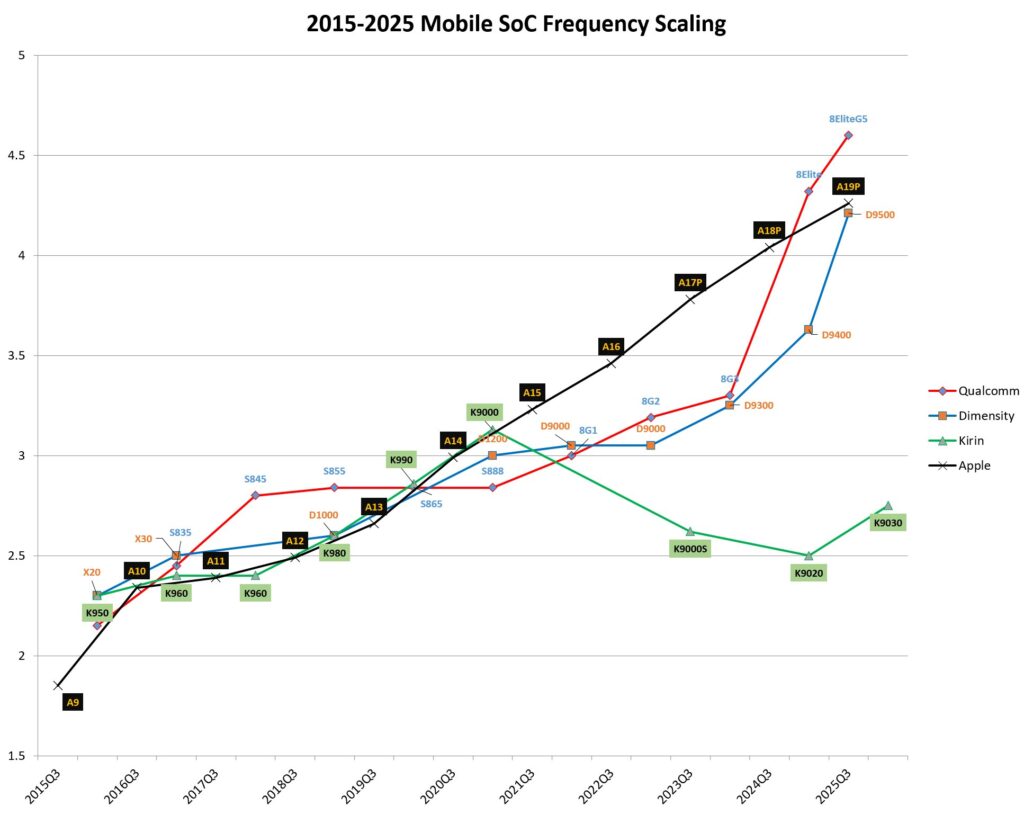
Over the years, Qualcomm, MediaTek, and Apple have grown strongly to offer powerful chips with excellent performance and efficiency, and TSMC has been at the center of it. The chart below (shared by Kurnal) shows how these companies have gradually increased peak clock speeds, now pushing toward the 5.0GHz mark.

Qualcomm, MediaTek, Apple Huawei frequency scaling

The latest flagship from Qualcomm, the Snapdragon 8 Elite Gen 5, can already reach a peak speed of 4.61GHz, and the upcoming Snapdragon 8 Elite Gen 6 Pro is said to reach 5.0GHz. MediaTek’s Dimensity 9600 Pro will reportedly achieve a similar feat, following the Dimensity 9500’s 4.21GHz peak clock speed. This increase enables SoCs to offer major improvements in both single-threaded and multi-threaded workloads.

Huawei’s Kirin chipsets, on the other hand, are nowhere near the performance and efficiency offered by Qualcomm, MediaTek, and Apple. Its downtrend on the above graph is due to U.S. trade sanctions that banned the company from doing business with TSMC. Huawei had no other option but to use China’s SMIC facility, which is still generations behind TSMC. Even today, SMIC is limited to the 5nm process because it’s restricted from using the most advanced EUV (Extreme Ultraviolet) lithography machines.

Huawei’s latest chip, Kirin 9030 Pro, hasn’t crossed the 3.0GHz mark. As things stand today, Huawei is still a long way behind Qualcomm, MediaTek, and Apple to even compete with them, and the difference is a foundry partner.

source/via: wccftech

For more daily updates, please visit our News Section.

Stay ahead in tech! Join our Telegram community and sign up for our daily newsletter of top stories

The post TSMC hits 5GHz speeds on smartphone processors, leaving Huawei generations behind appeared first on Gizmochina.

Milagrow iMap Max W300 ULTRA Robot Vacuum Launched in India With 35,000Pa Suction and Auto Dock

13 April 2026 at 15:37

Milagrow has launched the iMap Max W300 ULTRA robotic vacuum cleaner in India, adding a new high-end option to its home cleaning lineup. The product is built for larger homes and focuses on reducing manual cleaning through a fully automated system.

The W300 ULTRA combines a 35,000Pa suction motor with dual rotating mop pads that apply consistent pressure on the floor. It can sweep and mop at the same time, which helps cut down overall cleaning time. For homes with mixed flooring, the robot uses carpet detection and a 17mm mop lifting system to move onto carpets without wetting them. It also includes an AI-based tangle-free system to prevent hair and fibers from getting stuck in the brush. The onboard TRUE HEPA filter is designed to trap fine dust, allergens, and micro-particles.

Navigation is handled by an LDS laser system along with SLAM-based mapping. This allows the robot to map rooms accurately, clean in a structured pattern, and avoid obstacles. It supports multi-floor mapping, lets users set no-go zones, and allows room-wise cleaning schedules. There is also an automatic carpet boost feature that increases suction when needed.

The device runs on a 6400mAh EV-grade battery, which is intended to support longer cleaning cycles in bigger homes. The docking station handles most of the maintenance work. It can automatically empty dust, wash mop pads, refill water, and dry the mops using 68°C hot air to reduce odor and bacteria buildup.

The robot can be controlled through a mobile app, where users can schedule cleaning, adjust settings, and receive updates. It also works with voice assistants for hands-free control.

The Milagrow iMap Max W300 ULTRA is available in white at an introductory price of INR 1,24,990. It is currently listed on Milagrow’s website and Vijay Sales.

For more daily updates, please visit our News Section.

Stay ahead in tech! Join our Telegram community and sign up for our daily newsletter of top stories!

The post Milagrow iMap Max W300 ULTRA Robot Vacuum Launched in India With 35,000Pa Suction and Auto Dock appeared first on Gizmochina.

Motorola Edge 70 Pro India Launch Soon: Design, Battery, and Camera Details Leak

13 April 2026 at 15:03
motorola edge 70 Pro

Motorola India has started teasing its next phone, the Edge 70 Pro, which will join the Edge 70 lineup after last month’s Edge 70 Fusion launch. A teaser on Flipkart shows the phone with a triple rear camera setup and the tagline “Seize the Night,” suggesting that low-light photography will be a key focus.

motorola edge 70 Pro

A recently leaked image shows the device in a green colour with what Motorola calls a satin-luxe finish. It is also expected to come in a blue variant with a tailored-fabric finish and a white option with a marble finish. The phone appears to have a curved display and a triple camera module on the back. Some reports also mention a wood grain finish for certain markets.

On the hardware side, the Edge 70 Pro is said to pack a 6,500mAh battery with support for 90W fast charging. Motorola has not confirmed full specifications yet, but more details are expected soon as the launch is likely to take place later this April.

Earlier leaks had already hinted at the device and pointed to the same “Seize the Night” tagline, reinforcing the focus on camera performance in low-light conditions. This is not new for Motorola, but it suggests the company may be pushing it further this time.

Design-wise, the phone is expected to follow Motorola’s recent approach. Leaks suggest a quad-curved display and back panel, along with a flat middle frame that has slightly contoured edges for better grip. There have also been mentions of finishes like wood grain and nylon-style textures, which could give it a different look compared to standard glass phones.

Certifications have revealed a few more details. The 6,500mAh battery is a step up from the 6,000mAh unit in the Edge 60 Pro, while charging speeds are expected to remain at 90W. Other features mentioned include wireless charging, Wi-Fi 6E, and NFC.

The Edge 70 Pro is expected to sit within a wider lineup that includes the Edge 70, Edge 70 Fusion, Edge 70 Fusion+, and the Motorola Signature. A Pro+ variant is also expected to follow.

For more daily updates, please visit our News Section.

Stay ahead in tech! Join our Telegram community and sign up for our daily newsletter of top stories!

(Source)

The post Motorola Edge 70 Pro India Launch Soon: Design, Battery, and Camera Details Leak appeared first on Gizmochina.

Xiaomi 18 Pro battery and camera details leak

13 April 2026 at 14:25

Xiaomi’s upcoming 18 Pro series has been showing up in leaks at a steady pace, and the latest one adds a few more details.

As you might already know, Xiaomi is reportedly working on two Xiaomi 18 Pro models: a smaller Xiaomi 18 Pro and a larger 18 Pro Max. 

Xiaomi 18 Pro Specifications (Expected)

According to prolific tipster Digital Chat Station, the smaller Pro model could feature a battery capacity starting in the “7,000mAh” range, along with support for both 100W wired and wireless charging. In comparison, Xiaomi 17 Pro has a 63000mAh cell. 

On the camera side, the report mentions a “dual 200MP” setup, alongside telephoto and macro capabilities. That lines up with earlier rumors, which also pointed to 200MP sensors from SmartSens for the Xiaomi 18 Pro. 

These new sensors are also expected to support LOFIC HDR 3.0, a hardware-based approach aimed at improving dynamic range.

There’s also talk of modular optics, including magnetic, snap-on lenses. If that actually makes it to the final product, it could give users more flexibility, especially for zoom or more specialized photography.

Performance is expected to come from Qualcomm’s next-generation Snapdragon 8 Elite Gen 6 chip built on a 2nm process. It is likely to be paired with up to 16GB of RAM. 

Meanwhile, the larger 18 Pro Max could push battery capacity even further, with prototypes said to be targeting around 8,500mAh.

The Max model is also expected to retain the secondary rear display introduced last year.

As usual with early leaks, none of this is confirmed, and Xiaomi hasn’t said anything publicly. We’ll keep you updated as more details about the phone start to surface.

/For more daily updates, please visit our News Section.

Stay ahead in tech! Join our Telegram community and sign up for our daily newsletter of top stories! 💡

The post Xiaomi 18 Pro battery and camera details leak appeared first on Gizmochina.

AI Needs Power: China Turns to Nuclear Power to Stay Ahead

13 April 2026 at 13:52
china AI nuclear

Highlights

  • China is exploring nuclear energy to power its fast-growing AI infrastructure
  • “Linglong One” SMR is nearing completion and could start operations this year
  • A “nuclear + computing” industrial park is planned to build zero-carbon AI systems

AI-generated image for representation only

China is looking at nuclear power as a solution to one of AI’s biggest challenges: electricity. As artificial intelligence systems grow, they require huge amounts of energy to process data. Industry leaders, including Jensen Huang, have described AI tokens as the “new commodity,” highlighting how computing demand is rapidly increasing.

To meet this demand, China is focusing on Small Modular Reactors (SMRs), which are smaller, flexible nuclear units that can be built closer to data centers. These reactors are easier to deploy than traditional nuclear plants and can provide steady, 24/7 power, something AI systems need.

A major project in this space is the Linglong One reactor, developed by China National Nuclear Corporation. It is the world’s first onshore commercial SMR and is already about 90% complete. Once operational, it is expected to generate around 1 billion kWh of electricity annually while significantly reducing carbon emissions.

China is also planning a “nuclear + computing power” industrial park in Hainan, aiming to create a clean, zero-carbon AI ecosystem. The project has been prioritized in the country’s 2026 government plans.

Globally, nuclear energy is gaining attention as a reliable, low-carbon solution for powering AI. With AI usage rising rapidly, especially in China, the link between computing power and electricity is becoming clearer than ever.

Read More:

(via)

The post AI Needs Power: China Turns to Nuclear Power to Stay Ahead appeared first on Gizmochina.

Redmi A7 Pro 5G Launched in India With 6300mAh Battery and 120Hz Display

13 April 2026 at 13:28
REDMI A7 Pro 5G

Xiaomi has launched the REDMI A7 Pro 5G in India, marking the first “Pro” model in its entry-level REDMI A Series. The device brings a larger display, a bigger battery, and the introduction of Xiaomi HyperOS 3 to this segment.

REDMI A7 Pro 5G

The REDMI A7 Pro 5G features a 6.9-inch HD+ IPS LCD display with a resolution of 1600 x 720 pixels. It supports a 120Hz refresh rate and a 240Hz touch sampling rate, with peak brightness reaching 800 nits. The screen includes DC dimming and TÜV Rheinland certifications for low blue light, flicker-free use, and circadian-friendly viewing. It also supports Wet Touch Technology 2.0, allowing the screen to respond accurately even with damp or oily fingers. The phone measures 8.15mm in thickness and weighs 210g, and is available in Black, Mist Blue, and Sunset Orange.

The device is powered by a 6nm 2.2GHz octa-core UNISOC T8300 processor paired with a Mali-G57 GPU. It comes with 4GB LPDDR4X RAM and offers 64GB or 128GB UFS 2.2 storage, expandable up to 2TB via microSD. It also supports virtual RAM expansion up to 8GB. Connectivity options include dual 4G VoLTE, Wi-Fi ac, Bluetooth 5.4, GPS with GLONASS, Galileo, and BDS, along with a USB Type-C port.

REDMI A7 Pro 5G

The smartphone runs Android 16 with Xiaomi HyperOS 3. It introduces features like Google Gemini, Circle to Search, HyperIsland for multitasking, and Xiaomi Interconnectivity. The company promises 4 years of Android updates and 6 years of security updates.

For optics, the phone includes a 32MP rear camera with HDR+ and Night Mode, and an 8MP front camera with beauty filters and Night Mode. Additional tools include AI Sky and Document Mode. The REDMI A7 Pro 5G packs a 6,300mAh battery with 15W fast charging and 7.5W reverse wired charging. It is rated for 1,000 charge cycles and retains over 80 percent capacity after four years.

Pricing & availability

The phone is priced at Rs. 11,499 for the 4GB + 64GB model and Rs. 12,499 for the 4GB + 128GB variant. It will be available from April 15 via Amazon, mi.com, and retail stores, with up to three months of no-cost EMI.

Don’t miss a thing! Join our Telegram community for instant updates and grab our free daily newsletter for the best tech stories!

For more daily updates, please visit our News Section.

The post Redmi A7 Pro 5G Launched in India With 6300mAh Battery and 120Hz Display appeared first on Gizmochina.

XChat vs WeChat: Can Elon Musk’s App Really Beat the Super App King of China?

13 April 2026 at 13:16
Elon XChat

 Highlights:

  • XChat launching on April 17 for iOS
  • Ad-free messaging with strong privacy features
  • Built as part of Elon Musk’s super app vision

Ai-generated image for representation only

XChat, a new messaging app from X (formerly Twitter), is set to launch on April 17 on the Apple App Store. The app will first be available on iOS, while the Android release date has not been announced yet.

Developed under Elon Musk’s direction, XChat is designed to become the main messaging platform within the X ecosystem. It is part of a larger plan to transform X into an all-in-one “super app,” similar to China’s WeChat.

The app supports one-to-one chats, group conversations, as well as voice and video calls. It also focuses heavily on privacy, offering features like end-to-end encryption, disappearing messages, screenshot blocking, and message recall. Users can edit and delete messages, and even create accounts without using a phone number.

One standout feature is the complete absence of ads, making the experience cleaner compared to other popular messaging apps.

XChat has been in development since May 2025 and entered public beta in March 2026. Built using the Rust programming language, it is supported by X’s massive user base of over 500 million monthly active users.

Overall, XChat is a key step in Musk’s plan to combine messaging, payments, and multiple digital services into a single platform.

 XChat vs WeChat (Early Feature Comparison)

FeatureXChatWeChat (China)Winner
Messaging (1-to-1 & Group)YesYesTie – Both offer core messaging
Voice & Video CallsYesYesTie – Standard feature on both
End-to-End EncryptionYes (claimed)LimitedXChat – Stronger privacy focus
Phone Number RequirementNot requiredRequiredXChat – More flexible signup
Disappearing MessagesYesLimitedXChat – More modern privacy tools
Message Editing & RecallYesYesTie – Both support it
Screenshot ProtectionYesNoXChat – Extra privacy layer
AdsNo adsAds & promotionsXChat – Cleaner experience
PaymentsNot available (yet)Fully integratedWeChat – Mature ecosystem
Mini Apps / ServicesNot available (yet)Extensive ecosystemWeChat – Far more advanced
Social IntegrationIntegrated with X platformMoments featureTie – Different approaches
AI IntegrationExpected (not confirmed)LimitedXChat – Future potential

Disclaimer:

This comparison is based on currently available information about XChat. Since the app has not fully launched and features are still evolving, some details may change over time.

Read More:

(via)

The post XChat vs WeChat: Can Elon Musk’s App Really Beat the Super App King of China? appeared first on Gizmochina.

Xiaomi HyperOS 4 to bring a Leica color palette, says leak

13 April 2026 at 13:04
Xiaomi-HyperOS-4-self-developed-architecture

Android 17 is in its beta phase, and phone makers like Xiaomi are already deep into building their next software on top of it. The company’s upcoming HyperOS 4 has previously been rumored to bring a major shift, with earlier reports claiming a self-developed architecture under the hood.

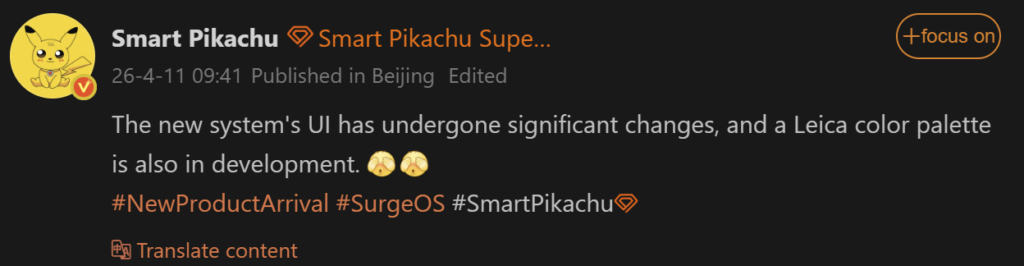
Now, a few more details are starting to surface, courtesy of Weibo tipster Smart Pikachu. According to the leak, Xiaomi is reworking the core user interface for HyperOS 4. Its specifics are still scarce, but the tipster claims the system UI has undergone “significant changes.”

Xiaomi HyperOS with a Leica color palette

One of the more interesting claims is that Xiaomi is reportedly working on a dedicated Leica color palette for the OS.

Xiaomi’s partnership with Leica has mostly been visible in the camera app so far, especially in color science and filters. Bringing that aesthetic into the operating system could mean that Xiaomi wants the software to reflect the same “premium” tone as its camera hardware.

Xiaomi-HyperOS-4-self-developed-architecture

Moreover, Xiaomi also confirmed in January its aim to achieve “grand convergence” in 2026 with a self-developed chip, operating system, and large AI models on a single device. 

If all of this pans out, HyperOS 4 might not be about flashy new features as much as it is about refinement. A redesigned interface paired with a more cohesive visual language could make the experience feel more unified across Xiaomi, Redmi, and Poco devices.

Of course, it’s still early days. Xiaomi hasn’t confirmed any of these details, and the company is known for iterating quickly, which means features seen in leaks don’t always make it to the final release in the same form. So, as always, take it with a grain of salt.

For more daily updates, please visit our News Section.

Stay ahead in tech! Join our Telegram community and sign up for our daily newsletter of top stories.

The post Xiaomi HyperOS 4 to bring a Leica color palette, says leak appeared first on Gizmochina.

Oppo Pad Mini Launch Confirmed for April 21: 8.8-inch OLED, 144Hz Display, Snapdragon 8 Gen 5

13 April 2026 at 12:54
Oppo Pad Mini

Oppo is getting ready to launch a compact tablet called the Oppo Pad Mini, aimed at users who want a better gaming and media experience than what a smartphone offers. The company has confirmed a global launch on April 21, where it will debut alongside the Find X9 Ultra. Pricing has not been announced yet.

From what has been shared through teasers and leaks, the Pad Mini will feature an 8.8-inch OLED display with a 3:2 aspect ratio and a 144Hz refresh rate. The tablet is expected to be very thin at 5.39mm and weigh around 279 grams, making it noticeably slimmer and lighter than devices like Lenovo’s Legion Tab Gen 5.

It is also expected to run on Qualcomm’s Snapdragon 8 Gen 5 chip. While this processor is said to be about 30 percent slower than the Snapdragon 8 Elite Gen 5 used in Lenovo’s tablet, it should still deliver strong performance for gaming and everyday tasks.

Other details point to an 8000mAh battery with support for 67W fast charging. The front is expected to have a punch-hole camera and thin bezels around the display.

Earlier leaks had already filled in more of the picture. The display is said to have a 2880×1920 resolution, with LTPO tech that can scale the refresh rate from 1Hz to 144Hz. Peak brightness is tipped at 1800 nits, along with full DCI-P3 color support.

The tablet is also expected to use a unibody metal design and come in dark gray, purple, and cyan. On the back, it may include a 13MP camera in a capsule-style module. There is also mention of eSIM support, which could allow it to work without relying only on Wi-Fi.

Don’t miss a thing! Join our Telegram community for instant updates and grab our free daily newsletter for the best tech stories!

For more daily updates, please visit our News Section.

(Source, via)

The post Oppo Pad Mini Launch Confirmed for April 21: 8.8-inch OLED, 144Hz Display, Snapdragon 8 Gen 5 appeared first on Gizmochina.

Xiaomi REDMI K90 Max Will Feature E-Sports Touchscreen for Pro-Level Gaming

13 April 2026 at 12:42
Redmi K90 Max

Xiaomi has confirmed that the REDMI K90 Max will launch on April 21 at 7:00 PM. The phone is being introduced as a gaming-focused flagship, clearly targeting users who want top-level performance for competitive mobile gaming. From the announcement itself, Xiaomi is highlighting speed, responsiveness, and long gaming sessions as the main focus areas.

E-Sports Touchscreen Technology

The biggest highlight of the REDMI K90 Max is its new e-sports touchscreen. It supports a 480Hz multi-finger touch reporting rate and an extremely high 3500Hz instantaneous touch sampling rate. In simple terms, this means the screen reacts almost instantly to your touch, which is very important in fast games like shooters. It also includes a 400Hz six-axis gyroscope for better motion control. Xiaomi says the display has been tested for up to 1 million continuous touches, showing strong durability along with performance.

Display and Gaming Experience

The phone features a large 6.83-inch display with a 165Hz refresh rate and up to 3500 nits peak brightness. It can run games at native 165FPS while maintaining HD graphics quality at the same time. This is still rare in smartphones and gives smoother and clearer gameplay. Xiaomi has even confirmed support for this in games like Delta Force.

Cooling and Durability

To handle long gaming sessions, the REDMI K90 Max comes with a built-in cooling fan, a first for Xiaomi phones. It uses a sealed air duct and metal structure to keep temperatures under control. The device is also highly durable with IP66, IP68, and IP69 ratings, along with a 50,000-hour aging test. The cooling fan is designed to last long, with a 6-year warranty and lifetime maintenance support.

Comparison with Other Gaming Phones

Compared to other phones in this segment, most gaming devices offer high touch sampling rates but usually in the range of 720Hz to 2000Hz. Very few combine such a high instantaneous sampling rate with advanced gyroscope performance. While brands like ASUS ROG and iQOO focus on triggers and high refresh displays, the REDMI K90 Max focuses more on touch accuracy and responsiveness. This could give it an edge for competitive gamers who rely on fast and precise inputs.

Read More:

(via)

The post Xiaomi REDMI K90 Max Will Feature E-Sports Touchscreen for Pro-Level Gaming appeared first on Gizmochina.

Alleged DJI Avata 3 or Neo 3 spotted in testing video

13 April 2026 at 12:35

DJI looks to be testing another compact drone, based on a short clip that’s started circulating online. It shows a small model with built-in propeller guards, which usually points toward either a beginner-friendly design or something aimed at FPV-style flying.

DJI recently introduced the Avata 360, which brings 360-degree capture into the FPV space. That model is still in the early stages of rollout, so seeing another device already being tested suggests the company is working on multiple things at once.

From what’s visible in the footage, the drone sits somewhere between the Avata 2 and the Neo in terms of design. It has a compact body, enclosed propellers, and what looks like a single camera setup. Nothing too surprising there, but the guarded design does stand out, especially for indoor or close-range flying.

As for what it actually is, that part isn’t clear yet. Some think it could be an early Avata 3, given the similarity to DJI’s FPV lineup. Others are leaning toward a Neo 3, which would make sense if DJI is updating its more entry-level models. Right now, it’s mostly guesswork.

The footage itself isn’t very detailed, which is pretty typical for early testing leaks. Still, it does confirm that DJI has something new in development, even if it’s still at a fairly early stage.

If past releases are anything to go by, this probably won’t turn into a launch anytime soon. DJI tends to test its drones in public for a while before making anything official.

For now, it’s just a brief look at what could be coming next: either a follow-up to the Avata series or a refreshed Neo model with a similar approach to safety and usability.

Don’t miss a thing! Join our Telegram community for instant updates and grab our free daily newsletter for the best tech stories!

For more daily updates, please visit our News Section.

(Source)

The post Alleged DJI Avata 3 or Neo 3 spotted in testing video appeared first on Gizmochina.

Infinix Note 60 Pro goes official with Active Matrix display, Snapdragon 7-series chip, and more

13 April 2026 at 12:33
Infinix Note 60 Pro

Infinix has launched the Note 60 Pro in India, marking it Infinix’s first smartphone powered by a Snapdragon chipset. The device also highlights features like the segment-first Active Matrix display, a 144Hz AMOLED screen, and a large battery, setting the tone for a design and performance-focused experience.

Infinix Note 60 Pro specifications and features

Infinix Note 60 Pro

The Note 60 Pro features a 6.78-inch 1.5K AMOLED display with a 144Hz refresh rate and up to 4500 nits peak brightness. It also introduces a segment-first Active Matrix LED display integrated into the camera module, enabling real-time notifications and interactive lighting patterns even when the main screen is off.

Under the hood, the device is powered by the Snapdragon 7s Gen 4 processor, paired with 3D IceCore VC cooling for stable performance during extended usage. It supports up to 8GB RAM, expandable to 16GB, along with 128GB or 256GB storage options. The phone runs on XOS 16 based on Android 16, with a focus on AI-driven features and long-term software support.

Infinix Note 60 Pro

The device houses a 6500mAh battery with 90W wired charging and 30W wireless charging support, along with reverse and bypass charging features. On the camera front, it includes a 50-megapixel OIS main camera with an ultra-wide lens, along with a 13-megapixel front camera.

Infnix Note 60 Pro

Additional highlights include JBL-tuned dual speakers, an integrated heart rate sensor, NFC support, and an aerospace-grade aluminium frame with Corning Gorilla Glass 7i protection.

Infinix Note 60 Pro price and availability

The Infinix Note 60 Pro is available in Solar Orange, Deep Ocean Blue, and Mocha Brown color options. It comes in 8GB+128GB and 8GB+256GB variants priced at Rs 31,999 (~$345) and Rs 34,999 (~$375), respectively. A Call of Duty Mobile limited edition is also available in the Mocha Brown finish with themed elements.

As part of launch offers, buyers can get one-year screen replacement, a complimentary MagPower speaker worth Rs 3,999, and bundled benefits such as Google Gemini access and cloud storage. The device will be available via Flipkart and retail stores with cashback and EMI options.

For more daily updates, please visit our News Section.

Stay ahead in tech! Join our Telegram community and sign up for our daily newsletter of top stories! 💡

The post Infinix Note 60 Pro goes official with Active Matrix display, Snapdragon 7-series chip, and more appeared first on Gizmochina.

XPeng with Huawei Launches the World’s Most Advanced AI Headlights Yet

13 April 2026 at 12:20
XPeng Huawei AI headlight

Highlights:

  • Features one of the most advanced AI projection headlight systems ever
  • Capable of displaying real-time road signals and alerts
  • Up to 750 km range (BEV) with dual-motor AWD standard
  • Level 4-ready tech with steer-by-wire system

XPeng is set to officially launch its new flagship SUV, the GX, on April 15, bringing a strong focus on intelligent lighting and advanced driving technology. Developed in collaboration with Huawei Qiankun, the GX introduces a new generation of AI-powered digital projection headlights designed to transform how vehicles interact with their surroundings.

The standout feature is its advanced DLP projection lighting system. Unlike traditional headlights, the GX can project dynamic symbols directly onto the road. This includes arrows for lane guidance, “Yield to Pedestrians” alerts, and even following distance indicators. The system also supports SOS projections and personalized welcome animations, adding both safety and premium appeal. It can even project videos, turning the vehicle into a mobile outdoor cinema.

In terms of performance, the GX will be available in both all-electric (BEV) and extended-range (EREV) versions. The BEV model offers a claimed range of up to 750 km (CLTC), while the EREV delivers 320 km of pure electric driving. All variants come with dual-motor all-wheel drive and a top speed of 200 km/h.

The SUV features a large, premium six-seater layout with a length of 5265 mm and a 3115 mm wheelbase. Design highlights include a yacht-inspired body, clamshell hood, split tailgate, and a panoramic glass roof. Inside and out, the GX focuses on blending minimalism with a bold, futuristic identity.

With Level 4 autonomous driving capability support and a next-gen steer-by-wire system, the XPeng GX positions itself as a technology-first flagship in the large SUV segment.

Read More:

(via)

The post XPeng with Huawei Launches the World’s Most Advanced AI Headlights Yet appeared first on Gizmochina.

HyperOS 4 leak reveals massive UI overhaul and Leica Color integration

13 April 2026 at 12:00
Xiaomi HyperOS 4.0
Xiaomi HyperOS 4.0

Xiaomi may already be developing HyperOS 4, as leaks have begun surfacing online, revealing key elements. A fresh leak suggests that HyperOS 4 won’t be just another upgrade, but a major one with significant visual changes and premium Leica color palette integration.

The latest information comes from a Chinese tipster, Smart Pikachu, via a Chinese microblogging site Weibo. He claims that the upcoming HyperOS 4 will feature significant changes to the core user interface. While the leak doesn’t go into detail, it suggests the company might be switching from its familiar design language to a highly modernized, cohesive look for its next-generation OS.

HyperOS 4 leak screenshot

The leakster also claims Xiaomi is developing a Leica color palette to integrate into the upcoming major HyperOS release. Again, no specific details were provided, but it likely points to a premium, high-contrast aesthetic for the system UI, which was previously reserved for the camera application.

While we are yet to see these changes in action, they sound exciting. Xiaomi’s software team appears to be working hard in the background to ensure HyperOS 4 feels more premium and feature-rich. According to Ximitime’s industry sources, changes in HyperOS 4 go much deeper than just a superficial visual refresh.

Xiaomi may also be working on a deeper, bigger change that most people wouldn’t even notice. According to past leaks, the company is removing remnants of the legacy MIUI framework. The core system applications for HyperOS 4 will reportedly be rewritten using the RUST programming language, offering better system fluidity and security.

While Xiaomi hasn’t officially revealed anything about HyperOS 4, reports say it could debut alongside the upcoming Xiaomi 18 series in Q3 2026, with beta testing beginning in August.

Related: Xiaomi HyperOS 4 to adopt self-developed architecture while retaining native Android services

We’ll keep tracking the latest HyperOS developments and post the same in the Xiaomi section on this website. Remember to visit it every few days to get fresh details. Or, you can join our Telegram channel to get instant notifications when we publish new stories.

The post HyperOS 4 leak reveals massive UI overhaul and Leica Color integration appeared first on Gizmochina.

Vivo X Fold 6 tipped to use 200MP camera, 7,000mAh battery

13 April 2026 at 11:56
Vivo X Fold 5

Vivo launched the X Fold 5 back in June last year, and early details of the X Fold 6 have already started showing up online. The successor is still some time away, but a new leak gives a rough idea of what the company might be planning.

Vivo X Fold 5

The information comes from tipster Digital Chat Station, who mentions a possible 200MP main camera. If that ends up being accurate, it would likely be the same sensor used in the X300 and X300 Pro. That should help with detail in good lighting. The sensor is also slightly larger than the 50MP unit on the X Fold 5 (1/1.4″ vs 1/1.56″), so it could lead to a small change in the camera island design.

Battery is another area that could see a noticeable jump. The leak points to a rated 6,760mAh capacity, with a typical value closer to 7,000mAh. That’s a significant upgrade over the 6,000mAh unit of the X Fold 5.

There’s also mention of a 50MP periscope lens with telemacro support, which suggests close-up shooting could be part of the setup again. Vivo has used similar systems before, so this wouldn’t be entirely new, just carried forward and possibly refined.

Beyond that, details are still a bit vague. The leak references a new design language and some accessory support, but doesn’t go into specifics. On the performance side, the phone is expected to use a flagship Snapdragon chip, though it’s not clear which one yet. The X Fold 5 is powered by the Snapdragon 8 Gen 3 and its successor is speculated to use the newly launched Snapdragon 8 Gen 5.

As with previous models, the X Fold 6 will likely launch in China first, with a wider rollout coming later.

For now, it looks like Vivo is focusing on the same areas again, but pushing them a bit further. Still early days though, so things could change by the time it’s official.

Don’t miss a thing! Join our Telegram community for instant updates and grab our free daily newsletter for the best tech stories!

For more daily updates, please visit our News Section.

(Source: DCS on Weibo)

The post Vivo X Fold 6 tipped to use 200MP camera, 7,000mAh battery appeared first on Gizmochina.

Honor’s “Lightning” and “Energetic Boy” robots are heading to a marathon

13 April 2026 at 11:13
Honor-Lighting-and-Electric-Boy-marathon

Honor is getting into the marathon business, but not in the way most phone makers would. Instead of sponsoring runners or building fitness features, the company itself is sending robots to the starting line.

According to Honor’s Global Chief Marketing Officer, two humanoid robots named “Lightning” and “Energetic Boy” will take part in the upcoming Beijing Yizhuang Marathon on April 19. 

The “Lightning” is finished in red with glowing blue eye-like lights and a visible Honor logo. Meanwhile, “Energetic Boy” comes in silver with a blue lighting strip on the face. It looks more like a traditional humanoid robot, while the “Lighting” is something that we expect to see in movies.

According to Honor, “Lightning” combines its latest work in intelligent manufacturing with embodied AI. That includes motion-control algorithms designed for high-speed movement, along with real-time perception and decision-making systems that enable the robot to react to its surroundings without constant human input.

The marathon will stress-test these capabilities.

The two Honor robots will run on a 21km track

Organized by the Beijing Municipal People’s Government and China Media Group, the 21.0975-kilometer race runs from Tongming Lake to Nanhaizi Park, mixing city roads, racing circuits, and park terrain. It’s not a controlled lab environment, which is exactly the point.

Earlier this month, more than 70 teams — including four from outside China — took part in a full-scale overnight test organized by the Beijing Economic-Technological Development Area. Below is a clip of Honor’s Lighting Robot during the practice.

The rehearsal covered everything from navigation to emergency response, which gave makers an idea of how complex it is to get humanoid robots to operate reliably over long distances.

The competition format also nudges teams toward autonomy. Robots can either operate autonomously or rely on remote control, but the rules make the latter less attractive by imposing time penalties and restrictions on human intervention.

Teams that manage to complete the race fully autonomously may even qualify for a Guinness World Records entry.

For more daily updates, please visit our News Section.

Stay ahead in tech! Join our Telegram community and sign up for our daily newsletter of top stories! 💡

(Source)

The post Honor’s “Lightning” and “Energetic Boy” robots are heading to a marathon appeared first on Gizmochina.

OPPO Find X9 Ultra Earth Explorer Master Set Unveiled Ahead of April Launch

13 April 2026 at 10:24
OPPO Find X9 Ultra

OPPO has unveiled the Find X9 Ultra Hasselblad Earth Explorer Master Set ahead of its global launch on April 21. Inspired by the Hasselblad X2D 100C Earth Explorer Limited Edition, the bundle includes a collector’s commemorative certificate with a unique serial number, positioning it as a limited-edition release for photography-focused users.

OPPO Find X9 Ultra

The Find X9 Ultra will be offered in three finishes: Earth Tundra, Polar Glacier, and Velvet Sand Canyon. The design centers around a large circular rear camera module, highlighting its imaging-first approach. The device features a 144Hz high refresh rate display paired with a new 1-nit eye protection technology. It runs on ColorOS 16 and includes an ultrasonic in-display fingerprint sensor. Durability is a key focus, with IP66, IP68, and IP69 ratings for water and dust resistance.

Imaging is the core highlight. The phone introduces a Hasselblad dual 200MP camera system, supported by Hasselblad Master Mode, the LUMO light-condensing imaging system, and a professional imaging kit. It also supports 8K video recording. As shown in the official details, the setup includes a 200MP ultra-sensing main camera with improved light intake, a 200MP 3x telephoto lens with 36 percent more light intake, a 50MP ultra-wide camera with 56 percent more light capture, a 50MP 10x optical zoom telephoto lens with a 230mm focal length, and a new-generation true color camera with 43 percent improved light sensitivity. The front camera uses a 50MP large sensor.

Previous leaks suggest the device will feature a 6.78-inch OLED display with 3168 x 1440 resolution and could be powered by the Snapdragon 8 Elite Gen 5 chipset. It may include up to 16GB LPDDR5x RAM and 1TB UFS 4.1 storage, along with a 7,050mAh battery supporting 100W wired and 50W wireless charging. Additional features may include satellite connectivity, dual speakers, an IR blaster, and advanced camera sensors, including a multispectral unit.

For more daily updates, please visit our News Section.

Stay ahead in tech! Join our Telegram community and sign up for our daily newsletter of top stories!

(Source: 1, 2 & 3)

The post OPPO Find X9 Ultra Earth Explorer Master Set Unveiled Ahead of April Launch appeared first on Gizmochina.

Redmi K90 Max launch date officially confirmed, K Pad 2, Pad 2 SE, Redmi Book Pro (2026) to debut alongside

13 April 2026 at 09:05
Redmi K90 Max launch date

After the teasing the arrival of the Redmi K90 Max in the past week, the brand has confirmed that it will debut on April 21 in China. The brand has previously confirmed that it will be positioned between the Redmi K90 and K90 Pro Max that are already available in China. Here’s a look at what to expect from the K90 Max.

Redmi K90 Max: What’s known so far

Redmi K90 Max launch date
Redmi K90 Max display size

The Redmi K90 Max is confirmed to feature a 6.83-inch display with a 165Hz refresh rate and peak brightness reaching 3500 nits. It will support high frame rate gaming, with over 40 games capable of running at up to 165fps, along with specific optimizations for darker in-game environments.

It stands out as the first smartphone from the brand to feature an in-built fan-based cooling system. It uses a vertical air intake fan design measuring 18.1mm, delivering airflow of up to 0.42CFM. This setup is claimed to reduce temperatures significantly within a short span, helping maintain performance during long gaming sessions.

The cooling system is built on a suspended structure that operates independently without affecting the motherboard layout. This allows the device to retain full dust and water resistance with IP66, IP68, and IP69 ratings, while also accommodating a large battery. The fan system is designed for durability as well, with a metal bearing structure and extended lifespan testing.

Powering the device will be the MediaTek Dimensity 9500 chipset, built on an advanced 3nm process, paired with an additional independent graphics chip for enhanced gaming performance. The device is also expected to include a large 8000mAh or 8,500mAh battery with support for 100W wired charging. Other expected features include an ultrasonic fingerprint sensor, symmetrical dual speakers with custom tuning, and a refined industrial design with a metal frame.

What other Redmi devices are launching on April 21

Apart from the Redmi K90 Max, the company will announce tablets, namely, the Redmi K Pad 2 powered by the Dimensity 9500 chip, and the Redmi Pad 2 SE packed with mid-range specs. The event will also see the arrival of the 14-inch and 16-inch Redmi Book Pro (2026).

For more daily updates, please visit our News Section.

Stay ahead in tech! Join our Telegram community and sign up for our daily newsletter of top stories! 💡

The post Redmi K90 Max launch date officially confirmed, K Pad 2, Pad 2 SE, Redmi Book Pro (2026) to debut alongside appeared first on Gizmochina.

Legion Y70 (2026) to mark Lenovo’s return to gaming phone market, here’s when it will debut

13 April 2026 at 08:46
Lenovo Legion Y70 (2026) incoming

Lenovo hasn’t launched a gaming phone since the Legion Y70, which debuted back in 2022. Now, the brand has confirmed its return to the gaming smartphone segment with the arrival of the Legion Y70 (2026). Here’s a look at what to expect from the device.

Legion Y70 (2026): A comeback driven by AI gaming ambitions

With this launch, Lenovo is re-entering a space it had stepped away from after its earlier Legion gaming phones. The Y70 new generation is being positioned as a device built for the evolving AI gaming era, where performance is not just about raw power but also intelligent optimization. The company aims to create a more seamless gaming experience by refining responsiveness, touch feedback, and visual smoothness.

Lenovo suggests that smartphones remain a key part of its broader gaming ecosystem, which already includes laptops, tablets, and accessories. The absence of a gaming phone was seen as a missing link, and this new model is expected to bridge that gap. The focus appears to be on delivering a connected experience where gameplay, settings, and performance tuning feel consistent across devices.

Lenovo Legion Y70
Lenovo Legion Y70 (2022)

The Legion brand entered the gaming smartphone market in 2020 with models like the Legion Phone Pro series and later the Y90, known for their distinct thermal systems and gaming-centric designs. The previous Y70, launched in 2022, offered flagship-grade hardware for its time, and the new generation is expected to build on that foundation with modern upgrades.

While the Legion Y70 (2026)’s detailed specifications are still under wraps, the emphasis is clearly on delivering a refined gaming experience rather than just headline numbers. As for the launch, it will go official in May in China.

For more daily updates, please visit our News Section.

Stay ahead in tech! Join our Telegram community and sign up for our daily newsletter of top stories! 💡

The post Legion Y70 (2026) to mark Lenovo’s return to gaming phone market, here’s when it will debut appeared first on Gizmochina.

Huawei Pura X Max design officially revealed ahead of April 20 launch, 5 color options confirmed

13 April 2026 at 08:40
Huawei Pura X Max desgin

Huawei has officially revealed the Pura X Max ahead of its April 20 launch event. While the announcement keeps things fairly broad, it confirms a new direction for foldable smartphones, hinting at a larger form factor and a different usage approach compared to typical foldables.

Huawei Pura X Max: First foldable with a horizontally wide foldable design

Huawei Pura X Max desgin

The Huawei Pura X Max is being positioned as the industry’s first horizontally wide foldable, focusing on a broader internal display rather than a tall, narrow layout. When unfolded, the device is expected to feature a screen of around 7.6 to 7.69 inches with a 16:10 aspect ratio, offering a tablet-like experience. This makes it closer in usability to compact tablets such as the iPad mini, especially for multitasking, media consumption, and productivity.

HUawei Pura X Max
HUawei Pura X Max
HUawei Pura X Max

The outer screen is said to measure around 5.5 inches, allowing users to handle everyday tasks like messaging and calls without unfolding the device. The design includes a relatively flat frame, a centred punch-hole camera on the cover display, and a slightly offset punch-hole on the internal screen. At the back, Huawei appears to be using a horizontally aligned camera module with multiple sensors.

Under the hood, the Pura X Max is rumoured to be powered by Huawei’s Kirin 9030 chipset, which is also expected to feature in the Pura 90 series.  

HUawei Pura X Max
HUawei Pura X Max

Huawei has already opened pre-orders in China, with the official launch scheduled for April 20 alongside the Pura 90 series. The official listing reveals that it will come in multiple storage options: 12GB+256GB, 12GB+512GB, 16GB+512GB (Collector’s Edition), and 16GB+1TB. Color choices include black, white, blue, gold, and orange.

For more daily updates, please visit our News Section.

Stay ahead in tech! Join our Telegram community and sign up for our daily newsletter of top stories! 💡

The post Huawei Pura X Max design officially revealed ahead of April 20 launch, 5 color options confirmed appeared first on Gizmochina.

Xiaomi launches new split air conditioner with 15-second cooling and 30-second heating

13 April 2026 at 03:34
Xiaomi Mijia Strong Air Super 1.5 HP air conditioner

Xiaomi has launched the Mijia Strong Air Super 1.5 HP air conditioner in China. The model is priced at 2,699 yuan ($395), and it will be available for purchase on JD.com starting April 28.

Xiaomi Mijia Strong Air Super 1.5 HP air conditioner

Mijia Strong Air Super AC Specifications

Xiaomi equipped the air conditioner with a 13cc large-displacement dual-cylinder compressor, enhancing low-frequency stability by 30% and reducing noise by 5%. It also includes dual-row pure copper evaporators and condensers, with the condenser providing a 75% larger heat exchange area for improved cooling and heating efficiency.

The AC features an upgraded airflow system with a 118mm large-diameter fan and dual air deflectors, delivering airflow up to 900m³/h. It cools a room in 15 seconds and heats it in 30 seconds. The unit offers canopy-style cooling to prevent direct drafts and carpet-style heating for enhanced comfort in colder months.

Xiaomi designed the Mijia Strong Air to maintain exceptional performance in extreme conditions. The unit supports cooling at temperatures as high as 55°C and heating at temperatures as low as -15°C.

Xiaomi Mijia Strong Air Super 1.5 HP air conditioner

The product boasts a super level 1 energy rating and an APF of 6.01, enabling up to 344 kWh of annual electricity savings with Xiaomi’s Lingyun energy-saving algorithm.

The air conditioner utilizes the HyperOS Connect ecosystem with an AI module for smarter controls, OTA updates, and cloud-based self-diagnostics for maintenance. It integrates with Xiaomi smart home devices and supports voice command operation.

Xiaomi designed the Mijia Strong Air with a clean and minimalistic appearance. The indoor unit measures 865 x 330 x 219 mm and weighs 11.5 kg, while the outdoor unit measures 852 x 565 x 331 mm and weighs 27 kg. The unit supports both vertical and horizontal swing modes, self-cleaning with high-temperature sterilization up to 58°C, and an anti-cold air function.

In related news, Xiaomi has also recently unveiled a new smart floor air conditioner featuring HyperOS integration and powerful airflow capabilities.

For more daily updates, please visit our News Section.

Stay ahead in tech! Join our Telegram community and sign up for our daily newsletter of top stories! 💡

(JD)

The post Xiaomi launches new split air conditioner with 15-second cooling and 30-second heating appeared first on Gizmochina.

Xiaomi unveils Redmi G27U 2026 monitor with 4K 160Hz & 1080p 320Hz dual mode

13 April 2026 at 02:16
Redmi G27U 2026

Xiaomi has officially unveiled the new Redmi G27U 2026 monitor in China. The monitor is now listed on JD.com and Xiaomi Mall at a price of 1,499 yuan ($220). The full official specs have not been revealed yet, but we’ll keep you updated after its official launch on April 17.

Redmi G27U 2026

Redmi G27U 2026 Specifications

So far what we know, the Redmi G27U 2026 features a 27-inch Fast IPS display with a 4K resolution of 3840 x 2160 pixels and a 16:9 aspect ratio. It comes with a dual-mode refresh rate, allowing users to switch between 4K at 160Hz or 1080p at 320Hz. The monitor also features 1ms GTG response time, which reduces the motion blur.

The monitor supports HDR400, which enhances brightness and contrast, and it includes 10-bit color, delivering deeper and more vibrant visuals. The IPS panel has a 1000:1 contrast ratio, which ensures consistent and clear image quality across different lighting conditions.

The monitor includes essential connectivity options such as HDMI and DisplayPort for ease of use with PCs and consoles. The design features tilt and height adjustment, providing users with ergonomic flexibility.

The Redmi G27U 2026 weighs 5.5 kilograms and measures 613 mm in width, 522 mm in height, and 227 mm in depth. The monitor meets Level 2 energy efficiency standards, making it more energy-efficient during use. Xiaomi is also offering a three-year warranty for added peace of mind.

In related news, Xiaomi has recently introduced a new smart floor-standing air conditioner with HyperOS and powerful airflow. The company has also launched the Mijia Wireless Floor Washer 5 Pro, which offers 26,000Pa suction and up to 40 minutes of runtime.

For more daily updates, please visit our News Section.

Stay ahead in tech! Join our Telegram community and sign up for our daily newsletter of top stories! 💡

(Xiaomi)

The post Xiaomi unveils Redmi G27U 2026 monitor with 4K 160Hz & 1080p 320Hz dual mode appeared first on Gizmochina.

Xiaomi launches an Ice Cream and it comes in Standard, Pro and Max variants

13 April 2026 at 00:26
Xiaomi Ice Cream

Xiaomi is known for putting its branding on almost everything, but its latest product launch at the 2026 Values Conference isn’t a smart home gadget or a flagship phone; it’s ice cream.

Xiaomi Ice Cream

True to its tech roots, Xiaomi’s cafeteria is offering the new treat in three very familiar tiers: Standard, Pro, and Max. The Standard edition gets you the base ice cream for a highly competitive 5.99 yuan (about $0.88).

Stepping up to the Pro version for 6.99 yuan ($1.02) adds a single cookie to the mix. Finally, for power users with a sweet tooth, the Max version costs 8.99 yuan ($1.32) and maxes out the specs with three cookies.

Chef Bing Jiabao from Xiaomi’s cafeteria developed the ice cream recipe. Xiaomi says Bing drew inspiration from tofu ice cream and created the product by experimenting with millet, a key ingredient in Xiaomi’s branding.

Xiaomi Ice Cream

After three iterations, Bing perfected the process. The method starts with steaming millet, transforms it into a paste blended with milk, and finishes with millet grain toppings. Xiaomi says the recipe solves the challenge of giving millet a stronger flavor.

Photos showed the ice cream machine used in the cafeteria with branding from Mengniu, a well-known Chinese dairy company, suggesting a collaborative effort. Xiaomi has operated its cafeteria in-house since 2015, with all chefs and staff serving as direct employees who receive standard company benefits.

The launch of Xiaomi Ice Cream immediately trended on social media. Some online commenters joked about the absence of an Ultra version or suggested adding a Youth Edition. Xiaomi confirmed that the ice cream sold out quickly after its launch.

For more daily updates, please visit our News Section.

Stay ahead in tech! Join our Telegram community and sign up for our daily newsletter of top stories! 💡

(Source)

The post Xiaomi launches an Ice Cream and it comes in Standard, Pro and Max variants appeared first on Gizmochina.

PocketTerm35 is a handheld Linux PC powered by Raspberry Pi 5

12 April 2026 at 22:39
PcoketTerm35

The PocketTerm35 is a new handheld computing device aimed at developers and electronics enthusiasts. It brings a compact Linux-based experience powered by Raspberry Pi hardware, combining portability with practical functionality. The device integrates productivity, DIY flexibility, and even gaming support into a single unit.

PocketTerm35 features and specifications

PcoketTerm35
PcoketTerm35

The PocketTerm35 is a compact Raspberry Pi-based handheld device designed for portable computing. The Pi5 variant is powered by the Raspberry Pi 5 with 1GB RAM and comes with a pre-installed 64GB memory card. On the other hand, the Pi4 version uses the Raspberry Pi 4 paired with 2GB RAM. Both variants support a 5,000mAh lithium battery, enabling on-the-go usage, although the battery may be optional depending on the selected kit.

It features a 3.5-inch IPS display with a 640 x 480 resolution, along with optical bonding and a 5-point capacitive touch layer. The screen is protected by a toughened glass panel with 6H hardness, making it suitable for everyday use.

PcoketTerm35

For input, the device includes a 67-key QWERTY silicone keyboard, which is intended for coding, command-line operations, and general typing tasks. It also features dedicated action keys, navigation controls, and function shortcuts for brightness and volume adjustments. An RP2040 MCU is built in to manage keyboard input and system-level controls.

In terms of connectivity and ports, the device includes USB ports, an Ethernet port, a USB-C charging port, an I2C header, and a 2-pin battery connector. For audio, it features an internal 8Ω 2W speaker and a 3.5mm audio jack. A built-in UPS power management system enables seamless switching between battery and external power, ensuring uninterrupted usage.

PcoketTerm35

The PocketTerm35 is also compatible with RetroPie, making it suitable for handheld gaming alongside development tasks. Its compact design measures 93.5 x168.5 x 37 mm and combines a CNC-machined aluminium front with a PC and ABS rear shell.

PocketTerm35 price and availability

The PocketTerm35 is priced at $148.99, and it is available in multiple configurations, including variants with built-in Raspberry Pi boards, pre-installed storage, and accessory-only kits depending on user requirements.

For more daily updates, please visit our News Section.

Stay ahead in tech! Join our Telegram community and sign up for our daily newsletter of top stories! 💡

The post PocketTerm35 is a handheld Linux PC powered by Raspberry Pi 5 appeared first on Gizmochina.

Samsung 2026 OLED and The Frame Pro TVs Now Available Globally: What You Need to Know

12 April 2026 at 22:05

Samsung has refreshed its TV lineup for 2026, bringing updates to both its OLED range and The Frame series. The changes focus on display quality, gaming support, design, and smarter software features across different price segments.

OLED models get better processing and gaming support

The OLED lineup includes three series: S95H, S90H, and S85H, with sizes going up to 83 inches. The S95H stands out with a new FloatLayer design that uses a metal bezel and sits flush against the wall, giving it a clean, floating look when mounted.

Samsung has expanded its Art Store integration across these models. It includes more than 5,000 artworks from over 800 artists, with collections from the Museum of Modern Art, Art Institute of Chicago, and Art Basel. There is also a rotating Art Store Streams feature that cycles through 30 artworks every month.

On the display side, the S95H and S90H use Glare Free technology to reduce reflections. The S95H supports OLED HDR Pro, while the S90H uses OLED HDR+ for improved brightness and contrast.

All three series run on the NQ4 AI Gen3 Processor. This powers features like 4K AI Upscaling Pro, Auto HDR Remastering, Color Booster Pro, and AI Motion Enhancer Pro. There is also an AI Customization Mode that adjusts picture settings based on what you are watching.

For gaming, Samsung is pushing higher refresh rates and compatibility. The TVs support Motion Xcelerator up to 165Hz, along with NVIDIA G-SYNC Compatible and AMD FreeSync Premium Pro. Audio features include Dolby Atmos, Object Tracking Sound+, Adaptive Sound Pro, Active Voice Amplifier Pro, and Q-Symphony for pairing with Samsung speakers.

The TVs also include Vision AI Companion, which supports voice and conversational features through Bixby, Microsoft Copilot, and Perplexity AI.

The Frame series focuses on design and flexibility

The Frame lineup has also been updated with The Frame Pro and the standard The Frame. The Frame Pro uses a Neo QLED 4K panel, which improves brightness, contrast, and black levels compared to earlier versions.

One key change is the Wireless One Connect Box, which lets you place connected devices up to 30 feet away. The standard model keeps built-in ports but adds a Slim Fit Wall Mount and back stoppers to make cable access easier.

Both models include Glare Free technology and support Motion Xcelerator up to 144Hz. With DLG, the refresh rate can go up to 240Hz when connected to a compatible PC.

Art features remain central here as well. The TVs support the same Art Store library and use Pantone Validated ArtfulColor for accurate color reproduction. Buyers can choose from bezel options like Modern Brown, Modern Teak, Modern White, and Sand Gold Metal, along with third-party frames.

Audio and AI features include Dolby Atmos, Q-Symphony, AI Sound Controller Pro, and AI Soccer Mode.

Software and availability

All models run on One UI Tizen OS, which Samsung says will get up to seven years of updates. The platform includes Samsung TV Plus with more than 2,700 streaming options and Samsung Gaming Hub for cloud gaming.

In terms of pricing, the S95H starts at $2,499.99 and goes up to $6,499.99. The S90H ranges from $1,399.99 to $5,299.99, while the S85H starts at $1,199.99. The Frame Pro is priced between $1,999.99 and $3,999.99. Pricing for the standard The Frame models is yet to be announced. The OLED models are already available, while The Frame Pro is on sale now, and the standard models will arrive later.

For more daily updates, please visit our News Section.

Stay ahead in tech! Join our Telegram community and sign up for our daily newsletter of top stories!

(Source)

The post Samsung 2026 OLED and The Frame Pro TVs Now Available Globally: What You Need to Know appeared first on Gizmochina.

Lenovo launches Bellator 7000 2026 gaming laptop with i7-13645HX and RTX 5060

12 April 2026 at 19:47
Lenovo Lecoo Bellator 7000

Lenovo has launched the 2026 variant of the Lecoo Bellator 7000 gaming laptop in the Chinese market. It is now available on JD.com with a starting price of 7,699 yuan ($1,1278).

Lenovo Lecoo Bellator 7000

Lenovo Lecoo Bellator 7000 Specifications

The Lecoo Bellator 7000 features an Intel Core i7-13645HX processor with 14 cores, 20 threads, and a max turbo frequency of 4.9GHz. The laptop pairs the CPU with 16GB of DDR5 RAM clocked at 4800MHz and a 512GB PCIe 4.0 SSD. Lenovo provides dual memory and dual M.2 storage slots for future expandability.

The Lecoo Bellator 7000 is equipped with an Nvidia GeForce RTX 5060 GPU with 8GB of GDDR7 VRAM, based on Blackwell architecture. It operates at 115W via Dynamic Boost 2.0, supports DLSS 4 for frame generation, and offers strong AI performance for gaming, video editing, and 3D rendering.

Lenovo Lecoo Bellator 7000

Lenovo uses a triple-fan cooling system with four heat pipes, including a 10mm main pipe, and an expanded heat dissipation area to support up to 200W performance while keeping noise levels low.

The laptop features a 16-inch display with a resolution of 2560 x 1600 and a refresh rate of 180Hz. The screen has a brightness of up to 500 nits and covers 100% of the sRGB color gamut. The display supports HDR as well as VRR.

Lenovo Lecoo Bellator 7000

Connectivity options include four USB-A ports, a full-function USB-C port with 10Gbps and DisplayPort support, an HDMI 2.1 FRL port, a Gigabit Ethernet port, and a 3.5mm jack. The laptop comes with a 60Wh battery that supports 100W Power Delivery charging.

In related news, Lenovo has recently unveiled the Yoga Slim 7, Yoga 7 2-in-1, and IdeaPad 5 Gen 11 laptops in India.

For more daily updates, please visit our News Section.

Stay ahead in tech! Join our Telegram community and sign up for our daily newsletter of top stories! 💡

(JD)

The post Lenovo launches Bellator 7000 2026 gaming laptop with i7-13645HX and RTX 5060 appeared first on Gizmochina.

Tozo launches Open X2 Pro open-ear earbuds with 15.4mm drivers, LCD case & 36h battery

12 April 2026 at 18:14
Tozo Open X2 Pro open-ear earbuds

Tozo has officially launched its Open X2 Pro open-ear earbuds in the Chinese market. The earbuds are now available on JD.com for 1,299 yuan (about $190).

Tozo Open X2 Pro open-ear earbuds

Tozo Open X2 Pro Specifications

The Open X2 Pro earbuds deliver premium audio with 15.4mm drivers for balanced sound, emphasizing deep bass, clear mids, and crisp highs. They support LDAC high-resolution audio decoding with transmission speeds up to 990 kbps and are Hi-Res Audio Wireless certified for high-fidelity listening on compatible devices.

The earbuds offer dynamic spatial audio with 360-degree head tracking for an immersive experience. These include Origx Pro tuning, Bass+ technology for enhanced bass, and customizable EQ settings for personalized sound.

The charging case includes a 1.75-inch ultra-HD touchscreen for direct control, enabling volume adjustment, mode changes, EQ management, and earbud location. It also offers AI-powered features like real-time language translation, voice assistant integration, and AI voice note functionality.

Tozo Open X2 Pro open-ear earbuds

Tozo has prioritized comfort by introducing a dual-axis adjustable design for the earbuds, allowing both horizontal and vertical rotation to fit different ear shapes. The build uses liquid silicone material and memory alloy wire for a secure fit. The open-ear design improves comfort and maintains situational awareness during outdoor activities.

The device features Bluetooth 6.0 for stable connectivity, dual-device pairing, and a 60ms low-latency mode. These also include gesture controls that let users answer or reject calls by nodding or shaking their heads.

Tozo Open X2 Pro open-ear earbuds

The earbuds deliver 9 hours of playback on a single charge, with up to 36 hours using the charging case. They feature fast charging and quad microphones with AI ENC for clear calls in noisy environments.

The Open X2 Pro features IPX7 water resistance for outdoor and workout use and is available in purple and blue-purple.

In related news, Realme is set to launch the Buds T500 Pro on April 16, featuring 50dB active noise cancellation and up to 56 hours of battery life, while QCY has introduced the C50S clip-on earbuds with LDAC support and real-time translation.

For more daily updates, please visit our News Section.

Stay ahead in tech! Join our Telegram community and sign up for our daily newsletter of top stories! 💡

(JD)

The post Tozo launches Open X2 Pro open-ear earbuds with 15.4mm drivers, LCD case & 36h battery appeared first on Gizmochina.

Before yesterdayGizmochina

Infinix Note 60 Pro key specifications confirmed before launch

12 April 2026 at 15:36

Infinix is gearing up to launch the Infinix Note 60 Pro in India on April 13, and early details are already surfacing online. The Flipkart landing page highlights one of its standout elements, while the official website reveals additional specifications ahead of the announcement. Together, these listings offer a clearer picture of what to expect from the upcoming device.

Infinix Note 60 Pro key features

One of the major highlights of the Infinix Note 60 Pro is that it is equipped with the Snapdragon 7s Gen 4, making it the first Infinix phone with a Qualcomm chipset. The company promises 120fps gaming on CODM and includes a 4758mm² vapor chamber unit for heat dissipation.

The 6.78-inch AMOLED screen of the Note 60 Pro supports a 1.5K resolution, a 144Hz refresh rate, and 4500 nits of peak brightness. The display also offers features like flicker-free clarity during late-night usage, motion sickness relief, and Gorilla Glass 7i protection. For audiophiles, it features JBL-powered dual speakers.

The Note 60 Pro houses a massive 6,500mAh battery with 90W fast charging. It also supports 30W wireless charging and bypass charging. The device is equipped with a heart rate sensor for monitoring heart rate, blood oxygen, and heart rate variability through Infinix’s My Health app.

The Note 60 Pro has a 50-megapixel main camera with support for 4K video recording and AIGC portrait. The phone comes with other features, such as XOS 16-based Android 16, Folax AI Assistant, a One-Tap AI button, NFC, and an IR blaster. The phone is confirmed to receive three years of OS upgrades and five years of security patches.

The Infinix Note 60 Pro is now available for pre-orders in the country. Those who pre-book it can benefit from offers like no-cost EMI up to 12 months, up to Rs 3,000 bank discount, a free MagPower speaker worth Rs 3,999, one year of free screen replacement, free Pro Google Gemini for 18 months, and free 5000GB cloud storage from Jio, along with a 1+1 year warranty and a Rs 2,000 voucher on order completion.

For more daily updates, please visit our News Section.

Stay ahead in tech! Join our Telegram community and sign up for our daily newsletter of top stories! 💡

The post Infinix Note 60 Pro key specifications confirmed before launch appeared first on Gizmochina.

Motorola Razr 70 Ultra bags an important certification before launch

12 April 2026 at 14:46
Motorola Razr 70 Ultra press renders leak

The rumor mill has been consistently revealing details about the Motorola Razr 70 series, which includes the vanilla Razr 70 and the Razr 70 Ultra. Last month, the standard edition was approved by Chinese certification platforms like 3C and TENAA. Now, the 3C authority has approved the Razr 70 Ultra, indicating it has cleared an important hurdle and is expected to debut soon in China.

Motorola Razr 70 Ultra gets 3C certified

Motorola Razr 70 Ultra 3C certified

As seen above, China’s 3C authority has approved a Motorola phone with model number XT2655-4. Based on recent reports, it is expected to launch as the Motorola Razr 70 Ultra. The listing reveals that it may ship with a 68W charger, which means it will support 68W charging, similar to last year’s Razr 60 Ultra.

A recent report revealed that the Razr 70 Ultra will arrive in two shades: Orient Blue Alcantara, featuring a faux leather texture, and Pantone Cocoa Wood, which offers a matte wooden finish.

CAD renders of the Razr 70 Ultra, which surfaced a few days ago, suggest that it could be slightly thicker than the previous generation. As a result, there is a possibility that the device may pack a slightly larger battery than the Razr 60 Ultra’s 4,700mAh unit.

Other specifications of the Razr 70 Ultra remain under wraps. Considering that the Razr 60 Ultra featured the Snapdragon 8 Elite, it is likely that the upcoming model could be powered by the Snapdragon 8 Elite Gen 5. More details are expected to emerge in the coming days.

For more daily updates, please visit our News Section.

Stay ahead in tech! Join our Telegram community and sign up for our daily newsletter of top stories! 💡

(via)

The post Motorola Razr 70 Ultra bags an important certification before launch appeared first on Gizmochina.

Xiaomi TV Desktop 4.0 update rollout begins this week, read eligible TV models, key features

12 April 2026 at 12:33
Xiaomi TV Desktop 4.0

Xiaomi has announced a major update for its TV interface, bringing a refreshed experience for users. The Xiaomi TV Desktop 4.0 version will begin rolling out from April 13 in phases across supported models.

Xiaomi TV Desktop 4.0: Key features and improvements

Xiaomi TV Desktop 4.0

The Xiaomi TV Desktop 4.0 brings a redesigned interface with a vertical navigation layout, replacing the earlier horizontal structure. This change is expected to make navigation quicker, allowing users to access frequently used features and recommended content with fewer steps. The overall responsiveness of the interface is also expected to improve.

Another notable addition is the ability to preview highlights from popular shows and programs directly on the home screen. This allows users to quickly discover content without needing to open full episodes. The playback history section has also been refined, organizing viewing records based on content type and time for easier access.

Xiaomi TV Desktop 4.0

The sports section has received a significant upgrade as well. Users will be able to set reminders for upcoming matches and receive alerts when they go live. The update also introduces support for viewing multiple matches on the same screen, which could be particularly useful during major tournaments.

Parental control features have also been enhanced. The improved child mode allows remote management through connected devices, enabling functions such as screen locking, viewing time limits, and access to viewing reports. This helps parents monitor and manage their child’s screen usage more effectively.

Eligible TV models

The Xiaomi TV Desktop 4.0 update will roll out to the following devices:

  • Xiaomi TV S Pro Mini LED 2025 series
  • Xiaomi TV S Pro Mini LED series
  • Xiaomi TV S Mini LED 2025 series
  • Xiaomi TV S Mini LED series
  • Redmi TV X 2025 series
  • Redmi Monitor G Pro 27U
  • Redmi TV MAX 2025 series
  • Redmi Smart TV A Pro series
  • Redmi Smart TV A 2025 series

The update will roll out in China first, with availability in other markets yet to be confirmed.

For more daily updates, please visit our News Section.

Stay ahead in tech! Join our Telegram community and sign up for our daily newsletter of top stories! 💡

The post Xiaomi TV Desktop 4.0 update rollout begins this week, read eligible TV models, key features appeared first on Gizmochina.

Oppo Pad 5 Pro specifications, images leaked before official announcement

12 April 2026 at 12:13
Oppo Pad 5 Pro

The Oppo Pad 5 Pro has been listed prematurely in China Telecom’s product library, revealing important details before its official debut. The flagship is scheduled to launch in China on April 21 alongside other devices, such as the Find X9 Ultra, Find X9s Pro, Pad Mini, and Enco R5.

Oppo Pad 5 Pro specifications (rumored)

As per the China Telecom listing, the Oppo Pad 5 Pro will feature a large 13.2-inch display with a resolution of 1920 x 1200 pixels and a 16:9 aspect ratio. The tablet is expected to run on Android 16 and will be powered by the Qualcomm Snapdragon 8 Elite Gen 5 (SM8850P) chipset, indicating a focus on high-end performance.

It will pack a 13,380mAh battery, suggesting extended battery life for productivity and entertainment. Charging details indicate a full charge time of around 120 minutes. While fast charging details are mentioned, it is likely that the device may support 80W charging.

Oppo Pad 5 Pro
Oppo Pad 5 Pro

For imaging, the tablet is expected to include a 13-megapixel rear camera, while no front camera has been mentioned in the listing. Connectivity features include WiFi support with multiple standards and Bluetooth compatibility. The tablet does not support cellular connectivity, positioning it as a WiFi-only device. It has a slim design measuring 5.94mm in thickness and weighing around 672 grams.

Oppo Pad 5 Pro variants and color options

The Oppo Pad 5 Pro is expected to be available in multiple configurations, including 8GB+256GB, 12GB+256GB, 12GB+512GB, and 16GB+512GB variants. It will be offered in three colour options: Dawn Gold, Mocha Brown, and Monet Purple.

For more daily updates, please visit our News Section.

Stay ahead in tech! Join our Telegram community and sign up for our daily newsletter of top stories! 💡

The post Oppo Pad 5 Pro specifications, images leaked before official announcement appeared first on Gizmochina.

iPhone 18 Pro could get Deep Red, and Android brands will copy again

12 April 2026 at 12:10
iPhone 18 Pro in Deep Red

The iPhone 17 Pro series’ “Starry Orange” finish has been one of the most talked-about iPhone colors in years. It’s also inspired a wave of copycat shades across multiple Android brands. We’re looking at you, Honor

If a new leak is anything to go by, Apple may be planning a repeat performance next year with the iPhone 18 Pro lineup.

According to leaker Digital Chat Station, Apple is testing a new deep, more refined red finish for the next Pro iPhones. The shade is said to continue Apple’s recent strategy of turning bold colorways into headline features rather than secondary options.

What’s even more interesting is that some Android manufacturers have reportedly already started experimenting with similar tones. Copycat cycle, meet déjà vu.

What can you expect from the iPhone 18 Pro?

The iPhone 18 Pro is also rumored to feature a higher screen-to-body ratio. Leaks claim Apple is working to shrink the front cutout area, reducing its width from 20.76mm to 13.49mm. That’s roughly a 35 percent drop. 

The result should be a slightly more immersive display, though it’s the kind of change you’ll likely notice more on a spec sheet than in day-to-day use.

On the performance side, the iPhone 18 Pro series is expected to debut Apple’s A20 Pro chip. It will be among the first set of smartphone processors to be built on TSMC’s 2nm process. 

This year, Apple is also expected to launch iPhone Ultra, Apple’s first foldable, alongside the iPhone 18 series. 

However, there’s still some time before Apple officially announces the upcoming phones, but more details are likely to surface through unofficial channels as we get closer to launch.

Stay ahead in tech! Join our Telegram community and sign up for our daily newsletter of top stories!

For more daily updates, please visit our News Section.

(Source)

The post iPhone 18 Pro could get Deep Red, and Android brands will copy again appeared first on Gizmochina.

Honor 600, 600 Pro full specifications, renders leaked before April 23 global launch

12 April 2026 at 11:51
Honor 600 and Honor 600 Pro

The Honor 600 series is scheduled to launch globally on April 23. Ahead of the launch, Winfuture.de has published a report revealing the full specifications and leaked renders, giving a clear idea of what to expect from the Honor 600 and Honor 600 Pro.

Honor 600, Honor 600 Pro specifications (rumored)

Honor 600 and Honor 600 Pro

According to the report, Honor 600 and Honor 600 Pro are expected to feature a 6.57-inch display with a resolution of 2728 x 1264 pixels and a 120Hz refresh rate. Both devices will run on MagicOS 10-based Android 16.

The Honor 600 is expected to be powered by the Snapdragon 7 Gen 4 chipset and come with 8GB RAM along with 256GB or 512GB storage options. The Honor 600 Pro, on the other hand, may feature the Snapdragon 8 Elitev chip paired with 12GB RAM and similar storage configurations.

The European variants of the Honor 600 and 600 Pro are said to pack a 6,400mAh battery, while their Chinese editions may pack a massive 9,000mAh battery. Charging speeds are tipped to reach 60W on the standard model and 80W on the Pro variant.

In terms of cameras, both models are likely to include a 200-megapixel primary sensor with optical image stabilization and a 12-megapixel ultra-wide camera. A 50-megapixel front camera is also expected on both devices. The Pro variant may add a 50-megapixel telephoto camera with hardware stabilization and zoom capabilities.

Additional features could include Wi-Fi 6E or Wi-Fi 7 depending on the model, Bluetooth 5.4 or 6.0, NFC, an infrared blaster, and an in-display fingerprint sensor. Both devices are also expected to carry IP68 certification and run Android 16 with MagicOS 10.

Honor 600, Honor 600 Pro price (rumored)

In terms of pricing, the Honor 600 is expected to start at around €400 (~$470), while the 512GB variant could cost about €530 (~$620). The Honor 600 Pro is tipped to be priced at €630 (~$740) for the 512GB version. Reports also suggest possible pre-order offers, including a free storage upgrade for early buyers.

The devices are expected to feature a metal frame design and come in multiple color options, including shades like Black, Orange, and Golden White.

For more daily updates, please visit our News Section.

Stay ahead in tech! Join our Telegram community and sign up for our daily newsletter of top stories! 💡

The post Honor 600, 600 Pro full specifications, renders leaked before April 23 global launch appeared first on Gizmochina.

Nubia Neo 5 Pro debuts with 144Hz display, gaming trigger buttons, big battery

12 April 2026 at 11:34
Nubia Neo 5 Pro

The Nubia Neo 5 Pro, a mid-range gaming phone has gone official in the Philippines. The device brings touch response, audio, and cooling, setting the tone for a gaming-focused experience. Here’s a look at the specifications, features, and price of the device.

Nubia Neo 5 Pro specifications and features

Nubia Neo 5 Pro

The Nubia Neo 5 Pro features a 6.8-inch OLED display with a 1.5K resolution and a 144Hz refresh rate, aiming to offer smoother visuals for gaming and everyday use. The device runs on MyOS 16 based on Android 16 and is powered by the MediaTek Dimensity 7400 chipset, paired with up to 12GB RAM and 256GB storage.

For gaming, the device includes shoulder triggers that provide better control during gameplay. Magic Touch 3.0 improves screen responsiveness even with wet or oily fingers, supported by an AI-based anti-mistouch system to reduce accidental touches. The presence of a Z-axis linear motor enhances haptic feedback, making interactions feel more precise.

The smartphone also focuses on thermal management with a 4083mm² VC cooling system designed to maintain stable performance during long gaming sessions. Audio is handled by stereo dual speakers with DTS X Ultra support, delivering a more immersive sound experience.

On the camera front, the Nubia Neo 5 Pro features a 50-megapixel main sensor along with a 2-megapixel secondary camera. For selfies and video calls, it includes a 16-megapixel front camera.

The Neo 5 Pro is backed by a 6,210mAh battery with support for 80W fast charging, aiming to reduce downtime between sessions. Connectivity features include 5G support, Wi-Fi 6, Bluetooth, NFC, and an under-display fingerprint sensor. Additional sensors such as a gyroscope and accelerometer, are also included, further supporting gaming and motion-based applications.

Nubia Neo 5 Pro price and availability

The Nubia Neo 5 Pro is available in black and white colour options. In the Philippines, it is priced at PHP 14,999 (~$250) for the 12GB+128GB variant and PHP 17,999 (~$300) for the 12GB+256GB model.

For more daily updates, please visit our News Section.

Stay ahead in tech! Join our Telegram community and sign up for our daily newsletter of top stories! 💡

The post Nubia Neo 5 Pro debuts with 144Hz display, gaming trigger buttons, big battery appeared first on Gizmochina.

Rollme G9 is a 32g smartwatch with offline maps, dual GPS, and 15-day battery

12 April 2026 at 11:08
Rollme G9

Rollme has unveiled the Rollme G9, a new smartwatch designed for users who priorities accuracy, navigation, and fitness tracking. One of the major highlights of this offer is that it comes with a very lightweight build. Continue reading ahead to know everything about the Rollme G9.

Rollme G9 specs and features

Rollme G9
Rollme G9

The Rollme G9 focuses heavily on positioning accuracy and navigation support. It comes with offline maps that can be downloaded directly to the watch, allowing users to access routes without relying on network connectivity. This makes it suitable for trekking, cycling, or even navigating within cities where connectivity may fluctuate.

The smartwatch is equipped with a dual-band GNSS system that works with multiple satellite networks to improve tracking precision. This setup helps maintain reliable positioning even in areas with weak signals, such as dense urban spaces or mountainous regions. It also includes sensors like an altimeter, barometer, and compass to provide essential environmental data for outdoor activities.

Despite its rugged capabilities, the watch weighs only 32 grams, making it comfortable for all-day wear. It features a 1.32-inch HD AMOLED display that ensures clear visibility across different lighting conditions. With support for various sports modes and guided training features, it aims to deliver a balanced fitness tracking experience.

Along with navigation, the Rollme G9 offers comprehensive health monitoring. It uses an upgraded sensor system designed to improve tracking accuracy during movement, covering heart rate, blood oxygen levels, sleep patterns, respiration, and additional health metrics. This makes it suitable for users to keep track of both fitness and overall wellbeing.

The smartwatch also supports Bluetooth connectivity with TWS earphones and includes onboard storage for music playback, adding convenience during workouts. Backed by a 500mAh battery, it is claimed to deliver up to 15 days of regular usage and up to 30 days on standby, reducing the need for frequent charging.

Rollme G9 price and availability

The Rollme G9 is available in black, silver, and orange color options and is currently on sale through the brand’s official store. During on the ongoing promotion offer, which is limited to first 100 customers only, the Rollme G9 buyers will receive a free pair of TWS earbuds.

For more daily updates, please visit our News Section.

Stay ahead in tech! Join our Telegram community and sign up for our daily newsletter of top stories! 💡

The post Rollme G9 is a 32g smartwatch with offline maps, dual GPS, and 15-day battery appeared first on Gizmochina.

Redmi R70m surfaces online, revealing specs and a new lineup

12 April 2026 at 11:05
Redmi-R70m-Design-and-Display

It looks like Redmi is planning a new budget series, at least in China. A new Redmi phone from a brand-new “R” lineup has appeared in China Telecom’s product database, revealing its images and specifications. Interestingly, the listing suggests the device could go by either Redmi R70m 5G or simply Redmi R70.

According to the listing, the phone will be available in five memory configurations: 4GB + 128GB, 6GB + 128GB, 6GB + 256GB, 8GB + 256GB, and 12GB + 256GB. Meanwhile, the color options include Starry Night Black, Feather White, Cold Mist Blue, and Feather Purple.

Redmi R70m / R70 Specifications

On the hardware side, the phone features a large 6.9-inch display with a waterdrop notch. The resolution sits at 1600 × 720, which is just HD+.

As for the design, the phone has a flat, right-angled frame, with a 3.5mm headphone jack, speaker grille, and USB-C port on the bottom edge.

Camera hardware also stays on the basic side. There’s an 8-megapixel front-facing camera, paired with a dual-camera setup on the back. The main sensor is 13 megapixels, paired with a secondary 8MP lens.

Internally, the device is powered by a chipset labeled UMS9632. That is an Unisoc platform, which typically shows up in affordable devices rather than performance-focused ones. The phone runs Android 16 out of the box.

The Redmi R70m packs a 6300mAh battery inside a body measuring 171.56 × 79.47 × 8.2mm and weighing around 211.5 grams.

There’s still no official word on pricing or availability. But based on the specifications, the Redmi R70 series looks like another addition to Xiaomi’s growing portfolio of budget 5G phones.

For more daily updates, please visit our News Section.

Stay ahead in tech! Join our Telegram community and sign up for our daily newsletter of top stories! 💡

The post Redmi R70m surfaces online, revealing specs and a new lineup appeared first on Gizmochina.

Oppo F33 series takes smartphone toughness to another level

12 April 2026 at 10:53
Oppo F33 series

Oppo is gearing up to launch the Oppo F33 series on April 15 in India, with a clear focus on durability and long-term usability. The latest information shared by the brand reveals that the lineup will address common user concerns such as accidental damage, water exposure, and battery degradation.

Oppo F33 series durability details officially confirmed

Oppo F33 series
Oppo F33 series – IP69K rating

The Oppo F33 series is confirmed to arrive with IP69K certification, which goes beyond the typical IP67 or IP68 ratings seen in this segment. According to the brand, this level of protection ensures complete resistance against dust and also allows the device to withstand high-pressure and high-temperature water exposure. It means the phone can handle challenging conditions such as heavy rain, wet hands, or dusty outdoor environments with more confidence.

The device is said to undergo rigorous testing conditions that simulate extreme heat, cold, humidity, and environmental stress. It has reportedly been tested for high-temperature operation, freezing conditions, and prolonged exposure to salt and moisture. Drop resistance has also been validated through repeated impact testing, aiming to reduce the risk of everyday damage.

Oppo F33 Pro
Oppo F33 Pro

The F33 series is expected to feature a reinforced aluminium frame along with a thickened protective glass layer. Internally, cushioning materials are placed strategically to absorb shock and protect key components such as the camera and battery. The back panel is also designed to be thicker than standard builds, improving overall strength.

The F33 series will house a 7,000mAh battery designed to retain up to 80 percent of its capacity even after extended usage over several years.  The device will support fast charging along with features like reverse charging and bypass charging, offering flexibility for different usage scenarios. Combined with improved thermal handling, the focus appears to be on maintaining stable performance during long sessions.

For more daily updates, please visit our News Section.

Stay ahead in tech! Join our Telegram community and sign up for our daily newsletter of top stories! 💡

The post Oppo F33 series takes smartphone toughness to another level appeared first on Gizmochina.

Oppo Find X9s Pro full specs emerge via China Telecom listing

12 April 2026 at 10:33
Oppo Find X9s Pro

Oppo Find X9s Pro and Oppo Find X9 Ultra are set to go official on April 21 in China. Recently, the X9 Ultra was spotted in the product library of China Telecom. Now, the X9s Pro has appeared in China Telecom’s database, revealing all the core specs ahead of the anticipated launch. Here’s a look at what to expect from the device.

Oppo Find X9s Pro specifications

Oppo Find X9s Pro
Oppo Find X9s Pro

As per the China Telecom listing, the Oppo Find X9s Pro will feature a 6.32-inch display with a resolution of 2640 x 1216 pixels, indicating a relatively compact flagship positioning. The device is expected to run on Android 16, with a layer of ColorOS 16 on top. For security, it will feature an in-screen fingerprint sensor.

Under the hood, the handset will be powered by the MediaTek Dimensity 9500 (MT6993) chipset, with a clock speed of 4.21GHz. It will be available with up to 16GB of RAM and up to 1TB of storage.

For photography, the Find X9s Pro is expected to feature a 32-megapixel front camera. On the rear, it will likely sport a triple camera setup comprising a 200-megapixel + 200-megapixel + 50-megapixel configuration. The setup will be supported by a 3.2-megapixel multispectral sensor for color accuracy. As per reports, the X9s Pro will have the Samsung HPE as the primary sensor and Samsung HP5 for the periscope telephoto camera. On the front, the device will feature a 32-megapixel camera for selfies and video calls.

The device will pack a large 7,025mAh battery, which could make it one of the bigger battery offerings in its segment. Reports have suggested that it will support 80W wired and 50W wireless charging. The handset will measure 150.36 x 71.72 x 8.40mm and weigh 200 grams.

The listing further reveals multiple color options, including Orange, Titanium, White, and Cyan variants. It will be available in multiple configurations, including 8GB+256GB, 12GB+256GB, 12GB+512GB, 16GB+512GB, and 16GB+1TB variants.

For more daily updates, please visit our News Section.

Stay ahead in tech! Join our Telegram community and sign up for our daily newsletter of top stories! 💡

The post Oppo Find X9s Pro full specs emerge via China Telecom listing appeared first on Gizmochina.

Motorola Edge 70 Pro+ in works, but could be limited to only this country

12 April 2026 at 10:08

Motorola is reportedly working on the Motorola Edge 70 Pro. The device is gradually bagging certifications across different markets, with the latest being approval from the UAE’s TDRA. At the same time, a listing has revealed the existence of the Edge 70 Pro+, which may possibly be limited to one country. Here’s a look at the details about their sightings.

Motorola Edge 70 Pro bags TDRA certification

Motorola Edge 70 Pro TDRA certified

As can be seen, the Motorola Edge 70 Pro, which bears the model number XT2607-1, has been approved by the UAE’s TDRA certification platform. As usual, the TDRA listing does not reveal any specifications of the device.

Motorola Edge 70 Pro+ moniker spotted

Motoroal Edge 70 Pro+ HDR10+ certified

At the beginning of this month, tipster Evan Blass revealed that the Edge 70 Pro and Edge 70 Pro+ are in the works. These devices are codenamed Terrain and Terrain+, respectively.

In a new development, the Edge 70 series has appeared in the HDR10+ certification database. The listing reveals that the Edge 70 Pro+ has an SKU for the Indian market but does not seem to have variants for other regions.

At present, there is no clarity on what sets the Edge 70 Pro+ apart from the regular Edge 70 Pro. In terms of pricing, the Edge 70 Pro+ could be the most powerful Edge 70 series phone, positioning it just below the Motorola Signature.

The Motorola Signature’s base variant, packed with 12GB RAM and 256GB storage, is priced at Rs 59,999 (~$645). Therefore, the Edge 70 Pro+ could be priced at around Rs 50,000 (~$540) to Rs 55,000 (~$590).

The Edge 70 Pro series will also have an Edge 70 Pro Lite variant, which is codenamed Terrain Lite. At present, there is no information

For more daily updates, please visit our News Section.

Stay ahead in tech! Join our Telegram community and sign up for our daily newsletter of top stories! 💡

(via 1, 2, 3)

The post Motorola Edge 70 Pro+ in works, but could be limited to only this country appeared first on Gizmochina.

Qualcomm may be working with CXMT on new DRAM for smartphones

12 April 2026 at 07:54
Snapdragon 8 Gen 3 in 2026

The smartphone industry has been dealing with supply chain issues for years, but memory shortages are now harder to ignore than ever. A mix of rising demand for AI hardware and limited production capacity has pushed DRAM prices up, putting pressure on companies that rely on it to build phones.

According to reports from Wccftech and South Korean publication JoongAng Ilbo, Qualcomm is now working with Changxin Memory Technologies (CXMT) to develop custom DRAM tailored for smartphones. 

Qualcomm

Since a large portion of DRAM manufacturing capacity is currently used for high-bandwidth memory (HBM), manufacturers are focusing less on mobile-focused memory, creating a shortage in the industry. 

This imbalance is affecting different segments in different ways. Flagship phones can absorb rising costs more easily, but budget and mid-range devices have less flexibility. 

Why could this be the right move?

Memory has quietly become one of the most expensive parts of a phone. DRAM alone makes up roughly a third of the total bill of materials, and when combined with NAND storage, memory accounts for more than half of the cost of building a typical device. This makes it harder for manufacturers to keep prices stable without cutting corners elsewhere.

Qualcomm-Snapdragon-8-Elite-Gen-5-confirmed

There are already signs that the pressure is reshaping production strategies. Both Qualcomm and MediaTek are said to have scaled back orders for their mid-range 4nm chips. The reduction reportedly means tens of millions fewer chips.

In that context, Qualcomm’s collaboration with CXMT is a good move, if true. By working directly with a memory manufacturer, Qualcomm could gain more control over supply and maybe stabilize costs for its partners.

The partnership also has a geographic angle. China remains the largest smartphone market, and many of Qualcomm’s biggest customers are based there. Custom DRAM developed with CXMT could primarily serve that ecosystem, which will help local manufacturers navigate the current constraints more effectively.

For more daily updates, please visit our News Section.

Stay ahead in tech! Join our Telegram community and sign up for our daily newsletter of top stories

(Via)

The post Qualcomm may be working with CXMT on new DRAM for smartphones appeared first on Gizmochina.

Vivo X300 FE telephoto extender for India leaks in an official-looking image

12 April 2026 at 07:10
Vivo-X300-FE-telephoto-extender

Vivo quietly unveiled the Vivo X300 FE in Russia last month, but the phone’s broader rollout is just getting started. An India launch is expected in May, and a new leak suggests the company might have something extra in store for the market.

The core hardware won’t likely be much different, but according to 91Mobiles, the Vivo X300 FE could come with a 200mm ZEISS Telephoto Extender Kit in India. 

It’s a paid add-on that attaches via a dedicated case. According to reports, it enables 2.35x extended zoom, with support for up to a 200mm optical equivalent and a staggering 1600mm maximum focal length.

We’ve also gotten a closer look at the accessory. PassionateGeekz shared what appears to be an official render of the extender along with the phone’s pink variant. 

Vivo X300 FE Specifications

As for the phone itself, the Vivo X300 FE uses a Snapdragon 8 Gen 5 chip inside with LPDDR5X Ultra RAM and UFS 4.1 storage. It comes in configurations of up to 12GB of RAM and 512GB of storage.

The device features a 6.31-inch AMOLED display with a resolution of 2640 × 1216 pixels. The phone runs OriginOS 6, based on Android 16, and Vivo is promising five years of Android updates along with seven years of security patches.

Vivo X300 FE
Vivo X300 FE

On the camera side, the phone includes a 50-megapixel Sony IMX921 main sensor, a 50-megapixel telephoto camera with 3x optical zoom, and an 8-megapixel ultra-wide lens. For selfies, there’s a 50-megapixel front camera.

The X300 FE is backed by a 6,500mAh battery and supports 90W wired and 40W wireless charging. In Russia, the phone retails at RUB 60,124 (around $770) for the 12GB + 256GB variant.

India is also expected to get an additional green color option alongside the existing Moonlight White, Cool Purple, and Graphite Black variants.

For more daily updates, please visit our News Section.

Stay ahead in tech! Join our Telegram community and sign up for our daily newsletter of top stories

(Source 1 | 2)

The post Vivo X300 FE telephoto extender for India leaks in an official-looking image appeared first on Gizmochina.

Casio GA-V01SKE Translucent G-Shock With Y2K Aesthetic Launched in the US

12 April 2026 at 03:58

Casio has refreshed its GA-V01 series with a new translucent lineup that leans into a Y2K-inspired design. The original GA-V01 already stood out for its unusual, almost sci-fi look, and these new versions push that further with clear cases and bold color finishes.

The watches come in four shades: neon green, black, orange, and purple. The see-through casing gives them a different feel compared to earlier solid models, but the structure underneath stays the same. Casio continues to use an integrated bezel and band design that protects the core module. The large hour markers extend over the glass and also act as bumpers, adding to the watch’s shock resistance.

In terms of build, the GA-V01 keeps the typical G-Shock durability. It is shock-resistant and rated for 200-meter water resistance. The case measures 49.1 × 58.2 × 19.6 mm and weighs 74 g. It uses a resin case and strap, along with mineral and spherical glass. The watch supports wrist sizes between 145 and 215 mm.

A key feature is the Shock Release Hand system. The minute hand is attached using magnetic force instead of a fixed connection. This allows it to shift slightly during shocks or vibrations and then return to the correct position. The design also enables larger hands and more flexibility in styling.

The dial combines analog and digital elements, featuring a full-screen LCD with a metallic openwork design. It includes two analog hands and a digital display showing time, date, and other functions. A hand shift feature ensures the display remains visible when needed.

Functionality includes world time across 31 time zones covering 48 cities, a 1/100-second stopwatch, a countdown timer up to 24 hours, and five daily alarms with an hourly signal. It also includes a double LED light system with selectable duration and afterglow. Additional features include a full auto-calendar up to 2099, ±15 seconds per month accuracy, and support for both 12 and 24-hour formats. The watch is powered by a CR2025 battery with an estimated life of 10 years.

The translucent GA-V01SKE series was first launched in Japan and is now available in the US. The models are priced at $155, with availability through Casio’s official online store.

For more daily updates, please visit our News Section.

Stay ahead in tech! Join our Telegram community and sign up for our daily newsletter of top stories!

The post Casio GA-V01SKE Translucent G-Shock With Y2K Aesthetic Launched in the US appeared first on Gizmochina.

Lifelong ROAR Projector Debuts in India with 4K Support & 20W Audio

12 April 2026 at 02:31
Lifelong ROAR projector

Lifelong Electronics has launched the ROAR projector in India, adding a mix of streaming, audio, and karaoke features to the budget projector segment. The device runs on Android and comes with Netflix, Prime Video, and JioHotstar pre-installed. It also supports Miracast for screen casting and allows users to download apps through its app store.

Lifelong ROAR projector

The projector uses an LED light source with a native resolution of 1280 × 720 pixels and support for content up to 4K. Lifelong claims a brightness of 4500 lumens. It can project images from 30 inches up to 150 inches, with a throw distance ranging between 2.29 feet and 11.1 feet. For setup, it includes auto keystone correction and manual focus adjustment.

Audio is where the ROAR stands out in its category. It comes with 20W built-in speakers, which is higher than what most projectors at this price typically offer. The output is designed to handle movies, music, and sports without requiring external speakers. The projector can also double as a Bluetooth speaker.

Lifelong ROAR projector

The device also includes two wireless microphones aimed at karaoke use. Users get multiple voice modulation modes, along with a Live Commentary feature that lets them add voice input during sports viewing or group sessions.

In terms of connectivity, the ROAR supports Wi-Fi, Bluetooth, HDMI, and USB. It also includes a maintenance slot for cleaning the lens, which is not common in this segment. The lamp is rated for up to 50,000 hours of use. Weighing 1000 grams, the projector is designed to be portable. Lifelong is offering a 12-month warranty with the device.

Pricing & availability

The ROAR projector is now available in India at a launch price of Rs. 7,999 on Amazon and Flipkart.

For more daily updates, please visit our News Section.

Stay ahead in tech! Join our Telegram community and sign up for our daily newsletter of top stories!

The post Lifelong ROAR Projector Debuts in India with 4K Support & 20W Audio appeared first on Gizmochina.

Xiaomi launches new smart floor air conditioner with HyperOS and strong airflow

12 April 2026 at 01:33
Xiaomi 3HP Mijia Floor-Standing Air Conditioner

Xiaomi has launched its Mijia Natural Wind Floor-Standing Air Conditioner (3HP) in China. The new model is priced at 4,299 yuan ($630) and targets large living spaces such as combined living and dining areas.

Xiaomi 3HP Mijia Floor-Standing Air Conditioner

Mijia Natural Wind Floor-Standing AC Specs

The air conditioner delivers a circulating air volume of up to 1752 m³/h, which ensures faster temperature adjustments across large rooms. It features a wide 115-degree air supply angle, allowing it to distribute air evenly throughout the space. The unit supports airflow distribution over a distance of up to 13 meters, reaching every corner of the room without users needing to sit directly in its path.

The Mijia AC delivers rapid cooling and heating, with cooling in 30 seconds and heating in 60 seconds. It operates in extreme conditions, from -32°C for heating to 60°C for cooling, making it suitable for all seasons.

Xiaomi has equipped the Mijia air conditioner with a 181 mm wide air outlet and a 2600 cm² area for softer airflow. It features a multi-zone airflow system with upper and lower sectional distribution, offering modes like canopy wind for overhead cooling and carpet wind for lower airflow, enhancing comfort indoors.

Xiaomi 3HP Mijia Floor-Standing Air Conditioner

The air conditioner achieves an APF rating of 4.75, which enhances energy efficiency compared to older models. It supports Xiaomi HyperOS Connect, enabling users to control it through the Mijia app.

The system also integrates with XiaoAI voice control when paired with supported devices. Xiaomi has included full-link OTA updates for the indoor and outdoor units, ensuring the air conditioner remains optimized over time.

Xiaomi has developed advanced maintenance features for this model. The internal self-cleaning mechanism uses condensation, frost, and high-temperature drying (up to 56°C) to reach a sterilization rate of 99% against bacteria like E. coli. The outdoor unit’s self-cleaning process uses condensed water to clean the heat exchanger, maintaining long-term performance.

In related news, Xiaomi has recently introduced the Mijia Wireless Floor Washer 5 Pro, offering 26,000Pa suction power and up to 40 minutes of runtime. The company has also launched the Mijia Smart Curtain 3 Pro, which features quieter motors and supports independent left and right curtain control.

For more daily updates, please visit our News Section.

Stay ahead in tech! Join our Telegram community and sign up for our daily newsletter of top stories! 💡

(JD)

The post Xiaomi launches new smart floor air conditioner with HyperOS and strong airflow appeared first on Gizmochina.

Stuffcool Zeno 100W Desktop Charger Launched in India with Retractable USB-C Cable & 4 Outputs

12 April 2026 at 00:31
Stuffcool Zeno 100W Charging Station

Stuffcool has introduced the Zeno 100W desktop charger in India, a multi-port charging station designed to replace multiple adapters on a work desk. The device focuses on delivering high output across several devices while keeping cable clutter in check.

Stuffcool Zeno 100W Desktop Charging Station

The Zeno 100W supports a total output of up to 100W and can charge laptops, tablets, phones, and accessories at the same time. It comes with two USB Type-C ports that support Power Delivery 3.0 and PPS. Each of these ports can deliver up to 100W when used on its own, which is enough for most laptops. The ports also support Samsung Super Fast Charging 2.0.

One of the more practical additions is the built-in retractable USB Type-C cable. It extends up to 93 cm and supports up to 65W output. When not in use, it retracts back into the body, which helps keep the desk clean without loose cables.

Stuffcool Zeno 100W Desktop Charging Station

There is also a USB-A port with Quick Charge 3.0 support and a maximum output of 18W, meant for smaller devices like earbuds, smartwatches, or older phones. In total, the charger has four outputs: two Type-C ports, one USB-A port, and the integrated Type-C cable.

Charging speeds change depending on how many devices are connected. For example, dual output can run at 65W plus 35W, while three-device setups can split into 45W, 35W, and 20W. With all ports in use, the charger adjusts power automatically to keep devices charging safely.

The Zeno 100W supports an input of AC 100 to 240V, 50 to 60Hz at 1.85A. Output profiles range from 5V to 20V, with PPS support going up to 21V and 4.75A on the Type-C ports. It measures 9.68 x 9.3 x 2.8 cm and weighs about 233g. The unit includes an LED indicator and is BIS certified. Stuffcool says the product is made in India.

Pricing & availability

The Zeno 100W is priced at Rs. 4,199 and is available in white via Amazon India and Stuffcool’s website.

For more daily updates, please visit our News Section.

Stay ahead in tech! Join our Telegram community and sign up for our daily newsletter of top stories!

The post Stuffcool Zeno 100W Desktop Charger Launched in India with Retractable USB-C Cable & 4 Outputs appeared first on Gizmochina.

OBE launches C3 Max 1080P gimbal projector with 850 CVIA lumens

11 April 2026 at 23:38
OBE C3 Max gimbal projector

OBE, a Chinese projector brand, has launched the C3 Max gimbal projector in China. The projector features native 1080P resolution and 850 CVIA lumens brightness. Initially priced at 1,528 yuan ($224), it is available for a limited-time offer of 1,299 yuan ($190) on JD.com.

OBE C3 Max gimbal projector

OBE C3 Max Specifications

The OBE C3 Max projector offers a 1920 x 1080 resolution with support for 2K and 4K decoding. Using LCD technology, it provides a 3000:1 contrast ratio and 850 CVIA lumens brightness, making it ideal for comfortable bedroom viewing.

OBE uses its proprietary Wukong X Pro fully sealed optical engine and incorporates a three-piece all-glass optical lens system for enhanced performance.

OBE C3 Max gimbal projector

The OBE C3 Max projector features a 1.2:1 throw ratio, supports 40-120 inch projection sizes, and includes auto keystone correction, autofocus, intelligent obstacle avoidance, automatic screen alignment, and wall color adaptation for precise visuals in any environment.

The projector is powered by a MediaTek MT9 chipset with 1GB RAM and 32GB storage, expandable via USB or external drives. It offers dual-band Wi-Fi 6, Bluetooth 5.3, and multiple ports, including HDMI 2.0, USB 2.0, and a 3.5mm audio jack, for versatile connectivity.

OBE C3 Max gimbal projector

For audio, the OBE C3 Max features dual 6W stereo speakers for clear sound and can function as a standalone Bluetooth speaker. It operates at under 26dB noise levels, ideal for quiet environments like bedrooms or study spaces.

The projector measures 183 x 194 x 296 mm, weighs 2.6 kg, and has a power consumption of 120W. It features a modern sky-blue finish and a gimbal stand that offers 360-degree horizontal rotation and 120-degree vertical tilt.

In related news, Aurzen has recently launched the EAZZE D1 Air smart portable projector, featuring 300 ANSI lumens of brightness and 1080p output.

For more daily updates, please visit our News Section.

Stay ahead in tech! Join our Telegram community and sign up for our daily newsletter of top stories! 💡

(JD)

The post OBE launches C3 Max 1080P gimbal projector with 850 CVIA lumens appeared first on Gizmochina.

Google’s NameDrop-like contact sharing feature is called “Tap to Share”

11 April 2026 at 20:34
Google-tap-to-share-screengrab

Google has been quietly working on its own version of Apple NameDrop for a while now. The first signs surfaced back in November, and there’s already a video showing how it works. Now, a new report has revealed what Google plans to call it.

It’s called “tap to share.” Not subtle, but it gets the point across.

Folks over at Android Authority managed to enable the feature in Google Play Services v26.15.3.

Here’s how tap to share works

First, unlock your phone, bring the tops of the two devices together, and keep both screens facing up. From there, you can share contacts or send media like photos, videos, links, locations, and even “more”. You’ll need to hold the devices together until they glow, which acts as a visual confirmation that the transfer is underway.

There’s also a preview screen showing exactly what contact info you’re about to share before it’s sent, which is a nice touch.

If this all sounds familiar, that’s because it is. Apple NameDrop uses NFC to initiate the handshake, then switches to Bluetooth and Wi-Fi to actually move the data. Previous reports suggest Google is taking a similar approach here. The feature has even been spotted in Samsung One UI 9, hinting at broader ecosystem support.

And honestly, it’s about time. NameDrop is one of those small-but-delightful features with slick animations that make sharing feel effortless. Android has had plenty of sharing options over the years, but nothing quite this seamless.

We are not sure when Google will roll out the feature, but given how far along this build appears, it is safe to assume it will arrive sooner rather than later.

For more daily updates, please visit our News Section.

Stay ahead in tech! Join our Telegram community and sign up for our daily newsletter of top stories! 💡

(Source)

The post Google’s NameDrop-like contact sharing feature is called “Tap to Share” appeared first on Gizmochina.

G-Shock GA-2100 Nissan GT-R Edition Revealed, May 2026 Launch Tipped

11 April 2026 at 20:29

Nissan has teamed up once again with Casio for a new collaboration under the G-Shock lineup. This time, the partnership introduces a special edition watch based on the G-Shock GA-2100, inspired by the iconic Nissan GT-R range. The model is expected to launch in May 2026. The information comes from a recent post shared by @geesgshock on Instagram.

This is the first time the GT-R edition uses the GA-2100 platform. Earlier collaborations have mostly stayed with fully digital models, so this marks a clear shift in design. The watch comes in black, with red and white accents that match the GT-R’s usual color theme. A large GT-R logo sits on the dial, making the branding hard to miss.

The GA-2100 itself is known for its slim profile and octagonal case, along with an analog-digital display. That gives this version a different look compared to the square digital styles seen in earlier GT-R releases.

As with previous editions, availability will be limited. The watch will be sold only in Japan through Nissan dealerships, the Global Headquarters Gallery, the Nissan Boutique at Nissan Crossing, and the official Nissan Online Shop. Orders placed online will ship within Japan only.

The last GT-R collaboration came out in 2024 and was based on the DW-5600. That model kept things simple with an all-matte black finish, including the buttons and buckle. The GT-R logo was placed just above the display, and the watch used a positive LCD with an EL backlight. It also came in a custom tin case with GT-R branding.

Compared to that, the 2026 version stands out mainly for its design change. It keeps the GT-R identity, but the GA-2100 base gives it a more modern and slightly less utilitarian look.

For more daily updates, please visit our News Section.

Stay ahead in tech! Join our Telegram community and sign up for our daily newsletter of top stories!

(via)

The post G-Shock GA-2100 Nissan GT-R Edition Revealed, May 2026 Launch Tipped appeared first on Gizmochina.

Xiaomi launches Mijia Wireless Floor Washer 5 Pro with 26000Pa suction & 40-min runtime

11 April 2026 at 20:21
Xiaomi Mijia Wireless Floor Washer 5 Pro

Xiaomi has announced the launch of the Mijia Wireless Floor Scrubber 5 Pro, a feature-packed vacuum and mop cleaner designed for effective home cleaning. The product is listed on JD.com for 2,499 yuan ($366) but will go on sale at a discounted launch price of 2,149 yuan ($314) on April 19.

Xiaomi Mijia Wireless Floor Washer 5 Pro

Mijia Wireless Floor Scrubber 5 Pro Specs

The Mijia Wireless Floor Scrubber 5 Pro delivers 160°C high-temperature steam to remove stains, bacteria, and grime effectively without damaging floors. It provides 2850 mg of steam per minute for rapid cleaning, supported by a 300W boiler for fast steam production, and features a blue light for better visibility in dark areas.

The device features a 26000Pa suction system that effectively removes dry debris, wet messes, dust, hair, and larger particles from floors. Xiaomi has equipped the scrubber with a high-speed roller brush that rotates at 400 RPM to tackle tough dirt. It includes anti-tangle comb teeth with a shark-tooth design and a four-layer anti-tangle system to handle long hair without clogging, making it ideal for homes with pets or heavy hair shedding.

Xiaomi Mijia Wireless Floor Washer 5 Pro

Xiaomi’s floor scrubber also includes a 100°C boiling water self-cleaning system. This function disinfects the roller brush and internal components after each use to maintain hygiene and eliminate odors. The high-temperature drying system keeps the roller brush mold-free and prevents moisture buildup. The scrubber uses a five-layer water control system to minimize water residue on floors, which helps reduce drying time and slipping risks.

The Floor Scrubber 5 Pro offers multiple modes, including standard, steam, water absorption, and power mode, to address different cleaning needs. The centrally mounted motorized assist wheel allows 360-degree flexibility, making the device easy to maneuver.

The low center of gravity enhances handling, while a large-capacity 4000mAh battery provides up to 40 minutes of runtime on a single charge. This is enough to clean up to 340 square meters.

The scrubber includes separate 1000 ml clean water and 700 ml dirty water tanks. It features an LED display and voice prompts for clear and easy operation.

In related news, Xiaomi has recently launched the Mijia Smart Curtain 3 Pro, featuring quiet motors and independent left-right control.

For more daily updates, please visit our News Section.

Stay ahead in tech! Join our Telegram community and sign up for our daily newsletter of top stories! 💡

(JD)

The post Xiaomi launches Mijia Wireless Floor Washer 5 Pro with 26000Pa suction & 40-min runtime appeared first on Gizmochina.

Huawei drops Pura 90 Ultra from lineup, and sadly, the industry may follow

11 April 2026 at 17:49
Huawei-Pura-90-Pro-Max-Design

Huawei is set to launch the Huawei Pura 90 series phones in China on April 20th. The company has so far revealed and opened pre-orders for only two models — Huawei Pura 90 Pro and Pura 90 Pro Max — in China. 

If last year’s lineup is anything to go by, you’d expect four models in total. But that might not be the case anymore.

According to tipster Fixed Focus Digital, Huawei is scrapping the Ultra model altogether this generation. That is to say, Huawei Pura 90 series will have the vanilla, Pro, and Pro Max versions.

More interestingly, this might not be a Huawei-only move.

Many smartphone brands may discontinue Ultra models

Another well-known leaker, Digital Chat Station, claims that several other smartphone brands are also hitting pause on their Ultra-tier devices. Instead, the companies could reshuffle their portfolios. 

The Pro Max that just sits below Ultra might inherit some of the imaging features that would have otherwise been reserved for the Ultra. Essentially, the Pro Max will replace the Ultra. 

The tipster notes that this is due to soaring memory prices. And in these circumstances, launching an Ultra model would push the retail price beyond 10,000 yuan (~ $1500), which is far above the typical pricing range for Ultra series devices.

The current surge in memory prices shows no signs of easing either. According to a report by Counterpoint Research, the supply gap in the memory market is unlikely to be resolved until at least the second half of 2027.

This means cost pressures will remain a persistent challenge for the smartphone industry for a considerable period. Combined with factors such as limited demand for Ultra models, many brands may opt to discontinue the Ultra line. 

For consumers, though, the implications are harder to ignore. The era of pushing top-tier specs at relatively aggressive prices may be winding down. And as brands recalibrate, the barrier to entry for true flagship experiences is only getting higher.

For more daily updates, please visit our News Section.

Stay ahead in tech! Join our Telegram community and sign up for our daily newsletter of top stories!

The post Huawei drops Pura 90 Ultra from lineup, and sadly, the industry may follow appeared first on Gizmochina.

OnePlus Nord 6 Receives First OTA Update With New Timer Features and Security Patch

11 April 2026 at 17:37
OnePlus Nord 6

OnePlus Nord 6 has started receiving its first software update shortly after its launch on April 9, 2026. The update, OxygenOS 16.0.5.701, is currently rolling out in phases across India and global markets.

OnePlus Nord 6

The rollout is incremental, with a limited number of users receiving it initially, followed by a wider release in the coming days. The Indian variant carries version CPH2793_16.0.5.701(EX01), while the global model is labeled CPH2795_16.0.5.701(EX01).

The update focuses on usability improvements and system security. A key addition is support for running multiple timers at the same time, aimed at improving multitasking. Timers now also show estimated stop times, making it easier to track ongoing activities.

Another change comes to the Content Portal, which now supports app clones. This allows users to share content more easily between duplicate apps, a feature often used for managing multiple accounts.

In terms of connectivity, the update introduces a new toggle called “Automatically open received files.” This setting gives users control over whether shared files open immediately after being received, adding flexibility and reducing interruptions.

On the security side, the update integrates the March 2026 Android security patch. This brings the latest fixes and improvements aimed at protecting user data and system integrity.

As with most OTA updates, availability may vary depending on region and device batch, so users may receive the update over the next few days.

For more daily updates, please visit our News Section.

Stay ahead in tech! Join our Telegram community and sign up for our daily newsletter of top stories!

(Source)

The post OnePlus Nord 6 Receives First OTA Update With New Timer Features and Security Patch appeared first on Gizmochina.

Caviar launches $10K iPhone 17 Pro with real iPhone 2G motherboard inside

11 April 2026 at 17:02
Caviar iPhone 2007

Caviar has announced the iPhone 2007, a custom version of the iPhone 17 Pro/Pro Max designed to celebrate Apple’s 50th anniversary. The luxury customization brand built this limited-edition smartphone with a unique feature: a fragment of the original iPhone 2G motherboard embedded in its back panel.

Design Details

The company designed the iPhone 2007 to honor the 2007 launch of Apple’s first iPhone. Caviar placed the motherboard fragment inside a capsule shaped like Apple’s iconic logo. The capsule sits at the center of the phone’s rear panel, surrounded by engraved lines that mirror the circuitry of the first-generation iPhone.

Caviar iPhone 2007

Caviar constructed the casing of the device from titanium with a black PVD coating. The design includes Steve Jobs’ engraved signature as well. Each phone also features a custom Apple 50 commemorative screensaver, designed exclusively for this edition.

Caviar iPhone 2007
Caviar iPhone 2007

The company limited production to just 11 units globally to enhance exclusivity. Each phone ships in a premium gift box that includes a commemorative coin plated in 999 fine gold and a signature Caviar key featuring gold accents.

Pricing and Availability

The pricing starts at $10,770 for the iPhone 17 Pro (256GB) and goes up to $11,490 for the 1TB version. For the iPhone 17 Pro Max, it starts at $11,270 for the 256GB model and reaches $12,700 for the 2TB version.

The company also recently launched the Jobs’ Turtleneck edition, which, according to the company, has already officially sold out.

For more daily updates, please visit our News Section.

Stay ahead in tech! Join our Telegram community and sign up for our daily newsletter of top stories! 💡

(Caviar)

The post Caviar launches $10K iPhone 17 Pro with real iPhone 2G motherboard inside appeared first on Gizmochina.

OnePlus Nord 6 vs Vivo V70 FE: Which One Should You Actually Buy?

11 April 2026 at 16:11
oneplus vs vivo

Almost the same price, completely different priorities, that’s what makes the OnePlus Nord 6 vs Vivo V70 FE such an interesting clash. One goes all-in on raw performance and ultra-smooth experience, while the other doubles down on camera power and sleek appeal. On paper, they feel close, but in daily use, they deliver very different vibes, making this comparison more important than it seems.

Please Note: When you buy something using the links in our articles, we may earn a small commission at no cost to you.

Major Features:

FeatureOnePlus Nord 6Vivo V70 FEWinner & Reason
Display6.78″ AMOLED, 165Hz, 3600 nits peak6.83″ AMOLED, 120Hz, 1900 nitsNord 6 – Much smoother + brighter
ProcessorSnapdragon 8s Gen 4Dimensity 7360 TurboNord 6 – Flagship-level power
GPUAdreno 825Mali-G615 MC2Nord 6 – Better gaming performance
RAM & StorageUp to 12GB, UFS 4.1Up to 12GB, UFS 3.1Nord 6 – Faster storage
Main Camera50MP (OIS)200MP (OIS)V70 FE – Higher detail output
Ultrawide8MP8MPTie – Similar performance
Selfie Camera32MP32MP / 50MP (India)V70 FE – Better front camera
Video4K 60fps (main)4KNord 6 – Higher frame rate
Battery7500mAh / 9000mAh (India)7000mAhNord 6 – Much bigger battery
Charging80W wired90W wiredV70 FE – Faster charging
Build & ProtectionIP68/IP69K + extra durabilityIP68/IP69Nord 6 – More rugged
ConnectivityWiFi 7, BT 6.0Standard WiFi, BT 5.4Nord 6 – More advanced tech
Price~$460 / ₹39,000~$450 / ₹38,000V70 FE – Slightly cheaper
Disclaimer: Specs are based on available data. Actual performance may vary. Verify details from official sources before buying.

Please Note: When you buy something using the links in our articles, we may earn a small commission at no cost to you.

Design and Display

Build and Feel

Both phones use a glass front with a plastic frame and back, keeping things practical rather than premium. The OnePlus Nord 6 feels more durability-focused with stronger protection and additional rugged certifications, making it slightly more reassuring for long-term use. The Vivo V70 FE, however, leans toward a slimmer and more refined aesthetic, with subtle design touches like its special glow finish adding personality. It feels more stylish in the hand, while the Nord 6 feels more functional and sturdy.

Display Quality

The Nord 6 clearly pushes boundaries with its 165Hz refresh rate and extremely high peak brightness, making scrolling and gaming feel exceptionally fluid. The Vivo V70 FE sticks to 120Hz but compensates with a slightly larger panel and strong brightness levels. While both displays are sharp and vibrant, the Nord 6 feels more flagship-grade, especially for fast interactions.

Verdict

The Nord 6 wins for display smoothness and durability, while the V70 FE appeals more to users who prioritize sleek design and a slightly larger screen.

Specifications Including Battery

Performance

The OnePlus Nord 6 is in a completely different league when it comes to raw performance. Its Snapdragon 8s Gen 4 chipset delivers flagship-level power, making it ideal for gaming, multitasking, and long-term performance stability. In contrast, the Vivo V70 FE’s Dimensity 7360 Turbo is efficient and capable but clearly mid-range. It handles daily tasks smoothly but doesn’t offer the same headroom for heavy workloads. The Nord 6 feels faster and more future-proof overall.

Battery and Charging

Battery life is strong on both devices, but the Nord 6 stands out with its massive capacity, especially in the India variant. It’s built for endurance, easily lasting extended usage. The Vivo V70 FE counters with faster 90W charging, which is convenient for quick top-ups. Still, the Nord 6 balances a big battery with solid charging speeds, making it more dependable.

Verdict

The Nord 6 dominates performance and battery longevity, while the V70 FE offers faster charging but can’t match overall power.

Camera

Main and Secondary Lenses

The Vivo V70 FE grabs attention with its massive 200MP main sensor, delivering highly detailed shots with strong dynamic range. It feels more versatile for photography enthusiasts who like cropping and high-resolution output. The Nord 6, with its 50MP sensor, focuses more on consistency and balanced processing, often producing more natural-looking images. Both include ultrawide lenses, but neither stands out significantly there.

Selfie Camera

Selfie performance is competitive, but the V70 FE gains an edge in the India variant with its higher-resolution front camera and autofocus support. The Nord 6 still delivers sharp and reliable selfies, especially with stable video recording, but the Vivo feels slightly more advanced for front-camera users.

Verdict

The V70 FE wins for camera hardware and versatility, while the Nord 6 offers more consistent and natural image processing.

Pricing

Price Comparison

The OnePlus Nord 6 is priced at around $460 (₹39,000), while the Vivo V70 FE comes slightly lower at $450 (₹38,000). The price gap is minimal, placing both devices in direct competition within the upper mid-range segment. This makes the decision less about budget and more about priorities.

Value for Money

The Nord 6 justifies its price with flagship-grade performance, a superior display, and a significantly larger battery. It feels like a performance-focused package built for power users. On the other hand, the V70 FE delivers strong camera hardware, faster charging, and a more stylish design, making it appealing for users who prioritize photography and aesthetics. The value perception depends heavily on usage style.

Verdict

The Nord 6 offers better overall value for performance-focused buyers, while the V70 FE is a strong pick for camera-centric users.

Disclaimer:
Prices are approximate and may vary based on country, region, and applicable taxes.

Conclusion

The OnePlus Nord 6 stands out with its flagship-level chipset, ultra-smooth 165Hz display, and massive battery capacity, making it a powerhouse in its segment. It feels tailored for gamers and heavy users who need sustained performance. The Vivo V70 FE differentiates itself with a 200MP camera, faster charging, and a more refined design approach. It feels more lifestyle-oriented, focusing on photography and visual appeal.

Verdict

The Nord 6 is the better all-rounder with clear advantages in performance, display, and battery life. The V70 FE is a compelling alternative for users who value camera capabilities and design over raw power.

Disclaimer: This comparison is based on the specifications provided and is intended for general informational purposes. Actual performance, camera results, battery life, and overall experience may vary depending on real-world usage, software updates, and individual preferences.

Read More:

The post OnePlus Nord 6 vs Vivo V70 FE: Which One Should You Actually Buy? appeared first on Gizmochina.

OnePlus Nord 6 vs iQOO 15R – Which One Should You Buy in 2026?

11 April 2026 at 15:37
oneplus vs iqoo

The mid-premium smartphone segment is more competitive than ever, and the OnePlus Nord 6 vs iQOO 15R highlights that perfectly. Both promise flagship-level performance and features, but take very different approaches; one focuses on endurance and smooth usability, while the other pushes raw power and a more premium experience.

For buyers trying to get the most out of their budget, this comparison highlights which one truly delivers where it matters most.

Please Note: When you buy something using the links in our articles, we may earn a small commission at no cost to you.

Major Features:

FeatureOnePlus Nord 6iQOO 15RWinner & Reason
Build & DesignPlastic frame & back, durable, IP68/IP69K + MIL-gradeGlass/aluminum build, IP68/IP69iQOO 15R – More premium materials
Display6.78″ AMOLED, 165Hz, 3600 nits peak6.59″ AMOLED, 144Hz, 5000 nits peakiQOO 15R – Brighter & more refined
PerformanceSnapdragon 8s Gen 4Snapdragon 8 Gen 5iQOO 15R – Newer, more powerful chip
GPUAdreno 825Adreno 829iQOO 15R – Better graphics performance
StorageUFS 4.1UFS 4.1Tie
Main Camera50MP (1/1.95″) OIS50MP (1/1.56″) OISiQOO 15R – Larger sensor = better photos
Ultrawide8MP8MPTie – Similar performance
Selfie Camera32MP with PDAF32MPNord 6 – Better focus reliability
Video4K 60fps (main)4K 60fps + better HDR optionsiQOO 15R – More versatile video
Battery7500mAh (Global) / 9000mAh (India)7600mAhNord 6 – Massive battery advantage
Charging80W100WiQOO 15R – Faster charging
Reverse ChargingYes (limited)YesTie
ConnectivityWi-Fi 7, Bluetooth 6.0, IRWi-Fi 7, Bluetooth 6.0, IRTie
FingerprintOpticalUltrasoniciQOO 15R – Faster & more accurate
Price₹39,000 (~$460)₹45,000 (~$530)Nord 6 – Better value
Disclaimer: Specs are based on available data. Actual performance may vary. Verify details from official sources before buying.

Please Note: When you buy something using the links in our articles, we may earn a small commission at no cost to you.

Design and Display

Build and Feel

OnePlus Nord 6 uses a practical approach with a plastic frame and back, but adds durability perks like IP68/IP69K and even MIL-grade certification. It feels sturdy and purpose-built rather than premium. iQOO 15R, on the other hand, leans into a more flagship-like design with a glass or fiber back and an aluminum frame, giving it a more refined in-hand feel. The difference is noticeable, iQOO feels more premium, while Nord feels more rugged and functional.

Display Quality

Nord 6 pushes a 165Hz AMOLED panel with strong brightness and excellent HDR tuning, making it very fluid and vibrant. iQOO 15R counters with a slightly lower 144Hz refresh rate but significantly higher peak brightness and better PWM dimming, which improves eye comfort. In real-world use, iQOO’s panel looks more polished, while Nord’s feels faster and more aggressive.

Verdict

iQOO 15R wins on premium feel and display refinement, while Nord 6 appeals more to users who value durability and ultra-smooth scrolling.

Specifications Including Battery

Performance

Nord 6 is powered by Snapdragon 8s Gen 4, delivering flagship-level performance with strong efficiency and stable gaming. However, iQOO 15R steps ahead with the newer Snapdragon 8 Gen 5, bringing a clear boost in raw power and future-proofing. The difference may not always be obvious in daily use, but under heavy gaming or multitasking, iQOO feels sharper and faster.

Battery and Charging

Nord 6 stands out massively with a huge battery, especially the India variant, offering exceptional endurance. Charging is decent but not class-leading. iQOO 15R uses a slightly smaller battery but compensates with much faster 100W charging, making it more convenient for quick top-ups. Nord focuses on longevity, while iQOO prioritizes speed.

Verdict

iQOO 15R wins on performance and charging speed, but Nord 6 is clearly better for long-lasting battery life and endurance-focused users.

Camera

Main and Secondary Lenses

Both phones feature a 50MP main sensor with OIS, but iQOO 15R uses a larger sensor, which gives it an edge in detail, dynamic range, and low-light shots. The ultrawide cameras are similar on paper, though iQOO’s processing feels slightly more refined. Nord 6 still delivers consistent and reliable results, but iQOO images tend to look more flagship-like.

Selfie Camera

Both devices offer 32MP front cameras with 4K video support. Nord 6 includes PDAF, which helps with sharper focus in selfies and videos. iQOO delivers good output, but Nord feels more dependable for consistent front camera results, especially in motion scenarios.

Verdict

iQOO 15R wins overall with better main camera performance, while Nord 6 holds a slight advantage in selfie reliability and focus consistency.

Pricing

OnePlus Nord 6 is priced at around ₹39,000 ($460), while iQOO 15R comes in higher at approximately ₹45,000 ($530). The gap is noticeable, especially in the mid-premium segment, where pricing heavily influences decisions.

Is the Price Justified?

Nord 6 offers excellent value with a massive battery, high refresh rate display, and solid performance at a lower price. It feels like a well-balanced package for most users. iQOO 15R justifies its higher price with a more powerful chipset, better build quality, faster charging, and a more refined display experience. The premium is not excessive, but it is clearly targeted at performance-focused buyers.

Verdict

Nord 6 is the better value-for-money option, while iQOO 15R justifies its higher price with stronger flagship-level upgrades.

Disclaimer:
Prices are approximate and may vary based on country, region, and applicable taxes.

Conclusion

Nord 6 stands out with its massive battery, ultra-smooth 165Hz display, and durability-focused design, making it ideal for heavy users and long sessions. iQOO 15R differentiates itself with next-gen performance, premium materials, brighter display, and faster charging, giving it a more flagship-like appeal overall.

Verdict

The choice depends on priorities. Nord 6 feels more practical and endurance-focused, making it perfect for users who want longevity and smooth daily performance at a lower price. iQOO 15R, however, is the better pick for those who want cutting-edge performance, a premium feel, and faster charging. It delivers a more complete flagship experience, while Nord delivers smarter value.

Disclaimer: This comparison is based on the specifications provided and is intended for general informational purposes. Actual performance, camera results, battery life, and overall experience may vary depending on real-world usage, software updates, and individual preferences.

Read More:

The post OnePlus Nord 6 vs iQOO 15R – Which One Should You Buy in 2026? appeared first on Gizmochina.

Fitbit Brings Health Coach to More Users, Expands Language and Region Support

11 April 2026 at 15:25
Fitbit Personal Health Coach

Fitbit is widening access to its personal health coach, which is currently in Public Preview. The feature is rolling out to free and Premium users on Android and iOS across 37 countries, including India, and will reach more users over the coming weeks.

Fitbit Personal Health Coach

The Preview version supports 27 languages. Earlier updates also pointed to a broader expansion up to 32 languages, covering options like Hindi, French, German, Japanese, Korean, and Spanish, so users can interact with the coach in a language they are comfortable with.

Inside the Fitbit app, the coach uses existing health data to offer insights and suggestions. It pulls in metrics such as steps, distance, calories burned, sleep, weight, and body fat. There is also support for third party data through Health Connect, which lets users bring in information from other apps and devices. The app combines data from different sources and shows where it is coming from, with filters available above each graph.

Fitbit has also added VO2Max, earlier known as Cardio Fitness Score, to the Preview. This brings cardio fitness tracking into the coaching experience.

Since this is still a Preview, several features are missing. Health tracking does not yet include blood glucose logging, body temperature tracking, or manual edits to sleep data. On the fitness side, advanced running metrics are not available for Pixel Watch 3 and Pixel Watch 4 users.

Social features are also not part of the Preview. This includes friends, groups, leaderboards, messages, badges, and workout sharing. Other missing features include exporting TCX files, syncing with Aria Air, and switching to a children’s view.

Some Health Connect data types are also not supported yet, including workout sessions, routes, heart rate variability, breathing rate, resting heart rate, SpO2, and temperature. Fitbit says these will be added later.

(Source 1, 2)

The post Fitbit Brings Health Coach to More Users, Expands Language and Region Support appeared first on Gizmochina.

Samsung’s Big China Exit? Tech Giant May Keep Only Chips and Phones

11 April 2026 at 14:23
samsung digital city suwon

Highlights:

  • Samsung may retain only smartphones and memory chip businesses in China
  • Likely exit from home appliances, consumer electronics, and display segments
  • Strategy shift driven by strong global chip demand and rising pressure in China

Samsung Digital City Suwon

Samsung Electronics is reportedly planning a major restructuring of its China operations as it faces a strategic dilemma: whether to defend its declining market share in China or shift focus toward global competitiveness. Analysts suggest the company may prioritize global markets over continuing intense competition in China.

According to industry reports, Samsung is considering a broad overhaul that would streamline its presence in the country. The company is expected to retain only its mobile (smartphones) and memory (semiconductor chips) businesses, which are seen as its most profitable and globally critical segments. Meanwhile, it may exit or scale down divisions such as home appliances, consumer electronics, and display operations, which are reportedly underperforming.

Samsung is likely to continue prioritizing its semiconductor operations in China, supported by strong global demand for AI chips. The company has significantly increased investment in its Xi’an chip plant, with spending rising 67.5% year-on-year in 2025.

The restructuring may also involve workforce reductions in weaker divisions and operational changes, including outsourcing appliance distribution while retaining manufacturing. Despite its low smartphone market share in China, Samsung is expected to keep its mobile business due to its importance in the global supply chain and ecosystem.

Currently, Samsung maintains operations across semiconductors, consumer electronics, and R&D centers in Beijing and Nanjing, focusing on AI, telecommunications, and smartphones. While the plans are not officially confirmed, analysts believe Samsung is moving toward a leaner, more selective China strategy centered on high-value businesses and global leadership.

Read More:

(via)

The post Samsung’s Big China Exit? Tech Giant May Keep Only Chips and Phones appeared first on Gizmochina.

HyperOS 3.1 global update is available for these Xiaomi devices

11 April 2026 at 12:52
Xiaomi HyperOS 3.1 global update

Xiaomi started rolling out the global HyperOS 3.1 update last month, with the Xiaomi 17 series getting the first bite, and has since been expanding it to more eligible smartphones and tablets. The new software will continue to expand to more devices over the coming weeks, but it’s a difficult task to keep track of HyperOS rollouts.

To make things simpler, we’ve included a list of devices that are receiving the HyperOS 3.1 update globally. Review the list below to see if Xiaomi has begun the update rollout for your device.

These Xiaomi, Redmi, and POCO devices have received HyperOS 3.1 global update 

  • Xiaomi 17
  • Xiaomi 17 Ultra
  • Xiaomi 15T Pro
  • Xiaomi Pad 7
  • Xiaomi Pad 7 Pro
  • Xiaomi Pad 7 Ultra
  • Xiaomi Pad 7S Pro
  • Redmi Pad Pro
  • POCO F7 Pro
  • POCO Pad

Currently, the list is short as the global rollout went live only recently. However, it will grow as more devices receive the update. We’ll update the list periodically to keep it current. You can bookmark this page to visit again.

If you own a device that’s on the list above, go to Settings > About phone and tap the HyperOS logo to check for an available update. Note that the update follows a staged rollout, so it may take some time to reach your device.

Also read: HyperOS 3.1 vs HyperOS 3: Every new feature, changes, & full eligible device list

The HyperOS 3.1 skin, based on Android 16, introduces HyperIsland to tablets for the first time. Smartphones receive an upgraded HyperIsland, featuring richer animations, deeper third-party integration, and more intuitive real-time activity tracking.

The recent apps page also received visual upgrades, now featuring an iOS-inspired look with smoother gesture navigation, fluid card swiping, and better visual management. HyperOS 3.1 also focuses on improving cross-platform connectivity with Apple devices by adding native support for Apple AirPods. This enables features like quick pop-up pairing and access to spatial audio on compatible earbuds.

The update also introduces the Super OTA feature that applies system updates faster with minimal reboot time and fewer errors. Additionally, it offers expanded lock-screen customizations and more interactive elements in HyperIsland. Besides new features and visual upgrades, HyperOS 3.1 includes a wealth of under-the-hood optimizations to deliver a snappier, more stable software experience.

To ensure you don’t miss out on the latest HyperOS stories, remember to visit the Xiaomi section on Gizmochina regularly. Alternatively, you can join us on Telegram to get instant notifications about the latest HyperOS updates and major tech headlines.

The post HyperOS 3.1 global update is available for these Xiaomi devices appeared first on Gizmochina.

Apple May Team Up with TSMC for Secret AI Chip ‘Baltra’

11 April 2026 at 12:40
apple baltra

Highlights:

  • Apple is developing its own AI server chip, codenamed “Baltra,” for cloud infrastructure
  • Built using advanced 3nm technology from TSMC
  • Move aims to reduce reliance on NVIDIA and strengthen Apple’s AI ecosystem

AI- generated image for representation only

Apple is quietly building a major foundation for its AI future with a new self-designed server chip known internally as “Baltra.” This chip is expected to power the company’s internal cloud infrastructure, focusing on secure data processing and backend AI workloads. It marks a major shift as Apple expands beyond consumer hardware into large-scale AI computing.

The Baltra chip is likely to be manufactured by TSMC using its second-generation 3nm (N3E) process. This technology is designed to deliver improved performance and efficiency compared to earlier nodes. Apple is also investing heavily in TSMC’s advanced SoIC (System on Integrated Chips) packaging, which enables vertical stacking of multiple chip components for better speed and power efficiency.

Reports suggest Baltra will use a chiplet-based architecture, allowing different specialized chips to work together in one package. This design improves scalability and lets Apple optimize AI workloads more effectively. The company is also working with partners on interconnect technologies while gradually aiming to bring more design capabilities in-house.

To support its AI push, Apple has reportedly reserved significant production capacity at TSMC for the coming years. A large portion of this is expected to be allocated to AI server chips like Baltra, signaling serious long-term investment.

Overall, this move highlights Apple’s plan to control its entire AI stack, from silicon and packaging to cloud infrastructure, while reducing dependence on external chip providers and competing more directly in the AI hardware space.

Read More:

(via)

The post Apple May Team Up with TSMC for Secret AI Chip ‘Baltra’ appeared first on Gizmochina.

3DMark removes RedMagic 11 Pro and 11 Pro Plus from its benchmark database

11 April 2026 at 12:17
REDMAGIC 11 Pro and 11 Pro+

The benchmarking platform 3DMark has removed performance results for the RedMagic 11 Pro and RedMagic 11 Pro+ from its database.

According to reports, the listings for both devices were taken down because the manufacturer did not follow the rules during testing. The issue lies in how the phones handle performance limits when running benchmarking software.

3DMark says the devices behave differently when they detect its tests. Specifically, the phones are said to remove normal limits on power consumption and temperature while the benchmark is running. This allows the chipset to operate at unusually high levels without throttling, even as temperatures rise.

From 3DMark’s perspective, this creates results that don’t reflect typical real-world usage. The platform’s rules are designed to ensure that scores represent the performance users can expect under normal conditions, not in a special testing mode. Because of this, the results were classified as a violation and removed.

Here’s what Nubia replies 

Nubia, the brand behind the RedMagic series, has responded by defending its approach.

In a statement to Android Authority, the company said its devices are built for “high-performance experiences,” particularly in demanding gaming scenarios, and include multiple performance modes that users can enable. It specifically pointed to a feature called “Diablo Mode,” which is designed to push the hardware to its limits under heavy workloads.

REDMAGIC 11 Pro and 11 Pro+

The company also said that benchmarking should be viewed as “an indicator of a device’s performance potential under controlled, high-load conditions,” adding that results can vary depending on system settings and usage.

In other words, Nubia is saying that the scores reflect what the hardware is capable of, even if that level of performance isn’t always active by default.

It’s not surprising to see a brand optimizing specific apps to run better—that’s actually a good thing. But in the case of benchmark apps, this shouldn’t happen, as it is considered manipulation of scores.

For more daily updates, please visit our News Section.

Stay ahead in tech! Join our Telegram community and sign up for our daily newsletter of top stories.

The post 3DMark removes RedMagic 11 Pro and 11 Pro Plus from its benchmark database appeared first on Gizmochina.

Huawei Pura X Max beats Apple in launching world’s first wide-folding phone

11 April 2026 at 11:13
Huawei-Pura-X-Max-Design-2

Huawei has a launch event scheduled for April 20, where it is set to refresh its Pura lineup. The update includes the Pura 90 series, which Huawei has already started teasing, and a foldable in the Pura X lineup. Now, according to tipster Digital Chat Station, this new model is called the Pura X Max.

The Pura foldable line from Huawei is known for wide-folding devices, and no surprises, the Pura X Max follows the same route. 

Huawei Pura X Max Specs (Expected)

However, unlike the original Pura X, the X Max is said to be a horizontally folding device. The design is the same as what’s expected for the Apple iPhone Fold (or Ultra, as rumors say), but Huawei will be the first to launch such a device. It will feature a 7.69-inch WQHD+ inner display and a 5.5-inch outer screen.

The inner display will offer more usable space, while the outer screen is designed for quick, everyday tasks. Huawei is reportedly sticking with a 16:10 aspect ratio, similar to its earlier model.

Lucky for us, another tipster, Fixed Focus Digital, has shared the foldable’s front and back design on Weibo.

There are also expected upgrades under the hood. The Pura X Max is rumored to use Huawei’s Kirin 9030 chip, which is also said to power the Pura 90 series. The chip reportedly uses a new 9-core architecture, with improvements in overall performance.

Moreover, the device is expected to include Huawei’s Red Maple Quad Camera system, with a particular focus on improving the telephoto lens.

As we mentioned earlier, this type of foldable design will not remain exclusive to Huawei for long. Apple is working on a foldable iPhone with a similar tablet-like aspect ratio, possibly arriving in September. Meanwhile, Samsung is also working on a wide-foldable called the Galaxy Z Fold 8 Wide.

For more daily updates, please visit our News Section.

Stay ahead in tech! Join our Telegram community and sign up for our daily newsletter of top stories.

(Source 1 | 2)

The post Huawei Pura X Max beats Apple in launching world’s first wide-folding phone appeared first on Gizmochina.

Oppo’s ColorOS 16.1 releasing this month: Here’s everything we know about it

11 April 2026 at 10:53
Oppo ColorOS 16.1 update

While Oppo has already begun its Android 17 beta program, it’s also preparing to release a minor update based on Android 16, offering exciting visual upgrades and quality-of-life improvements. This one will be called ColorOS 16.1 and is officially confirmed to be released this month.

If you have an Oppo device, you may be wondering if it’s eligible for the ColorOS 16.1 update and what new features or changes to look forward to. So, here’s everything we know so far.

ColorOS 16.1 release date

Oppo has confirmed that ColorOS 16.1 will be released on April 16, 2026. This is the release date for the Chinese market. The company hasn’t announced the same for the global markets.

The Oppo Find X9s Pro and Find X9 Ultra, launching on April 21st in China, will be the first phones to run the upcoming ColorOS 16.1 software out of the box.

If past rollouts are any indication, the brand may begin rolling out the ColorOS 16.1 update to older devices in late April, while the global rollout could begin in May 2026.

Which Oppo devices will receive the ColorOS 16.1 update?

Oppo has confirmed that the Find X9s Pro and Find X9 Ultra will debut with ColorOS 16.1. However, it hasn’t announced which older devices will receive the update.

It’s safe to say the update will be rolled out to the recent Find X-series phones, at least. We’ll have more details on the eligible devices next week when the software is released.

ColorOS 16.1 update: New features and upgrades

Ahead of the release date, Oppo has posted a video showcasing new features and exciting upgrades in ColorOS 16.1. It shows a revamped Live Activities and a new stacked notification center.

The video also confirms that the new Live Activities will support ongoing calls, the recorder, the timer, the flashlight, and maps. The new software also introduces an iOS-like media player for the lock screen.

ColorOS 16.1 new media player

ColorOS 16.1 also features a pill-shaped UI element at the bottom of the lock screen, which looks and works similarly to Samsung’s Now Bar. Plus, the software will include new AI features and a revamped camera UI.

We’ll keep updating you with the latest information in the Oppo section on this website. Be sure to visit that once in a while. Or, join our Telegram channel to get instant notifications.

The post Oppo’s ColorOS 16.1 releasing this month: Here’s everything we know about it appeared first on Gizmochina.

Samsung Expanding AI Anti-Fraud Feature Beyond Galaxy S26, Foldables Next

11 April 2026 at 09:37
samsung ai

Highlights:

  • Samsung’s AI anti-fraud feature can detect scam calls in real time
  • Powered by on-device Gemini AI, originally from Google Pixel phones
  • Global rollout expected, with foldables like Z Fold 8 and Flip 8 likely to get it

AI-generated image for representation only

Samsung is preparing to expand its new AI-powered anti-fraud feature beyond the Galaxy S26 series, signaling a wider global rollout in the coming months. The feature, currently limited to users in the United States, is designed to detect scam calls in real time and warn users instantly if a conversation appears suspicious.

The technology behind this feature comes from Google and uses an on-device Gemini AI model. This means call content is analyzed directly on the phone, ensuring better privacy since data does not need to be sent to external servers. The system listens for patterns commonly linked to fraud and alerts users during the call itself.

Samsung has integrated this capability into its native Phone app through a collaboration with Google. Interestingly, this AI feature was first introduced on Pixel smartphones before making its way to Samsung’s flagship lineup.

Recent findings from code strings in the Google Phone app (version 217 beta) suggest that Samsung is planning to bring this feature to more devices. These include upcoming foldables such as the Galaxy Z Fold 8 and Galaxy Z Flip 8, along with other regional variants across global markets.

The presence of multiple international model numbers strongly indicates that Samsung is aiming for a large-scale rollout. However, one notable absence is the expected global variant of the Flip 8, leaving some uncertainty.

Overall, this move suggests that AI-powered fraud detection could soon become a standard feature across Samsung Galaxy devices worldwide.

Read More:

(via)

The post Samsung Expanding AI Anti-Fraud Feature Beyond Galaxy S26, Foldables Next appeared first on Gizmochina.

Xiaomi hikes Redmi K90 Pro Max, Redmi Turbo 5 series price in China

11 April 2026 at 09:36

Xiaomi is raising the prices of some Redmi phones in China, and the changes are taking effect today. The company confirmed it’s bumping prices on three of its higher-end models: the Redmi K90 Pro Max, Redmi Turbo 5, and Redmi Turbo 5 Max.

According to the brand, the increases are due to the “continued sharp rise” in the cost of key components, especially global memory chips.

Redmi Price hike announcement

Here are the new effective prices

The most direct increase is to the Redmi K90 Pro Max, which now costs 200 yuan more across all configurations. The base 12GB + 256GB variant is now priced at 4,199 yuan, up from its earlier launch price of 3,999 yuan. Higher-end variants follow the same pattern, with the top 16GB + 1TB model now listed at 5,499 yuan, compared to its initial price of 5,299 yuan.

Things are a little less straightforward with the Redmi Turbo 5 and Turbo 5 Max. The prices have gone up, but not because Xiaomi is raising them directly. Instead, the company has ended its Spring Festival promotional discounts, effectively snapping both phones back to their standard retail pricing.

However, Xiaomi is still offering a 200 yuan subsidy on the 512GB variants, which slightly softens the impact for buyers considering higher storage options.

This means the Redmi Turbo 5 now starts at 2,299 yuan for the 12GB + 256GB model, while the Turbo 5 Max begins at 2,499 yuan for the same configuration. Previously, both models were available at lower “initial sale” prices during promotional periods.

None of this comes as much of a surprise. Memory prices have been trending upward for a while now, and manufacturers usually pass at least some of those costs down the line.

For more daily updates, please visit our News Section.

Stay ahead in tech! Join our Telegram community and sign up for our daily newsletter of top stories.

The post Xiaomi hikes Redmi K90 Pro Max, Redmi Turbo 5 series price in China appeared first on Gizmochina.

Keychron K3 Max SE Goes Global at $104.99 – Ultra-Slim QMK Keyboard You Shouldn’t Miss

11 April 2026 at 09:02
Keychron K3 Max SE

The Keychron K3 Max SE is designed for users who want a sleek, portable mechanical keyboard without compromising on performance. With its ultra-slim profile, modern features, and strong customization options, it targets both productivity users and casual gamers looking for a clean, minimal desk setup.

Design & Build Quality

The K3 Max SE features a 75% compact layout that strikes a balance between functionality and space-saving design. Its aluminum alloy top frame gives it a premium feel, while the plastic bottom keeps the weight manageable for portability. The keyboard stands out as one of the thinnest wireless mechanical keyboards available, making it ideal for travel or minimalist setups.

It uses low-profile LSA double-shot PBT keycaps, which are durable, oil-resistant, and designed for long-term use. The inclusion of both Windows and macOS key layouts makes it versatile across platforms.

Switches & Typing Experience

Users can choose between three switch options: linear Red, tactile Brown, and tactile Banana switches. These Milk POM switches are 31% slimmer than traditional mechanical switches and come pre-lubed, ensuring a smoother and quieter typing experience.

The keyboard also includes EPDM acoustic foam and additional bottom case foam, which enhance typing acoustics and reduce noise. Redesigned stabilizers improve consistency and reduce wobble on larger keys like the spacebar and enter key.

Performance & Connectivity

Powered by an ARM-based MCU with 256KB flash memory, the K3 Max SE delivers strong performance. It supports a 1000 Hz polling rate in both wired and 2.4GHz wireless modes, ensuring low latency suitable for gaming.

Connectivity is flexible with tri-mode support: 2.4GHz wireless, Bluetooth 5.2 (up to three devices), and USB Type-C wired connection. This makes it easy to switch between devices like laptops, tablets, and smartphones.

Customization & Smart Features

The keyboard runs on QMK firmware, allowing full key remapping, macro creation, and advanced customization. It works with the Keychron Launcher web app, making personalization easy even for beginners.

RGB lighting is another highlight, offering over 22 lighting modes, per-key customization, and a static white option for a cleaner look.

Battery & Usage

The 1550mAh battery delivers up to 120 hours of usage, which is solid for a keyboard with RGB and wireless features. It’s not the longest in its category, but still sufficient for most users.

Positioning

The K3 Max SE is essentially a simplified version of the K3 Ultra. It offers QMK instead of ZMK firmware, a 1kHz polling rate instead of 8kHz, and a smaller battery. This makes it more affordable while still retaining core features.

Specifications:

  • Layout: 75% compact
  • Build: Aluminum top frame, plastic bottom
  • Keycaps: Low-profile LSA double-shot PBT
  • Switches: Milk POM Red, Brown, Banana
  • Hot-swappable: Yes
  • Firmware: QMK
  • MCU: ARM architecture, 256KB flash
  • Polling Rate: 1000 Hz (wired & 2.4GHz)
  • Connectivity: 2.4GHz, Bluetooth 5.2 (3 devices), USB-C
  • Battery: 1550mAh (up to 120 hours)
  • Lighting: 22+ RGB modes, per-key RGB
  • Special Features: Multi-device switching, Mac support
  • Price: ~ $104.99

Read More:

The post Keychron K3 Max SE Goes Global at $104.99 – Ultra-Slim QMK Keyboard You Shouldn’t Miss appeared first on Gizmochina.

Realme Narzo 100 Lite 5G Launching April 14 with 7000mAh Battery and 144Hz Display

10 April 2026 at 20:35
realme NARZO 100 Lite 5G

Realme has confirmed that the Narzo 100 Lite 5G will launch in India on April 14. It will replace the Narzo 80 Lite 5G and sits in the company’s budget 5G lineup. The biggest highlight this time is the battery. The phone packs a 7000mAh unit, which Realme is calling a “Titan Battery.” The company says it is built to retain battery health for up to six years. It also supports reverse charging, so it can be used to charge other devices.

realme NARZO 100 Lite 5G

The phone runs on the MediaTek Dimensity 6300 chipset and includes a 5300mm² vapor chamber cooling system. Realme says the device is tuned to deliver smooth performance for up to four years. On the front, it features a 6.9-inch LCD display with a 144Hz refresh rate and peak brightness of 900 nits, which should help with smoother scrolling and better outdoor visibility.

realme NARZO 100 Lite 5G specs

In terms of design, the Narzo 100 Lite 5G will come in Thunder Black and Frost Silver. The back panel has a textured finish with a vertical camera layout and an LED flash. It includes a 13MP rear camera. The phone is rated IP64 for dust and splash resistance and comes with Armorshell protection for added durability. It will be available on Amazon India, Realme’s website, and offline stores after launch.

Earlier leaks had already pointed to most of these details. It mentions that the phone will feature a 5MP front camera, a 7000mAh battery, and support for bypass charging. Storage options are likely to include 4GB + 64GB, 4GB + 128GB, and 6GB + 128GB. Pricing is expected to start under INR 13,000 and go up to around INR 15,000 for the top variant.

For more daily updates, please visit our News Section.

Stay ahead in tech! Join our Telegram community and sign up for our daily newsletter of top stories.

The post Realme Narzo 100 Lite 5G Launching April 14 with 7000mAh Battery and 144Hz Display appeared first on Gizmochina.

Honor Choice MouseBuds Pro Launched: Mouse with Built-in Earbuds and ANC

10 April 2026 at 18:59
Honor MouseBuds Pro

Honor has launched a product that blends two everyday accessories into one. The Honor Choice MouseBuds Pro is a wireless mouse that also stores and charges a pair of true wireless earbuds inside its body.

Honor MouseBuds Pro

The idea is simple. The back half of the mouse opens up to reveal the earbuds, which sit in a built-in charging case. You don’t need to carry a separate case or deal with extra cables. Once the mouse is connected using the included wireless receiver, the earbuds are ready to use as well. There is no manual pairing step. Just take them out and start using them.

The device also supports two modes. In computer mode, both the mouse and earbuds connect through the receiver for a stable connection. In smartphone mode, the earbuds switch to Bluetooth and can be used on their own without the mouse. A single button handles switching between modes, which makes it easier to move between calls, work, and media use.

Honor MouseBuds Pro
Honor MouseBuds Pro

On the mouse side, it uses a PixArt optical sensor with 1200 DPI, which is standard for daily tasks like browsing and office work. The left and right buttons use TTC quiet switches rated for up to 5 million clicks, keeping noise low in shared spaces. The surface has an excimer coating that feels smooth and is designed to resist fingerprints and wear. The shape follows a simple ergonomic curve for a comfortable grip.

The earbuds use a semi-open design and support adaptive active noise cancellation. It reduces background noise without sealing the ear completely. For calls, dual microphones handle AI noise reduction to improve voice clarity. Audio is powered by dual-magnetic dynamic drivers with an LCP diaphragm for stronger bass.

A 1000 mAh battery powers the device and is rated for up to 30 days of typical use. Charging is done through USB-C. The mouse measures 112 × 60 × 34 mm and weighs 78 g without the earbuds. With them, it reaches 88 g. It supports Windows 10 and above, and macOS 10.13 and above. Pricing is set at €99.90 in Germany and £79.99 in the UK.

For more daily updates, please visit our News Section.

Stay ahead in tech! Join our Telegram community and sign up for our daily newsletter of top stories!

The post Honor Choice MouseBuds Pro Launched: Mouse with Built-in Earbuds and ANC appeared first on Gizmochina.

OnePlus Nord Buds 4 Pro review: A safe everyday choice

10 April 2026 at 18:40
OnePlus Nord Buds 4 Pro

At Rs 3,999, the OnePlus Nord Buds 4 Pro sit in one of the most competitive segments in the TWS market right now. This is the price range where brands try to bring premium features like ANC, spatial audio, and multipoint connectivity to a wider audience. On paper, these earbuds tick most of the right boxes. I’ve been using the Raven Black variant for about a week, and the experience has been largely consistent, with a few expected compromises.

Design and comfort

OnePlus Nord Buds 4 Pro

The Nord Buds 4 Pro follow a clean and understated design language. The Raven Black finish keeps things minimal, which some may appreciate, though it doesn’t particularly stand out. The case has a slightly more structured, boxy shape compared to earlier Nord Buds. It’s still pocketable, but it can feel a bit noticeable if you’re carrying it alongside other items.

In everyday use, however, the design proves to be practical. The case feels solid, the hinge is reliable, and the matte texture resists fingerprints well. The earbuds themselves are lightweight and sit securely in the ears. I used them during work hours and short walks, and they stayed in place without needing adjustment.

OnePlus Nord Buds 4 Pro (10)

Comfort is easily one of the better aspects here. With the right ear tips, I could wear them for extended periods without discomfort, which makes them suitable for long listening sessions.

Sound quality

OnePlus Nord Buds 4 Pro

The Nord Buds 4 Pro are tuned with a clear focus on a bass-forward sound. The 12mm drivers deliver a noticeable low-end punch, which works well for genres like electronic music and Bollywood tracks.

At the same time, the tuning leans towards a more relaxed listening experience. Vocals come through clearly enough for everyday use, and the overall presentation feels smooth rather than aggressive. This makes them easy to listen to over longer periods without fatigue.

OnePlus Nord Buds 4 Pro

While the sound is enjoyable, it feels more tuned for casual listening rather than critical listening. For most users streaming music or watching content, the performance remains perfectly adequate and consistent.

ANC and transparency mode

OnePlus Nord Buds 4 Pro

OnePlus claims up to 55dB of active noise cancellation, and in real-world use, the performance is decent for the segment. In quieter environments like home or office spaces, the ANC reduces background noise effectively, making it easier to focus on music or calls.

In busier surroundings such as traffic or crowded cafés, the earbuds still reduce a fair amount of ambient noise, though some external sounds can remain audible. It doesn’t completely block everything out, but it does enough to improve the overall listening experience.

Transparency mode is usable for staying aware of your surroundings, especially for quick conversations or while walking outdoors.

Call quality

OnePlus Nord Buds 4 Pro

Call quality is fairly reliable in indoor conditions. Voices come through clearly, and there’s no major distortion during regular calls.

Outdoors, performance can vary depending on the environment. While the microphones manage to keep your voice audible, background noise like wind or traffic can sometimes be noticeable to the listener on the other end. It works fine for casual calls, but may not always deliver the same consistency in challenging conditions.

Battery life

OnePlus Nord Buds 4 Pro

Battery life is dependable for daily use. With mixed usage and ANC toggled on and off, I was getting around six hours on a single charge. With the case, the earbuds easily lasted a few days before needing a recharge.

Fast charging is a useful addition. A short 10-minute charge provided enough playback for a couple of hours, which is convenient when you’re in a hurry. There’s no wireless charging, but that’s expected at this price.

Connectivity and features

OnePlus Nord Buds 4 Pro

Connectivity has been smooth and reliable throughout my usage. Pairing is quick, and the earbuds reconnect almost instantly when taken out of the case. Dual-device connectivity works well, allowing easy switching between devices without manual intervention.

Latency is noticeable in the standard mode, especially during gaming or fast-paced video content. However, enabling the low-latency mode improves synchronization significantly, making it much more usable for those scenarios.

The companion app offers a wide range of features, including ANC controls, EQ settings, touch customization, and more. On OnePlus devices, these controls are integrated into the system settings, which adds to the convenience.

Verdict

OnePlus Nord Buds 4 Pro

The OnePlus Nord Buds 4 Pro deliver a well-rounded experience for their price. They are comfortable, easy to use, and come with a feature set that covers most everyday needs, from ANC and multipoint connectivity to low-latency gaming mode.

At the same time, they don’t try to push boundaries in any one area. Instead, they focus on delivering a consistent and reliable experience across the board.

For Rs 3,999, these earbuds are best suited for casual listeners, commuters, and users looking for a dependable pair of TWS earbuds without overthinking the details. Personally, I found them to be a good everyday option—but not necessarily the most exciting one in this segment.

For more daily updates, please visit our News Section.

Stay ahead in tech! Join our Telegram community and sign up for our daily newsletter of top stories! 💡

The post OnePlus Nord Buds 4 Pro review: A safe everyday choice appeared first on Gizmochina.
❌
❌