
Reading view

The 100MP Front Camera Revolution: Necessary or Just Spec Race?
Front Camera

Just when you thought your smartphone’s rear-facing camera had reached its peak with 200-megapixel monster sensors, the industry has decided to turn the lens around and aim straight for your face.

According to the latest leaks from seasoned tipster Digital Chat Station, the 2026 flagship cycle is set to witness a staggering shift as manufacturers begin testing 100MP selfie cameras.

While we are already bracing for dual 200MP setups on the back of phones like the rumored Xiaomi 18 Pro, the jump to a nine-digit megapixel count for a front-facing lens raises a provocative question about where actual utility ends and marketing vanity begins.
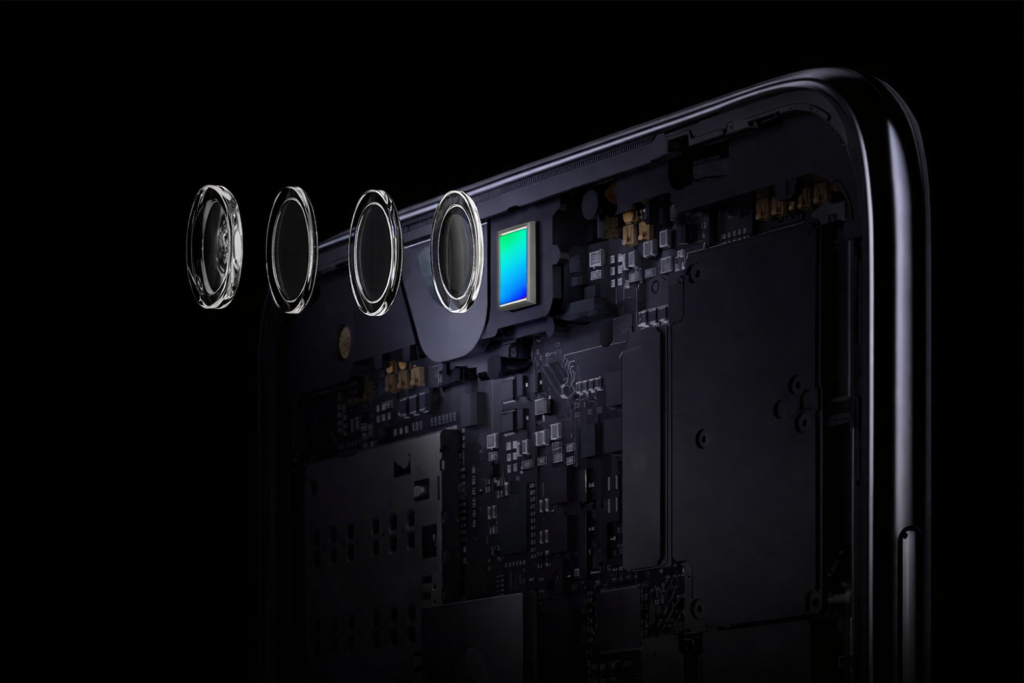
Front Camera

Challenges of 100MP Selfie Sensors

Fitting a hundred million pixels into the punch-hole of a modern display is less about a simple hardware upgrade and more about a breakthrough in engineering. To make this work, brands like Oppo and Huawei are reportedly developing custom “small-pixel” sensors that defy traditional size constraints.

Because these pixels are so tiny, they naturally struggle with light sensitivity, but the industry isn’t just throwing numbers at a wall for the sake of it. They are likely banking on advanced pixel-binning and potentially RYYB color filters to ensure your low-light selfies don’t look grainy.

Vlogging Flexibility

We are now in the social media age, where almost everyone is exploring content creation, whether it’s recording for TikTok, vlogging for YouTube, or sharing high-quality videos on Instagram.

The 100MP square sensor could allow creators to shoot a single high-resolution video vertically for TikTok while seamlessly cropping it into a horizontal format for YouTube, all without compromising 4K clarity.

Manufacturers are also reportedly embracing the new 1:1 square format, an innovation inspired by Apple’s Center Stage feature introduced with the iPhone 17. According to reports, Huawei’s Nova 16 series and Oppo’s Find X10 series are expected to feature these advanced square sensors, signaling a shift in how front-facing cameras are designed.

The real value here isn’t just in capturing more detail but in enabling digital zoom, stabilization, and reframing during post-production without any loss in quality.

This level of flexibility could turn smartphones into powerful tools for content creators, rivaling even dedicated vlogging rigs and making mobile devices the preferred choice for the social media generation.

Spec Race or Genuine Innovation?

Despite the excitement, some might wonder if our devices can handle the immense data demands of a 100MP selfie camera. After all, such high-resolution photos come with significant processing and storage requirements.

However, with the advancements in modern chipsets and AI, refining and optimizing these massive images is no longer a challenge. AI-driven algorithms can efficiently enhance light, detail, and color in real time, ensuring that even high-resolution selfies are polished and ready to share instantly.

Ultimately, the 100MP selfie revolution might be the ultimate spec flex, but innovation is always welcome, and Android manufacturers have proven its value. Unless we experiment with new spaces, we won’t know what to expect.

Five years ago, capturing the moon with such detail seemed impossible, yet here we are. The front camera is the final frontier of smartphone imaging, and it is finally getting the upgrade it deserves.

For more daily updates, please visit our News Section.

Stay ahead in tech! Join our Telegram community and sign up for our daily newsletter of top stories! 💡

The post The 100MP Front Camera Revolution: Necessary or Just Spec Race? appeared first on Gizmochina.
Samsung reveals Galaxy S26 camera upgrade with AI features

Samsung has started teasing what could be the most software-heavy camera shift in Galaxy history. Galaxy S26 series keeps the majority of the camera hardware unchanged, and the 2026 upgrade is realized by AI features.

Ahead of Galaxy Unpacked on February 25, 2026, in San Francisco, Samsung is previewing a unified Galaxy AI camera experience for the Galaxy S26 series.

The pitch is simple on paper: capture, edit and share in one frictionless flow. No jumping between apps, nor exporting files just to fix exposure or crop out distractions. Every brand says something similar, but Samsung is adding a twist.

Samsung describes it as a multimodal system, meaning you can interact with the camera and editing tools more naturally, whether that is through text prompts, context-aware suggestions, or smart post-processing.

Galaxy S26’s biggest camera upgrade

Galaxy S26 will allow users to turn a bright daytime shot into a convincing night scene. Not just darken the frame, but rebuild it with realistic lighting and atmosphere.

It can also restore missing details in photos, which suggests aggressive computational reconstruction when highlights are blown out or shadows are crushed.

There is also multi-photo merging, combining several shots into one final image directly on the device. These tools are apparently powered by Samsung’s new EdgeFusion technology.

Samsung appears to be betting that software, not silicon alone, will carry the Galaxy S26 camera story. It is a clear signal that the company sees AI-driven post-processing as its edge against rivals.

If the company nails the unified flow, where capture, AI enhancement, and sharing feel like one continuous motion, it could reduce friction in a way that matters more than a few extra megapixels ever will.

We will see the full end-to-end Galaxy camera experience next week at Galaxy Unpacked in San Francisco.

The post Samsung reveals Galaxy S26 camera upgrade with AI features appeared first on Sammy Fans.

Galaxy S25 Ultra already has one big S26 Ultra camera feature?

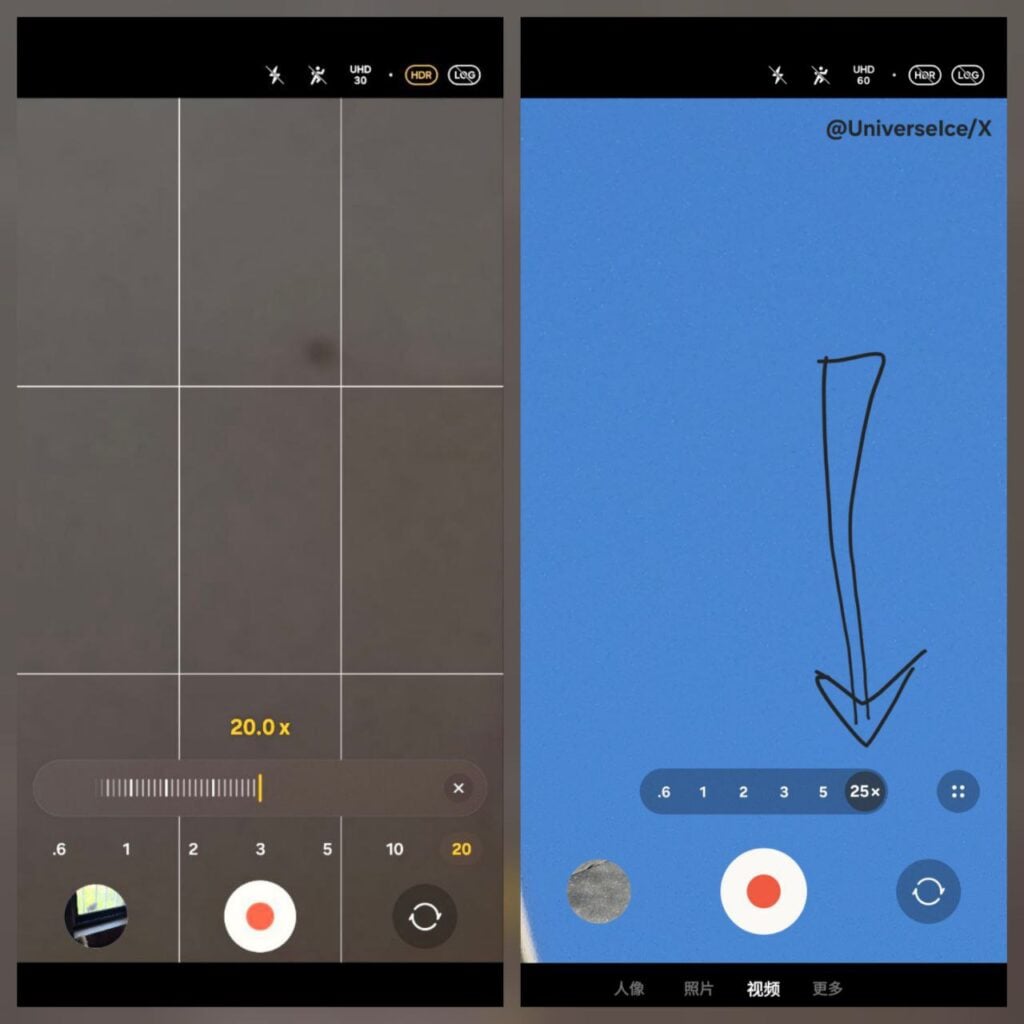
Galaxy S26 Ultra brings a meaningful upgrade to the video camera, which Samsung already brought to the Galaxy S25 Ultra. The upcoming beast, Galaxy S26 Ultra, will push video zoom to 25x, and it’s already available on the S25 Ultra.

The jump from 20x to 25x in video mode is not just flashy. It changes framing flexibility without switching to still capture. The reveal did not come from a flashy teaser, but slipped through the One UI 8.5 Beta on the Galaxy S25 Ultra.

With the January build of One UI 8.5 Alpha, something interesting happened. The stock camera app on the S25 Ultra suddenly unlocked 25x video zoom. That was not there before; the device was officially capped at 20x video zoom.

Samsung rarely expands zoom ceilings mid-cycle unless it is testing code that was originally written for future hardware. We have seen it before with Nightography camera refinements and portrait processing shifts.

The internal One UI 8.5 build basically tipped Samsung’s hand. The 25x limit was not primarily built for the Galaxy S25 Ultra. It was built for the Galaxy S26 Ultra and then quietly pushed downstream to stress test stability in the wild.

Samsung Galaxy S25 Ultra Video Camera Mode

Image – Left One UI 8.5 (Public Beta) | Right One UI 8.5 (Internal Beta)

Out of the box, the Galaxy S25 Ultra maxed out at 20x video zoom. A 5x bump sounds small on paper, but in practice, that extra reach gives creators more cropping headroom and more framing freedom.

Early rumors point to tighter integration with the Snapdragon 8 Elite Gen 5. Qualcomm’s next ISP is expected to lean heavily into real-time AI enhancement. It unlocks cleaner high-zoom footage without needing dramatically different glass.

Samsung is set to unveil the Galaxy S26 Ultra in the US on February 25. The 25x video zoom upgrade may not be the headline feature on stage. It will likely get a quick demo clip (or may be note) and move on.

The post Galaxy S25 Ultra already has one big S26 Ultra camera feature? appeared first on Sammy Fans.

Galaxy S26 Ultra front camera leak teases big upgrade over S25 Ultra

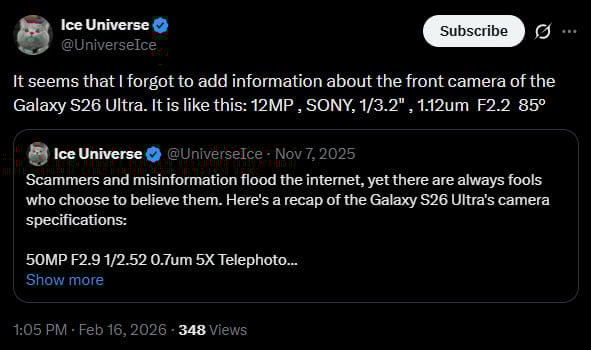
Samsung’s next Ultra is already leaking in pieces, and this one is all about selfies. Reliable tipster IceUniverse has shared fresh details about the front camera of the Galaxy S26 Ultra. The headline change is not resolution, but the sensor supplier.

The upcoming Galaxy S26 Ultra is tipped to retain the 12-megapixel front camera with some twists. Instead of Samsung’s ISOCELL, the device would feature a Sony-made image sensor, probably the IMX874. Here are the key specs:

  • 12-megapixel resolution
  • Sony sensor
  • 1/3.2-inch sensor size
  • 1.12μm pixel size
  • F2.2 aperture
  • 85-degree field of view

The Galaxy S25 Ultra smartphone also shipped with a 12MP F2.2 selfie camera. On paper, this looks nearly identical: same resolution, same aperture, and similar pixel size. The interesting twist is the switch to Sony.

For years, Samsung has used its own ISOCELL sensors across much of its lineup. A move to a Sony sensor in the Ultra line signals something deliberate. Sony’s IMX series has a strong reputation for dynamic range and natural color science.

Samsung Galaxy S26 Ultra front camera

The 1/3.2-inch size and 1.12μm pixels suggest this is still a compact camera. Shoppers shouldn’t expect a dramatic leap in low-light performance. The 85-degree FOV keeps things consistent with the Ultra’s wide framing for group selfies.

The Galaxy S25 Ultra delivered sharp detail, reliable HDR, and strong skin tone processing. A Sony sensor could potentially improve texture handling or dynamic range without touching the headline sensor specifications.

While Sony is taking over ISOCELL on the front, the legacy Sony telephoto is being replaced by an ISOCELL sensor. Samsung is utilizing its in-house camera as the 10-megapixel 3x telephoto module to improve zoom photos and videos.

The post Galaxy S26 Ultra front camera leak teases big upgrade over S25 Ultra appeared first on Sammy Fans.

Galaxy S26 Ultra rebuilds 3x telephoto camera philosophy?

Samsung is using a new 3x telephoto camera in the Galaxy S26 Ultra, which appears to be an intelligent upgrade. The sensor is actually a 12-megapixel solution, but the device trimmed it down to 10-megapixel with reduced size.

Judging from the spec sheet proves that Samsung has downgraded the 3x telephoto camera of the Galaxy S26 Ultra, but the reality seems different. Some recent posts on X let us have an even better idea of the potential benefits.

Samsung did not shrink the camera, but changed the philosophy behind it. The new 3x module built around the ISOCELL 3LD is less about raw glass and more about high-speed silicon.

12MP to 10MP – Why couldn’t it be a downgrade?

The ISOCELL 3LD is natively a 12MP sensor with a 1/3.2 inch optical format. On paper, that sounds larger than the effective 1/3.94 inch number being circulated.

Samsung is only using the center 10 megapixels for the final image. When you crop to the middle portion of a sensor, the diagonal of the active area becomes smaller.

In optics, the diagonal defines the optical format. Shorter diagonal, “smaller” format number. That is how we land at 1/3.94 inch (via ErencanYılmaz), but this is not a lost area; it is a controlled area – as debunked by MyDaebakCafe.

Samsung still outputs a 12MP file to match the main and ultrawide cameras. Multi-frame fusion and intelligent upscaling bring resolution consistency across lenses.

Samsung Galaxy S26 Ultra 3x Telephoto Camera

Courtesy – Daebak 앤디

Integrated DRAM and AI ISP

The real upgrade is not the crop, it is the 3 stack architecture. The ISOCELL 3LD features integrated DRAM, which grabs the image before your subject moves. It reduces rolling shutter artifacts and freezes motion in 3x portraits.

Now pair that with the Snapdragon 8 Gen 5 and its AI ISP. The sensor is engineered to feed massive amounts of data into the ISP in real time. A larger but slower sensor cannot compete if it cannot deliver data quickly enough for the ISP to chew on.

The phone can shift the crop window within that 12MP canvas while still delivering a clean 10MP base frame, later processed into a 12MP output for consistency. The result is gimbal-like stabilization at 3x without sacrificing 4k resolution.

This also contributes to better HDR stacking and near-zero shutter lag, since the sensor and DRAM can rapidly capture multiple frames before you even realize you tapped the shutter.

The post Galaxy S26 Ultra rebuilds 3x telephoto camera philosophy? appeared first on Sammy Fans.

❌