Reading view

Nothing announces Headphone (a) with five days of battery and a lighter design

Nothing-Headphone-a-Launch-Specs-Price

Alongside the Phone (4a) series, Nothing has officially launched the Headphone (a). As an affordable alternative to the Headphone (1), the headphones feature a similar design to the Headphone (1) and offer good battery life and customizable sound.

Nothing Headphone (a) Specifications

The Headphone (a) stands out visually thanks to its four color options: yellow, pink, black, and white. Despite being over-ear headphones, the device is relatively lightweight at 310 grams. It uses memory foam ear cushions designed to sit comfortably during long listening sessions.

Nothing has also added an IP52 rating, meaning the headphones offer protection against dust and light splashes of water.

Inside the Headphone (a) are 40mm drivers with a titanium-coated diaphragm. According to Nothing, this material provides a more rigid structure for the drivers, helping to reduce distortion and deliver cleaner audio.

The headphones support Hi-Resolution Audio Wireless and the LDAC codec. Users can also tweak the sound profile through the Nothing X app, which includes an eight-band equalizer for more precise frequency adjustments than typical bass and treble sliders.

Adaptive Noise Cancellation and Smarter Controls

The Headphone (a) includes adaptive active noise cancellation with three preset levels — low, medium, and high — depending on how much background noise users want to block out.

There is also a transparency mode that lets outside sounds in, allowing users to stay aware of their surroundings. For calls, the headphones feature a three-microphone AI system that analyzes surrounding noise and isolates the user’s voice.

The headphones also use the same physical controls introduced on the earlier Nothing Headphone (1), including a Roller, Paddle, and Button built directly into the ear cups.

Nothing is also introducing a feature called Channel Hop. Users can activate it by pressing the button, allowing them to quickly switch between apps or functions without reaching for their phone. The same button can also work as a remote camera shutter.

As for battery life, Nothing says the headphones can deliver up to five days of continuous listening on a single charge. A quick five-minute charge is said to provide up to five hours of playback.

Price and Availability

The Nothing Headphone (a) will be sold for $199, £149, or €159. Preorders begin on March 5 through Nothing’s website and selected partners.

Open sales for the black, white, and pink versions start on March 13, while the yellow limited edition model will arrive later, on April 6.

Don’t miss a thing! Join our Telegram community for instant updates and grab our free daily newsletter for the best tech stories!

For more daily updates, please visit our News Section.

The post Nothing announces Headphone (a) with five days of battery and a lighter design appeared first on Gizmochina.

Nothing launches Phone (4a) and Phone (4a) Pro, each with its own design identity

Nothing-Phone-4a-Pro-Launched

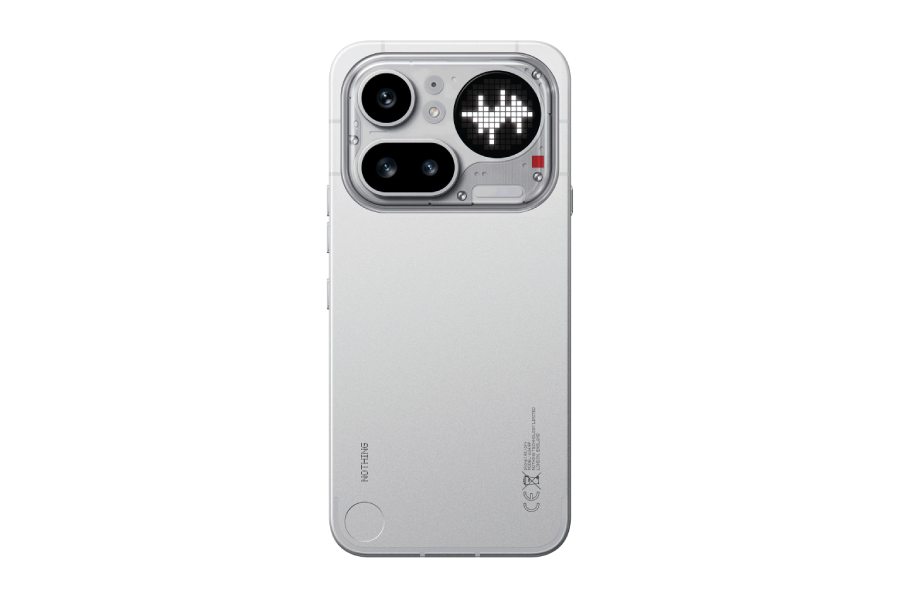
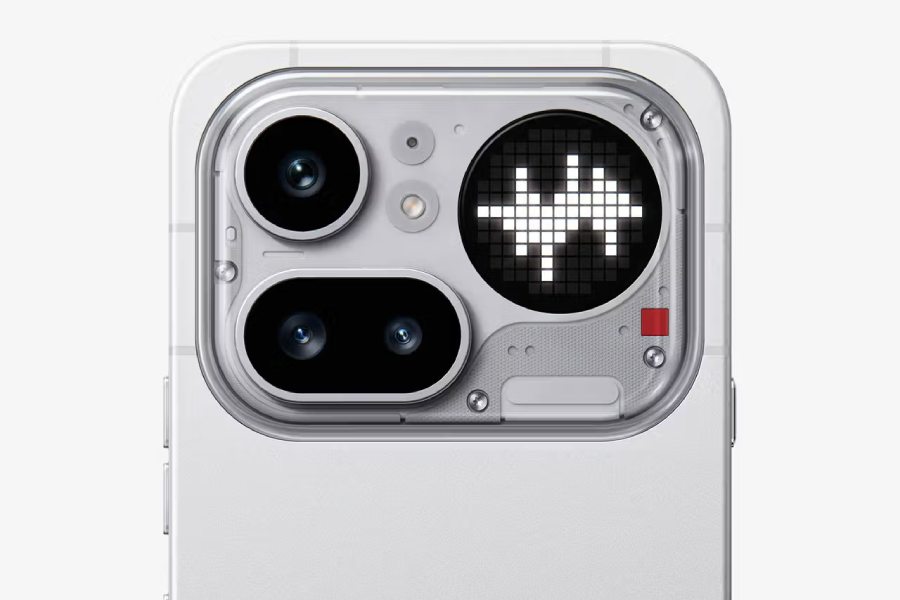
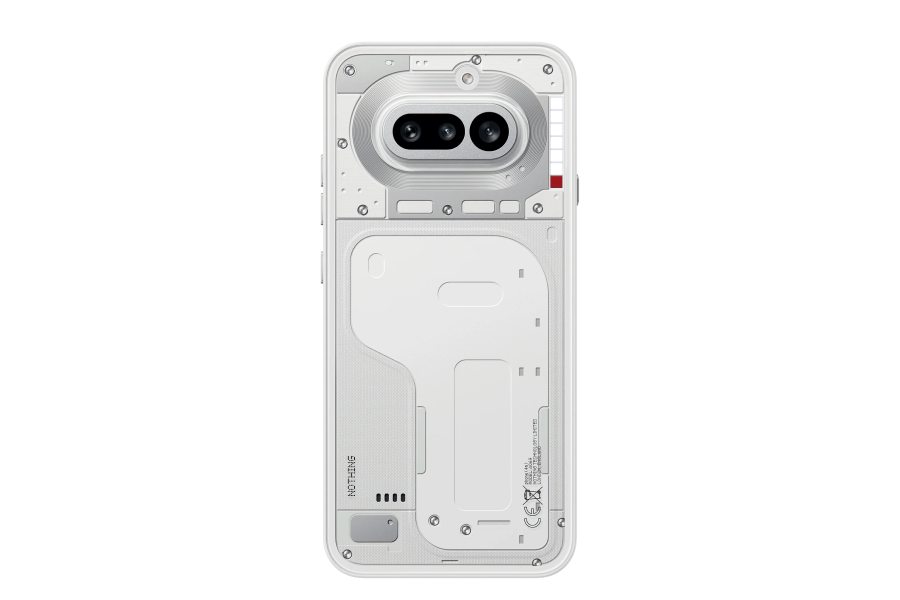
The Nothing Phone (4a) and (4a) Pro are finally here, and unsurprisingly, both phones have their own design and character. The Phone (4a) has a cleaner profile with a pill-shaped rear camera module. Meanwhile, the Nothing Phone (4a) Pro has a bold new look, where the camera module covers the top, housing three camera lenses. 

Nothing Phone (4a)
Nothing Phone (4a) Pro

Both phones also feature redesigned rear lighting systems and arrive with Nothing OS 4.1 based on Android 16. Nothing is promising three major OS updates and six years of security patches, matching the support window offered by the previous generation.

Here’s how the two new models differ.

Nothing Phone (4a)

The Nothing Phone (4a) retains the simpler design of its predecessor. The phone features a pill-shaped rear camera module and a new lighting system called the Glyph Bar on the back.

Glyph Bar places LEDs in a straight strip across the back. The bar is divided into six segments and contains 63 LEDs, along with the red recording indicator. The lights can reach up to 3,500 nits of brightness in three different levels, which is about 40% higher than the previous generation.

Inside, the phone runs on the Snapdragon 7s Gen 4 chipset. While it technically succeeds the Snapdragon 7s Gen 3 used previously, the performance improvement is relatively small—only about 7% per Nothing. It’s paired with 8GB or 12GB of LPDDR4X RAM and up to 256GB of UFS 3.1 storage. 

On the front, it has a 6.78-inch OLED panel with a resolution of 1,224 × 2,720 pixels and supports a 120Hz refresh rate. Peak brightness climbs to 4,500 nits, and the screen is protected by Gorilla Glass 7i.

Camera hardware is where the vanilla model slightly differs from the Pro. The main camera uses a 50-megapixel Samsung GN9 sensor with an f/1.88 lens and optical image stabilization. The rest of the camera setup mirrors the Pro model, including a 50MP 3.5x periscope telephoto lens, an 8MP ultra-wide camera, and a 32MP front camera.

The body uses a plastic frame and measures 8.55mm thick. It carries an IP64 rating for dust and water resistance and features a 5,080mAh batterywith 50W wired charging support.

Price and availability

Pre-orders for the Nothing Phone (4a) start from today, and open sales will begin on March 13. The phone will be available through the official website and select retail partners. Here’s the price breakdown for EU, UK, and India:

  • 8/128GB: €350 / £350 / ₹32,000
  • 8/256GB: €390 / ₹35,000 
  • 12/256GB: €430 / £400 /  ₹38,000

Nothing Phone (4a) Pro

Coming to the Nothing Phone (4a) Pro, the most visible change is the Glyph Matrix. It is a circular LED display on the back of the phone made up of 137 LEDs. While that’s fewer than the 489 LEDs used in the flagship Glyph Matrix seen on Nothing Phone (3), the new version is larger and brighter. 

The circular area is also about 57 percent bigger, and the LEDs can reach up to 3,000 nits of brightness. 

The Pro also upgrades the build quality with a metal unibody design, replacing the plastic frame used on the standard model. Despite the metal switch, the phone remains relatively light and is slimmer at 7.95mm thick.

It carries an IP65 rating for dust and water resistance. Nothing says the phone can survive submersion in water up to 25cm for around 20 minutes.

Under the hood, the phone runs on the Qualcomm Snapdragon 7 Gen 4 processor. Compared to the Snapdragon 7s Gen 3 used in the previous generation, the new chip promises around 27 percent faster CPU performance, 30 percent better graphics performance, and a significant 65 percent boost in AI tasks.

The device pairs the chip with 8GB or 12GB of LPDDR5X RAM and either 128GB or 256GB of UFS 3.1 storage. To maintain sustained performance, Nothing has added a 5,300mm² vapor chamber cooling system.

The display is also larger and faster than the one on the standard model. The phone features a 6.83-inch OLED panel with a 144Hz refresh rate and a resolution of 1,260 × 2,800 pixels. Its peak brightness reaches 5,000 nits, and the panel uses 2,160Hz high-frequency PWM dimming.

Camera hardware on the Pro includes a 50MP Sony Lytia 700C sensor for the main camera with optical image stabilization. The phone also includes a 50MP Samsung JN5 periscope camera offering 3.5x optical zoom, extendable to 7x using in-sensor zoom.

The ultra-wide camera remains unchanged from the previous model with an 8MP Sony IMX355 sensor and a 120-degree field of view. On the front, the phone uses a 32MP selfie camera.

Like the standard model, the Pro includes a 5,080mAh battery with support for 50W wired charging.

Price and availability

Pre-orders for the Nothing Phone (4a) Pro begin on March 13, with open sales starting on March 27. Surprise, surprise, it will also be available in the US. Here’s the pricing breakdown for EU, UK, India, and the US:

  • 8/128GB: €480 / £500 / ₹40,000 / $500
  • 8/256GB: ₹43,000 (only available in India)
  • 12/256GB: €550 / £550 / ₹46,000 / $600

Don’t miss a thing! Join our Telegram community for instant updates and grab our free daily newsletter for the best tech stories!

For more daily updates, please visit our News Section.

The post Nothing launches Phone (4a) and Phone (4a) Pro, each with its own design identity appeared first on Gizmochina.

5 reasons the MacBook Neo isn’t a typical MacBook

Apple just introduced the MacBook Neo as its most affordable laptop at $500. This is a Mac designed to reach people who might otherwise buy a Chromebook or a cheaper Windows laptop.

And at first glance, it’s really captivating. It has an aluminum chassis, weighs just 1.23kg, and comes in four bright colors. The laptop features a 13-inch Liquid Retina display, dual speakers with Dolby Atmos, a 1080p webcam, and up to 16 hours of battery life.

But once you look past the bright colors and the relatively low price, the compromises start to show. To reach this price point, Apple has trimmed back several features that users might expect from a modern MacBook. Some of those changes may not matter much for casual users, but others stand out when compared with the company’s more expensive laptops.

Here are five limitations of the MacBook Neo that you must know before buying Apple’s new entry-level laptop.

It doesn’t use a full-power laptop chip

One of the most unusual aspects of the MacBook Neo is its processor.

Instead of using one of Apple’s laptop-focused chips, like those found in the MacBook Air or MacBook Pro, Apple chose the A18 Pro, the same chip it used in the iPhone 16 Pro.

This choice alone makes it clear where Apple sees the Neo in its lineup. A-series chips are typically designed for iPhones and iPads, not laptops. While they’re powerful and efficient, they aren’t built with the same thermal headroom or performance expectations as Apple’s M-series processors.

Snapdragon 8 Gen 4 vs Apple A18 Pro

The version of the chip used in the MacBook Neo is also slightly reduced. The iPhone version features a 6-core CPU and a 6-core GPU, while the MacBook Neo ships with a 6-core CPU but only a 5-core GPU.

For basic tasks like browsing, document editing, or streaming, the chip should still be more than capable. Apple is also using a fanless design, which means the laptop operates completely silently. But for heavier workloads like video editing, the Neo may fall short compared with laptops powered by Apple’s M-series chips.

Limited memory and slower memory bandwidth

Memory is another area where Apple has made clear compromises. The MacBook Neo comes with 8GB of RAM, and unlike many other Apple computers, users cannot upgrade it when ordering the device. That means buyers are locked into the base configuration.

By comparison, newer Mac models now start with 16GB of RAM, including updated versions of the MacBook Air.

Because Apple uses unified memory architecture — where the CPU and GPU share the same memory pool — the amount of RAM can affect multiple parts of the system at once. Lower memory limits may become noticeable when running many browser tabs, multitasking across apps, or working with large files.

There’s also a difference in memory bandwidth. The MacBook Neo offers 60GB/s, which is less than half of what the MacBook Air provides.

The display loses several premium features

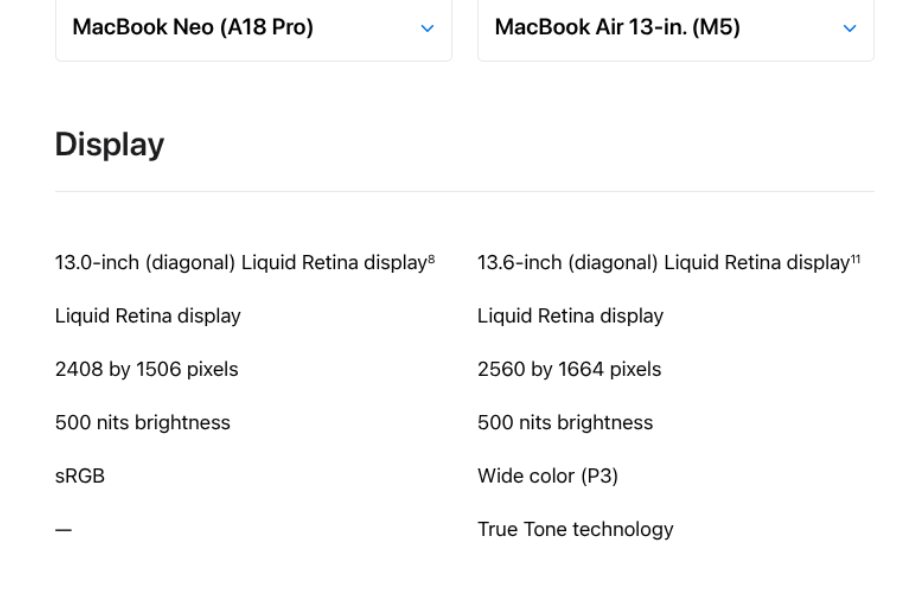
Apple is still calling the screen on the MacBook Neo a Liquid Retina display, but it’s not the same type of panel used in the company’s other laptops.

The 13-inch display has a resolution of 2408 × 1506, supports 1 billion colors, and reaches 500 nits of brightness, which matches the brightness level of the MacBook Air. However, there are several missing features.

First, the display only covers the sRGB color gamut, rather than the wider P3 color space supported by the MacBook Air since it switched to Apple silicon in 2020.

The display also does not support True Tone, Apple’s technology that automatically adjusts color temperature based on ambient lighting.

And perhaps more surprisingly, the MacBook Neo doesn’t include an ambient light sensor at all. That means the system cannot automatically adjust screen brightness depending on the environment.

No Magnetic Charging

Finally, the MacBook Neo removes a few physical hardware features that are common on other MacBooks.

One of the biggest differences is charging. Unlike the MacBook Air and MacBook Pro, the Neo does not include a MagSafe magnetic charging port. 

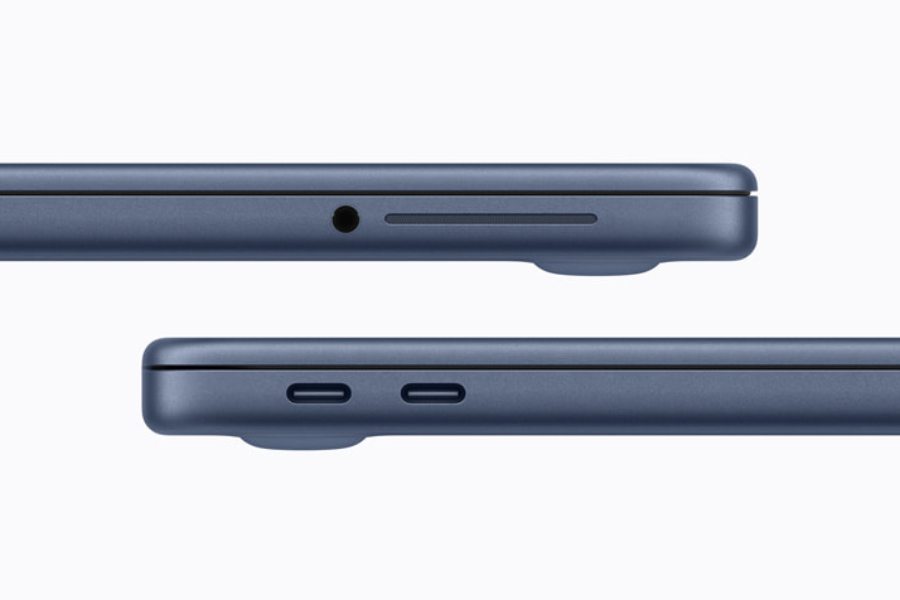
Instead, it relies on two USB-C ports, both located on the left side of the laptop. One of these ports supports USB 3 speeds up to 10Gb/s, while the other is limited to USB 2 speeds up to 480Mb/s.

Using USB-C for charging is not unusual, but MagSafe has become a popular feature because it detaches easily if someone trips over the charging cable. Also, it clears the USB-C port for other tasks.

Keyboard without backlight

Last but not least, there are compromises in keyboard and trackpad, too.

The keyboard does not include backlighting. It been a standard for MacBooks to include a backlit keyboard, but Neo is an exception.

Meanwhile, the trackpad is a simpler physical multi-touch trackpad instead of Apple’s Force Touch design. That means it lacks pressure sensitivity, force click features, and pressure-sensitive drawing.

Even Touch ID is optional. The base 256GB model doesn’t include it, though it is available if users upgrade to the 512GB version.

For more daily updates, please visit our News Section.

Stay ahead in tech! Join our Telegram community and sign up for our daily newsletter of top stories

The post 5 reasons the MacBook Neo isn’t a typical MacBook appeared first on Gizmochina.

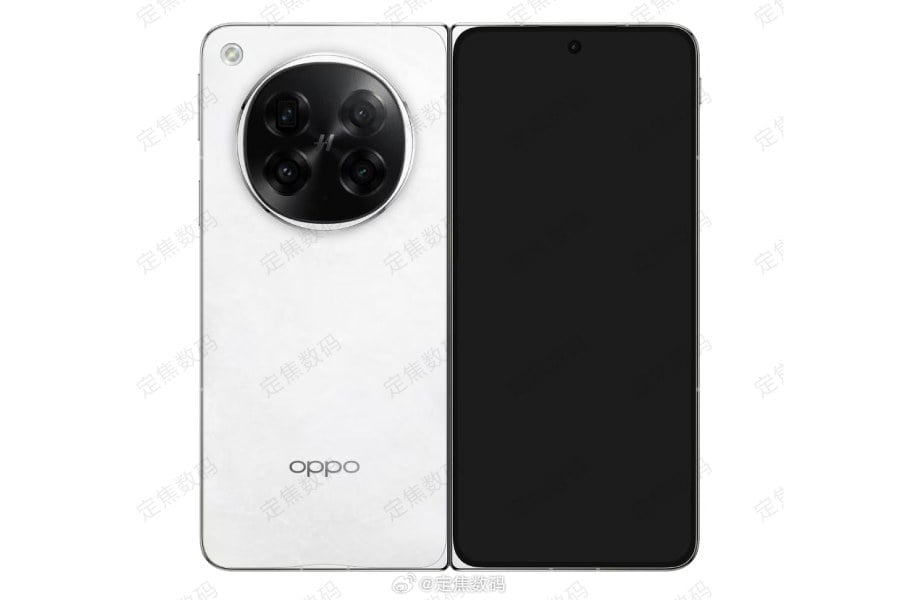
Oppo Find N6 leaks in full with dual LTPO display, titanium hinge, 6000mAh battery

Oppo Find N6 specs features leak

Oppo is gearing up to launch the Find N6 foldable in China, and this time, it looks like a global release is on the table, too. There’s still no official date, but a flurry of recent posts on the Chinese social media platform Weibo have spilled the full spec sheet ahead of schedule.

Here’s everything we know so far about the Oppo Find N6.

Display

According to the leak, the Find N6 may feature a 6.62-inch external display with a 1.5K+ resolution. The panel is reportedly based on BOE’s Q10 technology and supports Dolby Vision, HDR Vivid, and HDR10+. It’s also said to use an 8T LTPO panel with a variable refresh rate ranging from 1Hz to 120Hz.

Oppo Find N6 presentation leaks on Weibo

The external screen is said to reach up to 1,600 nits of global peak brightness, while manual brightness tops out at 800 nits. For eye comfort, the panel reportedly combines Pulse DC-like dimming at high brightness levels with 2160Hz PWM dimming when brightness is low.

Inside, the foldable screen may measure 8.12 inches with a sharper 2K+ resolution. This internal display is expected to use a Samsung E7 panel and offer the same HDR standards and 1–120Hz adaptive refresh rate. It has 2160Hz PWM dimming at lower brightness levels.

Triple-camera system

The camera setup described in the leak includes three sensors. It has a 50MP 0.6x ultra-wide camera with a 15mm lens and an f/2.0 aperture, which is reportedly paired with Samsung’s JN5 sensor.

Oppo-Find-N6-White-2
Oppo FInd N6 in White

The main camera could use a 200MP 23mm lens with an f/1.8 aperture and optical image stabilization, reportedly based on the HP5 sensor. The 3x telephoto camera offers a 70mm focal length and f/2.7 aperture with OIS. The device is also said to feature a second-generation “Danxia” lens system.

Flagship hardware and durability

On the performance side, the Find N6 is expected to run on Qualcomm Snapdragon 8 Elite Gen 5 paired with LPDDR5X RAM and UFS 4.1 storage.

The leak mentions a titanium alloy dome hinge, along with multiple dust and water resistance certifications, including IP56, IP58, and IP59. The device is also said to include a new Shanhai communication chip, super linear dual speakers, and an infrared remote control.

Moreover, the Find N6 is rumored to include a 6,000mAh third-generation Glacier Battery, with 80W wired and 50W wireless charging. 

For more daily updates, please visit our News Section.

Stay ahead in tech! Join our Telegram community and sign up for our daily newsletter of top stories

The post Oppo Find N6 leaks in full with dual LTPO display, titanium hinge, 6000mAh battery appeared first on Gizmochina.

Honor 600 Lite launches without fanfare, has a 6520mAh battery

Honor-600-Lite-Launch-Specs-and-Price

Just a few days after its reveal in full, Honor has quietly introduced the Honor 600 Lite in Malaysia. The company didn’t hold an event or make a big announcement, but the new Honor 600 Lite is now officially listed and available for purchase in the country.

At a glance, the phone sticks to a fairly simple design. The front features a pill-shaped notch, while the back has a rectangular camera module with two lenses and an LED flash. 

On the right side of the frame, Honor has added a dedicated shutter button likely to wake the camera with one touch. The device is available in two color options: Velvet Grey and Desert Gold.

Honor 600 Lite Specifications

Up front, the Honor 600 Lite features a 6.6-inch AMOLED display with a 1.5K screen resolution. The panel also supports a 120Hz refresh rate and has 6,500 nits of peak brightness.

Powering the phone is MediaTek’s MediaTek Dimensity 7100 Elite processor. The chip is paired with 12GB of RAM and 256GB of internal storage. 

The camera setup is built around a 108-megapixel primary sensor. It’s accompanied by a 5-megapixel ultra-wide camera, while a 16-megapixel camera on the front handles selfies. 

Moving on, the Honor 600 Lite packs a 6,520mAh battery, and top-up is handled through 45W wired charging.

The phone also supports Bluetooth 6.0, NFC, and carries an IP66 rating for water and dust resistance. On the software side, it runs MagicOS 10 based on Android 16.

The Honor 600 Lite is now available in Malaysia with a retail price of RM1,399 (~ $355). For a limited time, Honor is offering a RM100 (~ $25) rebate along with a 1+1 year extended warranty worth RM99.

For more daily updates, please visit our News Section.

Stay ahead in tech! Join our Telegram community and sign up for our daily newsletter of top stories.

The post Honor 600 Lite launches without fanfare, has a 6520mAh battery appeared first on Gizmochina.
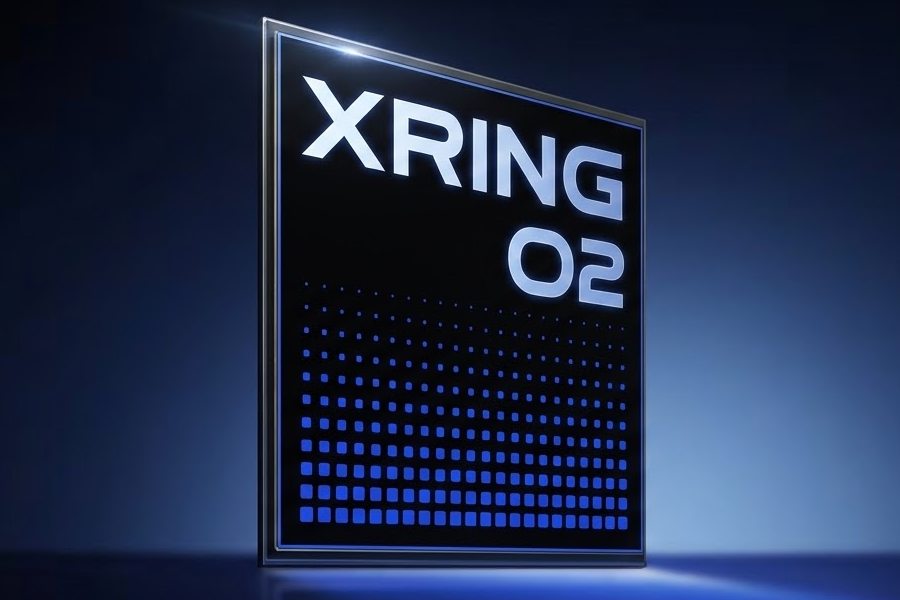
Xiaomi XRING O2 to launch this year, to be based on 3nm process

Xiaomi-XRING-O2

Xiaomi introduced its in-house XRING O1 mobile processor back in May last year. Seems like the company is now gearing up for its successor.

According to well-known leaker Digital Chat Station, Xiaomi will “definitely” launch a new XRING-branded chip this year, possibly called the XRING O2.

Like its predecessor, it is said to be manufactured using TSMC’s 3nm process. While the naming has not been officially confirmed, it is expected to be the direct successor to the O1.

Xiaomi plans to launch a new mobile processor every year moving forward

The XRING O1 is Xiaomi’s first self-developed flagship SoC, built on TSMC’s second-generation 3-nanometer process. The chip later debuted inside the Xiaomi 15S Pro, where it delivered competitive benchmark scores and solid real-world performance.

In a recent interview with CNBC, Xiaomi Group President Lu Weibing said the company plans to release a brand-new self-developed mobile phone processor every year going forward.

Outside of companies like Apple and Samsung, most Android phone makers rely heavily on chip suppliers such as Qualcomm and MediaTek. Xiaomi’s entry into that small club signals a longer-term strategic shift that will give the brand greater control over its products.

However, Xiaomi’s chip ambitions are not limited to smartphones. The company is reportedly planning to expand the use of its next-generation silicon across a wider range of smart devices within its ecosystem. This could include tablets, wearables, and other connected hardware.

When Xiaomi first launched the O1, it positioned the chip as a foundational step. Founder Lei Jun previously said that self-developed chips typically require three to four years of research and development.

He explained that the first generation was more about validating the underlying technology than chasing large shipment volumes, and pre-order quantities were intentionally limited.

On paper, however, the O1 was no small experiment. Built on Arm-based CPU and GPU architectures, it achieved a multi-core benchmark score above 9,000, placing it among top-tier flagship chips. For a first attempt, that was enough to draw attention.

For more daily updates, please visit our News Section.

Stay ahead in tech! Join our Telegram community and sign up for our daily newsletter of top stories! 💡

(Source | Via)

The post Xiaomi XRING O2 to launch this year, to be based on 3nm process appeared first on Gizmochina.
AnTuTu’s February flagship rankings are out, and iQOO leads the pack

iQOO 15 Ultra

AnTuTu’s Android performance rankings for February 2026 are out, and there’s a new device at the top.

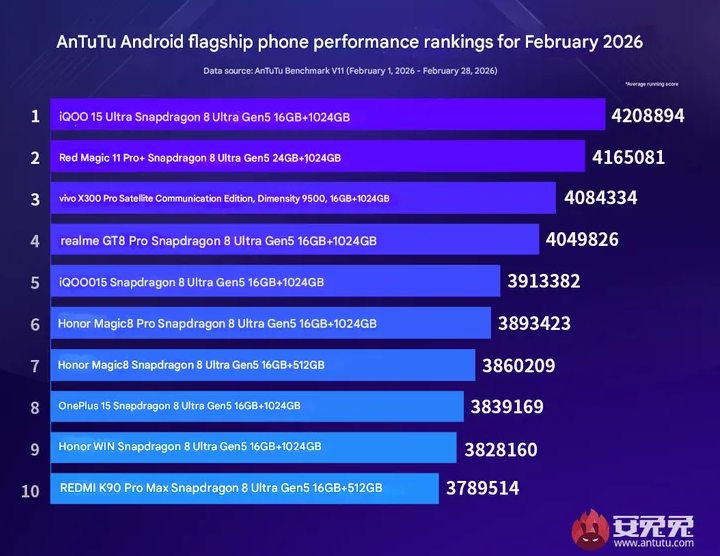
The iQOO 15 Ultra has claimed the number one spot on the flagship list, ending the recent streak of the Red Magic 11 Pro+. With an average score of 4.2 million points, the iQOO phone now sets the pace for Android performance this month. 

iQOO 15 Ultra

The Red Magic 11 Pro+, which had held onto first place in previous rankings, slips to second with an average of 4.16 million. Irrespective of numbers, both phone runs on Qualcomm’s Snapdragon 8 Elite Gen 5 processor. 

In third place is the Vivo X300 Pro Satellite Communication Edition, powered by MediaTek’s Dimensity 9500 chipset. It posts an average score of 4.08 million. Not to mention, it’s also the only MediaTek-powered phone on the list. 

It’s all Snapdragon moving forward

From the Realme GT 8 Pro at fourth to the Redmi K90 Pro Max at tenth spot, all use a Snapdragon 8 Elite Gen 5 chip at the helm.

So it’s unsurprising to say that the Snapdragon 8 Elite Gen 5 has become the mainstream choice for high-end Android devices. Multiple phones powered by the chip are now comfortably crossing the 4 million mark in AnTuTu’s scoring system. 

It’s also worth noting how AnTuTu calculates these rankings. The published score reflects the average of all benchmark results recorded for each model during the month, not the single highest score a device may achieve.

That means the numbers can differ from marketing claims or isolated screenshots circulating online. In theory, the average score should provide a more realistic reference point for day-to-day performance.

For more daily updates, please visit our News Section.

Stay ahead in tech! Join our Telegram community and sign up for our daily newsletter of top stories! 💡

The post AnTuTu’s February flagship rankings are out, and iQOO leads the pack appeared first on Gizmochina.

Xiaomi changes plan, Pad 8 to launch before Xiaomi 17 series in India

Xiaomi Pad 8

Xiaomi is readjusting its India launch timeline for the Xiaomi Pad 8 and the Xiaomi 17 series.

The company originally unveiled the Xiaomi 17 series at MWC 2026. Soon after that, it announced that the phones, along with the tablet, would launch on March 11. However, Xiaomi has now confirmed that the India launch has been rescheduled.

According to updates shared on X, the Xiaomi Pad 8 will arrive on March 10, with the Xiaomi 17 series following a day later on March 11.

Xiaomi Pad 8

For India, Xiaomi is keeping the spotlight on the standard Pad 8. It features an 11.2-inch LCD panel with a 3.2K resolution (3200 x 2136) and a 3:2 aspect ratio, which is slightly taller than the usual 16:10 format seen on many Android tablets.

The display supports a 144Hz adaptive refresh rate and peaks at 800 nits of brightness. It also brings Dolby Vision and HDR10 support, along with 12-bit color depth.

Xiaomi Pad 8

Furthermore, the screen supports wet-touch input and carries TÜV Rheinland certifications for low blue light, flicker-free viewing, and circadian-friendly performance. 

Powering the Pad 8 is Qualcomm’s Snapdragon 8s Gen 4 chip built on a 4nm process, paired with LPDDR5X RAM. Storage options include 128GB with UFS 3.1 or 256GB/512GB with faster UFS 4.1.

The tablet runs on HyperOS 3, Xiaomi’s latest software platform, which adds split-screen multitasking, a workstation mode, PC-like drag-and-drop browsing, and AI tools such as AI Writing, AI Translate, and AI Art.

Xiaomi 17 series

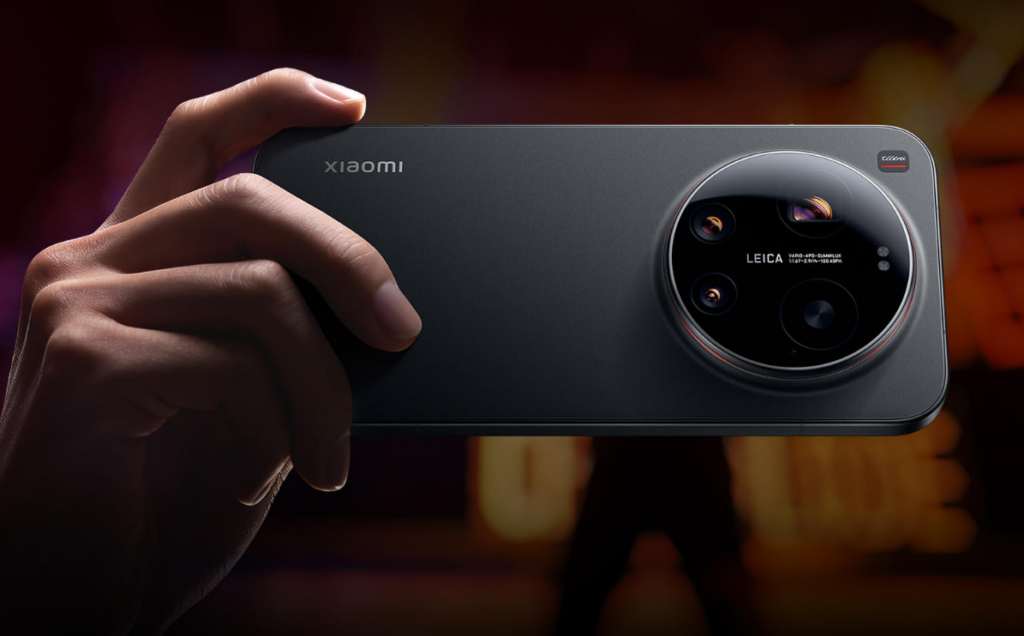
On March 11, Xiaomi will launch the Xiaomi 17 and Xiaomi 17 Ultra in India. Notably, the Leica-branded Ultra variant available in some global markets won’t be making its way to India.

There’s also a battery difference depending on the region. While Chinese variants of the Ultra models feature 6,800mAh batteries, the global and Indian versions are equipped with 6,000mAh units. 

The Indian microsite confirms that the Xiaomi 17 Ultra will support 90W wired HyperCharge and 50W wireless HyperCharge. Another feature Xiaomi is highlighting is Offline Communication, which enables network-free voice calls up to 1.9 kilometers using Bluetooth and proprietary protocols.

For more daily updates, please visit our News Section.

Stay ahead in tech! Join our Telegram community and sign up for our daily newsletter of top stories! 💡

The post Xiaomi changes plan, Pad 8 to launch before Xiaomi 17 series in India appeared first on Gizmochina.

Samsung Galaxy A57 and A37 retailer listing confirms price hike, here are the details

Sasmsung Galaxy A56 (left) and Galaxy A36 (right)

Samsung’s next midrange phones are getting expensive. Tipster Sudhanshu Ambhore on X spotted the upcoming Galaxy A57 and Galaxy A37 on a European retail listing, revealing the price of two phones. And yes, it suggests a price hike.

If the leak is accurate, the Galaxy A57 with 6GB of RAM and 128GB of storage could cost €439. The higher-end model with 8GB of RAM and 256GB of storage may go up to €539.

The Galaxy A37, meanwhile, is listed at €539 for the 8GB RAM + 128GB variant, while the 8GB RAM + 256GB model could reach €609.

Samsung Galaxy A37 and A57 prices for Europe:

Galaxy A37
• 6GB+128GB: €439
• 8GB+256GB: €539

Galaxy A57
• 8GB+128GB: €539
• 8GB+256GB: €609 pic.twitter.com/O7bAYH5Vaz

— Sudhanshu Ambhore (@Sudhanshu1414) March 3, 2026

For comparison, Samsung launched the Galaxy A36 and the Galaxy A56 at starting prices of €379 and €479, respectively, for the same storage variants. That means Samsung may be planning a €60 price increase across the board without increasing memory or storage. 

What to expect from the Galaxy A37

According to leaks, the Galaxy A37 could be powered by Samsung’s Exynos 1480 chipset, the same processor used in last year’s Galaxy A55. 

Samsung Galaxy A37 5G
Samsung Galaxy A37 in certification listing

It will feature a triple rear camera setup, headlined by a 50-megapixel primary sensor with OIS, an 8-megapixel ultra-wide, and a 5-megapixel macro camera. The phone could pack a 5,000mAh battery with 45W charging support.

Some reports also suggest the device could ship with Android 16 and One UI 8.5, though that may depend on its final release date.

What to expect from the Galaxy A57

The Galaxy A57 is expected to sit slightly higher in Samsung’s lineup. It may feature a newer Exynos 1680 processor and a 6.6-inch AMOLED display with a 120Hz refresh rate.

Samsung-Galaxy-A57-Design
Samsung Galaxy A57 in TENAA listing

It’s also said to come with a 5,000mAh battery and 45W charging. Other possible features include IP67 water resistance and stereo speakers.

Samsung has yet to announce the device officially.

Don’t miss a thing! Join our Telegram community for instant updates and grab our free daily newsletter for the best tech stories!

For more daily updates, please visit our News Section.

(Via)

The post Samsung Galaxy A57 and A37 retailer listing confirms price hike, here are the details appeared first on Gizmochina.
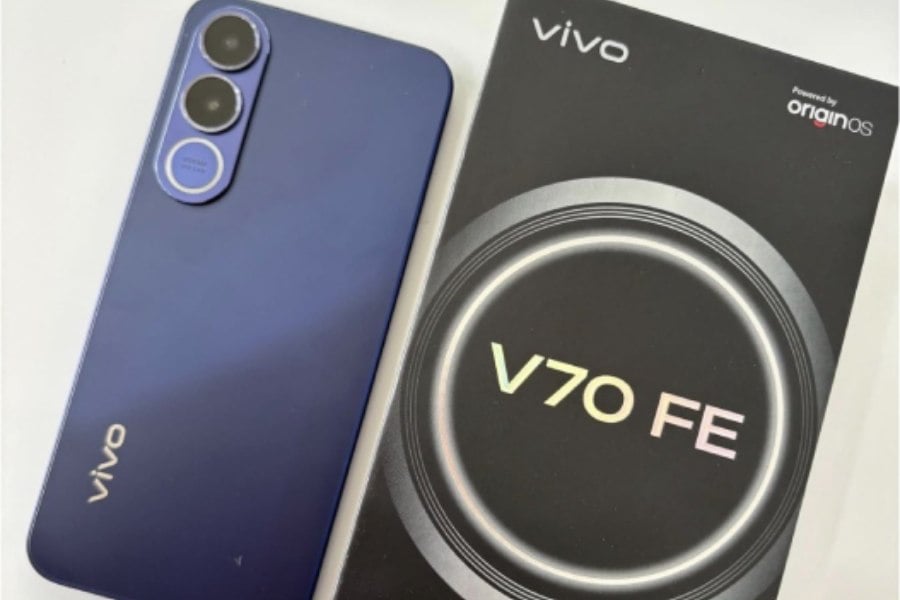
Vivo V70 FE to debut in three colors with 200MP primary camera

Vivo-V70-FE-launch-announced

The Vivo V70 FE has largely been revealed ahead of its official debut, thanks to a steady stream of leaks. Now, Vivo has confirmed it’ll launch the phone in Indonesia on March 9. Joining it is the Vivo V70, which has already debuted in India.

Vivo has also started teasing key details ahead of the event. The company confirmed that the V70 FE will ship with a dual rear camera system led by a 200-megapixel primary sensor. 

Teaser images also show off the phone’s slim display bezels and three color options—Muse Purple, Ocean Blue, and Titanium Silver. 

Vivo V70 FE Specifications (Expected)

Alongside the 200MP main sensor sits an 8-megapixel ultra-wide camera for broader scenes. On the front, there’s a 32-megapixel camera designed for selfies and video calls.

The V70 FE is expected to feature a 6.83-inch AMOLED display with a 1.5K resolution and a 120Hz refresh rate. If you notice, the screen also has a gentle curve on the side. 

Powering the device is MediaTek’s Dimensity 7360-Turbo chipset, built on a 4nm manufacturing process. It’s paired with multiple memory options: 8GB of RAM with 256GB of storage, 12GB with 256GB, and 8GB with 512GB.

The phone runs on OriginOS 6 out of the box. Vivo says it will support the device with up to six years of system updates and promises five years of smooth performance.

The V70 FE packs a large 7,000mAh “BlueVolt” battery, paired with 90W FlashCharge support for faster top-ups.

Rounding out the spec sheet are dual stereo speakers and IP68 and IP69 ratings for dust and water resistance.

For more daily updates, please visit our News Section.

Stay ahead in tech! Join our Telegram community and sign up for our daily newsletter of top stories.

The post Vivo V70 FE to debut in three colors with 200MP primary camera appeared first on Gizmochina.

OnePlus 16, iQOO 16, and Redmi K100 Pro Max all tipped to launch at higher starting prices

OnePlus 15

2026 is expected to be the year when Apple, Qualcomm, and MediaTek release their 2nm flagship mobile processors. Apple is reportedly preparing its A20 series chip. Qualcomm is working on the Snapdragon 8 Elite Gen 6 series, while MediaTek is said to be developing the Dimensity 9600.

On paper, this new silicon is expected to deliver a major performance leap across flagship smartphones. But there’s a catch, an expensive one in fact.

According to recent reports, the cost of a single 2nm wafer from TSMC is expected to exceed $30,000. That’s nearly double the price of today’s mainstream 4nm wafers. Manufacturing at this scale is not just technologically difficult; it’s also financially demanding.

Flagship phones from sub-brands will increase in price in 2026

When core components become more expensive, the final product usually follows. A well-known industry tipster, Digital Chat Station, claims that next-generation flagship smartphones from sub-brands like OnePlus, iQOO, and Redmi equipped with 2nm chips will start at 5,000 yuan (~$725). The base variant is said to feature 12GB of RAM and 256GB of storage.

For comparison, current flagships from these brands start at significantly lower prices. The OnePlus 15 starts at 3,999 yuan for the 12GB/256GB variant. The iQOO 15 launched at 4,199 yuan. Likewise, the Redmi K90 Pro Max retails for 3,999 yuan.

Brands are unlikely to absorb higher chip fabrication costs on their own. Instead, many are expected to adopt differentiated strategies within their product lineups. Not every model will ship with a 2nm processor; standard versions may continue using refined 3nm chips, which are more mature and less expensive to produce.

For consumers, the promise of faster speeds and improved battery efficiency is appealing. But so is a reasonable price. If entry-level flagship pricing climbs past 5,000 yuan, the barrier to experiencing cutting-edge hardware will rise significantly.

Don’t miss a thing! Join our Telegram community for instant updates and grab our free daily newsletter for the best tech stories!

For more daily updates, please visit our News Section.

(Source)

The post OnePlus 16, iQOO 16, and Redmi K100 Pro Max all tipped to launch at higher starting prices appeared first on Gizmochina.

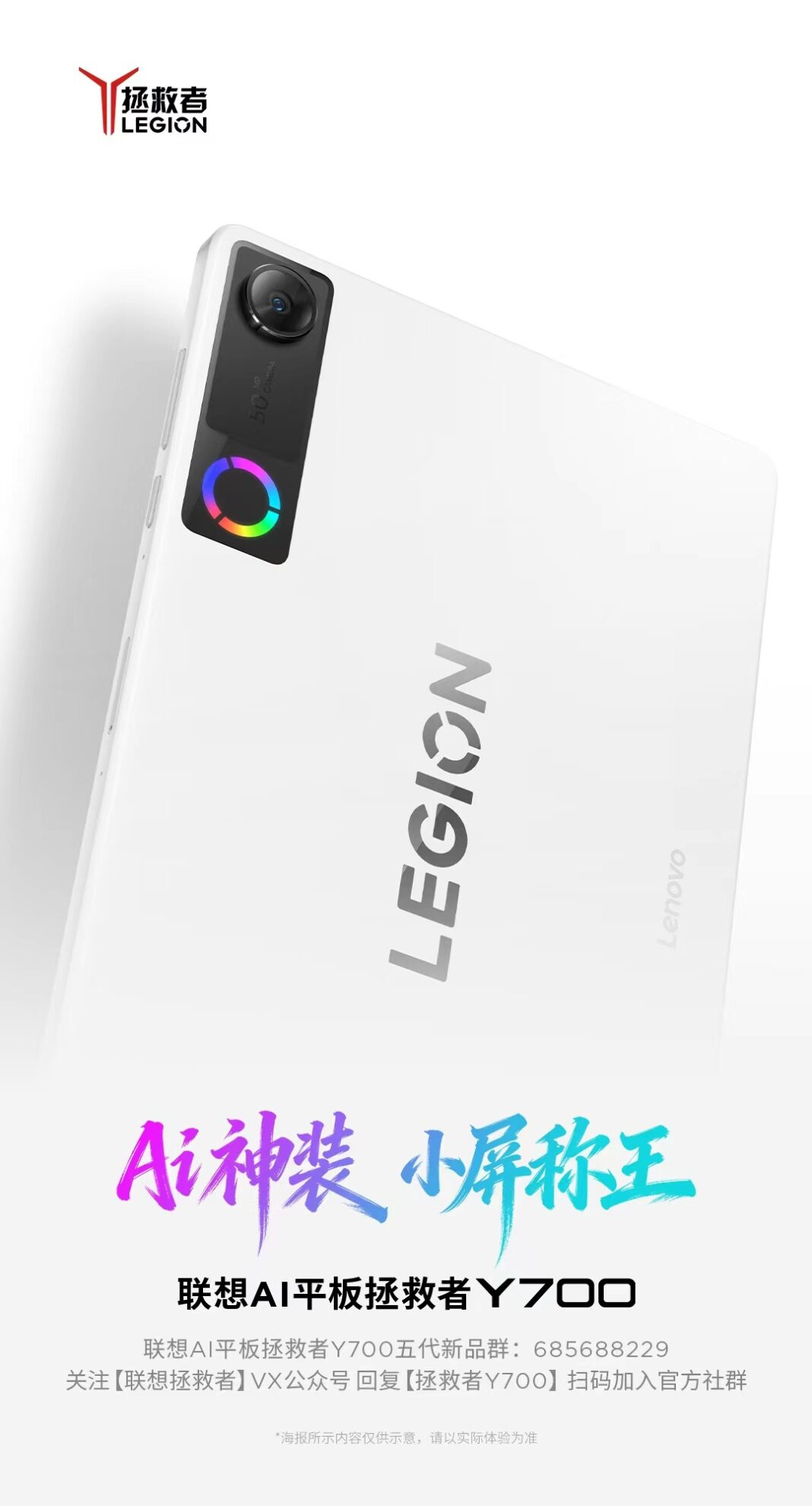
Lenovo confirms Xiaoxin Pro 13 and Legion Y700 (2026) launch date, here are the specs we know

Lenovo-Xiaoxin-Pro-13-Launch-Specs

Lenovo has been teasing the Xiaoxin Pro 13 and Legion Y700 (2026) tablet for quite some time. Now, we finally have a date to look forward to.

Lenovo today confirmed that it will hold an AI-focused tablet launch event on March 18, where it will introduce the fifth-generation Legion Y700 and the Xiaoxin Pro 13.

According to Lenovo, the new Legion Y700 delivers the strongest performance in the lineup’s history. The Xiaoxin Pro 13 series, meanwhile, focuses on its display, which Lenovo says is the largest and best screen the series has offered so far.

If some of this sounds familiar, that’s because Lenovo already showed part of its hand at MWC. 

The company recently introduced the Lenovo Legion Tab (8.8”, 5), which is said to be the international version of the Legion Y700 (2026). It also unveiled the Lenovo Idea Tab Pro Gen 2, which could be the upcoming Xiaoxin Pro 13 for the global market. 

Lenovo Legion Y700 (2026) Specifications

The Legion Tab (8.8”, 5) is powered by Qualcomm’s Snapdragon 8 Elite Gen 5 processor and features an 8.8-inch 3K display with a 165Hz refresh rate and 600 nits of brightness. 

It comes with 16GB of LPDDR5X-10667 RAM and 512GB of UFS storage. There are dual USB-C ports, a 9,000mAh battery, and a total weight of 360 grams.

Lenovo says its upgraded Legion Coldfront liquid cooling system is 32 percent more efficient than the previous generation. The tablet also includes Lenovo’s AI Engine+ software, which uses AI to enhance audio quality, reduce noise, and improve touch responsiveness.

The Legion Tab (8.8”, 5) is scheduled to go on sale in April 2026, with a starting price of €999.

Lenovo Xiaoxin Pro 13 Specifications

On the other side, the Idea Tab Pro Gen 2 runs on Qualcomm’s Snapdragon 8s Gen 4 platform and features a 13-inch 3.5K PureSight Pro display, with an optional matte eye-care panel. It includes a JBL quad-speaker system and supports Dolby Vision and Dolby Atmos.

The tablet is just 6.20mm thick and weighs under 600 grams. Inside, there’s a 10,200mAh battery with support for 45W fast charging. Lenovo is also bundling a 2-in-1 keyboard with a dedicated smart key, and the tablet supports the Lenovo Tab Pen Plus stylus for note-taking and drawing.

The Idea Tab Pro Gen 2 is set to launch in March 2026 with a starting price of €549.

For more daily updates, please visit our News Section.

Stay ahead in tech! Join our Telegram community and sign up for our daily newsletter of top stories! 💡

The post Lenovo confirms Xiaoxin Pro 13 and Legion Y700 (2026) launch date, here are the specs we know appeared first on Gizmochina.

JBL launches GO 5 Bluetooth speaker with audio tuned by Harman Acoustics

JBL-GO-3-IP-Rating

JBL has quietly announced the new JBL GO 5 speaker. The small, colorful Bluetooth speaker builds on the familiar GO design, but this time JBL is layering in a handful of meaningful upgrades.

At first glance, not much has changed about the design. The GO 5 keeps its compact, block-like shape, measuring 101 x 77.4 x 43 mm and weighing about 230 grams. It’s small enough to slip into a bag pocket without much thought. 

JBL is offering it in six color options, including Black, Red, Sky Blue, Pink, Orange, and Deep Blue (Cloisonne). There’s also WINK ambient lighting built in for a subtle visual layer. And as expected, the speaker comes with an IP68 rating for dust and water resistance. 

JBL GO 5 Specifications

Internally, JBL says the GO 5 has been tuned by the Harman Acoustics team. Output power is rated at 4.8W RMS, a modest bump that suggests slightly stronger sound compared to previous models. 

It uses a 45mm driver and offers a frequency response range of 100 Hz to 19 kHz (-6dB), with a signal-to-noise ratio above 85 dB. As expected from a speaker of this size, it’s built more for personal listening and small gatherings rather than filling large rooms.

For connectivity, the GO 5 moves to Bluetooth 6.0 and supports SBC, AAC, and LC3 codecs. JBL is also adding support for Bluetooth AURACAST, a newer feature designed to broadcast audio to multiple compatible devices. There’s an AirTouch one-touch pairing function as well, aimed at simplifying the setup process.

If you own more than one GO 5, you can power them on and have two units automatically connect to form a stereo pair. Multiple speakers can also be wirelessly linked together for a wider sound setup. 

For those who prefer a wired option, the GO 5 supports direct USB-C connection to a computer and includes a built-in DAC chip for digital audio playback.

Inside, there’s a 1000mAh lithium-ion battery (3.85Wh, equivalent to 3.8V/1000mAh). JBL claims up to 8 hours of music playback with lights off, depending on volume level and audio content. Charging takes about three hours using a 5V/1A USB-C input. The maximum operating temperature is listed at 40°C.

The JBL GO 5 is now available for pre-order in China for 399 yuan (roughly $58), with broader global availability expected in the coming days.

For more daily updates, please visit our News Section.

Stay ahead in tech! Join our Telegram community and sign up for our daily newsletter of top stories

(Via)

The post JBL launches GO 5 Bluetooth speaker with audio tuned by Harman Acoustics appeared first on Gizmochina.

Keychron launches the B11 Pro foldable keyboard with 138 hours of battery life

Keychron-B11-Pro-foldable-keyboard-launch-specs-price

Keychron has introduced a new portable keyboard that folds in half and fits into a bag with ease. The new B11 Pro is designed for people who work across multiple devices and want something more ergonomic than the usual flat, straight keyboard layout.

Keychron B11 Pro Keyboard Specifications

The B11 Pro uses what Keychron calls a flat Alice layout. Unlike a traditional horizontal keyboard, the Alice-style design slightly splits and angles the keys to create a more natural typing position. 

It’s meant to reduce wrist strain over long sessions, while still keeping a familiar key arrangement. The keyboard supports all major platforms: macOS, Windows, and Linux.

As its name suggests, portability is a big part of the pitch. The B11 Pro features an inward-folding design, so the keys fold into themselves when closed. The main body is made of ABS plastic, while the back is covered in matte black PU leather.

At 258 grams, it’s light enough to carry around daily without adding noticeable weight to a backpack. Under the hood, the keyboard uses scissor-switch mechanisms instead of mechanical switches. That typically means quieter typing and a thinner overall profile. The keycaps are concave and made of ABS, shaped to guide fingers toward the center of each key.

For connectivity, the keyboard supports USB-C wired, 2.4GHz wireless, and Bluetooth 5.3 options. It also features a dual 1,000Hz polling rate.

Power comes from a built-in 250mAh battery, which Keychron says can deliver up to 138 hours of use on a single charge. The keyboard automatically powers off when folded and turns back on when unfolded. It’s rated to operate in temperatures ranging from -10 to 50 degrees Celsius.

The Keychron B11 Pro is priced at USD 64.99.

For more daily updates, please visit our News Section.

Stay ahead in tech! Join our Telegram community and sign up for our daily newsletter of top stories! 💡

The post Keychron launches the B11 Pro foldable keyboard with 138 hours of battery life appeared first on Gizmochina.

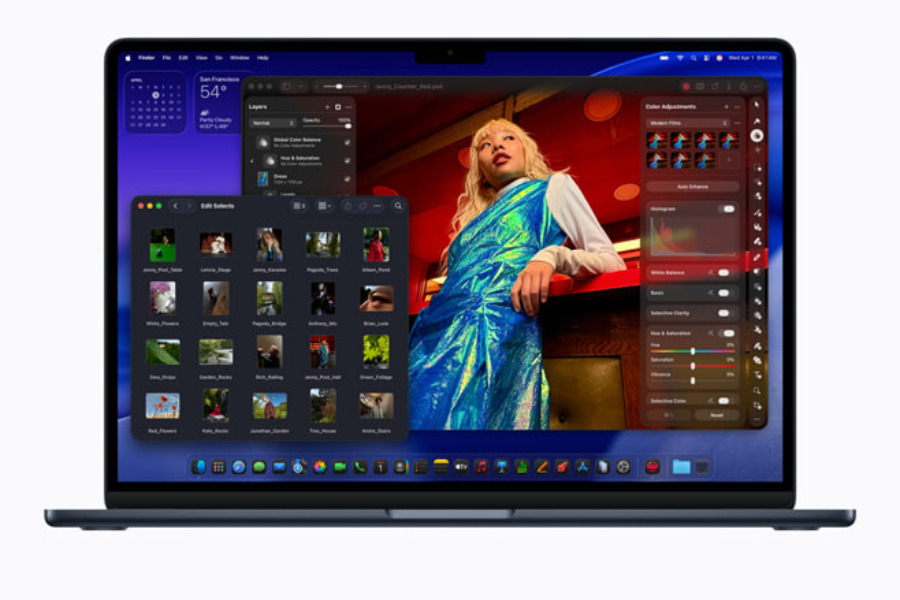
MacBook Air M5 debuts with 16GB RAM, 512GB storage, and up to 18 hours of battery life

Apple-MacBook-Air-M5-launch-specs-price

The all-new MacBook Air M5 is here, and at first glance, it doesn’t look very different. But inside, Apple’s latest thin-and-light laptop gets a new chip, faster storage, and updated wireless connectivity, while it keeps the same design that’s defined the Air lineup for the past few years.

Apple’s new MacBook Air is powered by the company’s M5 chip. An important change is that the laptop now starts with 16GB of RAM and 512GB of storage as standard. 

The price also went up from $999 to $1,099 for the base, but you can’t complain. Pre-orders are opening from March 4th, and the launch is set for Wednesday, March 11. 

Same design, familiar feel

On the outside, this is still very much the MacBook Air people know. Apple is keeping the same chassis design, flat edges, a thin profile, and a lightweight build. The 13-inch version weighs 1.23kg, while the 15-inch model comes in at 1.51kg. Color options include sky blue, silver, starlight, and midnight. 

The 13-inch model continues to feature a 13.6-inch LCD display with a 2560 x 1664 resolution and a 60Hz refresh rate. Up top, there’s still a 12MP Center Stage webcam, which automatically adjusts framing during video calls. 

M5 chip takes center stage in new MacBook Air

The real story here is the M5 chip. Apple is offering two GPU configurations: one with an 8-core graphics processor and another with a 10-core graphics processor. 

The new MacBook Air M5 also allows users to customize RAM, SSD capacity, keyboard options, and even the matching power adapter. Apple claims the SSD read and write speeds are now twice as fast as the previous generation. 

Connectivity also gets a bump. The laptop includes Apple’s upgraded N1 wireless chip, supporting Wi-Fi 7 (802.11be), Bluetooth 6, and Thread networking technology. 

The MacBook Air M5 packs a 53.8Wh lithium polymer battery, rated for up to 18 hours of streaming video playback. Likewise, you get a MagSafe 3 magnetic charging port and two Thunderbolt 4 ports on the left. On the right, you’ll find a 3.5mm headphone jack.

Don’t miss a thing! Join our Telegram community for instant updates and grab our free daily newsletter for the best tech stories!

For more daily updates, please visit our News Section.

(Source)

The post MacBook Air M5 debuts with 16GB RAM, 512GB storage, and up to 18 hours of battery life appeared first on Gizmochina.

Honor Magic 9 Pro may arrive with two 200MP cameras on the back

If you’ve been keeping up with us, you’ve already seen the early details on the Honor Magic 9 series. Now there’s more. This time, the spotlight is on the Honor Magic 9 Pro.

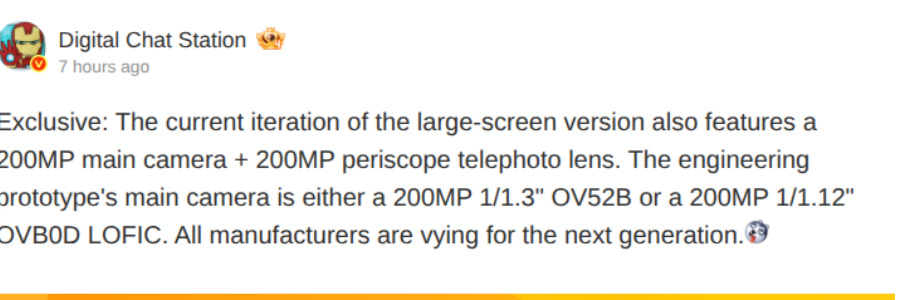
According to tipster Digital Chat Station, Honor is testing the Magic 9 Pro with not one but two 200-megapixel sensors on the back. One is said to serve as the primary camera, while the other would power a periscope-style telephoto lens. 

Honor Magic 9 Pro Camera Specifications (Expected)

The more interesting part is the choice of sensor. The prototype is said to be using either the OmniVision OV52B or the OmniVision OVB0D, both 200MP sensors, but with slightly different sizes and capabilities.

The OV52B reportedly comes in a 1/1.3-inch format and is expected to appear in several 2026 flagship phones. It’s designed to balance high resolution with improved dynamic range, which could help capture more detail in both bright and dark areas of a scene.

The OVB0D, on the other hand, is even larger at 1/1.12 inches and supports OmniVision’s LOFIC Gen 2 HDR technology. LOFIC, short for Lateral Overflow Integration Capacitor, is meant to improve dynamic range and reduce blown-out highlights in challenging lighting. That could make it particularly useful in a flagship device that wants to compete on image quality rather than just raw megapixel numbers.

For now, there are no confirmed details about the phone’s processor, design, or battery. The leak focuses entirely on imaging. But the tipster did confirm that the Honor Magic 9 Pro will feature a 6.85-inch display. 

As always with early leaks, plans can change. But we now at least have an idea of what Honor is preparing for its 2027 flagship lineup. The lineup could debut in October 2026.

For more daily updates, please visit our News Section.

Stay ahead in tech! Join our Telegram community and sign up for our daily newsletter of top stories.

(Source)

The post Honor Magic 9 Pro may arrive with two 200MP cameras on the back appeared first on Gizmochina.
Redmi K90 Ultra to launch a little later than expected

Redmi K90 Pro Max

The Redmi K90 Ultra was supposed to arrive in February — at least, that’s what earlier rumors suggested. February has come and gone, and there’s still no official word. Now, a new leak indicates the wait might stretch a bit longer.

According to a well-known Weibo tipster, Digital Chat Station, a certain manufacturer’s Dimensity 9500 flagship processor is tentatively scheduled for release in April. 

While the post doesn’t directly name the phone, the clues are hard to ignore. Based on the blogger’s previous posting patterns and discussions in the comments, many are speculating that the device in question is the Xiaomi Redmi K90 Ultra.

Redmi K90 Ultra Specifications

As for specs, the rumored hardware reads like a checklist of flagship ambitions. The phone is expected to feature a massive 6.8-inch display with 1.5K resolution and a 165Hz refresh rate. 

Powering it could be an equally massive 8,500mAh battery with support for 100W charging. Other rumored features include a metal frame, an ultrasonic in-display fingerprint sensor, and comprehensive water resistance.

Redmi K90 Pro Max
Redmi K90 Pro

There’s also a global angle. The so-called Xiaomi 17T Pro is rumored to be a tweaked version of the K90 Ultra for international markets. Carrying the model number 2602EPTC0G, it may ship without certain features like a cooling fan. 

In any case, the Redmi K90 Ultra is expected to launch along with the Redmi K Pad 2 in China. It could come with an 8.8-inch 3K display, a flagship-level processor, and a larger 9,000mAh cell.

For more daily updates, please visit our News Section.

Tech enthusiast? Get the latest news first! Follow our Telegram channel and subscribe to our free newsletter for your daily tech fix! ⚡

(Source)

The post Redmi K90 Ultra to launch a little later than expected appeared first on Gizmochina.

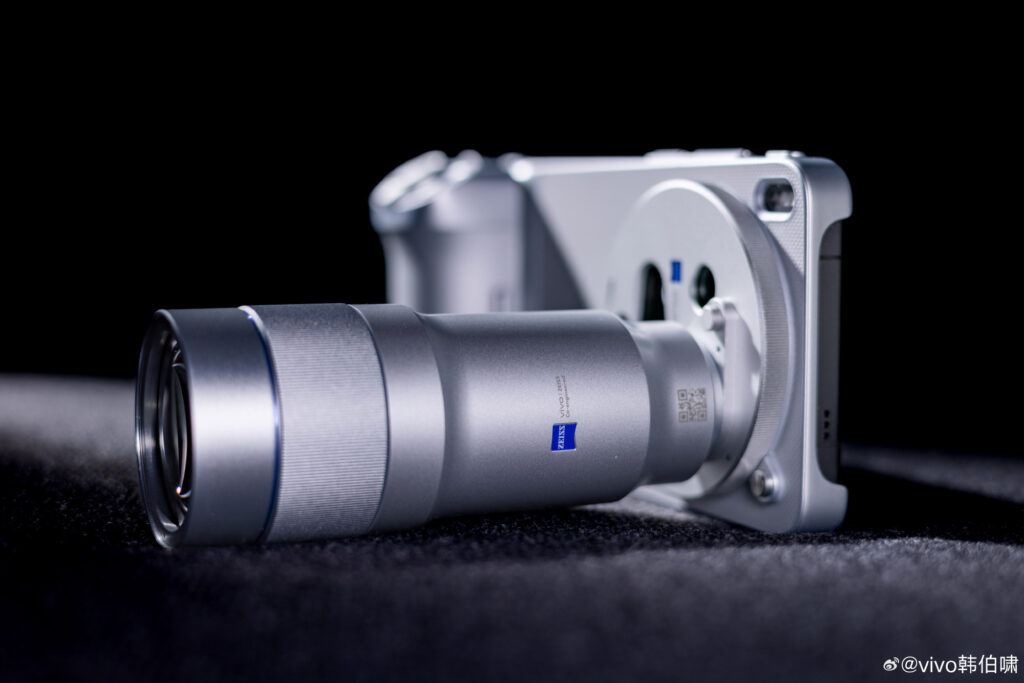
Vivo confirms X300 Ultra supports full-focal-length 4K Log shooting and custom LUT support

Vivo X300 Ultra 400mm teleconverter kit-

Vivo officially unveiled the X300 Ultra at Mobile World Congress 2026, and now the company is sharing more details about the phone’s video chops. 

In a post on Weibo, Vivo product manager Han Boxiao laid out what he calls the key camera upgrades coming to the X300 Ultra. According to him, the X300 Ultra is aiming to be a “pocket camera” for creators.

Vivo X300 Ultra can record 10-bit Log from all three lenses

One of the headline features is what Vivo calls its “no secondary camera” Zeiss Master Lens Trinity. In practical terms, the company says all focal lengths — from wide to telephoto — will support 4K 120fps 10-bit Log recording. The same applies to 4K 120fps Dolby Vision capture and optical image stabilization across all focal lengths.

The consistency carries over into post-production. The X300 Ultra supports APV 422 professional video encoding, which Vivo claims brings output closer to what you’d expect from a dedicated camera. 

Moreover, Log footage can load and apply 3D LUTs and custom LUTs during recording, enabling real-time color calibration on set. It’s also compatible with ACES workflows, so Log clips can drop into professional cinema pipelines without heavy conversion.

As for the audio, the X300 Ultra has a four-microphone system with six preset scenes designed to enhance target audio while reducing ambient noise. 

For more casual use, Vivo is adding two cinematic color presets: Film Style and Film Look. These are designed to deliver more polished, one-tap results without requiring manual grading. The official says that sample photos and videos in these modes will be shared later.

Vivo X300 Ultra 400mm teleconverter kit-

The device is also tipped to feature a 6.82-inch 2K BOE flat display with narrow bezels and LTPO technology. It will pack the Snapdragon 8 Elite Gen 5 chip and a battery of around 7,000mAh capacity with 100W wired and 40W wireless charging support.

For more daily updates, please visit our News Section.

Stay ahead in tech! Join our Telegram community and sign up for our daily newsletter of top stories

(Source)

The post Vivo confirms X300 Ultra supports full-focal-length 4K Log shooting and custom LUT support appeared first on Gizmochina.

❌