Reading view

Poco C81 Pro premature listing reveals specs ahead of launch

Xiaomi seems to have revealed its next budget phone a bit earlier than planned. The Poco C81 Pro briefly showed up on the company’s global website before being taken down, but not before its specs were noticed.

From what’s been spotted, this looks like a fairly straightforward entry-level device. The focus is on the basics, big screen, decent battery, and enough performance for everyday use.

Up front, there’s a 6.9-inch LCD display with a 120Hz refresh rate and HD+ resolution. Brightness is listed at up to 800 nits, so it should hold up reasonably well outdoors.

The phone runs on the Unisoc T7250, which is more suited for lighter tasks. Think browsing, messaging, online payments, and social media. Connectivity is limited to 4G, which might be a drawback for some users. RAM is listed at 4GB, with storage options going up to 256GB, plus microSD support.

Cameras are about what you’d expect here. A 13MP main sensor on the back and an 8MP front camera. No extra lenses or fancy tricks, just the basics.

Battery is where it stands out a bit. There’s a 6000mAh unit, which should comfortably last a full day, maybe longer depending on usage. Charging is limited to 15W, so it won’t be particularly quick to top up.

Other features include a side-mounted fingerprint sensor, dual SIM support, and likely a lightweight version of HyperOS, possibly based on Android Go. The overall idea is pretty clear. This is meant to be an affordable phone that handles everyday tasks without much trouble.

The listing has already been removed, so nothing is official just yet. That said, the specs suggest it could be a rebranded Redmi A7 Pro 4G, which launched globally earlier this month.

Don’t miss a thing! Join our Telegram community for instant updates and grab our free daily newsletter for the best tech stories!

For more daily updates, please visit our News Section.

(Via)

The post Poco C81 Pro premature listing reveals specs ahead of launch appeared first on Gizmochina.


Xiaomi Mijia Smart Steam Air Fryer 7L launches globally with 10 cooking modes

Xiaomi looks set to bring another smart kitchen gadget to global markets. The upcoming Mijia Smart Steam Air Fryer 7L combines air frying with steam cooking, and even adds support for sous vide-style cooking.

If it sounds familiar, that’s because Xiaomi already launched a similar model in China earlier. This version bumps the capacity up to 7 liters, making it more suitable for larger meals or batch cooking.

In terms of features, it covers quite a bit. Xiaomi lists 10 cooking modes, including steaming, fermenting, dehydrating, defrosting, and reheating. The sous vide part is interesting here. Traditionally, that requires a separate setup with a water bath, but Xiaomi seems to be using a built-in 1.5L water tank to replicate a similar effect. Exact details aren’t fully clear yet, but it’s likely tied to how the device handles steam and temperature control.

Speaking of temperature, the fryer supports a wide range from 40°C to 230°C, so it can handle both low-temp cooking and high-heat roasting. For steam, it can go up to around 130°C, which should help cook food faster compared to a standard steamer.

There’s also a hybrid mode that combines hot air and steam. That’s meant to keep food moist inside while still getting a crispy finish on the outside.

On the smart side, it supports HyperOS Connect, so you can control it through the Xiaomi Home app. That includes adjusting settings remotely, browsing recipes, and even linking it with Google Home for voice commands.

Compared to Xiaomi’s existing models like the 6.5L version already available in some markets, this one feels like a step up in terms of flexibility rather than just size.

There’s no confirmed global pricing or release date yet. But if it lands in markets like Europe, it could be a decent option for anyone looking to replace multiple kitchen appliances with a single device.

Don’t miss a thing! Join our Telegram community for instant updates and grab our free daily newsletter for the best tech stories!

For more daily updates, please visit our News Section.

(Source: Xiaomi)

The post Xiaomi Mijia Smart Steam Air Fryer 7L launches globally with 10 cooking modes appeared first on Gizmochina.

REDMI K Pad 2 teased with 15300mm² VC, Sound by Bose tuning, color options

REDMI has started teasing a new tablet, the K Pad 2, and it’s clearly going after performance-focused users. The company is calling it a “performance flagship,” which sounds like typical marketing, but some of the early details suggest it’s at least trying to stand out a bit, especially on the gaming side.

At the center of it is the Dimensity 9500, paired with a 15300mm² vapor chamber cooling system. REDMI is also using a centered chip layout, which is meant to help with heat distribution during longer sessions. In theory, that should mean more stable performance without throttling too quickly.

The display is another key part. It’s an 8.8-inch panel with a 165Hz refresh rate and 1100 nits of peak brightness. REDMI says it’s tuned specifically for gaming, though we’ll have to see how much of that actually makes a difference in real use. Battery capacity sits at 9100mAh, which should be enough for extended use, especially given the size of the device.

The tablet itself sticks to a fairly premium look, with a metal unibody and a few color options, including purple, silver, and black. Nothing too surprising, but it looks clean.

On the gaming side, REDMI is claiming support for 165fps gameplay in select titles, along with a 540Hz touch sampling rate. There’s also a high-frequency gyroscope, which should help with responsiveness in fast-paced games.

For audio, the tablet includes dual full-range drivers housed in a 2.0cc “super-large” sound cavity, designed to deliver fuller bass, clearer treble, and richer detail. It’s marketed as the first tablet tuned by Sound by Bose.

The K Pad 2 is set to launch on April 21, 2026, alongside the Redmi K90 Max and the Redmi Book Pro 2026.

Don’t miss a thing! Join our Telegram community for instant updates and grab our free daily newsletter for the best tech stories!

For more daily updates, please visit our News Section.

(Source: Lu Weibing on Weibo)

The post REDMI K Pad 2 teased with 15300mm² VC, Sound by Bose tuning, color options appeared first on Gizmochina.

Xiaomi launches Mijia Hair Clipper 2 Set with precision trimming and engraving blade

Xiaomi has added another product to its Mijia lineup, this time in the personal care category. The new Hair Clipper 2 Set builds on the regular version, but adds a couple of extras that make it a bit more versatile.

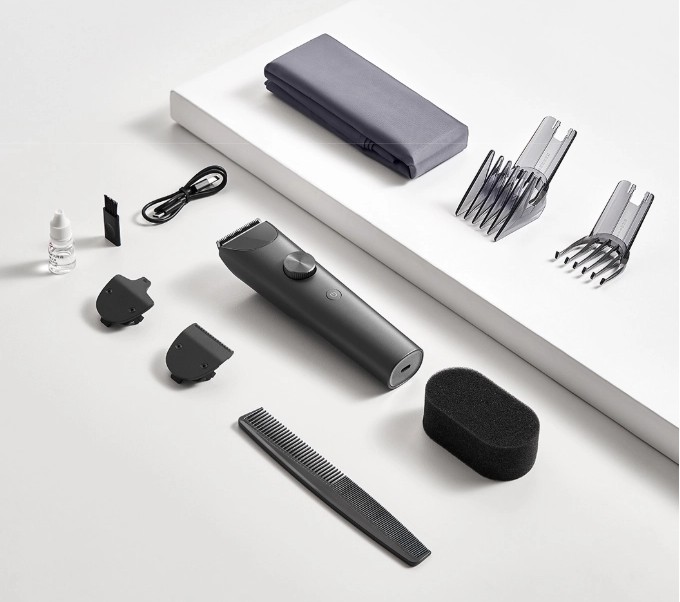
At its core, it’s still a standard hair clipper, but the set version includes precision trimming and engraving attachments, which is where things get more interesting. The precision trimmer is meant for smaller areas, around the hairline, ears, or sideburns, basically the kind of detailing you don’t always get right with a regular clipper.

Then there’s the engraving blade, which feels a bit more niche. It’s designed for sharper lines or patterns, so more for styling than basic trimming. Probably not something everyone will use, but it adds an extra layer for those who like experimenting.

Both attachments use a titanium carbide coating, and Xiaomi says the main blade is built to reduce friction and heat during use. That should help with comfort, especially if you’re using it for longer sessions.

In terms of adjustments, the clipper offers 19 length settings along with two speed modes, so there’s a decent amount of flexibility. It’s also IPX7 rated, meaning you can rinse it under water without worrying too much.

There’s a small display on the body as well, which shows battery status and other basic info. Not essential, but useful.

The box includes quite a few accessories, adjustable combs, cleaning tools, even a cape, so it’s clearly meant to be a complete kit rather than just the device.

The Mijia Hair Clipper 2 Set is priced at 189 yuan and is already available through Xiaomi’s Youpin platform in China.

Overall, it feels like Xiaomi is trying to push this a bit beyond just a basic grooming tool. It’s still simple at its core, but with enough extras to make it more flexible for people who want to do a bit more than a quick trim.

Don’t miss a thing! Join our Telegram community for instant updates and grab our free daily newsletter for the best tech stories!

For more daily updates, please visit our News Section.

Source: Xiaomi Youpin

The post Xiaomi launches Mijia Hair Clipper 2 Set with precision trimming and engraving blade appeared first on Gizmochina.

Redmi A7 Pro 5G debuts in India as first Pro model in A series

Xiaomi has added a new model to its entry-level lineup in India, and this one brings a small change to the naming as well. The Redmi A7 Pro 5G is now official, marking the first time a “Pro” tag shows up in the A-series. At a glance, the focus is pretty clear. This phone is all about size and battery, rather than pushing performance.

You get a 6.9-inch HD+ LCD display with a 120Hz refresh rate. Resolution is still on the lower side, but for everyday use, scrolling, videos, it should feel good enough. Xiaomi has also added triple TUV Certifications for Low Blue Light, Flicker-Free viewing, and Circadian-friendly tuning to ensure a comfortable visual experience.

Under the hood, it runs on the Unisoc T8300, paired with 4GB RAM and up to 8GB of virtual RAM. Storage goes up to 128GB and can be expanded via microSD, so there’s some flexibility there.

The phone packs a 6,300mAh battery, which should easily last a full day, and likely longer for lighter users. Charging is capped at 15W, so topping it up will take some time.

Cameras are fairly basic. A 32MP main sensor on the back, plus an 8MP front camera. Enough for casual use, but clearly not the highlight here.

On the software side, it runs HyperOS 3 based on Android 16, and Xiaomi is promising up to four years of OS updates and six years of security patches. That’s actually quite solid for this segment. Other bits include a side fingerprint sensor, headphone jack, USB-C, and IP52 rating for basic dust and splash protection.

Pricing and availability:

Pricing starts at ₹11,499 for the 4GB + 64GB model, going up to ₹12,499 for 128GB. Sales begin April 15 across Xiaomi’s website, Amazon, and offline stores.

While this is a straightforward budget phone, the camera island design makes it look much more expensive than it is, which could be a big selling point for many.

Don’t miss a thing! Join our Telegram community for instant updates and grab our free daily newsletter for the best tech stories!

For more daily updates, please visit our News Section.

(Xiaomi)

The post Redmi A7 Pro 5G debuts in India as first Pro model in A series appeared first on Gizmochina.

50% of the Galaxy S27 series rumored to be powered by the Exynos 2700

Samsung looks like it’s leaning more seriously into its own chips for 2027. New reports suggest the company plans to increase the use of Exynos processors in the Galaxy S27 series, mainly to reduce how much it depends on Qualcomm. The reason is pretty straightforward, Snapdragon chips are getting expensive. For the Galaxy S25 lineup, Samsung went all-in on Qualcomm’s flagship chip, which ended up costing the company around 3 trillion won.

If Samsung continues down this path, things don’t really get easier. The Snapdragon 8 Elite Gen 6 Pro, expected to power the Galaxy S27 Ultra, is said to move to TSMC’s more expensive 2nm process. That would likely push costs even higher. At that point, Samsung either absorbs the hit, passes it on to buyers, or leans more on its own chips to keep manufacturing costs in check.

So the shift toward Exynos isn’t exactly surprising. That said, real-life performance tests paint a mixed picture of the Exynos 2600. It performs well in some areas, but still trails Snapdragon in power efficiency, thermals, and battery life.

As for the Galaxy S27 series, Samsung is said to be aiming for roughly a 50% split between Snapdragon and Exynos. That’s a noticeable jump, and it suggests the company is more confident this time around.

Of course, this isn’t without some risk. Exynos hasn’t always had the best reputation, especially when compared to Snapdragon in real-world use. That said, recent versions have improved, and Samsung clearly has a strong incentive to keep pushing in that direction.

In a way, this feels like a long-term correction. Relying too heavily on Qualcomm turned out to be expensive, and now Samsung is trying to rebalance things.

How well this works will depend on the power efficiency and stability of the Exynos 2700. If it can hold up in everyday performance, not just benchmarks, Samsung might finally get closer to that balance it’s been aiming for.

Don’t miss a thing! Join our Telegram community for instant updates and grab our free daily newsletter for the best tech stories!

For more daily updates, please visit our News Section.

(Source)

The post 50% of the Galaxy S27 series rumored to be powered by the Exynos 2700 appeared first on Gizmochina.

REDMI R70, REDMI R70m listed on official website with specs, color options

Xiaomi has quietly added two new phones to its Chinese website, the REDMI R70 5G and R70m 5G, and they look very much aimed at the lower end of the 5G market.

Both models are currently marked as “coming soon,” so they’re not up for sale yet. Still, the listings give a fairly clear idea of what Xiaomi is going for here, large displays, big batteries, and pricing that stays within reach.

The two phones share most of their core specs. Up front, there’s a 6.9-inch LCD panel with a 120Hz refresh rate and a 720p+ resolution. Not the sharpest, but it should be enough for everyday use like scrolling, messaging, and streaming.

They’re powered by the Unisoc T8300, built on a 6nm process, paired with LPDDR4x RAM and UFS 2.2 storage. Nothing high-end, but in line with what you’d expect at this price point.

Xiaomi is offering a decent range of configurations. The R70 starts at 4GB + 128GB (1599 yuan) and goes up to 8GB + 256GB, while the R70m skips the base variant and stretches all the way to 12GB + 256GB.

The main difference between the two is the battery. The standard R70 comes with a 6000mAh unit, while the R70m bumps that up slightly to 6300mAh. Charging is capped at 15W.

Camera setup is pretty basic. There’s an 8MP front camera and a single 13MP rear sensor, so clearly not a focus here.

Design-wise, they follow a familiar look and come in a few color options like Feather White, Starry Black, and a couple of blue and purple shades. The phones are on the larger side, but still relatively slim for what they pack. Both models run Hyper OS 3, which is Xiaomi’s software skin based on Android 16.

Overall, these feel like straightforward budget 5G phones. Not trying to do anything fancy, just covering the basics with a bit of extra emphasis on battery life.

Don’t miss a thing! Join our Telegram community for instant updates and grab our free daily newsletter for the best tech stories!

For more daily updates, please visit our News Section.

(Sources: 1, 2)

The post REDMI R70, REDMI R70m listed on official website with specs, color options appeared first on Gizmochina.

Vivo X300 Ultra tipped to launch in India on May 7

Vivo’s next Ultra phone looks set to arrive in India sooner than expected. According to a report from Smartprix, citing Yogesh Brar, the Vivo X300 Ultra could launch on May 7, with sales likely beginning around May 14. Last year’s X200 Ultra never made it outside its home market officially, so if this holds, it would be a relatively quick turnaround.

There’s a 6.82-inch LTPO AMOLED display with 2K resolution and a 144Hz refresh rate, which should be more than enough for everyday use and gaming. Nothing unusual there, but still a strong spec. It’s expected to run on the Snapdragon 8 Elite Gen 5, so performance shouldn’t be a concern. That part is also fairly straightforward.

The camera setup is where things stand out a bit more. The X300 Ultra includes two 200MP sensors as part of a triple rear camera system. That’s not something we see often, even in top-of-the-line flagships, so it’ll be interesting to see how Vivo actually uses them. There’s a 50MP front camera for selfies.

The Chinese version packs a 6,600mAh battery and supports 100W wired and 40W wireless charging. On paper, that should be enough for a full day of use, with a full recharge taking around 30–40 minutes. On the software side, it runs OriginOS 6 based on Android 16.

Pricing hasn’t been mentioned so far, but given the positioning, it’s likely to sit firmly in the premium range. For context, in its home market, the phone starts at 6,999 yuan for the 12GB + 256GB model and goes up to 11,999 yuan for the 16GB + 1TB Satellite Edition bundled with the photography kit.

Don’t miss a thing! Join our Telegram community for instant updates and grab our free daily newsletter for the best tech stories!

For more daily updates, please visit our News Section.

(Source)

The post Vivo X300 Ultra tipped to launch in India on May 7 appeared first on Gizmochina.

DJI Osmo Pocket 4 Pro spotted in hands-on photo alongside Osmo Pocket 4

DJI is set to launch the Osmo Pocket 4 on April 16, but just ahead of that, a leak has put some focus on the Pro model. A new image shared online is said to show the Osmo Pocket 4 Pro next to the standard version, and the difference between the two is fairly noticeable.

The photo comes from tipster Igor Bogdanov. It does give a rough idea of what DJI might be working on. The regular model keeps the familiar single-camera setup, while the Pro version appears to add a second lens.

That second camera is really the main point of interest here. The module on the Pro looks larger and slightly heavier at the top, which probably has to do with the extra lens and gimbal hardware.

There have been earlier mentions of the standard model supporting 2x in-sensor zoom and up to 4x digital zoom. If that’s accurate, then the Pro version could be adding a telephoto lens, possibly around 3x optical zoom. That would give it a bit more flexibility, especially for creators who want tighter framing without relying too much on digital zoom.

The image itself doesn’t reveal much beyond the dual-lens design. It’s slightly blurry, and there aren’t any readable markings near the lenses, so most of this is still based on interpretation rather than confirmation.

As for timing, the Pro model may arrive later. Current leaks point to a late spring window, which would mean DJI is planning to separate the launches instead of announcing both together.

For now, it’s still early, and things could change. But even from this one image, it looks like DJI might be moving the Pocket series a bit closer toward a more flexible, camera-focused setup rather than keeping it strictly simple. More details should come through once the standard model is officially out.

Don’t miss a thing! Join our Telegram community for instant updates and grab our free daily newsletter for the best tech stories!

For more daily updates, please visit our News Section.

(Source: Igor Bogdanov on X)

The post DJI Osmo Pocket 4 Pro spotted in hands-on photo alongside Osmo Pocket 4 appeared first on Gizmochina.
Alleged DJI Avata 3 spotted in early test flight

DJI looks to be testing another compact drone, based on a short clip that’s started circulating online. It shows a small model with built-in propeller guards, which usually points toward either a beginner-friendly design or something aimed at FPV-style flying.

DJI recently introduced the Avata 360, which brings 360-degree capture into the FPV space. That model is still in the early stages of rollout, so seeing another device already being tested suggests the company is working on multiple things at once.

From what’s visible in the footage, the drone sits somewhere between the Avata 2 and the Neo in terms of design. It has a compact body, enclosed propellers, and what looks like a single camera setup. Nothing too surprising there, but the guarded design does stand out, especially for indoor or close-range flying.

As for what it actually is, that part isn’t clear yet. Some think it could be an early Avata 3, given the similarity to DJI’s FPV lineup. Others are leaning toward a Neo 3, which would make sense if DJI is updating its more entry-level models. Right now, it’s mostly guesswork.

The footage itself isn’t very detailed, which is pretty typical for early testing leaks. Still, it does confirm that DJI has something new in development, even if it’s still at a fairly early stage.

If past releases are anything to go by, this probably won’t turn into a launch anytime soon. DJI tends to test its drones in public for a while before making anything official.

👉Well, well, well…DJI, what are you doing? Let me think: Neo 3 or Avata 3🫣 pic.twitter.com/1BjQTew1b0

— Igor Bogdanov (@Quadro_News) April 11, 2026

For now, it’s just a brief look at what could be coming next: either a follow-up to the Avata series or a refreshed Neo model with a similar approach to safety and usability.

Don’t miss a thing! Join our Telegram community for instant updates and grab our free daily newsletter for the best tech stories!

For more daily updates, please visit our News Section.

(Source)

The post Alleged DJI Avata 3 spotted in early test flight appeared first on Gizmochina.

Vivo X Fold 6 tipped to feature 200MP camera, 7,000mAh battery

Vivo launched the X Fold 5 back in June last year, and early details of the X Fold 6 have already started showing up online. The successor is still some time away, but a new leak gives a rough idea of what the company might be planning.

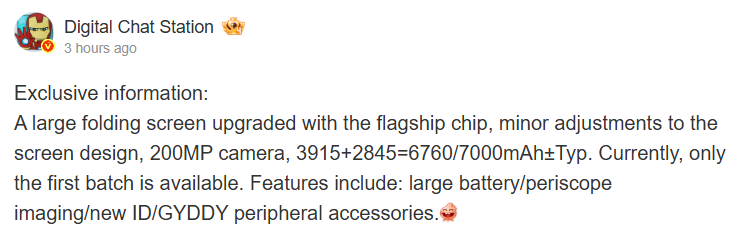
The information comes from tipster Digital Chat Station, who mentions a possible 200MP main camera. If that ends up being accurate, it would likely be the same sensor used in the X300 and X300 Pro. That should help with detail in good lighting. The sensor is also slightly larger than the 50MP unit on the X Fold 5 (1/1.4″ vs 1/1.56″), so it could lead to a small change in the camera island design.

Battery is another area that could see a noticeable jump. The leak points to a rated 6,760mAh capacity, with a typical value closer to 7,000mAh. That’s a significant upgrade over the 6,000mAh unit of the X Fold 5.

There’s also mention of a 50MP periscope lens with telemacro support, which suggests close-up shooting could be part of the setup again. Vivo has used similar systems before, so this wouldn’t be entirely new, just carried forward and possibly refined.

Beyond that, details are still a bit vague. The leak references a new design language and some accessory support, but doesn’t go into specifics. On the performance side, the phone is expected to use a flagship Snapdragon chip, though it’s not clear which one yet. The X Fold 5 is powered by the Snapdragon 8 Gen 3 and its successor is speculated to use the newly launched Snapdragon 8 Gen 5.

As with previous models, the X Fold 6 will likely launch in China first, with a wider rollout coming later.

For now, it looks like Vivo is focusing on the same areas again, but pushing them a bit further. Still early days though, so things could change by the time it’s official.

Don’t miss a thing! Join our Telegram community for instant updates and grab our free daily newsletter for the best tech stories!

For more daily updates, please visit our News Section.

(Source: DCS on Weibo)

The post Vivo X Fold 6 tipped to feature 200MP camera, 7,000mAh battery appeared first on Gizmochina.

❌