Casio has launched the LTP1234PDC-7B women’s watch in the United States. The new model features a simple and timeless design aimed primarily at women who prefer understated elegance. Its rectangular case and clean lines give it a classic tank-style appearance, making it a versatile accessory for everyday wear.
Design Details
The watch has a polished silver-tone finish that enhances its sleek and minimalist look. The rectangular case includes softly rounded edges and straight lugs that connect seamlessly to a stainless steel bracelet.
Casio designed the watch to be lightweight and comfortable, measuring 32 x 21 x 7.4 mm and weighing only 56 grams. The bracelet features a one-touch 3-fold clasp, ensuring ease of use.
The dial stands out with a white base that contrasts sharply with bold black numerals. Casio positioned the oversized numerals around the outer edge of the dial to maximize legibility.
The dial also features a smaller inner rectangle that frames the center, adding a layered visual effect. Fine printed details along this inner section add subtle depth without complicating the overall design. The watch features slim silver‑tone hour and minute hands complemented by a minimalist seconds hand.
The LTP1234PDC-7B offers essential features, including water resistance and an approximate three-year battery life powered by an SR626SW battery. The watch face is protected by mineral glass, and the stainless steel band fits wrist sizes ranging from 125 mm to 185 mm. Casio claims the watch maintains an accuracy of ±20 seconds per month.
Pricing and Availability
The LTP1234PDC-7B is priced at $69.95, making it an affordable yet stylish choice for women seeking a classic timepiece. It is now available for purchase in the US.
Acemagic has announced the N3A NAS mini PC, a compact system built to handle storage, computing, and multimedia tasks. The company has already shared some key specifications in a blog post on its global website.
Acemagic N3A NAS Specifications (Teased)
The device functions as both a NAS and a mini PC, and it is very similar to Beelink ME Pro NAS, which launched in December last year. The N3A NAS is powered by AMD’s Ryzen 7 3750H processor, based on the Zen+ architecture. It features four SATA drive bays and two M.2 NVMe slots, providing a solid mix of performance and storage flexibility.
The Ryzen 7 3750H processor features 4 cores and 8 threads with a boost clock of up to 4.0GHz. It delivers a 35W TDP, ensuring energy-efficient performance for 24/7 operation. The integrated Radeon RX Vega graphics support 4K@60Hz display output, making the system suitable for media playback and display-oriented tasks.
The N3A offers four SATA drive bays for high‑capacity 3.5‑inch HDDs, giving users ample space for storing photos, videos, and work files. Its dual M.2 NVMe slots support high‑speed system drives or caching setups to enhance data transfer rates and overall responsiveness. The device also includes two DDR4 memory slots, supporting up to 64GB of RAM for multitasking and future expansion.
The mini PC measures 270 x 150 x 185 mm, making it compact enough for flexible placement in home or office settings. It includes a single Gigabit Ethernet port for multi‑device connectivity and cross‑platform file sharing. The system also supports private cloud deployment, enabling centralized data management while delivering reliable performance for simultaneous file access and containerized workloads such as Docker.
Acemagic has not revealed an exact release date and pricing, but has stated that the N3A NAS mini PC is expected to launch soon.
For more daily updates, please visit our News Section.
Fast charging has become one of the biggest competitive headlines in phones today. Brands like Xiaomi, OPPO, and others boast numbers as high as 200W and even 240W, promising a full charge in minutes. But how does ultra-fast charging compare with more moderate speeds like 65W when it comes to battery health after two years of regular use? The short answer? There is a trade-off.
Battery Degradation
Unlike rapid top-ups you might do daily, battery cycle life is the best proxy for long-term wear. Industry standards generally consider a battery still healthy at 80% capacity after 800 cycles, meaning it retains 80% of its original capacity and performance. However, ultra-high-watt charging changes that equation. Devices using 65W charging tech tend to degrade less over time. But after about the same 800 cycles, batteries charged at 65W can retain approximately 91% of their original capacity.
Xiaomi’s 200W Fast Charging Solution
So, you get a solid performance that means noticeably longer lifespan and less capacity loss after two years of typical use. On the other hand, phones that support faster charging speeds, like 200W charging, show faster degradation. Evidence suggests these batteries can fall to around 80% capacity after just 800 cycles, which aligns with the minimum baseline for acceptable battery health, but it hits this mark much earlier than models with 65W charging support.
What These Percentages Mean in Real Use
When we talk about 80% vs 91 % capacity after two years, the difference is more than just a number on paper:
80% Battery Capacity: You’ll likely notice shorter screen-on time, faster drainage during heavy use, and more frequent mid-day charging. The battery feels more tired, especially after a couple of years.
91% Battery Capacity: The battery still feels closer to “new,” retains longer endurance, and delivers steadier performance throughout the day.
Realme GT 3 with 240W Charging Support
In practical terms, a device with 200W charging might need battery health conservation strategies earlier. This could include limited full charges, enabling optimized charging, or reducing high-watt charging use.
Why Faster Charging Affects Battery Health
It might seem counterintuitive that faster charging could be worse for battery health, but the mechanisms are rooted in electrochemistry:
Heat: Ultra-fast charging creates more heat inside the battery during the charge process. Heat is one of the main accelerators of battery ageing, which speeds up internal chemical reactions that degrade the electrode materials over time.
Charge Stress: Charging at higher wattages pushes more current into the battery at once. This can increase stress on the lithium-ion cells, leading to faster capacity loss across many cycles.
Thermal Management: Modern phones use advanced cooling and thermal throttling, like graphite layers, vapor chambers, and smart charging algorithms help reduce heat and mitigate degradation. However, these systems only reduce the long-term impact, not eliminate it entirely. So while a phone with 200W charging won’t immediately fail, the battery will show signs of ageing sooner than a phone that uses 65W charging under the same usage pattern.
OPPO’s Surprising Case
Interestingly, real-world testing has shown that in some cases, a 150W charging implementation (like OPPO’s) can outlast an even faster 240W solution. In some scenarios, it even managed to achieve up to double the cycle life (approx 1,600 cycles) before reaching similar degradation levels. This highlights how fast charging is implemented (software control, cell chemistry, thermal design) matters as much as the wattage itself.
Should You Avoid Fast Charging?
Ultra-fast charging isn’t inherently bad. In fact, it’s extremely convenient, especially if your lifestyle demands quick top-ups between meetings or when you’re travelling. Considering the massive upgrades in battery tech in recent years, these devices have also retained good battery capacities even after a few years. Faster charging does accelerate capacity loss compared to more moderate speeds, so here’s how you can balance conveniencewith longevity:
Use standard charging (like 30–65W) for overnight/top-off charging.
Reserve super fast charging for when you really need speed.
Enable battery care features and Super OTA battery management options if available.
Avoid extreme thermal environments (like charging in hot cars or under direct sunlight)
For more daily updates, please visit our News Section.
Caviar has introduced a new Valentine’s-themed customization series for the iPhone 17 Pro. The collection, called Garden of Eden, includes three limited-edition designs inspired by traditional symbols of love and loyalty. Prices start at $10,000, and each model is limited to 14 units worldwide.
Design Details
The Garden of Eden lineup includes Charming Lotus, Goldfish, and Wings of Love. Caviar uses 24K gold, jewelry enamel, engraving, diamonds, and sapphires across the designs. The models are available for both the iPhone 17 Pro and iPhone 17 Pro Max, including configurations with up to 1TB of storage.
Charming Lotus draws inspiration from the lotus flower, which holds cultural meaning in India, China, and Ancient Egypt. In Indian tradition, the lotus represents spiritual refinement and inner clarity. In Chinese culture, it symbolizes faithful love and harmony in marriage. The design features gold elements and detailed enamel work influenced by floral patterns. This variant starts at $19,630, making it the most expensive in the series.
Charming LotusGoldfishWings of Love
Goldfish centers on a pair of golden fish arranged in a circular motion. In Buddhist symbolism, two fish represent unity and harmony between partners. In Chinese tradition, goldfish also reflect prosperity and fertility. The design includes gold-plated sculptural elements accented with sapphires. Pricing for this model starts at $10,490.
Wings of Love features swallow birds in flight. The swallow has long symbolized loyalty and safe return in European and Asian cultures. In Ancient Greece, it was associated with Aphrodite, the goddess of love. The design highlights the idea of devotion across distance. This model starts at $10,340.
Caviar will also include a Valentine’s-themed gold coin with each purchase. Each unit ships in premium packaging.
Choosing between the Samsung Galaxy Watch Ultra and the Apple Watch Series 11 isn’t just about specs; it’s about lifestyle. One is built like a survival tool for the outdoors, designed to handle extreme workouts and long adventures. The other feels like a refined digital companion, blending premium design with seamless everyday intelligence. While official pricing positions them differently, it’s worth noting that Amazon often lists both at discounted rates, which can shift the value equation. If you’re stuck between rugged endurance and polished performance, this decision deserves a closer look.
Please Note: When you buy something using the links in our articles, we may earn a small commission at no cost to you.
Design and Display
Build and Feel
The Galaxy Watch Ultra embraces a rugged, adventure-focused design with sapphire crystal protection and a titanium frame that feels engineered for durability. It is clearly positioned for outdoor enthusiasts and athletes who demand resilience. The Apple Watch Series 11, while also premium in materials, presents a more refined and versatile aesthetic. It blends into professional and casual settings with ease, offering a smoother visual identity. One feels purpose-built for endurance and harsh conditions, while the other feels thoughtfully designed for daily wear and style-conscious users.
Display Quality
Samsung’s Super AMOLED panel offers vibrant contrast and strong outdoor readability, making fitness stats easy to view in bright conditions. Apple’s LTPO3 OLED display pushes higher peak brightness and delivers exceptionally fluid animations, giving the interface a polished and responsive feel. The Apple screen often feels more immersive due to tighter software optimization, though Samsung’s display remains sharp and bold.
Verdict
For rugged durability and bold presence, Galaxy Watch Ultra stands out. For display brightness and refined everyday usability, Apple Watch Series 11 feels more balanced.
Specifications Including Battery
Performance
The Galaxy Watch Ultra runs on Samsung’s advanced chipset paired with Wear OS, delivering strong multitasking capability and smooth Android integration. It feels powerful and responsive, particularly within Samsung’s ecosystem. The Apple Watch Series 11, powered by Apple’s latest silicon and watchOS, prioritizes efficiency and seamless animation. The experience feels cohesive and highly optimized, with transitions that appear effortless. While both are fast, Apple’s software harmony often creates a slightly more fluid daily interaction.
Battery and Charging
Samsung equips the Galaxy Watch Ultra with a larger battery designed for extended endurance. It is better suited for long tracking sessions, outdoor trips, and users who prefer fewer charging interruptions. Apple focuses on efficient power management and fast charging, making it convenient for daily routines. While it may not last as long on a single charge as Samsung’s model, quick top-ups reduce downtime significantly.
Verdict
Galaxy Watch Ultra leads in battery longevity and endurance. Apple Watch Series 11 excels in efficiency and fast recharge convenience.
Camera
Main and Secondary Lenses
Neither smartwatch includes a built-in camera, choosing instead to dedicate internal space to health tracking sensors and smart functionality.
Selfie Camera
There is no selfie camera on either device. This absence allows both watches to prioritize battery capacity, structural durability, and advanced biometric sensors rather than rarely used imaging hardware.
Verdict
This category remains a tie. Both smartwatches appropriately focus on health, connectivity, and performance instead of camera features.
Pricing
Galaxy Watch Ultra is officially positioned at a significantly higher price tier compared to the Apple Watch Series 11 in both the US and Indian markets. Apple’s model enters the market at a notably lower starting point, making it more accessible to a wider audience.
Is the Price Justified?
The Galaxy Watch Ultra’s higher pricing aligns with its rugged build, titanium construction, enhanced durability certifications, and larger battery capacity. It targets users who prioritize toughness and extended endurance. The Apple Watch Series 11, despite being priced lower, delivers premium materials, excellent display brightness, and highly optimized performance. This makes it feel like a strong value proposition for everyday users within Apple’s ecosystem.
Verdict
For overall affordability and value balance, Apple Watch Series 11 feels more approachable. Galaxy Watch Ultra justifies its higher positioning primarily through durability and battery advantages.
Conclusion
The Galaxy Watch Ultra distinguishes itself with durability-focused engineering, advanced GPS support, and extended battery endurance tailored for outdoor lifestyles. It is clearly designed for users who demand resilience in demanding conditions. The Apple Watch Series 11 shines with exceptional display brightness, seamless ecosystem integration, and refined health tracking features such as highly accurate temperature sensing and Ultra Wideband support. One emphasizes toughness and stamina, while the other prioritizes polish and daily usability.
Verdict
For Android users and adventure-driven buyers, the Galaxy Watch Ultra offers rugged confidence and longer endurance. For iPhone users seeking refined performance at a lower entry cost, the Apple Watch Series 11 delivers stronger overall value. The best choice ultimately depends on ecosystem preference and whether durability or affordability carries more weight.
New data tracking CPU sales on Amazon US shows a sharp year-over-year decline in January 2026. According to figures compiled by analyst TechEpiphany, just 26,100 processors were sold during the month. That might not sound terrible on its own, but it represents a steep 51% drop compared to January 2025.
That’s a significant contraction for one of the largest online retailers, and it adds to a broader downward trend that’s been visible in recent months.
At the same time, prices are moving in the opposite direction. The average selling price of CPUs rose from $227 in January 2025 to $305 in January 2026, a jump of roughly 34%. That suggests buyers who are still upgrading may be choosing higher-end chips, or simply paying more across the board.
Despite the slowdown, AMD continues to lead by a wide margin. The company reportedly sold 23,050 Ryzen CPUs in January, accounting for more than 88% of total units. Revenue share was nearly identical. Intel, by comparison, moved just 3,050 units.
What’s interesting is where demand seems concentrated. AMD’s newer Zen 5-based Ryzen 9000 series performed well, but older Zen 4 (Ryzen 7000) and even Zen 3 (Ryzen 5000) chips continue to sell in meaningful numbers.
Building or upgrading a PC right now means paying more for nearly every major component. Memory prices have climbed noticeably in recent months, affecting both DDR4 and DDR5 kits. SSD pricing has also increased. Graphics cards haven’t helped the situation either. Even mid-range options have seen pricing pressure.
When RAM, storage, and GPUs all cost more, the appeal of upgrading “just the CPU” weakens. Most enthusiasts don’t upgrade in isolation; it’s usually part of a broader platform refresh. And right now, that refresh isn’t cheap.
Between higher component costs, platform transition expenses, and general economic caution, many consumers seem comfortable holding onto existing systems a little longer.
Snapdragon 7 Gen 3 has been a popular choice among mid-range phones for offering excellent performance, power efficiency, and a reliable gaming experience. Its successor, the Snapdragon 7 Gen 4, takes everything a step ahead with notable advancements to CPU, GPU, and connectivity.
The Snapdragon 7 Gen 4 will offer better performance, but the real question is: how big an upgrade is it? Is it just a new name with minor changes, or are there some serious upgrades? Let’s look at the benchmark scores and key differences to find out.
Here’s the spec sheet to begin with:
Snapdragon 7 Gen 4
Snapdragon 7 Gen 3
Announced
May 2025
November 2023
Process node
4nm (TSMC)
4nm (TSMC)
CPU
1 x 2.8GHz — Cortex-A720 4 x 2.4GHz — Cortex-A720 3 x 1.84GHz — Cortex-A520
1 x 2.63GHz — Cortex-A715 3 x 2.4GHz — Cortex-A715 4 x 1.8GHz — Cortex-A510
GPU
Adreno 722 Snapdragon Elite Gaming features
Adreno 720 Snapdragon Elite Gaming features
NPU
Qualcomm Hexagon NPU
Qualcomm Hexagon NPU
Memory
LPDDR5x, up to 4.2GHz
LPDDR5, up to 3.2GHz
Storage
UFS 4.0
UFS 3.1
Camera
Qualcomm Spectra ISP (Triple AI-ISPs, 12-bit) up to 200MP single camera up to 64MP single camera with zero shutter lag up to 32+21MP dual cameras with zero shutter lag up to 21MP triple cameras with zero shutter lag up to 4K/60fps video recording
Qualcomm Spectra ISP (Triple CV-ISPs, 12-bit) up to 200MP single camera up to 64MP single camera with zero shutter lag up to 32+21MP dual cameras with zero shutter lag up to 21MP triple cameras with zero shutter lag up to 4K video recording
Snapdragon X63 5G modem (sub‑6GHz) download speed: 5Gbps (peak speed) Wi-Fi 6E (peak speed: 2.9Gbps) Bluetooth 5.4
Snapdragon 7 Gen 4 vs 7 Gen 3: Benchmark scores
[Note: For the benchmark results, the tests were performed on the Vivo T4 Pro (powered by Snapdragon 7 Gen 4) and OnePlus Nord CE 4 5G (powered by Snapdragon 7 Gen 3).]
Geekbench score
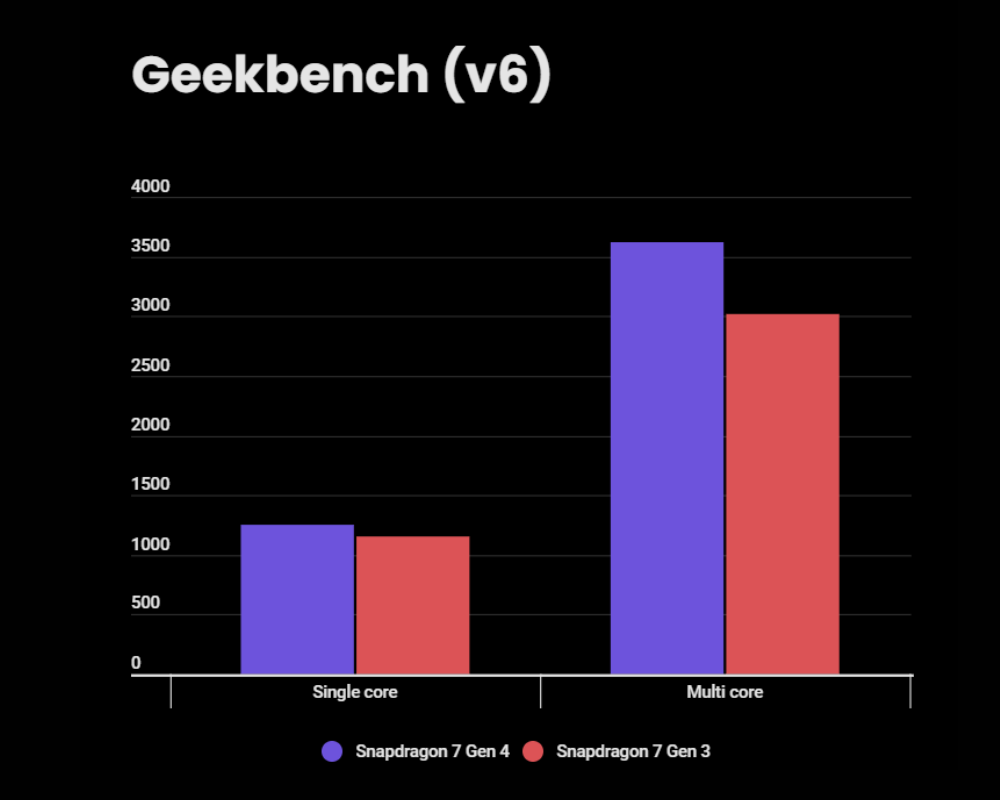
The Vivo T4 Pro, powered by the Snapdragon 7 Gen 4, has achieved 1,252 points in the single-core performance, which is about 8% higher than the 7 Gen 3. The gap widens in the multi-core performance, where the 7 Gen 4 leads with 20% higher score (3620 vs 3018).
Snapdragon 7 Gen 4
Snapdragon 7 Gen 3
Single core
1,252
1,154
Multi core
3,620
3,018
Geekbench v6
Geekbench results suggest devices powered by Snapdragon 7 Gen 4 will perform better than those powered by 7 Gen 3, especially in tasks that require multiple cores to work together.
AnTuTu score
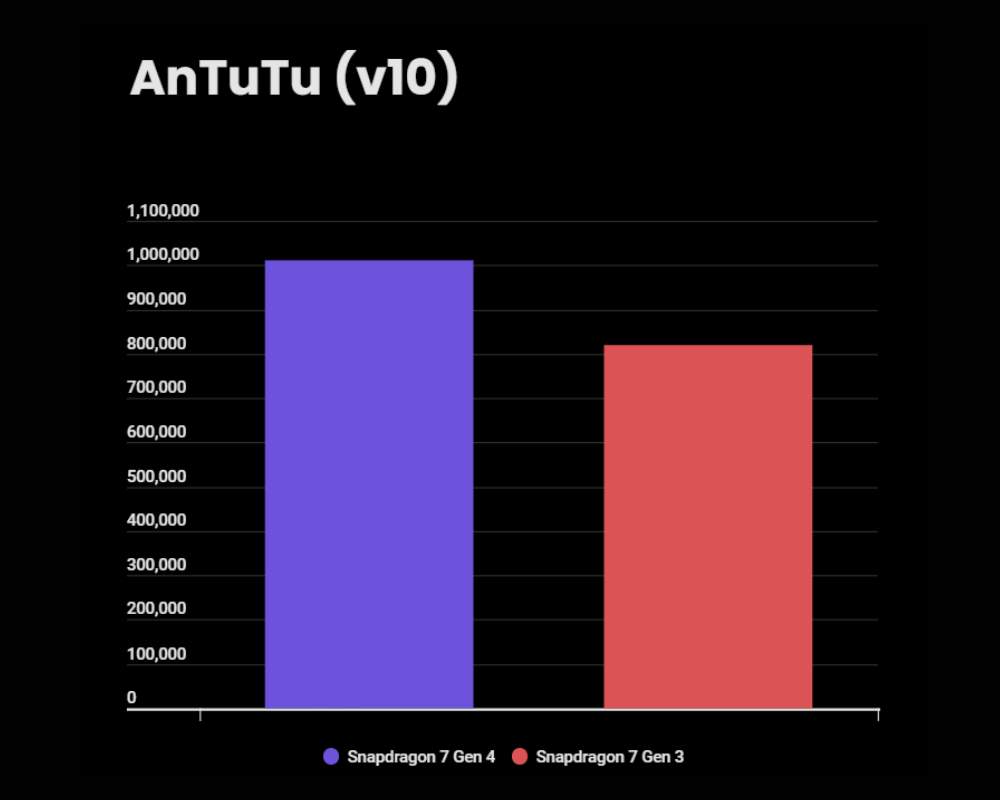
In the AnTuTu benchmark, the Snapdragon 7 Gen 4 scores over 1 million, while the 7 Gen 3 scores 819K. That’s a 23% higher score for the newer chip, which also reflects in every single test on the platform.
The Snapdragon 7 Gen 4 delivers 14% higher CPU and 26% higher GPU scores than the Snapdragon 7 Gen 3. The memory and UX scores also favor the newer chip.
Snapdragon 7 Gen 4
Snapdragon 7 Gen 3
AnTuTu score
1,010,864
819,655
CPU
309,273
269,334
GPU
323,797
256,584
Memory
182,776
129,961
UX
195,019
163,776
AnTuTu v10
Benchmark scores suggest a notable performance boost for the Snapdragon 7 Gen 4, but they don’t reveal improvements to the camera, connectivity, or other key areas. So, let’s discuss them in the following section.
Snapdragon 7 Gen 4 vs 7 Gen 3: What are the upgrades?
CPU, GPU, and NPU
The Snapdragon 7 Gen 4 features an upgraded (1+4+3) core configuration, which replaces an efficiency core with a performance core. On top of this, the CPU uses a newer instruction set and newer cores, which offer better performance and power efficiency than the Snapdragon 7 Gen 3.
Additionally, the prime core in the Snapdragon 7 Gen 4 runs at a higher frequency, further improving the chip’s performance. Qualcomm claims a 27% performance uplift in CPU over the 7 Gen 3.
For graphics rendering, the Snapdragon 7 Gen 4 relies on the Adreno 722 GPU, which brings higher capabilities than the 7 Gen 3’s Adreno 720 GPU. The newer chip also benefits from some additional gaming optimizations, such as Qualcomm Adaptive Performance Engine 4.0 and Snapdragon Adaptive Game Configuration. Qualcomm says the newer GPU does 30% faster rendering.
The Snapdragon 7 Gen 4 also features an upgraded Hexagon NPU, which delivers 65% better AI performance. It’s also the first in the lineup to support Stable Diffusion 1.5, enabling real-time image generation in seconds.
Camera and imaging
The camera specs are largely unchanged, but there are a few upgrades worth paying attention to. The Snapdragon 7 Gen 4 is an AI ISP that enables AI-powered autofocus, auto white balance, and auto exposure.
The Snapdragon 7 Gen 4 is the first in the series to feature hardware-enabled electronic image stabilization (EIS) and adds real-time Video Super Resolution. Additionally, it significantly improves multi-frame noise reduction, resulting in clearer, crisper capture.
Connectivity
The Snapdragon 7 Gen 4 features more robust connectivity, thanks to an upgraded 5G modem that implements the latest 3GPP Release 17 standard. Unfortunately, though, the 7 Gen 4 features a lower peak download speed over 5G. On the plus side, it features twice the download speed over Wi-Fi as the 7 Gen 3.
The Snapdragon 7 Gen 4 also benefits from Wi-Fi 7 and Bluetooth 6.0 implementation. It’s the first chip in the series to feature Qualcomm Expanded Personal Area Network (XPAN) technology, which keeps earbuds connected over Wi-Fi ultra-clear, untethered audio.
Snapdragon 7 Gen 4 vs 7 Gen 3: Which is a better choice?
The Snapdragon 7 Gen 4 is a real upgrade rather than a new name slapped to minor improvements. It has a performance-focused CPU and a newer GPU with faster rendering and additional gaming-centric features. The upgraded NPU is faster and more capable.
The newer Snapdragon chip also features an AI-ISP with advanced camera capabilities like hardware-enabled electronic image stabilization (EIS) and real-time Video Super Resolution. It also offers more modern, robust connectivity features, such as Wi-Fi 7, Bluetooth 6.0, and Qualcomm’s XPAN technology.
The Snapdragon 7 Gen 4 is clearly the better choice here. But it will come with a higher price tag than 7 Gen 3-powered devices. In short, the Snapdragon 7 Gen 3 gives you an excellent value for money, whereas the newer 7 Gen 4 pushes for higher performance and modern features for a slightly higher price.
Xiaomi Redmi Note 15 Pro+ and Redmi Note 15 Pro may look almost identical on paper, but the real story lies in the upgrades. A faster Snapdragon chip, dramatically quicker 100W charging, upgraded connectivity, and a sharper selfie camera separate the Pro+ from the already impressive Pro.
For buyers trying to decide whether the extra $100 (₹8,000) is truly worth it, this comparison breaks down exactly how those upgrades affect gaming performance, daily charging convenience, long-term durability, and overall value. If choosing between smart savings and smarter speed feels confusing, this is the comparison that makes the decision clear.
Major Upgrades:
Feature
Redmi Note 15 Pro+
Redmi Note 15 Pro
Upgrades
Processor
Snapdragon 7s Gen 4 (Adreno 810)
Dimensity 7400 Ultra (Mali-G615 MC2)
Pro+ – Better GPU efficiency and more stable gaming performance long term
Charging Speed
100W wired (0–100% ~40 min)
45W wired
Major Upgrade – Dramatically less charging time; more convenient daily use
Selfie Camera
32MP
20MP
Pro+ – Sharper selfies and better detail for social media/video calls
Wi-Fi Support
Wi-Fi 6E
Wi-Fi 6
Pro+ – Faster and more future-ready connectivity (region dependent)
Build Materials
Fiber-reinforced structure options
Plastic frame
Pro+ Feels More Premium – Slightly better durability and premium in-hand feel
Please Note: When you buy something using the links in our articles, we may earn a small commission at no cost to you.
Design and Display
Build and Feel
Both phones feature Gorilla Glass Victus 2 protection and IP68/IP69K durability, making them equally resistant to dust and water. However, the Redmi Note 15 Pro+ steps ahead with a more premium structural finish using fiber-reinforced materials alongside eco-leather options. The standard Pro uses a plastic frame, which is solid but slightly less refined.
That upgrade in material subtly improves long-term durability and gives the Pro+ a sturdier, more flagship-like feel. For buyers planning to use their device for several years, that added structural strength can make a real difference in day-to-day confidence.
Display Quality
Both devices share the exact same 6.83-inch AMOLED panel with 120Hz refresh rate, HDR10+, Dolby Vision, and 3200 nits peak brightness. Visual experience is identical, ultra-bright outdoors, smooth scrolling, and rich contrast.
There is no display upgrade on the Pro+, meaning buyers get the same flagship-grade viewing experience regardless of which model they choose.
Verdict
Design durability slightly improves with the Pro+, but display quality remains equal. The upgrade here is subtle, not transformative.
Specifications
Performance
The biggest upgrade comes in performance. The Redmi Note 15 Pro+ uses the Snapdragon 7s Gen 4, while the Pro runs on the Dimensity 7400 Ultra. The Snapdragon chip typically delivers better GPU efficiency and more stable gaming performance.
For buyers, this means smoother high-frame-rate gaming, better long-term optimization, and potentially stronger resale value. Casual users may not notice a massive difference today, but heavy gamers and power users will benefit from the Pro+ over time.
Battery and Charging
Battery size is nearly identical, but charging speed is not. The Pro+ supports 100W fast charging, compared to 45W on the Pro. This is a major lifestyle upgrade.
In real life, this means dramatically shorter charging sessions. A quick top-up before heading out becomes practical with the Pro+. That convenience adds up daily.
Verdict
Performance tuning and 100W charging are meaningful upgrades that directly improve long-term usage and daily convenience.
Camera
Main and Secondary Lenses
Both phones feature the same 200MP OIS main sensor and 8MP ultrawide camera. Photo quality in daylight and 4K video performance will be very similar. There’s no hardware upgrade here for rear photography.
Buyers won’t miss out on imaging quality by choosing the standard Pro.
Selfie Camera
The Pro+ upgrades the front camera from 20MP to 32MP. This brings sharper detail in selfies and better clarity for video calls and content creation.
For social media users or vloggers, this is a practical upgrade. For occasional selfie users, the difference may feel minor.
Verdict
Rear cameras are equal, but the upgraded 32MP selfie sensor gives the Pro+ a noticeable advantage for content-focused buyers.
Pricing
Redmi Note 15 Pro+ costs around $450 (₹38,000), while the Redmi Note 15 Pro is priced at $350 (₹30,000). That $100 (₹8,000) gap pays for a faster Snapdragon processor, 100W charging, Wi-Fi 6E support, upgraded GPS precision, and a better selfie camera.
For many buyers, the Pro already offers a flagship-level display, a 200MP OIS camera, an IP rating, and a massive battery at a lower cost. It delivers most of the experience without the premium.
The Pro+ justifies its price if performance and charging speed are daily priorities.
Verdict
The Pro is stronger on value; the Pro+ is stronger on performance-driven upgrades.
Disclaimer: Prices are approximate and may vary based on country, region, and applicable taxes.
Conclusion
Both devices share standout features like IP68/IP69K protection, 120Hz Dolby Vision AMOLED displays, 200MP OIS cameras, and large silicon-carbon batteries. The Pro+ introduces meaningful upgrades: Snapdragon 7s Gen 4 performance, 100W charging, Wi-Fi 6E, and a 32MP selfie camera.
These upgrades directly impact gaming smoothness, charging convenience, and front-camera quality. The Pro, however, retains nearly the same flagship core experience at a lower price, making it highly competitive.
Final Verdict
The Redmi Note 15 Pro is the smart buyer’s choice, it delivers almost everything at a lower price.
The Redmi Note 15 Pro+ is for those who hate waiting, game more seriously, and want their phone to feel a little more future-proof. The upgrades aren’t cosmetic, they improve speed, charging time, and front-camera clarity in ways that everyday users can actually feel.
Magnetic power banks have become essential for anyone who needs portable charging solutions. In 2026, the market offers a wide range of options with advanced features like Qi2 wireless charging, high-capacity batteries, and compact designs.
These power banks are ideal for keeping devices like iPhones, AirPods, and even tablets charged throughout the day. Here are the top magnetic power banks available this year, along with their standout features.
Anker Nano Power Bank
Price: $59.99
Capacity: 5,000mAh
Anker designed the Nano Power Bank to prioritize portability and convenience. At just 0.34 inches thick and weighing 4.3 ounces, this power bank fits easily into a pocket or bag. It charges iPhones with 15W MagSafe-compatible wireless charging and supports 20W USB-C wired charging.
The device recharges itself in under two hours and can charge an iPhone 16 Pro to 25% in 42 minutes. Its skin-friendly back panel and curved edges make it comfortable for daily handling.
This power bank is best for users who need a slim and lightweight option for quick top-ups. However, its 5,000mAh capacity may not be enough for multiple charges or extended use.
Anker MagGo Power Bank
Price: $79.86
Capacity: 10,000mAh
Anker built the MagGo Power Bank to offer both power and functionality. It features 15W Qi2-certified wireless charging and a USB-C port capable of 20W output.
The built-in foldable stand allows users to prop up their phones while charging, making it convenient for video calls or media viewing. The smart display provides real-time information about battery levels and charging times.
This power bank works well for users who need a higher capacity for multiple devices or longer trips. Its weight of 8.82 ounces makes it less portable compared to slimmer models, but the added features justify its size.
Baseus PicoGo AM61
Price: $64.99
Capacity: 10,000mAh
Baseus focused on speed and versatility with the PicoGo AM61. It delivers 25W Qi2.2-certified wireless charging and 45W USB-C wired charging.
The built-in USB-C cable and additional charging port allow users to charge up to three devices at once. Strong magnetic alignment ensures stable wireless charging, while the graphene cooling system prevents overheating.
This power bank is ideal for users who need fast and efficient charging for multiple devices. Its compact design and powerful performance make it a great choice for travelers and heavy users.
Sharge Icemag 3
Price: $67.90
Capacity: 10,000mAh
Sharge designed the 3rd generation of its Icemag power bank with a transparent case and dynamic RGB lighting. It supports 25W Qi2 wireless charging and features a side-mounted USB-C cable for 35W wired charging.
It also features a built-in micro-fan that actively cools the device, ensuring consistent wireless charging performance. The integrated kickstand allows for hands-free use while charging.
This power bank targets users who want a stylish and high-tech charging solution. The active cooling system and RGB lighting set it apart from traditional designs.
Ugreen MagFlow
Price: $89.99
Capacity: 10,000mAh
Ugreen created the MagFlow to provide reliable power with advanced safety features. It delivers 25W Qi2 wireless charging and 30W USB-C output through a built-in cable. The real-time LED display shows battery levels, and the 13-layer safety system protects against overheating and overcharging.
This power bank works well for users who prioritize safety and high performance. Its built-in cable doubles as a strap, making it easy to carry during travel or daily commutes.
Baseus PicoGo AM31 Mini
Price: $59.99
Capacity: 5,000mAh
Baseus designed the PicoGo AM31 as a compact option for users who need a lightweight power bank. It measures just 3.4 x 2.3 inches and weighs 4.8 ounces. The device supports 15W Qi2 wireless charging and 20W wired output. It also features a built-in kickstand that provides hands-free viewing while charging.
This power bank is best for users who need an ultra-portable solution for short trips or quick top-ups throughout the day. Its smaller capacity limits its usefulness for extended charging needs.
Belkin BoostCharge Pro
Price: $59.95
Capacity: 5,000mAh
Belkin created the BoostCharge Pro as a versatile and user-friendly charging solution. This power bank supports fast wireless charging up to 15W and is Qi2-certified for MagSafe compatibility. The built-in foldable kickstand lets users switch between pad and stand modes, making it convenient for FaceTime calls, streaming, or multitasking while charging.
Weighing 5.3 ounces, the BoostCharge Pro is compact and travel-friendly. It provides up to 16 hours of extra battery life and includes a USB-C to USB-C cable for fast wired charging. Belkin offers the device in multiple colors, such as Deep Purple, Teal, Pink, and Black, to suit different tastes.
This power bank works well for iPhone users who value convenience and style. Its foldable design and reliable performance make it a great choice for on-the-go use.
Xiaomi UltraThin Magnetic Power Bank
Price: $50
Capacity: 5,000mAh
Xiaomi has recently introduced the UltraThin Magnetic Power Bank, which measures only 6 mm thick, making it one of the slimmest magnetic power banks available. It supports 15W wireless charging for Xiaomi 17 devices and 7.5W for iPhones. For faster charging, it offers 22.5W wired charging through its USB-C port.
The power bank features a high-density silicon-carbon battery housed in an aluminum alloy shell with a fire-resistant fiberglass phone-facing side. Four LED indicators display the remaining battery, and a power button lets users control charging. Xiaomi has introduced the device in select global markets, with additional countries expected to follow soon.
This power bank is perfect for users seeking an ultra-slim and lightweight option for daily use.
The Xiaomi 17 Ultra has finally entered the DxOMark rankings, and unsurprisingly, it’s among the top camera phones on the market right now. However, Xiaomi still has some work to do to reach the top of the leaderboard.
According to DxOMark, the Xiaomi 17 Ultra scored 166 points for its camera, placing it in 6th position overall.
DxOMark says the device delivers well-balanced photography across all focal lengths. From ultra-wide shots to telephoto zoom, performance is consistent.
The lab also highlights natural subject exposure, rich detail, and stable white balance in most scenes. Color reproduction is described as accurate, too, along with controlled noise, even in low light.
Xiaomi 17 Ultra ranks among the best camera phones per DxOMark
The hardware, of course, plays a big role here. The phone features a 50MP main camera with an f/1.7 aperture, 23mm focal length, dual-pixel phase detection autofocus, and optical image stabilization.
There’s also a 50MP ultra-wide camera at f/2.2 and 14mm. The standout on paper is the 200MP telephoto lens, offering a variable f/2.4–3.0 aperture, 75–100mm focal length, PDAF, OIS, and 3.2x to 4.3x optical zoom.
DxOMark gave the device 170 points for overall photo performance. Breaking that down further, the main camera earned 171 points, bokeh scored 175 points, the ultra-wide scored 160 points, and zoom scored 169 points.
The telephoto performance, in particular, is said to be high-level, which delivers strong detail at longer focal lengths and natural-looking background separation in portrait shots.
Video, however, is where the Xiaomi 17 Ultra shows some limitations. The overall video score stands at 157 points. The main camera’s video performance scored 164 points, while the ultra-wide and telephoto video results were lower at 144 and 132 points, respectively.
DxOMark notes that while brightness and exposure are generally good indoors and outdoors, low-light video still struggles more than the best devices in its class. Zoom transitions during video recording can also appear noticeable.
There are a few other trade-offs, like group photos can sometimes result in foreground subjects appearing slightly out of focus. And although texture and noise are well balanced in photos, low-light video doesn’t maintain the same consistency.
In terms of competition, the Xiaomi 17 Ultra didn’t overtake the Huawei Pura 80 Ultra at the top of the rankings. Still, it managed to outperform several high-profile devices, including the Magic 8 Pro, Pixel 10 Pro XL, and iPhone 16 Pro Max.
For more daily updates, please visit our News Section.
Lenovo has just teased its 5th Gen Legion Y700 once again. The fresh teaser posters have confirmed that the gaming tablet will arrive with various AI powered tools that help improve the network connectivity and offer better eye protection. So here’s what we know.
Lenovo Legion Y700 2026 Teased
Lenovo Legion Y700 (2026)
The Chinese brand announced that the Legion Y700 2026 will arrive with multiple eye protection modes and adaptive ambient light adjustment. Lenovo has backed this with a TÜV Rheinland certifications for low light emission and flicker-free performance. Based on the previous teasers, the Legion Y700 5th Generation sports a relatively compact 8.8-inch display with a 3040 x 1904 resolution, a 165Hz refresh rate, a 2640Hz instant touch sampling rate, a 480Hz multi-finger sampling rate, and 800 nits of peak brightness.
Alongside the screen enhancement, Lenovo is also teasing “Super Internet 3.0” connectivity features for the Legion Y700. This suite of tools includes cross-ecosystem functions like iOS drag-and-drop game asset uploads, immersive game notification sharing, and the ability to convert a PC into a secondary gaming screen with minimal setup. For multiplayer titles and competitive play, AI Network Acceleration promises to cut lag and smoothing out connections in complex network environments.
Lenovo Legion Y700 (2026) display-
Other rumored features include a 50MP main camera on the rear, RGB lighting, a massive 9,000mAh battery pack with 68W wired fast charging support, dual USB-C ports, and Qualcomm’s latest and greatest Snapdragon 8 Elite Gen 5 SoC with up to 24GB of RAM and 1TB of internal storage.
For more daily updates, please visit our News Section.
Choosing between two nearly identical smartphones can be harder than picking between completely different models. The OPPO Reno 15 5G and Reno 15c 5G share the same chipset, cameras, battery size, and display specs, yet there’s a noticeable price gap between them. That raises an important question: are the premium touches on the Reno 15 worth the extra money, or does the Reno 15c quietly deliver the better deal?
This comparison breaks down where the real differences lie and which one truly makes more sense for your budget in 2026.
Major Features:
Feature
OPPO Reno 15 5G
Oppo Reno 15c 5G
Winner
Build Quality
Gorilla Glass 7i + aluminum frame
Scratch-resistant glass
Reno 15 – Premium materials feel more refined and durable.
Please Note: When you buy something using the links in our articles, we may earn a small commission at no cost to you.
Design and Display
Build and Feel
Both phones share a premium, symmetrical design language with IP68/IP69 protection and a sleek profile. The Reno 15 5G stands out with Gorilla Glass 7i protection and an aluminum frame, giving it a slightly more refined, flagship-leaning feel. The Reno 15c 5G keeps things sturdy with scratch-resistant glass and the same durability ratings, but without the added premium materials. In hand, the Reno 15 feels a touch more polished, while the 15c focuses on practicality without losing visual appeal.
Display Quality
Each device features a 6.59-inch AMOLED panel with 1B colors, 120Hz refresh rate, and strong brightness levels. Resolution and color reproduction are identical, delivering sharp visuals and smooth scrolling. The Reno 15 supports HDR10+, adding a slight edge in streaming quality, while the Reno 15c includes 3840Hz PWM dimming for better eye comfort. The difference is subtle, but HDR support makes the Reno 15 feel more premium for media lovers.
Verdict
Reno 15 5G offers a more flagship-style build and HDR support, while Reno 15c delivers similar visuals at a lower cost.
Specifications
Performance
Both smartphones are powered by the Snapdragon 7 Gen 4 paired with UFS 3.1 storage and run Android 16 with ColorOS 16. Performance is virtually identical, smooth multitasking, stable gaming, and efficient thermal management. The Reno 15 offers more RAM variants, including 8GB options, while the Reno 15c starts at 12GB RAM. Day-to-day performance will feel equally fast, and most users won’t notice a difference in real-world speed.
Battery and Charging
Each device packs a 6500mAh battery with 80W wired charging support. Charging standards and speeds are nearly identical, promising a full charge in under an hour. The Reno 15 confirms 100% in 50 minutes, offering clearer expectations. Endurance on both models is excellent, easily lasting a full heavy-use day. The Reno 15c uses a silicon-carbon battery, which may offer long-term efficiency benefits.
Verdict
Performance and battery are evenly matched, with the Reno 15 having a slight edge in charging clarity and variant flexibility.
Camera
Main and Secondary Lenses
Both phones feature identical triple-camera setups: 50MP main with OIS, 50MP telephoto with 3.5x optical zoom and OIS, plus an 8MP ultrawide. Image processing, video capabilities (4K up to 60fps), and stabilization features are the same. Daylight shots should be detailed and vibrant, while the telephoto zoom adds genuine versatility. With no hardware difference, photography performance will feel nearly identical across both devices.
Selfie Camera
Each model includes a 50MP ultrawide front camera with autofocus and 4K recording. Selfies are expected to be sharp with good dynamic range, making both suitable for content creators and video calls. Autofocus on the front camera is a notable strength in this segment.
Verdict
Camera performance is essentially identical. Neither device has a real advantage here.
Pricing
The Reno 15 5G is priced around $500 / ₹46,000, while the Reno 15c 5G comes in at approximately $400 / ₹35,000. That ₹11,000 gap is significant considering the hardware similarities. Both devices share the same chipset, cameras, display specs, and battery capacity. The Reno 15 justifies its higher price with Gorilla Glass 7i, HDR10+, and confirmed fast-charge timing. However, the Reno 15c delivers nearly the same experience for substantially less money.
For buyers focused on performance and camera value, the Reno 15c feels like the smarter purchase. The Reno 15 positions itself slightly closer to flagship territory, but the gap in real-world experience is minimal.
Verdict
Reno 15c 5G offers stronger value for money, while Reno 15 5G appeals to those wanting premium build refinement.
Disclaimer: Prices are approximate and may vary based on country, region, and applicable taxes.
Conclusion
The Reno 15 5G differentiates itself with Gorilla Glass 7i, HDR10+ support, eSIM capability, and broader RAM configurations. It targets users seeking a more premium finish and added flexibility. The Reno 15c 5G counters with Wi-Fi 6 support, silicon-carbon battery tech, and a noticeably lower price while keeping the same performance and camera hardware.
The real-world user experience between the two remains extremely close. Everyday tasks, gaming, streaming, and photography performance should feel nearly identical.
Verdict
If premium materials and HDR streaming matter, Reno 15 5G makes sense. For most buyers, Reno 15c 5G delivers nearly the same flagship-like experience at a far better price, making it the more balanced choice overall.
TECNO has officially introduced the POVA Curve 2 5G, expanding its popular POVA lineup. The phone was announced on February 13, 2026, in Hong Kong and will be available in India later this month. The device is also being showcased at Mobile World Congress 2026 (MWC 2026).
The company confirmed that the smartphone will receive two major Android OS upgrades, ensuring longer software support.
Slim Yet Powerful Design
One of the biggest highlights of the POVA Curve 2 5G is its slim profile. The device measures just 7.42mm thick and weighs 195g, despite packing a massive 8000mAh battery, the largest ever in a TECNO phone. It is claimed to be among the slimmest smartphones in its segment with such a large battery.
The phone features a curved AMOLED display and a futuristic design inspired by interstellar spacecraft. It comes in three color options: Melting Silver, Storm Titanium, and Mystic Purple.
For durability, the device carries IP64 dust and water resistance, SGS-certified 1.5m drop protection, and Corning Gorilla Glass 7i. It is also designed to operate in extreme temperatures ranging from -20°C to 60°C.
Massive Battery with Fast Charging
The POVA Curve 2 5G houses an 8000mAh high-density battery, which is 2500mAh larger than its predecessor. It supports 45W fast charging and includes bypass charging technology to reduce heat during gaming or while plugged in.
The battery is TÜV SÜD certified and is engineered to maintain performance for up to six years, according to the company.
Smooth Performance and Display
Powering the device is the MediaTek Dimensity 7100 processor, offering 5G connectivity and stable performance. The phone sports a 144Hz curved AMOLED display for smoother scrolling and enhanced gaming visuals.
Connectivity is improved with dual-signal enhancement chipsets, helping users get stronger cellular and Wi-Fi signals in weak or crowded network areas. The device also supports offline voice, text, and image communication up to 1.5km.
AI Features and Smart Tools
Running on HiOS 16, the smartphone introduces several AI-powered tools. These include AI content summarization, writing assistance, call noise reduction, and automatic photo enhancement.
It also offers productivity features like FlashMemo for capturing on-screen content instantly and Mind Hub to organize saved insights. Region-specific features such as AI-powered Muslim prayer reminders are included as well.
The Ella assistant provides personalized support and natural voice interaction across various tasks.
With its large battery, slim design, and gaming-focused features, the POVA Curve 2 5G continues the POVA series’ identity of delivering power with comfort.
Lava has introduced a new entry-level smartphone in India, the Lava Yuva Star 3, and it’s clearly aimed at buyers who just want a simple, reliable phone without spending much.
Priced at ₹7,499 for the single 4GB + 64GB variant, the device will be available in Indus Black and Siachen White. Sales are expected to begin in March 2026 through offline retail stores.
The Yuva Star 3 features a 6.75-inch HD+ LCD panel with a 90Hz refresh rate. In daily use, the higher refresh rate should make scrolling and basic navigation feel smoother. There’s a waterdrop notch at the top housing a 5MP front camera.
Powering the device is the Unisoc SC9863A processor. It’s designed to handle basic tasks like calling, WhatsApp, YouTube, and light apps.
The phone runs Android 15 Go Edition, Google’s lightweight version of Android designed specifically for entry-level hardware. If Lava keeps it close to stock, that could actually improve long-term usability.
The Yuva Star 3 packs a 5,000mAh battery with 10W charging via USB-C. The charger is included in the box.
On the back, there’s a 13MP main camera along with a secondary depth sensor. For selfies, you get a 5MP front shooter. This setup is basic and clearly meant for casual photography rather than anything serious. Interestingly, Lava claims an IP64 rating for dust protection and resistance to water splashes. For security, there is a side-mounted fingerprint sensor
At ₹7,499, the Yuva Star 3 isn’t trying to compete with mid-range devices. Instead, it focuses on essentials: a smooth display, clean software, solid battery life, and service support. For anyone looking for a secondary phone, this could be a practical option.
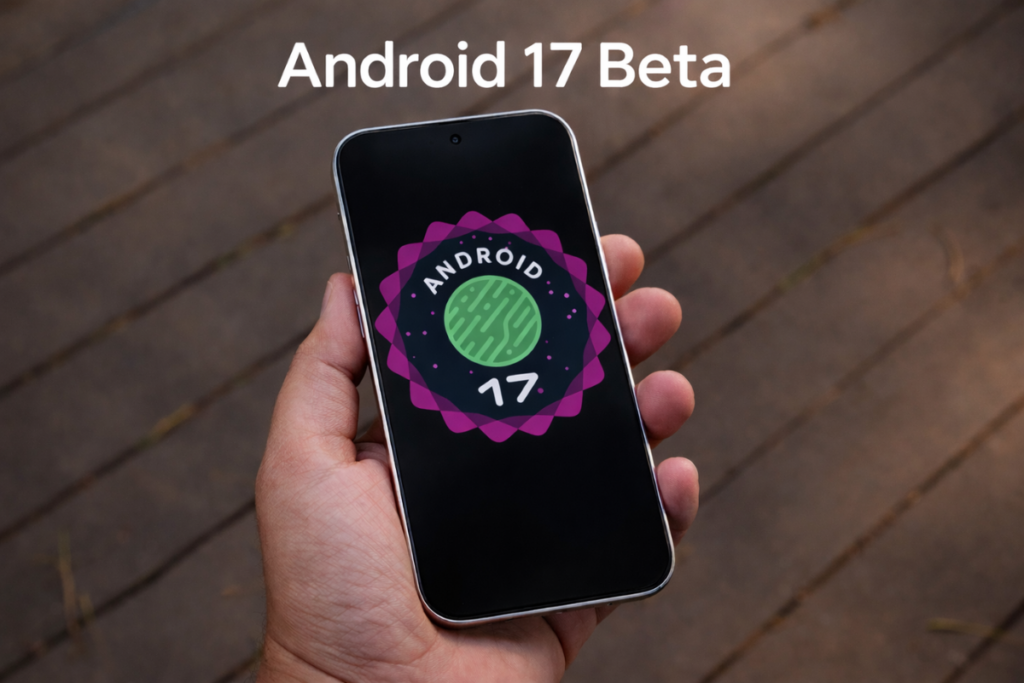
Just three days ago, Google confirmed that Android 17 Beta 1 is coming, and now it’s here. We weren’t expecting the first beta to be released so quickly, but it’s here with improvements to privacy, security, and performance. There are some significant changes as well, which we’ll discuss in the article, along with the eligible devices list and installation steps.
Which devices are eligible for Android 17 beta?
Google Pixels are the first in line to receive the latest beta update, and this year is no different. For now, Android 17 Beta 1 is available for Google Pixels, and it will soon be available on devices from other brands.
So, here’s a list of Google Pixel devices eligible for Android 17 beta:
Pixel 6
Pixel 6 Pro
Pixel 6a
Pixel 7
Pixel 7 Pro
Pixel 7a
Pixel Tablet
Pixel Fold
Pixel 8
Pixel 8 Pro
Pixel 8a
Pixel 9
Pixel 9 Pro
Pixel 9 Pro XL
Pixel 9 Pro Fold
Pixel 9a
Pixel 10
Pixel 10 Pro
Pixel 10 Pro XL
Pixel 10 Pro Fold
In short, if you have a Pixel 6 or older, you can install the Android 17 Beta 1 build and get a taste of the latest features and all the upgrades without waiting months for the stable rollout.
How to install Android 17 Beta 1 on Google Pixels?
If your Google Pixel is running Android 16 QPR3 Beta 2.1 and you haven’t exited the beta program, you should automatically receive the Android 17 Beta 1 update. The update should be available at Settings > System > Software Updates > System Updates. Other users should follow the process as mentioned below.
If you’re not already part of the beta program, visit google.com/android/beta and “Opt in” on your selected device. Make sure you’re logged into the website with the same Google account. After opting in, you should be able to install the latest beta update on your Google Pixel from the Software Updates section in the Settings app.
Before installing any beta update, it’s advised to back up important data to another device or a cloud storage for added safety.
Android 17 Beta 1: What’s new and what’s improved?
The first beta of Android 17 is mostly developer-focused and marks the transition from the traditional “Developer Preview” model to a continuous “Android Canary” program. The Canary channel offers faster access to features and APIs, quicker stability, and eliminates the need for manual flashing.
As for the changes, the first beta enforces stricter requirements for app behaviour on large-screen devices (smallest width ≥ 600dp), preventing apps from opting out of resizability and orientation changes. These changes do not affect smaller devices (sw < 600dp).
Furthermore, apps running on larger screens, such as tablets, foldables, or desktop windowing environments, must now support landscape and portrait layouts and adapt to resizable windows.
Android 17 introduces several low-level changes to improve app efficiency and system health, including a Lock-free MessageQueue to reduce missed frames, Generational Garbage Collection to reduce the CPU cost and duration of full-heap collections, and Strict “Static Final” Fields to allow the runtime to apply more aggressive performance optimizations.
The update also includes important camera upgrades, including Dynamic Camera Sessions to enable seamless transitions between modes, Constant Quality Recording for extended control, and Versatile Video Coding (VVC) on devices with supported hardware.
Additionally, the latest beta build includes an improved audio framework, enhanced VoIP call history (supporting avatars and privacy controls), and Wi-Fi Ranging updates (Proximity Detection and 11az secure ranging). The CompanionDeviceManager now features two new profiles, Medical Devices and Fitness Trackers, for streamlined permission handling and device identification.
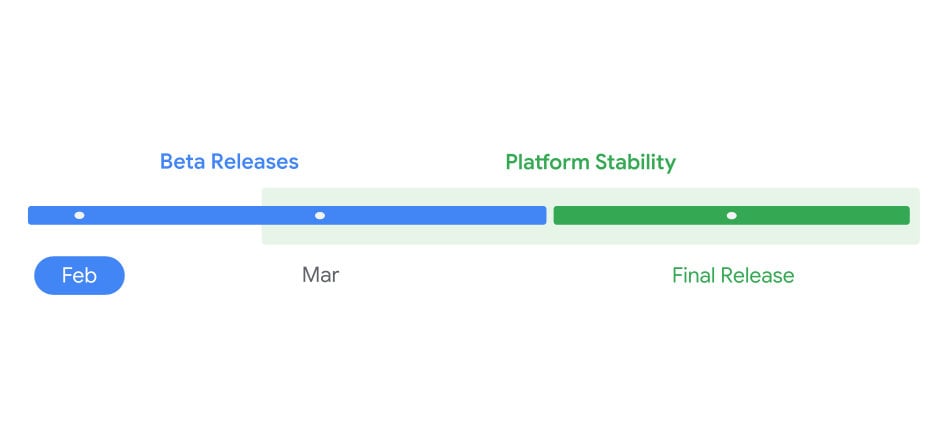
According to the official timeline, the “Platform Stability” phase begins next month. At this point, SDK/NDK APIs and app-facing behaviors will be finalized. The stable release could arrive sometime in Q3 2026.
We’ll continue to update you with fresh developmenets in our Android 17 section. You can visit it regularly for the latest updates. Or, join our Telegram channel to get instant notifications about the latest happenings in tech.
LG has expanded its xboom audio range in partnership with nine-time Grammy winner will.i.am. The company has introduced two new true wireless models, the LG xboom Buds Plus and the LG xboom Buds Lite. These earbuds were initially released in South Korea in September 2025 and are now rolling out more widely. Both models are part of the “xboom by will.i.am” lineup, with will.i.am closely involved in tuning and shaping the sound profile.
According to LG, the earbuds are tuned to deliver balanced warm tones that reflect will.i.am’s sound preferences. The new models were presented at the FYI Visionaries event, where the expanded xboom lineup was showcased.
LG xboom Buds Plus
The Buds Plus are designed as the most advanced model in the lineup. They feature a UVnano+ charging case that uses UV-C light to reduce bacteria on the earbud speaker mesh. Independent testing shows that the UVnano system eliminates 99.9 percent of Escherichia coli, Staphylococcus aureus, and Klebsiella pneumoniae within ten minutes of charging when the case is connected to a power cable. Users can also set the UV function to activate automatically whenever the earbuds are placed inside the case and the lid is closed.
Active Noise Cancellation is supported through a three-microphone system that improves noise detection and reduction. With ANC turned off, the earbuds provide up to 10 hours of continuous playback. The charging case adds up to 20 more hours, bringing total playback to up to 30 hours. Actual battery life depends on usage and settings.
The Buds Plus also support 3D Spatial Audio for a wider soundstage and multi-point connection for switching between devices without disconnecting. Users can adjust sound through customizable EQ settings. The earbuds carry an IPX4 rating under IEC 60529 standards, meaning they are resistant to splashes of water. They should be dried before use and must not be charged while wet. The charging case is not IPX4 rated.
A built-in Bluetooth transmitter allows the Buds Plus to connect wirelessly to devices that have a headphone jack, such as in-flight entertainment systems or treadmills. Compatibility may vary depending on the device.
LG xboom Buds Lite
The Buds Lite focus on portability with a compact and lightweight design. They deliver up to 11.5 hours of continuous playback from the earbuds. With the charging case, total playback reaches up to 35 hours when ANC is turned off. Actual performance varies based on usage.
The Buds Lite use a single microphone to monitor ambient noise, which results in a different ANC experience compared to the three-microphone system on the Buds and Buds Plus. They also include customizable EQ settings and carry an IPX4 water resistance rating for protection against splashes.
The LG xboom Buds Plus are priced at $179.99 and are available now on LG.com and through LG authorized retailers across the United States. The LG xboom Buds Lite are priced at $69.99 and are also available online and at authorized retailers nationwide.
Sharge, a brand known for bold power solutions and eye-catching tech accessories, has just announced a new power bank that brings impressive specs packed in a futuristic design. The Shargeek 300 Power Bank just debuted as a next-gen portable charger that pairs serious output with a transparent body. So here are all the details.
Shargeek 300 Power Bank Specifications
Under the hood, the Shargeek 300 packs a massive 24,000mAh capacity, which sits right at the upper limit for airline-safe power banks. That kind of muscle means it can keep smartphones, tablets, laptops and more powered up without needing a wall socket for a long stretch, making it ideal for travel, work setups, and outdoor use. Sharge’s new power bank doesn’t just store a lot of juice, it moves it fast too. The unit delivers a combined maximum output of 300W, which is spread across two USB-C ports, a USB-A port, and a DC output.
Shargeek 300 Power Bank
Each of the USB-C ports can push up to 140W, which is enough to charge some power-hungry laptops as well. Meanwhile, the DC output can be tuned between 25W and 140W for flexible use with gear like monitors, routers, or even small home electronics. A standout feature is the Shargeek 300’s semi-transparent body and RGB accent lighting, giving it a look more aligned with futuristic hardware than traditional power banks.
This also gives you aglimpse into the internal components and a built-in smart display that shows key data like remaining battery capacity, input/output wattage, and temperature. You also get support for up to 140W fast charging for fast top-ups. The Shargeek 300 has just launched on Kickstarter, with early-bird pricing starting at about $149. After the initial discount, the estimated backing price during the crowdfunding period is around $159 before its expected delivery around May 2026.
For more daily updates, please visit our News Section.
OnePlus has commenced the global rollout of OxygenOS 16 (based on Android 16) for the OnePlus Pad Lite, beginning with Indian users. The update (versions OPD2481_16.0.3.500 and OPD2480_16.0.3.500) introduces substantial performance improvements and AI-powered features across the operating system.
OnePlus Pad Lite
Performance Updates
The Trinity Engine optimizes workload distribution in real-time, improving storage read/write operations and RAM compression. Background resource management has been updated to reduce power drain during intensive tasks, and power-saving modes now adjust performance based on battery levels. Apps launch faster from the home screen, with improved scrolling and touch responsiveness.
Parallel processing updates include animations for text selection magnifiers, status bar transitions, and audio playback controls. Swipe-back gestures now show previews of previous pages with motion tracking, and the Luminous Rendering Engine adds light field motion effects.
AI Features
The Photos app has updated navigation with clearer categories and personalized sorting. Video editing now includes splitting, merging, speed adjustment, transitions, and background music. Users can swipe up to view photo details.
Notes include block editing mode for formatting and repositioning text, images, tables, and documents. Text highlighting, font switching, and quick formatting access via “/” command are now available. Notes can be shared as single links containing all media types.
Interface Changes
The Flux Home screen uses light field styling for icons and has optimized grid layouts and customizable folder configurations. Users can remove icon labels, add more dock apps, and access drawer organization with category sorting and app suggestions.
Lock screen customization includes custom text and configurable corner shortcuts. Flux themes adjust icon styles to match wallpaper colors, with dark mode options available.
Connectivity and Additional Changes
OnePlus Connect groups device settings by type. My Devices appears in Quick Settings and home screen widgets for device management. AI LinkBoost updates kernel scheduling for app connectivity.
Other changes include earbuds-only ringtones, redesigned Smart Sidebar, faster iOS data migration, and updated notification management with Quick Settings customization.
Casio has added a sleek new model to its classic digital lineup in the United States, blending retro styling with everyday features and a genuine leather strap for a more refined look. It is the Casio Vintage LA680WEL-1, which was previously announced in Japan.
Casio’s Vintage Digital Watch Goes Global
The Casio Vintage LA680WEL-1 US release follows its recent debut in Japan and brings a vintage-inspired design to a fresh generation of watch buyers. This model pairs a streamlined digital face with a silver-colored chrome-plated resin bezel and a black genuine leather band that has an embossed pattern for added character. The design nods to Casio’s heritage while giving it a slightly more upscale finish suitable for everyday wear.
Casio Vintage LA680WEL-1 Watch Launch with Leather Straps
The watch measures just 15 grams, making it a compact and lightweight wearable piece. So it’s perfect for wrists that find many modern smartwatches too bulky. Under the polished exterior, Casio hasn’t skimped on useful features. The LA680WEL-1 includes a digital display offering 12/24-hour time formats, an automatic calendar to stay accurate, a daily alarm, 1/100th second stopwatch, an amber LED backlight, and water resistance.
What makes this release stand out from other Casio digital classics is its genuine leather strap. It is a notable departure from the usual resin or metal bands for many digital models. That leather band gives the LA680WEL-1 a slightly dressier edge, making it easier to wear with both casual and business outfits. This contrasts with Casio’s longstanding tradition of resin-strapped digital watches, but fans of retro designs with a modern twist should appreciate the aesthetic here. Casio has listed the Vintage digital watch at its official US online store for 54.95 US Dollars.
For more daily updates, please visit our News Section.
Xiaomi‘s latest flagship smartwatch could finally be getting a release outside of China. A fresh leak has suggested that the Xiaomi Watch 5 is rolling out in the global market. The wearable first debuted in the brand’s home market back in December 2025, so here’s what we know about its wider launch.
Xiaomi Watch 5 Global Launch
After the initial announcement alongside the Xiaomi 17 Ultra, recent leaks suggest that the premium smartwatch could launch beyond its home market with premium specs, robust health tracking, and Google Play support. Unlike the China-only version that currently runs Xiaomi’s local software layer and HyperOS integration, the global Watch 5 is tipped to switch to WearOS. This would mark Xiaomi’s return to a broader smartwatch ecosystem with direct access to Google’s app store, Tiles, assistants and more.
Xiaomi Watch 5
In other words, the smartwatch would likely compete directly with the likes of the Google Pixel Watch and Samsung Galaxy Watch series that also run on WearOS. Early details from European price leaks point to the Watch 5 being listed in Czechia for around 7,990 CZK (roughly 390 US Dollars). The earlier listing also reveals the smartwatch in two color options, Black and Juniper Green. This is for the 47mm case, and hints at an imminent launch.
While specs for the global model are expected to mirror what’s already on offer in China, here’s what buyers are likely to get:
1.54-inch AMOLED display
Dual-chip architecture with Snapdragon W5
Advanced health sensors (ECG, SpO2, and more)
Stainless steel body
5ATM water resistance
Battery life details suggest multi-day endurance, offering around six days in smart mode and over 18 days in the power saving mode.
For more daily updates, please visit our News Section.
Hisense has released its M7 Mini-LED TV series in the United States, targeting budget-conscious buyers seeking premium display technology. The lineup includes 50-inch, 55-inch, and 65-inch models, with the smaller two sizes already available at Walmart for $278 and $298, respectively.
The M7 Series delivers 4K UHD resolution at 3,840 × 2,160 pixels with a 60Hz refresh rate. Mini-LED backlighting enhances contrast by producing deeper blacks and brighter highlights than traditional LED displays. Hisense’s Hi-QLED Color technology aims to improve color accuracy and maintain visibility in well-lit environments.
The TV supports Dolby Vision, HDR10+, and HLG formats. An AI-powered 4K upscaler analyzes textures and edges in lower-resolution content to reconstruct detail for improved sharpness. AI Smooth Motion reduces blur in fast-moving scenes, which can benefit sports and action content.
For gaming, the M7 includes Game Mode Plus with Variable Refresh Rate and Auto Low Latency Mode on the 60Hz panel. These features are designed to reduce input lag and screen tearing. A built-in Game Bar provides access to real-time performance settings.
The M7 runs Google TV, providing access to major streaming platforms including Netflix, YouTube, and Disney+. Google Assistant enables voice control, while Google Cast supports wireless screen mirroring from compatible devices.
Connectivity options include Wi-Fi, Bluetooth, and multiple physical ports: four HDMI 2.0 inputs, USB 2.0 Type-A, Ethernet, optical audio output, cable/antenna input, and a 3.5mm AV composite jack.
For more daily updates, please visit our News Section.
Xiaomi is preparing to launch the new TV S Mini LED 2026 lineup globally soon, bringing its next generation Mini LED TV to markets outside of China. The new smart TV is set to debut with ultra high resolution, Google TV support, and much more. So here’s what we know.
Xiaomi TV S Mini LED 2026 Global Launch
The upcoming 2026 TV S Mini LED was just spotted on the Chinese tech giant’s international website. Xiaomi’s new series spans a wide range of screen sizes and packs smart TV features/ The 2026 TV S Mini LED family will be available in multiple screen sizes, namely 55-inch, 65-inch, 75-inch, 85-inch and even a massive 98-inch option. Every size delivers 4K UHD resolution (3,840 × 2,160), and the platforms run Google TV, giving users access to top streaming apps and smart assistants such as Google Assistant, Google Cast and Apple AirPlay.
Xiaomi TV S Mini LED 2026
All models also come with dual 15 W built-in speakers, connectivity options like Wi-Fi and Bluetooth, and broad port support for HDMI and USB. The TV S Mini LED 2026 lineup steps up picture quality with Mini LED backlighting. All four size options arrive with a peak brightness of around 1,200 nits, 94% coverage of the DCI-P3 color gamut, and support for popular HDR formats such as HDR10+ and HLG.
When it comes to fluid motion and gaming, the 85-inch and 98-inch variants stand out with a native 144Hz refresh rate. This makes it ideal for action sports, movies, and video games. Meanwhile, the smaller sizes (55″, 65″, 75″) feature 60Hz refresh rates with robust HDR support. Other notable features include MEMC support, WiFi 5, Bluetooth 5, HDMI, and HDMI 2.1 ports on the three smaller options. Meanwhile, the 85 inches and 98 inches models get WiFi 6, Bluetooth 5.2, and more HDMI 2.1 ports.
For more daily updates, please visit our News Section.
As the Year of the Dragon festivities kick off in China, Xiaomi has given its camera app a festive twist with three new limited-time camera watermarks for devices running HyperOS 3. These themed overlays add a holiday vibe to your photos. So let’s check it out.
Xiaomi HyperOS 3 Update Brings Chinese New Year Watermarks
As the Year of the Dragon festivities kick off in China, Xiaomi has given its camera app a festive twist with three new limited-time camera watermarks for devices running HyperOS 3. These themed overlays add a holiday vibe to your photos. But keep in mind, this new addition isn’t permanent. The Chinese tech giant is only offering these special watermarks for a limited time.
Xiaomi HyperOS 3 Chinese New Year Watermark
These are currently region-exclusive and available in devices running on the latest HyperOS 3 build. The new watermarks lean into traditional Chinese New Year symbolism and are designed to give your snapshots an auspicious feel. There are three new options available, which include:
Red Koi Fish: A vibrant red koi motif that represents luck, perseverance, and prosperity, with its tail elegantly arched in motion.
Traditional Lion Dance: A stylized lion dance figure that reflects classic folk customs, embodying celebration and joyful energy.
Horse + Ruyi Pattern: A horse motif intertwined with the auspicious ruyi pattern, symbolizing good fortune and balance.
Notably, these designs aren’t just static overlays. Xiaomi’s camera product manager notes that they can be customized and tweaked within the camera settings to fit your shots and personal aesthetic. Xiaomi is only making them available from February 10 through March 9. Unfortunately, the Chinese New Year watermarks aren’t currently available on global HyperOS builds and are specific to devices in China.
For more daily updates, please visit our News Section.
BenQ has launched the GW90TC Series monitors in India. The lineup includes four models: GW2490C, GW2490TC, GW2790C, and GW2790TC. These monitors are built for office work, study, and home setups, with high refresh rates, IPS panels, and USB-C support on select models.
The GW2490C and GW2490TC feature a 23.8-inch IPS panel with LED backlight, Full HD 1920 × 1080 resolution, 250 nits brightness, 178-degree viewing angles, and 99 percent sRGB color coverage. They offer a 16:9 aspect ratio, 16.7 million display colors, 93 PPI, matte screen coating, and HDCP 1.4 support.
The GW2790C and GW2790TC come with a 27-inch IPS LED panel, Full HD 1920 × 1080 resolution, 300 nits brightness, 178-degree viewing angles, and 99 percent sRGB. These models provide a 16:9 aspect ratio, 16.7 million colors, 82 PPI, matte coating, and HDCP 1.4. The GW2790TC also supports gamma adjustment from 1.8 to 2.6 and AMA.
All four monitors support a 144Hz refresh rate and 5ms response time. Available color modes include Standard, Game, ePaper, Care, and Cinema. AMD FreeSync is supported. Audio is handled by dual 2W speakers and a headphone jack.
Connectivity options include 1 HDMI 1.4 port and 1 DisplayPort 1.2 port on all models. The C variants include 1 USB-C port with DisplayPort Alt Mode and data support, but no power delivery. The TC variants include 1 USB-C port with DisplayPort Alt Mode, data, and up to 20W power delivery.
The TC models offer full ergonomic adjustment with tilt from -5 to 35 degrees, swivel of ±45 degrees, 90-degree pivot, and 150 mm height adjustment. The C models support tilt from -5 to 20 degrees.
Eye-care features include Flicker-Free, Low Blue Light Plus, Color Weakness mode, and ePaper mode. Certifications include TUV Eye Comfort 3.0, EyeSafe 2.0, Low Blue Light, and Energy Star. All models support 100 × 100 mm VESA mounting.
Pricing & availability
Pricing in India starts at Rs. 9,589 for the GW2490C, Rs. 12,750 for the GW2490TC, Rs. 11,989 for the GW2790C, and Rs. 14,990 for the GW2790TC.
Leaks around the Samsung Galaxy S26 Ultra are picking up pace, and the latest one gives us a closer look at the phone in a White finish, thanks to a newly surfaced dummy unit.
The clip, shared by tipster Phonenurd, doesn’t show the display powered on, so it’s unclear whether this is a functioning unit or simply a realistic-looking dummy with camera lenses and premium finish details. Non-functional mockups are typically used by accessory makers to prepare cases ahead of launch. But even as a dummy, it reveals quite a bit about the design direction Samsung may be taking this year.
The White variant looks surprisingly clean. While Cobalt Violet is reportedly the hero color for the lineup, this white finish feels understated and premium.
One noticeable change is the shape of the corners. The S26 Ultra appears to lean even further into rounded edges compared to the Samsung Galaxy S25 Ultra, which had already softened the sharp, boxy look seen in earlier Ultra models.
If this holds true in the final version, it could make the device more comfortable to hold without sacrificing the Ultra’s premium feel. It’s a subtle change, but ergonomics matter.
The camera setup also seems to be evolving. Since the Samsung Galaxy S22 Ultra, Samsung has stuck with a relatively clean look: individual camera rings sitting directly on the rear panel. The S26 series, however, introduces a more noticeable camera bump across the lineup.
It’s a shift from minimalism toward something slightly more aggressive. Some fans may prefer the older floating-lens aesthetic, but this new approach does give the device a stronger visual identity.
The Galaxy S26 lineup is expected to arrive in four standard colors: Violet (likely Cobalt Violet), Black, Blue (possibly Sky Blue), and White. Samsung is also likely to introduce a few online-exclusive shades.
If these early looks are accurate, the Galaxy S26 Ultra doesn’t reinvent the design, but it does refine it in a few meaningful ways.
Now the real question is whether those tweaks will be enough to stand out in an increasingly competitive flagship market.
Google Pixel 10a’s full specifications have surfaced online ahead of its expected launch next week. The leak gives a clearer picture of the upcoming budget Pixel, highlighting minor refinements rather than major design changes. Here is everything revealed so far about the device and how it differs from its predecessor.
Google Pixel 10a full specifications
Google Pixel 10a color options
According to Winfuture.de, the Google Pixel 10a is expected to feature a 6.3-inch OLED display with a 120Hz refresh rate and a resolution of 2424 x 1080 pixels. The panel is protected by Corning Gorilla Glass 7i, indicating improved durability compared to previous models. The overall design of the Pixel 10a is almost the same as its previous generation.
The device is said to be powered by the Google Tensor G4 processor paired with the Titan M2 security chip. It may arrive with 8GB LPDDR5X RAM and UFS 3.1 storage options of 128GB and 256GB, without microSD expansion. A 5,100mAh battery is expected, now supporting faster wired charging speeds up to 45W, along with wireless charging support.
In terms of cameras, the Pixel 10a is tipped to retain a 48-megapixel primary camera with dual-pixel autofocus and optical image stabilisation, alongside a 13-megapixel ultrawide camera offering a 120-degree field of view. A 13-megapixel front camera is also expected for selfies and video calls.
The Pixel 10a is expected to ship with Android 16 and will receive up to seven years of software and security updates. Its other features include an in-screen fingerprint sensor, an IP68-rated dust and water-resistant body, dual speakers, Bluetooth 6, Wi-Fi 6e, dual SIM support including eSIM, NFC, USB Type-C, satellite emergency calling, and multiple navigation systems such as GPS, Galileo, GLONASS, QZSS, and BeiDou.
5 key changes compared to Pixel 9a
Google Pixel 9a color variants
While the overall hardware appears familiar, five notable changes separate the Pixel 10a from the Pixel 9a:
45W wired charging support | Pixel 9a supported 23W charging
Satellite emergency call feature added | Not available on Pixel 9a
Bluetooth 6 support | Pixel 9a featured Bluetooth 5.4
New colour options: Obsidian, Fog, Lavender, Berry | Pixel 9a came in Obsidian, Porcelain, Iris, Peony
Also, the Pixel 10a measures 153.9 x 73 x 9 mm and weighs 183 grams. In comparison, the Pixel 9a has 154.7 x 73.3 x 8.9 mm dimensions and weighs 186 grams.
Google Pixel 10a variants, price and launch timeline
The report suggests that the Google Pixel 10a will be available in two storage variants: 128GB and 256GB. Pricing is expected to start at €499, with reports indicating a promotional offer where the 256GB version may initially be available at the same price as the base model instead of its regular €599 cost. It will be available for purchase across different markets starting Feb. 18.
For more daily updates, please visit our News Section.
Honor has introduced the Honor Pad X8b in global markets, expanding its affordable tablet lineup with a focus on entertainment and everyday productivity. Key highlights include an 11-inch eye-comfort display, Snapdragon processor, quad-speaker setup, and a large 10,100mAh battery. Here is a closer look at its specifications, features, and pricing details.
Honor Pad X8b specifications and features
Honor Pad X9b
The Honor Pad X8b has an 11-inch TFT LCD panel with a resolution of 1920 x 1200 pixels, 207ppi density, and support for a 90Hz refresh rate. The display reaches up to 500 nits brightness and carries TÜV Rheinland certifications for reduced blue light and flicker-free viewing.
The X9b is powered by the Snapdragon 680 chip, 4GB of RAM, and 128GB of internal storage. The tablet supports expandable storage up to 2TB via microSD.
The X9b’s camera hardware includes a 5-megapixel rear camera with autofocus and a 5-megapixel front camera designed for video calls and basic photography. It houses a massive 10,100mAh battery, but there’s no word on its fast charging capabilities. However, it promises a standby time of up to 97 days.
The tablet runs MagicOS 10 based on Android 16, with Honor’s software enhancements including parental controls, eye-comfort features, and AI-based tools. It comes with Honour Sound-tuned quad speakers, Wi-Fi 5 support with dual-band frequencies, Bluetooth 5.0, and USB Type-C charging. The tablet measures 7.25mm in slimness and weighs around 496 grams.
Honor Pad X8b price and availability
In Saudi Arabia, the Honor Pad X8b is priced at 649 SAR (~$175) for the 4GB+128GB (Wi-Fi-only) variant. It comes in a single Space Gray shade. There’s no clarity about which other markets will be receiving the X9b.
For more daily updates, please visit our News Section.
Mosseri, who leads Instagram, is among the first major tech executives to testify in a growing wave of cases accusing platforms of harming young users. The current case targets Meta, Instagram’s parent company, along with YouTube. Similar lawsuits have also been filed against TikTok and Snap.
At the center of this particular trial is a 20-year-old plaintiff, who says she began using Instagram and YouTube heavily as a child. Her legal team argues that the platforms’ design encouraged compulsive use that contributed to depression, anxiety, and suicidal thoughts.
Mosseri did not deny that excessive use can happen. But he pushed back strongly against the term “clinical addiction.”
When attorneys pointed to testimony that the plaintiff sometimes spent up to 16 hours a day on Instagram, Mosseri described it as “problematic use,” not addiction in a medical sense. He compared it to binge-watching a TV series.
“I’m sure I’ve said I was addicted to a Netflix show after staying up too late,” he told the court. “But that’s not the same thing as clinical addiction.” In his framing, personal factors and broader lifestyle patterns play a significant role, not just platform mechanics.
That distinction is central to the defense. Plaintiffs are trying to show that the platforms’ design directly contributed to psychological harm. Meta’s position, at least as articulated in court, is that heavy use alone does not equal medically recognized addiction, and that correlation should not be confused with causation.
Critics argue that this minimizes growing evidence linking prolonged social media use to mental health challenges among teens. US Surgeon General advisories and multiple academic studies have found associations between extended daily use and higher rates of anxiety, depression, sleep disruption, and body image concerns.
Meta, for its part, says it has introduced parental controls, time-management reminders, and youth safety features, and that it tests new features with younger audiences in mind.
As the case moves forward, the debate remains less about screen time alone and more about responsibility. Are these platforms simply tools that some users overuse? Or are they engineered in ways that exploit developing brains?
Samsung’s upcoming foldable devices have appeared in early software testing leaks, hinting that the company has already begun working on One UI 9. Firmware sightings linked to unreleased models suggest that development is progressing alongside preparations for next-generation foldables expected later this year.
One UI 9 testing spotted on upcoming foldables
Samsung Galaxy Z Fold 7
Recent reports indicate that internal One UI 9 builds have been detected for multiple upcoming foldable smartphones, including the Galaxy Z Fold 8 and Galaxy Z Flip 8. Firmware versions such as F976USQU0AZB1 and F776USQU0AZB1 have surfaced through test servers, pointing toward early-stage software testing.
Another mysterious device carrying the model number SM-F971U has also been seen running similar firmware, suggesting Samsung may be working on an additional foldable model alongside its usual Fold and Flip lineup. Leakers claim that One UI 9 will be based on Android 17 and could debut directly on new foldable devices once they launch.
Reports also mention that testing has extended to current foldable hardware like the Galaxy Z Fold 7, indicating that Samsung is preparing the update for both new and existing devices simultaneously. This early testing phase highlights Samsung’s strategy to accelerate software readiness ahead of hardware launches.
Galaxy Z Fold 8, Z Flip 8: What to expect?
While details about the hardware remain limited, early rumors suggest that the Galaxy Z Fold 8 could feature a triple-camera system, including a 200-megapixel main sensor, a 50-megapixel ultrawide camera, and a 12-megapixel telephoto unit. The Galaxy Z Flip 8 is tipped to run on a next-generation chipset, possibly built on a 2nm process, though confirmation is still pending.
Samsung is also believed to be developing a wider foldable device internally codenamed H8, which may adopt a different form factor compared to existing models. The next foldable lineup is expected to arrive later this year, potentially making these devices the first to ship with One UI 9 out of the box, while the Galaxy S26 series may debut with One UI 8.5 before transitioning to the newer software.
For more daily updates, please visit our News Section.
While the One UI 8.5 release is yet to happen, Samsung is already laying the groundwork for its next major release, One UI 9. A few Galaxy devices have been spotted on Samsung’s test servers with new build versions pointing to One UI 9.
The Galaxy Z Fold 8 and Galaxy Z Flip 8 were the first phones to show up on the server with One UI 9 test builds (1, 2). Both foldables will launch around July 2026 with One UI 9 right from the box.
Perhaps the most intriguing is the appearance of a mysterious third device with the modem number SM-F971U running the build version F971USQU0AZB1. This could mean Samsung might also launch a third foldable phone alongside the Fold 8 and Flip 8 in the second half. We don’t know what it would be called, but rumors say this could be the Galaxy Wide Fold.
Alongside these three upcoming foldable phones, the One UI 9 test build has also been spotted for the Galaxy Z Fold 7. This is kind of surprising, as the Galaxy Z Fold 7 hasn’t even received the One UI 8.5 update.
So, here’s a list of Samsung devices that are currently under One UI 9 testing:
Galaxy Z Fold 8
Galaxy Z Flip 8
Galaxy Wide Fold (name unconfirmed)
Galaxy Z Fold 7
The list is currently small, as Samsung began testing One UI 9 just recently. It will grow in the coming days, especially after the One UI 8.5 release, when more of the company’s focus will shift towards One UI 9.
It’s important to highlight that One UI 9 testing is happening internally, so you can’t download and test the firmware on your Galaxy device. The presence of such test builds on the server indicates that the company is testing the firmware behind closed doors to ensure a stable, smooth rollout in the future.
While Samsung has begun development of One UI 9 for its Galaxy devices, its primary focus will be the Galaxy S26 series, which is launching later this month with One UI 8.5. In late April, we might see One UI 8.5 rolling out to older Galaxy devices. You can check the list of eligible devices here.
We’ll continue to update you with the latest One UI news in our Samsung section. Visit it regularly to stay up to date. Or, join our Telegram channel to get instant notifications about the latest happenings in tech.
The Poco X8 series, which includes the Poco X8 Pro and X8 Pro Max, has been gradually receiving new certifications. In the latest development, the Pro Max edition has received approval from the Indonesian TKDN certification platform. While it has not revealed any technical details, it marks another hurdle cleared before launch.
Poco X8 Pro Max TKDN certified
Poco X8 Pro Max TKDN listing
The TKDN listing of the Poco X8 Pro Max reveals 5G support and nothing else. The handset carries the model number 2602BPC18G, which has already surfaced on other certification platforms, including IMDA in Singapore, BIS in India, and the EEC, suggesting preparations for availability across multiple markets.
While the above-mentioned listings only revealed the model number, a previously seen IMEI listing helped confirm the device’s final marketing name. In all likelihood, the Poco X8 Pro Max and the X8 Pro may debut in March across different countries.
Poco X8 Pro Max specifications (rumored)
Poco X8 Pro Max
Although official details remain undisclosed in certifications, leaks based on Xiaomi’s HyperOS 3 code provide a clearer picture of what to expect. The Poco X8 Pro Max is tipped to feature a large 8,500mAh battery along with support for 100W wired charging. In all likelihood, it will be a tweaked version of the China-exclusive Redmi Turbo 5 Max, with one major difference being in the battery department. To put this into context, the Redmi model packs a massive 9,000mAh battery.
The Poco X8 Pro Max is expected to feature a 6.83-inch AMOLED display with a resolution of 1280 x 2772 pixels, combined with a 120Hz refresh rate, 3,840Hz PWM dimming, and peak brightness of up to 3,500 nits. It is likely to be powered by the MediaTek Dimensity 9500s chipset, paired with 12GB or 16GB RAM and storage options reaching up to 512GB. Camera hardware is rumored to include a 50-megapixel primary sensor with OIS, supported by an 8-megapixel ultrawide lens and a 20-megapixel front camera.
For more daily updates, please visit our News Section.
Apple’s upcoming iPhone 17e has surfaced in a fresh leak by FrontPageTech, offering an early look at its expected design changes, hardware upgrades, and positioning within the company’s lineup. The leak reveals that it could arrive sooner than usual, possibly through a press announcement later this month, signalling Apple’s renewed push in the affordable premium segment.
iPhone 17e key specifications, design
iPhone 17e render by FPT
According to FPT, the iPhone 17e may drop the traditional notch in favor of Dynamic Island, aligning its appearance more closely with higher-end models. The device is expected to feature a 6.1-inch display, although reports indicate it may retain a 60Hz refresh rate, which could remain one of its compromises.
Apple appears to be targeting users looking for a relatively accessible entry into the iOS ecosystem, especially in markets where mid-range competition is strong. The handset is also tipped to introduce an upgraded 18-megapixel front camera with Centre Stage functionality, improving video calls and content creation.
iPhone 17e render by FPT
On the rear, a single 48-megapixel Fusion camera is likely to continue, relying on improved processing from the newer chipset to deliver better imaging results rather than major hardware changes. Its rear design is almost identical to the previous generation.
Internally, the iPhone 17e is said to run on a lower-binned A19 processor paired with 8GB RAM, enabling support for Apple Intelligence features. Connectivity improvements may come via Apple’s C1X networking chip, while MagSafe charging is reportedly making its way to this tier for the first time.
iPhone 17e render by FPT
Pricing is said to start at around $599, keeping it in line with its predecessor. Standard Black and White color options are likely, with a possible Lavender variant under consideration.
For more daily updates, please visit our News Section.
Huawei is set to break its recent streak of China-only flagship launches with the global debut of the Mate 80 Pro. The company unveiled this premium phone a couple of months ago, and it is finally making its way outside of China. So here’s everything you need to know.
Huawei Mate 80 Pro Goes Global on Feb 26
The Chinese tech giant has confirmed that it will be unveiling its latest Mate series premium phone on 26th February 2026. The company will make the official announcement during an event in Madrid, Spain. In this conference, Huawei will also showcase new TWS earbuds and its latest smartwatch. To recall, the Mate 80 Pro was first introduced in China in November 2025, and its international debut marks a significant step as Huawei continues to re-establish flagship momentum outside its home market.
Huawei Mate 80 Pro
The global press event is dubbed the “Global Innovative Product Launch”, which will launch the Mate 80 Pro, FreeBuds Pro 5 TWS, and Watch GT Runner smartwatch. Based on the earlier release, the Mate 80 Pro stands out with its Dual Space Ring design, which adds a bold visual identity that surrounds the rear camera array with a large circular camera module and a secondary ring below it.
Huawei’s teaser poster shows the upcoming phone in refined colour options such as Dawn Gold and Aurora Blue, paired with a near-edge-to-edge front display and slim bezels. On the front is a 6.75-inch LTPO AMOLED panel with FHD+ resolution and a 1–120Hz dynamic refresh rate. Other notable features include an advanced triple camera with large sensors and the brand’s XMAGE imaging algorithm.
For more daily updates, please visit our News Section.
Xiaomi has quietly expanded its accessory lineup with a new 45W Mini GaN Charger that aims to make fast charging more portable, powerful and affordable. Instead of a bulky charging brick, the company’s latest charging accessory uses Gallium Nitride (GaN) technology to deliver quick power in a much smaller footprint.
Xiaomi 45W Mini GaN Charger Specifications
Despite its tiny size, Xiaomi’s new charger pumps out up to 45W of power, which is enough to juice up most modern phones quickly. Using GaN tech, Xiaomi has managed to shrink the charging adapter, since the materials run cooler and more efficiently than traditional silicon. The Chinese tech giant’s tiny charger is ideal for travel or everyday carry. You get support for universal fast charging standards like PD 3.0 (Power Delivery), QC 3.0 (Quick Charge), and PPS (Programmable Power Supply).
Xiaomi 45W Mini GaN Charger
This means it works not just with Xiaomi and Redmi phones, but also with many iPhones, Samsung Galaxy models, tablets and even lightweight laptops or portable devices that support higher-wattage USB-C charging. The charger’s single USB-C port makes it straightforward to use, and the inclusion of the USB-C cable in the box saves buyers from needing to buy one separately. Xiaomi has also built in multiple protection layers, including over-voltage, over-current, short-circuit and over-temperature safeguards, so the charger is designed to keep your device safe while powering up.
The brand has released the Xiaomi 45W Mini GaN Charger in the Indian market for Rs 1,799, arriving in a clean white finish. Unlike many lower-wattage GaN chargers that don’t include a cable, Xiaomi’s decision to package a USB-C to USB-C cable adds extra value and convenience for users. This accessory is currently available for purchase via the brand’s official website, the official Xiaomi India online store and offline retail outlets.
For more daily updates, please visit our News Section.
The affordable 5G segment is getting more competitive, and that’s exactly why the Samsung Galaxy A17 5G and OPPO K14x 5G are being compared. Both target buyers in the ₹15,000–₹20,000 range, but they take completely different approaches. Samsung focuses on a refined experience with a Super AMOLED display, OIS-backed camera, and long-term software support. OPPO, on the other hand, pushes aggressive value with a massive battery, faster charging, and a lower expected price.
For buyers trying to choose between display quality and battery endurance, long-term reliability and immediate power, this comparison highlights which phone truly delivers the better overall value in 2026’s crowded budget 5G market.
MajorFeatures:
Feature
Samsung Galaxy A17 5G
OPPO K14x 5G
Winner
Display Quality
6.7″ Super AMOLED, 90Hz, Full HD+ — vibrant colors, deep blacks
Please Note: When you buy something using the links in our articles, we may earn a small commission at no cost to you.
Design and Display
Build and Feel
The Galaxy A17 5G uses Gorilla Glass Victus on the front with a fiber-reinforced plastic back and IP54 protection. It feels slightly more refined and durable for daily use. The OPPO K14x 5G offers IP64 dust-tight protection, which adds a practical edge against dust exposure. However, its plastic-heavy build makes it feel more utility-focused than premium. Samsung’s cleaner finish gives it a more polished everyday appeal.
Display Quality
Samsung features a 6.7-inch Super AMOLED panel with 90Hz refresh rate, Full HD+ resolution, and 800 nits brightness. Colors are richer, blacks are deeper, and clarity is noticeably sharper. OPPO counters with a 6.75-inch IPS LCD, 120Hz refresh rate, and higher peak brightness, but its HD+ resolution lowers overall sharpness. While OPPO feels smoother, Samsung looks more vibrant and refined.
Verdict
Samsung wins on display quality and overall visual experience, while OPPO offers better dust resistance and smoother scrolling.
Specifications
Performance
The Galaxy A17 5G runs on the Exynos 1330 (5nm) with up to 8GB RAM and promises six major Android upgrades. That long-term support adds serious value. The OPPO K14x 5G uses the Dimensity 6300 (6nm) with up to 6GB RAM and UFS 2.2 storage. Both are capable of daily tasks, but Samsung’s extended software support makes it feel like a safer long-term investment.
Battery and Charging
OPPO clearly focuses on endurance with a massive 6500mAh battery and 45W wired charging, plus reverse charging support. It’s built for users who hate frequent charging. Samsung offers a 5000mAh battery with 25W charging, which is reliable but not exciting. OPPO’s charging speeds and larger battery make it more future-ready.
Verdict
OPPO wins in battery and charging. Samsung holds an edge in long-term software reliability.
Camera
Main and Secondary Lenses
Samsung provides a 50MP main sensor with OIS, along with 5MP ultrawide and 2MP macro lenses. Optical stabilization gives it an advantage in steadier shots and low-light clarity. OPPO features a 50MP main camera and an auxiliary lens but lacks OIS. While both deliver solid daylight shots, Samsung’s OIS makes photos feel more consistent and dependable.
Selfie Camera
The Galaxy A17 5G includes a 13MP front camera capable of 1080p recording. OPPO offers a 5MP selfie camera. The resolution difference is noticeable in detail and sharpness. Samsung clearly prioritizes better front-camera performance.
Verdict
Samsung wins comfortably in overall camera versatility and selfie performance.
Pricing
The Galaxy A17 5G is priced at approximately $200 (₹19,500). The OPPO K14x 5G is expected to cost around $170 (₹15,000), though it has not officially been out for sale yet. OPPO undercuts Samsung in pricing while offering a larger battery and faster charging, which makes it very attractive for budget buyers.
Samsung justifies its higher price with a Super AMOLED display, OIS camera, Gorilla Glass Victus protection, NFC support (region dependent), and extended software updates. Those features make it feel more premium and future-proof.
Verdict
OPPO offers stronger value for budget-focused buyers. Samsung justifies its higher price with better display and camera hardware.
Disclaimer: Prices are approximate and may vary based on country, region, and applicable taxes.
Conclusion
Samsung stands out with its Super AMOLED display, OIS-enabled camera, Gorilla Glass Victus protection, NFC support, and long-term Android upgrade promise. These elements make it ideal for users prioritizing display quality and camera stability.
OPPO shines with its 6500mAh battery, 45W charging, reverse wired charging, 120Hz refresh rate, Bluetooth 5.4 with aptX HD, and a lower entry price. It feels built for heavy battery users who want maximum endurance without spending much.
Verdict
Overall, the Samsung Galaxy A17 5G stands out as the better all-around smartphone. While the OPPO K14x 5G impresses with its larger battery, faster charging, and lower expected price, Samsung delivers a more complete experience with its Super AMOLED display, OIS-backed camera system, sharper selfie performance, and long-term software support. For users wanting a balanced phone that feels more refined and future-proof, the Galaxy A17 5G is the stronger overall choice.
Tecno has launched the Pova Curve 2 5G in India, introducing a curved AMOLED display, a large 8,000mAh battery, Dimensity 7100 chipset, and Android 16 OS. The device aims to deliver strong battery endurance and smooth performance in the mid-range segment. Here’s a closer look at its specifications, features, and pricing.
Tecno Pova Curve 2 5G specifications and features
Tecno Pova Curve 2
The Tecno Pova Curve 2 5G has a 6.78-inch curved AMOLED display with a Full HD+ resolution and a 144Hz refresh rate, offering fluid visuals for gaming and everyday use. The panel supports peak brightness of up to 4,500 nits and is protected by Corning Gorilla Glass 7i, enhancing durability while maintaining a premium appearance.
Under the hood, the MediaTek Dimensity 7100 chipset paired with 8GB LPDDR5x RAM. The handset is available with 128GB and 256GB of UFS 2.2 storage options, along with 8GB virtual RAM expansion for improved multitasking.
A standout highlight is the 8,000mAh battery, supported by 45W fast charging. With a full charge, the phone can easily last for up to two days. While it packs a huge battery, it is ultra-thin at 7.42mm and weighs just under 200 grams.
The phone runs on Android 16 with HiOS 16 on top. For photography, it features a 50-megapixel primary rear camera accompanied by a 2-mgeapixel secondary sensor, while the front houses a 13-megapixel camera for selfies and video calls.
The Pova Curve 2 packs other features, such as an in-display fingerprint scanner, an enhanced display protection for everyday reliability, an IR blaster, a single speaker with Dolby Atmos support, and an IP65-rated dust and splash resistance.
Tecno Pova Curve 2 5G price and availability
The Tecno Pova Curve 2 5G starts at Rs 27,999 (~$310) for the 8GB+128GB variant, while the 8GB+256GB model is priced at Rs 29,999 ($330). The device comes in Storm Titanium, Melting Silver, and Mystic Purple color options. Sales begin on February 20 at 12pm (local time) via Flipkart. Launch offers include bank discounts of up to Rs 3,000 (~$33) for eligible buyers.
For more daily updates, please visit our News Section.
In September, Xiaomi may unveil the Xiaomi 18, 18 Pro, and 18 Pro Max in China. These devices will replace the Xiaomi 17, 17 Pro, and 17 Pro Max, which were announced in the same month last year. Well before the expected launch, a Chinese tech blogger has shared a render of the Xiaomi 18. Before reading ahead, readers are advised to take this report with a grain of salt, as the authenticity of the design could not be confirmed.
Xiaomi 18 render
Xiaomi 18 render
The above image showcases a square-shaped camera module for the Xiaomi 18 with rounded corners and a minimalist aesthetic. The triple cameras are arranged in a triangular layout, complemented by subtle Leica branding and an LED flash. This design is more in line with the recently unveiled Oppo Reno 15 series.
Xiaomi 18 specifications (rumored)
According to a recent leak by tipster Digital Chat Station, Xiaomi may increase the display from 6.3 inches to 6.4 inches on the Xiaomi 18. A bigger display means the device will internally have more space to accommodate advanced specs.
Therefore, while the Xiaomi 17 came with a massive 7,000mAh battery, it is likely that the Xiaomi 18’s battery could be even bigger than its predecessor. Under the hood, the device is said to feature the next-generation Snapdragon 8 Elite Gen 6 chipset.
DCS also revealed that the entire Xiaomi 18 lineup will have a 200-megapixel periscope telephoto camera. Hence, the Xiaomi 18 may also include a 200-megapixel periscope camera. Like the previous generation, it may continue to feature a 50-megapixel main camera and a 50-megapixel ultra-wide lens. Considering the phone is scheduled to launch later this year, it is expected to ship with Android 17 and a new version of HyperOS.
For more daily updates, please visit our News Section.
Xiaomi has begun rolling out the February 2026 security patch to its devices. While the update doesn’t include new features or improvements, it’s still important because it ensures the devices have fixes for the latest security vulnerabilities. Fortunately, Xiaomi isn’t prioritizing newer devices, as the February update has already started rolling out to HyperOS 2 (Android 14) devices, alongside many HyperOS 3 devices.
The latest security patch doesn’t include any critical “zero-day” vulnerabilities or high-level severity, according to the official Android Security Bulletin. This appears to be a standard maintenance release focused on bug fixes and improvements to system stability.
List of Xiaomi devices receiving the February 2026 security update
HyperOS 3 (Android 16) devices getting the February update:
Xiaomi 15
Global: OS3.0.6.0.WOCMIXM
Taiwan: OS3.0.3.0.WOCTWXM
Xiaomi 15T
Global: OS3.0.9.0.WOEMIXM
EEA/Europe: OS3.0.10.0.WOEEUXM
Xiaomi 15T Pro
Global: OS3.0.11.0.WOSMIXM
EEA/Europe: OS3.0.13.0.WOSEUXM
Xiaomi 14T
Indonesia: OS3.0.2.0.WNEIDXM
POCO F6 Pro/Redmi K70
Global: OS3.0.7.0.WNKMIXM
POCO X7/Redmi Note 14 Pro
Global: OS3.0.9.0.WOOMIXM
EEA/Europe: OS3.0.3.0.WOOEUXM
POCO X7 Pro
Turkey: OS3.0.5.0.WOJTRXM
Global: OS3.0.9.0.WOJMIXM
EEA (Europe): OS3.0.5.0.WOJEUXM
India, Indonesia, Russia, Taiwan
POCO M6/Redmi 13/Redmi 13X
Global: OS3.0.6.0.WNTMIXM
EEA/Europe: OS3.0.3.0.WNTEUXM
HyperOS 2 (Android 15) devices getting the February update:
Xiaomi 12T
Global: OS2.0.212.0.VLQMIXM
Russia: OS2.0.207.0.VLQRUXM
Taiwan: OS2.0.207.0.VLQTWXM
Redmi Note 15 Pro 4G
EEA/Europe: OS2.0.207.0.VPFEUXM
Redmi Note 15 Pro 5G
India: OS2.0.203.0.VPPINXM
Turkey: OS2.0.202.0.VPPTRXM
Redmi Note 12S
Turkey: OS2.0.208.0.VHZTRXM
Russia: OS2.0.209.0.VHZRUXM
Taiwan: OS2.0.209.0.VHZTWXM
Redmi Note 12 4G
Global: OS2.0.205.0.VMTMIXM
Redmi Pad 2 4G
India: OS2.0.209.0.VOWINXM
Redmi Pad 2 Pro 5G
Russia: OS2.0.203.0.VPXRUXM
Redmi 13C 5G, Redmi 13R
Taiwan: OS2.0.203.0.VGQTWXM
EEA: OS2.0.209.0.VGQEUXM
POCO Pad, Redmi Pad Pro
EEA: OS2.0.208.0.VNSEUXM
Russia: OS2.0.207.0.VNSRUXM
Redmi Pad Pro 5G
India: OS2.0.207.0.VFSINXM
EEA: OS2.0.208.0.VFSEUXM
HyperOS 2 (Android 14) devices getting the February update
Redmi Note 12 series (Explorer, Pro, Pro+)
Turkey: OS2.0.8.0.UMOTRXM
India: OS2.0.10.0.UMOINXM
Indonesia: OS2.0.12.0.UMOIDXM
Taiwan: OS2.0.8.0.UMOTWXM
POCO X5 Pro 5G/Redmi Note 12 Pro Speed
Indonesia: OS2.0.13.0.UMSIDXM
The above list has been shared by Xiaomi Time, which also includes some Xiaomi devices running Android 14. It’s good to see the brand expanding the update to older devices alongside newer models. We’ll update the list regularly as Xiaomi expands the update to more devices.
If your Xiaomi device is on the list and you live in a region where the update is already rolling out, you can upgrade to the latest security patch by navigating to Settings > My Device and tapping the HyperOS logo at the top.
Be sure to visit the Xiaomi section regularly for the latest updates. Or, you can join us on Telegram to get instant notifications about the latest HyperOS updates, along with the biggest tech headlines.
A new accessory kit developed in collaboration with accessory maker Telesin is designed specifically for the Honor Magic 8 Pro, turning the flagship into something that feels closer to a compact camera. While the Porsche Design variant already has its own official kit, the Magic 8 Pro didn’t. This new “Professional Photography Grip Kit” fills that gap.
The Magic 8 Pro already has solid camera hardware. It features a 200MP periscope telephoto sensor and a 50MP main camera with a bright f/1.6 aperture. On paper, it’s more than capable. What this kit changes is how you interact with it.
The kit starts with a custom protective case that supports standard 67mm screw-on filters. That means users can attach ND filters, polarizers, and other accessories typically reserved for dedicated cameras. There’s also a mounting point for a wrist strap and magnetic support for quick attachments.
The more interesting piece is the detachable grip. It magnetically snaps onto the case and adds physical controls, including a prominent red shutter button, a zoom slider, and additional shortcut keys. One button handles quick video recording, while another can act as a power switch or programmable function key. A front dial allows for exposure adjustments or other manual tweaks. It’s clearly aimed at users who prefer tactile controls instead of tapping a screen.
The package also includes a 200mm teleconverter lens attachment. It connects via an adapter ring and effectively increases the phone’s optical reach. Combined with the Magic 8 Pro’s existing periscope camera, it should help with distant subjects like wildlife or sports.
As with most clip-on or add-on lenses, real-world performance will depend on alignment and optical quality. But in theory, this gives the phone a bit more versatility than stock hardware alone.
Honor and Telesin have been teasing the kit ahead of a full reveal at Mobile World Congress 2026, where pricing and broader availability are expected to be confirmed.
For Magic 8 Pro users who want more control without carrying a separate camera, this kit could make sense. For everyone else, it’s at least a reminder that smartphone photography still has room to evolve beyond just bigger sensors and software processing.
Ultra smartwatches are no longer just fitness trackers; they’re built as rugged companions for extreme workouts, outdoor adventures, and everyday productivity. The Apple Watch Ultra 3 and Samsung Galaxy Watch Ultra represent the very best from Apple and Samsung, blending premium materials with serious health and performance features. But with similar durability claims and flagship specs, and now a much wider price gap, choosing the right one isn’t simple. This comparison breaks down where each watch truly excels and which one offers the best overall value.
Please Note: When you buy something using the links in our articles, we may earn a small commission at no cost to you.
Design and Display
Build & Comfort
Apple Watch Ultra 3 features a 49mm titanium (grade 5) frame with sapphire crystal protection and a ceramic/sapphire back. It carries IP6X dust resistance, 100m water resistance, 40m dive certification, and MIL-STD-810H compliance. At 61.6g, it feels solid and purpose-built for rugged adventures.
Samsung Galaxy Watch Ultra uses grade 4 titanium with sapphire protection and a ceramic/sapphire back. It offers IP68, 10ATM (100m) water resistance, and MIL-STD-810H durability. At 60.5g, it is slightly lighter and more compact on the wrist.
Display Brightness & Visibility
Apple’s 1.98-inch Retina LTPO3 OLED reaches an impressive 3000 nits peak brightness, making it extremely readable under harsh sunlight.
Samsung’s 1.5-inch Super AMOLED delivers sharp 480×480 resolution and excellent contrast, but brightness levels are lower than Apple’s peak output.
Verdict
Apple dominates outdoor visibility with its ultra-bright 3000-nit panel. Samsung feels slightly more compact and balanced for daily wear. For extreme environments, Apple has the edge.
Health and Fitness Tracking
Sensors & Tracking Accuracy
Apple Watch Ultra 3 includes heart rate, ECG (region dependent), SpO2, VO2 max, body and water temperature sensing (0.01˚ accuracy), depth gauge (±1m), always-on altimeter, and satellite Emergency SOS. Its depth and diving tools make it particularly appealing to serious explorers.
Samsung Galaxy Watch Ultra offers heart rate, ECG, SpO2, body and water temperature, BioActive sensor suite, barometer, and altimeter. It covers all essential health metrics with reliable performance for everyday athletes.
Workout Modes
Both watches support extensive fitness tracking with multi-GNSS positioning (L1+L5 GPS support). Apple leans toward adventure and diving precision, while Samsung integrates tightly with broader Android fitness ecosystems.
Verdict
Apple stands out for advanced depth tracking and satellite safety tools. Samsung remains comprehensive for mainstream fitness users.
Performance and Software
UI Smoothness
Apple Watch Ultra 3 runs watchOS 26 (upgradable to 26.3) powered by the Apple S10 dual-core chip. Animations are fluid, and system optimization is typically seamless within Apple’s ecosystem.
Samsung Galaxy Watch Ultra runs Wear OS 5 (upgradable to 6.0) with One UI Watch 8 on the 3nm Exynos W1000 penta-core chipset. Multitasking benefits from up to 2GB RAM and 64GB storage options.
App Support & Features
Apple offers 64GB storage and strong ecosystem integration with iPhone, plus UWB (Gen 2) support.
Samsung provides 32GB or 64GB storage options and deep integration with Android devices. Wear OS brings broader Google app compatibility.
Verdict
Apple delivers refined ecosystem cohesion, while Samsung offers stronger hardware versatility and Wear OS flexibility. Choice largely depends on smartphone pairing.
Battery and Connectivity
Battery Life
Apple packs a 599mAh battery with wireless charging reaching 0–80% in 45 minutes. Fast top-ups are convenient for active users.
Samsung houses a 590mAh battery with 10W wireless charging. Capacity is similar, and efficiency depends on OS optimization.
GPS, Bluetooth, LTE
Both support eSIM for LTE connectivity. Apple includes GPS (L1+L5), GLONASS, GALILEO, BDS, QZSS, Bluetooth 5.3, dual-band Wi-Fi, NFC, and satellite Emergency SOS.
Samsung supports GPS (L1+L5), GLONASS, GALILEO, BDS, Bluetooth 5.3, dual-band Wi-Fi, and NFC.
Verdict
Battery capacities are nearly identical. Apple adds satellite connectivity and QZSS support, giving it a slight advantage for remote travel.
Pricing
Apple Watch Ultra 3 is priced around $800 / ₹89,900. Samsung Galaxy Watch Ultra now comes in at approximately $500 / ₹45,000.
Verdict
The price gap is substantial. Samsung undercuts Apple by roughly $300 globally and over ₹40,000 in India. While Apple offers brighter display tech and satellite features, Samsung delivers flagship durability and performance at a dramatically more accessible price. In terms of pure value, Samsung clearly wins.
Disclaimer: Prices are approximate and may vary based on country, region, and applicable taxes.
Conclusion
Apple Watch Ultra 3 suits adventurers, divers, and dedicated iPhone users who want maximum outdoor capability and advanced safety tools.
Samsung Galaxy Watch Ultra is ideal for Android users seeking premium durability and flagship performance without paying ultra-premium pricing.
Final Verdict
Overall, the Apple Watch Ultra 3 remains the more feature-rich and adventure-focused smartwatch. However, with Samsung’s aggressive pricing, the Galaxy Watch Ultra becomes the smarter buy for most people. It delivers flagship durability, strong performance, and comprehensive health tracking at a significantly lower cost. Unless satellite SOS and extreme brightness are must-haves, Samsung offers the better overall value.
The Nothing Phone (4a) series launch is drawing near. While the company is mum about its launch date, it is expected to go official globally next month (March). Recently, the Phone (4a) was spotted on the Geekbench benchmarking platform, confirming that it is powered by the Snapdragon 7s Gen 4 chip and 12GB of RAM. The latest leak that has emerged now reveals the Phone (4a) series’ configurations and color options.
Nothing Phone (4a) series configs, color variants revealed
According to tipster Sudhanshu Ambhore, the Nothing Phone (4a) and Phone (4a) Pro will arrive in two configurations: 8GB+128GB and 12GB+256GB. Both phones will come in a common black color, while the Phone (4a) will also have a white variant, and the Pro edition could also be available in a silver edition.
Reports have claimed that the Phone (4a) series will also have blue and pink editions, but this leak does not mention their existence. Speculation is rife that the brand will announce the Headphone (a) over-the-ear headphones on March 12. It remains to be seen whether the company launches the Phone (4a) alongside the Headphone (a) or separately.
The Nothing Phone (4a) Pro was recently spotted on the EPREL certification platform, revealing a rated battery of 5,088mAh and 50W charging. The company has also confirmed that the (4a) series will offer upgraded UFS 3.1 storage. The other specifications of both phones are under wraps.
In related news, Nothing has no plans to launch the Nothing Phone (4a) flagship phone in 2026. Instead, it will shift its focus to bring flagship-level features on the Phone (4a) lineup.
For more daily updates, please visit our News Section.
After showing off a wave of concept and commercial PCs at CES 2026, Lenovo is now preparing its next business machine to show off at MWC.
A new report from Windows Latest reveals a series of renders of what’s said to be the upcoming Lenovo ThinkPad X13 Detachable. According to the report, the device will debut at Mobile World Congress 2026, which runs from March 2nd to 5th in Barcelona.
Here’s your first look at Lenovo ThinkPad X13 Detachable
Visually, the most noticeable change is in the display. Lenovo has trimmed down the bezels compared to the ThinkPad X12 Detachable while making the screen a tad bigger from 12.3 inches to 13 inches.
As a ThinkPad, there’s no denying the laptop is made with business users in mind. The renders show the ThinkPad X13 Detachable with USB-C charging ports on both sides. The laptop also keeps the good ol’ 3.5mm headphone jack and a Kensington lock slot.
Interestingly, we can see four visible screws on the bottom panel, which suggests that repairability hasn’t been ignored. That’s notable in a detachable category where many devices are sealed tightly.
Performance details remain unclear, though. The previous generation shipped with Intel’s Core Ultra 7 processor, so it’s safe to expect Intel Panther Lake chips to power this version.
Now, the thing that gives it the “detachable” name is its detachable keyboard. However, unlike the Microsoft Surface Pro keyboard that lies flat, the X13 Detachable’s magnetic keyboard attaches at a slight angle.
Lenovo is also keeping the signature TrackPoint and physical buttons. The stylus slot has reportedly been redesigned to take up less space.
On the security front, the device includes a front-facing camera with a mechanical privacy shutter, along with a circular fingerprint reader next to the touchpad. Combined with an infrared camera, the system supports dual Windows Hello authentication.
For more daily updates, please visit our News Section.
As China prepares to celebrate its most important annual holiday, Xiaomi is pressing pause on HyperOS software updates.
According to XiaomiTime, the company is entering a roughly two-week slowdown for the Chinese New Year that runs from February 17 through March 3. During this stretch, Xiaomi will not roll out any new HyperOS update, and work on internal test builds will also stop temporarily.
Xiaomi 17 Pro New Year Collection Wallpaper
As a result, don’t expect any new features or bug fixes in the coming days. The report also suggests the usual stream of bug reports and progress summaries will also go dark for the duration of the break.
XiaomiTime suggests the slowdown has already started behind the scenes. Xiaomi reportedly began winding down development several days ago, with internal test builds largely halted around four to five days back. Any updates that are currently reaching users were actually compiled weeks earlier, before the holiday freeze took effect.
Xiaomi isn’t alone in this
This kind of extended break may seem unusual compared to New Year holidays in Europe or the United States, where companies typically shut down for only a few days. But in China, the Lunar New Year is a major cultural event.
It’s common for businesses across industries to close for an extended period, giving employees time to travel home and spend time with family. For many workers, it’s the only long holiday of the year.
As such, you can guess Xiaomi isn’t alone in this. Other major China-based smartphone makers like Oppo, Vivo, and OnePlus follow similar schedules during this time, slowing development and pausing non-essential operations.
Regular update cycles are expected to resume once the holiday period ends in early March. Until then, HyperOS users shouldn’t expect much movement.
For more daily updates, please visit our News Section.
Huawei may be getting ready to refresh its fitness band lineup again. Almost a year after introducing the Huawei Band 10 in March, signs of a new model have quietly appeared inside the company’s own software.
The listing for something called the Huawei Band 11 Pro has appeared in the Huawei Smart Life app. Tapping on it redirects users to the Huawei Health app, where the interface — particularly in the HarmonyOS version — reveals the band’s final design. Huawei hasn’t said anything publicly yet, but the software trail makes the product hard to ignore.
Huawei Band 11 Pro shows up on the Huawei Health app
From the images visible in the app, the Band 11 Pro adopts a noticeably refined look. The frame appears to feature curved edges around the perimeter, paired with what looks like a metallic finish.
The display is surrounded by evenly sized bezels on all four sides. Also, the screen edges on the left and right are slightly curved, though the curvature looks subtle enough that this is probably still a flat panel.
Huawei will offer at least two strap options for the Band 11 Pro: braided and silicone. There’s also a physical button on the side, which is expected to handle common tasks like switching between function pages or waking the display.
So far, Huawei hasn’t shared any official details about the Band 11 series. Still, as an iterative update, the new model will likely build on the foundation laid by Band 10.
The previous generation supported customizable watch faces, including different styles and color options. It also offered Always-On Display (AOD), average HRV-based sleep tracking, and hundreds of sports modes. Those features are now fairly standard in this category, so it would be surprising if they didn’t return.
What makes this launch more notable is the “Pro” branding. It’s been four years since Huawei released a Pro model in this lineup. The last one was the Huawei Band 6 Pro, which added a temperature sensor and body temperature tracking features. It will be interesting to see what new feature Huawei will bring with this one.
For more daily updates, please visit our News Section.
ASUS India has started pan-India sales of its new AI-powered laptops, including the Zenbook S16 (UM5606GA), Zenbook 14 (UM3406GA), Vivobook S16 (M3607GA), Vivobook 16 (M1607GA), Vivobook 15 (M1502NAQ), and Vivobook 16 (M1605NAQ). The launch follows last week’s pre-booking phase. The lineup covers both premium and everyday use segments.
All models are powered by AMD Ryzen AI 400 Series processors with AMD XDNA NPUs delivering up to 50 TOPS of AI performance. These chips support on-device AI tasks, Copilot+ PC features, and ASUS apps such as MyASUS, StoryCube, AI Noise Canceling, WiFi SmartConnect, TaskFirst, and system-level tuning tools.
Zenbook S16 (UM5606GA)
The Zenbook S16 runs on the AMD Ryzen AI 9 465 processor with 10 cores and 20 threads. It comes with 32GB LPDDR5X RAM and a 1TB M.2 NVMe PCIe 4.0 SSD. The laptop features a 16-inch 3K OLED touchscreen with 2880 x 1800 resolution, 16:10 aspect ratio, 120Hz refresh rate, and 0.2ms response time. It offers 500 nits brightness, 1000 nits HDR peak brightness, 100 percent DCI-P3 color coverage, 1,000,000:1 contrast ratio, PANTONE validation, stylus support, and eye care certification.
The aluminum chassis comes in Antrim Gray and measures 35.36 x 24.30 x 1.19 to 1.29 cm. It weighs 1.5 kg. Connectivity includes WiFi 7, Bluetooth 5.4, one USB-A port, two USB-C ports, HDMI 2.1, a 3.5mm audio jack, and an SD 4.0 card reader. It packs an 83Wh 4-cell battery with a 68W USB-C adapter. Security features include Microsoft Pluton. It also meets MIL-STD 810H durability standards and offers a 1-year warranty.
Zenbook 14 (UM3406GA)
The Zenbook 14 is powered by the AMD Ryzen AI 5 430 processor with 4 cores and 8 threads. It includes 16GB LPDDR5X RAM and a 1TB M.2 NVMe PCIe 4.0 SSD. The 14-inch FHD+ OLED touchscreen has a 1920 x 1200 resolution, 16:10 aspect ratio, 60Hz refresh rate, and 0.2ms response time. It delivers 400 nits brightness, 500 nits HDR peak brightness, 100 percent DCI-P3 coverage, 1,000,000:1 contrast ratio, glossy finish, reduced blue light, TÜV Rheinland and SGS eye care certification, stylus support, and an 87 percent screen-to-body ratio.
The aluminum chassis comes in Jade Black and measures 31.24 x 22.01 x 1.49 cm. It weighs 1.28 kg. It supports WiFi 6E tri-band 2×2 and Bluetooth 5.4. Ports include one USB-A, one USB 3.2 Gen 2 Type-C, one USB 4.0 Gen 3 Type-C, HDMI 2.1, and a 3.5mm combo jack. It houses a 75Wh 4-cell battery with a 68W USB-C adapter supporting 45W to 68W charging. Security is handled by Microsoft Pluton. The laptop also includes McAfee for 1 year.
Vivobook S16 (M3607GA)
The Vivobook S16 runs on the AMD Ryzen AI 7 445 processor with 6 cores and 12 threads. It comes with 16GB DDR5 onboard memory, a 1TB M.2 NVMe PCIe 4.0 SSD, one DDR5 SO-DIMM slot, and one M.2 PCIe 4.0 slot. The 16-inch FHD OLED touchscreen has a 1920 x 1200 resolution, 16:10 aspect ratio, 60Hz refresh rate, and 0.2ms response time. It offers 300 nits brightness, 1,000,000:1 contrast ratio, 1.07 billion colors, glossy finish, reduced blue light, and TÜV Rheinland certification.
The aluminum body comes in Cool Silver and weighs 1.7 kg. It measures 35.70 x 25.06 x 1.59 to 1.79 cm. It includes WiFi 6 dual-band 2×2, Bluetooth 5.4, two USB-C ports, two USB-A ports, HDMI 2.1, and a 3.5mm combo jack. It has a 70Wh 4-cell battery with a 68W USB-C adapter. Security features include firmware TPM and BIOS boot password protection.
Vivobook 16 (M1607GA)
The Vivobook 16 uses the same Ryzen AI 7 445 processor with 16GB DDR5 onboard memory, a 512GB M.2 NVMe PCIe 4.0 SSD, one DDR5 SO-DIMM slot, and one M.2 PCIe 4.0 slot. It features a 16-inch FHD+ LED display with 1920 x 1200 resolution, 16:10 aspect ratio, 60Hz refresh rate, anti-glare coating, and 300 nits brightness.
The aluminum chassis is available in Quiet Blue and Cool Silver. It measures 35.70 x 25.06 x 1.79 to 1.99 cm and weighs 1.88 kg. It supports WiFi 6 dual-band 2×2 and Bluetooth 5.4. Ports include two USB-C, two USB-A, HDMI 2.1, and a 3.5mm combo jack. It packs a 42Wh 3-cell battery with a 68W USB-C adapter. It meets MIL-STD 810H durability standards.
Vivobook 15 (M1502NAQ) and Vivobook 16 (M1605NAQ)
The Vivobook 15 (M1502NAQ) is designed for office and business use. It features a 15.6-inch Full HD display with 1920 x 1080 resolution. The screen has a matte finish, uses an IPS panel, and supports a 60Hz refresh rate. It is powered by an AMD Ryzen 7 150 processor with 6 cores and a base frequency of 3.30 GHz. The laptop comes with 16GB DDR5 RAM, expandable up to 24GB. Storage includes a 512GB PCIe NVMe SSD. Graphics are handled by AMD Radeon 660M Graphics with dynamic shared memory.
Pricing and Availability
The Zenbook S16 starts at Rs. 1,69,990. The Zenbook 14 starts at Rs. 1,15,990. The Vivobook S16 starts at Rs. 1,04,990. The Vivobook 16 (M1607GA) starts at Rs. 87,990. The Vivobook 15 (M1502NAQ) starts at Rs. 62,990. The Vivobook 16 (M1605NAQ) starts at Rs. 65,990.
The Zenbook S16, Vivobook S16, and Vivobook 16 (M1607GA) are available through ASUS Exclusive Stores, ASUS Eshop, Amazon, and authorized retailers. The Zenbook 14 is available via Amazon and ASUS Eshop. The Vivobook 15 is available through ASUS Stores, ASUS Eshop, Amazon, Flipkart, and authorized retailers. The Vivobook 16 (M1605NAQ) will go on sale in the first week of March.
For more daily updates, please visit our News Section.
Sony Electronics has expanded its WH-1000XM6 flagship wireless noise-cancelling headphones with a new Sand Pink color option, joining Black, Platinum Silver, and Midnight Blue variants at $459.99 USD and $599.99 CAD.
Originally launched in May 2025, the WH-1000XM6 represents Sony’s latest premium offering, featuring the HD Noise Canceling Processor QN3, which is seven times faster than previous generations. The advanced active noise cancellation system employs twelve microphones working with an Adaptive NC Optimizer that continuously analyzes environmental conditions and wearing patterns to adjust noise reduction across different settings.
Sony redesigned the driver unit specifically for enhanced audio performance, collaborating with mastering engineers from Sterling Sound, Battery Studios, and Coast Mastering for precise tuning. The headphones support LDAC high-resolution audio and include Edge-AI with DSEE Extreme upscaling technology.
Design improvements include a vegan leather headband, soft stretchable earpads, and a reinstated foldable mechanism that enables a more compact carrying case with magnetic buckle closure. Control options combine a touch panel with tactile buttons and a dedicated mute function.
Feature highlights include Auto Ambient Sound mode for environmental awareness, Game EQ optimized for shooters, and Cinema 360 Reality Audio Upmix for immersive film experiences. Battery performance reaches 40 hours with ANC disabled.
The WH-1000XM6 utilizes Sony’s Integrated Processor V2, which powers the Adaptive Noise Canceling Optimizer to maintain consistent performance regardless of environmental changes or how the headphones sit on the user’s head.
The Sand Pink model is immediately available through Sony’s direct channels, Amazon, Best Buy, and authorized retailers.
For more daily updates, please visit our News Section.
Sony has launched the WF-1000XM6 wireless earbuds, claiming a 25 percent noise cancellation improvement over the WF-1000XM5, particularly in mid-to-high frequencies encountered in everyday settings.
The earbuds deploy Sony’s HD Noise Canceling Processor QN3e and Integrated Processor V2. Each earbud now houses four microphones instead of three, paired with an Adaptive Noise Canceling Optimizer that continuously analyzes external noise and fit conditions. The system compensates for sound leakage from imperfect ear tip seals. New Noise Isolation Earbud Tips come in four sizes, and the earbuds are 11 percent slimmer, conforming to inner ear anatomy. A ventilation structure reduces internal noise from movement and chewing.
Audio processing uses dual processors with enhanced DAC amplification and 32-bit support. The driver unit combines a soft edge for bass response with a rigid dome for high-frequency extension. The package includes Hi-Res Audio Wireless, DSEE Extreme upscaling, 360 Reality Audio, 10-band EQ via the Sound Connect app, head tracking, and Background Music Effect. Sony consulted mastering engineers Randy Merrill, Chris Gehringer, Mike Piacentini, and Michael Romanowski for sound tuning.
Call quality relies on bone conduction sensors, dual microphones with AI beamforming, and AI-based noise reduction per earbud. Connectivity improvements include antennas 1.5 times larger than the previous generation. The earbuds support LE Audio and deliver up to eight hours of playback, extending to 24 hours with the charging case. Qi wireless charging is included.
The WF-1000XM6 launches at $329.99 USD ($429.99 CAD) in Black and Platinum Silver.
For more daily updates, please visit our News Section.
Casio has officially released the GMWBZ5000D-1, GMWBZ5000BD-1, and GMWBZ5000GD-9 G-Shock watches in the US market. These models first debuted in Japan in November 2025 and now expand availability to global buyers. The new lineup continues the brand’s 5000-series legacy with a full-metal construction and updated internals.
Design Details
Each watch in the series features a square stainless steel case, measuring 49.3 x 43.6 x 13 mm, and a solid metal bracelet with a three-fold clasp. The GMWBZ5000D-1 uses a natural silver finish, the GMWBZ5000BD-1 adopts a black ion-plated treatment, and the GMWBZ5000GD-9 is coated in a gold ion-plated finish. All three watches maintain the signature G-Shock design but introduce a redesigned internal structure developed through AI-assisted design processes.
Casio created a new shock-resistant structure after studying decades of G-Shock performance data. Using AI, the company designed a case extension that connects with the lugs to minimize shock transmission. Inside, a resin protector absorbs impacts while preserving the strength of the full-metal exterior.
The watches use a high-contrast, full-dot Memory in Pixel (MIP) LCD for improved readability and energy efficiency. Casio enables eight display modes across two font styles, with options for dual time, day-date, and triple time layouts. The LCD offers wide viewing angles and remains visible even in direct sunlight.
Connectivity features include Bluetooth support through the Casio Watches app and Multi Band 6 radio signal calibration. Casio includes its Tough Solar charging system, which powers the watch from ambient light. The battery can run for up to 22 months in power-saving mode after a full charge.
Other functions include 38 world time zones, a 1/100-second stopwatch, a countdown timer, five daily alarms, an LED backlight, and a full auto-calendar valid through 2099. The watches are water-resistant to 200 meters and feature a screw-lock case back for added durability.
Pricing and Availability
Casio has priced the GMWBZ5000D-1 at $660, while the black and gold models retail for $720. All three models are now available through Casio’s official US channels, select online stores, and authorized jeweler-exclusive outlets.
In related news, Casio has recently launched the premium G-Shock MRGB2100D-2A in the US, featuring a titanium build and Bluetooth connectivity. The company has also introduced its latest Baby-G series with playful pastel tones and translucent straps.
For more daily updates, please visit our News Section.
COLORFUL Technology has announced the EVOL P15 gaming laptop series. The new lineup brings NVIDIA GeForce RTX 50 series Laptop GPUs to a 15.6-inch form factor. The series will be available in two variants with GeForce RTX 5060 and RTX 5050 Laptop GPUs. Both models come with Windows 11 Home and WPS Office pre-installed, with support for Word, Excel, and PowerPoint file formats.
The EVOL P15 RTX 5060 model comes in a Carbon Grey chassis. It supports up to an Intel Core i7 14650HX processor with 16 cores and 24 threads. Graphics are handled by the NVIDIA GeForce RTX 5060 Laptop GPU with 8GB VRAM and DLSS 4 support.
It features a 15.6 inch IPS display with 2560 × 1440 resolution, a 165Hz refresh rate, and 100 percent sRGB color coverage. The laptop uses an Ice Cooling System with dual fans and five heatpipes. It supports up to 16GB DDR5 5200MHz memory and includes a 512GB PCIe Gen3 M.2 SSD. There is also an additional M.2 slot for storage expansion. Connectivity includes Wi Fi 6E, and it has an RGB LED keyboard.
The EVOL P15 RTX 5050 model comes in a Cloud White chassis. It supports up to an Intel Core i5 13420H processor with 8 cores and 12 threads. It is paired with the NVIDIA GeForce RTX 5050 Laptop GPU with 8GB VRAM and DLSS 4 support.
This version features a 15.6 inch IPS display with 1920 × 1080 resolution, a 144Hz refresh rate, and 100 percent sRGB color coverage. Cooling is handled by Ice Cooling System 3.0 with dual fans and four heatpipes. It supports up to 16GB DDR5 5200MHz memory and includes a 512GB PCIe Gen3 M.2 SSD with an additional M.2 slot. It supports Wi Fi 6 and includes an RGB LED keyboard.
The EVOL P15 series will launch in Q1 2026 with a two-year warranty. Pricing will be announced closer to release.
For more daily updates, please visit our News Section.
Xiaomi’s 2026 flagship lineup already has four members. Now the company is reportedly adding a sixth in the form of the Xiaomi 17 Max. That’s a lot of phones in one series. But based on what has surfaced so far, the 17 Max will have its own distinguishing feature in the lineup.
Most of what we know so far comes from a steady stream of rumors, along with a few related reports. Nothing is official yet, but the details have been consistent enough to sketch a fairly clear picture of what Xiaomi might be planning.
An 8,000mAh battery is the headline feature
If there’s one spec that defines the Xiaomi 17 Max right now, it’s the battery.
According to multiple leaks, the phone will pack an 8,000mAh battery. That’s bigger than the already substantial 7,500mAh unit inside the Xiaomi 17 Pro Max.
More importantly, none of the flagships from brands like Samsung or Apple come close to this capacity. So it’s not difficult to imagine Xiaomi marketing this around multi-day usage, heavy gaming, or extended video streaming without worrying about a charger.
Xiaomi could pair this with 100W wired charging and 50W wireless charging. These numbers are in line with the Pro Max model, which also supports 100W wired and 50W wireless charging, along with 22.5W reverse wireless charging.
Big display, flat panel
The “Max” name also points to a large screen, and leaks back that up. According to reports, it will feature a flat OLED display measuring either 6.8 inches or 6.9 inches. For context, the Pro Max also features a 6.9-inch 2K 120Hz OLED panel.
One of the clearer differentiators within the Xiaomi 17 lineup is the presence of a secondary rear display on the Pro and Pro Max models. The 17 Max, despite its name, will not include this feature.
This decision likely serves two purposes. First, it helps Xiaomi maintain a clear hierarchy in the lineup. The Pro Max can keep its more experimental design elements, while the Max focuses on battery and scale. Second, it probably keeps costs and complexity down.
Snapdragon 8 Elite Gen 5 inside
Under the hood, the Xiaomi 17 Max is likely to use the same chipset as the rest of the Xiaomi 17 series, i.e., the Snapdragon 8 Elite Gen 5. That would place it on equal footing with the Xiaomi 17, 17 Pro, and 17 Pro Max in terms of raw performance.
For users, that means the 17 Max should handle demanding games, heavy multitasking, and AI features just as well as its siblings. The real differences will likely come down to battery capacity, camera configuration, and design.
Cameras
As for the optics, early leaks suggest that the Xiaomi 17 Max might borrow the OmniVision Light Fusion 950 primary camera from the standard Xiaomi 17, while improving overall photography performance. It was also tipped to include a periscope telephoto lens that could outperform most models in the series, excluding the 17 Ultra.
More recent information, however, suggests that the 17 Max could feature a 200-megapixel Samsung ISOCELL HPE main sensor (1/1.4-inch), paired with a 50-megapixel Sony IMX8-series periscope telephoto sensor (1/1.953-inch) and a 50-megapixel ultrawide lens.
If accurate, this would be a noticeable step up from the vanilla Xiaomi 17, which reportedly uses three 50-megapixel sensors for main, telephoto, and ultrawide shots. There’s also mention that Xiaomi’s partnership with Leica will continue on the 17 Max.
It’s worth noting that these two sets of camera leaks don’t perfectly match. Either Xiaomi adjusted the prototype configuration over time, or one of the reports reflects an earlier engineering sample.
Until official confirmation arrives, it’s safest to assume the 17 Max will sit above the standard 17 in camera capability, but below the 17 Ultra.
Where it fits in the lineup
Even with five models in the lineup, Xiaomi has a way to create specific identities for each device.
The Xiaomi 17 is the standard flagship.
The 17 Pro and 17 Pro Max add design elements like the secondary rear display.
The 17 Ultra likely remains the photography-focused halo product.
The 17 Max might prioritize battery capacity and scale, while still offering high-end performance and strong cameras.
In some ways, the 17 Max feels like a hybrid between the standard model and the Pro Max. It may inherit much of the Pro Max’s hardware — including the Snapdragon chip and fast charging — but with a more restrained design and an even larger battery.
Launch timeline and availability
As for timing, the Xiaomi 17 Max is rumored to launch in China in Q2 2026, likely in April. The timeframe places it alongside other expected flagship launches in China, including devices like the Vivo X300s and Oppo Find X9s.
Global availability is less certain. Current speculation suggests Xiaomi may only bring the Xiaomi 17 and Xiaomi 17 Ultra to international markets. If that holds, the 17 Max could remain a China-exclusive model.
For more daily updates, please visit our News Section.
Xiaomi’s next flagship phones may already have a price tag in India, months before their expected debut. According to tipster Abhishek Yadav, the series could start at Rs 80,000 for the standard Xiaomi 17, while the Xiaomi 17 Ultra may land at Rs 1,25,000 in the country.
No surprises, Xiaomi hasn’t confirmed these numbers, and as with most early leaks, they should be taken cautiously. Still, the pricing suggests Xiaomi is preparing to move further into ultra-premium territory in India.
For context, the Xiaomi 15 Ultra launched at Rs 1,09,999 for the single 16GB + 512GB variant. The regular Xiaomi 15, meanwhile, had a starting price of Rs 64,999 for the 12GB + 512GB model.
If the leak is true, the standard Xiaomi 17 would see a 23% increase over its predecessor, while the Ultra model would see a 14% hike.
What could Xiaomi be thinking?
Xiaomi has spent the last few years refining its premium image in India, particularly with its Ultra lineup. At ₹1,25,000, the Xiaomi 17 Ultra wouldn’t just be competing on specs; it would be competing on brand perception, software polish, long-term updates, and ecosystem value. Those are areas where Samsung and Apple have historically had an edge.
Another factor affecting the price is the ongoing memory shortage that has driven up consumer device prices. Phones, of course, are one of those commodities.
Meanwhile, the Xiaomi 17 itself appears to be confirmed for India. The device recently surfaced on the Bureau of Indian Standards (BIS) certification database, a common sign that a launch is in the pipeline.
As for timing, the Xiaomi 17 and Xiaomi 17 Ultra are expected to follow a similar launch window to last year’s Xiaomi 15 series. According to earlier information from the same tipster, Xiaomi could unveil the new models around March 2026.
For more daily updates, please visit our News Section.
Nothing has begun setting the stage for its next midrange phones. The company recently confirmed the Phone (4a) series through CEO Carl Pei, and shortly after that, it teased new color options. Now, the standard Nothing Phone (4a) has appeared on Geekbench ahead of the launch.
Nothing Phone (4a) Geekbench
The benchmark reveals that the Phone (4a) will run on Qualcomm’s Snapdragon 7s Gen 4, just a step up from the Snapdragon 7s Gen 3 on its predecessor.
The chip features an octa-core CPU setup with one core clocked at 2.71GHz, three cores at 2.40GHz, and four efficiency cores running at 1.80GHz. Meanwhile, graphics duties are handled by the Adreno 810 GPU.
Moreover, the tested unit on Geekbench comes with 12GB of RAM. But of course, Nothing may offer lower RAM variants at launch. Software-side is handled by Android 16 out of the box.
As for the benchmark score, the Phone (4a) ran the AI benchmark with a single-precision score of 707, a high-precision score of 1077, and a 1265 quantized score.
At this point, Geekbench results don’t tell the whole story. They don’t reveal anything about the display, camera system, battery size, or charging speeds. But they do confirm that Nothing is sticking with a capable midrange chip and pairing it with a relatively high amount of RAM.
The Phone (4a) will launch with the (4a) Pro and even an affordable pair of headphones, called the Headphone (a).
Unfortunately, though, there’s talk of a price increase this time around. Previous reports suggest upcoming Nothing phones could be 30% more expensive due to the ongoing DRAM shortage.
We will know more when the device launches. Speaking of which, the new products are expected to launch in March, though Nothing hasn’t officially confirmed the date yet.
Gmktec has launched the NucBox G3 Pro mini PC for global markets, following its earlier debut in China. The compact desktop targets users looking for an affordable and efficient system for everyday productivity, media consumption, and home server use.
Gmktec NucBox G3 Pro Specifications
The NucBox G3 Pro runs on a 10th Gen Intel Core i3-10110U processor with two cores and four threads. The chip clocks at 2.1GHz and reaches up to 4.1GHz with Turbo Boost. Gmktec allows power tuning with three thermal profiles: Silent Mode at 8W, Balanced Mode at 10W, and Performance Mode at 15W. The CPU is paired with Intel UHD Graphics, which enables dual HDMI output at up to 4K resolution.
The mini PC is available in several configurations. The barebone model ships without RAM or storage, while prebuilt variants include 8GB RAM with a 256GB SSD and 16GB RAM with a 512GB SSD. It houses two SO-DIMM DDR4 slots supporting up to 64GB of memory and dual M.2 slots for storage expansion. One M.2 slot supports PCIe 3.0 x4 drives up to 8TB, and the other supports SATA 3.0 drives up to 1TB.
For connectivity, the G3 Pro includes Wi-Fi 6 (RTL8852BE), Bluetooth 5.2, and a 2.5G Ethernet port (Intel i226). The front panel includes two USB 3.2 Gen1 ports and a power button. The rear panel features two more USB 3.2 Gen1 ports, dual HDMI 1.4 outputs, a 3.5mm audio jack, and a DC input.
For cooling, the device comes with a single-fan and copper heat pipe cooling solution to maintain low temperatures during use. The mini PC supports dual 4K output at up to 24Hz and comes in a small chassis measuring 114 x 106 x 44mm.
The unit weighs around 280 grams and includes VESA mount support. Gmktec states the fan noise stays below 38dB during use. The NucBox G3 Pro supports Windows 11 Pro and major Linux distributions.
Pricing and Availability
The NucBox G3 Pro starts at $169.99 for the barebone model (regularly $309.99). The 8GB + 256GB version is priced at $239.99, and the 16GB + 512GB configuration sells for $299.99.
In related news, Thunderobot has recently launched the Mix Pro II Mini PC featuring Intel Core Ultra 200H processors, a glass design, and ARGB lighting, while Beelink has unveiled the SER10 Max Mini PC powered by the Ryzen AI 9 HX 470 chip, offering 86 TOPS of AI performance, DDR5 memory, and USB4 connectivity.
For more daily updates, please visit our News Section.
If you’ve ever wanted a no-nonsense Windows laptop that feels as sleek and sharp as a MacBook Air but with a dash of futureproof AI acceleration, the Asus Vivobook S14 (M3407KA) might be exactly what you’re looking for.
I’ve been using this machine, powered by the AMD Ryzen AI 7 350, for everything from work to light gaming, and I can say with confidence: this is a seriously competent ultraportable that doesn’t just chase trends. It builds a practical, intelligent foundation for the next generation of computing.
Design and Build Quality
The Vivobook S14 might not be the flashiest device in the room, but it blends in well. The Matte Gray finish on my unit looks subdued and classy, with a CNC-engraved chrome Asus Vivobook logo that adds a bit of character without drawing too much attention. The overall design feels clean and minimal, and it does not attract fingerprints the way some glossier ZenBooks tend to.
It weighs just 1.4 kg and measures about 15.9 mm in thickness, which makes it easy to carry around in a backpack. Despite the lightweight design, the build feels solid. There is no flex in the keyboard deck, no noticeable screen wobble, and the hinge supports a full 180-degree lay-flat design. Asus also meets MIL STD 810H military-grade durability standards, which adds confidence when using the laptop in cafes or during travel assignments.
Display
The 14-inch OLED panel with thin bezels on this laptop looks excellent. Asus labels it as a Lumina OLED display, a panel technology used across several of its professional laptops. The 1920×1200 resolution, combined with a 16:10 aspect ratio, works well for productivity. Text appears sharp, colors look vibrant without appearing exaggerated, and black levels are deep, as expected from an OLED panel.
Asus claims support for 1.07 billion colors and full 100% DCI P3 color gamut coverage, making the display suitable for casual creative work such as photo editing and light color grading. Since this model is not aimed at gaming, it features a standard 60Hz refresh rate.
For eye comfort, the display supports low blue light hardware certification and DC Dimming. This avoids PWM flicker at lower brightness levels and helps reduce eye strain during extended work sessions or nighttime use.
Brightness peaks at around 300-400 nits, which is suitable for indoor use and remains usable outdoors as long as direct sunlight is avoided. The display uses a glossy finish, so reflections are visible at times, but Asus includes an anti-reflective coating to reduce glare.
To be honest, the Vivobook S14’s display is class-leading for its segment. Many competitors at similar prices offer only IPS LCDs (often lower resolution or lower color gamut), whereas Asus has made OLED more accessible. The only trade-offs to be aware of are the typical ones with OLED: potential image retention if static content is left for hours. However, Asus mitigates this with pixel shifting and a screensaver timeout.
But this is a minor issue in day-to-day use. Having such a high-quality panel on a laptop geared at students and working professionals means you get an ultra-portable device that’s excellent for watching movies, doing creative hobby work, or simply enjoying a beautiful Windows UI every day. It’s a big selling point for the Vivobook S14.
Ports and Connectivity
Asus equips the Vivobook S14 with a well-balanced selection of ports. It includes two USB-C 3.2 Gen 1 ports that support both charging and DisplayPort output, along with two USB-A ports for older peripherals, a full-size HDMI 2.1 port, and a 3.5 mm audio jack.
The laptop omits an SD or microSD card slot, which could disappoint creators and photographers, but overall, it covers the essentials without the need for extra adapters.
Wireless performance is equally solid. With Wi-Fi 6E and Bluetooth 5.3, I didn’t face any hiccups during my use, whether it was pairing devices or maintaining a stable connection across tasks.
Keyboard and Trackpad
Typing on this laptop feels comfortable and precise. The keyboard provides 1.7 mm of travel, which is impressive for a thin and light device. Each key offers a quiet yet tactile response, and the deck feels solid enough to support extended writing sessions without flex. I have typed entire articles, including this one, without needing an external keyboard. It also includes a backlight for easier use in dim environments.
The trackpad is spacious, smooth, and highly responsive. Its large surface area takes a little getting used to, and I initially experienced a few accidental palm touches, though it quickly became manageable. Palm rejection could use minor improvement, but it does not interfere with regular use. Clicks feel slightly firm near the edges, while tap-to-click functions accurately. Multi-finger gestures such as three-finger swipes, four-finger taps, and pinch to zoom are well supported and work seamlessly.
Benchmarks
Here’s how the Vivobook S14 (Ryzen AI 7 350, Radeon 860M) performed in my benchmarking suite:
PCMark 10: 7,490 overall – Fast and fluid in day-to-day use.
3DMark Time Spy: 1,961 overall – OK for integrated graphics.
3DMark Steel Nomad Light: 1,452 – Shows limitations for modern AAA gaming.
Geekbench AI (quantized): 7,935 – Impressive for on-device AI tasks.
CrystalDiskMark: 6,752 MB/s read / 3,683 MB/s write – Fast Gen 4 SSD, no slowdowns.
These numbers put it in solid upper-midrange territory, above budget machines and well into premium thin-and-light territory without costing flagship money.
AI and Performance
This is where the Vivobook starts to separate itself. The Ryzen AI 7 350 features an XDNA NPU capable of 50 TOPS, and that matters, especially as Windows 11 leans into AI integration. Copilot, background blur in video calls, real-time translation, and local AI summarization all run smoother and more efficiently on this chip than on older CPU or GPU-bound systems.
And it is not just theoretical. I used AI-powered features in Office apps, Windows Studio Effects, and several local applications that benefit from NPU offload, and they consistently performed without any issues. The advantage lies in the quiet and efficient operation, as AI tasks happen seamlessly in the background without draining the battery or triggering fan noise.
In terms of raw performance, the laptop never felt limited during everyday workloads. It handled heavy Chrome sessions, 1080p video editing, large WordPress dashboards, and even moderate gaming with ease.
Gaming
No, this isn’t a gaming laptop. But the Radeon 860M GPU with RDNA 3.5 architecture is surprisingly capable for an integrated chip. I tested a few titles:
Valorant: 170-230 fps (Low settings, 1080p)
Genshin Impact: 60 fps (Low), 20-25 fps (High)
PUBG: ~50 fps (Lowest settings)
These aren’t groundbreaking numbers, but for an ultrabook? Very respectable. If you’re into casual gaming, this can hold its own.
Thermal and Fan Performance
Asus has done an excellent job with thermal management on this laptop. Even during benchmarks or light gaming, the fans never became noticeably loud. Most of the time, they stayed silent, especially when running in Standard or Whisper mode. When pushed in Performance mode, fan noise hovered around 38 dB, producing a low whoosh rather than a distracting sound.
Temperatures remained in the 75s °C range under load, with very little heat buildup across the chassis. After a Valorant session, the keyboard area felt only slightly warm, and the palm rest stayed cool. This efficiency comes from the dual fan cooling system that Asus adapted from its higher wattage designs, which provides more cooling headroom than the chip actually requires.
Battery Life, Sound, and Camera
Asus claims up to 23 hours of battery life, and while I did not reach that exact figure, I consistently achieved around 10 to 12 hours in real-world use. For my workflow of writing, browsing, streaming music, and light photo editing, I only needed to charge it every other day. When recharging was necessary, the 65W USB-C fast charging brought the battery back to 50% in under 40 minutes.
Audio performance is solid for a thin and light laptop. The stereo speakers deliver clear sound at high volume levels without noticeable distortion. Bass is limited, as expected, but the output remains crisp enough for calls, videos, and casual music playback. Asus’s Audio Booster tuning adds a bit of warmth and depth. For critical listening, headphones are still preferable, but the built-in speakers perform well for everyday use.
The 1080p webcam also performs well. It supports Windows Hello facial recognition through an IR sensor, enabling quick and reliable logins. Video quality is good enough under good lighting conditions, and the built-in microphone array captures voices clearly for online meetings. It may not rival dedicated webcams in sharpness, but with AI background blur and enhancements, it handles video calls effectively and without any issues.
Storage and Upgradability
The Vivobook S14 delivers impressive storage performance with its PCIe Gen 4 SSD. The review unit I tested featured a 512GB NVMe PCIe 4.0 drive, while Asus also offers a 1TB option depending on the configuration. Sequential read speeds exceeded 6,700 MB/s, and write speeds reached around 3,600 MB/s in testing. These results translate into fast app launches, smooth multitasking, and quick file access.
For memory, the laptop comes with 16GB of DDR5 RAM onboard, which is fast and efficient for daily productivity and creative workloads. Unlike many ultrabooks, Asus includes a DDR5 SO-DIMM slot for future upgrades, allowing users to expand memory beyond 16 GB if required.
The storage is also user accessible via a standard M.2 2280 PCIe 4.0×4 slot, making it possible to replace or expand the SSD later. This mix of soldered and upgradable components gives the Vivobook S14 more flexibility than most thin and light laptops in its class.
Verdict
After spending more than two weeks with the Asus Vivobook S14 (M3407), it is clear that this is one of the most balanced ultrabooks in its category. It does not aim to be a creator’s workstation or a gaming powerhouse, but it delivers strongly on the essentials: productivity, portability, battery life, and AI readiness.
The combination of Ryzen AI 7 350 processor and its integrated NPU makes it future-ready for AI-assisted tasks, while the OLED display and comfortable keyboard make daily use enjoyable and efficient.
It starts at Rs. 78,990 for this variant in India, and for students, bloggers, professionals, and anyone who values responsiveness, battery endurance, and a great screen over high-end graphics performance, this laptop is a strong fit.
For more daily updates, please visit our News Section.
Infinix appears to be preparing the launch of the Note 60 Ultra, the top-end model in the upcoming Note 60 lineup. The device was recently listed on the Carlcare service platform, which revealed its model number X6877, and now the same handset has surfaced on Geekbench. Here’s a look at the details that have emerged through the listing.
Infinix Note 60 Ultra Geekbench listing
As per the Geekbench listing, the device is powered by the Dimensity 8400 Ultimate chipset. As usual, the chipset’s name is not mentioned in the listing, but the technical details available in it are sufficient to state that it features the said chipset. The processor configuration includes one core clocked at 3.25GHz, three cores operating at 3GHz, and four efficiency cores running at 2.10GHz. For graphics, it features the Mali-G720 MC7 GPU.
In terms of benchmark performance, the phone achieved 1609 points in the single-core test and 6762 points in the multi-core test on Geekbench 6.5. The listing also confirms that the device includes 12GB of RAM and runs Android 16 out of the box.
Infinix Note 60 Ultra specifications (rumored)
Rumors surrounding the Infinix Note 60 Ultra suggest it may feature a 144Hz AMOLED display and a 200-megapixel primary camera, along with Infinix XOS 16 software. The handset is also expected to include a 7,000mAh battery supporting 100W wired charging and 30W wireless charging.
Additionally, reports hint that the Note 60 Ultra will support two-way satellite communication. Infinix’s collaboration with Italian design house Pininfarina indicates that the device may adopt a more premium design approach compared to previous Note series models. The Carlcare service platform listing has also revealed that the Note 60 Ultra could arrive in two storage configurations, namely 12GB+256GB and 12GB+512GB.
The Note 60 series also include the Note 60 and Note 60 Pro. Previously seen Geekbench listings have indicated that these devices will be powered by the Dimensity 7400 Ultimate and Snapdragon 7s Gen 4 chipsets respectively, positioning the Ultra variant as the most powerful option in the lineup.
For more daily updates, please visit our News Section.
Xiaomi is preparing to launch its first Bluetooth item tracker, the Xiaomi Tag, with retail listings already appearing across European markets before official confirmation.
As reported by WinFuture, the Xiaomi Tag has surfaced on Xiaomi’s UK and France online stores and through third-party retailers. French pricing stands at €17.99 per unit, though some sellers offer it below €15. A four-pack costs €59.99, reducing the per-unit price to approximately €15.
The tracker measures 7.2mm thick and operates on a replaceable CR2032 battery rated for one year of use. Its plastic housing will launch in white only, according to current listings.
The Xiaomi Tag supports Bluetooth 5.4 and NFC connectivity, integrating with both Apple’s Find My network and Google’s Find Hub. This dual-platform compatibility allows iOS and Android users to track tagged items through their respective ecosystems.
Current specifications notably exclude UltraWideBand technology, despite earlier evidence suggesting UWB support in HyperOS software code. This omission has prompted speculation about a potential premium variant featuring UWB for enhanced precision tracking.
Xiaomi has not announced a launch date, though the Tag could arrive alongside new hardware ahead of MWC 2026 in early March.
The tracker’s compatibility with established networks from Apple and Google removes barriers to adoption, allowing users to leverage existing infrastructure rather than relying on a proprietary Xiaomi network.
Asus is stepping a little outside its usual gaming headset formula with the new ROG Kithara. Instead of focusing on RGB lighting or wireless features, this one leans heavily into sound quality, and it does so with help from HIFIMAN, a brand better known in audiophile circles than esports arenas.
The Kithara is an open-back headset built around large 100mm planar magnetic drivers. That alone makes it unusual in the gaming space, where dynamic drivers are far more common. At $299, the Kithara is clearly aimed at enthusiasts rather than casual players.
The headset uses a fully open-back design, which helps create a wider, more natural soundstage. That can be useful for competitive games where spatial awareness matters, but it also means there’s no isolation.
Asus claims a frequency response of 8Hz to 55kHz, which is wider than human hearing, but the real takeaway is likely the tuning. It’s expected to offer a fairly balanced sound signature with good separation between bass, mids, and treble. In theory, that should make footsteps and directional cues easier to pick out without muddying everything with exaggerated low-end.
Unlike many gaming headsets, the Kithara includes a 4.4mm balanced connector, alongside standard 3.5mm and 6.3mm options, plus a USB-C adapter. The detachable boom mic uses MEMS technology and covers a typical 20Hz to 20kHz range.
The frame uses metal in key areas, including hinges and headband supports, and extra earpads are included in the box. At around 420 grams, it’s not lightweight. That’s often the trade-off with planar designs. Whether it feels comfortable over longer sessions will depend on head shape and tolerance for weight.
Reportedly, there’s no wireless mode, no active noise cancellation, and no flashy lighting. That may disappoint some ROG fans, but it seems intentional. Asus seems to be prioritizing sound over features this time.
A Different Direction for ROG
The ROG Kithara feels less like a traditional gaming headset and more like a crossover product. It’s positioned somewhere between an audiophile headphone and a competitive gaming too
OPPO has added a new set of features and improvements to ColorOS 16 for February 2026. This is not a major software upgrade, but a feature update focused on the Photos app and productivity tools. The goal is to improve editing, document handling, and file security.
The Photos app gets several upgrades. The new Popout feature creates a layered effect by separating the main subject from the background. This makes people or objects stand out more clearly in a photo. It works directly inside the gallery, so users do not need any third party apps.
The AI Eraser has also been improved. It now removes unwanted objects with fewer visible marks left behind. Edited areas look cleaner and more natural. The Remove Reflections tool has been upgraded as well. It reduces glare in document photos and portraits, including reflections on glasses, for clearer results.
OPPO has also introduced a limited time New Year Watermark themed around the Year of the Horse. Users can find it by going to Photos App > Select Photo > Edit > Watermark. The feature is available from February 6, 2026 to March 3, 2026. It requires OS version 13.1 and above, and Photos App version 15.75.0 and above. The feature is available in Indonesia, Malaysia, and the Philippines. The Photos app can be updated through the App Market if needed.
On the productivity side, ColorOS 16 now supports PowerPoint translation. Users can translate entire presentations into multiple languages while keeping the original formatting. The feature allows users to view the original and translated text side by side and export the translated file.
The Private Safe feature has also been improved. Adding images and files is now faster, making it easier to store sensitive content securely.
These February 2026 features will roll out in phases from February 6 to February 28. Supported devices include OPPO Find X9 Pro, OPPO Find X9, OPPO Find X8 Pro, OPPO Find X8, OPPO Find N5, OPPO Reno14 Pro 5G, and OPPO Reno14 5G. Rollout timing may vary by device and region.
For more daily updates, please visit our News Section.

 Login
Login