ASUS has refreshed its ROG Strix gaming lineup for 2026, but the spotlight is clearly on the upcoming ROG Strix SCAR 18. It hasn’t fully launched yet, but early details and official renders give a pretty good idea of what ASUS is aiming for this year: more power, even if it comes at the cost of size.
The company announced the new Strix series alongside Intel’s latest Arrow Lake-HX chips, and the SCAR 18 (2026) is shaping up to be the top-end option. Images on ASUS’ ROG website show a familiar aggressive design, though the chassis has grown slightly. The laptop now weighs around 3.73kg and measures 35mm thick, both up from last year’s model. It’s not subtle, but that extra bulk seems to be there for a reason.
One of the more telling upgrades of this gaming laptop is the power adapter. ASUS is bundling a 450W charger, up from 380W on the previous version. That’s a big jump, and it usually points to higher sustained performance. ASUS itself hints at a higher total system power budget this time, which should help the laptop hold peak speeds for longer instead of dialing things back under load.
As expected, the hardware is top-tier. The SCAR 18 is expected to run on an Intel Core Ultra 9 290HX-class chip, paired with NVIDIA RTX 5090 Laptop GPU. That combination should comfortably handle high-end gaming, heavy creative workloads, and pretty much anything else you throw at it.
Memory and storage look flexible as well. There are two DDR5-6400 slots for RAM upgrades and dual M.2 SSD slots with support for PCIe Gen5.
ASUS is sticking with a large 18-inch Mini LED panel with 3840 × 2400 resolution and a 240Hz refresh rate, which should be ideal for both gaming and content work.
The ROG Strix SCAR 18 (2026) is expected to arrive sometime in Q2 2026, with pricing and full configurations still to be confirmed. It’s clearly not trying to be lightweight, but for those chasing maximum performance in a laptop, that trade-off might be part of the appeal.
Canon has announced that 2026 marks 30 years of its PowerShot compact digital camera lineup. To commemorate the occasion, the company will release a limited-edition version of the PowerShot G7 X Mark III with updated design elements and anniversary branding.
Three decades of PowerShot evolution
The PowerShot series was introduced in July 1996 with the PowerShot 600. Over the years, Canon expanded the lineup across multiple segments. Early models included the PowerShot A5 launched in April 1998, and the PowerShot Pro70 in November 1998. The S series debuted with the S10 in October 1999, followed by the G series with the G1 in October 2000.
The company continued to add new categories, including the TX1 in March 2007, SX100 IS in October 2007, and E1 in September 2008. Later models, such as the PowerShot D10 (May 2009) and PowerShot N (April 2013) extended the range further. Most recently, Canon introduced the video-focused V series with the PowerShot V10 in June 2023.
Canon states that the PowerShot lineup has been built around delivering still photography and video in compact, easy-to-use designs. As of December 2025, the company says total global production of compact digital cameras, including the IXUS series, has exceeded 200 million units.
Current lineup structure
The current PowerShot portfolio is divided into three categories. The G series targets users looking for high image quality and advanced controls. The V series is positioned for video-focused use cases such as vlogging. The SX series is aimed at users who need extended zoom capabilities.
PowerShot G7 X Mark III: 30th anniversary edition
Canon will mark the anniversary with a limited-edition version of the PowerShot G7 X Mark III, originally launched in August 2019. The camera features a 1.0-inch stacked CMOS sensor with approximately 20.1 effective megapixels and a lens with 4.2x optical zoom. It also includes a dedicated Video Blog recording mode.
The anniversary model introduces cosmetic and packaging changes. These include a graphite color finish, a knurled control ring, a 30th anniversary logo on the body, and a collector’s edition wrist strap. It will also ship in commemorative packaging.
Canon has confirmed that the model will be released in limited quantities. Pricing and availability details have not been announced yet.
For more daily updates, please visit our News Section.
Battery life hasn’t exactly been a strong point for foldables so far, but that might be starting to shift. A recent comparison test gives a clearer idea of where things stand right now.
The test comes from PhoneBuff, which put the Oppo Find N6, Samsung Galaxy Z Fold 7, and Google Pixel 10 Pro Fold through its usual mixed-usage routine. That includes a bit of everything: gaming, scrolling through social media, web browsing, video playback, basically the kind of usage most people would spread across a full day.
By the end of it, the Find N6 came out on top, lasting 27 hours and 46 minutes. The Pixel 10 Pro Fold followed at 26 hours and 40 minutes, while the Galaxy Z Fold 7 finished at 25 hours and 52 minutes. The gaps aren’t massive, but they’re consistent enough to stand out.
A lot of that likely comes down to the battery itself. Oppo is using a 6,000mAh silicon-carbon battery here. It basically allows more capacity to fit into the same space. For comparison, the Fold 7 packs a 4,400mAh battery, while the Pixel uses a 5,015mAh unit. What’s a bit interesting is that the Pixel doesn’t quite translate its larger battery into better runtime than expected. That could be down to software tuning, or just how the hardware is balanced overall.
There are a couple of smaller details that add to the overall picture. Even after hitting 0%, the Find N6 managed to squeeze out another 18 minutes in a low-power mode. Not something you’d rely on daily, but it could help in a pinch. Charging is also quicker, with 80W wired speeds getting it to around 55% in 30 minutes, which is noticeably ahead of the other two.
It’s just one comparison, so it’s not the final word. Still, it does hint at where things might be heading, especially if more brands start adopting silicon-carbon batteries in foldables.
Vivo has confirmed that the Vivo X300s will debut alongside the Vivo X300 Ultra on March 30 in China. Recent teasers have revealed that the Vivo X300s will be a refined and larger version of the existing X300. Recently, it was spotted with its model number V2548A on the country’s 3C certification platform. Now, the device has appeared in the Geekbench benchmarking database, revealing its chipset ahead of launch.
Vivo X300s Geekbench listing
The above Geekbench listing reveals that the Vivo X300s scored 3,310 in the single-core test and 10,141 points in the multi-core test. These scores are achieved thanks to the inclusion of the Dimensity 9500 chip.
Although the chip’s name is not explicitly mentioned, the CPU and GPU details in the metadata confirm the presence of the chipset. The handset has been spotted with 16GB of RAM and Android 16.
A recent report revealed that the Vivo X300s will arrive in multiple configurations, including 12GB+256GB, 12GB+512GB, 16GB+512GB, and 16GB+1TB. It may be offered in green, purple, white, and black color options.
Recent reports have revealed that the Vivo X300s will feature a 6.78-inch flat AMOLED display offering a 1.5K resolution and a 144Hz refresh rate. For selfies, it will include a 50-megapixel camera, and its rear panel could be equipped with a 200-megapixel main camera, a 50-megapixel ultra-wide lens, and a 50-megapixel periscope telephoto sensor.
Vivo X300s
The X300s will feature LPDDR5x RAM, UFS 4.1 storage, and a 7,100mAh battery with 90W wired and 40W wireless charging. It will also include features such as a large heat dissipation unit, bypass charging, dual speakers, an X-axis linear motor, a USB-C (Gen 3.2) port, a metallic frame, and an IP68/69-rated body.
For more daily updates, please visit our News Section.
After teasing the arrival of the iQOO Z11 for the past few days in China, iQOO has officially confirmed that the Z11 will be introduced on March 26. The brand also confirmed that it will unveil the iQOO Z11x alongside the Z11. Here’s a look at what to expect from the brand.
iQOO Z11, Z11x key specifications and design confirmed
The Z11 series will include two models, with the iQOO Z11 positioned slightly higher in the lineup compared to the Z11x. According to the company, the Z11 introduces two notable firsts for the brand. It will feature the largest battery ever used in an iQOO smartphone, with a capacity of 9,020mAh. The device will also introduce iQOO’s first 165Hz eye-protection gaming display.
Recent reports have revealed that it will also feature a 6.83-inch OLED 1.5K panel, a Dimensity 8500 chipset, 16GB of RAM, 512GB of storage, OriginOS 6-based Android 16, and 90W fast charging. It will be available in silver, black, and light blue finishes and priced at approximately $290 in China.
Alongside the Z11, iQOO will also introduce the Z11x, which will feature a 6.76-inch LCD screen with eye-protection features, a Dimensity 7400 chip, and a 7,200mAh battery paired with 44W fast charging. It will be sold in silver, mint green, and dark blue variants.
The Z11x heading to China appears to be the same device that recently debuted in India. It features LPDDR4x RAM, UFS 3.1 storage, a 32-megapixel front camera, a 50-megapixel dual-camera setup, and OriginOS 6-based Android 16.
For more daily updates, please visit our News Section.
Lenovo has launched the Legion Y700 5th Gen AI Tablet in China, bringing flagship-level hardware, AI features, and high-end gaming capabilities in a compact form factor. The tablet offers up to 24GB of RAM and positions itself as a performance-focused Android tablet. This tablet was recently introduced globally as the Lenovo Legion Tab Gen 5.
The device features Tianxi Personal Super Intelligent Agent, a system-level AI assistant designed to act as a personalised smart agent. It also includes Tianxi AI PadClaw, which works locally without internet and adapts to different use cases such as studying, entertainment, and daily tasks.
The tablet sports an 8.8-inch LCD display with a 3K resolution of 3040 x 1904 pixels. It supports a 165Hz refresh rate, 800 nits brightness, and 12-bit colour depth. The panel offers a 2640Hz instant touch sampling rate and 480Hz multi-touch sampling rate, along with 10X touch precision for improved zoom and stylus accuracy. It is TÜV Rheinland certified for low blue light and flicker-free viewing.
It is powered by the Snapdragon 8 Elite Gen 5 chipset and runs Android 16. The tablet scored 4,532,189 on AnTuTu, putting it ahead of most Android tablets currently on the market. It comes with up to 24GB LPDDR5T RAM and up to 1TB UFS 4.1 Pro storage, expandable up to 2TB via TF card. Cooling is handled by a 3rd Gen Qiankun heat dissipation system with a 17,353 mm² VC.
The tablet includes a 50MP rear camera with a LEGION HALO lighting ring and an 8MP front camera. It packs a 9000mAh battery with 68W fast charging and bypass charging support. Gaming-focused AI features include AI performance scheduling, AI network acceleration, AI sound detection 2.0, and AI aiming assist 2.0.
Pricing & availability
Pricing in China starts at CNY 3,999 ($582) for 12GB + 256GB, CNY 4,799 ($698) for 16GB + 512GB, and CNY 5,999 ($873) for 24GB + 1TB. Subsidised prices drop to CNY 3,499 ($509), CNY 4,299 ($625), and CNY 5,499 ($800), while student pricing goes as low as CNY 3,299 ($480), CNY 4,099 ($596), and CNY 5,299 ($771). The tablet is currently on sale in China.
For more daily updates, please visit our News Section.
OnePlus has started teasing a new Nord phone in India, and all signs point to it being the upcoming Nord 6. Ahead of its official debut, the device has appeared on Geekbench with model number CPH2793.
According to the benchmark listing, the phone is powered by the Qualcomm Snapdragon 8S Gen 4 chipset. The configuration includes a prime Arm Cortex‑X4 core clocked at 3.21GHz, alongside a cluster of Arm Cortex‑A720 performance cores running at different speeds. Graphics duties are handled by the Adreno 825 GPU.
The benchmark numbers themselves look promising. The Nord 6 scores 2,040 in single-core tests and 6,520 in multi-core on Geekbench. Synthetic benchmarks don’t always tell the whole story, but these figures suggest the device should have plenty of horsepower for gaming, multitasking, and heavier apps.
The listing also confirms 12GB of RAM and the presence of Android 16.
OnePlus Nord 6 could borrow from Turbo 6
If earlier reports are accurate, the Nord 6 could borrow several specs from the OnePlus Turbo 6. That may include a 6.78-inch AMOLED display with a 1.5K resolution and possibly a 165Hz refresh rate. Another standout feature could be a massive 9,000mAh battery paired with 80W fast charging.
OnePlus Turbo 6
Alongside the Nord 6, OnePlus may also introduce the OnePlus Nord CE 6. It recently appeared in India’s Bureau of Indian Standards certification database. That model is expected to target a more affordable segment of the market.
OnePlus hasn’t confirmed a launch date just yet, but early reports suggest the Nord 6 series could make its global debut around April 2026. India is likely among the first markets to get it. We will keep you in the loop if we receive new details on it.
At its event in China on March 17, Oppo introduced the Find N6, and during the keynote, it directly compared the device to Samsung’s Galaxy Z Fold 7. In a live demo, presenters showed a freshly unboxed Fold device that had been left folded for about an hour. Once opened, the crease running down the middle was clearly visible under stage lighting.
Oppo then unfolded the Find N6 alongside it. The difference, at least on stage, was noticeable. The inner display looked much flatter, with the company claiming its new hinge design and “Zero-Feel Crease” tech help reduce visible folding marks. Oppo says this involves a mix of redesigned mechanics and updated glass layers aimed at minimizing long-term creasing.
Beyond the demo, the Find N6 also brings top-end specs. It’s powered by the Snapdragon 8 Elite Gen 5 chip and comes with up to 16GB of RAM and 512GB of storage (with higher variants expected). On the camera side, there’s a 200MP main sensor, along with 50MP ultrawide and telephoto lenses, plus dual 20MP selfie cameras for both displays.
Battery life could be another strong point. The phone packs a 6,000mAh battery, with support for 80W wired and 50W wireless charging. It runs Android 16 with ColorOS 16 on top.
The on-stage comparison felt very intentional. Samsung has improved crease visibility over the years, but it hasn’t completely eliminated it. Oppo is clearly trying to position the Find N6 as a step ahead in that area.
With more competition expected in foldables this year, including the long-rumored foldable iPhone, the focus seems to be shifting toward refining the experience rather than just pushing specs. And if Oppo’s demo holds up outside controlled conditions, crease reduction could become a bigger talking point going forward.
Vivo has officially revealed the design of its upcoming X300 Ultra and X300s smartphones after several weeks of teasers. The company has shared the first official images, highlighting a camera-inspired design language and a new film-themed color finish. The announcement offers an early look at Vivo’s next-generation flagship imaging smartphones.
Vivo introduces a camera-inspired design approach
Vivo X300 Ultra with telephoto extenderVivo X300s with telephoto extender
According to Vivo product manager Han Boxiao, Vivo refers to the X300 Ultra as a “professional V camera phone,” while the X300s is positioned as a smaller version called the “super V camera phone”. For those who do not know, “V camera phone” refers to Vivo’s concept of a smartphone designed with a camera-first approach, combining professional camera features with a mobile phone form factor.
Both models feature a new “Film Green” color finish that blends classic photography aesthetics with a modern smartphone design. The company suggests the color and styling aim to deliver a mix of retro and contemporary visual appeal.
Both devices also support a long-range telephoto extender kit. The X300 Ultra will support what Vivo calls the “Cannon 400” telephoto system, designed for extreme long-distance photography with a 400mm focal length. The lineup also supports the “Lipstick 200” telephoto mode, intended to offer a lighter and more portable zoom shooting experience.
Vivo X300 Ultra and X300s with telephoto extender
The X300 Ultra is expected to focus heavily on professional video recording. It will support 4K 120fps 10-bit Log recording across multiple focal lengths, along with Dolby Vision recording and cinematic slow-motion video at the same resolution.
Industry sources suggest that Vivo may officially launch the X300 Ultra, X300s, and the Vivo Pad6 Pro tablet on March 30, with market availability likely beginning on April 3.
For more daily updates, please visit our News Section.
Xiaomi is continuing its steady push into large language models. After introducing MiMo-7B in May 2025 and following it up with MiMo-V2-Flash in December, Xiaomi has now announced three new models: MiMo-V2-Pro, MiMo-V2-Omni, and MiMo-V2-TTS.
All three are already being integrated across Xiaomi’s own ecosystem, including MiMo Studio, Xiaomi Browser, and Kingsoft Office, while also being accessible through developer tools like OpenClaw, OpenCode, and Cline. There’s also a one-week free trial for developers.
Xiaomi MiMo-V2-Pro
The headline model here is MiMo-V2-Pro, which Xiaomi positions as its flagship for what it calls the “agent era.” It’s built for heavy, real-world workloads, with more than 1TB of total parameters and a 1MB context window.
Xiaomi claims MiMo-V2-Pro can handle complex tasks like workflow orchestration and long-term planning without human input, especially within agent frameworks. The company also says its performance is close to models like Claude Opus 4.6, while costing significantly less to use via API. Pricing starts at $1 per million tokens for input within smaller contexts, scaling up for larger ones.
The model is integrated into Kingsoft’s WPS Office tools, where it can work across Word, Excel, PowerPoint, and PDFs.
Xiaomi MiMo-V2-Omni and MiMo-V2-TTS
MiMo-V2-Omni takes a different approach to focus on multimodal tasks. It’s designed to process audio, images, and video together, with Xiaomi claiming strong performance in areas like audio understanding and visual reasoning.
The model can handle long audio inputs, multi-speaker scenarios, and combined audio-video analysis, which points to broader use cases beyond text. Xiaomi says its audio understanding even surpasses models like Gemini 3 Pro in some cases.
Meanwhile, MiMo-V2-TTS is Xiaomi’s speech synthesis model. Here, you can adjust tone, emotion, and speaking style at a detailed level. Xiaomi says it can handle everything from natural conversation to singing, with support for multiple Chinese dialects.
All three models are now available via Xiaomi’s API platform, with relatively aggressive pricing. Most large tech companies are building similar stacks of text, multimodal, and voice models. What stands out is how quickly Xiaomi is iterating and how tightly these models are being woven into its existing software ecosystem.
For more daily updates, please visit our News Section.
Lenovo has unveiled the Xiaoxin Pro 16 2026 AI Yuanqi Edition laptop at its latest product launch event. The laptop is priced between 7,499 yuan ($1,091) and 8,499 yuan ($1,236).
Lenovo Xiaoxin Pro 16 2026 AI Yuanqi Edition Specs
The laptop runs on Intel’s third-generation Core Ultra processors. Lenovo offers two options: the Core Ultra 5 336H and Core Ultra 7 356H. Both processors are built on the Intel 18A process and feature a hybrid architecture with up to 16 cores and 16 threads. These CPUs can reach boost clock speeds of up to 4.7GHz. The integrated GPU supports ray tracing and Intel XeSS 3 technology, making the device suitable for gaming and creative tasks.
Lenovo equips the laptop with 32GB of DDR5 RAM running at 5600MT/s and a 1TB PCIe 4.0 SSD. It offers to expand the memory to 96GB and storage to 6TB with an additional M.2 slot. The device also includes an NPU capable of delivering up to 50 TOPS of AI performance. This allows the laptop to handle AI features like real-time transcription, AI translation, and intelligent content analysis.
The Xiaoxin Pro 16 features a 16-inch OLED display with a resolution of 2880 x 1800 pixels and a 16:10 aspect ratio. The screen supports a 120Hz refresh rate with variable refresh support. Lenovo rates the display for a peak brightness of 1100 nits and a typical brightness of 500 nits.
The laptop also carries VESA DisplayHDR True Black 1000 certification and supports 100% sRGB, 100% DCI-P3, and 99% AdobeRGB color gamuts. The display is factory calibrated with a Delta E of less than 1 and includes TÜV Rheinland certification for low blue light and flicker-free technology.
Lenovo includes an 80Wh battery that delivers up to 22.7 hours of local video playback. The laptop supports fast charging with a 100W USB-C charger. The cooling system features an improved airflow design with a large fan and dual heat pipes to handle sustained performance loads.
The Xiaoxin Pro 16 offers several connectivity options, including two USB-A ports, two USB-C ports, HDMI 2.0, a microSD card reader, and a 3.5mm audio jack. The laptop also supports Wi-Fi 6.
Lenovo includes a full-size keyboard with a numeric keypad and a large precision touchpad. The device features a 1080p webcam, dual microphones with noise reduction, and Dolby Atmos-certified speakers. The laptop measures 16.9mm in thickness and weighs 1.76kg.
In related news, Lenovo has also introduced the Xiaoxin Pro 13 and Pro GT 13 tablets with flagship-grade specifications, alongside the Legion Y700 5th Gen featuring a Snapdragon 8 Elite Gen 5 chip, a 165Hz display, and a 9000mAh battery.
For more daily updates, please visit our News Section.
Lenovo has officially unveiled its latest Xiaoxin Pro 13 and Pro GT 13 tablets at a launch event today. These flagship tablets feature high-performance chipsets, vibrant displays, and advanced software, delivering a premium user experience.
Lenovo Xiaoxin Pro 13
Lenovo Xiaoxin Pro 13 and Pro GT 13 Specifications
Both the Lenovo Xiaoxin Pro 13 and Pro GT 13 tablets feature a 13-inch 3.5K LCD display with a 3504 x 2190 resolution, 144Hz refresh rate, 12-bit color depth, 99% DCI-P3 color gamut, Dolby Vision, and 800 nits peak brightness. The display is TÜV Rheinland certified for flicker-free and low blue light, offering vivid visuals and comfortable extended viewing.
Lenovo Xiaoxin Pro 13
The Xiaoxin Pro 13 is powered by the Qualcomm Snapdragon 8s Gen 4 processor, delivering an AnTuTu score of 2.62 million. Meanwhile, the Pro GT 13 is equipped with the powerful Snapdragon 8 Elite chipset, built on a second-generation 3nm process. This processor achieves an impressive AnTuTu score of over 3.44 million. Both tablets support LPDDR5X RAM and UFS 4.0 storage.
Both tablets run on Android 16 with Lenovo’s AI-powered software suite, including the Tianxi AI assistant and tools for note-taking, translation, and document summarization. They support PC-level apps like WPS Office, offer a desktop-style interface with resizable windows, and feature Super Interconnect 3.0 for seamless collaboration across Android and iOS devices, enabling file transfers, notification syncing, and multi-device workflows.
Lenovo Xiaoxin Pro GT 13
Both tablets feature 13MP rear cameras and a JBL quad-speaker setup with Dolby Atmos. The Xiaoxin Pro 13 houses a 10,200mAh battery with 45W fast charging, providing up to 15 hours of video playback and 72 days of standby time. The Pro GT 13, on the other hand, includes a larger 12,000mAh battery with 68W fast charging, delivering up to 16 hours of video playback and 85 days of standby.
Both tablets feature a premium metal unibody design. They support Wi-Fi 7 and Bluetooth 6.0 for fast connectivity and come with optional accessories like a magnetic keyboard, protective case, and stylus pen.
Lenovo Xiaoxin Pro GT 13
Pricing and Availability
Lenovo Xiaoxin Pro 13 Pricing
8GB + 256GB: 2,499 yuan (~$375)
12GB + 256GB: 2,899 yuan (~$435)
12GB + 512GB: 3,299 yuan (~$495)
Lenovo Xiaoxin Pro GT 13 Pricing
8GB + 256GB: 2,799 yuan (~$420)
12GB + 256GB: 3,199 yuan (~$480)
12GB + 512GB: 3,599 yuan (~$540)
In related news, Lenovo has also unveiled the Legion Y700 5th Gen, featuring the Snapdragon 8 Elite Gen 5 chipset, a 165Hz display, and a 9000mAh battery.
For more daily updates, please visit our News Section.
HUAWEI is set to launch two new tablets in India, the MatePad 11.5 PaperMatte Edition 2025 (review) and the MatePad SE 11″. The company has updated its Flipkart landing page, confirming both models along with their offer prices.
This launch marks HUAWEI’s return to the tablet segment in India after several years. Its last tablet, the MatePad T8, was launched in 2020. Since then, the company has focused on wearables and accessories in the country through RTC India.
Both tablets will run HarmonyOS based on an open-source AOSP version. These devices will not support Google Mobile Services, so Google apps will not run natively. HUAWEI is instead promoting its own ecosystem, including the WPS Office Suite for productivity.
The MatePad 11.5 PaperMatte Edition (2025) is the higher-end model. It features an 11.5-inch 2.5K display with a resolution of 2456 × 1600 pixels. The PaperMatte display uses anti-reflection coatings that reduce light interference by 99 percent and cut screen reflections by 60 percent. The tablet has an all-metal unibody design with a slim 6.1mm profile, a quad-speaker setup, and comes bundled with a HUAWEI Keyboard. It packs a 10,100mAh battery with 40W HUAWEI SuperCharge support. It runs HarmonyOS 4.3 and offers up to 8GB RAM and 256GB storage. For cameras, it has a 13MP rear camera and an 8MP front camera.
The MatePad SE 11″ is an entry-level option. It features an 11-inch WUXGA display and an all-metal unibody design with a 6.9mm profile. It supports the HUAWEI M-Pen Lite. The tablet is backed by a 7,700mAh battery with 22.5W HUAWEI SuperCharge support. It runs HarmonyOS 2.0 and offers up to 6GB RAM and 128GB storage. It includes an 8MP rear camera and a 5MP front camera.
HUAWEI has revealed effective prices of Rs. 27,999 for the MatePad 11.5 PaperMatte Edition with keyboard and Rs. 13,749 for the MatePad SE 11″, including bank offers. Both tablets are listed as coming soon and are expected to be available on Flipkart and the RTC India website with a 6-month no-cost EMI option.
It’s been just three months since Huawei announced the Nova 15 series, but rumors of its successor have already started surfacing on the web.
According to tipster Digital Chat Station, a prototype device from a “certain manufacturer” is currently being tested with a 6.84-inch 1.5K LTPO display.
While the leak doesn’t reveal the name, the hints in the comment section suggest the device could be part of the Huawei Nova 16 series. In particular, the Nova 16 Ultra.
Huawei Nova 16 Ultra Specifications (Expected)
The leak also mentions a “9-series flagship processor,” which likely corresponds to the Kirin 9000 series SoC. Moreover, the device is said to feature a battery capacity of around 7000mAh.
On the camera side, the prototype is said to feature a newly tested 50-megapixel sensor in the 1/1.3-inch range. This is paired with a 50MP periscope telephoto lens, though with a smaller sensor, and a multispectral lens. Rounding out the specs in this leak is wireless charging.
For context, the previous Nova 15 lineup launched late last year with Kirin 8020 and 9010S chipsets, starting at 2699 yuan. The Ultra variant also introduced a distinctive dual “red maple leaf” design across both the front and back.
The leak also briefly touches on competitors. In a reply, DCS notes that Oppo is expected to keep its focus on 200-megapixel cameras for the Reno 16 series, along with a more detailed back design. Another comment suggests that at least one manufacturer may revisit curved displays later this year.
As always with early leaks, details could change before launch. So take these details with a pinch of salt.
For more daily updates, please visit our News Section.
Wireless gaming earbuds have quietly become a category of their own. A few years ago, gamers who wanted low-latency audio usually had to rely on bulky over-ear headsets. True wireless earbuds were convenient, but they often struggled with delay, unstable connections, or weak microphones.
Skullcandy Ink’d ANC TWS Earbuds
Things are changing now. Several companies have started building earbuds specifically for gaming, often combining Bluetooth with a low-latency 2.4GHz wireless dongle. This way, you get the portability of earbuds but with the responsiveness of a gaming headset.
If you’re looking for the best gaming TWS earbuds in March 2026, the options are limited, but a few are good at what they promise.
SteelSeries Arctis GameBuds
The SteelSeries Arctis GameBuds are an example of how gaming earbuds have evolved in 2026. Instead of relying purely on Bluetooth, they ship with a USB-C dongle that uses a dedicated 2.4GHz wireless connection for lower latency.
Using the dongle, the earbuds can connect to devices like PlayStation, PC, Nintendo Switch, and even some handheld gaming systems. Bluetooth 5.3 is also included for regular phone use, so you can switch between gaming and everyday listening fairly easily.
SteelSeries also leans heavily on software customization. Through its companion app, users get access to parametric EQ settings and over 100 game-specific audio presets designed to emphasize sounds like footsteps or directional cues.
The earbuds deliver around 10 hours on a single charge, with the charging case extending that to roughly 40 hours total. The case supports both USB-C charging and Qi wireless charging.
Add active noise cancellation and spatial audio support, and the Arctis GameBuds start to feel like a full gaming headset in a much smaller package.
ASUS ROG Cetra SpeedNova
From the visuals themselves, the ASUS ROG Cetra SpeedNova confirms they are made for gaming.
Like several gaming earbuds, the Cetra SpeedNova uses dual-mode connectivity: traditional Bluetooth for everyday use and a proprietary 2.4GHz SpeedNova wireless connection for gaming. This dedicated wireless mode is designed to reduce delay so audio stays in sync with gameplay.
The earbuds also focus heavily on sound hardware. ASUS is using large 14.2mm drivers with a diamond-like carbon coating to deliver clearer highs and deeper bass than typical earbuds.
The Cetra SpeedNova isn’t just built for competitive play. ASUS has also included sound modes such as Phantom Bass and Immersion Mode, which are designed to enhance low-end audio or reduce environmental noise depending on the situation.
Sony Pulse Explore (2026 update)
Sony’s Pulse Explore earbuds were originally designed as companions for the PlayStation ecosystem, but the 2026 update expands their appeal slightly.
The biggest advantage here is Sony’s proprietary PlayStation Link wireless technology, which delivers low-latency audio when paired with compatible devices such as the PlayStation 5 or PlayStation Portal. The goal is to keep audio perfectly synchronized with gameplay without the delay often associated with Bluetooth.
Sony also leans heavily on spatial audio. The earbuds support PlayStation’s 3D audio processing, which helps create directional cues in games.
Another distinguishing feature is the use of planar magnetic drivers. This technology can produce more detailed and accurate sound compared to traditional dynamic drivers. The Pulse Explore is for players who primarily game on PlayStation hardware.
Razer Hammerhead Pro HyperSpeed
Razer has been experimenting with gaming earbuds for several years, and the Hammerhead Pro HyperSpeed are ts the company’s most refined version so far.
The earbuds follow the same pattern as many modern gaming models: Bluetooth plus a 2.4GHz wireless dongle. This approach allows them to work with consoles, PCs, and smartphones while keeping latency low enough for fast-paced games.
The earbuds should last around 6 to 7 hours of playback per charge, with the charging case extending total usage to roughly 40 hours.
Razer also includes features that mirror its larger gaming headsets, such as customizable EQ settings, low-latency gaming modes, and RGB lighting on some variants. The Hammerhead Pro HyperSpeed is particularly appealing for players already using Razer peripherals.
Audeze Maxwell 2
While most gaming earbuds focus on portability, the Audeze Maxwell 2 takes a slightly different approach. It’s technically a headset rather than earbuds, but it’s still part of the modern wireless gaming audio landscape.
Announced at CES 2026, the Maxwell 2 builds on Audeze’s reputation for high-fidelity audio. It uses large planar magnetic drivers capable of reproducing a wide frequency range. Thus, it delivers extremely detailed sound compared to typical gaming headsets.
The headset also includes several modern wireless features:
Dual connectivity via 2.4GHz dongle and Bluetooth 5.3
Support for LDAC and LE Audio
AI-powered noise cancellation for the detachable microphone
Up to 80 hours of battery life
Those specifications make the Maxwell 2 one of the longest-lasting wireless gaming audio devices currently available.
Why gaming earbuds are becoming more common
The rise of gaming earbuds is tied to a few broader trends in gaming hardware.
First, portable gaming devices have become more popular. Handheld PCs, cloud gaming, and gaming phones all benefit from compact audio gear that’s easier to carry than a full headset.
Second, wireless technology has improved significantly. Modern 2.4GHz dongles can reduce latency enough that many players no longer notice delays between sound and gameplay.
Finally, gamers increasingly want multi-purpose audio devices. A pair of earbuds that works with a PC, console, and smartphone is far more convenient than owning separate headsets for each platform.
For more daily updates, please visit our News Section.
Philips has introduced a new smart kitchen device aimed at simplifying everyday cooking for Indian households. Called the Philips OneChef, the appliance combines several cooking techniques into a single compact system.
The Philips OneChef was unveiled at a Mumbai event titled “Chef’s Tasting Table,” curated by chef Ranveer Brar, where live cooking demos showcased dishes from across India. Brar and Gulbahar Taurani demonstrated how modern kitchen appliances can simplify complex recipes while preserving traditional flavours. The event also included a discussion with Farah Khan and Rajiv Makhni on how smart appliances are shaping the future of home cooking.
OneChef is designed as a multi-purpose cooking appliance that combines 33 cooking functions into a single device. It can handle several cooking methods commonly used in Indian kitchens, including air frying, stir frying, steaming, and boiling. This approach helps reduce the need for multiple appliances while making the cooking process easier for everyday meals and festive dishes.
At the core of the appliance is Philips’ AmbiHeat technology, which focuses on even heat distribution and intelligent temperature control. The system monitors cooking conditions and adjusts heat levels depending on the dish being prepared. This allows the appliance to maintain consistent texture and flavor across different recipes. Philips has also equipped the device with intuitive controls and guided cooking programs that help users prepare a variety of dishes with minimal effort.
Philips OneChef: Price and availability
The Philips OneChef will go on sale in India starting March 19. The appliance carries a best buy price of Rs 19,995 (~$215). It will be available through leading retail stores and online platforms, including Croma, Reliance Digital, Vijay Sales, Amazon, and Flipkart.
For more daily updates, please visit our News Section.
Lenovo has launched the Legion Y700 5th Gen AI tablet in China. It is globally known as the Legion Tab Gen 5, which was released earlier this month. Let’s check out the specifications and pricing details.
Lenovo Legion Y700 5th Gen Specifications
The Y700 5th Gen features an 8.8-inch LCD display with a 3040 x 1904 resolution, 408 PPI, and a 165Hz refresh rate. It offers a 2640Hz touch sampling rate and a 480Hz multi-finger sampling rate. The display supports 800 nits brightness, DCI-P3 color gamut, and 12-bit color depth via FRC technology. It is TÜV Rheinland-certified for low blue light and flicker-free viewing for extended comfort.
Under the hood, the tablet is powered by the Snapdragon 8 Elite Gen 5 processor, delivering flagship-level performance with an impressive AnTuTu score of 4.53 million. It is paired with LPDDR5T RAM clocked at 10,667Mbps and UFS 4.1 Pro storage. The tablet supports up to 24GB of RAM, an upgrade over the global version’s 16GB.
The tablet runs on Android 16 and supports Lenovo’s Tianxi AI tools, which include a personal AI assistant and AI PadClaw features. These tools enable on-device AI processing and are optimized for large screens.
The tablet also features Super Interconnect 3.0, allowing seamless connection with Lenovo PCs, Moto phones, and iPhones. It enables real-time message syncing, file transfers, and shared controls for a unified experience.
In terms of optics, it features an 8MP front camera and a 50MP rear camera. The front camera supports facial recognition for unlocking, while the rear camera is integrated with the Legion Halo lighting design.
The Y700 2026 comes with a 9,000mAh battery supporting 68W fast charging. It features dual USB-C ports and bypass charging technology to minimize heat during heavy use and protect the battery.
The Legion Y700 5th Gen uses a large 17,353mm² vapor chamber and a central cooling architecture to keep the device cool during extended gaming sessions. Lenovo has added dual X-axis linear motors for enhanced haptics and dual stereo speakers with Dolby Atmos for immersive sound. Surprisingly, the tablet also supports TF card expansion up to 2TB.
Pricing and Availability
The tablet is available in White and Black colors. The 12GB + 256GB variant is priced at 4,299 yuan ($645) while the 16GB + 512GB variant costs 5,099 yuan ($765). The top model with 24GB + 1TB is priced at 6,399 yuan ($960).
For more daily updates, please visit our News Section.
OPPO Find N6 Global Version brings a flagship foldable experience with top-tier hardware, a massive battery, and a refined software experience. Designed for users who want performance and productivity in a premium foldable form, this device stands out with its large displays and powerful internals. With global network support and multi-language compatibility, it’s built for users across regions.
Stunning Dual Displays
The OPPO Find N6 features a premium foldable AMOLED setup. The inner display is an 8.12-inch 2K LTPO UTG panel with a resolution of 2480 × 2248 pixels, offering sharp visuals and immersive viewing. The outer screen is a 6.62-inch OLED display with 2616 × 1140 resolution, making it perfect for quick tasks and one-handed use. Both screens support rich colors with 100% P3 and sRGB gamut for a vibrant experience.
Flagship Performance
Powered by the Qualcomm Snapdragon 8 Elite Gen 5 processor and paired with the Adreno 850 GPU, the device delivers smooth and fast performance. Whether you are multitasking, gaming, or switching between apps, the 16GB LPDDR5x RAM ensures everything runs effortlessly. The 512GB UFS 4.1 storage provides plenty of space for apps, media, and files.
Advanced Camera System
The phone comes with a powerful triple rear camera setup, including a 200MP main sensor, a 50MP ultra-wide lens, and a 50MP periscope telephoto camera with 3x optical zoom. This setup allows you to capture detailed photos in different scenarios. For selfies and video calls, there are dual 20MP front cameras, one on the outer screen and one inside.
Big Battery and Fast Charging
The OPPO Find N6 packs a large 6000mAh battery, ensuring long-lasting usage throughout the day. It supports 80W wired fast charging and 50W wireless charging, so you can quickly power up when needed. The ultra power-saving mode helps extend battery life even further.
Software and Connectivity
Running on ColorOS 16 based on Android 16, the device offers a smooth and modern user experience. It supports over 50 languages, making it suitable for global users. With wide 5G and 4G band compatibility across Asia, Europe, and Australia, staying connected is easy.
Availability
OPPO Find N6 Global Version starts at $1,899.00 and is currently available at Giztop with global shipping for customers worldwide. The device is on pre-sale now and is expected to begin shipping from March 24.
Anker has launched a new 87W power bank with a 20,000mAh capacity in China. The device is available on JD.com at a price of 189 yuan ($27), with a limited-time introductory price of 169 yuan ($25). It has also been available globally for a while now.
Anker 87W 20K Power Bank Specifications
It features a built-in USB-C cable, which supports both input and output, eliminating the need to carry an additional charging cable. The integrated cable supports up to 65W fast charging, allowing users to quickly charge compatible devices. It also equips a USB-C port and a USB-A port, offering a 2C+1A configuration for versatile connectivity. The USB-C port supports up to 65W input and output, while the USB-A port delivers up to 22.5W output. When multiple ports are used simultaneously, the power bank supports a maximum combined output of 87W.
The power bank comes with support for a wide range of fast-charging protocols, including PD 3.0, QC 3.0, PPS, FCP, SCP, AFC, Apple 2.4A, and BC 1.2. This ensures compatibility with a broad range of devices from brands such as Apple, Samsung, Huawei, Xiaomi, Oppo, and Vivo. It features intelligent power distribution, allowing three devices to charge at the same time without significant performance drops.
The large battery capacity allows it to charge devices like the iPhone 15, Samsung Galaxy S24 Ultra, and MacBook Air multiple times. It also supports low-current charging, making it suitable for accessories such as earbuds, smartwatches, and Bluetooth devices.
Anker included an LED display on the front of the power bank to show the remaining battery level. The device has a matte black finish and features an integrated cable storage system to keep the form factor clean and organized. It meets airline safety standards, making it suitable for travel.
The power bank uses Anker’s ActiveShield temperature control technology to monitor heat levels. The system performs up to 864,000 temperature checks per day to ensure safe and stable operation. The device supports fast recharging and can fully recharge in about 90 minutes using a 65W or higher charger.
For more daily updates, please visit our News Section.
The newly launched OPPO Find N6 is now officially available for global buyers, starting at an attractive price of just $1,799 on Giztop. Packed with a massive foldable display, flagship-level performance, and a huge battery, this device is shaping up to be one of the most exciting foldables of the year. For those looking to upgrade to a powerful, feature-rich foldable, the Find N6 offers serious value right out of the gate. Please note This is not the official global version.
Design & Display
The OPPO Find N6 brings a premium foldable design focused on both productivity and entertainment. It features a large 8.12-inch 2K LTPO inner display with a resolution of 2480 × 2248 pixels, delivering sharp visuals and smooth performance. The 6.62-inch outer OLED display with 2616 × 1140 resolution ensures easy one-hand use when folded. With support for 100% P3 and sRGB color gamut, the display offers vibrant colors and a rich viewing experience whether you’re watching videos or multitasking.
Performance & Software
Powered by the Qualcomm Snapdragon 8 Elite Gen 5 processor and Adreno 850 GPU, the Find N6 delivers flagship-level performance. It handles heavy apps, multitasking, and gaming smoothly. The device comes with 12GB or 16GB LPDDR5x RAM and up to 512GB UFS 4.1 storage, ensuring fast data access and plenty of space. Running on ColorOS 16 based on Android 16, the phone offers a clean, fast, and user-friendly experience with support for multiple global languages.
Camera System
The OPPO Find N6 is built for photography enthusiasts. It features a triple rear camera setup with a 200MP main sensor, a 50MP ultra-wide lens, and a 50MP periscope telephoto camera with 3x optical zoom. This setup allows for detailed shots, wide landscapes, and zoom photography. On the front, the phone includes dual 20MP cameras, one on the outer screen and one inside, making it ideal for selfies and video calls in both folded and unfolded modes.
Battery & Charging
The device packs a massive 6000mAh battery, designed for long usage throughout the day. It supports 80W wired fast charging and 50W wireless charging, allowing quick top-ups. There is also an Ultra Power Saving mode to extend battery life when needed.
Connectivity & Extras
The OPPO Find N6 supports a wide range of 5G and 4G bands, making it compatible across Asia, Europe, and Australia. It also includes access to the Google Play Store for apps and content, ensuring a complete smartphone experience.
The OPPO Find N6 stands out as a powerful foldable smartphone with a large display, strong performance, versatile cameras, and a huge battery, making it a solid choice for users who want both productivity and flagship features in one device.
Ulefone has officially launched the RugKing 5 Pro worldwide on March 16, 2026. Positioned as a budget-friendly alternative to the Armor 24, the device focuses on extreme battery life, rugged durability, and practical outdoor tools. With an early-bird price of $269.99, it is aimed at users who need reliability in tough conditions without spending too much.
Massive Battery Built for Extreme Use
The biggest highlight is the massive 20,000mAh battery, designed to deliver weeks of standby time. This makes it ideal for long trips, outdoor work, or emergency situations.
It supports 33W fast charging, which helps refill the large battery faster. The reverse charging feature also turns the phone into a power bank, allowing users to charge other devices on the go.
Bright Display Designed for Outdoors
The device features a 6.78-inch FHD+ display with a peak brightness of 910 nits. This ensures good visibility even under direct sunlight.
The screen is optimized for outdoor usage, making it easier to view content, maps, or tools in bright environments, which is important for field use.
Rugged Build and Protection
The RugKing 5 Pro comes with IP68 and IP69K ratings along with MIL-STD-810H certification. This ensures strong protection against dust, water, and shocks.
Its design is clearly focused on durability, making it suitable for construction sites, trekking, and rough environments where standard smartphones may fail.
Outdoor Tools and Utility Features
This is where the phone stands out the most. It includes a powerful 1,202-LED camping light panel on the back, which can be used for camping, repairs, or emergencies in low light.
The new Water-Lock Mode disables the touchscreen when the device is wet, preventing accidental inputs caused by rain or water splashes. This is a small but very practical feature for real-world outdoor use.
Additional utility includes NFC support, making the device more versatile for daily tasks like payments and connectivity.
Camera Setup with Night Vision
The phone features a 64MP main camera along with a 20MP Sony night vision sensor.
The night vision camera allows users to capture images in complete darkness, which is especially useful for outdoor adventures, wildlife observation, or security scenarios.
Performance, Software, and AI Features
The RugKing 5 Pro is powered by 8GB RAM and 256GB storage, which is enough for smooth daily performance and multitasking.
It runs on Android 16 and brings AI-powered features focused on productivity and smart usage. These include better task management, optimized performance based on usage patterns, and improved system efficiency.
The software experience is designed to be practical rather than flashy, aligning well with the phone’s rugged and utility-first approach.
Pricing, Availability, and Launch Offers
The RugKing 5 Pro is now available globally through official online channels. It launches at a discounted price of $269.99, compared to its original $299.99.
Ulefone is also running a global giveaway, with entries open until March 25, 2026. Early buyers get priority access, exclusive launch bonuses, and a free Armor Molle Holster, adding more value to the overall package.
The Ulefone RugKing 5 Pro is clearly built for a specific type of user. It is not trying to compete with slim flagship phones but instead focuses on durability, battery life, and real-world tools. Features like the massive battery, camping light, night vision camera, and Water-Lock Mode make it highly practical for outdoor users. At $269.99, it offers strong value in the rugged smartphone category, especially for those who prioritize function over form.
Oppo has launched the Oppo A6s 5G in India, targeting the lower mid-range smartphone market. Here’s a detailed look at what the device has to offer.
Oppo A6s 5G Specifications
The Oppo A6s 5G features a 6.75-inch HD+ (1570 x 720 pixles) LCD display with a 90.6% screen-to-body ratio and a 120Hz refresh rate. It offers 1125 nits peak brightness and a 240Hz touch sampling rate.
Under the hood, the device is powered by the MediaTek Dimensity 6300 chipset with an ARM Mali-G57 MC2 GPU. It has LPDDR4X RAM for faster memory and UFS 2.2 storage. It also includes AI GameBoost 2.0 for optimized power and lag-free gaming.
The Oppo A6s 5G runs on ColorOS 15.0, based on Android, featuring AI LinkBoost 3.0 and RAM Expansion. Its Trinity Engine optimizes hardware and software integration for consistent performance.
For photography, the A6s 5G features a dual rear camera with a 50MP primary sensor and a 2MP monochrome sensor, offering AI Night Mode for low-light photography and Portrait Mode for depth and detail.
On the front, the 16MP camera ensures high-quality selfies and supports features like AI Portrait Retouching. The phone also supports underwater photography, AI Perfect Shot, and AI Eraser 2.0.
The device packs a 7000mAh battery for all-day usage and supports 80W SuperVOOC Flash Charge, charging from 1% to 54% in 30 minutes and fully in 64 minutes.
The Oppo A6s 5G is IP69-rated for water and dust resistance and features a SuperCool VC System to prevent overheating. It offers dual stereo speakers and supports reverse wired charging for powering other devices.
The device measures 166.61mm x 78.51mm x 8.61mm and weighs 216g.
Pricing and Availability
The Oppo A6s 5G is available in two variants. The 4GB+128GB model is priced at Rs. 18,999 ($205). The 6GB+128GB model is priced at Rs. 20,999 ($226).
The phone comes in two color options: Aurora Gold and Plum Purple. It is available starting today on Amazon, Flipkart, the Oppo Store, and retail outlets.
Customers can avail an instant cashback of Rs. 1,000 ($11). They can also enjoy three months of No Cost EMI on select credit cards. Zero Down Payment schemes are available through select financial partners.
For more daily updates, please visit our News Section.
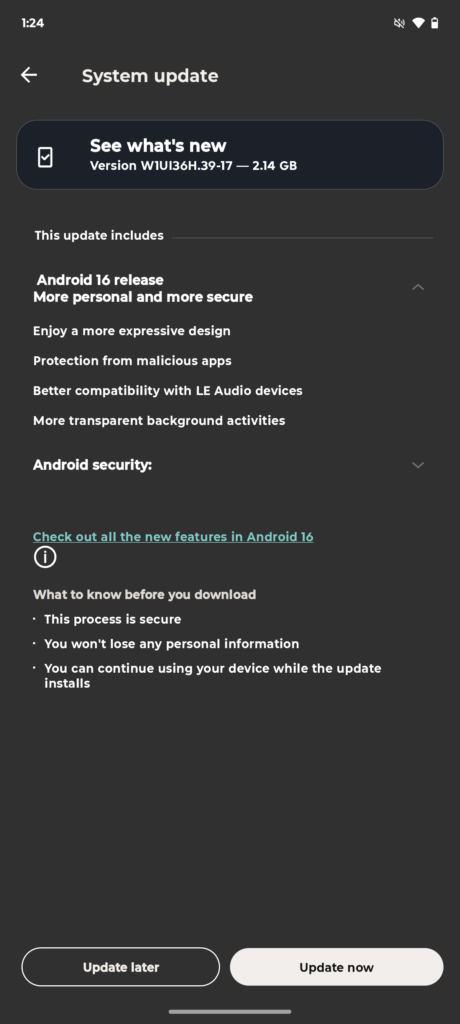
While Motorola has already begun accepting applications for the Android 17 beta program, a couple of devices are still waiting to receive Android 16. Among them was the Motorola Edge 50 Neo, which has just started receiving the stable Android 16 update after over 2 months of beta testing.
Motorola hasn’t confirmed the rollout yet. However, some Edge 50 Neo users are already receiving the update, as spotted by Ytechb. This major upgrade comes with the firmware version W1UI36H.39-17 and has a download size of about 2.14GB. It’s rolling out across several European countries, including Italy, Poland, Spain, and Romania. Other regions, including India, should start receiving the update soon.
If you have an Edge 50 Neo and are still waiting for an update notification, go to Settings > System updates > Check for updates to check for available updates manually. Since the rollout has just begun, it may take some time to show up on your Motorola device.
The Edge 50 Neo is one of the few Motorola devices that comes with a promise of five OS updates and five years of security updates from the brand. Since it was launched with Android 14, it should receive OS updates until Android 19.
While it’s a major OS upgrade, don’t expect major visual changes or groundbreaking features. That said, there are still some useful upgrades and new features that further improve the software experience. It introduces a new notification cooldown feature that prevents you from getting annoyed when an app sends too many notifications from the same app within a short time. It does so by reducing the volume of incoming notifications for that particular app.
Android 16 lets you create custom models based on your needs, in addition to the existing modes, including Do Not Disturb, Bedtime, and Driving. You can also connect to a hotspot of a different device without entering the password, provided that both devices are logged in to the same Google account. The update also brings improvements to hearing aids, protection from malicious apps, and performance upgrades.
Be sure to visit the Motorola section regularly for the latest updates. Alternatively, you can join our Telegram channel to get instant notifications about the latest software releases, product launches, and all major tech events.
BenQ has introduced the RD280UG, a new monitor designed to improve visual comfort and productivity for developers. It focuses on better readability and reduced eye strain during long coding sessions. Continue reading ahead to know everything about it.
BenQ RD280UG monitor specifications and features
BenQ RD280UG monitor
The BenQ RD280UG monitor features a 28-inch display with a 4K+ resolution and a 3:2 aspect ratio. This format allows users to view more vertical content on the screen, which can be helpful when working with long blocks of code. The monitor also supports a 120Hz refresh rate, enabling smoother scrolling through large files and development environments.
BenQ has equipped the monitor with a Nano Matte panel designed to minimise reflections and glare. This helps maintain clarity in different lighting conditions, allowing users to remain focused without distractions caused by screen reflections. The display also includes dedicated coding modes that adjust contrast and visual balance depending on whether the user prefers dark or light themes while programming.
BenQ RD280UG monitor
Additional visual comfort features are also included. Paper Colour Mode aims to provide a softer viewing experience, while MoonHalo bias lighting helps create balanced ambient illumination around the monitor. Night Hours Protection is designed to reduce eye strain during late-night work sessions. The monitor also supports flexible ergonomics such as height adjustment, screen rotation, and auto pivot to accommodate different working setups.
The RD280UG is compatible with multiple operating systems, including macOS, Windows, and Linux. It also includes a dedicated coding hotkey that allows developers to quickly adjust display settings without interrupting their workflow.
BenQ RD280UG: price and availability
BenQ has priced the RD280UG programming monitor at Rs 64,990 (~$700). The device is currently available through major gadget and IT retail outlets as well as several online marketplaces.
With its combination of a tall display format, high refresh rate, and developer-focused visual features, the RD280UG is positioned as a monitor designed to support long hours of coding while helping reduce visual fatigue.
For more daily updates, please visit our News Section.
Honor’s next-generation flagship lineup is expected to include the Honor Magic 9, Magic 9 Pro, and Magic 9 RSR. Reports suggest that the Magic 9 may house a smaller display compared to the Honor Magic 8’s 6.58-inch screen. Despite having a more compact size, it is expected to feature a bigger battery, which could even surpass the OnePlus 15T, which houses a 7,500mAh battery. A new leak has revealed that the Magic 9 may feature an impressive 200-megapixel triple camera setup.
Honor Magic 9 camera specs, battery leak
According to Digital Chat Station, the Honor Magic 9’s rear camera setup will be headlined by a 200-megapixel camera featuring a 1/2.8-inch large sensor. For ultra-wide shots, it will feature a 50-megapixel sensor.
The rear setup will also include a 64-megapixel periscope telephoto camera equipped with a mid-tier 1/2-inch sensor. While there is no information about the device’s front camera, it may retain the Magic 8’s 50-megapixel selfie snapper.
A couple of days ago, it was reported that Honor is upgrading the Magic 9’s battery and is currently working on packing an 8,000mAh unit. There is no information about the device’s fast charging capabilities, but it is said to support wireless charging. To recall, the Honor Magic 8 featured a 7,000mAh battery with 90W wired and 80W wireless charging support.
Early reports suggest that the Magic 9 will be powered by the Snapdragon 8 Elite Gen 6 chipset. Qualcomm is expected to unveil the 2nm chip in September this year.
On the front, the Magic 9 is said to feature a 6.3-inch OLED LTPO panel with a flat design. It is expected to feature an ultrasonic in-screen fingerprint sensor for security. Other details about the device remain under wraps.
For more daily updates, please visit our News Section.
Xiaomi has an impressive software update policy for its devices, but even that has to come to an end sometime. It hurts more when popular devices reach the end of life (EOL), as that impacts a large group of people. Sadly, that time has arrived for the popular Xiaomi 12 series, which is now officially retiring from all kinds of software updates, including HyperOS updates and security patches.
As mentioned on the official security center page (via Xiaomi Time), the update cycle for the Xiaomi 12 series has finally concluded. That means it won’t receive HyperOS updates, security patches, or feature drops. Here’s a list of affected devices and their final HyperOS/Android OS versions.
Xiaomi 12: HyperOS 3.0 / Android 15
Xiaomi 12 Pro: HyperOS 3.0 / Android 15
Xiaomi 12 Lite: HyperOS 1.0 / Android 14
All three Xiaomi 12 models were launched with Android 12, but didn’t receive the same software support. Being premium models, the Xiaomi 12 and 12 Pro promised an extra OS upgrade over the Xiaomi 12 Lite. As a result, both are retiring with Android 15, while the Xiaomi 12 Lite will spend its life running Android 14.
Alongside the Xiaomi 12 series, the Redmi Note 12 5G has also been added to the EOL list. This smartphone launched with Android 12 and, after two OS upgrades, it now runs Android 14 with HyperOS 2.0 on top.
If your Xiaomi phone is on the list, it’s best to upgrade to go for a new hardware. That will receive the latest HyperOS updates with plenty of new features and enhancements, and security patches will ensure protection against the latest vulnerabilities.
You can still use your current device, though. It would work just fine, but without the latest security patches, you’re exposing it to new vulnerabilities. If you’re considering a smartphone upgrade, do check out our curated list of Xiaomi phones with the best software support.
To ensure you don’t miss out on the latest HyperOS stories, remember to visit the Xiaomi section on this website regularly. Alternatively, you can join us on Telegram to get instant notifications about the latest HyperOS updates and the biggest tech headlines.
itel’s sub-brand Zeno has announced a new device aimed at simplifying how professionals record and organize conversations. Called the Zeno Weaver, the product is positioned as an AI-powered voice recorder that can capture meetings and convert discussions into structured notes. The launch signals the brand’s entry into productivity-focused AI hardware.
Zeno Weaver focuses on recording, transcription and AI summaries
Zeno Weaver AI recorder
The Zeno Weaver is designed to record meetings, interviews, and lectures while automatically converting speech into text. The device can process conversations and organize them into structured summaries using multiple templates. These summaries can be generated in various formats such as meeting minutes, interview notes, blog drafts, video scripts and mind maps.
The system runs on an AI engine powered by ChatGPT 4.0, allowing it to analyse discussions and present them in an organised format. According to the company, the goal is to help professionals remain engaged in conversations instead of dividing attention between listening and writing notes.
The recorder also includes a multi-microphone system designed to reduce background noise. This helps capture clearer audio, which is important for accurate transcription and summarization. The device comes in an ultra-slim form factor similar to a credit card and supports MagSafe compatibility, allowing it to attach easily to smartphones. Zeno is also bundling a leather case with the recorder for added protection.
The Zeno Weaver offers up to 40 hours of recording capacity along with a standby time of up to 40 days. It includes 32GB of internal storage and supports connectivity features such as Bluetooth 5.4 and 2.4GHz WiFi. The device works alongside the AI Recorder mobile application available on both Android and iOS, where users can access recordings, transcripts, and summaries in one place.
Users also receive 300 minutes of free transcription every month. The platform supports features such as translation, file sharing and offline recording. For users who require extended features, the company offers a Pro subscription plan that provides unlimited transcription, advanced summary templates, cloud backup and multi-device access.
The Zeno Weaver is currently available exclusively through Amazon in India at a price of Rs 11,816, positioning it as a productivity-focused gadget for professionals who regularly attend meetings and discussions.
For more daily updates, please visit our News Section.
Limited edition smartphones have become increasingly popular in 2026. They offer a perfect combination of cutting-edge technology, exclusive branding, and unique designs that appeal to specific audiences.
Whether you are a fan of luxury craftsmanship, iconic TV shows, or gaming aesthetics, there is something for everyone. Here is a look at the best limited-edition smartphones available in March 2026.
Leica Leitzphone Powered By Xiaomi
Xiaomi has introduced the Leica Leitzphone, a photography-focused smartphone designed in collaboration with Leica.
The phone is based on the Xiaomi 17 Ultra Leica Edition and features a premium aluminum-alloy body with a nickel-anodized finish. Leica’s iconic Red Dot and a rotatable camera ring give the phone a unique look and functionality.
The Leica UX/UI includes exclusive modes such as Leica Essential Mode, Leica M9 Style, and Leica M3 Style, which recreate the image quality and aesthetics of legendary Leica cameras.
The phone comes with a Snapdragon 8 Elite Gen 5 chip, a 6.9-inch 2K OLED display, and a 6000mAh battery. Xiaomi has priced this phone at €1999.99, making it a dream device for photography enthusiasts.
Honor Magic 8 RSR Porsche Design
Honor has collaborated with Porsche Design to create the Magic 8 RSR, a luxurious smartphone with a microcrystalline nano-ceramic back. The phone is inspired by Porsche’s sleek design and features a Mohs hardness of 8.5, making it durable and premium.
The phone is powered by the Snapdragon 8 Elite Gen 5 processor and offers up to 24GB of RAM. Honor has included a 200MP telephoto camera with advanced stabilization and professional imaging features like a magnetic camera grip and a 67mm filter adapter ring. HOnor has priced the phone starting at 7999 yuan ($1,161), making it a great choice for users who value design and high-end imaging.
Motorola Razr Fold Fifa World Cup 26 Collection
Motorola has launched the Motorola Razr Fold Fifa World Cup 26 Collection Edition as a commemorative device for football fans. The phone features a foldable design with Corning Gorilla Glass Ceramic 3, which enhances durability. It also includes a textured back panel with the Fifa World Cup 26 logo finished in 24K gold.
The phone has an 8.1-inch 2K LTPO internal display and a Snapdragon 8 Gen 5 chip for top-tier performance. Motorola has priced the phone at €1,999 for the European market. This phone is ideal for collectors and fans of football.
Realme 15 Pro Game of Thrones Edition
Realme has created the Game of Thrones Edition of its 15 Pro smartphone, designed for fans of the hit HBO series. The phone features a Targaryen-inspired black-and-gold design with a heat-sensitive back that changes color from black to red when the temperature exceeds 44°C.
The device comes with customized UI themes, including Ice and Fire, along with exclusive filters inspired by Westeros. Priced at ₹44,999 ($487), this phone is a perfect choice for Game of Thrones enthusiasts who love unique designs and features.
Tecno Pova Metal Tonino Lamborghini Edition
Tecno has launched a limited-edition Tonino Lamborghini version of its Pova Metal smartphone. The phone features a full-metal unibody design with a 0.99mm bezel. The back of the phone includes a Rear Dot Matrix lighting system with programmable LED alerts for calls, notifications, and other system events.
This phone focuses on aesthetics and premium design, targeting users who appreciate Lamborghini’s iconic branding.
Poco X8 Pro Iron Man Limited Edition
Poco has partnered with Marvel to release the Poco X8 Pro Iron Man Limited Edition. The phone has a gold-and-black armored design inspired by Iron Man, along with a matching case, UI, and accessories like a themed SIM ejector tool.
The phone is powered by the Dimensity 8500-Ultra processor and features a 6500mAh battery with 100W fast charging. Poco has priced this edition at ₹37,999 ($411) for the 12GB + 256GB model, making it an excellent choice for Marvel fans.
Red Magic 11 Pro+ Wuthering Waves Edition
Red Magic has launched the 11 Pro+ Wuthering Waves Edition in collaboration with Kuro Games. The phone features a bold Energy Red theme, with a dark red finish on the back, crimson-accented liquid-cooling engine motifs, and red-accented gaming trigger buttons. The matte metal frame and custom RGB lighting effects enhance the overall design.
The phone includes a customised Wuthering Waves UI theme with exclusive icons, wallpapers, and animations inspired by the game. Buyers also receive themed extras such as a Kevlar magnetic protective case, a custom SIM ejector pin, and a 120W Magic Flash fast charger in a matching design. Priced at 6999 yuan (~$970), this phone is perfect for gamers and fans of Wuthering Waves.
For more daily updates, please visit our News Section.
OnePlus has wrapped up its OxygenOS 16 rollout and may already be developing the next major upgrade, OxygenOS 17, which would be based on Android 17. We can expect to see some major upgrades and a host of refinements across the UI, along with upgrades to security and privacy.
Unfortunately, many OnePlus devices will miss out on the OxygenOS 17 update, as they have already received the promised number of OS updates. We’ve prepared a list of such devices below. Review it to find out if you’re on the safe side or if you’ll need a newer device to receive this major upgrade.
List of OnePlus devices not eligible for OxygenOS 17 (Android 17) upgrade
OnePlus flagship series
OnePlus 11R
OnePlus 10R
OnePlus 10T
OnePlus 10 Pro
Older OnePlus flagship phones
OnePlus Nord series
OnePlus Nord 3
Older Nord phones
OnePlus Nord CE series
OnePlus Nord CE 4
OnePlus Nord CE 4 Lite
Older Nord CE phones
OnePlus Pad series
OnePlus Pad
OnePlus Pad Go
Keep in mind that this is an unofficial list. However, since it’s based on the official update policy, we would hardly expect any difference. So, if your device is on the above list, it’s unlikely to be upgraded to OxygenOS 17. In that case, you may want to upgrade to a newer device that can stay relevant for years to come. To make things easier, we’ve compiled a list of OnePlus devices that promise six years of software updates.
As of writing this post, OnePlus hasn’t revealed anything about OxygenOS 17. However, Google has already released two public betas of Android 17, which is available to eligible Pixels and select Motorola devices. OnePlus should also join the beta party soon, likely with the OnePlus 15. The stable Android 17 could be released in Q3 2026 for Google Pixels, and will eventually start rolling out to OnePlus devices a few weeks later.
We’ll keep you updated with the latest OxygenOS updates in our OnePlus section. Visit it once in a while to get the fresh details. Alternatively, you can join our Telegram channel to get instant updates about software updates and breaking tech news.
OnePlus has officially confirmed that the OnePlus 15T will debut next week in China. Set to launch on March 24, the device has already been made available for pre-orders on the Oppo store in the country. The listing has officially confirmed the configurations and color options that will be available to choose from.
OnePlus 15T configurations, color options
OnePlus 15T – Relaxing MatchaOnePlus 15T – Pure CocoaOnePlus 15T – Healing White Chocolate
OnePlus has already confirmed several details of the OnePlus 15T, which will arrive as a performance-focused compact flagship. Several other specifications have also emerged through recent leaks.
The OnePlus 15T will feature a 6.32-inch OLED LTPO panel with 1.1mm ultra-thin bezels on all four sides. It will offer a 1.5K resolution, a 165Hz refresh rate, and an ultrasonic in-screen fingerprint sensor.
Under the hood, the OnePlus 15T will feature the Snapdragon 8 Elite Gen 5 chipset, LPDDR5x RAM, UFS 4.1 storage, and a massive 7,500mAh battery. It will support 100W wired, 50W wireless, and bypass charging. It will run on Android 16 with a layer of ColorOS 16 on top.
OnePlus 15T – Relaxing MatchaOnePlus 15T – Pure CocoaOnePlus 15T – Healing White Chocolate
The OnePlus 15T will have a 32-megapixel camera on the front and a dual 50MP camera setup, which will include a 3.5x periscope telephoto camera. It will also offer other features such as a Plus Key, a metal frame, and an IP66/68/69/69K-rated dust- and water-resistant chassis. It will measure 8.5mm in thickness and weigh around 194 grams.
For more daily updates, please visit our News Section.
Samsung’s next set of Galaxy A series phones seems to be getting closer to launch. The Galaxy A37 and Galaxy A57 have both been popping up in leaks lately. After a retail unit of the Galaxy A57 surfaced with its pricing in Thailand, promo materials for both devices have now appeared online, revealing the Galaxy A37’s pricing in the market.
The poster lists the 8GB + 256GB variant of the A37 at THB 13,999. That roughly converts to around $430, or about ₹36,000, though final pricing will obviously vary by region.
What’s interesting is that only this higher storage option is mentioned. Earlier leaks did suggest a 6GB + 128GB model as well, but there’s still no clear pricing for that one. It could mean Samsung is pushing the A37 with more storage by default in some markets, or it’s just the variant they’re choosing to highlight first.
There’s also been a steady flow of other leaks around these phones, including unboxings, hands-on clips, and even a teardown.
As for specs, the Galaxy A37 is expected to feature a 6.7-inch AMOLED display with a 120Hz refresh rate, along with Samsung’s Exynos 1480 chip. The camera setup is said to include a 50MP main sensor, plus 8MP ultra-wide and 5MP macro lenses. On the front, there’s reportedly a 12MP selfie camera.
Battery capacity is listed at 5,000mAh, paired with 45W charging, which should be more than enough for a full day of use. Software-wise, it’s expected to run One UI 8.5 based on Android 16.
Nothing here feels like a major shift, but taken together, it looks like a fairly solid update. If the pricing holds up across markets, the A37 could land as another dependable mid-range option once it officially launches.
Marshall has introduced the Bromley 450, a new party speaker that sits below the Bromley 750. It is designed to be smaller and more affordable while keeping the same core features and sound profile.
The Bromley 450 has a box-style design wrapped in water-based PU leather. It uses soft TPU corner caps for added protection and a stamped metal grille on the front. The speaker also includes built-in stage lights inspired by 1970s shows. Physical tactile controls are placed on top for easy use, especially in loud or crowded spaces.
It delivers True Stereophonic 360° sound through drivers placed on multiple sides. This allows the audio to spread evenly in all directions, whether indoors or outdoors. The sound is tuned for strong bass, clear mids, and detailed highs, so it works well across different types of music.
The speaker is portable and comes with a built-in handle. It has an IP55 rating, which means it is resistant to dust and water splashes. This makes it suitable for use in parks, backyards, beaches, or festival setups.
Battery life is a major highlight. The Bromley 450 offers over 40 hours of playback on a single charge, which can cover long sessions or multiple events. It supports interchangeable batteries that are also used in the Bromley 750, so you can swap batteries when needed. The speaker can also run on an AC cable, which can charge the battery at the same time.
It includes three-stage light presets. One provides ambient lighting, while the other two sync with the music for a more active light effect. The speaker also has two combo input jacks for microphones and instruments, making it easy to set up karaoke or a small live performance.
Pricing & availability
The Marshall Bromley 450 is priced at €649, which is about $746. It is available from March 17 on Marshall’s website, with retail availability starting March 31.
For more daily updates, please visit our News Section.
Nike and Beats have introduced the Powerbeats Pro 2 Nike Special Edition, a new set of wireless earbuds designed for fitness-focused users. The collaboration combines performance features with a distinct dual-brand design and adds health tracking capabilities aimed at athletes.
The earbuds feature secure-fit earhooks to keep them stable during high-intensity workouts. They include Active Noise Cancelling for blocking external noise and a Transparency mode that lets users stay aware of their surroundings when needed. Sweat and water resistance ensure reliability across workouts such as running, strength training, and outdoor sessions.
A key addition is built-in heart rate monitoring during workouts. The feature integrates with the Nike Run Club app, allowing users to track performance without needing a separate wearable. Nike and Beats are positioning this as a step toward more integrated fitness audio products.
The earbuds come with five ear tip sizes to improve comfort and fit across different users. Battery life is rated at up to 45 hours with the included wireless charging case, making them suitable for extended use across multiple sessions.
Design is a major focus of this edition. The earbuds use a two-tone Volt and matte black finish. In a first for Beats, the branding is split across the earbuds, with the “b” logo on one side and the Nike Swoosh on the other. The charging case follows the same visual theme with a Volt splatter design and Nike’s “Just Do It” tagline inside. The product is also part of a campaign featuring LeBron James, highlighting its use across training and recovery routines.
The Powerbeats Pro 2 Nike Special Edition was first made available through an early-access lottery on March 17 via SNKRS. It will launch globally on March 20 through Nike.com, Apple.com, and select Apple Stores.
In India, the earbuds are priced at $249.99 and will be available online only through Apple’s website. In-store availability is limited to select Apple Store locations in markets such as the United States, the United Kingdom, China, and Singapore.
Nothing has started rolling out the first software update for the Phone (4a), just days after the device went on sale. The update is based on Nothing OS 4.1 and carries the build number B4.1-260309-1830, with a download size of 257MB. This update brings the March 2026 Android security patch along with several new features across the system, camera, and UI.
The update introduces Breathing Break widgets in the widget drawer, offering guided exercises for relaxation. Live Updates now extend across the lock screen, notification panel, and Glyph Interface, allowing users to track real-time activity from supported apps like Google Maps. The status bar also shows a dedicated icon when Nothing headphones are connected. Compatibility for Live Updates depends on app support and region.
In the Glyph Interface, the Essential Notifications settings UI has been redesigned for better clarity. A new generative ringtone feature has been added, enabling custom sounds paired with unique Glyph lighting patterns for calls and notifications.
Nothing has also expanded its Essential AI tools. The widget drawer now includes a recommendation section for quicker access to Nothing Playground and AI-driven community content. The Essential Space interface has been updated with a cleaner layout, along with new “For You” and “Library” sections. A new Events feature helps organise tasks, and a search function has been added for faster navigation. Some of these features will require a separate update via Google Play.
Visual changes include a new lock screen clock face inspired by the Phone (3a) Community Edition, co-created with community member Jad Zock. Lock screen customisation now supports Depth effect in beta, along with adjustable clock sizes and alignment. The password screen now includes a wallpaper blur effect, and dual network signals are merged into a single status bar icon.
Image via @smasithick
Camera improvements include new presets such as an India-exclusive “Cricket” watermark and an “Amber” portrait mode. Playground Sync allows one-tap preset imports, while power-saving recording dims the screen during idle video capture. Image processing has also been improved with better exposure, colour accuracy, and HDR.
The update also improves system stability, network performance, and fixes display issues. The device may heat up during installation, but it will return to normal after completion.
OPPO has launched the K14 5G in India. The phone focuses on battery life, durability, and smooth day-to-day performance. It comes with a 6.75-inch HD+ display with a resolution of 1604 × 720 pixels. The screen supports a 120Hz refresh rate and up to 1125 nits peak brightness. The device runs Android 16 with ColorOS 16.
The phone is powered by the MediaTek Dimensity 6300 6nm processor with an ARM Mali-G57 MC2 GPU clocked at 1072MHz. It is available with 6GB or 8GB LPDDR4X RAM. There is also support for up to 8GB virtual RAM. Storage options include 128GB and 256GB UFS 2.2, with expandable storage up to 1TB using a microSD card. OPPO has added a 3900mm² vapor chamber cooling system to help manage heat.
For cameras, the K14 5G has a 50MP main sensor with f/1.8 aperture and a 2MP portrait sensor with f/2.4 aperture. It supports video recording up to 1080p at 60fps. On the front, there is an 8MP camera with f/2.2 aperture, capable of 1080p video recording at 30fps. The phone also includes a side-mounted fingerprint sensor.
The device has an IP69 rating for dust and water resistance. It measures 166.61 × 78.51 × 8.61mm and weighs 212g. It has a matte finish on the back and frame, which makes it easier to hold. Connectivity features include 5G SA and NSA support, dual 4G VoLTE, Wi-Fi 802.11 ac with 2.4GHz and 5GHz bands, Bluetooth 5.4, GPS with GLONASS, and a USB Type-C port. The phone packs a 7000mAh battery and supports 45W SuperVOOC fast charging. The charger is included in the box.
Pricing & availability
The OPPO K14 5G comes in Prism White, Prism Violet, and Icy Blue. The 6GB + 128GB variant is priced at Rs. 17,999, the 6GB + 256GB model costs Rs. 19,999, and the 8GB + 256GB version is priced at Rs. 21,999. It will go on sale from March 20 at 12 PM on Flipkart, the OPPO India online store, and offline retail stores. Launch offers include a Rs. 1,500 instant discount with HDFC Bank, ICICI Bank, and SBI Cards, along with no-cost EMI options for up to three months.
Oura has officially introduced the Oura Ring 4 in India. First launched globally in October 2024, the smart ring is now available at over 100 Croma stores and on Amazon.in.
The Silver and Black variants are priced at ₹28,900, while the premium Stealth, Brushed Silver, Gold, and Rose Gold finishes come with a price tag of ₹39,900. To access all app features, users must pay a monthly subscription fee of ₹599.
Oura Ring 4 Specifications
The Oura Ring 4 tracks over 50 health metrics, including sleep patterns, heart rate, heart rate variability (HRV), stress levels, blood oxygen levels (SpO₂), and daytime activity. The ring uses AI-powered insights to help users understand their health data and make improvements. The device does not have a screen or notifications, and it focuses on providing long-term wellness insights rather than real-time updates.
The Oura Ring 4 features several hardware upgrades over its predecessor. The ring now includes 18 sensing pathways, which improve accuracy for metrics like HRV and blood oxygen levels. The titanium construction makes it lightweight, durable, and comfortable for all-day wear. The device is water-resistant up to 100 meters and has a battery life of 5 to 8 days, with a full charge taking just 20 to 80 minutes.
The company has also drawn attention to sleep-related challenges in India through its report, India: The State of Sleep 2026. According to the findings, Indians get an average of just 6 hours and 28 minutes of sleep per night, around 40 minutes less than those in the highest-sleeping countries.
Bedtimes tend to stretch late, averaging 12:14 AM, while users typically wake up at 7:43 AM, leaving limited time for proper recovery. Many try to make up for this deficit with daytime naps, which reach an average of 53 minutes on Mondays, the highest globally. Through its platform, Oura aims to help users better understand and improve their sleep and overall recovery.
The Oura Ring 4 is available in six finishes and multiple sizes (4-15) to ensure a proper fit. The device integrates with over 40 apps and works with both Android and iOS.
Xiaomi is close to launching the Xiaomi 17T series, and a new report may have spilled the beans on two upcoming phones in the lineup. According to information shared by tipster Digital Chat Station, Xiaomi is working on two new mid-range phones expected to launch in Q2 2026.
While the leak doesn’t reveal the phones’ names, they are expected to be part of the Xiaomi 17T series.
According to the tipster, the vanilla Xiaomi 17T could feature a 6.59-inch flat display with a 1.5K resolution. It may also pack a battery of around 7,000mAh and could be powered by the MediaTek Dimensity 8500 processor.
Meanwhile, the higher-end 17T Pro variant is expected to feature the more powerful MediaTek Dimensity 9500. On the camera side, the Pro model may include a periscope telephoto lens.
Software-wise, the devices are likely to run a newer version of HyperOS, though specifics remain unclear.
What else do we know?
A previous report also hints that the Xiaomi 17T and Xiaomi 17T Pro are expected to feature Leica-tuned cameras. The phones are tipped to include a triple rear camera setup consisting of a 50MP primary sensor, a 12MP secondary sensor, and a 50MP telephoto sensor.
Xiaomi 15T
The primary and telephoto sensors may differ between the two models. The Pro version is also expected to include a periscope telephoto camera. For selfies, both devices could feature a 32MP front camera.
According to reports, the Xiaomi 17T could launch in India within the next two to three months. The device is expected to be priced at around ₹55,000. The tipped price may include launch offers that Xiaomi usually provides during the initial sales period.
For more daily updates, please visit our News Section.
Samsung’s Galaxy A series doesn’t usually go for big surprises, and from the latest leaks, the Galaxy A57 seems to follow that same pattern, just with a few practical upgrades here and there.
New details shared by @Alfaturk16 on X include what look like promo materials and internal diagrams of the device. The design is probably the first thing people will notice. The A57 is said to use a unibody metal build, measuring 6.9mm in thickness and weighing around 179 grams. That would make it slimmer and a bit easier to handle than recent models. The bezels also seem slightly reduced, though not dramatically.
Camera hardware looks familiar. There’s a 50MP main sensor, backed by a 12MP ultra-wide that supports 4K at 30fps, along with a 5MP macro lens. On the front, a 12MP selfie camera handles video and photos, also with 4K support.
Software might be where things are intended to feel a little different. The phone is expected to run One UI 8.5 based on Android 16, with features like Now Brief, some level of AI-powered search, and updates to Bixby. How useful those actually are will depend on how well they’re implemented. Samsung’s AI features have been a bit hit-or-miss so far.
Under the hood, the Exynos 1680 is expected to power the device. It’s likely aimed at steady, everyday performance rather than anything too demanding. More interesting is the cooling setup. The leaked internal views suggest a larger vapor chamber, which could help keep performance stable over longer sessions.
The display is a 6.7-inch OLED panel with a 120Hz refresh rate, paired with an in-display fingerprint sensor. Battery capacity is listed at 5,000mAh, with 45W charging support.
Overall, the A57 feels more like a careful update than a major step forward. Still, if these changes hold up, it should fit comfortably into Samsung’s mid-range lineup once it arrives.
Oppo has launched its latest smartwatch, the Watch X3, at a product event alongside the Find N6 foldable smartphone. The new smartwatch brings a high-end design, advanced health tracking features, and standalone smart functionalities.
Oppo Watch X3 Specifications
The Oppo Watch X3 features a lightweight full-titanium design using aerospace-grade TC4 titanium alloy, making it 16% lighter and 6.4% thinner than previous models. It includes a durable sapphire crystal display with a Mohs hardness rating above 8 and a 1.5-inch LTPO OLED screen offering up to 3000 nits peak brightness for sunlight visibility. The smartwatch is highly durable with IP68/IP69 dust and water resistance and MIL-STD-810H military-grade certification.
The Watch X3 excels in health tracking, providing cuffless blood pressure risk assessments, daily blood pressure monitoring, and insights into lifestyle impacts. It features ECG, heart rate, blood oxygen, and wrist temperature sensors, along with a 60-second health check analyzing 14 metrics with AI insights. Its sleep tracking includes sleep stage detection, snore monitoring, and sleep issue risk analysis.
The smartwatch supports more than 100 sports modes. It includes a fat-burning running mode that provides guidance on posture and intensity. The watch tracks detailed fitness metrics such as ground contact time, stride balance, and calorie burn. It uses dual-frequency GPS for accurate outdoor tracking. The device also assesses training load and workout readiness to help users optimize performance.
The watch comes with standalone eSIM functionality for calls and messages, a WeChat smartwatch version for phone-free communication, and NFC for payments, transit cards, and access control. It supports music streaming, navigation apps, and more, running on ColorOS Watch 16 with customizable watch faces, quick notifications, and gesture controls.
The battery offers up to three days of heavy usage, five days of regular use, and 16 days in long battery mode.
Pricing and Availability
The Oppo Watch X3 is available in three colors: Gravity Black, Infinite Titanium, and Cosmos Star Orange. The Gravity Black variant is priced at 2,599 yuan ($364), while the Infinite Titanium version costs 2,799 yuan ($392). The price for the Cosmos Star Orange variant has not been specified. Sales will begin in China on March 20 at 10:00 AM.
For more daily updates, please visit our News Section.
FUJIFILM India has announced the instax mini 13, a new entry-level instant camera in its instax lineup. The camera is designed for instant photo printing and builds on the instax mini 12 with updates focused on ease of use and added shooting flexibility.
The instax mini 13 is an analog instant camera that keeps operation simple. Users can turn the lens to power it on, frame the shot, and press the shutter button to capture and print instantly. The camera introduces two built-in self-timers. The 2-second timer helps reduce camera shake during handheld selfies, while the 10-second timer allows users to place the camera down for group shots or full-body images. The timer is controlled using a lever on the shutter button.
The design has been updated with a rounded, 3D body and a pop-style look. It features a metallic silver logo on the front and a band-wrapped design on the sides. The camera is available in five translucent pastel colors: Dreamy Purple, Candy Pink, Frost Blue, Lagoon Green, and Clay White.
Fujifilm has also included a Camera Angle Adjustment Accessory that allows users to adjust the shooting angle without needing a tripod. This makes it easier to use the self-timer in different scenarios.
The camera retains features from the previous model, including Close-up Mode and Automatic Exposure. Close-up Mode includes parallax correction, which adjusts the viewfinder framing to better match the final print. Automatic Exposure adjusts shutter speed and flash intensity based on the scene to ensure proper brightness.
Fujifilm has also updated the instax UP! smartphone app. The latest version uses AI in its scanning feature to improve accuracy and make it easier to digitize instax prints, regardless of background or orientation, for sharing on social media.
Alongside the mini 13, Fujifilm has introduced a new Jet Black color option for the instax WIDE 400 camera, in addition to the existing Green variant.
Pricing & availability
The instax mini 13 is priced at Rs. 10,999 and will be available from March 31, 2026. The instax mini film “PASTEL GALAXY” is priced at Rs. 899 and will also be available from the same date. The mini 13 comes in Dreamy Purple, Candy Pink, Frost Blue, Lagoon Green, and Clay White. The instax WIDE 400 in Jet Black will also be available from March 31, 2026 alongside the Green option.
Foldables in 2026 are no longer experimental; they’re refined, powerful, and surprisingly practical. The real competition now isn’t about who can fold, but who does it better. The Oppo Find N6 and Honor Magic V6 represent two different philosophies: one focused on cutting-edge features and immersive experiences, the other on durability, battery life, and long-term reliability. For buyers investing in a premium foldable, this comparison matters more than ever, as small differences can shape everyday usability in a big way.
Major Features:
Feature
Oppo Find N6
Honor Magic V6
Winner & Reason
Build & Durability
Titanium hinge, IP58/IP59
IP68/IP69, armored display
Honor – higher protection rating
Display (Inner)
8.12″ LTPO OLED
7.95″ LTPO2 AMOLED
Oppo – larger screen
Display Brightness
2500 nits (peak)
5000 nits (peak)
Honor – higher brightness
PWM Dimming
2160Hz
4320Hz
Honor – better eye comfort
Processor
Snapdragon 8 Elite Gen 5
Snapdragon 8 Elite Gen 5
Tie – same chipset
RAM & Storage
Up to 16GB / 1TB
Up to 16GB / 1TB
Tie – same options
Main Camera
200MP + 50MP + 50MP
50MP + 64MP + 50MP
Oppo – higher resolution main sensor
Zoom Camera
50MP (3x)
64MP (3x)
Honor – higher resolution zoom
Video Recording
4K up to 120fps, Dolby Vision
4K up to 60fps, 10-bit
Oppo – higher frame rate + Dolby Vision
Selfie Cameras
20MP + 20MP
20MP + 20MP
Tie – identical
Battery
6000 mAh
Up to 7150 mAh
Honor – larger battery
Charging (Wired)
80W
80W
Tie
Wireless Charging
50W
66W
Honor – faster wireless
Software Support
Android 16 (ColorOS 16)
Android 16, up to 7 updates
Honor – longer support
Price
$1400 / ₹90,000
$1300 / ₹110,000
Oppo – cheaper (based on given data)
Design and Display
Build and Feel
Both foldables push premium craftsmanship, but they approach durability differently. The Oppo Find N6 stands out with its titanium hinge and aircraft-grade aluminum frame, giving it a slightly more “engineered” feel. The addition of IP58/IP59 protection adds confidence for real-world usage. On the other hand, the Honor Magic V6 feels more refined in durability standards with an IP68/IP69 rating, offering stronger resistance overall. Honor also focuses heavily on screen protection with its armored inner display and anti-reflective coating, which subtly improves usability outdoors. Oppo’s zero-crease claim and self-healing glass lean more toward long-term display smoothness, which feels futuristic.
Display Quality
Oppo delivers a larger, more immersive inner screen with Dolby Vision and strong brightness, while its cover display reaches very high peak brightness levels. Honor counters with extreme brightness numbers and higher PWM dimming, making it more comfortable for sensitive eyes. The slightly smaller display on Honor feels more controlled, while Oppo feels more cinematic.
Verdict
Honor wins for durability and eye comfort, but Oppo feels more premium and immersive.
Specifications Including Battery
Performance
Both devices run the same Snapdragon 8 Elite Gen 5 chip with identical CPU and GPU setups, so real-world performance is virtually identical. Multitasking, gaming, and heavy workloads feel effortless on both. Oppo edges slightly ahead with higher RAM availability across variants, which may help in long-term usage. However, Honor balances this with longer software support, promising up to 7 major Android updates, making it a safer long-term investment.
Battery and Charging
Oppo packs a 6000 mAh battery with fast wired and wireless charging, delivering a balanced flagship experience. Honor goes bigger with up to 7150 mAh (depending on variant), clearly focusing on endurance. Wireless charging is also faster on Honor. In daily use, Honor is likely to last longer, especially for heavy users, while Oppo feels more balanced in charging flexibility.
Verdict
Performance is equal, but Honor wins overall due to a larger battery and longer software support.
Camera
Main and Secondary Lenses
Oppo takes a bold approach with a 200MP main sensor, paired with a periscope zoom and ultrawide lens tuned with Hasselblad color science. This setup leans toward detail-rich photography and more vibrant, stylized output. Honor uses a more balanced approach with a 50MP main sensor and a higher-resolution 64MP periscope lens, which may produce more consistent zoom results. Oppo’s video capabilities stand out with 4K Dolby Vision recording and higher frame rates, making it more versatile for creators.
Selfie Camera
Both devices feature dual 20MP selfie cameras for the inner and cover screens. The experience is nearly identical, with solid HDR and 4K recording. Neither device clearly dominates here, as both prioritize consistency over innovation.
Verdict
Oppo wins for camera versatility and video features, while Honor offers more balanced zoom performance.
Pricing
Price Comparison
The Oppo Find N6 is priced at around $1400 (₹90,000), while the Honor Magic V6 comes in at approximately $1300 (₹110,000). Interestingly, despite being cheaper globally, Honor appears more expensive in the Indian market based on conversion, which affects perceived value. Oppo positions itself as a premium foldable with advanced camera hardware and display innovations, while Honor focuses on durability, battery, and longevity.
Value for Money
Oppo feels like a better deal in regions where pricing is lower, especially considering its camera hardware and display tech. Honor justifies its price with stronger durability ratings, a bigger battery, and long software support, which adds long-term value. The choice depends on whether upfront features or longevity matter more.
Disclaimer: Prices are approximate and may vary based on country, region, and applicable taxes.
Conclusion
Oppo Find N6 stands out with its 200MP camera, Dolby Vision video, self-healing display, and zero-crease design, making it feel cutting-edge and media-focused. Honor Magic V6 counters with industry-leading durability ratings, massive battery capacity, anti-reflective displays, and extended software support. These differences highlight two philosophies: Oppo prioritizes innovation and experience, while Honor emphasizes reliability and endurance.
Verdict
The Oppo Find N6 is the better choice for users who want top-tier camera performance, immersive displays, and a premium foldable feel. The Honor Magic V6 is ideal for those who prioritize battery life, durability, and long-term usability.
Overall, Honor edges ahead slightly as a more practical daily driver, while Oppo feels more exciting and feature-rich.
Alongside the Find N6 foldable, Oppo also announced a new wireless charger, called the Oppo Magnetic Turbo 2 AIRVOOC 50W. As the name suggests, it’s a 50W wireless charger, but with a built-in cooling system and a desktop stand. The charger is priced at 349 yuan (~$50) in China.
According to the company, the wireless charger can charge the Oppo Find N6 to around 50 percent in about 34 minutes. Oppo recommends pairing it with a SUPERVOOC adapter rated at 80W or higher and an official fast-charging cable to achieve those speeds.
The charger has a cooling system inside!
One of the main features here is the cooling system. The charger uses chip-level active turbine air cooling combined with a built-in TEC cooling chip and a centrifugal fan. Oppo says this multi-layer heat dissipation setup helps keep the device cool during charging.
The Magnetic Turbo 2 also introduces multiple operating modes. Users can double-tap the device to switch between high-power cooling charging, a quieter charging mode, and a cooling-only mode that focuses purely on heat dissipation without charging. The charger has indicator lights that show which mode is currently active.
Another practical addition is the built-in stand. The charger includes a 360-degree rotating desktop stand, allowing it to function like a charging dock on a desk. This makes it easier to place a phone upright for video calls, notifications, or general use while it charges.
Despite being designed for Oppo’s magnetic ecosystem, the charger is also compatible with Apple devices. It can wirelessly charge iPhones and supports the Standby feature introduced in recent versions of iOS.
The charger itself is relatively compact, measuring about 63mm in diameter and just over 22mm in height. It connects through a USB-C port and supports Oppo’s AIRVOOC charging protocol.
Samsung has launched the Galaxy M17e 5G in India as part of its budget 5G lineup. The phone focuses on battery life, basic durability, and long-term software support.
The Galaxy M17e 5G features a 6.7-inch HD+ (720 x 1600 pixels) Infinity-U LCD display with a 120Hz refresh rate. It is powered by the MediaTek Dimensity 6300 6nm processor with two Cortex-A76 cores clocked at 2.4GHz and six Cortex-A55 cores at 2GHz, along with an Arm Mali-G57 MC2 GPU. The phone comes in 4GB, 6GB, and 8GB RAM options with 128GB internal storage. Storage can be expanded up to 2TB using a microSD card through a hybrid dual SIM slot.
For cameras, the phone has a 50MP main sensor with f/1.8 aperture and a 2MP depth sensor with f/2.4 aperture, supported by an LED flash. On the front, there is an 8MP camera for selfies. It runs Android 16 with One UI 8 and includes Gemini Live features. Samsung has promised 6 OS updates and 6 years of security updates.
The device measures 167 x 77 x 8.2mm and weighs 199g. It uses a Glass Fibre Reinforced Polymer back panel and has a key island design for easier button access. It also has an IP54 rating for dust and splash resistance and includes a side-mounted fingerprint scanner.
Connectivity features include 5G SA and NSA support with 12 bands, dual 4G VoLTE, Wi-Fi 802.11 ac (2.4GHz and 5GHz), Bluetooth 5.3, GPS with GLONASS, NFC, and a USB Type-C port. It also supports USB Type-C audio and has bottom-ported speakers. The phone packs a 6000mAh battery with 25W fast charging support.
Pricing & availability
The Galaxy M17e 5G comes in Vibe Violet and Blitz Blue. Pricing starts at Rs. 12,999. It will be available on Amazon, Samsung.com, and select retail stores. Limited online sales are scheduled from 12 PM to 2 PM, and there is a Rs. 1,250 discount offer.
After weeks of teasers, Poco has finally introduced its latest X-series smartphones, the Poco X8 Pro 5G and the Poco X8 Pro Max 5G. There’s also a themed Poco X8 Pro Iron Man Edition if you’re a Marvel fan.
As expected of the X-series, the two phones are all about performance. Both are powered by MediaTek Dimensity chipsets with a large battery inside. Poco X8 Pro and X8 Pro Max will go on sale in India starting March 23.
Poco X8 Pro Series Specifications
The standout here is clearly the Poco X8 Pro Max 5G. It comes with a large 9,000mAh battery, which Poco claims can give three days of run time in moderate use. The standard Poco X8 Pro 5G, meanwhile, sticks with a still-large 6,500mAh battery.
Both phones support 100W wired fast charging, along with 27W reverse wired charging.
The Poco X8 Pro Max 5G features a 6.83-inch AMOLED display with a 1.5K resolution and a 120Hz refresh rate. It also reaches up to 3,500 nits of peak brightness and includes high-frequency PWM dimming.
The Poco X8 Pro 5G gets a slightly smaller 6.59-inch AMOLED panel, but it retains the same refresh rate and similar display characteristics.
Under the hood, the Pro Max model is powered by a 3nm MediaTek Dimensity 9500s, paired with up to 12GB of LPDDR5X RAM and 512GB of UFS 4.1 storage. The standard Pro uses a Dimensity 8500 Ultra processor, built on a 4nm process, with slightly lower storage ceilings.
Both phones also include Poco’s 3D Ice Loop cooling system, though the Pro Max version gets a larger cooling area. It’s a detail that may matter more for sustained gaming or heavy workloads than everyday use.
Cameras and durability
On the camera side, Poco is sticking with a simpler formula. Both devices feature a dual rear setup led by a 50-megapixel primary sensor with optical image stabilization, alongside an 8-megapixel ultra-wide camera. On the front, there’s a 20-megapixel selfie shooter capable of handling video calls and basic content capture.
Both models are also rated IP66, IP68, IP69, and IP69K for dust and water resistance. The phones run on Android 16 with HyperOS 3 layered on top. The Pro Max variant also includes an ultrasonic fingerprint scanner.
Pricing and variants
The Poco X8 Pro 5G starts at Rs. 29,999 for the 8GB RAM and 256GB storage version, going up to Rs. 32,999 for the 12GB variant. The Iron Man Edition is priced slightly higher at Rs. 34,999 and comes in a single configuration.
For the Poco X8 Pro Max 5G, pricing begins at Rs. 39,999 for the 12GB + 256GB model, while the 512GB version goes up to Rs. 43,999.
For more daily updates, please visit our News Section.
Oppo has launched the Find N6, claiming it to be the “world’s flattest foldable smartphone.” It combines advanced technology, sleek design, and high performance, setting a new standard in the foldable smartphone market. Here’s a detailed look at its features, specifications, and pricing.
Oppo Find N6 Specifications
The Find N6 features an 8.12-inch QXGA+ foldable OLED inner screen and a 6.62-inch FHD+ AMOLED outer display, both supporting 1.07 billion colors, 1-120Hz adaptive refresh rates, and 240Hz touch sampling. The inner screen peaks at 2,500 nits brightness, while the outer display reaches 3,600 nits.
For eye comfort, the screens include a 1-nit ultra-low brightness mode. The bezels on the outer screen are reduced by 30%. Both displays are TÜV Rheinland certified for eye protection.
Now, let’s talk about the Zero-Feel Crease tech a bit. Oppo has focused on making the foldable display look and feel as flat as possible, even after long-term use. The system combines a new hinge with advanced memory glass to minimize crease visibility.
The hinge uses a bionic four-axis structure built with chip-level polymer 3D printing technology, reducing surface unevenness from 0.18mm to just 0.1mm. Alongside this, the memory glass delivers over three times the rigidity of conventional flexible glass and can restore up to 99.9% of its flatness after folding.
Together, these technologies help maintain a smoother display surface over time, offering a more seamless and immersive viewing experience. The device is also TÜV Rheinland certified for up to 600,000 folds, ensuring durability alongside improved flatness.
Under the hood, the device features the Snapdragon 8 Elite Gen 5 processor paired with LPDDR5X RAM and UFS 4.1 storage. It integrates Oppo’s Tidal Engine optimization system to enhance CPU and GPU performance while reducing power consumption.
The Find N6 runs on ColorOS 16, offering enhanced multitasking and productivity features like multi-window mode for running up to four apps simultaneously. It also includes AI-powered tools such as smart note-taking, voice transcription, image editing, and stylus support with the optional Oppo AI Pen. Oppo guarantees 5 years of Android OS updates and 6 years of security patches.
In terms of photography, The Find N6 features a Hasselblad-engineered quad-camera system, headlined by a 200MP wide-angle main sensor with dual-axis OIS and an f/1.8 aperture. It is paired with a 50MP ultra-wide camera offering a 120° field of view, a 50MP telephoto lens with 3x optical zoom and dual-axis OIS, and a Danxia color calibration lens for enhanced color accuracy.
The cameras support up to 120x digital zoom, 8K photography, and 4K 120fps Dolby Vision video recording, alongside advanced portrait and cinematic features like XPAN mode for wide-angle shots. Front-facing cameras include 20MP sensors on both the main and cover screens.
The Find N6 packs a massive 6000mAh silicon-carbon battery. It supports 80W wired fast charging and 50W wireless charging. The device is also compatible with various fast-charging standards like UFCS, PPS, and QC.
For connectivity, the device supports dual SIM cards with 5G connectivity across 66 global network bands. It features Wi-Fi 7, Bluetooth 6.0, and NFC for seamless connectivity. The phone includes a side-mounted fingerprint sensor, satellite communication (on select variants), and a USB Type-C 3.2 port for fast data transfer.
The device weighs just 225g and measures 8.93mm when folded. It has an IP56, IP58, and IP59 rating.
Pricing and Availability
The Oppo Find N6 starts at 9,999 yuan ($1,400) for the 12GB + 256GB variant. The 16GB + 512GB model is available for 10,999 yuan ($1,540), while the top-tier 16GB + 1TB satellite communication version costs 11,999 yuan ($1,680).
The phone is available in three colors: Deep Black, Original Titanium, and Gold Orange. Global sales begin on March 20.
For more daily updates, please visit our News Section.
Samsung hasn’t exactly been aggressive with battery upgrades on its smartphones. The Galaxy Z Fold series, in particular, has been sitting on the same 4,400mAh capacity for years now, even as competitors have been pushing much higher numbers for some time. That might finally be about to change.
A new report from GalaxyClub suggests the upcoming Galaxy Z Fold 8 could see a noticeable bump. The device is said to use a dual-battery setup with a combined rated capacity of around 4,854mAh, split between two cells (2,369mAh and 2,485mAh). As usual, Samsung will likely market that as a 5,000mAh battery, which would be roughly a 13% increase over previous models.
The Fold 8 is expected to launch in July, alongside the Galaxy Z Flip 8. Interestingly, the Flip doesn’t seem to be getting the same treatment this time, with leaks suggesting its battery will remain unchanged. So the focus, at least for now, is clearly on the Fold.
Even then, Samsung still isn’t leading the pack. Some competitors are already pushing 6000mAh+ capacities. So while this is progress, it’s more of a catch-up move than a leap ahead.
There’s also a small twist in the leak. Another battery, rated at 2,393mAh, has reportedly been spotted in testing. It’s not confirmed what it belongs to, but speculation points to a possible “Galaxy Wide Fold”, a different take on the Fold design that could launch around the same time.
If that turns out to be real, it might come with a combined capacity somewhere near 4,900mAh. Slightly below the Fold 8, but still better than what Samsung has been offering so far. The idea seems to be a wider form factor, possibly making the device feel more tablet-like when opened up.
All of this points to Samsung slowly responding to pressure in the foldables space. It’s not a dramatic overhaul, but the battery upgrade alone could make the Fold 8 a bit more practical for everyday use.
There’s still a lot we don’t know, but with the expected July 2026 launch window getting closer, more details should start to surface soon.
Foldable phones are no longer just futuristic experiments; they’re now serious flagship contenders. But with brands pushing innovation in different directions, choosing the right one has become more complicated than ever. This comparison between the Honor Magic V6 and Samsung Galaxy Z Fold 7 matters for buyers who want the best blend of performance, durability, and real-world usability in a foldable. One focuses on cutting-edge hardware and aggressive value, while the other leans on refinement and ecosystem strength, making this a true battle of innovation vs experience.
Please Note: When you buy something using the links in our articles, we may earn a small commission at no cost to you.
Design and Display
Build and Feel
The Honor Magic V6 focuses on durability and refinement with IP68/IP69 protection and stylus support on both displays, making it feel more versatile and future-ready. The Samsung Galaxy Z Fold 7, meanwhile, leans into premium craftsmanship with its Armor aluminum frame and Gorilla Glass protection, plus added productivity perks like DeX. Samsung’s approach feels more polished, but Honor’s ruggedness and added functionality quietly stand out in real-world use.
Display Quality
Honor delivers a brighter and more eye-friendly experience with higher peak brightness and advanced PWM dimming, making long usage more comfortable. The cover screen also pushes brightness further, which is noticeable outdoors. Samsung counters with a slightly larger inner display and HDR10+ tuning, giving it an edge in media consumption. However, Honor’s sharper panel and brightness advantage make it feel more cutting-edge overall.
Verdict
Honor Magic V6 wins for display innovation and durability, while Samsung feels more refined but slightly conservative.
Specifications Including Battery
Performance
Both devices run top-tier Snapdragon 8 Elite chips, but the Magic V6 uses a newer Gen 5 variant with a more powerful GPU, giving it a slight edge in sustained performance and gaming. Samsung still delivers extremely smooth performance with better software optimization and ecosystem features. In daily use, both feel flagship-fast, but Honor has the raw power advantage on paper.
Battery and Charging
This is where Honor clearly dominates. The Magic V6 packs a significantly larger battery with blazing-fast wired and wireless charging, making it far more reliable for heavy users. Samsung’s battery is comparatively smaller with slower charging speeds, which feels outdated for a premium foldable. Over time, Honor’s battery setup feels more practical and less restrictive.
Verdict
Honor Magic V6 wins convincingly thanks to stronger performance hardware and vastly superior battery and charging.
Camera
Main and Secondary Lenses
Samsung pushes ahead with a massive 200MP primary sensor and 8K video support, delivering more detail and flexibility, especially for creators. Honor’s triple 50MP + 64MP setup is more balanced, offering strong color consistency and a capable periscope zoom. While Samsung wins on raw power and video, Honor feels more reliable across different shooting scenarios.
Selfie Camera
Honor offers higher-resolution selfie cameras on both inner and cover displays, making it more suitable for video calls and content creation. Samsung’s cameras are decent but feel less impressive in comparison, especially considering the premium price.
Verdict
Samsung Galaxy Z Fold 7 wins for camera power and video, but Honor holds its ground with balanced and practical performance.
Pricing
The Honor Magic V6 is priced around ₹1,10,000 ($1300), while the Samsung Galaxy Z Fold 7 comes in significantly higher at ₹1,75,000 ($1900). This creates a massive price gap, especially considering that both target the same premium foldable segment.
Is the price justified?
Samsung justifies its pricing with brand value, software polish, and ecosystem features like DeX. However, the hardware differences do not fully explain the steep premium. Honor, on the other hand, delivers better battery, brighter displays, and comparable performance at a much lower price, making it feel like a smarter purchase. The value proposition clearly leans toward Honor in practical terms.
Verdict
Honor Magic V6 is the clear winner for value, offering flagship-level innovation at a far more reasonable price.
Disclaimer: Prices are approximate and may vary based on country, region, and applicable taxes.
Conclusion
The Honor Magic V6 stands out with its massive battery, ultra-bright displays, stylus support on both screens, and stronger durability ratings. Samsung Galaxy Z Fold 7 counters with premium build quality, DeX desktop mode, superior video capabilities, and a more mature software ecosystem. Samsung feels like a productivity powerhouse, while Honor feels like a next-gen hardware showcase.
Verdict
Honor Magic V6 emerges as the better overall foldable for most users, thanks to its superior battery, display, and value. Samsung Galaxy Z Fold 7 remains a strong choice for those deeply invested in Samsung’s ecosystem and productivity features, but it feels harder to justify at its premium price.
Samsung is reportedly preparing to wind down one of its more experimental foldables just months after introducing it. The company’s first tri-fold device, the Samsung Galaxy Z TriFold, is expected to be discontinued following a final round of restocks in its home market of South Korea.
To be honest, the TriFold was never positioned as a mainstream device. Samsung wanted to test whether such a device could gain traction, which explains why it was limited to just a few markets.
Samsung Galaxy Z TriFold
According to reports, Samsung will restock one last batch of the Galaxy Z TriFold before discontinuing it. We haven’t heard from leaks or rumors about any immediate plans for a follow-up model either.
What the Galaxy Z TriFold offers
The Galaxy Z TriFold uses a G-shaped folding mechanism, unlike the S-shaped mechanism of the Huawei Mate XTs. Samsung’s mechanism folds the display inward on both sides, protecting the inner display while offering a larger usable screen when fully opened.
It has a 6.5-inch external display for regular phone use and a much larger 10-inch internal screen that turns the device into something closer to a tablet when unfolded.
Under the hood, the phone runs on the Qualcomm Snapdragon 8 Elite platform and supports dual SIM functionality. It also packs a 5600mAh battery. Despite that complexity, Samsung has managed to keep the weight at 309 grams.
The physical design is arguably the most impressive part. The device measures just 4.2mm thick when unfolded and 12.9mm when folded, which is thin considering the multiple layers of folding components inside.
Even so, the TriFold’s use cases were fairly narrow. You either used it fully opened for a large-screen experience or relied on the outer display when closed. There wasn’t much middle ground, which may have limited its appeal beyond enthusiasts and early adopters.
Vivo is expanding its budget 5G lineup in India once again, this time with the new T5x 5G. It follows last year’s T4x 5G, but on paper at least, this looks like a fairly meaningful upgrade.
Up front, the phone gets a 6.76-inch FHD+ LCD display with a 120Hz refresh rate. It’s a flat panel with a punch-hole cutout, and while it’s not AMOLED, it should still be more than fine for basic tasks like texting, scrolling through social media, and watching videos on YouTube.
The bigger change is under the hood. Vivo has moved to the MediaTek Dimensity 7400 Turbo, replacing the Dimensity 7300. The company claims it can cross the 1 million mark on AnTuTu, which, if it holds up in real use, should translate to smoother multitasking and slightly better gaming performance.
It runs Android 16 with Origin OS 6.0, and Vivo is promising 2 years of OS updates along with 4 years of security patches.
Battery is clearly one of the main highlights here. The T5x packs a 7200mAh battery and supports 44W fast charging. On top of that, the phone is IP68 and IP69 dust and water-resistant. It seems durability is a bigger focus of this phone.
On the camera side, things are more straightforward. There’s a 50MP Sony main sensor paired with a 2MP depth sensor, while the front gets an 8MP selfie camera. Nothing too ambitious, but likely good enough for daylight shots and video calls.
The phone comes in Star Silver and Cyber Green, with pricing starting at Rs. 18,999 for the 6GB + 128GB variant. The 8GB + 128GB model is priced at Rs. 20,999, while the 8GB + 256GB version goes up to Rs. 22,999, factoring in launch offers.
Sales are set to begin March 24, via Flipkart, Vivo’s online store, and offline retail channels. Launch offers include up to Rs. 2,000 instant discount on select bank cards, no-cost EMI options, and bundled OTT access for eligible Jio users.
It’s not trying to do everything, but for budget-conscious buyers who care about practical features and reliability, it could land as an appealing option.
Apple’s AirPods Max headphones have long been positioned as the company’s most premium audio product. With the arrival of the AirPods Max 2, Apple has introduced several upgrades while retaining many of the core design elements that defined the original model. The newer version continues to target users who want high-end audio performance combined with deep integration within the Apple ecosystem.
While the two models share similarities in design and battery performance, the newer version introduces a more advanced chip, improved noise cancellation, and support for newer audio technologies. Here is a closer look at how the AirPods Max 2 compares with the first-generation AirPods Max.
AirPods Max 2 vs AirPods Max
Design and build
In terms of design, the AirPods Max 2 retains the overall look of the original AirPods Max. Both models feature large ear cups connected by a stainless-steel frame and a mesh headband that helps distribute weight evenly. The dimensions remain identical across the two generations.
Both headphones measure 7.37 inches in height, 6.64 inches in width, and 3.28 inches in depth. Each model weighs around 386.2 grams. Apple continues to include the Smart Case with both models, which places the headphones in a low-power state when stored.
The AirPods Max 2 is available in Midnight, Starlight, Blue, Purple, and Orange colour options, while the first-generation model originally debuted in the same colour palette. Both versions include the Digital Crown for volume control and playback commands along with a dedicated button for switching listening modes.
Chipset and audio technology
One of the most significant differences between the two headphones lies in the internal chip. The first-generation AirPods Max is powered by Apple’s H1 chip in each ear cup. In contrast, the AirPods Max 2 runs on the newer H2 chip, which enables improved processing for audio features.
Both headphones include Adaptive EQ, personalized spatial audio with dynamic head tracking, and Apple-designed dynamic drivers. However, the newer model introduces enhanced active noise cancellation that Apple claims can deliver up to 1.5 times stronger noise reduction compared to the original version.
The AirPods Max 2 also supports Adaptive Audio and Conversation Awareness, features designed to intelligently balance noise cancellation and ambient sound depending on the listening environment.
Noise control and microphones
Each version includes nine microphones in total, with eight dedicated to active noise cancellation and three microphones used for voice pickup. Transparency mode is available on both models, allowing external sound to pass through when needed.
However, the AirPods Max 2 expands on the listening experience by combining Adaptive Audio with Transparency mode, creating a more dynamic noise control system. Conversation Awareness is another feature exclusive to the newer model, automatically lowering media volume when the user begins speaking.
Connectivity and audio support
Both headphones support Bluetooth connectivity and integrate closely with Apple devices through features such as Automatic Switching and voice commands via Siri. The AirPods Max 2 uses Bluetooth 5.3, while the original AirPods Max supports Bluetooth 5.0.
Another major addition in the newer model is support for lossless audio and ultra-low latency audio through USB-C. This allows higher quality audio playback when connected with compatible devices.
The AirPods Max 2 also introduces Live Translation, a feature designed to assist with conversations across different languages.
Battery life and pricing
Battery life remains largely unchanged between the two models. Both the AirPods Max and AirPods Max 2 deliver up to 20 hours of listening time on a single charge with Active Noise Cancellation enabled.
They also support up to 20 hours of movie playback with spatial audio and noise cancellation active. Charging is handled through a USB-C connection, and storing the headphones in the Smart Case preserves battery life by placing them in an ultra-low power state.
In terms of pricing, the first-generation AirPods Max launched at $549 in the US and Rs 59,900 in India. The newer AirPods Max 2 also carry a $549 starting price in the US, while it costs Rs 67,900 in India.
Final thoughts
The AirPods Max 2 builds on the foundation of the original model rather than redesigning it entirely. The improvements mainly focus on the internal hardware and audio processing capabilities. Features such as the H2 chip, stronger noise cancellation, Adaptive Audio, and lossless audio support represent the most notable upgrades.
For existing AirPods Max users, the decision to upgrade may depend on whether these newer audio features and connectivity improvements are important. For new buyers entering Apple’s premium headphone segment, the AirPods Max 2 represents the more advanced option while maintaining the familiar design and comfort of the original model.
For more daily updates, please visit our News Section.
Samsung has just released the Exynos 2600 with the Galaxy S26 series, and it feels like a real upgrade rather than just an annual refresh. The CPU now features all big cores, the GPU’s performance has improved dramatically, and the connectivity speed is just unmatched.
While the Exynos 2600 brings serious upgrades over the Exynos 2500, the real question is: how does it perform against its biggest rivals, the Snapdragon 8 Elite Gen 5 and Dimensity 9500? We’ll look at the spec sheet, benchmark numbers, and important differences to figure it out.
Here’s the spec sheet to begin with:
Snapdragon 8 Elite Gen 5
Dimensity 9500
Exynos 2600
Announced
September 2025
September 2025
December 2025
Process node
3nm (TSMC)
3nm (TSMC)
2nm (Samsung)
CPU cores
8-core
8-core
10-core
CPU configuration
2 x 4.6 GHz (Oryon Gen 3 – Prime) 6 x 3.62 GHz (Oryon Gen 3 – Performance)
1 x 4.21 GHz (C1-Ultra) 3 x 3.5 GHz (C1-Premium) 4 x 2.7 GHz (C1-Pro)
1 x 3.8 GHz (C1-Ultra) 3 x 3.25 GHz (C1-Pro) 6 x 2.75 GHz (C1-Pro)
GPU
Adreno 840 ray tracing support Snapdragon Elite Gaming features
Immortalis Mali-G1 Ultra MP12 ray tracing support MediaTek HyperEngine Gaming Technology
Exynos Xclipse 960 GPU ray tracing support Exynos Neural Super Sampling Heat Path Block (HPB)
NPU
Qualcomm Hexagon NPU
MediaTek NPU 990
AI engine with 32K MAC NPU
Memory
LPDDR5X, up to 5.3 GHz
LPDDR5X, up to 5.3 GHz
LPDDR5X
Storage
UFS 4.1
UFS 4.1
UFS 4.1
Camera
Qualcomm Spectra Triple ISP (20-bit) up to 320MP single camera up to 108MP single camera (MFNR, ZSL, 30fps) up to 48MP triple cameras (MFNR, ZSL, 30fps) up to 4K/120fps video recording real-time semantic segmentation support
MediaTek Imagiq 1190 ISP up to 320MP single camera up to 8K video recording real-time semantic segmentation support
up to 320MP single camera up to 108MP single camera (30fps) up to 64MP+32MP dual cameras (30fps) up to 8K video recording real-time semantic segmentation support
Connectivity
Snapdragon X85 5G modem download speed: up to 12.5 Gbps upload speed: up to 3.7 Gbps Wi-Fi 7 (peak speed: 5.8 Gbps) Bluetooth 6.0
integrated 5G modem (3GPP R17) download speed: up to 7.4 Gbps Wi-Fi 7 (peak speed: 7.3 Gbps) Bluetooth 6.0
Exynos 5410 modem download speed: up to 14.79 Gbps upload speed: up to 4.9 Gbps Wi-Fi 7 Bluetooth 6.0
Quick verdict:
Choose Snapdragon 8 Elite Gen 5 if you want the best overall performance, stronger gaming power, and the most complete flagship experience. Choose Dimensity 9500 if you care more about better gaming stability under heavy load and strong Wi-Fi 7 performance. Choose Exynos 2600 if you want a more balanced chip with solid everyday performance, strong memory results, and promising efficiency and connectivity upgrades.
Snapdragon 8 Elite Gen 5 vs Dimensity 9500 vs Exynos 2600: Benchmark numbers
The Snapdragon 8 Elite Gen 5 delivers the best result in the Geekbench CPU test. It scored 3725 points in the single-core test, which is about 7% higher than the Dimensity 9500 (3452 points) and about 22% higher than the Exynos 2600 (3040 points).
Snapdragon 8 Elite Gen 5
Dimensity 9500
Exynos 2600
Single core
3,725
3,452
3,040
Multi core
11,318
10,128
10,290
In multi-core performance, however, the Exynos 2600 delivers a noticeably better score than the Dimensity 9500, scoring 10,290 points (vs. 10,128). The Snapdragon 8 Elite Gen 5 is miles ahead of them with a total score of 11,318 points.
AnTuTu score
On the AnTuTu platform, the Snapdragon 8 Elite Gen 5 has scored close to 3.9 million points, putting it well ahead of the other two. The Dimensity 9500 scored 3.5 million, and the Exynos 2600 scored 3.2 million.
More important is the breakdown of the total score, which offers clearer insights. It shows a stronger CPU for the Snapdragon 8 Elite Gen 5, which scored 1.16 million points, followed by the Exynos 2600 (1.06 million points) and the Dimensity 9500 (1.03 million points).
Snapdragon 8 Elite Gen 5
Dimensity 9500
Exynos 2600
AnTuTu score
3,893,781
3,548,426
3,210,573
CPU
1,162,784
1,028,694
1,065,772
GPU
1,568,941
1,413,659
1,212,568
Memory
411,037
385,723
413,700
UX
751,019
720,349
518,533
The Snapdragon chip also scores the highest in the GPU test among the three chips, with a total of 1.56 million. The Dimensity 9500 is just behind it with 1.41 million score, while the gap widens with Exynos 2600, which has scored just 1.21 million points. Memory performance, however, favors the Exynos chip over the other two.
3DMark score
Wild Life Extreme performance
The Snapdragon 8 Elite Gen 5 takes the top spot here as well with the best score of 7786. The Dimensity 9500 sits below it with 7,163 points, and then comes the Exynos 2600 with 7,061 points. However, the order changes in the low score.
The Dimensity 9500 surprises with the best low score of 4,092 points. The Snapdragon 8 Elite Gen 5 and Exynos 2600 achieve a low score of 3,753 and 3,280, respectively. This results in better stability on Dimensity 9500.
Snapdragon 8 Elite Gen 5
Dimensity 9500
Exynos 2600
Best loop score
7,786
7,163
7,061
Lowest loop score
3,753
4,092
3,280
Stability
48.2%
57%
46.4%
According to benchmark results we’ve seen so far, the Snapdragon 8 Elite Gen 5 offers much more promising CPU and GPU performance than the other two, while the competition between the Dimensity 9500 and Exynos 2600 is closer.
The benchmarks alone do not tell the full story; therefore, we’ve included a section below that discusses the camera, connectivity, and other important aspects.
Snapdragon 8 Elite Gen 5 vs Dimensity 9500 vs Exynos 2600: The differences you should know
The Snapdragon 8 Elite Gen 5 and Dimensity 9500 were announced in September 2025, built using TSMC’s advanced 3nm process node. Three months later, the Exynos 2600 arrived as the world’s first mobile chipset to use the 2nm GAA process, offering enhanced efficiency and thermals.
Performance
The Snapdragon 8 Elite Gen 5 offers an 8-core CPU, featuring third-generation Oryon cores, while the Dimensity’s 8-core CPU includes ARM’s C1-Ultra, C1-Premium, and C1-Pro cores. Unlike them, the Exynos 2600 features a 10-core CPU comprising C1-Ultra and C1-Pro cores.
The Snapdragon chip offers the highest peak clocked speed of 4.6 GHz, while the Dimensity 9500 peaks at 4.21 GHz and the Exynos 2600 peaks at 3.8 GHz. This helps the Snapdragon 8 Elite Gen 5 achieve better performance during demanding tasks.
For graphics-intensive workloads, the Snapdragon 8 Elite Gen 5 relies on the Adreno 840 GPU, which delivers excellent gaming performance and ray tracing capabilities. Plus, it comes with a full suite of Snapdragon Elite Gaming features to further enhance the gaming performance, stability, and battery efficiency.
The other two chips, the Dimensity 9500 and Exynos 2600, also deliver smooth gaming performance and support ray tracing. Plus, they integrate a range of features to improve the frame rate and the overall performance. Notably, the Exynos 2600 features Heat Path Block (HPB) for the first time on a mobile chipset, while the Snapdragon 8 Elite Gen 5 and Dimensity 9500 rely on phone-level passing cooling solutions, such as vapor chambers and graphite sheets.
AI and NPU
The Snapdragon 8 Elite Gen 5 features a hexagon NPU with agentic AI capabilities, enabling a proactive, on-device AI assistant for a personalised experience. The Dimensity 9500 with MediaTek NPU 990 NPU also supports agentic AI, but it isn’t explicitly mentioned on the Exynos 2600 official page. However, the latter, with 32K MAC NPU, offers on-device inference, Visual Perception System for proactive camera AI, and Nota AI integration for enhanced offline processing.
Camera and connectivity
All three chips feature advanced triple ISPs with support for up to 320MP single camera, real-time semantic segmentation, and 8K video recording. The Snapdragon and Exynos chips also offer Advanced Professional Video (APV) codec for lossless pro-level video capture and editing on smartphones.
On the connectivity side, there are several crucial differences. The Snapdragon 8 Elite Gen 5 and Exynos 2600 have integrated 5G modems, while the Exynos 2600 uses an external modem for better manufacturing yields and improved power efficiency. Furthermore, the Exynos chip excels at peak upload and download speeds over a 5G connection, while the Dimensity 9500 offers the highest Wi-Fi 7 speeds. The Snapdragon chip benefits from a mature modem with superior carrier integration.
Choosing between the Google Pixel 10 Pro and Samsung Galaxy S26 Ultra isn’t just about specs; it’s about how smart a smartphone can really feel in daily life. One leans heavily into AI-driven simplicity and photography magic, while the other pushes raw power, versatility, and productivity to the limit. For buyers spending flagship-level money, this comparison matters more than ever, because both phones represent two very different visions of the “future smartphone.”
Please Note: When you buy something using the links in our articles, we may earn a small commission at no cost to you.
Design and Display
Build and Feel
The Pixel 10 Pro keeps things minimal with a clean glass-and-aluminum design that feels compact and refined. Its understated finish gives it a premium yet subtle identity. On the other hand, the Galaxy S26 Ultra goes bold with a more industrial look, reinforced by Armor aluminum and the integrated S Pen. It feels more like a productivity tool than just a phone, which naturally appeals to power users.
Display Quality
Pixel offers a sharp LTPO OLED panel with excellent brightness and color accuracy, making it ideal for everyday usage and HDR content. However, Samsung’s larger Dynamic AMOLED display takes immersion further with higher resolution, anti-reflective coating, and a more expansive canvas. It simply feels more cinematic and easier on the eyes outdoors.
Verdict
The Pixel 10 Pro feels cleaner and more ergonomic, while the S26 Ultra delivers a more feature-rich and immersive display experience. Samsung edges ahead for media lovers.
Specifications Including Battery
Performance
The Pixel 10 Pro’s Tensor G5 focuses heavily on AI-driven tasks, delivering smooth real-world performance with smart optimizations. It feels fluid in daily use, especially with Google’s software integration. Meanwhile, the Snapdragon 8 Elite Gen 5 inside the S26 Ultra is built for raw power, offering superior gaming, multitasking, and sustained performance under load.
Battery and Charging
Pixel’s battery is reliable and optimized for efficiency, comfortably lasting a full day with moderate usage. Charging is decent but not particularly fast. Samsung pushes ahead with faster wired and wireless charging, making it more convenient for quick top-ups. The larger battery also helps in handling heavy workloads more confidently.
Verdict
Pixel focuses on smart efficiency, but Samsung clearly wins on raw power and faster charging. The S26 Ultra feels more future-proof for demanding users.
Camera
Main and Secondary Lenses
Pixel continues its legacy of computational photography, delivering highly consistent shots with excellent dynamic range and natural tones. Features like Best Take and AI enhancements elevate everyday photography. Samsung counters with sheer hardware power, a 200MP main sensor, dual telephoto lenses, and versatile zoom capabilities. It excels in detail, long-range zoom, and video flexibility.
Selfie Camera
Pixel’s high-resolution selfie camera captures sharper and more detailed images, especially useful for group shots and social content. Samsung’s selfie shooter is reliable but leans more toward balanced output rather than extreme detail.
Verdict
Pixel is still the king of smart, effortless photography, while Samsung dominates in versatility and zoom. Those who prefer point-and-shoot perfection may lean toward Pixel, but Samsung offers more creative control.
Pricing
The Pixel 10 Pro starts at around $1000 (₹1,10,000), while the Galaxy S26 Ultra sits higher at approximately $1300 (₹1,40,000). The price gap is noticeable and immediately positions Samsung as a premium-tier investment.
Value for Money
Pixel delivers strong value with its AI features, excellent cameras, and long-term software support, making it a smart choice for most users. Samsung, however, justifies its higher price with top-tier hardware, S Pen functionality, superior display, and stronger performance. It feels like a complete package for those who want everything in one device.
Verdict
Pixel 10 Pro offers better value for money, but the S26 Ultra justifies its premium with added power and versatility. The choice depends on whether those extras truly matter.
Disclaimer: Prices are approximate and may vary based on country, region, and applicable taxes.
Conclusion
Pixel stands out with its AI-first approach; features like Best Take, Zoom Enhance, and deep Google integration make it feel smarter and more intuitive. Samsung differentiates itself with the S Pen, DeX desktop experience, and a more powerful hardware ecosystem. It feels less like a phone and more like a productivity device.
Verdict
The Pixel 10 Pro is ideal for users who prioritize simplicity, AI features, and camera consistency. It delivers a polished experience without overwhelming complexity. The Galaxy S26 Ultra, however, is built for power users who want maximum performance, versatility, and premium extras.
Overall, the Pixel feels smarter, while the Samsung feels stronger. The better choice ultimately depends on whether intelligence or raw capability matters more in daily use.
In April, Oppo is expected to announce the Oppo Find X9 Ultra and Find X9s Pro in China. It is also being said that there could be a dedicated launch event in Q2 for the Find X9 Ultra’s global debut. Well ahead of the launch, a new report from Nixanbal has revealed almost everything about the X9 Ultra.
Oppo Find X9 Ultra specifications (rumored)
Oppo Find X9 Ultra real-life image
According to the report, the Oppo Find X9 Ultra will feature a larger display than the Find X9 Pro model. The device is expected to include a 6.82-inch LTPO AMOLED ProXDR panel with a resolution of 3120 x 1440 pixels. The screen is tipped to support up to a 144Hz refresh rate and may reach a peak brightness of 3600 nits. It is also expected to be protected by Oppo’s NanoCrystal Glass.
The smartphone is likely to be powered by the Snapdragon 8 Elite Gen 5 chipset. The processor will be paired with Oppo’s Trinity Engine for performance optimisation. The report suggests that the handset could ship with 16GB of RAM and 512GB of internal storage.
One of the most notable aspects of the Find X9 Ultra could be its camera hardware. The rear camera setup is said to include four primary sensors, led by a 200-megapixel main camera. It may also feature a 200-megapixel periscope camera with 3x optical zoom, along with another 50-megapixel periscope lens offering 10x optical zoom. A 50-megapixel ultra-wide camera is also expected to be part of the system.
In addition to these sensors, the device may include a dedicated True Color Camera designed to improve colour accuracy. Oppo is expected to continue its collaboration with Hasselblad, and the smartphone could include an upgraded Hasselblad Master Mode along with other photography features inspired by professional cameras.
For selfies, the Find X9 Ultra is tipped to feature a 50-megapixel front camera. The device may pack a 7050mAh battery with support for up to 100W wired charging and 50W wireless charging.
The design is said to include a metal frame combined with elements of artificial leather on the back panel. It may measure between 8.65mm and 9.1mm in thickness depending on the version, while the weight could range between 235 grams and 236 grams. The phone is also expected to carry IP66, IP68, and IP69 ratings for dust and water resistance.
For more daily updates, please visit our News Section.
Premium phones are no longer just about specs; they’re about how much extra you’re willing to pay for refinement. The iPhone 17 Pro and OnePlus 15R sit on opposite sides of that debate, with a massive $400 gap separating them despite both offering flagship-level performance. One leans into ecosystem, camera power, and polish, while the other focuses on raw specs, battery, and value. This comparison matters for buyers deciding whether the “premium experience” is truly worth the extra money, or if smart value delivers more where it counts.
Please Note: When you buy something using the links in our articles, we may earn a small commission at no cost to you.
Design and Display
Build and Feel
iPhone 17 Pro continues Apple’s premium design philosophy with a Ceramic Shield front, metal frame, and refined glass construction. The materials feel dense and polished, giving the device a clearly flagship-level finish. Apple’s ecosystem integration and durability features also reinforce the sense that this phone is built for long-term ownership.
OnePlus 15R uses Gorilla Glass protection with an aluminum frame and an optional composite back panel. While it may not feel quite as luxurious as Apple’s approach, the design still looks modern and durable. The added IP68/IP69K water resistance also brings strong real-world durability. Overall, OnePlus prioritizes practicality and toughness rather than ultra-premium polish.
Display Quality
Apple equips the iPhone 17 Pro with a 120Hz LTPO Super Retina XDR OLED panel featuring Dolby Vision, excellent brightness, and strong color calibration. The screen is tuned for accuracy, which often makes photos and videos appear more natural.
The OnePlus 15R counters with a 165Hz AMOLED display supporting HDR10+, Dolby Vision, and significantly higher peak brightness. The smoother refresh rate can make scrolling and gaming feel noticeably faster, giving the panel a more energetic character.
Verdict
Apple offers superior color tuning and a premium finish, while OnePlus pushes refresh rate and brightness. The choice largely depends on whether refinement or raw visual punch matters more.
Specifications Including Battery
Performance
The Apple A19 Pro chipset inside the iPhone 17 Pro represents one of the most powerful mobile processors available. Combined with Apple’s tight hardware-software optimization, everyday performance feels extremely fluid. Tasks like video editing, gaming, and multitasking tend to run with remarkable efficiency. Apple’s chip design also typically maintains performance stability over long periods, which benefits demanding workloads.
The Snapdragon 8 Gen 5 powering the OnePlus 15R is also a flagship-grade processor built on a modern 3nm architecture. With its Oryon CPU cores and Adreno GPU, the phone targets top-tier Android performance. In raw multitasking and high-refresh gaming scenarios, the device feels fast and aggressive, reflecting OnePlus’ performance-focused identity.
Battery and Charging
Battery capacity is where the OnePlus 15R becomes difficult to ignore. Its 7400mAh battery paired with 80W fast charging promises exceptional endurance and dramatically quicker refueling.
The iPhone 17 Pro relies more on efficiency than capacity. While Apple’s optimization often delivers strong daily usage, charging speeds remain relatively conservative compared to modern Android rivals.
Verdict
Apple leads in efficiency and optimized performance, but OnePlus clearly dominates battery capacity and charging speed. For power users, the difference is difficult to overlook.
Camera
Main and Secondary Lenses
The iPhone 17 Pro features a triple-camera system built around three 48MP sensors, including a periscope telephoto and an ultrawide lens. Apple also integrates advanced technologies such as sensor-shift stabilization, LiDAR depth sensing, and professional video features like ProRes and Dolby Vision HDR recording. The camera system focuses heavily on consistency, reliable color science, and strong low-light performance.
The OnePlus 15R adopts a simpler dual-camera setup with a 50MP primary sensor and an ultrawide lens. While the main camera can capture detailed images with good dynamic range, the absence of a dedicated telephoto lens limits versatility. The system feels optimized for everyday photography rather than professional-level imaging.
Selfie Camera
Apple includes an advanced front camera with depth sensors that support biometric security and improved portrait effects. Video recording quality also remains among the strongest in the industry.
The OnePlus 15R uses a 32MP selfie camera with autofocus, delivering sharper front-facing photos and decent video capabilities.
Verdict
Apple delivers a far more versatile and professional camera system. OnePlus performs well for casual photography but lacks the range and advanced imaging tools.
Pricing
The iPhone 17 Pro costs roughly $1100 (around ₹135,000), positioning it firmly in the ultra-premium flagship category. Apple’s pricing reflects its brand value, ecosystem integration, long-term software support, and high-end camera capabilities. For many buyers, the iPhone experience itself is part of the justification.
The OnePlus 15R, priced around $700 (approximately ₹47,998), sits in a dramatically different value segment. Despite costing hundreds less, it still offers a flagship-class chipset, a high-refresh-rate display, and an enormous battery. From a pure specification perspective, the price gap is surprisingly difficult to rationalize.
Is the Price Justified?
Apple’s premium largely pays for ecosystem advantages, camera leadership, and long-term optimization. Those factors remain meaningful for users already invested in Apple services.
However, the OnePlus 15R arguably offers one of the strongest price-to-performance ratios among modern Android phones.
Verdict
The iPhone justifies its price through ecosystem strength and camera performance, while OnePlus clearly wins on raw value.
Disclaimer: Prices are approximate and may vary based on country, region, and applicable taxes.
Conclusion
The iPhone 17 Pro distinguishes itself with features such as Apple’s A19 Pro chipset, LiDAR-assisted photography, ProRes video recording, satellite connectivity, and deep integration with the Apple ecosystem. These capabilities create a polished flagship experience that often feels cohesive and refined.
The OnePlus 15R, meanwhile, focuses on power and practicality. Its enormous battery, extremely fast charging, high-refresh-rate display, and Snapdragon flagship chipset make it feel like a performance-focused device designed for heavy daily use. The inclusion of an infrared sensor and high-brightness display also adds useful everyday convenience.
Verdict
iPhone 17 Pro justifies its premium with a more versatile camera system, advanced video features, and tight integration with Apple’s ecosystem, making it appealing for users who prioritize photography, long-term optimization, and a polished flagship experience.
However, the OnePlus 15R delivers flagship performance, a smoother high-refresh display, and a massive battery with much faster charging at a significantly lower price. For most buyers focused on hardware value and endurance, the OnePlus 15R offers better value for money, while the iPhone 17 Pro makes sense mainly for those who specifically want Apple’s ecosystem and camera advantages.
Last year, OnePlus launched the Snapdragon 8 Elite-powered OnePlus Pad 2 Pro in China. Now, a new leak reveals that its successor edition may not be far away. The same leak also reveals that the brand could be working on a compact flagship tablet.
OnePlus Pad 3 Pro specifications (rumored)
According to tipster Digital Chat Station, the OnePlus Pad 3 Pro is expected to feature a large 13.2-inch customized display powered by the Snapdragon 8 Elite Gen 5 chipset. It is also said to offer a high-end configuration with 16GB LPDDR5X RAM and 512GB UFS 4.1 storage.
The Pad 3 Pro is tipped to pack a battery capacity exceeding 10,000mAh and may arrive in Titanium and Green color options.
Just as last year’s OnePlus Pad 2 Pro was based on the Oppo Pad 4 Pro, it is likely that the OnePlus Pad 3 Pro may bear similarities with the upcoming Oppo Pad 5 Pro, which is said to feature a 13.2-inch display, a Snapdragon 8 Elite Gen 5 chip, a 13,000mAh battery with 67W fast charging, up to 16GB of RAM, up to 512GB of storage, a 13-megapixel rear camera, and an 8-megapixel front camera.
OnePlus Pad Mini key details tipped
The same leak also mentions a smaller tablet currently in development. While DCS did not mention its name, it could be called the OnePlus Pad Mini.
Its engineering prototype is said to feature an 8.8-inch display and could run on the Snapdragon 8 Gen 5 processor. This compact model may also include a matte or soft-light display option and is expected to focus on a balanced, all-around experience. As per the current schedule suggested by the tipster, the larger tablet could launch first, followed later by the smaller model.
This device may bear similarities with the rumored Oppo Pad Mini, which is said to have the OPD2511 model number. The OnePlus variant is said to have the model number OPD2513. The Oppo offering may arrive in configurations such as 8GB+256GB, 12GB+256GB, 12GB+512GB, and 16GB+512GB. It may come in shades like Monet Purple, Dawn Gold, and Mocha Brown.
OnePlus is expected to announce the OnePlus 15T in April in China. Likely, the OnePlus Pad 3 Pro may debut alongside the 15T.
For more daily updates, please visit our News Section.
Samsung’s next wave of premium tablets is starting to leak, and the latest details around the Galaxy Tab S12+ suggest a small but useful upgrade.
According to reports from SamMobile, the Tab S12+ is expected to carry batteries with model numbers EB-BX846AAE and EB-BX846AAY, both rated at 10,392mAh. As usual, Samsung will likely market a slightly higher “typical” capacity, which could land somewhere between 10,500mAh and 10,600mAh. That’s only about a 4–5% bump over the Galaxy Tab S10+.
The overall design doesn’t seem to be changing much. The tablet is expected to stick with the familiar 12.4-inch form factor, paired with an OLED display, QHD+ resolution, and a 120Hz refresh rate. That combination has worked well for Samsung’s Plus models so far.
On the performance side, early information points to MediaTek’s Dimensity 9500+ chipset. If that holds, the Tab S12+ should offer a decent balance between power and efficiency. Memory and storage options are expected to start at 12GB RAM and 256GB storage, with support for microSD expansion still likely.
Other features sound pretty in line with what you’d expect from Samsung’s high-end tablets. There’s mention of a quad-speaker setup with Dolby Atmos, IP68 dust and water resistance, and a bundled S Pen, which should again be water-resistant as well. Fast charging is expected to top out at around 45W, similar to previous models.
Camera details are still unclear, but as usual, that’s not really the focus here. Samsung seems to be doubling down on the basics: display, battery, performance, and overall usability.
As for timing, the Galaxy Tab S12 series, including the S12+ and the larger Ultra model, is rumored to launch sometime in Q3 2026. That would line up with Samsung’s usual release cycle for its flagship tablets.
It’s not a major overhaul, at least on paper, but a slightly bigger battery combined with a newer chipset could still translate to better real-world endurance.
Oppo is launching the Find N6 foldable phone along with the Watch X3 smartwatch today in China. Next month, the brand will hold a major launch event to announce the Find X9 Ultra, Find X9s Pro, and new Oppo tablets. A new update coming from an official Oppo source has revealed that April will also see the arrival of the company’s K-series performance smartphones.
Oppo K14 Turbo series launch timeframe
According to Oppo product manager SaSai, the upcoming K14 lineup is expected to debut in early April. He added that the entire lineup will include an integrated active cooling fan. s.
The active cooling design introduces a compact high-speed fan inside the device, allowing hot air to be pushed out of the internal structure while cooler air circulates inside. This shorter heat dissipation path can help the processor maintain more stable performance during extended gaming sessions and other demanding tasks.
Oppo K14 Turbo series specifications (rumored)
Reports suggest that the Oppo K14 Turbo series may consist of two models, the K14 Turbo and the Oppo K14 Turbo Pro. The Pro version is tipped to feature a 6.79-inch OLED display and may run on the Dimensity 9500s chipset, placing it among the most powerful phones in its segment. The standard model could offer a slightly smaller 6.59-inch OLED display and may be powered by the Snapdragon 8s Gen 4 processor.
Engineering units of the Pro model are said to exist in several configurations, including 12GB+256GB, 12GB+512GB, and 16GB+512GB. The device could weigh about 201 grams and may arrive in colour options such as white, grey, pink, and a forged carbon finish.
Previous leaks have also indicated that the Pro variant may include a large 8,000mAh battery. Both models are expected to feature a 50-megapixel primary rear camera, while the integrated cooling fan system is likely to remain the defining hardware feature of the series.
For more daily updates, please visit our News Section.
Apple’s more affordable “e” series iPhones have always played it a bit safe with features, especially when it comes to displays. While many Android phones in the same price range already offer 120Hz panels, Apple has stuck with 60Hz so far. That might finally change.
A new report from ZDNet Korea suggests that Apple is planning to bring a high refresh rate display to the lineup with the iPhone 19e, expected around spring 2028. If that timeline holds, it means at least a couple more generations of the “e” series will continue without the upgrade.
The current iPhone 17e, which recently launched as a more accessible option in Apple’s lineup, still uses a 60Hz OLED panel. It also sticks to a single rear camera and a relatively modest battery, making it feel a bit behind compared to similarly priced Android devices. It gets the basics right, but it’s not exactly pushing hardware boundaries.
The reported upgrade for the iPhone 19e is more significant. Apple is said to be planning a 120Hz LTPO OLED display, which would allow the refresh rate to dynamically adjust between 1Hz and 120Hz depending on what’s on screen. That’s the same general idea behind ProMotion on higher-end iPhones, and it could make scrolling, animations, and overall responsiveness feel noticeably smoother.
As usual, Apple is expected to reuse parts from earlier flagship models to keep costs down. In this case, the panel could be borrowed from the iPhone 17 series: a 6.3-inch display with a resolution of 2,622 × 1,206, along with high brightness levels for HDR content. The shift from LTPS to LTPO would also help with power efficiency, which should translate to better battery life in everyday use.
Another likely addition is support for an always-on display, something that’s been limited to more expensive iPhones so far. With LTPO, the screen can drop to very low refresh rates, allowing it to show basic information without draining much power.
It’s still early, and plans could change, but the move suggests Apple is gradually bringing more premium features to its lower-cost models.
Last month, Huawei revealed its plans to bring the Mate 80 Pro to the global market. The company has now officially made the device available outside China, beginning with Malaysia. Originally unveiled in China in November 2025 alongside other Mate 80 series models, the Pro variant is currently the only version being offered internationally.
The Mate 80 Pro comes with a 6.75-inch LTPO OLED display with a resolution of 2832 × 1280 pixels. It supports a 120Hz refresh rate and reaches up to 3,000 nits peak brightness. The display also includes 1440Hz PWM dimming and a 300Hz touch sampling rate. It is protected by second-generation Kunlun Glass.
Huawei has not confirmed the chipset for the global model. In China, the 16GB RAM and 512GB storage variant uses the Kirin 9030 Pro processor, which is also used in the Mate 80 Pro Max and Mate 80 RS Ultimate Design.
For cameras, the phone has a 13MP front camera that supports 4K video recording. On the back, it features a triple camera setup with a 50MP ultra lighting main camera with a variable aperture from F1.4 to F4.0, a 40MP ultra-wide camera, and a 48MP ultra lighting macro telephoto camera. The phone supports 4x optical zoom, up to 100x digital zoom, and can record videos in 8K.
The device comes with IP68 and IP69 ratings for dust and water resistance. It supports dual SIM with 4G connectivity, along with WiFi 7, Bluetooth 6.0, NFC, 3D face unlock, a fingerprint scanner, and an infrared sensor. It is powered by a 5,750mAh battery with support for 100W wired fast charging and 80W wireless fast charging.
Pricing & availability
The Mate 80 Pro is available in a single configuration with 16GB RAM and 512GB storage. Buyers can choose from Black, Green, and Gold color options. It is priced at RM 3,999, which is about $1,017, €888, or £765.
Samsung’s upcoming Galaxy A57 is starting to take shape through leaks, and the latest one points to a change that might actually matter in day-to-day use. While recent unboxing clips have focused on design, a new image suggests Samsung may be putting more effort into thermal performance this time.
A tipster on X, @Alfaturk16, shared what looks like a side-by-side comparison of the internals of the Galaxy A55, Galaxy A56, and the unreleased Galaxy A57. The image appears to be pulled from a teardown or assembly clip, showing the phones with their backs and batteries removed. What stands out is the vapor chamber: the A57’s looks noticeably larger than the ones used in the previous two models.
That might not sound like a big deal at first, but cooling plays a bigger role than most people notice. A larger vapor chamber helps move heat away from the chipset more efficiently, which can keep performance stable during longer gaming sessions or heavier multitasking. In simpler terms, it should help the phone avoid slowing down when things get demanding.
This lines up with what we’ve been seeing from other recent leaks. The Galaxy A57 has already shown up in hands-on and unboxing videos, reportedly from retail units in Thailand, suggesting launch isn’t too far off. It also reveals a price of 17,999 THB for the 12GB + 256GB variant, roughly 2,000 THB higher than the same model of the Galaxy A56.
Of course, the internal image itself hasn’t been independently verified, so it’s worth taking with some caution. Still, the timing fits. The A57 has moved pretty quickly from early leaks to real-world sightings, which usually means an official announcement isn’t far away.
Samsung’s A-series tends to focus on steady, incremental upgrades rather than big headline features. If this larger cooling system is real, it could be one of those changes that doesn’t look flashy on paper but ends up making a noticeable difference over time.
A new leak is adding to the growing pile of early details around Xiaomi’s next flagship lineup. According to frequent tipster Digital Chat Station, the upcoming Xiaomi 18 Pro will feature two 200MP cameras alongside a big battery.
In particular, this “small-screen” flagship is said to feature a 200-megapixel main camera paired with a 200-megapixel periscope telephoto lens. Both these lenses are an upgrade from Xiaomi 17 Pro’s 50MP main and telephoto setup.
The successor is also expected to feature a 7000mAh battery, a slight improvement over the 17 Pro’s 6300mAh cell. And of course, for a flagship, wireless charging is a must.
Apart from this, the leaked prototype is said to include features like IP68/IP69-rated water and dust resistance, and a 3D ultrasonic in-display fingerprint sensor.
Xiaomi 18 Pro could also retain the rear screen
Perhaps more interesting is the fact that the Xiaomi 18 Pro is also rumored to retain the rear display alongside the cameras. This would be impressive, if true, given that the company is also using larger camera sensors and a bigger battery. And mind you, this is a 6.3-inch flagship, not your regular 7-inch slab.
Xiaomi 17 Pro
Previous leaks have also indicated that the Xiaomi 18 series could be powered by Qualcomm’s next-generation flagship chipset, widely expected to be the Snapdragon 8 Elite Gen 6. The lineup may launch in China around September next year, while an Ultra variant could arrive later.
For now, these details remain early and subject to change. But if Xiaomi does move forward with a dual 200MP camera setup and a 7,000mAh-class battery, the Xiaomi 18 Pro could end up being more about refining extremes. We’ll keep you in the loop as more details emerge.
For more daily updates, please visit our News Section.
Xiaomi is preparing for a multi-product launch event in China, where it will unveil a new laptop, a smartwatch, and an electric vehicle. The event is scheduled for March 19 at 7 PM Beijing time, and ahead of that, the company has started sharing early details about what to expect.
Xiaomi Book Pro 14
At the center of the announcement is the Xiaomi Book Pro 14. The device is confirmed to feature a 14.6-inch OLED panel with a 3.1K resolution, a 120Hz refresh rate, and 1600 nits of brightness.
The Book Pro 14 is light at just 1.08kg and is paired with a thin chassis design. Powering it is Intel’s third-generation Core Ultra X7 358H processor. And storage option goes up to 4TB via multiple drive slots and an additional M.2 SSD slot.
Moreover, the laptop has a large pressure-sensitive touchpad designed to support gesture controls. Its port options include Thunderbolt 4, USB Type-C, USB Type-A, HDMI 2.1, and a 3.5mm headphone jack.
For cooling, Xiaomi is using a vapor chamber system with dual fans and a triple air-duct setup. The company says it can sustain up to 50W of performance under load.
Xiaomi Watch S5
Alongside the laptop, Xiaomi will introduce the Xiaomi Watch S5. The wearable features a redesigned sensor system that uses multiple light sources and photodiodes to improve biometric readings. Xiaomi claims its updated heart rate algorithm can achieve up to 94 percent accuracy.
Sleep tracking is done via a new algorithm designed to better detect when users fall asleep and wake up. On the fitness side, the watch supports over 150 sports modes and uses a dual-frequency GNSS chip for more accurate location tracking across multiple satellite systems, including GPS and Galileo.
Xiaomi says the Watch S5 can last up to 21 days in Bluetooth mode, or around 14 days when using eSIM connectivity, thanks to a large 815mAh battery.
The March 19 event will also include the debut of the next version of the Xiaomi SU7 electric car.
For more daily updates, please visit our News Section.
OnePlus appears to be gearing up for the next chapter of its Nord lineup. The company’s India account recently posted a short teaser on X (formerly Twitter), hinting that a new Nord device could be on the way soon.
The post carries the line “Entering the Nord era soon” alongside the hashtag #OnePlusNord. The image itself is fairly cryptic. It shows an X-ray-style view of a bag containing everyday items like earbuds, keys, a charger, and a smartphone. The phone’s design is mostly hidden, though the OnePlus logo and a large battery silhouette stand out. It’s clearly meant to spark curiosity rather than reveal much about the device.
While OnePlus hasn’t confirmed the model name yet, many signs point to the upcoming OnePlus Nord 6. A device believed to be the Nord 6 (model CPH2795) previously appeared on Geekbench, where it was listed with the Qualcomm Snapdragon 8s Gen 4 chipset. If accurate, that would mark a major performance jump for the series, bringing near-flagship levels of power for gaming, multitasking, and AI features.
There’s also speculation that the Nord 6 could be closely related to the OnePlus Turbo 6, a phone already launched in China. OnePlus has followed a similar strategy before, releasing slightly modified versions of its China-only models for global markets like India and Europe.
If the connection holds, the Nord 6 could inherit several of the Turbo 6’s key specs. Leaks suggest a 6.78-inch AMOLED display with a 1.5K resolution and possibly a 165Hz refresh rate. Another headline feature could be a massive 9,000mAh battery paired with 80W fast charging.
Alongside the Nord 6, OnePlus may also introduce the Nord CE 6, which recently appeared in India’s BIS certification database. That model is expected to target a more affordable segment.
While OnePlus hasn’t confirmed a launch date yet, early reports suggest the Nord 6 series could debut globally around April 2026, with India likely among the first markets. For now, the teaser campaign suggests the company is just getting started.

 Login
Login