After weeks of chatter, DJI has finally introduced its latest pocket-sized gimbal camera, the Osmo Pocket 4. The new model builds on the familiar formula of DJI’s long-running handheld gimbal series, but it comes with a larger sensor and a set of upgrades for creators.
DJI Osmo Pocket 4 Specifications
At the center of the DJI Osmo Pocket 4 is a newly upgraded one-inch CMOS sensor paired with an f/2.0 aperture. This combination brings a claimed dynamic range of up to 14 stops, which should help preserve more detail in both highlights and shadows.
It also supports a 10-bit D-Log color mode, offering greater flexibility in post-production.
The camera now supports 4K slow-motion recording at up to 240fps. On the audio side, DJI is adding spatial audio recording along with zoom audio pickup. There’s also support for OsmoAudio direct connection to DJI microphone transmitters, enabling up to four-channel audio recording. This makes the gimbal camera more practical for interviews or multi-source recording setups.
As for tracking, the Osmo Pocket 4 introduces Intelligent Follow 7.0, which supports subject tracking at up to 4x zoom. DJI has also added “Lock Subject Tracking” and “Priority Subject Registration” for a more stable and predictable tracking experience.
Gesture controls are part of the update as well, allowing users to start or stop tracking and recording without touching the screen.
For users focused on portrait shooting, DJI says it has calibrated the camera for more natural skin tones across different lighting conditions. There’s also a built-in beauty filter with adjustable smoothing, whitening, and tone settings.
It also supports an external fill light for adjustable brightness and color temperature in a compact form.
DJI Osmo Pocket 4 Pricing and Availability
The DJI Osmo Pocket 4 is now open for pre-orders, with deliveries scheduled to begin on April 22. DJI is offering the camera in three different bundles.
The base option keeps things simple, while the higher tiers gradually turn the Pocket 4 into something closer to a full creator kit.
Everything in Essential + gimbal clamp, wrist strap, and extra accessories
£445 / from €499
Creator Combo
Everything in Standard + wide-angle lens (from Osmo Pocket 3), DJI Mic 3 transmitter (with magnetic clip and windscreens), fill light, mini tripod, carrying bag
Xiaomi has introduced the Mijia Smart Range Hood 3C Side Suction, a new addition to its growing smart kitchen lineup. The product is aimed at modern households looking for powerful ventilation combined with smart, hands-free controls. It will be available through the Xiaomi Youpin platform as part of a limited crowdfunding campaign.
Pricing and Availability
The range hood comes with a suggested retail price of 1299 yuan (around $182), while early buyers can get it at a discounted crowdfunding price of 999 yuan (around $140). The campaign will run from April 20 at 10:00 AM to April 27 at 10:00 AM, making it a limited-time opportunity for interested buyers.
Strong Performance for Heavy Cooking
The Mijia Smart Range Hood 3C is built for high-intensity cooking environments. It offers a maximum suction power of 24 m³/min along with a static pressure of 500Pa. This combination helps remove smoke and oil fumes quickly and efficiently. The device also features a fully encapsulated high-speed motor, a 60° wide-angle air intake, and a tilting plate design to improve smoke capture.
Smart and Touch-Free Controls
One of the standout features is gesture control, allowing users to wave their hand to turn the hood on or off or adjust settings. This helps keep the surface clean and reduces contact with oily panels. It also supports cooktop linkage, automatically syncing with compatible stoves.
Ai- generated image
Connected Smart Kitchen Experience
The range hood integrates with the Mi Home app and supports voice control via Xiao Ai speakers. With smart connectivity features, users can create automation scenes and connect the hood with other devices like smoke detectors, making it a practical upgrade for modern smart kitchens.
The 2nm process node is the most advanced, cutting-edge node in the industry, and it’s none other than TSMC leading the next-generation wave of advanced chips. The Taiwanese chip giant has managed to achieve yields favorable for mass-producing 2nm wafers, but unfortunately, that is not enough to meet demand for AI chips and mobile SoCs, forcing smartphone brands to opt for silicon downgrades later this year.
According to a reliable Chinese tipster, Digital Chat Station, multiple smartphone brands will offer fully equipped SoCs only in their top-of-the-line “Ultra” or “Pro Max” models because of rising memory costs and the chip crisis. While the tipster doesn’t explicitly mention “TSMC,” it doesn’t take long to realize where the fingers are pointing to.
While the complexities of mass-producing advanced wafers at a larger scale pose a major challenge for the Taiwanese chip giant, AI and mobile are competing for the same advanced nodes, only worsening the supply crunch. According to industry reports, much of N2 capacity through 2026 is already effectively sold out, with Apple, Qualcomm, Nvidia, and AMD locking in large allocations. Apple alone is reported to have more than half of the initial N2 capacity.
Samsung is the most prominent alternative to TSMC, but it is struggling even worse in bringing up its 2nm GAA yields. That leaves smartphone brands with limited supply, so it wouldn’t be surprising to see high-end chips being reserved for top-end models. This explains why Qualcomm is rumored to launch Snapdragon 8 Elite Gen 6 and Snapdragon 8 Elite Gen 6 Pro as part of its dual-chip launch strategy. Apple is also said to follow a similar approach with its A20 and A20 Pro.
Even MediaTek is reportedly adopting the same strategy, offering the Dimensity 9600 and Dimensity 9600 Pro. The more affordable SoC will be offered to less premium phones, and the more expensive silicon will be reserved for top-end phones. We can also expect smartphone prices to rise, with the DRAM crisis among the main culprits.
In that regard, a Geekbench listing has now revealed the chipset of the OnePlus Nord CE 6 Lite. The smartphone appeared in the benchmark under the model number CPH2943 and is powered by the MediaTek Dimensity 7400 chip.
The latter is confirmed by the core setup, consisting of four CPU cores running at 2.60GHz and four at 2.0GHz. Graphics are handled by the Mali-G615 MC2 GPU. Similarly, the device tested features 8GB of RAM and runs Android 16 out of the box.
With this setup, the OnePlus Nord CE 6 Lite managed to score 1,068 points in single-core and 2,953 points in multi-core tests.
OnePlus Nord CE 6 Lite: Rumored Specifications
As for other hardware specifications, the Nord CE 6 Lite is expected to feature a 6.7-inch LCD panel with support for a 120Hz refresh rate. That’s a noticeable downgrade from the Nord CE 4 Lite, which offered an AMOLED panel with a peak brightness of 2,100 nits.
The camera setup could be fairly simple as well. It is said to feature a 50MP main sensor paired with a secondary lens on the back, along with a 16MP front camera.
Keeping it up will be a large 7,000mAh battery. Its predecessor pairs a 5,110mAh cell with 80W fast charging. So, hopefully, the Nord CE 6 Lite will support similar charging speeds for quick top-ups.
Moreover, the 6GB + 128GB variant is said to cost under ₹23,000. However, these are just leaks, so take the details with a pinch of salt.
The OnePlus Nord CE 6 Lite is expected to launch alongside the OnePlus Nord CE 6 in India next month.
With storage prices climbing faster than game install sizes, gamers are getting creative and a little rebellious. The latest “hack”? Turning unused Xbox expansion cards into external SSDs for PCs.
Originally designed for the Xbox Series X|S, these cards are basically NVMe storage in disguise, wrapped in a CFexpress Type B form factor. One curious Reddit user, “u/Dramatic-Shape5574,” decided to test the limits and plugged the card into a CFexpress reader, and Windows recognized it like a regular drive. Suddenly, that “console-only” storage wasn’t so exclusive anymore.
Ai-generated image for representation only
Performance is surprisingly decent. You’re looking at speeds around 1000–1500 MB/s, nowhere near top-tier NVMe drives, but comfortably faster than SATA SSDs. That’s enough to run games, store files, and feel like you’ve outsmarted the system.
But before you go digging out your wallet, here’s the catch. You’ll need to format the card, which means saying goodbye to Xbox compatibility. Also, these cards are overpriced compared to standard SSDs, so buying one just for this hack makes no sense.
Other Similar Workarounds
Gamers have been experimenting with all sorts of storage hacks for years. Many repurpose old laptop SSDs by placing them into USB enclosures and using them as portable drives. Others install PS5-compatible NVMe SSDs into PCs when upgrading consoles, effectively recycling high-speed storage. Even traditional internal hard drives and SSDs often get a second life as external drives through simple adapters, showing how flexible storage hardware can be when you think beyond default use cases.
Pros & Cons
This hack is great if you already own an unused expansion card, letting you reuse hardware with performance better than SATA SSDs, but it quickly loses appeal due to high costs, the need for extra adapters, permanent loss of Xbox compatibility after formatting, and a setup process that isn’t exactly beginner-friendly.
This is peak gamer ingenuity, clever, slightly unnecessary, but undeniably cool. If you already have an unused expansion card lying around, it’s a fun and practical experiment. But if you’re starting from scratch, a standard SSD remains the smarter, cheaper, and far less complicated choice.
Huawei has unveiled a new smart home accessory in China called the Huawei Smart Lock M2. The lock officially went on sale today at 799 yuan (~$117), but a government subsidy brings the price down to 679.15 yuan, or around $100. And it’s a bargain for that price.
Huawei Smart Lock M2 Specifications
The Huawei Smart Lock M2 relies on AI-based features, particularly for its fingerprint unlocking system. The company says the lock uses an adaptive AI fingerprint sensor that improves with each use, gradually refining recognition accuracy over time.
It unlocks in about 0.5 seconds, and Huawei claims a very low false recognition rate of less than 0.00001.
Beyond fingerprint access, the M2 supports a wide range of unlocking methods. Users can rely on NFC cards, physical keys, digital passwords, visitor or temporary passwords, and even Huawei smartphones and smartwatches.
From a design standpoint, the device features a slim profile with a 0.5 mm “golden depth” and rounded edges. Both the inner and outer panels share the same dimensions, measuring 365 x 76.5 x 23 mm, and the entire unit weighs around 4.2 kg.
Powering the lock are four AA batteries, which Huawei says can last up to 18 months. There’s also a Type-C port for emergency power if the batteries run out, along with tiered battery reminders to avoid sudden shutdowns.
The M2 includes an EAL5+ certified security chip for handling sensitive data locally, along with an additional chip that independently verifies access permissions. It also uses a Class C direct-insertion lock cylinder so that the mechanical lock remains functional even if the outer panel is damaged.
Huawei is also offering a four-year warranty with the device.
For the time being, there’s no word on availability in the international market.
For more daily updates, please visit our News Section.
Xiaomi has launched a new high-end refrigerator, the Mijia Refrigerator Pro Premium Cross-Door 508L with Ion Purification 4.0. The refrigerator is now available for pre-order in China, priced at 9999 yuan ($1466). The appliance comes in three colors: Ice Crystal White, Star Silver, and Apricot Glass.
Mijia Refrigerator Pro 508L Specifications
The refrigerator has a total capacity of 508L, divided into a 297L fridge, a 35L variable temperature zone, and a 176L freezer. It features multiple storage zones for beverages, fresh produce, and frozen goods, enabling efficient food organization.
This Xiaomi model features Full-Area Ion Purification 4.0, which removes odors in 3 minutes and sterilizes bacteria, fungi, and viruses with 99.9999% efficiency in 2 minutes. It neutralizes ethylene gas to keep produce fresh and includes silver ion antibacterial protection and an antibacterial inner liner for cleanliness across all compartments.
The refrigerator uses dual cooling technology, with independent evaporators and fans for the fridge and freezer compartments. This setup prevents odors from mixing and provides better control over temperature and humidity. For fresh items like fruits and vegetables, Xiaomi has added a moisture-retaining system that uses molecular sieve technology, keeping produce fresh for up to seven days.
Xiaomi also offers an optional automatic ice-making module. The system produces ice in as little as 55 minutes and can create a daily output sufficient for multiple ice cups. It integrates antibacterial materials in the water tank, ice tray, and storage area and provides smart reminders for low water levels or full ice storage.
The refrigerator features a sleek and modern design. Its ultra-thin, flat-embedded construction measures 597 x 792 x 1925mm, with a depth of 600mm and a width of 800mm. Xiaomi has included a motion-sensing ambient light for the handle and soft lighting inside the compartments.
For smart features, the refrigerator includes HyperOS Connect and a smart internal display. It also operates quietly at 31dB and offers high energy efficiency.
Realme has added a new pair of budget TWS earbuds to its lineup, and on paper at least, they look surprisingly loaded for the price. The Realme Buds T500 Pro bring features like active noise cancellation, Hi-Res audio, and multi-device connectivity.
Under the hood, the Buds T500 Pro uses 12.4mm dynamic drivers with a titanium-plated diaphragm. It supports the LHDC 5.0 codec, which should help with better audio quality when connected to compatible devices.
The company claims up to 50dB noise cancellation, along with a fairly wide frequency range. It’s adaptive too, meaning it adjusts depending on your surroundings and fit. You also get a transparency mode when you need to hear what’s happening around you. For calls, there’s a six-mic setup, and interestingly, Realme has added live translation features, including face-to-face and two-way modes.
Connectivity is another area where the Buds T500 Pro stands out. The earbuds support Bluetooth 6.1 and can connect to up to three devices at once, which should make switching between, say, your phone, laptop, and desktop a lot easier. Features like Google Fast Pair and a Find My Earbuds option are here as well.
There’s also a 45ms low-latency mode for gaming and video, and something called MindFlow Mode, which basically plays ambient soundscapes through the app. The last one is a bit niche, but some people might like it.
Battery life looks solid on paper. Realme is claiming up to 56 hours total with the case. Each earbud packs a 62mAh battery, while the case has 530mAh. In real-world use, you’re looking at around 13–14 hours without ANC (AAC) and closer to 8–9 hours with ANC, depending on how you use them. Charging takes about an hour for the buds and roughly two hours for the case via USB-C.
The earbuds themselves weigh just 4.5g each, and the case is compact enough to carry around easily. You also get an IP55 rating, so they should handle sweat and light splashes without issues.
Pricing and availability:
The earbuds were launched in India at ₹2,799, with a limited-time ₹200 discount that brings the price down to ₹2,599 for the first sale window between April 23 and April 26, 2026. Color options include Chocolate, Lemon Cola, and Orange Mint.
At this price, the Buds T500 Pro seems to tick quite a few boxes. On paper, they look like a strong option in the sub-₹3,000 category.
Lenovo is set to host a major product launch event on May 19, 2026, in China, bringing together its latest innovations across smartphones, laptops, and tablets. The event, themed “Tianxi AI, All-in-One Multi-Terminal, All-Scenario New Product Super Night,” clearly signals the company’s growing focus on building a deeply connected AI ecosystem across devices. This launch is not just about individual products; it’s about how they work together seamlessly in real-world scenarios.
Leading the announcements is the new Legion Y70, a next-generation gaming smartphone expected to deliver significant upgrades in performance, thermal management, and gaming-centric features. Lenovo is likely aiming to push deeper into the mobile gaming space with this refreshed model.
Moto Razr Fold
Another highlight is the Moto Razr Fold, Lenovo’s first large-format foldable smartphone, previously showcased at MWC 2026. It comes powered by the Snapdragon 8 Gen 5 chipset, paired with 16GB RAM and a massive 6000mAh battery. With support for 80W wired and 50W wireless charging, it positions itself as a premium foldable priced at around €1999.
YOGA Air 14 Ultra
On the productivity side, Lenovo will introduce the YOGA Air 14 Ultra, an ultra-lightweight AI PC weighing under 1kg. Designed for portability and premium usage, it emphasizes AI-driven features and a sleek design.
Legion Y900 tablet
The event will also feature the Legion Y900 tablet, expected to blend gaming and productivity with AI enhancements, alongside the Legion Y7000X laptop, which targets users needing powerful CPU and GPU performance for both gaming and creative workloads.
Overall, Lenovo’s May 19 event reflects a clear strategy: unify gaming, productivity, and AI into a cohesive multi-device experience.
GameSir has officially introduced its new Tarantula series controllers, expanding its esports-focused lineup with two models: the Tarantula 8K for PC and the Tarantula Pro for Xbox. Both controllers feature a symmetrical joystick layout and are currently available in overseas markets.
In China, they are expected to launch under the names “Nine-Tailed Fox Arena Edition” (8K) and “Nine-Tailed Fox Microsoft Licensed Edition” (Pro). The company is clearly targeting competitive gamers with a focus on speed, precision, and customization.
The Tarantula 8K and Pro are priced at $69.99 and are expected to start shipping in June.
Tarantula 8K Focuses on Ultra-Fast Performance
The Tarantula 8K stands out with its 8000Hz polling rate and extremely low latency of just 0.5ms, making it one of the fastest wired controllers in its segment. It is equipped with second-generation GameSir Mag-Res TMR sticks, which use a magnetic, contactless design to eliminate stick drift while offering smoother control. The controller also features Hall Effect triggers with dual-mode switching, allowing users to choose between precise analog input and quick micro-switch response.
Weighing just 180g, the controller is built for long gaming sessions. It includes nine programmable buttons, macro support with up to 32-step recording, and customizable RGB lighting. To maintain low latency, GameSir has removed the battery and rumble motors, making it a wired-only device with a detachable USB-C cable.
Tarantula Pro Targets Xbox Gamers
The Tarantula Pro is designed specifically for Xbox users and comes with a 1kHz polling rate and first-generation TMR sticks. While it is slightly heavier at 235g, it still offers a six-axis gyroscope, dual triggers, and nine programmable macro buttons. Priced the same at $69.99, it provides a more console-focused experience.
Key Differences and Positioning
The biggest difference lies in performance. The Tarantula 8K clearly leads with faster response times, newer joystick technology, and a lighter build, making it ideal for competitive PC gaming. Meanwhile, the Tarantula Pro focuses on Xbox compatibility while retaining essential customization features.
GameSir Tarantula 8K PC vs Tarantula Pro:
Feature
GameSir Tarantula 8K PC Wired Controller
GameSir Tarantula Pro Multiplatform Controller
Difference
Platform
PC only
PC, Switch, iOS, Android, Steam
Pro supports multiple platforms
Connectivity
Wired only (USB-C)
Wired, Bluetooth, 2.4GHz dongle
Pro is more versatile
Polling Rate
8000Hz
1000Hz
8K is significantly faster
Latency
As low as 0.5ms
Higher (not specified)
8K has ultra-low latency
Joystick Tech
Gen-2 TMR sticks
Gen-1 TMR sticks
8K has newer, smoother tech
Triggers
Hall Effect + Micro switch (dual-mode)
Hall Effect or Micro switch
8K offers hybrid switching
Gyroscope
Yes (6-axis)
Yes (6-axis)
Same
Rumble Motors
No
Yes (HD Rumble)
Pro offers immersive feedback
Buttons
9 programmable
9 programmable
Same
Back Buttons
2 + extra front buttons
2 back buttons
8K has more control options
Macro Support
Yes (32-step macros)
Yes
Similar, but 8K more detailed
Battery
No (wired only)
1200mAh battery
Pro is wireless capable
Weight
180g
~235g
8K is lighter
RGB Lighting
Yes
Yes
Same
Audio Jack
Yes (3.5mm)
Not specified
8K advantage
Build Focus
Esports / competitive
Casual + multi-platform
Different target users
Price
$69.99
$69.99
Same pricing
Disclaimer: Specs are based on available data. Actual performance may vary. Verify details from official sources.
A new set of renders, said to show the upcoming Xiaomi 18 Pro, has surfaced on the web, although the phone is months away from launch.
From the renders, the Xiaomi 18 Pro retains the wide camera plateau on the back with a triple-camera setup along with a secondary rear display. To note, the render currently shows the interior of the phone, and not a finished look.
The more notable addition this generation could be a new physical AI button on the side of the device. According to the leak, this button is designed for quick access to AI-powered features, with support for one-press activation in different contexts. It’s also expected to integrate with Xiaomi’s broader ecosystem, including smart home controls and even compatible electric vehicles.
That ecosystem angle is not new for Xiaomi, but a dedicated hardware shortcut could make those connections more immediate. The report suggests the button will be customizable, allowing users to assign different AI-driven actions depending on their needs.
The rear display is here to stay
These renders are still early, and there’s no guarantee the final product will look exactly like this. That said, they line up with previous reports that Xiaomi plans to keep investing in the rear display concept.
Lu Weibing, president of Xiaomi Group, has previously said the company wants to evolve the rear screen from a decorative element into something more functional.
On the current model, the rear display already supports features like translation during conversations, a teleprompter mode for video, and even simple interactive widgets. The expectation is that the Xiaomi 18 Pro will possibly turn the rear screen into a more independent interface rather than just an extension of the main display.
On the front, the phone is rumored to feature a relatively compact flat display with a 1.5K resolution. Internally, the Xiaomi 18 Pro is expected to debut with Qualcomm’s next-generation flagship chip, likely the Snapdragon 8 Elite Gen 6 Pro, built on a 2-nanometer process by TSMC.
For more daily updates, please visit our News Section.
It looks like Nubia is getting ready for another refresh in its gaming phone lineup. The RedMagic 11s Pro has now appeared in a certification listing, which usually means things are moving toward a launch.
The listing comes from Thailand’s NBTC and confirms the name along with the model number NX809J. There’s no mention of specs there, which isn’t unusual, but it’s enough to confirm the device is on the way.
What’s slightly confusing is the model number. NX809J has been linked before to the RedMagic 11 Pro. And if you remember, when the 11 Pro launched globally, it already borrowed quite a bit from that Pro+ version. So now there’s a bit of overlap again.
That makes it harder to tell what exactly the 11s Pro is supposed to be. It could just be a reworked version for global markets, or there might be some small upgrades. RedMagic has done both in the past.
There’s no official word on specs yet, but people are already guessing. One thing that keeps coming up is the battery. The Chinese 11 Pro has an 8,000mAh unit, while the global version dropped slightly to 7,500mAh in favor of faster charging. There’s a chance the 11s Pro swings things back.
Beyond that, it will probably stick to the same idea. A flagship Snapdragon chip, active cooling with a built-in fan, high refresh rate display, shoulder triggers, all the usual gaming-focused hardware. That’s kind of RedMagic’s identity at this point.
The current 11 Pro is already pretty strong on raw performance, so this refresh might just be about small refinements rather than anything major.
No launch date yet, but with certification out of the way, it likely won’t be too long before more details start showing up.
Oppo is not done with the Find X9 series yet, but rumors about its successor are already making headlines. The Find X10 lineup is expected to include three models so far: the Find X10, Find X10 Pro, and Find X10 Pro Max.
A new leak from Digital Chat Station on Weibo now claims that the vanilla model will feature a 6.59-inch display. It’s said to be a 1.5K flat OLED panel.
A previous report suggested that the Find X10 series could debut with a dual 200MP camera setup. The new leak backs that up, adding that even the base model may include dual 200MP rear cameras.
Among them, one is expected to serve as the main sensor, while the other could be a 200MP periscope telephoto camera, both reportedly using large 1/1.3-inch sensors.
The leak also sheds light on the battery. The Oppo Find X10 is now tipped to pack an 8,000mAh cell, nearly 1,000mAh larger than its predecessor. For comparison, the Find X9 features a 7,025mAh battery with 80W wired and 50W wireless charging support.
What else can you expect?
Beyond that, the standard Find X10 is said to be in testing with the Dimensity 9500 Plus, which is reportedly built on a 3nm process. Meanwhile, the Pro and Pro Max models are expected to step up to a more advanced 2nm Dimensity 9600-series chipset.
Moreover, a previous report reveals that upgrading the line to LPDDR6 RAM and UFS 5.0 storage could be challenging. That’s because the combination is said to be “comparable in price to a chip.” By comparison, the Find X9 series uses LPDDR5X RAM and UFS 4.1 storage.
Last October, Oppo unveiled the Find X9 lineup, and the company may follow a similar timeline this year by introducing the Find X10 series in October.
For more daily updates, please visit our News Section.
At MWC 2026, HONOR unveiled the HONOR 600 Series, bringing a major leap in on-device AI creativity. Building on the success of the HONOR 400 Series—which saw users generate over 13.4 million seconds of AI video—the new lineup introduces industry-exclusive AI Image to Video 2.0, powered by what HONOR calls the world’s first unified multi-modal video generation model running directly on a smartphone.
Honor has confirmed that the Honor 600 series will be launched in Malaysia on April 22, 2026, which is positioned as a flagship series, with a focus on next-generation AI imaging technology.
Unlike traditional AI video tools that require switching between separate apps for generation, understanding, and editing, HONOR’s new model merges all three into a single workflow. The on-device architecture, built on a multi-modal visual-language framework, can handle image, video, and text inputs simultaneously. Users can prompt, generate, and edit videos through simple conversational dialogue, thanks to deep semantic understanding.
A key technical breakthrough is visual consistency. HONOR claims the model uses multi-angle subject construction and free composition techniques to ensure generated videos remain structurally coherent even with complex camera movements or scene transitions.
Gizmochina Review tested the simplest sample of generating a video from a single image on the HONOR 600 Pro. The results were truly impressive—it even managed to match the cat’s meows and reproduce realistic changes in depth of field. You can see the natural blurring of the out-of-focus areas as one of the kittens walks toward us.
Four Key Upgrades in AI Image to Video 2.0
Image + Instruction to Video: Upload one or multiple reference photos and add text commands to dictate specific on-screen actions. This gives users precise directorial control.
First-and-Last Frame + Instruction to Video: Input two distinct images as opening and closing frames, and the AI generates a smooth transitional video. Duration can be flexibly set between 3 to 8 seconds, breaking free from fixed-length limitations.
Rich Preset Templates, Effects & Camera Movements: Access to an extensive library including artistic stylizations, multi-frame transitions, and cinematic techniques like Hitchcock zoom, bullet time, and world-transformation effects.
AI Button One-Tap Access: The HONOR 600 Series introduces a dedicated AI Button. A single press instantly initiates image-to-video generation from the local gallery or across social platforms like WhatsApp, Instagram, and X.
The AI Image-to-Video feature will be delivered via an OTA update. Free trial eligibility varies by region, and paid access may apply afterward. For now, HONOR is positioning the 600 Series as the most frictionless AI video-creation tool in the smartphone market.
Huawei is bringing back one of its more unusual ideas. The company has confirmed that its next wearable, the Huawei Watch Buds 2, will be officially unveiled on April 20 at its Pura series launch event.
As the name implies, this is the second iteration of the product. The original Watch Buds launched in late 2022, combining a smartwatch with a pair of tiny wireless earbuds hidden inside the watch case. Now three years later, Huawei is giving it another shot.
The core idea hasn’t changed. The Watch Buds 2 still follows a “2-in-1” design, where the watch opens up to reveal a pair of earbuds tucked inside. A small push-button will likely release the top frame to access the buds.
Huawei Watch Buds 2 still have those legless earbuds
We can see the watch in a brown leather strap with visible stitching and a metallic frame all around. The buds retain the octagonal, cylindrical, or bullet-shaped design from the predecessor. These compact, legless earbuds are designed to be interchangeable, meaning there is no specific left or right side.
The previous model also used a highly integrated internal design to make everything fit. The earbuds were extremely small and support AI noise cancellation for calls. The watch itself also doubled as a fitness tracker, offering more than 80 sports modes and up to 30 hours of battery life. We expect the successor to build on these features.
Pricing and full specifications for the Watch Buds 2 are still unknown. The original launched at 2,988 yuan, so it’ll be interesting to see whether Huawei keeps it in the same range or pushes it further into premium territory.
We will know the full details on April 20. Stay Tuned.
For more daily updates, please visit our News Section.
OnePlus is gearing up to launch a new high-speed charging accessory in China. An official product page has gone live for the OnePlus 120W SuperVOOC Power Bank, and if it looks familiar, that’s because it is.
The device appears to be a straight rebrand of Oppo’s recently announced 120W SuperVOOC power bank.
Oppo has already opened pre-orders for its version. The power bank comes with a 15,000mAh battery and supports up to 120W output, allowing compatible Oppo and OnePlus phones to charge at their maximum supported speeds.
OnePlus hasn’t officially listed the full specifications of its version yet, but given the direct rebranding, the core hardware is unlikely to change. The main difference, at least for now, seems to be cosmetic. OnePlus is introducing the product in an “Accelerated Red” finish, whereas Oppo offers it in Star Orange and Space Black.
Oppo’s 120W SuperVOOC power bank with 15,000mAh capacity
What can you expect?
What makes this power bank slightly more interesting isn’t just the charging speed, but also the timing. Oppo says its model complies with China’s upcoming power bank safety regulations, which are set to become mandatory in April 2027. These rules are designed to address concerns around overheating, battery degradation, and potential safety hazards in high-capacity portable chargers.
To meet these requirements, the power bank has reportedly undergone a range of durability and safety tests. These include puncture resistance, compression testing, high-temperature endurance, and long-term aging simulations.
The device is also expected to include Oppo’s “Ice Shield” battery technology. This system focuses on improving safety while also giving users more visibility into battery health.
Users may also be able to check the power bank’s condition over time. There’s also mention of traceability features, so manufacturing details can be accessed if needed.
Alongside the power bank, Oppo has introduced a compact dual-port 120W GaN charger. Interestingly, there is also a OnePlus version of this GaN charger.
For more daily updates, please visit our News Section.
Smalth has announced the Titanium Lava, a new smart ring that brings a different perspective to wearable technology. It combines design-focused aesthetics with everyday health tracking features.
Smalth Titanium Lava: Uniquely built
Smalth Titanium Lava
The Smalth Titanium Lava is shaped by a lava-inspired exterior, giving each unit a distinct surface pattern. Unlike conventional wearables that follow uniform designs, this approach ensures that no two rings are identical, adding a sense of individuality to the device.
The textured finish is combined with a titanium alloy frame and a soft PVC inner layer, offering a balance between durability and comfort. The structure is designed to remain lightweight while resisting wear over time, making it suitable for extended daily use. This combination also ensures that the ring feels comfortable on the skin, whether worn during workouts, sleep, or regular activities.
Smalth Titanium Lava’s key features
The Titanium Lava focuses on essential health tracking features that operate seamlessly in the background. It supports heart rate monitoring, sleep tracking, activity tracking, and automatic recording of wellness data, allowing users to stay informed about their daily health patterns without constant interaction.
The ring also supports offline data storage with smooth syncing, ensuring that information is captured even when not connected. Smalth is offering the Titanium Lava at an introductory price of $88, down from its regular pricing, along with a complimentary charging case for a limited time.
For more daily updates, please visit our News Section.
Motorola is reportedly preparing to launch the Razr 70 series in China. Recently, the standard model was approved by the country’s TENAA certification, revealing all its specs ahead of launch. The same certification body has now approved the Razr 70 Ultra, listing its core specifications. Here’s a look at the details of the Ultra variant.
Motorola Razr 70 Ultra TENAA listing
Motorola Razr 70 Ultra’s leaked renders
The Motorola Razr 70 Ultra, which carries the model number XT2655-4, has appeared on TENAA with a 6.9-inch foldable OLED display offering a resolution of 1224 × 2992 pixels. On the outside, it features a 4-inch OLED cover screen with a resolution of 1080 × 1272 pixels.
Although the chipset is only listed with a clock speed of 3.53–4.32GHz, it appears to be powered by the Snapdragon 8 Elite. The TENAA listing reveals 8GB, 10GB, 12GB, and 16GB RAM variants, along with 128GB, 256GB, 512GB, and 1TB storage options for the Chinese market.
The Razr 70 Ultra packs a dual-cell battery rated at 1125mAh + 3415mAh, with a total rated capacity of 4,540mAh. This suggests that its typical capacity could be around 4,700mAh, similar to the previous generation. It is likely to support 68W fast charging, as indicated by a recently spotted 3C certification listing.
Moving to the cameras, the TENAA listing reveals a 50-megapixel front camera and a dual 50-megapixel rear camera setup. For security, it will feature a side-facing fingerprint sensor. The device measures 171 x 73.9 x 7.2mm and weighs around 199 grams.
The dimensions of the Razr 70 Ultra’s Chinese edition are almost identical to the previous generation. However, recent reports suggest that the global version may measure around 7.8mm in thickness and could pack a larger 5,000mAh battery. It is advisable to wait for further reports to confirm whether there will be any differences in specifications between the global and Chinese editions of the Razr 70 Ultra.
For more daily updates, please visit our News Section.
Motorola has officially confirmed that the Edge 70 Pro will be unveiled on April 22 in India. Ahead of the launch, its landing page has appeared on Flipkart, revealing several key details about its specifications. Here’s a look at what the Edge 70 Pro offers.
Motorola Edge 70 Pro specifications revealed
Motorola Edge 70 Pro launch date
As per the Flipkart page, the Motorola Edge 70 Pro features a 6.8-inch AMOLED panel with a 1.5K resolution, up to a 144Hz refresh rate, and a peak brightness of 5200 nits. The display is protected by Gorilla Glass 7i. The phone also comes with MIL-STD-810H military-grade durability and an IP68/69 rating for dust and water resistance.
Under the hood, the Edge 70 Pro is powered by the Dimensity 8500 Extreme chip, paired with up to 12GB of LPDDR5x RAM. It packs a massive 6,500mAh battery with 90W charging support and comes preloaded with Hello UX based on Android 16. For heat dissipation, the device features a 4600mm² vapor chamber cooling unit.
Motorola Edge 70 Pro key features
The Motorola Edge 70 Pro is confirmed to receive three years of OS upgrades and five years of security updates. For audiophiles, it will arrive with Dolby Atmos-tuned dual speakers. While it is confirmed to feature a Sony LYT-710 50-megapixel primary camera, details about the rest of the cameras have yet to be revealed.
Motorola Edge 70 Pro color options
The Edge 70 Pro will be available in three Pantone shades: Lily White with a marble finish, Tea (green) with a satin luxe finish, and Titan (blue) with a tailored fabric finish. At present, there is no information about the device’s price, but considering that the Edge 70 was priced at Rs 29,999 at launch, it is likely that the upcoming Pro model could be priced under Rs 40,000.
Motorola is also reportedly planning to launch a device named the Edge 70 Pro+. There is no clarity yet on how the Pro+ variant will differ from the standard Pro model.
For more daily updates, please visit our News Section.
Adata has launched the Urban Tapsafe, a portable SSD designed with style, performance, and security in mind. This is the first product in Adata’s new Urban Series, which focuses on lightweight, minimalist designs paired with advanced functionality.
Adata Urban Tapsafe Specifications
The Urban Tapsafe uses a USB 3.2 Gen2 x2 interface, delivering sequential read and write speeds of up to 1900MB/s. Adata offers the device in two storage capacities, 1TB and 2TB, which are ideal for tasks like 4K video editing, large software development projects, or expanding storage for gaming consoles.
The SSD features NFC-supported security via a dedicated mobile app, allowing users to unlock the device by tapping their smartphone. The app supports multi-user access control for up to nine users, with customizable permissions such as read-only or writable. It also ensures data security by automatically locking when disconnected.
The Urban Tapsafe introduces a clip-on mounting system that attaches directly to camera rigs or smartphone cages. This removes the need for extra mounting adapters and makes it easier for creators to use the drive on the go. Adata includes swappable magnetic covers with the Urban Tapsafe. These covers allow users to customize the SSD’s look or organize their work by project.
The Urban Tapsafe offers compatibility with Windows, macOS, Android, iOS, and Linux. The drive also works with modern gaming consoles, providing off-console storage for additional games.
The device features a sleek, portable design measuring 68.68 x 36.18 x 19.18 mm and weighing 72.61g. The SSD is available in black and includes a five-year limited warranty.
Xiaomi has officially launched the Redmi G24Q monitor in the Chinese market. It is priced at 749 yuan ($110) and is available on JD.com.
Redmi G24Q Specifications
The Redmi G24Q features a Fast IPS display with a 2560 x 1440 resolution. It offers a 178-degree wide viewing angle for consistent colors from any perspective and a narrow three-sided bezel design, ideal for multi-monitor setups.
The monitor includes a 180Hz refresh rate and a 1ms GTG response time to reduce motion blur and ghosting. It also features AMD FreeSync technology to prevent screen tearing and stuttering, while Dynamic OD tuning enhances clarity during fast movements.
Xiaomi has added several gaming-focused features to the G24Q, including custom crosshair overlays for improved aiming, a dark scene enhancement mode to brighten shadows without overexposing brighter areas, and a night vision mode to enhance visibility in low-light gameplay.
The Redmi G24Q is VESA DisplayHDR 400 certified, with up to 400 nits peak brightness. It covers 94% of the DCI-P3 and 100% of the sRGB color gamuts for accurate colors, uses 8-bit + FRC technology for smooth color transitions, and offers a Delta E value of less than 2, making it ideal for creative work.
The monitor enhances eye comfort with TÜV Rheinland-certified low blue light technology and Xiaomi’s QingShan eye protection system, which reduces harmful blue light without a yellow tint. Additionally, it features DC dimming to eliminate flicker, minimizing eye strain during extended use.
For connectivity, the G24Q includes two HDMI 2.0 ports and two DisplayPort 1.4 ports. The stand supports height adjustment, tilting, and rotation, and the monitor is compatible with VESA 75 x 75 mm wall mounts.
In related news, Xiaomi has recently introduced the Redmi G Pro 32U 2026 monitor featuring 4K resolution, a 160Hz refresh rate, Mini LED technology, and HyperOS 3. The company has also unveiled the Redmi G27U 2026 monitor, which offers a dual-mode display with 4K at 160Hz and 1080p at 320Hz.
For more daily updates, please visit our News Section.
OPPO has scheduled a major launch event for April 21, where it will introduce the Find X9 Ultra and Find X9s Pro in China. At the same time, the company is preparing global markets for the Find X9 Ultra and the Find X9s, with the Ultra model confirmed to debut internationally as well.
The Find X9s is expected to launch globally on the same day as the Ultra. While OPPO has not officially confirmed the exact date for the global rollout, the event microsite and earlier announcements point to April 21. The company had already confirmed the India launch of the Find X9s back in February during a MediaTek event, where it revealed that the phone will be powered by the Dimensity 9500s chipset.
This also indicates a split strategy. The Find X9s Pro, which is expected to feature dual 200MP cameras, may remain limited to China. Global markets are likely to get the Find X9s instead, which comes with a different camera setup.
OPPO has shared a teaser showing the Find X9s in orange, light purple, and dark grey or black. The phone carries a square camera module similar to other models in the series, but without the extended camera design seen on the Pro variant.
On the front, the Find X9s is expected to use a flat display with 1.15mm bezels. Both the Find X9s and the Pro model are likely using LIPO packaging, which helps reduce bezel thickness and gives the screen a more edge-to-edge look.
The phone is confirmed to pack a 7,025mAh battery. This should comfortably last over a day with regular use. It is also expected to feature a triple rear camera setup with a 50MP main sensor, and there are chances of a telephoto lens being included. Pricing and full specifications will be announced at the launch.
For more daily updates, please visit our News Section.
A Galaxy S26 Ultra owner has run into a camera issue just days after buying the phone, and what followed sounds more confusing than it should be.
The problem showed up in a post on Samsung’s community forum. According to the user, the camera system doesn’t seem to work properly. Opening the camera app triggers a warning about some features not working, and when trying to switch lenses, it simply says the “lens cannot be used”. For a phone at this price, that’s obviously not a great start.
Naturally, the user took it to a service center. Twice. Both times, the response was the same. Diagnostics didn’t show any hardware fault, and the phone was said to be working as intended.
That might have been the end of it, but the user also shared logs through the Samsung Members app. And this is where things start to feel a bit off.
A moderator on the platform, said to be from the camera team, reviewed those logs and suggested something completely different. According to that response, the ultrawide module could actually be faulty and might need replacing. The advice was to head back to a service center. So now there are two answers. One says everything is fine, the other points to a hardware problem.
It’s not clear what’s causing the mismatch. Maybe the issue doesn’t show up during regular diagnostics. Maybe the logs are picking up something more specific. Hard to say from the outside.
Either way, it puts the user in a difficult spot. Going back to the same service center with a different diagnosis doesn’t always lead anywhere, especially if the earlier checks didn’t find anything.
There’s no official comment from Samsung on this particular case yet. It could just be one isolated incident, but it does raise questions about how consistent the support process is across different channels.
For now, it’s one of those cases where the issue itself is frustrating, but the lack of a clear answer makes it more so.
OnePlus OxygenOS has begun rolling out a new system update, version B60P01, as part of its regular upgrade cycle. The update is being released in batches and introduces minor interface improvements along with overall system stability enhancements.
The update carries version numbers B60P01 (BRB1EX01) for smartphones and B60P01 (BRB3EX01) for tablets. It focuses on refining everyday usability rather than adding major new features.
One of the key changes is in the Photos app. The speed control button for videos has been repositioned, allowing users to access it directly while playback is ongoing. This change aims to improve ease of use when adjusting playback speed.
Alongside this, the update brings general system stability improvements. These changes are designed to reduce bugs and improve performance across supported devices.
The rollout started on April 8, 2026, and is expected to reach all eligible devices by around April 30, 2026. Like previous updates, it is being pushed out in stages, meaning not all users will receive it at the same time. The update is available across a wide range of devices running different versions of OxygenOS:
OxygenOS 16
OnePlus Open
OnePlus 15 series
OnePlus 13 / OnePlus 13R
OnePlus 12 series
OnePlus 11 series
OnePlus 10 Pro
OnePlus Nord 5
OnePlus Nord CE5
OnePlus Nord 4
OnePlus Nord CE4 series
OnePlus Nord 3
OnePlus Pad 3 / OnePlus Pad 2 / OnePlus Pad
OnePlus Pad Go 2
OxygenOS 15 & 16
OnePlus Nord 3
OxygenOS 15
OnePlus 10R/OnePlus 10T
OnePlus Nord CE3 series
OxygenOS 14
OnePlus 9 Series
OnePlus 8T
OnePlus Nord 2T 5G
OnePlus Nord CE 2 Lite 5G
OnePlus Pad Go
OxygenOS 13.1.0
OnePlus 8 / OnePlus 8 Pro
OxygenOS 13.0.0
OnePlus Nord 2 5G
OnePlus Nord CE 2 5G
OnePlus Nord CE 5G
As with all incremental updates, availability depends on device model, region, and hardware compatibility. Some features may vary between devices.
Users can check for the update manually. Once downloaded, the installation prompt will appear, and the device will restart automatically after confirmation.
XElectron has launched the Luminex Smart Projector in India, offering a convenient home cinema experience. It is priced at ₹14,990 ($160) and available on Amazon India, Flipkart, and the official XElectron website.
XElectron Luminex Smart Projector Specs
The Luminex Smart Projector features a 180° rotatable design for flexible projection on walls or ceilings. It supports screen sizes up to 250 inches, offers Native Full HD (1080p) resolution, and 4K decoding for sharp and vibrant visuals.
The projector operates on Android 12-based Whale OS, offering direct access to pre-installed streaming apps like Netflix, Prime Video, YouTube, Zee5, SonyLIV, and Jio Hotstar, removing the need for external devices.
XElectron has equipped the Luminex with Auto Focus, Auto Keystone Correction, and Auto Screen Alignment for quick setup and precise adjustments. The projector also offers 16,000 lumens brightness (1200 ANSI) and a 10,000:1 dynamic contrast ratio, making it suitable for both dark and moderately lit rooms.
For connectivity, the projector offers dual-band Wi-Fi for screen mirroring via AirPlay and Miracast, Bluetooth 5.2 for audio streaming, and multiple ports, including HDMI, USB, Ethernet, and a 3.5mm audio jack, supporting devices like laptops, gaming consoles, and set-top boxes.
The projector features 10W built-in stereo speakers for decent audio and supports external Bluetooth or wired audio devices. Its 60W LED light source offers a lifespan of up to 50,000 hours for long-term reliability.
In related news, boAt has recently introduced the CineHead M1 projector in India with Full HD resolution, 200 ANSI lumens brightness, and dual 3W speakers, while Portronics has unveiled the Beem 570 projector featuring a 50,000-hour lamp life, 10,000 lumens brightness, and auto keystone correction.
For more daily updates, please visit our News Section.
Sony Electronics Inc. has expanded its INZONE lineup with the new INZONE M10S II esports monitor. The 27-inch QHD OLED display focuses on high refresh rates and consistent image clarity for competitive FPS gameplay.
The monitor delivers a 540Hz refresh rate at 1440p, along with a 0.02ms response time. It also includes a Dual Mode setting that switches to HD resolution with up to a 720Hz refresh rate. This allows users to choose between higher resolution or faster performance depending on the game.
Sony has reworked Motion Blur Reduction to avoid the usual drop in brightness. Instead of dimming the display, the monitor boosts brightness during active frames. This keeps motion sharp while maintaining visibility. A Super Anti-glare Film further reduces reflections and helps maintain a clear view in different lighting conditions.
The stand has been updated with input from Fnatic. It offers a tilt range from -5° to 35° and uses a compact, centered design that leaves more desk space for peripherals. The panel is just 4mm thin, allowing for flexible setups, including placing angled keyboards closer to the screen.
A tournament mode is also included. Users can switch from the full 27-inch display to a 24.5-inch view at 1332p or 1080p, matching the screen sizes commonly used in esports events. The monitor features two preset modes for gameplay. FPS Pro mode replicates the look of standard LCD esports monitors, while FPS Pro+ mode uses OLED to deliver higher contrast and improved detail.
To support long-term performance, the monitor includes custom heat sinks and OLED protection features. It is backed by a three-year warranty.
Pricing & availability
The INZONE M10S II will be available later this year through Sony’s website. It is priced at $1,099.99 in the US and $1,499.99 in Canada.
Samsung doesn’t seem done experimenting with tri-fold phones just yet. A new patent suggests the company could be working on a different take, something that looks a bit more usable day to day.
Samsung Galaxy Z TriFold
The concept, referred to as the Galaxy Z TriFold Wide, leans toward a wider form factor. Closed, it would behave more like a regular phone, just slightly wider than usual. Unfold it, and it turns into a larger, tablet-like screen that’s better suited for video and multitasking compared to the first-generation TriFold. That alone makes it feel like a response to one of the bigger complaints around early multi-fold devices, the awkward aspect ratio.
Samsung’s first tri-fold launched at a very high price, somewhere around $2,899, and didn’t stick around for long due to production challenges. Even so, demand didn’t exactly disappear. Limited restocks reportedly sold out quickly, and resale prices went much higher, which says something about the level of interest. So while the first version may not have been practical to produce at scale, it clearly got people’s attention.
The wider approach also lines up with other rumors around Samsung’s foldables. There’s been talk of a Galaxy Z Fold 8 moving in a similar direction, with a more balanced display. If that happens, a wider tri-fold doesn’t feel like a stretch.
Of course, this is still just a patent, and those don’t always turn into real products. But it does give a sense of where Samsung’s thinking is right now.
At the same time, competition in this space is starting to pick up. Huawei has been experimenting with wider-style foldable form factors for a while, and Apple is expected to enter the category by the end of this year.
For Samsung, the challenge is probably less about building something new and more about making it usable and scalable. The idea of a tri-fold phone is already there. The next step is making it feel less experimental and more like something people would actually carry every day. That’s where something like a “Wide” version could make a difference, if it ever makes it past the concept stage.
The Snapdragon 7 Gen 4 is a performance-friendly mid-range chipset, which is already powering a flurry of devices from top smartphone brands. It was announced in mid-2025, and three months later, Qualcomm announced the Snapdragon 7s Gen 4 with a similar spec sheet. However, there are still several key differences that set them apart.
In this detailed comparison, we’ll review the benchmark data and key differences to determine which Snapdragon chip delivers higher performance and, more importantly, better overall value.
Here’s the spec sheet to begin with:
Snapdragon 7 Gen 4
Snapdragon 7s Gen 4
Announced
May 2025
August 2025
Process node
4nm (TSMC)
4nm (TSMC)
CPU
1 x 2.8 GHz (Cortex-A720) 4 x 2.4 GHz (Cortex-A720) 3 x 1.84 GHz (Cortex-A520)
1 x 2.7 GHz (Cortex-A720) 3 x 2.4 GHz (Cortex-A720) 4 x 1.8 GHz (Cortex-A520)
GPU
Adreno 722 Snapdragon Elite Gaming features
Adreno 810 Snapdragon Elite Gaming features
NPU
Qualcomm Hexagon NPU
Qualcomm Hexagon NPU
Memory
LPDDR5x, up to 4.2GHz
LPDDR5, up to 3.2GHz
Storage
UFS 4.0
UFS 3.1
Camera
Qualcomm Spectra ISP (Triple AI-ISPs, 12-bit) up to 200MP single camera up to 64MP single camera with zero shutter lag up to 32+21MP dual cameras with zero shutter lag up to 21MP triple cameras with zero shutter lag up to 4K/60fps video recording
Qualcomm Spectra ISP (Triple ISPs, 12-bit) up to 200MP single camera up to 64MP single camera with zero shutter lag up to 32+21MP dual cameras with zero shutter lag up to 21MP triple cameras with zero shutter lag up to 4K/30fps video recording
Connectivity
Snapdragon 5G modem download speed: 4.2 Gbps (peak speed) Wi-Fi 7 (peak speed: 5.8 Gbps) Bluetooth 6.0, LE
Snapdragon 5G modem download speed: up to 2.9 Gbps Wi-Fi 6E (peak speed: 2.9 Gbps) Bluetooth 5.4, LE
Quick verdict:
Choose the Snapdragon 7 Gen 4 if you prioritize performance, gaming, advanced AI, and modern connectivity. Choose Snapdragon 7s Gen 4 if you’re a value-conscious buyer who prioritizes battery life and daily reliability over high-end performance.
Snapdragon 7 Gen 4 vs 7s Gen 4: Benchmark score
[Note: To obtain benchmark results, the tests were performed using the Vivo T4 Pro (powered by Snapdragon 7 Gen 4) and POCO M8 Pro (powered by Snapdragon 7s Gen 4).]
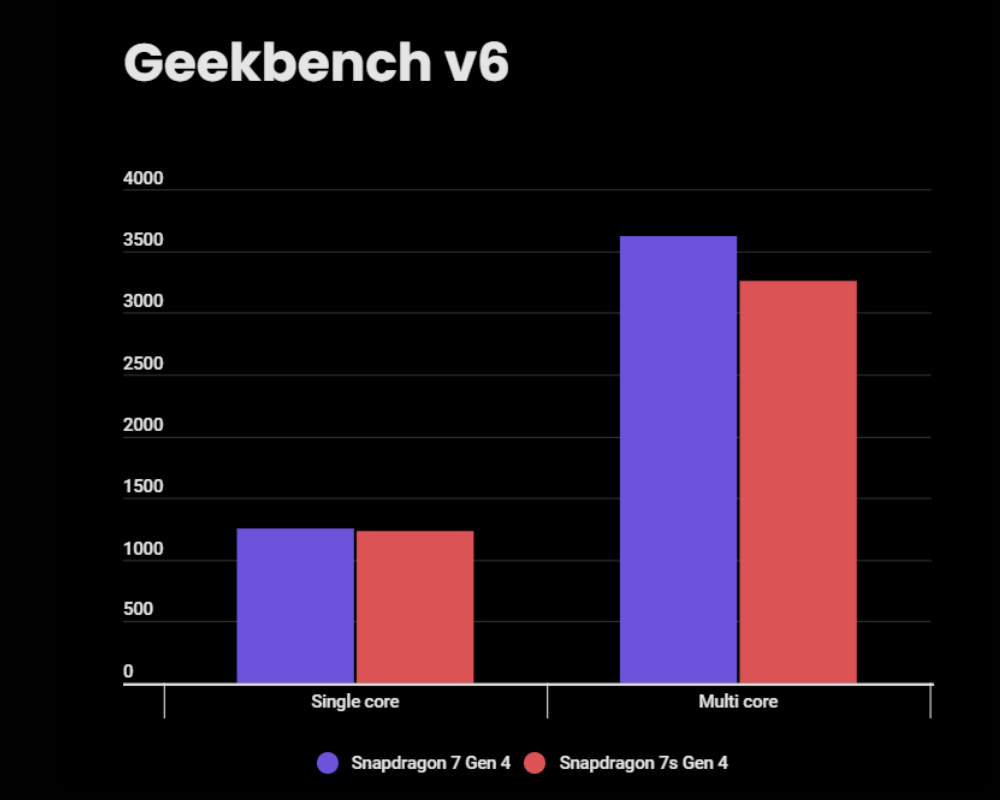
Geekbench score
On Geekbench v10, the Snapdragon 7 Gen 4 pulls just ahead in single-core performance. However, the gap widens in multi-core performance, with the Snapdragon 7 Gen 4 posting a 10% higher score. So, demanding apps that require multiple cores to work together would perform better on a device powered by Snapdragon 7 Gen 4 than on one powered by Snapdragon 7s Gen 4.
Snapdragon 7 Gen 4
Snapdragon 7s Gen 4
Single core
1,252
1,231
Multi core
3,620
3,257
AnTuTu score
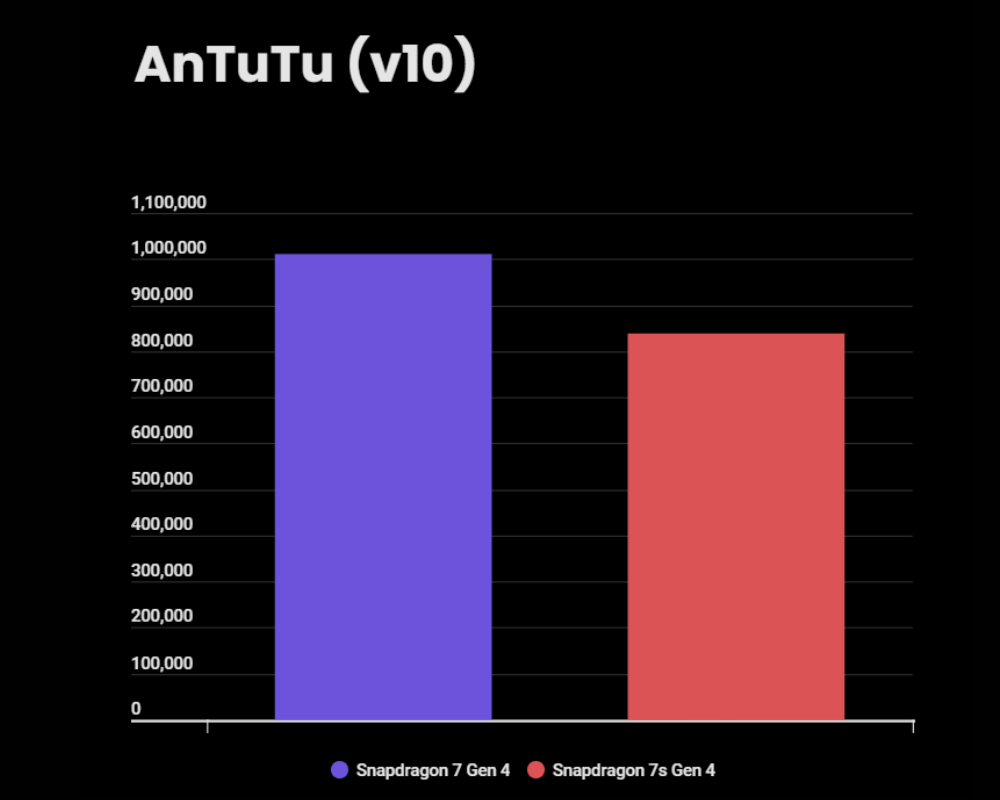
The Snapdragon 7 Gen 4 has achieved over 1 million AnTuTu points, while the Snapdragon 7s Gen 4 gets 838K points. That’s a 20% solid uplift for the 7 Gen 4, but the overall score doesn’t offer much clarity. So, we look at the breakdown of the AnTuTu score.
Snapdragon 7 Gen 4
Snapdragon 7s Gen 4
AnTuTu score
1,010,864
838,402
CPU
309,273
276,892
GPU
323,797
211,590
Memory
182,776
162,373
UX
195,019
187,547
The Snapdragon 7 Gen 4 outperforms the 7s Gen 4 in all aspects. The CPU score is up by 11%; the GPU score is up by 53%, and the memory score is up by 12%. The 7 Gen 4 also pulls ahead in the UX score, even though the difference is small.
Performance-wise, the Snapdragon 7 Gen 4 looks promising, but we must also review other key aspects, such as camera capabilities and connectivity features, to pick the right one. (more on that below)
Snapdragon 7 Gen 4 vs 7s Gen 4: Key differences that matter
Performance
CPU
The Snapdragon 7 Gen 4 prioritizes raw power by using five performance cores (1 prime + 4 performance), whereas the Snapdragon 7s Gen 4 uses a traditional four-performance core setup (1 prime + 3 performance), leaning more on its efficiency cores for battery savings.
The Snapdragon 7 Gen 4 also benefits from a higher peak clock speed of 2.8 GHz compared to the 2.7 GHz on the 7s Gen 4, offering additional performance advantage to the standard 7 Gen 4 SoC.
GPU
For graphics rendering, the 7 Gen 4 relies on the Adreno 722 GPU, which may seem weaker than the Adreno 810 GPU on the 7s Gen 4 at first sight, but it’s actually more powerful. It has a higher frequency, shading units, and FLOPS, resulting in consistent frame rates and reliable gaming performance. The 7 Gen 4 also features advanced Snapdragon Elite Gaming features to deliver smoother gaming with reduced stutter.
AI & NPU
Coming to the AI part, both Snapdragon chips have Hexagon NPUs, but the one on the Snapdragon 7 Gen 4 is significantly more powerful than the NPU on the Snapdragon 7s Gen 4. Qualcomm claims a 65% higher AI performance than the 7 Gen 3, but the 7s Gen 3 is only described generically as an updated Hexagon NPU with “better AI performance” than the 7s Gen 3.
The 7 Gen 4 supports on-device generative AI assistants and large language models (LLMs) for the first time in the Snapdragon 7-series. Also, the first-in-series to run models like Stable Diffusion 1.5 locally on-device. In short, the 7 Gen 4 features a significant upgrade to generative AI, while the 7s Gen 4 hasn’t received a major NPU upgrade.
Camera
While both Snapdragon SoCs use the same 12-bit Spectra ISPs, there are still crucial differences that can significantly affect output quality. This includes the hardware-enabled Electronic Image Stabilization (EIS) support on the Snapdragon 7 Gen 4 for the first time in the Snapdragon 7-series.
The Snapdragon 7 Gen 4 leverages AI-powered autofocus, auto white balance, and auto exposure, now baked into the ISP hardware. The Real-time Video Super Resolution is also AI-assisted, enhancing detail while also reducing noise. In contrast, the 7s Gen 4 features modest AI features such as Snapdragon Low Light Vision and AI Remosaic.
The 7 Gen 4 also excels in video recording, supporting 4K HDR videos at 60fps, while the 7s Gen 4 supports 4K HDR recording at 30fps.
Connectivity
The Snapdragon 7 Gen 4 features more modern, high-end connectivity, which includes Wi-Fi 7 and Bluetooth 6.0. In contrast, the 7s Gen 4 has Wi-Fi 6E and Bluetooth 5.4.
The 7 Gen 4 also excels in connectivity speeds, supporting up to 4.2 Gbps on a 5G connection and up to 5.8 Gbps on a Wi-Fi connection, while the 7s Gen 4 can reach just 2.9 Gbps on both cellular and Wi-Fi connections.
Snapdragon 7 Gen 4 vs 7s Gen 4: Conclusion
The Snapdragon 7 Gen 4 is a premium mid-range chipset, featuring a performance-focused CPU, a superior GPU, and robust connectivity. The Snapdragon 7s Gen 4 sits below it, prioritizing balanced performance and power efficiency.
If you prioritize gaming, AI features, and modern connectivity, the Snapdragon 7 Gen 4 is the better choice. For those looking for reliable daily performance at a lower cost, the Snapdragon 7s Gen 4 is a good fit.
Xiaomi India has launched its first Mini LED TV series in the country, called the Xiaomi TV S Mini LED Series. This launch marks Xiaomi’s entry into the premium television space, featuring advanced Mini LED technology that promises better picture quality with deeper blacks, vivid colors, and enhanced brightness.
Xiaomi TV S Mini LED Series Specifications
The Xiaomi TV S Mini LED Series is available in 55-inch, 65-inch, and 75-inch screen sizes. These TVs feature 4K Ultra HD resolution, a 120Hz Dynamic Local Gamut (DLG) refresh rate, and HDR10+ compatibility. Xiaomi has equipped the series with Quantum Mini LED technology, which incorporates up to 512 precision dimming zones, depending on the model. The TVs deliver peak brightness levels of up to 1200 nits.
The series features AI Local Dimming and the Vivid Picture Engine 2, which optimize brightness and contrast in real time. The TVs also include adaptive light sensors that adjust screen brightness and color temperature based on room lighting for optimal viewing comfort.
The sound setup for the Xiaomi TV S Mini LED Series features 34W quad-speakers and support for Dolby Audio, DTS:X, and Xiaomi Sound.
The TVs come with Google’s PatchWall interface, offering a smooth and intuitive user experience. The software combines Google TV integration with features like personalized recommendations, a kids mode, and universal search. Xiaomi has also included Google Voice Assistant, Miracast, AirPlay 2, and Chromecast compatibility for seamless connectivity and streaming.
Xiaomi has powered the TV series with a quad-core A55 processor, a Mali-G52 GPU, 2GB of RAM, and 32GB of storage. This hardware ensures smooth performance when navigating apps, streaming content, or gaming. Gamers also benefit from features like ALLM (auto low latency mode), MEMC, and high refresh rates for blur-free motion.
Pricing and Availability
The Xiaomi TV S Mini LED Series will be available from April 22, 2026, across Mi.com, online marketplaces, and retail stores. Xiaomi has priced the 55-inch model at ₹51,999 ($557), the 65-inch model at ₹71,999 ($772), and the 75-inch model at ₹99,999 ($1,072).
iPhone 17e and Nothing Phone (4a) sit in very different price segments, but both aim to deliver a strong everyday smartphone experience. One focuses on premium performance and a polished ecosystem, while the other offers more features and flexibility at a much lower cost. This comparison breaks down what really matters between the two and which one makes more sense for different types of users.
Please Note: When you buy something using the links in our articles, we may earn a small commission at no cost to you.
Major Features:
Feature
iPhone 17e
Nothing Phone (4a)
Winner
Design & Build
Glass + aluminum, premium finish, IP68
Glass + plastic, unique glyph design, IP64
iPhone 17e – More premium and durable
Display
6.1″ OLED, HDR10, standard refresh rate
6.78″ AMOLED, 120Hz, higher brightness
Nothing 4a – Smoother and brighter
Chipset
Apple A19 (3nm)
Snapdragon 7s Gen 4
iPhone 17e – Flagship-level power
Performance
Top-tier, long-term stability
Good mid-range performance
iPhone 17e – Faster and more efficient
RAM & Storage
8GB + NVMe storage
Up to 12GB + UFS 3.1
Nothing 4a – More RAM flexibility
Rear Camera
48MP single, strong processing
50MP + telephoto + ultrawide
Nothing 4a – More versatile setup
Video Recording
4K Dolby Vision, excellent stability
4K, good but less refined
iPhone 17e – Better video quality
Selfie Camera
12MP with 3D depth, better video
32MP higher resolution
iPhone 17e – Better overall quality
Battery
4005mAh
5080–5400mAh
Nothing 4a – Larger battery
Charging
Slower wired + wireless
50W fast charging
Nothing 4a – Much faster charging
Software
iOS 26, long-term updates
Android 16, 3 updates
iPhone 17e – Longer support
Extra Features
Face ID, satellite features
Glyph lights, reverse charging
Tie – Different but useful extras
Price
₹65,000 (~$600)
₹32,000 (~$450)
Nothing 4a – Much better value
Disclaimer: Specs are based on available data. Actual performance may vary. Verify details from official sources before buying.
Design and Display
Build and Feel
The iPhone 17e delivers a premium in-hand feel with its aluminum frame and refined glass finish, backed by Ceramic Shield protection. It feels clean, minimal, and unmistakably flagship. The Nothing Phone (4a), on the other hand, leans into a more expressive design with its transparent aesthetic and LED glyph interface. While its plastic frame slightly reduces the premium feel, it compensates with uniqueness and personality. The iPhone feels more durable and polished, while the Nothing phone feels more experimental and fun.
Display Quality
The iPhone 17e offers a sharp OLED panel with excellent color accuracy and reliable brightness, making it ideal for consistent everyday use. However, it sticks to a standard refresh rate. The Nothing Phone (4a) clearly pushes ahead with a larger AMOLED display, 120Hz refresh rate, and significantly higher peak brightness. It feels smoother and more immersive, especially for scrolling and media consumption. The difference is immediately noticeable in fluidity and visual punch.
Verdict
The iPhone 17e wins on build quality and refinement, but the Nothing Phone (4a) takes the lead with a more advanced and smoother display experience.
Specifications Including Battery
Performance
The iPhone 17e is powered by the Apple A19 chip, delivering top-tier performance that easily outclasses most mid-range Android processors. It handles gaming, multitasking, and long-term performance stability with ease. The Nothing Phone (4a), running on the Snapdragon 7s Gen 4, offers solid performance for its class, but it doesn’t match the raw power or efficiency of Apple’s silicon. For heavy users, the difference becomes quite clear over time.
Battery and Charging
Battery life is where the Nothing Phone (4a) gains a strong advantage. Its larger battery easily lasts longer under heavy use, and the faster 50W charging makes top-ups quick and convenient. The iPhone 17e provides reliable battery life with optimized efficiency, but its charging speeds feel conservative in comparison. Wireless charging support adds convenience, but overall speed still lags.
Verdict
The iPhone 17e dominates in performance, but the Nothing Phone (4a) offers better battery life and significantly faster charging, making it more practical for power users.
Camera
Main and Secondary Lenses
The iPhone 17e focuses on a single high-quality 48MP sensor, delivering consistent, natural-looking photos with excellent video capabilities. It prioritizes reliability over versatility. In contrast, the Nothing Phone (4a) offers a more flexible triple-camera setup, including a periscope telephoto lens and ultrawide sensor. This adds creative freedom with zoom and wider shots, something the iPhone lacks. While the Nothing phone provides more options, consistency still slightly favors Apple.
Selfie Camera
The iPhone 17e’s 12MP front camera stands out with advanced features like 3D depth sensing and better video recording, making it ideal for content creators and secure authentication. The Nothing Phone (4a) offers a higher-resolution 32MP sensor, producing sharper images, but lacks the same level of refinement in video and depth processing.
Verdict
The iPhone 17e wins in consistency and video quality, while the Nothing Phone (4a) stands out for versatility and zoom capabilities.
Pricing
Price Comparison
The iPhone 17e is priced at around ₹65,000 ($600), placing it firmly in the premium segment. In contrast, the Nothing Phone (4a) comes in at approximately ₹32,000 ($450), making it significantly more affordable. The price gap is substantial and immediately influences buying decisions.
Is the Price Justified?
The iPhone 17e justifies its price with flagship performance, long-term software support, and a polished ecosystem experience. It feels like a long-term investment. However, the Nothing Phone (4a) delivers exceptional value by offering features like a 120Hz display, versatile cameras, and fast charging at nearly half the price. It feels aggressively priced for what it offers, making it hard to ignore.
Verdict
The iPhone 17e is worth it for premium users, but the Nothing Phone (4a) is the clear winner in value for money.
Disclaimer: Prices are approximate and may vary based on country, region, and applicable taxes.
Conclusion
The iPhone 17e stands out with its powerful A19 chip, refined ecosystem, satellite features, and strong video capabilities. It’s built for users who prioritize performance, longevity, and seamless integration. The Nothing Phone (4a), however, brings a fresh approach with its glyph lighting system, bigger battery, faster charging, and versatile camera setup. It feels more innovative in everyday usability and visual identity.
Verdict
iPhone 17e is the better choice for those seeking flagship performance and long-term reliability. Nothing Phone (4a) is ideal for users who want maximum features, better battery life, and a standout design at a much lower price.
Disclaimer: This comparison is based on the specifications provided and is intended for general informational purposes. Actual performance, camera results, battery life, and overall experience may vary depending on real-world usage, software updates, and individual preferences.
Something a bit unusual is being talked about across the Indian tech space right now. A major smartphone brand is reportedly taking legal action against a large number of social media accounts over what it calls “negative content.”
The story started with a post on X by Yogesh Brar. He didn’t name the company directly, but the replies and follow-up chatter quickly started pointing toward Motorola.
What’s being claimed is that over 300 influencers and pages are involved. The brand apparently believes certain posts have hurt its image. It’s not very clear what kind of content triggered this, whether it’s critical reviews, complaints about service, or something else entirely.
If this turns out to be accurate, it’s not something you see often. Brands usually deal with criticism in quieter ways, through PR statements or by addressing issues directly. Legal action on this scale feels different.
There’s been a mix of reactions so far. Some people see it as a worrying move, especially if it ends up discouraging honest feedback. Others think it might be justified if there’s actual misinformation or coordinated campaigns involved. Hard to say without more details.
The timing is also interesting. The brand being linked to this has been pushing hard in India recently. In a market like this, where competition is intense, perception can matter just as much as the product itself.
At the same time, there’s no official word yet. No public filings, no statement from the company. So for now, this is still based on a leak that’s gained traction pretty quickly online.
If more concrete information shows up, this could turn into a much bigger discussion around how far brands can go in controlling their image, and where that leaves creators and users.
For now, it’s one of those stories that’s still unfolding.
GoPro has introduced a new line of compact cinema cameras called the MISSION 1 Series. The lineup includes three main models: MISSION 1 PRO, MISSION 1, and MISSION 1 PRO ILS. All three are built around a new 50MP 1-inch sensor and the company’s GP3 processor, with a focus on high-resolution video, better low-light output, and longer recording times.
The new sensor uses 1.6µm native pixels and 3.2µm fused pixels in Quad Bayer mode. GoPro says this allows up to 14 stops of dynamic range. The GP3 processor, built on a 5nm design, is meant to improve efficiency and heat management while handling image processing. It also includes an AI-based neural unit that helps with low-light video and detail processing.
Video capabilities are one of the main highlights. The MISSION 1 PRO and PRO ILS can shoot 8K video at up to 60 frames per second, 4K at up to 240 frames per second, and 1080p at up to 960 frames per second in short bursts. They also support 1080p at 480 frames per second for longer slow-motion clips. The standard MISSION 1 is more limited, offering 8K30, 4K120, and 1080p240 recording.
Open Gate recording is supported across the lineup. The PRO models can shoot 8K30 and 4K120 using the full 4:3 sensor, while the base model supports 4K120 Open Gate. This gives more flexibility when cropping for different formats later.
Battery life has also been pushed. With the Enduro 2 battery, the cameras can record for over five hours at 1080p30 and more than three hours at 4K30. The same battery works with HERO13 Black cameras, though older batteries will not last as long.
The cameras include 13 preset capture modes that adjust settings automatically based on the scene. Manual control is still available for those who want it. Video recording supports up to 240Mbps bitrate, along with 10-bit color, HLG HDR, and GP-Log2. Timecode sync is included for multi-camera setups.
GoPro MISSION 1 Series Accessory Ecosystem
Audio is handled by a four-microphone setup with stereo recording and wind noise reduction. There is also 32-bit float recording to avoid clipping. Bluetooth 5.3 support allows wireless audio with compatible devices.
For photos, the cameras can shoot 50MP images, including RAW. Burst shooting goes up to 60 frames per second, and HDR processing is handled automatically.
On the design side, the MISSION 1 and PRO are waterproof up to 20 meters without extra housing. A separate case extends this to 60 meters. The cameras use a 159-degree field of view, a larger OLED rear display, and bigger buttons that are easier to use with gloves.
The MISSION 1 PRO ILS stands out with its interchangeable Micro Four Thirds lens mount, allowing the use of different lenses through adapters. The cameras also work with the GoPro Quik app, which handles cloud backup, automatic highlight videos, and editing tools.
Pre-orders start May 21, with global availability from May 28. The PRO and base models will ship first, while other versions will follow in Q3 2026. Pricing will be announced at the NAB Show later this month.
Xiaomi seems to have revealed its next budget phone a bit earlier than planned. The Poco C81 Pro briefly showed up on the company’s global website before being taken down, but not before its specs were noticed.
From what’s been spotted, this looks like a fairly straightforward entry-level device. The focus is on the basics, big screen, decent battery, and enough performance for everyday use.
Up front, there’s a 6.9-inch LCD display with a 120Hz refresh rate and HD+ resolution. Brightness is listed at up to 800 nits, so it should hold up reasonably well outdoors.
The phone runs on the Unisoc T7250, which is more suited for lighter tasks. Think browsing, messaging, online payments, and social media. Connectivity is limited to 4G, which might be a drawback for some users. RAM is listed at 4GB, with storage options going up to 256GB, plus microSD support.
Cameras are about what you’d expect here. A 13MP main sensor on the back and an 8MP front camera. No extra lenses or fancy tricks, just the basics.
Battery is where it stands out a bit. There’s a 6000mAh unit, which should comfortably last a full day, maybe longer depending on usage. Charging is limited to 15W, so it won’t be particularly quick to top up.
Other features include a side-mounted fingerprint sensor, dual SIM support, and likely a lightweight version of HyperOS, possibly based on Android Go. The overall idea is pretty clear. This is meant to be an affordable phone that handles everyday tasks without much trouble.
The listing has already been removed, so nothing is official just yet. That said, the specs suggest it could be a rebranded Redmi A7 Pro 4G, which launched globally earlier this month.
Xiaomi looks set to bring another smart kitchen gadget to global markets. The upcoming Mijia Smart Steam Air Fryer 7L combines air frying with steam cooking, and even adds support for sous vide-style cooking.
If it sounds familiar, that’s because Xiaomi already launched a similar model in China earlier. This version bumps the capacity up to 7 liters, making it more suitable for larger meals or batch cooking.
In terms of features, it covers quite a bit. Xiaomi lists 10 cooking modes, including steaming, fermenting, dehydrating, defrosting, and reheating. The sous vide part is interesting here. Traditionally, that requires a separate setup with a water bath, but Xiaomi seems to be using a built-in 1.5L water tank to replicate a similar effect. Exact details aren’t fully clear yet, but it’s likely tied to how the device handles steam and temperature control.
Speaking of temperature, the fryer supports a wide range from 40°C to 230°C, so it can handle both low-temp cooking and high-heat roasting. For steam, it can go up to around 130°C, which should help cook food faster compared to a standard steamer.
There’s also a hybrid mode that combines hot air and steam. That’s meant to keep food moist inside while still getting a crispy finish on the outside.
On the smart side, it supports HyperOS Connect, so you can control it through the Xiaomi Home app. That includes adjusting settings remotely, browsing recipes, and even linking it with Google Home for voice commands.
Compared to Xiaomi’s existing models like the 6.5L version already available in some markets, this one feels like a step up in terms of flexibility rather than just size.
There’s no confirmed global pricing or release date yet. But if it lands in markets like Europe, it could be a decent option for anyone looking to replace multiple kitchen appliances with a single device.
Oppo just refreshed its F-series in India with the new Oppo F33 and Oppo F33 Pro. The two phones share most of their specifications, with differences mainly in areas like the camera and design.
The standard F33 has a rectangular camera module on the back that doesn’t look much different from last year’s model.
The Pro model, however, introduces a larger camera plateau and a more noticeable visual identity, even if the influence from recent iPhone designs is hard to ignore.
Oppo F33Oppo F33 Pro
The standard model is available in Pearl White and Forest Green, while the Oppo F33 Pro comes in Starry Blue, Passion Red, and Misty Forest. The latter features a forest-like pattern on the back and a layered 3D depth effect that creates a subtle shifting look under light.
Both phones carry multiple protection ratings, including MIL-STD-810H certification and IP66, IP68, and IP69 dust and water resistance ratings. The Pro model also supports IP69K.
Oppo F33 Pro
Oppo F33 and F33 Pro Specifications
Both phones share the same core specifications. There’s a 6.57-inch AMOLED display with a 120Hz refresh rate and peak brightness of 1,400 nits. Powering them is a MediaTek Dimensity 6360 Max chip built on a 6nm process, paired with up to 8GB of RAM and 256GB of storage.
The Pro model adds a vapor chamber cooling system, which helps with sustained performance.
Oppo F33 Pro
Oppo is packing a 7,000mAh battery into both models, paired with 80W fast charging. Features like reverse wired charging and bypass charging are also included.
On the camera side, both devices use a 50MP primary sensor with a 2MP depth sensor. The difference appears on the front — the F33 has a 16MP selfie camera, while the Pro upgrades to a 50MP ultra-wide sensor that can automatically adjust framing when more people enter the shot.
The phones run Android 16 with ColorOS 16 on top.
Pricing and Availability
The Oppo F33 starts at Rs 31,999 for the base variant and goes up to Rs 40,999 for the F33 Pro. Both devices are now up for pre-order through Amazon, Flipkart, Oppo’s online store, and offline retail outlets, with typical launch offers like cashback, exchange bonuses, and EMI options included.
Model
Variant
Price (India)
Oppo F33
6GB + 128GB
Rs 31,999
8GB + 128GB
Rs 34,999
8GB + 256GB
Rs 37,999
Oppo F33 Pro
8GB + 128GB
Rs 37,999
8GB + 256GB
Rs 40,999
For more daily updates, please visit our News Section.
Different brands like Oppo Reno 16 series, Honor 600 series, Huawei Nova 16 lineup, and Vivo S60 lineup are in the works for the Chinese market. According to tipster Digital Chat Station, the Reno 16 series, along with other models, is expected to launch around June. Ahead of the expected launch, the tipster has shared key details about the Reno 16 Pro and Reno 16.
Oppo Reno 16 Pro key specifications, price (rumored)
The Reno 16 Pro is said to feature a flat OLED LTPO display with narrow bezels, measuring around 6.78 inches and offering a 1.5K resolution. In terms of design, the device may come with a metal frame, indicating a more premium build compared to earlier models.
It is expected to be powered by the Dimensity 9500s chipset and could pack a battery in the 7000mAh range. While there is no confirmed information about charging capabilities, it may support around 80W wired and 50W wireless charging, similar to the previous generation.
For photography, the device may feature a 200-megapixel primary camera paired with a periscope telephoto lens. Compared to the Reno 15 Pro, which offered a 200-megapixel main, 50-megapixel ultra-wide, and 50-megapixel periscope setup, the Reno 16 Pro could retain a similar camera system.
The device is expected to be available in multiple variants, including 12GB+256GB, 12GB+512GB, 16GB+256GB, and 16GB+512GB, with a 16GB+1TB option possibly under consideration. However, the top variant may be dropped due to rising memory costs. It is likely to be priced between 4,000 Yuan (~$585) and 5,000 Yuan (~$735) and could arrive in white, black, purple, and green shades. It still remains to be seen whether it will be simply called Reno 16 Pro or Reno 16 Pro Max.
Oppo Reno 16 key specifications (rumored)
According to the tipster, the Reno 16 will be a compact model similar to the Reno 15. It is expected to feature a 6.3-inch display and could be powered by a Dimensity 8-series chipset, possibly the Dimensity 8500. The other specs of this phone are under wraps, but it is likely to feature a 200-megapixel + 50-megapixel + 50-megapixel triple camera setup like the previous generation.
For more daily updates, please visit our News Section.
Honor is one of the few brands offering smartphones with 10,000mAh batteries. The company already offers both mid-range and flagship models with these oversized cells, including the Honor Power 2 and the Honor Win series (Win and Win RT), respectively.
Now, the next milestone for Honor seems to be 11,000mAh.
A new leak from tipster Digital Chat Station claims the company has started trial production of a new battery with a rated capacity of 10,690mAh and a typical capacity of 11,000mAh.
The report does not name the phone, but it points to yet another Honor device built around a very large battery.
That would put the phone beyond Honor’s current official battery leader, the Power 2. The latter ships with a 10,080mAh battery, 80W wired charging, and 27W reverse wired charging.
Before that, Honor launched the original Power with an 8,000mAh battery and 66W charging. The growth over just one generation is quite significant.
Honor Power 2 Specifications
While details about this rumored 11,000mAh Honor device remain unknown, the Honor Power 2 offers a useful reference point.
It packs a 10,080mAh battery into a surprisingly slim 7.98mm chassis. Charging caps at 80W wired and 27W for reverse.
Honor Power 2
On the front, there’s a 6.79-inch OLED LTPS flat display with a 1.5K resolution (2600 x 1200 pixels). The panel is rated for up to 8,000 nits peak brightness and includes 3,840Hz PWM dimming for reduced eye strain.
Powering the device is the MediaTek Dimensity 8500 Elite chipset, paired with LPDDR5X RAM and UFS 4.1 storage.
As for the cameras, it has a 50MP main sensor with OIS and a 5MP ultra-wide lens on the back, along with a 16MP front-facing camera. On the software side, it runs Android 16 with MagicOS 10 on top.
For more daily updates, please visit our News Section.
REDMI has started teasing a new tablet, the K Pad 2, and it’s clearly going after performance-focused users. The company is calling it a “performance flagship,” which sounds like typical marketing, but some of the early details suggest it’s at least trying to stand out a bit, especially on the gaming side.
At the center of it is the Dimensity 9500, paired with a 15300mm² vapor chamber cooling system. REDMI is also using a centered chip layout, which is meant to help with heat distribution during longer sessions. In theory, that should mean more stable performance without throttling too quickly.
The display is another key part. It’s an 8.8-inch panel with a 165Hz refresh rate and 1100 nits of peak brightness. REDMI says it’s tuned specifically for gaming, though we’ll have to see how much of that actually makes a difference in real use. Battery capacity sits at 9100mAh, which should be enough for extended use, especially given the size of the device.
The tablet itself sticks to a fairly premium look, with a metal unibody and a few color options, including purple, silver, and black. Nothing too surprising, but it looks clean.
On the gaming side, REDMI is claiming support for 165fps gameplay in select titles, along with a 540Hz touch sampling rate. There’s also a high-frequency gyroscope, which should help with responsiveness in fast-paced games.
For audio, the tablet includes dual full-range drivers housed in a 2.0cc “super-large” sound cavity, designed to deliver fuller bass, clearer treble, and richer detail. It’s marketed as the first tablet tuned by Sound by Bose.
The K Pad 2 is set to launch on April 21, 2026, alongside the Redmi K90 Max and the Redmi Book Pro 2026.
ASUS has introduced the ROG Open Wireless (OWS) gaming earbuds, designed to balance comfort, low-latency performance, and everyday usability. These earbuds feature an open-ear design, allowing users to stay aware of their surroundings while listening, making them suitable for both gaming and daily use. The ergonomic ear-hook structure ensures a secure fit without putting pressure on the ear canal, enabling longer usage sessions without fatigue.
Launch and Availability
The ROG Open Wireless (OWS) earbuds have been introduced in China and are currently available via JD.com. They are priced at 1399 yuan, with an introductory launch price of 1199 yuan. ASUS is expected to expand availability to more regions through its official retail channels in the coming months.
Connectivity and Gaming Performance
The earbuds support dual-mode connectivity, including Bluetooth and 2.4GHz wireless via a USB-C dongle. This allows seamless switching between devices and even simultaneous dual-device connections. ASUS has integrated its SpeedNova wireless technology, delivering ultra-low latency, up to six times lower than standard Bluetooth. This ensures faster audio transmission and better synchronization, helping users react quickly in competitive gaming scenarios with accurate positional sound.
Audio and Microphone System
Equipped with a 14.2mm diamond-like carbon-coated driver, the earbuds deliver clear highs, deep bass, and low distortion. Multiple sound modes, including bass enhancement and immersive modes, allow users to customize audio based on their preferences. The quad-microphone array with AI noise cancellation enhances voice clarity, improving both call quality and in-game communication.
Battery, Durability, and Additional Features
The earbuds offer up to 16 hours of usage on a single charge, with total battery life extending up to 48–64 hours with the charging case. Fast charging support provides around three hours of playback with just 15 minutes of charging. With an IPX5 rating, the earbuds are resistant to sweat and light splashes. Additional features such as USB-C pass-through charging and an extended connector design improve convenience, especially for users using devices with thicker protective cases.
The BenQ MA270S monitor has just gone official in India. The new monitor, which has been primarily designed for Mac users, comes with a 27-inch 5K display, 99 percent P3 color coverage, and Thunderbolt 4 connectivity with 96W power delivery, targeting creators who need high precision and seamless integration. Here’s more information on the specs, features, and price of the BenQ MA270S.
BenQ MA270S specifications and features
BenQ MA270S monitor
The BenQ MA270S features a 27-inch panel with 5K resolution of 5120 x 2880 pixels and a pixel density of 218 ppi. This ensures sharp visuals that closely match the clarity seen on Mac displays. The monitor also covers 99 percent of the P3 color gamut, helping maintain colour consistency across devices, which is important for design and video work.
It includes a 2000:1 contrast ratio and a 70Hz refresh rate, offering smoother interactions compared to standard 60Hz panels. The display is tuned to align with macOS color and brightness behavior, aiming to deliver a consistent viewing experience when paired with Mac devices.
Connectivity is handled through Thunderbolt 4, supporting up to 96W power delivery. This allows users to connect and charge a MacBook with a single cable. The monitor also supports daisy chaining for dual 5K setups, which can be useful for multi-window workflows such as editing timelines or coding.
Additional features include support for BenQ Display Pilot 2 software, enabling control over brightness, colour profiles and screen layout directly from the Mac. The monitor also offers a Smart KVM feature for switching between systems, along with multiple ports for expanded connectivity. Ergonomic adjustments such as height, tilt, swivel and pivot are also included.
Rivals Apple Studio Display
The BenQ MA270S serves as a direct competitor to the Apple Studio Display by offering a matching 5K resolution and seamless Mac integration through its DisplayPilot 2 software. Unlike the Apple alternative, it includes a height-adjustable stand as standard, dual Thunderbolt 4 ports for daisy-chaining, and a built-in KVM switch to easily manage multiple devices.
Price and availability
The BenQ MA270S 5K monitor is available in India for Rs 94,998 (~$1,020). It can be purchased through leading retail stores as well as online platforms. It is already available in the US for $999.
For more daily updates, please visit our News Section.
OnePlus has started teasing a new tablet for its global debut, though the company hasn’t revealed the name yet. According to reports, it’s likely the OnePlus Pad 3 Pro. And now, ahead of launch, the same device has surfaced on Geekbench.
The listing shows a OnePlus tablet with the model number OPD2514, which is likely the global or Indian variant. It is powered by Qualcomm’s Snapdragon 8 Elite Gen 5 chipset, confirmed by its CPU setup of two high-performance cores clocked at 4.61GHz and six efficiency cores running at 3.63GHz.
Meanwhile, graphics are handled by the Adreno 840 GPU.
The device tested on Geekbench is running Android 16 and comes with 12GB of RAM. In terms of performance, it scored 3,467 in the single-core test and 10,377 in the multi-core test.
OnePlus Pad 3 Pro Specifications (Expected)
As for other hardware specs, the OnePlus Pad 3 Pro is likely to feature a 13.2-inch display for productivity and media consumption. Its memory options are said to include up to 16GB of LPDDR5X RAM and 512GB of UFS 4.1 storage.
Being a large device, the tablet is rumored to pack a battery larger than 10,000mAh. Design-wise, it is tipped to arrive in at least two color options: Titanium and Green.
Oppo Pad 3 Pro
On a side note, last year’s OnePlus Pad 2 Pro was based on the Oppo Pad 4 Pro. As a result, the OnePlus Pad 3 Pro may similarly share similarities with the upcoming Oppo Pad 5 Pro.
The latter is expected to debut with a 13.2-inch display, a Snapdragon 8 Elite Gen 5 chip, a 13,380mAh battery with 67W fast charging, up to 16GB of RAM, up to 512GB of storage, a 13-megapixel rear camera, and an 8-megapixel front camera.
For more daily updates, please visit our News Section.
As scheduled, Vivo today announced its latest mid-range smartphone, the Vivo T5 Pro 5G, in India. A successor to the Vivo T4 Pro, it debuts with a much larger 9,020mAh battery, up from 6,500mAh. The Vivo T5 Pro 5G starts at Rs 29,999 for the 8GB + 128GB variant in India.
Vivo T5 Pro 5G Specifications
The phone features a large 6.83-inch 1.5K LTPS OLED display built on a Visionox VM9 panel. It supports a 144Hz refresh rate and reaches up to 5,000 nits peak brightness, with 2,000 nits in high brightness mode.
The display also has 2,160Hz PWM dimming for reduced eye strain in low-light conditions.
Under the hood, the device runs on the Snapdragon 7s Gen 4 chipset, paired with LPDDR4X RAM and UFS 3.1 storage. Vivo claims the phone can achieve around 1.2 million points on AnTuTu benchmarks.
It also supports up to 120FPS gaming, aided by a large 7,000mm² vapor chamber cooling system that the company says is the biggest in this category.
The Vivo T5 Pro features a dual rear camera setup, consisting of a 50MP Sony IMX882 main sensor with OIS and a 2MP secondary depth sensor. On the front, there is a 32MP camera for selfies and video calls.
Powering the 9,020mAh battery is 90W fast charging support. Vivo claims the phone can charge up to 50% in around 37 minutes. Despite the large battery, the device remains 8.25mm thick and weighs 213 grams. The company also promises five years of battery health durability.
On the software side, the phone runs Android 16 with OriginOS 6. Vivo is offering three years of major OS updates and five years of security patches. The device also includes IP68 and IP69 ratings for water and dust resistance, an in-display optical fingerprint sensor, an IR blaster, Wi-Fi 6, and Bluetooth 5.2.
The Vivo T5 Pro 5G will be available in Cosmic Black and Glacier Blue color options. It will go on sale starting April 21 via Flipkart, the Vivo India eStore, and offline retail stores.
For more daily updates, please visit our News Section.
The Xiaomi 17 Max is making headlines again, this time for a regulatory filing in China. A new Xiaomi device with the model number 2605EPN8EC has passed China’s Ministry of Industry and Information Technology SRRC certification.
While the certification doesn’t confirm any specification except its connectivity (5G / WLAN / Bluetooth), it usually means that a launch isn’t too far away.
Based on earlier leaks, this device is widely believed to be the Xiaomi 17 Max, though some sources have referred to it as the Xiaomi 17S Pro. Either way, it’s a large-screen option in the company’s 17 series lineup.
The model number also hints at Xiaomi’s internal timeline. It suggests a release window around April or May, which lines up with previous reports of a May debut in China.
What to expect?
According to previous reports, the Xiaomi 17 Max could feature a 6.9-inch flat OLED display with a 1.5K resolution and narrow bezels on all sides. The hardware will be led by the Qualcomm Snapdragon 8 Elite Gen 5 chipset, paired with up to 16GB of LPDDR5x RAM and up to 1TB of UFS 4.1 storage.
Xiaomi 17 Pro Max
Its camera specs are likely to include a 200-megapixel main sensor, paired with a 50-megapixel telephoto macro lens. It will also have a 50MP ultrawide lens. These specs are similar in comparison to the Xiaomi 17 Pro Max, but the latter also has a secondary display on the rear. The Xiaomi 17 Max is rumored to skip that.
Other rumored features include symmetrical dual speakers, an X-axis linear motor, and a 3D ultrasonic fingerprint sensor. The device may also introduce a new silicon-based battery with a capacity starting in the 8,000mAh range, along with full water resistance and a metal frame. The overall design is said to follow a clean, minimalist approach.
For more daily updates, please visit our News Section.
Asus has introduced its 2026 editions of the Zenbook and Vivobook laptops in India, focusing on design, portability, and next-generation performance. The announcement includes multiple models across premium and mainstream segments, with pre-orders now open for select devices.
2026 Zenbook and Vivobook lineup’s key features
Asus ZenBook S16 (2026)
The new 2026 Zenbook range includes the Zenbook S14, Zenbook Duo, and Zenbook A series, all built using a new Ceraluminum material aimed at improving durability while keeping the devices lightweight. The Zenbook S14 stands out with its slim profile of around 1.1 cm and a weight close to 1.2 kg, making it suitable for users who prefer portability. It also features a 14-inch 3K OLED display and is powered by Intel Core Ultra series processors, offering up to 50 TOPS of AI performance for demanding tasks.
The Zenbook Duo takes a different approach by offering dual 14-inch OLED touch displays with a 144Hz refresh rate. This setup allows better multitasking, especially for users working across multiple apps. It runs on Intel Core Ultra processors and is designed to handle heavier workflows while still maintaining a relatively compact design.
Asus ZenBook Duo (2026)
The Zenbook A14 and A16 models focus on lightweight usage, with the A14 weighing under 1 kg. These devices are powered by Snapdragon X2 series processors, enabling AI-driven features and efficient performance for everyday tasks.
Asus Zenbook A16 (2026)
On the Vivobook side, Asus has annoced both the Classic and S series models. The Vivobook 14 and 16 come with Intel Core Ultra 5 processors and include AI-based features such as smart search and task assistance. They also feature an AI camera with face unlock support for added security. Meanwhile, the Vivobook S14 and S16 target users looking for a balance between performance and design, offering metallic builds, long battery life, and Intel Core Ultra 7 processors for smoother multitasking.
Price and availability
2026 Zenbook and Vivobook lineup
The 2026 Zenbook series starts at Rs 179,990 (~$1,930), while the Vivobook range begins at Rs 98,990 (~$1,060). Pre-orders for select Zenbook models are open from April 14 to April 20, with general availability starting April 21 across ASUS stores, online platforms, and retail partners.
The Zenbook Duo is priced at Rs 299,990 (~Rs 3,215), while the Zenbook A14 and A16 start at Rs 185,990 (~$1,990) and Rs 199,990 (~$2,145), respectively. Vivobook models are positioned more affordably, with prices ranging between Rs 98,990 and Rs 131,990 depending on the configuration.
For more daily updates, please visit our News Section.
Word on the street says OnePlus is working on a handheld console, and turns out it’s real. OnePlus official Li Jie confirmed in a livestream yesterday that the company is at least experimenting with a handheld gaming device.
During the stream, Li briefly showed a hand-drawn sketch of what looked like a portable console. The illustration wasn’t detailed, but the outline was clear enough to suggest it’s a gaming device.
Previously, tipster Digital Chat Station shared renders of a similar device. Those images pointed to a slightly boxy design with shoulder buttons, a rear camera, and colored grips.
So far, OnePlus hasn’t confirmed any specifications. But based on leaks, the device could feature an 8-inch display and run on a flagship chipset from MediaTek.
OnePlus’s gaming console will be touchscreen first
What could set this console apart is its approach to controls. Instead of relying entirely on joysticks and physical buttons, OnePlus may focus on a touchscreen-first interaction system. It’s expected to improve multi-finger input, reduce latency, and support high refresh rates.
Previous reports also mention system-level optimizations for games like Delta Force and PUBG Mobile.
The console is also expected to pack a larger battery, with hints of active cooling as well.
OnePlus gaming console leaked image by DCS
Alongside the console tease, Li also showed the OnePlus Ace 6 Ultra, a more immediate product powered by a Dimensity 9500 chip and a 165Hz display. It is closer to launch, while the handheld console is more of an experiment for now.
A report from March had already suggested that OnePlus was exploring an “Android handheld console” concept, possibly as part of a broader push by smartphone makers into new categories.
Nothing is official yet, and there’s still no timeline. But now that the concept has been teased by the company itself, a OnePlus console may not be too far off.
For more daily updates, please visit our News Section.
Global smartphone shipments are off to a slower start in 2026. According to IDC’s latest Worldwide Quarterly Mobile Phone Tracker, shipments fell 4.1% year over year in the first quarter to 289.7 million units.
The drop effectively ends a ten-quarter streak of growth that began around mid-2023. And we are all probably aware of the reasons. Supply constraints tied to storage components and rising costs. Both of these are expected to continue putting pressure on the market.
The top two companies still posted growth. Samsung and Apple were the only vendors among the global top five to record year-over-year gains.
The market outlook in Q1, 2026
Samsung returned to the number one spot for the quarter, thanks in part to the demand for the Samsung Galaxy S26 Ultra. Even with a later-than-usual launch, shipments still rose 3.6% compared to last year.
The company also filled the gap with earlier releases in its midrange A series, which helped stabilize volumes.
Apple followed in second place, with the iPhone 17 series seeing particularly strong demand in China. The company recorded more than 30% growth in the mainland, contributing to a 3.3% increase globally. That said, IDC notes that supply disruptions and weaker channel support in some regions kept that growth in check.
For the rest of the top five, things were a bit more muted. Xiaomi held onto third place despite posting the largest decline among the group.
Oppo came in fourth, with stronger performance in China offsetting weaker international results. Notably, Oppo’s data now also includes Realme. Vivo rounds out the top five, contributing 7.3% of global smartphone shipments.
Outside the top tier, there were a few bright spots. Honor, along with Lenovo (through Motorola) and Huawei, all managed to grow. Honor stood out with a 24% year-over-year increase, which IDC says is due to its overseas expansion.
In China, total shipments reached about 69 million units, down 3.3% from a year ago. Even there, growth from Huawei and Apple wasn’t enough to offset the broader slowdown.
For more daily updates, please visit our News Section.
Several reports have revealed that there will be two versions of the next-generation Qualcomm Snapdragon Elite-branded 8-series chip. These include the Snapdragon 8 Elite Gen 6 and 8 Elite Gen 6 Pro. Tipster Digital Chat Station has now shared fresh details about the standard variant and how it differs from the Pro model.
Snapdragon 8 Elite Gen 6 key details revealed
Snapdragon 8 Elite Gen 6 specs leak
According to the tipster, the Snapdragon 8 Elite Gen 6, identified as SM8950, is expected to be built on TSMC’s advanced 2nm process. It is said to feature a new 2+3+3 Oryon CPU layout, along with a shared 16MB L2 cache. This architecture indicates a strong focus on balancing performance and efficiency for flagship devices.
On the graphics side, the chipset may include an Adreno 845 GPU with a six-slice design, paired with 12MB GMEM and 6MB system-level cache. It is also expected to support LPDDR5X memory and UFS 5.0 storage, making it suitable for high-performance smartphones without pushing costs too high. The chip is likely to power upper mid-range and mainstream flagship models in the next cycle.
How does the Snapdragon 8 Elite Gen 6 differ from the Pro variant
The same source suggests that the standard version comes with slightly reduced cache and peripheral capabilities compared to the Pro model. Earlier reports indicate that the Snapdragon 8 Elite Gen 6 Pro, carrying model number SM8975, could bring support for LPDDR6 memory along with a more powerful Adreno 850 GPU and expanded cache configuration.
In addition, the Pro variant is expected to target premium Ultra-tier smartphones, while the standard chip may focus on offering stable performance and better efficiency for a wider range of devices. However, there are reports that the OnePlus 16 and iQOO 16 will come equipped with the Pro chip.
For more daily updates, please visit our News Section.
Xiaomi has added another product to its Mijia lineup, this time in the personal care category. The new Hair Clipper 2 Set builds on the regular version, but adds a couple of extras that make it a bit more versatile.
At its core, it’s still a standard hair clipper, but the set version includes precision trimming and engraving attachments, which is where things get more interesting. The precision trimmer is meant for smaller areas, around the hairline, ears, or sideburns, basically the kind of detailing you don’t always get right with a regular clipper.
Then there’s the engraving blade, which feels a bit more niche. It’s designed for sharper lines or patterns, so more for styling than basic trimming. Probably not something everyone will use, but it adds an extra layer for those who like experimenting.
Both attachments use a titanium carbide coating, and Xiaomi says the main blade is built to reduce friction and heat during use. That should help with comfort, especially if you’re using it for longer sessions.
In terms of adjustments, the clipper offers 19 length settings along with two speed modes, so there’s a decent amount of flexibility. It’s also IPX7 rated, meaning you can rinse it under water without worrying too much.
There’s a small display on the body as well, which shows battery status and other basic info. Not essential, but useful.
The box includes quite a few accessories, adjustable combs, cleaning tools, even a cape, so it’s clearly meant to be a complete kit rather than just the device.
The Mijia Hair Clipper 2 Set is priced at 189 yuan and is already available through Xiaomi’s Youpin platform in China.
Overall, it feels like Xiaomi is trying to push this a bit beyond just a basic grooming tool. It’s still simple at its core, but with enough extras to make it more flexible for people who want to do a bit more than a quick trim.
The Edge 70 Pro by Motorola is set to be announced in India soon. Ahead of the big reveal, the device has appeared on Geekbench, revealing its chipset and performance metrics.
According to details shared by tipster Abhishek Yadav, the phone appears on benchmark tests with 12GB of RAM and Android 16 out of the box. The listing also reveals an octa-core chipset, believed to be part of MediaTek’s Dimensity 8000 series—likely the Dimensity 8500.
The chip uses a mix of cores, including four efficiency cores clocked at 2.2GHz, three performance cores at 3.2GHz, and a prime core reaching up to 3.4GHz. Graphics duties are handled by a Mali-G720 MC8 GPU.
In terms of raw numbers, the device scores 1,727 in single-core and 6,563 in multi-core tests.
What to expect?
The benchmark leak comes shortly after a teaser microsite quietly went live on Flipkart. While the page doesn’t explicitly name the device, the design and finishes shown match previously leaked renders of the Edge 70 Pro. It is expected to come in three finishes: a fabric-like blue, a satin-style green, and a marble-inspired white.
Design-wise, the phone is expected to stick with familiar Motorola aesthetics, a curved display with a centered hole-punch camera, and a square-shaped module on the back housing a triple camera system. There is also mention of HDR10+ certification.
Moreover, certification listings suggest a 6,500 mAh battery with support for 90 W fast charging via USB-C. Other specifications have not been confirmed yet.
None of this is official just yet, but the pieces are starting to line up. Between the benchmark listing, leaked visuals, and the Flipkart teaser, it looks like Motorola is getting ready to formally introduce the Edge 70 Pro soon.
For more daily updates, please visit our News Section.
OnePlus has started teasing its upcoming Ace 6 Ultra, offering an early look at its design and gaming-focused upgrades. The device is expected to launch later this month in China, with more details gradually emerging. It is expected to rival the Redmi K90 Max, which is set to debut on April 21 in the country.
OnePlus Ace 6 Ultra design and gaming focus
The OnePlus Ace 6 Ultra‘s black colour has been unveiled, featuring a layered texture created using a 3D light engraving process. The finish reflects light dynamically, giving the rear panel a shifting visual effect. A large “Ace” text is prominently engraved across the back panel, adding to its bold visual identity. The design also includes a simplified rectangular camera module and a striking vertical branding element.
The camera module has been flattened to avoid interference with finger placement, while a redesigned internal structure helps manage heat more effectively. The company has also refined the edges to improve long-duration grip, which is often a concern during extended gaming sessions.
On the front, the phone is expected to feature a 165Hz high refresh rate display developed in partnership with BOE. This panel is positioned to deliver smoother visuals, aligning more closely with gaming monitors. The device is also said to include software-level optimizations aimed at maintaining stable frame rates while keeping power consumption under control.
OnePlus Ace 6 Ultra specifications (rumored)
According to recent reports, the OnePlus Ace 6 Ultra will have a 6.78-inch OLED display with 1.5K resolution and a 165Hz refresh rate. It is expected to run on the Dimensity 9500 chipset and pack a large 8,500mAh battery with support for 100W charging. The device may be offered in multiple RAM and storage configurations, going up to 16GB RAM and 1TB storage.
For photography, the phone could include a 50-megapixel main sensor along with an 8-megapixel secondary camera, while the front may feature a 16-megapixel selfie camera. It is also expected to run on Android 16 with ColorOS 16 layered on top, and will be available in Titanium and Black shades. At present, there’s no clarity whether there will be a global version of this device.
For more daily updates, please visit our News Section.
boAt has launched the CineHead M1 Smart Projector in India, expanding its presence in the home entertainment segment. The device adopts a compact form factor that resembles a portable speaker design seen in similar products in the market.
The CineHead M1 offers native Full HD 1080p resolution and 200 ANSI lumens brightness. It supports projection sizes ranging from 30 inches to 150 inches, making it suitable for both small rooms and larger viewing setups. The projector is positioned for everyday content consumption, including movies, shows, and streaming.
It runs on Android 12 and includes access to a built-in app store. Users can download apps such as Prime Video, JioHotstar, SonyLiv, Zee5, and YouTube. Wireless screen mirroring is also supported, allowing users to cast content from smartphones, tablets, and laptops onto a larger screen.
The device features auto focus, which adjusts image sharpness within seconds without manual input. It also includes auto keystone correction to fix image distortion and maintain a properly aligned rectangular screen, even when placed at an angle. The rotatable design allows flexible adjustment of the projection angle based on the setup.
For audio, the projector comes with dual 3W speakers. The sound output is designed for regular viewing, reducing the need for external speakers in most cases. Connectivity options include HDMI, USB, AV, and AUX ports, allowing users to connect laptops, gaming consoles, and storage devices. It also supports dual-band WiFi for stable wireless streaming and faster performance. The built-in carry handle improves portability, making it easier to move and set up. The projector offers a lamp life of up to 30,000 hours.
Pricing & availability
The boAt CineHead M1 Smart Projector is available in Ivory White and is priced at Rs 10,999. It can be purchased via Amazon.
For more daily updates, please visit our News Section.
Dreame has launched the H70 Ultra Station, its flagship wet-and-dry floor cleaning device in the Chinese market. The device is priced at 4,999 yuan ($733) and is now listed on JD.com.
Dreame H70 Ultra Station Specifications
The H70 Ultra Station features a dual heating system powered by a 330W aerospace-grade boiler, delivering steam at up to 200°C and 4000 mg/min for effective removal of stains, grease, and bacteria. It also supports 90°C hot water cleaning for deep floor cleaning and allergen removal.
The device boasts 28,000Pa suction, driven by a 150,000 RPM motor for powerful debris removal. Its noise reduction system ensures low noise levels without affecting performance.
The H70 Ultra Station includes a self-cleaning feature with two options: a 95°C hot water mode and a 200°C steam mode. These features ensure the roller brush and internal components remain clean and hygienic without requiring manual effort.
For power, the device features a 7,500mAh battery, providing up to 90 minutes of runtime. It includes a 5.5L automatic water refill station that supports up to 7 days of cleaning in a plug-and-play setup.
Dreame added smart features to improve usability. The device includes AI-assisted controls such as self-propelled movement, real-time dirt detection, and omnidirectional assistance. It supports app connectivity for remote control and real-time monitoring through a high-definition display.
The H70 Ultra Station features a 360-degree hot water penetration system for enhanced cleaning efficiency. Its roller brush includes a Swiss PPA anti-tangle blade to cut hair during cleaning, while a dual-layer suction and brushing system prevents tangles from long hair or pet fur.
In related news, Xiaomi has recently introduced Mijia Robot Vacuum and Mop 4 featuring 10,000Pa suction and up to 180 minutes of runtime, all at a competitive price.
For more daily updates, please visit our News Section.
Sony has added a new headset to its INZONE gaming lineup with the launch of the INZONE H6 Wired Air. It is positioned as a lightweight, open-back option for players who rely on sound accuracy during gameplay.
The biggest change here is the open-back design. Unlike closed gaming headsets, the earcups are not sealed, which reduces internal echo and makes the sound feel more natural. In practice, this creates a wider soundstage, making it easier to pick up direction and distance of in-game audio.
Sony is using custom-tuned drivers based on its MDR-MV1 studio headphones. These have been adjusted for gaming use. The headset also includes back ducts built into the driver unit to manage airflow. This helps deliver deeper bass without muddying mid-range sounds, so footsteps, dialogue, and background details remain clear.
The audio profile has been tuned with input from sound teams at PlayStation Studios. There is a dedicated RPG and Adventure equalizer setting that boosts environmental detail and depth. When used with the USB-C Audio Box and INZONE Hub software, the headset supports virtual 7.1 channel surround sound along with 360 Spatial Sound for Gaming.
Comfort is another focus. The headset weighs about 199 grams without the detachable mic and cable, making it one of Sony’s lightest gaming headsets. It uses a spring hinge headband design, similar to the INZONE H9 II, to keep the fit stable without adding pressure.
For voice chat, the INZONE H6 Air includes a cardioid boom microphone. It is angled toward the mouth to focus on voice pickup while cutting out side noise. The arm is flexible and stays in place once adjusted. Sony worked with Fnatic during development as part of its broader push into competitive gaming gear.
The INZONE H6 Air is priced at $199.99 in the US and $249.99 in Canada, and is available through Sony’s website, Amazon, and Best Buy.
GOBOULT has launched two new power banks in India, the Mustang AmpVault V10 MagSafe and the Mustang V20. With these, the company is taking its Mustang-themed design beyond wearables and audio products and into everyday charging accessories.
The AmpVault V10 MagSafe is the smaller of the two and is built for portability. It packs a 10000mAh battery and supports 15W wireless charging, along with up to 22.5W wired output. It works with PD, QC, and Adaptive PPS charging standards, which helps it adjust power based on the device being charged. It includes a built-in Type-C cable, a Type-C input and output port, and a Type-A Quick Charge port.
In terms of design, the V10 comes with a metallic finish, racing stripes, and Mustang branding. It also has a magnetic hold for MagSafe-compatible devices and a foldable kickstand that lets you use your phone while it charges. A dashboard-style LED indicator shows battery levels. The device weighs 300g and includes overcharge and overvoltage protection. It is available in Nitro Black.
The Mustang V20 is aimed at users who need more capacity. It comes with a 20000mAh lithium polymer battery, which is generally more durable than standard battery types. It supports 22.5W fast charging and includes PD 3.0, QC, and Adaptive PPS. The V20 has three output ports, one Type-C and two Type-A, so you can charge multiple devices at the same time. It also includes a built-in Type-C cable.
The V20 has a curved metallic design with Mustang Pony and 302 badging. It features a Fuel Gauge LED dial to show battery status and weighs around 300g. Safety features include protection against overcharge, overvoltage, and overcurrent.
Pricing & availability
Both models are priced at Rs. 1,499 under a launch offer, compared to an MRP of Rs. 4,999, and are available on Myntra, Flipkart, Amazon.in, and the GOBOULT website.
Realme has launched the NARZO 100 Lite 5G in India, adding a new entry-level 5G option to its NARZO lineup. The device focuses on battery life, durability, and a high refresh rate display at a competitive price.
The smartphone features a 6.8-inch HD+ IPS LCD display with a resolution of 1570×720 pixels. It supports a 144Hz refresh rate, up to 180Hz touch sampling rate, and peaks at 900 nits brightness. Powering the device is the MediaTek Dimensity 6300 6nm processor with an octa-core setup consisting of two Cortex-A76 cores clocked at 2.4GHz and six Cortex-A55 cores at 2GHz, paired with a Mali-G57 MC2 GPU. It also includes a 5300+ mm² vapor chamber cooling system.
The phone comes in 4GB and 6GB LPDDR4X RAM options, with support for up to 8GB dynamic RAM expansion. Storage options include 64GB and 128GB eMMC 5.1, expandable up to 2TB via microSD. It runs realme UI 7.0 based on Android 16.
For cameras, the NARZO 100 Lite 5G offers a 13MP rear sensor with f/2.2 aperture and LED flash, capable of 1080p video recording at 30fps. The front camera is a 5MP unit with f/2.0 aperture and similar video support.
The device is rated IP64 for dust and splash resistance and meets MIL-STD 810H durability standards with ArmorShell Protection. It also includes a side-mounted fingerprint sensor, a 3.5mm headphone jack, and a single bottom-ported speaker with 300% ultra volume.
Connectivity features include 5G SA and NSA bands, dual 4G VoLTE, Wi-Fi 802.11 ac, Bluetooth 5.3, GPS, GLONASS, Galileo, QZSS, and USB Type-C. The phone measures 166.3×78.1×8.4mm and weighs 212g. A 7000mAh battery powers the device, with support for 15W fast charging and bypass charging. Realme claims up to two days of usage on a single charge.
Pricing & availability
The phone starts at ₹13,499 for the 4GB + 64GB variant, ₹14,499 for 4GB + 128GB, and ₹16,499 for 6GB + 128GB. With coupons, prices drop to ₹12,499, ₹13,499, and ₹14,999, respectively. The first sale is scheduled for April 21, 2026, on Amazon India and realme.com, with a 12-hour special sale window starting at 12 noon.
For more daily updates, please visit our News Section.
The JBL Go 5, which was first announced in China earlier this March, now appears to be heading to the US. While JBL has not made a formal global announcement yet, the speaker has been listed on Amazon US with a release date of April 26. Pre-orders are open at $54.95.
The Amazon listing shows the Go 5 in seven colors: Black, Blue, Purple, Red, Teal, White, and Squad. Earlier listings in China mentioned slightly different shades, including Sky Blue, Pink, Orange, and Deep Blue. The speaker also includes WINK ambient lighting, adding a subtle visual element.
In terms of design, not much has changed. The Go 5 keeps its small, block-style build, measuring 101 x 77.4 x 43 mm and weighing about 230 grams. It is compact enough to fit into a small bag or even a jacket pocket. It also carries an IP68 rating, which means it is protected against dust and can handle water exposure.
Inside, the speaker uses a 45 mm driver with an output of 4.8 W RMS. JBL says the tuning has been done by its Harman Acoustics team. It offers a frequency response range from 100 Hz to 19 kHz and a signal-to-noise ratio above 85 dB. The setup is clearly aimed at personal listening and small spaces.
The Go 5 upgrades to Bluetooth 6.0 and supports SBC, AAC, and LC3 codecs. It also adds Bluetooth AURACAST, which allows audio to be shared across multiple compatible devices. There is also an AirTouch one-tap pairing feature for quicker setup.
Users can pair two units for stereo sound or connect multiple speakers for a wider setup. The speaker also supports USB-C audio playback with a built-in DAC when connected to a computer. It runs on a 1000 mAh battery rated at 3.85 Wh, with up to 8 hours of playback without lighting. Charging takes around three hours using a 5V/1A USB-C input.
For more daily updates, please visit our News Section.
Xiaomi has launched the Mijia Instant Hot Water Purifier 2 Pro in two variants: 1200G and 1600G. The device is now available for pre-sale at 3,699 yuan ($542) and 4,299 yuan ($630), respectively.
Xiaomi Mijia Water Purifier 2 Pro Specifications
The purifier features Xiaomi’s Dual Instant Heating 3.0 technology, providing real-time water heating. It delivers hot water at a flow rate of up to 1.5 liters per minute, making it ideal for tea brewing, baby formula preparation, and cooking. Additionally, it can dispense up to 10 liters of 95°C water uninterrupted in heat exchange mode.
Xiaomi included zero cold water technology for precise temperature control with ±3°C accuracy, offering four preset temperatures and adjustable settings between 40°C and 90°C in 1°C increments.
The device features a dual-faucet, dual-pathway system with separate channels to prevent cross-contamination. The upper faucet provides drinking water with infant-grade purification, while the lower faucet supplies filtered water for cooking and other uses.
Xiaomi equipped the purifier with an advanced multi-layer filtration system. It uses an imported RO membrane with a filtration precision of 0.0001 microns. The system removes up to 145 contaminants, including heavy metals, bacteria, viruses, and organic pollutants.
Xiaomi also included a Sri Lankan coconut shell activated carbon filter to improve the water taste by removing odors and chlorine. The filters last for up to eight years and can process approximately 29.2 tons of water.
The 1200G model delivers an initial water output of 3.65 liters per minute, while the 1600G model offers up to 4.46 liters per minute. Xiaomi included a color LCD display on the purifier, allowing users to monitor water temperature and quality in real time.
The device also features Xiaomi HyperOS Connect for managing settings, filter status, and usage through the Mijia app, along with voice prompts and a temperature-sensitive light ring for added convenience.
The purifier features IPX7 waterproofing, anti-corrosion electroplating, a low-noise multi-chamber pump for quiet operation, and a user-friendly twist-and-pull filter replacement mechanism.
In related news, Xiaomi has recently introduced a new split air conditioner capable of cooling in 15 seconds and heating in 30 seconds, alongside a smart floor-standing air conditioner that features HyperOS integration and delivers powerful airflow.
For more daily updates, please visit our News Section.
Portronics has introduced the Beem 570 smart projector in India, expanding its Beem lineup shortly after the Beem 560 launch earlier this year. The new model focuses on improved visuals, built-in smart features, and a compact, adjustable design aimed at everyday home and office use.
The Beem 570 comes in a silver finish and features a 270-degree adjustable design, allowing flexible placement across different indoor setups such as living rooms and bedrooms. It supports a native 1080p Full HD resolution and delivers brightness of up to 10,000 lumens. The projector can display content on screens up to 120 inches and has a rated lamp life of up to 50,000 hours. These specifications make it suitable for media streaming, gaming, sports viewing, and presentations.
On the software side, the device runs Whale TV OS based on Android 13, enabling it to function without external streaming devices. It comes pre-installed with apps such as Netflix, YouTube, Prime Video, and JioHotstar. The interface is designed to offer direct access to content while reducing dependency on additional hardware.
The projector also includes a set of automated features to simplify setup. Autofocus adjusts image sharpness automatically, while auto keystone correction ensures a properly aligned rectangular image even when projected at an angle. Additional features like auto alignment and obstacle avoidance help the projector adjust the display area to fit available wall space and avoid obstructions such as switches or frames.
For audio, the Beem 570 is equipped with a built-in 5W speaker intended for standard viewing needs. Connectivity options include dual-band Wi-Fi, Bluetooth 5.4, HDMI, and USB ports. It also supports wireless screen mirroring from smartphones and other compatible devices.
Pricing & availability
The Portronics Beem 570 is priced at Rs. 19,999 and is available via Portronics’ official website, Amazon, Flipkart, and offline retail stores across India. It comes with a 12-month warranty.
The Vivo X300 (review) is a highly rated flagship smartphone that promises excellent performance and top-tier camera capabilities. It quickly became one of the most demanding flagship smartphones after its release in December 2025. However, it’s not the only showstopper in the price segment the device falls in. There exist some great alternatives that give the Vivo X300 a serious run for its money.
The Oppo Find X9 (review) is the closest competitor to the Vivo X300, offering a similar flagship experience but scaling up in important aspects. It offers a 6.59-inch AMOLED screen, which is larger than Vivo X300’s for media consumption but not unwieldy as “Ultra” phones.
Both smartphones feature competitive camera performance, but the Hasselblad colour tuning on the Find X9 should yield more natural skin tones. Plus, the Oppo phone offers a 16% higher battery capacity and faster wireless charging.
The Galaxy S26 doesn’t outshine the Vivo X300 on the spec sheet, but it’s a reliable choice for people looking for a compact flagship phone with longer software support. Also, it’s the only non-Chinese alternative on this list.
While the screen sizes are almost identical, the Galaxy S26 features tougher Gorilla Glass Victus 2 protection on both sides. The Galaxy device also offers a tougher Armour aluminium 2 frame than the standard aluminium frame on the Vivo X300.
The Galaxy S26 ships with Snapdragon 8 Elite Gen 5 in the US, Canada, China, and Japan, which offers better performance than the Dimensity 9500 inside the Vivo X300. But the rest of the world gets the Exynos 2600, which is slightly weaker compared to the Dimensity 9500.
Samsung phones win big when it comes to software support, and the Galaxy S26 is no different. It promises Android updates up to seven generations, while the Vivo X300 only promises four major Android updates.
The OnePlus 15 is a solid choice here, with several key upgrades, including a more powerful Snapdragon 8 Elite Gen 5 chipset and a larger 6.78-inch screen with tougher Gorilla Glass Victus 2 protection.
OnePlus 15 also outperforms the Vivo X300 in battery capacity and charging speeds. The former has a 7,300mAh battery with 120W wired charging support, while the latter has a smaller 6,040mAh battery with 90W wired charging support. The OnePlus phone also offers faster wireless charging.
Xiaomi’s high-end phones offer robust hardware, and Xiaomi 17 is no different. The smartphone ships with the Snapdragon 8 Elite Gen 5 chipset, which is faster and more efficient than the Dimensity 9500 inside the Vivo X300.
The Xiaomi 17 (review) packs a bigger 6,330mAh battery (versus 6,040mAh on Vivo X300) and offers faster wired and wireless charging.
The Realme GT 8 Pro features a larger 6.79-inch AMOLED screen with a higher resolution and a 144Hz refresh rate. The peak brightness of 7,000 nits is also much higher than the 4,500 nits on the Vivo X300. The Realme smartphone also delivers better performance and efficiency, thanks to the Snapdragon 8 Elite Gen 5 processor.
The GT 8 Pro’s camera specs are competitive with the Vivo X300, but it outperforms the Vivo phone in battery capacity and charging speeds.
Edifier has launched the Hecate CP2, a new pair of clip-on Bluetooth gaming earbuds in the Chinese market. The earbuds are priced at 279 yuan ($40) and are now available for pre-order on JD.com.
Edifier Hecate CP2 Specifications
The Hecate CP2 features a clip-on, open-ear design with a pivot spherical fit system. This system adapts to different ear shapes to provide a secure and pressure-free fit.
Edifier uses skin-friendly materials and incorporates a curved structure to ensure long-term comfort. Each earbud weighs only 4.8 grams, making them lightweight for gaming sessions, workouts, or daily wear.
Edifier equipped the earbuds with an 11mm PEN titanium-plated diaphragm driver for detailed sound. The earbuds enhance high-frequency audio clarity and extend low-frequency depth with a low-frequency enhancement algorithm. These also feature a coaxial circular acoustic structure for more precise sound delivery, reduced sound leakage, and improved focus.
For communication, the earbuds feature a high-sensitivity microphone with AI noise reduction technology to enhance voice clarity during phone calls and gaming.
The earbuds offer gaming mode with low-latency Bluetooth 6.0 for reduced audio delay and music mode for balanced sound quality across all frequencies. These also feature RGB lighting effects, customizable via Edifier’s companion app.
The Hecate CP2 delivers up to 6.5 hours of playback on a single charge. The charging case extends total battery life to 26 hours.
The earbuds include touch controls for managing playback, calls, lighting, and mode switching. These come with IPX4 water resistance, allowing users to wear them during workouts or light outdoor activities.
In related news, QCY has recently introduced the C50S clip-on earbuds with LDAC support and real-time translation, while Philips has unveiled its 80s-inspired Moving Sound range featuring speakers, on-ear headphones, and TWS earbuds.
For more daily updates, please visit our News Section.
Samsung Display is facing a significant supply disruption in China this April, according to recent industry reports. All display orders scheduled for the month have reportedly been cancelled, with no fresh stock available for shipment. Distributors are currently relying only on existing inventory, indicating a sudden halt in supply flow.
Sources suggest that there has been internal confirmation of zero stock availability for the April dispatch. While early signs of disruption appeared as shipment delays at the beginning of the month, the situation quickly escalated into complete order cancellations. This specifically affects Distributor Purchase (DP) orders across the region.
AI-generated image for representation only
The impact is being felt widely among offline distributors, many of whom have been formally notified about the lack of stock. Major distribution partners, including Hanlinhui and Samsung Pengtai, are among those affected. As a result, distributors have entered an inventory depletion phase, with no new stock being added to the supply chain.
Pricing has also started to shift due to tightening supply. Hanlinhui reportedly resumed limited shipping on April 13, but without subsidies. This has led to an approximate price increase of ¥100 (~$15), signaling rising costs and constrained availability.
Samsung Pengtai continues to supply products to JD.com, but it is operating solely on remaining inventory and is unable to secure new stock at this time.
The disruption points to a short-term supply crunch in China’s display market. It may lead to broader price increases and could reflect underlying production or logistics challenges within Samsung Display’s operations.
Xiaomi has officially launched the Redmi G Pro 32U 2026, a 32-inch Mini LED monitor designed for gamers and content creators. The monitor is now available for pre-order in China at a price of 3,199 yuan ($468).
Redmi G Pro 32U 2026 Specifications
The Redmi G Pro 32U 2026 features a 31.5-inch QD-Mini LED display. It supports two refresh rate modes, allowing it to handle 4K resolution at 160Hz and 1080p resolution at 320Hz. It achieves a 1ms GTG response time and includes support for AMD FreeSync Premium Pro, variable refresh rate (VRR), and auto low latency mode (ALLM).
Xiaomi uses 1,152 local dimming zones with a QD-Mini LED backlight system to improve brightness and contrast control. The display reaches a peak brightness of 1,600 nits and maintains a minimum brightness of 0.001 nits, providing deeper blacks and greater detail in shadows. These features make it suitable for HDR content, and the monitor is certified for DisplayHDR 1000 and supports Dolby Vision, including Dolby Vision gaming.
The QD-Mini LED technology enables the monitor to achieve wide color gamut coverage. It supports 98% DCI-P3, 100% Adobe RGB, and 100% sRGB color spaces. The panel comes factory-calibrated, ensuring a color accuracy rating of ΔE < 1.
The monitor also includes gaming features like dark scene enhancement, crosshair overlays, and zoom assist, along with TÜV Rheinland-certified low blue light technology to reduce eye strain while preserving color accuracy.
For connectivity, the monitor comes with dual HDMI 2.1 ports (4K at 160Hz), DisplayPort 1.4, USB-C with 90W charging, two USB 3.0 ports, and a 3.5mm audio jack. It includes dual 5W speakers with DTS:X audio and supports Dolby Atmos for external sound systems.
The monitor runs on HyperOS 3, offering smart capabilities such as switching between monitor and TV modes, accessing streaming services, utilizing XiaoAI voice commands, and integration with Xiaomi’s smart home ecosystem. It is powered by a quad-core Cortex-A73 processor and comes with 3GB RAM and 32GB internal storage.
The design includes an aluminum alloy frame, slim bezels, and RGB ambient lighting for a customizable look. The stand delivers flexibility with options for height adjustment, tilt, swivel, and pivot, as well as VESA mount support.
A growing number of Samsung Galaxy Watch users are reporting unusual battery drain across several models. The issue appears to have started after recent software updates. Many users say their smartwatch battery is draining much faster than usual, even though their daily usage habits have not changed.
The problem has been reported on multiple devices, including the Samsung Galaxy Watch6, Samsung Galaxy Watch7, Samsung Galaxy Watch8, and the Samsung Galaxy Watch Ultra. Some users claim their battery life has dropped from around four days to just two days after the update.
Suspected Cause
The issue is widely believed to be linked to Google Play Services. This system service handles important tasks such as app syncing, location tracking, and background processes. Reports suggest it may be running abnormally in the background, causing frequent CPU wake-ups and increased power consumption.
User Reports and Behavior
Users on forums like Reddit have described the battery drain as sudden and severe. In some cases, Google Play Services alone is said to consume more than 10% of the battery. Restarting the watch may temporarily reduce this usage, but the problem often returns. Some users have also noticed missing or inaccurate battery usage stats.
Temporary Fixes and Current Status
Basic troubleshooting steps like restarting the watch, clearing the cache, or performing a full reset have been tried by many users. However, these fixes only provide temporary relief and are not reliable.
As of now, there has been no official response from Samsung or Google. The exact cause remains unclear, and users may need to wait for a future software update to fully resolve the issue.
OPPO has officially launched the OPPO A6s Pro in China, expanding its A-series lineup with a strong focus on battery life, durability, and smooth display performance. The smartphone is already available for pre-order and will go on sale starting April 17. With a large battery, modern design, and solid mid-range specs, it targets users who want long-lasting performance without compromising on features.
Launch & Availability
The OPPO A6s Pro has debuted in China and is currently open for pre-orders via the brand’s official website. The first sale is scheduled for April 17. Reports suggest the device may launch in India soon under a different name, likely as the OPPO F33 Pro.
Pricing Details
The smartphone is available in multiple configurations:
8GB + 128GB – CNY 2,199 (~₹30,000)
8GB + 256GB – CNY 2,399 (~₹33,000)
12GB + 256GB – CNY 2,699 (~₹37,000)
12GB + 512GB – CNY 2,999 (~₹41,000)
Special flash sale pricing is expected to start around 1999 yuan, with subsidized offers dropping it further.
Display
OPPO has equipped the A6s Pro with a 6.57-inch Full HD+ AMOLED display that delivers a smooth and vibrant viewing experience. The 120Hz refresh rate ensures fluid scrolling and gaming, while the peak brightness of 1400 nits helps in outdoor visibility. It also supports 100% DCI-P3 color gamut and 10-bit color depth, making visuals richer and more accurate. The 2160Hz PWM dimming reduces eye strain during extended use.
Performance
The device is powered by the MediaTek Dimensity 6360 Max chipset built on a 6nm process. It features a combination of performance and efficiency cores, making it suitable for daily tasks, multitasking, and moderate gaming. A large 4300mm² vapor chamber cooling system helps maintain stable performance during heavy usage.
Memory & Storage
The OPPO A6s Pro comes with up to 12GB of LPDDR4X RAM and up to 512GB of UFS 2.2 storage. This setup ensures smooth app performance and enough space for media, apps, and files.
Camera
The smartphone features a dual rear camera setup with a 50MP primary sensor and a 2MP secondary sensor for depth or monochrome shots. It supports up to 10x digital zoom and can record videos at 1080p 60fps. On the front, there is a 16MP selfie camera designed for clear photos and video calls.
Battery & Charging
One of the biggest highlights is the massive 7000mAh battery, which is designed to easily last more than a full day of heavy usage. It supports 80W Super Flash charging, allowing users to quickly recharge despite the large battery size.
Build & Durability
The phone focuses heavily on durability. It features OPPO Crystal Shield glass and meets military-grade MIL-STD-810H certification. It also offers top-tier water and dust resistance with IP66, IP68, and IP69 ratings. This means it can handle extreme conditions, including high-pressure water jets and exposure to heat.
Design & Colors
OPPO has added stylish finishes to the A6s Pro with unique visual effects. Color options include:
White
Blue
Silver
The design includes light-reflective patterns inspired by nature and light effects, giving the phone a premium look.
Features & Audio
The smartphone includes an in-display fingerprint sensor for security. It also features stereo speakers with Hi-Res audio support, enhancing the multimedia experience. An IR sensor is included for added utility.
Connectivity
The device supports a wide range of connectivity options, including 5G, dual 4G VoLTE, Wi-Fi (dual-band), Bluetooth 5.4, GPS, GLONASS, Beidou, NFC, and USB Type-C.
Software
The OPPO A6s Pro runs on Android 16 with ColorOS 16 on top, offering a smooth and feature-rich user experience with customization options.
Full Specifications:
Display
6.57-inch AMOLED, FHD+ (2372 × 1080)
120Hz refresh rate
240Hz touch sampling rate
1400 nits peak brightness
100% DCI-P3, 10-bit colors
Processor
MediaTek Dimensity 6360 Max (6nm)
Octa-core (2× Cortex-A76 + 6× Cortex-A55)
Mali-G57 MC2 GPU
RAM & Storage
8GB / 12GB LPDDR4X RAM
128GB / 256GB / 512GB UFS 2.2
Camera
Rear: 50MP (f/1.8) + 2MP
Front: 16MP (f/2.4)
Video: 1080p @ 60fps
Battery
7000mAh
80W fast charging
Build & Protection
Crystal Shield glass
MIL-STD-810H certified
IP66 + IP68 + IP69 / IP69K
Software
Android 16
ColorOS 16
Connectivity
5G, 4G LTE
Wi-Fi (dual-band)
Bluetooth 5.4
NFC, USB Type-C
GPS, GLONASS, Galileo, Beidou, QZSS
Sensors
In-display fingerprint
Proximity, ambient light
Gyroscope, accelerometer
Compass, color temperature sensor
Dimensions & Weight
Thickness: 8.29mm
Weight: 194g
Note on 4G / 5G Variants:
It’s worth noting that you may see different specs and chipset details for the OPPO A6s Pro across various sources. This is because the phone is launched in multiple variants for different markets. Some regions may get a 4G version powered by the MediaTek Helio G100 MAX, while the China variant is positioned as a 5G model using a Dimensity 6300/6360 series chipset. So, the exact processor and some other specs may vary depending on the region and final model launched.
Disclaimer: Some details may vary by region and model. Please check official listings for final specifications before buying.
Samsung has stretched the One UI 8.5 beta program long enough to make it the longest One UI beta program in the company’s history. While that can be frustrating, it has allowed the brand to release the One UI 8.5 beta to a larger number of Galaxy devices, thus becoming the company’s biggest beta program to date.
The beta program went live in early December 2025, starting with the Galaxy S25 series, and it didn’t expand to other devices for the next three months. That long gap led to rumors that the beta program might remain exclusive to the Galaxy S25 series. But Samsung had other plans.
In mid-March 2026, the One UI 8.5 beta expanded to Galaxy Z Fold 7 and Galaxy Z Flip 7 for the first time. The beta rollout has since expanded to over a dozen Galaxy devices. What surprised us the most is the inclusion of Galaxy A-series phones, which typically don’t receive minor One UI releases. The list also includes three generations of FE phones, for the first time.
As of writing this post, the One UI 8.5 beta program is available for a total of 21 Galaxy devices. Here’s the complete list:
Galaxy S25 series, S24 series, S23 series
Galaxy S25 FE, S24 FE, S23 FE
Galaxy Z Fold 7, Fold 6, Fold 5
Galaxy Z Flip 6, Flip 6, Flip 5
Galaxy Tab S11, Tab S11 Ultra
Galaxy A55, A36, A35
That’s 21 devices in total, more than the total number of Galaxy devices that participated in previous One UI beta programs. The One UI 8.0 beta had about 18 eligible devices, while the One UI 7 beta had only 12. The One UI 6.1 and One UI 6.1.1 beta programs had fewer than 15 eligible devices each.
While it’s good to see Samsung doing the hard work to bring the One UI 8.5 beta to a larger user base, there’s still room for improvement. Samsung could’ve done a better job of expanding the beta, particularly in the first few months. And for the Galaxy S25 series, Samsung appears to be prolonging the beta program, given that recent beta builds have had no critical bugs. It has already received nine One UI 8.5 betas, which is already the biggest any Galaxy device has received so far. Still, looking at new features and upgrades in One UI 8.5, the wait is worth it.
Be sure to visit the Samsung section on this website regularly for the latest One UI updates. Alternatively, you can join our Telegram channel to get instant notifications about the latest software updates and breaking tech news.
Xiaomi has added a new model to its entry-level lineup in India, and this one brings a small change to the naming as well. The Redmi A7 Pro 5G is now official, marking the first time a “Pro” tag shows up in the A-series. At a glance, the focus is pretty clear. This phone is all about size and battery, rather than pushing performance.
You get a 6.9-inch HD+ LCD display with a 120Hz refresh rate. Resolution is still on the lower side, but for everyday use, scrolling, videos, it should feel good enough. Xiaomi has also added triple TUV Certifications for Low Blue Light, Flicker-Free viewing, and Circadian-friendly tuning to ensure a comfortable visual experience.
Under the hood, it runs on the Unisoc T8300, paired with 4GB RAM and up to 8GB of virtual RAM. Storage goes up to 128GB and can be expanded via microSD, so there’s some flexibility there.
The phone packs a 6,300mAh battery, which should easily last a full day, and likely longer for lighter users. Charging is capped at 15W, so topping it up will take some time.
Cameras are fairly basic. A 32MP main sensor on the back, plus an 8MP front camera. Enough for casual use, but clearly not the highlight here.
On the software side, it runs HyperOS 3 based on Android 16, and Xiaomi is promising up to four years of OS updates and six years of security patches. That’s actually quite solid for this segment. Other bits include a side fingerprint sensor, headphone jack, USB-C, and IP52 rating for basic dust and splash protection.
Pricing and availability:
Pricing starts at ₹11,499 for the 4GB + 64GB model, going up to ₹12,499 for 128GB. Sales begin April 15 across Xiaomi’s website, Amazon, and offline stores.
While this is a straightforward budget phone, the camera island design makes it look much more expensive than it is, which could be a big selling point for many.
Samsung looks like it’s leaning more seriously into its own chips for 2027. New reports suggest the company plans to increase the use of Exynos processors in the Galaxy S27 series, mainly to reduce how much it depends on Qualcomm. The reason is pretty straightforward, Snapdragon chips are getting expensive. For the Galaxy S25 lineup, Samsung went all-in on Qualcomm’s flagship chip, which ended up costing the company around 3 trillion won.
If Samsung continues down this path, things don’t really get easier. The Snapdragon 8 Elite Gen 6 Pro, expected to power the Galaxy S27 Ultra, is said to move to TSMC’s more expensive 2nm process. That would likely push costs even higher. At that point, Samsung either absorbs the hit, passes it on to buyers, or leans more on its own chips to keep manufacturing costs in check.
So the shift toward Exynos isn’t exactly surprising. That said, real-life performance tests paint a mixed picture of the Exynos 2600. It performs well in some areas, but still trails Snapdragon in power efficiency, thermals, and battery life.
As for the Galaxy S27 series, Samsung is said to be aiming for roughly a 50% split between Snapdragon and Exynos. That’s a noticeable jump, and it suggests the company is more confident this time around.
Of course, this isn’t without some risk. Exynos hasn’t always had the best reputation, especially when compared to Snapdragon in real-world use. That said, recent versions have improved, and Samsung clearly has a strong incentive to keep pushing in that direction.
In a way, this feels like a long-term correction. Relying too heavily on Qualcomm turned out to be expensive, and now Samsung is trying to rebalance things.
How well this works will depend on the power efficiency and stability of the Exynos 2700. If it can hold up in everyday performance, not just benchmarks, Samsung might finally get closer to that balance it’s been aiming for.
Xiaomi has quietly added two new phones to its Chinese website, the REDMI R70 5G and R70m 5G, and they look very much aimed at the lower end of the 5G market.
Both models are currently marked as “coming soon,” so they’re not up for sale yet. Still, the listings give a fairly clear idea of what Xiaomi is going for here, large displays, big batteries, and pricing that stays within reach.
The two phones share most of their core specs. Up front, there’s a 6.9-inch LCD panel with a 120Hz refresh rate and a 720p+ resolution. Not the sharpest, but it should be enough for everyday use like scrolling, messaging, and streaming.
They’re powered by the Unisoc T8300, built on a 6nm process, paired with LPDDR4x RAM and UFS 2.2 storage. Nothing high-end, but in line with what you’d expect at this price point.
Xiaomi is offering a decent range of configurations. The R70 starts at 4GB + 128GB (1599 yuan) and goes up to 8GB + 256GB, while the R70m skips the base variant and stretches all the way to 12GB + 256GB.
The main difference between the two is the battery. The standard R70 comes with a 6000mAh unit, while the R70m bumps that up slightly to 6300mAh. Charging is capped at 15W.
Camera setup is pretty basic. There’s an 8MP front camera and a single 13MP rear sensor, so clearly not a focus here.
Design-wise, they follow a familiar look and come in a few color options like Feather White, Starry Black, and a couple of blue and purple shades. The phones are on the larger side, but still relatively slim for what they pack. Both models run Hyper OS 3, which is Xiaomi’s software skin based on Android 16.
Overall, these feel like straightforward budget 5G phones. Not trying to do anything fancy, just covering the basics with a bit of extra emphasis on battery life.
Last year in June, Red Magic unveiled the Snapdragon 8 Elite-powered Red Magic Gaming Tablet 3 Pro in China, which later launched globally as the Red Magic Astra Gaming Tablet. Now, the brand is said to be preparing its successor, tentatively called the Red Magic Gaming Tablet 5 Pro. Senior executive Jiang Chao recently hinted at an April or May 2026 launch timeline, and ahead of this, tipster Digital Chat Station has shared key details about the device.
Red Magic Gaming Tablet 5 Pro specifications (rumoured)
Red Magic Gaming Tablet 5 Pro teaser
According to the leak, the Red Magic Gaming Tablet 5 Pro could feature a compact 9-inch OLED display with a resolution of 2400 x 1504 pixels. The panel is expected to support a refresh rate of up to 185Hz, indicating a strong focus on smooth gaming visuals. Powering the device could be the Snapdragon 8 Elite Gen 5 chipset, paired with an advanced liquid cooling circulation system designed to manage heat during extended gaming sessions.
The tablet is also said to include a battery capacity of around 8300mAh, which should offer a balance between performance and endurance. In terms of memory and storage, multiple configurations are expected, including options going up to 24GB RAM and 1TB storage. The device may also integrate an on-device AI model, adding new capabilities beyond gaming.
DCS leaks Red Magic Gaming Tablet 5 Pro’s specs
The leak has no information about the device’s cameras. It remains to be seen whether it inherits the 9-megapixel rear camera and a 13-megapixel front camera from the previous generation.
Red Magic Gaming Tablet 5 Pro configs, color options
The Red Magic Gaming Tablet 5 Pro is expected to arrive in several variants, including 12GB+256GB, 16GB+512GB, 16GB+1TB and 24GB+1TB. It may also feature distinctive design options such as transparent finishes with RGB lighting elements, aligning with the brand’s gaming-focused identity. Globally, this device may get rebranded as Red Magic Astra 2.
Red Magic 11S Pro+ in the works
Alongside the tablet, the company is also said to be working on the Red Magic 11S Pro+. This upcoming device is expected to continue the gaming-centric approach with liquid cooling, and could arrive as an incremental upgrade over the current Red Magic 11 Pro series. It remains to be seen whether both devices will debut together.
For more daily updates, please visit our News Section.
Update: A new poster rolled out by Redmi confirms that the Redmi K90 Max packs a massive 8,550mAh battery. The device is also confirmed to support 100W wired charging. 22.5W reverse wired charging, 100W PPS, and bypass charging.
Original story continues…
Redmi has started revealing key details about the upcoming Redmi K90 Max ahead of its official launch on April 21. While the brand is positioning it as a performance-focused device, recent teasers and leaks highlight its strong focus on gaming capabilities.
Dimensity 9500 confirmed with dual-chip gaming setup
Redmi K90 Max chip
The Redmi K90 Max is now officially confirmed to feature the MediaTek Dimensity 9500 chipset, paired with a dedicated D2 graphics chip. This dual chip setup is designed to handle frame interpolation, resolution scaling and overall image enhancement during gameplay. Redmi claims the device can deliver up to 165fps across games, even in titles that do not natively support such high frame rates.
The device has also appeared on Geekbench recently, where a prototype with 16GB RAM delivered strong single-core and multi-core scores. The listing further confirms the flagship chipset and suggests that multiple RAM variants could be offered at launch.
On the front, the Redmi K90 Max is expected to feature a 6.83-inch OLED display with a 165Hz refresh rate, designed for competitive gaming. The panel is said to support high brightness levels and enhanced touch response, improving overall responsiveness during gameplay.
Another key highlight is the cooling system. This is expected to be Xiaomi’s first smartphone with an integrated fan, featuring a vertical airflow design that can reduce internal temperatures significantly within a short duration. Despite the presence of active cooling, the device is still said to retain strong dust and water resistance ratings.
The Redmi K90 Max is also likely to include a large battery with fast charging support, along with LPDDR5X RAM and UFS 4.1 storage, making it a well-rounded performance device.
For more daily updates, please visit our News Section.
Huawei is preparing to launch its next flagship lineup, the Pura 90 series, on April 20. The Pro Max is the top-of-the-line model—there’s no Ultra this time—and Huawei today revealed some camera details about it.
The Pura 90 Pro Max features a 200-megapixel telephoto lens, a first for a Huawei flagship. The company says the camera can “capture everything, near and far.”
Huawei is also extending this capability to video. The phone supports up to 20x telephoto video recording using that same lens. While devices like the Galaxy S26 Ultra already offer similar zoom levels, Huawei’s emphasis here suggests strong optimization.
Moreover, the company also announced an AI posture recommendation feature for the Pura 90 series. If you tend to rely on the same poses in photos, the system can suggest alternatives. It’s another example of how smartphone makers are trying to make photography feel more guided rather than purely manual.
Huawei Pura 90 Pro Max Specifications
According to previous reports, the Pura 90 Pro Max features a 50-megapixel main camera with a 1-inch sensor and a variable aperture.
The company is also continuing with its second-generation Red Maple Image technology, which reproduces more natural colors. This is particularly relevant in scenes with complex lighting—such as sunsets or firelight—where maintaining accurate tones is often difficult.
On the hardware side, the device is expected to run on the Kirin 9030 Pro chip. It may also ship with the new HarmonyOS 6.1.
As for looks, the Pura 90 Pro Max will come in Obsidian Black, Dawn Gold, Purple Sunset, Orange Ocean, and Emerald Lake. All variants except Obsidian Black and Dawn Gold will feature a gradient finish. Storage options are expected to include 12GB/256GB, 12GB/512GB, 16GB/512GB, and 16GB/1TB configurations.
We should learn more about the new phones in the lead-up to launch.

 Login
Login