Reading view

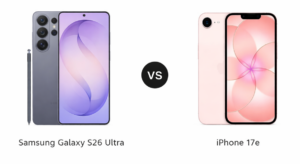
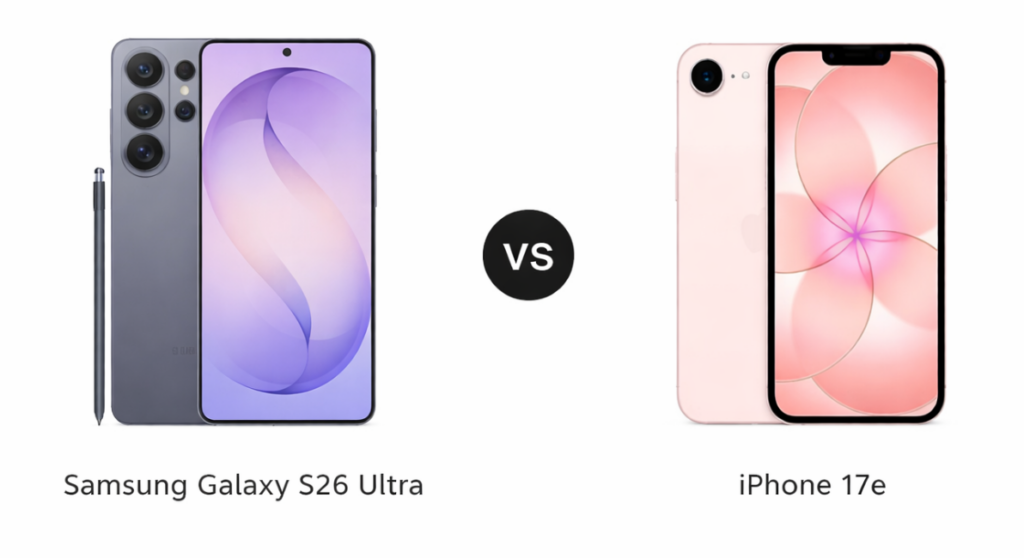
Samsung Galaxy S26 Ultra vs iPhone 17e: Is Paying Double Actually Worth It?
samsung vs apple

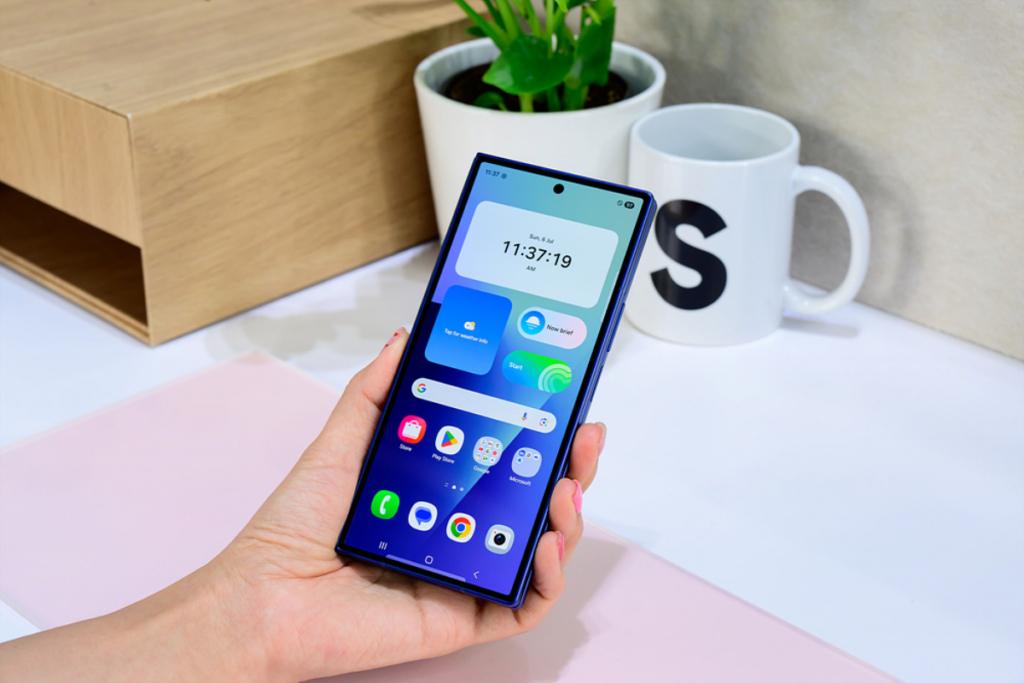
Flagship battles aren’t always about which phone is the most powerful, they’re about which one actually makes sense to buy. The Samsung Galaxy S26 Ultra pushes boundaries with top-tier specs and features, while the iPhone 17e takes a smarter, value-focused approach. This comparison isn’t just about performance; it’s about deciding whether cutting-edge hardware is worth paying nearly double, or if a balanced experience delivers the better deal.
Please Note: When you buy something using the links in our articles, we may earn a small commission at no cost to you.

Major Features:

FeatureSamsung Galaxy S26 UltraiPhone 17eWinner
Display6.9″ LTPO AMOLED, 120Hz, 2600 nits, QHD+6.1″ OLED, 60Hz, 1200 nits peakSamsung – smoother, brighter, sharper
Build & ProtectionGorilla Armor 2, Armor aluminum, IP68Ceramic Shield 2, aluminum, IP68Samsung – tougher glass + better durability
ProcessorSnapdragon 8 Elite Gen 5Apple A19Samsung – more raw power (on paper)
RAM & StorageUp to 16GB RAM, UFS 4.X8GB RAM, NVMeSamsung – higher RAM + faster storage
Rear Camera200MP + 10MP (3x) + 50MP (5x) + 50MP UW48MP single cameraSamsung – massively more versatile
Selfie Camera12MP with PDAF12MP + 3D depthiPhone – better for video + Face ID
Video Recording8K, 4K@120fps, HDR10+4K Dolby VisionSamsung – higher resolution + flexibility
Battery5000 mAh4005 mAhSamsung – bigger capacity
Charging60W wired, 25W wireless, reverseSlower wired, 15W wirelessSamsung – much faster overall
ConnectivityWi-Fi 7, Bluetooth 6.0, UWBWi-Fi 6, Bluetooth 5.3Samsung – newer standards
Extra FeaturesS Pen, DeX, UWBFace ID, Satellite featuresSamsung – more productivity tools
Price~₹1,40,000~₹65,000iPhone – far better value
Disclaimer: Specs are based on available data. Actual performance may vary. Verify details from official sources before buying.

Design and Display

Build and Feel

The Samsung Galaxy S26 Ultra leans into a premium, ultra-flagship identity with Gorilla Armor 2 protection, an Armor aluminum frame, and the added utility of a built-in stylus. It feels engineered for productivity and durability, especially with enhanced scratch resistance. The iPhone 17e keeps things simpler with Ceramic Shield 2 and aluminum, offering a clean, lightweight experience that feels more approachable. The difference in philosophy is clear—Samsung aims for maximum capability, while Apple focuses on simplicity and ease of use.

Display Quality

Samsung dominates with a 6.9-inch LTPO AMOLED panel, 120Hz refresh rate, and a massive 2600 nits peak brightness. The anti-reflective coating and higher resolution make it ideal for outdoor use and media. The iPhone’s 6.1-inch OLED panel is sharp and color-accurate, but lacks high refresh rate smoothness and brightness headroom. It feels refined but less immersive.

Verdict

Samsung wins clearly with a more advanced, brighter, and smoother display, while also offering extra utility through its stylus.

Specifications Including Battery

Performance

The Snapdragon 8 Elite Gen 5 inside the Galaxy S26 Ultra delivers top-tier Android performance with powerful Oryon cores and a strong GPU. It is built for heavy multitasking, gaming, and long-term software support with 7 Android updates. The iPhone 17e’s A19 chip is efficient and fast in daily use, especially with iOS optimization, but it targets a more balanced experience rather than raw power. The difference becomes noticeable under sustained heavy workloads.

Battery and Charging

Samsung packs a 5000 mAh battery with 60W wired charging and faster wireless options, making it more suitable for power users. The iPhone 17e’s 4005 mAh battery is paired with slower charging, prioritizing efficiency over speed. It feels dependable, but not aggressive.

Verdict

Samsung takes this round with stronger performance and faster charging, making it better suited for demanding users and future-proofing.

Camera

Main and Secondary Lenses

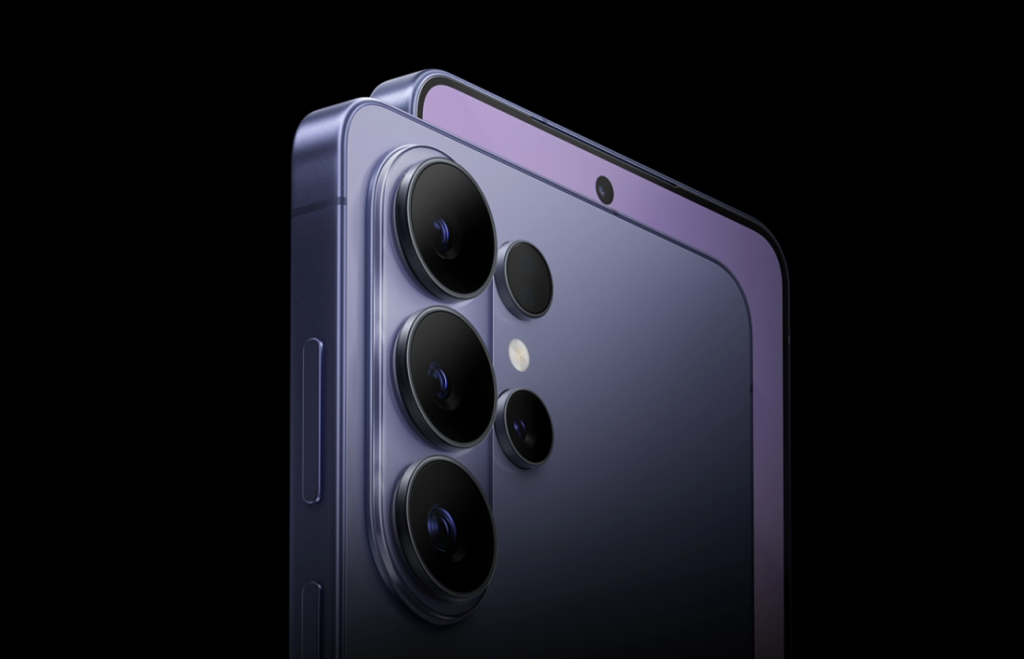
The Galaxy S26 Ultra offers a versatile quad-camera setup with a massive 200MP sensor, dual telephoto lenses (3x and 5x), and a high-resolution ultrawide. This setup provides flexibility across all shooting scenarios, especially zoom and landscape photography. The iPhone 17e sticks to a single 48MP sensor, which delivers consistent and reliable results but lacks versatility. Samsung’s system feels more like a professional toolkit.

Selfie Camera

Both devices feature 12MP front cameras with autofocus, but Apple adds depth sensing and strong video capabilities like Dolby Vision. Samsung counters with HDR10+ and solid autofocus performance. The difference is subtle, but Apple leans slightly toward video quality.

Verdict

Samsung wins overall with its superior camera versatility and zoom capabilities, while Apple remains strong in consistency and video.

Pricing

Price Comparison

The Galaxy S26 Ultra is priced around ₹140,000 ($1300), firmly in ultra-premium territory. The iPhone 17e, at around ₹65,000 ($600), sits in a much more accessible range. The gap is significant, and it directly reflects the difference in hardware and features.

Is the Price Justified?

Samsung justifies its price with cutting-edge display tech, advanced cameras, flagship performance, and productivity features like DeX and stylus support. It feels like a complete powerhouse. The iPhone 17e delivers solid performance, reliable cameras, and iOS ecosystem benefits at a much lower cost, making it a strong value pick for everyday users.

Verdict

The iPhone 17e wins on value for money, while the S26 Ultra justifies its premium with unmatched features.

Conclusion

The Galaxy S26 Ultra stands out with its S Pen, DeX desktop experience, advanced camera system, and ultra-bright display. It is built for users who want maximum capability in a single device. The iPhone 17e focuses on essentials, a smooth iOS experience, strong optimization, satellite features, and a simplified camera system that delivers consistent results.

Verdict

The Samsung Galaxy S26 Ultra stands out as the best overall smartphone, delivering top-tier performance, a superior display, versatile cameras, and advanced features that clearly place it at the top of the flagship segment. It feels like a complete powerhouse built for users who want the absolute best without compromise.

However, the iPhone 17e emerges as the more logical and value-driven choice. It delivers a smooth, reliable flagship-like experience at nearly half the price, making it far more balanced for most users. The real-world difference simply does not match the massive price gap.

Final takeaway:

  • Best overall phone: S26 Ultra
  • Best logical + value choice: iPhone 17e

Disclaimer: This comparison is based on the provided specifications and is for informational purposes. Actual performance, camera results, and battery life may vary depending on real-world usage and software updates.

Read More:

The post Samsung Galaxy S26 Ultra vs iPhone 17e: Is Paying Double Actually Worth It? appeared first on Gizmochina.


7 Unique Xiaomi Smart Home Products You Can Buy in 2026

Xiaomi-Semi-Automatic-Espresso-Machine

When it comes to smart home innovation, Xiaomi has been leading the charge with its expansive product ecosystem, designed to integrate seamlessly into everyday life.

In 2026, the brand offers some standout devices that reimagine convenience, style, and functionality. Here’s a look at 7 unique Xiaomi smart home products you can buy this year, each bringing something extraordinary to the table.

Xiaomi Robot Vacuum 5 Pro

Xiaomi Robot Vacuum 5 Pro

The Xiaomi Robot Vacuum 5 Pro delivers exceptional cleaning performance with advanced AI technology. It detects over 200 objects, including cables and pet bowls, using a triple-camera system. Its suction power reaches an impressive 20,000Pa, which allows it to clean carpets, corners, and low-clearance areas with ease.

The robot comes with a self-cleaning base that reduces maintenance tasks. Its anti-tangle brushes and precise navigation simplify household cleaning, making it one of the smartest robot vacuums available.

Xiaomi Semi-Automatic Espresso Machine

Xiaomi Semi-Automatic Espresso Machine

The Xiaomi Semi-Automatic Espresso Machine provides café-quality coffee at home. It uses a 20-bar pump and low-pressure pre-infusion technology to extract rich flavors from coffee grounds. The compact 14cm-wide stainless steel design fits easily into any kitchen.

It comes with a professional steam wand that creates dense milk foam for drinks like lattes and cappuccinos. The machine also offers customizable brew volumes, allowing users to enjoy single or double servings based on their preferences.

Xiaomi Dust Mite Vacuum Cleaner 2 Pro

Xiaomi Dust Mite Vacuum Cleaner 2 Pro

The Xiaomi Dust Mite Vacuum Cleaner 2 Pro tackles allergens and dust mites in household fabrics. It features 16kPa suction power and offers 72,000 taps per minute to dislodge dirt from mattresses and sofas. The built-in UV sterilization and 65°C hot-air drying system ensure a germ-free and comfortable clean.

The vacuum uses an intelligent dust sensor that adjusts suction power according to dirt levels. Its six-stage filtration system prevents secondary pollution, making it an essential tool for maintaining clean and healthy spaces.

Mijia Smart Air Purifier 6

Mijia Smart Air Purifier 6

The Mijia Smart Air Purifier 6 improves indoor air quality with its five-sensor system. It detects PM2.5, dust, and other pollutants while providing real-time feedback via an LCD display. Its five-layer composite filtration system removes allergens, bacteria, and VOCs, including formaldehyde.

The air purifier has a CADR of 443m³/h, which ensures the entire room is purified in just 3.5 minutes. It integrates with the Xiaomi Home app for remote control and features voice control compatibility, making it an ideal choice for allergy-prone households.

Xiaomi Vacuum Cleaner G30 Max

Xiaomi Vacuum Cleaner G30 Max

The Xiaomi Vacuum Cleaner G30 Max provides powerful cleaning performance with 280AW maximum suction power. The vacuum can clean deep crevices and handle stubborn dirt, making it ideal for homes with carpets and hard floors.

The device features dust detection, automatic suction adjustment, and three cleaning modes (Eco, Auto, Turbo). Its bendable tube and attachments ensure versatile cleaning, including pet hair and hard-to-reach spots, with up to 90 minutes of runtime in Eco mode.

Xiaomi Outdoor Camera CW100 Dual

Xiaomi Outdoor Camera CW100 Dual

The Xiaomi Outdoor Camera CW100 Dual offers enhanced home security with dual-lens functionality. This surveillance camera provides nearly 180° panoramic coverage and ensures no blind spots. It records sharp visuals in 2K resolution and uses smart full-color night vision to capture details even in the dark.

The camera uses AI to detect people, vehicles, and motion, sending instant alerts via the Xiaomi Home app. It features two-way audio for communication and is IP66-rated for outdoor reliability.

Xiaomi Rechargeable Mini Fan

Xiaomi Rechargeable Mini Fan

The Xiaomi Rechargeable Mini Fan offers a simple yet effective solution for portable cooling. The fan features multiple speed settings and operates quietly, making it suitable for home, office, or outdoor use.

Its lightweight, rechargeable design ensures convenience for users on the go. The fan powers on via USB and offers a surprising amount of airflow for its size. Xiaomi combines practicality and minimalist style in this device, catering to everyday needs.

For more daily updates, please visit our News Section.

Stay ahead in tech! Join our Telegram community and sign up for our daily newsletter of top stories! 💡

The post 7 Unique Xiaomi Smart Home Products You Can Buy in 2026 appeared first on Gizmochina.

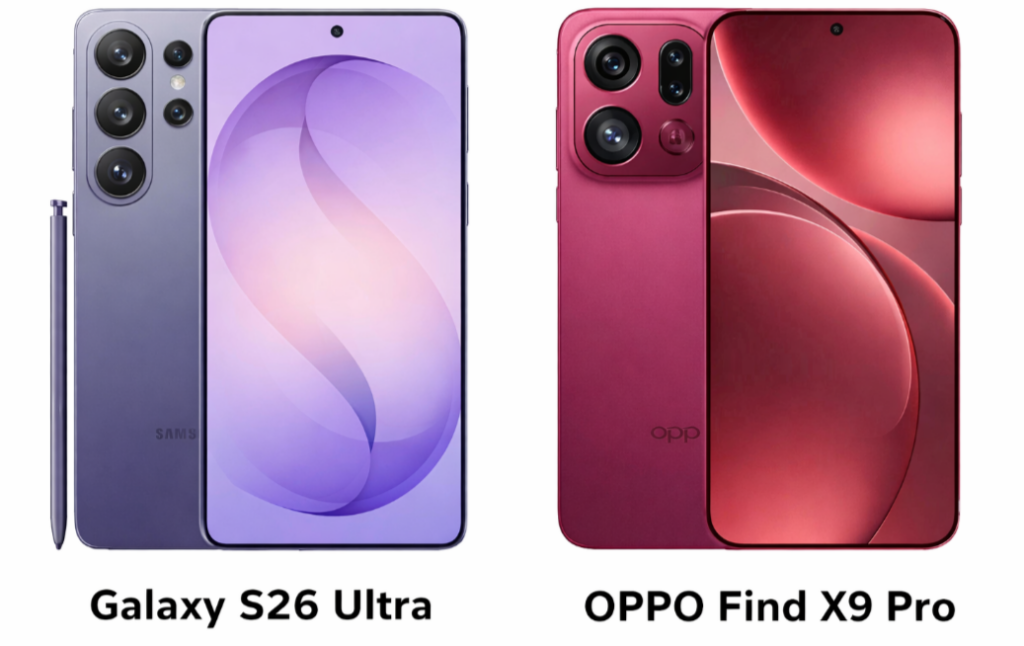
Galaxy S26 Ultra vs OPPO Find X9 Pro: Specs, Camera, Battery Compared

samsung vs oppo

Flagship smartphones in 2026 are no longer just about specs: they’re about how those specs translate into real-world usage. The Galaxy S26 Ultra and OPPO Find X9 Pro take completely different approaches: one focuses on refinement, ecosystem, and long-term reliability, while the other pushes aggressive hardware with massive battery and cutting-edge features. 

This comparison matters for buyers deciding between a polished all-rounder and a hardware powerhouse that promises more on paper. The real winner depends on whether consistency or raw innovation matters more in daily use.

Please Note: When you buy something using the links in our articles, we may earn a small commission at no cost to you.

Major Features:

FeatureGalaxy S26 UltraOPPO Find X9 ProWinner
Build & DurabilityGorilla Armor 2, IP68, stylusGlass, IP68/IP69Samsung – better protection + stylus
Display1440p, 2600 nits, anti-reflective3600 nits, Dolby VisionSamsung – sharper + better usability
ProcessorSnapdragon 8 Elite Gen 5Dimensity 9500Samsung – more stable flagship chip
RAM & StorageUp to 16GB, UFS 4.XUp to 16GB, UFS 4.1Tie – similar flagship configs
Battery5000mAh7500mAhOPPO – massive capacity
Charging60W wired, 25W wireless80W wired, 50W wirelessOPPO – faster overall
Rear Camera200MP + dual zoom + UW200MP periscope + 50MP + UWSamsung – more versatile setup
Selfie Camera12MP50MPOPPO – higher resolution
Video8K, HDR10+4K 120fps, Dolby VisionSamsung – higher recording capability
Software Support7 years updates5 years updatesSamsung – longer support
Special FeaturesS Pen, DeX, UWBIR blaster, satelliteSamsung – more productivity features
Price$1300$1200OPPO – cheaper
Disclaimer:
Specs are based on available data. Actual performance may vary. Verify details from official sources before buying.

Please Note: When you buy something using the links in our articles, we may earn a small commission at no cost to you.

Design and Display

Build and Feel

The Galaxy S26 Ultra brings a more refined and durable build with Gorilla Armor 2 protection and an Armor aluminum frame, along with stylus support that adds productivity value. It feels like a device designed for serious, long-term usage. The OPPO Find X9 Pro, with its glass and aluminum build, feels sleek and modern, and the IP68/IP69 rating adds extra durability confidence. OPPO leans toward comfort and smooth aesthetics, while Samsung feels more functional and premium. The inclusion of a stylus subtly gives Samsung an edge for productivity-focused users.

Display Quality

Samsung offers a Dynamic LTPO AMOLED 2X panel with 1440p resolution, HDR10+, and anti-reflective coating, delivering sharper visuals and better outdoor usability. OPPO counters with a feature-rich LTPO AMOLED display with Dolby Vision and a higher peak brightness of 3600 nits. While OPPO wins in raw brightness and HDR formats, Samsung’s higher resolution and anti-reflective layer make it feel more practical and consistent in real-world viewing.

Verdict

Samsung wins with a sharper, more practical display and added stylus functionality, while OPPO focuses on brightness and features.

Specifications Including Battery

Performance

The Galaxy S26 Ultra is powered by the Snapdragon 8 Elite Gen 5 with a high-clocked Oryon CPU and Adreno 840 GPU, delivering top-tier flagship performance. The OPPO Find X9 Pro runs on the Dimensity 9500 (3nm), which is also extremely powerful and efficient. Both phones are clearly flagship-level, but Samsung’s chipset and optimization tend to offer more consistent sustained performance. OPPO feels extremely fast, but Samsung feels slightly more stable under heavy workloads.

Battery and Charging

OPPO takes a massive lead with its 7500mAh silicon-carbon battery, offering significantly longer endurance. Charging is also faster with 80W wired and 50W wireless support. Samsung’s 5000mAh battery with 60W charging is solid but clearly more conservative. OPPO’s setup feels built for heavy users, while Samsung focuses on balanced daily usage.

Verdict

Samsung leads in performance stability, but OPPO dominates battery life and charging speed.

Camera

Main and Secondary Lenses

Samsung delivers a highly versatile quad-camera setup with a 200MP main sensor, dual telephoto lenses (3x and 5x), and a 50MP ultrawide. This provides more flexibility, especially for zoom ranges and consistent results. OPPO offers a powerful triple setup with a 200MP periscope lens and Hasselblad tuning, focusing more on hardware and color science. OPPO feels more experimental, but Samsung feels more complete and reliable across scenarios.

Selfie Camera

OPPO includes a 50MP selfie camera with autofocus and 4K recording, making it excellent for high-resolution content. Samsung’s 12MP front camera focuses more on balanced output and video stability. OPPO clearly wins on hardware, but Samsung tends to deliver more consistent results.

Verdict

Samsung wins for overall versatility and reliability, while OPPO offers stronger selfie hardware and creative flexibility.

Pricing

The Galaxy S26 Ultra is priced at around $1300 (₹140,000), while the OPPO Find X9 Pro comes in lower at $1200 (₹110,000). This creates a noticeable price gap, with OPPO being the more affordable flagship despite offering aggressive hardware.

Value for Money

OPPO delivers exceptional value with a larger battery, faster charging, and strong camera hardware at a lower price. Samsung, however, justifies its premium with features like stylus support, longer software updates (7 years), and a more complete ecosystem experience. OPPO feels like the better deal on paper, while Samsung feels like a more long-term investment.

Verdict

OPPO wins on value, while Samsung justifies its price with longevity and premium features.

Disclaimer:
Prices are approximate and may vary based on country, region, and applicable taxes.

Conclusion

Samsung stands out with stylus support, DeX, longer software support, and a more refined flagship experience. It feels like a productivity-focused device built for consistency. OPPO, on the other hand, shines with its massive battery, ultra-fast charging, brighter display, and Hasselblad-tuned camera system. It feels more aggressive and innovation-driven.

Verdict

The Galaxy S26 Ultra emerges as the more balanced and versatile flagship, offering better long-term value, productivity features, and consistent performance. The OPPO Find X9 Pro, however, is the better choice for users who prioritize battery life, charging speed, and cutting-edge hardware at a lower price.

Read More:

The post Galaxy S26 Ultra vs OPPO Find X9 Pro: Specs, Camera, Battery Compared appeared first on Gizmochina.

Redmi K90 Ultra and OnePlus Ace 6 Ultra tipped to launch in April

OnePlus-Ace-6T

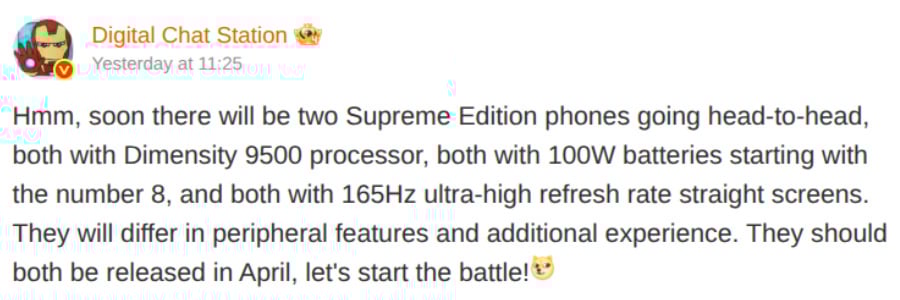
According to reliable insider Digital Chat Station, both the Redmi K90 Ultra and the OnePlus Ace 6 Ultra will be unveiled in April. Interestingly, both phones are expected to share several features.

DCS claims both phones will be powered by MediaTek Dimensity 9500. Its core setup includes a single high-frequency prime core clocked at up to 4.21GHz, alongside three performance cores and four efficiency cores. The chip delivers up to a 32 percent improvement in single-core performance and a 17 percent boost in multi-core workloads over its predecessor.

The similarities don’t stop there. Both devices are rumored to pack batteries in the 8,000mAh range with support for 100W fast charging, along with ultra-smooth 165Hz displays.

Redmi K90 Ultra

The K90 Ultra is also expected to feature a 1.5K-resolution LTPS display, a dedicated graphics chip, and even an active cooling fan.

According to reports, it will have a battery closer to 8,500mAh. If true, that would be unusually large, even for a gaming-focused phone.

Other rumored features include custom-tuned symmetrical stereo speakers, a larger vibration motor for stronger haptics, an ultrasonic fingerprint sensor, and an IP68 rating for water and dust resistance.

OnePlus Ace 6 Ultra

The Ace 6 Ultra, meanwhile, is tipped to feature a massive 6.8-inch display with a 165Hz refresh rate and, like its Redmi rival, will run on the Dimensity 9500.

The phone has already cleared certification in China, though specific details remain under wraps. A device with the model number PMK110 has surfaced in China’s SRRC database, and it could be the Ace 6 Ultra, but that’s not confirmed just yet.

The Ace 6 Ultra is expected to go head-to-head with the Redmi K90 Ultra when both launch in China this April. For now, there’s no word on whether OnePlus plans to release the device globally, but given the company’s track record, it’s not off the table.

For more daily updates, please visit our News Section.

Stay ahead in tech! Join our Telegram community and sign up for our daily newsletter of top stories.

The post Redmi K90 Ultra and OnePlus Ace 6 Ultra tipped to launch in April appeared first on Gizmochina.

Vivo X300s key specifications officially confirmed ahead of launch

Vivo X300s

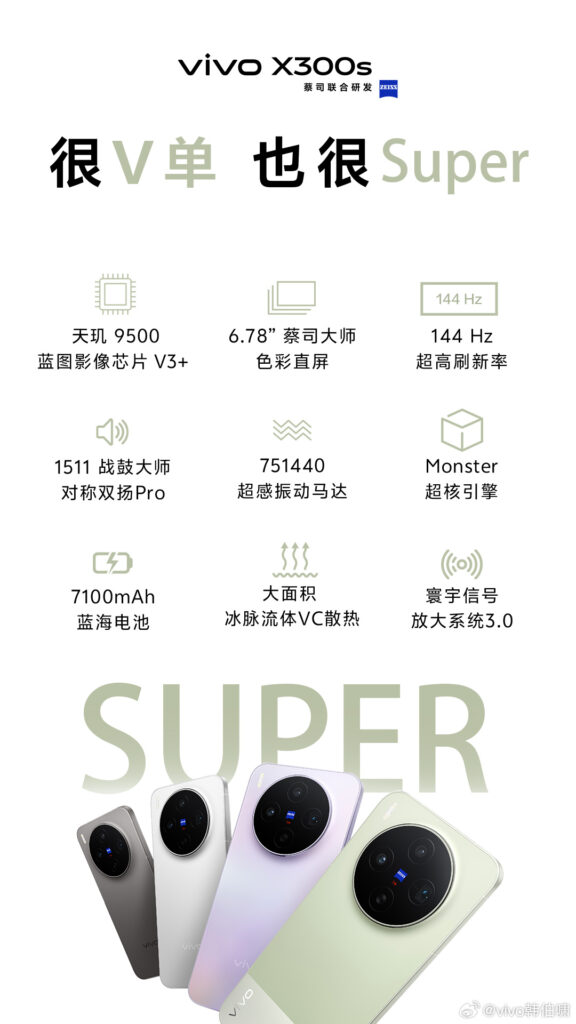
Tomorrow (March 30), Vivo will announce the much-anticipated Vivo X300 Ultra in China. Alongside it, the company is also set to introduce the Vivo X300s and the Vivo Pad 6 Pro. Just ahead of the launch, a new poster shared by Product Manager Han Boxiao has revealed key hardware details of the X300s, giving a clearer idea of what to expect from the device.

Vivo X300s key specifications confirmed

Viov X300s key specs confirmed

The official teaser confirms that the Vivo X300s will be powered by the MediaTek Dimensity 9500 chipset, paired with the brand’s in-house V3+ imaging chip. The device will feature a 6.78-inch flat display tuned with Zeiss color calibration, offering a 144Hz refresh rate for smoother visuals. Audio performance is expected to be enhanced through dual stereo speakers with advanced tuning.

The phone is also set to include a large 7,100mAh battery, which is notably higher than what is typically seen in this segment. Thermal management will be handled by a large-area VC liquid cooling system, aimed at maintaining stable performance during extended use. Vivo has also highlighted a new signal amplification system for improved connectivity. The poster also shows color options, such as light green, lavender, white, and dark grey.

Apart from the confirmed specifications, the Vivo X300s is said to feature a 50-megapixel front camera. On the rear, it may include a triple camera setup comprising a 200-megapixel main sensor with OIS, a 50-megapixel ultra-wide lens, and a 50-megapixel periscope telephoto camera with OIS. This setup suggests a strong focus on versatile photography.

The device is also expected to support 90W wired and 40W wireless charging. Additional features could include an ultrasonic in-display fingerprint sensor, a USB-C Gen 3.2 port, and an IP68 and IP69-rated body for durability.

For more daily updates, please visit ourNews Section.

Stay ahead in tech! Join our Telegram community and sign up for our daily newsletter of top stories! 💡

The post Vivo X300s key specifications officially confirmed ahead of launch appeared first on Gizmochina.

Snapdragon 8 Elite Gen 6 Pro custom information reveals LPDDR6 support

Qualcomm Snapdragon 8 Elite Gen 6 Pro Block Diagram

Qualcomm’s next flagship chips are still months away from becoming official, but leaks are already sketching out what the company might be planning. As you might have heard, there could be two versions this time: the Snapdragon 8 Elite Gen 6 and the Snapdragon 8 Elite Gen 6 Pro. 

According to a new report from ITHome, the Snapdragon 8 Elite Gen 6 Pro could support LPDDR6 RAM.

Qualcomm Snapdragon 8 Elite Gen 6 Pro Block Diagram

Previously, it was believed to support LPDDR5X, but a report last week suggested that LPDDR6 is on the cards for the Snapdragon 8 Elite Gen 6 Pro.

Snapdragon 8 Elite Gen 6 Pro will support LPDDR6

In line with that, the Pro model, carrying the internal model number SM8975, has appeared in customs information with the new memory support.

The SoC is also said to feature a 2+3+3 CPU layout, likely an all-big-core setup similar to the Snapdragon 8 Elite Gen 5. This means there will be two prime cores for peak performance, three performance cores for sustained workloads, and three efficiency-oriented cores.

On the graphics side, the Snapdragon 8 Elite Gen 6 Pro is said to include an Adreno 850 GPU along with 18MB of GMEM (graphics memory).

The standard version of the chip reportedly shares the same CPU architecture, but it may run at lower clock speeds and use a slightly less capable Adreno 845 GPU. More notably, this version is expected to stick with LPDDR5X memory rather than move to LPDDR6.

Of course, with the launch still some time away, these specifications could change. But if LPDDR6 does make its way into the Pro model, it would mark one of the first major shifts in mobile memory in a while.

For more daily updates, please visit our News Section.

Stay ahead in tech! Join our Telegram community and sign up for our daily newsletter of top stories! 💡

(Via)

The post Snapdragon 8 Elite Gen 6 Pro custom information reveals LPDDR6 support appeared first on Gizmochina.

UNIX HAVANA UX-W3 Wireless Headset Launched in India with ANC, 42-Hour Battery & Folding Design

Unix HAVANA UX-W3 Wireless headphones

UNIX has introduced a new wireless headset, the HAVANA (UX-W3), expanding its presence in the budget audio segment. The device brings a combination of noise reduction features, long battery life, and a foldable design aimed at everyday use.

Unix HAVANA UX-W3 Wireless headphones

The HAVANA (UX-W3) includes both Active Noise Cancellation (ANC) and Environmental Noise Cancellation (ENC). ANC is used to reduce background noise during media playback, while ENC focuses on improving voice clarity during calls by filtering surrounding noise. This dual setup is intended to maintain usability in crowded or noisy environments.

The headset connects over Bluetooth with a stated range of up to 10 metres. It is powered by a 300mAh battery, rated for up to 42 hours of playback on a single charge. Standby time is listed at up to 400 hours. Charging is handled via a Type-C port, with a full charge taking approximately 2 to 3 hours.

Unix HAVANA UX-W3 Wireless headphones

In terms of hardware, the HAVANA (UX-W3) uses a foldable over-ear design, allowing it to be stored more easily when not in use. The headset also includes RGB lighting accents, which serve as a design addition rather than a functional feature.

Pricing & availability

The HAVANA (UX-W3) is priced at Rs. 1,699. It is currently available through the company’s official website as well as online platforms, including Amazon India and Flipkart. The device is available in Black and Beige color options and comes with a 6-month warranty.

For more daily updates, please visit our News Section.

Stay ahead in tech! Join our Telegram community and sign up for our daily newsletter of top stories!

The post UNIX HAVANA UX-W3 Wireless Headset Launched in India with ANC, 42-Hour Battery & Folding Design appeared first on Gizmochina.

Lava Bold N2 Pro 4G Confirmed for March 31 Launch with 120Hz Display and 50MP Camera

Lava Bold N2 Pro 4G

Lava is set to launch a new smartphone in India, the Lava Bold N2 Pro 4G. The company has confirmed the launch through a Flipkart microsite, which also reveals the key specifications and launch timing.

Lava Bold N2 Pro 4G

The Lava Bold N2 Pro 4G will launch in India on March 31 at 12 PM IST. The listing gives a clear look at what the device will offer in terms of hardware and software.

The smartphone will feature a 6.67-inch HD+ display with a 120Hz refresh rate. This should help with smoother scrolling and general use. On the back, the phone will include a 50MP triple AI camera setup.

Lava Bold N2 Pro 4G

It will be powered by the Unisoc T7250 chipset. According to the listing, the processor has an AnTuTu score of over 240,000. The phone will come with 4GB RAM and support an additional 4GB of virtual RAM. It will also include 128GB of internal storage. The device will run on Android 15 out of the box. Lava states that the software will be clean, with no ads or pre-installed bloatware.

Lava Bold N2 Pro 4G
Lava Bold N2 Pro 4G features

For battery, the phone will pack a 5000mAh unit and support USB Type-C charging. It also comes with an IP54 rating, which means it is protected against dust and light splashes. The Lava Bold N2 Pro 4G will be available in two colour options, Eclipse Grey and Aurora Gold.

Pricing and availability details have not been announced yet. These are expected to be revealed at the launch event.

Don’t miss a thing! Join our Telegram community for instant updates and grab our free daily newsletter for the best tech stories!

For more daily updates, please visit our News Section.

(Source)

The post Lava Bold N2 Pro 4G Confirmed for March 31 Launch with 120Hz Display and 50MP Camera appeared first on Gizmochina.

Samsung QuantumBlack Solves QD-OLED Monitor Glare With 20 Percent Lower Reflectance

Samsung Display has announced a new film technology designed to reduce glare on QD-OLED monitors while improving panel durability. The technology, called QuantumBlack, will be applied across all new QD-OLED monitor panels released by the company this year.

QD-OLED panels are capable of delivering true black levels by switching off individual pixels. However, reflections from ambient light can reduce perceived contrast in real-world conditions. QuantumBlack aims to address this limitation by lowering light reflectance by 20 percent compared to Samsung Display’s previous film. This reduction is expected to improve visibility in darker scenes, particularly in environments with strong lighting.

The change has direct implications for gaming monitors, where contrast and shadow detail are critical. Lower reflections can help maintain clearer separation between objects and backgrounds, which may improve visibility in darker areas of games such as first-person shooters and survival titles.

Alongside optical improvements, Samsung Display says the new film also increases panel durability. Internal testing indicates that surface hardness has been raised from 2H to 3H. A higher hardness rating generally means better resistance to scratches from routine use, including cleaning or incidental contact.

The introduction of QuantumBlack comes as display manufacturers continue to focus on refining QD-OLED technology beyond core image quality. Several monitor brands have already introduced similar anti-reflection positioning under different names. ASUS refers to its implementation as Black Shield, while Gigabyte and MSI use Obsidian Shield and Dark Armor, respectively, to highlight reduced reflectivity in their latest products.

According to data from Omdia, the global self-emissive monitor market is projected to grow from 3.4 million units in 2025 to 7.6 million units by 2030. Samsung Display currently leads this segment with a reported 75 percent market share.

For more daily updates, please visit our News Section.

Stay ahead in tech! Join our Telegram community and sign up for our daily newsletter of top stories!

(Source)

The post Samsung QuantumBlack Solves QD-OLED Monitor Glare With 20 Percent Lower Reflectance appeared first on Gizmochina.

Asus launches ExpertCenter P600 AiO with up to Ryzen AI 7 445, 64GB DDR5 RAM & FHD displays

Asus ExpertCenter P600 AiO

Asus has launched its latest all-in-one desktop series, the ExpertCenter P600 AiO, designed to deliver next-generation AI performance for business users. The lineup includes two models, the 27-inch PM670GA and the 24-inch-class PM640GA.

Asus ExpertCenter P600 AiO

Asus ExpertCenter P600 AiO Specifications

The ExpertCenter P600 AiO features AMD Ryzen AI processors, with options including the AMD Ryzen AI 5 430 (4 cores, up to 4.5GHz, 8MB cache, 50 TOPS NPU) and the AMD Ryzen AI 7 445 (6 cores, up to 4.6GHz, 16MB cache, 50 TOPS NPU). It supports up to 64GB DDR5 memory and 2TB PCIe 4.0 SSD storage.

The PM640GA features a 23.8-inch FHD IPS panel with 250 nits brightness, while the PM670GA boasts a larger 27-inch FHD IPS display with 300 nits brightness. Both models offer 178° wide viewing angles, 99% sRGB color accuracy, TÜV Rheinland-certified low blue-light emissions, an anti-glare coating, and optional touchscreen functionality.

Asus offers two camera options for these models: a 2MP FHD+IR camera and an upgraded 5MP FHD+IR camera. Both include a retractable mechanism to ensure privacy by physically blocking the lens when not in use. For audio, these PCs feature dual 5W internal stereo speakers.

Asus ExpertCenter P600 AiO

The ExpertCenter P600 AiO series offers extensive connectivity, including a USB 2.0 Type-A port, a microphone/headphone combo jack, a Kensington lock slot, and an HDMI-in button on the side. The rear panel features three USB 3.2 Gen 1 Type-A ports, one USB 3.2 Gen 1 Type-C port, HDMI-out 2.1, HDMI-in 1.4, an RJ45 LAN port, and a power input. Wireless connectivity includes WiFi 6 and Bluetooth 5.2, with optional upgrades to WiFi 7 and Bluetooth 5.4.

For ergonomic comfort, the lineup includes an optional height-adjustable stand. The stand allows users to tilt, swivel, and rotate the display for different work needs.

The P600 AiO is built for high security and durability, featuring Asus ExpertGuardian with TPM 2.0 and biometric login. It meets the MIL-STD 810H military durability standard for reliability.

Asus also provides optional accessories such as a full-sized keyboard, ergonomic mouse, height-adjustable stand (HAS), and VESA mount support.

In related news, HP has recently introduced the Star Studio Pro 27 all-in-one PC, powered by the Intel Core 5 210H processor, paired with a 27-inch FHD display featuring a 120Hz refresh rate and 16GB of DDR5 RAM.

For more daily updates, please visit our News Section.

Stay ahead in tech! Join our Telegram community and sign up for our daily newsletter of top stories! 💡

The post Asus launches ExpertCenter P600 AiO with up to Ryzen AI 7 445, 64GB DDR5 RAM & FHD displays appeared first on Gizmochina.

OnePlus Nord CE6 Lite 5G specs: a mixed bag of upgrades and downgrades

The OnePlus Nord CE6 Lite is expected to launch soon alongside the OnePlus Nord CE6, succeeding the Nord CE4 Lite from 2024. This suggests OnePlus is once again shifting focus toward aggressively priced entry-level devices in the Indian market.

The timing is interesting. Some key components are getting more expensive as tech giants continue to push heavily into AI infrastructure. That usually leads to price hikes, cost-cutting, or a bit of both. Which is why it’s worth paying attention to what OnePlus is planning with the budget-friendly CE6 Lite, and how it ends up being priced.

According to an exclusive report from Smartprix, the Nord CE6 Lite is built around a 6.7-inch LCD panel that supports a 120Hz refresh rate. That’s a noticeable downgrade from the Nord CE4 Lite, which offered an AMOLED panel with a peak brightness of 2,100 nits.

On the inside, the phone will be powered by the MediaTek Dimensity 6300 5G chipset. It should handle everyday tasks like browsing, streaming, and light gaming without much trouble, which is likely the priority for this segment.

The camera setup appears fairly simple. The report suggests a 50MP main sensor paired with a secondary lens on the back, mainly to maintain the dual-camera design, along with a 16MP front camera.

One area where the phone could stand out is a large 7,000mAh battery. Its predecessor from 2024 paired a 5,110mAh cell with 80W fast charging. So, hopefully the Nord CE6 Lite will support similar charging for quick top-ups.

Unfortunately, the report hints at a cost-cutting move here: the phone may not ship with a charger in the box. This could be disappointing for users who are already on a tight budget, especially in the Indian market, where this move from Chinese smartphone makers hasn’t fully normalized yet.

Lastly, pricing. According to the report, the 6GB + 128GB option (base variant) could cost “under ₹23,000,” which is quite aggressive in 2026 for the specs mentioned above.

Stay ahead in tech! Join our Telegram community and sign up for our daily newsletter of top stories!

For more daily updates, please visit our News Section.

(Source)

The post OnePlus Nord CE6 Lite 5G specs: a mixed bag of upgrades and downgrades appeared first on Gizmochina.

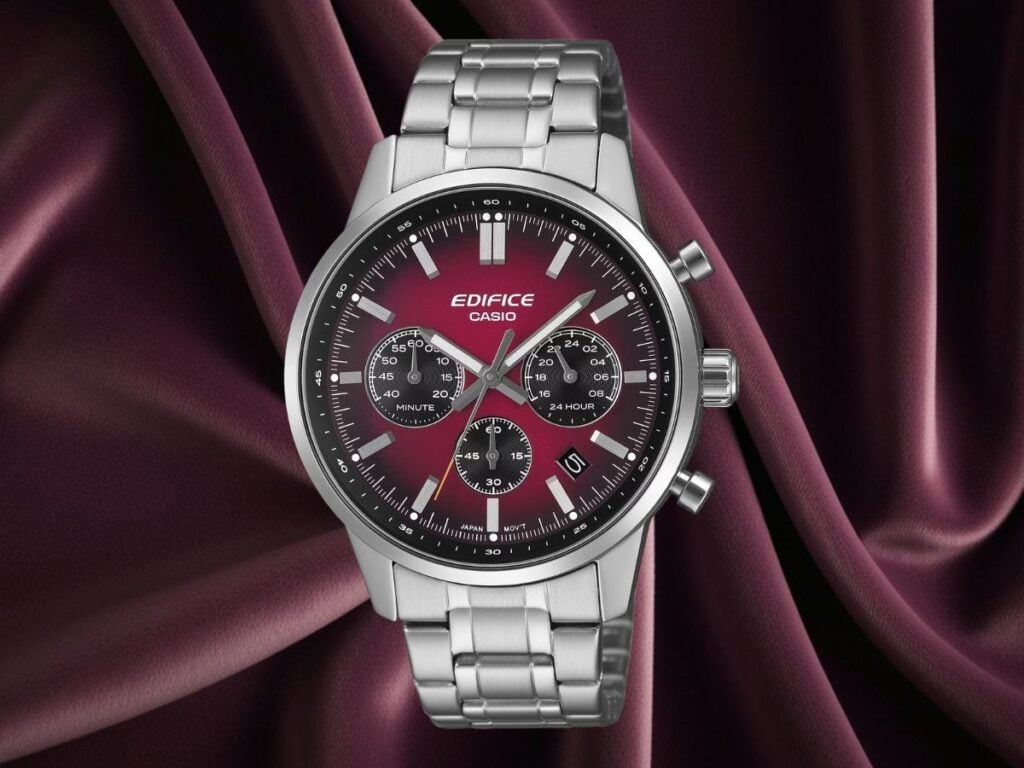
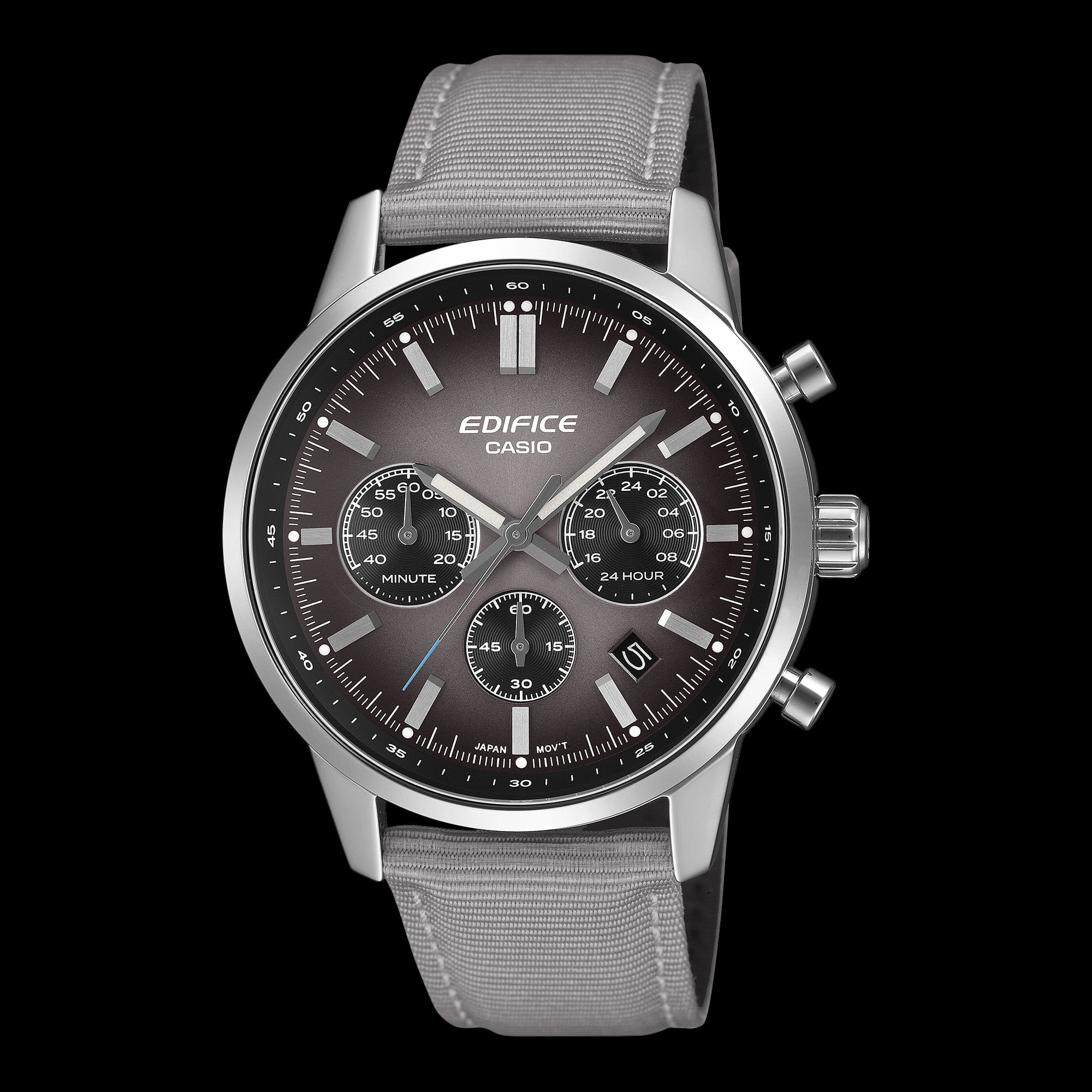
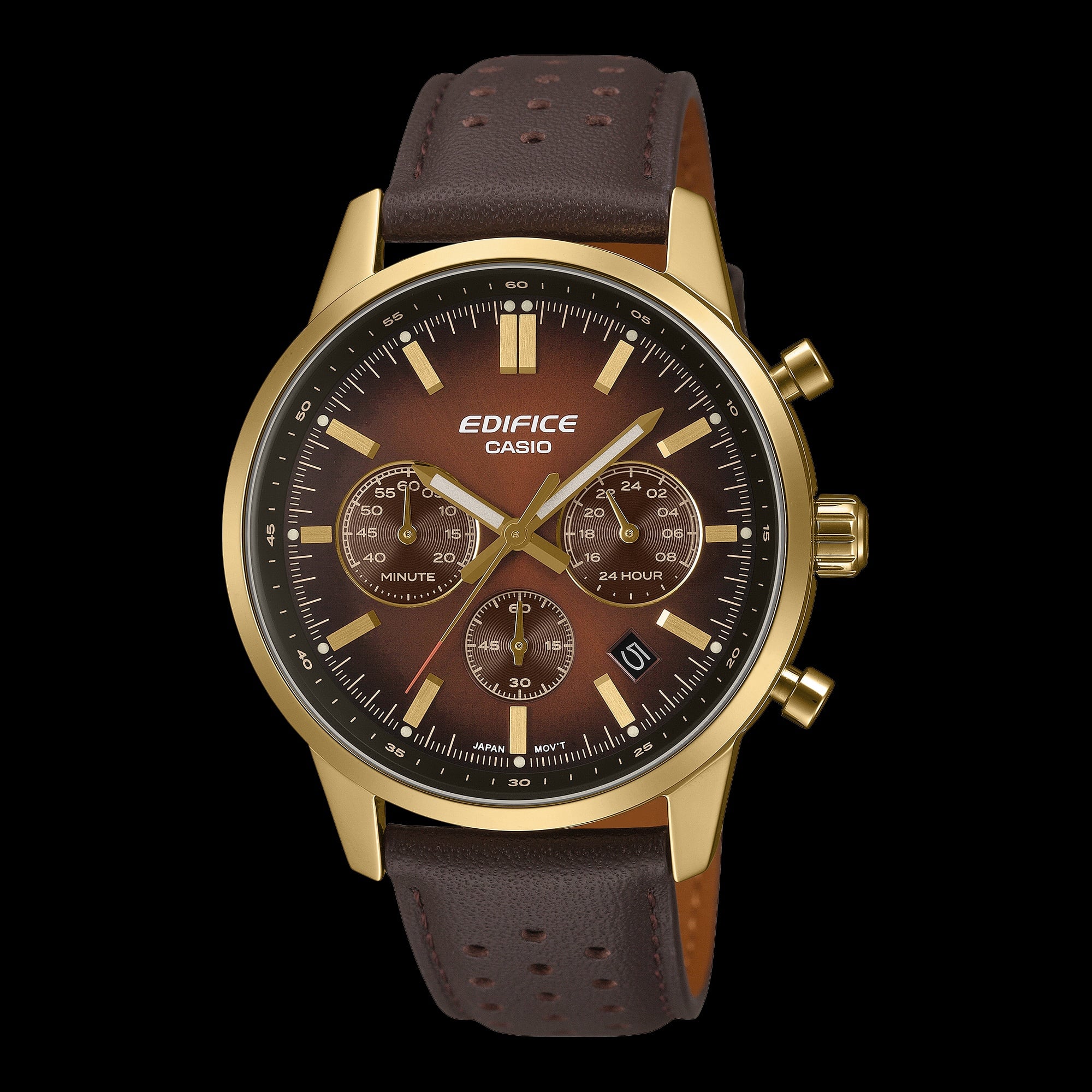
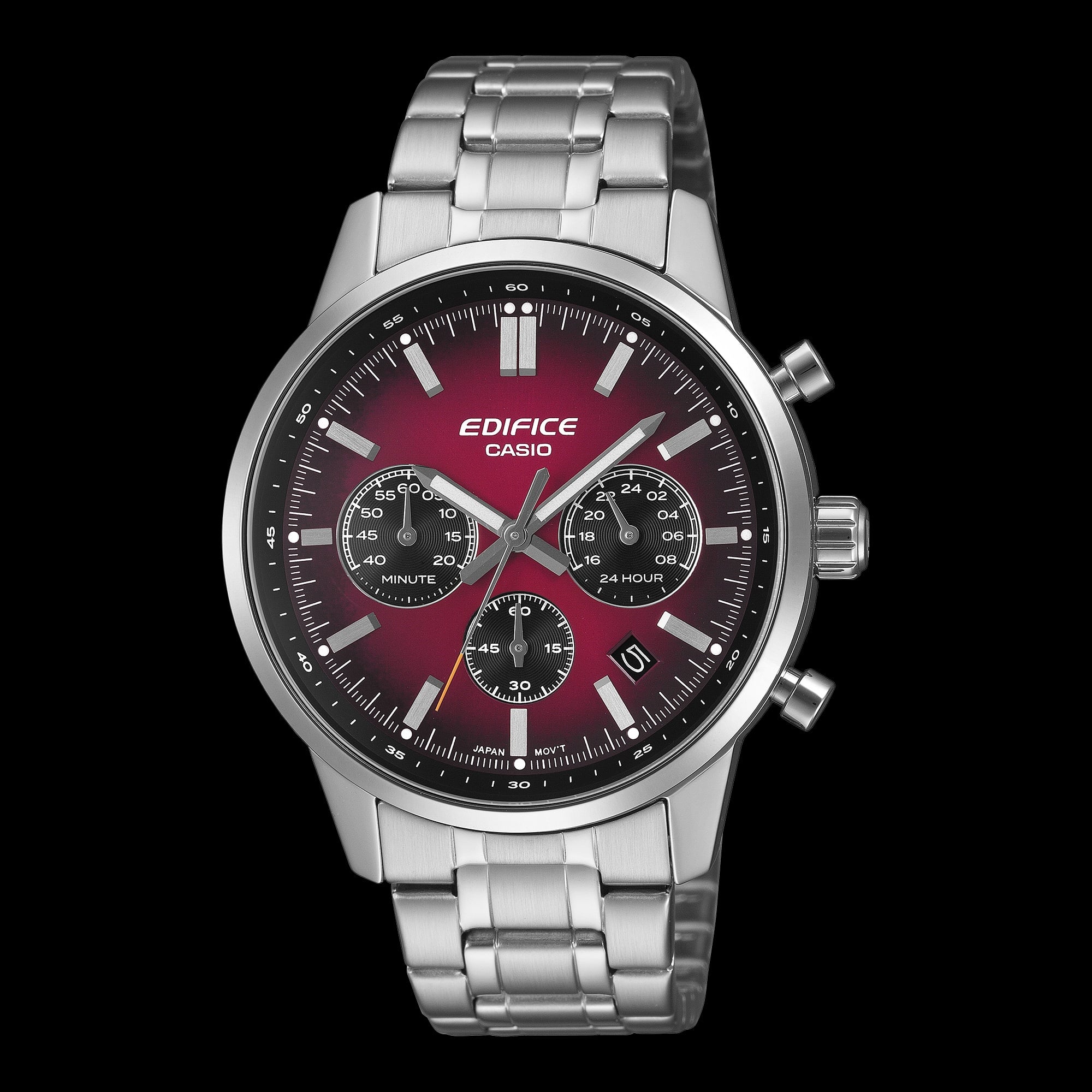
Casio EDIFICE EQB-1300 Series Watches Leaks with New Colors and Features

Casio Edifice EQB-1300D

Casio is preparing to expand its EDIFICE lineup with the new EQB-1300 series, expected to be announced in April. As per a report from Casioblog, the range will include three variants at launch: the blue EQB-1300D-2A, green EQB-1300DC-3A, and a newly revealed brown EQB-1300D-5A.

Casio Edifice EQB-1300D

The EQB-1300 focuses heavily on dial design. It uses layered textures and bold color finishes to create a sporty look inspired by automotive design. The surface features a geometric layout made up of parallel line patterns, while satin-finished side elements give the impression of metal panels. The outer chapter ring is slightly raised, creating a floating effect with visible shadows. Hour markers are shaped with clean polygonal edges, reinforcing the premium positioning of the model.

The bezel also stands out. Its top surface varies in width across different sections, adding visual depth and breaking away from a uniform circular design.

Casio Edifice EQB-1300D

While official dimensions are not confirmed, the watch is expected to be more compact than models like the ECB-2300 and ECB-2200. This would mark a shift toward a slimmer profile for the EQB series, which has not seen a major update since the EQB-2000 launched nearly four years ago.

The watch runs on module 5758, bringing Bluetooth connectivity and solar charging. It supports automatic time syncing via smartphone, daylight saving adjustments, and easy configuration through an app. A low battery indicator is included, where the second hand moves in two-second steps.

Functionality is straightforward. There is a 30-minute stopwatch displayed through a subdial at the 8 o’clock position, which also shows the day of the week. A date window sits opposite it, while a separate indicator displays 24-hour time. There is no timer or alarm.

Water resistance is rated at 100 meters. As per Casioblog, the pricing is expected to stay under $300, though the green IP-coated variant may cost slightly more.

For more daily updates, please visit our News Section.

Stay ahead in tech! Join our Telegram community and sign up for our daily newsletter of top stories!

(Source)

The post Casio EDIFICE EQB-1300 Series Watches Leaks with New Colors and Features appeared first on Gizmochina.

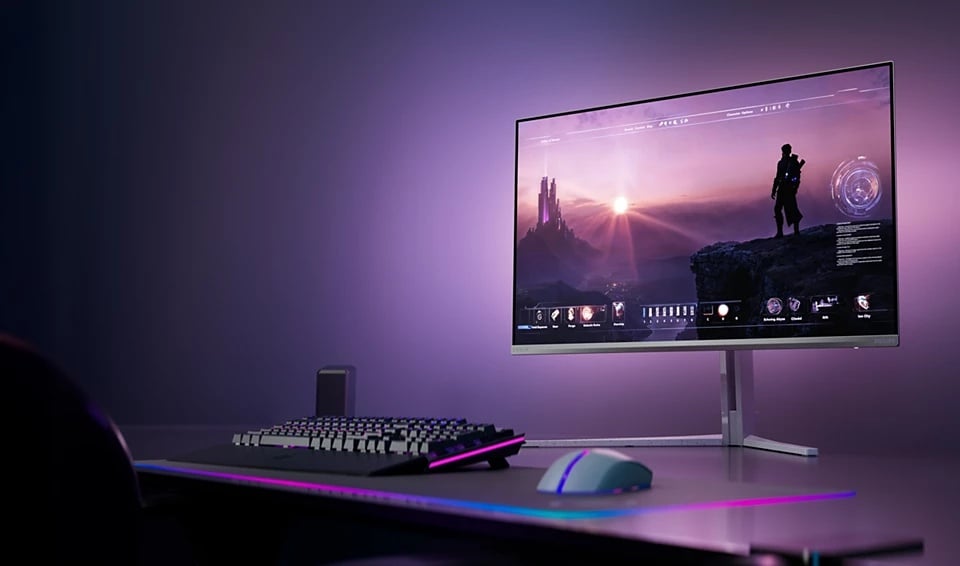
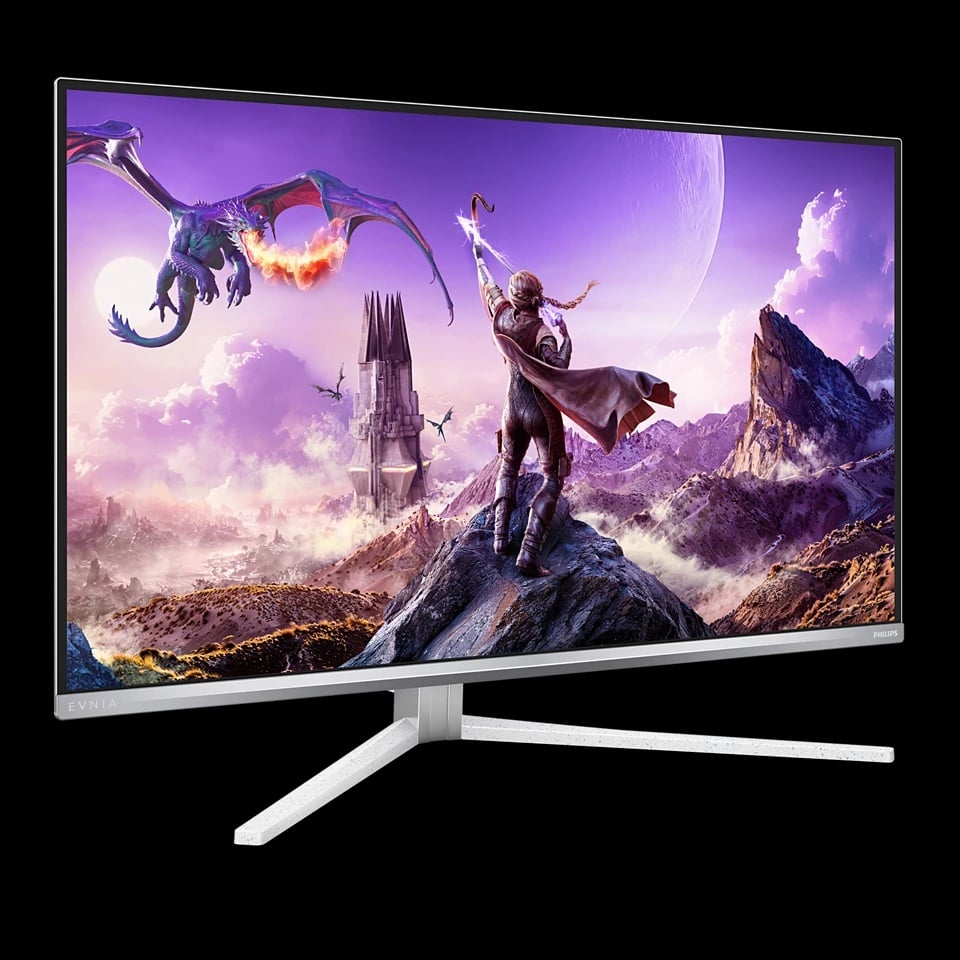
Philips Evnia 32M2N8900X Gaming Monitor Listed with 4K QD-OLED, 240Hz Refresh Rate

Evnia 32M2N8900X

Philips has listed a new high-end gaming monitor in China under its Evnia lineup, the 32M2N8900X. The model uses a 31.5-inch QD-OLED panel with a 3840 x 2160 resolution and supports refresh rates up to 240Hz over both HDMI and DisplayPort, positioning it for high-performance gaming and content work.

Philips Evnia 32M2N8900X

The panel delivers a 0.03 ms response time and supports Adaptive-Sync, along with NVIDIA G-SYNC compatibility to reduce screen tearing. It is rated for DisplayHDR True Black 500, while additional certification details also point to DisplayHDR True Black 400 support, depending on mode. ClearMR 13000 is also listed, indicating reduced motion blur in fast scenes.

Brightness levels are rated at 300 nits in SDR at full screen, 515 nits in HDR at 10 percent window, and up to 1000 nits peak in HDR at 3 percent window. The monitor supports true 10-bit color and offers a 1,500,000:1 contrast ratio. Color coverage includes full sRGB and up to 99.5 percent DCI-P3, with Delta E below 2 in sRGB mode. Pixel density is rated at 139.87 PPI, and the panel uses an RGB Q-Stripe subpixel layout with an anti-glare coating.

Philips Evnia 32M2N8900X

Philips integrates QD-OLED technology with Quantum Dot enhancement for higher brightness and color output while maintaining deep blacks and wide viewing angles. The panel also uses an internal graphene layer to improve heat dissipation and maintain long-term color stability.

On the feature side, the monitor includes three-sided Ambiglow with AI-based lighting effects, a built-in KVM switch, and MultiView support for PiP and PbP. Gaming-focused tools include Smart Crosshair, ShadowBoost, and low input lag modes. Eye comfort features such as LowBlue mode and flicker-free technology are also included. Audio is handled by dual 5W speakers with DTS Sound.

Connectivity options include two HDMI 2.1 ports, one DisplayPort, USB-C with up to 65W Power Delivery, USB-B upstream, two USB-A ports, and an additional USB-C downstream port with 15W output. Philips has not yet confirmed pricing or availability outside China.

For more daily updates, please visit our News Section.

Stay ahead in tech! Join our Telegram community and sign up for our daily newsletter of top stories!

(via: ITHome)

The post Philips Evnia 32M2N8900X Gaming Monitor Listed with 4K QD-OLED, 240Hz Refresh Rate appeared first on Gizmochina.

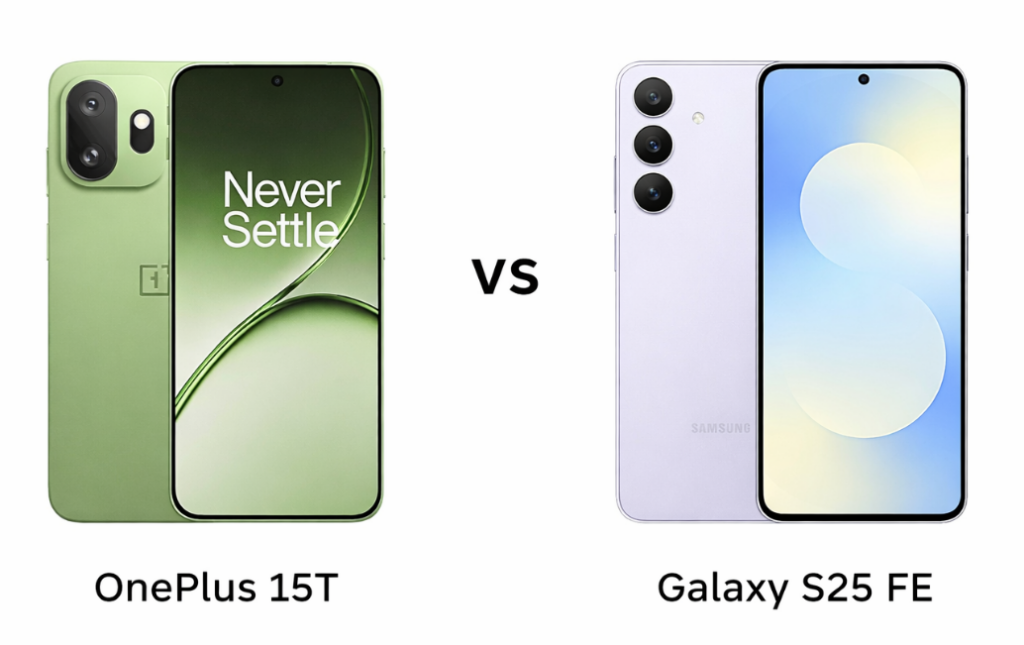
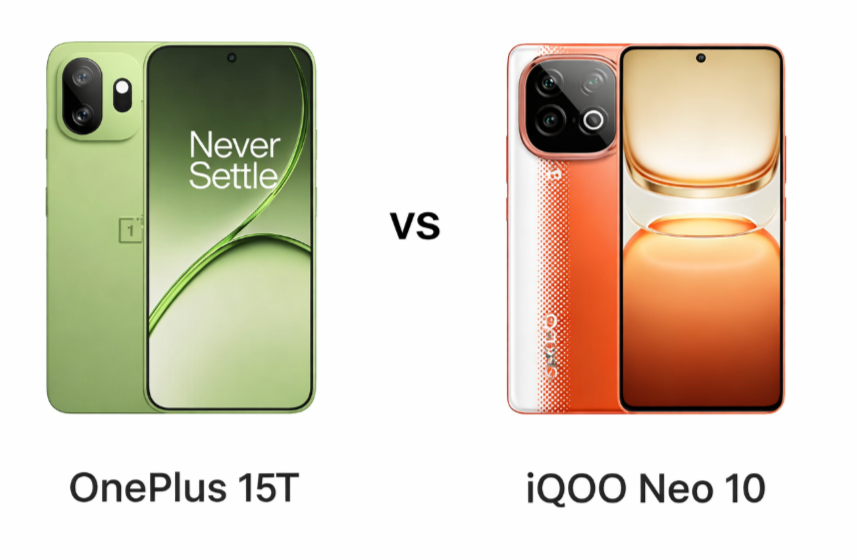
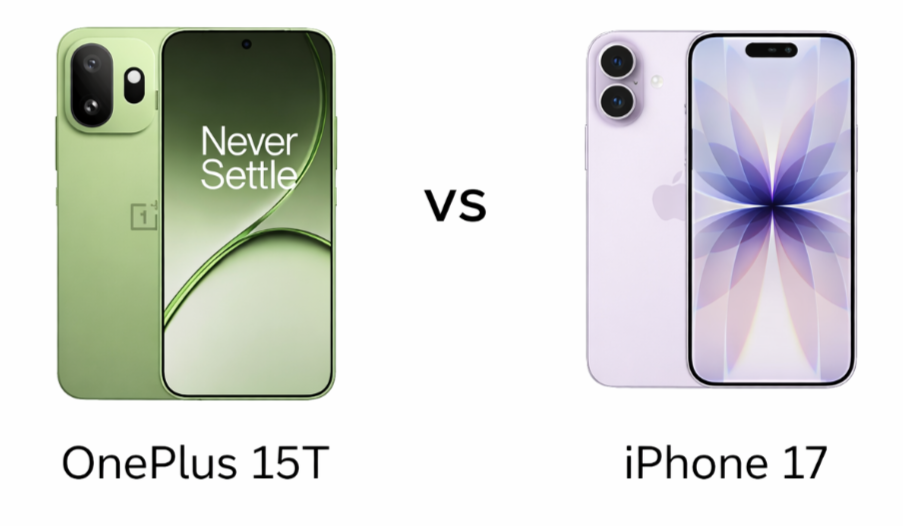
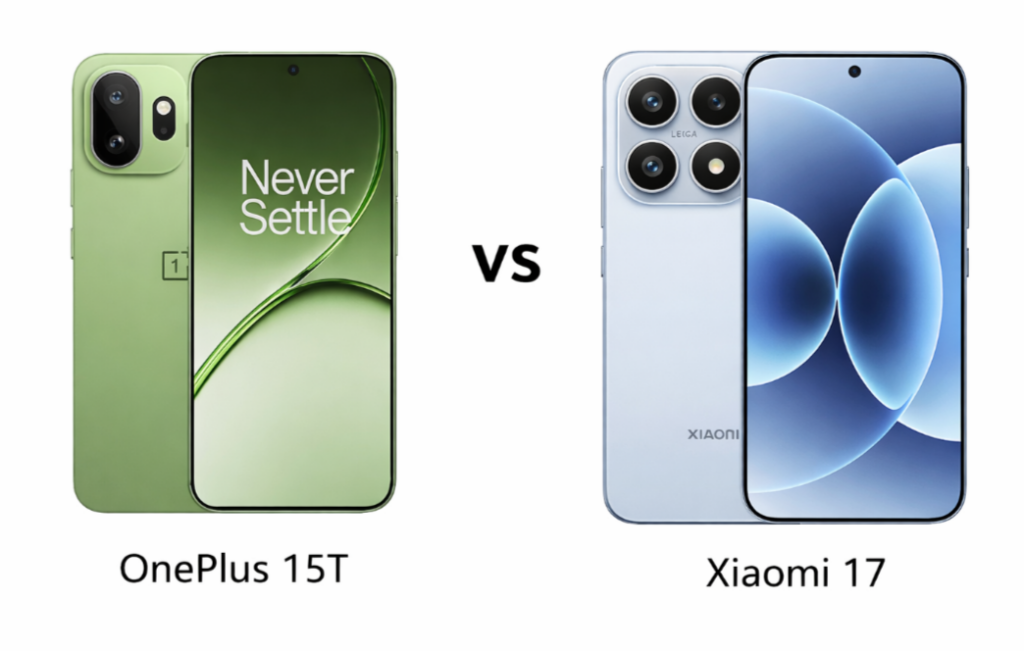
OnePlus 15T vs Galaxy S25 FE Full Comparison: Which Offers Better Value?

OnePlus vs Samsung

Some smartphone comparisons come down to minor upgrades, but this one is a clear clash of priorities. OnePlus 15T is engineered around high-performance hardware, featuring a next-gen chipset, high refresh rate display, and an unusually large battery with ultra-fast charging. In contrast, the Samsung Galaxy S25 FE takes a more balanced flagship approach, combining refined build quality, a versatile multi-camera system, and extended software support. 

This comparison ultimately comes down to prioritizing raw performance and hardware innovation versus a more polished, well-rounded user experience.

Please Note: When you buy something using the links in our articles, we may earn a small commission at no cost to you.

Major Features:

FeatureOnePlus 15TSamsung Galaxy S25 FEWinner
Display6.32″ AMOLED, 165Hz, Dolby Vision, 3600 nits peak6.7″ LTPO AMOLED 2X, 120Hz, 1900 nitsOnePlus – higher refresh rate + brighter panel
Resolution & Sharpness1216 x 2640 (~460 ppi)1080 x 2340 (~385 ppi)OnePlus – sharper visuals
Build QualityGlass + aluminum + fiber back, IP68/IP69KGlass (Victus+) + aluminum, IP68Samsung – more premium materials
PerformanceSnapdragon 8 Elite Gen 5, Adreno 840Exynos 2400, Xclipse 940OnePlus – significantly more powerful
RAM & StorageUp to 16GB RAM, UFS 4.1Up to 8GB RAM, UFS 4.0OnePlus – faster + more memory
Rear Camera50MP + 50MP telephoto (3.5x)50MP + 8MP tele (3x) + 12MP ultrawideSamsung – more versatile setup
Selfie Camera16MP, 1080p video12MP, 4K videoSamsung – better video capability
Battery7500mAh4900mAhOnePlus – massive advantage
Charging100W wired, 50W wireless45W wired, 15W wirelessOnePlus – much faster charging
Software SupportAndroid 16 (no long-term promise mentioned)7 years updatesSamsung – long-term reliability
Extra FeaturesIR blaster, faster Bluetooth 6.0Samsung DeX, Wireless DeXSamsung – better ecosystem features
Price~$600 / ₹58,000~$700 / ₹50,000OnePlus – better hardware value

Design and Display

Build and Feel

The OnePlus 15T leans toward a performance-first design with a sturdy aluminum alloy frame and fiber-reinforced back, paired with high-end IP68/IP69K protection. It feels built for durability and aggressive use. The Samsung Galaxy S25 FE, on the other hand, focuses on premium aesthetics with Gorilla Glass Victus+ on both sides and an enhanced armor aluminum frame. It feels more refined and flagship-like in hand, with a cleaner, polished finish that aligns with Samsung’s design language.

Display Quality

The OnePlus 15T pushes boundaries with a 165Hz AMOLED panel, Dolby Vision, and extremely high peak brightness, making it ideal for gaming and HDR-heavy usage. The Samsung Galaxy S25 FE counters with a larger Dynamic LTPO AMOLED 2X display, offering smoother adaptive refresh and excellent color tuning. While OnePlus delivers raw display power, Samsung’s panel feels more balanced and easier on the eyes for long-term use.

Verdict

OnePlus 15T wins for performance-focused display and brightness, while Samsung Galaxy S25 FE feels more premium and visually refined.

Specifications Including Battery

Performance

The OnePlus 15T clearly dominates with the Snapdragon 8 Elite Gen 5 chip, offering top-tier performance that easily handles gaming, multitasking, and future workloads. It also pairs with faster UFS 4.1 storage and higher RAM options, giving it a clear edge in speed. The Samsung Galaxy S25 FE’s Exynos 2400 is capable and efficient, but it doesn’t match the raw power or sustained performance of OnePlus, especially under heavy loads.

Battery and Charging

The battery is where the gap becomes massive. The OnePlus 15T packs a huge 7500mAh battery with 100W wired and 50W wireless charging, making it one of the fastest and longest-lasting setups in its class. The Samsung Galaxy S25 FE offers a 4900mAh battery with slower 45W charging and modest wireless speeds. Samsung focuses more on stability than speed, but the difference is noticeable in daily use.

Verdict

OnePlus 15T is the clear winner for performance and battery, delivering significantly more power and faster charging.

Camera

Main and Secondary Lenses

The OnePlus 15T features a dual-camera setup with a strong 50MP main sensor and a 50MP telephoto lens with 3.5x zoom, focusing on quality over quantity. It delivers sharp images and solid zoom performance but lacks an ultrawide lens. The Samsung Galaxy S25 FE takes a more versatile approach with a triple-camera setup, including ultrawide, telephoto, and wide lenses. This makes it more flexible for different shooting scenarios, even if the telephoto sensor is less powerful than that of OnePlus.

Selfie Camera

Samsung takes the lead in selfies with a 12MP sensor capable of 4K video, offering better detail and video quality. The OnePlus 15T’s 16MP front camera is decent but limited to 1080p video, which feels slightly behind in this segment.

Verdict

Samsung Galaxy S25 FE wins for versatility and better selfie/video capabilities, while OnePlus focuses on stronger primary and zoom quality.

Pricing

Price Comparison

The OnePlus 15T is priced at around $600 (₹58,000), while the Samsung Galaxy S25 FE comes in at about $700 (₹50,000). Despite the higher dollar price, Samsung appears more affordable in the Indian market, which shifts the value perception significantly.

Is the price justified? 

The OnePlus 15T justifies its price with cutting-edge performance, a massive battery, and ultra-fast charging. It feels like a power-user device built for longevity. The Samsung Galaxy S25 FE, however, offers a more balanced package with a premium design, versatile cameras, and long-term software support, making it appealing for users who prefer stability and ecosystem features over raw specs.

Verdict

OnePlus 15T offers better hardware value, while Samsung Galaxy S25 FE delivers more balanced overall value, especially considering pricing in India.

Disclaimer:
Prices are approximate and may vary based on country, region, and applicable taxes.

Conclusion

The OnePlus 15T stands out with its massive battery, 165Hz display, and flagship-grade performance, clearly targeting power users and gamers. It feels like a device built to push limits. The Samsung Galaxy S25 FE differentiates itself with premium build quality, versatile cameras, Samsung DeX support, and long-term software updates, making it more ecosystem-friendly and future-proof.

Final Verdict

If you have to choose one, then OnePlus 15T is the better pick overall. It delivers significantly stronger performance, a much larger battery, faster charging, and a more advanced display, making it feel more powerful and future-ready in daily use. While the Samsung Galaxy S25 FE offers a more balanced experience with better cameras and software support, it doesn’t match the raw hardware advantage of the OnePlus. For most users, the OnePlus 15T gives more value in the long run.

Read More:

The post OnePlus 15T vs Galaxy S25 FE Full Comparison: Which Offers Better Value? appeared first on Gizmochina.

Hisense XR10 4K Triple Laser Projector Now Available for Pre-Order with 6,000 Lumens Output

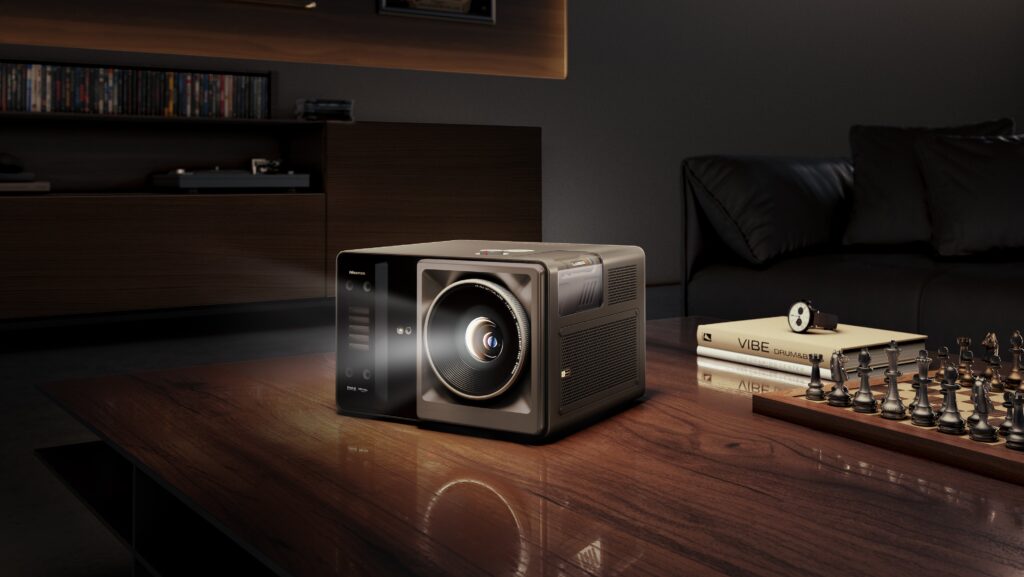
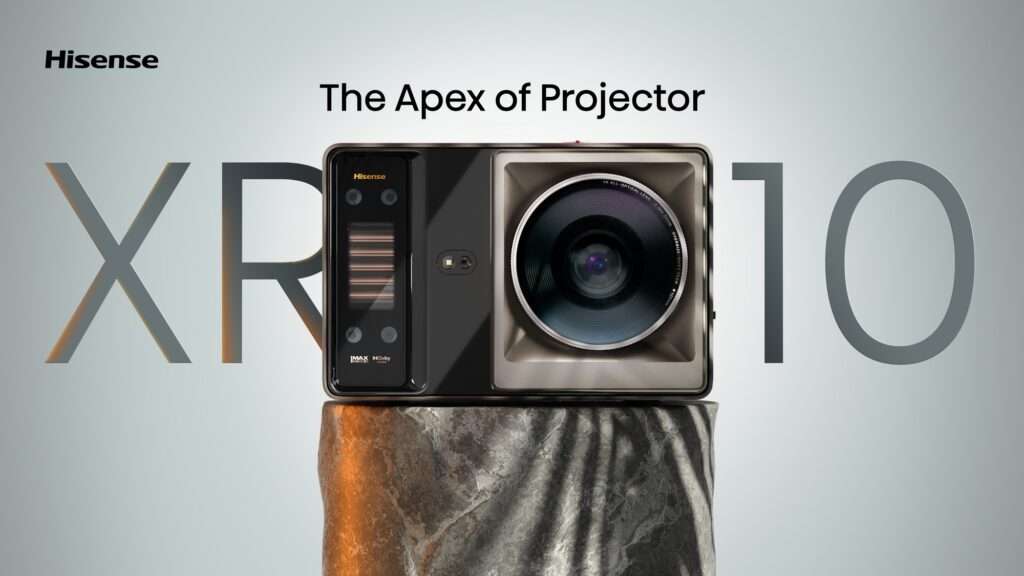
Hisense has opened pre-orders for its XR10 4K Triple Laser Smart Projector, which was first shown at CES 2026. The model is positioned as the company’s most advanced home projector so far.

Hisense XR10

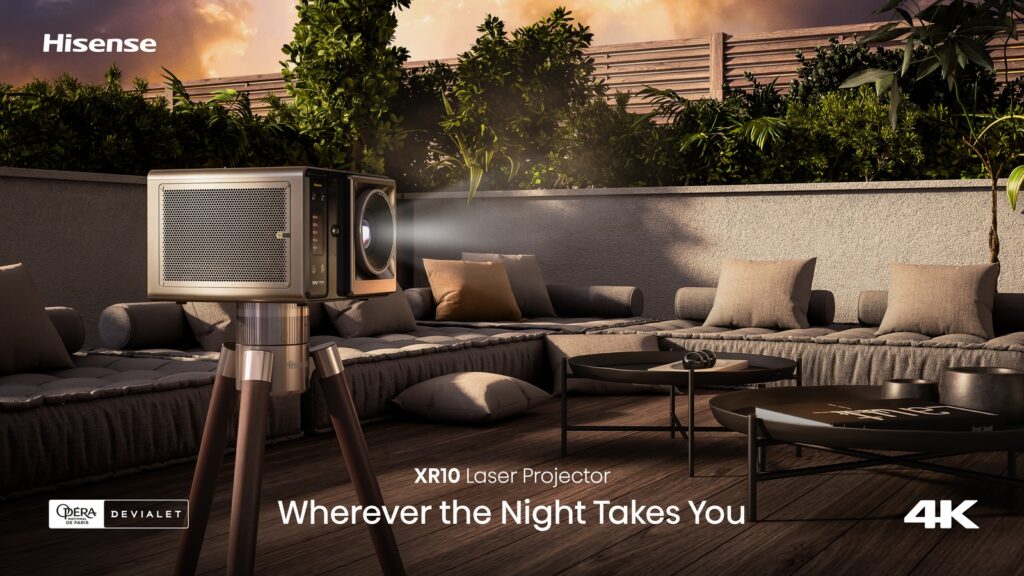
The XR10 supports 4K UHD resolution at 60Hz and can project images from 65 inches up to 300 inches. It uses a triple-laser light source that delivers up to 6,000 ANSI lumens. This level of brightness is designed to keep the image clear even with lights on. The light source is rated for up to 25,000 hours.

Hisense XR10

The projector has a 0.84 to 2.0:1 throw ratio, along with 2.39x optical zoom and lens shift. These features allow flexible placement without needing to move the unit much. Hisense has also added a seven-level iris adjustment and a 17-element glass lens system. The XR10 delivers a 6,000:1 native contrast ratio and up to 60,000:1 dynamic contrast.

Hisense XR10

For picture formats, it supports Dolby Vision, HDR10+, and IMAX Enhanced. It covers up to 118 percent of the BT.2020 color space, which is aimed at accurate color output.

The XR10 runs on Hisense’s VIDAA smart platform. It includes apps like Netflix, Amazon Prime Video, Disney+, and Apple TV. Screen mirroring is supported through AirPlay 2 and Miracast. For connectivity, it offers Wi-Fi 7, Bluetooth 5.4, HDMI 2.1, HDMI 2.0, USB 3.0, and Gigabit Ethernet. It also supports eARC and CEC for easier audio setup.

Audio is handled by a built-in 2.1-channel system developed with Devialet. It includes two 8W speakers and a 15W subwoofer. The system supports Dolby Digital and DTS Virtual:X. The sound profile has also been tuned with input from the Opéra de Paris. Cooling is managed by a dual-channel liquid cooling system designed to keep temperatures stable and reduce noise.

Pricing & availability

In the US, the XR10 is priced at $6,999.99. It is currently available for pre-order at $5,299.99 with a $1,700 discount. Buyers also get a free HT Saturn 4.1.2 wireless sound system. In Europe, it is listed at £5,999 in the UK and €4,999 in Germany.

For more daily updates, please visit our News Section.

Stay ahead in tech! Join our Telegram community and sign up for our daily newsletter of top stories!

The post Hisense XR10 4K Triple Laser Projector Now Available for Pre-Order with 6,000 Lumens Output appeared first on Gizmochina.
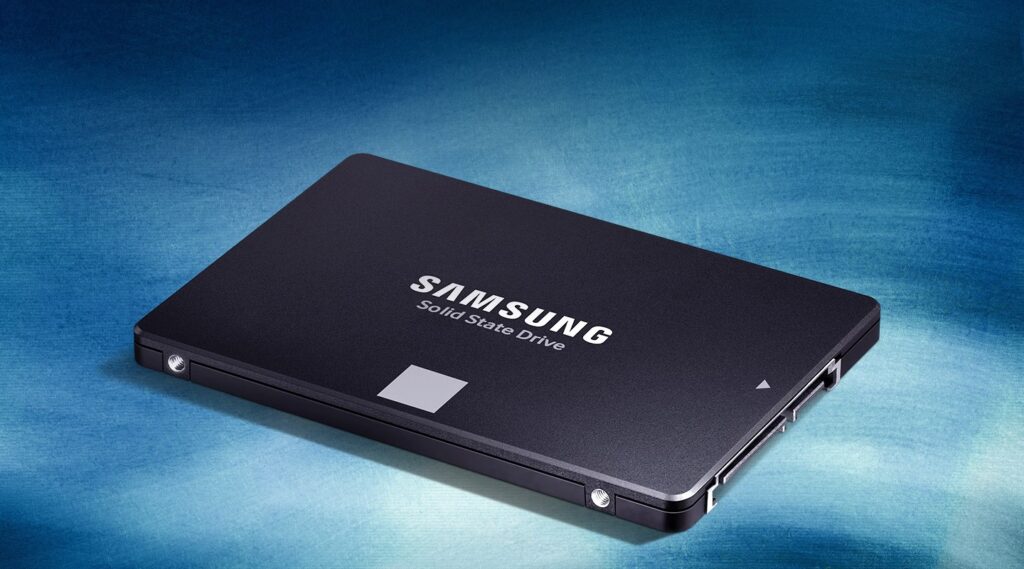
Samsung launches 8TB version of 870 EVO SSD with 5-year warranty

Samsung 870 Evo 8TB SSD

Samsung has launched the 8TB version of its 870 Evo SSD. The new model is now available in China for 12,999 yuan through major retailers like JD.com. In Europe, the SSD is priced at around €1,259, while in Singapore it is priced at $1,864.

Samsung 870 Evo 8TB SSD

Samsung 870 Evo 8TB SSD Specs

Samsung introduced the 870 Evo series in 2021 with capacities ranging from 250GB to 4TB. The new 8TB model doubles the previous maximum capacity, providing more options for users with heavy storage needs.

The 870 Evo SSD achieves sequential read speeds of up to 560 MB/s and write speeds of up to 530 MB/s, which are the highest possible speeds for the SATA interface. Samsung uses Intelligent TurboWrite technology to deliver consistent write performance over extended periods. Everyday users can expect professional-grade performance for tasks like gaming, media editing, and large file transfers.

Samsung 870 Evo 8TB SSD

Samsung designed the 8TB model for reliability and longevity. The SSD includes a five-year limited warranty and a 4,800 TBW (terabytes written) endurance rating, making it suitable for data-intensive workloads like 4K/8K video processing. The 870 EVO uses Samsung’s V-NAND TLC memory and the in-house MKX controller to ensure stable performance and compatibility across a wide range of devices.

This new SSD supports a standard 2.5-inch SATA form factor, which allows it to work with most desktop PCs, laptops, and NAS devices. Samsung Magician software lets users easily migrate data, monitor drive health, and install firmware updates. The SSD weighs approximately 48 grams and maintains compatibility with SATA 6Gb/s connections, while also supporting older SATA 3Gb/s and SATA 1.5Gb/s standards.

In related news, SanDisk has launched three new portable SSDs with up to 4TB storage and speeds reaching 4,000MB/s, while Lexar also unveiled AI-focused storage solutions, portable SSDs, and high-speed microSD cards at CES 2026.

For more daily updates, please visit our News Section.

Stay ahead in tech! Join our Telegram community and sign up for our daily newsletter of top stories! 💡

(Samsung)

The post Samsung launches 8TB version of 870 EVO SSD with 5-year warranty appeared first on Gizmochina.
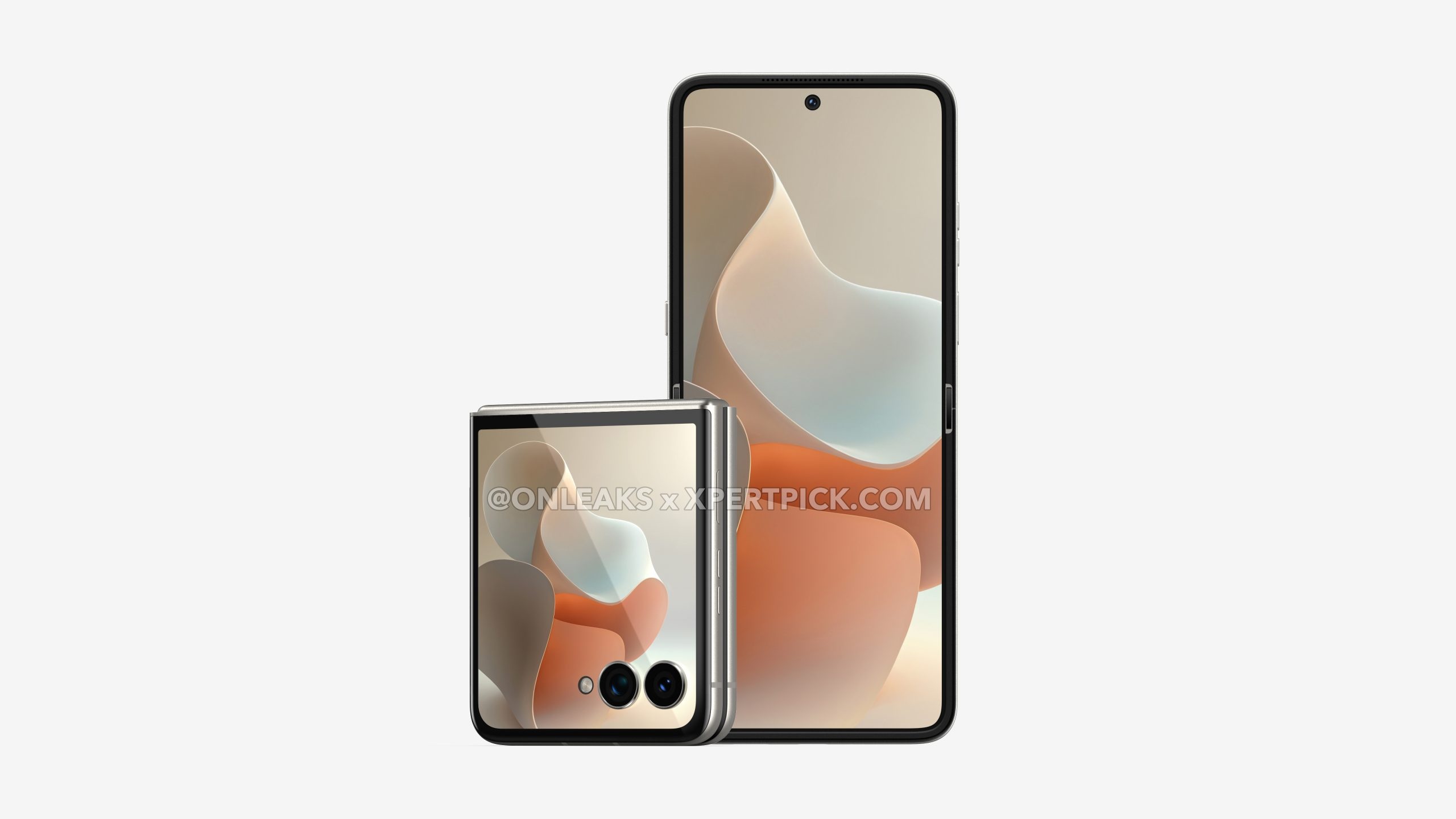
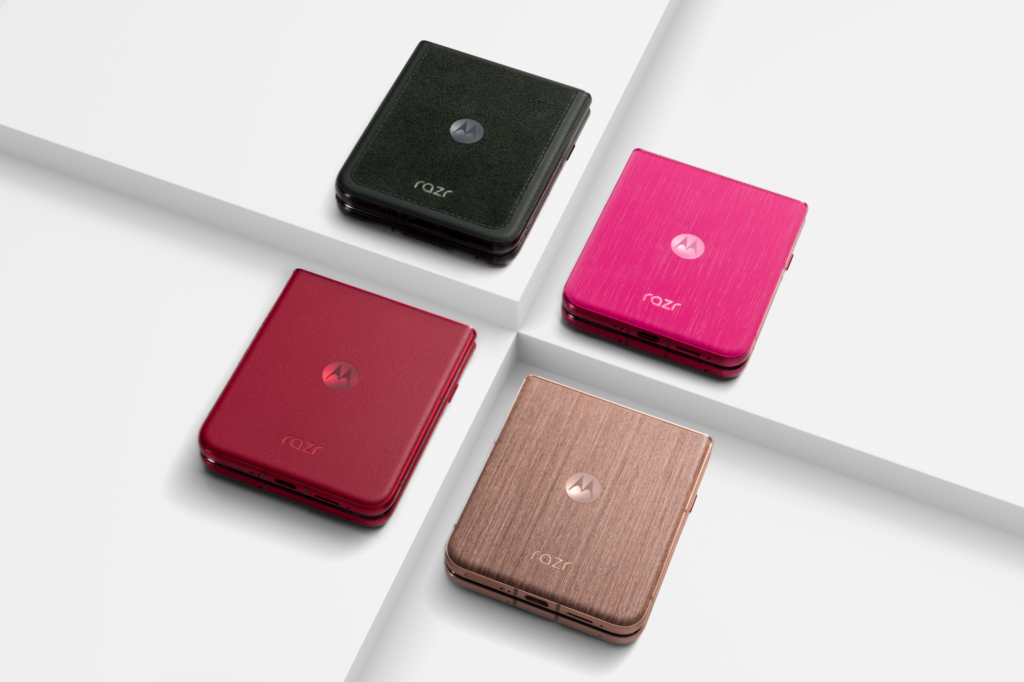
Motorola Razr 70 Ultra Leak Suggests Bigger Battery and Slightly Thicker Design

Motorola Razr 70 Ultra

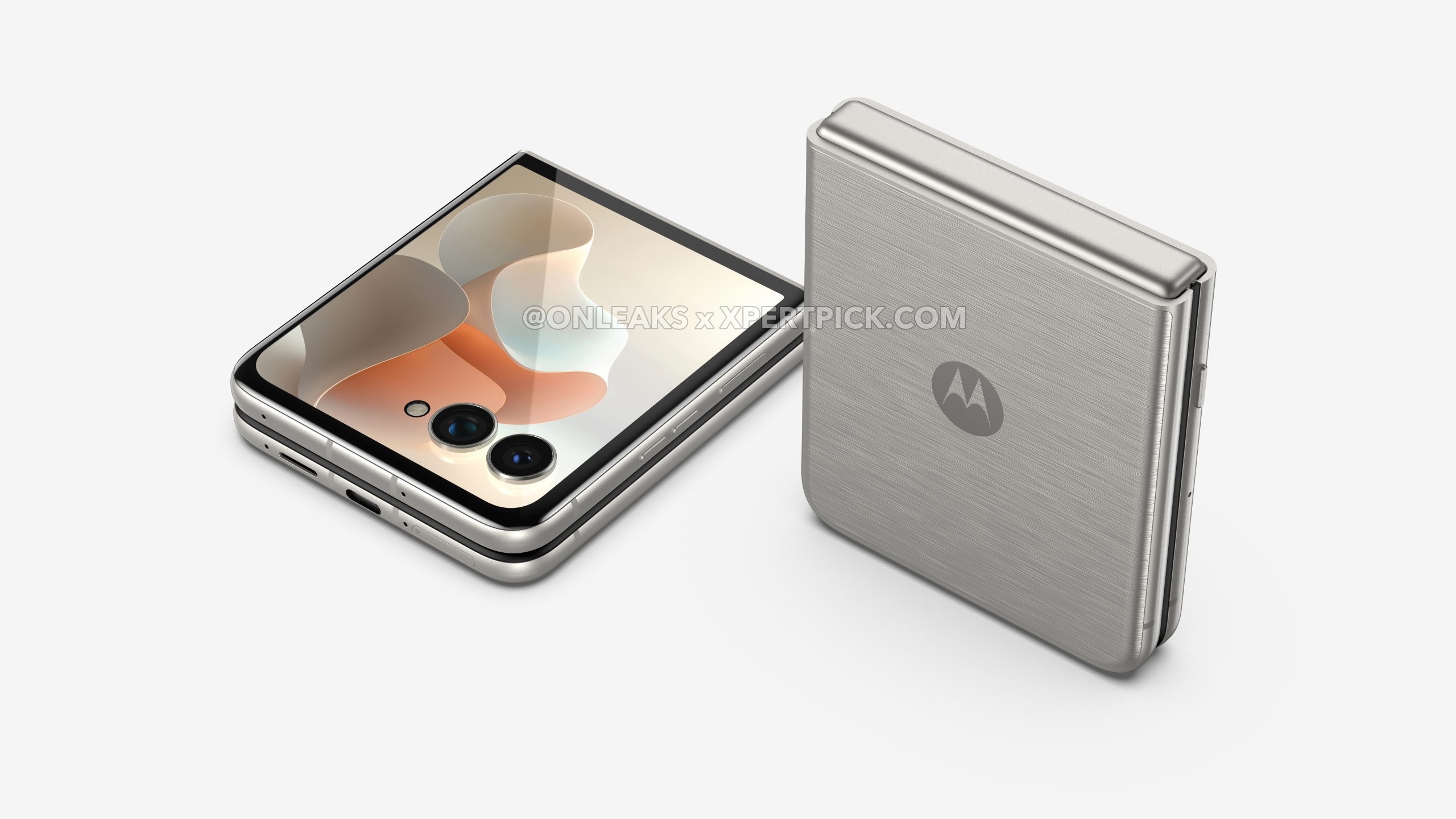
Motorola‘s upcoming Razr 70 Ultra has appeared in CAD renders and a 360-degree video shared by OnLeaks and XpertPick, revealing a device that prioritizes refinement over reinvention.

Motorola Razr 70 Ultra

The foldable maintains its clamshell form factor with dimensions of 171.3 x 74.1 x 7.8mm unfolded and 88.0 x 74.1 x 15.8mm folded. The camera bump pushes the total thickness to 9.6mm and 17.63mm, respectively. This represents a slight increase from the Razr 60 Ultra’s 7.2mm and 15.7mm measurements, suggesting internal modifications likely targeting battery capacity or camera components.

Motorola Razr 70 Ultra

Display specifications remain static: a 7-inch internal foldable screen paired with a 4-inch cover display, matching the previous generation’s configuration.

Design alterations are minimal. The left edge now features a dedicated Moto AI button, while power and volume controls stay right-mounted. The bottom houses a USB Type-C port, speaker grille, microphone, and SIM slot. A secondary microphone sits topside.

For context, the Razr 60 Ultra delivers a 7-inch FlexView pOLED LTPO inner display (1224 x 2992 pixels, 1-165Hz refresh, 4000 nits peak brightness) and a 4-inch QuickView outer screen (1272 x 1080 pixels, 1-165Hz, 3000 nits, Gorilla Glass Ceramic). It runs Snapdragon 8 Gen Elite on 3nm architecture with Adreno 830 graphics, 16GB LPDDR5X RAM, and 512GB UFS 4.1 storage.

Camera hardware includes triple 50MP sensors: main (f/1.8, OIS), ultra-wide (f/2.0), and front-facing (f/2.0). Connectivity spans 5G SA/NSA, dual 4G VoLTE, Wi-Fi 6E, Bluetooth 5.4, and NFC. The 4700mAh battery supports 68W wired and 30W wireless charging. The Razr 70 standard model has already surfaced on China’s TENAA with images and specifications, indicating an imminent launch window for both variants.

(Source)

The post Motorola Razr 70 Ultra Leak Suggests Bigger Battery and Slightly Thicker Design appeared first on Gizmochina.

Samsung’s 2nm GAA efficiency disappoints as Exynos 2600 consumes 40% more power than Snapdragon 8 Elite Gen 5 at its peak

Samsung's 2nm Exynos 2600 chip

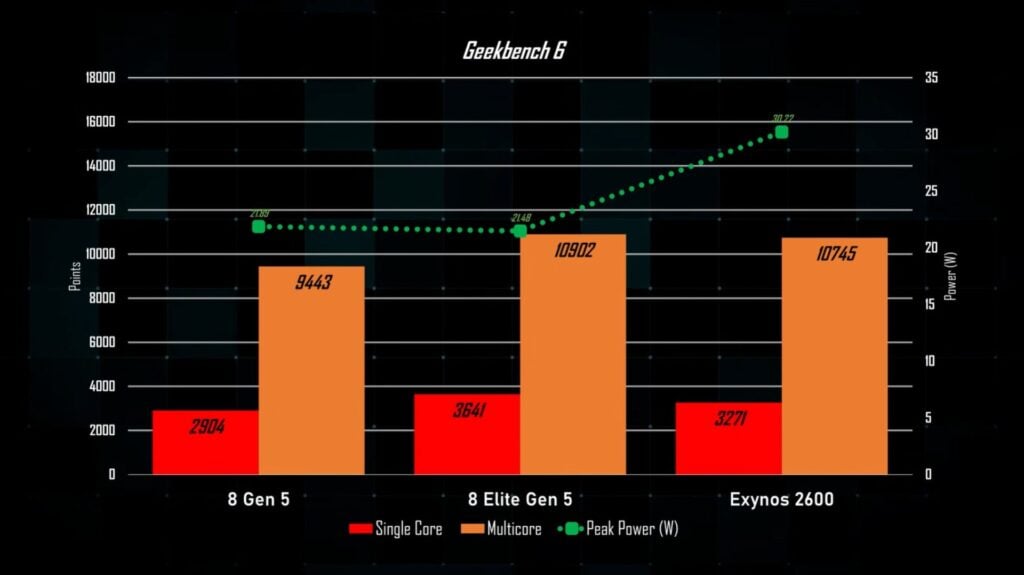
The Exynos 2600 is the first chipset to use Samsung’s 2nm process, promising upgrades to both performance and efficiency, thanks to advanced lithography, increased nanosheet count, and improved gate control. However, things haven’t gone Samsung’s way, as the chip ended up drawing 30W at peak, making its rival, the Snapdragon 8 Elite Gen 5 (21W), significantly more power-efficient.

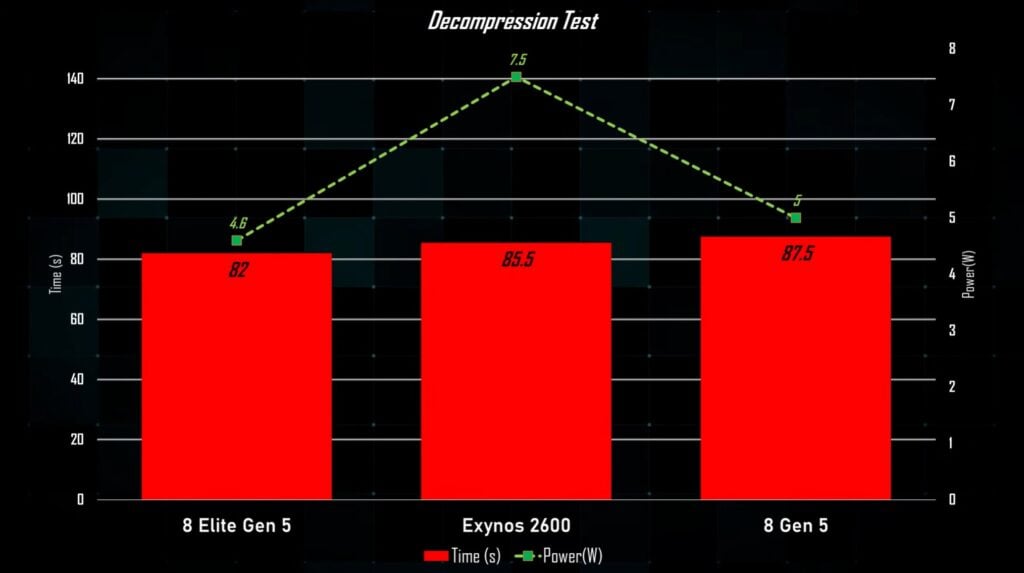
YouTube channel TechStation365 performed a series of tests on Galaxy S26 (powered by Exynos 2600), OnePlus 15 (powered by Snapdragon 8 Elite Gen 5), and Motorola Signature (powered by Snapdragon 8 Gen 5). For the sake of this article, we’ll focus on Geekbench 6 and a Decompression Test (for a 20GB ZIP file), which reveal rather interesting results.

Both the Snapdragon 8 Elite and Snapdragon 8 Elite Gen 5 have a peak power draw of around 21W, while the Exynos 2600 reaches 30W, which is a pretty significant gap, even though the power draw may have just been for a few seconds. This also means the Exynos 2600 will perform poorly under sustained workloads due to increased power draw.

Snapdragon 8 Elite Gen 5

  • Single core: 3,641 points
  • Multi core: 10,902 points
  • Peak power draw: 21.48W

Exynos 2600

  • Single core: 3,271 points
  • Multi core: 10,745 points
  • Peak power draw: 30.22W

Snapdragon 8 Gen 5

  • Single core: 2,904 points
  • Multi core: 9,443 points
  • Peak power draw: 21.89W

Even in the Decompression Test, the Exynos 2600 didn’t see any efficiency improvements. It reached up to 7.8W in peak power consumption, while the Snapdragon 8 Gen 5 and Snapdragon 8 Elite Gen 5 are below 5W. The Snapdragon 8 Elite Gen 5 also takes less time to decompress.

The results pretty much confirm that TSMC still has a solid upper hand in chip efficiency over Samsung. YouTube channel TechStation365 has concluded that the Exynos 2600 is a power-hungry chipset, as those 10-cores require a little more juice to perform optimally. Hopefully, we’ll see some real efficiency upgrades in Exynos 2700.

Check the complete video here.

Also read: Snapdragon 8 Elite Gen 5 vs Dimensity 9500 vs Exynos 2600: The flagship showdown

The post Samsung’s 2nm GAA efficiency disappoints as Exynos 2600 consumes 40% more power than Snapdragon 8 Elite Gen 5 at its peak appeared first on Gizmochina.

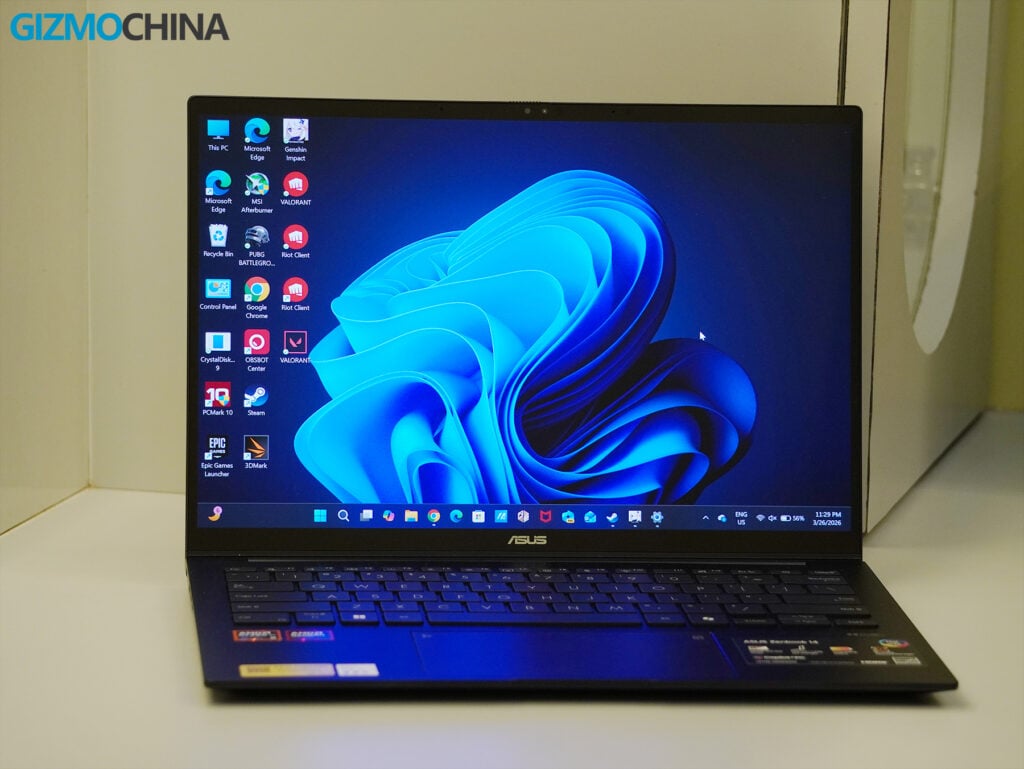
Asus Zenbook 14 OLED (UM3406G) Review: Sleek, Efficient and Built for Everyday Tasks

Asus Zenbook 14 OLED (UM3406G) Review

Thin-and-light laptops have always been my go-to for their portability and sleek aesthetics.

Over the past couple of weeks, I had the chance to test out the Asus Zenbook 14 (UM3406G), a machine that promises the best of modern design, AI-infused performance, and impressively long battery life.

While marketed as an ultraportable, it’s clear that Asus also wanted to make a device that stands out in terms of build, features, and utility. But does it deliver on all fronts? Let’s break it down.

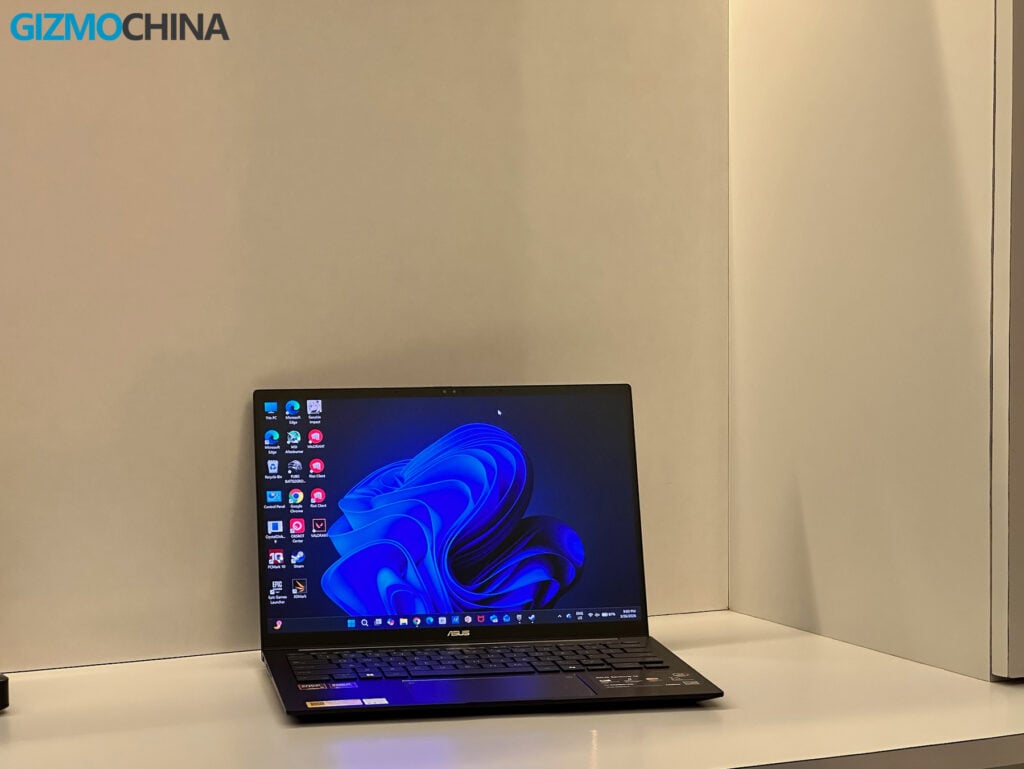
Asus Zenbook 14 OLED (UM3406G) Review

Design and Build Quality

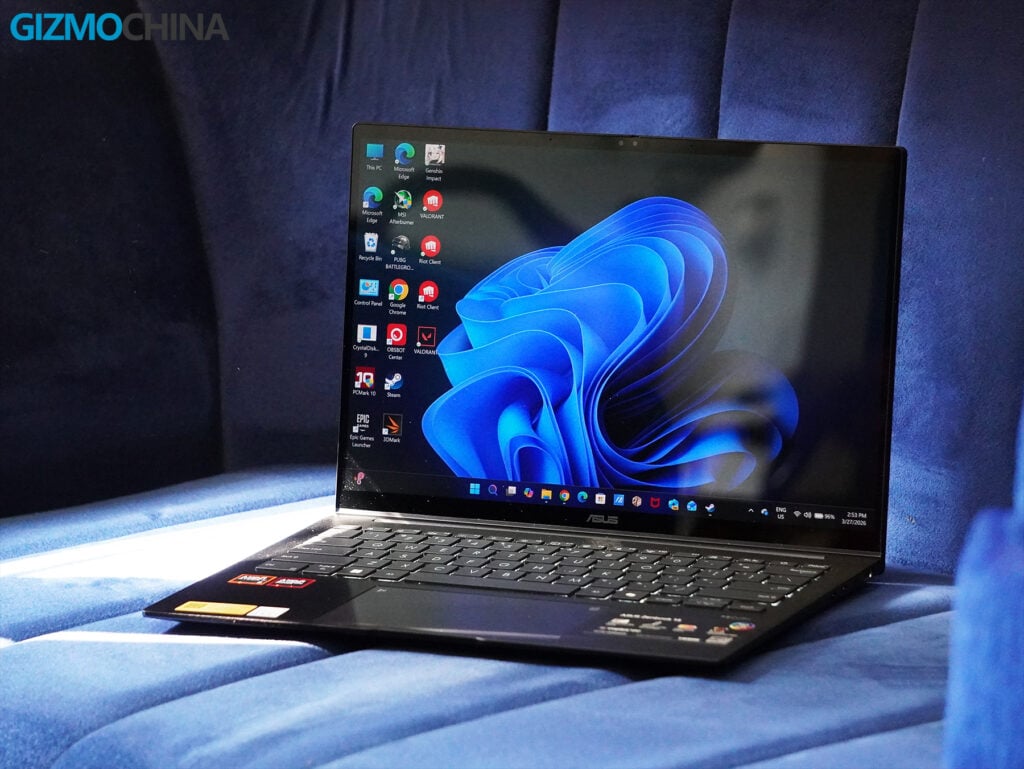
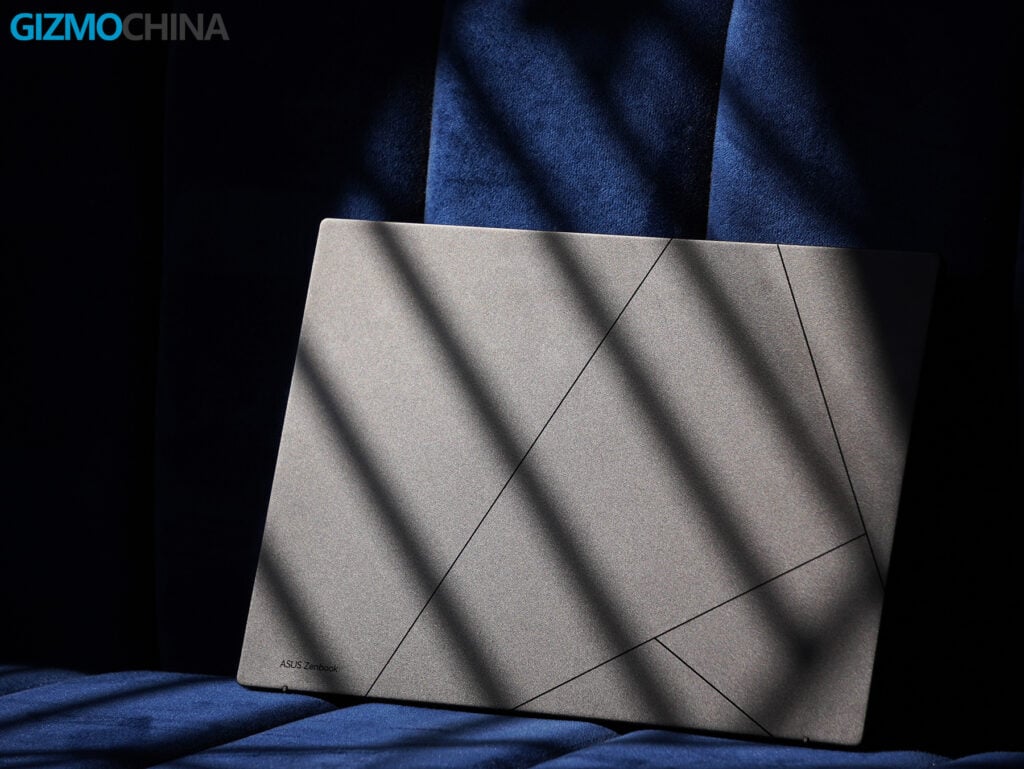
Straight out of the box, the Zenbook 14 makes an impression with its minimalist, all-aluminum alloy chassis. Asus has gone for a clean, professional aesthetic that blends seamlessly into both casual and office settings. The Jade Black finish steals the spotlight, subtle, sophisticated, and premium. However, it’s a fingerprint magnet, which detracts slightly from its otherwise polished look. You’re going to want to keep a microfiber cloth handy.

Asus Zenbook 14 OLED (UM3406G) Review

At 1.49 cm thin and weighing 1.28 kg, this laptop is designed for those on the move. It’s incredibly lightweight and slim, yet it doesn’t compromise structural integrity. The MIL-STD 810H certification for military-grade durability adds some peace of mind. I tossed it into my work bag every day and used it in various coffee shops without worrying about accidental bumps.

Asus Zenbook 14 OLED (UM3406G) Review

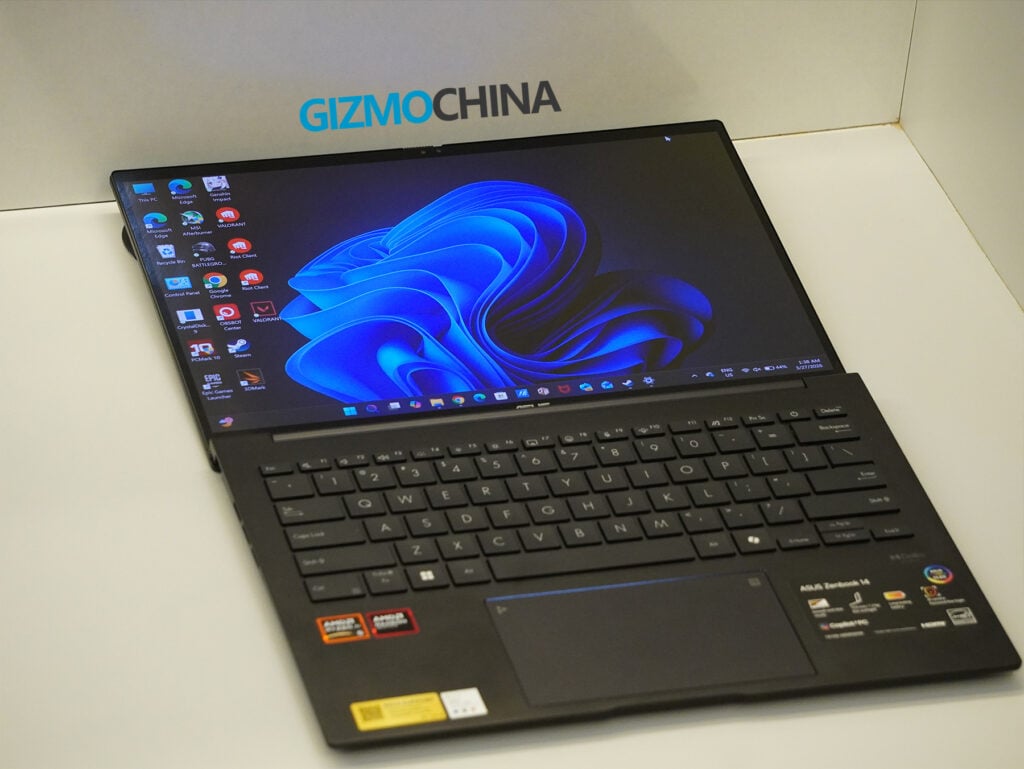
The hinge design allows the lid to open a full 180 degrees, making collaboration or angled viewing comfortable. However, the one downside in practical use is that you can’t open the lid with one hand, a very annoying hiccup in an otherwise thoughtful design.

Display

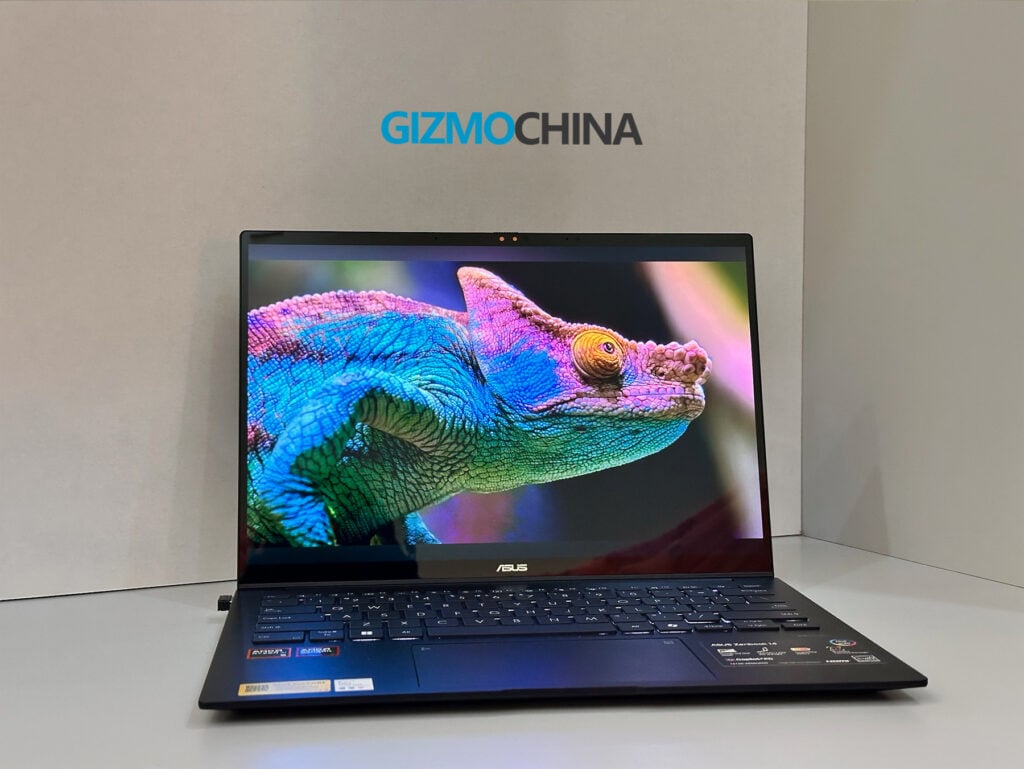
The display is easily one of the standout features of the Zenbook 14 for me. It comes with a 14-inch FHD+ Lumina OLED panel (1920×1200) surrounded by incredibly thin bezels and an aspect ratio of 16:10, giving it an impressive 87% screen-to-body ratio.

Asus Zenbook 14 OLED (UM3406G) Review

Even though the resolution might feel a little low compared to higher-res panels, the colors are absolutely stunning. They’re vivid and deeply saturated, covering 100% of the DCI-P3 color gamut with a 1,000,000:1 contrast ratio. Whether I was editing photos, watching HDR videos, or just scrolling through documents, the display felt immersive and incredibly true-to-life.

HDR content looks fantastic on this VESA-certified DisplayHDR True Black 500 panel. The 0.2ms response time makes motion smooth and fluid, which is perfect for watching videos or working on media-heavy tasks.

Asus Zenbook 14 OLED (UM3406G) Review

That said, there are a couple of downsides. The glossy screen, while gorgeous indoors, can be highly reflective in bright lighting. On top of that, the refresh rate is capped at 60Hz, which is fine for my general productivity tasks but might feel limiting for gamers or anyone used to 120Hz or higher.

Asus Zenbook 14 OLED (UM3406G) Review

On the positive side, my unit includes a touchscreen, and it works flawlessly. It also supports a stylus, which has made the laptop even more versatile for creative or note-taking tasks.

Ports and Connectivity

The laptop comes with a well-rounded selection of ports. You get one USB 4.0 Gen 3 Type-C port with DisplayPort and Power Delivery, one USB 3.2 Gen 2 Type-C port, one USB 3.2 Gen 1 Type-A port, an HDMI 2.1 port, and a 3.5mm combo audio jack.

Asus Zenbook 14 OLED (UM3406G) Review

The port selection is versatile enough to cover most of my needs, but I did notice that Asus placed all the USB-C ports on the right side of the laptop. For me, this design choice can make cable management a bit tricky when connecting multiple peripherals or an external monitor on my desk. I also found myself missing an SD card reader, which would have been helpful for transferring files from my camera or other recording devices.

Keyboard and Trackpad

I found the keyboard on the Zenbook 14 to be a joy to type on. The well-spaced keys, natural layout, and backlit made it easy to start typing right away without any awkward adjustments.

Asus Zenbook 14 OLED (UM3406G) Review

The 1.4mm key travel feels smooth and satisfying, while still being quiet enough for any setting. I also liked the smudge-resistant keycaps, which keep the keyboard looking clean and tidy even after extended use.

I found the trackpad to be smooth and accurate, with plenty of space for swipes and multitouch gestures. It also comes with an integrated numpad shortcut, which is a clever feature that worked really well.

Benchmarks

Here’s how the Zenbook 14 (UM3406G) performed in my benchmarking suite:

Asus Zenbook 14 OLED (UM3406G) Review
  • PCMark 10: 6,985 overall – Smooth and consistent for everyday multitasking.
  • Cinebench R23: 1,725 (single) / 6,944 (multi) – Solid single-core, capable multi-core performance for light creative tasks.
  • Geekbench 6: 2,509 (single) / 7,716 (multi) – Efficient single-thread tasks and overall snappiness.
  • Geekbench AI: 6,875 – Competent for handling on-device AI-related tasks like productivity features and video call enhancements.
  • 3DMark Time Spy: 1,650 overall – Decent for casual gaming and minimal 3D workloads.
  • CrystalDiskMark: 6,978 MB/s read / 6,130 MB/s write – Ensures fast boot times, large file handling, and responsive app performance.
Asus Zenbook 14 OLED (UM3406G) Benchmarks

These results position the Zenbook 14 as an ultraportable designed for everyday productivity and portability, rather than a powerhouse for intensive workloads or gaming. It performs reliably for general tasks, but if you are seeking high-range performance for creative applications or gaming should look elsewhere. It’s best suited for professionals, students, and casual users.

AI and Performance

The Zenbook 14 (UM3406G) uses the Ryzen AI 5 430 processor, and I’ve found it great for enhancing everyday productivity with its AI-powered features. Windows Copilot works seamlessly with 50 TOPS, offering tools like background blurring for video calls, real-time translation, local AI-based summarization, and even basic image editing.

These features have been super convenient and made my workflow feel more efficient. Office apps also run incredibly smoothly, handling everything from heavy Excel sheets to PowerPoint presentations without any issues.

Asus Zenbook 14 OLED (UM3406G) Review

In my testing, the laptop handled over 30 Chrome tabs without breaking a sweat, but pushing beyond that introduced noticeable slowdowns, especially when multitasking with other programs.

For day-to-day tasks like web browsing, casual Photoshop sessions, light editing tasks, writing documents, and working with office apps, it runs perfectly as long as I keep the workload moderate.

Gaming

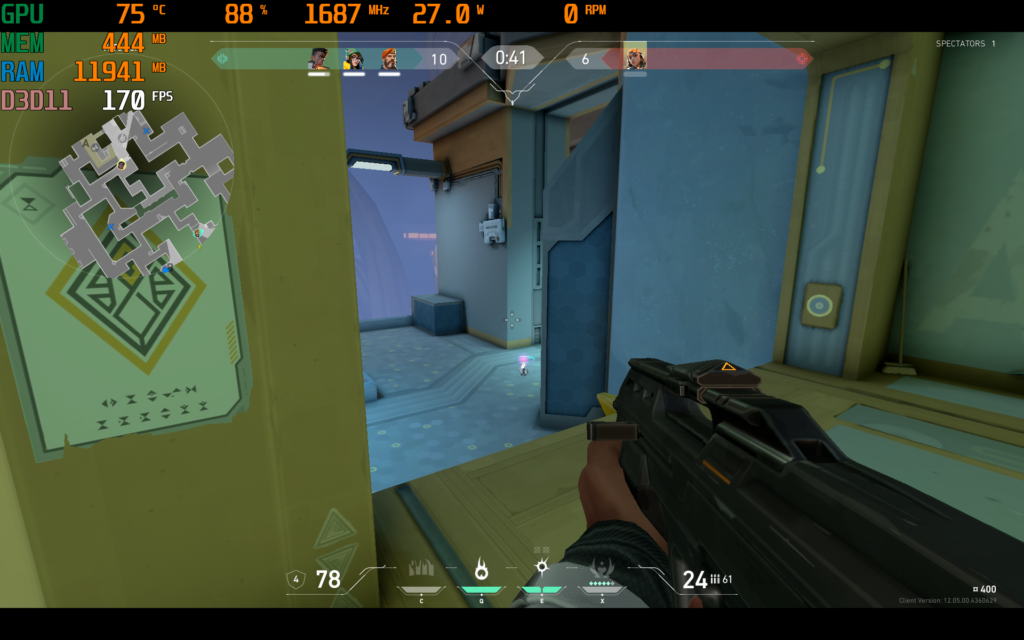
The laptop offers entry-level gaming performance with its integrated Radeon 840M GPU, which I found good enough for casual gaming. In esports titles like Valorant, it performs really well, delivering a smooth 170-230 FPS. The GPU runs at around 85-90% usage and consumes about 28W of power, which provides a stable and competitive experience.

Asus Zenbook 14 OLED (UM3406G) Review

For slightly more demanding games like Genshin Impact, the laptop manages 49-57 FPS on medium settings. The GPU is fully utilized at 97-99%, drawing about 20W of power. It’s definitely playable, but there are occasional dips during more intense moments.

Asus Zenbook 14 OLED (UM3406G) Review

When I tested PUBG on its lowest settings, the laptop averaged around 32 FPS, with the GPU maxed out at 98%. It’s clear that it struggles with modern AAA or resource-heavy titles.

Asus Zenbook 14 OLED (UM3406G) Review

While the Zenbook 14 isn’t a gaming laptop, it handles light gaming and older esports titles quite well. It’s great if you’re looking to game casually or play less demanding titles, but it’s not suited for intense DX12 workloads or modern AAA games on higher settings. For me, it works perfectly as a secondary device for light gaming when I’m not looking for peak performance.

Thermal and Fan Performance

Thermals were remarkably well-managed, thanks to the single-heatpipe cooling system. Even under sustained workloads, the device remained cool to the touch, with the fan ramping up only during heavy tasks. For everyday usage, this is one of the quietest laptops I’ve tested.

Battery Life, Sound, and Camera

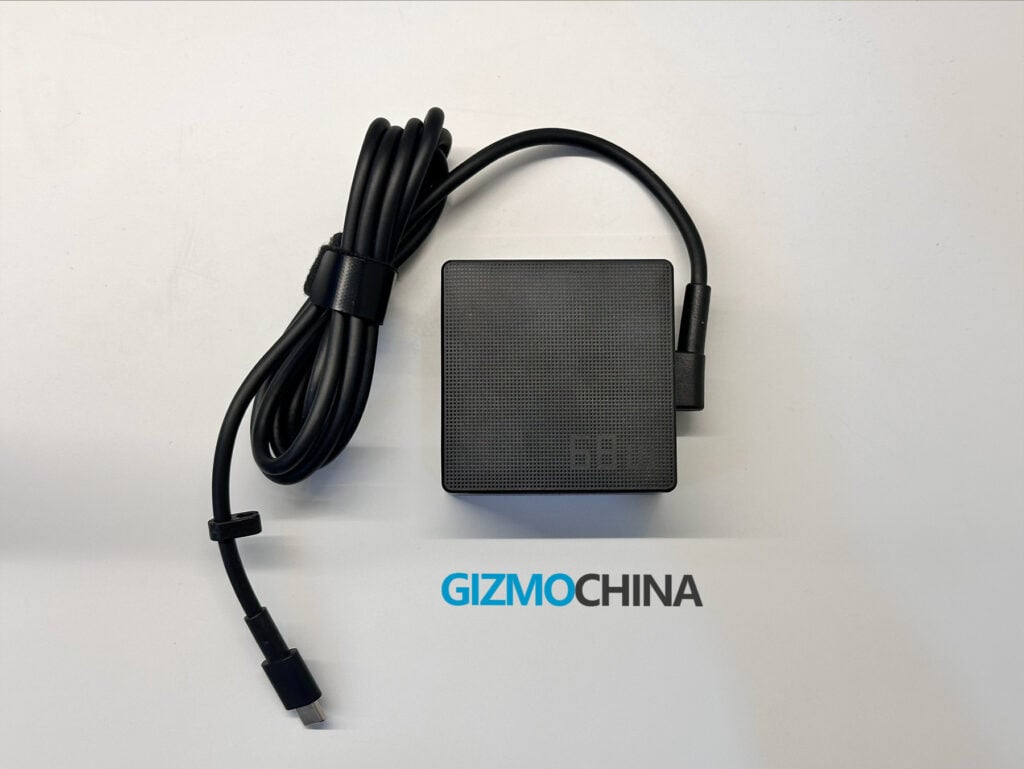
The Zenbook’s 75Wh battery is solid. I got over 10 hours of use with tasks like browsing, writing, using Office apps, and streaming. For heavier workloads, like multitasking with demanding apps, it lasted around 7-8 hours, which was enough to get me through the day without charging. The 65W fast charging is handy, it took around 50 minutes to go from 0 to 60%.

Asus Zenbook 14 OLED (UM3406G) Review

The speakers, however, were a bit disappointing. They’re bottom-firing and don’t have much bass. They’re okay for casual media and calls but don’t stand out if you’re hoping for great sound quality.

The 1080p webcam works fine for video calls. The quality is decent, and features like AI background blur and low-light adjustments help. It’s not amazing, but I didn’t have any complaints using it for meetings.

Verdict

The Asus Zenbook 14 (UM3406G) gets a lot of things right.

It combines a premium design, a fantastic OLED display, excellent battery life, and strong everyday performance into a lightweight package that’s easy to live with. The Ryzen AI 5 430 may not be the most powerful chip in its class, but it focuses on efficiency, and that’s exactly what this category needs.

Asus Zenbook 14 OLED (UM3406G) Review

There are compromises. The 60Hz display feels limiting, the reflective panel can be annoying, and the speakers could have been better. Port placement also feels slightly inconvenient.

But none of these break the experience.

After using it for over two weeks, this feels like a laptop designed for real life not benchmarks. It’s reliable, consistent, and comfortable to use daily.

If you’re looking for a Windows ultrabook that prioritizes battery life, portability, and a great display over raw power, this is an easy recommendation.

The Zenbook 14 (UM3406) starts at ₹85,990 for the Ryzen AI 5 340 variant, while the higher-end Ryzen AI 5 430 model is priced around ₹115,990 on the Asus store.

For more daily updates, please visit our News Section.

Stay ahead in tech! Join our Telegram community and sign up for our daily newsletter of top stories! 💡

The post Asus Zenbook 14 OLED (UM3406G) Review: Sleek, Efficient and Built for Everyday Tasks appeared first on Gizmochina.
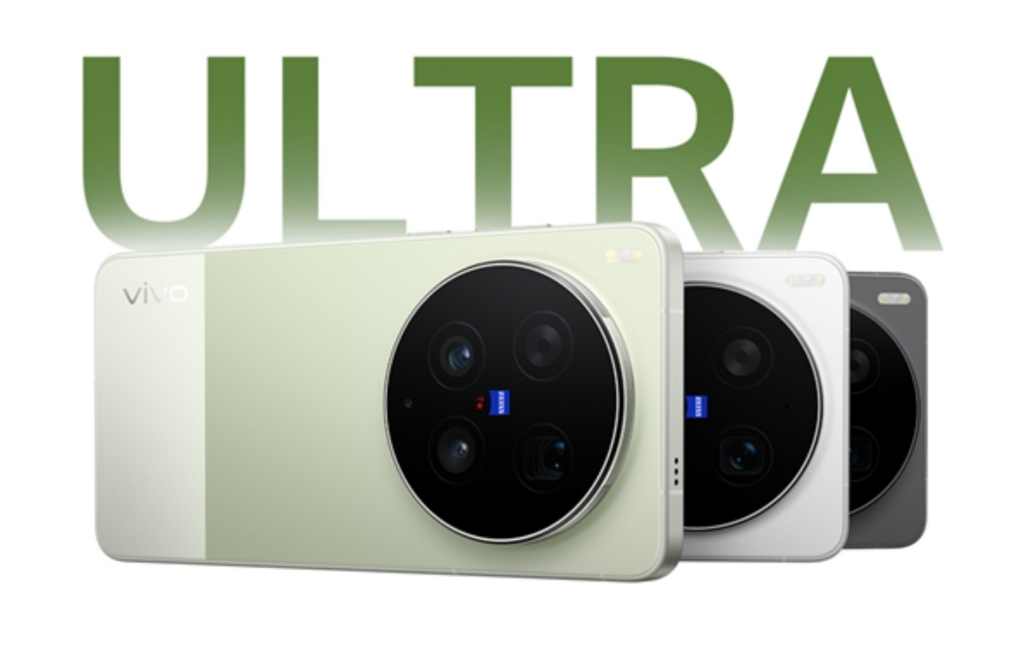
Global Vivo X300 Ultra appears on Geekbench with a lower score than its Chinese counterpart

Vivo X300 Utlra

Vivo is gearing up to launch the Vivo X300 Ultra on March 30 in China. The company already showcased the device at MWC in February, so a global launch is also expected soon.

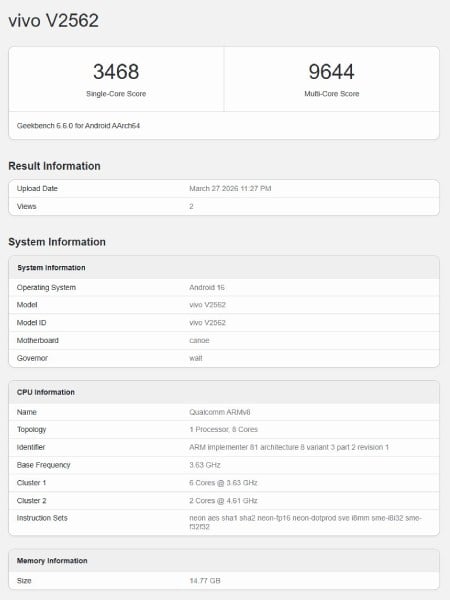
Ahead of that, the global model of the Vivo X300 Ultra has appeared on Geekbench.

The device, identified by the model number V2562, is powered by Qualcomm’s latest Snapdragon 8 Elite Gen 5 chipset. It is paired with 16GB of RAM, runs Android 16, and scored 3,468 points in single-core and 9,644 points in multi-core tests.

Interestingly, the Chinese model of the device, with model number V2547DA, also appeared on Geekbench a few days ago. It posted slightly higher scores, with 3,722 in single-core and 11,621 in multi-core tests.

The processor, RAM, and OS version are the same as the global model, which suggests the latter might still need some optimization.

Vivo X300 Ultra Specifications (Expected)

Vivo X300 Ultra is expected to feature a 6.82-inch 2K BOE display with narrow bezels all around. The Chinese model will pack a 6,600mAh battery, along with 100W wired and 40W wireless charging support. Despite that, the phone reportedly maintains a slim profile at 8.19mm.

Cameras, of course, are the highlights here. It features a 200MP Sony LYTIA-901 main sensor paired with a 50MP LYTIA-828 ultrawide sensor, which was previously used as the X300 Pro’s main sensor. This phone also has a 200MP ISOCELL HP0 prerescope telephoto unit along with a 5MP multi-spectral sensor, which will improve colour accuracy. 

On the audio and recording side, the X300 Ultra introduces a quad-microphone system. The phone also includes customized speakers, featuring a 1697 upward-firing unit and a relatively large 0.8cc sound cavity, which could contribute to louder or fuller audio output.

Last but not least, the device is said to include a high-end 751440 vibration motor for more precise haptic feedback. Vivo is also adding a back-tap gesture feature, allowing users to trigger shortcuts like silent mode, flashlight, or screen recognition functions.

For more daily updates, please visit our News Section.

Stay ahead in tech! Join our Telegram community and sign up for our daily newsletter of top stories! 💡

The post Global Vivo X300 Ultra appears on Geekbench with a lower score than its Chinese counterpart appeared first on Gizmochina.

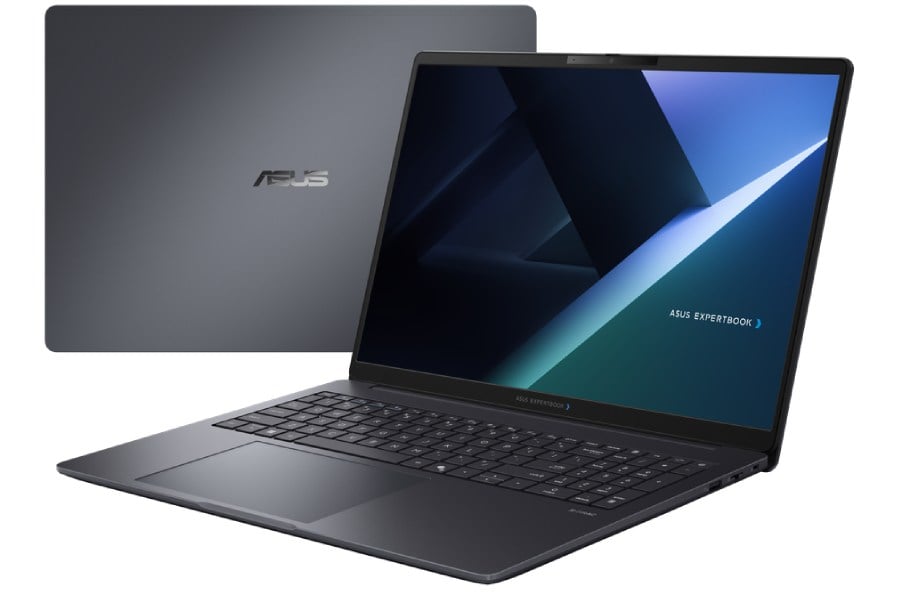
Asus ExpertBook B3 G1 is official with four different CPU choices, up to 96GB RAM

Asus-ExpertBook-B3-G1-laptop-launch-specs-price

Asus is adding another option to its business laptop lineup with the new Asus ExpertBook B3 G1. The ExpertBook B3 G1 comes in both 14-inch and 16-inch versions, which is fairly standard for business laptops trying to cover different workplace needs. 

You can also choose between multiple processors, from the Core Ultra 5 225H, Core Ultra 5 vPro 235H, Core Ultra 7 255H, and Core Ultra 7 vPro 265H. Graphics is handled by up to an Arc 140T iGPU. 

Memory can be configured up to 96GB of DDR5-5600, while the storage includes two M.2 PCIe 4.0 slots supporting up to 6TB in total capacity.

Asus ExpertBook B3 G1 Specifications 

Asus is also using two different panels on the front. One has a 1920 x 1200 IPS screen, while another comes with a higher-resolution 2560 x 1600 IPS option. The latter pushes brightness up to 400 nits, includes a 144Hz refresh rate, and covers 100 percent of the sRGB color gamut.

The 16-inch version also adds the option of a touchscreen panel. But this model has a 1920 x 1200 resolution panel with a 120Hz refresh rate and similar overall characteristics to the higher-resolution panel.

The laptop has all the necessary port options, including Thunderbolt 4, two USB-A 3.2 Gen 1 ports, HDMI 2.1, a 3.5mm headphone jack, and a Gigabit Ethernet port. 

The ExpertBook B3 G1 runs on 50Wh and 70Wh batteries. For video conferencing and remote work, Asus is also offering multiple webcam options, including HD, Full HD, and FHD+IR variants, the latter likely intended for Windows Hello facial recognition.

The company hasn’t detailed anything on pricing or availability yet.

For more daily updates, please visit our News Section.

Stay ahead in tech! Join our Telegram community and sign up for our daily newsletter of top stories! 💡

The post Asus ExpertBook B3 G1 is official with four different CPU choices, up to 96GB RAM appeared first on Gizmochina.
These Galaxy devices have received March 2026 security update

Samsung March 2026 security update

Samsung wasn’t quick to begin the March 2026 security update rollout. It went live in the second half of the month, starting with the Galaxy S25 series, and the expansion has been strong since. The latest security patch now covers dozens of Galaxy phones, including many mid-range phones. We’ve included the complete list below, which is updated regularly.

The March 2026 security patch for Samsung Galaxy includes fixes for 65 vulnerabilities. Of these, 60 are Android-related vulnerabilities with fixes coming from Google, while the remaining 5 are specific to Samsung Galaxy devices.

Samsung has released March 2026 security update for these devices: Complete list

Galaxy S series

  • Galaxy S25
  • Galaxy S25+
  • Galaxy S25 Ultra
  • Galaxy S25 Edge
  • Galaxy S25 FE
  • Galaxy S24
  • Galaxy S24+
  • Galaxy S24 Ultra
  • Galaxy S24 FE
  • Galaxy S23
  • Galaxy S23+
  • Galaxy S23 Ultra
  • Galaxy S23 FE

Galaxy Z series

  • Galaxy Z TriFold
  • Galaxy Z Fold 7
  • Galaxy Z Flip 7
  • Galaxy Z Flip 7 FE
  • Galaxy Z Fold Special Edition
  • Galaxy Z Fold 6
  • Galaxy Z Flip 6
  • Galaxy Z Fold 5
  • Galaxy Z Flip 5
  • Galaxy Z Fold 4
  • Galaxy Z Flip 4

Galaxy A series

  • Galaxy A55
  • Galaxy A54
  • Galaxy A53
  • Galaxy A36

The list will continue to grow as Samsung pushes the March update to more Galaxy devices over the coming days. We’ll update it regularly to keep it fresh.

If you’ve spotted your device on the list, the March 2026 security update may be available for installation. Go to Settings > Software updates > Download and install to check for available updates. Keep in mind that updates are usually rolled out in batches, and so they can take some time to reach all the users.

Also read: Check if your Samsung device will receive One UI 8.5 update

Besides rolling out the March 2026 security patch, Samsung’s software team is busy expanding One UI 8.5 beta to more devices. It recently went live for the Galaxy S25 FE, Galaxy S24 series (including S24 FE), and Galaxy Tab S11 series, with more devices expected to join in April. You can head to our One UI 8.5 section for the latest updates.

We’ll keep posting the latest One UI developments in our Samsung section. You can visit the section regularly for the latest updates, or join our Telegram channel to get instant notifications about the latest software updates and breaking tech news.

The post These Galaxy devices have received March 2026 security update appeared first on Gizmochina.

Honor confirms WIN gaming laptop launch in April

Honor-WIN-gaming-laptop

A few weeks after the initial news, Honor has officially announced that it will launch the Honor WIN gaming laptop in April. An accompanying teaser poster places the device front and center alongside the Delta Force Fiery Professional League, hinting at a clear esports angle.

The WIN gaming laptop isn’t entirely a surprise. Honor has been hinting at a return to gaming hardware since early 2024, when it revived its Hunter branding during a spring flagship launch.

Later, in December 2025, Zhu Chencai, general manager of Honor’s PC division, said that a new gaming laptop was on the way. Around the same time, the company confirmed that the device would arrive in 2026 and would be closely tied to the Delta Force esports scene.

Honor WIN Specifications (Expected)

Before this announcement, an earlier report revealed key specifications of the device. The laptop is expected to feature a base configuration with an Intel Core i7-14650HX processor paired with an Nvidia RTX 5060 GPU, along with 16GB of DDR5 RAM and either 512GB or 1TB of SSD storage.

Moreover, a higher-end configuration is said to include an Ultra 9 290HX Plus processor and an RTX 5070 GPU, with total system power reportedly exceeding 250W.

Design-wise, the WIN gaming laptop is expected to carry forward the visual identity of the earlier Hunter series, including a lit Hunter logo and a style that leans into esports aesthetics without overdoing it.

Honor is also positioning the device for professional gaming use cases, particularly through its partnership with the Delta Force league.

For now, much of the WIN gaming laptop story still relies on a mix of official hints and well-sourced leaks. But with an April launch now confirmed, Honor doesn’t have much longer to wait before revealing the full picture.

For more daily updates, please visit our News Section.

Stay ahead in tech! Join our Telegram community and sign up for our daily newsletter of top stories! 💡

The post Honor confirms WIN gaming laptop launch in April appeared first on Gizmochina.
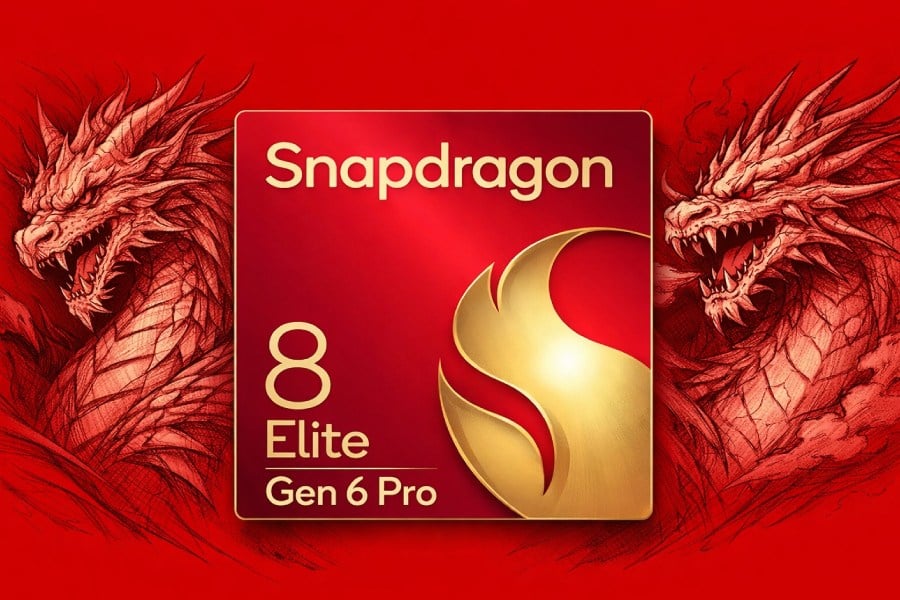
Galaxy S27 Ultra could be one of the first to use LPDDR6 RAM with Snapdragon 8 Elite Gen 6 Pro chip

Galaxy-S26-Ultra

If recent leaks are anything to go by, the Galaxy S27 Ultra could end up being one of the first phones to adopt a new generation of memory, which might bring some noticeable gains.

Galaxy-S26-Ultra

According to a fresh leak, the device is expected to feature LPDDR6 RAM, likely paired with Qualcomm’s upcoming Snapdragon 8 Elite Gen 6 Pro. That would make it one of the earliest Android phones to move beyond LPDDR5X, which is still what most current flagships rely on.

On paper, LPDDR6 is a fairly big step forward. It’s said to offer higher bandwidth and improved efficiency, partly due to changes in how memory channels are structured. In everyday use, that could mean smoother multitasking, quicker app loading, and better performance in heavier workloads like gaming or on-device AI tasks. Whether the difference feels dramatic is another question, but it should at least be measurable.

The chipset itself is also shaping up to be a notable upgrade. Qualcomm is reportedly working on two versions this time: the standard Snapdragon 8 Elite Gen 6 and a more powerful Pro variant. The latter is expected to include a “superior” Adreno 850 GPU with 18MB GMEM, while the standard model will likely use an Adreno 845 GPU with 12MB GMEM. Both chips are said to use a 2+3+3 CPU layout and could be built on TSMC’s 2nm process, which should help with efficiency.

As for Samsung’s own chips, development is ongoing with the Exynos 2700 and Exynos 2800. Still, early reports suggest the Ultra model will stick with Qualcomm, at least in most markets.

Of course, there’s a trade-off here. Moving to newer memory standards and a more advanced chipset usually means higher costs. With DRAM and storage prices already trending upward, it wouldn’t be surprising if the Galaxy S27 Ultra ends up being more expensive than the current generation.

It’s still early, and a lot can change before launch, but if these details hold, the S27 Ultra could be one of the first Android phones to really push next-gen hardware across the board.

Don’t miss a thing! Join our Telegram community for instant updates and grab our free daily newsletter for the best tech stories!

For more daily updates, please visit our News Section.

The post Galaxy S27 Ultra could be one of the first to use LPDDR6 RAM with Snapdragon 8 Elite Gen 6 Pro chip appeared first on Gizmochina.
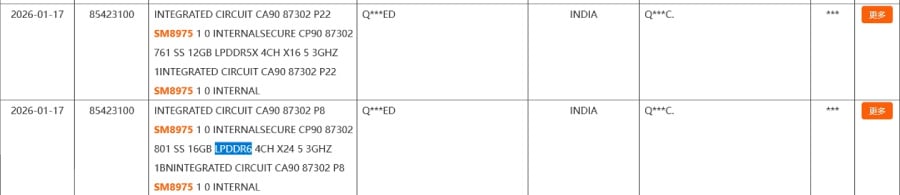
New Casio Edifice EFR-575 Chronograph Watches Arrive in Europe with Gradient Dial Models

Casio has introduced three new additions to its Edifice EFR-575 series in Europe, continuing to build on the lineup launched last year. The latest models include the EFR-575C-8A, EFR-575D-4A, and EFR-575CL-5A, each offering different finishes while retaining the same underlying specifications.

Casio Edifice EFR-575D-4A

All three watches share a stainless steel case that measures 47.9 mm in diameter. The dial uses a standard analog layout with hour, minute, and second hands, and is rated for accuracy within ±20 seconds per month. Additional features include a date display, a 24-hour indicator, and dedicated sub-dials for tracking stopwatch minutes and seconds.

EFR-575C-8A
EFR-575CL-5A
Casio Edifice EFR-575D-4A
EFR-575D-4A

The design follows the Edifice range’s motorsport-inspired approach. Each model is equipped with a domed crystal and a slim metal bezel. On the right side of the case, three pushers are used to operate the chronograph. The watches also offer water resistance up to 10 bar, making them suitable for everyday wear and light water use.

Power is supplied by an SR920SW battery, which is expected to last around two years. The overall focus remains on traditional timekeeping with basic chronograph functions, rather than connected or smart features. Casio has not confirmed any plans for availability outside Europe, including a release in the United States.

In terms of variants, the EFR-575C-8A comes with a gray gradient dial and a silver-tone case and strap. The EFR-575D-4A uses a purple-to-black gradient dial with the same metal finish. The EFR-575CL-5A looks a bit more premium, with a brown gradient dial, a gold-tone case, and a brown leather strap. Pricing starts at €129 for the EFR-575C-8A and EFR-575D-4A, while the EFR-575CL-5A is priced at €149 in markets like the Netherlands, Spain, and Germany.

For more daily updates, please visit our News Section.

Don’t miss a thing! Join our Telegram community for instant updates and grab our free daily newsletter for the best tech stories!

(via: Notebookcheck)

The post New Casio Edifice EFR-575 Chronograph Watches Arrive in Europe with Gradient Dial Models appeared first on Gizmochina.

Ayaneo to discontinue some handhelds amid rising costs

Ayaneo has issued a new update for its handheld lineup, and it’s not exactly great news for buyers. The company says prices for several models are set to go up soon, while a few others could disappear altogether once current stock runs out. Like many in the industry right now, Ayaneo is dealing with rising memory and storage costs, and it’s starting to show.

In a post shared on its Discord server, Ayaneo outlined the situation across multiple devices. Some of the affected models are fairly recent too, which makes the timing a bit unusual.

The Pocket Vert, for example, is already running low on stock and won’t be restocked once it sells out. The Pocket S Mini is in a similar position, though slightly more abrupt. It only launched earlier this year, but production has already stopped. What’s left will be sold, and that’s it. The company also confirmed that the free Pocket Air Mini units offered as compensation for the smaller battery will no longer be available after April 1, 2026.

There’s also a limited update on the Pocket DS. Around 200 units are up for pre-order again, with shipping expected in mid-April. Beyond that, Ayaneo isn’t committing to more batches, so availability could be short-lived.

Things are a bit more mixed under the Konkr branding. The Pocket Fit Gen 3 and Pocket Fit 8 Elite are still in play, but with some changes. The Snapdragon 8 Elite version, which had seen delays, is finally shipping. Once current orders are done, Ayaneo plans to relaunch it in phases. The Snapdragon 8 Gen 3 variant, however, is already gone from the official store.

The Konkr Fit, which is the first Windows-based model in that lineup, is still open for pre-orders. It was initially planned as a limited run, but Ayaneo now says production will depend on demand instead.

There’s no clear word yet on how much prices will increase, or whether other models will be affected. But given the broader spike in DRAM and storage costs, it wouldn’t be surprising if more changes follow.

Don’t miss a thing! Join our Telegram community for instant updates and grab our free daily newsletter for the best tech stories!

For more daily updates, please visit our News Section.

The post Ayaneo to discontinue some handhelds amid rising costs appeared first on Gizmochina.

Samsung Galaxy Book 6 Series Announced in India with AMOLED Displays, RTX 5070, Galaxy AI

Samsung has launched the Galaxy Book 6 series in India with three models: Galaxy Book 6 Ultra, Galaxy Book 6 Pro, and Galaxy Book 6. The new lineup focuses on updated design, AMOLED displays, Intel Core Ultra processors, and built-in Galaxy AI features.

Galaxy Book 6 Ultra
Galaxy Book 6 Ultra

The series comes with a redesigned chassis and updated internal layout. Samsung has added a wider vapor chamber, thinner fans, and a revised hinge system to improve cooling while keeping the laptops slim. The Galaxy Book 6 Ultra measures 15.4mm in thickness, while the Galaxy Book 6 Pro 16-inch comes in at 11.9mm. The laptops use a two-tone backlit keyboard across all models. The Ultra and Pro include a haptic touchpad, while the standard Galaxy Book 6 uses a clickpad.

Galaxy Book 6 Pro

On the display side, the Galaxy Book 6 Ultra features a 16-inch touch AMOLED panel with WQXGA+ resolution of 2880 × 1800 and peak brightness up to 1000 nits. The Galaxy Book 6 Pro is available in 14-inch and 16-inch touch AMOLED displays with anti-reflective coating. The standard Galaxy Book 6 uses IPS panels with a WUXGA resolution of 1920 × 1200 and 350 nits brightness. AMOLED models support adaptive refresh rates from 30Hz to 120Hz, Vision Booster, True Bright certification, and low black levels. Gorilla Glass with DXC is used to reduce reflections.

Performance is powered by Intel Core Ultra Series 3 processors under the Intel Evo platform. Options include Core Ultra 5, 7, and X7 variants, with up to 16 CPU cores. Each chip includes an Intel NPU delivering up to 50 TOPS for AI workloads. The Galaxy Book 6 Ultra also includes an NVIDIA GeForce RTX 5070 Laptop GPU with 8GB GDDR7 memory. The Pro models use Intel Arc or integrated graphics, while the standard Book 6 uses Intel Graphics.

Galaxy Book 6

The Galaxy Book 6 Ultra comes with 32GB LPDDR5X RAM and a 1TB PCIe SSD with expansion support. The Pro models offer 16GB or 32GB LPDDR5X RAM with 512GB or 1TB SSD options, with expansion support on the 16-inch model. The standard Book 6 also supports 16GB or 32GB RAM with 512GB or 1TB SSD, with expansion available on the 14-inch model.

Battery capacity on the Ultra is 80.2Wh, with support for 100W USB Type-C charging on the integrated model and 140W on the discrete GPU version. The Pro models include 67.18Wh for the 14-inch and 78.07Wh for the 16-inch, both with 65W charging. The standard Book 6 uses a 61.2Wh battery with 45W charging. Samsung claims up to 30 hours of video playback under typical usage. The Ultra supports fast charging up to 63 percent in around 30 minutes.

Audio on the Ultra includes a six-speaker system with Dolby Atmos, using four woofers and two tweeters. The Pro 16-inch uses quad speakers, while the 14-inch model uses stereo speakers. The standard Book 6 also includes stereo speakers. All models include dual-array microphones and a 2MP 1080p webcam.

Connectivity includes Wi-Fi 7 and Bluetooth 5.4 on the Ultra and Pro models, while the standard Book 6 supports Wi-Fi 6E and Bluetooth 5.4. Ports on the Ultra and Pro include two Thunderbolt 4 ports, one USB Type-A port, HDMI 2.1 with support for 8K at 60Hz and 5K at 120Hz, a microSD slot, and a headphone and microphone combo jack. The Book 6 includes two USB Type-C ports, two USB Type-A ports, HDMI, microSD, RJ45, and a security lock slot. The laptops run Windows 11 Home and include Samsung Knox security along with secured-core PC support.

Samsung has also integrated Galaxy AI features such as AI Select, AI Cut Out, Note Assist, and Natural Language Search. Cross-device features include Multi Control, Second Screen, Link to Windows, and Storage Share.

Pricing & availability

The Galaxy Book 6 series is available in Gray and Silver through Samsung’s official website, retail stores, and authorized partners. Pricing starts at Rs. 1,27,990 for the Galaxy Book 6, Rs. 1,78,990 for the Galaxy Book 6 Pro, and Rs. 2,42,990 for the Galaxy Book 6 Ultra with 32GB RAM and 1TB storage. Launch offers include up to 24-month no-cost EMI, cashback up to Rs. 5000 on Ultra and Pro models, Rs. 2000 on the standard model, and student discounts up to 10 percent.

For more daily updates, please visit our News Section.

Stay ahead in tech! Join our Telegram community and sign up for our daily newsletter of top stories.

The post Samsung Galaxy Book 6 Series Announced in India with AMOLED Displays, RTX 5070, Galaxy AI appeared first on Gizmochina.
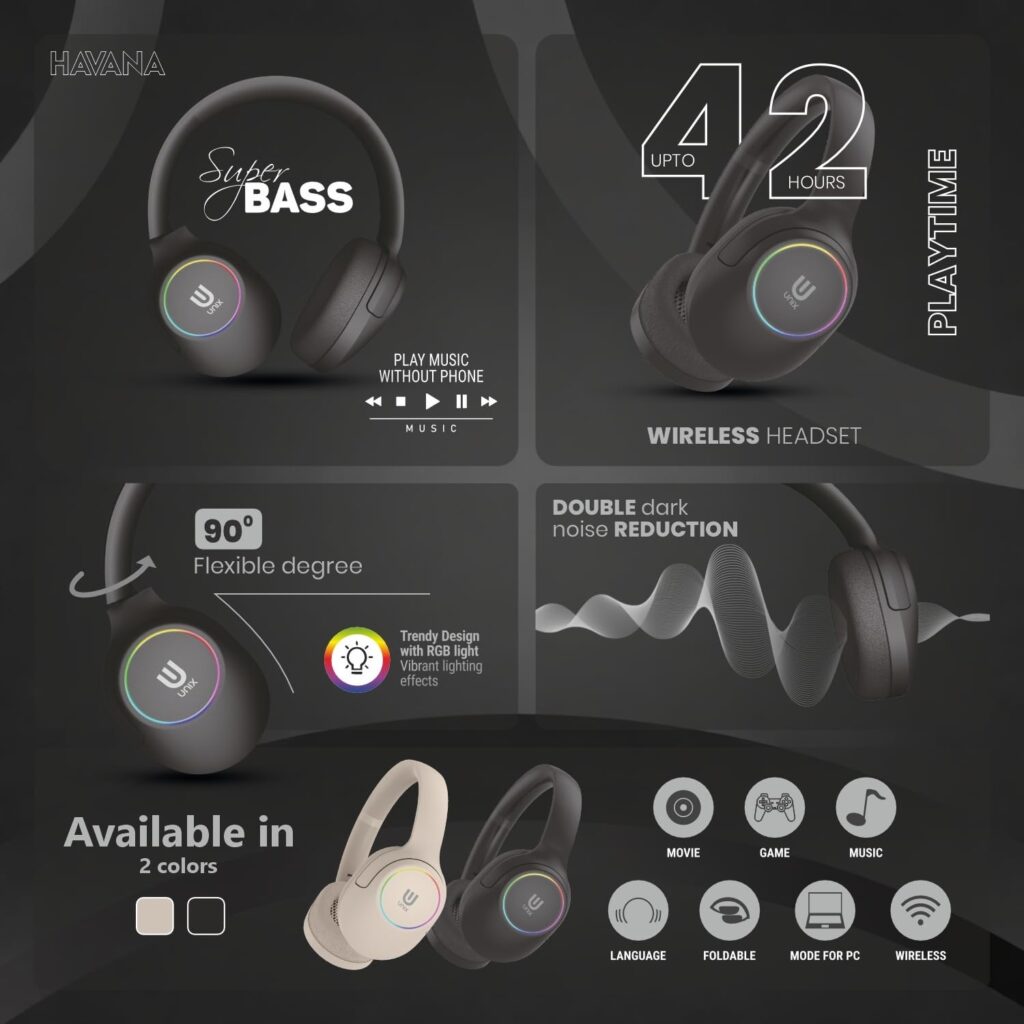
Tecno Spark 50 5G debuts with Dimensity 6400 chip, 6,500mAh battery, and Pixel-like camera design

Tecno has launched the Spark 50 5G in India, adding another option to the already crowded budget 5G segment. This one leans heavily on battery life and practical features rather than trying to stand out with flashy specs, which, for this price range, probably makes sense.

The phone comes with a 6.78-inch HD+ LCD display and a 120Hz refresh rate. It’s still 720p, so sharpness isn’t the highlight here, but the higher refresh rate should make everyday use feel smoother. Tecno is also claiming up to 560 nits of brightness, which should be just about enough for outdoor visibility in most cases.

Performance is handled by the MediaTek Dimensity 6400, a 6nm chip that’s fairly common in entry-level 5G phones right now. It’s paired with either 4GB or 6GB RAM and 128GB storage, with a microSD slot if you need more space. It’s not built for heavy gaming, but for regular use like calling, messaging, watching YouTube, and making online payments, it should be more than enough.

The biggest talking point, however, is the battery. Tecno has gone with a 6,500mAh unit, which is on the larger side even for budget phones. It supports 45W fast charging, so while the battery is big, topping it up shouldn’t take forever. For users who don’t like carrying a charger around, this could be a real advantage.

Cameras are pretty straightforward. There’s a single 50MP rear sensor and an 8MP front camera. No extra lenses, no gimmicks, just the basics. It should do okay in good lighting, but expectations should be realistic. That said, one thing that helps it stand out is the Pixel-like pill-shaped camera island. It gives the phone a more premium look, and for many buyers, design plays a big role as long as the basics are covered.

The phone also gets an IP64 rating and MIL-STD-810H certification. It adds a bit of reassurance if the phone takes the occasional drop or gets exposed to splashes.

Pricing and availability:

The Spark 50 5G starts at ₹16,999 for the 4GB variant and goes up to ₹18,999 for 6GB RAM. Sales begin April 3 via Amazon and Flipkart.

Overall, it feels like a very straightforward device. Big battery, decent performance, and just enough features to cover daily needs.

(Source: Tecno)

The post Tecno Spark 50 5G debuts with Dimensity 6400 chip, 6,500mAh battery, and Pixel-like camera design appeared first on Gizmochina.

OnePlus Nord CE6 real-life photo surfaces revealing new camera design

OnePlus looks set to expand its Nord lineup in India soon, with more models expected after the upcoming Nord 6. The company has already confirmed that the Nord 6 will launch on April 7, 2026. Now, a leak from tipster @stufflistings suggests the Nord CE6 and Nord CE6 Lite could follow in May.

Alongside the timeline, the tipster also shared what appears to be a live image of the Nord CE6. The phone is shown in a matte black finish with a fairly clean rear panel and a dual-camera setup inside a squircle-shaped module.

Specs are still mostly unclear, but earlier reports hint that the device could be related to the OnePlus Turbo 6V, which launched in China earlier this year. That phone comes with a 6.78-inch AMOLED display, 144Hz refresh rate, Snapdragon 7s Gen 4, and a notably large 9,000mAh battery. If OnePlus follows a similar setup here, it would be a noticeable step up from the previous generation.

For context, last year’s Nord CE model used a 120Hz panel, a MediaTek chip, and a smaller battery. So even a partial upgrade would make a difference.

The Nord CE6 Lite, meanwhile, is expected to sit a tier below. It will likely target buyers looking for a more affordable option, similar to how the Nord CE4 Lite was positioned.

Taken together, the lineup looks fairly spread out this year. The Nord 6 is expected to focus more on performance, while the CE6 models should cover the mid-range and budget-friendly segments.

There’s still no official word on pricing or full specifications. But if the May timeline holds, teasers could start not long after the Nord 6 launch.

With brands like Xiaomi, Realme, and Motorola pushing aggressively in this space, OnePlus doesn’t have much room to slow down.

Stay ahead in tech! Join our Telegram community and sign up for our daily newsletter of top stories!

For more daily updates, please visit our News Section.

(Source: @stufflistings)

The post OnePlus Nord CE6 real-life photo surfaces revealing new camera design appeared first on Gizmochina.
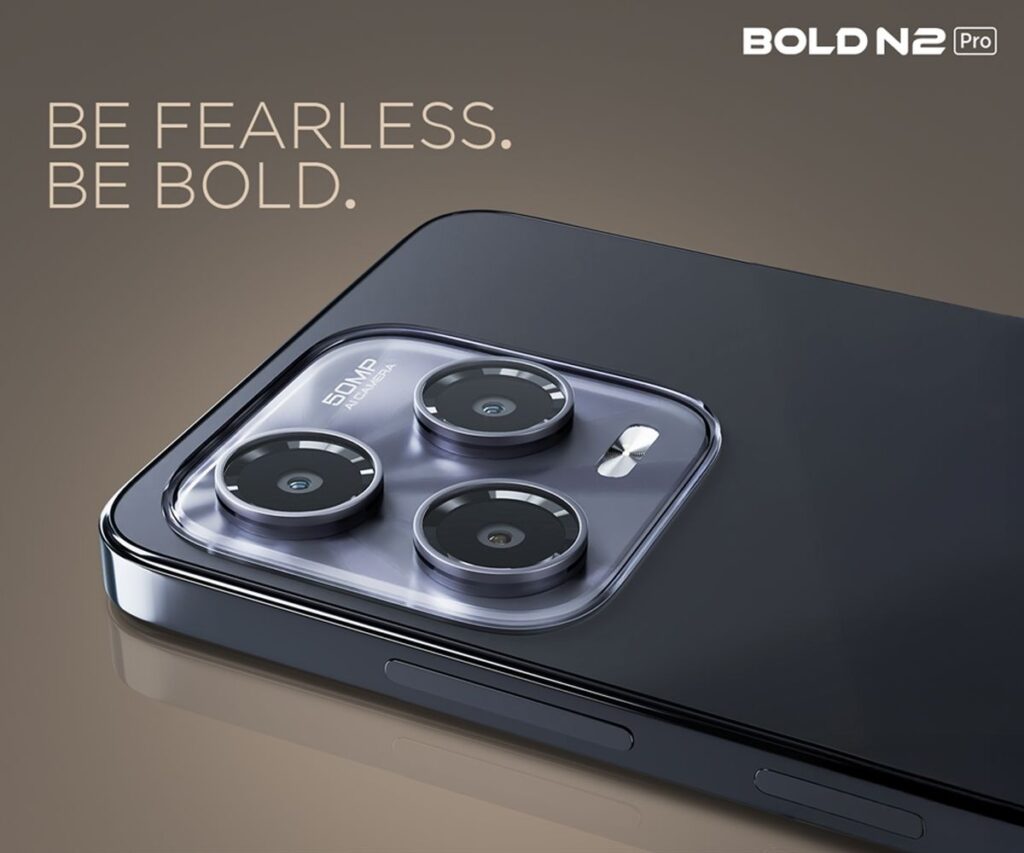
Redmi 15A 5G launches in India with Unisoc T8300 chip, 6300mAh battery, 120Hz display

Xiaomi has quietly added another budget option to its lineup in India with the Redmi 15A 5G. It’s not trying to do anything flashy, and that’s kind of the point. This one is clearly meant for people who just want a dependable phone with 5G, without spending too much.

At the center of it is the Unisoc T8300 chip. It’s built on a 6nm process and should be fine for basic tasks like calls, messaging, online payments, and some light multitasking. Nothing particularly exciting here, but it doesn’t need to be. You get 4GB or 6GB RAM options, along with up to 128GB storage, and there’s a microSD slot if that matters to you.

The battery is probably the main highlight. It’s a 6,300mAh unit, which is quite large even by today’s standards. Xiaomi is claiming up to two days of use, which sounds reasonable if you’re not pushing it too hard. Charging is limited to 15W though, so it will take its time. There’s also reverse wired charging, which is a small but useful addition.

The display is big, 6.9 inches, with a 120Hz refresh rate. It’s still HD+, so it won’t look as sharp as some others, but the smoother scrolling does help a bit in daily use. Brightness tops out at 800 nits, which should be manageable outdoors.

Cameras are kept simple. There’s a single 32MP sensor at the back and an 8MP camera on the front. It should handle basic shots fine, especially in daylight, but that’s about it.

It runs HyperOS 3.0 based on Android 16, and Xiaomi is promising four major updates, which is actually quite good for this price range.

The Redmi 15A 5G starts at ₹12,999 and goes up to ₹16,499, with sales beginning April 3. It comes in Black, Blue, and Pink.

Overall, it feels like a phone that knows exactly what it’s trying to be. Nothing extra, just the basics covered.

Stay ahead in tech! Join our Telegram community and sign up for our daily newsletter of top stories!

For more daily updates, please visit our News Section.

(Source: Xiaomi)

The post Redmi 15A 5G launches in India with Unisoc T8300 chip, 6300mAh battery, 120Hz display appeared first on Gizmochina.
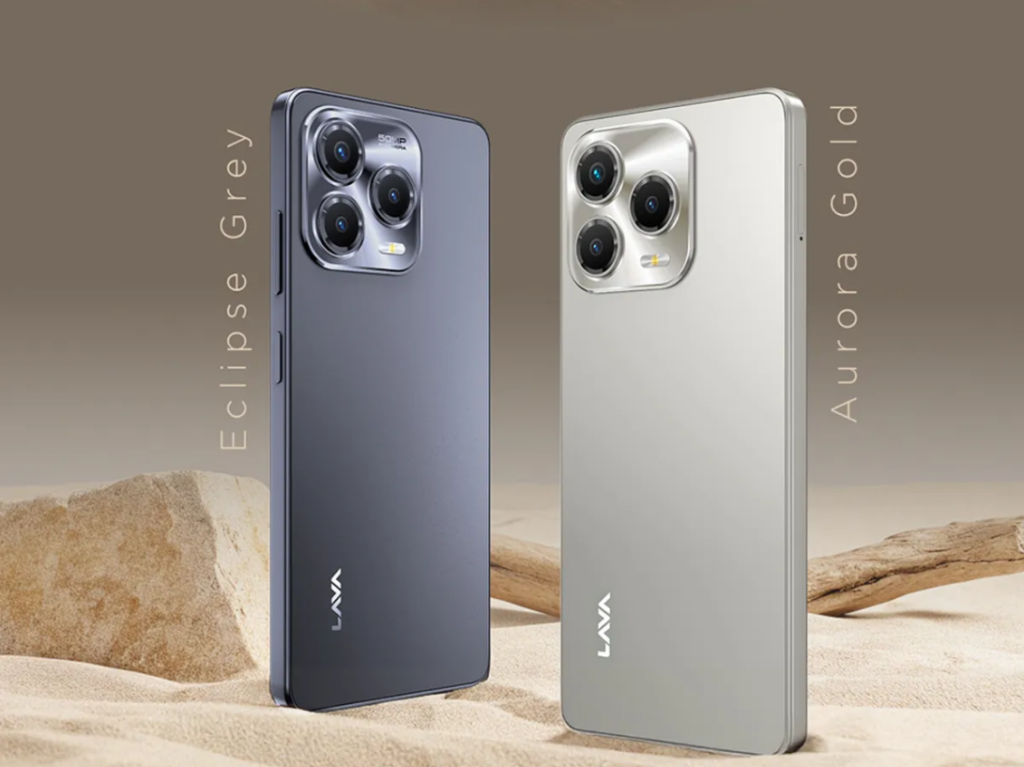
OnePlus 15T vs iQOO Neo 10 Full Comparison: Specs, Camera, Battery & Price

Flagship power is no longer reserved for flagship prices, and this comparison proves it. The OnePlus 15T brings cutting-edge performance, premium build, and advanced camera tech, while the iQOO Neo 10 pushes aggressive value with high-end specs at nearly half the price. One aims to deliver a refined flagship experience, the other focuses on raw performance and speed without breaking the bank. This isn’t just a spec battle, it’s a clash between premium polish and unbeatable value.

Major Features:

FeatureOnePlus 15TiQOO Neo 10Winner
Build & ProtectionGlass front, aluminum frame, IP68/IP69KGlass front, plastic build, IP65OnePlus – Better materials + stronger protection
Display (Refresh Rate)165Hz144HzOnePlus – Smoother experience
Display (Brightness)3600 nits peak4400 nits peakiQOO – Higher peak brightness
Display FeaturesDolby Vision, HDR10+, HDR VividHDROnePlus – More advanced HDR support
ChipsetSnapdragon 8 Elite Gen 5 (3nm)Snapdragon 8s Gen 4 (4nm)OnePlus – Newer & more advanced node
GPUAdreno 840Adreno 825OnePlus – More powerful GPU
Storage OptionsUp to 1TBUp to 512GBOnePlus – Higher max storage
Rear Camera Setup50MP (wide) + 50MP (telephoto 3.5x)50MP (wide) + 8MP (ultrawide)OnePlus – Telephoto adds better zoom capability
Video Recording8K, 4K@120fps, Dolby Vision4K@60fpsOnePlus – Higher resolution & advanced video
Selfie Camera16MP, 1080p32MP, 4KiQOO – Higher resolution + better video
Battery7500mAh7000mAhOnePlus – Larger battery
Charging100W wired + 50W wireless120W wirediQOO – Faster wired charging
Wireless ChargingYesNoOnePlus – Supports wireless charging
Bluetooth6.05.4OnePlus – Newer version
Fingerprint SensorUltrasonicOpticalOnePlus – More advanced tech
Price₹58,000 (~$600)₹33,000 (~$400)iQOO – Much more affordable

Please Note: When you buy something using the links in our articles, we may earn a small commission at no cost to you.

Design and Display

Build and Feel

The OnePlus 15T clearly leans toward a more premium feel with its aluminum frame and stronger IP68/IP69K protection, making it more durable in real-world conditions. The iQOO Neo 10, while solid, uses a plastic frame and offers only IP65 protection, which feels less reassuring at this price tier. The OnePlus device also supports eSIM, adding a layer of flexibility that’s becoming increasingly useful. Overall, the OnePlus 15T feels like a flagship, whereas the iQOO feels more performance-focused than premium.

Display Quality

The iQOO Neo 10 offers a larger and brighter display with a higher peak brightness, making it more immersive for content consumption and outdoor visibility. However, the OnePlus 15T counters with a smoother 165Hz refresh rate and stronger HDR support including Dolby Vision, which enhances streaming quality. The slightly sharper panel also gives it a cleaner look in daily use. One feels cinematic, the other feels more refined.

Verdict

The iQOO wins on size and brightness, but the OnePlus 15T delivers a more premium build and balanced display experience.

Specifications Including Battery

Performance

The OnePlus 15T is powered by the newer Snapdragon 8 Elite Gen 5, delivering significantly better raw performance and efficiency compared to the Snapdragon 8s Gen 4 on the iQOO Neo 10. This translates into smoother multitasking, better sustained gaming, and more future-proof performance. The difference isn’t just on paper—it’s noticeable in heavy workloads where the OnePlus feels more stable and faster over time.

Battery and Charging

The OnePlus 15T packs a larger 7500mAh battery, which should easily last longer in real-world usage. It also supports wireless charging, something missing on the iQOO. However, the iQOO Neo 10 takes the lead in charging speed with 120W fast charging, making it extremely quick to top up. The inclusion of bypass charging is also a big plus for gamers. One prioritizes endurance, the other prioritizes speed.

Verdict

The OnePlus 15T wins for performance and battery longevity, while the iQOO Neo 10 appeals to users who value ultra-fast charging.

Camera

Main and Secondary Lenses

The OnePlus 15T clearly has the more versatile camera setup with a 50MP main sensor paired with a 50MP telephoto lens offering 3.5x optical zoom. This gives it a major advantage in portrait and zoom photography. The iQOO Neo 10, on the other hand, includes an 8MP ultrawide camera, which is useful but less impactful overall. Additionally, OnePlus supports 8K recording and Dolby Vision HDR, pushing it ahead for video capabilities.

Selfie Camera

The iQOO Neo 10 features a higher-resolution 32MP front camera with 4K video support, making it better suited for selfies and vlogging. The OnePlus 15T’s 16MP selfie camera is more basic and limited to 1080p video, which feels slightly outdated at this level.

Verdict

The OnePlus 15T dominates in rear camera versatility and video, while the iQOO Neo 10 is better for selfie-focused users.

Pricing

OnePlus 15T is priced at around ₹58,000, while the iQOO Neo 10 comes in significantly lower at around ₹33,000. This creates a massive price gap, positioning the iQOO as a value-driven performance phone and the OnePlus as a premium flagship alternative. The difference isn’t small; it fundamentally changes which audience each phone targets.

Value for Money

iQOO Neo 10 offers exceptional value, delivering strong performance, a great display, and ultra-fast charging at a much lower price. It feels like a performance bargain. However, the OnePlus 15T justifies its higher price with better build quality, superior chipset, wireless charging, and a more advanced camera system. It feels more complete and future-ready.

Verdict

The iQOO Neo 10 is the clear value winner, while the OnePlus 15T justifies its price for those wanting a flagship-level experience.

Disclaimer:
Prices are approximate and may vary based on country, region, and applicable taxes.

Conclusion

The OnePlus 15T stands out with its flagship-grade chipset, premium build, wireless charging, and telephoto camera, making it a well-rounded high-end device. Meanwhile, the iQOO Neo 10 focuses on delivering top-tier performance, extremely fast charging, and a large immersive display at a much more accessible price. Each device targets a different kind of user, one aiming for refinement, the other for aggressive value.

Verdict

OnePlus 15T is the better overall phone with flagship features and long-term usability. However, the iQOO Neo 10 is hard to ignore for its price, offering incredible performance and features for the money. The smarter buy depends on priorities, premium experience or maximum value.

Read More:

The post OnePlus 15T vs iQOO Neo 10 Full Comparison: Specs, Camera, Battery & Price appeared first on Gizmochina.
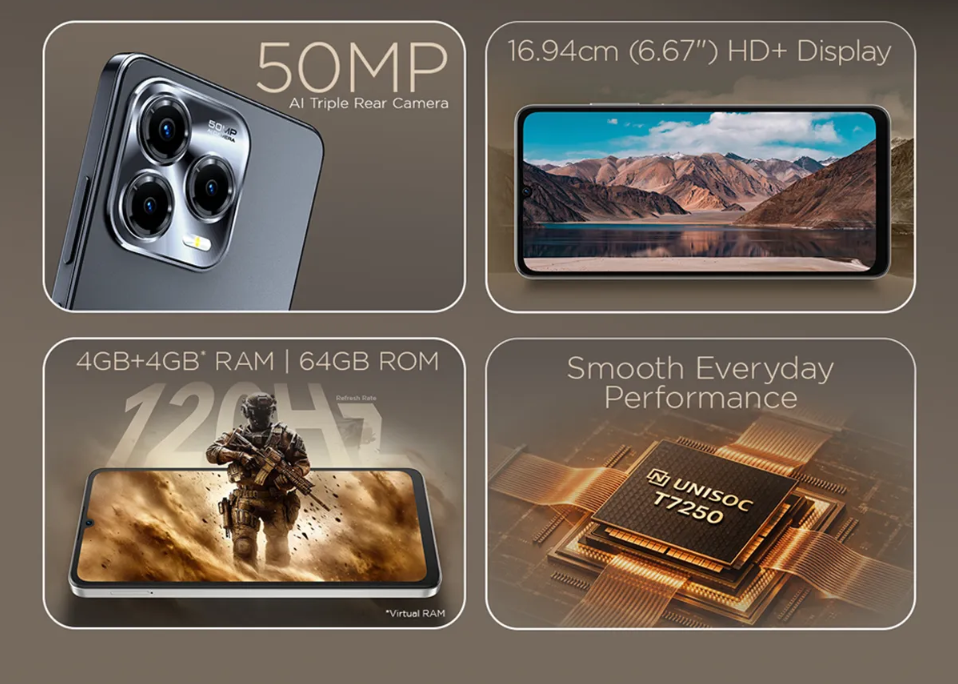
Samsung begins work on Exynos 2800 for Galaxy S28

Early work on the Exynos 2800 is reportedly underway, and this is the processor expected to power the Galaxy S28 lineup in 2028. It’s still early days, but the direction Samsung is taking is starting to become clearer.

According to a report from Korea, the company wants to wrap up the design of the Exynos 2800, codenamed Vanguard, sometime in 2026. After that, it will be handed over to Samsung’s foundry division for production. The chip is expected to be built on the company’s third-generation 2nm process, referred to as SF2P+.

Samsung had earlier plans to move more aggressively toward a 1.4nm process around 2027, but that no longer seems to be the priority. Instead, the focus now is on improving yields and making sure the process is stable enough before pushing further. The 1.4nm node is now expected to arrive later, possibly closer to 2029.

This change doesn’t come as a huge surprise. Shrinking chip sizes every year is getting harder, and the gains aren’t always as straightforward as they used to be. Samsung now seems to be leaning more on design and manufacturing working closely together, rather than just chasing smaller numbers on paper.

The upcoming Exynos 2700, which is also expected to use a 2nm process, is said to be progressing smoothly. That probably gives Samsung some confidence that this approach is working, at least for now.

For Samsung, this is about more than just hitting a new node. Previous Exynos chips haven’t always matched Snapdragon in areas like efficiency and heat management. Focusing on stability and optimization could help narrow that gap.

There’s still no word on CPU or GPU details for the Exynos 2800, which isn’t surprising this far out. But if things go according to plan, the Galaxy S28 could end up benefiting from a more refined and balanced chip than what we’ve seen in the past.

Don’t miss a thing! Join our Telegram community for instant updates and grab our free daily newsletter for the best tech stories!

For more daily updates, please visit our News Section.

(Source)

The post Samsung begins work on Exynos 2800 for Galaxy S28 appeared first on Gizmochina.

OnePlus 15T vs iPhone 17: Big Battery vs Big Brand

oneplus vs apple

OnePlus 15T and iPhone 17 take two very different approaches; one focuses on raw power, battery, and aggressive specs, while the other delivers refinement, ecosystem strength, and long-term consistency. This comparison matters because both target premium users but prioritize completely different experiences, making the choice less about specs and more about what actually fits everyday usage. 

Major Features:

FeatureOnePlus 15TiPhone 17Winner
Build & ProtectionIP68/IP69K, aluminum + fiber backIP68, Ceramic Shield 2OnePlus – better durability rating
DisplayAMOLED, 165Hz, 3600 nits peakLTPO OLED, 120Hz, 3000 nits peakOnePlus – smoother & brighter
ChipsetSnapdragon 8 Elite Gen 5Apple A19iPhone – better optimization & efficiency
RAM & StorageUp to 16GB RAM, 1TB UFS 4.18GB RAM, up to 512GB NVMeOnePlus – more RAM & storage options
Main Camera50MP (wide) + 50MP telephoto (3.5x)48MP (wide) + 48MP ultrawideTie – zoom vs ultrawide preference
Video Recording8K, 4K 120fps4K Dolby Vision (better processing)iPhone – superior video quality
Selfie Camera16MP18MP + 3D sensoriPhone – better features & video
Battery7500mAh3692mAhOnePlus – massive advantage
Charging100W wired, 50W wirelessSlower wired, 25W wirelessOnePlus – much faster charging
ConnectivityWi-Fi 7, IR blaster, advanced codecsWi-Fi 7, UWB, satelliteiPhone – more premium features
SecurityUltrasonic fingerprintFace IDiPhone – more seamless & secure
Price$600 / ₹58,000$800 / ₹83,000OnePlus – far better value

Please Note: When you buy something using the links in our articles, we may earn a small commission at no cost to you.

Design and Display

Build and Feel

The OnePlus 15T leans toward a practical flagship feel with its aluminum frame and fiber-backed design, offering durability without going overly premium. It also brings IP68/IP69K protection, giving it an edge in rugged use cases. The iPhone 17, on the other hand, sticks to Apple’s refined glass-and-aluminum build with Ceramic Shield 2, delivering a more premium in-hand feel and tighter finishing. It feels more polished overall, though slightly less aggressive in durability claims.

Display Quality

OnePlus pushes boundaries with a 165Hz AMOLED panel, higher peak brightness, and advanced PWM dimming, making it smoother and more eye-friendly. The iPhone’s 120Hz LTPO display is more color-accurate and consistent, with excellent HDR tuning and anti-reflective coating. It looks more natural, while OnePlus looks more vibrant and punchy.

Verdict

OnePlus wins for sheer display specs and smoothness, but the iPhone feels more refined and balanced for everyday viewing.

Specifications Including Battery

Performance

The OnePlus 15T runs on the Snapdragon 8 Elite Gen 5, delivering top-tier Android performance with aggressive clock speeds and strong GPU output. It feels built for gaming and sustained workloads. The iPhone 17’s A19 chip, however, focuses on efficiency and real-world fluidity. It may not chase peak numbers, but it consistently delivers smoother app optimization and longer-term performance stability.

Battery and Charging

Battery is where OnePlus clearly dominates with a massive 7500mAh cell, paired with 100W wired and 50W wireless charging. It is designed for heavy users who hate charging anxiety. The iPhone’s smaller battery is optimized well, but charging speeds remain conservative, even with MagSafe improvements.

Verdict

OnePlus is the clear winner for power users and battery life, while the iPhone focuses more on efficiency and consistency.

Camera

Main and Secondary Lenses

The OnePlus 15T offers a versatile setup with a 50MP main sensor and a dedicated telephoto lens with 3.5x optical zoom, making it more flexible for zoom shots. The iPhone 17 counters with a 48MP main sensor and a 48MP ultrawide, focusing on consistency and color science rather than zoom reach. Apple’s processing tends to produce more natural tones, while OnePlus leans slightly toward sharper and more contrast-heavy results.

Selfie Camera

The iPhone pulls ahead with a more advanced selfie system, including autofocus and depth sensing for Face ID, along with better video capabilities like 4K Dolby Vision. OnePlus keeps it simpler with a decent but less advanced front camera.

Verdict

iPhone wins for overall camera reliability and video, while OnePlus offers better zoom flexibility.

Pricing

OnePlus 15T is priced around $600 (₹58,000), while the iPhone 17 sits significantly higher at $800 (₹83,000). This creates a clear gap in positioning, with OnePlus targeting value flagship buyers and Apple aiming at premium users.

Value for Money

OnePlus delivers aggressive specs for the price, especially in battery, charging, and display. It feels like a performance-first device built to overdeliver. The iPhone, despite the higher price, justifies itself through ecosystem integration, long-term software support, and consistent user experience. It may not win on paper, but it often feels more complete in daily use.

Verdict

OnePlus offers better raw value, while iPhone justifies its price through refinement and ecosystem advantages.

Disclaimer:
Prices are approximate and may vary based on country, region, and applicable taxes.

Conclusion

The OnePlus 15T stands out with its massive battery, ultra-fast charging, high refresh rate display, and telephoto zoom, features that directly impact heavy usage. It feels designed for users who prioritize performance and endurance. The iPhone 17, meanwhile, focuses on ecosystem features like Face ID, Ultra Wideband, satellite connectivity, and long-term software updates. These features may not seem flashy, but they add meaningful convenience over time.

Verdict

OnePlus 15T is the better pick for power users and value seekers, offering more hardware for less money. The iPhone 17 suits those who prefer a polished, reliable, and ecosystem-driven experience that stays consistent over the years.

Read More:

The post OnePlus 15T vs iPhone 17: Big Battery vs Big Brand appeared first on Gizmochina.

OnePlus 15T vs Xiaomi 17: Same Chip, ₹30K ($400) Difference – Is Xiaomi Overpriced?

oneplus vs xiaomi

Flagship smartphones are no longer just about raw power; they’re about how that power is packaged, priced, and experienced daily. The OnePlus 15T and Xiaomi 17 take two very different approaches despite sharing the same core chipset. One pushes boundaries with battery and smoothness, while the other leans into premium design and camera versatility. This comparison breaks down where each device truly stands, and more importantly, which one actually makes more sense depending on what matters most.

Please Note: When you buy something using the links in our articles, we may earn a small commission at no cost to you.

Major Features:

FeatureOnePlus 15TXiaomi 17Winner
Build QualityIP68/IP69K, fiber backIP68, glass backoneplus – better durability
Display Refresh Rate165Hz AMOLED120Hz LTPO AMOLEDoneplus – smoother scrolling
Display Quality1B colors68B colors, better HDRxiaomi – richer visuals
Brightness3600 nits peak3500 nits peakoneplus – slightly brighter
PerformanceSnapdragon 8 Elite Gen 5Sametie – identical chipset
SoftwareOxygenOSHyperOSoneplus – cleaner UI
Battery7500mAh6330/7000mAhoneplus – bigger capacity
Charging100W + 50W100W + 50Wtie – same speeds
Reverse Charging10W wired22.5W wired + wirelessxiaomi – more versatile
Main CameraDual 50MPTriple 50MPxiaomi – more flexible setup
Telephoto3.5x zoom2.6x zoomoneplus – better zoom
Selfie Camera16MP50MP (4K)xiaomi – sharper selfies
VideoDolby Vision10-bit, LOG, HDRxiaomi – more pro features
AudioStereoHi-Res, Snapdragon Soundxiaomi – better audio tech
USBUSB 2.0USB 3.2, Display outxiaomi – faster & more capable
Price$600 / ₹58K$1000 / ₹90Koneplus – much cheaper

Design and Display

Build and Feel

The OnePlus 15T focuses on durability with its IP68/IP69K rating and a practical fiber-reinforced back that prioritizes toughness over premium shine. It feels built for long-term use and harsher conditions. The Xiaomi 17, on the other hand, leans into flagship elegance with a glass back and refined finish, giving it a more premium in-hand feel. It looks and feels more luxurious, though slightly less rugged on paper.

Display Quality

OnePlus delivers a 165Hz AMOLED panel with aggressive brightness scaling and excellent motion smoothness, making it ideal for gaming and fast UI interactions. Xiaomi counters with an LTPO AMOLED panel featuring richer color depth, better HDR handling, and more efficient adaptive refresh. While OnePlus feels smoother, Xiaomi’s display appears more refined and visually cinematic.

Verdict

OnePlus 15T is the practical, durability-first choice with ultra-smooth visuals. Xiaomi 17 feels more premium and polished, especially for content consumption.

Specifications Including Battery

Performance

Both phones run the same Snapdragon 8 Elite Gen 5 chip, so raw performance is virtually identical. Daily tasks, gaming, and multitasking feel equally fast. However, software tuning differs; OxygenOS feels lighter and snappier, while HyperOS leans toward feature richness. One tends to feel cleaner, the other more versatile.

Battery and Charging

This is where the gap becomes obvious. OnePlus packs a massive 7500mAh battery, making it a clear endurance leader. It’s built for heavy users who want fewer charging cycles. Xiaomi’s 6330mAh (global) is still solid but less impressive in comparison. Both offer 100W wired and 50W wireless charging, but Xiaomi adds faster reverse charging options, which is a practical bonus.

Verdict

Performance is a tie, but the OnePlus 15T dominates battery life. Xiaomi 17 adds versatility with better reverse charging features.

Camera

Main and Secondary Lenses

Xiaomi 17 clearly targets photography enthusiasts with its triple 50MP setup, including an ultrawide and Leica tuning. It delivers more flexibility and richer image processing, especially in varied lighting. OnePlus 15T keeps it simpler with a dual-camera setup but still offers strong results, especially with its telephoto lens and consistent color science. Xiaomi feels more complete, while OnePlus feels more focused.

Selfie Camera

The difference is significant. Xiaomi’s 50MP selfie camera supports 4K video and produces sharper, more detailed shots. OnePlus sticks with a basic 16MP sensor, which is fine for casual use but lacks flagship appeal. This makes Xiaomi more suitable for content creators and video calls.

Verdict

Xiaomi 17 wins decisively with a more versatile camera system and a much stronger selfie experience.

Pricing

The OnePlus 15T is priced at around ₹58,000, while the Xiaomi 17 sits much higher at approximately ₹90,000. This creates a substantial gap, placing them in slightly different buyer segments despite similar core performance.

Is the price justified?

OnePlus delivers flagship-level performance, massive battery life, and a high-refresh display at a much more accessible price. It feels aggressively priced for what it offers. Xiaomi justifies its premium with a superior camera system, more refined display tuning, and flagship-grade build quality. However, the price jump is noticeable and may feel steep unless those extras are truly valued.

Verdict

OnePlus 15T offers significantly better value for money. Xiaomi 17 justifies its price, but only for users who prioritize cameras and a premium feel.

Conclusion

OnePlus 15T stands out with its massive battery, ultra-smooth 165Hz display, and rugged durability, making it ideal for power users and gamers. Xiaomi 17 differentiates itself with Leica-tuned cameras, a high-end display experience, and premium build quality that feels closer to ultra-flagship territory. One focuses on practicality and endurance, while the other leans toward refinement and imaging excellence.

Verdict

OnePlus 15T is the smarter buy for most users, offering flagship performance at a much lower price with unmatched battery life. Xiaomi 17 feels more premium and complete, but its higher price makes it a niche choice for those who truly value its camera and display advantages.

Read More:

The post OnePlus 15T vs Xiaomi 17: Same Chip, ₹30K ($400) Difference – Is Xiaomi Overpriced? appeared first on Gizmochina.
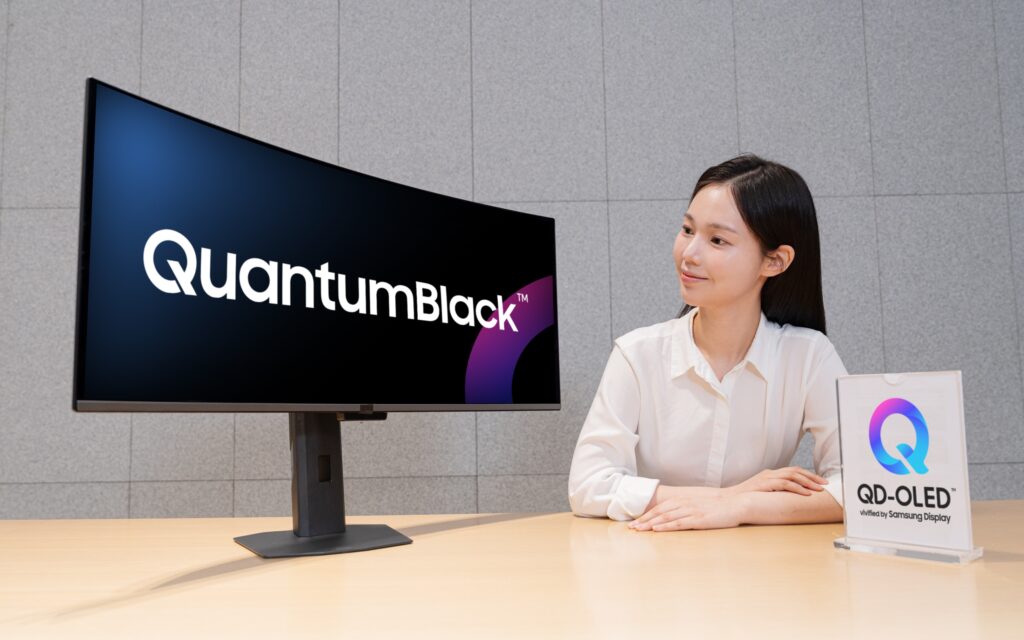
OnePlus 15T Deal Alert: Save $100 on This Powerful Flagship at Giztop

OnePlus 15T

OnePlus 15T is now available at a special first-sale discount on Giztop, making it a much more attractive deal for flagship buyers. Originally priced at $799, the device is currently available for $699, giving buyers a flat $100 discount. This limited-time offer makes the OnePlus 15T one of the most value-packed premium smartphones right now, especially considering its high-end specs and massive battery.

Flagship Performance with Snapdragon 8 Elite Gen 5

Under the hood, the OnePlus 15T is powered by the latest Qualcomm Snapdragon 8 Elite Gen 5 processor, ensuring top-tier performance for gaming, multitasking, and everyday use. Paired with 12GB or 16GB LPDDR5X Ultra Pro RAM, the phone delivers smooth app switching, fast loading times, and stable high frame rates. It also supports dual 5G connectivity, keeping you future-ready for faster networks.

Smooth Display and Premium Experience

The phone features a 6.32-inch 1.5K AMOLED LTPO display with an ultra-smooth 165Hz refresh rate, making scrolling and gaming incredibly fluid. With 1300 nits peak brightness and HDR10+ support, visuals look sharp and vibrant. Additional features like Reading Mode, Night Mode, and an in-display fingerprint sensor enhance the overall user experience.

Powerful Cameras with Periscope Zoom

For photography, the OnePlus 15T comes with a triple camera setup, including a 50MP Sony IMX890 main sensor and a standout 50MP LUMO 3.5X periscope telephoto lens. This setup allows for detailed shots and improved zoom capabilities. On the front, a 16MP selfie camera handles video calls and social media content with ease.

Massive Battery with Fast Charging

One of the biggest highlights is the 7500mAh battery, which easily lasts more than a day. It supports 100W fast wired charging and 50W wireless charging, ensuring you spend less time plugged in. Features like Ultra Power Saving Mode further extend battery life when needed.

Storage and Software

The device offers up to 1TB UFS 4.1 storage, providing plenty of space for apps, photos, and videos. It runs on ColorOS 16 with Dark Mode 2.0, offering a clean, customizable, and smooth software experience with support for multiple global languages.

Why This Deal Stands Out

At $699, the OnePlus 15T combines flagship performance, a massive battery, and premium features at a price that undercuts many rivals. The $100 launch discount makes it an especially compelling option for buyers looking to upgrade without paying full flagship pricing.


Read More:

The post OnePlus 15T Deal Alert: Save $100 on This Powerful Flagship at Giztop appeared first on Gizmochina.

Motorola is taking a bite out of Samsung’s foldable lead ahead of iPhone Fold launch

The foldable smartphone market in North America is starting to look more competitive. For years, Samsung has held a clear lead, but that gap is now shrinking.

According to a recent report from Counterpoint Research, foldable shipments in the region grew 28% year-over-year in 2025. Growth is still solid, but the bigger shift is in market share.

Samsung’s share reportedly fell from 65% in 2024 to around 51% in 2025. The company still leads overall and remains strong in book-style foldables, but competition in the clamshell segment has picked up.

A big part of that shift comes from Motorola. The brand saw strong demand for its Razr 60 series, helped by aggressive pricing and carrier deals. As a result, Motorola captured roughly 44% of the market, turning what used to be a one-sided space into a much closer race.

Google is also growing, though from a smaller base. Shipments rose 52% year-over-year, following the launch of the Pixel 10 Pro Fold in late 2025. Even so, its share is still estimated at around 5%.

All of this comes just ahead of Apple’s expected entry into foldables. The long-rumored iPhone Fold is widely tipped to arrive alongside the iPhone 18 series later this year, though availability could vary depending on the market.

Apple has taken its time with foldables, skipping the early phase when people were more concerned about the durability and reliability of the new form factor. By entering now, the company is stepping into a category that’s more mature and easier to sell to mainstream users.

Samsung, meanwhile, is said to be working on updates of its own, including a book-style foldable with a wider display. The goal appears to be staying competitive as new players, especially Apple, enter the space.

If these trends continue, 2026 could mark a turning point. What was once a Samsung-dominated category is starting to open up, and Apple’s arrival may push it further toward the mainstream.

Don’t miss a thing! Join our Telegram community for instant updates and grab our free daily newsletter for the best tech stories!

For more daily updates, please visit our News Section.

(Source: Counterpoint Research)

The post Motorola is taking a bite out of Samsung’s foldable lead ahead of iPhone Fold launch appeared first on Gizmochina.

DJI Avata 360 goes official: 8K 360° recording, 23-min flight time

DJI has stepped into the growing 360-degree FPV space with the new Avata 360, and it’s clearly aiming at creators who want more flexibility from their footage. The idea is simple on paper: capture everything in one go, then decide the framing later.

The Avata 360 uses a dual-lens setup with 1/1.1-inch square CMOS sensors. Each one has relatively large 2.4 μm pixels, which should help in tricky lighting. DJI claims up to 120MP stills and 8K 60fps HDR video in full 360 mode. There’s also a single-lens mode for more traditional 4K 60fps recording if you don’t need the full spherical view.

What makes this kind of camera interesting is what happens after shooting. Since the drone captures everything around it, you can reframe shots later, pick different angles, or even create multiple clips from a single flight. It’s not entirely new as a concept, but having it on a compact FPV drone does make it more usable in day-to-day shooting.

DJI is also bringing over its usual flight tech. The Avata 360 uses the O4+ transmission system, offering a 1080p 60fps live feed with a claimed range of up to 20km. There’s omnidirectional obstacle sensing as well, which should make flying a bit less stressful, especially in tighter environments. Features like ActiveTrack 360° and Spotlight Free are included too.

A few practical touches stand out. The front lens can be replaced if it gets damaged, there’s 42GB of built-in storage, and Wi-Fi 6 helps speed up file transfers. Flight time is rated at up to 23 minutes, and the drone weighs about 455 grams.

DJI launched the Avata 360 on March 26, with availability starting in China and wider rollout expected soon. Pricing sits around £409 or €459, which feels fairly aggressive for what’s being offered.

Stay ahead in tech! Join our Telegram community and sign up for our daily newsletter of top stories!

For more daily updates, please visit our News Section.

The post DJI Avata 360 goes official: 8K 360° recording, 23-min flight time appeared first on Gizmochina.

Oppo K15 Pro and K15 Pro+ chipsets revealed via Geekbench; RAM, storage, and color options officially confirmed

Oppo K15 Pro - Golden Legend

On April 1, Oppo will announce the Oppo K15 Pro and K15 Pro+ in China. Ahead of the launch, both phones are now listed for pre-orders through the company’s online store. The official listings have revealed their configurations and color options. At the same time, both devices have appeared on Geekbench, confirming their chipsets.

Oppo K15 Pro series configs, color options

Oppo K15 Pro - Cyber Wings
Oppo K15 Pro – Cyber Wings
Oppo K15 Pro - Origin Gray
Oppo K15 Pro – Origin Gray
Oppo K15 Pro - Photodust
Oppo K15 Pro – Photodust
Oppo K15 Pro - Golden Legend
Oppo K15 Pro – Golden Legend

The official images of the Oppo K15 Pro and K15 Pro+ show that both phones have an identical design. For those who don’t know, the K15 Pro will be a smaller device featuring a 6.59-inch screen, whereas the K15 Pro+ will have a larger 6.78-inch display.

The K15 Pro and K15 Pro+ will come in shades such as Cyber Wings, Origin Gray, and Photodust (pink). The Pro version will also be available in an additional Golden Legend color variant. Both phones will be offered in 12GB+256GB and 12GB+512GB configurations.

Both phones are also listed on Geekbench with model numbers PHM110 and PGM110, respectively. The previously seen TENAA listings revealed that these devices are powered by 3.40GHz octa-core and 3.73GHz octa-core chips, respectively.

Oppo K15 Pro Geekbench
Oppo K15 Pro Geekbench listing
Oppo K15 Pro+ Geekbench
Oppo K15 Pro+ Geekbench listing

The Geekbench listings confirm that these devices are powered by the Dimensity 8500 and Dimensity 9500s, respectively. Although the chipset names are not explicitly mentioned, the CPU and GPU details available in the listings are sufficient to confirm their identities. The listings further reveal that the K15 Pro series comes with 12GB of RAM and runs on Android 16.

Oppo K15 Pro+ - Cyber Wings
Oppo K15 Pro+ – Cyber Wings
Oppo K15 Pro+ - Origin Gray
Oppo K15 Pro+ – Origin Gray
Oppo K15 Pro+ - Photodust
Oppo K15 Pro+ – Photodust

Other reports suggest that the K15 Pro series will support a 1.5K resolution and up to a 165Hz refresh rate. Both phones are also expected to feature a built-in cooling fan, a 16-megapixel front camera, and a 50-megapixel + 8-megapixel dual-camera setup. The K15 Pro may house a 7,600mAh battery, while the Pro+ variant may feature an 8,000mAh battery, and both are likely to support 80W charging.

For more daily updates, please visit our News Section.

Stay ahead in tech! Join our Telegram community and sign up for our daily newsletter of top stories! 💡

(via 1, 2)

The post Oppo K15 Pro and K15 Pro+ chipsets revealed via Geekbench; RAM, storage, and color options officially confirmed appeared first on Gizmochina.

ANTHBOT M5 Smart Robot Lawn Mower Gets Massive Discount – Limited Time Amazon Deal

ANTHBOT M5 lawnmower

ANTHBOT M5 is a smart robotic lawn mower designed for small to medium-sized yards up to 0.15 acre. It focuses on convenience, precision, and automation, making lawn care easy even for beginners. With advanced AI vision and RTK positioning, it eliminates the need for perimeter wires and manual setup, offering a clean and modern mowing experience.

Deal & Availability

The ANTHBOT M5 is currently available with a massive limited-time discount on Amazon, making it a much more attractive buy. The mower has an original MSRP of $819, but it is now available at a reduced deal price of $679, offering solid savings. This special offer started on March 25, 2026, and will run until March 31, 2026. Since it’s a time-limited deal, availability may vary depending on stock, so interested buyers should act quickly to grab this smart robotic mower at a lower price.

Smart Navigation & Precision

This mower uses a dual AI vision system combined with RTK technology to achieve highly accurate positioning. It can map your lawn automatically in about 10 minutes without needing manual guidance. The dual-camera setup ensures stable performance even in complex garden layouts, while full signal coverage improves reliability across different areas of your yard.

Performance & Cutting

The ANTHBOT M5 delivers efficient mowing with support for slopes up to 45%, making it suitable for most residential lawns. It features adjustable cutting height from 1.2 to 2.7 inches and uses five free-rotating blades to give a smooth, carpet-like finish. Intelligent path planning allows users to select different mowing patterns through the app.

App Control & Multi-Zone Support

Using the ANTHBOT app, users can manage up to 20 zones, create no-go areas, and monitor mowing progress remotely. The mower also supports automatic charging and resumes work after recharging, ensuring uninterrupted operation.

Safety & Build

Equipped with dual HDR cameras, the M5 can recognize over 1,000 obstacles for better safety. It also includes emergency braking, IPX6 water resistance, and operates quietly at under 58 dB, making it neighbor-friendly.

Why Buy ANTHBOT M5?

  • No perimeter wire setup
  • Auto mapping in ~10 minutes
  • Dual AI vision + RTK precision
  • Handles slopes up to 45%
  • Detects 1,000+ obstacles
  • Supports up to 20 zones
  • App control with remote access
  • Self-charging & auto resume
  • Quiet operation (≤58 dB)
  • IPX6 waterproof build
  • 5-blade system for smooth cutting

Key Specs:

FeatureDetails
ModelANTHBOT M5
Lawn CoverageUp to 0.15 Acre (≈500㎡)
NavigationDual AI Vision + Full-Band RTK
Positioning AccuracyCentimeter-level precision
Boundary SetupNo perimeter wire required
MappingAuto mapping in ~10 minutes
Camera SystemDual 150° HDR cameras
Obstacle DetectionIdentifies 1,000+ objects
Slope HandlingUp to 45% gradient
Cutting Height1.2 – 2.7 inches
Blade System5 free-rotating blades
Path PlanningIntelligent, app-controlled
Multi-Zone SupportUp to 20 zones
App ControlYes (remote monitoring & control)
ChargingAuto return & resume
Waterproof RatingIPX6
Noise Level≤ 58 dB
ConnectivityApp-based (4G/RTK optional)
Safety FeaturesEmergency braking, obstacle avoidance
Package IncludesMower, charging base, blades, RTK station

The post ANTHBOT M5 Smart Robot Lawn Mower Gets Massive Discount – Limited Time Amazon Deal appeared first on Gizmochina.
SmartSens unveils SC5A6XS 1-inch 50MP sensor, brings advanced HDR tech, 4K 120fps support

SmartSens SC5A6XS

Chinese image sensor maker SmartSens has introduced a new camera sensor aimed at flagship smartphones. The SC5A6XS brings a 50-megapixel 1-inch format and focuses on improving dynamic range and video capabilities. The announcement highlights upgrades in HDR processing, low-light imaging, and power efficiency, setting the stage for next-generation mobile photography.

Focus on HDR and video performance

SmartSens SC5A6XS
SmartSens SC5A6XS

The SC5A6XS is built on a 22nm stacked process and integrates the brand’s upgraded Lofic HDR 3.0 technology. This system enhances image quality in challenging lighting by capturing a wider range of brightness levels. With a peak dynamic range of 115dB, the sensor aims to preserve highlight details while retaining shadow information in high-contrast scenes.

The HDR system works through multi-frame fusion within a single exposure, which also helps reduce motion artefacts. This is particularly useful in video scenarios where subjects or the camera are in motion. The sensor supports 4K video at 120fps, along with 4K 60fps recording in HDR mode, making it suitable for advanced video use cases on smartphones.

In terms of hardware, the sensor features a 1.6μm pixel size and incorporates SFCPixel technology to improve light sensitivity. With higher sensitivity and reduced read noise, it is designed to produce clearer images in dim conditions without excessive grain.

Autofocus is handled through a combination of full-pixel AllPix ADAF and partial pixel phase detection, allowing faster and more reliable focusing across different lighting environments. Additionally, the company has worked on reducing power consumption, with an approximate 11 percent improvement in HDR mode, which may help control device heating during extended video recording.

The SC5A6XS has already entered the sampling phase and is expected to move into mass production in the second quarter of 2026. It is likely to appear in upcoming flagship smartphones, probably the Huawei Pura 90 series, being the likely candidate, focusing heavily on camera performance.

What are your thoughts on the new 1-inch 50-megapixel SC5A6XS sensor and its HDR capabilities?

For more daily updates, please visit our News Section.

Stay ahead in tech! Join our Telegram community and sign up for our daily newsletter of top stories! 💡

The post SmartSens unveils SC5A6XS 1-inch 50MP sensor, brings advanced HDR tech, 4K 120fps support appeared first on Gizmochina.

Best Projectors Under $500 in 2026

JMGO-N1-Air-4th-Gen-projector

There’s a certain kind of compromise that comes with buying a projector under $500 in 2026. You’re not getting true home theater performance, and you’re definitely not replacing a high-end TV. 

But you are getting something that can project a large image onto a wall, run streaming apps, and occasionally feel like a cinema, as long as you understand the trade-offs.

JMGO-N1-Air-4th-Gen-projector

That’s really what defines this category now. Most projectors under $500 lean on 1080p resolution, portability, and smart features, while settling on just enough brightness. 

In this article, we will list out five of the best projectors you can find in 2026 with their pros and cons. 

The reality of budget home theater in 2026

Before getting into the list, it’s worth setting expectations, and is a $500 budget tier for projectors?

Yes, $500 is a budget segment for projectors. Proper home theater models can easily cost over $1000, so this sits at the lower end of the market. And that means these projectors come with trade-offs. 

At this price, brightness is the first limitation. Many portable models hover around a few hundred lumens, which means they work best in dark rooms. Even slightly lit environments can wash out the image. For example, compact models like the Nebula Capsule 3 sit at around 200 ANSI lumens, which is enough for nighttime viewing but not much else.

Resolution is less of a problem now. Most options here are Full HD (1920 x 1080), which has become the baseline even for cheaper projectors.

What has improved is usability. Features like autofocus, keystone correction, and built-in Google TV have become standard, even in budget devices. This drastically improves the usability. 

XGIMI Halo+ 

If you want the least compromised projector under $500, the XGIMI Halo+ is the one that looks the most complete on paper and in practice. It has 1080p FHD resolution, 700 ISO lumens, Google TV, a 59.454Wh built-in battery, and 2.5 hours of playtime. 

It also includes two 5W Harman Kardon speakers and a full auto-setup suite. It uses a CMOS sensor and a ToF module to focus the image and fix the keystone automatically. 

All these features make Halo+ a worthy choice for most people. It is bright enough for a dark living room, simple enough for a casual movie night, and portable enough to move from room to room.  

The trade-off is still brightness. At 700 ISO lumens, it’s bright enough for a dim room, though you’ll still want to pull the curtains during the day.

Lumio Arc 7

The Lumio Arc 7 is harder to categorize, partly because of its limited availability. It’s mostly sold in India, but it’s a good projector for the price nonetheless. 

The design is a vertical tower, which makes it easy to stick on a crowded nightstand. It’s a 1080p unit with 400 ANSI lumens. It’s lower than the XGIMI on paper, but Lumio uses a proprietary “Arclight Engine,” which is a fully sealed, dust-proof, and precision-aligned optical system.

Lumio Arc 7 Amazon Prime Day Sale

It is designed to be a high-performance projection core rather than a standard, open LED light source, for long-term durability by preventing dust from creating hazy spots or color degradation on the display over time. 

The real standout here is the audio. It packs dual 8W speakers (16W total) that are genuinely impressive. If you’re a renter who doesn’t want to buy a soundbar, this is probably the best all-in-one solution on the list. It also runs a very clean version of Google TV with official Netflix support.

ViewSonic LX60HD

The ViewSonic LX60HD is the simplest option in this group. It currently retails at $249.99 in the US. The projector has 1080p Full HD resolution, 630 ANSI lumens, Google TV, native Netflix support, built-in Wi-Fi and Bluetooth, and auto focus plus auto H/V keystone correction. It also projects up to a 140-inch screen and uses a sealed optical engine designed to keep dust and moisture out.

This makes the LX60HD a good fit for people who do not want to assemble a home theater from separate pieces. It has the streaming system built in, the setup tools are straightforward, and the price is low enough that it does not feel risky. 

The downside is that it is still a 630-lumen projector, so it belongs in a dim room rather than one full of daylight. But if you want a compact projector for nighttime movies, this projector is for you.

Epson EpiqVision Flex CO-W01

Unlike other projectors in this list, the Epson EpiqVision Flex is a bit different. It doesn’t try to be portable, nor does it has built-in battery. But if you plan on using your projector in a room with some ambient light, and your budget is under $500, this is the one.

It pumps out 3,000 lumens using 3LCD technology. This means the colors stay vibrant even when the room isn’t pitch black. Most cheap projectors use a single-chip DLP system that can cause a “rainbow effect.” You don’t get that here.

But there are two big trade-offs. First, the resolution is WXGA (1280×800), which is essentially 720p. In 2026, that feels a bit dated. 

Second, it has zero smart features. There’s no Netflix, no Wi-Fi, and no apps. You’ll need to plug in a Chromecast or a Roku stick to actually watch anything. 

Nebula Capsule 3

The Nebula Capsule 3 probably has the most recognizable form factor in this list. It looks like a portable speaker, and in many ways, it behaves like one.

It’s small, battery-powered, and designed to be carried around. It runs Google TV, so you can stream content directly without additional hardware. Setup is simple, and it includes automatic image adjustments.

Its limitations are equally clear, too. The brightness is capped at around 200 ANSI lumens, which means it’s strictly a dark-room or nighttime device. The speakers are decent at 8W.

The main point of Capsule 3 is that it’s built for convenience. You can take it anywhere, set it up quickly, and watch something without thinking too much about placement or cables.

It can run for a couple of hours, which is enough for a movie but not much more. It’s less of a home theater projector and more of a personal screen you can move around.

For more daily updates, please visit our News Section.

Stay ahead in tech! Join our Telegram community and sign up for our daily newsletter of top stories.

The post Best Projectors Under $500 in 2026 appeared first on Gizmochina.

LG Launches 2026 TVs With Wireless OLED W6 and Micro RGB evo Series

LG OLED evo

LG Electronics has started rolling out its 2026 TV lineup, bringing updates across OLED, LCD, and wireless TV categories. The new range includes OLED evo models, a Micro RGB evo series, and a wireless OLED wallpaper TV.

LG OLED evo

The OLED evo lineup includes the G6, C6, and B6 series. These models focus on improving brightness, color accuracy, contrast, and response time. LG says the panels use Hyper Radiant Color technology and can reach up to 3.9 times higher brightness compared to standard OLED, with the B6 used as a reference.

All models are powered by the α11 AI Processor 4K Gen3, which delivers 5.6 times higher AI performance. Features include AI Dual 4K Upscaling for lower-resolution content and Hyper Bright Booster, which adjusts brightness based on scenes. The Reflection Free Premium display reduces glare by eliminating light instead of scattering it and is certified by Intertek. Core OLED traits such as near-infinite contrast and fast response time remain.

Audio support includes Dolby Atmos FlexConnect and compatibility with LG Sound Suite for multi-speaker setups.

The TVs run on webOS 26. The platform integrates Microsoft Copilot and Google Gemini for search and interaction. Features include AI Concierge for recommendations, AI Search for contextual results, an AI Chatbot, and AI Picture and Sound Wizard for automatic adjustments. Voice ID allows user-based personalization, while LG Shield handles system-level security. LG Gallery+ adds AI-generated images and background audio.

LG Thinnest TV
LG OLED evo W6

The OLED evo W6 is a wireless wallpaper TV with an ultra-slim design of around 9mm. It uses a Zero Connect Box for wireless AV transmission. The TV supports 4K resolution at 165Hz with low-latency, lossless signal transmission. The Zero Connect Box is 35 percent smaller than earlier versions. The model has received multiple awards at CES 2026.

The Micro RGB evo series is LG’s new premium LCD approach. It replaces white LED backlighting with RGB LEDs and uses smaller light units for better precision. The series uses the α11 AI Processor 4K Gen3 with a dual AI engine. It also applies light control techniques derived from OLED. It supports triple 100 percent color certification across BT.2020, DCI-P3, and Adobe RGB. Large variants include 100-inch models.

Pricing & availability

LG will begin sales in South Korea from March 25, followed by global rollout. OLED evo models will be available from 42 to 97 inches.

G6 pricing ranges from KRW 3,059,700 ($2,027) for 55-inch to KRW 37,900,000 ($25,110) for 97-inch.
C6 pricing ranges from KRW 1,897,200 ($1,257) for 48-inch to KRW 6,190,000 ($4,107) for 77-inch.
B6 models are priced at KRW 3,290,000 ($2,180) for 65-inch, KRW 5,690,000 ($3,770) for 77-inch, and KRW 7,900,000 ($5,234) for 83-inch.

The W6 wireless OLED TV and Micro RGB evo series are expected to launch in the first half of 2026. LG is also expanding large-screen options, with Micro RGB models up to 100 inches and QNED TVs reaching 115 inches.

For more daily updates, please visit our News Section.

Stay ahead in tech! Join our Telegram community and sign up for our daily newsletter of top stories.

The post LG Launches 2026 TVs With Wireless OLED W6 and Micro RGB evo Series appeared first on Gizmochina.
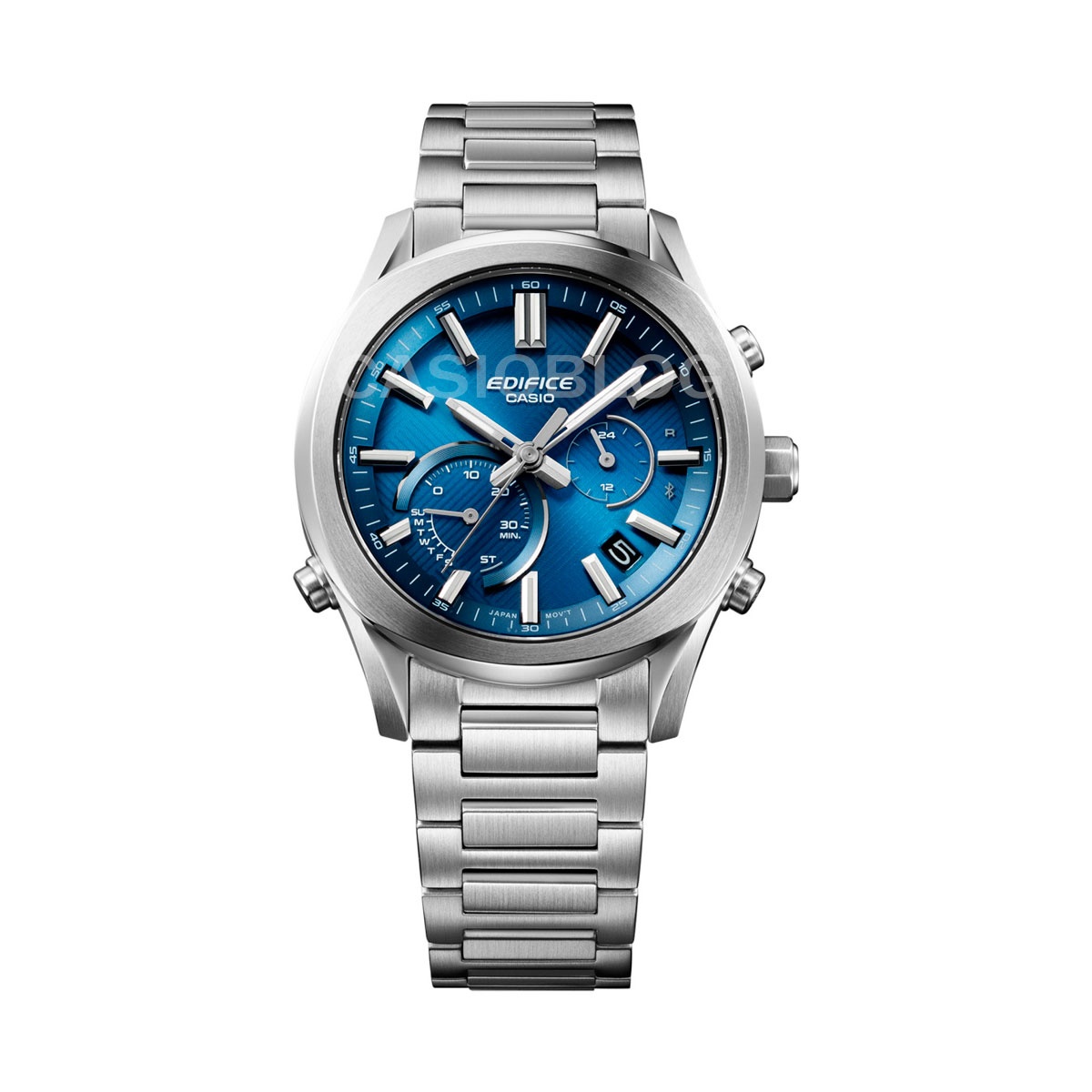
iQOO Z11 Goes Official: 9020mAh Battery, 165Hz Display, 90W Charging

iQOO Z11

The iQOO Z11 has been launched in China, targeting users who want long battery life, high refresh rate visuals, and stable gaming performance. The device introduces a larger battery, an updated chipset, and new display features.

iQOO Z11

Battery capacity is the headline feature. The phone packs a 9,020mAh “Blue Ocean” battery, the largest used in an iQOO device so far. It uses a fourth-generation silicon anode and semi-solid-state battery cells to maintain a relatively slim 8.25mm profile while improving performance in low temperatures. The company claims over 10 hours of mixed usage with more than 50 percent charge remaining. The device supports 90W wired charging and also allows reverse charging for other devices.

iQOO Z11

The Z11 runs on the MediaTek Dimensity 8500 chipset, built on a second-generation 4nm process. It uses Cortex-A725 cores in an all-large-core architecture aimed at improving efficiency. iQOO adds its Monster Over-Core Engine, which includes a Prophet Scheduler for background task control and a Lightning Accelerator to stabilize frame rates. The phone also includes a 7K Ice Dome VC liquid cooling system. The brand claims a benchmark score exceeding 2.62 million.

iQOO Z11

On the front, the device features a 6.83-inch AMOLED display with a 1.5K resolution of 2800×1260 pixels and a 165Hz refresh rate. It supports up to 5000 nits peak brightness, 2160Hz PWM dimming, and DC-like dimming. The panel is designed to reduce latency and improve touch response during gaming.

For cameras, the Z11 includes a 50MP primary sensor with OIS and a 2MP depth sensor. It supports 4K video recording. The front camera is 16MP. Software features include portrait enhancements, film filters, and a watermark system that logs time and location.

The device runs Android 16 with OriginOS 6 and comes with up to 16GB LPDDR5X RAM and 512GB storage. It supports Wi-Fi 6, Bluetooth 5.4, NFC, NavIC, and stereo speakers. It also includes an in-display fingerprint sensor and infrared support.

The design features a rounded “floating porthole” camera module and is available in Floating Light, Sky White, and Midnight Black. It carries IP68 and IP69 ratings and has passed multiple durability tests.

Pricing & availability

Pricing starts at 2299 yuan for the 8GB + 256GB model and goes up to 3399 yuan for the 16GB + 512GB variant. The device is already on sale in China with discounts of up to 300 yuan.

The post iQOO Z11 Goes Official: 9020mAh Battery, 165Hz Display, 90W Charging appeared first on Gizmochina.

realme 16 5G Launching on April 2, 2026 with 50MP Cameras and 7000mAh Battery

Realme 16 5G

Realme will launch the Realme 16 5G on April 2, 2026, expanding its 16 Series lineup. The phone focuses on photography and content creation, with a mix of camera hardware and AI features.
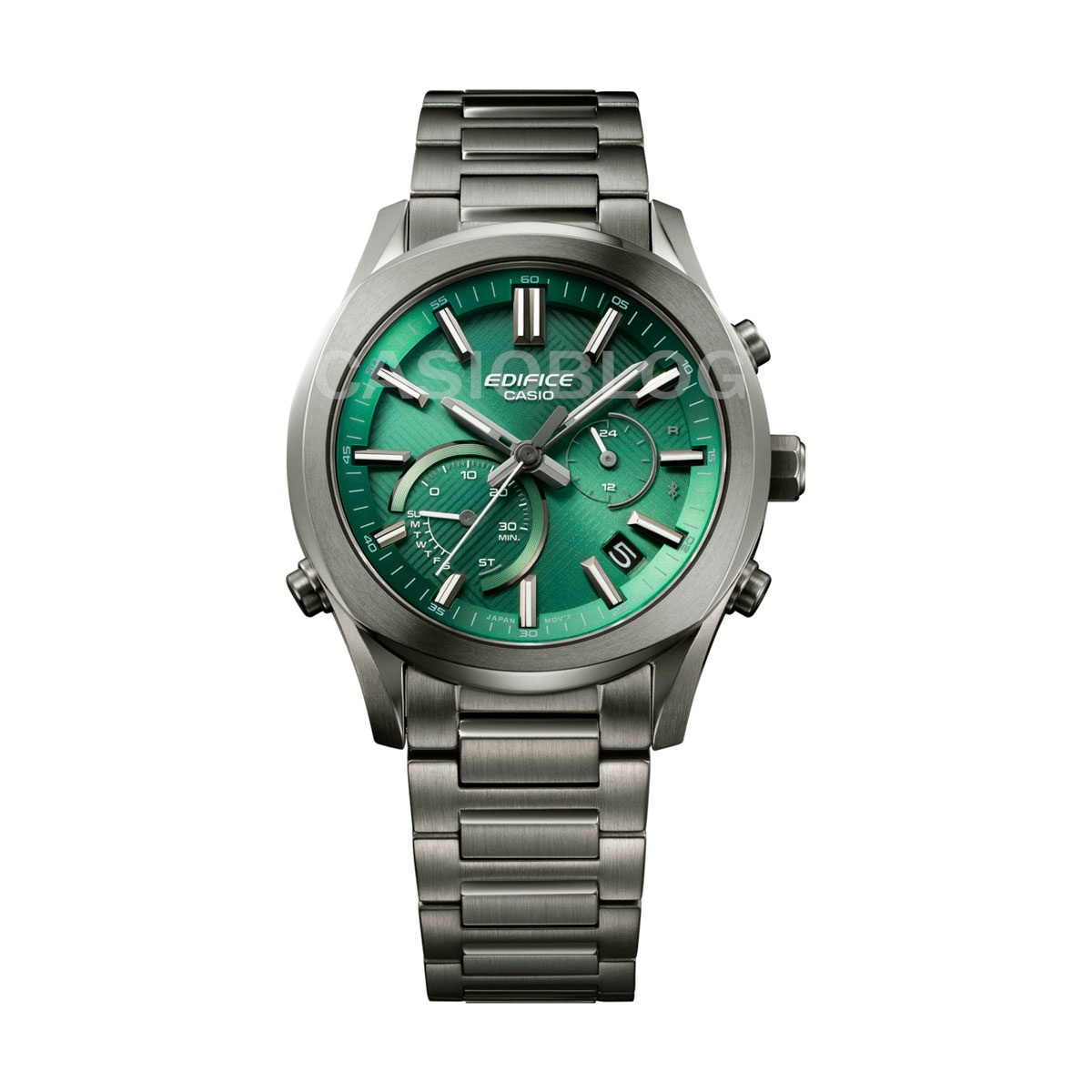
Realme 16 5G

The device uses 50MP Sony sensors for both the rear and front cameras. This setup is aimed at keeping image quality consistent on both sides. It also includes a rear selfie mirror, which helps users frame shots while using the main camera instead of the front lens. A ring flash is built into the back to provide more even lighting in low-light conditions.

Realme 16 5G

On the software side, realme is adding several camera tools. LumaColor imaging works to keep colors balanced and skin tones natural across different lighting conditions. The “Say Hi” gesture feature lets users start a countdown shutter by making a hand gesture. Vibe Master Mode offers three preset styles called Lively, Festival, and Ceremony for quick edits. AI Edit Genie allows users to change elements like hairstyles, clothing, and backgrounds through simple commands. AI Instant Clip can turn photos and videos from the gallery into ready-to-share clips.

The phone also focuses on battery and design. It packs a 7000mAh battery but keeps a slim profile at 8.1mm thickness and 183g weight. realme says this is possible due to its “AirCraft Structure,” which uses a high-density internal layout and reduces unused space. High energy-density graphite cells are used to fit the large battery inside a thin body, while improved internal stacking adds strength.

The Realme 16 5G has a 6.57-inch display with narrow bezels and rounded edges for better grip. The back panel uses a “Gleaming Wings” design with a layered blue-gold gradient finish. It also has an anti-fingerprint coating. The phone will be available in Air Black and Air White.

For more daily updates, please visit ourNews Section.

Stay ahead in tech! Join our Telegram community and sign up for our daily newsletter of top stories!

(Source)

The post realme 16 5G Launching on April 2, 2026 with 50MP Cameras and 7000mAh Battery appeared first on Gizmochina.

Wobble K-series 65-inch TV review: A big-screen upgrade focused on everyday entertainment

Wobble K-series 65-inch TV (8)

The Wobble K-series 65-inch TV is aimed at users who want a large 4K display without spending heavily. Instead of focusing on premium specifications, it delivers a balanced experience for daily viewing. After spending time with it, the TV feels designed for users upgrading from smaller screens to a more immersive setup at a reasonable price.

Design and build quality

Wobble K-series 65-inch TV (8)

The TV features a clean and minimal design with slim bezels that help create an immersive viewing experience. From a normal viewing distance, it looks modern and fits well into most living room setups. Up close, the plastic build is noticeable, which is expected in this segment.

Wobble K-series 65-inch TV
Wobble K-series 65-inch TV (8)

The bundled table stands hold the TV in place, but stability is not the strongest aspect. A slight push can cause some wobble, especially given the large screen size. Wall mounting feels like the better option for long-term use, although the included mount is fairly basic and does not offer movement or flexibility.

Display performance

Wobble K-series 65-inch TV

The 65-inch LED panel supports 4K resolution along with Dolby Vision and HDR10. For regular viewing, the panel produces bright and lively colours that work well for streaming content, TV shows, and sports.

The TV offers multiple picture modes, including Standard, Dynamic, Cinema, Low Blue, Film Maker, Eco, Game, and User. These modes allow you to adjust the viewing experience based on the content type. Cinema mode delivers more balanced colours, while Dynamic and Vivid-style settings push brightness and saturation.

For Dolby Vision content, you get dedicated modes such as Dolby Vision Bright, Dolby Vision Dark, Dolby Vision Vivid, and Dolby Vision Game. Dolby Vision Bright works best for most scenarios, while Dark mode tends to crush shadow details and Vivid can appear overly saturated.

Wobble K-series 65-inch TV

Black levels are average, which is expected from a standard LED panel without local dimming. In darker scenes, blacks appear slightly grey, which becomes noticeable in low-light conditions. However, for viewing in a well-lit room, this is not a major issue.

Motion handling is decent for casual use, and enabling MEMC at a higher setting helps reduce blur during fast scenes such as sports.

Performance and software

Wobble K-series 65-inch TV

The TV runs on Google TV, offering a clean and user-friendly interface with access to all major streaming apps. Content discovery works well, making it easier to find shows and movies across platforms.

Performance is mostly smooth, but there are occasional delays when switching apps or navigating menus. These slowdowns are minor but noticeable at times.

Wobble K-series 65-inch TV

Google Assistant support works reliably and adds convenience for searching content and controlling the TV using voice commands.

Remote control

Wobble K-series 65-inch TV

The remote is one of the standout aspects of this TV and feels well thought out for everyday use. It connects via Bluetooth and is comfortable to hold, with a layout that makes navigation easy.

In addition to dedicated hotkeys for Netflix, YouTube, and Prime Video, the remote includes a dedicated Menu button that brings up on-screen controls instantly. This makes quick adjustments more convenient.

There is also a Mute button, a Your Apps button for quick access to installed apps, a Settings button, and a Source button for switching inputs. Buttons for Broadcast and Live TV are also included, which can be useful for users who still watch traditional channels.

Wobble K-series 65-inch TV

Further adding to usability are Next and Previous buttons, along with a button for selecting your Google account. The Google Assistant button allows for voice commands, making it easier to search and control functions without typing.

Overall, the remote enhances the overall experience and stands out for its thoughtful layout.

Audio performance

Wobble K-series 65-inch TV

The TV comes with dual speakers delivering 40W of output and Dolby Atmos support. The audio is loud enough to fill a medium-sized room, and dialogue clarity is good for everyday viewing.

It also offers multiple sound modes including Standard, Cinema, Music, News, and Personal, allowing users to tweak audio output based on content type. Standard works well for general use, while Cinema enhances depth slightly for movies.

However, during complex scenes with multiple sound elements, the audio lacks depth and separation. At higher volume levels, clarity begins to drop slightly. For a more immersive experience, adding a soundbar would be beneficial.

Connectivity and ports

Wobble K-series 65-inch TV

The TV offers a good mix of ports, with side-facing access for convenience and bottom-facing ports for permanent connections. On the side, you get HDMI ports and a USB 3.0 port. At the bottom, there is LAN, USB 2.0, optical audio, AV input, RF antenna, and satellite input, keeping cable management cleaner.

Verdict

Wobble K-series 65-inch TV

The Wobble K-series 65-inch TV is listed on Flipkart starting at Rs 39,799, making it one of the more accessible options in the 65-inch 4K segment.

It offers a large display, vibrant visuals, a clean smart TV experience, and a well-designed remote that improves usability. It may not be ideal for gaming or cinematic viewing in dark rooms, but for streaming, live TV, and general entertainment, it delivers a solid overall experience.

For more daily updates, please visit our News Section.

Stay ahead in tech! Join our Telegram community and sign up for our daily newsletter of top stories! 💡

The post <strong>Wobble K-series 65-inch TV review: A big-screen upgrade focused on everyday entertainment</strong> appeared first on Gizmochina.

Aoostar launches MACO 470 Mini PC with Ryzen AI 9 HX470, USB4 & OCulink support

Aoostar MACO 470 mini PC

Aoostar has launched the MACO 470 mini PC in China. The device features the AMD Ryzen AI 9 HX470 processor and comes with 32GB of LPDDR5 RAM.

Aoostar MACO 470 mini PC

Aoostar MACO 470 Specifications

The mini PC has a compact design and uses a CNC-machined unibody aluminum chassis. The chassis has a seamless vent-free construction, which improves durability and gives the device a premium appearance. The mini PC weighs 0.66 kg and has dimensions of 13 x 15 x 5.5 cm. It also includes a fingerprint sensor with Windows Hello support, allowing secure and password-free logins.

Aoostar MACO 470 mini PC

The system is powered by the AMD Ryzen AI 9 HX470 processor, which is built on the Zen 5 architecture. This processor has 12 cores and 24 threads with boost speeds up to 5.2GHz. The device also features integrated Radeon 890M graphics, which use the RDNA 3.5 architecture with 16 compute units running at up to 3.1GHz.

The MACO 470 includes 32GB of LPDDR5 RAM operating at 8533MT/s. Aoostar has provided support for up to three M.2 PCIe 4.0 SSD slots to allow storage expansion.

The device uses a Glacier 4.0 cooling system to manage heat. This system includes a 5600mm² vapor chamber and a turbo fan with fluid dynamic bearings. The cooling setup ensures efficient heat dissipation while keeping noise levels low, even during heavy workloads.

The system also sports a well-rounded selection of ports across the chassis. The front includes two USB 3.2 Gen2 ports, one USB4 port (40Gbps), and a 3.5mm audio jack for quick access.

Aoostar MACO 470 mini PC

The rear comes with another USB4 port, two USB-A ports, HDMI 2.1, DisplayPort 2.1, and dual 2.5G Ethernet ports, ensuring stable high-speed networking and versatile display output options. It supports up to four displays simultaneously, including high-resolution output up to 8K. It also includes an OCulink port for external graphics docks.

Pricing and Availability

The MACO 470 barebones version costs 5,899 yuan ($826), the 1TB SSD variant is 7,299 yuan ($1,022), and the 2TB SSD version is 8,599 yuan (~$1,204). These are now available on JD.com.

For more daily updates, please visit our News Section.

Stay ahead in tech! Join our Telegram community and sign up for our daily newsletter of top stories! 💡

(JD)

The post Aoostar launches MACO 470 Mini PC with Ryzen AI 9 HX470, USB4 & OCulink support appeared first on Gizmochina.

OpenAI discontinuing its AI video generation tool Sora

OpenAI is reportedly shutting down its Sora video-generation tool, less than two years after it first drew widespread attention. Sora was introduced in 2024 as a way to create realistic video clips from simple text prompts. Early demos generated a lot of buzz, especially around how quickly the quality seemed to improve.

But that momentum didn’t quite translate into long-term traction. OpenAI has now announced that it plans to step back from video generation and focus more on areas like robotics and so-called “agentic” AI.

That said, the situation around Sora isn’t a clean, immediate shutdown. While OpenAI has indicated that it is discontinuing the app and winding down development, the tool hasn’t disappeared overnight. The web version, for instance, is still accessible for now, and there’s no clearly defined cutoff date yet. It suggests Sora is in a transition phase—no longer a priority, but not fully offline either.

The shift isn’t just about the product itself. OpenAI is also walking away from a major content partnership with The Walt Disney Company, which had been announced only a few months ago. The deal, reportedly worth around $1 billion, would have allowed Sora users to generate videos featuring well-known Disney characters.

According to reports, the agreement hadn’t progressed far enough for any payments to be made, and Disney was caught somewhat off guard by the decision. The company has since said it will continue exploring AI partnerships elsewhere, while keeping a close eye on how its intellectual property is used.

Sora’s commercial performance may have played a role here. Despite the initial excitement, the platform reportedly brought in around $1.4 million in global in-app revenue—a relatively small figure compared to ChatGPT’s $1.9 billion over a similar period. There were also ongoing concerns around moderation, including misuse involving deepfakes, copyrighted content, and non-consensual imagery.

At the same time, competition in the space has been heating up, with new tools emerging from other companies. Combined with legal risks and rising infrastructure costs, continuing Sora may have been harder to justify.

Don’t miss a thing! Join our Telegram community for instant updates and grab our free daily newsletter for the best tech stories!

For more daily updates, please visit our News Section.

(Source)

The post OpenAI discontinuing its AI video generation tool Sora appeared first on Gizmochina.

OnePlus 15T vs OPPO Find X9: Is OPPO Worth Paying More?

Oneplus vs oppo

Flagship smartphones are no longer just about raw power; they’re about how intelligently that power is used in daily life. The battle between the OnePlus 15T and the OPPO Find X9 perfectly reflects this shift, where one focuses on performance and endurance, while the other leans into camera innovation and premium refinement. For buyers in this price segment, the real question isn’t which phone is better on paper, but which one actually delivers a more satisfying experience day to day.

Major Features:

FeatureOnePlus 15TOPPO Find X9Winner
Display6.32″ AMOLED, 165Hz, Dolby Vision, HDR10+, 3600 nits peak6.59″ AMOLED, 120Hz, Dolby Vision, HDR10+, 3600 nits peakOnePlus 15T – Higher 165Hz refresh rate
Resolution1216 × 2640 (~460 ppi)1256 × 2760 (~460 ppi)OPPO Find X9 – Slightly sharper
ChipsetSnapdragon 8 Elite Gen 5 (3nm)Dimensity 9500 (3nm)OnePlus 15T – More powerful & optimized
GPUAdreno 840Arm G1-UltraOnePlus 15T – Better gaming performance
RAM & StorageUp to 16GB RAM + 1TB, UFS 4.1Up to 16GB RAM + 1TB, UFS 4.1Tie – Same configuration
Rear Camera50MP (main) + 50MP (3.5x telephoto)50MP (main) + 50MP (periscope) + 50MP (ultrawide)OPPO Find X9 – More versatile triple setup
Selfie Camera16MP32MPOPPO Find X9 – Higher resolution
Video Recording8K, 4K up to 120fps, Dolby Vision4K up to 120fps, Dolby Vision, LOGOnePlus 15T – 8K support
Battery7500 mAh7025 mAhOnePlus 15T – Larger capacity
Charging100W wired, 50W wireless80W wired, 50W wirelessOnePlus 15T – Faster wired charging
OS SupportAndroid 16 (OxygenOS/ColorOS)Android 16, up to 5 major updatesOPPO Find X9 – Longer software support
BuildFiber-reinforced back, aluminum frameGlass back, aluminum frameOPPO Find X9 – More premium materials
ProtectionCrystal Shield GlassGorilla Glass 7iOPPO Find X9 – Stronger known protection
Water ResistanceIP68/IP69KIP68/IP69OnePlus 15T – Slightly higher rating
ConnectivityWi-Fi 7, Bluetooth 6.0, NavICWi-Fi 7, Bluetooth 6.0, NavICTie – Same features
Price₹58,000 (~$600)₹76,000 (~$650)OnePlus 15T – Much better value

Design and Display

Build and Feel

The OnePlus 15T leans toward a practical, durability-focused approach with its fiber-reinforced back and solid frame, giving it a slightly rugged yet premium feel. In contrast, the OPPO Find X9 goes all-in on a flagship aesthetic with glass on both sides and refined finishing. Both offer top-tier water and dust resistance, but the OPPO device feels more traditionally premium, while the OnePlus subtly prioritizes grip and durability.

Display Quality

OnePlus pushes ahead with a 165Hz AMOLED panel, making animations and gaming feel noticeably smoother. OPPO counters with a slightly larger display and equally rich color tuning, backed by strong HDR support. Brightness levels are comparable, but the higher refresh rate on OnePlus adds a more fluid everyday experience, especially for gamers and power users.

Verdict

The OPPO Find X9 feels more premium in-hand, but the OnePlus 15T delivers a smoother, more responsive display experience that may feel more modern in daily use.

Specifications Including Battery

Performance

The OnePlus 15T is powered by the Snapdragon 8 Elite Gen 5, delivering top-tier performance with excellent efficiency and strong GPU output. The OPPO Find X9 uses the Dimensity 9500, which is also flagship-grade and optimized for AI and sustained workloads. While both are extremely fast, Snapdragon still holds a slight edge in gaming stability and optimization across apps.

Battery and Charging

OnePlus clearly dominates with a massive 7500mAh battery paired with ultra-fast 100W charging. OPPO’s 7025mAh battery is still impressive and supported by fast wired and wireless charging, but it doesn’t match the sheer endurance of the OnePlus. The larger battery makes a noticeable difference in heavy usage scenarios.

Verdict

OnePlus 15T stands out with better battery life and slightly stronger performance, making it the more reliable long-term performer.

Camera

Main and Secondary Lenses

The OPPO Find X9 takes a clear lead in camera versatility with a triple-camera setup, including an ultrawide and a periscope zoom lens. Its larger sensors and Hasselblad tuning help deliver richer colors and better dynamic range. The OnePlus 15T keeps things simpler with a dual-camera setup, focusing on strong primary and telephoto performance but lacking ultrawide flexibility.

Selfie Camera

OPPO again pulls ahead with a 32MP selfie camera capable of 4K video, offering sharper detail and better video quality. OnePlus provides a decent 16MP shooter, but it feels more basic in comparison, especially for content creators or video calls.

Verdict

OPPO Find X9 is clearly the better camera phone, offering more versatility and higher-quality outputs across both rear and front cameras.

Pricing

OnePlus 15T is priced at around ₹58,000, while the OPPO Find X9 comes in significantly higher at about ₹76,000. This creates a noticeable gap in positioning, with OnePlus targeting value-focused flagship buyers and OPPO leaning into the premium segment.

Value for Money

OnePlus delivers exceptional value with top-tier performance, a massive battery, and a high-refresh-rate display at a lower price. OPPO justifies its higher cost with superior cameras, premium build, and longer software support, but the difference may feel steep unless camera quality is a priority.

Verdict

OnePlus 15T offers better overall value, while the OPPO Find X9 makes sense for users willing to pay extra for camera and premium design upgrades.

Conclusion

The OnePlus 15T shines with its massive battery, ultra-smooth 165Hz display, and performance-focused tuning, making it ideal for gamers and heavy users. The OPPO Find X9 stands out with its advanced camera system, premium build, and long-term software support, appealing more to photography enthusiasts and flagship buyers seeking refinement.

Verdict

For most users, the OnePlus 15T feels like the smarter buy due to its aggressive pricing and balanced performance. However, the OPPO Find X9 positions itself as a more complete flagship experience, especially for those who prioritize camera quality and premium feel over pure value.

Read More:

The post OnePlus 15T vs OPPO Find X9: Is OPPO Worth Paying More? appeared first on Gizmochina.
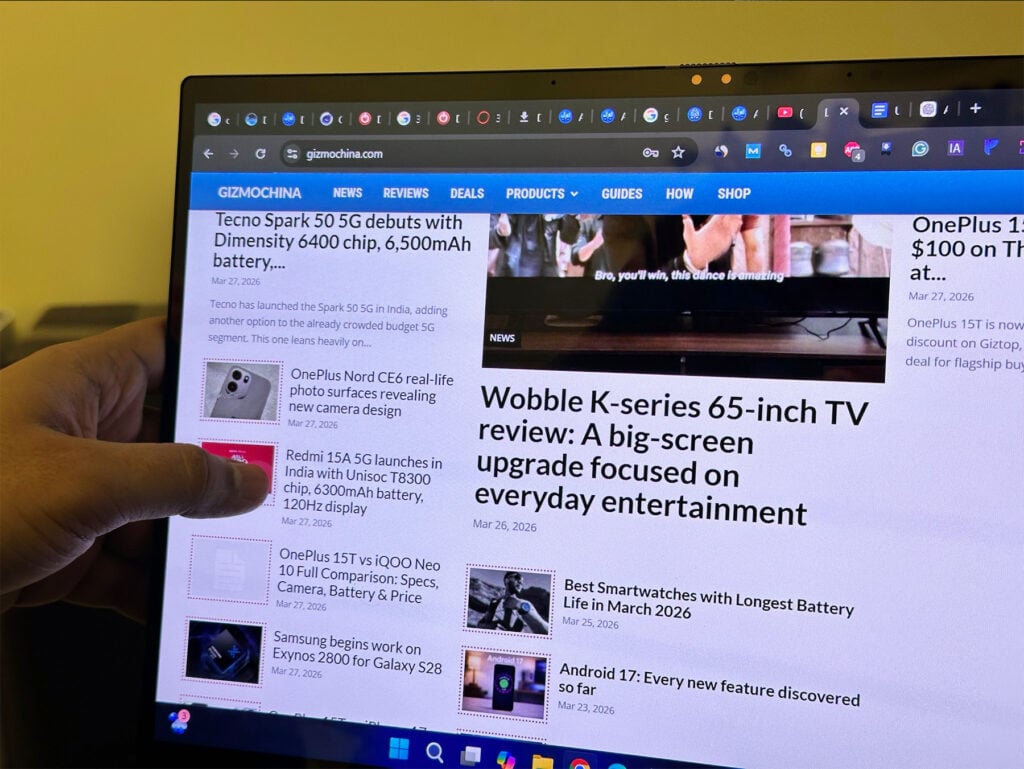
OPPO Find N6 Review: My Favorite Foldable Phone (For Now)

For those who are already using foldable phones, most people probably don’t care much about how deep the crease is. Your fingers almost never swipe across that area, and when you’re looking straight at the screen, you can’t really see any impact from the crease on display quality. If the crease truly affected the daily experience, then Samsung wouldn’t be the best-selling foldable phone brand on the earth. However, the OPPO Find N6 with the best crease-control ever is still breathtaking at first glance.

As no model had ever reached this level before, eliminating the crease is definitely significant: it doesn’t affect your experience after purchase, but it does affect your decision before buying. Many potential users, when they see that deep crease, genuinely believe it will constantly interfere with their vision—even if it won’t. When no one can see the crease anymore, and it looks like a tablet and feels like one in use, more people will want to give it a try. This is the killer feature of the Find N6: attracting more new customers with a crease-free display.

China ver. VS Global ver.

This time, the internationalization of the Find N6 has been done very well. The Chinese version and the global version are identical in most specifications, including battery capacity. I’ve listed all the differences between them. Aside from the eSIM, the Chinese version actually has strong advantages.

You may not know this, but the cost of 16GB RAM plus 1TB ROM alone already exceeds that of the Snapdragon 8 Elite Gen5. So the 1TB version is the most cost-effective choice for now.

Display & Hinge

How flat the inner screen of the Find N6 is has already been proven countless times by other reviewers. But what they didn’t tell you is whether long-term use will make the crease more noticeable. Unfortunately, the answer is yes (a slightly yes). Every second you keep the phone folded will make the crease slightly deeper. It doesn’t take long—after just one night’s sleep, you can already notice the crease becoming more pronounced.

The good news is that the new UTG glass has a self-healing feature. As long as you keep it unfolded and use it for a while, it will become flatter again (impressive!). I left two Find N6 units folded and unfolded, respectively for 48 hours, and you should be able to see the impact of time on them. As a reference, I also left another foldable phone unfolded for 4 days, and you can clearly see the effort OPPO has made regarding the crease. So if you can use it unfolded, just keep it unfolded. This can extend the lifespan of a foldable phone.

I haven’t used it for very long, and compared to when I first got it a week ago, the crease hasn’t changed noticeably. However, I still don’t believe it will remain crease-free after one or two years. But one thing I do believe: when it comes to crease control, no other foldable phone does it better.

The new hinge design not only helps reduce the crease but also improves the tactile experience. The hinge on the Find N6 is the tightest I’ve ever used—you need to apply some force to open or close it. Solid, no wobbling, and no noise. The minimum opening angle is even less than ten degrees. While that may not be particularly useful, it’s these small details that make every dollar you spend on this phone feel worthwhile.

Stylus

The dedicated stylus bundle for the Find N6 has also attracted a lot of attention. The stylus itself is very ordinary, almost the same as the one on the Samsung Galaxy S26 Ultra. The difference is that it still has a built-in battery and supports Bluetooth connectivity. Unfortunately, once you put on this phone case, you won’t be able to use wireless charging.

If there’s anything special about this stylus, it would be all the AI-related features. For example, if you want to convert a hand-drawn table or line chart into a digital version, just hold down the AI button on the stylus and circle the area you want to generate. Although there are usage limits, it’s undeniably an attractive selling point for office workers. Also, thanks to the flat screen, using the stylus doesn’t feel like driving over speed bumps.

For a stylus designed for a foldable phone, it has already reached a top-tier level in both portability and functionality.

Performance & Battery Life

As mentioned in the hands-on video, just like the N5, the Find N6 has one performance core of the Snapdragon 8 Elite Gen5 disabled. As you might expect, its gaming performance is extremely bad. Genshin Impact is no longer a challenge for modern flagship phones, but for the Find N6, it’s a big problem. The frame rate hovers around 45.

Of course, this isn’t entirely the processor’s fault, since the inner display’s gaming resolution is twice that of a regular phone. The weak cooling system and conservative performance tuning also share the blame.

If this were a regular phone, I would probably start complaining. But this is a foldable phone, and its target users likely don’t care about gaming performance at all. In fact, if you don’t play games, this cut-down 8 Elite Gen5 can actually save you quite a bit of battery. A 6000 mAh battery may not sound impressive, but in real-world use, it easily lasts a full day—and I mean whole 24 hours.

I didn’t use it heavily, just like most people on a typical day out: navigation, scrolling TikTok, chatting on messaging apps, then getting some sleep. After waking up, there was still 45% battery left, equivalent to about 5 and a half hours of Genshin Impact. By the time you brush your teeth and take a shower, the 80W wired charging can almost fully recharge the Find N6. Trust me, 6000 mAh only sounds underwhelming—it performs much better than you’d expect.

Camera

All four cameras on the Find N6 are familiar faces. Not the best, but reliable.

They can deliver satisfying photos in almost any environment. The ultra-wide camera, in particular, has improved significantly, upgrading from 8MP to 50MP. Anyone familiar with OPPO phones knows their biggest strengths in photography are high dynamic range and high saturation. That makes the Find N6 especially suitable for everyday shots like food photography. Of course, the two secondary cameras don’t have large sensors, so in low-light conditions, you shouldn’t expect outstanding image quality.

As for video recording, the evaluation is roughly the same as for photos: stable footage, vibrant colors, and good quality as long as there’s enough light. The two front-facing cameras have been upgraded to 20MP. Perhaps the image quality has improved, but come on, you’re using a foldable phone—unfolding it then using the rear cameras is definitely the smarter choice.

System

For the Find N6, ColorOS 16 introduces new exclusive gesture controls. By swiping from the corner toward the center of the screen, you can turn apps into windows of various sizes. When minimized, they automatically arrange themselves in the top-right corner, and you can double-tap to switch between them. If you want split-screen mode, just use a four-finger pinch gesture to switch between windowed and split-screen modes. This familiar gesture system was clearly inspired by someone, but it’s undeniably a unique interaction method among foldable phones.

Another thing that impressed me is how much OPPO wants iPhone users to switch. When I connected my AirPods to the Find N6, I realized I could fully control my earbuds using an Android phone—features like noise control, spatial audio, and even accessing earbuds settings directly from the control center. Although this has been possible since last year, it still blows my mind every time I see it.

Conclusion

Due to the recent shortage of DRAM and NAND supply, price increases for smartphones in 2026 are inevitable. Indeed, the Find N6 has become more expensive, but it’s still within an acceptable range. I’m glad it hasn’t downgraded anything and has achieved the best crease control in Foldable history. Gizmochina Review has been asked time and time again which foldable phone is the best. Well personally, before Apple releases its foldable, the answer is likely to be “Find N6”. Furthermore, based on my experience and taking factors such as price into account, I believe it will be difficult to revise this answer in the first half of 2026.

The post OPPO Find N6 Review: My Favorite Foldable Phone (For Now) appeared first on Gizmochina.
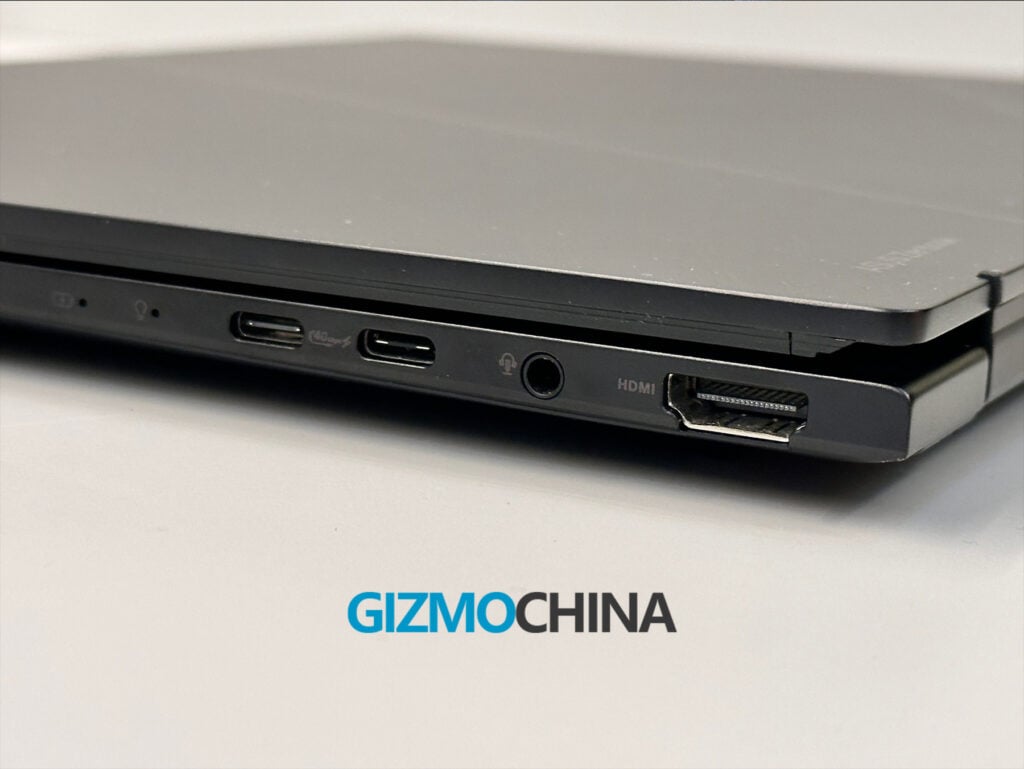
AI-Powered Robots Begin Real Battlefield Testing

Phantom MK1 Military Robot

Key Highlights

  • Humanoid robots like Phantom MK-1 are now being tested in real combat environments
  • Over 7,000 robot missions completed in a single month show rapid adoption
  • Future warfare may rely on coordinated AI robots across land, air, and sea

The use of AI-powered robots in warfare is no longer just an idea; it is becoming a reality. Modern battlefields are now being used to test advanced machines designed to reduce human risk and improve efficiency. These developments show how quickly robotics and artificial intelligence are moving from labs into real-world situations.

Humanoid Robots Enter the Field

One of the most advanced examples is the Phantom MK-1 humanoid robot. It is designed to move like a human and operate in difficult terrains where traditional machines struggle.

The robot stands around 175 cm tall, weighs about 80 kg, and can carry up to 20 kg. It uses cameras and sensors to understand its surroundings and can move at speeds of up to 6 km/h.

These robots are not fully independent. They are being tested to study mobility, performance, and how AI behaves under pressure.

Phantom MK1 – Bomb Disposal Test

How AI Military Robots Work

Military robots today use a mix of AI and human control. This is called a “human-in-the-loop” system. AI helps with tasks like identifying objects, navigating terrain, and suggesting actions. However, humans still control critical decisions, especially when it comes to using weapons.

Rise of Ground Robots

Humanoid robots are only part of the story. Uncrewed Ground Vehicles (UGVs) are already widely used.

In January 2026 alone, more than 7,000 missions were carried out using robots. These machines mainly handle logistics such as delivering supplies, evacuating injured soldiers, and scouting areas. Most robots are currently used for support tasks rather than direct combat.

Challenges and Future Potential

Despite rapid growth, there are still limitations. Robots face issues like limited battery life, high costs, and difficulty understanding complex situations. There are also concerns about hacking and misuse.

Looking ahead, experts believe future warfare could involve large groups of connected robots working together across land, air, and sea. This shift is not just about warfare; it is a major step forward in robotics and AI. Machines are slowly moving from tools to active partners, shaping the future of technology.

Did You Know? 

The Phantom MK-1 is built by a San Francisco-based startup called Foundation, founded by former military personnel and engineers focused on defense robotics. The company has already secured about $24 million in contracts with the US Army, Navy, and Air Force, making it an official defense partner. 

Beyond this robot, the global race for military robotics is accelerating; countries like the United States, China, Israel, and Russia are actively developing and deploying robotic systems. China has tested armed robot dogs in military drills, while the US has long used systems like PackBot and TALON in combat zones. Even countries like Estonia and Turkey are building advanced unmanned ground and aerial combat systems, showing that the future battlefield is rapidly becoming automated.

Read More:

(via)

The post AI-Powered Robots Begin Real Battlefield Testing appeared first on Gizmochina.
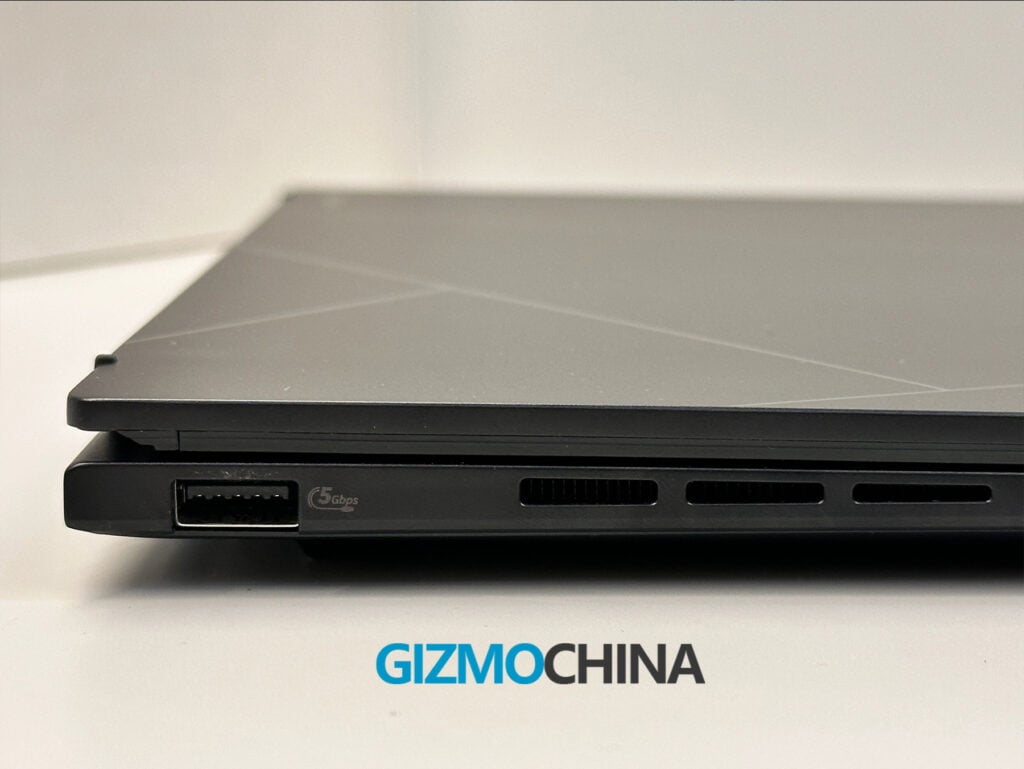
HUAWEI Watch GT Runner 2 Review: The Best Running Companion

HUAWEI WATCH GT Runner 2

By 2026, it has become difficult for any smartwatch to truly stand out. Nevertheless, the HUAWEI Watch series remains one that Gizmochina Review continues to anticipate. Among the entire lineup, the HUAWEI Watch GT Runner series would be selected within the team without hesitation as the most memorable sub-series. It distinguished itself among professional sports smartwatches from 2021 onward. Five years ago, we reviewed the first-generation GT Runner, which left a lasting impression—certain running-tracking features from that model still rank among the best tie on the market today. At MWC 2026, HUAWEI introduced the all-new HUAWEI Watch GT Runner 2, a device that demonstrates considerable potential to challenge Garmin’s dominance in this segment.

With a comprehensive range of Garmin products already available across various price points—such as the 165, 265, 570, and 970 series—dedicated running devices have evolved to offer extensive capabilities for professional training and tracking. However, after two months of testing the GT Runner 2, a clear sense of ambition emerges: by addressing the full spectrum of sports and health applications, the watch elevates industry-leading performance to new levels.

Brief Summary

The following are the truly cutting-edge features of the HUAWEI Watch GT Runner 2:

  1. Ultra-precise positioning and tracking for not only running but also any outdoor sport that requires route tracking/guiding, including hiking and cycling.
  2. A comprehensive set of customizable training plans, including a dedicated marathon mode designed to simulate long-distance running training.
  3. Access to a professional running performance assessment system when paired with the HUAWEI Health app, enabling precise improvements to personal best (PB) times.
  4. An excellent, ultra-lightweight design that supports the watch’s precise tracking capabilities and enhances the wearing experience.
  5. Incorporation of the latest all-scenario health features from the HUAWEI Watch series.

The Most Accurate Positioning

Accurate positioning data is essential for properly assessing running performance. At present, the GT Runner 2 delivers the best results in this regard. Over an 8-kilometer run, virtually no noticeable error in distance or route tracking is observed. The watch supports dual-band all-satellite positioning, including GPS, GLONASS, Galileo, BeiDou, and QZSS—ensuring coverage by the strongest available signal regardless of the user’s location. To ensure this powerful positioning system operates reliably and efficiently, the watch incorporates a new frame design. A sandwich structure is employed, wherein the metal mid-frame transfers energy to the top floating titanium bezel via the dielectric bezel, generating circularly polarized signals that align effectively with satellite signals.

Even when running or walking in an urban canyon surrounded by towering buildings and dense trees, performance remains impressive.

Walking in an urban canyon

It can be stated with certainty that during a recent 40-kilometer run, no noticeable drift in positioning or tracking occurred. For specifics, the following record is provided: a total of 7.07 kilometers was run back and forth along a riverbank, with careful attention to maintaining a consistent route. The route recorded by the watch closely matched the actual path, and the individual distance consistently remained around 3.03 kilometers.

My preferred running location is a sports park featuring an irregular 545-meter track, part of which winds through a wooded area. The recorded route consistently demonstrated excellent consistency lap after lap. Distance accuracy was also tested at another sports park with a 3-kilometer track by a mountain. After completing one lap and walking for a few extra seconds at the end, the watch recorded a distance of 3.01 kilometers—the most accurate reading recorded to date. For nearly all runners, accurate route tracking facilitates better monitoring of pace, stride, and other important metrics during training.

Full Details for Run Tracking

This is also among the most valuable benefits derived from the GT Runner 2: greater training consistency and improved self-awareness. Previously, the relationship between running performance and physical condition was difficult to assess accurately. Now, by strictly adhering to the training plans provided by the GT Runner 2, it is possible to track physical performance metrics and identify specific exercises that contribute to improved running performance. For instance, upon reviewing the running balance record, the GT Runner 2 indicated a tendency to place more stress on the left leg. It subsequently recommended Bulgarian split squats and alternating lunge jumps. After regularly performing Bulgarian split squats, the most recent running log shows improvement in the imbalance issue, and anaerobic performance can be sustained for longer durations. Additional metrics such as vertical oscillation, ground contact time, cadence, and others can also be tracked.

For users seeking a rapid assessment of overall running ability, the GT Runner 2 now features an upgraded running assessment system. The system provides access to the Running Ability Index (RAI), Training Load, Training Index, Recovery, VO₂ Max, and Predicted Time.

Marathon Coach & Companion

For marathon runners, the newly introduced intelligent Marathon mode, co-created with DSM-Firmenich Running Team on the GT Runner 2 represents a significant advancement. Runners may choose either a marathon test or follow a race event training plan. The event assistant within HUAWEI Health effectively fulfills the role of a coach, assisting in setting achievable goals and preparing a smart training plan.

Once a specific marathon event is selected, the app generates a training plan based on the user’s goals and running capacity. The plan includes specific weekly sessions such as easy runs, core strength training, progressive tempo runs, lower-body strength training, and steady long runs. Detailed exercise guidance is provided for each session, and the watch automatically records progress. If the watch detects that your metrics are not matching the workout intensity, it will work with the HUAWEI Health app to suggest lowering the intensity, helping you adapt more effectively to the rest of the training plan.

For those committed to improving their personal best, the GT Runner 2 paired with the HUAWEI Health app currently represents an excellent choice—a professional, ongoing training plan is delivered without high additional cost. Especially for amateur runners like me, this smart mode arrives at the perfect time, playing a key role in preventing improper training and reducing the risk of injury.

Innovative Sports Tracking

In addition to enhanced running tracking, the GT Runner 2 effectively builds upon the innovative sports tracking features developed in previous HUAWEI Watch generations, particularly the GT and Ultimate models, including golf, cycling, and hiking. For golf, the watch and app come preloaded with maps of golf courses in most countries and cities worldwide. Courses can be searched, downloaded, and synced to the watch. For outdoor adventure, the watch offers extensive offline maps for most countries, many of which are available with contour lines.

Golf Mode Course download
offline map download

Sufficient Battery Life

Battery life is also impressive given the watch’s focus on athletic performance. Connectivity is limited to Bluetooth, NFC, and specific health and fitness devices, which contributes to extended battery life during workouts. Under normal daily use, including 1.5 hours of exercise tracking per day, the watch lasts over a week on a single charge. The included charging dock additionally provides extremely fast charging.

Multi-platform software compatibility

Currently, the most compatible mobile operating systems are undoubtedly HarmonyOS and EMUI. Since the global version of the GT Runner 2 runs on EMUI, this ensures that its features are nearly perfectly transferred to other Android phones. The only thing to note is that, due to restrictions on background app management imposed by other phone brands, you’ll need to manually enable settings such as “Background Protection” and “Ignore Battery Optimization.” When used with iOS, a small number of features may be limited, but overall, it still delivers one of the best smartwatch experiences outside the Apple Watch ecosystem. If you can accept that trade-off, it offers even more comprehensive sports tracking than most smartwatches, including the Apple Watch series.

Hassle-Free Wearing

Finally, the wearing experience merits discussion. For a watch with such impressive performance, the weight is just 43 grams on the wrist (measured with the default strap)—clearly designed to be lightweight for running.

At the same time, the default AirDry Woven Strap is truly exceptional; it is the most skin-friendly strap encountered. The strap quickly wicks away moisture after a run or even a swim, keeping the wrist dry and cool. It offers greater comfort than any sports silicone strap previously used. The reviewer’s wrist skin is particularly sensitive to sweat, and rashes often resulted from straps with poor breathability. The GT Runner 2’s strap has completely resolved this issue.

Conclusion

Personally, it is unlikely that this watch will need replacement for several years (mainly for running and hiking). As a powerful, smart running companion, no notable shortcomings can be identified on the smartwatch. A different watch might be chosen for aesthetic reasons or to match my outfit. But in terms of battery life and location tracking, the GT Runner 2’s current performance is difficult to surpass.

Its pinpoint dual-band satellite positioning, comprehensive training ecosystem, and marathon-focused features make it a compelling alternative to all established pro-lineups. Battery life comfortably exceeds a week under regular training loads, and the lightweight, breathable design ensures all-day comfort even for runners with sensitive skin. While iOS users may encounter minor feature limitations, the overall package remains one of the most polished and capable sports wearables on the market today. If you’re serious about improving your running performance without compromising on smartwatch functionality, the HUAWEI Watch GT Runner 2 is an easy recommendation.

The post HUAWEI Watch GT Runner 2 Review: The Best Running Companion appeared first on Gizmochina.
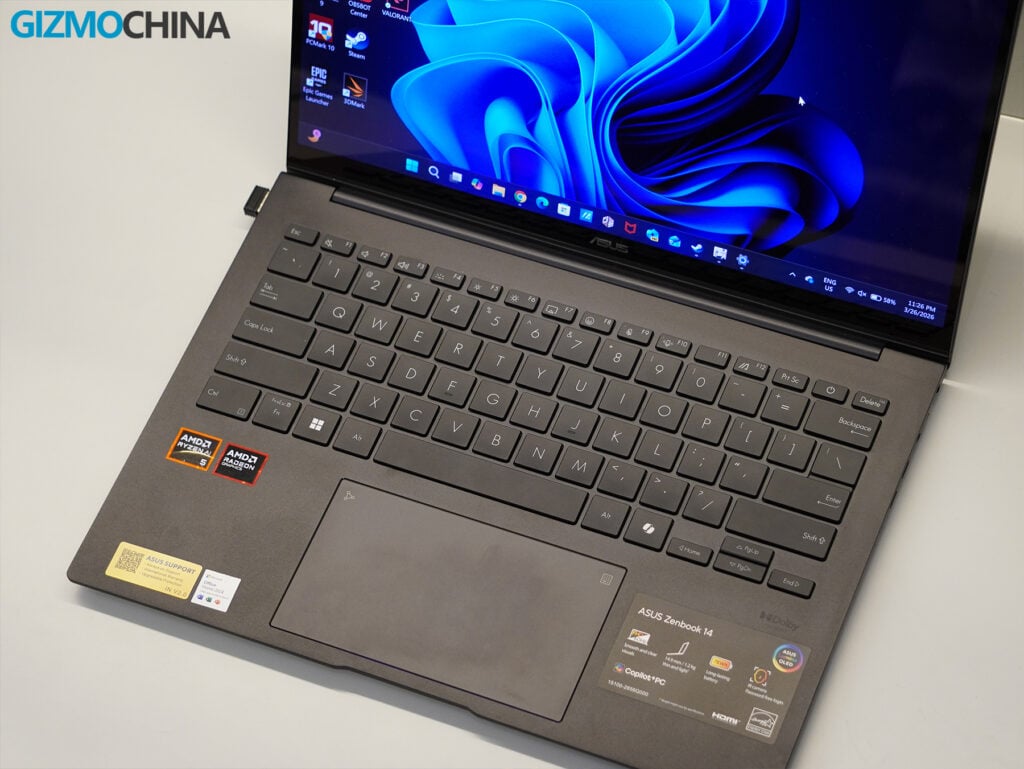
Samsung releases One UI 8.5 Beta 8 for Galaxy S25 series

Samsung One UI 8.5 beta

While we expected this to be a stable release for the Galaxy S25 series, Samsung has thrown another One UI 8.5 beta update, bringing the total beta count to eight. The latest build includes a host of bug fixes, but thankfully, those are not critical, meaning Samsung may be doing the final bug cleanup before the stable release.

The eighth One UI 8.5 beta for the Galaxy S25, S25+, and S25 Ultra comes with the build version ZZCD and has a download size of nearly 1GB. The update, spotted by Tarun Vats, was initially rolled out in Germany, but then quickly expanded to India, Poland, South Korea, and the UK within a few hours of its initial release. Only the US is yet to receive the update, which shouldn’t take long.

Galaxy S25 One UI 8.5 beta 8 update

As for the changes, Beta 8 adds a new story type in the Gallery app that automatically generates monthly, quarterly, or yearly reviews. The rest of the update focuses on squashing bugs related to the camera, Studio, lock screen, notifications, and Galaxy Book 4 connectivity. Check the complete changelog below for more details.

Galaxy S25 One UI 8.5 Beta 8 changelog

– Added a new story type within the Gallery (monthly/quarterly/yearly review)
– Improved the issue of corrupted camera quick view previews when cloud-exclusive videos were the latest
– Fixed an issue where originals were not restored after changing the storage resolution in Studio
– Improved the flickering when updating real-time notification cards
– Improved the bubble notification badge not disappearing after checking received bubble notification
– Fixed an issue where the clock shortcut disappeared when the screen was turned off while Now Brief was running
– Improved an issue where the date was displayed incorrectly after editing a video with metadata errors
– Improved an issue where shots were corrupted or not captured when scrolling in Naver Map
– Improved the issue where certain folders could not be copied when connected to shared storage with Galaxy Book 4.

If you have a Galaxy S25, S25, or S25 Ultra running One UI 8.5 beta, you should be able to install the latest beta by navigating to Settings > Software updates > Download and install.

This could very well be the last One UI 8.5 beta for the Galaxy S25 series, as Samsung is reportedly gearing up for the stable rollout. A stable build for the same device was also recently spotted on Samsung’s servers, further hinting at a closer stable rollout. We’ll let you know when that happens. Stay tuned.

We’ll keep posting the latest One UI developments in our Samsung section. You can visit the section regularly for the latest updates, or join our Telegram channel to get instant notifications about the latest software updates and breaking tech news.

The post Samsung releases One UI 8.5 Beta 8 for Galaxy S25 series appeared first on Gizmochina.
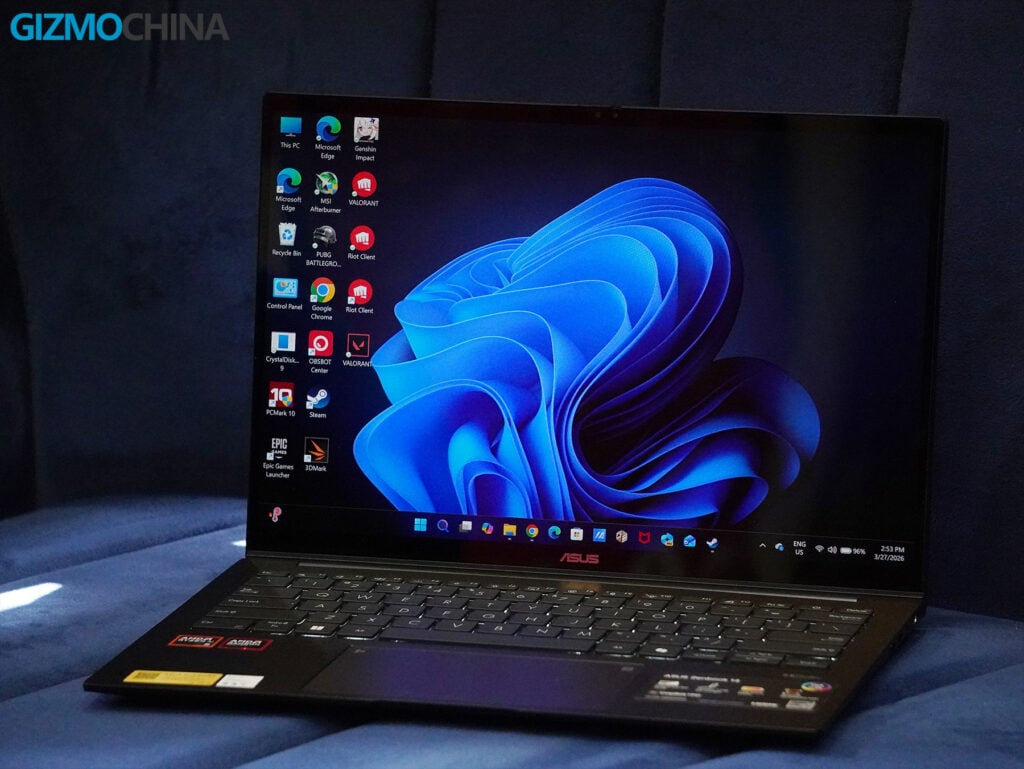
This Luxury Caviar iPhone 17 Pro Has a Piece of Steve Jobs’ Turtleneck Inside

Caviar Steve Jobs iPhone 17 Pro

Caviar has unveiled a limited edition collection of customized iPhone 17 Pro and Pro Max to commemorate Apple’s 50th anniversary. The collection focuses on blending historical design with ultra-luxurious materials, showcasing three unique models. Each model highlights Apple’s legacy while appealing to collectors and enthusiasts, with prices starting at $5,930.

Caviar iPhone 17 Pro Steve Jobs Edition

Design Details

The flagship of the collection is the iPhone 17 Pro Steve Jobs Edition, which pays homage to Apple’s first iPhone released in 2007. The phone features a nostalgic black-and-silver design inspired by the original iPhone. Caviar has included a genuine fragment of Steve Jobs’ iconic black turtleneck in the Apple logo on the back of the device.

Caviar iPhone 17 Pro Steve Jobs Edition

The collected fabric is authenticated with an official certificate, turning this phone into a collector’s item. Designers have moved the Apple logo upward to match the aesthetic of the 2007 iPhone, while additional details include Steve Jobs’ signature and a 50th Anniversary Edition engraving. Caviar will only release nine units of this model, with each priced at $8,430.

Caviar Black Apple iPhone 17 Pro

The collection also includes the Black Apple and Golden Apple models. The Black Apple model features a sleek, minimalist design crafted from lightweight titanium with a carbon fiber texture. The black titanium body gives the phone a refined yet bold look. Caviar has limited this model to 50 units, with prices starting at $5,930.

Caviar Golden Apple iPhone 17 Pro

The Golden Apple model contrasts the Black Apple by adding gold accents to emphasize luxury. Designers used 18-karat gold for the three-dimensional Apple logo and included a carbon finish for added visual depth. This model also comes as a limited run of 50 units, priced at $7,180.

All three models are now available for reservation on Caviar’s official website.

In related news, Caviar has recently introduced a custom Galaxy S26 Ultra featuring 24K gold animal-inspired designs starting at $10,490, and has also unveiled an ultra-luxury iPhone 17 Pro Valentine’s collection decorated with gold and diamonds.

For more daily updates, please visit our News Section.

Stay ahead in tech! Join our Telegram community and sign up for our daily newsletter of top stories! 💡

(Caviar)

The post This Luxury Caviar iPhone 17 Pro Has a Piece of Steve Jobs’ Turtleneck Inside appeared first on Gizmochina.
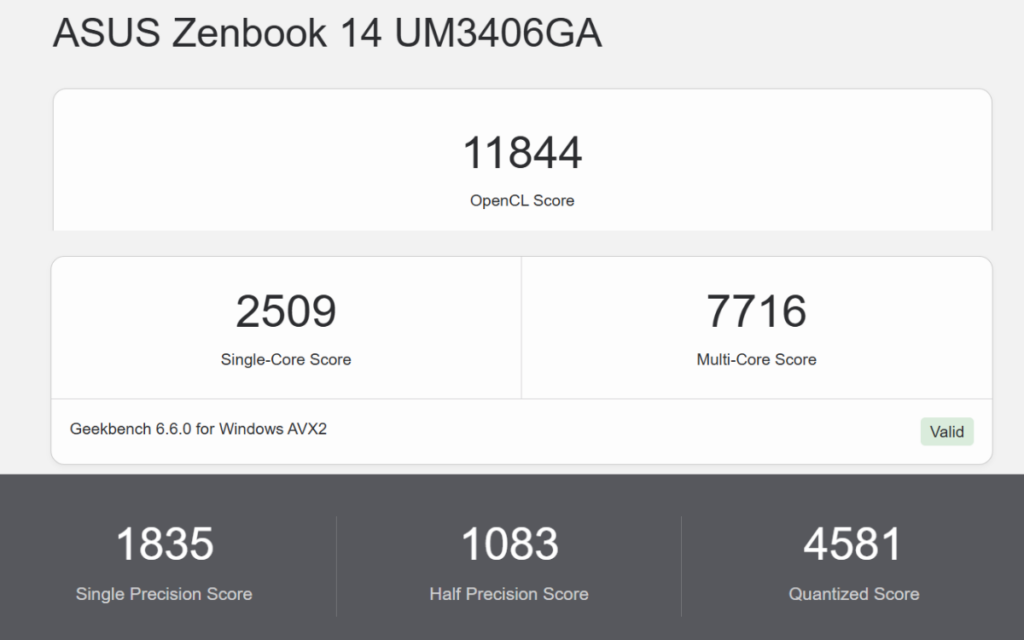
US Router Ban Explained: Should You Be Worried?

us router ban

Highlights

  • The Federal Communications Commission (FCC) is blocking new foreign-made routers from entering the US market.
  • The move is based on cybersecurity risks and national security concerns.
  • Existing routers are safe; users don’t need to replace their current devices.

What the Ban Is About

The FCC has introduced a new rule that stops new consumer Wi-Fi routers made outside the US from being sold or imported without approval. This decision is part of a larger effort by the US government to reduce dependence on foreign technology, especially from China.

However, the rule is limited. Routers that are already in homes or already available in stores will not be affected. So, for most users, nothing changes right now.

Why This Decision Was Taken

Officials believe routers can be a weak point in network security. Some foreign-made devices have been linked to cyber threats like spying, hacking, and data theft. Major cyber campaigns such as the Volt Typhoon cyberattack and the Salt Typhoon cyberattack raised serious concerns.

Because of this, these devices were added to the FCC’s “Covered List,” which includes equipment seen as risky for national security.

Which Routers Are Affected

The ban only applies to new routers entering the market. Existing devices, ongoing sales, and software updates are not impacted.

The term “foreign-made” is broad and may include devices designed or built outside the US. This means popular brands like TP-Link, Netgear, Asus, Amazon (Eero), and Google (Nest) could be affected.

Approval System for Companies

Companies can still sell routers in the US, but they must apply for approval. They need to share details about their ownership, supply chain, and where products are made. They may also be asked to shift some production to the US over time.

This is part of a bigger plan to boost local manufacturing, also known as “onshoring.” But experts say this could be difficult due to high costs and limited factories in the US.

Impact on the Market and Users

In the short term, users won’t notice much difference. There is no need to replace your router. But over time, there could be fewer options and slightly higher prices if supply becomes limited.

In the long run, the US hopes this move will improve security and reduce risks from foreign hardware. Still, some questions remain, like why only consumer routers are targeted and how approvals will work.

Overall, this decision shows that routers are now seen as critical technology, not just simple home devices.

Please Note: When you buy something using the links in our articles, we may earn a small commission at no cost to you.

Read More:

(via)

The post US Router Ban Explained: Should You Be Worried? appeared first on Gizmochina.
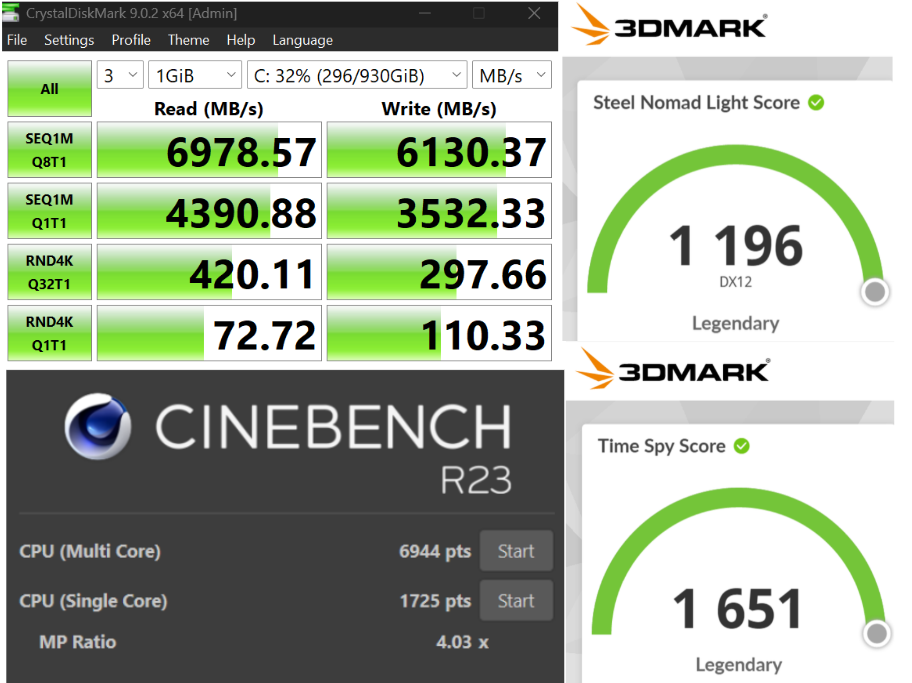
Android 17 beta is available for these devices: Complete list

Android 17 beta update devices list

Google Pixels were the first phones to get Android 17 beta, but now, a few weeks later, the beta is available for many third-party phones from different brands, including Motorola, OnePlus, and Oppo. For easier tracking of beta-supported devices, we’ve created a list here that has all the devices getting Android 17 beta.

List of devices getting Android 17 beta

Google

  • Pixel 10
  • Pixel 10 Pro
  • Pixel 10 Pro XL
  • Pixel 10 Pro Fold
  • Pixel 10a
  • Pixel 9
  • Pixel 9 Pro
  • Pixel 9 Pro XL
  • Pixel 9 Pro Fold
  • Pixel 9a
  • Pixel 8
  • Pixel 8 Pro
  • Pixel 8a
  • Pixel Tablet
  • Pixel Fold
  • Pixel 7
  • Pixel 7 Pro
  • Pixel 7a
  • Pixel 6
  • Pixel 6 Pro
  • Pixel 6a

Motorola

  • Motorola Edge 70
  • Motorola Edge 70 Fusion
  • Motorola Edge 70 Fusion+
  • Motorola Edge 60
  • Motorola Edge 60 Fusion
  • Motorola Edge 2025
  • Motorola Moto G86
  • Motorola Moto G86 Power
  • Motorola Moto G57
  • Motorola Moto G57 Power

OnePlus

  • OnePlus 15

Oppo

  • Oppo Find X9 Pro

Realme

  • Realme GT 8 Pro

If your device is on the list, you can sign up for the beta program to receive the Android 17 beta update and access upcoming features and changes months before the stable release.

The list should continue to grow as the brands open the beta program to more devices over the coming weeks and months. We’ll update the list periodically to keep it fresh.

Keep in mind that beta builds are only rolled out to a few devices, which typically include the latest flagship phones. So, if your device is not on the list above, it may still receive the stable Android 17 update, depending on its eligibility.

Also read: Android 17: Every new feature discovered so far

So far, Google has released two Android 17 betas. The first beta was released on February 13, and the second beta arrived on February 26. And now, it appears the third beta could drop anytime soon. Google will continue to release beta builds to further refine the software until it reaches a stable state for a wider rollout.

According to the official timeline, Google may release the stable Android 17 in June 2026, while other brands would require additional time to fine-tune their skin based on the latest Android OS and add new features. Those third-party brands would likely begin rolling out a stable Android 17 update in Q3 2026.

We’ll keep posting fresh updates in the Android 17 section on Gizmochina. Remember to visit it regularly to stay up-to-date with the latest developments. Alternative, you can join our Telegram channel to get instant notifications about software updates, along with the biggest tech headlines.

The post Android 17 beta is available for these devices: Complete list appeared first on Gizmochina.
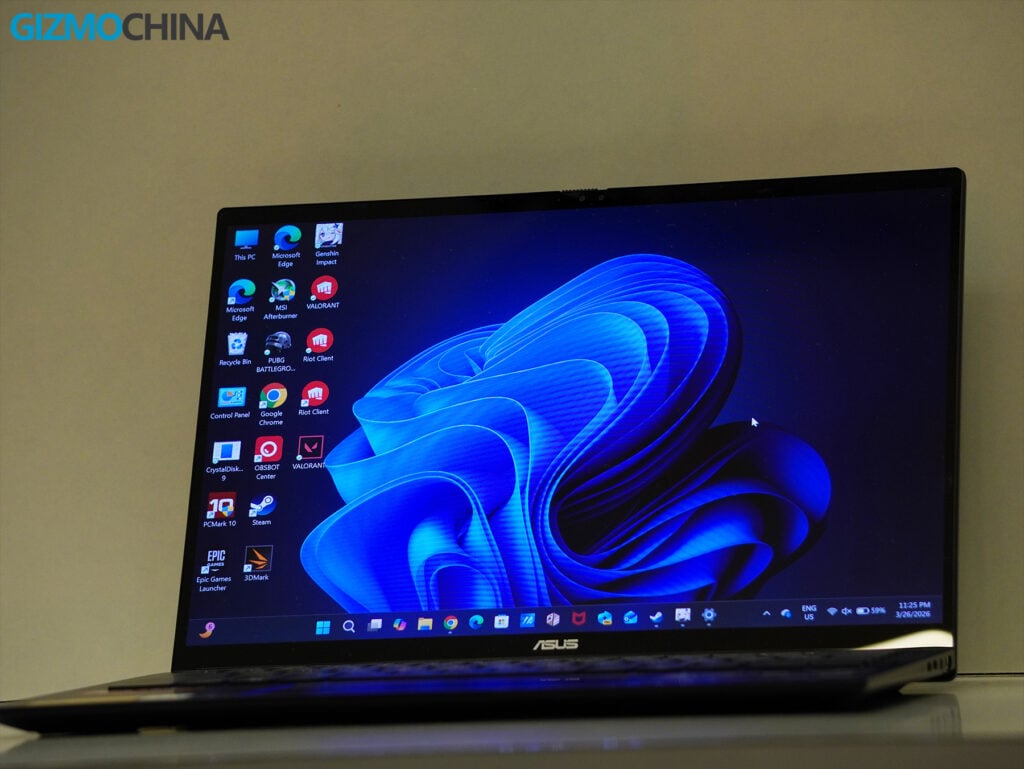
Vivo X300 Ultra specs officially confirmed; Packs 144Hz display, Snapdragon 8 Elite Gen 5, 100W charging, and more

Vivo X300 Utlra

Vivo is gearing up to launch the Vivo X300 Ultra on March 230 in China. So far, the brand has shared many details about its camera capabilities. Today, the brand released the following poster to confirm some of its other specs.

Vivo X300 Ultra key specs revealed

Vivo X300 Utlra
Vivo X300 Utlra

While the existing Vivo X300 and X300 Pro are powered by the Dimensity 9500 chip, the X300 Ultra will feature the Snapdragon 8 Elite Gen 5 chipset. The device will come with a 2K flat display tuned with Zeiss Master Color calibration, along with support for a 144Hz refresh rate and Ultra XDR technology for improved brightness and colour accuracy.

Recent reports have claimed that the Vivo X300 Ultra will house a 6,600mAh battery. Despite packing high-end hardware, the phone maintains a slim profile at just 8.19mm, which stands out in the ultra-premium segment. The display and design combination suggests a strong focus on both visual quality and ergonomics.

The X300 Ultra will support 100W wired charging and 40W wireless charging, and it will ship with a USB Type-C to Type-C charger in the box. For audio and video recording, the device introduces a quad-microphone system designed to enhance sound capture in different scenarios, especially during video shooting.

On the multimedia side, the phone includes customised speakers with a 1697 upward-firing unit and a large 0.8cc sound cavity for improved output. It also features a high-end 751440 vibration motor for better haptic feedback. Additional features include a new back-tap gesture that allows users to trigger shortcuts such as silent mode, flashlight, and screen recognition functions.

For more daily updates, please visit ourNews Section.

Stay ahead in tech! Join our Telegram community and sign up for our daily newsletter of top stories! 💡

The post Vivo X300 Ultra specs officially confirmed; Packs 144Hz display, Snapdragon 8 Elite Gen 5, 100W charging, and more appeared first on Gizmochina.

Vivo V70 FE is launching on this date in India

VVivo V70 FE launch date

In February, Vivo announced the Vivo V70 and V70 FE smartphones in India. Recently, the brand started teasing the arrival of the V70 FE in the country. While it has already launched in some Southeast Asian markets, it is now finally heading to India. Here is a look at what to expect from this phone.

Vivo V70 FE India launch details

VVivo V70 FE launch date
Vivo V70 FE India launch date

Vivo has officially confirmed that the Vivo V70 FE will make its debut in the Indian market on April 2, 2026. The smartphone is expected to be a strong contender in the premium mid-range segment, with a projected starting price of less than Rs 40,000. This positioning makes it an attractive option for those looking for high-end features without a flagship price tag.

The V70 FE will be available in striking shades, including Monsoon Blue and Northern Lights Purple. The Monsoon Blue variant is particularly unique as it features a glow-in-the-dark finish that reveals luminous patterns when the lights go out, while the purple option offers a soft, elegant gradient.

Vivo V70 FE specifications

The handset features a 6.83-inch AMOLED display with a 1.5K resolution, a 120Hz refresh rate and 1,900 nits peak brightness. Under the hood, it runs on the MediaTek Dimensity 7360-Turbo chipset, paired with up to 12GB of RAM and 512GB of internal storage.

The V70 FE operates on Android 16 with OriginOS 6 for a smooth user interface. It is confirmed to receive six years of updates. Powering the device is a massive 7000mAh battery that supports 90W fast charging.

For photography, the phone includes a 200-megapixel primary sensor with optical image stabilization and an 8-megapixel ultra-wide lens. A 32-megapixel front camera handles high-quality selfies. Durability is a priority, as the device carries IP68 and IP69 ratings against water and dust.

For more daily updates, please visit ourNews Section.

Stay ahead in tech! Join our Telegram community and sign up for our daily newsletter of top stories! 💡

The post Vivo V70 FE is launching on this date in India appeared first on Gizmochina.

❌