EU regulators are expected to rule that Google illegally favored its own shopping, travel, and other specialized services over rivals in search results.
The European Commission is expected to issue the decision next week under the Digital Markets Act, according to the Financial Times (subscription required), citing people familiar with the matter and internal Commission documents.
Google search changes possible. The case focuses on how Google displays its own vertical services in search results compared with competing services. Google owns some of the most valuable commercial search real estate. An order requiring changes could affect visibility for comparison sites, travel platforms, shopping services, and other businesses competing for organic traffic.
Why we care. Google’s treatment of its own services influences which businesses users see first in high-intent searches. Required changes could create new visibility opportunities in competitive commercial categories.
Fines add pressure. The Commission is expected to fine Google hundreds of millions of euros across two DMA decisions. Google could also face daily penalties if it fails to comply with parts of the orders within 60 days.
Search data access. The Commission is also expected to decide whether Google must give third-party search engines access to search data, including ranking, query, click, and view data. Google argues that sharing the data would threaten user privacy and exceed the Commission’s authority.
The Commission is also considering whether Google must give third-party AI providers access to the same features available to Gemini.
Google’s AI Mode showed text ads on 29.45% of commercial queries in a new SE Ranking study, less than a year after ads began appearing in AI-generated search answers.
Ads appeared on 14,733 queries in the study, which analyzed U.S. commercial searches where text ads could appear, excluding product carousels.
AI Mode ad adoption accelerated.SE Ranking said ads began appearing in AI Mode responses in late 2025. By mid-2026, nearly one in three commercial queries in its data set showed a text ad. SE Ranking said the real ad rate may be higher because AI Mode results are inconsistent across sessions.
Two advertisers often appeared together. Most AI Mode ad blocks included more than one advertiser. SE Ranking found that 71.1% of ad-triggering queries showed two ads in the same AI Mode response, while 28.9% showed only one.
CPC best predicted ad visibility. Higher-cost keywords were much more likely to trigger AI Mode ads.
Ad presence was 24.33% for keywords with CPCs below $2.
It rose to 32.45% for keywords between $2 and $10, then jumped to 53.56% for keywords at $10 or more.
SE Ranking said search volume and keyword difficulty did not show the same relationship with ad frequency.
Ad presence varied across categories. Pets had the highest rate, with ads appearing on 72.38% of analyzed keywords. Healthcare had the lowest, at 2.64%.
Higher-ad categories were typically lead-generation markets with clear paths to paid conversions.
Lower-ad categories were more likely to involve informational or YMYL intent, where commercial demand may be lower or Google may be more cautious.
Advertisers were rarely cited. Buying an AI Mode ad didn’t make advertisers more likely to be cited as a source in the same response. Only 11.53% of advertiser domains appeared among the cited sources for the keywords they advertised on. At the URL level, overlap fell to 1.95%.
This held true even after comparing advertisers with similar non-advertising domains based on domain strength, backlinks, referring domains, and organic visibility, SE Ranking said.
Organic overlap was limited. Advertisers also rarely ranked organically for the same keywords. Only 2.32% of advertised URLs ranked organically for the queries where their ads appeared. At the domain level, overlap increased to 15.35%.
About 85% of advertisers didn’t appear in organic results for the same keywords where they showed AI Mode ads, according to the study.
Why we care. Buying visibility in AI Mode doesn’t increase your chances of being cited or ranking organically. Treat AI Mode ads, cited sources, and organic rankings as separate visibility channels.
About the data. SE Ranking analyzed 50,032 commercial keywords across 20 niches, averaging about 2,500 keywords per niche. The data reflects U.S. AI Mode results collected on June 30. SE Ranking noted that ad behavior may change as Google expands AI-specific formats.
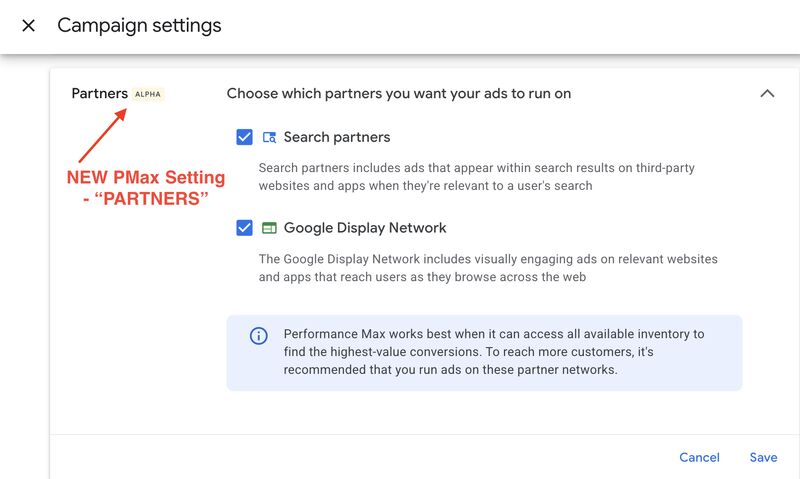
Google is testing a new Partners (Alpha) setting in Performance Max that gives advertisers the ability to opt in or out of Search Partners and the Google Display Network—a level of control that hasn’t previously existed in the automated campaign type.
What’s happening. Some advertisers are seeing a new Partners (Alpha) setting within Performance Max campaigns that lets them choose whether to include:
Search Partners
Google Display Network (GDN)
Until now, both networks were automatically included in Performance Max with no option to exclude them.
Why we care. The update gives advertisers greater control over where Performance Max ads appear, making it easier to align inventory with campaign objectives. Those focused on efficiency metrics such as ROAS or CPA can now test whether excluding certain networks improves performance.
What we’re watching. The feature is currently labelled Alpha, indicating it is only available to a limited number of advertisers. Google has not announced when—or if—it plans to roll the setting out more broadly.
The bottom line. Google’s new Partners (Alpha) setting could give Performance Max advertisers one of their most requested controls: the ability to decide whether campaigns run across Search Partners and the Display Network, rather than relying entirely on Google’s automation.
Spotted. This update was spotted by PPC Growth Strategist Saquib Syed, who shared spotting it on LinkedIn.
Google’s AI Mode increased citations to google.com by 8.4x in about two months, making it the No. 2 cited domain in Profound’s tracking.
The increase came almost entirely from Google Business Profiles and Product Knowledge Panels, according to Profound. Those Google-hosted cards now appear within AI Mode answers for many local and product searches.
Google cards moved up. AI Mode now surfaces Google Business Profiles as inline panels for local-intent queries.
These panels can display a business’s hours, photos, location, and reviews before users reach the company’s website. Profound said the shift makes the Google-hosted profile the first page many users see.
Local categories led. The change was strongest in industries where local intent drives revenue, including:
Hospitality and travel
Home services
Restaurants and dining
Real estate
Healthcare
Product panels gained ground. Product searches also shifted toward Google-hosted results. Queries about comparisons, compatibility, or specifications increasingly surfaced Product Knowledge Panels instead of direct links to ecommerce or brand websites, Profound said.
Why we care. Your Google-hosted profile may shape a user’s first impression before they ever reach your website. Missing hours, outdated photos, incomplete information, or poor reviews can cost you the click before users visit your site.
About the data. Profound tracked AI Mode citation share from April 15 through June 30, analyzing more than 32 million google.com/searchviewer instances.
Salesforce found 20% of sales coming from agents marks a signpost.
60% of companies use agents live in production, and 3 out of 4 companies invest in AI agents.
To figure out how ready B2B sites are for agentic visitors, I teamed up with David Kaufman, founder of Siteline, and I analyzed how agents scan websites and where they get stuck. The answer: most sites are agent-ready, but there is one critical breaking point.
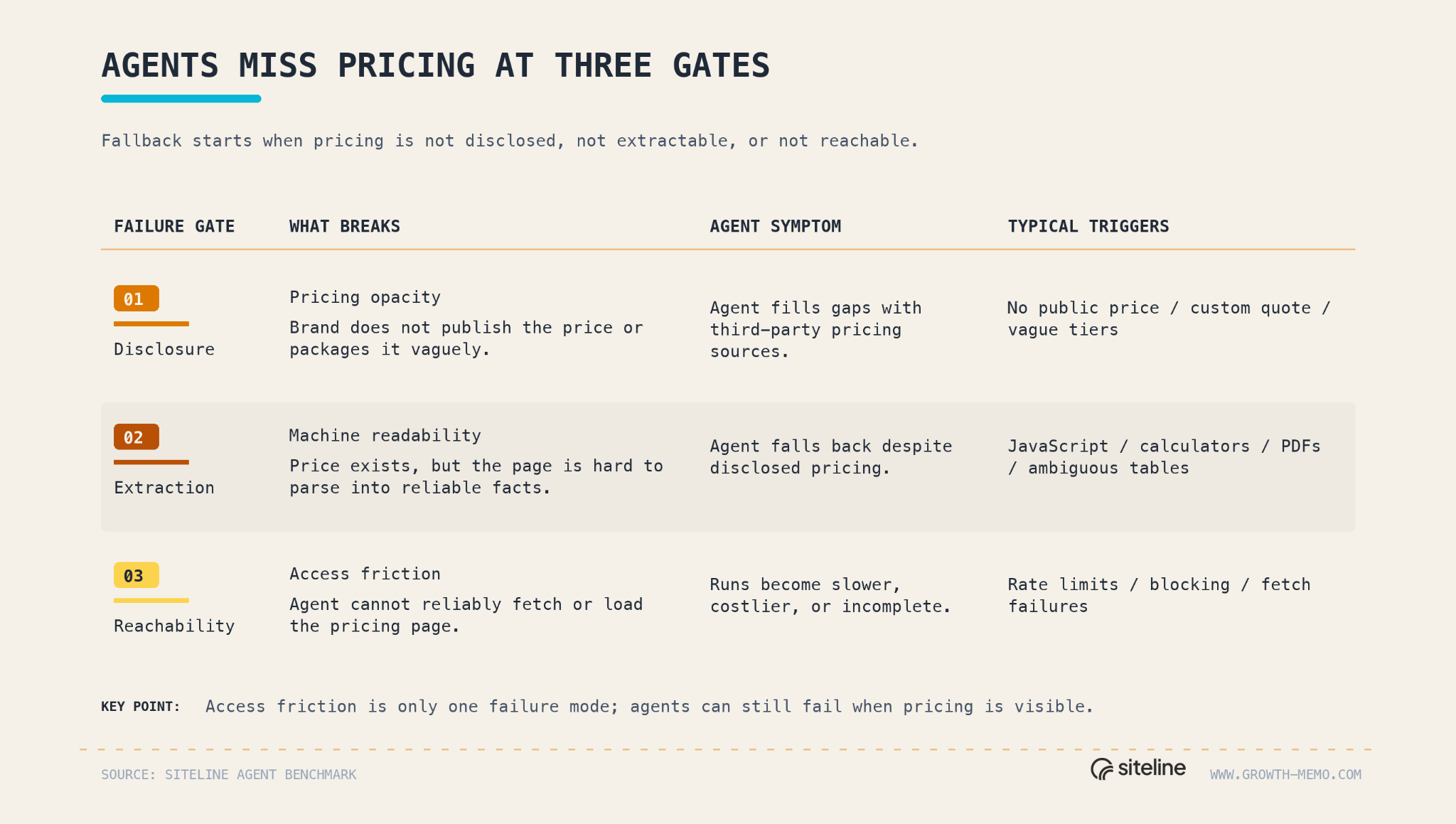
Agents don’t read websites like humans. They receive a task, search the web, fetch pages, extract facts, and cite the sources they used. A page can persuade a human and still fail an agent if the facts are hard to find (opacity), hard to fetch (machine-readability), or hard to cite (access friction).
AI agents turn websites from showrooms into barcodes.
How we looked at agent behavior:
The agent had to find the official site itself. We did not provide starting links, eg to homepages.
We gave agents three buyer-related tasks for 100 B2B products: find pricing/features, integrations, and security/compliance. We ran each task five times to measure the impact of the probabilistic nature of LLMs.
We weren’t comparing whether or not the information existed somewhere on the web; instead, we measured whether the agent could reliably answer from the vendor’s own site.
The moment a prospect looks at pricing, they stop browsing and start comparing. High buyer intent, bottom of the funnel. That makes pricing the hardest and most important test of whether a vendor site can serve agents directly.
Pricing also sits in a triangle of 3 “wants” that good pricing pages need to satisfy:
Companies want to control pricing disclosure.
Buyers want fast comparison.
Agents need clear, fetchable, citable facts.
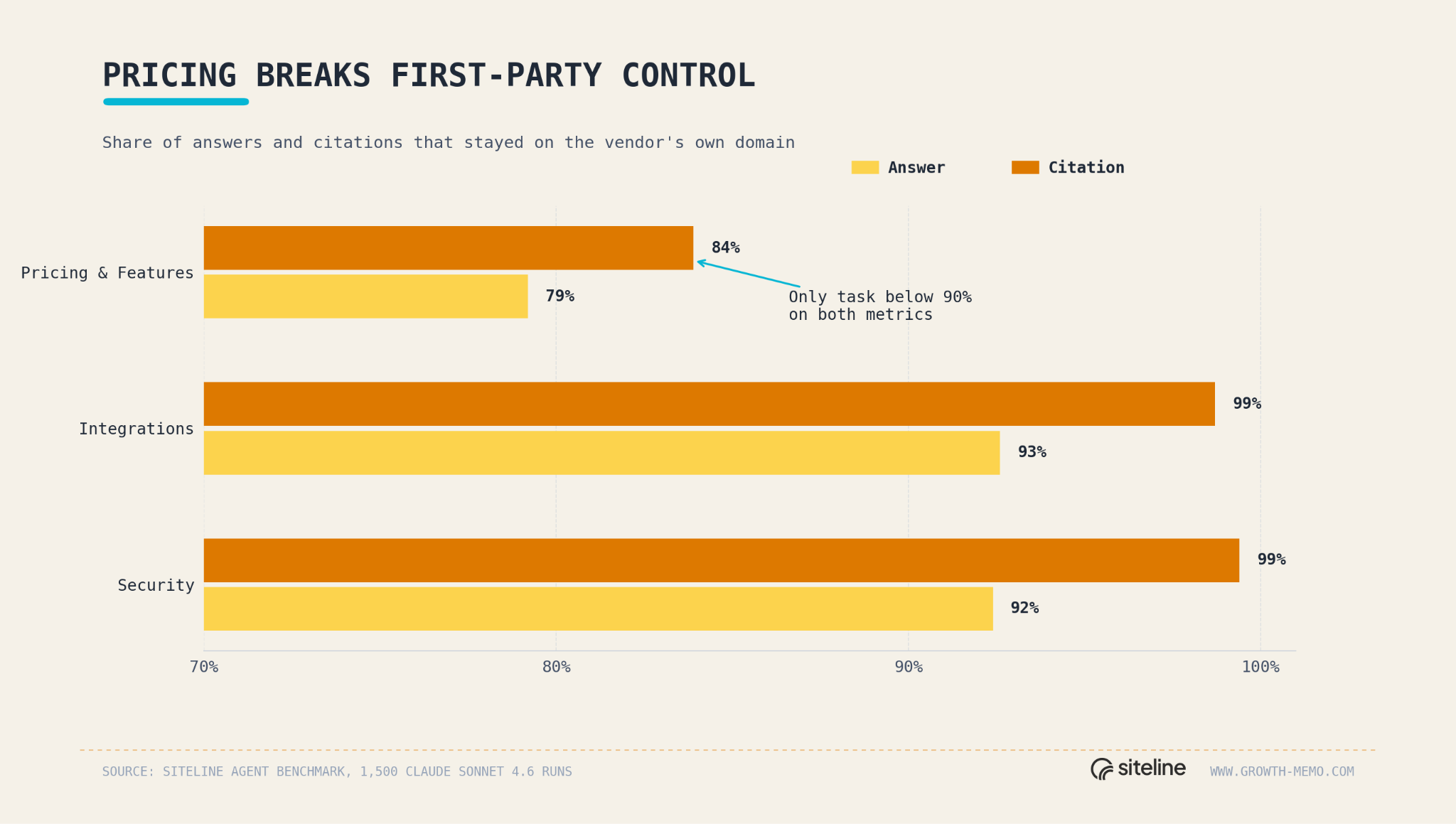
When AI agents try to retrieve pricing, they get stuck much more than for security or integrations.
Pricing/features produced 77% of all third-party citations.
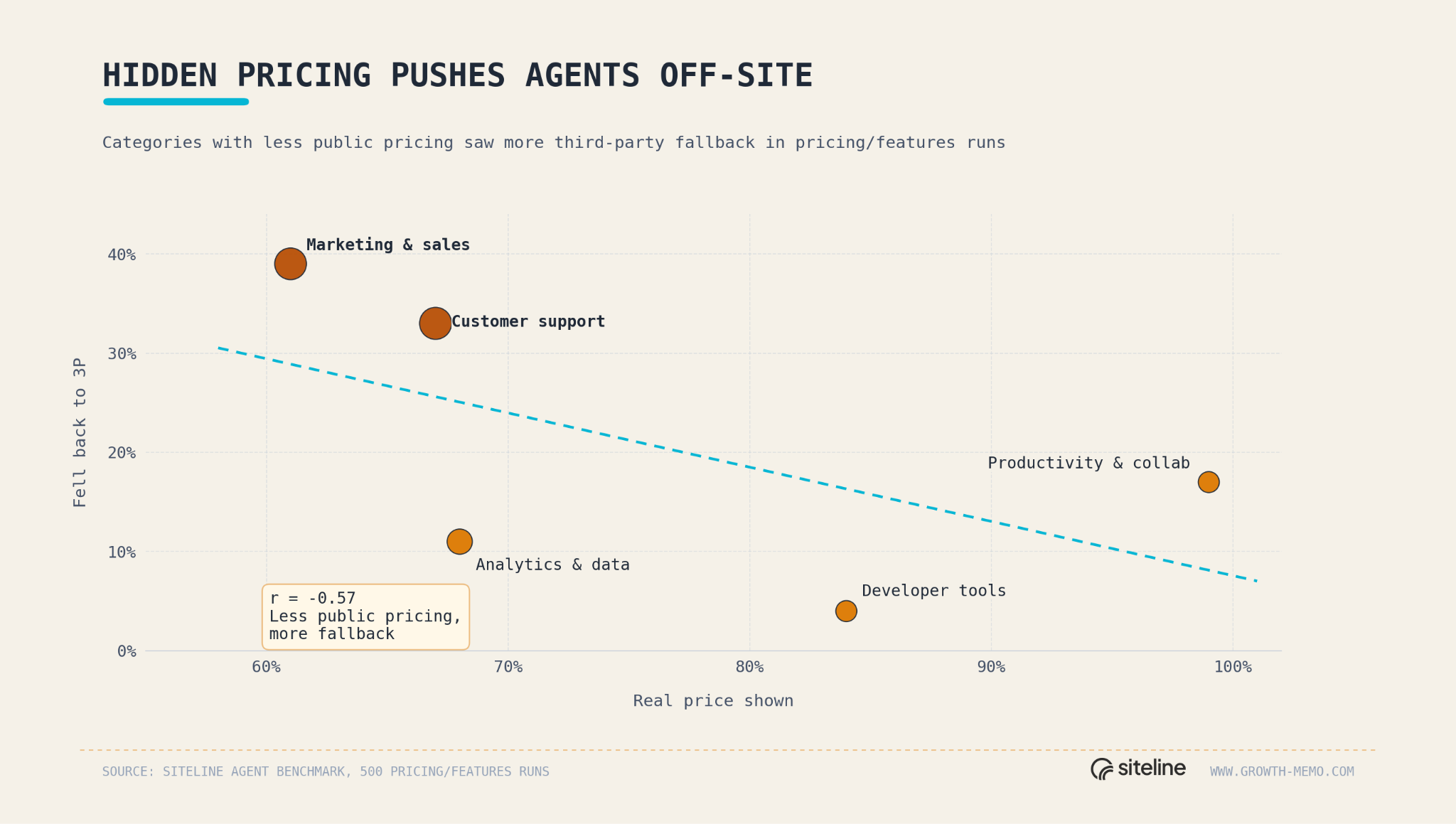
If you wonder whether that’s because some B2B companies don’t publicly show pricing, you’re only half right.
2. Hidden pricing is only part of it
Hiding prices forces agents to look elsewhere, but published prices do not fully solve the problem. Among pricing prompt runs where the vendor did not disclose a real price, 45% cited at least one third-party source. The other 55% stayed on first-party citations, usually by saying the vendor required contact sales or did not publish a concrete price.
Even when the vendor showed a numeric public price, agents still cited at least one third-party source in 18% of runs, suggesting price can be on the page but still be hard for the agent to extract, trust, or cite cleanly.
You can try to hide your pricing, but you better make sure no one else knows and writes about it. Once it’s “out there”, it’s too late. If you have complex pricing methodology, the best way is to explain it clearly and make it accessible to agents.
Some pricing pages are visible to humans but not reliable enough for agents to parse and cite. You can’t always trust your eyes.
3. Agents fail for three reasons
Agents fail to retrieve pricing from a brand for 3 reasons: opacity, machine-readability, and access friction.
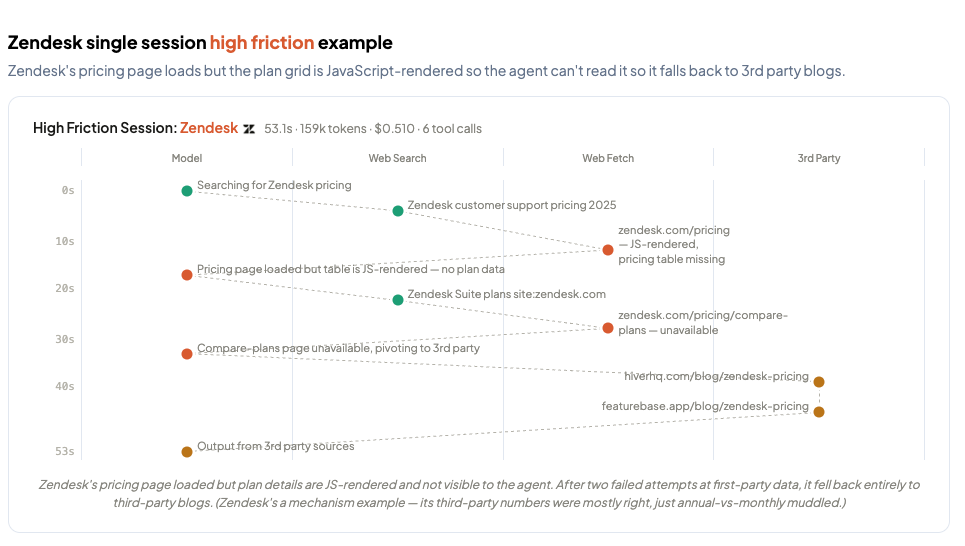
Example of an agent struggling to retrieve Zendesk’s pricing and pivoting to third-party sources.
Pricing opacity simply means the brand doesn’t publicly disclose the price, or it’s vaguely packaged. Opacity explains elevated fallback, meaning agents have to rely on third parties for information.
Machine-readability describes the situation when prices exist, but agents still do not confidently extract them. Machine-readability explains fallback despite disclosed pricing. Machine-readability fails when the price is hard to extract because of page structure, JavaScript, calculators, toggles, screenshots, PDFs, or ambiguous tables.
Access friction is what most people expect to be the problem with agents. The agent hits fetch failures, rate limits, blocking, or unreachable pages, making agent runs more costly.
Access errors were not the main reason agents left first-party sources, but when they happened, they were severe. They appeared in only 7% of all runs. In pricing runs, access errors pushed third-party fallback to 77%, compared to 17% without access errors.
The impact of errors on agent run cost (tokens, web searches, fetches, retrieves, time) is significant when comparing the 90th with the 10th percentile in our study:
Cost: 4.4x
Token: 4.7x
Time: 2.0x
Brands don’t pay that bill directly, but it is a useful proxy for friction. The harder your site is to retrieve, the more work an agent has to do before it can answer from your page. If your pricing page is blocked, slow, hard to fetch, or hard to parse, the agent has two choices: spend more work on your site… or get the answer somewhere else.
4. The fallback web is messy
Fallback occurs when agents have to rely on third-party sources rather than first-party sources as a result of the three failure modes. This is the biggest risk because third-party information is spotty and beyond your control.
Agents do not fall back to one clean source category. They reconstruct pricing from a mixed web of explainers, directories, app stores, partner pages, and low-trust aggregators.
Key stats from the 580 pricing third-party citations:
52% were editorial (blogs, media articles, comparison guides, explainers, and other article-style pages).
46% fell into the directory category (review, procurement, and software-listing sites such as G2, Capterra, Vendr, Tekpon, and similar domains).
2% from broader ecosystem pages (app stores, marketplaces, partner pages, and integration directories tied to another platform).
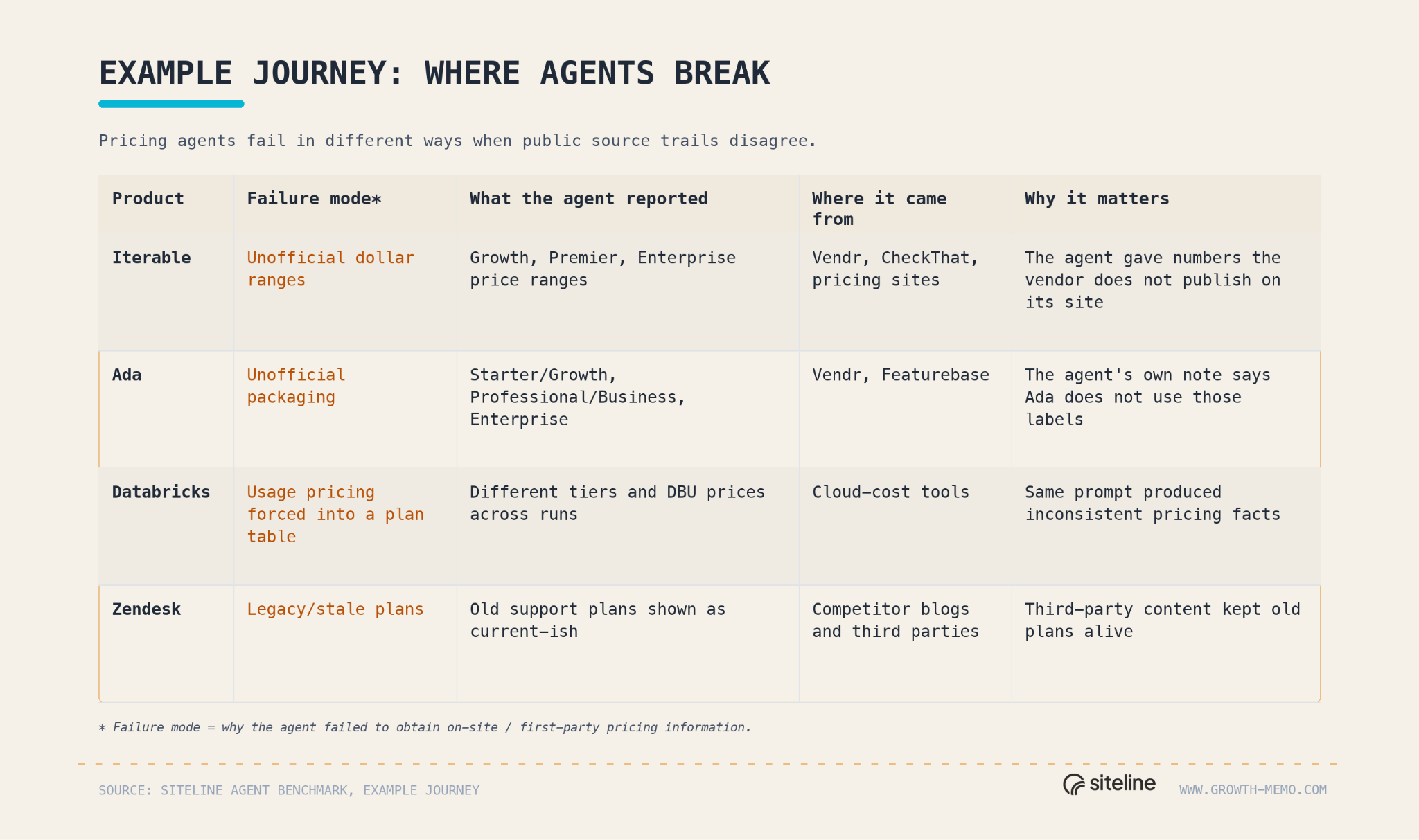
The examples show the risk of missing pricing transparency and agent stumbling blocks on your site.
Example journey:
Here, failure mode indicates the reason the agent failed to obtain on-site / first-party pricing information.
5. How to make your site agent-proof
An agent-proof pricing page is how you keep the agent quoting you instead of a directory like Vendr. The fixes map to the three failure modes.
Disclose the fact (opacity)
Publish real prices in text for every self-serve tier. If a tier is genuinely custom, say what drives the number instead of “contact sales.”
Keep plan names, prices, limits, and features on one canonical pricing URL, and point every other mention back to it.
Mark legacy plans clearly so third-party content can’t keep stale tiers alive.
Make the fact extractable (machine-readability)
Put prices in crawlable HTML. Many agent fetches never run JavaScript, so a price rendered client-side is invisible. In testing, prices in server HTML got read in under a second; a JavaScript-only price got missed.
Add schema.org Product and Offer markup with price and priceCurrency. This single lever moved a page from 73 to 93 in the readiness test.
Explain usage-based pricing in text, not a calculator-only widget.
Let the agent in (access friction)
Allow AI crawlers in robots.txt (GPTBot, ClaudeBot, PerplexityBot, Google-Extended). Check you aren’t allowing Googlebot while blocking them.
Don’t block server-side AI fetches on pricing pages. Access errors hit only 7% of runs, but they push fallback from 17% to 77% when they do.
Keep the price early in the DOM and the page light. A 1 MB pricing page taxes every agent and pushes cheap runs to route around you.
Fix opacity and machine-readability first; they drive most of the fallback. Then run the query yourself, “Find all pricing and features for [product],” and measure it with the skill below.
This post first appeared on the author’s website and is republished here with permission.
Rising CPCs aren’t just the result of more competition inside search auctions. They’re increasingly the result of what happens before anyone places a bid.
AI Overviews, shrinking organic click volume, and stronger brands competing for a smaller pool of commercial traffic have changed the economics of paid search. Improving bids and ad copy still matter, but the biggest opportunities now sit outside the auction itself.
Why paid search keeps getting more expensive
Paid search costs are climbing across almost every category. The cross-industry average CPC is $5.42, per the latest WordStream benchmarks, more than double what it was a decade ago.
Stackmatix has Google Search up 14-18% year over year. LinkedIn is up 18 to 22%. Some accounts are seeing 25% inflation in their primary commercial keywords.
For most of the last decade, organic search helped offset PPC costs. Today, AI Overviews absorb the clicks that used to keep your paid search efficient.
The latest zero-click study from Sparktoro shows an 8% reduction in clicks through from search engines vs. 2025, further impacting brands whose users now get information from AI summaries.
Digiday’s research with brand and agency professionals shows 37% of respondents have already seen informational search traffic decline, which mirrors what we’re seeing across our client base, putting more pressure on navigational and transactional traffic to hold steady.
The number of advertisers participating in search auctions has risen 35% year over year because AI creative tools have lowered the barrier to entry for new bidders. In its first year, AI Max for Search has expanded query space for advertisers willing to use it, but also concentrated competition into a narrower set of commercial queries.
Fewer organic clicks reaching your site means more pressure to make up the gap in paid auctions. More advertisers fighting for those auctions means higher CPCs. And the auctions that still resolve to a click are increasingly the only ones where a user has exited the AI summary and chosen to scroll past it.
Paid search performance in 2026 is decided across three layers. The auction itself now offers the least opportunity to improve results.
1. Brand: Upstream of the click
This layer determines whether a click is generated or absorbed before any auction begins. It’s influenced by authority signals, brand mentions, AI Overview inclusion, LLM citations, and visibility in the publications and communities AI systems use to build their answers.
Most CPC inflation starts here. When AI Overviews answer more queries directly, the pool of clicks available to advertisers shrinks. The auction doesn’t get cheaper as a result. It gets more expensive because the same number of advertisers compete for fewer clicks.
As CPCs continue to rise, the brands protecting their margins are building visibility across multiple platforms. A stronger organic presence lets them rely less on paid search while remaining visible throughout the buying journey.
The auction itself is influenced by ID strategy, match types, ad copy, automation, Smart Bidding configurations, and Performance Max guardrails.
This is where most paid teams still focus their efforts. It’s also the layer with the least leverage left because the size and quality of the click pool are determined upstream. The work still matters, but the opportunity to improve performance here is smaller than it used to be.
Red ocean vs. blue ocean media
The paid channels where most performance teams compete are becoming red oceans: saturated auctions where advertisers bid against one another for the same shrinking pool of commercial clicks.
Blue oceans are channels where buyer intent already exists, but advertiser competition hasn’t yet caught up.
Red ocean (where competition is fiercest)
Blue ocean (where intent exists but competition is lower)
Why the shift works
Google Search non-brand commercial keywords
Microsoft Advertising (Bing), including its growing share of AI Search ad surfaces
CPCs typically 20 to 40% lower, audience skews older and higher value, much less crowded
Standard LinkedIn Sponsored Content
LinkedIn Thought Leader Ads (peer-to-peer format from a real profile)
Around 1.7x higher CTR than company-page ads, lower effective CPC, better fit for considered purchases
Meta feed ads (broad demographic targeting)
Reddit Ads, community sponsorships, niche newsletter and Substack advertising
High-intent attention in environments LLMs cite, less saturated auction dynamics, more first-party engagement
Performance Max and Google display
Connected TV, BVOD, podcast advertising
Premium attention at the top of the funnel, fewer competing bidders, channel measurement is maturing fast
Branded search defense at any cost
AI Search and early ChatGPT ad inventory
First-movers are buying tomorrow’s primary discovery surface at today’s clearance prices
This isn’t an argument for abandoning Google Search. It’s a reminder not to overinvest your paid budget in the most competitive auctions. Instead, start shifting some of your existing budget into testing emerging channels and compare their performance with traditional search.
3. Experience: After the click
The post-click experience is an essential part of media economics, but most paid teams still treat it as something to hand off to another function.
Every other lever in this article governs what you pay to enter the auction. Experience determines what each click is worth after you’ve paid for it, and it’s the only one of the three layers you fully control.
In an inflating market, post-click conversion stops being a quarterly optimization exercise and becomes your primary defense against rising acquisition costs.
Google’s Ad Rank is calculated using your bid, your Quality Score, and the expected impact of assets. Landing page experience is one of the three components of Quality Score.
A higher Quality Score directly offsets the need to bid more aggressively. A stronger landing page can help you outrank a better-funded competitor while paying less per click.
That said, most expensive clicks don’t convert on the first visit, especially in B2B, where buying cycles are longer and purchases are more considered. The job of the experience layer is to convert and capture. Think first-party data, a reason to return, and an entry point into nurture and CRM.
The advertisers protecting their margins through this transition will stop treating media and landing pages as separate disciplines. They’ll manage them as a single P&L shared across paid media, CRO, UX, content, and lead nurture.
Paid search accounts for a smaller share of where performance is earned, and it’s becoming a more expensive channel to operate if you haven’t built brand strength around it. Much of the work that makes paid search efficient now sits in disciplines paid search teams have historically considered someone else’s job.
The teams that protect their margins through this transition won’t be the ones with better targeting or bidding strategies. They’ll be the ones who’ve built enough visibility and authority outside the auction to win it when it matters.
SEO vs. PPC? SEO vs. PPC vs. AI? SEO vs. PPC vs. AI vs. (everything else)? I’ve been covering this question and its ever-changing answer for nearly 20 years.
The answer? It’s the classic SEO and marketing response: it depends.
It depends on the situation, goals, marketplace, keywords, year, location, SERP features, and myriad other variables, all working together to create utterly unique little marketing snowflakes.
When paid search is the better answer
I’ve run into this question with several clients over the last few months, and each had a different answer.
The first, an architect, ranked first for several seemingly important keywords. Their SEO agency celebrated the rankings, but they weren’t generating leads.
A quick look at the data explained why. They often ranked first organically, but only after four ads (many with sitelinks), a Find Results on Page feature, and four local listings, one of them paid. By the time users reached the organic results, they were about 20 links down the page.
Search Console told the rest of the story. These keywords generated roughly 300 searches a month with a click-through rate of about 1%. Three hundred searches. Three clicks. No wonder they weren’t seeing results.
With the data in front of us, the lack of leads wasn’t surprising. We shifted some budget from SEO to paid search, and performance improved quickly.
The second client couldn’t have been more different. She’s a clinical psychologist specializing in childhood bereavement and trauma. She left an NHS post to build a private practice.
She works a few days a week, her clients come weekly for months at a time, and she needs only two or three quality inquiries each week to stay busy. Quality matters more than volume here.
The budget left no room for ads. Instead, we focused on a well-optimized Google Business Profile, a website that clearly and warmly explained what she does and who she helps, a handful of local citations, and relevant vertical citations.
It worked. She gained visibility in Maps, localized organic search, and AI results. Leads now come from both prospective clients and private referrals, enough to keep the practice full.
What made this interesting wasn’t the lack of competition. It was the type of competition. The ads were dominated by large, impersonal therapy directories. Positioning her as a local, experienced psychologist who could genuinely help made her stand out. A relatively small amount of traffic generated more than enough business.
The wrong question
Two clients. Same year. Opposite answers.
Ask me, “SEO or PPC?” and those two examples show why the question doesn’t work.
I’ve revisited this debate several times over the years, and the answer always landed in the same place: a blended approach works best, with a big, fat “it depends” attached. It depends on your market, your margins, your competition, and your goals.
That answer is still technically correct. It’s just no longer sufficient.
In 2026, the question isn’t merely difficult to answer. It’s the wrong question, asked about a search results page that no longer exists, in a market where the click is no longer the thing you’re actually buying.
4 assumptions that no longer hold up
This debate has historically rested on a series of assumptions that I no longer think hold true.
1. The results page is a stable list of slots
It isn’t. It’s a synthesis engine that assembles a different answer depending on the query, the device, and the model driving it. AI Overviews now appear on a large and growing share of queries, and Google swapped Gemini 3 in as the default model behind them in January.
2. The click is the unit of value
In the first four months of 2026, 68.01% of U.S. Google searches ended without a click anywhere. Not without a click to your site. Without a click anywhere.
That’s up from 60.45% in 2024 and around 45% a decade ago. Clicks are still one measure of success, but influence matters more.
3. SEO and PPC are substitutes competing for the same visitor
That was the entire premise of the debate — one visitor, one click, two ways to win it. Pick your fighter.
The data now shows both channels being squeezed by the same force on the same page, while organic visibility measurably lifts paid performance. They’re not substitutes. They’re two parts of the same system.
4. Search happens on a search engine
SparkToro and Datos looked at 41 major platforms where search behavior actually occurs. Google accounted for 73.7% of desktop searches. Traditional search engines together made up around 80%. Commerce sites accounted for roughly 10%, social platforms 5.5%, and AI tools 3.2%. Amazon, Bing, and YouTube each handled more search activity than ChatGPT.
Search is a behavior, not a channel, and it’s happening everywhere (hence the increasingly popular shift toward “search everywhere optimization”).
The assumptions behind the debate
Assumptions are another problem with the whole SEO vs. PPC debate.
Often, a client comes to us asking for SEO (and now AEO, or whatever you want to call it). They have a hunch it’s the right answer, that SEO can plug the holes Google Ads is punching in their marketing budget, and that the magic SEO/GEO wand can fix everything.
Those assumptions are dangerous. They send people down the wrong path, often for a long time, throwing good money after bad. Many agencies and consultants don’t help. Instead of embracing the shift, they cling to old approaches, massage the data, and eke every last drop of budget from the very people they’re supposed to help.
Remove those assumptions and any channel bias, and it becomes clear there is no better channel. The whole model has, to some extent, imploded.
AI: The new kid on the block
Historically, if traffic went to SEO or PPC, we could at least see how it was split between the two.
AI is different. It’s not chasing clicks. It’s shaping attention and influence.
Fortunately, correlation studies give us some visibility into what’s happening. Seer Interactive found that, across queries with AI Overviews, the average organic click-through rate for organic listings fell from 1.76% to 0.61%, a 61% decline.
That’s a grim number. Fewer than one in 100 impressions resulted in an organic click.
PPC, the big dog of search traffic, took an even bigger hit, falling about 68%, from 19.7% to 6.34%. Ouch.
It’s worth pausing to let that sink in.
AI Overviews did more damage to ads than organic results. They reduced clicks overall rather than redistributing them in the long-running battle between SEO and PPC.
For decades, the SEO vs. PPC debate has been a slow war of attrition, with PPC taking an ever-larger share while organic CTR declined year after year. AI changes that. Both paid and organic are now being squeezed as AI rapidly accelerates the rise of zero-click searches.
AI goes further still. It’s fundamentally changing the customer journey. SERP features like featured snippets chipped away at CTR, but AI means people often don’t need websites at all to get answers.
A single prompt can produce a refined response without users piecing together information from multiple sources.
The point is that AI isn’t just a third player in the SEO vs. PPC debate. It’s fundamentally changing how we access and consume information, reshaping both channels in the process.
The Seer study also found that brands cited inside an AI Overview earned 35% more organic clicks than uncited brands and 91% more paid clicks.
That can be a little difficult to unpack, so it helps to think of it as a funnel.
The AI Overview dramatically reduces the total number of organic and paid clicks.
However, if you’re cited in the AI Overview and also have a paid or organic listing below it, you’re much more likely to earn the click. Typically, that click isn’t on the AI Overview itself, if it’s even linked. It goes to the paid or organic listing below.
The user reads, trusts, skims, and clicks.
The process looks something like this: The user reads the summary, sees your brand cited as a source, then scans the page. When they decide to click, they choose the name AI has already presented as credible. The AI citation isn’t functioning as a link. It’s functioning as an endorsement that primes the click elsewhere on the page, whether paid or organic.
The AI citation primes the click on your paid or organic listing and sends you a warm visitor, much like a personal referral arriving through a branded search.
SEO, PPC, and AI
In previous attempts to unpack the SEO vs. PPC debate, the best general answer I could give was that they worked well together. Some laser-targeted PPC paired with complementary SEO efforts, whether local, upper-funnel, or lower-funnel. In some cases, SEO alone worked.
In others, PPC alone was enough. But if search was important to the business, a blended approach usually delivered the best results.
That was always general advice and always needed to be tailored to the situation. Today, though, I think we can make a much stronger case that the SEO vs. PPC debate is over. The conversation now is SEO, PPC, and AI.
To understand why, we have to look at how these channels intersect. A good example is Google’s new AI Max ad format. Think of it as an AI-powered evolution of Dynamic Search Ads. AI Max reads your website content and landing pages, expands your final URLs, and matches queries.
The targeting inputs for your paid campaigns are now, quite literally, your SEO assets. Ads in AI Mode are already in testing in the U.S. AI-powered Shopping ads read your Merchant Center feed and use Gemini to generate a tailored explainer for each shopper.
Work that once belonged to SEO (and perhaps CRO) now directly supports AI and PPC. Clear pages, structured content, and a value proposition machines can understand now feed your organic rankings, Quality Score, AI Max query matching, AI Overview citations, and LLM visibility. One well-executed asset now supports multiple marketing surfaces.
Meanwhile, the paid search picture is more interesting than the doom-posting suggests. WordStream’s 2026 benchmarks put average search CPC at $5.42, more than double the 2016 figure.
At the same time, conversion rates improved across 87% of industries, and cost per lead fell for the first time in five years. Paid search is becoming more expensive per click but more effective per outcome. That’s exactly what you’d expect when the click pool shrinks, and the remaining clicks carry higher intent.
Finally, I’m no conspiracy theorist, but if the book Supremacy is to be believed, Google developed an AI chatbot before OpenAI and ChatGPT brought the technology into the mainstream. The company reportedly held it back because of internal concerns about the impact on ad revenue, and perhaps accuracy.
That also makes a business case for why Google must integrate AI into its ecosystem to protect its core revenue. I also think it’s more useful to align with where Google is headed than spend your time chasing algorithms.
The trend was already underway
While this may feel like a revolution, I think it’s really the next step in an evolution that’s been unfolding for years.
We were talking about zero-click searches long before AI. The trend has been remarkably consistent: roughly 45% in 2016, 49% in 2019, 60% in 2024, and 68% today. Google has spent a decade building features that keep people on Google, and AI Overviews simply accelerated a trend that was already underway.
AI Mode accounted for about one-third of 1% of searches from January through April. It’s growing fast, with more than a billion monthly users and queries reportedly more than doubling each quarter. But it isn’t what got us here.
Google got us here, one SERP feature at a time, gradually transforming search from a list of signposts into a platform that provides answers. AI didn’t start that trend. It accelerated it.
Simply put, if you’re not on that list, you’re probably no longer in the running.
Why SEO still matters
The good news is that none of this makes SEO less important. It changes why it matters. SEO still matters because AI Overviews are grounded in Google’s index. Your search visibility still drives your AI visibility.
It’s not quite that simple, though. AI uses a process known as query fan-out to break a complex prompt into multiple smaller searches. It then combines those results, with the highest-ranking pages often receiving the most visibility in the AI summary. Rankings still matter across a broad range of topical subqueries in your space.
YouTube is a particularly strong opportunity because videos often rank for many of the subqueries that support those broader AI-generated answers. If your competitors haven’t invested there yet, they may be leaving visibility on the table.
Keywords aren’t what they once were. Topical visibility across search, both on your own site and across third-party platforms, remains highly important.
There is one caveat. This is still the Wild West. Studies from Ahrefs and BrightEdge reached slightly different conclusions, and measuring AI visibility remains challenging.
Just like the early days of SEO, success comes from thinking, tinkering, and experimenting to maximize your visibility across a topic, whether on your own site or on third-party platforms like YouTube and Reddit.
The “SEO is dead” crowd is trying to sell you GEO. The GEO crowd says it sends no traffic and tries to steer you back to SEO. The anti-PPC crowd points out that click prices have doubled while total clicks have fallen.
The traffic data is fairly clear. Google still drives nearly 90% of referral traffic, according to Cloudflare Radar. All AI chatbots combined account for less than 1%.
But that’s only part of the story. Google still drives most referral traffic, but AI increasingly shapes the decisions behind those clicks. That means SEO, GEO, and PPC aren’t competing strategies. They’re different parts of the same decision journey.
By the time someone reaches your website or clicks your ad, they’re often a warm prospect, and the business is yours to lose. That’s why AI-referred traffic converts several times better than traditional organic traffic, even when it lands on the homepage, something PPC practitioners have historically avoided. There’s no magic here. People arrive already familiar with your brand and closer to making a decision than asking a question.
SEO and PPC are no longer just acquisition channels. They’re the mechanisms that help you become the answer.
That reframes what SEO and PPC are for. They stop being two ways to do the same job and become two parts of the same sequence. Your organic footprint, including content, coverage, videos, reviews, and what others say about you, helps you become the answer across search and AI. Your ads help you get chosen once you are. One earns the recommendation. The other converts it.
That’s why you can no longer trade them off against each other. You can’t choose between the thing that gets you onto the shortlist and the thing that converts you once you’re there.
This isn’t a budget decision or an either-or choice. These are two parts of a single system that work together in sequence to maximize results. Integrate them, or you’ll lose ground to competitors that do.
Maybe this question had some merit in the past. Every time I tried to answer it, though, I ended up in the same place: for most businesses, an integrated approach worked best.
The real problem is that it was always the wrong question. It just happened to be a popular one because a simple question is easier to live with than a complicated one. “SEO or PPC?” is easy to answer in a meeting. “Where do my customers decide, and what would make them choose me?” takes real work.
Underneath it all, though, the fundamentals haven’t changed. Your customers still have problems to solve. They still build a shortlist. They still choose someone. The only thing that’s changed is who’s holding the pen when that shortlist gets written. Increasingly, it’s a machine reading everything the world has said about you.
I always come back to the restaurant example. Bob’s Burgers serves 100 customers a week. Ninety-nine leave happy. Every week, one customer, and there’s always one, leaves a bad review. Your job is to make sure the digital record reflects the experience of the other 99.
So get your own house in order first. Fix the offer. Fix the website. Fix the tracking. Then map the territory, choose your ground, and become genuinely, specifically, unsummarizably good at what you do. Then tell the world.
The SEO vs. PPC debate is dead. Long live integrated SEO, PPC, and AI.
You pick up your phone to reply to a message. A few taps later, you’re watching a TikTok about a restaurant in Sicily, a boutique hotel in Copenhagen, or a local business you hadn’t heard of before.
Maybe you Google it right away. Maybe you don’t. But days or weeks later, someone mentions it, and you search for it. Just like that, discovery becomes search.
That’s happening more often than many businesses realize. People increasingly discover brands before they actively look for them, making Google less of a starting point and more of a place to validate decisions. That shift has important implications for SEO, local visibility, and content strategy.
Recommendation engines change the rules
TikTok’s recommendation engine is one of the most sophisticated consumer recommendation systems available today. Rather than waiting for users to type a query, it continuously learns from subtle behavioral signals, such as watch time, rewatches, pauses while scrolling, shares, and saves.
According to TikTok, recommendations are driven by a combination of user interactions, video information, and viewing behavior, not a single ranking signal.
If discovery increasingly happens before search, visibility strategies need to evolve.
The content that earns attention tends to share a few characteristics:
A strong hook.
Storytelling that keeps people watching.
Fast-paced editing, visuals, and sound that feel native to the platform.
The shift is significant enough that even Google has acknowledged it. Google’s SVP Prabhakar Raghavan revealed that almost 40% of young people looking for somewhere to eat turn to TikTok or Instagram instead of Google Search or Google Maps.
Recommendation engines don’t wait for users to express intent through a search. They predict what people may find interesting before they even think to look for it.
Google understands intent. TikTok understands curiosity.
TikTok analyzes spoken language, captions, and on-screen text to understand what a video is about before deciding who should see it. It also reads text that appears within the video, considers location signals, and rewards content that generates meaningful conversations in the comments.
Experienced creators deliberately craft seamless loops in which the final seconds of a video naturally connect back to the beginning. Viewers often replay the video without realizing it, increasing completion rates and sending stronger retention signals that encourage wider distribution. Videos that continue generating saves and engagement over time are also more likely to keep being recommended.
Comments can be used to create conversations. Instead of ending the interaction with a simple answer, encourage the original commenter, or someone else, to reply again, even if the question has already been asked. For businesses, it’s also an opportunity to naturally reinforce important keywords by mentioning your hotel, restaurant, location, or services in your replies.
Every conversation adds another layer of semantic relevance, helping both users and TikTok better understand what your content is about.
This behavioral shift is especially important for businesses where visual trust shapes purchasing decisions, including:
Restaurants.
Hotels.
Beauty.
Fitness.
Retail.
Before visiting somewhere new, people increasingly want to experience it from their sofa. Short-form video makes that possible by instantly communicating atmosphere, context, and emotion.
More importantly, it dramatically reduces the cognitive effort required to make a decision. Instead of reading reviews, comparing ratings, opening photo galleries, and jumping between websites, people can evaluate an experience in seconds.
When planning your content strategy, ask yourself:
What does the restaurant actually look like?
What’s the atmosphere like?
Does the food look as good as it tastes?
Within the first few seconds, viewers have often answered many of those questions.
The first decision is emotional. The research comes afterward.
Google continues to dominate high-intent searches, Maps, local business information, and transactional queries.
What’s changing is where the customer journey begins.
In travel, hospitality, and lifestyle, discovery increasingly happens on platforms like TikTok, while Google becomes the place to validate those decisions.
Today’s customer journey is an interconnected discovery ecosystem. Every platform plays a different role, and brands that understand how they work together will earn both attention and conversions.
TikTok as a market research tool
Recommendation platforms aren’t just changing how people discover brands. They’re also changing how brands discover customer demand.
One of the biggest mistakes brands still make is creating content around what they want to communicate instead of what their audience actually wants to know.
TikTok’s Creator Search Insights is becoming one of the most valuable market research tools available because it reveals rising searches, unanswered questions, and content gaps directly from user behavior.
These insights help identify:
Rising search topics.
Unanswered questions.
Seasonal demand.
Content gaps.
Emerging customer interests.
The findings should shape your SEO strategy, local landing pages, editorial planning, FAQs, and even product positioning. The most valuable keyword research may no longer begin inside a keyword tool. It may begin inside TikTok.
As search becomes increasingly AI-driven, earning attention before someone types a query may become one of the strongest competitive advantages a business can have.
The brands that succeed won’t start with channels. They’ll start with customer behavior.
The same person may search Google for a marketing course, browse TikTok for vacation inspiration, and turn to Instagram before buying a skincare product. Discovery doesn’t happen in the same place for every customer or every decision. It depends on the intent behind the search.
As AI-powered search increasingly answers questions without requiring a click, visibility will depend on far more than rankings alone. Brands will need to earn attention before the search, build trust throughout the journey, and be present wherever their audience chooses to discover, validate, and decide.
The brands that win won’t create content for algorithms. They’ll create content people genuinely choose to watch.
Ultimately, the future of SEO isn’t just about ranking when someone searches. It’s about becoming visible before they ever think to search.
OpenAI’s ad revenue forecast is on pace to miss its 2030 target by 90%, according to Emarketer.
OpenAI projected $2.5 billion in ad revenue this year and $100 billion by 2030. Emarketer estimates the entire U.S. market for standalone chatbot ads will generate less than $1 billion this year and $5.41 billion by 2030.
OpenAI’s target. OpenAI began testing ChatGPT ads in February. By April, the company projected that ad revenue would grow to $100 billion within five years. But that forecast is larger than Emarketer’s 2030 estimate for the full U.S. chatbot ad market.
What Emarketer measured. Emarketer’s estimate covers standalone chatbots in the U.S., including ChatGPT, Microsoft Copilot, Google AI Mode and Amazon Alexa for Shopping, formerly Rufus. The research firm’s forecast puts the 2030 market ceiling at $5.41 billion, far below OpenAI’s target for its ad business alone.
Why we care. Chatbot ads are still a small market, despite growing interest in AI search and shopping. The gap between OpenAI’s target and Emarketer’s forecast shows ChatGPT Ads have a long way to go.
Assumptions vs. reality? OpenAI’s forecast assumes the company will capture search ad budgets at scale, dominate a mature chatbot ad market, and outperform every ad format in history, Adweek reported. Emarketer’s data points to a much smaller market.
Google Image Search has turned 25 years old and with that, Google has decided to completely revamp the Google Image Search home page at images.google.com from a clean search box, to a gallery of image collections.
“Today, we’re introducing a brand new browseable home for Google Images, featuring a dynamic, immersive gallery of images from across the web — updated in real time and intelligently tailored to your unique interests,” Brad Kellet, Senior Engineering Director, Search announced.
What it looks like. Here is a screenshot of the new Google Image Search homepage:
This is what the old Google Image Search home page looked like:
Features as well. Google is not only showing a gallery of images on its new image search home page but there are search features as well. The search box is at the top, where you can search by text, voice, by image and so forth.
You can also browse and save ideas to your collections on Google Image Search. Those images will appear as tabs above the main gallery, making it easy to jump back in and continue exploring based on what inspires you, Google explained.
Here are screenshots of how that works:
Availability. Google said this new Google Images home page will roll out over the coming weeks on desktop in the U.S. in English. You will need to sign in to your Google Account to try it out.
Google will let you create images directly within AI Overviews in Google Search. “To help bring those unique ideas to life, we’re bringing image generation directly into AI Overviews in Search,” Google announced.
This uses Google’s latest Nano Banana AI model within AI Overviews to create these images.
Google said, “This update transforms a simple text prompt into a high-quality, custom visual made completely from scratch, seamlessly bridging the gap between imagination and reality.”
What it looks like. Here is a video of this in action:
Availability. Google will roll out this image generation feature within AI Overviews over the coming weeks in English, for all regions that currently support image creation in AI Mode.
Why we care. This may have an impact on traffic to publishers, as it will add more AI-generated content (the images) to the AI Overview, potentially discouraging clicks from Google Search. Plus, if people get the image they want in the AI Overview, it might even discourage some use of Google Image Search – maybe?
In any event, it is wild to know that Google Image Search is now 25 years old.
SEO has long focused on what a page says. Increasingly, it also needs to account for how that information is presented.
As Google gets better at understanding page layout, structure, and functionality, visual semantics is becoming an important part of how search engines interpret webpages.
What is visual semantics?
Visual semantics is a meaning model for segmenting, classifying, and understanding documents by working alongside textual semantics.
Google is changing how it interprets web documents, shifting from “web text” to “web layout” to better identify real expertise, uniqueness, and originality by giving more weight to the functional components of a webpage.
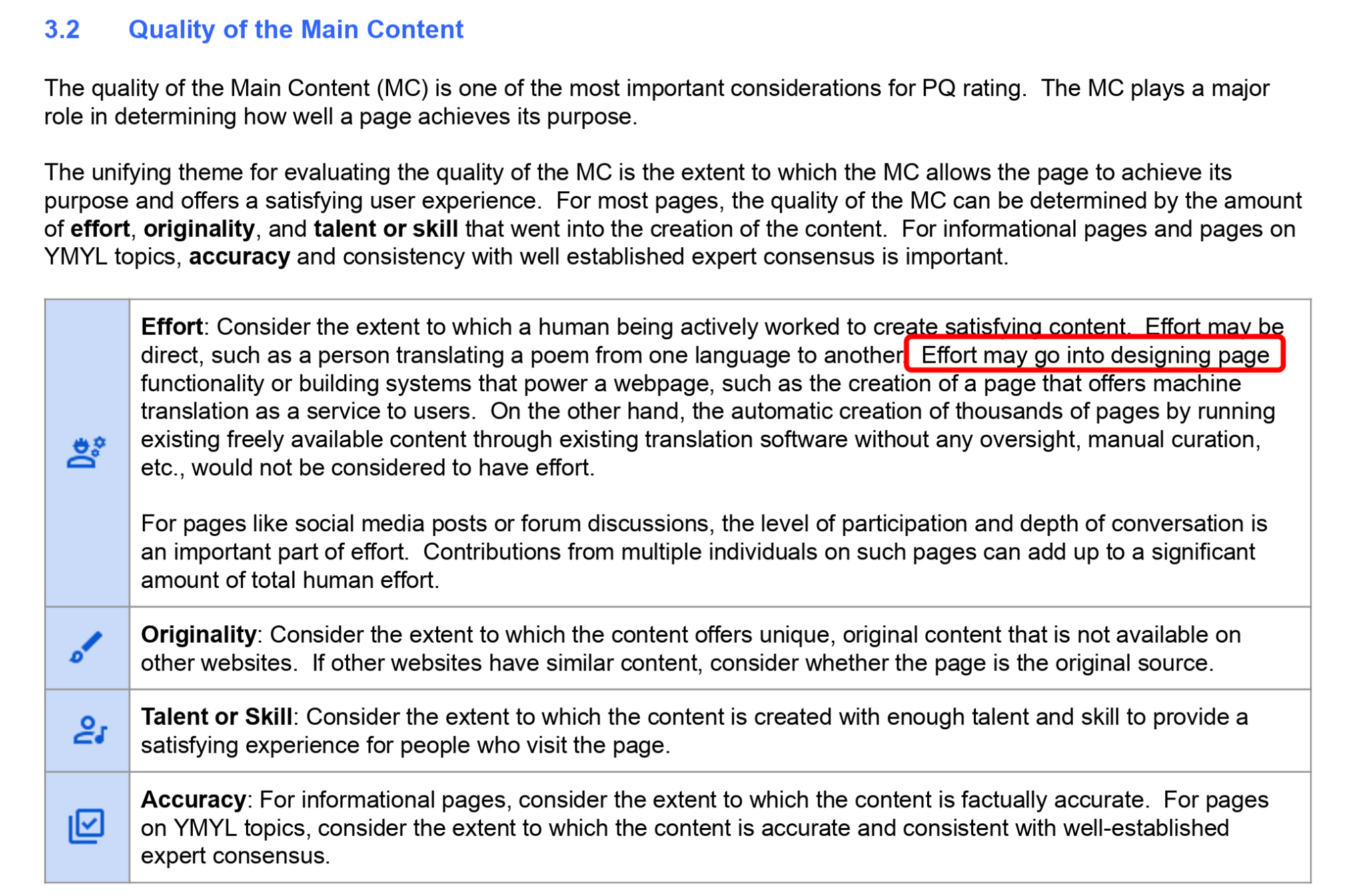
Google’s Quality Rater Guidelines cite “human effort and involvement” as one of the most important quality principles, with “design effort” identified as one aspect of that evaluation.
Webpage layout has always been an important part of SEO, dating back to Google’s Page Layout algorithms. Those early algorithms focused primarily on ad placement and simple document-ranking signals, unlike today’s more sophisticated approaches to understanding webpages.
Why Google is paying more attention to page layout
Google has introduced newer inventions and patents that highlight the importance of understanding webpage layout. Most webpages are no longer built with only prose or simple text-over-text layouts. Instead, they contain much denser information.
Every 10 to 20 pixels can introduce a new interaction point, engagement element, clickable module, comparison unit, or dynamic component designed to help users.
That’s why some of Google’s leading engineers, including those who have worked on Gemini and AI Mode, are also associated with newer inventions such as Structured Information Cards and layout-aware multimodal document understanding.
As a result, it needs systems that can understand how different card types are structured, including product cards, hotel cards, real estate cards, trip cards, credit card cards, and other information cards.
In other words, modern search engines must understand not only the text on a page but also the layout, hierarchy, visual relationships, annotations, and functional meaning of each structured information block.
A citation from Google’s “Layout-aware Multimodal Document Understanding” patent
Why layout matters for search engines
Understanding structured information cards and layout-aware document interpretation requires neural networks, and possibly a new type of LLM, that can “verbalize” web documents with annotations and high-confidence citations.
Google can’t reliably rank a flight booking website, a credit card application aggregator, or similar platforms without understanding the data embedded in these documents.
Much of that data is presented through uniquely designed card structures, comparison modules, tables, and interactive layouts rather than plain text.
Below is an early example of document layout understanding from Microsoft called ViPS, which Google has also cited.
Both approaches are closely related and rely heavily on HTML to determine which text belongs to each section, component, entity, or visual block on a page.
With the rise of embedding-based algorithms, concepts such as “chunking” have become widely discussed in the SEO industry.
However, many discussions about text or document chunking miss a critical point: Chunking isn’t only a linguistic process. It’s also a layout-aware and structure-aware process.
If a document isn’t visually segmented and structurally understandable to search engines, the content itself becomes harder to interpret. In that case, it doesn’t matter how many entities, predicates, triples, or entity relationships you include, or how accurate they are.
Search engines still need to understand where each piece of information belongs, how it relates to the surrounding elements, and which visual or functional component gives it meaning.
In modern search, information quality alone isn’t enough. Information also needs to be presented within a layout that helps machines understand its boundaries, hierarchy, context, and purpose.
Google explained this concept through “centerpiece annotation,” describing visual annotations that help its systems better understand a document.
Martin Splitt from Google said the “centerpiece annotation” represents the “primary content” of a webpage.
Later, documents disclosed during Google’s antitrust case showed that centerpiece annotation was also used to classify and rank news documents.
The centerpiece annotation was primarily limited to about 400 characters, though those documents also reveal several other noteworthy details.
For example, below you can see how Google extracts the centerpiece annotation from HTML. The sentence is interrupted by unnecessary HTML elements, such as Facebook, email, Twitter (X), and Google+ share buttons.
In the next example from Google’s DOJ documents, proper HTML structure prevents share-button boilerplate from interrupting the centerpiece annotation, allowing Google to extract the content correctly.
What visual semantics looks like in practice
Below is a simple SEO case study. Although it involved 19 changes, the biggest ranking improvement came from one simple adjustment: moving a calculator component from the bottom of the page to the top, making it the centerpiece annotation.
The results of that change are shown below.
Metric
Previous
Current
Increase / Change
Success %
Total clicks
3.47 million
4.53 million
+1.06 million clicks
+30.5%
Total impressions
84.1 million
167 million
+82.9M impressions
+98.6%
Average CTR
4.1%
2.7%
-1.4 percentage points
-34.1%
Average position
8.9
8.5
Improved by 0.4 positions
+4.5% improvement
This project closely connects visual semantics and textual semantics because it’s a programmatic SEO case study involving more than 100,000 pages.
At that scale, even a small sentence edit, component update, or layout adjustment is multiplied across every URL. That’s why Google re-crawled the entire website after the layout changes and why impressions and clicks increased afterward.
The project is a converter website that ranks for queries such as “2m to cm” and millions of similar numeric and metric variations. In this type of search environment, more than 10,000 competing websites provide essentially the same data and the same answer.
These websites have the same topical coverage and factual accuracy. The competitive advantage doesn’t come from providing a better answer because “1 meter to cm” has the same value everywhere.
It comes from retrieval cost, document understanding efficiency, internal PageRank distribution, and how clearly the answer is presented for Google’s initial ranking systems.
In these types of queries, you can’t differentiate yourself by changing the answer. You differentiate yourself by changing how the answer is structured, annotated, prioritized, and visually presented.
That’s why changing the centerpiece annotation caused Google to reprocess the layout, rerank the pages, and further improve the site’s rankings.
What is the cost of retrieval, and how does it relate to visual semantics?
“The cost of ranking a document” can’t be higher than the “cost of not ranking a document.” I introduced this concept years ago in one of my conference presentations. Google cares about search quality, but its systems also weigh quality against cost. If a website costs more to process than its quality justifies, Google will look for an alternative.
Google reduced the HTML file size limit to 2 MB and carried out large-scale deindexing following the December 2025 core update.
At the same time, it sent a clear signal to websites that scale AI-generated content without meaningful human effort. Google appears less tolerant of practices it accepted for years, and its indexing decisions are likely to become even more selective.
Retrieval costs increase when a webpage doesn’t clearly explain itself or fails to demonstrate sufficient relevance and responsiveness, especially around the “centerpiece annotation.” Google’s Content Warehouse API leak suggests the company truncates documents and predicts quality based on initial signals. If a document doesn’t meet relevance and responsiveness thresholds during those early evaluations, it won’t be considered a candidate.
During Google’s antitrust trial, Pandu Nayak, then Google’s vice president of Search, explained that Google doesn’t run its most computationally expensive algorithms on every webpage because it lacks sufficient click data. Instead, it first evaluates core topicality signals to determine whether a page is worth indexing and keeping as a candidate.
Nayak also explained that RankBrain-like algorithms are expensive to run, so Google reserves them for results that have at least one click, demonstrate strong topicality, and include annotations that justify the investment in crawling, rendering, evaluation, and further processing.
In other words, classifying documents by their layout, components, and structured information cards is a more efficient way to reduce retrieval costs while improving search quality.
Today, most large-scale content publishers rely on AI to generate more text. Far fewer invest in front-end and back-end systems that improve user engagement, interaction, and document understanding.
That distinction increasingly separates low-quality and high-quality sources. Low-quality sources primarily scale text. High-quality sources scale systems, layouts, components, structured information cards, and user interactions that help both users and search engines understand content more efficiently.
Below is Google’s concept of website representation vectors.
Google classifies websites using visual and layout-related embeddings and features to determine whether they resemble expert, apprentice, or amateur sources.
“For instance, the website classifications may include a first category of websites authored by experts in the knowledge domain (for example, doctors), a second category authored by apprentices (for example, medical students), and a third category authored by laypersons…”
How does Google’s helpful content system relate to visual semantics?
The helpful content system is a classifier that identifies which websites genuinely provide helpful information or meaningful engagement and which only imitate usefulness without fulfilling the searcher’s underlying intent.
Much of the SEO industry’s analysis of the helpful content system has focused on textual features. Early discussions centered on keyword stuffing, gibberish content, or adding “unique information” to improve information gain. However, many of the system’s algorithms appear to focus on the function and type of a source.
Google first classifies websites by their type rather than their content quality. That means the same content can rank differently on an affiliate website than it does on an ecommerce website.
So how does Google distinguish among affiliate sites, aggregators, service providers, ecommerce sites, and SaaS platforms? The answer is visual semantics. What a page can do, or can’t do, is largely determined by its layout and page components.
The biggest distinction between relevance and responsiveness comes from engagement, not understanding.
Google created systems such as neural matching to align the entity type and entity ID in a query with the most relevant documents. In simple terms, if the entity in the query doesn’t match the entity in the document, that page becomes less likely to rank. This is primarily about relevance.
Relevance alone isn’t enough. A document may rank because it’s relevant, but if it doesn’t support meaningful user actions, such as purchasing, comparing, ordering, reviewing, filtering, or watching, it isn’t responsive to the user’s actual task.
That’s why the helpful content system shouldn’t be viewed only as a system that evaluates page text. It also evaluates page function. A helpful page isn’t simply one that contains relevant words. It’s one that helps users complete the action, decision, or information-seeking task behind the query.
Google reinforced this idea by adding “misleading functionality” to its spam policies after the Helpful Content updates. A page can appear helpful by imitating a function without actually providing it.
For example, a page may suggest users can compare, filter, calculate, book, review, or purchase something even though those functions don’t genuinely exist. In those cases, the page may appear functional to both users and algorithms, but it isn’t truly responsive to the user’s task.
Google doesn’t classify websites only by page layout and design. It also appears to apply result-type constraints within the SERP. For example, a query such as “best women’s glasses” may return listicles, ecommerce category pages, product grids, videos, and commercial guides in the same results page.
To satisfy multiple search intents, Google can apply diversity constraints that limit how many ecommerce pages, listicles, videos, or other result types appear together.
Google’s DOJ documents include functions such as “max_total” and “BlogCategorizer,” which show how Twiddlers can classify results and limit the number of pages from the same cluster, category, or source type.
A similar annotation appears in the Google Content Warehouse API leak through the “WebrefFatcatCategory” module, which assigns categorical weight to a result.
In other words, Google doesn’t simply rank documents individually. It also classifies, clusters, and constrains results based on page type, source category, and categorical diversity. As a result, a page may be relevant enough to rank but still be limited by the overall composition of the SERP.
Even when a generated ranked entity list, such as a “best products” page, ranks successfully, it doesn’t rank simply because it’s a blog article. It ranks because it functions as a commercial resource. It helps users compare, evaluate, filter, review, and move closer to a decision. In that sense, Google can rank nonfunctional content when it effectively serves a functional category.
Viewed through this lens, “helpful” in the context of the helpful content system is closely aligned with “functional.”
The following case study demonstrates this principle. We moved identical content from an affiliate website to an ecommerce website, supported it with an integrated topical map, and saw rankings improve almost immediately.
The content itself didn’t change. What changed was the function, context, and source type surrounding it. By placing the same information within a more functional, commercial, and task-oriented environment, Google interpreted the document as more useful for the user’s search activity.
How is click data used to rerank search results through visual semantics?
Google increasingly understands the purpose of a webpage through its layout, not just its text. As a result, click data is aggregated according to the type of source. Many SEOs assume that long clicks, or longer dwell times, signal quality.
However, that’s not always true, according to Google’s research. Depending on the category, shorter dwell times can indicate a successful experience, while longer sessions may signal an “engagement trap.”
Below is Google’s reranking model, which applies different ranking and rank-modification models based on user behavior captured by its tracking components.
Google also uses the concept of the “Life of a Click” to help engineers understand how search ranking algorithms interpret user behavior.
Taken together, these systems suggest that click data becomes a more meaningful classification signal when interpreted alongside a webpage’s design rather than through text alone.
Classifying documents by their visual structure can be more efficient than analyzing millions of documents, billions of word tokens, co-occurrences, named entity resolutions, attribute extractions, and value corrections.
If certain document layouts consistently generate stronger user satisfaction, Google can classify those pages as more helpful or functional. It can then use those signals to identify other documents with similar layout patterns, component structures, and interaction models.
This means topical authority doesn’t come only from a topical map that defines which topics to cover. It also comes from understanding which page layouts, component structures, information cards, comparison modules, and functional designs best match each topic, query, and search activity.
A proper topical map shouldn’t define only entities, attributes, predicates, and contextual relationships. It should also define the page type and functional layout needed to satisfy both relevance and responsiveness.
This leads to the concepts of coverage and domain-level classification. The following three examples illustrate this approach.
The first example is AudioToText.com, a sub-brand built around a single topic.
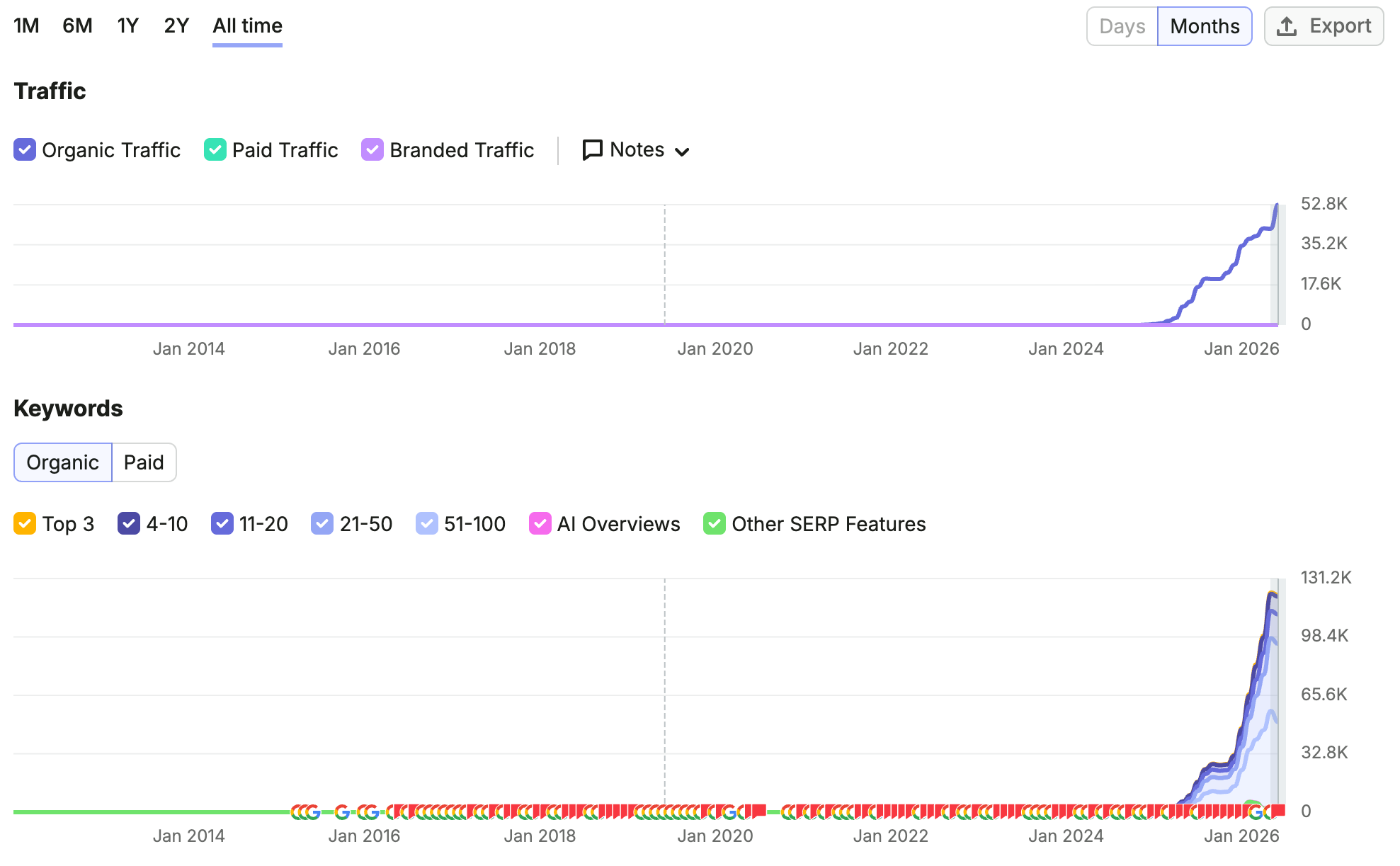
GSC Metrics of Audiototext.com. The third-party Semrush data is shown below.
Despite covering only one topic across 12 languages, or 13 pages in total, the site continues to grow in search visibility for three reasons:
Its exact-match domain reinforces relevance.
Its visual semantics improve responsiveness.
It earns its first clicks quickly, allowing Google to run more computationally expensive ranking systems sooner.
Click satisfaction from the other language versions may also reinforce the English version through cross-lingual information retrieval.
Google can use webpage layout understanding and chain-of-reasoning to classify AudioToText.com as a “no-signup transcription tool” and rank it in AI Overviews. This suggests Google isn’t only reading the text. It’s also interpreting the page’s function, visual annotations, and interaction model.
In other words, Google can use agentic retrieval based on visual signals to understand what a page does and determine whether it deserves to rank for a specific query.
The Audiototext.com’s single-page topical map representation with the fundamentals are below.
The webpage was designed with minimal text while placing its primary conversion element, the content upload component, above the fold.
If that component were moved lower on the page or made smaller, rankings would likely decline, and text changes alone wouldn’t be enough to recover them.
Another example is attorneys.lexinter.net, which ranks primarily through a subdomain because its core content was moved there together with a filtering engagement component.
The primary domain didn’t meet the required thresholds, but moving the content to a subdomain with additional functional elements produced better results.
The same subdomain testing approach also worked for Pricelisto.com. Although most of the design and content remained the same, we added functions and annotations related to purchasing, comparing, examining, and reviewing.
Those functional additions made the pages behave less like passive content and more like task-completing commercial resources. As a result, the site avoided filters associated with the Helpful Content System.
The improvement didn’t come from changing the text. It came from changing how the document functioned, how users interacted with it, and how clearly Google understood the purpose of each page component.
Search engines try to reduce retrieval costs by avoiding computationally expensive algorithms whenever possible. As a result, domains affected by historical or domain-level signals may not receive a completely fresh evaluation immediately.
Testing on a subdomain can give Google a clearer reason to reprocess documents, reevaluate their layouts, and run more advanced evaluation systems. That makes it easier to determine whether improvements come from new designs, functionality, annotations, or document structures rather than from the historical state of the primary domain.
How is visual semantics related to the future of search?
Google is experimenting with fundamental changes to search results, including replacing the traditional search bar with new interfaces.
One example is its Jan. 29 patent, “AI-generated content page tailored to a specific user.” The patent describes generating a landing page that uses visual segmentation, annotations, and generative AI to satisfy a user’s query.
The patent places significant emphasis on “landing page score,” using click data and explicit user feedback signals
In other words, Google can use visual semantics not only to rank web documents but also to construct new types of search results.
Google’s patent work is often complemented by its research. For example, the paper “Neural Design Network: Graphic Layout Generation with Constraints” explores how systems can understand, classify, and even generate webpage layouts to improve search performance.
This suggests that layout isn’t only a design consideration. It can also serve as a retrieval, classification, and ranking signal.
Google’s multimodal document understanding also connects to its latest announcement, Google Embedding 2, which uses generative neural networks to understand and vectorize text, images, videos, audio, and documents.
This matters because different versions of the same web document can be compared through their vector representations. Doing so makes it possible to evaluate how well Google understands layout differences, visual structure, and document-level meaning.
In other words, layout changes aren’t merely visual. They can also produce different vector representations, which may affect how a document is understood, classified, and retrieved.
Below is Google’s example of the neural network process for understanding page layouts. The centerpiece annotation that helps classify a webpage as an ecommerce category page, product page, or SaaS page comes from these types of labeling systems.
In the future, Google could apply these same principles to construct its own landing pages from multiple search results.
The patent shown below also illustrates how Google could adjust SERP features based on an entity’s primary attributes. That suggests search results aren’t simply ranked and displayed. They can also be reorganized, redesigned, and presented as dynamic interfaces based on the entity, query intent, and available document structures.
Google’s “Search result ranking and presentation” patent explains which types of visual representations best match different attribute-value pairs when generating SERP features and ranking webpages with similar characteristics
Centerpiece annotation and query processing
Google classifies and augments queries differently from how people naturally think about them. That means one of the most important parts of creating a topical map is understanding search terms the way Google’s systems do and augmenting them accordingly. This process is called query semantics. Below is an example of query augmentation from ChatGPT.
In this example, we searched for “best search engine optimization information sources,” and GPT expanded the query as follows:
Best SEO information sources: search engine optimization resources Google research, patents, SEO blogs
If you perform a search in ChatGPT, open the Network tab in Chrome DevTools, filter for XHR requests, and inspect the JSON file associated with the https://chatgpt.com/backend-api/conversation/6a* path. Look for search_model_queries, which shows what the system actually searches for.
Google also has a patent called query augmentation, shown below.
The patent is attributed to engineers, including Krishna Bharat and Anand Shukla. These names are significant because they also appear on patents and systems related to AI Overviews and AI Mode.
For example, the “Search with Stateful Chat” patent includes query augmentation as one of its steps, and its terminology and inventors overlap with this system.
The centerpiece annotation is the primary visual annotation that reflects a webpage’s purpose, function, and context. The context created through the augmented query needs to align with that centerpiece annotation.
The following case study shows how I classified query variations and their contexts across different document types, each with a distinct purpose, function, and visual structure, for a local service directory.
Let’s use “air conditioner” queries as an example. Each query variation should be matched with the appropriate page type, layout, and function.
Experience queries require a forum-style layout. For a query such as “How do I repair my AC?” the intent is experience-based. A forum structure works best because users expect real problems, answers, troubleshooting paths, and personal experiences. This content can also live on a subdomain to separate experiential content from the main commercial website.
Local service queries require a directory page. For “Air conditioner installation in [City],” the intent is local and service-oriented. The best page type is a local directory or listing page with providers, service areas, ratings, contact options, and conversion elements.
Price queries require a hybrid layout. For “air conditioner installation prices,” the intent is both informational and commercial. The page should provide an immediate answer with average prices, cost factors, and price ranges while also presenting local providers, comparisons, and quote-related elements.
Instructional queries require an informational layout. For “How to install an air conditioner,” the intent is instructional. The page should minimize local service elements and instead focus on a step-by-step guide, required tools, safety considerations, visuals, and practical instructions.
In short, a topical map should define not only which topics to cover but also the appropriate layout, components, and page function for each search activity. The following example shows some of the early results from this project after classifying query augmentation models for different query variations.
Early GSC results for the same brand.
If there’s no need for a separate page for the [Local], [Service], [Forum], or [Instructional List] intent, we simply prune it. If other pages are too similar, we merge them.
As a result, the number of pages decreases along with retrieval costs, while PageRank concentration and relevance per document increase. Below are four closely connected components:
Mock-up design in draw.io.
Production design in Figma.
Topical map for different query types.
Content brief aligned with the Figma and draw.io designs.
Early on, we defined the topical authority formula as:
Historical data x Topical coverage
Later, we expanded it to:
Historical data x Topical coverage ÷ Cost of retrieval
Today, I’d extend the formula with one additional factor:
((Historical data x Topical coverage) ÷ Cost of retrieval) x Right visual annotations
Even if you have the lowest retrieval cost, the highest topical relevance, the broadest topical coverage, strong accuracy, the longest duration of satisfied click data, and positive historical performance, none of it matters if the centerpiece annotation is wrong or the page isn’t functional.
Google’s ranking system largely functions as a decision tree. If the first decision-making layer rejects a website, the later evaluations, tests, and reranking processes won’t occur.
To maximize your chances of ranking from the start, visual annotations should be optimized just as carefully as the page’s text, images, and links.
Below is a conceptual model of this system.
A website consists of “letters, pixels, and bytes.” Data2Website is the process of turning a dataset that Google’s algorithms favor into a website by combining textual and visual semantics through those letters, pixels, and bytes.
The example above shows how a local law firm benefited from a topical map, semantically optimized content briefs, specific sentence structures, and visual design decisions.
The Semrush results below show the impact on the firm’s local rankings.
We previously applied the same principles to another ecommerce website.
If you examine the screenshots closely, you’ll see that the same principles carry over from an ecommerce design to a local service provider.
For every attribute within an entity-seeking query, such as “best law firm in Houston” or “birth test kit prices,” you can classify those attributes within the query network and organize them according to their importance.
Some attributes require review components, while others require directly commercial components.
Below are two design examples from the sibling websites Morethanpanel.com and StreamingMafia.com. Their above-the-fold and below-the-fold sections are structured similarly, covering different types of user engagement and functionality.
The above-the-fold area is often referred to as the macro-context because it contains the main content. Google’s Quality Rater Guidelines use the concept of main content to emphasize the importance of relevance, accuracy, and completeness in this section.
The below-the-fold area corresponds to what Google’s Quality Rater Guidelines describe as supplementary content, which we refer to as the micro-context. This section typically contains less important attributes and most internal links.
The next example shows the mock-up design and the distribution of factual content, opinionated content, structured content, and unstructured content.
Google doesn’t always prioritize factual or opinionated content, or structured versus unstructured content. Instead, it evaluates these characteristics based on how the search query is augmented. To improve language relevance, we distribute different types and formats of content using different visualization, verbalization, commercialization, and contextualization techniques.
The following example applies the same approach to the second website in the same industry, together with its topical map, content briefs, and authorship rules.
Algorithmic authorship can be explained through the research paper “Are LLMs Reliable Rankers?” It means writing content according to predefined sentence structures and rules. For example, the research shows that the “Rank anything first” framework increased rankings by 20% to 60%.
The system evaluates which words should follow one another to determine how relevance changes. It performs retrieval within a generative retrieval system and identifies the entity-attribute-value triples that best improve relevance. In the example above, “material” is selected as the attribute and “steel” as the value because they strengthen relevance within that context.
Structured content: Supports attributes such as symptoms, advantages, and benefits.
Unstructured content: Supports concepts such as definitions, processes, and importance.
Visualization: Presents content using the appropriate semantic attributes.
Commercialization: Adds functional components that help users complete their tasks.
Contextualization: Maintains relevance by aligning content with the query.
Verbalization: Converts visually important information into text that LLMs and search engine crawlers can understand.
Depending on the query, Google may prefer opinionated and unstructured content, factual and structured content, or other combinations supported by different visualization, commercialization, contextualization, and verbalization techniques.
The following example from the online dating industry shows how different webpage components can improve relevance and responsiveness at the same time.
The next examples illustrate different ways to visualize content.
Comparing these two sections, you’ll see that one answer is highly factual, while the other, distinguished by a different background color, is more conversational and opinion-based.
We can create a Q&A component and add opinion-based content as forum-style discussions at the bottom of the page.
We can also ask users questions and let them contribute answers through voting, allowing those responses to be verbalized into content that is continuously updated.
Below is what we call the preceding question component. It reframes the original question using a semantically similar concept and gradually shifts the content from factual to more opinion-based.
The next example shows a horizontal tab component that distributes internal links to related headings, increasing contextual coverage.
The following Semrush data shows the early and later results for the URLs we modified.
The patents and research behind visual semantics
At this point, we’ve introduced the key concepts, definitions, and website examples needed to explain visual semantics.
We could explore these examples, processes, and implementation details in much greater depth, but every conceptual discussion begins with understanding where Google is heading.
Many of Google’s advances in query semantics, visual semantics, Gemini, and AI Search are driven by two influential engineers: Dr. Marc Najork and Michael Bendersky. They are among Google’s most frequently cited researchers in recent years and have played major roles in shaping the company’s AI-related direction.
They are also listed as inventors on the Layout-Aware Document Understanding and Structured Information Cards patents.
Another important contributor is Alexander Grushetsky, who identifies himself as the founder of RankLab, Google’s internal end-to-end ranking platform.
He’s worth mentioning because he’s frequently cited alongside Bendersky and Najork in foundational patents and research papers.
Grushetsky also worked with Bendersky and other Google engineers on item-ranking models based on item types, attribute sets, and attribute values. We’ll explore what RankLab represents in more detail another time.
Today’s search engines and large language models increasingly rely on visual semantics as part of their vectorization and embedding-based ranking systems.
Even the original Transformer research described extending these ideas to web documents and their layouts.
WebRef vectorizes webpages using not only their text but also their visual layout, page components, HTML structure, and overall document context.
Whether your rankings depend primarily on external PageRank, branded search demand, or internal signals such as semantics, a page’s visual context still carries ranking weight alongside its textual relevance.
If you apply standard SEO playbooks to a travel website, you’ll likely exhaust your budget with little to show for it.
Most SEO advice is written for sectors operating in a search ecosystem where organic text listings still dominate most user journeys.
In travel, the rules of search are entirely different because Google isn’t just a search engine. It’s a direct transactional competitor, a visual aggregator, and a gatekeeper to visibility.
Winning in this space requires accepting that what works elsewhere will fail here. To build a search strategy that actually drives bookings, travel brands must abandon standard organic best practices and instead master unique challenges:
Intermittent, non-linear user journeys and highly fragmented user intent.
Travel search is driven by data, not webpages
In almost every other industry, the ultimate goal of SEO is to secure a high-ranking organic text listing.
In the travel sector, particularly for high-intent queries involving hotels, flights, and activities, the traditional “blue link” is functionally dead (and becoming even less relevant as AI, AI Overviews, and other LLMs compete for user attention).
If a user searches for “flights from London to Rome” or “boutique hotels in Edinburgh,” the top of the search page is entirely occupied by Google’s own interactive search tools.
Below these tools sit local map packs, sponsored advertisements, and, in the UK and Europe, the massive “Find results on” directory boxes mandated by antitrust regulations.
Instead of just writing content, successful travel SEOs focus on feed management and entity optimization.
For accommodations and hotels, this means treating Google Hotel Center with the same priority an ecommerce specialist gives their primary website. You must ensure that your real-time pricing feeds, inventory levels, and tax calculations are integrated directly with Google’s API.
Travel entity optimization requires meticulous calibration of your Google Business Profile. Google’s local algorithms categorize hotels and attractions based on physical attributes rather than editorial text.
Whether your property appears in a filtered search for “dog-friendly hotels with free parking” depends entirely on your structured attributes, customer review sentiment analysis, and precise location coordinates.
In travel, the search engine is a database, and your primary job is to format your data so the database can display it without friction.
Traditional search campaigns operate under the assumption that organic traffic must land directly on a domain you own to have any measurable value.
In the travel sector, this insular approach ignores how modern searchers, especially younger audiences seeking visual reassurance before booking, actually behave.
Google has adapted to this shift by turning its results pages into visual aggregators that pull content directly from external social networks.
For queries driven by discovery or curation, such as “best rooftop bars in Soho” or “hidden beaches in Cornwall,” Google often serves dedicated “Short Videos” carousels and “Perspectives” feeds directly within the main search results.
These features extract short-form video content from TikTok, Instagram Reels, and YouTube Shorts, allowing users to watch authentic, crowdsourced footage without ever visiting a traditional website. With search engines actively indexing public business posts from platforms like Meta, social media updates are now ingested into search layouts and AI Overviews.
Travel SEO is no longer confined to the boundaries of your content management system. To capture this visual search real estate, digital teams must treat social media profiles as distributed landing pages.
The standard content marketing advice for B2B or consumer services is to build comprehensive, long-form informational guides. The theory is that if you write a 4,000-word article covering every possible detail of a destination, you’ll build topical authority and guide the reader smoothly down a conversion funnel.
In travel SEO, this approach often yields high bounce rates and very few conversions. Travelers don’t plan trips in a linear fashion, nor do they want to read extensive blocks of text on mobile devices while walking down a busy street.
Travel planning is highly visual, emotional, and fragmented across different devices and moments.
A user searching for “things to do in Cornwall” is usually looking for quick inspiration, geography-based grouping, and immediate utility. If they land on a page with lengthy introductory paragraphs and dense blocks of prose, they’ll return to the search results to find a simpler resource.
Travel content must be built for rapid utility rather than high word counts. Instead of writing long essays, your content layouts should rely on interactive, modular components, such as:
Tabbed interfaces that allow users to toggle between “Itinerary,” “Cost,” and “Best Time to Visit.”
Embedded, interactive maps that show the physical proximity of recommended locations.
Bite-sized, structured lists that clearly state opening hours, entry prices, and booking links.
Structuring content this way also makes it much easier for Google to extract your data for its AI Overviews and visual carousels.
Instead of trying to keep users on a long page of text, the goal should be to provide structured, high-value answers that Google can easily parse.
When your site behaves like a functional tool rather than an online magazine, users are much more likely to bookmark your pages and trust your brand when they’re finally ready to book.
Winning at travel SEO requires a fundamental shift in perspective. Success can’t be measured solely by standard keyword rankings or overall organic traffic levels.
It must be evaluated by how effectively your site appears across Google’s SERP features, how reliably your data feeds communicate real-time pricing, and how quickly your landing pages answer highly specific, visual questions.
By stepping away from generic SEO advice and focusing on technical data feeds, regulatory price compliance, and modular user experiences, travel brands can secure a distinct competitive advantage in one of the most crowded landscapes on the web.
Hidden gem publishers have 1.7x higher audience affinity than major media outlets, even though they attract 130x less traffic. If that makes you rethink your 2026 earned media strategy, it should.
Fractl’s latest SparkToro-backed research suggests most digital PR teams still build media lists using outdated SEO metrics such as domain authority and traffic. (Disclosure: I’m the co-founder of Fractl.) In AI-driven search, entity authority shapes brand visibility. A narrow media-list strategy is increasingly misaligned.
If you’re still learning about generative engine optimization (GEO), entity authority is the cumulative signal created when your brand is repeatedly associated with credible sources across influential channels in your niche.
In plain terms, your brand visibility now relies on which sites mention you, which audiences engage with those sites, and whether your brand keeps showing up across trusted nodes.
How authority has evolved in today’s AI-centric landscape
For years, digital PR teams built media lists the same way SEO teams built link targets: prioritizing domain authority, traffic, and referring domains. That made sense when backlinks were the primary goal.
But AI-driven discovery is changing what “authority” actually means.
When ChatGPT, Gemini, Perplexity, or Google’s AI experiences synthesize information about your brand, they’re not just evaluating whether your website is optimized. They’re pulling from the broader web of sources that repeatedly mention and contextualize your brand.
A placement on a smaller, highly relevant industry publication can sometimes do more to reinforce your brand’s entity authority than a broad mention on a much larger site.
That shift reflects what we’ve seen across years of earned media campaigns spanning major publishers like The Wall Street Journal, The New York Times, and CNBC, alongside niche publications such as PCMag, Men’s Health, and Travel + Leisure.
Today, those campaigns often extend far beyond backlinks, generating TV coverage, Reddit discussions, podcasts, YouTube commentary, and other third-party mentions that reinforce brand authority across search, social, and AI-driven discovery.
Which non-mainstream media publishers drive the strongest influence?
We wanted to understand which publishers and platforms actually drive influence with the audiences brands want to reach. That question led to this study.
We used SparkToro’s audience affinity data as a relevance layer on top of traditional earned media and SEO metrics. Rather than starting with the largest publications in each category, we began with the audiences brands want to influence: decision-makers, buyers, and practitioners across eight industries.
We then analyzed where those audiences spend time across websites, YouTube channels, podcasts, social accounts, and community-led platforms.
After separating mainstream publishers from vertical-specific outlets, we compared audience affinity against traditional signals such as domain rating, organic traffic, and referring domains.
The study revealed a major blind spot: “Hidden gem” publishers had 1.7x higher audience affinity than mainstream media outlets, despite attracting 130x less traffic.
Many highly relevant publications would never surface on a traffic- or authority-sorted media list, even though they may play an important role in shaping the topical associations AI systems use to understand and describe brands.
The takeaway: Traffic and authority are incomplete proxies for the kind of relevance AI systems increasingly depend on.
How smaller publishers drive big brand influence
When pitching brand content, we typically build a list of journalists whose beats closely align with each campaign’s key insights, which often span several verticals. We then identify the publisher best suited for an exclusive by prioritizing domain authority.
This approach creates a built-in syndication effect, with regional and niche journalists often picking up stories from larger publications. That’s how we regularly earn brand features like this, without ever pitching TV news anchors.
While this remains an effective approach for scaling earned media that builds brand authority and awareness, SparkToro’s data revealed that more vertically focused publishers with minimal traffic (often 5,000-10,000 monthly visits) and mid-tier domain authority (typically in the 60s and 70s) often have much higher audience affinity.
This finding highlights the value of pitching low-traffic, niche publishers that old-school SEO practitioners might once have deprioritized or excluded from outreach.
Across every industry we analyzed, the same pattern emerged: Smaller, niche sites with modest traffic consistently earned the highest affinity scores among the audiences that matter most.
The placements with the greatest strategic value for building entity authority may be the very ones your digital PR team has been overlooking.
Why niche publishers build stronger entity authority than mainstream media alone
I started in SEO in 2006, and the same guiding principle that shaped my career is now being reinforced by a growing body of research: Brand visibility in AI is built through a diverse, authoritative network of brand mentions.
Monthly organic traffic remains a weak proxy for audience alignment, and AI systems synthesizing information about your brand may weigh that distinction more heavily than traditional ranking algorithms do.
We plotted audience affinity against monthly organic traffic, and two distinct clusters immediately emerged.
“Hidden gem” publishers clustered in the upper-left quadrant: high affinity, low traffic. Major publishers occupied the lower-right: high traffic, low affinity.
The 1.7x affinity gap and 130x traffic gap tell the same story from opposite directions: Reach and relevance are inversely correlated more often than most earned media strategies account for.
What stands out in this dataset isn’t just that niche sites outperform on average. It’s how consistently they appear at the very top of the affinity range.
The highest-scoring publishers across industries, including recruitingdaily.com (93), clubindustry.com (90), and chimecentral.org (86), attract just 2,000-10,000 monthly visits.
Meanwhile, many of the largest, most recognizable publishers fall in the 50–65 affinity range, with some scoring in the teens despite attracting hundreds of thousands of monthly visits.
Ultimately, the smartest media mix isn’t mainstream or niche. It’s both. Major publishers still matter for scale, authority, and SEO value, but their broad audiences make beat-level relevance even more important.
The more precisely you place a story within the right category on a large publication while also earning coverage from niche, high-affinity outlets, the more effectively you compound brand visibility across SEO and GEO.
The best media strategies engineer both reach and relevance.
YouTube and Reddit dominate platform affinity
High-affinity authority isn’t limited to publishers.
When we expanded the analysis beyond traditional editorial outlets, YouTube, Reddit, and podcasts repeatedly emerged as influential audience hubs. That matters because AI-driven discovery is increasingly shaped by the broader web of brand mentions.
This shift should expand the definition of earned media. A founder interview on a niche YouTube channel, a data-led discussion in a relevant subreddit, or a subject-matter expert appearance on an industry podcast can all reinforce the same entity associations as a traditional article.
The format may differ, but the strategic value is the same: repeated third-party validation around the topics you want your brand to be known for.
The mistake is treating these channels as post-publication promotion. They should be part of your media strategy from the beginning.
If your campaign is built around original research, expert commentary, or proprietary data, plan how that story can be repurposed to earn brand mentions across publishers, YouTube, Reddit, podcasts, newsletters, and social communities before the first pitch goes out.
Transforming your digital PR strategy to drive brand visibility in AI
I entered SEO when authority could be manufactured through paid link networks. Today, AI systems infer authority very differently by recognizing patterns of trusted, third-party validation across the web.
That shift changes how you should think about earned media. Success isn’t measured only by the authority or traffic of the publications that mention your brand. It’s also shaped by whether those publications reach the audiences you care about and reinforce the topics you want AI systems to associate with your brand.
Traffic and domain authority still matter, but they don’t tell you whether your brand is being reinforced across the sources AI systems retrieve from. Audience affinity adds another layer, helping you identify the placements most likely to strengthen your visibility across AI search experiences.
The takeaway isn’t to stop pitching top-tier press. It’s to stop treating top-tier press as the whole plan.
A GEO-ready media list isn’t bigger. It’s better balanced.
Start with authoritative mainstream publishers. They still matter for reach, trust, link equity, and broad brand validation.
Add high-affinity niche publishers. These outlets may have smaller audiences, but they often concentrate the exact buyers, practitioners, or decision-makers you want to reach.
Include community-driven platforms. YouTube channels, podcasts, Reddit communities, newsletters, and other trusted communities can reinforce the same entity associations as traditional editorial coverage.
Score opportunities by entity relevance. Ask whether each placement connects your brand with the topics, competitors, use cases, and customer problems you want AI systems to associate with you.
Measure more than links. Track high-affinity placements, branded co-occurrences, AI citations, AI mentions, and recommendation-style visibility across major AI platforms.
AI visibility compounds through repetition. A well-placed story on a high-affinity publisher can reinforce the same entity associations as a mainstream feature, especially when it’s republished, cited, discussed by subject matter experts, and adapted across channels.
That’s how a single earned media campaign can shape more than rankings. It can influence the broader context AI systems use to retrieve, describe, and recommend your brand.
The brands that win in AI search won’t necessarily be the ones with the most optimized websites. They’ll be the ones most consistently validated across the sources their audiences and AI systems trust.
Ten years ago, a negative piece of online content primarily affected search rankings.
Today, that same article can influence across Google’s AI Overviews and other AI search experiences. It can be summarized, cited, and redistributed, making it more influential and longer-lasting than it ever should be.
As a result, outdated stories can resurface long after they disappear from traditional search results. That gives older content renewed visibility and makes reputation management far more difficult.
When old articles resurface
I recently saw this happen with a client who owns a grocery chain in the Midwest that has grown successfully for more than two decades.
In the mid-2010s, one location received negative press over a customer service issue. The problem was resolved shortly afterward, and the article gradually faded from public attention.
Years later, AI Overviews gave the story new visibility. Seemingly overnight, the article became a recurring source in AI-generated answers about the business.
A single, outdated news story began shaping how AI systems described a company whose reputation had long since moved on.
AI search engines don’t just retrieve information. They generate answers by relying on published sources they consider reliable.
That changes the role of negative news articles. Even if an article no longer ranks prominently in traditional search results, it can remain an authoritative source for AI-generated answers.
Media coverage often carries strong authority signals. If a negative article receives attention, citations, or discussion, AI systems may continue treating it as a reliable source long after the underlying issue is resolved.
That’s why a single article can influence how AI describes a person, company, or brand years after it was published. The article doesn’t need to dominate search rankings anymore. It only needs to remain a trusted source.
Five or 10 years ago, handling negative content involved suppression. We aimed to bury the negative content by publishing fresher, more positive, and more accurate content, optimizing a client’s online profiles and social media, and building microsites to strengthen its reputation.
That approach matters less today. AI systems readily access and cite original negative sources, even when those sources no longer rank prominently in search results.
AI has changed online reputation management, but you still have options. Here are the approaches we’ve found most effective.
Diversify your sources
To combat those negative news articles, it’s imperative to build new sources that are credible and that present across multiple trusted platforms. The aim is to publish articles on respected outlets, focusing on thought leadership and expert insights — with factual resources to boot.
Respond faster and smarter
Be proactive rather than reactive. Before a negative news source becomes widely cited, get on top of it. Address it with responses that clarify the initial controversy.
Build content that’s citation-worthy
Perhaps the best way to counter an original negative news source is to trump it with citation-worthy content.
Remember the grocery chain I mentioned earlier? To thwart the original negative news article, we focused on publishing original case studies and expert insights tied to the success of the grocery chains. We made sure these pieces were all published on reputable, longstanding media outlets.
Monitor visibility on AI platforms
Returning to the topic of being proactive, the best way to do so is by constantly monitoring your brand.
It’s not enough anymore to see how your brand appears on everyday search engines. You must track how you appear in Google AI Overview and other generative search tools. Spend a few hours every month or so typing queries about your brand into various AI search engines.
Several tools can help you detect negative narratives earlier and monitor how AI platforms present your brand.
Tools like removenews.ai simplify outreach to publishers.
Paste an article URL, and removenews.ai generates a personalized removal request and identifies the editor’s contact information, making it easier to request updates or removal. The tool is free and takes about a minute.
Monitor AI visibility and citations
Need to understand how AI platforms describe your brand? Tools such as Otterly.ai, Mangools, and Ahrefs Brand Radar can monitor citations, visibility, and sentiment across AI search experiences.
Continue using traditional ORM tools
Don’t abandon your existing ORM and digital PR tools.
Platforms such as Semrush and Surfer continue to expand their capabilities, making them valuable additions to an AI-focused reputation strategy.
My 8-year-old daughter desperately wanted a Nintendo Switch. Her evil parents refused to buy it for her.
She was too young to get a job, so she did what any resourceful kid would do: she set up a lemonade stand in front of our house.
But she didn’t just put out a table and a pitcher. She ran a high-stakes A/B test.
Her hypothesis was simple: if she could get more people to stop, she could sell more lemonade and buy her Nintendo Switch faster.
Variant A was her two-year-old sister, Julie, stationed out front to attract attention.
Variant B was our dog, Ginger.
I know what you’re thinking.
The dog. Obviously, the dog.
But her sister won. It wasn’t close.
The only metric that mattered
Actually, my daughter didn’t care about the outcome of the A/B test. She didn’t care how many people stopped by the stand.
She cared about one thing, and one thing only:
Did she make enough money to buy the Nintendo Switch?
Marketers have a similar problem right now.
Generative engine optimization (GEO) is the practice of increasing your brand’s visibility in AI-generated answers from platforms like ChatGPT, Gemini, Perplexity, and AI Overviews.
We’re tracking AI visibility, citation share, impressions, rankings, and every other signal we can find.
Meanwhile, leadership is asking a much simpler question:
Is any of this helping the business grow?
I use a simple test I call the Dollar Rule: If I can’t put a dollar sign in front of a metric, it’s a channel metric, not a business metric.
That’s the challenge with GEO.
Most of the metrics we’re tracking are useful operational signals. They tell us what’s happening inside the channel.
Leadership wants something different.
They want to understand business impact.
GEO arrived at exactly the moment attribution started becoming less reliable.
Traditional SEO measurement was built around a straightforward model: someone searched, clicked, visited your website, and converted. You could trace the path and measure the outcome.
AI search changed that.
Buyers are making decisions before they ever reach your website and AI influence is hard to measure with traditional attribution models.
AI search broke attribution
Buyers now discover brands through AI-generated answers, citations, publishers, forums, reviews, videos, and other sources that influence decisions before a click ever happens. Much of that influence never shows up cleanly in analytics.
That’s why so many teams are struggling to justify GEO investments. The visibility is real. The influence is real. But the attribution is often incomplete.
Waiting for perfect attribution is becoming a convenient excuse for inaction.
If you want buy-in for GEO, you need a way to connect that influence to business outcomes, even when you can’t connect every interaction to a conversion.
Making the case for GEO using financial impact
The biggest mistake marketers are making right now is trying to prove attribution before proving value.
Before you worry about attribution, ask whether you’re measuring something that matters to the business.
That’s where the Dollar Rule comes in.
We’ve found that justifying GEO usually comes down to three things:
Align metrics to business outcomes.
Verify that the metrics reliably point you in the right direction.
Translate the metrics into language your CFO understands.
The Dollar Rule is simple:
If a number doesn’t translate into dollars, it’s a channel metric, not a business metric.
Consider revenue opportunity, revenue at risk, payback period, and customer acquisition cost. These are the metrics that live on a P&L, and they’re the ones your leadership team actually cares about.
CFOs don’t allocate budget based on attribution models. They allocate budget based on expected financial outcomes.
Here’s what that looks like in practice.
Influence over attribution
AI search didn’t just change discovery. It changed measurement.
Traditional organic attribution assumes a simple path: search, click, visit, convert.
AI platforms increasingly answer questions before a click happens, influence buyers across multiple touchpoints, and often remove the referral data marketers depended on.
The result is a strange situation: your GEO campaigns may be influencing pipeline while your analytics platform struggles to prove it.
Loamly estimates that roughly 70% of AI-influenced traffic appears as Direct traffic in GA4, making a large portion of AI’s contribution difficult to trace through traditional attribution models.
That doesn’t mean measurement is impossible. It means we need to broaden where we look for evidence.
Instead of asking, “How many clicks do we get from AI search?” ask:
Is branded search growing?
Are prospects arriving already familiar with our positioning?
Are we cited in AI answers for revenue-driving questions?
None of these signals is definitive on its own. Together, they create enough confidence to make investment decisions.
This is how GEO measurement differs from traditional SEO. You’re not measuring a click path. You’re measuring market influence.
The marketers who adapt fastest will stop treating attribution as a traffic sorting exercise and start combining quantitative signals with qualitative evidence. The goal isn’t certainty. The goal is confidence that your GEO investment is moving the business in the right direction.
You’re measuring the wrong thing
The problem isn’t that SEO or GEO metrics are wrong. The problem is that they’re often precise without being relevant to the business outcome you’re trying to influence. They tell you exactly what happened in a channel, but not whether the business is moving in the right direction.
SEO tools are full of precise numbers. The challenge is that many of those numbers aren’t closely connected to business outcomes.
Precise = exact
Accurate = connected to business outcomes
Leadership would rather have a roughly correct estimate of revenue impact than a perfectly precise count of clicks.
I studied engineering in school. We spent a lot of time talking about precision, as in, how exact and repeatable your measurements are, down to the decimal point. In marketing, those precise metrics look like organic clicks, rankings, impressions, and click-through rate. You can get extremely precise numbers from tools like Google Search Console.
The problem is they aren’t accurate. Accurate measurements tell you whether you’re moving closer to a business outcome that matters. Even if they’re not precise, accurate measurements are more useful because they point you toward the bullseye: business outcomes your leadership cares about.
Knowing you got 40 organic clicks to a page is precise. It tells you almost nothing about whether you’re winning or losing in the market, or in my daughter’s case, whether she’s getting close to buying that Nintendo Switch.
That’s a practical application of the Dollar Rule. When attribution is incomplete, translate the evidence you do have into business impact.
Revenue beats attribution
A rough number tied to revenue beats an exact number tied to channel metrics every time.
When accurate attribution isn’t available, build your case from signals you can actually get your hands on and do the math from there.
Fuzzy math doesn’t replace SEO metrics or attribution. It sits alongside them when a traffic-based attribution metric isn’t available.
Here’s an example:
One of our healthcare clients had a problem.
Prospects were showing up to sales calls already convinced of things that weren’t true.
The source was a competitor’s comparison page that was shaping buyer perceptions long before our client had a chance to tell their side of the story.
We recommended publishing content to counter the narrative, but leadership wasn’t convinced there was enough evidence to respond. So we had to make the case.
SEO tools estimated roughly 40 organic visits per month. Whether that number was right or wrong didn’t matter. It wasn’t measuring influence.
So we looked at something more meaningful.
We talked to our client’s salespeople. They told us that roughly 10% of their qualified B2B discovery calls included unprompted mentions of specific claims from the competitor’s page.
It wasn’t a clean number we could do exact math with, but we couldn’t ignore it. It was real. It was happening on live sales calls.
So we did fuzzy math:
10% mention rate on discovery calls
× 1,200 qualified B2B sales calls per year
× $500,000 average contract value
× 20% average win rate
= $12 million in annualized revenue being influenced by the competitor’s narrative
This wasn’t a forecast, and it wasn’t an attribution model. It was a directional estimate of the amount of pipeline influenced by the competitor’s messaging.
We stopped talking about 40 clicks a month and started talking about $12 million in influenced pipeline.
That’s the number we brought to leadership. Not impressions or citation shares. We brought them twelve million dollars of pipeline being influenced by a page our client was refusing to counter. That is a number a CFO understands.
Lead with the value metrics
If you walk into a GEO campaign review and lead with citation share going up or impressions growing, your CMO is going to yawn. Your CFO is going to wonder what language you’re speaking. In the worst case, they’re going to cut your budget because they don’t see the return.
Here’s how we framed the situation for our client’s leadership:
Leadership funds marketing campaigns with business impact. Translating the problem into dollars changes the conversation.
The decision makers didn’t need certainty. They needed a credible story: leading indicators and momentum that build trust, all tied to dollars.
Focus on what matters
That’s what my eight-year-old intuitively understood at the lemonade stand. Her goal was never to count lemonade stand visitors. Her goal was to buy the Nintendo Switch.
GEO has created a lot of anxiety because it broke the attribution models we relied on for years. But attribution was never the goal.
The real goal: business growth.
If you can connect your GEO efforts to revenue opportunity, revenue at risk, pipeline influence, or customer acquisition, you don’t need perfect certainty to make the case.
You just need evidence that your GEO campaigns are moving the business in the right direction.
Precise metrics tell you what happened. Relevant metrics tell you whether you’re winning.
Before your next GEO report, take every metric on the page and ask one question:
If this metric doubled tomorrow, would the business care?
Then ask the follow-up:
Can I translate this metric into revenue opportunity, revenue at risk, pipeline influence, or customer acquisition cost?
If the answer is no, you’re probably reporting on channel impact, not business impact.
AI shopping is changing what SEO needs to optimize. Structured data, product feeds, entity signals, and crawlable content no longer just influence rankings. They increasingly determine whether AI systems can understand, evaluate, and recommend your products.
The technical foundations haven’t changed. Their role has.
As AI becomes another path to product discovery and purchasing, brands need to strengthen the information AI relies on to make decisions.
AI shopping requires a broader view of brand knowledge infrastructure
For ecommerce and service brands, brand knowledge infrastructure has historically meant maintaining a Google Business Profile, keeping NAP data consistent, and ensuring core pages are crawlable.
Those fundamentals still matter, but they’re now the floor, not the ceiling. Today, brand knowledge infrastructure has three layers.
The static layer
Structured, agent-facing content, including clear return policies, shipping terms, and product differentiation in machine-readable formats. This information needs to be available in crawlable HTML, not hidden behind JavaScript or buried in PDFs.
Agents evaluating whether to recommend your business for a booking or purchase will look for this information the same way a person would check your FAQ page. The difference is they’ll stop looking the moment they can’t parse it.
The real-time layer
Live product and inventory data that AI systems rely on for pricing, availability, and recommendations.
Once a product is added, Universal Cart works in the background to monitor price drops, surface price history, and alert users when an item is back in stock, all powered by Gemini models.
Agents pulling from this system need product data that’s accurate, up to date, and complete at the attribute level. A product listing with a missing shipping estimate or stale inventory count is unhelpful and untrustworthy to the machine making the recommendation.
The entity layer
The signals that establish your brand as a trusted, machine-readable entity across the web. That includes:
Consistent brand naming.
A verified Google Business Profile.
Organization schema with sameAs attributes pointing to authoritative sources.
Accurate Knowledge Graph data.
The entity markup that establishes your organization in Google’s Knowledge Graph is the highest-leverage schema implementation available in 2026. Its impact on AI Mode citations and Knowledge Panel accuracy is substantial and measurable, even though it doesn’t generate visible SERP features.
Traditional SEO asks whether people will click. AI shopping expands that to ask whether machines will trust your data enough to evaluate and recommend your products. These six priorities are where that trust is built or lost.
1. Product data quality
Complete, accurate, real-time product attributes, including titles, descriptions, pricing, inventory, and shipping information, are what AI systems evaluate first. The minimum data set for AI-ready product data includes:
A title.
Description.
Price.
Availability.
Global Trade Item Number (GTIN) or Manufacturer Part Number (MPN).
Shipping speed and cost.
Return policy.
High-quality images.
Stale or incomplete data creates a poor user experience and can prevent your products from appearing in AI-generated comparisons and recommendations before a person ever has a chance to see them.
Audit your product feeds the way you audit technical SEO: systematically, on a regular cadence, and with the assumption that every gap has a cost.
Prioritize price and inventory accuracy first because those are the attributes AI systems verify most aggressively against real-time signals.
2. Machine-readable product information
JSON-LD Product markup, availability signals, pricing data, and shipping details make up the machine-readable layer AI systems parse before anything else.
Implementation best practices haven’t fundamentally changed, but validation requirements have expanded to include AI Mode considerations that existing tools don’t directly measure.
The current validation workflow requires two checks: Google’s Rich Results Test for traditional eligibility and a manual review of AI Mode citation behavior for your key queries.
Beyond Product schema, one of the most underused implementations is Organization schema with knowsAbout and sameAs properties. These establish your entity identity in Google’s Knowledge Graph and improve your chances of being selected as a cited source in AI Mode responses.
3. Structured content beyond schema
Schema markup tells AI systems what your data is. Structured content determines how that data is presented on the page. AI systems evaluate both independently.
In practice, this means three things:
Product specifications should appear in HTML tables, not prose paragraphs. An AI system assembling a comparison interface needs clean, scannable attribute rows, such as material, dimensions, compatibility, and weight, not a sentence that happens to contain those facts.
Policies that influence purchase decisions, including returns, shipping terms, and warranties, should be hosted in crawlable HTML at a stable, linkable URL, not in a JavaScript accordion, modal, or PDF.
If you publish comparison content, such as “our product vs. competitors,” present it as tabular data. AI systems building real-time product comparisons can extract information from structured tables more reliably than from narrative copy making the same claims.
This is as much a content production and CMS decision as it is an SEO one, and it’s worth auditing separately from your schema implementation.
With Google’s Universal Cart and generative UI both pulling from live product data, the quality of your real-time feeds is no longer just a commerce operations problem. It’s an SEO problem. Feeds that update infrequently, omit key attributes, or contain stale inventory signals will underperform in AI-generated shopping experiences, much like slow page speed underperforms in traditional search.
If you use a feed management platform, audit the refresh rate and attribute completeness of your Google Merchant Center data. If you manage feeds manually, establish a regular QA process at the SKU level, not just the category level. AI systems building comparison tables or product simulations from live data will skip products they can’t fully populate.
5. AI-ready business information
For service businesses, such as home repair, beauty, and pet care, prepare for the possibility that Google’s AI will call your business on a customer’s behalf.
That means your Google Business Profile services, hours, and pricing need to be accurate, complete, and consistent with what’s on your website.
Your phone staff also need to be ready to answer agent-style queries: specific, structured, criteria-driven questions about availability, pricing, and service scope.
Assume the AI system will check three things before deciding whether to call your business or move on to a competitor:
Your Google Business Profile services list.
Your website’s pricing and availability information.
Your reviews.
If any of these are incomplete or inconsistent, you risk being bypassed without ever knowing it.
6. CRM and transactional data
Consistent brand naming, structured product identifiers in transactional emails, and clean order confirmation data are signals AI systems can use to connect a user’s history to a current purchase decision.
Audit your transactional email stack with this question: If Google’s AI reviewed every order confirmation your brand has sent, could it accurately identify your products, pricing history, and brand identity? If not, those inconsistencies are creating friction in a recommendation process you can’t see.
The organic window is open, but it won’t stay that way
AI shopping doesn’t replace traditional SEO. It changes what successful SEO looks like. The same technical foundations you’ve relied on for years, including structured data, product feeds, entity signals, and crawlable content, now do more than improve visibility. They help AI systems understand your business well enough to recommend it.
Historically, incomplete or inconsistent data might have meant lower rankings or fewer rich results. In AI shopping, it can mean your products never make it into the comparison, recommendation, or transaction in the first place.
That’s why the six priorities in this article aren’t new SEO tactics. They’re established best practices that now carry greater weight as AI becomes another way people discover and buy products.
Brands that strengthen their brand knowledge infrastructure now will be better positioned as AI shopping matures and competition for visibility inevitably increases.
Every performance marketer has seen this movie. Search ROAS looks great, social ROAS looks mediocre, so the budget shifts to search. Three months later, search performance quietly erodes, and nobody can explain why. Nothing in the account changed. You turned off the thing feeding your search campaigns in the first place.
Paid search looks better when paid social is running. Not because of some attribution trick, although attribution is part of the story, but because social changes the quality and quantity of the people who end up searching. Evaluate the two channels in isolation, and you’ll systematically overinvest in search and underinvest in the channel that makes search work.
I should say this upfront: I’m a paid search person. Search is where I’ve spent most of my career, and it’s not in my professional interest to tell you that my channel’s numbers are flattered by someone else’s work.
I’m telling you anyway because I’ve seen it in too many accounts to pretend otherwise. PPC specialists need to internalize this. We sit on the flattering dashboards, and we’re the ones asked to explain the numbers when the halo disappears.
Social creates demand, search captures it
A search click starts with a query, and that intent came from somewhere. Some of it is organic demand you had nothing to do with. But a meaningful share, especially for brand and category terms, was created upstream.
Paid social is one of the biggest sources of that demand. A user scrolls past your ad on Instagram or TikTok, doesn’t click, but registers the brand. A week later, they need the product, open Google, and type your brand name. Search “converts” them at an excellent CPA. It didn’t create the intent. It collected the toll at the end of the road.
This shows up in the data in three consistent ways.
Brand search volume rises with social spend
The most direct and most ignored signal. Plot weekly Meta or TikTok spend against brand query impressions in Google Ads. In most accounts with meaningful social budgets, the correlation is obvious. Users don’t click social ads and convert. They see social ads and search later.
Non-brand conversion rates improve
Even generic queries convert better when the searcher has prior brand exposure. Same keyword, same auction, same landing page, very different conversion probability. Your search CVR is partly a measure of how well your upper funnel is performing.
Auction dynamics follow
Better CTRs on brand-adjacent terms feed expected CTR, which feeds CPCs. Social spend indirectly makes your search clicks cheaper. Nobody attributes that to social because no report captures it.
Last-click attribution, and most data-driven attribution inside ad platforms, assigns credit to touchpoints it can see. Social impressions that never became clicks are invisible to GA4. View-through conversions exist in Meta’s reporting, but nobody trusts Meta grading its own homework, so they get discounted to zero.
The result is a structural bias. Search sits closest to the conversion and inherits credit for demand created elsewhere. The budget review happens: Search: 6x ROAS. Social: 1.8x. The conclusion writes itself, and it’s wrong. You’re comparing a channel that harvests demand with one that creates it, using a measurement system that only sees harvesting.
I’ve watched teams cut social by 40% based on this logic, then spend two quarters wondering why search CPAs went up 25% with no change in the account. The answer was sitting in the brand query volume chart the whole time.
I’ll admit the uncomfortable part. As the search person in the room, it’s tempting to accept that budget review. Your channel wins, the money flows your way.
Correcting the record means arguing against your own budget. That’s exactly why it usually goes uncorrected, and why it’s on us as PPC people to raise it first.
The decay is delayed, which makes it worse
If cutting social broke search immediately, everyone would learn the lesson fast. It doesn’t.
Brand awareness decays over weeks and months. The users who social warmed up last quarter are still searching this quarter.
You cut social, search holds for four to eight weeks, and someone declares victory. Then the warmed-up pool empties out, brand volume softens, non-brand CVR drifts down, and by the time the damage is visible, nobody connects it to a budget decision from two months ago. Seasonality, competition, and CPC inflation take the blame instead.
That lag is why last-click logic survives. The feedback loop is too slow for weekly optimization rhythms to catch.
You don’t have to leave the search platforms to build the upper funnel
One clarification: the mechanism isn’t about Meta or TikTok specifically. It’s about upper-funnel exposure creating downstream search demand, and you can buy that exposure inside the platforms PPC people already use.
In Google Ads, YouTube and Demand Gen are built for this job. YouTube reaches users in the same lean-back, discovery mindset as a social feed, and Demand Gen puts visual creative across YouTube, Shorts, Discover, and Gmail.
Run either with a real budget and you’ll see the same pattern. Brand queries rise, non-brand CVR improves, and search quietly gets better without a single change to the search account. Microsoft’s version is Audience Ads across MSN, Outlook, and Edge: smaller reach, same funnel logic, often cheap enough to test with low risk.
There’s a practical upside for PPC teams. A team that would never get signoff for Meta budgets can usually get YouTube or Demand Gen approved inside the account they already run, and Google’s lift measurement tools can pick up part of the effect.
But the same platform doesn’t mean attribution is solved. Demand Gen warming users who later convert through Search is the same halo problem inside one interface, and Google’s attribution will still hand most of the credit to Search.
Someone has to fill the pool that search fishes from. Whether that’s paid social, YouTube, Demand Gen, or Audience Ads is a question of audience fit and creative capability, not whether the upper funnel is needed.
How to actually measure this
Three approaches, in ascending order of rigor.
Brand search as a leading indicator
Cheap and immediately available. Track weekly brand impression volume against social spend with a one- to three-week lag.
If social is doing its job, the relationship is visible. Make it a standing chart right next to ROAS.
Cohort search CVR by exposure
Where you can pass exposure data into your own stack or use incrementality tooling, compare search conversion rates for exposed versus unexposed users.
Even a rough version usually shows a meaningful gap. That gap is social’s contribution hiding inside search’s numbers.
Geo holdout tests
The gold standard that’s actually attainable. Turn social off, or up, in matched regions and watch search volume, search CVR, and total conversions against a control for at least six to eight weeks. This is the only method that gives you a defensible incrementality number for the budget meeting.
Proper attribution tooling and marketing mix modeling
Third-party incrementality platforms can stitch exposure data across channels in a way GA4 never will, and they’re not grading their own homework. MMM has also become far more accessible than its enterprise reputation suggests.
Open-source frameworks like Meta’s Robyn and Google’s Meridian let a capable analytics team model cross-channel effects, including the social-to-search lag, without a seven-figure engagement.
Pair a model with periodic geo tests to calibrate it, and you have a setup platform dashboards can’t argue with.
If you run agentic or automated budget allocation, this matters even more. An agent optimizing on platform-reported ROAS makes the same mistake a junior analyst makes, just faster and with more conviction. Cross-channel effects belong in the objective function before automation moves money between channels.
Capturing high-intent demand at the moment of decision is valuable, and someone will capture it if you don’t.
It means channel-level ROAS is the wrong unit of analysis. The right question is never “Which channel has the better ROAS?” It’s “What happens to total outcomes when I move a euro from one channel to the other?”
Those are different questions with frequently opposite answers.
Stop presenting search and social ROAS side by side as if they’re comparable. They measure different jobs.
Put brand search volume in every social performance review.
Before any major cut to social, run a geo holdout or watch search metrics for a full decay cycle afterward. Eight weeks minimum.
Treat search efficiency partly as an output of your upper funnel. Your search team’s great quarter might be last month’s social, YouTube, or Demand Gen spend paying out with a delay.
Some of the credit on your search dashboard belongs to a channel your reporting tells you to defund. As a PPC person, admitting that costs me something in the short term. Not admitting it costs the account far more.
The teams that understand how much of search’s performance is borrowed end up with cheaper clicks and more total demand. The rest keep optimizing the toll booth while starving the road.
The gap between who you are and who the machine thinks you are has always been an issue in search. After all, this gap is an alignment problem before it’s an AI problem, per se. AI has finally made it legible.
For example, I recently asked four AI engines to explain who a specific company was in plain language. Guess what? The results were as if I’d asked about four different companies. Same business, four identities, and none of them quite fit the bill based on what I knew to be true.
That gap is the whole problem, and it opens long before any AI is involved. SEO runs on a quiet assumption that four things line up:
What your business says it is.
What the search engine decides your business is.
What AI engines cite your business for.
Who your actual buyers are.
We steer by the ranking and trust the rest to follow. Yet they almost never line up, and the gap tends to sit open for years before anyone names it.
Where does this gap come from?
Every technical decision is a signal: the homepage copy, the internal links, the schema, and the brand saying one thing on LinkedIn and another in the sales deck. When these things disagree, they turn into noise that accumulates.
Those decisions get made in different rooms by different teams, including product, brand, content, and sales, which is one reason SEO can no longer work in a silo. The signals it has to reconcile were never SEO’s to set alone.
None of this began with the advent of AI. It reads the same signals Google always has. The only thing that’s changed is its output.
Traditional Google SERPs returned a position in a list you still had to translate, where contradictory signals could sit buried at the bottom of a page nobody scrolled to.
AI instead returns a plain-text paragraph in the first answer a buyer sees. When it detects noise, it either misinterprets your data or ignores it altogether.
That first impression carries more weight than ever because fewer links get shown and fewer get clicked. Take, for example, a randomized field experiment run in early 2026 by researchers at the ISB Institute of Data Science. They found that when an AI summary appears, outbound clicks to publishers fall by 38%. Users don’t feel they’re missing anything. (It’s a working paper, not yet peer-reviewed, so hold it loosely. Still, the older correlational Pew numbers point the same way.)
The Tow Center puts misattributed citations above six in 10, and the button that used to let users correct the engine has been removed. So whatever the AI engine has decided you are, right or wrong, tends to stand.
Figure 1: The three symptoms, from the newest and most visible (outer) to the oldest and deepest (inner). Each with its test.
These are patterns, not a framework. The name matters less than the test behind each one, and each test is something you can run on Monday.
Entity dissonance
When there’s entity dissonance, the engines are misclassifying the business itself: perhaps the wrong category, the wrong location, the wrong founder, or sometimes even a different company entirely.
It’s the most literal of the three, and the oldest issue SEOs have dealt with. This is ground Dixon Jones and Jason Barnard have covered for years: how to get a machine to hold one clear idea of who your brand is.
How to spot it
Ask each engine plainly who your company is. Search your brand in Google and read the knowledge panel, if there is one. What does it anchor to: the product, the free tools, or the blog? Where do the sitelinks and “People also search for” point?
Then pose the same question to ChatGPT, Gemini, and Perplexity, and line the answers up on four axes: category, location, founder, and what it sells.
You can tell there’s entity dissonance when the engines contradict each other, when one fastens the brand to a same-named stranger, when the category is the traffic magnet rather than the product, or when the location is the registered address instead of the market served. The wider the disagreement, the deeper the problem sits in the entity layer.
Audience mismatch
Audience mismatch happens when the traffic a site earns is not the buyers it needs, and the people searching are a different population from the people buying.
In SEO, we’ve called this user intent for years, but it runs deeper than the intent behind any single search. It’s whether the audience you sell to actually needs the product, with everything that implies and every team that has a say in it.
The instinct is to open Search Console, hunt for low click-through rates, and treat it as a keyword problem. It isn’t one. It starts with knowing the buyer: interviews, real voice of customer, and personas built from evidence rather than a demographic sketch.
The concrete version is to set the queries and pages that bring traffic, besides who actually closes in your customer relationship management (CRM) platform, tagged by source and intent, and ask yourself whether the two describe the same person.
You can even let a model stand in for that buyer. Feed it what you know about your target audience, the job they’re doing, their constraints, and the words they use, then have it read your site as them.
Stanford’s research on simulating human behavior with AI agents found that an agent grounded in a two-hour interview with a real person reproduces that person’s survey answers about 85% as accurately as the person does themselves when retaking the same survey two weeks later.
A persona built only from what you know about your ideal customer profile (ICP) is a weaker version of this, but it’s still a useful starting point. It flatters and smooths over the friction real buyers feel, so use it to explore, not settle, the question.
However you run it, your audience is broken when the traffic sits in discovery questions and free tools while the closed-won business clusters around bottom-of-funnel intents like compliance and migration that barely surface in the traffic.
It’s also the pattern where SEO gains the most from leaving its own lane because the people who can tell you who the buyer really is sit on the copy, brand, and analytics teams. If you spend too long inside the algorithm, you can lose sight of the person it’s meant to reach.
Citation drift
Citation drift is when AI platforms do cite the brand, but for things or services it doesn’t sell, such as old content, abandoned free tools, or the reputation it’s trying to outgrow. It’s the newest of the three, and that isn’t a coincidence.
That’s because audience mismatch and entity dissonance have accumulated quietly for years, and citation drift is what surfaced once AI started reading that accumulation back to us in plain text.
How to spot it
Ask each engine what the brand is known for and what it does best, and write down the assets, pages, and topics it names. Beside that list, make a new list of all the products and offerings that actually pay the bills, and rank them by revenue. The distance between them is the drift.
You know citation drift is a problem when the engines praise you for things like free calculators and old blog posts while your paid product goes unmentioned. Measure it as a pattern, not a snapshot. If you ask the same question on different days, the list often looks different, so rerun it before you trust the gap.
The four signals rarely get read against each other, and almost never against what buyers say on sales calls. That last reading never comes off a SERP.
The identity gap audit: An example of one business, four signals
The four identity gap signals I opened this article with were one signal of four. Read the same business through all of them, and the three symptoms surface together in one company, at once.
The audit is real and anonymized. I’ve rounded the figures but kept the proportions exactly as I measured them.
Figure 2: One company, asked who it is, gets a different answer from every signal; the AI alone splits into three. Anonymized client audit.
This business sells accounting software to freelancers and small companies. What brings people to the site is a set of free fiscal calculators (VAT, withholding tax, payroll, and an invoice generator).
What pays the bills is a subscription that keeps those same small businesses’ books in order. Hold that split in mind because it’s where the noise starts. The thing that earns the traffic is not the same as the thing that earns the revenue, and every system in the chain reads the business through its traffic.
What the business says it is
Start with what the company is trying to become. Our example business grew up as one narrow product, a free tool that handled a single fiscal chore for freelancers, and it outgrew that.
Today, it wants to be a compliance platform that small companies trust with their books, judged against accountants and established software rather than other free calculators.
Its own positioning document says exactly that, then admits the catch. What the brand still transmits — the visual language, the channels it grew up on, the words it uses, the entities it gets associated with, and so on — all lag a step or two behind what the business has become. This is a company that already knows it’s being read as something it no longer is.
What the search engine thinks the business is
Most audits stop here, so the gap is easy to miss. This software brand has a knowledge panel, so Google knows it exists. But look at what the panel anchors to.
To the search engine, the site appears to be a free resource and a blog. That’s because the sitelinks lead with the calculators, not the product. The entity is registered to a single address in one country, while the market it serves is in another.
The “People also search for” rail for this company surfaces complaint and legitimacy queries, the quiet version of someone asking whether the company is for real. Google hasn’t filed the business under the wrong heading, exactly. It has filed it by its traffic magnet rather than by what it sells.
Figure 3: Traffic vs. leads, by content type. Anonymized client audit.
What the AI cites the business for
This is the lens the opening came from. Those four AI engines, when asked the same plain question, disagreed completely.
One didn’t recognize the company at all and answered with the generic meaning of the business name.
A second got the founder’s name right, then attached it to a same-named person from an unrelated field. Note that this is not a hallucination but a reconciliation error: two people with one name collapsed into a single identity.
A third engine recognized the company but described it through its old content and its free tools, never through what it charges for.
Only the address-pinned version came close, and it had the geography wrong.
Four machines, four identities, none of them what the company says it is.
Who actually buys from this business
The one signal that none of the machines are reading is perhaps the most important: the buyer. And “the buyer” is really three people:
The audience pulled in by the free tools.
The customer who buys today.
The upmarket customer the business is growing toward, from sole traders to small companies that need real compliance.
The sales calls reveal who actually closes. Across more than 1,300 calls (895 captured a reason the buyer gave for choosing), the intent that wins by a wide margin, close to a quarter of the time, is compliance.
The buyers are essentially asking the business, “Keep me out of trouble in an audit.” Price sits near the bottom of the reasons people give, and the objection that kills the most deals is data migration, the fear that moving the books across will be slow or costly.
So the mismatch hits twice. The current buyers’ real questions, migration and audit risk, go mostly unanswered on the site. And the upmarket buyer never sees anything built for them because none of that shows up in how Google files the business, in what AI cites, or in the calculators that bring the traffic.
So the four signals each answer “Who is this?” differently, and the buyer’s answer, the one that decides the sale, is the one none of the machines can read. Read back through the lenses, and all three symptoms are there at once.
The search engine and the AI engines misclassify the entity. AI cites the free tools instead of the product. The buyer asks for something none of the traffic reflects. One cause sits underneath all three: the traffic magnet pulling the brand’s identity away from what it sells. The rest of the work is closing that gap.
The work closing the gap that got skipped
Closing the gap is two jobs, not one. The first is the SEO everyone already does. The second is the part that gets skipped, and it’s where the deals actually live.
Find the gaps the tools miss
Most of the SEO here is the SEO everyone does, and it’s necessary work: keyword research by topic, competition, and trend that produces a list of terms with volume and difficulty.
Doing only this kind of SEO skips the more difficult component. You have to map the business against the buyer’s actual journey, every doubt from first look to ready to pay, and make sure something on the site answers each one.
Map that against real sales calls, and you’ll likely find that the holes aren’t where the keyword tool says they are. In this audit, the questions that closed deals — “Can I migrate last year’s books?” “Am I covered if I’m audited?” “What happens to my data?” — barely registered as keywords.
The volume instead sat at the top of the funnel — “How to write an invoice” and “VAT calculator” — the things people search before they care who you are. The decisions got made on questions the tool couldn’t see.
Be precise here because it’s a claim a fact-checker should push on. Zero measured volume doesn’t mean nobody asks. It means the buyer’s own phrasing falls below the tool’s floor, and a closing question, asked once at the bottom of the funnel and phrased a hundred ways, doesn’t aggregate the way a discovery term does. The questions that close a deal live below the line the keyword tool can see.
That zero-volume queries can still matter isn’t news. SEOs have made that case for years. What’s new is that the engines now run on them. Query fan-out, the way a model spins one prompt into subqueries that Mike King and Dan Petrovic have each mapped closely, lives almost entirely in that blind spot.
The funnel map is only half of it, and the smaller half. The bigger job is cleanup. You have to:
Fix the entity dissonance so the engines stop confusing the company with a calculator site and a same-named stranger.
Close the topic gaps where the buyer’s real questions went unanswered.
Open the niche outward toward the upmarket buyer the catalog never spoke to.
When you’ve done this, it’s time to prune content. You thin out the free content and the generic explainers dragging your brand’s whole identity toward the traffic magnet and away from what it sells.
That pruning is the part that feels backward, yet matters most. Accept losing some traffic on purpose because the traffic was noisy. Clean the signals, and two things happen together:
The engines start to recognize you for what you actually are.
Your real buyer starts to find you.
Those turn out to be two sides of the same coin. When you close the distance between who you are and who the machine reads you as, you’ve closed it for the buyer, too.
A site reorganized around the buyer’s problem doesn’t just earn more traffic today. It changes what it can earn tomorrow.
AI works by matching a need to an answer, so a site shaped that way gets found twice: once for the search buyers run today and again for the conversation they have tomorrow.
This is an SEO problem, not an AI problem
It’s tempting to read this as a reason to chase the chatbots, to optimize for ChatGPT the way we once optimized for Google. That’s the wrong instinct.
The AI layer didn’t create the mismatch between who you are and who the machine thinks you are. It inherited it from the search layer and removed the user’s ability to correct it. The fix lives upstream, where it always did: the entity layer and your positioning.
Two things make achieving this more difficult than it sounds. What AI says about you doesn’t hold still. SparkToro’s experiment found that asking ChatGPT or Google’s AI for brand recommendations a hundred times returns the same list fewer than one time in a hundred, and the same order roughly one time in a thousand.
You can’t optimize a position that doesn’t survive two identical prompts. You can only make the underlying entity unambiguous enough that you surface more often. And, in a sense, the churn is beside the point.
What sits under it is personalization, every user getting a different answer, and you don’t win that by chasing positions. You win it by speaking clearly to the audience you actually want, the one thing that stays constant across all those different answers.
Ranking no longer guarantees a citation, either, and the numbers look contradictory at first.
An AI reply tends to pull one well-ranked anchor and several lower-ranked sources from fan-out, so ranking still helps. It just stopped being sufficient. (Part of that 18-month shift is likely vendors parsing citations better, not only engine behavior changing.)
What closing the gap costs, and what to do about it
The cost of the four-way mismatch is paid in two currencies. One is demand that never converts, that is, the traffic earned against discovery terms while the buyer’s actual questions go unanswered.
The other is being cited for the wrong things — your old blog posts and free calculators — rather than the product that pays the bills, leaving the thing you sell invisible. Being cited is the brightest part of this, and the one everyone watches now, but it isn’t what sustains the organic channel. It’s the same mismatch as the rest, just the part that catches the light.
Neither cost gets fixed downstream with more content or a cleverer chatbot play. The first move isn’t technical at all. Before anyone touches the entity layer or the content, the business, marketing, product, and sales teams have to agree on who your company is, what it sells, and to whom.
Most organizations never write that down, so the same argument gets refought on every campaign, every page, every release, and each team settles it a little differently. That’s where the noise is born.
A single internal source of truth, the company’s own reference document for who it is and who it serves, is what keeps the four signals from drifting apart again. Without it, you pay for the same decision and the same risk, over and over.
Figure 5: Fix the source of truth and the four signals converge on one answer. The mirror of Figure 2.
The four signals will never line up on their own. The job is to notice when they’ve come apart and close that distance before an answer engine quotes the gap back to a buyer as fact.
Not a week goes by without me reading about ChatGPT ads in my LinkedIn feed. I’m guilty of it, too.
There’s so much happening so quickly. The product feed integrations, the Ads Manager beta, and the inevitable comparisons to Google’s dominance in search advertising.
While it’s a compelling narrative for agencies looking to drive new business, it’s also short-sighted. The real shift isn’t advertising on LLMs like ChatGPT. It’s happening in checkout flows, voice assistants, and agentic commerce infrastructure, where the transaction itself becomes the ad unit.
The brands quietly winning this next cycle are refining their product data to ensure they factor into AI-powered purchase decisions.
ChatGPT Ads is structurally weak
Referral traffic from ChatGPT to the rest of the web grew 206% in 2025, according to Semrush’s analysis of 17 months of U.S. clickstream data. That’s the headline most people stopped at.
What they didn’t read was the footnote: that growth is driven by deeper engagement from existing users, not by audience expansion. ChatGPT’s U.S. user base has been essentially flat since September 2025. The people who use it are using it more. But the addressable audience isn’t growing.
This obviously matters if you’re trying to build an advertising business. Ad revenue scales with reach, and reach requires a growing audience. Without new users coming in, you’re running the standard sequence (build an audience and then monetize at scale) backward.
OpenAI’s leaked financials show another structural challenge: $13 billion in revenue against $34 billion in total costs and expenses in 2025, translating to an operating loss of nearly $21 billion.
On the bright side, OpenAI spent $2.37 to generate every $1 in revenue in 2024. By 2025, that ratio had improved to $1.60 per dollar. Progress, but not nearly enough, or fast enough. It’s no surprise OpenAI postponed its IPO until next year.
To put those numbers in perspective, Amazon lost $30 million the year it went public. Google and Meta were already profitable before their IPOs. OpenAI isn’t playing in the same league.
The scale of the bet is unlike anything the tech industry has attempted before. How long before investors pull back? Your guess is as good as mine.
But OpenAI had to realize that to fund its dollar-hungry master plan, it needed something to help balance the books, at least partially.
So what’s that master plan? Look elsewhere for a clearer view.
At Google I/O 2026, Google introduced Universal Cart, building on Universal Commerce Protocol (UCP), infrastructure that lets AI agents complete purchases on your behalf. This isn’t a shopping tab redesign. It’s a transaction layer between intent and purchase, with Gemini deciding what gets recommended and bought. If you’re skeptical, remember you can already onboard UCP. This is happening today, not in some distant future.
It’s the same story at Amazon. The company combined Rufus, its expert shopping assistant used by more than 300 million customers in 2025, and Alexa+, its personalized AI assistant available across hundreds of millions of devices, into a unified experience called Alexa for Shopping.
The result is a surface that enables customers to automate deal-finding and routine purchases based on personalized insights. Like Gemini, Alexa can complete the transaction, dramatically shortening the distance from ad impression to purchase.
It’s the same story at OpenAI. The company already has integrated product feeds in Ads Manager. You’d think it’s a basic feature because Google, Meta, and Amazon all have it. But that soon in a brand-new advertising platform?
OpenAI launching product feed ads in 2026 isn’t an advertising innovation. It’s a platform reaching for familiar revenue streams while the more interesting architecture takes shape beneath the surface.
Most of the industry is asking the wrong question. The question isn’t, “Should I test ChatGPT Ads?” (Obviously, you should.) Or even, “Should I diversify beyond Google?” (Again, obviously you should.)
The right question is: “Is my product data ready for agentic commerce?”
Because when an AI agent — whether it’s Alexa, Google’s shopping agent, or whatever OpenAI builds next — makes a purchase recommendation on behalf of a user, it won’t pull from your campaign creatives. It’ll pull from your product feed. The cleanliness and completeness of that data will determine whether you exist in the recommendation.
This is the same transition we’ve lived through before, just at a different layer of the stack.
When Google moved from keywords to audiences to intent signals, the advertisers who won were the ones with cleaner conversion tracking and stronger first-party data foundations. When Meta moved to Advantage+ and black-box optimization, the winners built better creative systems.
It’s the same pattern here: Data is king. Agentic commerce applies the same dynamic to the transaction layer.
I know. The checklist isn’t glamorous.
Make sure your product feeds are complete, accurate, and updated in near real time.
Ensure your structured data — product attributes, availability, profitability, and more — is properly implemented across your catalog.
Invest in API integrations with the platforms building agentic infrastructure.
Bottom line: Treat your product data the way you should’ve been treating your conversion tracking for the last decade. It’s a competitive advantage, not a maintenance task.
ChatGPT Ads will generate some revenue. It’ll attract some advertisers, produce some case studies, and exist as a line item in some media plans. That’s fine.
But it won’t be the next Google Ads. It won’t scale into a duopoly-level advertising machine. The audience ceiling is real, the cost structure is brutal, and the competitive moat — the thing that made Google’s search ads irreplaceable for 20 years — simply isn’t there.
The tidal wave isn’t in the ad console. It’s in the infrastructure being built around task completion, automated purchasing, and agent-to-agent commerce. Google and Amazon are already constructing it. The brands that show up there won’t do it through better bidding strategies. They’ll do it through better data. Start there.
Looking to take the next step in your search marketing career?
Below, you will find the latest SEO, PPC, and digital marketing jobs at brands and agencies. We also include positions from previous weeks that are still open.
Remote (Toronto HQ) | Full-time About Windscribe Windscribe is a Toronto-based privacy pioneer founded in 2016, dedicated to building reliable, easy-to-use tools that protect online privacy for 100M+ users worldwide. Windscribe is unlike most other companies. We’re 100% privately owned and bootstrapped. We build products that people want to use, pay for, and tell others […]
US-based candidates only and only candidates that do not now and/or will not in the future require H-1B sponsorship About New Media Advisors: At New Media Advisors, we don’t just deliver modern SEO, AI Search and content strategies, we empower in-house marketing teams to build and sustain digital growth. As former in-house leaders with 125+ […]
Company Overview Tree Care Marketing Solutions (TCMS) is an award-winning digital marketing company based in Tucson, AZ, that specializes in marketing for tree care companies across North America. We are a premium provider in this space – clients come to us for a comprehensive online marketing solution, including a custom website, in-depth content, PPC, SEO, […]
Remote opportunity. U.S. based applicants only. If you’re looking for a place where you can sharpen your SEO skills, push your expertise to the next level, and work alongside a team that genuinely loves testing, learning, and winning, we’d love to meet you. Honest Digital is one of the fastest-growing digital marketing agencies in the […]
Perrill is an award-winning digital marketing agency that helps businesses grow through tailored digital marketing, development, and design solutions that drive successful business outcomes. We partner with organizations that are serious about performance and expect their marketing to deliver. Our culture is grounded in four core values that define how we work and win: Get […]
About the role Accolade Solutions is a Finnish AI & growth agency and technical delivery partner. This role is the engineering side of our technical web and SEO infrastructure work — where technical SEO meets real software development. Your job is to make complex, JavaScript-heavy websites genuinely crawlable, fast, and render-parity-clean: making sure what a […]
About the company Place Digital is a boutique, mission-driven marketing agency dedicated to helping therapy practices and rehab centers grow in sustainable, ethical, and genuinely life-changing ways. We’re not a traditional agency — we exist because the mental-health industry deserves better than burnout culture, predatory marketing tactics, and one-size-fits-all strategies. We help practitioners build profitable, […]
About North Star Network North Star Network (NSN) is a global sports and betting media group that builds and operates leading digital brands connecting sports fans and bettors across 30+ countries. Our mission is to turn passion for sports and gaming into trusted information, data-driven insights, and responsible entertainment. We’re a multicultural and fully remote […]
Botify’s leading agentic AI search technology and seasoned experts ensure every brand has the power to be found, both in traditional and AI search. With one powerful platform, brands achieve visibility, relevance, and greater control across Google, Bing, ChatGPT, Perplexity, and more. Botify’s technology powers agentic workflows, AI-driven recommendations, and automated cross-platform indexation and deployment. […]
VP / Head of Search & AI Visibility Location: United States (Remote / Hybrid Preferred) Reports To – President/Founder Company: Milestone Inc. (direct hire) Term: Full-time About Milestone Milestone Inc. is a leading Digital Experience Software and Services company dedicated to providing comprehensive solutions across all touch points that enhance customer engagement and drive business growth. […]
Directive Consulting is the leading B2B marketing agency for companies that are done optimizing for metrics that don’t move the business. With over a decade of expertise and 420+ B2B brands behind us, we know what real results look like. We operate through 3 divisions: Performance, Communications, and Commerce, each built to share intelligence and […]
Manager, Paid Search (SEM) Manager, Paid Search (SEM) Job Description Company description: Spark Foundry was built during the most transformative time in the history of advertising and marketing. We deliver everything a traditional media agency has to offer and have grown into one of the world's most successful agencies by helping brands evolve their marketing […]
Paid Search Manager The role of the Paid Search Manager is to be the day-to-day steward of search media for assigned brands and lead search campaign development, activation, and innovation. The Paid Search Manager is expected to apply search mastery to deliver against client goals. The Paid Search Manager will work closely with the Associate […]
Medium seeks a Digital Advertising Manager to plan, launch, optimize, and scale paid campaigns that generate new patient leads and appointments for pediatric dentistry and orthodontics. The role focuses on Google Ads and Meta Ads while exploring YouTube, Reddit, display, and emerging platforms. The ideal candidate combines strong analytics with hands-on campaign management and a […]
We're looking for the next PPC Manager to join a Marketing and Digital Advertising company The PPC Manager is responsible for implementing Pay Per Click media strategies for clients, and can quickly understand, manage, and support initiatives that will contribute to the goals and success of client campaigns. Key Functional Areas of Responsibility Manage, review, […]
Develop and implement comprehensive marketing strategies covering traditional and digital channels to achieve regional objectives and enhance brand visibility.
Plan and execute integrated marketing campaigns, incorporating traditional and digital elements, to generate leads and drive sales.
Own and scale Talkiatry’s paid search program end-to-end, including forecasting, budgeting, pacing, bidding strategies, account structure, and creative testing for Google, Bing, and ZocDoc.
Develop and execute a rigorous testing roadmap, including ad copy, keyword strategy, landing page variants, and automation/algorithmic controls; quantify impact using sound experimental design.
If you’re walking into budget meetings with rankings, traffic, and keyword reports, you’re making the wrong case. CFOs don’t approve SEO budgets based on channel metrics. They approve investments that reduce risk, improve commercial outcomes, and justify capital allocation.
As AI changes search economics and customer acquisition costs climb, translating SEO into business risk is becoming just as important as the strategy itself. Here’s how to prepare for the conversation before you walk into the room.
Why SEO budget conversations break down
A global enterprise software business recently shared this with us:
One of its core product lines generated 291 inbound demo requests in a single month in 2008. In the same month in 2026, it generated 274. Nearly two decades later, despite a digital marketing budget roughly eight times larger, it was generating fewer qualified opportunities.
That’s not a search strategy problem. It’s a structural problem. Their CFO had already noticed.
The head of search walked into the budget review with a 24-slide deck. Slide 3 showed rankings improvements. Slide 7 showed year-over-year organic traffic growth. Slide 12 covered keyword opportunities.
All of it was accurate. None of it answered the CFO’s question: Why is it costing us more every year to generate the same number of qualified opportunities?
The CFO didn’t ask it right away. She let the presentation run. Then, at slide 19, she put her pen down and said, “This is all interesting. But I can’t see the connection to pipeline.”
The head of search started to explain. The CFO looked at the CMO. The meeting was over.
Most heads of search lose the CFO budget conversation before they walk into the room. Not because their strategy is weak. Not because the numbers don’t stack up. But because they arrive with channel metrics (sessions, rankings, and organic traffic share), and CFOs don’t speak that language.
CFOs speak P&L. They speak risk. They speak payback periods and opportunity cost.
The moment you open with “organic traffic grew 23% year over year,” you’ve already lost the room. A CFO hears, “I have no idea how this connects to revenue.” And if they’ve already seen a cost-per-opportunity trend like this client’s, they’re not just skeptical. They’re primed to cut.
Before the tactics comes the diagnosis. Without it, the rest of this article is just a better way to lose the same argument.
In 2008, paid search was an undersupplied monopoly channel. High intent. Low competition. Linear returns. A dollar in reliably produced a predictable dollar out. There was no AI layer absorbing clicks before they happened, no comparison aggregators siphoning high-intent traffic, and no competitors with 18 years to build organic authority in your category.
That environment is gone.
Today’s search landscape is different. Organic authority is contested. AI Overviews intercept high-intent queries before users reach paid ads. Attribution models built for the old environment are still being used to justify budgets in the new one.
The diagnosis a CFO needs to hear isn’t, “We need more budget,” or, “Our rankings are improving.” It’s that the structural conditions that made search efficient have changed, and here’s your plan to adapt.
Why channel metrics kill your budget case
The instinct makes sense. You’ve spent months building organic authority, improving rankings, and growing traffic. You want to show that work. The problem is that presenting it as channel performance undermines the case you’re trying to make.
CFOs have been burned by marketing attribution models before. They’ve sat through enough presentations built on rankings charts and organic traffic growth to know none of it connects directly to the P&L.
When you lead with channel metrics, the CFO’s first response isn’t agreement. It’s, “According to which model?” and “What does that mean for revenue?” Every slide that prompts those questions costs you credibility before you’ve made your argument.
The counterfactual problem
The deeper issue is the question every CFO silently brings into the room: “Would this revenue have happened anyway?”
It’s the hardest question in marketing attribution, and most presentations never answer it. They assume the connection between organic performance and commercial outcomes is self-evident. It isn’t. A CFO who’s watched the marketing budget grow for a decade while blended CAC drifts upward is right to question it.
If “How do we know those customers wouldn’t have found us anyway?” lands without a prepared answer, you’ve lost the thread. Don’t build your budget case on an attribution model you can’t defend under pressure. Build it on something a CFO can’t easily dismiss: risk.
CFOs aren’t optimizers. They’re risk managers. Their job is to protect the business from downside scenarios, allocate capital efficiently, and keep the P&L from being surprised.
When you walk in talking about upside — “Here’s what more budget could achieve” — you’re appealing to the wrong instinct.
Lead with downside instead. Specifically, three risks a CFO can price and act on.
Competitive displacement risk
Organic search positions aren’t balance-sheet assets. They’re contested positions in a live environment. When you reduce investment, competitors don’t pause to match you. They accelerate.
The risk isn’t, “We’ll lose rankings.” That’s still a channel metric. The risk is this:
“A 30% budget reduction doesn’t produce a 30% reduction in output. It creates a compounding decline over the next three to 18 months as competitor content accumulates, our positions erode, and recovery costs exceed the cost of maintaining them.”
That’s a deferred liability argument, not a channel performance argument. It’s the kind of risk a CFO can model. What does a 20% decline in organic share of voice add to CAC over 12 months if paid search has to compensate?
Show that calculation. It shifts the conversation from “Can we afford this?” to “Can we afford not to?”
AI visibility risk
This is the newest and least understood risk in most boardrooms, creating an opportunity for the head of search who can explain it clearly.
As AI Overviews and LLM citations become the primary discovery layer for high-intent queries, organic authority is no longer just about rankings. It’s about whether your brand appears in the AI answer.
Unlike a paid campaign that can restart next quarter with more budget, AI citation share depends on content depth, structured data, and domain authority built over months and years. Rebuilding that visibility isn’t a media buy. It’s a content and authority program measured in quarters, not weeks.
Here’s the connection most teams miss: Losing AI visibility doesn’t just reduce traffic. It forces you to buy back those same high-intent users through paid search, often at CPCs inflated by competitors that maintained their AI citation share.
The CAC blowout described in the next section doesn’t happen in isolation. For many organizations, AI visibility loss is the trigger. That’s why it’s worth pricing explicitly instead of treating it as a future concern.
The CFO framing:
“We’re holding strong AI citation share across our top 10 commercial queries. That position won’t maintain itself. Here’s what it cost to build, what it would cost to recover if we lost it, and the quarterly investment required to defend it.”
This is the risk that lands hardest because, in many enterprise organizations, it’s already happening.
Return to the enterprise software client from the opening. The year-over-year picture is even more revealing than the 18-year comparison.
April 2025: Roughly $420,000 in Google spend, 681 inbound demo requests, and about $617 per opportunity.
April 2026: Roughly $310,000 in Google spend, 418 inbound demo requests, and about $741 per opportunity.
Spend fell 26%. Qualified opportunities fell 39%. Cost per opportunity rose 20% in a single year. Not despite the budget reduction, but partly because of it.
A CFO’s instinct is to reach for the simpler explanation: Performance was already declining, so the budget was cut in response. That’s a reasonable hypothesis. But it doesn’t fit the data. Cost per opportunity was rising before the budget reduction, which means the cut didn’t create the efficiency problem. It exposed the structural one that already existed.
The search environment had changed, but the budget strategy hadn’t. AI Overviews were absorbing high-intent category and solution queries before they became clicks.
The organic authority that took years to build was producing fewer visits as zero-click search expanded. When paid spend fell, the organic foundation wasn’t strong enough to carry the load, and the combined effect was worse than either would have produced independently.
That’s the CAC blowout mechanism in practice. When organic weakens and paid compensates, blended CAC rises. When paid is reduced before the organic gap is fixed, CAC rises further.
The CFO sees a trend moving in the wrong direction and concludes the channel no longer works. The real problem is that the structural relationship between paid and organic was never managed.
This isn’t unique to enterprise software. It’s the predictable result of treating paid and organic as separate budget lines with separate accountability, which is still how many enterprise search functions operate.
The CFO framing: Show the relationship between organic share of voice and blended CAC over the past 18-24 months. If organic visibility declined while paid CPCs rose, you have direct evidence of the risk.
If you’ve completed a cannibalization audit and redirected spend from terms where paid competed with strong organic coverage toward genuine demand gaps, you have a concrete example of the structural fix in action.
The one thing most practitioners don’t do, but should
The most effective preparation most heads of search skip is briefing your CMO before you walk into the room. Not for approval. For stress-testing.
Your CMO has been in more CFO conversations than you have. They know which objections land hardest, the CFO’s current risk sensitivities, and which parts of your argument will invite scrutiny. You won’t get that perspective if you’re building your deck in isolation.
A CMO who’s already strengthened your argument is an ally in the room. A CMO hearing it for the first time alongside the CFO is a liability. They may hesitate over a number or qualify a claim you were confident in. The CFO will notice both.
Brief your CMO. Walk in aligned. The budget conversation is won or lost before you sit down.
3 questions that will always get asked
Before the questions comes the opening move.
Most practitioners get the first 60 seconds wrong. They either open with a summary of last quarter’s performance or jump straight into the risk framing without first establishing common ground. Both are mistakes, and CFOs notice both.
Lead with the structural diagnosis, not the channel results. Say something like:
“Before I walk through the data, I want to explain why we’re having this conversation. The search environment has changed materially over the past three years, and I want to show you how that’s affecting our cost per opportunity and what we’re doing about it.”
Then present the data. Then the risk framing. Then the questions below. You’ll get them regardless of how well the first 20 minutes go.
These aren’t hypothetical. Every head of search who’s been in this room has heard them. Prepare your answers before you sit down.
‘What happens if we cut this by 30%?’
The wrong answer is defending the cut as unacceptable or catastrophic. A CFO asking this question is often testing your understanding of your program’s efficiency curve, not necessarily planning the cut. Defensive answers signal that you haven’t done the modeling.
The right answer is prepared in advance:
“A 30% reduction applied across the program would cost us approximately [X] in organic traffic within six months, which, at our current organic conversion rate, represents [Y] in pipeline impact. If we need to find 30%, here’s where I’d make cuts with the least commercial damage, and here’s the threshold below which the program becomes structurally unsustainable and recovery costs exceed the savings.”
That answer does three things. It demonstrates P&L literacy, preempts follow-up questions, and shifts the conversation from defending a budget to solving a business problem. You’re not protecting a budget line. You’re helping the CFO make a better capital allocation decision.
‘How do we know this isn’t just attributing conversions that would’ve happened anyway?’
The wrong answer is defending your attribution model. You’ll lose that argument, and with it, the credibility of everything else you’ve presented.
The right answer acknowledges the attribution problem and pivots to incrementality:
“You’re right that last-click attribution overstates organic’s contribution. We don’t use it as our primary evidence. Instead, we track quarters where organic visibility declined across our top commercial queries and paid CAC increased as paid search compensated. That’s our most defensible proxy for organic’s incremental contribution, and it’s deliberately conservative.”
Intellectual honesty about attribution limitations is the fastest way to build credibility with a financially trained audience. CFOs have seen too many marketing presentations built on models that prove whatever the presenter wants them to prove.
The practitioner who acknowledges the limitation first and offers a conservative proxy will earn more trust than one who makes confident ROI claims.
‘What’s the payback period?’
The wrong answer is a long-term brand equity or compounding authority argument. CFOs with quarterly reporting cycles aren’t persuaded by three-year organic compounding narratives. Leading with one signals that you don’t understand how capital allocation decisions are made.
The right answer separates the investment into two components with different payback profiles.
Maintenance spend — the investment required to maintain existing positions, keep content fresh, and preserve technical health — has an immediate payback. It’s the cost of not losing what you’ve already built. The payback period is whatever it would cost to recover those positions in the future.
Growth spend — new content, category expansion, and authority building — should be modeled over six to 12 months for content targeting existing demand with known search volume. Show the underlying assumptions, including query volume, conversion rate, and revenue per conversion.
Show your work. A CFO who stress-tests your assumptions and pushes back on specific numbers is engaging with your model. That’s a better outcome than a CFO who nods along and cuts the budget anyway because nothing you presented inspired confidence in the methodology.
The data to bring, and the data to leave behind
Start by deciding what to cut. Most search budget decks don’t fail because they lack good data. They fail because they’re buried under metrics that erode credibility before the important numbers appear.
Leave behind
Keyword rankings in isolation: Unless you’ve connected specific ranking movements directly to pipeline impact, rankings are just another channel metric that invites the counterfactual question.
Organic sessions without market context: Growing 15% in a market growing 40% is decline. Year-over-year traffic growth without a market benchmark is a number the CFO can’t evaluate or trust.
Metrics that require a glossary: If you have to explain what a metric is before explaining why it matters, it doesn’t belong in the room. Every definition puts your credibility on hold.
Long-term brand equity arguments: Not because they’re wrong — they aren’t — but because they can’t be acted on within a quarterly budget cycle. Presenting them signals a mismatch between your timeline and the CFO’s.
Bring
Before you build the deck, decide what belongs on slide 12. Not a traffic graph. Not a rankings summary. Start with something like:
“Organic search offset an estimated $[X] in paid search dependency this quarter.”
Lead with the money you saved the business, expressed in CFO language. Everything below supports that opening claim.
Blended CAC trend over the past 18-24 months, segmented by channel. This chart makes the structural relationship between paid and organic visible and provides the foundation for the CAC blowout argument. It’s the clearest link between search investment and the P&L.
Organic share of voice compared with your top three competitors over time. This turns competitive displacement into something measurable. If a competitor gained ground while your investment stayed flat, show it.
Pipeline contribution by channel using a conservative, clearly labeled attribution model. State whether it’s last-touch or position-based. The disclosure matters as much as the number. A conservative model builds more credibility than an optimistic one that invites debate.
A pre-modeled 30% cut scenario with specific commercial impact. This is the single most powerful analysis you can bring into the room. Have it ready before the question is asked.
AI Overview citation share across your top 10 commercial queries. It’s still uncommon enough in boardroom conversations to stand out. It shows you understand the evolving search landscape and grounds the AI visibility argument in your own data instead of industry generalizations.
The enterprise software client in this article isn’t an outlier. The pattern — growing budgets, declining efficiency, and increasingly skeptical CFOs — is playing out across enterprise search, wherever AI Overviews absorb intent, paid and organic remain disconnected, and reporting still rewards channel metrics over commercial outcomes.
The practitioners who succeed aren’t necessarily the ones with the best search strategy. They’re the ones who’ve learned to translate SEO into business risk in language a CFO can act on. They walk into the room having briefed the CMO, prepared a modeled budget-cut scenario, and developed an answer to the attribution question before it’s asked.
That preparation is within your control. The structural shift in search isn’t. Neither is your CFO’s skepticism.
Whether you walk in ready for a capital allocation conversation or a channel performance conversation is up to you.
Most paid media campaigns shouldn’t launch with the biggest budget you can afford.
Spending aggressively before you’ve validated performance often leads to higher acquisition costs, slower optimization, and weaker stakeholder confidence when results fall short.
A phased rollout gives your campaigns time to generate meaningful data, improve bidding efficiency, and identify what’s working before you scale.
Here’s why frontloading ad spend usually backfires, the few situations where it may make sense, and how to grow your budget without sacrificing long-term performance.
Fire bullets before cannonballs
For those of us who make a living driving growth through paid media, there’s one thing almost as bad as a tiny advertising budget: an advertiser who wants to spend too much, too soon.
Paid media launches should follow a plan. As Jim Collins wrote in “Great by Choice,” successful companies fire “bullets” first, learn from the results, and then fire “calibrated cannonballs” with greater confidence.
Most campaigns aren’t ready for a cannonball on day one. The algorithms are still learning, Quality Scores haven’t matured, and you don’t yet know which audiences, keywords, or creative will perform best. That’s when acquisition costs and inefficiencies tend to be highest.
There are exceptions. Occasionally, years of historical data or a high degree of confidence justify launching more aggressively. Those cases are rare.
More often, frontloading ad spend creates expensive lessons instead of faster growth. The following scenarios explain why companies make this decision, and why a measured rollout usually delivers better long-term results.
As a marketing principle, it’s safe to assume that the amount you spend on ads shouldn’t be confused with “performance” (despite Google’s opinion).
The Modify Columns workflow in Google Ads. Its Performance bucket is… not actual performance.
Street-smart, owner-operated companies typically start with careful ad budgets. It’s deep-pocketed intellectuals who are more likely to talk about how much they’re capable of spending.
In this context, intellectuals could mean high-ranking Fortune-something executives, venture capitalists, or even serial entrepreneurs suddenly flush with an unusually generous investment from a single backer.
When Nassim Taleb praises those with “skin in the game,” he’s urging us to empathize with people who bear the consequences of risk-taking. Risk asymmetry means splashy failures don’t always hurt the “intellectual class.”
Directly or indirectly, I’ve analyzed close to 1,000 ad accounts over the years. The pattern is clear: Advertisers who overspend early in pursuit of hypergrowth often flame out and lose stakeholder buy-in.
4 examples of frontloading, and the cases against them
1. ‘It’s a land grab. Gaining market share quickly is our justification for aggressive early spending.’
While I rarely agree that it’s a prudent course of action, it’s worth understanding the motivation behind frontloaded ad spend strategies.
This is an all-out attempt to achieve market share and first-mover advantages before new entrants catch up. I can think of all kinds of examples in fast-moving customer acquisition environments for tech startups.
We once came on the scene to help a startup with a much-diminished, modest, incremental Google Ads campaign. What was shocking was how little they’d learned. And how little money they had left after raising more than $250 million. Nearly all of it had been burned, including large sums on ads. There wasn’t going to be more where that came from.
We helped them measure KPIs such as “new accounts that actually led to revenue” and “lifetime revenue from those accounts.” No one had seen fit to do this in three years, as nine figures in funding blazed relentlessly.
Even bootstrapped startups celebrating their first $1 million to $2 million in “real” venture funding can get carried away by the same logic. It’s so unnecessary.
We’ve helped numerous niche SaaS startups, such as Clio for legal practice management and SuccessFactors in HR management, achieve prominence.
Small beginnings and careful ad budgets don’t preclude unicorn status. Matching your customer acquisition budget to your stage of growth is entirely feasible. It isn’t a life sentence of smallness.
Define your addressable market for initial paid growth efforts relatively tightly. Save the “huge addressable market” hype for conversations with larger investors who are viewing things over a longer time horizon.
As a helpful exercise, remind yourself how a behemoth like Uber got started. Its seed round was $1.25 million, valuing the company at a modest $4 million.
Feel free to think big. But don’t try to “act bigger than you are” with money and product-market fit you don’t yet have. Network effects and access to more capital will, if all goes well, accelerate growth once you’ve established a meaningful lead.
Why do founders sometimes get stars in their eyes and want to race through growth stages by lighting their newly raised, but finite, cash on fire? It could be because certain investors goad them into it. Or it could be because the team responsible for growth decided to party hearty with the money.
Eventually, the hangover hits. When investors see high churn rates and stratospheric CACs — or, worse yet, few tangible signs of customer acquisition of any kind — they squeal as if mortally wounded, even though they sort of asked for it in the first place.
Unit economics do matter. Other founders may have recently repealed the laws of economics, but as your mom once said, “If Billy jumped off a cliff, would you do it too?”
It’s indisputable that predictive bidding algorithms perform poorly when conversion and value signals are sparse. More data helps them identify patterns associated with higher-value sessions.
Human teams also need to cycle through feedback loops to understand what works, what doesn’t, and how to iterate.
One example of faster learning is the quick discovery of necessary pools of negative keywords. Higher query volumes speed up that process, especially because lower volumes can keep many bad queries hidden in “Other Search Terms” for a long time.
But beyond a certain budget level, impatient spending becomes counterproductive.
What if your sales cycle varies in length and typical order or deal value? If two or three months commonly pass between the first ad view and a sale, and you try to shoehorn too much budget into the first month, you’re still running ads blind, with little opportunity to iterate along the way. That can be an expensive lesson.
Overspending can raise your own CPCs. Barging into ad auctions that have reached a certain equilibrium and overbidding aggressively could trigger competitors to bid higher, too.
Your key metrics will typically be at their worst early on because you haven’t established Quality Scores in the ad platform yet. That means higher CPCs, all else being equal. The account for our “get spendy” client mentioned earlier recently saw CPCs drop by 80% between establishing Quality Scores and our optimizations. Good thing the initial pilot ran on a modest budget.
Investing a deluge of funds into the worst ROI environment your budget is ever likely to see defies logic. Even four to six weeks later, ROI is almost always substantially better based on Quality Score statistical confidence alone.
3. ‘We’re pre-revenue. With a hefty check our lead investor just sent over, we want a quick estimate of the market size to help us evaluate the investment hypothesis.’
What could possibly go wrong?
This takes the land-grab approach even further into the intellectual ether. No customers — or virtually any other outcome — seem to be the goal, at least for now.
One or two steps removed, the investors are telling you plainly: We don’t care if we spend a huge wad of cash in the first month. Just get us a pile of data.
When Mr. Big’s name comes up, we shrug and figure, “Billionaire knows best.” We dutifully throw money at a performance channel, don’t ask it to perform, and feel sad 35 days later when, you know what, the investor suddenly isn’t going to invest another penny, and the founder is left with no credible Plan B.
A new investor pops in with questions.
“Q: What is the company, exactly? I mean, what product or service do you provide?”
“A: We’re still figuring that out, but we know there must be a gold mine in there somewhere, given how many music fans are searching for [music examples redacted to protect the innocent].”
The project never truly launches because it was never defined in the first place.
To be fair, fail-fast market research can be a good idea. Over a short period, we once spent around $10,000 on ads for a client exploring a telecommunications business model. He got a definitive answer about demand patterns in his space and decided not to move forward in that vertical.
Google Ads is an invaluable tool for market research. But if you’re not using it in a disciplined way to measure a business outcome that requires potential customers to clear a meaningful hurdle of intent, why bother? Scratch that itch with the free Google Trends tool, Google Analytics on a content site you create, or Semrush. Or hire a market research company.
Free Google Trends market research shows “bruno mars concert” giving “concert near me” a solid run for its money.
The key is to rein in waste in unusual situations like this. You can’t always eliminate it entirely.
4. ‘There’s a vendor who won’t work with us unless we spend more out of the gate’
Some ad platforms, and even third-party software tools or managed services, set steep minimums. Some advertisers are tempted to overspend to join these exclusive clubs out of FOMO.
A timely example is the early days of the OpenAI ad pilot. Steep minimums and uncomfortably high CPMs seemed to rule out entry for the typical advertiser.
As you’ve probably gathered, I think wildly overpaying for each ad interaction is a bad idea. Don’t twist yourself into a pretzel trying to rationalize it. At some point, the market will come to you. Just look at how much easier it is to get started with StackAdapt in programmatic compared with Google DV360 and The Trade Desk.
If you’re small, grow first, and only step up to new levels when your company’s size and budget justify it. It’s a bit of the old The Millionaire Next Door logic. Buying a house you can’t afford or getting into a luxury car doesn’t make you rich. It might even prevent you from getting there.
The common thread running through most frontloaded ad spending mistakes is that they kill buy-in. Why taint an entire channel, or your company’s growth function, by accelerating spend so quickly that you skid into the ditch? You’ll get farther once you’ve built solid traction.
If you’re a smaller business owner with skin in the game, it’s more than a buy-in problem. Nasty waste isn’t just bad optics — it can jeopardize your future.
So, when that overconfident investor or ad platform sales rep comes calling, urging you to go from “zero to sixty in 3.5,” it might be time to tap the brakes — or pray the airbags are functioning.
OpenAI is discontinuing ChatGPT Atlas, its standalone desktop browser. The browser-based AI features are moving to the new ChatGPT desktop app, which includes ChatGPT Work, OpenAI’s work-focused agent, alongside ChatGPT Codex.
The end of Atlas. James Sun of OpenAI confirmed on X Atlas will be deprecated Aug. 9.
“The current targeted date for deprecation is 8/9, and we’ll share more information in the upcoming days both in-app and via email,” Sun said.
One desktop app. The new ChatGPT desktop app becomes OpenAI’s primary desktop product with built-in browser capabilities. Instead of maintaining a separate AI browser, OpenAI is combining browsing, work-agent features, and Codex into a single app.
Chrome users can keep Chrome. OpenAI also offers a ChatGPT and Codex extension for Chrome. That lets Chrome users access ChatGPT in their existing browser without switching to an OpenAI browser.
Why we care. OpenAI is moving AI browsing from a standalone browser into the main ChatGPT app, where more users can ask questions, research brands, and complete tasks. That gives ChatGPT another way to shape discovery beyond traditional search results.
As long as I’ve been in search marketing, the path has been simple: search query → click → buy.
SEO followed the same model, with organic traffic, impressions, and click-through rate (CTR) serving as its primary measures of success.
Google’s Universal Commerce Protocol (UCP) signals where search is headed, shifting from a discovery engine to a transaction layer.
Driven by the rise of “agentic commerce,” Google can now discover, evaluate, compare, and complete purchases entirely within its AI-powered experiences, including AI Mode, Gemini, YouTube, and Gmail.
The SEO implications are significant. We’re moving from optimizing for clicks to optimizing for AI transactions. If your brand doesn’t speak the language of UCP, you risk becoming invisible to the next generation of shoppers.
Here’s what UCP is, why it’s reshaping digital marketing, and how to adapt your SEO strategy.
UCP: The infrastructure behind AI transactions
UCP is an open-source, vendor-agnostic standard that enables the entire commerce lifecycle, from discovery and cart building to checkout and post-purchase tracking, within AI interfaces.
Co-developed by Google with Shopify, Walmart, Target, Wayfair, Etsy, and other ecosystem leaders, UCP acts as a universal translator between AI shopping agents and merchants’ storefront backends.
Think of UCP as the ecommerce equivalent of HTTPS. Just as HTTPS standardizes secure communication between web browsers and servers, UCP standardizes how AI agents interact with online stores. Instead of requiring custom one-to-one integrations for every merchant, AI agents can securely browse inventory and complete purchases across millions of online stores.
When someone asks AI Mode to “find and order a replacement water filter for a 2021 Samsung French-door fridge with the fastest shipping,” UCP handles the transaction through a structured workflow.
Capability publication
The merchant publishes its merchant capabilities, including product search, live pricing, fulfillment options, and accepted payment methods.
Handshake
The AI agent reads the merchant profile, matches it with its own capabilities, and establishes a secure path forward, such as aligning on loyalty programs or supported digital wallets.
Action execution
The AI searches for the product, verifies real-time inventory, builds the cart, and uses the Agent Payments Protocol (AP2) to complete a secure, tokenized transaction.
Human escalation
If user input is required, such as selecting a delivery window or confirming a shipping address, UCP pauses the transaction, prompts the user, and then hands control back to the AI to complete the workflow.
UCP isn’t just a technical update. It changes how AI discovers, evaluates, and purchases products. Here’s why it matters for SEO.
1. From click-throughs to buy-throughs
In an agentic search environment, website traffic is no longer the only measure of business value. As Google rolls out features like Universal Cart, allowing users to add products from multiple retailers to a single Google cart and check out with Google Wallet, the buying journey becomes much shorter.
Shoppers may never visit your homepage, category page, or product detail page. Your SEO objective shifts to earning product selection within the AI recommendation layer, turning a search query into a sale without intermediate web traffic.
2. The rise of hyper-personalized, conversational queries
Keyword research is evolving. Shoppers are no longer searching for “men’s running shoes.” They’re using highly specific, situational prompts, such as “Best running shoes for flat feet under $150 that can arrive by Friday.”
To match those queries, search engines need more than on-page copy. They need rich, queryable product attributes. UCP bridges that gap, allowing AI agents to match your inventory with highly specific user requests.
3. Less checkout friction
Cart abandonment remains a persistent ecommerce challenge, often caused by lengthy forms, broken checkout flows, or unexpected shipping costs. Because UCP integrates with secure digital wallets and passes verified user data automatically, it removes many of those friction points.
For high-intent, urgent, or repeat purchases, merchants that support UCP can capture more conversions than competitors that send users to a separate checkout experience.
4. Merchants retain brand control and customer ownership
When a transaction happens through UCP, the merchant remains the Merchant of Record. Brands still control pricing, fulfillment, and return policies while retaining customer relationships and first-party data. UCP simply provides the infrastructure that enables AI-powered transactions.
If your SEO strategy is limited to blog articles and meta descriptions, you’re overlooking the technical infrastructure behind AI-powered commerce. To make your products eligible for UCP-powered search experiences, focus on these priorities.
Optimize your Merchant Center feed
Your Google Merchant Center (GMC) account is no longer just for Shopping ads. It’s becoming the primary source of product data for AI discovery.
Enable the native_commerce attribute: To opt into UCP-powered checkouts, add the native_commerce attribute to your product feed. Google recommends using supplemental feeds to apply it at the product level without affecting your primary feed.
Map product identifiers: Ensure every product ID in your GMC feed maps one-to-one with your internal checkout API. If they don’t match, use the merchant_item_id attribute to align them.
Complete your policy data: Keep your returns, shipping, and customer support information complete and up to date. AI agents prioritize merchants with clear policy data.
Align structured data with your product feed
AI search relies on consistent data across your website and Merchant Center. Keep your Product, Offer, and Review schema synchronized with your product feed. Differences between the two can trigger validation issues that make products ineligible for AI-powered checkout.
Prepare for conversational attributes
Google is introducing new semantic attributes designed for conversational AI search. Start preparing your inventory systems to provide:
Real-time inventory availability.
Direct answers to product FAQs, such as “Is this jacket machine washable?”
Product compatibility data, including accessory pairings, sizing guides, and model-specific replacements.
Google updated the canonicalization troubleshooting guide to clarify how long it may take for Google to reflect those fixes within the Google search results. Google said “after fixing content issues, Google might hold pages in a duplicate cluster for up to two weeks.”
What was changed. Google added a whole new section of content to the top of the page specifying the timing of canonicalization fixes, i.e. up to two weeks. Google also spoke about clustering and how pages need to be different enough to be clustered or canonicalized as one.
Here is what was added:
Why we care. Knowing canonicalization fixes can take up to two weeks after Google processes your fix is good to know. This way, you don’t keep trying to make changes to the page until Google has had the full two weeks to handle your update.
Google unveiled Gemini Intelligence at the Android Show on May 12, alongside a new laptop called the Googlebook. The company describes Gemini Intelligence as a layer that runs beneath the Android operating system across laptops, phones, watches, and glasses.
The new Googlebook is built from the ground up around an AI agent that understands what’s on your screen and acts on it for you. Point at a date in an email, and it’ll set up a meeting. Select pieces of furniture in an app, and it’ll show you what they’d look like in your living room.
Now that an operating system can complete tasks without users even opening a webpage, how people search, discover, and conduct commerce will fundamentally change. Let’s look at how this will affect the search industry.
What the shift to an agentic operating system means
Up until now, a person had a question or intent, typed it into a search engine, received a list of links, and chose one. Getting your website to rank on that list was the prize, and the entire SEO industry was built around earning that click.
Gemini Intelligence assumes something completely different. A user still has search intent, but an AI agent now handles the middle steps — reading pages, filling out forms, and, increasingly, completing the task for you. Instead of you visiting a website, an AI agent visits it on your behalf.
One example is Chrome Auto Browse, launched in January and built on Gemini 3. It handles multistep tasks like researching flights, filling out forms, scheduling appointments, and managing subscriptions, then pauses to ask before making a purchase.
A 2025 preprint evaluated the declared-tools approach across online shopping, authentication, and content management. It found that handing an agent pre-structured interaction data cut processing requirements by 67.6% and reduced costs by 34% to 63%, compared with parsing the full HTML document. Task success was only slightly lower than with the traditional method: 97.9%, compared with 98.8%.
AI agents prefer sites they can transact with cleanly because it’s more efficient. Gemini Intelligence only works if agents can reliably perform tasks on websites.
Two protocols make this possible: WebMCP makes a site’s actions callable, and the Universal Commerce Protocol (UCP) allows an agent to complete a sale. Together, they let an agent finish the job without a human having to load a page.
WebMCP
This API lets a website declare its functions as structured tools an agent can call, such as searching inventory, starting checkout, or submitting a support request. This effectively lets you hand an AI agent a labeled menu.
Google co-developed WebMCP with Microsoft. An origin trial is live in Chrome 149, Firefox has committed to the third quarter of 2026, and Safari is expected to follow in the fourth quarter.
Universal Commerce Protocol (UCP)
This protocol gives AI agents a common language to discover products, build a cart, complete checkout, and handle orders without a user visiting the site. Google also has a consumer-facing surface layer called Universal Cart, which collects items as you move across Search, Gemini, YouTube, and Gmail.
Google, Shopify, Walmart, Target, Etsy, Wayfair, PayPal, and Stripe co-developed UCP, which launched in January.
Websites are rapidly changing from destinations to backends, from places people visit to places agents quietly use. The operating system is becoming the search layer. The question is no longer whether you rank, but whether an agent can use your site.
To prepare, audit your most valuable actions, whether that’s a lead form, booking flow, or checkout page, and ask whether an agent could complete them instead. Check your Lighthouse Agentic Browsing score the way you check Core Web Vitals to see whether an agent can use your site in addition to reading it.
If you run ecommerce, find out whether your checkout is reachable through UCP or ACP. Keep doing the retrieval work, because an agent still has to find and trust you before it can act on your behalf.
Link building for legitimacy means earning authoritative backlinks, brand mentions, and media coverage that signal trust, expertise, and credibility to search engines and AI systems. Instead of chasing link volume, it uses digital PR, original research, thought leadership, and journalist relationships to earn editorial citations — the authority signals behind Google’s E-E-A-T framework that help brands appear in AI Overviews, get cited by LLMs, and build visibility that survives ranking swings.
A little competition is healthy in almost every part of life. It challenges us and pushes us to keep striving for bigger, better things.
But in today’s search environment, LLMs and algorithm updates are changing the game and reshaping search behavior, making it nearly impossible to keep up.
The metrics you once used to keep brands afloat (e.g., traffic, DA increases, keyword rankings) no longer define SEO success. You can top the SERP and still see minimal conversions.
If we keep chasing these metrics, we’ll be left behind. We have to adapt.
Instead of focusing on these metrics, we need to widen our view to the “metrics” that truly matter: trust and brand authority. Unlike traditional metrics, trust and authority don’t come easily or quickly.
It takes time to spread the word about your brand and even more time to build trust. But once you do, it takes a lot to knock it down.
Traffic can dip overnight after an algorithm update. Trust can’t.
But how can you build trust and boost your brand when every other organization is trying to do the same? And how do you measure such nebulous ideas?
The answers may involve some nuance, but they’re simpler than you think. It just takes a shift in perspective.
Why link building is more than just rankings now
For years, link building was a popularity contest. Whoever earned the most votes won spots at the top of the SERP.
But over time, Google and other search engines updated their algorithms to improve searchers’ experiences. With each update, Google has cracked down on more sites trying to “hack” the system with high backlink volume instead of links with real editorial and searcher value. Inevitably, countless sites lost traffic, with repercussions still felt today.
Instead of ranking by backlink volume, Google began prioritizing relevance to the searcher’s query, industry trust, and authority. That means big-name brands with similar content and keywords often attract more searchers than the little guy.
Large language models (LLMs) and Google’s AI Overviews have widened this divide even further. These systems use retrieval-augmented generation (RAG) to pull sources with the most relevant information, often preferring proprietary data. Because of this, if you’re citing the same information as a top-tier publication, RAG will often choose the top-tier publication to avoid spreading misinformation.
With this shift, new generations of searchers are increasingly using AI instead of search tools — 61% of Gen Z use generative AI in lieu of Google, according to a 2025 Resolve study.
That doesn’t mean all link building signals spam to Google and LLMs. Instead, backlinks should work alongside authority signals.
Publications and journalists citing your brand signal authority. Original content and proprietary data signal authority. Eye-catching graphics and informative videos signal authority.
Once Google and LLMs see these signals and the backlinks that act as votes of confidence, your site is more likely to rank higher in SERPs, appear in the AI Overviews, and receive more citations in LLM answers.
The role of E-E-A-T in a competitive search environment
Experience: Whether the site’s author has personally engaged with the topic, such as a forum of users who tested a product or a gardener’s blog post about personal trials with pest prevention.
Expertise: Whether the content’s author has credentials that support their information and advice.
Authoritativeness: Whether other credible sources and industry voices have linked back to the site, establishing it as a leading figure in the community.
Trustworthiness: Whether the site is transparent and consistently accurate. It doesn’t deceive users or engage in link-building activities that manipulate them.
While E-E-A-T plays a role in on-page SEO — author bios can demonstrate expertise, accurate sourcing can demonstrate trustworthiness, and so on — it also plays a role in off-page SEO. Specifically, Google evaluates E-E-A-T based on who links to you and which journalists rely on you as a trusted source. Both on-page and off-page E-E-A-T affect how Google assesses your value to searchers and whether you provide trustworthy, accurate information.
If your site consistently earns backlinks from dozens of irrelevant sites, Google sees that as a sign of low quality. But if a few journalists mention your brand because of a study you just published, Google is more likely to see that as a vote of confidence.
In this way, link quantity no longer signals legitimacy. Google looks for backlinks that demonstrate real value.
You can’t earn these links half-heartedly. You earn them with a multifaceted strategy that works on and off the page.
Off-page SEO tactics that demonstrate value to search engines
So what can you do to build strong links that search engines and LLMs use to evaluate whether you’re a trusted source? They don’t come from a single outreach. They come from multiple tactics you address continuously.
Creating linkable assets
To show that people actually want to link to your site, you need to create content that people and publishers want to reference. For brands used to quick, easy links, this may mean investing more in content than they’re used to. A typical “how-to” article or listicle won’t cut it anymore.
Instead, “linkable” now means anything journalists or people find unique and engaging — something they haven’t seen before. This could include any of the following content formats:
Original data and proprietary research: One of the best ways to catch searchers’ and journalists’ attention is to publish information they can’t find anywhere else. In such a competitive, information-rich search environment, that means creating original research no one has created before. When a journalist wants to reference a statistic and your site is the only one with it, you earn a natural backlink.
Thought leadership and expert commentary: If you feature an original perspective from a credible voice at your brand, you provide a quote publishers may use later.
Authoritative long-form guides: Anyone can answer a question simply. But if you answer it fully and address every related follow-up question, you can earn more links over time as searchers go deeper into their research.
Engaging visuals and infographics:YouTube mentions strongly correlated with sites featured in AI Overviews, according to Ahrefs. That means visuals, especially videos, carry extra weight in search algorithms. It isn’t limited to videos, either. Informative infographics give publishers something they crave: a visual they can use with their own audience.
While these formats may take more time, effort, and money to create, they’re often more sustainable than other content. They help earn credible citations from publications and build industry authority that no algorithm update can disrupt.
Digital PR
At the heart of every authority-building discussion is digital PR — and for good reason. It bridges brand establishment and link building. It can help you earn more links and spread the word about your organization through credible journalists. In the eyes of search engines, that’s exactly what they look for when assessing your site’s legitimacy.
Unlike traditional PR, digital PR focuses on generating online coverage through backlinks from news sites and media outlets. Often, this means creating assets and proprietary data journalists find interesting, then pitching stories that align with their beat.
Many of these publications hold major sway online and have large audiences that can spread the word about your brand. If the publication is highly authoritative, other journalists may naturally pick up the news and share it organically. This can be amplified through syndication, when a media conglomerate posts an article on subsidiary sites, helping you earn dozens of links at once.
Data-led PR campaigns: When creating a campaign, don’t focus on topics or ideas you find interesting. Check local news sites or Google News to see what journalists find interesting and which topics are trending. If you consider journalists’ intent from the start, you’re more likely to earn responses and successful link placements.
Newsjacking or reactive PR: If your organization can move quickly, newsjacking or reactive PR can be one of the best ways to get media attention fast. You jump on breaking news relevant to your brand by providing expert opinions, data, or commentary journalists can use when covering the story.
Proactive PR: Proactive PR anticipates trends before they break. You provide unique insights that align with recurring news, holidays, and relevant media moments.
Contributed content and guest features: Featured content, written by you or experts at your organization, can be one of the best ways to speak directly to a publication’s audience and earn recognition.
These tactics elevate your brand to a level competitors can’t easily reach.
Building relationships with journalists, publishers, and industry authorities
Even the most interesting proprietary data, packaged in an expertly built linkable analysis, can fail if you don’t approach journalist outreach strategically.
Today, journalists receive countless PR pitches every day that can either help or hinder their work. Nearly nine in 10 journalists say at least some of their stories come from PR pitches, according to a 2026 MuckRack study.
Still, the same survey found that 54% seldom or never respond to most PR pitches. The reason? Relevance. Nearly half of journalists in the study said relevant pitches are rare.
If a journalist at an economics journal receives a pitch about music-listening trends, they’ll likely turn it down because only a small share of their readers would care. It’s nothing personal. Journalists build careers around specific topics and beats, and PR professionals should supplement that beat, not distract from it.
Instead, approach journalist outreach as relationship-building: a two-way exchange that benefits both parties. Treat the person on the other end as a real person.
Personalize your emails.
If they say no, respond kindly. They may bite on your next pitch.
Share their publications on social media.
Leave comments.
Cite them in future content.
The more you build the relationship, the more likely they are to respond to future opportunities. Journalists are more likely to respond positively to follow-ups or second pitches when they know you have good data on hand.
PR relationships grow over time, so even if your first pitch doesn’t fit a journalist’s beat, don’t hesitate to reach back out with new data.
How to measure metrics that reflect real brand authority
Authority, trust, and legitimacy are less concrete than hard metrics like traffic or keyword positioning. But they’re even more crucial today. Traffic volume may seem positive, but it can signal temporary attention from keyword manipulation, which can change quickly after an update or once web crawlers detect that searchers are losing interest in the page.
On the other hand, authority and legitimacy last. And you can still measure the impact of these tactics through metrics like:
Earned media placements: Track publications that cover your brand, including unlinked brand mentions. This is a strong measure of brand credibility.
Branded search volume: As people discover your brand through different publications, they’ll search for it naturally.
Industry coverage: After you successfully reach one publication, others — even those you haven’t contacted — may naturally cite you to stay relevant. This helps establish you as an authority in your industry.
Conversions: When searchers find you credible, they’re more likely to trust you and your products or services, leading to more conversions — the metric every SEO and marketing professional strives for.
Organic ranking improvements for target keywords: While traditional link building can improve keyword rankings, rankings can also show how search engines compare you to others on the SERP. As you become more authoritative, you may start to see movement.
These “metrics” don’t appear overnight.
Creating proprietary data takes effort.
Building trust with journalists takes relationship-building.
Growing authority takes time.
Be patient. You’ll see results.
How to build a credibility-focused link building strategy
Even if you know the best practices for building SEO authority, creating a full campaign around them can be a different beast. That’s why we’ve created this step-by-step guide:
Step 1 — Define target publications: Identify five to 10 publications your audience trusts most and Google sees as authoritative in your space. These are your primary link targets. Your goal is to earn coverage from journalists in these spaces.
Step 2 — Develop linkable assets: Create at least a couple of content pieces or media assets designed to interest your target publications. Rely on proprietary data from original surveys, visual guides, and thought leadership.
Step 3 — Launch a digital PR campaign: Pitch these assets proactively to target publications. Use platforms like Connectively or MuckRack to generate ongoing backlink opportunities with writers covering stories relevant to your linkable assets.
Step 4 — Nurture relationships over time: Treat every positive media interaction as the start of a longer relationship. Follow up with useful information, engage with the coverage, and build rapport journalists can rely on.
Step 5 — Measure and iterate: Review the metrics above quarterly and adjust your content and outreach strategies accordingly.
This process can easily consume your team, especially if you’re working with limited resources or know-how.
In these cases, it may be worth working with a link building and digital PR specialist who can amplify your efforts and keep up with algorithm updates. Doing so can keep your brand afloat long term, so you don’t have to sweat the small stuff.
Build brand authority that lasts with Resolve
Today, most SEOs know quality stands the test of time over quantity. But for most brands, the hard part is keeping their eye on the prize.
Don’t get distracted by flashy metrics or competitors seeing temporary traffic spikes. Instead, focus on what matters: real authority and legitimacy built through years of content production, PR outreach, and relationship-building.
When that patience is hard to come by, Resolve can step in.
Resolve works with brands to build credibility-focused SEO campaigns through linkable content, data-driven digital PR, and boots-on-the-ground link building. With it, you can help your brand build sustainable organic growth — not temporary results that decay after the next algorithm update.
It’s an approach we’ve seen pay off. A recent data-led campaign for EZ Contacts earned more than 1,000 placements in outlets like the New York Post and Yahoo. As coverage built, its visibility in ChatGPT and Google’s AI Overviews doubled — the kind of durable growth that lasts beyond the next algorithm update.
Ready to build links that last? Visit growresolve.com today to learn more.
FAQs about link building strategy and brand authority
What is the difference between link building and Digital PR?
Link building and digital PR overlap significantly, but they aren’t identical. Link building is the broader practice of acquiring backlinks from other websites to improve search authority. Digital PR is a specific approach within that category — one focused on earning backlinks through media coverage, journalist relationships, and placements in credible publications rather than directory submissions, guest post exchanges, or other lower-authority tactics. Digital PR tends to generate the highest-quality backlinks from outlets with real editorial standards while building brand visibility and consumer trust in ways other link building methods don’t.
How long does a credibility-focused link building campaign take to produce results?
Authority backlinks and earned media coverage don’t produce overnight results. That’s one honest trade-off of a credibility-focused approach versus more aggressive tactics. Most brands start seeing meaningful domain authority gains and initial ranking movement within three to six months of consistent campaign execution. More competitive keywords and higher-authority placements may take longer. The advantage is that results compound and last: links from credible publications don’t disappear, journalist relationships recur, and the brand authority built through consistent coverage keeps generating value long after the initial campaign investment.
What is an authority backlink, and how is it different from a regular backlink?
An authority backlink comes from a source that search engines — and its users — treat as credible and trustworthy. These are typically publications with high domain authority, real editorial processes, genuine audiences, and topical relevance to your industry. A regular backlink can come from any site willing to link to yours, regardless of authority, relevance, or editorial standards. The distinction matters because search engines weigh backlinks based on the authority of the linking source. One link from a high-authority industry publication can carry more weight than dozens from low-authority sites — and signal E-E-A-T credibility in a way bulk links never can.
Can brand mentions count as a link building signal even without a hyperlink?
Yes. Google can associate brand mentions with brand entities even when those mentions don’t include a hyperlink. Unlinked mentions in credible publications, especially in relevant industry coverage, contribute to the brand authority signals that inform E-E-A-T evaluation. That’s why digital PR efforts that generate coverage, even without always securing a link, still strengthen a brand’s overall search authority. It also reinforces why a credibility-focused off-page SEO strategy shouldn’t be reduced to link acquisition alone. The real goal is building a brand that publications want to mention, cite, and cover.
What’s the risk of using outdated link building tactics?
The risks are real, ranging from ineffectiveness to active penalties. Tactics like link buying, link exchange schemes, private blog networks (PBNs), and manipulative anchor text optimization violate Google’s guidelines. They can trigger manual actions or algorithmic penalties that significantly suppress a site’s visibility. Even when they don’t trigger immediate penalties, they often lose effectiveness as algorithm updates get better at identifying and devaluing manufactured signals. Recovering from a link-related penalty is time-consuming and expensive. Investing in credibility-focused link building from the start is lower-risk and more durable than repairing damage from outdated tactics.
ChatGPT Ads has sent out an email to advertisers announcing new ChatGPT Ads Manager updates and ChatGPT Ads experience updates. The updates include custom audiences, new overview tab, suggested ad drafts, as well as a refreshed ad card format and expanding ads in Japan and South Korea.
Overview tab: You can monitor account health, review recommended tasks that can help improve campaign performance, and analyze key performance metrics in a larger, more flexible trend chart.
Suggested ad drafts: If your campaign could benefit from broader content coverage to optimize delivery, you may see the option to select ‘Add new ad’ in your campaign view. This feature uses existing website metadata to prefill an ad draft with an image, title, and description for you to review, edit, and assign to a campaign and ad group. It does not generate new copy or imagery with AI. We covered this in more detail over here earlier this week.
ChatGPT Ads are live in Japan and South Korea: Campaigns can now target users in Japan and South Korea, expanding reach for advertisers doing business in those markets.
Refreshed static ad card format: OpenAI is starting to roll out a refreshed static ad card format across web and mobile that is more compact and easier to read, with larger visual elements. This actually rolled out in late June. Here is the before and after:
Why we care. ChatGPT Ads are new, and OpenAI continues to add new features, expand to new markets and test new ad formats and treatements.
Make sure you stay on top of these changes, experiment and continue to fine-tune your ad creatives and campaigns.
YouTube expanded Ask YouTube to signed-in U.S. desktop viewers 13 and older, moving its conversational search experience beyond a Premium-only test.
What is Ask YouTube? Ask YouTube lets users type natural-language questions into the YouTube search bar and receive responses that combine text, video clips, long-form videos, and Shorts. Users can also ask follow-up questions to refine results.
Access expands. When YouTube announced the test in April, Ask YouTube was limited to U.S. YouTube Premium members 18 and older who opted in through youtube.com/new. On July 6, YouTube expanded it to signed-in U.S. viewers 13 and older using English-language searches on desktop.
Signed-out viewers and supervised accounts remain excluded.
YouTube said it will roll out the feature to more devices, languages, and users worldwide in the coming months.
YouTube standard Search isn’t going away. Users can switch back to traditional video results by clicking All on an Ask YouTube results page or by returning to the Home page. Ask YouTube remains a separate search option rather than a replacement for standard YouTube Search.
Views count for creators. YouTube said videos featured in Ask YouTube responses give creators another way to be discovered.
Views from Shorts, videos, and previews shown in Ask YouTube responses count toward total view metrics and YouTube Partner Program eligibility. Featured videos also display the video title and channel name.
YouTube said creators can improve their chances of appearing by publishing unique, high-quality content with clear chapters and descriptive titles. Those signals help its systems match video segments to viewer questions.
Why we care. YouTube is putting conversational search in front of a much larger group of U.S. desktop users. Your videos may need clear titles, chapters, and segments that answer specific questions well enough to appear in Ask YouTube responses.
What it looks like. Here’s a GIF of Ask YouTube in action:
Advanced architecture is no longer just technical structure. It determines whether your content can be found, understood, and surfaced by search engines and AI systems.
Our next SMX Now on July 15 features Shari Thurow, co-founder, information scientist, and search director at the Information Architecture Gateway. She’ll explain how advanced architecture works and where most AI, SEO, and site development workflows fall short.
The session introduces a five-phase framework Thurow has tested through decades of client work with organizations including Microsoft, Google Cloud, Abbott Laboratories, CVS Pharmacy, WebMD, Sony Music, the Library of Congress, Best Buy, and Merriam-Webster. You’ll learn how architecture decisions shape labeling systems, wayfinding networks, taxonomy, wireframes, and AI access to valuable content.
It also challenges long-standing misconceptions, including the three-click rule, the idea that taxonomy is only a hierarchy, and the belief that AI can generate effective wireframes without a deeper architectural model.
You’ll leave with a practical framework for building sites that communicate more clearly with users, search engines, and human-centered AI systems.

 Login
Login