Normal view

Today — 7 March 2026Gizmochina

Realme C83 5G Arrives with 6.8-inch 144Hz Display, 7000mAh Battery and Dimensity 6300

7 March 2026 at 07:31
Realme C83 5G

Realme has introduced the Realme C83 5G, adding a new model to its C-series lineup. The device focuses on long battery life, durability features, and a high refresh rate display in the budget segment.

The smartphone runs on the MediaTek Dimensity 6300 processor, a 6nm octa-core chipset with two Cortex-A76 cores clocked at 2.4GHz and six Cortex-A55 cores at 2GHz, paired with the Arm Mali-G57 MC2 GPU. It is available with 4GB or 6GB LPDDR4X RAM, along with Dynamic RAM expansion up to 12GB. Storage options include 64GB and 128GB eMMC 5.1, and users can expand storage up to 2TB using a microSD card through the hybrid dual SIM slot.

On the front, the phone carries a 6.8-inch IPS LCD display with an HD+ resolution of 1570 × 720 pixels. The panel supports a 144Hz refresh rate, up to 180Hz touch sampling rate, and 900 nits peak brightness, helping with smoother navigation and better visibility in bright environments.

The device runs Realme UI 7.0 based on Android 16. It also includes AI Outdoor Mode, a feature designed to improve usability outside. When activated, it increases screen brightness, boosts system performance, improves network responsiveness, and raises speaker output for clearer audio.

Realme C83 5G

For photography, the Realme C83 5G is equipped with a 13MP rear camera with an f/2.2 aperture and LED flash. On the front, it offers a 5MP camera with an f/2.2 aperture for selfies and video calls.

The phone features a vertical dual-camera layout on the back and comes in two color options: Blooming Purple and Sprouting Green. Blooming Purple mixes blue and purple tones, while Sprouting Green takes inspiration from fresh plant growth.

Durability is another focus of the device. The phone carries IP64 dust and splash resistance, ArmorShell Protection, and MIL-STD 810H military-grade shock resistance certification.

The Realme C83 5G measures 166.3 × 78.1 × 8.4 mm and weighs 212 grams. It includes a side-mounted fingerprint scanner, 3.5mm headphone jack, and a bottom-ported speaker with 300 percent Ultra Volume.

Connectivity features include 5G SA and NSA bands (n1, n3, n5, n8, n28B, n40, n41, n77, n78), dual 4G VoLTE, Wi-Fi 802.11ac (2.4GHz and 5GHz), Bluetooth 5.3, GPS, GLONASS, Galileo, QZSS, and USB Type-C.

Powering the phone is a 7000mAh battery with 15W fast charging. The device also supports reverse wired charging and bypass charging, and Realme says the battery is designed to provide up to six years of reliable usage.

Pricing & availability

The Realme C83 5G starts at ₹13,499 for the 4GB + 64GB model, while the 4GB + 128GB version costs ₹14,499. The 6GB + 128GB variant is priced at ₹17,499. The phone will go on sale March 7, 2026 through Flipkart, realme.com, and offline retail stores, with six months of no-cost EMI available for buyers.

For more daily updates, please visit our News Section.

Stay ahead in tech! Join our Telegram community and sign up for our daily newsletter of top stories

The post Realme C83 5G Arrives with 6.8-inch 144Hz Display, 7000mAh Battery and Dimensity 6300 appeared first on Gizmochina.

Redmi Buds 8 Active (Vitality Edition) launched: Bluetooth 5.4, HyperOS Connect, 37-hour battery

7 March 2026 at 03:58

Xiaomi has launched the Redmi Buds 8 Active (Vitality Edition) in China. The new wireless earbuds focus on sound quality, stable connectivity, and long battery life at a low price.

REDMI Buds 8 Active Edition

The earbuds use a 14.2 mm large dynamic driver with a titanium-plated diaphragm. This setup is designed to deliver clearer sound and stronger bass. The earbuds also support the AAC audio codec, which helps maintain audio quality during wireless playback.

Xiaomi has added wind noise reduction that works at speeds of up to 6 meters per second. This helps reduce noise when listening outdoors or while moving. For calls, the earbuds use dual microphones with AI call noise reduction. The system is designed to filter background noise and improve voice clarity during calls.

REDMI Buds 8 Active Edition

The Redmi Buds 8 Active (Vitality Edition) use a semi-in-ear design. This is similar to the design used in the Redmi Buds 8 Lite that was recently launched globally. The earbuds rest lightly in the ear and are designed for everyday use and longer listening sessions.

Battery life is one of the main highlights. Each earbud includes a 37 mAh battery. Xiaomi says the earbuds can deliver up to 7 hours of playback on a single charge. The charging case carries a 475 mAh battery. With the case, the total listening time can reach up to 37 hours.

For connectivity, the earbuds support Bluetooth 5.4. This version helps improve connection stability and power efficiency. The earbuds also come with an IP54 rating, which protects them from dust and water splashes from any direction.

The Redmi Buds 8 Active (Vitality Edition) support Xiaomi HyperOS Connect. This allows features such as smart device search, dual device connection, audio sharing, and quick pairing pop-ups when used with compatible Xiaomi devices. The earbuds also work with the Xiaomi Earbuds app for additional settings and controls.

Pricing & availaiblity

In China, the Redmi Buds 8 Active (Vitality Edition) are priced at 119 yuan. The earbuds are available in three colors: Transparent Blue, Matte Black, and Cream White. Information about a possible global launch has not been announced yet.

The post Redmi Buds 8 Active (Vitality Edition) launched: Bluetooth 5.4, HyperOS Connect, 37-hour battery appeared first on Gizmochina.

LG Launches Sound Suite Premium Home Audio System With AI Sound and 13.1.7 Channel Output

7 March 2026 at 03:58

LG Electronics has introduced the LG Sound Suite, a new premium home audio system in South Korea. The system focuses on delivering spatial sound throughout the home without requiring fixed wired speaker placement. LG says the setup is designed for watching movies and sports, streaming music, and regular TV viewing. It was initially unveiled at CES 2026 back in January.

Flexible multi-speaker system

The Sound Suite lineup includes four main components. The Soundbar H7 serves as the central hub and manages sound processing using AI. The M7 and M5 models act as surround speakers that can be placed in different parts of the room to create a wider soundstage. The W7 subwoofer is responsible for handling low frequencies and providing deeper bass.

LG says the system supports up to 50 configuration combinations. When users build the system around the soundbar, there are 28 possible configurations. A setup centered around an LG TV allows 22 combinations. The largest configuration uses the Soundbar H7, four M7 surround speakers, and the W7 subwoofer. In this setup, the system outputs 13.1.7 channels designed for full multi-directional audio.

Audio technologies and features

One of the main features is Dolby Atmos FlexConnect. This technology identifies where speakers are placed and adjusts the audio output automatically. Users can place speakers freely around the room without losing spatial audio accuracy. The feature works with LG premium TVs released in 2025 and 2026 for synchronized sound output.

Sound Follow is another key feature. It uses ultra-wideband wireless technology and the LG ThinQ app to detect where the listener is located. The system then adjusts the audio so the user hears sound from the best listening position.

Room Calibration Pro analyzes the size, layout, and acoustic characteristics of the room. Based on this analysis, the system adjusts audio output to suit the installed environment.

The system is powered by LG’s third-generation Alpha11 AI processor. Through AI Sound Pro+, it identifies voices, music, and sound effects, then adjusts levels for clearer playback. AI Upmix also expands low-channel audio into multi-channel output so all speakers in the setup are used.

Peerless premium drivers are included to deliver balanced high and low frequencies. The system supports wireless streaming through Wi-Fi and Bluetooth, with stereo and standalone listening modes available.

Price and availability

LG will begin selling the Sound Suite in South Korea starting April 2026 through LGE.COM and LG Best Shop retail stores.

The Soundbar H7 is priced at 1,299,000 won, which is around $880 or ₹80,650. The W7 subwoofer costs 799,000 won, about $541. The M7 surround speaker is priced at 549,000 won, about $372. The M5 surround speaker costs 449,000 won, about $304.

For more daily updates, please visit our News Section.

Stay ahead in tech! Join our Telegram community and sign up for our daily newsletter of top stories.

The post LG Launches Sound Suite Premium Home Audio System With AI Sound and 13.1.7 Channel Output appeared first on Gizmochina.

Anker Nano Smart Shield Magnetic Power Bank introduced with 10,000mAh battery and Smart Shield safety system

6 March 2026 at 23:56
Anker Nano Smart Shield Magnetic Power Bank

Anker has released the Nano Smart Shield Magnetic Power Bank in China. The portable charger introduces the company’s new Smart Shield safety system, which focuses on improving battery monitoring and protection.

Anker Nano Smart Shield Magnetic Power Bank

The device includes an internal system that monitors battery conditions in real time. Anker says the Smart Shield system can detect temperature-related issues immediately when charging begins. A built-in battery management system continues monitoring throughout the charging cycle. The power bank also uses dual-core protection along with flame-retardant materials inside the body to improve overall safety.

Anker Nano Smart Shield Magnetic Power Bank

Another feature highlighted by the company is battery traceability. Each unit includes a unique identification number that allows users to check manufacturing details for the battery cell.

The power bank is equipped with a 10,000 mAh battery and a rated capacity of 6,200 mAh. It uses ATL battery cells, which Anker states come from the same supplier used by Apple. Charging is available through both wired and wireless methods.

The front magnetic pad supports wireless charging up to 7.5W, allowing compatible smartphones to attach magnetically while charging. For faster charging, the USB-C port supports up to 27W output. The same USB-C port is also used to recharge the power bank itself.

A small LCD display is placed on the side of the device. The screen shows real-time charging data including battery percentage, charging status, and estimated charging time remaining.

The design also includes a foldable built-in stand, allowing the attached smartphone to stay upright during charging. This makes it easier to watch videos or use the device hands-free while power is being delivered.

The Nano Smart Shield Magnetic Power Bank measures 107 mm × 68.9 mm × 21.8 mm and weighs 233 g. It is available in three color options: black, white, and blue. Because the battery capacity is below 27,000 mAh, the power bank is permitted on airplanes according to airline carry-on regulations.

Pricing & availability

The product is currently available in China for CNY 369 (around $54). Anker has not yet confirmed whether the Nano Smart Shield Magnetic Power Bank will launch in other markets.

For more daily updates, please visit our News Section.

Stay ahead in tech! Join our Telegram community and sign up for our daily newsletter of top stories!

The post Anker Nano Smart Shield Magnetic Power Bank introduced with 10,000mAh battery and Smart Shield safety system appeared first on Gizmochina.

Galaxy A37 and Galaxy A57 specs leak paint a somewhat disappointing picture

6 March 2026 at 21:20

Fresh leaks have now revealed the full specifications of the upcoming Galaxy A37 and Galaxy A57, offering a clearer picture of what Samsung is preparing for the next cycle.

Galaxy A57 design render

Both models reportedly keep the same 6.7-inch AMOLED display with a 120Hz refresh rate. So the visual experience should remain largely unchanged. Battery capacity is also expected to stay at 5,000mAh on both devices.

Where things do change is the processor. Samsung is said to be moving to the Exynos 1480, replacing the Snapdragon 6 Gen 3 used in the Galaxy A36. The switch could bring a modest bump in performance for everyday tasks.

Memory and storage options are expected to include:

  • 6GB or 8GB RAM
  • 128GB or 256GB storage
  • No microSD expansion

The camera system also sees a small tweak. The main 50MP camera remains, but the ultra-wide sensor may increase from 8MP to 12MP. A 12MP selfie camera is expected on the front.

In terms of size, the device is tipped to measure 162.9 × 78.2 × 7.4mm and weigh about 196g. Samsung may offer several “Awesome” colors, including Charcoal, Graygreen, Lavender, and White. You can see the leaked renders below.

The Galaxy A57 also appears to follow a similar formula. Samsung will use the Exynos 1680, replacing the Exynos 1580 from the Galaxy A56. RAM and storage options reportedly mirror the A37, and the camera hardware also seems largely unchanged.

  • 50MP main camera
  • 12MP ultra-wide camera
  • 5MP macro camera
  • A 12MP front camera

Color options reportedly include Awesome Gray, Icyblue, Lilac, and Navy.

Physically, the Galaxy A57 is rumored to be slightly slimmer and lighter than its predecessor, measuring around 161.5 × 76.9 × 6.9mm and weighing about 192g. For reference, the Galaxy A56 measures 7.4mm in thickness and weighs 198g. So if the leaks are accurate, Samsung isn’t making any major change this year.

Don’t miss a thing! Join our Telegram community for instant updates and grab our free daily newsletter for the best tech stories!

For more daily updates, please visit our News Section.

(Source)

The post Galaxy A37 and Galaxy A57 specs leak paint a somewhat disappointing picture appeared first on Gizmochina.

Xiaomi’s REDMI Pad 2 9.7″ appears in GSMA database ahead of expected launch

6 March 2026 at 19:58

Xiaomi may be getting ready to expand its budget tablet lineup once again. A new version of the REDMI Pad 2 has now surfaced in certification records, suggesting the device could be on the way.

As first reported by XiaomiTime, a tablet listed as the REDMI Pad 2 9.7-inch has appeared in the IMEI database of the GSMA. Devices typically show up in this database before their official launch, so its presence there usually indicates that the company is preparing the device for release.

The listing mentions three model numbers: 2604ERP4DG, 2604ERP4DC, and 2604ERP4DI. These kinds of suffixes often point to different regional variants. Based on the pattern Xiaomi has used in the past, DG is likely meant for the global market, DC could be the Chinese version, and DI may correspond to the Indian model.

Going by the name alone, the tablet will carry a 9.7-inch display. That would make it slightly smaller than many recent tablets that sit around the 11-inch mark. Devices in this size range usually aim for portability first, something that can be easily carried around for reading, watching videos, browsing, or quick tasks.

Connectivity options could vary depending on the model. The tablet is expected to come in both 4G LTE and Wi-Fi-only variants. There is also a chance the Wi-Fi version may launch under a different name in some markets. According to the report, it could appear internationally as the POCO C Pad. Xiaomi has done similar rebrands before, especially with its more affordable devices.

Other hardware details are still unclear at this stage. There’s no information yet about the chipset, battery size, cameras, or memory configurations. Still, the model number itself may hint at the timing. Xiaomi devices with codes starting with “2603” or “2604” have previously been tied to launches early in the year.

If that pattern holds, the REDMI Pad 2 9.7 could make its debut sometime around March or April 2026.

Don’t miss a thing! Join our Telegram community for instant updates and grab our free daily newsletter for the best tech stories!

For more daily updates, please visit our News Section.

(Source)

The post Xiaomi’s REDMI Pad 2 9.7″ appears in GSMA database ahead of expected launch appeared first on Gizmochina.

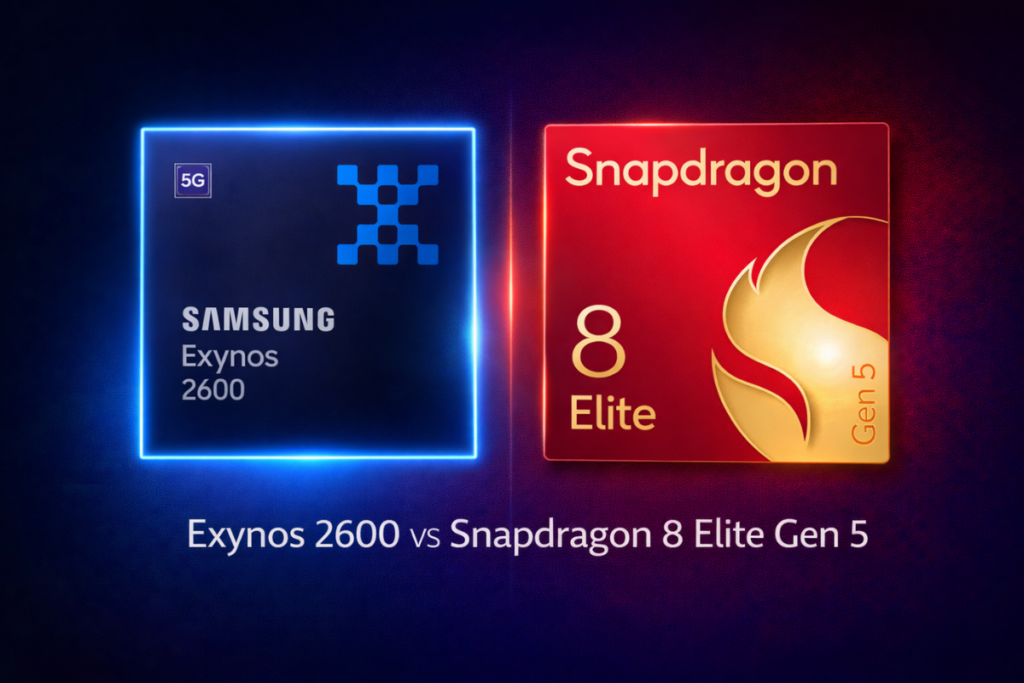
Exynos 2600 vs Snapdragon 8 Elite Gen 5: The battle gets more intense

6 March 2026 at 18:19
Exynos 2600 vs Snapdragon 8 Elite Gen 5

Samsung’s Exynos chipsets have historically been less powerful than Qualcomm’s Snapdragon chipsets. The latter has always dominated key aspects, including CPU, GPU, and connectivity. However, the newly-released Exynos 2600 narrows the gap significantly. In fact, it outperforms the Snapdragon 8 Elite Gen 5 on several benchmarks.

In this detailed comparison, we’ll make sense of the benchmark scores and dive into the key differences to understand how the Exynos 2600 and Snapdragon 8 Elite Gen 5 stack up against each other.

Let’s begin with a quick look at the spec sheet:

Exynos 2600Snapdragon 8 Elite Gen 5
AnnouncedDecember 2025September 2025
Process node2nm (TSMC)3nm (TSMC)
CPU cores10-core8-core
CPU cores1 x 3.8GHz — C1-Ultra
3 x 3.25GHz — C1-Pro
6 x 2.75GHz — C1-Pro
2 x 4.61GHz — Oryon (3rd gen)
6 x 3.63GHz — Oryon (3rd gen)
GPUExynos Xclipse 960 GPU
Ray tracing support
Exynos Neural Super Sampling
Adreno 840
Ray tracing support
Snapdragon Elite Gaming features
NPUAI engine with 32K MAC NPUQualcomm Hexagon NPU
Agentic AI support
MemoryLPDDR5XLPDDR5X, up to 5.3 GHz
StorageUFS 4.1UFS 4.1
Cameraup to 320MP single camera
up to 108MP single camera (30fps)
up to 64MP+32MP dual cameras (30fps)
up to 8K video recording
real-time semantic segmentation
Qualcomm Spectra Triple ISP (20-bit)
up to 320MP single camera
up to 108MP single camera (MFNR, ZSL, 30fps)
up to 48MP triple camera (MFNR, ZSL, 30fps)
up to 8K video recording
real-time semantic segmentation (limitless)
Advanced Professional Video (APV) codec
ConnectivityExynos 5410 modem
download speed: 14.79Gbps (maximum)
upload speed: 4.9Gbps (maximum)
Wi-Fi 7
Bluetooth 6.0
Snapdragon X85 5G modem
download speed: 12.5Gbps (peak)
upload speed: 3.7Gbps (peak)
Wi-Fi 7 (peak speed: 5.8Gbps)
Bluetooth 6.0

Exynos 2600 vs Snapdragon 8 Elite Gen 5: Benchmark scores

Since the Galaxy S26 trio has yet to reach Gizmochina’s house, we used NL Tech’s benchmark data. The Galaxy S26+ (Exynos 2600) and Galaxy S26 Ultra (Snapdragon 8 Elite Gen 5) were used in the testing.

Geekbench score (v6)

Exynos 2600Snapdragon 8 Elite Gen 5
Single core3,1263,690
Multi core10,68411,148

On Geekbench, the Exynos 2600 posts lower scores than the Snapdragon 8 Elite Gen 5. In the single-core test, the Snapdragon gets about 18% higher score, while the difference in multi-core scores is just 4%.

AnTuTu score (v11)

Exynos 2600Snapdragon 8 Elite Gen 5
AnTuTu score2,663,8983,396,880
CPU788,8031,014,266
GPU1,091,1411,388,476
Memory359,328346,871
UX424,626647,267

The Snapdragon 8 Elite Gen 5 shines on AnTuTu too, posting a total score close to 3.4 million (vs. 2.66 million on Exynos 2600). That 27% uplift in total score for the Snapdragon chip is also reflected in the CPU and GPU scores.

The Snapdragon 8 Elite Gen 5 also achieves a significantly higher score in the memory test, while the Exynos 2600 scores 3% higher in the user experience test.

3DMark score

Wild Life Extreme Stress Test

Exynos 2600Snapdragon 8 Elite Gen 5
Best loop score7,0777,084
Lowest loop score2,9883,067
Stability42.2%43.3%

Benchmark results from the 3DMark Wild Life Extreme Stress Test show that the Dimensity 2600 performs on par with the Snapdragon 8 Elite Gen 5. There isn’t a big gap in stability either.

Solar Bay Extreme Stress Test

Exynos 2600Snapdragon 8 Elite Gen 5
Best loop score2,0371,247
Lowest loop score878709
Stability43.1%56.9%

The Exynos 2600 surprisingly outperforms the Snapdragon 8 Elite Gen 5 in the Solar Bay Extreme Stress Test, which means that the latest phones have excellent ray tracing performance.

Now that we’re aware of the benchmark data, let’s dig further into the key differences to get a clearer picture.

Exynos 2600 vs Snapdragon 8 Elite Gen 5: Key differences

The Exynos 2600 was announced just three months after the Snapdragon 8 Elite Gen 5, as the world’s first smartphone chipset to use a 2nm process. In February 2026, it debuted with the Galaxy S26 series.

CPU, GPU, and NPU

The Exynos 2600 features a 10-core CPU, which includes one C1-Ultra prime core, three C1-Pro high-performance cores, and six C1-Pro high-efficiency cores. The Snapdragon 8 Elite uses a custom-designed Oryon CPU, featuring two Oryon prime cores (third-gen) and six Oryon performance cores (third-gen).

The Snapdragon 8 Elite benefits from a higher peak CPU speed, which is one of the reasons it scored higher in the single-core test on Geekbench. For graphics-intensive tasks, the Exynos 2600 relies on the Xclipse 960 GPU, while the Snapdragon chip uses the Adreno 840 GPU.

Both chipsets have highly capable GPUs with strong ray tracing capabilities. However, the Exynos 2600 may have an edge, as seen in 3DMark tests.

The Exynos 2600 and Snapdragon 8 Elite Gen 5 feature advanced NPUs optimized for on-device generative AI. They also use AI to optimize connectivity, camera, and many other aspects.

Camera

The Exynos 2600 introduces an AI-powered Visual Perception System (VPS), which replaces the traditional ISP with a dedicated AI subsystem for real-time scene analysis, object recognition, and noise reduction. This enables ultra-high-res processing at 60fps with over 50% better power efficiency than the Exynos 2400.

The Exynos chip features Deep Learning Video Noise Reduction (DVNR) for noise reduction in low-light conditions and supports hybrid OIS + AI-EIS for better stabilization.

On the other hand, the Snapdragon 8 Elite offers 20-bit triple AI-ISPs, delivering 4x dynamic range, real-time semantic segmentation with up to 250 layers, and direct NPU access to raw sensor data for on-device AI processing. Additionally, the chip offers a range of features to further improve the camera output, including object eraser, skin/sky tone enhancements, Night Vision 3.0, video object eraser, and Snapdragon Audio Sense.

Connectivity

The Exynos 2600 features a redesigned connectivity setup with an external modem (Exynos Modem 5410), offloading cellular, Wi-Fi, and Bluetooth from the main 2nm die to improve the thermal efficiency and space for CPU/GPU.

The Exynos chip supports a higher peak download speed of 14.79Gbps (vs. 12.5Gbps) and a higher peak upload speed of 4.9Gbps (vs. 3.7Gbps) on a cellular connection compared to the Snapdragon 8 Elite Gen 5.

The Snapdragon chip features an integrated Snapdragon X85 5G modem with FastConnect 7900 for robust connectivity. Wi-Fi 7 supports a peak speed of 5.8Gbps. Furthermore, the chip includes AI-powered optimizations for traffic prioritization, seamless Wi-Fi/cellular switching, and enhanced satellite support.

Exynos 2600 vs Snapdragon 8 Elite Gen 5: Which is a better choice?

Since we haven’t yet tested an Exynos 2600-powered Samsung phone, it’s difficult to say whether it’s the same story this year or if the Exynos 2600 completely outperforms the Snapdragon 8 Elite Gen 5. However, based on the benchmark data and spec sheet, the Exynos 2500 appears to be significantly better than its predecessor, particularly in gaming performance.

The Exynos chip also introduces major camera upgrades, including Deep Learning Video Noise Reduction. It now features a redesigned connectivity system with an external modem, which claims to improve thermal efficiency.

That said, the Snapdragon 8 Elite Gen 5 still delivers strong CPU performance and features a mature ISP with excellent imaging capabilities. Its robust connectivity system with better carrier support also makes a notable difference.

The post Exynos 2600 vs Snapdragon 8 Elite Gen 5: The battle gets more intense appeared first on Gizmochina.

Zebronics launches Zeb Juke Bar 9710C 5.1 550W Dolby Atmos soundbar

6 March 2026 at 15:35
Zebronics Zeb Juke Bar 9710C 5.1 soundbar

Zebronics has launched the Zeb Juke Bar 9710C, a compact 5.1-channel soundbar system designed for home entertainment setups. The new model features a multi-speaker configuration with support for Dolby Atmos and DTS:X, aiming to deliver immersive surround sound for movies, music, and gaming.

Zebronics Zeb Juke Bar 9710C 5.1 soundbar

Zebronics Zeb Juke Bar 9710C Specifications

The Zeb Juke Bar 9710C delivers a total output of 550W RMS. The system includes a soundbar, a wireless subwoofer, and two rear satellite speakers that form a full 5.1-channel surround configuration.

The subwoofer provides 190W output and uses a 13.33 cm driver to handle low-frequency audio. The main soundbar houses three drivers rated at 70W each, while the rear satellite speakers deliver 75W output per unit to enhance surround effects.

The audio system supports a frequency response range of 40Hz to 20kHz. Zebronics lists the signal-to-noise ratio at 78dB or higher and channel separation at 48dB or above. These specifications allow the system to deliver clear dialogue, detailed mid-range sound, and stronger bass output through the dedicated subwoofer.

Zebronics Zeb Juke Bar 9710C 5.1 soundbar

For connectivity, the soundbar includes Bluetooth 5.3 for wireless streaming from smartphones and tablets. It also features TV eARC, Optical input, AUX input, and USB playback support. The USB port supports MP3 files and works with storage devices up to 32GB. It also includes an LED display for playback and connectivity details.

The soundbar measures 40.5 x 9 x 6.2 cm, while the subwoofer measures 15 x 18.5 x 29.5 cm. Each satellite speaker measures 9 x 6 cm. The complete system weighs about 4.3 kg. The design includes a matte finish and supports wall mounting for flexible installation.

Zebronics ships the package with the soundbar, wireless subwoofer, two satellite speakers, power adapters, cables, wall mount fasteners, and a remote control.

Pricing and Availability

The Zeb Juke Bar 9710C is currently available in India through Amazon at an introductory price of Rs. 16,999. The product comes with a one-year warranty.

In related news, Philips launched the TAB4230 soundbar, TAS4400 speaker, and SHP9500 headphones in India, while Xiaomi unveiled a budget Redmi Soundbar equipped with RGB lighting and a wireless subwoofer.

For more daily updates, please visit our News Section.

Stay ahead in tech! Join our Telegram community and sign up for our daily newsletter of top stories! 💡

The post Zebronics launches Zeb Juke Bar 9710C 5.1 550W Dolby Atmos soundbar appeared first on Gizmochina.

Rollme launches Navis smartwatch with dual-band GPS, offline maps & 50m waterproofing

6 March 2026 at 15:11
Rollme launches Navis smartwatch

Rollme has launched the Navis GPS Smartwatch, a feature-packed wearable designed for outdoor enthusiasts. The smartwatch is priced at $79.99 and is now available for purchase from the official store.

Rollme Navis Smartwatch

Rollme Navis Specifications

The Navis features L1+L5 dual-frequency GPS supporting GPS, BeiDou, GLONASS, and Galileo for fast and accurate positioning. It offers offline maps, reliable route tracking, and track-back navigation for both trails and city streets.

The device features a 1.43-inch AMOLED HD display with a 90% screen-to-body ratio and narrow bezels. The screen supports a 60Hz refresh rate, auto-brightness adjustments, and an Always-On Display (AOD) mode. Rollme allows users to customize the watch with dynamic watch faces, DIY video styles, and AI-generated designs by entering keywords.

The Navis is designed for durability with a metal case, MIL-STD 810H certification, and a 50-meter waterproof rating. It features a 600mAh battery, and as per the brand, it provides 15-20 days of daily use or up to 60 days on standby.

Rollme launches Navis smartwatch

For health and fitness, the smartwatch supports 178+ sports modes and features a 4PD sensor for 24/7 monitoring of heart rate, blood oxygen, sleep, and stress levels. It also includes outdoor tools like a compass, barometer, altimeter, and a built-in LED flashlight for added safety and convenience during activities.

The Navis connects to smartphones via Bluetooth and allows users to answer calls, read messages, and receive notifications. It supports offline music playback and works with TWS headphones for hands-free listening. Rollme has added AI GPT integration, which provides instant answers to questions and translation support.

The Rollme Navis is available in Black and Silver.

In related news, Amazfit has launched the Active 3 Premium with a sapphire AMOLED display, offline maps, and up to 12 days of battery life, while Reebok has introduced the Stride smartwatch with an AMOLED display, GPS, and Bluetooth calling for $99.

For more daily updates, please visit our News Section.

Stay ahead in tech! Join our Telegram community and sign up for our daily newsletter of top stories! 💡

(Rollme)

The post Rollme launches Navis smartwatch with dual-band GPS, offline maps & 50m waterproofing appeared first on Gizmochina.

OnePlus 15T Geekbench listing appears, launch imminent

6 March 2026 at 15:01
OnePlus 15T (AI-generated image)

The OnePlus 15T was recently spotted on AnTuTu with an impressive score of 4.45 million. Now, the device, which bears the model number PLZ110, has appeared on Geekbench, suggesting that the brand could be internally testing its performance before launch.

OnePlus 15T Geekbench listing

OnePlus 15T Geekbench

The OnePlus 15T Geekbench listing reveals that it is powered by the Snapdragon 8 Elite Gen 5 chip, 16GB of RAM, and Android 16. It scored 3,440 points in the single-core test and 10,523 points in the multi-core test.

The previously seen AnTuTu listing revealed that the OnePlus 15T will have LPDDR5x RAM, up to 512GB of UFS 4.1 storage, and 165Hz refresh rate support. The brand has already confirmed that it will be a compact phone with a 6.32-inch OLED display with ultra-thin bezels.

Despite its compact size, the OnePlus 15T will feature a massive 7,500mAh battery with 100W wired and 50W wireless charging support. The phone is also confirmed to feature a 50-megapixel periscope telephoto camera on the back, but it is unlikely to feature an ultra-wide lens. It will also have other features, such as an ultrasonic in-screen fingerprint sensor and an IP68/69 level of dust and water resistance.

OnePlus 15T launch date

OnePlus is expected to confirm the OnePlus 15T launch date in the coming week. Most likely, it may debut a few days after the Oppo Find N6, which is rumored to launch on March 17. Therefore, the 15T may launch toward the end of this month in China.

Globally, the OnePlus 15T’s tweaked version may release with the OnePlus 15s branding. This phone may break cover in the second quarter of this year.

For more daily updates, please visit our News Section.

Stay ahead in tech! Join our Telegram community and sign up for our daily newsletter of top stories.

(via)

The post OnePlus 15T Geekbench listing appears, launch imminent appeared first on Gizmochina.

Oppo Watch X3 officially confirmed, teasers hint premium design

6 March 2026 at 14:18
Oppo Watch X3

Oppo has officially teased the upcoming Oppo Watch X3 smartwatch, hinting that the device will debut soon in China. The company has confirmed that the wearable will arrive alongside the Oppo Find N6 foldable smartphone. Early teasers and leaks have already started revealing several details about its design and hardware.

Oppo Watch X3 design teased

According to official teasers shared by Oppo on Weibo, the Watch X3 will feature a design focused on durability and premium materials. The company has used promotional phrases that translate roughly to a titanium-focused design and strong protective build.

This suggests the smartwatch could feature a titanium alloy bezel or structural components, similar to the approach seen on its predecessor. Preview videos released by the brand indicate that the smartwatch will support several outdoor activity metrics. The interface appears capable of displaying information such as step count and altitude, suggesting that the device is being positioned for fitness tracking and outdoor usage scenarios.

The smartwatch was also previously spotted in China with the model number OWW261 during a radio certification process. Some reports claim that the device may feature a USB Type-C charging interface instead of the proprietary connectors commonly seen on smartwatches.

Oppo Watch X3 specifications (rumored)

Oppo Watch X3
Oppo Watch X3 teaser

Earlier this year, tipster Digital Chat Station have revealed that the Oppo Watch X3 may include 2GB of RAM and 32GB of internal storage. The wearable is expected to pack a 632mAh battery and weigh around 68 grams. It may also support eSIM connectivity through an independent eUICC chip, allowing users to make calls or access data without needing a smartphone nearby.

The smartwatch is expected to arrive in several color options, including black, silver, titanium and orange. There are also early reports suggesting that Oppo could be working on a smaller Watch X3 mini variant, although details about this model remain unclear.

Industry sources indicate that the Oppo Watch X3 and the Oppo Find N6 foldable smartphone could be unveiled around March 17 in China, though the company has not yet confirmed the exact launch date.

Recently, a OnePlu watch with model number OPWWE261 was spotted at Elements Certification, revealing support for 10W charging. This watch, which is believed to be a rebranded version of Oppo Watch X3, is likely to be called the OnePlus Watch 4 when it hits the global market.

For more daily updates, please visit our News Section.

Stay ahead in tech! Join our Telegram community and sign up for our daily newsletter of top stories.

The post Oppo Watch X3 officially confirmed, teasers hint premium design appeared first on Gizmochina.

First MacBook Neo benchmark reveals how fast Apple’s new laptop is

6 March 2026 at 14:06

After the god-tier M5 Max, the first benchmark results for the Apple MacBook Neo have surfaced online. The numbers suggest that the laptop’s CPU performance is very close to that of the Apple iPhone 16 Pro.

According to Apple’s official specifications, the MacBook Neo runs on the Apple A18 Pro chip, the same six-core processor found inside the iPhone 16 Pro.

However, the laptop version ships with a slightly reduced graphics configuration. While the iPhone 16 Pro has six GPU cores, the MacBook Neo includes five. The CPU cores are 6 on both. 

MacBook Neo Geekbench

With this setup, the MacBook Neo scored 3461 in single-core, 8668 in multi-core, and 31,286 in the Metal graphics test on Geekbench. For comparison, the iPhone 16 Pro posts 3445 single-core, 8624 multi-core, and 32,575 Metal.

These scores make the two devices nearly identical on the CPU side, which isn’t surprising given that they share the same chip architecture. The small gap in the Metal graphics score likely comes from the MacBook Neo’s reduced GPU core count.

The numbers also put the new laptop in an interesting position compared to older and newer Macs. For instance, the Apple MacBook Air (M1) scored 2346 single-core and 8342 multi-core in the same benchmark, meaning the MacBook Neo noticeably improves single-core performance while only slightly surpassing the M1 in multi-core tasks.

Meanwhile, the Apple MacBook Air M4 sits in a very different performance tier with 3696 single-core and 14,730 multi-core, far ahead in workloads that rely on multiple CPU cores.

The MacBook Neo also lands below devices like the Apple iPad Air (M3) in multi-core performance, which scores 11,678 points. However, it still outperforms more entry-level hardware, such as the Apple iPad (11th generation), which achieves 6036 points in multi-core performance.

Don’t miss a thing! Join our Telegram community for instant updates and grab our free daily newsletter for the best tech stories!

For more daily updates, please visit our News Section.

The post First MacBook Neo benchmark reveals how fast Apple’s new laptop is appeared first on Gizmochina.

Poco X8 Pro series could debut globally on March 17, says new leak

6 March 2026 at 13:59
Redmi Turbo 5 Max display-

Poco appears to be preparing its next performance-focused smartphones for the global market. According to an industry insider, the Poco X8 Pro and Poco X8 Pro Max could launch globally on March 17, 2026.

Redmi Turbo 5 Max display-

If the details are accurate, both phones will follow a familiar strategy from Poco: bringing slightly modified versions of Xiaomi’s China-only devices to international markets. In this case, the upcoming models are expected to be based on the Redmi Turbo 5 and Redmi Turbo 5 Max.

The Poco X8 Pro is confirmed to feature MediaTek’s Dimensity 8500 Ultra chipset, which should offer solid performance for gaming, multitasking, and everyday use. On the front, the device is expected to include a 6.59-inch OLED display with 1.5K resolution and a 120Hz refresh rate, something that has become fairly standard in this segment.

Camera hardware looks fairly typical for a mid-range performance-centric phone. Reports suggest a 50MP Sony IMX882 primary sensor, paired with an 8MP ultrawide camera, while the front houses a 20MP selfie shooter.

One of the more interesting aspects may be the battery. The X8 Pro is rumored to pack a 7,560mAh battery, the same as the Redmi Turbo 5. This is unusually large for a device in this category. It’s also likely to support 100W fast charging, so topping up the battery shouldn’t take long.

Just like the Redmi Turbo 5 Max, the Poco X8 Pro Max is expected to pack a larger 6.83-inch 1.5K display and a more powerful MediaTek Dimensity 9500s chipset. Camera setup includes a 50MP Light Hunter 600 sensor, an 8MP ultrawide, and a 20MP selfie shooter.

Battery capacity could be another highlight. Global variants are rumored to include an 8,500mAh battery, while some reports suggest certain markets could see a 9,000mAh version. Charging is still expected to max out at 100W. With certifications already appearing in several regions, the launch may not be far off.

Don’t miss a thing! Join our Telegram community for instant updates and grab our free daily newsletter for the best tech stories!

For more daily updates, please visit our News Section.

(Source: Smartprix)

The post Poco X8 Pro series could debut globally on March 17, says new leak appeared first on Gizmochina.

Oppo Reno 16 Pro Max display, camera and processor detail leaks

6 March 2026 at 13:43

Oppo announced the Oppo Reno 15 smartphones in China last November. Since the company typically refreshes the lineup every six months, the Oppo Reno 16 series likely isn’t too far away. A previous report has already tipped some shared specs for the upcoming devices.

A new leak now suggests Oppo could expand the lineup with a Pro Max model. According to tipster Digital Chat Station, the device is described as “super-sized,” reportedly featuring a 6.78-inch display.

Oppo Reno 16 Pro Max Specifications

The screen is said to offer 1.5K resolution and use an LTPO panel, with uniform bezels on all four sides. The most interesting detail, however, may be the chipset. The tipster claims the phone will run a flagship “N-1” Dimensity processor. While the exact model wasn’t confirmed, it could be a previous-generation flagship chip such as the MediaTek Dimensity 9400.

So far, the Reno series has typically used sub-premium processors, but if the leak is accurate, the lineup could move closer to the sub-flagship segment. 

As for cameras, the Reno 16 Pro Max is said to feature a 200-megapixel main camera alongside a 50-megapixel periscope telephoto lens. Interestingly, the Reno 16 Pro may also have a similar lens setup. The latter, however, is said to be powered by the Dimensity 8500 chip.  

If the leak proves accurate, the Reno 16 Pro Max could effectively replace the current Pro model as the lineup’s top-tier offering, bringing upgraded specs across the board. That bump in hardware may also come with a higher price tag, according to the tipster.

None of this is official yet, and Oppo hasn’t acknowledged the leak. Still, with testing already underway and a mid-year launch window hinted at, the Reno 16 series may not stay a mystery for much longer.

For more daily updates, please visit our News Section.

Tech enthusiast? Get the latest news first! Follow our Telegram channel and subscribe to our free newsletter for your daily tech fix! ⚡

The post Oppo Reno 16 Pro Max display, camera and processor detail leaks appeared first on Gizmochina.

Poco X8 Pro Max with Dimensity 9500s appears on Geekbench, performance revealed

6 March 2026 at 13:11
Poco X8 Pro Max

Poco is expected to announce the Poco X8 Pro series of smartphones later this month globally. The brand has already announced that the lineup will feature phones powered by Dimensity 8500 and Dimensity 9500s chipsets. These chipsets are likely to power the Poco X8 Pro and X8 Pro Max, respectively. In a new development, the global and Indian versions of the X8 Pro Max have emerged on the Geekbench benchmarking platform.

Poco X8 Pro Max Geekbench listing

Poco X8 Pro Max Geekbench

As can be seen in the above screenshots, the Poco X8 Pro Max’s global and Indian versions have appeared on Geekbench. These models have appeared with respective model numbers, such as 2602BPC18G and 2602BPC18I.

The global version has scored 2,659 and 8,369 points, respectively in the single-core and multi-core tests of Geekbench 6.5. On the other hand, the Indian version has recorded 2,616 and 8,401 points, respectively. The X8 Pro Max’s Geekbench listings have revealed the Dimensity 9500s performance for the first time. Reports have revealed that the upcoming Oppo Find X9s will also feature the said chipset.

For those who do not know, the Dimensity 9500s is a toned-down version of the existing Dimensity 9500, which was announced in October 2025. The Geekbench listing reveals that the single prime core of the D9500s operates at 3.73GHz. It also includes three cores working at 3.30GHz, four cores running at 2.40GHz, and Mali-G925 Immortalis MC11 graphics.

Being a more powerful offering, the Dimensity 9500 comes with a 1+3+4 architecture but with faster core speeds, such as 4.21GHz, 3.5GHz, and 2.7GHz. For graphics, it has Arm G1-Ultra onboard. When it comes to performance, the Dimensity 9500 can reach around 3,500 and 9,000 to 10,000 in the single-core and multi-core tests, respectively.

The Poco X8 Pro Max’s Geekbench listing also reveals Android 16 and 12GB RAM. Now that the device has appeared on the benchmarking site, it appears that the brand could be doing final testing before its launch. Some unconfirmed reports suggest that the series may launch on March 26.

For more daily updates, please visit our News Section.

Stay ahead in tech! Join our Telegram community and sign up for our daily newsletter of top stories.

(via)

The post Poco X8 Pro Max with Dimensity 9500s appears on Geekbench, performance revealed appeared first on Gizmochina.

Apple’s M5 Max outperforms a previous 32-core Apple chip in new benchmark listing

6 March 2026 at 11:36
MacBook Pro with M5 Pro and M5 Max

Apple announced its M5 Max–powered MacBooks a couple of days ago, and its first benchmarks are finally in. A 16-inch MacBook Pro equipped with Apple’s M5 Max has appeared in the Geekbench, offering an early look at the chip’s performance.

Apple M5 Max Geekbench shows incredible multi-core performance

According to MacRumors, the tested configuration features an 18-core CPU, and it did incredibly well in the multi-core test. The chip posted a score of 29,233, which is even higher than Apple’s M3 Ultra’s 27,726 points in a 32-core CPU setup.

This result puts the M5 Max ahead of several other high-end Apple processors. The M3 Ultra in the Mac Studio scores 27,726 in Geekbench’s multi-core test, while the M4 Max inside the Mac Studio reaches 26,166. Another configuration of the M4 Max in a 16-inch MacBook Pro scored 25,702 points.

In other words, the new M5 Max delivers roughly a 5% improvement over the M3 Ultra and around 14 to 15% over the M4 Max in multi-core performance.

Single-core performance looks strong as well. The M5 Max scored 4,268 in Geekbench’s single-core test, putting it roughly in line with the standard M5 chip used in the 14-inch MacBook Pro. The result also exceeds the score of AMD’s high-end desktop processor, the Ryzen 9 9950X3D, which sits at around 3,395 in the same benchmark.

The tested M5 Max configuration includes a 40-core GPU. In Geekbench’s Metal graphics benchmark, the chip scored between 218,772 and 232,718 points. That’s roughly 20 percent higher than the M4 Max, but about 5 to 10 percent lower than the M3 Ultra.

That gap isn’t entirely surprising. The M3 Ultra is effectively two Max-class chips fused together, giving it significantly more GPU resources overall.

All told, the early benchmark results suggest the M5 Max offers around a 15 percent CPU improvement and roughly a 20 percent GPU uplift compared with the M4 Max.

For more daily updates, please visit our News Section.

Stay ahead in tech! Join our Telegram community and sign up for our daily newsletter of top stories.

(Source)

The post Apple’s M5 Max outperforms a previous 32-core Apple chip in new benchmark listing appeared first on Gizmochina.

Asus V501 desktops, AiO V400 bring compact design and Intel performance

6 March 2026 at 10:58
Asus V501 desktops, AiO V400

Asus has expanded its consumer PC lineup with the launch of the Asus V501 desktops and AiO V400 series. The new systems are designed to cater to different usage scenarios ranging from small offices and studios to family households that require dependable everyday computing. With compact designs and modern hardware, the lineup aims to provide balanced performance for both productivity and entertainment needs.

Asus V501 desktop specifications and features

Asus V501 desktops, AiO V400
Asus AiO series

The Asus V501 desktop lineup includes the V501MV mini-tower and the V501SV small-form-factor model. These systems are designed for environments such as small offices, startups, studios and home workspaces where reliable day-to-day computing is essential. The desktops are powered by up to Intel Core 7 240H processors and support up to 64GB DDR5 expandable memory, allowing them to handle tasks such as document processing, accounting software, virtual meetings and light design workloads.

Asus has also focused on stability for long working hours. The V501 desktop includes an advanced thermal design with copper heat pipes to maintain steady performance under sustained workloads. Noise levels can stay as low as 38dB even during heavy use, making the system suitable for professional environments like consultation rooms or creative studios. The desktops also feature an 80 Plus Bronze certified power supply that helps improve energy efficiency while reducing operational costs.

The Asus AiO V400 series includes the V470 and V440 models, designed for users who prefer a clutter-free workspace. These all-in-one systems combine the display and computing hardware in a single unit, reducing cable clutter and saving desk space. Powered by up to Intel Core 3 processors and paired with up to 8GB DDR5 RAM and SSD storage, the AiO V400 series supports tasks such as streaming, online learning, video calls and everyday multitasking.

Asus AiO V400 series price and availability

The Asus V501 desktops start at Rs 42,990 (~$470) and will be available from March 16 through Asus Exclusive Stores, the Asus eShop, Flipkart, Amazon and authorized retail partners. The AiO V470 starts at Rs 71,990 (~$785) and is already available through Asus Exclusive Stores, Croma, the Asus eShop, Flipkart and Amazon. The AiO V440 is expected to go on sale from April 14 through the same channels.

For more daily updates, please visit our News Section.

Stay ahead in tech! Join our Telegram community and sign up for our daily newsletter of top stories.

The post Asus V501 desktops, AiO V400 bring compact design and Intel performance appeared first on Gizmochina.

Motorola Edge 70 Fusion launched with 144Hz AMOLED display and 7000mAh battery

6 March 2026 at 10:39

The Motorola Edge 70 Fusion has been launched in India as a device that focuses on camera performance, battery life and AI-powered features. It also brings a slim design with a textured fabric finish and a high refresh rate display. Here’s a look at the specifications, features, and price of the device.

Motorola Edge 70 Fusion specifications and features

Motorola Edge 70 Fusion color options

The Motorola Edge 70 Fusion features a 6.78-inch quad-curved AMOLED display with a 1.5K resolution and a 144Hz refresh rate. The panel supports HDR10+, a 100 percent DCI-P3 color gamut and 10-bit colour depth. Motorola says the screen can reach up to 5200 nits of peak brightness and is protected by Gorilla Glass 7i. The phone also includes dual stereo speakers with Dolby Atmos support for an improved multimedia experience.

For photography, the device is equipped with a 50-megapixel Sony Lytia 710 primary camera with optical image stabilisation. The setup also includes a 13-megapixel ultra-wide camera with macro support and a dedicated light sensor.

On the front, the phone has a 32-megapixel selfie camera capable of recording 4K video. Camera software features include adaptive stabilisation, portrait modes with different focal lengths and AI-based photo enhancement tools.

Motorola Edge 70 Fusion

The smartphone runs on the Snapdragon 7s Gen 4 processor and comes with up to 12GB RAM and up to 256GB storage. It runs Hello UI based on Android 16 and is expected to receive three Android updates along with five years of security updates. The device carries a 7000mAh silicon-carbon battery with 68W fast charging, which the company claims can provide a full day’s usage with a short charge.

Motorola Edge 70 Fusion price in India, availability

The Motorola Edge 70 Fusion is available in three variants. The 8GB + 128GB model is priced at Rs 26,999 (~$300), the 8GB + 256GB version costs Rs 29,999 (~$330), and the 12GB + 256GB variant is priced at Rs 32,999 (~$360). With bank and exchange offers, the effective price starts at Rs 24,999.

The phone will be available in Pantone Blue Surf, Pantone Country Air and Pantone Silhouette colour options with a fabric-inspired finish. An early bird sale is scheduled for March 6 between 12pm and 4pm on Flipkart, while open sales will begin from March 12 through Flipkart, Motorola’s official website and retail stores across India.

For more daily updates, please visit our News Section.

Stay ahead in tech! Join our Telegram community and sign up for our daily newsletter of top stories.

The post Motorola Edge 70 Fusion launched with 144Hz AMOLED display and 7000mAh battery appeared first on Gizmochina.

Xiaomi announces miclaw, an autonomous AI assistant for smartphones

6 March 2026 at 10:18
Xiaomi-miclaw-announced

Xiaomi has introduced a new experimental AI project called Xiaomi miclaw. Announced today, the tool is designed to turn a smartphone into a more autonomous AI assistant that can carry out tasks across apps and system features.

The company describes Xiaomi miclaw as an early test product built on its in-house MiMo large language model. Rather than simply answering questions or generating text, the system is designed to interpret user intentions and complete tasks by interacting with different tools on the phone.

Once users grant permission, the AI can access system functions and supported third-party apps to carry out commands.

In practical terms, that means the assistant can choose which tools to use and decide how to complete a task on its own. If you remember, Honor smartphones with AI Agent can also perform similar actions.

For example, if a request requires opening an app, checking system data, or triggering a function, the AI decides the steps needed and executes them in sequence. Xiaomi says the system can also interpret less specific requests and attempt to translate them into concrete actions.

How is Xiaomi miclaw built?

At the core of the system is what Xiaomi calls an “inference-execution loop.” Here, AI first analyzes the request, which then selects a tool and parameters, executes the action, reviews the result, and continues the process until the task is finished. Each step is handled asynchronously, so the system doesn’t block other phone processes.

Xiaomi miclaw also includes a memory system intended to help the AI learn from repeated use. The assistant keeps track of important context while compressing older interactions so it can remember the original intent of longer tasks.

The assistant can also connect with Xiaomi’s broader ecosystem. Through integration with the company’s Mi Home platform, the AI can read the status of smart home devices and send control commands, provided the user allows it. 

Xiaomi is also opening the platform to developers. The system supports the Model Context Protocol (MCP), an open standard for integrating AI tools, which could allow existing AI utilities built for other platforms to work with Xiaomi miclaw. In addition, Xiaomi is releasing an SDK that lets third-party apps declare what capabilities they can offer so the AI can call them when needed.

Xiaomi miclaw is experimental and is supported by limited devices

The company says that the project is still experimental. Xiaomi says reliability, power consumption, and success rates for complicated tasks are still being improved, and some operations may fail or behave inconsistently.

As a result, the rollout is limited for the time being. Xiaomi is launching miclaw as a closed beta project where participation is by invitation only. The company advises testers not to install the experimental build on their primary phones and recommends backing up data before trying it.

Xiaomi 17 Ultra
Xiaomi 17 Ultra

The test currently supports a small set of devices, including the Xiaomi 17, Xiaomi 17 Pro, Xiaomi 17 Pro Max, Xiaomi 17 Ultra, and the Xiaomi 17 Ultra Leica Edition.

Xiaomi also says that user data from miclaw interactions won’t be used to train its AI models. According to the company, model training relies on publicly available or authorized datasets, while personal interactions are only used to process commands in real time. Sensitive information is handled locally on the device using what Xiaomi describes as “edge-cloud privacy computing.”

For more daily updates, please visit our News Section.

Stay ahead in tech! Join our Telegram community and sign up for our daily newsletter of top stories!

The post Xiaomi announces miclaw, an autonomous AI assistant for smartphones appeared first on Gizmochina.

Honor MagicPad 4 Debuts in UK and Europe as the World’s Thinnest Tablet With 165Hz OLED & Snapdragon 8 Gen 5

6 March 2026 at 09:58
Honor MagicPad 4

Honor‘s MagicPad 4 has arrived in Europe and the UK following its MWC 2026 preview in Barcelona. The tablet stands out for its extremely slim build, measuring just 4.8mm thick, which the company claims makes it the thinnest tablet currently available.

Honor MagicPad 4
Honor MagicPad 4

The Honor MagicPad 4 features a 12.3-inch OLED display with a resolution of 3000 × 1920 pixels. The panel reaches a peak HDR brightness of 2400 nits and supports refresh rates up to 165Hz. Multiple adaptive refresh levels are included to balance smooth visuals and power consumption during scrolling, gaming, and video playback.

Despite the slim design, the tablet weighs around 450 grams. It measures 273.4mm in width and 178.8mm in height, giving it a relatively compact footprint for a device with a large display.

HONOR MagicPad 4

Powering the MagicPad 4 is Qualcomm’s Snapdragon 8 Gen 5 mobile platform. The tablet is available with up to 16GB of RAM and up to 512GB of internal storage. It runs MagicOS 10 based on Android 16.

The device includes a 10,100mAh battery and supports 66W fast charging. This capacity is intended to support extended productivity and media use throughout the day.

For cameras, the rear features a 13-megapixel main sensor with autofocus. On the front, there is a 9-megapixel camera designed for video calls, conferencing, and online meetings. Connectivity options include Wi-Fi 7 with 2×2 MIMO support and Bluetooth 6.0 with support for multiple high-quality audio codecs.

Honor also includes a PC Mode that provides a desktop-style interface with resizable windows. The tablet supports external accessories, including a keyboard and stylus, allowing it to function as a lightweight productivity device.

Pricing & availability

Pricing starts at €599 in the Eurozone or £499.99 in the UK (with coupon) for 12GB RAM and 256GB storage. The 16GB RAM and 512GB storage version costs €799 or £599.99.

Honor’s Pencil 3 stylus and Smart Keyboard are available separately for €50 or £50 each. The trackpad-equipped keyboard shown at MWC 2026 is not currently offered. Pre-orders ship around March 10.

The post Honor MagicPad 4 Debuts in UK and Europe as the World’s Thinnest Tablet With 165Hz OLED & Snapdragon 8 Gen 5 appeared first on Gizmochina.

Vivo X300 FE vs iPhone 17: A head-to-head comparison

6 March 2026 at 09:42
Vivo-X300-FE-vs-iPhone-17

Compact flagship phones have become a small but steady category in the smartphone market. Not everyone wants a 6.7-inch screen and a device that stretches pockets. That’s why we have phones like the Vivo X300 FE and the Apple iPhone 17 that offer high-end hardware while keeping the overall footprint relatively manageable.

On paper, both devices sit in a similar size class, both use 3nm chipsets, and both bring 120Hz OLED displays. And they are even priced similarly, just below $800. But if you look closely, they take noticeably different approaches to things like cameras, battery life, software, and even basic hardware priorities.

Here’s how these two phones compare.

Size and design

At first glance, the Vivo X300 FE and iPhone 17 look like they belong to the same category. The Vivo measures 150.8 × 71.8 × 8 mm, while the iPhone 17 comes in slightly smaller at 149.6 × 71.5 × 8 mm.

However, the two phones have notable differences in weight. The Vivo X300 FE weighs 191 grams, while the iPhone 17 is lighter at 177 grams. That 14-gram difference can make the iPhone feel a bit easier to hold over long periods.

Both phones use glass on the front and back with aluminum frames. Apple uses its Ceramic Shield 2 protection on the front glass, while Vivo sticks with a standard glass front. 

The iPhone 17 carries IP68 certification for immersion up to 6 meters, while the Vivo X300 FE has both IP68 and IP69, which also covers high-pressure water jets but only guarantees immersion up to 1.5 meters.

Displays are similar, but not identical

The Vivo X300 FE has a 6.31-inch LTPO AMOLED display with a resolution of 1216 × 2640 and a pixel density of around 461 ppi. Meanwhile, the iPhone 17 features a 6.3-inch LTPO Super Retina XDR OLED panel with 1206 × 2622 resolution and about 460 ppi.

Both support 120Hz refresh rates, which is notable since Apple only recently began bringing ProMotion-style refresh rates to its non-Pro lineup. Where they diverge is in brightness and display features.

The Vivo X300 FE claims up to 5000 nits peak brightness, while the iPhone 17 lists 1000 nits typical brightness, 1600 nits high-brightness mode, and up to 3000 nits peak. Apple also supports HDR10 and Dolby Vision, along with an anti-reflective coating.

Performance and chipset

Both phones are powered by new 3nm processors, but they come from different worlds. The Vivo X300 FE uses the Qualcomm Snapdragon 8 Gen 5, featuring Oryon V3 cores and an Adreno 829 GPU. Meanwhile, the iPhone 17 runs on the Apple A19 chip.

Historically, Apple’s A-series chips have focused on strong single-core performance and tight software optimization. Qualcomm’s latest flagship processors usually emphasize multi-core performance and GPU improvements for gaming.

Memory configurations include 12GB of RAM on the X300 FE, while the iPhone 17 features 8GB of RAM. Both are paired with either 256GB or 512GB storage.

Of course, raw specs rarely tell the whole story. Apple’s control over both hardware and software means the iPhone often performs smoothly even with less RAM. Meanwhile, Android flagships typically rely on larger memory pools to manage multitasking.

Software

As always, the biggest talk comes down to the software. The Vivo X300 FE runs Android 16 with Vivo’s OriginOS 6 interface on top. The company promises up to five major Android upgrades, which is a relatively long support window in the Android ecosystem.

The iPhone 17 runs iOS 26, with updates expected for many years beyond its launch. Apple’s software experience tends to emphasize consistency and ecosystem integration. Android phones, including Vivo’s, offer more customization and flexibility.

For users, the choice between the two phones will come down almost entirely to whether they prefer iOS or Android.

Cameras

The Vivo X300 FE wins in terms of optics with its triple-camera system. It has a:

  • 50MP main camera
  • 50MP periscope telephoto with 3× optical zoom
  • 8MP ultrawide camera

The inclusion of a periscope lens means the X300 FE can offer true optical zoom beyond the main camera.

On the other hand, the iPhone 17 has a dual rear-camera setup:

  • 48MP main camera
  • 48MP ultrawide camera

Apple doesn’t include a dedicated telephoto camera on the base iPhone 17, which means zoom photography will likely rely more on digital cropping.

However, the iPhone supports Dolby Vision HDR recording and multiple frame-rate options up to 4K at 60fps. Vivo supports 4K recording as well, but Apple typically focuses more heavily on video features. 

For selfies, Vivo includes a 50MP front camera, while the iPhone 17 has an 18MP ultrawide camera paired with a 3D depth sensor used for Face ID.

Battery and charging

Vivo wins in hardware in this department, too. It has a 6500mAh battery, significantly larger than the 3692mAh battery inside the iPhone 17. The former charges at 90W wired, 40W wireless speed, and also supports wireless charging. 

Apple’s charging system is slower by comparison. The iPhone 17 supports wired charging capable of reaching 50 percent in around 20 minutes and 25W wireless charging through MagSafe or Qi2.

Connectivity and extra features

Both phones support modern connectivity features such as Wi-Fi 7, Bluetooth 6.0, and a wide range of global navigation systems. The Vivo X300 FE also includes an infrared port. 

On Apple’s behalf, the iPhone 17 includes Ultra Wideband support, satellite communication for emergency services, and deeper integration with Apple services like Find My. 

For biometrics, Vivo uses an ultrasonic fingerprint scanner under the display, while Apple relies on Face ID with its front-facing 3D sensor system.

Two different interpretations of a flagship

The Vivo X300 FE and iPhone 17 are roughly the same size and price, but they are two very different ideas of what a compact flagship can be.

Vivo is heavy on hardware with a larger battery, more RAM, faster charging, and a dedicated telephoto camera. The iPhone focuses more on software integration, camera processing, and ecosystem features. 

Neither approach is necessarily better. It mostly depends on what someone values more in a phone. 

For more daily updates, please visit our News Section.

Stay ahead in tech! Join our Telegram community and sign up for our daily newsletter of top stories

The post Vivo X300 FE vs iPhone 17: A head-to-head comparison appeared first on Gizmochina.

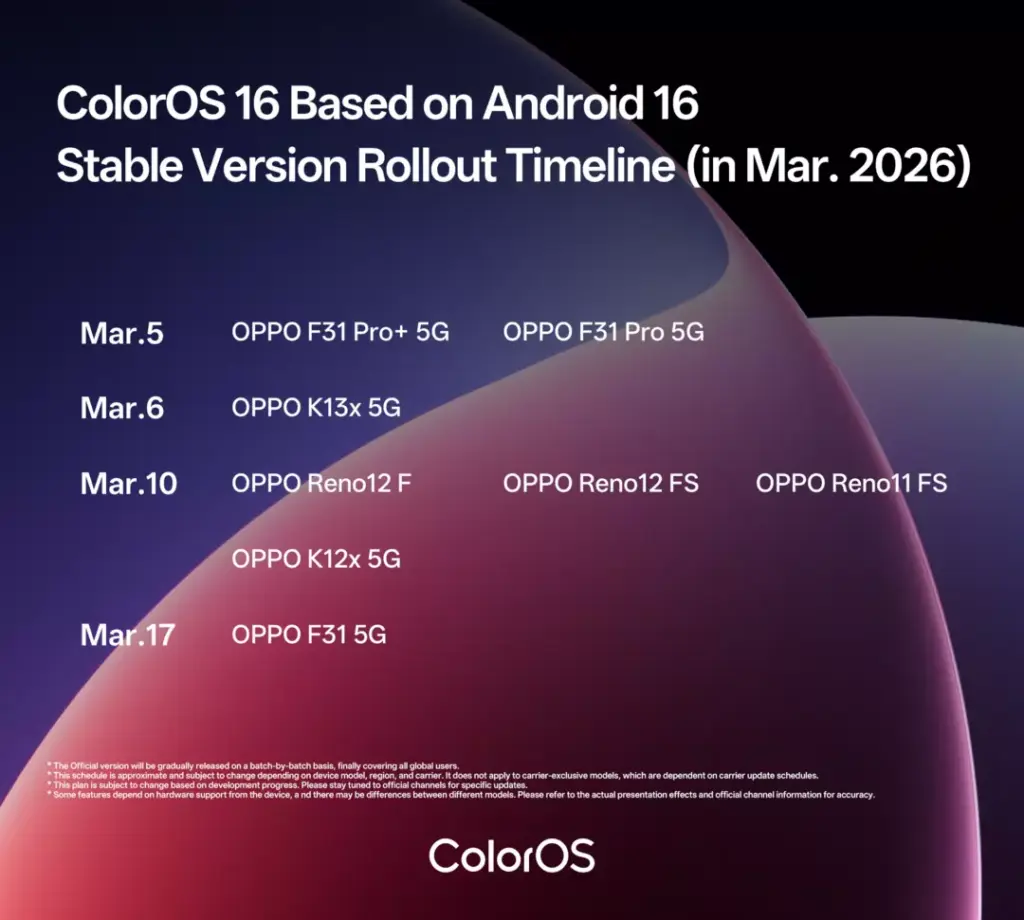
OriginOS 6 update now rolling out to iQOO Z9 and Z9x

6 March 2026 at 09:31
iQOO Z9, Z9x OriginOS 6 update

The OriginOS 6 update is rolling out to the last phase of eligible devices. Part of this phase, the iQOO Z9 and iQOO Z9x have recently started receiving the Android 16 update, which brings a host of new features and upgrades across the system.

The Android 16-based update for the iQOO Z9 is tagged with the firmware version PD2346F_EX_A_16.2.10.4.W30, while the iQOO Z9x is getting it as PD2353F_EX_A_16.2.11.0.W30, as spotted by Ytechb. The initial rollout may be limited to select regions. So, if you don’t see the update on your device, check again in a few days once the rollout expands. You can manually check for updates via the System updates section in the Settings app.

iQOO Z9x OriginOS 6 update
iQOO Z9 OriginOS 6 update

If the update doesn’t appear on your iQOO smartphone, you can get it sooner by requesting it through the trial program. For this, navigate to Settings > About Phone > System updates > version Trial > Trial version > download and install.

The OriginOS 6 update is a hefty one, weighing in at around 4GB. Therefore, you must ensure that your device has sufficient storage and that it’s charged to at least 40% for a smooth upgrade to OriginOS 6. You can also back up important data for added safety.

Once you have the software installed on your phone, there’s a lot to explore, including an all-new Origin Island that offers real-time updates and improved multitasking. The Control Center now features an enhanced notification center, improved lighting effects, and new system fonts. The lock screen features new clock styles, new widgets, and better layout controls. OriginOS 6 also introduces improvements to privacy, security, and battery efficiency. You can read the complete changelog on this page.

Be sure to regularly visit the iQOO section on Gizmochina to get the latest updates. Or, if you prefer your news instant and on-the-go, hop into our Telegram channel for rapid-fire software updates and all the biggest tech headlines.

The post OriginOS 6 update now rolling out to iQOO Z9 and Z9x appeared first on Gizmochina.

TCL 27P2A Ultra Mini LED Gaming Monitor Announced With 1040Hz Refresh Rate

6 March 2026 at 08:42
TCL 27P2A Ultra minI LED gaming monitor

TCL has announced the 27P2A Ultra gaming monitor, a new display built for competitive gaming. The monitor was revealed alongside the 27C3A Pro QD-Mini LED gaming monitor, but the 27P2A Ultra stands out because of its extremely high 1040Hz refresh rate.

If the claim holds, the 27P2A Ultra will become the first Mini LED gaming monitor to go past the 1000 Hz refresh rate mark. Such a high refresh rate is mainly aimed at esports players who want the fastest possible motion response and the lowest input delay.

TCL 27P2A Ultra minI LED gaming monitor

However, the monitor cannot reach its maximum refresh rate at its full resolution. TCL confirmed that the display supports 550Hz at its native 2K resolution. The company did not reveal what resolution is required to achieve the full 1040Hz refresh rate. That said, it is expected to be 720p, as any lower resolution will make it a hard sell. To achieve this high refresh rate, the brand has claimed to use the TCL CSOT “HFS Shoot” high-speed panel.

This is not the first time a 1040Hz display has been shown. Back in December, Samsung introduced its Samsung Odyssey G6 (G60H) monitor. It features a 27-inch QHD panel with a 600Hz refresh rate. However, Samsung’s monitor uses an IPS panel instead of a Mini LED panel.

For now, pricing and availability details for both the Samsung model and the 1040Hz monitor from TCL have not been announced.

For more daily updates, please visit our News Section.

Stay ahead in tech! Join our Telegram community and sign up for our daily newsletter of top stories!

(Source)

The post TCL 27P2A Ultra Mini LED Gaming Monitor Announced With 1040Hz Refresh Rate appeared first on Gizmochina.

Vivo X300 Ultra’s 200MP Samsung HP0 periscope telephoto camera officially confirmed

6 March 2026 at 07:51
Vivo X300 Ultra 400mm teleconverter kit-

Yesterday, Vivo Product Manager Han Boxiao shared a Weibo post confirming that the upcoming Vivo X300 Ultra will be the world’s first smartphone to feature a 200-megapixel Sony LYT-901 sensor as its primary camera. Today, he released another post revealing more details about the device’s periscope telephoto camera, highlighting several upgrades aimed at improving zoom photography and video stability.

Vivo X300 Ultra periscope telephoto camera details

Boxiao’s latest Weibo post reveals that the Vivo X300 Ultra will feature a fifth-generation ZEISS 200-megapixel “Thanos” periscope telephoto camera based on a Samsung HP0 sensor. The camera is paired with Vivo’s BlueImage imaging technology, which brings optimisations in areas such as colour accuracy, autofocus performance, HDR processing and power efficiency.

The X300 Ultra is said to introduce a large-sensor telephoto lens with 3° optical image stabilization, marking the return of Vivo’s earlier gimbal-style stabilization concept. Traditional telephoto lenses usually offer stabilization in the range of 0.7° to 1°, while the X200 Ultra reached 1.2°. The new system reportedly increases stabilization performance by two to three times, delivering what Vivo describes as gimbal-level steadiness.

According to Boxiao, the telephoto camera achieves CIPA 7.0-level professional stabilization, a standard typically associated with dedicated cameras. This allows longer and steadier exposure times, improving light intake and making high-zoom photography easier even for casual users. The stabilization is particularly useful when shooting at long focal lengths such as 200mm, 400mm, or beyond, especially in handheld video scenarios.

By this, the Vivo X300 Ultra will debut as the world’s first flagship phone equipped with dual 200-megapixel cameras. Recent reports have revealed that the rear camera setup is also expected to include a Sony LYT-828 50-megapixel ultra-wide lens and a 5-megapixel multispectral sensor for color accuracy.

For more daily updates, please visit our News Section.

Stay ahead in tech! Join our Telegram community and sign up for our daily newsletter of top stories.

The post Vivo X300 Ultra’s 200MP Samsung HP0 periscope telephoto camera officially confirmed appeared first on Gizmochina.

Yesterday — 6 March 2026Gizmochina

OnePlus 15T’s 6.32-inch OLED screen officially confirmed along with new details

6 March 2026 at 07:06
OnePlus 15T (AI-generated image)

For the past few days, OnePlus China President Li Jie has been consistently revealing new details about the upcoming OnePlus 15T through his Weibo handle. Today’s Weibo post summarizes all the details he shared and also includes some new information. These teasers suggest that the 15T may debut later this month in China.

OnePlus 15T key specifications officially confirmed

OnePlus 15T (AI-generated image)

According to Li Jie, the OnePlus 15T is positioned as a “small-screen powerhouse,” aimed at becoming the dream phone for users who prefer compact smartphones. It is expected to feature a 6.32-inch flat display with large, rounded corners and extremely narrow symmetrical bezels for an improved front-facing design. Rumors surrounding the device have claimed that it will support a 1.5K resolution and a 165Hz refresh rate.

Despite its compact size, the phone is tipped to pack a massive 7,500mAh silicon-carbon battery, which is even larger than many big-screen flagships, along with 100W fast charging and bypass charging. It will also have support for 50W wireless charging.

The camera system is also expected to see improvements with an upgraded LUMO periscope telephoto lens designed to keep the camera bump minimal. Reports have suggested that it may feature a 50-megapixel or 200-megapixel main camera along with a 50-megapixel periscope zoom sensor. For selfies, it may feature a 32-megapixel front camera.

Other upgrades include an ultrasonic in-display fingerprint sensor and IP66, IP68, IP69, and IP69K dust and water resistance ratings. The device will also support a magnetic accessory ecosystem, including compatible chargers, protective cases, and cooling accessories.

Li Jie added that the OnePlus 15T will bring broader upgrades in areas such as performance, gaming, display quality, and overall in-hand feel. He also teased that the phone’s design will be officially revealed next Monday (March 9).

Earlier this week, the Snapdragon 8 Elite Gen 5-powered OnePlus 15T was spotted with a 4.45 million score on AnTuTu benchmarks. The listing also revealed 16GB of LPDDR5x RAM, 512GB of UFS 4.1 storage, and Android 16.

For more daily updates, please visit our News Section.

Stay ahead in tech! Join our Telegram community and sign up for our daily newsletter of top stories.

The post OnePlus 15T’s 6.32-inch OLED screen officially confirmed along with new details appeared first on Gizmochina.

Honor X80i specifications revealed via TENAA certification

6 March 2026 at 06:32
Honor-600-Lite-Design-Specs-and-Price-Leak

A forthcoming Honor smartphone has appeared with the model number LNA-AN00 in the database of China’s TENAA certification. This device is believed to carry the Honor X80i branding when it hits the Chinese market. The listing reveals several key specifications of the device, including details about its display, battery, cameras, and hardware configuration.

Honor X80i specifications

Honor-600-Lite-Design-Specs-and-Price-Leak

The TENAA listing reveals that the Honor X80i will feature a 6.6-inch OLED display that offers a resolution of 1200 x 2600 pixels. The phone is expected to be powered by a 2.6GHz octa-core processor, although the exact chipset name has not been confirmed yet.

In terms of memory configurations, the X80i may arrive with 6GB, 8GB, 12GB, and 16GB of RAM, along with storage options such as 128GB, 256GB, 512GB, and 1TB. The handset is listed with a 6,800mAh rated battery, suggesting that the typical capacity could be around 7,000mAh when officially announced.

For photography, the Honor X80i is expected to feature an 8-megapixel front camera for selfies. On the rear, the device is equipped with a 50-megapixel primary camera, accompanied by an additional sensor as part of a dual-camera setup.

The X80i is also expected to feature an in-screen fingerprint sensor and an IR blaster.  The TENAA listing further reveals that the handset measures 157.43 x 75.35 x 7.34mm and weighs around 185 grams, indicating a relatively slim profile despite packing a large battery.

While Honor has not officially confirmed the launch timeline yet, the appearance of the device on TENAA suggests that the Honor X80i may debut in China later this month.

Last year’s Honor X70i for the Chinese market was similar to the Honor 400 Lite, which debuted globally. Therefore, China’s Honor X80i could be somewhat similar to the Honor 600 Lite (model number LNA-NX1), which recently debuted in the global market.

For more daily updates, please visit our News Section.

Stay ahead in tech! Join our Telegram community and sign up for our daily newsletter of top stories.

The post Honor X80i specifications revealed via TENAA certification appeared first on Gizmochina.

Motorola Razr 70 specifications revealed via TENAA certification

6 March 2026 at 06:29
motorola razr 60

Earlier this year, the upcoming Motorola Razr 70 and Razr 70 Ultra were spotted with the respective model numbers XT2655-1 and XT2657-8 at the UAE’s TDRA certification. In a new development, the Razr 70 has now appeared in the database of China’s TENAA certification, revealing key details about its specifications.

Motorola Razr 70 specifications

motorola razr 60
Motorola Razr 60

The TENAA listing reveals that the Motorola Razr 70 will feature a 6.9-inch OLED screen with an FHD+ resolution of 1080 x 2640 pixels and a 3.63-inch cover display with a resolution of 1056 x 1066 pixels. For security, it will have a side-facing fingerprint sensor.

Moving on to the optics, the Razr 70 will feature a 32-megapixel front camera and a dual 50-megapixel camera setup on the back. In comparison, the Razr 60 from last year came with a 50-megapixel main camera and a 13-megapixel ultra-wide lens, along with a 32-megapixel selfie camera.

Under the hood, the Razr 70 has a 2.75GHz octa-core chip with 8GB / 12GB / 16GB / 18GB of RAM. It appears that it will have a different chip, as the Razr 60 featured a 2.6GHz Dimensity 7400x SoC.

The Razr 70 may come in storage options such as 128GB / 256GB / 512GB / 1TB. It has a 4,275mAh rated dual-cell battery, with a combination of 1,090mAh and 3,185mAh. Likely, the typical value could be 4,500mAh, the same as the previous generation. Finally, it will measure 171.3 x 73.9 x 7.2mm and weigh around 188 grams. These dimensions are almost identical to the Razr 60.

The Razr 60 series was unveiled in April 2025, and now that the Razr 70 has received TENAA certification, it appears that it may debut later this month or by early April in China. The global launch could follow soon after.

For more daily updates, please visit our News Section.

Stay ahead in tech! Join our Telegram community and sign up for our daily newsletter of top stories.

The post Motorola Razr 70 specifications revealed via TENAA certification appeared first on Gizmochina.

TCL launches 27C3A Pro QD-Mini LED monitor with 4K 165Hz and FHD 320Hz dual modes

6 March 2026 at 03:26
TCL 27C3A Pro monitor

TCL has introduced its latest gaming monitor, the 27C3A Pro, at its 2026 monitor launch event in China. The monitor features advanced QD-Mini LED technology and retails for 3,578 yuan (approximately $518).

TCL 27C3A Pro monitor

TCL 27C3A Pro Specfications

The TCL 27C3A Pro includes a 27-inch 4K display (3840 x 2160 pixels) with a 165Hz refresh rate. TCL has also added a dual-mode refresh system that allows users to switch to Full HD resolution at 320Hz.

The monitor uses QD-Mini LED technology with quantum dot color enhancement for precise lighting and vibrant colors. It features 2304 local dimming zones, XDR peak brightness of 2200 nits, HDR1400 certification, and a 22,000,000:1 dynamic contrast ratio, delivering deeper blacks, vivid highlights, and enhanced HDR performance.

The 27C3A Pro features 10-bit color depth and covers 99% of the DCI-P3 and sRGB color gamuts. TCL has factory-calibrated the display for a Delta E value of less than 1, ensuring accurate color reproduction for gaming, content creation, and media consumption.

TCL 27C3A Pro monitor

Designed for gaming, the monitor features a 1ms response time and HFS Shoot high-speed panel technology for better motion clarity and reduced ghosting. It supports AMD FreeSync Premium and Nvidia G-Sync for tear-free performance. It also features AI-powered tools such as crosshair adjustment, dark-scene enhancement, and flash detection to enhance visibility and gameplay.

The TCL 27C3A Pro includes HDMI 2.1, DisplayPort 1.4, and USB-C with 90W power delivery. It supports KVM functionality and includes an ergonomic stand with height, tilt, swivel, and pivot adjustments. Additionally, it serves as a smart TV, powered by TCL’s smart entertainment system with Dolby Vision and Dolby Atmos support.

In related news, TCL recently launched the 32X3A OLED+ monitor with a 4K 240Hz display and also unveiled the CrystalClip open-ear earbuds, including a Swarovski special edition.

For more daily updates, please visit our News Section.

Stay ahead in tech! Join our Telegram community and sign up for our daily newsletter of top stories! 💡

The post TCL launches 27C3A Pro QD-Mini LED monitor with 4K 165Hz and FHD 320Hz dual modes appeared first on Gizmochina.

TCL launches 32X3A OLED+ monitor with 4K 240Hz display

6 March 2026 at 01:51
TCL 32X3A OLED+ monitor

TCL has unveiled its latest flagship monitor, the 32X3A OLED+, at its 2026 monitor launch event. The new monitor targets gamers, content creators, and professionals with its advanced display technology, fast refresh rates, and premium design. TCL has priced the monitor at 6666 yuan (around $966).

TCL 32X3A OLED+ monitor

TCL 32X3A OLED+ Specifications

The TCL 32X3A OLED+ is a 31.5-inch monitor with an OLED+ panel that offers deep blacks, vibrant colors, and precise image quality. It provides dual 99% color gamut coverage for DCI-P3 and sRGB, making it ideal for professional and cinematic use. The monitor also features a 10-bit color depth, 1300 nits peak brightness, and DisplayHDR True Black 400 certification.

TCL 32X3A OLED+ monitor

The 32X3A OLED+ supports 4K resolution at 240Hz and can switch to 480Hz at Full HD for competitive gaming. It features a 0.03ms GtG response time to reduce motion blur and supports AMD FreeSync Premium and Nvidia G-Sync compatible for smoother gameplay. It also includes gaming features such as AI dynamic crosshair adjustment and dark scene enhancement, which improve visibility in competitive scenarios.

The 32X3A features a Stargate-inspired design with a slim 6.4mm profile and ultra-thin bezels for immersive viewing. It includes a reverse-projection ambient lighting system for a soft glow and Bang & Olufsen-tuned speakers with a front-facing sound chamber.

TCL 32X3A OLED+ monitor

The monitor prioritizes eye comfort with low blue light filtering, flicker-free dimming, and an anti-glare coating. It features an ambient light sensor for automatic brightness and color adjustments and includes burn-in protection with intelligent screen management and pixel refresh routines.

For connectivity, it includes HDMI 2.1, DisplayPort 2.1, USB-C with 90W power delivery, USB-B, USB-A, and a headphone jack. These ports allow connections to PCs, gaming consoles, and laptops, as well as device charging and peripheral support.

In related news, TCL unveiled the CrystalClip open-ear earbuds with a Swarovski special edition, while TCL CSOT presented its Super Pixel display technology and outlined plans for 8.6-generation printed OLED production at MWC 2026.

For more daily updates, please visit our News Section.

Stay ahead in tech! Join our Telegram community and sign up for our daily newsletter of top stories! 💡

The post TCL launches 32X3A OLED+ monitor with 4K 240Hz display appeared first on Gizmochina.

Patent reveals affordable Galaxy Z Flip phone with interesting design

6 March 2026 at 00:16

Samsung’s foldable phones have gradually become more accessible over the years, but a newly surfaced patent suggests the company may be exploring an even cheaper clamshell model. The design hints at a Galaxy Z Flip variant that could sit below the Z Flip7 FE in price, potentially pushing foldables further into the mainstream.

The patent was spotted by 91Mobiles in the World Intellectual Property Organization (WIPO) database. Samsung originally filed the design on May 20, 2024, and it was officially registered on March 3, 2026. Like most patents, it doesn’t guarantee an actual product, but it does offer a glimpse into the kinds of ideas Samsung is experimenting with.

The device shown in the filing clearly follows the familiar Galaxy Z Flip-style clamshell design. However, one detail stands out: the cover screen.

Samsung has steadily increased the size and usefulness of the outer screen in its foldable phones. Earlier flip models had very small displays with limited functionality, mostly for notifications. That changed with the Galaxy Z Flip 5, which introduced a much larger cover screen capable of running apps and handling quick tasks without opening the device.

The patent seems to move in the opposite direction. Instead of a large rectangular panel, the design shows a small circular display placed next to the rear cameras on the cover. It’s a noticeably simpler setup. Some interpretations suggest there may be a surrounding display area, but from the diagrams it looks more like a single compact screen meant for basic information and quick controls.

That smaller display could serve a practical purpose: lowering costs. A simpler cover screen would likely reduce manufacturing complexity while keeping the core flip-phone experience intact. When unfolded, the device appears very similar to a standard Galaxy Z Flip, suggesting the main foldable display and overall form factor wouldn’t change much.

Of course, patents often represent experimental ideas rather than confirmed products. Still, with competition in the foldable market growing and more brands entering the segment, it wouldn’t be surprising to see Samsung explore ways to make flip-style foldables cheaper and easier for new buyers to try.

Don’t miss a thing! Join our Telegram community for instant updates and grab our free daily newsletter for the best tech stories!

For more daily updates, please visit our News Section.

(Source | Via)

The post Patent reveals affordable Galaxy Z Flip phone with interesting design appeared first on Gizmochina.

Vivo’s X300 Max makes a surprise appearance at MWC 2026

5 March 2026 at 23:26

Vivo came to MWC 2026 in Barcelona with plenty to show off, but one device at its booth drew attention for a different reason. While the company has been openly promoting the camera-focused X300 Ultra, visitors noticed another handset quietly displayed nearby, one that appears to be the long-rumored Vivo X300 Max.

The handset appeared alongside information referencing MediaTek’s upcoming Dimensity 9500 processor, and was described simply as an existing member of the X300 series. Well-known leaker Roland Quandt quickly connected the dots. He pointed to a device labeled V258A, likely related to the previously rumored V2548A model number. That identifier recently surfaced in 3C certification documents, which also revealed support for 90W wired charging.

Images shared by Vivo executive Han Bo Xiao seem to show the same handset, strengthening the case that the device on display is indeed the Vivo X300 Max.

One of the clearest visual differences appears to be the rear camera layout. Unlike the X300 and X300 Pro, the Max features a slightly different arrangement: two lenses sit on either side of the Zeiss T* branding, while a third lens is positioned above them.

Rumors suggest the phone could feature a 6.78-inch LTPO OLED display with a 1440p resolution. Perhaps even more notable is the battery capacity being discussed: a massive 7,000 mAh unit, which could translate into impressive battery life.

Vivo hasn’t formally acknowledged the X300 Max yet, but its quiet appearance at MWC hints that the company may be preparing to expand the X300 lineup sooner rather than later.

If the X300 Ultra is aimed at photography enthusiasts looking for maximum camera capabilities, the X300 Max could end up serving as the more balanced flagship, combining strong performance, long battery life, and versatile cameras.

Don’t miss a thing! Join our Telegram community for instant updates and grab our free daily newsletter for the best tech stories!

For more daily updates, please visit our News Section.

(Sources: 1, 2)

The post Vivo’s X300 Max makes a surprise appearance at MWC 2026 appeared first on Gizmochina.

Casio launches four new transparent G-Shock GA-V01 models

5 March 2026 at 23:12
Casio-G-Shock-GA-V01

Casio has updated its G-Shock GA-V01 series with four new transparent models. The watches feature translucent resin cases and introduce a new orange color option. Pre-orders for the refreshed lineup are now available in Japan for ¥24,200 ($154). The models are now up for sale through Casio stores and authorized retailers.

Casio G-Shock GA-V01

The new models retain the futuristic, industrial design of the GA-V01 series while replacing solid cases with see-through shells. Casio has introduced four color variants: orange (GA-V01SKE-4A), green (GA-V01SKE-3A), purple (GA-V01SKE-6A), and gray (GA-V01SKE-8A). The translucent designs take inspiration from the popular Y2K aesthetic, recalling the look of early-2000s tech products and accessories.

Casio has maintained the durability and functionality that G-Shock is known for. The GA-V01 models include a shock-resistant construction and 200-meter water resistance. The watches feature a bezel-and-band structure designed to protect the module inside. Large dimensional indexes overlap the glass and act as bumpers to absorb impacts.

Casio G-Shock GA-V01

Casio has also introduced a Shock Release Hand mechanism in these models. The mechanism uses magnetic force to attach the minute hand to the shaft, rather than a fixed connection. This design improves shock absorption and allows for larger hands while maintaining durability.

The watches feature a combination of analog and digital displays. The full-screen LCD sits beneath a metallic dial with decorative openwork sections. The timepieces include essential functions like world time for 31 time zones, a 1/100-second stopwatch, a countdown timer, and five daily alarms. Casio has added a double LED Super Illuminator that improves visibility in low light.

Each model uses a CR2025 battery, which delivers approximately 10 years of battery life. The watches weigh 74 grams and measure 49.1 x 58.2 x 19.6 mm.

In related news, Casio has recently introduced the G-Shock GM-H5600 series with heart rate tracking and solar charging, and the G-Shock GMA-P2126W-8A with a sleek monochrome design and gold accents.

For more daily updates, please visit our News Section.

Stay ahead in tech! Join our Telegram community and sign up for our daily newsletter of top stories! 💡

The post Casio launches four new transparent G-Shock GA-V01 models appeared first on Gizmochina.

Casio Edifice x Honda ECB-2300HR-1A Watch Goes on Sale in the US for $400

5 March 2026 at 22:54
New Casio G-Shock 2026

The new Casio Edifice Sospensione ECB‑2300HR‑1A, developed in collaboration with Casio and Honda, has officially gone on sale in the United States after its launch was delayed in 2025. The watch celebrates the 60th anniversary of Honda’s first Formula 1 victory and is priced at $400.

Casio-Edifice-ECB-2300HR-1A-Honda-F1-Special-Edition

The model commemorates Honda’s historic win at the 1965 Mexican Grand Prix, where the Honda RA272 secured the company’s first Formula 1 victory on October 24, 1965. It marked the first F1 win for a Japanese car manufacturer. Honda designed both the engine and chassis internally. Since that milestone, the company has won six constructors’ championships and produced four world champions in Formula 1. Honda engineers worked closely with Casio to design the details of this commemorative watch.

Casio-Edifice-ECB-2300HR-1A-Honda-F1-Special-Edition

The bezel uses genuine Championship White paint taken from the RA272 race car. The color is applied to the base and finished with a top coat to replicate the car’s glossy ivory body. A gold “60” sits at the 60-minute position to highlight the anniversary. Around the dial, a red ring references the Hinomaru circle used on the RA272 and mirrors the design of the Japanese flag.

Inside the dial, a gold metal bearing ring carries the engraving “Veni, Vidi, Vici” along with the car number “11.” The phrase refers to the message Honda’s Formula 1 team sent after its historic victory. The strap also reflects Honda’s engineering history. It features a printed diagram of the RA272’s 1.5-liter V12 engine, emphasizing Honda’s unusual decision to use a 12-cylinder layout in the car. The band uses nappa leather on the front and ultra suede on the underside.

The countdown timer positioned at 9 o’clock is designed to resemble the RA272’s tachometer. It replicates the original color scheme, scale font, hand shape, and red zone markings from the race car’s instrument cluster.

The watch measures 50.2 × 45.8 × 11.8 mm and weighs 67 grams. Its case and bezel combine carbon, stainless steel, and resin materials. The band fits wrists measuring between 175 and 215 mm. Water resistance is rated at 10 ATM.

In Japan, the model is listed at ¥66,000, roughly $421, and is expected to go on sale there in March 2026.

For more daily updates, please visit our News Section.

Stay ahead in tech! Join our Telegram community and sign up for our daily newsletter of top stories!

The post Casio Edifice x Honda ECB-2300HR-1A Watch Goes on Sale in the US for $400 appeared first on Gizmochina.

Tecno Camon 50 Ultra 5G Ranked Best Camera Phone Under $600 by DXOMARK

5 March 2026 at 21:31
TECNO CAMON 50 Ultra 5G

The Tecno Camon 50 Ultra 5G was tested using the camera evaluation suite from DXOMARK to measure photo, video, and zoom performance in real-world use. The device achieved an overall camera score of 146, with 154 for photo and 132 for video. According to TECNO, this is currently the highest DXOMARK camera score among smartphones priced under $600.

TECNO CAMON 50 Ultra 5G

Camera hardware

The Tecno Camon 50 Ultra 5G uses a triple rear camera system designed to handle different shooting situations.

Tecno Camon 50 Ultra 5G DXOMARK

The main camera uses a 50 MP sensor with an f/1.8 aperture and a 23 mm wide lens. It has a 1/1.56-inch sensor, 1.0µm pixel size, phase detection autofocus, and optical image stabilization (OIS).

The ultra-wide camera uses an 8 MP sensor with an f/2.2 aperture and a 14 mm lens. It offers a 112° field of view, uses a 1/4.0-inch sensor, and has 1.12µm pixels.

The telephoto camera uses a 50 MP sensor with an f/2.4 aperture and a 70 mm lens. It uses a 1/2.88-inch sensor, 0.61µm pixels, PDAF, and supports 3x optical zoom.

Photo performance

The phone achieved a photo score of 154. In testing, the main camera delivered stable exposure and natural colors in most conditions. Skin tones were rendered accurately across different skin types. Images showed good detail and controlled noise in bright light, indoor lighting, and moderately low light.

Autofocus was fast and accurate. The camera was able to lock focus quickly when capturing both still and moving subjects. Group photos also benefited from extended depth with AI face detail enhancement that kept faces clear across the frame.

Some issues were still visible in testing. Exposure shifts affecting brightness and contrast appeared in certain scenes. White balance changes were also noticeable in some cases. Testers also observed artifacts such as fusion artifacts and occasional face rendering issues in both main and telephoto photos.

Low light and portrait

In low-light scenes, the camera maintained good detail with limited noise. Faces usually appeared bright and well rendered, though they could sometimes appear slightly brighter than the background. Exposure and white balance could shift in challenging lighting.

Portrait mode produced natural skin tones and reliable background separation. Depth mapping was usually accurate, although small depth errors could appear around the subject.

Zoom and video

The telephoto camera delivered consistent results with the main camera in both photo and video capture. Images retained good detail and low noise. The ultra-wide camera showed lower quality, with softer images and more visible noise compared with the other cameras. Zoom performance received a score of 125.

Video achieved a score of 132. Video clips showed good detail and controlled noise. Autofocus remained stable, although exposure shifts were sometimes visible during recording.

Overall, the Tecno Camon 50 Ultra 5G delivers strong camera performance for its price segment, especially with its main and telephoto cameras.

For more daily updates, please visit our News Section.

Stay ahead in tech! Join our Telegram community and sign up for our daily newsletter of top stories!

(Source)

The post Tecno Camon 50 Ultra 5G Ranked Best Camera Phone Under $600 by DXOMARK appeared first on Gizmochina.

Tecno x Tonino Lamborghini brings bold new smartphones, PCs, and more

By:Sean
5 March 2026 at 21:02
Tecno x Tonino Lamborghini Collab

Tecno just announced a partnership with Italian lifestyle brand Tonino Lamborghini. This collaboration introduces a range of co-branded hardware products that combine Tecno’s technology with Lamborghini-inspired design language. Rather than focusing on a single product, the partnership covers multiple devices, including gaming PCs, smartphones, laptops, and much more.

Tecno x Tonino Lamborghini Collab
Tecno x Tonino Lamborghini

A mini gaming PC leads the lineup

The flagship product of the collaboration is the Tonino Lamborghini Tecno Taurus (Mega Mini G1 Pro), which is a compact gaming PC that builds on the brand’s existing mini PC. Despite its small size, the device packs serious gaming hardware:

  • Intel Core i9-13900HK processor
  • Nvidia GeForce RTX 5060 GPU
  • 10,000mm² copper water-cooling plate with triple-fan cooling system
  • Wi-Fi 6E and Bluetooth 5.4 connectivity
  • 15 external ports

The mini PC also features a metal body with RGB lighting and a small built-in display that shows real-time CPU and GPU performance.

Lamborghini-themed Tecno smartphone

Tecno also revealed a special POVA Metal Tonino Lamborghini Limited Edition smartphone, which brings the luxury brand’s design identity to the company’s mobile lineup. So here’s what it offers:

  • Full-metal unibody construction
  • Slim 0.99mm bezel design
  • A Snapdragon processor
  • A customizable Rear Dot Matrix lighting system made up of 241 LEDs
  • A pulse light strip integrated into the chassis

The programmable LED matrix can display notifications, alerts, and other visual effects on the back panel, giving the phone a distinctive look that matches the bold aesthetic of the Lamborghini brand.

A bigger AIoT ecosystem in the works

Beyond the initial hardware, Tecno also showcased a concept AIoT ecosystem that expands the collaboration into more product categories. Future devices under the partnership may include:

  • Laptops and MEGABOOK models
  • Tablets
  • Wearables
  • Other smart devices for productivity and everyday use

For more daily updates, please visit our News Section.

Tech enthusiast? Get the latest news first! Follow our Telegram channel and subscribe to our free newsletter for your daily tech fix! ⚡

The post Tecno x Tonino Lamborghini brings bold new smartphones, PCs, and more appeared first on Gizmochina.

Casio launches new G-Shock GM-H5600 watches with heart rate tracking and solar charging

5 March 2026 at 19:52
Gshock GM-H5600

Casio has introduced two new fitness-focused G-Shock watches, the GM-H5600-1 and GM-H5600-9, in Japan. The watches are priced at ¥51,700 (around $328) and will be available for purchase later in March. These may also be launched in other markets in the coming weeks.

Gshock GM-H5600

G-Shock GM-H5600 Specifications

The GM-H5600 series combines the classic G-Shock design with modern fitness features. Casio has added a stainless steel bezel to enhance durability and style. The case back uses lightweight but durable carbon fiber-reinforced resin. The bands are made from bio-based resin derived from renewable materials like corn, reducing the environmental impact of the watches.

Gshock GM-H5600-1
Gshock GM-H5600-9

Casio has equipped these watches with advanced fitness-tracking features, including an optical heart rate sensor and a 3-axis accelerometer, for activities like running and walking. They also integrate with the Polar smartwatch library, offering workout analysis, sleep recovery monitoring, breathing exercises, and blood oxygen level measurements.

The GM-H5600 models feature a high-resolution memory-in-pixel (MIP) LCD for clear visibility in any lighting condition. The watches support USB charging and solar-assisted charging, offering up to 35 hours of battery life during intensive use or 11 months in power-saving mode.

Casio GM-H5600-1
Casio GM-H5600-9

The watches come with Bluetooth connectivity, allowing them to link to the Casio Watches app for enhanced functionality. Through the app, users can access training data, sleep analysis, and set the time for over 300 cities worldwide. Both models also boast shock resistance, 200-meter water resistance, and a built-in LED Super Illuminator for easy visibility in low-light conditions.

In related news, Casio debuted the G-Shock GMA-P2126W-8A with a minimalist monochrome finish and gold highlights, alongside new G-Shock GMA-S140PG models featuring metallic pink gold accents.

For more daily updates, please visit our News Section.

Stay ahead in tech! Join our Telegram community and sign up for our daily newsletter of top stories! 💡

(Casio 1,2)

The post Casio launches new G-Shock GM-H5600 watches with heart rate tracking and solar charging appeared first on Gizmochina.

Nothing Headphone (a) vs Headphone (1): How the new affordable model compares with the flagship

5 March 2026 at 17:36
Nothing Headphone (a) vs. Headphone (1)

Nothing today unveiled the Nothing Headphone (a) alongside the Phone (4a) and Phone (4a) Pro. The new headphone brings the brand’s distinctive design language and software features to a more accessible price segment.

While the Headphone (a) shares several core features with the flagship Nothing Headphone (1), there are notable differences in audio tuning, battery life, design materials, and positioning. Here’s a closer look at how the two models compare.

Nothing Headphone (a) vs. Headphone (1)

Design and build

Both headphones follow Nothing’s recognisable transparent-inspired aesthetic and distinctive control layout, but they are aimed at slightly different audiences.

The Nothing Headphone (1) is positioned as the company’s premium over-ear headphone. It uses higher-end materials and a more refined design that aligns with flagship audio products. The overall construction feels more premium and is intended for users who value both aesthetics and build quality. The headphones weigh 329 grams.

The Nothing Headphone (a) focuses on accessibility and practicality with a polycarbonate build. While it still maintains Nothing’s design identity and tactile controls, the build has been simplified to help reduce cost. The headphones weigh around 310 grams and include a lightweight carry pouch.

In terms of colors, the Headphone (a) is available in White, Black, Pink, and Yellow, whereas the Headphone (1) is offered in more traditional color options.

Audio hardware and sound features

The two headphones share several similarities in terms of audio hardware.

The Nothing Headphone (a) features 40mm drivers with a titanium-coated diaphragm and supports Hi-Res Audio and LDAC codecs. It also supports AAC and SBC, ensuring compatibility across Android and iOS devices. The headphones offer a 20Hz to 40,000Hz frequency response.

The Headphone (1) also features 40mm dynamic drivers with a 20Hz–40kHz frequency range, but its sound is tuned by KEF, which is intended to deliver a more refined and balanced audio experience.

For everyday listening, both headphones should offer strong performance, but Headphone (1) remains the better option for users who prioritize sound quality.

Active noise cancellation and microphones

Both headphones support active noise cancellation, though the implementation differs slightly.

The Nothing Headphone (a) offers adaptive ANC up to 40dB along with a transparency mode that allows outside sound to pass through when needed. It also features a four-microphone setup, including hybrid ANC microphones and a three-mic algorithm for calls.

The Headphone (1) features real-time adaptive ANC up to 42dB and uses six microphones in total (three on each side) with ENC architecture for calls.

That said, the Headphone (a) should still provide effective noise reduction for everyday situations such as commuting, traveling, or working in busy environments.

Battery life and charging

Battery life is one of the biggest advantages of the Nothing Headphone (a).

The headphones pack a 1,060mAh battery and can deliver up to 135 hours of playback with ANC turned off and up to 75 hours with ANC enabled. Fast charging is also supported, with a five-minute charge providing up to eight hours of playback with ANC disabled.

The Headphone (1) includes a 1,040mAh battery. It offers up to 80 hours of playback with ANC off and up to 35 hours with ANC enabled using AAC playback. A five-minute charge can provide up to five hours of playback with ANC off.

Connectivity and software features

Both headphones integrate with the Nothing X app, allowing users to customize controls, adjust sound settings, and manage device features.

The Nothing Headphone (a) supports Bluetooth 5.4, dual-device connectivity, Google Fast Pair, and Microsoft Swift Pair, along with a low-latency mode.

The Headphone (1) supports Bluetooth 5.3, dual-device connectivity, LDAC, and similar software features through the Nothing X app.

Another notable feature shared by both models is the custom tactile control system, which includes a roller, paddle, and multifunction button for managing playback, volume, and calls.

For more daily updates, please visit our News Section.

Stay ahead in tech! Join our Telegram community and sign up for our daily newsletter of top stories.

The post Nothing Headphone (a) vs Headphone (1): How the new affordable model compares with the flagship appeared first on Gizmochina.

Nothing announces Headphone (a) with five days of battery and a lighter design

5 March 2026 at 16:53
Nothing-Headphone-a-Launch-Specs-Price

Alongside the Phone (4a) series, Nothing has officially launched the Headphone (a). As an affordable alternative to the Headphone (1), the headphones feature a similar design to the Headphone (1) and offer good battery life and customizable sound.

Nothing Headphone (a) Specifications

The Headphone (a) stands out visually thanks to its four color options: yellow, pink, black, and white. Despite being over-ear headphones, the device is relatively lightweight at 310 grams. It uses memory foam ear cushions designed to sit comfortably during long listening sessions.

Nothing has also added an IP52 rating, meaning the headphones offer protection against dust and light splashes of water.

Inside the Headphone (a) are 40mm drivers with a titanium-coated diaphragm. According to Nothing, this material provides a more rigid structure for the drivers, helping to reduce distortion and deliver cleaner audio.

The headphones support Hi-Resolution Audio Wireless and the LDAC codec. Users can also tweak the sound profile through the Nothing X app, which includes an eight-band equalizer for more precise frequency adjustments than typical bass and treble sliders.

Adaptive Noise Cancellation and Smarter Controls

The Headphone (a) includes adaptive active noise cancellation with three preset levels — low, medium, and high — depending on how much background noise users want to block out.

There is also a transparency mode that lets outside sounds in, allowing users to stay aware of their surroundings. For calls, the headphones feature a three-microphone AI system that analyzes surrounding noise and isolates the user’s voice.

The headphones also use the same physical controls introduced on the earlier Nothing Headphone (1), including a Roller, Paddle, and Button built directly into the ear cups.

Nothing is also introducing a feature called Channel Hop. Users can activate it by pressing the button, allowing them to quickly switch between apps or functions without reaching for their phone. The same button can also work as a remote camera shutter.

As for battery life, Nothing says the headphones can deliver up to five days of continuous listening on a single charge. A quick five-minute charge is said to provide up to five hours of playback.

Price and Availability

The Nothing Headphone (a) will be sold for $199, £149, or €159. Preorders begin on March 5 through Nothing’s website and selected partners.

Open sales for the black, white, and pink versions start on March 13, while the yellow limited edition model will arrive later, on April 6.

Don’t miss a thing! Join our Telegram community for instant updates and grab our free daily newsletter for the best tech stories!

For more daily updates, please visit our News Section.

The post Nothing announces Headphone (a) with five days of battery and a lighter design appeared first on Gizmochina.

Nothing launches Phone (4a) and Phone (4a) Pro, each with its own design identity

5 March 2026 at 16:19
Nothing-Phone-4a-Pro-Launched

The Nothing Phone (4a) and (4a) Pro are finally here, and unsurprisingly, both phones have their own design and character. The Phone (4a) has a cleaner profile with a pill-shaped rear camera module. Meanwhile, the Nothing Phone (4a) Pro has a bold new look, where the camera module covers the top, housing three camera lenses. 

Nothing Phone (4a)
Nothing Phone (4a) Pro

Both phones also feature redesigned rear lighting systems and arrive with Nothing OS 4.1 based on Android 16. Nothing is promising three major OS updates and six years of security patches, matching the support window offered by the previous generation.

Here’s how the two new models differ.

Nothing Phone (4a)

The Nothing Phone (4a) retains the simpler design of its predecessor. The phone features a pill-shaped rear camera module and a new lighting system called the Glyph Bar on the back.

Glyph Bar places LEDs in a straight strip across the back. The bar is divided into six segments and contains 63 LEDs, along with the red recording indicator. The lights can reach up to 3,500 nits of brightness in three different levels, which is about 40% higher than the previous generation.

Inside, the phone runs on the Snapdragon 7s Gen 4 chipset. While it technically succeeds the Snapdragon 7s Gen 3 used previously, the performance improvement is relatively small—only about 7% per Nothing. It’s paired with 8GB or 12GB of LPDDR4X RAM and up to 256GB of UFS 3.1 storage. 

On the front, it has a 6.78-inch OLED panel with a resolution of 1,224 × 2,720 pixels and supports a 120Hz refresh rate. Peak brightness climbs to 4,500 nits, and the screen is protected by Gorilla Glass 7i.

Camera hardware is where the vanilla model slightly differs from the Pro. The main camera uses a 50-megapixel Samsung GN9 sensor with an f/1.88 lens and optical image stabilization. The rest of the camera setup mirrors the Pro model, including a 50MP 3.5x periscope telephoto lens, an 8MP ultra-wide camera, and a 32MP front camera.

The body uses a plastic frame and measures 8.55mm thick. It carries an IP64 rating for dust and water resistance and features a 5,080mAh batterywith 50W wired charging support.

Price and availability

Pre-orders for the Nothing Phone (4a) start from today, and open sales will begin on March 13. The phone will be available through the official website and select retail partners. Here’s the price breakdown for EU, UK, and India:

  • 8/128GB: €350 / £350 / ₹32,000
  • 8/256GB: €390 / ₹35,000 
  • 12/256GB: €430 / £400 /  ₹38,000

Nothing Phone (4a) Pro

Coming to the Nothing Phone (4a) Pro, the most visible change is the Glyph Matrix. It is a circular LED display on the back of the phone made up of 137 LEDs. While that’s fewer than the 489 LEDs used in the flagship Glyph Matrix seen on Nothing Phone (3), the new version is larger and brighter. 

The circular area is also about 57 percent bigger, and the LEDs can reach up to 3,000 nits of brightness. 

The Pro also upgrades the build quality with a metal unibody design, replacing the plastic frame used on the standard model. Despite the metal switch, the phone remains relatively light and is slimmer at 7.95mm thick.

It carries an IP65 rating for dust and water resistance. Nothing says the phone can survive submersion in water up to 25cm for around 20 minutes.

Under the hood, the phone runs on the Qualcomm Snapdragon 7 Gen 4 processor. Compared to the Snapdragon 7s Gen 3 used in the previous generation, the new chip promises around 27 percent faster CPU performance, 30 percent better graphics performance, and a significant 65 percent boost in AI tasks.

The device pairs the chip with 8GB or 12GB of LPDDR5X RAM and either 128GB or 256GB of UFS 3.1 storage. To maintain sustained performance, Nothing has added a 5,300mm² vapor chamber cooling system.

The display is also larger and faster than the one on the standard model. The phone features a 6.83-inch OLED panel with a 144Hz refresh rate and a resolution of 1,260 × 2,800 pixels. Its peak brightness reaches 5,000 nits, and the panel uses 2,160Hz high-frequency PWM dimming.

Camera hardware on the Pro includes a 50MP Sony Lytia 700C sensor for the main camera with optical image stabilization. The phone also includes a 50MP Samsung JN5 periscope camera offering 3.5x optical zoom, extendable to 7x using in-sensor zoom.

The ultra-wide camera remains unchanged from the previous model with an 8MP Sony IMX355 sensor and a 120-degree field of view. On the front, the phone uses a 32MP selfie camera.

Like the standard model, the Pro includes a 5,080mAh battery with support for 50W wired charging.

Price and availability

Pre-orders for the Nothing Phone (4a) Pro begin on March 13, with open sales starting on March 27. Surprise, surprise, it will also be available in the US. Here’s the pricing breakdown for EU, UK, India, and the US:

  • 8/128GB: €480 / £500 / ₹40,000 / $500
  • 8/256GB: ₹43,000 (only available in India)
  • 12/256GB: €550 / £550 / ₹46,000 / $600

Don’t miss a thing! Join our Telegram community for instant updates and grab our free daily newsletter for the best tech stories!

For more daily updates, please visit our News Section.

The post Nothing launches Phone (4a) and Phone (4a) Pro, each with its own design identity appeared first on Gizmochina.

HAYLOU Flowbuds N55 Launched: LDAC, Ti-Coated Drivers, 40 Hours Playback

5 March 2026 at 14:11

HAYLOU has launched the Flowbuds N55, a new pair of true wireless earbuds built for everyday use. The focus is on stable performance, simple controls, and long battery life instead of adding unnecessary features.

The Flowbuds N55 comes with real-time adaptive active noise cancellation that can reduce ambient noise by up to 54dB under optimal conditions. The system automatically adjusts based on the surroundings, whether it is traffic, public transport, or crowded indoor spaces. There is no need to switch modes manually. The earbuds respond as the environment changes, helping reduce distractions while keeping the experience simple.

For sound, the earbuds use a 12.4mm titanium-coated dynamic driver. They are certified for Hi-Res Audio and support LDAC. The tuning focuses on balanced clarity, controlled bass, and clear detail. Vocals remain sharp, bass does not overpower, and finer details stay intact. The sound profile is designed for long listening sessions across music, voice calls, and podcasts without causing fatigue.

Battery life is rated at up to 12 hours on a single charge. With the charging case, total playback reaches up to 40 hours. This reduces the need for frequent charging during the day. The earbuds support touch controls for easy operation. The charging case is compact and easy to carry, making it suitable for daily travel and first-time true wireless users.

The case features a dual-tone design with vacuum coating and excimer processing. This improves durability while maintaining a clean look. The design focuses on daily practicality and long-term use.

Pricing and availability

The HAYLOU Flowbuds N55 are listed for preorder for $39.99 on the brand’s official online store. Shipping is stated to commence on April 5.

Don’t miss a thing! Join our Telegram community for instant updates and grab our free daily newsletter for the best tech stories!

For more daily updates, please visit our News Section.

The post HAYLOU Flowbuds N55 Launched: LDAC, Ti-Coated Drivers, 40 Hours Playback appeared first on Gizmochina.

TECNO CAMON 50 Ultra 5G Launched With 50MP Sony LYT-700C Camera, Dimensity 7400 and 6500mAh Battery

5 March 2026 at 13:25
Tecno CAMON 50 Ultra 5G

TECNO has quietly launched the CAMON 50 Ultra 5G, expanding the CAMON 50 series after several teasers. The phone focuses on mobile photography, AI features, and durability, offering high-resolution camera sensors, AI imaging tools, and a rugged design.

Hardware & software

The CAMON 50 Ultra 5G runs on the MediaTek Dimensity 7400 Ultimate processor. The chipset is built on a 4-nanometer process and is designed to provide balanced performance and power efficiency.

The device features a 6.78-inch curved AMOLED display with a 1.5K resolution. The screen supports refresh rates up to 144Hz, which improves smoothness when scrolling and switching between apps. TECNO also includes ProXDR eye-care technology to reduce eye strain during long viewing sessions. Power comes from a 6500mAh battery. The phone supports 45W fast charging, allowing users to recharge the large battery quickly.

The phone includes TECNO’s AI software tools. These include an upgraded Ella smart assistant, an AI Image-to-Video generator, 3D PhotoSpace, and AI LightMaster 2.0.

Tecno CAMON 50 Ultra 5G

TECNO has confirmed three major Android OS updates and up to five years of Android security updates for the device. Users will also receive 50GB of TECNO Cloud storage every year for the first three years.

Tecno CAMON 50 Ultra 5G

The CAMON 50 Ultra 5G carries IP68, IP69, and IP69K ratings. These ratings indicate resistance to dust, water submersion, and high-pressure water jets. The device also holds MIL-STD-810 military certification, which means it has passed tests for drops, shocks, and general physical stress.

Camera hardware and imaging features

The CAMON 50 Ultra 5G uses a triple-camera system designed for different shooting situations. The main camera is a 50-megapixel Sony LYT-700C sensor with Optical Image Stabilization. It uses a 1/1.56-inch sensor size, which helps capture more light and improves performance in low-light conditions.

The second camera is a 50-megapixel telephoto sensor that supports 3x optical zoom. This lens is intended for portrait photography and distant subjects without losing image quality.

An 8-megapixel ultrawide camera completes the setup. It allows users to capture wider scenes such as landscapes, buildings, and group photos.

TECNO also adds several software tools to support the camera hardware. AI 60x SuperZoom increases zoom capability using AI processing. Super-Zoom FlashSnap helps stabilize and sharpen subjects when shooting at high zoom levels. The phone also supports Live Photo, which records short motion clips around each photo. A dedicated Underwater Photography mode is included for shooting in wet conditions.

TECNO says the phone achieved a DXOMARK overall camera score of 146. According to the company, this is the highest score among smartphones priced under $600. The device also received an impressive portrait score of 142.

For more daily updates, please visit our News Section.

Stay ahead in tech! Join our Telegram community and sign up for our daily newsletter of top stories!

(Source)

The post TECNO CAMON 50 Ultra 5G Launched With 50MP Sony LYT-700C Camera, Dimensity 7400 and 6500mAh Battery appeared first on Gizmochina.

Hisense UX 2026 becomes world’s largest RGB Mini LED TV with record-breaking 10,000-nit brightness

5 March 2026 at 13:20
HiSense UX 2026

Hisense has officially unveiled the Hisense UX 2026, a new flagship television designed to push the boundaries of display technology. The company says the premium home entertainment TV introduces several new technologies aimed at improving color accuracy, brightness, and motion performance. Continue reading ahead to know more about it in detail.

Hisense UX 2026 specifications and features

HiSense UX 2026
HiSense UX 2026

The Hisense UX 2026 introduces a new RGB Mini LED backlight system built around what the company calls a Linglong four-chip true-color architecture. Unlike traditional Mini LED systems that rely on three color sources, this setup adds a cyan light chip alongside red, green, and blue. The additional chip helps fill color gaps in the spectrum and improves colour accuracy across brightness levels. As a result, the panel can reach 110 percent BT.2020 colour gamut, allowing the TV to reproduce an extremely wide color range.

The flagship model features up to 43,008 color control zones and peak brightness of 10,000 nits, enabling strong contrast and detailed highlights in HDR content. Hisense pairs this hardware with the Hi-View H7 Pro AI picture processor, which uses a four-chip coordinated architecture and 134-bit color control precision. The processor also applies advanced algorithms designed to minimize halo effects around bright objects while maintaining balanced colors and stable brightness.

For screen technology, the UX 2026 includes a customised Ultra Black Obsidian panel designed to reduce reflections and deliver deeper black levels. Motion performance is handled by a native 4K 180Hz refresh rate, which is aimed at reducing motion blur and improving clarity during fast-moving sports and gaming scenes.

HiSense UX 2026
HiSense UX 2026

Audio is powered by a Devialet-tuned sound system featuring a counter-balanced bass chamber that enhances low-frequency performance without increasing the overall thickness of the TV. Hisense also introduces real-time AI 2D-to-3D conversion, which can transform standard video content into a simulated 3D viewing experience.

The top variant also stands out as the world’s largest 116-inch RGB Mini LED television, designed with an ultra-slim body and a wall-hugging form factor aimed at premium home theatre setups.

Hisense UX 2026 price and availability

The Hisense UX 2026 is available in 85-inch, 100-inch, and 116-inch variants. The 85-inch model is priced at 34,999 Yuan (around $4,850), the 100-inch version costs 54,999 Yuan (around $7,620), and the 116-inch flagship model is priced at 119,999 Yuan (around $16,640).

Pre-orders for the TV have already begun in China, and the official sales are scheduled to start on April 18. There’s no information on whether it will be released in markets outside of China.

For more daily updates, please visit our News Section.

Stay ahead in tech! Join our Telegram community and sign up for our daily newsletter of top stories.

The post Hisense UX 2026 becomes world’s largest RGB Mini LED TV with record-breaking 10,000-nit brightness appeared first on Gizmochina.

Samsung Galaxy S26 series sees strong pre-orders as Galaxy S26 Ultra wins Best in Show at MWC 2026

5 March 2026 at 12:50
Samsung-Galaxy-S26-and-S26-Plus

Samsung’s latest flagship lineup, the Galaxy S26 series, is reportedly seeing strong demand during its pre-order phase. An early industry report (via) indicates that the new devices are attracting significant interest from buyers. At the same time, the Galaxy S26 Ultra has received a major industry award at MWC 2026, highlighting the technological advancements introduced with the series.

Galaxy S26 series pre-orders show strong demand

Samsung-Galaxy-S26-and-S26-Plus

According to telecom industry sources in South Korea, the Galaxy S26 series is performing well in early pre-order sales. Analysts believe the lineup could surpass the record set by the Galaxy S25 series, which recorded approximately 1.3 million units during its reservation period.

While the final figures have not yet been confirmed, several telecom officials noted that the current sales momentum appears stronger than last year’s flagship lineup. Among the available models, the Galaxy S26 Ultra is reportedly attracting the highest share of demand from buyers.

Samsung executives have also hinted at strong early performance. Company representatives revealed that sales of the Galaxy S26 lineup are currently about 15 percent higher than the previous generation, with the Ultra variant accounting for nearly 70 percent of the orders.

Industry observers believe that a mix of factors is contributing to this strong response. Carrier inventories of the Galaxy S25 series have largely been cleared, encouraging upgrades. In addition, premium smartphone buyers appear to be showing strong interest in the new lineup.

Galaxy S26 Ultra wins Best in Show at MWC 2026

Galaxy S26 Ultra has also received recognition at the Global Mobile Awards (GLOMO) during MWC 2026

Alongside its early market momentum, the Galaxy S26 Ultra has also received recognition at the Global Mobile Awards (GLOMO) during MWC 2026 in Barcelona. The device won the Best in Show award, one of the highest honours presented at the event.

The judging panel highlighted the device’s integration of advanced hardware with One UI 8.5 software and Galaxy AI features designed to simplify daily tasks while maintaining strong privacy protections.

One of the standout technologies is the built-in Privacy Display, which improves screen privacy without compromising visual quality. Judges noted that the device stood out among thousands of products showcased at MWC because it delivers meaningful innovation that users can experience today.

For more daily updates, please visit our News Section.

Stay ahead in tech! Join our Telegram community and sign up for our daily newsletter of top stories.

The post Samsung Galaxy S26 series sees strong pre-orders as Galaxy S26 Ultra wins Best in Show at MWC 2026 appeared first on Gizmochina.

These Oppo devices will receive ColorOS 16 (Android 16) update this month

5 March 2026 at 12:39
ColorOS 16 March 2026 rollout plan

Oppo is wrapping up ColorOS 16 rollout as it announces the update timeline for the last batch of eligible devices. The March 2026 timeline mostly focuses on mid-range devices, such as the Oppo F31 series, Reno 12F, Reno12 FS, K12x 5G, and more.

ColorOS 16 rollout schedule for March 2026

  • March 5: Oppo F31 Pro+ 5G, Oppo F31 Pro 5G
  • March 6: Oppo K13x 5G
  • March 10: Oppo Reno12 F, Oppo Reno12 FS, Oppo Reno11 FS, Oppo K12x 5G
  • March 17: Oppo F31 5G

Some of these devices, including the Oppo F31 Pro models and Oppo K13x 5G, are already receiving the ColorOS 16 update. The rollout may be limited to select regions for now, but it should eventually expand to the remaining devices this month.

Oppo ColorOS 16 rollout timeline for March 2026

If your Oppo device is on the list above, you can expect the ColorOS 16 update this month. To manually check for available updates, go to Settings > System & Updates > Software update.

Keep in mind that this is a major upgrade, and hence the update size will be a few gigabytes. So, ensure that your device has sufficient storage and it’s charged to at least 50% for a smooth upgrade to ColorOS 16. You can read about the changes and new features in ColorOS 16 here.

With the ColorOS 16 rollout nearing completion, Oppo is reportedly already working on its next major upgrade based on Android 17. Google has already released the first two public betas, and more are expected in the coming weeks. The stable version is likely to arrive in Q3 2026.

We’ll keep you updated with the latest news in our Oppo section, so make sure to check it regularly for new updates. You can also join our Telegram channel to get instant notifications.

The post These Oppo devices will receive ColorOS 16 (Android 16) update this month appeared first on Gizmochina.

Realme Narzo Power packs insane 10,001mAh battery, AI chip, 144Hz display

5 March 2026 at 12:22
Realme Narzo Power 5G launched

Realme has unveiled the Realme Narzo Power 5G in India. The device highlights include a massive 10,001mAh battery, a Dimensity 7400 Ultra chipset, and a curved-edge AMOLED display. The phone also integrates a dedicated AI chip aimed at improving gaming performance and efficiency. Here is a closer look at the specifications, features, and pricing of the new Narzo smartphone.

Realme Narzo Power specifications and features

Realme Narzo Power 5G launched

The Realme Narzo Power 5G features a 6.8-inch AMOLED display with a 144Hz refresh rate and support for up to 1.07 billion colours. The screen is capable of reaching peak brightness levels of up to 6500 nits and is protected by Corning Gorilla Glass 7i. The device is built with durability in mind and carries IP66, IP68, and IP69 ratings for dust and water resistance.

The smartphone is powered by the MediaTek Dimensity 7400 Ultra 5G chipset. It also includes the HyperVision+ AI chip, which acts as a secondary processor to assist with gaming performance and visual enhancements.

The device supports features such as AI Hyper Stable Frame, AI Hypermotion, and AI Hyper Clarity to improve gaming smoothness and graphics. Realme Narzo Power runs on Realme UI 7.0, which is overlaid on Android 16. The brand has to provide Narzo Power users with three years of Android OS upgrades and four years of security updates.

A key highlight is the 10,001mAh battery, which is significantly larger than most smartphone batteries currently available. The battery supports 80W fast charging, capable of charging the device to 50 percent in about 36 minutes. The phone also offers 27W reverse charging, allowing it to charge other devices.

Realme Narzo Power price in India, availability

The Narzo Power’s 8GB+128GB model is priced at Rs 27,999, while the 8GB+256GB variant costs Rs 29,999. It comes in Titan Silver and Titan Blue color options.With first sale offers including bank discounts and price benefits, the effective starting price comes down to Rs 23,999.

The first sale begins on March 5 at 12 noon via realme.com and Amazon. Buyers can also receive benefits worth Rs 3,999, including bank offers, exchange discounts, and a 4-year battery warranty available during the initial sale period.

For more daily updates, please visit our News Section.

Stay ahead in tech! Join our Telegram community and sign up for our daily newsletter of top stories.

The post Realme Narzo Power packs insane 10,001mAh battery, AI chip, 144Hz display appeared first on Gizmochina.

5 reasons the MacBook Neo isn’t a typical MacBook

5 March 2026 at 11:41

Apple just introduced the MacBook Neo as its most affordable laptop at $500. This is a Mac designed to reach people who might otherwise buy a Chromebook or a cheaper Windows laptop.

And at first glance, it’s really captivating. It has an aluminum chassis, weighs just 1.23kg, and comes in four bright colors. The laptop features a 13-inch Liquid Retina display, dual speakers with Dolby Atmos, a 1080p webcam, and up to 16 hours of battery life.

But once you look past the bright colors and the relatively low price, the compromises start to show. To reach this price point, Apple has trimmed back several features that users might expect from a modern MacBook. Some of those changes may not matter much for casual users, but others stand out when compared with the company’s more expensive laptops.

Here are five limitations of the MacBook Neo that you must know before buying Apple’s new entry-level laptop.

It doesn’t use a full-power laptop chip

One of the most unusual aspects of the MacBook Neo is its processor.

Instead of using one of Apple’s laptop-focused chips, like those found in the MacBook Air or MacBook Pro, Apple chose the A18 Pro, the same chip it used in the iPhone 16 Pro.

This choice alone makes it clear where Apple sees the Neo in its lineup. A-series chips are typically designed for iPhones and iPads, not laptops. While they’re powerful and efficient, they aren’t built with the same thermal headroom or performance expectations as Apple’s M-series processors.

Snapdragon 8 Gen 4 vs Apple A18 Pro

The version of the chip used in the MacBook Neo is also slightly reduced. The iPhone version features a 6-core CPU and a 6-core GPU, while the MacBook Neo ships with a 6-core CPU but only a 5-core GPU.

For basic tasks like browsing, document editing, or streaming, the chip should still be more than capable. Apple is also using a fanless design, which means the laptop operates completely silently. But for heavier workloads like video editing, the Neo may fall short compared with laptops powered by Apple’s M-series chips.

Limited memory and slower memory bandwidth

Memory is another area where Apple has made clear compromises. The MacBook Neo comes with 8GB of RAM, and unlike many other Apple computers, users cannot upgrade it when ordering the device. That means buyers are locked into the base configuration.

By comparison, newer Mac models now start with 16GB of RAM, including updated versions of the MacBook Air.

Because Apple uses unified memory architecture — where the CPU and GPU share the same memory pool — the amount of RAM can affect multiple parts of the system at once. Lower memory limits may become noticeable when running many browser tabs, multitasking across apps, or working with large files.

There’s also a difference in memory bandwidth. The MacBook Neo offers 60GB/s, which is less than half of what the MacBook Air provides.

The display loses several premium features

Apple is still calling the screen on the MacBook Neo a Liquid Retina display, but it’s not the same type of panel used in the company’s other laptops.

The 13-inch display has a resolution of 2408 × 1506, supports 1 billion colors, and reaches 500 nits of brightness, which matches the brightness level of the MacBook Air. However, there are several missing features.

First, the display only covers the sRGB color gamut, rather than the wider P3 color space supported by the MacBook Air since it switched to Apple silicon in 2020.

The display also does not support True Tone, Apple’s technology that automatically adjusts color temperature based on ambient lighting.

And perhaps more surprisingly, the MacBook Neo doesn’t include an ambient light sensor at all. That means the system cannot automatically adjust screen brightness depending on the environment.

No Magnetic Charging

Finally, the MacBook Neo removes a few physical hardware features that are common on other MacBooks.

One of the biggest differences is charging. Unlike the MacBook Air and MacBook Pro, the Neo does not include a MagSafe magnetic charging port. 

Instead, it relies on two USB-C ports, both located on the left side of the laptop. One of these ports supports USB 3 speeds up to 10Gb/s, while the other is limited to USB 2 speeds up to 480Mb/s.

Using USB-C for charging is not unusual, but MagSafe has become a popular feature because it detaches easily if someone trips over the charging cable. Also, it clears the USB-C port for other tasks.

Keyboard without backlight

Last but not least, there are compromises in keyboard and trackpad, too.

The keyboard does not include backlighting. It been a standard for MacBooks to include a backlit keyboard, but Neo is an exception.

Meanwhile, the trackpad is a simpler physical multi-touch trackpad instead of Apple’s Force Touch design. That means it lacks pressure sensitivity, force click features, and pressure-sensitive drawing.

Even Touch ID is optional. The base 256GB model doesn’t include it, though it is available if users upgrade to the 512GB version.

For more daily updates, please visit our News Section.

Stay ahead in tech! Join our Telegram community and sign up for our daily newsletter of top stories

The post 5 reasons the MacBook Neo isn’t a typical MacBook appeared first on Gizmochina.

OnePlus 16’s 200MP triple camera specifications seemingly revealed

5 March 2026 at 11:41
OnePlus 15

OnePlus is expected to unveil the OnePlus 16 in October this year in China. Since the OnePlus 15 was criticized for having underwhelming cameras, recent rumors suggest that its successor could arrive with significantly improved camera hardware. To recall, in December 2025, well-known tipster Digital Chat Station claimed that the OnePlus 16 may feature the same imaging setup expected to debut on the upcoming Find N6 foldable phone. Now, a new leak has surfaced revealing the rear camera configuration of the N6, offering a glimpse of what the OnePlus 16 could bring in terms of photography.

Oppo Find N6 / OnePlus 16 camera specs tipped

Oppo Find N6 camera specs tipped

As per the leak, the Oppo Find N6 will feature a 200-megapixel Samsung HP5 main camera with an f/1.8 aperture and OIS support. It will be accompanied by a 50-megapixel Samsung JN5 camera with an f/2.0 aperture and a 50-megapixel Samsung JN5 periscope telephoto camera with an f/2.7 aperture and OIS support.

There is a possibility that the same 200-megapixel triple camera setup could also appear on the OnePlus 16. These cameras may not necessarily deliver the same level of photography experience as Pro or Ultra-branded flagship phones. However, if the leak proves accurate, the OnePlus 16 could still deliver a strong camera experience, especially considering that the device may be positioned primarily as a performance-focused flagship.

Speaking of performance, the OnePlus 16 is expected to feature the next-generation Snapdragon 8 Elite Gen 6 chipset. Some reports also suggest that the device may pack a massive 9,000mAh battery.

The display could also see an upgrade. The OnePlus 16 is rumored to feature a 200Hz or 240Hz OLED panel offering a 1.5K resolution and ultra-thin bezels measuring less than 1mm. As a next-generation flagship, the device is expected to run on OxygenOS 17 based on Android 17. This phone may carry a starting price of 4,999 Yuan (~$725).

For more daily updates, please visit our News Section.

Stay ahead in tech! Join our Telegram community and sign up for our daily newsletter of top stories.

The post OnePlus 16’s 200MP triple camera specifications seemingly revealed appeared first on Gizmochina.

Oppo Find N6 leaks in full with dual LTPO display, titanium hinge, 6000mAh battery

5 March 2026 at 10:42
Oppo Find N6 specs features leak

Oppo is gearing up to launch the Find N6 foldable in China, and this time, it looks like a global release is on the table, too. There’s still no official date, but a flurry of recent posts on the Chinese social media platform Weibo have spilled the full spec sheet ahead of schedule.

Here’s everything we know so far about the Oppo Find N6.

Display

According to the leak, the Find N6 may feature a 6.62-inch external display with a 1.5K+ resolution. The panel is reportedly based on BOE’s Q10 technology and supports Dolby Vision, HDR Vivid, and HDR10+. It’s also said to use an 8T LTPO panel with a variable refresh rate ranging from 1Hz to 120Hz.

Oppo Find N6 presentation leaks on Weibo

The external screen is said to reach up to 1,600 nits of global peak brightness, while manual brightness tops out at 800 nits. For eye comfort, the panel reportedly combines Pulse DC-like dimming at high brightness levels with 2160Hz PWM dimming when brightness is low.

Inside, the foldable screen may measure 8.12 inches with a sharper 2K+ resolution. This internal display is expected to use a Samsung E7 panel and offer the same HDR standards and 1–120Hz adaptive refresh rate. It has 2160Hz PWM dimming at lower brightness levels.

Triple-camera system

The camera setup described in the leak includes three sensors. It has a 50MP 0.6x ultra-wide camera with a 15mm lens and an f/2.0 aperture, which is reportedly paired with Samsung’s JN5 sensor.

Oppo-Find-N6-White-2
Oppo FInd N6 in White

The main camera could use a 200MP 23mm lens with an f/1.8 aperture and optical image stabilization, reportedly based on the HP5 sensor. The 3x telephoto camera offers a 70mm focal length and f/2.7 aperture with OIS. The device is also said to feature a second-generation “Danxia” lens system.

Flagship hardware and durability

On the performance side, the Find N6 is expected to run on Qualcomm Snapdragon 8 Elite Gen 5 paired with LPDDR5X RAM and UFS 4.1 storage.

The leak mentions a titanium alloy dome hinge, along with multiple dust and water resistance certifications, including IP56, IP58, and IP59. The device is also said to include a new Shanhai communication chip, super linear dual speakers, and an infrared remote control.

Moreover, the Find N6 is rumored to include a 6,000mAh third-generation Glacier Battery, with 80W wired and 50W wireless charging. 

For more daily updates, please visit our News Section.

Stay ahead in tech! Join our Telegram community and sign up for our daily newsletter of top stories

The post Oppo Find N6 leaks in full with dual LTPO display, titanium hinge, 6000mAh battery appeared first on Gizmochina.

Official: Vivo X300 Ultra to feature Sony LYT-901 200MP main camera; More details confirmed

5 March 2026 at 10:25
Vivo X300 Ultra main camera

Vivo recently showcased the Vivo X300 Ultra at MWC 2026. Since then, the brand has been gradually revealing key details about what it claims will be its ultimate camera smartphone. Today, Vivo product manager Han Boxiao confirmed several technical details about the primary camera of the X300 Ultra, offering a clearer picture of the device’s imaging capabilities.

Vivo X300 Ultra main camera details confirmed

Vivo X300 Ultra main camera
Vivo X300 Ultra main camera sensor (right) compared with X200 Ultra’s 200MP main camera (right)

According to Han Boxiao, the Vivo X300 Ultra will feature a Sony LYTIA-901 sensor, which is making its debut globally on the device. The phone will adopt a 35mm main camera, a focal length often preferred for street and documentary photography. Vivo says this focal length offers a natural perspective that is well-suited for capturing people and real-world scenes with minimal distortion.

The main camera also combines a 200-megapixel sensor with a large 1/1.12-inch sensor size, which Vivo describes as a premium configuration for mobile photography. The company claims that the effective light-gathering area per pixel has increased by over 30 percent compared to the previous generation. Stabilization has also been upgraded from CIPA 5.0 to CIPA 6.5, which should help improve handheld photography and video recording, especially in low-light environments.

Vivo has also improved the lens structure. The previous generation’s 7P lens setup has been replaced by a 1G + 6P optical configuration. The system includes ALD PRO coating that reportedly reduces reflections by around 30 percent, along with additional coatings designed to minimise ghosting and improve clarity in challenging lighting conditions.

Vivo X300 Ultra’s other cameras

Vivo X300 Ultra 400mm teleconverter kit-

As for the rest of the camera system, rumors suggest the Vivo X300 Ultra may include a 50-megapixel Sony LYT-828 ultra-wide camera and a 200-megapixel Samsung HPB periscope telephoto camera. For color accuracy, the setup is also expected to feature a 5-megapixel multispectral sensor. On the front, the phone may include a 50-megapixel autofocus selfie camera.

At MWC 2026, Vivo also showcased a 400mm teleconverter kit capable of delivering 17x optical zoom. The X300 Ultra paired with this accessory is aimed at professional creators. A recent leak has also suggested that Vivo is preparing another teleconverter kit designed for everyday photography enthusiasts.

For more daily updates, please visit our News Section.

Stay ahead in tech! Join our Telegram community and sign up for our daily newsletter of top stories

(source)

The post Official: Vivo X300 Ultra to feature Sony LYT-901 200MP main camera; More details confirmed appeared first on Gizmochina.

Xiaomi HyperOS 3.1 stable rollout begins: These devices are getting it first

5 March 2026 at 10:07
Xiaomi HyperOS 3.1 update rollout

Following weeks of beta testing, Xiaomi has finally begun rolling out a stable HyperOS 3.1 update to the initial set of devices. The latest HyperOS software, based on Android 16, brings meaningful upgrades and plenty of fixes to deliver a refined software experience.

The latest update is available for the new Xiaomi 17 series and Redmi K90 Pro Max, as shared by Xiaomi Time. Currently, the rollout is restricted to China, as has been the case with previous HyperOS releases. However, it will eventually reach Xiaomi devices globally soon.

  • Xiaomi 17: OS3.0.301.0.WPCCNXM
  • Xiaomi 17 Pro: OS3.0.301.0.WBLCNXM
  • Xiaomi 17 Pro Max: OS3.0.301.0.WPBCNXM
  • Redmi K90 Pro Max: OS3.0.301.0.WPMCNXM

Xiaomi will expand the HyperOS 3.1 update to more devices over the coming days and weeks. And soon, it will also start rolling out in other regions. We’ll continue to update you on the latest developments in our Xiaomi section.

You should receive a notification on your device once the update is ready for download and installation. You can also manually check for available updates by navigating to Settings > My device and tapping the HyperOS logo at the top.

Xiaomi HyperOS 3.1 update: complete changelog

[Notes]
– This update will upgrade from the Beta version to the official version. Some functions are only available in the Beta version. After upgrading to the official version, some Beta version functions will no longer be available. For specific functions, please refer to the official version.

[System]
– Optimize the display effect of the gesture prompt line in some scenarios
– Fix the problem of system sharing crashing in some scenarios
– Fix the problem of abnormal sharing of handwritten notes in some scenarios
– Fix the problem of abnormal location display in some scenarios
– Fix the occasional black screen problem after restoring factory settings
– Fix the problem of abnormal file uploading in some third-party applications
– Fix the problem of unencryptable private files in app clones in some scenarios
– Fix the problem of unrecognizable SIM cards in some special scenarios
– Fix the occasional connection problem with AirPods in some scenarios
– Fix the abnormal opening of some files in dual-app scenarios

[Launcher]
– Add support for stacking recent tasks, making it more beautiful and smooth

[Smart Assistant]
– Fix the occasional lag problem in the Negative Screen in some scenarios

[Gallery]
– Optimize the smoothness in some scenarios and improve the user experience (App is recreated with Rust)

[Weather]
– Fix the problem of unresponsive weather in some scenarios (App is recreated with Rust)

[Status bar and notification bar]
– Fix the abnormal display of the network icon in the status bar in some scenarios

Be sure to visit the Xiaomi section regularly for fresh details. Alternatively, you can join our Telegram channel to get instant alerts about the latest HyperOS releases and breaking tech news.

The post Xiaomi HyperOS 3.1 stable rollout begins: These devices are getting it first appeared first on Gizmochina.

Honor 600 Lite launches without fanfare, has a 6520mAh battery

5 March 2026 at 09:31
Honor-600-Lite-Launch-Specs-and-Price

Just a few days after its reveal in full, Honor has quietly introduced the Honor 600 Lite in Malaysia. The company didn’t hold an event or make a big announcement, but the new Honor 600 Lite is now officially listed and available for purchase in the country.

At a glance, the phone sticks to a fairly simple design. The front features a pill-shaped notch, while the back has a rectangular camera module with two lenses and an LED flash. 

On the right side of the frame, Honor has added a dedicated shutter button likely to wake the camera with one touch. The device is available in two color options: Velvet Grey and Desert Gold.

Honor 600 Lite Specifications

Up front, the Honor 600 Lite features a 6.6-inch AMOLED display with a 1.5K screen resolution. The panel also supports a 120Hz refresh rate and has 6,500 nits of peak brightness.

Powering the phone is MediaTek’s MediaTek Dimensity 7100 Elite processor. The chip is paired with 12GB of RAM and 256GB of internal storage. 

The camera setup is built around a 108-megapixel primary sensor. It’s accompanied by a 5-megapixel ultra-wide camera, while a 16-megapixel camera on the front handles selfies. 

Moving on, the Honor 600 Lite packs a 6,520mAh battery, and top-up is handled through 45W wired charging.

The phone also supports Bluetooth 6.0, NFC, and carries an IP66 rating for water and dust resistance. On the software side, it runs MagicOS 10 based on Android 16.

The Honor 600 Lite is now available in Malaysia with a retail price of RM1,399 (~ $355). For a limited time, Honor is offering a RM100 (~ $25) rebate along with a 1+1 year extended warranty worth RM99.

For more daily updates, please visit our News Section.

Stay ahead in tech! Join our Telegram community and sign up for our daily newsletter of top stories.

The post Honor 600 Lite launches without fanfare, has a 6520mAh battery appeared first on Gizmochina.

Nothing Phone (4a) Pro with scaled-down Glyph Matrix

5 March 2026 at 09:19

Ahead of the official launch on March 5, 2026, Nothing shared a teaser showing the rear of the Phone (4a) Pro as a dark silhouette, briefly lit up by a circular LED pattern. The short clip confirms that the phone will feature a Glyph Matrix, the circular LED array that first appeared on the flagship Nothing Phone (3).

Nothing Phone (4a) Pro Glyph Matrix

On the Phone (3), the Glyph Matrix consisted of 489 micro-LEDs, allowing the phone to display fairly detailed animations, everything from notifications and timers to progress indicators and even pixel-style caller IDs.

The version coming to the Phone (4a) Pro, however, appears to be noticeably scaled down. Early information suggests the matrix may use around 137 micro-LEDs, a significant reduction from the flagship implementation.

That change has already sparked debate within the community. Discussions on platforms like Reddit and X show many fans wondering whether the reduced LED count will limit what the feature can actually do. With fewer lights, animations may not look as smooth, and complex icons or progress indicators could lose some detail.

Nothing Phone (3) Glyph Matrix

An animation circulating online, shared by X user @adi, appears to demonstrate the matrix in action. It shows familiar Glyph-style behaviors such as pulsing notification alerts and charging indicators. But compared to the Phone (3), the visuals do seem less detailed.

Another detail that remains unclear is the physical size of the matrix. The teaser doesn’t reveal whether the LED circle itself is smaller or simply uses fewer LEDs within the same space.

The base Phone (4a) takes a different approach altogether. Instead of the circular matrix, it features a Glyph Bar. By keeping the Glyph Matrix exclusive to the Pro model, Nothing is clearly trying to create a visual and functional gap between the two devices.

With the launch event scheduled for later today in many regions, we won’t have to wait long to see the full picture. Whether the scaled-down Glyph Matrix turns out to be a clever cost-saving tweak or a feature that feels watered down remains to be seen. Either way, the teaser has already done one thing successfully: it has people talking.

Don’t miss a thing! Join our Telegram community for instant updates and grab our free daily newsletter for the best tech stories!

For more daily updates, please visit our News Section.

(Source: Nothing)

The post Nothing Phone (4a) Pro with scaled-down Glyph Matrix appeared first on Gizmochina.

Poco X8 Pro series officially confirmed to pack Dimensity 8, 9-series chipsets

5 March 2026 at 09:16
Poco X8 Pro Max

Poco has started teasing the Poco X8 Pro series globally, which indicates that it may launch this month in multiple markets. A recent teaser released by the brand confirms the MediaTek chips that will power the X8 Pro series. Here’s a look at what to expect from the lineup.

Poco X8 Pro series chipsets confirmed

Poco X8 Pro series chipsets

As can be seen in the above image, the Poco X8 Pro series will feature Dimensity 8500 Ultra and Dimensity 9500s chipsets. The latter is a slightly toned-down version of the existing Dimensity 9500.

While Poco has not confirmed the names of the X8 Pro models, reports say that the X8 Pro will feature the Dimensity 8500 Ultra, whereas the X8 Pro Max will house the Dimensity 9500s.

Rumors have claimed that the Poco X8 Pro and X8 Pro Max will be slightly tweaked versions of the Redmi Turbo 5 and Turbo 5 Max, which debuted earlier this month in China. The only major difference could be in the battery department, as the Poco models are said to feature slightly smaller batteries. The X8 Pro may arrive with a 6,500mAh battery, whereas the X8 Pro Max edition may feature a 7,550mAh unit.

The Poco X8 Pro may feature a 6.59-inch screen, whereas the Pro Max may house a bigger 6.83-inch panel. Both OLED panels may offer a 1.5K resolution and a 120Hz refresh rate. The X8 Pro and X8 Pro Max may feature a 20-megapixel and a 32-megapixel front camera, respectively. Their rear panels could be equipped with an OIS-enabled 50-megapixel main camera and an 8-megapixel ultra-wide lens.

The series is expected to ship with up to 12GB of LPDDR5x RAM and up to 512GB of UFS 4.1 storage. Both phones could be available in mint, black, and white shades. Reports have also revealed that the X8 Pro will have a special Iron Man edition variant.

For more daily updates, please visit our News Section.

Stay ahead in tech! Join our Telegram community and sign up for our daily newsletter of top stories

The post Poco X8 Pro series officially confirmed to pack Dimensity 8, 9-series chipsets appeared first on Gizmochina.

Xiaomi phones to be pricier soon, but it will try to limit the effect on users

5 March 2026 at 08:57
xiaomi lei jun

A surge in memory chip prices has started raising concerns across the smartphone industry. Xiaomi CEO Lei Jun recently addressed questions about whether this trend could affect smartphone prices. His comments shed light on the broader supply challenges affecting the consumer electronics sector.

Rising memory prices: The cause behind smartphones’ price hike

xiaomi lei jun
Xiaomi CEO Lei Jun

During a recent interaction with the media, Lei Jun explained that the rapid growth of artificial intelligence has significantly increased the demand for memory chips. According to him, this demand surge has created a shortage of supply in the past year, pushing memory prices sharply higher. The rising cost of memory components has placed noticeable pressure on Xiaomi’s smartphone business and other related product lines.

Lei Jun acknowledged that the cost situation is challenging for manufacturers, but he suggested that Xiaomi will attempt to manage these pressures carefully. Instead of directly passing the entire cost increase to consumers, the company plans to explore different approaches to reduce the burden on buyers. He indicated that Xiaomi will try various methods to make any price adjustments easier for customers to accept.

The spike in component costs is already affecting multiple companies across the consumer electronics sector. Some brands have reported profit declines due to the higher cost of components. Others have slowed down or reconsidered certain product plans as the rising prices make new launches more difficult to sustain.

Xiaomi executives have indicated that the company is in a relatively stable position compared to some competitors. Xiaomi President Lu Weibing previously stated that the company maintains close partnerships with the world’s major memory manufacturers. Because Xiaomi produces a wide range of products, including smartphones, tablets, televisions, and electric vehicles, its scale allows it to maintain stable supply relationships.

Lu Weibing also noted that the memory price cycle may last longer than previous ones. He expects the current price increase phase to continue until around the end of 2027. According to industry observers, some smartphone brands may increase prices in the coming months, with entry level devices potentially disappearing as manufacturers shift their focus towards higher value models.

For more daily updates, please visit our News Section.

Stay ahead in tech! Join our Telegram community and sign up for our daily newsletter of top stories

(via)

The post Xiaomi phones to be pricier soon, but it will try to limit the effect on users appeared first on Gizmochina.

Xiaomi 17 Max could launch in May with Snapdragon 8 Elite Gen 5, 8,000mAh battery

5 March 2026 at 08:49
Xiaomi 17

Several reports have revealed that Xiaomi is working on a new Snapdragon 8 Elite Gen 5-powered flagship phone dubbed the Xiaomi 17 Max. Rumors have claimed that Xiaomi may unveil it in April, but a new leak by tipster Digital Chat Station suggests a different launch window. Here’s a look at what to expect from this phone.

Xiaomi 17 Max launch timeframe (rumored)

Xiaomi 17 Max tentative launch timeframe

The above post suggests that the Xiaomi 17 Max is tentatively scheduled to break cover in May in China. Apart from revealing the inclusion of the Snapdragon 8 Elite Gen 5, the new leak does not state anything about its other specifications.

Xiaomi 17 Max specifications (rumored)

Recent reports have revealed that the Xiaomi 17 Max will house a 6.9-inch flat OLED 1.5K screen with support for a 120Hz refresh rate and an ultrasonic in-screen fingerprint sensor. It is expected to ship with HyperOS 3-based Android 16.

The 17 Max is expected to feature a 50-megapixel front camera. Its back panel will have a secondary display, and its rear camera setup will comprise a 200-megapixel Samsung HPE main camera, a 50-megapixel ultra-wide lens, and a 50-megapixel periscope telephoto camera.

The Snapdragon 8 Elite Gen 5-powered device is expected to ship with up to 16GB of LPDDR5x RAM and up to 1TB of UFS 4.1 storage. One of the major highlights of the 17 Max is that it will house a huge 8,000mAh battery with 100W wired and 50W wireless charging. It is also expected to feature an x-axis linear motor and a dual symmetric 1115 speaker setup.

For more daily updates, please visit our News Section.

Stay ahead in tech! Join our Telegram community and sign up for our daily newsletter of top stories

The post Xiaomi 17 Max could launch in May with Snapdragon 8 Elite Gen 5, 8,000mAh battery appeared first on Gizmochina.

Infinix Note 60 Ultra debuts with Pininfarina design, 144Hz AMOLED screen, 7,000mAh battery. 200MP camera

5 March 2026 at 08:23
Infinix Note 60 Ultra

Infinix has introduced a new flagship smartphone called the Infinix Note 60 Ultra at MWC 2026 in Barcelona. The device arrives as the top model in the Note 60 lineup, following the Note 60 Pro launched earlier. The phone brings several premium features including a redesigned camera module, satellite communication support, and a large battery aimed at heavy users.

Infinix Note 60 Ultra specifications and features

Infinix Note 60 Ultra

The Infinix Note 60 Ultra features an aluminium unibody construction designed in collaboration with the Italian design house Pininfarina. The rear panel uses a single sheet of Gorilla Glass Victus and integrates what the company calls a Uni-Chassis camera module, giving the device a flat back without a raised camera bump. The back panel also includes a floating taillight-style notification light and a hidden dot matrix display that can show alerts and system icons.

For photography, the phone includes a triple camera system led by a 200-megapixel Samsung ISOCELL HPE primary sensor. It is accompanied by a 50-megapixel Samsung JN5 periscope telephoto camera that supports 3.5x optical zoom and extended digital zoom up to 100x. An ultra-wide camera with a 112-degree field of view completes the setup. The imaging system is supported by the company’s XDR Image Engine with Ultra HDR capture to improve dynamic range.

Infinix Note 60 Ultra

On the front, the device features a 6.78-inch AMOLED display with 1.5K resolution and a 144Hz refresh rate. The screen can reach peak brightness levels of up to 4500 nits. Powering the phone is the MediaTek Dimensity 8400 Ultimate chipset built on a 4nm process. The device runs XOS 16 based on Android 16 and comes with 12GB RAM and 256GB storage.

The Note 60 Ultra houses a 7000mAh silicon carbon battery that supports 100W wired charging and 50W wireless charging. Infinix claims the phone can reach a full charge in around 48 minutes. It also introduces battery self-healing technology designed to recover around one percent battery health every 200 charging cycles. Additional features include stereo speakers tuned by JBL, IP64 protection, and dual-way satellite calling and messaging for communication in areas without network coverage.

Infinix Note 60 Ultra price and availability

The Infinix Note 60 Ultra has been listed in Malaysia with a price of 3,000 MYR (~$770) for the 12GB+256GB edition. It comes in Torino Black, Monza Red, Amalfi Blue and Roma Silver shades. Its retail package includes a zinc alloy MagCharge Case, a custom Kevlar MagCase, a Kevlar MagPad, and a Track-Edition SIM pin. Global availability details are yet to be announced.

For more daily updates, please visit our News Section.

Stay ahead in tech! Join our Telegram community and sign up for our daily newsletter of top stories

The post Infinix Note 60 Ultra debuts with Pininfarina design, 144Hz AMOLED screen, 7,000mAh battery. 200MP camera appeared first on Gizmochina.

Red Magic teases compact Gaming Tablet 5 Pro following Legion Tab Gen 5 reveal

5 March 2026 at 07:58

Red Magic has started teasing a new entry in the compact gaming tablet segment, not long after Lenovo introduced the Lenovo Legion Tab Gen 5 at MWC 2026. Smaller, high-performance tablets are slowly gaining attention, and Red Magic appears ready to join that push with its next device.

The company posted an early teaser for the upcoming Red Magic Gaming Tablet 5 Pro, which will succeed the Red Magic Astra. That device originally launched in China as the Red Magic Gaming Tablet 3 Pro before getting a global rebrand.

The teaser highlights a compact form factor, suggesting the new model will stick closer to the Astra’s portable design rather than the larger Red Magic Nova. Red Magic hasn’t revealed specifications yet, and there’s no confirmed launch date either. The only message for now is that the tablet is “coming soon.”

The timing is interesting because compact gaming tablets are suddenly getting more attention. Lenovo’s Legion Tab Gen 5 currently stands out as one of the first in this category to feature Qualcomm’s Snapdragon 8 Elite Gen 5. Given Red Magic’s focus on gaming hardware, it wouldn’t be surprising to see the Gaming Tablet 5 Pro use the same chip, paired with a high-refresh display and the brand’s typical active cooling system.

Red Magic has followed a fairly predictable launch pattern in the past. The previous model arrived in China first in June 2025, then appeared internationally about a month later under the Astra name. The new tablet could follow a similar path, debuting in China before a wider global release sometime later in 2026.

The Astra itself already packed strong hardware for its size. It featured a Snapdragon 8 Elite processor, a 9.06-inch 2.4K OLED display, up to 24GB of RAM, and an internal cooling fan. The upcoming model will likely build on that formula, possibly adding higher refresh rates, improved triggers, or a larger battery.

For now, though, Red Magic is only offering a small preview. More details should emerge soon as the company moves closer to announcing the Gaming Tablet 5 Pro.

Don’t miss a thing! Join our Telegram community for instant updates and grab our free daily newsletter for the best tech stories!

For more daily updates, please visit our News Section.

(Source: Red Magic on Weibo)

The post Red Magic teases compact Gaming Tablet 5 Pro following Legion Tab Gen 5 reveal appeared first on Gizmochina.

Official: OnePlus 15T’s 7,500mAh battery revealed, more details confirmed

5 March 2026 at 07:55
OnePlus 15T (AI-generated image)

OnePlus China President Li Jie has been gradually confirming new details about the upcoming OnePlus 15T. Today, he released a new Weibo post confirming fresh information about the 15T’s battery size and charging capabilities.

OnePlus 15T battery, charging details confirmed

OnePlus 15T (AI-generated image)

The OnePlus 15T is confirmed to house a humongous 7,500mAh battery. This will be coupled with 100W wired and 50W wireless charging.

With this, the OnePlus 15T will offer one of the best battery and charging combinations on a compact flagship phone. Despite packing a huge battery, the 15T is said to measure 8.4mm in thickness and weigh around 194 grams.

In recent days, Li Jie has also confirmed that the OnePlus 15T features a 50MP periscope telephoto camera and carries IP68/IP69/69K-level dust and water resistance. An official image released by him revealed that its compact screen will have ultra-thin bezels on all four sides. Speaking of the display, rumors suggest it will feature a 6.31-inch OLED 1.5K panel offering a 165Hz refresh rate.

The OnePlus 15T’s AnTuTu listing has confirmed that it features the Snapdragon 8 Elite Gen 5 chipset, 16GB of LPDDR5x RAM, and 1TB of UFS 4.1 storage. The device recorded a remarkable 4.45 million score on AnTuTu benchmarks.

Rumors suggest that it may include a 32-megapixel front camera, and its rear panel could feature a dual-camera setup consisting of a 50-megapixel Sony IMX906 or a 200-megapixel Samsung HP5 primary camera. It may also arrive with additional features such as a metal middle frame, an ultrasonic in-screen fingerprint sensor, and a Plus key.

For more daily updates, please visit our News Section.

Stay ahead in tech! Join our Telegram community and sign up for our daily newsletter of top stories

The post Official: OnePlus 15T’s 7,500mAh battery revealed, more details confirmed appeared first on Gizmochina.

Before yesterdayGizmochina

Xiaomi XRING O2 to launch this year, to be based on 3nm process

5 March 2026 at 06:45
Xiaomi-XRING-O2

Xiaomi introduced its in-house XRING O1 mobile processor back in May last year. Seems like the company is now gearing up for its successor.

According to well-known leaker Digital Chat Station, Xiaomi will “definitely” launch a new XRING-branded chip this year, possibly called the XRING O2.

Like its predecessor, it is said to be manufactured using TSMC’s 3nm process. While the naming has not been officially confirmed, it is expected to be the direct successor to the O1.

Xiaomi plans to launch a new mobile processor every year moving forward

The XRING O1 is Xiaomi’s first self-developed flagship SoC, built on TSMC’s second-generation 3-nanometer process. The chip later debuted inside the Xiaomi 15S Pro, where it delivered competitive benchmark scores and solid real-world performance.

In a recent interview with CNBC, Xiaomi Group President Lu Weibing said the company plans to release a brand-new self-developed mobile phone processor every year going forward.

Outside of companies like Apple and Samsung, most Android phone makers rely heavily on chip suppliers such as Qualcomm and MediaTek. Xiaomi’s entry into that small club signals a longer-term strategic shift that will give the brand greater control over its products.

However, Xiaomi’s chip ambitions are not limited to smartphones. The company is reportedly planning to expand the use of its next-generation silicon across a wider range of smart devices within its ecosystem. This could include tablets, wearables, and other connected hardware.

When Xiaomi first launched the O1, it positioned the chip as a foundational step. Founder Lei Jun previously said that self-developed chips typically require three to four years of research and development.

He explained that the first generation was more about validating the underlying technology than chasing large shipment volumes, and pre-order quantities were intentionally limited.

On paper, however, the O1 was no small experiment. Built on Arm-based CPU and GPU architectures, it achieved a multi-core benchmark score above 9,000, placing it among top-tier flagship chips. For a first attempt, that was enough to draw attention.

For more daily updates, please visit our News Section.

Stay ahead in tech! Join our Telegram community and sign up for our daily newsletter of top stories! 💡

(Source | Via)

The post Xiaomi XRING O2 to launch this year, to be based on 3nm process appeared first on Gizmochina.

Motorola Razr Fold Camera Tested by DXOMARK: 164 Score Sets Foldable Record

5 March 2026 at 04:55
Motorola Razr Fold

Motorola’s Razr fold has received a DXOMARK camera score of 164, earning the DXOMARK Gold Label for imaging performance. According to DXOMARK’s rankings, this score places the device among the top cameras on foldable smartphones and ranks it 8th overall globally, beating competitors like the Google Pixel 10 Pro XL and the Xiaomi 17 Pro Max. Motorola’s recently launched Motorola Signature has also received the same label from the testing lab.

For those unaware, DXOMARK is an independent technology evaluation laboratory that measures the performance of consumer electronics using controlled scientific tests and perceptual analysis. To determine the score, the Razr fold was evaluated using the DXOMARK Camera test suite, which analyzes photo quality, zoom capability, and video performance from a user perspective.

In its findings, DXOMARK reported that the Razr fold performed well in exposure accuracy, dynamic range, and low-light photography. The device produced balanced colors across different lighting conditions, while maintaining good detail and relatively low image noise. The lab also observed accurate skin tone rendering and consistent depth estimation, which helped portrait shots appear natural.

Zoom performance was another area highlighted in the evaluation. The Razr fold includes a dedicated 3x periscope telephoto camera, which produced detailed images with stable color reproduction during testing. DXOMARK noted a balanced texture-to-noise ratio, which helped maintain clarity in zoomed images. Portrait photography also benefited from the 85mm equivalent focal length, which creates natural subject separation. The ultra-wide camera captured a wide field of view while maintaining consistent image quality.

The camera hardware on the Razr fold includes three 50MP rear cameras equipped with Sony LYTIA sensors. The 50MP main camera uses the Sony LYTIA 828 sensor, which Motorola describes as its largest 50MP sensor so far. The system supports AI-based image processing and produces photos with Pantone-validated color and skin tone calibration.

The 50MP periscope telephoto camera uses the Sony LYTIA 600 sensor and supports 3x optical zoom. The phone also offers 100x Super Zoom Pro, which relies on AI processing to maintain detail at long distances. Optical image stabilization is included to reduce blur in zoom shots. The 50MP ultra-wide camera provides a 122° field of view and supports Macro Vision for close-up photography.

For selfies and video calls, the device includes a 20MP front camera with Quad Pixel technology and a 32MP internal camera with Quad Pixel technology, which can be used in laptop mode for hands-free photos or video calls.

Video recording on the Razr fold supports 8K resolution with Dolby Vision, which allows higher dynamic range and improved color reproduction.

Image processing on the device is handled by Motorola’s Photo Enhancement Engine, which uses AI to expand dynamic range, reduce noise, and create software-based bokeh effects. The system also uses the Snapdragon 8 Gen 5 Mobile Platform, which supports AI processing for camera performance and efficiency.

For more daily updates, please visit our News Section.

Stay ahead in tech! Join our Telegram community and sign up for our daily newsletter of top stories.

(Source)

The post Motorola Razr Fold Camera Tested by DXOMARK: 164 Score Sets Foldable Record appeared first on Gizmochina.

New Xiaomi BE19000 Pro WiFi 7 Router Launching Globally Soon

By:Sean
4 March 2026 at 23:26
Xiaomi BE19000 Pro WiFi 7 Router

After unveiling the Xiaomi 17 series and Xiaomi Pad 8 lineup, the brand is expanding its smart IoT product lineup with a new router. The new Xiaomi BE19000 Pro WiFi 7 router is set to debut globally soon. So here are all the details.

Xiaomi BE19000 Pro Router Specs

The upcoming router was spotted on the Chinese tech giant’s official global website. This quiet listing revealed a high performance WiFi 7 router with built-in NAS functionality. Looking at the webpage, the Xiaomi Router BE19000 Pro brings tri-band WiFi 7 connectivity, bringing support for 2.4GHz, 5GHz, and 6GHz bands. The router delivers combined theoretical wireless speeds up to 18,656Mbps, making it one of the fastest networking devices from Xiaomi yet.

Xiaomi BE19000 Pro WiFi 7 Router

The BE19000 Pro also delivers serious wired connectivity to match its wireless capabilities, including two 10-Gigabit Ethernet ports and four 2.5-Gigabit Ethernet ports. This allows users to connect high-bandwidth devices such as gaming PCs, NAS servers, or media workstations while maintaining multi-gig speeds across the network. Other ntoable features include WiFi mesh networking with AI optimizations, Bluetooth Mesh functionality for smart home devices, and Xiaomi’s HyperOS ecosystem integration.

Unfortunately, Xiaomi has yet to confirm the launch date, availability, or pricing details for the Xiaomi BE19000 Pro WiFi 7 Router. In related news, the company recently unveiled the Xiaomi Vertical Study Lamp 2 and is gearing up to release the HyperOS 3.1 update.

For more daily updates, please visit our News Section.

Tech enthusiast? Get the latest news first! Follow our Telegram channel and subscribe to our free newsletter for your daily tech fix! ⚡

The post New Xiaomi BE19000 Pro WiFi 7 Router Launching Globally Soon appeared first on Gizmochina.

AnTuTu’s February flagship rankings are out, and iQOO leads the pack

4 March 2026 at 19:45
iQOO 15 Ultra

AnTuTu’s Android performance rankings for February 2026 are out, and there’s a new device at the top.

The iQOO 15 Ultra has claimed the number one spot on the flagship list, ending the recent streak of the Red Magic 11 Pro+. With an average score of 4.2 million points, the iQOO phone now sets the pace for Android performance this month. 

iQOO 15 Ultra

The Red Magic 11 Pro+, which had held onto first place in previous rankings, slips to second with an average of 4.16 million. Irrespective of numbers, both phone runs on Qualcomm’s Snapdragon 8 Elite Gen 5 processor. 

In third place is the Vivo X300 Pro Satellite Communication Edition, powered by MediaTek’s Dimensity 9500 chipset. It posts an average score of 4.08 million. Not to mention, it’s also the only MediaTek-powered phone on the list. 

It’s all Snapdragon moving forward

From the Realme GT 8 Pro at fourth to the Redmi K90 Pro Max at tenth spot, all use a Snapdragon 8 Elite Gen 5 chip at the helm.

So it’s unsurprising to say that the Snapdragon 8 Elite Gen 5 has become the mainstream choice for high-end Android devices. Multiple phones powered by the chip are now comfortably crossing the 4 million mark in AnTuTu’s scoring system. 

It’s also worth noting how AnTuTu calculates these rankings. The published score reflects the average of all benchmark results recorded for each model during the month, not the single highest score a device may achieve.

That means the numbers can differ from marketing claims or isolated screenshots circulating online. In theory, the average score should provide a more realistic reference point for day-to-day performance.

For more daily updates, please visit our News Section.

Stay ahead in tech! Join our Telegram community and sign up for our daily newsletter of top stories! 💡

The post AnTuTu’s February flagship rankings are out, and iQOO leads the pack appeared first on Gizmochina.

Xiaomi changes plan, Pad 8 to launch before Xiaomi 17 series in India

4 March 2026 at 19:22
Xiaomi Pad 8

Xiaomi is readjusting its India launch timeline for the Xiaomi Pad 8 and the Xiaomi 17 series.

The company originally unveiled the Xiaomi 17 series at MWC 2026. Soon after that, it announced that the phones, along with the tablet, would launch on March 11. However, Xiaomi has now confirmed that the India launch has been rescheduled.

According to updates shared on X, the Xiaomi Pad 8 will arrive on March 10, with the Xiaomi 17 series following a day later on March 11.

Xiaomi Pad 8

For India, Xiaomi is keeping the spotlight on the standard Pad 8. It features an 11.2-inch LCD panel with a 3.2K resolution (3200 x 2136) and a 3:2 aspect ratio, which is slightly taller than the usual 16:10 format seen on many Android tablets.

The display supports a 144Hz adaptive refresh rate and peaks at 800 nits of brightness. It also brings Dolby Vision and HDR10 support, along with 12-bit color depth.

Xiaomi Pad 8

Furthermore, the screen supports wet-touch input and carries TÜV Rheinland certifications for low blue light, flicker-free viewing, and circadian-friendly performance. 

Powering the Pad 8 is Qualcomm’s Snapdragon 8s Gen 4 chip built on a 4nm process, paired with LPDDR5X RAM. Storage options include 128GB with UFS 3.1 or 256GB/512GB with faster UFS 4.1.

The tablet runs on HyperOS 3, Xiaomi’s latest software platform, which adds split-screen multitasking, a workstation mode, PC-like drag-and-drop browsing, and AI tools such as AI Writing, AI Translate, and AI Art.

Xiaomi 17 series

On March 11, Xiaomi will launch the Xiaomi 17 and Xiaomi 17 Ultra in India. Notably, the Leica-branded Ultra variant available in some global markets won’t be making its way to India.

There’s also a battery difference depending on the region. While Chinese variants of the Ultra models feature 6,800mAh batteries, the global and Indian versions are equipped with 6,000mAh units. 

The Indian microsite confirms that the Xiaomi 17 Ultra will support 90W wired HyperCharge and 50W wireless HyperCharge. Another feature Xiaomi is highlighting is Offline Communication, which enables network-free voice calls up to 1.9 kilometers using Bluetooth and proprietary protocols.

For more daily updates, please visit our News Section.

Stay ahead in tech! Join our Telegram community and sign up for our daily newsletter of top stories! 💡

The post Xiaomi changes plan, Pad 8 to launch before Xiaomi 17 series in India appeared first on Gizmochina.

Vivo X300 FE launched with compact 6.31-inch display, Snapdragon 8 Gen 5, 50MP triple cameras

4 March 2026 at 19:11
Vivo X300 FE

Back in December 2025, Vivo unveiled the Vivo X300 and Vivo X300 Pro globally. There have been reports that the X300 FE will be added to the lineup in the coming days. Surprisingly, the device has already gone official in Russia. Here is a look at the specifications, features, and price of the device.

Vivo X300 FE specifications and features

Vivo X300 FE
Vivo X300 FE

The Vivo X300 FE arrives as a compact flagship with a 6.31-inch AMOLED display that delivers a resolution of 2640 x 1216 pixels. The panel supports a 1Hz to 120Hz refresh rate and offers up to 5000nits local peak brightness. It runs OriginOS 6 based on Android 16 and is promised to receive five years of Android version upgrades along with seven years of security updates.

Under the hood, the phone runs on the Snapdragon 8 Gen 5 chip, paired with LPDDR5X Ultra RAM and UFS 4.1 storage, offering configurations of 12GB RAM with up to 512GB storage. It houses a 6,500mAh battery with 90W wired and 40W wireless charging support.

For photography, the device features a triple rear camera system that includes a 50-megapixel Sony IMX921 main camera, a 50-megapixel telephoto lens using the IMX882 sensor with 3x optical zoom, and an 8-megapixel ultra-wide camera. On the front, it carries a 50-megapixel camera for selfies and video calls.

Vivo X300 FE-
Vivo X300 FE

The Vivo X300 FE is equipped with other features, such as an ultrasonic in-screen fingerprint sensor, dual speakers, Wi-Fi 7, Bluetooth 5.4, NFC, an IR blaster, and a USB-C port. The X300 FE has a glass back and measures around 7.99mm in thickness, while weighing about 190 gram.

Vivo X300 FE price and availability

The Vivo X300 FE is offered in color options such as Moonlight White, Cool Purple, and Graphite Black. In Russia, the sole 12GB+256GB trim of the device is priced at RUB 60,124 (~$770).

At the time of writing, Vivo has not publicly revealed the official pricing for the Russian market. As expected, the X300 FE has turned out to be a rebranded version of the Vivo S50 Pro Mini, which debuted in China in December 2025.

For more daily updates, please visit our News Section.

Stay ahead in tech! Join our Telegram community and sign up for our daily newsletter of top stories

The post Vivo X300 FE launched with compact 6.31-inch display, Snapdragon 8 Gen 5, 50MP triple cameras appeared first on Gizmochina.

❌
❌