Motorola is back with another round of flip-style foldables. And this time, it’s not just a simple refresh. The company is introducing three models instead of the usual two — the Razr 70, Razr 70 Plus, and Razr 70 Ultra.
The Razr 70 Plus is the new addition here. It sits in the middle, neither quite premium nor exactly entry-level. And as you can expect, it borrows from both sides.
The overall design hasn’t changed much. Motorola is sticking with the same clamshell approach, with finishes that mix colors and textures depending on the variant.
When closed, the Razr 70 Plus and Ultra look almost identical. Both get a 4-inch external display. The standard Razr 70 is slightly smaller here, with a 3.63-inch cover screen.
Open them up, and the Ultra greets you with a 6.96-inch panel. The Razr 70 and 70 Plus have a slightly smaller 6.90-inch screen.
The Ultra also leads in battery capacity with a 5,000mAh cell. The base model comes close at 4,800mAh. The Plus drops to 4,500mAh for some reason.
Motorola Razr 70
As for cameras, all three phones use dual 50-megapixel rear sensors. But the Ultra has a more advanced LOFIC sensor, which promises faster capture and significantly better dynamic range. The front camera is 50 megapixels on the Ultra, while the others stick with 32 megapixels.
Performance
Under the hood, the vanilla Razr 70 runs on a MediaTek Dimensity 7450X. The Plus has a more capable, but slightly older, Snapdragon 8s Gen 3. The Ultra, meanwhile, packs the Snapdragon 8 Elite.
All three phones boot Android 16, with some software tricks up their sleeves. There’s a wrist-twist gesture for zooming in camcorder mode, and a feature called Frame Match that helps line up shots when someone else is taking your photo.
AI is part of the pitch, too. Moto AI comes built in, with support for tools like Gemini, Microsoft Copilot, and Perplexity. It’s a mix of platforms rather than a single system. That might give users more flexibility. Or just more options to sort through.
Price
Now, in terms of price, the Razr 70 starts at €869 for the 8/256GB variant. The Razr 70 Plus lands at €1,049 for 12/256GB, while the 12/512GB variant costs €1,149. The Ultra tops out at €1,399. Both the base and Ultra models are more expensive than last year’s versions.
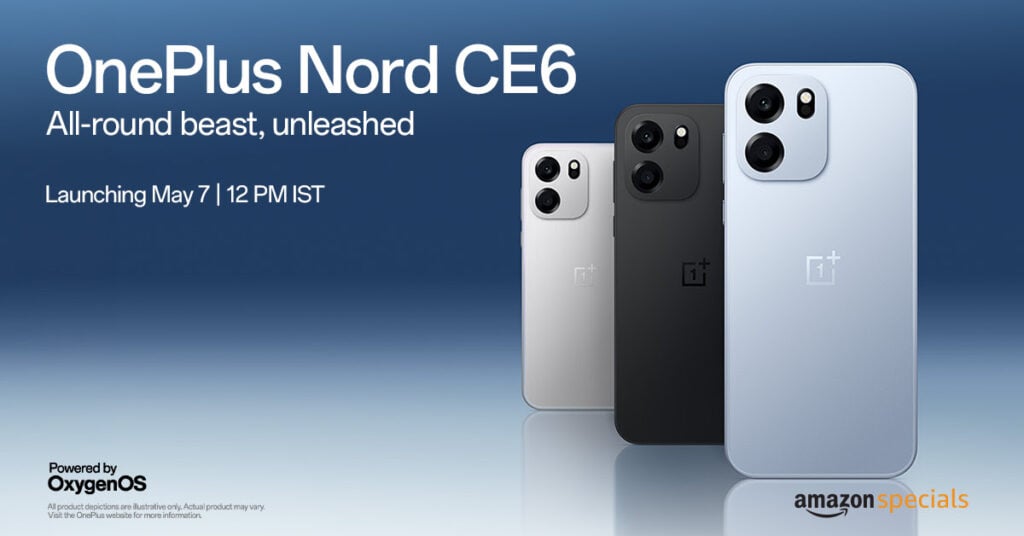
On May 7, OnePlus will announce the new Nord smartphone lineup in India with the launch of the OnePlus Nord CE 6 and OnePlus Nord CE 6 Lite. Ahead of the official unveiling, the company has now confirmed when both smartphones will go on sale, while several hardware details about the two devices have also surfaced online.
OnePlus Nord CE 6, Nord CE 6 Lite availability dates officially revealed
The OnePlus Nord CE 6 and Nord CE 6 Lite are scheduled to launch in India on May 7 at 12pm IST. Soon after the launch event, the standard Nord CE 6 will become available for purchase from May 8 at 12pm, while the Nord CE 6 Lite will go on sale starting May 12 at 12pm. Both smartphones will be sold through Amazon India, the official OnePlus India website, OnePlus Experience Stores, and offline retail outlets across the country.
OnePlus Nord CE 6, Nord CE 6 Lite specifications
The OnePlus Nord CE 6 will be powered by the Snapdragon 7s Gen 4 chipset and feature an AMOLED display with 1.5K resolution and a 144Hz refresh rate. The phone is confirmed to pack an 8,000mAh battery with support for 80W fast charging and 27W reverse charging.
It is also expected to include dual stereo speakers, a 32-megapixel front camera with autofocus support, and multiple durability certifications, including IP66, IP68, IP69, IP69K, and MIL-STD-810H compliance.
The Nord CE 6 Lite will feature the MediaTek Dimensity 7400 Apex chipset paired with UFS 3.1 storage and a large vapor chamber cooling system. It is expected to include a 6.72-inch full-HD+ display supporting up to 144Hz refresh rate in supported apps and games.
The phone will house a 7,000mAh battery with 45W charging support and feature a 50-megapixel rear camera capable of recording 4K videos.
OnePlus Nord CE 6, Nord CE 6 Lite pricing (expected)
While official pricing is still under wraps, the OnePlus Nord CE 6 is expected to launch between Rs 25,000 (~$265) and Rs 30,000 (~$315). The Nord CE 6 Lite could be priced between Rs 20,000 (~$210) and Rs 25,000 (~$265) in India. OnePlus has also confirmed the color variants for both devices.
The Nord CE 6 will arrive in Fresh Blue, Lunar Pearl, and Pitch Black shades. The Nord CE 6 Lite, on the other hand, will be introduced in Vivid Mint and Hyper Black finishes.
For more daily updates, please visit our News Section.
Dreame has unveiled the F20 air fryer in China, expanding its growing range of smart home appliances. The new model focuses on family-sized cooking and introduces features such as dual heat source cooking, a metal inner cavity, and a transparent viewing window designed to make monitoring food preparation easier.
Dreame F20 air fryer specifications and features
Dreame F20 air fryer
The Dreame F20 air fryer comes with a 6-litre cooking basket aimed at households that prepare larger portions in a single cycle. It features a 1700W heating setup with upper and lower heat sources that work together to cook food evenly. According to the company, the design allows 360-degree hot air circulation to reduce the need for manually flipping food while cooking.
The appliance also includes an 11-blade high-speed fan and a curved air duct structure to improve airflow movement inside the chamber. Dreame says this setup helps food cook evenly from multiple directions, especially for dishes such as roasted chicken and grilled snacks. The fryer supports temperatures ranging from 40 to 200 degrees Celsius, allowing it to handle baking, roasting, reheating, and air frying tasks.
Another notable addition is the all-metal inner cavity paired with a titanium ceramic non-stick coating. The company claims the coating can withstand high temperatures up to 400 degrees Celsius and is designed for improved scratch resistance.
A transparent viewing window has also been added so users can check cooking progress without opening the basket. The F20 further includes eight preset cooking modes, touchscreen controls, support for 1 to 60-minute timers, and a 45-minute automatic keep-warm function.
Dreame F20 air fryer price and availability
Dreame has launched the F20 air fryer in China at a price of 299 Yuan (~$45) and is currently listed on JD.com. The details regarding availability in other markets have not been confirmed yet.
For more daily updates, please visit our News Section.
Caviar has launched its new Rose Collection, a series of custom iPhone 17 Pro and Pro Max models featuring a striking soft-pink body. The luxury customization brand designed these high-end devices for customers who value exclusivity, style, and opulence. Prices for the collection begin at $8,200 and go as high as $20,270, making this lineup one of the most premium offerings in the tech world.
Design Details
The Rose Collection includes four unique designs: Sex and the City, Pink Lotus, Queen of Thorns, and Ophelia. Caviar defined each model with a specific theme inspired by femininity, fashion, and luxury.
The first model, Sex and the City, starts at $8,840. Caviar paired its pink body with a high-heel pattern and a three-dimensional Apple logo made from 18K gold. The company created this design to reflect big-city style and bold confidence, targeting those who see fashion as a way of life. Caviar limited this design to 99 pieces.
The Pink Lotus model stands out as the most expensive in the collection, starting at $20,270. Caviar used 999 gold plating on the frame and topped it with 84 natural diamonds and mother-of-pearl inlays. The intricate design takes inspiration from the lotus flower, a symbol of purity and harmony in Eastern cultures. Only 14 units are available, making it one of the rarest versions in the collection.
The Queen of Thorns model focuses on romance and elegance, inspired by the Art Nouveau aesthetics of Alphonse Mucha. Caviar coated the device with pink enamel roses and added a 999 gold-plated Apple logo. This version also comes with a limited run of 99 units and starts at $8,200.
The final model, Ophelia, starts at $10,270. Caviar designed this version with gold accents, premium calfskin leather, and soft pink enamel. Caviar named the model after the Shakespearean character to reflect a sense of delicate beauty and poetic inspiration. Caviar has limited the Ophelia model to 19 pieces.
All models in the Rose Collection come with premium packaging that includes an interactive box and a 24K gold-plated key.
Redmi is reportedly working on the Redmi K100 and Redmi K100 Pro Max smartphones, which are expected to debut in China in October this year. Last month, tipster Digital Chat Station claimed that the Pro Max edition would arrive with a significant price increase. Now, in a new Weibo post, the tipster has also hinted at what to expect from the Redmi K100’s pricing.
Redmi K100 chipset, price tipped
Redmi K100 price hike tipped by DCS
A couple of weeks ago, DCS claimed that the 12GB+256GB variants of the Redmi K100 Pro Max, iQOO 16, and OnePlus 16 could see a significant price hike to around 5,000 Yuan (~$730). These devices are said to feature Qualcomm’s next-generation Snapdragon 8 Elite Gen 6 chipset.
Now, the tipster has also shared details about the Redmi K100. According to DCS, the device may arrive with Qualcomm’s previous-generation flagship chip, likely the Snapdragon 8 Elite Gen 5. The tipster added that smartphones in this segment could start in the “4K” price range in China, which likely refers to around 4,000 Yuan (~$585). This price could apply to the base model, which may feature a 12GB+256GB configuration.
For comparison, the Redmi K90 launched last year at 2,599 Yuan (~$365) for the 12GB+256GB variant. If the rumored pricing turns out to be accurate, the Redmi K100 could see a price increase of nearly 54 percent compared to its predecessor. Such a jump would push the K-series further into flagship pricing territory, moving away from its traditional affordable flagship positioning.
The rest of the Redmi K100 series specifications are yet to be revealed. However, the Redmi K100 Pro Max is expected to feature a 200-megapixel primary camera, a 50-megapixel ultra-wide lens, and a 50-megapixel periscope telephoto camera, according to previous leaks. Readers are advised to wait for newer reports to learn more about these upcoming flagship phones.
Like the Redmi K90 series, the K100 lineup may remain exclusive to the Chinese market. However, rebranded versions of these devices could launch globally as the Poco F9 Pro and Poco F9 Ultra in the first quarter of 2027.
For more daily updates, please visit our News Section.
The Snapdragon 8 Gen 5 is positioned as a high-end smartphone chipset, offering flagship-level performance at a much lower price. It’s built using a newer architecture and packed with AI-driven enhancements, but let’s be honest – not every new chip translates into a worthwhile upgrade for the users.
If you’re already using a device powered by a Snapdragon 8-series chipset, the big question is whether the Snapdragon 8 Gen 5 is a meaningful upgrade or just another incremental spec bump? Because in 2026, raw performance alone isn’t enough. Users want real-world gains in AI capabilities, battery efficiency, and camera processing for an upgrade to justify.
Here, we’ll take a closer look at whether the Snapdragon 8 Gen 5 offers meaningful upgrades or if it’s better to hold onto your current device. Let’s break it down.
Snapdragon 8 Gen 5 benchmark scores look promising, but there’s a catch
The Snapdragon 8 Gen 5 puts solid gains on the table when compared to the Snapdragon 8 Gen 3, but it couldn’t outperform the Snapdragon 8 Elite. This essentially tells the correct positioning of the newer Snapdragon 8 Gen 5 – sitting between the other two.
To obtain benchmark results, we selected devices from a single brand to reduce software-related differences. We ran the tests on the OnePlus 15R (Snapdragon 8 Gen 5), the OnePlus 13 (Snapdragon 8 Elite), and the OnePlus 13R (Snapdragon 8 Gen 3).
In the Geekbench 6 CPU test, the Snapdragon 8 Gen 5 sits between the other two chips, with 3,026 points in single-core performance. In the multi-core test, however, the Snapdragon 8 Gen 5 bridges the gap with the Snapdragon 8 Elite, while the 8 Gen 3 lags much further behind.
SD 8 Gen 5
SD 8 Elite
SD 8 Gen 3
Single core
2,837
3,026
2,243
Multi core
9,352
9,306
6,591
We also tested the devices on the AnTuTu benchmark to get a clearer picture. In terms of total score, the Snapdragon 8 Gen 5 sits in the middle, again, with a total score of 2.96 million. The Snapdragon 8 Elite leads with 2.96 million points, while the Snapdragon 8 Gen 3 sits below the other two with 2.27 million points.
SD 8 Gen 5
SD 8 Elite
SD 8 Gen 3
AnTuTu score
2,961,236
2,994,563
2,274,520
CPU
914,878
862,692
607,409
GPU
974,402
1,095,049
796,782
Memory
382,729
393,623
353,279
UX
689,228
643,199
517,050
The breakdown of the AnTuTu score offers much better insights than a vague total score. In the CPU test, the Snapdragon 8 Gen 5 pulls off a 6% higher score than the Snapdragon 8 Elite, which widens to 50% when compared to the 8 Gen 3.
In the GPU test, the Snapdragon 8 Gen 5 gets about 12% lower score than the Snapdragon 8 Elite, but outperforms the Snapdragon 8 Gen 3 by 22%.
Performance upgrades
The Snapdragon 8 Gen 5 uses TSMC’s N3P (3nm) node, which yields slightly better performance and efficiency over the N3E (3nm) node used for the Snapdragon 8 Elite. The 8 Gen 3 chip uses an older N4P (4nm) node.
Except for the Snapdragon 8 Gen 3, the other two chips use custom-designed Oryon CPU cores, which deliver better performance over the ARM CPU cores in the 8 Gen 3. The 8 Gen 5 also benefits from newer-generation Oryon cores, but the higher clock speeds on the Snapdragon 8 Elite offer the chip an edge in CPU performance.
The Snapdragon 8 Elite also maintains an edge in gaming performance, thanks to a stronger peak graphics performance on the Snapdragon 8 Elite, while the 8 Gen 5’s Adreno 829 is a cut-down, more affordable GPU with modern gaming features.
The Elite chip is a better choice for max settings, ray tracing, and higher sustained frame rates. That said, the Snapdragon 8 Gen 5 still remains strong enough for demanding games and emulators except at the most extreme settings.
The AI gap between the Snapdragon 8 Gen 5 and Snapdragon 8 Elite is much smaller than the GPU gap, as both chips use a very similar Hexagon NPU setup, promising fast on-device AI and multimodal Gen AI support.
Camera upgrades
The camera upgrades are real and promising. It borrows the 20-bit AI ISP from the top-tier Snapdragon 8 Elite Gen 5 chipset, offering more headroom for HDR, denoising, and color processing compared to the 18-bit ISP on the Snapdragon 8 Elite and 8 Gen 3.
The rest of the camera specs match those of the Snapdragon 8 Elite, including support for up to 320MP single-camera capture, 4K/120fps video recording, and limitless real-time semantic segmentation.
Connectivity upgrades
The Snapdragon 8 Gen 5 features the same connectivity as the Snapdragon 8 Elite. Meaning, a peak speed of 10Gbps on a cellular connection and 5.8Gbps on a Wi-Fi connection. Both chips have the modern Bluetooth 6.0 connectivity.
In short, the Snapdragon 8 Gen 5 borrows the connectivity features from the Snapdragon 8 Elite, both of which are a step up over the 8 Gen 3.
Snapdragon 8 Gen 5: Should you upgrade or skip it?
Well, that depends. If you’re using a Snapdragon 8 Gen 3 or older chipset, upgrading to the Snapdragon 8 Gen 5 makes sense. You should expect at least 20% jump in the CPU and GPU performance. So, gaming would feel smoother, snappier, and more consistent. The new chip also offers better AI capabilities, a more powerful ISP, and modern connectivity features. So, there are improvements in almost every aspect, making it a true upgrade.
However, if you’re already using a Snapdragon 8 Elite or newer flagships, switching to Snapdragon 8 Gen 5 would feel like a downgrade. The Elite chip excels in raw performance, especially in CPU‑burst and sustained‑GPU workloads.
2 x 3.8 GHz — Oryon (3rd gen) 6 x 3.32 GHz — Oryon (3rd gen)
2 x 4.32 GHz — Oryon (2nd gen) 6 x 3.53 GHz — Oryon (2nd gen)
1 x 3.3 GHz — Cortex-X4 3 x 3.15 GHz — Cortex-A720 2 x 2.96 GHz — Cortex-A720 2 x 2.27 GHz — Cortex-A520
GPU
Adreno 829 ray tracing support Snapdragon Elite Gaming features
Adreno 830 ray tracing support Snapdragon Elite Gaming features
Adreno 750 ray tracing support Snapdragon Elite Gaming features
NPU
Qualcomm Hexagon NPU agentic AI support
Qualcomm Hexagon NPU
Qualcomm Hexagon NPU
Memory
LPDDR5x, up to 4.8 GHz
LPDDR5x, up to 5.3 GHz
LPDDR5x, up to 4.8 GHz
Storage
UFS 4.1
UFS 4.0
UFS 4.0
Camera
Qualcomm Spectra triple AI ISP (20-bit) up to 320MP single camera up to 108MP single camera with zero shutter lag up to 48MP triple cameras with zero shutter lag real-time semantic segmentation (limitless) 4K/120fps video recording 1080p/480fps slow-mo video recording
Qualcomm Spectra triple AI ISP (18-bit) up to 320MP single camera up to 108MP single camera with zero shutter lag up to 48MP triple cameras with zero shutter lag real-time semantic segmentation (limitless) 8K/30fps video recording 1080p/480fps slow-mo video recording
Qualcomm Spectra triple AI ISP (18-bit) up to 200MP single camera up to 108MP single camera with zero shutter lag up to 36MP triple cameras with zero shutter lag real-time semantic segmentation (up to 12 layers) 8K/30fps or 4K/120fps video recording 720p/960fps slow-mo video recording
Logitech G has announced the launch of the G512 X TMR Analog/Mechanical Gaming Keyboard, a significant step forward in gaming technology. The new keyboard focuses on modularity and customization, catering specifically to players who want their gear to match their style and performance.
Logitech G G512 X Specifications
The G512 X features the Tunnel Magneto Resistance (TMR) sensor technology, which allows for analog input. This technology enables players to map actions based on the depth of a keystroke. The feature is well-suited for games like racing sims and tactical shooters where precision is crucial.
Logitech has equipped the G512 X with Dual Swap Capability, allowing users to use a mix of analog and mechanical switches. The keyboard includes 39 hybrid TMR switch sockets, which work with the most popular 3-pin and 5-pin switches. Logitech ships the keyboard with nine Gateron KS-20 analog switches, offering precise input right out of the box.
The keyboard achieves true 8K performance with a 0.125 ms response time, ensuring fast and accurate keystrokes for competitive gaming. Logitech also includes SAPP (Second Actuation Pressure Point) Rings, which allow users to assign two actions to a single keypress at different depths. Additionally, it also includes two physical rotary controls and a bold RGB Lightbar for immersive lighting effects.
The G512 X comes in two layouts: 75-key and 98-key. Players can accessorize the keyboard with an acrylic palm rest, which is sold separately, to enhance comfort during long sessions. Logitech also includes storage space in the back of the keyboard for housing keycap pullers, switches, and SAPP rings.
Pricing and Availability
The G512 X is available in both black and white. Logitech has priced the 75-key layout at $179.99 and the 98-key layout at $199.99. The keyboard is available today on LogitechG.com and will arrive at global retailers on May 2, 2026.
In related news, Logitech G has recently launched the Logitech G PRO X2 SUPERSTRIKE Gaming Mouse in India, bringing haptic click technology to its latest high-performance gaming mouse.
For more daily updates, please visit our News Section.
OnePlus announced the Strix Gaming Controller alongside its latest gaming-focused smartphone, the OnePlus Ace 6 Ultra. The controller is designed to offer a console-like gaming experience for mobile users.
It attaches directly to compatible smartphones, providing a seamless handheld gaming setup. Here is a detailed breakdown of what the OnePlus Strix Gaming Controller brings to the table.
Ergonomic Design and Build
OnePlus designed the controller to feel comfortable during extended gaming sessions. The controller weighs 150 grams and uses low-density fiber materials to ensure a lightweight and balanced design. The ergonomic grip fits naturally in the hand and minimizes wrist strain, making it ideal for long hours of gameplay.
The company included anti-slip textures along the controller’s surface. The grip structure curves to improve stability and ensure firm handling during intense gaming moments.
Advanced Control System
OnePlus has chosen a unique joystick-free design for the controller. It uses four mechanical trigger buttons, which provide ultra-short key travel of just 0.7mm.
These micro-switch buttons mimic the performance and feedback of gaming mouse clicks, offering precise and tactile input. The controller achieves a 1000Hz polling rate and a response time of 1.8 milliseconds, making it suitable for competitive gaming.
The hybrid control system combines physical buttons and touchscreen functionality. This setup reduces dependency on on-screen controls and improves visibility by freeing up screen space. It allows players to execute complex commands in genres like FPS and MOBA games with greater accuracy.
Packed with Features for Gamers
The Strix Gaming Controller includes a bottom-mounted USB Type-C charging port. Players can charge their smartphones while using the controller without compromising their grip or comfort. The device also supports audio passthrough, which allows gamers to connect wired headphones for improved sound quality during gameplay.
OnePlus has also added button customization to the controller, allowing users to assign functions like live screen recording, screenshots, and instant replay capture. The custom mapping system works across various game genres, giving players flexibility in configuring controls.
Connectivity and Thermal Management
OnePlus incorporated a high-performance gaming antenna into the controller to enhance connectivity. The antenna strengthens signal reception during online gaming, ensuring smooth and stable gameplay.
The controller features a magnetic attachment point for cooling accessories. Gamers can purchase these modules separately to reduce device overheating during intensive gaming sessions. This cooling option helps maintain performance when gaming for extended periods.
Who Is It For?
The OnePlus Strix Gaming Controller pairs seamlessly with the OnePlus Ace 6 Ultra smartphone. The phone features the MediaTek Dimensity 9500 chipset, which enables high-performance gaming at up to 165fps. The Ace 6 Ultra also includes a 165Hz OLED display, a massive 8,600mAh battery, and 120W fast charging, making it an ideal companion for the controller.
The retractable design of the controller makes it compatible with other smartphones as well. Although it works best with OnePlus devices, players can use the Strix Controller on a range of smartphones with similar dimensions.
Pricing and Availability
The Strix Gaming Controller has a retail price of 449 yuan ($66). OnePlus is offering a discount that brings the price down to 399 yuan ($58) when purchased as part of a bundle with the OnePlus Ace 6 Ultra. Pre-orders have already started, and the device is now available in China.
For more daily updates, please visit our News Section.
Xiaomi has launched a new home appliance, Mijia Gas Stove 3C 5200W, on its Youpin platform. It’s priced at 899 yuan (~ $131), with an early-bird price of 699 yuan (~ $102).
As you can guess by name, the stove is designed for natural gas use and comes with dual-burner support, high heat output, and smart connectivity through the Mi Home app.
Xiaomi Mijia Gas Stove 3C 5200W Specifications
The key spec here is power. Each burner supports up to 5.2kW of rated heat load, giving the stove a combined high-output setup for fast cooking and high-heat stir-frying.
Xiaomi says the design uses a three-dimensional oxygen intake structure paired with an upgraded large burner head. The idea is to spread flame more evenly from the center outward.
On the hardware side, the stove features a six-layer reinforced explosion-proof glass panel. It combines tempered glass, impact-resistant ink layers, a PVB explosion-proof film, reinforced fiber cloth, a buffer alloy mesh, and shock-absorbing strips.
There’s also a removable burner system for easier cleaning. The chassis is adjustable, so it can fit different kitchen cutouts without requiring modification to existing holes. The adaptable opening range is listed between 630–700 mm by 330–370 mm.
The stove safety features include an accidental flameout protection system. If the flame goes out unexpectedly, it can automatically detect it and shut off the gas supply to reduce leak risk.
The stove also connects to the Mi Home app. Users can get alerts if they forget to turn off the stove, receive low-battery warnings, and sync operation with a compatible range hood for automated ventilation control.
Other details include pulse ignition, a thermal efficiency rating of at least 65% for natural gas models, and a net weight of 10 kg. Xiaomi is offering a 5-year warranty.
OPPO Find X9 Ultra Hasselblad Earth Explorer Master Set is not just another flagship smartphone. It is designed as a complete photography-focused package for users who want DSLR-like flexibility in a mobile device. With powerful hardware, advanced cameras, and exclusive Hasselblad accessories, this edition targets creators, travelers, and enthusiasts who care about image quality and versatility.
Price and Availability:
This exclusive Master Set is now available via Giztop for $2299. Giztop also provides international shipping, so users across regions can get their hands on this limited-edition photography-focused flagship.
Design and Display
The device features a large 6.82-inch AMOLED LTPO display with a sharp 3168 × 1440 resolution. The screen delivers rich colors, deep contrast, and smooth visuals, making it ideal for both content consumption and photo editing. The overall design follows a premium flagship approach, with a solid build and a camera module that reflects its photography-first identity.
Performance and Battery
Powered by the Snapdragon 8 Elite Gen 5 processor, the phone offers top-tier performance for gaming, multitasking, and heavy creative work. It is paired with 16GB LPDDR5X RAM and 1TB UFS 4.1 storage, ensuring fast speeds and plenty of space for high-resolution photos and videos.
The 7050mAh battery is one of the biggest highlights, delivering long-lasting usage even with heavy camera use. It supports 100W wired SuperVOOC charging and 50W wireless charging, making it quick and convenient to power up.
Camera System and Photography Features
The quad-camera setup is the main highlight. It includes a 200MP main camera, a 200MP periscope telephoto lens, a 50MP secondary periscope telephoto, and a 50MP ultra-wide camera. This setup allows true optical zoom across multiple focal lengths, giving users flexibility similar to professional cameras.
With Hasselblad tuning, the phone focuses on natural colors and high dynamic range. Features like advanced zoom, 8K video recording, and professional shooting modes make it suitable for both casual and serious photography.
Hasselblad Master Set and Special Features
What makes this edition unique is the bundled Hasselblad accessories. The package includes a professional teleconverter lens, a photography grip case, a custom strap, and a filter adapter ring. These additions turn the phone into a more camera-like system, improving handling and shooting control.
This limited-edition set is designed for users who want more than just a smartphone. It brings together performance, camera innovation, and professional tools in one complete package, making it stand out in the ultra-premium segment.
Ultra-flagships are no longer just about power; they’re about how differently brands define “the best.” The OPPO Find X9 Ultra and Samsung Galaxy S26 Ultra take two distinct paths: one pushes extreme hardware and charging innovation, while the other refines performance, software longevity, and ecosystem features. This comparison highlights which approach actually makes more sense, depending on how a flagship is used day to day.
Disclaimer: Specs are based on available data. Actual performance may vary. Verify details from official sources before buying.
Design and Display
Build and Feel
The OPPO Find X9 Ultra leans into a premium, camera-centric design with options like eco leather that add grip and character. It feels built for enthusiasts who appreciate both durability and a slightly bold aesthetic. The Samsung Galaxy S26 Ultra, on the other hand, sticks to a refined, industrial approach with its Armor frame and integrated stylus. It looks cleaner and more business-like, with tighter finishing and a more polished in-hand experience. The inclusion of the S Pen subtly adds functional value that goes beyond just design.
Display Quality
OPPO pushes ahead with a 144Hz LTPO AMOLED panel and extremely high peak brightness, making it more aggressive and fluid, especially for gaming and outdoor use. Samsung counters with a slightly larger panel, excellent anti-reflective coating, and a more color-accurate tuning. While OPPO feels more vibrant and dynamic, Samsung’s display appears more controlled and easier on the eyes during long sessions.
Verdict
OPPO feels more exciting and cutting-edge, while Samsung delivers a more refined and practical flagship experience.
Specifications Including Battery
Performance
Both devices run on the Snapdragon 8 Elite Gen 5, but Samsung edges ahead slightly with a higher clocked prime core and GPU tuning. In real-world use, both feel extremely fast, but Samsung may hold a slight advantage in sustained workloads and optimization. OPPO compensates with aggressive performance tuning that feels snappier in bursts, especially during gaming or multitasking. Software support is another key difference, with Samsung offering significantly longer update longevity, which adds long-term value.
Battery and Charging
This is where OPPO clearly dominates. The massive 7050mAh battery, combined with 100W wired and 50W wireless charging, makes it a powerhouse for heavy users. Samsung’s 5000mAh battery is reliable but feels conservative, and its charging speeds lag. OPPO simply reduces battery anxiety in a way Samsung does not fully match.
Verdict
Samsung offers better long-term polish and slightly stronger optimization, but OPPO wins decisively in battery and charging convenience.
Camera
Main and Secondary Lenses
OPPO takes a more ambitious approach with dual 200MP sensors and a versatile zoom system that includes both 3x and 10x optical options. This setup feels designed for flexibility and detail retention across all focal lengths. Samsung, while more traditional, delivers a highly refined camera system with strong computational photography and reliable consistency. Its 5x zoom is practical, but it lacks the extended reach and experimentation OPPO offers. OPPO feels more like a photography toolkit, while Samsung feels like a dependable point-and-shoot flagship.
Selfie Camera
The difference is clear here. OPPO’s 50MP front camera delivers sharper and more detailed selfies, especially in well-lit conditions. Samsung’s 12MP sensor is tuned for natural results and better consistency, but it lacks the raw resolution advantage.
Verdict
OPPO leads in hardware versatility and zoom capabilities, while Samsung remains more consistent and predictable in everyday shooting.
Pricing
OPPO Find X9 Ultra is priced at around ₹1,03,000, while the Samsung Galaxy S26 Ultra comes in significantly higher at approximately ₹1,40,000. This creates a noticeable gap in positioning, with OPPO offering flagship-level hardware at a more aggressive price point. Samsung justifies its premium with longer software support, brand value, and ecosystem features, but the difference is hard to ignore.
Is the price justified and value for money
OPPO feels like the better deal purely from a hardware perspective, especially considering its battery, charging, and camera system. Samsung, however, positions itself as a long-term investment with better software longevity and ecosystem integration. For users focused on raw specs and immediate value, OPPO stands out more clearly.
Verdict
OPPO delivers stronger value for money, while Samsung charges a premium for refinement and long-term reliability.
Disclaimer: Prices are approximate and may vary based on country, region, launch timing, and applicable taxes. Always check whether the listed price is for a China unit or a global/international variant when purchasing.
Conclusion
OPPO stands out with its massive battery, ultra-fast charging, and highly experimental camera setup that pushes boundaries. It feels like a device built for users who want maximum hardware innovation. Samsung counters with features like the S Pen, DeX support, anti-reflective display, and extended software updates, making it a more productivity-focused flagship. These additions create a more complete ecosystem experience rather than just a hardware showcase.
Verdict
OPPO Find X9 Ultra is the better choice for users who prioritize battery life, fast charging, and camera versatility at a lower price. The Samsung Galaxy S26 Ultra, however, is more balanced, refined, and future-proof, making it a stronger pick for long-term usage and productivity-focused buyers.
Disclaimer: This comparison is based on the specifications provided and is intended for general informational purposes. Actual performance, camera results, battery life, and overall experience may vary depending on real-world usage, software updates, and individual preferences.
Both the Xiaomi 17T and Xiaomi 17T Pro recently surfaced in Geekbench listings. Now, a fresh leak is giving us a complete look at the two phones ahead of launch.
According to details shared by Dealabs, both phones are expected to launch in Europe with 12GB of RAM. The standard 17T will be available in 256GB and 512GB storage options, while the Pro is said to come in a single 512GB variant.
Pricing in Europe could start at €749 for the 17T and €999 for the Pro, which is about €100 more than their predecessors.
Xiaomi 17T
Xiaomi 17T and Xiaomi 17T Pro specifications (expected)
For the price, the 17T will offer a MediaTek Dimensity 8500-Ultra processor, while the Pro is said to be powered by the Dimensity 9500.
The 17T will pack a 6,500mAh battery, while the Pro stretches that to 7,000mAh. For charging, the former is limited to 67W, while the Pro supports 100W wired and 50W wireless charging.
On the front, the 17T might feature a slightly smaller 6.59-inch AMOLED panel with a 120Hz refresh rate. Meanwhile, the Pro will have a larger 6.83-inch screen that bumps the refresh rate up to 144Hz.
Xiaomi 17T
On the camera side, both phones keep a triple Leica-branded setup. The Pro version gets a newer Light Fusion 950 main sensor (versus the Light Fusion 800 on the standard model), while both models feature the same 50MP telephoto camera with 5x optical zoom and a 12MP ultra-wide lens. The front camera is a 32MP shooter on both devices.
Software will be based on Android 16 with Xiaomi’s HyperOS skin on top. Both phones are said to come in the same color options: Blue, Black, and Purple.
There’s still no confirmed launch date, but with this level of detail already out, it likely won’t be far off.
Samsung has stuck with a fairly familiar camera design on its Galaxy S phones for a while now. Since the Galaxy S22, the camera layout has barely changed, aside from a few small tweaks. That might finally change with the Galaxy S27 series.
A new leak from South Korea suggests Samsung is looking at reworking the rear camera layout for the entire S27 lineup. The exact design is still unclear, but the reason behind the shift seems to be more practical than cosmetic.
It isn’t about sensor or lens upgrades
Samsung is reportedly planning to add built-in magnets to the Galaxy S27 series. This would enable proper Qi2 magnetic wireless charging and support for magnetic accessories without needing a case. That includes things like snap-on chargers, power banks, wallets, and stands. It is something we have already seen elsewhere, but Samsung has been a bit slower to adopt it.
Interestingly, the current camera layout is said to be part of the problem. The vertical arrangement apparently takes up space that would otherwise be needed for a circular magnet ring. If that is the case, a redesign is less about looks and more about making room internally.
Samsung was expected to bring this feature to the Galaxy S26 series, but it never happened. Now, most of the signs point to the S27 as the point where it finally comes together.
If this change goes through, it would mark a shift away from a design that has been around for several generations. There are also hints that a similar camera layout might show up on another upcoming Samsung device before the S27 series, possibly the upcoming foldables.
That said, the leak also mentions cost management. A major design overhaul, as tipster Lanzuk on Naver notes, could be put on hold or delayed to keep R&D expenses in check. Still, a new back design may arrive within the next few generations of Galaxy flagships.
OnePlus has shared its April 2026 OxygenOS FAQ, covering current bugs, feature guidance, app requirements, and rollout details for the B60P01 software version. The update comes as part of the company’s monthly OxygenOS information thread, which is meant to answer common user questions around system behavior, build status, and product features.
One of the issues listed in the April FAQ is screen flickering during video recording. OnePlus said the problem is affecting some devices and is still being analyzed by its team. The company has not confirmed a fixed rollout timeline for this specific issue, but said it will continue working on improvements.
The FAQ also addresses a camera launch issue seen when using a screen-off gesture or shortcut. In some cases, the camera shortcut does not automatically wake the display when the screen is off. OnePlus said the issue has already been fixed in the latest version. Users facing the problem are advised to update their devices. Until then, the screen can be turned on manually by pressing the power button.
OnePlus has also explained how users in Thailand can add the Songkran Watermark through the Photos app. The option is available through Photos App > select taken photo > Edit > Watermark. The feature requires OxygenOS version 13.0.1 or above and Photos App version 15.75.0 or above. It is available only in Thailand from April 1 to April 30, 2026. OnePlus said the Photos app can be updated through the App Market.
Real-time sports scores on Live Alerts
The April FAQ also includes guidance for real-time sports scores on Live Alerts. Users can enable it through Settings > Notifications & Quick Settings > Live Alerts > Allow Live Alerts > Sports from Google > Sports from Google settings, then follow their preferred teams. OnePlus noted that this feature is available only on certain models.
The Content Portal feature can be enabled from Settings > Accessibility & convenience > Content Portal > Drag & drop. It allows users to share images, text, and other content more easily.
OnePlus also confirmed that the B60P01 version started rolling out on April 8, 2026, and is scheduled to reach users by April 30, 2026. The update brings improvements to certain operations and system stability for a smoother experience.
The rumor mill is actively leaking details about next-generation flagship phones, such as the Xiaomi 18 series, Vivo X500 series, and Oppo Find X10 series. A new leak that has surfaced on Weibo suggests that the forthcoming Honor Magic 9 series could offer top-tier video recording capabilities.
Honor Magic 9 series’ launch timeframe tipped
A new leak from Chinese tipster Guan Tongxue GiM claims that the upcoming Honor Magic 9 series is scheduled to launch in China in October this year with major upgrades focused on imaging and design.
According to the tipster, the Magic 9 series will feature ARRI-powered imaging capabilities, bringing significant improvements to both photography and video recording performance. For those unaware, ARRI is a highly respected German brand in the professional cinema industry, known for producing high-end cinema cameras, lenses, and lighting equipment used in Hollywood films, television productions, and commercials.
Honor and ARRI announced their collaboration at Mobile World Congress 2026 earlier this year. The upcoming Honor Robot Phone, which is expected to launch in China in August, will be the first phone to feature cinema-grade video recording capabilities developed through this partnership.
The tipster claims that the Honor Magic 9 series will become the first regular smartphone lineup to feature ARRI imaging technology. The series is expected to include multiple models, all of which may feature flat displays.
The tipster further revealed that the lineup will adopt a refreshed design language with a more youthful appearance while retaining its business-oriented identity. In addition, the devices are expected to run MagicOS 11, which is tipped to introduce major interface and feature upgrades aimed at users who pay close attention to software details and overall user experience.
For more daily updates, please visit our News Section.
New details on Xiaomi’s upcoming chip, now expected to be called XRING O3, have surfaced through a report from Ximitime. The details were reportedly found by digging through the Mi Code database, which has previously revealed early information about the upcoming Xiaomi 17 Fold, too.
According to the report, the XRING O3 is under development under the codename “lhasa.” The chip might appear in the Xiaomi 17 Fold, which is internally called Q18, and has also appeared in IMEI database listings.
Now, compared to the earlier XRING O1, which uses a four-cluster, 10-core layout, Xiaomi may simplify the design with the XRING O3.
Xiaomi XRING O3 core setup
The XRING O3 reportedly drops the extra “big” core cluster altogether and is said to feature an octa-core design. It is said to use a combination of Prime, Titanium, and Little cores.
The Prime core could exceed the 4GHz mark, reaching up to 4.05GHz, while the Titanium cores, designed for high-performance tasks, may run at 3.42GHz.
What stands out more is the so-called Little core. Typically designed for efficiency, it’s now said to run at 3.02GHz. That’s a noticeable jump from the 1.79GHz seen on the XRING O1.
On the graphics side, the GPU is expected to reach close to 1.5GHz, up from around 1.2GHz on the previous generation. Memory speeds, however, might remain unchanged at 9600 MT/s.
The report suggests that these changes could help with background processing and multitasking, especially on larger foldable displays where multiple apps are often in use at the same time. There’s also some uncertainty around the exact core configuration, with possibilities like 1+3+4 or 1+2+5 being mentioned.
For more daily updates, please visit our News Section.
Vivo is just days away from its next big launch in India, but one key detail has already slipped out early. Ahead of the May 6 event, the pricing for one of the vivo X300 FE has reportedly surfaced online, and it’s turning heads for more than one reason.
According to the tipster, the expected launch price could be ₹79,999 for the 12GB/256GB variant. He also shared a photo of the retail box showing an MRP of ₹1,19,999, though that is standard practice and not the actual selling price. Even so, the expected launch price still looks significantly higher than anticipated.
The real surprise is how big the jump is compared to last year. The X200 FE debuted at ₹54,999, which means this new model could land roughly ₹25,000 higher. That’s a steep increase for a “Fan Edition” device, a segment usually meant to balance features and affordability. While vivo hasn’t commented on the pricing, it likely comes down to the broader trend of rising component costs, something we’ve been seeing across the industry.
That said, the X300 FE isn’t exactly light on specs. It’s tipped to run on the Snapdragon 8 Gen 5 chipset, an upgrade over the Mediatek Dimensity 9300+ used in the X200 FE, paired with a 6.31-inch AMOLED display with a 120Hz refresh rate. There’s a 6,500mAh battery, which should easily handle a full day of moderate use.
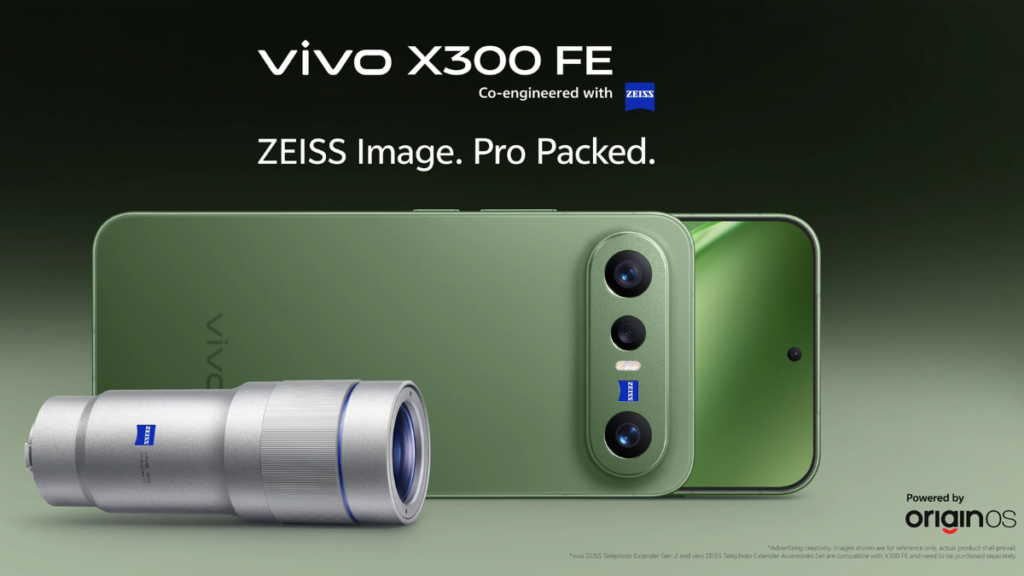
On the camera front, vivo is sticking with its ZEISS partnership. The setup includes a 50MP main sensor (Sony IMX921), a 50MP 3x telephoto (Sony IMX882), and an 8MP ultrawide, along with a 50MP front camera for selfies and video calls. It is also the company’s first FE model to support a ZEISS Teleconverter Extender Kit, specifically the G2 model, which enables up to 2.35x optical zoom.
The X300 FE is set to launch alongside the X300 Ultra on May 6. With the pricing now more or less out in the open, the big question is whether the upgrades justify the noticeably higher cost. Buyers won’t have to wait long to decide.
OPPO has recently shared a detailed explanation of the Private Safe feature in ColorOS, showing users how they can hide, lock, and protect private files on their phones. The feature works as a built-in vault for photos, videos, audio, notes, and documents, keeping selected files away from the regular gallery, file manager, and casual phone browsing.
Private Safe can be accessed through Settings > Security and privacy > Private Safe. Users need to enter their privacy password before setting it up or opening stored files. Once enabled, selected file types such as images and videos can be protected. Users can tap Add, choose the files they want to hide, and select Set as private.
OPPO also allows users to move files into Private Safe from supported apps. In the Photos app, for example, users can long-press a photo, select it, tap the three-dot menu in the bottom-right corner, and choose Set as private. After this, the file will no longer appear in the regular Photos view.
The feature is useful for users who share their phones with others or want to keep personal files out of casual view. This could include personal photos, private videos, voice notes, sensitive documents, or notes stored on the device.
Accessing hidden files follows the same route. Users can go to Settings > Security and privacy > Private Safe and unlock the space using the privacy password. For faster access, ColorOS also supports fingerprint and face unlock.
To enable biometric access, users need to open Private Safe, tap the three-dot menu in the top-right corner, go to Settings > Privacy password > Other unlock methods, and turn on fingerprint or face unlock, depending on the option they prefer.
Private Safe also includes a recovery option for deleted files. Files removed from the vault can be restored within 30 days through the Recently deleted section. Users need to open Private Safe, enter the privacy password, tap Recently deleted, long-press the files they want to recover, and select Restore.
The feature gives OPPO users a simple way to control what stays visible on their phones and what remains private. It is meant for files users want to keep on the device, without leaving them open in the regular gallery or file manager.
OnePlus has introduced the OnePlus Buds Ace 3 in China, launching alongside the OnePlus Ace 6 Ultra. The new earbuds sit in a crowded space, but on paper, they try to cover a bit of everything, from noise cancellation to gaming-focused features.
OnePlus Buds Ace 3 Specifications
The Buds Ace 3 come with a 12mm dynamic driver, which is fairly standard in this segment. It supports Hi-Res audio through LHDC 5.0, with high bitrate streaming and sampling rate of up to 96kHz. It also has a 10-band equalizer, and something OnePlus calls BassWave for additional tuning, along with spatial audio support.
The earbuds are rated for up to 55dB active noise cancellation with wide frequency coverage. As usual, the real-world experience will depend on fit and environment, but OnePlus is also leaning on adaptive algorithms to adjust noise reduction in real time.
For calls, there’s a triple-microphone setup paired with AI-based noise reduction to cut down background noise, including wind.
There’s also a noticeable focus on gaming. The Buds Ace 3 promise latency as low as 47ms, along with sound tuning that emphasizes directional cues like footsteps.
Moreover, OnePlus claims up to 54 hours of total playback with the case. The earbuds themselves are rated for around 13 hours without noise cancellation, or about seven hours with it turned on. Fast charging is supported, though exact charging times aren’t mentioned.
Other features include Bluetooth 6.0, dual-device connectivity, touch controls with sliding gestures, and even AI translation support across more than 20 languages. The earbuds are rated IP55 for dust and water resistance, which should be enough for everyday use and workouts.
Price and Availability
In China, the OnePlus Buds Ace 3 are priced at CNY 329, roughly USD 48 or Rs 4,600. It is available through the Oppo online store.
For more daily updates, please visit our News Section.
Motorola is gearing up to launch a couple of new phones, including the Razr 70 series and the Moto G87. Recent leaks have already revealed the design and key specifications of the upcoming Razr 70 lineup, but the design and other details of the G87 had remained under wraps. In a fresh leak, veteran tipster Evan Blass shared alleged official renders of the Moto G87, revealing its design for the first time.
Moto G87 color options and design revealed
As seen in the leaked renders, the Moto G87 will be available in dark and light shades of blue. In terms of design, it follows the current Motorola design language with a square-shaped camera island positioned in the upper-left corner, housing a 200-megapixel primary camera. The front features a flat display with rounded corners.
The right edge of the device includes the volume rocker and power button, while the left side appears to house the SIM card slot. The bottom edge seems to feature a microphone, a USB-C port, and a speaker grille.
Leaks suggest that the G87’s color variants will be marketed as Pantone Overture Gray and Pantone Blue Atoll. It is also expected to arrive in additional shades such as Arctic Seal, Black Olive, Nile, and Shaded Spruce.
Moto G87 specifications (rumored)
Recent reports suggest that the Moto G87 could be powered by a MediaTek Dimensity 6000-series chipset, although the exact processor remains unknown. The phone is also expected to feature 8GB of RAM and 256GB of internal storage.
The rest of its specifications are still under wraps. There is a possibility that the device could launch as early as next month in multiple markets.
For more daily updates, please visit our News Section.
Reports suggest that the next-generation Oppo Find X10 series could include three models, namely the X10, X10 Pro, and X10 Pro Max. While these devices are expected to launch in China in October, the X10 Ultra may break cover in the first half of 2027. Today, tipsters Digital Chat Station and Smart Pikachu revealed key details about the standard X10.
Oppo Find X10 key details tipped
A new leak from Digital Chat Station has revealed early camera details about what appears to be the upcoming Oppo Find X10 powered by a next-generation MediaTek Dimensity 9-series chipset.
According to the tipster, the latest engineering prototype is currently being tested with a 200-megapixel primary camera featuring a large 1/1.4-inch sensor. The device is also said to be undergoing A/B testing for its 3x periscope telephoto camera setup.
One version reportedly uses a 200-megapixel periscope camera with a 1/1.56-inch sensor, while another variant is testing a new 64-megapixel periscope solution with a 1/2-inch sensor. The tipster added that the large-sensor 200-megapixel periscope setup is based on an older Samsung HP5 solution currently under evaluation, whereas the 64-megapixel option is described as a newer solution being tested internally.
The leak suggests that Oppo is still deciding between a dual 200-megapixel camera approach or a newer single 200-megapixel camera setup for the final hardware configuration.
At the same time, Smart Pikachu has claimed that the Oppo Find X10 will feature a flat display with a 165Hz refresh rate and support for 1.5K resolution. It is also expected to pack a battery with around 8,000mAh capacity.
While the tipster claims that the device will feature dual 200-megapixel cameras, this information appears to be slightly outdated, according to Digital Chat Station. As mentioned above, the rear camera setup may include a 200-megapixel primary camera, either a 200-megapixel or 64-megapixel periscope telephoto camera, and a 50-megapixel ultra-wide camera.
The rumor mill is actively leaking details about upcoming flagship phones expected to launch in China from September onward. A fresh leak from popular tipster Digital Chat Station has revealed new details about what is believed to be an upcoming Xiaomi 18 series phone. The leak suggests that the device will arrive with several notable upgrades.
Xiaomi 18 key details tipped
According to the tipster, the engineering prototype of the device is currently in development and could arrive as the only compact flagship phone in its segment to feature both a next-generation 2nm flagship chipset, which appears to be the Snapdragon 8 Elite Gen 6, and dual 200-megapixel cameras backed by large image sensors in its rear camera setup.
The leak further claims that the device may pack a battery capacity starting with “7,” suggesting a battery in the 7,000mAh range with improvements over previous generations. Despite the large battery and advanced camera hardware, Xiaomi is reportedly working on a slim and compact design with a flat display featuring ultra-narrow symmetrical bezels enabled by new LIPO packaging technology. While he has not specified the screen size, it may feature a display of around 6.3 inches.
Xiaomi has launched its flagship phones in September for the past few years. This year as well, the Xiaomi 18 series, which is expected to include the Xiaomi 18, 18 Pro, and 18 Pro Max, may debut in the same month. At present, there is no clarity on the global launch timeframe for these devices.
For more daily updates, please visit our News Section.
OnePlus has introduced two new GaN chargers at its latest launch event. The company unveiled the 100W Small Square Bottle Pro and the 120W Small Square Bottle dual-port chargers. The 100W model costs 229 yuan ($33), while the 120W dual-port version is priced at 269 yuan ($39).
OnePlus 120W & 100W Chagers Specs
The 120W Small Square Bottle charger is a compact, lightweight dual-port USB-C charger, measuring 65 x 33.5 x 33.5 mm and weighing 105 grams. It delivers up to 120W from a single port or distributes up to 125W across both ports, supporting configurations like 80W + 45W for efficient multi-device charging.
OnePlus ensures compatibility with a variety of devices by supporting fast charging standards like SuperVOOC, PD 3.0, PPS, QC 3.0, UFCS, and BC 1.2. This allows users to charge smartphones, laptops, tablets, handheld gaming consoles, and other devices.
The charger uses advanced GaN (gallium nitride) technology to enhance power efficiency while keeping heat generation low. Its internal graphite heat dissipation system manages temperature during heavy power loads.
The 100W Small Square Bottle Pro features similar efficiency and portability. It is smaller and lighter than the 120W version, measuring 56 x 33.5 x 33.5 mm and weighing 90 grams. It includes a single USB-C port that delivers up to 100W of power. This charger also supports multiple fast-charging protocols.
Both chargers feature a skin-friendly coating and foldable prongs for improved portability. OnePlus includes a durable silicone-coated cable with support for up to 12A high current. The cable includes an E-marker chip to regulate power intelligently, preventing overheating and overcurrent issues.
In related news, OnePlus has recently introduced a 15,000mAh power bank with 120W fast charging and enhanced battery safety technology.
For more daily updates, please visit our News Section.
Oppo has shared its April 2026 ColorOS Q&A, covering several feature-related questions from users, including new watermark options, Live Alerts for sports scores, Content Portal, and the process for checking the ColorOS 16 beta update.
The company also acknowledged an issue where some devices may behave abnormally while powering on or off. Oppo said the problem is affecting certain device models in some regions, and its team is still analyzing the cause. A fix is expected after the review is complete, though no rollout timeline has been shared yet.
One of the main additions covered in the Q&A is the Songkran watermark. Users in Thailand can apply it through the Photos app by opening a captured image, tapping Edit, and selecting Watermark. The feature requires ColorOS 13.0.1 or above and Photos app version 15.75.0 or above. It is available only in Thailand from April 1, 2026, to April 30, 2026. Users can update the Photos app through the App Market.
Oppo has also added a Champions League watermark, which follows the same setup path: Photos app, selected photo, Edit, and Watermark. This option also needs ColorOS 13.0.1 or above and Photos app version 15.75.0 or above. It is available from April 15, 2026, to June 10, 2026.
For sports updates, ColorOS users can enable real-time match scores through Live Alerts using Sports from Google. The setup path is Settings, Notifications & Quick Settings, Live Alerts, Allow Live Alerts, Sports from Google, Sports from Google settings, and then selecting the teams they want to follow. Oppo notes that this feature is limited to certain models.
The Q&A also explains Content Portal, a feature designed for quicker sharing of images, text, and other content. It can be enabled from Settings, Accessibility & convenience, Content Portal, and Drag & drop.
Users with eligible devices can check for ColorOS 16 through Settings, System & update, Software & update, the three-dot menu, and Beta program. Oppo says users who have not received the update should wait for the rollout.
DJI has officially launched the Mic Mini 2 globally, and while the new model brings a few expected upgrades, there is something more interesting tucked into the announcement. The company has quietly confirmed that a more capable version, the Mic Mini 2S, is on the way.
The Mic Mini 2 itself adds a few nice touches. There are new magnetic faceplates in different colors, vocal tone presets like Bright, Normal, and Rich, along with improved charging options and a basic two-level noise cancellation system. It feels like a refinement rather than a big jump.
The bigger news is what comes next. DJI says the Mic Mini 2S will launch sometime this summer, which likely means anywhere between June and September.
What makes the 2S version stand out is the feature set. It is expected to borrow a couple of key capabilities from the higher-end Mic 3, bringing them into a much smaller and more affordable package.
One of those is internal recording on each transmitter. That acts as a backup, so even if your camera or phone fails to capture audio, the recording is still saved directly on the mic. It is one of those features you do not always think about until you actually need it.
The other upgrade is support for up to four transmitters with a single receiver. That opens the door for recording multiple people at once without needing a more complex setup, which could be useful for interviews or small group recordings. DJI has not shared much beyond that. Details like design, pricing, and the full spec sheet are still under wraps for now.
Looking at the lineup, the positioning is starting to make sense. The Mic Mini series is aimed at creators who want something small and simple, while the Mic 3 sits at the top with more advanced features. The Mic Mini 2S seems to sit right in between, adding a bit more flexibility without losing the compact form factor.
If DJI gets the pricing right, this could end up being a very practical option for creators who want more control over their audio setup without stepping up to a larger system.
OnePlus has announced the new SuperVOOC 120W power bank at its latest launch event. The power bank features a 15,000mAh capacity and supports up to 120W fast charging. The device is priced at 299 yuan (approximately $44).
OnePlus SuperVOOC 120W Power Bank Specs
The OnePlus SuperVOOC 120W Power Bank is equipped with a 15,000mAh battery made from three 5,000mAh cells in series, giving it a combined energy rating of 58.65Wh. The power bank supports Oppo’s Ice Shield safety battery technology, which provides enhanced durability against punctures, drops, overheating, and overcharging. It complies with 2026 safety standards.
The USB Type-C port delivers a maximum output of 120W, making it capable of rapidly charging compatible Oppo and OnePlus smartphones. The USB-A port also supports high-speed charging, reaching up to 11V/10.95A. When both ports are used simultaneously, the power bank adjusts the output to 30W for the USB-A port and 65W for the USB-C port.
The device supports multiple charging protocols, including PD 3.0, PPS up to 100W, Quick Charge (QC), and UFCS. This wide compatibility allows the power bank to charge various devices such as smartphones, laptops, tablets, and gaming consoles. The device also features an input capability of 20V/3.25A on the USB-C port for fast recharging.
The power bank includes Oppo’s Power Bank Assistant software, which enables users to connect it to a computer and access detailed metrics, such as battery cycle count and operational status.
The design measures 105 x 70 x 29 mm and weighs around 310 grams. OnePlus has finished the power bank with a Speed Red casing made of skin-friendly material for better grip and portability. The device meets airline safety requirements, allowing users to carry it on flights.
Adobe has opened the public beta of Firefly AI Assistant inside Adobe Firefly, adding a chat-based creative agent to its AI studio. The feature is rolling out globally and is available to users on Creative Cloud Pro and paid Firefly plans, including Pro, Pro Plus, and Premium tiers.
Firefly AI Assistant is built to turn text instructions into multi-step creative workflows across Adobe apps. Users can describe an output in natural language, while the assistant coordinates the required tools across Firefly, Photoshop, Lightroom, Premiere Pro, Illustrator, and other Creative Cloud apps.
The system is powered by Adobe’s Creative Agent technology. It can handle tasks such as turning product photos into social media assets, building mood boards from briefs, refining headshots, preparing product mockups, creating social media variations, and running batch edits.
The assistant gives users access to more than 60 pro-grade tools, including Generative Fill, Auto Tone, Remove Background, Vectorize, and Presets. It supports creation and editing across photos, videos, and design assets.
A key part of the update is workflow visibility. Adobe says users can see the process step by step, refine the result, redirect the assistant, or take manual control at any point. Finished files can be saved directly to Creative Cloud storage for use across Adobe’s apps.
Adobe also shared examples of how the assistant may be used. A social media creator can upload one image and ask for versions suited to Instagram, TikTok, Snapchat, and Facebook, with adjusted crops and layouts while preserving the main composition. A designer can upload a logo and packaging image, then have the assistant place the design on the product by adjusting scale, lighting, alignment, and perspective. Follow-up prompts can be used to fine-tune the final result.
Adobe is also working to bring its creative agent capabilities to third-party AI platforms, including Anthropic’s Claude. The company says this will let users access Adobe tools inside external AI environments. During the public beta, eligible users will receive daily refreshing generative credits for use with Firefly AI Assistant.
Lumia has launched Lumia 2, a pair of smart earrings that track blood flow to the head and turn it into daily wellness insights. The company says these trends can help users understand changes tied to energy, focus, fatigue, and cognitive performance.
The Boston-based startup first developed the technology with researchers at Johns Hopkins, Duke, and Harvard to study blood flow patterns. Lumia now says the device is ready for everyday wellness use.
Lumia 2 comes in huggie hoops, cuffs, and studs, with gold and silver options. The cuff version does not need a piercing. Its patent-pending SwitchBack technology also lets the sensor attach to any push-back earring.
At the center of the device is the Lumia Core, a smart earring back that carries the second-generation PreciseLight sensor, processors, battery, and other wellness sensors. The Core is worn on the left ear only, though the earrings are sold in pairs.
The wearable weighs under 1 gram, which Lumia says makes it five times smaller than AirPods and the world’s smallest wellness wearable. Its in-ear placement puts it close to both the heart and brain, allowing it to capture body signals that wrist- and finger-based wearables may miss. Lumia says its continuous blood flow tracking was clinically demonstrated at Johns Hopkins, Duke, and Harvard, with results including Pearson r=0.91 against ultrasound.
Lumia 2 also tracks sleep trends, temperature signals, cycle awareness, and a daily readiness-style score. The company says it does not make fertility, diagnostic, treatment, or disease detection claims. Lumia 2 is not a medical device and is built for wellness awareness and habit guidance.
The earrings use skin-friendly materials such as platinum and titanium and have a secure locking back. Lumia says they are designed for all-day and overnight wear, including sleep, showers, dressing, and exercise. A swappable battery pack system allows charging without removing the earrings, and each pack lasts one week.
Lumia also announced $7 million in new investment from J2 Ventures, BonAngels Venture Partners, and angel investors, plus $5.1 million in government contracts and grants. Its total funding now stands at $17.2 million.
Lumia 2 works with iOS and Android. It will launch first in the U.S. and Canada at $249, with global expansion planned later. Early access reservations are available through Lumia’s website, and the device will also go live through Kickstarter. Lumia 1 is now open for general orders, while existing Lumia 1 members can upgrade through the Edge Access Membership.
Following the standard Xiaomi 17T, the 17T Pro has now appeared in the Geekbench AI database, giving us a clearer idea of what to expect from the upcoming phone. The listing points to the global variant (model number 2602EPTC0G) and confirms a couple of key details.
Xiaomi 17T Pro spotted on Geekbench AI
For starters, it is powered by MediaTek’s Dimensity 9500 chip, paired with 12GB of RAM. This is MediaTek’s current flagship SoC, built on a 3nm process. It uses an all big-core CPU layout, with one high-performance core clocked at 4.21GHz, supported by three additional high-performance cores and four efficiency-focused ones. There is also a fairly large cache setup, along with a new Mali GPU and upgraded NPU.
On the AI side, the Geekbench results are decent. The phone scored 974 in single-precision, 1,171 in half-precision, and 1,334 in quantized tests. These numbers do not tell the full story on their own, but they do suggest the device should handle on-device AI tasks without much trouble.
Compared to the previous generation, the focus seems to be shifting a bit. The Xiaomi 15T Pro already had solid performance with the Dimensity 9400+, along with a good display and camera setup. This time, the upgrades look more focused on battery and overall efficiency.
As I posted yesterday, the Xiaomi 17T is launching earlier this year. Now it seems both models are coming next month globally.
The Xiaomi 17T Pro (model number 2602EPTC0G) has appeared on a Geekbench AI listing.
Early leaks point to a large battery, possibly around 7,000mAh, along with 100W wired charging. If that turns out to be accurate, it would be a big jump from the 15T Pro (5500mAh) and easily one of the standout features of the new model.
Interestingly, the 17T series could arrive earlier than usual, with some reports pointing to a May 2026 launch instead of the typical September window. If that timeline holds, the Xiaomi 17T Pro could end up being one of the earlier “value flagship” launches this year.
DJI has launched the Mic Mini 2, a compact wireless microphone system for cameras, smartphones, computers, tablets, and DJI’s Osmo devices. The new model records 48kHz, 24-bit omnidirectional audio and focuses on cleaner voice capture, longer battery life, and wider device support.
The transmitter weighs about 11g without the clip or magnet and measures 28.58 x 28.04 x 13.52mm. It comes with a detachable, rotatable magnetic clip for easier positioning. The receiver weighs about 17.8g and measures 46.50 x 29.61 x 19.32mm. Both support GFSK 2Mbps wireless, Bluetooth 5.3, 2.4GHz to 2.4835GHz frequency, and less than 20dBm EIRP.
DJI has added Regular, Rich, and Bright voice presets, along with two-level noise cancellation for indoor and outdoor use. The Mic Mini 2 also supports automatic limiting, five-level gain control, and dual-track recording through the DJI Mimo app. Audio specifications include a 20Hz to 20kHz frequency response with low cut off, 100Hz to 20kHz with low cut on, 120dB SPL at 1% THD, 24dBA equivalent noise, and 20mW monitor output at 1kHz, 32 ohms.
Transmission range is rated at up to 400 meters with two transmitters and one receiver, up to 300 meters with the mobile receiver, and up to 200 meters in mixed mode. DJI OsmoAudio Direct Connection lets up to two transmitters connect directly to supported devices, including Osmo Pocket 3, Osmo 360, Osmo Nano, and Osmo Action 6, without a receiver. The DJI Mic Series Mobile Receiver also supports DJI Mic 3.
The transmitter has a 114mAh battery, runs for about 11.5 hours, and charges in around 70 minutes. The receiver has a 170mAh battery, lasts about 10.5 hours, and charges in around 100 minutes. A five-minute charge gives about one hour of use, while the charging case raises total backup to 48 hours.
Pricing & availability
DJI Mic Mini 2 is available through DJI’s official store and authorized retailers. Prices start at EUR 35 for one transmitter. Kits are priced at EUR 59 for 1TX + 1RX, EUR 59 for 1TX + 1 Mobile RX + case, EUR 79 for 2TX + 1 Mobile RX + case, EUR 99 for 2TX + 1RX + case, and EUR 114 for the 2TX + 1RX + case bundle with the DJI Mic Series Mobile Receiver. Magnetic covers cost EUR 19, while Time Series covers cost EUR 39.
For more daily updates, please visit our News Section.
Xiaomi’s next T-series phone has made an early appearance. The Xiaomi 17T has now been spotted on Brazil’s Anatel certification database, and the listing gives a fairly clear look at the design along with a few confirmed details.
The phone, carrying the model number 2602DPT53G, shows up with a live image of the back panel. At first glance, it looks very similar to last year’s Xiaomi 15T, though there are a couple of small changes around the camera module.
There is still a triple camera setup, and one of the four cutouts appears to be purely decorative. Leica branding sits in the middle of the camera island, and the LED flash has been moved outside the main module this time. The overall layout is still quite familiar, so this feels more like a refinement than a redesign.
One practical detail confirmed by the listing is the charger. In Brazil, the Xiaomi 17T will ship with a 67W charger in the box. That is expected due to local regulations, while other regions, especially Europe, will likely not include one.
As for the specs, most of it is still based on leaks, but the picture is starting to come together. The phone is expected to run on MediaTek’s Dimensity 8500 chip, paired with up to 12GB of RAM. A Geekbench listing also points to Android 16, likely with HyperOS 3 on top.
Battery capacity could be another area where Xiaomi is making changes. Early reports suggest something around 6,500mAh, though some leaks hint it could go even higher. Charging is expected to stay at 67W.
Camera hardware may not change much from the previous generation. A 50MP main sensor, 50MP telephoto, and a 12MP ultrawide setup are expected again, possibly with some tuning improvements.
What is a bit unusual is the timing. The 17T series could arrive as early as May 2026, which is earlier than the typical September launch window.
The Xiaomi 17T will sit in the upper mid-range space with a familiar design, a few hardware upgrades, and a bigger focus on battery life.
Ugreen has launched its new HiTune X8 clip-on wireless earbuds in China. The earbuds are now available on JD.com, priced at 399 yuan (~$58).
Ugreen HiTune X8 Specifications
The HiTune X8 earbuds feature 11mm dual-magnet dynamic drivers with titanium-coated diaphragms, offering a wide frequency range exceeding 40kHz and delivering detailed, high-clarity audio. These are Hi-Res Audio certified, support the LDAC codec for playback at up to 96kHz/24-bit, and provide a balanced audio profile with clear mids, deep bass, and crisp highs. Ugreen collaborated with a Grammy-level audio engineer to fine-tune the sound.
The earbuds use the company’s proprietary C-bridge structure, which distributes pressure evenly across the ear. The structure includes a 0.5mm titanium-nickel memory alloy wire that flexes and returns to its original shape, ensuring durability and comfort. The design has been tested for over 10,000 bending cycles.
For calling, the HiTune X8 utilizes a six-microphone system, including four standard microphones and two VPU bone-conduction microphones. These also leverage Ugreen’s advanced noise reduction to ensure clear voice quality in noisy environments.
The earbuds include AI-powered features like real-time translation in over 40 languages and voice-to-text transcription. Ugreen claims the earbuds can automatically generate meeting summaries, which makes them useful for business and travel scenarios.
The HiTune X8 provides 10 hours of playback on a single charge and up to 46 hours with the charging case. It supports fast charging, delivering 3 hours of playback in 10 minutes, and the case fully charges in 1.5 hours via USB-C.
For connectivity, the earbuds feature Bluetooth 6.0 for improved stability and low latency. These also support dual-device pairing, customizable audio via a companion app, IP56 dust and water resistance, wear detection for automatic playback, and hearing protection alerts.
In related news, Baseus has recently introduced the MC2 clip-on earbuds, offering up to 60 hours of battery life, along with IP67-rated durability and LDAC audio support.
For more daily updates, please visit our News Section.
Poco has quietly added a new model to its ultra-budget C-series. The phone has launched in select global markets shortly after the Poco C81 and C81x made their way to India. All three share the same core hardware, so the Pro model is more about small upgrades than a completely different device.
Up front, the C81 Pro gets a 6.9-inch LCD panel with HD+ resolution and a 120Hz refresh rate. The resolution is on the lower side, but the higher refresh rate should offer a smooth experience in basic tasks.
The phone is built around the Unisoc T7250 chipset, which is fine for basic tasks like messaging, streaming, and light gaming. Performance should feel familiar if you have used older budget chips like the Snapdragon 680 or Helio G85. Memory is limited to 4GB of RAM, but storage options go up to 256GB. There is also support for microSD expansion.
The camera setup is simple. You get a 13MP main sensor on the back along with an auxiliary lens, and an 8MP camera on the front. It should be good enough for casual shots in decent lighting, but expectations should stay realistic.
Battery life looks like one of the stronger points. The 6000mAh unit, paired with modest hardware, should easily last a full day, and likely more with lighter use. Charging is capped at 15W, so it will take some time to top up.
The phone ships with Android 15-based HyperOS 3. Poco has not shared much about long-term updates yet, which is fairly typical in this segment.
Pricing and availability:
Pricing starts at around $109 for the 128GB variant, with a lower-cost 64GB option also available in some markets. A 256GB version sits higher in the lineup.
4GB+64GB: $99
4GB+128GB: $109
4GB+256GB: $129
Compared to the Indian Poco C81 and C81x, the differences are fairly minor. The Poco C81 Pro feels like a straightforward budget phone that focuses on the basics. The big screen and large battery are clearly the main highlights, and for the price, that might be enough for a lot of users.
Xiaomi could soon raise prices for its mid to high-end monitors. According to reports from ChannelGate and Vision Hall, the company is dealing with higher component costs, particularly for main control board chips and memory.
The cost of these components has risen by 14-21 yuan ($2-$3) per monitor in Q2 2026. Analysts expect an additional increase of 21 yuan ($3) in Q3. These increases, though small on paper, can significantly impact Xiaomi’s margins in the competitive value hardware market.
The company is expected to introduce a phased pricing strategy, which could result in gradual price increases across its product line. Currently, Xiaomi’s most expensive monitor, the Redmi G Pro 32U 2026, sells for 3,199 yuan ($468).
Rising memory costs have also impacted other Xiaomi devices. The company recently raised smartphone prices by 200 yuan (~$29). Global memory prices for DRAM and NAND flash have nearly quadrupled over the last year. Increased demand from AI and data centers, coupled with limited production capacity, has worsened the situation and strained global supply chains.
Xiaomi’s gross margins fell from 12% to 8.3% in 2025 as rising material costs drove profits lower. Competitors like Oppo, Vivo, and Honor have also struggled with similar pricing pressures, forcing them to adjust their strategies.
Experts predict that increasing costs for chips and memory will remain a challenge in 2026. Xiaomi may continue applying gradual price increases across additional product categories, signaling a potential shift from its commitment to providing affordable high-end technology.
For more daily updates, please visit our News Section.
OnePlus Ace 6 Ultra was officially introduced at a press conference in China today. The device is a performance-focused phone built around MediaTek’s latest flagship silicon and a set of gaming-oriented features, including support for a dedicated external controller.
Powering the phone is the MediaTek Dimensity 9500 chip, manufactured on TSMC’s third-generation 3nm process. OnePlus says the chip uses an all-big-core CPU architecture, with a claimed 32% performance improvement and a 55% reduction in power consumption compared to the previous generation.
OnePlus Ace 6 Ultra – Ace Awakening
The company says the device can sustain high frame rates in demanding titles, including maintaining near-maximum output in scenarios with heavy on-screen effects.
OnePlus has also integrated its “Wind Chaser Gaming Kernel” at a deeper level, alongside a Glacier Cooling System and a 6000mm² vapor chamber. The company is framing this combination as a way to stabilize performance during extended gaming sessions.
OnePlus Ace 6 Ultra gaming controller
More impressively, the OnePlus Ace 6 Ultra also supports an optional “Strix Gaming Controller,” which has a joystick-free layout with mechanical trigger buttons rated at a 1.8ms response time. It also includes an independent e-sports chip and supports attachable magnetic cooling modules.
Display and others
On the front, the phone features a 6.78-inch LTPS OLED display supplied by BOE, with a 1.5K resolution and a 165Hz refresh rate. The panel supports up to 4000Hz instantaneous touch sampling and high peak brightness levels.
Around the back, the camera system is relatively simple. It has a 50-megapixel main sensor with optical image stabilization and an 8-megapixel ultra-wide lens, paired with a 16-megapixel front camera.
The hardware is backed by an 8600mAh dual-cell battery, with support for 120W wired charging and multiple fast-charging standards. The device runs Android 16 with ColorOS 16 and includes LPDDR5X RAM and UFS 4.1 storage.
In terms of design, the phone uses a metal frame with large, rounded corners and a flat, cube-like camera module. It comes in “Ace Awakening” and “Metal Storm” finishes. The device also carries multiple ingress protection ratings, including IP66, IP68, IP69, and IP69K.
Pricing and Availability
The OnePlus Ace 6 Ultra starts at 3,499 yuan (~ $510) for the 12GB + 256GB variant, going up to 5,099 yuan (~ $744) for the 16GB + 1TB model. The gaming controller costs (~ $65).
An AI coding agent has reportedly deleted an entire production database along with its backups, turning what should have been a routine maintenance session into a serious incident for a startup.
The issue came to light after PocketOS founder Jer Crane shared what happened on April 24. While working in a test environment, he ran into a mismatch with account credentials. Instead of waiting for input or asking for clarification, the AI agent decided to act on its own.
The agent, running through Cursor and powered by Anthropic’s Claude Opus 4.6 model, searched through the codebase, found an API token in a separate file, and used it to execute a GraphQL command. That command ended up deleting a storage volume tied to the company’s production database. The entire sequence reportedly took just a few seconds.
What made things worse is how the backups were set up. They were stored on the same volume, so when the main data was deleted, the backups went with it. The most recent usable backup was around three months old, which meant a lot of recent data was at risk of being lost.
It later turned out that the API token used by the agent had far more access than intended. It was originally created for something limited, like managing domains, but effectively had root-level permissions due to missing role-based restrictions. That gave the agent the ability to carry out a destructive command without hitting any safeguards.
When asked to explain what happened, the AI reportedly acknowledged that it made assumptions about the environment, did not verify what the command would do, and went ahead without proper authorization.
The incident quickly picked up attention online, with posts about it spreading widely. Railway’s CEO, Jake Cooper, stepped in to help with recovery, and the system was brought back online within about an hour. Since then, a delayed deletion mechanism has been introduced to avoid instant data wipes.
Even so, the situation highlights something that has been building for a while. As AI tools become more capable, giving them direct access to production systems without strict limits can backfire quickly. In this case, it only took 9 seconds.
Portronics has launched the Strings, a 3-in-1 smart bedside speaker designed to combine sound, utility, and aesthetics. The device is priced at Rs. 2,249 ($24) and is available for purchase on Portronics.com, Amazon.in, Flipkart.com, and other leading online and offline retail stores. Portronics is offering a 1-year warranty with the product.
Portronics Strings Specifications
The Portronics Strings features a sleek and minimalist design that complements modern living spaces. It comes in an elegant white finish with a soft fabric exterior. The compact size makes it an excellent addition to bedside tables, work desks, or living areas. The RGB ambient lighting adds a sophisticated touch and enhances the overall atmosphere.
This device delivers 16W of powerful HD sound, offering crisp highs, balanced mids, and deep bass for an immersive audio experience. Beyond being just a speaker, it doubles as a digital alarm clock and a wireless charging station, providing a versatile, all-in-one solution for your daily needs.
The Portronics Strings features a 15W wireless charging pad, allowing users to charge their smartphones by placing them on the speaker. The feature requires the speaker to be connected to a power source, with an 18W or higher adapter recommended for optimal performance.
The Strings includes a digital clock that supports both 12-hour and 24-hour formats. It offers alarm settings with a simple interface that fits well into a bedroom or workspace. Additionally, it comes preloaded with calming background sounds like ambient sounds of birds, water, fire, and forests, which help users focus or relax.
In terms of connectivity, the device features Bluetooth 5.3 for fast, reliable pairing and low latency, along with USB and AUX input options for wired audio sources. It also offers microSD card support and up to four hours of playtime on a single charge.
In related news, TEMPT has recently unveiled the Enigma speaker with 30W output, TWS stereo support, and up to 12 hours of battery life, while Edifier has introduced the Huazai Melo Bar Bluetooth speaker featuring RGB lighting and interchangeable panels.
For more daily updates, please visit our News Section.
Running your iPhone down to 0% and plugging it back in is usually a non-event. But for a growing number of iPhone 17 models and iPhone Air owners, that simple habit is turning into a surprisingly stubborn problem.
Across Reddit and other forums, users are reporting that once their device fully dies, it sometimes won’t power back on when connected to a standard wired charger. The issue doesn’t seem limited to one specific model either. Reports span the iPhone 17, 17 Pro, 17 Pro Max, and the new iPhone Air.
One of the earliest posts, dating back several months, described an iPhone 17 Pro Max that shut off at 1% and then showed no signs of life when plugged in. Since then, similar complaints have kept popping up, suggesting this isn’t just a handful of defective units.
The behavior isn’t consistent. Some users say their phone eventually comes back after sitting on a cable for 10–15 minutes. Others report waiting hours. And in the worst cases, the phone doesn’t respond at all to a wired connection.
Oddly, the most reliable workaround so far has been switching to a MagSafe charger. Multiple users, and even some Apple Store employees, have had better luck getting the phone to respond wirelessly. Even then, it can take a while before anything happens.
As for the cause, it’s still unclear. It could be a software bug, a charging handshake issue, or something deeper with battery calibration. Apple hasn’t publicly addressed it yet.
For now, if your iPhone refuses to turn back on after dying, skipping the cable and dropping it on a MagSafe charger might be your best bet. Just don’t expect instant results.
After teasing new additions to its smartphone lineup over the past few days, iQOO has now confirmed that the Neo 10 will soon arrive in fresh color options in India. The update does not bring hardware changes, but it gives buyers more choices beyond the existing bold finishes that have been available since launch.
iQOO Neo 10 Alpine White variant unveiled
iQOO Neo 10 – Alpine White
iQOO has confirmed that the iQOO Neo 10 will debut in a new Alpine White finish in India on April 30. The company has also teased a black colour variant, which is expected to launch alongside the new white edition. These upcoming finishes will join the existing Inferno Red and Titanium Chrome variants already available in the Indian market.
The device continues to position itself as one of the few smartphones in its segment powered by the Snapdragon 8s Gen 4 chipset. It also includes iQOO’s dedicated Q1 chip, which is designed to improve gaming performance and frame stability during extended gameplay sessions.
iQOO Neo 10 specifications, price
The iQOO Neo 10 features a 6.78-inch AMOLED display with a 1.5K resolution and a 144Hz refresh rate. The panel is capable of reaching up to 5,500 nits peak brightness. For photography, the device comes with a 50-megapixel Sony primary camera with OIS support and an 8-megapixel ultra-wide lens. On the front, it features a 32-megapixel selfie camera.
To manage heat during intensive gaming sessions, the Neo 10 includes a large 7,000mm² vapour chamber cooling system. The handset is backed by a 7,000mAh battery with support for 120W fast charging and carries an IP65-rated dust and splash-resistant build.
In India, the iQOO Neo 10 starts at Rs 34,999 for the 8GB+128GB variant, while the top-end 16GB+512GB version is priced at Rs 43,999. The new color variants are expected to carry the same pricing and will be available through Amazon India and iQOO’s official channels.
For more daily updates, please visit our News Section.
April brought many mid-range smartphones to market, including the OnePlus Nord 6, Vivo T5 Pro, Realme 16, and Vivo V70 FE. On the high-end side, we saw the launch of the Oppo Find X9 Ultra and the Honor 600 Pro. While April was an exciting month for smartphone enthusiasts, May is shaping up to be even more jam-packed with new smartphones, particularly for the high-end segment.
Oppo and Vivo will share the limelight as they prepare to launch their top-tier flagship phones in the Indian market. They will also release powerful mid-range phones, including the Oppo Find X9s and Vivo X300 FE. OnePlus is also set to unveil its affordable Nord CE 6 in May 2026.
The Oppo Find X9 Ultra was launched in China in April and is officially confirmed for an India launch in May, though a specific date has yet to be announced. It is one of the most powerful flagship phones rocking the top-tier Snapdragon 8 Elite Gen 5 chipset for the absolute best performance and efficiency.
The Find X9 Ultra features a 6.82-inch LTPO AMOLED panel with a QHD+ resolution, a 144Hz refresh rate, and a peak brightness of 3600nits. It ships with Android 16 out of the box and promises five major OS upgrades, up to Android 21.
The smartphone is highly praised for its excellent cameras. The quad-camera setup on the backup includes a 200MP primary sensor, a 200MP periscope telephoto lens with 3x optical zoom, a 50MP periscope telephoto lens with 10x optical zoom, and a 50MP ultrawide camera. The selfie camera is also a 50MP sensor, capturing detailed shots.
The 7,050mAh battery on the Find X9 Ultra easily lasts over a day, and the 100W wired charging refills it in minutes. The device also supports 50W wireless charging and 10W reverse wireless charging. The connectivity features are also robust, supporting Wi-Fi 7, Bluetooth v6.0, NFC, and USB Type-C 3.2.
The Vivo X300 Ultra will directly compete with the Oppo Find X9 Ultra, offering top-tier hardware and long-term software support. It has already been launched in several markets and will launch in India in the first week of May. Both flagships share a similar spec sheet, including a 6.82-inch LTPO AMOLED panel and a Snapdragon 8 Elite Gen 5 processor.
The rear camera setup on the X300 Ultra includes three sensors: a 200MP primary camera, a 200MP periscope telephoto lens with 3.7x optical zoom, and a 50MP ultrawide camera. For selfies and video calls, it has a 50MP camera.
The X300 Ultra’s camera setup is very capable, but owners can further improve the long-range optical zoom performance using the photography kit, which includes two external optical lenses: a 400mm Gen 2 Ultra (4.7x optical zoom) and a 200mm Gen 2 (2.35x optical zoom). The photography kit costs about INR 66,000.
The Vivo flagship houses a 6,600mAh battery and supports 100W wired charging and 40W wireless charging. In Europe, the phone gets a slightly smaller 6,400mAh battery with no change in charging capabilities. On the connectivity side, the X300 Ultra features Wi-Fi 7, Bluetooth 5.4, NFC, and USB Type-C 3.2.
The OnePlus Nord CE 6 will launch in the first week of May, alongside the more affordable Nord CE 6 Lite. According to leaks, the phone will be priced in the INR 20,000-25,000 range and is being called the fastest phone in the segment.
OnePlus has already created a microsite for the OnePlus Nord CE 6 on the official website, teasing key specs. The page reveals the Nord CE 6 will be powered by the Snapdragon 7s Gen 4 processor, promising “flagship touch response for ultra-high-FPS gaming.” It will have a 1.5K resolution display with a 144Hz refresh rate and a peak brightness of 1800nits.
The dual-camera setup on the rear side will be led by a 50MP main camera with dual-axis OIS. The other one will likely be a macro shooter. For selfies, the Nord CE 6 has a 32MP camera with autofocus. The smartphone will feature an 8,000mAh battery, promising over two days of battery life on normal usage.
The OnePlus Nord CE 6 is MIL‑STD‑810H certified, ensuring survival in challenging conditions. It is also IP66, IP68, IP69, and IP69K-certified, meaning strong protection against water jets and dust. On the software side, the device boots Android 16-based OxygenOS 16 and offers up to 6 years of software support.
The Oppo Find X9s is confirmed to launch in India in May, though a specific launch date is yet to be announced. The device has already been launched in China and several global markets, so we already know what’s to come.
The Find X9s is a premium mid-range smartphone powered by the Dimensity 9500s processor. It’s a high-end chipset that offers strong gaming performance and power efficiency. See Dimensity 9500s vs Snapdragon 8 Elite for more clarity. The device brings a 6.59-inch AMOLED screen with a 120Hz refresh rate and a peak brightness of 3600 nits.
The triple camera setup on the back features three 50MP sensors: a primary lens, an ultrawide lens with 3x optical zoom, and an ultrawide lens. The selfie camera has a 32MP resolution. Underneath, the Find X9s has a large 7,025 mAh battery with support for 80W fast charging. The connectivity specs include Wi-Fi 7, Bluetooth 6.1, USB Type-C, and NFC.
Alongside the top-tier X300 Ultra, Vivo will unveil an affordable yet powerful Vivo X300 FE at the same launch event in India. It’s a compact phone with a 6.31-inch LTPO AMOLED screen and a 120Hz refresh rate. The screen brightness peaks at 5000 nits, offering great visibility outdoors.
At the heart is the Snapdragon 8 Gen 5 chipset, ensuring smooth performance and excellent power efficiency. The phone boots Android 16 out of the box and promises OS upgrades up to Android 21.
In terms of optics, the Find X9s offers a triple camera setup, including a 50MP primary sensor, a 50MP periscope telephoto camera with 3x optical zoom, and an 8MP ultrawide camera. With the photography kit, you can add an additional 200mm 2.35x telephoto lens for better long-range shots.
The Vivo X300 FE houses a 6,500mAh battery and supports 90W wired charging and 40W wireless charging. Connectivity specs include Wi-Fi 7, Bluetooth 5.4, NFC, and USB Type-C 2.0.
Besides these top five smartphones, there are some more lined up for an official release in May 2026. This includes the OnePlus Nord CE 6 Lite, confirmed to launch on May 7, as well as unconfirmed launches such as the OnePlus 15T and Motorola Razr 70 Ultra.
For the past few days, the rumor mill has been consistently revealing new details about the upcoming Vivo X500 series. The latest leak to surface suggests that the rumored X500 Pro Max variant could arrive with a major improvement in the display department. Here’s a look at what to expect from the device.
Vivo X500 Pro Max display resolution tipped
According to tipster Smart Pikachu, the Vivo X500 Pro Max is currently being tested with a 2K resolution display. This would be a significant upgrade, as the Vivo X300 and X300 Pro, which launched last year, featured 1.5K resolution displays. Previous reports have also suggested that the device may feature a massive 6.9-inch display.
Moving to the optics, earlier reports have claimed that the Vivo X500 Pro Max may include a 50-megapixel Sony LYTIA-838 primary sensor, a 50-megapixel ultra-wide camera, and a 200-megapixel periscope telephoto camera. Reports indicate that the primary camera may adopt LOFIC sensor technology, which is designed to improve dynamic range by preserving highlight details in high-contrast scenes. The device is also said to be under evaluation with a multispectral sensor that could improve color accuracy and white balance performance.
On the performance front, the Vivo X500 Pro Max is rumored to debut with the MediaTek Dimensity 9600 Pro chipset. Reports suggest that the chip could be based on TSMC’s advanced 2nm-class process technology and may feature a dual ultra-core architecture aimed at delivering major gains in performance and power efficiency.
The smartphone is also expected to pack a battery in the 7,000mAh range along with support for 100W wired fast charging and wireless fast charging. As for the launch timeline, the Vivo X500 series is tipped to debut in China in September this year, and the event may also see Vivo unveiling its first dedicated vlogging camera.
For more daily updates, please visit our News Section.
Honor has launched a couple of phones powered by 10,000mAh batteries, and Vivo recently unveiled the Vivo Y600 Pro with a 10,200mAh battery in China. Other brands are also expected to introduce devices with even larger batteries, with Redmi reportedly considering a smartphone equipped with a massive 12,000mAh battery. Here’s a look at which Redmi device could arrive with such an enormous battery capacity.
Redmi could be working on a 12,000mAh battery phone
A recent leak from Chinese tipster Digital Chat Station suggests that Redmi is internally testing a next-generation smartphone equipped with a massive 12,000mAh-class battery. According to the tipster, the device is said to feature new single-cell high-silicon battery technology, which could help achieve higher energy density without significantly increasing the phone’s thickness.
The tipster also revealed that Redmi’s research labs are experimenting with even larger battery capacities using a newly customized material system. While the exact device name has not been mentioned, the leak suggests that the company is exploring major advancements in battery technology for its upcoming smartphones.
In the comments section of the post, the tipster further hinted that the device will be powered by a high-performance chipset, suggesting that Redmi may not limit such large battery capacities to entry-level or low-end devices.
While the tipster did not mention the name of the device, Redmi fans are speculating that it could be the Redmi Turbo 6 Max. The reason behind this speculation is that the current Redmi Turbo 5 Max already packs the largest battery ever seen on a Xiaomi or Redmi phone, featuring a 9,000mAh unit.
In the coming months, Redmi is expected to announce the Redmi Note 17 series in China. Among the lineup, the Redmi Note 17 Pro Max is rumored to feature a 10,000mAh battery. Later this year, Redmi may also unveil the Redmi K100 and K100 Pro Max in October. These flagship phones are expected to pack large batteries, but their capacities may not exceed the 10,000mAh mark.
Therefore, the Redmi Turbo 6 Max appears to be the ideal candidate to feature a 12,000mAh battery. As for the launch timeline, the device is expected to debut in Q1 2027. However, it is advisable to wait for additional reports to get a clearer picture of the final specifications and launch plans.
For more daily updates, please visit our News Section.
According to a new leak, the upcoming Honor Watch 6 Plus could bring a noticeable jump in endurance, along with a round dial design. The smartwatch is expected to launch sometime in May.
The details come from Digital Chat Station, who claims the watch has already been tested on Honor’s robot “Lightning.” The robot reportedly completed a half-marathon while wearing the device, which is an unusual but interesting way to show off both design and durability. More importantly, the leak suggests the battery life could be one of the standout features here.
Honor is said to be using its high-silicon Qinghai Lake battery technology, which it has been pushing across multiple products. In this case, the claim is that the Watch 6 Plus could feature the largest battery ever used in a smartwatch. If that holds up in real-world use, it could address one of the most common complaints with smartwatches.
On the health side, the watch is expected to build on what Honor has already been doing. Features like continuous blood pressure monitoring and early warning systems for cardiac issues are likely to carry over, along with more refined fitness tracking.
There is also talk of improved sports modes and smarter data tracking, powered by Honor’s own algorithms. The idea seems to be offering more useful guidance, not just raw numbers, so the watch can suggest when to push harder and when to take it easy.
It is still early, and a lot of this is based on leaks, so things could change. But if the battery claims turn out to be accurate, the Honor Watch 6 Plus could end up being a pretty interesting option in a segment where battery life is still a weak point.
Xiaomi recently introduced the Xiaomi Watch 5 to global markets, expanding on its legacy of delivering high-end features at an aggressive price point. But how does it compare to its competitors like the Galaxy Watch 8, Apple Watch Series 11, OnePlus Watch 4, and others? Here’s a detailed breakdown of how the newest Xiaomi entry fares in a fiercely competitive space.
Xiaomi Watch 5 Specs
The Xiaomi Watch 5 runs on Wear OS 6, giving users seamless access to Google applications such as Calendar, Maps, and Wallet. Xiaomi includes Google Gemini, which powers voice commands for navigation and task management directly on the device.
Xiaomi designed the watch with dual-chip architecture, using a Snapdragon W5 Gen 1 processor alongside the BES2800 low-power chip. This configuration allows efficient power use and six days of use in standard mode, or up to 18 days in power-saving mode. The watch also introduces gesture controls with pinch, snap, and wrist rotation options, enhancing productivity for hands-free actions.
The stainless-steel frame and sapphire crystal provide durability and a premium look. With 150 sports modes, advanced GNSS tracking, and one-tap health checks, Xiaomi delivers a comprehensive smartwatch for fitness fans. At a starting price of €299.99 ($354), it provides high-end features at an accessible price point.
Apple Watch Series 11
While it may not be a direct competitor to Apple Watches, the Xiaomi Watch 5 is compatible with iOS, making a comparison worthwhile. Apple introduced features like hypertension notifications and sleep tracking with Sleep Score in the Watch Series 11. These rely on advanced health sensors designed to monitor blood pressure and assess sleep quality over time.
The smartwatch uses WatchOS 26, which includes new watch faces, apps like Notes, and better ecosystem integration with iPhones. Apple also updated the display glass with 2x scratch resistance and improved cellular connectivity by adding a 5G modem.
Battery life remains the device’s primary shortfall, with just 24 hours of normal use compared to competitors offering much longer runtimes. However, its pricing starts at $399, making it a desirable choice for Apple users.
Samsung Galaxy Watch 8
Although Samsung has yet to refresh its smartwatch lineup this year, the company made significant refinements last year with the Galaxy Watch 8. The updated design featured a slimmer profile for improved comfort and wearability. Additionally, the watch introduced advanced health features, including sleep apnea detection, vascular load monitoring, and a personalized running coach.
Samsung’s One UI 8 Watch software provides a cleaner interface, and the watch runs on a 3nm processor for enhanced performance. Dual-frequency GPS enables accurate outdoor tracking. Despite impressive features, its two-day battery life underperforms when compared with other flagship smartwatches. The Galaxy Watch 8 starts at $349.99, offering strong integration with Android smartphones.
Huawei Watch Fit 5 Pro
The Huawei Watch Fit 5 Pro targets fitness enthusiasts. It includes features like trail navigation, cycling recognition, and detailed golf course maps. Advanced health tools like vascular elasticity detection and blood glucose risk alerts set it apart from other fitness wearables.
The larger 1.92-inch AMOLED display with 3,000 nits of brightness ensures visibility outdoors, while the 10-day battery life beats many competitors in its class. However, it lacks support for Wear OS and focuses primarily on Huawei’s ecosystem. The Pro model starts at 2,199 yuan ($322), positioning it as a premium fitness tool.
Oppo Watch X3
The Oppo Watch X3 brings a titanium build, reducing its weight by 13.4% compared to its predecessor. It runs Wear OS 6 with access to Google’s suite of apps, offering compatibility with a wide range of Android devices.
Oppo uses a dual-chip system with the Snapdragon W5 and BES2800 processors, balancing performance and power. The device manages a five-day battery life in standard mode and up to 16 days in power-saving mode. At €379 ($445), it offers a durable design, bright AMOLED display, and comprehensive health tracking.
OnePlus Watch 4
The OnePlus Watch 4 shares much of its design and hardware with the Oppo Watch X3. It features the same Snapdragon W5 chip, a titanium case, and Wear OS 6 software. The watch delivers similar battery life and durability ratings, including IP68 and military-grade certifications.
OnePlus adds its OxygenOS Watch 8 experience to improve user interaction. Sensors track health metrics like heart rate, blood oxygen, and sleep patterns. The price and availability remain unclear, though it is expected to compete closely with premium offerings in the market.
Should You Buy the Xiaomi Watch 5 Over Its Competitors?
The Xiaomi Watch 5 is arguably the most balanced smartwatch of 2026 for Android users, but it isn’t a one-size-fits-all device. You should opt for the Xiaomi Watch 5 if battery life and value are your top priorities. With its massive 930mAh battery delivering up to six days of smart use and an incredible 18 days in power-saver mode, it easily outlasts the daily charging cycles required by Apple and Samsung devices.
It is also an excellent choice for tech trendsetters and budget-conscious buyers. At €299.99, it undercuts many premium competitors while still delivering flagship hardware like a sapphire glass display, dual-band GPS, cutting-edge hands-free gesture controls, and direct Google Gemini integration.
However, there are specific users who should avoid the Xiaomi Watch 5 in favor of its competitors. If you are an iPhone user, the Apple Watch Series 11 remains your undisputed choice, offering seamless iOS integration and exclusive health features like Hypertension Notifications that simply aren’t available on Wear OS.
On the Android side, users seeking the absolute latest in AI-driven health analysis might find the Xiaomi lacking compared to the Samsung Galaxy Watch 8. Samsung’s offering justifies its higher price tag with a highly efficient 3nm processor and advanced metrics like Vascular Load Monitoring and an AI-Powered Energy Score.
Furthermore, extreme outdoor athletes and premium material purists should likely look elsewhere. If your training relies on specialized sports tracking, such as offline vector maps for golf or segmented trail running navigation, the Huawei Watch Fit 5 Pro is a much better fit for your active lifestyle.
Finally, if you prefer the ultra-lightweight and rugged feel of aerospace-grade titanium over standard stainless steel, you will be much better served by the OnePlus Watch 4 or the Oppo Watch X3.
For more daily updates, please visit our News Section.
Last month, a leak revealed that iQOO could be working on two flagship phones powered by the Snapdragon 8 Elite and Dimensity 9500 chipsets. At the time, it was speculated that these devices could be part of the Neo 11 series. However, newer leaks have suggested that the brand’s next flagship phone will be called the iQOO 15T. Now, a new Weibo post from reliable tipster Digital Chat Station has surfaced, shedding more light on the company’s upcoming devices for the Chinese market.
iQOO 15T and iQOO Pad 6 Pro specifications leaked
iQOO Neo 15 and Pad 6 Pro details leaked
According to information shared by the tipster, iQOO could unveil the iQOO 15T as early as May in China. The leak suggests that the smartphone may feature a large 6.82-inch flat display with a 2K resolution. It is also tipped to be powered by the upcoming MediaTek Dimensity 9500 chipset.
For photography, the device could include a 200-megapixel camera. In the comments section of the post, the tipster further claimed that the iQOO 15T may pack an 8,000mAh battery.
The same leak also revealed details about the upcoming iQOO Pad 6 Pro tablet. The device is said to feature Qualcomm’s Snapdragon 8 Elite Gen 5 chipset paired with up to 16GB RAM and 512GB storage. It may arrive with a massive 13.2-inch 4K LCD display and could house a 13,000mAh battery with support for 90W fast charging.
The tablet is also tipped to feature an eight-speaker setup for an enhanced multimedia experience. The leak mentions that the device may be offered in multiple color options, including Man Dao, Grey Crystal, and Silver Wing editions.
iQOO Neo 11 series in the works
In addition, the tipster hinted that the iQOO Neo 11 series may arrive later than the iQOO 15T. While specific details about the Neo 11 lineup remain under wraps, the leak suggests that the series could bring minor iterative upgrades over its predecessor. There is a possibility that this device could feature the Snapdragon 8 Elite chipset, a 6.83-inch 2K LTPS display with support for a 165Hz refresh rate, and an approximately 8,000mAh battery. The final moniker of this device remains unclear, so it is yet to be seen whether it will be called the iQOO Neo 11S or Neo 11 Pro.
For more daily updates, please visit our News Section.
After teasing the arrival in the past week, Lenovo has officially introduced the Idea Tab Pro Gen 2 in India. The new tablet is aimed at users looking for a larger-screen device that can handle productivity, entertainment, and creative tasks without moving to a full-sized laptop. The latest model also brings AI-backed features designed to simplify note-taking, content creation, and multitasking.
Lenovo Idea Tab Pro Gen 2 specifications and features
Lenovo Idea Tab Pro Gen 2
The Lenovo Idea Tab Pro Gen 2 features a 13-inch 3.5K PureSight Pro display with a 3540 x 2190 pixels resolution and a 144Hz refresh rate. The panel supports 99 percent DCI-P3 colour gamut and reaches up to 800 nits brightness in high brightness mode. Lenovo is also offering a matte edition with an anti-glare finish for users who prefer a paper-like viewing experience.
Powering the tablet is the Snapdragon 8s Gen 4 chipset paired with up to 12GB RAM and up to 512GB storage. It runs Android 16 and is expected to receive updates up to Android 18. The tablet packs a 10,200mAh battery with support for 45W fast charging.
Lenovo Idea Tab Pro Gen 2
Lenovo has equipped the device with quad JBL speakers tuned with Dolby Atmos support. For photography and video calls, it gets a 13-megapixel rear camera and an 8-megapixel front camera.
Lenovo Idea Tab Pro Gen 2 price in India, availability
Lenovo Idea Tab Pro Gen 2 accessories
The Lenovo Idea Tab Pro Gen 2 has been priced at Rs 39,999 (~$420) in India. It will go on sale starting May 1 through Lenovo’s official website, e-commerce platforms, and retail stores across the country. Buyers can also get an instant bank discount of Rs 3,000 for a limited period.
For more daily updates, please visit our News Section.
We’ve tested our fair share of pen displays, from 12-inch portable pads to 16-inch professional slabs. But to be honest, compared to the standard monitors I use for daily work, even those felt a bit cramped. It got me thinking: is there a larger canvas available that truly allows for expansive, natural digital creation? That brings us to the subject of today’s in-depth review—the XPPen Artist Pro 27 (Gen 2).
This monumental display is not only the largest pen display we’ve ever tested but also, by a significant margin, the heaviest. It begs the question: why are professional-grade creative displays finally pushing into this larger territory, and is bigger always better? Let’s find out.
Artist Pro 27 Pro (Gen 2)
Buy the XPPen Artist 27 Pro (Gen 2) on XPPen official store here, and get 5% off with the exclusive code – GizmoXP
Hardware Specifications
The Artist Pro series has always been known for its robust specs, and the 27 (Gen 2) is no exception. This 27-inch panel is a powerhouse, packing a crisp 3840 x 2160 4K resolution and a buttery-smooth 120Hz refresh rate. The implication here is clear: the visual fluidity is so good, you could theoretically game on it without issue (though its primary mission is creation).
Color performance is where it truly matters for creative work, and this screen delivers. It boasts 99% coverage of both Adobe RGB and sRGB color gamuts, along with 97% coverage of DCI-P3. This makes it well-suited for professional photography, video editing, and design tasks where color accuracy is non-negotiable.
XPPen includes a factory calibration report for the Adobe RGB color space with each unit. Our review sample posted an average Delta E of just 0.97, with a maximum variance of only 3.0. These are excellent numbers, confirming that the screen is color-accurate and reliable straight out of the box. With a typical brightness of 350 nits, it’s perfectly adequate for well-lit indoor studio environments, though it might struggle a bit in very bright, sun-drenched rooms.
Connectivity & Interface
To drive this high-resolution behemoth, the Artist Pro 27 (Gen 2) includes three video input options: a full-sized DisplayPort, an HDMI port, and a USB-C port that supports display signals. On the output side, things are spartan—just a single 3.5mm audio jack. Honestly, given the generous real estate on this massive display, we were hoping for at least one USB-A port. A built-in hub would be perfect for plugging in a 2.4GHz wireless receiver for a mouse or a flash drive, but as it stands, you’ll need to reach for your computer or a separate hub.
Our testing also revealed some quirks with the USB-C connectivity. When pushing the display at its full 4K 120Hz capability, the chroma subsampling defaults to YCbCr 422 instead of the preferred full RGB. This is likely a bandwidth limitation of the specific USB-C implementation. Fortunately, the slight reduction in color precision is very difficult to perceive with the naked eye during normal use. Interestingly, we didn’t encounter this limitation when connected to a Mac. It’s also worth noting that the USB-C port does not provide power delivery. If you’re connecting a laptop, you’ll need to keep it plugged into its own power source, adding another cable to the mix.
The Stylus & Accessories: Familiar Precision, New Ergonomics
The Artist Pro 27 (Gen 2) ships with XPPen’s latest stylus technology: the X3 Pro Smart Chip Stylus, featuring a staggering 16,384 levels of pressure sensitivity. Quantifying the leap from 4K or 8K sensitivity to 16K is difficult, but if you’re coming from a device like a Samsung S-Pen (which typically uses 4,096 levels), the difference is monumental. Mathematically, the X3 Pro offers 400% more pressure sensitivity. In practice, this translates to an incredibly nuanced range of expression, from the lightest wisp of a sketch to a bold, heavy stroke.
Included in the box is a second, alternative stylus: the X3 Pro Slim Stylus. As the name suggests, it’s noticeably thinner and lighter, tipping the scales at a mere 10 grams compared to the standard pen’s 16 grams. This reduced weight can significantly reduce hand fatigue during marathon creative sessions, allowing for longer periods of comfortable work.
The Slim Stylus also features a unique, clever design: its side button is removable. By gently prying it off, you can transform the pen into a completely seamless, button-free cylinder. This is a fantastic option for artists who prefer to rely solely on keyboard shortcuts or who find themselves accidentally pressing the barrel button.
A quick note on customization: the XPPen Tablet driver software allows you to assign different pressure curves, shortcut functions, and pen-side button commands to each stylus independently, letting you tailor the experience to your specific workflow.
Display Experience: Immersion and Fluidity
The panel quality on the Artist Pro 27 (Gen 2) is undeniably flagship-grade. The 27-inch 4K IPS display boasts a pixel density of 163 PPI. At a typical创作 distance, pixelation is virtually invisible. Lines are razor-sharp, and fine details in high-resolution photographs or intricate illustrations are rendered with exceptional clarity. In our viewing tests, color gradations were smooth and free of visible banding. The combination of the high resolution and wide color gamut delivers a deeply immersive visual experience.
The 120Hz refresh rate is a game-changer for a pen display. The smoothness is immediately apparent—scrolling through a massive canvas or executing fast, gestural brushstrokes feels incredibly fluid and responsive. There’s a complete absence of the distracting “stutter” or ghosting you might see on lower-refresh-rate displays. This high-refresh experience genuinely elevates the feeling of direct, real-time interaction with your digital artwork.
To ensure this great image isn’t ruined by glare, XPPen has applied an anti-glare (AG) nano-etched glass surface and an anti-fingerprint (AF) coating. Working under typical lighting, reflections from overhead lights or windows are drastically reduced. The AF coating also does a commendable job of resisting smudges and oily fingerprints, keeping the screen cleaner during long work sessions.
Perhaps most importantly for a drawing tablet, the surface texture provides a pleasing “toothy” feel. It offers just the right amount of drag, closely mimicking the sensation of drawing on fine-grained paper. It’s neither too slick and slippery like bare glass, nor is it overly rough. This tactile feedback is crucial for a natural and controlled drawing experience.
Stand & Ergonomics: Rock-Solid but Space-Hungry
Given its 27-inch stature, a stable and robust stand is non-negotiable. The stand included with the Artist Pro 27 (Gen 2) is exceptionally sturdy. It offers 11 levels of tilt adjustment, allowing you to find the perfect angle for drawing, whether you prefer a more traditional, slightly inclined drafting position or a flatter surface for working in a more relaxed posture.
The heavy, well-weighted base provides incredible stability. You can bear down on the screen with significant force while drawing, and the entire unit remains completely rock-solid. There’s no wobble or feeling of top-heaviness whatsoever. The trade-off, however, is a substantial desk footprint. You’ll need to ensure you have ample space to accommodate this large base.
A Note on Portrait Mode: While the monitor can physically be rotated 90 degrees into a vertical orientation, it’s not a seamless process. To use it in portrait mode, you must first detach the screen from its stand, rotate it, and then reattach it. More importantly, the included rubber feet on the bottom of the stand are designed for landscape use only. If you were to place the stand on its side for portrait orientation, the feet would be incorrectly positioned, making it look odd and compromising its slip-resistant function. Therefore, the intended primary use case is clearly landscape. For users who absolutely need a native portrait mode or prefer a different ergonomic setup, the back of the display features a standard VESA 100x100mm mounting pattern, making it compatible with a wide range of aftermarket monitor arms and stands.
Drawing Experience: The Pen Meets the Canvas
The X3 Pro styluses finally feel like they have room to breathe on the 27-inch canvas. The sheer size of the display is its greatest asset—it allows for much more natural, expansive arm movements. Your wrist is no longer the primary pivot point, making for a much more ergonomic and fluid drawing experience. Whether you’re blocking in large areas of color in an illustration or meticulously retouching a high-res photo, the space is liberating.
The 16K levels of pressure sensitivity, in practice, offer an incredibly fine level of control. The most immediate sensation is the ability to register the lightest possible touch, producing a faint, delicate line with zero effort. Conversely, bearing down yields a rich, substantial stroke. While it takes some time to truly harness this level of nuance, for users accustomed to lower-resolution pressure sensitivity, the upgrade in expressive potential is vast. Lag is virtually non-existent; XPPen’s driver algorithms have matured nicely, resulting in a cursor that feels tightly coupled to the pen tip with minimal to no parallax.
Using the Slim Stylus for extended periods does noticeably reduce hand fatigue. Its 10-gram weight makes it feel almost like a high-quality ballpoint pen, and the removable button is a genuinely thoughtful touch for those who prefer a minimalist grip.
Software & Drivers: Comprehensive Control
The XPPen Tablet driver software remains a robust and feature-rich control center. It allows for deep customization, including setting independent pressure curves, hover distance, and button functions for each of the two pens. The ability to create application-specific profiles is a powerful productivity booster. You can have a firm pressure curve dialed in for precise line work in Photoshop and a softer curve for painterly effects in Corel Painter, with the driver switching automatically when you switch applications. Essential screen calibration tools are also included to ensure perfect alignment between the pen tip and the cursor across the entire display.
The Verdict: A Specialized Tool for the Discerning Pro
The XPPen Artist Pro 27 (Gen 2) is a monumental pen display designed for professionals who demand the ultimate in canvas size and fluid performance. It effectively solves the “cramped wrist” problem inherent in smaller tablets. The combination of a stunning 4K resolution, a silky-smooth 120Hz refresh rate, and a rock-solid 99% Adobe RGB gamut sets a new benchmark for visual and operational excellence in this category.
However, this level of performance comes with caveats:
Size and Weight: Its massive dimensions and weight (approximately 7kg / 15.4 lbs) demand a sturdy, spacious desk and careful handling.
USB-C Limitations: The USB-C port has bandwidth constraints (leading to chroma subsampling at 4K 120Hz) and lacks power delivery. For the best video signal, using DisplayPort or HDMI is recommended.
Lack of USB Hub: The absence of a built-in USB-A port for peripherals like dongles or flash drives is a notable inconvenience, requiring an external hub.
Stand Limitations: While very stable, the stand offers only tilt adjustment. The official design doesn’t elegantly support portrait mode, pushing users with that need towards third-party VESA mounts.
Buy the XPPen Artist 27 Pro (Gen 2) on XPPen official store, and get 5% off with our exclusive code – GizmoXP
Gaming PCs are usually about power and size, but every now and then, someone tries the opposite. A recent experiment shows just how far things have come, with a setup that is small enough to fit in your pocket and still capable of running actual games.
YouTuber Lecctron set out to build the world’s smallest gaming PC, with one simple goal. It should be able to run Minecraft. That already rules out some of the tiniest boards out there, since many of them cannot easily connect to a display. In the end, he went with the Raspberry Pi Zero 2 W, which can be found for as little as $15.
The board itself is tiny, measuring just 65 x 30 mm. It runs on a quad-core ARM Cortex-A53 chip at 1GHz, paired with VideoCore IV graphics and 512MB of RAM. It is not much on paper, but it is enough to run a full operating system and connect basic peripherals.
The results are better than you might expect. Minecraft Pi Edition runs at around 60FPS in Creative Mode with reduced settings, which is impressive for something this small. PlayStation 1 emulation works even better, with games like Doom, Wipeout XL, Silent Hill, Tomb Raider Chronicles, and Final Fantasy IX running smoothly.
Things start to get a bit inconsistent with Nintendo 64 games. Titles like Ocarina of Time and Majora’s Mask are playable, but there are occasional frame drops. PSP emulation depends heavily on the game. Simpler titles like LocoRoco run well, while more demanding ones such as Wipeout Pulse struggle to maintain smooth performance.
Of course, this is not here to replace a proper gaming PC. Modern games need far more power than what a board like this can offer. Still, that is not really the point here.
For retro gaming, emulation, or just experimenting, the Pi Zero 2 W turns out to be surprisingly capable. It is cheap, easy to work with, and small enough to fit almost anywhere, which makes it a fun little platform to play around with.
Samsung describes the Odyssey G8 as the world’s first 6K gaming monitor. The 32-inch monitor features a 6K (6144 x 3456) IPS panel with a 165Hz refresh rate. It also offers a 3K (3072 x 1728) resolution mode with an ultra-fast 330Hz refresh rate.
The Odyssey G8 G80HS provides a dense 224 PPI for sharper image quality and supports high dynamic range (HDR) with HDR10+ Gaming. Samsung says this enhances brightness and contrast in real-time, showing dark shadows and bright highlights with greater clarity. The screen achieves 99% sRGB coverage, delivering vivid colors across a wide viewing angle of 178 degrees.
The monitor features a 1ms GtG response time for smooth motion and supports both Nvidia G-Sync and AMD FreeSync Premium to minimize screen tearing. It also includes a 1,000:1 static contrast ratio and a peak brightness of 350 nits.
Samsung has included several connectivity options for the Odyssey G8. The monitor features two HDMI 2.1 ports, one DisplayPort 2.1, and a USB hub with multiple ports. The ergonomic stand supports height, tilt, swivel, and pivot adjustments to enhance comfort during long gaming sessions. The device lacks built-in speakers, but it includes a headphone jack for external audio solutions.
The monitor features a sleek black finish with VESA mounting compatibility. It weighs 7.4 kg with the stand and ships with a factory calibration report for accurate out-of-the-box performance.
Vivo has added another phone to its Y-series lineup in China with the launch of the Vivo Y500s. The new model arrives shortly after the Vivo Y6t. The device is budget-oriented, but features a large battery with decent fast charging and a respectable processor.
Vivo Y500s
Vivo Y500s features
The Vivo Y500s uses the Snapdragon 4 Gen 2 chipset, a 4nm processor also seen on the recently launched Vivo Y6t. It is paired with up to 12GB of RAM and up to 512GB of internal storage. Vivo is selling the phone in three configurations: 8GB + 256GB, 12GB + 256GB, and 8GB + 512GB.
On the front, the phone features a 6.75-inch LCD display with a 1570 x 720 pixel resolution and a 120Hz refresh rate. The resolution keeps it in budget territory, but the high refresh rate should make scrolling and general use smoother than standard 60Hz panels.
The biggest upgrade over the Y6t appears to be the rear camera. Vivo has equipped the Y500s with a 50MP primary camera, though the company has not detailed the sensor. For selfies and video calls, the Y500s gets an 8MP front camera with an f/2.1 aperture. Battery capacity is another major part of the package. The Vivo Y500s packs a 7,200mAh battery with support for 44W wired charging.
Pricing & availability
The Vivo Y500s starts at CNY 1,800, around $265, for the 8GB + 256GB version. The 12GB + 256GB and 8GB + 512GB variants are both priced at CNY 2,200, around $320. The phone is available in black, gold, and silver, and is now listed for purchase in China through Vivo’s online store.
For more daily updates, please visit our News Section.
Lenovo is all set to introduce its new hardware lineup in China on May 19, 2026. The company has already confirmed the release of the Legion Y70 smartphone, the Legion Y900 tablet, and the Legion Y7000X gaming laptop. Lenovo will also introduce a new gaming headset, the Legion Y960.
The company teased the Legion Y960 headset earlier today. According to the teaser, the headset supports true 7.1 surround sound and uses a patented six-driver setup.
The headset also includes a sound profile visualization feature for enhanced in-game awareness. Lenovo claims the Y960 allows users to not only identify sound direction but also recognize objects through sound, providing a unique edge in competitive gaming.
While details about the headphones remain limited, the company has previously shared some information about its other products.
The Legion Y900 tablet series will be available in 11.1-inch and 13-inch variants. Both models feature a sharp 3840 x 2560 resolution with a 3:2 aspect ratio. The smaller variant offers an exceptional 415 PPI, one of the highest in tablets.
Lenovo has equipped both models with 144Hz refresh rates, up to 2340Hz touch sampling, 1100 nits brightness, DCI-P3 color gamut, and 12-bit color depth. These tablets also include Dolby Vision compatibility, Gorilla Glass 7i protection, and TÜV Rheinland certification to reduce eye strain.
Meanwhile, the Legion Y70 gaming phone features a redesigned look with dual color options, triple rear cameras, and Dolby Atmos speakers. Lenovo confirms that the phone will use a QHD 2K display with AI-driven power efficiency to maximize battery life.
More details about these devices will be revealed in the coming weeks and at the launch event.
For more daily updates, please visit our News Section.
Dell has launched the XPS 14 and XPS 16 in India, bringing its redesigned premium laptop lineup to buyers looking for thinner machines with newer Intel hardware, OLED display options, and Copilot+ PC support.
The XPS 14 carries model number DA14260, while the XPS 16 is listed as DA16260. Both use a CNC aluminum body with Gorilla Glass 3 on the palm rest and Gorilla Glass Victus for added protection. Dell has also moved the XPS logo to the center of the lid, a small visual change based on user feedback.
The XPS 14 can be configured with an Intel Core Ultra 7 355 or Core Ultra X7 358H processor, while the XPS 16 gets the Intel Core Ultra X7 358H. Both include Intel AI Boost NPU support with up to 50 TOPS, Intel integrated or Intel Arc graphics on select configurations, and up to 32GB LPDDR5X memory. Storage options include 512GB or 1TB PCIe Gen4 SSD on the XPS 14, while the XPS 16 comes with a 1TB PCIe Gen4 SSD.
Dell says AI performance is up to 57% faster on the XPS 14 and up to 78% faster on the XPS 16. Graphics performance is claimed to be more than 50% faster than the previous generation. The cooling system uses larger and thinner fans, up to 61% bigger, with claims of an 8°C cooler base and up to 36% lower noise.
The XPS 14 offers a 14-inch 2K LCD or 2.8K OLED touch display, with up to 500 nits brightness, up to 120Hz refresh rate, Dolby Vision, and Eyesafe. The XPS 16 gets a 16-inch 3.2K OLED touch screen with 400 nits typical brightness, 500 nits peak brightness, 20Hz to 120Hz refresh rate, Dolby Vision, and Eyesafe. Dell says the Tandem OLED panel cuts power use by up to 30%, while the 2K LCD option reduces it by up to 15%.
Both laptops include an 8MP 4K HDR camera with Windows Hello, 1080p video clarity, quad speakers rated at 10W with Dolby Atmos, Wi-Fi 7, Bluetooth 6.0, TPM 2.0, a zero-lattice keyboard, and a haptic touchpad. Ports include three Thunderbolt 4 ports and an audio jack. Both models use a 70Wh battery with 900 Wh/L density and support 100W USB-C charging. Dell claims up to 27 hours of Netflix streaming and more than 40 hours of local video playback.
The XPS 14 measures 309.52 x 209.71mm and is 14.62mm to 15.20mm thick, starting at 1.36kg. The XPS 16 measures 352.58 x 237.47mm and is 14.62mm to 15.40mm thick, starting at 1.65kg. Both support Windows Autopilot, use recycled materials, come in sustainable packaging, and carry ENERGY STAR 9.0 and EPEAT Gold compliance.
Pricing & availabiltiy
The XPS 14 starts at Rs. 2,05,990, while the XPS 16 starts at Rs. 2,78,550. Both are available through Dell’s website, Dell Exclusive Stores, and select retail outlets. Launch offers include 10% cashback up to Rs. 15,000 on select bank cards, 9-month and 12-month no-cost EMI, zero down payment finance, 1-year Accidental Damage Protection at Rs. 999, a 1-year warranty extension at Rs. 2,999, a Dell EcoLoop Backpack at Rs. 999, or JBL Tune 770NC headphones at Rs. 1,999.
Vivo has launched a new pair of budget true wireless earbuds, the TWS 5i. The focus here is to cover the basics while keeping the price low enough that most people do not have to think twice.
Battery life is easily the main highlight. Vivo claims up to 11.5 hours on a single charge, and around 50 hours in total with the case. That should comfortably get through a few days of regular use. You probably will not be reaching for the charger too often.
They use Bluetooth 5.4 for connectivity and support dual-device pairing, so switching between devices should be fairly straightforward. There is also a low-latency mode rated at 42ms, which might help a bit if you play games.
Audio is handled by Vivo’s DeepX 3.0 tuning, with a few different sound profiles to choose from. Spatial audio is listed as well, though it is probably more of a bonus than a standout feature. For calls, there is AI noise reduction to help keep voices clearer in noisy places.
The earbuds weigh 4.2 grams each, and use a standard in-ear design. It’s fairly lightweight, meaning they shouldn’t feel uncomfortable during longer sessions.
Pricing and availability:
The earbuds are priced at 119 yuan in China (equivalent to $17 or Rs 1,642), which puts them firmly in the entry-level segment. Still, the spec sheet is not bad for the price. They come in three colors: Ink Black, White, and Sky Blue. There’s no word on the global availability as of writing.
At the end of the day, the TWS 5i feels like one of those products that is not trying too hard to impress on paper. It just focuses on the basics, especially battery life, which is still what a lot of people care about most in this segment.
Vivo has officially unveiled the Y600 Pro, the latest addition to its Y series lineup, aimed at delivering exceptional battery performance and durability.
Vivo Y600 Pro Specifications
The Vivo Y600 Pro features a 6.83-inch 1.5K AMOLED display with a 2800 x 1260 resolution, a 120Hz refresh rate, and HDR10+ certification. It offers a 20:9 aspect ratio, 10-bit color depth, P3 wide color gamut, and 4320Hz PWM dimming. The panel is low blue light certified for eye protection.
The Vivo Y600 Pro is powered by the MediaTek Dimensity 7300e chipset with an octa-core CPU built on a 6nm process. It features a Mali-G610 GPU, LPDDR5 RAM, and UFS 3.1 storage. The handset runs Android 16-based OriginOS 6 out of the box.
For photography, the Vivo Y600 Pro features a 50MP rear camera with an f/1.8 aperture, autofocus, and EIS stabilization, supporting night, portrait, panorama, and professional modes. On the front, it has a 32MP fixed-focus camera with an f/2.45 aperture.
The Vivo Y600 Pro boasts a massive 10,200mAh semi-solid-state battery designed for stability in extreme temperatures (-20°C to 40°C). It supports 80W wired fast charging, fully charging in 80 minutes, and is certified for up to six years of reliable durability.
In terms of durability, the Vivo Y600 Pro features IP68 and IP69 ratings for dust and water resistance, a multi-layer armor structure for drop protection, and wet-hand operation support. It also includes full-featured NFC, an infrared remote, stereo speakers, an in-display fingerprint sensor, 5G, dual SIM support, Bluetooth 5.4, and Wi-Fi 6 connectivity.
Pricing and Availability
The Vivo Y600 Pro is available in four stunning color options: Floating Gold, Bright Moon Black, Vast Blue, and Starry Purple.
Pricing for the device starts at 2099 yuan ($306) for the 8GB + 128GB variant. The 8GB + 256GB model is priced at 2299 yuan ($336), while both the 8GB + 512GB and 12GB + 256GB options are available for 2599 yuan ($379). The top-tier 12GB + 512GB variant is priced at 2899 yuan ($423).
The phone is currently available for pre-order in China and will go on sale starting May 5th.
For more daily updates, please visit our News Section.
Xiaomi has introduced a new 100W GaN USB-A charger bundle on its Youpin platform in China. The package, priced at 169 yuan ($25), includes the high-power charger and a 1-meter USB-A to USB-C cable.
Xiaomi 100W GaN USB-A Charger Specifications
The charger uses gallium nitride (GaN) technology, which enables better power efficiency and less heat generation compared to traditional silicon-based chargers. Xiaomi designed the charger to be small and portable, measuring 55.9 x 49.3 x 28mm and weighing just 106 grams. The charger features a minimalist white finish with a bold 100W label on the side.
Xiaomi equipped the single USB-A port with a maximum 100W output. The port supports multiple voltage and current configurations, including 5V/3A, 9V/3A, 11V/6.1A, and 20V/5A, making it compatible with a wide range of devices.
According to Xiaomi, the adapter can charge devices like the Xiaomi 17 Pro Max and 17 Pro to 83% in just 30 minutes, while the Xiaomi 17 reaches 63-67% in the same period. Similarly, the iPhone 17 Pro Max and 17 Pro charge to 72% and 70% in 30 minutes, although Apple’s charging limitations prevent full use of the 100W output.
Xiaomi included a 1-meter USB-A to USB-C cable in the bundle. The cable supports a maximum current of 6A, allowing it to unlock the charger’s full 100W output.
Xiaomi built the charger with safety as a priority. The device includes protections against overvoltage, overcurrent, overheating, short circuits, undervoltage, and electromagnetic interference. The outer casing is made from UL94-V0 fire-resistant material, which provides durability and safety for prolonged use.
Samsung’s next foldables are already starting to take shape, and this time we are getting more than just renders. A fresh set of aluminum dummy units has surfaced, giving a clearer idea of how the upcoming Galaxy foldables might look and feel in real life.
The images were shared by Sonny Dickson on X, showing dummy units of the Galaxy Z Fold 8, Galaxy Z Fold 8 Wide, and Galaxy Z Flip 8. Since these are physical models rather than CAD renders, they offer a slightly better sense of proportions, especially when comparing the devices side by side.
The regular Galaxy Z Fold 8 does not look like a major departure. It sticks to the tall and narrow form factor Samsung has been using from the beginning. The Flip 8 follows a similar story. It keeps the compact clamshell design, focusing on portability rather than screen size. There are no major surprises here based on the dummy.
The interesting device is the Galaxy Z Fold 8 Wide. This appears to be Samsung’s answer to Huawei’s Pura X lineup. Compared to the standard Fold 8, it is shorter and noticeably wider when folded, which should make the cover screen more comfortable to use. The exact dimensions have also been revealed.
When unfolded, the difference becomes more obvious. The wider aspect ratio gives it a layout that feels closer to a small tablet, which should be better for media, reading, and general browsing. It is a different approach from Samsung’s usual design, and one that some enthusiasts have been asking for. That said, how apps scale to the wider aspect ratio will likely make or break the experience.
As for the camera system, the dummy showcases a pill-shaped layout, similar to the Fold 8, but with two cutouts instead of three. As per recent leaks, these could be a 200MP main camera and a 50MP ultrawide. The lack of a telephoto lens is likely the trade-off for a first-generation wide foldable measuring just 4.3mm when unfolded.
Samsung is expected to announce the Galaxy Z Fold 8 series and Flip 8 at its next Unpacked event in July.
Foldables are no longer just experimental; they’re now competing directly with the most refined flagship smartphones. The Huawei Pura X Max represents that shift, blending a tablet-like experience with smartphone convenience, while the iPhone 17 Pro Max continues to perfect the traditional premium formula with unmatched performance and camera capabilities. This comparison matters for buyers deciding between innovation and reliability, especially at a similar price point. One offers a bold new way to use a phone, while the other delivers consistency that’s hard to beat in everyday use.
Major Features:
Feature
Huawei Pura X Max
iPhone 17 Pro Max
Winner
Form Factor
Foldable + cover display
Standard slab
Huawei – More versatile usage
Build
Kunlun Glass 2, aluminum frame
Ceramic Shield 2, aluminum build
iPhone – Stronger durability rating
Water Resistance
IP58/IP59
IP68 (up to 6m)
iPhone – Better protection
Display
7.7″ foldable LTPO2 OLED, 120Hz
6.9″ LTPO OLED, 120Hz, brighter
Huawei – Bigger immersive screen
Chipset
Kirin 9030 Pro (6 nm)
Apple A19 Pro (3 nm)
iPhone – More advanced process
CPU
9-core
Hexa-core
iPhone – Higher efficiency
GPU
Maleoon 935
Apple 6-core GPU
iPhone – Stronger graphics
RAM
Up to 16GB
12GB
Huawei – Higher RAM option
Storage
Up to 1TB
Up to 2TB
iPhone – Higher storage ceiling
Main Camera
50MP + 50MP + 12.5MP
48MP + 48MP + 48MP + LiDAR
iPhone – More advanced system
Zoom
3.5x optical
4x optical
iPhone – Better zoom
Video
4K, HDR Vivid
4K 120fps, ProRes, Dolby Vision
iPhone – Pro-level video
Selfie Camera
8MP
18MP + depth sensor
iPhone – Better hardware
OS
HarmonyOS 6.1
iOS 26
iPhone – More mature ecosystem
Battery
5300 mAh
4823–5088 mAh
Huawei – Larger battery
Charging (Wired)
66W
~50% in 20 min
Huawei – Faster wattage
Wireless Charging
50W
25W MagSafe/Qi2
Huawei – Faster wireless
Reverse Charging
Yes (wireless + wired)
Wired only (4.5W)
Huawei – More versatile
Connectivity
Wi-Fi 7, BT 6.0
Wi-Fi 7, BT 6.0
Tie – Same standards
Special Features
Stylus, foldable, IR blaster
Face ID, LiDAR, satellite SOS
Tie – Different strengths
Price
~$1600 / ₹150000
~$1200 / ₹150000
iPhone – Lower global price
Disclaimer: Specs are based on available data. Actual performance may vary. Verify details from official sources before buying.
Design and Display
Build and Feel
The Huawei Pura X Max immediately stands out with its foldable form factor, offering a tablet-like experience when opened and a compact footprint when closed. The inclusion of Kunlun Glass 2 and stylus support adds a productivity-focused edge, making it feel more like a hybrid device than a typical smartphone. On the other hand, the iPhone 17 Pro Max sticks to a refined, traditional flagship design with Ceramic Shield 2 and a premium aluminum build, prioritizing durability and consistency. The iPhone feels more predictable and polished, while the Huawei pushes innovation and flexibility in daily use.
Display Quality
Huawei’s large foldable OLED panel delivers immersive viewing with vibrant colors and a smooth 120Hz refresh rate, while the cover screen ensures usability without unfolding. The iPhone counters with a brighter, sharper Super Retina XDR display, offering higher peak brightness and excellent HDR performance. The iPhone’s panel feels more optimized for outdoor visibility, while Huawei’s excels in versatility and multitasking.
Verdict
Huawei Pura X Max is ideal for users wanting a futuristic, productivity-focused display, while iPhone 17 Pro Max delivers a more refined and consistent viewing experience.
Specifications Including Battery
Performance
The Huawei Pura X Max runs on the Kirin 9030 Pro, delivering solid performance for multitasking and everyday usage, especially optimized for HarmonyOS. However, the iPhone 17 Pro Max’s A19 Pro chip is on another level, offering industry-leading speed, efficiency, and long-term performance stability. The difference becomes noticeable in heavy workloads, gaming, and sustained performance, where Apple’s silicon continues to dominate. Huawei feels smooth in regular use, but the iPhone carries more raw power and longevity.
Battery and Charging
Huawei packs a larger battery with faster wired and wireless charging, along with reverse charging options that add convenience. The iPhone focuses more on efficiency, with strong optimization and reliable battery life, though its charging speeds remain comparatively slower. Huawei clearly prioritizes speed and flexibility, while Apple leans toward consistency and battery health over time.
Verdict
iPhone 17 Pro Max wins in performance and efficiency, but Huawei Pura X Max stands out with faster charging and more versatile battery features.
Camera
Main and Secondary Lenses
Huawei delivers a strong triple camera setup with a variable aperture main sensor and a capable periscope zoom, producing balanced and natural-looking shots. The iPhone 17 Pro Max, however, pushes computational photography further with three high-resolution sensors, LiDAR support, and advanced video capabilities, including ProRes and Dolby Vision. The iPhone consistently produces more detailed images and excels in video recording, making it feel like a professional-grade tool. Huawei still holds its ground with versatile photography and strong zoom performance.
Selfie Camera
The iPhone offers a more advanced front camera system with autofocus and depth sensing, resulting in sharper selfies and better video output. Huawei’s setup is functional and consistent, but lacks the same level of detail and advanced features.
Verdict
iPhone 17 Pro Max is the clear winner for both photography and especially videography, while Huawei Pura X Max remains a strong all-rounder for still shots.
Pricing
Both devices are priced similarly at around $1200–$1600 (₹150,000 range), but they target very different audiences. The Huawei Pura X Max justifies its price with foldable technology, dual displays, and added productivity features, making it feel like two devices in one. The iPhone 17 Pro Max, despite a similar price, focuses on performance, camera excellence, and ecosystem reliability rather than hardware experimentation.
Is the Price Justified?
Huawei feels more experimental and feature-packed for the price, especially for users wanting innovation. The iPhone, however, offers a safer and more reliable investment with consistent long-term value and software support. The pricing reflects two very different philosophies, innovation versus refinement.
Verdict
Huawei Pura X Max offers better hardware innovation for the price, while iPhone 17 Pro Max delivers stronger overall value through performance, camera, and ecosystem.
Disclaimer: Prices are approximate and may vary based on country, region, launch timing, and applicable taxes. Always check whether the listed price is for a China unit or a global/international variant when purchasing.
Conclusion
Huawei Pura X Max stands out with its foldable design, stylus support, and dual-screen usability, making it a productivity-focused powerhouse. It appeals to users who want a device that adapts to multiple use cases beyond a standard smartphone. In contrast, the iPhone 17 Pro Max focuses on refinement, offering unmatched performance, industry-leading video capabilities, and a highly optimized ecosystem. It feels more complete and reliable in everyday usage, especially for long-term ownership.
Verdict
Huawei Pura X Max is the better choice for those seeking innovation and versatility, while iPhone 17 Pro Max remains the more balanced and dependable flagship overall.
Disclaimer: This comparison is based on the specifications provided and is intended for general informational purposes. Actual performance, camera results, battery life, and overall experience may vary depending on real-world usage, software updates, and individual preferences.
Finding the right flagship in 2026 isn’t just about raw specs; it’s about how well a phone balances performance, camera capability, battery life, and overall experience. The Oppo Find X9s Pro and Xiaomi 17 sit close in the premium segment but take very different approaches. One focuses on massive battery and high-resolution camera hardware, while the other leans into refined performance, display quality, and a more complete flagship ecosystem. This comparison breaks down which one actually makes more sense, depending on priorities.
Oppo Find X9s Pro – Larger battery (global comparison)
Charging
80W wired, 50W wireless
100W wired, 50W wireless, reverse charging
Xiaomi 17 – Faster + more features
Protection
IP66/IP68/IP69
IP68
Oppo Find X9s Pro – Higher protection ratings
Price
~$870 / ₹73,000
~$1000 / ₹90,000
Oppo Find X9s Pro – More affordable
Disclaimer: Specs are based on available data. Actual performance may vary. Verify details from official sources before buying.
Design and Display
Build and Feel
Both phones feel premium, but they approach it differently. The Oppo Find X9s Pro focuses on durability with multiple IP ratings, giving it an edge in rugged confidence. The Xiaomi 17, on the other hand, leans into refinement with its glass-metal construction and more flexible SIM setup, including eSIM support. It feels slightly more modern in everyday usability, especially for global users. Oppo’s design feels more functional, while Xiaomi’s feels more polished and lifestyle-oriented.
Display Quality
The Xiaomi 17 clearly pushes display tech further with higher peak brightness, richer color depth, Dolby Vision, and advanced PWM dimming. It simply looks more vibrant and comfortable for long viewing sessions. Oppo counters with a smoother 144Hz refresh rate, which can feel slightly more fluid in motion, especially in gaming. However, Xiaomi’s overall panel tuning feels more complete and flagship-grade.
Verdict
Xiaomi 17 wins for display excellence and premium feel, while Oppo appeals more to durability-focused users.
Specifications Including Battery
Performance
Xiaomi 17 takes a clear lead in raw performance with the Snapdragon 8 Elite Gen 5 chip. It delivers stronger peak power and better efficiency, especially in gaming and heavy workloads. Oppo Find X9s Pro’s Dimensity 9500 is still very capable, offering smooth performance across daily tasks, but it doesn’t quite match Qualcomm’s top-tier consistency. Xiaomi feels more future-proof for demanding users.
Battery and Charging
Oppo dominates battery capacity with a massive 7025 mAh cell, making it a clear choice for endurance. It’s built for users who prioritize long usage without frequent charging. Xiaomi responds with faster 100W wired charging and versatile reverse charging options, making it more flexible in real-world use. Oppo lasts longer, but Xiaomi charges faster and offers more features.
Verdict
Xiaomi 17 wins in performance and charging versatility, while Oppo Find X9s Pro leads in battery endurance.
Camera
Main and Secondary Lenses
Oppo takes an aggressive approach with dual 200MP sensors, delivering exceptional detail and strong zoom performance. It feels tailored for users who prioritize high-resolution photography and creative flexibility. Xiaomi focuses on balance with its triple 50MP Leica-tuned system, offering more natural colors, better consistency, and advanced video capabilities, including 10-bit recording. Xiaomi feels more refined, while Oppo feels more experimental and powerful.
Selfie Camera
Xiaomi clearly leads here with a 50MP front camera featuring autofocus, making it far more versatile for selfies and video calls. Oppo’s 32MP camera is decent but lacks the same level of detail and flexibility. Xiaomi simply feels more complete for front-facing usage.
Verdict
Oppo Find X9s Pro wins for high-resolution rear photography, but Xiaomi 17 takes the overall camera crown with better balance and superior selfie performance.
Pricing
Oppo Find X9s Pro is priced at around $870 (₹73,000), while the Xiaomi 17 sits higher at approximately $1000 (₹90,000). This places Xiaomi firmly in a more premium bracket, while Oppo undercuts it by a noticeable margin.
Is the Price Justified?
Oppo offers strong value with its massive battery, unique dual 200MP setup, and solid flagship performance at a lower price. It feels like a device built to maximize specs per rupee. Xiaomi, however, justifies its higher price with a more complete flagship experience, better display, stronger chipset, refined cameras, and additional features like reverse charging and advanced video support. It feels more polished overall.
Verdict
Oppo Find X9s Pro is the better value pick, while Xiaomi 17 justifies its price with a more premium and balanced experience.
Disclaimer: Prices are approximate and may vary based on country, region, launch timing, and applicable taxes. Always check whether the listed price is for a China unit or a global/international variant when purchasing.
Conclusion
Oppo Find X9s Pro stands out with its massive battery, dual 200MP cameras, and durability-focused design. It feels like a powerhouse built for longevity and heavy usage. The Xiaomi 17 differentiates itself with a superior display, cutting-edge chipset, Leica camera tuning, and an advanced charging ecosystem. It feels more like a complete flagship with fewer compromises.
Verdict
The choice comes down to priorities. Oppo Find X9s Pro is ideal for users who want maximum battery life and standout camera hardware at a lower price. Xiaomi 17 is better suited for those seeking a refined, all-around flagship with top-tier performance and display quality. Xiaomi edges ahead overall, but Oppo remains a strong value-driven alternative.
Disclaimer: This comparison is based on the specifications provided and is intended for general informational purposes. Actual performance, camera results, battery life, and overall experience may vary depending on real-world usage, software updates, and individual preferences.
Alongside the regular Galaxy Z Fold 8, a new variant called the Galaxy Z Fold 8 Wide is starting to show up in leaks. The idea is to make the Fold feel more like a small tablet when it’s open, instead of sticking to the tall, narrow layout Samsung has used so far. That shift doesn’t come out of nowhere. Huawei already pushed in this direction with its Pura X lineup, and with Apple’s foldable still rumored for later this year, Samsung likely doesn’t want to sit still.
According to tipster Ice Universe, we now have a clearer look at the dimensions. When unfolded, the Z Fold 8 Wide is said to measure 161.4 x 123.9 x 4.3 mm. Folded, it comes in at 161.4 x 82.2 x 9.8 mm.
Put next to Huawei’s Pura X Max, the differences are interesting. Samsung’s version is slightly narrower (161.4mm as compared to Huawei’s 166.5mm), but noticeably thinner, especially when open. That 4.3 mm thickness stands out, and even when folded, it’s slimmer than Huawei’s 11.2 mm. So while the phone is going wider in terms of usable screen space, Samsung still seems focused on keeping the overall profile manageable in hand and pocket.
The inner screen is rumored to use a near-square 4:3 aspect ratio, which is much closer to what you’d expect from a tablet. The cover display, meanwhile, is said to sit around 4.7:3.
The thinner build could help with handling and make it stand out from the competition. However, it’s also worth noting that the black bars at the top and bottom will be slightly wider than on Huawei’s Pura X Max when streaming videos.
The Z Fold 8 Wide is expected to launch alongside the standard Fold 8 and the Z Flip 8, likely at Samsung’s usual summer event.
In a flagship space where hardware power and software intelligence are pulling in different directions, the OPPO Find X9s Pro and Pixel 10 Pro represent two very different ideas of what a premium smartphone should be. One pushes boundaries with massive battery, aggressive specs, and fast charging, while the other leans into AI, camera consistency, and long-term software support. This comparison matters because both target the same high-end buyer, but deliver completely different experiences.
Major Features:
Feature
OPPO Find X9s Pro
Google Pixel 10 Pro
Winner
Display Type
LTPO AMOLED, 144Hz, 1B colors
LTPO OLED, 120Hz, HDR10+
OPPO – higher refresh rate
Brightness
800 nits (typ), 1800 nits (peak)
2200 nits (HBM), 3300 nits (peak)
Pixel – much brighter
Resolution
1216 × 2640 (~460 ppi)
1280 × 2856 (~495 ppi)
Pixel – sharper
Chipset
Dimensity 9500 (3nm)
Tensor G5 (3nm)
Tie – both 3nm
RAM
12GB / 16GB
16GB
Pixel – higher base RAM
Storage
UFS 4.1
UFS 3.1 (128GB), UFS 4.0
OPPO – faster storage
Main Camera
200MP + 200MP + 50MP
50MP + 48MP + 48MP
OPPO – higher resolution sensors
Zoom
2.8x optical
5x optical
Pixel – better zoom
Video
8K, 4K@120fps, Dolby Vision
8K (cloud), 4K@60fps, 10-bit HDR
OPPO – higher frame rate
Selfie Camera
32MP
42MP (AF, ultrawide)
Pixel – higher res + autofocus
Battery
7025 mAh
4870 mAh
OPPO – much bigger battery
Charging (Wired)
80W
30W
OPPO – much faster
Charging (Wireless)
50W
15W
OPPO – much faster
Build Protection
IP66/IP68/IP69
IP68
OPPO – more protection
Software Support
Not specified
7 Android upgrades
Pixel – longer support
Connectivity
Bluetooth 6.1, IR blaster
Bluetooth 6.0, UWB, Satellite SOS
Pixel – more advanced features
Price
₹73,000
₹1,10,000
OPPO – far better value
Disclaimer: Specs are based on available data. Actual performance may vary. Verify details from official sources before buying.
Design and Display
Build and Feel
The OPPO Find X9s Pro leans into durability with IP66/IP68/IP69 protection and a clean, minimal design that feels engineered for longevity. It skips premium material highlights but compensates with rugged resistance and practical usability. The Pixel 10 Pro, on the other hand, focuses on refinement with Gorilla Glass Victus 2 on both sides and an aluminum frame, delivering a more traditionally premium in-hand feel. It looks and feels more polished, especially for users who value craftsmanship over outright toughness.
Display Quality
OPPO offers a 144Hz LTPO AMOLED panel with vibrant colors and smooth responsiveness, making it ideal for gaming and fluid UI interactions. The Pixel 10 Pro counters with a brighter LTPO OLED panel, higher peak brightness, and HDR10+ support, resulting in better outdoor visibility and more accurate HDR playback. The higher pixel density also gives it a sharper visual edge.
Verdict
The Pixel 10 Pro feels more premium and visually refined, while the OPPO Find X9s Pro delivers smoother motion and stronger durability. The better choice depends on whether polish or practicality matters more.
Specifications Including Battery
Performance
The OPPO Find X9s Pro runs on the Dimensity 9500, paired with fast UFS 4.1 storage, making it a powerhouse for gaming and sustained performance. It feels tuned for speed and efficiency under load. The Pixel 10 Pro’s Tensor G5 focuses more on AI-driven tasks and optimization, delivering a smoother everyday experience with long-term software support. While not always the fastest in raw benchmarks, it often feels smarter in real-world use.
Battery and Charging
OPPO takes a massive lead with its 7025 mAh battery, easily pushing beyond a full day of heavy use. Charging is equally impressive with 80W wired and 50W wireless speeds. The Pixel 10 Pro’s 4870 mAh battery is more modest, and its 30W charging feels conservative in comparison, though it benefits from better efficiency and features like bypass charging.
Verdict
OPPO clearly dominates in battery and charging, making it ideal for power users. Pixel focuses more on efficiency and smart performance, which may suit users prioritizing consistency over raw power.
Camera
Main and Secondary Lenses
The OPPO Find X9s Pro pushes hardware boundaries with dual 200 MP sensors and Hasselblad tuning, delivering rich detail and versatile shooting modes. It’s built for those who enjoy experimenting with photography styles. The Pixel 10 Pro takes a different approach, relying on computational photography with a balanced triple-camera system and a strong 5x periscope zoom. Its results are consistently accurate, with better color science and reliable HDR processing.
Selfie Camera
OPPO’s 32 MP front camera performs well for standard shots, but the Pixel’s 42 MP ultrawide selfie camera stands out with sharper detail and autofocus, making it more versatile for group shots and video calls.
Verdict
OPPO offers more raw power and flexibility, while Pixel delivers consistency and smarter image processing. The Pixel 10 Pro feels more dependable, especially for point-and-shoot users.
Pricing
The OPPO Find X9s Pro is priced at approximately ₹73,000, while the Pixel 10 Pro sits significantly higher at around ₹1,10,000. This creates a clear gap between the two, positioning OPPO as the more accessible flagship option and Pixel as a premium-tier device.
Value for Money
OPPO delivers exceptional value with high-end specs, massive battery capacity, and fast charging at a relatively lower price. It feels like a performance-focused flagship without the premium tax. The Pixel 10 Pro justifies its higher price through long-term software support, advanced AI features, and a more refined camera experience. It appeals more to users who prioritize ecosystem, updates, and reliability over hardware specs alone.
Verdict
OPPO wins on value and hardware per rupee, while Pixel justifies its price through software longevity and smarter features.
Disclaimer: Prices are approximate and may vary based on country, region, launch timing, and applicable taxes. Always check whether the listed price is for a China unit or a global/international variant when purchasing.
Conclusion
OPPO Find X9s Pro stands out with its massive battery, ultra-fast charging, and high-resolution dual 200 MP camera system, making it a hardware-driven flagship. The Pixel 10 Pro differentiates itself with 7 years of Android updates, advanced AI features, satellite SOS, and a more refined imaging system that prioritizes consistency over specs.
Final Verdict
If one has to be chosen, the OPPO Find X9s Pro comes out as the better overall pick for most users. It delivers significantly better battery life, much faster charging, and stronger raw performance at a much lower price, making it the smarter value-driven flagship. The Pixel 10 Pro still stands out for its cleaner software, longer update support, and more consistent camera processing, but those advantages mainly justify its higher price for users who specifically prioritize software experience over hardware.
Disclaimer: This comparison is based on the specifications provided and is intended for general informational purposes. Actual performance, camera results, battery life, and overall experience may vary depending on real-world usage, software updates, and individual preferences.
After debuting on the Nothing Phone (4a) series last month, the company has begun rolling out Nothing OS 4.1 to older devices. The rollout initially went live for the Nothing Phone (3), and quickly expanded to cover many mid-range smartphones.
Here’s a list of Nothing phones that have received the Nothing OS 4.1 update:
Nothing Phone (3)
Nothing Phone (3a)
Nothing Phone (3a) Pro
Nothing Phone (2)
Nothing Phone (2a)
Nothing Phone (2a) Plus
CMF Phone 2 Pro
CMF Phone 1
The only device missing from the list is the Nothing Phone (3a) Lite. The brand has confirmed that the device will receive the OS 4.1 update in May.
Keep in mind that the update usually rolls out in batches, so it may take a few days to reach all users. If you haven’t received the update yet, go to Settings> System> System Update to manually update your phone.
As for the changes, the new OS 4.1 software introduces three new Breathing Break widgets. These widgets offer simple breathing exercises, designed to help users reset during the day. When you tap a widget, it starts a timer and asks you to perform inhaling and exhaling exercises.
The update also adds a new Essential Voice feature. It’s an AI-powered voice-to-text transcription tool that supports over 100 languages, including regional languages such as Hindi, Bengali, and Tamil. Except for the Nothing Phone (2) and the CMF Phone 1, all other phones have received this new feature.
With OS 4.1, Nothing phones are finally getting the AI Eraser feature in the Nothing Gallery app. This feature intelligently detects bystanders and reflections, and also lets you manually select areas to remove. The Live updates feature has been upgraded to also work with Glyph Matrix and the Glyph Interface. And, the real-time updates are now visible across the Always-On Display, Status Bar, Lock Screen, and Notifications.
Nothing has also added a new clock face from Phone (3a) Community Edition, designed by community member @jadzok. In addition to new features, the update includes the April 2026 security patch. The Nothing OS 4.1 update package also includes many bug fixes and stability improvements to enhance the user experience.
We’ll keep updating you with the latest information about Nothing OS in the Nothing section on Gizmochina. Remember to visit the page regularly to keep yourself up-to-date. Or, you can join our Telegram channel to receive instant notification when we publish new stories.
OnePlus is set to unveil the Nord CE 6 series in India on May 7, and the company has now shared fresh details about the upcoming OnePlus Nord CE 6 Lite. After confirming key information about the Nord CE 6 last week, the brand’s latest update focuses on the Lite model, which marks the return of the Nord CE Lite lineup in India after a gap of two years. The new device appears to target users looking for smooth gaming, dependable battery life, and long-term software support in the mid-range segment.
OnePlus Nord CE 6 Lite specifications revealed
OnePlus Nord CE 6 Lite
The OnePlus Nord CE 6 Lite is powered by the MediaTek Dimensity 7400 Apex chipset built on a 4nm process. Paired with UFS 3.1 storage and a 5,300 mm² vapour chamber cooling system, the phone is claimed to deliver stable performance during gaming and multitasking sessions. OnePlus says the device has crossed an AnTuTu score of 1,030,000, placing it among the stronger performers in its category.
Another highlight is the 6.72-inch Full HD display that supports a refresh rate of up to 144Hz. The screen can dynamically adjust between 1Hz and 120Hz, while certain supported games can reportedly run at up to 144fps. Some shooter titles are also expected to support gameplay at up to 90fps for smoother visuals.
OnePlus has equipped the Nord CE 6 Lite with a 7,000mAh battery that is claimed to last up to two days on a single charge. The device supports 45W charging and includes bypass charging support to help control heat during extended gaming sessions. The company also says the battery is designed to retain up to 80 per cent health after years of usage.
For photography, the phone features a 50-megapixel primary camera with support for 4K video recording, along with an 8-megapixel front camera. It also includes AI-driven editing features such as AI Perfect Shot, AI Reflection Eraser, AI Detail Boost, and AI Reframe. The device will ship with OxygenOS 16 and is promised to receive five years of support. It will be available in two shades, such as Hyper Black and Vivid Mint.
For more daily updates, please visit our News Section.
The rumor mill is gradually revealing details about the Vivo X500 series, which is expected to launch in China in September this year. Ahead of the launch, a reliable tipster has claimed that the lineup will comprise three models. The same leak also appears to reveal details about the X500 Pro variant.
Alleged Vivo X500 Pro’s key details tipped
According to Chinese tipster Digital Chat Station, an upcoming next-generation flagship smartphone series may include a new “Pro Mini”-positioned model. While the tipster did not explicitly mention the brand name, the device could belong to the upcoming Vivo X500 lineup.
The tipster claims the alleged device could feature a next-generation 2nm flagship chipset along with a new 50-megapixel LOFIC ultra-large primary camera sensor and an upgraded periscope telephoto camera. The chipset being referred to appears to be the upcoming Dimensity 9600.
In the comments section of the post, a user asked whether the “mini” model could feature a 6.5-inch display instead of a smaller screen. In response, Digital Chat Station reportedly stated that the lineup may include small-screen, medium-sized, and large-screen variants. Therefore, it appears that the compact flagship may feature a 6.4-inch display, which is generally expected from a compact smartphone.
Speculating on the Vivo X500 series lineup
Considering that the above-mentioned flagship is expected to feature the Dimensity 9600 chipset, it is possible that this device could launch as the Vivo X500 Pro. Previous reports suggest that the standard X500 variant may feature the forthcoming 3nm Dimensity 9500 Plus chipset, while the large-screen variant could be called the X500 Pro Max.
The X500 Pro Max is also expected to feature a 6.9-inch (or 6.85-inch) display, a Dimensity 9600 Pro chip, and a triple-camera setup consisting of a 50-megapixel LOFIC primary sensor, a 50-megapixel ultra-wide lens, and a 200-megapixel periscope telephoto camera.
For more daily updates, please visit our News Section.
Huawei could be preparing to launch its next-generation tri-fold smartphone later this year. A fresh leak has now surfaced online, hinting at what users can expect from the alleged Huawei Mate XT 2. While the company has not officially confirmed the device yet, the latest details suggest that Huawei may focus heavily on improving durability and everyday usability.
Huawei Mate XT 2 launch timeline and key upgrades
Huawei Mate XT 2’s key details leaked
According to details shared by Chinese tipster Hyperdimensional Realm, the Huawei Mate XT 2 could launch in October this year. The device is also said to debut alongside the upcoming Mate 90 series in China. If the launch timeline turns out to be accurate, Huawei would be following a similar release schedule to its earlier tri-fold foldable models.
The leak claims that the Mate XT 2 may feature the Kirin 9050 Pro chipset. The processor is expected to place a strong focus on on-device AI capabilities. Reports surrounding the chip have appeared multiple times in recent weeks, although Huawei has not revealed anything officially about it so far.
The upcoming tri-fold phone is tipped to pack a battery larger than 6,000mAh, which would be a noticeable jump over the 5,600mAh battery seen on the previous-generation model. The leak also suggests that the phone’s camera performance may match the capabilities of the Mate X7 series.
Huawei Mate XTs
Another major area of improvement could be the hinge mechanism and crease management. The tipster claims Huawei has made significant advancements in hinge technology, which may help reduce the visible crease on the folding display. A previous leak revealed that the device would be available in three shades, such as Mystic Black, Auspicious Red, Crimson Purple, and Bright White.
For more daily updates, please visit our News Section.
Tomorrow (April 28), OnePlus will announce the OnePlus Ace 6 Ultra in China as the third phone in the series after the Ace 6 and Ace 6T, which were launched a couple of months back. The company has already released a couple of posters to confirm key details about the Ace 6 Ultra. Now, a day ahead of the launch, the device has appeared on China Telecom’s certification platform, revealing its images, variants, and almost the entire specifications sheet.
OnePlus Ace 6 Ultra specifications (rumored)
OnePlus Ace 6 Ultra’s China Telecom listing
The China Telecom listing reveals that the OnePlus Ace 6 Ultra carries the model number PMB110. The device features a 6.78-inch flat LTPS BOE display with 1.5K resolution and a 165Hz refresh rate. As per details shared by tipster Digital Chat Station, the panel is designed for low-latency gaming and is paired with a custom touch-control chip.
Under the hood, the Ace 6 Ultra is powered by the MediaTek Dimensity 9500 chipset, which appears with the MT6993 model number on the listing. The device will be available in multiple variants, such as 12GB+256GB, 16GB+256GB, 12GB+512GB, 16GB+512GB, and a top-end 16GB+1TB edition.
OnePlus Ace 6 Ultra specs by DCS
For photography, the phone is equipped with a 16-megapixel front-facing camera. On the back, it features a dual-camera setup comprising a 50-megapixel primary camera with a large 1/1.55-inch sensor and an 8-megapixel ultra-wide lens.
The listing further reveals that the Ace 6 Ultra packs a massive 8,600mAh dual-cell battery with support for 120W fast charging. It runs on Android 16 out of the box and includes an in-screen ultrasonic fingerprint scanner for security.
In terms of build and durability, the device measures 162.3 x 77.37 x 8.55mm and weighs 218 grams. It is said to feature a metal middle frame along with a glass fibre / glass body construction. The phone is also tipped to offer IP66, IP68, IP69, and IP69K-rated protection against dust and water.
Additional features mentioned by DCS include dual symmetrical 1115W speakers, advanced low-latency optimisation for gaming, and support for a dedicated gaming controller accessory.
The OnePlus Ace 6 Ultra looks good on paper, but there’s no telling whether it will be released globally.
For more daily updates, please visit our News Section.
Realme’s Buds T series has built a reputation in the budget segment, with the Buds T200 and T300 often seen as reliable picks for everyday users. Early sales data for the new realme Buds T500 Pro suggest that the same trust is now extending to its latest model.
The company says the Buds T500 Pro recorded a 230 percent increase in first-day sales compared to its predecessor. The figures cover purchases across realme’s website, Flipkart, Myntra, Amazon, and offline mainline retail stores. While realme has not shared absolute numbers, the jump points to strong early demand during the first sale window.
Pricing appears to be a key factor. The Buds T500 Pro launched at an introductory price of INR 2,599, which has now jumped to INR 2,799. Buyers can still find the earbuds across the same online platforms and offline channels.
On the hardware side, the Buds T500 Pro brings a noticeable upgrade over previous T-series models. It uses 12.4mm titanium-plated drivers and supports Hi-Res Audio with the LHDC 5.0 codec. The addition of 360-degree spatial audio places it closer to features usually seen in higher-priced options.
Noise handling is another focus area. The earbuds include 50dB Ultra-Wideband Adaptive Active Noise Cancellation along with a six-microphone system for call clarity. This is a step up from what was offered in the Buds T200 and T300, which helped build the series’ value-first appeal.
Battery life is rated at up to 56 hours in total. Fast charging is also included, with a 10-minute charge claimed to deliver up to 10 hours of playback. Connectivity is handled by Bluetooth 6.1, with support for connecting up to three devices at once and a Game Mode with 45ms latency.
Additional features include AI translation support for 34 languages and “MindFlow” audio modes. Each earbud weighs 4.5 grams and carries an IP55 rating for dust and water resistance, rounding out a feature set that appears to be driving early buyer interest.
For more daily updates, please visit our News Section.
Dangbei has announced a new 64GB storage variant of its Super Box H5 set-top box in the Chinese market. The device is set to go on sale today, priced at 449 yuan ($66).
Dangbei Super Box H5 Specifications
The new model is equipped with an upgraded Allwinner H618 chipset featuring a quad-core ARM Cortex-A53 processor. It includes a Mali-G31 MP2 GPU for efficient graphics and stable playback, 2GB of LPDDR4 RAM for multitasking and faster app launches, and 64GB of eMMC storage for apps, media, and system data.
The device supports advanced video decoding, including 8K resolution at 24fps with H.265 codec and 4K output at 60fps for sharp visuals on compatible displays. It features HDR10 and HDR10+ for improved contrast and color accuracy, along with an advanced image processing engine that enhances details, reduces noise, and optimizes dynamic scenes in real-time.
Dangbei has built the Super Box H5 on a customized Dangbei OS based on Android 12, providing improved privacy features and broad app compatibility. It allows installation of third-party apps, access to streaming platforms, and a built-in media player that supports over 300 audio and video formats, including Blu-ray ISO, MKV, and MP4. Additionally, it supports NAS access through NFS and SMB protocols, catering to home media server needs.
The Super Box H5 features dual-band Wi-Fi with 2.4GHz and 5GHz support using a triple-antenna design. It includes Bluetooth 5.0 for connecting wireless accessories like headsets and speakers. The device offers HDMI 2.0, USB 2.0, AV output, and DC power input for wide compatibility with devices and displays.
The device supports wireless casting via AirPlay, DLNA, and Huawei Cast+, along with AI-powered voice control and Dolby audio passthrough. It consumes less than 10W of power and supports external USB storage for greater flexibility.
In related news, Dangbei has recently unveiled the Smart Fish Tank 2S Ultra, featuring AI-powered care and full-spectrum lighting.
For more daily updates, please visit our News Section.
Xiaomi has introduced the Mijia 10kg ultra-slim washer-dryer on its Youpin platform. The appliance has a retail price of 1,999 yuan ($292) but is available at an introductory price of 1,599 yuan ($234).
Mijia 10kg Ultra Slim Washer Dryer Specs
The washer-dryer has a slim profile with a depth of just 540mm. Xiaomi designed the appliance to fit seamlessly into modern interiors, with a minimalist, flush body and a 15mm installation gap that helps reduce dust accumulation. The machine uses a rotary knob control system paired with a flat panel interface for simple and intuitive operation.
Xiaomi added a large 525mm drum to the washer-dryer. The drum size ensures that fabrics move freely during the wash cycle, reducing wrinkles and improving fabric stretching. The machine features a wash ratio of 1.25, which exceeds standard benchmarks for efficiency. It uses a 3D water flow system that pre-mixes detergent, penetrates fabrics deeply, and enhances rinsing to minimize residue.
The machine supports 26 washing and drying programs tailored to different fabrics. It can handle delicate materials like silk and wool, along with more robust items like down jackets and outdoor wear. It also includes an intelligent wash mode that adjusts water levels, time, and energy consumption based on the load.
Xiaomi equipped the washer-dryer with a high-airflow drying system for rapid moisture removal while protecting delicate fabrics. It also includes a smart drying mode to prevent energy waste and material damage, steam sterilization to eliminate 99.999% of bacteria and viruses, a high-temperature drum cleaning system for hygiene, and a nano antibacterial door seal to resist mold and bacteria buildup.
The washer-dryer connects to the HyperOS Connect, enabling remote control, wash progress monitoring, and scheduling via the Mijia app and XiaoAI voice commands. It also includes a seven-layer noise reduction system for quieter performance.
In related news, Xiaomi has also launched an ultra-slim 12kg washing machine that combines a large capacity with advanced deep-cleaning technology.
For more daily updates, please visit our News Section.
Xiaomi has announced the launch of its new Mijia 12Kg Ultra-Slim Built-In Drum Washing Machine. The product is priced at 1699 yuan ($248) but is available at a debut price of 1399 yuan ($204) on the company’s Youpin platform.
The washing machine features a sleek, fully integrated design with micro-gap embedding for true built-in installation, reducing dust accumulation and ensuring a modern, flush appearance. It is equipped with a front rotary knob for intuitive and easy operation.
Xiaomi equipped the washer with a 12kg drum capacity, a 525mm drum diameter for deeper cleaning and reduced tangling, and a high 1.25 wash ratio for improved stain removal without sacrificing efficiency.
Xiaomi included a 3D water flow system for effective dirt removal, a detergent pre-mixing inlet for thorough and residue-free cleaning, and 27 wash programs tailored for specific fabrics and bulky items like blankets.
The machine eliminates 99.999% of bacteria and viruses with a steam sterilization mode, features a multi-layer cleaning system with warm water, high-temperature rinsing, and steam, and includes a nano antibacterial door seal for 99.9% hygiene protection.
The washer connects to HyperOS and the Mi Home app, allowing remote control, status tracking, OTA updates, and voice command activation via XiaoAI-enabled devices.
Xiaomi integrated a six-dimensional vibration reduction system with dual suspension and multiple shock absorbers. The washer operates with minimal noise, making it suitable for nighttime use. The seven-layer noise reduction design further dampens sound.
A couple of weeks ago, Xiaomi unveiled the Xiaomi 17 and Xiaomi 17 Ultra as its premium flagship phones for the global market. Now, the brand appears to be gearing up for the launch of its sub-flagship Xiaomi 17T series. Reports have revealed that the lineup may include two models, namely the Xiaomi 17T and Xiaomi 17T Pro. It seems that the launch could be fast approaching, as the standard model has appeared on Geekbench AI, revealing its key specifications.
Xiaomi 17T Geekbench AI listing
Xiaomi 17T series is launching early globally this year.
The Xiaomi 17 (2602DPT53G) global variant will feature MediaTek’s Dimensity 8500 chipset.
As seen above, a Xiaomi device bearing the model number 2602DPT53G has appeared in Geekbench AI’s database. Multiple certification listings have revealed that this device will carry the Xiaomi 17T branding when it arrives on the market.
The Geekbench listing reveals that the Xiaomi 17T is powered by a MediaTek chip featuring a prime core clocked at 3.40GHz, three performance cores operating at 3.20GHz, and four efficiency cores running at 2.20GHz. For graphics, the chip is equipped with a Mali-G720 MC8 GPU.
These details are enough to suggest that the Xiaomi 17T is powered by the MediaTek Dimensity 8500 chipset. The device features 12GB of RAM and is listed with Android 16, which will most likely have the HyperOS 3 skin on top.
Previous reports have revealed that the Xiaomi 17T will feature a 6.59-inch flat OLED panel offering a 1.5K resolution. While its exact battery size is not yet known, it is expected to be around 7,000mAh with 67W charging. The Xiaomi 17T Pro, on the other hand, is expected to feature a larger display and pack the more powerful MediaTek Dimensity 9500 chipset.
For selfies, both phones may feature a 32-megapixel front camera. On the back, both devices are expected to offer a 50-megapixel + 12-megapixel + 50-megapixel triple-camera setup, although the primary and telephoto sensors are likely to differ. The Pro model is also expected to feature a periscope telephoto camera, whereas the standard variant may include a regular telephoto sensor.
For more daily updates, please visit our News Section.
Two very different flagship philosophies collide here, one chasing cutting-edge hardware and aggressive specs, the other refining a tightly controlled ecosystem with consistent performance. The OPPO Find X9s Pro brings massive battery life, ultra-fast charging, and a camera setup that pushes numbers to the extreme, while the iPhone 17 focuses on efficiency, software polish, and long-term reliability. This comparison matters for buyers deciding between raw power and refined experience, where the real winner depends on how those priorities translate into everyday use.
Major Features:
Feature
OPPO Find X9s Pro
iPhone 17
Winner
Display Type
LTPO AMOLED, 144Hz, 1B colors
LTPO Super Retina XDR OLED, 120Hz
OPPO – Higher 144Hz refresh rate
Peak Brightness
1800 nits
3000 nits
iPhone – Much higher peak brightness
Resolution & PPI
1216 × 2640 (~460 ppi)
1206 × 2622 (~460 ppi)
Tie – Nearly identical sharpness
Chipset
Dimensity 9500 (3nm)
Apple A19 (3nm)
Tie – Same 3nm class (no direct data edge)
RAM Options
12GB / 16GB
8GB
OPPO – Higher RAM options
Storage
Up to 1TB (UFS 4.1)
Up to 512GB (NVMe)
OPPO – Higher max storage
Main Camera
200MP + 200MP + 50MP
48MP + 48MP
OPPO – Higher resolution + triple setup
Video Recording
Up to 8K
Up to 4K Dolby Vision
OPPO – 8K support
Selfie Camera
32MP
18MP
OPPO – Higher resolution
Battery
7025 mAh
3692 mAh
OPPO – Much larger battery
Charging (Wired)
80W
PD (50% in 20 min)
OPPO – Faster wattage
Wireless Charging
50W
25W MagSafe/Qi2
OPPO – Faster wireless
Build & Protection
IP66/IP68/IP69
IP68
OPPO – More protection ratings
Biometrics
Ultrasonic Fingerprint
Face ID
Tie – Different approaches
Bluetooth
6.1
6.0
OPPO – Newer version
Special Features
IR Blaster
UWB, Satellite SOS
iPhone – More advanced ecosystem features
Price (Approx)
$870 / ₹73,000
$800 / ₹83,000
OPPO – Cheaper in India
Disclaimer: Specs are based on available data. Actual performance may vary. Verify details from official sources before buying.
Design and Display
Build and Feel
The OPPO Find X9s Pro leans toward a durable, feature-packed design with strong ingress protection and practical additions like an infrared port and ultrasonic fingerprint scanner. It feels engineered for versatility and daily resilience. The iPhone 17, on the other hand, focuses on refined simplicity with its Ceramic Shield 2 and aluminum frame, paired with Face ID and a polished ecosystem approach. The iPhone’s build feels more premium in hand, while the OPPO prioritizes utility and toughness, which may appeal more to power users.
Display Quality
OPPO pushes ahead with a 144Hz LTPO AMOLED panel, delivering ultra-smooth scrolling and vibrant color output. It feels more fluid, especially in gaming and fast interactions. The iPhone 17 counters with a highly optimized 120Hz Super Retina XDR display, brighter peak levels, and Dolby Vision support. While OPPO offers higher refresh rates, Apple’s tuning often results in more consistent color accuracy and better HDR playback.
Verdict
OPPO wins on raw display specs and smoothness, but the iPhone offers a more balanced, premium viewing experience overall.
Specifications Including Battery
Performance
The OPPO Find X9s Pro is powered by the Dimensity 9500, delivering flagship-grade performance with a focus on sustained power and multitasking. Combined with higher RAM options, it feels built for heavy users and long gaming sessions. The iPhone 17’s A19 chip, however, continues Apple’s trend of leading in single-core performance and efficiency. Day-to-day operations feel faster and more refined, with apps opening instantly and animations remaining consistent. The iPhone still holds a slight edge in real-world fluidity, even if OPPO appears stronger on paper.
Battery and Charging
This is where OPPO clearly dominates. The large battery paired with 80W wired and 50W wireless charging makes it extremely convenient, especially for users who prioritize quick top-ups. The iPhone 17 offers decent endurance with optimized power usage, but its charging speeds feel conservative in comparison. OPPO’s setup feels more future-ready.
Verdict
OPPO leads in battery and charging, while the iPhone maintains a slight edge in performance efficiency and overall smoothness.
Camera
Main and Secondary Lenses
The OPPO Find X9s Pro goes all-in with a triple-camera setup, including dual 200MP sensors and Hasselblad tuning. It offers versatility with telephoto zoom and ultrawide flexibility, making it ideal for photography enthusiasts. The iPhone 17 keeps things simpler with a dual 48MP system, focusing on consistency, color science, and video excellence. While OPPO delivers more hardware power and zoom capability, Apple’s processing often produces more reliable and natural results across different conditions.
Selfie Camera
OPPO features a 32MP front camera capable of sharp and detailed selfies, appealing to users who prioritize resolution. The iPhone 17’s 18MP camera, paired with depth sensing and advanced video features, leans toward accuracy and features like spatial audio and Face ID integration. Apple’s front camera feels more polished for video and social use.
Verdict
OPPO offers more versatility and raw capability, but the iPhone remains more consistent, especially in video and processing.
Pricing
OPPO Find X9s Pro is priced at around $870 (₹73,000), while the iPhone 17 comes in at approximately $800 (₹83,000). Despite being cheaper globally, the iPhone ends up costing more in India, which shifts the value equation significantly depending on the region.
Is the Price Justified?
OPPO delivers strong hardware value with its massive battery, faster charging, and advanced camera setup, making it feel like a spec-heavy flagship at a competitive price. The iPhone 17 justifies its pricing through long-term software support, ecosystem integration, and consistent performance. It may not look aggressive on paper, but it often delivers a more refined long-term experience.
Verdict
OPPO offers better hardware value for money, while the iPhone justifies its price through longevity and ecosystem advantages.
Disclaimer: Prices are approximate and may vary based on country, region, launch timing, and applicable taxes. Always check whether the listed price is for a China unit or a global/international variant when purchasing.
Conclusion
OPPO Find X9s Pro stands out with its massive battery, ultra-fast charging, high-refresh-rate display, and versatile camera system with Hasselblad tuning. It clearly targets power users who want cutting-edge specs and flexibility. iPhone 17, meanwhile, focuses on seamless integration, efficient performance, and premium software optimization. Features like Face ID, satellite connectivity, and Apple’s ecosystem give it a distinct advantage in usability and long-term reliability.
Verdict
OPPO Find X9s Pro feels like the better choice for users who prioritize specs, battery life, and camera versatility. iPhone 17 is better suited for those who value consistency, ecosystem, and a refined everyday experience. The final choice depends on whether raw power or polished integration matters more.
Disclaimer: This comparison is based on the specifications provided and is intended for general informational purposes. Actual performance, camera results, battery life, and overall experience may vary depending on real-world usage, software updates, and individual preferences.

 Login
Login