 Login
Login
Justin Sun calls out WLFI, platform threatens lawsuit in response

Sun criticized the WLFI platform over long token lockup periods and accused it of having blacklist functions at the smart contract level.

Sun criticized the WLFI platform over long token lockup periods and accused it of having blacklist functions at the smart contract level.

The company has completed 105 Bitcoin transactions since 2020 and is playing contrarian as it continues accumulating BTC via corporate debt and equity financing



Bitcoin miners are heading toward the 2028 halving with thinner margins, tighter power markets and a growing need for capital discipline.

Stablecoin adoption in Europe is shifting from strategy to execution, with demand increasingly driven by real-world needs.

The post Crypto in the Last 24 Hours as Japan Reclassifies Crypto While Pepeto Accelerates and SOL BNB Stall appeared first on Coinpedia Fintech News
Crypto in the last 24 hours just got a jolt that changes everything. Japan’s cabinet approved a landmark bill on April 10 reclassifying crypto as financial instrument on par with stocks and bonds, banning insider trading and requiring annual disclosures, according to CoinDesk. When the world’s third largest economy treats crypto like traditional securities, the capital that follows makes every early entry more valuable.
Pepeto follows that same conviction at presale pricing, past $8.92 million raised with live tools shipped before the first wallet committed and a Binance listing on the horizon that makes the projected growth real. This crypto in the last 24 hours breakdown covers what Japan’s move signals and why wallets keep entering Pepeto during extreme fear.
Japan’s cabinet approved amendments to the Financial Instruments and Exchange Act on April 10, officially classifying crypto as financial instruments for the first time, according to CoinDesk. The bill bans insider trading, requires annual disclosures from issuers, and raises penalties for unregistered sellers to 10 years in prison.
The move opens the door to crypto ETFs in Japan and a proposed tax cut from 55% to 20% on crypto gains, according to Yahoo Finance. Crypto in the last 24 hours proves that regulatory clarity is accelerating, not slowing down, and the projects with live products and confirmed listings are where that wave lands first.
The biggest cost this cycle is not bad trades. It is entering a token that looked real until the contract drained your wallet. A risk engine that scans every token and blocks the threat before your money touches it is the fix most platforms still do not offer. Pepeto already runs this on every trade.
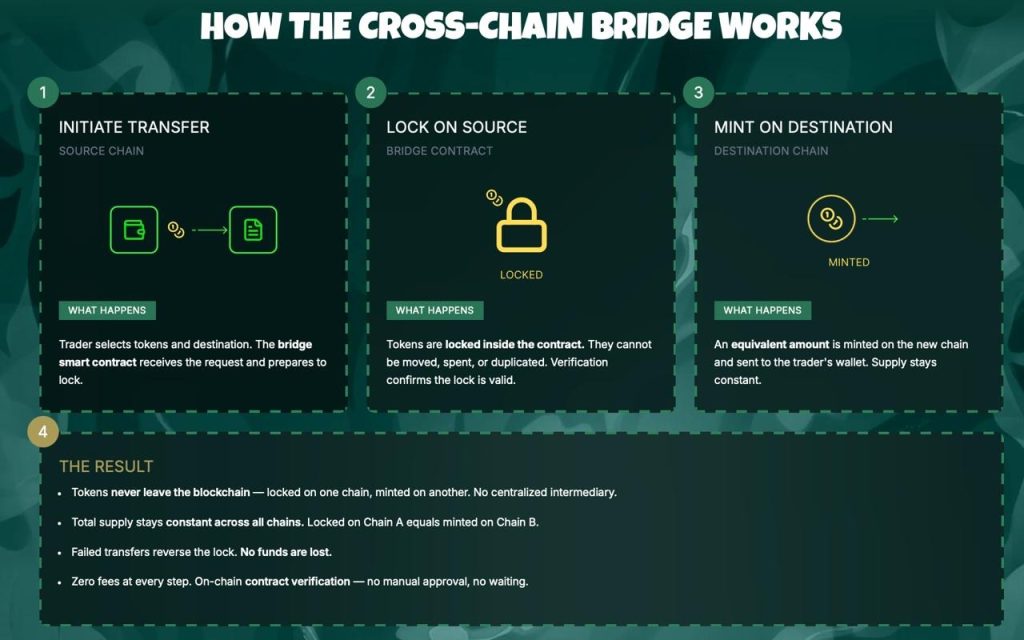
The bridge handles cross-chain transfers between Ethereum, BNB Chain, and Solana at zero cost. PepetoSwap runs every swap without fees so the entry you commit to is the entry you hold.
Over $8.92 million arrived at $0.0000001863 from wallets that checked the SolidProof audit and verified the founder behind Pepe’s $11 billion run before committing during Fear 14. Staking at 185% APY builds your position while the listing draws closer, but the Binance listing itself is the event that turns this entry into the returns analysts project. That return only goes to the wallets that acted while the entry was still open, and the listing can land at any moment.
Solana (SOL) trades at $85 on April 11, down 72% from its $293 high while active addresses fell 11% in 30 days, according to CoinMarketCap.
SOL ETFs posted three straight weeks of outflows totaling $17 million despite Japan’s regulatory boost. On-chain activity keeps fading, breaking the case that ETF inflows alone fix price. A break above $90 shifts the picture, but from $85 a double still takes months and billions that crypto in the last 24 hours shows are not arriving for altcoins.
BNB trades at $607 on April 11, the steadiest large cap in the crypto in the last 24 hours while the broader market digests Japan’s announcement, according to CoinMarketCap.
BNB benefits from exchange revenue and token burns, but an $88 billion cap means a 2x needs capital that took years to build the first time. For wallets that want returns counted in multiples, the gap between BNB’s ceiling and Pepeto’s confirmed listing is where this cycle’s real math lives.
While Solana (SOL) and BNB grind sideways, every crypto in the last 24 hours signal points to the same thing. Japan just told the world that crypto belongs in the same category as stocks and bonds, and the projects with live tools, audits, and confirmed listings are the ones that benefit first. Pepe went from nothing to a multi billion dollar cap with zero products, and the people who acted early still say they did not buy enough.
The same pattern forms around Pepeto now, and $8.92 million flowing during Fear 14 proves the wallets inside already calculated the outcome. The Pepeto official website is where smart capital commits right now, and the presale closes once the Binance listing goes live. You move on the signal or you carry the cost of waiting.
Click To Visit Pepeto Website To Enter The Presale

What does the crypto in the last 24 hours show after Japan reclassified crypto as financial instruments?
Japan treating crypto like stocks opens doors for ETFs and institutional capital. Pepeto has $8.92 million raised and a Binance listing approaching during Fear 14.
Can Solana or BNB deliver presale-level returns from current prices after Japan’s move?
SOL at $85 and BNB at $607 need years of capital inflows for a 2x. Pepeto at presale pricing delivers 100x from a single Binance listing.

The post Justin Sun Says Trump-Backed World Liberty Financial Built a Secret Backdoor to Steal Investor Tokens appeared first on Coinpedia Fintech News
Justin Sun says World Liberty Financial secretly built a backdoor into its smart contract that lets the company freeze or seize any token holder’s funds without warning, and he is demanding answers.
The Tron founder, who invested heavily in the Trump-backed DeFi project, published a lengthy public statement this week accusing WLFI of embedding a hidden blacklisting function that gives the company unilateral control over investor assets, directly contradicting its public promise of decentralisation.
“What was never disclosed to me or to any investor is that World Liberty embedded a backdoor blacklisting function in the smart contract used to deploy WLFI tokens,” Sun wrote. “This function gives the company unilateral power to freeze, restrict, and effectively confiscate the property rights of any token holder, without notice, without cause, and without recourse.”
He called it the opposite of decentralisation. “This is a trap door marketed as an open door.”
Sun said he invested in WLFI because he believed in its public vision of a decentralised finance platform that would remove intermediaries and bring DeFi to mainstream Americans. He described himself as an early and enthusiastic supporter of President Trump’s pro-crypto agenda.
His experience, he says, was very different from what was promised. Sun claims his WLFI wallet was frozen in 2025, making him what he describes as the first and single largest victim of the project’s alleged misconduct. He received no warning and no explanation.
He also accused the WLFI team of extracting fees from users, secretly controlling user assets without disclosure and treating the crypto community as a personal ATM. He dismissed the governance votes used to justify these actions as predetermined and non-transparent.
“These votes do not represent the will of the community. They represent the will of those who designed them,” he wrote.
The reaction to Sun’s statement was sharp and split.
Some sided with him, pointing to the broader pattern of alleged misconduct by politically connected crypto projects during the current administration. One commentator said that given the lineup of founders involved, nothing coming to light was surprising, and called for a thorough investigation into what they described as the most blatant extraction of money from everyday Americans by any administration in recent memory.
Sun is calling on WLFI to unlock his frozen tokens immediately, commit to transparency and stop what he describes as illegitimate control over investor assets. He framed his statement as a defence of basic blockchain principles rather than a personal grievance.
“Let’s build with integrity, not misconduct,” he wrote.
Whether WLFI responds publicly remains to be seen. The project has not addressed Sun’s accusations at time of publication.
The post Pi Network News: Why the PIRC 23.8% Floor Creates a Contradiction With Exchange Prices appeared first on Coinpedia Fintech News
A post from pioneer Daniel F is generating discussion in the Pi community, and the argument at the centre of it is more technically interesting than most of the price speculation that usually dominates the conversation.
The claim is interesting but the implications are uncomfortable for anyone trying to reconcile Pi’s DEX pricing with its centralised exchange activity.
Pi’s ecosystem includes PIRC tokens, which reportedly carry a design feature protecting holders from losing more than 23.8% of their initial listing value, measured in Pi. That floor is the starting point of Daniel’s argument.
If PIRC tokens cannot fall more than 23.8% relative to Pi, then Pi itself must behave with a certain degree of price stability to make that guarantee meaningful. A token whose floor is measured against a wildly volatile asset is not really floored at all. For the 23.8% protection to function as described, Pi’s liquidity would need to behave more like a stablecoin than a speculative asset.
“If they explain that PIRC tokens will never lose more than 23.8% of the initial value, they will have to admit that Pi liquidity acts like a stablecoin,” Daniel wrote. “This would contradict CEX prices. To avoid this paradox, they prefer to remain silent.”
The tension he is identifying is real. Pi trades on centralised exchanges at prices determined by speculative market activity, prices that have already seen significant volatility. Pi itself has dropped more than 90% from its peak by some measures.
If the DEX operates with a protected floor measured in Pi, and Pi is simultaneously trading as a volatile speculative asset on CEXs, then either the floor protection is weaker than it appears or the DEX pricing operates on fundamentally different logic than the exchange price.
One community member extended the arithmetic simply. “If PIRC tokens will never lose more than 23.8% of listing price measured in Pi, then at that time it is expected that Pi, the most liquid token, will react to the same ratio around 23.8%. Simple arithmetic.”
Daniel’s broader point is about transparency rather than price prediction. The technical architecture of Pi’s DEX and its relationship to exchange-listed Pi creates a logical tension that has not been publicly addressed. Speculators on centralised exchanges are operating on one price discovery mechanism. Pioneers participating in the DEX and Launchpad are operating on another.
“If someone tries to mislead you, ask them why the liquidity of tokens, which is in Pi, cannot fall if Pi is volatile,” he wrote.
The question is pointed and has not received a clean answer from the project. Whether that silence is strategic, technical or simply a matter of timing is something the community continues to debate.







United States Senator Cynthia Lummis said the country should not risk its financial future by further delaying the CLARITY Act.

Polymarket links briefly appeared under mainstream outlets in Google News results for event-driven queries but were later removed.



The Ethereum treasury firm aimed to launch a $1.5 billion yield-bearing ETH fund but will now halt its plans following the mutual decision to end the deal.

Bitcoin and Ether are each less than 10% away from price levels that could signal a potential reversal in the crypto market, according to a macro analyst.

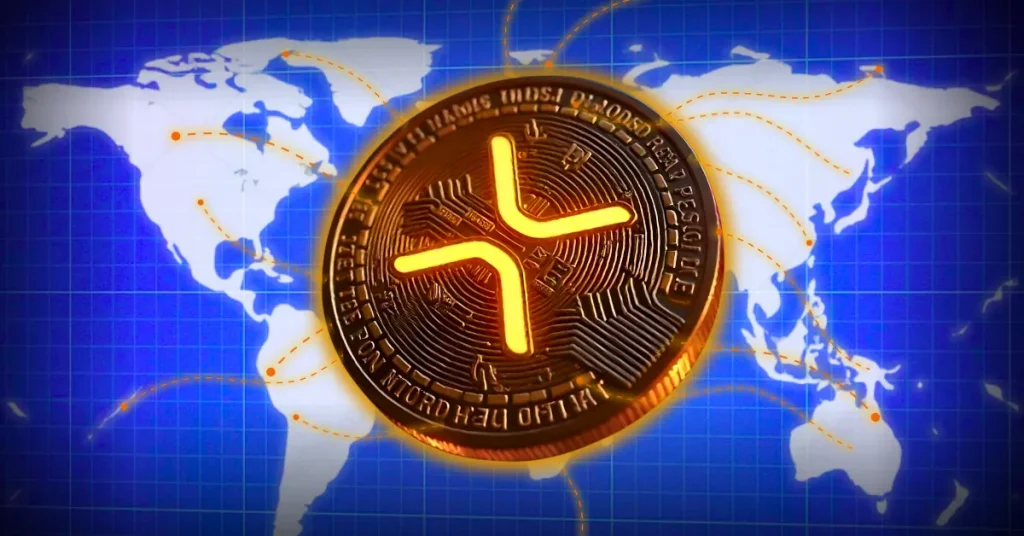
The post Why XRP Could Replace the Petrodollar? appeared first on Coinpedia Fintech News
The events unfolding in the Strait of Hormuz are not just a geopolitical story. According to analyst Mickle, they may be the moment the world learns it does not need the dollar to settle trade.
“What’s happening in the Strait is teaching all of these other countries how to transact in something other than the petrodollar,” Mickle said in a recent discussion. “If that starts to happen, we’re going to see more XRP, Ethereum and a handful of other tokens being used in some of these global settlements.”
The framework underpinning Mickle’s argument draws on Ray Dalio’s long-cycle economic theory, specifically the final stage of a reserve currency collapse where the flight is not from one currency to another but from currency itself.
For years, that final stage was assumed to involve the Chinese Yuan stepping into the dollar’s role. Mickle argues that the narrative has shifted. Even Dalio, historically a gold advocate, appears to have pivoted toward something broader. The question is no longer which nation’s currency dominates. It is whether any nation’s currency dominates at all.
“I think Ray Dalio has pivoted his thesis because that final stage is now a flight from currency itself,” Mickle said. “Digital assets create an off-ramp from the global centralised fiat currency and into decentralised neutral liquidity sources.”
Mickle was specific about what qualities matter when nations are looking for alternative settlement rails. Deep liquidity pools. International settlement capability. The ability to move value at speed. And neutrality, meaning no single government controls it.
“There’s only a handful of tokens that fall into that category and XRP is one of them,” he said. “That is exactly where an asset like XRP can be strategically positioned at a global level.”
Gold, he said, used to fill that neutral store of value role. But physical gold cannot settle 130 ships a day moving through a strait in real time. Digital assets can.
Mickle’s timeline is explicitly long term. Dedollarisation and deglobalisation are multi-decade trends in his view and the technology to enable them is only now being introduced at the moment those trends are accelerating.
“I think we’re just at the very start of a technology being introduced to allow that to happen,” he said. “This is the dominoes just beginning to fall.”
With the Strait of Hormuz closed, Iran demanding crypto tolls and direct US-Iran talks collapsing in Islamabad, the scenario Mickle describes is no longer theoretical. It is being stress-tested in real time.
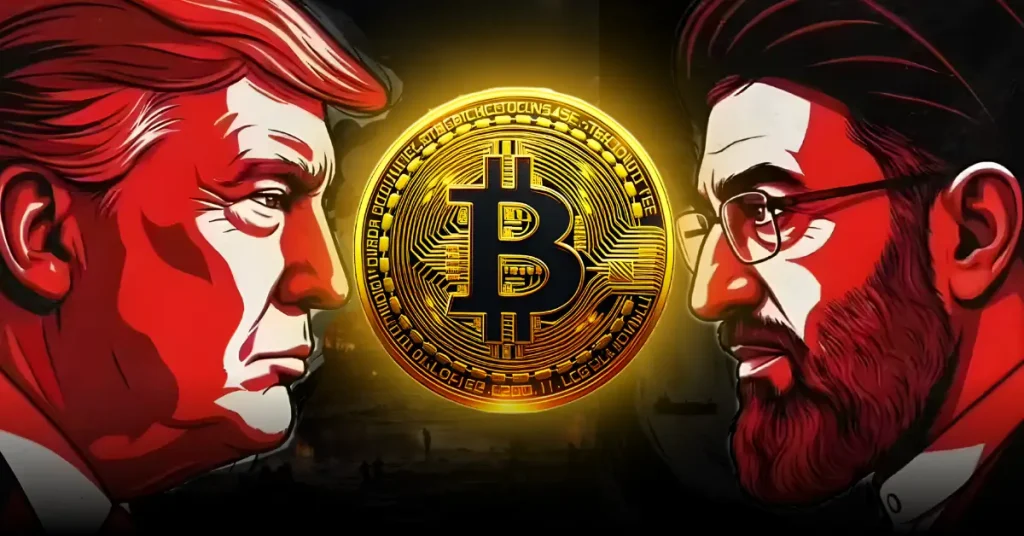
The post BREAKING: Bitcoin Drops Below $72,000 as Ethereum and XRP Slide After JD Vance Confirms Iran Deal Failure appeared first on Coinpedia Fintech News
Crypto markets slipped on Friday after Vice President JD Vance confirmed that direct US-Iran negotiations in Pakistan ended without an agreement, reviving fears of continued conflict and uncertainty in global markets.
Bitcoin dropped below $72,000, trading around $71,503 at time of writing, down 1.82% in 24 hours. Ethereum fell to $2,211, while XRP slipped to $1.32. The total crypto market cap sits at $2.43 trillion, down 1.54% on the day.
The talks represented a historic moment. It was the first direct face-to-face meeting between US and Iranian officials since the 1979 Islamic Revolution. They lasted 21 hours and produced nothing.
The negotiations collapsed on two core issues. Iran refused to give up uranium enrichment and refused to relinquish control of the Strait of Hormuz. Iran also arrived with four conditions of its own: full sovereignty over the Strait, complete war reparations, unconditional release of frozen assets and a regional ceasefire including Lebanon.
The US came in asking for free passage through Hormuz and a commitment that Iran would never build a nuclear weapon.
The two sides never found common ground.
Vance was direct after leaving Islamabad. “Iran has chosen not to accept our terms. That is bad news for Iran much more than it is for the United States,” he said, adding that the US had left its final and best offer on the table.
The Strait of Hormuz handles roughly 20% of global oil trade. A prolonged standoff keeping it closed adds sustained pressure to energy prices, inflation expectations and global growth forecasts. All three are headwinds for risk assets including crypto.
The Fear and Greed Index sits at 45, in neutral territory, suggesting markets have not yet fully priced in a worst-case scenario but are clearly not comfortable either.
With diplomatic talks now officially off the table and the US calling its last offer final, the path toward a negotiated resolution has narrowed significantly. Markets will now watch for whether military escalation resumes, whether a new diplomatic channel opens or whether a third party steps in to mediate.

Democratic lawmakers and crypto investors characterized crypto projects launched by or tied to Trump as scams and political corruption.

The October 2025 Bitcoin and altcoin crash may have ended the bull market, but its long-term impact on market health may have been overstated.

Bitcoin open interest hit five-week highs while funding rates mimicked the BTC price collapse below $60,000, leading analysis to predict a new short squeeze.

The comments followed recent reports that law enforcement officials retrieved deleted Signal messages through device push notification logs.

While some proponents believe AI will bring about an employment boom, so far its effect has been to dampen entry-level hiring while delivering mixed results on productivity.

Crypto’s transparent ledger makes sanctions evasion easier to trace, allowing authorities to track and potentially freeze illicit flows.

The post Will Chainlink Price Break Its Long Consolidation Phase? appeared first on Coinpedia Fintech News
Right now, Chainlink price is hovering in a well-defined range, with support sitting around $8 and resistance creeping higher toward $12–$15 zones. It’s not exciting on the surface. But markets rarely are before they move.
CMF has climbed back to 0, suggesting capital inflows are stabilizing. Not explosive, but definitely not bearish either. Meanwhile, the AO histogram has started improving slowly flipping sentiment from red to green. It’s subtle, but it matters.
And then there’s the MACD. A bullish crossover has already formed. That’s usually where things begin, not where they end.
RSI? Sitting just above 50 at 51.36. That’s the sweet spot. Not overbought, not weak but just enough strength to support a move higher if momentum follows through.
Now, before anyone gets carried away and LINK price structure still rules everything. Indicators can hint, but levels decide.
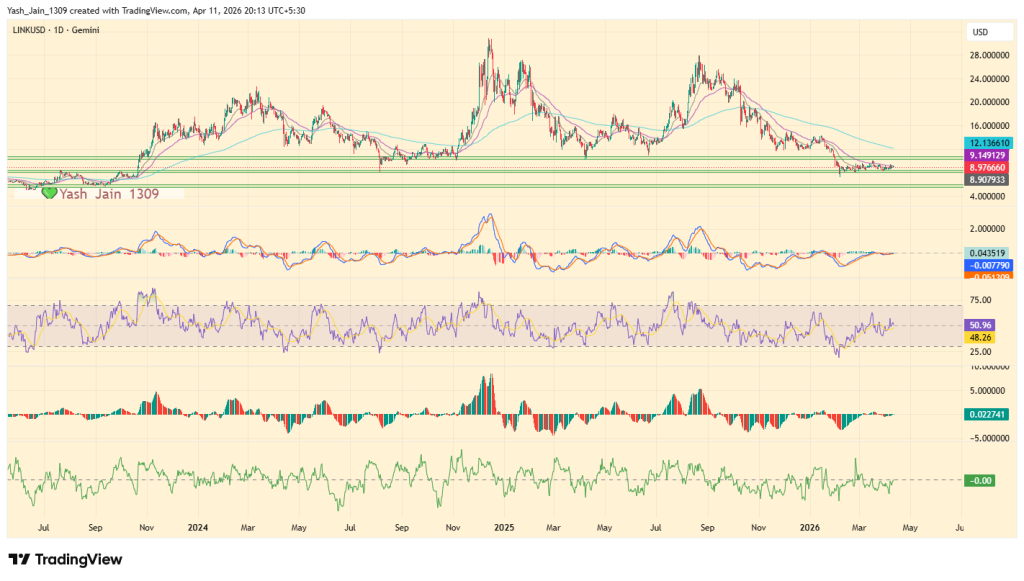
If bulls step in with conviction, the upside targets are pretty clear: first $15, then possibly a stretch toward $20. That’s where the real test begins.
But let’s be real this isn’t a one-way street. If that $8 support cracks, the downside opens fast. The next logical level sits around $5.50, and below that, things could get ugly quickly. No sugarcoating it.
So yeah, bullish signals are building… but they’re sitting on top of a fragile floor.
Here’s where things get interesting. While price is stuck in consolidation, the narrative around Chainlink isn’t.
There’s growing chatter about its massive ecosystem spanning everything from Web3 projects like Ondo to traditional finance rails like SWIFT, and even crypto infrastructure players like Coinbase.
Some crypto projects like flexing partnerships with big TradFi & F500 entities
— Kyren (@noBScrypto) April 9, 2026
And then there's $LINK
There quite literally isn't enough room to fit all their partners across TradFi & Web3 into a singular tweet.
From Web3 utility like Ondo,
To TradFi rails like SWIFT
To… pic.twitter.com/qHtFb2prOj
That’s not your typical “partnership announcement hype cycle.” It’s more like slow, steady integration. And honestly, that’s harder to price in.
While other projects flex one or two big names, Chainlink seems to have so many connections that listing them all in a single post isn’t even practical anymore. That kind of positioning doesn’t move markets overnight but it builds long-term relevance.
Well, Chainlink price is sitting at a decision point. The technicals are leaning bullish. The fundamentals look solid. The narrative is expanding. But none of that matters unless price actually breaks out of this range.
Until then, it’s just potential. A clean move above resistance could unlock that $15–$20 zone quickly. But if support fails, the market won’t hesitate to punish late bulls.
That’s the reality with Chainlink price right now compressed, coiled, and waiting.

The post Can RAVE Price Sustain Its 900% Price Explosion? appeared first on Coinpedia Fintech News
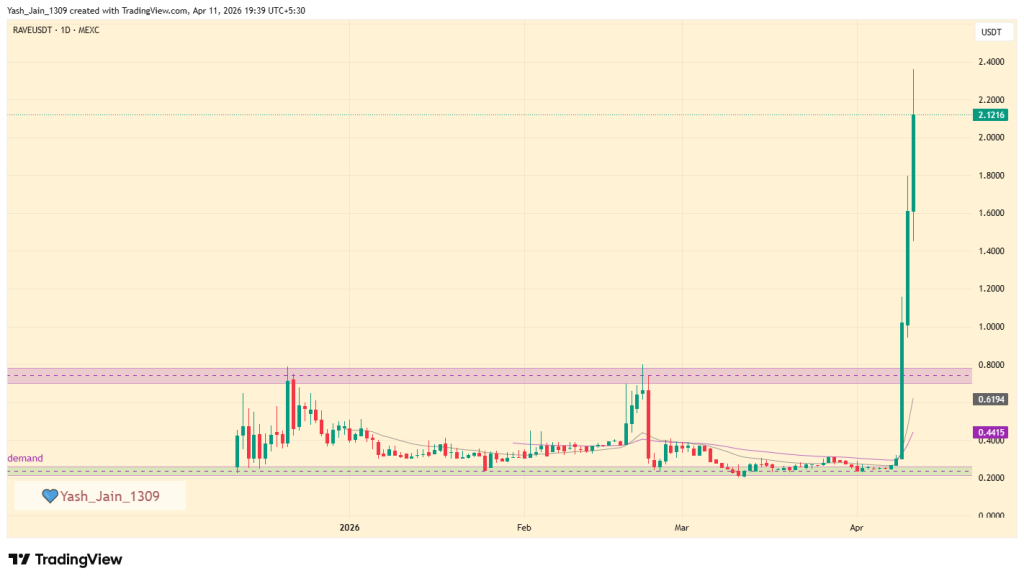
RAVE token analysis right now feels less like investing and more like watching a high-speed chase. The token exploded nearly 900% in early April 2026, ripping from $0.20 to a jaw-dropping $2.35. No slow grind, no healthy pullbacks which is just vertical chaos. Naturally, that kind of move drags in attention. But whether it’s opportunity or a setup… that’s where things get messy.
Let’s start with what actually powered this move because it wasn’t just spot buyers clicking “market buy.”
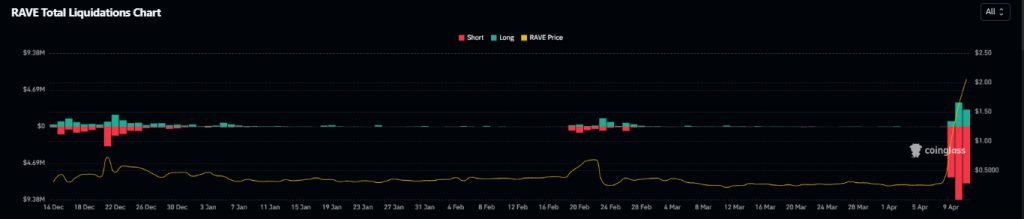
Open Interest surged aggressively, peaking near $250 million. That’s not retail curiosity that’s leveraged conviction. The kind that can move markets fast… and break them even faster.

And then came the liquidations. Shorts got absolutely steamrolled. The liquidation data shows a brutal cascade where forced buybacks became fuel for the next leg higher. Classic short squeeze mechanics. One side gets squeezed, price goes vertical, more shorts pile in thinking it’s overextended… and boom, rinse and repeat.
But this kind of rally is self-reinforcing, not self-sustaining.
Now, you’d expect some blockbuster announcement to justify a move like this, right? Something big. Something structural. Instead… you get a club event.
The biggest recent update tied to the project is a “Dim Sum Rave” event scheduled in Hong Kong on April 18. Sure, it’s sold out. Sure, it’s a cool brand play. But let’s be real, a party at a 100-year-old tea house doesn’t explain a multi-hundred-million-dollar valuation surge.
That disconnect? It’s not subtle. When price runs this hard without matching fundamentals, it usually means something else is driving the narrative and it’s rarely retail.
And this is where things get uncomfortable. Right as the rally kicked off, two wallets deposited 18.58 million RAVE tokens which worth around $40 million at peak into Bitget, per an x post. Timing like that doesn’t happen by accident.
Even more interesting? These wallets are linked to the token’s deployment address.
Historically, deployer-linked deposits during vertical rallies tend to signal one thing and that is an exit liquidity. Insiders quietly distributing into strength while retail chases momentum. It doesn’t crash immediately. It just… tops out.
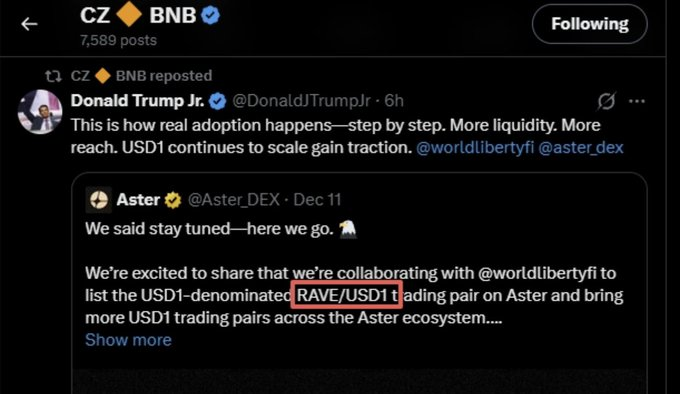
Then there’s the social layer. A retweet from late 2025 sparked speculation about a potential connection with Donald Trump Jr. No confirmed partnership, nothing concrete but in a risk-on market, even a loose association can ignite speculation.
And that’s exactly what happened. Traders aren’t always betting on reality but they’re betting on what might be real.
So, what’s next? If RAVE holds above $1.00 and somehow delivers actual Web3 partnerships beyond event marketing, maybe this madness stabilizes. But if not… well, this RAVE token analysis paints a familiar picture parabolic moves, insider flows, leveraged fuel. And those stories rarely end quietly.
The post Next Altcoin to 10x: Is It HYPE, LINK, ONDO or AVAX? appeared first on Coinpedia Fintech News
Bear markets are often where the next cycle’s winners get built. Most traders are watching Bitcoin and Iran headlines right now. But four altcoins are stacking institutional catalysts that the broader market has not priced in yet.
Here’s what you should know.
Hyperliquid surpassed Coinbase in notional trading volume in 2025, recording $2.6 trillion against Coinbase’s $1.4 trillion. Its protocol generated $14 million in fees in a single week in March – a 56% jump – with 97% of that revenue automatically used to buy back HYPE tokens daily.
Four major asset managers have now filed spot ETFs for HYPE: Grayscale, Bitwise, 21Shares, and VanEck. That is the first time four firms have raced simultaneously for a DeFi-native token ETF. JPMorgan published a research note on Hyperliquid’s oil trading surge in March. S&P Dow Jones Indices officially licensed the S&P 500 for perpetual contracts on the platform – the first officially licensed S&P 500 derivative on any blockchain.
BitMEX co-founder Arthur Hayes set a $150 price target for HYPE by August 2026, calling it his fund’s largest non-Bitcoin position.
HYPE currently trades near $42.
Chainlink secures over $28 trillion in total value across more than 15 blockchains. Its Cross-Chain Interoperability Protocol processes $18 billion per month, growing 62% quarter over quarter. JPMorgan and UBS are running live blockchain settlement tests through CCIP. The Bitwise LINK ETF launched on NYSE Arca, opening LINK to 401(k) and IRA accounts for the first time.
Standard Chartered has set a $25-$45 price target. LINK currently trades near $9.
The gap between what the network does and what the token costs is the story.
Binance partnered with Ondo Finance to relaunch tokenised US stocks and ETFs – the exchange’s first such offering since 2021. Ondo holds 58% market share in tokenised stocks. TVL hit a record $2.52 billion in February 2026.
Franklin Templeton’s $1.7 trillion asset management operation has partnered with the platform. ONDO currently trades near $0.25.
BlackRock is actively tokenising assets on Avalanche. RWA total value locked on the network reached $1.3 billion, doubling since April 2025. VanEck launched the first US spot AVAX ETF in January 2026, including staking rewards. AVAX trades near $9.2.
As one analyst put it: “BlackRock doesn’t tokenize on untrusted chains. If the ETF gains traction, $55 is realistic – but patience is required.“
Which token will rally first and the highest? The market will tell, but the catalysts are live today.
The post Solana (SOL) Price Prediction 2026, 2027-2030: Technical Outlook and Long-Term Forecast appeared first on Coinpedia Fintech News
Solana is a high-performance blockchain platform designed to host decentralized applications and power global internet capital markets. It distinguishes itself through a unique architecture that combines Proof of Stake with a “Proof of History” mechanism, allowing the network to process thousands of transactions per second with near-instant finality and minimal fees. This scalability makes it a preferred choice for developers building everything from decentralized finance (DeFi) protocols to massive consumer applications and stablecoin payment systems.
The native SOL token is the lifeblood of this ecosystem, used to pay for transaction fees, deploy smart contracts, and secure the network through staking. As adoption grows among major financial institutions, many enthusiasts are left wondering about the future value of the asset.
Questions regarding whether SOL price can realistically reach $1,000, or how it will maintain stability in longterm, remain central to the community’s curiosity. In this deep dive, we explore these burning questions and more.
| Cryptocurrency | Solana |
| Token | SOL |
| Price | $81.5555
 -3.31% -3.31%
|
| Market Cap | $ 46,855,385,604.27 |
| 24h Volume | $ 4,092,471,251.3458 |
| Circulating Supply | 574,521,437.7746 |
| Total Supply | 624,255,207.2218 |
| All-Time High | $ 294.3349 on 19 January 2025 |
| All-Time Low | $ 0.5052 on 11 May 2020 |
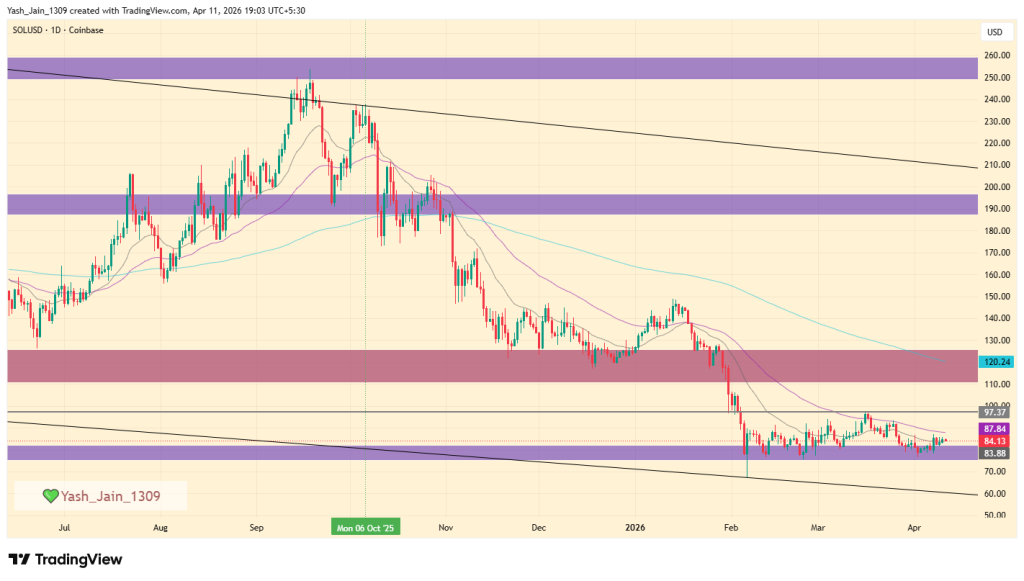
– SOL price trended downward into the first quarter. Dropped below $120 in January, then reached $67-$70 in early February but since then its price has since stabilized in March.
– Right now, Immediate resistance level now at $97. Breaking the $97 threshold could lead to a retest of $110 in April. But, Losing $80 support could drop the price to $60.
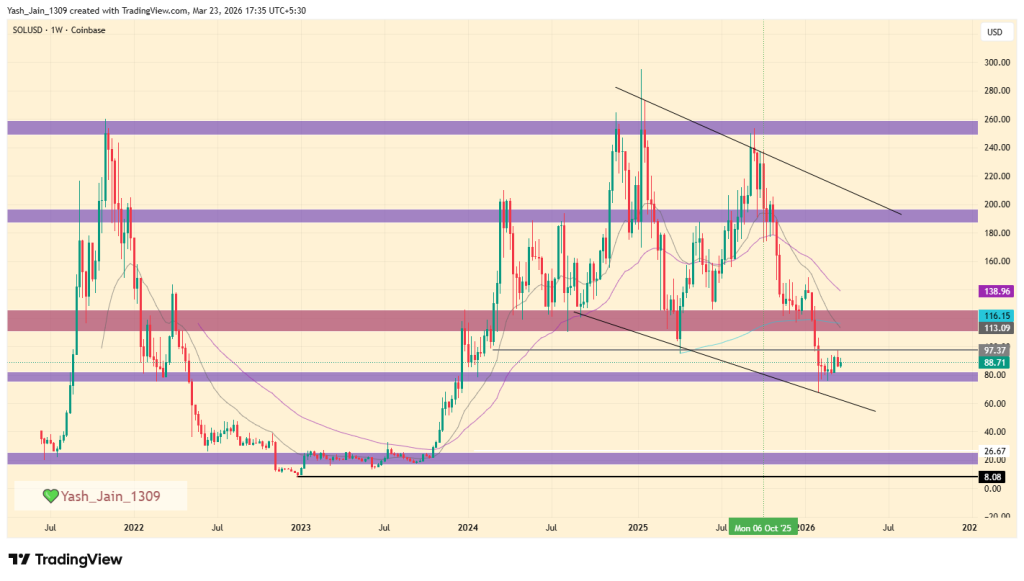
The weekly chart for Solana price (SOL) reveals a historical pattern of significant price surges followed by prolonged corrective phases. After a major spike in late 2021, the asset entered a multi-month downtrend that eventually found a bottom near the $8 mark.
A similar narrative played out in early 2025 as the price surged toward new highs, only to enter the current broader downtrend. This recent decline has been characterized by a falling wedge pattern, where the price action has consistently respected the converging trendlines, signaling a period of heavy consolidation.
Throughout early 2026, this downward trajectory extended until it tested the lower boundary of the wedge in January. However, a short-term recovery has since materialized, successfully reclaiming the $80 support level.
For a sustained bullish reversal, the price must first overcome the immediate resistance at $97, which would open the door for a move toward $116. If these levels are flipped into support, the next primary target lies within the $180 to $200 range, aligning with the upper border of the falling wedge.
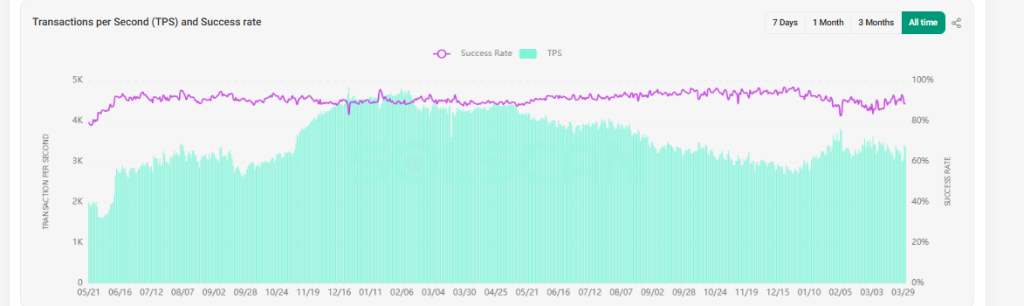
Solana’s on-chain data confirms a remarkably resilient ecosystem. Despite a dip in late 2025, the network maintained a steady success rate above 80%.
By Q1 2026, Solana demonstrated its strength as TPS climbed back above 3,000. This recovery, paired with high success rates, highlights a robust infrastructure capable of sustaining high-speed performance even under pressure.
Moreover, The Solana ecosystem continues to see intense activity, with protocol rankings over the last 30 days highlighting the dominant fee-generating platforms. Leading the charge is Pump.fun, which recorded a staggering $70 million in fees, underscoring its massive role in the current market cycle.
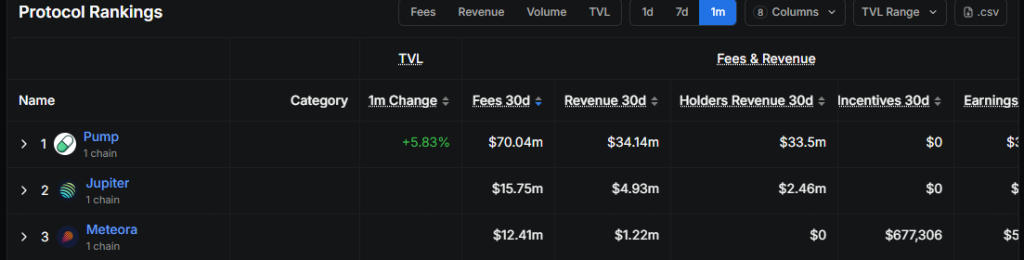
This surge in fee generation is followed closely by Jupiter and Meteora, both of which remain cornerstone protocols for liquidity and trading on the network. Together, these three platforms represent the primary engines of on-chain value capture within the Solana ecosystem.
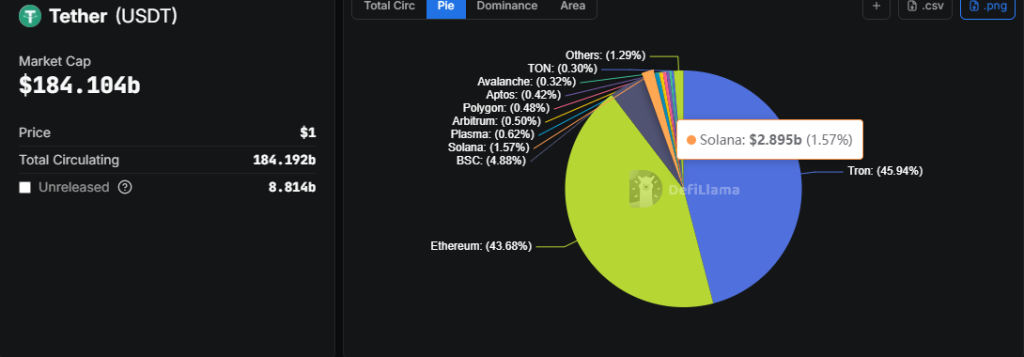
Additionally, Solana’s role as a primary hub for liquidity is further evidenced by its growing share of the stablecoin market. Tether (USDT) on the network currently accounts for 1.59% of the total $184.192 billion circulating supply.
This upward trend marks a significant expansion from the 1.15% dominance recorded in January 2026. For a Layer 1 platform, this increasing stablecoin concentration is a vital health indicator, signaling deepening liquidity and a more robust foundation for decentralized finance activities.
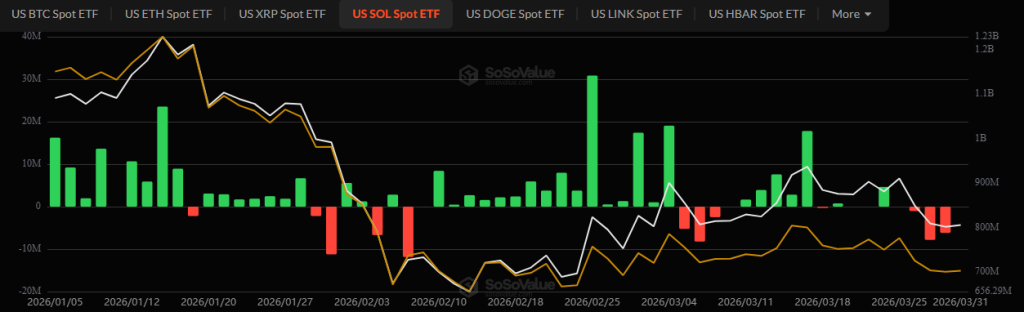
By the end of Q1 2026, the U.S. spot Solana ETF market has around eight sponsoring firms, with the Bitwise BSOL product on the NYSE emerging as the largest holder. These ETFs are distributed across major exchanges, including some on the NYSE, some on NASDAQ, and some on CBOE. Currently, these sponsors hold a combined $805.84 million in net assets, representing approximately 1.69% of Solana’s total market capitalization.
While cumulative net inflows since listing have reached a significant $979.37 million, recent momentum has shifted. After maintaining steady growth through February 2026, inflows began to stall in March. This cooling period culminated in the final week of the quarter, which recorded notable net outflows, reflecting a cautious shift in institutional sentiment.
| Year | Potential Low ($) | Potential Average ($ | Potential High ($) |
| 2027 | 180 | 320 | 600 |
| 2028 | 300 | 420 | 720 |
| 2029 | 500 | 750 | 1000 |
| 2030 | 880 | 1200 | 1400 |
As per the Solana Price Prediction 2027, Solana may see a potential low price of $180. The potential high for Solana price in 2027 is estimated to reach $600.
In 2028, Solana price is forecasted to potentially reach a low price of $300 and a high price of $720.
Thereafter, the Solana (Solana) price for the year 2029 could range between $500 and $1000.
Finally, in 2030, the price of Solana is predicted to maintain a steady positive. It may trade between $880 and $1400.
The long-term projection assumes Solana sustains relevance in enterprise blockchain use cases, with growth moderating over time as the asset matures.
| Year | Potential Low ($) | Potential Average ($) | Potential High ($) |
| 2031 | 1200 | 1500 | 1800 |
| 2032 | 1600 | 2000 | 2300 |
| 2033 | 1900 | 2400 | 3000 |
| 2040 | 3200 | 4800 | 5000 |
| 2050 | 5500 | 7500 | 10000 |
| Year | 2026 | 2027 | 2030 |
| Changelly | $220.00 | $350 | $500 |
| CoinCodex | $350.00 | $400 | $600 |
| WalletInvestor | $300.00 | $450 | $550 |
Stay ahead with breaking news, expert analysis, and real-time updates on the latest trends in Bitcoin, altcoins, DeFi, NFTs, and more.
SOL could trade between $75 and $200 in 2026, depending on adoption, market trends, and broader crypto infrastructure growth.
By 2030, SOL could trade between $880 and $1,400, with an average around $1,170 if adoption and market growth continue.
Solana may reach $2,000–$4,800 by 2040, depending on blockchain adoption, network upgrades, and macroeconomic factors.
By 2050, SOL could range from $5,500 to $10,000 if long-term enterprise use and Web3 adoption remain strong.
SOL price is shaped by blockchain adoption, DeFi activity, network upgrades, investor confidence, and overall crypto market trends.

The post Ice Open Network Updates ION as $ION Drops appeared first on Coinpedia Fintech News
Ice Open Network released a public repository showing real code progress for its AI-powered ecosystem, including the ION dApp Framework and the Online+ app frontend and backend, aiming to show real development amid growing market concern. The ION token has seen sharp price drops recently, with heavy selling and exchange volatility driving declines rather than new minting. Circulating supply remains high at around 11.36 billion tokens. The team says whales and bridging are behind recent moves and plans to buybacks and burns with partners to support confidence.

The post Venice Token (VVV) Price Surge Sparks Breakout Hopes: New Highs Just Ahead? appeared first on Coinpedia Fintech News
VVV price is heating up again, jumping nearly 8% today to trade around $8.40 as buyers return aggressively. After months of quiet recovery, the Venice (VVV) token is now pushing into a key breakout zone that has previously capped rallies. The shift is catching trader attention fast. VVV price has been climbing steadily throughout 2026, but this move is different, it’s now testing resistance where momentum either accelerates or stalls.
At the same time, market positioning is turning bullish, with pressure building just above current levels. If VVV price clears the $9–$10 zone, the move could quickly extend toward higher targets, and potentially a retest of the $22 all-time high.
Derivatives data is now reinforcing the bullish setup behind VVV’s rally. The long/short ratio has moved firmly above 1, indicating that traders are increasingly positioning for further upside rather than fading the move.
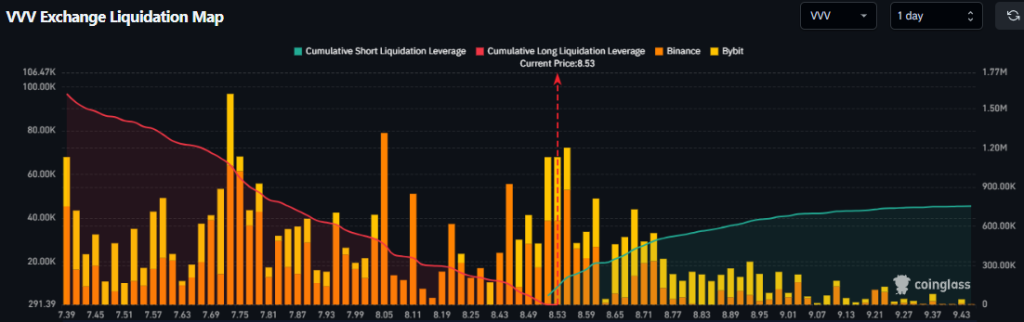
At the same time, liquidation data shows a heavy concentration of short positions sitting just above the current price, particularly around the $9–$10 resistance zone. This creates a high-probability scenario where a breakout could trigger forced liquidations, accelerating the move through a short squeeze.
On the downside, liquidation pressure remains relatively limited, suggesting reduced risk of aggressive long unwinding unless key supports fail. This imbalance highlights one key dynamic, the market is leaning bullish, and liquidity is stacked in a way that favors upside continuation.
VVV’s current move is part of a broader structural recovery that began after a significant correction phase in 2025. Since early 2026, the token has been trending higher within a well-defined rising channel, indicating sustained accumulation and controlled upside. VVV price is now trading near $8.40, approaching the upper boundary of this structure. The immediate resistance lies in the $9–$10 zone, which acts as the breakout trigger for continuation.
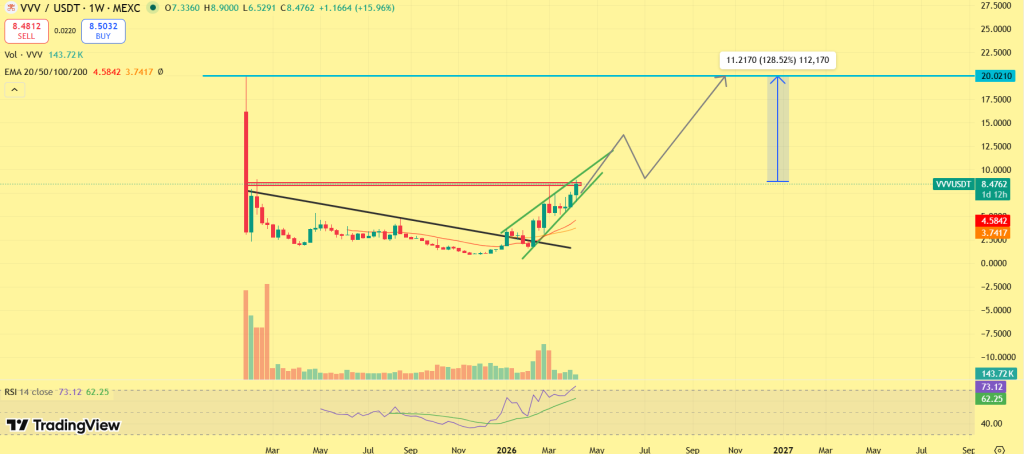
A successful move above this level could accelerate price toward $12, followed by $15–$17 as the next expansion targets. More importantly, the broader trend suggests a larger objective. If the current channel holds and momentum sustains, VVV could extend its rally toward a retest of the previous all-time high near $22. On the downside, the $7.20–$7.50 range remains key support, maintaining the bullish structure. As long as this level holds, the trend continuation scenario remains intact.
VVV is now at a decisive point where structure, positioning, and momentum are all aligning near resistance. A confirmed breakout above $10 could trigger a fast expansion phase, driven by both technical continuation and liquidation flows. However, failure to break this level may result in short-term consolidation before the next attempt.
The post Sei (SEI) Price Prediction 2026, 2027-2030: Will the Sei Giga Upgrade Trigger a Bullish Breakout? appeared first on Coinpedia Fintech News
Originally recognized as the first sector-specific Layer 1 blockchain, Sei has evolved into a powerhouse of parallelized execution. While its initial mission focused on optimizing decentralized exchanges (DEXs), the 2024-2025 “V2” upgrade transformed Sei into the Parallelized EVM. This pivot allowed the network to combine the vast developer ecosystem of Ethereum with the blazing-fast performance typically reserved for non-EVM chains like Solana.
As we move through 2026, the network is undergoing its most ambitious technical overhaul yet: the Sei Giga upgrade. By implementing the “Autobahn” consensus and asynchronous execution, Sei aims to support over 200,000 transactions per second with sub-400ms finality. From institutional real-world asset (RWA) tokenization to high-frequency gaming and AI-agent economies.
Planning on investing in this crypto project but concerned about its prospects? Fear not and scroll down, as in this article, we have uncovered the market trends of SEI price prediction from 2026 up until 2032.
| Cryptocurrency | Sei |
| Token | SEI |
| Price | $0.0555
-1.33%
|
| Market Cap | $ 380,296,877.27 |
| 24h Volume | $ 27,077,798.8176 |
| Circulating Supply | 6,854,444,444.00 |
| Total Supply | 10,000,000,000.00 |
| All-Time High | $ 1.1417 on 16 March 2024 |
| All-Time Low | $ 0.0080 on 15 August 2023 |
As the first quarter concluded on a bearish note, and now investors are hoping for the opportunities of April in the second quarter, it is important to reflect on recent trends.
The first quarter has extended the downturn from 2025 into 2026, with the January-to-March period exhibiting persistent challenges. Notably, the SEI price dipped below the $0.100 threshold, highlighting a continued bearish trend, and by March, it reached a low of $0.050.
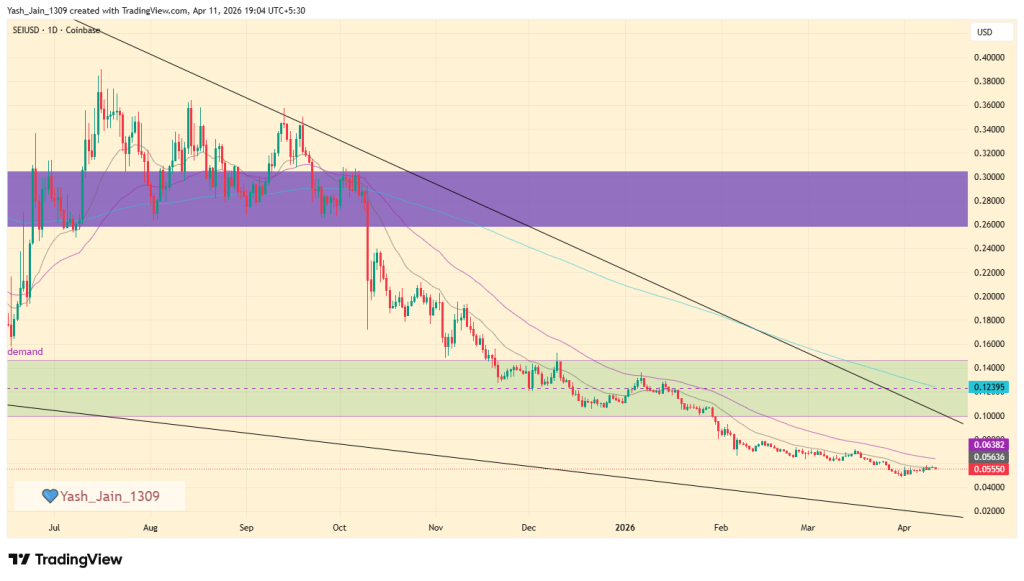
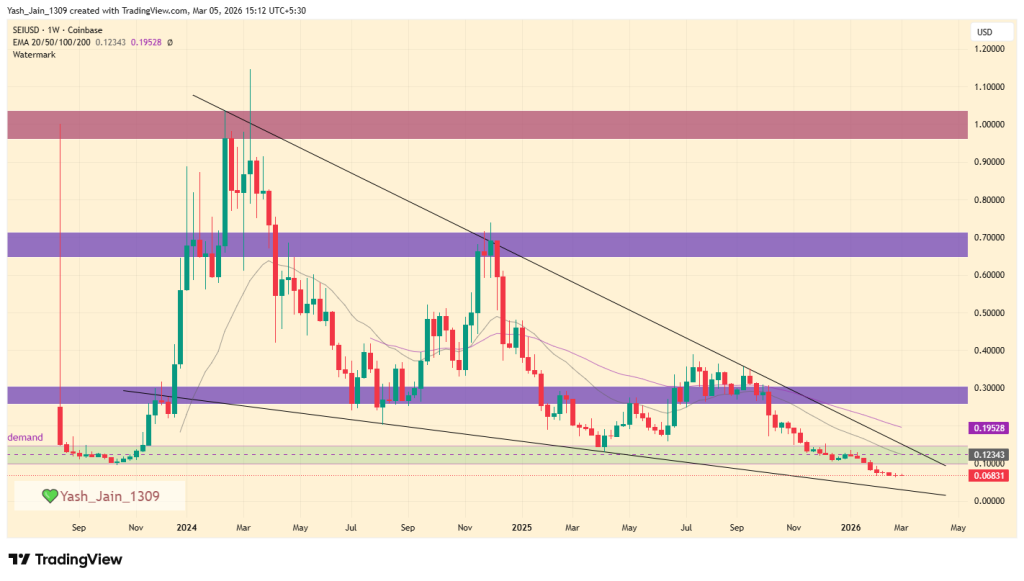
The technical outlook for Sei (SEI) in 2026 reflects a challenging macroeconomic trend defined by a persistent descending structure. Looking back at the weekly chart, 2024 was marked by two significant but ultimately capped rallies: an explosive surge to the $1.00 mark in the early months, followed by a secondary peak near $0.70 late in the year 2024. Both movements highlighted intense bearish pressure, as sellers consistently utilized these rallies to exit positions, effectively constraining the price within a tightening range.
This market structure deteriorated further in 2025 when the SEI price failed to hold the critical $0.30 demand zone. The breakdown confirmed that the SEI asset had abandoned traditional horizontal support levels and is favoring a massive falling wedge pattern.
This technical formation has been dictated by three clear resistance touches, the most recent occurring in September 2025. While analysts initially hoped the early 2023 demand floor would exhaust the selling pressure, the first quarter of 2026 saw a continuation of the slide, with the price slipping beneath the psychological $0.10 support area.
Current price action suggests that the SEI price is now gravitating toward the lower boundary of the falling wedge. This decline is expected to persist through mid-2026 until the price meets the primary demand area situated around the $0.020 mark. This level represents a deep value zone where selling exhaustion is highly probable.
If buyers successfully defend this floor, the resulting spike in demand could ignite a trend reversal, potentially driving the SEI token price back toward the $0.10 and $0.20 levels. Under a highly bullish recovery scenario, a retest of the $0.30 breakdown point remains a possibility before the year concludes.
| Year | Minimum Price ($) | Maximum Price ($) | Average Price ($) |
| 2027 | 0.2450 | 0.2940 | 0.2500 |
| 2028 | 0.3550 | 0.4260 | 0.3650 |
| 2029 | 0.5240 | 0.6190 | 0.5350 |
| 2030 | 0.7850 | 0.9050 | 0.8060 |
| 2031 | 0.8900 | 1.1000 | 0.9950 |
| 2032 | 1.2600 | 1.4500 | 1.3210 |
The SEI price forecast maintains an upward climb throughout 2027. Market analysts project the SEI token will fluctuate between $0.2450 and $0.2940, centering on an annual average SEI/USD price of $0.2500.
Growth is expected to accelerate in 2028 as ecosystem maturity attracts deeper liquidity. SEI crypto price is projected to trade within a bullish corridor of $0.3550 to $0.4260, maintaining a robust year-round average of $0.3650.
By 2029, SEI token’s price movements are anticipated to reach a significant peak of $0.6190. On the lower end, strong support is expected at $0.5240, leading to a projected average trading cost of $0.5350.
Entering the new decade, SEI Crypto’s valuation is expected to be driven by global market recognition. Projections suggest a price range of $0.7850 to $0.9050, with an expected average price of $0.8060.
The bullish momentum continues into 2031, with the high target set at $1.1000. While retracements may dip toward $0.8900, the overall market equilibrium is expected to sit near $0.9950.
Based on current expert modeling, 2032 represents a major milestone for the token. SEI is estimated to range between $1.2600 and $1.4500, with an average valuation of $1.3210.
Stay ahead with breaking news, expert analysis, and real-time updates on the latest trends in Bitcoin, altcoins, DeFi, NFTs, and more.
SEI may drop toward $0.020 before recovering. If demand returns, it could rebound to $0.10–$0.20, with a bullish case targeting $0.30 by year-end.
By 2030, SEI could reach between $0.7850 and $0.9050, with further upside possible if ecosystem growth and adoption accelerate
By 2040, SEI could exceed $2–$3 if long-term adoption, scalability, and real-world use cases expand, though such projections remain speculative.
SEI shows long-term potential due to its high-speed infrastructure and upgrades, but it remains a high-risk asset dependent on adoption and market trends.



The post Arweave (AR) Price Prediction 2026, 2027-2030: Can AR Rally to $15 This Year? appeared first on Coinpedia Fintech News
Arweave (AR) has entered 2026 in a technically compressed structure, where price action reflects patience rather than momentum, yet beneath the surface, both structural positioning and long-term narrative strength suggest that the consolidation phase could be laying the groundwork for a broader expansion cycle. As a decentralized permanent storage protocol, Arweave continues to anchor itself within Web3 infrastructure conversations, and historically, infrastructure-layer tokens tend to move aggressively once liquidity rotates back into high-conviction assets.
Technically, AR has been trading inside a well-defined descending channel on the higher timeframe, forming consistent lower highs while defending macro support zones, which typically indicates controlled distribution transitioning toward accumulation. With three months of 2026 already completed, the market is now evaluating whether this compression resolves into a breakout phase capable of pushing AR toward the projected $15 mark by year-end.
| Cryptocurrency | Arweave |
| Token | AR |
| Price | $1.7348
 1.18% 1.18%
|
| Market Cap | $ 113,891,723.97 |
| 24h Volume | $ 17,837,100.2223 |
| Circulating Supply | 65,652,466.00 |
| Total Supply | 65,652,466.00 |
| All-Time High | $ 90.9400 on 05 November 2021 |
| All-Time Low | $ 0.4854 on 27 May 2020 |
Arweave enters April within a tightening range, where price is holding steady after a prolonged decline. This shift indicates that the market is moving away from aggressive selling into a more balanced structure. The immediate resistance lies near the $2.20–$2.50 zone, which has previously acted as a rejection area. A breakout above this level would confirm the return of demand and shift short-term momentum.
Beyond this, the next expansion zone becomes visible. If this breakout sustains, AR in April could advance toward the $3–$4 range, driven by renewed positioning and short-term momentum flows. However, if resistance continues to hold, price may remain within its current range, delaying the move higher.
Arweave’s broader outlook for 2026 depends on whether the current stabilization phase evolves into a sustained recovery cycle. The coin has undergone a prolonged corrective phase, forming a compression structure near its lower range. This stage typically represents accumulation, where selling pressure is gradually absorbed and the token prepares for expansion.
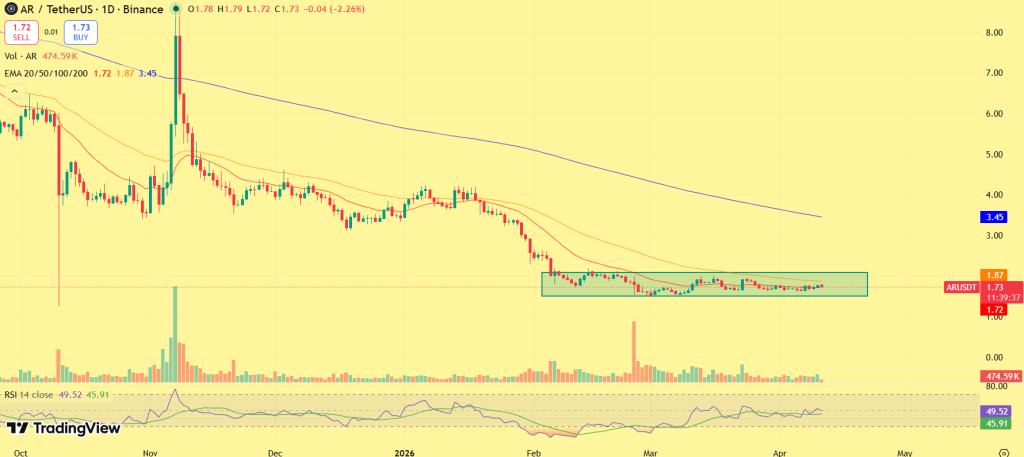
The recovery path requires reclaiming key resistance levels in sequence. The initial shift begins above $2.50–$3.00, followed by stronger confirmation near $4–$6. These levels act as structural checkpoints where momentum begins to build. Once these zones are cleared, price behaviour tends to accelerate as the asset transitions into a higher trading range.
Under a sustained breakout scenario, AR could move toward the $6–$15 range in 2026, reflecting a full recovery cycle driven by structural expansion. However, until these levels are reclaimed, the token remains in a rebuilding phase, where consolidation may persist before a breakout occurs.
| Year | Potential Low ($) | Potential Average ($ | Potential High ($) |
| 2026 | 4.00 | 9.50 | 15.00 |
| 2027 | 10.50 | 18.00 | 26.00 |
| 2028 | 18.00 | 32.00 | 45.00 |
| 2029 | 30.00 | 55.00 | 65.00 |
| 2030 | 40.00 | 60.00 | 80.00 |
In 2026, the Arweave price could project a low price of $1.00, an average price of $4.00, and a high of $15.00.
As per the Arweave Price Prediction 2027, Arweave may see a potential low price of $10.50. The potential high for Arweave price in 2027 is estimated to reach $26.00.
In 2028, Arweave price is forecasted to potentially reach a low price of $18.00 and a high price of $45.00.
Thereafter, the Arweave (Arweave) price for the year 2029 could range between $30.00 and $65.00.
Finally, in 2030, the price of Arweave is predicted to remain steadily positive. It may trade between $40.00 and $80.00.
The long-term projection assumes Arweave sustains relevance in enterprise blockchain use cases, with growth moderating over time as the asset matures.
| Year | Potential Low ($) | Potential Average ($) | Potential High ($) |
| 2031 | 55.00 | 85.00 | 110.00 |
| 2032 | 75.00 | 110.00 | 140.00 |
| 2033 | 90.00 | 130.00 | 165.00 |
| 2040 | 390.00 | 560.00 | 650.00 |
| 2050 | 1900.00 | 2500.00 | 2700.00 |
| Year | 2026 | 2027 | 2030 |
| Changelly | $13.20 | $25 | $78 |
| CoinCodex | $12.00 | $22 | $70 |
| WalletInvestor | $15.00 | $28 | $80 |
Stay ahead with breaking news, expert analysis, and real-time updates on the latest trends in Bitcoin, altcoins, DeFi, NFTs, and more.
Arweave could trade between $4 and $15 in 2026 if it breaks $7 resistance with strong volume and holds key support above $1.50 weekly.
Arweave could trade between $10.50 and $26 in 2027 if bullish momentum continues and key resistance levels flip into support.
By 2030, AR (often searched as AWR) may range between $40 and $80, driven by Web3 growth and sustained market expansion.
If adoption accelerates and enterprise use expands, Arweave could potentially reach $650 by 2040 in a strong macro cycle.
Arweave has long-term potential due to permanent storage utility, but price depends on adoption, liquidity, and market cycles.
The post Bitcoin Weekly MACD Turns Bullish — Why This Doesn’t Confirm a Market Bottom Yet appeared first on Coinpedia Fintech News
Bitcoin price has been rising in the past few days, despite the higher CPI rates, marking a local high at $73,400. With this, the price has surged above a crucial resistance zone, which may validate a rise above the bearish influence. However, the historical data show that the current trade setup does not confirm a market bottom and can appear during the ongoing downtrends.
In the previous rallies, the current trade setup resulted in a significant pullback for two consecutive times. This highlights the possibility of early momentum shifts, which often act as temporary relief signals rather than true reversals. Now the question arises whether the BTC price will repeat its previous pattern and slash hard by more than 30% or transform the current reversal into a sustained upswing.
The Bitcoin price has entered a pivotal resistance zone between $70,972 and $74,585, which hints towards a bullish reversal. However, the historical price action suggests the price has not bottomed yet. Therefore, if the pattern repeats, the BTC price may slash hard below $50,000 or may go lower too.
Bitcoin is trying to stabalise after a sharp correction, and the current MACD is turning positive with the momentum improving. But here’s a major catch.
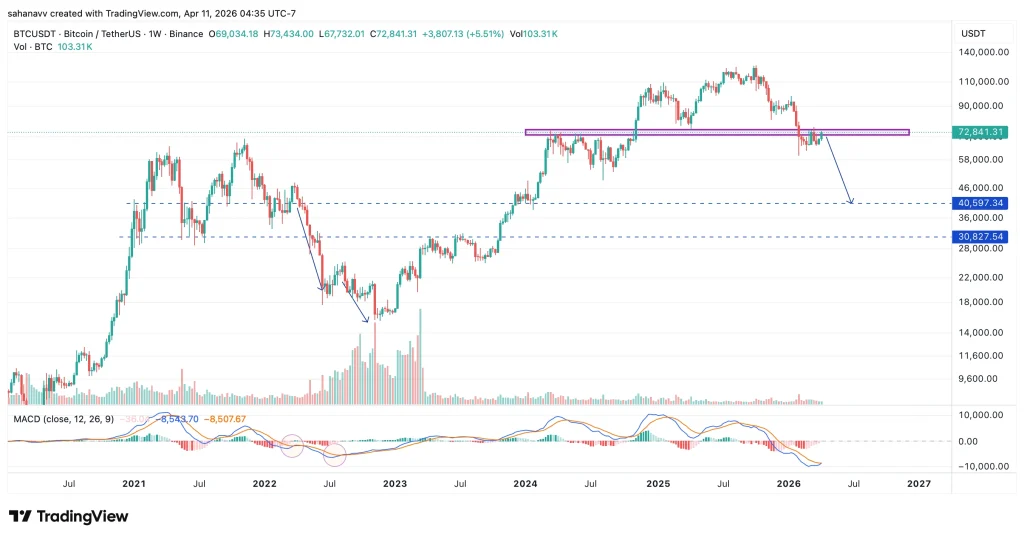
Currently, the BTC price is trading below prior major highs, lacking a clear higher high and low structure, and showing signs of consolidation rather than expansion. As seen in the above chat, the weekly MACD is showing signs of a bullish crossover in the times when Bitcoin is in a bear market. This indicator could hint towards a reversal, while previously, during the 2022 bear markets, the price experienced 2 corrections of 60% and 40%.
Therefore, if the price holds the current range and builds higher lows, it may lead to a gradual trend reversal. Or in the bearish case, if Bitcoin sees another leg down or extended consolidation, a final bottom may form after a liquidity sweep.
Bitcoin’s weekly MACD turning bullish signals a shift in momentum, but not a confirmed trend reversal. As history shows, these signals can appear before the actual bottom, making price action the only reliable confirmation.
Currently, the BTC price is trading in a decisive phase, where a rise beyond $85,000 could be possible if it holds the range between $75,000 and $78,000. Failure to break the resistance could trigger a breakdown below $60,000, which may extend to $50,000 as well.
However, the real signal is the Bitcoin price structure, not just the momentum.




WLFI fell to a record low after it was revealed that the project used billions of its own tokens as collateral to borrow $75 million in stablecoins.
The post XRP Price Outlook: Will SEC Clarity Act Talks Trigger a Rally? appeared first on Coinpedia Fintech News
XRP price is holding firm near $1.30 level as markets turn increasingly attentive to the upcoming SEC Clarity Act roundtable on April 16, a regulatory event that could redefine sentiment across the asset.
XRP coin has shown relative resilience in recent sessions, stabilizing above crucial levels even as broader uncertainty around U.S. crypto policy persists. Market participants are now closely watching the roundtable, which is expected to address digital asset classification, a long-standing overhang for XRP. At the same time, improving macro conditions and easing geopolitical tensions have lifted overall risk appetite, allowing XRP to maintain its footing while positioning for a potential directional move.
With regulatory clarity emerging as a pivotal catalyst, XRP price now sits at a critical juncture, where sentiment, structure, and policy expectations are beginning to converge.
The SEC’s Clarity Act roundtable on April 16 is drawing increased attention, with discussions expected to focus on how digital assets are classified under U.S. law, a key issue that has long influenced XRP’s market sentiment. Recent regulatory signals have pointed toward a shift, with major cryptocurrencies increasingly viewed under a commodity-like framework. This evolving stance has helped reduce uncertainty, placing XRP in a more defined regulatory context.
The SEC is hosting a roundtable on April 16 to discuss listed options market structure. The event will be in-person and live-streamed on https://t.co/kacEcVjwPi. Agenda, panelists, and registration info will be available soon.
— U.S. Securities and Exchange Commission (@SECGov) March 5, 2026
Additional details: https://t.co/Z3TYBzf7Nl
The roundtable is expected to evaluate whether such classifications should be formalized through legislation, potentially bringing consistency across regulatory bodies. For markets, the outcome could act as a sentiment trigger, with regulatory clarity historically aligning with stronger participation and renewed momentum.
XRP price is currently stabilizing near the $1.30–$1.34 range, holding above a key demand zone that has consistently attracted buyers. This region is now acting as a base, suggesting that selling pressure is gradually being absorbed. However, XRP price continues to trade within a descending channel, but recent action indicates early signs of strength as XRP pushes toward the upper boundary of the structure.
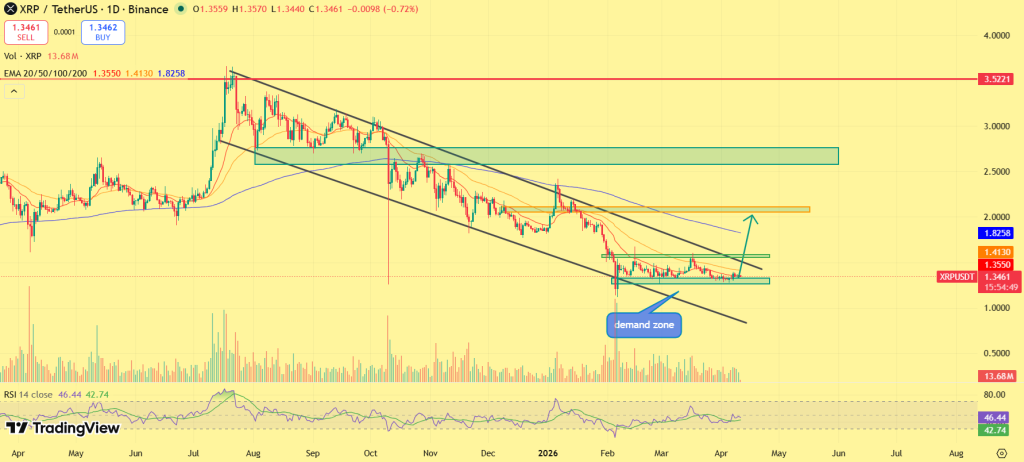
Immediate resistance lies near the $1.40–$1.45 zone, a level that must be cleared to confirm bullish momentum. A breakout above this range could open the path toward $1.80–$2.00, where a broader supply zone is positioned. On the downside, the $1.25–$1.30 region remains critical support. A breakdown below this level would weaken the current structure and expose XRP to further downside pressure.
On-chain data highlights a clear slowdown in XRP trading activity, with the Volume Z-Score dropping into negative territory, marking one of its lowest levels in recent periods. This indicates that trading volume has fallen below its 30-day average, reflecting reduced participation from short-term traders. Such conditions typically emerge during consolidation phases, where markets pause before a larger move.
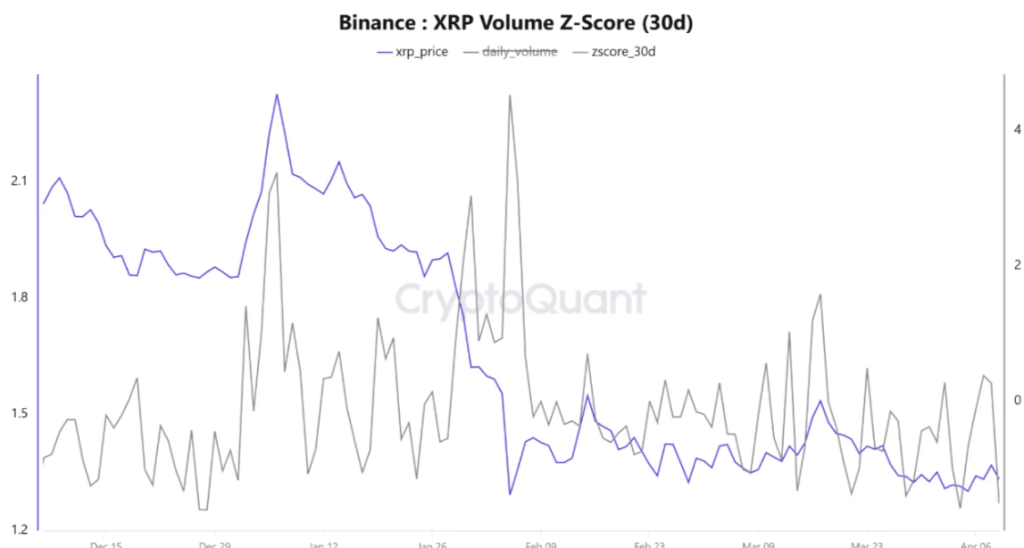
The decline in activity aligns with XRP’s price compression, suggesting the market is rebalancing rather than breaking down. Historically, this type of low-volume environment often precedes a strong directional move once momentum returns.
XRP is approaching a decisive phase, holding above key support while volatility compresses ahead of the SEC Clarity Act roundtable. A breakout above the $1.40–$1.45 zone could trigger renewed upside momentum, while losing the $1.30 level may extend consolidation. With structure tightening and a major catalyst ahead, XRP appears poised for a directional move.
The post World Liberty Financial (WLFI) Price Drops 21% as Whale Activity Spikes—What’s Next? appeared first on Coinpedia Fintech News
In times when Bitcoin and Ethereum prices are surging, World Liberty Financial’s (WLFI) price has been dropping massively. The bearish move followed a sustained horizontal consolidation since February, bringing the token under massive selling pressure. In the past four days, the WLFI price has plunged over 22%, and a deeper observation suggests the whales may have played out well.
The price action and large-holder behavior diverge, raising serious queries: Are whales accumulating during the dip or positioning for further downside?
Recent on-chain data from Santiment highlights a sharp increase in large transactions, with 87 whale transfers above $100K, marking the highest activity in seven weeks. At the same time, the network recorded a net outflow of over $56 million from exchanges, indicating a significant shift in token movement.
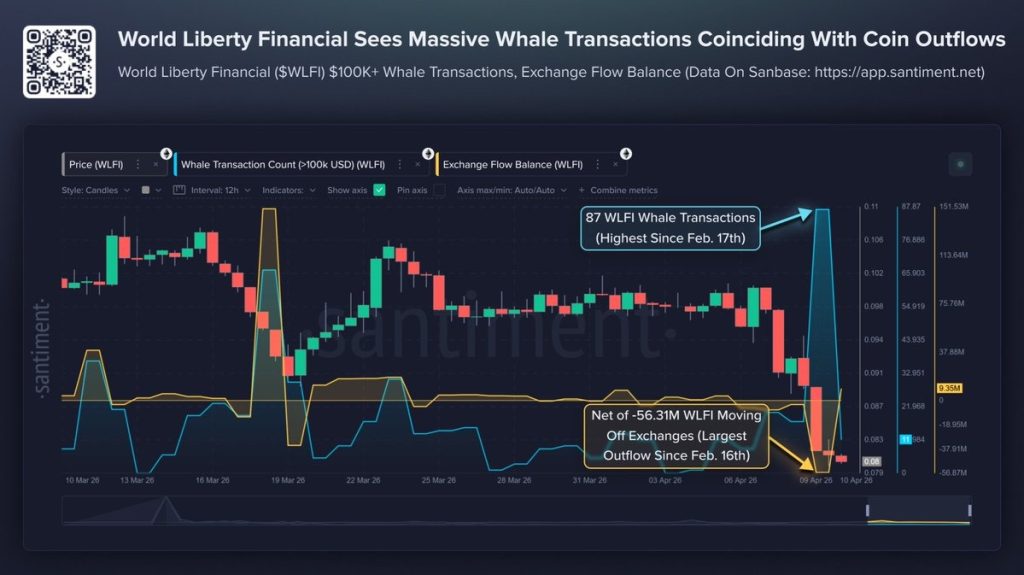
Typically, exchange outflows are interpreted as a bullish signal, suggesting that investors are moving assets into private wallets for holding. In this case, it suggests a reduced selling pressure and hence it can be interpreted as the whales may be buying aggressively during the dip. This could be an early positioning before a reversal.
On the other hand, whale transfers do not always indicate buying but reflect internal reshuffling or OTC deals. Moreover, price weakness suggests a lack of immediate demand. Therefore, without a strong price recovery, whale activity alone is not enough to confirm accumulation.
World Liberty Financial (WLFI) continues to face sustained selling pressure, extending its multi-week downtrend as price hovers near key support levels. Despite a recent spike in whale activity and significant exchange outflows, the token has failed to show any meaningful recovery, raising concerns about whether smart money is accumulating—or quietly exiting.
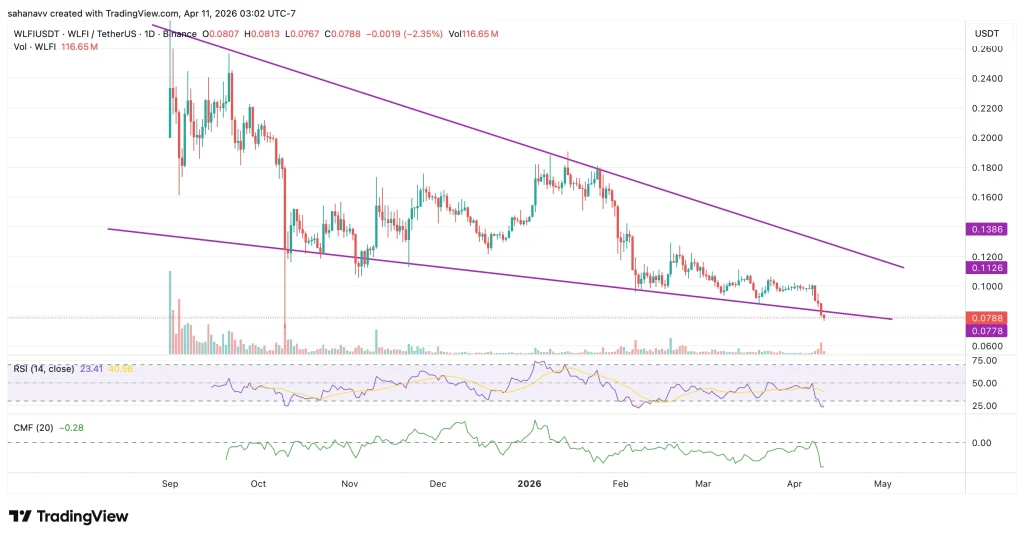
The RSI is near oversold levels (~23), suggesting that a short-term relief bounce is possible. However, the Chaikin Money Flow (CMF) remains negative, indicating persistent capital outflows and weak buying pressure. Volume also lacks strong accumulation signals, reinforcing the idea that downside momentum is still dominant unless structure shifts.
The price is now testing the lower boundary near the $0.077–$0.078 zone, which acts as immediate support. A breakdown below this level could accelerate downside toward lower liquidity zones, while any bounce would still face strong resistance around $0.11–$0.13, aligned with the upper trendline. Until WLFI breaks out of its descending channel and reclaims resistance levels, any upside move is likely corrective rather than a confirmed trend reversal.
World Liberty Financial is currently at a critical juncture where on-chain signals and price action are diverging. While whale activity and exchange outflows hint at possible accumulation, the continued price decline suggests caution.
For traders, the key is confirmation—until the WLFI price shows signs of strength on the chart, the risk of further downside remains, making this a high-risk, high-uncertainty setup.

The post Private Credit Is Cracking: Are We Headed for a 2008-Like Crisis? appeared first on Coinpedia Fintech News
The Federal Reserve is asking major US banks how exposed they are to the private credit market. The Treasury is asking insurance companies the same question. Neither has announced a formal investigation. They are doing it through routine examination channels, which is what regulators often do when they are worried but do not yet know how worried to be.
The $1.8 trillion private credit market is facing its most significant stress since it emerged after the 2008 financial crisis. Understanding why requires a brief look at how it was built.
Private credit funds lend directly to mid-market companies – typically businesses too small for public bond markets. Between 2019 and 2021, when interest rates were near zero, these funds wrote loans aggressively, particularly in software and technology. The problem is loans written during that period are now coming due. That puts the refinancing wall squarely in 2025 and 2026, when rates are dramatically higher.
Companies that borrowed at effectively zero must now refinance at 5-6% more, or default. Many are choosing a third option: Payment-in-Kind interest, or PIK, where instead of paying cash interest, they simply add it to the principal.
According to reports citing Fitch and KBRA ratings data, bad PIK reached 6.4% of total private debt volume in Q1 2026 – a recognised precursor to hard defaults.
Blue Owl Capital became the most visible casualty. Its OBDC II fund, which had promised retail investors access to private lending returns, was overwhelmed by a 200% surge in withdrawal requests and permanently closed its redemption gates. Morgan Stanley’s North Haven Private Income Fund met only 45.8% of tender requests in March.
The deeper problem is opacity. These funds mark their own books. There is no public market to challenge their valuations. A loan can sit at 100 cents on the dollar in a quarterly report and be zero the next.
Not yet. The Federal Reserve has stated the private credit market does not currently pose a systemic threat to the banking core. Unlike 2008, around 80% of private credit assets sit in closed-ended structures with locked capital. There are no depositor runs possible. Fund-level leverage remains modest.
But pockets of stress are real, spreading, and now drawing regulatory attention.
Private credit stress compounds the same macro ceiling that has kept Bitcoin range-bound since February. Credit stress plus energy inflation plus a Fed on hold is the late business cycle environment where capital does not rotate into risk assets.
Bitcoin’s best week in months came from geopolitical relief, but the underlying financial conditions have not changed.
The post CLARITY Act Could Unlock Institutional Capital Into Crypto Markets appeared first on Coinpedia Fintech News
The U.S. crypto market could be nearing a major turning point as support for the CLARITY Act grows. With leaders like Brian Armstrong and Scott Bessent backing the bill, analysts believe institutional capital may soon enter the market, prompting early positioning in assets like Ethereum, Solana, and Chainlink.
Momentum around the CLARITY Act is increasing as both policymakers and industry leaders push for clear crypto regulation in the United States.
Brian Armstrong has now publicly backed the bill, aligning with Scott Bessent, who has urged Congress to act quickly.
“It’s time to pass the Clarity Act.”
This shift signals growing alignment between regulators and major industry players.
In a recent discussion on the Paul Barron Network podcast, analyst Tim Warren broke down how he is positioning ahead of this potential catalyst.
He simply goes with the notion that, don’t wait for confirmation. Instead, accumulate strong assets before clarity hits, because once regulation is finalized, much of the upside could already be priced in. With all heads up for the Clarity Act, the analyst is detailing his top altcoin picks for the market to consider before Clarity hits this summer.
At the center of Warren’s strategy is Ethereum.
He describes it as the most institution-friendly asset in crypto. With ETFs already gaining traction and major players like Morgan Stanley expected to expand exposure, Ethereum is seen as the primary entry point for institutional money.
While long-term projections like $40,000 by 2030 are being discussed, Warren keeps expectations grounded, calling it possible but not guaranteed. The real thesis is institutional inflows, not hype-driven targets.
Beyond Ethereum, Solana and Chainlink stand out.
For Solana, Warren remains bullish long-term but cautious in the short term. He notes the possibility of a double bottom, with key levels around $68 and a potential downside toward $50 if the broader market weakens. Still, strong buy signals suggest this is not a time to short.
Chainlink, on the other hand, is a fundamentals play. As the backbone for real-world data in blockchain systems, it is expected to benefit heavily from institutional adoption. Warren sees potential upside toward the $10–$11 range, while also acknowledging a possible retest near $7 if markets pull back.
Despite the focus on altcoins, Bitcoin remains the key driver.
Warren makes it clear that if Bitcoin and Ethereum haven’t confirmed their bottom, altcoins are unlikely to see a sustained rally. The entire setup depends on broader market stability.
According to him, while a few other altcoins like Bittensor, Zcash, and others are showing independent moves, the majority, including Solana, XRP, and Chainlink, are closely mirroring Bitcoin’s trend with only minor differences.
The post Kalshi Wins as Federal Court Blocks Arizona Crackdown Until 24th April appeared first on Coinpedia Fintech News
A federal judge in Arizona temporarily blocked the state from enforcing gambling laws against Kalshi, siding with federal regulators. The ruling pauses enforcement until April 24 and signals that event-based contracts may fall under federal derivatives law rather than state gambling rules.
On 10th April, U.S. District Judge Michael Liburdi granted a temporary restraining order preventing Arizona from pursuing criminal or civil action against Kalshi. The decision followed a request from the Commodity Futures Trading Commission (CFTC), which argued the platform operates under federal jurisdiction.
Arizona had filed 20 misdemeanor counts against Kalshi, accusing the company of running an unlicensed wagering business involving elections and sports outcomes.
However, the court indicated the CFTC is likely to succeed in arguing that Kalshi’s contracts qualify as “swaps” under the Commodity Exchange Act, placing them under federal oversight.
The restraining order remains active until April 24, when the court will decide whether to issue a longer-term injunction.
This is because Kalshi allows users to trade “Yes” or “No” contracts based on event outcomes. The company argues these are financial contracts traded between participants, not bets placed against a house.
State regulators, including Arizona, view the activity as gambling. Last week, Nevada extended a ban on Kalshi, while Utah lawmakers passed legislation targeting similar prediction contracts.
The disagreement centers on whether event markets should be treated as derivatives or betting platforms.
The legal battle comes as Kalshi rapidly expands. As of April 2026, the platform is valued at around $22 billion following a March funding round. It currently accounts for roughly 89% of U.S. prediction market volume, making it a dominant player.
User growth has also surged. Monthly active users increased from about 600,000 at the start of 2025 to around 5.1 million by early 2026. Trading activity is accelerating as well. In March 2026 alone, Kalshi recorded $13.1 billion in transaction volume, marking a 25.2% jump from the previous month.
These numbers highlight why the classification debate has become more important for regulators.
The temporary order remains in effect until April 24, when the court will consider issuing a preliminary injunction. Meanwhile, Kalshi continues its civil claims against several states
The case may shape how prediction markets are regulated in the U.S., determining whether they are treated as financial instruments or gambling products.



The post No, Bitcoin Has Not Bottomed Yet: Analyst Who Called the Top Explains Why appeared first on Coinpedia Fintech News
Bitcoin just had its best week in a while. The ceasefire rally, the CPI relief, $73,000 briefly touched. After weeks of grinding losses, it finally feels like something has changed.
But one analyst who publicly called the top six months ago is not buying the narrative shift. According to Benjamin Cowen, founder of Into The Cryptoverse, the data does not yet support calling a bottom – and the 4-year cycle is still pointing to October.
Cowen’s case is not based on sentiment or macro headlines. It is based on three specific on-chain conditions that have marked every previous Bitcoin cycle bottom and none of which have triggered yet.
First, the supply in profit/loss indicator has not crossed.
“All prior lows occur after they cross, not before,” Cowen said in a recent video. “And we haven’t seen that cross yet.”
Second, the MVRV Z-score has not gone below zero. Every previous bear market bottom has required this reset. It has not happened.
Third, Bitcoin has not traded below both its realized price, currently around $54,000, and its balance price, which sits near $39,000. Historically, every cycle bottom has involved Bitcoin touching both levels.
Cowen identifies $78,000 to $79,000 as the current bear market resistance band – the level where the former bull market support has flipped to overhead resistance. Until Bitcoin closes convincingly above that level, the structure of a bear market remains intact.
Tactical rallies, he notes, are entirely normal within bear markets and do not signal a trend reversal.
The 4-year cycle has run November to November in 2021-2022 and December to December in 2017-2018. Cowen’s base case is October to October this time, putting the most likely low in Q4 2026.
He gives it 75% probability that the bottom is still ahead.
“I would say there’s like a 75% chance that the Bitcoin bottom is still in the future,” he said. “Maybe a 25% chance that it’s already in.”
His implied price target for a full reset sits around $39,000 – the balance price, and roughly a 70% decline from the $126,000 peak, consistent with every prior bear market being slightly less severe than the last.
Cowen is not permanently bearish. He acknowledges the 25% scenario where the low is already in and says he would revise his view if Bitcoin has not made a new low by October. The thesis is data-dependent, not directional.
The post The U.S Moves $177K in Bitcoin, But the Real Story Is Bigger appeared first on Coinpedia Fintech News
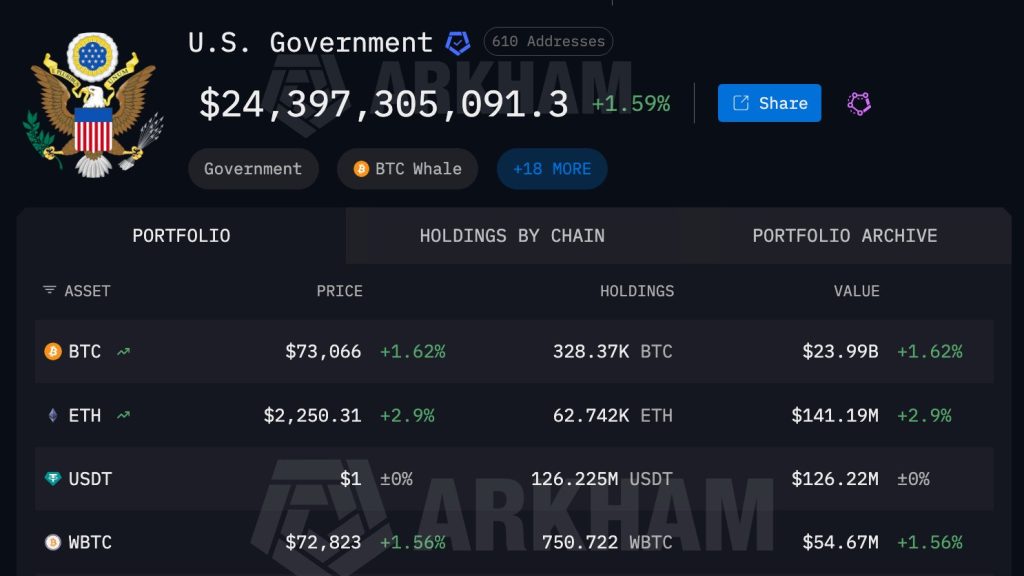
The U.S. government just moved over 2 BTC to a Coinbase Prime wallet, but the transfer itself isn’t the real story. It’s what it reveals about how seized crypto is now being handled.
The funds, flagged by Arkham Intelligence, are linked to Glenn Olivio, who was indicted in 2025 in an alleged steroid distribution and money laundering case, with the Bitcoin likely seized during that investigation and moved in two transactions worth around $177,000.
At first glance, this looks routine. Governments often move seized assets for custody or consolidation. But zoom out, and a pattern starts forming.
Similar movements have been seen recently with funds tied to cases involving Ross Ulbricht and other financial crimes. These repeated transfers suggest the government is actively organizing and managing its crypto holdings rather than leaving them idle.
Here’s where things get interesting. This shift comes after the U.S. introduced its strategic bitcoin reserve following an executive order under Donald Trump.
Treasury Secretary Scott Bessent later confirmed that the government has stopped selling seized bitcoin and is now holding onto it instead.
That changes how these transfers should be viewed. Instead of preparing assets for liquidation, the government may now be repositioning them for long-term storage within its reserve.
The U.S. already holds around 328,000 BTC, worth over $22 billion. Moves like this suggest a quiet transition from treating crypto as confiscated property to managing it as a strategic asset.
Even small transfers like this one could be part of a larger system being built in the background, one where seized crypto feeds directly into national reserves.
In short, this isn’t just about a criminal case. It’s another signal that bitcoin is becoming part of government-level financial strategy, not just law enforcement cleanup.
Crypto analysts are watching closely but not panicking. One X user said the move was “interesting,” noting it’s the first transfer in over a month and highlighting that such assets are rarely sold immediately.
Meanwhile, another user framed it as routine custody management with minimal market impact due to the small size.
The post Bhutan Cuts Bitcoin Holdings by 70% Over 18 Months appeared first on Coinpedia Fintech News
Bhutan has sold about 70% of its Bitcoin holdings over the past 18 months, with Arkham data showing its stash shrinking from roughly 13,000 BTC in October 2024 to 3,954 BTC, now worth around $280.6 million. About $215.7 million of that reduction happened this year alone, indicating active liquidation. Additionally, it’s been over a year since the country saw any mining inflows above $100,000, suggesting its hydropower-powered Bitcoin mining operations may have slowed or stopped altogether.





A federal judge in Arizona has temporarily barred state officials from enforcing gambling laws against Kalshi, siding with the CFTC.
Bitwise added the ticker $BHYP and a 0.67% management fee in its latest filing, signaling a potential launch soon, according to Bloomberg's senior ETF analyst.

Technical and onchain indicators hint at a possible trend reversal in XRP price as traders watch to see if a key support level holds.
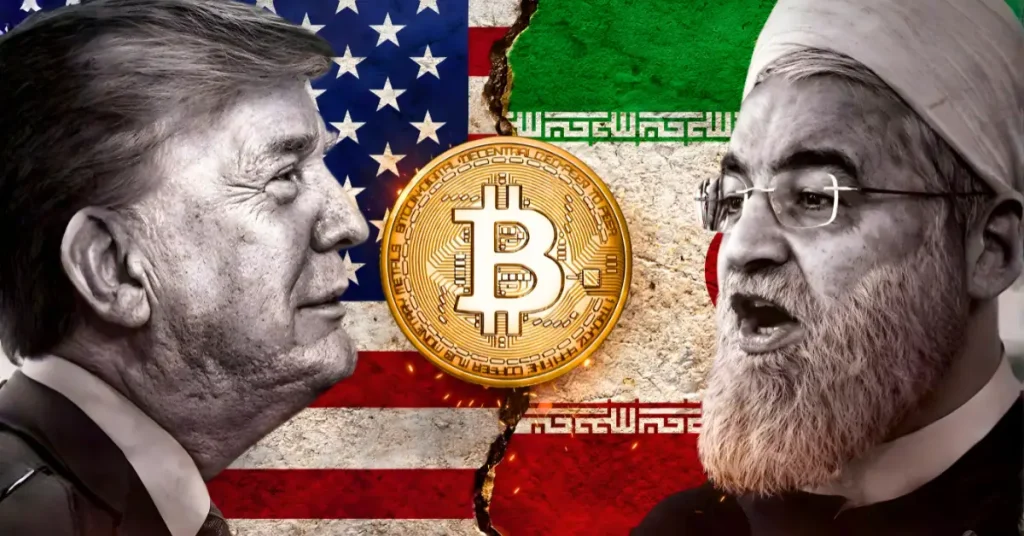
The post Trump Says Iran-US Deal Is 99% About One Thing: What That Means for Bitcoin appeared first on Coinpedia Fintech News
An extremely consequential diplomatic meeting is hours away.
Iran’s 71-person team, led by Parliament Speaker Mohammad Bagher Ghalibaf and Foreign Minister Abbas Araghchi, arrived in Pakistan’s capital this morning for direct negotiations with US Vice President JD Vance, special envoy Steve Witkoff and Jared Kushner.
It is the first face-to-face meeting between the two nations since the war began on February 28. Bitcoin is currently trading at $72,798, up 8.62% on the week.
The positions entering these talks remain far apart. Iran’s 10-point proposal demands Iranian oversight of the Strait of Hormuz, sanctions relief, war reparations, frozen asset releases and a halt to Israeli operations in Lebanon.
The US 15-point counter-proposal centres on one non-negotiable: no nuclear weapon.
President Donald Trump made his priorities explicit before departing for Virginia yesterday. Asked what a good deal looks like, he said: “No nuclear weapon. That’s 99% of it.”
On the Strait of Hormuz, his view was equally direct: “That’ll open up automatically, otherwise they make no money.”
That framing matters. Trump is not treating Hormuz as the primary obstacle. He is treating it as an economic inevitability. If nuclear is genuinely 99% of the deal, the bar for an agreement that moves markets is lower than most traders currently assume.
Also Read: Is Bitcoin Being Manipulated by Market Insiders?
The war has been Bitcoin’s single biggest macro headwind since February. The conflict closed the Strait of Hormuz, disrupted 20% of global oil supply, drove the largest monthly CPI increase since June 2022, and kept the Federal Reserve on hold. Every one of those pressures traces back to this room in Islamabad.
A deal framework, even a partial one, removes the energy inflation overhang that has suppressed Bitcoin for six weeks. Analysts have projected a move toward $75,000 to $80,000 if geopolitical risk is sustainably removed.
The Crypto Fear and Greed Index has been in extreme fear for over 60 consecutive days, the longest streak on record. A credible path to peace ends that.
Pakistan has set a modest goal: get both sides to agree to keep talking. Ghalibaf arrived saying “we have goodwill, but we do not trust.” A breakdown in talks sends oil back toward $110 and Bitcoin back toward $65,000 support.
Vance said before boarding his flight: “I think it’s going to be positive.”
The gap between those two statements is where Bitcoin’s next major move is being decided today.
The post Grayscale Is Accumulating These Altcoins in Q2 2026 appeared first on Coinpedia Fintech News
Grayscale Investments has released its Q2 2026 “Assets Under Consideration” list, highlighting a clear shift in institutional focus toward infrastructure, advanced DeFi, and AI-driven crypto projects.
The list suggests that institutions are prioritizing real-world utility, scalability, and emerging technology narratives over speculative trends.
The list includes a wide range of tokens across multiple sectors:
It also includes early-stage projects like MegaETH, Nous Research, and Poseidon, showing interest in upcoming innovations.
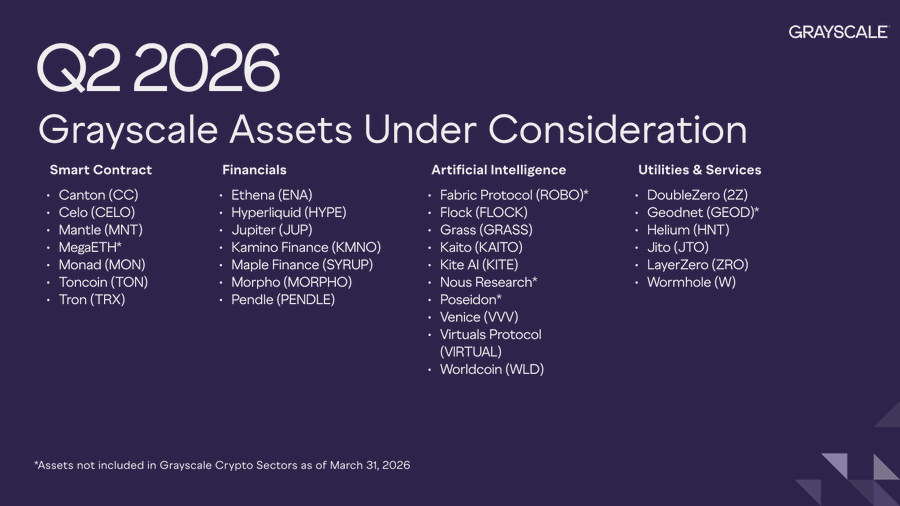
A large portion of the list is focused on smart contract platforms and core blockchain infrastructure, including CELO, TON, and TRX.
These projects form the backbone of the crypto ecosystem, supporting:
This suggests institutions are prioritizing foundational layers that enable long-term growth rather than short-term hype.
The DeFi segment of the list highlights a major shift in how decentralized finance is evolving. Projects like ENA, HYPE, MORPHO, and PENDLE are focused on:
This is no longer the early DeFi hype cycle. Instead, it reflects a move toward structured, institutional-grade on-chain financial systems.
The AI category is easily one of the most stacked: ROBO, FLOCK, GRASS, KAITO, KITE, VVV, VIRTUAL, and WLD, plus projects like Nous Research and Poseidon.
This shows where the narrative is heading. AI and blockchain are starting to overlap, especially around data ownership, identity, and decentralized computing. It’s early, but institutions clearly don’t want to miss this wave.
Then there’s the utility layer, 2Z, GEOD, HNT, JTO, ZRO, and W. These projects focus on infrastructure, data, connectivity, and cross-chain systems.
It’s a reminder that beyond hype, real-world functionality still drives long-term value in crypto.

The post Dogecoin Price Prediction: Is DOGE Ready for Rally Toward $1? appeared first on Coinpedia Fintech News
Dogecoin (DOGE) is flashing a high-stakes setup as price compresses at a key macro support, with market structure now pointing toward a potential Wave 5 expansion, the phase historically linked with the most aggressive rallies.
After months of sideways drift and weakening momentum, the setup now shows a rare alignment: trendline support, cycle structure, and market positioning converging at a critical inflection point. If this structure confirms, DOGE may not just recover, it could accelerate sharply toward its first major target near $1, marking a decisive shift in trend. Read our Dogecoin price prediction below for more details.
DOGE’s monthly chart suggests a classic Elliott Wave cycle nearing completion of its corrective phase. The memecoin has already completed its earlier impulsive waves during previous bull cycles, followed by a prolonged Wave 4 correction that has unfolded over the past few years. This correction has brought price back to a long-term ascending trendline, a level that has historically acted as a launchpad for major rallies.
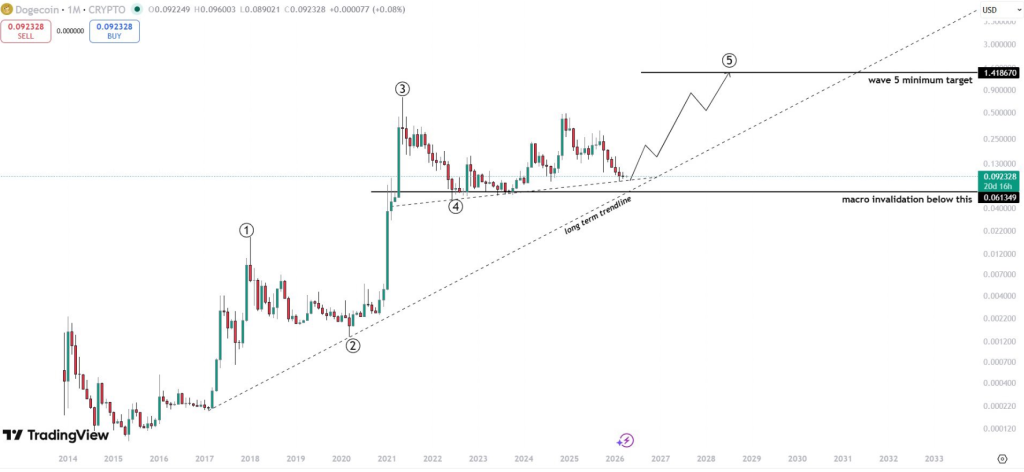
Now, with price stabilizing at this support and forming a base, the structure points toward a potential transition into Wave 5, typically the most aggressive phase of the cycle. If this plays out, DOGE could enter a momentum-driven expansion, with historical patterns suggesting the possibility of a move toward the $1 and beyond range. However, this scenario remains valid only as long as key support levels continue to hold.
On-chain indicators are beginning to align with the bullish structural setup, reinforcing the idea that the market is in an accumulation phase rather than a continuation of decline. The MVRV ratio has cooled significantly, indicating that most holders are no longer sitting on large unrealized profits. This typically reduces sell-side pressure and creates conditions favorable for accumulation.
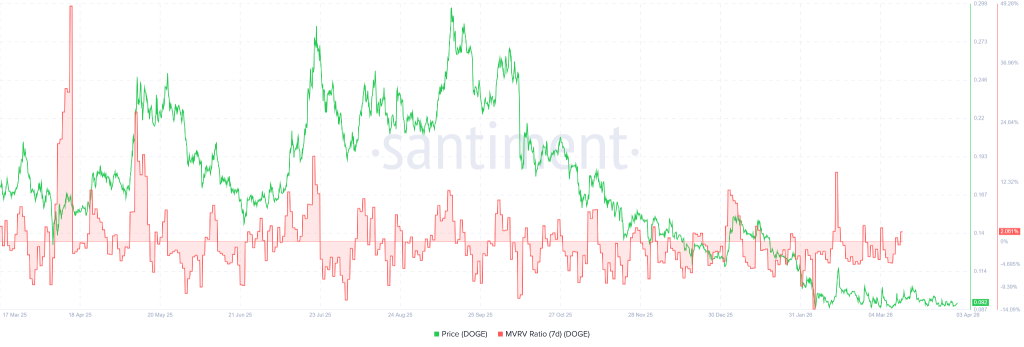
At the same time, network activity remains stable, with consistent transaction counts and active address data suggesting that user engagement has not dropped off despite the price correction.
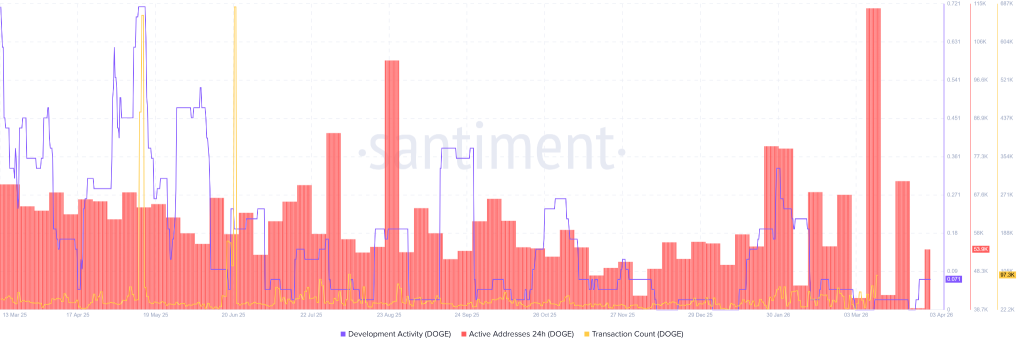
This divergence, stable fundamentals alongside weak price action, often signals that strong hands are accumulating while weaker participants exit, a pattern commonly seen near cycle bottoms.
DOGE price is currently trading near the $0.09 zone, holding above a critical long-term ascending trendline that defines its macro structure. The memecoin has formed a series of higher lows near support, indicating that buyers are stepping in consistently at lower levels. This behaviour suggests that selling pressure is being absorbed.
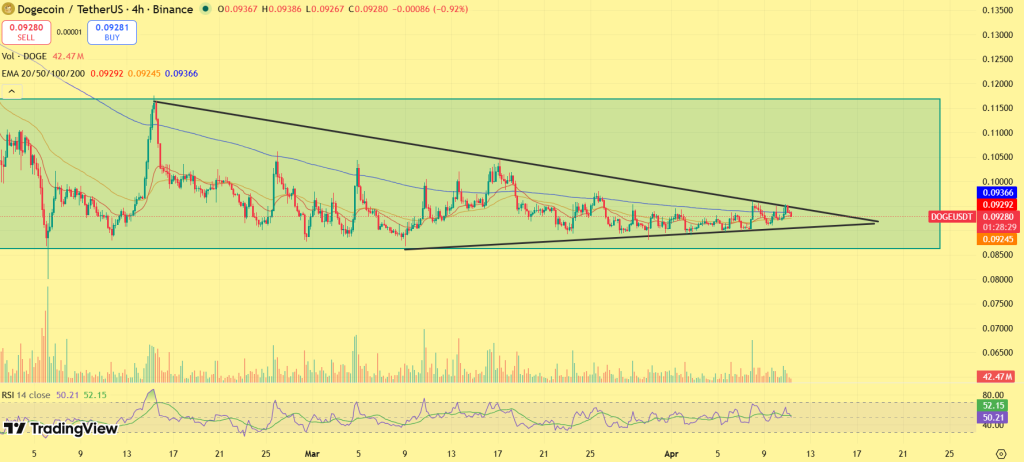
Immediate resistance is seen near the $0.10–$0.11 range, which has capped recent upside attempts. A confirmed breakout above this zone would signal a shift in short-term momentum and open the path toward $0.14–$0.18 as the next upside targets. On the downside, the key invalidation level remains near $0.061, where a breakdown would disrupt the macro structure and delay the bullish Wave 5 scenario. As long as price continues to hold above trendline support, the broader setup remains constructive, with compression suggesting a potential expansion move ahead.
The post RaveDAO (RAVE) Price Jumps 500%: Is This Real Web3 Adoption or Just Short-Term Momentum? appeared first on Coinpedia Fintech News
RaveDAO (RAVE) has emerged as one of the crypto market’s most talked-about tokens, posting explosive gains and attracting massive trading volume. The price has been going vertical, attracting over 500% gains, with volume exploding from below $20 million to over $400 million, a more than 1700% rise.
But beneath the rally, a key question remains. Is this genuine adoption driven by real-world use cases, or another hype-fueled move in which early players exit in strength?
RaveDAO (RAVE) is a Web3 entertainment platform that merges live electronic music events with blockchain technology to create a community-driven ecosystem. Instead of traditional ticketing, attendees receive NFT-based proof of participation, which acts as a digital identity. It also unlocks future rewards, access, and experiences. The platform is powered by the RAVE token, which enables payments, staking, and governance. It also allows users to participate in the ecosystem rather than remain passive event-goers.
What sets RaveDAO apart is its focus on bridging real-world experiences with on-chain value. By hosting global music events and integrating crypto payments, NFTs, and decentralized governance, the project aims to onboard mainstream audiences into Web3 through culture and entertainment. However, while the concept is gaining traction and driving recent price momentum, its long-term success will depend on sustained user adoption beyond hype and consistent execution across its global event network.
RaveDAO (RAVE) is rising primarily due to a mix of strong narrative momentum and aggressive market activity, rather than purely fundamentals. The token has seen a sharp surge in trading volume and price, attracting attention across crypto communities looking for the next breakout asset. Its positioning as a real-world adoption story—combining music events, NFTs, and crypto payments—adds a fresh angle compared to typical meme or Layer-2 tokens.
At the same time, early-stage price discovery, exchange listings, and speculation around whale activity have amplified volatility. This has created a feedback loop where rising prices drive more attention, fueling further upside in the short term.
RaveDAO (RAVE) has entered a parabolic breakout phase, surging from the $0.25 base (0 Fib level) to above $2.10 in a near-vertical move. This kind of expansion typically signals strong momentum-driven buying but also places the asset in a high-risk zone. The price is currently hovering near the 1.0 Fibonacci extension (~$2.13), which is acting as immediate resistance. A rejection from this level, already hinted at by the upper wick and pullback, suggests early signs of profit-taking after an overheated rally.
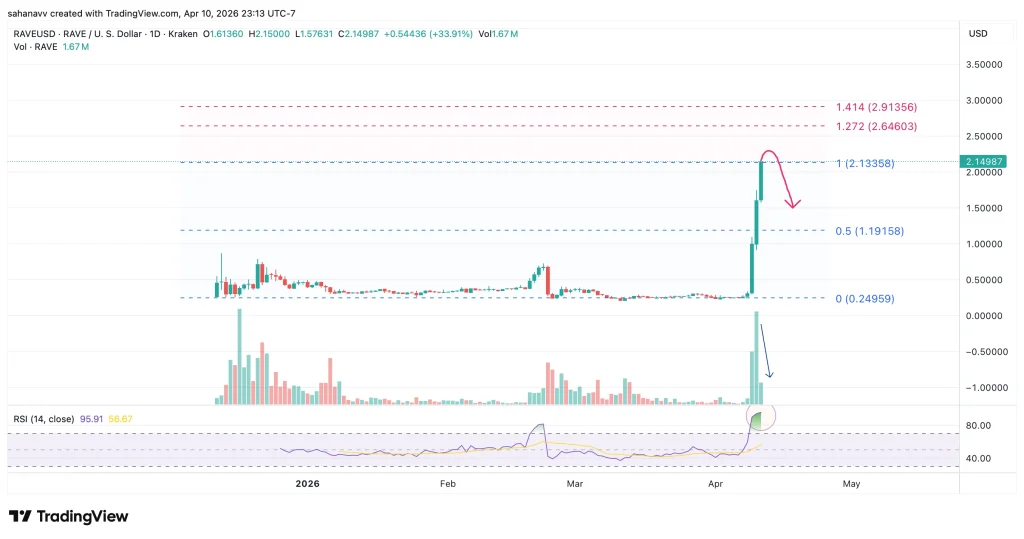
From an indicator perspective, the RSI is extremely overbought (above 90), confirming that the move is stretched and likely unsustainable in the short term without consolidation. Volume has also spiked aggressively during the breakout, but the latest candle shows a decline in follow-through volume, indicating weakening buying pressure.
If Rave DAO (RAVE) price fails to hold above the $1.20–$1.30 zone (0.5 Fib level), a deeper retracement toward the breakout base cannot be ruled out. On the upside, a clean hold above $2.10 could open the path toward $2.60 and $2.90 levels, but only if momentum sustains and volume re-expands.
Overall, this is a high-momentum, high-risk setup, where chasing strength without confirmation could be dangerous, while pullbacks may offer more structured entries.
The post Bitwise Files Second Amendment for Hyperliquid ETF appeared first on Coinpedia Fintech News
Bitwise has submitted a second amendment for its Hyperliquid ETF, confirming the ticker BHYP and setting the management fee at 67 basis points. These finalized details are typically one of the last steps before an ETF receives regulatory approval and moves toward launch. The filing reflects continued development of the product structure and positioning in the market. It also comes amid rising interest in Hyperliquid (HYPE), with investors closely watching for the ETF’s official debut and potential market impact.
The post Crypto Regulation News: CFTC Task Force Signals Major Shift for US Crypto Rules appeared first on Coinpedia Fintech News
The Commodity Futures Trading Commission (CFTC) has launched an Innovation Task Force (ITF), signaling a major shift in how the United States is approaching crypto regulation.
This move suggests the U.S. is finally transitioning from uncertainty to a more structured and proactive regulatory framework.
The task force will focus on crypto, blockchain, artificial intelligence (AI), and prediction markets, aiming to establish clear guidelines instead of the fragmented and enforcement-heavy approach that has defined the industry for years.
Crypto regulation has become one of the most debated topics globally, and the timing of this move is critical.
While regions like Europe and parts of Asia have already introduced structured frameworks, the U.S. has lagged, creating uncertainty for businesses and investors. Now, regulators appear to be accelerating efforts to catch up.
This shift comes as institutional interest in crypto continues to rise, increasing the urgency for clear, consistent rules that can support long-term growth while maintaining oversight.
The ITF is led by Michael J. Passalacqua and brings together a mix of public regulators and private-sector experts, an approach that could bridge the gap between policy and real-world industry needs.
Passalacqua highlighted the importance of this collaboration, stating:
“Thrilled to be part of a team that pairs deep CFTC expertise with private-sector experience ranging from major law firms, Blockchain Association & DeFi funds.”
This diverse lineup signals an effort to create rules that are both practical and aligned with how the crypto industry actually operates.
CFTC Chairman Michael S. Selig said that the goal is to provide “rules of the road” for innovators.
If executed effectively, this could mark a turning point, moving away from the enforcement-driven model that has long frustrated crypto companies toward a more predictable regulatory environment.
At the same time, the proposed CLARITY Act is gaining attention in Washington.
Paul Atkins, Chair of the U.S. Securities and Exchange Commission (SEC), recently indicated that both agencies are prepared to implement the legislation, urging Congress to act quickly and “future-proof” the system.
Right now, much depends on whether this law passes. If it does, the groundwork laid by the CFTC’s task force could rapidly translate into real, enforceable crypto regulations.
This isn’t just another regulatory committee; it’s a strong signal that the U.S. is preparing to formalize its crypto framework.
If successful, the initiative could:
In short, the U.S. may finally be moving toward a coherent, innovation-friendly regulatory era for crypto, and this task force could be the first real step in that direction.

The post Bitwise Moves Closer to Launch Hyperliquid ETF with BHYP Ticker Reveal appeared first on Coinpedia Fintech News
Bitwise has taken a major step toward launching a Hyperliquid ETF by confirming the ticker BHYP and a 0.67% fee, signaling the product is likely in its final stages before approval. If launched, the ETF could bring significant institutional capital into Hyperliquid and further boost demand for its native token HYPE.
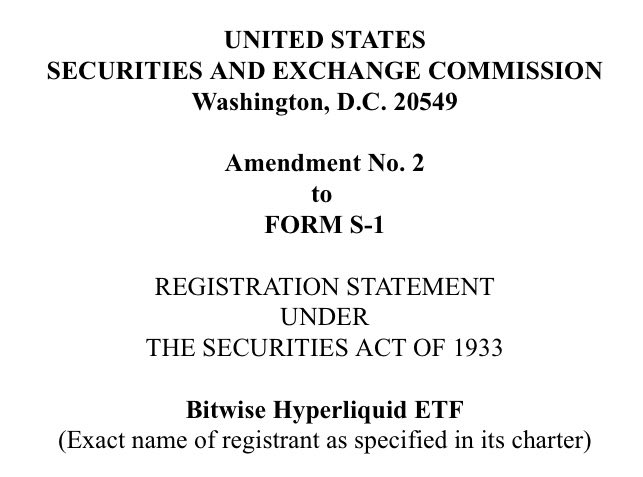
Bitwise Asset Management has filed a second amendment for its proposed Hyperliquid ETF, revealing key details such as the ticker BHYP and a 67-basis-point fee.
This level of specificity typically indicates that the ETF is moving closer to launch. According to Eric Balchunas, filings that include final details like ticker and fees often suggest that approval momentum is building and issuers are preparing for market rollout.
The development comes as Hyperliquid’s native token HYPE continues to gain strong traction across both retail and institutional markets.
The proposed ETF could significantly expand Hyperliquid’s reach by opening access to traditional financial markets. This would allow institutions to gain regulated exposure to a rapidly growing decentralized perpetuals trading platform.
Over the past year, Hyperliquid has shown strong real adoption:
This suggests that demand for Hyperliquid is backed by real activity, making the ETF more attractive to institutional investors.
Balchunas also added a lighter remark on X, saying:
“Hyperliquid sounds like the name of a rave I attended in 1994 but barely remember.”
While humorous, the comment reflects how crypto-native platforms are increasingly entering mainstream financial conversations.
On-chain data further supports the bullish narrative.
According to Lookonchain, a newly created wallet (0x96eb) deposited 5 million USDC into Hyperliquid and used 2.39 million USDC to purchase 59,239 HYPE tokens.
This type of behavior is often associated with strategic positioning ahead of major catalysts.
Key takeaway:
Market sentiment around HYPE is strengthening as price action confirms bullish expectations.
HYPE recently reached $41.80, aligning with a technical target previously identified by Ali Martinez, signaling strong upward momentum.
At the same time, Arthur Hayes has made a bold long-term projection, suggesting HYPE could reach $150 by August 2026.
His bullish outlook is based on two key factors:
This creates consistent upward pressure on price over time..


The post Ethereum Name Service (ENS) Price Prediction 2026, 2027 – 2030: Will ENS Price Sprint to $100? appeared first on Coinpedia Fintech News
Ethereum Name Service (ENS), a key identity layer within the Ethereum ecosystem, is moving into April 2026 at a point where growing on-chain utility contrasts with an extended phase of muted price performance. As Web3 adoption expands, ENS continues to anchor digital identity through human-readable wallet addresses, reinforcing its structural relevance.
ENS has spent months under sustained pressure, gradually compressing into a lower range. Recent sessions, however, indicate a shift, selling momentum is easing while price begins to stabilize near its base. This type of compression often precedes a directional move, particularly when supply is being absorbed. The setup now is clear: ENS is no longer in decline, but it has yet to confirm recovery. With April underway, can ENS break out toward $20, and does the broader structure support a move toward $120 in 2026?
| Cryptocurrency | Ethereum Name Service |
| Token | ENS |
| Price | $5.7573
-0.68%
|
| Market Cap | $ 220,965,994.33 |
| 24h Volume | $ 15,329,036.9599 |
| Circulating Supply | 38,380,013.5305 |
| Total Supply | 100,000,000.00 |
| All-Time High | $ 85.6875 on 11 November 2021 |
| All-Time Low | $ 4.9497 on 06 February 2026 |
ENS enters April within a tightening range, where volatility has declined and price is holding steady above its recent lows. This behavior reflects a market transitioning from persistent weakness into equilibrium. The immediate resistance sits near the $7–$8 zone, which has consistently limited upside attempts in recent months. A move through this level would signal that demand is returning, shifting the short-term structure.
Above this, the next expansion zone emerges. If momentum builds beyond resistance, ENS in April could extend toward the $15–$20 range, driven by breakout flows and renewed positioning. However, failure to reclaim the $8 region would likely keep price contained within its current band, delaying the breakout.
ENS’s broader outlook for 2026 is defined by whether the current stabilization phase transitions into a sustained expansion cycle. The token has undergone a prolonged correction, gradually moving into a phase where downside pressure is diminishing and price is compressing near its lower range. This stage typically forms the base for future trend development, provided resistance levels are reclaimed. The recovery path begins with acceptance above $8–$10, followed by stronger confirmation in the $15–$20 zone. These levels represent structural inflection points where the market shifts from consolidation into trend formation.
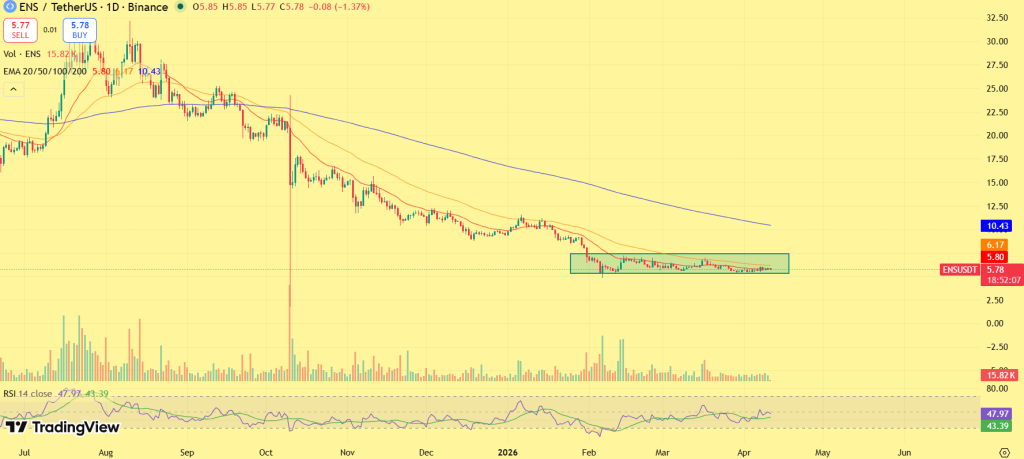
Once these zones are cleared, price behavior often accelerates as liquidity rotates upward and momentum strengthens. Under a sustained breakout scenario, ENS could expand toward the $40–$120 range in 2026, reflecting a full-cycle recovery driven by structural transition. However, until these levels are decisively reclaimed, ENS remains in a rebuilding phase, where consolidation may persist before expansion begins.
Growing adoption of Web3 identities, increasing demand for ENS domains across wallets and applications.
Rising activity within the Ethereum ecosystem, supporting ENS usage as a core infrastructure layer.
Renewed focus on digital identity solutions, positioning ENS within a critical narrative segment of crypto.
| Year | Potential Low ($) | Potential Average ($ | Potential High ($) |
| 2026 | 30.00 | 60.00 | 100.00 |
| 2027 | 40.00 | 80.00 | 150.00 |
| 2028 | 70.00 | 130.00 | 200.00 |
| 2029 | 140.00 | 200.00 | 250.00 |
| 2030 | 180.00 | 250.00 | 300.00 |
The ENS price range in 2026 is expected to be between $30.00 and $100.00.
Ethereum Name Service (ENS) price range can be between $40.00 to $150.00 during the year 2027.
In 2028, Ethereum Name Service is forecasted to potentially reach a low price of $10.00, an average price of $70.00, and a high price of $200.00.
Thereafter, the ENS price for the year 2029 could range between $140.00 and $250.00.
Finally, in 2030, the price of ENS is predicted to maintain a steady and positive. It may trade between $180.00 and $300.00.
Based on the historic market sentiments and trend analysis of the largest cryptocurrency by market capitalization, here are the possible ENS price targets for the longer time frames.
| Year | Potential Low ($) | Potential Average ($) | Potential High ($) |
| 2031 | 250.00 | 320.00 | 400.00 |
| 2032 | 300.00 | 400.00 | 580.00 |
| 2033 | 400.00 | 520.00 | 650.00 |
| 2040 | 600.00 | 700.00 | 800.00 |
| 2050 | 1000.00 | 1400.00 | 1800.00 |
| Year | 2026 | 2027 | 2030 |
| Changelly | $25.00 | $50.00 | $70.00 |
| DigitalCoinPrice | $30.00 | $60.00 | $80.00 |
| WalletInvestor | $20.00 | $50.00 | $70.00 |
Stay ahead with breaking news, expert analysis, and real-time updates on the latest trends in Bitcoin, altcoins, DeFi, NFTs, and more.
ENS is projected to trade between $60 and $100 in 2026 if market sentiment improves and adoption of Web3 identity solutions grows.
By 2030, ENS could trade between $180 and $300 if Web3 adoption expands and ENS remains a core identity layer on Ethereum.
Long-term estimates suggest ENS may reach $600 to $800 by 2040, supported by sustained blockchain usage and decentralized identity growth.
Yes, ENS has a future due to its real-world utility, strong Ethereum integration, and growing demand for decentralized naming solutions.
ENS shows long-term potential due to real utility, governance use, and Ethereum integration, but price depends on market conditions and adoption.
The post Bitcoin Cash Price Prediction 2026, 2027 – 2030: Will BCH Hit $1000? appeared first on Coinpedia Fintech News
Bitcoin Cash (BCH), one of the most established peer-to-peer payment-focused cryptocurrencies, has entered 2026 with renewed momentum as price structure begins to strengthen after a prolonged consolidation phase.
Following months of range-bound movement, BCH has started to show signs of expansion, with buyers gradually stepping in and pushing price toward higher levels. This shift suggests that the coin may be transitioning from accumulation into a potential breakout phase. If momentum continues to build, BCH could be setting up for a move toward $600 in the near term and potentially $1200 over the broader cycle.
The key question now is whether this emerging strength can sustain. Can Bitcoin Cash maintain its momentum and reclaim higher levels in 2026? Here’s a detailed breakdown of 2026-2030-year trajectory.
| Cryptocurrency | Bitcoin Cash |
| Token | BCH |
| Price | $440.0027
0.02%
|
| Market Cap | $ 8,808,684,167.99 |
| 24h Volume | $ 195,561,826.5507 |
| Circulating Supply | 20,019,612.50 |
| Total Supply | 20,019,612.50 |
| All-Time High | $ 4,355.6201 on 20 December 2017 |
| All-Time Low | $ 75.0753 on 15 December 2018 |
Bitcoin Cash enters April with improving price structure, as the asset continues to trade above its recent consolidation range. After spending an extended period moving sideways, BCH has started to form higher lows, an early indication that buyers are gaining control. This shift reflects a transition from passive accumulation into active demand. The immediate resistance lies near the $480–$500 zone, which has previously acted as a rejection area. A breakout above this level would confirm continuation and open the path higher.
If this momentum sustains, BCH in April could move toward the $550–$600 range, marking a clear expansion from its prior range. However, failure to hold above the $400 support could delay this move and keep price within consolidation.
Looking ahead, BCH’s broader outlook suggests a market that is moving out of consolidation and into a potential expansion phase. BCH coin has spent considerable time building a base, absorbing supply and stabilizing after previous volatility. This phase often precedes stronger directional moves, particularly when supported by improving structure.
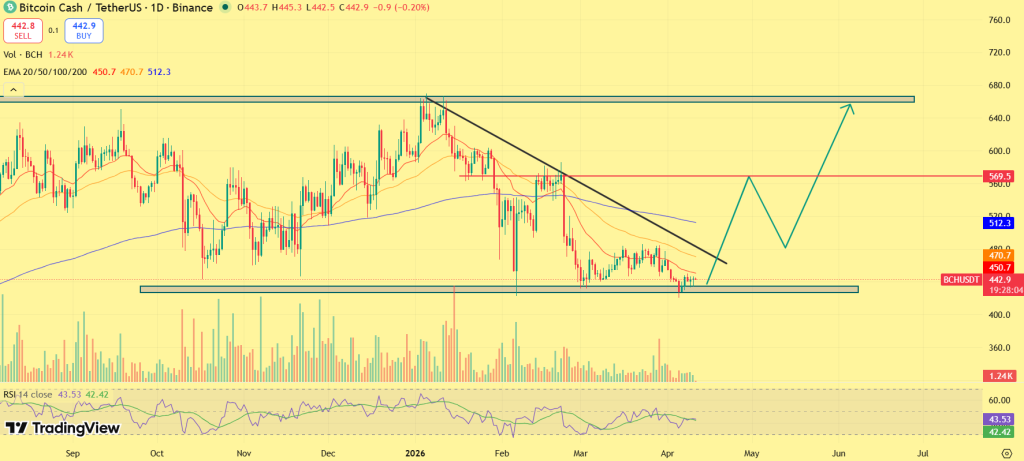
The recovery path depends on reclaiming key levels. The first confirmation lies above $500, followed by a stronger expansion zone near $700–$800. These levels act as checkpoints for sustained momentum. Once these zones are cleared, price behavior typically accelerates, allowing the asset to transition into a higher trading range.
In this scenario, BCH could advance toward the $600–$1200 range in 2026, reflecting a full expansion cycle driven by structural breakout. However, if momentum weakens and key supports fail, the market may revert to a range-bound phase before attempting another move higher.
Renewed interest in payment-focused cryptocurrencies, supporting BCH’s core use case.
Increased on-chain transaction activity, indicating growing network usage.
Market rotation toward established altcoins, bringing attention back to legacy assets like BCH.
| Year | Potential Low ($) | Potential Average ($ | Potential High ($) |
| 2026 | 600.00 | 850.00 | 1200.00 |
| 2027 | 820.00 | 1200.00 | 1600.00 |
| 2028 | 1100.00 | 1800.00 | 2100.00 |
| 2029 | 1500.00 | 2200.00 | 2500.00 |
| 2030 | 2000.00 | 2500.00 | 3000.00 |
In 2026, Bitcoin Cash price could project a low price of $600.00, an average price of $850.00, and a high of $1200.00.
As per the Bitcoin Cash price Prediction 2027, Bitcoin Cash may see a potential low price of $820.00, The potential high for Bitcoin Cash price in 2027 is estimated to reach $1600.00
In 2028, Bitcoin Cash price is forecasted to potentially reach a low price of $1100.00, and a high price of $2100.00
Thereafter, the Bitcoin Cash (BCH) price for the year 2029 could range between $1500.00, and $2500.00
Finally, in 2030, the price of Bitcoin Cash is predicted to maintain a steady and positive. It may trade between $2000.00 and $3000.00
The long-term projection assumes Bitcoin Cash (BCH) sustains relevance in overall cryptocurrency adoption and the continued development of blockchain payment solutions, with growth moderating over time as the asset matures.
| Year | Potential Low ($) | Potential Average ($) | Potential High ($) |
| 2031 | 2300.00 | 2900.00 | 3600.00 |
| 2032 | 2700.00 | 3500.00 | 4200.00 |
| 2033 | 3200.00 | 4200.00 | 5000.00 |
| 2040 | 8200.00 | 10200.00 | 12000.00 |
| 2050 | 18000.00 | 24000.00 | 28000.00 |
| Year | 2026 | 2027 | 2030 |
| Changelly | $800.00 | $1200.00 | $2000.00 |
| CoinCodex | $980.00 | $1320.00 | $2500.00 |
| WalletInvestor | $1100.00 | $1500.00 | $2400.00 |
Stay ahead with breaking news, expert analysis, and real-time updates on the latest trends in Bitcoin, altcoins, DeFi, NFTs, and more.
Bitcoin Cash could trade between $600 and $1,200 in 2026, with an average around $850 if the market regains momentum and BCH breaks the key $650–$700 resistance zone.
Bitcoin Cash could trade between $2,000 and $3,000 by 2030, depending on global crypto adoption, market cycles, and BCH’s role in digital payments.
Long-term projections suggest BCH could reach $8,200 to $12,000 by 2040 if blockchain payments grow and the network maintains strong adoption and relevance.
Yes, BCH could grow through wider merchant adoption, faster payments, and improved on-chain utility in real-world transactions.
BCH has long-term potential due to low fees, fast transactions, and growing merchant adoption, but price depends on broader crypto market trends.
Revisiting previous highs is possible if BCH sees sustained adoption and a confirmed long-term trend reversal, though it’s not guaranteed.

The CFTC’s task force includes five members with legal and crypto backgrounds to help "clear rules of the road for American innovators."

The post Is Your Crypto Safe? Microsoft Discloses Android Vulnerability Exposing 30M Wallets appeared first on Coinpedia Fintech News
Microsoft has published the details of an Android-native security vulnerability that exposed 30 million crypto wallet credentials to malicious actors.
The company’s Defender Security Research Team first identified the issue in April 2025 during a routine security research.
The attack begins with the user installing malicious apps designed to bypass the Android sandbox. The latter is a security system that isolates phone apps, preventing them from “seeing” each other’s data. The app then sends a message to a vulnerable Software Development Kit (SDK), specifically version 4.5.4. An SDK is a fundamental component of every phone application, with most applications requiring several SDKs to run properly.
This corrupts all other apps that receive the message, tricking them into giving up read and write privileges for personal information within them, including crypto wallet seed phrases and addresses. This susceptibility is akin to leaving the windows open in what should be a top-security building.
Known as an “intent redirection,” the attack compromised over 50 million apps, including 30 million crypto wallets.
That said, Microsoft promptly teamed up with Google and the Android Security Team in May 2025. This led EngageLab to release the patched version – SDK 5.2.1.
The team now encourages users to swiftly update their apps and verify them using Google Play Protect. They also encourage downloading apps from the Play Store rather than as APK files from websites, since the former are subject to stricter security checks.
Even more, users who have not made any updates since mid-2025 are encouraged to move any funds they may have in their crypto wallets to new wallets with fresh seed phrases.
The report is the latest regarding crypto-related Android flaws, with another involving Android chips flagged early last month.
Nonetheless, there is greater hope for industry security with the recently announced collaboration between the US Treasury and crypto firms to share cybersecurity information.
Today, @USTreasury OCCIP announced a new initiative to strengthen cybersecurity across the digital asset industry.
— Treasury Department (@USTreasury) April 9, 2026
Eligible U.S. digital asset firms and industry organizations that meet Treasury’s criteria will be able to receive, at no cost, the same actionable cybersecurity…







Alex Thorn, an executive at crypto investment firm Galaxy, said it is monitoring onchain activity for signs of an oil tanker fee paid in BTC.

The 10-day lunar flyby mission is expected to end in a splashdown landing in the Pacific Ocean on Friday evening.

CoreWeave said the agreement means it now serves nine of the 10 major developers of large language models for artificial intelligence.






The post Bitcoin Rallies Despite 22-Month High CPI—What Are Markets Seeing? appeared first on Coinpedia Fintech News
The Bitcoin price surprised markets with a sharp upside move, reclaiming key resistance levels and pushing toward the $73,000 zone, even as US CPI printed its highest level in 22 months. The reaction caught many off guard, as elevated inflation typically signals tighter financial conditions and downside pressure on risk assets.
Instead, BTC moved higher—tracking strength across US equities and risk markets—raising a critical question: why are markets rallying on seemingly bearish data?
The latest US CPI came in at ~3.5% YoY (vs. 3.4% expected, 3.2% previous), marking the highest level in nearly two years. Core inflation also remained elevated, reinforcing concerns that price pressures are not cooling fast enough.
Under normal conditions, this would strengthen the case for a hawkish Federal Reserve, delaying rate cuts and tightening liquidity—typically bearish for risk assets like Bitcoin.
However, markets reacted differently.
With traders already positioned cautiously ahead of the release, the data failed to trigger a fresh downside. Instead, it acted as a catalyst for repositioning, allowing Bitcoin and equities to move higher as uncertainty cleared.
Bitcoin has reclaimed the $70K–$72K range high, pushing into the upper boundary of a consolidation zone that has capped price over the past few weeks. This level previously acted as resistance and is now being tested as support, indicating a potential range breakout attempt. The recent move from the $65K liquidity zone shows strong buyer interest, with price forming higher lows and gradually building upward pressure.
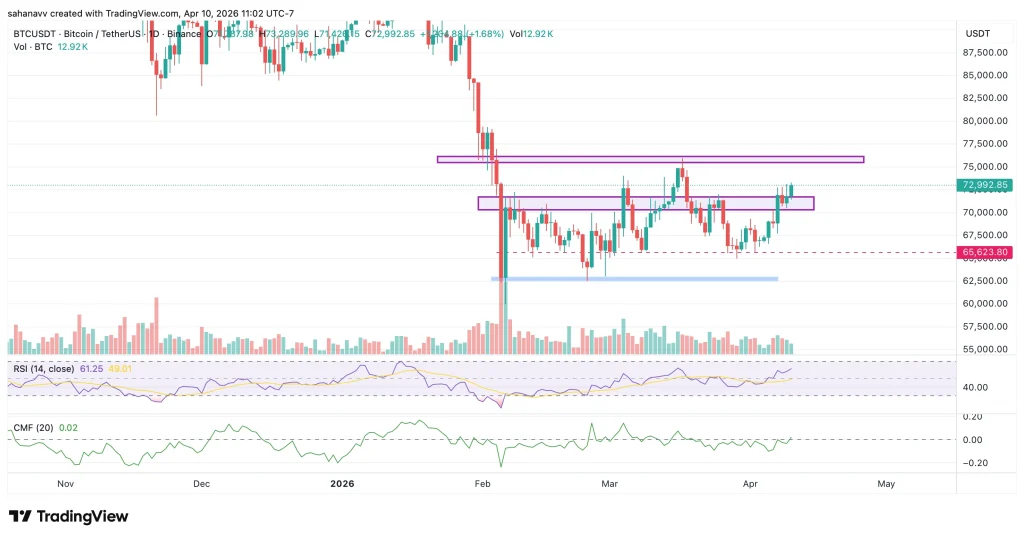
Momentum indicators support the move. RSI is trending above 60, signaling strengthening bullish momentum, while CMF has flipped slightly positive, indicating steady capital inflows. However, price is now approaching a major resistance zone near $75K, which aligns with prior rejection levels. A clean breakout above this level could open the path toward $78K–$80K, while failure to sustain above $70K–$72K risks a pullback toward $65K support.
Bitcoin’s move highlights a key principle that it reacts to liquidity but not headlines. Despite the hot CPI, selling pressure failed to follow through. Buyers stepped in at key levels, and hence, the price broke above a crucial resistance level. This suggests the market was under-positioned for upside, creating room for a squeeze as shorts got trapped and momentum flipped.
This is no longer about CPI, but it’s about follow-through. If the price holds above the support range between $70,000 to $72,000, continuation remains likely to $75,000. While a failure may initiate a pullback and compel the BTC price to remain consolidated.

Iran may require oil tankers to pay BTC tolls through the Strait of Hormuz, signaling a new use case for crypto as geopolitical tensions reshape global trade routes.

Technical analysis, overhead supply awaiting absorption, and a shift in investor sentiment have increased the likelihood of Bitcoin reaching $80,000 in April.

The public statement came about three months after the CEO said Coinbase could not support the crypto bill “as written“ before a crucial committee vote.

Bitcoin bulls spent the week stampeding toward a critical overhead resistance level, which, if breached, could restart the bull market in BTC and altcoins.

Bitcoin holding above $72,000, along with a sharp uptick in whale activity, suggests traders may target the supply zone at $88,000.

Although US inflation was weaker than expected in March, the ongoing war between the United States, Iran and Israel has fueled macroeconomic uncertainty.
The post How $5K Could Hit $750K as DOGE Active Wallets Jump 28% and Pepeto Targets 150x While LINK Holds appeared first on Coinpedia Fintech News
Crypto news this week shows Dogecoin active addresses jumping 28% in seven days as X Money enters its public launch window in April, proving that meme coin attention returns fast when a real trigger shows up, according to Coinpedia. Most large caps keep bleeding, but the projects with listing catalysts keep delivering.
Pepeto approaches the same moment with $8.86 million raised, a live exchange, and the Binance listing confirmed. Crypto news favours entries made before the listing, and $5,000 at the current price targets $750,000 at 150x, the same kind of return Pepe coin delivered with zero products.
Dogecoin active addresses climbed 28% in one week, rising from 57,000 to 73,000, as X Money moved from closed beta into its public launch window set for April, according to Coinpedia. DOGE integration remains unconfirmed, but the address spike shows traders are already positioning.
Crypto news also covered LINK whales adding $9 million in tokens while the Bitwise LINK ETF started trading on NYSE Arca, according to BeInCrypto. The wallets that entered before each of those catalysts collected the gains, and the ones who waited are buying at the top right now.
When trust breaks on one platform, people move to tools they can verify. Pepeto is the trading version of that shift: an exchange that scans every contract and blocks dangerous tokens before your money moves, built for a market where bad code costs people everything.
The scanner digs into every contract for wallet drains, locked sell functions, and inflated supply tricks, then tells you what it found in plain language so you decide with real facts. PepetoSwap charges nothing on every trade so your capital holds full value, and the bridge transfers tokens across chains for free.
Here is the math crypto news has not picked up yet. $5,000 at $0.0000001863 buys over 26 billion Pepeto tokens. Pepe coin hit $0.00002803 on the same 420 trillion supply with zero products, and matching that from presale price is 150x. That turns $5,000 into $750,000. Pepeto has a full exchange, a bridge, and the mind behind Pepe’s $11 billion run. Staking at 186% APY keeps growing early entries while rounds fill.
SolidProof cleared the entire codebase, a Binance-trained developer runs the exchange backend, and Pepeto delivers everything Pepe never built. The product works, the listing is close, and analysts call 150x the floor because the math checks out. The Binance listing can drop at any moment, and early holders will be sitting on positions that the rest of the market pays multiples more to enter.
Dogecoin trades at $0.094 on April 10, up 1.01% in 24 hours and 88% below its $0.7376 all-time high, according to CoinMarketCap. Active addresses jumped 28% but the price stays stuck under $0.095 resistance with $0.089 as support.
DOGE ran from $0.007 to $90 billion once, but from $0.094 the best case is a 2x over months if X Money confirms DOGE integration. That is not the 150x a presale delivers from one listing.
Chainlink trades at $9,06 on April 10, down 84% from its $52.99 all-time high, according to CoinMarketCap. The Bitwise LINK ETF is live and CCIP handles $18 billion in monthly cross-chain volume.
Analysts target $18 by late 2026, a doubling that takes months. The presale compresses that kind of return into days from one listing, not the quarters LINK holders need to wait.
You already know how cycles work because you lived the last one. You watched others collect returns while you waited, and you told yourself next time would be different.
This week showed DOGE addresses jumping 28% while the price stayed flat, and LINK sitting in extreme fear despite an ETF and $18 billion in CCIP volume. Rounds fill faster with every stage, and the Binance listing can arrive at any moment.
Over $8.86 million entering Pepeto during fear shows thousands of wallets already calculated the returns on the other side, and getting in now is how you collect those same results. The Pepeto official website is where that call is being made right now.
Click to Lock In Pepeto Before the Binance Listing Turns This Price Into a Story You Missed
Pepeto approaches its Binance listing with $8.86 million raised, a SolidProof audit, and 150x projected by analysts at $0.0000001863.
DOGE at $0.094 and LINK at $9,06 need months of recovery for a 2x. Pepeto at presale pricing targets 150x from one listing event.

The post Can Privacy Coins Sustain Their Breakout Rally? appeared first on Coinpedia Fintech News
Privacy coins are back and not quietly either. Since April 4, the privacy coins surge has been hard to ignore, with tokens like DASH, ZEC, DCR, and XMR snapping out of their long consolidation phases and ripping higher. The timing? Not random. The spark came from a geopolitical twist, the April 8 U.S.- Iran ceasefire news acted as major trigger which flipped the market into full-blown risk-on mode.
And when that switch flips, capital doesn’t tiptoe infact it rotates fast. This time, it ran straight into high-beta altcoins, with privacy assets leading the charge.
Here’s the thing: markets love narratives, and this one had everything it showed hopes of macro relief, fresh liquidity, and a sector that had been sleeping for months.
DASH led the charge, jumping over 33% in just 24 hours to hit $42.84. That kind of move doesn’t happen in a vacuum. Volume surged to nearly 45% of its market cap, hinting at a mix of short squeeze chaos and genuine accumulation. ZEC wasn’t far behind, pushing toward $382.24.
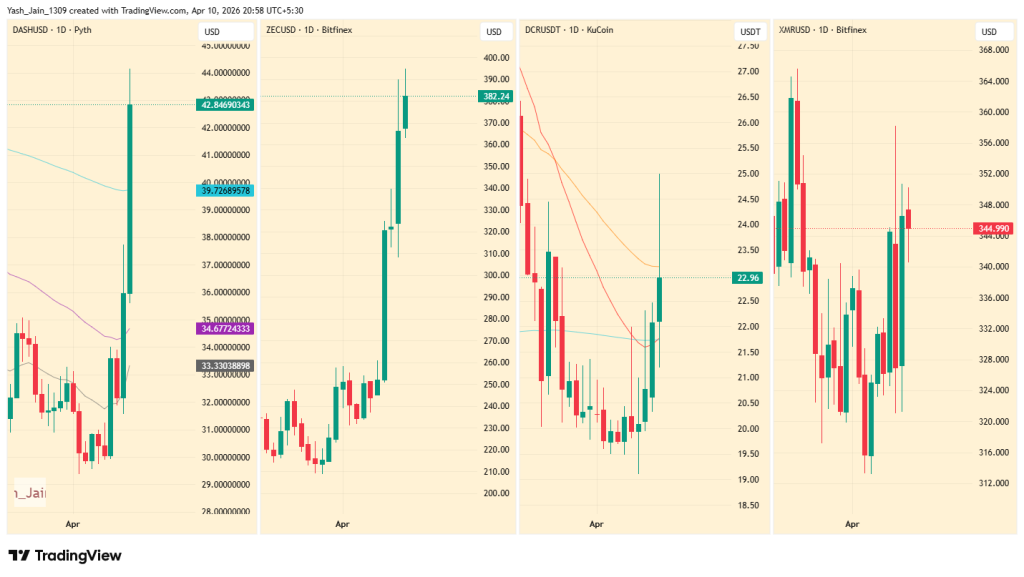
Now zoom out a bit. This wasn’t a one-coin wonder. DCR clawed its way back to $22.96 after a prolonged downtrend, showing signs of life as broader sentiment improved. And then there’s XMR the so-called gold standard. It surged to $344.99, brushing off exchange delisting pressures like they’re background noise. Even more telling? Peer-to-peer volumes are hitting yearly highs. That’s not speculation that’s usage.
So yeah, technically speaking, the charts are aligned. Breakouts, volume, momentum, basically it’s all there.
But let’s be real, this isn’t just only about charts. Privacy is slowly shedding its “niche” label. On public blockchains, everything is visible forever for instance transactions, balances, the whole deal. That’s great for transparency, terrible for businesses trying to stay competitive.
And that’s where the shift is happening. It’s no longer just about anonymity. It’s about operational confidentiality like payroll, suppliers, treasury flows. Stuff that companies simply can’t afford to expose.
Of course, there’s always a catch. Stronger privacy usually means weaker distribution. Delistings, compliance headaches, restricted access and it’s all part of the package. But here’s the twist: the narrative is starting to split.
Some regions are tightening the screws. Others? They’re beginning to see privacy as a feature, not a bug. So, what’s next? Well, if the current risk-on environment holds, this privacy coins surge might not just be a reaction but it could be the start of a broader repositioning.






TAO drops 30% from its weekly high, confirming fractal setups that projected deeper downside targets for the token in the past.

Bitcoin saw a fresh attempt to hit new local highs on the back of lower-than-expected US CPI data, despite a giant gas-price increase.

Reuters reported that White House staff were warned against using confidential information after suspicious Iran-linked oil futures bets and fresh scrutiny of prediction markets.

A Bank of France official called for tighter MiCA rules on non-euro stablecoins as lawmakers advance reporting requirements for self-custodial crypto wallets above 5,000 euros.

New BTC price analysis predicted that the bear market would bottom out later in the year, before beginning a "two-year accumulation phase."

Bitget’s IPO Prime will debut with preSPAX, a Republic-issued token tied to SpaceX’s post-IPO performance rather than direct ownership of the company’s shares.
The post Why is Crypto Rallying Today: Price Targets For Bitcoin, Ethereum and XRP appeared first on Coinpedia Fintech News
The crypto market has rebounded, with Bitcoin rising 10% over the last eight days and Ethereum up 12% in the same period. The total market cap is now up about 2.95% to $2.47 trillion in 24 hours, adding roughly $209 billion in value.
The primary driver is Japan’s regulatory momentum. The Japanese cabinet has approved a bill that classifies crypto as official “financial products,” giving institutions more confidence to treat crypto similarly to traditional assets.
Secondary factors include:
Near‑term, the outlook remains bullish if Bitcoin holds its $69,000–$70,000 support range. The next event to watch is the SEC’s CLARITY Act roundtable on April 16, which could either confirm the current momentum or trigger a re‑evaluation by traders.
Bitcoin is currently trading around $72,900–$73,000, still technically in a larger bearish trend, but now showing signs of a relief rally after a deep oversold phase.
Bitcoin is now testing a major resistance zone between $72,000 and $76,000—a range that has acted as strong resistance since 2024 and has repeatedly flipped between support and resistance over 2025 and 2026. If BTC breaks and holds above $76,000, analysts expect a move toward the mid‑$80s, around $85,000–$86,000, as the next major target.
Ethereum has bounced back above $2,240–$2,250, recovering about 9% in the last week.
On the daily chart, ETH is trading between $2,150 and $2,250, a range that has become critical. If Ethereum holds this zone as support, the bullish inverse head and shoulders structure remains intact, with a technical target around $2,430 as the next upside. However, a confirmed break below $2,150–$2,200 would invalidate the current pattern and reopen the door to deeper downside.
In the short term, many analysts expect a small cool‑off, mirroring Bitcoin’s structure, with a roughly 1‑day setback possible before the next leg up.
XRP is trading around $1.35, up about 3% over the last seven days, and still in a larger bearish trend on the weekly chart. However, the price is now firmly testing a long‑watched support zone around $1.30–$1.35, which has served as a major downside target and bounce area for months.
If XRP continues to hold above $1.30, the downside could be limited and the coin may trade sideways in its $1.30–$1.45 range. XRP is expected to follow Bitcoin’s lead over the next few days: if BTC pulls back into a small cool‑off, XRP is likely to see similar weakness, but not necessarily a full breakdown as long as that $1.30 floor holds.

The post Everything EV Token Surges in Attention, But Liquidity Tells Another Story appeared first on Coinpedia Fintech News
Everything EV has pulled off nice ascent in past 30 days and it briefly outpaced even Bitcoin in 24-hour visits on CoinMarketCap. Yeah, that got attention. And naturally, when a relatively under-the-radar token suddenly tops traffic charts, it’s either the start of something… or the middle of something messy. Let’s unpack what’s actually going on.
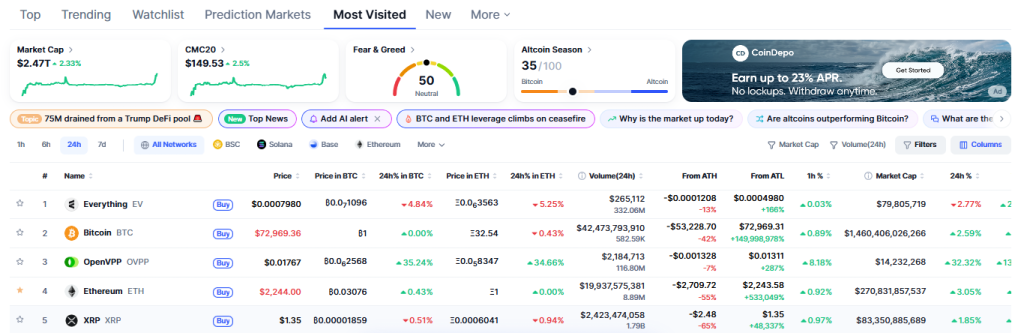
At first glance, the surge looks like a classic retail rush. Dig a little deeper, though, and there’s a more structured narrative forming. Investors aren’t just browsing but they’re staking.
Its staking activity has picked up, signaling a rise in perceived trust and liquidity around Everything EV. And honestly, nothing attracts capital faster than yield. The project’s own numbers back that up. The EV/USDTO pair has climbed to roughly $379,995, while WETH/USDTO sits at $105,739.
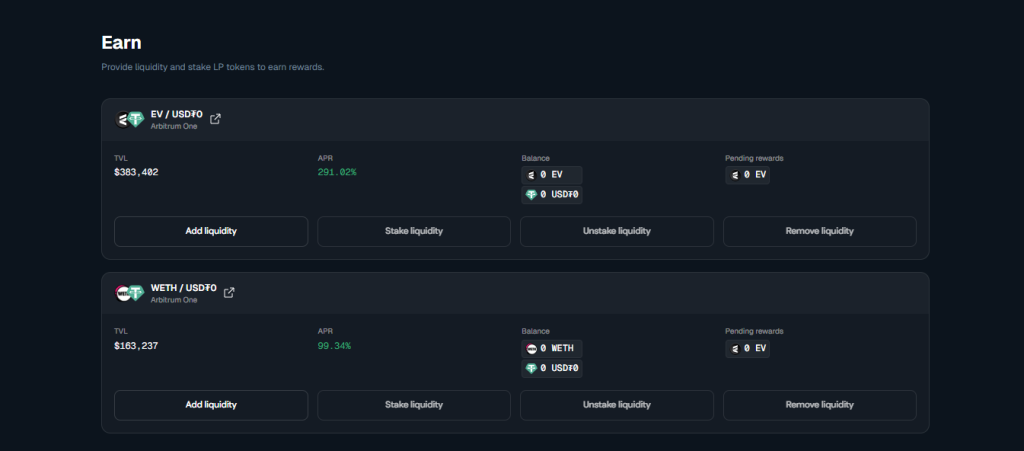
Why the gap? Simple its the APR rates difference. The EV/USDTO pool is offering a massive 293.55%, while WETH/USDTO trails at 152.07%. High yields, high attention. No surprises there.
But let’s be real but those kinds of returns don’t just attract believers. They attract opportunists.
On its official X, its team itself confirmed that incentive programs have kicked off, with “crazy good APR” being unlocked. That explains the sudden spike in participation.
Meanwhile, their broader DeFi strategy is also gaining traction. The “DeltaUSD HyperLiquid USDN Funding Arb” vault, for example, targets a 15–20% yearly yield by arbitraging between SMARDEX perpetuals and Hyperliquid funding rates. And based on recent data, it’s actually delivering a steady upward trajectory.
So yeah, there’s some real infrastructure here not just all hype.
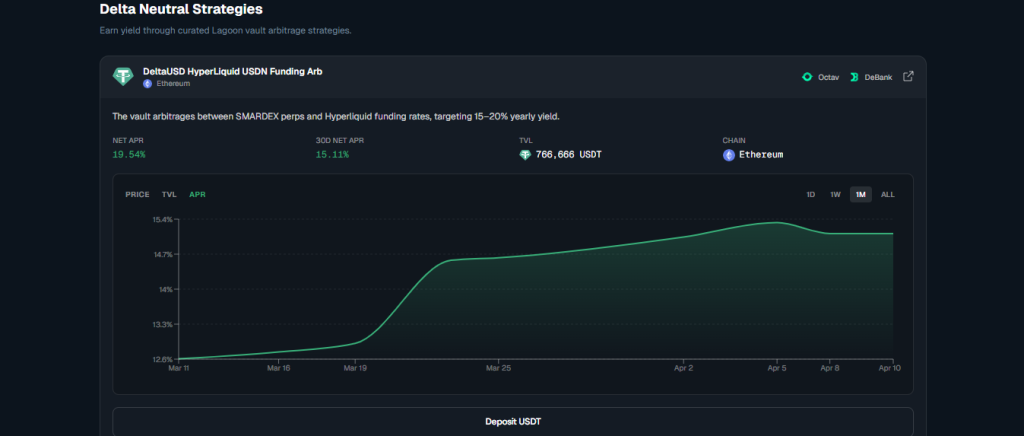
Its website claims that the project is built in Montreux, Switzerland, backed by a team with over 15 years of trading experience, 30+ in-house engineers, and over $25 million in self-funded capital. Sounds solid on paper. But markets don’t reward resumes they reward flows.
And this is where things get… less exciting. Despite the buzz, Everything EV isn’t widely available. It’s currently limited to Uniswap and SMARDEX hardly the deep-liquidity venues that sustain long-term growth.
Now look at the numbers. TVL spiked to $1.3 million in late March. Great. But by April? It dropped to around $862.7K. That’s not a rounding error but that’s a meaningful pullback.
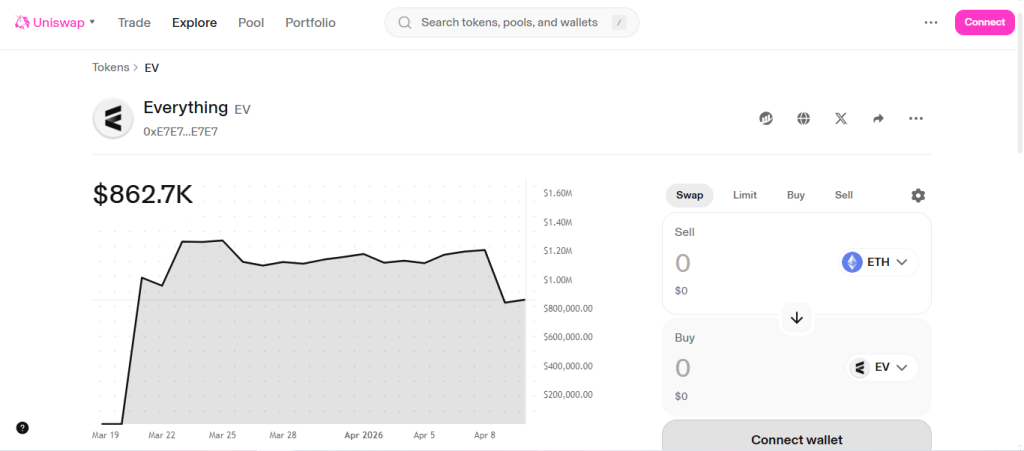
So while staking demand and APR-driven flows pushed attention higher, overall locked value suggests capital isn’t sticking around as strongly as the narrative implies.
Well, it looks like a classic case of high-yield magnetism meeting fragile liquidity. Everything EV is trending, no doubt. It’s attracting users, generating buzz, and showcasing some clever DeFi mechanics.
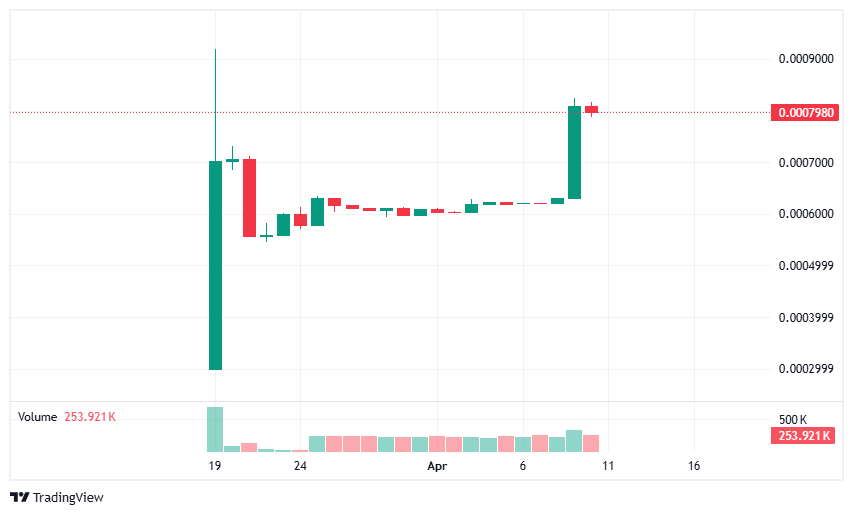
But underneath all that? The TVL dip hints that not all that capital is committed. And in crypto, attention is easy. Retention is everything. So, its price shows caution clearly.
The post Bitcoin Breaks $73,000 as Core CPI Surprises: Will the Rally Last? appeared first on Coinpedia Fintech News
Bitcoin briefly crossed $73,000 this afternoon, hitting a high of $73,115 before pulling back.
It is currently trading at $72,794, up 2.51% in the past 24 hours and 8.81% on the week.
The March CPI report that everyone had been watching landed this morning, and understanding what it actually said explains the move.
The March CPI report landed this morning and the headline looked alarming. Inflation rose to 3.3% year-on-year, up from 2.4% in February, marking the largest month-on-month increase since June 2022.
But CryptoQuant analyst Darkfost published a breakdown that explains why Bitcoin rallied rather than sold off.
The entire rise was driven by energy prices, which surged 10.9% in March including a 21.2% spike in gasoline – a direct consequence of the Iran war’s disruption to oil supply routes. Food prices remained flat.
Core CPI, which strips out energy and food, came in at 0.2% month-on-month. The forecast was 0.3%.
“Looking at Core CPI which excludes energy and food shows that inflation has not deeply anchored itself in the broader economy, as there was little to no significant change,” Darkfost wrote. “This suggests that, for now, inflation remains concentrated in energy and largely reactive in nature, rather than systemic.”
His conclusion on the Fed was direct: “The Fed will do nothing, and will wait and see, as usual.”
For Bitcoin, a contained core reading removes the scenario the market feared most. The rate cut conversation hasn’t reopened but it hasn’t closed either.
Also Read: Bitcoin Bear Market In Its Final Stage? 2 On-Chain Signals to Know Before Your Next Trade
The CPI data landed on top of existing geopolitical momentum. The two-week US-Iran ceasefire announced April 7 already sent Bitcoin from $68K to $72K.
Now, peace talks between US and Iranian delegates are scheduled in Islamabad this weekend, with JD Vance leading the American team in what would be the highest-level US-Iran meeting since 1979.
A confirmed deal would ease energy prices further, strengthen the rate cut case, and accelerate Bitcoin’s rally.
Analysts are flagging that April’s CPI data will be the real structural test – the question is whether energy-driven inflation begins spreading into the broader economy as the conflict continues.
$75,000 remains the confirmed breakout level analysts are watching. Whether it can hold above $73,000 on a sustained basis remains the immediate question.
The post Ripple and Quant Team Up on Stage: Is XRP the Real Internet of Value Behind the Scenes? appeared first on Coinpedia Fintech News
Ripple and Quant are no longer just talking about the future of institutional payments, they’re now sharing the stage, and the market is taking notice. In a rare joint appearance, Ripple’s James Wallace, head of CBDC relations, and Gilbert Verdian of Quant Network sat side by side, unveiling a single, tightly‑linked vision: a programmable, multi‑ledger, institutional “internet of value” largely built on the XRP Ledger.
On stage, Wallace laid out Ripple’s two‑pronged setup: RippleNet for cross‑border payments using cryptocurrency as a bridge currency, and Ripple’s XRP‑based initiatives for next‑generation CBDC and institutional solutions. Crucially, he framed Ripple’s mission as creating the “internet of value”—where corporate, central‑bank, and individual money can move as easily as data.
Observers on the XRP community side argue that while Quant markets itself as the programmable, interoperable layer for regulated value, Ripple is calling the XRP Ledger the main “regulated library network” beneath it all. In this narrative, Quant acts as the “API glue” and roll‑up layer, while XRP is the backbone ledger for CBDCs, private digital currencies, and cross‑border rails.
The video deep‑dive highlights how banks and central‑bank tech leaders have quietly renamed the same concept several times: “regulated library network,” “regulated internal value,” “shared ledger,” “unified ledger,” “constellation of regulated networks.” According to the XRP‑focused commentary, they all point back to the XRP Ledger as the shared, public, regulated‑grade core, with CBDC‑style blockchains as “carbon‑copy clones” running alongside.
The twist? The same executives who talk about a “constellation” of CBDC‑related networks are the ones who sit with Verdian at events and call Quant the interoperability layer. That’s where the XRP‑centric argument kicks in: Ripple and the XRP Ledger are the shared infrastructure; Quant and similar firms are the programmable front‑end layer.
Jesse said that put together, the scene is a masterstroke for XRP:











World Liberty said its WLFI unlock proposal will go through community input before a formal vote, outlining a phased vesting plan rather than a full token release.

Aethir said it halted a bridge exploit on its Ethereum-linked contracts, limiting losses to under $90,000 after PeckShield estimated $400,000 in damages.

Covenant AI said it was leaving Bittensor due to its overreaching control on subnets and their large-scale TAO token sales, but Bittensor’s founder denied all allegations.

A spoofed CoinDCX site sparked a 7.16 million rupee fraud case, triggering arrests before a court ruled the exchange was impersonated

Hong Kong has issued its first stablecoin issuer licenses, approving Anchorpoint Financial and HSBC’s Hong Kong banking arm under its new regime.





Some industry insiders speculate the crypto sector may be just one market cycle away from full-scale mainstream adoption.

Japan tightens oversight with insider-trading bans and new disclosure rules as crypto markets attract more institutional participation.

Fidelity and Morgan Stanley’s Bitcoin ETFs also saw a combined $68.2 million in inflows, while four other Bitcoin ETFs also tallied inflows on Thursday.

xAI argues that the law could force Grok to align with state-defined standards, which would conflict with its goal of “maximally truth-seeking” AI.

The upgrade from flat fees to variable pricing is designed to support the use of AI agents for LLM inference, compute and data queries.




























































Need to know what happened in crypto today? Here is the latest news on daily trends and events impacting Bitcoin price, blockchain, DeFi, NFTs, Web3 and crypto regulation.
