 Login
Login
Strategy's STRC stock trading surge: How much Bitcoin can Saylor buy?

Strategy may raise $300 million via STRC sales, potentially giving Michael Saylor enough proceeds to continue buying Bitcoin throughout 2026.

Strategy may raise $300 million via STRC sales, potentially giving Michael Saylor enough proceeds to continue buying Bitcoin throughout 2026.
The post PI Network Price Jumps 15% as Volume Rises But $0.28 Holds the Real Answer appeared first on Coinpedia Fintech News
The PI Network price is suddenly back on traders’ radar this weekend. Not because it exploded into a massive rally but because something subtler is happening beneath the surface: volume is quietly heating up.
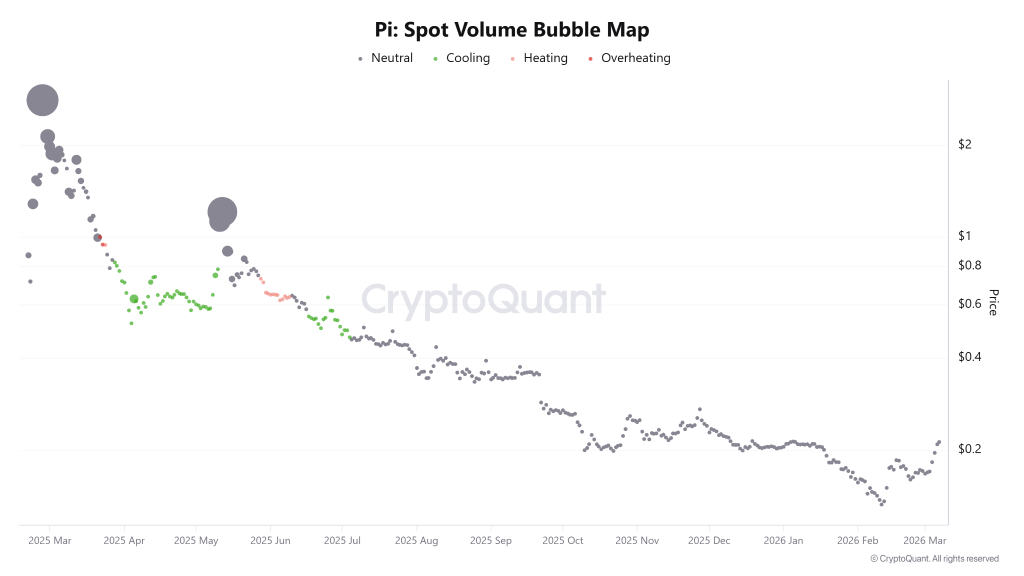
And in crypto markets, rising volume during a price recovery tends to get people paying attention. According to data from CryptoQuant’s spot volume bubble map, trading activity has started climbing alongside the recent PI/USD move. Now, before anyone starts screaming “breakout,” there’s a catch. The indicator still labels the current volume environment as neutral.
Oddly enough, that’s not bad news. Neutral volume during a rising price trend often hints that accumulation might still be underway rather than a full-blown speculative frenzy.
Take a closer look at the volume map and the pattern becomes clearer. The bubbles tracking spot activity have been gradually expanding, signaling a rise in trading interest. But they’re not glowing red-hot or light orange yet. In other words, momentum hasn’t strengthened yet and to reach peak speculation territory it needs some more efforts to do it.
For long-term watchers of the PI Network price chart, that distinction matters. If volume remains controlled while price edges upward, it can suggest investors are slowly building positions rather than chasing a short-term pump.
Still, crypto has a long history of teasing traders before pulling the rug.
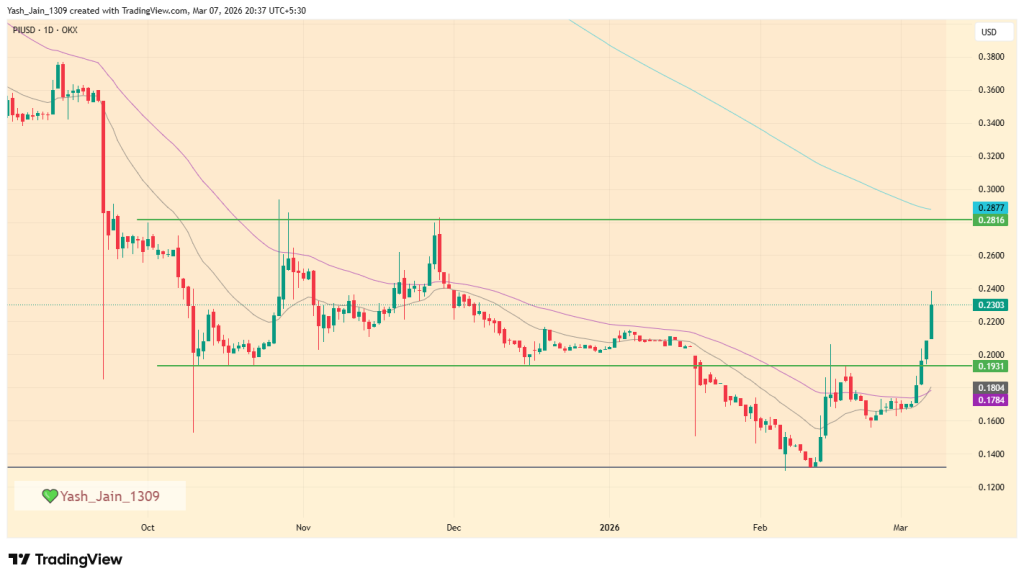
History provides a useful cautionary tale here. Back in Q4 2025, the asset surged from roughly $0.19–$0.20 but ran into a stubborn ceiling at $0.28. That level ultimately triggered a loss of strength, turning the rally into what traders later labeled a classic fakeout.
Fast forward to Q1 2026, and the story looks slightly different. This time, the asset found support much lower, in the $0.13–$0.14 zone. From there, it managed to reclaim $0.20, a move that technically signaled a shift in short-term trend.
But the real test hasn’t arrived yet. If price once again stalls beneath $0.28, the market could start asking uncomfortable questions about whether history is repeating itself.
So why the renewed attention now? Two recent developments inside the ecosystem appear to be driving the interest.
First came the announcement that Protocol v19.9 migration has been successfully completed, with the next upgrade, v20.2, targeted for completion before Pi Day 2026. Node operators were advised to ensure their systems are updated ahead of the next phase.
Then things got even more interesting. A separate update revealed a proof-of-concept project exploring a new Pi Node utility for decentralized AI training and computing tasks. The project reportedly uses spare computing power from over 421,000 Pi Nodes to process AI-related workloads.
The initiative was conducted in collaboration with OpenMind, a robotics startup backed by Pi Network Ventures. The experiment showed that Pi Nodes could handle AI workloads and return useful results quickly, an early step toward integrating the network into distributed AI infrastructure.
So where does that leave things?
Simple. The PI Network price prediction debate now circles around a single technical hurdle.
If the PI Network price climbs decisively above $0.28, the probability of the current rally being another fakeout drops significantly. Rising volume on CryptoQuant’s chart could then signal accelerating momentum.
And if that momentum continues building, some traders believe the next long-term target could eventually stretch toward $1. But first things first. The market still has one stubborn ceiling to deal with.
The post Ethereum Price Builds Quiet Strength as RWAs Hit $20.4B and L2 Ecosystem Expands appeared first on Coinpedia Fintech News
The Ethereum price may look sluggish on the surface, but under the hood the network’s fundamentals are doing something far less boring which quietly expanding. And in crypto, quiet expansion tends to get loud eventually.
Since January 2025, the value of tokenized RWAs on blockchain has climbed to $20.4 billion, according to the latest data. That growth isn’t happening in isolation either. It’s unfolding alongside a rapidly expanding Layer 2 ecosystem and a massive stablecoin footprint across the Ethereum network.
So while traders argue over candles on the Ethereum price chart, the infrastructure beneath the market keeps getting bigger.
Let’s start with the raw numbers. The Ethereum ecosystem now hosts 146 live Layer 2 networks. That’s not a typo, 146 separate scaling environments designed to handle transactions and applications without clogging Ethereum’s base layer.
And despite the brutal token corrections many of those L2 projects have faced recently, the capital sitting inside them hasn’t exactly vanished.
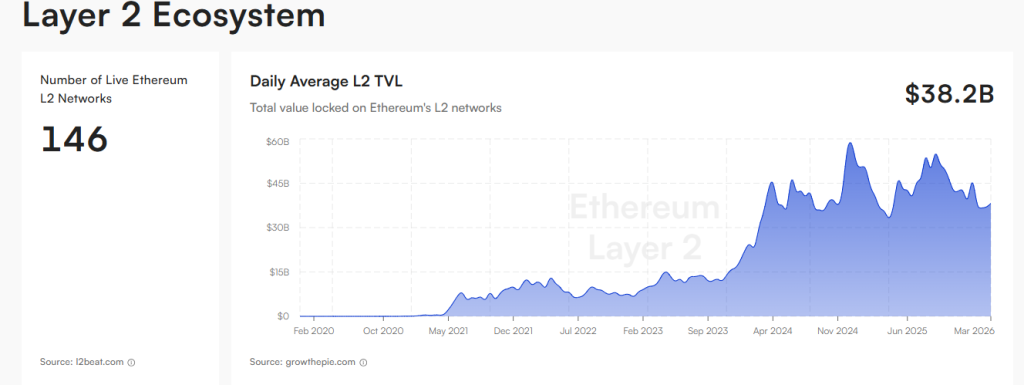
The total value locked across Ethereum’s L2 networks currently sits at $38.2 billion. Sure, that’s down from the $58 billion peak recorded in mid-December 2025, but it’s still a massive figure considering the broader market turbulence.
In other words, the infrastructure didn’t disappear just because prices dropped.
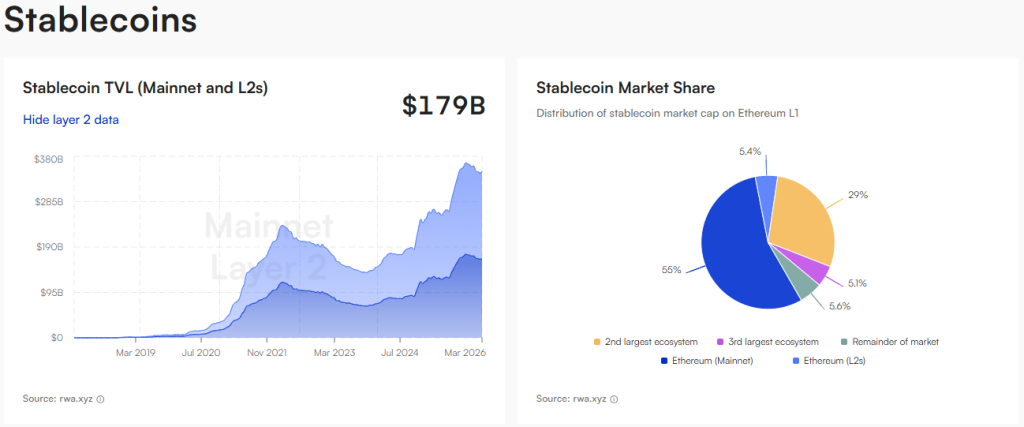
Now here’s another piece of the puzzle. When combining Ethereum’s mainnet and its L2 networks, stablecoins account for over 60% of the market share, representing roughly $179 billion.
That’s a staggering amount of liquidity circulating inside one ecosystem. Why does it matter? Because stablecoins function as the financial plumbing of crypto. They power trading, lending, payments, and DeFi. When the majority of that liquidity sits inside Ethereum’s orbit, it tells you where most of the financial activity still lives.
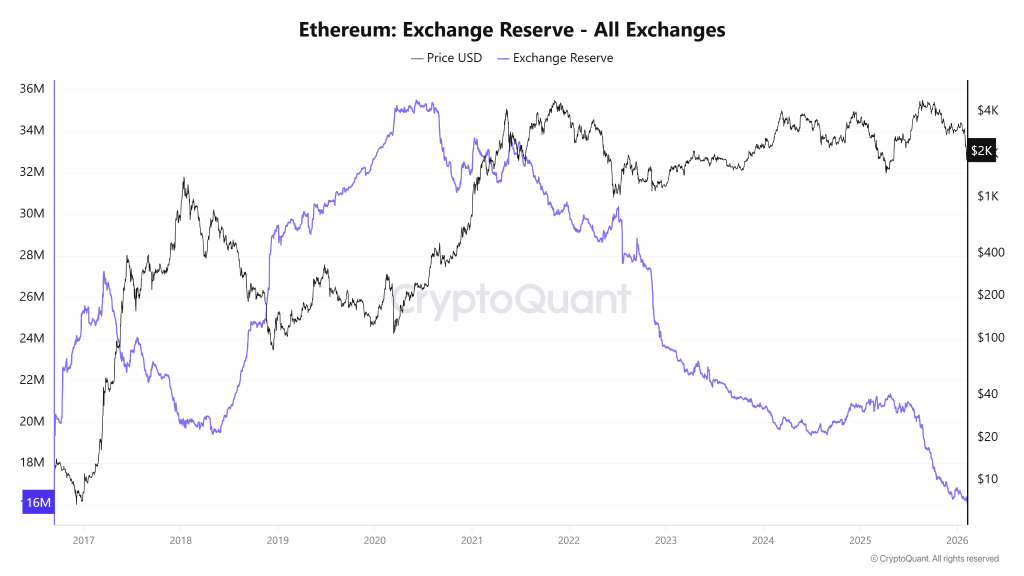
Meanwhile, another metric is quietly flashing on analysts’ dashboards: declining ETH exchange reserves. Put simply, fewer ETH tokens are sitting on centralized exchanges.
Historically, that kind of movement suggests accumulation. Investors pull assets off exchanges when they’re planning to hold rather than sell. Not exactly the behavior you see during panic exits.
Now here’s where things get interesting. Some market watchers believe the current setup could be quietly building pressure. One particularly blunt sentiment floating around crypto circles sums it up pretty clearly: many investors may not fully grasp how bullish the broader chart structure appears.
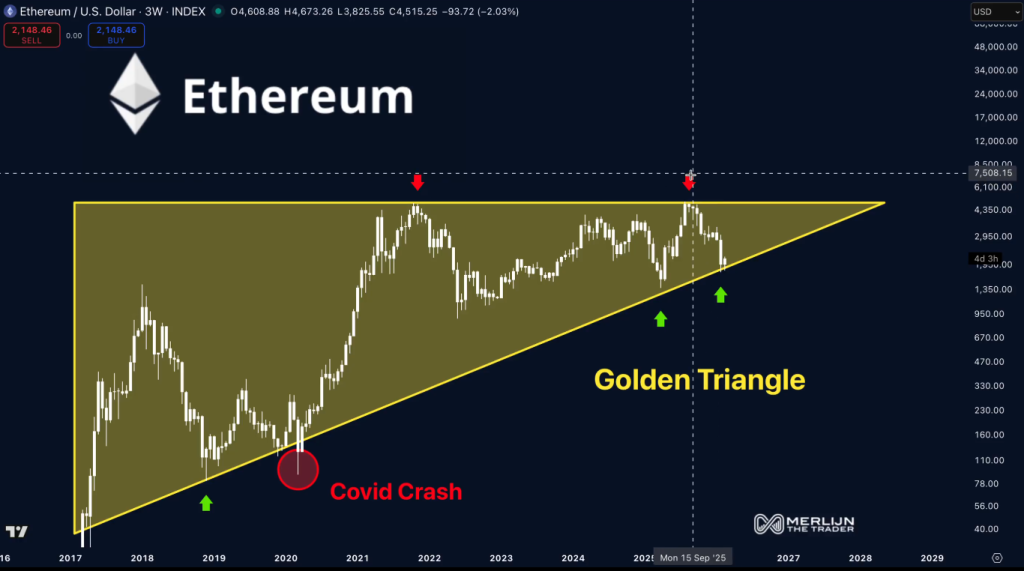
The argument goes like this. Sentiment across the market remains crushed. Massive capital reportedly sits on the sidelines waiting for regulatory clarity. Meanwhile, institutions, governments, and banks are increasingly experimenting with blockchain-based financial infrastructure.
If that alignment plays out, the Ethereum price prediction suggests that it could eventually reflect the scale of the ecosystem being built around it. And when that happens, the ripple effects across the altcoin market could be hard to ignore.
The post Worldcoin Price Prediction 2026, 2027 – 2030: Will WLD Price Reach $10? appeared first on Coinpedia Fintech News
WLD price was almost $12 ATH but went crashing to $0.50 in the last remaining days of 2025. This has raised concerns among investors and traders about WLD’s future, and as a result, the Worldcoin price prediction 2026 has become a topic of significant discussion, with many being intrigued about its prospects in the coming year.
Its prolonged period of downtrend has left many wondering if the project’s initial buzz was fading. But, behind the scenes, Worldcoin is still quietly building its platform. Now, experts view Q1 2026 as a potential turning point where renewed momentum could be observed.
So many are now asking a crucial question: is this the start of a new chapter for Worldcoin? Will the project’s focus on decentralized identity and its connection to the AI sector be enough to fuel a powerful comeback and reclaim its spot in the market spotlight?
Let’s delve into the anticipated Worldcoin price predictions 2026 to 2030 and the years to come.
| Cryptocurrency | Worldcoin |
| Token | WLD |
| Price | $0.3735
 -3.70% -3.70%
|
| Market Cap | $ 1,080,862,612.29 |
| 24h Volume | $ 89,224,716.4222 |
| Circulating Supply | 2,893,975,824.9380 |
| Total Supply | 10,000,000,000.00 |
| All-Time High | $ 11.8171 on 10 March 2024 |
| All-Time Low | $ 0.3140 on 06 February 2026 |
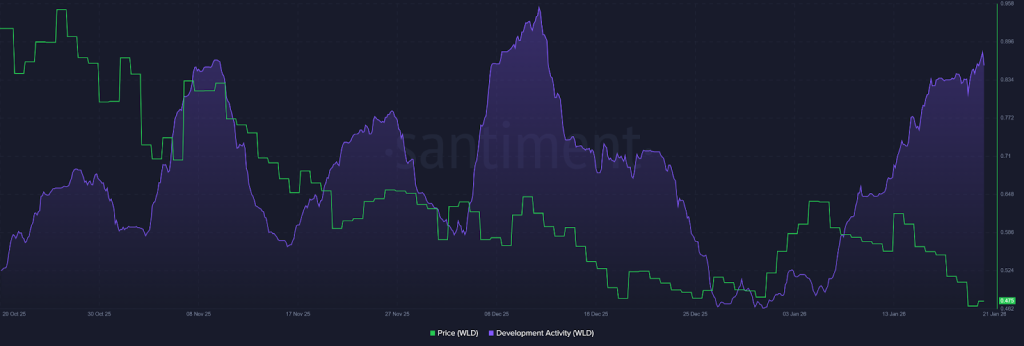
In early 2026, the price dropped to $0.27, prompting efforts to stabilize the market. However, investor sentiment continues to be cautious. The immediate short-term support level is at $0.31; a drop below this level could result in further declines. If the prices increase, we could see a bounce back to $0.60 and potentially $0.95 in March. For a long-term recovery, it is essential to break through the resistance at $1.50.
Following a false breakout to $2.12 in September 2025, the bearish trend continued into the first quarter of 2026, with prices dropping as low as $0.27. However, since mid-February, there have been efforts to sustain the price and prevent further declines.
Given the significant drop already experienced, broader market conditions have notably affected liquidity within the cryptocurrency sector. As a result, traders and investors have remained on the sidelines, waiting for clearer market signals to emerge.
In March, the market would find itself in a precarious situation, as odds suggest it could struggle to stabilize. Investor sentiment remained lukewarm, with many hesitant to take advantage of opportunities despite substantial price discounts.
Currently, the immediate critical support level is at $0.31. If this level is breached, lower prices may be possible. On the other hand, if the price rises, March could see a bounce towards $0.60 and $0.95 in the short term. For long-term recovery, the price needs to breach the $1.50 resistance zone.
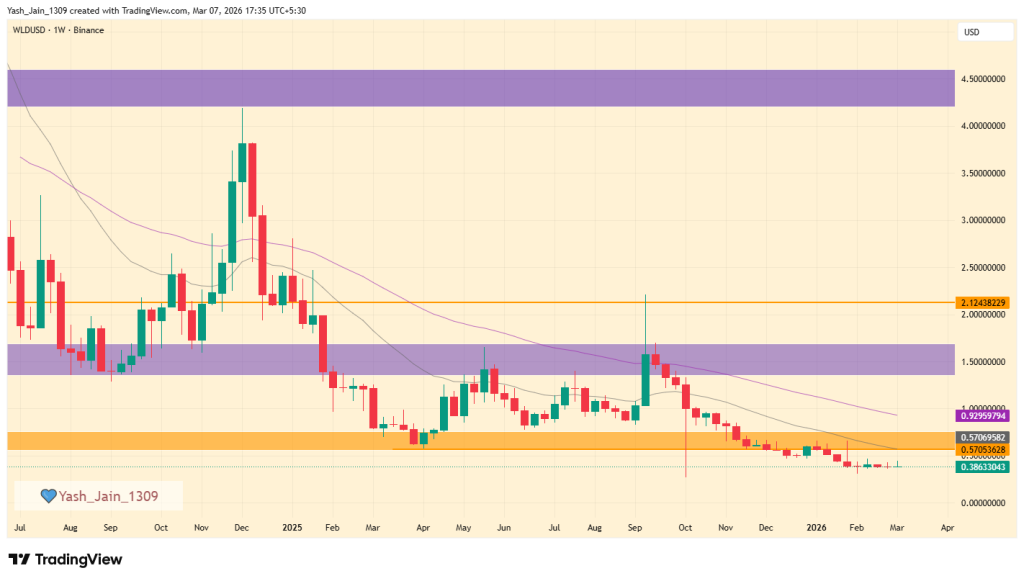
The WLD Spot Average Order Size chart reveals persistent green clusters into January 2026, indicating sustained “Big Whale” participation. This heavy institutional accumulation suggests that smart money is aggressively building positions, viewing the current price range as a high-conviction entry point.
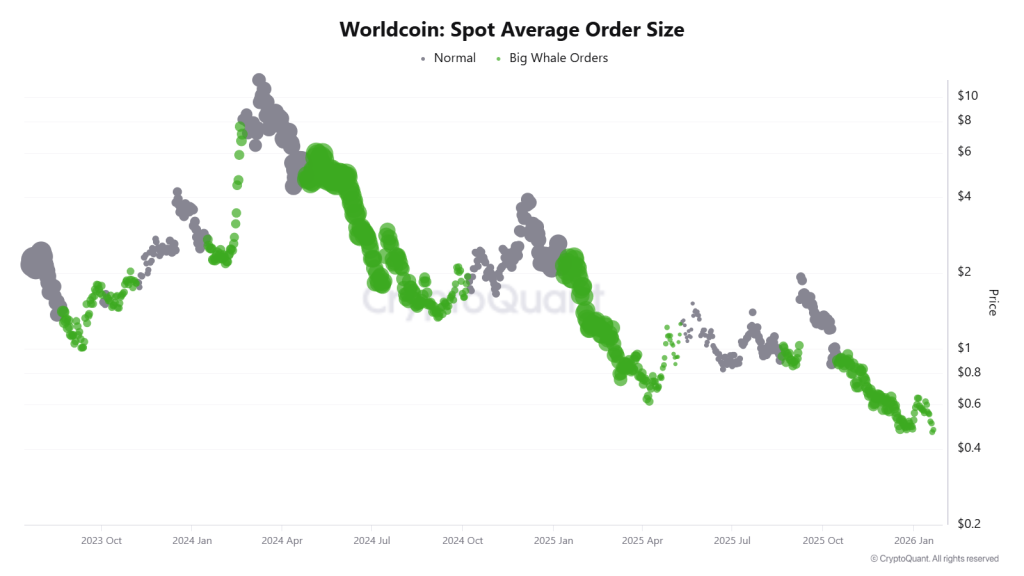
Similarly, development activity on Worldcoin is surging to new local highs in January 2026, showcasing intense builder commitment. This spike in innovation, combined with whale interest, creates a powerful fundamental divergence that historically precedes a massive price reversal.
| Year | Potential Low ($) | Average Price ($) | Potential High ($) |
| 2026 | 2.50 | 6.00 | 9.50 |
| 2027 | 7.00 | 11.25 | 15.70 |
| 2028 | 10.75 | 15.95 | 21.15 |
| 2029 | 15.65 | 21.60 | 27.50 |
| 2030 | 19.75 | 27.75 | 35.60 |
This table, based on historical movements, shows Worldcoin price to reach $35.60 by 2030 based on compounding market cap each year. This table provides a framework for understanding the potential Worldcoin price movements. Yet, the actual price will depend on a combination of market dynamics, investor behavior, and external factors influencing the cryptocurrency landscape.
Worldcoin’s price for 2026 is projected to range between $2.50 and $9.50, with an average price of approximately $6.00.
Worldcoin’s price for 2027 is expected to fluctuate between $7.00 and $15.70, with an average price of around $11.25.
Worldcoin’s price for 2028 is anticipated to be between $10.75 and $21.15, with an average price of about $15.95.
Worldcoin’s price for 2029 is projected to vary from $15.60 to $27.50, with an average price of roughly $21.60.
Worldcoin’s price for 2030 is expected to fluctuate between $19.75 to $35.60, with an average price of approximately $27.75.
| Firm Name | 2026 | 2030 |
| Swapspace | $1.30 | $2.07 |
| coincodex | $2.40 | $4.30 |
| DigitalCoinPrice | $3.02 | $4.06 |
*The targets mentioned above are the average targets set by the respective firms.
Stay ahead with breaking news, expert analysis, and real-time updates on the latest trends in Bitcoin, altcoins, DeFi, NFTs, and more.
Worldcoin is a cryptocurrency project aiming to distribute digital assets to a global audience through a unique identity-verification system.
At the time of writing, the price of one WLD token was $ 0.00349731.
WLD price forecasts for 2026 suggest a potential range between $2.50 and $9.50, depending on market recovery and technical breakouts.
Long-term models suggest WLD could trade from about $19.75 to $35.60 by 2030 under bullish conditions.
While speculative, extended growth forecasts envision potential for WLD beyond 2040 based on adoption and tech use cases.
Worldcoin offers long-term potential due to its focus on decentralized identity and AI, but it remains volatile and requires risk awareness.
WLD price is driven by AI narrative strength, user adoption, token supply dynamics, market sentiment, and overall crypto market trends.
The post Hyperliquid Price Prediction 2026, 2027 – 2030: Will HYPE Price Hit A New ATH? appeared first on Coinpedia Fintech News
The crypto market is buzzing with excitement over Hyperliquid and its native token, HYPE. As a decentralized, paperless alternative to platforms like Binance and Coinbase, Hyperliquid is quickly gaining traction, prompting investors to look closely at the HYPE price prediction for 2026 and beyond.
With its unique “HyperBFT” consensus mechanism, lightning-fast transactions, and zero KYC hurdles, Hyperliquid is rewriting the rules of perpetual trading. Beyond its consensus mechanism, Hyperliquid also allows users to trade crypto perpetual futures, including major assets like BTC, ETH, SOL, AVAX, and SUI, even without owning the underlying asset.
As the platform gains traction for its streamlined trading experience, many investors are now turning to analyze the HYPE token price outlook. But does its innovative model signal long-term growth for HYPE Token Price?
In this article, we dive deep into market sentiment and Hyperliquid price projections from 2026 to 2030.
| Cryptocurrency | Hyperliquid |
| Token | HYPE |
| Price | $30.1648
-1.52%
|
| Market Cap | $ 7,774,102,257.37 |
| 24h Volume | $ 151,844,828.0610 |
| Circulating Supply | 257,720,838.6770 |
| Total Supply | 957,394,042.8675 |
| All-Time High | $ 59.3926 on 18 September 2025 |
| All-Time Low | $ 3.2003 on 29 November 2024 |
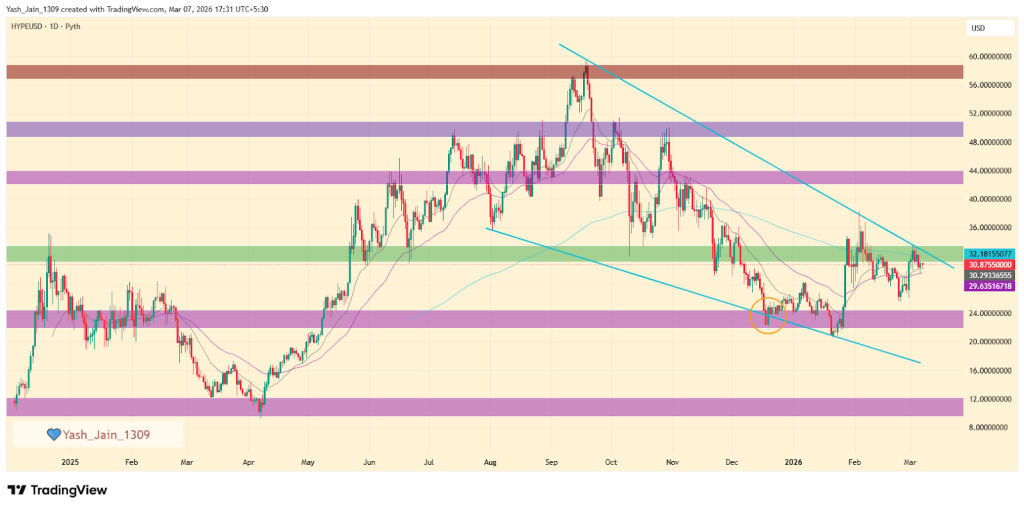
In 2026, HYPE retested support at $21 and rose to $38 but now faces resistance at the upper wedge boundary around $32. If it breaks $32, it could reach $44 or $50; otherwise, it may fall below $21 to $18.
In February, HYPE’s price fell from its $38 peak and is now 30% lower at $26. But late February saw a faint demand again, which pushed the price back up to retest the 20-day and 50-day EMA bands. If it crosses, in March, a retest of $32 could be possible, or even a breach, with targets at $44. But, if $32 repels, then it could hit $21.
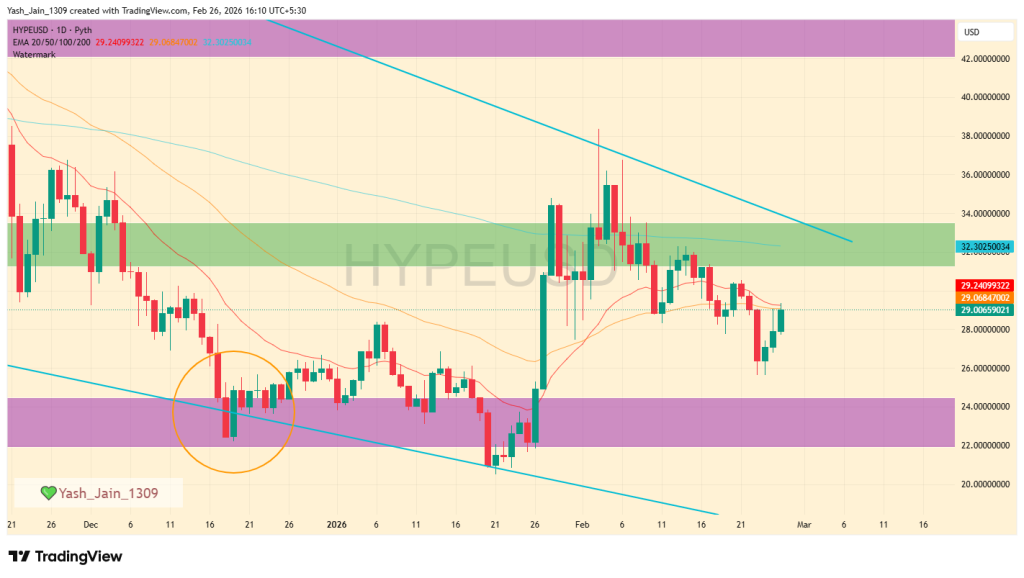
In 2026, the HYPE price underwent a significant retest of dynamic support at $21, which coincided with the lower boundary of a falling wedge pattern. This retest led to a price rise to $38 by early February. However, the upper boundary of the falling wedge then served as dynamic resistance, preventing any further upward movement.
Currently, HYPE is consolidating within a narrowing wedge, with the trading range narrowing each month. At present in March, it is fluctuating around the 20-day and 50-day EMA bands.
In the short term, the price has tested the upper boundary of the falling wedge again, approximately at $32. If it successfully breaks through and maintains above this level, it may initiate a rally towards $44 or $50. Conversely, if it is rejected at $32, the price could decline below $21, potentially reaching as low as $18.
| Year | Potential Low | Potential Average | Potential High |
| 2026 (conservative) | $15 | $35 | $80 |
The Dune analytics dashboard provided an quick on-chain overview of the utility metrics of the Hyperliquid token (HYPE), which appears to be improving significantly with each passing month.
HyperEVM total transaction fees have surpassed 235.57K and are at an ATH, and total trading volume has crossed $3.64 trillion and is at an ATH. Even its revenue has reached an ATH, crossing $993 million.

All the major metrics suggest that it is experiencing great adoption among peers, and its on-chain metrics are proof of that, suggesting that if the rally occurs, then 2026 might end on very good numbers.
| Year | Potential Low ($) | Potential Average ($) | Potential High ($) |
| 2026 | 25 | 50 | 90 |
| 2027 | 40 | 75 | 105 |
| 2028 | 55 | 95 | 130 |
| 2029 | 85 | 110 | 155 |
| 2030 | 105 | 125 | 185 |
By 2026, the value of a single Hyperliquid token price could reach a maximum value of $90 with a potential low of $25. With this, the average price could land at around the $50 level.
During 2027, the HYPE could reach a maximum value of $105 with a potential low of $40. Considering this, the average price of this altcoin could settle at around $75.
The Hyperliquid price could achieve the $130 milestone by the year 2028. On the flip side, the altcoin could record a low of $55 and an average price of $95.
The HYPE crypto prediction for the year 2029 could range between $85 to $155 and the average price could be around $110.
Looking forward to 2030, the Hyperliquid Price may range between $105 and $185, and a potential average value of around $125.
| Firm Name | 2025 | 2026 | 2030 |
| Binance | $37 | $63 | $164 |
| DigitalCoinPrice | $76 | $54 | $97 |
*The aforementioned targets are the average targets set by the respective firms.
This Layer-1 project has taken the crypto market by storm within a short time frame. With a market cap of over $7 billion, this altcoin has successfully secured a position in the top 25. Moreover, with the mass adoption, this altcoin could claim a spot in the top 10 during the upcoming bull run.
If the bullish sentiment intensifies, the Hyperliquid price will reach a high of $41.39 this year. On the flip side, if the market experiences unfavorable events, this could result in this altcoin settling at a low of $14.65.
| Year | Potential Low | Potential Average | Potential High |
| 2025 | $14.65 | $28.02 | $41.39 |
Stay ahead with breaking news, expert analysis, and real-time updates on the latest trends in Bitcoin, altcoins, DeFi, NFTs, and more.
Hyperliquid is a fast, decentralized trading platform with no KYC and low fees, making HYPE popular among traders seeking speed and independence.
HYPE price in 2026 is projected to range between $25 and $90, with an average near $60 if adoption and trading volumes keep rising.
Long-term projections suggest HYPE might reach an average of $125 by 2030, with possible highs near $185 if platform usage keeps expanding.
HYPE may appeal to long-term investors due to strong platform growth, but like all crypto, it carries risk and requires careful research.
The post Avalanche Price Prediction 2026, 2027 – 2030: Will AVAX Price Hit $100? appeared first on Coinpedia Fintech News
Aave (AAVE) is a decentralized finance protocol built on Ethereum that facilitates permissionless lending and borrowing through smart contracts. After witnessing a strong expansion in the previous market cycle, AAVE entered a prolonged correction phase, with price gradually retracing from its earlier highs. Throughout 2025, AAVE remained in a consolidation structure, reflecting a period of market digestion rather than trend continuation. While short-term momentum has cooled, the broader technical structure suggests that AAVE may be transitioning into a new accumulation phase.
As volatility contracts and price holds above long-term demand levels, attention is now shifting toward whether 2026 can trigger the next major price discovery cycle.
| Cryptocurrency | Avalanche |
| Token | AVAX |
| Price | $8.8594
-1.61%
|
| Market Cap | $ 3,825,258,235.40 |
| 24h Volume | $ 155,048,347.4029 |
| Circulating Supply | 431,771,961.1772 |
| Total Supply | 463,441,061.1772 |
| All-Time High | $ 146.2179 on 21 November 2021 |
| All-Time Low | $ 2.7888 on 31 December 2020 |
Currently, the Avalanche price is testing the $9 mark in March after hitting resistance at $15 in January. A recovery is expected in March, and projections for the first quarter of 2026 suggest it could regain previous levels. Experts are targeting $20, with a potential rise to $28. If it breaks through $28, it may reach $44 by mid-year. However, if $28 acts as strong resistance, consolidation may continue.
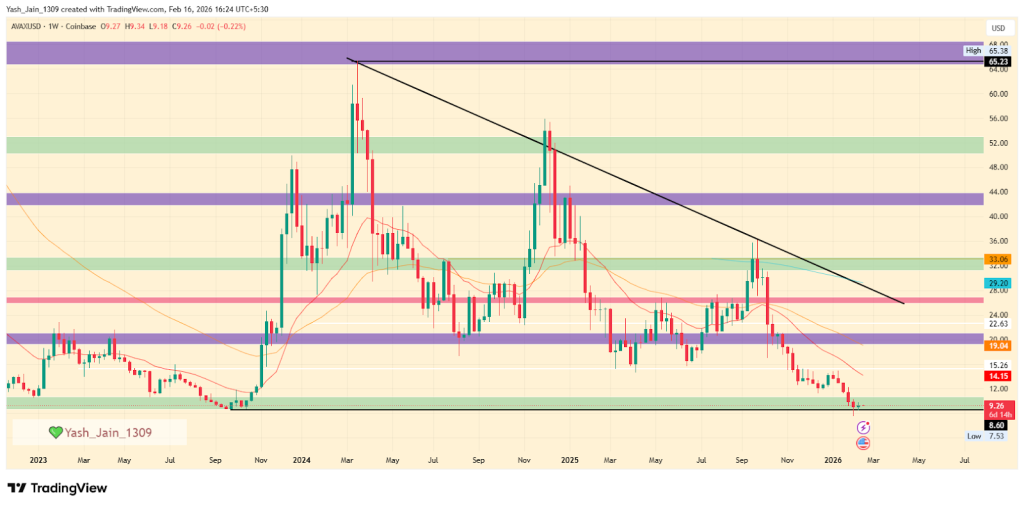
The price action of AVAX hasn’t been so great since its Q1 2024 high of $65; it has been in decline ever since. Most of 2024 and all of 2025 were in decline.
Even in 2026, this bearish momentum’s shadow didn’t lift; it worsened, with the broader market in turmoil. In January, the AVAX price faced rejection from $15 and slipped to $9 support zone after hitting a low of $7.53 in February. But things can change this time around. Since Q1 still has several days left, a recovery remains an option, as it has been testing a demand area of $9 that ignited the late 2024 rally. Sustained demand here could signal a reversal.
Now, expectations for its recovery, which are gaining momentum in Q1 2026, are significantly higher. Now, it appears AVAX may not have performed in the past two years, but it was all about establishing a base, and it seems it has done so. Now, an impressive rally ahead is a strong possibility.
For Q1, we expect $20 with potential to test the pattern’s upper border at $28. However, if it clears the upper border, we can expect AVAX to hit $44 by the end of the first half. But if $28 repels, then the first half could see consolidation stretching.
| Year | Potential Low | Potential Average | Potential High |
| 2026 (conservative) | $25 | $33 | $50 |
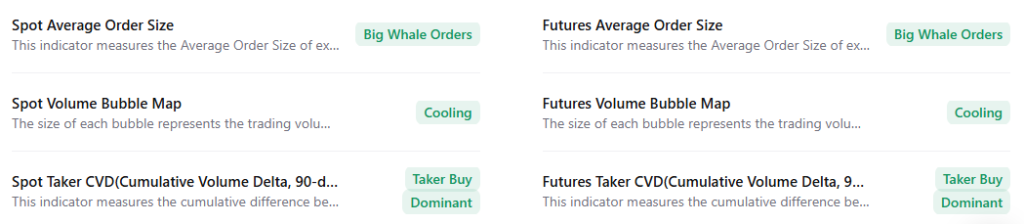
AVAX shows a highly bullish sentiment. Big Whale Orders in both spot and futures indicate strong institutional accumulation. With Taker Buy Dominance at 90 days, aggressive buyers are in control, while the Cooling volume bubble map suggests a healthy consolidation phase. Collectively, major metrics point to a bullish rally ahead.
| Year | Potential Low ($) | Potential Average ($ | Potential High ($) |
| 2026 | 400 | 500 | 600 |
| 2027 | 550 | 690 | 820 |
| 2028 | 650 | 830 | 980 |
| 2029 | 740 | 950 | 1100 |
| 2030 | 820 | 1000 | 1200 |
Looking ahead to 2026, AVAX’s potential price is anticipated to rise even further, with a projected low of $20.00 and a high of $80.00. The average price for AVAX in 2026 will likely be $50.00.
In 2027, the analysis suggests a continued upward trend in AVAX’s value, with the price potentially ranging between $31.50 and $126.50. Based on the calculated figures, the average price is projected to be approximately $79.00 during this period.
By 2028, AVAX’s price could potentially experience further growth, falling within the range of $50.50 and $202.50. The average price during this period, calculated from the data, is expected to be around $126.50.
Moving forward to 2029, AVAX’s price is predicted to ascend between $81.00 and $324.00. The average price during this period is estimated at around $202.50 based on calculated figures.
By 2030, AVAX’s price is forecasted to soar between $129.50 and $518.50. Further, the average price during this period, calculated from the data, could stand at $324.00.
Based on the historic market sentiments and trend analysis of the largest cryptocurrency by market capitalization, here are the possible AAVE price targets for the longer time frames.
| Year | Potential Low ($) | Potential Average ($) | Potential High ($) |
| 2031 | 890 | 1100 | 1350 |
| 2032 | 920 | 1200 | 1500 |
| 2033 | 1100 | 1350 | 1780 |
| 2040 | 1600 | 2200 | 3000 |
| 2050 | 2600 | 3300 | 4500 |
| Year | 2026 | 2027 | 2030 |
| Changelly | $500 | $750 | $1100 |
| DigitalCoinPrice | $480 | $680 | $1000 |
| WalletInvestor | $520 | $650 | $1250 |
Stay ahead with breaking news, expert analysis, and real-time updates on the latest trends in Bitcoin, altcoins, DeFi, NFTs, and more.
AAVE shows long-term growth potential if it breaks key resistance levels. However, price depends on market conditions and DeFi adoption.
Watch support near $135–$150, resistance above $250, overall market trend, and activity within the Aave protocol.
Key drivers include DeFi expansion, institutional adoption, subnet growth, and overall crypto market recovery cycles.
The AVAX price prediction for 2026 suggests a potential range between $400 and $600 if market momentum and network growth remain strong.
AVAX coin price prediction for 2030 points to a possible range of $820 to $1,200, assuming sustained adoption and favorable market conditions.
Avalanche price prediction for 2040 estimates a broad range between $1,600 and $3,000 if long-term blockchain adoption accelerates globally.
Samsung’s best flagship phone, the Galaxy S26 Ultra, technically supports a 24MP photo mode, but it’s not there when you open the camera app.
Galaxy S26 Ultra comes with an enhanced 200-megapixel camera. Samsung has also developed a 24-megapixel photo mode for this flagship device. However, users still see those familiar resolutions, 12MP, 50MP, and 200MP.
Most flagships default to 12MP because of pixel binning. The sensor takes data from multiple pixels and smashes them together into one, which helps with light, speed, and noise. You lose some sharpness, but you get faster processing and cleaner shots.
While the Galaxy S26 Ultra has a 200MP main sensor, shooting at full resolution gives you insane detail, but the files are huge.
The 50MP telephoto has similar issues, so people bounce between 12MP for everyday reliability and the higher resolutions when they need to crop hard or print large.

Image via Samsung Community
24MP is supposed to split the difference
Samsung showcased the 24MP mode, which uses AI Fusion processing to pull detail from the higher resolution data. You get more sharpness without sacrificing the natural color and dynamic range, without huge files.
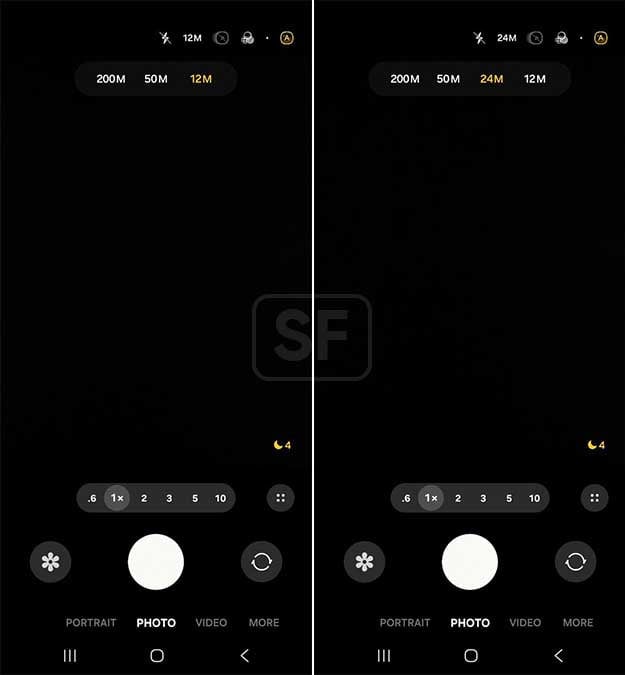
Want 24MP? You need to download Camera Assistant first. Camera Assistant is a Good Lock module, which means it lives in the Galaxy Store, not the main camera interface.
Once you’ve installed Camera Assistant, you have to dig into Advanced Resolution Options and manually flip the toggle “24 MP resolution.”
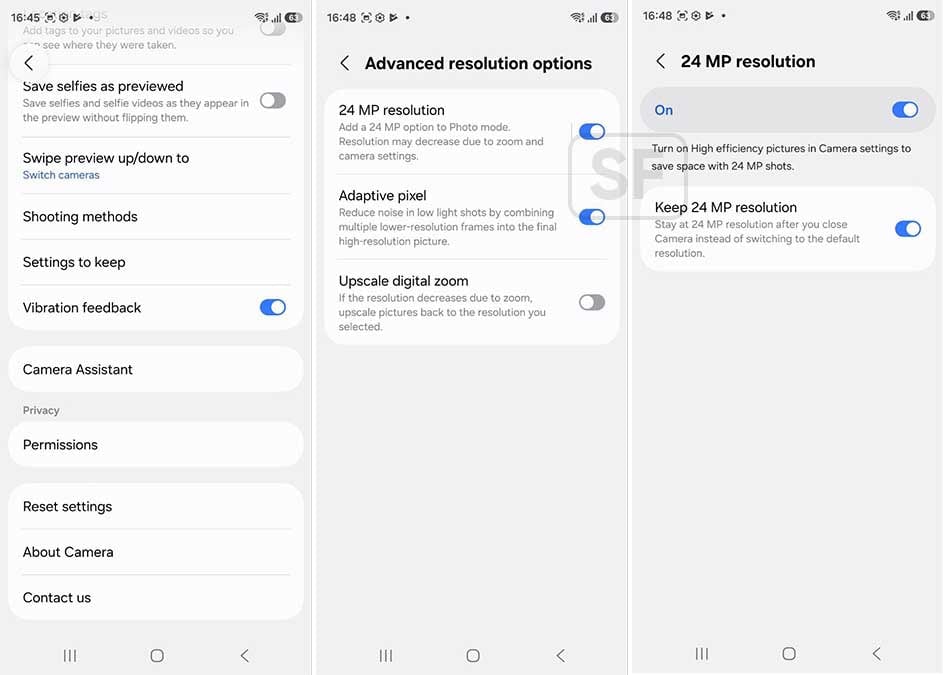
However, there’s a letdown. Even after you enable 24MP in Camera Assistant, the camera app won’t remember it as your default. You can tap it on and shoot with it, but if you switch back to 12MP or 50MP before closing the app.
he phone resets to 12MP the next time you open it. You have to manually select 24MP every single time unless you leave it set when you exit. To stop this from happening, expand 24MP settings and turn on “Keep 24 MP resolution.”
Unlike the 24MP mode buried in Expert RAW, this version works in the normal camera app.
The post How to enable the hidden 24MP camera mode on Galaxy S26 Ultra appeared first on Sammy Fans.
The first Galaxy S26 Ultra drop test is already here as Samsung gears up to start shipping the new flagship phones to preorder buyers.
Famous YouTube channel PBKreviews just released the Galaxy S26 Ultra drop test video. The smartphone has survived the brutal test with flying colors, but one important part failed badly, and it’s not good to hear.
PBKreviews tossed the S26 Ultra off a concrete slab from head height four times. What emerged from that beating tells you everything about the phone’s durability story: it’s mostly excellent, but the camera island got obliterated.
The screen held up, no question there. Gorilla Armor 2 on the front glass proved itself immediately with the first drop. Not a crack, not a damage and the power button worked fine, like nothing happened to the device.
The camera bump extends more than the S25 Ultra’s setup, and the individual lenses sit there with less protective framing around them. So when the phone landed on its back during the second drop, one lens cover shattered outright.
Third drop, more glass fell off. By the end, the cameras still functioned but the shattered lens covers caused noticeable distortion in shots. That’s fixable with a replacement, sure, but you shouldn’t have to be thinking about that.
It was the same case with the Galaxy S25 Ultra last year.
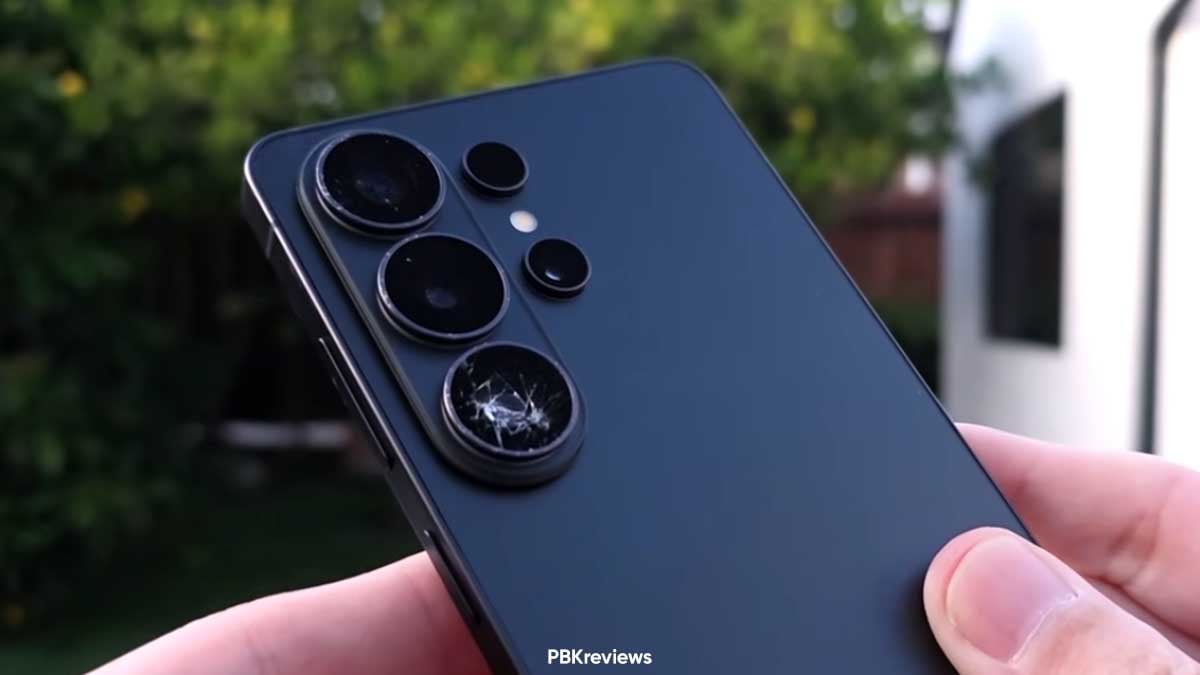
Source – PBKreviews/YouTube
The aluminum frame took visible damage too. Samsung swapped titanium for aluminum this year, while the difference isn’t drastic. The fourth drop popped the S Pen right out of its slot, however, it remained fully functional.
So we’ve got a phone where the front and back glass hold up brilliantly, but the camera design actively invites disaster.
Do watch the full Galaxy S26 Ultra drop test video on YouTube.
The post Galaxy S26 Ultra survives brutal drop test, but one part fails badly appeared first on Sammy Fans.
So a Brazilian TV host’s Galaxy phone crashed at the single most important networking event of his career; classic Samsung timing, that too in the presence of Samsung’s Boss.
Carlos Gorito, a moderator hired to run Brazil’s state dinner with South Korea last month, tried to snap a photo of the February 23 gathering at Seoul’s Blue House Guest House.
Gorito’s Galaxy gave up, not dead exactly; calls and texts still worked but the camera went frozen. He posted about it later on Instagram, saying the phone “suddenly decided to travel back to the past” – via Chosun.
Now Gorito could’ve just pocketed the Galaxy phone, cursed Samsung under his breath, maybe borrowed someone else’s phone. But he walked up to Lee Jae-yong, the chairman of Samsung, and asked for help fixing his Galaxy.
Lee told him his own phone was working fine. Then, instead of handing it over or calling a tech person or pretending he didn’t understand the question, Lee offered to take the photo himself and email it to Gorito later.

That’s not how executives usually handle product failure in public. Most would’ve quietly had someone swap the device out, maybe sent a new Galaxy Ultra to Gorito’s hotel the next morning with a handwritten note.
Brazilian President Lula in attendance, Samsung’s Lee Jae-yong, the CEOs of SK, LG, and Hyundai. This was the dinner where deals happen, where Brazil and Korea shake hands on factory investments and export agreements.
The post Galaxy phone crashed in the presence of Samsung boss, then he surprised all appeared first on Sammy Fans.
Samsung just revealed spare part pricing for the Galaxy S26 series and it’s more expensive than last year’s phones.
Galaxy S26 spare part cost in India shows the baseline screen replacement for the regular S26 surfacing at Rs 7,640, which is Rs 1,490 higher than what the S25 screen cost at launch.
The Plus model follows the same trajectory. The S26+ main screen now costs Rs 10,340, up from Rs 8,400 for the S25+, which is Rs 1,940 more.
Worth noting that the Plus actually gets a smaller price hike on its frame compared to the base model, which shrinks from Rs 3,460 to Rs 3,690. But the Ultra is where things get uncomfortable.
The Galaxy S26 Ultra screen repair clocks in at Rs 14,760. Last year, it was Rs 11,950 for the Galaxy S25 Ultra. That’s Rs 2,810 more for the same repair scenario; probably, the Privacy Display upgrade is making the difference.
The motherboard replacements are equally brutal. A 256GB motherboard for the S26 Ultra will set you back Rs 44,640 compared to Rs 37,150 for the S25 Ultra. Meanwhile, the 1TB variant jumps to Rs 53,850 from Rs 46,060, a Rs 7,790 climb.
The Ultra uses a Snapdragon 8 Elite Gen 5 chipset, and it has that new Privacy Display tech that Samsung spent five years developing. Those components cost money, but the base S26 and S26+ don’t get the Privacy Display.
The S26 Ultra battery now costs Rs 3,030 versus Rs 2,440 for the S25 Ultra. The base S26 battery actually costs less than the S25 battery, which is the only part that got cheaper year over year.
The S26 has a Rs 570 increase for the frame, and the S26+ sees a Rs 270 bump. However, things got better for the Galaxy S26 Ultra due to preferring Aluminum over Titanium; frame drops from Rs 6,740 to Rs 4,660.
The phones go on sale March 11, and people who pre-ordered are locked in.
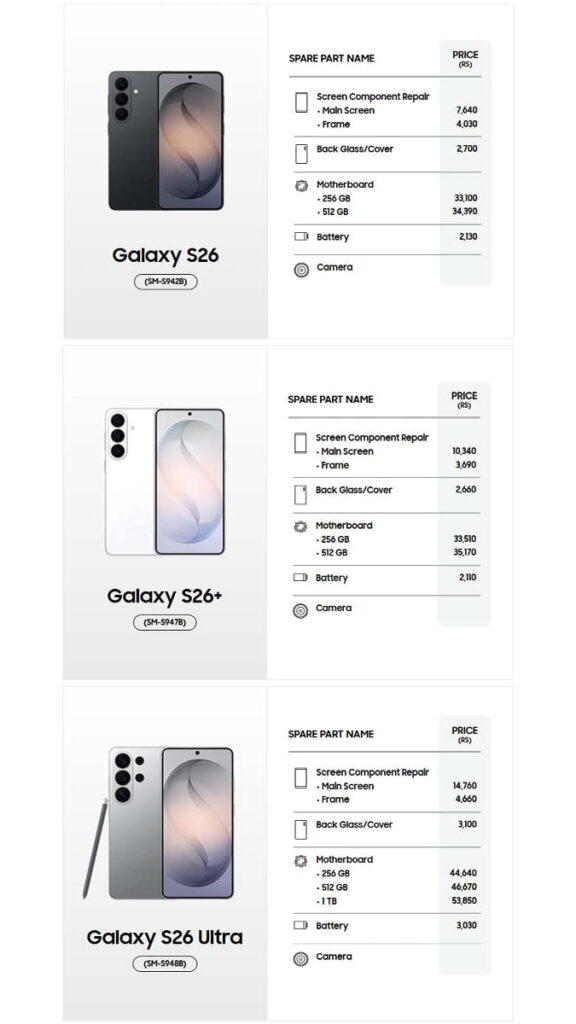
The post Samsung’s Galaxy S26 series spare parts are more expensive than S25 appeared first on Sammy Fans.
Samsung Internet app has been renamed to Samsung Browser on the Galaxy S26 series, and the latest version also integrates the Ask AI feature.
The change in name was spotted recently, and Samsung is now rolling out a new update to the Browser (previously Internet) app, bringing the Ask AI feature. It also adds a warning to safeguard privacy when you browse the web.
Samsung enthusiast LarrySWhite shared a screenshot, showcasing the latest update for the Samsung Browser app. The changelog mentions two major changes that are integration of Ask AI and the malicious site warning.
The Samsung Browser version 29.0.4.45 carries these upgrades. The rollout appears to be limited to the most recent Galaxy flagships. An expansion will take place, but there’s no guarantee of wider availability soon.
Samsung Browser’s changelog makes it clear that Ask AI is only for users in South Korea and the US. It’s a very hard regional restriction, keeping the availability limited to just two countries, leaving others waiting.
Chrome remains the most widely used internet browser app on Android. Samsung Internet is available for all Android devices, yet its utilization is not significant. Still, Samsung is empowering its in-house browser with new features.
APK file of the latest version is available for download manually. Sideloading is banned by Auto Blocker and not recommended either. Still, you can give it a try if you are really interested in the Ask AI trick in the US and Korea.
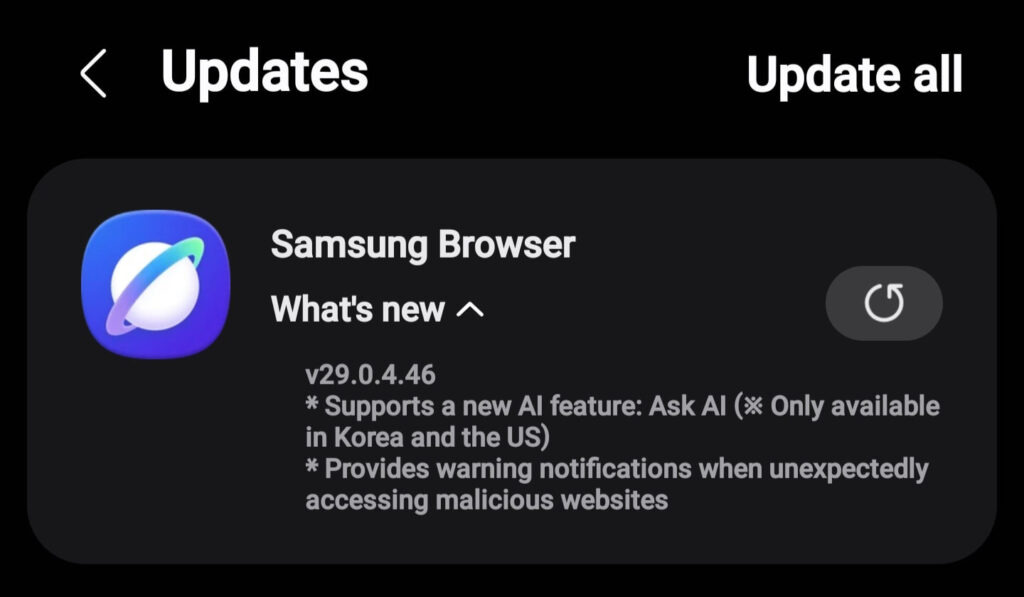
Credit – Larry S White
The post Samsung Browser (Internet) app integrates Ask AI feature in latest update appeared first on Sammy Fans.
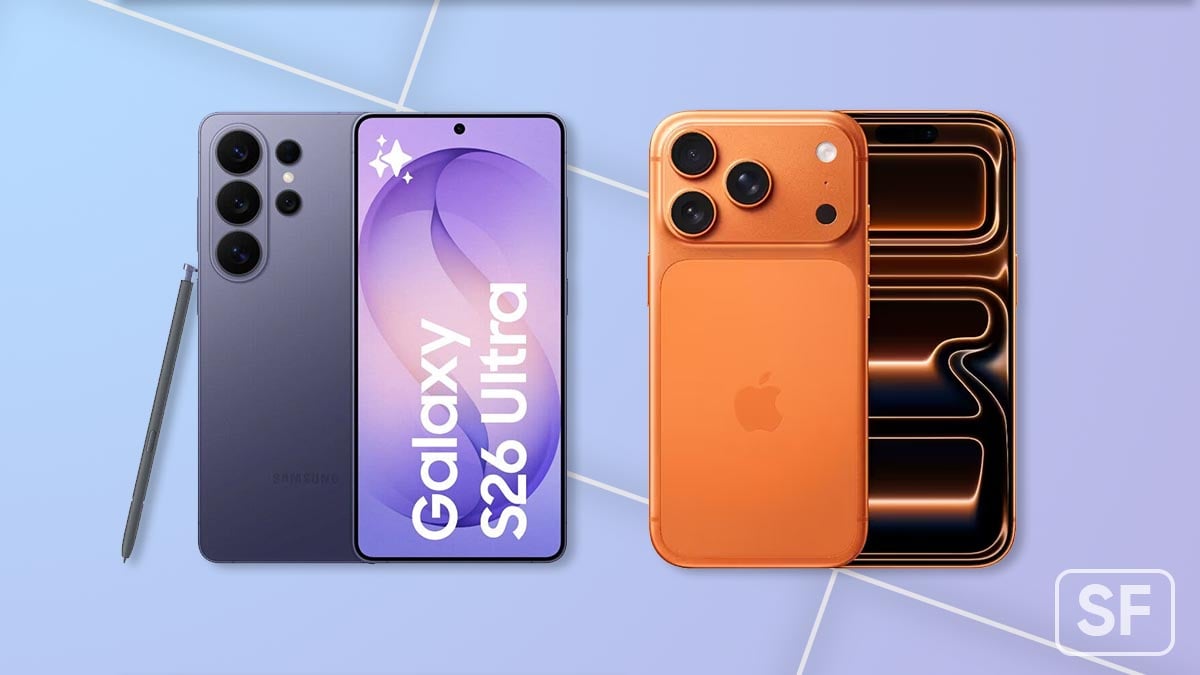
The Galaxy S26 Ultra vs iPhone 17 Pro (Max) debate kicked off the second Samsung wrapped its Unpacked event, and this year’s matchup is messier than usual.
I’ve spent the better part of a week looking at these devices, comparing spec sheets, reading Samsung’s marketing claims, and thinking about what actually matters when you’re dropping over a grand on a phone.
This isn’t a definitive buyer’s guide yet. It’s more like an early assessment from someone who’s watched Samsung chase Apple for five years straight.
Design
Samsung and Apple make rounded rectangular slabs with glass backs and an aluminum frame. Samsung refined the Ultra this year, smoothing out some edges. The camera bump on all three S26 models is the pill-shaped island with three lenses.
Apple has further enlarged the rectangular bump on the Pro and Pro Max models. The island now occupies a significant space on the back. Meanwhile, the base iPhone 17 has two cameras sitting in a smaller bump.
Samsung wrapped the S26 and S26 Plus in Gorilla Armor, then upgraded the Ultra to Gorilla Armor 2. Apple covered all three iPhone 17 models with Ceramic Shield 2. Marketing names aside, they are all extremely durable pieces of glass.
Verdict: Both lineups look like premium flagship phones in 2026
Colors
Samsung offers Black, Cobalt Violet, Sky Blue, and White everywhere, with Silver Shadow and Pink Gold exclusive to its online store. The iPhone 17 comes in Black, Lavender, Mist Blue, Sage, or White. The Pros get Cosmic Orange, Deep Blue, and Silver.


Display
Samsung bumped the base S26 up to 6.3 inches from last year’s 6.2. The S26+ stays at 6.7 inches, and the Ultra now rocks a massive 6.9-inch panel. All three support variable refresh up to 120Hz, hit 2,600 nits peak brightness.
Apple’s iPhone 17 and 17 Pro both use 6.3-inch screens, while the Pro Max matches Samsung’s Ultra at 6.9 inches. This year, every iPhone supports 1Hz to 120Hz refresh, includes an anti-reflective coating, and 3,000 nits brightness.
Samsung added something Apple didn’t think of or didn’t bother with: Privacy Display.
Verdict: Galaxy S26 Ultra display is a game-changer.
Performance
Every Galaxy S26 runs on a Qualcomm Snapdragon 8 Elite Gen 5 for Galaxy in the US. Apple’s running an A19 chip in the base iPhone 17 and an A19 Pro in the Pro models.
Both companies make absurdly powerful processors at this point, and unless you’re doing something incredibly demanding, they’ll both feel instant.
Verdict: Too early to call a winner here
Camera
Samsung is stuck with the same camera setup on the S26 and S26 Plus that it used last year. That means a 50MP main sensor, a 12MP ultra-wide, and a 10MP telephoto with 3x optical zoom.
The S26 Ultra upgrades things considerably. You get a 200MP main camera, a 50MP ultra-wide, a 50MP telephoto with 5x optical zoom, and a 10MP telephoto with 3x optical zoom.
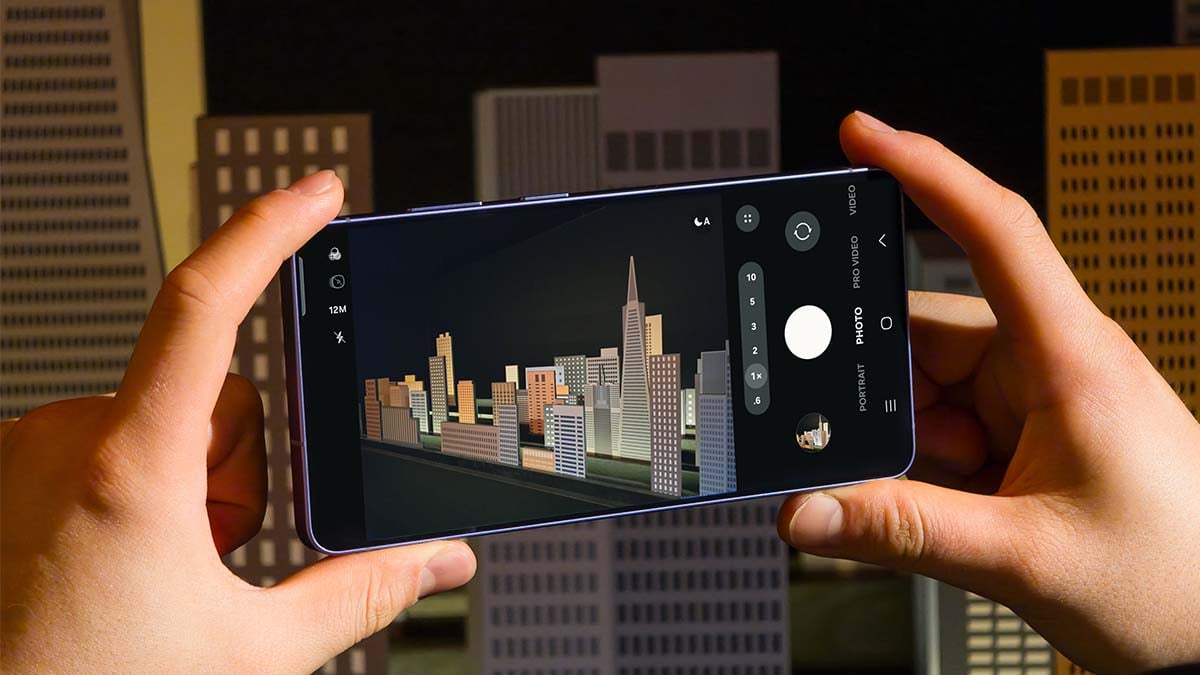
Apple’s base iPhone 17 features a 48MP main camera and a 48MP ultra-wide. No telephoto, but Apple claims 2x optical zoom in and 2x optical zoom out through software.
The iPhone 17 Pro models get three 48MP rear cameras covering main, ultra-wide, and telephoto duties. All three iPhones sport an 18MP front camera with the Center Stage feature.
Samsung and Apple cameras have been excellent for years. The Ultra and Pro Max will likely trade wins depending on lighting conditions, subject matter, and personal preference.
Verdict: Samsung is ahead of Apple in the camera segment.
Battery capacity
Samsung’s battery sizes: 4,300mAh in the S26, 4,900mAh in the S26+, and 5,000mAh in the Ultra. Charging speeds vary too; the base model charges at 25W wired, Plus supports 45W, whereas the Ultra goes up to 60W (25W wireless).
Apple doesn’t publish battery capacity numbers, but the supply chain does. The base iPhone brings a battery of 3,692mAh, the Pro model gets approximately 4,252mAh, while the Pro Max version boasts the largest at about 5,088mAh.
Battery life’s one of those specs where you can’t trust the numbers until you run the actual test.
Price
Samsung wants $899 for the base Galaxy S26, while Apple asks $799 for the iPhone 17. That’s a hundred-dollar gap right out of the gate. Note that every phone here starts at 256GB, which is table stakes in 2026.
The Galaxy S26 Plus comes with a price tag of $1,099, while the iPhone 17 Pro costs $1,099 flat. As before, the Galaxy S26 Ultra continues to keep its $100 (upward) price difference from the best of Apple (iPhone 17 Pro Max).
Verdict: Apple is cheaper at every tier.
The post Galaxy S26 Ultra vs iPhone 17 Pro: 7 key differences decide the winner appeared first on Sammy Fans.
The post Sui Crypto (SUI) Price Prediction 2026, 2027-2030: Is This the Best Time to Buy SUI? appeared first on Coinpedia Fintech News
As a next-generation Layer 1 blockchain, Sui is redefining the architecture of the decentralized web by introducing an object-centric model where assets, data, and permissions are natively ownable and programmable. Built to handle the demands of modern commerce, the Sui Stack provides a modular toolkit that allows developers to scale on resilient infrastructure while delivering high-performance experiences without typical blockchain trade-offs.
From powering institutional capital markets and DeFi to even revolutionizing the gaming sector, the network has already secured a significant foothold with a Total Value Locked (TVL) of $583 million, per the official website.
By prioritizing verifiable security and composable scaling, Sui ensures that value created within its ecosystem is shared rather than extracted. In this comprehensive SUI price prediction 2026–2030, we analyze how this business-ready infrastructure and growing industry adoption will impact SUI’s token and market valuation in the years to come.
| Cryptocurrency | Sui |
| Token | SUI |
| Price | $0.9119
-3.83%
|
| Market Cap | $ 3,556,276,817.54 |
| 24h Volume | $ 457,956,126.9241 |
| Circulating Supply | 3,899,984,688.4154 |
| Total Supply | 10,000,000,000.00 |
| All-Time High | $ 5.3519 on 06 January 2025 |
| All-Time Low | $ 0.3643 on 19 October 2023 |
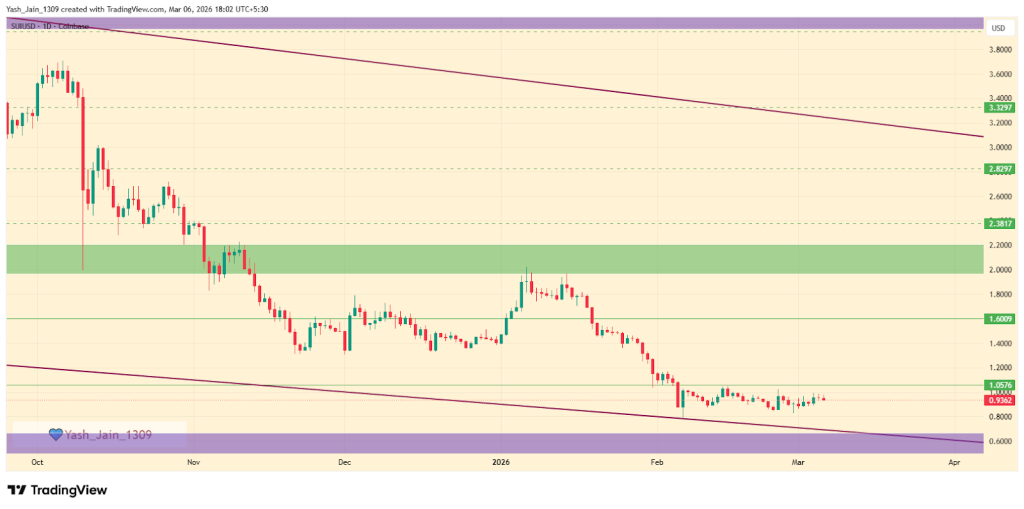
SUI/USD is in a corrective phase after peaking at $5.36 in late 2024. It’s currently testing $0.80 support, with a risk of dropping to the key $0.50 level. Stabilization at $0.50 could signal a reversal. Key resistance levels to watch are $1.05, $1.60, and $2.00, while a breakout above $3.50 would confirm a trend reversal. Until then, it’s a “buy the dip” phase for long-term investors.
On the daily timeframe, SUI price entered 2026 with an initial retest of the $2.00 psychological level, but aggressive selling pressure forced a deep correction. This decline culminated in a macro low of $0.80 in early February. Since then, the price has been grinding sideways, carving out a tight consolidation range just beneath the $1.00 mark.
As we move through March, SUI/USD sits at a critical technical crossroads. If SUI token price manages to generate enough momentum to clear the $1.05 resistance, it would confirm a local bottom. This could trigger a rapid relief rally toward the $1.60 liquidity pocket, with an outside chance of re-testing the $2.00 supply zone before the end of the month.
Conversely, if the $0.80 support floor fails to hold, the downtrend is likely to extend into the next major interest zone. In this capitulation scenario, SUI could seek out deeper support within the $0.50–$0.60 range.
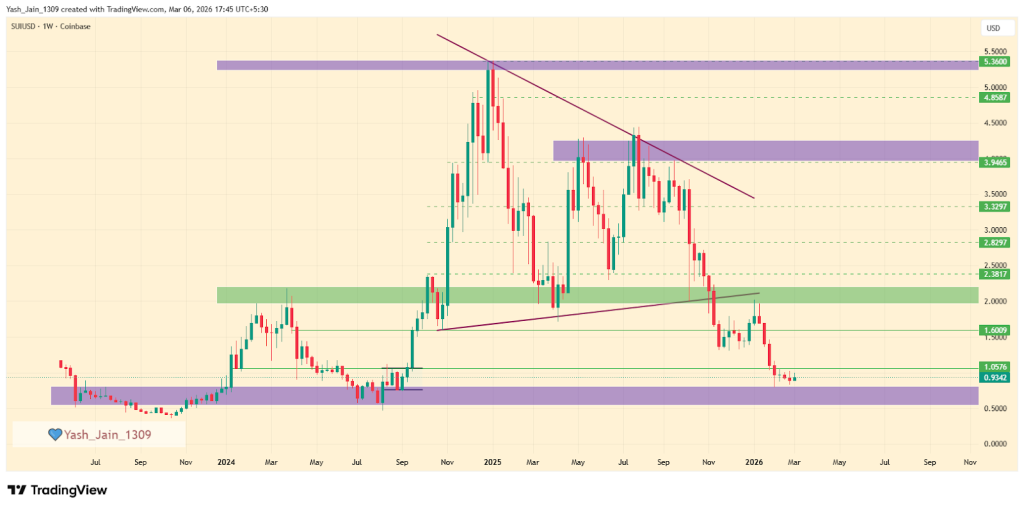
The weekly price action for SUI/USD reveals a market in a major corrective phase after its late-2024 peak, currently in Q1 2026, searching for a definitive long-term bottom.
What we witnessed is that after the 2024’s explosive rally that topped out near $5.36, the asset entered a persistent downtrend, characterized by a series of “lower highs” capped by a prominent descending resistance line. This primary trendline has remained unbroken throughout 2025, consistently forcing the price toward deeper support levels as the initial hype cycle cooled.
Currently, the SUI price is testing $0.80 support after losing $1.05 support in Q1 2026. The odds suggest a chance of reaching the $0.50 support zone if it fails to hold $0.80, because the $0.50 area is of immense technical importance, as it represents the original “genesis” accumulation level from early 2024.
The price has dipped a lot, and now it’s showing signs of stabilization as sellers are about to reach exhaustion once it hits $0.50. Real consolidation could begin, and a true reversal to fruit has better odds. This area serves as the “line in the sand” for bulls; maintaining this floor is essential to prevent a complete technical breakdown and to begin building a new base for the next market cycle.
Looking ahead, the chart identifies several key resistance levels that SUI must reclaim to shift its bearish structure. The immediate hurdle lies at the $1.05, $1.60, and $2.00 horizontal zones. A successful bounce from the current demand floor would likely target these levels first.
However, a true trend reversal will only be confirmed if SUI breaks and closes above the long-term descending trendline, currently near $3.50. Until that breakout occurs, the asset remains in a “buy the dip” accumulation phase for long-term investors.
| Year | Potential Low ($) | Potential Average ($) | Potential High ($) |
| 2027 | $4 | $6 | $8 |
| 2028 | $8 | $10 | $12 |
| 2029 | $10 | $13 | $16 |
| 2030 | $12 | $15 | $18 |
Subsequently, the SUI price range can be between $4 to $8 during the year 2027.
Beyond the previous ATH,SUI bullish momentum may gain pace and will see another bullish spark in 2028. Specifically, as per our SUI Price Prediction, the potential SUI price range in 2028 is $8 to $12.
Thereafter, the SUI price for the year 2029 could range between $10 and $16
Finally, in 2030, the price of SUI is predicted to maintain a steady and positive. It can trade between $12 and $18.
Based on the historic market sentiments and trend analysis of the largest cryptocurrency by market capitalization, here are the possible SUI price targets for the longer time frames.
| Year | Potential Low ($) | Potential Average ($) | Potential High ($) |
| 2031 | $8 | $10 | $15 |
| 2032 | $10 | $13 | $18 |
| 2033 | $12 | $15 | $22 |
| 2040 | $20 | $32 | $40 |
| 2050 | $30 | $70 | $150+ |
Stay ahead with breaking news, expert analysis, and real-time updates on the latest trends in Bitcoin, altcoins, DeFi, NFTs, and more.
SUI could trade between $0.50 and $5 in 2026. If it breaks key resistance near $3.50, momentum may push the token toward the $3–$5 range.
If adoption continues and the ecosystem expands, SUI could reach $12–$18 by 2030, driven by DeFi growth and network demand.
Long-term projections suggest SUI may trade between $20 and $40 by 2040, assuming strong blockchain adoption and sustained ecosystem growth.
By 2050, SUI could potentially reach $30–$150+ if the network becomes widely used across finance, gaming, and Web3 infrastructure.
You can buy SUI on major crypto exchanges like Binance, Coinbase, KuCoin, and OKX. Simply create an account, deposit funds, and trade for SUI.
Yes, if SUI breaks above key resistance near $3 and market conditions stay favorable, a retest of its $5.35 ATH is possible.
SUI shows long-term potential due to its scalable Layer-1 design, growing DeFi adoption, and increasing developer and institutional interest.
Key drivers include rising TVL above $1B, strong on-chain activity, ecosystem expansion, and SUI’s reputation as a fast, scalable network.
Samsung pulled back the curtain on Privacy Display last week. The Galaxy S26 Ultra launched on February 25th with the mobile industry’s first built-in Privacy Display.
Now, Samsung has revealed the brilliant technology behind the Privacy Display. It relies on a new OLED panel from Samsung Display that alternates between two types of pixels: Narrow and Wide.
Here’s how it actually works
In normal mode, both narrow and wide pixels spread light across a wide range of angles. When Privacy Mode is enabled, the display prioritizes narrow pixels that emit light straight forward, while wide pixels are reduced to a minimal level.
Samsung says the tech has been in development for 5 years, which tracks.
The company built Privacy Display with the ability to only apply to small portions of the S26 Ultra’s display, and it can hide notification pop-ups nearly perfectly. You’re not stuck blanking the entire screen every time you’re on a train.
You can set triggers for when the feature activates, such as during PIN, password, or pattern entry, or when notifications appear. No one wants to manually toggle a privacy filter every time they pull out a credit card to buy something online.

Early hands-on suggests the blocking works well at the Samsung booth, but real-world performance depends heavily on the angle. Double-press the side button, and it activates. It’s a quick trick in addition to the toggle in the Quick panel.
Samsung insists it doesn’t mess with brightness, color accuracy, or viewing quality when you’re looking head-on. However, it actually dims the screen brightness a little when tested with equipment.
The post Samsung reveals the pixel trick behind Privacy Display appeared first on Sammy Fans.
Samsung phones may finally receive the Android-to-iPhone sharing feature this month. The rollout may initially start for the Galaxy S26 series. Samsung will later expand the tool to even more Galaxy users sequentially.
In a recent development, Oppo confirmed (via 9to5Google) that the Find X9 and Find X9 Pro will get a software update later this month that lets them share files with iPhones, iPads, and Macs through Quick Share.
iPhone users will need to flip AirDrop visibility to Everyone for the handshake to work, because Apple’s default Contacts Only mode won’t play nice with Android devices trying to bridge in.
That’s Android-to-iPhone sharing via Quick Share wired into AirDrop’s backend, the same trick Google pulled on Pixel phones back in November.
Here’s what Oppo announced at MWC 2026:
Coming soon, OPPO’s Find X9 Series will bring Android Quick Share, enabled in close collaboration with MediaTek and Google. Without installing third-party applications, users can conveniently and securely transfer files between OPPO smartphones and iOS, iPadOS and macOS devices, improving cross-platform interoperability. The feature is expected to begin rolling out via software update starting in March.
Why does this matter?
Samsung Android iPhone sharing is about to follow. Screenshots surfaced weeks ago showing the Galaxy S26 series prepped for AirDrop compatibility through Quick Share, though the feature wasn’t active when reviewers tested retail units.
The company’s software rollouts haven’t exactly been the most predictable thing for the past year or two. One UI 8.5 is the likely vehicle for this, and Samsung has a habit of staggering such features across device generations.
The Galaxy S26 lineup doesn’t support this out of the box, but the feature may go live through a software update later this month.
The feature doesn’t require special hardware, so older Galaxy phones could get it with a software update, possibly bundled into One UI 8.5.
The post Samsung phones could get Android-to-iPhone sharing feature this month appeared first on Sammy Fans.
People with Galaxy S26 Ultra camera moisture problems are starting to speak up. It’s the most distressing problem Samsung’s flagships have ever faced. The condensation problem is rendering the cameras unusable, and that’s sad.
Ice Universe posted about it first on X, asking anyone who bought the phone to check their cameras in freezing weather. His own unit’s got condensation inside.
The problem surfaced after he took his phone outside when the temperature hit around minus six Celsius. Both the 3x and 5x telephoto lenses fogged up completely, which means you’re not taking usable photos in cold conditions.
He mentioned Korean forums picked up the same complaints, which tells you it’s not a bad batch. When multiple people in different countries see moisture forming on the inside of camera lenses on a phone rated IP68, that’s an engineering screwup.
The real question is why moisture’s getting trapped inside sealed camera housings. Samsung proudly touts that IP68 rating like it means invincibility.
Either the seals aren’t doing their job, or the vapor chamber inside the phone is creating internal humidity that has nowhere to go when the temperature plummets.
You’re holding a $1,300 phone that can’t shoot photos when it’s cold. That’s embarrassing for a company that stakes its reputation on hardware quality.
Samsung launched the Galaxy S26 series last month, full well knowing that people in half the world would be using it in freezing temperatures within weeks.
If this happens to you, what do you do?
You can’t blow dry without risking further condensation when it cools again. Rice doesn’t work and never did. Let it sit at room temperature and hope the moisture evaporates on its own without leaving residue on the lens internals.
If it doesn’t clear, you’re looking at a service center visit, and good luck getting that covered under warranty when Samsung might almost certainly call it user error.

Via – Ice Universe / X
The post Moisture forming inside Galaxy S26 Ultra camera lenses appeared first on Sammy Fans.
There’s one thing Samsung didn’t shout about at Unpacked that could actually change how people use Samsung phones: vibe coding.
Recently, Hamish Hector of Techradar asked Won-Joon Choi, Samsung’s head of MX Business, whether vibe coding might surface on Samsung Galaxy devices; he didn’t shut the door. “Something we’re looking into,” he said.
Then he got specific; the appeal isn’t just app tweaks, it’s deeper.
“The possibility of customising your smartphone experience in new ways, not just your apps but your UX.” Right now, we are stuck with whatever Samsung or Google decided to ship, but vibe coding flips that.
You tell an AI what you want built. Maybe you’re sick of YouTube Shorts clogging your feed and you want a version that strips them out entirely. The AI writes the code, you install it and it’s done, Shorts gone from your feed.
This isn’t some futuristic concept either; coding assistants have been around since LLMs first showed up, but the new breed of vibe coding tools can hand working apps to people who’ve never touched a line of code.
Samsung loves reminding everyone that Android is open. Benjamin Braun, Samsung’s chief marketing officer, celebrated that openness in a post-Unpacked panel.
If Android lets you sideload anything you want already, why wouldn’t Samsung bake vibe coding directly into One UI? It’s the most obvious move they could make.
Choi seemed interested, at least. He didn’t commit to a timeline or confirm it’s definitely happening. But the fact that he engaged with it at all tells you Samsung’s at least thinking about this seriously.
If Samsung actually does this, the “AI phone” label might finally mean something beyond marketing copy. You wouldn’t just be using Samsung and Google’s preloaded apps, but you would make your own apps and use them on Galaxy.
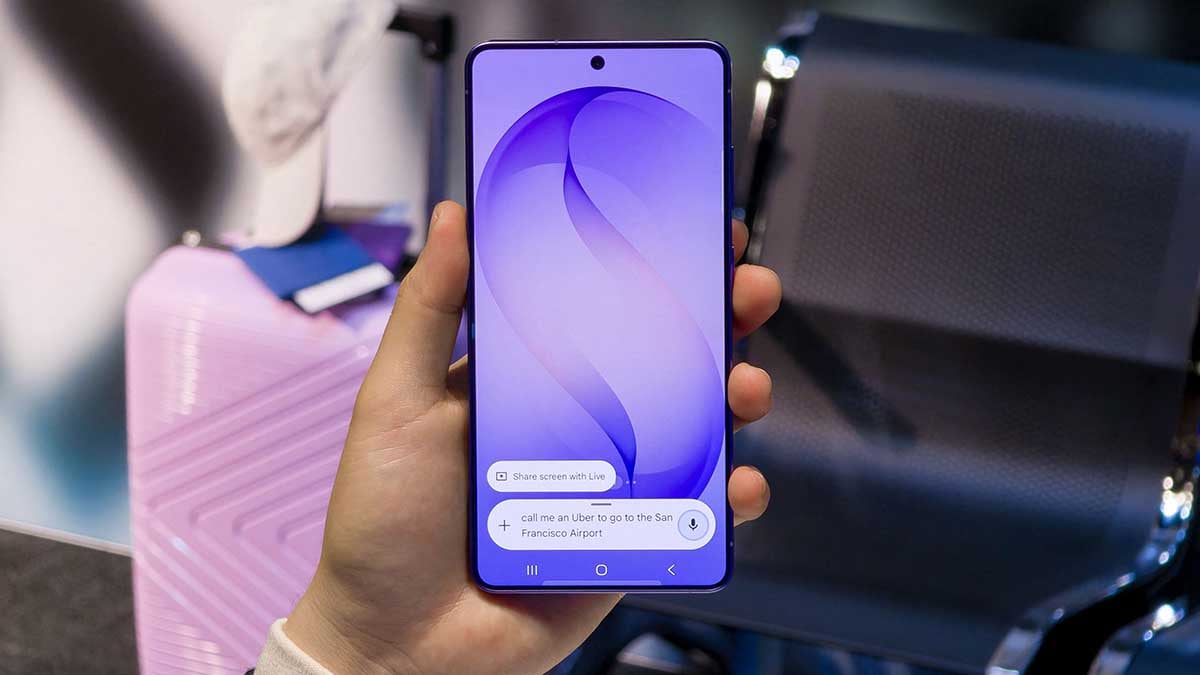
The post Samsung wants you to customize One UI beyond apps with vibe coding appeared first on Sammy Fans.
Samsung’s Jay Kim stood on a stage in Barcelona and shared crucial details about the Samsung AI Smart Glasses. The executive let slip that the upcoming Samsung AI Smart Glasses will feature a camera at “your eye level.”
Samsung has been working on AI Smart Glasses with Qualcomm and Google since 2023, and until this week at MWC 2026 all we got was strategic silence and some internal whispers about something called Project HAEAN, via CNBC.
The glasses feed what you’re looking at through that camera to your Galaxy phone, which does the heavy lifting and then sends you back “a lot of information”. Your phone becomes the brain and the glasses are just your eyes and ears.
When asked about a built-in display, Kim sidestepped the whole thing and said Samsung’s got watches and phones if you need a screen.
Meta’s Ray-Ban glasses own 82% of the global smart glasses market, and Samsung’s essentially trying to clone that playbook with better AI baked in.
The difference is Gemini integration, tighter Galaxy ecosystem hooks, and the hope that Samsung’s name carries more weight than Meta’s in a category where people are still creeped out by cameras on faces.
Kim said the XR headset stuff won’t be “a sort of mass scale business”. It signals the company screwed up, thinking people wanted bulky VR nonsense when they just want something lightweight they won’t be embarrassed to wear.
Samsung is betting that AI agents will turn glasses into the next must-have platform. Meta’s already there and Apple is presumably watching. Samsung’s targeting a release “for industry this year,” and Qualcomm’s confirmed 2026.
The post Samsung reveals what its AI Smart Glasses will actually do appeared first on Sammy Fans.
Galaxy S26 Ultra is set to hit the market shelves on March 11, but we just got the first teardown of this flagship phone, confirming the hidden camera upgrade: ALoP tech in the periscope sensor.
YouTube channel Disassembling Parts uploaded the Galaxy S26 Ultra teardown. The video highlights an excessive use of a “strange adhesive,” but what caught the eye is the installation of ALoP camera technology inside.
It’s a full internal breakdown of the Galaxy S26 Ultra, going layer by layer through components like:
The periscope camera module appears to use ALoP technology, which Samsung quietly teased over a year ago. Samsung’s new ALoP (All Lenses on Prism) places the lenses on top of the prism, reducing module size.
ALoP uses a larger lens diameter for improved brightness. The module sits flatter against the body, with less bump and better aesthetics. That square prism outline has also gone; you just see round lenses now as the phone gods intended.

Source – Disassembling Parts / YouTube | Via – @MyDaebakCafe/X
Even though the ALoP camera has been shipped, Samsung did not mention the technology. The company is accused of lazy hardware upgrades, not because of staleness, but of avoiding marketing of these technologies publicly.
The main highlight is an unusually large amount of adhesive applied in unexpected or “strange” places inside the phone. Adhesive inside phones isn’t new, but the sheer amount here raises questions.
The video explores possible reasons Samsung did this, such as:
You can watch the full teardown video on YouTube.
The post Galaxy S26 Ultra teardown uncovers ALoP camera, strange adhesive appeared first on Sammy Fans.
Samsung is opening up One UI 8.5 Beta forums for the Galaxy Z Fold 7 and Flip 7. No actual builds yet, but the fact these forums popped up tells you something awkward about Samsung’s software timeline right now.
The earliest Samsung fans seeing the One UI 8.5 Beta for the Galaxy Z Fold 7 and Z Flip 7 is mid-March, according to MohammedKhatri tracking Samsung’s server movements. That puts stable release somewhere closer to mid-April.
Setting up forums first is usually prep work. March security patch builds are currently being tested for the Fold 7 and Flip 7, which pushes One UI 8.5 toward April. The company’s basically admitting the software isn’t cooked yet.
The Fold 7 and Flip 7 launched in July 2025, running One UI 8 on Android 16. One UI 8.5 went live with the Galaxy S26 series on February 25. Existing devices are now looking at an April rollout instead of the March window people expected.

Courtesy – @Mohammed_K_2010/X
The Galaxy S25 series already has the One UI 8.5 Beta running. Samsung is also testing the seventh One UI 8.5 Beta update for last year’s flagships. Stable could start rolling out next month, leaving March dominated by patches.
With One UI 8.5 Beta expanding, we may see the Program arriving for even more models. Samsung may invite the users of the Galaxy S24 series, S23 series, as well as previous foldable models, to test before the Stable jump.
Unlike One UI 8.0, One UI 8.5 is a major upgrade, built on Android 16. It brings a new design language that is more fluid and dynamic. The application of blur across the interface makes it pleasing on Galaxy devices.
The post Samsung teases wider One UI 8.5 Beta expansion; Galaxy Z Fold 7 and Flip 7 next appeared first on Sammy Fans.
The post Is XRP Price Preparing for $4 Breakout as 44M Tokens Leave Binance? appeared first on Coinpedia Fintech News
The XRP price is once again flirting with a familiar setup shrinking exchange supply and a technical pattern that’s starting to look suspiciously explosive.
Over the past few weeks, whale activity on major exchanges has quietly shifted. According to exchange flow data tracking XRP across 15 major trading platforms, one particular venue stood out: Binance. And not for the usual reasons. Because twice, large holders pulled tens of millions of tokens off the exchange.
Tracking whale behavior can often reveal what the biggest market participants are doing before the broader crowd catches on. In this case, the data shows a sharp spike in negative NetFlow for XRP.
Negative flows mean tokens are leaving exchanges. On February 27, roughly 44 million XRP was withdrawn from whale wallets on Binance. That’s one of the largest outflow events visible in the dataset, per analyst Amr Taha.
But here’s where it gets interesting. Earlier that same month on February 6 another sizeable movement occurred. Around 30 million XRP left the exchange from whale-controlled wallets.
Two massive withdrawals. One month. Same exchange. That kind of pattern rarely goes unnoticed by traders who obsess over liquidity.
In simple terms, exchange flows can hint at market intentions. When large holders move assets into exchanges, it often suggests preparation to sell. That’s why positive NetFlow spikes can be interpreted as bearish signals.
But when the opposite happens, tokens leaving exchanges, the logic flips.
As less supply sits on trading platforms, fewer coins are immediately available for sale. If demand remains steady, the XRP price could face upward pressure.
Think of it as a liquidity squeeze. Less supply on the shelves. Same buyers walking into the store. Eventually, prices adjust.
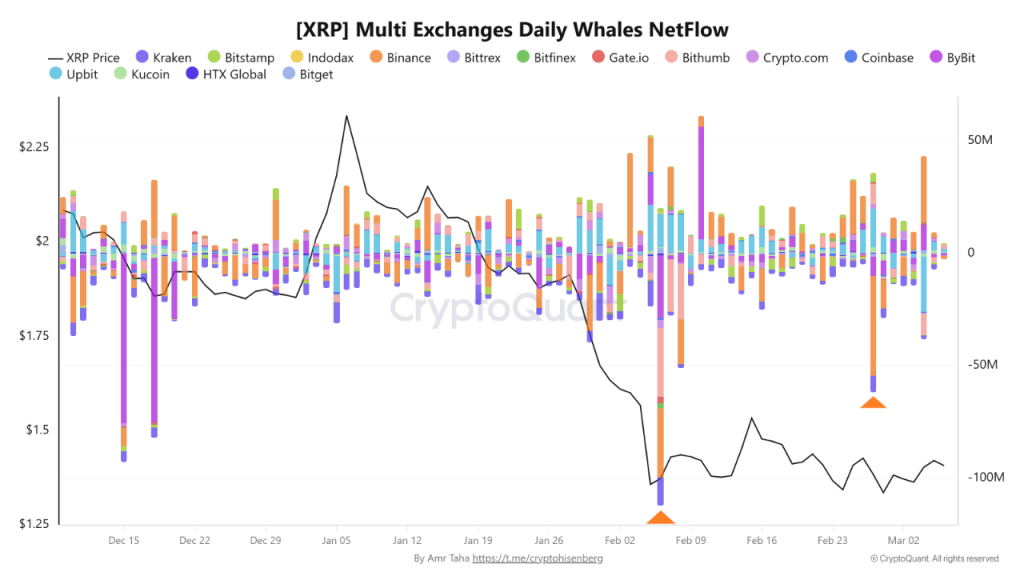
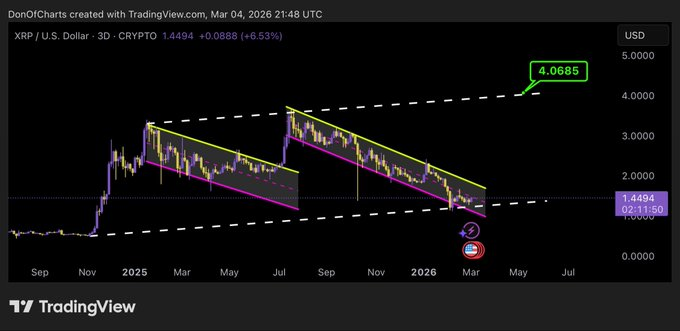
Meanwhile, the XRP price chart itself is telling its own story. On the XRP/USD three-day chart, price action has been forming a long-standing ascending channel that stretches back to late 2024. Inside that structure, the asset has been following a recurring fractal pattern.
Explosive rally. Slow descending consolidation. Then pressure builds again. Right now, XRP appears to be repeating that exact sequence.
After a sharp upward move earlier in 2025, the asset is now compressing inside a descending wedge an area often associated with accumulation.
At roughly $1.4494, XRP is sitting near the lower boundary of that wedge while simultaneously resting on a multi-month structural support zone. That combination tends to attract attention from technical traders.
If the current fractal plays out as previous cycles have, the next move could be aggressive.
A breakout above the wedge’s upper trendline would open the door toward the top of the broader ascending channel. In that scenario, the projected target sits around $4.0685. That would represent a potential 180% rally from current levels.
Of course, crypto markets rarely move in straight lines. But between whale withdrawals and tightening price structure, the stage is clearly being set. And if the pattern holds, the XRP price analysis suggests it may not stay quiet for long.

The post Bitcoin Price at Critical Turning Point as IFP Golden Cross Signals Possible Rally appeared first on Coinpedia Fintech News
The Bitcoin price might be standing at one of those uncomfortable moments markets love, where bullish signals scream “rally,” but the chart quietly whispers, “careful.”
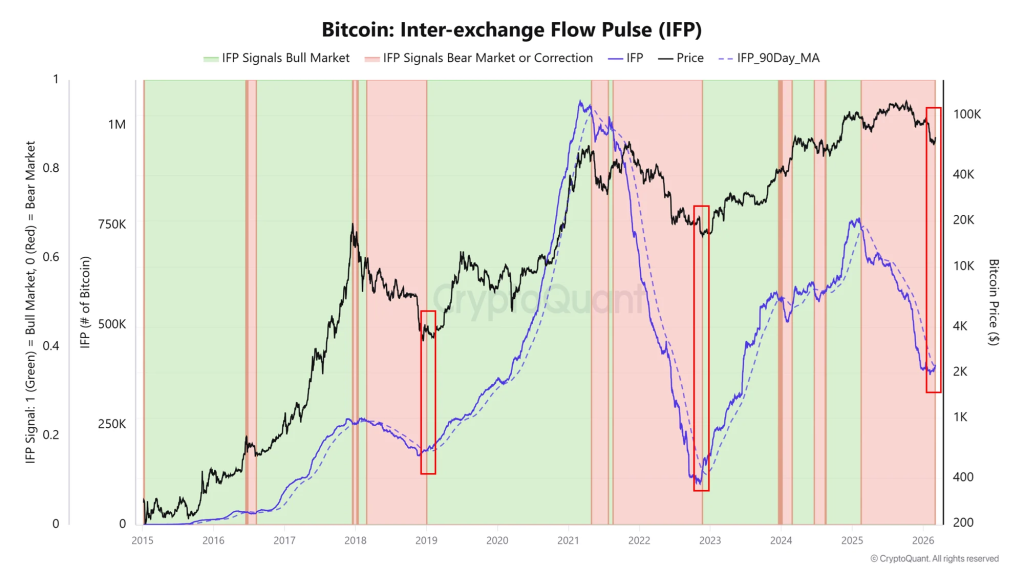
A technical signal known as the Inter-exchange Flow Pulse (IFP) indicator has just flashed a golden cross for $BTC. Historically, that crossover has marked the beginning of major rallies. According to the indicator’s interpretation, by analyst, the long correction that dragged on for nearly a year could finally be over.
Sounds exciting. Maybe even convincing. But charts rarely move in straight lines, and the market right now seems to be sitting on a knife’s edge.
Let’s start with the optimistic side of the story. The Inter-exchange Flow Pulse indicator recently printed a golden cross. In simple terms, that crossover has previously aligned with the start of powerful upward trends in the market.
The signal suggests the prolonged consolidation phase might have served as a long period of reaccumulation. Instead of immediately blasting higher earlier in the cycle, the asset experienced a weaker rally followed by an extended cooling-off phase.
Now, according to the indicator, momentum could be shifting again. In previous cycles, similar golden crosses on the IFP indicator marked the early stages of significant rallies. That’s why some observers are framing the current signal as the point where the “real rally” begins.
Now here’s where the story gets interesting and a little less comfortable.
The Bitcoin price chart is reportedly testing what some analysts call the most important line on the chart. Historically, this level has acted as a decisive turning point for the market.
The pattern is fairly straightforward. When price bounced off this level in past cycles, it eventually pushed toward new all-time highs. But when the level failed to hold, the market slid into deeper bear phases.
So the same line is back in play again. Same setup. Same tension. Different cycle. Which direction it breaks could determine the next major trend.
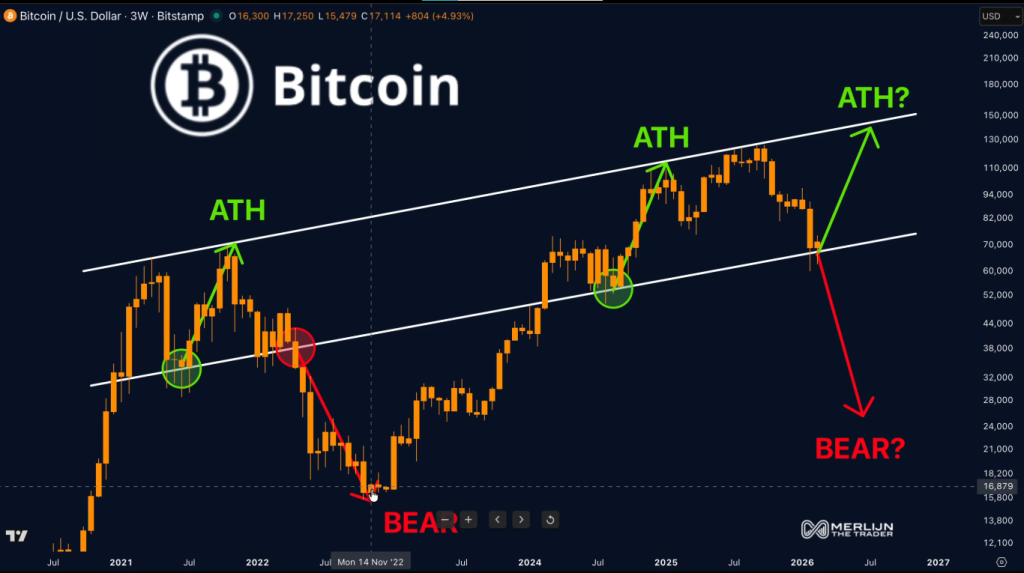
So what does the Bitcoin price prediction crowd do with that? Well, this is where things get messy. One signal says the rally is just getting started. Another says the market is testing a structural level that historically decides between explosive growth and painful declines.
In other words, the chart isn’t giving answers yet. It’s asking a question. Traders watching Bitcoin/USD know this kind of setup well: long consolidation, conflicting signals, and a market hovering right at a critical support or resistance zone.
Break upward, and the narrative quickly shifts toward momentum and new highs. Lose the level, and suddenly the tone across the market changes entirely. For now, the market is simply waiting to see which direction the Bitcoin price chooses next.
One UI 8.5 is entering a new Beta phase as Samsung continues to prepare Beta builds after the official debut with the Galaxy S26 series.
Samsung officially unveiled One UI 8.5 along with the Galaxy S26 series. The new flagships ship with the Stable version of One UI 8.5. Meanwhile, users of the Galaxy S25 series are running the sixth Beta build released last week.
Tipster TarunVats spotted a new One UI 8.5 Beta for the Galaxy S25 series. The latest internal build carries PDA build version ending with ZZC3. This build has started to be prepared in March, but the patch level is still February 2026.
On February 25, Samsung’s Galaxy S26 series debuted One UI 8.5. A day later, the company has started the rollout of Beta 6 for the Galaxy S25 series. The previous Beta was already in prep even before the software went official.
March 2026 marks the evolution of One UI 8.5. The software has officially landed with new flagships, and the Beta Program is approaching its end. We might receive Beta 7 as the closure test software before the public build.
Galaxy S26 series will mark the rollout of One UI 8.5 on its Global release, set for March 11. Samsung has already confirmed the updates will be provided to existing Galaxy devices sequentially thereafter.
Samsung kept the Beta Program limited to the Galaxy S25 series. Meanwhile, the update is already being prepared for dozens of Galaxy models, excluding the S21 FE. Expect more polishing across the user interface with Beta 7.
The post Samsung One UI 8.5 Beta is entering a new phase appeared first on Sammy Fans.
The post Uniswap Price Prediction 2026, 2027 – 2030: Will Uniswap Reach $50? appeared first on Coinpedia Fintech News
Founded in 2018 by Hayden Adams, Uniswap has transcended its origins as a simple Ethereum-based Automated Market Maker (AMM) to become the undisputed backbone of the decentralized finance (DeFi) economy. By mid-2026, the protocol has achieved a staggering $4.0 trillion in all-time volume, supported by 119 million swappers and $2.6 billion in Total Value Locked (TVL).
Uniswap Labs continues to dominate the landscape by offering a seamless, no-fee trading experience backed by deep, on-chain liquidity. Beyond simple swaps, its sophisticated Liquidity Pools allow users to earn yield by powering the very markets they trade in. As Uniswap integrates deeply with the on-chain economy into a single platform, the central question for investors remains:
Will UNI reach $70? How high can UNI go in five years? Let’s take a look at Uniswap price prediction 2026 -2032 to provide answers to these queries.
| Cryptocurrency | Uniswap |
| Token | UNI |
| Price | $3.8637
-4.45%
|
| Market Cap | $ 2,448,565,639.75 |
| 24h Volume | $ 254,027,439.8054 |
| Circulating Supply | 633,729,562.7465 |
| Total Supply | 898,364,420.0366 |
| All-Time High | $ 44.9741 on 03 May 2021 |
| All-Time Low | $ 0.4190 on 17 September 2020 |
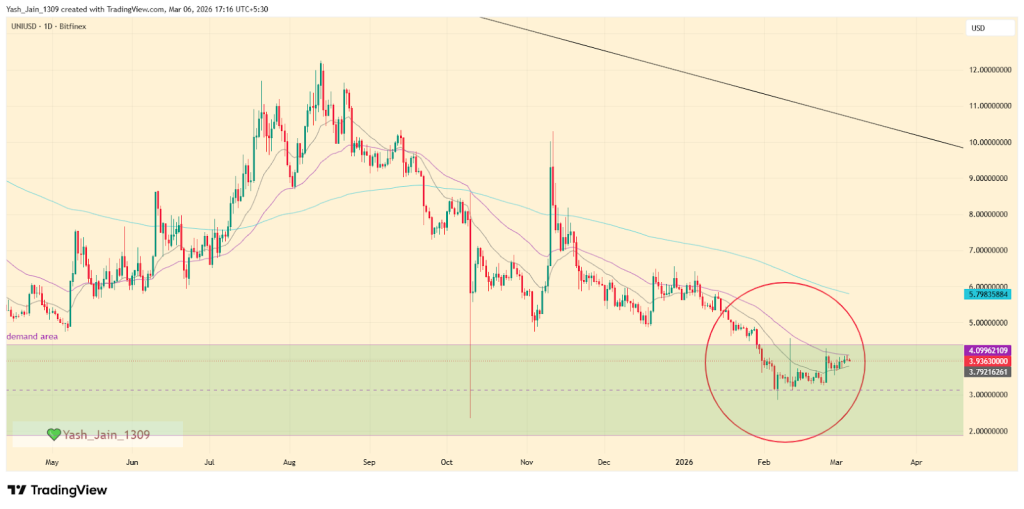
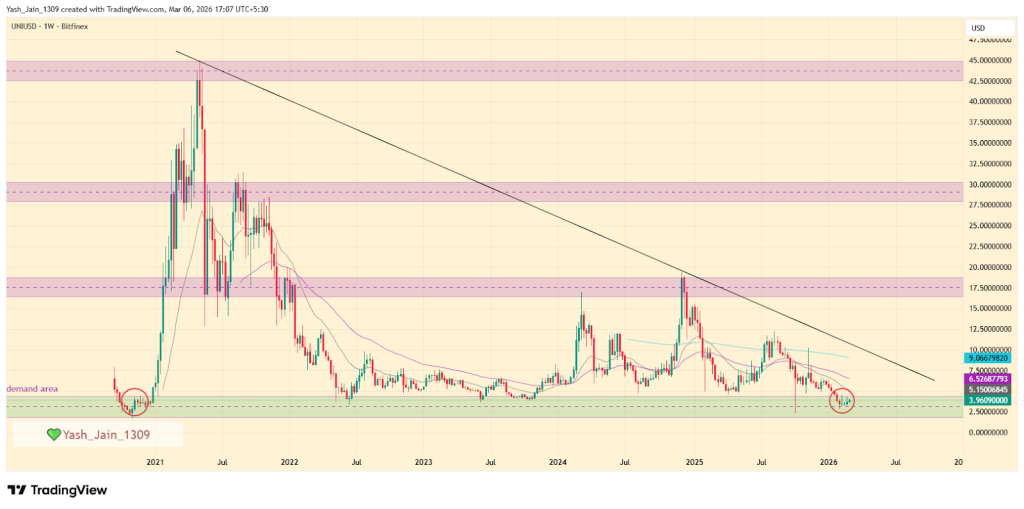
On the daily timeframe, Uniswap (UNI) experienced a significant downturn throughout the first quarter of 2026. The breakdown below the $5.00 support base in January accelerated the decline, eventually leading the price to a multi-year floor near $3.00 price level by early February.
However, the remainder of February saw a sustained bullish reaction, characterized by steady absorption within the historical demand zone. This price action suggests a shift from distribution to accumulation as the market begins to value UNI/USD within the mid-range of its primary support box.
Now, heading into March, the technical outlook hinges on the interaction with the 50-day EMA. Therefore, if UNI price successfully flips the 50-day EMA and breaches the upper border of the current consolidation box, a recovery toward the $6.00 liquidity pocket is highly probable before the month concludes.
Conversely, if selling pressure intensifies, the $3.00 level remains the line in the sand. A failure to hold this psychological floor would likely result in a capitulation event, sending UNI price toward the $2.00 mark to seek deeper liquidity.
On March 3, 2026, Judge Failla of the Southern District of New York dismissed the Risley class action against Uniswap Labs and Hayden Adams with prejudice. This ruling effectively clears the protocol of all federal and state claims, providing a massive regulatory green light for the DEX’s operations.
Uniswap recently announced a strategic collaboration with Securitize to integrate BlackRock’s USD Institutional Digital Liquidity Fund (BUIDL) into the UniswapX ecosystem. Launched on February 11, this integration allows institutional-grade assets to be traded directly on-chain, bridging the gap between TradFi and decentralized liquidity.
As of Q1 2026, Uniswap (UNI) is currently consolidating within a highly-crucial demand zone ranging from $1.80 to $4.50. This specific price floor carries immense historical weight, as it served as the original launchpad for the 2021 bull run that saw UNI skyrocket to its $44.50 all-time high.
For the first time in five years, the price has returned to this foundational level, effectively completing a full market cycle. This re-entry into the “genesis demand zone” suggests a significant long-term accumulation phase is underway, as long-term holders seek to front-run a potential structural shift in DeFi liquidity.
While the market awaits a catalyst as explosive as the 2021 rally, the current price action is also defined by a massive descending triangle pattern. This structure indicates that while selling pressure is exhausting at the multi-year floor, the price remains capped by a descending resistance line.
Throughout 2026, a steady recovery setup appears more likely than a vertical spike. Technical targets for the year point toward a possible retest of the $10.00 level, which aligns perfectly with the pattern’s upper border. A confirmed weekly breakout above this resistance could signal the end of the long-term bear cycle and the beginning of a sustained move toward mid-range targets.
| Year | Potential Low ($) | Potential Average ($) | Potential High ($) |
| 2027 | 7.00 | 10.00 | 13.50 |
| 2028 | 8.50 | 11.50 | 18.00 |
| 2029 | 10.00 | 15.50 | 22.00 |
| 2030 | 12.00 | 19.00 | 32.00 |
The UNI price range can be between $7.00 to $13.50 during the year 2027.
The UNI Network price for 2028 is anticipated to lie within the range of $8.50 to $18.00.
In 2030, the price of UNI is expected to systain trend and remain positive. It may trade between $10.00 and $22.00.
Finally, in 2030, the price of UNI is predicted to maintain a steady and positive. It may trade between $12.00 and $32.00.
Based on the historic market sentiments and trend analysis of the largest cryptocurrency by market capitalization, here are the possible UNI price targets for the longer time frames.
| Year | Potential Low ($) | Potential Average ($) | Potential High ($) |
| 2031 | 19.00 | 29.00 | 39.00 |
| 2032 | 26.50 | 35.00 | 41.00 |
| 2033 | 35.00 | 37.00 | 44.00 |
| 2040 | 42.00 | 52.00 | 57.00 |
| 2050 | 55.00 | 62.00 | 70.00 |
| Year | 2026 | 2027 | 2030 |
| Changelly | $13.25 | $15.80 | $20.10 |
| CoinCodex | $10.90 | $14.85 | $19.45 |
| Binance | $12.40 | $15.10 | $20.85 |
Uniswap (UNI) is consolidating in a key demand zone of $1.80 to $4.50, marking a return to its foundational level from the 2021 bull run. A descending triangle pattern suggests potential for a steady recovery throughout 2026, with targets around $10.00. A breakout above this resistance may signal the end of the bear cycle.
Stay ahead with breaking news, expert analysis, and real-time updates on the latest trends in Bitcoin, altcoins, DeFi, NFTs, and more.
Uniswap is a leading decentralized exchange protocol, allowing users to trade tokens directly on Ethereum and Layer-2 networks without intermediaries.
UNI could trade between $5.00 and $10.00 in 2026 if demand for DeFi grows and the token breaks key resistance levels.
Analysts estimate UNI could trade between $7.00 and $13.50 in 2027 if DeFi activity expands and the broader crypto market remains bullish.
Forecasts suggest UNI could reach $12.00 to $32.00 by 2030 if adoption increases and Uniswap continues leading decentralized exchange trading.
UNI offers long-term potential as a key DeFi token, supported by Layer-2 adoption, stable protocol activity, and growing Ethereum ecosystem usage.
The post Axie Infinity (AXS) Price Prediction 2026, 2027-2030: Technical Analysis and Future Price Targets appeared first on Coinpedia Fintech News
As we move into 2026, Axie Infinity (AXS) is no longer just a “play-to-earn” game infact it has evolved into a sophisticated, multi-layered gaming nation. Under the leadership of Sky Mavis, the ecosystem has undergone its most aggressive economic transformation since the 2021 peak, pivoting toward long-term sustainability and “risk-to-earn” mechanics.
The introduction of Bonded AXS (bAXS) in early 2026 and the total cessation of SLP emissions in Origins have effectively dismantled the “farm-and-dump” cycles of the past, replacing them with a reputation-based economy that rewards genuine players over automated bots. With the Ronin Network transitioning into a full-scale Ethereum Layer 2 and the highly anticipated Atia’s Legacy MMO on the horizon, the project is taking “bigger swings” to recapture its crown.
In this Axie Infinity (AXS) Price Prediction 2026–2032 guide, we analyze whether these structural reforms can decouple AXS from speculative noise and drive a new era of value accrual for the original titan of GameFi.
| Cryptocurrency | Axie Infinity |
| Token | AXS |
| Price | $1.2141
 0.74% 0.74%
|
| Market Cap | $ 205,650,949.48 |
| 24h Volume | $ 33,264,190.0804 |
| Circulating Supply | 169,383,349.7382 |
| Total Supply | 270,000,000.00 |
| All-Time High | $ 165.3691 on 06 November 2021 |
| All-Time Low | $ 0.1234 on 06 November 2020 |
AXS/USD is at a critical point after a decline, with support around $0.80 and resistance near $2.30. Currently forming a falling wedge pattern, AXS may break out towards $4.00 in 2026. However, if market conditions worsen, it could dip to $0.25, offering a strong buying opportunity.
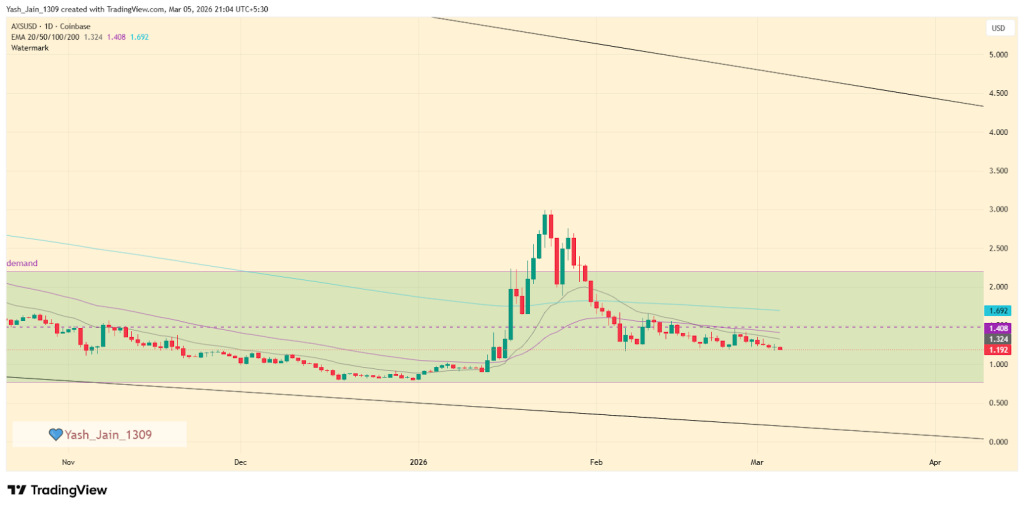
On the daily timeframe, AXS price is currently oscillating within a horizontal consolidation box. This range directly overlaps with the critical demand zone identified on the weekly chart, suggesting a period of high-stakes accumulation.
After spent the most of January and February within these boundaries, AXS/USD market odds suggest that March will likely continue this sideways trend as the asset builds necessary liquidity for its next move.
Moreover, a daily candle flip above $1.40 would signal a shift in momentum, opening the door for Axie Infinity price to target the $1.70 and $2.20 resistance levels, respectively.
Conversely, if the psychological $1.00 floor is lost, we should anticipate a retest of the $0.80 macro support before the end of March.
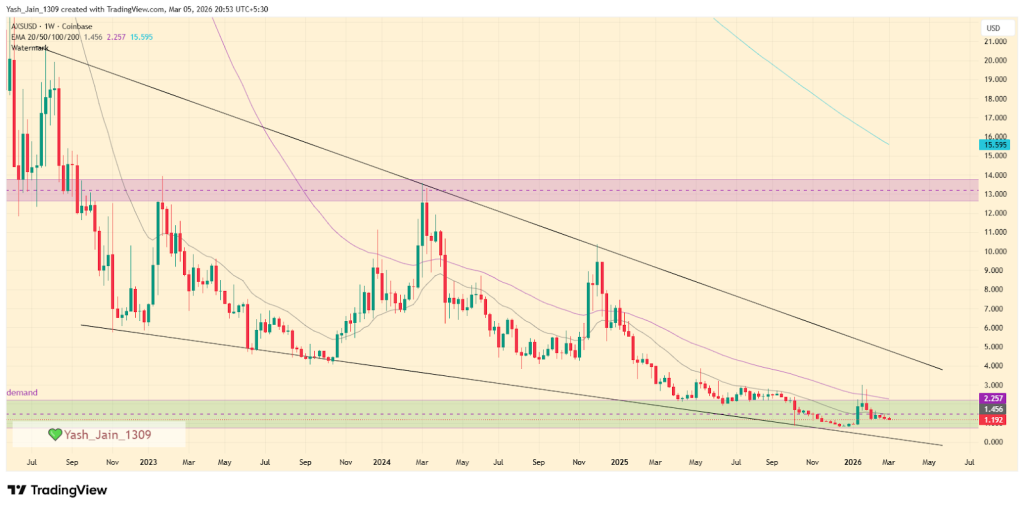
The long-term weekly chart for AXS/USD reveals a persistent declining trend that has finally reached a critical inflection point in early 2026. After hitting record lows near the $0.80 support level, the asset attempted a significant relief rally in Q1. However, this momentum was halted by the 50-week EMA band, which acted as a dynamic ceiling, forcing the price back into the primary demand zone.
Currently, the corridor between $0.80 and $2.30 is solidifying as a major accumulation area, suggesting that internal ecosystem developments are beginning to provide a fundamental floor for the price action.
Technically, AXS price is navigating a massive falling wedge pattern, a structure typically associated with bullish reversals upon completion. The lower boundary of this wedge provides a “double confirmation” for the current accumulation phase. Throughout the remainder of 2026, we anticipate the Axie Infinity price will continue to build a base within this pattern. A successful breakout could see the price targeting the upper resistance border near $4.00.
Conversely, if broader market stress persists, a final liquidity sweep toward the lower border at $0.25 remains a possibility, offering a deep-value entry point for long-term believers.
| Year | Minimum Price ($) | Maximum Price ($) | Average Price ($) |
| 2027 | 0.80 | 4.50 | 2.60 |
| 2028 | 1.20 | 5.90 | 3.50 |
| 2029 | 1.80 | 7.10 | 4.80 |
| 2030 | 2.20 | 8.90 | 5.50 |
| 2031 | 2.50 | 9.80 | 6.90 |
| 2032 | 3.00 | 12.00 | 7.50 |
In 2027, AXS is expected to find a stable market floor at $0.80 as the Ronin ecosystem matures further. Increased adoption of “risk-to-earn” mechanics could drive the token to a maximum of $4.50, maintaining an annual average of $2.60.
By 2028, scalability improvements are projected to push the minimum price to $1.20 during periods of market consolidation. Sustained gaming demand may ignite a rally toward a peak of $5.90, with the price likely hovering around a $3.50 average.
Entering 2029, the token is forecasted to show strong resilience with a decentralized bedrock established at $1.80. Market analysts anticipate a climb to visionary heights of $7.10, centering on a robust yearly average trading price of $4.80.
As Axie Infinity potentially becomes a linchpin of the crypto economy in 2030, the minimum price is expected to rise to $2.20. Growth in institutional gaming interest could propel AXS to a $8.90 zenith, with a projected average of $5.50.
The 2031 outlook suggests a meticulous consolidation phase where AXS trades at a minimum of $2.50 even during bearish cycles. Optimistic projections set an impressive high of $9.80, with price stability expected to settle near the $6.90 mark.
Rounding out the decade, 2032 targets represent a significant milestone with a projected peak performance of $12.00. While volatility remains a factor, the asset is expected to average $7.50, supported by a long-term accumulation floor of $3.00.
Stay ahead with breaking news, expert analysis, and real-time updates on the latest trends in Bitcoin, altcoins, DeFi, NFTs, and more.
AXS could trade between $0.25 and $4.00 in 2026. A breakout from its falling wedge pattern may push prices higher if market sentiment and ecosystem growth improve.
Market forecasts suggest AXS could trade between about $2.20 and $8.90 by 2030 if the Ronin network grows and GameFi adoption continues expanding.
By 2040, AXS could potentially trade between $15 and $35 if blockchain gaming becomes mainstream and Axie Infinity maintains strong ecosystem growth.
Some long-term projections estimate AXS could range between $25 and $60 by 2050 if GameFi adoption accelerates and the ecosystem remains competitive.
Long-term projections suggest AXS could reach around $12 by 2032 if GameFi adoption grows and the Ronin ecosystem continues expanding.
The Galaxy S26 Ultra PUBG showcase in San Francisco on February 26 wasn’t just another tournament. Samsung has turned a phone launch into a year-long esports circuit.
It was the opening bell for the entire 2026 #PlayGalaxy Cup, a full season of mobile competition that kicks off regionals in May and ends at Gamescom in Cologne.
100 Thieves sent Sunny, CouRage, NiceWigg and Octane. OfflineTV rolled in with TinaKitten, Yvonnie, Foolish and Masayoshi. They were joined by eight members of TeamGalaxy, forming a 16-player lineup of creators and competitors.
The #PlayGalaxy Cup: PUBG Mobile Global Open was livestreamed on Ludwig’s YouTube channel, attracting 16.77 million views. The broadcast was also streamed on Samsung’s YouTube channel and co-streamed by creators.
A center-stage screen showed what the Galaxy S26 Ultra was rendering in real time, smooth and loud. Additionally, there was a demo zone where visitors could try the phone and see if it actually held up under gameplay pressure.
Regionals start rolling out across Europe, Southeast Asia, Oceania, North America, India and South America in May. Winners advance to the World Final at one of the biggest gaming conventions on the planet.
The Korean tech giant is betting that if you’re going to spend that much, you want a device that can handle competitive play without thermal throttle or frame drops.
“The Global Open marked a milestone with the launch of the inaugural 2026 #PlayGalaxy Cup league,” said David Moon, Head of Influencer Marketing, Mobile eXperience (MX) Business at Samsung Electronics. “We look forward to continuing this journey with gaming fans around the world.”

The post Galaxy S26 Ultra headlines global PUBG Mobile esports league appeared first on Sammy Fans.
Samsung quietly announced a price hike for 14 Galaxy phones in India. The cost revision primarily targets budget and mid-range phones. The revised prices have come into effect on March 5, hurting consumer purchasing power.
The price revisions surfaced through a channel partner memo, via AbhishekYadav. Galaxy A17 5G, which now costs up to INR 3,000 more, depending on configuration. It is a crucial device that helps Samsung spike volume in the market.
Galaxy M36 and F36 both increased by INR 500 on the 128GB model and INR 1,500 on the 256 GB. Same story for the M17 5G and F17 5G, though the F17 saw slightly smaller jumps, ranging from INR 500 to INR 1,000.
You could maybe ignore a 500 rupee bump if you were already reaching for your wallet.
Galaxy A17’s situation is different
Base model went from around INR 18,000 to nearly INR 19,000 in some channels, and the top spec 8GB/256GB variant climbed to INR 23,499. The A06 5G also sneaked up by as much as INR 1,500.
Meanwhile, Samsung did something interesting here. According to the memo, price adjustments “as per Price Protection Policy” will apply to existing stock held by channel partners, excluding direct retailers.
Rising component costs and memory supply issues are the usual suspects this year. The company already raised prices on Galaxy A56, A36, and F17 5G in early January, ranging from INR 1,000 to INR 2,000.
Budget-conscious buyers who were stretching to Samsung for brand trust and software support now have less room to stretch. The M and F series exist specifically to hit aggressive price points in offline retail and smaller towns.

Credits – Abhishek Yadav
The post 2026’s best-selling Android phone gets a major price hike appeared first on Sammy Fans.
With the latest software update, Samsung is bringing a visual treat to its smartwatches. After Watch 7 and Watch 8, Samsung’s Galaxy Watch 6 series is receiving the February 2026 patch, which also carries the One UI 8.5 update screen.
The firmware update is rolling out in South Korea. An expansion will take place sequentially, more widely once Samsung ensures stability. You can look forward to an even more elevated user experience post-installation.
Samsung’s updated Galaxy Wearable app pushes the One UI 8.5 update screen to the Galaxy Watch 6 and Watch 6 Classic with February 2026 patch.
The new update screen revamps the background with a more dynamic image. It’s the same as Samsung offers to Galaxy phones and tablets with the latest software.
The visual carries vibes from One UI 9 aesthetics. It’s a silent indication to the next iteration of Samsung’s One UI, which will be based on Android 17.
Samsung’s February patch is another notable point in the Watch 6 update. It improves system security and stability to elevate reliability. With enhanced security, the Watch will keep your data secure against vulnerabilities.
Last month’s patch addresses thirty-seven CVEs and SVEs. These are applicable to mobile phones, and the watches may have some differences. But it wouldn’t be that much, as One UI Watch is based on Wear OS, which is built on Android.
To update the Watch:
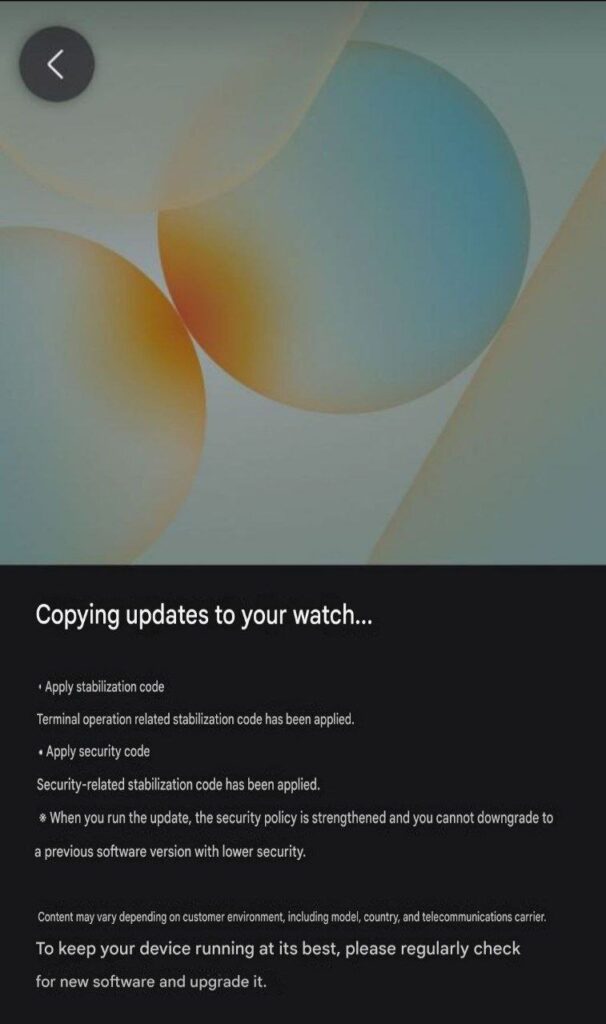
The post Galaxy Watch 6 grabs One UI 8.5 update screen with February 2026 patch appeared first on Sammy Fans.
Galaxy S26 series has just outclassed Samsung’s preorders record. The newly announced flagship lineup has surpassed the Galaxy S25 series in preorders, which was known to have the highest shipments in recent years.
On March 6, Samsung revealed (via IceUniverse) that the Galaxy S26 series preorders hit 1.35 million units in South Korea. The new phones have beaten their predecessors, which managed to secure 1.3 million preorders.
As forecasted, Galaxy S26 Ultra is the fan favorite. The Ultra version alone occupies roughly 70 percent share in total preorders. It shows Samsung was right when it increased the production of Ultra early last month.
It’s said that the Galaxy S26 Ultra has become the highest-selling Ultra model in Samsung’s history. The frenzy is driven by practical upgrades that are pushing fans to upgrade to the new flagship.
Samsung has also retained the double storage benefit offer. It practically saves money and encourages buyers to consider upgrading to the new model, with trade-in benefits added.
The South Korean tech giant has increased the prices of its new flagships. Despite the steep jump, the new flagship phones are selling like hotcakes, solidifying the love for the Galaxy is unbreakable.
The report also talks about the trending colors of each model. Consumers prefer White and Black for the S26, Black and Cobalt Purple for the S26 Plus, and Black and White for the S26 Ultra.

Cobalt Violet/Purple is the hero color of the Galaxy S26 Ultra. Meanwhile, the other three colors are equally iconic, with pre-order stats confirming the consumers are sided on the flip of hero shade.
Samsung may soon share Galaxy S26 preorder data for other markets.
The post Galaxy S26 beats S25 preorders, hitting 1.35 million; S26 Ultra is fan favorite appeared first on Sammy Fans.
The post Chainlink Price Gains Attention After Visa e-HKD Pilot and LINK Chart Signals Possible Breakout appeared first on Coinpedia Fintech News
The Chainlink price is suddenly back in the spotlight and not just because of a chart bounce. This time, the story comes straight from the intersection of crypto infrastructure and traditional finance.
A recent update revealed that a cross-border settlement pilot under Hong Kong’s e-HKD program has been completed. And yes, it involved some heavyweight names: Visa, ANZ, ChinaAMC, and Fidelity International. The connective tissue tying it all together? Chainlink crypto’s oracle network.
On paper, the initiative focused on enabling atomic and compliant transfers of tokenized funds. In simpler terms: programmable money moving across borders with reduced counterparty risk and near-real-time settlement. Visa’s interim report and Chainlink’s platform documentation detail how the infrastructure handled regulated asset transfers within the program.
That’s not just another blockchain experiment. It’s a test run of how financial institutions might actually move money in the tokenized future.
Let’s be honest crypto has promised to “revolutionize finance” for years. Most of the time, that claim lives somewhere between marketing hype and speculative optimism.
But occasionally, real infrastructure work appears.
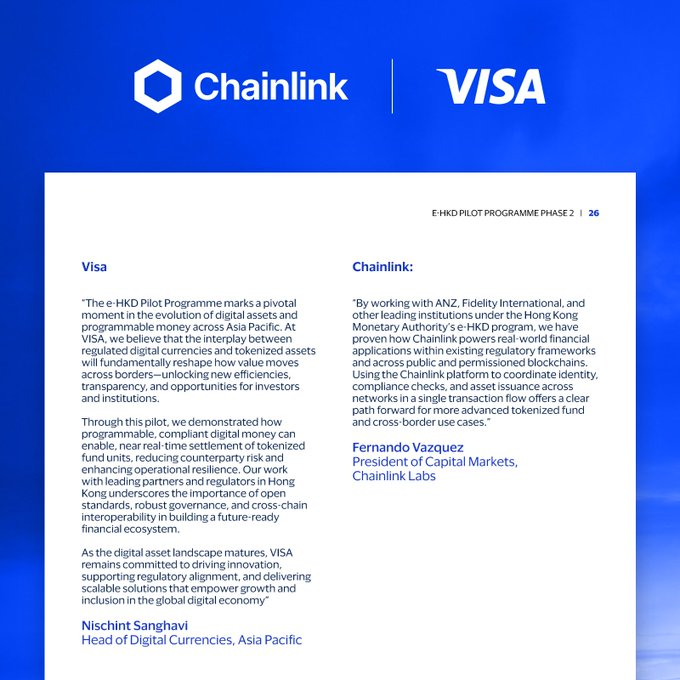
This pilot under Hong Kong’s e-HKD program shows how programmable money might operate in the Asia-Pacific region. By linking financial institutions through Chainlink’s oracle network, the system demonstrated near-instant settlement for tokenized funds while reducing settlement risk.
In traditional finance, settlement delays can create exposure between parties. Programmable transactions remove that uncertainty by executing transfers atomically meaning they either complete entirely or not at all.
And here’s the most highlighting detail: it’s not just a theory anymore.Institutions are testing it.
While the institutional narrative unfolds, the Chainlink price chart is quietly showing signs of life.
A weekly chart shared online highlights how LINK recently bounced from a critical $9–$10 support zone after previous declines. That range appears to have acted as a foundation for a potential recovery.
Now the asset is trading inside a parallel range structure. If momentum continues upward, the first technical target sits around $15. Push beyond that, and the upper boundary of the range appears closer to $26.
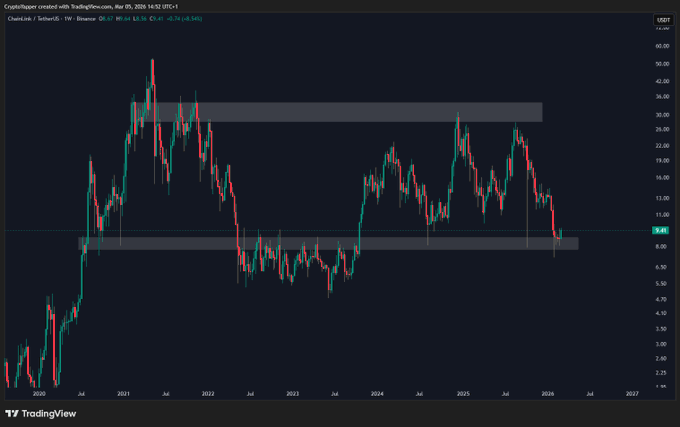
Of course, markets rarely move in straight lines. Resistance zones tend to attract sellers, especially after sharp recoveries.
Still, for traders watching LINK/USD, the support rebound has become the key talking point behind the latest Chainlink price prediction circulating across the market.
So what’s really happening here? Well, here’s the interesting part. Institutional experimentation with programmable money is happening at the same time the market structure for LINK is attempting a recovery.
Correlation doesn’t equal causation, obviously. But the combination tends to attract attention.
If price holds above the $9–$10 base and momentum continues building inside the range, the next move on the chart could determine whether the current rebound becomes a trend.
For now, both narratives first the infrastructure progress and second the technical setup are converging around the same topic: the direction of the Chainlink price.
The post Bitcoin Price Debate Ignites as Bull Trap Warning Clashes With On-Chain Data appeared first on Coinpedia Fintech News
The Bitcoin price is once again sitting in the middle of a classic crypto argument: bull trap or genuine recovery? One viral chart circulating on X claims the current rally perfectly mirrors the 2022 pattern and warns that BTC could crash to $45,000 within 12 days after a supposed bull trap near $73K.
That’s a dramatic call. But not everyone’s buying it. Because when you dig into the on-chain data, the story suddenly looks… a lot less catastrophic.
Let’s start with derivatives markets. According to CryptoQuant data, more than 30,000 BTC flowed out of derivatives exchanges as price approached $72,900 in early March 2026.
That’s not small change. Large derivatives outflows often indicate short covering, that means traders closing bearish positions rather than doubling down on them. In other words, some of the selling pressure that previously dragged the Bitcoin price chart lower may already be fading.
And that matters. A lot. Because, if major players considered the $65K–$68K zone a local bottom, then the current move higher might be less about hype and more about repositioning.
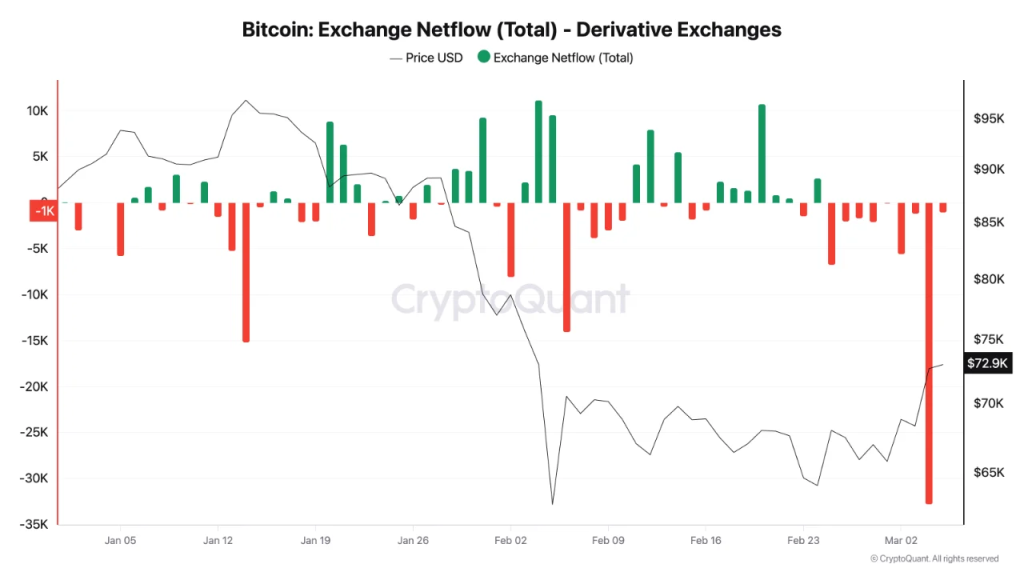
Then there’s spot market behavior. On February 18, roughly 8,000 BTC left spot exchanges right at price lows.
Not sold. Withdrawn. That pattern is often described as “stealth accumulation.” Institutions and large holders buy during weakness and move coins to cold storage rather than leaving them on exchanges where they could be dumped.
For anyone obsessing over a Bitcoin price prediction, that kind of behavior usually signals confidence rather than panic.
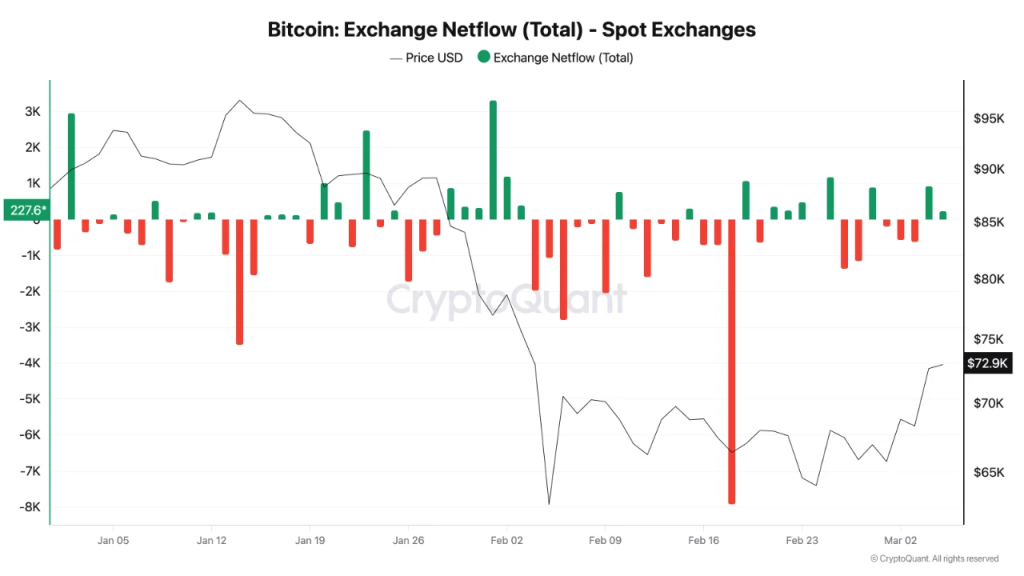
Meanwhile, long-term holders, the so-called diamond hands haven’t flinched.
Wallets holding coins for more than five years remain almost completely unchanged despite the volatility. Even the 6-month to 12-month holder group is expanding, suggesting some investors who bought last year’s volatility have simply transitioned into longer-term holders.
Not exactly the behavior you’d expect before a massive collapse.
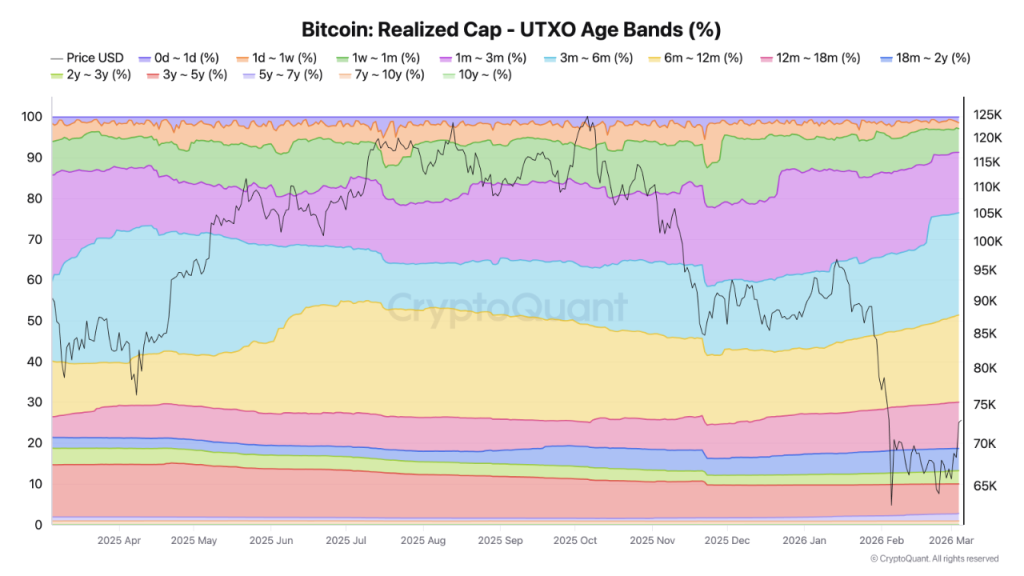
Now here’s the part traders keep watching. Mining economics. According to Marathon Digital filings, the average mining cost in Q4 2025 sat around $70,027 per BTC. With Bitcoin/USD hovering near $73,000, the margin above that break-even point is only about $3,000.
That level effectively becomes a structural floor.
Historically, if price drops below mining costs, miners can capitulate and sell reserves. But there’s a twist this cycle. Some miners are pivoting toward AI data centers, which may reduce the urgency to liquidate holdings during downturns.
So, what’s next? Well, Sentiment has already shifted from extreme fear to optimism, yet on-chain indicators still show accumulation rather than distribution.
The Bitcoin price might not be heading straight to the moon. But the data doesn’t scream imminent collapse either.
For now, the $70,000 line remains the battlefield. And the next move on the Bitcoin price chart will likely decide which side of the debate wins.
February 2026 Google Play System Update has arrived for Samsung users, and nobody is celebrating. Samsung was busy with One UI 8.5 Beta testing and the Galaxy Unpacked event, which delayed the February patch rollout.
The February 2026 version has arrived recently, weighing in at roughly 90MB. Galaxy devices were stuck on the July 1, 2025, Google Play System version in some cases. The latest release comes as a big relief for those Galaxy fans.
In mid-February, tons of Galaxy phones suddenly started receiving the January update. Such updates exist so manufacturers don’t need to push full OTA patches every time Google tweaks something in the backend.
The Play System updates hadn’t touched Samsung Galaxy devices in some time, dating back to mid-2025, then those updates resumed.
Google describes the February 2026 Play System update with improvements to security and privacy and updates for bug fixes, plus new developer features for Google and third-party app developers
to handle web content.
You can now track your progress across games with trophies in the You tab, and a persistent navigation bar on large-screen devices makes navigating the Play Store slightly less annoying.
Samsung’s handling of these updates has been a mess. The company has remained silent for months, left users on outdated builds, and blamed One UI 8 rollout conflicts.
February’s build is live; install it when it shows up. Just don’t assume March’s update will arrive on time.
The post February 2026 Google Play System Update hits Samsung devices appeared first on Sammy Fans.
Samsung pushed a new Galaxy Store update, introducing a new “Benefits” tab Galaxy S26 Ultra giveaway. After Reserve sweepstakes, this is the second opportunity to enter the year’s second biggest giveaway with the least effort.
Galaxy Store version 4.6.5.3 brings the “Benefits” tab to the navigation bar, and it contains a Galaxy S26 Ultra giveaway. Samsung confirmed the rollout is sequential, meaning you may not immediately gain access to the changes.
Samsung is doubling down on the usability of Galaxy Store. Thanks to the new “Benefits” tab, Galaxy’s native app store has become beneficial. It has different categories of perks that unlock with simple tasks and processes.
Activities include: Daily bonus, Spin to win, Refer a friend, Redeem a code, and so on.
Right now, the biggest offer inside the Benefits hub is the Galaxy S26 Ultra giveaway. It falls under the March Monthly Sweepstakes, which is free to join and requires tickets to add entries.
You get a key entitled “Enter now” to secure your entry. As confirmed by LarrySWhite, the first entry is free, and one can add multiple entries. These entries require “Tickets” that you could score by completing specific tasks.
The program is running throughout March, so make sure you mark your entry.
Galaxy S26 Ultra starts at $1,299 in the United States. Samsung is currently offering double storage benefit in the preorder phase. It’s available in four standard and two exclusive colors; you can score up to $900 trade-in credit.
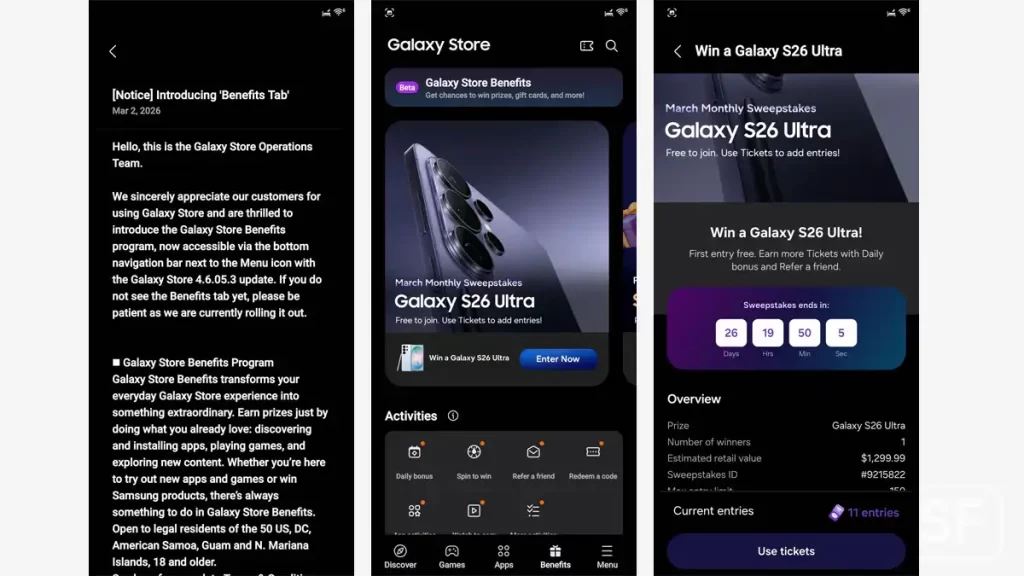
Credits – Larry S White
The post Galaxy Store introduces ‘Benefits’ hub and an S26 Ultra giveaway appeared first on Sammy Fans.
Samsung has rolled out a new LockStar update, and if you’ve been dealing with busted clock settings or weird brightness issues on your AOD lock screen.
This modest patch comes with LockStar version 6.1.00.18, but the fixes actually matter if you’re running One UI 8.0 or higher. As described in the changelog, the update tackles a handful of specific annoyances.
Lock screen and always-on-display clock settings were throwing errors for some users, which is the kind of basic functionality problem that shouldn’t exist this late in the One UI cycle.
Samsung also patched bugs that surfaced during Smart Switch transfers and GTS testing. Another patch included for the manual brightness malfunction on devices without full-screen AOD support.
LockStar March 2026 update changelog:
People who actually bought into Samsung’s lock screen ecosystem need stability. These aren’t flashy notes, but they’re the kind that keep daily use from feeling like a Beta test.
With the March 2026 update, the Samsung LockStar update doesn’t reimagine anything or add new customization options. It just makes the thing work the way it should’ve worked from the start.
Should you grab it now?
If you’ve seen any of these bugs yourself, yes. If your lock screen’s been behaving, you can wait a week and let someone else handle the weird edge cases.
The post Samsung LockStar update improves lock screen experience appeared first on Sammy Fans.
Samsung scooped up a bunch of superfans, flew them to San Francisco, and gave them Galaxy S26 feature superfans access before anyone else could get their hands on it.
From late February, the company hosted the Galaxy Community Connect 2026 event. Over 50 people from 17 countries got to test drive the unreleased Galaxy S26 and Buds 4 series.
Samsung Members Stars are the people who actually post high-quality content on Samsung’s community platform. Samsung also pulled in Reddit users, who bought Galaxy devices and then got mad at you in the comments.
Features from the Galaxy S26 series that were trending include Now Nudge, Privacy Display, Circle to Search, and Super Clear Calls of the Galaxy Buds 4 series.
Now Nudge checks your calendar when someone messages about plans and presents a context aware popup if there’s a conflict.
Privacy Display on the S26 Ultra adjusts viewing angles to block visibility from side angles. It can be activated in settings, bringing additional personalization for specific apps.
Upgraded Circle to Search can now handle multi-element searches, like circling a celebrity’s outfit and getting curated pieces to recreate the look.
Super Clear Call uses deep neural network tech and a voice pickup unit to separate your voice from background noise, then doubles Bluetooth bandwidth to 16kHz for Super Wideband calling.
AMA session: Sungdae Joshua Cho, who runs Visual Solution for Samsung’s mobile division, took live questions. The company says it’ll keep doing this kind of direct community engagement.
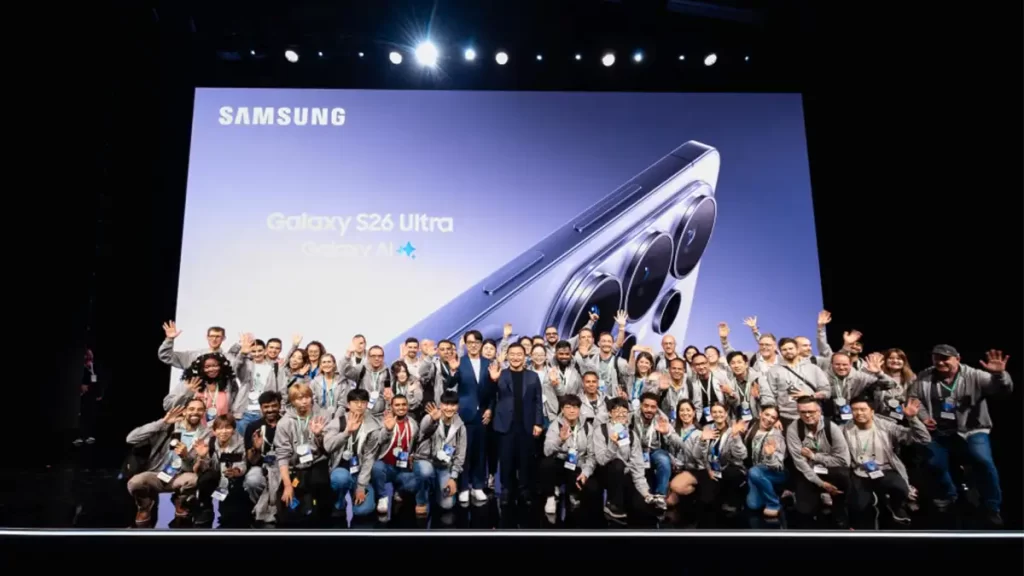
The post Samsung handed Galaxy S26 to superfans before launch appeared first on Sammy Fans.
JB Park, President and CEO for Southwest Asia, let slip that the entire Galaxy S26 lineup will roll off the production line at Samsung Noida factory in India (not just assembling, but full manufacturing).
CEO Park also revealed engineers at the Bengaluru and Noida R&D facilities in India “played a pivotal role” in developing the S26 Galaxy series.
Park said “Galaxy S26 series” but didn’t break it down. Does that include the S26 Ultra, or just the base and Plus variants? Samsung’s done splitting manufacturing before, so it’s worth asking.
If you’ve been watching Samsung’s India operations, you know those two hubs have been scaling up quietly for the better part of three years now.
Every tech giant with a factory in India loves to talk about local production. It’s good optics, it softens import duty hits, and it makes the government happy.
Meanwhile, R&D is different, which means the actual decisions about hardware, software integration, feature sets, and performance tuning are happening on the ground in India.
If Bengaluru and Noida engineers really did shape the S26 series, then Samsung’s betting that its India talent can build flagships that will sell around the world.
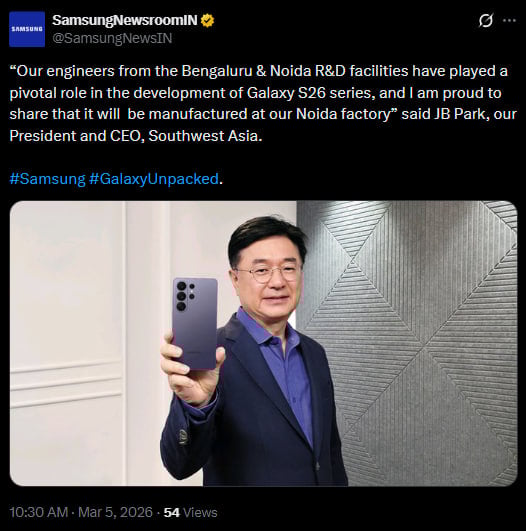
The post Galaxy S26 series will be made in India, CEO lauds pivotal role in R&D appeared first on Sammy Fans.
New year, new controversy. Samsung can’t enjoy the privilege Apple does after unveiling new products. While the internet praises Apple’s every move, it’s just the opposite when it comes to Samsung. The newly launched Galaxy S26 Ultra is already a hot topic, adding fuel to the trend; fake reports of Green Line and display glitches have surfaced online.
Samsung launched the Galaxy S26 Ultra with its best display technology. The panel features M14 material set and Flex Magic Pixel technology. The OLED brings a Privacy Display feature that dims brightness through software.
No doubt, Galaxy phones are famous for their green/pink line issues. We’ve seen reports of a vertical line surfacing on several models. Even some Galaxy S24 Ultra users reported that a green line appeared without physical damage.
A Reddit user, u/Eziolambo, posted a cryptic post earlier. The original poster slapped a dashed green line on the Galaxy S26 Ultra display using AI/Photoshop. The user asked if “the S26 Ultra’s green line will have breaks in between.”
It was pure fun, and the question is literally factual given the pixel structure of the Galaxy S26 Ultra’s screen. Meanwhile, things went opposite when the altered picture was taken to X and circulated as a real scenario.
The cropped image has gone viral on X, with hundreds of users flooding the comments section. Some spotted that the image is fabricated using AI, while the wider impact isn’t visible in comments, but it’s hurting the initial hype.
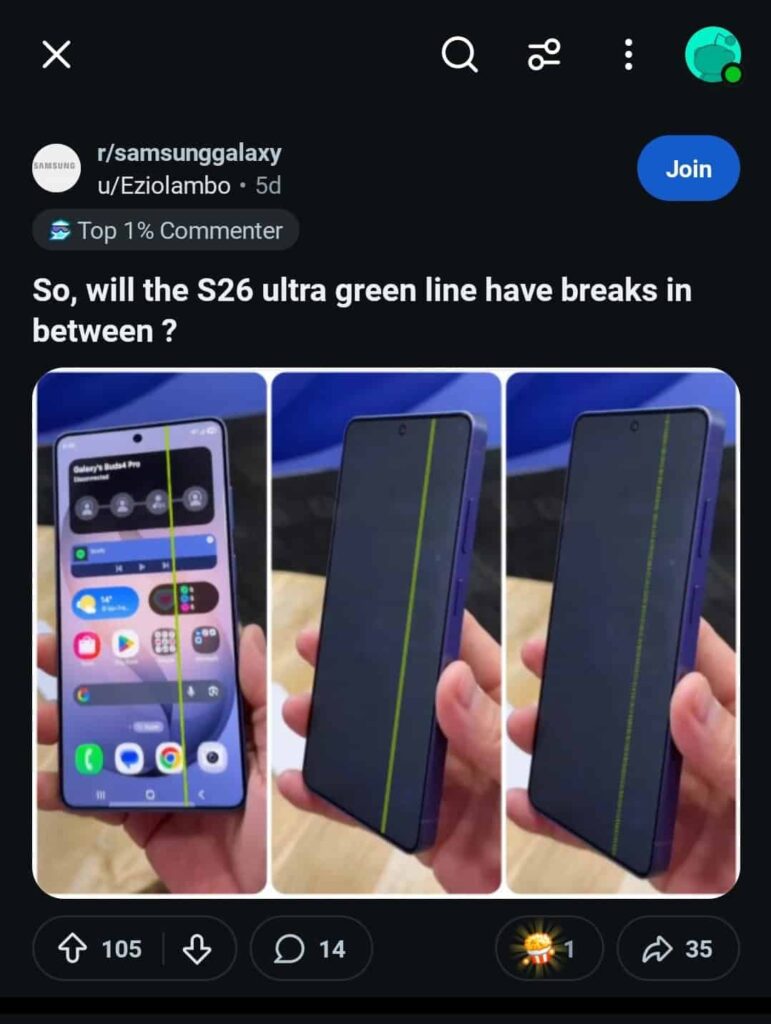
Apart from this, reports of Privacy Display have degraded the screen quality are also trending on the internet. There’s a targeted negativity being spread against the brand and the device, which needs to be addressed by Samsung.
If you’re planning to purchase the Galaxy S26 Ultra, visit your nearest Samsung Experience Store. Have a hands-on experience before making the purchase, at the same store, or order from the Samsung Store thereafter.
The post Galaxy S26 Ultra already hit by Green Line curse? Debunking the early reports appeared first on Sammy Fans.
Caviar just unveiled the Totem collection, a set of modded Galaxy S26 Ultra. The flagship model, Fire Horse, clocks in at $11,490, while the cheapest model costs $10,490.
Only 76 people can buy into this particular fever dream. Each Totem design, whether it’s the Fire Horse or the Lion or the Falcon or the Wolf, gets capped at 19 units.
The phone’s cost, $11,490, is three months of rent in most American cities for a phone with hand-painted red enamel and a 24K gold horse rearing up on the back.
The Fire Horse treatment involves hand-applied red enamel layered over black titanium with a PVD coating that watchmakers like Richard Mille lean on when they want something durable that looks expensive.
The horse itself is a bas-relief sculpture, not a sticker. It’s meant to honor the Fire Horse in the Eastern Zodiac, which governs 2026. That said, the money isn’t just buying gold plating, though there’s plenty of that.
The other three Totem variants follow the same playbook.
Caviar knows its audience
Caviar’s been doing this for years now. Slap gold and carbon fiber on flagships, invent some mystical narrative around archetypes or zodiac signs, then sell them to people who find normal luxury boring.
This isn’t for people budgeting their next upgrade. It’s for people who want a conversation piece that doubles as a status object and happens to make phone calls.
A regular Galaxy S26 Ultra starts at $1,300, while Caviar wants eight times that for materials and craftsmanship. You’re still getting the same Snapdragon 8 Elite Gen 5, same 200MP camera, same privacy display tech.

Samsung Galaxy S26 Ultra Caviar Models
The post Caviar Galaxy S26 Ultra gets 24K gold treatment for $11,490 and only 76 people can buy it appeared first on Sammy Fans.
After a brief halt, Samsung’s software rollout has returned to the usual pace. Due to the Galaxy S26 Unpacked, the distribution of the February 2026 update has been pushed to March, with the Galaxy Tab S11, Tab S9, and Tab S8 starting to receive it.
Samsung is bringing the February 2026 security update to the Galaxy Tab S11, Galaxy Tab S9, and Galaxy Tab S8 series tablets. The software has initially landed in South Korea, and the expansion is likely to take place shortly, via Aptivi.
The company recently shared details of its March 2026 patch. Galaxy’s next SMR will bring patches to sixty-seven CVE and SVE items. It includes improvements for Android and One UI for better system security and stability.
February 2026 security patch carries thirty-seven improvements. Among the total items, twenty-five were provided by Google, while the remaining twelve were provided by Samsung.
If you own a Galaxy device, open the system Settings, followed by the Software update page. Tap on the Download and install button to initiate the process. Hit Restart now to begin the installation of the update on your tablet.
Samsung is also tailoring One UI 8.5 for several Galaxy devices. The official version landed with the S26 series last month. The public rollout to existing models may commence in April, with another Beta coming to the S25 series.
The post Samsung’s February 2026 update reaches Galaxy Tab S11, Tab S9, and Tab S8 tablets appeared first on Sammy Fans.
Samsung Galaxy Watch 8 and Watch 8 Classic users begin receiving the February 2026 update. Recently, Samsung pushed a new firmware update to the Watch 7, which also carried the February 2026 security patch.
For mobile devices, Samsung provides 37 security improvements. It consists of 25 CVE items from Google and 12 SVE items from Samsung. Galaxy Watches run the Wear OS operating system, which is actually based on Android.
Users of the Watch 8 and Watch 8 Classic can identify the update via the PDA build version ending with AZB1 (via LarrySWhite). The software weighs roughly 430 megabytes. Samsung will sequentially expand the availability of the February patch.
You may have been wondering why March update bringing February patch?
Wear OS watches were expected to receive new update in February. Since Galaxy wearables get new OTAs every quarter, February was the timeline. However, the Galaxy S26’s launch has delayed the software distribution for all devices.

Source – Samsung
Expect the next firmware update in May or June, while the patch could be dated May 2026. Meanwhile, we would see the expansion of February patch to the remaining Galaxy Watch models over the next couple of days.
Check for updates on your Watch or Wearable app on mobile. Open Watch settings followed by Watch software update. Hit Download and install to allow the system establish connection with the server and fetch the OTA.
Previously, Samsung rolled out Wear OS 6-based One UI 8 Watch to Watch 7 and older models. It brought plenty of new features and design tweaks. The new tile system elevates usability by offering the creation of function-based combinations.
The post Galaxy Watch 8 gets February 2026 security update… in March appeared first on Sammy Fans.
Samsung’s Galaxy S26 Ultra secured the biggest award at MWC 2026, the “Best in Show.” It is the first honour that the new flagship smartphone has gained. The class of this award solidifies its supremacy in the world of Android.
On February 5, Samsung announced MWC 2026 named the Galaxy S26 Ultra as “Best in Show.” The victory was declared at the Global Mobile Awards (GLOMO Awards), with the device clearing a field of more than 3,000 exhibitors at MWC.
The judging panel, comprising over 200 industry analysts, journalists who’ve forgotten more about mobile tech than most product managers will ever learn, and assorted veterans, handed Samsung the gold standard.
The S26 Ultra ships with the world’s first built-in Privacy Display. The flagship also features a custom Snapdragon chipset that runs Galaxy AI faster than the S25 Ultra. One UI 8.5 sits on top, and the software is supposedly smart enough.
Shaun Collins, chair of the MWC Best in Show panel, said the S26 Ultra “pushes the boundaries” while delivering real-world impact. He specifically called out the privacy angle as addressing “one of the most important needs” of how people actually use phones today.
Collins admitted that the MWC panel is looking for products that move the industry forward. The panel said most of MWC was future-gazing tech that sounds great in a keynote but won’t ship until your current phone is already obsolete.
Stephanie Choi, Samsung’s EVP running mobile marketing, leaned into the “Agentic AI Phone” phrasing during her acceptance remarks. That term’s going to get beaten into the ground over the next six months.
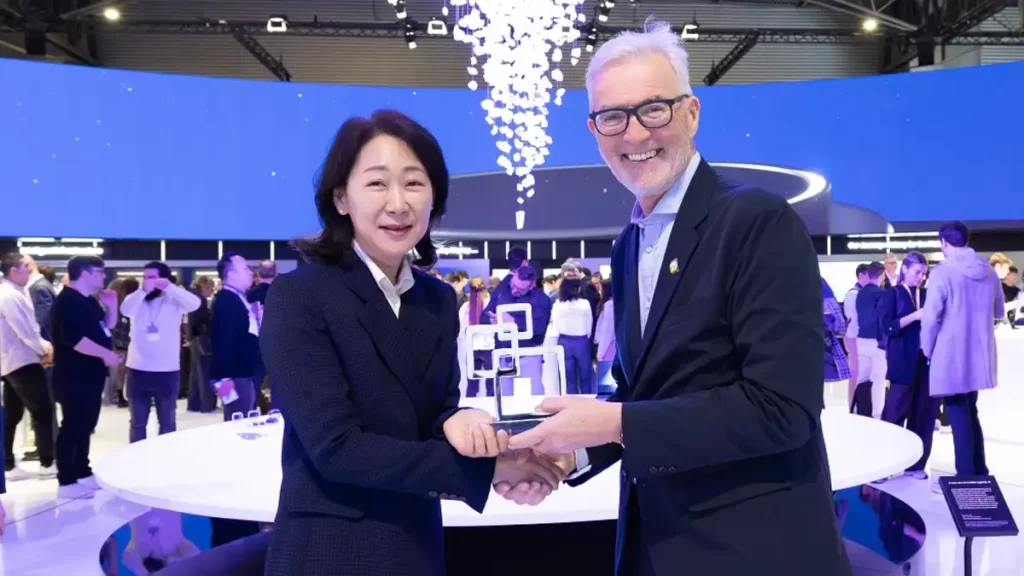
The post Samsung Galaxy S26 Ultra just won the biggest award at MWC 2026, beating 3000 rivals appeared first on Sammy Fans.
