 Login
Login
Ethereum is still a good long-term buy, according data: Analyst

Ethereum’s dominance in DeFi, stablecoins and staking is strengthening the long-term ETH accumulation thesis, despite it’s 28% price decline in 2026.

Ethereum’s dominance in DeFi, stablecoins and staking is strengthening the long-term ETH accumulation thesis, despite it’s 28% price decline in 2026.

Laszlo Hanyecz's 2010 post, offering 10,000 BTC in exchange for two pizzas delivered to his home, marked the first recorded commercial BTC payment.


US President Donald Trump has repeatedly said he wants the Federal Reserve to lower interest rates, but investors forecast no chance of a rate cut in 2026.


Bitcoin sold off to $76,000, giving bears an opportunity to reclaim control of the crypto market. Meanwhile, altcoins like HYPE charted new highs.

The proposed fund would use covered-call and short-term options strategies designed to generate monthly income alongside Bitcoin exposure through a leveraged structure.






Representative James Comer asked CEOs of two major prediction market companies for information on their responses to insider trading after “suspiciously timed trades” related to US military actions against Iran.

NEAR price surges 50% in a week as AI token momentum, Nvidia optimism and network upgrades fuel bullish sentiment.

The transfer was executed on ADI Chain, a layer-2 blockchain designed for institutional payments, treasury operations and trade settlement.






Institutional crypto adoption accelerates as Tether expands Bitcoin holdings, miners pivot to AI and Polymarket joins Nasdaq amid $1 billion fund outflows.

Bitcoin headed lower as Wall Street trading began with new record highs for the Dow Jones, while traders warned of weak US demand.





ICE and OKX plan to launch oil-linked perpetual futures based on Brent and WTI benchmarks, bringing crypto derivatives further into traditional energy markets under licensing restrictions.

MARA spent $4.3 million on CEO Fred Thiel’s security in 2025, including vehicle armoring, as crypto wrench attacks increased globally.

SpaceX’s IPO could turn the Mag 7 into a Mag 8, with Tesla and SpaceX comprising 25% of the group's Bitcoin balance-sheet exposure.

Repeated bridge exploits and shrinking yields are making institutions question whether DeFi’s risks still justify the returns, says Symbiotic’s Putiatin.

The $10.7 million THORChain exploit was caused by a GG20 vulnerability, which allowed a malicious node to reconstruct a full private key to one of its vaults.






XRP Ledger activity surges with 4,300 new wallets created in 24 hours, but strong resistance keeps XRP price capped.





Polymarket is reportedly seeking entry into Japan amid falling trading volumes and rising regulatory scrutiny, targeting approval by 2030.

Polymarket said user funds and market resolution were safe after a suspected private key compromise tied to top-up operations.





The hacker behind the Verus bridge exploit returned 75% of the stolen funds as part of a recovery deal negotiated with the protocol days after the incident.

Bitcoin rallied for 90 days after its dip below $60,000, breaking the record for the longest uptrend within a bear market in BTC price history.




The post Top Altcoins To Buy When Bitcoin Price Dips Again appeared first on Coinpedia Fintech News
A crypto analyst remains highly bullish on several altcoins despite waiting patiently for better entry points before buying. According to the analyst, projects like Monad and Canton are among the strongest long-term plays if Bitcoin revisits lower support zones near the 200-week moving average.
One of the main projects on his radar is Monad, a heavily backed Layer-1 blockchain currently sitting near a $310 million market cap.
The analyst noted that Monad’s chart structure looks surprisingly healthy compared to many VC-backed Layer-1 launches that often collapse after launch. He compared it to projects like ICP, which saw huge post-launch crashes, while saying Monad’s price action has remained relatively organic despite launching near the end of the bull cycle.
He also highlighted Monad’s strong financial backing, with the project raising roughly $431 million, even slightly more than Sui raised before its major breakout cycle.
The Monad price today stands near $0.028240 with a 24-hour trading volume of roughly $130.8 million. The token is also up around 3.77% over the past 24 hours.
The second project he wants to stack is the Canton Network.
According to him, Canton has one of the strongest institutional backing lists in crypto right now, including support tied to Goldman Sachs, Citigroup, Nasdaq Ventures, Samsung Ventures, Binance Labs, and S&P Global.
The analyst says Canton could become a major tokenization play for the next cycle, particularly as Wall Street continues pushing blockchain-based financial infrastructure.
The Canton price today stands near $0.154547 with a 24-hour trading volume of roughly $30.4 million. The token is also up around 1.10% over the past 24 hours.
The post Hyperliquid Shows Signs of Leverage Overheating—Is a Short-Term Flush Needed Before it Targets $100? appeared first on Coinpedia Fintech News
Hyperliquid has continued to expand considerably, reaching new highs at $62.14 during the previous trading day. The trading volume also doubled to $1.58 billion, signifying the rise in the traders’ participation. At the same time, the speculative activity across the derivative market has accelerated rapidly, which has pushed the Open Interest to new highs.
Despite the strong bullish momentum, signs of short-term overheating are beginning to emerge. The rise in the selling pressure, elevated leverage exposure, and euphoric funding conditions now suggest the rally may be entering a vulnerable phase. The key question now is whether the HYPE price rally has exhausted or is just undergoing a small correction before a rally to $100.
The latest Coinglass data shows Hyperliquid’s Open Interest has surged sharply above $2.7 billion while the HYPE price climbed toward the $60 range. The simultaneous rise in both price and Open Interest suggests fresh capital continues to enter the market as traders aggressively open new positions.
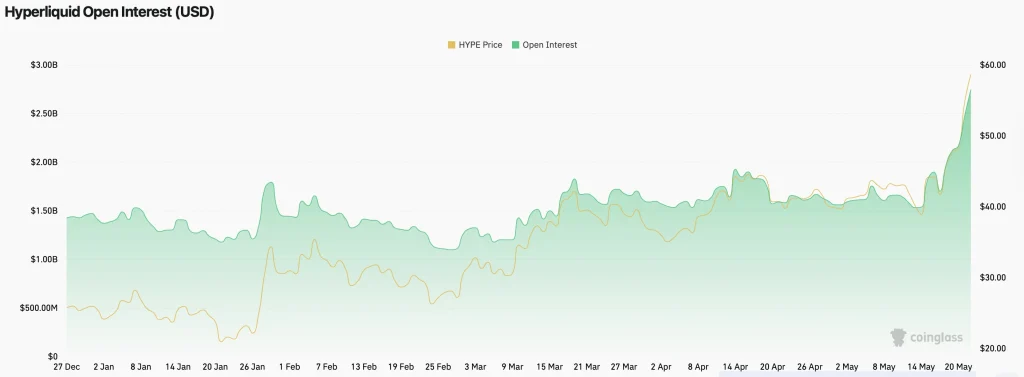
Rising Open Interest alongside rising price action is considered bullish because it reflects growing market participation rather than a temporary short squeeze. Besides, the OI-weighted funding rate strengthens the overheating narrative. Funding rates have recently spiked aggressively positive as HYPE approached fresh highs, indicating long traders are paying elevated premiums to maintain bullish positions.
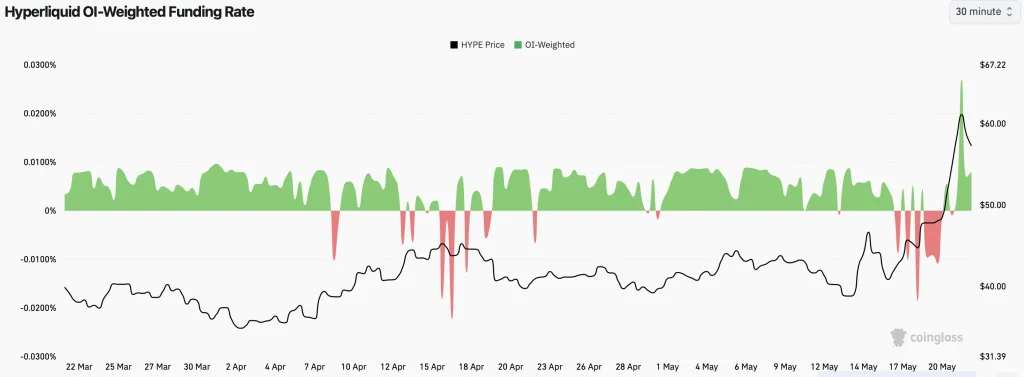
When funding becomes excessively positive, it often reflects overcrowded long positions and rising speculative euphoria. While the aggressive funding spikes precede periods of high volatility, sharp pullbacks or temporary liquidation, the current structure does not confirm a macro bearish reversal. Instead, the market appears to be entering a late-stage momentum expansion phase where bullish sentiment remains dominant but increasingly unstable.
Despite the growing leverage concerns, Hyperliquid’s broader structural outlook continues to remain strong. Glassnode data shows HYPE’s circulating supply valuation has continued rising alongside price action, suggesting the market is still absorbing the expanding token supply relatively efficiently. In many cases, aggressive supply expansion creates strong dilution pressure that weakens price performance.
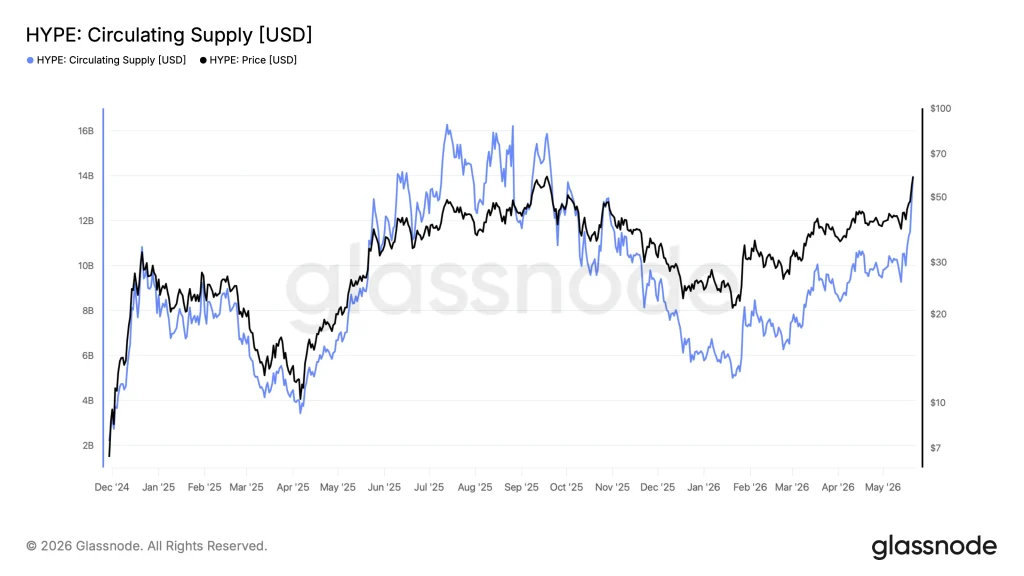
However, Hyperliquid price continues to maintain upward momentum even as circulating valuation expands, indicating that underlying demand remains strong enough to offset the increasing supply. This divergence suggests the broader market still maintains confidence in the Hyperliquid ecosystem and its long-term growth trajectory.
The data also indicates the current rally is not being driven purely by speculative leverage alone. Spot demand and broader ecosystem participation continue to support the macro bullish structure despite signs of short-term overheating.
Hyperliquid currently appears to be entering a critical phase where bullish momentum remains intact, but leverage conditions are becoming increasingly stretched. If HYPE manages to stabilize above the $55 region and reclaim the $60 resistance zone with sustained buying volume, the broader bullish continuation could target higher levels around $75 and $85 before eventually approaching the psychological $100 milestone.
However, if the leverage-heavy structure begins unwinding aggressively, the token could witness a rapid short-term correction toward support zones around $52, $48, or even the lower $40 range. Still, these downside levels may act more as leverage reset zones rather than confirmed macro reversal regions as long as broader spot demand remains strong.
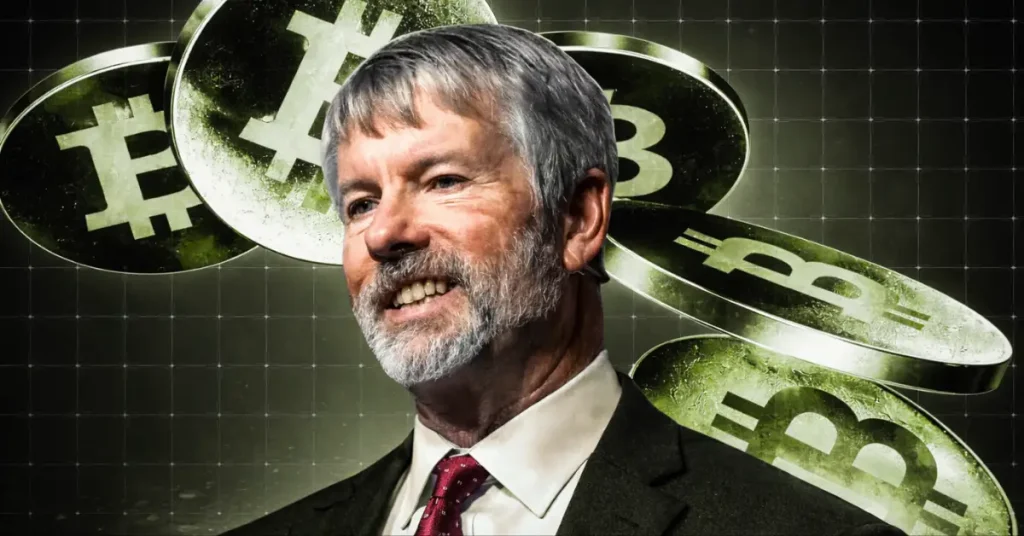
The post Michael Saylor Says Bitcoin Will Outperform the S&P 500 Over Time appeared first on Coinpedia Fintech News
Michael Saylor said during an interview with CNBC that he expects Bitcoin to continue outperforming traditional markets over the long term, despite recent volatility across crypto and macro markets.
“We think Bitcoin’s going up more than the S&P index over time,” Saylor said. “We expect 30%, but it doesn’t matter if it’s 10 or 20%.”
The Strategy founder argued that Bitcoin is entering a stronger phase after correcting from previous highs. According to him, the market now has solid support levels while investors wait for macro conditions and regulation to improve.
Saylor pointed to the potential passage of the CLARITY Act as one of the biggest catalysts for crypto markets.
“I think the passage of the CLARITY Act will be a big deal,” he said.
He also highlighted growing interest in tokenization and digital assets from regulators and financial institutions. According to Saylor, SEC guidance allowing tokenized securities and digital assets could significantly accelerate blockchain adoption across financial markets.
“The real power of tokenization is that it creates a free market in credit formation and yield for asset owners,” Saylor explained.
During the interview, Saylor revealed that Strategy continues aggressively buying Bitcoin and believes the company could theoretically absorb all newly mined BTC for decades.
“The credit market itself is absorbing all of the organic supply of Bitcoin from now to forever,” he said.
Strategy currently holds roughly $65 billion worth of Bitcoin, making it one of the largest corporate BTC holders globally. Saylor claimed the company’s long-term approach allows it to outperform traditional investment structures tied to the S&P 500.
Saylor also discussed Strategy’s “digital credit” products tied to Bitcoin appreciation. The model uses preferred stock structures to generate yields for investors while preserving long-term Bitcoin upside for shareholders.
“If you’re a crypto believer and you have working capital, you want to buy digital credit because you get paid four times the money market after tax,” Saylor said.
Despite continued skepticism from some traditional investors, Saylor remains highly bullish on Bitcoin’s future. He argued that growing adoption, tokenization, and institutional participation continue proving that crypto is becoming a permanent part of the global financial system.
The post Bitcoin ETFs See $1.63B Outflows as BlackRock Leads Selling Pressure appeared first on Coinpedia Fintech News
U.S. spot Bitcoin ETFs continued seeing heavy outflows for the straight five days with total withdrawals reaching nearly $1.63 billion. The biggest selling came from BlackRock’s Bitcoin ETF, (IBIT), as institutions continued reducing exposure. Meanwhile Bitcoin price continues to struggle below the $78,000 level.
On May 21 alone, the Bitcoin ETF saw around $101 million outflow. Meanwhile, over the past few days, BlackRock Bitcoin ETF recorded as outflow of,
n total, BlackRock has now seen more than $1.15 billion leave its Bitcoin ETF in just four trading days. That represents nearly 75% of all Bitcoin ETF outflows during the recent selloff.
BREAKING :
— Ash Crypto (@AshCrypto) May 22, 2026Blackrock ETF has sold $103,640,000 in Bitcoin. pic.twitter.com/z3rdFcJeAH
Other Bitcoin ETFs also saw investors pulling money out. ARK Invest’s ARKB lost around $163 million, while Fidelity Investments’ FBTC recorded roughly $114 million in outflows during the same period.
The recent ETF outflows are mainly linked to growing market uncertainty. Higher inflation data in the U.S. has increased fears that interest rates could stay high for longer. When interest rates rise, investors usually move away from risky assets like crypto.
At the same time, global tensions and weak stock markets have also pushed institutions to reduce risk.
Despite the heavy selling from ETFs, Bitcoin prices have not collapsed. As of now BTC continued trading near $77,500 during the latest session, showing that buyers are still active around lower support levels.
Meanwhile, Ethereum ETFs also continued seeing money leave the market, recording another $32.5 million in outflows.Thus, XRP and Solana ETFs continued attracting fresh inflows, showing that some investors are still actively buying select altcoins. Solana ETFs alone recorded nearly $3.86 million in daily net inflows.

The post South Korea Petition Against Crypto Tax Passes 50,000 Signatures appeared first on Coinpedia Fintech News
A petition in South Korea calling for the removal of a planned 22% crypto gains tax has surpassed 50,000 signatures, forcing lawmakers to review it in the National Assembly’s Finance and Economy Committee. The tax, set to begin in 2027, would apply to crypto profits above roughly $1,800. Supporters of the petition argue the policy could hurt trading activity and push investors away from local markets. The debate highlights growing tension between governments seeking tax revenue and crypto users demanding fairer treatment and stronger investor protections.

The post Pi Network News: Elf Continent Is Now Live on Pi Browser as CiDi Games Opens Virtual Farming World appeared first on Coinpedia Fintech News
CiDi Games has officially rolled out “Elf Continent,” a new virtual world built for Pi Network users inside the Pi Browser.
According to CiDi Games, users can access the experience directly through the Pi Browser by logging into the platform with their Pi accounts. After signing in, players can enter the Pi ELF section and begin exploring the continent.
The early gameplay experience includes:
How to start in Elf Continent:
— CiDi Games (@PlayCiDi) May 22, 2026
1. Open Pi Browser
2. Visit https://t.co/Dg2GncZzKM and sign in with Pi
3. Tap Pi ELF tab, enter Elf Continent
4. Walk around, gather resources, meet other Pi ELFs
5. Build at your own pace pic.twitter.com/Xvm7igH3Ww
The launch quickly grabbed attention across the Pi community as more users jumped in to test the new experience. The platform is designed around a casual build-and-explore concept where players progress at their own pace while participating in the growing Pi ecosystem.
Like many early-stage launches, Elf Continent also faced a few technical issues shortly after going live.
Some users reported that their progress disappeared after leaving the game, while others said their CidiScore vanished during gameplay. CiDi Games responded quickly, confirming that the team is already working on fixes for players affected by early testnet-related bugs.
A few players also experienced interface problems involving the in-game radar system. The developers suggested using the “Edit” option to manually move the radar to a better position while additional fixes are being prepared.
The community also started asking about social features, including messaging systems and world chat support. CiDi Games confirmed that these features are still being developed and are expected to arrive in future updates.
The launch shows how Pi ecosystem projects are slowly moving beyond simple mining and token discussions into gaming and interactive applications. As more developers continue building inside the Pi ecosystem, projects like Elf Continent are helping create a more active and community-driven experience for Pi users worldwide.

The post Cosmos Price Set For Breakout: Coinbase Accumulation Sparks ATOM Rally Hopes appeared first on Coinpedia Fintech News
Cosmos price is quietly finding its way back into trader conversations after months of relentless weakness left ATOM stuck in a frustrating downtrend. But beneath the surface, something may be changing. A growing institutional narrative around Coinbase’s increasing Cosmos exposure, paired with a chart structure hinting at accumulation, has sparked fresh speculation that ATOM could be preparing for a meaningful comeback. With price hovering near a key inflection point, traders are now asking one question: Is Cosmos price finally gearing up for a breakout toward $3?
One of the biggest drivers behind the renewed attention surrounding Cosmos is growing speculation that Coinbase has been quietly increasing its involvement in the ATOM ecosystem. Recent community discussions suggest the exchange now controls a notable portion of Cosmos’ network voting power while operating multiple validators. Supporters see this as more than passive participation, arguing that such exposure reflects stronger long-term confidence in the Cosmos ecosystem at a time when ATOM continues trading significantly below previous cycle highs.
The narrative has gained traction because institutional positioning often attracts broader market attention during depressed market phases. While Coinbase has not publicly framed its activity as a direct bullish bet on ATOM’s price, market participants increasingly view the move as a potential vote of confidence in Cosmos’ long-term utility.
The timing also comes as Cosmos enters a potentially important period of ecosystem development, with ongoing upgrades and leadership shifts aimed at strengthening network participation and interoperability. For many investors, the bigger question is whether this renewed institutional interest could become the spark that finally shifts sentiment around ATOM.
Beyond institutional interest, optimism around Cosmos is also being supported by improving ecosystem fundamentals. The network continues to position itself as one of crypto’s leading interoperability ecosystems, connecting multiple independent blockchains through its interchain infrastructure. Upcoming developments, governance improvements, and leadership changes have further strengthened expectations that Cosmos may be entering a new growth phase.
After a prolonged period of underperformance, ATOM bulls argue the token may now be trading near historically undervalued levels relative to broader ecosystem potential. With sentiment slowly improving, traders are increasingly watching whether stronger fundamentals can finally translate into sustained price momentum.
Cosmos price appears to be attempting a structural recovery after spending months trapped inside a prolonged bearish trend. The weekly chart shows ATOM forming what resembles a descending wedge pattern, often associated with exhaustion in downside momentum. More importantly, price has begun consolidating inside a visible accumulation range, while volume activity shows early signs of rebuilding after a prolonged decline.
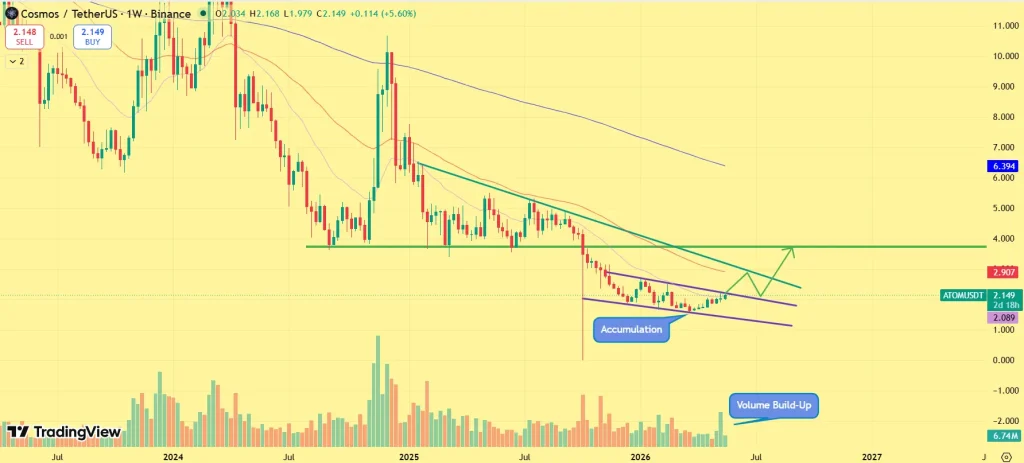
Currently trading near the $2.10–$2.20 range, Cosmos is testing an important short-term resistance zone that aligns with the upper boundary of its consolidation structure. A decisive breakout above this region could confirm strengthening momentum and trigger renewed buying interest.
If bulls manage to reclaim momentum and break above the descending trendline resistance near $2.40–$2.50, Cosmos price may begin targeting the next major resistance level near $3, a psychologically important zone that previously acted as key support before the broader downtrend accelerated.
A successful reclaim of $3 could significantly strengthen market confidence and potentially pave the way for a larger recovery move toward the $4 resistance area, highlighted on longer-term charts as the next major breakout region. However, the bullish setup remains conditional. Failure to sustain momentum above the current accumulation range may keep ATOM trapped in sideways consolidation, delaying any meaningful recovery and reinforcing broader market caution.
Cosmos is beginning to show early signs of stabilization as institutional narratives and improving chart structure slowly shift sentiment around ATOM. While confirmation is still needed, a breakout above key resistance could accelerate momentum toward $3, potentially marking the token’s strongest recovery attempt in months. Until then, traders remain focused on whether Cosmos is genuinely emerging from accumulation, or simply extending its prolonged consolidation phase.
The post Ethereum Sentiment Drops Sharply as ETH Price Holds Key Support—Will a Major Move Follow? appeared first on Coinpedia Fintech News
Bitcoin and Ethereum witnessed a strong recovery after President Donald Trump reportedly pushed the Federal Reserve to provide crypto firms with direct access to master accounts. While Bitcoin extended its gains toward new local highs, the Ethereum price failed to break decisively above the crucial $2,157 resistance zone, causing the rally to lose momentum and enter a tight consolidation phase.
At the same time, social sentiment surrounding Ethereum has declined significantly over the past few weeks, signaling weakening retail participation despite the ongoing recovery. However, ETH continues to hold firmly above the newly established $2,000 support zone, suggesting bulls are still defending the broader bullish structure.
The question now remains whether the ETH price can regain momentum to trigger a breakout above resistance or if declining market participation will weaken the rally.
Ethereum continues to trade within a tight consolidation range after facing repeated rejections from the major supply zone between $2,300 and $2,420. The latest pullback pushed the price back toward the ascending trendline support, which has been acting as the backbone of the ongoing recovery since February. The chart suggests ETH is currently trapped between rising support and a heavy overhead resistance zone, indicating growing price compression.
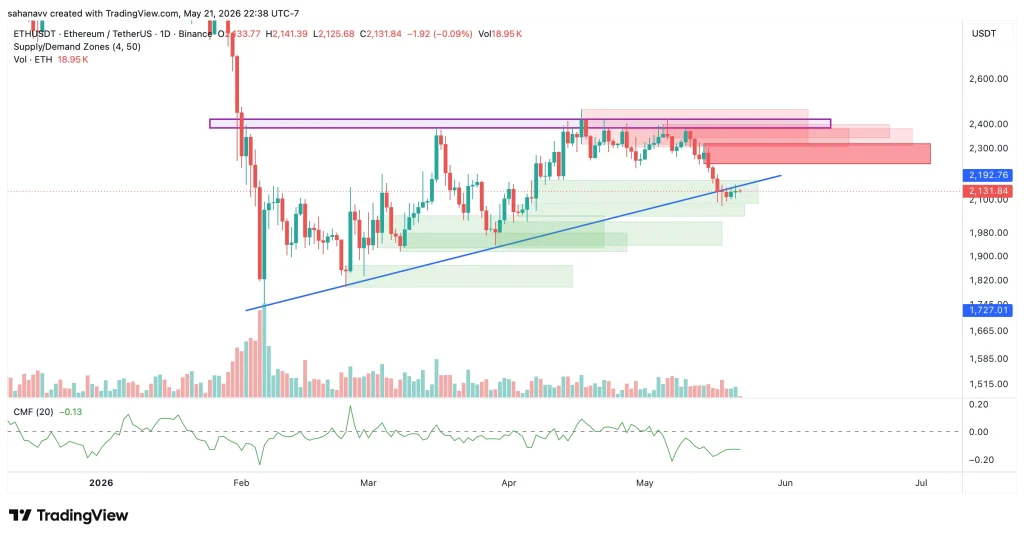
At the same time, the CMF indicator remains below the neutral zone, signaling weakening capital inflows, indicating the buying pressure has slowed. Additionally, the price range around $2,300 has become a strong ‘sell zone’ as it shows a significant increase in supply. This may have kept the price restricted below the ascending trend line until it reclaims levels above the range; a bearish possibility may prevail.
Ethereum’s on-chain activity continues to show signs of weakening despite the price holding above the crucial $2,000 support zone. The latest data from Santiment reveals that both daily active addresses and network growth have dropped sharply over the past few months, reflecting a notable slowdown in user participation across the ecosystem. The decline in network growth suggests fewer new addresses are interacting with Ethereum, while active address activity has also continued to trend lower.
— Santiment Intelligence (@SantimentData) May 22, 2026
Ethereum sentiment has flipped hard, and retail has jumped from crypto’s #2 market cap quickly. ETF outflows, Foundation exits, slowing network growth, and nonstop bearish narratives have traders questioning $ETH like never before. Here’s our take.
https://t.co/RDpVPbdIZs pic.twitter.com/y7JPlcZEPK
At the same time, exchange flow data indicates large spikes in both inflows and outflows. This highlights rising uncertainty among market participants rather than aggressive long-term accumulation. Social sentiment surrounding Ethereum has also weakened considerably in recent weeks. Positive sentiment has steadily declined, while the positive-to-negative sentiment ratio has dropped toward local lows.
The combination of weakening network activity, softer sentiment, and slowing capital inflows suggests Ethereum’s current recovery remains fragile. Unless the network metrics begin to recover alongside price action, ETH may continue struggling below the major resistance zone near $2,300 to $2,400.
Ethereum price continues to defend the crucial $2,000 support zone despite facing repeated rejections from the major resistance range between $2,300 and $2,400. The tightening price structure suggests a decisive move could be approaching as bullish momentum and bearish pressure continue to collide near key technical levels.
A breakout above $2,300 could help Ethereum regain bullish momentum and target the resistance zone around $2,420 and beyond. Conversely, a breakdown below the ascending support trendline may increase bearish pressure and expose ETH to a deeper correction toward the lower demand zones near $2,000 and $1,920.
The post Trader Dumps Millions in HYPE to Defend Massive Short Position appeared first on Coinpedia Fintech News
A trader identified as loracle.hl deposited more than 616,000 Hyperliquid tokens worth about $36.7 million into Hyperliquid and quickly sold most of them to support a massive short position. The trader still holds a 1.8 million HYPE short valued at over $100 million, though unrealized losses have reportedly narrowed to around $22 million after recent moves. The situation matters because continued selling pressure from large holders could impact HYPE’s price volatility, especially if the token keeps rising toward the trader’s liquidation level near $83.33.
The post Glassnode Warns Nearly $500B in Bitcoin Could Face Future Quantum Risks appeared first on Coinpedia Fintech News
New research from Glassnode estimates that around 6.04 million Bitcoin — worth roughly $469 billion — may be vulnerable to future quantum computing attacks because their public keys are already exposed on-chain. The report says much of the risk comes from address reuse, with crypto exchanges alone holding about 1.66 million BTC in potentially unsafe wallets. The findings matter because advances in quantum computing could eventually threaten older Bitcoin security methods, increasing pressure on the industry to prepare stronger protections before the technology becomes practical.

TradFi views the breakup of its previously consolidated, centralized liquidity as a “serious structural threat,” said Tiger Research director Ryan Yoon.

Galaxy Digital’s Mike Novogratz reportedly told a court the SEC made it “very difficult” to complete a planned 2021 merger with BitGo.

An executive at tokenization platforms Superstate said the stricter approach suggested by Hester Peirce would enable DeFi to expand without compromising rules in traditional capital markets.







Uncertainty surrounding the current macro environment “appears to be pushing institutions toward hedging strategies while waiting for greater clarity,” said analyst Darkfost.






CertiK reported earlier this month that criminal wrench attack teams usually consist of three to five people and are often made up of amateurs, while the masterminds are outside the country.

Under the American Reserve Modernization Act of 2026, Bitcoin must be held for a minimum of 20 years unless used to slash national debt.

Fantasy.top, Everclear and ZERO Network announced they were winding down on Thursday, adding to a growing list of crypto companies that have closed this year.


Data show Bitcoin futures traders are pursuing overhead short positions, raising the chance of a rally to $80,000.

Data shows Bitcoin traders cutting short positions and going long despite concerning US macroeconomic data emerging. Is a rally toward $82,000 next?

Harvard's endowment fund has become one of the latest high-profile holders to liquidate its ETH as investor sentiment sours during the ongoing bear market.


Federal Election Commission filings showed only $175,000 in contributions to the hybrid PAC, which could influence US voters through media buys before key elections in several states.

Data suggest Bitcoin’s chance of dropping below $60,000 again is slim to none, thanks to longer-term investors holding more than 71% of the asset’s total supply.

The crypto exchange's new pre-IPO futures product lets traders speculate on SpaceX’s expected public market valuation before the company begins trading on public exchanges.





Critics say the new 22% crypto tax, set to take effect in 2027, unfairly favors other asset classes with a much lower tax burden.

The financial regulator signed a similar agreement with Major League Baseball in March and continues to file lawsuits against state-level authorities going after prediction market platforms over sports betting.

The crypto services company began the US IPO process as companies across the digital asset sector weigh public market debuts.



Bitcoin whales and investors shift to distribution as realized losses surge past $600 million, as BTC price declines toward $76,000.


Bitcoin should shift 5% or more "soon" with $77,000 staying the focus amid mixed messages over the latest US-Iran peace deal plans.

IG Group, which launched spot crypto in the UK last year, is bringing the service to European investors through Bitpanda’s infrastructure.










HYPE’s rally is flashing exhaustion near its record-high resistance, raising the risk of a 20% pullback toward the $51.5–$45 support zone.

Kraken’s parent company, Payward, received preliminary approval from Dubai's VARA, paving the way for UAE dirham funding, margin and OTC trading and institutional access via Kraken Prime.

OFAC sanctioned six Ethereum addresses linked to a Sinaloa Cartel money laundering network allegedly converting drug proceeds into crypto.

Bitcoin demand and ETF flows weaken as BTC struggles below $80,000, raising risks of prolonged consolidation or a drop toward $65,000.

The private Telegram backchannel allegedly allowed Jane Street to unwind hundreds of millions in potential exposure “mere hours before” the Terra ecosystem’s $40 billion collapse.

Boerse Stuttgart’s Seturion has partnered with Societe Generale, SG-FORGE and flatexDEGIRO to build a pan-European blockchain securities settlement system.




The US Federal Reserve proposed a limited “skinny” payment account framework for fintech and crypto firms and called for a temporary pause on Tier 3 applications.





OSL Group (863.HK) (OSL), a global stablecoin payment and trading platform, today announced that its Hong Kong-licensed digital asset exchange OSL HK has officially listed USDKG, the gold-backed stablecoin issued by the Kyrgyz Republic.




Former Silvergate executive Kate Fraher said the rule that prevented her from sharing her side of the story was unconstitutional. It was finally lifted by the SEC this week.

Italian authorities uncovered a tax evasion scheme in which an individual allegedly used Bitcoin Ordinals and the BRC-20 token standard to generate and conceal $1.1 million.

The Ethereum rollup market is dominated by Arbitrum and Base, which have a combined 68% market share, according to L2Beat.






The post Hyperliquid Price Eyes $60 Breakout as Whale Buying Surges: Is a New ATH Next? appeared first on Coinpedia Fintech News
Hyperliquid price is once again capturing market attention after a powerful rally pushed the token within touching distance of its all-time high. After surging nearly 25% in recent days, HYPE has re-entered price discovery discussions as whale accumulation intensifies and bullish sentiment around the protocol continues to strengthen.
Adding fuel to the momentum, a high-profile endorsement from Bitwise CIO Matt Hougan has reignited speculation that Hyperliquid may still be undervalued despite its explosive run. Combined with strong on-chain activity and an emerging breakout structure on the weekly chart, traders are now asking whether HYPE is preparing for a decisive move above $60.
So, what’s driving Hyperliquid’s price latest momentum, and could this rally still have room to run?
One of the biggest catalysts behind HYPE’s renewed momentum appears to be growing institutional confidence in the Hyperliquid ecosystem. Bitwise CIO Matt Hougan recently argued that the market may be mispricing Hyperliquid, viewing it solely as a perpetual exchange rather than a broader crypto financial ecosystem. According to Hougan, Hyperliquid increasingly resembles a “super app” capable of supporting multiple layers of decentralized trading infrastructure.
— Coin Bureau (@coinbureau) May 20, 2026
BITWISE SAYS HYPE IS UNDERVALUED
Bitwise CIO Matt Hougan says the market is wrongly valuing Hyperliquid as only a perp exchange, when it may be closer to a "super app."
He argues $HYPE is already the best-performing large-cap crypto asset of 2026, up 77% YTD. pic.twitter.com/5rTOQYzFnr
The bullish commentary quickly gained traction across crypto markets, especially as Hyperliquid continues to outperform many large-cap assets in 2026. The endorsement has reinforced a growing narrative that HYPE may still be trading below its long-term potential, despite already posting strong year-to-date gains. At the same time, social sentiment surrounding Hyperliquid has accelerated sharply, with traders increasingly discussing a potential breakout into new all-time highs.
On-chain activity is also painting a bullish picture. Recent blockchain data shared by Lookonchain revealed that an a16z-linked whale wallet purchased another 206,325 HYPE worth nearly $10 million, later staking the tokens. Since mid-April, the same whale has reportedly accumulated over 2.34 million HYPE valued at roughly $102 million.
This #a16z-linked whale created another new wallet and bought 206,325 $HYPE ($9.95M) over the past 10 hours, then staked it.
— Lookonchain (@lookonchain) May 20, 2026
Since April 14, this whale has bought a total of 2.34M $HYPE($102M).https://t.co/mFc4HXZhiLhttps://t.co/FfsbEom1Rs pic.twitter.com/PfgnX7GG80
Large-scale accumulation of this magnitude often reflects growing confidence among sophisticated investors, especially when buying continues near local highs rather than during panic sell-offs. Meanwhile, data from Santiment shows Hyperliquid’s social dominance and engagement metrics climbing significantly in recent weeks, suggesting retail participation is also beginning to return as momentum builds.
Hyperliquid price appears to be approaching a major inflection point. On the weekly timeframe, HYPE has broken out from an ascending channel structure and is now pressing against a key resistance zone between $58 and $60, which marks its previous all-time high.
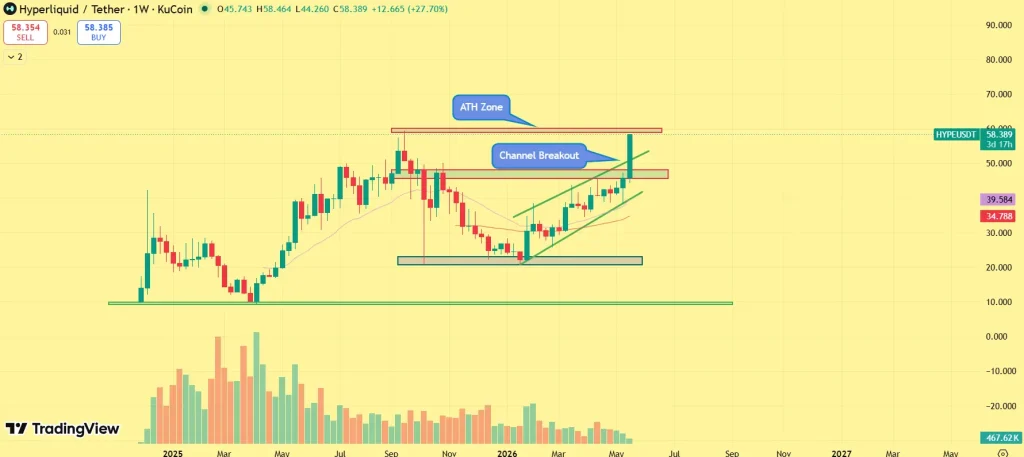
HYPE price token continues to hold above key moving averages, while price action remains supported by higher highs and higher lows, a classic bullish continuation structure. If bulls successfully reclaim the ATH zone with strong volume, the next upside targets could quickly expand toward the $65–$70 region, potentially triggering fresh momentum buying and price discovery.
However, failure to clear resistance may temporarily push HYPE back toward the $50–$52 support area, where buyers could attempt another accumulation phase before a fresh breakout attempt.
Hyperliquid’s bullish case is strengthening as institutional optimism, whale accumulation, and technical breakout signals begin aligning at the same time. With HYPE now hovering just below its all-time high, the next few trading sessions could determine whether the token enters full price discovery above $60 or pauses for short-term consolidation. For now, momentum appears firmly tilted in favor of the bulls.

The post Charles Hoskinson: ‘Cardano Is My Life’s Work and I Want ADA to Succeed No Matter What’ appeared first on Coinpedia Fintech News
Charles Hoskinson once again doubled down on his commitment to Cardano during a recent X Spaces session held on May 20, saying the project remains deeply personal to him as both a founder and one of the ecosystem’s biggest holders.
Speaking about the blockchain’s future, Hoskinson stated, “Cardano is my life’s work. I want ADA to succeed,” while stressing that his financial interests remain directly tied to the network’s long-term growth.
Although he did not publicly disclose the exact size of his holdings, Hoskinson confirmed that he still owns a substantial amount of ADA. Many in the crypto industry believe he remains among the token’s largest holders.
Hoskinson explained that his large ADA position means he directly benefits if the ecosystem grows through stronger adoption, utility, and infrastructure development. At the same time, he admitted that major market downturns have also personally impacted him financially.
Earlier this year, Hoskinson revealed that he suffered unrealized losses exceeding $3 billion after ADA dropped more than 90% from its all-time high during the broader crypto market collapse. He previously remarked that he “lost more money than anyone else in the Cardano community.”
Despite those losses, Hoskinson said his confidence in Cardano remains unchanged. He described the project’s success as “an undeniable fact” and reiterated his desire to see ADA continue climbing among the top-ranked cryptocurrencies.
Hoskinson strongly defended Cardano’s research-driven identity, arguing that the blockchain became one of crypto’s most respected ecosystems because of its academic and peer-reviewed approach.
According to him, Cardano spent more than a decade building one of the strongest research teams in the crypto industry.
“We cannot allow this achievement to be shattered and dismantled over some piecemeal funding support,” Hoskinson said. “Our scientists will simply leave for places that offer greater certainty and respect.”
The Cardano founder also urged community members to delegate voting power to dReps who support the ecosystem’s long-term research agenda.
一部の日本のdRepが私たちの研究提案に反対票を投じたことに、深い悲しみを覚えています。…
— Charles Hoskinson (@IOHK_Charles) May 20, 2026
Meanwhile, Input Output Global is currently facing community debate over a proposal seeking roughly 33 million ADA to fund Cardano’s 2026 roadmap, including scalability upgrades, Leios consensus development, and post-quantum security research.
Early voting has shown strong resistance, with many delegates questioning whether the spending would deliver enough measurable ecosystem growth and DeFi expansion. Voting on the proposal remains open until June 8, turning the debate into a major test of Cardano’s evolving governance model and long-term priorities.
The post Federal Reserve’s New Payment Account Proposal Puts Ripple Back in Spotlight appeared first on Coinpedia Fintech News
A new proposal from the Federal Reserve is now officially moving forward with “skinny” payment accounts, a lighter version of traditional master accounts that could eventually give crypto companies direct access to U.S. payment rails.
For Ripple and the broader XRP community, the proposal is being viewed as one of the biggest institutional payment developments in years.
The Federal Reserve this week opened a 60-day public comment period for its revised “payment account” framework, sometimes called skinny master accounts.
The accounts would allow eligible crypto firms, stablecoin issuers, and fintech companies to directly clear and settle payments using Federal Reserve infrastructure like Fedwire and FedNow, without receiving full traditional banking privileges.
However, the accounts come with major restrictions.
Firms would not receive access to intraday credit, discount window borrowing, or interest earned on reserve balances held at the Fed. Automated controls would also prevent overdrafts and limit operational risk.
The proposal follows years of pressure from crypto firms seeking direct access to U.S. payment infrastructure instead of relying on intermediary banks.
Ripple has been one of the most closely watched companies tied to the master account debate. The company previously applied for Federal Reserve access as part of its broader push to integrate its payment network and RLUSD stablecoin deeper into traditional finance.
Ripple’s Chief Legal Officer Stu Alderoty previously described skinny master accounts as an “attractive idea” because they could allow faster and cheaper redemption for Ripple’s RLUSD stablecoin.
The timing is also notable because Ripple’s stablecoin RLUSD has already grown toward a reported $1.73 billion market cap since launch.It’s not just Ripple that is exploring this; Coinbase, Circle, Anchorage Digital, and Custodia Bank, all of which have reportedly explored or applied for some form of Federal Reserve payment access.
Earlier this year, Kraken became the first crypto-focused institution to receive a limited master account through the Kansas City Federal Reserve Bank.
Despite growing momentum, major hurdles remain. The Fed is currently asking regional Reserve Banks to temporarily pause new Tier 3 payment account decisions until December 2026 while regulators finalize the framework. Most crypto firms fall into the Tier 3 category.
At the same time, Elizabeth Warren has introduced amendments seeking to block crypto firms like Ripple from receiving Federal Reserve payment access.
Crypto investors believe direct Fed payment access could significantly improve how Ripple settles U.S. dollar transactions by reducing reliance on outside banking partners.
The post Pi Price Rally Soon? Pi Network Breaks Into US Market Through OKX Integration appeared first on Coinpedia Fintech News
Pi Core Team confirmed today that OKX is now providing Pi access to millions of users across the United States. The update marks a key moment for the project as it continues expanding beyond its early mobile-mining phase into a more active blockchain ecosystem.
The announcement comes during a busy period for Pi Network, following recent infrastructure upgrades and growing public attention after the project’s appearance at Consensus 2026.
In its latest statement, the Pi Core Team said the OKX integration creates another important gateway into the Pi ecosystem for U.S.-based users. The team emphasized that the network remains focused on increasing participation, utility, and real-world adoption globally.
“More users. More usage. Stronger network,” the team stated.
For many community members, the move is seen as an important milestone because U.S. market access remains one of the biggest challenges for blockchain projects operating under stricter compliance rules. Social media reactions were largely optimistic, with supporters viewing the OKX rollout as a sign that Pi Network is continuing to strengthen partnerships with established crypto infrastructure platforms.
The expansion also follows appearances by Dr. Nicolas Kokkalis and Dr. Chengdiao Fan at Consensus 2026. During the event, the founders discussed topics including AI-era digital trust systems, verified online identity, and blockchain-powered utility models.
Their presentations reflected Pi Network’s long-standing focus on human verification and accessible blockchain participation through mobile devices rather than speculative hype alone.
Moreover, Pi Network has also completed several important backend upgrades in recent weeks, including:
Looking at the scenario, some market watchers now think Pi may be entering a recovery phase. Community analyst Tob-crypto noted that Pi holding near $0.15 while some forecasts discuss possible moves toward the $2–$5 range by late 2026 highlights continued long-term optimism around the project.
Meanwhile, crypto user Crypto Wave said Pi’s technical setup remains mixed, though recent mainnet upgrades and improving momentum indicators could support rebound chances if buying pressure continues.
The post Wallet Linked to Grayscale Quietly Builds Large HYPE Position appeared first on Coinpedia Fintech News
Blockchain data from Arkham shows a wallet suspected to be connected to Grayscale Investments has accumulated more than $10 million worth of Hyperliquid over the past week. The address reportedly sourced HYPE through exchanges and OTC firms including Wintermute, FalconX, Coinbase, and Flowdesk. The wallet now holds around 176,050 HYPE worth nearly $9.8 million, while another 149,100 HYPE was transferred to the Hyperliquid System Address. The activity is drawing attention because it may signal growing institutional interest in the token.
The post Pi Network Expands to US Trading Through OKX appeared first on Coinpedia Fintech News
Pi Network announced that its PI token is now available for US users on OKX, allowing spot trading against USDT, USD, and other pairs. The expansion follows Pi Network’s full mainnet launch in late 2025 and removes earlier geographic restrictions that limited US access. The move matters because it opens one of crypto’s largest communities — reportedly over 60 million users — to a major trading market, potentially improving liquidity and broader adoption as the project pushes toward mainstream use.

The post SpaceX Discloses $1.45 Billion Bitcoin Holdings Ahead of IPO appeared first on Coinpedia Fintech News
SpaceX revealed in a new SEC filing that it holds 18,712 Bitcoin worth roughly $1.45 billion at current prices. The company reportedly bought the Bitcoin at an average price of about $35,300 and has kept the holdings unchanged since the end of 2024, giving it major unrealized gains. The disclosure matters because it would make SpaceX one of the world’s largest corporate Bitcoin holders ahead of its expected Nasdaq listing under SPCX. Investors see the move as another strong signal of growing corporate confidence in Bitcoin.
The post Zcash Soars After SEC Drops Probe and Traders Rush In appeared first on Coinpedia Fintech News
Zcash surged 17% in a day to reach $672, capping a massive monthly rally driven by heavy short liquidations and renewed interest in privacy-focused crypto assets. The rally gained momentum after the U.S. Securities and Exchange Commission ended its three-year investigation into the Zcash Foundation without taking action, removing a major regulatory overhang. Supporters say Zcash’s privacy and security features make it attractive in a world of growing surveillance concerns, while critics warn the sharp rise may be fueled by hype and low market liquidity.

The post WLFI Price Today: Record Profit Event Sparks Fresh Bullish Debate – Recovery Ahead? appeared first on Coinpedia Fintech News
WLFI price today is suddenly back in focus after climbing nearly 3%, just as blockchain data flashed one of the most unusual signals in the token’s history. Massive dormant wallet movement, record profit-taking, and rising speculative activity have sparked fresh debate over whether World Liberty Financial is quietly preparing for a comeback.
Even more surprising, the rebound comes after months of brutal downside pressure that left sentiment around the token deeply shaken. Yet despite heavy selling from long-term holders, buyers appear to be stepping back in. Now, traders are watching closely for the answer to one critical question: Could this be the early sign of a WLFI price recovery ahead, or another temporary bounce before sellers regain control?
World Liberty Financial recently recorded one of the largest on-chain events in its history, according to fresh data from Santiment. The analytics platform reported that May 18 marked WLFI’s highest realized profit day ever, alongside a major spike in the network’s Age Consumed metric, which tracks dormant token movement.
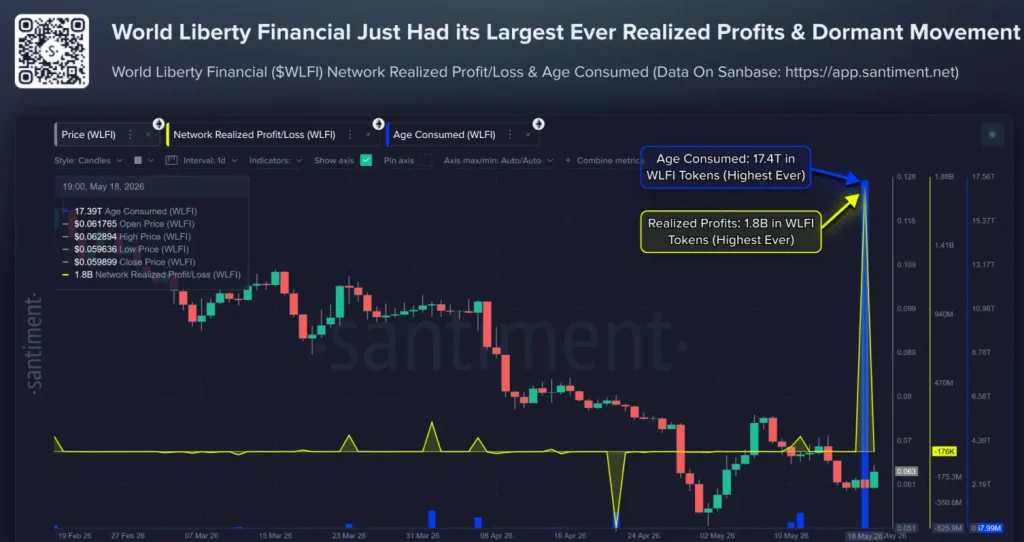
Data revealed that approximately 1.8 billion WLFI tokens were sold for profit, while nearly 17.4 trillion dormant tokens moved across the network, suggesting long-term holders suddenly became active after extended inactivity. Typically, sharp spikes in dormant activity signal distribution or profit-taking, especially after prolonged market weakness. However, WLFI’s market reaction has been somewhat unexpected.
Rather than collapsing under fresh selling pressure, the token managed to stabilize and even push higher, triggering renewed speculation that selling pressure may finally be getting absorbed. One major catalyst behind the unusual activity appears to be the launch of a USD1/BTC trading pair on Binance, allowing traders to use WLFI-linked stablecoin collateral for Bitcoin futures for the first time. The added exposure likely created fresh liquidity conditions, encouraging early holders to reposition or lock in profits.
Beyond on-chain metrics, derivatives data also points toward growing trader participation. Recent statistics show WLFI trading volume surged more than 14% to nearly $97 million, while open interest climbed over 2% to around $185 million.

In crypto markets, rising volume alongside increasing open interest often signals fresh capital entering the market, rather than price movement driven solely by low liquidity or temporary volatility. The data suggests traders are increasingly positioning around WLFI as speculation over a possible recovery narrative begins to build.
Still, sentiment remains cautious. Despite the recent bounce, WLFI continues trading significantly below earlier highs after suffering an aggressive correction in recent months. That leaves market participants looking for stronger confirmation before calling a definitive trend reversal.
WLFI remains inside a broader bearish market structure, though short-term price action is beginning to hint at stabilization. After previously breaking below a major descending range, WLFI entered a prolonged correction phase that dragged price toward the $0.052 support zone, where buyers eventually stepped in.
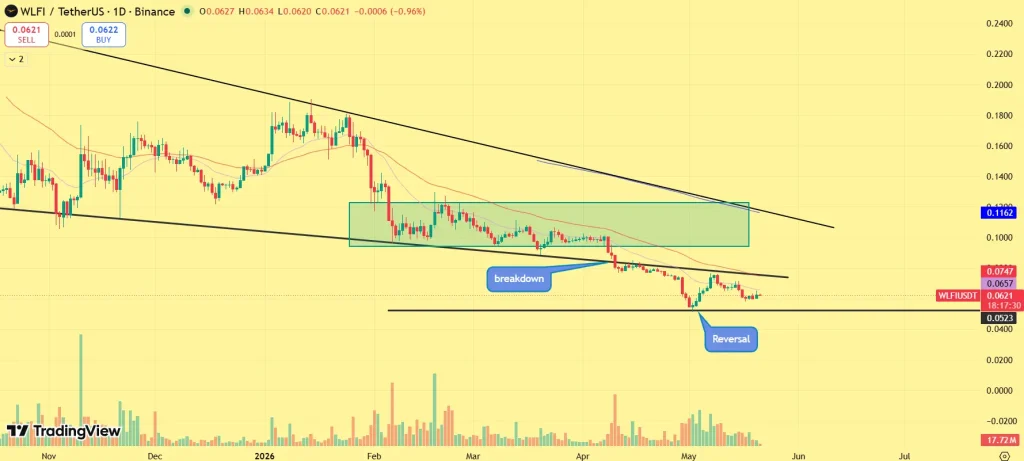
WLFI price is now trading near $0.062, attempting to establish a local bottom after rebounding from oversold conditions. However, bulls still face an important challenge. Immediate resistance sits near the $0.074–$0.080 range, where previous breakdown levels and declining moving averages continue acting as overhead pressure.
A decisive move above this region could strengthen bullish momentum and potentially expose the next upside target near the $0.10–$0.11 supply zone. On the downside, failure to defend $0.052 support could quickly invalidate the recovery narrative and reopen the door for renewed selling pressure.
WLFI’s recent rebound and improving on-chain activity suggest early recovery momentum may be building, but confirmation is still missing. For bulls to strengthen the recovery case, WLFI price must reclaim the $0.074 resistance zone, which could open the path toward $0.10. However, if momentum fades and price slips below $0.052 support, bearish pressure could quickly return.




Bitwise, Roundhill Investments and GraniteShares had their prediction market ETF applications put on hold by the SEC earlier this month.

ETF analyst Eric Balchunas says crypto and traditional assets are trading down while Hyperliquid is up, leading to a boon for ETFs tied to the token.

The attacker tricked the Butter Network cross-chain bridge into minting millions more tokens than the legitimate supply of MAPO.

Shares in Nakamoto closed Wednesday at 16 cents. They are down more than 99% from May last year, when the stock traded above $25.
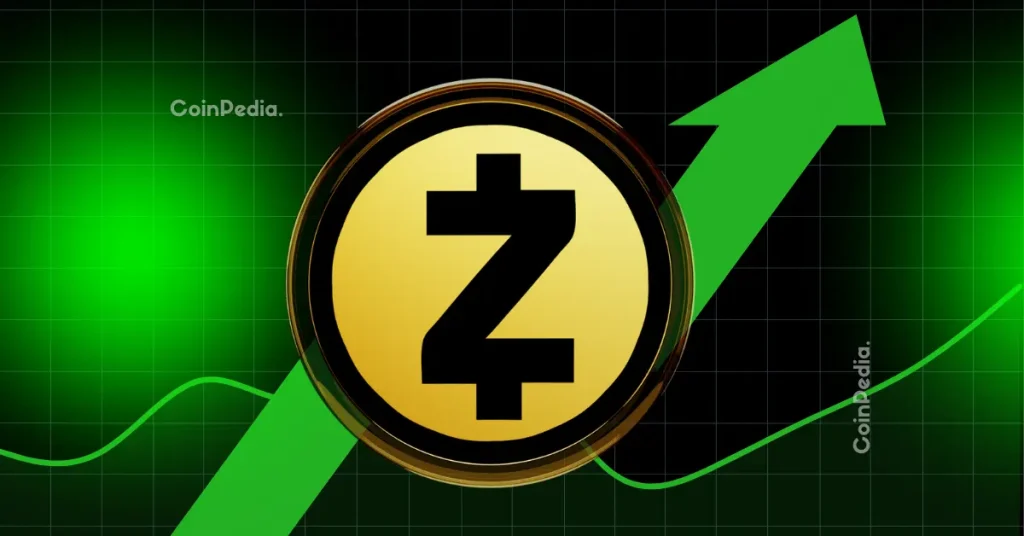
The post Zcash Price Surges After SEC Closure—Will This Catalyst Push ZEC to $1,000 in 2026 appeared first on Coinpedia Fintech News
Zcash price has been rallying strongly over the past few days after breaking out of its prolonged consolidation range near $530. The latest surge toward $675 appears to have been driven by multiple catalysts, with the closure of an SEC investigation into the Zcash Foundation emerging as the strongest trigger. The development has significantly improved market sentiment around ZEC, which climbed to the 11th-largest cryptocurrency by market capitalization, now valued at over $11 billion.
The ZEC price gained more than 15% in the past 24 hours alone, reaching a local high near $675 and significantly outperforming the broader crypto market. With narrative momentum building around financial privacy and altcoin rotation gaining strength, speculation is now growing over whether the Zcash price could push toward the $1000 milestone.
Zcash recently published its Q1 report, which turned out to be the major catalyst for the persisting rally. In the reports, it confirmed that the US SEC closed its investigation into the Zcash Foundation without pursuing enforcement action. For a privacy-focused cryptocurrency that had spent years facing regulatory uncertainty, the development has been interpreted by the market as a major legitimacy boost.
The latest report also highlighted that governance disputes within the Electric Coin Company led to the departure of a large portion of its development team during the quarter. Despite the internal turbulence, the Zcash network continued to operate normally, producing blocks and settling transactions without any disruption to user funds or privacy protections.
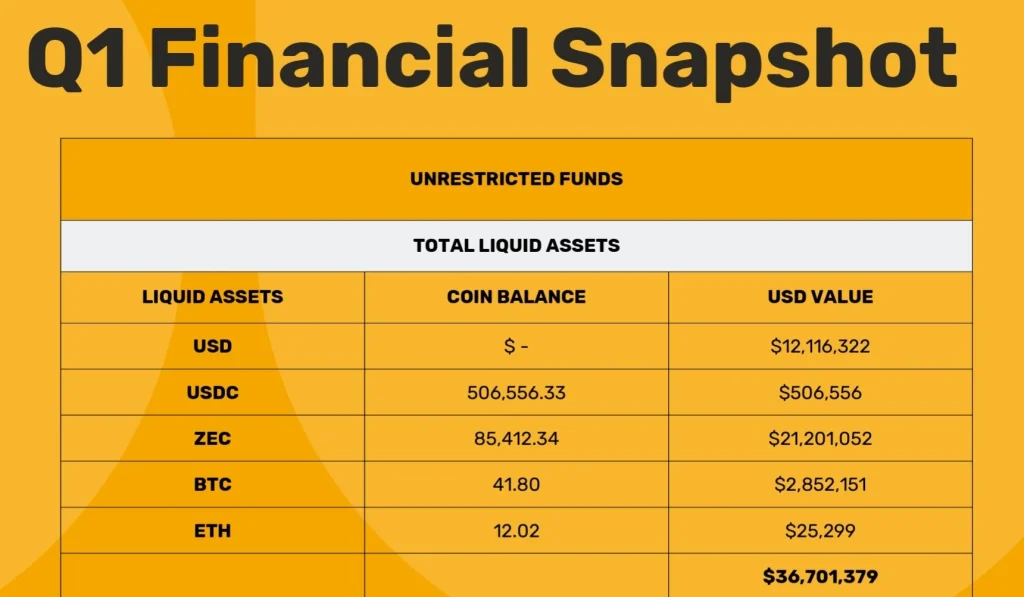
The foundation further revealed that, as of March 31, it held nearly $36.7 million in liquid assets, including around 85,412 ZEC, 41.8 BTC, more than 506,000 USDC, and a smaller ETH reserve. Monthly operating expenses averaged roughly $272,500, reflecting that the ecosystem still maintains a relatively strong financial runway despite the recent governance challenges.
At the same time, the broader market is also witnessing a gradual rotation into overlooked altcoin sectors beyond memecoins and AI narratives. As Bitcoin stabilizes near higher levels, traders are increasingly moving capital toward high-beta assets with stronger upside volatility, and Zcash has emerged as one of the strongest beneficiaries of this shift.
Alongside the improving fundamental outlook, Zcash has also confirmed a strong technical breakout after reclaiming key resistance levels that had capped price action for weeks. The rally above the $530 consolidation zone triggered a sharp expansion in bullish momentum, allowing ZEC to rapidly climb toward the $675 region with rising trading volume and increased market participation.
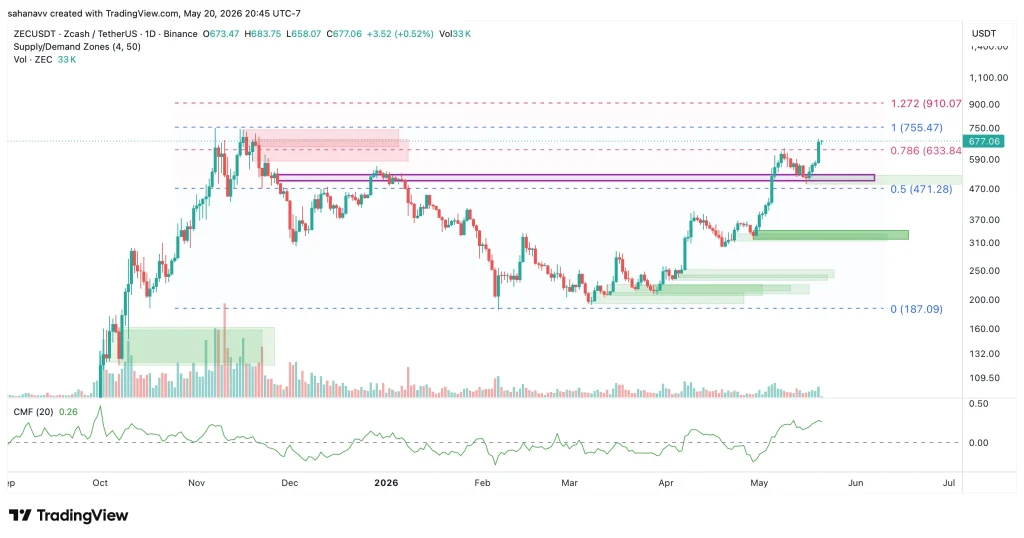
The ZEC price rebounded strongly from the crucial support zone between $500 and $524.75 before breaking above the key resistance at $633.84. As seen in the chart above, every dip continues to attract strong buying pressure, highlighting sustained bullish demand. However, the token has now entered a major supply zone between $682 and $739, where traders are likely to book profits, increasing the possibility of short-term rejection. A decisive breakout above this range could trigger a fresh rally toward higher targets near $750 and potentially $800.
Meanwhile, the rising CMF suggests capital inflows continue to strengthen, indicating the bullish momentum may persist for longer.
With Zcash regaining momentum both fundamentally and technically, speculation about a potential move toward $1,000 is rising across the market. If the ZEC price successfully flips the $700 to $740 supply zone into support, the rally could extend toward higher resistance levels around $800 and $900 over the mid-term. A breakout above these ranges would place the psychological $1,000 mark firmly within reach, especially if the broader altcoin market continues to gain strength alongside Bitcoin’s stability.
The post Exclusive: India Parliament Meets Binance and WazirX on Crypto Rules as Experts Call It Historic Shift appeared first on Coinpedia Fintech News
India’s Standing Committee on Finance convened at Parliament House Annexe in New Delhi on May 20 to hear oral evidence from representatives of ZebPay, Binance, and WazirX on the subject of virtual digital assets and the way forward.
The hearing marks one of the most formal engagements between India’s legislative apparatus and the global crypto industry to date, coming after years of regulatory ambiguity that drove significant trading volume to offshore platforms.
India introduced a 30% flat tax on crypto gains with no loss offsetting provision in 2022, alongside a 1% TDS on every transaction. The measures did not suppress adoption. They redirected it. Exchanges outside Indian jurisdiction absorbed the volume, removing it from Indian tax collection and Indian consumer protection frameworks simultaneously.
The Lok Sabha session represents a recognition that discouragement has not worked and that structured engagement is the more productive path.
Avinash Shekhar, Co-Founder and CEO of Pi42, spoke to Coinpedia about the significance of Wednesday’s parliamentary session.
“India bringing major global and domestic crypto platforms into formal policy discussions is a significant step for the industry’s long-term evolution,” Shekhar said. “It signals that the conversation is gradually moving from uncertainty toward structured engagement between policymakers and the ecosystem.”
Shekhar said the scale of India’s existing user base makes regulatory clarity increasingly urgent. “India already represents one of the world’s largest digital asset user bases, and with participation continuing to grow, regulatory clarity becomes increasingly important for investor protection, market transparency, and responsible innovation.”
He described the practical value of direct dialogue between policymakers and practitioners. “These discussions can help policymakers better understand how areas such as compliance, custody, taxation, cybersecurity, and cross-border transactions function in practice. They also create an opportunity to build frameworks that are aligned with India’s financial priorities while learning from global regulatory models.”
On the stakes of getting the framework right, Shekhar was direct. “A balanced and well-defined framework would strengthen confidence among users, institutions, and businesses, while encouraging more innovation and liquidity to remain within regulated Indian platforms rather than moving offshore.”
The regulatory conversation in India extends beyond crypto alone. Raghuveer Kancherla, Co-Founder at compliance infrastructure company Sprinto, told Coinpedia that the broader fintech regulatory environment compounds the challenge for companies operating across multiple verticals simultaneously.
“India’s fintech regulatory environment is both complex and fast-moving,” Kancherla said. “RBI, SEBI, DPDP, and emerging crypto frameworks mean the rules governing these businesses are changing in real time. For companies operating across payments, digital assets, and lending, these are multiple compliance challenges compounding simultaneously.”
He described the operational burden this creates for growing companies. “Every new framework adds surface area. Every audit cycle creates drag. Teams trying to manage this manually are spending more time on compliance operations than on the business itself.”
Kancherla argued that the pace of regulatory change has outgrown manual compliance management entirely. “Manual GRC was not built for this pace. Autonomous GRC is the only way to keep up by monitoring continuously, adapting in real time, and treating compliance as infrastructure rather than overhead.”

The post Arthur Hayes Says Trump Should Reject the CLARITY Act appeared first on Coinpedia Fintech News
Arthur Hayes has sparked fresh debate around crypto regulation after saying he hopes Donald Trump vetoes the proposed CLARITY Act if it reaches his desk.
Speaking during an interview on The Wolf Of All Streets, Hayes made his position clear, saying:
“If Bitcoin and crypto needed regulations to survive, it wouldn’t be worth a dime.”
Hayes argued that banks are pushing into crypto mainly because clients want exposure to assets that can hedge against inflation and fiat currency debasement.
According to him, Bitcoin’s strong performance during periods of heavy money printing is what attracts institutional interest. He also noted that banks simply see crypto as another profitable product to offer clients.
Still, Hayes pushed back hard against what he sees as the over-institutionalization of Bitcoin.
“Why are we bending over backwards to try to institutionalize Bitcoin?” Hayes asked during the interview. He warned that turning Bitcoin into another traditional financial product could destroy the original purpose of crypto.
He added, “What’s the point? If you’re just going to have another derivative that sits on some member of the financial system’s balance sheet, we already got that.”
Hayes also referenced Brian Armstrong while discussing growing lobbying efforts tied to crypto regulation.
He acknowledged that Armstrong is doing what benefits Coinbase shareholders but argued that large crypto firms may not always represent the broader crypto ecosystem.
“He is a CEO of a publicly listed centralized crypto company, and he’s doing everything in his power to make his shareholders money,” Hayes said.
At the same time, Hayes questioned whether large corporate crypto players truly prioritize retail users or open-source developers.
The comments come as the crypto industry remains divided over regulation and institutional adoption.
Supporters of the CLARITY Act believe clearer rules could bring more legitimacy and institutional capital into digital assets. Critics like Hayes, however, worry that too much integration with traditional finance could weaken the decentralized foundations Bitcoin was originally built on.


SpaceX is expected to go public next month, which would make its 18,712 Bitcoin holdings rank seventh among public companies.



Profit-taking by Bitcoin traders pushed the Coinbase BTC premium to a six-week low, but demand from longer-term traders put a clear support under the range lows.





The lawsuit followed an investigation by Missouri authorities into several crypto ATM companies that involve allegations of “deceptive fee structures” and scams.

The launch marks Coinbase’s latest push into white-label stablecoin infrastructure for businesses building branded digital payment and settlement systems.

Bitcoin finds footing above $77,000 despite investors’ worry over BigTech earnings results and $2 billion outflows from the BTC ETFs.

Hester Peirce will become an associate professor at a Virginia law school some 18 months after her term at the SEC expired, leaving another empty seat in the agency’s leadership.




The post Why $60K Is the Ultimate Bitcoin Floor: K33 Research appeared first on Coinpedia Fintech News
The ultimate price floor for Bitcoin (BTC) in the current market cycle is $60,000, according to K33 Research, the research arm of K33 digital asset brokerage company.
In a May 19th publication, the crypto market intelligence firm supported its argument by citing crypto market support from heightened institutional adoption.
Notably, Bitcoin institutional investors comprise public and private corporations, spot ETF issuers, and fund managers. It also includes systematic hedge funds and trading firms, as well as pension funds and endowments.
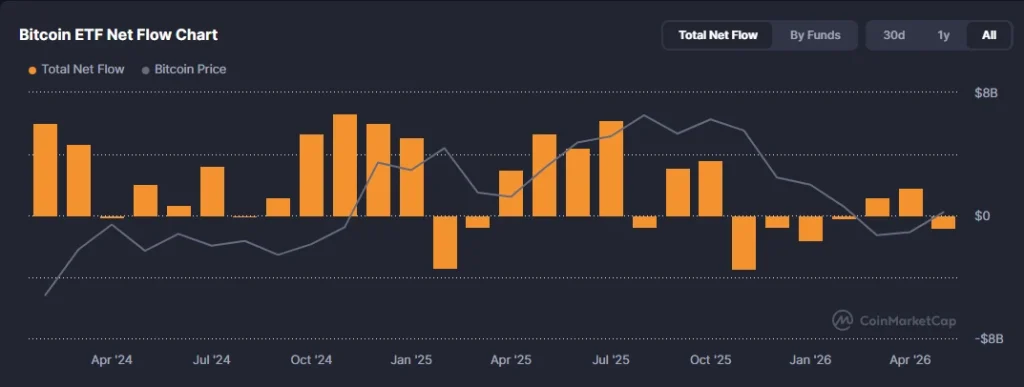
According to CryptoQuant’s Bitcoin Fund Holdings Chart, the cryptocurrency’s holdings have grown steadily among institutions. The period post-2024 is seeing the most considerable growth.
Spot Bitcoin Exchange-Traded Fund (ETF) is overwhelmingly the most popular cryptocurrency product offered by institutions, with BlackRock’s iShares Bitcoin Trust holding 817,138.2 BTC. Interestingly, BlackRock itself held no BTC until January 2024.
Source: CoinMarketCap
As for publicly listed corporate holders, Strategy leads the race, with 843,739 BTC following a period of continuous accumulation starting in August 2020.
That said, recent geopolitical unrest has caused Bitcoin ETF issuers to scale back. Bitcoin itself saw $982 million in outflows in the week ending on May 15. Still, their positions remain considerable as compared to previous cycles.
According to Ventle Lunde, head of research at K33 Research, these conditions make a 80% price drop like the one witnessed in 2018 and 2022 highly unlikely. Instead, BTC is likely to consolidate between $60,000 – $75,000 without capitulation beyond that.
Arthur Hayes supports Bitcoin’s bullish theory this year, saying $125,000 is a “foregone conclusion.” In a post stating “liquidity is king,” he argues that printing money to fund wars, service debt, and fight AI-driven inflation will eventually fuel the coin’s rally to new highs.
With BTC trading at $77,442 at the time of writing, and having dropped to $59,600 this year, it remains to be seen how geopolitical and economic factors will impact its future movements.

Bitcoin looks on track for a rally toward $80,000 while HYPE, ZEC and a handful of altcoins are pushing toward their range highs.

Five Republicans and one Democrat won or went to runoffs following primaries in Georgia, Alabama and Kentucky after a crypto-backed PAC and its affiliates spent a combined $20 million on media and ads.

The stablecoin issuer bought SoftBank’s 26% stake, expanding its control over the public Bitcoin holder as it moves into lending, mining and capital markets.




Bitcoin struggles to overcome US selling pressure with markets on edge ahead of Nvidia's Q1 earnings report.

The remittance company partnered with Stripe-incubated blockchain Tempo to support stablecoin settlement and help validate transactions across its global payments network.


The post Xphere XP Price Rebounds Again After Massive 300% Rally appeared first on Coinpedia Fintech News
The XP token isn’t cooling off quietly. After exploding 300% from roughly $0.019 to $0.082 on May 14 the market looked ready to dump the usual “sell-the-news” script on traders. And, honestly, it did for a moment.
Price corrected sharply toward $0.042 by May 19. But now XP price is climbing again, because crypto never really sleeps when narratives are involved.
The initial breakout came after XPHERE unveiled its new Proof-of-Work algorithm. Not just another recycled mining pitch either. The project framed it as infrastructure built specifically for the Proof Chain itself, focused on network stability, scalable hardware compatibility, and long-term mining ecosystem growth.
That announcement alone flipped the switch on momentum. And traders noticed that fast.
Now the second wave of hype is tied to visibility. XPHERE announced it would serve as title sponsor for Builders x Capital Night x Block:Lounge, an official SEABW 2026 side event in Bangkok. The project’s co-founder is also scheduled to appear as a guest speaker alongside builders, VCs, and Web3 executives.
Well, to this announcement XP is already up 18% intraday and its generally witnessed that smaller-cap tokens tend to move aggressively when narrative momentum and public exposure collide.
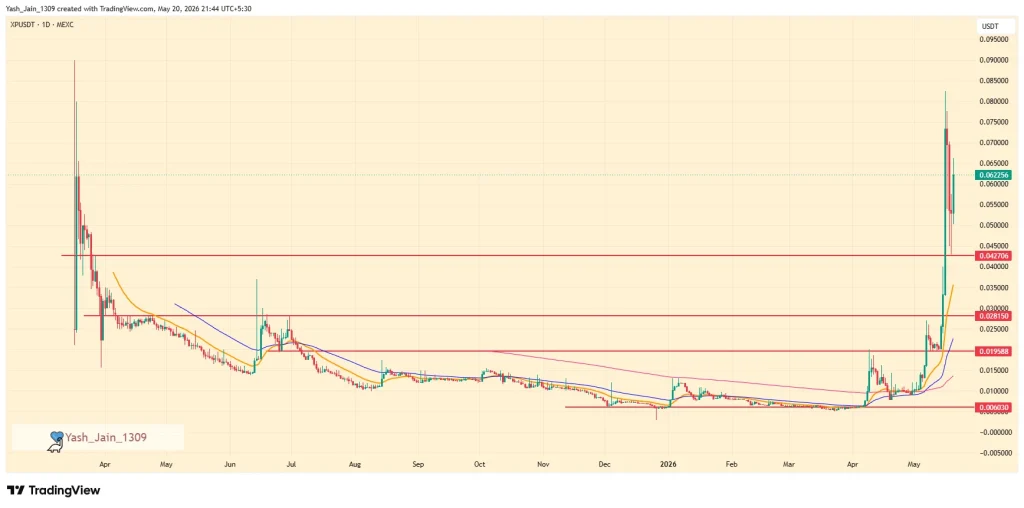
From a technical perspective, the big level remains $0.082. If XP pushes through that spike high, traders will immediately start eyeing the psychological $0.100 zone and potentially a fresh all-time high.
But on the contrary, a rejection there could send XP price back toward $0.042, with $0.028 sitting lower as another support zone if momentum fades.

The post Why is Ozone Chain Surges In Mentions Alongside LINK & INJ, despite flat OZO prices? appeared first on Coinpedia Fintech News
Something weird is happening around Ozone Chain and its token OZO. While heavyweight AI and infrastructure coins like LINK, TAO, INJ, and VVV dominate crypto conversations most days, but a much smaller project with roughly a $106 million market cap suddenly climbed to the top of LunarCrush mention rankings with 895 mentions by even beating Render’s 644 mentions.
That’s not normal for a token sitting near rank 3979 by market cap on CoinMarketCap. Naturally, traders started asking why.
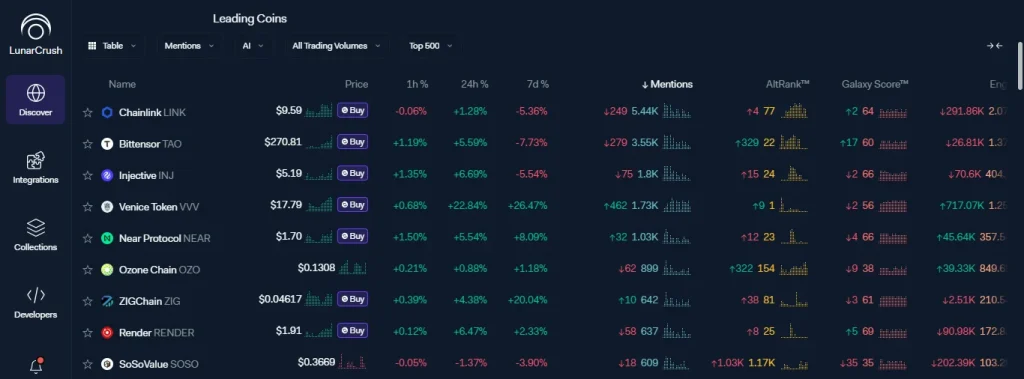
Well, here’s the hook. Ozone Chain isn’t pitching another recycled Layer-1 story with vaporware promises and eternal testnets. The project already has its mainnet live and markets itself as a quantum-resistant Layer-1 blockchain integrating advanced quantum security technologies.
Over the past few weeks, the team kept stacking announcements. On April 29, Ozone Chain highlighted full EVM compatibility, allowing Ethereum developers to migrate smart contracts without rewriting code while promising faster transactions and lower fees.
Then came another push on May 5 around real-world use cases. The project promoted cross-border payments, DeFi integrations, interoperable smart contracts, and quantum-resistant transaction security. And on May 15, it rolled out “OZO Name,” a Web3 identity layer replacing wallet addresses with human-readable usernames alongside a marketplace for premium identities.
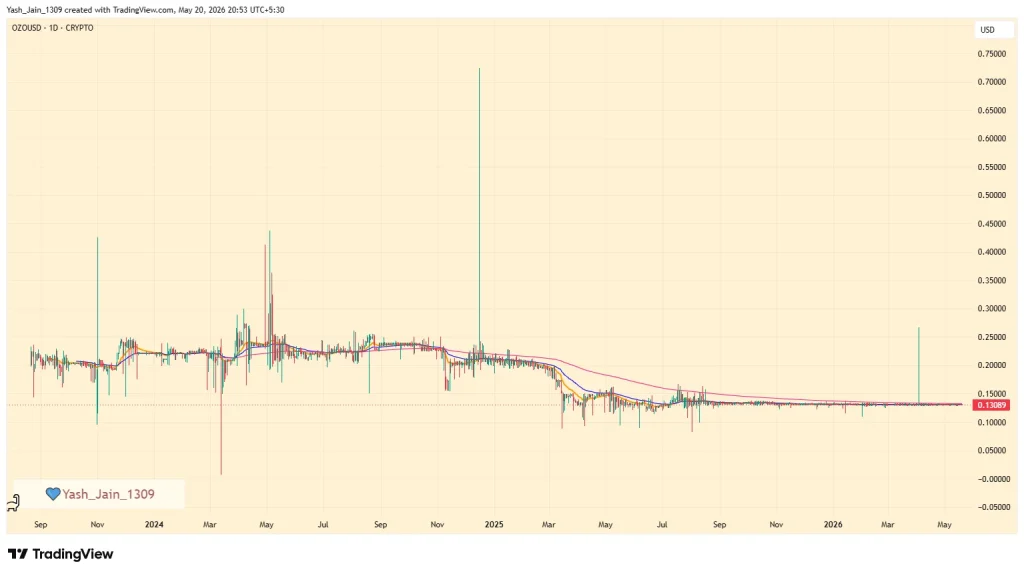
Now, here’s where things get awkward. Despite all the chatter, the OZO price chart still looks completely lifeless. The token trades near $0.13 and has mostly moved sideways since 2024.
But the reality is that the social dominance and actual adoption aren’t always the same thing. Right now, Ozone Chain has attention. Whether that attention becomes sustained usage is still an open question.

The post AI Coins Rally Hard As SERV, BNKR, VVV Jump appeared first on Coinpedia Fintech News
AI coins are ripping again, and no, this isn’t one of those overnight “next big thing” rotations the market forgets in 48 hours. The AI narrative has been grinding higher for months now, and today’s leaderboard is packed with tokens riding that momentum hard.
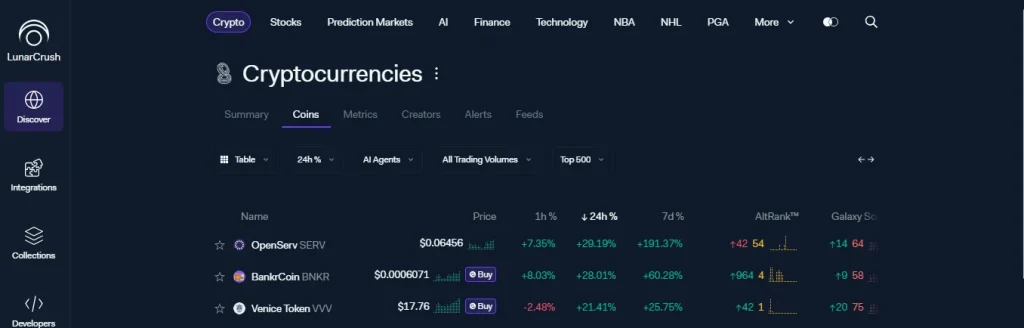
OpenServ’s token, SERV, surged roughly 27% intraday after the project pushed out a fresh claim tied to Google’s newly released Gemini 3.5 Flash model. According to OpenServ, its SERV engine paired with DeepSeek v4 Flash can outperform Google’s setup at nearly one-thirtieth of the cost. Cheap, faster, “enterprise-ready” AI infrastructure? Crypto traders eat that stuff up like it’s free yield season again.
Well, here’s the kicker. Today’s candle wasn’t built in isolation. The daily chart shows SERV has been climbing steadily since early May, with cumulative gains now approaching 350%.
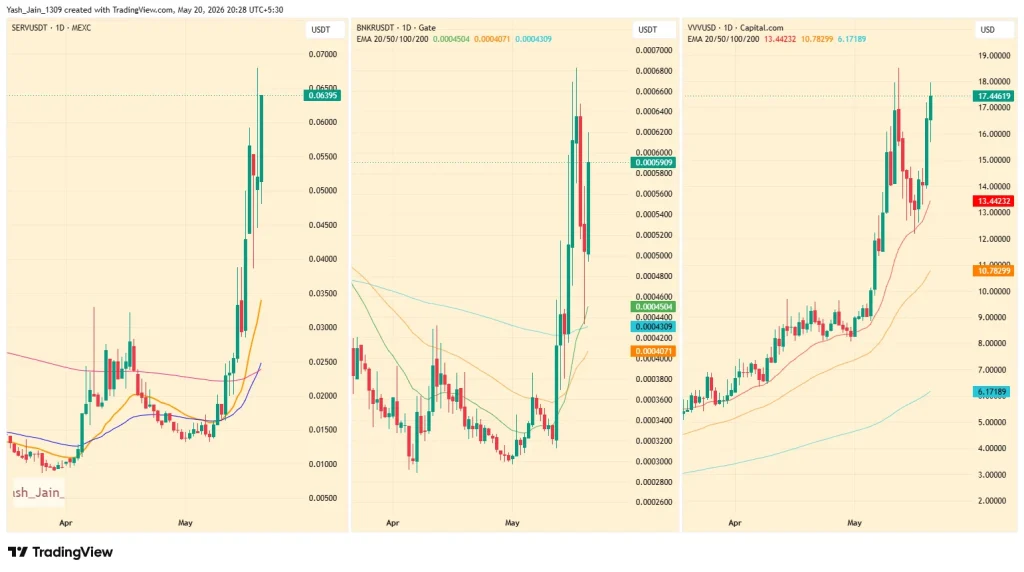
Price action also reflects growing momentum around AI infrastructure narratives tied to governments, Fortune 500 firms, and high-stakes operational systems. Whether those adoption dreams materialize is another conversation entirely, but traders clearly aren’t waiting around for audited quarterly reports.
Meanwhile, the broader AI coin sector remains one of the strongest-performing corners of the market today.
BankrCoin’s token BNKR also joined the rally, climbing 28% intraday and extending its already strong upward trend from earlier this month.
The move places BNKR among the top-performing AI-related assets on LunarCrush’s intraday rankings. Short-term charts show continued speculative demand flowing into lower-cap AI names as traders rotate away from slower large-cap plays.
But let’s be real momentum like this cuts both ways. These rallies tend to move vertically until they don’t.
Then there’s Venice Token, better known as VVV, which gained another 22% after becoming available for trading on Robinhood. That listing catalyst added fresh retail visibility at a time when AI-linked crypto assets are already dominating social and trading feeds.
So, what’s next? If AI narratives continue sucking liquidity into the sector, SERV, BNKR, and VVV crypto could remain market favorites in the near term. But if momentum cools, traders chasing green candles late may quickly discover how brutal AI coin reversals can get.
The post Why Is DASH Surging Today? Here’s What’s Driving the Price Rally appeared first on Coinpedia Fintech News
Dash has emerged as one of the top-performing cryptos over the past 24 hours, recording a sharp surge of 15.75%, reaching $48.77. The sudden breakout has attracted renewed trader attention toward the legacy-payment-focused crypto as speculative momentum returns across several altcoins. One of the biggest catalysts behind the rally appears to be Dash’s latest expansion efforts in Southeast Asia. Alongside the growing regional exposure, rising speculative activity, and increasing trading volumes have further accelerated DASH’s bullish momentum.
As the token reclaims key resistance levels, traders are now watching whether the latest rally can evolve into a broader recovery trend or face exhaustion after the sharp upside move.
The latest DASH price rally appears to be driven by a combination of rising speculative activity, improving market momentum, and the project’s growing visibility across Southeast Asia. One of the biggest catalysts behind the rally appears to be Dash’s latest expansion efforts in Southeast Asia after announcing its participation as a community partner at Southeast Asia Blockchain Week. The collaboration will allow Dash to participate in panel discussions, networking sessions, and community-driven activities alongside major blockchain projects and policymakers.
The move also highlights Dash’s broader strategy to strengthen visibility around its payments-focused ecosystem while increasing awareness of innovations like DashPay. At a time when countries like Vietnam, Indonesia, and the Philippines continue ranking among the global leaders in retail crypto adoption, the expansion could help Dash improve ecosystem visibility, strengthen liquidity access, and reinforce its relevance in the evolving digital payments sector.
The latest price action shows DASH attempting to reclaim bullish momentum after rebounding strongly from the $30 support zone over the past few months. However, DASH is now approaching a major resistance zone between $52 and $55, which has repeatedly acted as a strong supply region since late 2025.
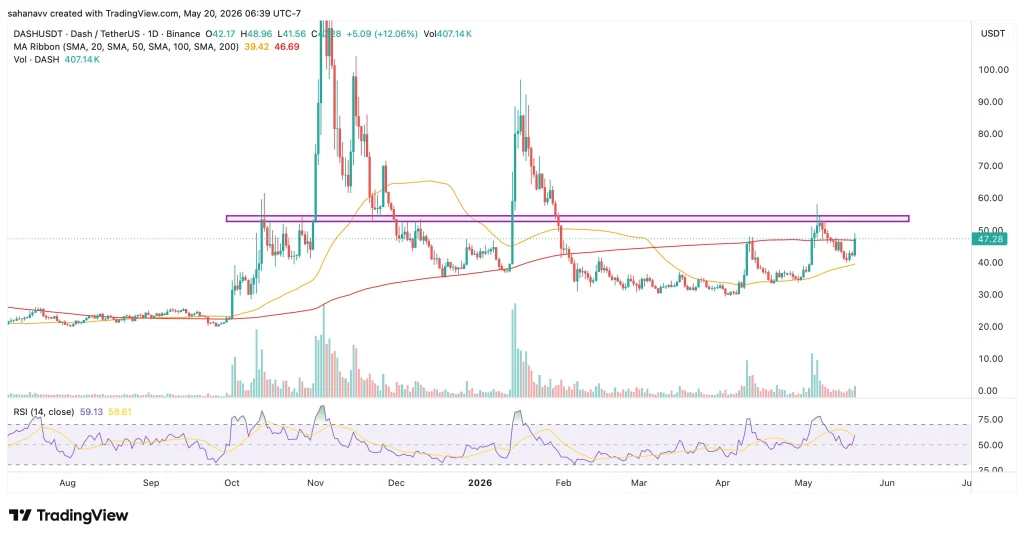
The recent rejection near this zone suggests sellers remain active at higher levels, while the RSI hovering near 60 indicates bullish momentum is improving but not yet overheated. Moreover, the price has risen above the 50 & 200-day MA, which could further head for a bullish crossover or the Golden Cross, if the DASH price remains elevated.
If DASH manages to break above the $55 resistance range with strong volume confirmation, the token could open the doors for a broader recovery rally toward higher price levels. On the other hand, failure to sustain above the moving averages may trigger another short-term pullback toward the $40 support zone before the next major move develops.
Dash’s latest rally highlights the return of speculative momentum across legacy altcoins, but the project’s growing expansion efforts in Southeast Asia are also adding fresh fundamental interest around the ecosystem. However, the token now faces a crucial resistance zone near $55, which could determine the next phase of the trend. If buying pressure and market sentiment continue improving, DASH could attempt a broader recovery rally in the coming weeks. On the other hand, weakening momentum near resistance may trigger short-term profit-taking before the next major move develops.

Analytics provider Glassnode identified 10% of Bitcoin supply as structurally exposed to a quantum breakthrough, underscoring the need for a quantum-proof implementation such as BIP-360.

Ethereum is flashing a warning of a familiar bearish pattern that preceded a 41% drop in January, raising risks of a fresh breakdown.

EU opens MiCA review as consultation probes stablecoin interest rules, DeFi risks and classification gaps ahead of July's crypto authorization deadline.

If even a fraction of the more than 1 billion people who use AI daily delegate authority to AI agents for online spending, stablecoin adoption would grow substantially, a Fireblocks executive said.

Earlier, analysts at Bernstein and BitMEX co-founder Arthur Hayes also projected Bitcoin to reach new record highs in 2026.

MAS found deficiencies in Bsquared’s risk management and conflict-of-interest policies, and that the firm had provided false or misleading information to the regulator on multiple occasions.










Bitcoin momentum is fading following drop to $76,000 as analysts warn a loss of key support at $74,000-$76,000 could trigger a deeper BTC price correction.

Senate Bill 163 bans CBDC payments by state agencies and shields Bitcoin miners from discriminatory zoning and licensing rules.



Qivalis expands to 37 banks after adding 25 new members across 15 countries, boosting euro stablecoin plans ahead of a second-half 2026 launch.

OpenAI is opening its first overseas applied AI lab in Singapore through a $234 million partnership expected to create more than 200 technical roles.






Bitwise’s Matt Hougan says Hyperliquid’s token is not priced as if it is tied to a “global super-app,” arguing the platform is more than just a crypto platform.

Financial regulators are also asked to review regulations that could be amended to streamline applications for eligible fintech firms seeking bank and credit union charters.

GitHub said the activity involved the exfiltration of about 3,800 internal repositories, and it removed the malicious code extension.

Approximately 49,000 workers were laid off in 2026 as companies adopted a more AI-reliant business model.







“Congress has the power to slam the brakes on this unwise conflict,” said bill sponsor and Democratic Senator Tim Kaine.

AI Financial Corp. posted a net loss of $271.5 million in the first quarter of 2026 as it flagged significant doubt about its ability to continue operating for the next 12 months.

About 24 hours after Minnesota Governor Tim Walz signed a bill into law passed by the state’s legislature to effectively ban prediction markets in the state, the CFTC pushed back with its own lawsuit.




Bankr recommends that affected users create a new wallet, generate a new seed phrase on a clean device and revoke approvals if remaining assets can’t be moved.

The crypto ETFs were intended to be part of Trump Media & Technology Group’s broader crypto strategy, which included the launch of the Truth.fi financial platform.

Solana futures funding turned negative as demand for SOL and its associated decentralized exchanges fell. Will traders buy the dip or is $78 next?

Bernstein says miners control 27 GW of planned power and $90 billion in AI deals, giving them a strategic edge as electricity becomes the main constraint on data center growth.

Bitcoin futures and orderbook data show dip buyers waiting for a BTC price drop below $70,000.

New markets will let users trade on fundraising, valuation and other startup milestones using data from Nasdaq Private Market, extending forecasting into private capital.

The platform combines crypto custody, trading, settlement, staking and stablecoin infrastructure services for banks and financial institutions.

The Massachusetts lawmaker asked the US Comptroller of the Currency to provide all communications between the agency and President Donald Trump potentially related to the charter approvals.

The UK central bank said digital money should remain trusted and interoperable as it weighs stablecoin reforms and near-24/7 settlement to support tokenized markets.

Spot XRP ETFs record net inflows for nine days, absorbing sell pressure and potentially supporting an XRP price recovery over time.

The Bitcoin miner said the investment will support development of its River Bend AI data center campus as the company expands its long-term AI infrastructure business.

BTC price stayed pinned below $77,000 amid rising US bond yields and oil prices, with market analysts saying Bitcoin is now at a "crucial level of support."

5,800 users in two hours. One QR code. One bow that went viral.

Global internet freedom has declined for 15 consecutive years, with more countries restricting access to more of the internet, according to Freedom House.

More than 10,000 Bitcoin have been sold at a loss by short-term holders in recent days, adding fuel to analysts’ predictions that BTC price will fall to $65,000.

Canaan’s Q1 results were dragged down by a $25 million inventory write-down and a 75% quarterly drop in equipment sales as Bitcoin prices retreated from their highs.

Estonia’s FIU has partially suspended BB Trade Estonia OÜ’s license, giving the Zondacrypto operator 30 days to fix compliance issues or risk full revocation.

ZEC has jumped 18% in three days as privacy coins rally, defying a 3.45% drop across the wider crypto market.

South Korea’s seventh-largest mutual aid company is currently sitting on a $33 million paper loss on its leveraged Ether ETF investment, following the crypto market downturn.

Pump.fun pulled in $124.7 million in Q1 2026, making it Solana’s largest revenue generator even as memecoin activity cooled, while the network’s RWA market cap crossed $2 billion.

The self-custodial wallet platform integrated Kraken-backed xStocks infrastructure, adding more than 130 tokenized stocks and ETFs for users.

Bubblemaps’ investigation found a cluster of nine accounts that generated $2.4 million with a near-perfect win rate on Polymarket contracts tied to major US military operations.

Swan Bitcoin has been sued for allegedly using insider access to pull nearly $1 billion in Bitcoin and cash from Prime Trust days before its 2023 bankruptcy filing.

Tom Emmer, the House majority whip, is also advocating for his Anti-CBDC Surveillance State Act, which has passed the House but has yet to pass the Senate.

Ethereum Foundation researchers Julian Ma and Carl Beek have resigned, bringing the total number of major departures from the nonprofit to at least eight in 2026.

Among those who used crypto for payments, over 25% said they did so because the business preferred crypto, citing speed, privacy and lower cost advantages.

Several SEC officials reportedly didn’t support the decision, while tokenization platform Securitize flagged risks with enabling third-party platforms to issue tokenized stocks.

The hacker has already laundered nearly 5% of the loot through Tornado Cash and is still holding the remaining 955 eBTC.

Bitmine chairman Tom Lee said the company is expected to have accumulated 5% of Ether's total supply before the end of the year.

Bitcoin retail inflows to Binance remained at record lows as aggressive BTC futures selling and weakening spot demand pressured BTC below $77,000.

Many experts voiced concerns that the confirmation of Kevin Warsh as Federal Reserve chair would lead to uncertainty about the central bank’s independence, particularly in setting interest rates.

The NYDFS approvals allow GalaxyOne Prime NY to offer trading and financing services to institutional investors in one of the most tightly regulated US crypto markets.

Bitcoin positions itself for a rally above $80,000 after Strategy's $2 billion BTC buy, crumbling investor confidence in the US Treasury and a potential US-Iran deal.

Hosting revenue outpaced mining as new capacity came online, highlighting Soluna’s shift toward data centers for AI and high-performance computing.

A political action committee aligned with crypto interest groups reported spending more than $4 million in support of Democratic US House candidate Jasmine Clark in Georgia.

Bitcoin traders are closely watching the $74,000-$75,000 support zone as exchange inflows rise and market signals weaken following BTC's loss of momentum above $82,000.

Bitcoin dropped to the crucial $76,000 support level while large-cap altcoins sold off sharply. Do technical charts suggest that traders will buy the dip?

Minnesota-based banking institutions and credit unions will be authorized to provide digital asset custody services in a nonfiduciary capacity as of Aug. 1.

Institutional investors pulled capital from Bitcoin and Ether products as Iran tension and rising inflation rattled markets, while XRP and Solana funds continued to attract fresh inflows.

Ether price fell sharply below $2,100 as increasing sell pressure on Binance and persistent ETF outflows fueled bearish momentum.

A bullish long-term chart pattern puts HYPE on track for a potential rally above $70 this year, with a16z-linked accumulation and fresh institutional catalysts strengthening the case.

The FCA and Bank of England are seeking feedback on new tokenization guidance and plans to extend operating hours for the UK’s core payment and settlement infrastructure toward near-24/7 availability.

Bitcoin Depot files for Chapter 11 in Texas, plans asset sale and wind-down as regulatory pressure forces shutdown of its Bitcoin ATM network.

EUR 1 billion note programme planned for 2026 following completion of global issuance infrastructure by the end of Q3 2026.

Michael Saylor’s Strategy bought 24,869 Bitcoin for $2.01 billion last week, lifting holdings to 843,738 BTC as STRC sales funded around 97% of the acquisition.

Standard Chartered will absorb Zodia Custody’s regulated crypto business and spin out Zodia Solutions, as big banks move to own core digital asset custody in-house.

The parent company of South Korea’s largest bank completed a stablecoin payment pilot ahead of the country's proposed digital asset framework.

Bitcoin analysis says BTC price could revisit the $65,000 demand area after fresh US-Iran war tensions soured the crypto market mood.

XRP still faces short-term downside risk, with a symmetrical triangle breakdown pointing to a possible drop toward $1.00–$1.10.

Proof of Talk, widely known as the Davos of Web3, today confirmed its 2026 programme and opened remaining passes for its fourth edition at the Louvre Palace in Paris on June 2–3.

South Korea’s FSC is reportedly reviewing Hana Bank’s $668 million Dunamu stake under “banking-commerce separation” rules that limit bank ownership tied to crypto firms.

Goldman Sachs cut its crypto ETF exposure in Q1 2026, exiting XRP and Solana funds while trimming Bitcoin and Ether ETFs and reshaping equity bets.

AFX, a sovereign Layer 1 purpose-built for decentralized derivatives trading, has officially commenced the operation of its L1 Mainnet, signaling a definitive end to the era of trade execution compromised by general-purpose blockchain congestion.

Bitcoin started the week with a dip toward new May lows as ongoing BTC price pressures included "collapsing" US bond markets.

Need to know what happened in crypto today? Here is the latest news on daily trends and events impacting Bitcoin price, blockchain, DeFi, NFTs, Web3 and crypto regulation.
