 Login
Login
Chaos Labs says oracles secure after attempted ‘nation-state’ wallet attack

Chaos Labs said on Thursday it has rotated all keys since the attempted attack over the weekend and hasn't detected any suspicious activity since.

Chaos Labs said on Thursday it has rotated all keys since the attempted attack over the weekend and hasn't detected any suspicious activity since.

Coinbase financial chief Alesia Haas said “macro conditions were genuinely tough,” while CEO Brian Armstrong highlighted a plan to diversify beyond spot trading.

Block’s Q1 earnings beat estimates despite Bitcoin revenue falling 26% on changing Bitcoin “trading dynamics” and reducing fees on Cash App transactions.

Bitcoin options show bulls targeting $115,000 by year-end but are traders becoming overly optimistic?



US Treasury officials reportedly sent a letter to Binance pressing the crypto exchange on compliance with a 2023 deal, after reports circulated that the company had facilitated transactions linked to Iran.

The provisions in the crypto market structure bill are still under review by the banking and crypto lobbies as a new poll shows bipartisan voter support for the legislation.

Two affiliates of the crypto-backed PAC Fairshake reported media buys for political candidates in Georgia, Alabama, Nebraska, Kentucky and Texas this week.



Institutional investors are gradually increasing crypto exposure as Bitcoin leads allocation preferences amid rising fund inflows and improving market sentiment.

The integration allows AI agents built on Amazon Bedrock AgentCore to make USDC micropayments and access services autonomously using Coinbase’s x402 protocol.





Bitcoin hit resistance at $82,800, triggering a drop below $80,000, but a $1.105 billion weekly inflow into spot BTC ETFs could slow sellers.
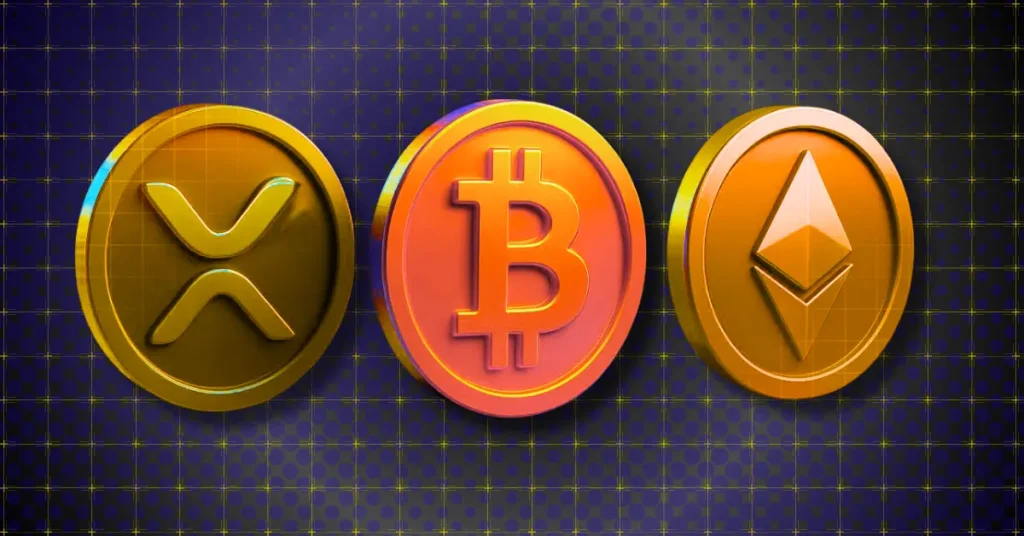
The post Why Are Bitcoin, Ethereum and XRP Prices Falling Today? appeared first on Coinpedia Fintech News
Bitcoin dropped below $80,000. Ethereum fell under $2,300. XRP slipped to $1.38. The total crypto market cap shed 1.51% to $2.66 trillion, with over $90 billion wiped from local highs and $331 million in liquidations recorded in the last 24 hours alone.
Meanwhile gold surged 4.6% and silver jumped 12.4% in the same period, adding a combined $2.1 trillion to precious metals market caps. Money is moving. The question is where it is going and why it is leaving crypto.
Michael Saylor Spooked the Market
One of the possible reasons could be comments from Michael Saylor, who discussed the potential for strategic Bitcoin sales to cover dividends. For a market that treats Saylor’s MicroStrategy as a symbol of institutional conviction, any suggestion of selling from that camp hits sentiment hard. Bitcoin dominance climbed to 60.23% as the market followed BTC lower, dragging altcoins down with it.
ETF flow concerns added to the pressure. Institutional demand through spot Bitcoin ETFs has been the backbone of this cycle’s rally. Any signal that those flows are slowing or reversing tends to amplify selling across the board.
A $6.7 Million DeFi Hack Rattled Confidence
On May 7, DeFi liquidity provider TrustedVolumes was exploited for $6.7 million. The attacker was linked to a prior hack on 1inch, raising concerns about interconnected vulnerabilities across DeFi protocols. Large Ethereum whale wallets moved funds to exchanges shortly after, a classic signal of impending selling pressure.
Security incidents like this create a risk-off response across the entire sector. Traders reduce exposure first and ask questions later.
Gold and Silver Are Winning the Safe Haven Trade
The rotation into precious metals tells a broader story. With US-Iran tensions still unresolved and global economic uncertainty rising, institutional capital is flowing into gold and silver rather than crypto. Gold and silver pumping simultaneously for the first time since the conflict began suggests a genuine flight to safety rather than a short-term trade.
The crypto market is currently testing a key support level at $2.63 trillion. A clean hold above that level keeps the near-term outlook stable. A break below opens the door to $2.59 trillion as the next meaningful support.
Two catalysts will determine which way it goes. First, whether Bitcoin can hold the psychological $80,000 level. Second, the US employment data releasing on May 8, which will shape Federal Reserve policy expectations and broader risk appetite across all markets.

The post Why Most Trading Platforms Don’t Teach You How to Trade appeared first on Coinpedia Fintech News
A trading platform can give you charts, prices, indicators, order buttons, account history, and access to the market. What it usually cannot give you is the judgement to decide whether a trade is worth taking.
That is where many beginners struggle. They open a forex trading platform, see professional-looking tools, and assume the platform will teach them as they go. But access is not education. A platform helps you execute decisions. It does not automatically help you make better ones.
Many beginners confuse platform use with trading skill. Charts, indicators, demo accounts, news feeds, and tutorials can make the interface feel educational, but most features only show information. They do not teach market context, risk control, emotional discipline, or strategy.
This is where structured learning matters. Resources such as TFXC help traders focus on strategy, risk management, and decision-making rather than assuming the platform itself will teach them how to trade.
Most forex trading platforms are built for access and execution. They connect traders to prices, brokers, charts, order types, and account tools. Forex itself is connected to real cross-border financial activity, and the UK’s balance of payments data gives useful context on the international flows behind currency markets.
In practical terms, a platform helps you:
That is useful, but it is not the same as education. If a trader does not know why they are entering, where the trade becomes invalid, or how much they can afford to lose, faster access only makes poor decisions happen faster.
Trading platforms and brokers may earn money through spreads, commissions, financing charges, or related account activity. The UK’s digital strategy gives a wider context on how digital platforms and financial technology have become part of modern economic life. Easier access can be useful, but it does not remove the need for education.
The model fails beginners because it gives them access before understanding. A new trader can open an account, load a chart, add indicators, and place a trade within minutes. That speed feels empowering, but it also increases the chance of acting before learning.
What usually goes wrong:
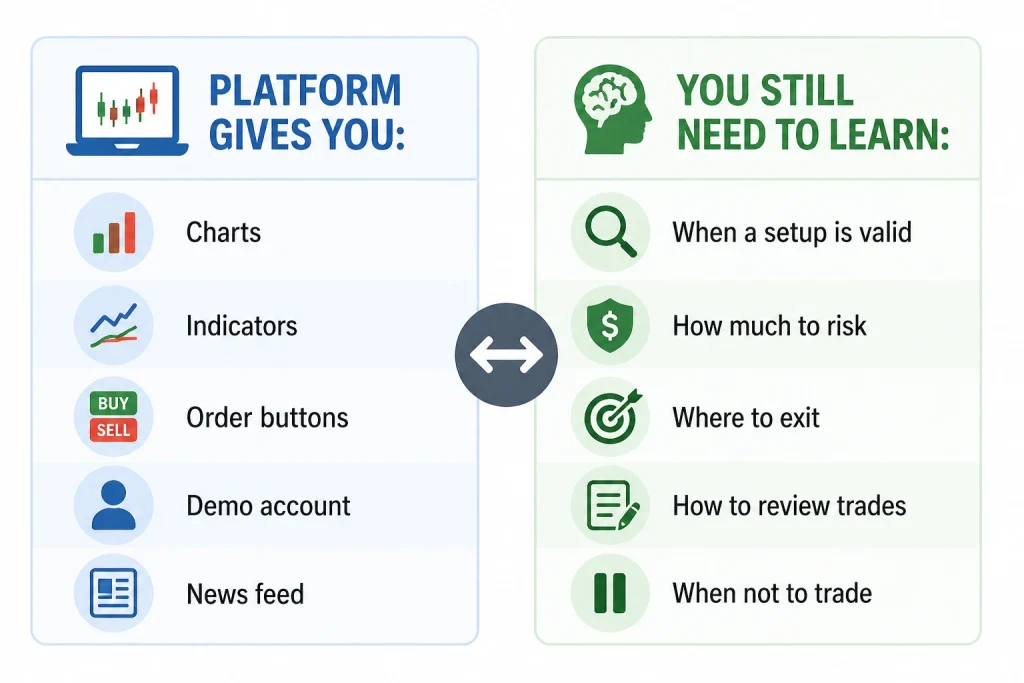
Using a platform is mechanical. Knowing how to trade is analytical. A platform can show price movement, indicators, and news, but it cannot decide what matters most in the moment. That judgement belongs to the trader.
A sudden price spike may be a real breakout, a reaction to news, or a false move before reversal. A beginner often sees movement and thinks, “I should enter.” A better trader asks whether the setup fits the plan, whether the entry is still valid, and where the risk is defined.
Indicators can support a strategy, but they are not a strategy by themselves. A moving average, RSI, or MACD signal only becomes useful when the trader already knows when to enter, where to exit, how much to risk, and when to stay out. Execution should be the final step, not the starting point.
More features can make a platform look more professional, but they do not automatically improve decision-making.
Common problems include:
Real control comes from position size, stop-loss placement, trade selection, and the discipline to stay out when conditions are poor.
Most platforms give access to tools, but not a complete learning path. Beginners are often left to build their education from videos, forums, signal groups, social media, and trial and error. The OECD’s work on financial education and consumer protection supports the broader point that people need financial capability, not just access to financial products.
What traders need instead:

A stronger learning path starts with the basics, then moves into repeatable strategy and controlled risk. That means learning the market before going live, trading a plan rather than every price move, and defining acceptable loss before entering a trade.
Professional traders do not become consistent because their platform has more buttons. They improve through structured practice, feedback, repetition, and review. The platform is only where the trade happens. The learning happens before and after execution.
The right platform matters, but it should be chosen for function, not fantasy. A forex trading online platform should make execution clear, pricing transparent, and risk controls easy to use.
Use the platform for execution: clear charts, accurate orders, stop management, trade history, and stable pricing. Use a separate learning process for education: demo practice, a written plan, review, and gradual live risk.
When comparing trading platforms for forex, look for stability, order controls, spreads, usability, and withdrawal reliability. Do not choose based only on “top 10 forex trading platforms” lists.
Most platforms do what they are built to do: provide access, charts, prices, and execution. Searching for the best forex trading platform for beginners may help with usability, but it will not teach patience, strategy, or risk control. A platform helps you place the trade. A system teaches you whether the trade should be placed at all.

The post Is Pepe Coin Still Worth Holding, or Does the Pepeto Presale Offer the Cleanest 150x Setup of 2026? appeared first on Coinpedia Fintech News
The Pepe coin price prediction debate heated up on May 4 after CoinDesk reported that Tom Lee called the start of a “crypto spring” while MBitmine bought $238 million in ETH in a single week. PEPE trades at $0.000003992 per CoinMarketCap, stuck 86% below its all-time high with zero working products. BTC pushed past $80,000 for the first time since January, but the P\epe coin price prediction shows a ceiling that keeps shrinking.
Capital floods memes first when the market wakes up, and that is why this debate showed up this week. But while the market argues about whether PEPE has anything left to give, the same builder behind that $11 billion run already started something new, and the numbers coming out of the Pepeto presale demand attention.
Same 420 trillion supply, same grassroots energy, but with a working exchange the original never had, $9.89 million raised, and a Binance listing forming behind the scenes. The Pepe coin price prediction frames the ceiling on PEPE, but the real opening for 2026 lives inside a presale that has not closed yet.
The original Pepe Coin climbed to $11 billion on community energy alone but never shipped an exchange, and demand collapsed once the excitement faded.
Pepeto fills every gap under the same builder, and the community forming around Pepeto follows the exact path that carried the first Pepe toward billions.
The first Pepe coin fell 86% because once the hype cooled, there was nothing to keep holders in the project. No exchange generating volume, no revenue flowing back, no tools protecting capital. The same builder saw that collapse and designed Pepeto so it could never happen the same way.
PepetoSwap already runs on Ethereum and charges nothing on trades, which means holders who enter the presale today and trade after listing keep the full value of every position, and that alone changes the math on whether demand sticks around or fades like the original did.
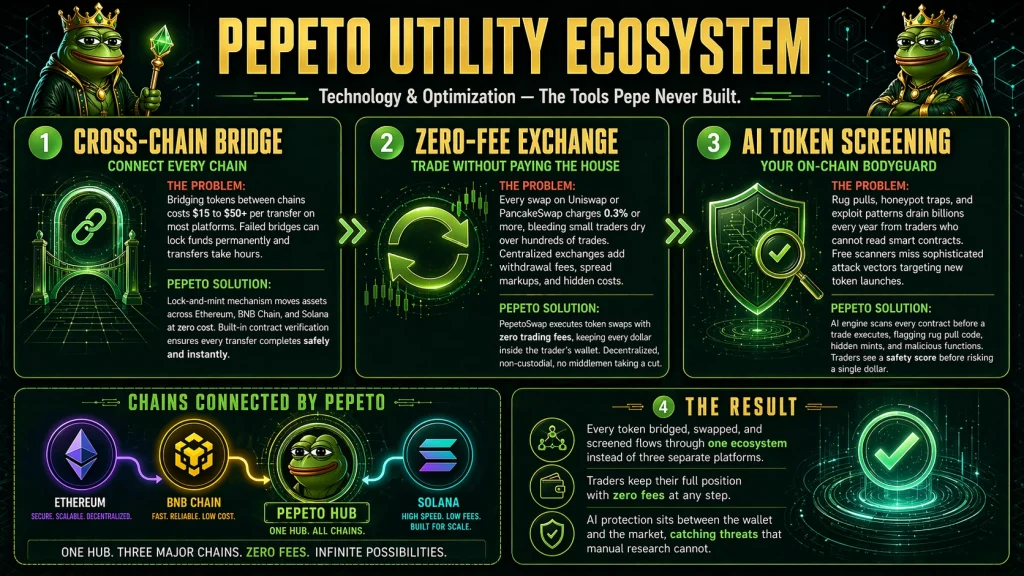
On top of that, every contract goes through a risk scoring engine before a wallet can send funds, so the scams and traps that drain meme coin buyers never reach the people inside this project. SolidProof already signed off on every contract, and a former Binance specialist is pushing the listing forward.
The $9.89 million that flowed in came from wallets that see a SolidProof audit, a builder with an $11 billion track record, and a presale at $0.0000001868 across a 420 trillion supply where the 150x target is not fantasy, it is the same market cap the first Pepe already reached with nothing behind it. Staking pays 175% APY so positions compound while the listing approaches, and each round fills faster than the last.
Pepe (PEPE) prints at $0.000003992 per CoinMarketCap, still 86% below its all-time high of $0.00002803 with a $1.64 billion cap.
A full recovery gives roughly 7x, and 7x on a token that already fired its viral energy at full volume is a recovery trade, not a wealth trade. Pepeto, from the same builder, targets that same cap for 150x from presale pricing.
The first Pepe coin made early holders rich beyond anything they planned for, and it did it with zero products, zero audits, and zero exchange tools. Just a meme, a moment, and the wallets that moved before everyone else.
Pepeto is built by the same person, carries the same 420 trillion supply, but this time the exchange is live, the audit is done, staking pays 175% APY, and the Binance listing is approaching fast. The pepe coin price prediction gives PEPE a 7x ceiling. Pepeto at $0.0000001868 targets 150x into that same market cap, and the presale is still open right now.
People who missed PEPE, who missed SHIB, who missed every early entry that turned small money into life-changing money, all say the same thing: “I saw it and I did not act.” The presale at Pepeto is closing, the listing is near, and this is the last time this price exists. Once trading opens, the entry belongs to the market and the chance to get in early is gone for good.
Click To Visit Pepeto Website To Enter The Presale
Pepe (PEPE) at $0.000003992 needs a 7x to reach its $0.00002803 all-time high, and CoinCodex projects only $0.0000068 as the near-term target. Pepeto at presale pricing targets 150x into the same market cap range with a working exchange and SolidProof audit already live.
Pepeto is the best meme coin presale before a Binance listing because it ships zero-fee trading, cross-chain bridging, and AI contract screening at $0.0000001868 with $9.89 million already raised. The same builder behind the $11 billion Pepe coin leads the project with 175% APY staking live today.

The post Brad Garlinghouse Explains What CLARITY Act Means For Ripple and XRP appeared first on Coinpedia Fintech News
The CLARITY Act passing would be good for crypto and Ripple CEO Brad Garlinghouse believes that. Garlinghouse said Ripple has actively leaned into supporting the CLARITY Act.
“If we want the largest economy in the world, the United States, to lean into crypto in the way that helps, it’s good for Ripple if that happens,” he said. “But XRP has clarity.”
The distinction matters. Ripple is not lobbying for the CLARITY Act because it needs it. It is supporting it because the broader crypto industry does, and because a healthy US crypto regulatory environment is ultimately good for everyone operating in the space, including Ripple.
Garlinghouse also pointed to a concern he hears repeatedly from bank CEOs and senior financial executives. They are nervous. Not about XRP specifically, but about what happens when the current regulatory leadership changes. Paul Atkins is at the SEC today. But guidance is not law, and guidance can change the moment a new administration arrives.
“If you’re a big financial institution that’s had to deal with an SEC that has fined them billions of dollars, they don’t want to take a chance,” he said.
That institutional nervousness, Garlinghouse argued, is exactly why the CLARITY Act matters. Legislation creates permanence that guidance never can. Without it, major banks will remain cautious no matter how friendly today’s regulators appear.
On timing, Garlinghouse said that the window is narrow. The bill needs to clear the Senate Banking Committee within the next few weeks. If it does not, the realistic chance of passage shrinks dramatically, and the political calendar makes things worse. If the House flips in November, the entire legislative landscape could shift as early as then.
“Either this gets out of committee in the next few weeks or it’s not going to happen anytime soon,” he said.

The post Will Insurance Adoption Push HBAR Price Higher? appeared first on Coinpedia Fintech News
Just when most traders had already thrown HBAR into the “ghost chain” category, Hedera quietly landed something crypto loves to brag about but rarely delivers: actual enterprise utility. And not the fake “partnership” kind either. The Institutes RiskStream Collaborative is integrating HashSphere and the public Hedera network into a $1 trillion insurance market, pushing HBAR straight into the world of property data verification and tokenized identifiers.
Yeah, boring stuff. Which is usually where the real money hides.
The core pitch here is simple. Every lookup, registration, and verification tied to property identifiers on the public Hedera network generates transaction fees paid in HBAR. That creates baseline demand that doesn’t depend on meme traders screaming on social media every weekend.
The U.S. property and casualty insurance market relies on data that today is fragmented and difficult to verify.@The_Institutes RiskStream Collaborative is transforming this $1T market – eliminating structural inefficiencies using HashSphere, powered by @hedera technology.…
— Hashgraph (@hashgraph) May 7, 2026
Well, here’s the kicker: the case study data shows that eight of the top ten U.S. property and casualty insurers are reportedly involved in the initiative. That means the network could see a consistent flow of enterprise-grade transactions as the project scales from proof-of-concept toward broader adoption. For a market addicted to speculation, structural demand is a rare sight.
Technically, HBAR price is sitting at a critical level. The weekly chart shows the token still trapped inside a falling wedge pattern, with support holding around the $0.074 to $0.080 zone.
But the big reality check is that the market now wants one thing and that’s pure confirmation.
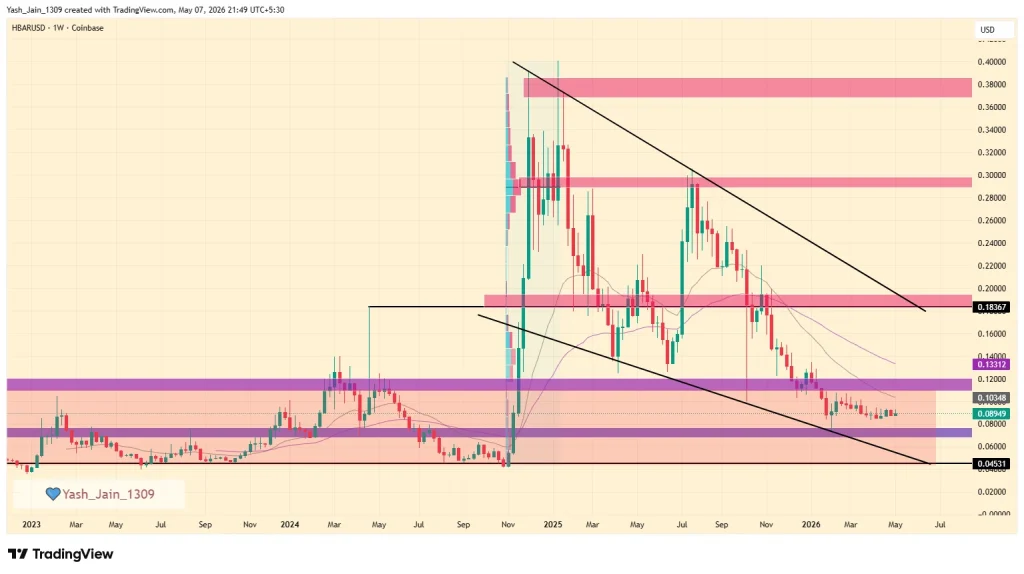
If HBAR reclaims the $0.10 level, it would move back into its previous consolidation range and potentially invalidate part of the broader bearish structure. Beyond that, resistance levels near $0.13 remain the bigger hurdle.
So, what’s next? The interesting part isn’t hype but it’s credibility. Hedera already operates with a governance council model backed by global corporations, and adding a major insurance consortium only strengthens the “enterprise-standard” narrative.
If actual usage metrics begin reflecting this integration, HBAR could finally get the catalyst needed to shift from speculative trading into long-term infrastructure relevance. For now, the market is watching whether Hedera can turn insurance-sector adoption into sustained HBAR price recovery.
The post AVAX Price Stalls Near $8.60 As CME Futures Spark Speculation appeared first on Coinpedia Fintech News
The AVAX price has spent months doing what crypto traders hate most and thats absolutely doing nothing. Since early 2026, Avalanche has been trapped around the $8.60 zone, grinding sideways after bouncing from the lower border of a falling wedge on the weekly timeframe back in February.
But here’s the thing. This doesn’t exactly look weak. If anything, the market’s acting suspiciously calm.
As the observation of its weekly chart suggests that prolonged consolidation inside a large falling wedge lower edge often gets attention for one reason and that’s for accumulation. The AVAX price has managed to hold its structure despite broader market uncertainty, and that stability is starting to look intentional rather than accidental.
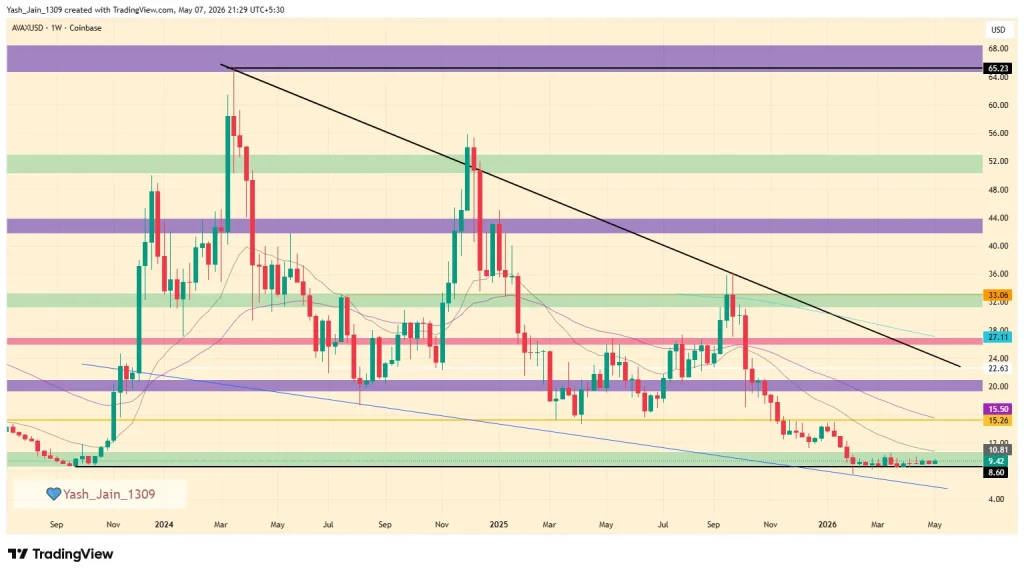
Right now, traders are eyeing the wedge’s upper boundary near $20. That’s still a long way off from current levels, but if momentum flips bullish, it represents a potential 100% move from the consolidation range. Of course, crypto loves dangling big targets before humiliating everyone involved.
Still, Avalanche just got a catalyst the market can’t ignore. CME Group, the world’s largest derivatives marketplace, has made Avalanche futures available for trading and confirmed crypto futures and options will trade 24/7 starting May 29.
LATEST:
— CoinMarketCap (@CoinMarketCap) May 6, 2026CME Group has made Avalanche and Sui futures available for trading and announced that crypto futures and options can be traded 24/7 starting May 29. pic.twitter.com/EL1vgByacd
That matters. As Futures markets typically bring deeper liquidity, larger positioning, and more institutional participation. In other words, volume. Lots of it, if demand actually shows up.
So, what’s next? The current consolidation could stretch longer, but May is shaping up as a critical month for Avalanche. If futures activity boosts participation and buyers reclaim momentum, the AVAX price could attempt a move toward the $20 resistance region.
But let’s be real: until the breakout actually happens, it’s still just a theory sitting inside a falling wedge.






Fresh capital from top Wall Street and Silicon Valley firms signals increasing confidence in regulated event trading and retail prediction markets.

The Bitcoin advocate spoke up after Michael Saylor signaled that the company might sell some BTC, a major departure from the Strategy founder's previous rhetoric.



Hosted by Luna PR, the fourth edition of the Crypto Polo Cup (CPC) will take place on May 9, 2026, at the Santa Clara Polo Club, alongside Consensus Miami.

After years of research, engineering, and community collaboration, Panther Protocol Foundation announced that Panther Protocol is now live on Polygon.

Germany may overhaul its crypto tax rules from 2027, potentially curbing the country’s hallmark one-year tax-free holding rule as it tightens enforcement and seeks extra revenue.

The Snapshot vote would move the recovery effort toward a binding onchain Arbitrum governance proposal.

Bitwise plans to take over Superstate’s tokenized crypto carry fund as demand for actively managed onchain investment products continues to grow.




The post Solana RWA Holders Cross 200K As Asset Growth Accelerates appeared first on Coinpedia Fintech News
The Solana RWA narrative just keeps getting bigger. While most blockchains are still busy pitching “future potential,” Solana is quietly stacking real numbers and now its real-world asset holders have officially reached 200,044 for the first time. That’s a 6.50% jump in just 30 days.
Well, this isn’t just about wallets sitting idle. Solana’s distributed asset value has climbed to $2.02 billion, while represented asset value surged to $538.63 million, up more than 50% over the past month.
Meanwhile, the network’s RWA count now stands at 1,841. Not bad for a chain critics once dismissed as just another fast-moving retail playground.
But the real deal here or should we call it as the real engine here is stablecoins. Solana’s stablecoin market cap has reached $14.62 billion, while stablecoin holders climbed to 11.48 million.
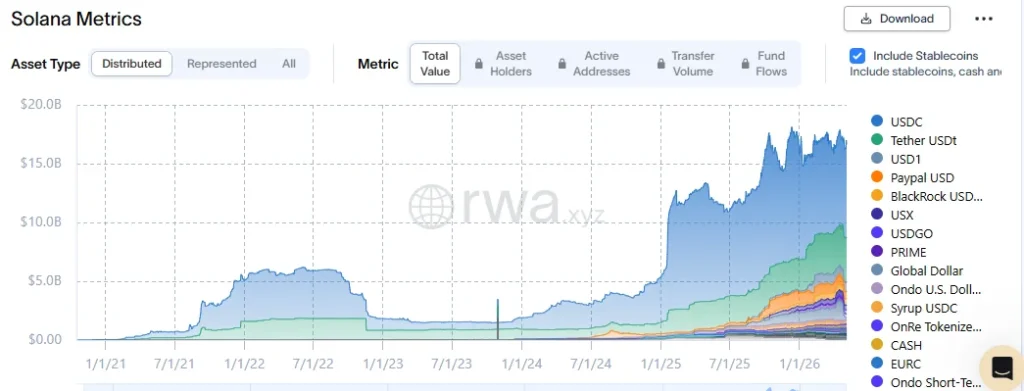
And yes, the transfer numbers are absurd. Stablecoin 30-day transfer volume sits at $813.74 billion, even after a 30.88% monthly decline. That’s still massive by any standard. The broader RWA 30-day transfer volume also reached $3.46 billion.
So, what’s driving this? Solana keeps leaning into one thing: speed. The network promotes an average settlement time of 400 milliseconds with transaction fees around $0.013.
Compared to traditional markets stuck in 24/5 schedules and slower settlement rails, Solana’s 24/7 programmable infrastructure is becoming increasingly attractive for real-world asset applications.
For now, the Solana RWA sector keeps expanding and the numbers suggest institutions and builders are paying attention whether the market likes it or not.

The post Pepeto Targets 100x as Strategy Pauses Bitcoin Buys Before Earnings, While BTC and SUI Face Limits appeared first on Coinpedia Fintech News
The crypto news this week starts with a signal that says more than any price chart. Strategy, the largest corporate Bitcoin holder with 818,334 BTC, paused purchases ahead of May 5 Q1 earnings, according to CoinDesk. The pause lands while analysts focus on $14.46 billion in unrealized losses. Meanwhile, whale wallets bought 270,000 BTC over 30 days and exchange reserves fell to a seven-year low.
The same kind of large holders are filling the Pepeto presale past $9.89 million, with a working exchange, a SolidProof audit, and a Binance listing approaching. Following the whales is the shortest path to real returns.
Strategy halted Bitcoin purchases before reporting Q1 on May 5, a quarter that saw BTC crash to $62,000 in February, according to CoinDesk. Saylor’s average cost across 818,334 BTC sits at $75,537, barely above today’s price.
But the crypto news beneath the surface tells a different story. 24/7 Wall St reported whale wallets grew by 142 addresses to reach 2,028, and exchange reserves dropped to levels not seen since December 2017. The institutions are not making headlines. They are making entries.
The real signal in the crypto news is not what Strategy reports on May 5 but where the largest wallets move capital while everyone else watches earnings calls, and right now
Those wallets are choosing Pepeto because the person who took Pepe from zero to $11 billion built a full exchange this time with PepetoSwap running zero-fee trading, a bridge moving tokens without taking a cent, and a contract screener reading every project before funds get close, all verified by SolidProof.
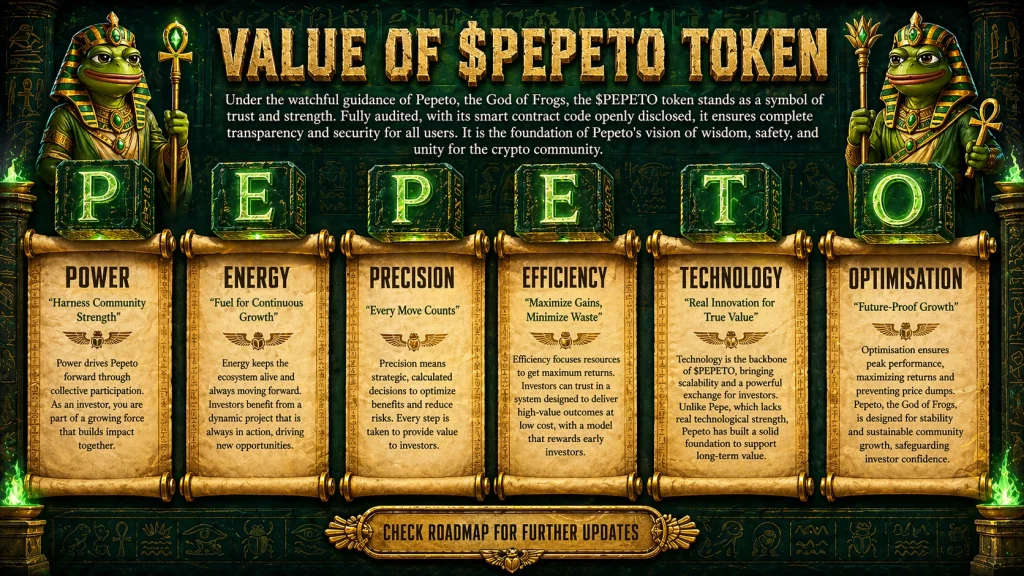
That is exactly why more than $9.89 million has poured in during the worst fear of the year, because this is serious capital from wallets with the same kind of access the whales buying 270,000 BTC always have, and at $0.0000001868 with 175% APY staking growing every position daily and analysts projecting 100x from the listing alone, following them into Pepeto right now is the clearest signal this market has given all cycle.
Bitcoin (BTC) trades at $80,156 per CoinMarketCap, up 1.08% after touching $80,500 earlier on May 4. Exchange reserves sit at a seven-year low of 2,693,000 BTC according to CryptoQuant, and ETF inflows posted a fifth straight positive week.
BTC remains 37% below its all-time high of $126,198 from October 2025. A recovery to $90,000 delivers 14% over months, while the presale entry targets 100x from one listing event the whales are already positioned for.
Sui Network (SUI) trades at $0.93 per CoinMarketCap, holding flat with a $3.7 billion cap. SUI sits 83% below its all-time high of $5.35 from January 2025, and a push to $1.50 delivers 61% over months.
But Pepeto at presale pricing carries the 100x that SUI at $3.7 billion is simply too large to deliver from a single event.
The same kind of wallets that bought 270,000 BTC in 30 days while exchange reserves hit a seven-year low are the same kind of wallets that pushed the Pepeto presale past $9.89 million during the worst fear of the year, and that is the strongest signal anyone can follow in this market.
These are not small players guessing. These are informed holders who see the working exchange, the SolidProof audit, the viral growth, and the Binance listing timeline, and they are loading up because they already know what happens next.
In every single cycle, the wallets that followed the whales into early entries are the ones that built real wealth, and right now the whales are inside Pepeto at $0.0000001868 while the rest of the market watches from the outside. The crypto news will keep changing daily, but the wallets already inside Pepeto are sitting on the kind of position that only exists once per cycle and only at this price.
Click To Visit Pepeto Website To Enter The Presale
What is the biggest crypto news as Strategy pauses Bitcoin buys?
Strategy paused its weekly Bitcoin purchases before May 5 Q1 earnings while whale wallets added 270,000 BTC in 30 days. The crypto news shows large capital is still moving aggressively while Pepeto at presale pricing targets 100x from the Binance listing.
What is the best meme coin presale to buy before the next Binance listing?
Pepeto is the best meme coin presale before the next Binance listing because it already raised $9.89 million with a verified exchange that includes zero-fee trading, a cross-chain bridge, and a contract risk scorer audited by SolidProof. At $0.0000001868 with 175% APY staking, Pepeto carries the same early-entry setup that turned Pepe coin into an $11 billion project.

The post ZachXBT Accuses LAB Token Founder of Market Manipulation, Offers $10,000 Bounty for Evidence appeared first on Coinpedia Fintech News
On-chain investigator ZachXBT has publicly accused Vova Sadkov, the founder of LAB token, of manipulating the market through centralised exchanges while simultaneously posting philosophical content on social media. ZachXBT said the alleged manipulation has directly harmed retail investors who were trading the token.
Before going public, ZachXBT said he reached out to the LAB team privately via direct message. He received no response.
With no reply from the team, ZachXBT escalated. He announced a $10,000 bounty for anyone who can provide concrete evidence of LAB-related market manipulation. The information he is specifically looking for includes contracts, chat records, and insider documents from LAB’s market-making activities across four major exchanges: Bitget spot, Bybit perpetuals, Binance perpetuals, and OKX perpetuals.
$10K bounty is now live on @vsadkovv passport/ID or insider details of the market maker (contracts, chat logs, etc) used for LAB on Bitget spot, Bybit perps Binance perps, or OKX perps.
— ZachXBT (@zachxbt) May 7, 2026
These grifters are further hurting the industry reputation and it must not go unpunished.… pic.twitter.com/NG2n2PHWeS
He is also offering the bounty for identity-related information on the founder, known online as vsadkovv, including passport or government-issued ID details.
The accusation quickly gained traction across crypto social media. On-chain analyst Specter posted what he described as strong on-chain proof of coordinated manipulation by the LAB team, calling it a classic pump and dump scheme with retail investors used as exit liquidity. LAB had previously raised $1.5 million from institutional backers, adding weight to the concerns being raised.
ZachXBT was direct when asked about trading tokens like LAB. “I do not recommend trading these type of tokens at all,” he wrote.
When another user suggested naming and shaming the market makers involved, ZachXBT replied with a single word: “Yes.”
LAB token has not publicly responded to the accusations at the time of writing. With a $10,000 bounty now live and on-chain analysts actively digging through transaction data, more evidence is likely to surface in the coming hours and days.
ZachXBT has a track record of producing detailed investigations that have led to real consequences for bad actors in the crypto space. For retail holders of LAB, his warning is clear. Proceed with extreme caution.
The post Bitcoin Price Prediction as BTC Breaks $80,000 for First Time Since January, While Pepeto Could Be the Biggest Winner of This Cycle appeared first on Coinpedia Fintech News
The Bitcoin price prediction turned bullish on May 4 after BTC broke above $80,000 for the first time since January, driven by the Iran peace proposal that sent Brent crude down to $107, according to Finance Magnates. April ETF inflows reached $2.44 billion, the strongest month since October 2025, and whale wallets grew by 142 addresses while retail sold into fear.
The Bitcoin price prediction now targets $92,000 to $150,000 as the bull market support band turns green for the first time in six months. But the traders set for the real gains are entering Pepeto at $9.89M raised with exchange tools already running, because one listing event delivers more than the Bitcoin price prediction gives BTC holders in a year.
Finance Magnates reported Bitcoin hit $80,393 on May 4 after Iran sent a 14 point peace proposal to mediators, cooling oil prices and lifting risk assets. BTC reclaimed the bull market support band and sits inside the $79,000 to $84,000 CME gap that acted as resistance since February.
When BTC breaks a level it lost three months ago, and $629 million in fresh ETF money flows in during the first week of May, the Bitcoin price prediction shifts from consolidation to breakout, and presale entries capture the rotation before charts confirm it.
BTC touching $80,000 confirmed the cycle is turning, and that is exactly why experienced wallets loaded Pepeto during consolidation at a price the listing will erase. The presale crossed $9.89M because the exchange already runs, the Binance listing is approaching, and every stage fills faster than the last.
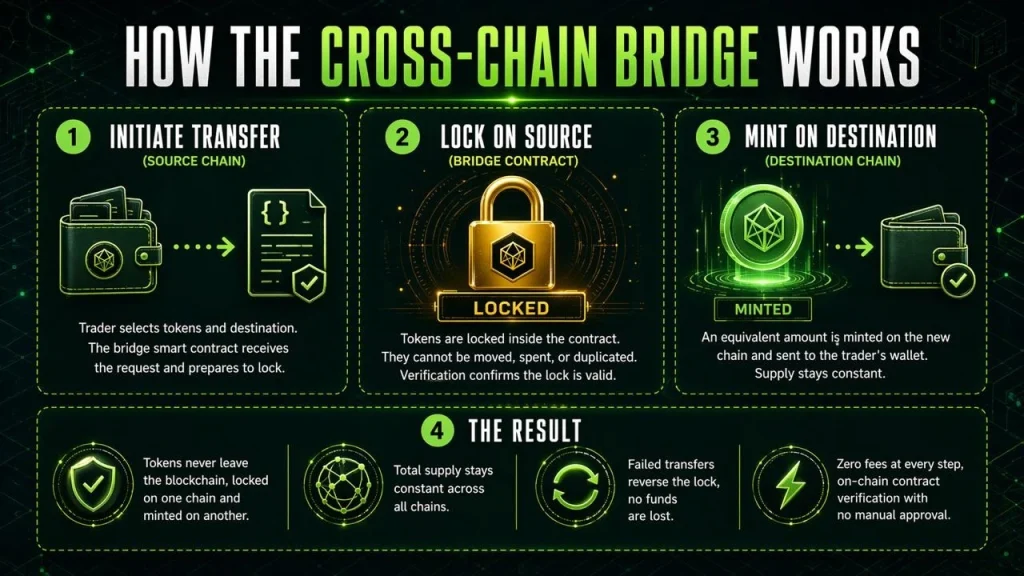
The cross chain bridge lets traders move between Ethereum, BNB Chain, and Solana in one step instead of paying three sets of fees, and because PepetoSwap removes trading costs, the amount you trade is the amount you keep. Every contract passes through the risk scoring system that reads for hidden drains before a single dollar goes near them, which means capital enters verified positions while the SolidProof audit backs every line of code. The cofounder who built the original Pepe token to $7 billion leads the team.
At 175% APY staking, wallets that entered weeks ago are compounding while new buyers push each stage closer to the end. One wallet turned $8,000 into $9 million on Shiba Inu in 2021 according to CNN, and the same sequence of presale demand, exchange listing, and viral attention is forming around Pepeto now.
The entry at $0.0000001868 will not exist after the Binance listing, and every day spent watching is a day where the profit goes to wallets already inside.
BTC reclaimed $80,256 after touching $80,393 on May 4, its highest since January, according to CoinMarketCap. The asset gained 17% in one month and crossed the bull market support band for the first time since November.
The all time high of $126,198 from October 2025 sits 58% above, Standard Chartered targets $150,000, and at $1.33 trillion even that is barely a 2x. The bitcoin price prediction confirms presale entries produce faster returns during breakouts.
ETH climbed to $2,337 with 13% gains this past month, according to CoinMarketCap. The all time high of $4,953 from August 2025 sits 112% higher.
Ethereum (ETH) remains the DeFi foundation, but at $233 billion the Bitcoin price prediction confirms large caps need years to deliver what exchange presales produce from one listing.
BTC broke above $80,000, ETF inflows hit $2.44 billion in April, and the bull market support band is green again. The Bitcoin price prediction points higher, but the biggest returns will not come from BTC at $1.33 trillion.
Pepeto crossed $9.89M while the market debated the bottom, the Binance listing is approaching, and 175% APY compounds right now for wallets that moved first. Stages fill faster each round, and the entry at $0.0000001868 gets closer to closing every day.
The traders who watched Shiba Inu run without buying know what hesitation costs. Visit Pepeto and enter the presale before the listing closes this window and the price you see today becomes someone else’s return.
Click To Visit Pepeto Website To Enter The Presale
What is the Bitcoin price prediction for 2026 after BTC broke $80,000?
The Bitcoin price prediction targets $92,000 to $150,000 after BTC reclaimed $80,000 with $2.44 billion in April ETF inflows. Pepeto at $9.89M raised with a Binance listing approaching offers returns BTC at $1.33 trillion, needs years to deliver, visit Pepeto.
Why is Pepeto gaining attention during the Bitcoin breakout?
Pepeto gained attention because the presale crossed $9.89M with a working exchange, zero fee trades, cross chain bridge, and Binance listing approaching. The 175% APY at $0.0000001868 gives early buyers the entry large caps at current prices cannot match.

The post Top New Memecoin to Watch in May 2026: Wadoozie’s Fair Launch Is Days Away appeared first on Coinpedia Fintech News
Anyone scrolling X this week for the top new memecoin to watch in May 2026 has run into the same name more than once. Wadoozie — an Ethereum-native, narrative-driven project trading under the $WADZ ticker — is days away from a CertiK-audited fair launch on May 27, 2026, and the audience showing up early is the kind that doesn’t want to find out about a launch the day after it’s gone live. With the clock running on the launch window, this is one of those rare months where even passive observation is the right move; serious memecoin watchers want this on the radar, not in the rear-view.
The list of new memecoins shipping in any given month of 2026 is long, but the list of new memecoin launches that publish a third-party audit, lock the majority of supply on day one, and renounce ownership of the contract is short. Wadoozie sits in that smaller list. The token is ERC-20, deployed on Ethereum mainnet, with 75% of total supply allocated to a DAO-governed locked liquidity pool, a 0/0 tax structure on transfers, the contract renounced at launch, and the team allocation locked for 12 months.
Each of those mechanics is verifiable on-chain rather than on a marketing deck — which has become the operative distinction in a category where retail readers learned the hard way that a “fair launch” claim only counts when the launch parameters survive contact with Etherscan. Memecoin discovery in 2026 is a noisy room, and the only reliable filter has become whether a project’s claims live where they can be checked.
The May 27 fair launch is not a standalone event. It opens an 8-Act, 48-state U.S. tour that begins in Austin and closes back in New Orleans, with a European leg planned to follow. Each state along the route activates a node where seven physical Signal Fragments — four Common, one Uncommon, one Rare, and one Legendary — are placed in the field for community members to recover through clues surfaced on the live stream. Recoveries redeem to $WADZ at fixed per-tier payouts of 15,375, 46,125, 153,750, and 461,250 tokens, distributing a combined 34,686,000 $WADZ directly to the audience that does the on-the-ground work.
That structure is the reason “the memecoin worth watching this month” is showing up next to Wadoozie in early coverage rather than the usual launch-hype vocabulary. The product is the story; the token is the coordination layer that pays the community for participating in it. The launch is the doorway, not the destination.
Before May 27, anyone evaluating the launch can verify the basic claims directly. The token is CertiK-audited on Skynet, and the contract — short form 0x8a73…5d72 — is publicly viewable on Etherscan, where the locked-LP, 0/0 tax, and renounced-ownership flags can be confirmed directly rather than taken on faith. A second audit from Coinsult and a CoinMarketCap listing round out the verification stack the project has built ahead of launch day.
The fair launch itself goes live on May 27, 2026. Traders building a watchlist for the month do not need to take a position to mark the date — they need to be in the room when it happens, with the contract address, the audit links, and the launch-day mechanics already cross-checked. By the time post-launch coverage starts running, the early window will already have closed for the readers who treated the date as a maybe rather than a calendar entry.
Wadoozie is a narrative-driven Ethereum memecoin — $WADZ, ERC-20, fair-launching May 27, 2026 with 75% of supply in a DAO-governed locked LP, 0/0 tax, contract renounced, team locked 12 months, and a CertiK audit — built around a 48-state U.S. tour structured as 8 narrative Acts opening in Austin and closing back in New Orleans, then continuing into Europe.
When the tour bus arrives at a state, the node activates and seven physical Signal Fragments are placed in the field — four Common, one Uncommon, one Rare, one Legendary, with every state guaranteed at least one Legendary — recoverable on the ground through clues surfaced on the live stream and the state’s node page; whoever finds a fragment redeems it for $WADZ at fixed per-tier payouts of 15,375 / 46,125 / 153,750 / 461,250 tokens, distributing 34,686,000 $WADZ directly to community recoveries across the 48 states. The story is the product. The token coordinates it.
The post Stacks Price Jumps as Chart Structure Turns Bullish: Can STX Price Escape $0.3000? appeared first on Coinpedia Fintech News
Stacks price is showing renewed bullish momentum after rebounding sharply from a multi-month support zone, with STX price attempting to build a larger recovery structure following weeks of sideways consolidation.
The recovery comes as Bitcoin trades near local highs again, helping capital rotate back into Bitcoin ecosystem tokens. STX price reacted strongly, surging from the $0.22 support base and briefly pushing above $0.26 as traders rushed back into the market. The latest move is particularly important because it comes after months of sustained downside pressure, with technical structure now beginning to shift in favor of bulls for the first time since early 2026.
Futures market positioning is also beginning to strengthen the bullish case for Stacks price. According to CoinGlass data, STX futures volume currently stands near $134 million, while open interest remains above $31 million despite recent market volatility. Although both metrics declined over the past 24 hours, long positioning among top traders continues to dominate.
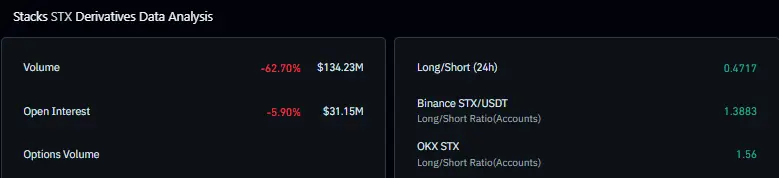
Binance top trader long/short ratio climbed to 1.50, while OKX traders remained net-long at 1.56. Binance top trader positioning by accounts also stayed above 1.37, signaling that professional traders are still leaning bullish despite recent uncertainty. At the same time, funding conditions have stabilized significantly compared to previous weeks, suggesting aggressive bearish leverage is beginning to unwind.
The sharp upside wick seen during the latest STX price spike has increased speculation that short-covering activity accelerated the move higher, especially after sellers failed to push price below the key support region. Historically, failed breakdowns combined with rising long exposure often trigger stronger volatility expansions as sidelined buyers return to the market.
On the daily chart, Stacks price appears to be reversing after successfully defending a major accumulation zone between $0.22 and $0.24. STX price had remained trapped inside a weakening range structure throughout March and April after losing its broader descending trend support. However, the recent rebound invalidated further downside continuation and triggered a sharp expansion candle toward overhead resistance.
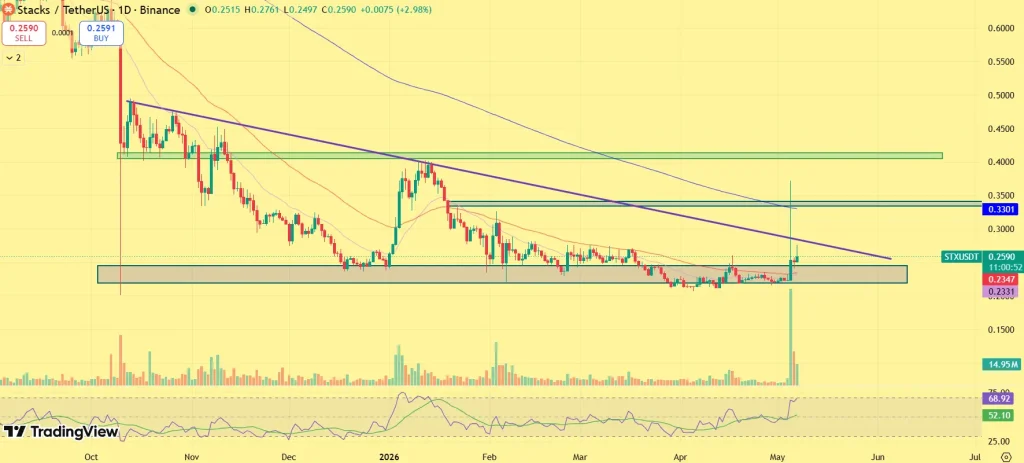
The long upper wick printed during the latest rally suggests aggressive volatility expansion and strong liquidity absorption near local lows, a pattern often associated with early-stage reversal attempts. The bearish sequence of lower lows is now weakening, while buyers are attempting to reclaim short-term control above the range midpoint.
Analysts are now watching the $0.30 level closely, as it remains the most critical breakout barrier for confirming a larger bullish reversal. If STX price clears that region, the next major upside target sits near $0.38, where a heavy supply zone previously triggered rejection earlier this year.
For now, Stacks price remains inside a developing recovery structure, but momentum has improved considerably compared to previous weeks. As long as STX price holds above the reclaimed $0.22–$0.24 support region, buyers are likely to maintain control of the short-term trend. Market attention now remains focused on whether bulls can generate enough momentum for a confirmed breakout above $0.30.
If that breakout materializes, STX price could rapidly accelerate toward the next major resistance near $0.38, potentially marking the beginning of a broader recovery cycle after months of bearish pressure.

Kraken parent Payward agreed to buy Hong Kong-based Reap for up to $600 million, adding card issuance and stablecoin payment capabilities to its new B2B platform.

Polygon delivered its first block time reduction upgrade since genesis, as the network seeks to position for more high-frequency applications such as private stablecoin payments.

XRP is retesting a key multi-year support zone that has historically preceded major rebounds, with analysts predicting a rally toward $12 if the level holds.

South Korea’s Finance Ministry has reportedly confirmed for the first time that a 22% tax on crypto gains will proceed as scheduled in January 2027.

Core Scientific mined 279 BTC in the quarter, down 45% from a year earlier, while its colocation business became its top revenue source.

VanEck’s Matthew Sigel says Bitcoin may reach $1 million in five years, comparing adoption trends to the video game industry’s shift to mainstream use.

A slowdown in profit-taking and reclaiming $88,000 as support are prerequisites for BTC to confirm cycle bottom.






Marlon Ferro, aka “GothFerrari,” broke into victims’ homes to steal hardware wallets when his co-conspirators couldn’t hack them remotely.

A new Bitcoin Bollinger Bands breakout attempt on the daily chart drew mixed reactions as the metric's creator, John Bollinger, revealed a fresh BTC position.

Changelly uncovers the main stablecoin trends for 2026, and hosts a podcast with Stablerail on stablecoin infrastructure every business must build on May 15, 2026.

The post South Korea to Impose Crypto Tax, Starting January 2027 appeared first on Coinpedia Fintech News
South Korea’s Ministry of Economy and Finance has confirmed that crypto gains above $1,800 will face a 22% tax starting January 2027. The announcement marks one of the biggest regulatory shifts for the South Korean crypto market, which remains one of the largest and most active digital asset markets in Asia.
The new rules are expected to impact more than 13 million crypto investors across the country.
Under the updated Income Tax Act, profits earned from transferring or lending virtual assets will now be classified as “other income.” Starting January 2027;
Officials estimate that the policy could affect approximately 13.26 million crypto investors in South Korea. However, the government also clarified that the crypto tax will remain separate from financial investment income taxes.
Despite political pressure to delay or completely abolish the tax, the Ministry of Economy and Finance confirmed that implementation will proceed as planned.
At an emergency virtual asset taxation forum held in Seoul, Moon Kyung-ho, director of the ministry’s income tax division, stated:
“We will implement the virtual asset tax in January next year as scheduled.”
This is the first time the ministry has publicly confirmed its final stance on the long-delayed crypto tax policy.
Moon also defended the framework, saying:
“Virtual assets are subject to a 20% rate under separate taxation as other income, which in some respects is more favorable to taxpayers than comprehensive taxation.”
South Korea’s National Tax Service is now working closely with the country’s five largest crypto exchanges including Upbit, Bithumb, Coinone, Korbit & Gopax.
Authorities are currently developing detailed tax reporting systems and compliance guidelines ahead of the 2027 rollout.
The government also plans to release separate tax standards for newer crypto income sources such as;
One major concern surrounding the tax involves tracking transactions made on overseas exchanges, decentralized exchanges (DEXs), and peer-to-peer platforms.
However, officials said these issues can be managed through;
The government also rejected criticism regarding potential double taxation. Officials explained that capital gains taxes on crypto profits and VAT charged on exchange service fees apply to different areas, meaning the system should not be viewed as double taxation.
South Korea remains one of the world’s most influential crypto trading markets, particularly for retail investors.
The post Coinbase Launches Gold and Silver Perpetual Futures appeared first on Coinpedia Fintech News
Coinbase has launched gold (GOLD-PERP) and silver (SILVER-PERP) perpetual futures for eligible non-U.S. traders, expanding crypto-linked commodities trading. The new contracts are settled in USD Coin and offer up to 25x leverage. Meanwhile, Coinbase Derivatives is working with the CFTC to upgrade its regulated U.S. gold and silver futures markets to 24/7 trading, replacing the traditional 23/5 schedule. The move reflects growing demand for always-open digital trading infrastructure tied to real-world assets.

The post Asteroid Shiba Price Down 14% as Mystery Trader Cashes In After 731,000% Rally appeared first on Coinpedia Fintech News
ASTEROID Shiba is currently down around 14.82% in the past 24 hours, trading near 0.000368.
The correction comes after ASTEROID’s massive 731,582% surge over the past 30 days, triggering aggressive profit-taking from traders who entered early in the rally.
The token made headlines today after blockchain analytics platform Arkham revealed that a mystery trader with only nine followers on X turned a small investment into a massive win.
THIS GUY HAS 9 FOLLOWERS – HE JUST MADE A MILLION DOLLARS
— Arkham (@arkham) May 7, 2026
Nobody knows who trader @404eq is – but he bought $17.5K of ASTEROID at an average of $2.5M Market Cap.
Since then, he’s up over $1 Million. How bullish is he on ASTEROID? pic.twitter.com/OvRUPZvMkw
According to Arkham, trader @404eq bought around $17,500 worth of ASTEROID when the token’s market cap was sitting near just $2.5 million. Since then, the wallet’s profits have surged past $1 million as the meme coin exploded higher.
The mystery wallet has not fully exited the position yet. Arkham later revealed that the trader sold about $118,900 worth of ASTEROID and transferred another $187,000 to CookerFlips, but is still holding nearly $750,000 worth of the token.
He sold $118.9K, sent $187K to CookerFlips, and is still holding $750K of ASTEROID.
— Arkham (@arkham) May 7, 2026
Track 404eq on Arkham:https://t.co/cDm1DGODP8
That has sparked speculation across crypto social media about whether the trader expects another major rally ahead.
For now, the biggest factor driving ASTEROID appears to be profit-taking after its parabolic move. Hence, technically, the token could stabilize if buying pressure returns and price holds above the key $0.00035 level.
However, if ASTEROID breaks the support, the next downside target could move closer to $0.00034. Traders are also watching whether trading volume begins to normalize after the recent frenzy.

The post WLFI Price Recovery Gains Steam as AI Integration Sparks Fresh Market Interest appeared first on Coinpedia Fintech News
WLFI is back on traders’ radar after a sharp recovery rally erased part of its recent breakdown losses. The token has climbed nearly 19% this week as speculative momentum returns to AI-linked crypto projects, with investors increasingly focusing on World Liberty Financial’s expanding AI ecosystem narrative.
The rebound comes despite ongoing legal controversy surrounding reports tied to Justin Sun, suggesting the market is shifting attention toward future utility and ecosystem growth rather than short-term headline pressure. With WLFI price now approaching a key resistance zone, traders are watching closely to see whether the recovery can evolve into a broader trend reversal.
The biggest driver behind WLFI’s recovery appears to be the project’s accelerating push into AI infrastructure and autonomous agent technology.
Recent updates surrounding WorldClaw AI and WorldRouter revealed plans to integrate access to more than 300 AI models while enabling AI agents to execute payments through USD1 across ecosystems including BNB Chain and Solana.
— Bitcoin.com News (@BitcoinNews) May 5, 2026
@worldlibertyfi is expanding access to AI with WorldClawAI, allowing users to access 300+ models via WorldRouter.
AI agents can facilitate payments in $USD1 on BNB Chain and #Solana to support task execution.
Locking $WLFI tokens will give access to additional features. pic.twitter.com/nBoxPIUn9I
The platform also hinted that locked WLFI tokens may unlock additional ecosystem utilities and premium features. That narrative arrives as AI-linked crypto assets continue attracting renewed speculative inflows across the market. Traders have increasingly rotated toward projects connected to decentralized AI infrastructure, autonomous systems, and agentic economies, sectors that are once again outperforming broader altcoin momentum.
For WLFI, the AI expansion story is helping shift sentiment away from recent weakness and repositioning the token within one of crypto’s strongest narrative sectors.
WLFI is attempting to stabilize after months of sustained downside pressure. The token previously broke below its broader descending structure, triggering a sharp sell-off that pushed price action toward the $0.05 support region. However, buyers quickly defended the zone, leading to a rebound that has now developed into a short-term recovery structure.
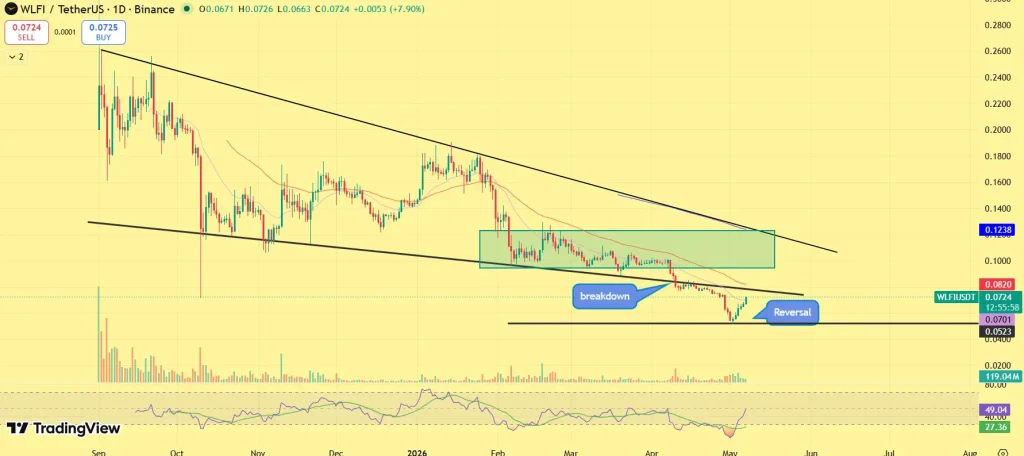
WLFI is currently approaching the critical $0.09–$0.12 resistance area, a zone that previously acted as support before flipping into resistance following the breakdown. Reclaiming that region could significantly improve the token’s market structure and potentially confirm a larger trend reversal setup. Momentum indicators are also beginning to strengthen. RSI has rebounded from oversold territory, while price action is starting to print higher lows for the first time in weeks. Rising volume during the recovery phase further suggests speculative participation is returning to the market.
For now, traders remain focused on whether bulls can sustain momentum above recent support levels and break through descending trendline resistance.
Despite the improving momentum, WLFI remains surrounded by legal uncertainty following reports tied to a complaint involving Tron founder Justin Sun. According to documents and discussions circulating across crypto social media, the filing includes allegations related to token agreements, disclosure terms, and public statements surrounding WLFI token purchases.
However, the claims remain allegations outlined in the complaint and are not court findings or final legal rulings. Interestingly, the token’s ability to recover despite the controversy may indicate that speculative market participants are currently prioritizing ecosystem growth and AI positioning over ongoing legal concerns.
WLFI is entering a decisive technical phase as recovery momentum accelerates alongside renewed AI-driven speculation. If buyers successfully reclaim the $0.10–$0.12 resistance zone, the token could attempt a broader breakout reversal after months of downside pressure. However, failure to sustain momentum may leave WLFI vulnerable to renewed volatility. For now, improving technical structure, rising trading activity, and expanding AI ecosystem integration remain the key bullish catalysts driving market attention.

The post Ice Open Network Reveals New Direction After Security Breach and Team Cuts appeared first on Coinpedia Fintech News
Ice Open Network has finally addressed growing concerns from its community after weeks of silence, reduced updates, and rising criticism surrounding the project’s direction. The statement comes after many users pointed out that the development had slowed down following missed expectations, technical delays, and the sudden drop in communication from the team.
In a lengthy X post, Ice Open Network reassured supporters that the project is still active and “still building,” even though the team is now smaller than before.
Ice Open Network recently faced a security breach linked to a third-party provider, exposing some user emails and 2FA-related phone numbers. The team clarified that no wallets or funds were affected, but the incident still triggered community concerns.
Since then, the project says it has been upgrading infrastructure and taking legal action against those involved.
The project admitted that things may look difficult from the outside, but said the current phase is about staying focused on execution instead of public hype. According to the team, this period will help separate long-term supporters from short-term panic and negativity.
Ice Open Network stressed that the lack of updates should not be seen as abandonment. “Silence does not mean surrender. It means focus,” the team wrote.
One important shift announced by the project is its communication strategy. Ice Open Network said it will no longer share weekly bulletins, internal milestones, or expected timelines before products are fully ready.
The team explained that previous transparency often backfired whenever delays happened, turning unfinished work into FUD and damaging community trust instead of helping it.
Instead, the project now plans to reveal developments only when products are closer to launch.
According to the statement, the project’s main priority now is building products that generate “real revenue” and create a stronger long-term business model.
The team also hinted that Ice Open Network wants to move beyond being just another crypto project. It said the goal is to build technology that can scale outside the crypto industry by offering faster, cheaper, and utility-driven solutions.
Ice Open Network teased several upcoming updates, including changes to its website, whitepaper, and overall direction. While no launch dates were provided, the team said the new vision will become clear once development is ready to be shown publicly.
The statement also included a personal lesson from the team, saying they learned not to “brag before the product is ready,” adding that if the work was easy, “everyone would have done it already.”

The post South Korea to Launch Crypto Tax Rules in January 2027 appeared first on Coinpedia Fintech News
South Korea will begin taxing virtual asset gains from January 2027, according to local reports. The country’s National Tax Service is coordinating with major exchanges including Upbit, Bithumb, Coinone, Korbit, and Gopax to finalize implementation measures. Under the current law, crypto gains exceeding KRW 2.5 million will face a 22% tax rate, including 20% income tax and 2% local income tax, marking a major regulatory step for South Korea’s digital asset market.

The post BNY Expands Crypto Custody Push to Abu Dhabi as UAE’s Digital Asset Race Heats Up appeared first on Coinpedia Fintech News
BNY, the world’s largest custodian bank with nearly $59 trillion in assets under custody and administration, is making a bigger move into crypto. The Wall Street giant is expanding its digital asset custody business into Abu Dhabi through partnerships with Finstreet and ADI Foundation.
As per the report, the new initiative will operate inside Abu Dhabi Global Market (ADGM), one of the Middle East’s fastest-growing crypto and blockchain hubs. Initially, the focus will be on custody services for Bitcoin and Ethereum, but the plan is to later expand into stablecoins and tokenized assets.
This is another sign that traditional finance is moving deeper into blockchain infrastructure. BNY was already the first major U.S. global systemically important bank to launch digital asset custody services, and now it’s taking that business into one of the world’s most crypto-friendly regions.
Hani Kablawi, Executive Vice Chair at BNY, said the UAE is entering a “new phase of financial development” driven by stronger digital connectivity and deeper capital markets. According to him, BNY wants to help connect traditional finance with digital assets through regulated infrastructure.
A big reason behind the move is regulation. Unlike many regions still figuring out crypto laws, ADGM has spent years building a clear framework for digital assets through its Financial Services Regulatory Authority (FSRA).
For a 240-year-old bank like BNY, legal clarity matters. It gives institutions confidence to safely manage crypto assets with the same standards used for traditional financial products.
This expansion is not just about storing Bitcoin and Ethereum. The real opportunity is tokenization, putting real-world assets like real estate, bonds, and private equity on blockchain networks.
By working with ADI Chain infrastructure, BNY is positioning itself for a future where trading, settlement, and custody all happen on-chain in one regulated ecosystem.
BNY’s arrival in the UAE signals a “domino effect” for other global banks. As one of the biggest names in traditional finance, its move adds major credibility to Abu Dhabi’s ambition of becoming a global hub for regulated digital finance.
The UAE is no longer just attracting crypto startups; it’s now becoming a serious destination for trillion-dollar institutional players.







1inch said its protocols, infrastructure and user funds were not affected by the exploit targeting independent resolver TrustedVolumes.

BNY is partnering with Finstreet and ADI Foundation to offer regulated Bitcoin and Ethereum custody to UAE clients from the Abu Dhabi Global Market.







Luffa, the global leader in intelligent ecosystem platforms, today officially announced a major brand upgrade, repositioning itself as the AI × Web3 Super Connector.

Bithumb’s tie-up with SSI Digital positions it for Vietnam’s strict crypto exchange pilot as competition for scarce licenses heats up and scrutiny mounts at home.

Near One says blockchains may need new ownership verification systems if quantum attacks compromise wallet keys and expose private assets.







The post NEAR Protocol Breakout Gains Momentum as Smart Money Bets on AI-Focused Crypto appeared first on Coinpedia Fintech News
NEAR Protocol emerged as one of the strongest-performing altcoins on Thursday after surging more than 13% in 24 hours, reigniting bullish momentum across AI-focused crypto assets. The rally pushed NEAR back toward a major breakout zone as traders rotated into infrastructure-driven narratives tied to artificial intelligence, decentralized compute, and next-generation blockchain ecosystems.
The move comes as sentiment across AI-linked cryptocurrencies continues improving amid rising institutional attention and growing speculation that infrastructure-focused projects could lead the next phase of the market cycle. Momentum around NEAR strengthened further after BitMEX co-founder Arthur Hayes recently identified the project as a potential outperformer during the current cycle.
Unlike short-term speculative rallies driven purely by hype, NEAR’s latest move appears increasingly supported by expanding derivatives participation, improving technical structure, and strengthening ecosystem fundamentals.
Beyond price action, NEAR has been aggressively positioning itself around the emerging “agentic economy” narrative through initiatives tied to NEAR AI, Confidential Intents, and broader AI infrastructure development.
Quantum computing is a threat to every blockchain protocol. NEAR's architecture already makes accounts and assets more quantum-secure than most chains.
— NEAR Protocol (@NEARProtocol) May 6, 2026
The team is now adding post-quantum cryptography to secure NEAR and the wider Intents ecosystem.
Here's what's underwaypic.twitter.com/kugoUIlq24
The protocol also recently announced plans to integrate post-quantum cryptography into its ecosystem, aiming to strengthen blockchain security against future quantum computing threats.
The development added another institutional-grade narrative to the project at a time when Layer-1 ecosystems are increasingly competing around AI integration, infrastructure scalability, and long-term security architecture. Traders appear to be interpreting these developments as signs that NEAR is evolving beyond a traditional smart contract blockchain into a broader AI-focused infrastructure platform.
CoinGlass data showed futures trading volume surging more than 250% to over $834 million during the rally, while open interest climbed roughly 24% to above $320 million. The simultaneous rise in both price and open interest suggests fresh capital entering the market rather than a simple short-covering event.
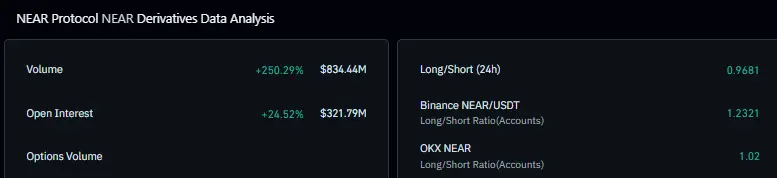
Funding conditions also remained relatively stable despite the sharp rally, indicating bullish positioning is building without excessive leverage overheating the market. Meanwhile, Binance top trader positioning continued showing a noticeable long bias, reinforcing expectations that traders are positioning for continuation rather than fading the breakout.
From a technical perspective, NEAR recently broke out of the long-term descending channel structure that had controlled price action for several months. However, instead of immediately accelerating higher, the token entered a broad consolidation range between roughly $1.30 and $1.60, where it has traded since February.
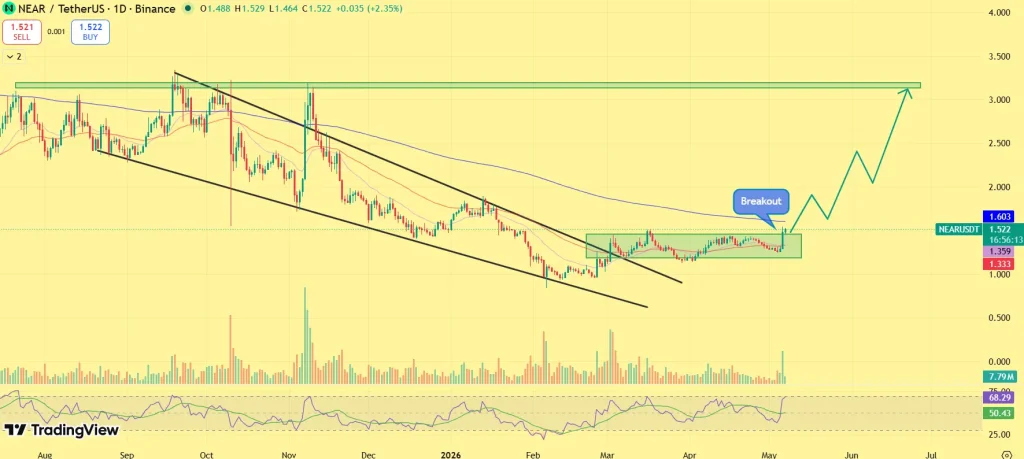
That prolonged sideways structure now appears to be evolving into a fresh breakout attempt. The latest rally pushed NEAR back toward the upper boundary of the range while daily RSI momentum climbed above 60, signaling strengthening bullish control. Rising volume during the move further suggests buyers are attempting to transition the market from accumulation into expansion.
The immediate resistance now sits near the $1.60 breakout region. A decisive close above that level could confirm a larger range breakout and potentially open the path toward the psychological $2 barrier first, followed by a broader expansion toward the $2.80–$3 resistance zone highlighted on the higher timeframe structure. Still, analysts note that failure to sustain above the breakout level could trigger temporary consolidation before the next directional move develops.
NEAR’s latest rally is increasingly being driven by a combination of AI narrative momentum, expanding derivatives participation, and improving market structure rather than pure speculative hype. As smart money continues rotating toward infrastructure-focused crypto projects, traders are beginning to watch whether NEAR can transition from a multi-month accumulation phase into a sustained macro reversal. If bullish momentum continues building and broader market conditions remain supportive, the path toward the $3 region could become increasingly realistic over the coming weeks.
The post Ondo Finance and XRP Ledger Complete Real-Time Treasury Settlement appeared first on Coinpedia Fintech News
Ondo Finance, Kinexys by JPMorgan Chase, Mastercard, and Ripple completed a breakthrough pilot connecting the XRP Ledger with institutional settlement rails. The transaction enabled tokenized U.S. Treasuries to settle across borders in near real time, even outside traditional banking hours. Ondo processed Ripple’s OUSG redemption on XRP Ledger, while Mastercard routed settlement instructions to Kinexys, which delivered USD to Ripple’s Singapore account. The milestone strengthens the case for always-on global markets powered by tokenized assets and blockchain infrastructure.
The post Notcoin Price Jumps as Altcoin Season Momentum Accelerates appeared first on Coinpedia Fintech News
Notcoin surged as the Altcoin Season Index climbed 7.5% in 24 hours, signaling stronger capital rotation into higher-risk altcoins despite Bitcoin slipping slightly. The rally appears driven more by broader market sentiment than coin-specific developments, highlighting growing appetite for speculative crypto assets. Analysts now see $0.00060 as a critical support level, while sustained altcoin momentum could push NOT toward the $0.00075 resistance zone. Rising Bitcoin dominance, however, remains the biggest threat to the rally’s continuation.
The post VanEck Says $1 Million Bitcoin Is The Base Case — Here Is What The Data Says appeared first on Coinpedia Fintech News
Bitcoin is slowly regaining momentum as investors once again look toward the $100,000 milestone. After dropping from its late-2025 high of $126,000, BTC is now trading near $81,000, supported by improving sentiment, growing enthusiasm around the U.S. CLARITY Act, and strong institutional demand.
Spot Bitcoin ETFs saw massive $2.44 billion inflows in April 2026 alone, marking the strongest month since the 2025 peak. On May 6, spot Bitcoin ETFs recorded a total net inflow of $46.33 million, marking the fifth consecutive day of net inflows.
Matthew Sigel, Head of Digital Assets Research at VanEck, made one of the boldest predictions yet, saying Bitcoin reaching $1 million is now the firm’s “base case.”
“Bitcoin going up for us is the base case. We think this asset is going to reach a million dollars over the next several years,” Sigel said during a CNBC interview.
To explain his outlook, Sigel compared Bitcoin to the video game industry. He noted that gaming was once seen as something mainly for kids, but today it is mainstream across all age groups, even mentioning that Elon Musk plays video games. According to Sigel, Bitcoin is following a similar path toward mass adoption.
“People don’t quit Bitcoin,” he said, pointing to growing interest from younger investors and the fact that central banks are now beginning to hold Bitcoin reserves. He described Bitcoin as a long-term “mega trend,” although he warned that the asset will remain highly volatile along the way.
Sigel believes Bitcoin could potentially reach $1 million within five years if adoption keeps accelerating.
According to CryptoQuant researchers, Bitcoin’s next major target could be $93,000 due to a key CME gap. BTC recently surged close to $83,000 as the total crypto market cap jumped to $2.73 trillion. Moreover, a sharp 12% crash in oil prices and growing optimism around a possible U.S.-Iran peace deal also added fresh fuel to the crypto rally.

The post BNY Brings Crypto Custody Services to Abu Dhabi appeared first on Coinpedia Fintech News
BNY Mellon is expanding its digital asset business into Abu Dhabi by launching crypto custody services through local partners Finstreet and ADI Foundation. The initiative will operate within the Abu Dhabi Global Market (ADGM) regulatory framework and initially support Bitcoin and Ethereum custody for institutional clients. The bank also plans to expand into stablecoins and tokenized assets in the future. With nearly $59 trillion in assets under custody and administration, BNY’s move highlights growing institutional interest in regulated crypto infrastructure across the Middle East.
The post Why is Toncoin Price Surging Today? appeared first on Coinpedia Fintech News
Toncoin has become the biggest crypto gainer of the day, surging more than 31% in just 24 hours and climbing to the 16th-largest cryptocurrency by market capitalization. While most of the crypto market remained relatively flat, TON exploded higher after a series of major announcements tied to Telegram and its growing blockchain ecosystem.
Here’s the key reason: Why is Toncoin price of Toncoin surging today?
The rally began after Toncoin CEO Pavel Durov announced on May 5 that Telegram had officially replaced the TON Foundation as the network’s largest validator.
Telegram becoming TON’s largest validator strengthens decentralization.
— Pavel Durov (@durov) May 5, 2026
It lets other major players join the validator pool without centralizing the network — with Telegram as the counterbalance.More and more TON gets locked in validation as everyone competes for 20%+ APR.
The move allows other major validators to join the network while keeping Telegram as a balancing force, reducing concerns around centralization and execution risk.
This shift immediately strengthened the bullish narrative surrounding TON, especially because of Telegram’s massive global reach of more than 900 million users.
Another major catalyst behind TON’s surge is rising validator participation and staking demand.
As more users compete for staking rewards reportedly exceeding 20% APR, a growing amount of TON supply is becoming locked within the network. This reduces circulating supply while increasing demand pressure, a combination that often supports strong price rallies.
According to network data, TON processed nearly 67 million transactions in April 2026, marking its strongest monthly performance of the year so far. At the same time, the network’s staking ratio reportedly climbed another 18%.
Market excitement increased further after Pavel Durov revealed additional upgrades under the second phase of his “Make TON Great Again” (MTONGA) roadmap.
The roadmap focuses on tighter Telegram integration, faster ecosystem development, and improving usability for developers and users.
One of the biggest announcements involved transaction fee reductions.
Durov stated that within a week, TON transaction fees would fall nearly six times to just 0.00039 TON, or roughly $0.0005 per transaction.
— Pavel Durov (@durov) April 23, 2026
Soon after most transactions go fully feeless. Zero commission. MTONGA!
From a technical perspective, analysts believe TON could be approaching a major breakout zone.
The token has already recovered nearly 30% from its lower support trendline and is now testing key resistance levels between $2.80 and $3.00.
If TON successfully breaks above the descending channel resistance, analysts believe it could potentially trigger a larger rally toward the $6–$7 range.
However, risks remain elevated.
TON’s Relative Strength Index (RSI) has climbed above 93, signaling overbought conditions.
The post BNY Expands Digital Asset Custody Business Into UAE Amid Tokenization Push appeared first on Coinpedia Fintech News
BNY, the world’s largest custodian overseeing $59 trillion in assets, is expanding its digital asset custody operations into the United Arab Emirates through partnerships with Finstreet and the ADI Foundation. The initiative, based in Abu Dhabi Global Market, will initially support custody for Bitcoin and Ethereum before expanding into stablecoins and tokenized assets. The move highlights growing institutional adoption of blockchain infrastructure and strengthens the UAE’s position as a global hub for regulated digital asset finance and tokenization.
The post TON DeFi Explodes as STON.fi Volume Surges 26x After Network Upgrades appeared first on Coinpedia Fintech News
DeFi activity on TON is accelerating rapidly, with DefiLlama data showing Total Value Locked jumping 20% in 24 hours. The biggest catalyst was STON.fi, which processed $40 million in daily swap volume after recent network upgrades a 26x surge from last week’s average. On-chain activity also intensified, averaging one transaction every 0.73 seconds. The momentum supports the “MTONGA” scaling vision backed by Pavel Durov, signaling growing utility, liquidity, and potential institutional attention for the TON ecosystem.

The post 1inch Liquidity Provider Trusted Volumes Exploited for $5.87 Million appeared first on Coinpedia Fintech News
Another major DeFi attack has shaken the crypto market. A liquidity provider tied to 1inch’s Trusted Volumes system has reportedly been exploited for nearly $5.87 million, with attackers draining millions in WETH, USDT, WBTC, and USDC.
More concerningly, blockchain security firms warn that the exploit may still be ongoing, meaning additional losses could still occur.
So, how did the exploit happen?
Security researchers at Blockaid revealed that attackers exploited a vulnerability in the Trusted Volumes resolver contract. This vulnerability allowed them to execute malicious orders directly from users’ wallets.
The attack worked by abusing a public function in the contract. Using this function, the attacker was able to add themselves as an “Allowed Order Signer.” Once they gained this permission, they could use old wallet approvals that users had previously granted to move funds.
— Blockaid (@blockaid_) May 7, 2026
Blockaid's exploit detection system has identified an on-going exploit on TrustedVolumes (1inch market maker / resolver, @trustedvolumes ).
Chain: Ethereum
Victim contract: TrustedVolumes resolver — 0x9bA0CF1588E1DFA905eC948F7FE5104dD40EDa31
Exploiter:…
What made the exploit especially dangerous is that users did not need to approve any new transaction for the attack to happen. Existing token approvals alone were enough for attackers to access and transfer assets.
The incident once again highlights one of DeFi’s biggest hidden risks: unlimited token approvals that stay active even after users stop using a protocol.
According to Blockaid, the attacker behind this exploit appears to be linked to the March 2025 1inch Fusion V1 attack.
Further blockchain security firm PeckShield reported that the attacker has already extracted:
The total stolen amount currently stands at approximately $5.87 million.
Researchers identified the affected resolver contract and vulnerable proxy linked to the March 2025 1inch Fusion V1 attack. Security experts also discovered strong similarities between the two incidents while tracing the exploiter wallet connected to the attack.
The TrustedVolumes exploit is now reportedly the fifth major DeFi exploit over the last one month alone, extending what is becoming an increasingly dangerous period for decentralized finance platforms.
The overall DeFi market has already witnessed several massive hacks in recent weeks, including:
According to data from DefiLlama, total crypto assets stolen in April 2026 surged to approximately $635.2 million, the highest level since the massive 2025 Bybit exploit where nearly $1.5 billion was drained.
The post Ethena Jumps 4% After Grayscale Adds It to DeFi Fund in Q1 Rebalancing appeared first on Coinpedia Fintech News
Ethena Jumps 4% After Grayscale Adds It to DeFi Fund in Q1 Rebalancing
Grayscale Investments reshuffled its crypto portfolios this week as part of its Q1 2026 fund rebalancing. The firm removed Aerodrome Finance from its DeFi Fund and replaced it with Ethena, a yield-focused decentralized finance protocol.
Ethena rose 4.33% in the last 24 hours following the announcement. Grayscale also made adjustments to its Smart Contract Fund, though no new assets were added to that portfolio.
The biggest change came in Grayscale’s DeFi Fund. Following the CoinDesk DeFi Select Index methodology, the firm sold AERO and portions of other existing holdings to purchase ENA.
As of May 1, 2026, the fund holdings stood at:
Grayscale also adjusted the weightings of its Smart Contract Fund using the CoinDesk Smart Contract Platform Select Capped Index methodology. Unlike the DeFi Fund, no assets were removed or added.
The updated allocations are:
The allocation shows Grayscale still heavily favors established smart contract ecosystems led by Ethereum and Solana.
These updates give a simple look into where institutional investors believe crypto is heading. Grayscale appears to be betting more on DeFi projects connected to stablecoins, yield, and tokenized assets rather than only trading platforms.
At the same time, the company is still keeping strong exposure to big blockchain ecosystems like Ethereum and Solana, which continue to dominate developer activity and liquidity in crypto markets.
Overall, rebalances like this reflect where capital is rotating. The question is whether flows follow or lag.

Samourai Wallet co-founder Keonne Rodriguez said mounting legal debt and fading pardon hopes could force him to serve his full prison sentence.

Donald Trump’s sons’ company, American Bitcoin, missed analyst revenue estimates and posted narrower losses as it ramped up its mining capacity.

The system enables near-instant conversion between UAE dirham and US dollar stablecoins within the country’s regulated payment token regime.



Galaxy Digital’s Thaddeus Pinakiewicz noted that Aave is now only 10% short of recovering from the bad debt that hit its lending protocol after the Kelp DAO hack.

Bitwise investment chief Matt Hougan says projections tipping stablecoins to hit $4 trillion in value by 2030 could happen if major tech firms continue to adopt them.
The post CLARITY Act Update: White House Sets July 4 Deadline as Senate Moves Toward Vote appeared first on Coinpedia Fintech News
The White House is pushing to pass the Digital Asset Market Clarity Act before July 4, according to Patrick Witt, the administration’s digital assets adviser.
Witt said that the Senate Banking Committee is expected to advance the bill this month and that most major disputes have been resolved. On the stablecoin yield question, which had been one of the most contested issues, he said a compromise has been reached though both the crypto industry and banks remain unhappy with the outcome.
“I’m very bullish, cautiously optimistic,” Witt said about the bill’s prospects.
Senate Banking Committee Chairman Tim Scott described the bill as “in the red zone.” CFTC Chair Mike Selig said he is hopeful for a July 4 signing.
The CLARITY Act would establish clear boundaries between SEC and CFTC jurisdiction over digital assets, set rules for stablecoin yields, create a regulatory framework for crypto exchanges and institutions, and reduce the use of enforcement actions as the primary tool of crypto oversight in the United States.
Senator Kirsten Gillibrand, the lead Democratic negotiator on the bill, said at the Consensus 2026 conference on Wednesday that she will not support the legislation without provisions banning crypto insider trading by lawmakers and government officials.
Gillibrand, who wrote the 2012 STOCK Act barring congressional insider trading in equities, named three issues that must be resolved before the Senate Banking Committee proceeds to markup: ethics rules, consumer protections, and safeguards against illicit finance and terrorism financing.
“It can get done by August if we’re lucky,” she said.
Many Democrats are concerned about potential conflicts of interest involving the Trump family. Bloomberg has estimated the family has earned at least $1.4 billion from the crypto industry. The White House said it is negotiating ethics rules that would apply to all government officials broadly rather than targeting specific individuals or families.
Witt said updates on the proposed US Strategic Bitcoin Reserve are expected in the coming weeks. The administration is currently auditing and centralising crypto assets held by federal agencies following President Trump’s executive order, with details on the reserve’s structure to follow.
The Senate Banking Committee markup in May is the most critical near-term milestone. If the bill clears committee, a July 4 deadline remains achievable. If it stalls, passage is more likely to slip to August at the earliest.

The post XRP News Today: JPMorgan, Mastercard and Ondo Complete a Historic First appeared first on Coinpedia Fintech News
Four of the biggest names in global finance just completed a transaction that the industry has been working toward for years. Ondo, Kinexys by JPMorgan, Mastercard, and Ripple successfully executed a pilot transaction connecting the XRP Ledger directly with interbank settlement rails.
The result was the first time tokenized US Treasuries settled across borders and between banks in near real time, outside traditional banking windows.
The transaction moved through three distinct steps. Ondo processed a redemption of OUSG, its tokenized US Treasury product, on the XRP Ledger. Mastercard’s Multi-Token Network then routed the settlement instructions to Kinexys, JPMorgan’s blockchain-based payment platform. JPMorgan then delivered US dollars directly to Ripple’s Singapore bank account.
Start to finish, a tokenized asset moved from a public blockchain through global banking infrastructure and landed as real money in a real bank account, in real time.
Cross-border settlements today are slow, expensive, and bound by banking hours and time zones. This pilot demonstrated that those constraints are not inevitable. A public blockchain and traditional banking infrastructure can work together in a single integrated flow without one replacing the other.
Tokenized assets have long been described as the future of finance. This transaction suggested that future is closer than most expected. For the first time, a tokenized fund did not just exist on a blockchain. It settled across borders, across institutions, and across time zones as part of a live transaction.
The broader implication is significant. Global financial markets currently close. The infrastructure tested in this pilot is designed to make sure they never have to.

The cross-border tokenized US Treasury transaction using blockchain and banking rails builds on an earlier pilot in which the same fund moved between a public and permissioned blockchain.


Ether rallies are abruptly capped at $2,400 and multiple data points suggest this pattern will remain in play for the foreseeable future.




Bitcoin's market dominance climbed above 61% as BTC led crypto market flows. Data also showed Binance-listed altcoins' share of volume hitting 49% in March.



Senator Kirsten Gillibrand said the Senate must address lawmakers potentially getting “rich off of these industries because of their insider status“ before any vote on the CLARITY Act.



Bitcoin's market dominance climbed above 61% as BTC led crypto market flows. Data also showed Binance-listed altcoins' share of volume hitting 49% in March.

The company also announced a new AI energy leasing deal as it continues to diversify into adjacent high-performance computing applications.

Representative James Baird won the Republican primary for Indiana's 4th district on Tuesday after receiving an endorsement from Donald Trump and supportive spending from a crypto-backed PAC.

SIX Group received FINMA approval to provide crypto custody through the same regulated infrastructure used for traditional securities settlement and post-trade services.






Bitcoin sellers may show up if BTC hits $84,000, but altcoin charts continue to predict new price highs.

The FINMA-regulated bank's institutional clients will get access to trading and holding Canton Coin through a banking platform instead of crypto-native venues.

Ether could rise as high as $3,500 in the coming days, fueled by rising balances in Ethereum accumulation wallets and a strengthening technical structure.

The crypto exchange said eligible US users can now access up to 10x leveraged spot crypto trading through a CFTC-registered entity.



Bitcoin price action failed to revisit the $83,000 mark after US-Iran war tensions took over to steer the crypto market mood.

The Wall Street bank is charging 50 basis points per crypto trade, below basic retail pricing at Coinbase, Robinhood and Charles Schwab.

The crypto industry in the UK has come out against the Bank of England’s proposed policy that would ban custodial wallets for stablecoins.

OpenTrade raised $17 million to expand its stablecoin yield platform, bringing total funding above $30 million as it scales stablecoin yield infrastructure for global clients.

Remittance firms are using crypto to bypass parts of traditional settlement infrastructure, but this does not mean SWIFT is disappearing.

The Korea Securities Depository platform is expected to launch by February 2027, aligning with South Korea’s incoming security token regulations.

Robinhood’s ZEC listing, easing US–Iran tensions and a shrinking liquid supply of tokens are further strengthening the bullish outlook for Zcash in the coming weeks.

Bubblemaps said it identified a large wallet cluster that accumulated 90% of the Mystery token’s supply at launch, raising concerns around the token’s distribution.

Linea Consortium board director Declan Fox said the move gives its technology a neutral, foundation-governed home.

The post Can TROLL Crypto Price Sustain Its 250% Rally & Break $0.08? appeared first on Coinpedia Fintech News
Out of nowhere this week, the TROLL crypto price has decided it’s done bleeding. After months of slow grind and near irrelevance through early 2026, the token just flipped the script very hard. Early May brought a brutal 250% rally, and suddenly, this isn’t just another dead chart. As It’s moving fast and could keep going contingent on demand.
Here’s price action on daily time frame chart where it gets even more interesting. The TROLL crypto price blasted through the $0.04001 level, marking a clear change of character after a prolonged downtrend. That level wasn’t just resistance but it was the line between “forgotten” and “maybe not.” Now it’s holding above it. That matters a lot now.
Even the 200-day EMA band has flipped from pressure to support, which, in crypto terms, is basically the market saying, “fine, we’ll take this seriously for now.”
Well, today this rally saw another spike intraday and didn’t come out of thin air. iTrustCapital added TROLL to its platform, opening the door for IRA-based trading.
And yes, the messaging leaned hard into it because it says capital gains tax-free trading, retirement narratives, the whole pitch. Predictable? Sure. Effective? Also yes.
Because suddenly, TROLL isn’t just a meme but it’s “portfolio eligible.”
So, what’s next? TROLL crypto Price already wicked up to around $0.06001 intraday, and now it’s eyeing the $0.08001 level as the next real test. Clear that, and the next zone sits way higher near $0.14000. But let’s not get carried away.
If momentum fades and $0.04001 support cracks, this entire move could unwind just as quickly as it started. For now though, the TROLL price is riding momentum and in this market, that’s usually enough.
The post The Centralization Paradox: Why We Hate Arbitrum but Love Durov’s TON appeared first on Coinpedia Fintech News
So, it turns out “decentralization” is just a word we use to feel superior until someone offers us a 75% pump and 6x lower fees. Last month, when the Arbitrum Security Council pulled an emergency “freeze” on $71M in exploited ETH, the community acted like the sky was falling.
Criticism was high and on socials we saw people screaming, for instance it was a “governance crisis,” a “betrayal of trustless code,” and a red flag for the entire L2 ecosystem. But fast forward to this week, and Pavel Durov announces Telegram is basically annexing the TON blockchain and replacing the Foundation and becoming the primary validator and the market throws a parade.
The numbers don’t lie, even if our principles do. Since the announcement, TON has rocketed from a May 3 low of $1.30 to a current CMP of $2.50. That is a 75% vertical move fueled by the kind of centralization that would usually have crypto purists reaching for their pitchforks.
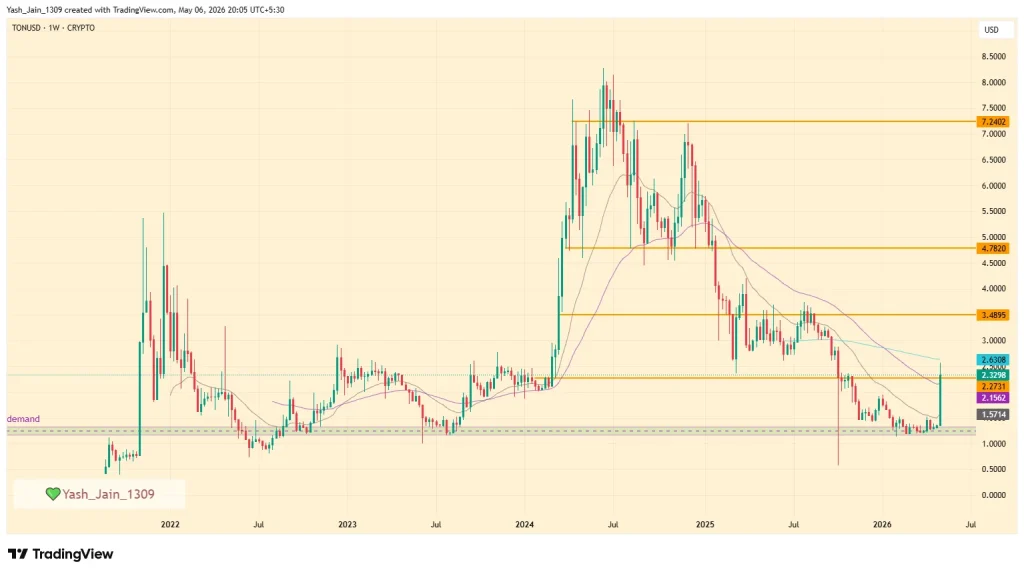
While Arbitrum was punished for “emergency centralization” to save user funds, Telegram is being rewarded for “strategic centralization” to seize protocol control. Apparently, we only care about the “code is law” mantra when the price is moving sideways.
If you want to see where the real sentiment lies, look at the social metrics. Mentions of TON hit 91 in a single four-hour window on May 5 that’s roughly six times the usual baseline. This sustained chatter shows the market isn’t just accepting Telegram’s takeover; it’s salivating over it.
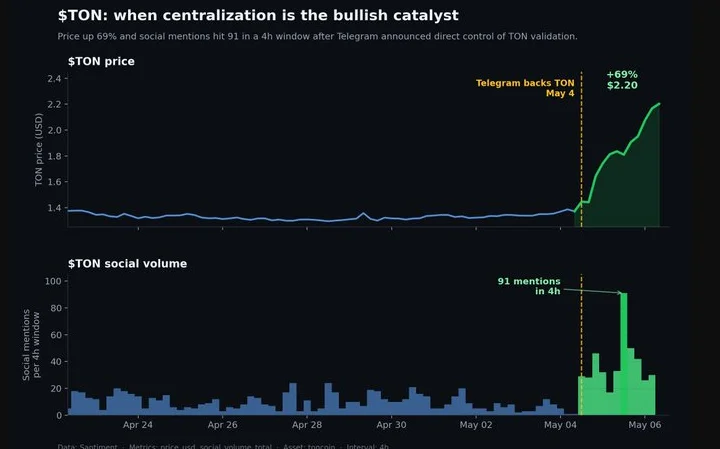
Durov’s “Make TON Great Again” (MTONGA) roadmap, which includes slashing fees sixfold to a negligible $0.0005, has effectively bought the community’s silence. It’s the ultimate proof that in 2026, utility and “technical superiority” are the new gods, and decentralization is just a relic of a more idealistic era.
At the end of the day, odds tells that finding ideological consistency in crypto is like finding a needle in a messy grass field. The market’s reaction to TON vs. Arbitrum proves that context matters infinitely more than ideology. We fear a Security Council that can freeze our funds, but we cheer for a CEO who can make our transactions nearly free. As long as the fees stay low and the green candles stay tall, it seems the “The Open Network” is perfectly happy being “The Telegram Network.”

The post Best Crypto to Buy Now as $630M Pours Into Bitcoin ETFs While Chainlink and Polygon Land Major Deals appeared first on Coinpedia Fintech News
The best crypto to buy now is getting easier to spot after Bitcoin spot ETFs pulled in $630 million on May 1, the single strongest inflow day of 2026 according to Farside Investors. BlackRock’s IBIT led with $284 million and Fidelity added $213 million in the same session. That kind of institutional buying tells you where the smart money is heading.
Pepeto has raised $9.79M from early wallets that see the expected Binance listing and 420 trillion supply as a setup no mid-cap can touch. Here is why it leads as the best crypto to buy now next to Chainlink and Polygon.
On May 1, Bitcoin ETFs recorded their best single session since late 2025 according to Blockonomi. BlackRock, Fidelity, and ARK Invest accounted for over 93% of the capital. April brought $1.97 billion total, the strongest month of 2026.
When regulated money enters this fast, the rotation into altcoins and presale entries follows. Finding the strongest entry before that rotation completes is more urgent than ever.
Institutional money worth $630 million entered Bitcoin ETFs in one day, and Pepeto, considered the best crypto to buy now, is the presale that already built the tools to absorb what comes next. A full exchange is live right now with working features that most tokens only promise on a roadmap.
Every token gets scanned by the built-in contract checker before you can spend a dollar on it. Six blockchains connect through PepetoSwap where trades cost zero in fees. Moving tokens across networks costs nothing, and a risk scoring tool shows you if large wallets are sitting heavy in any position before you enter. All of this runs today, not after the expected Binance listing reprices everything.
Due to rapid growth, Pepeto’s original domain came under attack. The team secured a provisory domain to keep access open. Click to visit Pepeto through the active link.The presale collected $9.79M at $0.0000001868 per token. Once the expected Binance listing goes live, this price disappears for good.
Holders who stake before listing earn 175% APY. The cofounder who started the original Pepe coin and took it to $7 billion is the one building Pepeto. When nobody around you is talking about a presale yet, that is when the real entry exists. This is that window, and the moment the listing opens, today’s price becomes the one everybody wishes they had locked in.
Chainlink (LINK) trades at $9.11 according to CoinMarketCap, sitting 83% below its $52.70 all-time high. Large holders moved 18.94 million LINK worth $170 million off exchanges in April, the biggest outflow month of 2026.
Chainlink earned SOC 2 Type 2 certification from Deloitte, the only oracle to hold all three institutional security standards. Support holds near $8.20 and resistance at $11.50. Changelly targets $10.80 average for 2026. Those gains are solid, but Pepeto’s presale delivers from one listing day what LINK needs months to produce.
Polygon (POL) trades at $0.097 according to CoinMarketCap, down 97% from its $2.92 peak. Visa added Polygon to its $7 billion stablecoin settlement program on April 29, and Meta selected the network for creator USDC payouts in Colombia and the Philippines.
The v2 7.0 hard fork went live the same week. CoinCodex forecasts place 2026 between $0.08 and $0.28. That math is strong for a recovery play, but the best crypto to buy now is the one where a single listing event delivers what Polygon needs a full quarter to reach.
Chainlink’s record whale outflows and the $630 million ETF session confirm that real capital is stacking behind working crypto infrastructure. Polygon landing Visa and Chainlink earning Deloitte certification tells you the build-out phase is done. All of this hits while the Fear and Greed Index sits below 50, a reading that has preceded every major rally in this market.
The best crypto to buy now is Pepeto because the expected Binance listing, the SolidProof audit, and the live exchange open a return path that no mid-cap or large-cap asset can deliver from current levels. More than $9.79M raised in this window shows that large wallets already committed through Pepeto.
The tokens that turned early believers into success stories all began in a window exactly like this one, and staying on the sidelines past the listing means giving up the best crypto to buy now at the last price that will ever be this low.
Click To Visit Pepeto Website To Enter The Presale

What is the best crypto to buy now while LINK and POL consolidate?
Pepeto is the best crypto to buy now with an expected Binance listing, SolidProof audit, and $9.79M raised during a consolidation window. Visit Pepeto for presale details.
What is Chainlink’s price prediction for 2026?
Chainlink (LINK) trades at $9.11 with analyst targets at $10.80 average and bullish cases reaching $25 to $42 if institutional oracle adoption continues growing through 2026.

The post ‘XRP Has Clarity’: Brad Garlinghouse Says He Has Chosen To Ignore Hoskinson’s ‘Stuff’ appeared first on Coinpedia Fintech News
Ripple CEO Brad Garlinghouse delivered a message that every XRP holder needed to hear. Regardless of whether the CLARITY Act passes through the US Senate, XRP is not waiting for Washington to catch up. It already has what most of the crypto industry is still fighting for.
“XRP has clarity,” Garlinghouse said. “XRP is going to be okay. No matter what.”
To understand why Garlinghouse sounds so calm while the rest of the crypto industry nervously watches Capitol Hill, you have to go back to the legal battle Ripple spent years fighting and ultimately won.
A federal judge ruled clearly and on the record that XRP in and of itself is not a security. That ruling did not come from a friendly regulator or a favorable administration. It came from an independent federal judge, appointed by a Democrat, who looked at the facts and reached her conclusion.
“Boom. We have clarity,” Garlinghouse said. “Like that’s what we care about.”
That single court ruling changed everything for Ripple. While other crypto projects are still operating in legal grey zones, hoping the CLARITY Act or SEC guidance will eventually give them the cover they need, XRP already has a federal court opinion on its side. That is a fundamentally different position to be in.
This is where the conversation got pointed. Not every voice in crypto has been supportive of the CLARITY Act, and one of the loudest skeptics has been Charles Hoskinson, the founder of Cardano and one of the most outspoken figures in the industry.
Hoskinson has been vocal about his concerns with how Washington shapes crypto legislation, often framing it as watching sausage get made, messy, uncomfortable, and not always reflective of what the industry actually needs. His commentary around the CLARITY Act has been pointed enough that it has drawn attention and sparked debate across crypto circles.
Garlinghouse’s response was not a counter-argument. It was something more dismissive and in its own way more powerful.
“I’ve chosen to ignore Charles Hoskinson on all this stuff,” he said. “I already have clarity. I’m supporting this because I think it’s good for the industry.”

The post Can Filecoin Price (FIL) Recover From 99% Fall Or Is It Now a Dead Crypto Asset? appeared first on Coinpedia Fintech News
Today, if investors were looking for a sign of life in the digital graveyard, Filecoin price (FIL) managed a pathetic 12% intraday rise today, but don’t let that green candle fool you into thinking the “dead” have risen.
While the broader market is enjoying a bit of a relief rally, Filecoin’s move is the equivalent of a twitching corpse that only looks halfway decent if you squint at a span of a 90-day chart and ignore the absolute wreckage behind it. But, sensibly, If we zoom out just a little further, the reality is a total horror show.
Especially, since 2021, this thing was a heavyweight champion trading at an all-time high of roughly $237, and today, after this “massive” spike today, still the CMP is sitting at a laughable $1.08. Can that be called as growth? I call that a 99.30% collapse from the peak that has left long-term bag holders in a nonsensical mess they can’t even escape from.
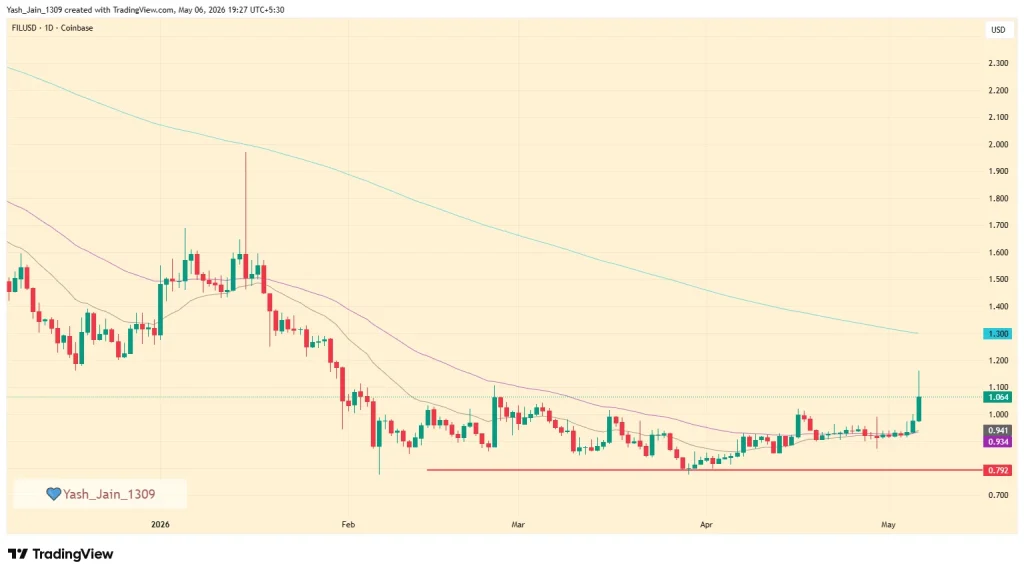
The math is simple and devastating, it feels rough but Filecoin price is at non arguably at an utter disaster point for anyone who didn’t exit years ago. When an asset is down over 99%, finding an “acceptable” exit price is a pipe dream because the liquidity and interest just aren’t there anymore.
It’s one of those tokens that is barely even visible on higher timeframes because the current price action is just a flat line compared to the 2021 heights. Investors are staring at a 99.30% loss from the peak, and no amount of intraday volatility can mask the fact that this is what a true dead asset looks like in the wild.
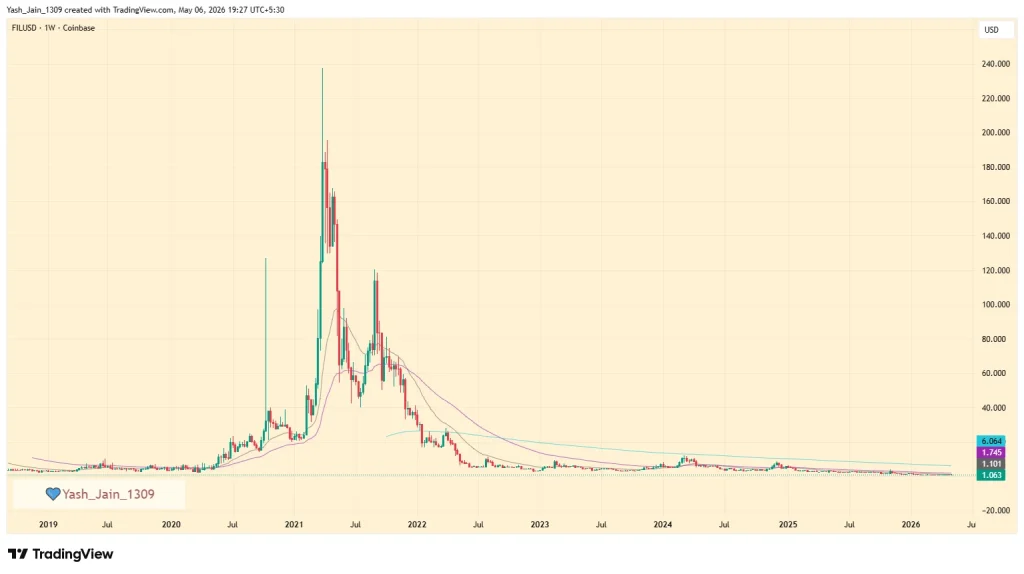
It’s not just the price that’s bleeding; the soul of the project is left too. Looking at the on-chain data, the Filecoin social dominance is so low it’s practically subterranean, suggesting the hype train left the station years ago and never looked back.
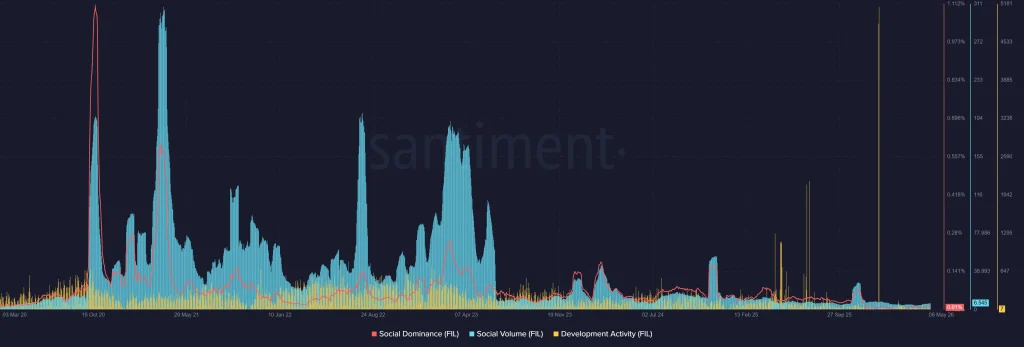
Even more concerning is the development activity, which has been eerily silent since the start of 2026. Sure, there was a desperate spike in the second half of 2025, but it did absolutely nothing to change the fate of the coin or stop the price from bleeding out even further. It’s hard to build a future when the builders have seemingly stopped showing up to work.
Even a quick glance at the Filscan data explorer tells the same tragic story of a network in decline. One of the most telling metrics “contract transactions” is on a consistent downspree, proving that users are becoming less active by the day.
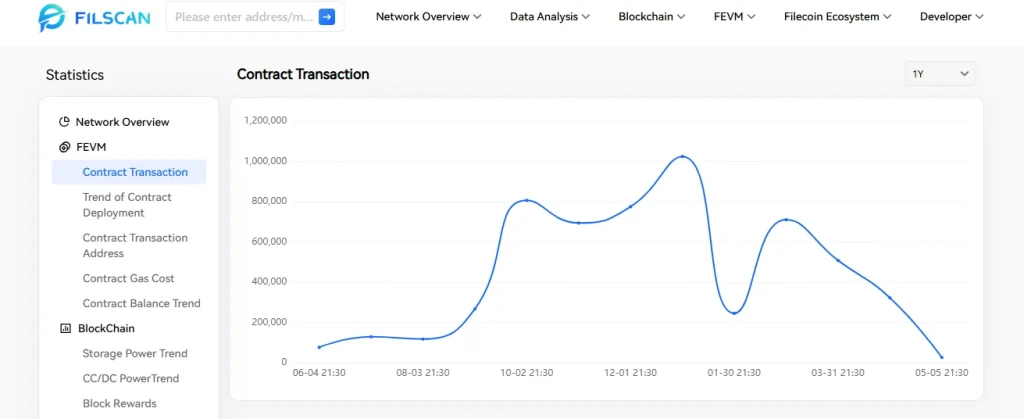
At this point, expecting a hard rebound for Filecoin price (FIL) is like trying to find a needle in an incredibly messy, overgrown grass field. The odds are astronomically low, the statistics are bleeding, and the sentiment is in the gutter, making any talk of a “recovery” sound like pure delusion.

The post Pepe Coin Price Prediction: $118 Billion in Equity Inflows Signal Risk Rotation as Pepeto Presale Hits $9.79 Million appeared first on Coinpedia Fintech News
The Pepe coin price prediction picked up fresh momentum after equity funds absorbed roughly $118 billion across four straight weeks of inflows while money market funds saw a $173 billion weekly outflow, according to CryptoSlate.
That rotation from safe assets into risk positions brings capital looking for the highest return entries. PEPE sits 86% below its record, and Cardano is down 92%, while Pepeto has crossed $9.79 million raised at Pepetoswap, with a Binance listing approaching.
Global equity funds pulled in approximately $118 billion over four consecutive weeks, and money market funds dropped $173 billion in a single week, signalling that risk appetite is returning across every asset class, according to CryptoSlate. Bitcoin bounced 14% in the opening weeks of Q2 2026, pulling attention back toward meme coins.
The Pepe coin price prediction draws attention because PEPE holds the strongest meme brand in crypto, but at 86% below its record the numbers limit how much upside a recovery delivers. Pepeto has crossed $9.79 million raised with a Binance listing expected, and the presale is where recovery limits disappear because the entry starts from presale cost, not a $1.63 billion cap.
When meme coin attention returns to the market, it brings capital looking for the highest return entry before the crowd arrives. That is why traders looking beyond the current Pepe coin price prediction have started paying attention to Pepeto, the project built to capture the demand that meme coin momentum creates.
PepetoAI reviews every position for risky contracts and unusual wallet patterns before they cause damage, and the cross chain bridge sends assets between blockchains at zero cost so even modest positions keep every dollar intact.
The developer who created the original Pepe token brought former Binance specialists together to build real exchange tools, and SolidProof audited every contract line before the presale went live. A $7,000 entry staking at 175% APY begins compounding from day one while the Binance debut approaches.
We have covered hundreds of presales over the years, and the combination sitting inside Pepeto right now is rare. A proven cofounder, a working exchange, a confirmed listing, and a price that still sits at seven zeros. Wallets entering through Pepetoswap today are locking in the cost that the entire market will chase the moment that listing goes live, and once this round closes, that specific entry is gone.
Pepe Coin (PEPE) trades near $0.00000393, sitting roughly 86% below its all time high of $0.00002803, according to CoinMarketCap.
Holder addresses surged by 37,000 in April to reach 551,500 unique wallets, and the Canary Capital spot PEPE ETF filing continues under SEC review. DigitalCoinPrice projects $0.0000057 to $0.0000072 for 2026, capping upside at roughly 83% in the best case. A full return to the all time high is about 7x across many months of waiting.
The Pepe coin price prediction carries weight because the token leads the meme sector, but a $1.63 billion cap means the distance to a life changing return requires sustained buying over a long period.
Cardano (ADA) trades near $0.25, sitting roughly 92% below its $3.10 all time high, according to CoinMarketCap. The stablecoin market cap on Cardano rose 29% to nearly $50 million this quarter, but that growth has not lifted the token price.
Changelly projects ADA between $0.24 and $0.47 through 2026, and recovery from current levels needs years of sustained demand to approach the old highs. For the Pepe coin price prediction crowd comparing options, presale entries bypass that recovery timeline entirely.
The Pepe coin price prediction carries real weight because PEPE holds the strongest meme coin brand with holder wallets growing and a Canary Capital ETF filing signalling institutional interest. But PEPE at 86% below its peak needs months of recovery, while Pepeto only needs the Binance listing to deliver returns that no recovery path can match.
Pepeto’s listing compresses the timeline between entering and collecting the reward, and every wallet that enters through Pepetoswap now enters at a cost the market will chase after debut. The raise stands at $9.79 million with 175% APY staking running daily. The entry remains open, but once the presale closes that opportunity is gone.
Click To Visit Pepeto Website To Enter The Presale
What does the Pepe coin price prediction show for 2026 as equity inflows return?
The Pepe coin price prediction for 2026 targets $0.0000057 to $0.0000072 per DigitalCoinPrice, roughly 44% to 83% above the current $0.00000393 level. Holder wallets jumped by 37,000 in April to reach 551,500, and the Canary Capital spot PEPE ETF filing adds institutional demand behind those forecasts.
What is Pepeto, and can it deliver bigger returns than PEPE in 2026?
Pepeto is a meme coin presale project offering entry at $0.0000001868 with a Binance listing approaching, three working exchange tools, and a SolidProof audited contract. The presale to debut return at this price point runs far beyond what PEPE at a $1.63 billion market cap can produce from current levels.

The post Bitcoin Price Rally Accelerates as Institutions Flows Return: Can BTC Reach $93K? appeared first on Coinpedia Fintech News
Bitcoin price is accelerating higher as bulls push BTC above the $82,000 mark, strengthening expectations for a larger breakout move across the crypto market. The latest rally comes as institutional inflows continue flooding into spot Bitcoin ETFs while bearish traders remain heavily trapped in short positions.
Data shows U.S. spot Bitcoin ETFs attracted more than $467 million in fresh inflows, extending a strong accumulation streak led by BlackRock and Fidelity. At the same time, funding rates across major exchanges remain deeply negative, a signal that a large section of the derivatives market is still betting against the rally despite Bitcoin reclaiming critical resistance levels.
That combination is now creating the conditions for a potential short-squeeze driven expansion. With the BTC price attempting to establish strength above $82,000, traders are increasingly eyeing the $89,000 to $93,000 region as the next major upside target.
Despite Bitcoin’s price move above $82,000, funding rates across major exchanges have continued turning negative. Current readings reportedly dropped to nearly -0.023%, even deeper than the extreme bearish conditions seen during the May 2023 correction phase. Negative funding means short traders are paying long traders to maintain bearish positions, a sign that a large section of the derivatives market still expects downside. That disconnect between rising spot prices and aggressive bearish positioning is becoming increasingly important.
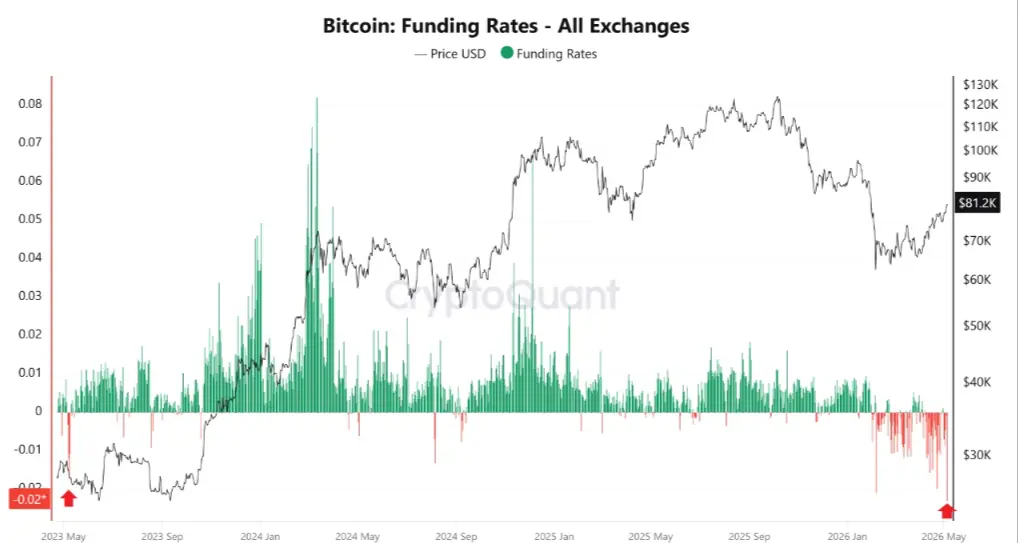
Historically, when Bitcoin rises while funding remains deeply negative, markets often enter liquidation-driven expansion phases. As price climbs higher, short positions begin getting forced out of the market, creating additional buy pressure through liquidations.
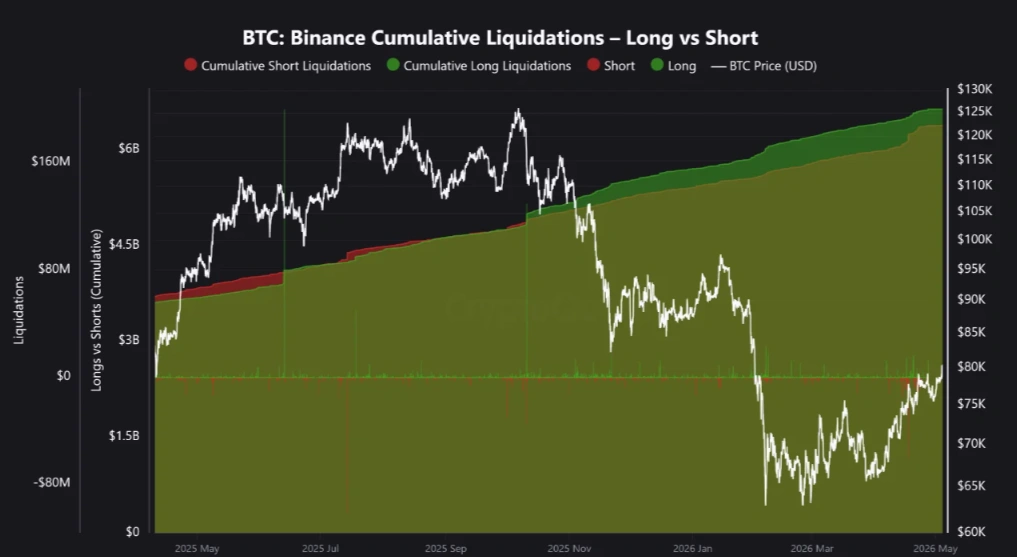
Binance liquidation data already suggests this process may be underway. After Bitcoin reclaimed the $77,000 breakout level, short liquidations accelerated rapidly as BTC pushed toward $81,000.
Market analyst say the setup remains constructive because the rally is not yet being driven by excessive long leverage. Instead, spot demand and short covering appear to be leading the current move.
Besides BTC on-chain data, technical indicators are also starting to align with the improving market structure. A bullish weekly MACD crossover triggered in April continues holding intact, with analysts comparing the setup to previous cycle expansions that produced multi-month rallies. Similar crossover structures in earlier bull phases historically preceded gains ranging between 75% and 140%.
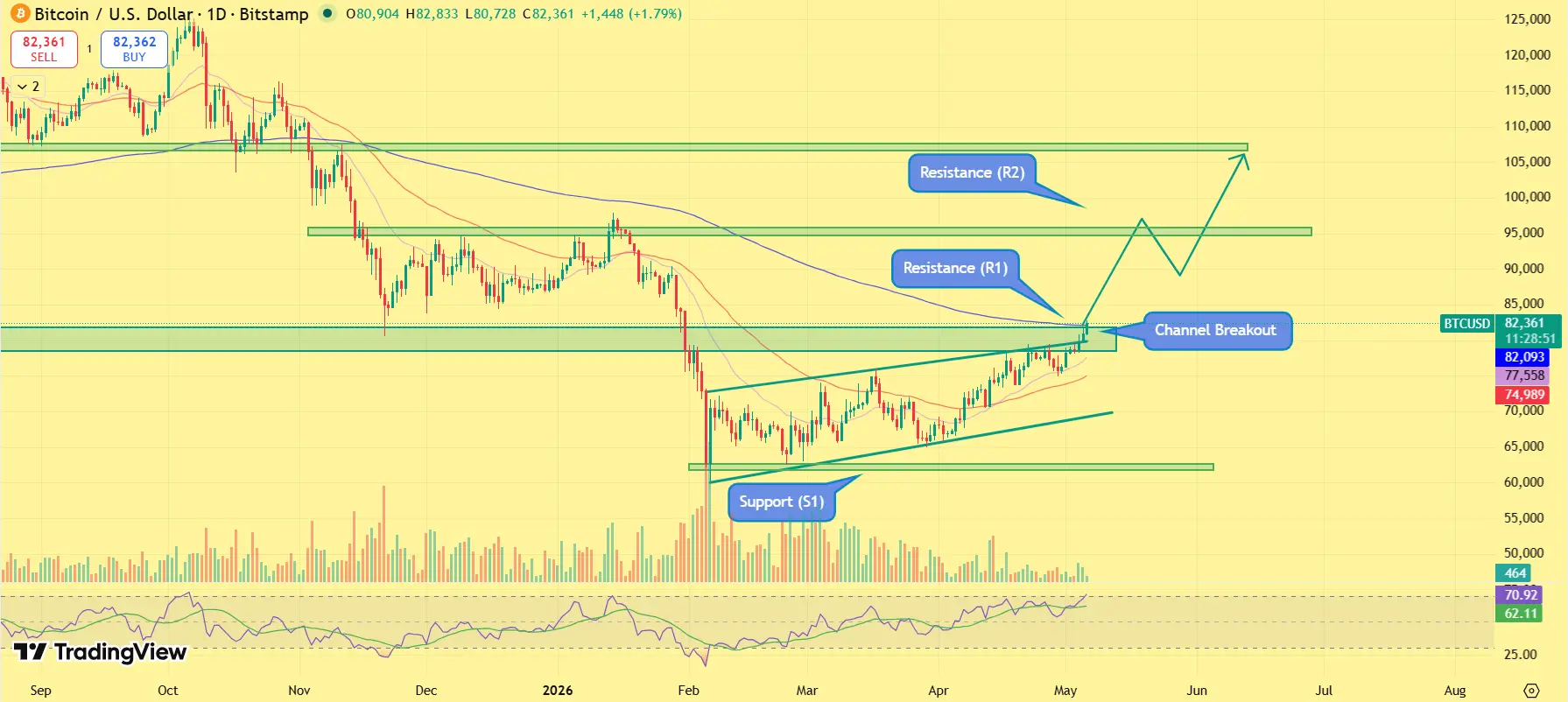
On the daily chart, Bitcoin (BTC) is now approaching a major resistance zone near the 200-day SMA around $83,000. That level is being viewed as the next key breakout trigger for the market. A clean breakout above the region could confirm continuation toward the $89,000 level initially, while a stronger momentum expansion may eventually open the path toward $93,000. Volume structure is also improving steadily as ETF demand absorbs available spot supply from the market.
Institutional demand is beginning to strengthen again as Bitcoin holds above the $82,000 region. On May 5, U.S. spot Bitcoin ETFs recorded more than $467 million in net inflows, marking the fourth consecutive day of positive institutional buying. BlackRock’s IBIT led the market with roughly $251 million in inflows, while Fidelity’s FBTC added another $133 million.
The growing ETF demand suggests large investors are rebuilding exposure as Bitcoin regains bullish momentum. Unlike leveraged futures activity, ETF inflows represent direct spot accumulation, reducing available BTC supply from the market.
BITCOIN ETFS SEE MASSIVE INFLOWS AS INSTITUTIONS STEP IN AGAIN
— BSCN (@BSCNews) May 6, 2026
Bitcoin $BTC spot ETFs recorded $467.35 million in net inflows on May 5. This marks the fourth consecutive day of inflows.
BlackRock’s IBIT led with $251.43 million, while Fidelity’s FBTC added $133.2 million.… pic.twitter.com/g440vM6OB3
On-chain data also reinforced the institutional narrative after Morgan Stanley reportedly purchased another 151.9 BTC worth nearly $12.4 million through Coinbase Prime-linked activity. The firm’s total Bitcoin holdings are now estimated near $229 million, highlighting continued institutional confidence as BTC approaches major resistance levels.
Bitcoin (BTC) continues to maintain a bullish structure above the $77,000 breakout region, while institutional demand keeps strengthening beneath the surface. As long as funding rates remain negative and spot ETF inflows continue rising, the probability of additional short squeezes remains elevated. The immediate resistance now stands near $83,500. If bulls successfully reclaim that level, momentum could accelerate toward $89,000, with $93,000 emerging as the next major upside target. However, traders will also watch for overheating in derivatives markets, as rapidly rising long exposure could eventually increase short-term volatility.
The post Bitcoin Near $83,000 While Oil Crashes 12% below $90 – Cryptoquant eyeing $93K appeared first on Coinpedia Fintech News
The world’s largest cryptocurrency Bitcoin has climbed close to $83,000, hitting this level for the first time since January 31. The overall crypto market also moved up about 2%, reaching around $2.73 trillion.
At the same time, oil prices dropped 12% below $90 after Islamic Revolutionary Guard Corps confirmed safe passage through the Strait of Hormuz.
Now, traders are closely watching the $93,000 level, as CryptoQuant says it matches a key “CME gap” that Bitcoin often tends to revisit.
Over the past week, Bitcoin has climbed steadily from around $75,000 to nearly $83,000, driven by growing optimism around the U.S.–Iran negotiations.
The latest rally follows reports that the United States and Iran are close to finalizing a 14-point agreement that could end the conflict within the next 48 hours.
Under the proposed deal, Iran would pause uranium enrichment and allow United Nations inspections. In return, the U.S. may ease sanctions and release frozen Iranian assets.
This progress has also improved the outlook for global trade, with expectations that oil flow through the Strait of Hormuz could return to normal after earlier disruption fears.
Recent research from CryptoQuant also shows growing activity in CME Bitcoin futures markets. Open Interest (OI) has climbed back above 110,000–120,000 contracts, compared to lows near 20,000–30,000 contracts seen during the February correction.
At the same time, Bitcoin has rebounded from the $65,000–$70,000 range to above $80,000 while futures activity continues rising.
Meanwhile, CoinGlass data shows nearly 125,567 traders were liquidated over the past 24 hours, with total liquidations reaching approximately $557.95 million.
Notably, short traders accounted for nearly 80% of those liquidations, or around $444 million.
According to CryptoQuant researchers, the next major upside target for Bitcoin could be around $93,000 due to a key CME gap.
CME Bitcoin futures trade only during weekdays, while the spot crypto market operates 24/7. This creates price gaps between Friday’s close and Monday’s open, often referred to as “CME gaps.”
Historically, Bitcoin tends to revisit and fill these gaps over time.
One previous gap was already filled during the recent recovery rally. However, the next major unfilled gap remains near the $93,000 level, making it an important target traders are closely watching.
Despite the bullish momentum, analysts warn that the market remains highly sensitive to geopolitical developments. Any negative headlines or collapse in the U.S.-Iran peace negotiations could quickly reverse sentiment and invalidate bullish targets.
The post Morgan Stanley Launches Crypto Trading on E*TRADE Platform appeared first on Coinpedia Fintech News
Morgan Stanley, one of the world’s largest wealth management firms, is set to introduce cryptocurrency trading on its E*TRADE platform, expanding access to digital assets for its 8.6 million retail clients. The rollout positions the firm to compete more directly with established crypto and brokerage platforms such as Coinbase, Robinhood, and Charles Schwab, while aiming to differentiate through lower trading costs and competitive fee structures. The move reflects a broader Wall Street trend of integrating crypto services into traditional brokerage offerings as institutional adoption accelerates and client demand for digital asset exposure continues to grow.
The post Clarity Act All New Updates: Moreno Says Bill Could Be Signed Before July 4 as Odds Hit 67% appeared first on Coinpedia Fintech News
A bipartisan compromise on stablecoin yield has cleared the biggest obstacle standing between the Clarity Act and a Senate vote, injecting fresh momentum into legislation that has spent months stalled over a single unresolved dispute.
Senators Thom Tillis and Angela Alsobrooks struck the deal this week, agreeing on language that allows crypto firms to offer stablecoin rewards while stopping those products from functioning as direct substitutes for traditional bank deposits. The agreement, modest in its technical scope, was significant in its political effect. It moved a bill that had been frozen.
“This finalised, bipartisan text is the culmination of months of hard work to deliver a compromise on yield we can all live with,” Senator Cynthia Lummis said. “We are closer than ever to getting the Clarity Act across the finish line.”
This finalized, bipartisan text is the culmination of months of hard work to deliver a compromise on yield we can all live with. We are closer than ever to getting the Clarity Act across the finish line. https://t.co/8vF7tzpxpy
— Senator Cynthia Lummis (@SenLummis) May 4, 2026
With the yield dispute resolved, the legislative calendar is moving. House Financial Services Chair Bryan Steil confirmed the markup is scheduled and Senate planning is underway.
Senator Bernie Moreno went further, telling reporters the bill could reach President Trump’s desk by the end of June and be signed into law before July 4.
The pressure to move is not just political. Brad Garlinghouse, Ripple’s chief executive, told the Consensus 2026 conference in Miami that the window is closing. “The next two weeks are pivotal,” Garlinghouse said. “Clarity is better than chaos.”
He warned that delays running into election season would sharply reduce the bill’s chances of passage, giving both parties a concrete reason to act now.
Circle rallied sharply. Coinbase gained. Bitcoin briefly crossed $80,000 as optimism about regulatory clarity fed into a broader market recovery already underway. Prediction markets moved the bill’s odds of passage to approximately 67%.
Coinbase CEO Brian Armstrong reduced his public position to two words: “Mark it up.”
Not every voice was bullish. Arthur Hayes argued that the bill, as written, advantages large centralised firms with established lobbying relationships while creating structural barriers for smaller and more decentralised projects.
Charles Hoskinson raised similar concerns earlier, warning that the legislation’s mature blockchain standard protects incumbents while making it harder for new projects to avoid securities classification.
Markup is the immediate milestone. After that, a Senate floor vote, House approval, and a presidential signature before July 4 is the timeline on record. The crypto industry has seen promising legislation arrive at the finish line before without crossing it. This time, the bipartisan deal, the market pressure, the political calendar, and the industry’s unified push are converging in the same direction at the same moment.







Bitcoin’s onchain data suggests that the upside may not be over for BTC price, but resistance at $84,000 could delay the recovery.

The plaintiff says Coinbase froze traceable assets from a 2024 DAI phishing theft but refused to return them without a court order.

CME to launch CFTC‑regulated Bitcoin Volatility futures in June, giving institutions an onshore way to trade implied BTC volatility.

Bitcoin price analysis saw $84,000 as bulls' "most critical" reclaim target as the risk of new $50,000 lows returned to the radar.

A new era of on-chain trading transparency. Atlas Live enables traders to analyze token concentration and spot potential rug pulls. Now in real time.

US spot Bitcoin ETFs posted $999 million in inflows over two trading days as Bitcoin moved back above $80,000.

OKX Card data shows most crypto spending in Europe is on groceries and dining, signaling growing everyday use over luxury purchases.












BG Wealth Sharing, according to authorities, claimed to provide guidance on crypto trading, advertised heavily on social media and offered “daily profit opportunities.”

Andreessen Horowitz’s crypto investment arm said its new fund would seek to back projects that “people keep using when the hype fades.”

Anchorage’s new product enables AI agents to have compliant access to capital across traditional finance and crypto payment rails.

The Colombian president pointed to the impact Bitcoin mining has had in Paraguay, which is now the fourth-largest Bitcoin mining country by hashrate.

Bryan Pellegrino, co-founder and CEO of LayerZero, disputed Kelp DAO’s accusations and said a postmortem by external security firms will be published soon.

A class-action group has accused rapper Iggy Azalea of not following through on delivering utility and business integrations for her memecoin, Mother Iggy.










It marks the first time that Saylor’s company has floated the idea of selling Bitcoin, parting ways with his long-held view that Bitcoin shouldn’t be sold.

Bitcoin carved a path toward $82,000, but derivatives metrics need another push from bulls to sustain the rally.

Investors back a model that moves insurance risk and capital flows onto blockchain rails, as onchain reinsurance looks to attract institutional participation.

Brad Garlinghouse addressed attendees at a Tuesday crypto conference on the progress of the CLARITY Act after US lawmakers announced a compromise on stablecoin yield that could advance the legislation.

Prophet, an AI-native prediction market platform, has launched its first live trading tranche, introducing a system where an AI model acts as the counterparty to user trades using real capital.

Short liquidations and rising open interest may be signs of the bulls’ plan to push the Bitcoin price closer to $90,000.

Days before Indiana’s primary election, the Defend American Jobs PAC disclosed roughly $514,000 in media spending supporting a Republican incumbent in the state’s 4th Congressional District.

The deal adds a Solana-based trading infrastructure platform that has processed more than $50 billion in volume and aggregates liquidity across multiple venues.



Regional lenders gain access to infrastructure for stablecoins, tokenized deposits and crypto-backed lending without building systems in-house, signaling wider bank adoption.

Improving investor confidence supports Bitcoin’s hold on $80,000, as the Crypto Fear and Greed Index exited the “Extreme Fear” zone and now reads “neutral.” Are the bulls back in control?

While Roni Cohen-Pavon’s lawyers requested time served, US prosecutors stopped short of recommending a specific sentence, instead urging the judge to consider federal sentencing guidelines.

Bernstein points to Figure’s expansion beyond home equity lending into blockchain-based credit as tokenization begins to scale across broader loan markets.

XRP price broke out of a multi-month bull flag, while other chart technicals are also supporting more upside in the near term.

The partnership enabling conversion of digital assets into cash through MoneyGram’s global network follows a similar move by rival Western Union.









Kaiko said open interest, funding rates and wallet activity showed repeated pre-announcement positioning before several Robinhood token listings.

The data blockchain securing onchain finance projects looks to provide lenders and borrowers with agreement-specific collateral solution.

Binance will shift to an orderbook-weighted pricing model for commodity perpetual futures during off-hours, potentially changing margin and liquidation behavior.

Brian Armstrong said Coinbase will flatten management layers and require leaders to work as “player-coaches” under the new structure.

Bitcoin bottom calls grow as analysts target $180,000–$250,000 within a year, fueling debate over whether BTC has resumed its broader bull cycle.

Crypto ETPs shed $619 million over four days before a $737 million Friday session rescued the week, extending the inflow streak to $4.02 billion across five weeks.

The Bank of Italy’s deputy governor floated the evaluation of tokenized SEPA payments, as the ECB experiments with tokenized digital payment frameworks to avoid stablecoin competition.

Bullish has agreed to acquire transfer agent Equiniti as more Wall Street participants accelerate their tokenization initiatives to offer 24/7 trading.

Polymarket was banned in the Netherlands in February, but Kalshi, Hyperliquid and Interactive Brokers are still offering prediction markets to Dutch users.










Accumulation by long-term Bitcoin holders, buying by institutional investors and a strengthening technical structure could fuel BTC’s price rise to $95,000 or higher.

Innovation City launches a blockchain-based business ID system, giving more than 1,000 firms verifiable onchain credentials for identity and access.

Toncoin rose 33.8% after Pavel Durov said Telegram would deepen its role in TON, while details on the foundation and validator structure remain unclear.

Spot Bitcoin ETFs pulled in over $532 million on Monday as BTC surged past $80,000 amid improved risk sentiment following the US-Iran ceasefire.













US Senator Thom Tillis said the current text of the CLARITY Act offers a compromise for the crypto industry and banks and provides a bipartisan path for the bill’s passage.

Haun Ventures founder Katie Haun said AI will “increasingly begin to conduct economic activity on our behalf," and services will need to adapt for that world.

The new wallet feature hides senders, receivers and amounts onchain while maintaining compliance through know your transaction screening and auditable files.









Aave argued that a thief doesn’t gain lawful ownership of property by stealing it and that Gerstein Harrow’s legal argument “defies logic, common sense and the law.”

Western Union is one of several remittance companies that announced stablecoin plans after the US passed the stablecoin-friendly GENIUS Act in July.

Bitcoin’s recent rally to $80,000 amid improving BTC miner and options markets metrics could create a clear path to $85,000.

World Liberty Financial claimed Sun engaged in defamatory tactics and prohibited token transfers, including shorting the WLFI token and conducting straw sales on behalf of others.

With $114 trillion in custodied liquid assets, Depository Trust & Clearing Corporation looks to position tokenization as the future of existing financial system.

Crypto markets turned euphoric as BTC traded above $80,000, but a rally through short-term holders’ cost basis is needed to cement the bull trend.









Tether’s XAUt tops $3.3 billion as gold reserves reach 154 tons, with demand rising amid geopolitical tensions and shifting expectations for Federal Reserve policy.

Bitcoin has broken above the $79,500 level, backed by solid buying by institutional investors. Will the altcoins also follow?

Bitcoin faced new volatility and a new struggle to reclaim $80,000 as Iran events added pressure to crypto and risk assets.

Institutional investors are entering prediction markets as block trades, custom contracts and US regulatory shifts reshape a sector still dominated by retail users.

Ethereum investors are no longer in the red, increasing the chances of a rally to $3,000, but resistance at $2,800 may delay recovery.





The regulator reportedly requested more information from Roundhill, GraniteShares and Bitwise about how the event contract funds would work.

K Wave Media is redirecting up to $485 million from a Bitcoin treasury strategy into AI infrastructure, alongside debt reduction and restructuring, per a Form 6-K filing.

ZIGChain, the blockchain built to bring regulated investment products onchain for everyday users, today reflected on its second annual ZIGChain Summit, a defining gathering for the future of onchain finance, held on 28 April at the The Meydan Hotel, Dubai.

The Bitcoin miner said the FalconX facility lowers its fixed interest rate to 7% and releases about 3,300 BTC from collateral restrictions.

Bitcoin’s rally on Monday pushed it above $80,000 for the first time since January as analysts say BTC price could rise further to fill the futures gap at $84,000 in the short term.

In past instances, BTC has averaged 24% gains in one month when institutional demand absorbed over 500% of the daily mined supply.

Crypto industry body DAXA said the proposed rules could push suspicious transaction reports from South Korea’s five largest exchanges to more than 5.4 million a year, Yonhap reported.





Bitcoin gained fresh bullish BTC price targets after hitting new three-month highs above $80,000.

GameStop proposes a $55.5 billion cash-and-stock takeover of eBay, disclosing a 5% stake and says CEO Ryan Cohen would lead the combined company.

The Blockstream CEO subscribed to 10 million warrants as Capital B pushes ahead with its Bitcoin treasury strategy.

















Gerstein Harrow has filed similar cases in the past, arguing its clients have a claim to funds stolen by the DPRK and frozen by crypto firms.

Bitcoin soared as the MSCI AC Asia Index rose to a new high on Monday, an early indicator that investors viewed the weekend developments in a reasonably positive light.

The CFTC received more than 1,500 responses to its prediction market rulemaking proposal, with respondents divided on how it should police the platforms.

John Palmer, a developer and brand adviser, agreed, said it "feels like a bug" to call them stablecoins and that they should have a self-defined and non-reactionary name.



The US-to-Mexico remittance corridor, while still the largest, shrank 4.5% in 2025 as other Latin American corridors grew.

Michael Saylor signaled a “pause” on BTC buying ahead of Tuesday’s earnings report, with Wall Street expecting a loss for Q1.


Bitcoin canceled out the week's earlier losses to tease the highest weekly BTC price candle close since the end of January near $79,000.

A new Politico poll finds most Americans distrust crypto and AI, raising questions about whether candidates backed by industry super PACs could face voter backlash.




New York AG Letitia James secured a $5 million settlement from Uphold for promoting CredEarn, a crypto savings product that misled users about its risks.
































Need to know what happened in crypto today? Here is the latest news on daily trends and events impacting Bitcoin price, blockchain, DeFi, NFTs, Web3 and crypto regulation.
