Samsung has a Galaxy Wide Fold model in its pipeline, and this device may go on sale in several countries. Apple is entering the foldable stream this year, and Samsung is already preparing to bring a direct alternative to the iPhone Fold.
A Galaxy Z Fold phone with a wide screen would be available in countries around the world. New findings paint a clear picture of the market availability, signaling a drop in South Korea, China, US, Canada and more markets.
Smartprix reports the so-called Wide Fold has appeared on the GSMA database with different model numbers, which reveal their regional belongings.
SM-F9710 – China
SM-F971W – Canada
SM-F971U1/SM-F971U – USA
SM-F971N – South Korea
SM-F971B – Global
Model numbers ending with 0 are locked to China, while U/U1 and W belong to North America (the US and Canada, respectively). Korean models come with an N suffix in the model number, while the B version gets a broad launch.
Countries from Asia and Europe usually get B models. The new development aligns with the recent revelation of potential production volume. Samsung plans to produce about 1 million units of the Galaxy Wide Fold in 2026.
Samsung is also working on the Galaxy Z Fold 8 and Z Flip 8. The focus has shifted from clamshell to book-style foldable after the success of the Galaxy Z Fold 7.
In addition, the South Korean tech giant is also developing next-gen smartwatches and tablets, as the Watch 9, Watch Ultra 2, and Tab S12 series have also appeared onthe GSMA database.
Conflicting rumors are creating confusion about the pricing of Samsung’s Galaxy S26 series. In a recent development, two early inputs emerged, but they clash: one claims no hike, while the other warns of a 40 percent jump.
Greece – No price hike
A new report from Techmaniacs indicates that the Galaxy S26 series may not see substantial pricing changes. Industry sources claimed that the S26 Ultra may not go pricier, and Samsung either has no plans to launch it at a lower price.
Regarding the Galaxy S26 and S26 Plus, the report suggests that the pricing decision is yet to be made. The decision is pending, probably pushed by Apple’s price freeze for the iPhone 17 series released in September 2025.
Samsung will not bring a 128GB version of any Galaxy S26 series model this year. The base storage will be 256GB across all models. The flagship phones will be widely paired with 12GB of RAM, with some countries getting up to 16GB.
Bulgaria – 30 percent jump
Credible leaker MysteryLupin revealed Galaxy S26, S26+, and S26 Ultra prices for Bulgaria, terming them “concerning.” As termed, the pricing info is literally concerning as it indicates a notable jump of up to 40 percent.
The standard base Galaxy S26 with 256GB could start at €1,199 (~ $1,417), while the 1TB version of the Galaxy S26 Ultra could come with a price tag of €2,329 (~ $2,754). Here’s the price chart as shared by tipster MysteryLupin:
Galaxy S26 12/256 – €1199
Galaxy S26 12/512 – €1429
Galaxy S26+ 12/245 – €1499
Galaxy S26+ 12/512 – €1729
Galaxy S26 Ultra 12/256 – €1739
Galaxy S26 Ultra 12/512 – €1969
Galaxy S26 Ultra 12/1TB – €2329
However, the source further added that the country, Bulgaria, adopted the Euro (currency) this year only. The pricing information shared above isn’t the same as planned for other European markets such as France.
One thing is common in all three teasers: the camera bump design. Samsung has crafted a pretty camera island for its 2026 flagships. The new teasers give us our first official look at the design in the most brilliant way possible.
Samsung’s latest teasers focus on camera capabilities. The video starts from a distance, with the text “CLOSER,” “GROOVE,” and “GLOW” turning “CLOOOSER,” “GROOOVE,” and “GLOOOW,” respectively.
The triple O comes into focus and evolves into the camera design of the upcoming flagships.
One teaser shows a camera viewfinder capturing a dog inside a car from a distance. It highlights the camera quality, which captures decent shots even of distant objects.
The second teaser puts night videography of the devices on display. The device is shown capturing a lady enjoying celebratory moments somewhere at an event where a lighting environment isn’t favorable.
The third teaser potentially spotlighted camera presets that turn regular videos into cinematic clips. The text here used is “GLOW,” which signals at night videos that don’t look dull, and other phones can’t match the level.
Samsung is preparing to hold the Galaxy Unpacked on February 25. It will be an in-person event in San Francisco, with the Buds 4 series also coming. Expect the general sale to open on March 11, the day the new devices hit market shelves.
Recently the prices across the altcoin market remain under pressure. Yet a major institutional catalyst has emerged for the top blue chips of the industry. Moscow Exchange’s plans to launch cash-settled futures for Solana, XRP, and TRX adds regulated exposure at a time of heightened volatility, reshaping how these assets are viewed within long-term market frameworks.
MOEX Expands Crypto Derivatives Beyond Bitcoin and Ethereum
Moscow Exchange (MOEX) is preparing to broaden its regulated crypto derivatives lineup by introducing cash-settled futures linked to Solana, XRP, and TRX. The move extends the exchange’s existing Bitcoin and Ethereum offerings and aligns with its strategy to deepen institutional access to digital asset exposure in Russia.
Russia's Moscow Exchange announces plans to launch cryptocurrency indices for Solana, Ripple, $XRP and Tron by the end of 2026, signaling further crypto market integration in the country. pic.twitter.com/afvbVYhSjv
Initially, MOEX plans to launch indices tracking these altcoins, which will then serve as the underlying benchmarks for futures contracts. At the same time, settlement will be conducted entirely in Russian rubles, removing any need for physical cryptocurrency delivery and simplifying compliance requirements.
Regulatory Guardrails Shape Market Structure
Access to the new futures contracts will be restricted to qualified investors under Russian law. Meanwhile, contract specifications are expected to mirror MOEX’s existing crypto products, with monthly expiries and standardized risk controls.
JUST IN: Russia to roll out crypto regulatory framework this July, allowing retail participation. pic.twitter.com/rSGoesFBzK
This structure reflects a broader regulatory direction. The Russian government is working toward a comprehensive digital asset framework expected by July 1, 2026, positioning regulated derivatives as a controlled gateway for institutional participation rather than direct spot market exposure.
Institutional Credibility Versus Short-Term Market Stress
From a market context perspective, the announcement arrives during a sharp correction across the altcoin sector. While, prices for Solana, XRP, and TRX have all been influenced by broader risk-off sentiment rather than asset-specific fundamentals.
Still, promises for derivatives listings on national exchanges is a longterm. This broadly signal a shift in how assets are classified. Rather than speculative instruments, they begin to function as monitored financial products within formal trading ecosystems. That said, futures markets also introduce leverage and hedging dynamics, which can amplify volatility in the short term.
Sentiment Reset and Long-Horizon Positioning
At the same time, the current drawdown appears more consistent with a cooling phase than a structural breakdown. Market participation has thinned, forced liquidations have slowed after the event, and volatility is gradually normalizing.
Breaking developments such as MOEX’s futures expansion may not immediately reverse price trends. However, they do open the possibility of renewed interest once bearish pressure fades, particularly among long-term investors assessing regulated exposure and liquidity pathways rather than short-term price action.
How Futures Listings Could Influence Market Behavior
From an analytical perspective, regulated futures introduce price discovery mechanisms that operate independently of spot markets. For Solana, XRP, and TRX, this may gradually influence how capital flows react during future market cycles.
While price recovery is never guaranteed, the introduction of these contracts places the trio within a more formal derivatives framework. The presence of MOEX futures suggests that Solana, XRP, and TRX are increasingly treated as enduring components of the crypto market rather than transient narratives, reinforcing their standing within long-term structural discussions.
Canton network price today is trading near $0.189 as fresh institutional infrastructure developments reshape its market context. The catalyst comes from Fireblocks’ integration with the Canton Network, a move that strengthens regulated settlement access while drawing attention to CC/USD at a critical technical juncture.
Meanwhile, Fireblocks, which is known and trusted by more than 2,400 enterprises and securing over $5 trillion in annual digital asset transfers has announced a new integration with the Canton Network. The move expands Fireblocks’ regulated infrastructure offerings for tokenization, settlement, and institutional digital asset flows.
Financial institutions can custody Canton Coin and build on Canton's privacy-enabled infrastructure with the same security and policy controls they use across our platform.
At the same time, the integration introduces custody and operational support for Canton Coin (CC) directly within Fireblocks’ platform. This gives financial institutions a governed and privacy-enabled environment to begin settling assets on Canton using Fireblocks’ enterprise-grade policy controls and workflow automation.
Interest from traditional financial institutions has already been accelerating Canton’s momentum. The network is increasingly being viewed as a preferred infrastructure layer for regulated tokenization, including tokenized securities, deposits, and settlement workflows. That shift places Canton network crypto closer to institutional deployment rather than speculative experimentation.
Regulated Custody Strengthens Market Confidence
That said, custody for Canton Coin will be provided through Fireblocks Trust Company, a qualified custodian chartered by the New York State Department of Financial Services (NYDFS). This structure provides a regulatory-compliant custody framework designed to meet fiduciary and risk management standards expected by large financial firms.
Still, the update also leverages Fireblocks’ MPC security architecture and governance controls. Institutions operating on Canton now gain protections suited for institutional-scale adoption, including key management safeguards and operational oversight. These features are increasingly seen as prerequisites for regulated digital finance participation.
From a market perspective, such developments often influence how participants assess network credibility, even when broader crypto conditions remain uncertain.
Canton Network Price Chart Shows Improving Structure
From a technical perspective, the Canton network price chart suggests that CC/USD has been trending upward from a key support zone. On the daily timeframe, $0.177 has established itself as immediate support after the price flipped the $0.160 level.
Price structure aligns with both an ascending parallel wedge and a developing cup-and-handle formation. The current rally remains contained within the ascending channel, suggesting controlled momentum rather than volatility-driven expansion.
If price continues to respect this structure, the upper boundary of the wedge near $0.220 becomes a level of interest. That zone may act as resistance and could invite a pullback toward the lower channel boundary near $0.140, which would still preserve a constructive longer-term setup. However, a sustained move beyond $0.220 would open the possibility of a broader reassessment in the Canton network price forecast.
Derivatives and Sentiment Data Add Context
Additionally, derivatives data shows total open interest for CC/USD reaching an all-time high of $37.61 million. This indicates increasing participation, even as price action remains technically structured.
Social volume has also been building into Q1 2026, pointing to rising discussion around Canton network crypto. Weighted sentiment metrics suggest that commentary has skewed more positive than negative, reinforcing engagement without signaling speculative crowd behavior.
Taken together, these metrics suggest that the Canton network price is increasingly reflecting infrastructure-driven interest rather than short-term momentum trading, and that the price may tilt on the higher side for a longer span.
Samsung used ISE 2026 to unveil Spatial Signage, a glasses-free 3D display along with Micro LED and enterprise display technologies.
The company is not presenting Spatial Signage as a one-off product. It is positioning it as part of a tighter system where display hardware, content creation, and deployment live under the same roof.
Spatial Signage
Spatial Signage is Samsung’s latest attempt to make 3D viable in real commercial environments. The display relies on the company’s proprietary 3D Plate technology, which creates depth behind the LCD panel itself rather than projecting outward.
The first global model measures 85 inches and uses a 4K UHD panel with a 2,160 x 3,840 resolution in a 9:16 portrait layout. Retail floors, museums, luxury storefronts, and entertainment venues are the primary targets.
Source – Samsung
AI Studio
At ISE 2026, Samsung also demonstrated AI Studio, a new app inside its VXT platform. The tool converts still images into motion-ready signage content without relying on third-party software.
For Spatial Signage, the system automatically adjusts shadows, spacing, and background treatment to better suit the 3D effect, reducing the amount of manual tuning typically required.
Micro LED
Beyond Spatial Signage, Samsung used ISE 2026 to broaden its supersized commercial display lineup. The headline addition is the 130-inch Micro RGB Signage (QPHX), shown to commercial audiences for the first time.
108-inch The Wall All-in-One in 2k res
Samsung also introduced a new 108-inch The Wall All-in-One (MMF-A) in 2K resolution. Like existing 110-inch, 136-inch, and 146-inch variants, it reduces on-site complexity, but the 108-inch model goes further with a split-panel structure.
Enterprise displays
Samsung confirmed that its 115-inch 4K Smart Signage (QHFX) and 146-inch 2K The Wall All-in-One (IAB) are now certified for compatibility with Cisco collaboration devices.
The company also announced a new partnership with Logitech. The 4K Smart Signage QBC series is now part of Microsoft’s Express Install for Microsoft Teams Rooms.
Samsung announced that its Wallet app will gain support for Amex (American Express) cards. Starting February 4th, Samsung Wallet users can utilize the app to make international payments through their Amex card.
Mastercard and Visa are already supported on Samsung Wallet, with Amex being the latest addition. This expansion will facilitate Samsung Wallet users with overseas payments, even without requiring a physical card.
Based on this collaboration with Amex, Samsung plans to expand the Wallet app’s global payment support coverage and further strengthen its competitiveness in the global markets.
Beyond that, it’s the latest attempt against Apple, which continues to expand the presence of Apple Pay in the markets where Samsung Wallet has a clear lead in the segment.
American Express
Amex is a technology-based global premium payment and lifestyle brand that is a credit card preferred by high-income earners and business travelers in the US, Europe, and Asia.
American Express cards provide users with several premium benefits to customers through partnerships with hotels, airlines, restaurants, and more.
Payments through Samsung Wallet are available at American Express merchants worldwide that support NFC (contactless payment). The company says it plans to expand beyond Samsung Card to additional card issuers later.
Chae Won-chul, Executive Vice President and Head of the Digital Wallet Team at Samsung Electronics’ MX Division, said, “Through this addition of Amex card international payment support, we plan to strengthen Samsung Wallet’s global usability and provide differentiated services to premium card users,” adding, “In the future, Samsung Wallet will continue to improve user convenience by adding more global payment options.”
Samsung Wallet
Samsung Wallet has various services like Samsung Wallet MiliPass, a mobile ID for military personnel and their families, Wallet Money, a rechargeable simple payment service, Wallet Points, a rewards program, and more.
Pay attention, Samsung’s rising digital wallet and payments app offers a secure payment environment based on robust security features, allowing users to use it with confidence during international travel or business trips.
Price predictions for 2026 range from $680 to $1160.
By 2030, BCH could reach highs of $3410, driven by increased adoption and transaction activity.
With Bitcoin smashing through the $100K barrier, all eyes are now on Bitcoin Cash (BCH) as traders wonder—will BCH price follow with a banana move of its own? Beyond hype, Bitcoin Cash is proving its value in the real world. Ranked 4th on Crypwerk’s global adoption list, BCH is gaining traction for its speed, low fees, and merchant-friendly design.
If you’re searching for answers to “Will Bitcoin Cash go up further?” — you’re not alone. In this Bitcoin Cash price prediction 2026–2030, we dive into the technicals and adoption trends shaping the next big BCH Price Prediction.
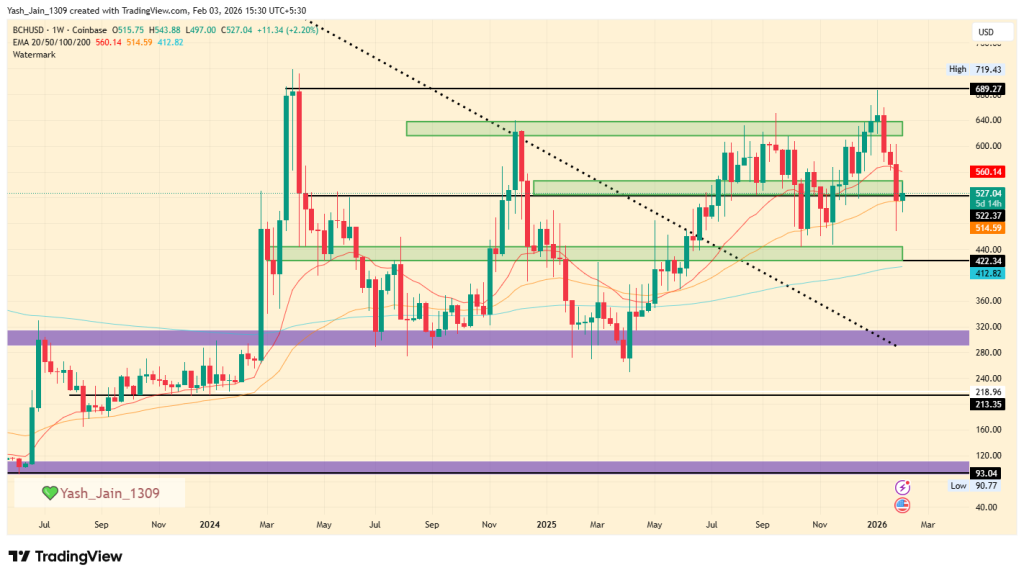
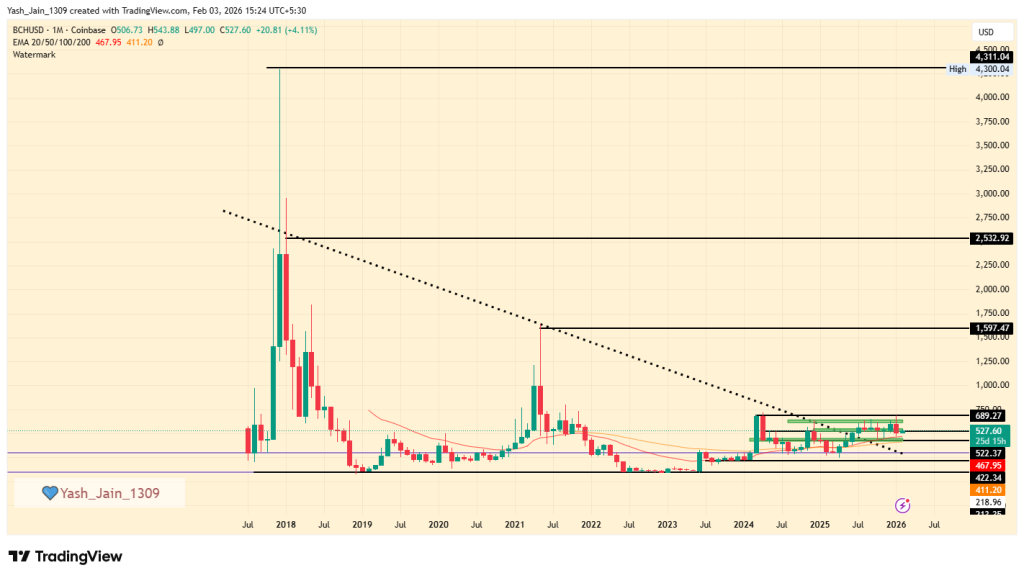
Q1 2026 could initiate a rally based on the success of the multi-year descending triangle pattern. On a 1-M timeframe, BCH/USD is in a consolidation between $425 and $689. But, sustaining above $689 would signal a trend shift. However, dropping below $450 risks a quick decline, with $300 as a critical support level.
BCH Price Prediction February 2026
In January, the price of Bitcoin Cash (BCH) briefly reached $689 but was rejected back into the 50-day EMA band. Now, it’s trading around $522 key support level. February can be seen as BCH trading around two key areas: $422 support, which could be tested if $522 is lost. Another is its resistance, which can be tested at around $620 if bullish demand returns around $522.
BCH Price Prediction 2026 (Q1)
Q1 2026 is set to be the most attractive period for the rally to truly kick off, because H2 2025 onwards it has broken out of a multi-year descending triangle pattern on the monthly chart, and ever since then it has mostly consolidated in a range of $425-$689. The range is quite big on a shorter timeframe, but on a longer timeframe, like monthly, it’s an ordinary consolidation whose movements are not as big as they sound compared to its historical price action.
In Q1 2026, it continues to consolidate in its range and has hit $689 once. And now, if it sustains above it in the coming months, that will signify a “Change of Character (ChoCh)” on the monthly chart, marking a significant long-term trend shift and unlocking potential for higher targets ahead.
Also, under the worst-case scenario, if the BCH price drops below critical support at $450, we could see a swift decline. The $300 level is expected to serve as a strong line of defense against further declines; however, breaking this level would completely delay the current long-term bullish sentiment
Year
Potential Low
Potential Average
Potential High
2026 (conservative)
$300
$605
$1200
Bitcoin Cash Price Targets 2026 – 2030
Year
Potential Low ($)
Potential Average ($)
Potential High ($)
2026
595
790
985
2027
680
925
1,160
2028
795
1,135
1,475
2029
1,025
1,480
1,955
2030
1,350
2,010
2,675
This table, based on historical movements, shows BCH price to reach $2675 by 2030 based on compounding market cap each year. This table provides a framework for understanding the potential BCH price movements. Yet, the actual price will depend on a combination of market dynamics, investor behavior, and external factors influencing the cryptocurrency landscape.
BCH Price Prediction 2026
In 2026, Bitcoin Cash price could project a low price of $680, an average price of $925, and a high of $1,160.
Bitcoin Cash Price Prediction 2027
As per the Bitcoin Cash Price Prediction 2027, BCH may see a potential low price of $795. Meanwhile, the average price is predicted to be around $1,135. The potential high for BCH price in 2027 is estimated to reach $1,475.
BCH Price Analysis 2028
Looking ahead to the Bitcoin Cash Price Prediction 2028, BCH is expected to have a low price of $1,025. With an average price of $1,480, the BCH price could make a high of $1,955.
Bitcoin Cash Price Prediction 2029
Finally, by 2029, Bitcoin Cash Price Prediction anticipates a low price of $1,350, an average price of $2,010, and a high of $2,675.
Bitcoin Cash Price Forecast 2030
For the year 2030, Bitcoin Cash Price Prediction forecasts a low price of $1809, an average price of $2705, and a high of $3410.
Never Miss a Beat in the Crypto World!
Stay ahead with breaking news, expert analysis, and real-time updates on the latest trends in Bitcoin, altcoins, DeFi, NFTs, and more.
FAQs
What is BCH price prediction for 2026?
BCH price prediction for 2026 ranges from $680 to $1,160, depending on whether it confirms a long-term bullish trend shift.
How much will Bitcoin Cash be worth in 2030?
Bitcoin Cash could trade between $1,350 and $2,675 by 2030 if adoption rises and market conditions remain favorable.
What is Bitcoin Cash price prediction for 2040?
By 2040, Bitcoin Cash could see significantly higher valuations if global payments adoption expands, though forecasts remain speculative.
Can Bitcoin Cash grow beyond its current use case?
Yes, BCH could grow through wider merchant adoption, faster payments, and improved on-chain utility in real-world transactions.
Is Bitcoin Cash a good long-term investment?
BCH has long-term potential due to low fees, fast transactions, and growing merchant adoption, but price depends on broader crypto market trends.
Can Bitcoin Cash reach its all-time high again?
Revisiting previous highs is possible if BCH sees sustained adoption and a confirmed long-term trend reversal, though it’s not guaranteed.
BSV has traded under the 200-day EMA band, indicating a bearish trend.
Analysts predict a gradual price increase, with potential highs reaching $175 by 2030.
Bitcoin SV price (BSV) has been on muted growth trajectory compared to other altcoins. Since the beginning of the year, signaling prolonged bearish sentiment, Bitcoin SV (BSV) has consistently traded below its 200-day EMA band.
Despite attempts to gain traction, the asset has failed to show any long-term bullish reversal, raising doubts among investors and traders about its recovery potential.
Even it’s a non-profit organization, BSV association, optimistic activities like successful collaboration and hackathon events are not manifesting on the BSV price chart
Many ask: “Can BSV Price break bearish trend above 200-day EMA?, “Is BSV a hidden gem waiting for its breakout, or just another risky bet?”. In this Bitcoin SV price prediction 2025 article, we’ll explore the future for BSV Price from 2025 through 2030.
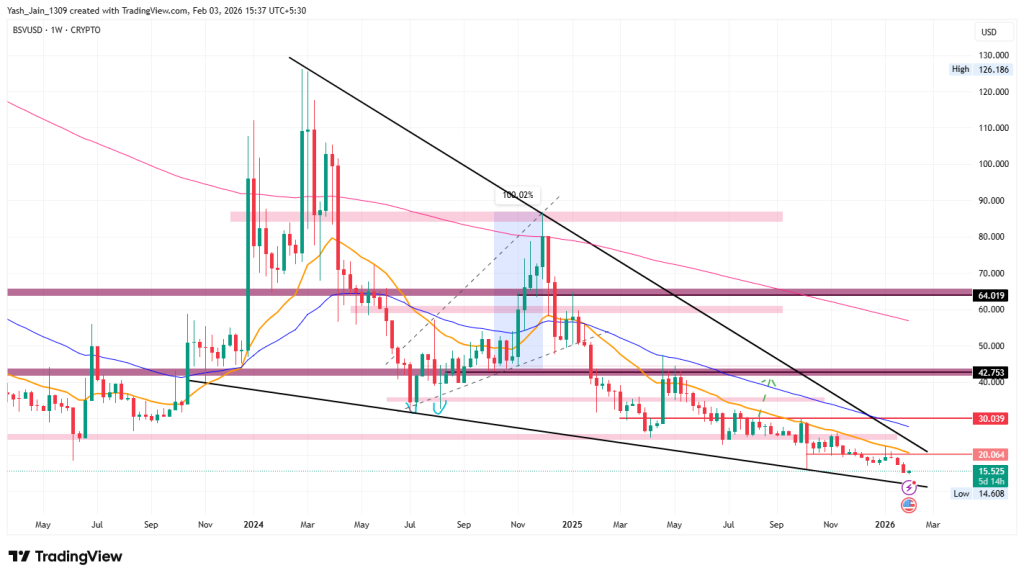
Bitcoin SV (BSV) shows potential for a rebound in 2026 as it approaches a critical support level within a falling wedge pattern. If it sees a reversal and surpasses the $30 resistance in that process, BSV could reach $42 and $64 by year-end, assuming improved demand. Otherwise, consolidation may continue.
BSV Price Prediction 2026: Outlook Of Fresh Year
The current price of Bitcoin SV (BSV) presents a notable opportunity for investors. Although 2025 experienced heavy challenges after 2024’s high, things seem to be changing for BSV. The price prediction for BSV in 2026 points to a more optimistic future ahead.
This optimism stems from recent chart observations that have revealed what was hidden amid the intense downtrend in the BSV/USD price. The pattern that emerged was a falling wedge, which has significantly compressed the trading range over the last two years. This compression suggests a strong potential for a positive shift in 2026, which should be considered despite the recent price fluctuations.
The projections for Q1 2026 align well with this falling wedge, which has been forming for multiple years, indicating that the trading range is approaching a critical point. Many believe that a substantial bounce could occur, offering a promising outlook for the asset.
While past price action has shown some terrific declines, Q1 is approaching the lower border of the falling wedge. From a distance, BSV/USD appears to be seeking a stable footing, and the lower boundary could answer that call. It appears to have laid a solid foundation that could benefit from better, more favorable macroeconomic conditions in the future. Signs indicate that 2026 could be a significant rally year, and investors anticipate bullish demand.
With stabilizing market conditions, there appears to be potential for considerable upward movement. The immediate resistance level to watch is $30; if this threshold is surpassed, we could see levels of $42 and $64 by the end of the year. However, if demand does not improve, consolidation might continue for an extended period.
Year
Potential Low ($)
Average Price ($)
Potential High ($)
2026
30
42
65
Bitcoin SV Onchain Analysis
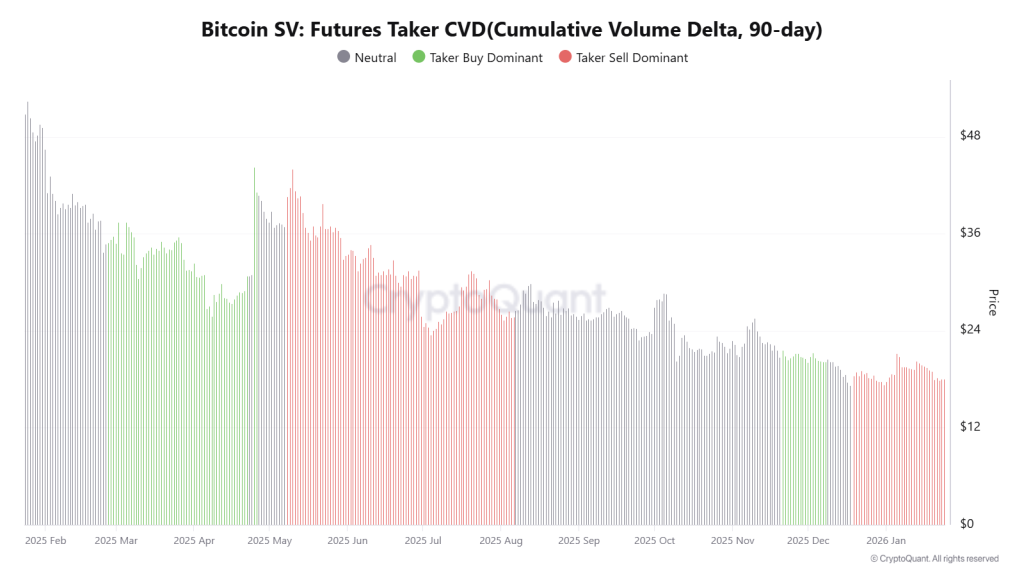
The 90-day Taker CVD is negative and declining, indicating that aggressive sellers have dominated the market. This means that those hitting the bid are selling more than they buy, which likely drives the BSV price down due to excess supply.
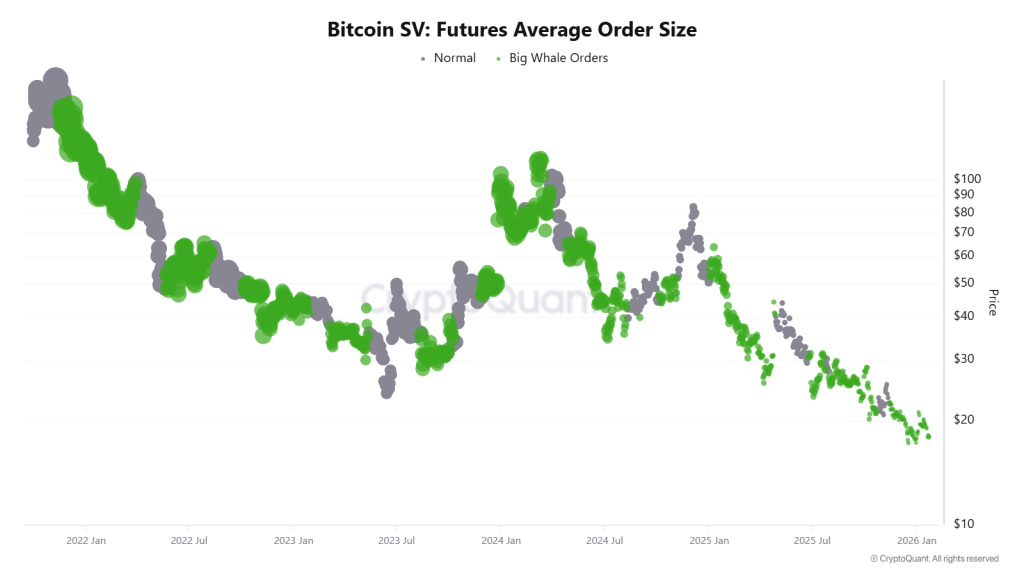
However, the large average order sizes indicated by the green dots on the chart suggest otherwise. When these order sizes remain high while prices drop, it signals that whales or big investors are placing significant buy orders. These players are absorbing the selling pressure, allowing retail investors to sell at lower prices into their large orders.
Historically, when high-value orders continue during a price decline, it suggests the market may be nearing a liquidity bottom.
Bitcoin SV Price Forecast 2026-2030
Year
Potential Low ($)
Average Price ($)
Potential High ($)
2026
60
90
130
2027
75
95
145
2028
85
115
155
2029
95
125
165
2030
105
135
175
This table, based on historical movements, shows BSV price to reach $175 by 2030 based on compounding market cap each year. This table provides a framework for understanding the potential BSV price movements. Yet, the actual price will depend on a combination of market dynamics, investor behavior, and external factors influencing the cryptocurrency landscape.
BSV Coin Price Prediction 2026
BSV price prediction for 2026 anticipates a potential low of $60 and a high of $130, with an average price projected at $90.
Bitcoin SV Price Forecast 2027
In 2027, the BSV token price can range between $75 and $145, with an average price of approximately $95.
Bitcoin SV (BSV) Price Prediction 2028
Based on the altcoin’s price history, it can target a potential low of $85 and a potential high of $155, with an average price expected to be $115.
BSV Crypto Price Prediction 2029
Bitcoin SV price targets in 2029 are estimated to range from $95 to $165, with an average price of around $125.
Bitcoin SV (BSV) Price Prediction 2030
The potential low for Bitcoin SV in 2030 is forecasted at $105, the potential high at $175, with an average price expected to be $135.
Market Analysis
Firm Name
2025
2026
2030
Digital Coin price
$78
$94
$199
Coindataflow
$75
$36
$70
Coincodex
$26
$21
$35
Swapspace
$23
$46
$360
Never Miss a Beat in the Crypto World!
Stay ahead with breaking news, expert analysis, and real-time updates on the latest trends in Bitcoin, altcoins, DeFi, NFTs, and more.
FAQs
What is the Bitcoin SV price prediction for 2026?
BSV could range from $60 to $130 in 2026, with an average price around $90, showing potential for a bullish reversal.
What is the Bitcoin SV price prediction for 2030?
By 2030, BSV may reach $105–$175, averaging $135 if adoption grows and market conditions remain favorable.
What is the price prediction for Bitcoin SV in 2040?
Long-term 2040 predictions are uncertain, but if growth continues, BSV could rise steadily with the broader crypto market.
Is Bitcoin SV better than Bitcoin?
BSV focuses on fast, low-cost transactions and enterprise use, while BTC is primarily a store of value. Choice depends on goals.
What are the main risks of investing in Bitcoin SV?
Risks include prolonged bearish trends, weak investor sentiment, regulatory uncertainty, and underperformance versus other altcoins.
Analysts predict PEPE could reach $0.0000539 by 2026.
Long-term forecasts suggest potential highs of $0.0002733 by 2030.
Pepe Coin (PEPE), the memecoin inspired by the iconic frog meme, has rapidly become a standout in the crypto world. Ranked just behind Dogecoin and Shiba Inu, PEPE’s explosive rise—boasting gains of over +130325085.96% from its all-time low—has captured investor attention globally.
As it maintains its position among top memecoins, many are now asking: Will PEPE price go parabolic by the end of 2025? In this article, explore CoinPedia’s in-depth PEPE coin price prediction for 2025, and discover long-term forecasts that look ahead to 2030.
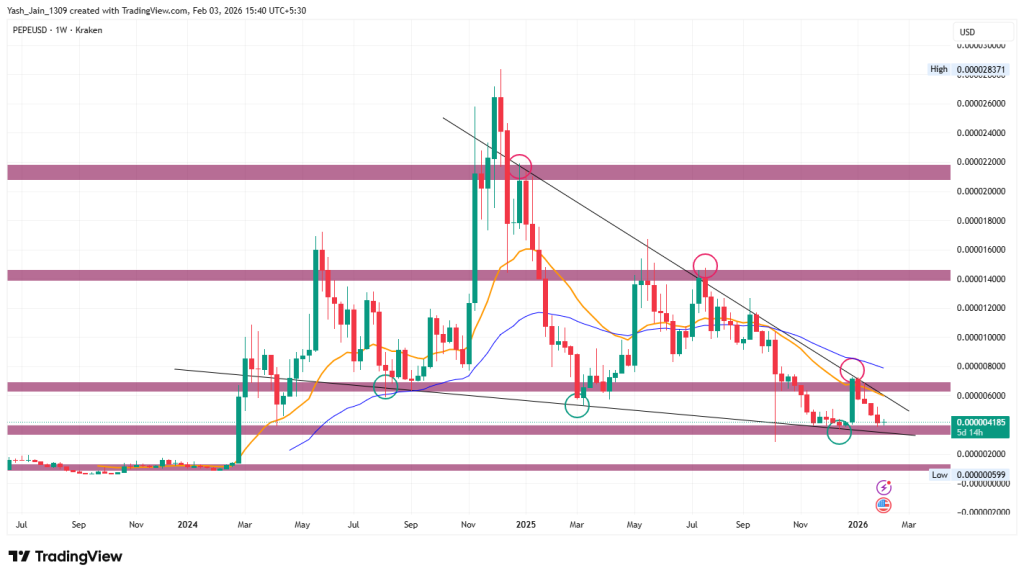
PEPE’s price has struggled in Q4 2025 due to low liquidity and cautious investor sentiment. However, if new capital flows in, a price rise is likely in Q1 2026, supported by a tightening trading range which is indicating potential for a breakout more than ever.
PEPE Price Prediction 2026
The PEPE price has faced challenges in Q4 2025, falling short of the expectations set by experts and investors alike, primarily due to an overarching risk-off sentiment within the memecoin space.
However, it’s essential to acknowledge that the current low market liquidity and cautious investor behavior have kept new capital on the sidelines amid a series of bearish trends.
Nevertheless, it is also a fact that entering the crypto market through memecoins remains one of the most accessible and easiest methods available. Should new liquidity begin to flow in, we can undoubtedly anticipate a bigger rise in PEPE’s price. Q1 2026 stands out as an ideal timeframe for this potential resurgence, and the compression of the falling wedge shows compression of the trading range that confirms the effectiveness and reliability of these trendlines that have been containing the price of PEPE since 2025, and the odds of a rally to pop out soon have greatly risen.
PEPE On-Chain Outlook
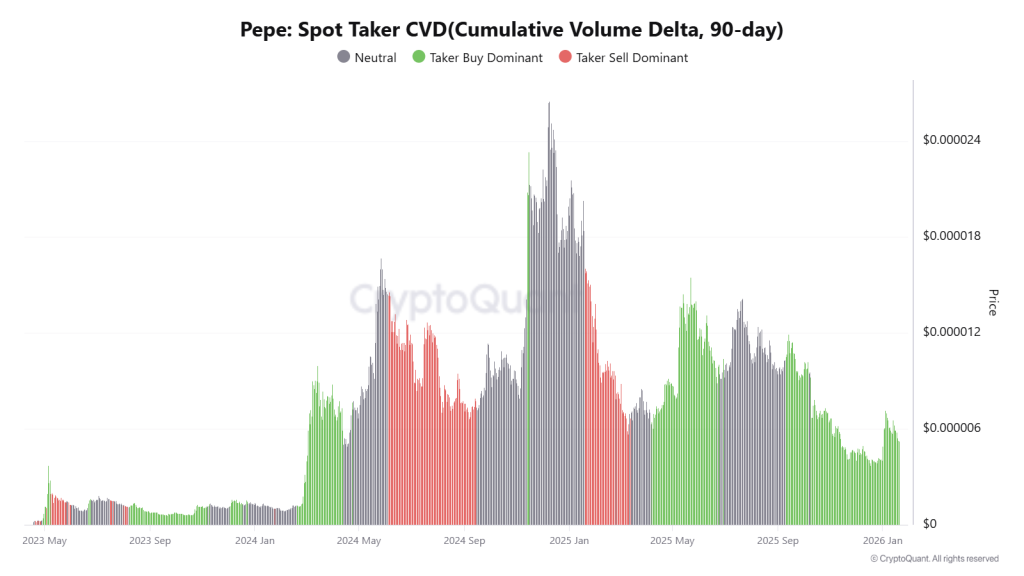
As per the metric “90-day Spot Taker CVD”, the cumulative difference between market buy and market sell volumes has turned positive and is increasing, indicating that high-conviction traders are aggressively market-buying PEPE rather than waiting for passive fills at lower prices.
This aggressive participation is a hallmark of a robust accumulation phase, in which market demand begins to outpace available liquidity, often serving as a precursor to a volatile price expansion.
Given that similar green clusters on the historical chart preceded significant rallies in mid-2024 and mid-2025, the current uptick suggests that “smart money” is positioning for a major move as the asset stabilizes near its current support levels in January 2026.
PEPE Price Prediction 2026 – 2030
Year
Potential Low ($)
Potential Average ($)
Potential High ($)
2026
0.0000179
0.0000359
0.0000539
2027
0.0000269
0.0000539
0.0000809
2028
0.0000404
0.0000809
0.0001214
2029
0.0000607
0.0001214
0.0001822
2030
0.0000910
0.0001822
0.0002733
This table, based on historical movements, shows PEPE price to reach $0.0002733 by 2030 based on compounding market cap each year. This table provides a framework for understanding the potential PEPE price movements. Yet, the actual price will depend on a combination of market dynamics, investor behavior, and external factors influencing the cryptocurrency landscape.
Pepecoin Price Forecast 2026
Our PEPE price prediction suggests that the price of PEPE in 2026 might range between $0.0000179 and $0.0000539, with the average price of the meme coin at $0.0000359.
Pepe Coin Price Prediction 2027
For 2027, we predict that the price of PEPE could range between $0.0000269 and $0.0000809, and the average price of the meme coin is expected to be around $0.000539.
Pepecoin Price Targets 2028
As per our Pepe Coin Price Prediction, in 2028, the price could range between $0.0000404 to $0.0001214, with the average price of the meme coin at $0.0000809.
Pepecoin Price Projection 2029
For 2029, the price of PEPE could range between $0.0000607 and $0.0001822, with the average price of the meme coin expected to be around $0.0001214.
Pepe Coin Price Prediction 2030
Based on our Pepecoin price forecast, the price of PEPE in 2030 might range between $0.0000910 to $0.0002733, with the average price of the meme coin predicted to be around $0.0001822.
PEPE Coin Market Analysis
Firm Name
2026
2030
Changelly
$0.0020
$0.015
CoinCodex
$ 0.000026
$ 0.000047
Binance
$0.000014
$0.000017
Never Miss a Beat in the Crypto World!
Stay ahead with breaking news, expert analysis, and real-time updates on the latest trends in Bitcoin, altcoins, DeFi, NFTs, and more.
FAQs
How much is Pepe coin worth?
The current price of Pepecoin is $ 0.00000419.
What factors could drive PEPE’s price growth in the coming years?
PEPE’s price depends on meme coin market sentiment, liquidity inflows, social media trends, and broader crypto cycles rather than fundamentals alone.
Is PEPE a high-risk investment compared to other cryptocurrencies?
Yes. As a meme coin, PEPE is highly volatile and sentiment-driven, making it riskier than utility-based cryptocurrencies with real-world use cases.
How does PEPE compare with Dogecoin and Shiba Inu?
PEPE competes mainly on community hype and trading momentum, while DOGE and SHIB benefit from longer histories and broader ecosystem support.
What is PEPE price prediction for 2026?
PEPE could trade between $0.0000179 and $0.0000539 in 2026, depending on meme coin demand, liquidity inflows, and overall crypto market momentum.
What is PEPE price prediction for 2027?
In 2027, PEPE may range from $0.0000269 to $0.0000809 if bullish sentiment and retail participation remain strong across meme coins.
What is PEPE price prediction for 2028?
PEPE’s price in 2028 could move between $0.0000404 and $0.0001214, driven by broader market cycles rather than project fundamentals.
What is PEPE price prediction for 2030?
By 2030, PEPE could reach up to $0.0002733 in optimistic scenarios, though prices will remain highly sensitive to market sentiment and risk appetite.
TRUMP memecoin cools near $5.66 as election hype fades, but 2026–2030 price predictions show potential surges toward $69.90 amid rising crypto and political momentum.
TRUMP token forecast signals major volatility ahead, with 2026 lows at $5 and highs up to $11.20 as memecoin trends, DeFi adoption, and political narratives drive demand.
OFFICIAL TRUMP (TRUMP), the political-themed memecoin linked to U.S. President Donald Trump, has become one of the most watched and volatile tokens in the market.
Its sharp rise in 2025 was driven by election hype, strong celebrity support, and massive social media attention. This pushed TRUMP into the spotlight as a cultural trend, not just another cryptocurrency.
So, let’s dive deep into our in-depth analysis of TRUMP Price Prediction 2026–2030, to find out what’s coming for the investors.
Was TRUMP regarded as a negligible asset in 2025? Not at all; the late 2025 announcement of a game launching on the App Store significantly shifted perceptions. Now, with the highly anticipated “Trump billionaire game” set to debut on the Apple Store on February 17th, 2026, the outlook for recovery in 2026 is strong, even after a challenging market in 2025. An increase from $4.00 clearly indicates potential, and once the $8.50 resistance is surpassed, we are poised for a rally towards $12.00.
Trump Price Prediction 2026
In 2025, the TRUMP token did not appear to be a dead asset, particularly with the announcement of the “Trump Billionaire Game,” which added a utility aspect beyond its initial memecoin status. The launch is scheduled for February 17th, 2026, on the Apple Store.
However, the outlook for 2026 is complicated by the 2025 market performance, where bulls struggled significantly against robust bearish sentiment. This dynamic reflects the speculative and often volatile nature of TRUMP’s price movement throughout 2025.
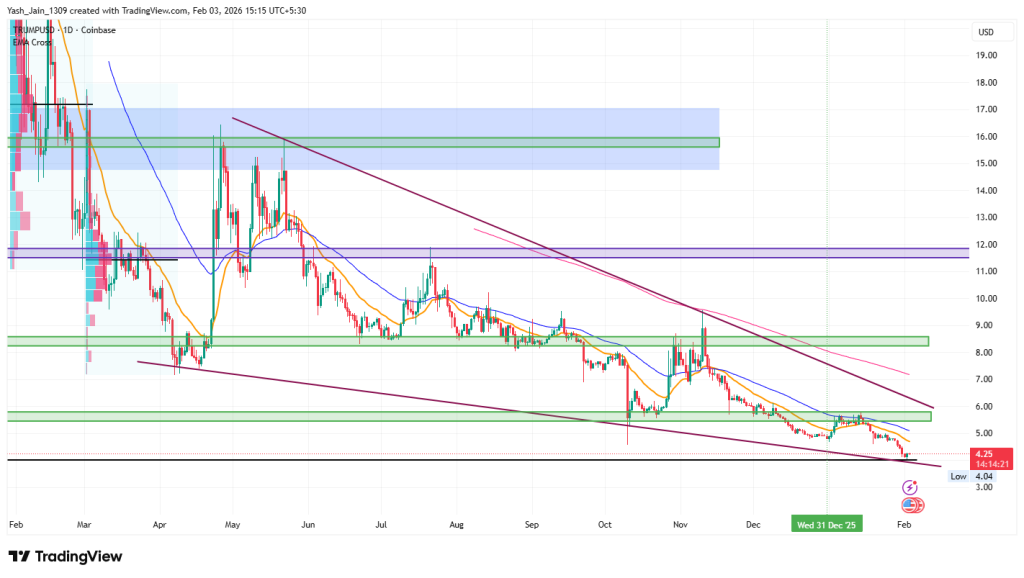
As we look forward to the possibilities that 2026 may bring, particularly with Donald Trump’s ongoing influence in the political arena, the potential for adoption is indeed compelling. On the price front, the weekly chart showcases an intriguing setup; we’ve recently seen a demand around 4.00 in early February. The price pattern indicates a falling wedge, reflecting a tightly compressed trading range, much like a coiled spring ready to unleash its energy.
Given this technical formation, a rebound appears likely. If bullish momentum emerges in Q1 2026, it will be crucial to monitor the $8.50 resistance level. A decisive breakout above this level could signal a significant rally, potentially advancing toward $12.00 as the uptrend unfolds.
Year
Potential Low ($)
Potential Average ($)
Potential High ($)
2026
$7
$18
$26
Trump Coin On-Chain Analysis
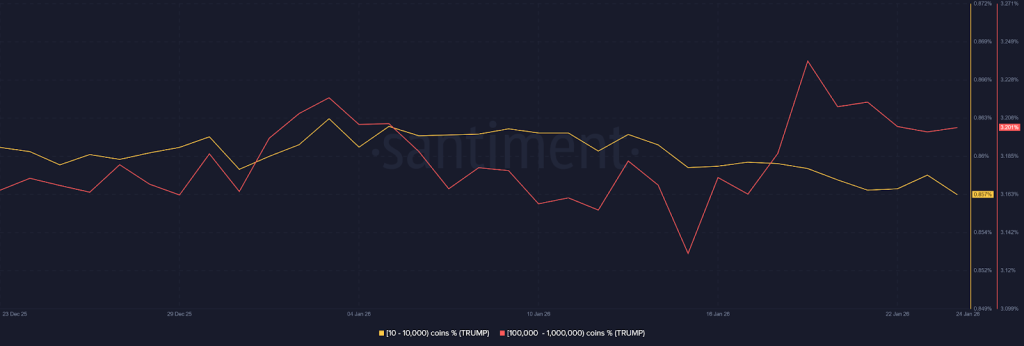
On-chain analysis of the OFFICIAL TRUMP (TRUMP) token in January 2026 reveals a significant bullish divergence characterized by institutional-grade absorption. Over the last 30 days, a clear redistribution of supply has occurred, which means that retail addresses holding between 10 and 10,000 coins have been consistently offloading their positions, while high-conviction “whale” addresses especially those holding between 100,000 and 1,000,000 TRUMP coins, have moved into an accumulation phase.
This “smart money” behavior suggests that larger entities are leveraging short-term retail panic and distribution as liquidity to build substantial long-term positions. This is laying the structural groundwork for a powerful upward trend as market sentiment stabilizes.
TRUMP Price Prediction 2026 – 2030
Year
Potential Low ($)
Potential Average ($)
Potential High ($)
2026
$5.00
$7.10
$11.20
2027
$6.05
$12.65
$18.90
2028
$8.20
$18.20
$27.50
2029
$12.40
$28.10
$44.80
2030
$18.10
$45.10
$69.90
TRUMP Price Prediction 2026
By 2026, the value of a single OFFICIALTRUMP coin price could reach a maximum of $42.00, with a potential low of $14.00. With this, the average price could land at around the $28.00 mark.
TRUMP Price Prediction 2027
Looking forward to 2027, the TRUMP coin Price may range between $21.00 and $42.00, and a potential average value of around $63.00.
TRUMP Price Prediction 2028
The Trump price could achieve the $94.25 milestone by the year 2028. However, the viral memecoin could record a low of $31.50 and an average price of $62.00 if the crypto market turns bearish.
TRUMP Price Prediction 2029
During 2029, the TRUMP crypto could reach a maximum trading value of $141.50 with a potential low of around $88. Evaluating the market sentiments, the average price of this altcoin could settle at around $94.50.
TRUMP Price Prediction 2030
The TRUMP memecoin crypto prediction for the year 2030 could range between $70.75 to $212.25. Considering the buying and selling pressure, the average price could be around $141.50 for that year.
What Does The Market Say?
Firm Name
2025
2026
2030
Mudrex
$60
$100
$600
Icobench
$100
$150
$500
Binance
$13.93
$14.63
$17.78
CoinPedia’s TRUMP Price Prediction
According to CoinPedia’s analysis, TRUMP could recover from its 2025 decline if strong social buzz returns. As per our price outlook, renewed interest in political-themed tokens may help TRUMP climb toward a possible $11.58.
However, if the market turns cautious, the token may drop back toward $5.0 before finding stable support.
Year
Potential Low ($)
Potential Average ($)
Potential High ($)
2026
$5.0
$7.18
$11.58
Never Miss a Beat in the Crypto World!
Stay ahead with breaking news, expert analysis, and real-time updates on the latest trends in Bitcoin, altcoins, DeFi, NFTs, and more.
FAQs
What is the TRUMP token and why is it gaining popularity?
The TRUMP token is a political-themed memecoin that surged due to election buzz, celebrity attention, and strong community hype.
What is the TRUMP price prediction for 2026?
Analysts expect TRUMP to trade between $5.00 and $11.20 in 2026, depending on market liquidity, sentiment, and political momentum.
Can the TRUMP token reach $20 by 2028?
Yes, if market demand rises, TRUMP could test the $20 zone by 2028 as memecoins mature and investor interest strengthens.
What could drive TRUMP’s price higher by 2030?
Community activity, strong market cycles, and sustained interest in political tokens may push TRUMP toward higher long-term levels.
Samsung Galaxy S26 Ultra will launch in four bold colors and at least two online exclusive shades. A fresh leak brings back the flagship’s color options to headlines, but two more rumored colors remain to be seen.
Newly leaked Galaxy S26 Ultra images showcase the device in its four standard colors, including Cobalt Violet, Black, White and Sky Blue. The device could be available in two more shades, namely “Pink Gold” and “Silver Shadow.”
After AndroidHeadlines, Russian retailer Cifrus.ru (via SammyGuru) also revealed official pictures of Samsung’s upcoming flagship. The retailer has also listed a 128GB model of the S26U, which was nothing but a technical error.
Moments after listing the device, Cifrus.ru pulled the webpage. The listing is no longer there, but the visual assets have been grabbed early. Colors that are missing in renders could be sold as Samsung.com-exclusive variants.
Just recently, an online listing brought disappointing news for fans. It looks like Samsung hasn’t installed Qi2 magnets inside the devices. Users would be required to purchase compatible accessories to utilize Qi2 charging.
If it happens, Pixel 10 will remain the only Android device with Qi2 charging. Samsung is widely rumored to bring Qi2 charging to the Galaxy S26 series; meanwhile, things may not turn out the way everyone has anticipated.
Samsung’s Galaxy S26 series could hit market shelves on March 11. Before release, the devices will officially be unveiled on February 25. The event is set to take place in San Francisco, and an official livestream will be available for fans.
A new industry report suggests that Samsung is betting big on the Galaxy Z Fold 8 rather than the Z Flip 8, and it’s going to happen for the first time in history.
Korea’s ETNews, citing industry sources reveal that Samsung plans to manufacture around 3.5 million Galaxy Z Fold 8 units for the second half of 2026, compared to just 2.5 to 3 million Galaxy Z Flip 8 devices.
This marks a historic production reversal that nobody saw coming three years ago when the clamshell Flip dominated sales at a comfortable 60-70 percent share.
Galaxy Z Fold 7 to be thanked
At 215g, it came in lighter than the Galaxy S25 Ultra. At 8.9mm thin, it became the slimmest foldable Samsung has ever shipped. Those two numbers alone erased years of complaints about bulky, heavy book-style foldables.
Industry estimates put combined Fold 7 and Flip 7 shipments at over 6 million units last year, with the Fold 7 outselling its clamshell sibling despite initial production plans favoring the Flip.
One industry insider called it “effectively the first Fold to increase shipments through reorders,” a stunning achievement for a product line that traditionally played as a niche portfolio.
Apple is entering the foldable game this year with a book-type device. Analysts project the Cupertino giant will ship approximately 10 million foldable units annually. The message is clear: the book-type form factor is where the real money lives.
Galaxy Z Fold 7 dumped the S Pen support for sleekness. Samsung could keep the Z Fold 8 unchanged from this particular aspect. The company also promises major improvements to the display crease.
Google is finally admitting what Pixel users have known for years. With Android 16 QPR3 Beta 2, Adaptive Connectivity is no longer a single, vague toggle buried in network settings. It is now split into two clear controls, each with a specific job and a clearer promise.
Until now, Adaptive Connectivity lived as a lone on-off switch under Settings, Network and internet. Google said it would extend battery life and manage connections automatically. You flipped it on and hoped the phone made the right call when Wi-Fi turned unreliable or power drain lagged in.
In QPR3 Beta 2 (via 9to5Google), Adaptive Connectivity becomes two separate toggles, both enabled by default.
One focuses purely on stability. Auto switch to mobile network does exactly what the name suggests. When Wi-Fi quality drops, the phone prioritizes staying connected, even if that means jumping to mobile data.
The second toggle is about restraint. Optimize network for battery life chooses the most efficient connection with power savings in mind, not raw reliability.
Technically, the change appears tied to an update of Adaptive Connectivity Services, recently pushed via Google System Services as version p.2026.01.
In Android 16 QPR3 Beta 2, the old single toggle is gone. In its place sit the two new options, described in plain language, inside the same Network and internet menu.
This split matters more than it may look at first glance. One more QPR3 beta is expected later this month. The stable Android 16 QPR3 release is still lined up for March.
February 2026 version of the Samsung update roadmap has brought bad news for the users of the Galaxy S21 series, S22 series, and S21 FE. Notable reshuffle has been carried out, with some getting ousted and others getting downgraded.
Galaxy S21 series (moved from Quarterly in January, completely removed in February):
Galaxy S21 5G
Galaxy S21+ 5G
Galaxy S21 Ultra 5G
Samsung launched the Galaxy S21 series in January 2021. The lineup has received four years of regular security updates and an additional year of quarterly updates. Samsung ended the support after the 5th anniversary.
Even though the software support has ended, your device will remain as functional as before. It would stop receiving new Android and One UI patches, rendering your privacy and data less secure and vulnerable to threats.
Galaxy S22 series (demoted from Monthly to Quarterly):
Galaxy S22
Galaxy S22+
Galaxy S22 Ultra
Galaxy S21 FE 5G (remained in Quarterly, but was in Monthly in January)
Galaxy S22 series and S21 FE have been downgraded from Monthly to Quarterly tier. The devices have completed their 4-year monthly updates support. Now, Samsung will offer a new security update once every three months.
If you own a Galaxy S22 series device or the S21 FE, February 2027 would mark the end of software updates support. Your device will remain secure through software patches through January 2027, with no impact on functionality.
The live price of the Cardano token is $ 0.29777966.
Price prediction suggests potential to reach $2.75 to $3.25 by year-end 2026.
Long-term forecasts indicate ADA could hit $10.25 by 2030.
The Cardano price prediction 2026 is generating significant buzz in the crypto market, as the last quarter is soon to close in few days, boosting interest for the next altcoin. The 2025 for ADA/USD began with numerous fundamental updates strengthening its future, including the transformative Plomin Hard Fork, but 2026 seems even more constructive.
Now, Questions abound: “Will Cardano spearhead the altcoin movement?” and “What heights can ADA reach by 2050?” Explore this Cardano price prediction 2026 and beyond, filled with expert insights and ambitious forecasts.
Coinpedia’s Cardano Price Prediction
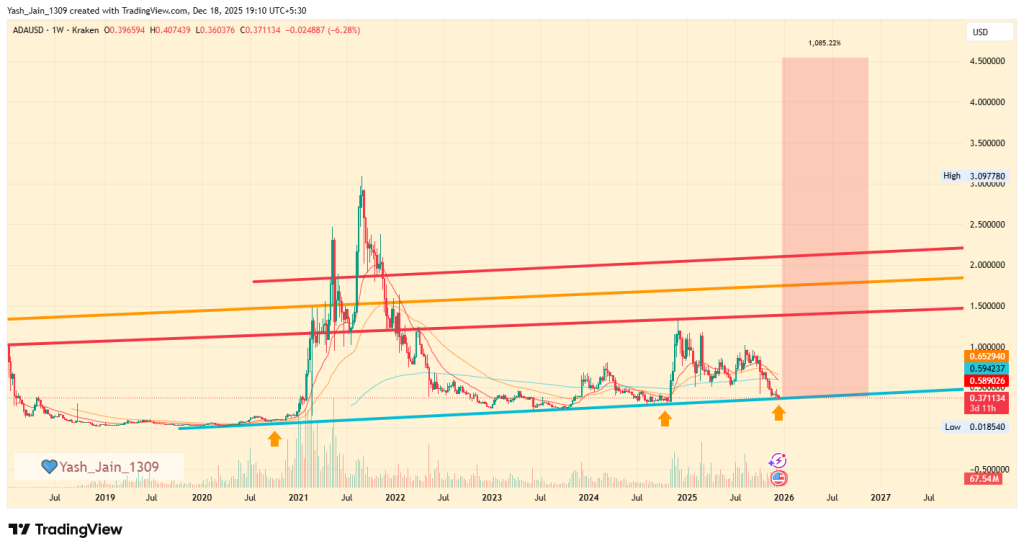
The Cardano price outlook 2026 is shaped by its remarkable 4,000% surge in 2020, currently resting at a similar support level. If market sentiment improves, even a modest increase could trigger a potential 1,000% rise to around $4.50.
A more conservative target of $1.40 suggests a 300% gain based on current trends. Analysts are optimistic that ETF approvals could enhance institutional adoption and stability, with price projections ranging from $2.05 to $2.80.
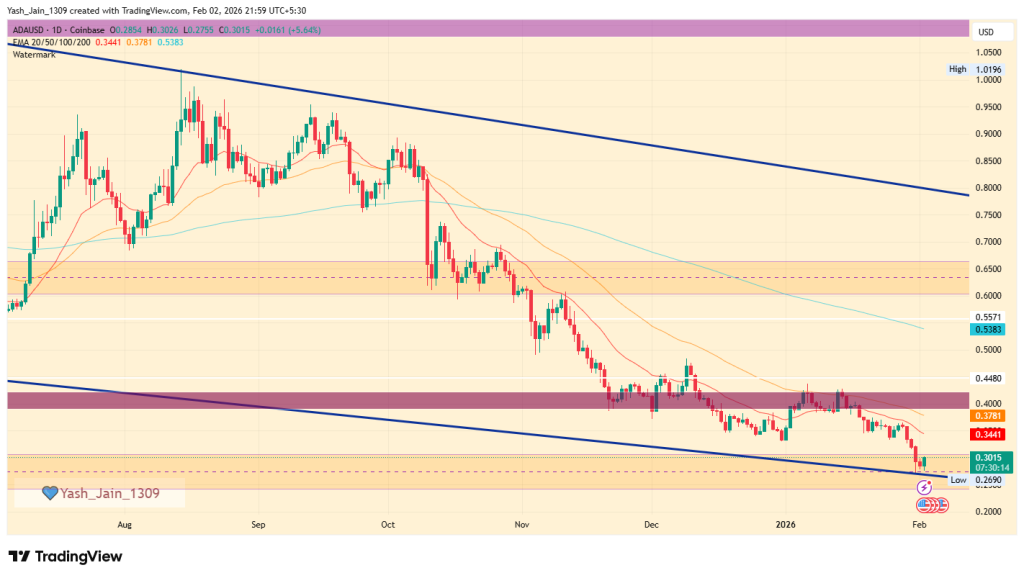
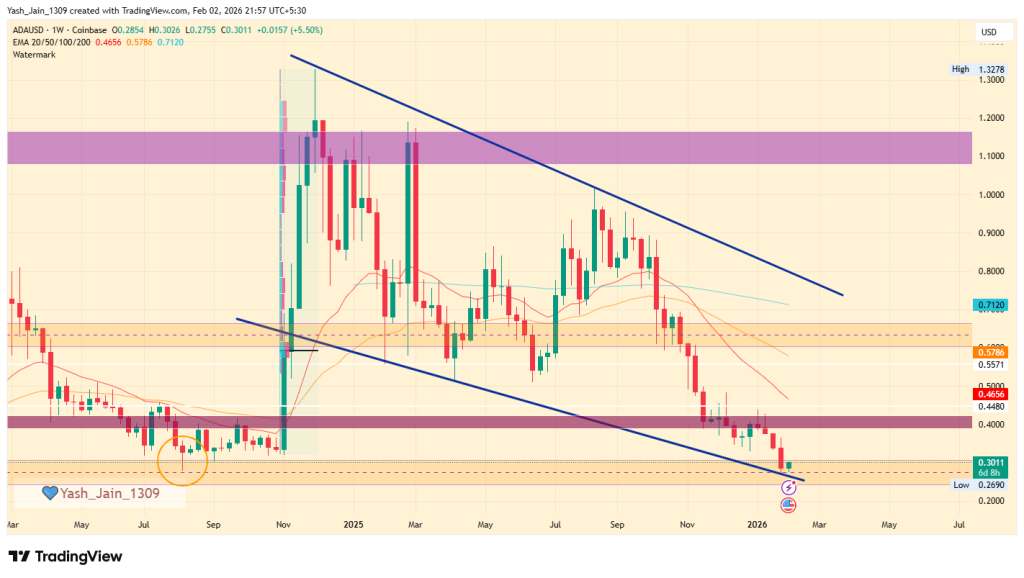
The ADA price action is currently in an intense sell-off, but in early February, it found an old demand area, and new demand could form here, taking it to new heights. Also, a falling wedge’s lower border acts as support, suggesting the nearest spike could occur, and the ADA price might hit $0.60 in February.
Cardano AI Price Prediction For February 2026
Source
Low Price
Average Price
High Price
Gemini
$0.85 – $0.95
$1.00 – $1.20
$1.30 – $1.50+
BlackBox
$0.65
$1.00
$1.50
ChatGPT
$0.75
$0.95
$1.25
ADA Price Prediction 2026
The Cardano price forecast for 2026 points to an important support level on its weekly chart, a range that has consistently acted as a strong pivot point for price trends, and is currently giving off signals of another potential rally. This support level is known for displaying remarkable resilience over time, suggesting that if Cardano price USD can maintain its position above this threshold once again, it could pave the way for significant price movements in 2026.
Looking back at Cardano’s historical performance on the weekly chart, it shows an extraordinary rally in 2020, when the asset posted staggering gains of nearly 4,000%. During that bullish phase, the Cardano price USD spent an extended period consolidating around the dynamic support trendline, which appears to be a strategic accumulation at discounts from smart money, contributing significantly to its eventual surge.
If the current market sentiment shifts positively, a resurgence in investor confidence could lead to a recovery. Not ambitiously, even modestly, past performance could give a tremendous surge. Last year’s performance was 4000%. If we assume 1/4 of that momentum, it would result in an increase of approximately 1000%, potentially elevating Cardano’s price to $4.50 by 2026.
Conversely, a more conservative approach suggests a realistic price target of around $1.40, indicating a potential increase of about 300%. This estimate remains feasible, especially since it is based on fundamental analyses and market trends that are not reliant on speculative triggers, such as the possible approval of exchange-traded funds (ETFs).
Additionally, many experts propose that these ETFs could significantly impact the market by boosting institutional investment and improving market stability. In a situation where ETF approvals occur and retail investor excitement rises, Cardano’s price could realistically range from $2.05 to $2.80.
Scenario
Potential Low
Average Price
Potential High
Without ETF Approval
$0.85
$1.10
$1.25
With ETF Approval + Retail Surge
$1.20
$1.65
$2.05
Bullish Breakout (with ETF & macro support)
$1.50
$2.05
$2.80
Cardano On-chain Analysis
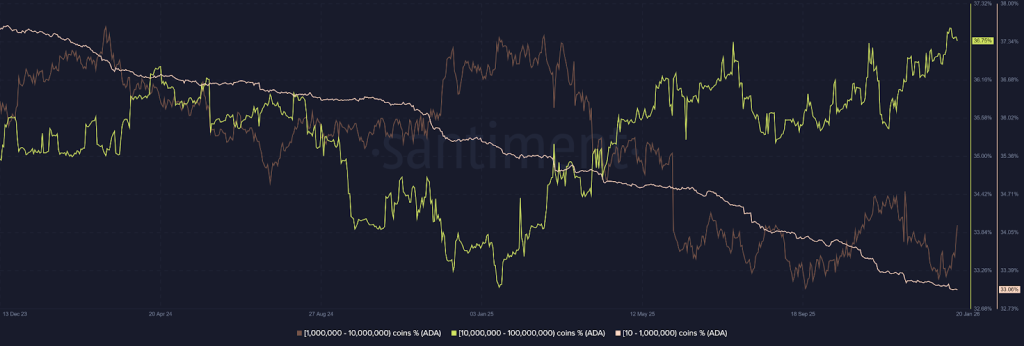
As per Cardano’s on-chain metrics, “Smart Money” accumulation phase is the best observation right now, because the divergence between retail and institutional holders is more vivid than ever.
As the number of addresses holding between 10 and 1 million ADA is declining, and the consistent surge in the 10 million to 100 million coin bracket confirms this, this represents a major supply consolidation. The observation shows that these mega-whales are strategically absorbing the “weak hands” during price dips, effectively building a rock-solid fundamental floor for the asset. Also, the fact that the 1M to 10M coin bracket is also growing confirms that professional high-net-worth investors seem to be positioning for a recovery, too.
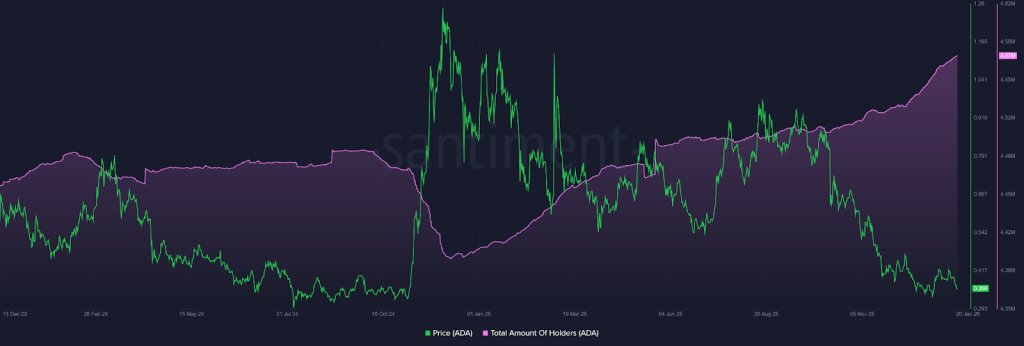
Similarly, the surge to 4.57 million total holders despite a grueling 2025 proves that Cardano’s ecosystem is expanding its reach even in a “stress test” environment. This growth in the holder base suggests that the asset is not being abandoned; rather, it is being redistributed into a more stable, long-term foundation. When a holder count rises as prices fall, it signals that the market views current levels as a deep-value opportunity rather than a reason to exit.
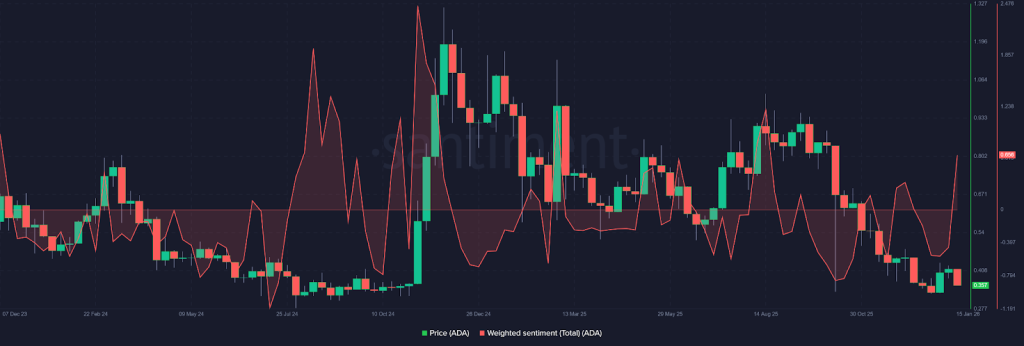
Additionally, the Weighted Sentiment flipping the 0 line to 0.656 is a crucial momentum trigger. Professionally, this “0-line flip” indicates that the aggregate social and market bias has shifted from fear to optimism.
Combined with the strategic whale accumulation, this sentiment pivot suggests that the “disbelief” phase is ending and that a bullish rally is likely once the remaining retail sell pressure is fully absorbed by the growing whale cohorts.
Cardano (ADA) Price Prediction 2026 – 2030
Price Prediction
Potential Low ($)
Average Price ($)
Potential High ($)
2026
2.75
3.00
3.25
2027
4.50
4.75
5.00
2028
5.25
5.50
5.75
2029
6.75
7.25
7.75
2030
9.00
9.75
10.25
This table, based on historical movements, shows ADA prices to reach $10.25 by 2030 based on compounding market cap each year. This table provides a framework for understanding the potential Cardano price movements. Yet, the actual price will depend on a combination of market dynamics, investor behavior, and external factors influencing the cryptocurrency landscape.
Based on the historic market sentiments and trend analysis of the altcoin, here are the possible Cardano price targets for the longer time frames.
Market Analysis
Firm Name
2025
2026
2030
Changelly
$0.752
$1.18
$6.05
Coincodex
$0.79
$0.53
$0.89
Binance
$0.79
$0.83
$1.01
*The aforementioned targets are the average targets set by the respective firms.
Coinpedia’s Price Analysis provides you with the latest content on the recent market trend that enables you to get closer to the price movements & actions of the various cryptocurrencies.
Never Miss a Beat in the Crypto World!
Stay ahead with breaking news, expert analysis, and real-time updates on the latest trends in Bitcoin, altcoins, DeFi, NFTs, and more.
FAQs
What is Cardano’s (ADA) price prediction for 2026?
Cardano could trade between $2.75 and $3.25 in 2026 if market sentiment improves, adoption grows, and key support levels hold.
Is Cardano a good long-term investment?
Cardano is considered a long-term project due to its research-driven development, scalability upgrades, and focus on decentralization.
What factors could drive ADA’s price higher in the future?
ETF approval, institutional adoption, network upgrades, and improved macro conditions could all positively impact ADA’s price.
Where will ADA be in 5 years?
In five years, ADA could trade between $7 and $10 if Cardano adoption grows, scalability improves, and the crypto market enters a strong cycle.
What will Cardano be worth in 2030?
By 2030, Cardano could be valued around $9 to $10 based on long-term growth, network usage, and sustained investor confidence.
XRP price currently stands at $2.99, with a market capitalization of $179.79 billion. Analysts and AI forecasts alike suggest that XRP could reach $5.05 by the end of 2025. Long-term XRP price predictions also place it as high as $26.50 by 2030, with an ultra-bullish target of $526 by 2050.
Ripple (XRP) remains one of the top five crypto assets in the world, gaining traction as institutional adoption ramps up and its prolonged legal battle approaches resolution. Since President Trump’s return to office, XRP has seen a resurgence in on-chain activity, investor sentiment, and even XRP ETF approved turned it into a bluechip asset.
Now, making this the most ideal time for XRP price prediction 2026-2030 to be in more focus. Read this to know in depth what’s coming next in XRP.
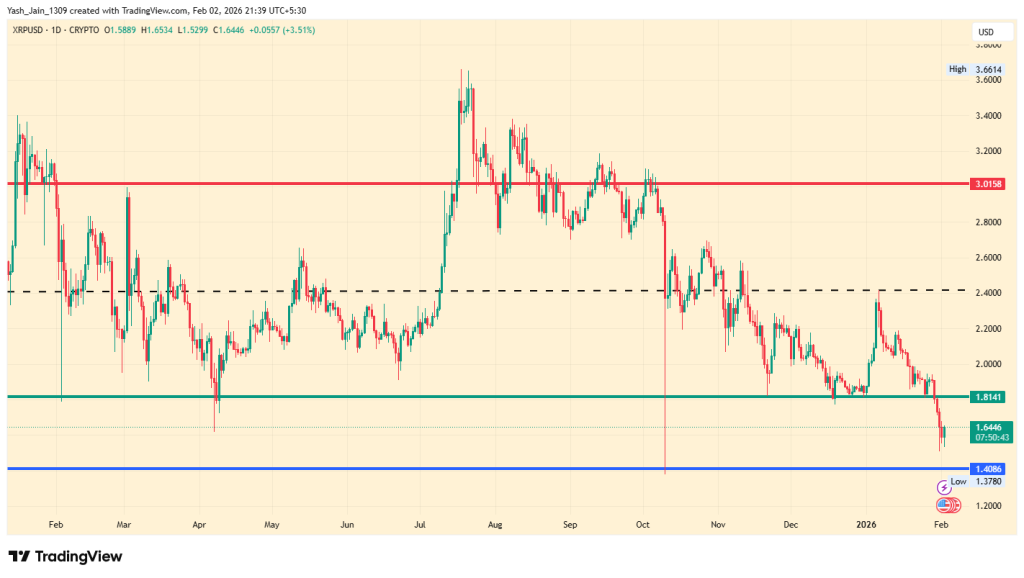
XRP/USD is in a bearish trend, approaching the $1.40 support level. If it doesn’t reverse, a drop to $0.92 may occur. A Q1 reversal is needed, with $2.40 as key resistance to retest the ATH of $3.66. For XRP to reach a new ATH by year-end, it must close above $3.66.
XRP February Outlook
In January, it peaked at $2.40 but has fallen since, and in February, it even breached $1.81 support, indicating that bears are dominant, with the next support at $1.40. If it takes support at $1.40 and recovers, its new resistance levels are $1.81 and $2.00.
XRP Price Prediction 2026
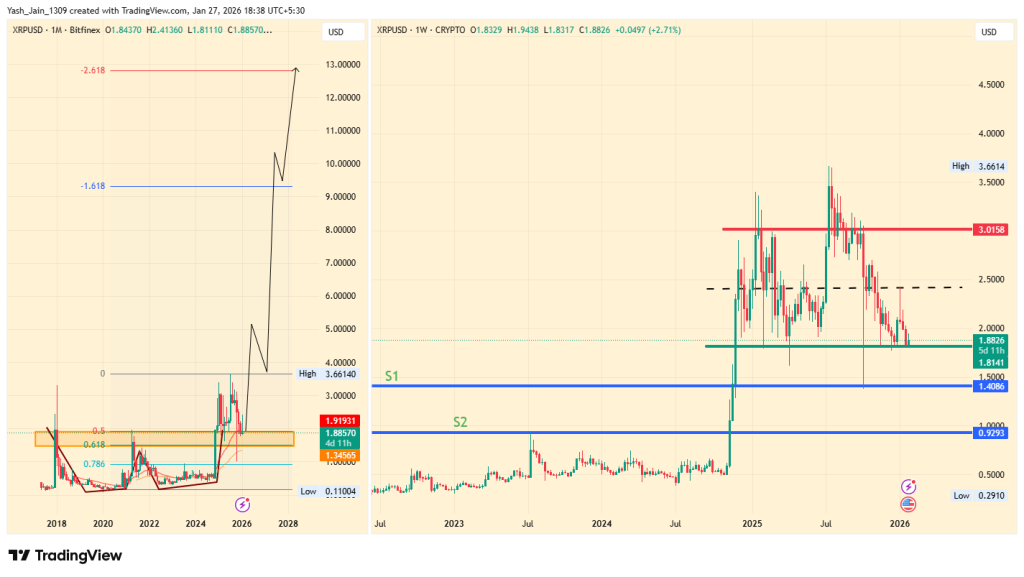
On the monthly chart, XRP price exhibits a notably bullish outlook, characterized by a double bottom pattern and a Fibonacci 0.50 retracement that indicates a strong accumulation phase occurred in 2025. This setup suggests that once a rally commences, the all-time high (ATH) could merely be the beginning, with targets potentially reaching $9 and even $13, primarily driven by its utility.
Conversely, the weekly chart presents a bearish picture, as XRP/USD has breached $1.81 level and is approaching $1.40 support 1 in early February.
Should it fail to execute a reversal from this level, a decline towards $0.92 (Support 2) could ensue.
However, if we observe a reversal in Q1, flipping the resistance at $2.40 will be essential to enhance the probability of XRP attempting to retest its ATH of $3.66. For the year to conclude with a new ATH, it is imperative that XRP break above $3.66 and secure a weekly close over this level.
Year
Potential Low
Potential Average
Potential High
2026
$1.75
$3.45
$5.05
XRP Price Predictions for January 2026 by AI platforms
Platform
Low Price
Average Price
High Price
Claude
$3.00 – $3.15
$3.50 – $4.00
$7.50 – $8.20
Blackbox
$2.50
$3.50
$5.00
Gemini
$3.00 – $4.00
$4.50 – $6.00
$6.50 – $8.00+
XRP Onchain Outlook
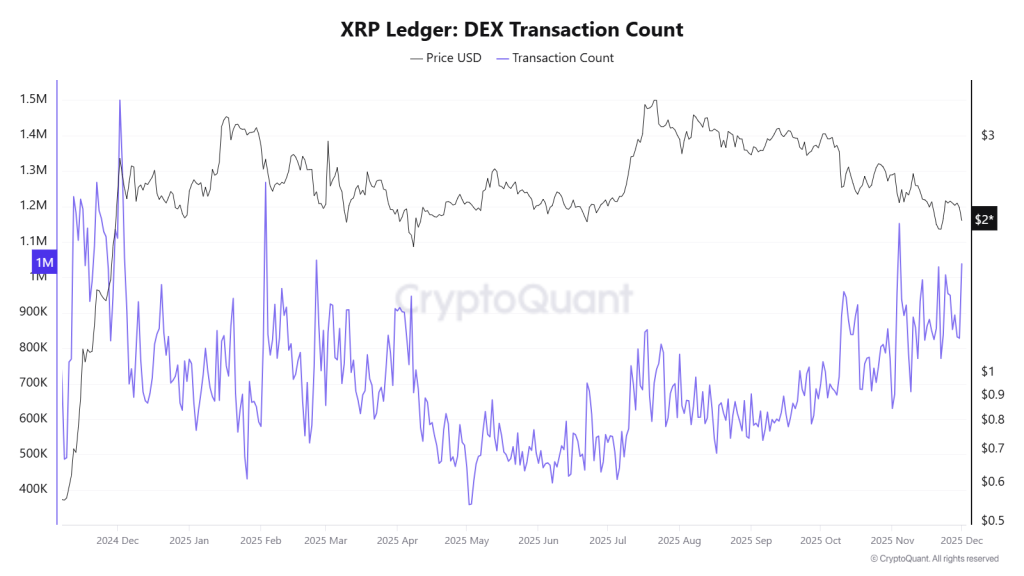
The XRP Ledger: DEX Transaction Count chart indicates a significant bullish divergence starting from May 2025. While the price is consolidating, the activity in decentralised exchanges (DEX) is increasing sharply.
The high transaction volume, which includes both orders placed and cancelled, shows that experienced traders are actively positioning themselves and adding liquidity in anticipation of a future price movement.
As a result, this on-chain metric suggests that the market is preparing for a powerful and sustainable rally in the XRP price ahead.
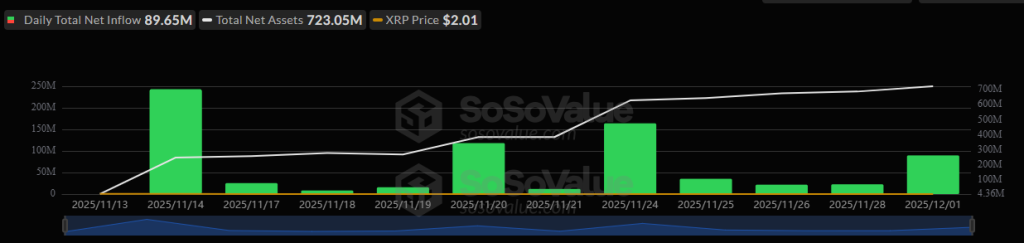
Also, the biggest fact right now in December is that altcoin liquidity is drying up. Projects securing new liquidity channels like ETFs have a better chance of long-term survival, and since November 14th, the XRP ETF has been seeing positive inflows consistently, despite what price action is, and so far, Cumulative Total Net Inflow has crossed $756 million, while total net assets are worth $723.05 million, by December 1st.
Ripple XRP Price Prediction 2026 – 2030
Year
Potential Low ($)
Potential Average ($)
Potential High ($)
XRP Price Prediction 2026
5.50
6.25
8.50
Ripple Price Prediction 2027
7.00
9.0
13.25
XRP Price Prediction 2028
11.25
13.75
16.00
XRP Price Prediction 2029
14.25
16.50
21.50
XRP Price Prediction 2030
17.00
19.75
26.50
This table, based on historical movements, shows XRP price prediction 2030 to reach $26.50 based on compounding market cap each year. This table provides a framework for understanding the potential XRP price movements. Yet, the actual price will depend on a combination of market dynamics, investor behavior, and external factors influencing the cryptocurrency landscape.
Based on historic price sentiments and XRP’s rising popularity, here are the XRP future price projections beyond 2030, where Ripple price forecasts suggest that it has become more speculative. Therefore, assuming continued adoption and dominance, XRP may see aggressive valuations in the decades ahead.
Year
Potential Low ($)
Potential Average ($)
Potential High ($)
2031
25.00
29.50
35.25
2032
31.50
36.75
41.25
2033
35.75
42.25
47.75
2040
97.50
135.50
179.00
2050
219.25
331.50
526.00
A look at this table, highlights the XRP price prediction 2040 and XRP price prediction 2050 potential high ambitious targets but this reflect a transformative vision for XRP as a dominant global payment player.
Market Analysis
Firm Name
2025
2026
2030
Changelly
$2.05
$3.49
$17.76
Coincodex
$2.38
$1.83
$1.66
Binance
$2.16
$2.27
$2.76
Never Miss a Beat in the Crypto World!
Stay ahead with breaking news, expert analysis, and real-time updates on the latest trends in Bitcoin, altcoins, DeFi, NFTs, and more.
FAQs
What will XRP be in 2026 price prediction?
XRP price predictions for 2026 range between $3.45 and $5.05, depending on ETF inflows, market sentiment, and sustained demand above key levels.
What will XRP be worth in 2030?
By 2030, XRP forecasts suggest a potential range of $17 to $26.50 if adoption grows and Ripple maintains its role in global payments.
How much will 1 XRP be worth in 2040?
Long-term projections estimate XRP could trade between $97 and $179 by 2040, assuming continued network usage and institutional integration.
Is XRP a good investment going into 2026?
XRP’s outlook for 2026 depends on ETF inflows, broader crypto sentiment, and its ability to hold key support levels above $2.
Bitcoin is currently trading at: $ 78,411.71255218
Predictions suggest BTC to hit $150K to $250K before 2026 ends.
Long-term forecasts estimate BTC prices could hit $900K by 2030.
The Bitcoin price prediction 2026 is becoming increasingly bullish as the 2025’s second half comes to a close soon, with all-time highs of $125K reached this year as the highest point.
As a wave of bullish momentum sweeps into the market, investors and traders are intrigued by its next stop.
The year was marked by optimism, driven by massive inflows into spot Bitcoin ETFs, skyrocketing institutional adoption, clearer regulations, and unwavering political support. There were several macro downturns, too, that capped BTC’s uptrend, like trade tariffs and wars.
Despite that, BTC holds its level, making it now seen as “a hedge against inflation” more than ever. Major players, including MicroStrategy, Metaplanet, and several other entities, are boldly adding BTC to their balance sheets, signaling unshakable adoption and confidence in its future.
The market enthusiasm is at a fever pitch, investors are buzzing with questions: “Can Bitcoin sustain its meteoric rise?” and “Will it redefine the financial landscape in the next five years?” This Bitcoin price prediction 2026 – 2030 dives deep into the trends driving this historic rally. Read on for the full scoop.
Coinpedia’s BTC Price Prediction 2026
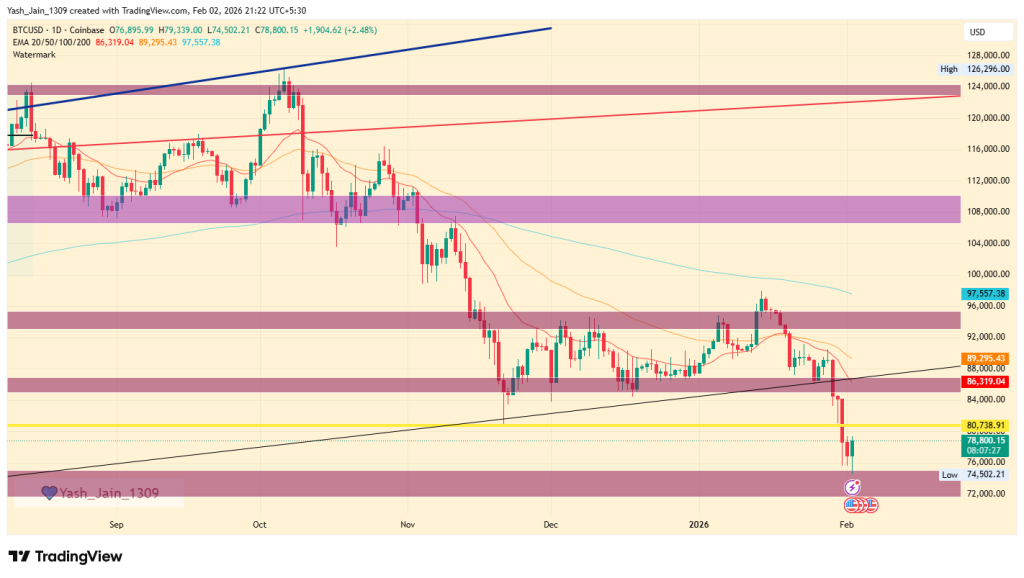
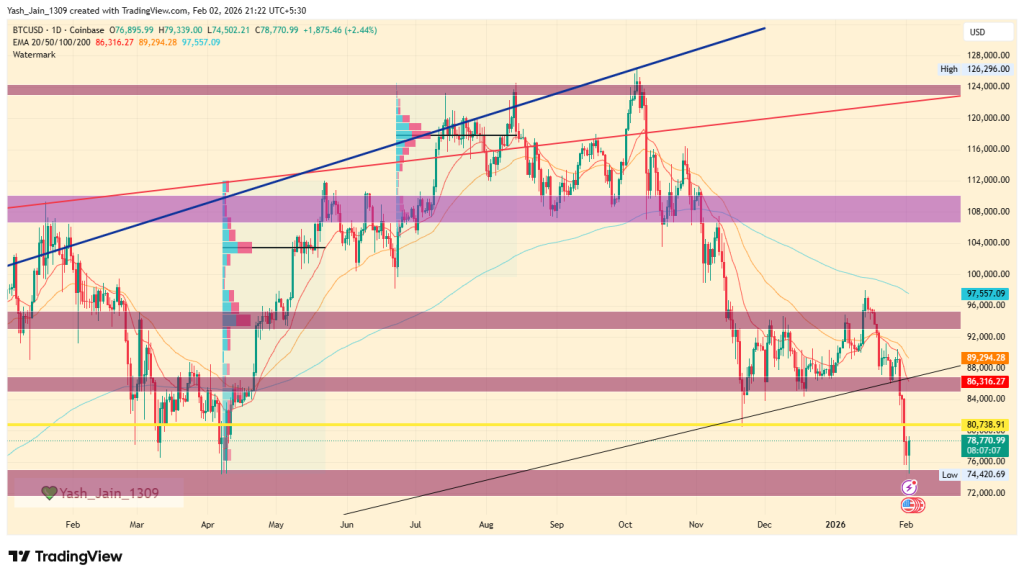
In early February, BTC dropped below $74,420, signaling potential further decline. A recovery may face resistance at the 200-day and 50-day EMAs. Breaching these could allow for an uptrend; failing to do so might lead to a downtrend.
What is the Bitcoin price prediction for today?
The BTC price may range between $74,844.86 and $79,258.61 today.
Since late November 2025, consolidation has mainly been within a tight range of $84800-$94500. But this consolidation seems like a big accumulation phase and has been happening near a multi-year trendline support, which feels very optimistic but also gives chills, as this range has built a lot of suspense in the market, too.
But, like the fall was feared, it happened exactly in the starting days of February, it fell to $74420, which is now a very vulnerable state; another bearish move could extend the crash further. But, if it reverses, then $85K could be an important resistance followed by another resistance at $89K.
Bitcoin Price Prediction 2026
In early February, the BTC price broke the ascending wedge support and dropped to $74420. This confirms the breakdown of this pattern and suggests a further decline is still a possibility if it fails to sustain $74420, but if it makes a comeback hereonward, then the 200-day and 50-day EMA bands are two major dynamic resistance areas. If it breaches this, then an uptrend may have another chance; otherwise, this bull cycle may end, and a downtrend may extend.
Month
Potential Low
Potential Average
Potential High
2026
$80,000-$95,000
$100,000 – $108,000
$115,000 – $118,000
Bitcoin (BTC) Price Prediction January 2026: What AI Platforms Project?
Source / Platform
Low Price (USD)
Average Price (USD)
High Price (USD)
Gemini (AI-assisted)
$110,000 – $125,000
$130,000 – $150,000
$160,000 – $180,000+
ChatGPT (OpenAI)
$92,000
$117,000
$138,000
BlackBox AI
$100,000
$125,000
$150,000
Bitcoin Price Onchain Outlook
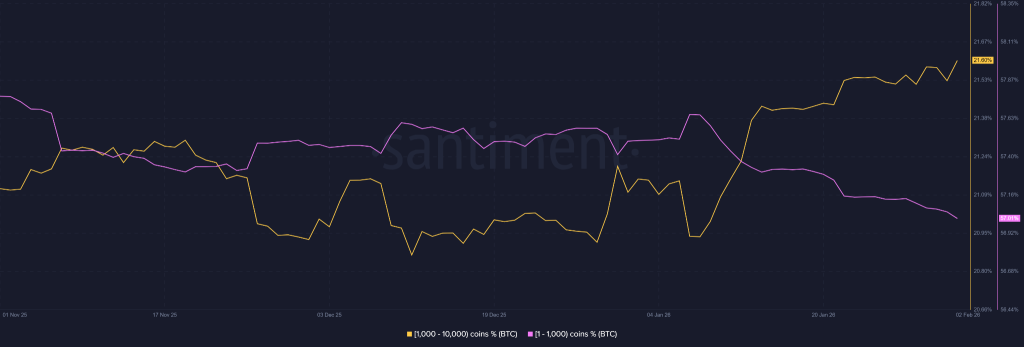
The on-chain data has showed strong accumulation in 2025 and sustained declines in exchange reserves. Crucially, this confirms the elevated institutional commitment, which is evident even in the US Spot ETFs data figures and the corporate adoption also reinforces this trend, with public company holdings nearly doubling since the start of the year.
Ultimately, a Bitcoin price prediction 2025 suggests that the future potential depends strictly on how sustained buying demand remains, as well as geopolitical stability and regulatory clarity.
If the current bullish sentiment persists, the BTC price is expected to reach a cycle high target of $150,000. Conversely, should global uncertainty intensify and sentiment turn negative, the downside risk is projected to find strong support around the $70,000 mark.
The BTC price range in 2026 is expected to be between $150K and $230K.
BTC Price Prediction 2027
Subsequently, the Bitcoin price range can be between $170K to $330K during the year 2027.
Bitcoin Predictions 2028
With the next Bitcoin halving, the price will see another bullish spark in 2028. Specifically, as per our Bitcoin Price Prediction, the potential BTC price range in 2028 is $200K to $450K.
BTC Price 2029
Thereafter, the BTC price for the year 2029 could range between $275K and $640K.
Bitcoin Price Prediction 2030
Finally, in 2030, the price of Bitcoin is predicted to maintain a positive trend. Indeed, the BTC price is expected to reach a new all-time high, ranging between $380K and $900K.
Based on the historic market sentiments and trend analysis of the largest cryptocurrency by market capitalization, here are the possible Bitcoin price targets for the longer time frames.
Year
Potential Low ($)
Potential Average ($)
Potential High ($)
2031
$540,830.43
$901,383.47
$1,261,936.86
2032
$757,162.60
$1,261,936.86
$1,766,711.60
2033
$1,059,945.80
$1,766,711.60
$2,473,477.75
2040
$5,799,454.28
$9,665,757.13
$13,532,059.98
2050
$161,978,188.65
$269,963,647.74
$377,949,106.84
Bitcoin Prediction: Analysts and Influencers’ BTC Price Target
As per the Bitcoin price forecast by Blockware Solutions, the price of 1 BTC could hit $400,000
Cathie Wood predicts the price of BTC to achieve the $3.8 million mark by 2030.
Michael Saylor-led MicroStrategy expects Bitcoin to soar beyond $13 million by 2045.
ARK Invest has increased its bullish BTC price target to $2.4 million by 2030.
Never Miss a Beat in the Crypto World!
Stay ahead with breaking news, expert analysis, and real-time updates on the latest trends in Bitcoin, altcoins, DeFi, NFTs, and more.
FAQs
What are the biggest risks to Bitcoin’s price in 2026?
Major risks include global recessions, tighter crypto regulations, declining liquidity, or a sustained breakdown below key support levels.
How much will BTC be worth in 2030?
Bitcoin price forecasts for 2030 range from $380K to $900K, driven by scarcity, long-term adoption, and expanding institutional participation.
What will be the price of Bitcoin in 2050?
While uncertain, many long-term projections suggest Bitcoin could exceed $1 million by 2050 if it becomes a global store of value.
Is Bitcoin still a good hedge against inflation in the long term?
Bitcoin’s fixed supply makes it attractive as an inflation hedge, especially during currency debasement and long-term economic uncertainty.
Samsung today released the February 2026 patch details and software roadmap. This month’s roadmap carried out major changes, removing 2021’s flagship lineup from support and demoting the 2022’s premium phones alongside an FE.
Galaxy S21 series will no longer receive software updates. The Galaxy S22 series will now get new updates on a quarterly basis. The S21 FE has also been transferred to the Quarterly schedule, demoted from the Monthly tier.
Current Models for Monthly Security Updates
Premium Samsung devices are eligible for new updates every month. The chart is dominated by Galaxy S and Z series phones. However, Samsung also provides monthly updates to select Galaxy A and Tab series devices.
Galaxy Foldable Series
Galaxy Z TriFold
Galaxy Z Fold4, Galaxy Z Fold5, Galaxy Z Fold6, Galaxy Z Fold7, Galaxy Z Fold Special Edition
Galaxy Z Flip4, Galaxy Z Flip5, Galaxy Z Flip6, Galaxy Z Flip7, Galaxy Z Flip7 FE
Galaxy S24, Galaxy S24+, Galaxy S24 Ultra, Galaxy S24 FE
Galaxy S23, Galaxy S23+, Galaxy S23 Ultra, Galaxy S23 FE
Galaxy A Series
Galaxy A56 5G
Enterprise Models
Galaxy A53 5G, Galaxy A54 5G, Galaxy A55 5G
Galaxy Tab Active5 Pro
Galaxy XCover6 Pro, Galaxy XCover7, Galaxy XCover7 Pro
Current Models for Monthly Security Updates
Non-flagship devices, such as mid-range and budget devices, get updated once every quarter. This tier also features Samsung’s flagship tablets. In addition, Samsung shifts Monthly devices to Quarterly chart after a certain period.
Samsung’s Biannual software update tier has officially shut down this month. As of January 31, 2026, the category had two devices, including the A03 and Tab A8. Now, there are just two categories: Monthly and Quarterly.
Samsung has made the details of its February 2026 security update public. Galaxy phones, foldables, and tablets will receive over three dozen CVE and SVE items combined.
February 2026 update brings 37 patches to Samsung devices, including smartphones, foldable phones, and tablets. Among the total improvements, 25 come from Google for Android and 12 are provided by Samsung Mobile.
Android CVEs
Google no longer introduces “critical” patches in the monthly bulletin. The company has tweaked the mechanism to benefit a wide range of Android devices. The February patch features 25 “high” level CVEs for Samsung devices.
Here’s a list of CVEs included in the February update:
One UI is based on Android, yet Samsung specifically brings SVE items to further cement Galaxy’s security and reliability. The latest iteration carries 12 Samsung Vulnerabilities and Exposures items for Galaxy device users.
Samsung’s February 2026 SMR has 12 patches for One UI labeled as “High” and “Moderate.”
SVE-2025-1140(CVE-2026-20977)
Improper access control in Emergency Sharing prior to SMR Feb-2026 Release 1 allows local attackers to interrupt its functioning.
SVE-2025-1217(CVE-2026-20983)
Improper export of android application components in Samsung Dialer prior to SMR Feb-2026 Release 1 allows local attackers to launch arbitrary activity with Samsung Dialer privilege.
SVE-2025-2226(CVE-2026-20978)
Improper authorization in KnoxGuardManager prior to SMR Feb-2026 Release 1 allows local attackers to bypass the persistence configuration of the application.
SVE-2025-2289(CVE-2026-20979)
Improper privilege management in Settings prior to SMR Feb-2026 Release 1 allows local attackers to launch arbitrary activity with Settings privilege.
SVE-2025-2473(CVE-2026-20980)
Improper input validation in PACM prior to SMR Feb-2026 Release 1 allows physical attacker to execute arbitrary commands.
SVE-2025-2705(CVE-2026-20981)
Improper input validation in FacAtFunction prior to SMR Feb-2026 Release 1 allows privileged physical attacker to execute arbitrary command with system privilege.
SVE-2025-2706(CVE-2026-20982)
Path traversal in ShortcutService prior to SMR Feb-2026 Release 1 allows privileged local attacker to create file with system privilege.
Note that some of the SVE items may not be included in this package, in case these items were already included in a previous update. Some SVE items included in the Samsung Android Security Update cannot be disclosed at this time.
Samsung will begin rolling out the February 2026 security update soon.
Samsung Galaxy S26 Global version has now appeared on Geekbench, revealing the Exynos 2600’s CPU and GPU performance benchmarks.
Galaxy S26 and S26 Plus will launch with Exynos 2600 in the Global market, whereas the Galaxy S26 Ultra will go solo with Snapdragon 8 Elite Gen 5. Samsung’s in-house chip has made great improvements in CPU and GPU stats.
Galaxy S26 Exynos CPU performance
The Galaxy S26 vanilla model has spotted on Geekbench with the Exynos 2600 chipset. The device scored up to 3336 points in single-core CPU performance tests and up to 11369 in multi-core CPU performance tests.
Galaxy S26 Exynos GPU performance
The base Galaxy S26 was also tested on Geekbench’s GPU benchmark. The phone benchmarked at 27478 points in Vulkan, indicating strong performance. This is backed by Samsung’s Xclipse 960 GPU powered by AMD graphics.
Source – Geekbench
The Exynos 2600 chipset features a deca-core CPU, consisting of a tri-cluster architecture. It has a prime core clocked at 3.8 GHz, 3 performance cores hitting 3.26 GHz, and six efficiency cores peaking at 2.76 GHz.
Additional info revealed in the benchmark test includes Android 16-based One UI skin and 12GB of RAM. The device is set to launch with One UI 8.5 preinstalled and storage options start from 256GB; there’s no 128GB version.
The device was tested a handful of times on the Geekbench platform. Scores remained stable, indicating that the company has finally achieved reliability. From this point, only further improvements are likely till release.
Samsung will introduce the Galaxy S26 series on February 25 in San Francisco.
Samsung Galaxy S26 series is widely expected to bring Qi2 wireless charging upgrade. Samsung also has a new Magnet Charger with Qi2 support, which could launch this month, but a new leak signals troubling info for fans.
Recently, NewMobile leaked images of the S26 Ultra’s S Pen along with official cases and screen protectors. The leaks indicate that the transparent cases may or may not have a magnetic ring for wireless charging.
This revelation suggests that the Galaxy S26 series may not have Qi2 magnets inside. If true, it’s a massive letdown after a long streak of leaks of arrival. Fans would have to rely on official cases to support Qi2 wireless charging.
Case with magnets is to support Qi2 charging, while the regular transparent case that lack magnetic field on the back is the point. If there’s a case exist without magnets, it’s simply telling us that there is no native Qi2 magnet inside.
Source – nieuwemobiel
In the past, we’ve seen leaks of upgraded wireless charging standards and Qi2-compatible power banks. The recently leaked Magnet Charger also signaled the upgraded charging standard, but that’s not going to happen.
Meanwhile, it’s said that the Galaxy S26 Ultra may charge at up to 25W wirelessly. Samsung could be bringing 15W or 20W charging to the Galaxy S26 and S26 Plus.
Galaxy S25 series and later flagships are already Qi2 charging-ready. Buy a Qi2-compatible case, and your phone will begin supporting Qi2 charging. The same could have to be done with the new Samsung Galaxy flagships.
BTC price fell sharply to $74,500 over the weekend following a sudden escalation in geopolitical tensions and a sharp rally in the US dollar. The violent move was cruelly responsible for erasing billions in market value, triggering forced liquidations and exposing fragile leverage across crypto markets as risk appetite abruptly vanished.
BTC Price Breakdown Fueled by a Liquidity Shock
The weekend sell-off marked one of the most aggressive downside moves in recent months and as experts hoped for a positive Q1 2026 it didn’t went as planned. As thin liquidity conditions amplified volatility as Bitcoin became a source of immediate liquidity rather than a defensive asset. Contrary to safe-haven expectations, BTC price USD moved in tandem with risk assets like ETH, XRP, and others as traders rushed to reduce exposure.
At the same time, President Donald Trump’s anger over the current Fed chair, Jerome Powell, led to the nomination of Kevin Warsh to the Federal Reserve, which further strengthened the dollar. This surge cruelly pressured traditional hedges as well, with gold and silver experiencing sharp declines post news. In light of this news, automated sell orders cascaded across crypto assets, accelerating the downside.
From a BTC price chart perspective, the speed of the drop suggested forced selling rather than discretionary exits, with leveraged long positions bearing the brunt of the move.
Retail Distribution vs Whale Accumulation
Beyond price action, on-chain data presents a more complex picture. Santiment metrics indicate that retail wallets holding fewer than 1,000 BTC were responsible for the crash as they have been steadily reducing exposure for over a month. This persistent selling aligns with fear-driven behavior often observed during sharp drawdowns.
Meanwhile, larger holders tell a different story. Wallets holding between 1,000 and 10,000 BTC have continued accumulating during the decline. This divergence suggests that while sentiment among smaller participants has deteriorated, but larger investors may be treating the drawdown as a rebalancing phase rather than an exit signal.
That said, this accumulation has not yet translated into visible price support, highlighting the scale of selling pressure still present from retailers.
Derivatives Market Shows a Forced Reset
From a derivatives standpoint, the BTC crypto market has undergone a rapid reset. CryptoQuant data shows open interest collapsing from nearly $47.5 billion in late 2025 to roughly $24.6 billion, a drawdown of almost 50%. This signals the near-total removal of speculative leverage that previously supported higher prices.
Funding rates further confirm the shift. Rates plunged deep into negative territory, reaching levels not seen since September 2024. A reading near -0.008 reflects aggressive short positioning and the complete loss of short-term bullish control.
Meanwhile, the Coinbase Premium Index has remained deeply negative. This suggests that US-based institutional and professional traders continue to lead the selling pressure, reinforcing the lack of domestic demand.
Miner Capitulation Adds Structural Pressure
Still, pressure has not been confined to traders alone. The Bitcoin network has seen an estimated 30% drop in hashrate, pointing to meaningful miner capitulation. Rising miner outflows indicate a transition from holding mined BTC to active liquidation.
From a structural angle, miner selling typically accompanies periods of margin stress and declining profitability. While painful, these phases often coincide with broader market resets rather than trend continuation.
HBAR price is trading near $0.09418 as bearish pressure continues across the broader altcoin market. Despite the drawdown, on-chain signals tied to development activity and real-world asset focus suggest Hedera is retaining underlying demand, offering context for why the HBAR price has avoided a deeper unwind so far.
HBAR Price Finds Support Amid Persistent Market Pressure
At the surface level, HBAR crypto appears to be moving with the market’s broader risk-off tone. Selling pressure has persisted, and price has yet to establish a decisive recovery trend. However, unlike many comparable altcoins, HBAR price USD has spent more time consolidating than accelerating lower.
This relative stability stands out. While price momentum remains cautious, the absence of aggressive capitulation hints that sellers are meeting steady demand, particularly near established support zones.
Meanwhile, market participation metrics suggest interest has not meaningfully deteriorated, even as price continues to grind lower.
Development Activity Offers Structural Support
One of the clearest differentiators for Hedera remains its ecosystem activity. Santiment data tracking the top ten real-world asset-focused networks by 30-day GitHub development activity places Hedera near the top of the list. This positioning highlights sustained engineering momentum rather than short-term narrative cycles.
At the same time, Santiment data reinforces this view. Since January, Hedera’s development activity has remained elevated, recently registering around 234. Notably, this strength has persisted even as price declined, signaling a disconnect between market valuation and underlying network work.
Social volume has also increased over the same period. Still, unlike speculative spikes, this rise has occurred alongside falling prices, suggesting discussion has leaned analytical rather than euphoric.
Enterprise Narrative Continues to Anchor Hedera
From a structural perspective, Hedera’s enterprise-first design continues to define its appeal. The network’s governance model, low transaction costs, and fast finality are tailored to regulated use cases, particularly in financial and real-world asset contexts.
Ongoing upgrades and collaborations with large institutions also reinforce this positioning. That backdrop helps explain why HBAR price has shown resilience during periods when speculative demand across altcoins has faded.
Rather than chasing momentum, Hedera crypto appears to be retaining relevance through utility-driven participation.
HBAR Price Chart Signals Compression, Not Capitulation
From a technical perspective, on the daily timeframe, the HBAR price chart still reflects an overall downtrend, marked by lower highs and lower lows. Beyond the existing downtrend, early February’s recent price action adds nuance, as HBAR/USD dipped to near $0.0840 before rebounding, suggesting demand is emerging near support.
This bounce doesn’t come from just any level; in fact, it closely aligns with the lower boundary of a falling wedge pattern. While the pattern often works but still has a chance of failing, this support still fuels some hope, as it introduces the possibility of stabilization rather than the continuation of decline.
If HBAR price reverses from the wedge’s lower edge, resistance comes into focus around $0.108–$0.110, depending on broader market conditions.
Conversely, a sustained move below $0.088 would expose the $0.083–$0.085 zone, with $0.078 acting as the next area of potential demand if weakness deepens. In this context, HBAR price continues to trade at a technical crossroads shaped by both structure and fundamentals.
Samsung is getting ready to launch a new smartphone in India called the Galaxy F70e 5G. The phone will be launched on February 9 and it is is made for users who want good camera quality, long battery life, and 5G support at a low price.
The Galaxy F70e 5G will have a 120Hz display, which means the screen will feel smooth while scrolling and watching videos. The display can reach up to 800 nits of brightness and is expected to be an LCD screen. The phone will have a notch at the top of the screen.
For photos, the phone will come with a 50MP main camera on the back and a 2MP depth camera for portrait photos. On the front, it will have an 8MP camera for selfies and video calls.
The phone will be powered by the MediaTek Dimensity 6300 processor. The phone supports 12 5G bands, which helps with better network coverage. It will also have a big 6000mAh battery, so users can use the phone for long hours without charging often.
Via – Fonearena
The Galaxy F70e 5G will run Android 16 with One UI 8. Samsung has promised six Android updates and six years of security updates.
The phone will have a leather-like finish on the back and will be available in Lime Green and Spotlight Blue colors. It also has an IP54 rating, which protects it from dust and water splashes.
Other features include Voice Focus for clearer calls and Samsung Knox Vault for better security. The phone will be sold on the Samsung India website and Flipkart after launch. The company has confirmed that the phone will cost under ₹15,000, which makes it a budget-friendly option.
While everyone is awaiting the Galaxy S26 series, Samsung is already working on the Galaxy Watch 9, Watch Ultra 2, Tab S12+, and Tab S12 Ultra.
New entries in the GSMA IMEI database have revealed Samsung’s next flagship tablets and smartwatches, offering a rare, concrete glimpse into the company’s plans months ahead of launch.
The listings were first uncovered by Smartprix, and they hint at a strategy shift that will not go unnoticed by long-time Galaxy watchers.
Galaxy Watch 9 and Watch Ultra 2
The GSMA IMEI database confirms the Galaxy Watch 9 with model number SM-L345U and the Galaxy Watch Ultra 2 listed as SM-L716U.
The Galaxy Watch 9 is expected to continue refining Samsung’s established smartwatch formula. Design changes are likely to be subtle, with the focus shifting to improved health tracking, better efficiency, and longer battery life.
The emergence of the Watch Ultra 2 confirms that Samsung sees long-term potential in the rugged, durability-focused segment it entered recently. Expect tougher materials, enhanced GPS accuracy, and deeper fitness and outdoor features.
Galaxy Tab S12+ and Tab S12 Ultra
Samsung is preparing two tablets: the Galaxy Tab S12 Ultra 5G, listed as SM-X946B, and the Galaxy Tab S12+ 5G with model number SM-X846B. For now, there is no standard Galaxy Tab S12 anywhere in sight.
Last year, Samsung trimmed its tablet lineup by dropping the Plus model and sticking to a base Tab S11 and a premium Ultra. Now the company seems to be reversing course. The Plus is back, and the entry-level flagship is gone.
Source – Smartprix
The IMEI leaks suggest Samsung is entering the second half of 2026 with a sharper, more premium-focused lineup. The smartwatches may launch alongside the Galaxy Z Fold 8, Flip 8, and Wide Fold in H2 206.
Historically, Samsung devices tend to surface in IMEI databases roughly six to seven months before launch. With these listings now public, a Galaxy Unpacked event sometime in July 2026 looks increasingly plausible.
The Galaxy S25 series was a hit in 2025, and Samsung is now working on its successor lineup. This article contains crucial details about the upcoming Samsung Galaxy S26 Ultra flagship smartphone, based on leaks and industry reports.
Samsung is set to launch the Galaxy S26 Ultra on February 25, 2026, but the details mentioned in this article may change based on the following inputs. For now, do not take this information as a confirmed spec or feature of the device.
Quick Look: What the rumors say
Expected Release: February 25 (launch), March 11 (release/first sale)
Processor: Snapdragon 8 Elite Gen 5 for Galaxy (TSMC 3nm)
RAM: LPDDR5X RAM (Faster 10.7Gbps)
Display: 120Hz refresh rate, 2600 nits brightness, and a new Privacy Display feature (Flex Magic Pixel technology)
Camera: 200MP main, 50MP ultrawide, 50MP 5x periscope and a 12MP 3x telephoto
Design: A potential move from “floating lenses” to a new pill-shaped camera island
Image Source – Onleaks and AndroidHeadlines
Display
Samsung’s displays are always best-in-class, and the S26 Ultra aims to continue that legacy.
Size: 6.9-inch Dynamic AMOLED.
Refresh rate: 120Hz refresh rate, touch sampling rate will increase.
Brightness: Peak brightness is rumored to remain unchanged at 2,600 nits.
Protection: It’s expected to use the next-generation Corning Gorilla Glass Armor.
New Feature: The most exciting feature is the “Privacy Display” technology based on “Flex Magic Pixel.”
Performance
Galaxy S26 Ultra will use Snapdragon 8 Elite Gen 5 for Galaxy, a chipset tailored for Samsung flagships. The chip will be manufactured using TSMC’s 3nm process technology, offering significant gains in CPU, GPU, and especially NPU.
A key rumor indicates the S26 Ultra will be one of the first phones to use new LPDDR5X RAM clocked at 10.7Gbps. This is a substantial speed bump from the 8.5Gbps RAM in the S25 Ultra, offering various improvements.
Image: Qualcomm Snapdragon 8 Elite Gen 5 Features
Camera
Samsung’s Galaxy S26 Ultra is expected to be paired with:
A 200MP Wide (primary) sensor with f/1.4 aperture.
A 50MP Ultrawide lens (1/2.52-inch sensor size).
A dual-telephoto system.
The device may use a new telephoto camera with 10MP resolution, trimmed down from a 12MP lens, featuring 3x optical zoom at a 1/3.94-inch sensor size, smaller than the Galaxy S25 Ultra’s 1/3.52-inch image sensor.
Additionally, the Galaxy S26 Ultra will have a 50MP periscope with a 1/2.52-inch sensor size. This camera will offer 5x optical zoom capabilities and enhanced light intake as compared to its predecessor, the S25 Ultra.
The bigger punch-hole:
Recent rumors suggest it will stick with a 12MP punch-hole but will make the cutout larger. This is allegedly to house a new lens with a wider 85-degree field-of-view (up from 80), allowing for better group selfies.
Battery and charging
This is the upgrade users have been requesting for years. Samsung isn’t bringing a capacity upgrade to the Galaxy S26 Ultra. The battery will remain 5,000mAh, but the wired and wireless charging will upgrade to 60W and 25W, respectively.
Disclaimer: This is an Article Based on Leaks and Rumors
The information presented in this article is based on early leaks, supply chain rumors, and industry analyst speculation circulating as of February 2, 2026.
Samsung is rolling out a new software update to the Galaxy Tab S11 and Tab S11 Ultra, which carries the FebruaryJanuary 2026 security patches.
Premium Galaxy Tab models have already received the latest patch last month. Despite being the latest, the Galaxy Tab S11 lineup’s turn came at last, and yet, the software is bringing the January 2026 security update.
Galaxy Tab S11 and Tab S11 Ultra users can identify the fresh update through the PDA build version ending with AZA7. The update weighs around 635 megabytes and provides system security and stability improvements.
The two tablets are powered by the flagship Dimensity chip. Samsung provides up to 55 patches to Exynos devices, while the Qualcomm and MediaTek-based products receive the unified update without Exynos patches.
The rollout has just started in South Korea. Global users should be able to grab the update in the next couple of days. Your tablet’s next security patch could arrive after three months, probably with the One UI 8.5 by May 2026.
Samsung has also started optimizing One UI 8.5 design and features for the Galaxy Tab S11 series. The work is underway internally, and a public Beta Program is less likely to expand beyond the Galaxy S25 series.
To download the January patch, open Settings > Software update > Download and install. Wait for a while so the device fetches a new OTA from the server. Once done, hit Install/Restart now to initiate the installation process.
Samsung is indeed bringing three Galaxy S26 series models, but the focus is only on one phone, the Galaxy S26 Ultra. The unpacking is set for February 25, and fans will be able to grab their ones starting March 11, 2026.
Last month, a Korean media outlet revealed the initial production volumes of the S26 series models, led by S26 Ultra. Now, tipster IceUniverse shared production numbers, which also signal the supremacy of the Galaxy S26 Ultra phone.
In the initial batch, the Korean tech giant is producing 600,000 units of Galaxy S26 Plus and 700,000 units of the base Galaxy S26. The Galaxy S26 Ultra production is on another level, targeting 3.6 million units.
That said, the initial production target of the Galaxy S26 Ultra is over 5x of the Galaxy S26 standard model and nearly 6x of the Plus version. It’s nothing special, but confidence in the top tier of the upcoming Ultra version.
Samsung’s decision is based on practicality.
Over the past couple of years, Samsung’s Ultra-branded flagship has dominated sales in the entire lineup. The standard and Plus versions target specific needs, like portability and big screen without a bulky phablet form factor.
Galaxy S26 Ultra is a bit different. Samsung is positioning it as a flagship smartphone, rather than a phablet like Galaxy Note. The sharp corners have already gone, and innovative technologies are pumping the hype for huge sales.
Samsung’s bringing Privacy Display tech to the Galaxy S26 series along with a new 12-megapixel Telephoto camera. The charging speeds are upgrading too, with wired hitting 60W and wireless hitting 25W with Qi2 standard.
All in all, Samsung wants to sell Galaxy S26 Ultra without dumping the other two. Which Galaxy S26 model would you consider purchasing this year?
Apple is working on its first foldable phone, and it could launch later this year. Fans are already aware of some of its specs, but a new leak makes a hefty claim for the Apple iPhone Fold, which even Samsung fans didn’t expect.
Weibo leaker FixedFocusDigital (via MacRumors) revealed that the Apple iPhone Fold could be equipped with a 5500mAh battery; if true, it’s going to be a massive headache for Samsung as it prepares its next foldable phone.
Apple last year introduced its iPhone 17 Pro Max with a 5088mAh battery. It’s the largest capacity available yet on iPhone. Meanwhile, the first foldable product would bring a massive leap when it comes to battery capacity.
For years, Samsung stayed in a safe haven in terms of battery size. The Galaxy Z Fold 7 packs a 4400mAh battery, the same as its predecessors. The next model is rumored to bring a battery capacity of up to 5000mAh.
With Apple’s foldable apparently bringing a 5500mAh battery, it would surpass the Galaxy Z Fold model. iPhone could have double advantages, pushing its power efficiency to a significant level for user convenience.
If the leak is accurate, Galaxy Z Fold 8 is already in massive trouble. Samsung already faces competition in battery life. Larger battery and an in-house chip/modem would further help the iPhone Fold last longer than its rivals.
Under the hood, the device is expected to be powered by Apple’s A20 chip paired with a C2 modem. Other rumored specifications include a 5.5-inch cover screen, a 7.8-inch crease-free inner display, TouchID, and a dual rear camera setup.
Samsung initiated One UI 8.5 Beta last December, but the Galaxy S25’s Stable update still has work left. While users await the fourth Beta build, Samsung is likely busy addressing major internal glitches.
As spotted by IceUniverse, the latest One UI 8.5 Beta on Galaxy S25 Ultra is causing random restart issues, hinting at a potential delay in the Stable update’s rollout.
The tipster is running an internal build of the software, which is a newer version than the Beta 3 available to Beta participants. Bugs in a newer release indicate that some work sis till left before kicking off the Stable rollout.
The source revealed that the bug is automatically shutting down and restarting the device. All this happened twice, signaling a critical glitch. It must be addressed before bringing the build to the public as the fourth Beta firmware.
Functional issues can be considered in Beta testing. Meanwhile, issues like shutdowns and unwanted restarts can be disastrous. Think you are recording something important, and your phone shuts down for no reason.
It could even happen when you are on a phone call and discussing a critical topic. That said, Samsung hasn’t yet dropped a new Beta build. It’s expected this week, but only when the bug is resolved and verified by engineers.
Is Samsung really delaying Stable?
No. Samsung has never pledged One UI 8.5 will be available in February. The company has already announced that the official rollout will begin with the Galaxy S26 series. The flagships arriving on February 25, with the first sale slated on March 11.
If you’ve participated in the Beta Program, stay joined; otherwise, you may not get access to the activity again. A fresh Beta will be provided as soon as it hits the necessary benchmarks in testing by Samsung engineers.
On February 2nd, Samsung announced that it is running outdoor advertising, featuring the Galaxy Z Flip 7 foldable phone, for the Milano Cortina 2026 Olympic and Paralympic Games at 10 locations across Milan.
The campaign features athletes from “Team Samsung Galaxy” and delivers Samsung’s Olympic message, “Open always wins.”
Samsung has put giant-sized ads at major landmarks such as the Duomo di Milano, San Babila, Cardona, and Porta Venezia. Some of the outdoor advertisements will continue through the end of the Paralympic Games in late March.
Participants in the Olympic campaign’s outdoor ads include Italian freestyle skiing siblings Flora Tabanelli and Miro Tabanelli, snowboarder Ian Mateoli, and para snowboarder Jacopo Lucchini.
The athletes captured “victory selfies” using the Galaxy Z Flip 7, photographing special moments shared with loved ones such as family members, friends, and coaches who supported them throughout their Olympic journeys.
Samsung might launch a square Flip phone influenced by an Apple idea. The new design may be adopted in the future, and Samsung could beat Apple.
According to Bloomberg, Apple is exploring a square Flip phone concept, which could eventually force Samsung to bring such a product. It’s the same playbook as the first foldable iPhone and Samsung’s rumored Wide Fold.
The upcoming iPhone Fold offers a tablet-like experience on a large canvas. Meanwhile, the clamshell would be just different. It could be positioned as main iPhone models as it would unlock a similar size and shape unfolded.
Apple could launch its first iPhone Fold this year with a wide design. To counter, Samsung is keeping the legacy Galaxy Z Fold and Flip models in its pipeline, but is also working on another model with Apple-like aesthetics.
Similarly, Apple’s square Flip phone idea would influence Samsung. The Galaxy maker would also consider bringing such a product before Apple. If you love clamshell foldable phones, it’s worth knowing the news for you.
Samsung’s proportion of selling Flip phones always remained higher than the Fold models. 2025 wasn’t the same as the Galaxy Z Fold 7 surpassed its Flip counterpart in terms of sales, thanks to its slim and lightweight profile.
Well, Samsung is working on some serious upgrades for its next Flip phone and bringing it back to the momentum. Increased sales of the Fold model should not come at the cost of reduced sales of Flip, and that’s the point.
Samsung is now expanding its foldable phone display component-only repair program to 160 out of 169 service centers across South Korea.
Foldables have always come with a quiet tax. You enjoy the wow factor, the engineering flex, the thin glass magic, and then one bad drop reminds you how expensive that magic really is. Samsung seems to have finally accepted that this fear has been holding people back, and it is doing something concrete about it.
Samsung has expanded its foldable phone display component-only repair program to the Masan and Yeongju centers in South Korea. It might sound minor on paper, but matter a lot in practice. It is now the default option for most foldable owners who walk into a Samsung service center.
This repair method is the key detail
Instead of swapping the entire display assembly, which has historically meant eye-watering bills, engineers carefully take apart the display, frame, and outer case.
Only the damaged components are replaced. Everything else that still works stays in the phone. It is slower, messier, and far more demanding than bulk part replacement.
It directly attacks the biggest complaint foldable users have had for years: the repair costs felt wildly out of proportion to the damage. Right now, Samsung is the only company offering this kind of foldable repair at scale.
Component-only repair takes more than twice as long as a standard display swap. This is micro-level work, done with specialized equipment by experienced engineers. Precision matters because one mistake can ruin the entire panel.
Samsung has officially confirmed NVIDIA G-SYNC support for its 2026 OLED TV lineup and next-generation Odyssey gaming monitors.
G-SYNC used to be a PC monitor thing, hardcore gamers only. That line is gone now. When your TV can sync its refresh rate with your GPU, everyday gaming feels cleaner, smoother, and far less annoying.
That is why Samsung leaning into NVIDIA G-SYNC for its 2026 OLED TVs and Odyssey monitors actually matters. It is about fixing one of the most visible problems in gaming.
G-SYNC compatibility allows a display’s refresh rate to synchronize with the GPU’s frame output. The result is reduced screen tearing, lower stutter, and more consistent motion during gameplay.
“Our goal is simple: deliver a consistently great gaming experience, no matter what you play or where you play it,” said Kevin Lee, Executive Vice President of the Visual Display (VD) Business at Samsung Electronics. “With new innovations across OLED TVs and gaming monitors, we’re bringing more power, precision, and immersion to every kind of player.”
For users, this means fewer visual distractions, especially in fast-moving games. Compatible models include the 2026 OLED S95H, S90H, and S85H TVs, as well as the new Odyssey G6 (G60H, G61SH) gaming monitors.
The S95H and S90H are built for high-performance gaming, supporting refresh rates up to 165Hz, while the S85H supports up to 120Hz. These models are designed to handle modern PC and console gaming workloads with smoother motion and lower latency.
The South Korean tech giant is also introducing HDR10+ Advanced across the OLED lineup. It is an updated HDR format aimed at improving brightness control, contrast, motion handling, and color accuracy.
By February 2026, the Galaxy S25 Ultra had slipped from headline novelty into something rarer. A settled object, a tool that no longer needs to announce itself.
Pick it up, and the first impression is not visual, it’s tactile. The Galaxy S24’s sharp geometry has been softened into a more humane arc, a contour that rests against the palm instead of negotiating with it.
The enhanced Titanium frame feels less like an ornament and more like geology. Its surface carries a faintly pitted, lunar-like permanence, as though it has already survived something and expects to survive you as well.
The display is where the phone grows quiet. Gorilla Armor does not shine, and that is the point. Reflections are muted into near-absence, turning the glass into a void of distractions.
Text seems printed rather than emitted, while video appears suspended beneath the surface, calm and almost private. In a year crowded with brighter and louder panels, the S25 Ultra’s restraint reads as confidence.
Snapdragon 8 Elite performs rock solid inside. AI tasks in 2026 simply arrive fully formed, language models respond without hesitation, and image processing happens before impatience can surface.
The chip’s power feels less like acceleration and more like the silent weight of a rising tide, lifting everything at once. The 200MP main sensor and dual-telephoto lenses do not chase sensation, along with the clean selfie shooter.
Days unfold without the low-grade anxiety of percentages. Charging becomes an occasional ritual rather than a constant interruption, which solidifies the efficiency and reliability of the smartphone’s 5,000mAh battery.
In 2026, the Galaxy S25 Ultra is no longer a promise. It is a resolved idea, a phone that chose refinement over noise, and in doing so, aged with unusual grace.
What makes the S25 Ultra relevant in February 2026 isn’t any single component. It’s the convergence of micro-refinements into a device that feels finished rather than iterative.
You can purchase the Galaxy S25 Ultra from Samsung.com, starting at $1,049.
Samsung, last week, began creating hype for the Unpacked event. As February begins today, the launch month of the Galaxy S26 series, leaker Evan Blass revealed the first official promo image of the Ultra version in its signature color.
Insider Evan Blass (@evleaks) leaked the Galaxy S26 Ultra official promo image, showing the device in its UltraViolet (Cobalt Violet) signature color.
Similar to the leaked CAD renders, the official promotional image confirms the adoption of a prominent camera bump on the back. The sensor alignment remains unchanged; Samsung just surrounded three big rings with an island.
The camera bump itself is a masterpiece. The thickness is much and that’s why Samsung has bumped it in two layers. The dual-layer bump ensures the design feels smooth, while remain durable for everyday usage.
Source – Evan Blass
Galaxy S26 Ultra’s corners are also shown in the leaked picture. The corners are a little more rounded than the S25 Ultra. The placement of volume buttons and the side key is also similar to what we’ve got in previous flagships.
You can also see the S Pen along with the smartphone. It’s a confirmation that the stylus is living on in 2026, but there’s no guarantee in 2027. The placement of the S Pen compartment has already become a topic of discussion among fans.
Well, it’s just the beginning of official leaks, which would intensify over the next few days. The company is expected to unveil the new flagships on February 25 in San Francisco, with the first sale likely beginning on March 11.
Samsung SDI has locked in a major battery supply contract in the US, and all signs point to Tesla being the customer.
On January 30, Samsung SDI confirmed that its US subsidiary has signed a large-scale battery supply deal. Key details are sealed until 2030 due to confidentiality. That alone tells you the size and sensitivity of the agreement.
The South Korean tech giant has not named its partner, but the market reaction was instant. This looks like a strategic win for Samsung at a moment when the US battery supply chain is being forcibly reshaped.
Meanwhile, this disclosure effectively closes the loop on reports from late last year that linked Samsung SDI to Tesla’s energy storage business.
The US government has tightened the screws on Chinese batteries, cutting them out of subsidies and slapping on steep tariffs. That said, Tesla needed a China-free alternative fast, and Samsung SDI was ready to land the deal.
Supplying LFP chemistry is not enough. Tesla needs prismatic cells, made at scale, inside North America. That short list of suppliers is very short, and Samsung SDI sits comfortably on it.
Samsung SDI has been quietly building out ESS-focused capacity in the US while others debated policy risk. At the StarPlus Energy joint venture with Stellantis, Samsung SDI already operates a 7 GWh NCA ESS line.
If this deal is indeed tied to Tesla’s ESS program, Samsung SDI just scored one of its most important US wins in years.
Samsung is testing One UI 8.5 Alpha and Beta for various phones. On December 8, Samsung officially launched the Public Beta Program for the Galaxy S25 series, and the official update rollout is likely to start in 2Q25.
One UI 8.5 testing isn’t just underway but also expanding its scope to even more Samsung phones. The company has already joined a number of Galaxy devices to the internal testing, regardless of the plans for the Beta rollout.
The testing is still underway, and we will see more changes and tweaks throughout the Program. Samsung may also invite even more devices like the Galaxy Z Fold 7 and Z Flip 7 as well as the S24 series, to test the software.
Devices in Public Beta
The Public Beta testing is currently limited to the Galaxy S25 series. However, the S25 Edge and S25 FE are not eligible for the Beta Program.
Galaxy S25, S25 Plus and S25 Ultra
Devices in Internet ‘Alpha’
While Public Beta has very limited availability, the internal testing has been expanded to plenty of newer and older Samsung phones.
Galaxy Z Series
Galaxy Z TriFold
Galaxy Z Fold 7 and Z Flip 7 as well as Flip 7 FE
Galaxy Z Fold 6 and Z Flip 6
Galaxy Z Fold 5 and Z Flip 5
Galaxy Z Fold 4 and Z Flip 4
Galaxy S Series
Galaxy S25 Edge
Galaxy S25 FE
Galaxy S24, S24 Plus and S24 Ultra
Galaxy S24 FE
Galaxy S23, S23 Plus and S23 Ultra
Galaxy S23 FE
Galaxy S22, S22 Plus and S22 Ultra
Galaxy A Series
Galaxy A17 LTE/5G
Galaxy A07
Galaxy A56
Galaxy A36
Galaxy A26
Galaxy A16 LTE/5G
Galaxy A06
Galaxy A55
Galaxy A35
Galaxy A25
Galaxy A15 LTE/5G
Galaxy A54
Galaxy A34
Galaxy A24
Galaxy A53
Galaxy A33
Galaxy Tab Series
Galaxy Tab S11 and Tab S11 Ultra
Galaxy Tab S10+ and Tab S10 Ultra
Galaxy Tab S9, Tab S9+ and Tab S9 Ultra
Galaxy Tab S8, Tab S8+ and Tab S8 Ultra
Galaxy Tab S10 FE and Tab S10 FE+
Galaxy Tab S9 FE and Tab S9 FE+
Galaxy Tab A9
Galaxy Tab A11+
Galaxy Tab Active 5
Galaxy M/F Series
Galaxy M17/F17
Galaxy M07/F07
Galaxy M56/F56
Galaxy M36
Galaxy M16
Galaxy M55/M55s
Galaxy M35
Galaxy M15
Galaxy M05/F05
Galaxy M54/F54
Galaxy M34/F34
Galaxy M53
Apart from this, Samsung is also working on One UI 8.5 firmware for the upcoming Galaxy S26 series, A37, and A57 smartphones.
The list of devices is expected to grow.
Image – SammyFans
Samsung’s One UI 8.5 is based on Android 16 (One UI 8). It comes with a user interface redesign and applies blur across various aspects. The majority of stock apps have also received dynamic tweaks that make the UI beautiful.

 Login
Login
 Samsung! (@thesammyfans)
 Russia's Moscow Exchange announces plans to launch cryptocurrency indices for Solana, Ripple,
  |
| (@Xaif_Crypto)
  Russia to roll out crypto regulatory framework this July, allowing retail participation.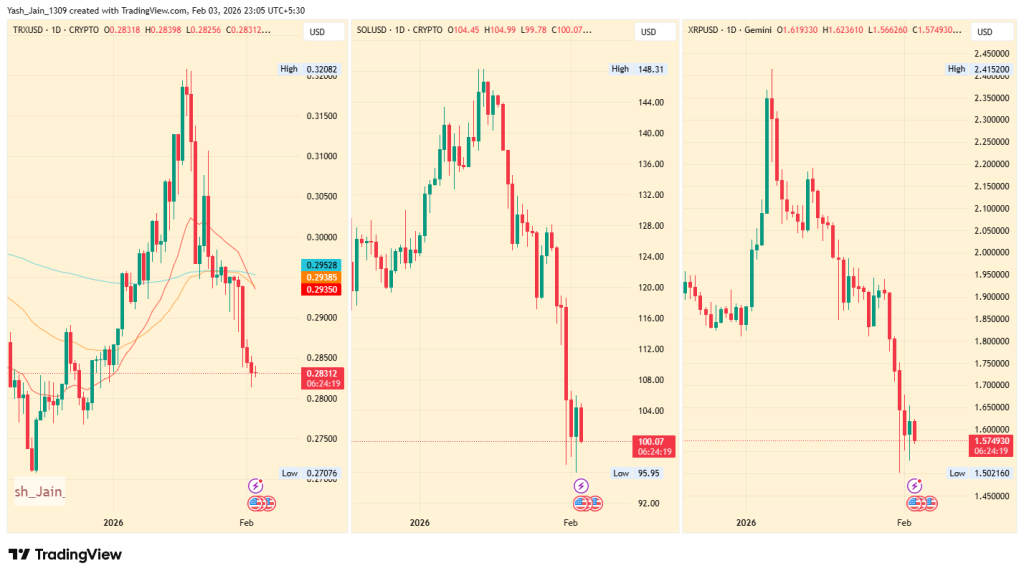
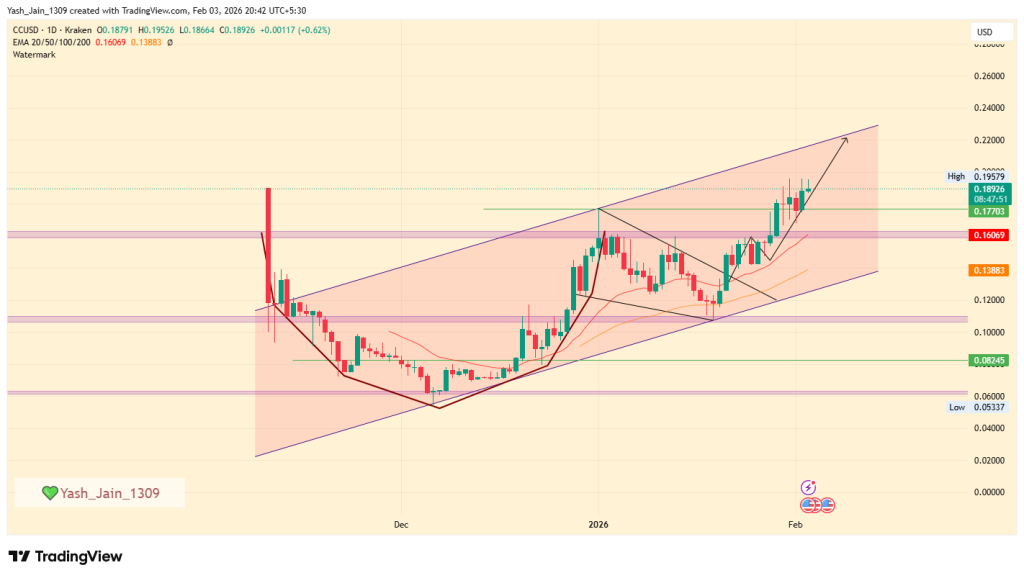
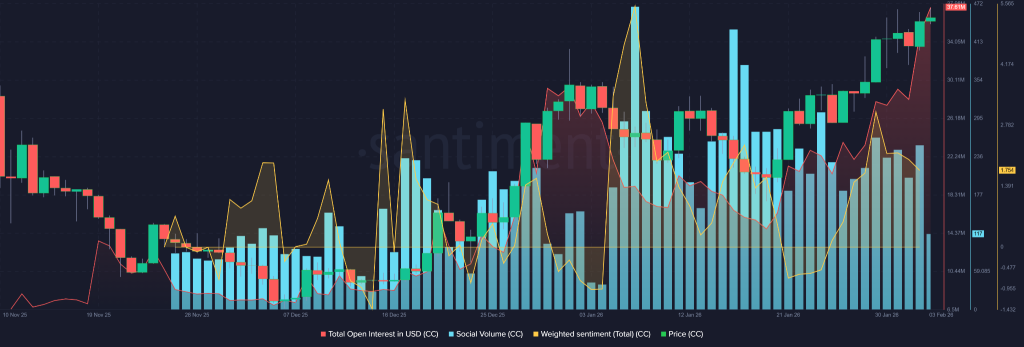

 0.23%
0.23%