Reading view

Samsung explains the pixel science behind Galaxy S26 Ultra’s Privacy Display

Galaxy S26 Ultra screen controversy isn’t stopping anytime soon, but Samsung is still busy proudly advertising the Privacy Display technology. Recently, Samsung shared a set of infographics linked to the S26 Ultra’s coolest invention.

How the pixels actually work

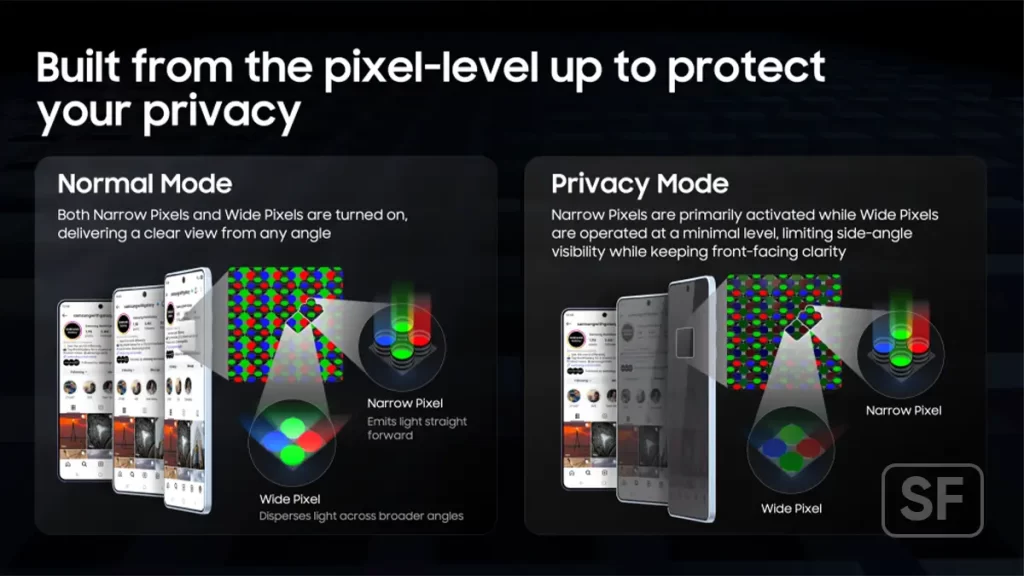
Privacy Display manipulates light dispersion at the subpixel level. In Normal Mode, both narrow pixels and wide pixels fire at full capacity. You get maximum brightness, full viewing angles, the whole show.

Flip Privacy Display on, and the wide pixels drop to minimal output. Narrow pixels stay active; what you see head-on barely changes. What does the guy next to you see? Almost nothing.

It’s selective pixel behaviour, and it works in portrait or landscape.

Samsung Galaxy S26 Ultra Privacy Display Infographic

Samsung’s recent Privacy Display infographics show this clearly.

Normal Mode disperses light across broad angles, whereas the Galaxy S26 Ultra’s Privacy Mode funnels it forward. The difference is immediate and honestly kind of unsettling the first time you test it with someone standing beside you.

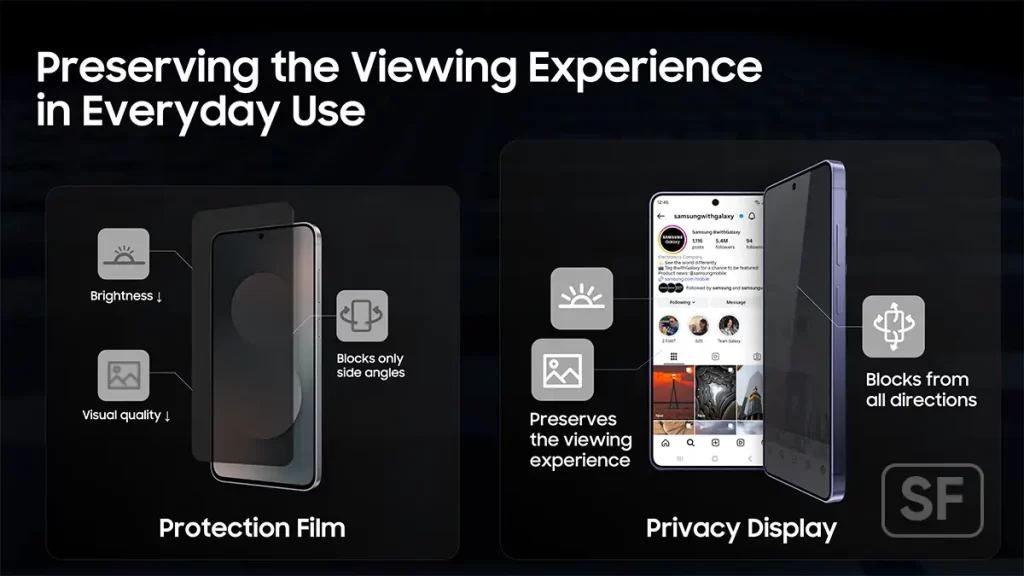
Traditional privacy films cut brightness by 30% or more. Colours look wrong and outdoor visibility craters. Samsung’s approach preserves the screen; the S26 Ultra’s display is still the S26 Ultra’s display when Privacy Mode is active.

Samsung Galaxy S26 Ultra Privacy Display Infographic

The S26 Ultra lets you trigger Privacy Display manually or automate it based on context. You can set it to activate when you punch in a PIN or when you open specific apps like your bank, email, and WhatsApp.

Partial Screen Privacy mode shields just the notification bar if you want usability with some cover. Maximum Privacy Protection cranks the side-angle blocking to full strength, with all happening automatically after setup.

Samsung Galaxy S26 Ultra Privacy Display Infographic

Related articles:

The post Samsung explains the pixel science behind Galaxy S26 Ultra’s Privacy Display appeared first on Sammy Fans.

Samsung phones can now run these apps via satellite

Samsung has quietly revealed a list of apps that can run over satellite on certain Galaxy phones, and the lineup’s more comprehensive than you’d expect.

We’re not just talking SOS messages here, but WhatsApp, X, Facebook Messenger, Google Maps, Samsung’s own Health app as well as Grok, as discovered by @theonecid on X.

Worth knowing before you assume your phone’s on that list: this feature only works if your carrier actually flipped the switch. Samsung apps satellite features are carrier-dependent, which is a very Samsung way to roll this out.

You find the compatible apps list buried in Settings > Connections > Satellite, assuming that menu option even shows up on your device. If it’s missing, your phone doesn’t support it, or your market hasn’t been blessed yet.

Hardware compatibility means nothing if T-Mobile or Verizon or whoever hasn’t inked the right deal yet.

Apps currently flagged as satellite-ready

  1. Find My Mobile
  2. Google Maps
  3. Google Play Services
  4. Grok
  5. Messenger (Facebook)
  6. Messages
  7. Samsung Account
  8. Samsung Find
  9. Samsung Health
  10. Weather
  11. WhatsApp
  12. X

Most of these are communication or location tools.

Makes sense when you’re relying on satellites orbiting overhead instead of a cell tower three blocks away. Inclusion of Samsung Health feels borderline random unless the company is picturing hikers tracking their heart rate mid-rescue.

Apple partnered directly with Globalstar and keeps the entire experience locked down to emergency messaging. Samsung went the other direction, partnering with carriers who work with satellite providers like Skylo and SpaceX’s Starlink network.

Who gets what and where

In the US, T-Mobile users with select Galaxy devices after the S21 series got T911, text, and data services starting in 2025. Verizon only offers emergency SOS and texting on Galaxy S25 series and newer, while AT&T is still working on it.

Virgin Media O2 in the UK has satellite features live on certain Galaxy phones now. Spain’s MasOrange is kicking off trials in March 2026. Vodafone’s in discussion mode for future devices.

Japan’s actually the furthest along. KDDI has supported satellite text, data, and even earthquake and tsunami warnings on Galaxy S22 and later devices since 2025. Docomo and SoftBank are joining this year with expanded device support.

Samsung Apps Satellite Connectivity

Credit – CID (theonecid/X)

The post Samsung phones can now run these apps via satellite appeared first on Sammy Fans.

Apple’s $2,000 iPhone Fold could force Samsung to respond

Apple is planning to jack up production of its first iPhone Fold and maybe even drop the price below what everyone expected, around $2000.

Korea’s Dealsite reports that Apple is boosting initial iPhone Fold production volumes by around 20 percent compared to original plans and considering slashing the price to around $2000.

That’s not great news for Samsung, which has spent six years basically owning this smartphone category and now has to figure out whether to keep prices steady or follow the rest of the industry into chipflation hell.

We’re talking about potential volumes climbing past 8 million units, maybe hitting 15 million. Originally pegged at $2,400, the foldable iPhone might actually land closer to $2,000, the same as the Galaxy Z Fold 7.

Samsung is in a weird spot now

Samsung hasn’t locked in its pricing strategy yet. During Galaxy S26 Unpacked, Mobile Business head TM Roh mentioned long-term contracts with partners and hardware efficiency improvements to ease cost pressures.

One industry source said Samsung’s now sourcing specialized foldable components from China that used to come exclusively from Korea. If those parts get cheaper, memory shortages might not push foldable prices up after all.

If Apple actually nails the execution while undercutting or matching Samsung on price, the company that invented this category might have to defend it harder than expected.

Galaxy Wide Fold

Apple’s first foldable iPhone may bring a form factor similar to the OG Pixel Fold. Samsung is also experimenting with this form factor as Galaxy Wide Fold. This model could launch alongside the Z Fold 8 and Z Flip 8 this year.

Samsung is reportedly developing three foldable phones and two smartwatches. The Galaxy Watch 9 and Watch Ultra 2 would arrive alongside the Fold and Flip. Samsung is also considering 5G support for the Watch Ultra 2.

The post Apple’s $2,000 iPhone Fold could force Samsung to respond appeared first on Sammy Fans.

XLM Price Climbs Toward $0.163 as Social Surge on Adoption News From BoG in Africa

Stellar (XLM) Price Drifts Lower, Yet On-Chain Data Hint at a Turn

The post XLM Price Climbs Toward $0.163 as Social Surge on Adoption News From BoG in Africa appeared first on Coinpedia Fintech News

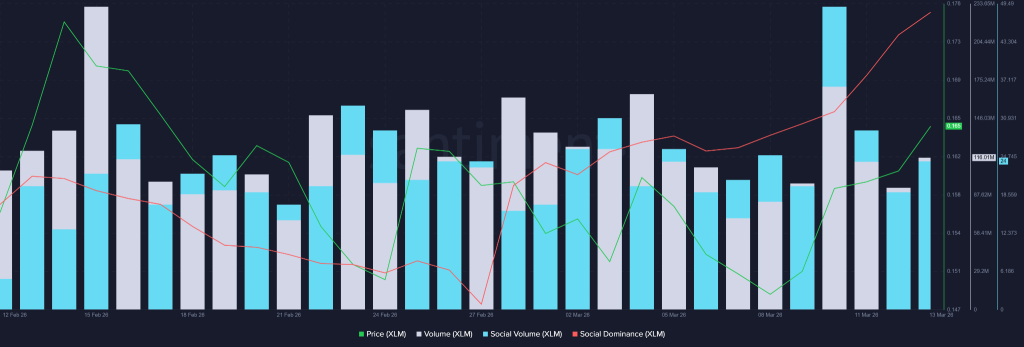
The XLM price has quietly staged a recovery this week, climbing toward the $0.163 level after printing a string of bullish daily candles. It’s not exactly a moonshot but it’s a clear shift in tone compared to the sluggish price action seen earlier.

Momentum has been building since the start of the week, and the latest move on the XLM/USD pair suggests buyers are beginning to reclaim some control.

Still, crypto markets rarely move in straight lines. And beneath the surface, there are a few signals that make the rally look… a bit complicated.

XLM Price Chart Shows Buyers Regaining Control Above Neutral RSI

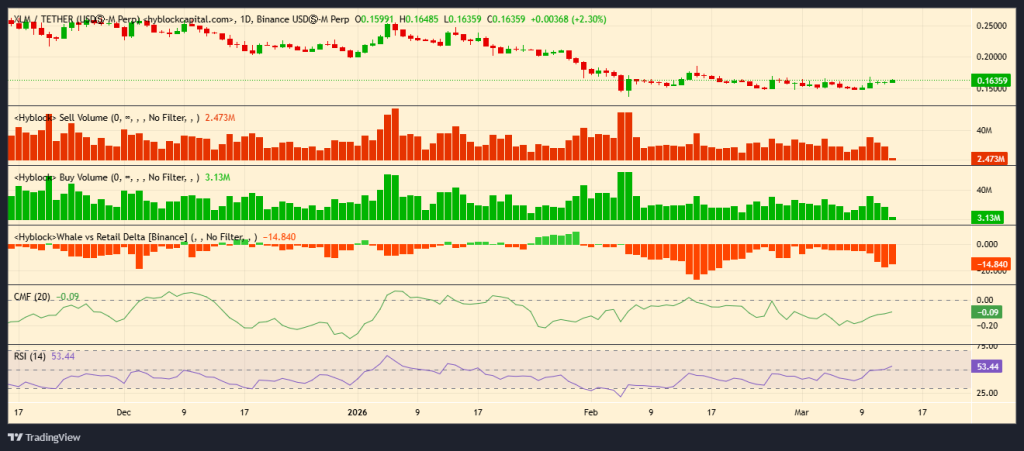
Starting with the technicals, we can witness indicators on the daily XLM price chart, like the RSI has pushed above the key neutral threshold, currently sitting at 53.44. That move might not sound dramatic, but it matters. Crossing the 50 line typically signals that momentum has shifted back toward buyers.

In other words, bullish traders are finally showing up again. Meanwhile, the CMF indicator remains slightly negative at -0.09. But, it’s trending upward from previous lows. That suggests capital outflows are slowing down, even if inflows haven’t fully taken over yet.

Put those signals together and the picture becomes clearer: selling pressure is fading while demand is gradually returning. Not explosive, but constructive.

XLM Price Climbs Toward $0.163 as Social Surge on Adoption News From BoG in Africa

Social Metrics Spike As Community Interest Returns To Stellar

Well, here’s where things start getting noisy. On-chain data from Santiment shows a sharp increase in Social Volume and Social Dominance for Stellar crypto. Both metrics have surged alongside the price rally, hitting their highest levels since mid-February.

And that’s rarely a coincidence. When social engagement spikes at the same time as price momentum, it often means the market narrative is shifting. Retail traders are paying attention again, discussions are heating up, and sentiment starts turning.

That doesn’t guarantee sustained gains but it definitely fuels short-term momentum. In this case, the rising chatter appears to be amplifying the ongoing recovery.

XLM Price Climbs Toward $0.163 as Social Surge on Adoption News From BoG in Africa

Whale Activity Raises Questions Behind Retail Driven Rally

But let’s not pretend everything is perfectly bullish. Because while retail participation seems to be rising, whale behavior tells a different story. The Whale vs. Retail Delta currently shows a negative reading of -14.840, indicating that large holders may be distributing into the strength created by smaller traders.

That kind of divergence tends to complicate rallies. It suggests the current move may be more of a retail-led relief bounce rather than the start of a full-scale trend reversal. For the momentum to evolve into something more durable, whale activity would likely need to stabilize rather than lean toward selling.

African Payments Initiative Adds Fresh Adoption Narrative

Now for the fundamental catalyst behind the excitement. A recent announcement from Stellar leadership highlighted a new development involving Akuna Wallet, a payments platform designed to serve African creators. The wallet has been admitted into the Bank of Ghana’s VASP regulatory sandbox, marking a step toward regulated experimentation within the region.

The payments system hasn't kept pace with African creators. @AkunaWallet is. Proud to be building this alongside Idris Elba and the whole team. https://t.co/ZVzcLuD9u9

— Denelle Dixon (@DenelleDixon) March 12, 2026

And there’s a direct link to the network itself. Akuna Wallet is built on the Stellar blockchain, meaning any growth in the platform could translate into increased usage of the ecosystem.

That’s the narrative currently feeding optimism in the market. Adoption potential, rising social interest, and improving technical momentum are all colliding at once.
Whether that’s enough to sustain the rally remains to be seen but for now, the XLM price appears to be enjoying the spotlight again.

SUI Price Hits $1.05 as Resistance Test Could Ignite Rally Toward $2

SUI Price Analysis Why $10 Could Be the Next Explosive Target

The post SUI Price Hits $1.05 as Resistance Test Could Ignite Rally Toward $2 appeared first on Coinpedia Fintech News

The SUI price is back at a level traders have been staring at for weeks. After grinding through a long stretch of consolidation since February, the token has climbed to around $1.05, a range that now acts as a decisive resistance on the daily chart.

And markets love moments like this. Because when price reaches the upper boundary of consolidation, something usually gives either momentum explodes higher, or the rally runs out of steam.

Right now, the SUI/USD pair appears to be leaning toward the former. Since Monday, the asset has shown steady bullish momentum, with today’s move pushing price up nearly 10% intraday.

So naturally, attention is turning to what happens next.

SUI Price Breakout Attempt From Months of Consolidation

The current level isn’t random. On the SUI price chart, the $1.05 zone represents the upper border of a consolidation range that has held the market in check for months.

Break that barrier convincingly and things could escalate quickly. From a purely technical standpoint, two immediate levels stand out on the radar: $1.60 and $2.00. These are the nearest targets traders are watching if the resistance flips into support.

But let’s be clear, resistance zones don’t surrender easily. Markets often test them multiple times before committing to a breakout. Still, momentum building throughout the week has given bulls a reason to stay optimistic.

Weekly Falling Wedge Support Adds Technical Strength

The current setup gets more interesting. As the recent upward move didn’t appear out of nowhere. It actually started from a weekly chart dynamic support, specifically the lower boundary of a falling wedge pattern.

When price rebounds from the lower border of such a formation, it tends to signal growing demand at discounted levels. That seems to be exactly what happened here.

The bounce from that support zone helped push price back toward the top of the consolidation range, placing the market in a crucial decision phase. Demand continues to build or it doesn’t.

SUI Price Hits $1.05 as Resistance Test Could Ignite Rally Toward $2

Network Activity Supports Bullish Momentum Narrative

Of course, price charts alone rarely tell the entire story. On-chain data is starting to echo the same bullish tone. Daily transaction activity has risen over the past seven days, signaling that network participation is gradually picking up again.

SUI Price Hits $1.05 as Resistance Test Could Ignite Rally Toward $2

That type of activity matters because sustainable rallies typically require more than just speculative trading. They need real usage, or at least the perception of it.

And the timing of today’s move adds another layer. The nearly 10% intraday surge coincided with the launch of OpenZeppelin Move Contracts on Sui Network. The same security library that has protected over $35 trillion in on-chain value across the broader crypto ecosystem is now available for Sui developers.

OpenZeppelin Move Contracts are now live on @SuiNetwork 💧

The same library securing over $35 trillion in onchain value and trusted by the industry's most critical protocols is now purpose-built for Sui.

Here's what's in the first release 👇 pic.twitter.com/3Y0lZ6EbEE

— OpenZeppelin (@OpenZeppelin) March 12, 2026

That’s not exactly a small headline. So now the SUI price analysis highlights that the market sits at a familiar crossroads. If demand continues to rise and resistance breaks with conviction, the next chapter for the SUI price could involve a much faster climb than the slow grind traders endured since February.

Galaxy S26 Ultra display causing eye strain and headache; Samsung is apparently investigating

Are Galaxy S26 Ultra eye strain and headache reports real or just noise? Privacy Display is the headline feature of the new Ultra phone; it’s a great invention, but hit with a slew of complaints that almost every Samsung flagship does.

The new Privacy Display is supposed to be the hero feature on the S26 Ultra this year. It’s a combination of hardware and software that will turn your screen black when viewed from an angle.

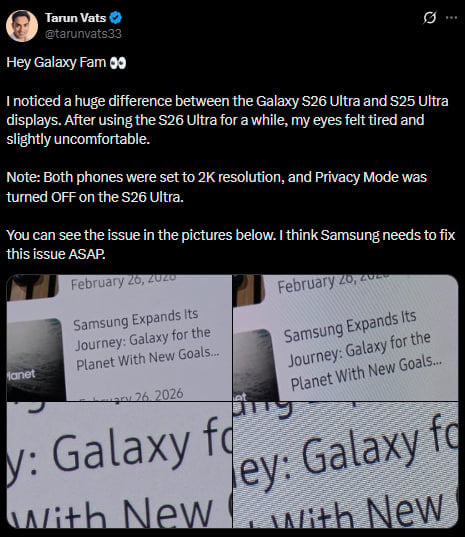
Samsung enthusiast TarunVats, also an early adopter of the Galaxy S26 Ultra, posted side-by-side photos of both the S26 Ultra and the S25 Ultra, noting his eyes felt tired and slightly uncomfortable after using the newer model.

Tipster Ice Universe highlighted that the company needs to fix an issue with the Galaxy S26 Ultra display immediately. When someone like that starts calling it a serious problem, Samsung fans should pay attention.

Samsung Galaxy S26 Ultra eye strain and headache complaints

As the Galaxy S26 Ultra reached even more shoppers, complaints of eye strain and headaches have started to grow across the Internet. Users are seeking solutions, with some returning their phones in fear of potential issues.

The pixels used for the Galaxy S26 Ultra display have two different types of light emission, one emits light at a wider angle, while the other pushes the light out straight ahead.

When Privacy Display is turned off, the brightness of the straight-ahead directional pixels still depends on viewing angle, and tilting the phone causes the brightness of those pixels to weaken.

So you’re fighting the screen tech even when the feature isn’t active.

Plenty of people will buy this phone and feel nothing. But when credible voices in the Samsung ecosystem start flagging fatigue, graininess, and reduced text sharpness with a feature turned off, that’s not user error.

Samsung Galaxy S26 Ultra Eye Strain

Meanwhile, Samsung appears to have started investigating the case on a case-by-case basis. Responding to a thread, a Samsung Moderator sought basic details from a buyer over DM to proceed with their examination.

Samsung Galaxy S26 Ultra Eye Strain

Most users, including many professional reviewers, report zero eye strain after normal use such as scrolling, watching videos, gaming, or reading for hours.

The bigger issue is whether Samsung can fix this supposed flaw with a firmware update or if it is, in fact, a fundamental part of the new hardware and therefore can’t be changed.

If it’s baked into the hardware because of those dual-pixel types, no software patch will save it.

Related article:

The post Galaxy S26 Ultra display causing eye strain and headache; Samsung is apparently investigating appeared first on Sammy Fans.

Pi Network Price Prediction 2026, 2027 – 2030: Why Is Pi Coin Dropping?

Pi Network Price Prediction 2026, 2027 - 2030

The post Pi Network Price Prediction 2026, 2027 – 2030: Why Is Pi Coin Dropping? appeared first on Coinpedia Fintech News

Story Highlights

  • Pi Coin Live Price is  $ 0.27371599
  • Price prediction for 2026 targets $0.85, with potential highs of $3.50.
  • The Pi coin price forecast for 2030 highlights a price target as high as of $22.00

Pi Network’s vision of mobile-based crypto mining attracted millions worldwide, making it a standout community-driven project. However, its lack of exchange listings, limited liquidity, and minimal real-world integration now challenge its sustainability. 

As the broader crypto landscape shifts toward utility-based projects and DeFi innovation, Pi Coin struggles to maintain relevance. As a reason, the PI price faced a seamless fall. While social and Google search curiosity still remains high, especially with growing searches like “1 Pi to INR” and “1 Pi to PKR,” the absence of strong fundamentals keeps Pi price recovery uncertain. 

This is leaving investors questioning whether this once-hyped token can ever reclaim its lost glory. As a result, the current period aligns perfectly with the current year’s calendar to change soon, making people intrigued towards the PI price prediction for 2026-2030.

Pi Price Today

Cryptocurrency Pi
Token PI
Price $0.2737 up 7.77%
Market Cap$ 2,644,723,740.48
24h Volume$ 137,207,204.4259
Circulating Supply9,662,291,721.9386
Total Supply100,000,000,000.00
All-Time High$ 2.9816 on 26 February 2025
All-Time Low$ 0.1312 on 11 February 2026

Coinpedia’s Pi Coin Price Prediction 2026

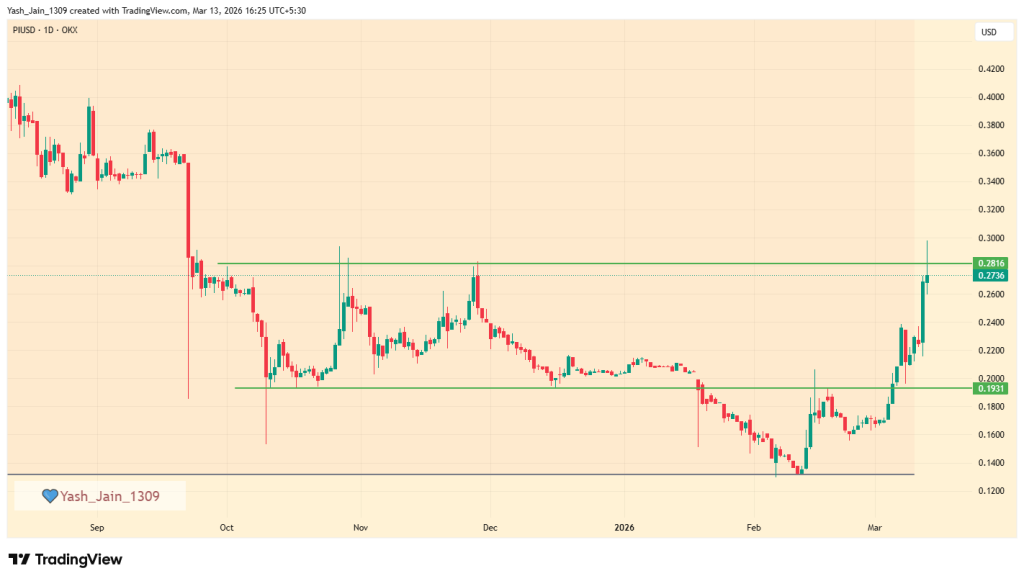
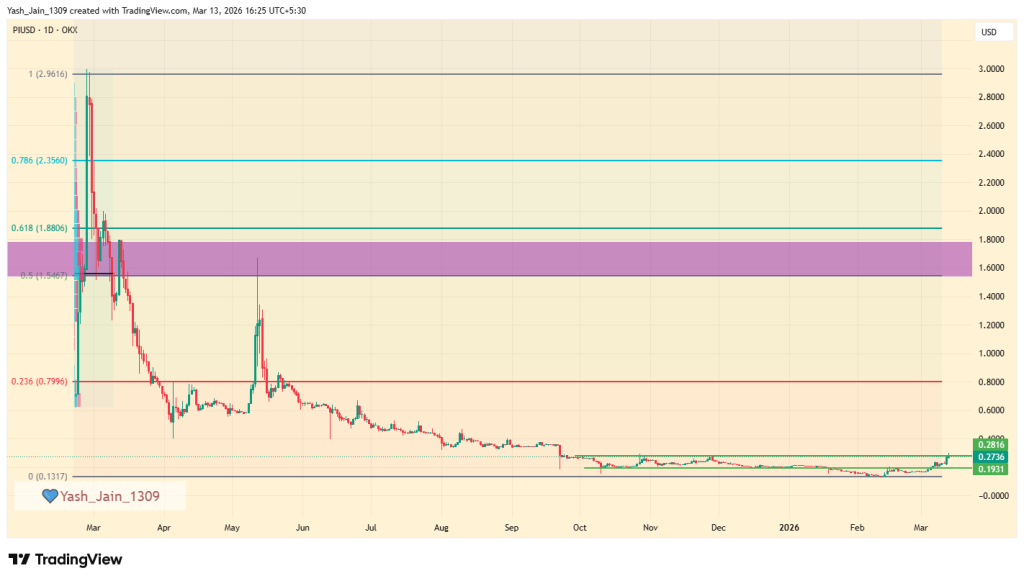
Pi’s price declined from $0.19 to $0.28 in Q4 2025, then to $0.1297 in January, indicating strong bearish sentiment. But this low was followed by short-term demand driven by ecosystem-level demand and the Kraken exchange listing, leading to an increase above $0.28 in March.

However, the overall recovery prospects for PI/USD in 2026 remain bleak due to low liquidity in the crypto market. Still, if the broader market improves, there may be an opportunity for Pi to rally more in March and recover some of its lost value, but $0.28 needs to be sustained.

PI Price Prediction 2026: Potential Scenarios for a Reversal

Pi’s price was firmly within its current consolidation range of $0.19-$0.28 in Q4 2025, but in January, it failed to trade within this range, hitting a new low of $0.1297.

This means momentum was completely on the bearish side, and PI investors were dumping like they had no chance of ever recovering. Investors and traders assumed it had become a dead asset for now, considering it worse than memecoins.

PI Price

Since the PI price prediction for 2026 still shows no significant improvement in the long term, after a devastating decline, a short-term momentum in February and march was observed that saw PI price beyond $0.28. 

Now, at this stage, when PI price is at its weakest long-term levels, but the short-term rally suggests a recovery chance, as few ecosystem updates were announced on X in early March along with an exchange listing from Kraken, which boosted this surge. Since it came with a new plan to revive its ecosystem, this strong possibility could turn around the dying momentum it’s was seeing till now.

Despite the challenges faced in December 2025 and since then, when the bear market suppressed momentum across the entire crypto sector, we’ve observed that no altcoin has managed to stage the anticipated rally. This was largely due to a lack of liquidity, with new investors still cautious, leaving many feeling apprehensive about the power of the bears.

However, the outlook for 2026 is optimistic for the sector, and if it flourishes, maybe PI could get a few more drops of liquidity, too. but if the broader market improves, the odds of a substantial rally may increase but key here is flipping $0.28 with confidence.

PI Price Prediction 2026

Pi Coin Price Targets 2026 – 2030

YearPotential Low ($)Potential Average ($)Potential High ($)
2026$0.85$2.25$3.50
2027$1.25$3.25$5.25
2028$2.00$5.50$8.50
2029$3.50$8.50$13.75
2030$5.50$13.75$22.00

Pi Crypto Price Forecast 2026

The Pi crypto prediction for the year 2026 could range between $0.85 to $3.50. Considering the buying and selling pressure, the average price could be around $2.25 for that year.

Pi Coin Price Prediction 2027

During 2027, the Pi network value could reach a maximum trading value of $5.25 with a potential low of $1.25. Evaluating the market sentiments, the average price of this altcoin could settle at around $3.25.

Pi Token Price Projection 2028

By 2028, the value of a single Pi coin price could reach a maximum of $8.50 with a potential low of $2.00. With this, the average price could land at around the $5.50 mark.

Pi Network Price Analysis 2029

Looking forward to 2029, the Pi coin Price may range between $3.50 and $13.75, and a potential average value of around $8.50.

Pi Network Price Prediction 2030

As per our Pi Coin Price Prediction 2030, the Pi coin value in 2030 could reach a high of $22.00. However, the viral altcoin could record a low of $5.50 and an average price of $13.75, if the crypto market turns bearish.

Market Analysis

Firm Name202520262030
CoinCodex$ 2.08$ 1.48$ 2.63
priceprediction.net$1.08$1.61$6.74
DigitalCoinPrice$107.98$125.57$265.95

*The aforementioned targets are the average targets set by the respective firms.

Conclusion

The Pi Network’s recent developments—from major token accumulation and Banxa integration to Binance listing rumors—are clear indicators that Pi is no longer just a test project. As market conditions turn favorable and institutional interest grows, Pi Coin is entering a new phase of maturity.

Never Miss a Beat in the Crypto World!

Stay ahead with breaking news, expert analysis, and real-time updates on the latest trends in Bitcoin, altcoins, DeFi, NFTs, and more.

FAQs

Will Pi Network price recover in 2026?

Pi may recover in 2026 if liquidity improves, exchange listings expand, and overall crypto market sentiment turns bullish.

What is the Pi price prediction for 2026?

Pi price prediction for 2026 suggests a range between $0.85 and $3.50, depending on adoption progress and market momentum.

Can Pi Coin reach $1 again?

Yes, Pi can reach $1 if buying demand strengthens and the token breaks out of its long-term consolidation range.

What is the Pi Network price prediction for 2030?

Pi Network price prediction for 2030 targets a potential high near $22.00 if ecosystem growth and real-world utility improve.

Is Pi Coin a good long-term investment?

Pi carries high risk due to limited utility and listings, but long-term upside depends on successful integration and network adoption.

Curve DAO Token (CRV) Price Prediction 2026, 2027-2030: Can CRV Break Its Long-Term Range?

Curve DAO Price Prediction

The post Curve DAO Token (CRV) Price Prediction 2026, 2027-2030: Can CRV Break Its Long-Term Range? appeared first on Coinpedia Fintech News

Story Highlights

  • The live price of the CRV token is  $ 0.24369563.
  • Price predictions for 2026 range from $0.45 to $3.00.
  • Curve Dao (CRV) could extend toward $8.00 by 2030, if recovery structure holds.

In the Decentralized Finance (DeFi) world, Curve DAO is known for its sophisticated Automated Market Maker (AMM) that redefined stablecoin liquidity. By utilizing non-custodial smart contracts to minimize slippage and trading costs, the protocol offers a seamless, permissionless environment for both traders and liquidity providers. At its core is the CRV token, a powerhouse of utility that drives governance and rewards through its unique staking architecture.

However, with the CRV price currently trading 98% below its all-time high, the protocol stands at a critical crossroads. As the market pivots toward more sustainable yield models and enhanced capital efficiency, investors are asking: Can Curve’s deep-rooted infrastructure spark a massive recovery? This analysis dives into the fundamental shifts within the Curve ecosystem and provides a comprehensive long-term Curve DAO (CRV) price prediction 2026-2030 to determine if CRV can recapture its former dominance in the next bull cycle.

Curve DAO Token Price Today

Cryptocurrency Curve DAO Token
Token CRV
Price $0.2437 up 4.50%
Market Cap$ 359,079,555.93
24h Volume$ 57,933,203.5001
Circulating Supply1,473,475,564.5963
Total Supply2,360,774,677.0374
All-Time High$ 60.4988 on 14 August 2020
All-Time Low$ 0.1811 on 05 August 2024

Curve Dao (CRV) Price February 2026 Outlook

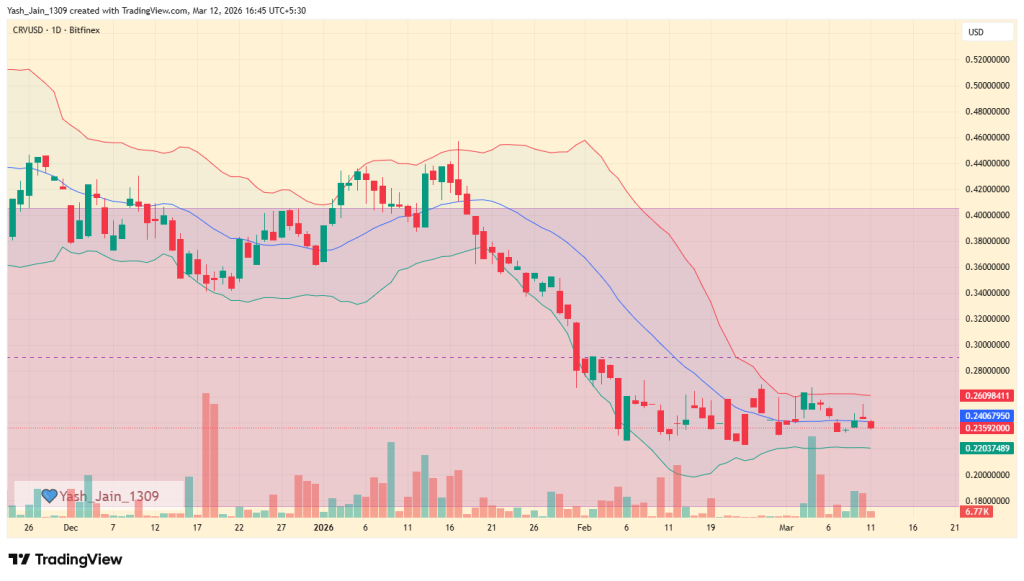
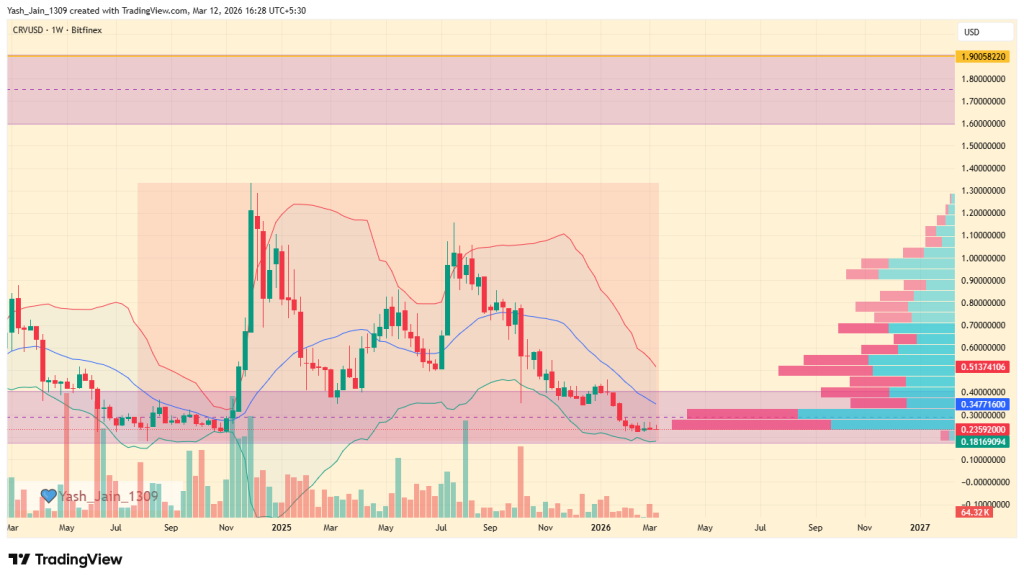
Based on the daily chart, the CRV price has entered a period of relative calm following a difficult start to the year. After losing the $0.34 level in January, the downward momentum persisted through February. However, as of March 2026, the price action has shifted into a tight range consolidation, signaling that the aggressive selling phase may be transitioning into a neutral state.

Curve Dao (CRV) Price Prediction March 2026

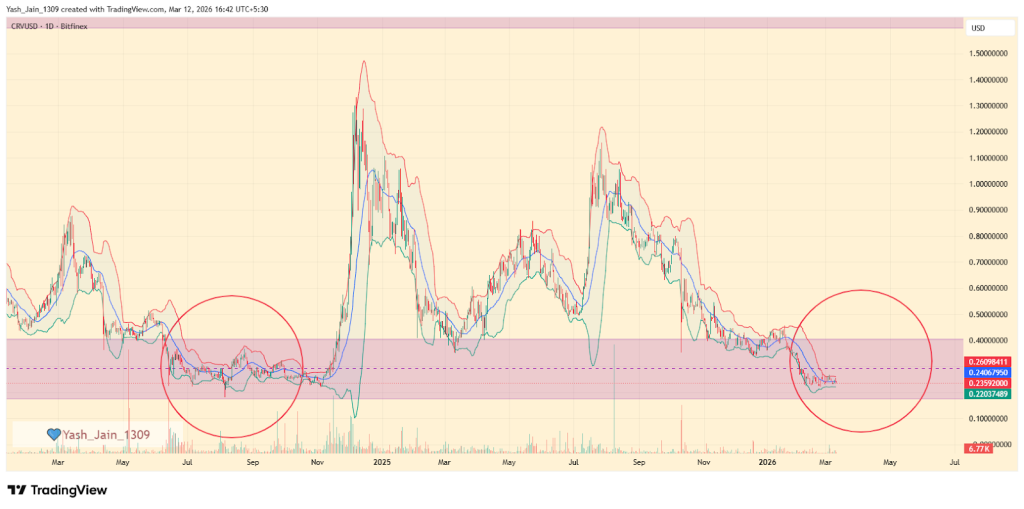
This current behavior mirrors the price action observed during the second half of 2024. During that period, CRV/USD remained trapped within a narrow range, defined by squeezed Bollinger Bands, for several months. That extended phase of sideways movement served as a necessary cooling-off period before the market eventually ignited a massive rally toward $1.33 in November 2024.

CRV Price

The technical patterns currently emerging suggest that the first quarter of 2026 has successfully placed CRV back into a primary “buy zone.” We are likely seeing the start of a multi-month accumulation phase. From March onwards, the price will likely remain engulfed in this consolidation as supply is absorbed, setting the stage for a potential breakout once the market builds sufficient energy.

Recent News / Opinions

On March 6th, Curve Finance publicly addressed PancakeSwap regarding an alleged license violation, claiming their code was used without permission. Curve cautioned that such actions are historically unwise and illegal, yet extended an olive branch by offering formal licensing and expertise to ensure user safety and legal compliance.

On February 4th, River announced an integration with Curve Finance to deepen satUSD liquidity. This partnership establishes a crvUSD-satUSD stable pool, allowing 1:1 swaps via the River module. The collaboration positions satUSD as a core DeFi primitive, leveraging Curve’s efficient AMM infrastructure to streamline stablecoin routing across the ecosystem.

Curve Dao (CRV) Price Prediction 2026

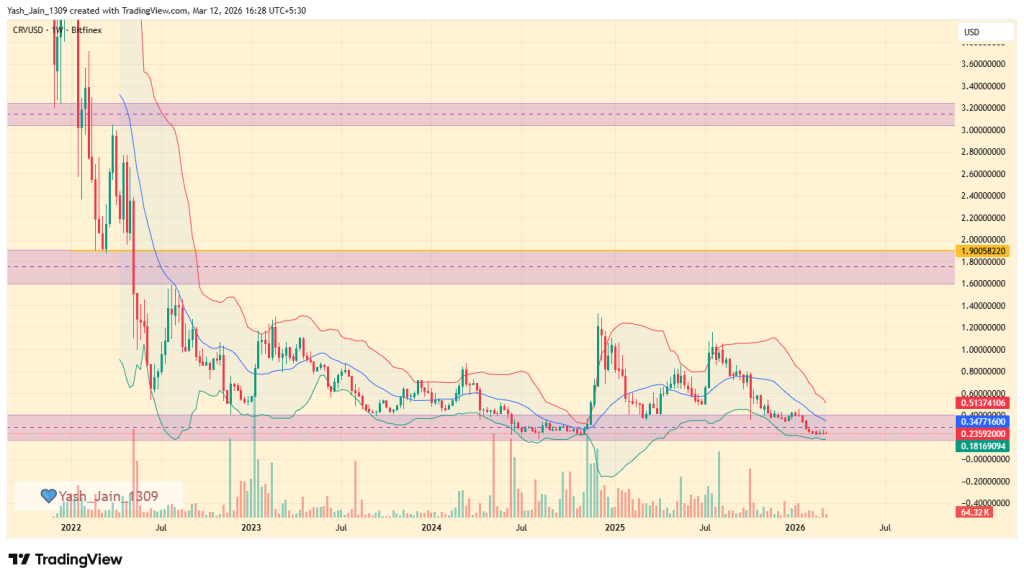
Based on the weekly chart, the CRV/USD pair has faced a grueling period for long-term investors. Since losing the critical $1.90 support level in 2022, the price action has been overwhelmingly pessimistic, dominated by a persistent bearish trend. This multi-year underperformance eventually saw the asset bottom out near the $0.18 mark by 2024, as sellers maintained a firm grip on the market.

Curve Dao (CRV) Price Prediction 2026

While late 2024 brought a wave of broader market optimism that lifted CRV, the recovery lacked the strength to challenge its former glory. The momentum stalled prematurely near $1.33, failing to even revisit the $1.90 threshold. This rejection led to a full retracement, with the price drifting back down to the $0.18 demand zone throughout 2025 and now stretching even in the first quarter of 2026.

Despite this sluggish history, there are emerging signs of a potential bottom. Weekly volume is beginning to fade, suggesting that selling pressure around the $0.18 area may finally be waning. Furthermore, the weekly Bollinger Bands are currently shrinking, that are mirroring the setup seen before the late 2024 pump, with the lower band providing a technical turning point from the existing demand zone.

CRV Price Analysis

If a fresh influx of demand enters the market, the odds favor a recovery attempt. A successful bounce from this floor would likely see CRV target a retest of the $1.00 psychological level. If bulls can sustain that momentum, a move back toward the $1.33 resistance and a long-awaited retest of the $1.90 level could become a reality.

Curve Dao Crypto Price Prediction 2026 – 2030

YearPotential Low ($)Potential Average ($Potential High ($)
20271.502.004.50
20282.104.106.00
20293.406.007.20
20304.806.508.00

Curve Dao Price Forecast 2027

As per the Curve Dao Price Prediction 2027, Curve Dao may see a potential low price of $1.50 . Meanwhile, the average price is predicted to be around $2.00. The potential high for Curve Dao price in 2027 is estimated to reach $4.50.

Curve Dao (CRV) Price Prediction 2028

In 2028, Curve Dao price is forecasted to potentially reach a low price of $2.10 and a high price of $6.00.

CRV Price Prediction 2029

Thereafter, the Curve Dao  (Curve Dao) price for the year 2029 could range between $3.40 and $7.20.

Curve Dao Price Prediction 2030

Finally, in 2030, the price of Curve Dao  is predicted to maintain a steady positive. It may trade between $4.80 and $8.00.

Curve Dao Price Prediction 2031, 2032, 2033, 2040, 2050

The long-term projection assumes Curve Dao sustains relevance in enterprise blockchain use cases, with growth moderating over time as the asset matures.

YearPotential Low ($)Potential Average ($)Potential High ($)
20315.207.409.00
20326.008.6010.80
20337.0011.5013.50
204019.0025.0032.00
205035.0048.0070.00

Curve Dao (CRV) Price Prediction: Market Analysis?

Year202620272030
Changelly$2.40$3.80$6.50
CoinCodex$1.90$3.50$7.00
WalletInvestor$2.00$3.60$6.40

CoinPedia’s Curve Dao Price Prediction

Curve Dao Price has fallen from a high of $1.33 late in 2024 and into 2025, and even into Q1 2026, but most importantly, it fell back to $0.18 through early 2026, which supported the late 2024 rally. Signs of a bottom are emerging, with decreasing selling pressure. If demand increases, the CRV price could target $1.00 and potentially retest $1.33 and $1.90 by the end of 2026.

Never Miss a Beat in the Crypto World!

Stay ahead with breaking news, expert analysis, and real-time updates on the latest trends in Bitcoin, altcoins, DeFi, NFTs, and more.

FAQs

What is the Curve DAO Token (CRV) used for?

Curve DAO Token (CRV) is used for governance, staking, and boosting rewards on Curve Finance, a leading DeFi protocol for low-slippage stablecoin trading.

What is the Curve DAO price prediction for 2026?

Curve DAO price prediction for 2026 suggests CRV may trade between $0.45 and $3.00 if long-term support holds and DeFi demand improves.

What is the CRV price prediction for 2030?

CRV price prediction for 2030 estimates a range between $4.80 and $8.00 if Curve continues serving as key liquidity infrastructure in DeFi.

What factors will influence Curve DAO price long term?

CRV’s long-term price depends on DeFi adoption, stablecoin growth, protocol revenue, governance activity, and broader crypto market cycles.

Zilliqa (ZIL) Price Prediction 2026, 2027 – 2030: Is ZIL Ready for a Long-Term Recovery?

Zilliqa Price Prediction

The post Zilliqa (ZIL) Price Prediction 2026, 2027 – 2030: Is ZIL Ready for a Long-Term Recovery? appeared first on Coinpedia Fintech News

Story Highlights

  • The live price of the Zilliqa crypto token is  $ 0.00422334.
  • Zilliqa’s price could move toward $0.045 if the recovery structure develops.
  • Broader adoption may support a long-term rise toward $0.20.

Zilliqa is a high-performance, public blockchain platform designed to solve the long-standing challenges of scalability and speed through its pioneering use of “sharding.” By dividing the network into smaller, parallel groups called shards, the protocol can process thousands of transactions per second, ensuring the network remains efficient as it grows. 

At the heart of this ecosystem is the ZIL token, which serves as the primary utility and governance asset. ZIL is used to pay for transaction fees, execute smart contracts written in the secure Scilla language, and reward miners and stakers for securing the network. 

As the platform expands its presence in DeFi and the metaverse, ZIL acts as the essential fuel driving all on-chain activity. But as competition in the Layer 1 space intensifies, can Zilliqa’s technical edge translate into sustained market dominance? To explore the long-term outlook, read our Zilliqa price prediction 2026-2030 for a deep dive.

Zilliqa Price Today

Cryptocurrency Zilliqa
Token ZIL
Price $0.0042 up 2.55%
Market Cap$ 84,238,735.67
24h Volume$ 9,234,440.4243
Circulating Supply19,945,989,624.69
Total Supply20,387,945,050.40
All-Time High$ 0.2563 on 06 May 2021
All-Time Low$ 0.0025 on 13 March 2020

CoinPedia’s Zilliqa Price Prediction

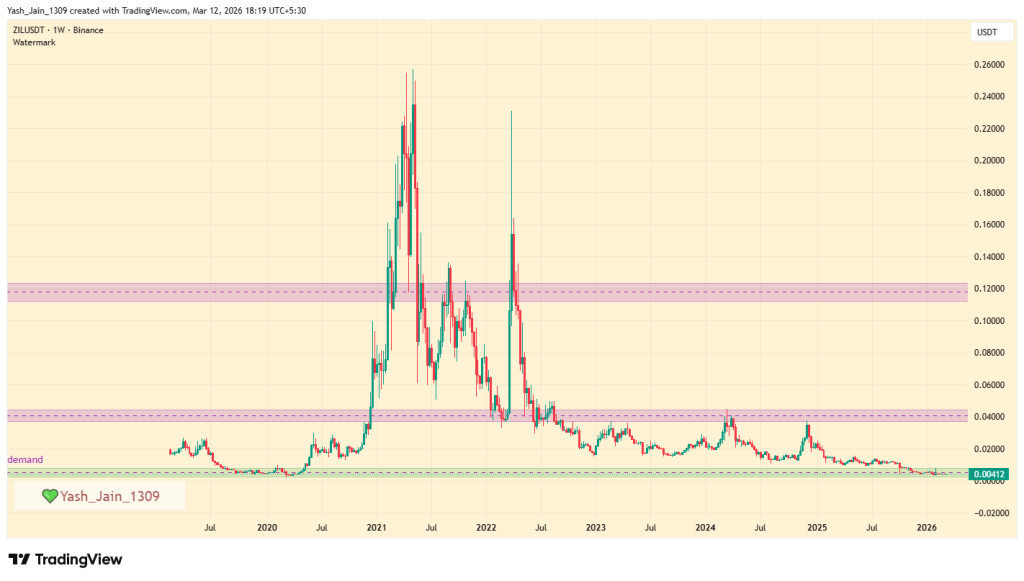
ZIL/USDT is revisiting a critical demand zone between $0.003 and $0.008, where strong accumulation occurred in early 2020. After a long retracement, this stage suggests potential for a trend reversal. If demand exceeds supply, ZIL could target $0.040 by the end of 2026.

Zilliqa Price Targets For March 2026

Ziliqa’s price in Q1 2026 continued the overall long-term downtrend, but it has entered the green box of demand, where it has remained around $0.0040, below the mid-level of the box, and could hit $0.0025 in March if short-term bearish pressure increases. But if short-term bullish demand rises, it could rise towards $0.0060 or $0.0080 as well.

Zilliqa Price Prediction 2026

Based on the weekly chart for ZIL/USDT, the price is currently revisiting a critical historical demand zone between $0.003 and $0.008. This area carries immense technical significance, as it served as the primary accumulation floor in early 2020 before Zilliqa’s massive rally toward its all-time high of approximately $0.240.

After years of retracement, the ZIL price has returned to these baseline levels in early 2026. This prolonged sideways movement suggests a deep phase of accumulation, where supply is being absorbed by patient buyers.

As the consolidation continues within this green-shaded support band, the market is essentially “filling its demand quota.” Once the selling pressure is fully exhausted and accumulation is complete, the groundwork for a trend reversal is set.

Therefore, If historical patterns repeat and demand outweighs supply, a significant recovery rally is anticipated. By the end of 2026, ZIL could realistically target the first major resistance flip at the $0.040 level, which represents a key structural pivot point on the macro scale.

Zilliqa Price Prediction 2026

Zilliqa (ZIL) Price Prediction 2026 – 2030

YearPotential Low ($)Potential Average ($Potential High ($)
20270.0280.0450.065
20280.0500.0800.120
20290.0900.1400.180
20300.1200.1650.200

Zilliqa Price Prediction 2027

As per the Zilliqa Price Prediction 2027, Zilliqa may see a potential low price of $0.028 The potential high for Zilliqa price in 2027 is estimated to reach $0.065

Zilliqa Price Forecast 2028

In 2028, Zilliqa  price is forecasted to potentially reach a low price of $0.050, and a high price of $0.120

Zilliqa Coin Price Prediction 2029

Thereafter, the Zilliqa  (Zilliqa) price for the year 2029 could range between $0.090 and $0.180.

Zilliqa Price Prediction 2030

Finally, in 2030, the price of Zilliqa is predicted to maintain a steady and positive. It may trade between $0.120 and $0.200

Zilliqa Price Prediction 2031, 2032, 2033, 2040, 2050

The long-term projection assumes Zilliqa sustains relevance in enterprise blockchain use cases, with growth moderating over time as the asset matures.

YearPotential Low ($)Potential Average ($)Potential High ($)
20310.150.220.30
20320.200.300.45
20330.280.420.60
20401.201.802.50
20504.006.509.00

Zilliqa (ZIL) Price Prediction: Market Analysis?

Year202620272030
Changelly$0.038$0.050$0.085
CoinCodex$0.040$0.060$0.090
WalletInvestor$0.050$0.070$0.140
Never Miss a Beat in the Crypto World!

Stay ahead with breaking news, expert analysis, and real-time updates on the latest trends in Bitcoin, altcoins, DeFi, NFTs, and more.

FAQs

What is the price prediction for Zilliqa (ZIL) in 2026?

Zilliqa could trade between $0.018 and $0.045 in 2026 if support holds and the crypto market strengthens, signaling steady recovery, not hype-driven spikes.

What is the Zilliqa price prediction for 2028?

Zilliqa could trade between $0.050 and $0.120 in 2028 if adoption improves and the broader crypto market enters a sustained growth cycle.

How high can Zilliqa price go by 2030?

By 2030, ZIL may reach up to $0.20 in a strong market cycle, supported by ecosystem growth and consistent long-term development progress.

What is the Zilliqa (ZIL) price prediction for 2040?

If Zilliqa maintains relevance and real-world use, ZIL could trade between $1.20 and $2.50 by 2040, reflecting gradual long-term expansion.

What role does Zilliqa 2.0 play in ZIL’s future price?

Zilliqa 2.0 shifts the network to Proof-of-Stake, improving speed and efficiency, which could support long-term value if adoption rises.

Is Zilliqa (ZIL) a good investment?

Zilliqa may appeal to long-term investors if upgrades translate into real usage, but it carries risk due to strong Layer-1 competition.

Notcoin (NOT) Price Prediction 2026, 2027 – 2030: Is NOT Set for a Gradual Comeback?

price prediction notcoin

The post Notcoin (NOT) Price Prediction 2026, 2027 – 2030: Is NOT Set for a Gradual Comeback? appeared first on Coinpedia Fintech News

Story Highlights

  • The live price of Notcoin (NOT) is  $ 0.00041436.
  • Notcoin may possibly hit $0.200 by 2030 if support holds and adoption strengthens steadily.
  • NOT remains in consolidation, with key support at $0.00030

Notcoin (NOT) began as a viral sensation, pioneering the “tap-to-earn” model on Telegram and onboarding over 35 million users into the TON ecosystem. 

However, the initial euphoria gave way to a significant “demise” in market value, as the token plummeted over 95% from its 2024 highs to a current market cap of approximately $39M. This decline was driven by massive airdrop sell pressure and a lack of sustainable utility beyond the initial clicker game. 

Today, the NOT token is attempting a “strategic resurgence,” evolving from a simple game into a gaming hub and DeFi platform. It now powers the “Not Games” ecosystem, serves as collateral in DeFi protocols, and even backs a digital Visa card with buyback mechanisms.

Can this pivot from hype to infrastructure restore investor confidence, or was the viral spark a one-time phenomenon? To explore its potential recovery, read our Notcoin price prediction 2026-2030 for a deep dive.

Notcoin Price Today

Cryptocurrency Notcoin
Token NOT
Price $0.0004 up 4.31%
Market Cap$ 41,288,564.49
24h Volume$ 13,549,204.2930
Circulating Supply99,429,405,866.9074
Total Supply102,452,755,868.52
All-Time High$ 0.0290 on 02 June 2024
All-Time Low$ 0.0003 on 10 October 2025

CoinPedia’s Notcoin Price Prediction

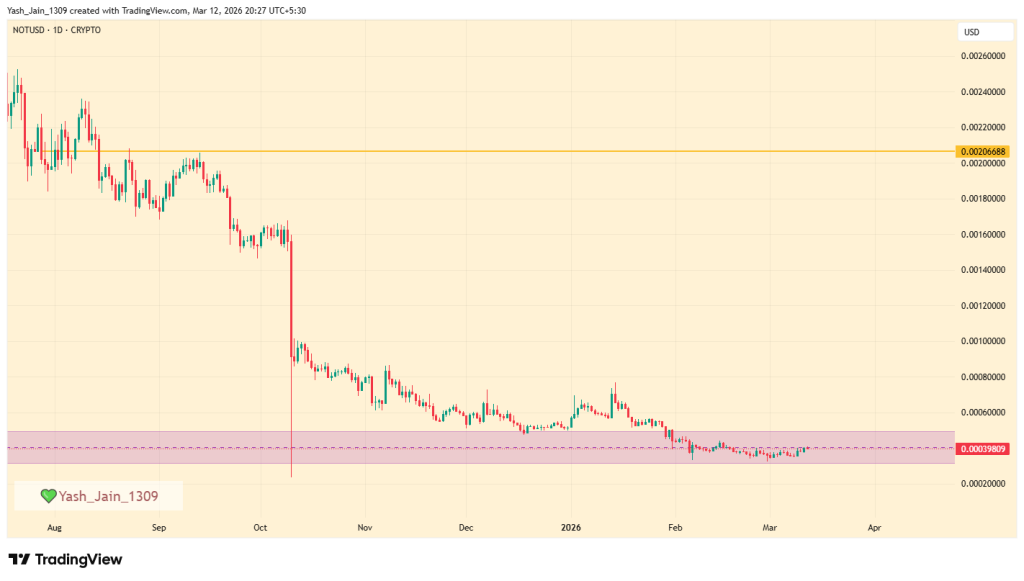
NOT/USD experienced a parabolic surge to $0.029 after its Q2 2024 launch but then declined, breaking key supports. As of early 2026, it trades at $0.00039 in a consolidation zone. Bulls need to reclaim $0.002 for a potential reversal.

Notcoin (NOT) Price March 2026 Outlook

As March approaches, Notcoin’s price action remains defined by stability rather than expansion. The $0.00030–$0.00035 range has emerged as a key support zone, where selling pressure has consistently eased. As long as NOT holds above this area, the risk of deeper downside remains limited, and price is likely to continue moving sideways.

On the upside, initial resistance is located near $0.00060, followed by a broader recovery zone between $0.0010 and $0.0015. These levels have a capped price during previous attempts and will likely require time and steady participation to overcome. March is unlikely to deliver a sharp breakout. Instead, its importance lies in whether Notcoin can maintain its base and slowly build higher structure, setting the stage for recovery later in the year.

Notcoin (NOT) Price Prediction March 2026

Notcoin (NOT) Price Prediction 2026

The weekly chart for NOT/USD illustrates a classic “hype-to-capitulation” cycle. Following its Q2 2024 launch, the token experienced a massive parabolic surge, peaking near $0.029. However, this was met with intense selling pressure, breaking key psychological supports at $0.012 and $0.009.

By 2025, the price entered a persistent “bleeding” phase, characterized by lower highs and diminishing volume. Currently, in early 2026, the asset is trading at extreme lows around $0.00039, deep within a terminal consolidation zone. For a reversal, bulls must reclaim the $0.002 level to break the long-term bearish structure.

Notcoin Crypto Price Prediction 2026 – 2030

YearPotential Low ($)Potential Average ($Potential High ($)
20270.0350.0550.080
20280.0600.0950.140
20290.1100.1600.190
20300.1500.1800.200

Notcoin Price Prediction 2027

As per the Notcoin Price Prediction 2027, Notcoin may see a potential low price of $0.035. The potential high for Notcoin price in 2027 is estimated to reach $0.080.

Notcoin (NOT) Price Forecast 2028

In 2028, Notcoin price is forecasted to potentially reach a low price of $0.060 and a high price of $0.140.

Notcoin Crypto Price Prediction 2029

Thereafter, the Notcoin  (Notcoin) price for the year 2029 could range between $0.110 and $0.190.

Notcoin (NOT) Price Prediction 2030

Finally, in 2030, the price of Notcoin is predicted to remain steady and positive. It may trade between $0.150 and $0.200.

Notcoin Price Prediction 2031, 2032, 2033, 2040, 2050

The long-term projection assumes Notcoin sustains relevance in enterprise blockchain use cases, with growth moderating over time as the asset matures.

YearPotential Low ($)Potential Average ($)Potential High ($)
20310.180.250.32
20320.220.450.45
20330.300.800.65
20401.602.503.50
20505.008.5012.00

Notcoin (NOT) Price Prediction: Market Analysis?

Year202620272030
Changelly$0.045$0.065$0.110
CoinCodex$0.050$0.075$0.150
WalletInvestor$0.060$0.090$0.180
Never Miss a Beat in the Crypto World!

Stay ahead with breaking news, expert analysis, and real-time updates on the latest trends in Bitcoin, altcoins, DeFi, NFTs, and more.

FAQs

What is the Notcoin price prediction for 2026?

Notcoin may trade between $0.020 and $0.060 in 2026, with average prices near $0.038 if it holds support and regains momentum.

What is the price prediction for Notcoin in 2027?

In 2027, Notcoin may range roughly from $0.035 at lows up to $0.080 at highs, reflecting gradual recovery potential.

How much will Notcoin be worth in 2030?

By 2030, Notcoin could reach around $0.150–$0.200 if adoption grows and market conditions remain supportive.

Is now a good time to buy Notcoin?

Buying Notcoin now may suit long-term holders if you believe in its future adoption, but volatility remains high with risk of sideways action.

What long-term price outlook does Notcoin have?

Long term, Notcoin’s value depends on adoption and relevance; strong recovery could see levels above $0.20 and beyond over years.

Samsung Galaxy S26 Ultra: Everything you need to know – Specs, Features and Price

The Galaxy S26 Ultra is Samsung’s flagship Ultra smartphone for 2026, announced at Galaxy Unpacked on February 25 in San Francisco and available in stores from March 11.

It sits atop the three-model Galaxy S26 lineup alongside the standard S26 and S26+. While non-Ultra models have become more expensive, the Ultra model carries the same starting price as its predecessor: $1,299.

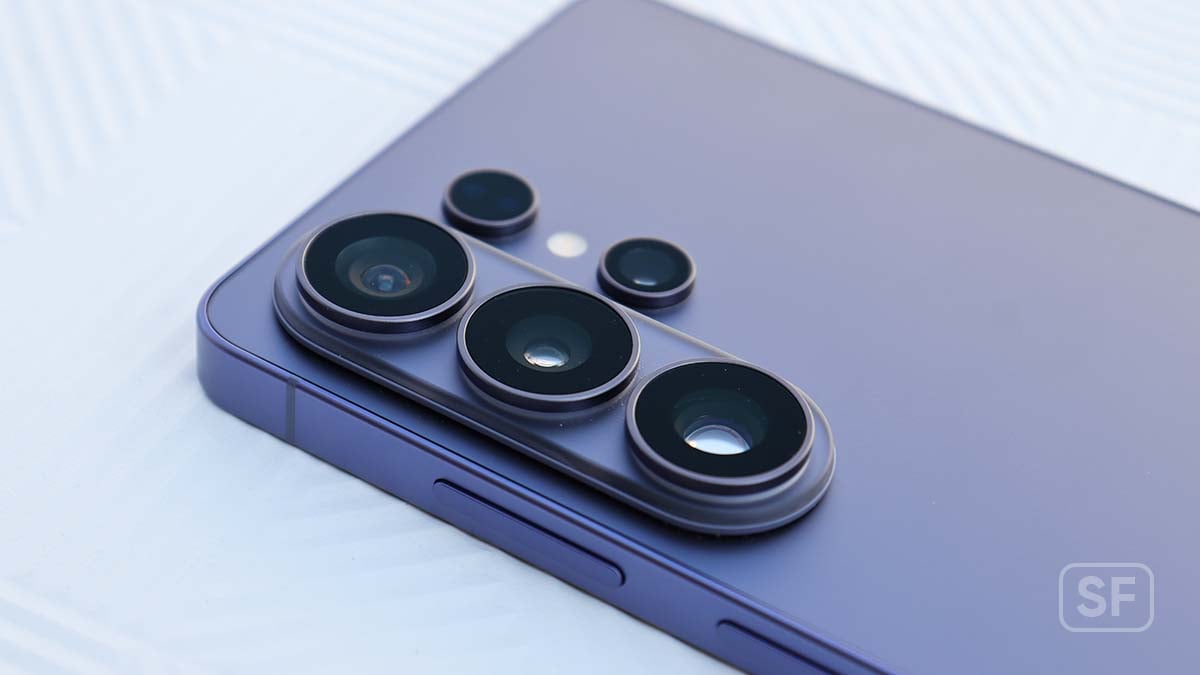
Galaxy S26 Ultra is a significantly refined version of the Galaxy S25 Ultra. It has got an Ambient Camera design on the back, which houses the three camera sensors vertically. Next to the bump are ToF sensor, LED flash and 3x telephoto.

The design language is familiar, and the 6.9-inch panel retains the familiar size. Samsung focused on Privacy Display, brighter apertures on its two most important lenses, the fastest Snapdragon chip yet, and a faster charging speed.

Specification Details

  • Launch Announced Feb 25, 2026 | Available March 11, 2026
  • Starting Price $1,299 (256 GB / 12 GB RAM)
  • Processor: Snapdragon 8 Elite Gen 5 for Galaxy (Qualcomm, TSMC 3nm) worldwide
  • Display: Dynamic AMOLED 2X, QHD+ (3120 × 1440), 120Hz LTPO, 2,600 nits peak
  • Headline Feature: Privacy Display (Flex Magic Pixel)
  • Main Camera 200 MP, f/1.4 (wider than f/1.7 on S25 Ultra)
  • Telephoto (5x): 50 MP periscope, f/2.9 (wider than f/3.4 on S25 Ultra) – ALoP mechanism
  • Charging: 60W wired and 25W Qi2-ready wireless charging
  • Colors: Black, White, Sky Blue, Cobalt Violet (plus Silver Shadow and Pink Gold)
  • Storage Options 256 GB, 512 GB, 1 TB
  • RAM 12 GB (256/512 GB) | 16 GB (1 TB model)
  • Dimensions / Weight 163.6 x 78.1 x 7.9 mm | 214 g

Samsung Galaxy S26 Ultra SG26U Display

Design and build

The Galaxy S26 Ultra makes a quiet but notable material shift: after two generations with a titanium frame (S24 Ultra and S25 Ultra), Samsung has returned to aluminum for 2026.

The S26 Ultra measures 163.6 x 78.1 x 7.9 mm and weighs 214 grams, compared to 8.2 mm and 218 grams for the S25 Ultra. The practical result is a device that feels marginally more comfortable in the hand.

Samsung Galaxy S24 S26 Ultra SG26U SG24U

Available in: Black, White, Sky Blue, Cobalt Violet (retail) + Silver Shadow, Pink Gold (Samsung.com exclusives in select markets).


Display

The Galaxy S26 Ultra carries a 6.9-inch Dynamic AMOLED 2X panel at QHD+ resolution (3,120 × 1,440 pixels), with LTPO adaptive refresh rate from 1 Hz to 120 Hz and HDR10+ support. Corning Gorilla Armor 2 protects both the front and back.

Privacy Display

The most discussed aspect of the S26 Ultra’s display is Privacy Display.

When enabled, the panel narrows its viewing angle so that anyone looking at the phone from the side sees little more than a dark screen, while the owner’s direct view is unaffected.

The system is part of Samsung Display’s updated LEAD 2.0 platform (polarizer-free OLED), which simultaneously improves power efficiency.

Samsung GalaxyS26 Ultra Privacy Display SG26U


Performance

Galaxy S26 Ultra uses Snapdragon 8 Elite Gen 5 for Galaxy, a chipset tailored for Samsung flagships. The chip is manufactured using TSMC’s 3nm process technology, offering significant gains in CPU, GPU, and especially NPU.

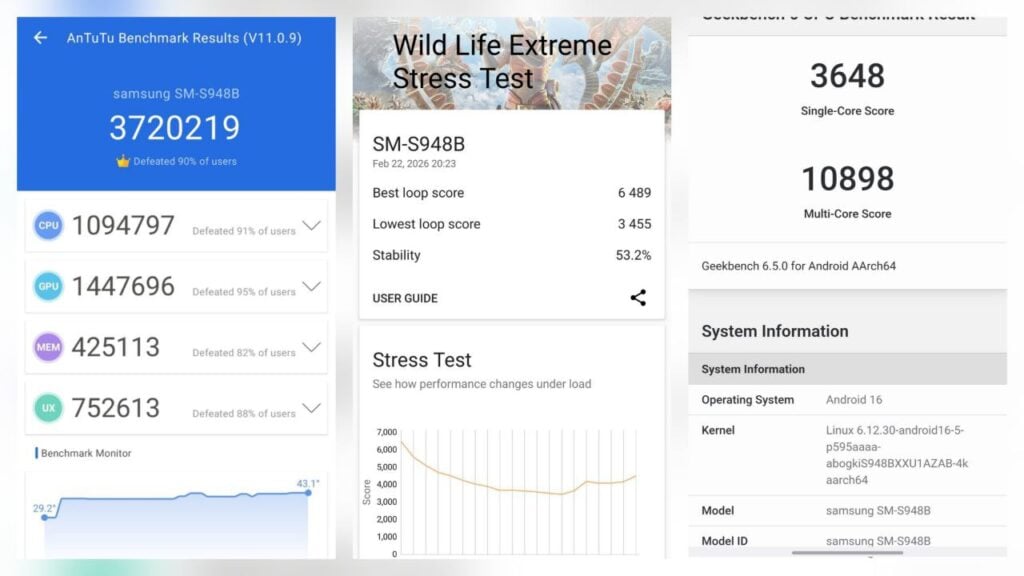
In Geekbench 6 benchmarks, the device hits around 3,600–3,700 in single-core and 10,800–11,500+ in multi-core tests. Sustained performance has also improved over the S25 Ultra, thanks to the aluminum frame and bigger vapor chamber.

The phones launch with Android 16 and One UI 8.5, and Samsung has committed to seven years of OS and security updates.

Samsung Galaxy S26 Ultra AnTuTu, 3D Mark and Geekbench test results

Images: Samsung Galaxy S26 Ultra AnTuTu, 3D Mark and Geekbench test results


Camera

  • Main (Wide) 200 MP | f/1.4 (up from f/1.7) | 1/1.3-inch sensor | OIS | 47% more light than S25 Ultra
  • Ultrawide 50 MP | f/2.2 | 1/2.5-inch | 120 degree FoV
  • Telephoto (3×) 10 MP | f/2.4 | 1/3.94-inch | 3× optical zoom
  • Periscope (5×) 50 MP | f/2.9 (up from f/3.4) | 1/2.52-inch | 5× optical | ALoP mechanism | 37% more light

The aperture widening from f/1.7 to f/1.4 on the main camera allows 47% more light to reach the sensor. The 5x periscope telephoto gains a new All Lens on Prism (ALoP) mechanism, replacing the traditional periscope arrangement.

Samsung Galaxy S26 Ultra SG26U rear camera

Video capabilities have been enhanced with Super Steady (gyro + accelerometer Horizon Lock), and the S26 Ultra gains support for APV (Advanced Professional Video) format.

Front Camera 12 MP | f/2.2 | 85° FoV (wider than 80 degree on S25 Ultra)

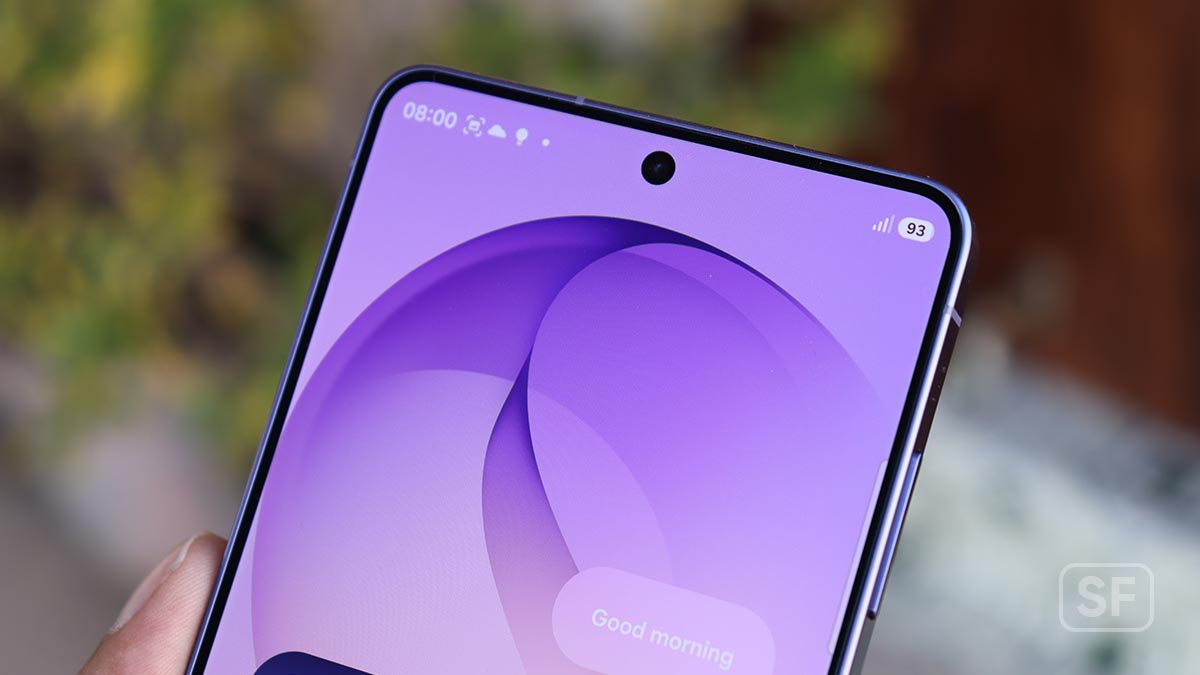
Samsung widened the field of view from 80 degree to 85 degree, enabling better group selfies. The punch-hole cutout is correspondingly slightly larger to accommodate the new optics.

Samsung Galaxy S26 Ultra SG26U front camera and task bar


Battery and charging

The Galaxy S26 Ultra retains a 5,000 mAh battery, unchanged from the S25 Ultra. Samsung’s focus instead was on charging speed. For the first time in the Galaxy S Ultra lineup, the device supports 60W wired and 25W wireless charging.

The phone does not come with a charger in the box. To achieve 60W speeds, users need a Power Delivery charger rated at 60W with PPS.


Galaxy AI

Samsung’s Galaxy AI suite has been expanded for 2026, with both productivity and camera-focused additions. Key new AI features include:

  • Now Nudge
  • Creative Studio
  • Photo Assist with text input
  • Call screening
  • Next-gen Bixby with Perplexity

Related post – Galaxy S26 update removed Perplexity’s Hey Plex

Samsung Galaxy S26 Ultra SG26U Now Nudge


Pricing and Availability

The Galaxy S26 Ultra is available starting March 11, 2026, through Samsung.com, and major US carriers (AT&T, T-Mobile, Verizon).

  • 256 GB / 12 GB RAM $1,299
  • 512 GB / 12 GB RAM $1,499
  • 1 TB / 16 GB RAM $1,799

For owners of the S23 Ultra or older, the S26 Ultra is a comprehensive upgrade. For S25 Ultra owners, it’s a more marginal case unless the Privacy Display specifically appeals.

The post Samsung Galaxy S26 Ultra: Everything you need to know – Specs, Features and Price appeared first on Sammy Fans.

Galaxy S26 magnetic power bank launched at $65, but there’s an annoying catch

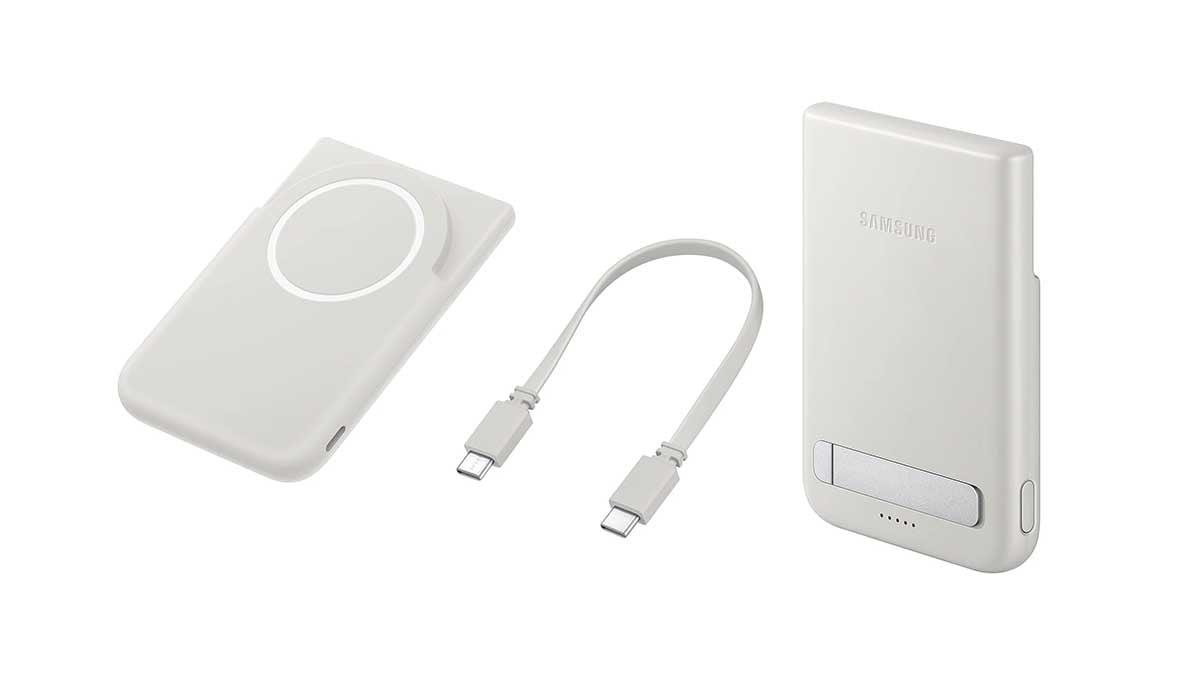
Samsung has quietly listed a new accessory for the Galaxy S26 lineup: the Magnet Wireless Battery Pack (power bank).

It is exactly what Galaxy users have been asking for: a magnetic wireless power bank designed for modern Qi2 charging. Well, there is a familiar catch: you cannot use it properly on the Galaxy S26 without a magnetic case.

Magnet Wireless Battery Pack is a compact 5,000 mAh portable charger built around Qi2 standards. It supports wireless charging up to 15W and can also deliver up to 25W if you plug in through the USB-C port.

Samsung’s version adds a built in kickstand, which turns the phone into a small desk setup while charging. That part is genuinely useful for video calls, watching content, or simply propping the device up while it powers up.

The battery pack is Qi2 certified and designed for magnetic alignment. But the Galaxy S26 itself does not include the magnetic ring required for that alignment. Samsung says skipping the magnets helps keep the phones thinner.

So the official solution is simple: buy a magnetic case.

Samsung Galaxy S26 Qi2 Battery Pack

Recent Galaxy phones have large camera modules that tend to interfere with many third-party magnetic accessories. This new battery pack avoids that problem with a dedicated cutout around the magnet ring, leaving space for the camera housing.

You can snap the battery onto the back of your phone, get a stable charging connection, and keep using the device without a cable. Apple users have had this style of accessory for years, and the broader Android ecosystem is slowly moving in.

The post Galaxy S26 magnetic power bank launched at $65, but there’s an annoying catch appeared first on Sammy Fans.

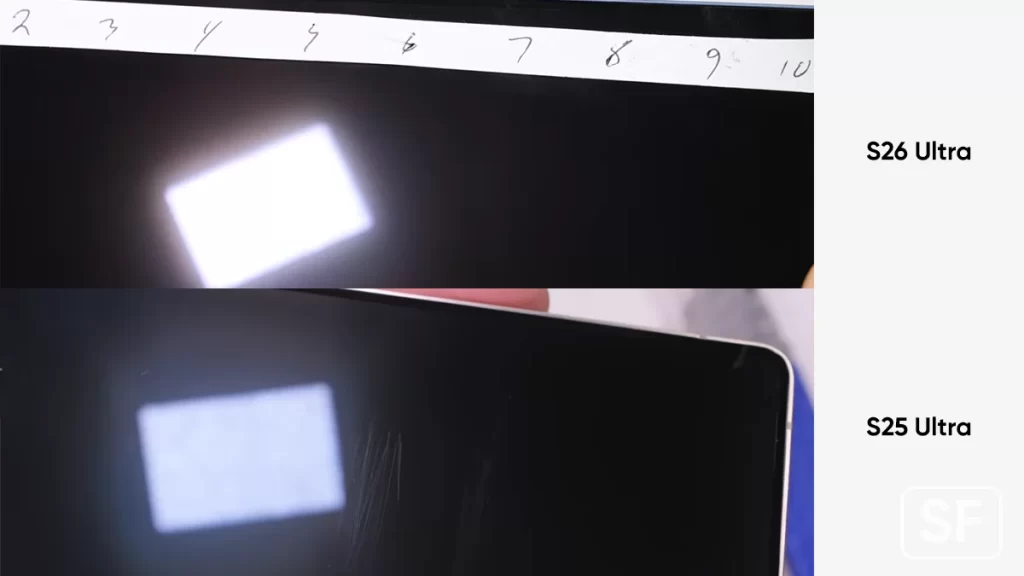
Galaxy S26 Ultra display survives scratches better than S25 Ultra

Samsung Galaxy S26 Ultra display scratches less than last year’s model, and based on how the S25 Ultra turned out, that’s a bigger deal than it sounds.

Famous tech YouTuber JerryRigEverything recently released the Galaxy S26 Ultra durability video. The new flagship phone survives scratch resistance, flame test, and bend test, with its aluminum frame also proven rock solid.

Galaxy S26 Ultra display survives scratches better than S25 Ultra

The Galaxy S26 Ultra has got Corning Gorilla Armor 2 on the front, same branding as last year. Zack Nelson (JerryRigEverything) found during the durability test:

  • Level 6 scratches are barely visible even under close inspection
  • Deeper grooves only surfacing at level 7

It reads like spec sheet noise until you remember what happened with the S25 Ultra.

The Galaxy S24 Ultra didn’t start getting scratches until level 7 on the Mohs scale. Then the Galaxy S25 Ultra came along with its so-called upgraded Gorilla Armor 2, and the screen started getting scratched at level six.

The S25 Ultra started showing scratches at level 6, same as phones from three years ago. Corning probably dialed back the brittleness after realizing the original Armor was too hard and prone to shattering.

Meanwhile, the Galaxy S26 Ultra’s behavior at level 6 is noticeably better than the S25 Ultra’s. You’d need strong light and intent to spot them. That suggests a recipe adjustment somewhere between the original Armor and Armor 2.

Samsung Galaxy S26 Ultra vs S25 Ultra Scratch Resistance

Related articles:

The post Galaxy S26 Ultra display survives scratches better than S25 Ultra appeared first on Sammy Fans.

Samsung Browser in One UI 9 may let you open multiple windows at once

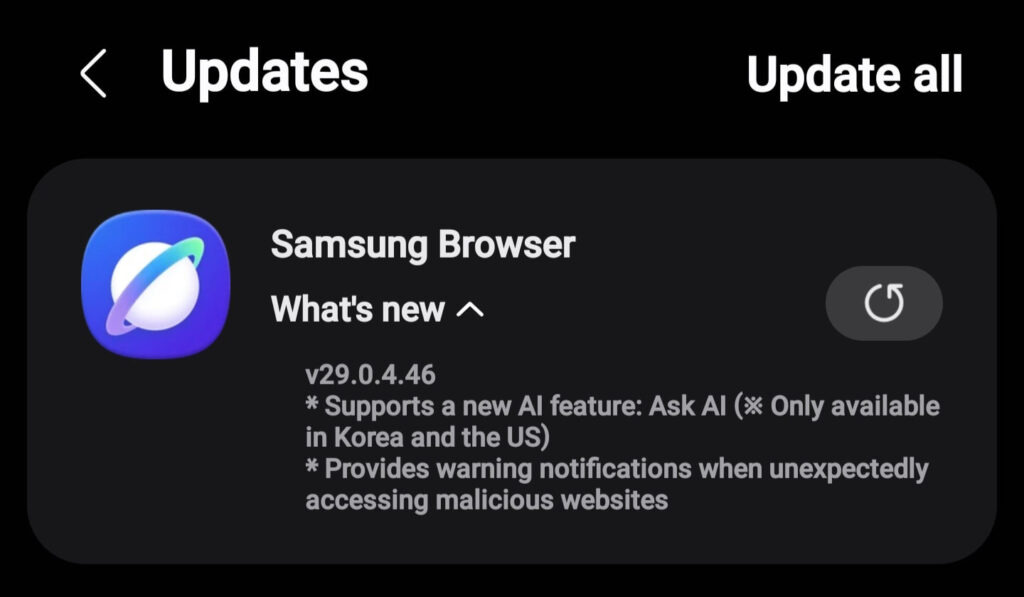
One UI 8.5 hasn’t even rolled out properly, and the Internet is already flooding with One UI 9 leaks as the latest just surfaced Samsung Browser app’s upcoming “multiple windows” feature.

What’s interesting this time around is what Samsung developers are quietly fueling into Samsung Browser. The company now calls it Samsung Browser, not Internet, which has been ditched with the Galaxy S26 series.

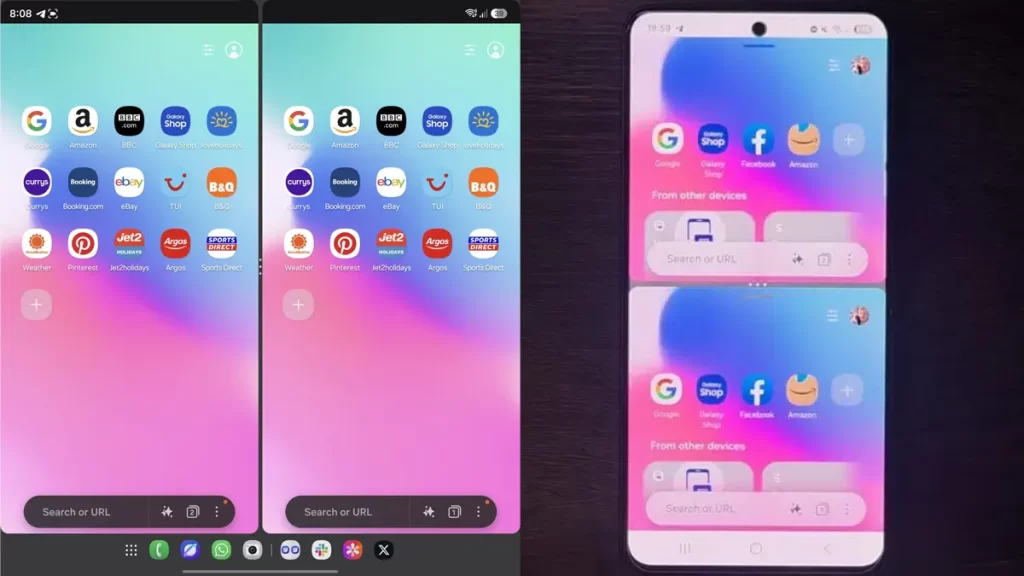
Samsung Browser – Split Page

Samsung Browser in One UI 9 can handle multiple instances of itself running side by side (on a foldable phone) or up and down (on a bar-type phone) – as discovered by Josh Skinner of SammyGuru.

You could finally do the things desktop browsers have let you do for years without feeling like you’re working against your phone.

Samsung already had multi-instance support for other apps like Notes and My Files. Having it in the browser now changes how people might actually navigate the web on their phone.

  • Checking a source while writing an email
  • Comparing product pages while shopping
Samsung Browser Multiple Windows

Image: Multiple Windows on Galaxy Z Fold 7 (Left) | Galaxy S21 FE (Right)

Ask AI turns Ask AI Beta

The Ask AI feature, which had been floating around earlier, now has a beta tag slapped on it in the latest build. Debug settings revealed something called Enable Cross-Device Resume, which doesn’t do anything, for now.

One UI 9 Update

One UI 9 is expected to launch sometime around July or August this year. Samsung’s expected to launch its Android 17-based One UI 9 with the Galaxy Z Fold 8, Galaxy Z Flip 8, and an alleged Galaxy Wide Fold.

Development of One UI 9 has already begun, though, which means leaks like this are going to keep trickling out no matter how hard Samsung tries to contain them.

The post Samsung Browser in One UI 9 may let you open multiple windows at once appeared first on Sammy Fans.

Galaxy S26 Ultra durability test reveals the fix S25 Ultra desperately needed

JerryRigEverything’s Galaxy S26 Ultra durability test just landed, and while Samsung fixed one of last year’s most embarrassing problems, they’ve quietly introduced something nobody expected.

The durability test shows how Galaxy S26 Ultra passes the brutal durability test with a sizzling rating. Samsung has also improved the screen resistance despite using the same Gorilla Armor 2 as the Galaxy S25 Ultra.

S Pen – Toothpick again?

The Galaxy S26 Ultra’s S Pen is thinner this year, more curved at the end for ergonomics, with internal copper coils improving digitizer precision and triangulation.

It’s now a purely passive stylus with a spring mechanism for docking. Nelson snaps it during testing; breaks like a toothpick – no reinforcing backbone.

Screen scratch test

Gorilla Armor 2 is back, apparently with some recipe tweaks, and it performs noticeably better than previous flagships. Level 6 scratches are barely visible even under close inspection, with deeper grooves only surface at level 7.

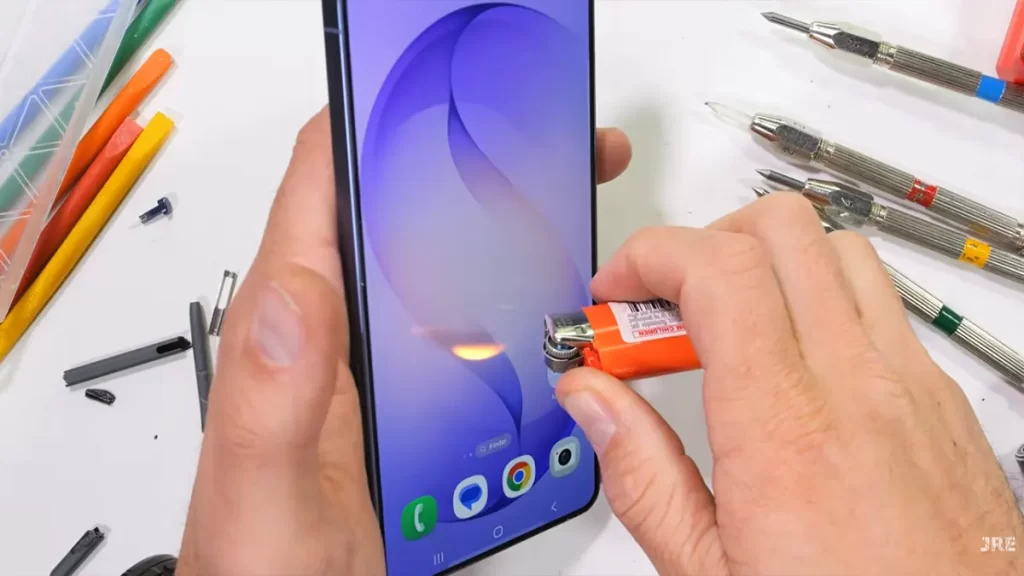
Additionally, the phone survives direct flame from a lighter for roughly 20 seconds with minimal pixel damage.

Samsung Galaxy S26 Ultra Durability Test

Source – JerryRigEverything

Bend test

In the bend test, the phone exhibits zero flex from either the front or back. Nelson describes it as a “rock solid beast.” The armor aluminum holds up structurally, but scratches more visibly than titanium did.

Samsung ditched titanium for armor aluminum this year. The frame is constructed as a single metal piece instead of glued sections, which simplifies repairs and recycling.

Camera Rings – This is what “they [Samsung] didn’t mention”

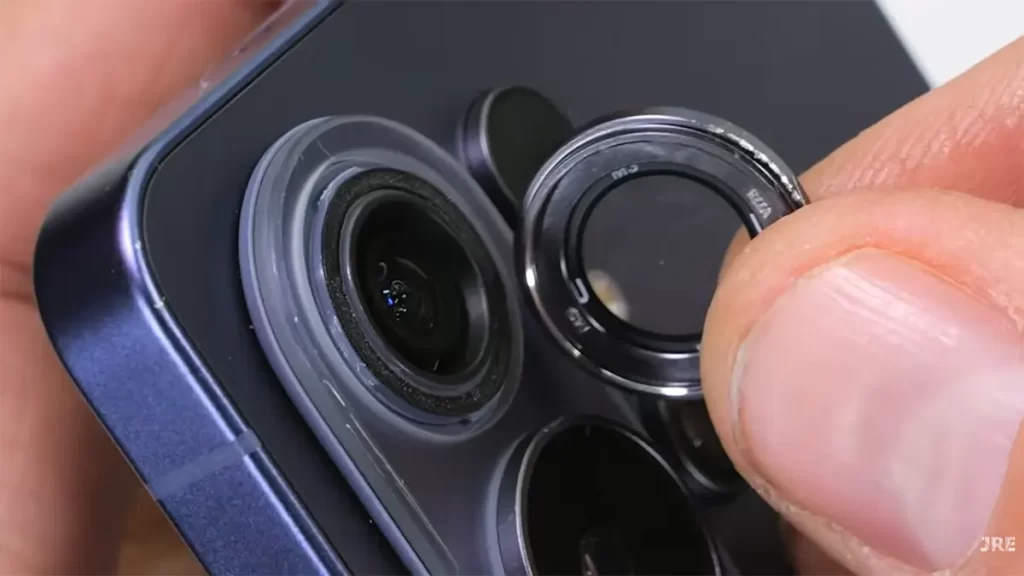
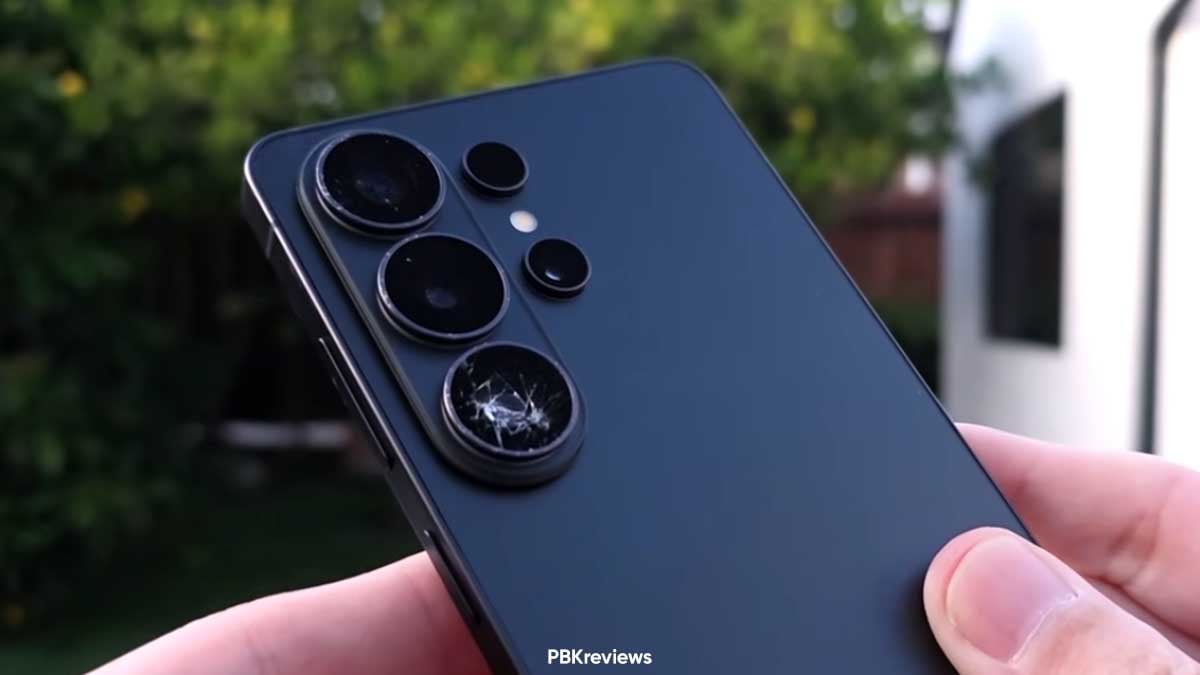
Remember how the S25 Ultra’s camera lenses practically fell off if you try to pull them off, even with minimal effort?

It caused a ton of criticism for Samsung, and the Galaxy S26 Ultra fixes that. Lenses are now secured properly, and while there’s still a subtle gap visible under the protective glass, they won’t pop out accidentally anymore.

The surprise part: the lenses can be intentionally removed and clicked back into place without breaking the glass itself. Samsung turned a design flaw into something repair shops can actually work with.

“Zack Nelson calls it a huge improvement, and he’s not wrong.”

Samsung Galaxy S26 Ultra Camera Ring

Source – JerryRigEverything

There’s a 60W USB-C port, a SIM tray with IP68-sealing rubber, and still no microSD expandable storage. Samsung’s giving a huge thumbs up for refinements like fixing camera issues and adding thoughtful repairability, but some annoyances stack up.

What matters is whether Samsung is learning the right lessons.

You can watch the full Galaxy S26 Ultra durability test on JerryRigEverything’s YouTube channel.

The post Galaxy S26 Ultra durability test reveals the fix S25 Ultra desperately needed appeared first on Sammy Fans.

Ethereum Price Stabilizes as Liquidations Fade But Institutional Demand Builds

Ethereum Price Analysis Whale Accumulation and Rising Volatility Put ETH at Crossroads

The post Ethereum Price Stabilizes as Liquidations Fade But Institutional Demand Builds appeared first on Coinpedia Fintech News

The Ethereum price might finally be catching its breath. After weeks of brutal leverage-driven chaos, the market appears to be shifting gears away from forced liquidations and toward something far less dramatic: actual demand.

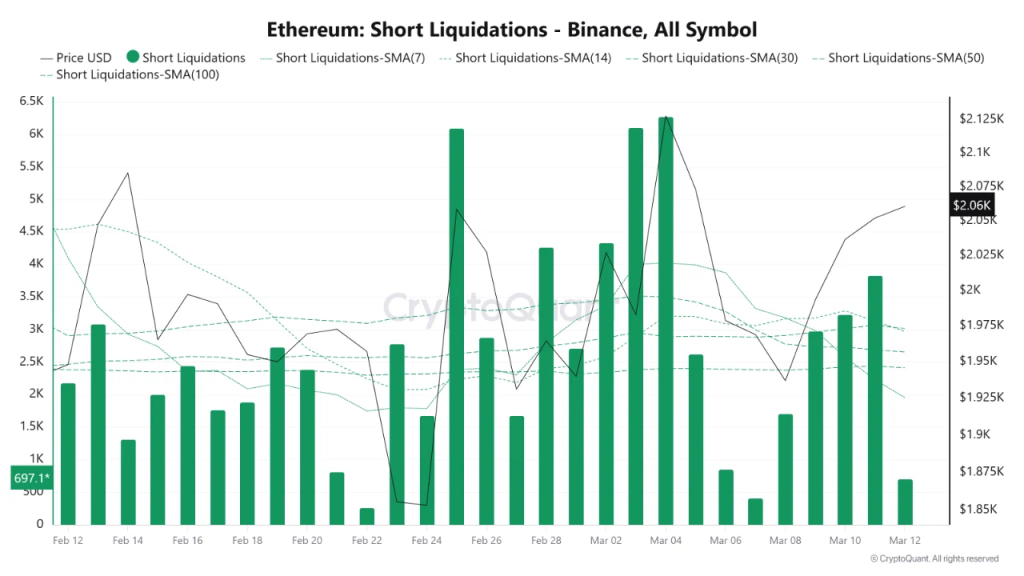
Recent data suggests the violent liquidation cycles that dominated late February are fading. Short liquidations, which previously spiked during the market’s most chaotic moments, have now dropped sharply to around 700. In simpler terms, the short squeeze fuel that once powered explosive moves has largely burned out.

And without that forced buying pressure, the market has to do something unfamiliar and that to move organically with spot demand.

Ethereum Price Leaves Liquidation Chaos

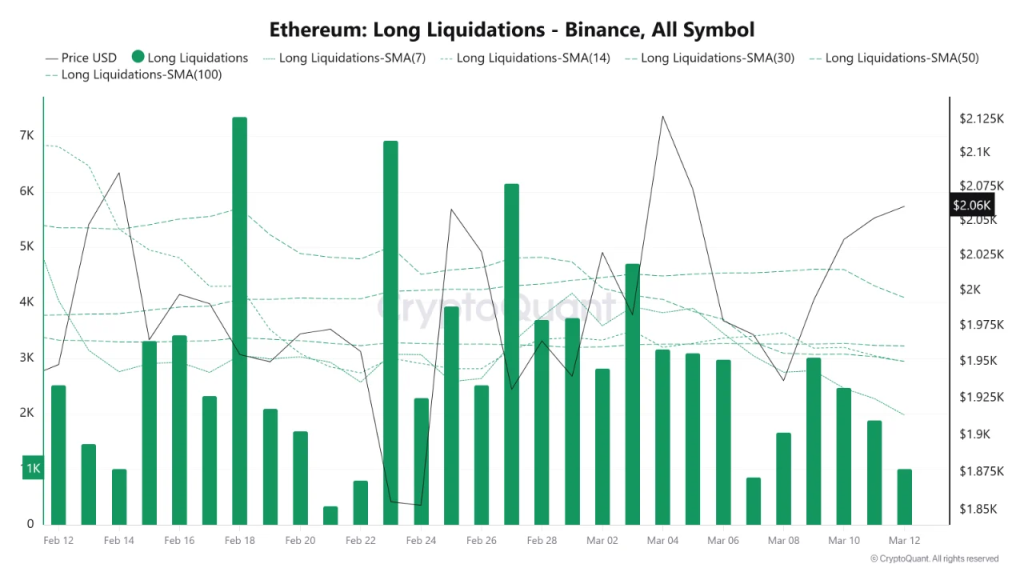
But let’s rewind a bit. Back in mid-February, leveraged traders were getting absolutely steamrolled. Long liquidations surged as overexposed positions were wiped out, sending waves of forced selling through the market.

Ethereum Price Stabilizes as Liquidations Fade But Institutional Demand Builds

Now that storm has calmed. Per analyst PelinayPA, current long liquidations are hovering near 1,000, dramatically lower than the aggressive flush seen earlier in the year. Meanwhile, short liquidations have also cooled, suggesting traders on both sides are finally dialing back the leverage.

That matters more than it sounds. When both long and short liquidations shrink simultaneously, it usually signals a transition phase. Less leverage means fewer forced moves. Fewer forced moves mean price action becomes… well, normal. The ETH/USD market appears to be entering that quieter stage.

Ethereum Price Stabilizes as Liquidations Fade But Institutional Demand Builds

Spot Demand Slowly Takes Over

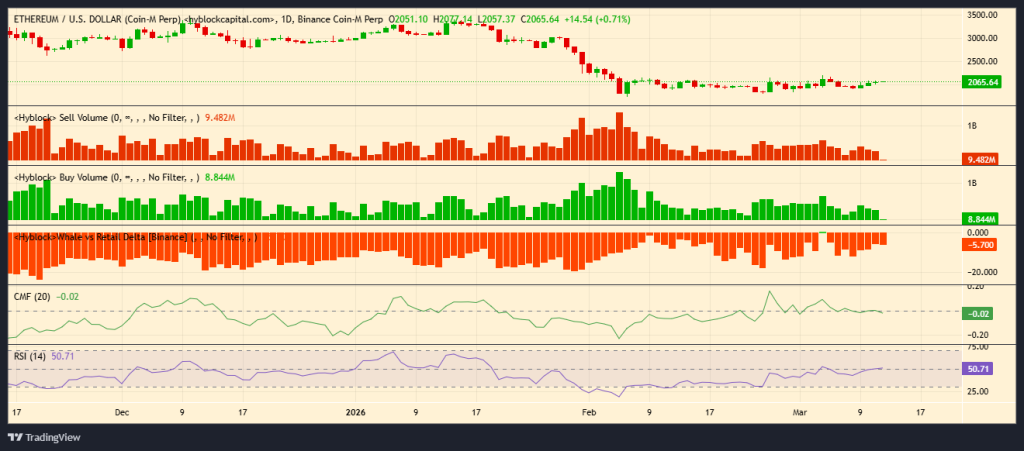
Well, here’s where things get even more interesting. As seen over the past 15 days, price action has quietly climbed even while liquidation volumes continue to fall. That’s a subtle but important signal. When prices rise without massive liquidations, it usually means one thing: spot buyers are stepping in.

Ethereum Price Stabilizes as Liquidations Fade But Institutional Demand Builds

Not leveraged gamblers. Actual investors. Of course, the momentum isn’t screaming “bull market” just yet. The Ethereum price chart still shows a market searching for direction rather than exploding higher.

Technical indicators confirm the cautious tone. The RSI is sitting near the 50 midline, which basically screams neutrality. Meanwhile, the CMF is hovering around zero, suggesting that capital flows are balanced rather than aggressively bullish. In other words, momentum exists but it’s still tentative.

Institutional Access Changes Narrative

Moreover, A significant development just hit the market: the official launch of BlackRock’s Ethereum staking ETF, ETHB. The new fund offers investors exposure not only to the asset’s market price but also to on-chain staking yields.

And the pricing? A 0.25% fee, matching the structure of its non-staking counterpart, ETHA.

NEW: BlackRock is launching their Ethereum Staking ETF today — $ETHB. It will have the same fee as $ETHA at 0.25% bps but has a fee waiver down to 0.12% for the first year or first $2.5 billion in assets. pic.twitter.com/aR3FVRChPz

— James Seyffart (@JSeyff) March 12, 2026

That’s not just another ETF headline. It potentially opens the door for institutional and retail investors to access staking returns through a familiar financial vehicle something traditional markets tend to appreciate.

So, what does all this mean? For now, the Ethereum price appears to be transitioning out of a liquidation-driven phase and into a slower environment defined by spot accumulation and institutional accessibility. Not explosive. But potentially far more sustainable.

River Price Jumps 25% as Breakout Setup Targets $25 Next

River Price Rebounds 22% After LBank Listing Relief Rally or Another Trap

The post River Price Jumps 25% as Breakout Setup Targets $25 Next appeared first on Coinpedia Fintech News

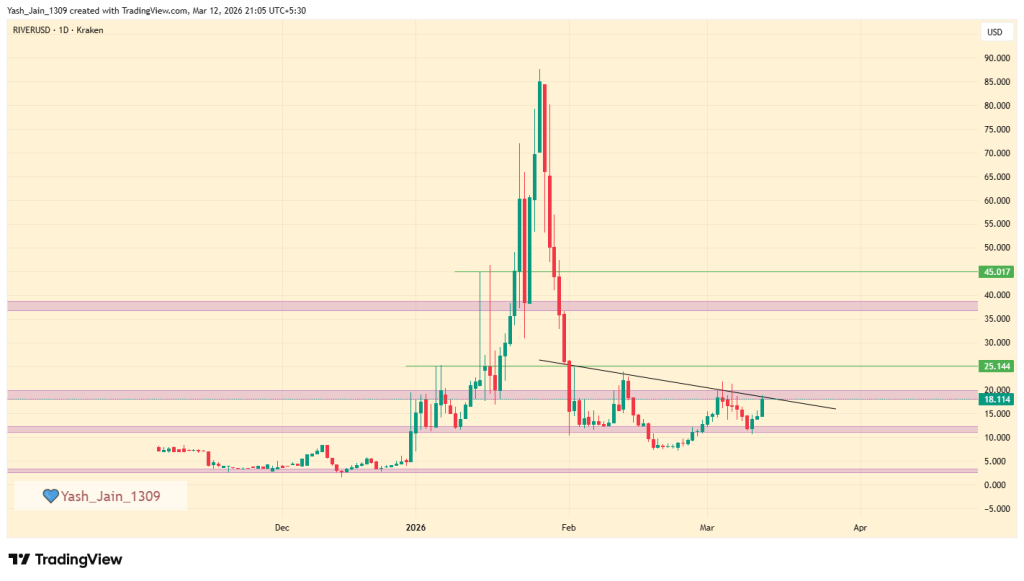
The River price just woke up violently. After posting a sharp 25.90% intraday surge, the asset has marched straight into a major technical battlefield between $18 and $20. That zone isn’t just another resistance level. It’s the neckline of a massive inverted head and shoulders pattern that has been quietly forming ever since the brutal correction back in February.

Now the market is staring at a simple question: does it break, or does it fake out?

Because if this neckline cracks with a daily close above $20, the technical roadmap suddenly opens up. The next obvious checkpoint sits near $25.14, a level marked by a previous structural barrier on the River price chart.

And if the current momentum keeps building? Well, traders are already eyeing the next liquidity pocket closer to $37.00.

River Price Tests Key Breakout Level

Here’s the thing about neckline breakouts they tend to attract attention fast, like in this crypto asset. Right now the RIVER/USD pair is hovering inside that critical $18–$20 zone, which makes the current moment more of a decision point than a celebration. Breakouts need confirmation, not just excitement.

River Price Jumps 25% as Breakout Setup Targets $25 Next

Still, the setup itself is hard to ignore. The inverted head and shoulders pattern is widely viewed as a classic trend-reversal formation, especially when it forms after a steep market correction like the one seen in February.

So the logic is pretty straightforward: reclaim the neckline, confirm the reversal. Fail to do that, and the breakout narrative gets a lot less convincing.

Indicators Flash Early Bullish Signals

Well, the rise is verified with price indicators and momentum felt real for now. As momentum indicators aren’t screaming “overbought panic” yet and they’re actually suggesting the move may still have room to run.

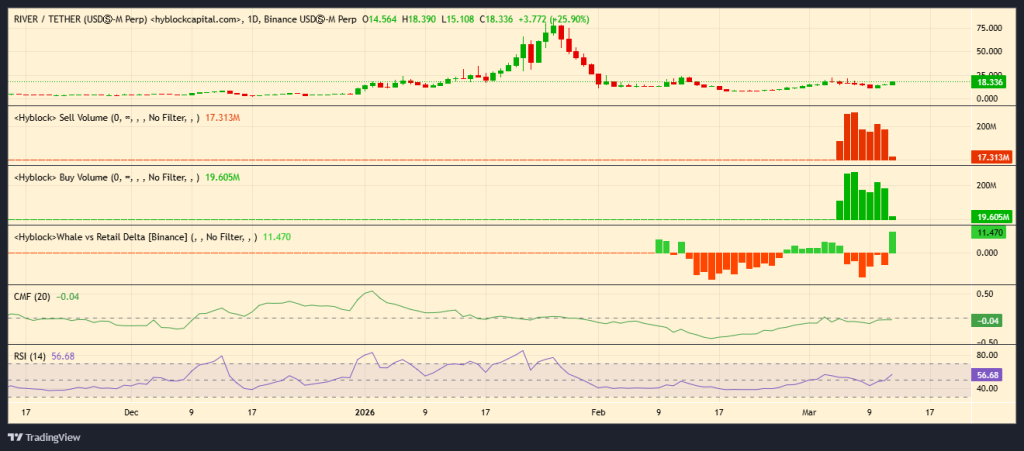
The RSI currently sits at 56.68, which places it comfortably in bullish territory but still far from exhaustion. That means traders aren’t yet dealing with the typical overheating that kills rallies prematurely.

River Price Jumps 25% as Breakout Setup Targets $25 Next

Meanwhile, the CMF is hovering around -0.04. It’s technically still negative, but the trajectory is what matters here but it’s rising sharply from previous lows, hinting that selling pressure is fading while accumulation quietly builds.

Then there’s the whale activity. The Whale vs. Retail Delta has flipped noticeably positive, with green histogram bars printing around 11.470. In simpler terms, large players appear to be buying more aggressively than retail traders.

That kind of imbalance doesn’t guarantee a breakout but historically it often shows up right before one.

Partnership Boosts Fundamental Narrative

Of course, charts alone rarely move markets forever. The recent surge also coincides with a new partnership with DIA, where River is integrating DIA’s oracle infrastructure for satUSD across five chains. The upgrade aims to strengthen reliability for lending markets and vaults, particularly during volatile periods.

Infrastructure improvements aren’t always flashy headlines, but they matter. Markets tend to reward projects that reinforce their backbone. And traders seem to be pricing that in.

On-Chain Activity Starts Recovering

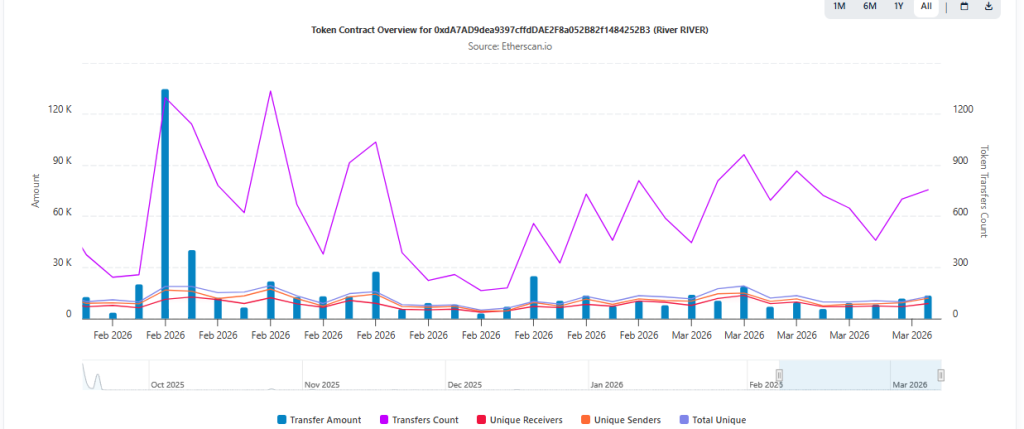
Then there’s the on-chain data quietly telling its own story. Activity on the River contract shows a V-shaped recovery in transfer counts starting in early March 2026. In short, more users are interacting with the network again after February’s slump.

Transfer volumes have also stabilized following the massive spike seen during the February sell-off. That spike likely represented redistribution, while the recent uptick hints that liquidity is flowing back into the ecosystem.

River Price Jumps 25% as Breakout Setup Targets $25 Next

Even wallet growth is turning upward. Both unique senders and receivers have been increasing since early March, signaling that the holder base is expanding something breakouts usually need to survive.

Which brings the market back to the same question. If momentum holds and the neckline breaks, the River price may have finally found its next leg higher.

3 big iPhone 18 Pro rumors already worrying Samsung

Six months out from launch, the iPhone 18 Pro rumors are getting more precise. Industry insiders are already revealing new details from Weibo that should make Samsung pause, maybe even sweat a little.

Chinese tipsters IceUniverse and DigitalChatStation share crucial information about the iPhone 18 Pro changes. The early reveal targets the phone’s design, dimensions, battery, and the most controversial Dynamic Island.

Thickness x Battery

The iPhone 18 Pro Max will measure 8.8mm, Ice Universe confirms. That’s barely thicker than the 17 Pro Max’s 8.75mm. Apple’s packing a battery reportedly north of 5000mAh into that chassis, while the Galaxy S26 Ultra clocks in at 5000mAh.

The chip and camera

Digital Chat Station calls three things locked in. The A20 Pro chip is built on a 2nm process, that bigger than a 5000mAh battery, and aperture changes to the cameras.

Samsung’s using 3nm Snapdragon and 2nm Exynos across the Galaxy S26 series. Apple’s jumping straight to 2nm and iPhone 18 Pro’s chip would hit new records in Geekbench performance and efficiency benchmarks.

Dynamic Island

Digital Chat Station claims that Apple is considering reusing some iPhone 17 Pro molds for the 18 Pro line. The Dynamic Island probably won’t shrink as much as the 35% reduction everyone was banking on.

Face ID components might not move under the display after all. Samsung has been using punch hole cutout for Galaxy selfie cameras for years. Meanwhile, Apple may still manage to promote that Dynamic Island.

People who actually bought Galaxy phones this cycle are about to watch Apple close every meaningful hardware gap by September.

The post 3 big iPhone 18 Pro rumors already worrying Samsung appeared first on Sammy Fans.

Samsung Galaxy Z Flip 7 grabs One UI 8.5 Beta, matching Fold 7

One UI 8.5 Beta Program has just gone public for the Galaxy Z Flip 7. A little earlier, Samsung released the first Beta update for the Galaxy Z Fold 7. The latest clamshell foldable phone has also joined the party with the Fold 7.

Samsung is bringing an expansive One UI 8.5 Beta Program. For Galaxy Z Fold 7, it has already landed in India and South Korea. More countries are expected to be followed, such as Germany, the UK, Poland, and the US.

One UI 8.5 is a major visual upgrade over One UI 8. The quick panel has become heavily personalizable and notifications management turn smart. The interface has adopted dynamic colors and elegant blur for better UX.

How to get it now

Galaxy Z Flip 7 users can install the One UI 8.5 Beta update with the least effort. An enrollment form is all you need to join the Beta testing. To access it, open Samsung Members, scroll to the bottom and hit the Beta banner.

Agree to the terms and conditions and proceed with Enrollment. Once done, return to the Software update section and hit Download now. It might take a few minutes for the firmware to arrive as you tap the final key for the upgrade.

The first Beta comes with a build version ending with ZZC5, the same as the Fold 7. It carries the February 2026 security patch, not the March’s. Make sure stable internet connection as the package weighs more than 4 gigabytes.

Samsung Galaxy Z Flip 7 One UI 8.5 Beta

Source – AndroidFlatform

The post Samsung Galaxy Z Flip 7 grabs One UI 8.5 Beta, matching Fold 7 appeared first on Sammy Fans.

Samsung releases One UI 8.5 Beta 1 for Galaxy Z Fold 7 – Here’s how to download and install

Samsung has quietly expanded the One UI 8.5 Beta Program to the Galaxy Z Fold 7. The company’s most expensive phone has just joined the Beta Program, and its clamshell counterpart will soon join the party with the Beta update.

So far, the One UI 8.5 Beta Program has been limited to the Galaxy S25 series. The entry of the Galaxy Z Fold 7 marks the first expansion. Notably, Samsung already launched official One UI 8.5 with the Galaxy S26 series.

Samsung is already rolling out the One UI 8.5 Beta 1 to the Galaxy Z Fold 7. Users can identify the first Beta update through the PDA build version ending with ZZC5. Note that it would only arrive after successful enrollment.

One UI 8.5 is based on Android 16 and elevates the entire user experience. It tweaks various aspects of the interface and applies a beautiful blur across the UI. You also get new features and extended Galaxy AI capabilities.

How to download and install

To get the Beta update, you will need to join the Beta Program manually. To do so, open the Samsung Members app and scroll down to access the Beta banner.

The Program is currently live in India and South Korea, so you may not see it outside. As Samsung expands the testing program, it could be available in the US and Europe.

Tapping the Beta banner triggers the expanded joining page, which takes you through the terms and conditions of the Beta Program before allowing you to hit Enroll now.

Once done, head toward the Software update page from the Settings page. As soon as the OTA arrives, hit Download now and get it installed on your foldable device.

Samsung Galaxy Z Fold 7 One UI 8.5 Beta

Source – Samsung Community Korea

The post Samsung releases One UI 8.5 Beta 1 for Galaxy Z Fold 7 – Here’s how to download and install appeared first on Sammy Fans.

One UI 8.5 Beta 7 has arrived: The most Stable update Samsung released yet

Samsung just dropped One UI 8.5 Beta 7 for the Galaxy S25 series, and on paper, it’s their least chaotic Beta in months. Starting in South Korea, the update has been expanded to Germany and India, with US following soon.

One UI 8.5 Beta 7 (PDA: ZZC7) brings eleven targeted fixes that suggest Samsung’s finally stopped breaking things in the rush to ship. Notably, there’s no latest security patch embedded in the Beta 7 release, which looks weird.

What’s new in One UI 8.5 Beta 7

Video calls were switching modes without permission. You’d start a voice call and the phone would just decide you meant video. That’s fixed.

Material You color palette wasn’t syncing to Google apps inside Work and Secure Folders. Gmail’s dark mode search field was invisible. The Gallery app was crashing when you tried starting new projects. Private album exports were failing outright.

DeX users were getting no warning when their phone overheated. Weather widget was clipping Fahrenheit temps when you added cities. Wi-Fi recovery during roaming with certain access points supporting Multiple BSSID was failing.

Samsung Messages was stuttering badly when you first opened unread inboxes. Notifications weren’t displaying under specific conditions. There’s a KT carrier fix in here for a service called WhoWho – limited to Korean models.

Samsung One UI 8.5 Beta 7 Update

Source – Samsung Community Korea

A significant portion mentions improvements for Android’s GMS, such as Material You. What’s striking is the absence of new features.

After three months of testing and six prior Betas, that’s where Samsung landed. The S26 series shipped with stable One UI 8.5, and the S25 lineup is still in Beta in March.

People who actually bought last year’s flagship are still testing software that’s already shipping on new phones. This way, Stable won’t hit the S25 series until at least late March, maybe April.

The post One UI 8.5 Beta 7 has arrived: The most Stable update Samsung released yet appeared first on Sammy Fans.

Waiting for Stable One UI 8.5 update? It could be arriving soon

Samsung’s stable One UI 8.5 update looks ready to roll out any day now, and if you picked up a Galaxy S25 last year, yours might be one of the first to get it.

Firmware version S93xBXXU8CZC9 just surfaced on Samsung’s servers with the March 2026 security patch, and that’s usually the last step before things go live.

The Galaxy S26 series has already hit market shelves yesterday in major markets. The expansion will continue over the days ahead, as Samsung plans to bring this year’s flagship phones to up to 120 countries globally.

While this firmware seems ready for prime time, there’s always a chance they spot something ugly in testing and swap it out. Samsung has rolled out six Beta builds for the Galaxy S25 series before getting here.

Rollout will probably kick off in South Korea first, then expand to Europe, the US, and India over the following days or weeks. That’s been the pattern for years, and there’s no sign they’re changing it now.

Samsung launched the Galaxy S26 series with One UI 8.5 already installed, which means the S25 is now playing catch-up to a phone released weeks ago.

One UI 8.5 sits on the same Android 16 base as One UI 8.0. However, Samsung claims there are major UI tweaks and under-the-hood improvements tucked inside.

The company has not opened Beta slots for other devices yet, which raises an obvious question. Will the Galaxy S24 or the Z Fold 7 skip betas entirely and jump straight to stable?

Samsung One UI 8.5

Image – SammyFans

The post Waiting for Stable One UI 8.5 update? It could be arriving soon appeared first on Sammy Fans.

Monero (XMR) Price Prediction 2026, 2027-2030: Will Privacy Coins Lead the Next Bull Run?

Monero Price Prediction

The post Monero (XMR) Price Prediction 2026, 2027-2030: Will Privacy Coins Lead the Next Bull Run? appeared first on Coinpedia Fintech News

Story Highlights

  • The live price of the Monero crypto is  $ 353.64894158.
  • XMR eyes $820 in 2026 if price reclaims and sustains above $500 resistance.
  • Privacy demand and macro liquidity will shape Monero’s 2027–2030 trend.
  • Key support at $300; breakout above $360 could trigger upside momentum.

Envision the capability to conduct online payments without a digital footprint; that’s payment privacy. Numerous cryptocurrency assets possess a distinct selling proposition (USP), some safeguard transaction details concerning the parties or institutions involved, but some do not. 

But, this transparency enables larger investors and institutional capital to be easily traced. While unshielded transactions are valued by researchers for the accessible information they provide regarding investments, individuals whose data is subject to scrutiny often experience frustration, as they perceive a loss of privacy over their own financial assets.

This is where Monero (XMR) comes in. Since its inception in 2014, Monero has offered robust privacy features. It has become the top choice for users seeking to maintain a high standard of anonymity in blockchain transactions. The impact of Monero’s privacy capabilities was particularly evident in the fourth quarter of 2025.

Despite the government’s tightening of the rules around digital assets, Monero has ranked 21st globally. Driven by rising interest, XMR stands out as a privacy-focused coin. So, what’s coming next for Monero in 2026 and the years to come? In this Monero price prediction 2026-2030 article, we look at the potential price targets.

Monero Price Today

Cryptocurrency Monero
Token XMR
Price $353.6489 down -1.25%
Market Cap$ 6,523,671,517.19
24h Volume$ 87,359,052.4025
Circulating Supply18,446,744.0737
Total Supply18,446,744.0737
All-Time High$ 798.9149 on 14 January 2026
All-Time Low$ 0.2130 on 14 January 2015

CoinPedia’s Monero Price Prediction

Monero (XMR) surged in Q4 2025, reaching $800 in 2026 before dropping to around $285, indicating bearish dominance. If demand increases, it could revisit $422, but failure to break this level may lead to a decline toward $200 or even $130 by year-end. Currently, XMR is retreating from the upper boundary of its ascending channel and has reached mid-way already, suggesting a correction may be imminent if more ground is lost.

Monero (XMR) Price March 2026 Outlook

The one-day price chart for Monero shows a downward trend in the market, indicating a significant price change. The price of XMR declined rapidly after it failed to hold above $422 in January. In February, it dropped below $370. However, there was a short-term recovery during the same month, although it continues to struggle near the 200-day EMA and around the $370 mark.

The XMR/USD pair has found short-term support, but if it breaks this level, another rapid decline could occur, potentially dropping below $300. Conversely, if the support holds, a retest of $422 could be possible by the end of March.

Monero (XMR) price prediction March 2026

Recent News and Opinions

Per the late February 2026 post from ProbeLab, they show that findings confirm the Monero network’s resilience against surveillance. Analysis reveals that 46% of community nodes have proactively adopted a “ban list,” effectively neutralizing nearly all identified spy nodes. This grassroots defense highlights a robust, decentralized commitment to privacy, strengthening the network’s topology against potential deanonymization attempts.

Monero (XMR) Price Prediction 2026

The price action of Monero (XMR) showed remarkable bullish momentum, particularly in Q4 2025, driven by a broader trend in privacy coins, which resulted in a significant price surge during that period.

In 2026, Monero followed the same privacy narrative, continuing the rally and pushing the price to new all-time highs (ATH) of $800. However, this increase was short-lived, as the price dropped to around $285 in February, losing more than 60% from its peak. Additionally, the mid-trendline of an ascending channel was breached, confirming a bearish dominance in the market at that time.

Monero (XMR) price prediction 2026

But, the remaining days of Q1 2026 showed some improvements that pushed it back above mid-trendline support, and now we see consolidation going on.

Now, if demand for XMR price increases, it could potentially revisit the $422 mark. It’s important to note that a recovery to this level might not inspire much excitement, as it could form a significant trap for investors. To regain a bullish setup, a weekly close above $422 would be crucial for attracting investor interest. 

Conversely, if the price fails to break through $422 or even collapses below mid-trendline support again, then the first half of 2026 could see a drop towards $200 area, which could accelerate to $130 by year’s end to touch the lower border of the ascending channels as a support, like in the past.

Furthermore, it’s essential to recognize that the price has reached the upper boundary of its ascending parallel channel. As with previous patterns, a correction appears to be imminent. When it pierced the upper boundary, it had two choices: break away from the earlier pattern and establish new price action, but it briefly exceeded the channel before falling back within it, echoing historical trends. Ultimately, it returned to the pattern, continuing its legacy from the past.

Monero (XMR) price prediction 2026

Monero Crypto Price Prediction 2026 – 2030

YearPotential Low ($)Potential Average ($)Potential High ($)
2027$910.00$1000.00$1200.00
2028$863.46$1,726.90$2,590.35
2029$1,295.19$2,590.35$3,885.53
2030$1,942.76$3,885.53$5,828.30

Monero Price Forecast 2027

Looking forward to 2027, XMR’s price is expected to reach a low of $910, with a high of $1,200 and an average forecast price of $1,000.

XMR Price Prediction 2028

In 2028, the price of a single Monero is anticipated to reach a minimum of $863.46, with a maximum of $2,590.35 and an average price of $1,726.90.

Monero Price Prediction 2029

By 2029, XMR’s price is predicted to reach a minimum of $1,295.19, with the potential to hit a maximum of $3,885.53 and an average of $2,590.35.

Monero (XMR) Price Prediction 2030

In 2030, Monero is predicted to touch its lowest price at $1,942.76, hitting a high of $5,828.30 and an average price of $3,885.53.

Monero Price Prediction 2031, 2032, 2033, 2040, 2050

The long-term projection assumes Monero sustains relevance in enterprise blockchain use cases, with growth moderating over time as the asset matures.

YearPotential Low ($)Potential Average ($)Potential High ($)
2031380052006800
2032550075009500
203377001000011500
2040150002200042000
2050300004000060000

Monero (XMR) Price Prediction: Market Analysis?

Year202620272030
Changelly$720$900$1900
CoinCodex$680$880$1800
WalletInvestor$740$870$2000
Never Miss a Beat in the Crypto World!

Stay ahead with breaking news, expert analysis, and real-time updates on the latest trends in Bitcoin, altcoins, DeFi, NFTs, and more.

FAQs

What is Monero (XMR) price prediction for 2026?

Monero could revisit the $422 level if buying demand strengthens. However, if bearish pressure continues, the price may fall toward $200 or even $130 during 2026.

How much will Monero be worth in 2030?

Projections indicate Monero could trade between about $1,942 and $5,828 by 2030, with an estimated average price around $3,885 if adoption continues growing.

How high can Monero price go by 2040?

Long-term projections vary widely, but some estimates place Monero between $2,000 and $5,000 by 2040, depending on adoption and regulation.

What factors influence the price of Monero?

Monero’s price is driven by privacy demand, regulatory developments, network adoption, market sentiment, and overall crypto market trends.

Will Monero be the next Bitcoin?

Monero serves a different role than Bitcoin. Bitcoin focuses on transparency, while Monero prioritizes privacy, making it a niche but valuable crypto asset.

Samsung fixes S Pen Air Command bug the Good Lock way

Samsung is patching a long-standing S Pen Air Command bug through Good Lock. The company is rolling out an updated version of Pentastic plugin. It patches an issue linked to the stylus on Galaxy devices running One UI 8.

Good Lock plugin Pentastic is getting a March 2026 update, bumping the version to 2.3.19, which carries improvements for the S Pen Air Command feature.

The changelog mentions “fixes for Air Command” section inside Pentastic. Samsung also acknowledged that the bug has broken Air Command types on One UI 8 devices.

Pentastic is a plugin that extends the usability of Samsung’s stylus menu. It elevates the user interface and lets users unlock experimental features that aren’t enabled by default.

Even though the Galaxy S25 Ultra dropped Bluetooth-powered S Pen, Air Command is still available. Previous Ultra models and foldable phones, such as the Galaxy Z Fold 6, would also benefit from this Pentastic release.

Like others, this new release also improves the overall functionality. It would clear the app cache and wipe unnecessarily stored data. With storage freeing up, the plugin will work even better and seamlessly on Samsung phones.

Get the latest Pentastic from Good Lock or Galaxy Store. The rollout has just begun, and the availability may vary by country. However, Galaxy Store updates often come all in one go, unlike regular software updates.

Samsung also updated the Good Lock app itself. Read more: Fresh Good Lock update fixes plugin UI issue for Samsung devices

Samsung Pentastic March 2026 Update

The post Samsung fixes S Pen Air Command bug the Good Lock way appeared first on Sammy Fans.

Samsung isn’t done with QNED, next-gen display tech returns to labs

Samsung has restarted development of its QNED display technology. It is a hybrid quantum dot nanorod LED project, which the company shelved back in 2022 after failing to solve a rather fundamental problem.

According to ETNews, late last year, Samsung Display formed a QNED research team buried inside its M Commercialization Team for small and medium displays.

These are the same people who worked on the tech the first time around before it all fell apart, and word is they’ve regrouped because somebody cracked something in the nanorod placement problem.

QNED theoretically outlasts QD-OLED because it ditches the organic blue emitter layer that degrades over time in favour of inorganic gallium nitride nanorods.

Samsung’s QNED may also be brighter, which matters in a market where brightness numbers have turned into a marketing arms race.

Pay attention, Samsung originally kicked off development in 2019, showed a TV prototype, then quietly walked away two or three years ago when uniform light emission stayed out of reach.

Samsung originally planned to commercialize QNED between 2024 and 2025. Restarting R&D now means any actual panels are years away, minimum, and the window for premium display dominance isn’t sitting still.

The company won’t confirm what breakthrough, if any, actually surfaced. One display expert said the engineers “found a technical clue” to the alignment mess, which is about as specific as saying they figured something out.

Samsung doesn’t get to just pick the winner by announcing research. QNED has to actually work this time.

The post Samsung isn’t done with QNED, next-gen display tech returns to labs appeared first on Sammy Fans.

Motorola rocks US foldable market despite Samsung, but can it survive Apple’s arrival?

Two IDC analysts revealed stats last week at MWC: foldable market share sits at 50% for Motorola in the US. This is despite the presence of Samsung, but it remains to be seen how it holds after the arrival of the Apple iPhone Fold.

The 50% market of Motorola is purely built on the back of those Razr flip phones that people actually want to buy in the US. The company officially announced its first Razr Fold (book-style foldable), coming stateside.

Samsung has got the bigger lineup, the deeper R&D pockets, and the brand recognition in foldables. Still, it’s getting torched by a company that basically said, “let’s make flip phones fun again” and picked some decent colors.

Here’s what’s working

Motorola priced the Razr lineup where normal people can actually afford it. They picked colors that don’t look like they came from a corporate boardroom. Fun sells when the tech actually works, and the recent Razr models work well enough.

Meanwhile, the real nightmare hasn’t even started yet. Apple’s foldable iPhone is no longer an “if” as mass production is planned for the second half of 2026.

The device will use a book-style folding mechanism similar to Samsung’s Galaxy Z Fold, and it reportedly has no visible crease, a problem Apple has pursued eliminating “regardless of cost.”

It’s rumored to cost around $2,200 to $2,400, which is insane money but won’t matter to the people who line up for launch day iPhones every September.

IDC US foldable phone market 2025

The post Motorola rocks US foldable market despite Samsung, but can it survive Apple’s arrival? appeared first on Sammy Fans.

Samsung and Apple finish 2025 in a rare draw at the top

In a surprise development, Samsung clawed back to a dead tie with Apple on production volume in 2025. Both brands produced nearly 240 million smartphones in 2025, according to TrendForce.

Apple pushed out 87 million phones in Q4, a jump of 54 percent over Q3. Samsung managed 58.2 million. Apple’s shipments rose due to the newly announced iPhone 17 series, which is still selling impressively.

Samsung’s vertical supply chain integration and sheer volume across the rest of the year let it keep pace. The company grew 11 percent year over year for the full 12 months.

While others are sweating over memory price spikes, Samsung makes its own chips, its own displays, its own everything. That’s not just an advantage in 2026, it’s a lifeline.

2025 was fine; the global smartphone production hit around 1.254 billion units, up 2.5% annually. TrendForce projects global output will crater at least 10% to roughly 1.135 billion units in 2026.

Memory prices aren’t just rising, they are surging, and every brand now faces an ugly choice: hike retail prices and watch sales collapse.

Xiaomi, which finished third with 169.8 million units produced in 2025, already started cutting back in Q4. Xiaomi’s whole identity is built on affordable hardware that punches above its weight.

If Apple decides to get aggressive with iPhone pricing in 2026, this whole market could tilt sideways. A more competitive pricing strategy could help Apple sustain both production and sales momentum.

Samsung can probably stomach a price war better than most. Vertical integration means they control more of the cost structure than any rival.

TrendForce 4Q25 and 2026 Smartphone Market

The post Samsung and Apple finish 2025 in a rare draw at the top appeared first on Sammy Fans.

Galaxy S26 Ultra teardown shows Samsung went all-in on cooling and camera hardware

When Zack Nelson dropped his JerryRigEverything teardown of the Galaxy S26 Ultra, it did what Samsung’s marketing team quietly refused to do at Unpacked last month. It showed you what actually changed, actually, inside.

Samsung Galaxy S26 Ultra teardown

ALoP Camera

The Galaxy S26 Ultra teardown reveals the use of ALoP (All Lenses on Prism) camera technology. That’s short for All Lenses on Prism, which stacks the glass horizontally instead of the traditional vertical setup.

The camera lenses now have a larger diameter for better brightness, and the whole telephoto module shrank by 22% while letting in 37% more light. The aperture went from f/3.4 to f/2.9 on that 5x periscope shooter.

Samsung Galaxy S26 Ultra ALoP Camera

Improved thermal

The vapor chamber grew roughly 15%, which translates to better heat dissipation during tasks like gaming or long video recording. What’s confirmed is the layered cooling approach. There are four layers now:

  1. Vapor chamber
  2. Graphite pad
  3. Thermal pads
  4. Newly added thermal paste

Samsung Galaxy S26 Ultra Vapor Chamber

Samsung even slapped thermal paste on both the storage and DRAM chips, which sit right on top of the Snapdragon 8 Elite Gen 5. It’s a dynamic approach that cements the Galaxy S26 Ultra’s thermal beyond legacy tricks.

Battery and charging

Dual connectors on the battery improve safety and efficiency by splitting the current load during fast charging. Less heat, less stress on a single connection point that should’ve been there three generations ago.

S Pen situation

The S26 Ultra comes with an integrated stylus, like every Ultra before it but the old S Pen doesn’t fit anymore. The slot’s been redesigned with slightly thicker dimensions, and the S25 Ultra’s stylus won’t work properly if you try forcing compatibility.

Samsung Galaxy S26 Ultra SG26U S Pen

Repairability

Pull tabs make battery removal straightforward, and the redesigned camera bump allows quicker repairs. Samsung finally built something you can actually fix without destroying it in the process.

The post Galaxy S26 Ultra teardown shows Samsung went all-in on cooling and camera hardware appeared first on Sammy Fans.

Galaxy S26 Ultra US deal takes a weird turn with free double storage

Galaxy S26 series was launched on February 25, preorders closed last night and worldwide sale opened today. Then came a weird twist: Samsung suddenly revived free double storage deal on the Galaxy S26 Ultra in the US.

Samsung offered free double storage toward the Galaxy S26, S26 Plus and S26 Ultra as a preorder deal in the US. However, some shoppers are still seeing the 2x storage freebie, while trade-in values slashed sharply.

Adding the Employee Purchase Program (EPP) benefit, the overall cost reduces by $75 more via LarrySWhite. The latest effective price to get the Galaxy S26 Ultra (after preorders ended) is as follows:

  • 512GB – $1234.99
  • 1TB – 1424.99

Both prices include an additional $75 discount through EPP. Even if you don’t qualify for EPP, the Galaxy S26 Ultra can be yours with double storage. You are paying for 256GB, but getting the upper tier with 512GB internal storage.

Pay attention, not every US resident is seeing the offer on the official website. Some can access it on Samsung.com website and the Shop app. Some are not seeing anywhere, including the online shop website or the Shop application.

If you’re willing to get the latest flagship and missed the Reserve and preorders period, it’s the biggest opportunity. While storage freebie revived for some, the trade-in values are no longer impressive like before.

Samsung Galaxy S26 Ultra double storage offer

Credit – Larry S White (X/Twitter)

The post Galaxy S26 Ultra US deal takes a weird turn with free double storage appeared first on Sammy Fans.

Galaxy S27 may end Samsung’s expensive Snapdragon addiction

Samsung had to spend a tremendous amount of money to purchase chips from Qualcomm. Over the years, Samsung’s spending on Snapdragon processors has increased significantly, and the Galaxy S27 may flip the script after all.

According to Chosun, Samsung is planning to push Exynos even harder in the Galaxy S27 series next year. The Ultra version could stay stuck to Snapdragon, while the base and Plus would increase the Exynos utilization.

If that happens, Samsung’s processor bill drops a lot. Samsung’s semiconductor division starts pulling its weight in mobile again, instead of just being the company that makes everyone else’s memory chips.

Meanwhile, Exynos has a reputation problem that won’t disappear overnight. Samsung has to deliver this time, with the Galaxy S26 itself. Not just a chip that’s “good enough” or “close to Snapdragon in most scenarios.”

The S26’s Exynos 2600 seems to have cleared that bar, at least based on early reception. But one generation doesn’t rebuild trust. The S27 will be the real test, the moment Samsung either proves it can compete or Snapdragon is necessary.

If the S27 lands with Exynos across the board and people barely notice, that’s when the balance of power starts to shift.

Samsung dropped nearly 14 trillion won last year buying chips from Qualcomm. The 2025 business report reveals that approximately 13.8 trillion won went to application processors alone, up 26.5% from the year before.

The post Galaxy S27 may end Samsung’s expensive Snapdragon addiction appeared first on Sammy Fans.

Galaxy Book 6 Pro and Ultra go on sale in the US, cheapest model still missing

Samsung Galaxy Book 6 Pro and Ultra US launch went live today. The company quietly delayed the entry-tier Galaxy Book 6, leaving only the Pro and Ultra available to purchase right now.

The South Korean tech giant flipped the switch on sales for its new laptop lineup this morning, but is anyone hunting for that $1,049 base model? You’re out of luck.

Here’s what you can buy

The 14-inch Galaxy Book 6 Pro with an Intel Core Ultra 7 356H, 16GB of RAM, and 512GB storage runs $1,549. Bump that same chip to a 16-inch screen with double the storage, and you’re looking at $1,849.

Want 32GB of RAM? Add another hundred bucks per screen size, landing you at $1,949 or $2,049, depending on whether you go smaller or bigger.

Samsung’s throwing in $50 discounts on all of these, which feels less like generosity and more like table stakes in March 2026.

The Galaxy Book 6 Ultra starts at $2,399, and that version pairs 32GB RAM and 1TB storage with the Intel Core Ultra X7 358H and an Intel Arc B390 GPU. If you want discrete graphics, you’ll need the $2,949 model.

It swaps in the GeForce RTX 5060 but downgrades the processor to the Core Ultra 7 356H. So you’re paying $550 extra for a GPU bump while getting a technically slower chip.

Samsung confirmed weeks ago that the base Galaxy Book 6 would start at $1,049. The Galaxy Book 6 Pro and Ultra are available now at Samsung.com and through retail partners.

Related article:

The post Galaxy Book 6 Pro and Ultra go on sale in the US, cheapest model still missing appeared first on Sammy Fans.

Bitcoin Price Warning: Is Bottom Still Ahead Before Next Rally?

Bitcoin Holds at $67K Amid Market Uncertainty

The post Bitcoin Price Warning: Is Bottom Still Ahead Before Next Rally? appeared first on Coinpedia Fintech News

The Bitcoin price is hovering near $69,926, but not everyone is convinced the worst is over. In fact, some voices like Arthur Hayes in the market are openly saying they wouldn’t buy right now even if they had fresh capital ready to deploy.

In a recent appearance on the Coin Stories podcast, he made it clear that if he had $1 to invest today, it wouldn’t be going into BTC just yet. He’d wait. Specifically, he’d wait for central banks to start printing money again.

Because according to this view, it’s not war that’s bullish for crypto. It’s the monetary response that follows.

Bitcoin Price Hinges On Money Printing

Well, the argument is simple: geopolitical conflicts can initially trigger risk-off reactions across markets. That means equities fall, liquidity dries up, and yes, the crypto often gets dragged down with everything else.

LATEST: 📊 Arthur Hayes says he would not invest in Bitcoin right now and would wait for the Fed to start money-printing, warning BTC could fall below $60,000 if geopolitical tensions persist. pic.twitter.com/OnHu6EpxP7

— CoinMarketCap (@CoinMarketCap) March 11, 2026

The ongoing tensions between the United States and Iran could create exactly that environment. If the conflict drags on, the theory goes, markets might see a broader sell-off before policymakers step in with stimulus. And that’s the moment many large traders are waiting for.

Once central banks begin easing monetary policy and liquidity floods back into the system, assets that thrive on abundant money supply historically start to move. For anyone tracking a Bitcoin price prediction narrative, that policy shift is seen as the real catalyst not the conflict itself.

War Could Trigger Market Liquidations

But let’s be real for a second. Before the liquidity wave comes the storm.

The warning is that prolonged geopolitical stress could trigger a sharp sell-off across equities and crypto markets alike. In that scenario, the Bitcoin/USD pair might not just dip, it could experience cascading liquidations.

One potential target mentioned? A drop below $60,000. That kind of move wouldn’t be unprecedented. The asset briefly touched the $60K level back on early february, before stabilizing and drifting into a mild recovery phase.

Still, traders watching the Bitcoin price chart know how quickly momentum can flip once leveraged positions start unwinding.

On-Chain Metrics Suggest Bottom Missing

And then there’s the on-chain data often the reality check when narratives get loud.

Two metrics are currently raising eyebrows, as well. First is Net Unrealized Profit/Loss (NUPL). Historically, major cycle bottoms have appeared when NUPL drops below zero. So far, that hasn’t happened yet.

Bitcoin Price Warning: Is Bottom Still Ahead Before Next Rally?

Second is Supply in Profit. Right now, roughly 58.6% of supply remains in profit, comfortably above the 50% threshold that historically coincided with major market bottoms. For context, the last major cycle bottom in November 2022 occurred when the metric dropped to around 45% while prices hovered near $16,000.

Bitcoin Price Warning: Is Bottom Still Ahead Before Next Rally?

So what does all that suggest? Simply put, the Bitcoin price may not have reached its ultimate floor yet, even if the long-term outlook remains bullish.

Interestingly, despite the caution, the same long-term outlook still includes a bold projection: a potential $250,000 valuation by 2026. But before that kind of rally can happen, the market might have to endure one more shakeout.

Can Rising Futures Volume Push BNB Price Higher For $1000 Target?

YZi Labs

The post Can Rising Futures Volume Push BNB Price Higher For $1000 Target? appeared first on Coinpedia Fintech News

The BNB price might be getting its groove back after a major decline from ATH and this time the action isn’t coming from just the usual spot traders. Nope. The real fireworks are happening inside the derivatives segment, where leverage-hungry traders seem to be piling in again.

Data shows derivatives activity around BNB is picking up steam, with Open Interest climbing to $550.86 million. That number alone doesn’t guarantee anything, of course. But paired with funding rates leaning toward improving long positions side, it definitely hits the odds higher that traders are increasingly betting that the next move might be upward rather than sideways for much longer.

And honestly? The market structure is starting to reflect that optimism slowly due to a recent case against Binance got dismissed, making sense to the shortterm momentum.

Derivatives Traders Step In

Let’s start with the obvious signal: derivatives demand. Open Interest sitting at $550.86 million means a sizable amount of capital is locked into active BNB futures contracts. More importantly, funding rates are currently aligned with long-side positioning, indicating traders are willing to pay a premium to maintain bullish exposure, per Santiment charts.

Can Rising Futures Volume Push BNB Price Higher For $1000 Target?

Now, here’s the interesting twist. The Futures Volume Bubble Map suggests the market isn’t overheated, at least not yet. Instead, it’s sitting in a neutral zone after coming from ATH. That’s the kind of environment momentum traders actually like because it leaves room for growth without the immediate risk of a crowded trade collapsing.

If optimistic demand keeps building, those volume bubbles could shift toward light orange, which could increase the odds of rising derivatives momentum. And when that happens, things can move fast.

Naturally, anyone staring at a BNB price chart will want to watch that transition carefully.

Can Rising Futures Volume Push BNB Price Higher For $1000 Target?

Binance Futures Market Surges

But the bigger story isn’t just BNB price itself. It’s what’s happening across the exchange, as well.

On Binance, the futures-to-spot volume ratio has surged to 5.1, a level not seen in about 1.5 years, the highest reading since mid-2023. Put simply, the futures market is now processing more than five times the trading volume of spot markets, which means that people are trading all sorts of pair and giving the fundamentals a boost to Binance as well.

That’s not a small shift. That’s structural. When the majority of trading moves toward derivatives, price action tends to become faster, sharper, and far more volatile.

Can Rising Futures Volume Push BNB Price Higher For $1000 Target?

Futures Growth Drives Market Shift

The data from analyst maartunn makes the trend even clearer. He said, in 2025, total trading volume on Binance reached $32.39 trillion. Derivatives activity alone accounted for $25.4 trillion, up from $21.21 trillion in 2024 showing a 19.7% increase year-over-year.

Spot trading, meanwhile, didn’t budge. It stayed flat at $6.99 trillion across both years.

Can Rising Futures Volume Push BNB Price Higher For $1000 Target?

Well, traders appear to be shifting toward leverage and hedging strategies rather than simple spot accumulation. Futures offer flexibility and risk, obviously, but they also attract liquidity.

That liquidity matters. Because when derivatives volume expands while spot markets stagnate, the result is often explosive price swings once demand returns.

Can Rising Futures Volume Push BNB Price Higher For $1000 Target?

And that brings us back to the BNB price. If derivatives liquidity continues building and bullish positioning strengthens, the BNB/USD pair could find itself with plenty of trading fuel. The BNB price prediction crowd will undoubtedly keep a close eye on the next derivatives surge.

Samsung Galaxy S26 series sale starts in the US – Latest price, offers and trade-in info

It’s March 11, and Samsung opened the general sale of the Galaxy S26 series in the US. Preorder perks are gone, and there’s no way to access them now. Trade-in values have been revised as well, and don’t make sense now.

The increased prices are now visible on the sale page, and it’s not a good time for purchase. If you were eager, it’s too late now. You should wait till June, when Samsung could slash prices by offering seasonal discounts stateside.

Galaxy S26

Galaxy S26 starts at $900 in the US, whereas the 512GB version bumps the price by $200. This is a steep increase, driven by the surging costs of DRAM and NAND chips. Samsung is letting you save up to $380 by trading your current phone.

Galaxy S26 Plus

The middle child of this lineup costs $1100 for 256GB and 1300 for 512GB. Trade-in savings are limited to $480, with the most recent flagship scoring the most. You get a $150 Samsung Credit even when you don’t sell your device to Samsung.

Galaxy S26 Ultra

Samsung Galaxy S26 Ultra now costs $1300 for the 256GB version in the US. Samsung has removed the double storage upgrade offer. The price of the 512GB version has spiked to $1500, and the 1TB model hits a massive $1800.

Trade-in discounts are now capped at $720, with the Galaxy S25 Ultra and Z Fold 7 paying back the most. If you don’t trade your existing device, Samsung still has a decent offer: a $150 instant savings upon Ultra purchase.

Samsung Galaxy S26, S26+, S26 Ultra SG26U

The post Samsung Galaxy S26 series sale starts in the US – Latest price, offers and trade-in info appeared first on Sammy Fans.

Samsung Galaxy S26 retires ODIN, the iconic firmware flashing tool

Samsung Odin is a famous tool that lets Galaxy users flash firmware through a personal computer. Years after serving Samsung fans, Odin might become irrelevant with each smartphone lineup coming after the Galaxy S26 series.

Galaxy S26 series doesn’t feature a download mode, which is the primary requirement for the Samsung Odin tool to function. The feature’s departure was rumored earlier and it’s now confirmed after the devices went official.

Samsung may have found the Download mode a barrier in solidifying Galaxy’s security. Alternatives may have also been discussed, but the firmware flashing tool has ended up saying goodbye, starting with the Galaxy S26 series.

Galaxy users will feel the impact at the worst time. If something goes wrong with a new firmware update, there will be no option but to wait until an official fix arrives.

Previously, power users managed to roll back to the previous build. It required downloading firmware from third-party providers. The Odin tool allowed them to manually flash the firmware using a personal computer.

Samsung also dumped the Wipe cache from the recovery menu. The process has been integrated into the system software installation process. It was pretty famous among power users, and it was used after each firmware install.

Galaxy S26 marks the beginning, with future devices following suit. It remains to be seen whether only flagship models remove Download mode or if this shift expands to other lineups, such as Galaxy Z, A, M and Tab series models.

The post Samsung Galaxy S26 retires ODIN, the iconic firmware flashing tool appeared first on Sammy Fans.

Binance Coin (BNB) Price Prediction 2026, 2027 – 2030: Will BNB Price Hit $2000?

Binance Coin (BNB) Price Prediction

The post Binance Coin (BNB) Price Prediction 2026, 2027 – 2030: Will BNB Price Hit $2000? appeared first on Coinpedia Fintech News

Story Highlights

  • Binance Coin Price Today is  $ 649.20546365.
  • Expanding exchange-ecosystem demand could lift BNB price toward $2000 by the end of this year.
  • Long-term network usage growth may extend BNB price toward $10,000.

Binance Coin (BNB) suggests a fundamental shift in how the asset responds to broader market dynamics. In 2026, the token’s performance increasingly reflects on-chain utility and ecosystem liquidity rather than mere speculative volatility. This transition from reactive price swings to a more structured price action indicates a maturing market environment.

As the ecosystem stabilizes, the technical narrative centers on long-term accumulation and the absorption of supply within established demand zones. Sustained network activity across the Binance Smart Chain provides a foundational backdrop for this consolidation, potentially setting the stage for a period of extended price discovery. By focusing on fundamental network health and institutional integration, the outlook for the next several years leans toward organic growth and structural resilience within the global digital asset landscape.

So, what’s next for the BNB price in the rest of 2026 and beyond? What can be the future price movements? Let’s get into the Binance Coin (BNB) Price Prediction 2026–2030.

BNB Price Today

Cryptocurrency BNB
Token BNB
Price $649.2055 down -0.08%
Market Cap$ 88,524,516,044.90
24h Volume$ 1,586,343,621.1385
Circulating Supply136,358,242.50
Total Supply136,358,242.50
All-Time High$ 1,370.5460 on 13 October 2025
All-Time Low$ 0.0961 on 01 August 2017

Binance Coin (BNB) Price February- March 2026 Outlook

In Q3 2025, we saw a 125% rally from the $600 support level to $1,375. However, by Q4 2025 and Q1 2026, the price returned to the $600 demand area, completely wiping out those gains. Since February, there has been visible accumulation on the daily chart around this $600 demand area, indicating that it could serve as a strong support level where bullish momentum might resume.

Binance Coin (BNB) Price Prediction March 2026

Despite the broader market pessimism, the consolidation continued throughout March, demonstrating resilience as the price remained above the $600 mark without further declines. In March of Q1 2026, long-term accumulation may persist, and short-term reactions could turn bullish, as early March indicators already suggest. If bullish pressure increases, we could see BNB price retest the $750 level by the end of March, but if short-term reactions stay muted, then further consolidation could continue throughout March.

Recent News/ Opinions

A recent ruling news on March 7th came from the US federal court that it has positively dismissed all anti-terrorism claims against Binance, alleviating a significant legal burden. In the Southern District of New York, a judge concluded that the plaintiffs, comprising 535 individuals citing 64 attacks from 2017 to 2024, did not establish sufficient evidence to demonstrate that Binance had assisted or conspired with terrorist organizations. This decision marks a commendable step forward for Binance, affirming its commitment to compliance and integrity.

Binance Coin (BNB) Price Prediction 2026

Based on the technical structure of the BNB/USD weekly chart, the price action reflects a long-term ascending channel (or wedge) that has defined the asset’s trajectory since the massive demand surge from the $40 level in early 2021. This multi-year uptrend culminated in a new all-time high of approximately $1,375 in late 2025, validating the token’s utility and its position within the Binance ecosystem. Currently, the market is witnessing a convergence of horizontal price levels with channel’s dynamic trendline support, which reinforces the technical significance of the current price zone.

As of Q1 2026, BNB price is testing a critical turning support zone around the $600 horizontal support, which aligns precisely with the lower boundary of the primary ascending channel. This area is currently serving as a consolidation floor, suggesting a period of institutional accumulation. Historical precedent highlights the importance of this trendline; a similar touchpoint in late 2023 at the $200 range served as the launchpad for a massive rally, though it took roughly 238 days to reach the channel’s median line.

Binance Coin (BNB) Price Prediction 2026

Looking ahead through 2026, the primary bullish thesis anticipates a recovery toward the $1,000 psychological level. If the recovery pace mirrors previous cycles, BNB/USD could reach the channel’s middle band by Q3 2026. However, if consolidation extends further into the year, the recovery might be more gradual, stretching toward the year-end. 

Conversely, a decisive break below the $600 footing would invalidate the current setup, significantly increasing the probability of a deeper correction toward the major $200 demand zone.

BNB Onchain Analysis

Recent on-chain data highlights the network’s resilience, with daily transactions stabilizing at 15 million in Q1 2026 despite market fluctuations. This sustained utility, paired with total unique addresses nearing the 800 million mark, signals a consistent rise in global adoption. These fundamental metrics suggest a robust foundation for long-term ecosystem growth and structural asset valuation.

BNB Onchain analysis

Binance Coin Crypto Price Prediction 2026 – 2030

YearPotential Low ($)Potential Average ($Potential High ($)
2027120014201800
2028160019502300
2029210032503900
2030250038004500

Binance Coin Price Prediction 2027

As per the Binance Coin Price Prediction 2027, Binance Coin may see a potential low price of $1200. The potential high for Binance Coin price in 2027 is estimated to reach $1800.

BNB Price Prediction 2028

In 2028, Binance Coin price is forecasted to potentially reach a low price of $1600 and a high price of $2300.

Binance Coin Price Prediction 2029

Thereafter, the Binance Coin  (Binance Coin) price for the year 2029 could range between $2100 and $3900.

Binance (BNB) Coin Price Prediction 2030

Finally, in 2030, the price of Binance Coin is predicted to remain steadily positive. It may trade between $2500 and $4500.

Binance Coin Price Prediction 2031, 2032, 2033, 2040, 2050

The long-term projection assumes Binance Coin sustains relevance in enterprise blockchain use cases, with growth moderating over time as the asset matures.

YearPotential Low ($)Potential Average ($)Potential High ($)
20316000980012000
203280001030015000
2033109001240018000
2040132002580038800
2050220003500050000

Binance Coin (BNB) Price Prediction: Market Analysis?

Year202620272030
Changelly$1600.00$2200$5200
CoinCodex$1800.00$2900$6400
WalletInvestor$2260.00$2500$5550

CoinPedia’s Binance Coin Price Prediction

The BNB/USD chart shows a long-term ascending channel which is testing a key support at $600 in Q1 2026, indicating potential accumulation. 

For 2026, a recovery towards $1,000 is expected, possibly reaching the median of the channel by Q3. However, if it stays below $600, the risk of a deeper drop to $200 increases.

Never Miss a Beat in the Crypto World!

Stay ahead with breaking news, expert analysis, and real-time updates on the latest trends in Bitcoin, altcoins, DeFi, NFTs, and more.

FAQs

What is the BNB price prediction for 2026?

BNB could recover toward $1,000 in 2026 if the $600 support holds and Binance ecosystem demand grows, supported by rising network usage and liquidity.

What will be the BNB price in 2030?

BNB could trade between $2,500 and $4,500 by 2030 if blockchain adoption grows and the Binance ecosystem maintains strong network activity.

How high can BNB price go by 2040?

Long-term projections suggest BNB could reach $13,000–$38,000 by 2040 if the network expands globally and maintains strong adoption across DeFi and Web3.

What factors influence Binance Coin’s price?

Price depends on exchange network usage, liquidity, adoption trends, historical support/resistance zones, and institutional participation.

Is Binance Coin (BNB) a good long-term investment?

BNB is often viewed as a strong long-term asset due to exchange utility, token burns, and ecosystem growth, though crypto investments always carry risk.

Android AutoFDO Kernel to improve your Samsung phone’s fluidity and battery life

Google’s Android LLVM toolchain team has just revealed one of those changes. It is bringing Automatic Feedback Directed Optimization, or AutoFDO, directly into the Android kernel, the deepest layer of the operating system.

According to Android Developers blog, the kernel alone accounts for roughly 40 percent of CPU time on Android devices. Improving efficiency at that level has ripple effects everywhere, including but not limited to:

  • Faster app launches
  • Better multitasking
  • Lower battery drain

Android performance tweaks often happen quietly in the background. No flashy feature announcements, no shiny UI toggle in settings. But sometimes behind-the-scenes changes matter more than a new animation or icon pack.

For Galaxy users, this is important

Most Android optimizations traditionally happen in what engineers call userspace. That includes apps, system services, and the frameworks that sit on top of the Android operating system.

Compilers normally optimize software using educated guesses. AutoFDO replaces guesses with real usage data. Google runs a controlled lab setup where Android devices repeatedly launch and interact with the top 100 most popular apps.

Early testing across Android kernels 6.1, 6.6, and 6.12 shows consistent performance gains when the optimized kernel is used. In practical terms that means:

  • Apps open quicker
  • App switching feels smoother
  • Background tasks stay responsive
  • Battery life improves slightly

Since the optimization is being applied to the Generic Kernel Image, the shared kernel base used across Android devices, future Samsung phones running One UI will benefit from it as well.

Pixel devices are typically where Google tests these changes first. But the real distribution channel here is the Generic Kernel Image. When Google updates the kernel optimization pipeline, the benefits flow outward to other Android OEMs as well.

Android AutoFDO Kernel

The post Android AutoFDO Kernel to improve your Samsung phone’s fluidity and battery life appeared first on Sammy Fans.

Samsung to make millions from Apple iPhone Fold thanks to its 12GB RAM

Samsung will earn tremendous revenue from iPhone Fold as Apple buys its 12GB RAM. Apple is going shopping in its rival’s warehouse again. This time, the purchase order lands squarely on Samsung’s desk for 12GB LPDDR5X RAM.

According to TheBell, Apple recently issued a PO to Samsung for the 12GB LPDDR5X RAM destined for the iPhone Fold. Shipments could begin in the second quarter, aligning with Apple’s plan to launch the device in the second half.

Sources in the memory supply chain reveal that Samsung secured a price increase that is close to double last year’s rate for the LPDDR5X modules used in the foldable iPhone program.

Apple still receives a so called VIP discount compared to other customers, but the days of ultra cheap memory for the Cupertino tech giant appear to be fading.

The iPhone maker has long enjoyed preferential pricing from suppliers because of its massive scale. This time, Samsung pushed back and the reason is simple: the DRAM market flipped.

Apple typically spreads orders across multiple suppliers. That said, SK Hynix and Micron are also believed to have secured smaller DRAM allocations for the foldable program.

Samsung Display holds the real monopoly

Samsung Display is the exclusive OLED supplier for the first foldable iPhone. Rival display makers such as LG Display and BOE have struggled to achieve stable mass production for foldable OLED panels that meet Apple’s reliability standards.

To support Apple’s program, the Korean display maker built dedicated production capacity at its Asan complex, which is expected to begin full scale mass production in the second quarter.

iPhone Fold is a win-win for Samsung (not Mobile). Samsung is selling Apple the memory that keeps the device running. Samsung Display is providing the foldable panel that defines the product.

The post Samsung to make millions from Apple iPhone Fold thanks to its 12GB RAM appeared first on Sammy Fans.

Google Play Protect broken on Galaxy S26: What buyers need to know

Turns out some Galaxy S26 units flag Play Protect error out of the box, and some banking apps refuse to run. Early buyers spot a strange security certification glitch at a crucial time when the phones are hitting store shelves worldwide.

A few early adopters have stumbled into a weird problem during the out-of-the-box experience. Some Galaxy S26 devices are showing an error that reads: “This device isn’t Play Protect certified,” as reported by 9to5Google.

For a flagship that is supposed to represent the best of the Android ecosystem, that message is a bit of a head scratcher.

Google Play Protect broken on Galaxy S26

Google Play Protect certification is basically Android’s trust signal. When a device passes the check, apps know the phone meets Google’s security and compatibility standards. Lose that certification and things start to break.

Turns out some S26 owners are seeing exactly that.

Our Galaxy S26 Ultra unit has no such error with Play Protect.

Reports popping up on Reddit show the Play Store flagging certain units as uncertified. The practical impact is immediate. Several security-sensitive apps refuse to run, especially banking apps and digital payment services.

Galaxy S26 Google Play Protect Error

Image Source: u/chrispirillo (Reddit)

Not widespread, and sometimes fixes itself

Only a portion of early devices seems to be affected, and the issue sometimes clears on its own. Some users say a simple reboot fixed the problem. Others report the certification eventually appearing correctly after a bit of time.

That said, the issue may be tied to device registration or server-side verification rather than a deeper hardware problem.

A firmware patch is likely already on the way

Samsung has already started pushing the first firmware patch for the Galaxy S26 series. Early launch updates are normal, especially when pre-order units start surfacing real-world bugs that internal testing missed.

There is a good chance this Play Protect hiccup gets cleaned up quickly through that update.

The post Google Play Protect broken on Galaxy S26: What buyers need to know appeared first on Sammy Fans.

Galaxy S26 Ultra Privacy Display keeps your secrets safe – How to activate

Samsung officially released the Galaxy S26 series today and didn’t forget to advertise the Privacy Display technology. After sharing US preorder stats, Samsung published an article entitled “Share on Your Terms with Galaxy S26 Ultra.”

Share on Your Terms with Galaxy S26 Ultra

Samsung Newsroom article’s title itself tells about the body. Privacy Display remains the primary focus, which allows Galaxy S26 Ultra users to safeguard their screen, even without the need for slapping a privacy film.

Galaxy S26 Ultra is equipped with a Flex Magic Pixel display. It allows a specific portion of LEDs to turn off to prevent visibility from side angles. It can be enabled or disabled through Settings and features customization options too.

Galaxy S26 Ultra Privacy Display – How to Activate

One UI 8.5 has a dedicated Privacy display toggle and page inside Settings. While the feature is limited to the Galaxy S26 Ultra, the other two models don’t have this interface.

Different ways to activate Privacy Display:

1. Quick Panel:

Samsung brings a Privacy Display quick toggle within the Quick Panel. It lets users instantly activate or deactivate the feature. However, it functions exactly as the setup is done by the user while setting up the feature.

2. Side key

You can assign the side key (power button) to operate Privacy Display. Double-pressing the side key switches on and off the screen privacy feature on the fly. It ends the need for putting efforts through the user interface.

Samsung Galaxy S26 Ultra Privacy Display Tutorial

3. Settings

Privacy display page can be found under Display settings. It’s available as a switchable toggle, while tapping the term redirects to the dedicated page.

Here, you can personalize the activation of the Privacy display feature.

  • Turn on Privacy display – Toggle
  • Conditions for turning on – Specific segments to be safeguarded such as PIN, notification popups
  • Maximum privacy protection – Full potential of Privacy display

Independent reviews suggest the Privacy display has caused a quality letdown to the screen. It dims the screen brightness a little from the front view as well. Yet, Samsung admits the technology is deriving sales worldwide.

Samsung Galaxy S26 Ultra Privacy Display Tutorial

The post Galaxy S26 Ultra Privacy Display keeps your secrets safe – How to activate appeared first on Sammy Fans.

Today’s the big day: Samsung Galaxy S26 and Buds 4 series releases worldwide

It’s March 11 in South Korea, and Samsung announced the worldwide release of the Galaxy S26 series and Buds 4 series. The two product lineups are today hitting market shelves in several countries around the world.

Samsung terms the Galaxy S26 series as its third generation of AI phones. The smartphones have “generated exceptional early demand,” with the Ultra version dominating the preorders by more than 70 percent of shoppers globally.

The Korean tech giant highlights that the “initial Galaxy S26 pre-order figures have surpassed previous records.” The growth in preorders has marked a double-digit increase, a major milestone in Samsung’s ambitions.

Samsung also highlighted the biggest features of the Galaxy S26 Ultra. It includes Privacy Display, Snapdragon 8 Elite Gen 5 for Galaxy, Now Nudge and Now Brief, Nightography video, Super Steady, Photo Assist and Creative Studio.

On the flip side, Galaxy Buds 4 series introduce superior hi-fi audio and everyday wearability, new iconic blade design with an engraved pinch control and ultra-sleek ergonomic fit, and all-day wearability and comfort.

Starting March 11, the Galaxy S26 and Buds 4 series is available through carriers, retailers and Samsung.com. The phones are available in Cobalt Violet, White, Black and Sky Blue, while the earbuds feature in White and Black with a refined matte finish.

Galaxy S26 Series

Samsung’s Galaxy S26, S26+ and S26 Ultra come with Agentic AI capabilities powered by modern chips and One UI 8.5 operating system.

Galaxy S26 and S26+ pack Exynos 2600 in most markets except for the US and China. The Galaxy S26 Ultra brings the Snapdragon 8 Elite Gen 5 for Galaxy processor.

Privacy Display is the most highlighted feature of the Galaxy S26 Ultra. The Horizon Lock is also a trending topic among consumers.

Have you received your Galaxy S26 smartphone? How are the first impressions? Feel free to share with the Samsung Community online!

The post Today’s the big day: Samsung Galaxy S26 and Buds 4 series releases worldwide appeared first on Sammy Fans.

Samsung Galaxy S26 Ultra camera scores 157 on DXOMark – Here’s what improved and what didn’t

DXOMARK tested the Samsung Galaxy S26 Ultra, giving its camera evaluation points that decide ranking in their chart. The reviewers had an extensive look at the improvements that are discussed in detail in their recent article.

Samsung Galaxy S26 Ultra scored 157 points in the camera test conducted by DXOMARK. Last year’s Galaxy S25 Ultra hit 151 points. The new device offers an improved camera, but it didn’t influence DXOMARK scores much.

Let’s talk about where the Galaxy S26 Ultra DXOMark score actually improved.

The f/1.4 aperture on the main sensor is legitimately useful. Low light performance got noticeably better, with improved detail, lower noise, and more stable color. White balance improved across the board alongside color accuracy in portraits.

Noise control is better on the telephoto module, which pairs nicely with more natural rendering. Fewer of those weird sporadic failures that plagued the Galaxy S25 Ultra’s 3x telephoto and 5x periscope camera system.

Top smartphones by camera score – DXOMARK

The top four right now are the iPhone 17 Pro at 168, the OPPO Find X8 Ultra at 168, the vivo X300 Pro at 171, and the Huawei Pura 80 Ultra at 175. Well, DXOMARK scores don’t really mean that you should buy alternatives for camera.

1. Huawei Pura 80 Ultra
2. Vivo X300 Pro
3. Oppo Find X8 Ultra and Apple iPhone 17 Pro
.
.
.
18. Samsung Galaxy S26 Ultra

Samsung Galaxy S26 Ultra DXOMARK Camera Test

What DXOMark actually found?

Exposure remains unstable, noise is still worse than competitors, and autofocus reliability in low light or with the ultra wide continues to lag. These are the exact problems Samsung’s had for two generations.

Worse, faces are often captured with fewer fine details, and the autofocus sometimes just refuses to lock onto eyes in portrait shots. Meanwhile, the depth of field is so shallow in group shots that only the front person stays sharp.

Video tells the same story: improvements in color, noise control, and stabilization don’t change the fact that top performers maintain a measurable edge in demanding conditions. Autofocus in video is slow to adapt, especially in low light.

The post Samsung Galaxy S26 Ultra camera scores 157 on DXOMark – Here’s what improved and what didn’t appeared first on Sammy Fans.

Is Galaxy S26 Ultra’s 16GB RAM Plus feature actually useful?

Samsung Galaxy S26 Ultra offers RAM Plus options up to 16GB. This option is also available on the Galaxy S25 Ultra, released last year. Available options vary depending on the hardware storage and the actual RAM chipset.

RAM Plus doesn’t work the way Samsung’s marketing wants you to think it does. It doesn’t steal your storage. It allocates a chunk of your actual RAM as zRam, compresses data at a higher rate, and stores more stuff in memory that way.

Samsung’s settings menu tells you otherwise, which is either lazy or intentional misdirection. Why Samsung specifically states that RAM Plus uses storage space for virtual RAM when it doesn’t is a mystery, likely a matter of marketing.

The effectiveness of RAM Plus is debated. Some users notice performance improvement, especially on lower to mid-range models with less built-in RAM. For devices with substantial RAM, benefits might not be as noticeable.

If you bought the base Galaxy S26 Ultra with 12GB of actual memory or went ahead for the 1TB model with 16GB, you probably won’t feel a thing.

RAM Plus was originally designed for mid-range devices, but Samsung decided to push it to higher-end devices that do not need it. On devices with little RAM, RAM Plus can make everyday use smoother because apps reload less often.

The tradeoffs nobody mentions

zRam uses extra CPU power for compressing and decompressing data. Your smartphone’s processor is doing work it would not otherwise do.

Virtual RAM is very slow compared to RAM and is used to store memory from programs running in the background. You’re opening yourself up to having a ton of open apps that may drastically hurt battery life.

Turning off RAM Plus via settings doesn’t actually disable zRam altogether anyway. Samsung stuck 16GB as an option because it tests well in focus groups and looks good on spec sheets next to competitors shipping similar numbers.

Samsung Galaxy S26 Ultra RAM Plus 16GB

Image source – @LaidBackDev_/X

Image source – @LaidBackDev_/X

The post Is Galaxy S26 Ultra’s 16GB RAM Plus feature actually useful? appeared first on Sammy Fans.

Samsung explores affordable Flip phone with Galaxy Watch-like cover screen

A newly surfaced patent sheds light on a future Samsung Flip phone with a Galaxy Watch-like cover screen slapped on the back. This major shift is expected to give the company the leverage to slash the pricing significantly.

As elaborated by workgpt (via @xleaks7), Samsung has patented a Flip phone with a Galaxy Watch-like round cover screen. It looks like the company’s most honest attempt yet at an affordable clamshell-style foldable phone.

The design centers on a large circular outer display that sits on the back of the phone, right where Samsung usually puts a rectangular cover screen. It looks exactly like a Galaxy Watch got fused into the rear shell.

Two cameras sit next to it, along with an LED flash. The smartphone folds in half like every other clamshell, but this time, the outer screen does not try to do everything. It will help the OEM save component cost and reduce factory price.

Samsung Galaxy Z Flip patent with Watch-like round cover screen

A circular outer screen actually works better for quick AI stuff than people think. Message summaries, reply suggestions, calendar nudges, assistant readouts. All of that fits on a round display without feeling cramped.

The patent drawings show a device that’s surprisingly plain when you strip away the circular screen. Rounded frame, slim profile when unfolded, side-mounted buttons where you would expect them.

The hinge runs across the middle, the body folds cleanly, and the whole package looks like Samsung decided function beats spectacle this time.

Samsung Galaxy Z Flip patent with Watch-like round cover screen

This could finally get Samsung closer to Motorola’s $699 Razr, which has been sitting there for months, making Samsung’s $899 FE pricing look awkward.

Most Samsung patents disappear into a filing cabinet and never see daylight. This one feels different because the timing lines up with a real problem Samsung has right now.

The post Samsung explores affordable Flip phone with Galaxy Watch-like cover screen appeared first on Sammy Fans.

Galaxy S26 gets ‘seamless’ surprise right before Global release

Samsung will announce the Global release of the Galaxy S26 series tomorrow. The new flagships are selling like hotcakes, and Samsung has prepared a surprise virtual treat for Galaxy S26 buyers around the world.

It’s the first software update.

Samsung pushed a surprise update for the Galaxy S26 series. Starting in South Korea, it has expanded to users in Europe and India. Early adopters can get it now, and the general availability is not too far.

Galaxy S26, S26+, and S26 Ultra have started getting their first software update. The firmware bumps the security patch to February 2026. It weighs over 500 megabytes, with the exact size depending on the model, region and carrier.

If your Galaxy device has already reached your hands, go ahead and get the latest update now. Worldwide sales opening tomorrow, with Samsung already preparing a crucial OTA to enhance system stability and reliability.

You can identify the update via the PDA build version ending with AZC7.

Seamless Updates

Samsung’s Galaxy S26 series supports Seamless Updates. It’s an A/B partition mechanism in the installation of the software. The device will ensure a seamless installation experience throughout the process.

Most of the extraction and installation work will be done online. You won’t need to be stuck to the boot screen, seeing how installation processes. It all happens without interrupting the functionality of your smartphone.

Once done, you just need to hit Restart now, which reboots your device in a few seconds. That’s what Seamless Updates do on Android phones. Thankfully, Samsung expanded the support to its newly launched flagship phones.

Samsung Galaxy S26 Ultra first software update

The post Galaxy S26 gets ‘seamless’ surprise right before Global release appeared first on Sammy Fans.

Galaxy S26 fans rushing to these two towns to save $500 via loophole discounts

Two South Korean towns have become Galaxy S26 sale hotspots after shoppers discovered massive loophole discounts. People are rushing to these towns, driving hours to save a huge amount toward their smartphone purchase.

Nobody expected Goheung and Haenam to matter in the Galaxy S26. They’re rural spots in South Jeolla Province with declining populations and governments desperate enough to offer fat discounts on local gift certificates.

Turns out those certificates work on Samsung flagships, and someone figured out you can stack them, via SEDaily.

Now people are driving hours, calling themselves honorary citizens, and walking out with Samsung Galaxy S26 discounts that can hit 750,000 won (around $500) depending on how many family members you rope in.

The loophole discounts work like this:

Charge up Haenam Love Gift Certificates at 12% off the face value, grab another 3% cashback, then get two more relatives to do the same thing and combine payments. Total benefit floats around 225,000 won on a mid-tier model.

Do it with five people, and you’re knocking close to a million won off an Ultra. That’s not a promo, but a structural exploit.

Samsung’s Digital Stores in these areas are shipping phones nationwide after purchase, so you don’t even need to show up. One branch went from 2 or 3 pre-orders per launch to 30 this time.

Social media’s full of screenshots showing final prices in the low 1.5 million won range for devices that retail at 1.7 million. Comments like “I’m an honorary Goheung resident now” aren’t jokes; they’re flex posts.

The post Galaxy S26 fans rushing to these two towns to save $500 via loophole discounts appeared first on Sammy Fans.

Samsung proudly advertising Galaxy S26 Ultra’s Privacy Display in NCAA March Madness campaign

Samsung officially announced a multi-year deal with the NCAA, and the Galaxy S26 partnership is kicking off with a blitz of March Madness spots starring twin college basketball players Cameron and Cayden Boozer.

The spots are going live across linear TV, streaming platforms, and digital channels this week. Samsung says the twins will show off how Privacy Display works “on the court, in the classroom, and across campus.”

Privacy Display got announced with the S26 Ultra but hasn’t gotten much airtime in Samsung’s marketing until now. It’s a software toggle that narrows the viewing angle so people next to you see a dimmed or obscured screen.

Cameron and Cayden Boozer are legit college hoops prospects, and they play for Duke. Featuring twins in an ad where the main selling point is privacy feels like someone in the marketing department had a too clever idea.

Samsung Galaxy S26 Ultra NCAA

The campaign is called Galaxy Upgrades, which is the kind of vague brand speak that could mean anything. Samsung’s CMO Keena Grigsby said fans are “going to see some things this tournament from Samsung they haven’t seen before.”

Drone show

Beyond the ads, Samsung is going harder than usual on experiential stunts.

There’s a drone show happening on March 20 outside The Phillies Ballpark in Philadelphia after the first round games. Another one’s planned for April 3 in Indianapolis during Men’s Final Four weekend.

Samsung is also bringing back its Super Saturday Practice sponsorship on April 4 in Phoenix before the women’s championship game.

The post Samsung proudly advertising Galaxy S26 Ultra’s Privacy Display in NCAA March Madness campaign appeared first on Sammy Fans.

Why Samsung’s $338 Galaxy Tab S11 Ultra Pro Keyboard might actually be worth it this time

Samsung just quietly listed the Galaxy Tab S11 Ultra Pro Keyboard on its Korean storefront. It costs 495,000 won, which translates to roughly $338.

The Pro Keyboard surfaced at MWC 2026 without a firm launch window or any pricing details. Samsung’s whole pitch back then revolved around build quality and a bigger trackpad, plus some dedicated keys for Galaxy AI and DeX mode.

The regular Book Cover Keyboard for the Tab S11 Ultra doesn’t even crack $200 in most markets. However, Samsung’s new Pro Keyboard for the Galaxy Tab S11 Ultra hits a 495,000 won (near $350) price tag in South Korea.

The trackpad is 14.6% larger than the one on the previous generation. Samsung also built the keyboard out of aluminum instead of the usual plastic and fabric combo.

Samsung Galaxy Tab S11 Ultra Pro Keyboard

There are dedicated keys now. One specifically for Galaxy AI features, another for toggling DeX on and off. Shortcut keys are one of those details that feel pointless in a spec sheet and borderline essential after a week of real use.

Samsung is already selling the regular Book Cover Keyboard, which lacks a trackpad. If you’re serious about using the Tab S11 Ultra as a laptop replacement, the Pro Keyboard isn’t just an upgrade. It’s the only option that actually makes sense.

The Korean site only lists the Gray colorway. The company teased a silver version back at MWC, but there’s no sign of it yet. We also don’t have US pricing or a concrete release date.

It could land stateside sometime in late March or early April, probably priced somewhere between $329 and $349. The Pro Keyboard will sell fine in South Korea, and it would sell fine in the US once it actually shows up.

Samsung Galaxy Tab S11 Ultra Pro Keyboard

The post Why Samsung’s $338 Galaxy Tab S11 Ultra Pro Keyboard might actually be worth it this time appeared first on Sammy Fans.

Samsung pinnacles QuickStar on One UI 8.5

Samsung is rolling out a new QuickStar plugin update, which brings a pending feature to One UI 8.5 devices. Thanks to the Galaxy S26 series, the feature has officially arrived months after getting disabled in Beta Program.

Last December, Samsung launched the One UI 8.5 Beta Program. Galaxy S25 series was originally invited and assumed to remain exclusive. However, Samsung plans a wider expansion, with Fold 7 and Flip 7 joining next.

One UI 8.5 Beta also crushed an important feature of QuickStar. The company has provided support earlier, but it didn’t restore quick setting button spacing. Well, the latest update does, and consumers are appreciating.

QuickStar on One UI 8.5 retained support for the “Change quick setting button grid” feature. It allows users to adjust the quick setting button spacing. It’s not about the tiles, but the section that holds plenty of circular buttons.

Widening the spacing reduces the number of toggles to three in each row. Narrowing the spacing increases the default toggles by one count, taking the total to 5. It’s helpful if you need ten quick toggles in one swipe in the Quick Panel.

Note that the feature is already available and functional on One UI 8.0 devices. The update is important for the users of the Galaxy S25 and S26 series. If you’re on One UI 8.5, head to the Galaxy Store and update QuickStar.

Samsung One UI 8.5 QuickStar Quick Setting Button Grid

The post Samsung pinnacles QuickStar on One UI 8.5 appeared first on Sammy Fans.

Find Hub biometric login is gone, and it might actually be better

Google pulled the Find Hub biometric requirement overnight. The app formerly known as Find My Device doesn’t ask for your fingerprint anymore when you open it to check where your devices or people are.

The silent server rollout confirms (via 9to5Google) quietly that this wasn’t planned as some grand security rethink; it just happened. The most recent Play Store update was in February, which means the switch flipped backend only.

Google had added the security layer back in 2024, making it feel responsible and locked down. Now, anyone who grabs your unlocked phone can see exactly where everything is.

If you were actively using Find Hub biometric as a navigation tool, bouncing back and forth trying to locate someone you’re picking up, that double authentication got old fast.

Unlock the phone, then unlock the app again. So the new behavior actually puts Google in line with how the rest of the ecosystem works.

Google also let slip in that February update that they would have “resolved an issue where Precision Finding wasn’t working correctly on certain Android devices.”

Precision Finding is the UWB stuff that’s supposed to make finding trackers less of a guessing game. If it wasn’t working right until last month, that’s a bigger problem.

The post Find Hub biometric login is gone, and it might actually be better appeared first on Sammy Fans.

Top reviewers awed by Galaxy S26 Ultra’s Privacy Display

The Samsung Galaxy S26 Ultra has made headlines as top reviewers in the mobile industry are awed by its Privacy Display tech. The creator community is vast, but some stand out for their credibility and fanbase.

I’ve watched several review/hands-on videos and sorted out four from creators, including MKBHD, Mrwhosetheboss, Supersaf, and Hayls World. The first two are full reviews, while others have their specific approach for watchers.

Here’s what they think about the Privacy Display:

MKBHD

Marques Brownless calls it a “massive new feature” and “incredibly useful.”

Praised the clever hardware approach and how it effectively limits viewing angles to prevent shoulder surfing. Highlighted its customizability, making it practical and highly valuable for privacy.

  • Watch MKBHD’s Galaxy S26 Ultra review here.

YouTuber MKBHD on Galaxy S26 Ultra Privacy Display Feature

Mrwhosetheboss

Arun Maini, better known as Mrwhosetheboss, describes it as a “completely world exclusive privacy display feature” and “James Bond level tech.”

Additionally, he described it as innovative and providing real “peace of mind” in public. Also emphasized it’s not a gimmick, a genuine innovation that stops others from seeing content from angles, and one of the standout features despite some trade-offs.

  • Watch Mrwhosetheboss’s Galaxy S26 Ultra review here.

YouTuber Mrwhosetheboss on Galaxy S26 Ultra Privacy Display Feature

Supersaf

Safwan AhmedMia refers to it as the “world’s first” privacy display, working like a privacy screen protector but at the pixel level.

Supersaf labeled it as “impressive” and working “well.” Loved the customization, but recommended selective use and saw the compromises as understandable/acceptable.

  • Watch SuperSaf’s Galaxy S26 Ultra review here.

YouTuber SuperSaf on Galaxy S26 Ultra Privacy Display Feature

Hayls World

Hayleigh Chamberlain, known online as Hayls World, highlights it as a “brand new feature” in Ultra settings, the “world’s first built-in privacy display” that can turn on/off.

Hayls World also loved the customization for hiding just passwords, notifications, or specific apps, comparing it favorably to physical protectors and noting it blocks every targeted pixel effectively.

  • Watch SuperSaf’s Galaxy S26 Ultra hands-on video here.

YouTuber Hayls World on Galaxy S26 Ultra Privacy Display Feature

Overall, across these videos, the Privacy Display is consistently praised as innovative hardware-level technology for anti-shoulder-surfing/privacy in public. It’s toggleable, app/notification-specific, and highly customizable.

The post Top reviewers awed by Galaxy S26 Ultra’s Privacy Display appeared first on Sammy Fans.

Galaxy S26 Ultra costs $1,300 yet ships with huge Bloatware

Galaxy S26 series costs between $900 to $1800 in the US, yet Samsung isn’t done with Bloatware. Preinstalled apps make sense with budget and mid-range phones, but flagships should maintain a status given their price point.

Our friends over at AndroidAuthority discovered a huge 40GB storage space occupied on the Galaxy S26 Ultra 512GB model. Worth knowing before you pre-order: there’s no opt-in screen, nor is there an option to stop these apps.

Galaxy S26 is still loaded with Bloatware

The moment you sign into your Google and Samsung accounts, apps from Meta, Microsoft, and Spotify flood in. Facebook, Instagram, LinkedIn, Outlook, OneDrive, M365 Copilot. They’re just there, sitting in your app drawer.

Budget Androids bundle third-party software because it helps offset costs. Manufacturers and carriers strike revenue-sharing deals with Microsoft or whoever, preload their stuff, and pass along some of the savings to buyers.

But the S26 Ultra doesn’t play by those rules. It costs $1,300 at the entry point, with Samsung offered 512GB model at this price, which originally is $1,500.

At that price point, you’re supposed to be buying a premium experience. Instead, you’re handed something that feels closer to a subsidized carrier phone from 2015.

40GB gone before you do anything

Fresh out of the box, after a factory reset and clean setup with only auto-updates enabled, the preinstalled apps and system files occupy over 40GB of storage on a 512GB model.

That’s close to eight percent of your total capacity consumed by stuff Samsung decided you needed. Samsung is monetizing your home screen before you’ve even migrated your photos.

Samsung Galaxy S26 Ultra 512GB storage

Source – Android Authority

The post Galaxy S26 Ultra costs $1,300 yet ships with huge Bloatware appeared first on Sammy Fans.

Samsung Galaxy Watch 8 enters clinical research era

Verily Life Sciences and Samsung Electronics America announced today a collaboration bringing the Galaxy Watch 8 together with Verily’s precision health platform, Pre.

Samsung launched the Galaxy Watch 8 in July 2025, positioned as a consumer health tracker with AI features and a softer redesign. Now it’s got another life entirely.

Verily will fully integrate sensor data from Galaxy Watch and make it accessible in its Viewpoint Evidence solution, which is built on the Verily Pre platform and enables research sponsors to run real-world studies with re-contactable participant cohorts.

Millions of people bought the Watch 8 because they liked the thinness, the brighter display, or whatever marketing line worked. Now Verily can tap them for studies without building its own pipeline.

Sponsors will use Verily Pre data solutions, including Refinery for data harmonization and Workbench for analysis, modeling, and activation. Verily will also recruit Samsung users directly and manage participant engagement.

The companies will also explore potential joint development of new and enhanced end-to-end solutions for clinical research. If this works, expect future Galaxy Watches to ship with features designed for trials first and consumers second.

Verily has a long history of leading the design and verification of digital measures across various therapeutic areas, including Cardiometabolic, CNS, and Respiratory diseases, and the development of advanced AI algorithms for Parkinson’s.

“The use of consumer-friendly devices in clinical research makes it easier for participants to engage in studies, while enabling sponsors to use advanced biomarkers to generate high quality data,” said Scott Burke, Chief Technology Officer at Verily. “This collaboration realizes our vision to integrate health research into everyday life, in order to generate better evidence and make precision health possible for all.”

The post Samsung Galaxy Watch 8 enters clinical research era appeared first on Sammy Fans.

Google Pixel 11 Pro Fold renders show Samsung-style camera bump

Google Pixel 11 Pro Fold surfaced today through CAD renders shared by OnLeaks, and it features a redesigned camera bump that looks a lot like the recent Samsung flagships, the Galaxy S26 Ultra and Galaxy Z Fold 7.

The LED flash and microphone moved inside the top pill-shaped cutout instead of sitting awkwardly next to it. The point where the bump meets the back glass now curves instead of just sticking as if someone slapped it.

The whole module looks cleaner now, as shown in renders leaked by our folks over at Android Headlines. Samsung has been doing this sort of integrated camera design for a while, and Google finally caught up.

Google Pixel 11 Pro Fold Camera Bump

The design is nearly identical to the Pixel 10 Pro Fold. Same shape, same corner radius, same bezels and the hole punch camera sits in the same spot on the inner display. You get a Type-C port at the bottom with the usual grille suspects.

The upcoming Pixel 11 Pro Fold measures 10.1mm when folded, down from 10.8mm; unfolded, it’s 4.8mm instead of 5.2mm. The phone’s height stays at 155.2mm, whereas the unfolded width stays at 150.4mm.

Google Pixel 11 Pro Fold Renders

Source – Android Headlines x Onleaks

Tensor G6 will power the Pixel 11 Pro Fold smartphone. TSMC is building it, supposedly on 3nm, and the latest rumors say it’s a 7-core chip, but take that for what rumors are worth.

Probably the same displays, same battery size, same IP68 rating. Pixelsnap and Qi2 charging may be supported as they became a key discussion point of the Pixel 10 series phones.

Google originally planned $1,500 according to their leaked 2028 roadmap. Meanwhile, the tariff hit and surging costs of components may have forced Google to revisit its pricing strategy.

August launch makes sense based on the last two years.

The post Google Pixel 11 Pro Fold renders show Samsung-style camera bump appeared first on Sammy Fans.

Samsung Galaxy A27 testing begins with One UI 8.5

Samsung Galaxy A27 starts internal testing with One UI 8.5 software. Last month, Samsung launched the Galaxy S26 series, which goes on global sale this week. Now, the focus is gradually being shifted to mid-range models.

As spotted by Alfaturk, Samsung is now possibly testing the Android 16-based One UI 8.5 software for the Galaxy A27. The smartphone is expected to be unveiled along with the Galaxy A57 and A37 sometime in April this year.

An internal build carrying the PDA version number ending with AZC1 has been spotted for the Galaxy A27. The firmware code reveals model number SM-A276B, which belongs to the global version of the Galaxy A27.

One UI 8.5 is based on Android 16 and debuts welcoming UI changes. It applies a dynamic blur engine that fills and reflects across the interface. The color selection is also elegant that refreshes the legacy Samsung software design.

Samsung Galaxy A27 One UI 8.5 Update Testing

Meanwhile, Samsung may shock fans with the phone’s pricing. After the Galaxy S26 series, Samsung may increase the prices of its mid-range phones. The next-gen models may cost more than their predecessors from 2025.

It’s all happening because of the massive surge in the prices of DRAM and NAND. Over the past couple of months, the component costs have more than doubled. RAM/NAND alone costs 30 percent of the Bill of Materials.

The impact isn’t loading just for the upcoming models, but existing ones also facing the heat. The company had three times of price revisions this year. It increased prices of Galaxy A, M and F series phones as well as some tablets.

The post Samsung Galaxy A27 testing begins with One UI 8.5 appeared first on Sammy Fans.

Samsung phones add a handy new security trick

Samsung seems to have silently installed a new Inactivity restart feature on Galaxy phones. It’s available on the Galaxy S26 series, and users report that the security page inside Settings has added this toggle with the February 2026 patch.

Inactivity restart is what Samsung calls this new security trick. It’s a kind of automation that aims at elevating your privacy. When enabled, it will automatically restart your phone if it stays locked for a straight 72 hours.

Samsung Inactivity restart

Open Settings > Security and Privacy > More security settings to check if the new “Inactivity toggle” is added. The feature description says it all: “Restart your phone if it remains locked for 72 hours.”

Once activated, the feature highlights another description, detailing the functionality.

If you don’t use your phone for 72 hours, and it detects there’s no successive attempt to unlock, it will reboot. No manual effort will be required for this operation as it needs a user-generated setup from system Settings.

After your phone restarts, you need to unlock it before you can receive notifications and alarms from some apps and see the names of incoming callers. If your SIM is locked, you need to unlock it to receive incoming calls.

Usually, restarting Galaxy sends the phone into additional security mode. It will stop displaying notifications and incoming calls. You will need to unlock the device to restore key facilities prevented due to the restart.

From a privacy perspective, it’s a smart addition. Samsung played it smart by offering it as a toggle inside Settings, that too disabled.

Samsung Inactivity Restart Feature

The post Samsung phones add a handy new security trick appeared first on Sammy Fans.

Samsung can’t ignore Oppo Find N6 teasing a crease-free screen and AI Pen

Oppo is launching a new foldable phone, the Find N6, this month, and it is bringing an “AI Pen” and a crease-free screen. The aim is no one else, but Samsung, which dominates the worldwide foldable smartphone market.

Pete Lau just released an official Oppo Find N6 teaser, which highlights its biggest upgrades, including the zero-feel crease, AI Pen, and iPhone 17 Pro-inspired Orange colorway, as well as a giant camera module on the back.

Samsung launched the Galaxy Z Fold 7 back in July 2025, which is just 8.9mm folded and 4.2mm unfolded. The company has engineered a new ArmorFlex hinge to reduce stress on the panel, and the crease is much less noticeable than before.

Meanwhile, Oppo touts its new foldable phone, which introduces a “zero-feel crease” and it unfolds flat. The graphics shown in the teaser also highlight the upgrade, with the crease portion showing no visible wrinkle on the panel.

Oppo AI Pen is the second big thing, revealed in the teaser, which beats the Galaxy Z Fold 7. Samsung used to support S Pen on its foldable phones, but decided to dump stylus to achieve thinness, folded and unfolded.

Zhou Yibao, head of the Oppo Find series, confirmed that the Find N6 will support a stylus, described as an AI-powered pen with industry-first capabilities, suggesting deep integration between hardware and on-device AI features.

Oppo Find N6 Crease, AI Pen

The Oppo Find N6 leverages an 8.12-inch foldable display, comparable to the Fold 7’s 8-inch display. The foldable features a 200MP camera for the first time, while the Z Fold 7 features a 200 MP wide-angle sensor too.

Power comes from the Snapdragon 8 Elite Gen 5 chipset and a 6,000mAh battery with 80W fast charging, which beats Samsung’s dual 4,400 mAh battery and 25 W wired charging by a humiliating margin.

The post Samsung can’t ignore Oppo Find N6 teasing a crease-free screen and AI Pen appeared first on Sammy Fans.

Galaxy S25 just got more interesting after Samsung confirmed this S26 camera feature

Samsung just confirmed it’s bringing the next-gen Virtual Aperture camera feature from the Galaxy S26 series to last year’s Galaxy S25 phones.

Last month, Samsung unveiled the latest Camera and Gallery features that arrived in the new flagship smartphones. At that time, the camera in charge didn’t reveal which new features were being planned for older models.

Virtual Aperture for 3x and 5x sensors

Samsung’s community moderators just confirmed something that makes the Galaxy S25 Ultra virtual aperture situation a lot more interesting.

The feature that debuted on the S25 series for the wide lens only? It’s coming to the telephoto and periscope lenses. A user in a Korean forum asked if the S25 Ultra could get virtual aperture support on the 3x and 5x zoom lenses through Expert RAW.

The moderator’s response was blunt. “Yes, we will support up to S25,” meaning the S25 gets it. Expanding virtual aperture to the 3x and 5x sensors makes total sense.

Samsung’s 3x and 5x cameras on the S25 Ultra are legitimately good. Giving them software-controlled depth just makes them more flexible.

Samsung Galaxy S25 Ultra Virtual Aperture

Virtual aperture is Samsung’s software trick to mimic DSLR aperture priority mode.

Physically, your phone’s camera has one fixed aperture, but Samsung uses depth map data from the dual camera array to fake different aperture values in software.

It works well enough that people who’ve used it on the wide lens seem to like it. The depth maps got better this generation, so the blur looks more natural.

Thanks for the tip, Alfaturk!

The post Galaxy S25 just got more interesting after Samsung confirmed this S26 camera feature appeared first on Sammy Fans.

Can any brand challenge Samsung’s 20-year streak as TV market leader?

Samsung officially announced it has been leading the TV market for straight 20 years. The company has been ranked the global TV market leader every year since 2006, based on revenue share.

According to Omdia’s figures, Samsung accounted for 29.1 percent of the global market in 2025. Two decades of leadership, think by now some competitor would have found a crack in the armor.

Meanwhile, TCL and Hisense tripled their shipment growth year over year in Q1 2025. TCL jumped from 12 percent to 20 percent in the premium market between Q4 2023 and Q4 2024.

That’s not incremental growth, that’s a land grab, and Samsung’s premium share dropped to 29% in Q4 2024 from 41 percent the year before. In December 2025, TCL topped Samsung in monthly shipments, 16 percent to 13 percent.

One month doesn’t crown a new king, but the trajectory is there. TCL’s shipments keep growing year over year while Samsung’s shipments have been stagnant, according to Counterpoint Research.

Well, Samsung held 54.3 percent market share in the premium segment priced over $2,500. Over half, which is dominance in the tier where margins actually matter. And they’ve got 52.2 percent market share for TVs above $1,500.

“When consumers choose a TV, they’re choosing a brand they can trust for years to come,” said SW Yong, President and Head of the Visual Display (VD) Business at Samsung Electronics. “Our 20-year leadership in the global TV market reflects that trust — built on decades of engineering excellence and premium innovation.”

Samsung 20 years TV market leadership

The post Can any brand challenge Samsung’s 20-year streak as TV market leader? appeared first on Sammy Fans.

Samsung Galaxy S25 Ultra has better anti-reflective screen than the S26 Ultra

Samsung just introduced the Galaxy S26 Ultra flagship and its anti-reflective screen to the world, like it’s some sort of breakthrough, and within a week, somebody’s already run tests showing last year’s phone does it better.

Ice Universe laid out Samsung’s Galaxy S25 Ultra and Galaxy S26 Ultra devices, with and without a privacy screen protector. It was all about testing the practical state of the anti-reflective screen technology of the flagships.

The primary image shared shows just a visual comparison with labels in Chinese identifying each device. The image shows four black screens laid side by side, and you can see the differences if you look closely.

The Galaxy S25 Ultra, without any screen protector on it, beat the Galaxy S26 Ultra running Samsung’s anti-reflection film. The S26 Ultra without a screen protector came in third. The S25 Ultra with a privacy screen protector came in dead last.

Samsung Galaxy S26 Ultra screen reflection vs S25 Ultra

Image source – Ice Universe / X

The leftmost S25 Ultra without film looks the cleanest. The second device, an S26 Ultra with the official anti-reflection film applied, shows slightly more visible reflection. Third is an S26 Ultra with no film at all, and the rightmost S25 Ultra with a privacy protector looks the worst of the bunch.

The fact that the S26 Ultra needed official Samsung film just to land in second place tells you this wasn’t the victory lap the company probably hoped for.

Samsung has been pushing anti-reflective tech as a cornerstone of the Ultra experience for three generations now. You would expect the newer one to win this kind of shootout without needing accessories to carry it over the line.

The post Samsung Galaxy S25 Ultra has better anti-reflective screen than the S26 Ultra appeared first on Sammy Fans.

PSA: Galaxy S26 Ultra charges at 60W with 3A cable; 5A cable isn’t necessary

Samsung Galaxy S26 Ultra ships with a 3A cable despite the upgraded 60W charging. Samsung is offering the new 60W adapter at a discounted price, but consumers are worried if they will need to purchase a 5A cable.

Worth knowing before you pre-order.

The Galaxy S26 Ultra never draws more than 3 A during charging, so you don’t need 5A cables, as many assumed would be mandatory when Samsung announced 60W charging.

You can use the Galaxy S26 Ultra 60W 3A setup with a PD 3.1 charging adapter, which supports PPS. That’s a pleasant change from the Chinese flagships that lock you into one specific brick and cable combo.

Thanks to the faster charging, the Galaxy S26 Ultra topups its 5000mAh battery from 0 percent to 75 percent in merely 30 minutes. The new 60W is a 33% jump over the 45W ceiling Samsung has been stuck to since forever.

Samsung’s spec sheet confirms what the measurements show. The official 60W adapter they’re selling uses a standard 3A cable, the same one bundled with the phone.

The bump from 45W to 60W is branded as Super Fast Charging 3.0, but it still uses open standards. The Galaxy S26 Ultra flagship’s 60W 3A cable situation is simpler than anyone expected, and that deserves credit.

People spent months speculating that 60W would require a cable upgrade, that Samsung would force you into buying new accessories. Nope.

Samsung 60W Charger Features

Source – Samsung

The post PSA: Galaxy S26 Ultra charges at 60W with 3A cable; 5A cable isn’t necessary appeared first on Sammy Fans.

My Samsung phone travelled back to the past due to Home Up

Samsung just dropped the Home Up plugin’s March 2026 version, which has two big issues. While testing the latest version of the plugin, I’ve encountered two problems, which may also be triggered due to OS incompatibility.

Home Up March 2026 update landed without a changelog. The version number indicates that the version belongs to the One UI 8.5 firmware. While it successfully installed on my One UI 8.0 device, things went wrong with the functionalities.

Lazy animations

Sideloading Home Up v17.5.00.24 has made system animations lazy as hell. Everything slowed down as I manually slapped this setup. Nothing changed when I tried to set the gesture animations to dynamic.

Even disabling the animation-related settings inside Home Up didn’t change anything. I ended up deciding to uninstall this version and go back to the previous version through Galaxy Store, which reverted the experience.

Pop-up folders

The new Home Up has also broken the pop-up folders feature. I like this feature most as it prevents One UI from allowing the folder to open as a dedicated space.

Enabling popup folder through Home Up ensures the folder takes minimal space to expand and lets users access the apps on the fly. It was the biggest letdown, and Samsung should fix this problem if it’s causing on One UI 8.5 devices too.

Samsung Home Up Pop Up Folder Feature Issue

If you are on One UI 8.0 and wondering about getting the latest Home Up, I recommend you stay on the official build. Still if you want to give the new version a try, make sure to take a backup of your customization set.

The post My Samsung phone travelled back to the past due to Home Up appeared first on Sammy Fans.

How to enable the hidden 24MP camera mode on Galaxy S26 Ultra

Samsung’s best flagship phone, the Galaxy S26 Ultra, technically supports a 24MP photo mode, but it’s not there when you open the camera app.

Galaxy S26 Ultra comes with an enhanced 200-megapixel camera. Samsung has also developed a 24-megapixel photo mode for this flagship device. However, users still see those familiar resolutions, 12MP, 50MP, and 200MP.

Galaxy S26 Ultra has a hidden 24MP photo mode

Most flagships default to 12MP because of pixel binning. The sensor takes data from multiple pixels and smashes them together into one, which helps with light, speed, and noise. You lose some sharpness, but you get faster processing and cleaner shots.

While the Galaxy S26 Ultra has a 200MP main sensor, shooting at full resolution gives you insane detail, but the files are huge.

The 50MP telephoto has similar issues, so people bounce between 12MP for everyday reliability and the higher resolutions when they need to crop hard or print large.

Samsung Galaxy S26 Ultra 24MP camera

Image via Samsung Community

24MP is supposed to split the difference

Samsung showcased the 24MP mode, which uses AI Fusion processing to pull detail from the higher resolution data. You get more sharpness without sacrificing the natural color and dynamic range, without huge files.

Samsung Galaxy S26 Ultra 24MP Camera Photo Mode

Here’s how to enable 24MP photo mode

Want 24MP? You need to download Camera Assistant first. Camera Assistant is a Good Lock module, which means it lives in the Galaxy Store, not the main camera interface.

Once you’ve installed Camera Assistant, you have to dig into Advanced Resolution Options and manually flip the toggle “24 MP resolution.”

Samsung Galaxy S26 Ultra 24MP Camera Photo Mode

However, there’s a letdown. Even after you enable 24MP in Camera Assistant, the camera app won’t remember it as your default. You can tap it on and shoot with it, but if you switch back to 12MP or 50MP before closing the app.

he phone resets to 12MP the next time you open it. You have to manually select 24MP every single time unless you leave it set when you exit. To stop this from happening, expand 24MP settings and turn on “Keep 24 MP resolution.”

Unlike the 24MP mode buried in Expert RAW, this version works in the normal camera app.

The post How to enable the hidden 24MP camera mode on Galaxy S26 Ultra appeared first on Sammy Fans.

Galaxy S26 Ultra survives brutal drop test, but one part fails badly

The first Galaxy S26 Ultra drop test is already here as Samsung gears up to start shipping the new flagship phones to preorder buyers.

Famous YouTube channel PBKreviews just released the Galaxy S26 Ultra drop test video. The smartphone has survived the brutal test with flying colors, but one important part failed badly, and it’s not good to hear.

PBKreviews tossed the S26 Ultra off a concrete slab from head height four times. What emerged from that beating tells you everything about the phone’s durability story: it’s mostly excellent, but the camera island got obliterated.

The screen held up, no question there. Gorilla Armor 2 on the front glass proved itself immediately with the first drop. Not a crack, not a damage and the power button worked fine, like nothing happened to the device.

Camera lenses still need work

The camera bump extends more than the S25 Ultra’s setup, and the individual lenses sit there with less protective framing around them. So when the phone landed on its back during the second drop, one lens cover shattered outright.

Third drop, more glass fell off. By the end, the cameras still functioned but the shattered lens covers caused noticeable distortion in shots. That’s fixable with a replacement, sure, but you shouldn’t have to be thinking about that.

It was the same case with the Galaxy S25 Ultra last year.

Samsung Galaxy S26 Ultra Drop Test

Source – PBKreviews/YouTube

The aluminum frame took visible damage too. Samsung swapped titanium for aluminum this year, while the difference isn’t drastic. The fourth drop popped the S Pen right out of its slot, however, it remained fully functional.

So we’ve got a phone where the front and back glass hold up brilliantly, but the camera design actively invites disaster.

Do watch the full Galaxy S26 Ultra drop test video on YouTube.

The post Galaxy S26 Ultra survives brutal drop test, but one part fails badly appeared first on Sammy Fans.

Galaxy phone crashed in the presence of Samsung boss, then he surprised all

So a Brazilian TV host’s Galaxy phone crashed at the single most important networking event of his career; classic Samsung timing, that too in the presence of Samsung’s Boss.

Carlos Gorito, a moderator hired to run Brazil’s state dinner with South Korea last month, tried to snap a photo of the February 23 gathering at Seoul’s Blue House Guest House.

Samsung boss surprised everyone

Gorito’s Galaxy gave up, not dead exactly; calls and texts still worked but the camera went frozen. He posted about it later on Instagram, saying the phone “suddenly decided to travel back to the past” – via Chosun.

Now Gorito could’ve just pocketed the Galaxy phone, cursed Samsung under his breath, maybe borrowed someone else’s phone. But he walked up to Lee Jae-yong, the chairman of Samsung, and asked for help fixing his Galaxy.

Lee told him his own phone was working fine. Then, instead of handing it over or calling a tech person or pretending he didn’t understand the question, Lee offered to take the photo himself and email it to Gorito later.

Samsung Boss Galaxy Camera Failure Brazil

That’s not how executives usually handle product failure in public. Most would’ve quietly had someone swap the device out, maybe sent a new Galaxy Ultra to Gorito’s hotel the next morning with a handwritten note.

Brazilian President Lula in attendance, Samsung’s Lee Jae-yong, the CEOs of SK, LG, and Hyundai. This was the dinner where deals happen, where Brazil and Korea shake hands on factory investments and export agreements.

The post Galaxy phone crashed in the presence of Samsung boss, then he surprised all appeared first on Sammy Fans.

Samsung’s Galaxy S26 series spare parts are more expensive than S25

Samsung just revealed spare part pricing for the Galaxy S26 series and it’s more expensive than last year’s phones.

Galaxy S26 spare part cost in India shows the baseline screen replacement for the regular S26 surfacing at Rs 7,640, which is Rs 1,490 higher than what the S25 screen cost at launch.

The Plus model follows the same trajectory. The S26+ main screen now costs Rs 10,340, up from Rs 8,400 for the S25+, which is Rs 1,940 more.

Worth noting that the Plus actually gets a smaller price hike on its frame compared to the base model, which shrinks from Rs 3,460 to Rs 3,690. But the Ultra is where things get uncomfortable.

The Galaxy S26 Ultra screen repair clocks in at Rs 14,760. Last year, it was Rs 11,950 for the Galaxy S25 Ultra. That’s Rs 2,810 more for the same repair scenario; probably, the Privacy Display upgrade is making the difference.

The motherboard replacements are equally brutal. A 256GB motherboard for the S26 Ultra will set you back Rs 44,640 compared to Rs 37,150 for the S25 Ultra. Meanwhile, the 1TB variant jumps to Rs 53,850 from Rs 46,060, a Rs 7,790 climb.

The Ultra uses a Snapdragon 8 Elite Gen 5 chipset, and it has that new Privacy Display tech that Samsung spent five years developing. Those components cost money, but the base S26 and S26+ don’t get the Privacy Display.

The S26 Ultra battery now costs Rs 3,030 versus Rs 2,440 for the S25 Ultra. The base S26 battery actually costs less than the S25 battery, which is the only part that got cheaper year over year.

The S26 has a Rs 570 increase for the frame, and the S26+ sees a Rs 270 bump. However, things got better for the Galaxy S26 Ultra due to preferring Aluminum over Titanium; frame drops from Rs 6,740 to Rs 4,660.

The phones go on sale March 11, and people who pre-ordered are locked in.

Samsung Galaxy S26, S26+ and S26 Ultra repair cost India

The post Samsung’s Galaxy S26 series spare parts are more expensive than S25 appeared first on Sammy Fans.

Samsung Browser (Internet) app integrates Ask AI feature in latest update

Samsung Internet app has been renamed to Samsung Browser on the Galaxy S26 series, and the latest version also integrates the Ask AI feature.

The change in name was spotted recently, and Samsung is now rolling out a new update to the Browser (previously Internet) app, bringing the Ask AI feature. It also adds a warning to safeguard privacy when you browse the web.

Samsung enthusiast LarrySWhite shared a screenshot, showcasing the latest update for the Samsung Browser app. The changelog mentions two major changes that are integration of Ask AI and the malicious site warning.

The Samsung Browser version 29.0.4.45 carries these upgrades. The rollout appears to be limited to the most recent Galaxy flagships. An expansion will take place, but there’s no guarantee of wider availability soon.

Ask AI – US and Korea only affair

Samsung Browser’s changelog makes it clear that Ask AI is only for users in South Korea and the US. It’s a very hard regional restriction, keeping the availability limited to just two countries, leaving others waiting.

Chrome remains the most widely used internet browser app on Android. Samsung Internet is available for all Android devices, yet its utilization is not significant. Still, Samsung is empowering its in-house browser with new features.

APK file of the latest version is available for download manually. Sideloading is banned by Auto Blocker and not recommended either. Still, you can give it a try if you are really interested in the Ask AI trick in the US and Korea.

Samsung Internet Browser Ask AI

Credit – Larry S White

The post Samsung Browser (Internet) app integrates Ask AI feature in latest update appeared first on Sammy Fans.

Galaxy S26 Ultra vs iPhone 17 Pro: 7 key differences decide the winner

The Galaxy S26 Ultra vs iPhone 17 Pro (Max) debate kicked off the second Samsung wrapped its Unpacked event, and this year’s matchup is messier than usual.

I’ve spent the better part of a week looking at these devices, comparing spec sheets, reading Samsung’s marketing claims, and thinking about what actually matters when you’re dropping over a grand on a phone.

Galaxy S26 Ultra vs iPhone 17 Pro

This isn’t a definitive buyer’s guide yet. It’s more like an early assessment from someone who’s watched Samsung chase Apple for five years straight.

Design

Samsung and Apple make rounded rectangular slabs with glass backs and an aluminum frame. Samsung refined the Ultra this year, smoothing out some edges. The camera bump on all three S26 models is the pill-shaped island with three lenses.

Apple has further enlarged the rectangular bump on the Pro and Pro Max models. The island now occupies a significant space on the back. Meanwhile, the base iPhone 17 has two cameras sitting in a smaller bump.
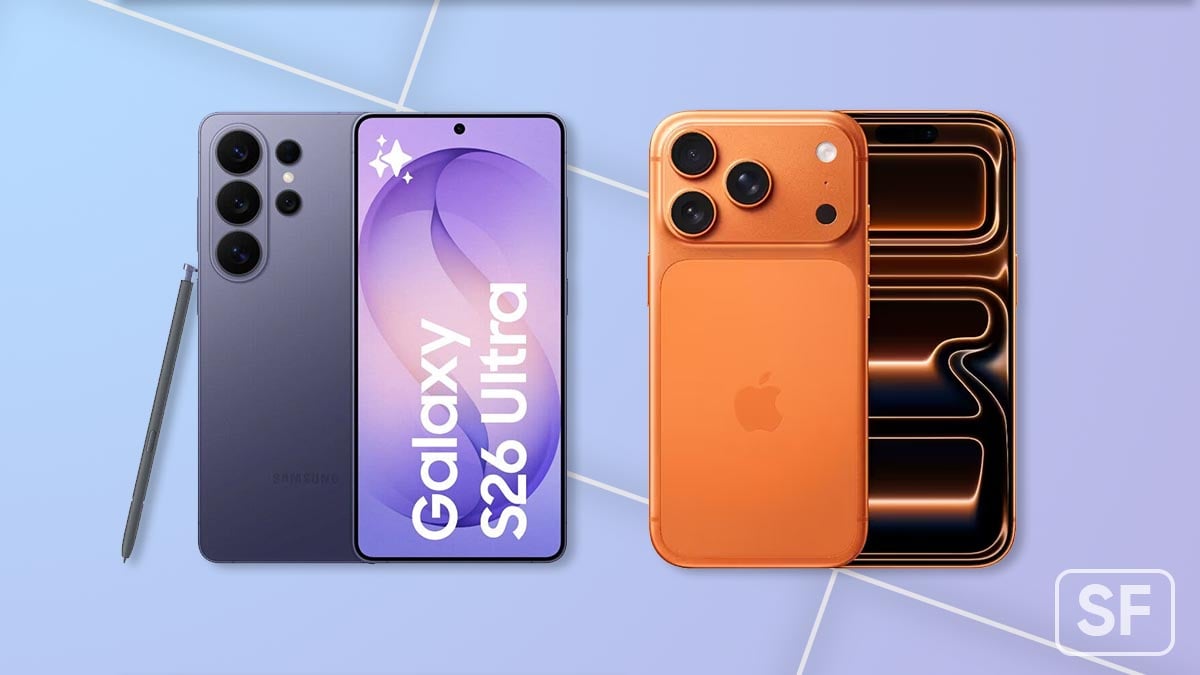
Samsung Galaxy S26 Ultra vs Apple iPhone 17 Pro Max

Samsung wrapped the S26 and S26 Plus in Gorilla Armor, then upgraded the Ultra to Gorilla Armor 2. Apple covered all three iPhone 17 models with Ceramic Shield 2. Marketing names aside, they are all extremely durable pieces of glass.

Verdict: Both lineups look like premium flagship phones in 2026

Colors

Samsung offers Black, Cobalt Violet, Sky Blue, and White everywhere, with Silver Shadow and Pink Gold exclusive to its online store. The iPhone 17 comes in Black, Lavender, Mist Blue, Sage, or White. The Pros get Cosmic Orange, Deep Blue, and Silver.

Samsung Galaxy S26 Ultra SG26U Apple iPhone 17 Pro Series

Display

Samsung bumped the base S26 up to 6.3 inches from last year’s 6.2. The S26+ stays at 6.7 inches, and the Ultra now rocks a massive 6.9-inch panel. All three support variable refresh up to 120Hz, hit 2,600 nits peak brightness.

Apple’s iPhone 17 and 17 Pro both use 6.3-inch screens, while the Pro Max matches Samsung’s Ultra at 6.9 inches. This year, every iPhone supports 1Hz to 120Hz refresh, includes an anti-reflective coating, and 3,000 nits brightness.

Samsung added something Apple didn’t think of or didn’t bother with: Privacy Display.

Verdict: Galaxy S26 Ultra display is a game-changer.

Performance

Every Galaxy S26 runs on a Qualcomm Snapdragon 8 Elite Gen 5 for Galaxy in the US. Apple’s running an A19 chip in the base iPhone 17 and an A19 Pro in the Pro models.

Both companies make absurdly powerful processors at this point, and unless you’re doing something incredibly demanding, they’ll both feel instant.

Verdict: Too early to call a winner here

Camera

Samsung is stuck with the same camera setup on the S26 and S26 Plus that it used last year. That means a 50MP main sensor, a 12MP ultra-wide, and a 10MP telephoto with 3x optical zoom.

The S26 Ultra upgrades things considerably. You get a 200MP main camera, a 50MP ultra-wide, a 50MP telephoto with 5x optical zoom, and a 10MP telephoto with 3x optical zoom.
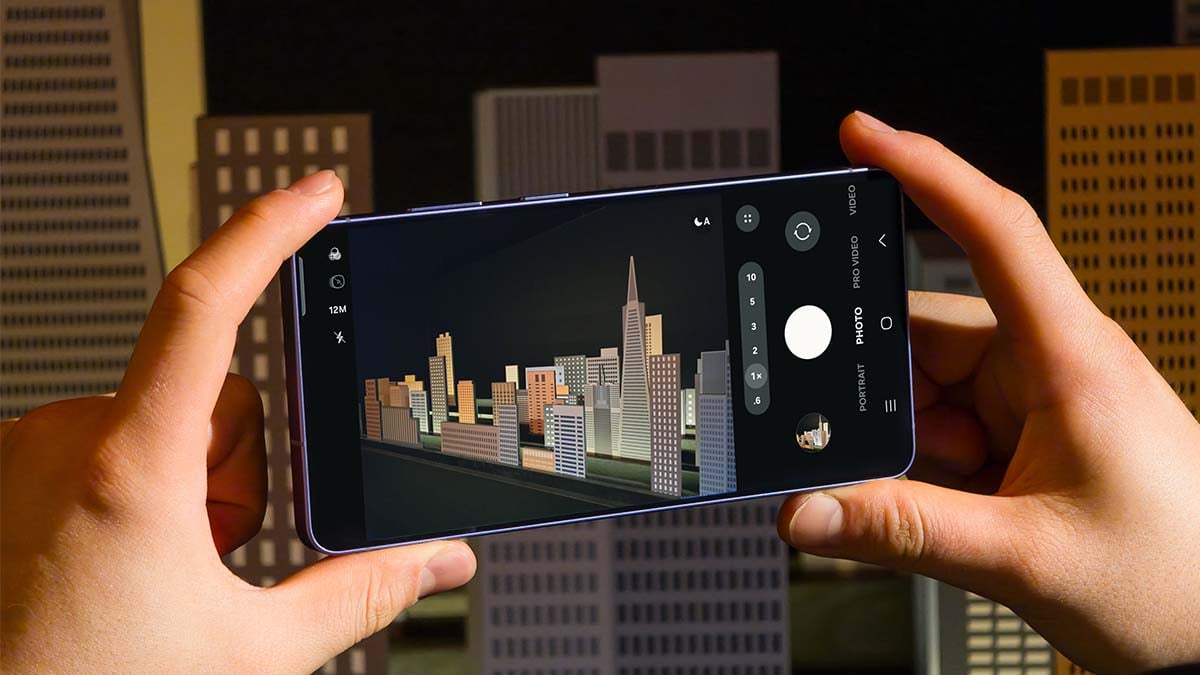
Samsung Galaxy S26 Ultra SG26U camera

Apple’s base iPhone 17 features a 48MP main camera and a 48MP ultra-wide. No telephoto, but Apple claims 2x optical zoom in and 2x optical zoom out through software.

The iPhone 17 Pro models get three 48MP rear cameras covering main, ultra-wide, and telephoto duties. All three iPhones sport an 18MP front camera with the Center Stage feature.

Samsung and Apple cameras have been excellent for years. The Ultra and Pro Max will likely trade wins depending on lighting conditions, subject matter, and personal preference.

Verdict: Samsung is ahead of Apple in the camera segment.

Battery capacity

Samsung’s battery sizes: 4,300mAh in the S26, 4,900mAh in the S26+, and 5,000mAh in the Ultra. Charging speeds vary too; the base model charges at 25W wired, Plus supports 45W, whereas the Ultra goes up to 60W (25W wireless).

Apple doesn’t publish battery capacity numbers, but the supply chain does. The base iPhone brings a battery of 3,692mAh, the Pro model gets approximately 4,252mAh, while the Pro Max version boasts the largest at about 5,088mAh.

Battery life’s one of those specs where you can’t trust the numbers until you run the actual test.

Price

Samsung wants $899 for the base Galaxy S26, while Apple asks $799 for the iPhone 17. That’s a hundred-dollar gap right out of the gate. Note that every phone here starts at 256GB, which is table stakes in 2026.

The Galaxy S26 Plus comes with a price tag of $1,099, while the iPhone 17 Pro costs $1,099 flat. As before, the Galaxy S26 Ultra continues to keep its $100 (upward) price difference from the best of Apple (iPhone 17 Pro Max).

Verdict: Apple is cheaper at every tier.

Samsung Galaxy S26 Ultra vs Apple iPhone 17 Pro Max

The post Galaxy S26 Ultra vs iPhone 17 Pro: 7 key differences decide the winner appeared first on Sammy Fans.

Samsung reveals the pixel trick behind Privacy Display

Samsung pulled back the curtain on Privacy Display last week. The Galaxy S26 Ultra launched on February 25th with the mobile industry’s first built-in Privacy Display.

Now, Samsung has revealed the brilliant technology behind the Privacy Display. It relies on a new OLED panel from Samsung Display that alternates between two types of pixels: Narrow and Wide.

Here’s how it actually works

In normal mode, both narrow and wide pixels spread light across a wide range of angles. When Privacy Mode is enabled, the display prioritizes narrow pixels that emit light straight forward, while wide pixels are reduced to a minimal level.

Samsung says the tech has been in development for 5 years, which tracks.

The company built Privacy Display with the ability to only apply to small portions of the S26 Ultra’s display, and it can hide notification pop-ups nearly perfectly. You’re not stuck blanking the entire screen every time you’re on a train.

You can set triggers for when the feature activates, such as during PIN, password, or pattern entry, or when notifications appear. No one wants to manually toggle a privacy filter every time they pull out a credit card to buy something online.

Samsung GalaxyS26 Ultra Privacy Display SG26U

Early hands-on suggests the blocking works well at the Samsung booth, but real-world performance depends heavily on the angle. Double-press the side button, and it activates. It’s a quick trick in addition to the toggle in the Quick panel.

Samsung insists it doesn’t mess with brightness, color accuracy, or viewing quality when you’re looking head-on. However, it actually dims the screen brightness a little when tested with equipment.

The post Samsung reveals the pixel trick behind Privacy Display appeared first on Sammy Fans.

Samsung phones could get Android-to-iPhone sharing feature this month

Samsung phones may finally receive the Android-to-iPhone sharing feature this month. The rollout may initially start for the Galaxy S26 series. Samsung will later expand the tool to even more Galaxy users sequentially.

In a recent development, Oppo confirmed (via 9to5Google) that the Find X9 and Find X9 Pro will get a software update later this month that lets them share files with iPhones, iPads, and Macs through Quick Share.

iPhone users will need to flip AirDrop visibility to Everyone for the handshake to work, because Apple’s default Contacts Only mode won’t play nice with Android devices trying to bridge in.

That’s Android-to-iPhone sharing via Quick Share wired into AirDrop’s backend, the same trick Google pulled on Pixel phones back in November.

Here’s what Oppo announced at MWC 2026:

Coming soon, OPPO’s Find X9 Series will bring Android Quick Share, enabled in close collaboration with MediaTek and Google. Without installing third-party applications, users can conveniently and securely transfer files between OPPO smartphones and iOS, iPadOS and macOS devices, improving cross-platform interoperability. The feature is expected to begin rolling out via software update starting in March.

Why does this matter?

Samsung Android iPhone sharing is about to follow. Screenshots surfaced weeks ago showing the Galaxy S26 series prepped for AirDrop compatibility through Quick Share, though the feature wasn’t active when reviewers tested retail units.

The company’s software rollouts haven’t exactly been the most predictable thing for the past year or two. One UI 8.5 is the likely vehicle for this, and Samsung has a habit of staggering such features across device generations.

The Galaxy S26 lineup doesn’t support this out of the box, but the feature may go live through a software update later this month.

The feature doesn’t require special hardware, so older Galaxy phones could get it with a software update, possibly bundled into One UI 8.5.

The post Samsung phones could get Android-to-iPhone sharing feature this month appeared first on Sammy Fans.

Moisture forming inside Galaxy S26 Ultra camera lenses

People with Galaxy S26 Ultra camera moisture problems are starting to speak up. It’s the most distressing problem Samsung’s flagships have ever faced. The condensation problem is rendering the cameras unusable, and that’s sad.

Ice Universe posted about it first on X, asking anyone who bought the phone to check their cameras in freezing weather. His own unit’s got condensation inside.

The problem surfaced after he took his phone outside when the temperature hit around minus six Celsius. Both the 3x and 5x telephoto lenses fogged up completely, which means you’re not taking usable photos in cold conditions.

He mentioned Korean forums picked up the same complaints, which tells you it’s not a bad batch. When multiple people in different countries see moisture forming on the inside of camera lenses on a phone rated IP68, that’s an engineering screwup.

The real question is why moisture’s getting trapped inside sealed camera housings. Samsung proudly touts that IP68 rating like it means invincibility.

Either the seals aren’t doing their job, or the vapor chamber inside the phone is creating internal humidity that has nowhere to go when the temperature plummets.

You’re holding a $1,300 phone that can’t shoot photos when it’s cold. That’s embarrassing for a company that stakes its reputation on hardware quality.

Samsung launched the Galaxy S26 series last month, full well knowing that people in half the world would be using it in freezing temperatures within weeks.

If this happens to you, what do you do?

You can’t blow dry without risking further condensation when it cools again. Rice doesn’t work and never did. Let it sit at room temperature and hope the moisture evaporates on its own without leaving residue on the lens internals.

If it doesn’t clear, you’re looking at a service center visit, and good luck getting that covered under warranty when Samsung might almost certainly call it user error.

Samsung Galaxy S26 Ultra Camera Lens Moisture Issue

Via – Ice Universe / X

The post Moisture forming inside Galaxy S26 Ultra camera lenses appeared first on Sammy Fans.

Samsung wants you to customize One UI beyond apps with vibe coding

There’s one thing Samsung didn’t shout about at Unpacked that could actually change how people use Samsung phones: vibe coding.

Recently, Hamish Hector of Techradar asked Won-Joon Choi, Samsung’s head of MX Business, whether vibe coding might surface on Samsung Galaxy devices; he didn’t shut the door. “Something we’re looking into,” he said.

Then he got specific; the appeal isn’t just app tweaks, it’s deeper.

“The possibility of customising your smartphone experience in new ways, not just your apps but your UX.” Right now, we are stuck with whatever Samsung or Google decided to ship, but vibe coding flips that.

You tell an AI what you want built. Maybe you’re sick of YouTube Shorts clogging your feed and you want a version that strips them out entirely. The AI writes the code, you install it and it’s done, Shorts gone from your feed.

This isn’t some futuristic concept either; coding assistants have been around since LLMs first showed up, but the new breed of vibe coding tools can hand working apps to people who’ve never touched a line of code.

Samsung loves reminding everyone that Android is open. Benjamin Braun, Samsung’s chief marketing officer, celebrated that openness in a post-Unpacked panel.

If Android lets you sideload anything you want already, why wouldn’t Samsung bake vibe coding directly into One UI? It’s the most obvious move they could make.

Choi seemed interested, at least. He didn’t commit to a timeline or confirm it’s definitely happening. But the fact that he engaged with it at all tells you Samsung’s at least thinking about this seriously.

If Samsung actually does this, the “AI phone” label might finally mean something beyond marketing copy. You wouldn’t just be using Samsung and Google’s preloaded apps, but you would make your own apps and use them on Galaxy.

Samsung Galaxy S26 Ultra SG26U Gemini Actions

The post Samsung wants you to customize One UI beyond apps with vibe coding appeared first on Sammy Fans.

Samsung reveals what its AI Smart Glasses will actually do

Samsung’s Jay Kim stood on a stage in Barcelona and shared crucial details about the Samsung AI Smart Glasses. The executive let slip that the upcoming Samsung AI Smart Glasses will feature a camera at “your eye level.”

Samsung has been working on AI Smart Glasses with Qualcomm and Google since 2023, and until this week at MWC 2026 all we got was strategic silence and some internal whispers about something called Project HAEAN, via CNBC.

The glasses feed what you’re looking at through that camera to your Galaxy phone, which does the heavy lifting and then sends you back “a lot of information”. Your phone becomes the brain and the glasses are just your eyes and ears.

When asked about a built-in display, Kim sidestepped the whole thing and said Samsung’s got watches and phones if you need a screen.

Meta’s Ray-Ban glasses own 82% of the global smart glasses market, and Samsung’s essentially trying to clone that playbook with better AI baked in.

The difference is Gemini integration, tighter Galaxy ecosystem hooks, and the hope that Samsung’s name carries more weight than Meta’s in a category where people are still creeped out by cameras on faces.

Kim said the XR headset stuff won’t be “a sort of mass scale business”. It signals the company screwed up, thinking people wanted bulky VR nonsense when they just want something lightweight they won’t be embarrassed to wear.

Samsung is betting that AI agents will turn glasses into the next must-have platform. Meta’s already there and Apple is presumably watching. Samsung’s targeting a release “for industry this year,” and Qualcomm’s confirmed 2026.

The post Samsung reveals what its AI Smart Glasses will actually do appeared first on Sammy Fans.

Galaxy S26 Ultra teardown uncovers ALoP camera, strange adhesive

Galaxy S26 Ultra is set to hit the market shelves on March 11, but we just got the first teardown of this flagship phone, confirming the hidden camera upgrade: ALoP tech in the periscope sensor.

YouTube channel Disassembling Parts uploaded the Galaxy S26 Ultra teardown. The video highlights an excessive use of a “strange adhesive,” but what caught the eye is the installation of ALoP camera technology inside.

Everything the video covers

It’s a full internal breakdown of the Galaxy S26 Ultra, going layer by layer through components like:

  • Battery
  • Motherboard
  • Camera system
  • Overall internal layout

ALoP Camera

The periscope camera module appears to use ALoP technology, which Samsung quietly teased over a year ago. Samsung’s new ALoP (All Lenses on Prism) places the lenses on top of the prism, reducing module size.

ALoP uses a larger lens diameter for improved brightness. The module sits flatter against the body, with less bump and better aesthetics. That square prism outline has also gone; you just see round lenses now as the phone gods intended.

Samsung Galaxy S26 Ultra ALoP Camera Sensor

Source – Disassembling Parts / YouTube | Via – @MyDaebakCafe/X

Even though the ALoP camera has been shipped, Samsung did not mention the technology. The company is accused of lazy hardware upgrades, not because of staleness, but of avoiding marketing of these technologies publicly.

The main highlight is an unusually large amount of adhesive applied in unexpected or “strange” places inside the phone. Adhesive inside phones isn’t new, but the sheer amount here raises questions.

The video explores possible reasons Samsung did this, such as:

  • Improved durability/structural support
  • Better thermal management
  • Enhanced water resistance
  • Other assembly/engineering trade-offs

You can watch the full teardown video on YouTube.

The post Galaxy S26 Ultra teardown uncovers ALoP camera, strange adhesive appeared first on Sammy Fans.

Samsung teases wider One UI 8.5 Beta expansion; Galaxy Z Fold 7 and Flip 7 next

Samsung is opening up One UI 8.5 Beta forums for the Galaxy Z Fold 7 and Flip 7. No actual builds yet, but the fact these forums popped up tells you something awkward about Samsung’s software timeline right now.

The earliest Samsung fans seeing the One UI 8.5 Beta for the Galaxy Z Fold 7 and Z Flip 7 is mid-March, according to MohammedKhatri tracking Samsung’s server movements. That puts stable release somewhere closer to mid-April.

Setting up forums first is usually prep work. March security patch builds are currently being tested for the Fold 7 and Flip 7, which pushes One UI 8.5 toward April. The company’s basically admitting the software isn’t cooked yet.

The Fold 7 and Flip 7 launched in July 2025, running One UI 8 on Android 16. One UI 8.5 went live with the Galaxy S26 series on February 25. Existing devices are now looking at an April rollout instead of the March window people expected.

Samsung Galaxy Z Fold 7 and Z Flip 7 One UI 8.5 Beta Forum

Courtesy – @Mohammed_K_2010/X

The Galaxy S25 series already has the One UI 8.5 Beta running. Samsung is also testing the seventh One UI 8.5 Beta update for last year’s flagships. Stable could start rolling out next month, leaving March dominated by patches.

With One UI 8.5 Beta expanding, we may see the Program arriving for even more models. Samsung may invite the users of the Galaxy S24 series, S23 series, as well as previous foldable models, to test before the Stable jump.

Unlike One UI 8.0, One UI 8.5 is a major upgrade, built on Android 16. It brings a new design language that is more fluid and dynamic. The application of blur across the interface makes it pleasing on Galaxy devices.

The post Samsung teases wider One UI 8.5 Beta expansion; Galaxy Z Fold 7 and Flip 7 next appeared first on Sammy Fans.

❌