Samsung’s now releasing One UI 8.5 Beta 4 to the Galaxy Z Fold 7 and Z Flip 7, with the firmware featuring new AI features from the latest flagships along with fixes for some specific problems reported by Beta testers.
Galaxy Z Fold 7 and Z Flip 7 users on One UI 8.5 Beta can now download Beta 4, which can be identified via PDA build version ZZDD (via TarunVats). This release feels more like a refinement update than a major feature drop.
The highlight is a fresh set of AI tools.
You now get Call Screening to filter unknown callers, Photo Assist that lets you edit images using simple text prompts, Creative Studio for more advanced content tweaks, and an upgraded Audio Eraser that can remove background noise in real time.
These aren’t entirely new if you’ve been following the Galaxy S25 Beta program, but it’s good to see them expanding to foldables.
It also focuses heavily on fixing annoyances.
Samsung has addressed a slow upload issue that showed up when retaking scans in the Camera’s Add Scan feature. Routines that weren’t triggering properly should now behave as expected.
The Now Bar color glitch, where it changed every time you turned on the screen, has also been fixed. Automatic language detection is working again, and a crash affecting the Settings Intelligence service has been resolved.
If you’ve already seen the Galaxy S25 series getting its 10th beta with similar changes, this rollout puts Samsung’s foldables more or less in sync.
Galaxy S26’s best AI features are now rolling out to the Galaxy S24 series and Galaxy S25 FE as part of the 3rd One UI 8.5 Beta update.
Samsung’s latest One UI 8.5 Beta ZZD8 update isn’t flashy, but it focuses on cleaning up a bunch of annoying day-to-day issues while quietly adding a few new AI features.
Owners of the Galaxy S24 series are getting the 3rd Beta update in Korea and India (via TarunVats), whereas the Galaxy S25 FE users are receiving it in Korea. An expansion will follow soon, covering Beta participants in Global markets.
On the AI side, Samsung is clearly expanding its toolkit.
You now get Call Screening, which helps filter unknown calls more intelligently. Photo Assist has been upgraded with text prompt input, letting you tweak images in a more flexible, almost generative way.
There’s also Creative Studio, aimed at giving users more control over content creation, and an Enhanced Audio Eraser that can reduce background noise in real time across apps like YouTube, Instagram, and Netflix.
Samsung is also tightening up the core experience.
Incoming call delays and black screen issues have been fixed, and the proximity sensor during calls should now behave more reliably. Camera bugs, especially the green line issue in 4K HDR recording on third-party apps, have also been addressed.
Bluetooth stability has been improved, and there’s a fix for multi-touch glitches that could show up after using accessibility zoom features.
The fact that the same changelog is now showing up on the Galaxy S25 series with its 10th Beta suggests the company is getting serious about polishing things before a stable rollout.
New EU rules, including removable battery design, coming into effect from 2027, could become a massive headache for Samsung’s Galaxy S27 development team.
Samsung’s Galaxy S27 might not be defined by its camera or chipset. It could be defined by a door on the back. That is the uncomfortable reality facing Samsung’s internal design cycles right now.
The European Union’s battery regulation, approved by the EU Council on July 10, 2023, sets a hard deadline of 2027. By then, smartphones sold in the region must feature user-replaceable batteries.
For Samsung, this is not a minor tweak. It is a full reset.
The modern Galaxy S lineup is built on a sealed body design. Glass on front, glass on back, tightly packed internals, aggressive adhesive, and structural rigidity that helps achieve IP68 ratings.
That entire philosophy clashes with removable battery requirements. Galaxy phones can not have easy access and perfect sealing at the same time without compromise.
Samsung’s engineers may have been facing a brutal trade-off. Either redesign the chassis to allow tool-less battery access or attempt a complex modular workaround that preserves some level of water resistance.
Consumers associate sealed designs with high-end craftsmanship. Reversing that perception will not be easy, even if the change is driven by regulation.
Going back to removable covers feels like a step backward. Samsung would need to rethink component layout, battery housing, sealing methods, and even retail logistics.
The same regulation mandates up to 10 years of spare parts availability and service documentation. Devices are no longer meant to be replaced every three to four years.
Samsung could try region-specific designs, keeping sealed builds in markets without such regulations. More likely, the company will attempt a unified design that meets EU standards while preserving identity as much as possible.
Samsung’s One UI 8.5 Beta 10 has finally arrived for Galaxy S25 users, bringing new AI features and plenty of bug fixes. It’s available to Beta participants in Germany, India, and South Korea, with Poland, the UK and the US joining shortly.
The One UI 8.5 Beta 10 (ZZDD) update for the Galaxy S25 series is a mix of meaningful AI upgrades and much-needed bug fixes. On the AI side, Samsung is clearly pulling features forward from its next-gen lineup.
You’re getting tools like Call Screening, which can automatically handle unknown callers, plus Creative Studio for generating and editing content more easily.
There’s also an upgraded Audio Eraser that does a better job cleaning background noise from recordings, and an improved Photo Assist that makes image edits smarter and more natural.
Additionally, this update quietly fixes some annoying issues. Incoming calls should now appear instantly instead of showing a delay or black screen. Call quality gets a boost, too, thanks to fixes for the proximity sensor acting up during calls.
Camera reliability has also been improved. If you were seeing green lines while recording 4K HDR video in certain third-party apps, that should now be resolved.
Samsung has also worked on stability across the board. Bluetooth crashes have been reduced, and a frustrating multi-touch issue that showed up after using accessibility zoom features has been fixed.
Overall, this update feels less about flashy changes and more about making the phone smarter with AI while quietly fixing the small things that affect daily use.
Get the Beta 10 now! Open Settings, then Software update and hit Download and install.
Samsung reportedly plans to begin the Stable One UI 8.5 rollout on April 30 in South Korea. Users outside the company’s home ground may start getting the official update starting May 4, if the OTA doesn’t encounter problems.
Samsung has started rolling out the April 2026 security update to the Galaxy A56 smartphone. The company has already updated previous models, including the A53, A54, and A55, to the latest patch version.
Around three weeks ago, the phone received its recent update with March 2026 patches. Samsung categorized the Galaxy A56 for priority update support, promising monthly software releases; April 2026 version is the latest.
As spotted by TarunVats, the firmware is available in Europe, Galaxy A56’s BZD1 build will soon expand to Global markets. Meanwhile, Samsung could open One UI 8.5 Beta Program for the Galaxy A56 in select markets.
For now, users of Galaxy A56 can grab the April update through Settings > Software update > Download and install. It’s expanding in batches, so the availability may vary by model (CSC), region, and carrier.
April patch contains fixes for a total of forty-seven problems. The OTA targets CVE and SVE items across Android and One UI. Samsung’s semiconductor division is specifically bringing four patches, addressing Exynos CVEs.
Even though the latest update has nothing exciting, you should update the software. It improves the system stability and reliability, with performance also seeing an increase. This is due to background cleanup during the OTA installation.
Seamless Updates ensure you don’t get stuck on the Samsung logo window for long. Updates install quickly as extraction takes place when you’re online. Just a normal reboot applies the firmware, reinstating immediate access.
Samsung boss Jay Y Lee was among a group of South Korea’s most powerful business leaders who left for India on April 19, joining President Lee Jae-myung on a high-stakes economic mission that also includes Vietnam.
The delegation is large, expectations are bigger, and outcomes tend to be negotiated behind closed doors. Before his departure to India, the Samsung boss kept his cards close; just a brief smile before heading to the gate.
The scale of the trip stands out
Around 200 delegates have been assembled by the Korea Chamber of Commerce and Industry and and the Federation of Korean Industries. These are not symbolic visits; business forums, policy meetings, and MOU signings are already lined up across both countries.
Korea’s Samsung, LG and Hyundai run production hubs in the country. Samsung has built a deep footprint, from large-scale smartphone manufacturing to R&D operations that support both local and global markets.
President Lee landed in New Delhi on the same day, kicking off a tightly structured visit. For Samsung, the trip is not about announcements on day one. The real signals will come later, once negotiations settle and commitments take shape.
Samsung walked away with four wins, including two Gold and two Silver at the US Edison Awards 2026, held April 15–16 in Fort Myers, Florida.
The Edison Awards, launched in 1987, are judged by industry experts and academics. Not every winner translates to market success, but they tend to signal where companies are placing bets.
Samsung lands 2 Gold, 2 Silver at US Edison Awards 2026
Gold awards went to Smart Modular House and Vision AI Companion, both centered on practical AI use, not demo-stage concepts. The Silver side is more hardware-driven, including commercial displays and washers/dryers.
Gold Award-Winning Innovations
Smart Modular House
Vision AI Companion (VAC)
Silver Award-Winning Innovations
Spatial Signage
Bespoke AI Laundry Combo
Mauro Porcini, Chief Design Officer at Samsung Electronics, framed the results around design, sitting between technology and user needs. In simpler terms, the company is trying to make its tech feel less like tech.
“Design sits at the intersection of business, technology and humanity,” said Mauro Porcini, Chief Design Officer and President of the Device eXperience (DX) Division at Samsung Electronics. “Our role is to understand people deeply and translate their needs, dreams and emotions into meaningful experiences. We will continue to push innovation forward with the ambition of enriching people’s lives in ways that truly matter.”
I have seen countless reports of Samsung users over green line issue on Galaxy devices. Meanwhile, a recent incident is pretty much shocking as a 1-month-old Galaxy S26 Ultra allegedly became a victim of Samsung’s green line display problem.
Our Galaxy Note 20 Ultra has also developed a green line, as well as the Galaxy S22 Ultra. The former is working with that vertical curse, but the problem worsened with the latter model due to the accumulation of display issues.
Now, I am seeing reports of Galaxy S23 Ultra users who are reporting a pink or green line issue on their devices after installing the recent software update. As always, users say there’s no physical or water damage, but the line has developed.
In search of more S23 complaints, I reached a viral post on X, showing a brand-new Galaxy S26 Ultra with a thick vertical green line. We can’t confirm the genuineness, but the user will surely get a display replacement if true.
Think you are spending $1,300 on an electronic device from a globally reputed brand. You spent such a huge amount of money for a top-notch experience, but what you are getting is a green line, which you could have gotten after two or three years.
— Samsung Software Update – One UI 9 #OneUI9 (@SamsungSWUpdate) April 20, 2026
The problem doesn’t seem limited to the Galaxy S23 phones, while the S26 Ultra is not a widespread problem. Users of Galaxy S21 FE and S22 Ultra report the problem at scale, and some of them get a free replacement from Samsung.
If you are facing a green line problem, the first step is to visit your nearest Samsung service center. Get your phone’s display replacement estimate and request a complimentary screen replacement, citing Samsung’s policy.
Service center staff may agree if they are aware of the green line policy. If they refuse, get the job sheet emailed to your ID and approach Samsung support. Claim quality issue, and they might offer a free screen replacement.
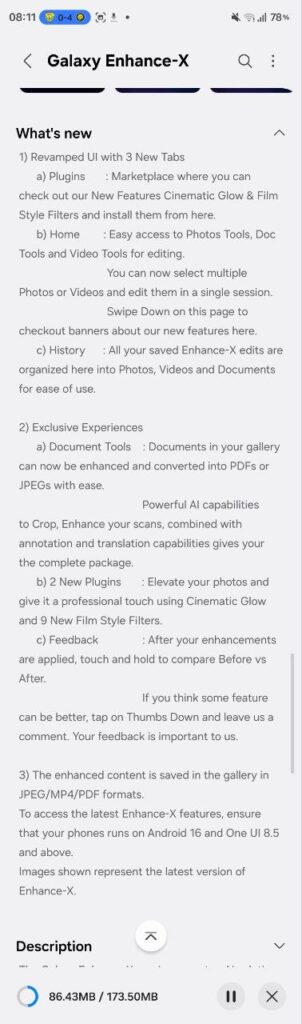
Samsung just began the general rollout of a new Galaxy Enhance-X app update with One UI 8.5 redesign. The latest version splits the app’s interface, adds a Good Lock-like Plugins system, Documents Tools, and more.
Version 16.3.00.31 is giving One UI 8.5 Galaxy Enhance-X a noticeable refresh, centered around a redesigned interface split into three tabs: Plugins, Home, and History. Navigation feels more purposeful, with quicker access to tools and saved edits.
The new Plugins tab works like a mini marketplace, letting users install features such as Cinematic Glow and Film Style filters. Home brings everything together, including photo, video, and document tools in one place.
A useful change is the ability to edit multiple photos or videos in a single session, which should save time. There’s also a swipe-down section highlighting new features and updates directly inside the app.
Samsung is also pushing deeper into document editing. Users can now enhance scans, crop them, add annotations, translate content, and convert files into PDFs or JPEGs without leaving the gallery environment.
Two new creative plugins aim to improve visual output, especially for photography enthusiasts. Cinematic Glow and several film-inspired filters promise a more polished, professional look with minimal effort from the user.
Another small but practical addition is the press-and-hold comparison tool. It lets users quickly check before-and-after results, while built-in feedback options make it easier to report issues or suggest improvements.
Finally, all enhanced content is saved in standard formats like JPEG, MP4, and PDF for easy sharing. The update appears targeted at devices running Android 16 with One UI 8.5, including the Galaxy S26 series.
A Galaxy S26 Ultra entry on Geekbench is grabbing attention due to the OS bump to Android 17, which is, of course, an internal testing build atop One UI 9.
Someone running an internal Android 17-based One UI 9 Alpha build on the Galaxy S26 Ultra (SM-S948B) submitted a Geekbench 6.7.0 result on April 17.
Single-core score: 3608
Multi-core: 10829
Meanwhile, one of the most recent entries of Galaxy S26 Ultra running a stable Android 16-based One UI 8.5 landed on the same benchmark.
Single-core: 3695
Multi-core: 11183
Single-core took an 87-point hit, about a 2.4 percent drop, whereas the multi-core fell by 354 points, roughly 3.2 percent.
The Galaxy S26 Ultra is equipped with a Snapdragon 8 Elite Gen 5 processor. Eight cores split across two clusters, six efficiency cores at 3.63 GHz, and two performance cores at 4.74 GHz, as well as 12 GB of RAM.
This is alpha software; of course, it’s not optimized. Drivers are half-baked, schedulers aren’t tuned, and the kernel team probably hasn’t finished work yet.
Samsung has months before any public One UI 9 release, and performance gaps like these close during that window all the time.
Back in February, Samsung introduced the Galaxy S26 series with Android 16-based One UI 8.5. The company is in final stage of rolling out the software to existing models like the Galaxy S25 series by the end of this year.
One UI 9 is a thing of the future, and users of Galaxy S26 can expect a Beta Program around the end of May this year. The official version will release with the Galaxy Z Fold 8, Z Flip 8, and Z Fold 8 Wide sometime in July 2026.
Samsung could finally shut down the Galaxy S25’s One UI 8.5 Beta Program tomorrow. It’s not an official confirmation, but credible rumors indicate that the last Beta update could be coming tomorrow.
One UI 8.5 Beta has been running for more than four months. Users of the Galaxy S25 series may complete five months on One UI 8.5 Beta firmware, as the Stable release is expected to take place on May 4th globally.
As always, Samsung’s Beta Program is restricted to six countries. However, the Beta activity is still covering millions of Galaxy S25 users. A wide-scale rollout may kickstart on April 30, with Samsung planning May 4 for Global users.
Samsung has released nine Beta updates for Beta participants so far. The firmware is based on the latest stage of Android 16. Galaxy users will also receive fruitful upgrades from the Android operating system together.
Not just the S25 series, but Samsung is also preparing the Stable release for Galaxy S24 and S23 series, along with their Fan Edition models. Older flagship lineups would not wait much once the update arrives for 2025 models.
If you’re on Beta, the 10th Beta would bring almost everything a Stable release would. If you are still rocking One UI 8.0, intentially or forced to, the big upgrade isn’t much away; expect it in the first week of May 2026.
Before I wrap up, I repeat that Beta 10 is “most likely” to come tomorrow. Samsung hasn’t officially confirmed the Beta or Stable release dates. Even its chat support executives are repeating what X chatter assumes for rollout.
AirDrop to Samsung via Quick Share is a significant move, but the sharing system has one more issue, this time with PDF files with certain names.
The headline feature, cross-platform file sharing with AirDrop compatibility, is functional on paper. In practice, the current One UI 8.5 Beta exposes gaps in how Samsung is handling file systems and metadata during the handshake protocol.
The most immediate issue is with PDFs.
When a file is sent from an iPad using AirDrop, certain filenames break the transfer entirely. Specifically, filenames containing characters like “/” fail to land on Galaxy devices.
Android’s directory structure treats “/” as a reserved separator. The result is a silent failure: no error prompt, no fallback rename, just a dropped transfer. For a feature that aims to simplify sharing, that lack of feedback stands out.
Then comes the deeper problem, metadata loss. Files that do make it across are often stripped of their EXIF data. That includes GPS location tags, lens information, and camera hardware identifiers.
For anyone relying on file integrity, photographers, journalists, or even social media creators, this is a serious regression. The data is present on the source device but disappears during the Quick Share to AirDrop transfer.
Samsung moderators responded to users’ complaints, but mentioned that the team was not able to reproduce the issue in their testing. The user was asked to reshare the PDF file after removing the special character from the file name.
Quick Share engineering team is reportedly working on fixes, with a patch expected in the next Beta update cycle. For now, One UI 8.5 Beta users get a preview of the future, but also a reminder that polish still matters.
Samsung’s One UI 8.5 seems to have entered the final phase for Stable rollout. Beta Program is underway, and the last update could be coming next week. Meanwhile, Samsung shifted its focus to Stable builds over the past few days.
Back in December, Samsung opened One UI 8.5 Beta Program for the Galaxy S25 series. The activity has arrived in six countries, while users in others are still stuck to the One UI 8.0, based on Android 16 operating system.
Samsung rolled out 9 Beta updates to Galaxy S25 series throughout the Beta Program. The last, 10th, Beta update could be pushed on April 20. Final rollout of the One UI 8.5 firmware is said to kickstart on April 30 in South Korea.
Latest Stable One UI 8.5 builds for Galaxy S phones
The Korean tech giant this week uploaded new Stable builds to its server. The latest builds belong to Galaxy S series smartphones. The Galaxy S22 series has yet to grab any attention in terms of a major software update.
The appearance of new Stable builds isn’t sudden, but strategic. With Samsung nearing the official rollout timeline, preparations are seeing notable progress. Pre-rollout testing is necessary to ensure reliable update distribution.
Galaxy S23 series – FZD7
Galaxy S24 series – DZD9
Galaxy S25 series – CZDB
Galaxy S23 FE – GZD7
Galaxy S24 FE – DZD7
Samsung revealed nothing about the One UI 8.5 rollout timeline. What we know from rumors is April 30 as the Korean rollout date and May 4 as Global. Like Beta releases, the Stable distribution roadmap may also be accurate.
If you’re waiting for the One UI 8.5 update, the next two weeks are important. Once the rollout begins for the Galaxy S25 series, the company won’t waste much time expanding the availability of the Stable update for older models.
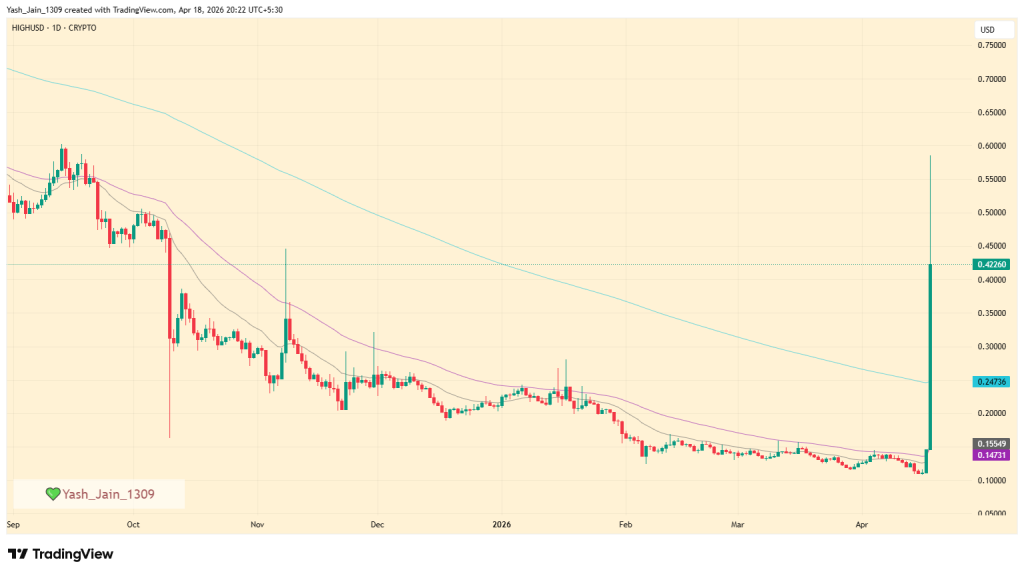
It’s not every day a “dead” token wakes up and decides to go vertical but HIGH/USD just did exactly that. A brutal 400% surge from the $0.10 zone has dragged Highstreet back into the spotlight, and no, it wasn’t random. This one had a trigger. A very specific one.
The Early Access launch of Highstreet: Calamity on Meta Quest VR flipped the switch.
VR Game Launch Sparks Sudden Market Revival
But honestly before this, Highstreet wasn’t exactly the market’s favorite child. It sat in what traders love to call the “graveyard zone.” Low interest. Flat price action. Basically invisible.
Then came the Calamity launch. Suddenly, the narrative changed. A roguelike VR brawler dropped into a niche but high-potential sector, metaverse gaming and just like that, the token had a story again. And in crypto, narratives move faster than fundamentals. The result? Buyers piled in. Fast.
Short Squeeze Chaos Drives Explosive Price Action
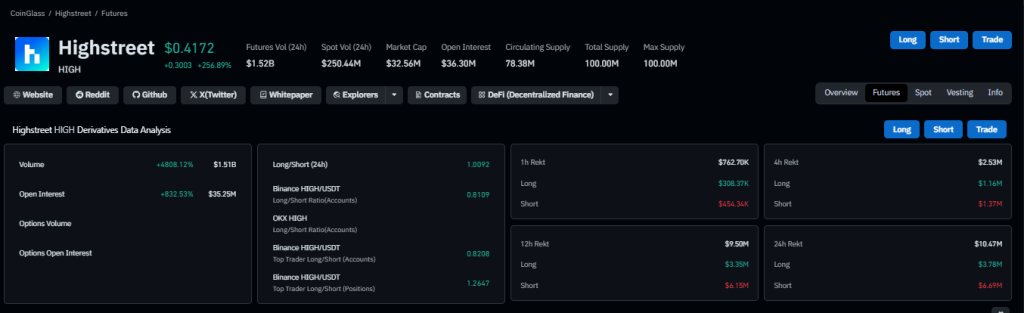
This wasn’t just organic demand. The derivatives market lit up like a Christmas tree. Futures volume exploded nearly 4800%, hitting $1.51 billion. Open interest? Up 830% to $35.25 million.
That’s not normal. That’s fuel. And then came the squeeze. Out of $10.47 million in total liquidations, a hefty $6.69 million were short positions getting wiped out. Forced buyers. Panic covering. You know the drill.
Each liquidation pushed the price higher… which triggered more liquidations… which pushed it even higher. A perfect feedback loop. Violent, fast, and completely unforgiving for anyone betting against it.
Zoom Out And The Picture Looks Less Impressive
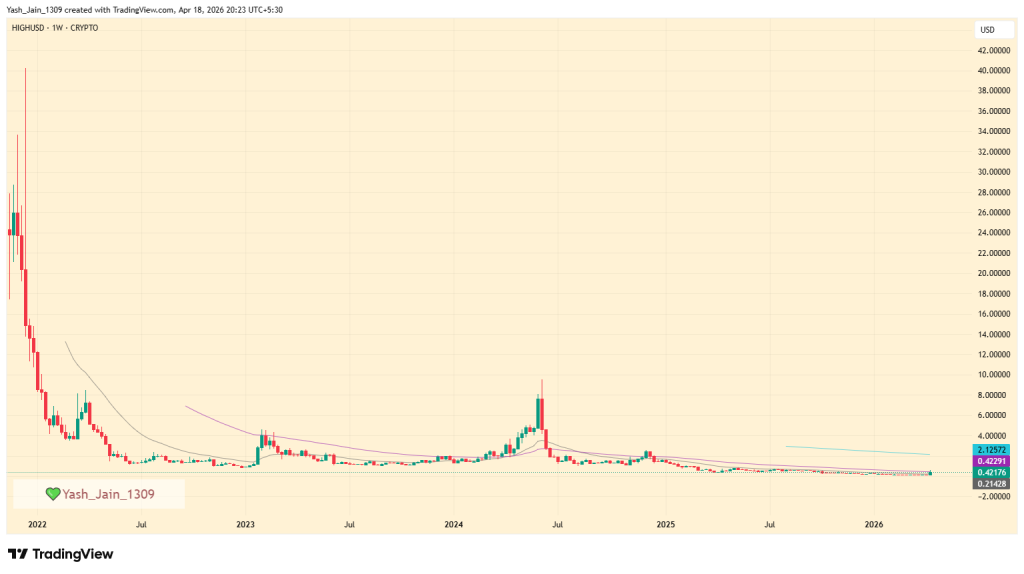
But here’s the part nobody chasing green candles wants to hear. Zoom out to the weekly chart and the move barely registers.
Yeah, triple-digit gains look flashy on the daily timeframe. But structurally? HIGH/USD is still sitting well below its historical highs. No major long-term levels reclaimed. No confirmed macro reversal.
So what does that mean? Simple. This looks a lot more like a high-momentum trade than a confirmed long-term comeback.
Highstreet Needs More Than Just One Catalyst
So, what’s next? If this Highstreet rally is going to stick, one VR game launch won’t cut it. The market will need consistent ecosystem updates, sustained engagement, and let’s not ignore this favorable macro conditions is also needed to keep the broader trend in check. Otherwise, the risk is obvious.
Psst… Have you heard?
Highstreet: Calamity just dropped into Early Access on Meta Quest #VR Dive into the chaos with your friends, swing your way through the arena, and see if you’ve got what it takes. Jump in now → Download here: https://t.co/36ZEMr0gI3pic.twitter.com/nXAN93KgZH
Once the Highstreet hype fades and the forced buying dries up, HIGH/USD could slip right back into the range it just escaped from. That’s how these things usually play out.
For now, though, momentum is doing what momentum does best ignoring reality and pushing higher.
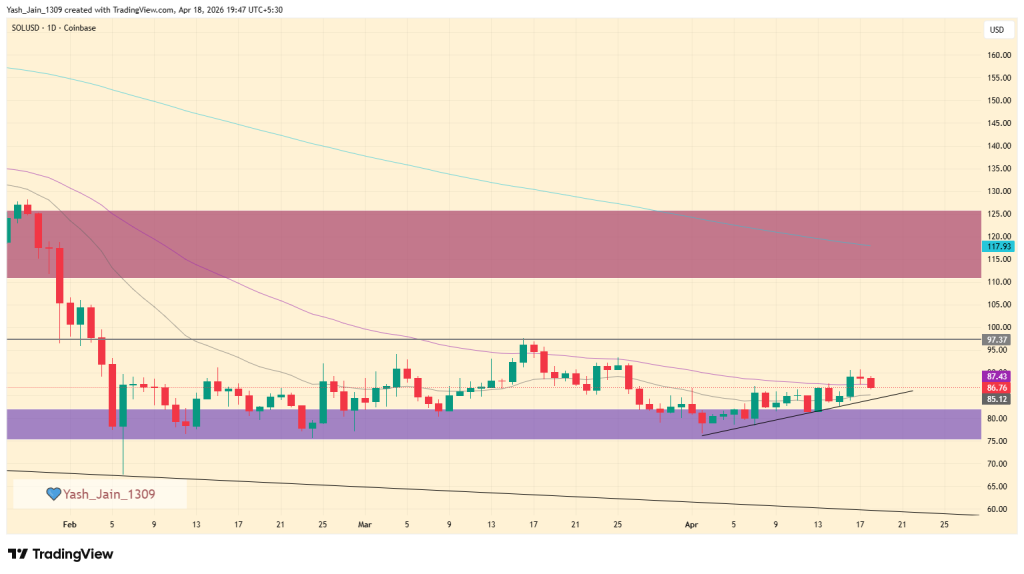
Solana price is walking a tightrope and below it sits a pile of liquidation fuel waiting to be lit. What looks like a simple rejection on the daily chart is actually a layered fight between short-term bears and overleveraged bulls, and right now, Solana price is stuck right in the middle of it.
Short-Term Pressure Mounts Near Critical EMA Rejection
Solana price just fell under the 50-day EMA, and it didn’t shrug it off either. The latest daily candle turned red, signaling that sellers aren’t just present they’re active.
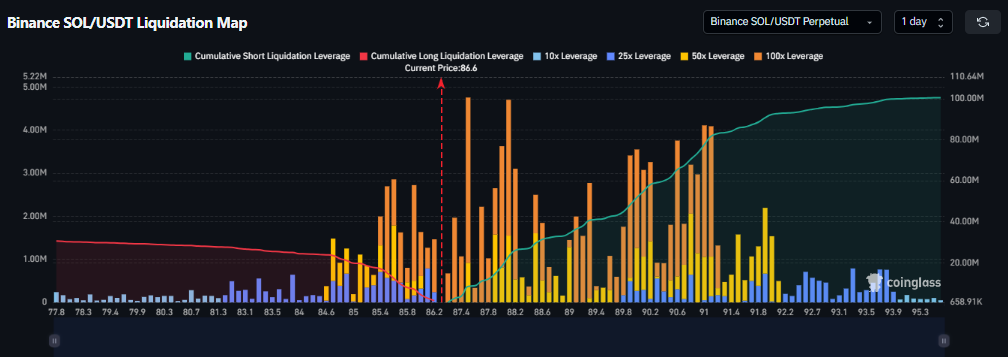
Now here’s where it gets interesting. On the 1-day liquidation map, there’s roughly $99.73 million in cumulative short liquidation leverage stacked above price. That’s a crowded short trade. Normally, that kind of imbalance creates a magnet upward markets love punishing consensus.
But that’s not what’s happening… at least not yet. Instead, the price is slipping, suggesting that in the immediate term, the path of least resistance is still downward. In other words, bears are controlling the short-term narrative despite the temptation of a short squeeze.
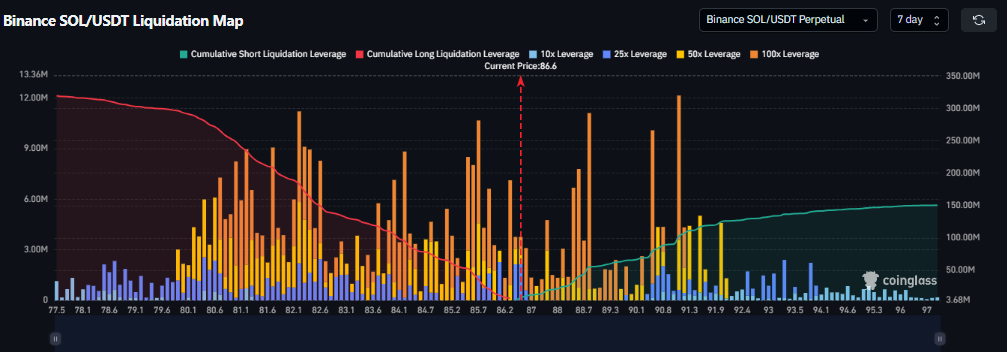
Well, the 7-day data flips the entire story as that turns suddenly the market dangerously long. There’s a massive $319.59 million in cumulative long liquidation leverage sitting below current price, compared to just $150.63 million in shorts.
That’s not just an imbalance but clearly it’s a setup. Because, if Solana price starts breaking key supports, those long positions become liabilities. And when they unwind, they don’t do it quietly. Forced selling kicks in, accelerating downside momentum in what traders call a long squeeze.
Translation? The real liquidity target might not be above perhaps it’s below.
Trendline Support Now Decides Solana Price Direction
So, It all comes down to a pretty simple line on the chart to a short-term ascending trendline. Solana price is currently sitting right on it, and the reaction here will likely dictate the next move.
If this trendline and the nearby $85 Solana price support fails to hold, the probability of cascading liquidations increases significantly. That opens the door to a deeper correction, with price potentially targeting the $75–$80 support zone where that liquidity pool sits.
But let’s not get ahead of ourselves. There’s still a wildcard in play. That heavy cluster of short liquidations above means a sudden bounce could trigger a quick relief rally toward the $90–$95 region. It wouldn’t be sustainable on its own, but it could happen fast.
Price predictions for 2026 highlight a potential range of between $20-$80.
Long-term forecasts indicate AVAX could reach $518.50 by 2030.
Aave (AAVE) is a decentralized finance protocol built on Ethereum that facilitates permissionless lending and borrowing through smart contracts. After witnessing a strong expansion in the previous market cycle, AAVE entered a prolonged correction phase, with price gradually retracing from its earlier highs. Throughout 2025, AAVE remained in a consolidation structure, reflecting a period of market digestion rather than trend continuation. While short-term momentum has cooled, the broader technical structure suggests that AAVE may be transitioning into a new accumulation phase.
As volatility contracts and price holds above long-term demand levels, attention is now shifting toward whether 2026 can trigger the next major price discovery cycle.
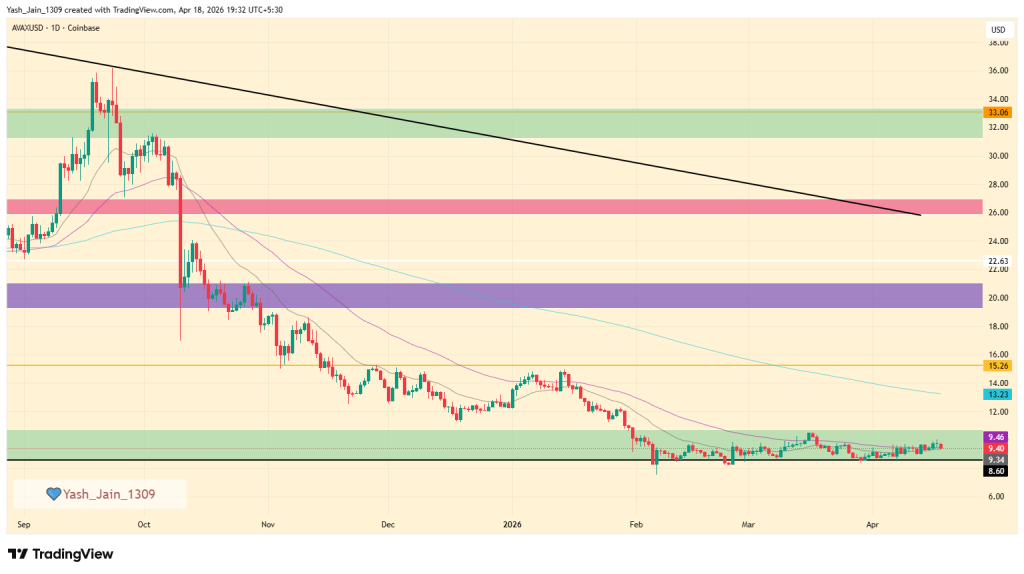
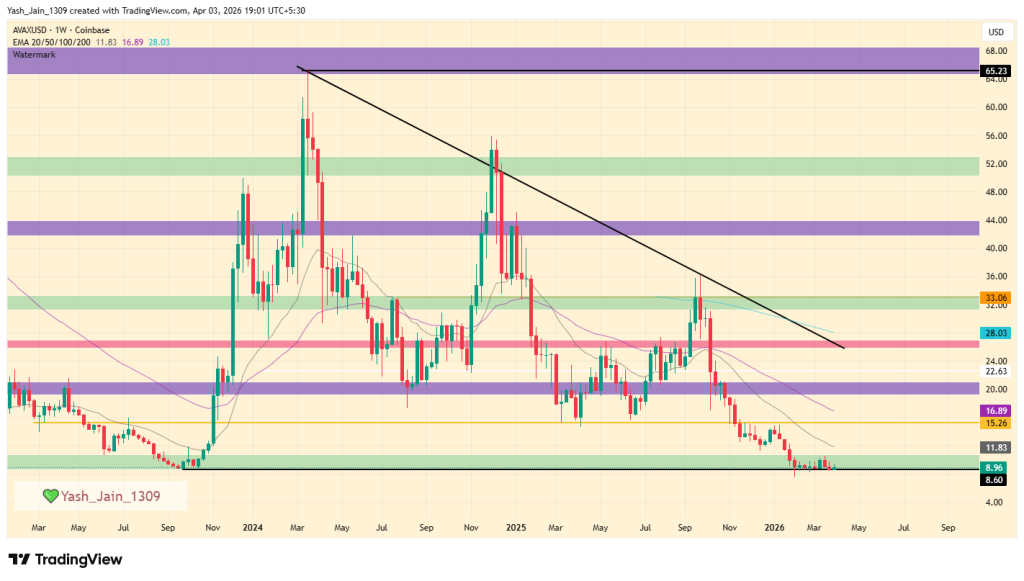
Avalanche price (AVAX) remains confined within a long-standing rectangular consolidation range between $8.60 and $10.50 as it enters the second quarter of 2026. Following a rejection from the $15 resistance level back in January, the price has struggled to generate meaningful bullish momentum, spending the entirety of Q1 oscillating within this tight demand zone. While analysts initially anticipated a recovery earlier in the Q1, but the market has instead chosen to build a base at these lower levels.
As April ongoing so has Q2 2026 and AVAX price is currently hovering near the $8.60 lower boundary of this box. The immediate technical hurdle for the month is the $10.50 upper edge; a decisive breakout above this level is required to shift the bias and open the door for a retest of the $15 psychological resistance.
However, given the persistently low trading volume and current market indecision, failure to clear the $10.50 mark would likely result in continued sideways price action throughout the rest of April as the asset awaits a stronger catalyst.
Avalanche (AVAX) Price Prediction 2026
The weekly price action for Avalanche price (AVAX) has been defined by a multi-year structural decline following its Q1 2024 peak of $65. Throughout 2024 and 2025, the asset remained trapped under a descending resistance line, with bearish momentum intensifying in early 2026. This downward pressure drove AVAX price to a major horizontal support floor between $8.60 and $10.00, marking a critical “base-building” phase as Q1 concluded with a period of low-volatility consolidation.
As Q2 2026 begins, holding this demand zone is essential for any potential reversal. While the price has been stagnant for nearly two years, the prolonged accumulation at these lows suggests that a market bottom may finally be in place. If demand returns in April, the first half of the year could see a recovery rally toward $20, with an ambitious secondary target at the $28 level, which aligns with the 200-week EMA and the long-term descending trendline.
A decisive breakout above this $28 resistance would signal a major trend shift, potentially clearing the path for AVAX to reclaim $44 by the end of 2026. However, investors should remain cautious; if the $28 level repels the price, the recovery could stall, leading to extended consolidation within the lower ranges. The next few months are pivotal to determine whether AVAX/USD can finally emerge from the shadow of its multi-year bear market.
AVAX On-Chain Analysis
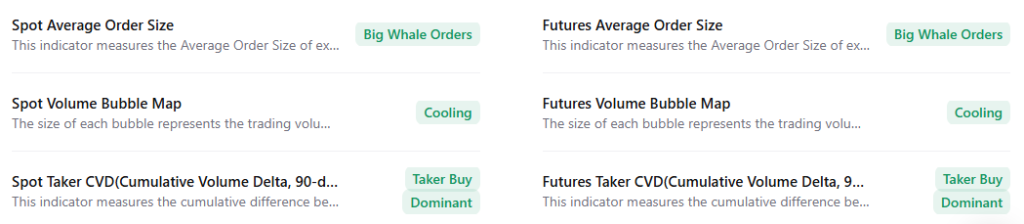
AVAX shows a highly bullish sentiment. Big Whale Orders in both spot and futures indicate strong institutional accumulation. With Taker Buy Dominance at 90 days, aggressive buyers are in control, while the Cooling volume bubble map suggests a healthy consolidation phase. Collectively, major metrics point to a bullish rally ahead.
Avalanche Price Prediction 2026 – 2030
Year
Potential Low ($)
Potential Average ($
Potential High ($)
2026
400
500
600
2027
550
690
820
2028
650
830
980
2029
740
950
1100
2030
820
1000
1200
AAVE Price Forecast 2026
Looking ahead to 2026, AVAX’s potential price is anticipated to rise even further, with a projected low of $20.00 and a high of $80.00. The average price for AVAX in 2026 will likely be $50.00.
AAVE Price Prediction 2027
In 2027, the analysis suggests a continued upward trend in AVAX’s value, with the price potentially ranging between $31.50 and $126.50. Based on the calculated figures, the average price is projected to be approximately $79.00 during this period.
AAVE Prediction 2028
By 2028, AVAX’s price could potentially experience further growth, falling within the range of $50.50 and $202.50. The average price during this period, calculated from the data, is expected to be around $126.50.
AAVE Price Prediction 2029
Moving forward to 2029, AVAX’s price is predicted to ascend between $81.00 and $324.00. The average price during this period is estimated at around $202.50 based on calculated figures.
AAVE Price Prediction 2030
By 2030, AVAX’s price is forecasted to soar between $129.50 and $518.50. Further, the average price during this period, calculated from the data, could stand at $324.00.
Based on the historic market sentiments and trend analysis of the largest cryptocurrency by market capitalization, here are the possible AAVE price targets for the longer time frames.
Year
Potential Low ($)
Potential Average ($)
Potential High ($)
2031
890
1100
1350
2032
920
1200
1500
2033
1100
1350
1780
2040
1600
2200
3000
2050
2600
3300
4500
AAVE Price Prediction: Market Outlook?
Year
2026
2027
2030
Changelly
$500
$750
$1100
DigitalCoinPrice
$480
$680
$1000
WalletInvestor
$520
$650
$1250
Never Miss a Beat in the Crypto World!
Stay ahead with breaking news, expert analysis, and real-time updates on the latest trends in Bitcoin, altcoins, DeFi, NFTs, and more.
FAQs
Is AAVE a good investment for 2026?
AAVE shows long-term growth potential if it breaks key resistance levels. However, price depends on market conditions and DeFi adoption.
What should investors watch before buying AAVE?
Watch support near $135–$150, resistance above $250, overall market trend, and activity within the Aave protocol.
What could drive Avalanche (AVAX) price growth in the coming years?
Key drivers include DeFi expansion, institutional adoption, subnet growth, and overall crypto market recovery cycles.
What is the AVAX price prediction for 2026?
The AVAX price prediction for 2026 suggests a potential range between $400 and $600 if market momentum and network growth remain strong.
What is the AVAX coin price prediction for 2030?
AVAX coin price prediction for 2030 points to a possible range of $820 to $1,200, assuming sustained adoption and favorable market conditions.
What is the Avalanche price prediction for 2040?
Avalanche price prediction for 2040 estimates a broad range between $1,600 and $3,000 if long-term blockchain adoption accelerates globally.
Samsung Research Institute Noida’s Managing Director, Kyungyun Roo, sat down with reporters recently and revealed something the company doesn’t usually broadcast: India shaped some of the Galaxy S26 family’s most practical features.
Most people assume Samsung’s best ideas come from South Korea, but that assumption is wrong.
Backup calling is the clearest example; Indians carry two SIM cards because coverage is patchy and no single operator owns every corner of the country. The SRI Noida team looked at that daily friction and built a solution.
When one SIM drops signal, the feature routes calls through the data service on the second SIM automatically. The team pitched it to Suwon headquarters and got a nod. Now it ships on every Galaxy S26 smartphone worldwide.
Direct Voicemail followed a similar path. Noida team developed it first for the A-series based on direct feedback, then it climbed up to the flagships. Roo was clear about the process: the SRI Noida team worked hand in hand with Suwon to get it done.
Other features with Noida fingerprints include Privacy display, which blocks side-view snooping, Call Screening, which acts as an AI-powered personal assistant to answer, transcribe, and filter incoming calls, and Creative Studio, a one-stop image generation tool built around prompts, sketches, and existing photos.
The Galaxy S26 itself, Samsung’s third AI smartphone, is being manufactured at the Noida plant. So India isn’t just contributing ideas, but also building the physical hardware.
Samsung has slapped a thin border across the cards, toggles, and sliders in One UI 8. It was the first step in adopting the frosted glass design language. This shift improved visibility while keeping the design idea unchanged.
One UI 8.5 marks a major progress in terms of customization. You can remove the cards that you don’t want and create your own. Good Lock’s QuickStar even allows you to tweak the orientation and alignment of sliders.
One UI 9 decouples toggles from sliders
Samsung’s upcoming One UI 9 could take Quick Panel one step ahead by delinking the legacy Dark/Light mode and Sound/Vibrate/Silent toggles from the brightness and sound sliders.
A screenshot posted by TarunVats shows off the Dark/Light mode and Sound tiles separated from the display brightness and speaker sound adjustment sliders.
The firmware has also increased the thickness of sliders. They look different at first glance, but prove more accessible once you get familiar with the updated design.
Samsung fans are divided over the decoupling redesign. Keeping toggles stapled with their respective functions was a wise move, but not everyone wants them to stay stuck.
How do you see this design shift?
One UI 9 is based on Android 17, and an official launch is due in July 2026. Expect the Beta Program for the Galaxy S26 series by May, with sequential expansion to more Galaxy models.
Galaxy S27 Pro is shaping up to be a real thing after Samsung failed to bring the Galaxy S26 Pro this year. The so-called Galaxy S27 Pro version has entered the supply chain discussion, but its arrival isn’t officially confirmed.
Samsung is reportedly making Galaxy S27 Pro equivalent to the Galaxy S27 Ultra. Consumers who want a top-notch experience without Ultra vibes will love buying the Galaxy S27 Pro if the phone progresses as the rumors claim.
Samsung Galaxy S27 Pro Expectations
Galaxy S27 Pro may target the iPhone 17 Pro before Apple brings the iPhone 18 Pro. The Galaxy S27 Ultra may be presented as an alternative to the iPhone 17 Pro Max and iPhone 18 Pro Max, as well as Apple’s Pro iPhones.
Samsung may launch the Galaxy S27 Pro with a 6.8-inch screen. The device may also feature Samsung’s anti-reflective layer along with Privacy display. Screen’s resolution, refresh rate and OLED materials may match Ultra.
In terms of optics, there’s nothing known. What we expect is an Ultra-style camera setup, bringing a 200-megapixel primary, a 50-megapixel ultrawide, a 50-megapixel ALoP telephoto and an upgraded 3x telephoto camera.
If Samsung prefers a triple camera setup, the module should include a 200-megapixel primary, a 50-megapixel ultrawide, and a 50-megapixel ALoP telephoto. The front camera may remain the same as S26s, 12MP sensor.
Galaxy S27 Ultra is rumored to come with variable aperture camera technology.
In terms of performance, Samsung may use Snapdragon 8 Elite Gen 6 processor worldwide. Exynos 2600 is decent and Exynos 2700 will be even better. However, Snapdragon helps Samsung flagships compete with Apple iPhones.
Samsung may use Snapdragon 8 Elite Gen 6 Pro in the Galaxy S27 Ultra.
The Qualcomm chipset could be paired with cutting-edge memory solutions. We may see LPDDR6 RAM, a major upgrade over LPDDR5X. USF 5.0 is also said to be featured in the S27 Pro and S27 Ultra with almost 2x speed.
Samsung may not bring S Pen support to the Galaxy S27 Pro. It will be the biggest thing to differentiate the Pro and Ultra. Meanwhile, the screen could support a stylus, and the Pen can be purchased as an additional accessory.
The Galaxy S27 Pro may pack a 5000mAh battery and support 45W or 60W charging speed. Wireless charging may also match the Ultra version, but built-in Qi2 charging magnets are the real upgrade fans are waiting for.
Galaxy S27 Pro, if it actually happens, could be priced between the Galaxy S27 Plus and Galaxy S27 Ultra. After a price hike over S25 series, the S26 Plus costs $1,099 and the S26 Ultra starts at $1,299 in the United States.
That said, the Galaxy S27 Pro may launch at $1,199 in the US.
Are you excited for the first Pro flagship from Samsung?
Disclaimer: The specs and features written in the post are derived from rumors, leaks, industry chatter, and assumptions. None of the specs or features are confirmed or final; Samsung hasn’t even confirmed the S27 Pro for 2027.
Samsung Galaxy Watch 8 is now being advertised as “free” through T-Mobile. The company’s latest wearable push just got a major carrier boost, but like most telecom deals, the real story sits in the fine print.
The Galaxy Watch 8 is not instantly free on T-Mobile, as most buyers expect. For buyers already planning to add a smartwatch line, this deal makes sense. For everyone else, it is a commitment disguised as a perk.
Here is how the numbers actually work:
Retail price: about $400
You pay that upfront or finance it
T-Mobile refunds that amount via monthly bill credits over 24 months
You must add a Watch Plan Plus line
There is also a $35 connection fee
So, month to month, you are essentially committing to a two-year contract where the watch cost is offset, not waived. The catch is simple: cancel early, and the remaining credits disappear, leaving you to pay the balance.
The real cost is the Watch Plan Plus line. That is the ongoing monthly expense that makes this deal viable for T-Mobile. In other words, the watch becomes “free,” but the connectivity is not.
Galaxy Watch 8 – Key specs and features
Health tracking remains a strong pillar. Sleep reports, workout logs, and sport-specific guidance are all here, making it a practical daily companion rather than just a notification screen.
40mm case with sapphire crystal for durability
1.34-inch display with sharp, readable UI
32GB onboard storage for apps and media
Improved battery with up to a few days in standby
You also get Samsung’s AI-powered assistant baked into the experience, handling quick searches, voice notes, and message drafting without needing your phone nearby.
The second-generation triple-folding Samsung phone, the Galaxy Z TriFold 2, could launch with an improved hinge. Beyond durability, the device may also improve some other aspects over the first-generation product.
As per a Naver source, Samsung is developing an improved hinge for the Galaxy Z TriFold 2. The company is prioritizing lightweight and ultra-slim design. The new hinge may be utilized in other foldable products as well.
The OG TriFold is 12.9mm thick when closed, far thicker than the 8.9mm Fold 7 and 7.9mm S26 Ultra. The device weighs 309 grams, a significant difference from the Z Fold 7 and S26 Ultra, which weigh 215g and 214g, respectively.
Foldable devices rely heavily on the hinge, which supports the entire form factor. Hinge is the component that keeps the screens attached. Folding and unfolding of the smartphone is solely handled by the hinge.
Over the years, Samsung has improved its foldable hinge. As a result, the durability of Galaxy foldables has improved greatly. The last three generations show major improvements, such as folding the phone flat without a gap.
Galaxy Z TriFold folds/unfolds twice, one extra time from regular foldables. To make it happen, Samsung had to use two hinges to attach three panels. It seems the next-gen TriFold may feature a hinge improved by user feedback.
Samsung has released TriFold in limited numbers, with the last restock selling out in the US. There’s very little hope for another restock, and the company may finally shift its focus to the second-generation products.
Samsung is about to phase out LPDDR4 and LPDDR4X RAM products and push the LPDDR5 standard, benefiting future Galaxy phones.
According to supply chain sources (via TheElec), Samsung has effectively pulled the plug on LPDDR4 and LPDDR4X as part of pushing LPDDR5 RAM in next-gen Galaxy phones.
LPDDR4X has been around for nearly a decade; perfect for mid-range phones.
Samsung is not replacing it with something equivalent. It is jumping straight to LPDDR5, and mid-range Galaxy phones are about to inherit flagship-grade memory performance. We are talking about a jump from roughly 4.3Gbps to 6.4Gbps.
Devices like the upcoming Galaxy A17 sit right in the transition window. Early batches could still rely on LPDDR4X if inventory holds, and later units might switch to LPDDR5.
At Samsung’s Hwaseong complex, specifically Line 12, the company is reshaping production priorities. Older memory and even some NAND lines are being phased out or reworked.
The goal is clear: free up capacity for newer DRAM generations that are in higher demand and tighter supply.
For chipmakers and OEMs, this forces a redesign cycle. You cannot keep shipping new silicon tied to LPDDR4X when supply is drying up. That is why players across the ecosystem are already moving toward LPDDR5 and even LPDDR5X support.
Samsung’s Galaxy Z TriFold is now completely sold out in the US, both online and in retail stores, following a final restock on April 10.
What is more telling is how Samsung now frames the device. The company has quietly labeled it a “limited-run” product, a term that only showed up after discontinuation, not at launch.
Galaxy Z TriFold was one of the most ambitious pieces of hardware Samsung’s shipped in years. The device pushed past the familiar book-style foldable and stepped into something closer to a pocket-sized tablet.
The TriFold barely had time to settle into the market before it disappeared. A March discontinuation, followed by a brief US restock in April, and now a full sell-out. That is a lifecycle measured in months, not years.
There is no official confirmation that the TriFold line is dead for good. At the same time, nothing on Samsung’s side suggests a near-term return. Reports of a potential sequel exist, but they sit firmly in early development territory.
If you land on the TriFold page today, you are redirected toward safer bets. The Galaxy Z Fold 7 and Galaxy S26 Ultra are now the recommended paths forward.
If a TriFold 2 shows up, it will not be a continuation. It will be a more calculated second attempt.
Galaxy Z TriFold
The limited-run Galaxy Z TriFold is now completely sold out. Keep visiting samsung.com to make sure you don’t miss upcoming one-of-a-kind innovations, and shop the latest foldables and premium mobile devices now from Samsung Galaxy.
Morpho price didn’t just wake up bullish, it kicked the door open. A sharp 20% intraday surge pushed Morpho price cleanly above the $2.0 resistance, and suddenly, a protocol once quietly building is now sitting in the spotlight with a “DeFi unicorn” badge stamped by France’s Ministry of Finance.
Morpho Declared France’s First DeFi Unicorn Project
Well, this isn’t just another price pump story because of some broader market optimism. But, Morpho has officially been recognized as France’s first DeFi unicorn, a milestone that carries more weight than the usual crypto hype cycle. Even more eyebrow-raising? It’s now the most valuable French startup per employee at $26 million, outpacing even Mistral AI’s $17 million. That kind of efficiency tends to get attention.
@Morpho is now a unicorn – a major announcement at the French Ministry of Finance.
“We are France’s first DeFi unicorn” – @faufleuret
Fun fact: Morpho is now the most valuable French startup per employee ($26M), ahead of Mistral AI ($17M). pic.twitter.com/1tRO8dAKKx
And just as the headlines hit, Morpho doubled down with another move as it is going live on LI.FI Earn. The integration means any app, wallet, or fintech platform can now tap directly into Morpho’s on-chain yield strategies across multiple chains. In simpler terms: accessibility just went mainstream.
But markets don’t care about narratives unless price confirms them. And right now, Morpho price is doing exactly that.
The breakout above $2.0 wasn’t subtle. It came with a 20% intraday move, backed by broader altcoin strength as Bitcoin’s rally continues to lift the market. Momentum is clearly leaning bullish, and if it sticks, the next psychological level sits around $3.0.
Still, nothing moves in a straight line. If price fails to hold above $2.0, a round of profit booking could drag it back down. That level now acts as the line in the sand now lose it, and the breakout starts looking shaky.
Technical Indicators Suggest Bullish Momentum Building Up
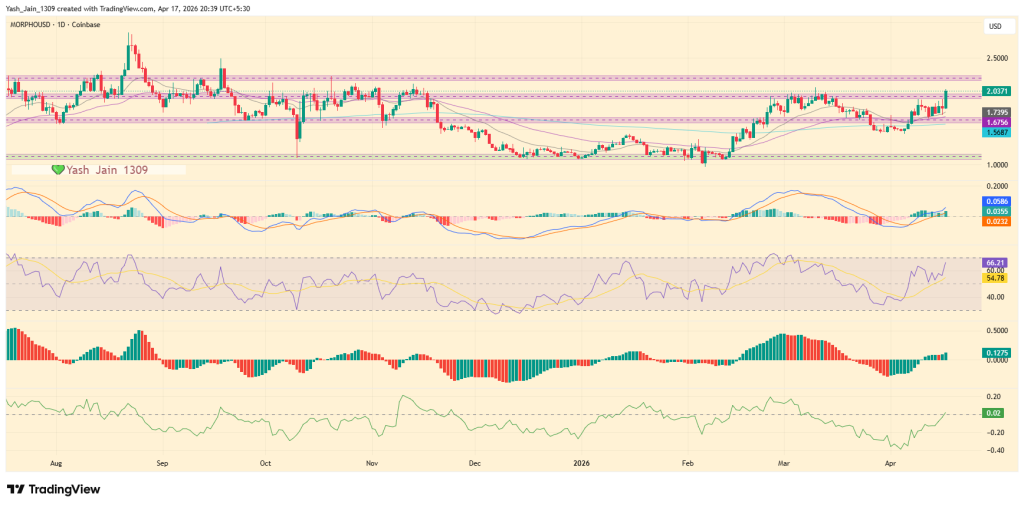
So, what’s under the hood? Surprisingly solid. The CMF has pushed above zero, signaling capital inflows rather than exits. The Awesome Oscillator has just flipped into positive territory, and not in an exhausted way infact it’s early, meaning momentum might just be getting started.
Then there’s MACD, which has crossed above the zero line with a bullish crossover. That’s not noise; that’s structure. And RSI? Sitting at 66. Not overheated, not sleepy but shows that price has just enough room to push higher before things get uncomfortable. Put it all together, and the indicators don’t exactly scream “imminent dump” at least for now.
Macro And Market Risks Still Lurking Beneath
Of course, here’s where reality taps you on the shoulder. This entire setup leans heavily on broader market stability. A sudden geopolitical shift something that’s already been driving volatility in 2026 could flip sentiment fast. And when sentiment flips, altcoins don’t ask questions; they react.
But for now, momentum is intact thanks to open strait of hormuz during the 10-days ceasefire period.
In line with the ceasefire in Lebanon, the passage for all commercial vessels through Strait of Hormuz is declared completely open for the remaining period of ceasefire, on the coordinated route as already announced by Ports and Maritime Organisation of the Islamic Rep. of Iran.
Morpho price has the narrative, the breakout, and the indicators backing it. Whether it holds above $2.0 or not will decide if this is just another spike or the beginning of something a bit more sustained for Morpho price.
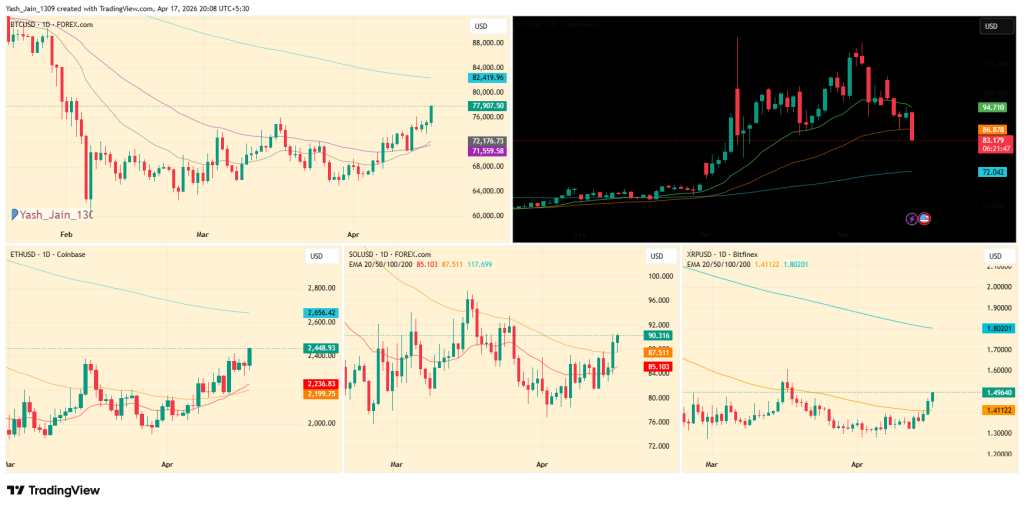
Bitcoin price is back in the spotlight and not quietly either. After weeks of chop and hesitation, the broader crypto market flipped risk-on almost overnight, and suddenly, Bitcoin price is pushing into territory that traders were doubting just days ago.
So what changed? Not the charts alone. This one’s macro-driven.
Middle East Calm Sparks Risk-On Crypto Rally
Well, its a fact that geopolitics blinked first. The announcement that the Strait of Hormuz will remain open during a ceasefire eased one of the biggest overhangs on global markets. Oil traders reacted instantly. WTI crude dropped nearly 10% to $85.90, and just like that, risk appetite came flooding back.
Crypto didn’t hesitate. Lower oil prices typically signal reduced inflationary pressure and less systemic stress. Translation? Investors get comfortable taking on risk again. And crypto, as always, is first in line when that switch flips.
But let’s be real macro alone doesn’t push price unless the chart agrees. Bitcoin price breaking above $76,000 wasn’t just another move; it marked a clean reclaim of a critical resistance level. The asset is now hovering around $76,400, up roughly 3% on the day, and sitting at a 10-week high.
That matters. Because after early 2026 volatility, this kind of structure suggests something more stable is forming. Not euphoric, not parabolic seems like just controlled upside atleast in the shortterm. The kind institutions prefer.
Institutional Demand Quietly Builds Under The Surface
While retail was busy reacting to headlines, institutions kept doing what they do best its accumulating.
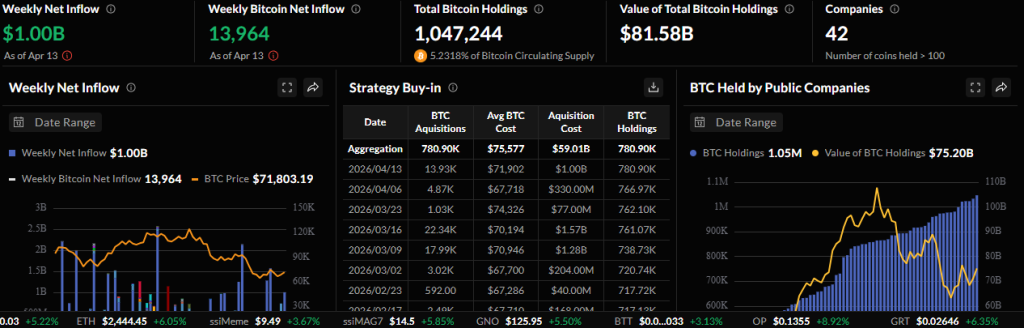
Total institutional Bitcoin holdings have now crossed 1.047 million coins, per soso value data. That’s not noise. That’s positioning.
Even during earlier corrections this month, accumulation didn’t stop. Which tells you something important: this isn’t a reactive market anymore but kinda feels it’s strategic.
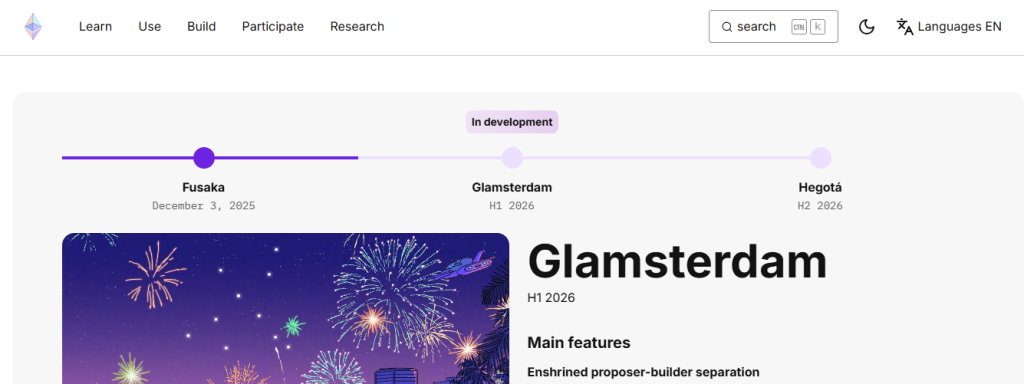
Meanwhile, Ethereum is tagging along at around $2,380 (+2.1%), with growing anticipation around the upcoming “Glamsterdam” upgrade in May 2026. The promise? Throughput scaling up to 10,000 TPS. Whether that delivers or not is another story—but for now, sentiment is clearly leaning bullish.
Altcoins And Market Momentum Add Fuel
So, what’s next? Crypto top dogs like Solana is hovering near $145 and leading in open interest, suggesting traders are leaning heavily into altcoin exposure as well. That’s usually a sign the market isn’t just defensive but it’s expanding risk.
Add to that the timing of major industry events like Paris Blockchain Week wrapping up, and you’ve got a perfect cocktail of narrative, liquidity, and momentum.
– Full on suits – very few degens – Institutional heavy, banking, payment, compliance, taxes, consulting. Many working on infra and some kind of “on-boarding” kits for more businesses to adopt blockchain – more commercial… pic.twitter.com/OrCIfJVU3D
But don’t get too comfortable. Because markets don’t move in straight lines. And while the macro relief has flipped sentiment for now, any reversal in geopolitical tone or oil could just as quickly pull the rug. Still, for the moment, Bitcoin price has the upper hand. And the market? It’s finally acting like it believes it.

 Login
Login





 Have you heard?
 Highstreet: Calamity just dropped into Early Access on Meta Quest
  Jump in now → Download here:

 0.59%
0.59%




 (@Raph_Bloch)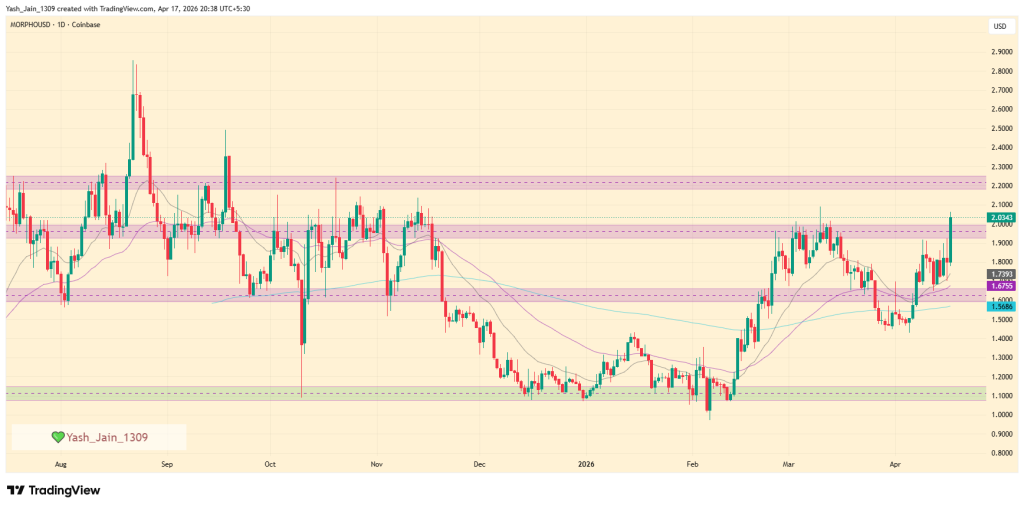

 PBW
PBW  (@AlsieLC)